The land, the people, the invaders, the tragedy (Josh 3; Pentecost 23A)

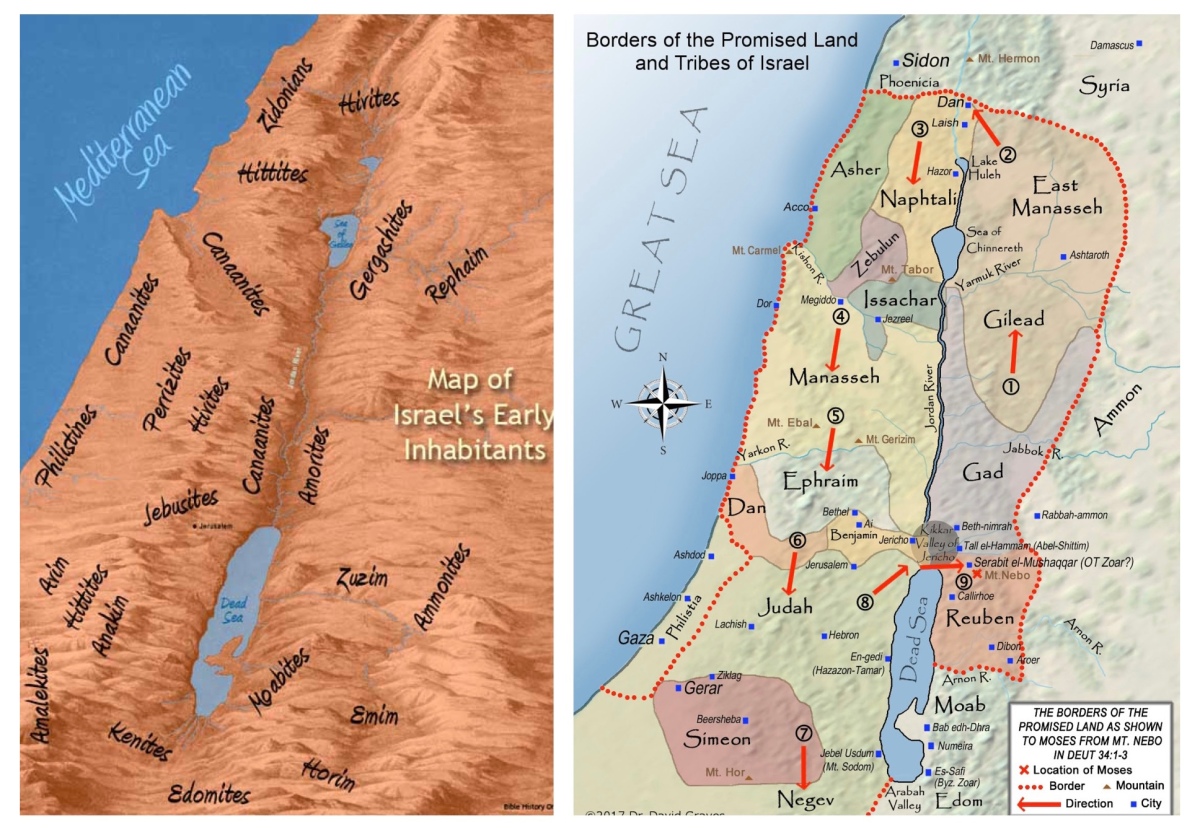
Last week, as the lectionary invited us to hear the closing section of Deuteronomy, we turned our attention to the land that was promised to Moses and the people of Israel. Land, as we know, can be contentious. Land claims often ferment into conflict. Acceptance—or rejection—of First Peoples’ Connection to Country in Australia underlies the current political situation downunder. And contested claims to land in the Middle East, from millennia ago, undergird the current disastrous situation that is unfolding there.

The Hebrew Scripture passage for this coming Sunday, from Joshua 3, continues the focus on land. It tells a part of the larger story of the Conquest of Canaan; the taking of the land by force. This story of the Hebrews entering the land of Canaan, battling the inhabitants and colonising the territory, lies underneath the whole story of Exodus, wilderness, and conquest, which is at the heart of the biblical narrative that accounts for the origins of Israel as a nation.

The story of invasion and conquest is told in all its bloody detail in the book of Joshua. Perhaps because of this, the lectionary offers us very few passages from this book in the three years of the lectionary—and one such occasion occurs this coming Sunday (Pentecost 23A), when we are invited to hear Joshua 3:7–17. There are a number of factors to consider when reading or hearing this passage, or any passage in the book of Joshua, and indeed any section of this long, extended saga of the origins of Israel.

Joshua as history?

The story from Joshua tells, in a highly stylised way, of the entry of the people of God into the promised land. This is a key moment in the extended narrative that stretches from Genesis to 1 Kings, recounting stories of the ancestors, a time of slavery in Egypt, the redemptive moment of Exodus, the giving of the Law, the long haul of wilderness wanderings, the battles waged to capture the land under the Judges, and the ultimate vindication of the establishment of the kingdom of Israel under King David.

Of course, it didn’t actually happen like this. For one thing, the book of Joshua is almost universally considered to be a wonderfully embellished and highly stylised narrative constructed by the priests in the sixth century BCE, as they prepared to lead the exiled people of Israel in their return to the land from which they had been removed. So it is an account from many centuries after the events that it purportedly recounts.
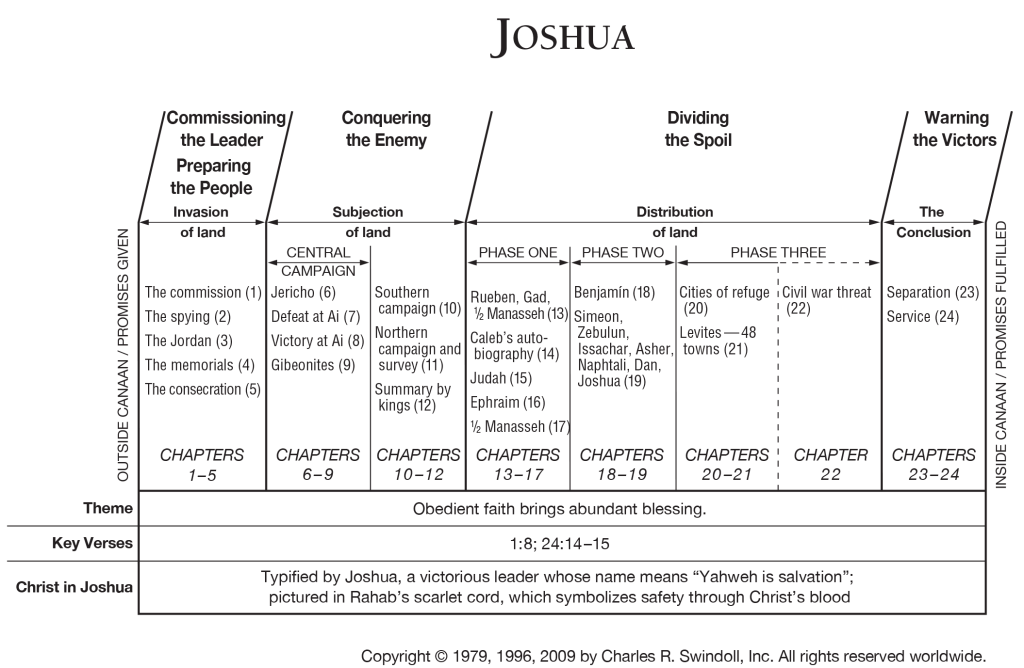
The book as a whole is marked by the schematic structuring that was so characteristic of priestly narratives. Structure and order was central to the priestly mindset and is evident in their literary style. We might note how Gen 1:1—2:3 is carefully structured, and observe the structure of the whole book of Numbers, as well as the whole book of Joshua; and we can also note the repeated formulaic assessment of various kings in 1 Ki 11:6, 11:19, 14:22, 15:5, 15:11, 15:26, 15:34, 16:7, etc.

For another thing, we know that the division of Israel into the twelve tribes (3:12), so important in the story that the priests of Israel tell about the nation, was a later ideological construction of the priestly story-tellers. As far as we know, there were no neatly schematised tribes at the time of this incident.

And, of course, the whole story of Exodus, liberation, wilderness and conquest, is beset by multiple historical problems. There is no evidence in the records of the Egyptians about the escape of a large crowd of slaves, not any record of the destruction of the Egyptian Army in the Red Sea. There are no remains in the wilderness between Egypt and Israel that suggest that such a large crowd was travelling, for many years, through the desert—no remains of campsites, no graves of deceased people have ever been found. And there is no archaeological evidence that correlates with the biblical record of the capture of Jericho and other cities in the land. All we have is the story told in the Bible.

The form of the story we have was written down quite some centuries from when the event is alleged to have taken place. It serves an ideological purpose, as the exiled people prepare to return to the land. As the 5th century exiles enter the land, the story of the wandering tribes entering the land from centuries before provides encouragement and inspiration.

So it is not the historical reliability of this incident itself that is to the fore as the story is told. What we, in the post-Enlightenment era, understand to be “history”, is very different from the way that “history” was understood in the time when the story was written.

Joshua as saga

Rather than history, the narrative offers us a saga that invites us into a creative, thoughtful pondering of the story. It offers the people of Israel, exiles returning from Babylon, hope and assurance for their future. The best question we can ask of this story, is not, “did this actually happen?”, but rather, “what does this story offer to us, today?”

Central in the story is the ark of the covenant. The story tells of the time at Mount Sinai when God established a covenant with Moses and Israel, and the giving of the Law within that covenant relationship. The ark is a sign of the presence of God, continuing on with the people of Israel beyond Mount Sinai (Exod 25:10–22). God is not an absentee God, but very present amongst the people. The ark symbolises and reinforces that message.
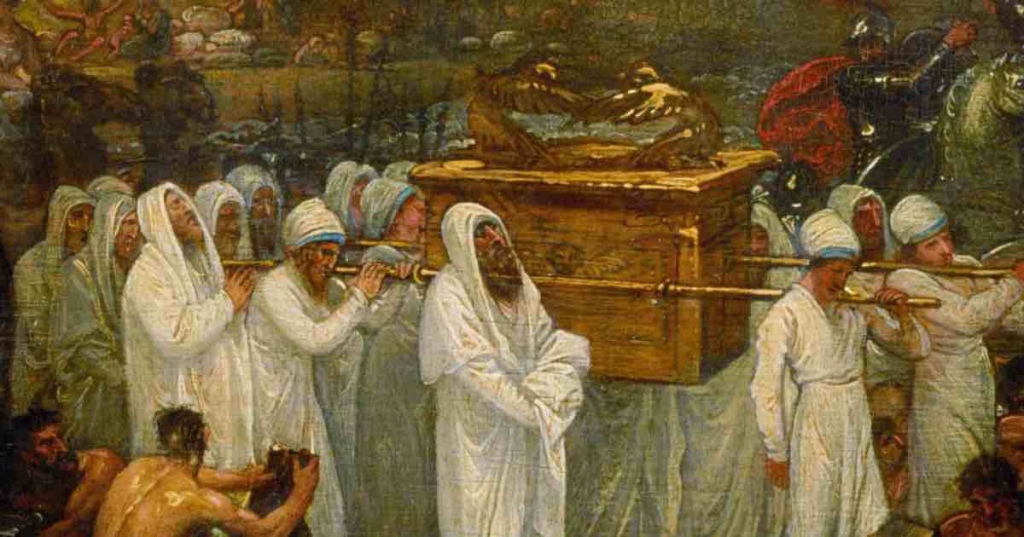
Levites carrying the ark of the covenant

The priests serve to mediate the presence of God. They carry the ark of the covenant, maintaining it, ensuring that it remains safe (Deut 10:8; 31:9, 25–26; Josh 3:3, 6, 8, 13). The story offers an indication that holy people are necessities in life; their mediation of the divine in the midst of the mundane is important. (As an ordained person, I confess that I have a vested interest in this claim!) As the priests shape the story, they make sure that priests play a central role in what is narrated.

Joshua as testimony to faith

The story contains a memorable description of God as “the living God” (3:10). The phrase appears elsewhere in a Hebrew Scriptures (Deut 5:26, 1 Sam 17:26, 36, 2 Kings 19:4, 16, Ps 42:2, 84:2, Isa 37:4,17, Jer 10:10, 23:36, Dan 6:20, 26, Hos 1:10) and also in the New Testament (Matt 16:16, 26:63, Acts 14:15, Rom 9:26, 2 Cor 3:3, 6:16, 1 Thess 1:9, 1 Tim 3:15, 4:10, Heb 3:13, 4:12, 9:14, 10:31, 12:22, Rev 7:2). The ark is a sign that this living God is present, active and engaged in the lives of the people.

A striking event demonstrates this: as the priests stand in the river, the waters stand still (3:16), and so the people are able to cross the river and enter the land. Of course, later on in Joshua, another miraculous event takes place, as the sun stands still (10:13). These were not actual events, but symbolic of divine intervention. The waters standing still evokes the moment in the Exodus story when the waters of the Sea of Reeds parted to allow the Israelites to pass through (Exod 14:21–22, 29).

We might well compare the New Testament story of the earthquake and resurrection of the saints (found only in Matt 27) after the resurrection of Jesus. This, too, was not an historical event; it was a dramatic tale told to underline that God was active in the story.

The key aspect of the story of the escape from Egypt, as the story is found in Exodus 14—15, is the connection with the Feast of the Passover. The story that is attached to the Exodus actually serves a liturgical purpose; the priests have developed the story to reinforce and highlight the way that God was able to redeem the people—as in the story, so in the experience of the returning exiles.

Likewise, the key aspect of this story of the entry into the land, in Joshua 3, is not the actual physical wading across the river, but the assurance of faith that comes from the telling of the story of entering the land. God is not only the redeemer, who delivers the people into freedom, but the one who delivers the land to the people. The promise of the gift of land, first made to Abraham (Gen 12:1, 15:7, 17:8), then reiterated to Jacob (Gen 28:4,13, 35:12) and again to Moses (Exod 3:8,17, 6:4,8, 12:25, 13:5,11), is now coming to fulfilment.

Joshua as military victory

Indeed, the crossing of the river itself points to the symbolism that this story contributes to the overarching narrative. Leaving Egypt, the Lord God parts the waters, the people pass through, the army is bogged and drowned, and their escape from Egypt is secure. Entering Canaan, the Lord God once again stops the flow of the waters, the priests who carried the ark of the covenant enable the people to cross the river and enter the land, and their hold on the land is made secure. Josh 4:19–24 draws this comparison quite explicitly.
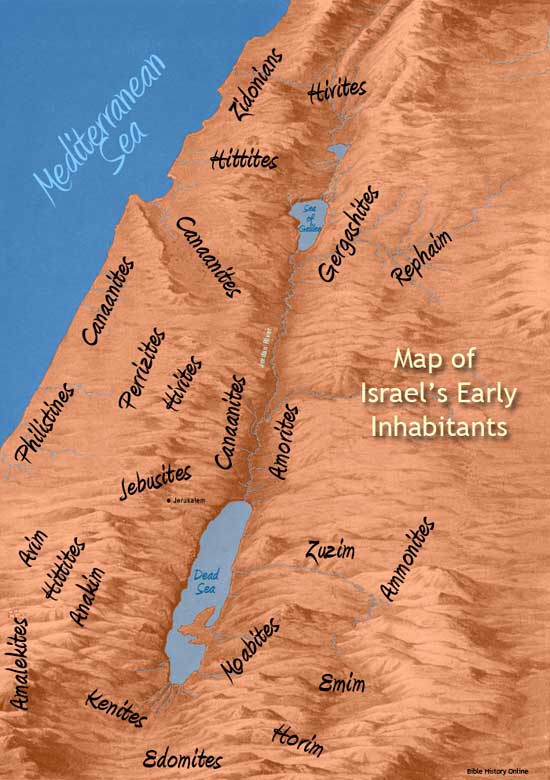
The parallel continues in the strong militaristic element, found in the list of the peoples whom “the living God who without fail will drive out from before you”. The text specifies “the Canaanites, Hittites, Hivites, Perizzites, Girgashites, Amorites, and Jebusites” (3:10). Even before the battles are waged, the victories have been declared. This also provides a neat bookend: the army of Egypt is crushed in Exodus 15, the inhabitants of the land are subdued and defeated in Joshua 3.

What follows on from this story of entering the land is a highly schematic presentation of the military conquest of the land, in the rest of the book of Joshua. The invaders take the key areas in turn: first the Central area (chs. 6—8), then the Southern regions (chs. 9—10) followed by the Northern areas (ch 11). Chapter 12 then provides a summary of the conquest, listing “the kings of the lands whom the Israelites defeated”—a kind of victor’s gloating, “thirty-one kings in all” (Josh 3:24).

The story of taking control of the land is then followed by a parallel schematic account of the allotment of the land to each of the tribes. The Transjordan (the land to the east of the Jordan River) is allotted in ch. 13; the Central regions in chs. 14—17; and then the peripheral regions to the north and south in chs. 18—19. Chapter 20 details the allocation of the five “cities of refuge”, whilst chapter 21 identifies the forty-eight towns which were allotted to the tribe of Levi, from which the priests came.

None of these are historical accounts. The schematic ordering carries symbolic weight, rather than being an historical account. Indeed, the twelve tribes of Israel were a later construction by the compiler of the narrative, rather than being an actual organisational principle at the time of any such conquest.

And even as the list of conquered peoples are identified, the savagery of this glorious moment is revealed. The memorial stones provide a reminder of the event (Josh 4:1–10), a reminder of the power of the invading force as they colonise the settled inhabitants of the land. We hear the story from the perspective of the victorious invaders—the people of Israel. The dispossession and death of so many Canaanites is simply “collateral damage” in this process.

Joshua and Israel, Britain and Australia, and the Indigenous perspective

This is a story of land, invasion, massacre, colonisation, and victory. It is an ancient story which resonates strongly with the experience of Indigenous peoples in the modern era of history. Time and time again, from late medieval times onwards, “explorers” set out from Western powers, “discovered” new lands, followed by “settlers” who came and established “civilisation”, most often by means of “subduing” the indigenous peoples, making them subservient to the “new order”—and even, in many instances, punishing those who resisted their new ways, even utilising means of killing the Indigenous peoples.

This is the dynamic of the story of “Israel entering the promised land” which is told in Joshua, as well as the story of “establishing British civilisation in the land of Australia” which is the story of the continent on which I live. It is a story of many other places, also, around t,he world today. The imposition of a new way of living by a more powerful force, the subjugation of those who already were living in the land, and the use of violence and murder to ensure that the new order was maintained and could flourish—all of this is in the history of Australia since 1788.

The story of invasion and settlement, defeat and decline, resonates with the contemporary Australian experience of the indigenous peoples of the continent and its islands. Which gives us pause for thought: how, then, do we hear and understand that story recounted in Joshua?

See also

and for my perspective on the way that biblical literalism has fed into the modern conflict over the land of Israel/Palestine, see
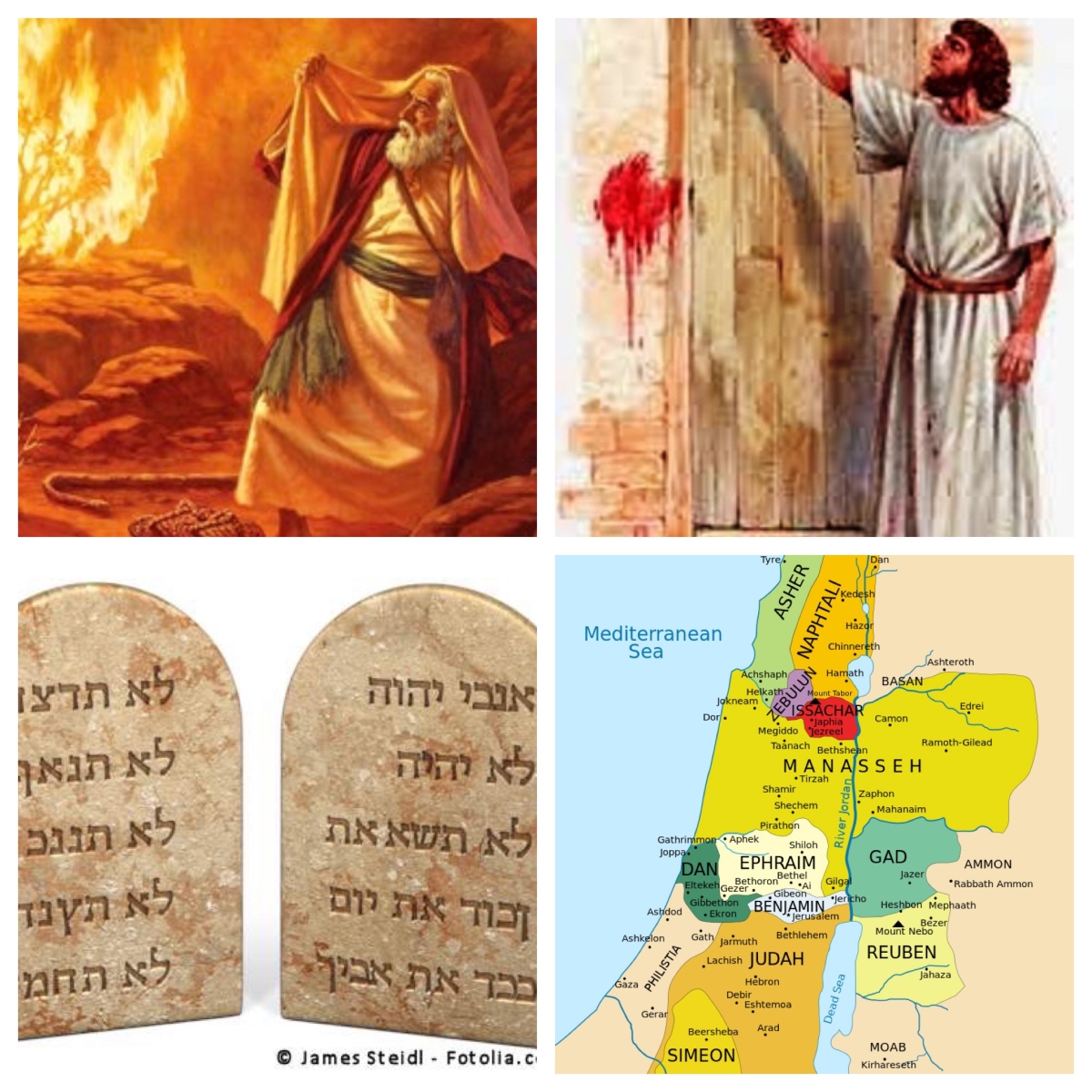
Never since has there arisen a prophet like Moses (Pentecost 13A to 22A)

Over the past ten weeks, we have heard and thought about various moments in the story of Moses, the reluctant prophet who came to stand tall in the stories told about the origins of Israel—Moses, the infant who was rescued by Egyptian women; Moses, who was called by God to lead his people to freedom; Moses, who received the Torah from God; Moses, who led the people through the wilderness for forty years;

Moses, who saw the promised land but died before he was able to enter that land. As the writer of Deuteronomy states, “never since has there arisen a prophet in Israel like Moses, whom the Lord knew face to face” (Deut 34:10). Here are the blog posts I have made about this extended story of Moses and the Israelites.

The problem of Canaan: conquering, colonising, massacring (Deut 34; Pentecost 22A)

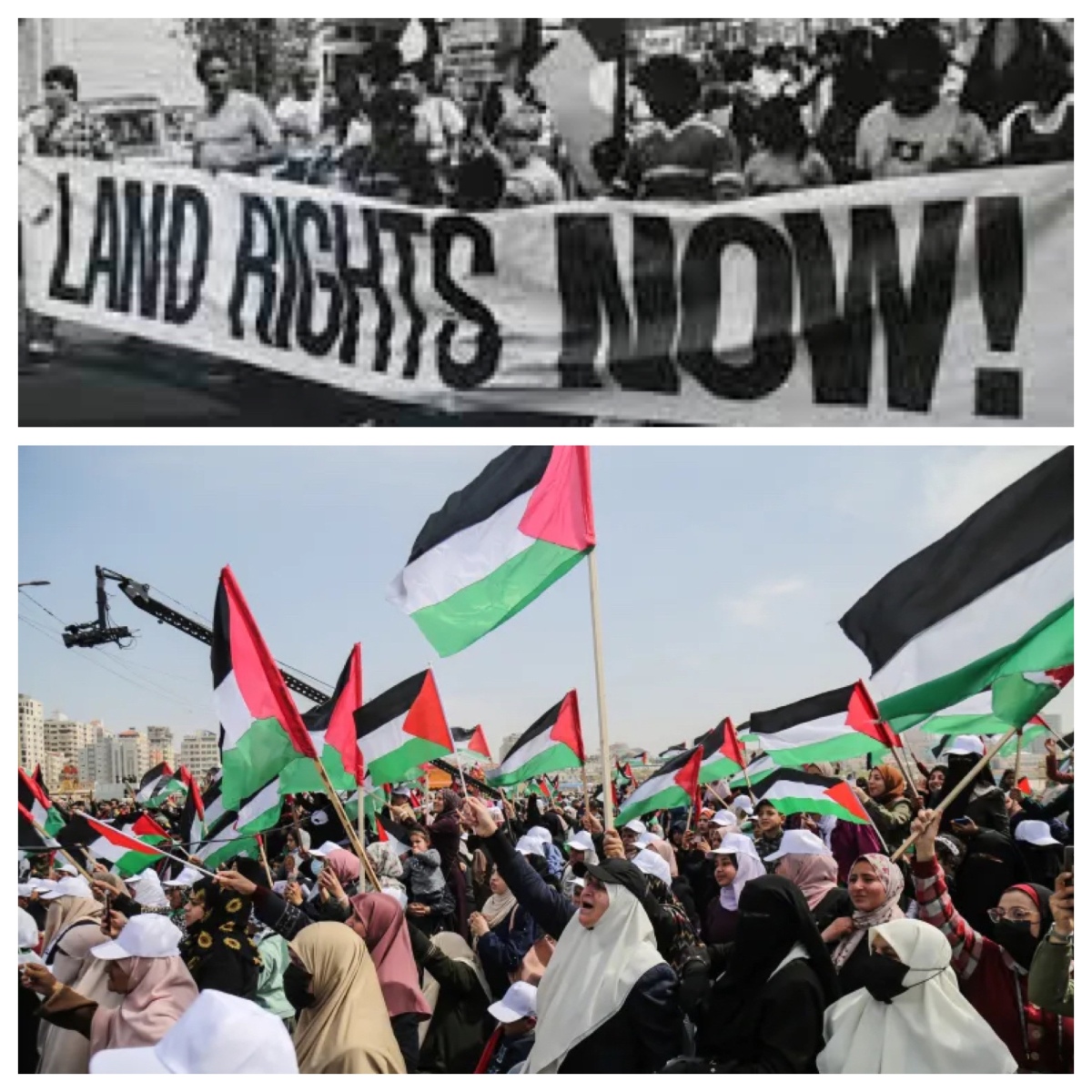
Land rights. Land claims. Land has always been a bone of contention-in the past, as in the present. This week, the lectionary invites us to consider land. The Hebrew Scripture passage contains an important statement about land a land claim, as it were.

“This is the land of which I swore to Abraham, to Isaac, and to Jacob”, God declares to Moses in the last moments of his life (Deut 34:4), as he stands on Mount Nebo, surveying “the whole land: Gilead as far as Dan, all Naphtali, the land of Ephraim and Manasseh, all the land of Judah as far as the Western Sea, the Negeb, and the Plain- that is, the valley of Jericho, the city of palm trees as far as Zohar” (Deut 34:1–3).

That land encompassed all the land of Canaan, which later becomes the land of Israel. It is the land which was in contention between different peoples long before the story of Moses was written on the scroll that became part of Torah.

That was most likely sometime before or during the period that Josiah ruled as king of Judah, when he commanded the high priest Hilkiah to undertake an audit of funds in the temple. We are told that, in the course of this audit, Hilkiah said to Shaphan his secretary, “I have found the book of the law in the house of the Lord” (2 Ki 22:8). That’s presumed to be the first version of what we know as Deuteronomy, which later found its place as the fifth of “the five Books of Moses”.

That same land, promised to Abraham, claimed by Moses, is in contention today. It has had a chequered history. The ancient land of Canaan eventually became the land of Israel, then (along with Judaea) part of the Roman province of Syria Palaestina (132–390), and then of the Diocese of the East in the Roman Empire (to 536). What followed the fall of the Roman Empire was a millennium and a half of Muslim rule of this land, first as a part of Bilad al-Sham, the Greater Syria region, under various Caliphates.

The region continued to be part of various organisational configurations under successive Muslim rule, on into the Ottoman Caliphate (from 1517) and then into the modern era. (I am not an expert, by any means, of this ancient and medieval history; for this summary, I am dependent on what I read in what I consider to be reputable sources.)

In the early 20th century, the place where Arabs identifying as Palestinians lived was decreed to be the British Mandate of Palestine (1920–1948). The ancient conflicts, it was hoped, would be well in the past. A place for Palestinians in the modern world was, it was thought, now settled.

But this was not to be, as we well know today.

In part in response to the horrors of the Shoah, exposed by the ending of World War Two, the modern state of Israel was created in 1948. The new nation took 78% of the area which had been provided for Palestinians in the British Mandate. That this was now Jewish territory was a blessing for Jews, but it was a huge irritant to Palestinian sensibilities, which has referred to the period from 1948 onwards as the Nakba, the Palestinian Catastrophe. In the early years of the Nakba, significant number of Palestinians fled the area declared as Israel, as (in one estimate) over 500 Palestinian villages were repopulated by Jews, becoming refugees with no national identity.

The contested regions of the Gaza Strip (along the east coastline of the Mediterranean Sea) and the West Bank (land immediately to the west of the River Iordan) became known as “the Palestinian Territories”.

Another irritant has been the fact that they have been occupied by Israel since the Six-Day War of 1967, and subsequent expansion of Israeli settlements into areas where Palestinians live has exacerbated the situation. And so those who were dispossessed become the dispossessors of others, and the cycle continues.

So when we hear, this coming Sunday, “This is the land of which I swore to Abraham, to Isaac, and to Jacob”, we can be sure that we know these territories; we know the conflicted situation in the modern era; and we know how the ancient texts describe and lay claim to Israelite “ownership” of the land.

When Abraham left his homeland to settle in Canaan (Gen 13:12) and when the Lord God later formalised a covenant with Abraham (then aged 99 years, we are told), the promise was made by God that “I will give to you, and to your offspring after you, the land where you are now an alien, all the land of Canaan, for a perpetual holding” (Gen 17:8).

That same phrase, “a perpetual holding”, is subsequently spoken by Jacob, as he tells Joseph, Manasseh and Ephraim of God’s words, “I am going to make you fruitful and increase your numbers; I will make of you a company of peoples, and will give this land to your offspring after you for a perpetual holding” (Gen 48:4).

That land, Canaan, is a problem that sits at the heart of the story that the Bible recounts in its early narrative books. It becomes a problem at the heart of life for the millions living in that region today, as I have outlined above. The biblical narrative tells of numerous battles leading to the defeat of many tribes: the Moabites (Judg 3:26–30) and the Ammonites to the east Judg 10:6–11:33), as well as “the Hittites, the Girgashites, the Amorites, the Canaanites, the Perizzites, the Hivites, and the Jebusites, seven nations mightier and more numerous than you” in the land (Deut 7:1; see also Josh 3:10; 12:8; 24:11), and also the Anakim (Josh 11:21–23).

Further, as recent events in Australia have powerfully reminded us, there is a problem right at the heart of the narrative that has been constructed about modern Australia. Our most recent failure even to accept a modest proposal to recognise the existence of First Peoples on the continent prior to 1788, is testimony to that problem. Although the First People of Australia were not completely destroyed and eliminated, they continue to be discriminated against in a multitude of ways.

Both the ancient Israelite narrative and the contemporar Australian narrative tell a story of a group of people who invade, conquer, massacre, colonise, settle, marginalise, and then claim as their own what had previously belonged to others who had long been there before them.

It’s a story, in both instances, that we need to hear, understand, and appreciate. We need to develop awareness of just how easily we adopt the victor’s point of view, and uncritically retell it, without thinking any more about the pain, hurt, anguish, and generations-long damage that was done, in each case.

That is hard to do. I am a white Australian, raised on the myths of the great Australian character, taught from my schooldays onwards about the glories of the British Empire and the values of western society. Understanding the situation of First Peoples in Australia takes time, focus, empathy, energy, and persistence.

And I am a Christian, raised on the stories of the Bible, taught from Sunday School onwards about the promises God made to the chosen people about the holy land that had been selected for them. Getting into the mindset of a people from so long ago, who have almost (but not quite) been written out of the story, is hard to do.

The story of the Hebrews entering the land of Canaan, battling the inhabitants and colonising the territory, lies underneath the whole story of Exodus, wilderness, and conquest, which is at the heart of the biblical narrative that accounts for the origins of Israel as a nation.

A specific set of stories which tell of that invasion and conquest is found in all its bloody detail in the book of Joshua. That book tells, in a highly stylised way, of the entry of the people of God into the promised land. It is a key incident in the extended narrative history that stretches from Genesis to 1 Kings, from slavery in Egypt, through the long haul of wilderness wanderings, to the establishment of the kingdom of Israel under King David.

That story has multiple historical problems, and needs to be understood as a mythological saga telling of the nature and identity of the people, rather than an accurate historical account of “what actually took place”. See

Invasion and colonisation, Joshua 3 and contemporary Australia (Pentecost 23A)

This ancient story of invasion, conquering, massacre, colonisation, settlement, marginalisation, and then the claiming as their own what had previously belonged to others, resonates strongly with the experience of indigenous peoples in so many places in the modern era of history-including, and especially, in Australia.

Time and time again, from late medieval times onwards, “explorers” set out from Western powers, “discovered” new lands, followed by “settlers” who came and established “civilisation”, most often by means of “subduing” the indigenous peoples, making them subservient to the “new order” and even, in many instances, punishing those who resisted their new ways, utilising various means of killing the indigenous peoples.

This is the dynamic at the heart of the story of “Israel entering the promised land” which is told in Ioshua. It is also at the heart of the story of “establishing British civilisation in the land of Australia” which is the story of the continent on which I live the land now called Australia. The imposition of a new way of living by a more powerful force, the subjugation of those who already were living in the land, and the use of violence and murder to ensure that the new order was maintained and could flourish all of this is in the history of Australia since 1788.

The story of invasion and settlement of Canaan, the defeat and decline of the various indigenous peoples of that land, resonates with the contemporary Australian experience of the indigenous peoples of the continent and its islands. Which gives us pause for thought: how, then, do we hear and understand that story recounted in Joshua, which is prefigured in this final chapter of Deuteronomy? What land claims do we accept from this ancient text? And how does that guide us, today, as we consider the land claims that are being made?

See also my discussion of the wav that biblical literalism has fed into the modern conflict over this land at

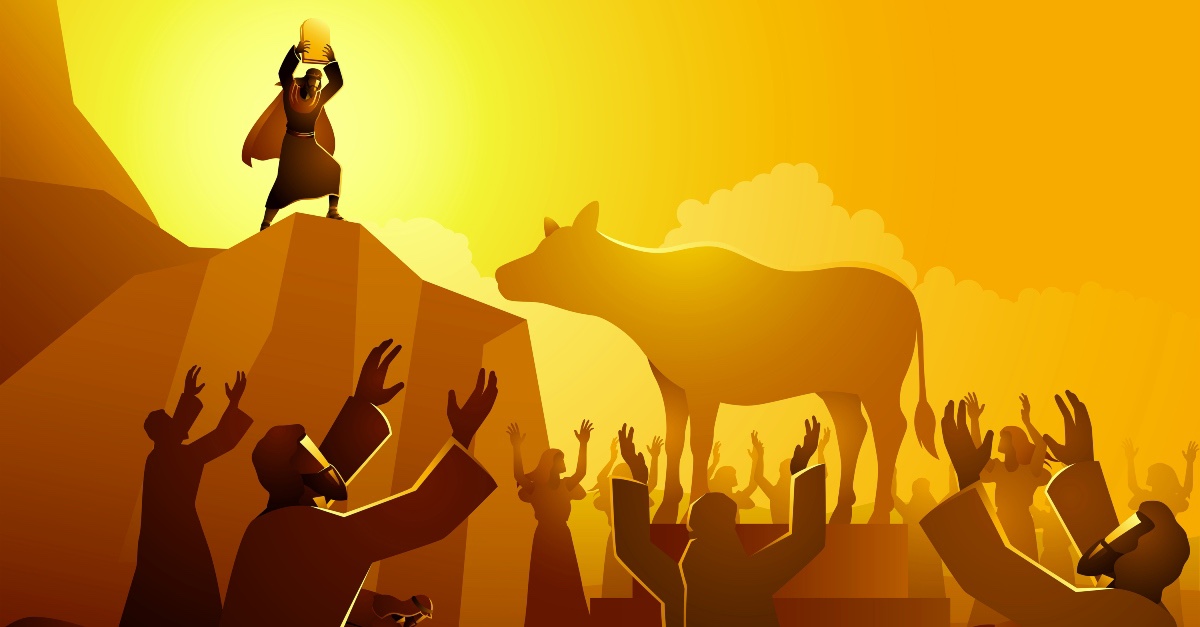
The Golden Bull (Exod 32 and Psalm 106; Pentecost 20A)

The psalm which is offered for this coming Sunday (an excerpt from Psalm 106) was surely chosen to complement the reading from Exodus offered by the lectionary. The first cluster of verses from this psalm (Ps 106:1–6) invite us to praise the Lord, for God’s “steadfast love endures forever” (v.1). The Lord is one who is able to show favour to people, to deliver them, and to grant prosperity to “his chosen ones” (vv.4–5).

The final verse of this selection offers a contrast, noting that “both we and our ancestors have sinned; we have committed iniquity, have done wickedly” (v.6), before the second selection of verses (vv.19–23) recounts the famous episode of sinful behaviour by Israel, known popularly as “the Golden Calf episode”—which is what is told in the narrative of Exodus 32, the Hebrew Scripture reading for this coming Sunday (Exod 32:1–14).

This story most likely relates to the god who was regarded as the head of the gods amongst the Canaanites—El, who was often depicted as a bull. The bull was the strongest animal in the ancient farmyard, and thus a fitting symbol for a powerful god. The Israelites chose to imitate that god through their golden construction. The story told in Exodus 32 and summarised in Ps 106:19–23 mocks the Canaanite god, depicting him as more like a calf.

By adopting a Canaanite symbol, the Israelites had turned from God (v.21). It seems they would deserve their fate—although Moses interceded and saved them from divine wrath (v.23). Moses is the hero who stands in the breach, to convince God to change God’s mind. This is a difficult statement, worth pondering further. What sort of god wishes to wreak savage wrath on people? And also, what kind of god is one who changes their mind in response to human petition? Both aspects challenge elements of classic theological understandings of God.

The language of the wrath of God “burning hot” (vv.10, 11, 22) resonates with the constant prophetic warning that God will use fire to destroy people and places because of their sinfulness (Isa 1:7; 5:24; 30:27–28, 30, 33 18–19; Jer 4:4; 6:27–30; 20:47–48; Hos 8:14; Joel 2:1–3; Amos 1:4—2:5; Nah 1:15). Zephaniah portrays utter devastation through divine judgement: “neither their silver nor their gold will be able to save them on the day of the Lord’s wrath; in the fire of his passion the whole earth shall be consumed” (Zeph 1:18). That is an intense fire indeed!

However, the final prophet in the Christian Old Testament, Malachi, reworks this imagery, offering some hope; God’s messenger on The Day of the Lord “is like a refiner’s fire and like fullers’ soap; he will sit as a refiner and purifier of silver, and he will purify the descendants of Levi and refine them like gold and silver, until they present offerings to the Lord in righteousness” (Mal 3:1–4).

The references to good and silver in these prophetic oracles sits interestingly in juxtaposition to the Exodus story, in which Aaron “took the gold [from the ears of the people], formed it in a mold, and cast an image of a calf” (Exod 32:4), before he “built an altar before it” and proclaimed, “Tomorrow shall be a festival to the Lord” (v.5).

So the people gladly “offered burnt offerings and brought sacrifices of well-being” on that altar. The burnt offerings mimick the daily burnt offerings (Exod 29:42), where the Lord God promises “I will meet with you, to speak to you there; I will meet with the Israelites there, and it shall be sanctified by my glory” (Exod 29:42–43). The sacrifices of well-being recall “the burnt offerings and sacrificed oxen as offerings of well-being to the Lord” made during the ceremony to ratify the covenant (Exod 24:5).

The people, under the leadership of Aaron, are deliberately imitating key components of the worship of the Lord God, but in this instance, they are worshipping an idol made with their own hands—in direct disobedience to the commandment “not [to] make for yourself an idol, whether in the form of anything that is in heaven above, or that is on the earth beneath, or that is in the water under the earth” (Exod 20:4).

And so, having offered their sacrifices, “the people sat down to eat and drink, and rose up to revel” (v.6). But not so God, for as he had warned the people, “I the Lord your God am a jealous God, punishing children for the iniquity of parents, to the third and the fourth generation of those who reject me” (Exod 20:5). God will not let this transgression pass; as he says to Moses, “I have seen this people, how stiff-necked they are; now let me alone, so that my wrath may burn hot against them and I may consume them” (Exod 32:10).

A number of psalms reflect the desire for God to punish evildoers severely; “pour out your indignation upon them, and let your burning anger overtake them” is the cry of one psalm (Ps 69:24). Another psalm notes the vengeance of God—“in your hearts you devise wrongs; your hands deal out violence on earth” (Ps 58:2)—and suggests that “the righteous will rejoice when they see vengeance done; they will bathe their feet in the blood of the wicked” (Ps 58:10). The graphic picture of a furious God intent on wreaking damage raises difficult theological questions for us as we read such passages.

The image of fiery punishment comes from the story of Daniel (Dan 3:1–30) and appears again in the last book of the New Testament, where the prophet describes his visions of “the lake of fire that burns with sulfur” (Rev 19:20; 20:10, 14–15), also described as “the second death” (Rev 20:14; 21:8). It is there that the devil, the beast, and the false prophet “will be tormented day and night forever and ever” (Rev 20:10).

In the Gospel of Matthew, in particular, eternal punishment in a fiery furnace features also in the words of Jesus, as he threatens sinners with “the furnace of fire” (Matt 13:43, 50; 25:41), a place of “eternal fire” (Matt 18:8; 25:41), “the hell of fire” (Matt 5:22; 18:9). This builds on the warnings found in Mark’s Gospel about the punishment in store for those who put stumbling blocks in the way of “these little ones”—they will be condemned to “the unquenchable fire” (Mark 9:42–48). These warnings are repeated by Jesus in Matt 18:6–9.

So Jesus follows the prophetic and narrative insistence, in Hebrew Scripture, on the judgement of God being rightly expressed when sinfulness abounds. And the story of Aaron and the golden calf is a clear demonstration of God’s intent to exact punishment.

*****

But the story takes a turn, when Moses mounts a passionate plea to God, asking for the divine fury to be turned away from the sinful people. Invoking the covenant made with Abraham, Isaac, and Jacob, Moses implores, “turn from your fierce wrath; change your mind and do not bring disaster on your people” (Exod 32:12–13).

In this week’s commentaries in With Love to the World, my friend Jione Havea has offered an incisive insight into this story as recounted in Exodus 32. He writes as follows:

The plot is straightforward: Israel complained to Aaron that Moses has disappeared for too long, Aaron organized a golden calf as their God, the Lord became angry and decided to wipe Israel off, Moses appealed for Israel’s sake, and “the Lord changed his mind about the disaster that he planned to bring on his people” (32:14). The Lord reconsidered, and changed their mind.

Previously, in Exodus 2:23–25, God had changed their mind and re-membered the covenant with Abraham, Isaac, and Jacob. In that instance, God responded to the groans and cries of the people. There is a comparable event in Nineveh: “When God saw what they did, how they turned from their evil ways, God changed his mind about the calamity that he had said he would bring upon them” (Jonah 3:10).

In the case of Nineveh, the people changed God’s mind on the basis of their own actions (Jonah 3:5) and agenda (Jonah 3:9); in the golden calf episode, Moses interceded on behalf of Israel. The story line is the same: God changed their mind. Change of mind (read: repentance) is not evidence of weakness in the character of God. Rather, it is evidence of being present, and of honouring the Tongan quality of va (relationship) over against immutable doctrines. We are called to do likewise.

And so, in the story, as he saw the golden calf at base camp, Moses burned in anger—because of the people, and because his own brother Aaron played a key role in their going astray. He was so angry that he broke the tablets of the covenant that the Lord godself wrote. The Lord repented (v.14) but Moses revenged (vv.19–20). He burned and grounded the golden calf into water, and made the people drink it. And he ordered the sons of Levi to kill people—whether “your brother, your friend, and[or] your neighbour”—who were NOT on the Lord’s side (v.27).

The Lord changed their mind—but to the opposite effect. This time, the Lord decided to blot out the people who sinned against the Lord (v.33). Because of the golden calf sinners, the Lord sent a plague (v.35). This time, divine repentance led to destruction—echoing the divine repentance that led to the flood (see Gen 6:5–7).

These stories show that the Lord’s book may have been written (cf. Exod 32:33), but it has not been closed. The Lord may still change their mind, and there is no guarantee that it will be for the reparation of covenant or for the destruction of people. Caveat emptor.

Ten things about the Ten Words (Exod 20; Pentecost 19A)

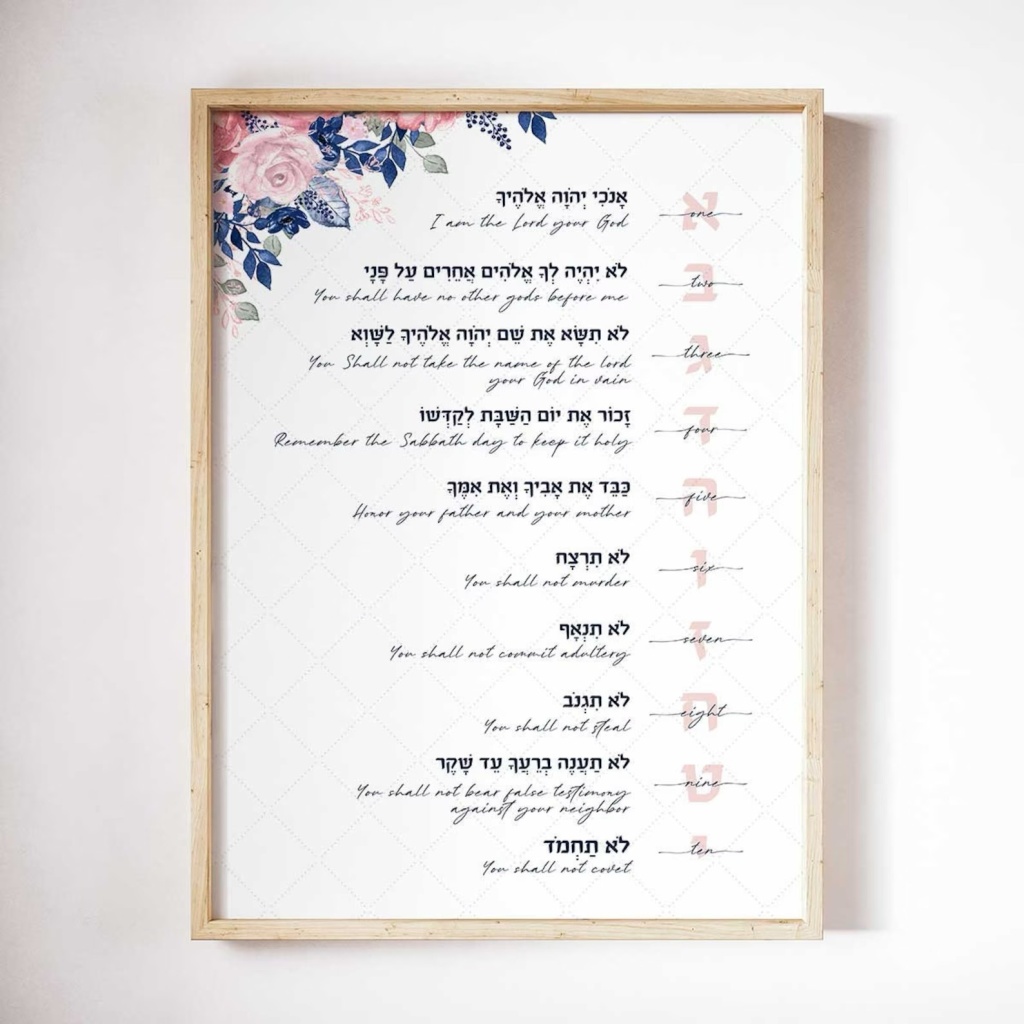
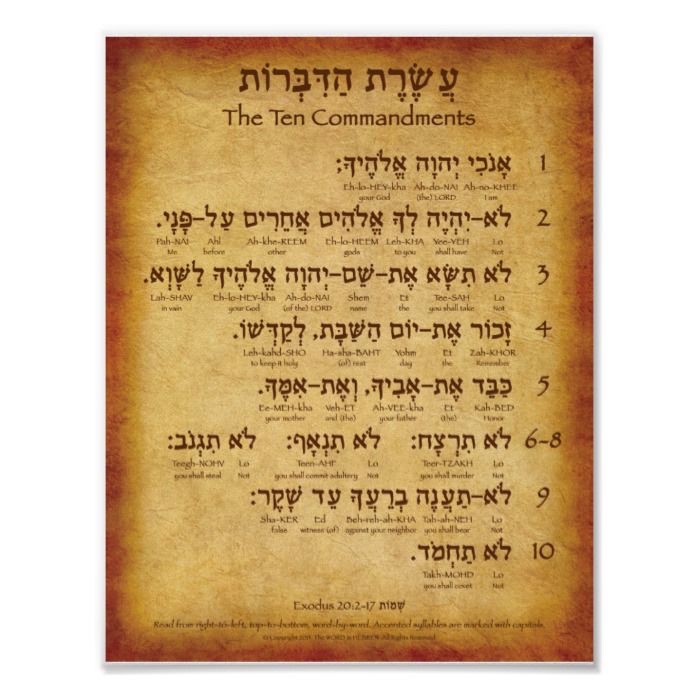
The Hebrew Scripture reading for this coming Sunday contains a set of well-known words—the Ten Commandments (Exod 20:1–20), given to Moses on Mount Sinai, for him to take down to the people of Israel as their set of guidelines for faithful living within the covenant. That covenant was sealed by God and Moses in the previous chapter (19:1–8).

These words set the pattern for life that the Israelites are to follow. They accept and commit to this way of life, declaring “everything the Lord has spoken we will do” (19:8). Those Ten Commandments are then followed by multiple other commands for living (20:22—23:19). It is these commands that the people are instructed to live by, to which they again make their commitment: “all the words that the Lord has spoken we will do” (24:3).

Moses then confirms this in a very public way: he arranged for “burnt offerings and sacrificed oxen [to be] offerings of well-being to the Lord”, as well as dashing half of the blood from those offerings against the altar he had constructed (24:5–6).

Then we read that Moses “took the book of the covenant, and read it in the hearing of the people; and they said, ‘All that the Lord has spoken we will do, and we will be obedient’” (24:7)—and the remaining half of the blood from the offerings was dashed on the people, who are told “see, the blood of the covenant that the Lord has made with you in accordance with all these words” (24:8).

What do we make of these familiar words? The Ten Commandments are probably one of the most well-known passages in Hebrew Scripture—even if most people would struggle to identify the specific requirements of all ten of the commandments. It’s more “the vibe of the thing” that we recall, rather than the precise words.

Here are ten things about these Ten Commandments that help us to understand and appreciate their significance—both in Judaism, the religion that developed from ancient Israelite practices, as well as in Christianity, which appropriated the stories, songs, oracles, and teachings of Judaism as the foundation for its own development.

1. The description of these commandments. In Judaism, this collection of ten commands is known as the Aseret ha-Dibrot, a Hebrew phrase often translated by Jews today as “Ten Statements” or “Ten Declarations”. This is how this collection of “the words of the covenant” are described at Exod 34:28 (and again at Deut 4:13; 10:4). The second word in that phrase is simply “word”—so we might well think of these ten statements as “Ten Words” spoken by God to provide guidance and instruction to the Israelites.

2. The two versions of these Ten Words. The first version of these words is what we have in Exodus 20. (The lectionary edits the selection offered, omitting verses 5–6 and 10–11, to shorten some of the longer parts.) The second version appears in Deuteronomy 5. There are many similarities between the two versions, although the Deut 5 version is longer. One noteworthy difference is the instruction relating to the sabbath; “remember the sabbath day” (Exod 20:8), contrasted with “observe the sabbath day” (Deut 5:12). The difference in the verb is a just slight nuance of difference.

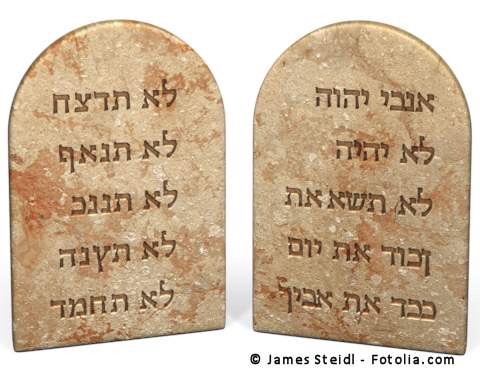
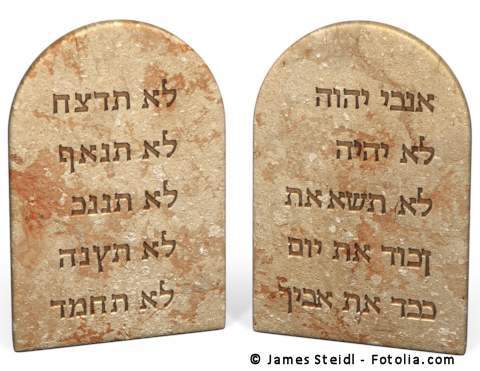
3. Two tablets of stone. Moses is given “two tablets of stone” by God, who informs him that they contain “the law (torah) and the commandment (mitsvah), which I have written for their instruction (horotam, from yara)” (24:12). The Hebrew words used here are part of a larger group of terms which describe all the instructions given throughout the first five books of scripture, the Torah. These tablets are later described as having been written “by the finger of God” (31:8), noting also that “the tablets were the work of God, and the writing was the writing of God, engraved upon the tablets” (32:6).

These two tablets are the ones that are notoriously broken by Moses in his anger when he discovers that the Israelites, in his absence, had made an image of a golden calf (32:19). This leads to the production of a replacement set of stone tablets, which Moses himself wrote under God’s instructions (34:1–4, 28).

These two tablets have most likely influenced the interpretation of the Ten Words as comprising one set of words in which the orientation is towards God (“you shall have no other gods … you shall not make an idol … you shall not make wrongful use of the name of the Lord your God … remember the sabbath day”, 20:2–11) and a second set oriented towards other humans (“honour your father and your mother, you shall not murder, you shall not commit adultery, you shall not steal, you shall not bear false witness against your neighbour, [and] you shall not covet”, 10:12–17). This, in turn, may have been an influence on the later rabbinic exposition (taken up by Jesus) of the Law as requiring love of God and love of neighbour (see Mark 12:28–31 and parallels).

4. How many laws do we have to remember? The natural desire to summarise and synthesise long lists into shorter, more readily remembered lists, may well account for the desire, in this encounter between Jesus and the scribe, to reduce all the commands to two. But there were other aspects involved in this process.

The Rabbis observed that the Torah, the first five books of scripture, actually contain 613 commandments (mitzvoth). There are 248 positive commands (“you shall …”) and 365 negative commands, or prohibitions (“you shall not …”). Collectively, these are known as mitzvoth, commandments; they comprise the Torah, the Law. In strict Jewish households, every one of them must be carefully observed.

However, the Babylonian Talmud (b. Makkoth 23b—24a) reports a rabbinic sermon in which various texts were cited in an attempt to make it easier to remember the central principles of the Torah. Rabbi Simlai declared that David reduced the 613 laws to eleven, citing Psalm 15. After him, Isaiah came, and found the basis in six commandments, quoting Isaiah 35:15-16.

Then the famous Micah triplet is cited, involving just three laws, “do justice, love kindness, walk humbly with your God” (Micah 6:8); before a later section of Isaiah is cited, noting that it proposed just two laws, “maintain justice, and do what is right” (Isa 56:1). Finally, Rabbi Simlai said there was an even shorter way to remember all the laws, and he cited Amos 5:4 as a single command: “seek me and live”.

Rabbi Nahman bar Isaac, however, proposed another prophetic text which provides one statement that summarises the Torah: “the righteous person lives by their faith” (Hab 2:4). This verse, of course, is familiar to Christians from Paul’s citation of it at Rom 1:17 and Gal 3:11.

Another way to summarise the Law is offered by the story of Rabbi Hillel, who is approached by a Gentiles seeking to convert to Judaism. Hillel says to the enquirer, “What is hateful to you, do not do to your neighbor. That is the whole Torah; the rest is the explanation of this—go and study it!” (b.Shabbat 31a). In like manner, when he was asked “which commandment is the most important of all?” (Mark 12:28), Jesus replies by citing two simple words: to love God (Deut 6:5) and to love neighbour (Lev 19:18).

5. Reading these words regularly. The Ten Words are read in full three times each year in Jewish synagogues. Jews follow a one-year lectionary, in which every verse in the first five books of scripture (the Torah, or the Five Books of Moses) is read in sabbath service during the course of the year. The weekly readings (called parashot, or “portions”) begin with Gen 1 and conclude with Deut 34. (The Jewish calendar follows the lunar cycle, and so it has 12 months of 29 or 30 days each, with an extra month added seven times every nineteen years. It’s complicated!)

So the Exodus passage is heard in the week when Exod 18:1—20:23 is read; and later in the year, the Deuteronomy version is heard, when Deut 3:23—7:11 is read. The Ten Words are also read at the Feast of Shavuot, which in the Jewish cycle of festivals is when the giving of the Law (the Ten Words) is remembered.

6. Quoted in the New Testament. The various commandments of these Ten Words are quoted in assorted New Testament passages. Jesus, in Matthew’s Gospel, affirms that all of the Law holds good; he comes to fulfil, not abolish, the Law (Matt 5:17). In the Sermon on the Mount, he specifically interprets—and intensifies—commands relating to murder and adultery, as well as not using God’s name in vain (Matt 5: 21–37).

Elsewhere in this Gospel, Jesus reinforces the importance of honouring parents (Matt 15:14) and of keeping this and further Words (murder, adultery, stealing, and lying, Matt 19:18). Paul likewise affirms that “the one who loves another has fulfilled the law” and “love is the fulfilling of the law” (Rom 13:8–10). In that passage, he cites four of the Ten Words (those relating to adultery, murder, stealing, and covetousness).

Earlier in the letter, he has referred to those words relating to stealing, adultery, and idol worship (Rom 2:21–22). Worshipping God, the first Word, is commended at Matt 4:10 and Luke 4:8; avoiding idol worship is advocated in the letter of the Jerusalem Church (Acts 15:20) and by Paul (1 Cor 6:9–10). The Sabbath is kept by Jesus (Luke 4:16) and Paul (Acts 17:2), as well as at Heb 4:9. Covetousness is condemned by Jesus (Luke 12:15) and Paul (Rom 7:7–11). So all ten of these Ten Words are affirmed in the New Testament—some on a number of occasions.

7. Numbering the list of ten. Judaism, unlike Catholicism and Protestantism, considers “I am the Lord, your God” to be the first “commandment”. Catholicism, unlike Judaism and Protestantism, considers coveting property to be separate from coveting a spouse. Protestantism, unlike Judaism and Catholicism, considers the prohibition against idolatry to be separate from the prohibition against worshipping other gods. No two religions agree on a single way to divide this stream of words into a list of ten distinct commands. So whose list should we follow?

8. Torah as a gift. To the Israelites of the past, as well as to Jews of today, the Torah is experienced as a gift which enriches their lives, not as a crass demand which weighs them down. The relationship that the people of Israel had with God was signalled in the Covenant that is offered to them. Exodus reports that the Lord spoke to Moses, “if you obey my voice and keep my covenant, you shall be my treasured possession out of all the peoples—indeed, the whole earth is mine, but you shall be for me a priestly kingdom and a holy nation” (Exod 19:5–6).

The Covenant is an outworking of this deep and abiding relationship between God and God’s people. That Covenant was not an idealised or abstract idea; it was known and expressed in each of the 613 laws contained within the Hebrew Scriptures. So the Law was considered to be a gift to the people, to be celebrated and valued as much as to be kept (Ps 19:7–11, 40:8, 119:97–104, 169–176). These Ten Words thus play a vital role in the shaping of society so that we live in ways that keep us in covenant relationship with God.

9. The basis of ethics. The Ten Words have formed a solid foundation for ethical principles, not just in Judaism and Christianity, but in wider societies more generally. During the early centuries of the church, these commandments are referenced in various documents, including the second century Didache, and they came to occupy their place in the developing catechism of the church, as Augustine of Hippo indicates in his Questions on Exodus.

The medieval scholastic, Thomas Aquinas, declared in his Summa Theologiae that these commandments provided “the primary precepts of justice and all law, and natural reason gives immediate assent to them as being plainly evident principles”. In his Institutes of the Christian Faith, Jean Calvin provides a detailed consideration of the Ten Commandments. He writes that “God has so depicted his character in the law that if any man [sic.] carries out in deeds whatever is enjoined there, he will express the image of God, as it were in his own life … it would be therefore a mistake for anyone to believe that the law teaches nothing but some rudiments and preliminaries of righteousness by which men [sic.] begin their apprenticeship, and does not also guide them to the true goal, good works.”

Their influence continues into 21st century societies across the globe. Writing in the Desert News (a conservative LDS publication), Paul Edwards proposes that “as long as people yearn for a cohesive and cooperative society that supports familial ties, secures the integrity of personhood and property, shuns petty jealousies and violence, and seeks to treat all alike in the eyes of social authority and before God, then the Ten Commandments — which accomplish these and much more — will continue to be inescapably relevant.”

10. The last word on the Ten Words relates to the last of these ten commandments. It is a curiosity not often commented on—but this last command indicates that these words are directed towards the males in the community, not to everyone, males and females alike. The final command specifies that a person “shall not covet your neighbour’s wife”, and the wording used clearly indicates that these words are directed towards males. It doesn’t say, “you shall not covet your neighbor’s husband”—which is the first indication that the instruction is directed towards men.

Further, we might note that Hebrew is a language in which gender can be indicated in the choice of words; and in this instance, every time the possessive pronoun “your” appears in this commandment, each of those possessive pronouns are masculine. It is your (male) neighbour’s house, your (male) neighbour’s wife, your (male) neighbour’s slave or ox or donkey, or anything that belongs to your (male) neighbour.

And it is noteworthy that there are feminine words used in this commandment (wife and maidservant), so the distinction is being drawn with intention and care. It is the male who possesses house and male slave and ox and donkey, as well as female slave and wife—all are possessions of the male. Which is only to be expected in the patriarchal culture in which these commandments were articulated.

And so, as we hear these Ten Words this coming Sunday, there are many things for us to reflect on!

See also

The law of the Lord is perfect (Psalm 19; Pentecost 19A)

The psalm that is offered by the lectionary for this coming Sunday (Psalm 19) contains some very well-known phrases. It deals with the way that we know God, and know about God—through creation, and through scripture. Those two “ways of knowing” form the basis for the later theological development of the notions of “natural revelation” (that we can know about God by observing the world around us) and “scriptural revelation” (that we can know about God by reading and studying the scriptures).

However, in this psalm, although there are two clearly delineated sections (verses 1–6 and 7–13) with a concluding verse 14, there are overlaps and connections between those two sections. Howard Wallace notes that “there are certain connections between the [two] parts of the psalm: word connections (e.g. ‘hid’ and ‘hide’ in vv. 6 and 12; ‘heart’ in vv. 8 and 14) … also the theme of ‘speech’ ties the psalm together (e.g. in vv. 1, 2, and 14, and presumed in the words ‘precepts’ and ‘commandments’)”. He concludes that “these connections invite us to consider the psalm as a unity with the meaning of the whole greater than the sum of the parts.”

See https://hwallace.unitingchurch.org.au/WebOTcomments/LentB/Lent3BExod20Ps19.html

Creation is the focus in the first six verses. The psalmist’s view is fixed on “the heavens”, which are “telling the glory of God” (v.1). In those heavens the Lord “has set a tent for the sun, which comes out like a bridegroom from his wedding canopy, and like a strong man runs its course with joy” (v.4–5)—clearly a description of the daily movement of the sun across the sky (from our perspective), from east to west, as verse 6 then elucidates.

In other psalms, the psalmist praises God for the heavens as the place where “you have set your glory above the heavens” (Ps 8:1); as a consequence, “the Lord has established his throne in the heavens” (Ps 103:19). By contrast with earthly idols—deaf, dumb, blind, immobile, mute—“God is in the heavens” (Ps 115:3–7; 123:1), from where he blesses the house of Israel (Ps 115:12–13).

So a recurrent refrain is, “your steadfast love is higher than the heavens, and your faithfulness reaches to the clouds” (Ps 36:5; 57:10; 108:4). “Be exalted, O God, above the heavens; let your glory be over all the earth” is another repeated prayer (Ps 57:5, 11; 108:5). In the same mode, another psalm rejoices that “your power and your righteousness, O God, reach the high heavens” (Ps 71:19).

However, another psalm declares that God “thundered in the heavens, and the Most High uttered his voice; and he sent out his arrows, and scattered them; he flashed forth lightnings, and routed them” (Ps 18:13–14). These natural elements, in the view of this psalmist, reflect the righteous judgement of the Lord—a view that we would distance ourselves from, today. (See also Ps 50:4–6; 76:7–9.)

By contrast, the rain that poured forth from the heavens when the people of Israel were in the wilderness “restored your heritage when it languished … in your goodness, O God, you provided for the needy” (Ps 68:7–10). So the heavens can be the source of nourishment and refreshment, as another psalm affirms: “he commanded the skies above, and opened the doors of heaven; he rained down on them manna to eat, and gave them the grain of heaven” (Ps 78:23–29).

Along with “the moon and the stars that you have established”, the heavens are seen to be “the work of your fingers” (Ps 8:3). “The Lord made the heavens” (Ps 96:5), “the heavens are yours, the earth also is yours”, other psalms offer, declaring that “the world and all that is in it—you have founded them” (Ps 89:11). It is “by the word of the Lord the heavens were made”, the psalmists sing (Ps 33:6; 102:25; 136:5), providing a bridge which connects both the heavens and the Law of the Lord, as in Psalm 19. Both the creation and the scriptures are the Lord God speaking to humanity.

The Law of the Lord is what shapes the second part of the psalm (verses 7–14). Those verses contain a ringing affirmation of the Torah as “perfect, reviving the soul … sure, making wise the simple … right, rejoicing the heart … clear enlightening the eyes … pure, enduring forever … true and righteous altogether … more to be desired than gold … sweeter also than honey” (Ps 19:7–14).

The terms used here in parallel to describe Torah (law, decrees, precepts, commandment, fear, ordinances) are found regularly in the narrative books to describe the collection of laws (Deut 8:11; 11:1; 1 Ki 2:3; 6:12; 8:58; 2 Ki 17:34–37; 1 Chron 22:13; 28:17; Neh 9:13; 10:29) as well as right throughout Psalm 119. See

https://johntsquires.com/2023/07/13/a-fully-developed-theology-from-just-one-psalm-psalm-119-pentecost-7a-§§4-5/

Such affirmations of Torah sound out insistently throughout the majestically grand doublets of the 176 verses which are artistically-arranged into acrostic stanzas of Psalm 119 (“happy are those … who walk in the way of the Lord … I long for your salvation, O Lord, and your law is my delight”, vv.1, 174). This psalm indicates that the Law shapes the way that the covenant is kept; and the covenant gives expression to the steadfast love and grace of God.

So much is Torah valued, that it apparently offers perfection: “the law of the Lord is perfect” (Ps 19:7), which we might compare with “I have seen a limit to all perfection, but your commandment is exceedingly broad” (Ps 119:96). In this regard, the psalmist’s appreciation for Torah as perfection seems to reflect the priestly desire for people to offer perfect sacrifices, without blemish (Lev 22:21), and Solomon’s desire to build the Temple as a perfect house for God (1 Ki 6:22).

Indeed, such a conception of perfect Torah also resembles the sage’s musings regarding Wisdom: “to fix one’s thought on her is perfect understanding” (Wisdom 6:15), and thoughts found in a prayer attributed to Solomon: “even one who is perfect among human beings will be regarded as nothing without the wisdom that comes from you” (Wisdom 9:6).

Much value is accorded to these words of Torah. As well as calling the law “perfect”, we hear that “the decrees of the Lord are sure” (Ps 19:7), a claim echoed in another psalm (Ps 93:5). The precepts of the Lord that are right (Ps 19:8; see also 119:75, 137, 172) means that one who is faithful and obedient will be led “in right paths” (Ps 23:3) as they pray “put a new and right spirit within me” (Ps 51:10). “The commandment of the Lord is clear” (Ps 19:8) is a claim that informs the later portrayal of those who trace the course of Wisdom “from the beginning of creation … [who] make knowledge of her clear” (Wisd Sol 6:22).

The psalmist extends the adoration of the Law, declaring that “the fear of the Lord is pure” (Ps 19:9), a claim extended in another statement found in wisdom texts, “the fear of the Lord is the beginning of wisdom” (Ps 111:10; Prov 1:7; 9:10; 15:33; Sir 1:18, 27; 19:20). A further elaboration, “the ordinances of the Lord are true and righteous altogether” (Ps 19:9), is the way that Ezra describes the laws given to Moses on Mount Sinai (Neh 9:13). They are righteous (Ps 119:7, 62, 106, 160, 164), good (119:39), the basis of hope (119:43) and comfort (119:52).

The closing affirmation, “more to be desired are they than gold,

even much fine gold; sweeter also than honey, and drippings of the honeycomb” (Ps 19:10), is echoed in “how sweet are your words to my taste, sweeter than honey to my mouth!” (Ps 119:103). By contrast, when Job asks, “where shall wisdom be found? and where is the place of understanding?”, he proposes that “gold and glass cannot equal it, nor can it be exchanged for jewels of fine gold” (Job 28:12–19), and concludes, “the fear of the Lord, that is wisdom; and to depart from evil is understanding” (Job 28:28).

Meditation and prayer is then affirmed in the final verse which brings the psalm to a close: “let the words of my mouth and the meditation of my heart be acceptable to you, O Lord, my rock and my redeemer” (v.14). They echo the plea of another psalm, “hear my prayer, O God; give ear to the words of my mouth” (Ps 54:2).

Yet another psalm affirms that “all the kings of the earth shall praise you, O Lord, for they have heard the words of your mouth” (Ps 138:4), while in another psalm the prayer is, “may my meditation be pleasing to him, for I rejoice in the Lord” (Ps 104:34). Finally, the closing verse of Psalm 19 resonates with a similar affirmation in Psalm 49, “my mouth shall speak wisdom; the meditation of my heart shall be understanding” (Ps 49:3).

Is the Lord among us, or not? (Exodus 17; Pentecost 18A)

It’s a good question: “is the Lord among us, or not?” It’s a question posed by the Israelites in the story that the lectionary presents for our consideration this coming Sunday (Exod 17:1–7). It’s a question that people of faith have asked, time and time again, throughout history. It’s a question that is still asked, in our own time, by people experiencing difficulties in their lives.

The people of Israel have been travelling in the wilderness. They entered the wilderness of Shur after crossing the Red Sea (15:22), and continued on into the wilderness of Sin (16:1). We are not told how long they had been in this desert wandering, when they arrived at Rephidim; the whole “wilderness wandering” saga of the Israelites is quite blurred, not only in terms of time, but also in terms of places. It is, after all, a story—not a history, as I have noted in previous blogs. So the teller of this story deems these details unimportant. What is important, by contrast, is what the storyteller chooses to highlight: complaints, leadership, and provision.

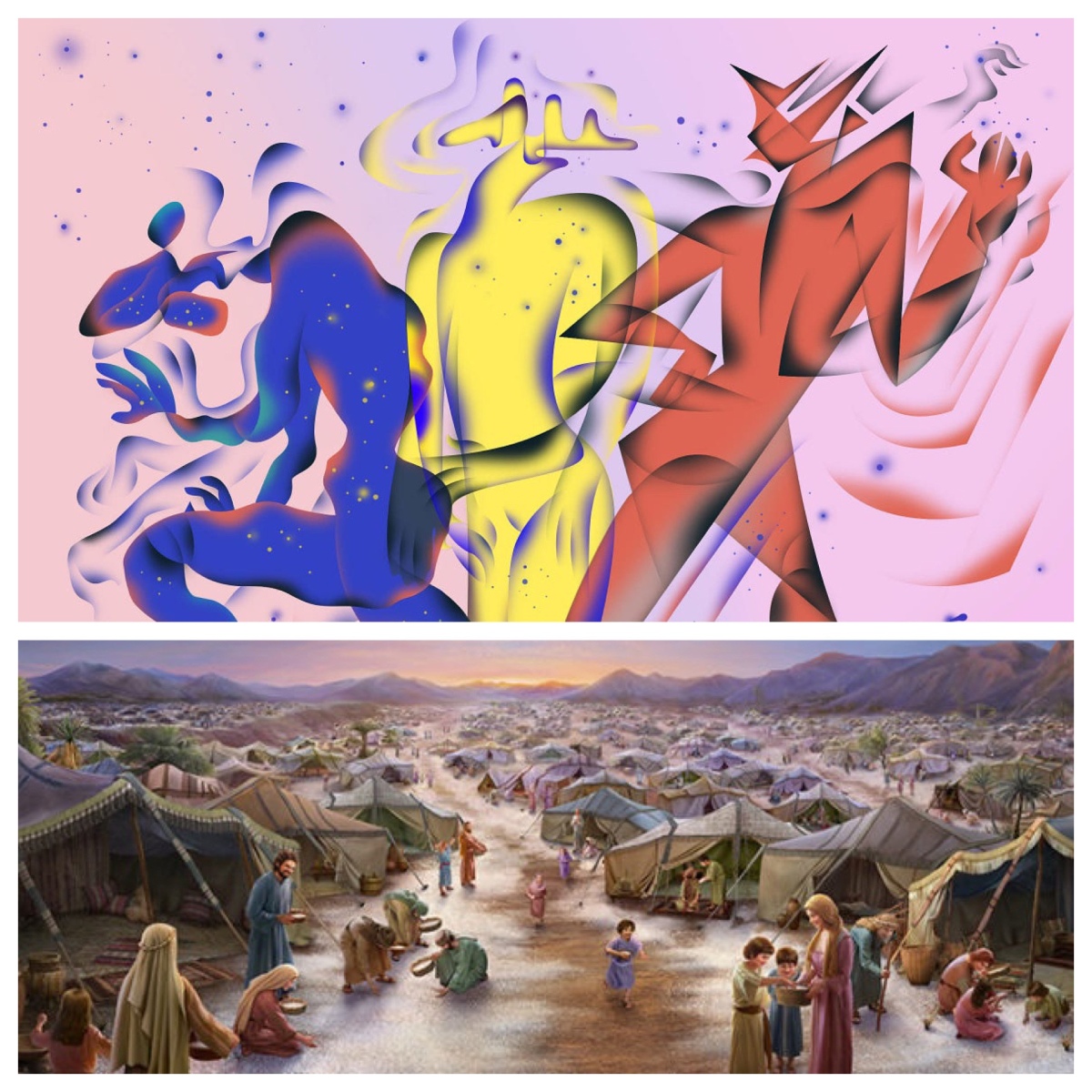
The people had already raised a complaint against Moses and Aaron when they had no food to eat (Exod 16:2–3). God had responded by providing food—quails and manna (16:13–14). That precedent, surely, must have meant that, when confronted with another lack—this time, of water—they might immediately have turned to God in prayer, requesting that God supply water. We might have thought this. But no—once again, they turned on their leaders: “the people quarreled with Moses, and said, ‘Give us water to drink’” (17:2A). “Is the Lord among us, or not?”, they wonder.

Moses, understandably, pushes back, saying, “why do you quarrel with me? why do you test the Lord?” (17:2b). Perhaps another line of response—following on from the observations I made in my post last week about the incident in the wilderness of Sin (ch.16)—might have been to show some understanding that the people had been through a series of traumatic events—oppressive slavery, a number of plagues, a hurried escape from Egypt, and then witnessing the mass drowning of the Egyptian army.

The cumulative experience of these traumas could well explain the attitude of the Israelites; suffering piled upon suffering, distress multiplying distress, and an acting-out of bad behaviour, as the text indicates. (Bearing in mind that this is a story, not an actual historical event, so it portrays characters as created by the narrator, and is not reporting on real historical people; and noting also that contemporary psychological insights should be applied with great caution—if at all—to stories from antiquity!)

But the story indicates that the people did not cave under the pressure from Moses. In response to his accusatory questions—“why? why?”—we are told, “the people thirsted there for water; and the people complained against Moses and said, ‘Why did you bring us out of Egypt, to kill us and our children and livestock with thirst?’” (17:3). It’s an unreasonable accusation. Moses most certainly was not leading them out of their state of slavery to kill them—he was seeking to save them, to rescue them and bring them into a new state of refuge and safety.

However, their state has led them to make unreasonable accusations. So Moses then intercedes with God: “what shall I do with this people?”, noting that “they are almost ready to stone me” (17:4). The crisis has not been averted! “Is the Lord among us, or not?” remains a key question.

*****

The response of God is not to equip Moses with words to speak to the Israelites (which is what he did when calling Moses, initially, in Exod 3:15–22), but to encourage Moses to act in a way that will persuade the Israelites (as he did when Moses pushed the point, earlier on, in Exod 4:1–9). “Is the Lord among us, or not?” Moses is going to ensure that they sense that he is, indeed, present.

The prophet, in ancient Israel, was called and commissioned to speak words to the people—to be the mouthpiece of the Lord God—and also to enact the justice and mercy that God shows towards the people, in deeds. That dual role is integral to the calling of Moses (Exod 3:1—4:17), who serves as the role model supreme for prophets in Israel (Deut 18:15; 34:10) and serves also as the template for Jesus, as Peter declares (Acts 3:20–26).

So Moses leads the people by acting in a way that directly meets the ends of the people. “Give us water”, they cry; so Moses struck the rock, confident that “water will come out of it, so that the people may drink” (Exod 17:6)—and indeed, the water did flow, and the people did drink. “Is the Lord among us, or not?” Moses is hoping to demonstrate that this is a question that invites—indeed, requires—the answer, Yes!

That place, like many other places in the narratives of Genesis and Exodus, is named for what takes place there. However, the place is not named in a way that highlights “the people drank”. Rather, it is named Massah and Meribah, “because the Israelites quarreled and tested the Lord, saying, “Is the Lord among us or not?” (17:7). Massah means “testing” and Meribah means “quarrelling”. That’s quite a name for this place to be known by!

The place is to be remembered for the difficulties that took place there—not for the miracle of providing water at that place. The larger narrative of the dramatic Exodus from Egypt and the lengthy wilderness wanderings does not shy away from the difficulties and conflicts of that part of the story. Those tensions and conflicts need to be told, and remembered. The wilderness was not an easy place to be. “Forty years” in the wilderness (that is, a heals-long time, indeed) was not an enjoyable experience to have.

Elsewhere in Hebrew Scripture, the forty years in the wilderness are remembered and described in ways that overlook or remove any reference to those difficulties and conflicts. Jeremiah, at his calling, is charged to declare the word of the Lord: “I remember the devotion of your youth, your love as a bride, how you followed me in the wilderness, in a land not sown” (Jer 2:2). One psalm retells the saga of the Exodus from Egypt and the time in the wilderness (Ps 136:10–16) and inserts a repeating refrain of gratitude to God after each statement, “his steadfast love endures forever”. This psalm makes it seem like it was a wonderful experience to have had!

Similarly, Hosea remembers fondly how the Lord God loved Israel and “led them with cords of human kindness, with bands of love; I was to them like those who lift infants to their cheeks; I bent down to them and fed them” (Hos 11:1,4)—although he does note that, sadly, “the more I called them, the more they went from me; they kept sacrificing to the Baals, and offering incense to idols—yet it was I who taught Ephraim to walk, I took them up in my arms; but they did not know that I healed them” (Hos 11:2–3). That’s a realistic recollection of the time.

So various psalms, likewise, remember this time as a difficult period of time. One psalmist recalls this very incident as a time “when your ancestors tested me, and put me to the proof, thought they had seen my work; forty years I loathed that generation and said, ‘They are a people whose hearts go astray, and they do not regard my ways’” (Ps 95:10).

Another psalm remembers the strong faith evident through the Exodus, but goes on to lament that “they believed his words; they sang his praise; but they soon forgot his works; they did not wait for his counsel … they had a wanton craving in the wilderness, and put God to the test in the desert … they were jealous of Moses in the camp, and of Aaron, the holy one of the Lord” (Ps 106:12–16). In Deuteronomy, this time is remembered as “the great and terrible wilderness, an arid wasteland with poisonous snakes and scorpions” (Deut 8:15).

Two ways of remembering those years: a time of great blessing from God; a time of great testing for Israel. “Is the Lord among us, or not?” is a key question—one worth remembering and pondering in any time of difficulty or challenge. We might well ask ourselves, then: how do these two very strong memories—these two vivid expressions of the drama of Israel—relate to one another, inform one another, enrich one another?

See also

The road to freedom: seeking the safety of refuge (Exod 16; Pentecost 17A)

This coming Sunday, we will hear a story that didn’t happen—yet a story that is always happening. Like all the stories we have heard in previous weeks—stories of Abraham, Sarah, and Hagar, of Isaac and Rebekah, stories of Jacob, Leah, and Rachel, and the twelve sons of Jacob, the stories of Joseph and his brothers and the stories from early in the life of Moses—these stories did not actually happen as they are reported; but they are told because the dynamics at work in the stories reflect the realities of life as humans experience it.

I don’t think we can say that these ancestral stories happened as actual historical events. Certainly, the historical elements in the story of the Exodus are impossible to validate using the standard methods of historical criticism. However, they are worth remembering and retelling, because they are always happening, in the murky depths of human life.

So this year in the lectionary cycle, as we read and hear these stories yet again, they refresh our understanding of life and they take us into the centre of our existential being. They have been told and retold throughout the centuries, because they express things that are deep within our lives.

The people depicted in the wilderness in today’s passage (Exodus 16:2–15) are quite relatable characters, to me. We are introduced to “the whole congregation of the Israelites” right at the start, and are told that they “complained against Moses and Aaron in the wilderness” (v.2). I’m going to pass on making any connection between this verse and any congregation of which I have been a part, or in which I have ministered. Let’s just say that humans complaining should not be a surprise to us!

However, let’s pause and consider: the complaint raised by the Israelites against Moses and Aaron appears to be quite unreasonable. How long have they been travelling in the wilderness? And already they seem to think that life was better for them back in Egypt, where “we sat by the fleshpots and ate our fill of bread”. Now, in the wilderness, the accuse their leaders of wanting “to kill this whole assembly with hunger” (v.3).

However, if you put yourself into the situation of the Israelites, you might well have a more empathic understanding of their situation. Their years in Egypt were intensely difficult: the Egyptians “set taskmasters over them to oppress them with forced labour … [they] became ruthless in imposing tasks on the Israelites, and made their lives bitter with hard service” (Exod 1:11–14). How were the Israelites to respond? Fright? Fight? or Flight??

We might hypothesise—imagining what might have been going through the minds of the Israelites in the story as they considered their situation. (As noted above, I don’t think that this was an actual historical event—but it is told in Exodus as a history-like narrative, and that history-like character invites us to consider how the hypothetical characters in that story might have thought and acted.)

In such a situation, fright would have been an understandable response. The power of the Egyptian overlords would have generated fear amongst the Israelites as they struggled to complete the increasingly demanding tasks imposed upon them. As there presumably were many years between the death of Joseph (Gen 50:26) and the time when “a new king arose over Egypt, who did not know Joseph” (Exod 1:8), that suggests that fright gripped the people and paralysed them into inaction. They continued as slaves under increasingly difficult conditions.

The thought of fight might have entered the minds of some—standing up for their rights and asserting themselves in order to gain freedom may well have been suggested, even debated, during this extended interim period. Indeed, as the story recounts, Moses himself, fuelled by a passion for justice and a dislike of injustice, was known to have intervened with passion and force into a situation of injustice—such that “he saw an Egyptian beating a Hebrew, one of his kinsfolk; he looked this way and that, and seeing no one he killed the Egyptian and hid him in the sand” (Exod 2:11–12). The next day, fearing that his actions were known, he fled across the desert to Midian, where he remained for quite some years.

Would Moses have thought to press hard against his Egyptian overlords, agitating for them to act justly in relation to the Israelites? His initial thoughts in this regard may well have been completely deficient—that is, until he had encountered God in the burning bush (Exod 3:1–5). From that bush, the voice had come, commissioning Moses to approach Pharaoh “to bring my people, the Israelites, out of Egypt” (3:10).

Moses, of course, argued with God about what that would mean (3:11–4:17)—but in the end, he returned to Egypt (4:18–31) with the intention of confronting Pharaoh, to say “Let my people go” (5:1). The initial request was simply “so that they may celebrate a festival to me in the wilderness” (5:1)—but Pharaoh was resistant, leading to the long sequence of divinely-initiated plagues (7:14—10:28), culminating in the plague of the death of “all the firstborn in the land” (12:29–32).

It was flight, however, which won the day for the Israelites—after they, in turn, had been convinced by Moses that this was what God wanted them to do (12:3, 21–28). And that flight, according to the story line, was supported by the interventions of the divine into the sequence of human events: “at midnight the Lord struck down all the firstborn in the land of Egypt, from the firstborn of Pharaoh who sat on his throne to the firstborn of the prisoner who was in the dungeon” (12:29), and then “the Lord brought the Israelites out of the land of Egypt, company by company” (12:51), and then “the Lord went in front of them in a pillar of cloud by day, to lead them along the way, and in a pillar of fire by night, to give them light, so that they might travel by day and by night” (13:21).

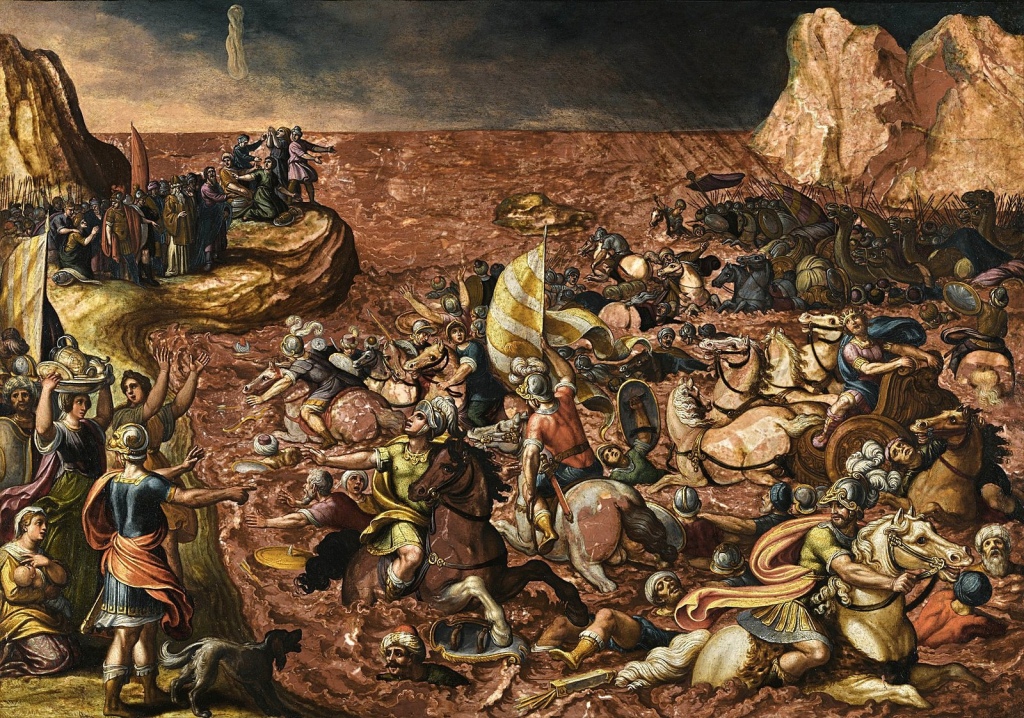
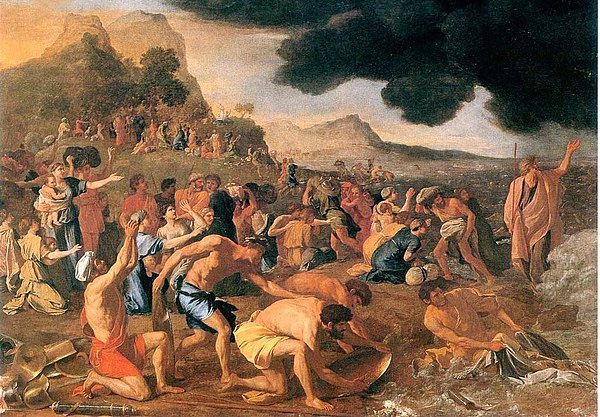
Then, when confronted with the sea in front of them, “the Lord hardened the heart of Pharaoh king of Egypt and he pursued the Israelites, who were going out boldly” (14:8), and then “the Lord drove the sea back by a strong east wind all night, and turned the sea into dry land; and the waters were divided. The Israelites went into the sea on dry ground, the waters forming a wall for them on their right and on their left. The Egyptians pursued, and went into the sea after them, all of Pharaoh’s horses, chariots, and chariot drivers.” (14:21–23).

And so the story resolves the tension: “the Lord tossed the Egyptians into the sea. The waters returned and covered the chariots and the chariot drivers, the entire army of Pharaoh that had followed them into the sea; not one of them remained. But the Israelites walked on dry ground through the sea, the waters forming a wall for them on their right and on their left.” (14:27–29).

The Israelites, so the story reveals to us, had thus experienced a long sequence of frightening and troubling events—culminating in their witnessing the mass drowning of the army that was pursuing them. The narrator makes it clear that “the Lord saved Israel that day from the Egyptians; and Israel saw the Egyptians dead on the seashore” (14:30). Today, meeting people who had experienced such a sequence of events, we would recognise that they had been immersed in a series of traumas, and we would readily explain their current state of being with reference to PTSD—post-traumatic stress disorder.

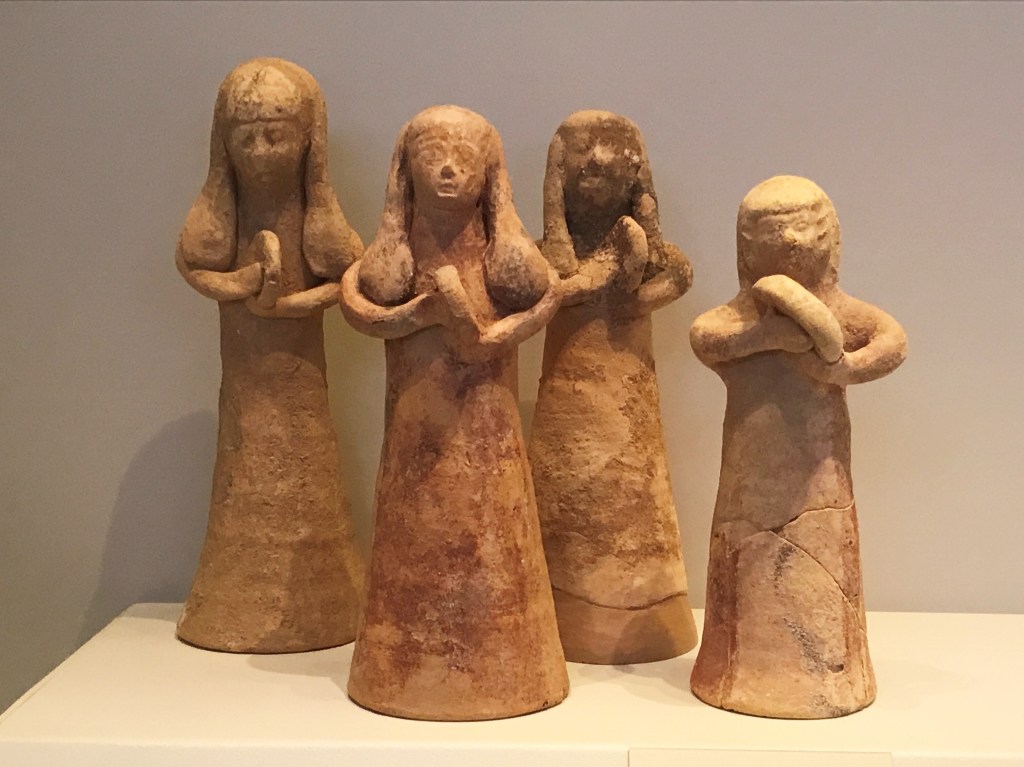
Of course, as we have noted, the narrator shrugs all of this off with the glib summation, “Israel saw the great work that the Lord did against the Egyptians; so the people feared the Lord and believed in the Lord and in his servant Moses” (14:31). The narrator expects the people in the story to move on. And so we are then given the full set of lyrics of the song that Moses led the people in singing, “I will sing to the Lord, for he has triumphed gloriously … the Lord is my strength and my might … this is my God, and I will praise him” (15:1–18), followed by a recapitulation of the earlier verses in the song that Miriam and the women sang, “Sing to the Lord, for he has triumphed gloriously; horse and rider he has thrown into the sea” (15:21).

But as the story continues on, the narrator cannot but help give indication of the ways that the trauma of this long sequence of events has impacted on the Israelites. The first indication of that comes in the complaint of the people when they could find no water; they cried out to Moses, and God intervenes again to enable him to provide water for drinking (15:22–25). The next indication comes in the passage which the lectionary offers us this coming Sunday, when another set of complaints is brought against Moses and Aaron, for the people are now hungry (16:1–3).

A further indication of this will be our focus on the following Sunday, when we hear the story of another moment of complaint, at Rephidim (17:1–7). And there are further stories of complaint at Num 11:1–15 and 14:1–4.

If we enter into the story and imagine the state of the people, there can be no doubt that they would have been gripped with terror and fear—wondering what the future would hold, lamenting the difficulties of the present, and looking back already on the past with “rose-coloured glasses”, unable to remember exactly how difficult and oppressive it was for them to live in Egypt.

And yet, the narrator wants us to understand that, in the midst of the complaints raised by the people, there was hope: they camped at a fertile oasis at Elim (15:27), they ate the quails and manna provided each day (16:13–18; Num 11:7–9); they had water to drink at Massah and Meribah (17:7).

The story that is shaped in the narrative of Exodus has a strong belief in an active, interventionist deity. That is possible to claim with the benefit of hindsight, knowing that the people did survive their time in the wilderness, did have nourishment and water, did eventually enter the land promised to them, and did settle and become prosperous in the land. That is the blessing of telling a story long after the time in which it is set; the long range result can be known!

It was not the case in the midst of the story, as the events being narratives took place. Doubt and fear grounded in uncertainty, as well as dysfunction generated by repeated traumatic events, would have blurred and marred any sense of confident hope, surely. And that is precisely the situation that we find ourselves in, today. Life is “happening” to us. We do not have a guarantee of the end-in-view, the longterm result that is hoped for. We ,I’ve by faith, with hope, yearning and trusting.

So the story we hear this coming Sunday (Exod 16:2–15) tells of God’s provision for the people of Israel—and, by extension, for people of faith today—as they, and we, live with an attitude of hopeful expectation and patient faith.

The climax of the story, at least in terms of the verses that the lectionary offers us, is the simple affirmation that the “fine flaky substance, as fine as frost on the ground”, the “bread from heaven” that they found, was indeed “the bread that the Lord has given you to eat” (16:4, 14–15).

Later in the chapter, we are told that this was the staple diet of the people for “forty years” (16:35), which is the standard biblical expression for “a very, very long time”. And much later, of course, in Christian tradition, Jesus of Nazareth is presented as “the bread from heaven”, the “living bread” which is given “for the life of the world” (John 6:31–51)—bread which lasts, not for ”forty years”, but “forever” (John 6:51).

Also in the story told in Exodus 16, we are told that “the house of Israel called it manna” and that “it was like wafers made with honey” (16:31). An explanation of this name—drawn from the comment made in Numbers—is that the phrase means “this is aphids”, indicating that the dew was crystallised matter deposited by insects. (See “the manna was like coriander seed, and its color was like the color of gum resin”, Num 11:7.)

An alternative explanation for the name manna lies within the text of Exodus itself; for when the people ask, “what is it?” (16:15), the Hebrew is man hu. And so the name reflects the initial puzzlement—a nice ironic twist, indeed.

How do we read this story today? For me, the story of the first half of Exodus has really strong resonances with the story of millions of people in the world today. These are people that we call refugees and asylum seekers—people fleeing from oppression and mistreatment in the land where they were born, travelling through difficulties and dangers, to seek the safety of refuge in a new land; a land that becomes, for them, a land of hope, a land of promise.

The United Nations Refugee Agency, UNHCR, keeps track of current numbers and publishes a summary each year. For 2022, the figures are:

You can see the consistent rise in numbers throughout this century, reflecting the persistence of civil war and uprisings in many places. Each person in those millions of people has experienced trauma, sought to escape, travelled along difficult pathways on land or sea, and is seeking safety in another country—or is patiently waiting to be resettled from the refugee camp where they are, into another country.

The UNHCR notes that over half of all refugees under UNHCR’s mandate and other people in need of international protection (52% in total) come from just three countries: 6.8 million from the Syrian Arab Republic, 5.7 million from the Ukraine, and another 5.7 million from Afghanistan. Just over a third (38%) of the 35.3 million refugees are being hosted in five countries (Türkiye, Iran, Colombia, Germany, and Pakistan), so there are a number of countries that are well-off and could well allow for a larger intake of refugees, to share in some of that burden of hosting and resettling such people.

Perhaps the Exodus story can resonate in our current global context, and remind us of the value of people who are seeking the safety of refuge, the importance of meeting their needs, and the necessity of remembering the trauma that they experienced which has pushed them to flee their homeland and seek safety elsewhere. The people of Israel, in the ancient story told by Exodus, were refugees, seeking asylum in a foreign land. And as people of faith, we might well ponder: how do we serve as the agents of God, to offer to refugees and asylum seekers, today, “the bread that the Lord has given [them] to eat”?

Israel saw the Egyptians dead on the seashore (Exodus 14; Pentecost 16A)

“So the Lord saved Israel that day from the Egyptians; and Israel saw the Egyptians dead on the seashore” (Exod 14:20). That’s the statement that tells the story of the Exodus in one short verse; it’s also the ethical problem that sits at the heart of the Exodus story. A part of that story is offered by the lectionary for this coming Sunday (Exod 14:19–31).

I have already offered some reflections on the violence that is central to the story of the Exodus from Egypt; see https://johntsquires.com/2023/09/06/escaping-from-oppression-how-do-we-make-sense-of-the-exodus-exodus-12-pentecost-15a/

As I have noted, there is much violence spread throughout the pages of the Hebrew Scriptures—and the reading proposed by the lectionary for this coming Sunday is no exception! I have no doubt that, for many people, the violent scenes in the “historical” narratives, in the prayers of the psalmists, in the visions of the prophets, is most off-putting. As a pacifist myself, I find these scenes disturbing.

As I have worked with people who have experienced trauma from abuse in their lives, I recognise how they may “work through” these matters in ways that are confronting and hard to handle; I have tried to cultivate an attitude of acceptance of them and curiosity about what drives their angry and violent language. And as a person who myself has experienced the trauma of violence through sexual abuse, when I was a child, I am intensely attuned to the ways that violent words and deeds can impact on people.

For my own story, see

and for the podcast in which I talk about this, go to

https://open.spotify.com/episode/5feSJb2qyVAhzBEfoeHj1x?si=29983b58d694477d

*****

I don’t, of course, hold to each and every event in the biblical narratives as literal historical events; but I do believe that these narratives reflect the zeitgeist of the time. It was a violent time, life was more precarious, people lived in a more tribal fashion (and thus fighting the neighbour was somehow a regular occurrence). And yet, in the midst of this, we see the emergence and development of a spirituality that values something wider than the immediate tribal, parochial viewpoint.

To the extent that the final editors of the many narratives shaped things intentionally, we might note that the stories of the little tribe(s) which later identified together as Israel, were framed by a grand narrative of the cosmic creation (Gen 1–2) and the strategic place of humanity within that creation (Gen 2–3). That, it seems to me, signals the moves that have been made from the violent tribal interactions of many narratives, into the poetic appreciation (mediated via the hierarchical priestly mindset) of the larger global—and spiritual—picture.

Thus, these texts do have some value; but they need to be understood in their detail, in their contexts, and in terms of the whole. They include the earlier stories of their heritage—because the people creating these texts “honour mother and father”, they preserve and retell those stories—but they also show how faithful people grappled with their various situations and challenges.

In Hebrew Scripture, then, we have extended stories constructed by writers seeking to shape the society of their time through a reconstructed (and perhaps idealised) past; songs from psalmists seeking to find God in trying situations; writings from sages plumbing the depths of wisdom and discernment; and oracles from prophets decrying infidelity and lack of commitment to the covenant, using graphic, even violent, language. The whole is a fascinating mix of case studies about “how to be faithful” in changing and challenging circumstances.

The Exodus needs to be seen in this context. It contains poetic sections (Exod 15) celebrating victory after violent engagement; a narrative shaped around that poem; then a further narrative, woven into the existing narrative but expanding or correcting or challenging the earlier material, all included into a literary stream of words that we puzzle, now, to unknot and make sense of.

The story of this Exodus from Egypt came to occupy a central place in the life of the people of Israel. It gained traction as a story that conveyed the identity of the people—once enslaved, miraculously liberated, steadfastly guided, and ultimately rewarded with a place of their own. It was retold in a number of psalms (Psalms 77 and 78; 80 and 81; 105 and 106; 114; 135 and 136).

A standard refrain which recalls the Exodus, “I am the Lord your God, who brought you out of the land of Egypt, out of the house of slavery” (Exod 20:2; Deut 5:6) recurs throughout the ensuing narrative books (Deut 1:27; 5:6; 6:12; 8:14; etc; Judg 2:12; 1 Sam 12:6; 1 Ki 6:1; 8:9, 21; 9:9; 12;28; 2 Ki 17:7, 36; 2 Chron 6:5; 7:22). A number of prophets also recall this story with similar phrases (Jer 7:22, 25; 11:4, 7; 16:14; 23:7; 31:32; 32:21; 34:13; Ezek 20:4–10; Dan 9:15; Hos 11:1; Amos 2:10; 3:1; Mic 6:4; 7:15; Hag 2:5).

In the difficulties of the Exile in Babylon, when the final form of the story as we know it was created, this saga resonated deeply with the confronting experiences and the fervently-held hopes of the people. Their Exile was their Egypt; their Exodus was still awaited, and their entry into the land of Israel remained yet well ahead of them. And so, the story is told of the past, but it becomes a story of the present, a hope for the future, for the people.

It seems to me that the dreaming stories of First Nations Peoples in Australia instruct us about the way that the ancients told their stories, retold and reworked them, and then wrote them down (a step that some First Nations peoples are now taking, under the pressure of western colonisation).

It is quite likely that the same kinds of processes were present in the formation, development, and passing on of the stories of ancient Israel, until such time as it was felt needed to write them down (a step that was clearly taken during the Exile in Babylon and in the years after that, as the people returned to the land of Israel).

The narratives bear witness to the faith of ancient peoples; they reflect life and society as it was, with all its faults as well as its positive points; and they invite us to share in the attitude of faith towards God and the demonstration of justice and care for one another that is reflected in the stories that are told.

What, then, do we make of the story of deliberate, divine-authorised death, which is told in Exodus 14, as we hear in the Hebrew Scripture reading in worship this coming Sunday? The story has become foundational, not only for Jews, but also for Christians, as I noted last week. (See the link above.)

Writing in Bible Odyssey, Professor Brian M. Britt offers this insightful summary of the function of the Exodus mythology over a long, extended period of time. He observes, “The prevalence of the exodus tradition in the Bible demonstrates its importance as a foundational collective memory from ancient Israel that predates the monarchy and survives into the time of the early rabbis and followers of Jesus.

“Postbiblical exodus traditions take many forms, from the Jewish observance of Passover to Christian celebrations of Easter, Muslim teachings about the Prophet Musa, and modern liberation theologies. Though many modern readers have asked whether episodes of the exodus, from the plagues in Egypt to the parting of the Red Sea, “really happened,” the exodus remains one of the most powerful narratives of divine compassion and liberation found in the Bible.”

See

The Exodus Tradition in the Bible

For Jews, this story is foundational. It is both in the remembrance of that first “passing over” at the annual Passover dinner in people’s homes, but also in the self-identity of the people as chosen by the Lord for a special, designated purpose, saved from the antagonisms of hostile surrounding nations, such that the story gains life and becomes effective as a fundamental mythos, a story that explains the very essence of who Jews are.

For Christians, it is in the remembrance of “the night on which the Lord [Jesus] was betrayed”, in the oft-repeated eucharistic celebration in local churches and cathedrals, that the story is foundational. It is part of the central thread of the grand narrative (the death and resurrection of Jesus) that sits at the heart of that religion.

That the story involves bloodshed and death—as well as rescue and salvation—indicates the earthy nature of each faith. Judaism and Christianity alike are grounded in the realities of human existence and deal with factors that are of the essence of human life. It is a foundational story that is important to remember. But that does not mean that the story is without problems.

The fate of the Egyptians, first being bogged in the muddy ground, next panicking as they are subsumed by the waters, and then drowning in the rising sea, is a difficult part of the story. The claim that God deliberately hardens their hearts (14:17) in order to lure them into the waters, is abhorrent. Is this really what God is like? Or is this an element introduced into the story by the narrator, to provide some form of explanation for their fate? I lean to the latter—but it still does not make for easy reading.

This part of the story remains, sitting as an accusatory claim. It is hard to resolve this in a satisfactory way. The Egyptians become a cipher for all with whom the Israelites struggled, over the centuries. They symbolise “the other”; and with the Canaanites, later in the grand narrative, they exercise a peculiar function; a reminder of those who were “in the way” of the grand plan (of God, it was claimed) that was being enacted.

They are difficult people in the way of the story–much like the First Peoples of the continent of Australia and its surrounding islands are “in the way” of the grand colonising, civilising narrative that has been created by powerful white historians, storytellers, and political leaders.

There is, however, another side of the story of Israel, which is presented in the concluding verses of this week’s passage. What happened in the Sea of Reeds is remembered as the day when “the Lord saved Israel … from the Egyptians” (14:20), the day when “Israel saw the great work that the Lord did against the Egyptians” (14:31). It is a story designed to evoke and strengthen faith.

The graphic scene is sketched in few words, but they are telling words: “Israel saw the Egyptians dead on the seashore” (14:30). That is a vastly understated comment. If you have ever seen pictures from the Western Front battles during World War I, you will know that a scene of dead bodies littering the ground is indeed a gruesome and sobering sight. The Exodus story contains just such a devastating scene.

But the whole purpose of the story is not to lament the dead (they are mere collateral damage, in modern terminology). It is to encourage faith and hope amongst those who have continued as faithful in subsequent years. “So the people feared the Lord and believed in the Lord and in his servant Moses” (14:31). Another brief, pointed observation. All’s well that ends well, it would seem—at least, for the victors.

Sing a new song to the Lord (Psalm 149; Pentecost 15A)

Many psalms in the later sections of the Book of Psalms begin with the exclamation, “praise the Lord!” (106:1; 111:1; 112:1; 117:1; 135:1; 146:1; 147:1; 148:1; 149:1; 150:1), whilst some end with that same exclamation (105:45; 106:48; 115:18; 117:2; 135:21; 146:10; 147:20; 148:14; 149:9; 150:6). We find this phrase at the beginning and at the end of Psalm 149, which is offered by the lectionary as the psalm for this coming Sunday.

Singing (v.1) is mentioned often in the psalms: “how good it is to sing praise to our God” (147:1), “with my song I give thanks to him” (28:7), “I will praise the name of God with a song” (69:30), and so the people of Israel are encouraged to “sing to God … lift up a song to him who rides on the clouds” (68:4), “raise a song, sound the tambourine, the west lyre with the harp” (81:2). A whole sequence of “songs of ascent” are included in this book, reflecting the journey of pilgrims as the approach the temple to bring their offerings (psalms 120—134).

, was a staple part of the temple liturgy. The Chronicler regularly reports the role that “the singers” had in the Temple, where “they were on duty [to sing] day and night” (1 Chron 9:33). They were to “play on musical instruments, on harps and lyres and cymbals, to raise loud sounds of joy” (1 Chron 15:16; see also 2 Chron 5:12–13; 9:11; 23:13; 29:28; 35:15).

In the return of the people to the city after the Exile, singers take their place alongside “the gatekeepers and the temple servants” (Ezra 2:70; 7:7; 7:24; Neh 7:1, 73; 10:28, 39; 12:45–47; 13:5). Often in these passages they are mentioned in association with the Levites. It was the descendants of Levi who had been appointed to take care of the Tabernacle (Num 1:51–53; 1 Sam 6:15; 2 Sam 5:24; 1 Ki 8:4) and then the Temple (1 Chron 6:48), “living in the chambers of the temple free from other service” (1 Chron 9:33–34).

Psalms are often communal. This particular psalm which we hear this coming Sunday is set “in the assembly of the faithful” (Ps 149:1), as others seem to be (Ps 7:7; 89:5; 107:32). Still other psalms reflect a setting in “the sanctuary of the Lord” (Ps 60:6; 68:35; 96:6; 108:7; 150:1). Sing “a new song” is often enjoined by the psalmists (33:3; 40:3; 96:1; 98:1; 144:9; and here, 149:1). This refrain is picked up by the four living creatures and the twenty-four elders in heaven (Rev 5:9) and then “the one hundred and forty-four thousand who had [the Lamb’s] name and his Father’s name written on their foreheads” (Rev 14:1–2). These latter texts have occasioned much interest in what, exactly, that “new song” was. But who knows?

The instruction to “let them praise his name … making melody to him with tambourine and lyre” (v.3) is repeated in “praise the Lord with the lyre, make melody to him with the harp of ten strings” (Ps 33:2) and further expanded in the complete orchestral array that is mentioned in Ps 150:1–6, as well as in narrative texts concerning the band of prophets coming to meet Samuel and Saul (1 Sam 10:5) and the sons of Jeduthun (1 Chron 25:1–8). Job notes that faithful people “sing to the tambourine and the lyre” (Job 21:12) and David, of course, was recognised for his skill with the lyre (1 Sam 16:14–16, 23; 18:10).

The role of playing the tambourine appears to have been linked with young girls (Ps 68:25) and women (1 Sam 18:6), following the example of “the prophet Miriam, Aaron’s sister” (Exod 15:20). There are tambourines in the instrumental array in the time of David (2 Sam 6:5; 1 Chron 13:8) and they are noted by Jeremiah (Jer 31:4) and in Judith’s “new psalm” of praise to God (Judith 16:1).

Their presence at weddings is reflected in the sad tale of the wedding of the family of Jambri, where weapons concealed amongst “the tambourines and musicians” are used to perpetrate a huge slaughter, such that “the wedding was turned into mourning and the voice of their musicians into a funeral dirge” (1 Mac 9:37–41).

A group of terracotta figurines dating to the eight-seventh century BCE.
These small figurines, six–eight inches tall, represent female figures playing the hand-drum, which was probably a woman’s instrument in ancient Israel.
These terracottas are in the collection of the Israel Museum in Jerusalem. Photo by Carol Meyers, Duke University; from
https://jwa.org/encyclopedia/article/women-with-hand-drums-dancing-bible

Dancing in temple worship (v.3) is also noted in other psalms; on Zion “singers and dancers alike say, ‘all my springs are in you’” (Ps 87:7), and praising God “with tambourine and dance” is encouraged in the great final psalm of praise (Ps 150:4). Dancing appears also in the narrative texts concerning Miriam (Exod 15:20), the daughter of Jephthah (Judg 11:34), Saul (1 Sam 8:6), and David (2 Sam 6:5; 1 Chron 13:8; 15:29).

The psalm ends with a celebration of the ways that God’s justice will be implemented (Ps 149:6–9), which is bracketed by reference to “the faithful” who “exult in glory” (v.5) and the closing affirmation, “this is glory for all his faithful ones” (v.9). These “faithful ones” are active in offering praise in other psalms (Ps 30:4), for they are valued by God. The psalmists affirm that the Lord “will not forsake his faithful ones” (Ps 37:28) and that their death is “precious … in the sight of the Lord” (Ps 116:15).

Yet regarding God’s just actions as the “glory” which God grants to these “faithful ones” is a reminder of the realities of the world in which the Israelites lived. It was marked by conflicts and battles, by bloodshed and killings, by invasions and deportations, so the judgement of God was sought by the “faithful ones” in brutal terms. With “two-edged swords”, with fetters and chains of iron, so “the judgement decreed” by the Lord God will take place (vv.6–9).

After which, the psalmist takes breath, and concludes, “Praise the Lord!” Indeed!