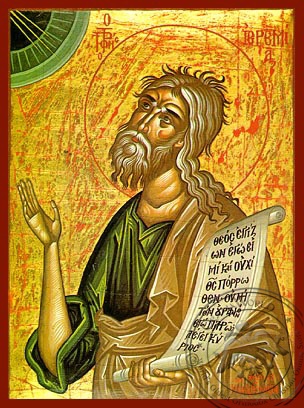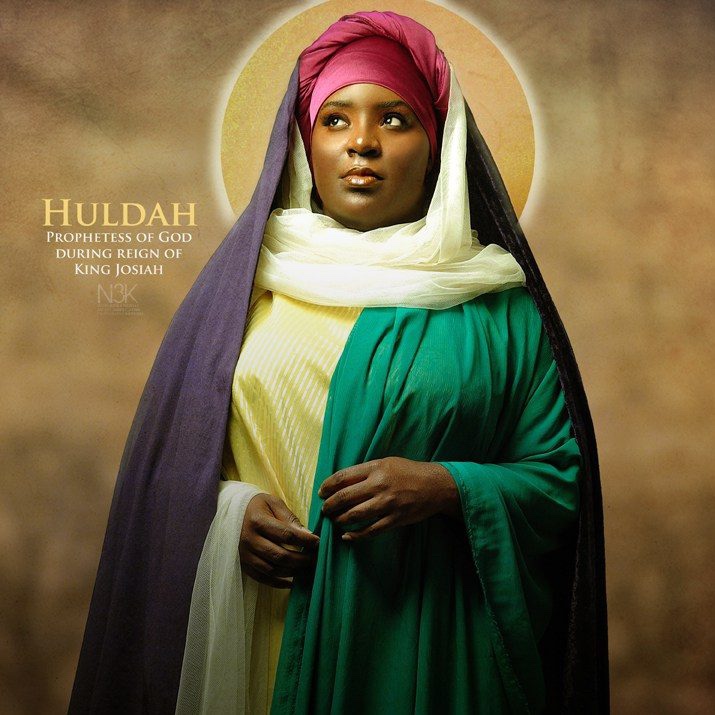
The Day, The End: themes in The Prophets

Eight centuries before Jesus, the prophet Amos had declared, “the LORD said to me, ‘the end has come upon my people Israel; I will never again pass them by’” (Amos 8:2). Amos continues, declaring that God has decreed that “on that day … I will make the sun go down at noon, and darken the earth in broad daylight. I will turn your feasts into mourning, and all your songs into lamentation; I will bring sackcloth on all loins, and baldness on every head; I will make it like the mourning for an only son, and the end of it like a bitter day” (Amos 8:9–10).

That image of The Day when the Lord enacts justice and brings punishment upon the earth, because of the evil being committed by people on the earth, enters into the vocabulary of prophet after prophet. Amos himself declares that it is “darkness, not light; as if someone fled from a lion, and was met by a bear; or went into the house and rested a hand against the wall, and was bitten by a snake. Is not the day of the LORD darkness, not light, and gloom with no brightness in it?” (Amos 5:18–20).

Isaiah, just a few decades after Amos, joined his voice: “the Lord of hosts has a day against all that is proud and lofty, against all that is lifted up and high … the haughtiness of people shall be humbled, and the pride of everyone shall be brought low; and the Lord alone will be exalted on that day” (Isa 2:12, 17). He warns the people, “Wail, for the day of the Lord is near; it will come like destruction from the Almighty!” (Isa 13:6).

Isaiah uses a potent image to describe this day: “pangs and agony will seize them; they will be in anguish like a woman in labour” (Isa 13:7). He continues, “the day of the Lord comes, cruel, with wrath and fierce anger, to make the earth a desolation, and to destroy its sinners from it” (Isa 13:8), and later he portrays that day as “a day of vengeance” (Isa 34:8).

Zephaniah, who was active at the time when Josiah was king (640–609 BCE) declares that “the day of the Lord is at hand; the Lord has prepared a sacrifice, he has consecrated his guests” (Zeph 1:7); “the great day of the Lord is near, near and hastening fast; the sound of the day of the Lord is bitter, the warrior cries aloud there; that day will be a day of wrath, a day of distress and anguish, a day of ruin and devastation, a day of darkness and gloom, a day of clouds and thick darkness ” (Zeph 1:14–15).

Habakkuk, active in the years just before the Babylonian invasion of 587 BCE, declares that “there is still a vision for the appointed time; it speaks of the end, and does not lie” (Hab 2:3); it is a vision of “human bloodshed and violence to the earth, to cities and all who live in them” (Hab 2:17).

Later, during the Exile, Jeremiah foresees that “disaster is spreading from nation to nation, and a great tempest is stirring from the farthest parts of the earth!” (Jer 35:32); he can see only that “those slain by the Lord on that day shall extend from one end of the earth to the other. They shall not be lamented, or gathered, or buried; they shall become dung on the surface of the ground” (Jer 35:33). He also depicts this day as “the day of the Lord God of hosts, a day of retribution, to gain vindication from his foes” (Jer 46:10).

And still later (most likely after the Exile), the prophet Joel paints a grisly picture of that day: “the day of the Lord is coming, it is near—a day of darkness and gloom, a day of clouds and thick darkness! Like blackness spread upon the mountains, a great and powerful army comes; their like has never been from of old, nor will be again after them in ages to come. Fire devours in front of them, and behind them a flame burns. Before them the land is like the garden of Eden, but after them a desolate wilderness, and nothing escapes them.” (Joel 2:1-3).

Later in the same oracle, he describes the time when the Lord will “show portents in the heavens and on the earth, blood and fire and columns of smoke; the sun shall be turned to darkness, and the moon to blood, before the great and terrible day of the Lord comes” (Joel 2:30–31). Joel also asserts that “the day of the Lord is near in the valley of decision; the sun and the moon are darkened, and the stars withdraw their shining” (Joel 3:14–15).

*****

The language of The Day is translated, however, into references to The End, in some later prophetic works. In the sixth century BCE, the priest-prophet Ezekiel, writing in exile in Babylon, spoke about the end that was coming: “An end! The end has come upon the four corners of the land. Now the end is upon you, I will let loose my anger upon you; I will judge you according to your ways, I will punish you for all your abominations.” (Ezek 7:2–3).

And again, Ezekiel declares, “Disaster after disaster! See, it comes. An end has come, the end has come. It has awakened against you; see, it comes! Your doom has come to you, O inhabitant of the land. The time has come, the day is near—of tumult, not of reveling on the mountains. Soon now I will pour out my wrath upon you; I will spend my anger against you. I will judge you according to your ways, and punish you for all your abominations.” (Ezek 7:5–8). This day, he insists, will be “a day of clouds, a time of doom for the nations” (Ezek 30:3; the damage to be done to Egypt is described many details that follow in the remainder of this chapter).

Obadiah refers to “the day of the Lord” (Ob 1:15), while Malachi asserts that “the day is coming, burning like an oven, when all the arrogant and all evildoers will be stubble; the day that comes shall burn them up, says the Lord of hosts, so that it will leave them neither root nor branch” (Mal 4:1).

Malachi ends his prophecy with God’s promise that “I will send you the prophet Elijah before the great and terrible day of the Lord comes; he will turn the hearts of parents to their children and the hearts of children to their parents, so that I will not come and strike the land with a curse” (Mal 4:5–6). This particular word is the final verse in the Old Testament as it appears in the order of books in the Christian scriptures; it provides a natural hinge for turning, then, to the story of John the baptiser, reminiscent of Elijah, who prepares the way for the coming of Jesus, evocative of Moses.

Another prophet, Daniel, declares that “there is a God in heaven who reveals mysteries, and he has disclosed to King Nebuchadnezzar what will happen at the end of days” (Dan 2:28), namely, that “the God of heaven will set up a kingdom that shall never be destroyed, nor shall this kingdom be left to another people. It shall crush all these kingdoms and bring them to an end, and it shall stand forever” (Dan 2:44).

Whilst the story of Daniel is set in the time of exile in Babylon—the same time as when Ezekiel was active—there is clear evidence that the story as we have it was shaped and written at a much later period, in the 2nd century BCE; the rhetoric of revenge is directed squarely at the actions of Antiochus IV Epiphanes, who had invaded and taken control of Israel and begun to persecute the Jews from the year 175BCE onwards.

The angel Gabriel subsequently interprets another vision to Daniel, “what will take place later in the period of wrath; for it refers to the appointed time of the end” (Dan 8:19), when “at the end of their rule, when the transgressions have reached their full measure, a king of bold countenance shall arise, skilled in intrigue. He shall grow strong in power, shall cause fearful destruction, and shall succeed in what he does. He shall destroy the powerful and the people of the holy ones.” (Dan 8:23–24). This seems to be a clear reference to Antiochus IV.

Still later in his book, Daniel sees a further vision, of seventy weeks (9:20–27), culminating in the time of “the end” (9:26). In turn, this vision is itself spelled out in great detail in yet another vision (11:1–39), with particular regard given to the catastrophes taking place at “the time of the end” (11:1–12:13; see especially 11:25, 40; 12:4, 6, 9, 13).

This final vision makes it clear that there will be “a time of anguish, such as has never occurred since nations first came into existence” (12:1), when “evil shall increase” (12:3) and “the wicked shall continue to act wickedly” (12:10). The visions appear to lift beyond the immediate context of the Seleucid oppression, and paint a picture of an “end of times” still to come, after yet worse tribulations have occurred.

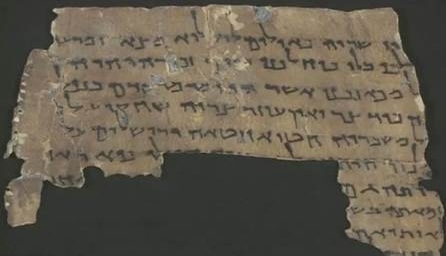
Attention to The Day which will bring The End continues in Jewish literature that was written in the Diaspora, amongst Jews that remained in the lands outside Israel, as well as by Jews whose ancestors had returned to Israel from the late 6th century onwards. Jews continued to write apocalypses (3 Enoch; Apocalypse of Abraham; Genesis Apocryphon; and a number of works in the Dead Sea Scrolls).

Interest in “the end times” appears also in Christian literature, both in words attributed to Jesus (Mark 13; Matt 25–25; Luke 17 and 21) as well as statements in various letters written by leaders in the movement initiated by Jesus (1 Thess 4:13–5:11; 1 Cor 7:29–31; 15:21–28; and all of 2 Thess) and in the seven letters found early in the book of Revelation. This interest continues on into other documents from the first few centuries that are not canonical (Didache 16; Barnabas 15; Apocalypse of Peter).
I have chosen you … rejoice greatly, O daughter Zion (Haggai and Zechariah)

Alongside the writings of Trito-Isaiah, there are a further two prophets whom we can date to the specific time soon after the exiles had returned to Jerusalem. The books of Haggai and Zechariah each open with a specific date, both placing their activity in the time of Darius, King of Persia. Malachi is not dated, but is generally considered to have been written fairly soon after Haggai and Zechariah. (The remaining “minor prophets”, Jonah and Joel, however, contain no such indication as to their date.)

Haggai and Zechariah are located in the period when the exiles in Babylon are returned to Judah late in the 6th century BCE, by decision of the Persian King, Cyrus (whom Deutero-Isaiah, you may remember, described as God’s “Messiah”). In his decree, Cyrus acknowledges “the Lord, the God of heaven” and states that “any of those among you who are of his people … are now permitted to go up to Jerusalem in Judah, and rebuild the house of the Lord, the God of Israel” (Ezra 1:2–4).

Under Nehemiah as Governor, worship is reinstituted in Jerusalem (Ezra 3:1–7), the walls around the city of Jerusalem are rebuilt (Neh 2—6, 12), and the Temple is rebuilt and rededicated (Ezra 5–6). After this, the Law is read in the city under the guidance of Ezra, a priest who is also described as a scribe (Neh 8) and the covenant with the Lord is renewed (Neh 9–10).

Initially, there was opposition to the rebuilding works from “the enemies of Judah and Benjamin” (Ezra 4:1–16), and with intervention from King Artaxerxes, work on the temple ceased (Ezra 4:17–24). The narrative in Ezra reports that “the prophets, Haggai and Zechariah son of Iddo, prophesied to the Jews who were in Judah and Jerusalem, in the name of the God of Israel who was over them” (Ezra 5:1), and work on restoring the temple recommenced (Ezra 5:2).

Further opposition emerged (Ezra 5:3–17), resulting in intervention from King Darius that decreed “let the house be rebuilt … let the Governor of the Jews and the elders of the Jews rebuild this house of God on its site … let it be done with all diligence” (Ezra 6:1–12).

The end result is that the prophets of the Lord and the rulers of the Persian Empire together ensure that the temple is restored: “So the elders of the Jews built and prospered, through the prophesying of the prophet Haggai and Zechariah son of Iddo. They finished their building by command of the God of Israel and by decree of Cyrus, Darius, and King Artaxerxes of Persia” (Ezra 6:14).

*****

What is it, then, that Haggai and Zechariah say to the people? The prophetic words of Haggai are nestled within a relatively brief narrative telling of this return to Jerusalem; they were delivered over a short period of time from “the second year of King Darius, in the sixth month, on the first day of the month” (Hag 1:1) until “the twenty-fourth day of the ninth month, in the second year of Darius” (Hag 2:10, 20).

In the course of those three months, Haggai condemns the people for failing to rebuild the ruined temple while people live in “paneled houses” (1:4), encourages the people to “go up to the hills and bring wood and build the house” (1:8), and then declares that “the latter splendor of this house shall be greater than the former, says the LORD of hosts; and in this place I will give prosperity, says the Lord of hosts” (2:9).

Haggai then relays an ominous word of the Lord: “I am about to shake the heavens and the earth, and to overthrow the throne of kingdoms; I am about to destroy the strength of the kingdoms of the nations, and overthrow the chariots and their riders; and the horses and their riders shall fall, every one by the sword of a comrade” (2:21–22). Yet this short book ends with a positive note for the future, promising to make Zerubbabel, who led the first wave of exiles to return to Judah, “like a signet ring, for I have chosen you” (2:23).

(An excerpt from Haggai appears in the lectionary on the 22nd Sunday after Pentecost.)

*****

Zechariah dates his opening prophecy to “the eighth month, in the second year of Darius” (Zech 1:1), which places him as a contemporary of Haggai. Zechariah begins witha familiar prophetic refrain: “return to me, says the Lord of hosts, and I will return to you, says the Lord of hosts” (1:3), noting that when this message was presented to earlier Israelites, “they repented and said, ‘the Lord of hosts has dealt with us according to our ways and deeds, just as he planned to do’” (1:6).

What follows this opening salvo is a report of eight visions (1:7—6:8). They are dated to “the twenty-fourth day of the eleventh month, the month of Shebat, in the second year of Darius” (2:7), two months after the final prophecy of Haggai. The visions combine glimpses of hope with reminders of the need to remain faithful to the covenant: “if you will walk in my ways and keep my requirements, then you shall rule my house and have charge of my courts” (3:7). The fourth vision (3:1–10) includes the figure of “the accuser” (ha-satan in Hebrew) standing at the right hand of Joshua, to accuse him (3:1).

At the conclusion of the eighth vision there follows words of condemnation (7:1–7) and punishment (7:8–14), citing classic prophetic notes: “render true judgments, show kindness and mercy to one another; do not oppress the widow, the orphan, the alien, or the poor; and do not devise evil in your hearts against one another” (7:9–10).

Then come words of promise (8:1–23): “I will return to Zion, and will dwell in the midst of Jerusalem; Jerusalem shall be called the faithful city, and the mountain of the Lord of hosts shall be called the holy mountain” (8:3). Once again, prophetic injections are offered: “speak the truth to one another, render in your gates judgments that are true and make for peace, do not devise evil in your hearts against one another, and love no false oath” (8:16–17).

An oracle pronouncing judgement on other nations then follows (9:1–8), followed by a joyful celebration of the restoration of Judah (9:9–11:3), introduced by a rousing shout of joy: “rejoice greatly, O daughter Zion! Shout aloud, O daughter Jerusalem! Lo, your king comes to you; triumphant and victorious is he, humble and riding on a donkey, on a colt, the foal of a donkey.” (Zech 9:9). This verse is well-known, of course, from its quotation in the story of Jesus’s entry into the city of Jerusalem (Matt 21:5).

The remaining chapters continue the note of exultation about the future, reworking the motif of “the day of the Lord” so that it signals joy for Jerusalem and terror for other nations (12:3, 4, 6, 8, 9, 11; 13:1, 2, 4; 14:1, 4, 6, 8, 9, 13, 20, 21). A triumphant note of universalism is sounded: “on that day “the Lord will become king over all the earth” (14:9) and “all who survive of the nations that have come against Jerusalem shall go up year after year to worship the King, the Lord of hosts, and to keep the festival of booths” (14:16).

*****

See also

Gathering the outcasts, envisaging the new creation (Isaiah 56–66)

The third section of the book of Isaiah (chapters 56–66) begins with a familiar prophetic announcement: “maintain justice, and do what is right, for soon my salvation will come, and my deliverance be revealed” (Isa 56:1). Written during the period when the people of Judah were returning to their land, to the city of Jerusalem (from the 520s BCE), the book demonstrates what this justice will look like through a series of powerful oracles.

The prophet sounds a vivid counter-cultural note in the midst of the events of his time. He begins with the promise to foreigners and eunuchs that “I will give, in my house and within my walls, a monument and a name better than sons and daughters; I will give them an everlasting name that shall not be cut off” (Isa 56:5). This is a striking contrast to the narrative provided in the books of Ezra and Nehemiah, which tell of the return to the city, the rebuilding of the walls, the renewal of the covenant and the public reading of the Law, the rededication of the Temple—and actions designed to remove foreigners (especially women) from within Israel (see Ezra 10; Neh 13).

Ezra and Nehemiah exhibited a zealous fervour to restore the Law to its central place in the life of Israel. Ezra, learning that “the holy seed has mixed itself with the peoples of the lands” (Ezra 9:2), worked with “the elders and judges of every town” to determine who had married foreign women; the men identified “pledged themselves to send away their wives, and their guilt offering was a ram of the flock for their guilt” (Ezra 10:19). (So much for the importance of families!)

Nehemiah considered that this project to “cleanse [the people] from everything foreign” (Neh 13:30) was in adherence to the command that “no Ammonite or Moabite should ever enter the assembly of God, because they did not meet the Israelites with bread and water, but hired Balaam against them to curse them” (Neh 13:1–2; see Num 22—24). The restoration of Israel as a holy nation meant that foreigners would be barred from the nation.

The oracle at the start of the third section of Isaiah stands in direct opposition to this point of view; “the foreigners who join themselves to the Lord … and hold fast my covenant—these I will bring to my holy mountain, and make them joyful in my house of prayer; their burnt offerings and their sacrifices will be accepted on my altar; for my house shall be called a house of prayer for all peoples” (Isa 56:6–7).

Jesus, of course, quoted this last phrase in the action he undertook in the outer court of the Temple (Mark 11:17). Later, the welcome offered to the Ethiopian court official by Philip, who talked with him about scripture and baptised him, a eunuch (Acts 8:26–38), is consistent with the prophetic words, “to the eunuchs who keep my sabbaths, who choose the things that please me and hold fast my covenant, I will give them an everlasting name that shall not be cut off” (Isa 56:4–5). (From the earliest days, the church practised an inclusive welcoming of diversity that was consistent with this prophetic declaration.)

Other words in this last section of Isaiah also resonate strongly with texts in the New Testament. The ingathering of the outcasts (56:8) and the flocking of all the nations to Zion (60:1–18) together are reflected in the prediction of Jesus that “this good news of the kingdom will be proclaimed throughout the world, as a testimony to all the nations; and then the end will come” (Matt 24:14).

The statement that those coming from Sheba “shall bring gold and frankincense, and shall proclaim the praise of the Lord” (60:6) most likely informed the story that Matthew created, concerning the wise ones from the east who came to see the infant Jesus and “offered him gifts of gold, frankincense, and myrrh” (Matt 2:11).

******

Further oracles set out exactly what the justice that God desires (56:1; 61:8) looks like. The extensive worship of idols (57:1–13) will bring God’s wrath on the people; “there is no peace, says my God, for the wicked” (57:13). Rather, “the high and lofty one who inhabits eternity, whose name is Holy” chooses “to revive the spirit of the humble and to revive the heart of the contrite” (57:15).

Because God indicates that “I will not continually accuse, nor will I always be angry” (57:16), the prophet conveys what the Lord sees as the fast that is required; not a fast when “you serve your own interest on your fast day,

and oppress all your workers” (58:3), but rather, a fast “to loose the bonds of injustice, to undo the thongs of the yoke, to let the oppressed go free,

and to break every yoke … to share your bread with the hungry, and bring the homeless poor into your house; when you see the naked, to cover them, and not to hide yourself from your own kin” (58:6–7). These words resonate with the actions of “the righteous” in the well-known parable of Jesus, as they gave food, water, a welcome, clothing, and care to those sick or imprisoned (Matt 25:31–46).

The prophet laments that “there is no justice … justice is far from us … we wait for justice, but there is none … justice is turned back … the Lord saw it, and it displeased him” (59:8–15); he declares that, as a consequence, God “put on righteousness like a breastplate, and a helmet of salvation on his head; he put on garments of vengeance for clothing, and wrapped himself in fury as in a mantle” (59:17)—a description that underlines the later exhortations to the followers of Jesus to “put on the whole armour of God, so that you may be able to stand against the wiles of the devil” (Eph 6:10–17).

Because the Lord “loves justice” (61:8), the prophet has been anointed “to bring good news to the oppressed, to bind up the brokenhearted, to proclaim liberty to the captives, and release to the prisoners; to proclaim the year of the Lord’s favour, and the day of vengeance of our God” (61:1–2)—words which are appropriated by Jesus when he visits his hometown and reads from the scroll of Isaiah (Luke 4:18–19); “today this scripture has been fulfilled in your hearing”, Jesus declares (Luke 4:21).

Adhering to this way of justice, practising the fast that the Lord desires, means that he will give Israel a new name: “you shall no more be termed Forsaken, and your land shall no more be termed Desolate; but you shall be called My Delight Is in Her, and your land Married; for the Lord delights in you, and your land shall be married” (Isa 62:4). We have already seen the symbolic significance of names in considering the prophet Hosea and in Isaiah 8.

By contrast, vengeance will be the experience of Edom; using the image of trampling down the grapes in the wine press, the prophet reports the intention of God: “I trampled down peoples in my anger, I crushed them in my wrath, and I poured out their lifeblood on the earth” (63:1–6). So vigorously does God undertake this task, that he is attired in “garments stained crimson” because “their juice spattered on my garments and stained all my robes” (63:1–3). Once again, the prophet speaks in graphic terms about the consequences of sinfulness.

Confronted with this display of wrath and vengeance, the prophet adopts an attitude of penitence, yearning for God to “look down from heaven and see, from your holy and glorious habitation” (63:15). His plea for the Lord to “tear open the heavens and come down, so that the mountains would quake at your presence—to make your name known to your adversaries, so that the nations might tremble at your presence!” (64:1–2) must surely have been in the mind of the evangelists as the reported the baptism of Jesus, when he “saw the heavens torn apart and the Spirit descending like a dove on him” (Mark 1:10).

The book ends with a sequence in which the prophet reports the words of the Lord which indicate that Israel will be restored (65:1–16), followed by the statement that the Lord is “about to create new heavens and a new earth” (65:17–25; 66:22–23). (This passage appears in the lectionary on the 23rd Sunday flyer Pentecost.)

This vision is taken up and expanded in the closing chapters of the final book of the New Testament (Rev 21:1–22:7). The closing vision of Trito-Isaiah incorporates a number of references to earlier prophetic words: building houses and planting vineyards (65:21) recalls the words of Jeremiah (Jer 29:5–7); the image of wolves lying with lambs and lions “eating straw like the ox” recalls the vision of Isaiah (Isa 11:6–7).

The promise that “they shall not hurt or destroy all on my holy mountain” (65:25) recalls that same vision of Isaiah (Isa 11:9), whilst the next promise about not labouring in vain nor bearing children for calamity (65:23) reverses the curse of Gen 3:16–19. The story of creation from the beginning of Genesis is evoked when the Lord asserts that “heaven is my throne and the earth is my footstool … all these things my hand has made” (66:1–2); these are the words which Stephen will quote back to the council in Jerusalem (Acts 7:48–50) and will lead to his death at their hands.

Even to the very end of this book, the judgement of the Lord is evident; the prophet declares that “the Lord will come in fire, and his chariots like the whirlwind, to pay back his anger in fury, and his rebuke in flames of fire; for by fire will the Lord execute judgment, and by his sword, on all flesh; and those slain by the Lord shall be many” (66:15–16).

Nevertheless, the glory of the Lord shall be declared “among the nations” (66:19) and “they shall bring all your kindred from all the nations as an offering to the Lord” (66:20). The universalising inclusivism that was sounded at the start of this prophet’s work is maintained through into this closing oracle. In “the new heavens and the new earth which I will make … all flesh shall come to worship before me, says the Lord” (66:22–23). The vision lives strong!

*****

See also

Comfort and hope: return from Exile (Isaiah 40–55)

“Comfort, comfort all my people”, sings the prophetic voice which opens the second major section of the book of Isaiah (chapters 40—55). Widely considered to be written in a period later than the time when the earlier sections are located, this section of Isaiah is called Deutero—Isaiah, signalling that it is the second main section of the book. (The third main section, chapters 56—66, is called Trito—Isaiah.)

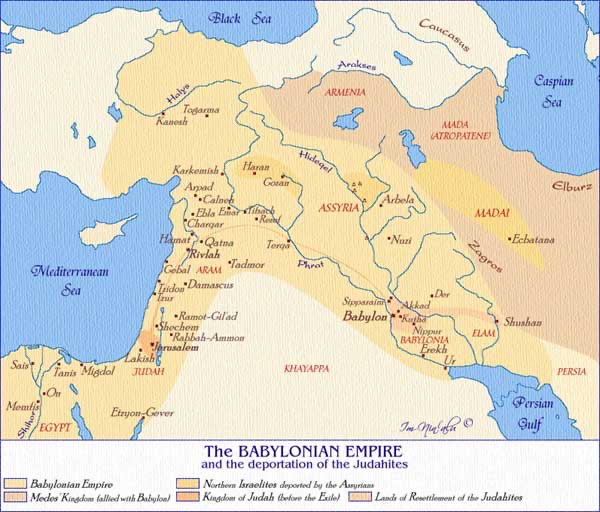
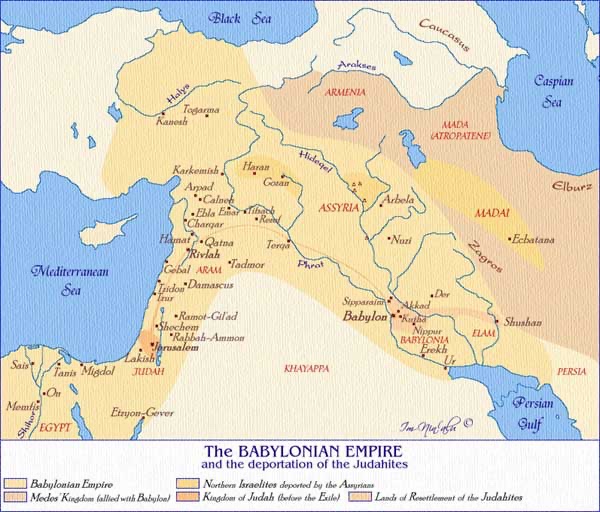
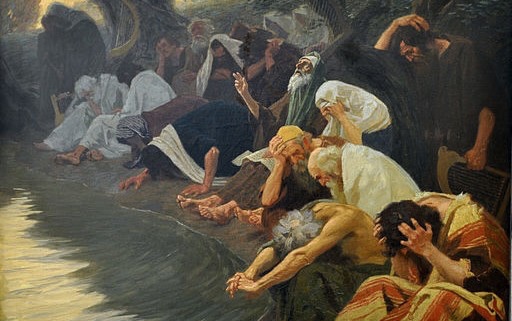
The comfort sung about by the prophet signifies the situation of the people: their forebears had been taken into exile by the Babylonians in 587 BCE, and now a new generation (perhaps four to five decades later) yearns to return to the land of Israel, given to the people in ancient times, as recounted in the foundational myth—story of the Exodus. Other parts of the Hebrew Bible reflect the anguish of the people during their time of Exile (Ps 137 is the most famous instance). Deutero-Isaiah, however, focuses consistently on the hope of return to the land of Israel.

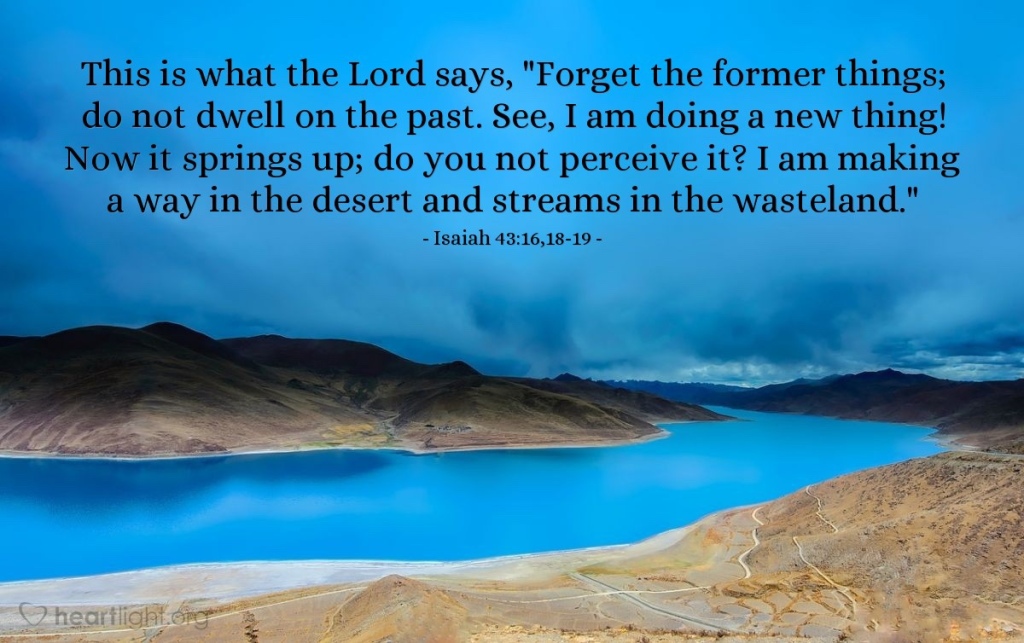
Looking to the new power of Persia to permit this return, the prophet of this later period speaks with hope and joy, to the people living in exile, using vivid imagery and dramatic scenes of promise and confidence. A joyous, positive tone runs right through the oracles in this section of Isaiah. “I am about to do a new thing”, says the Lord; “I will make a way in the wilderness and rivers in the desert” (43:19). “I will pour water on the thirsty land and streams on the dry ground”, the Lord continues; “I will pour my spirit upon your descendants, and my blessing on your offspring” (44:3).

The return to Israel is depicted in vivid scenes: “I will make of you a threshing sledge, sharp, new, and having teeth; you shall thresh the mountains and crush them, and you shall make the hills like chaff” (41:15). It is especially envisaged as a re-enacting of the Exodus through the Red Sea; “I will make a way in the wilderness and rivers in the desert, for I give water in the wilderness, rivers in the desert” (43:19–20); “when you pass through the waters, I will be with you; and through the rivers, they shall not overwhelm you” (43:2).

The imagery reaches back to the start of Genesis; “the Lord will comfort Zion; he will comfort all her waste places, and will make her wilderness like Eden, her desert like the garden of the Lord” (51:3). Indeed, the Lord as creator is emphasised a number of times (40:28; 43:7, 15; 44:2, 24; 45:12, 18; 48:1).

Key to this promised return to the land of Israel is Cyrus, the Persian ruler, who lived from about 600 to 530 BCE. Cyrus led the Persians to dominance in the region from around 550 BCE onwards. The Persian Empire stretched around the eastern edge of the Mediterranean Sea, from the Hellespont (the Dardanelles) in the west to the Indus River in the east.

A defining feature of Cyrus is that he respected the religious practices and cultural customs of the lands he conquered. The evidence for this,policy comes from an artefact known as the Cyrus Cylinder, made of clay (and now broken into a number of pieces). The Cylinder was found in modernity in 1879 during an expedition under the auspices of the British Museum, near a large shrine to the chief Babylonian god Marduk.

The Cylinder articulates the policy which undergirded the decision of Cyrus to allow the exiles in Babylon to return to the land of Judah (2 Chron 36:22–23; Ezra 1:1–10). The Cylinder does not refer directly to Judah or Israel, but it does include the line, “the gods, who resided in them [a list of cities across the Tigris], I brought back to their places, and caused them to dwell in a residence for all time, and the gods of Sumer and Akkad … I caused them to take up their dwelling in residences that gladdened the heart”.

Because of this policy, Cyrus is most strikingly described by Deutero-Isaiah as the Lord’s anointed one (45:1), the one of whom the Lord says, “he is my shepherd and he shall carry out all my purpose” (45:28). The prophet affirms that the Lord says, “I have aroused Cyrus in righteousness, and I will make all his paths straight; he shall build my city and set my exiles free, not for price or reward” (45:13). (The Hebrew word used, mashiach, is the same used to refer to the one anointed as Messiah at Dan 9:25–26; it is translated into Greek as Christos, from which Jesus is known as the Christ.)

Choosing a foreigner, the ruler of the dominant empire of the time, to carry out the will of the God of Israel, is a bold claim indeed. It is a striking development in Israel’s theology, especially since an intensified nationalism—indeed, xenophobia—is evidenced in literature from the time when people have returned (Ezra and Nehemiah, in particular).

After the return to the land under Cyrus (2 Chron 36:22–23), the narrative books which follow immediately, Ezra and Nehemiah, recount the details of this return as the walls around the city of Jerusalem are rebuilt (Neh 2—6, 12), the Temple is rebuilt and rededicated (Ez 3, 5–6), the Law is read in the city and the covenant with the Lord is renewed (Neh 8—10).

*****

Because of this word of good news about the fate of the exiles, God is regularly described as Redeemer (Isa 41:14; 43:14; 44:6, 24; 47:4; 48:1, 17; 49:7, 26; 54:5, 8). God is also regularly named as “the Holy One” (Isa 40:25; 41:14, 16, 20; 43:3, 14, 15; 45:11; 47:4; 49:17; 49:7; 54:5; 55:5), picking up a title found already in other texts (1 Sam 2:2; 2 Ki 19:22; Job 6:10; Ps 71:22; 78:41; 89:18; Prov 9:10; Isa 1:4; 5:19, 24; 10:17, 20; Ezek 39:7; Hos 11:9, 12; Hab 1:12; 3:3).

Later, Jesus is described in ways that use both terms: as “the one to redeem Israel” (Luke 24:21; see also Rom 3:24; 1 Cor 1:30; Gal 4:5; Eph 1:7, 14; Col 1:14; Tit 2:14; Heb 9:11–12), and as the “Holy One” (Acts 3:14; 1 John 2:20).

Within these oracles of promise and hope, the theological understanding of monotheism is clearly articulated for the first time in the history of Israel. “Is there any god besides me? There is no other rock; I know not one” (44:8). The phrase, “there is no other (god)”, recurs a number of times in this section (42:8; 45:5, 14, 21, 22; 46:9).

This is in contrast to the way that the God of Israel had previously been portrayed, as “among the gods” (Exod 15:11; Judg 2:12; Ps 86:8), with the commandment to have “no other gods before me” (Exod 20:3; Deut 5:7) distinguishing this God from those other gods whom Israel was clearly forbidden to worship (Deut 6:14; 7:4; 8:19; 11:16; 13:1–18; 17:2–5; 18:20).

Time after time, the straying of Israel to worship these ”other gods” resulted in punishment sent by the Lord (Josh 23:16; Judg 2:11–23; 10:13; 1 Sam 8:8; 1 Ki 9:6–9; 11:9–13; 14:6–14; 2 Ki 17:7–8, 35–40; 22:14–17; 2 Chron 7:19–22; 28:25; 34:24–25; Jer 1:16; 7:16–20; 11:9–13; 16:10–13; 19:4–9; 22:6–9; 32:29; 35:15–17; 44:1–19; Hos 3:1—4:11). Monotheism was not in view in earlier, pre-exilic literature.

As a consequence of this development, if the Lord God is the only god, then the Lord must take responsibility for all that takes place: “I form light and create darkness, I make weal and create woe; I the Lord do all these things” (45:7). This affirmation creates problems; if God causes both good and bad things to happen, he is accountable for all that takes place.

Over time, this theological development would lead to the development of another theological milestone: the creation of an opposing force who would be held responsible for all evil. The accuser from the heavenly court, delegated by God to prosecute cases (Job 1:6–12; 2:2–8; 1 Chron 21:1; Zech 3:1–10) would become Satan, tester of Jesus (Mark 1:13), fallen heavenly being (Luke 10:18), and “deceiver of the whole world” (Rev 12:9; 20:2–3).

*****

Deutero-Isaiah is fundamental, in other ways, for the theological developments that we find in the New Testament. Scattered through this section, we find four Songs of the Servant—three relatively brief (42:1–9; 49:1–7; 50:4–11); and the fourth, best-known within Christian circles, a longer description of the servant who “was despised and rejected by others; a man of suffering and acquainted with infirmity” (Isa 52:13–53:12).

The resonances that this longer song has with the passion narrative of Jesus are crystal clear. The song is explicitly linked with Jesus six times in the New Testament (Matt 8:14–17; Luke 22:35–38; John 12:37–41; Acts 8:26–35; Romans 10:11–21; 1 Pet 2:19–25); furthermore, so many of the details of the passion narrative are shaped in the light of this song, along with a number of psalms of the righteous sufferer. (See https://johntsquires.com/2021/03/22/3-mark-placing-suffering-and-death-at-the-heart-of-the-gospel/)

The list of connections with details in the passion narrative is impressive. The prophet describes the marred appearance of the Servant (52:14); he is despised, rejected, and suffering (53:3), bearing our infirmities (53:4), and wounded for our transgressions (53:5). The Servant is led like a lamb to the slaughter (53:7), suffering “a perversion of justice” (53:8), not practising violence or speaking deceit (53:9), and is buried with the rich (53:9).

The Servant gives his life as “an offering for sin” (53:10), carrying the iniquities of many (53:11), making them righteous (53:11), bearing the sin of many (53:12), making “intercession for the transgressors” (53:12). The role that the Servant plays in relation to sin, for the sake of the many, shapes the important saying of Jesus, that “the Son of Man came not to be served but to serve, and to give his life a ransom for many” (Mark 10:45).

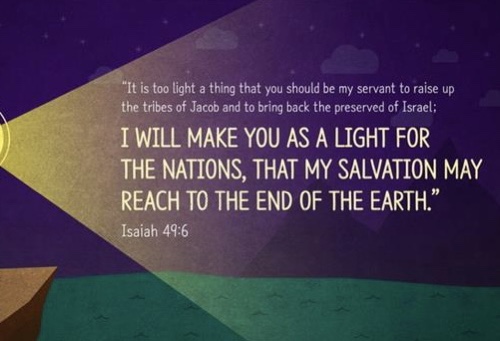
Deutero-Isaiah as a whole is the most-quoted part of Hebrew Scripture in New Testament texts. Another element in the Servant songs shapes the way that Luke envisages the story of Jesus and his followers. The Servant is given “as a covenant to the people, a light to the nations” (Isa 42:6), as “a light to the nations, that my salvation may reach to the end of the earth” (Isa 49:6).

The phrase is cited at critical moments by Simeon (Luke 2:32), Paul and Barnabas in Antioch (Acts 13:46–47), and Paul alone when on trial in Caesarea (Acts 26:23). Jesus foresees that witness to the good news will take place “in Jerusalem, in all Judea and Samaria, and to the ends of the earth” (Acts 1:8).

Further, the Servant is given as “a light to the nations, to open the eyes that are blind, to bring out the prisoners from the dungeon, from the prison those who sit in darkness” (Isa 42:6–7), words which resonate with the later scriptural citation spoken by Jesus in Nazareth: “the Spirit … has sent me to proclaim release to the captives and recovery of sight to the blind, to let the oppressed go free” (Luke 4:18).

The author of the fourth Gospel also made much of what was spoken to the Servant, “you are my servant, Israel, in whom I will be glorified” (Isa 49:6), a description of what happens to Jesus which recurs regularly in this book, when “the Son of Man has been glorified” (John 13:31; see also 7:39; 11:4; 12:16, 23, 28; 13:32; 17:10).

The prophet reports the decision of the Lord: “I have taken from your hand the cup of staggering; you shall drink no more from the bowl of my wrath, and I will put it into the hand of your tormentors” (51:22). Accordingly, any oracles of judgement and threat of punishment are directed squarely towards Babylon, (43:14; 45:20-47:15), not Israel (54:9).

The closing oracles of this section of Isaiah promise abundance and peace to the exiles, looking towards their return to the land. “Enlarge the site of your tent, and let the curtains of your habitations be stretched out … you will spread out to the right and to the left, and your descendants will possess the nations and will settle the desolate towns” (Isa 54:2–3). Israel is invited to “come, buy wine and milk without money and without price” (55:1), with the assurance that “as the rain and the snow come down from heaven, and do not return there until they have watered the earth, making it bring forth and sprout, giving seed to the sower and bread to the eater, so shall my word be that goes out from my mouth; it shall not return to me empty” (55:10–11).

Deutero-Isaiah ends with a portrayal of cosmic joy as the exiles prepare to return to Israel: “the mountains and the hills before you shall burst into song, and all the trees of the field shall clap their hands” (55:12). All will be well.

*****

See also

I have been a sanctuary to them for a little while: the God of the prophet Ezekiel (2)

Ezekiel the priest; Ezekiel the ben adam, the human one; Ezekiel was captured by the Babylonians in 599 BCE, sent into exile, but nevertheless was seized by the spirit, given visions from the Lord, and charged with speaking the word of the Lord not only to the people with him in exile and to those later taken into exile in 587 BCE, but also to those who remained in the land of Israel after the Babylonian conquest at that time. His dramatic, vivid visions, and his potent, articulate proclamations, make for exciting—and troubling—reading.

See part one at

After Ezekiel is granted his numerous visions by the spirit, he often enacts them with tangible items. He sees the siege of Jerusalem, and portrays it with a brick and iron plate (4:1–8). He sees the destruction of Jerusalem, and uses a sword to shave his hair, to dramatise this (5:1–17). He sees the ravaging of the altars of idols throughout the land, and claps his hands and stamps his feet to demonstrate the destructive anger of the Lord at this (6:1–14).

“On the sixth year, in the sixth month, on the fifth day of the month”, says Ezekiel (with his relentless priestly eye for detail), “as I sat in my house, with the elders of Judah sitting before me, the hand of the Lord God fell upon me there”. He describes the “figure like a human being” that he sees, and in characteristically careful detail he describes the scene unfolding before him; a scene of “the great abominations that the house of Israel are committing here, to drive me far from my sanctuary”, as God laments (8:1–18).

So extensive are these abominations that God concludes, “I will act in wrath; my eye will not spare, nor will I have pity; and though they cry in my hearing with a loud voice, I will not listen to them” (8:18). As a result, “the glory of the Lord” leaves the temple and is taken by the cherubim up and away from the earth (10:1–22). Those in exile are informed that their exile is due punishment from the Lord (11:1–12), but also that after sufficient punishment, they will return to the land (11:14–25). The “glory of the Lord” remains absent from the city until, in the final sequence of his visions, Ezekiel sees the new temple, built in the city, and “the glory of the Lord filled the temple” (Ezek 43:1–5; see also 1 Ki 8:11; 2 Chron 7:1–2; Exod 40:34–35; and cf. Isa 6:1, 4; Rev 15:8).

One of Ezekiel’s visions uses typical prophetic imagery to portray Israel as a female child, abandoned by her parents, but taken in by the Lord, who waited until she was  at an age for love, and then he “spread his cloak over her” – that is, he seduced her (16:1–14). He then complained, “you trusted in your beauty, and played the whore because of your fame, and lavished your whorings on any passer-by”, worshipping other gods, even engaging in foreign rituals of child sacrifice (16:15–34).

As a result of this, God threatens that he will execute a fulsome punishment. The blame is placed squarely on Israel, depicted as a woman engaging in countless acts of adultery—even though, in the patriarchal society of the time, the male priests, kings, and elders were the ones responsible for the decisions to erect images of other gods and to encourage the worship of pagan deities.

Only after he visits his punishment, does God then say, “I will satisfy my fury on you, and my jealousy shall turn away from you; I will be calm, and will be angry no longer” (16:35–43). And so, God promises forgiveness; “I will remember my covenant with you in the days of your youth, and I will establish with you an everlasting covenant” (Ezek 16:60; also 37:26), echoing the exact phrase also used to describe the covenants with Noah (Gen 9:16; and perhaps Isa 24:5), Abraham (Gen 17:7, 13, 19; 1 Chron 16:17), and David (2 Sam 23:35; Isa 55:3), and indeed with Israel as a whole (Ps 105:10; Isa 61:8; Jer 32:40; 50:5).

The character of God in this sequence of events is deeply troubling, and takes us to the heart of the issue; both deep loving kindness and savage wrath are part of this God’s nature. The prophet gives consideration to punishment as retribution (18:1–32), the need to abstain from idolatry (20:1–32), and judgement on idolatry and injustice practices (“father and mother are treated with contempt in you; the alien residing within you suffers extortion; the orphan and the widow are wronged in you”; 22:1–23). In each case, God wrestles with the tension between executing judgement and withholding wrath, between upholding justice and demonstrating covenant love.

*****

A dramatic enactment ensues, when Ezekiel proclaims that God declares judgement on “the bloody city”, saying “set on the pot, set it on, pour in water also; put in it the pieces, all the good pieces, the thigh and the shoulder; fill it with choice bones; take the choicest one of the flock, pile the logs under it; boil its pieces, seethe also its bones in it … heap up the logs, kindle the fire; boil the meat well, mix in the spices, let the bones be burned” (24:1–14). The meat being placed into the pot is nothing other then the residents of “the bloody city”. The savage imagery is brutally confronting.

Yet judge the falls not only on Jerusalem; Ezekiel declares God’s judgement on the Negev (20:45–49) and, in an extended series of oracles, on Ammon, Moab, Edom, Philistia, Tyre, Sidon, and Egypt (chs. 25–32). The repeated words, “raise a lamentation over … “ (19:1; 26:17; 27:2, 32: 28:12; 32:2, 16) and the relentless reference to “the day” (26:18; 27:27; 30:2–3, 9, 18; 31:15; 32:10) drive home the message that God’s justice brings persistent terror and requires harsh punishment. “The day of the Lord is near; it will be a day of clouds, a time of doom for the nations” (30:2–3)—the motif appears regularly through the prophets, and into later apocalyptic literature.

As the destruction of Jerusalem occurs (33:21–29), Ezekiel berates “the shepherds of Israel”: “you have not strengthened the weak, you have not healed the sick, you have not bound up the injured, you have not brought back the strayed, you have not sought the lost, but with force and harshness you have ruled them” (34:4).

Where is God during this time of exile? Ezekiel affirms that God is present: “I will search for my sheep, and will seek them out. As shepherds seek out their flocks when they are among their scattered sheep, so I will seek out my sheep. I will rescue them from all the places to which they have been scattered on a day of clouds and thick darkness” (34:11–12). The extended oracle ends with the affirmation, “you are my sheep, the sheep of my pasture and I am your God, says the Lord God” (34:31). The mercy of God is bound up with the justice of God. The resonances with Psalm 23, as well as the sayings of Jesus in John 10 and the well-known parable of Jesus found in Luke 15 and Matt 18, are clear.

There follows an extended blessing on Israel (36:1–38) and the vision of bones brought to life in the valley (37:1–28), followed by visions relating to Gog and Magog (38:1–39:20; and see Rev 20:7–8). Finally, the exile ends, and Ezekiel speaks of the restoration of Israel to their land (39:21–29); “I will never again hide my face from them, when I pour out my spirit upon the house of Israel, says the Lord God” (39:29).

*****

The issue of being in exile, away from the land that the Lord God had long ago given to the people of Israel, was a difficult situation for those who sought to remain faithful to the covenant with the Lord God. This matter exercises Ezekiel. He knows that exile is the consequence of Israel’s idolatry and infidelity (5:1–7:27). “Alas for all the vile abominations of the house of Israel—for they shall fall by the sword, and by pestilence … and any who are left shall die of famine” (6:11–12), say the Lord; “I will make the land desolate … then they shall know that I am the Lord” (6:14). Exile, it would seem, is a fair punishment.

The sense that the psalmist expresses—“how could we sing the Lord’s song in a foreign land?” (Ps 137:4)—is not a view that Ezekiel would have agreed with. Whilst the psalmist grapples with the loss of all that is familiar and valued—no temple, no familiar rituals, no priests, not being in the homeland—Ezekiel is able to find spiritual nourishment in his exile. The many visions he sees and oracles he proclaims attest to the robust nature of his own spiritual life!

Indeed, it appears that there were some who had been able to remain in Judah who maintained that the exiles had forfeited their place within the people of God, for “they have gone far from the Lord; to us this land is given for a possession” (11:15). Ezekiel disputes this, stating that the Lord God has said, “though I removed them far away among the nations, and though I scattered them among the countries, yet I have been a sanctuary to them for a little while in the countries where they have gone” (11:16). The promise is that God will not abandon the people in exile, nor regard them as no longer his people.

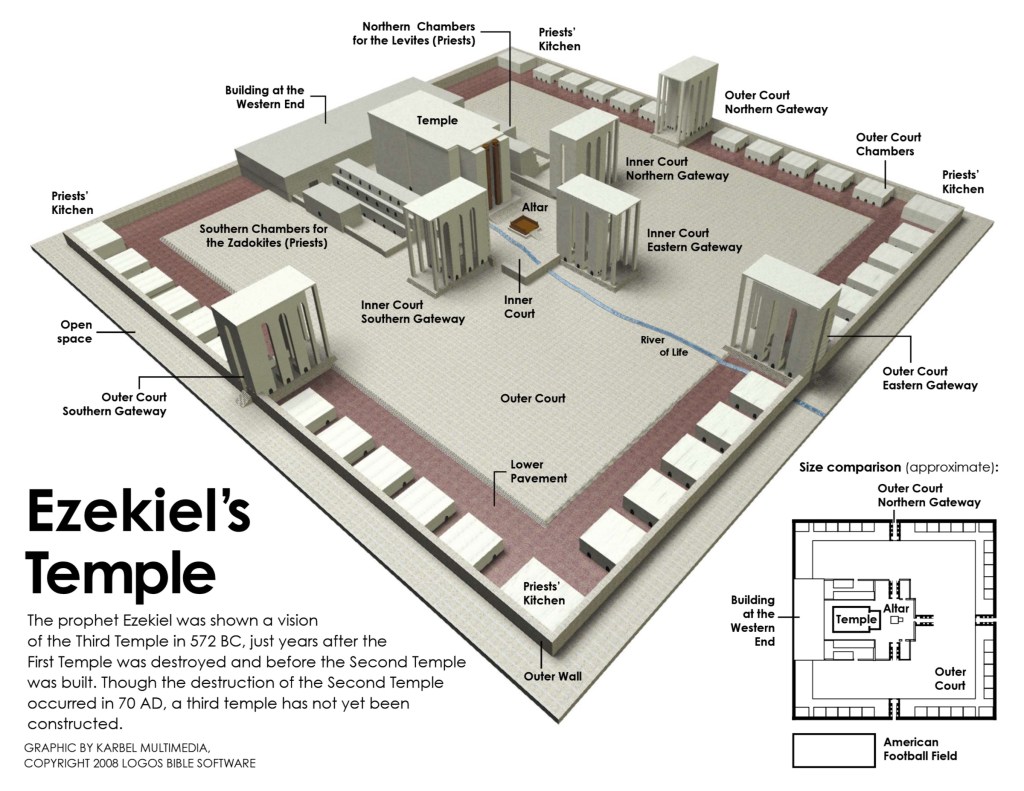
As a sign of his confidence that God will maintain his commitment to Israel, Ezekiel tells in detail his vision of the new temple that would, he believed, be built in the land (40:1–43:27), as well as the role of the Levitical priests in that temple (44:15–31) and various provisions that would be in force after the return to the land (45:1–46:24).

The priests in this temple would be charged with the range of expected duties relating to the sacrifices and offerings, but Ezekiel also indicates that “they shall teach my people the difference between the holy and the common, and show them how to distinguish between the unclean and the clean; in a controversy they shall act as judges, and they shall decide it according to my judgments” (44:23–24).

This detail is quite telling; it shows that Ezekiel considered priests to be learned in Torah and to have judicial responsibilities, making decisions about adherence to holiness prescriptions. This is the role that prophets took to themselves, instructing the people about the ways that they keep God’s justice and the ways that they fail in this; it is also the role that the scribes and Pharisees exercise when we encounter them in the New Testament. In the opinion of Ezekiel, the law of the Lord continues to be completely relevant and vitally important, through all the trials of the times in which he lives.

A final vision details the water flowing from the temple, the abundant trees growing beside the river, and the food sources for the people (47:1–12). The portrayal of the river evokes the scenes of Eden, where “a stream would rise from earth, and water the whole face of the ground” (Gen 2:6; cf. Ezek 47:1), providing fertile ground for the Garden of Eden, in which “the Lord God made to grow every tree that is pleasant to the sight and good for food” (Gen 2:9; cf. Ezek 47:7–12), and from which four rivers flow in abundance (Gen 2:10–14).  The vision of Ezekiel offers a wonderful ecologically vibrant scene!

This vision ends with an affirmation that Israel will be a broad, inclusive society: “the aliens who reside among you … shall be to you as citizens of Israel … in whatever tribe aliens reside, there you shall assign them their inheritance” (47:21–23). Ezekiel ends by reporting how the land will be divided schematically amongst the twelve tribes (48:1–35), in the way that the book of Numbers provided a systematic allocation of the land prior to the conquest of Canaan (Num 34:1–15). And so, from the first verse to the last chapter, Ezekiel’s book provides careful, schematic, detailed information, as befits a prophet who is a priest.

*****

See also

In my mouth, it was as sweet as honey: Ezekiel the prophet (1)

Like Jeremiah, Ezekiel was both a prophet and a priest (Ezek 1:3). The opening verse of the book exhibits characteristic priestly concern to document details; in this case, a very precise date is recorded: “in the thirtieth year, in the fourth month, on the fifth day of the month”. The year correlates with what we know as 593 BCE. No other prophet gives the precise day of his seeing “visions of God”!

Six years earlier, Ezekiel had been exiled to Babylon during the siege of Jerusalem by King Nebuchadnezzar II of Babylon (599 BCE; see 2 Kings 24:10–17). His prophetic activity was thus undertaken entirely in exile. He addresses both those in exile with him in Babylon, and also those left behind in Judah. His prophecies continue through the period when the people in Judah were conquered and taken to join Ezekiel in exile (587 BCE; see 2 Ki 25:1–21), and then for some time after that.

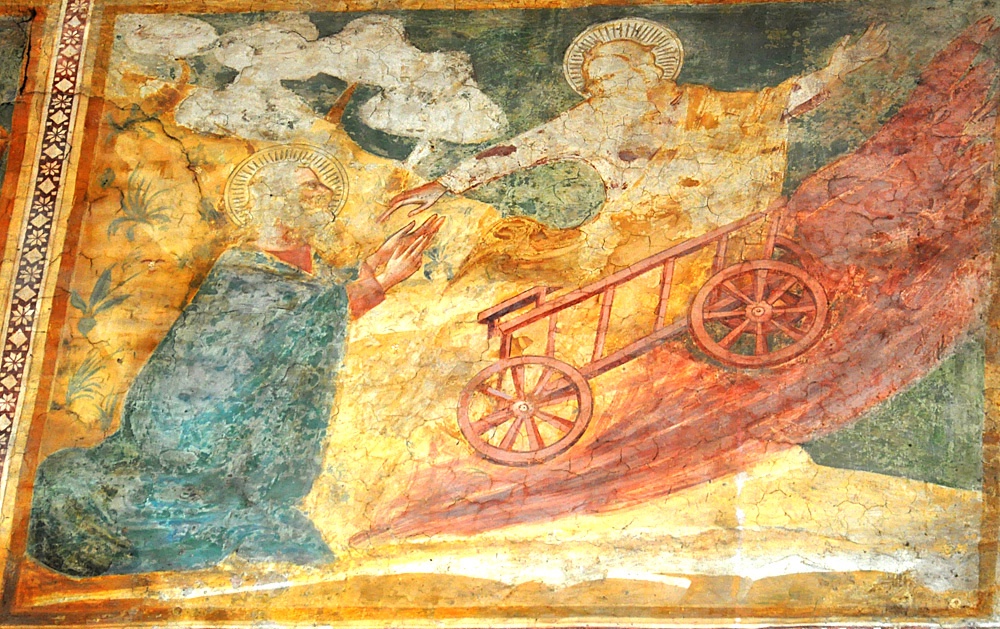
A 14th century fresco of the chariot in Ezekiel’s vision
from Pomposa Abbey, Codigoro, Italy

A dramatic vision opens the book, in which “the glory of God” appears in the form of a fiery, flaming chariot (1:4–28). Priestly attention to detail marks the account of this vision—the scene is reported in scrupulous detail, with many references to other scriptural stories. The bright cloud and flashing fire evokes the scene on Mount Sinai, when God gave Moses the Law (Exod 19:16–19) and the “burning coals of fire” (1:13) remind us of the burning coals in the scene of the call of Isaiah (Isa 6:6).

Then, “the bow in the cloud on a rainy day” evokes the sign of the covenant made with Noah (Gen 9:12–17). The creatures with wings that touch perhaps evoke the golden cherubim overlooking the mercy seat in the Tabernacle (1 Ki 6:23–28), while the wheeled chariot may have been inspired by the chariot that carried the ark of the covenant in procession (2 Sam 6:3).

However, the four creatures, each with four faces and four legs, sparkling “like burnished bronze” (1:6–7), with the appearance of a human being, a lion, an ox, and an eagle (1:10) are unusual. Their presence has invited much speculation about their significance. In the early centuries of the Christian church, these four figures were interpreted as symbols for the four Gospels included in the New Testament. They are found also in the first vision of the seer John, in exile on Patmos, many centuries later (Rev 4:1–8).

Similarly, the description of the crystal dome over the heads of the creatures (1:22) and the sapphire throne with a human form seated on it (1:26) signal to us that this prophet has a vivid imagination, and that there will be much symbolism in the oracles that lie ahead! The remainder of the book continues relentlessly in this style; exotic scenes, vividly imagined, described in detail, conveying a consistent theological perspective.

The point of this dramatic opening comes immediately, when Ezekiel reports a further vision, of a scroll (2:1–10) which he is immediately commanded to eat (2:8, 3:1–3). This second vision is at the heart of the call that Ezekiel receives, to “speak my very words to them [the people]” (2:7; 3:4). Ezekiel the priest has become Ezekiel the prophet.

These words “of lamentation and mourning and woe” (2:10) nevertheless taste “as sweet as honey” to Ezekiel (3:3). However, he knows from the start that the task he has been given will be difficult, for “all the house of Israel have a hard forehead and a stubborn heart” (3:8). They will not listen to him. The scene is set for the difficult career of this prophet-in-exile.

*****

A key issue for Ezekiel relates to whether God continues to be the God of the people of Judah who are in exile in Babylon. Ezekiel offers a development in understanding that God continues to care for the people even when they have no land and no temple, when they can no longer “go up to the house of the Lord” and offer sacrifices.

Ezekiel is impelled to play his role as a prophet by “the hand of the Lord” (1:3; 3:22; 8:1; etc); indeed, he says, “the spirit lifted me up” (3:12). That same spirit continues to lift him up with regularity (8:3; 11:1, 24; 37:1; 43:5) to show him vision after vision. More than this, Ezekiel declares that “the spirit entered me” (3:24), a process which he promises will be experienced by Israel as a whole (36:26–28)—for the Lord says he will “pour out my spirit upon the house of Israel” (39:29).

This emphasis on the renewing spirit of God is seen, most dramatically, by Ezekiel when he is taken by the spirit into “the middle of a valley … full of bones” (37:1) and sees a vision that he conveys in what must be his most famous oracle. What Ezekiel sees in this valley of dry bones is the work of God, as God puts sinews and flesh and skin on the bones, and breathes into the bodies so created, so that they live (37:5–6, 8, 10). The scene is a dramatic reworking of the creation scene in Genesis, when God creates humanity out of the dust, breathing “the breath of life” into human beings (Gen 2:7).

The vision indicates what God will do: “I will put my spirit within you, and you shall live, and I will place you on your own soil” (37:14). The end of the exile, it seems, is in sight. This passage is often interpreted in a Christian context as a pointer both to the resurrection of Jesus, and also to the general resurrection; for Ezekiel, however, it is not a far-into-the-future prediction (foretelling), but a word of hope to the people in their immediate situation (forthtelling).

Indeed, the very next section of this chapter reports a proclamation of Ezekiel which is quite directly forthtelling. The two sticks that he takes (37:16) stand for Judah and Israel; as he joins the sticks, so he points to the return of these peoples from their exile, their return “to their own land”, and a cleansing which will mean “they shall be my people, and I will be their God” (37:21–23, 27).

That final phrase is a common covenantal affirmation made by God (Lev 26:12; Ruth 1:16; Jer 7:23; 11:4; 24:7; 30:22; 31:1, 33; 32:38; Ezek 11:20; 14:11; 36:28; Zech 2:11; and Hos 1:10–11, overturning Hos 1:9). The reunited people shall have one king (37:24) and they will observe “an everlasting covenant” (37:26).

The Lord God addresses the prophet Ezekiel in a distinctive way; 94 times, he begins his words to the prophet with the Hebrew phrase ben adam—traditionally translated as “son of man” (meaning a human being), in the NRSV rendered as “o mortal”. We could simply say, Ezekiel, o human one. My NIV has the footnote, “the phrase son of man is retained as a form of address here and throughout Ezekiel because of its possible association with “Son of Man” in the New Testament”. Certainly, this distinctive address in Ezekiel resonates with the use of this distinctive phrase in the Gospels (although another scriptural usage, in Dan 7:14, offers a different take on this phrase.)

*****

Continued at

Unless you are angry with us beyond measure (Lamentations)

In one of his oracles, Jeremiah expresses the deep anguish of God for the people: “my joy is gone, grief is upon me, my heart is sick … for the hurt of my poor people I am hurt, I mourn, and dismay has taken hold of me” (8:18–22). The Lord echoes this attitude: “oh that my head were a spring of water, and my eyes a fountain of tears, so that I might weep day and night for the slain of my poor people” (9:1).

This weeping recurs in later chapters: in an oracle over Judah, “if you will not listen, my soul will weep in secret for your pride; my eyes will weep bitterly and run down with tears, because the Lord’s flock has been taken captive” (13:17); and in an oracle over Moab, “more than for Jazer I weep for you, O vine of Sibmah” (48:32).

This weeping is also expressed in the poems of lament found in the book of Lamentations; “for these things I weep; my eyes flow with tears”, the author mourns; “for a comforter is far from me, one to revive my courage; my children are desolate, for the enemy has prevailed” (Lam 1:16). Tradition presumes that the author, who is never identified, is the prophet Jeremiah; many scholars, however, believe that there were a number of authors whose work has been collected into this single short book.

The five chapters of Lamentations express a forlorn hope that the punishment being experienced might come to an end. However, that hope remains unfulfilled, from the opening lament, “how lonely sits the city that once was full of people! how like a widow she has become, she that was great among the nations!” (1:1); to the final disconsolate prayer, “restore us to yourself, O Lord, that we may be restored; renew our days as of old—unless you have utterly rejected us, and are angry with us beyond measure” (3:22).

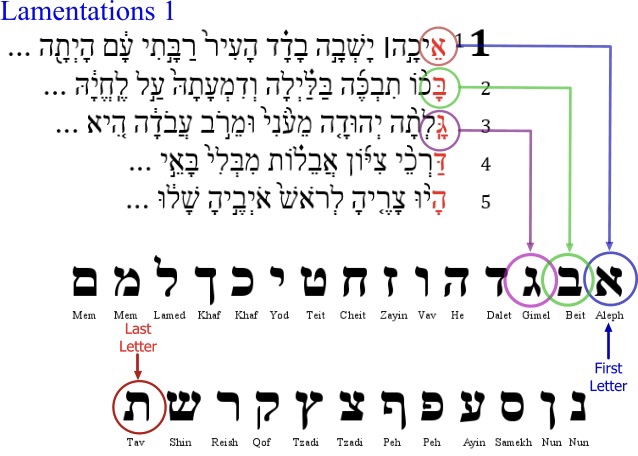
There is a tight numerical and alphabetical arrangement throughout this book. The first four chapters are acrostics—each new verse begins with a letter of the Hebrew alphabet, in alphabetical order. As there are 22 letters in the Hebrew alphabet, there are 22 verses in chapters 1, 2, and 4. Chapter 3 has 66 verses; each letter commences three verses before moving on to the next letter. The final chapter also has 22 verses, but they are not arranged in any alphabetical order.

The first four chapters employ a strict rhythmic pattern, known as a qinah rhythm: three stresses followed by two, which F.W. Dobbs-Allsopp describes as “the rhythmic dominance of unbalanced and enjambed lines” (Lamentations, Westminster John Knox, 2002). The pattern is suggestive of the broken, disjointed existence of the people.

In these five chapters, the author reveals much of how he, and the people, are lamenting their situation in the aftermath of the savage destruction of Jerusalem and its temple in 587/586 BCE. Chapter one paints a picture of the deserted, desolate city: “the roads to Zion mourn, for no one comes to the festivals; all her gates are desolate, her priests groan; her young girls grieve, and her lot is bitter” (1:4). Chapter four provides a detailed portrayal of the destruction of the temple: “how the gold has grown dim, how the pure gold is changed! the sacred stones lie scattered at the head of every street” (4:1).

The poems describe the traumatised state of the people in the immediate aftermath of this conquest. They suffer affliction (1:7, 9; 3:1, 19) and captivity (1:18), grief (3:32, 51) and suffering (1:3, 5, 18), hunger (2:19; 4:4, 9) and thirst (4:4). They express lamentation (2:5, 8) and mourning (1:4; 2:5; 5:15), with tears (1:2, 16; 2:18; 3:48), crying (2:12, 16, 18, 19; 3:8, 56), and weeping (1:2, 16; 2:11).

Since the city lies in ruins (2:5, 8), people put on sackcloth and throw dust on their heads (2:10); they hear songs of taunting (3:14, 61) and their enemies wag their heads and clap their hand at them, as they hiss and gnash their teeth (2:15–16). We might notice the allusion to this verse in the passion narrative (Mark 15:29–30; Matt 27:39–40) and the overtones of judgement in the gnashing of teeth in apocalyptic parables of Jesus (Matt 8:12; 13:42, 50; 22:13; 24:51; 25:30).

The people are rejected (1:15; 5:22) and filled with bitterness (3:5, 15) and wormwood (3:15, 19); their flesh and skin waste away (3:4). Permeating all is the anger of the Lord (2:3, 21, 22; 3:43, 66; 4:1); his wrath is intense (2:2; 3:1; 4:11) and he sends his fire to consume (1:13; 2:3, 4; 4:11). The fiery God of vengeance that we see in Jeremiah as well as in other prophets, is alive and well in the book of Lamentations.

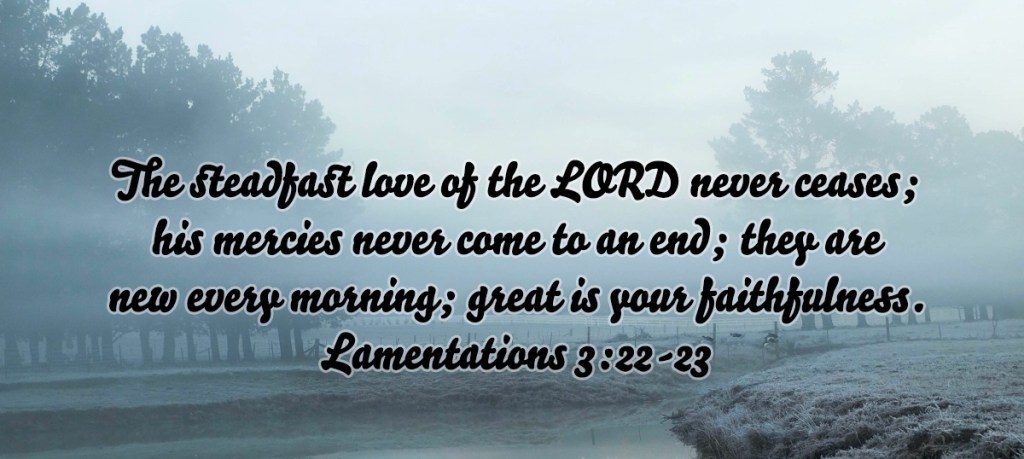
And yet, despite this dominance of divine wrath and fury, a beautiful fragment which praises God sits in the middle of the book: “the steadfast love of the Lord never ceases, his mercies never come to an end; they are new every morning; great is your faithfulness” (3:22). This poetic expression introduces a brief oasis of hope (3:22–33) in the midst of many lines of anguish, grief, and anger; God is praised for showing mercy, faithfulness, and compassion.

Sadly, this mood does not hold; the poems lapse back into questioning God and lamenting God’s inaction in the face of the people’s suffering. To be sure, God has been right to act in this way: “the Lord is in the right, for I have rebelled against his word” (1:18); “as he ordained long ago, he has demolished without pity” (2:17); what took place was “ for the sins of her prophets and the iniquities of her priests, who shed the blood of the righteous in the midst of her” (4:13).

In the middle poem, there is a call to repent: “let us test and examine our ways, and return to the Lord” (3:40); but then, a plea for God to intervene and change his mind: “you have taken up my cause, O Lord, you have redeemed my life; you have seen the wrong done to me, O Lord; judge my cause.” (3:58–59). However, this poem ends with a savage plea for God to deal with the Babylonian conquerors: “Pay them back for their deeds, O Lord, according to the work of their hands! Give them anguish of heart; your curse be on them! Pursue them in anger and destroy them from under the Lord’s heavens!” (3:64–66).

The final poem is an extended lament on the situation of Israel, framed with prayers of petition: “remember, O Lord, what has befallen us; look, and see our disgrace!” (5:1); “restore us to yourself, O Lord, that we may be restored” (5:21)—although the final pessimistic word laments, “unless you have utterly rejected us, and are angry with us beyond measure” (5:22). So the series of poems closes on this note of utter desolation.

These five poems bear many similarities, not only with the “confessions of Jeremiah”, but also with the “psalms of communal lament”, such as Pss 44, 60, 74, 79, 80, 85, 86, and 90, and the psalms of individual lament, such as Pss 3, 6, 13, 22, 25, 31, 71, 77, 86, and 142. In the face of God’s seeming inaction and unresponsiveness to pleading prayers, what is there to do, other than to lament?

The experience of the Shoah (Holocaust) in 1939–1945 has led many Jewish writers to reflect this attitude. It is not “giving up on God”, but resting in the pain and grief, venting about this to God, and hoping against hope that, in time, there may be a reversal of fortunes—a change of mind by God.

One writer notes that “Lament allows us to fully face and name our pain, and it creates space for future resolution and hope without glossing over our trauma. It gives us permission to protest life’s difficulties, to scream, cry, vent, plead, and complain in the presence of God and others. It lets us ask the hard questions without condemnation: Why did this have to happen? How could you allow it? Where are you in the midst of it? It allows weeping without explanation. It might be messy and uncomfortable, but it’s the first step towards healing.” (Whitney Willard, “Lamentatations: the volatile voice of grief”, https://bibleproject.com/blog/lamentations-voice-of-grief/)

These poetic expressions of lament (the psalms of laments, as well as the “confessions” of Jeremiah and Lamentations itself) also inform some elements of the way that the passion of Jesus is narrated in the canonical Gospels; although these accounts are told with a knowledge of the resurrection, there is grief, sadness, and despair at the fate of Jesus, with perhaps a note of patient lament at some moments in those narratives.

Lamentations is recited annually by Jews on the fast day of Tisha B’Av (the ninth day of the month of Av, usually in late July or early August), to mourn the destruction of both the First Temple (by the Babylonians in 586 BCE) and, on the same day (it is believed) the Second Temple (by the Romans in 70 CE). The book provides a fitting way to remember the two greatest moments of national grief and loss, many centuries later.

See also

A reticent prophet: called, equipped, and sustained (Jeremiah 1; Pentecost 11C)

This is a sermon that I wrote and presented for Project Reconnect for this coming Sunday, Pentecost 11. The video of the sermon is at https://projectreconnect.com.au/2022/07/21/21st-august-2022-pentecost-9-the-prophet-jeremiah

Project Reconnect is a worship resource that is published weekly to help congregations with their worship service. It includes a PDF information sheet with video messages, music resources and discussion starters. (The website notes, “downloads are free but we would appreciate your donations to help continue our work”; see https://projectreconnect.com.au)

*****

Prophets. Not profits as in financial gain, the difference between the amount earned and the amount spent in buying, operating, or producing something. But prophets, as in the chosen messengers of God, empowered by the Spirit, equipped to declare the word of the Lord to the people of God.

If your mind goes to prophets, perhaps you might think of Amos: “let justice roll down like waters, and righteousness like an ever-flowing stream”; or Micah: “what does the Lord require of you but to do justice, and to love kindness, and to walk humbly with your God?”. Perhaps you think of Elijah: “the Lord was not in the earthquake, nor in the fire; but in the sound of sheer silence.” Or is it Isaiah who comes to your recollection: “I heard the voice of the Lord saying, “Whom shall I send, and who will go for us?” And I said, “Here am I; send me!”

I’m not surprised if one of those famous prophets was the person you immediately thought of. We have heard from some of them in the Old Testament readings in previous weeks, so they may be fresh in your mind.

But in today’s reading, we hear about the call that God placed on another person, a somewhat reluctant prophet: Jeremiah.

Jeremiah was not itching to respond to God, when he received the call to become a prophet. He was not very old; some commentators consider him to be in his early 20s, others note that the distinctive Hebrew word used in this passage indicates he was in his teens. We might have sympathy for Jeremiah on this account; he was young, hardly at an age that we would recognise as qualified and equipped to be a public spokesperson for God!

So when he heard God declare to him, “I appointed you a prophet to the nations”, the NRSV translation says that the young man replied, “Ah, Lord GOD! Truly I do not know how to speak, for I am only a boy.” Actually, when they say he replied, “Ah”, he was using a Hebrew word that actually means, “alas” or “woe is me”. Strong’s Concordance says this is “a primitive word expressing pain”—so, more like “ouch!!!” So perhaps it’s better to think of his response as more like “oh no, oh no, oh nooooo—I couldn’t possibly do that! no way at all!!”. Jeremiah just did not want this gig at all.

Maybe you might know how he feels: when we are asked to do something difficult, something demanding, something challenging, that is beyond what we feel that we are able to achieve. For you, that might be the challenge of running a marathon, or being invited to speak in public to a large crowd, or learning a new language. Big challenges, lots of hard work, too much to consider. For me, I can think of a few challenges that really freak me out: climbing the Sydney Harbour Bridge (I don’t handle heights very well at all), letting a snake coil around me (that’s a petrifying thought), touching a spider (we just aren’t going to go there in any way!)

Jeremiah was incredibly reticent; like Moses, he was not going to take up this invitation in any way. Moses declined the offer of becoming the spokesperson for God: “who am I, to go to Pharaoh? what could I say to him?” but God persisted, and Moses relented. Likewise, with Jeremiah; initially, he says, “I do not know how to speak, for I am only a boy”, but God persists: he will support the young man Jeremiah, just as he supported the young man Moses.

But I think that we have this story from the opening chapter of this book, in our reading today, not because it shows us that God will help us overcome our fears about challenges set before us. It think that it is not Jeremiah’s words that we are to focus on. It is, rather, the words that God speaks to Jeremiah which should ring in our ears.

It is the encouragement for the task that God promises—and later delivers—that must stand out for us. “Do not say, ‘I am only a boy’”, the voice declares; “for you shall go to all to whom I send you, and you shall speak whatever I command you.” God gives the right words for the appropriate time. That is remembered when Jesus later tells his disciples that the spirit would enable them to speak, even in the midst of difficulties (Luke 21:13–15).

And then, we hear the words: “Do not be afraid of them, for I am with you to deliver you, says the LORD.” In typical style, the first word of God to the human being chosen for a specific task is, “do not be afraid”. When God appears to human beings—in a vision, as an angel, in a voice from the heavens, in a response to prayer, as a niggling, unsettling feeling, in words of advice or guidance from a friend—however God might appear to us, it can be an experience that evokes fear, awe, anxiety. Who is this, speaking to me? How am I to respond?

“Do not be afraid”, said the Lord, to Abraham, in a vision (Gen 15). “Do not be afraid”, he said, to Isaac, at Beersheba (Gen 26). “Do not be afraid”, to Moses, in the wilderness (Num 21), to Joshua, facing the combined might of a great army (Josh 11), to Elijah, also facing a great army (2 Kings 1); “do not be afraid”, Isaiah says, on behalf of the Lord, to king Hezekiah (Isa 37); “do not be afraid”, the voice of God says to the prophet Ezekiel, when he was called to his role (Ezek 2), and to Zechariah (Zech 8). It is a common refrain throughout the stories of the people of Israel.

And we hear the same phrase repeated in New Testament stories, when God speaks to Zechariah, “do not be afraid” (Luke 1), to Mary, “do not be afraid” (Luke 1), to Joseph (Matt 1), to Simon Peter (Luke 5), to Paul, Silas, and Timothy, in Corinth (Acts 18), and to the ageing prophet John in exile on Patmos: “do not be afraid” (Rev 1). It is God’s consistent and encouraging word to those who encounter the intensity of divine presence, the enormity of divine challenge, the inescapable call to follow, to believe, to declare the word of the Lord: “do not be afraid”. It is God’s word to each of us.

So the word of God to Jeremiah is clear: “I appointed you a prophet to the nations.” And Jeremiah is willing to respond; to accept the challenge, to take up the call, to stretch himself and step into a new experience.

What Jeremiah would encounter in the decades that followed, was pretty heavy stuff. He didn’t know that at the time that he accepted the call to be God’s spokesperson. He persisted, held strong, remained faithful throughout all the difficulties that ensued for the people of Israel, as they were attacked, besieged, defeated, and then sent into exile, away from their homeland, off into a strange, foreign country. Jeremiah held fast; he remained faithful to the call that God had placed upon him through all of this.

And God held fast to him through all these tragic events. Jeremiah received the support, the guidance, and the encouragement from God through this all, as the people of God were taken from their beloved land, and sent far away into exile. God remained faithful.

So we give thanks to God, for God holds fast, God remains faithful, God does not let go, no matter what. That gracious, faithful commitment to us is the heart of the good news that we know, that we proclaim, that we live in our lives: the ever-faithful God who is with us, the ever-present God who is for us.

For this, we say: thanks be to God!

*****

1. What do you think about the idea that a teenager could be the chosen voice of God?

2. How do you deal with difficulties on your walk of faith? How do you listen for what God might be saying to you at such a time?

3. Think of a challenge that faces your congregation or faith community. How might you work together to discern what God is calling you to do?

4. Jeremiah was called to speak to all the people—the whole community—in the public arena. How do you make your voice heard in the public discussion of important issues today?

It may be that they will listen (Jeremiah 26–52)

Jeremiah lived at a turning point in the history of Israel. The northern kingdom had been conquered by the Assyrians in 721 BCE; the elite classes were taken into exile, the land was repopulated with people from other nations (2 Kings 17). The southern kingdom had been invaded by the Assyrians in 701 BCE, but they were repelled (2 Kings 18:13–19:37). King Hezekiah made a pact with the Babylonians, but the prophet Isaiah warned that the nation would eventually fall to the Babylonians (2 Kings 20:12–19). Babylon conquered Assyria in 607 BCE and pressed hard to the south; the southern kingdom fell in 587 BCE (2 Kings 24–25) and “Judah went into exile out of its land” (2 Ki 25:21).

Jeremiah lived in the latter years of the southern kingdom, through into the time of exile—although personally, he was sent into exile in Egypt, even though most of his fellow Judahites were taken to Babylon. The difficult experiences of Jeremiah as a prophet colour many of his pronouncements. As the book moves on from the poetic oracles of chapters 1–25, to a series of prose narratives in chapters 26–45, some key events in the life of Jeremiah are reported.

First, we learn that Jeremiah is called to “stand in the court of the Lord’s house and speak to all the cities of Judah that come to worship in the house of the Lord; speak to them all the words that I command you; do not hold back a word” (Jer 26:2). His message is about their failure to walk in the law that God had given them (remembering that the discovery of “the book of the law” and the subsequent reforms under Josiah had taken place just a couple of decades earlier. The response from the ruling class is not positive—in fact, Jeremiah is threatened with death (26:7–11). He argues his way out of this sentence (26:12–24), but the threat of death will return in a later chapter.

To dramatise the judgement placed on Israel, as well the surrounding nations of Edom, Moab, Ammon, Tyre, and Sidon, Jeremiah wears a yoke (27:1–22), telling the people of Judah to “bring your necks under the yoke of the king of Babylon, and serve him and his people, and live” (27:12). Rather than seeing the foreign power as an enemy, Jeremiah exhorts the people to submit them, in what will be a hard, but not permanent, arrangement. This marks a change in theology that we will see also in Deutero-Isaiah, where the foreign power is seen to be an agent of God.

Accordingly, he sends a letter from the Lord “from Jerusalem to the remaining elders among the exiles, and to the priests, the prophets, and all the people, whom Nebuchadnezzar had taken into exile from Jerusalem to Babylon” (29:1), instructing them to “build houses and live in them; plant gardens and eat what they produce; take wives and have sons and daughters; … multiply there, and do not decrease; seek the welfare of the city where I have sent you into exile, and pray to the Lord on its behalf, for in its welfare you will find your welfare” (29:5–7). Life goes on in exile; God has not abandoned the people.

*****

In the midst of his despair, Jeremiah sees hope: “the days are surely coming, says the Lord, when I will restore the fortunes of my people, Israel and Judah, says the Lord, and I will bring them back to the land that I gave to their ancestors and they shall take possession of it” (30:3). In this context, Jeremiah indicates that the Lord “will make a new covenant with the house of Israel and the house of Judah … I will put my law within them, and I will write it on their hearts; and I will be their God, and they shall be my people” (31:31–34).

The renewal of the covenant was not a new idea in the story of Israel. God had entered into covenants with Abraham, the father of the nation (Gen 15:1–21) and before that, in the story of Noah, with “you and your descendants after you, and with every living creature that is with you … that never again shall all flesh be cut off by the waters of the flood” (Gen 9:8–11). The covenant given to Moses on Mount Sinai (Exod 19:1–6), accompanied by the giving of the law (Exod 20:1–23:33), is sealed in a ceremony by “the blood of the covenant” (Exod 24:1–8).

The covenant with the people that Moses brokered is renewed after the infamous incident of the golden bull (Exod 34:10–28), then under Joshua at Gilgal, as the people enter the land of Canaan after their decades of wilderness wandering (Josh 4:1–24). It is renewed again in the time of King Josiah, after the discovery of “a book of the law” and his consultation with the prophet Huldah (2 Chron 34:29–33), and it will be renewed yet again after the exiled people of Judah return to the land under Nehemiah, when Ezra read from “the book of the law” for a full day (Neh 7:73b—8:12) amd the leaders of the people made “a firm commitment in writing … in a sealed document” which they signed (Neh 9:38–10:39).

However, the particular expression of renewal that Jeremiah articulates will prove to be critical for the way that later writers portray the covenant renewal undertaken by Jesus of Nazareth (1 Cor 11:25; Luke 22:20; 2 Cor 3:6–18; Heb 8:8–12). Especially significant is the claim that this renewed covenant “will not be like the covenant that I made with their ancestors when I took them by the hand to bring them out of the land of Egypt—a covenant that they broke” (Jer 31:32), for God “will put my law within them, and I will write it on their hearts; and I will be their God, and they shall be my people” (31:33). It is a covenant which has “the forgiveness of sins” at its heart (31:34)— precisely what is said of the “new covenant” effected by Jesus (Matt 26:28; and see Acts 5:31; 10:43; 13:38; 26:18).

To signal his confidence in this promised return, Jeremiah buys a field in his hometown of Anathoth from his cousin Hanamel (32:1–15). The narrator notes that “the army of the king of Babylon was besieging Jerusalem, and the prophet Jeremiah was confined in the court of the guard that was in the palace of the king of Judah, where King Zedekiah of Judah had confined him” (32:2–3). Nevertheless, the purchase serves to provide assurance that the exiled people will indeed return to the land of Israel; “houses and fields and vineyards shall again be bought in this land” (32:15).

Jeremiah exhorts the people to “give thanks to the Lord of hosts, for the Lord is good, for his steadfast love endures forever!” (33:11), because in the places laid waste by the Babylonians, “in all its towns there shall again be pasture for shepherds resting their flocks … flocks shall again pass under the hands of the one who counts them, says the Lord” (33:12–13). As the people return to the land, the Lord “will cause a righteous Branch to spring up for David; and he shall execute justice and righteousness in the land” (33:15). The title “Son of David” is later applied to Jesus in three Gospels (Mark 10:47–48; Matt 1:1; 12:23; 15:22; 21:9, 15; Luke 18:38–39).

*****

As Jeremiah was “prevented from entering the house of the Lord” (36:5), he dictated his prophecies to a scribe named Baruch (36:4) and instructed Baruch to “read the words of the Lord from the scroll that you have written at my dictation” (36:6). Baruch does so; in response, King Jehoiakim burns the scroll (36:20–26), so Jeremiah repeated the process with Baruch (36:32). Subsequently, the prophet was imprisoned in the court of the guard (37:11–21) and then in a cistern (38:1–6), before being rescued from the cistern, on the king’s orders, by Ebed-melech the Ethiopian (38:7–13).

Jeremiah informs King Zedekiah of the imminent capture of Jerusalem (38:14–28); this is duly narrated (39:1–10) and Jeremiah is set free by King Nebuchadrezzar of Babylon (39:11–18). After speaking further oracles, the prophet is sent into exile in Egypt (43:1–7), where he continues to berate the exiles for their idolatry. “I am going to watch over them for harm and not for good”, the Lord asserts; “all the people of Judah who are in the land of Egypt shall perish by the sword and by famine, until not one is left” (44:27).

The final chapter in this narrative sequence reports the anguish of the Lord: “Woe is me! The Lord has added sorrow to my pain; I am weary with my groaning, and I find no rest”; and then the judgement of the Lord: “I am going to break down what I have built, and pluck up what I have planted—that is, the whole land … I am going to bring disaster upon all flesh, says the Lord” (45:1–5).

The book concludes with a series of prophecies against foreign nations in chapters 46–51 (the Egyptians, Philistines, Moabites, Ammonites, and Edomites, then Damascus, Kedor, Hazor, Elam, and Babylon itself), before ending with an historical appendix telling of the capture of Jersualem (chapter 52), which is drawn largely from 2 Kings 24:18—25:30.

See also

Huldah, a prophet, gifted by the spirit (2 Kings 22; 2 Chron 34)

In Jewish tradition, there are seven women identified as prophets (Sarah, Miriam, Deborah, Hannah, Abigail, Huldah, and Esther). Concerning Huldah, we know of only one of her prophetic acts, when she gave advice to King Josiah (2 Kings 22–23; see also 2 Chron 34).

However, this single piece of advice was extremely important; it guided Josiah to undertake the thoroughgoing reforms of religion in Judah that characterised his reign. “Josiah took away all the abominations from all the territory that belonged to the people of Israel, and made all who were in Israel worship the Lord their God. All his days they did not turn away from following the Lord the God of their ancestors” (2 Chron 24:33).

Huldah’s husband, Shallum, had a prominent position in the royal court. He was the keeper of the king’s wardrobe (Jer 34:5); he therefore had daily access to the king and was able to meet him in relative privacy. He was better placed than most to talk with the king and advise him. Huldah was therefore among the inner circle surrounding King Josiah.

According to rabbinic tradition, Huldah was a relative of Jeremiah (Megillah 14b). The last thing said in Hebrew scripture about Rahab and Joshua is that “Rahab the prostitute, with her family and all who belonged to her, Joshua spared; her family has lived in Israel ever since” (Josh 6:25). The rabbis, however, maintain that Joshua and Rahab married, and that their descendants included Hilkiah, Jeremiah, Huldah, Seraiah, Mahseiah, Baruch, and Ezekiel. That’s quite a family!

The significance of Huldah is that it was she, a woman, who was consulted by the king, and she, a female prophet, whose guidance led to a pivotal reform in Judah. Claude Mariottini writes that “Huldah’s oracle is significant because she is the only woman prophet who proclaimed a message about future events. She begins her speech, like the other male prophets, claiming that her words were the words of God: ‘Thus says the Lord, the God of Israel.’ This expression is the messenger formula that was used by the Old Testament prophets to introduce their oracles. As a prophet, Huldah saw herself as a messenger of God set apart to speak in God’s name.” (see https://claudemariottini.com/2013/09/17/huldahs-oracle/)

Josiah reigned from 640 to 609 BCE, with the reforms noted above taking place during the late 620’s. What drove the reforms was the discovery, in the midst of the restoration of the Temple, of an ancient book of the Law, at the bottom of a money chest that had recently been raided to pay for renovations to the Temple (2 Ki 22:8–10). The book set out the requirements of the Law; Josiah panics because he realises that the nation has not been faithful to the covenant, and that God will punish them.

Josiah repents in contrition, consults with Huldah, and then implements extensive reforms. Many scholars believe that the book referred to in 2 Kings 22 could well have been what we know as a Deuteronomy, which literally means “second law”. This book was supposed to have been lost during the wholesale destruction of anything to do with worship of the Lord God, from the previous two kings, who were hostile to worship of Yahweh during their reigns.

Did the fact that the consultation with Huldah is reported without any “excuses” or “explanation” mean that there were female prophets at the royal court, as a matter of regular practice? The group that came with Kimg Josiah included the priest Hilkiah, two men identified as “Shaphan the Secretary and the king’s servant Asaiah”, as well as the sons of Shaphan and Micaiah, obviously another court official. This was an impressive group of high-status people.

Later tradition claims that Huldah proclaimed her prophecies at a place in Jerusalem now called Huldah’s Gate. The main theme of the incident involving her could be seen to be, “listen for God’s voice, wherever it comes from”. You can read the rabbinic traditions about Huldah at https://jwa.org/encyclopedia/article/huldah-prophet-midrash-and-aggadah

*****

See also https://margmowczko.com/huldah-prophetess/

and