A Triple Treat at Tuggeranong

This past weekend has provided a “triple treat” for the people of the Tuggeranong Uniting Church and the community of the Tuggeranong Valley, in the south of Canberra.

The first “treat” was the emergence of beautiful tulips in the garden beds at the entry to the church. The colourful flowers are part of Floriade Reimagined, a community initiative that that ACT Government put in place in 2020 when the COVID pandemic meant that the annual Floriade display in Commonwealth Park could not be held.

Floriade Reimagined tulips at Tuggeranong Uniting Church

The government provided bulbs to churches and community organisations, to be planted on their properties, and thus enable a reimagined form for Floriade to take place. During the period of lockdown, Canberrans were able to drive around the city and admire colourful displays at many dispersed sights. Tuggeranong Uniting Church was one of those, and since Floriade Reimagined has continued each year since 2020, the annual display of tulips was on again this year.

The second “treat” was the annual SpringFest, held on the grounds and in the building of the Tuggeranong Uniting Church (TUC). A fruitful partnership with local environmental advocacy group SEE-Change has led to SpringFest being a combination of a typical church Spring Fair and a community day with a focus on sustainability and environmental responsibility.

The carpark was filled with stalls, with the SEE-Change stall providing information on many ways to reduce our carbon footprint. Another stall provided a recycling drop-off point for a range of household items. Other stall holders offered demonstrations of how to make beeswax wraps, a Trash to Treasure Art Competition, an Indigenous Art collection of items, a Repurposed Art stall, garden tools sharpening and repairs, rock painting for the kids, and head and neck massages for stressed adults.

Information about Eco-Sustainability was provided by Suburb Zero (transitioning Canberra to fully-electric), ACT No Waste (a part of the ACT Government City Services Directorate), and the Southern ACT Catchment Group (an umbrella group for active environmental groups in the areas of Woden, Weston Creek, Tuggeranong and Tharwa).

In the Erindale Neighbourhood Centre on one side of the church, Spider-Man led a comic-drawing workshop—much to the delight of the children attending—and Elizabeth Raine explained how to reduce plastic by using alternatives in everyday household items that are more environmentally friendly. In the Erindale Community Garden on the other side of the church, workshops were offered on Composting and Worm Farms and Keeping Backyard Chickens, as well as an Introduction to Permaculture.

The results of the Spider-Man comic drawing workshop

The church building had a cake stall run by the Girls Brigade, clothing from the Red Dove Op Shop, books galore, crafts from church members and community members alike, a stall for clothes and repairs, a nature photography stall, and a comfortable space to sit and enjoy the cakes and slices made by TUC members, while drinking coffee or tea, and enjoying the live music provided throughout the day.

Over 400 people came to SpringFest, making it one of the highlight events for the church each year. All who came were greeted on entry by the Mad Hatter—aka the Rev. Sharon Jacobs, Growth and Relationships Minister at TUC. When people entered the church building, the Spring Fairy—aka the Rev. Elizabeth Raine, TUC Minister—beguiled them with her sparkling wings and enticed people to buy monkeys made by vulnerable Cambodian women, to support their micro-enterprise.

The third “treat” was a gathering on the Sunday after SpringFest, to celebrate the ministry of Elizabeth Raine, as she concluded her time in ministry at Tuggeranong and moved into retirement. Colleagues and friends from around the Presbytery joined TUC members to give thanks for the energy, dynamism, plain speaking, and strong leadership that Elizabeth has provided throughout the past five years. The church has changed and transformed during the pandemic, but has held all its members and has been gaining new participants in the worship and mission of the congregation. It is a growing, lively, inclusive community of faith.

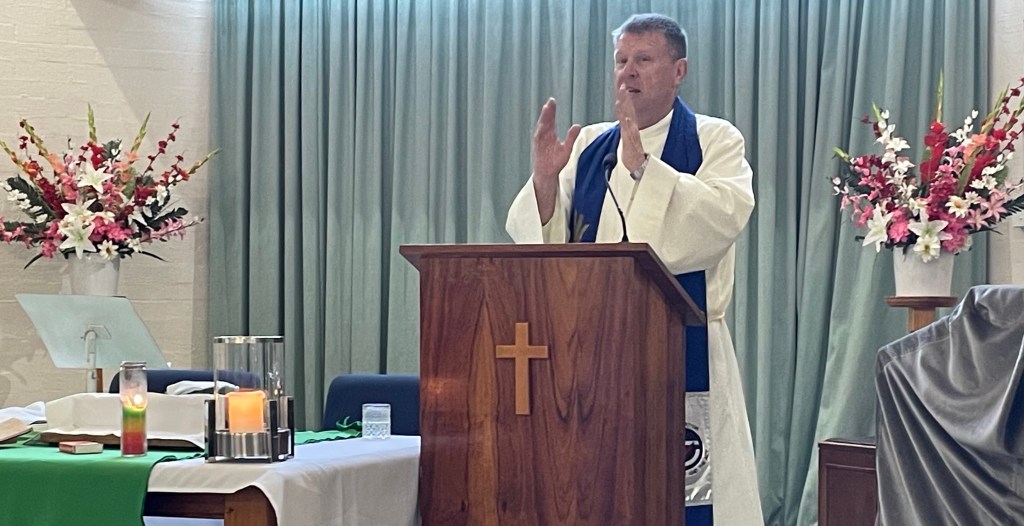
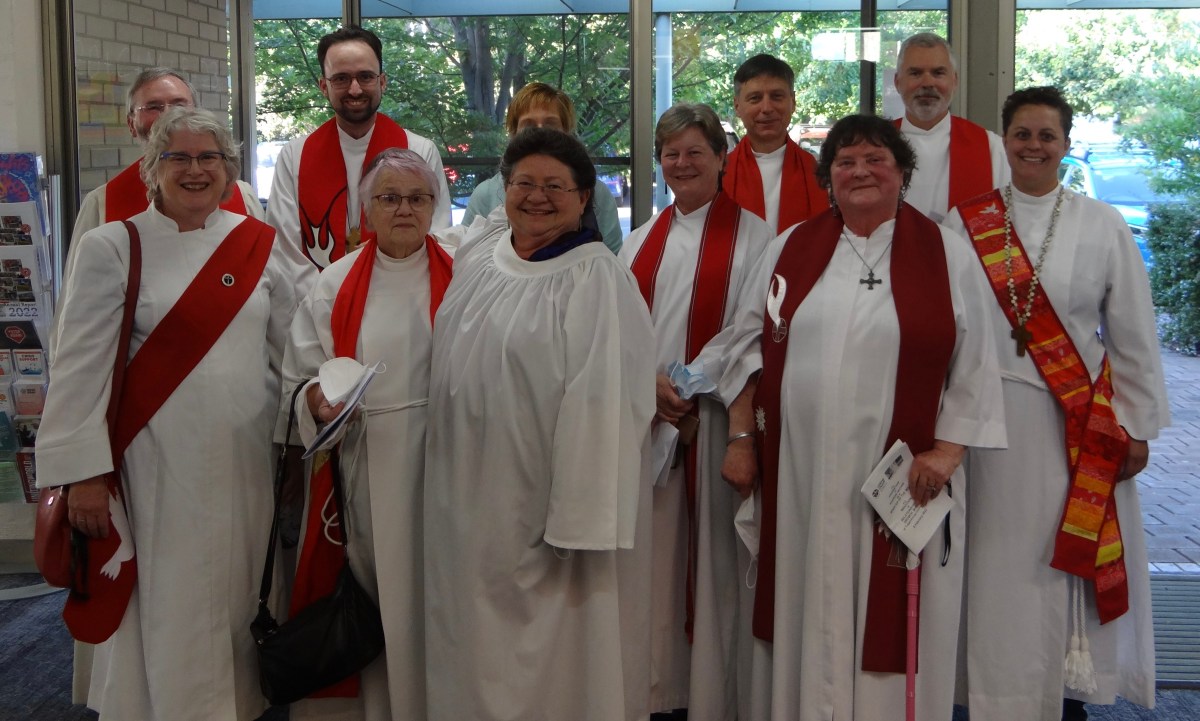
The Rev. Jane Fry, Synod Secretary, with Ms Janet Kay, Canberra Region Presbytery Chairperson, and colleague ministers from the Presbytery, with the Rev. Elizabeth Raine at her Closure of Ministry service

The Synod Secretary, the Rev. Jane Fry, has been a good friend of Elizabeth since their time together in theological college 30 years ago. Jane preached during the service, reflecting on the “grumbling” of the Israelites in the wilderness, and pondering how we might “grumble” constructively in today’s world. A collection of friends from years past and recent provided lively musical leadership for the Congregation.

Local Federal Member for Bean, David Smith MP, spoke warmly about Elizabeth, noting her “deep personal faith and firm commitment to working for the common good in society … her passion in standing for justice and her compassion in serving people at their particular point of need.” David noted that, “as minister of the Tuggeranong Uniting Church in the electorate of Bean, she has worked collaboratively and energetically with the people of this church to extend its mission to be inclusive, community-oriented, rainbow-friendly, an advocate for climate justice, a support for people facing economic stress, and a strong advocate for the Voice to Parliament.”

David Smith MP present a gift to Elizabeth Raine

Elizabeth returned the symbols of her ministry—baptismal jug, communion cup and plate, Bible, TUC Directory, Rainbow banner, and her fairy’s wand—to members of the Tuggeranong Congregation, before Church Council Chairperson thanked Elizabeth for keeping the promises she had made in her initial conversation with the church—she promised to challenge people, to test them in their discipleship and commitment, and to change the way that they were church. He noted that “she did—and we did!”

Presbytery Chairperson Janet Kay then led the group in praying for Elizabeth, blessing her for her retirement. Elizabeth has served in a rich variety of ministry placements—as school chaplain and SRE teacher, a tenancy advocate, a congregational minister, an Intentional Interim Minister in four congregations, in a Presbytery Minister role in two Presbyteries, and then as Minister at Tuggeranong, where she preached and led worship, offered Bible Studies and pastoral care, participated in Presbytery committees, and strengthened the missional outreach of the church through multiple community connections.

The Tuggeranong Uniting Church Congregation
with the recently-painted mural on the western wall of the church building

Elizabeth will move with husband John to the Hunter Valley, to rest and wind down after a very active time at TUC. That should be a treat for them. But to end the series of “treats” at TUC on the weekend, the whole gathering enjoyed a typically delicious Tuggeranong afternoon tea!

Wear It Purple Day at the Rainbow Christian Alliance

Today, 25 August, is Wear It Purple Day. This day was founded in 2010 in response to global stories of real teenagers, real heartache, and their very real responses. The day is specifically designed to foster supportive, safe, empowering and inclusive environments for rainbow young people around the world.

On the website for Wear It Purple Day, we are told more about the story of its origins:

“In 2010, several rainbow young people took their own lives following bullying and harassment resulting from the lack of acceptance of their sexuality or gender identity. One member of this group was 18 year old Tyler Clementi, who took his own life after being publicly ‘outed’ as gay by his roommate, prompting a frenzy as reports poured in of various young people sadly in the same situation.

“As the world saw the faces of precious young lives lost, some young people found a new sense of conviction and purpose to ensure that young people everywhere would know that there were people who did support and love them. Wear it Purple was established to show young people across the globe that there was hope, that there were people who did support and accept them, and that they have the right to be proud of who they are.”

Locally, in the lead up to this day, the Rainbow Christian Alliance (RCA) that meets at Tuggeranong Uniting Church (TUC) once each month held an evening to give a local focus on Wear It Purple Day. So, on Sunday 13 August, RCA members and visitors came dressed in purple—it was a dazzling display!
Local Greens MLA, Johnathan Davis, was the guest for the evening. (Sadly, as Johnathan does not own any purple clothing, he didn’t come dressed in purple, as the phot above shows!). Johnno, as he likes to be called, describes himself as “a young shamelessly queer person in public life”. He was elected to the Legislative Assembly of the Australian Capital Territory in 2020, as one of a number of Green members of that Assembly.

In the ACT, the Greens and Labor have formed a coalition government for the past few years, working together to provide reasonable and intelligent government for the territory. Johnno is not the only gay member of the Legislative Assembly—in fact, the ACT Chief Minister is a gay man in a longterm relationship. And he pointed out that while the Deputy Leader of the Greens is a practising Muslim, this indicates the breadth of opinions amongst the local political parties in the ACT.

Johnathan spoke about how he was radicalised politically by his own public school experiences—including a time when the then government was proposing to close the high school that he was attending. Indignant at this move, Johnno mobilised the school community and was successful in stopping the closure of his school. His first successful political campaign!

Wear It Purple is a day that is important to celebrate, he said. Visibility is so important to young gay and lesbian people—and, also, to young intersex and transgender people, as well as asexual and bisexual young people. Visibility such as like Wear It Purple Day provides is personally empowering for such people and it works to ensure that young rainbow people are not isolated. The Day helps to provide a shared sense of identity amongst young rainbow people, giving them encouragement and support from others of same identity—and, indeed, from straighten allies in the wider community who support this Day.

Johnathan talked about some of the initiatives that the ACT Government has introduced to strengthen mental health support for young rainbow people. We know that rainbow people are more liable to have mental health crisis, to attempt suicide, and indeed to die from their own hands, than those in the straight community. This is exacerbated even more for younger members of the rainbow community.

Studies show that the situation is very serious for members of this community. For instance, I have found that LGBTIQ+ Health Australia has stated the following in its October 2021 report:

For more statistics, and the details of the studies relied on, see https://assets.nationbuilder.com/lgbtihealth/pages/549/attachments/original/1648014801/24.10.21_Snapshot_of_MHSP_Statistics_for_LGBTIQ__People_-_Revised.pdf?1648014801

The ACT Government has recently opened a “queer space cafe”, which is a safe haven space, in the northwest of Canberra. Already, after just a short period of time, the impact of this safe haven space has proved to be incredibly powerful. It is based on the observation that early intervention, when a person is facing a mental health crisis, is far more effective than waiting until the issues have magnified and become far more difficult to manage.

The cafe is staffed by people who transform a simple space to sip coffee and chat into a one-stop shop to refer people in need to whatever services might best be able to support their need. Johnathan says that this reflects the current approach of the ACT Minister for Mental Health, Emma Davidson, MLA, to divert mental health funding away from government-run services into supporting existing community services that are working well. (Emma Davidson is, like Johnathan Davis, a member of the Greens Party.)

Johnathan also spoke quite candidly about his own faith. He volunteered that “Faith has not been an issue for me for many years, but my recent connections with Tuggeranong Uniting Church has led me to re-evaluate my position and rethink faith questions”. He noted that his understanding of God and his experience of church did not correlate—a disjuncture that, sadly, is the case for many people in today’s society, especially when they experience a church that is dogmatic, and judgemental, and what they experience is condemnation and exclusion.

“When I came out”, Johnno said, “everyone who had a problem with my sexuality attributed that to their faith”. That is, they judged him on the basis of what they believed (and what they had been taught) was “right”, rather than encountering him as he was, and building relationships with him from that.

The approach at Tuggeranong Uniting is quite different from this; the community has worked hard to develop an inclusive and welcoming community where relationships are valued over judging, where being an inclusive space has a higher value than being a set-apart, “holy” community of faith. (There are quite a number of other Uniting Churches which are similar in this regard.)

So Johnno continued, saying that “I feel like I can reconsider my faith because of the contact I have had with Tuggeranong; this church is prodding me to re-evaluate my faith”. He had said the same when interviewed for the recent video, “Transforming Connections”, which was recently released. He finished with an indication that he would like to continue to develop his relationship with TUC in the future.

The website for Wear it Purple Day notes that the Day has developed into an international movement. “New generations of rainbow young people continue to be dedicated to promoting the annual expression of support and acceptance to rainbow young people. What started out small has now grown; however the message remains the same: Everybody has the right to be proud of who they are.”

On 25 August, why not celebrate Wear it Purple Day? Be part of a movement that has the potential to save thousands of lives. Be part of this change.

*****

On Wear It Purple Day, see

https://www.wearitpurple.org/our-story

On Rainbow Christian Alliance, see

The church is alive and well in southern Canberra

The church is alive and well. In recent years, Uniting Mission and Education, working within the Synod of New South Wales and the Australian Capital Territory of the Uniting Church in Australia, has supported a project in which good news stories of thriving congregations are told through professionally-produced videos. The Signal Box has just completed the sixth video in this series, Transforming Connections, featuring the mission and ministry of the Tuggeranong Congregation in the southern suburbs of Canberra.

Under the energetic leadership of the Rev. Elizabeth Raine [my wife], the Tuggeranong Church Council has charted a deliberate course to make a difference in the wider Tuggeranong community—to be the “salt of the earth” in southern Canberra. “I am a change agent”, says Elizabeth, with great honesty; “I won’t just come in and do the ‘status quo’.” The video, which shows the results of this approach, can be viewed at https://www.nswact.uca.org.au/resources/our-story-future-directions-video-series/

In this video, we learn how deliberate connections have been fostered with a number of community groups in the area. Kirsty and Liz speak about the flourishing with SeeChange Tuggeranong, which has seen regular events with a focus on sustainability. In recent years, the Congregation has also participated in local ACT community events such as Floriade Reimagined and SouthFest, and hosted the Canberra SleepBus for a period of time.

Jenny and Anne represent the fine team of volunteers in the Red Dove pop-up Op Shop. Wearing their “volunteers uniform” (which has the words of Micah 6:8 as the motif for the shop), they speak about the reinvigoration that has taken place, as the team has focussed on both living and sharing the good news—the Gospel—that drives the enterprise. As well as providing recycled clothing and goods at very reasonable prices, there is an environmental plus: “Jesus would be horrified with all this clothing going into the tip”, Anne says. That marks one of the many ways that the Congregation is working to reduce their carbon footprint on the earth.

Within the Congregation, another group continues to provide its weekly Emergency Food programme and the Lunchtime Conversation group. Quite a number of people within the Congregation take part in the weekly visit to Karralika, a drug and alcohol rehabilitation centre in the Tuggeranong Valley, to offer a “God space” to residents. Leonie and one of the former residents speak in the video with joy and hope about the positive impact that this ministry offering has had over many years.

Bill Lang, a member of the Church Council, is responsible for communications for the Congregation. Under Bill’s leadership, the website has been upgraded, regular Facebook posts are made about activities of the church, and short seasonal videos are posted on the Tuggeranong Uniting Church (TUC) website at https://tuc.org.au. Bill also edits and uploads videos of the weekly online Bible Studies which are offered throughout the year—they can be accessed in the TUC YouTube Library at https://www.youtube.com/@tuggeranongunitingchurch4795/playlists

Bill has been a member at Tuggeranong for many decades, and in the video he speaks about the ways the Congregation has adapted and developed through into the contemporary period. The online presence of TUC, through website, Facebook, and Instagram, is a key to the growth of the Congregation. Another longterm member Liz talks about the TUC Girls Brigade ministry that has been offered over the years.

Supporting the Congregation in its development, Canberra Region Presbytery Minister Andrew Smith talks in the video about the importance of informed, enthusiastic leadership—from ministers as well as from key lay leaders. “Elizabeth’s leadership has been really important”, Andrew says; “she has enabled them to see differently, to imagine differently for what church might be”.

“Canberra has a higher proportion of same-sex couples than any other city according to the Australian Bureau of Statistics”, Elizabeth Raine comments, “and TUC offers a safe space for the many Christian LGBTQI people who report poor experiences with churches and Christianity in general.” A monthly Rainbow Christian Alliance, which has been a part of the Congregation for eight years, has broadened its membership in recent years, spreading beyond gay and lesbian people to include growing numbers of people who are trans, intersex, and asexual. Three members of the Rainbow group speak in the video about their experiences of being accepted and valued within a faith community.

The local Greens MLA, Jonathan Davis, who himself identifies as gay, is a friend of the Congregation. In the video, he speaks about how he finds the Tuggeranong Community to be a welcoming space for him—unlike many other faith spaces where he has felt awkward or unwanted.

A monthly Messy Church under the name of Fam@4 now meets at 4pm on the 4th Sunday of the month, providing a time for younger folk to enjoy craft, worship, and eat a meal together. The video shows one of the regular intergenerational worship services which are held at key moments on Sunday mornings. Inevitably the church is filled with people of all ages, craft activities, vibrant music, with lots of colour, energy, and caring relationships growing. Pentecost is always a blaze of red; Christmas offers opportunity for joyous celebrations!

The Rev. Sharon Jacobs recently began a placement as the Relationships and Growth Minister, a newly-created position funded substantially by the Synod Growth Fund. Sharon is focussing her 50% role on developing the Congregation’s work with families and children, as well as supporting and growing the leadership and membership of the Rainbow Christian Alliance.

She works alongside Elizabeth Raine, whose experience in transitional ministry and understanding of how systems work has undergirded the way she has encouraged, enthused, challenged, and grown the many aspects of the life of the Congregation. The video offers dramatic and encouraging glimpses into the development and growth that has taken place.

And there is a stunning drone shot of the recently-completed mural on the large western wall of the church building which looks out across Comrie St to the regional Erindale Shopping Centre. The joy and colour of the symbols in the mural offer an inviting facade to those who pass by each day. The church is known and valued within its local community—and the many connections that have been made, and are being made, are truly “transforming connections”. They are transforming for the community; and they are transforming for the Congregation.

The full set of Our Story videos can be accessed at https://www.nswact.uca.org.au/resources/our-story-future-directions-video-series/. There are currently stories about Condobolin, Orange, Leichhardt, Lane Cove, Auburn, and Tuggeranong.

To keep up to date with future videos in this series, join the Our Story Facebook Forum at https://www.facebook.com/groups/ourstoryforum/

On the dedication of the mural, see

On the Rainbow Christian Alliance, see

On Floriade Reimagined, see

The church is alive and well in southern Canberra

The church is alive and well. In recent years, Uniting Mission and Education, working within the Synod of New South Wales and the Australian Capital Territory of the Uniting Church in Australia, has supported a project in which good news stories of thriving congregations are told through professionally-produced videos. The Signal Box has just completed the sixth video in this series, Transforming Connections, featuring the mission and ministry of the Tuggeranong Congregation in the southern suburbs of Canberra.

Under the energetic leadership of the Rev. Elizabeth Raine [my wife], the Tuggeranong Church Council has charted a deliberate course to make a difference in the wider Tuggeranong community—to be the “salt of the earth” in southern Canberra. “I am a change agent”, says Elizabeth, with great honesty; “I won’t just come in and do the ‘status quo’.” The video, which shows the results of this approach, can be viewed at https://www.nswact.uca.org.au/resources/our-story-future-directions-video-series/

In this video, we learn how deliberate connections have been fostered with a number of community groups in the area. Kirsty and Liz speak about the flourishing with SeeChange Tuggeranong, which has seen regular events with a focus on sustainability. In recent years, the Congregation has also participated in local ACT community events such as Floriade Reimagined and SouthFest, and hosted the Canberra SleepBus for a period of time.

Jenny and Anne represent the fine team of volunteers in the Red Dove pop-up Op Shop. Wearing their “volunteers uniform” (which has the words of Micah 6:8 as the motif for the shop), they speak about the reinvigoration that has taken place, as the team has focussed on both living and sharing the good news—the Gospel—that drives the enterprise. As well as providing recycled clothing and goods at very reasonable prices, there is an environmental plus: “Jesus would be horrified with all this clothing going into the tip”, Anne says. That marks one of the many ways that the Congregation is working to reduce their carbon footprint on the earth.

Within the Congregation, another group continues to provide its weekly Emergency Food programme and the Lunchtime Conversation group. Quite a number of people within the Congregation take part in the weekly visit to Karralika, a drug and alcohol rehabilitation centre in the Tuggeranong Valley, to offer a “God space” to residents. Leonie and one of the former residents speak in the video with joy and hope about the positive impact that this ministry offering has had over many years.

Bill Lang, a member of the Church Council, is responsible for communications for the Congregation. Under Bill’s leadership, the website has been upgraded, regular Facebook posts are made about activities of the church, and short seasonal videos are posted on the Tuggeranong Uniting Church (TUC) website at https://tuc.org.au. Bill also edits and uploads videos of the weekly online Bible Studies which are offered throughout the year—they can be accessed in the TUC YouTube Library at https://www.youtube.com/@tuggeranongunitingchurch4795/playlists

Bill has been a member at Tuggeranong for many decades, and in the video he speaks about the ways the Congregation has adapted and developed through into the contemporary period. The online presence of TUC, through website, Facebook, and Instagram, is a key to the growth of the Congregation. Another longterm member Liz talks about the TUC Girls Brigade ministry that has been offered over the years.

Supporting the Congregation in its development, Canberra Region Presbytery Minister Andrew Smith talks in the video about the importance of informed, enthusiastic leadership—from ministers as well as from key lay leaders. “Elizabeth’s leadership has been really important”, Andrew says; “she has enabled them to see differently, to imagine differently for what church might be”.

“Canberra has a higher proportion of same-sex couples than any other city according to the Australian Bureau of Statistics”, Elizabeth Raine comments, “and TUC offers a safe space for the many Christian LGBTQI people who report poor experiences with churches and Christianity in general.” A monthly Rainbow Christian Alliance, which has been a part of the Congregation for eight years, has broadened its membership in recent years, spreading beyond gay and lesbian people to include growing numbers of people who are trans, intersex, and asexual. Three members of the Rainbow group speak in the video about their experiences of being accepted and valued within a faith community.

The local Greens MLA, Jonathan Davis, who himself identifies as gay, is a friend of the Congregation. In the video, he speaks about how he finds the Tuggeranong Community to be a welcoming space for him—unlike many other faith spaces where he has felt awkward or unwanted.

A monthly Messy Church under the name of Fam@4 now meets at 4pm on the 4th Sunday of the month, providing a time for younger folk to enjoy craft, worship, and eat a meal together. The video shows one of the regular intergenerational worship services which are held at key moments on Sunday mornings. Inevitably the church is filled with people of all ages, craft activities, vibrant music, with lots of colour, energy, and caring relationships growing. Pentecost is always a blaze of red; Christmas offers opportunity for joyous celebrations!

The Rev. Sharon Jacobs recently began a placement as the Relationships and Growth Minister, a newly-created position funded substantially by the Synod Growth Fund. Sharon is focussing her 50% role on developing the Congregation’s work with families and children, as well as supporting and growing the leadership and membership of the Rainbow Christian Alliance.

She works alongside Elizabeth Raine, whose experience in transitional ministry and understanding of how systems work has undergirded the way she has encouraged, enthused, challenged, and grown the many aspects of the life of the Congregation. The video offers dramatic and encouraging glimpses into the development and growth that has taken place.

And there is a stunning drone shot of the recently-completed mural on the large western wall of the church building which looks out across Comrie St to the regional Erindale Shopping Centre. The joy and colour of the symbols in the mural offer an inviting facade to those who pass by each day. The church is known and valued within its local community—and the many connections that have been made, and are being made, are truly “transforming connections”. They are transforming for the community; and they are transforming for the Congregation.

The full set of Our Story videos can be accessed at https://www.nswact.uca.org.au/resources/our-story-future-directions-video-series/. There are currently stories about Condobolin, Orange, Leichhardt, Lane Cove, Auburn, and Tuggeranong.

To keep up to date with future videos in this series, join the Our Story Facebook Forum at https://www.facebook.com/groups/ourstoryforum/

On the dedication of the mural, see

On the Rainbow Christian Alliance, see

On Floriade Reimagined, see

God’s generous extravagance on display at Tuggeranong

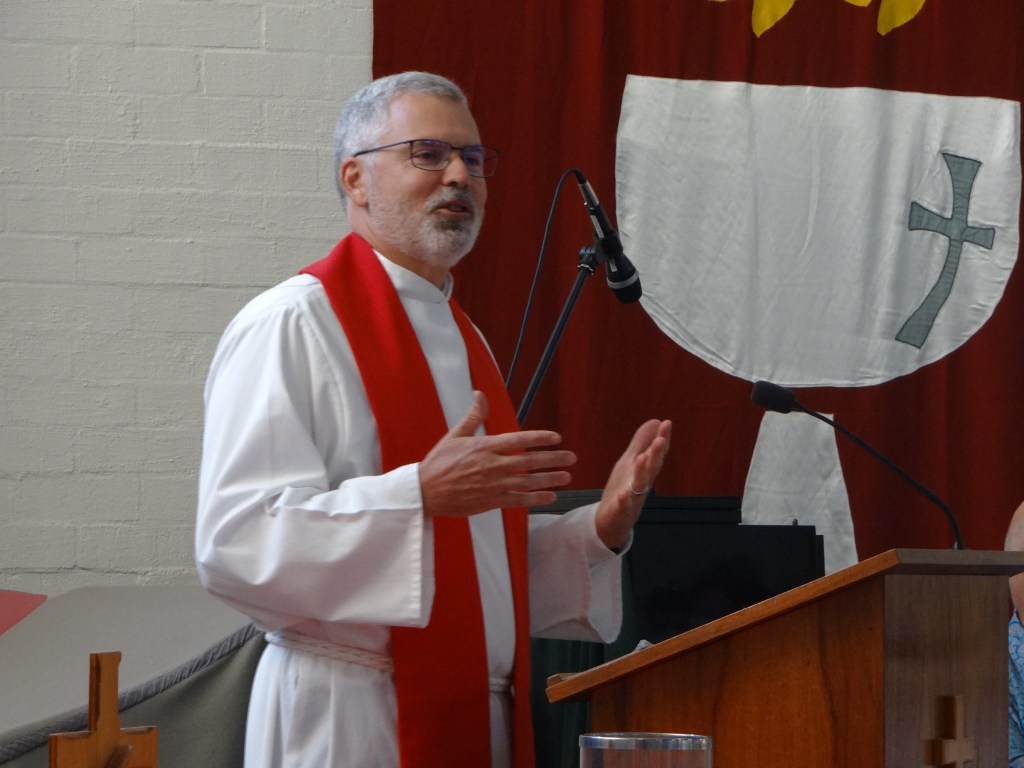
Last Sunday morning at Tuggeranong Uniting Church (TUC) in the south of Canberra, the Moderator came to visit. The Rev. Simon Hansford preached on the parable of the seeds and the sower—or the four types of ground onto which the seeds were sown (Matt 13). In his sermon, the Moderator called this “a story of God’s grace-filled, generous extravagance; a story that subverts our expectations and invites us to listen, pay attention, and be changed”.

The Moderator contrasted the story that Jesus told with the current business focus on KPIs (key performance indicators) and the need to measure, assess, and evaluate every aspect of work life—including the work of ministers within the church at large. In this view of work, no energy is to be expended on activity that does not produce results! Everything must be successful and achieve the desired goals; nothing should be “wasted”.

He then went on to insist that we should not focus on the fear of wasting the seeds we sow through our Christian life and witness. The story is not instructing us to measure how well we are doing. Rather, he invited the Congregation to hear the story as a demonstration of how God engages with us in Christ—generously, gracefully, extravagantly—and to model our own lives as disciples on this pattern. The story encourages us to live “a discipleship of gentleness and mercy, of grace and wonder”, he said.

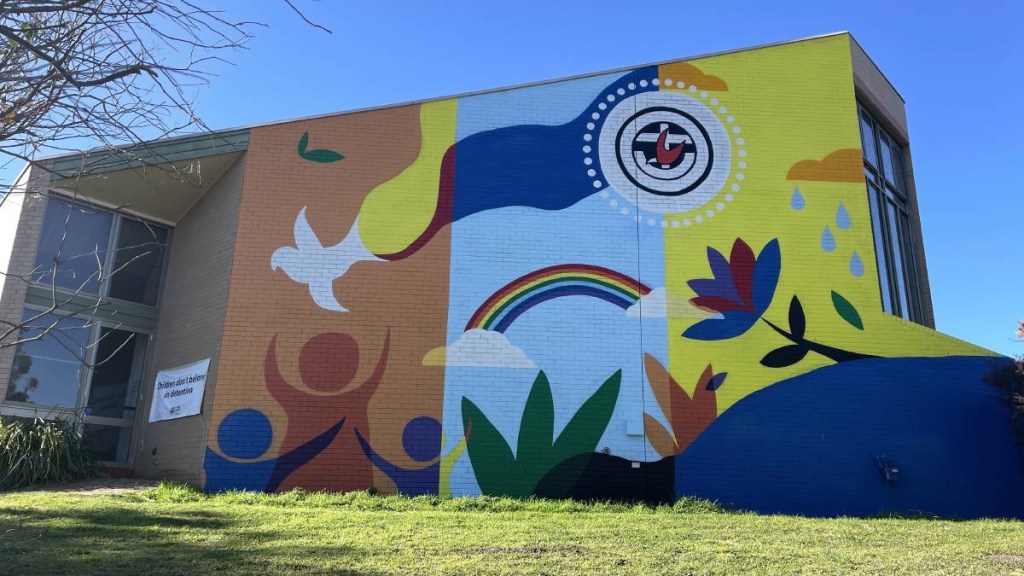
The new mural on the large western brick wall
of the Tuggeranong Uniting Church in Wanniassa, ACT

After worship, the Congregation moved outside to the western wall of the church, where Geoff Filmer’s wonderful mural—hope-filled, inviting, and generous—was dedicated by the Moderator. Geoff had recently painted this mural on what was previously a huge blank brick wall, facing the street and the Erindale shopping centre. Now, vibrant primary colours adorn the wall, with a set of symbols that were designed in close consultation between the artist and a small working group of the church. The mural is one way amongst many ways by which the Congregation is making connections with the local Tuggeranong community.

The Rev. Elizabeth Raine, minister of the Tuggeranong Uniting Church,
with the Rev. Simon Hansford, moderator of the NSW.ACT Synod
of the Uniting Church in Australia

The mural was the idea of the Rev. Elizabeth Raine, one of the ministers in placement at Tuggeranong. One of the mission groups that were established early in her ministry (in 2019) worked through the process of conceptualising the idea, fundraising to finance the mural, engaging the Congregation with the proposal, and negotiating with the artist. Some funding came from the Synod, other funding came from a community grant. The work was mostly completed just two months ago.

As a whole, the mural offers the community of the Tuggeranong Valley the symbols of the Gospel: hope and growth, an inclusive welcome and a resilient future. A large dove hovers in the sky, while rain falls to nurture the earth, symbolising the TUC commitment to environmental responsibility. The Uniting Church logo is surrounded by dots, representing a desire to seek reconciliation with First Peoples, whilst a rainbow signals the welcome extended to members of the LGBTIQA+ community, who participate both in the Rainbow Christian Alliance at TUC and in Sunday morning worship.

Members of the congregation complete the mural—
much to the delight of Geoff Filmer,
the artist who painted the mural

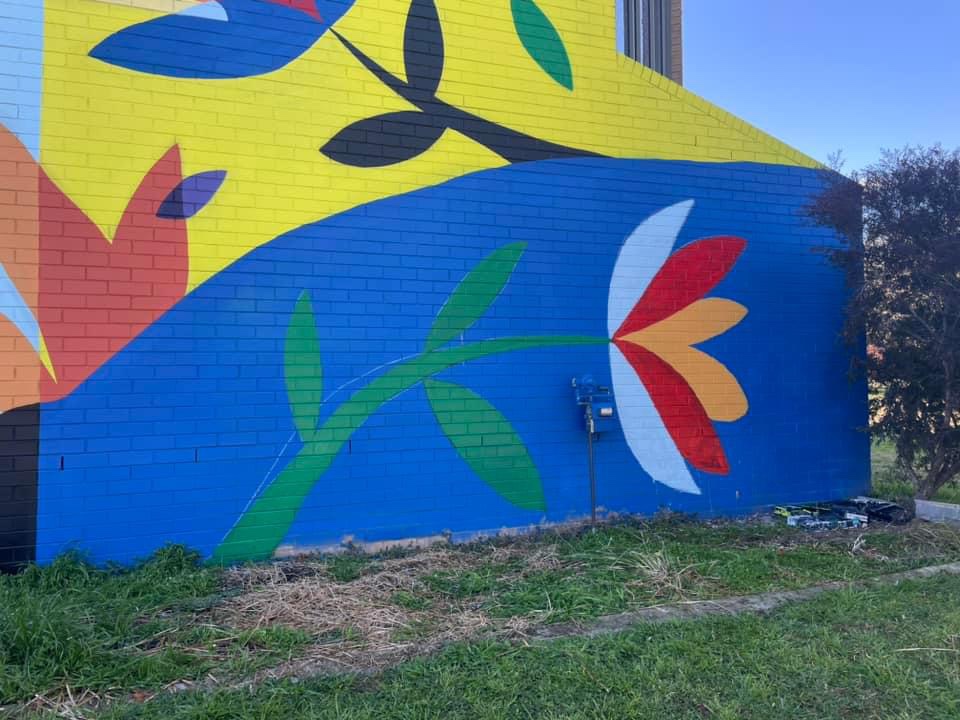
As people gathered on the grass, the Moderator prayed a blessing on the mural and the mission of the Congregation in the Tuggeranong Valley. To celebrate the occasion, members of the Congregation—young and old—joined Geoff Filmer in completing the bottom right-hand corner of the mural, painting sprouts of new growth which are now blossoming into life! The future looks bright; the seeds of God’s generous grace will continue to be sown throughout the Tuggeranong Valley.

The bottom right-hand section of the mural,
complete after members of the Congregation finished
the painting of a beautiful sprouting flower!

Learning of the land (5): Namadgi, Tharwa, and Tidbinbilla

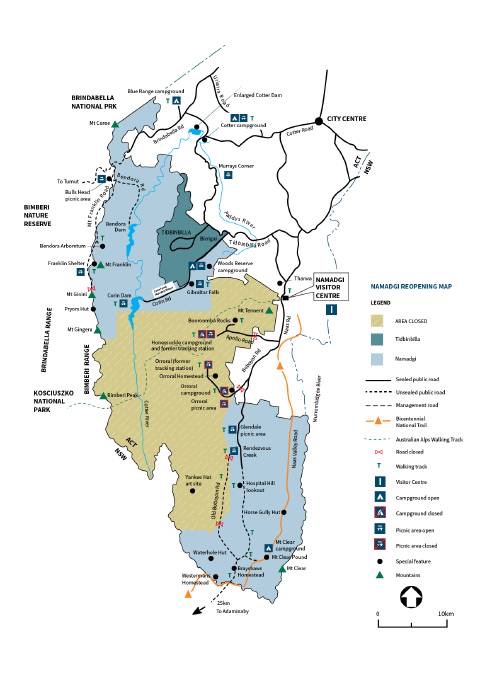
Not far from where we live, to the southwest in what is known as the Brindabella Ranges, there is a large swathe of national park. The Namadgi National Park actually stretches for almost 100 kilometres and it covers just over 100,000 hectares. It is a beautiful “natural” landscape with just a few roads running through it, quite a number of walking trails, and many features of significance.

Because it is so close (the entry point is just a 10km drive from where Elizabeth and I live), we have often ventured into the park for a Sunday afternoon drive; or, as was the case during the pandemic lockdown, for a once-a-week escape from the confines of home and the demands of the ZOOM screen!

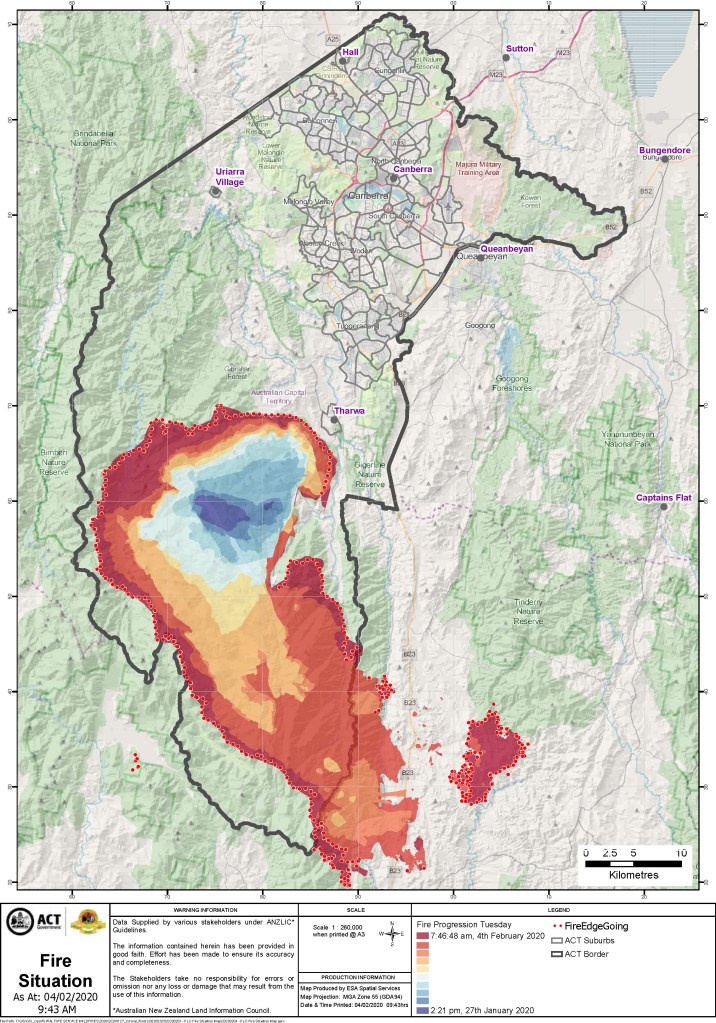
In early 2020, the Orroral Valley bushfire burnt over 80% of Namadgi National Park, or about 86,562 hectares. The fire came perilously close to the urban area where we love, at the southern edge of Canberra. Maps were published showing the danger of embers falling on the suburbs of Gordon and Banks. Plans to evacuate were publicised. We had packed our essentials into a couple of boxes, ready to whisk them away at an early opportunity.

One night, we stood with half of the residents of our street, watching the tops of the Brindabella range mountains that could be seen from our street. There were a number of fires, burning bright in the night. The darkness meant there was no real perspective; the flames, actually 5–6km away, looked like they were just across in the next street. The overhead buzz of planes and copters indicated that the Emergency Services were doing their very best to stop the spread of the fire—as they had been doing for weeks prior to this night.

The fire did not run down the mountain, into the urban area, as it had done in 2003, when a number of suburbs in the south-western area of Canberra were devastated. The memories of that event, scarred deep into the memories of people who had lived in the city longer than we had, were brought back to life in striking and vivid ways, for many we knew.

Just past the entry to the national park, the mountain of Tharwa stands high. It was given the name of Mount Tennent early in the colonial period, when British colonisation began. It was named after John Tennant, a bush ranger who lived in a hideout on the mountain behind Tharwa.

Tennant absconded from his assigned landholder in 1826 and with some others formed a gang which raided local homesteads in the years 1827 and 1828. Eventually he was arrested and transported to Norfolk Island. Tennant was 29 years old when he had been sentenced to transportation to Australia for life in 1823. He arrived in Sydney on 12 July 1824 on the ‘Prince Regent’. Old habits died hard, it would seem. He died in 1837, a year after coming back to Sydney.

Soon after the 2020 bushfire, flooding to the fireground caused significant and widespread damage. The road that ran deep into the national park was closed. Added to the risk of burnt trees falling was the damage done to roads and infrastructure in the floods that occurred some months after the fires. Eventually, the road into the park was opened. We were able to venture back into the bush—to see at close quarters the scarred landscape, the swathes of burnt trees, and the bursts of vibrant green leaves now decorating those burnt trunks.

The savage brutality of what had taken place was evident, from a distance, to those of us who paid attention. Now, at close range, we were able to see just how severe the damage was, as well as how resilient the Australian bush is. New life is bursting forth in so many ways—sadly, not everywhere, as some areas will take much longer to recover—but overall, a picture of verdant health is evident.

******

Archaeological excavation and carbon dating of sites in Tidbinbilla Nature Reserve and Namadgi National Park has confirmed an Aboriginal presence in the ACT region 25,000 years ago. Temperatures in the region would have been several degrees lower 25,000 years ago—similar to the conditions on the summit of Mount Kosciuszko today. In other words, seriously cold!!

Bogong Moths would pass through the area in October on their way from breeding grounds on the plains, up to the mountains to hibernate for the summer. The moths are highly nutritious, easy to collect and were in sufficient numbers to warrant large gatherings. Many Aboriginal people from different clan groups and neighbouring nations gathered here for initiation ceremonies, marriage, corroborees and trade.

In fact Jedbinbilla, which means ‘a place where boys become men’ in Ngunnawal language, is situated adjacent to Tidbinbilla and we are told that it was an important place for young boys to learn the first of three stages of man-hood (gatherer, hunter, warrior).

Archaeological surveys of two of the main access routes to the valley area, the Fishing Gap Trail and the path over Devil’s Gap, have found clear evidence of frequent Aboriginal passage. Gibraltar Rocks is a highly significant spiritual site and a corroboree site has been found near the headwaters of Sheedy’s Creek.

Researchers believe the Tidbinbilla valley floor was the focus of a territorial group that survived on the plentiful supply of possum, ducks, wild turkeys, emus, platypus, kangaroo, fish, yabbies and a range of plants, tubers, seeds and fruit.

When Europeans first arrived in the area in the early 1820s hundreds of Aboriginal people lived here. The population of Aboriginal people increased at various times during the year when people travelled to the region for social gatherings, ceremonies and seasonal food collecting. European settlement had the same impact on Aboriginal communities in the ACT as it did in other parts of Australia. It brought displacement from the land and exposed people to new diseases such as influenza, smallpox and tuberculosis, from which many died. That, to our shame, is an enduring legacy that we forced into the First Peoples.

Aboriginal heritage sites found in this region include burial places, campsites, rock shelters (with or without ochre paintings), stone arrangements, scarred trees, ceremonial grounds, grinding grooves, quarries and sacred places. At times, Aboriginal occupation is also evident at early European sites such as historic homesteads, cemeteries, reserves and old bridle tracks and coach roads. There is lots of information at https://www.tidbinbilla.act.gov.au/learn/tidbinbilla?a=396477

*****

Men’s sites were often found in the higher peaks of the valley. One of the rock shelters is home to ancient rock art found along a pathway to the Gibraltar rock peak, which is a men’s site. While the mountains in Tidbinbilla are also important to Ngunnawal women, women’s sites were found closer to the river system that twisted through the valley. In some women’s places grinding grooves can still be found on the river’s edge.

Often grand geological formations would be significant to the story of place. Many formations can still be seen today which visually reflect the dreaming story of the valley and its important relationship to the people that have survived and thrived within it for thousands of years. An example of this is the shape of a pregnant woman seen through the contours in the western slopes of the valley and found in the centre of the Tidbinbilla valley is a rock that looks like a perched eagle (Maliyan) the creator spirit of the Tidbinbilla dreaming story.

Tidbinbilla was a key place for Ngunnawal ceremonies, with groups from surrounding areas entering through key points such as Gibraltar Peak, where an elder would light a fire to guide people into the valley. Neighbouring language groups travelled to Ngunnawal Country for the purpose of ceremony, lore, marriage arrangements, trade, sharing of seasonal foods and cultural knowledge.

Tidbinbilla was also a place where young men learnt traditional lore/law, and where they were taken into the mountains as they learnt to become men in the traditional way. Similarly, Ngunnawal women carried out their customary ceremonies in the lower areas of the landscape preparing young girls for womanhood. And as we have noted, the mountains surrounding the valley were home in spring to the migrating bogong moths, which were gathered by Ngunnawal people as a source of food. See

https://www.tidbinbilla.act.gov.au/learn/ngunnawal-culture-and-heritage

and

https://www.canberratracks.act.gov.au/heritage-trails/track-1-ngunnawal-country/namadgi-visitor-centre

*****

For earlier posts on learning of country, see

Learning of the land (5): Namadgi, Tharwa, and Tidbinbilla

Not far from where we live, to the southwest in what is known as the Brindabella Ranges, there is a large swathe of national park. The Namadgi National Park actually stretches for almost 100 kilometres and it covers just over 100,000 hectares. It is a beautiful “natural” landscape with just a few roads running through it, quite a number of walking trails, and many features of significance.

Because it is so close (the entry point is just a 10km drive from where Elizabeth and I live), we have often ventured into the park for a Sunday afternoon drive; or, as was the case during the pandemic lockdown, for a once-a-week escape from the confines of home and the demands of the ZOOM screen!

In early 2020, the Orroral Valley bushfire burnt over 80% of Namadgi National Park, or about 86,562 hectares. The fire came perilously close to the urban area where we love, at the southern edge of Canberra. Maps were published showing the danger of embers falling on the suburbs of Gordon and Banks. Plans to evacuate were publicised. We had packed our essentials into a couple of boxes, ready to whisk them away at an early opportunity.

One night, we stood with half of the residents of our street, watching the tops of the Brindabella range mountains that could be seen from our street. There were a number of fires, burning bright in the night. The darkness meant there was no real perspective; the flames, actually 5–6km away, looked like they were just across in the next street. The overhead buzz of planes and copters indicated that the Emergency Services were doing their very best to stop the spread of the fire—as they had been doing for weeks prior to this night.

The fire did not run down the mountain, into the urban area, as it had done in 2003, when a number of suburbs in the south-western area of Canberra were devastated. The memories of that event, scarred deep into the memories of people who had lived in the city longer than we had, were brought back to life in striking and vivid ways, for many we knew.

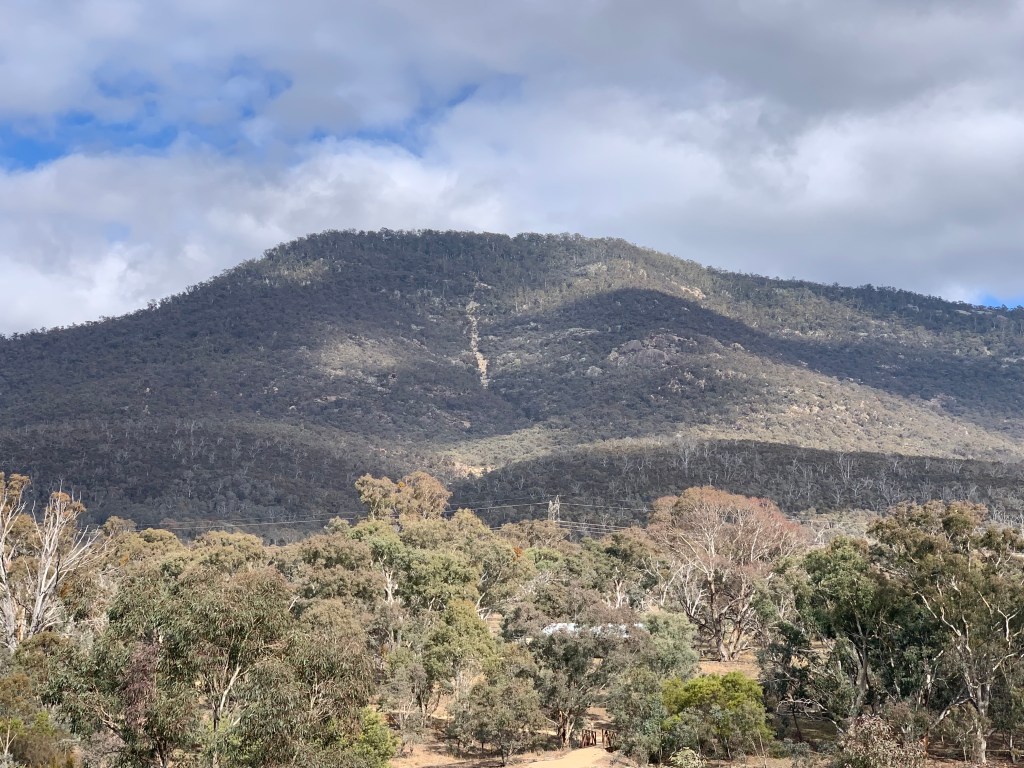
Just past the entry to the national park, the mountain of Tharwa stands high. It was given the name of Mount Tennent early in the colonial period, when British colonisation began. It was named after John Tennant, a bush ranger who lived in a hideout on the mountain behind Tharwa.

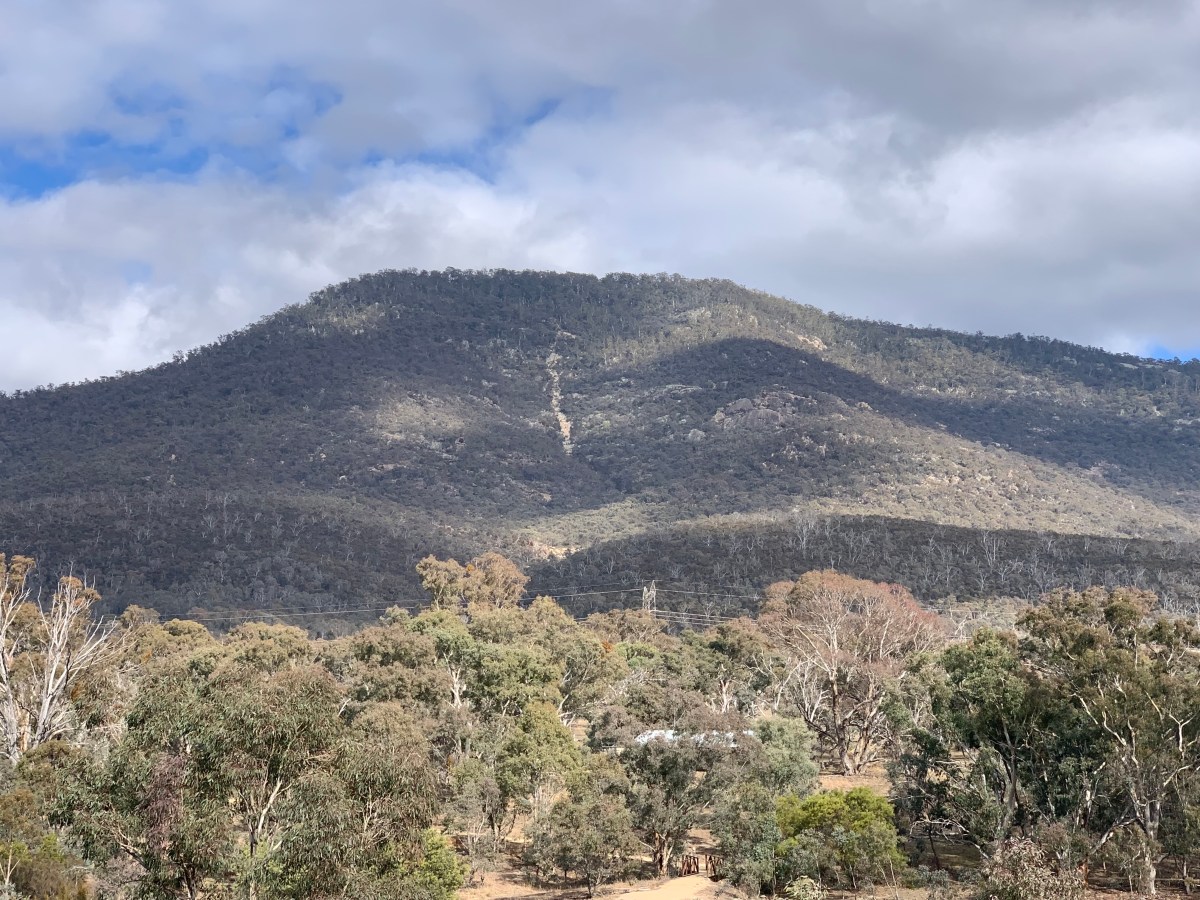
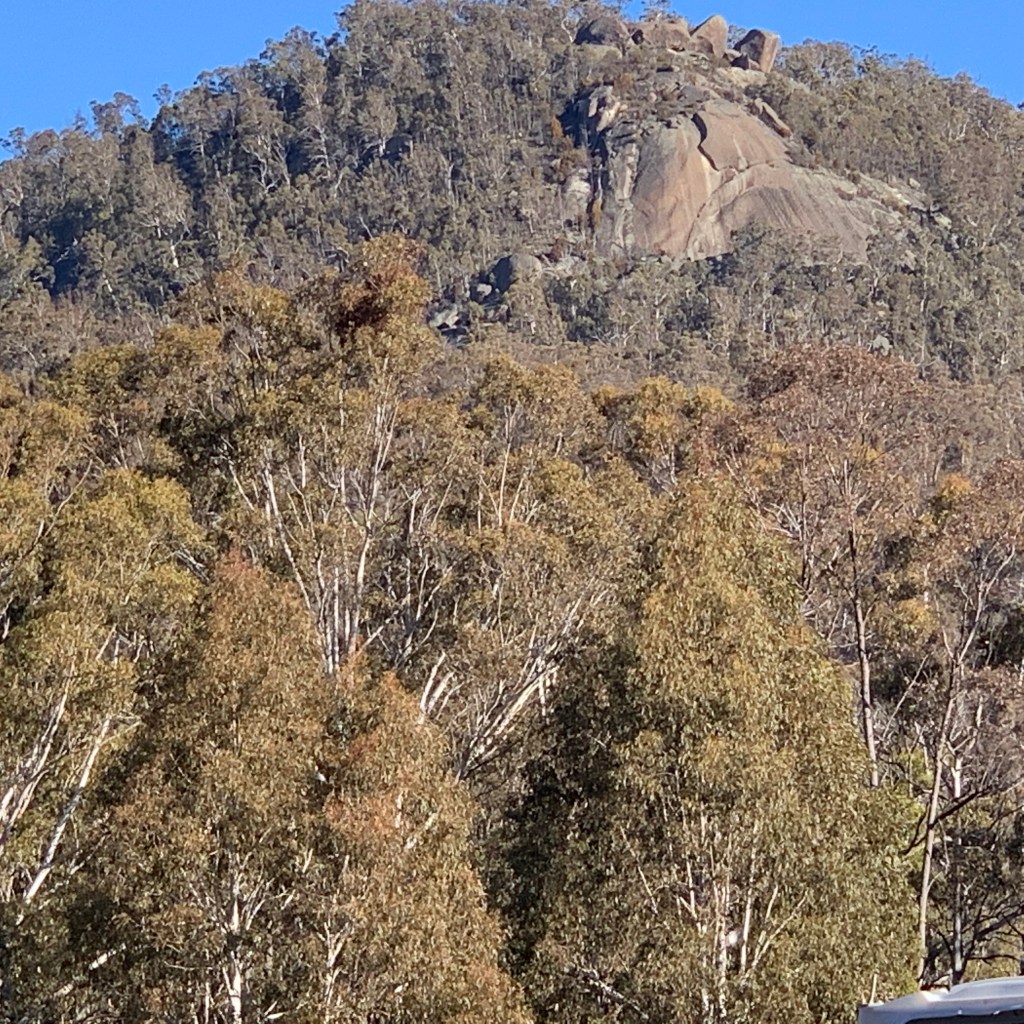
Tharwa (Mount Tennant) some months after the 2020 fires

Tennant absconded from his assigned landholder in 1826 and with some others formed a gang which raided local homesteads in the years 1827 and 1828. Eventually he was arrested and transported to Norfolk Island. Tennant was 29 years old when he had been sentenced to transportation to Australia for life in 1823. He arrived in Sydney on 12 July 1824 on the ‘Prince Regent’. Old habits died hard, it would seem. He died in 1837, a year after coming back to Sydney.

Soon after the 2020 bushfire, flooding to the fireground caused significant and widespread damage. The road that ran deep into the national park was closed. Added to the risk of burnt trees falling was the damage done to roads and infrastructure in the floods that occurred some months after the fires. Eventually, the road into the park was opened. We were able to venture back into the bush—to see at close quarters the scarred landscape, the swathes of burnt trees, and the bursts of vibrant green leaves now decorating those burnt trunks.

The savage brutality of what had taken place was evident, from a distance, to those of us who paid attention. Now, at close range, we were able to see just how severe the damage was, as well as how resilient the Australian bush is. New life is bursting forth in so many ways—sadly, not everywhere, as some areas will take much longer to recover—but overall, a picture of verdant health is evident.

******

Archaeological excavation and carbon dating of sites in Tidbinbilla Nature Reserve and Namadgi National Park has confirmed an Aboriginal presence in the ACT region 25,000 years ago. Temperatures in the region would have been several degrees lower 25,000 years ago—similar to the conditions on the summit of Mount Kosciuszko today. In other words, seriously cold!!

Bogong Moths would pass through the area in October on their way from breeding grounds on the plains, up to the mountains to hibernate for the summer. The moths are highly nutritious, easy to collect and were in sufficient numbers to warrant large gatherings. Many Aboriginal people from different clan groups and neighbouring nations gathered here for initiation ceremonies, marriage, corroborees and trade.

In fact Jedbinbilla, which means ‘a place where boys become men’ in Ngunnawal language, is situated adjacent to Tidbinbilla and we are told that it was an important place for young boys to learn the first of three stages of man-hood (gatherer, hunter, warrior).

Archaeological surveys of two of the main access routes to the valley area, the Fishing Gap Trail and the path over Devil’s Gap, have found clear evidence of frequent Aboriginal passage. Gibraltar Rocks is a highly significant spiritual site and a corroboree site has been found near the headwaters of Sheedy’s Creek.

Researchers believe the Tidbinbilla valley floor was the focus of a territorial group that survived on the plentiful supply of possum, ducks, wild turkeys, emus, platypus, kangaroo, fish, yabbies and a range of plants, tubers, seeds and fruit.

When Europeans first arrived in the area in the early 1820s hundreds of Aboriginal people lived here. The population of Aboriginal people increased at various times during the year when people travelled to the region for social gatherings, ceremonies and seasonal food collecting. European settlement had the same impact on Aboriginal communities in the ACT as it did in other parts of Australia. It brought displacement from the land and exposed people to new diseases such as influenza, smallpox and tuberculosis, from which many died. That, to our shame, is an enduring legacy that we forced into the First Peoples.

Aboriginal heritage sites found in this region include burial places, campsites, rock shelters (with or without ochre paintings), stone arrangements, scarred trees, ceremonial grounds, grinding grooves, quarries and sacred places. At times, Aboriginal occupation is also evident at early European sites such as historic homesteads, cemeteries, reserves and old bridle tracks and coach roads. There is lots of information at https://www.tidbinbilla.act.gov.au/learn/tidbinbilla?a=396477

*****

Men’s sites were often found in the higher peaks of the valley. One of the rock shelters is home to ancient rock art found along a pathway to the Gibraltar rock peak, which is a men’s site. While the mountains in Tidbinbilla are also important to Ngunnawal women, women’s sites were found closer to the river system that twisted through the valley. In some women’s places grinding grooves can still be found on the river’s edge.

Often grand geological formations would be significant to the story of place. Many formations can still be seen today which visually reflect the dreaming story of the valley and its important relationship to the people that have survived and thrived within it for thousands of years. An example of this is the shape of a pregnant woman seen through the contours in the western slopes of the valley and found in the centre of the Tidbinbilla valley is a rock that looks like a perched eagle (Maliyan) the creator spirit of the Tidbinbilla dreaming story.

Tidbinbilla was a key place for Ngunnawal ceremonies, with groups from surrounding areas entering through key points such as Gibraltar Peak, where an elder would light a fire to guide people into the valley. Neighbouring language groups travelled to Ngunnawal Country for the purpose of ceremony, lore, marriage arrangements, trade, sharing of seasonal foods and cultural knowledge.

Tidbinbilla was also a place where young men learnt traditional lore/law, and where they were taken into the mountains as they learnt to become men in the traditional way. Similarly, Ngunnawal women carried out their customary ceremonies in the lower areas of the landscape preparing young girls for womanhood. And as we have noted, the mountains surrounding the valley were home in spring to the migrating bogong moths, which were gathered by Ngunnawal people as a source of food. See

https://www.tidbinbilla.act.gov.au/learn/ngunnawal-culture-and-heritage

and

https://www.canberratracks.act.gov.au/heritage-trails/track-1-ngunnawal-country/namadgi-visitor-centre

*****

For earlier posts on learning of country, see

Saltiness restored: the need for innovation. An Ordination Celebration.

“The church does not need inventors; rather, we need innovators.” This was the heart of the message delivered by the Director of Education and Principal of United Theological College, the Rev. Dr Peter Walker, at a joyful celebratory service last Sunday evening in the Tuggeranong Uniting Church in the ACT.

Dr Walker was speaking at a service to ordain Sharon Jacobs as a Minister of the Word and to induct her into placement in the Tuggeranong Congregation as the Relationships and Growth Minister, a newly-created position funded substantially by the Synod Growth Fund. The ordination was presided over by the recently-elected Co-Chairperson of the Canberra Region Presbytery, Ms Janet Kay.

Dr Walker was addressing a capacity congregation in the building, with more people connecting online, from Canberra, as well as Melbourne, Aotearoa—New Zealand, and Scotland—the places where the Rev. Jacobs has lived in the past. Speaking under the title of “saltiness restored”, derived from Matthew 5, Dr Walker noted that “whilst inventors create new things, innovators know what they have to offer, and work to ensure that others can appreciate this”.

We have the Gospel, he said; we know what we have to offer others; and we need to work to find ways in which this good news comes alive in the lives of others. Our charge is to be “salt of the earth”; the church in our time is to discover how to be “saltiness restored”.

His words were particularly appropriate for the Tuggeranong Congregation, which has been innovating its life and witness in recent years, under the energetic leadership of the Rev. Elizabeth Raine and a strong team of lay leaders. The Congregation has refreshed its worship life, and continues its online worship alongside the in-person gathering each week. The Rev. Raine has developed the Congregation into an intentional learning community, providing leadership in three weekly online BIble Studies throughout the pandemic lockdowns. These studies are also continuing, as they draw participants from across the Presbytery and beyond, even interstate and overseas!!

The Church Council has charted a deliberate course to make a difference in the wider Tuggeranong community—to be the “salt of the earth” in southern Canberra. Deliberate connections have been fostered with a number of community groups; the Congregation has participated in Floriade Reimagined, reinvigorated its Red Dove pop-up Op Shop, continued providing its weekly Emergency Food and Lunchtime Conversation group, and offered the wider community innovative events such as Christmas Reimagined and SpringFest. A partnership with SeeChange Tuggeranong has seen regular events with a focus on sustainability.

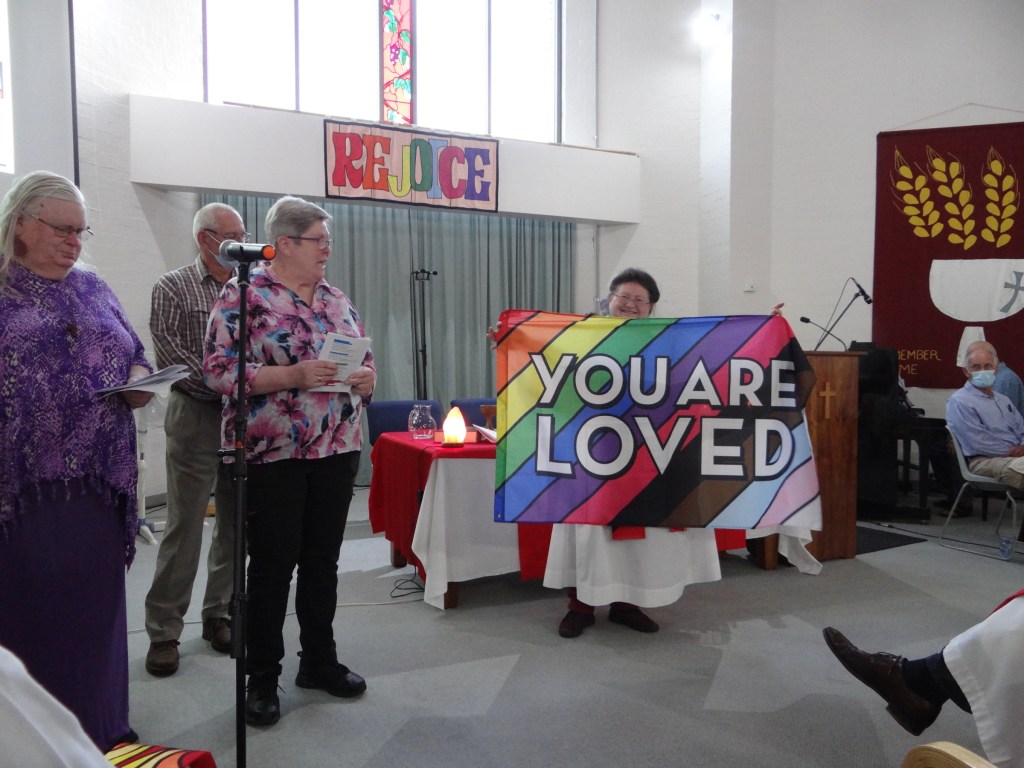
Members of the Congregation, Sally-Anne, Iain, and Delia, with Sharon as she holds the Rainbow Christian Alliance affirming that “you are loved”

The monthly Rainbow Christian Alliance now meets in the church and has broadened its membership beyond LGB people to include growing numbers of TIQ members. A monthly Messy Church under the name of Fam@4 now meets at 4pm on the 4th Sunday of the month. Regular intergenerational worship services are scheduled for key moments on Sunday mornings, and inevitably the church is filled with people of all ages, craft activities, vibrant music, with lots of colour, energy, and caring relationships growing.

Sharon will focus her 50% role on developing the Congregation’s work with families and children, as well as supporting and growing the leadership and membership of the Rainbow Christian Alliance. She brings experience and giftedness in pastoral care, working creatively with children, and generating enthusiasm—qualities that fit her well for this role.

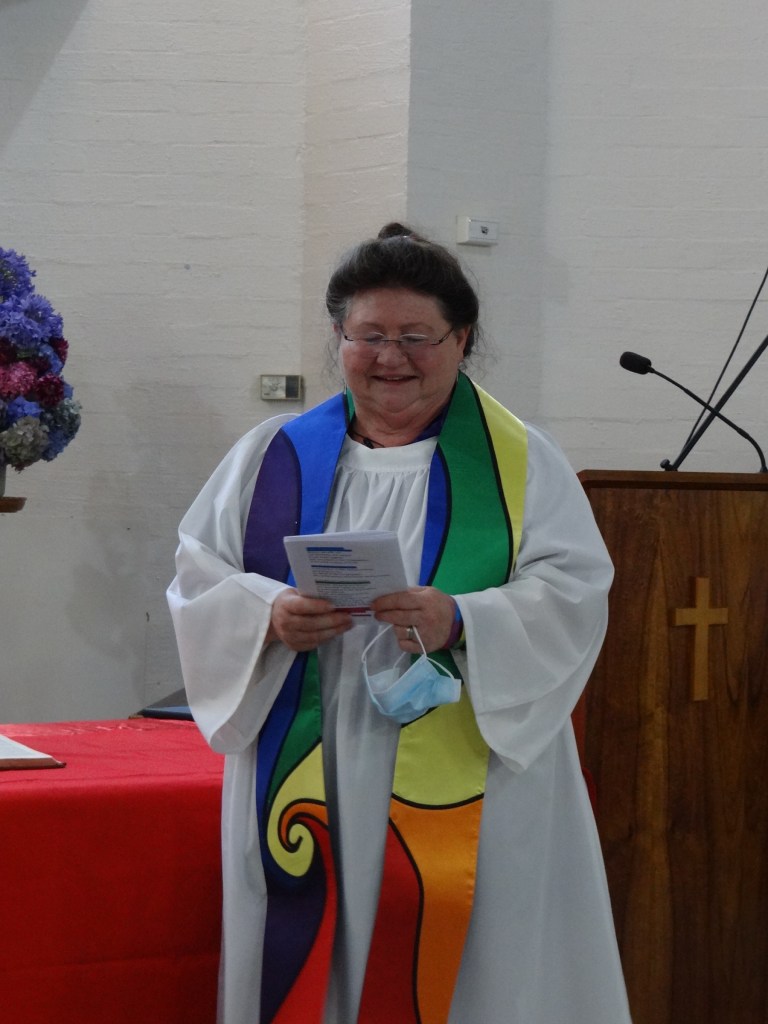
During the service, Sharon was welcomed as she joins the team of the Rev. Elizabeth Raine, Minister in placement, and the Rev. Margaret Middleton, the Tuggeranong Minister-in-Association. She was charged for her life as an ordained minister by her former minister, the Rev. David Thiem, and presented with a colourful rainbow stole by the congregation.

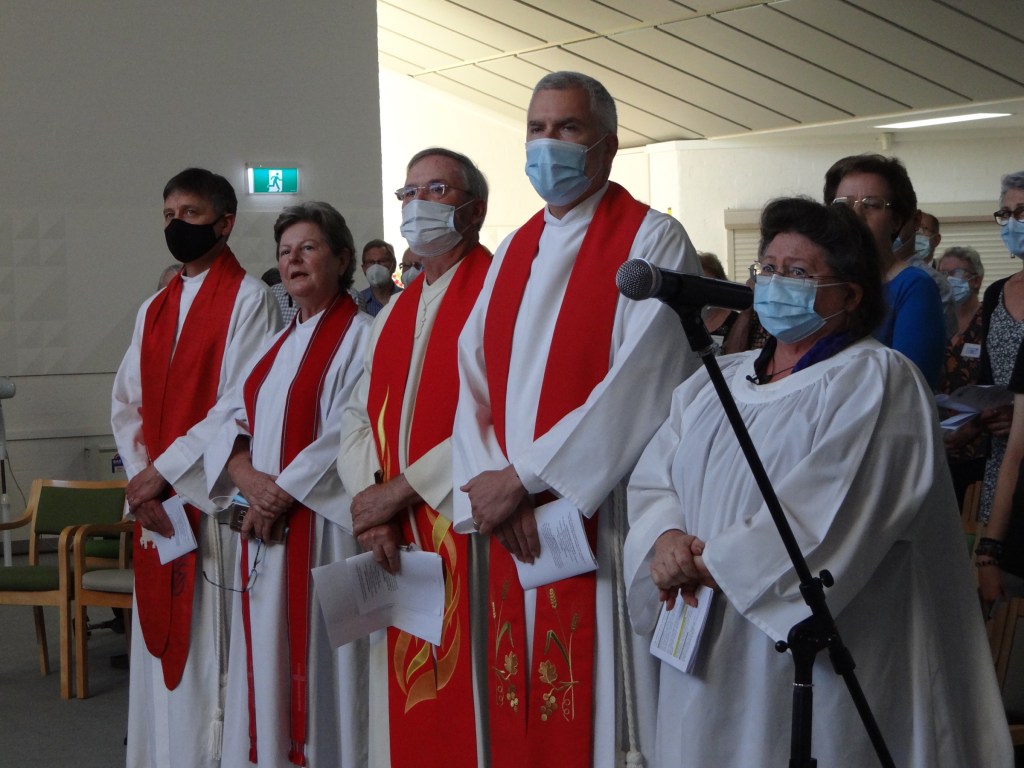
The Revs. Andrew Smith, LizMcMillan, David Thiem,
and Dr Peter Walker, with Sharon Jacobs

Also participating in the service were Canberra Region Presbytery Ministers, the Rev. Andrew Smith, and the Rev. Liz McMillan, recently arrived from Melbourne. Many members of the Presbytery greeted Sharon after her induction, and members of the Tuggeranong Congregation offered their trademark hospitality of a generous supper, as friendships were rekindled amongst those present after the service concluded.

Keep watching Tuggeranong, as innovation continues, its salty contribution to the local community in southern Canberra develops, and the vibrant life of the Congregation grows!

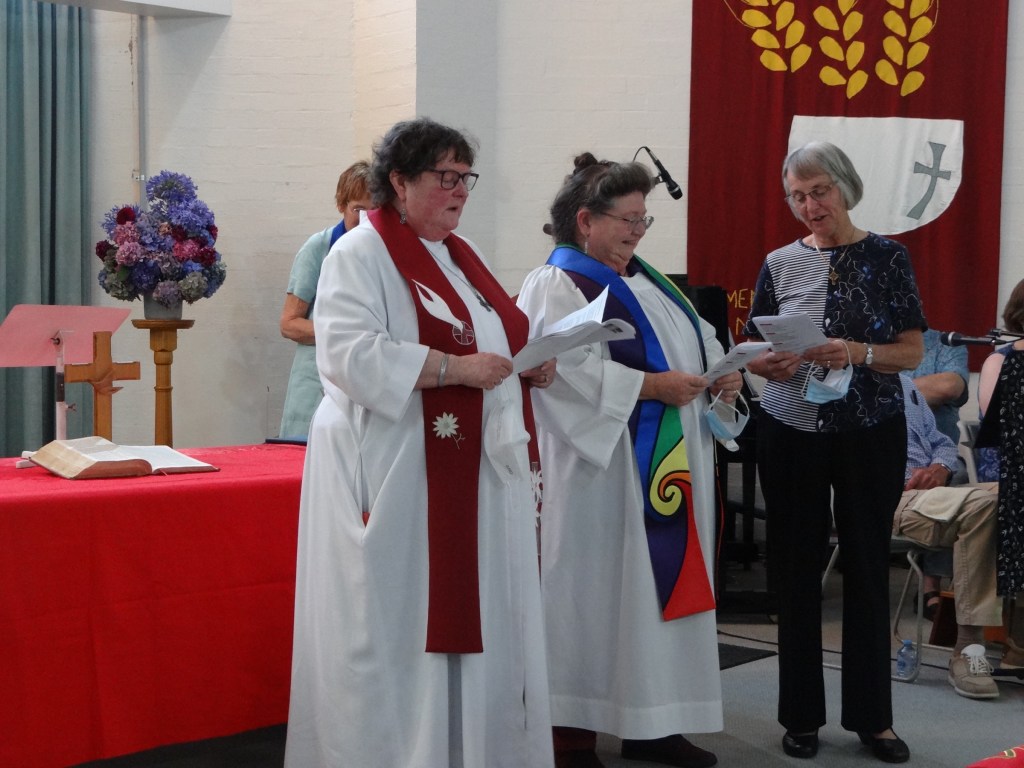
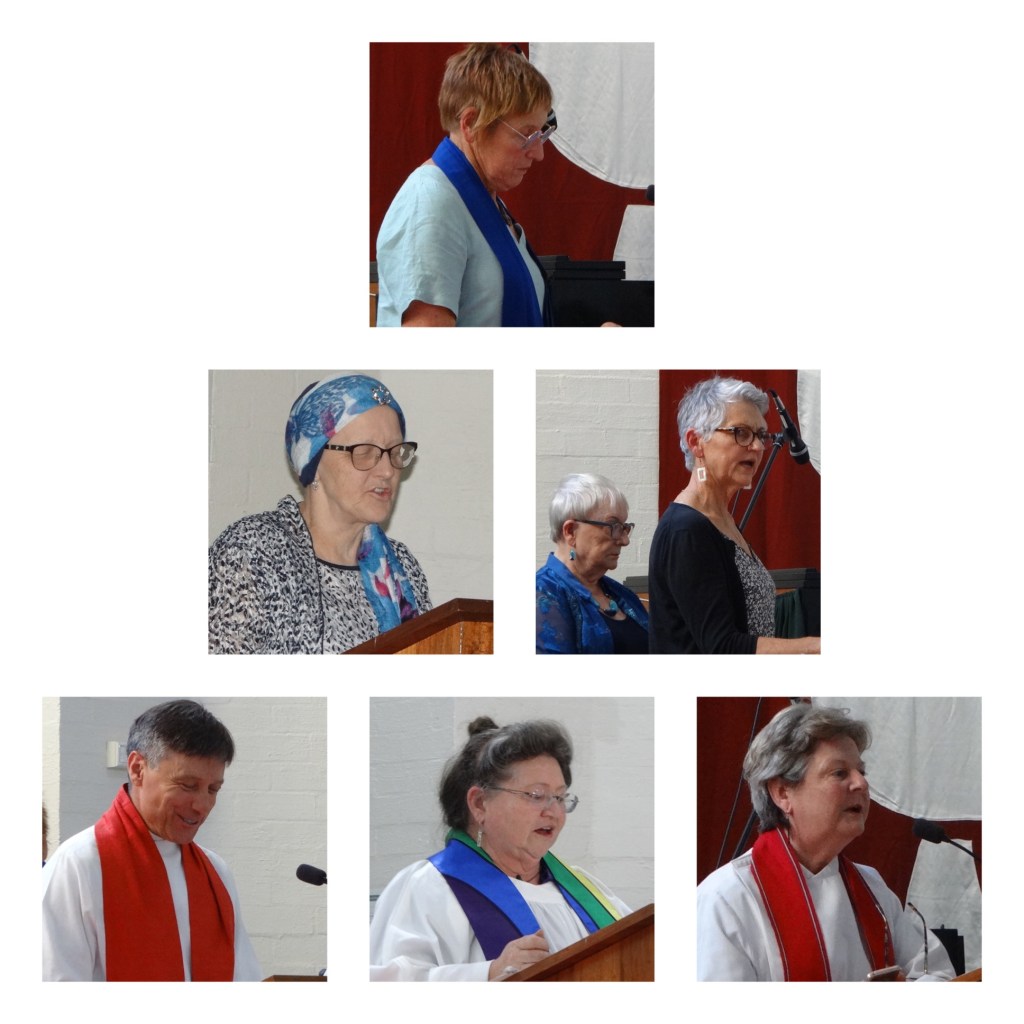
Presbytery Co-Chair, Girls Brigade Captain, Scripture readers,
Andrew Smith, Sharon Jacobs, Liz McMillan

*****

See also

“I will not be lectured by this man”: remembering 9 October 2012

There have been some great speeches by politicians over the years. It was before my time, but Chifley’s “light on the hill” speech at a 1949 Labor Conference in Sydney, is often cited. “We have a great objective”, Prime Minister Chifley declared, “the light on the hill, which we aim to reach by working the betterment of mankind [sic.] not only here but anywhere we may give a helping hand. If it were not for that, the Labor movement would not be worth fighting for.” The Labor party has referenced this speech regularly in the ensuing decades.

So too, also before my time, but also regularly referenced in the decades that followed, was a 1941 speech by Prime Minister Menzies, identifying “the forgotten class — the middle class — those people who are constantly in danger of being ground between the upper and the nether millstones of the false war; the middle class who, properly regarded represent the backbone of this country.”

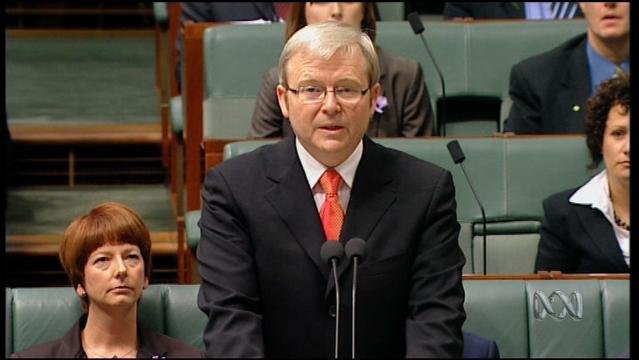
Alongside them, who could forget other Prime Ministerial offerings? One of huge significance was Kevin Rudd’s 2008 Apology to the Stolen Generations: “we say, sorry; to the mothers and the fathers, the brothers and the sisters, for the breaking up of families and communities, we say sorry; and for the indignity and degradation thus inflicted on a proud people and a proud culture, we say sorry.”

Another, also filled with rhetorical power and cultural significance, was Paul Keating’s Redfern Speech in 1997: “we committed the murders, we took the children from their mothers, we practised discrimination and exclusion; it was our ignorance and our prejudice.”

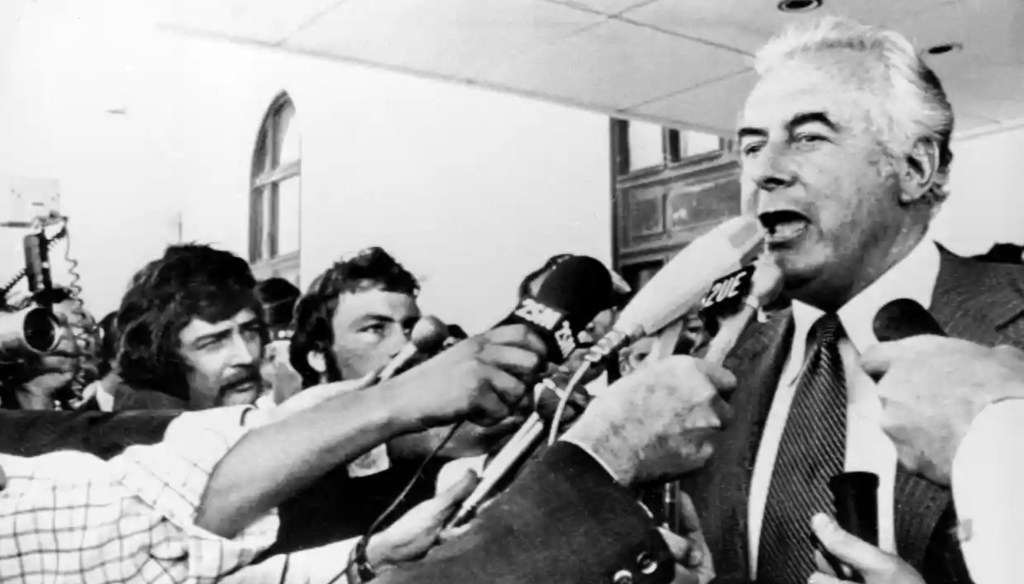
And, of course, there is Gough Whitlam, a master wordsmith, whose quick wit and rhetorical prowess was evident on the steps of Old Parliament House, immediately after the treachery of The Dismissal in November 1975; “well may we say God Save the Queen, because nothing will save the Governor-General.”

All memorable speeches, on (mostly) memorable occasions, eliciting words which live on in Australian culture and memory. They point to the best in Australian society, the most worthy aspects of our developing national culture.

There have been other signal speeches with a very different perspective—speeches that I won’t quote from, such as Pauline Hanson’s 1996 inaugural speech making outrageously discriminatory racist claims; John Howard, opportunistically picking up and running with this xenophobic streak with his declaration, in 2001, that “we will decide who comes to this country”; and Fraser Anning’s terrible reference to “the final solution” in his 2018 speech. These speeches live on in infamy. They reflect the worst of who some of us are.

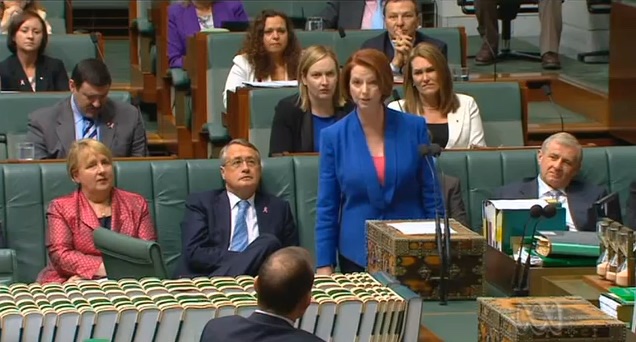
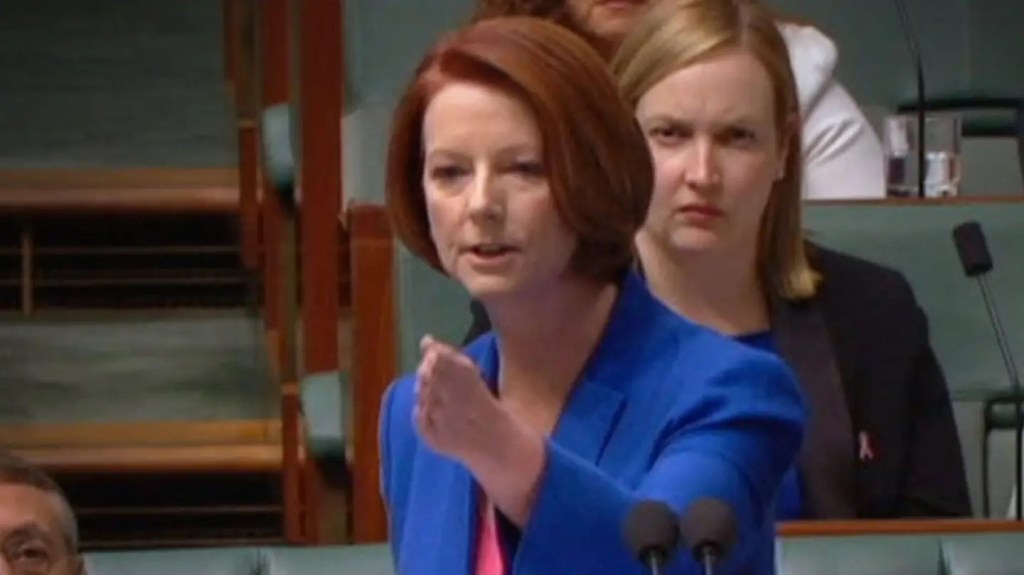
Today is the tenth anniversary of the most recent memorable, and utterly praiseworthy, speech by a federal political leader: a speech by Julia Gillard that has come to be known as the Misogyny Speech. This speech was delivered on 9 October 2012, with the penetrating declaration, “I will not be lectured about sexism and misogyny by this man; I will not—not now, not ever ”, searing the air in the House of Representatives chamber, as Prime Minister Gillard spoke directly and forcefully to the Opposition Leader, Tony Abbott.

Katherine Murphy has written a fine analysis of the moment, and how the speech was a turning point in the cultural change that focussed the nation’s attention on male privilege, misogynistic practices, and sexist words and actions, especially in the federal political arena. From that speech to the Enough is Enough! rallies on 15 March 2020, a significant shift has taken place. There is momentum for deep-seated cultural change, despite the troglodyte resistance of the pathetic remnant of conservative members currently in the post-Morrison federal parliament.

https://www.theguardian.com/world/2022/sep/30/i-will-not-how-julia-gillards-words-of-white-hot-anger-reverberated-around-the-world

The transcript of the speech, given by the Prime Minister without notes or briefing notes, can be read at

https://welvic.org.au/site_media/files/Gillard2.pdf

Julia Gillard’s potent impromptu speech is well worth reading once again on this anniversary—and worth remembering each day as a pointer to what is of fundamental importance in our society, if we really do want to commit to a fully equitable society. We remember this fine political speech, with gratitude. We anticipate ongoing cultural change, with hope. And so may it be.

Liberal losses: counting the cost

Now that all the results have been finalised in the Australian Federal Election 2022, we can see clearly the extent of Liberal losses. It’s been extensive, cutting right to the heart of the party in the so-called “blue-ribbon Liberal” seats.

From early on it was clear that six House of Representatives seats were lost to “teal independents”, standing on a platform of real action to address climate change, and the introduction of a corruption commission to begin to repair the shocking state of integrity in public life.

Three of these seats were in Sydney: Kylea Tink in North Sydney, the seat of former Treasurer Hockey; Sophie Scamps in Mackellar; and Allegra Spender in Wentworth, the seat of former PM Turnbull amd former Opposition Leader Hewson.

Two more were in Melbourne: Monique Ryan in Kooyong, the seat of former Treasuer Frydenberg, as well as former Opposition Leader Andrew Peacock, and foundation Liberal leader and (twice) Prime Minister Robert Menzies; and Zoe Daniel in Goldstein.

The sixth seat to fall to a “ teal independent” was in WA: Kate Chaney in Curtin, the seat of former Deputy Liberal Leader Bishop.

They join existing members Helen Haines in Indi and Zali Steggal in Warringah, both of which were once blue-Liberal seats; the latter was previously held by the former PM, the Abbott of Inequity.

The Liberals also lost to Labor in Bennelong, the seat of former PM Howard, and Robertson in NSW; in Victoria, they lost to Labor in Higgins, the seat of former Treasurer Peter Costello and former Prime Ministers Harold Holt and John Gorton, and Chisholm. In SA, they lost Boothby to Labor, and the Centre Alliance held on to Mayo, which it had taken from the Liberals in 2016; while in QLD, they lost to the Greens in Ryan.

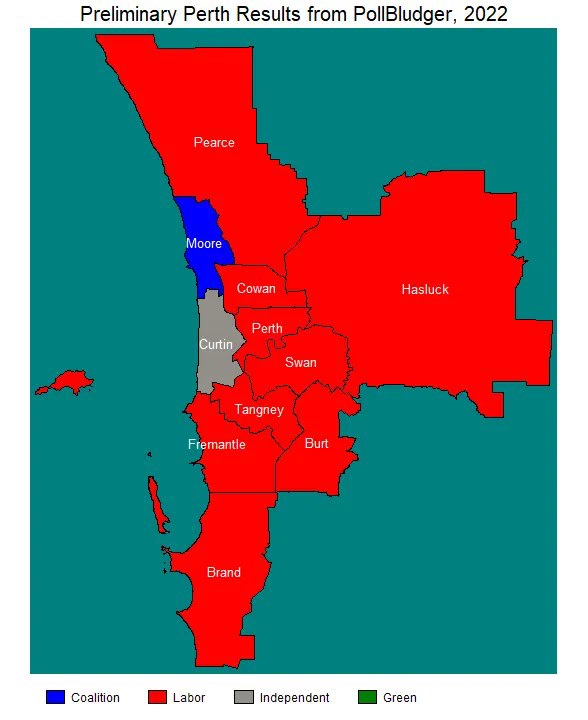
They lost massively in WA, with four seats going to Labor: Hasluck, Swan, Pearce, and Tangney. The map of electorates in the Perth area tells the story quite dramatically!

Lots of Liberal losses in the House.

See https://www.afr.com/politics/federal/where-the-election-was-won-and-lost-and-who-is-next-on-the-chopping-block-20220524-p5ao13

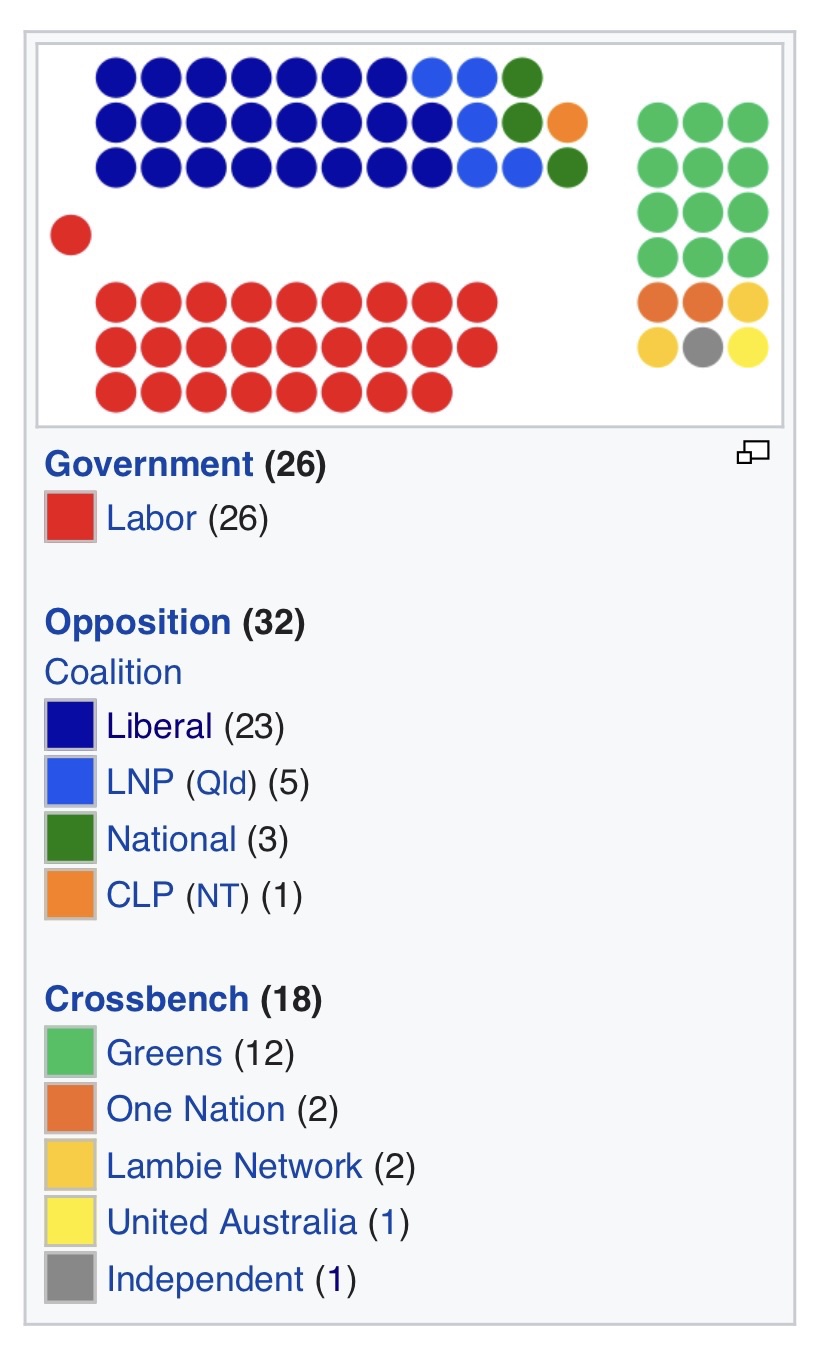
In the Senate, four Liberal seats were lost: to David Pocock in the ACT, to Labor in WA, to the Jacqui Lambie Network in Tasmania, and to “it’s my kinda party” Untied Australia in Victoria.

The Liberals now have only 23 seats in the Senate—but we add to that 5 from the Liberal National Party in QLD, 3 from the Nationals, and 1 from the Country Liberals in NT, to total 32 Senators as the main opposition body.

Labor now has 26 seats in the Senate, and no doubt they will work co-operatively with the 12 Greens and independent David Pocock on much of their legislative agenda. The 2 Jacqui Lambie Network senators may well also figure in these negotiations.

The conservative rump is now irrelevant in the Senate, except for the predictably useless aggravating grunts that they will surely make as often as they can to gain media attention: Pauline Hanson and Malcolm Roberts in QLD, and newcomer Ralph Babet in Victoria.

See https://www.pollbludger.net/category/federal-politics-2019-2022/federal-election-2022/

Lots of Liberal losses overall. And a clear indication that the Liberals are no longer anything like “liberal” in their policies or their practices.

The true cost of the Howard—Abbott—Morrison conservative hegemony is now evident: years of rhetoric about fiscal conservatism masking disastrous social policies, especially amongst the poor; years of dog whistling promoting xenophobia and overt racism, often in cahoots with various rightwingnutjobs; years of resistance to any significant action on climate, signing off on a bleak future for all humanity whilst profiting from the largesse of always-profitable fossil fuel companies; years of resisting real support for renewables; years of offering leftover scraps to the First Peoples of the country, while ignoring Royal Commission recommendations; and years of blithely ignoring the misogynistic culture that tolerated (and generated) many acts of sexist abuse.

Liberal losses: many reason to celebrate!