At the crossroads, beside the gates: Wisdom in the public places (Sunday after Pentecost; Proverbs 8)

“On the heights, beside the way, at the crossroads … beside the gates”. So Wisdom is located, in these opening verses of the section of Proverbs which the lectionary offers us for this Sunday, the first Sunday after the festival of Pentecost (Prov 8:1–4). Of course, this day is identified in the liturgical calendar as Trinity Sunday, and this passage from Proverbs is one of a number of Scripture passages which, over three years, are proposed for this particular Sunday. 

The others are Genesis 1, where God, God’s word, and God’s spirit are to be found, and Isaiah 6, which includes the tripartite song “holy, holy, holy”; and Psalms 8, a song in praise of creation, and 29, singing of “the voice of the Lord”. None of them, of course, make any specific claim that can be seen to be articulating a “doctrine of the Trinity”. It is up to later Christian interpreters to “read back” into the passage any inferences regarding a triune God.

In this post I am not going to attempt any exegetical gymnastics, to find aspects of the threefold nature of God in what is said about Wisdom. Rather, I want to highlight the importance of what is said about where Wisdom exercises her ministry (in this post) and the significance of the role that Wisdom plays in the creation of the world (in the following post). These are themes that are inherent in the passage itself; as we attend to these matters, we don’t need to squeeze, distort, or manipulate the text to make it conform with a much later dogmatic theory. 

Wisdom is positioned in the public places of her society—places where, normally, males would be found, transacting their business, arguing their views, maintaining the honour of their public status. Instead, in this poem, as also in the opening poem about Wisdom at 1:20–33, the female figure is placed firmly within those traditionally-male places. In the earlier poem, she was said to be crying out “in the street” (1:20), raising her voice “in the squares”, speaking forth “at the busiest corner” (1:20–21). 

The street is where the prophet Jeremiah is commissioned to proclaim his message in the pubic place of the streets (Jer 11:6); the squares are where this same prophet is to search, to see “if you can find one person who acts justly and seeks truth” (Jer 5:1). So here in Proverbs, Wisdom  is functioning in a very public place.

This claim is intensified with the further declaration that Wisdom takes her stand “at the crossroads” (8:2). This is reminiscent of the earlier assertion about Wisdom: “at the busiest corner she cries out; at the entrance of the city gates she speaks” (Prov 1:21). The street corner may well have been the location for public prayer by some, if the words of Jesus reflect the common practice of “the hypocrites [who] love to stand and pray in the synagogues and at the street corners, so that they may be seen by others” (Matt 6:5).

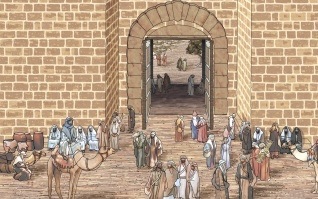
However, it is the mention of “the gates in front of the town” (8:3) that is most significant. The same claim, placing Wisdom “at the entrance of the city gates”, is made in the earlier poem (1:21). The gates were important parts of the protective structure surrounding towns and cities; built into the walls at strategic locations, they could be opened to allow for the coming and going of traders and visitors, or they could be closed to keep out enemies and invaders. “Fortress towns” are described in Deut 3:5 as having “high walls, double gates, and bars”. King Asa decreed “let us build these cities, and surround them with walls and towers, gates and bars” (2 Chron 14:7). 

In Jerusalem, the Chronicler claimed that it was the Levites who had responsibility for the gates, as Solomon appointed “gatekeepers in their divisions for the several gates” (2  Chron 8:14). When Judith calls out to be let into the city, the elders of the town “opened the gate and welcomed them, then they lit a fire to give light, and gathered around them” (Jud 13:12–13). Opening the gates is a clear sign of welcome to those acceptable to enter. 

Accordingly, the gates of the city became the place where various matters associated with the life of the city took place. When God’s angels arrived in Sodom, Lot was “sitting in the gateway,” apparently serving as a judge (Gen 19:1, 9). In association with the rape committed on Dinah, “Hamor and his son Shechem came to the gate of their city and spoke to the men of their city” (Gen 34:20). The “men of the city” are apparently often to be found in this location.

When David gathered his troops to fight against the uprising led by Absalom, “the king stood at the side of the gate, while all the army marched out by hundreds and by thousands” (2 Sam 18:4). After Absalom was killed, “the king got up and took his seat in the gate; the troops were all told, “See, the king is sitting in the gate”; and all the troops came before the king” (2 Sam 19:8). In a story from much later, Mordecai learned of plans to assassinate the king while “sitting at the king’s gate” (Esther 2:19).

Earlier in the narrative saga of Israel, when a soldier arrived at Shiloh and reported that Philistines had captured the ark of the covenant, Eli was sitting in the gate where “he had judged Israel forty years” (1 Sam 4:10–18). It was already known as a place for the judging of cases by the elders. That this took place at the city gates is clear from the story of Ruth, for Boaz went to the town gate to settle legal matters regarding his marriage to Ruth (Ruth 4:1–11). 

Moses instructs Israel to “appoint judges and officials throughout your tribes, in all your gates that the Lord your God is giving you, and they shall render just decisions for the people” (Deut 16:18). One of the laws decrees that parents of a rebellious son who would not submit to their discipline were to “take hold of him and bring him out to the elders of his town at the gate of that place” and there “all the men of the town shall stone him to death; so you shall purge the evil from your midst” (Deut 21:18–21). Such was the nature of justice rendered “ at the gates”.


What the city gates may have looked like:
a place of entry, a meeting place

So finding Wisdom “beside the gates in front of the town, at the entrance of the portals” (Prov 8:3) is striking. This is the place where the men of the city would gather, debate, and render justice. In the normal course of events, women would not be found at the gates; their domain was inside the houses with their families. The acrostic poem at the end of the book of Proverbs clearly locates the “woman of valour” in the house, from daybreak, when “she rises while it is still night and provides food for her household and tasks for her servant-girls” (Prov 31:15), through the day as “she girds herself with strength, and makes her arms strong” (31:17) to complete the many tasks listed in this poem, right until the darkness comes, when “her lamp does not go out at night” (31:18b). See

See also
So how did your bloke go?

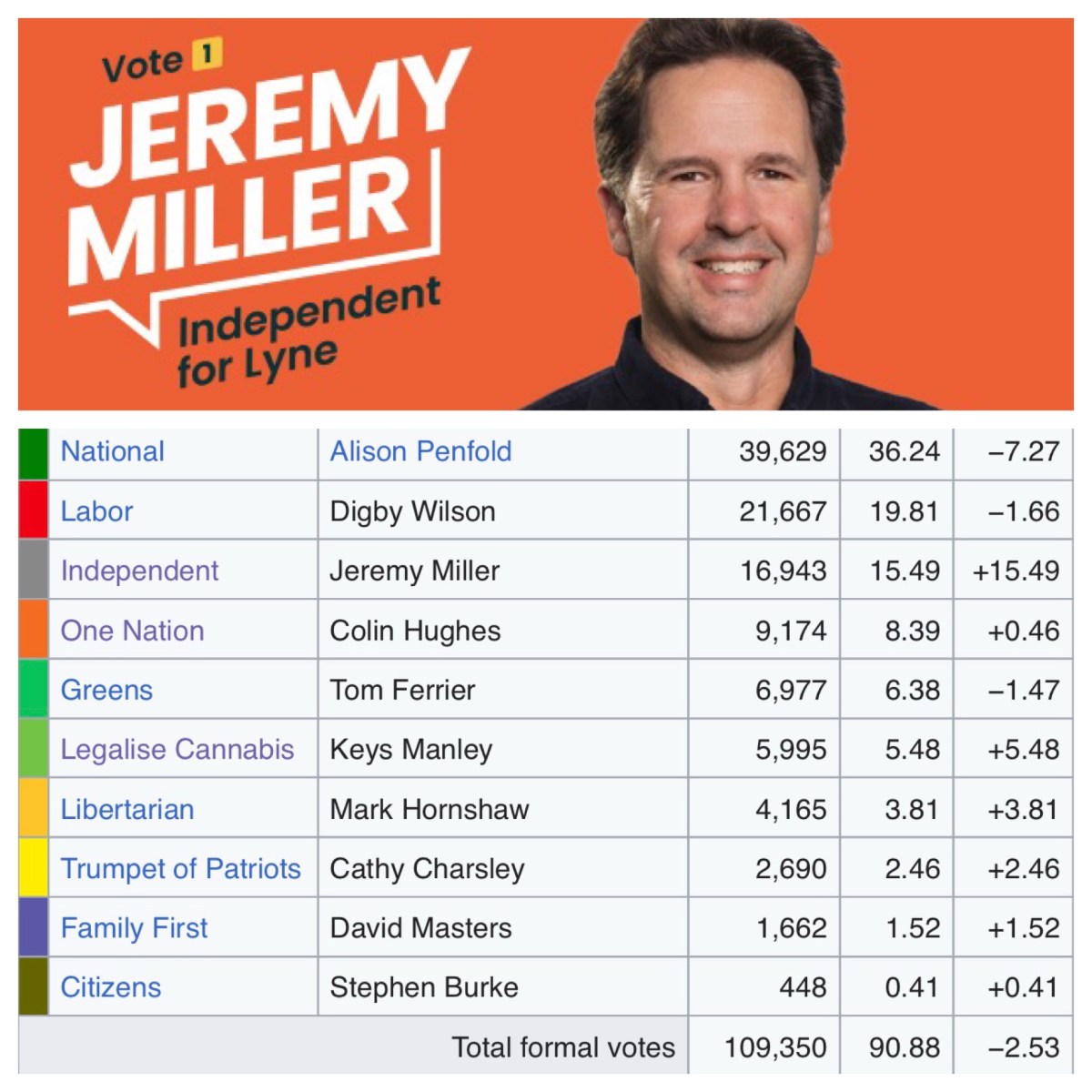
“So how did your bloke go?” Have you been asked this question in the weeks since the election? Recently a group of local leaders and volunteers in the Jeremy Miller for Lyne campaign met with members of the central campaign team to look at the future for an Independent candidate in Lyne. As part of that exploration, we heard an overview of what the polling in the booths reveal about how “our bloke” Jeremy actually went in the 2025 election.

1 The overall result

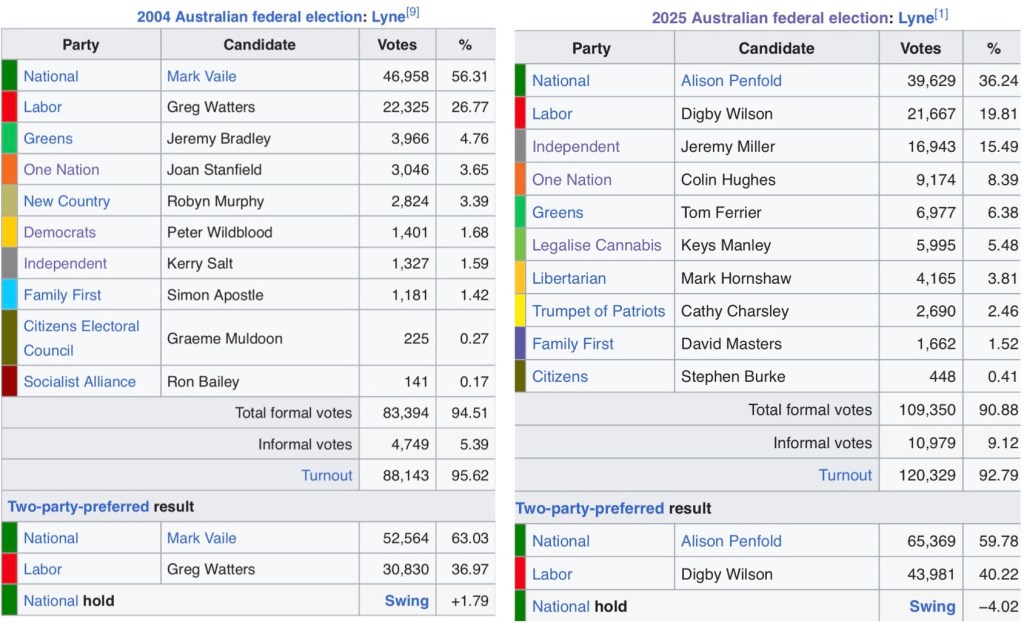
Now that the poll has been declared, we know the big picture: he didn’t win the seat—but, realistically, that would have been a huge achievement, which was somewhat unexpected. Yet, he did do remarkably well for a first-time community-supported candidate. Jeremy gained just under 16% of first preferences across the whole electorate, which was about 8% more than the votes that independent candidates gained in the 2022 election. 

And by the way: that 8% came from an 8% swing away from the Nationals candidate, for the 36.24% of first preference votes for the Nationals candidate was a healthy 7.27% less than the first preference votes for the Nationals in the 2022 election— and a massive 20% less than the 56.31% of first preferences that voters gave to the National Party way back in the 2004 federal election. That’s been a significant drop in the Nationals votes over the past two decades. Do they really think they are serving the electorate well, if one in five voters has stopped supporting them?

Looking at the longer-term trends, like this, as well as the detailed votes from booths across the electorate (discussed below) certainly indicates where our attention needs to be focussed in the next election in 2028: on “soft” Nationals voters who are open to being persuaded to change the way they vote. Are they happy with how the electorate is being represented in Canberra? Or are they discontent with the way the Lyne electorate is being treated? Might they be open to a different way of seeing things? After all, “if you want things to change, you need to change the way you vote”.

2 Where Jeremy polled best of all

If we look at the first preference votes cast booth-by-booth, we can see that in a good dozen or so booths, Jeremy’s vote was over 20%. He did best at Tinonee, with a wonderful 28.82% of first preference votes (more than the Labor vote and just under the Nationals votes) and at Old Bar, with 27.6% of first preferences there (ahead of both Labor and Nationals). At Taree West, where he attracted 26.2% of first preferences, he received the same number of votes as the Nationals and almost double the votes for Labor. 

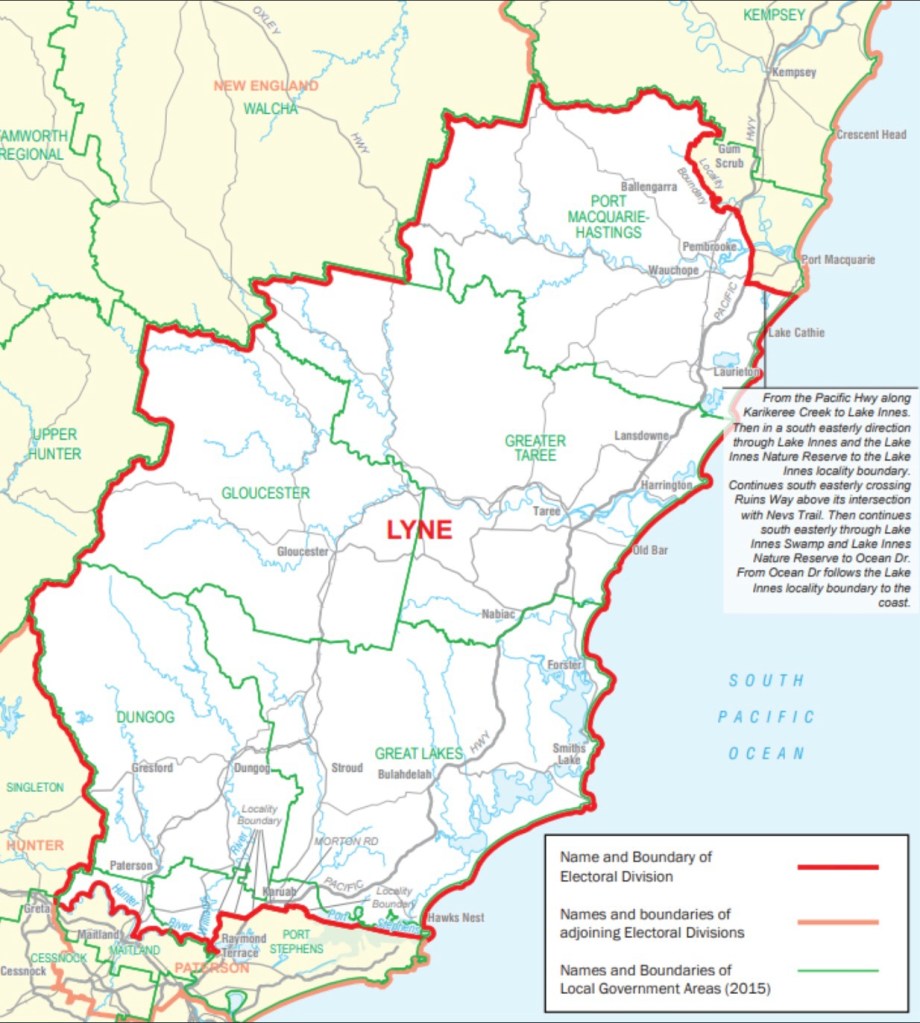
A more detailed breakdown of statistics indicates that Jeremy did indeed gain votes “where it matters”—in the larger population areas of Greater Taree and Forster—Tuncurry, where 40% of the voters live.

That detailed breakdown (which you can skip if figures befuddle you) is: in the Taree area, where Jeremy’s recognition is high, he attracted over 20% of the vote at Tinonee (28.82), Old Bar (27.6), Taree West (26.28), Cundletown (25.31), Purfleet (24.00), Chatham (22.08), and Taree (21.85). The exception in this area was the lower vote of 18.5% at Taree North. Nevertheless, all of these booths are significantly higher than the 15.8% primary vote across the electorate.

Further south, in Forster—Tuncurry, the best results were achieved at Pacific Palms (24.17, higher than each of Labor and the Nationals), Coomba Park (21.67), Forster East (21.67), Forster (21.50), Bungwahl (20.55), and Tuncurry (17.09). Other good results in this part of the electorate were at Hallidays Point (23.11) and Diamond Beach (24.78). At Lansdowne, Jeremy received 19.69, and at Coopernook 16.81, whilst at the two booths in Wingham, Jeremy secured 16.84 and 14.20. Again, these booth results are higher than the average.

So this is further cause for reflection: what was it in these particular areas that helped Jeremy to push his vote up, higher than the 15.8% average for the whole electorate? Clearly, the fact that he lives in the area and that he is a very active Councillor on the MidCoast Council must both have helped in securing that higher vote. Being “known” in these areas was a strong positive for Jeremy. These results again point to an area where our energy might best be focussed in the time leading up to the next election (presumably in 2028). 

The largest blocks of voters live in the two main urban areas—Greater Taree (including Wingham, Old Bar, and surrounds) and Forster—Tuncurry. This is where the influence of the National Party is less, by comparison, than it is in the inland rural areas. And these are amongst the areas in the electorate where we might expect population growth in future years. How do we plan and implement effective campaigning in these areas in the next few years?

3 In other places across the electorate of Lyne

In the north of the electorate, at Barrington, Jeremy secured 20.99, and in Gloucester itself 16.38. In Wauchope, he obtained fewer votes: 11.28 at Wauchope and 10.53 at Wauchope South. Nearby in Beechwood, the vote was 13.26, and in King Creek 15.27. These are promising results, offering a good base for future campaigning.

In the Dungog Shire, there was a good result at Paterson (16.46), and less at Seaham (12.59), Dungog (12.57), and Clarence Town (11.92). Closer to the coast, Jeremy’s share of the votes ranged from Krambach (17.00) to Bulahdelah (11.01) and Karuah (10.19). In polling places in the Port Stephens Council, votes ranged from Hawks Nest (16.74) to North Arm (14.13) and Tea Gardens (12.60).

4 Votes for Jeremy and votes for Labor

Another area of particular interest is in the area immediately to the north of Maitland which are currently included in the very southern end of the electorate. Whilst some votes for Jeremy were under 10% (in the more rural locations), better results were gained at Largs (10.81%), Lorn (11.67%), and Bolwarra (11.86%). These percentages are still below the average vote across the whole electorate. But a significant factor in this area is the support for Labor.

At these three polling booths, Labor’s share was consistently over 27%, although in Lorn it was 40.14%, the highest of all the booths in Lyne. This reflects the strong Labor base in Maitland itself (where the seat of Paterson saw a swing of 4.2% to Labor, despite the massive resources allocated to this seat by the Liberal Party). Making any headway in this area by attracting hesitant Labor voters would need a sustained campaign leading into the 2028 election.

And finally, if we look to places where Jeremy polled better than Labor, we can see some striking margins. At Old Bar, the 27.66 primary vote for Jeremy was greater than Labor’s 18.59. There were good margins also at other eight booths in this region: Taree pre-polling (21.93 to 16.47), Taree (21.85 to 14.94), Taree West (26.28 to 14.46), Cundletown (25.31 to 10.05), Chatham (22.08 to 15.35), Tinonee (25.82 to 13.64), Taree North (18.50 to 17.22), and Wingham West (16.84 to 13.46).

Jeremy also secured more votes than Labor at another seven polling booths: Hallidays Point (23.11 to 16.49), Diamond Beach (24.78 to 16.34), Pacific Palms (24.17 to 21.87), Krambach (17.00 to 14.41), Beechwood (13.26 to 12.80), King Creek (15.27 to 14.34), and Barrington (20.99 to 14.36). In all cases except for Old Bar and Pacific Palms, however, the Nationals still out-polled both Jeremy and Labor at these booths.

5 The future

So we can see from this just how well “our bloke” Jeremy did, and also just what work lies ahead for an even more successful campaign in 2028. I hope that lots will stay on board and even more sign up for that ride!

***** ***** *****

Written by John Squires, Member of the Central Campaign Team for Jeremy4Lyne, drawing on data prepared by James Foster, Polling Coordinator, Central Campaign Team, and data on the website of the Australian Electoral Commission.

See also
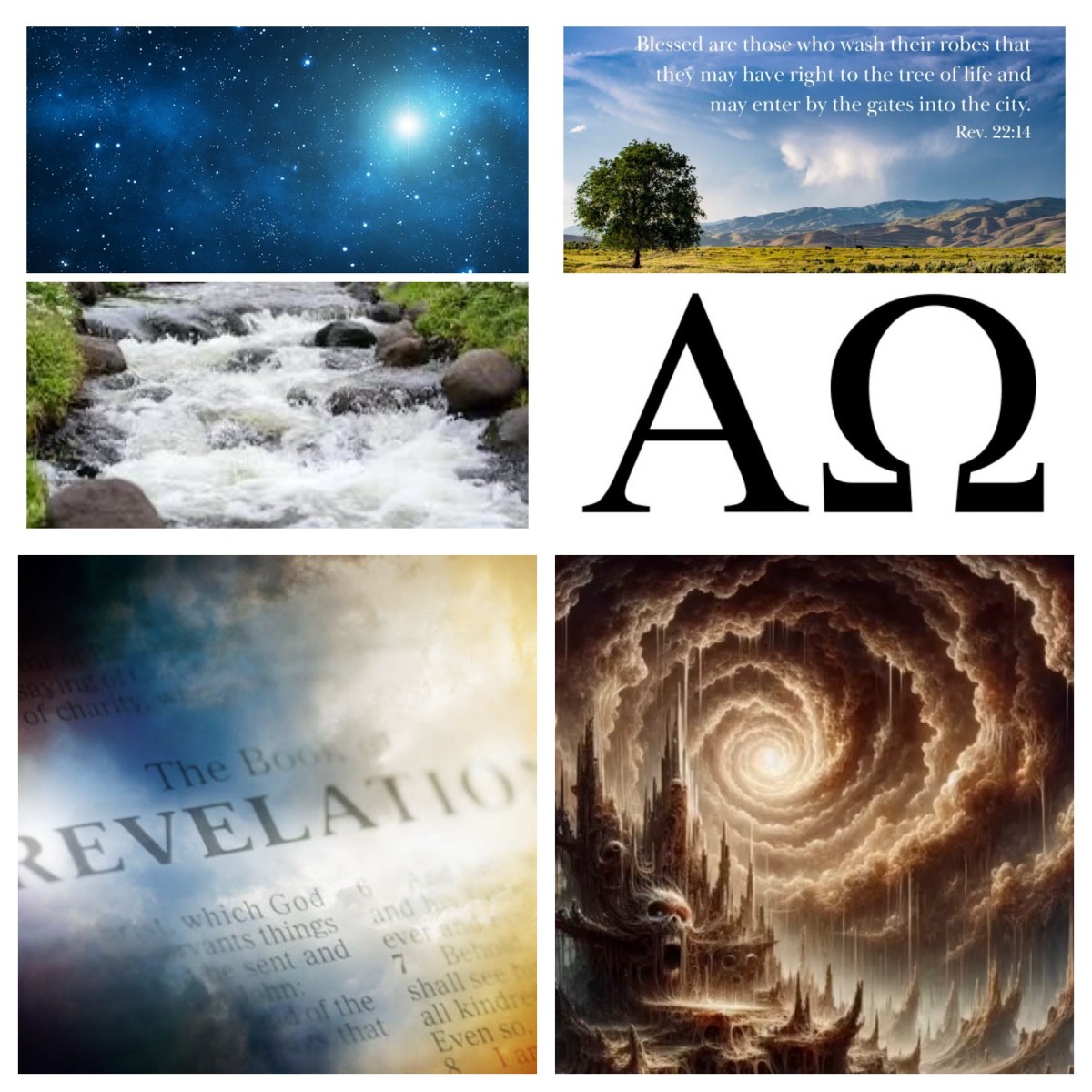
Alpha and Omega, bright morning star, water of life: final images in Revelation (Easter 7C; Rev 22)

During the season of Easter this year, we have read and heard passages from Revelation, the dramatic and vivid last book of scripture. We have encountered a number of creatively striking images: a white-haired, fiery-eyed figure like the Son of Man, a slaughtered lamb upon a throne, a multitude of white-robed people singing praises, a new heaven and new earth, and a city descending from the heavens. An amazing list, drawn from a book with even more amazing images in other chapters.

This Sunday, as the final Sunday in the seven-week season of Easter, we hear a passage which contains three striking images within the closing declarations and blessings that end the book (Rev 22:12–21). To give the creators of the lectionary their due, they have chosen not to excise a verse with a rather difficult message from the passage proposed—as they are wont to do at other times when dealing with other difficult verses.

So we will hear this Sunday the statement by John, as he concludes his long series of images, that whilst those who “wash their robes” will be firmly included within the holy city that has descended to earth (22:14; see 21:2, 10–26), those who are “dogs and sorcerers and fornicators and murderers and idolaters, and everyone who loves and practices falsehood” will remain outside, debarred from entry (22:15; see 21:27). The holy city will remain as the place which has “the glory of God and a radiance like a very rare jewel, like jasper, clear as crystal” (21:11). It’s a vibrant picture to bring to a close this year’s season of Easter, as we celebrate the risen Jesus in our midst.

In the midst of this exultant final vision of the book, we also hear this dire warning to all who read this book: “if anyone takes away from the words of the book of this prophecy, God will take away that person’s share in the tree of life and in the holy city, which are described in this book” (22:19). They are evocative of the instruction to Daniel, that the words of that book “are to remain secret and sealed until the time of the end” (Dan 12:9).

The book of Revelation has included many gruesome scenes where punishment—and, indeed, torture—are envisaged. As each of seven seals are broken and seven angels each blow their trumpet in turn (8:6–11:19), repeated scenes of destruction and devastation unfold across the earth. After the fifth seal is broken, locusts are sent to inflict on those who do not bear the seal of God on their foreheads five months of torture “like the torture of a scorpion when it stings someone” (9:3–5). After the sixth seal, “a third of humankind was killed by the fire and smoke and sulfur coming out of [the] mouths” of the four angels rampaging across the earth on their horses (9:15–19).

In subsequent visions, because of the evil that has infiltrated the whole world in multiple manifestations, a great red dragon threatens to consume the child born to a pregnant woman (12:1–4); a beast with ten horns and seven heads wages war “over every tribe and people and language and nation” (13:1–10); ad a group of seven angels pours out the wrath of God on earth, sea, rivers, sun, the throne of the beast, the great river, and into the air (15:1, 16:1–21). 

These visions climax with the vision of “the great whore”, Babylon, and “the beast with seven heads and ten horns that carries her” (17:1–8), who gatherers up all the sins of the world, whose sins “are heaped high as heaven, and God has remembered her iniquities” (18:5). Judgement comes upon her as  “plagues will come in a single day—pestilence and mourning and famine—and she will be burned with fire” (18:8, celebrated in song from v.10 to v.24). 

Then, in due course, the beast and the false prophet “were thrown alive into the lake of fire that burns with sulfur” (19:20), and last of all, after a millennium has passed, “the devil who had deceived them was thrown into the lake of fire and sulfur, where the beast and the false prophet were, and they will be tormented day and night forever and ever” (20:10).

These scenes of judgement, plagues, punishments, and torture, come to dominate the whole book. Yet none of these scenes appear in the passages selected for inclusion in the lectionary. The only negative notes in the passages included in the lectionary relate to the description of the lamb as one who has been slaughtered, but who now sits triumphant on the throne (5:6–14). So it is somewhat striking that this final passage includes these particular  negative notes. 

*****

In association with the celebratory notes attached to his vision of this holy city—the river of the water of life, the dazzling jewels of the city, the eternally-shining light from God, the celebrations around the throne of God and of the Lamb—John also offers striking statements about the figure whom he first described at the start of his book, the one “coming with the clouds” (1:7) whose face “was like the sun shining with full force” (1:16). This imposing figure is the one who is yet “coming soon” (22:12, 20). 

Three striking images characterise him in these final verses. None of these images should come as a surprise; they have each appeared earlier in Revelation, and indeed they tap into imagery in other books of scripture, in both testaments.

ALPHA AND OMEGA

The first striking image is one that was sounded at the very start of the book, when John was testifying “to the word of God and to the testimony of Jesus Christ, even to all that he saw” (1:2). Included in that early testimony is the claim that “the one who is pierced” is “coming with the clouds; every eye will see him” (1:7). At this, God himself speaks: “‘I am the Alpha and the Omega’, says the Lord God, who is and who was and who is to come, the Almighty” (1:8). 

Then, in the second of the seven letters to be sent to the seven churches (2:1—3:22), this claim is adopted by the author of the letter, “one like the Son of Man, clothed with a long robe and with a golden sash across his chest” (1:13). This figure adopts the words spoken by the Lord God as he declares “these are the words of the first and the last, who was dead and came to life” (2:8). It is a clear reference to Jesus, already identified as “the faithful witness, the firstborn of the dead, and the ruler of the kings of the earth”, the one who “loves us and freed us from our sins by his blood” (1:5–6).

The same claim recurs in the climactic closing vision of the book, when “the one who was seated on the throne” (21:5)—that is, the great white throne on which sat the judge of all humanity (20:11–16)—declared, “It is done! I am the Alpha and the Omega, the beginning and the end” (21:6). And then, after the vision concludes, the angelic figure seen by John reminds him, “I am the Alpha and the Omega, the first and the last, the beginning and the end” (Rev 22:13).

The words spoken by the Lord God, the one like a Son of Man, the judge on his throne, and his angelic messenger rekindle the image of God which had been described, centuries before, by the unnamed exilic prophet whose words are included as the second section of the book of Isaiah (Isa 40—55). “Who has performed and done this, calling the generations from the beginning?”, the prophet asks.”I, the Lord, am first, and will be with the last”, is the response (Isa 41:4). In a later oracle, the Lord God declares “I am the first and I am the last; besides me there is no god” (Isa 44:6); and still later, “Listen to me, O Jacob, and Israel, whom I called: I am He; I am the first, and I am the last” (Isa 48:12).

The significance of this claim is outlined in another prophecy: “Remember the former things of old; for I am God, and there is no other; I am God, and there is no one like me, declaring the end from the beginning and from ancient times things not yet done, saying, ‘My purpose shall stand, and I will fulfill my intention’” (Isa 46:8–10).

In the Revelation of John, these words are heard from the mouth of the one like a Son of Man, identified as Jesus (1:5; 22:16). Jesus is both Alpha and Omega, first and last; as the letter to the Hebrews declares in its idiosyncratic language, “without father, without mother, without genealogy, having neither beginning of days nor end of life, but resembling the Son of God, he remains a priest forever” (Heb 7:3).

BRIGHT MORNING STAR

A second striking image is that of the morning star, in the words of Jesus, “I am the root and the descendant of David, the bright morning star” (22:16). That image was first expressed early in this book, in one of the seven letters to the churches. In each of the seven letters included in this book, “those who conquer” are given a specific gift to signal their special status. To those in Thyatira, to signal the authority that is given to them “to rule [the nations] with an iron rod, as when clay pots are shattered”, the specific gift is “I will also give the morning star” (2:26–28).

The morning star is referenced in the book of Ecclesiasticus (Ben Sirach), in a poem which praises Simon son of Onias (high priest in the early C3rd BCE). After celebrating his work in repairing and fortifying the temple, the joy that he brought is described through a series of images: “How glorious he was, surrounded by the people, as he came out of the house of the curtain. Like the morning star among the clouds, like the full moon at the festal season; like the sun shining on the temple of the Most High, like the rainbow gleaming in splendid clouds” (Sirach 50:5–7, and continuing on for some verses). A similar use of the phrase appears in the second letter attributed to Peter, where “the prophetic message” is compared with “a lamp shining in a dark place, until the day dawns and the morning star rises in your hearts” (2 Pet 1:19).

It is the bright, dazzling quality of the star that rises early in the morning, before sunrise—the planet we know as Venus—that is in view here. We should note that there is no intention to allude to the words of Isaiah, who refers in one of his prophecies about the punishment that was imminent for the King of Babylon. The prophet warns, “Sheol beneath is stirred up to meet you when you come … you pomp is brought down to Sheol” (Isa 14:9, 11), before depicting this decline in poetic language: “How you are fallen from heaven, O Day Star, son of Dawn! How you are cut down to the ground, you who laid the nations low!” (Isa 14:12).

In the 17th century King James Version, “O Day Star” is rendered as Lucifer—since that is how “light-bringer” is expressed in Latin. This was the term used in the Vulgate, a late-4th century Latin translation of the Bible. This verse has been picked up in later theological developments and applied to the figure of the devil; it is probably also influenced by words attributed to Jesus in Luke 10:18, “I watched Satan fall from heaven like a flash of lightning”. 

However, this sense of the term does not relate at all to the way the imagery of “the morning star” appears in Revelation. In this book, the devil is depicted as “a great red dragon, with seven heads and ten horns, and seven diadems on his heads” (Rev 12:3; 20:2) who is “the deceiver of the whole world” (Rev 12:9) who is ultimately “thrown into the lake of fire and sulfur …[to be] tormented day and night forever and ever” (Rev 20:10).

WATER OF LIFE 

The third striking image in this final chapter of Revelation is “the water of life”. John had indicated that this water would be gifted to those who are thirsty (Rev 21:6). This gift comes from “the Lamb at the centre of the throne” who is the shepherd of “a great multitude that no one could count, from every nation, from all tribes and peoples and languages, standing before the throne and before the Lamb, robed in white, with palm branches in their hands” (7:9). This shepherd, says John, “will guide them to springs of the water of life, and God will wipe away every tear from their eyes” (7:17).

The imagery appears returns as integral part of the final climactic vision of “the holy city Jerusalem coming down out of heaven from God” (21:10). John writes that the angel showing him the vision of this city “showed me the river of the water of life, bright as crystal, flowing from the throne of God and of the Lamb” (22:1). 

The river brings water to nourish life, just as another John (compiling a Gospel narrative) attributes to Jesus words in which he offers water as the basis for life: “those who drink of the water that I will give them will never be thirsty; the water that I will give will become in them a spring of water gushing up to eternal life” (John 4:14). These words evoke the reality that all human beings know, that “the necessities of life are water, bread, and clothing, and also a house to assure privacy” (Sirach 29:21; see a similar, but expanded, list at Sirach 39:26).

The scene at the end of Revelation evokes the vision described centuries earlier by the prophet Ezekiel, in the final chapter of his book. Ezekiel details the water flowing from the temple, the abundant trees growing beside the river, and the food sources for the people (Ezek 47:1–12). It is a wonderful ecologically vibrant scene, as is the vision in Revelation, where “on either side of the river is the tree of life with its twelve kinds of fruit, producing its fruit each month; and the leaves of the tree are for the healing of the nations” (Rev 22:2).

So the book ends with words of grace: “The Spirit and the bride say, ‘Come’; and let everyone who hears say, ‘Come’, and let everyone who is thirsty come. Let anyone who wishes take the water of life as a gift” (22:17). It’s a nice closing note.

Saying Sorry—beginning the process of Telling Truth

Today is National Sorry Day. It begins National Reconciliation Week, which runs from 27 May to 3 June each year. This week was initiated in 1996 by Reconciliation Australia, to celebrate Indigenous history and culture in Australia and promote discussions and activities which would foster reconciliation.

The dates of National Reconciliation Week hold special historical significance. On 26 May 1997, the Bringing Them Home report was tabled in Federal Parliament. This report addressed them impacts of the fact that in the late 19th century and throughout the 20th century, Australian government policies resulted in many Stolen Generations, in which thousands of Indigenous children were separated, often forcibly, from their families, with the aim of removing them from their culture and turning them into “white Australians”.

Because of this, the date 26 May carries great significance for the Stolen Generations, as well as for Aboriginal and Torres Strait Islander communities, and its supporters among non-indigenous Australians. The word sorry is used in First Nations cultures in relation to the rituals surrounding death—the process of grieving is often call Sorry Business. So sorry indicates an acknowledgement of loss and offers empathic understanding to those who grieve.

Sorry Day is an annual event that has been held around the continent on 26 May since 1998, to remember and commemorate the mistreatment of the country’s Aboriginal and Torres Strait Islander People.

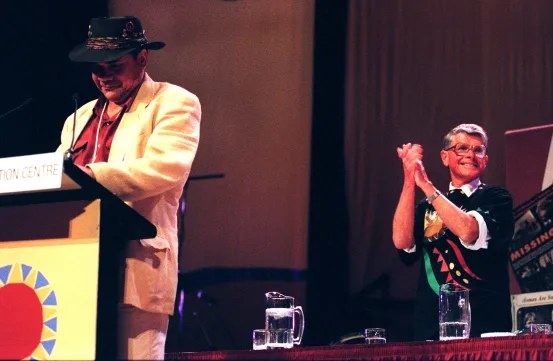
Mick Dodson and Ronald Wilson,
Commissioners of the Bringing Them Home Report
at its launch date on 26 May 1997

27 May marks the anniversary of the 1967 referendum in Australia, which gave the vote to Aboriginal and Torres Strait Islander people, while 3 June marks the anniversary of the 1992 judgement by the High Court on the Mabo v Queensland case.

Sorry Day (26 May) and the National Apology (made in Federal Parliament on 13 February 2008), the 1967 referendum, the 1992 Mabo decision, along with the Wik decision on native title (delivered by the High Court on 23 December 1996), are considered to be key events in addressing the historic mistreatment of indigenous Australians, and in taking steps towards reconciliation and restorative justice.

But these were only steps. The path still lies ahead. We need to take more steps, walking together, to foster deeper relationships, advocate for a more embedded restoration of justice, work for wider and more lasting reconciliation within our communities. The current discussion is focussed on a process that will lead to a referendum on the proposal that the Australian Constitution recognise the First Peoples as custodians of the land from millennia before the British Invasion and colonisation of 1788, and the establishment of a permanent Voice to the federal parliament.

This step is but one on a pathway that stretches ahead of us, well into the succeeding generations still to come in Australia. We need to hear and understand the Truth that was set forth in the 1997 Report, and indeed to listen to the Truth that is being stated by First Peoples leaders in our own time, and be willing to respond with sorry and with actions that lead to justice for the First Peoples of this continent and it’s surrounding islands.

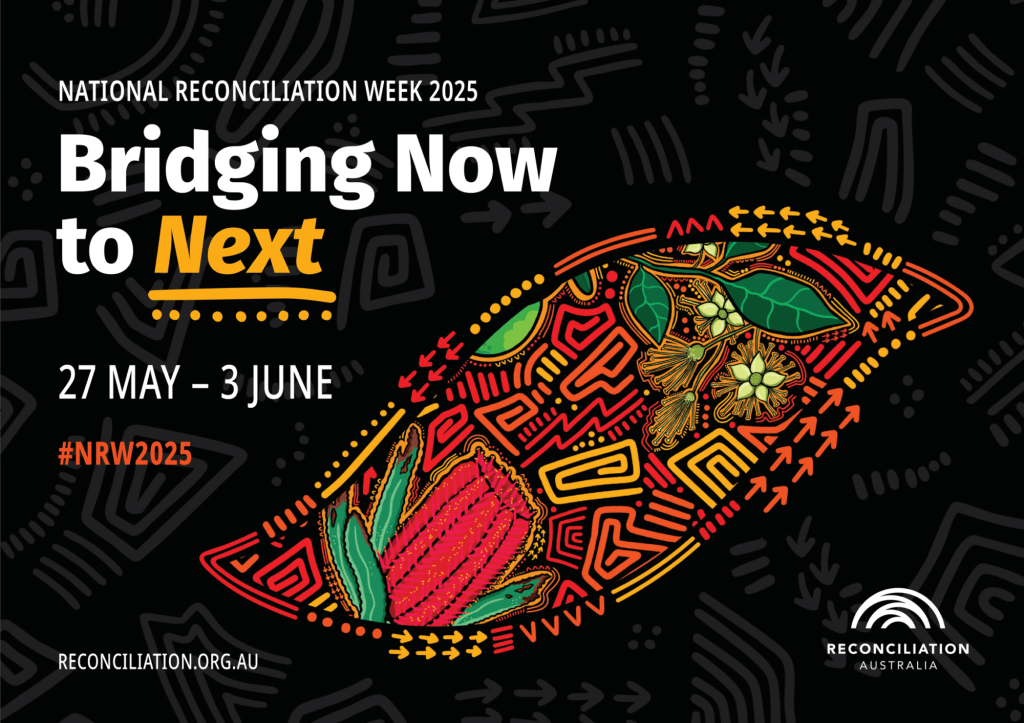
The theme for National Reconciliation Week 2025 is Bridging Now to Next. This theme reflects the ongoing connection between past, present, and future, urging us to look ahead and continue the push forward as past lessons guide us.

To seek reconciliation, we need to speak together, commit together, and act together. We are all in this together. May we tread that pathway with compassion and intent.

See https://www.reconciliation.org.au/national-reconciliation-week/

Click to access 150520-Sorry-Day.pdf

https://australianstogether.org.au/discover/australian-history/1967-referendum/

https://australianstogether.org.au/discover/australian-history/mabo-native-title/

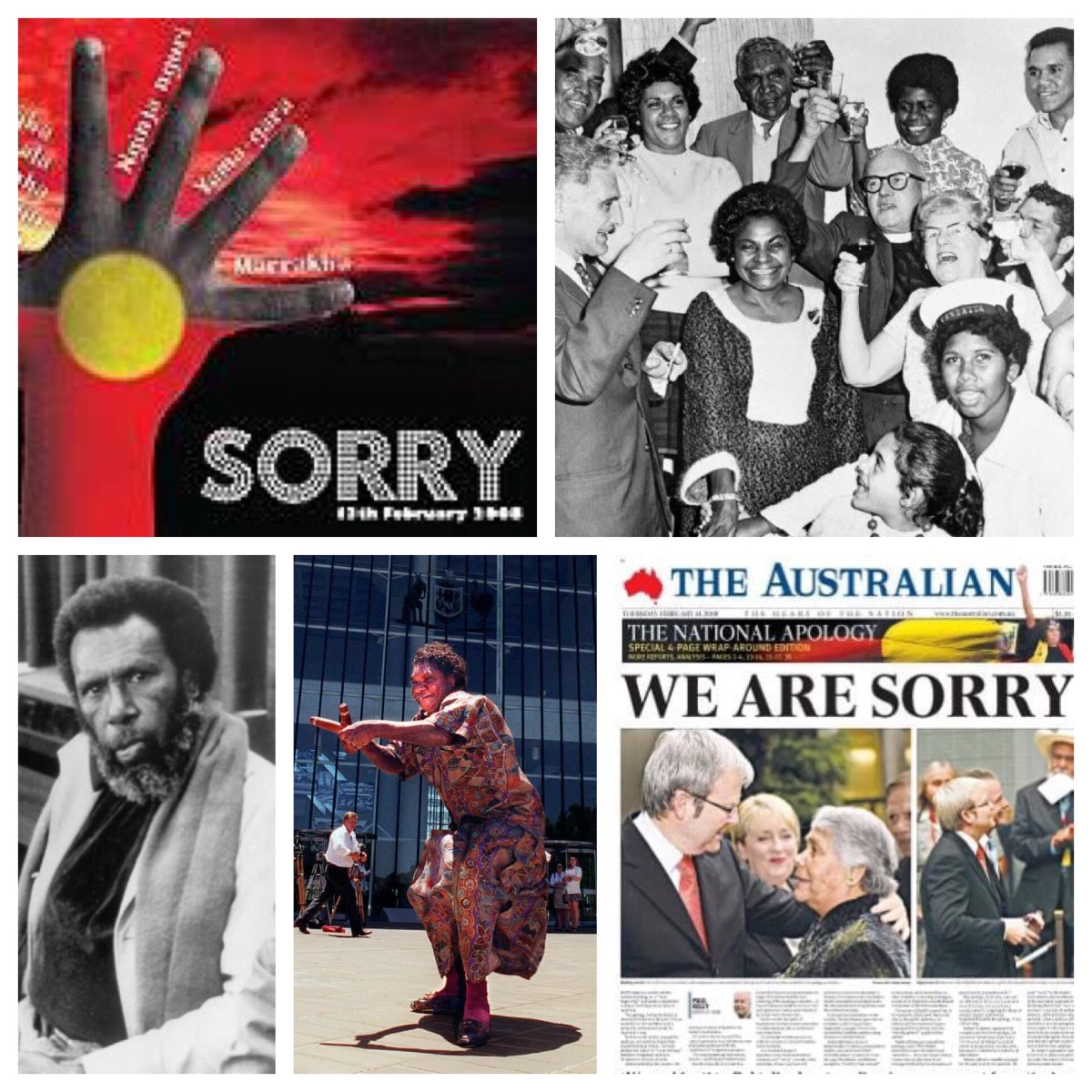
The picture montage shows a Sorry Day poster, celebrations after the 1967 referendum, Eddie Mabo who brought the High Court case that was resolved in 1992, Gladys Tybingoompa dancing outside the high court in Canberra on 23 December 1996 following the Wik people’s native title win, and the front page of a national newspaper reporting the National Apology in 2008.

A tale of the times (in the aftermath of the federal election)

For a good month, the adults were out and about across the country. “Tell me what you need”, many of them said—and stopped to listen. “This is what I think we can do”, others said— and gave indications of what they could offer to people who were listening. Why,some of them even said how much it would cost to do what they were offering, and where the money would come from to pay for that.

And then the people came, and considered, and voted, and told the adults what they wanted. And the adults all nodded, and said, “yes, indeed,the people have spoken: we respect that, and we will do what we said”.

Then the adults caught planes and drove cars and gathered in their sandpits in the special place that had been made for them to come together and play. Some of the adults said they needed a bigger sandpit, because there were more of them. Other adults said they didn’t want little Eddie and Mackie to play with them any more in their “special” sandpit. Amd other adults started a very public squabble about who would have the best toys and the most play space in their sandpits. Why, one of them even decided she didn’t like the sandpit where she said she would play; so she decided to join the adults in another sandpit, just across the way.

But by then, it was apparent to all the people who had listened, and talked, and voted, that the adults had become children, once again. Which was, after all, what they had been before they had spent that month as adults, amongst the people.

*****

Or, in plain language:

MPs are elected to represent the people of their electorate, first and foremost. National policy needs to be formulated with due awareness of the impact across the board: each MP ought to be advocating for the needs and concerns that they are hearing from their electors.

Instead, party members focus on climbing the factional ladder (in both “majors”) and gaining the prestige, power, and salary of the next few rungs “up”. Leadership competitions and factional deals reveal that once they return to Canberra, they have a completely skewed and unpredictable upside-down set of priorities.

To me, that is more reason next time around NOT to vote for “the major parties”—especially since they are funded by gambling companies, fossil-fuel industry, multi- million dollar magnates, and, in the case of the National Party, the tobacco industry.

*****

For my posts on the election from my perspective in Lyne:

https://johntsquires.com/2025/03/13/our-meet-the-candidate-event-jeremy-miller-comes-to-dungog/

https://johntsquires.com/2025/03/27/donations-as-a-means-of-political-support-and-political-influence/

https://johntsquires.com/2025/04/02/if-you-want-things-to-change-you-need-to-change-the-way-you-vote/

https://johntsquires.com/2025/04/04/why-vote-for-an-independent/

https://johntsquires.com/2025/04/10/but-where-does-your-funding-come-from-political-candidates-and-their-donors/

https://johntsquires.com/2025/04/13/politics-in-the-pub-with-jeremy-miller-at-stroud/

https://johntsquires.com/2025/04/15/seven-reasons-not-to-embrace-nuclear-power-as-the-basis-for-electricity-generation/

https://johntsquires.com/2025/04/19/woke-and-teal/

https://johntsquires.com/2025/04/21/which-candidates-in-lyne-are-committed-to-reconciliation/

https://johntsquires.com/2025/04/29/meet-the-candidates-for-lyne-at-dungog-28-april-2025/

https://johntsquires.com/2025/05/08/a-growing-presence-of-independent-candidates-and-members-of-parliament/

A growing presence of Independent candidates and Members of Parliament

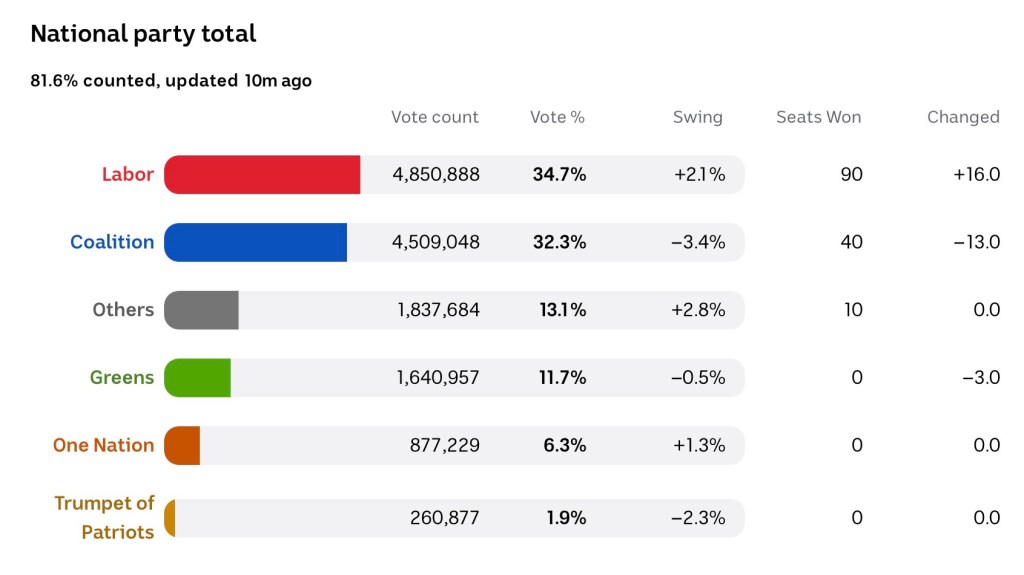
National results as of late afternoon, Thursday 8 May,
as displayed on the ABC website Australia Votes

People standing as Independent candidates have done very well in the recent federal election. While Labor attracted 34.7% of the national vote and the Coalition dropped to 32.3% of the vote, Independents collectively secured 13.1% of the national vote—a rise of 2.8% compared with 2022. On the left flank, the Greens had a small drop of 0.5% in their votes, to 11.7%, while on the right flank, One Nation rose by 1.3% to 6.3%. 

While Labor has more than twice the number of seats in the lower house than the Coalition, and neither Greens nor One Nation now have any seats (nor the Trumpet of Patriots and the Libertarian parties, for that matter), Independents look set to hold at least 10 seats in the House of Representatives. 

A number of Independent candidates have clearly been returned to their seat in the current election. Allegra Spender returns to Wentworth, former seat of John Hewson and Malcolm Turnbull, with an increase in primary votes of 7.7% from the 2022 result. Kate Chaney has also returned in Curtin, WA, where Julie Bishop had long been member; she has a 3.2% swing to her on primary votes. Both of these candidates come from long-established Liberal families; they have well exemplified the disenchantment, over a number of years, with the veer to the right that Abbott, Morrison, and Dutton engineered in the Liberal Party. 

Other seats once considered safe Liberal seats are now in Independent hands. Dr Sophie Scamps returns to be the representative for Mackellar, NSW, where Bronwyn Bishop once held sway, with an estimated gain of 2.0% after the distribution of preferences. To her south, in Warringah, the old stamping ground of Tony Abbott, Zali Steggal has been returned for a third term, with 40.2% of the primary votes (an increase of 0.4%), substantially outpolling the Liberal candidate, who dropped 1.9% of the votes gained in 2022. Two more blue-ribbon Liberal seats where Independents are now ensconced!

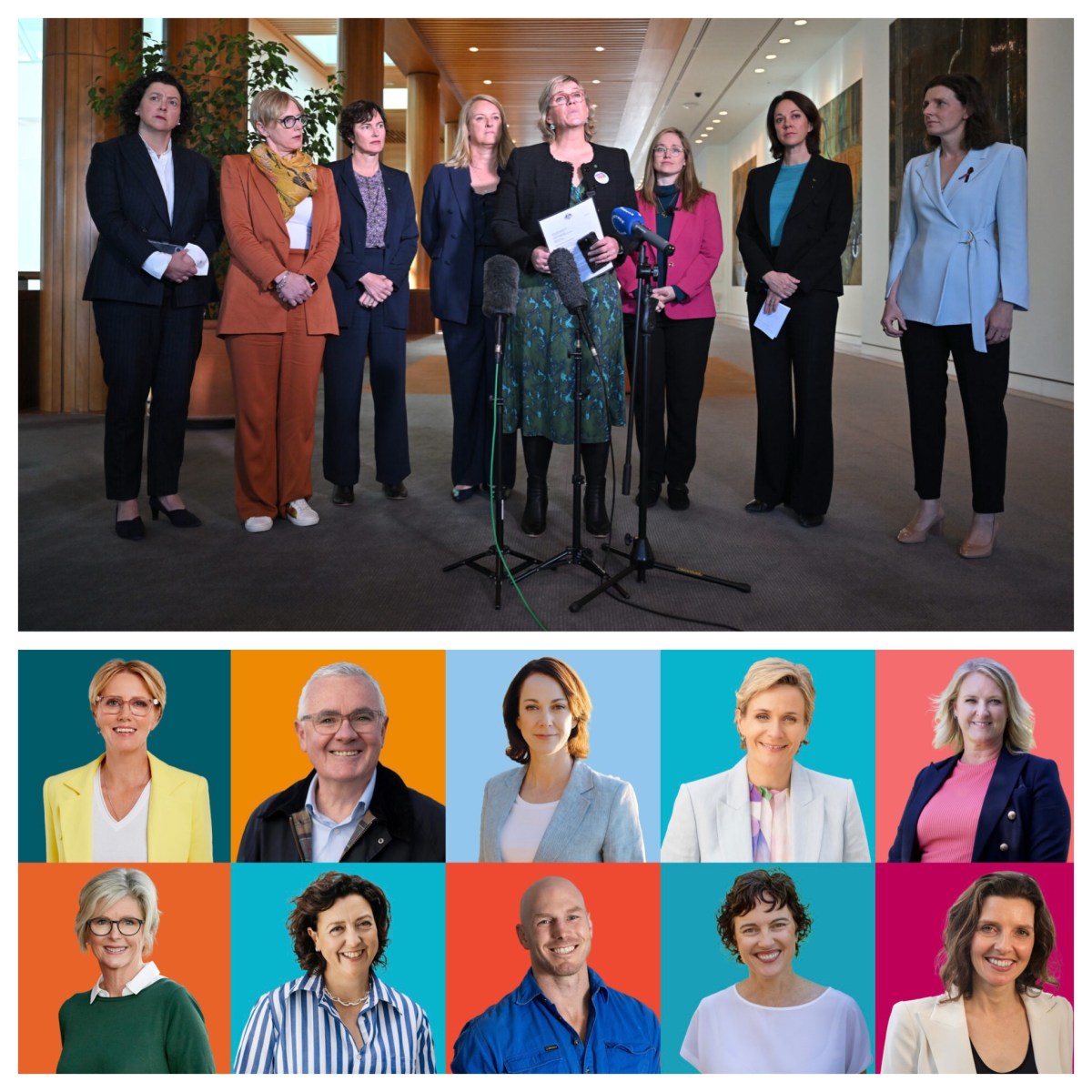
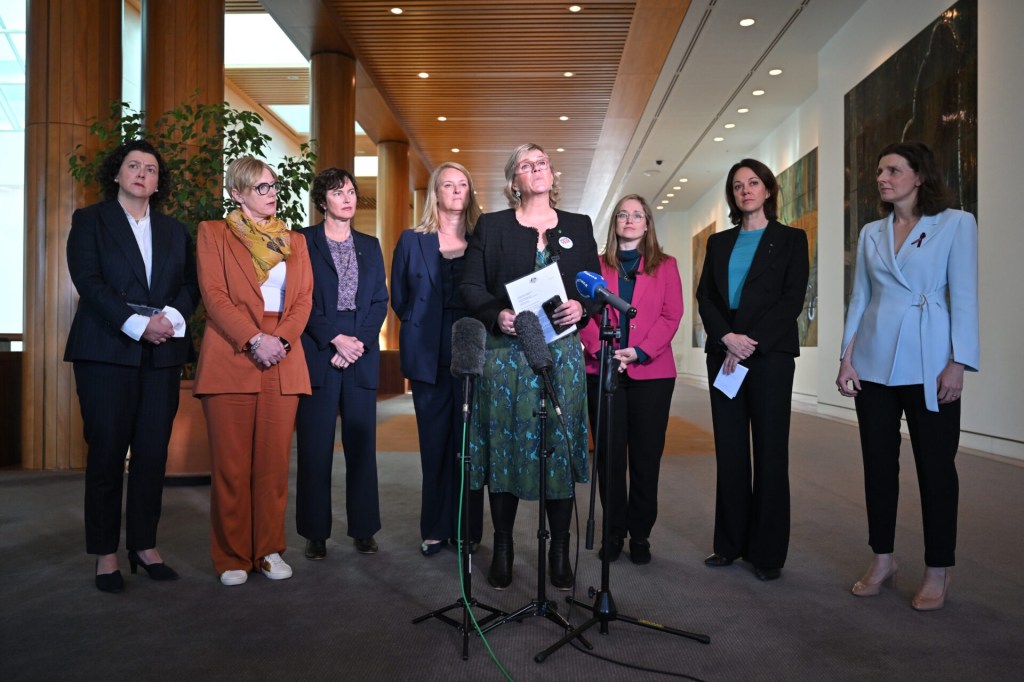
The group of eight community-supported Independents
at the start of the 2022 Parliament

The Queen of the Independents, Dr Helen Haines, who was elected to the seat of Indi after Cathy McGowan had served two terms (2013–2019) and has held the seat each time, was returned this election with a swing of 2.1% on the primary votes. Always returning a conservative member before this, long ago Indi was held by Isaac Isaacs (later a High Court Justice) and “Black Jack” McEwen (Country Party leader and briefly acting Prime Minister). 

Alongside her, in the seat of Clark in Tasmania, Andrew Wilkie retains his seat with an increase of 3.8% in his primary votes. He has held the seat since 2010, when he was a surprise winner, coming from third in the primary vote to win the seat. He was only the sixth House candidate in seventy years to win an election from third position in the vote! This seat is named after Andrew Inglis Clark (1848-1907) a lawyer and politician who introduced proportional representation in Tasmania using the electoral system that has come to be known as Hare-Clark. If this excellent system was used in federal elections, we would have a very different configuration of members in the Federal Parliament!

Another candidate who could possibly move up from third place in the primary vote once preferences are distributed is the Independent candidate Kerryn Jones, in Fisher, Qld. Although she has only 16.5% of the primary vote, Labor has 22.2% and the front runner, the Liberal-National Party candidate, has 37.8% of the vote, which puts him in the “danger zone”. The ABC notes that the Independent candidate “could yet move into second place which will create an interesting final count” because of the low LNP primary vote. Interesting! 

There’s a similar scenario in Grey, in SA, where first-time Independent candidate Anita Kuss has secured 18.4% of the primary vote. She is only4% below the votes for Labor, and the leading candidate, the Liberal, is also in the “danger zone” with 35.2% of the primary vote. The Independent would need a good proportion of the 24.3% of votes gained by the Greens and four rightwing minor parties.

Similarly, in Forrest, WA, Independent Sue Chapman has 18.4 of the primary vote, again only around 4% behind the Labor candidate, on 22.7%, and the Liberal candidate, who is very much in the “danger zone” on 31.7% of the primary vote. The 27.2% of the votes gained by the Greens, Legalise Cannabis, and three minor parties from the rightwing will be determinative. Accordingly, the ABC is calling this as a win for the Liberals.

In the seat of Bean in the southern part of Canberra, an Independent candidate with 26.9% of the vote is running close to unseating the Labor member, who suffered a swing of only 0.7% against him. We previously lived in this seat and know that David Smith is a very popular local member. The Liberals dived down 6.7% and the Greens 5.7%, so the Independent candidate, Jessie Price, has attracted votes from all directions—she is a good chance to win.

Alongside this, in the ACT as a whole, Independent David Pocock has decisively won a seat in the Senate, attaining a massive 18.59% increase in primary votes when compared with 2022. That gives him a primary vote of 39.8%, ahead of Labor on 31.6%, with 1.19 quotas on his primary vote alone. That’s a ringing endorsement!

In the seat of Calwell on the northwestern outskirts of Melbourne, three Independent candidates have run. They have secured 30.9% between the three of them, with Labor suffering a swing of 14.2% against it and the Liberals dropping by 8.1%. It is not yet clear who will emerge as the final winner in this seat, although the ABC is leaning towards Labor, with 30.9% of the primary vote, over the Liberal candidate, with 15.6% of the vote.

In Flinders in Melbourne, where the Liberal candidate scored 41.7%, there is a possibility that an Independent might take the seat. The Independent currently has 21.6% of the vote, just behind Labor on 22.2%. The ABC website says “Flinders remains in doubt as it is unclear who will finish second. A Labor second place win would deliver victory to Liberal MP Zoe McKenzie. But if Independent Ben Smith finishes second, he will attract a big majority of Labor and Green preferences. The AEC is currently trying to resolve who might finish second.”

In Kooyong, also in Melbourne, the sitting Independent candidate sits on 34.5%, a swing of 3.7% to her. The Liberal candidate drew a small swing of 0.6% but this may not be enough to enable her to take the seat from Independent Dr Monique Ryan. This seat is mighty close!

In Bradfield in northern Sydney, Independent Nicolette Boele has also almost made it over the line, with a swing to her of 4.6% taking her to 27.5% of the vote. With a possible preference flow from Labor, the Greens, and another Independent candidate, she may well just win this seat.

Dai Lee, a longterm Councillor and former Deputy Mayor of Fairfield Council has been returned in Fowler, NSW, with a 6.2% increase in primary votes, while Andrew Gee, a former Nationals MP for Calare, looks set to take the seat, with a massive 17.2% swing against his old party, the Nationals. A second Independent running in this seat obtained 15.8% of the votes, so together the Independents have 39.6% of the votes. 

In Adelaide, Rebekah Sharkie of the Centre Alliance will retain the seat of Mayo, with a projected swing to her of 1.5% after distribution of preferences. And, of course, in far North Queensland, the maverick Bob Katter is returned in the seat of Leichhardt with 40.8% of the primary votes.

In the Melbourne seat of Goldstein, Tim Wilson has claimed victory, to regain the seat he lost in 2022. He has 44.2% of the primary votes, against 31.7% for Independent Zoe Daniel, who is currently tracking about 1500 votes behind Wilson after preferences are distributed.

In two rural seats, pundits were tipping wins by two strong community-supported Independents, but these did not materialise. In Wannon, in western Victoria, Alex Dyson ran for the third time against the Liberal incumbent. Although he increased his vote by 12.9%, preferences in this seat are set to deliver it to the Liberal incumbent. In Cowper, on the mid north coast of NSW, Caz Heise ran for the second time against the Nationals incumbent. She increased her vote by 3.5%, but also in this seat the preferences are pointing to a win for the Nationals incumbent.

Just to the south of Cowper, in Lyne, Jeremy Miller ran with the support of the community organisation, Independent Lyne. A primary vote of 15.84% was not enough to put him into second position, so the likely outcome will be that the new Nationals candidate will keep this as a Nationals seat. There is, however, a rather slim hope that he may receive enough preferences from the Greens (6.0% primary vote) and assorted minor party candidates in the seat (with 22.3% between them) to “catch” and then overtake the total number of votes (primary plus preferences) for the Labor candidate. There are just under 4,000 votes (not quite 4% of the votes cast) between the two candidates. 

If the preferences distributed from all the minor party candidates largely avoid the Independent, he remains in third place, so his preferences would then be distributed amongst Labor and Nationals. Given the rightwing leanings of all but one of those minor parties, this seems most likely.

Or: if, perchance, the Independent candidate has attracted enough preference votes from those minor parties to put him ahead of Labor, then the preferences of the 20,000 plus votes for the Labor candidate will be distributed—and that could well push Jeremy Miller close to the 50% mark; although obviously he won’t reach that. Just how far short he falls, ultimately, is an interesting feature for those of us involved in the campaign to watch in the coming week.

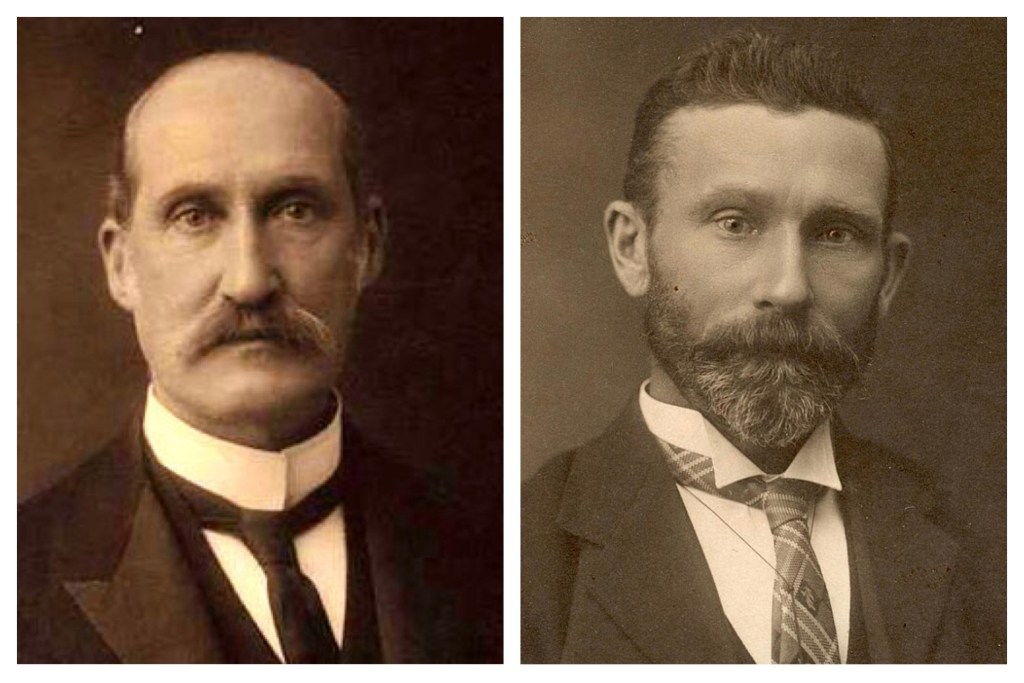
Whatever the result, it is clear from this national overview that the movement to elect community-supported Independent members of parliament is strong. As Joshua Black of the Australia Institute notes, “Australia is a world leader in electing Independent MPs”. He points to the two elected to the first federal parliament—both from electorates in Queensland. Alexander Paterson was elected as an Independent Free Trade member, and James Wilkinson, elected as an Independent Labour member. 

Alexander Paterson, left, and James Wilkinson, right

Black then notes that “between 1980 and 2004, 56 Independent MPs were elected to parliaments across Australia”. As well as those noted above, the list includes Ted Mack, Phil Cleary, Peter Andren, Pauline Hanson (for less than a year, before she formed her party), Bob Katter (still counted as an Independent although he also formed his own party), Tony Windsor, Rob Oakeshott, Kerryn Phelps, and Kylea Tink (whose seat was abolished ahead of this election). It’s a strong, enduring, and growing movement!

See

https://australiainstitute.org.au/post/election-entree-australia-is-a-world-leader-in-electing-independent-mps/

and

https://www.indiewins.com.au

“Meet the Candidates” for Lyne, at Dungog (28 April 2025)

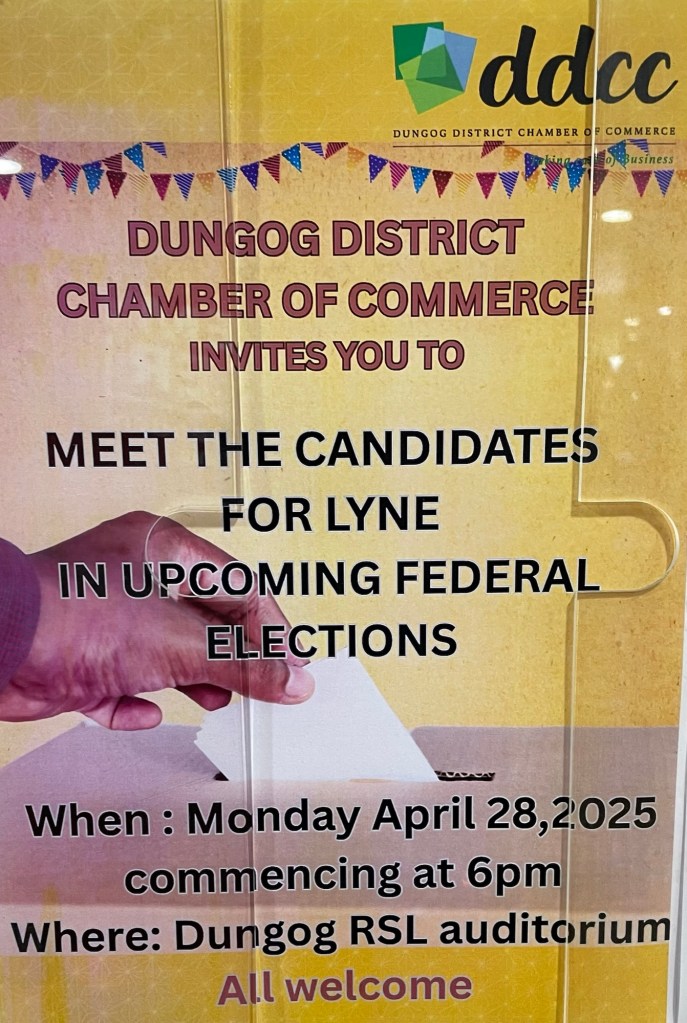
Five of the ten candidates standing in the electorate of Lyne came to Dungog yesterday at the start of the last week of campaigning. They were attending a Meet The Candidates forum organised by the Dungog Chamber of Commerce and held at the Dungog RSL Club.

Amongst the almost 50 people present were the Mayor and two Councillors of Dungog Shire Council. Three candidates had sent their apologies for the event. Each of the five candidates present were given ten minutes to speak about themselves and their policies. They spoke in the order that they appear on the ballot paper.

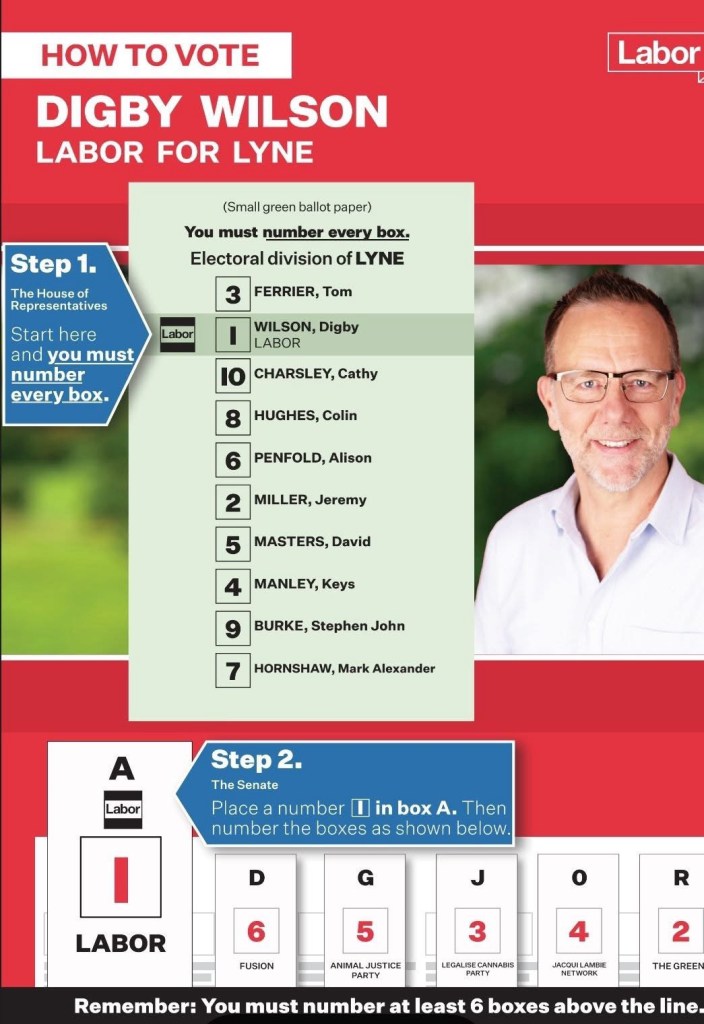
Digby Wilson (Labor) began, declaring that he is always energised by working with people. He spent 30 years working in telecommunications (with Optus and Telstra) before,retiring. He currently volunteers at St Vincent de Paul and is a councillor on Mid Coast Council; in these roles he meets many people struggling to make ends meet.

Digby spoke about the deteriorating roads and decrease in medical funding during the time that the Coalition was in power. The Coalition policy allowing people to empty superannuation savings is causing an increase in housing prices. 

He affirmed that policy and character are the fundamental bases for deciding how to vote. Misrepresentation by Nationals candidate has not been fair. His speech was a little hesitant at times, but overall it was a thoughtful presentation.

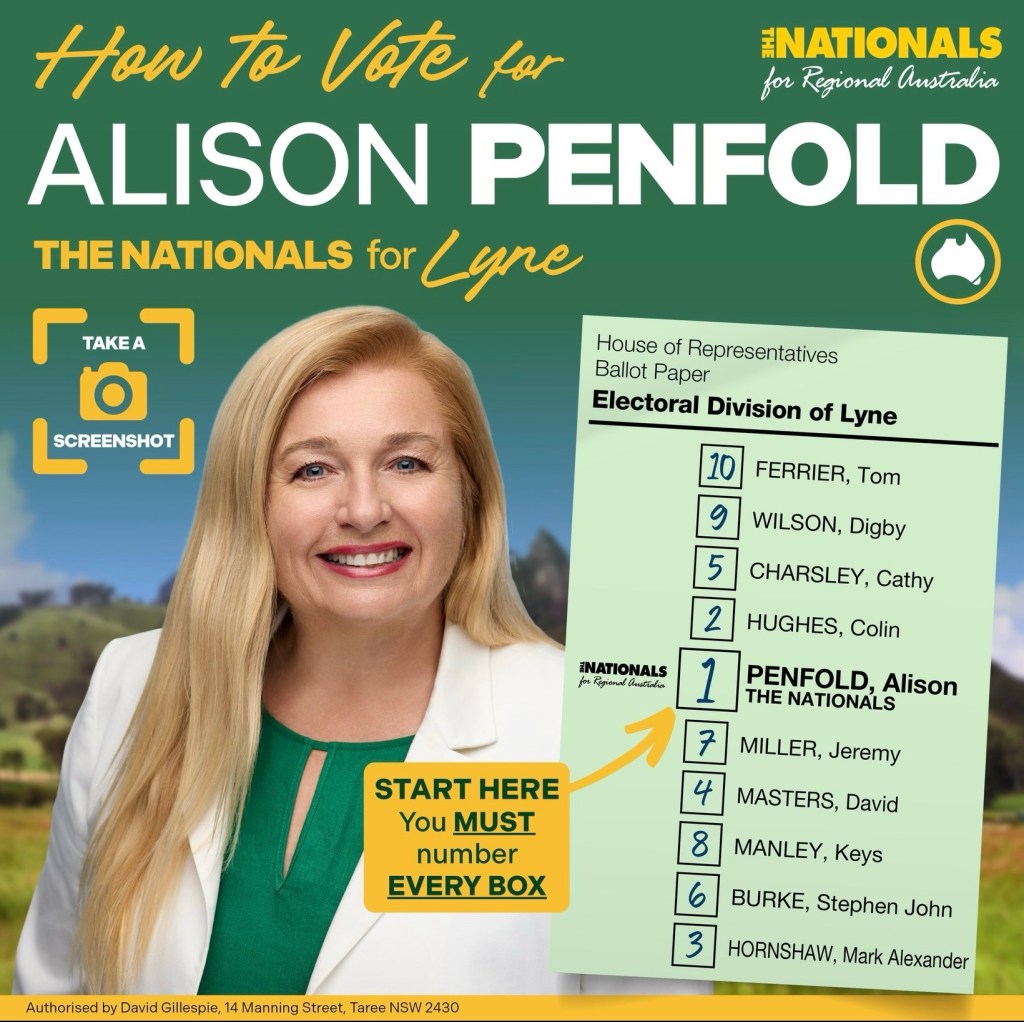
Alison Penfold (Nationals) noted that she has visited Dungog on many occasions in the past and is aware of the challenges Dungog faces as the smallest shire council in the electorate. Tied funding is the way to ensure that money comes to regional councils; it is not ideological, but practical. She spoke of plans to establish a fund that will prioritise roads, healthcare, and medical needs.

She noted that “if renewables can deliver, I will support them; but I don’t believe they can. I will not be ideological, but practical.” Her focus will be to develop a cost of living plan to get the country back on track, with cuts in fuel costs, tax offsets for up to $140k, cheaper energy, and a nuclear programme that will cost far less than $600billion. The Coalition will offer incentives for first home buyers; she also rattled off a list of specific proposals in terms of health care. 

Alison has worked in private enterprise and also on the staff of a member of parliament in both government and opposition. She is not interested in personality politics. However, throughout her presentation she was loud, assertive, even aggressive, which was noted by other speakers and in the informal conversations taking place after the event amongst those who had attended.

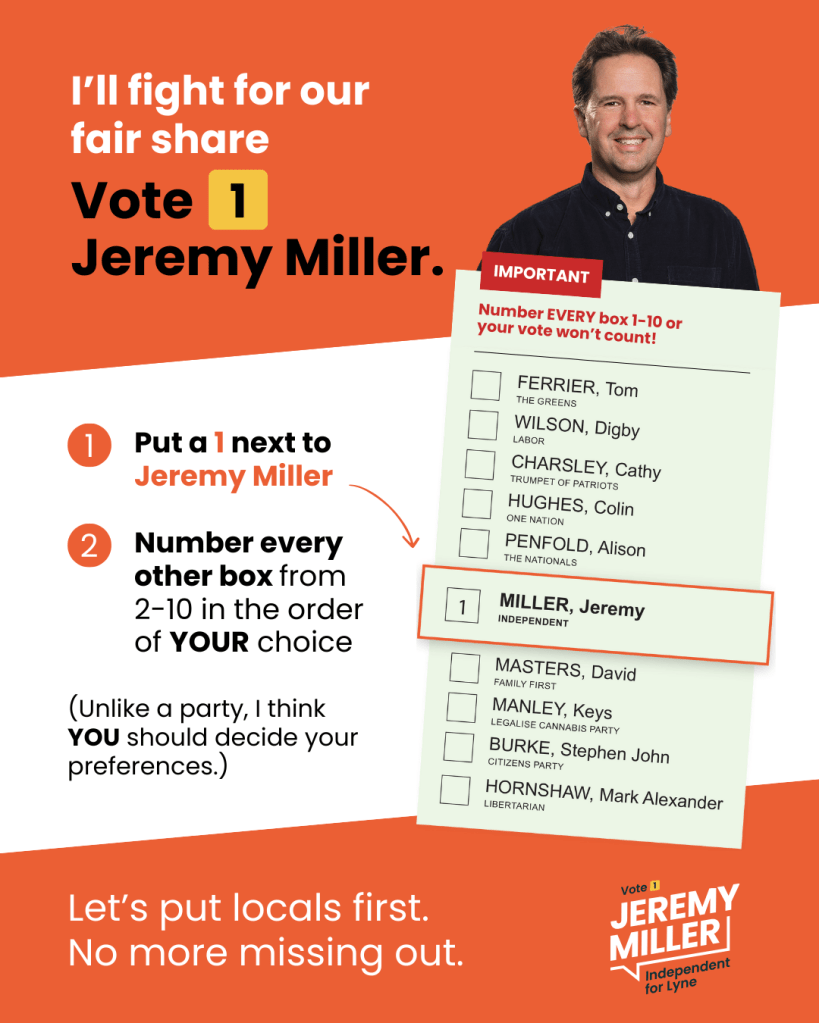
Jeremy Miller (Independent) is standing with the support of Independent Lyne, a local community movement. He has lived 30 years in the area, after moving from Canberra to Taree. Married with three kids, two at university, he now runs two businesses in Taree, employing 14 people. “I am not a typical politician”, he said; “I am not a lobbyist, but a business person who wants to get things done.” He believes it is time for something new, other than “the two tribes”. 

Independent Lyne has been modelled on the process used in the Indi electorate, with a strong grassroots movement developed by Cathy McGowan, and then used by Helen Haines. Kitchen table conversations were held across the electorate, with the results reported in a Listening Report. The group called for applications, then chose a candidate through a grassroots process. If he is asked “what do you stand for?”, Jeremy points to the results of that listening phase, which has shaped the policies he stands for.

He wants to see three levels of government working together (he is also a councillor on Mid Coast Council) rather than pointing the finger at each other as to why it does not work. In Lyne, he maintains, “we can feel it in our bones” that we are getting left behind. Jeremy offered an energetic and enthusing presentation.

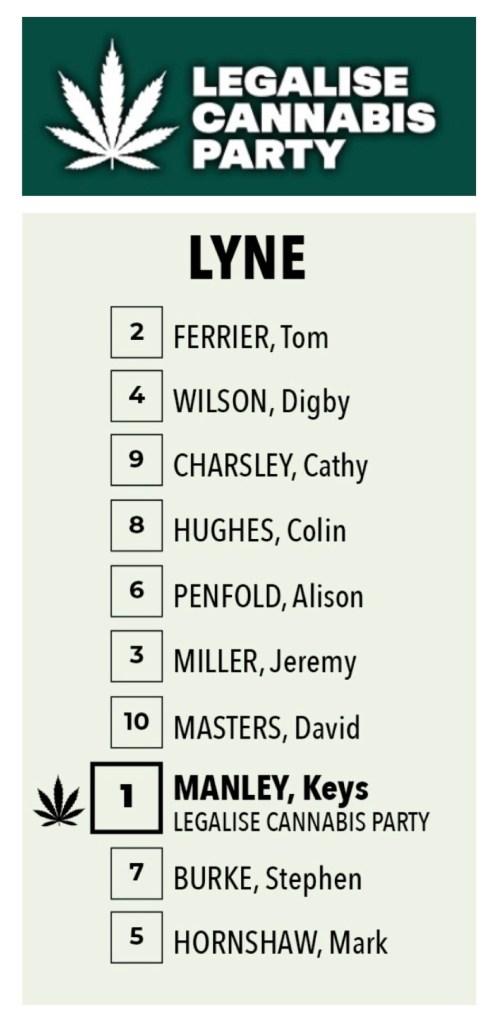
Keys Manley (Legalise Cannabis) has family links with Taree and Wingham, where he grew up. In 2017, he was diagnosed with a genetic mutation predisposing cancer. After a series of operations, he was introduced to medical cannabis, with oils and balms used as well. At a fourth operation to remove polyps, he was given a clean bill of health. He has since learnt about the many benefits of cannabis across many industries. It has saved his life. It offers many benefits in so many areas. 

Keys advocates for civil liberties and social tolerance. There is a wastage of resources consumed by the policing of cannabis; we could free all of this by legalising it. It is safer than alcohol and other drugs. Cannabis is a rich nutrient food and it can provide a more sustainable future. “Let’s embrace this industry and funnel the resources saved into what we need to build locally”, he concluded his passionate speech.

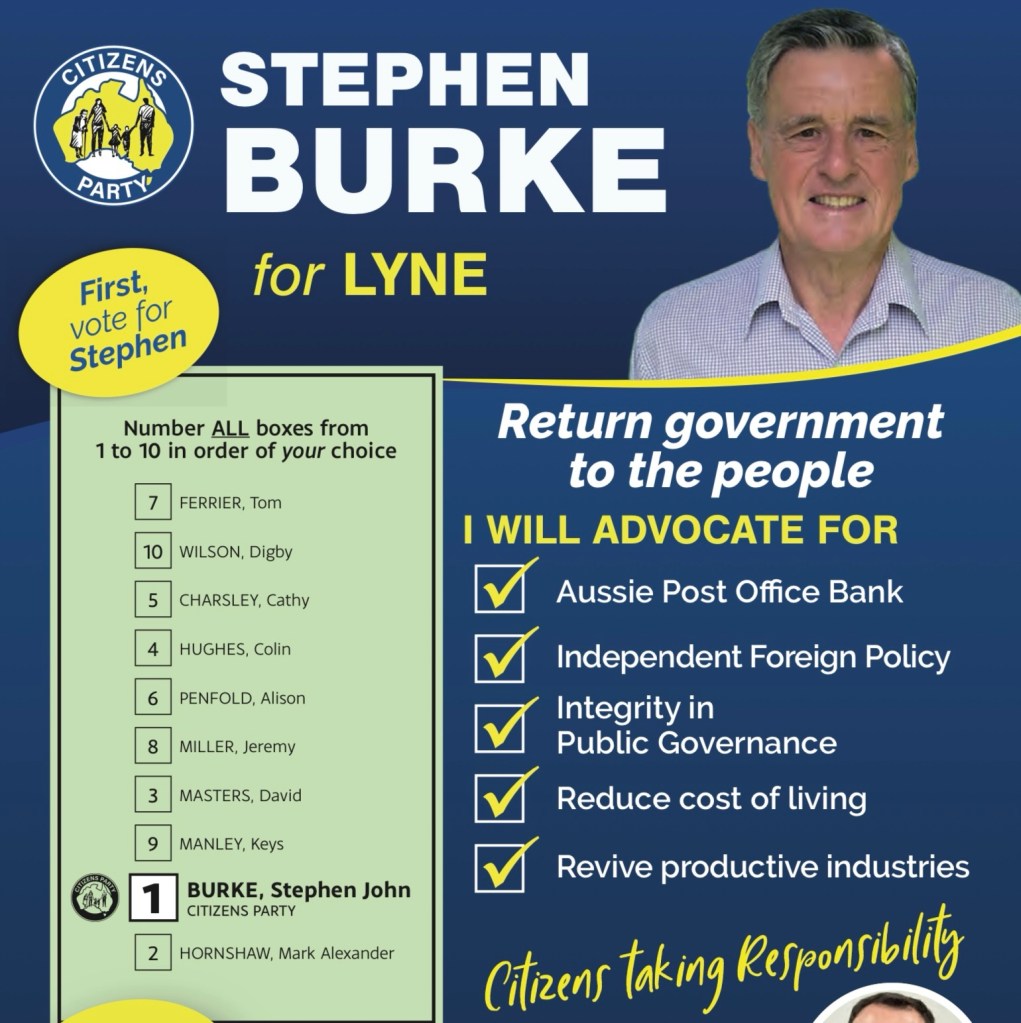
Stephen John Burke (Australian Citizens Party) also spoke passion  a speech filled with his key themes: Our system is broken, with policies of destruction, fostered by the rich, who benefit from and manipulate the current system. The ACP, he noted, is not a splinter party but has worked for over 30 years to achieve some important gains. 

He then ranged over the various policies of the party, which included: No totalitarian censorship. Liberty of expression. Religious liberty. Moving away from the digital scenario—“cash is king”. A Post Office Bank so that in person banking facilities are available directly in each rural town. The speech was delivered with some humour and intensity of commitment to the issues and the solutions he proposed.

The night ended with three specific questions relating to Dungog Shire being put to the candidates for their short response each in turn: recognising some local roads as State roads, thereby attracting funding; keeping in person government services in the town; and how to maintain more youth in the town. The answers given reflected the varying experiences of the candidates, in local and Federal roles, as well as the general policy platforms on which they were standing.

Unfortunately there was no opportunity to ask questions from the floor. However, the general feeling was that the evening was a useful event for those who attended. 

See also
Which candidates (in Lyne) are committed to reconciliation ?
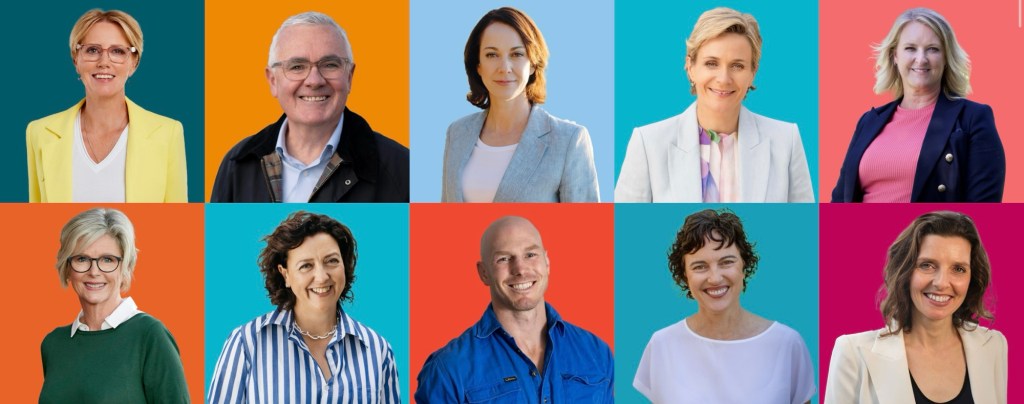
In preparation for the federal election, Reconciliation Taree wrote to all ten candidates standing in the Lyne electorate. They asked them a series of questions about reconciliation and invited them to provide a brief statement of their position.

Of the ten candidates: 

Four candidates answered all questions and are supportive of reconciliation and Indigenous justice.

Three candidates did not respond.

A further three candidates responded but declined to answer any of the questions. 

Candidates’ responses to the yes/no questions are reflected in the image that follows. Responses to the open-ended question from the four candidates who answered this question are summarised below.

Tom Ferrier (Greens) stated that “The Greens strongly supported the Yes vote for the Referendum” and referred people to the full set of Greens policies, “including our policies to support truth-telling and treaty-making, protect cultural heritage, and prioritise First Nations leadership and empowerment”, on their website: https://greens.org.au/platform

Digby Wilson (Labor) noted that “The Indigenous population of Australia remains the most disadvantaged and disenfranchised group in our society. Healing and repair are essential, grounded in respect and understanding. A divisive ‘us versus them’ mindset only pulls us further apart—we must strive for better. Preserving the history and culture of the world’s oldest living civilisation is not just a duty; it’s a necessity. To disregard this land’s heritage is to lose sight of our shared identity.”

Jeremy Miller (Independent) began by affirming “the custodianship of the Biripi, Worimi, and Wonnarua nations and peoples of Lyne”, stating “I pay my respects to their Elders- past and present-and recognise their ongoing connection to land, waters, and sky.” He continued, “I have been, and will continue to be, a strong ally to First Nations people including standing up for Welcomes to Country, supporting culturally safe spaces for children to grow and learn—like those provided through First Steps-and backing job opportunities such as the Indigenous Ranger Program. First Nations communities have long offered thoughtful, practical solutions to the challenges they face. What’s needed now is for Governments to act on those solutions, listening to and led by First Nations voices.”

Keys Manley (Legalise Cannabis) wrote that “The Legalise Cannabis Party recognises that Indigenous Australians are disproportionately affected by cannabis-related charges, contributing to systemic injustices. We support decriminalisation and legalisation to reduce these harms and ensure fair treatment under the law. Legal reform must go hand in hand with social justice, including addressing over-policing and ensuring indigenous voices lead policy decisions that affect them.”

Voters in Lyne, where these candidates are standing, may wish to consider these responses (and the fact that other candidates were not willing to respond to the questions) as they prepare to vote.

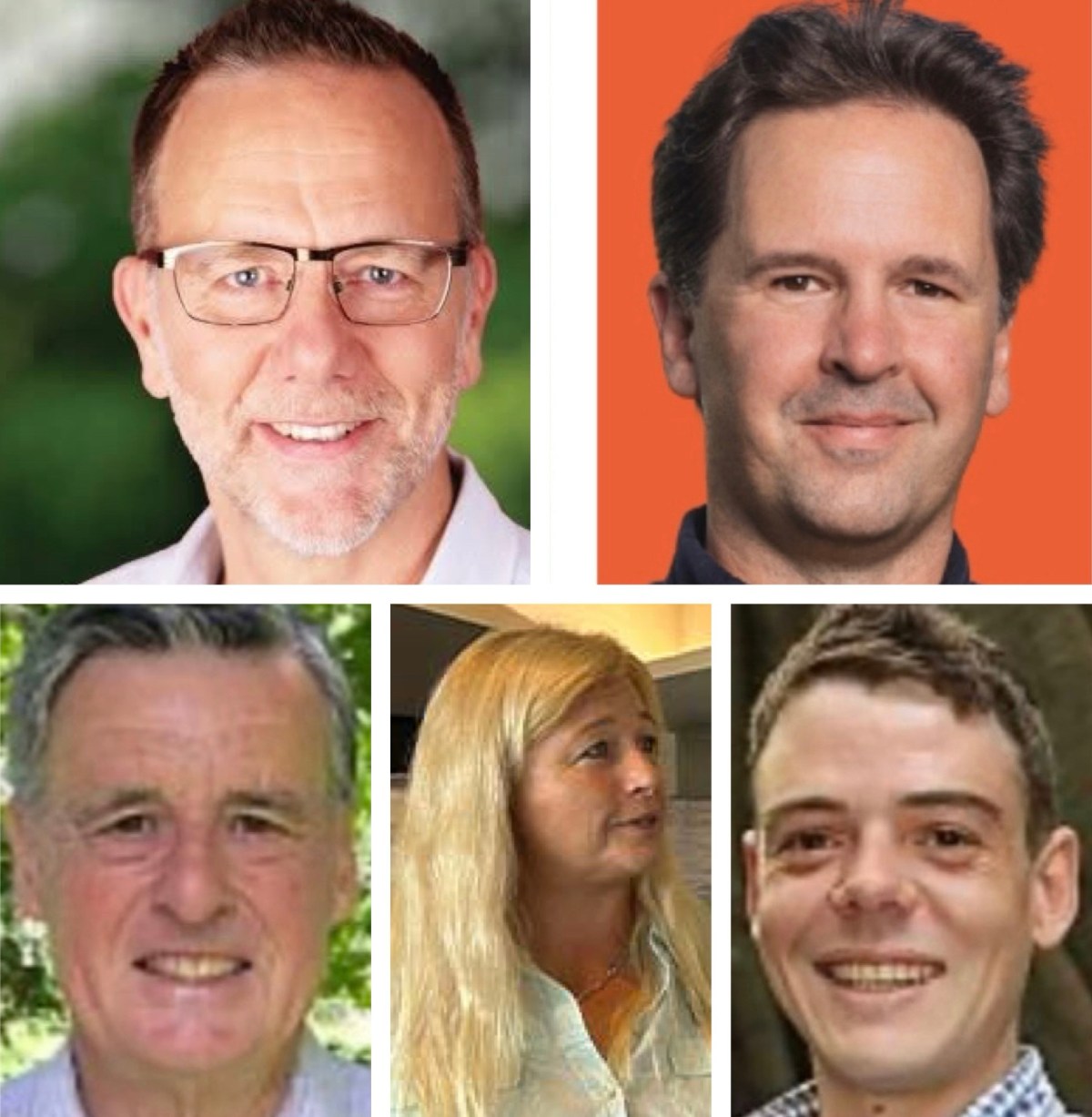
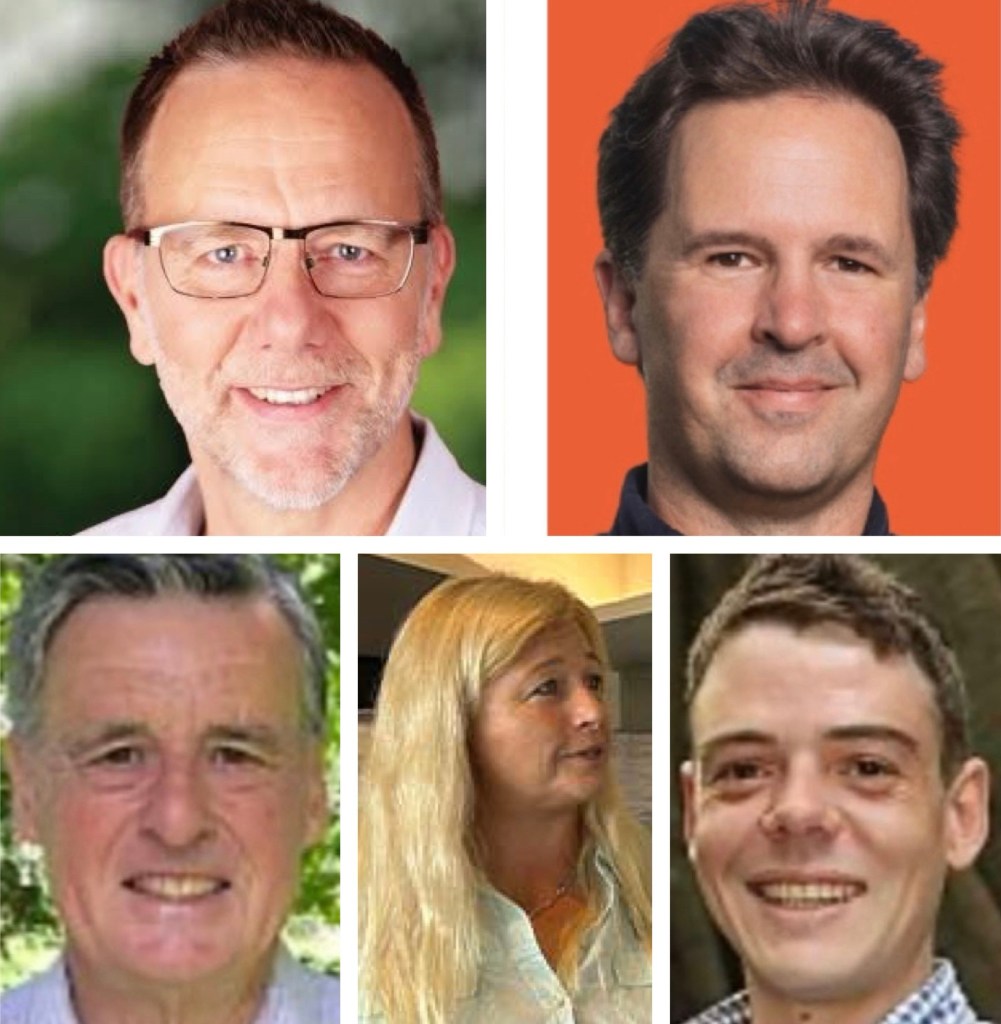
pictured: Digby Wilson, Tom Ferrier, Jeremy Miller, Keys Manley

Full disclosure: I am a member of Reconciliation Dungog and an active member of the Jeremy Miller for Lyne campaign.