In preparation for the federal election, Reconciliation Taree wrote to all ten candidates standing in the Lyne electorate. They asked them a series of questions about reconciliation and invited them to provide a brief statement of their position.
Of the ten candidates:
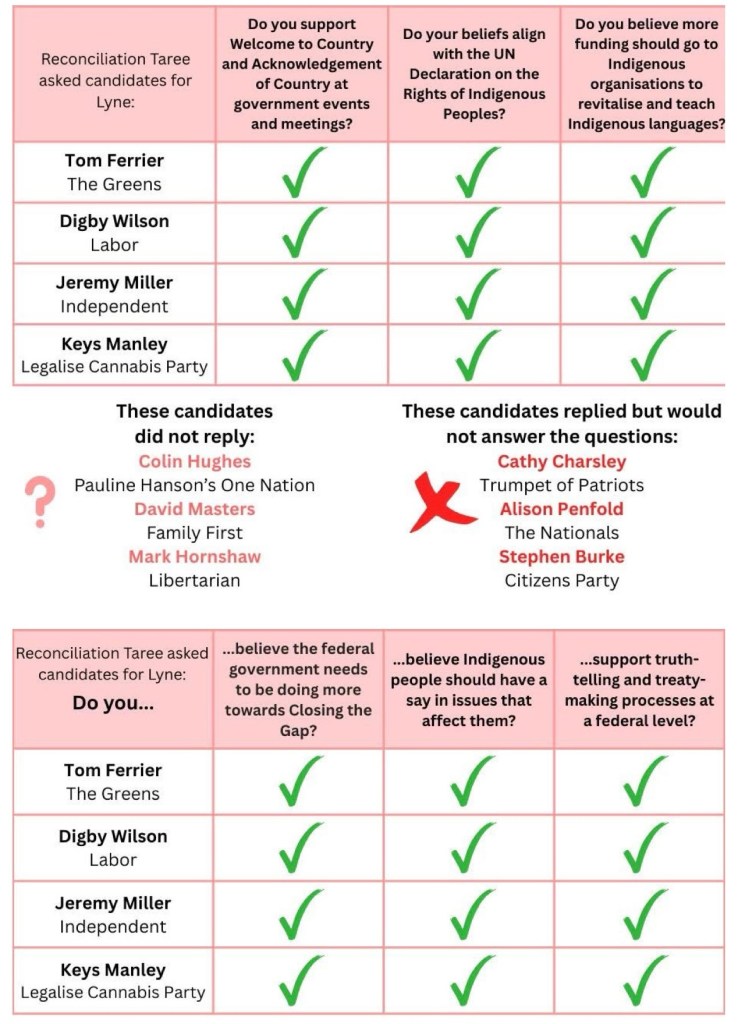
Four candidates answered all questions and are supportive of reconciliation and Indigenous justice.
Three candidates did not respond.
A further three candidates responded but declined to answer any of the questions.
Candidates’ responses to the yes/no questions are reflected in the image that follows. Responses to the open-ended question from the four candidates who answered this question are summarised below.
Tom Ferrier (Greens) stated that “The Greens strongly supported the Yes vote for the Referendum” and referred people to the full set of Greens policies, “including our policies to support truth-telling and treaty-making, protect cultural heritage, and prioritise First Nations leadership and empowerment”, on their website: https://greens.org.au/platform
Digby Wilson (Labor) noted that “The Indigenous population of Australia remains the most disadvantaged and disenfranchised group in our society. Healing and repair are essential, grounded in respect and understanding. A divisive ‘us versus them’ mindset only pulls us further apart—we must strive for better. Preserving the history and culture of the world’s oldest living civilisation is not just a duty; it’s a necessity. To disregard this land’s heritage is to lose sight of our shared identity.”
Jeremy Miller (Independent) began by affirming “the custodianship of the Biripi, Worimi, and Wonnarua nations and peoples of Lyne”, stating “I pay my respects to their Elders- past and present-and recognise their ongoing connection to land, waters, and sky.” He continued, “I have been, and will continue to be, a strong ally to First Nations people including standing up for Welcomes to Country, supporting culturally safe spaces for children to grow and learn—like those provided through First Steps-and backing job opportunities such as the Indigenous Ranger Program. First Nations communities have long offered thoughtful, practical solutions to the challenges they face. What’s needed now is for Governments to act on those solutions, listening to and led by First Nations voices.”
Keys Manley (Legalise Cannabis) wrote that “The Legalise Cannabis Party recognises that Indigenous Australians are disproportionately affected by cannabis-related charges, contributing to systemic injustices. We support decriminalisation and legalisation to reduce these harms and ensure fair treatment under the law. Legal reform must go hand in hand with social justice, including addressing over-policing and ensuring indigenous voices lead policy decisions that affect them.”
Voters in Lyne, where these candidates are standing, may wish to consider these responses (and the fact that other candidates were not willing to respond to the questions) as they prepare to vote.
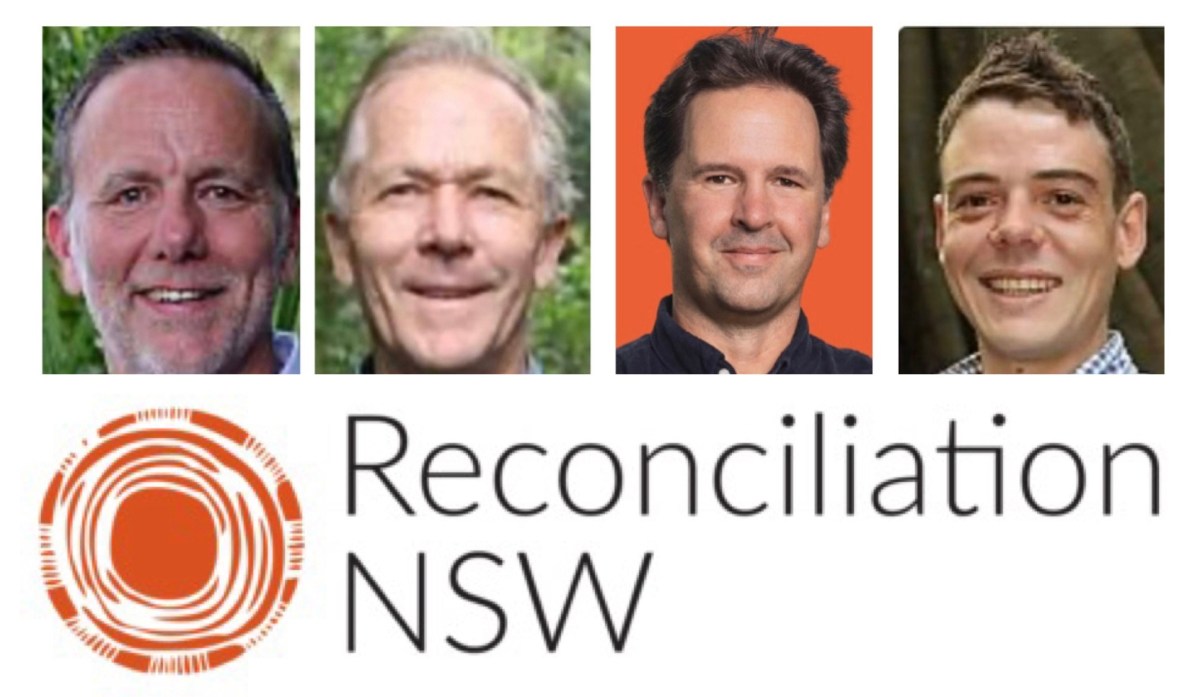
pictured: Digby Wilson, Tom Ferrier, Jeremy Miller, Keys Manley
Full disclosure: I am a member of Reconciliation Dungog and an active member of the Jeremy Miller for Lyne campaign.
A sermon preached at Dungog Uniting Church on Easter Sunday 2025.
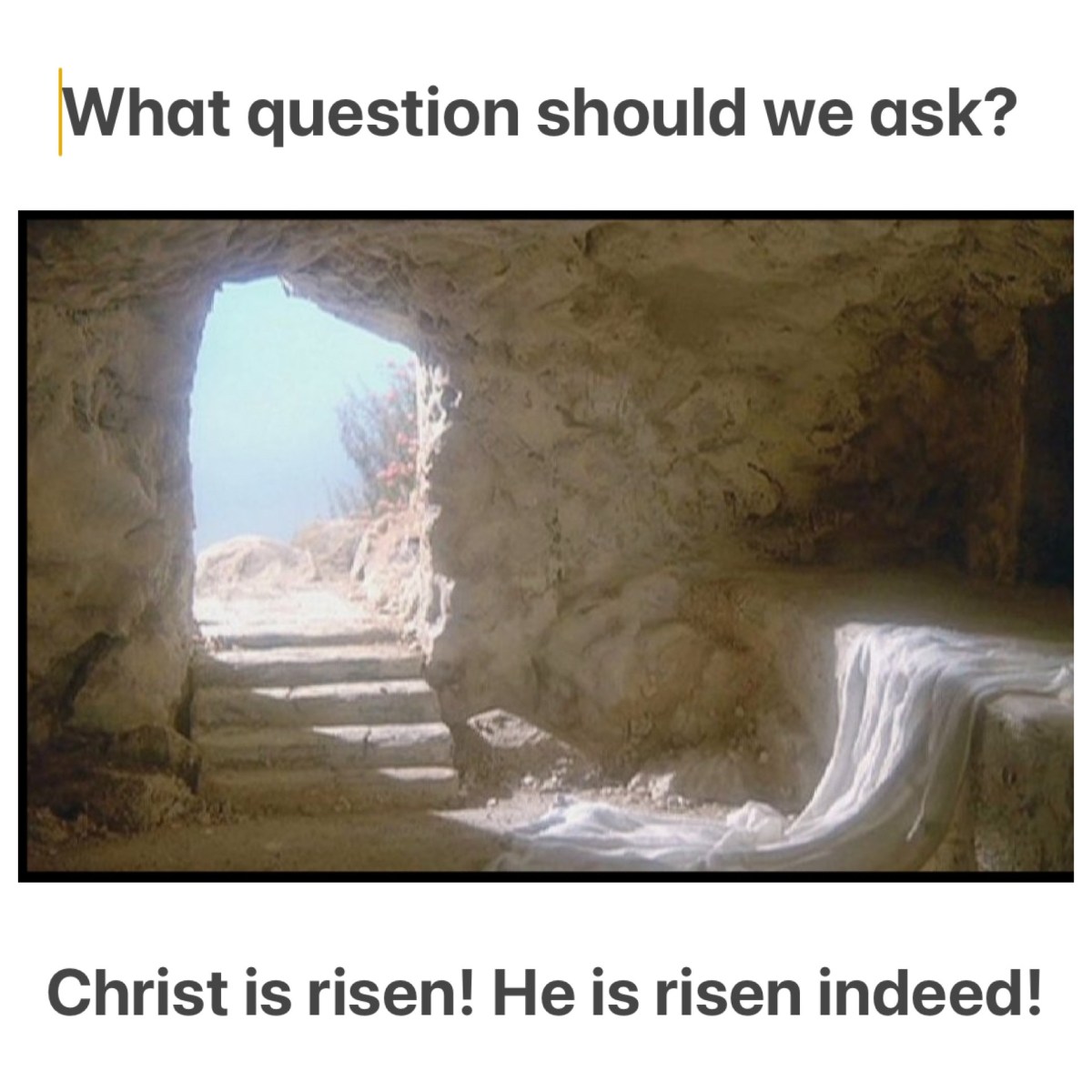
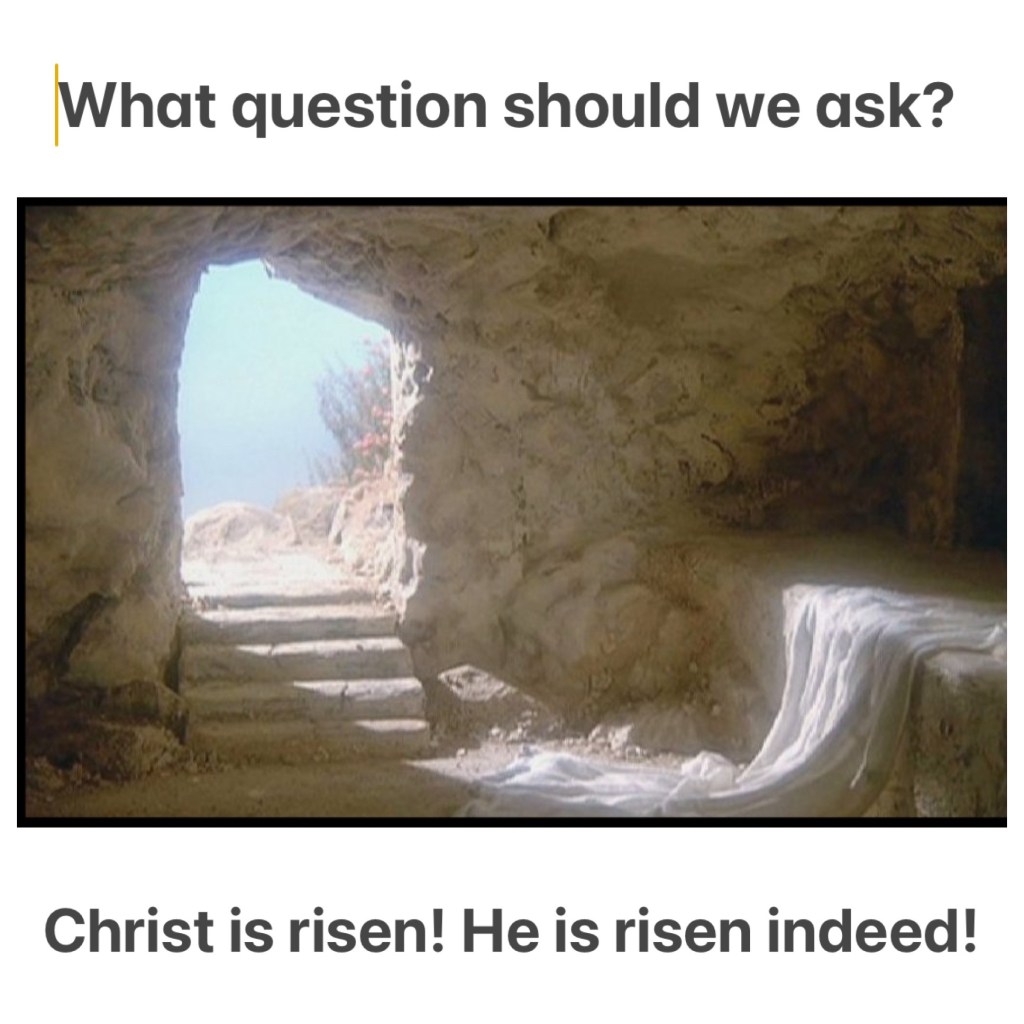
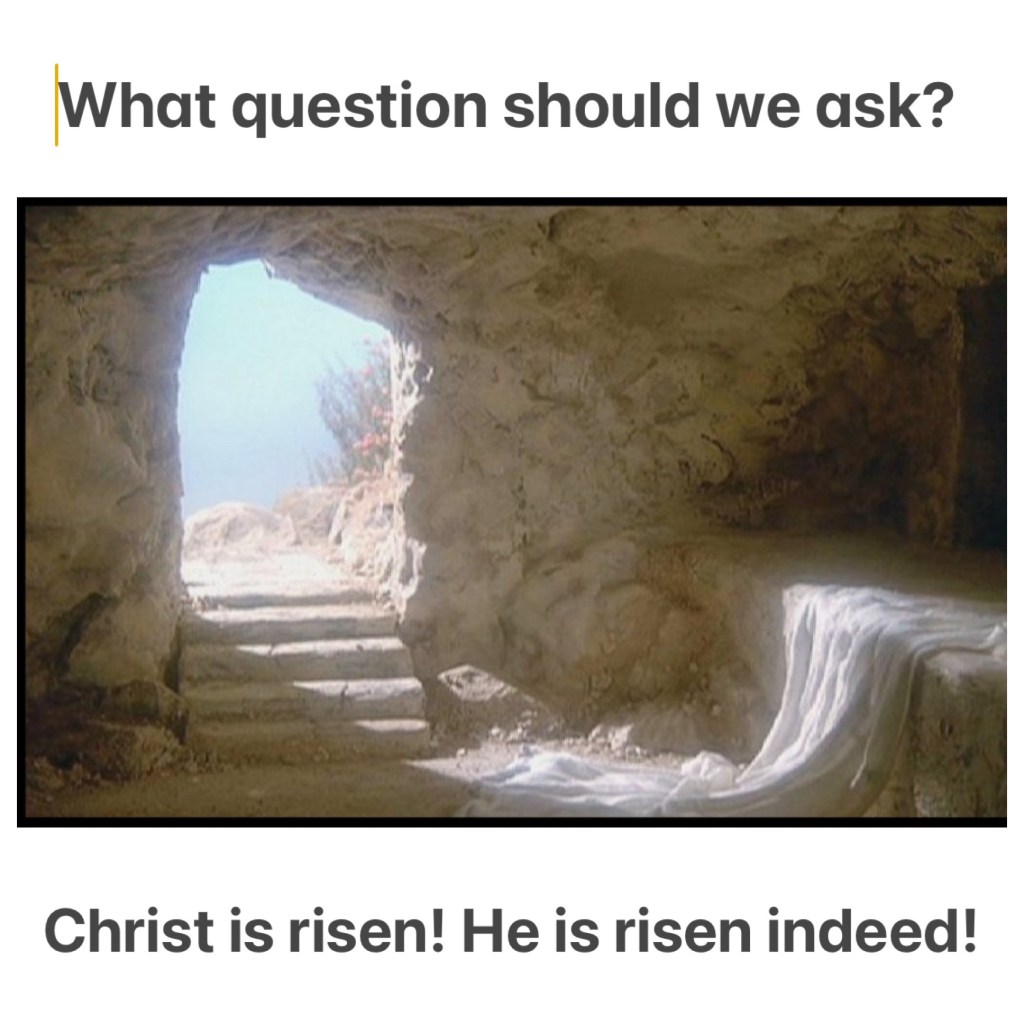
Today is a day of celebration. We gather, we sing, we exclaim “Christ is risen!” Joy fills the air; expectation and hope are abundant. It’s a fine way to emerge from the sombre mood of Friday, when we last gathered, on day of mourning, to remember the sombre reality, “Christ has died”.
On that day, we remembered again the story of the last days of Jesus: a story of betrayal and denial, of physical abuse and verbal mocking, of abandonment and death, of grief and despair.
And yet, today, we have moved from that deep despair, into abundant joy.
Today is a day of celebration.
Today is also a day of mystery. It is a day that we cannot fully explain with simple phrases and formulaic responses. It is a day that invites us to pause, reflect, and ponder.
Last week, Lurline quoted what she called “the most electric sentence of the Bible”: “he is not here; he has risen!”
We have heard that electric expression of joy in the reading from Luke’s Gospel. “Why do you look for the living among the dead? He is not here, but has risen.” (Luke 16:5)
And so we greet one another on this day: Christ is risen! Christ is risen indeed!!
That electric sentence provokes many questions.
What is it that actually happened?
How was the stone moved?
Where is the body of Jesus?
How exactly was Jesus raised from the dead?
What is the form that Jesus now takes?
What does it mean for us to hold the hope that we, too, will be raised from our death?
This day of mystery confronts us with a host of questions. Preachers and priests, scholars and writers, over decades and centuries, have asked these questions, have explored them in their words, have sought to provide explanations, all the while intending to buttress and strengthen our faith on this day of mystery.
Did the resurrection really happen? is one of the questions that is often asked on or around this day. What was the historical reality of the day? I have to say, that is a very modern question. It may surprise you, but for centuries, this was not a question that troubled the minds of believers. It is really only something that has concerned us in the last few centuries—from the time of The Enlightenment, when the focus shifted from lives lived by faith to lives exploring scientific and historical realities.
The question about “what really happened?” is a classic post-Enlightenment question. It’s not something that occurred to those of ancient times. So the biblical texts of antiquity don’t provide any explanation that satisfies us modern listeners and readers.
Indeed, this is a question that cannot be answered by a simple historical “proof”. The resurrection is, by its nature, something that transcends the material, earthly focus of our modern era. It resists clearcut scientific or historical questions. It remains, in the end, a mystery.
What actually happened to the body of Jesus? is another question that is often asked about today—which also reflects the time in which we live, when “what happened?” is often an important question. And the answer offered by numerous writers has varied, ranging from “the body was stolen” through to “a miracle happened”. Again, a satisfactory explanation is beyond us. It is a mystery.
How was the stone removed from the doorway to the tomb? is another question that is asked. Mark’s Gospel says that when the women came to the tomb to anoint Jesus, “they saw that the stone, which was very large, had already been rolled back” (Mark 16:4). So, too, does Luke (Luke 16:2); neither evangelist was interested in providing any explanation about this curious feature.
The account in Matthew’s gospel, however, does venture an answer: when the women arrive at the, “suddenly there was a great earthquake; for an angel of the Lord, descending from heaven, came and rolled back the stone and sat on it” (Matt 28:2). That’s the explanation, it seems. This evangelist then continues, “his appearance was like lightning, and his clothing white as snow; for fear of him the guards shook and became like dead men” (Matt 28:3–4). Understandably!
However, we need to note that Matthew’s account had also reported an earthquake at the very moment that Jesus had died on the cross: “Jesus cried again with a loud voice and breathed his last. At that moment the curtain of the temple was torn in two, from top to bottom. The earth shook, and the rocks were split. The tombs also were opened, and many bodies of the saints who had fallen asleep were raised. After his resurrection they came out of the tombs and entered the holy city and appeared to many.” (Matt 27:50–53).
That’s quite a story! and even more striking, perhaps, is the fact that none of the other evangelists report this incredible series of events: an earthquake and the raising of dead people at the moment Jesus died. It’s not in Mark’s earliest version; and it’s not in Luke’s later account, that we heard this morning. We can see, I hope, that this is part of the particular way that Matthew—a faithful Jew who held to the hope that God would act to come to earth to bring in the kingdom of God—tells the story of Jesus.
The earthquake that happens as Jesus dies and the second earthquake that comes just as the women discover the empty tomb both draw on apocalyptic imagery that the later prophets used and developed in their prophetic oracles. It’s not an actual historical account. It’s a vivid, dramatic telling of the story, designed to highlight this one central fact: God acted, God came to us, God raised Jesus from the dead, the kingdom of God is now present!
So today is a day of celebration; we celebrate that God has determined to be amongst us in a new, startling, and dramatic way. That is what motivated the women, when the discovered the tomb to be empty, made haste to return to the other disciples, to tell them “he is not here; he has risen” (Luke 24:8).
This is also a day of mystery, for the way that God came to us, raising Jesus from the dead, poses a range of questions, as I have considered. There is much to celebrate, and yet so many questions to consider. And that is probably why the apostles—Peter and Andrew, James and John, Matthew and Bartholomew and Thaddeus and Thomas—all men, it must be noted, heard what the women told them, and as Luke crisply reports: “it seemed to them an idle tale, and they did not believe them” (Luke 24:11). Ah, the patriarchy!
It was, they presumed, a strange story, told by hysterical women, completely unbelievable—even though the men in the tomb had explicitly reminded the women of what Jesus had said “while he was still in Galilee, that the Son of Man must be handed over to sinners, and be crucified, and on the third day rise again” (Luke 24:7).
It’s a day of celebration; a day of mystery; and perhaps, in the end, today is a day that calls for faith. At the heart of the story of Jesus, as we have heard over the last few days, is a story of betrayal and denial, of physical abuse and verbal mocking, of abandonment and death, of grief and despair. It could very well lead us to a pessimistic view of the world, and to dampen our hopes.
Yet today is a day that calls us to have faith. To have faith that death is not the end of life. To have faith that there is more to our existence than our physical bodies. To have faith that God’s desire and intention is to work through even the despair of the lowest moments and to offer us the hope of what we can but glimpse today.
For that is what the resurrection of Jesus stands for. We may not be able to answer the many questions that it poses. But we can affirm, with the faithful people of ages past, and across the world M.today, and those still to come in the future beyond us, that “Christ has died. Christ is risen“ … “Christ is risen indeed! Alleluia!” For God is with us.
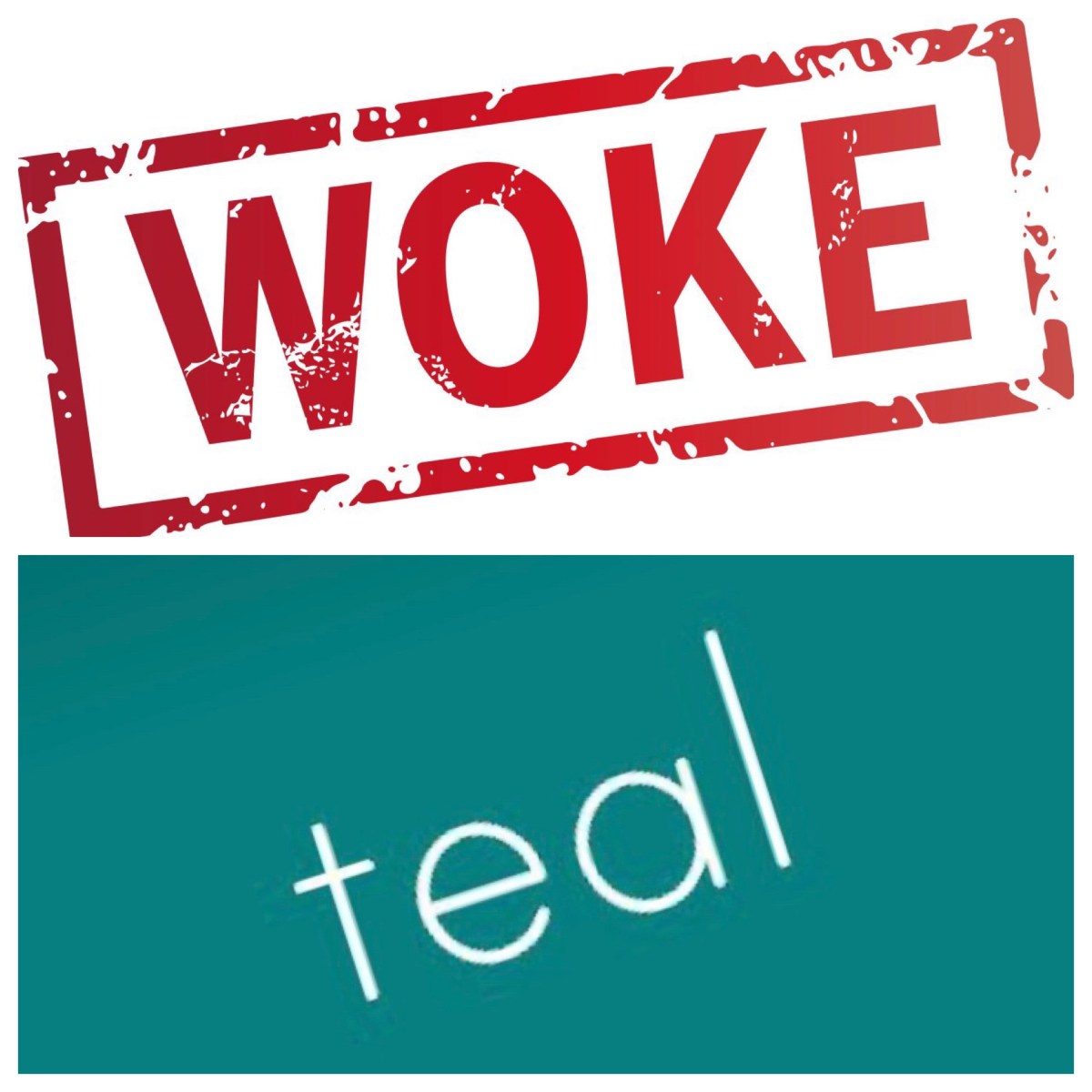
The term “Woke” was first used in a positive manner by Afro-Americans. It can be traced back to an 1891 book by Joel Chandler Harris (best known for his “Uncle Remus” stories). In the 1930s, it was used by Blacks quite often to describe being aware of racial prejudice and discrimination, often in the phrase “stay woke”. That usage continued through the decades and was picked up by the Black Power movement in the 1970s, and then increased in usage in the Black Lives Matter push of the 2010s.
In 2017, the Oxford English Dictionary added “woke” to its official lexicon, noting that it was most often used “in a derogatory sense”. This reflects the reality that the term had been picked up and hijacked by people of more conservative political and social perspectives (predominantly white people), and employed as a way of denigrating people with a social conscience committed to social justice. It’s a strange recent twist to what had been a proud Black statement.
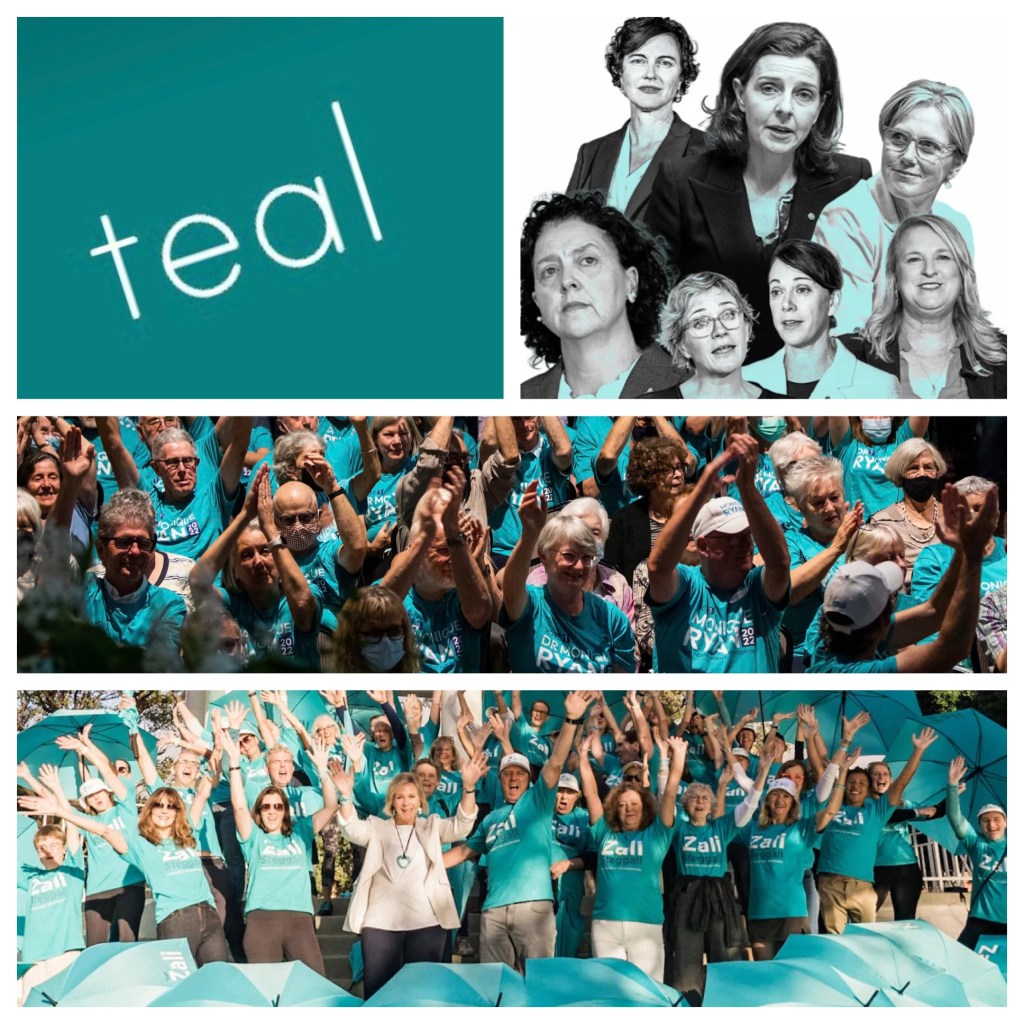
The same development in meaning can be seen with the word “Teal”, with a much more recent origin and a highly-compressed trajectory in turning from a positive to a negative meaning. It was first used as a political label in the 2019 federal election campaign of Zali Steggall, when she defeated Tony Abbott in the seat of Warringah (NSW).
The term (and the campaign colour) was then picked up and used in a constructive sense by some (but not all) community-supported independents in the 2022 election: Dr Monique Ryan in Koorong (Vic), Allegra Spender in Wentworth (NSW), Dr Sophie Scamps in Mackellar (NSW), Zoe Daniel in Goldstein (Vic), Kate Chaney in Curtin (WA), and Zali Steggall in her successful re-election campaign in Warringah.
The colour has successfully differentiated community-supported Independents from the “old parties” of Labor (bright red), Nationals (deep green), and Liberal (royal blue), as well as the Greens (light green).
However, the word “teal” has been adopted by uncritical conservative people as used as a way to lump together a widely-disparate group of independents and frame them all as “Labor lite” or “pale Green”. It has become a derogatory term for such people, as they look for an easy (and lazy) way to caricature those standing as Independents, dismissing them all as “leftwing woke ideology” (three slurs in one phrase!).
Too often there is a conflation of “Teal” and “Climate 200”, with the implication being that all candidates supported by C200 are Teals who are climate change warriors—“leftwards”, as some derogatorily call them. However, the C200 website clearly shows that the independents they are supporting are using a range of colours.
Quite a number of the Independent candidates that the Community independents Project is supporting are using teal, but others are using orange, and a few are using yellow. Standing against Peter Dutton in Dickson (Qld), Ellie Smith is using magenta. Overall, the choice of colour for Independents it is made on an individual basis. That’s far from the monolithic imposition by the parties of the red of Labor or blue for the Liberals, the lighter green for Greens and the deeper green for the Nationals. These are required of all of their candidates around the country. Community-supported Independents each choose their colour and their marketing strategy.
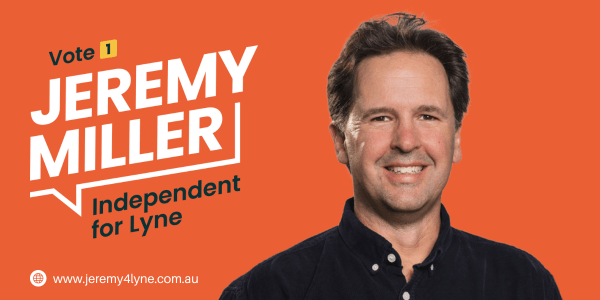
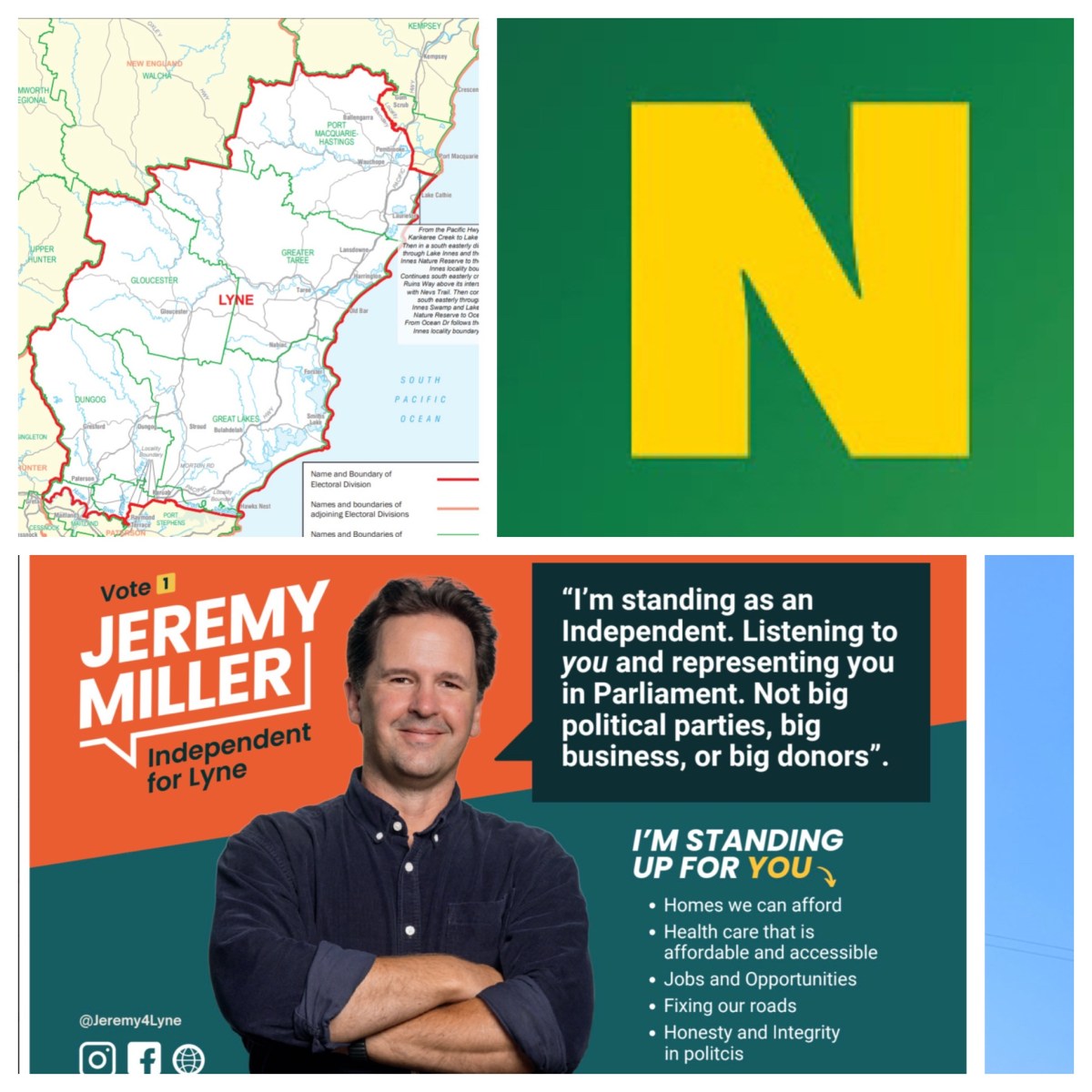
For myself, I am wearing orange and supporting Jeremy Miller as the Community Independent for Lyne. Jeremy has been chosen by community members across the Lyne electorate in response to a twelve month listening campaign aimed at prioritising the local needs of the Lyne electorate. His fundamental commitment is to listen to the people of the electorate and advocate strongly for the needs of people in Lyne.
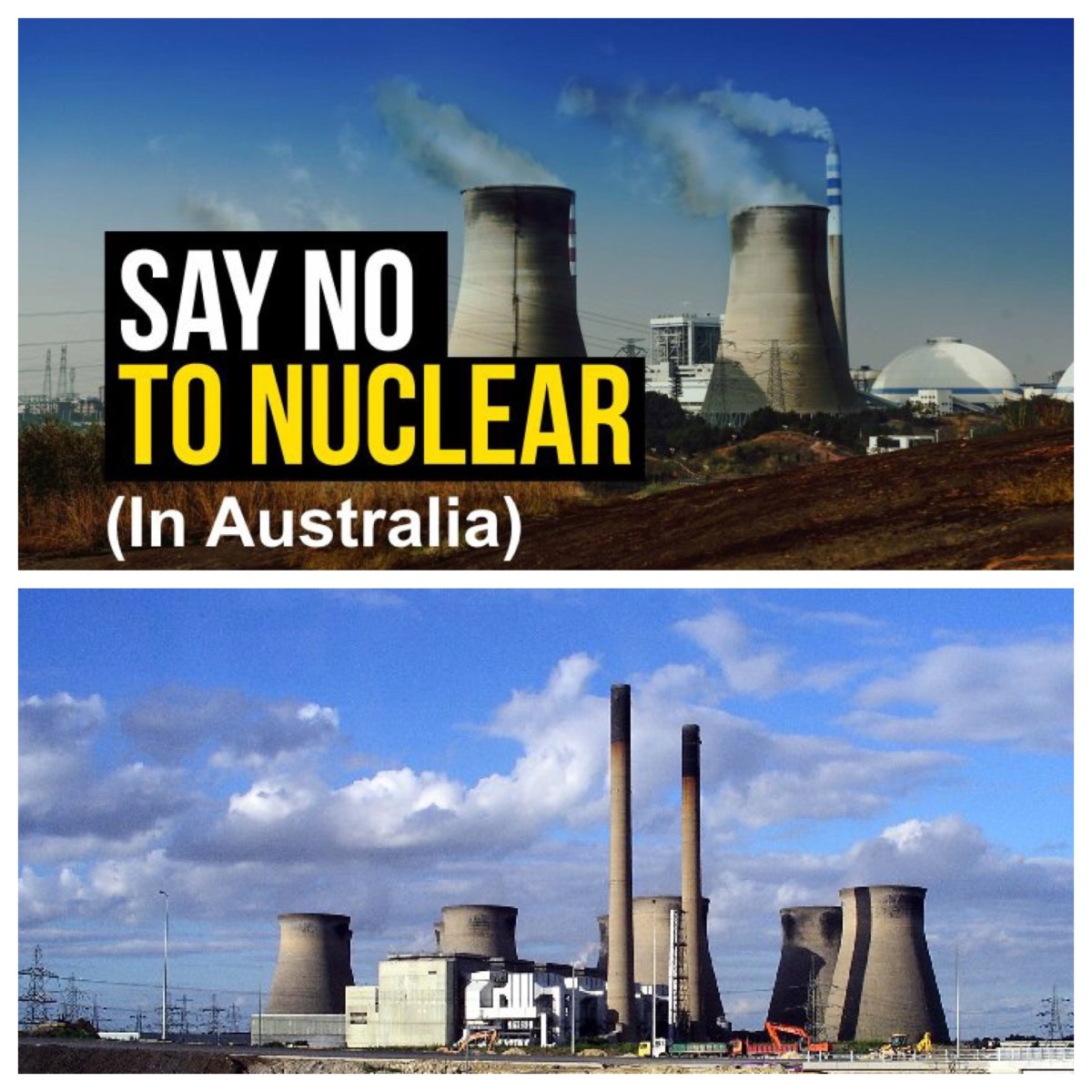
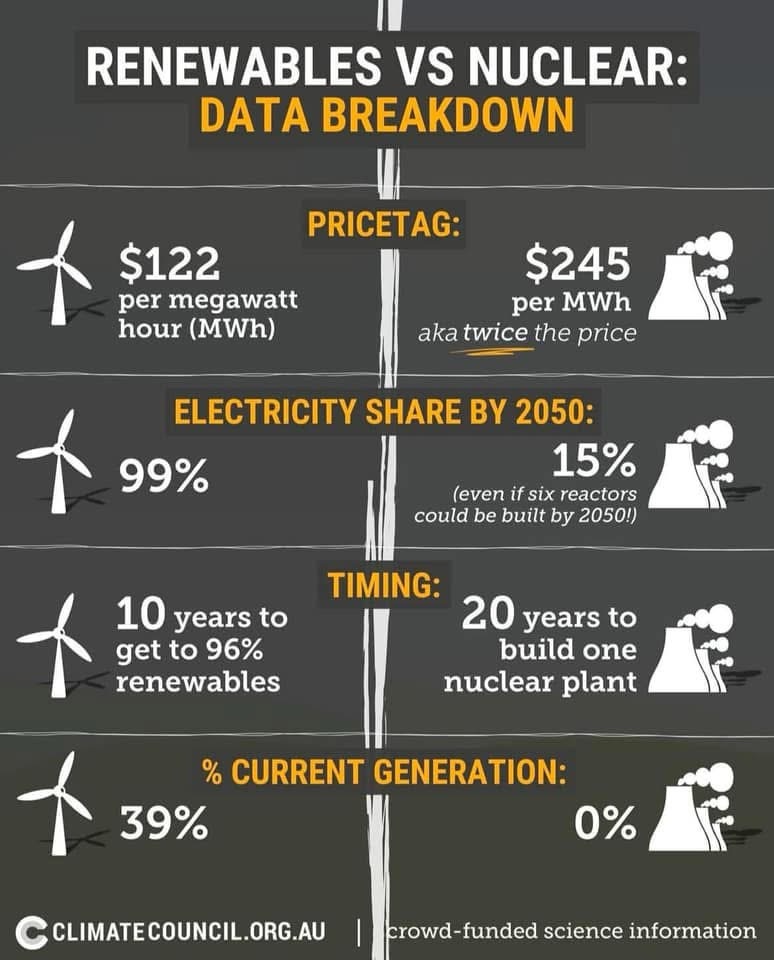
Is moving to nuclear power as the basis for electricity generation in Australia a reasonable move? There are many problems with this idea. Here are seven key reasons that come to mind for me.
1. Time. We are a long way from having the capacity for nuclear power to provide electricity in Australia. If we were to start work right now, there wouldn’t be any nuclear-generated electricity before 2040 at the earliest, according to the CSIRO. Even then, it might take years longer. Nuclear energy is not an immediate solution to our energy production issues.
2. Pollution. In the meantime, while we wait for the nuclear power plants to be built, there will be about a billion tonnes of climate pollution from burning more coal and gas. It would be more sensible to spend money in developing truly renewable sources of energy. These will cause far less climate pollution than nuclear power. Nuclear energy produces lots of pollution.
3. Cost. The cost of building nuclear power plants to generate electricity is much higher than any other source of power. Small Modular Reactors cost more than four times more than Solar Farms to build and maintain. Even larger-scale nuclear plants (which are not in view for Australia at the moment) are two and a half times the cost involved in harnessing renewable sources of energy. Nuclear energy is bad economic policy.
4. Efficiency. For the seventh year in a row, the CSIRO has said that renewable sources of energy are the most cost-efficient way of generating electricity. Large scale Solar PV farms is the most efficient. Gas turbine costs are rising. Nuclear power is the most expensive and least efficient way to generate electricity.
5. Risks for the environment. There are large environmental risks associated with nuclear power. Radioactive waste is a by-product of producing nuclear energy. This waste needs to be transported safely and stored securely. If it escapes, it can cause significant damage to human beings and to the whole environment. The risk lasts for thousands of years. Again: nuclear energy is bad environmental policy.
6. Risks for people. We have seen that even nuclear power plants that have high safety standards have failed to keep radioactive materials safe (see Chernobyl in 1986, and Fukushima in 2011). Many people have suffered from the breakdown of these nuclear reactor sites. Playing with this risk in Australia is unacceptable. Nuclear energy is risky.
7. Water. Nuclear reactors would require massive amounts of water to keep them running. A typical 1600MW nuclear facility uses 2,000 litres of water per second—that’s how much water four average households use in one year! With increased risks of drought in Australia, the driest continent on earth, this is bad management of our resources. Again, nuclear energy is bad environmental policy.
Sources consulted:
Centre for Independent Studies, “The six fundamental flaws underpinning the energy transition” (2 May 2014)
Centre for Independent Studies, “Nuclear vs Renewables—which is cheaper?” (Energy News Bulletin, 12 July, 2024)
Climate Council, “Why nuclear energy is not worth the risk for Australia” (media release, 28 January 2025)
Climate Council, “CSIRO confirms nuclear fantasy would cost twice as much as renewables” (explainer, 10 December 2024)
CSIRO, “GenCost: cost of building Australia’s future electricity needs” (Consultation Draft released February 2025; final version to be released in the second quarter of 2025)
Jeremy Miller has been out and about around the electorate this past weekend, with appearances at “Politics in the Pub” at Stroud on Friday, “Meet and Greet” at North Haven on Saturday, and Gloucester Markets on Sunday. He was also on ABC Mid North Coast radio early this morning, in a debate with the National Candidate. He is getting around!
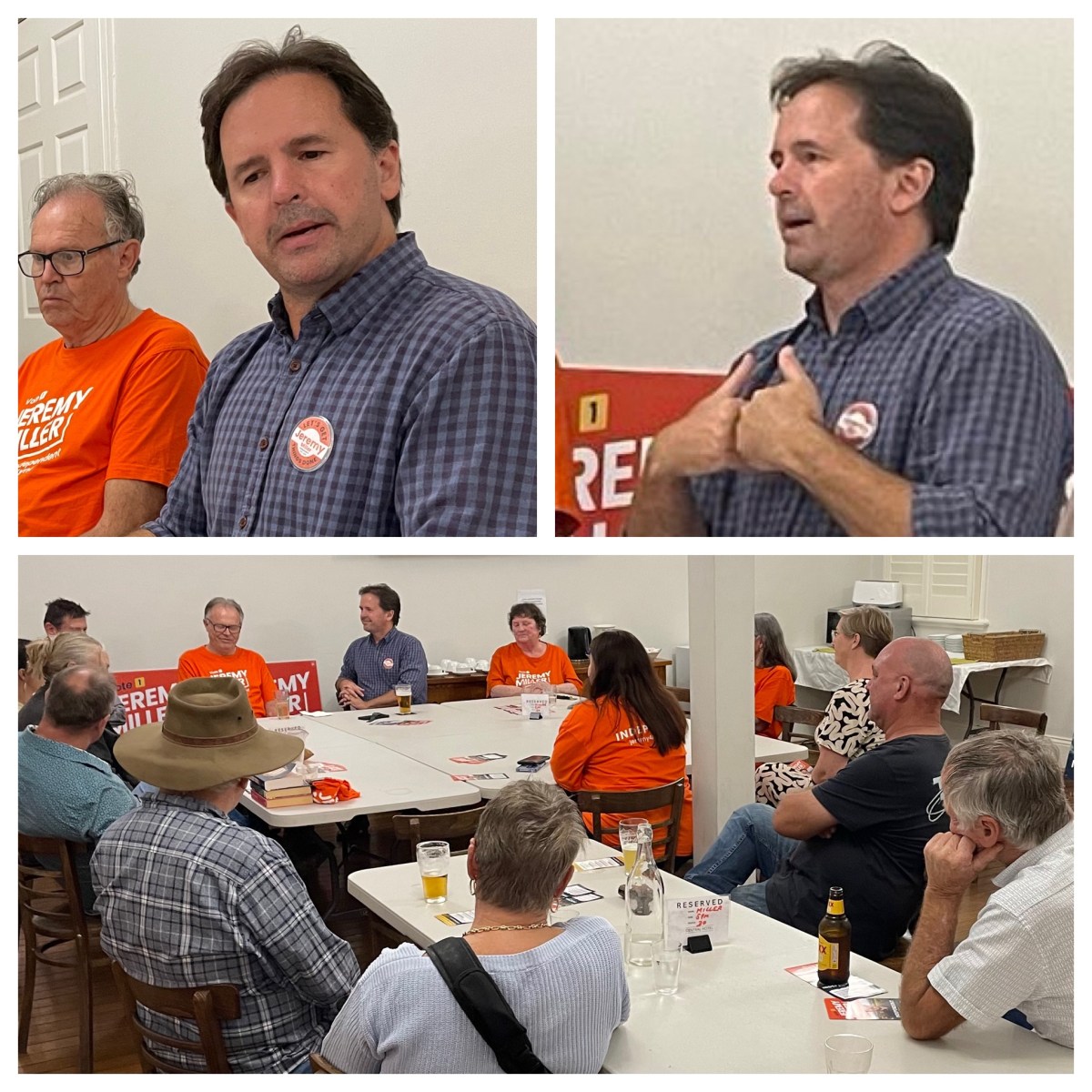
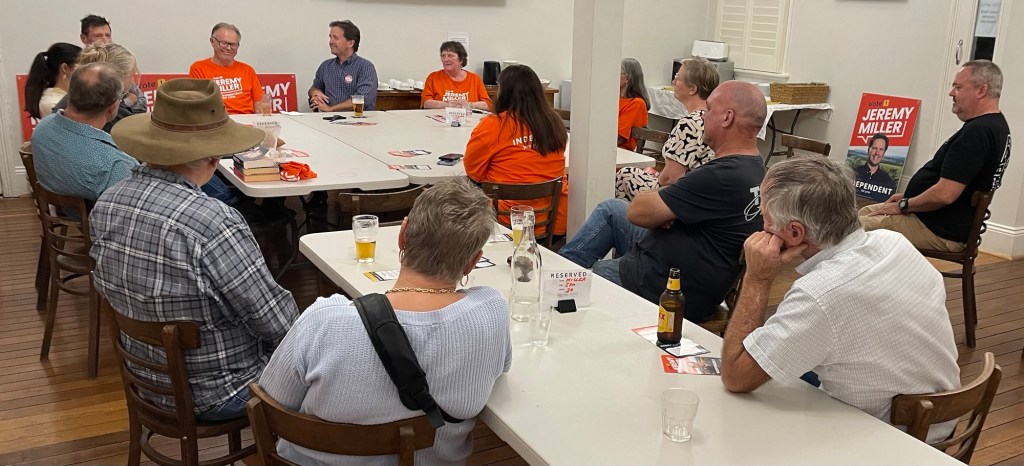
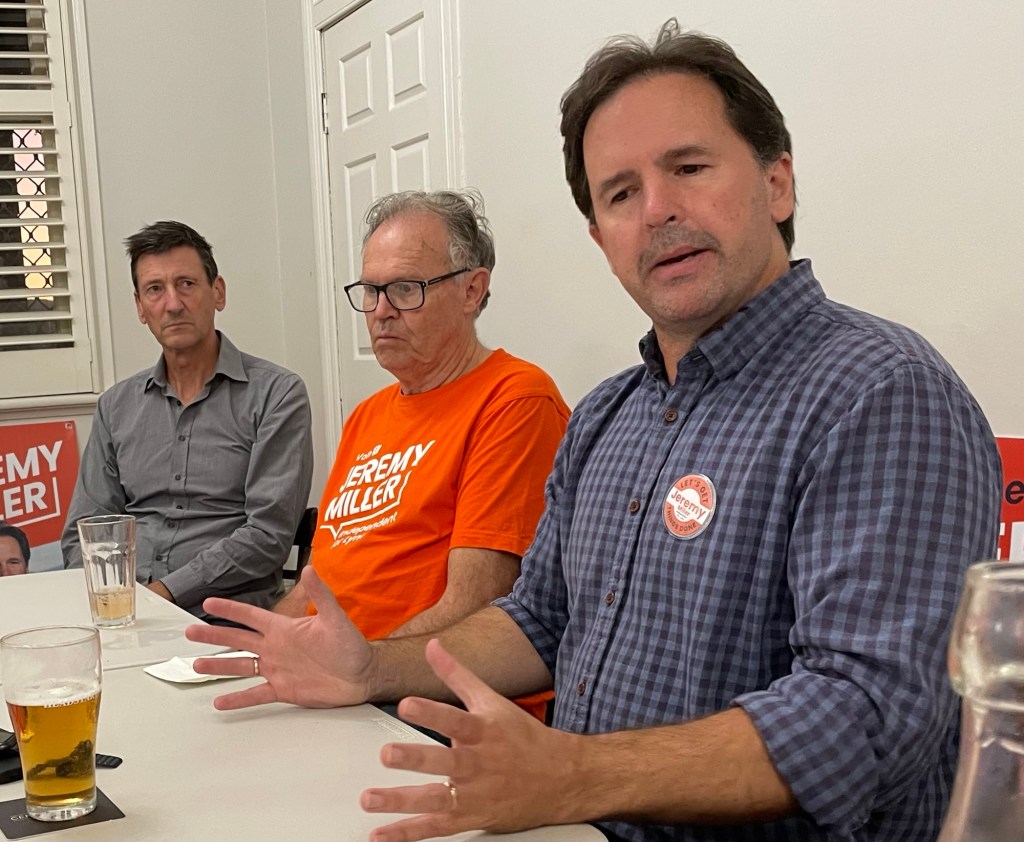
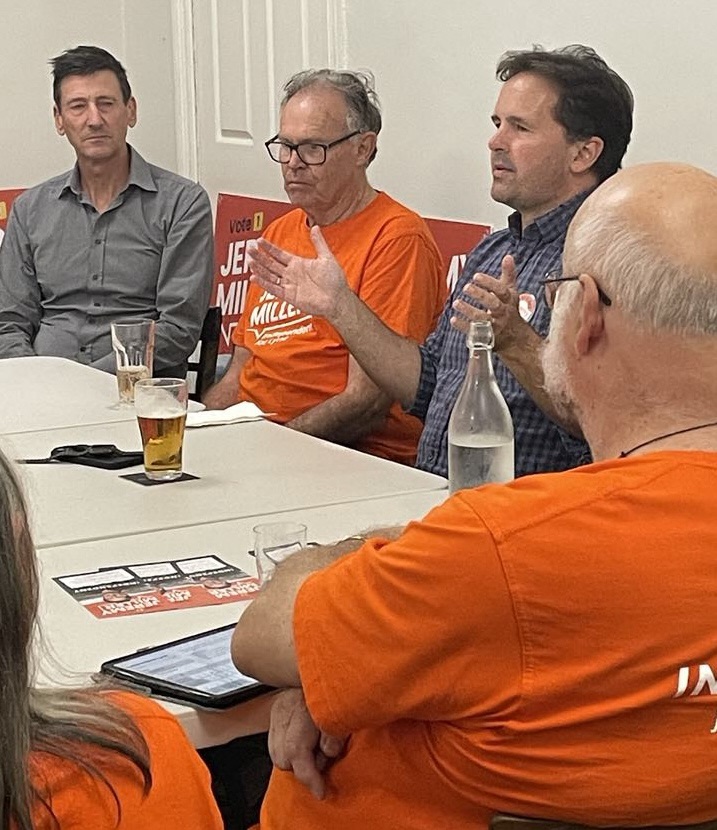
On Friday night, a crowd of interested folks gathered in the Central Hotel at Stroud to hear Jeremy speak about his life, his commitment to the community-supported model that Independents are following around the country, and his views on a range of issues.
The style wasn’t a typical “town hall meeting” where the candidate stands and speaks for a time before taking questions. Rather, it was more of a “kitchen table conversation”, with people sitting around the tables in the pub’s dining room and Jeremy fielding questions as they were raised. The back-and-forth meant that people could sense the integrity, knowledge, and commitment that Jeremy brings to his candidature.
No question was out of order for Jeremy. “What will you do to help address the changing climate?” He affirmed that the evidence of science should always be the guide to what we do. “How will you help motorists who are frustrated with the long wait time to get onto the highway, with flyovers not likely for at least 15 years?” Jeremy indicated he will take this on notice and investigate this once elected; “it’s a complex matter”. “How can we improve the roads in the electorate?” Jeremy noted that funding for roads in this electorate has declined $18mill in real terms over recent years; a restoration of the 1% of tax paid to councils for roads would be good!
“What do you think about nuclear power?” He responded that he is not convinced this is either environmentally or economically sensible, and does not see that government should run such a business. “What do you think about windfarms?” He noted that he is supportive, in principle, of renewable energy, but can see some unresolved issues with the specific proposal off Port Stephens). And “what are your views on immigration?” Jeremy’s answer began by affirming that Australia has been built on immigration; “we need a balanced intake but there are international agreements that we need to keep”, he noted.
A particularly important question put to him was “what would you do if you heard a clear view in the electorate that they want something that conflicts with your personal values?” Jeremy spoke about needing to hear the message clearly, but also about the role that a parliamentarian has in educating the electorate about complex issues. He cited the model of Participatory Democracy used by the Independent Member for North Sydney, Kylea Tink, who regularly gathers a “representative jury” from across the electorate to speaks a day considering expert views. At the end, the matter is presented to a Citizens Assembly for wider discussion. Jeremy plans to implement this if he is elected.
Finally, in response to the question, “why are you doing this?”, he cited his approach during the two decades that he worked as a DJ on local radio in Taree. “If I have the attention of people, I need to do something with it”, he said. “I didn’t want to squander the influence that this job gave me on silly and irrelevant things.” He cited the fact that, over the years, he has been active in his local P&C and in community action groups seeking to improve things in the community. He brings this same commitment to his role as a federal MP, representing the people of the electorate.
Jeremy Miller is the Community Independent for Lyne, chosen by community members across the Lyne electorate in response to a twelve month listening campaign aimed at prioritising the local needs of the Lyne electorate.
(Yes, that’s the left-rear perspective on yours truly in the front of this photo!)
One of the questions that is often put to Independent candidates relates to the issue of funding. “Where is your funding coming from?” “Your candidate is on the Climate 200 website—that means they’re a Teal, doesn’t it?” The implication is that Teal is somehow “Green-lite” and that there are murky climate-change figures lurking behind the group, feeding it money. Some basic figures might be helpful here.
For the 2022 election campaign, Climate 200 raised over $12 million and used it to back 23 independent candidates. These include Dr Monique Ryan, Zoe Daniel, Kylea Tink and Allegra Spender. The crowdfunded initiative received donations from every electorate in the country, with 11,500 donors in total. One third of these came from rural and regional areas.
Over the past financial year, Climate 200 has disclosed that they have received a total of $4.4m in donations. One donor, Robert Keldoulis and his investment firm Keldoulis Investments Pty Ltd, gave $1.1 million. Climate and energy market-focused trader Marcus Catsaras also donated $1 million. Other donations came from the large number of individuals, located right around the country, who are keen to support independent candidates who support an evidence-informed response to climate change, integrity in parliament, and gender equity. That’s all they ask for; they don’t govern the policies of each candidate.
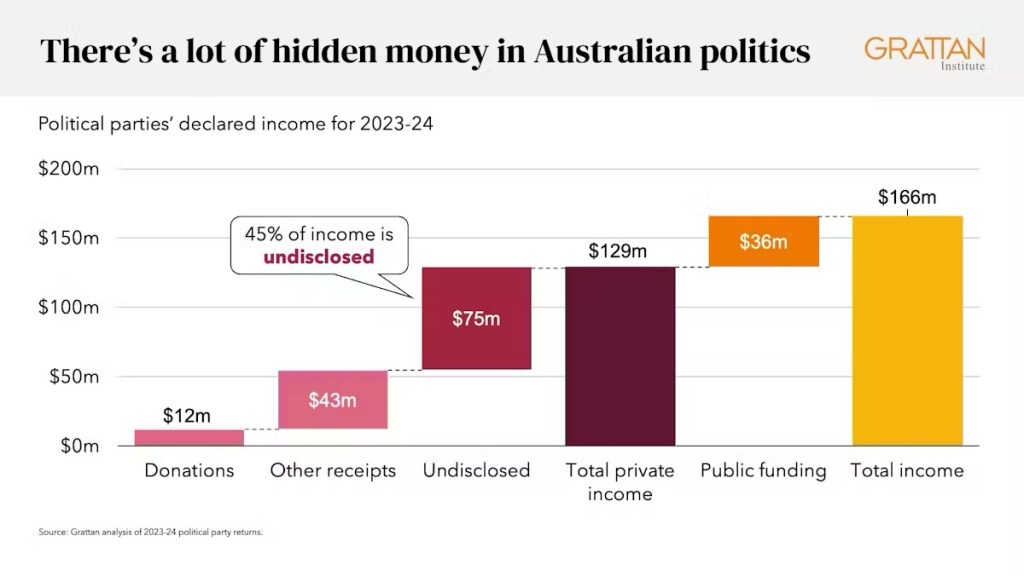
Alongside that $4.4 million given to Climate 200, we should place the major parties. The Australian Electoral Commission recently published a report which indicated that almost $160m flowed to the established major parties (Labor, Liberal, National, and Greens) in the past financial year, in preparation for the 2025 election. Labor’s branches received a total of $67.5m in receipts in the past financial year, compared with the Liberals’ and Nationals’ combined $72.2m. The Greens received $17.1m.
Whilst the majority of these donations were declared, the source for $67.2m was not declared. That’s troubling. The major parties apparently have ways around the laws that are still in place for this election. About half of what was donated to the Coalition has not been publically declared. It’s a lesser proportion for Labor. But that is still a worry.
Betting companies gave large amounts to Labor. In 2022, Sportsbet donated $88,000, Tabcorp $60,500 and the peak body Responsible Wagering Australia gave $66,000. Overall, Labor received almost $300,000 in 2021–2022, the Liberals a little over $100,000, and the Nationals received around $80,000.
Figures reported to the Australian Electoral Commission and analysed by the parliamentary library, show donations from the biggest gambling companies involved in horse betting to the major parties have increased from $66,650 in 2013–14 to $488,000 in 2022–23, representing a 632% growth. The major parties have taken this money without gumption. It’s a disgrace.
The Labor Party and the Liberal Party do not accept donations from tobacco industry players, but other parties do. In 2021–22 for example, Philip Morris Ltd donated $110,000 to political parties, split between Liberal Democratic party and the National Party.
The two major parties continue to receive donations from fossil fuel companies. Gina Rinehart’s Hancock Prospecting donated $500,000 to the Coalition, while the Minerals Council of Australia gave $382,465 in donations to several Labor and Coalition branches.
A report released this week predicts that a Coalition proposal to limit the rollout of renewable energy could stop at least $58bn of private investment in new developments and halt billions of dollars in flow-on spending in communities. Although it has not said it would limit renewable energy to 54%, the Coalition has said that it would not support as much solar and wind energy, and that it would scrap Labor’s $20bn rewiring the nation fund to build transmission links across the country.
That’s what comes from accepting fossil fuel money and supporting a destructive, dying industry. The policies of the Coalition—and, indeed, the policies of Labor—continue reflect that they cannot give up their damaging addiction to fossil fuels. We are helping to sign the death warrant of humanity and the planet by continuing on this path.
Climate 200 passes on all donations received to community-supported Independents. They report that their donors come from all walks of life. “They include entrepreneurs, farmers, tradespeople, professionals, teachers, pensioners, and health care workers. One-third are from rural and regional Australia and collectively they hail from every single electorate in the country.”
They note that “All our donors hoped for a better future for the planet and a more civilised politics.” That’s a markedly different motivation from the donations made by commercial business interests, who lobby the government incessantly and fund all major parties with the intention that they will be able to influence legislation. It’s a cancer at the heart of our system.
Climate 200 also notes that all their donors who give above the disclosure threshold each financial year “will be disclosed in accordance with AEC regulations, [however] the majority of our donors are below this threshold and have agreed to share their identity anyway.” There is full, open, transparent disclosure. Unlike the major parties, who are shifty and reticent about the declarations that they do have to make. It’s a clear contrast, offering a clear choice.
*****
In writing this blog, I have consulted the following websites:
• Represent your interests not party or big business interests
• Collaborate across party lines and take the best of both views
• Prioritise practical solutions over party driven agendas
• Speak up on important issues as they’re not silenced by party interests
• Reflect your values and concerns, not the party platform
True Representation of Local Interests Independent candidates are not bound by party lines, meaning they can focus entirely on the needs and concerns of their local community. This ensures that your voice is heard without the influence of national party politics.
Greater Accountability Independent MPs are directly accountable to their constituents, not a political party. They must work to earn your trust and support with every decision, giving you more direct influence over the political process.
Less Partisan Gridlock With no allegiance to a political party, an Independent can work across party lines, pushing for policies that benefit the community rather than getting caught up in party politics. This leads to more practical and effective solutions for pressing issues.
Freedom to Speak Up on Important Issues Without the constraints of party policies or backroom deals, Independent MPs can speak freely on important matters, advocating for change and challenging both sides of the political spectrum when necessary to improve local and national outcomes.
Focus on Practical Solutions Independents often bring a more pragmatic approach to governance, focusing on tangible solutions to local problems. This means they are more likely to push for policies that address real issues such as housing, healthcare, and cost of living without getting bogged down by political agendas.
Empowering the Voter Voting for an Independent candidate allows voters to have more control over their representation. It encourages a shift away from the traditional two-party system, giving individuals the power to choose someone who best reflects their values and concerns, not just a party platform.
Authorised by Jeremy Miller, Independent for Lyne 224 Dowling St Dungog NSW 2420
I have been exploring just how it is that my federal electorate of Lyne has been “represented” National Party incumbent in recent times. It’s quite revealing.
The member who “represented” the people of Lyne in Canberra for the past three years has consistently voted
AGAINST increasing support for rural and regional Australia
AGAINST improving housing affordability
AGAINST growing our investment in renewable energy
AGAINST increasing workplace protection for women
AGAINST a transition plan for people working in the coal industry, whose jobs will become obsolete in the future
AGAINST treating the COVID vaccine rollout as a matter of urgency
But the voting record for our representative is not always NO; unfortunately, it is sometimes YES. In the same period of time, our member has voted
FOR getting rid of penalty rates on Sundays and public holidays
FOR political intervention into research funding grants
FOR privatising more government services
FOR banning mobile devices in immigration centres
FOR decreasing the availability of welfare payments
FOR putting welfare payments onto a “cashless card” system
Is this really how we want to be represented in parliament? These issues are all central to the commitments that the National Party has—all their members voted the same way. They showed little concern for local issues, but were focussed on “following the party line”.
As the saying goes, “if you want things to change, you need to change the way you vote”. A vote FOR Jeremy Miller will ensure that the concerns of people in the electorate are heard and considered, and that there will be strong advocacy about what really matters to you.
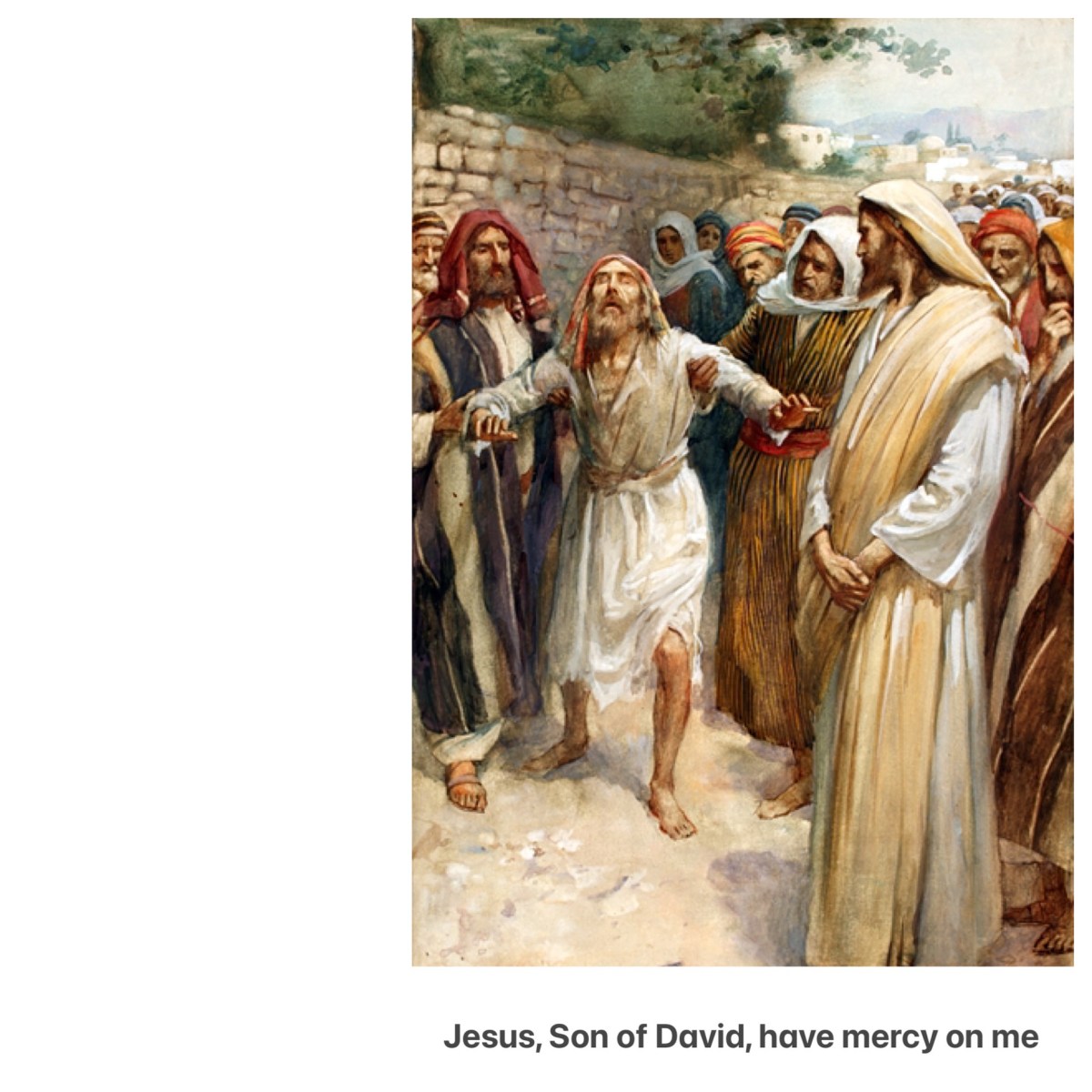
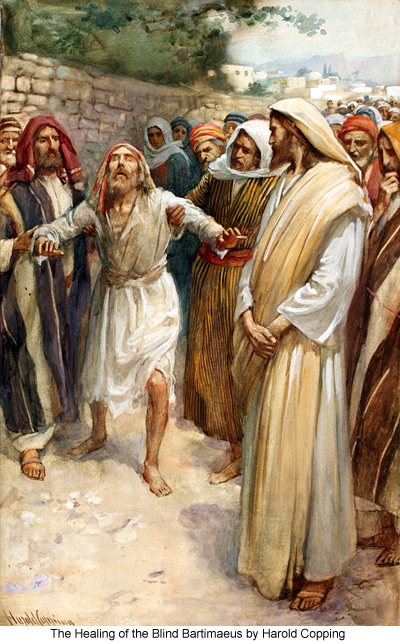
The man sits on the ground, beside the road leading into Jericho. Sensing what was happening, who was passing by, what was being spoken about; unable to use his eyes, he was undoubtedly attentive through his listening ears, through the sounds he could hear, as well as the fragrances he could smell. Because of this, he knew the identity of the person passing by, so he calls out with confidence, “Jesus, Son of David, have mercy on me” (Luke 18:38).
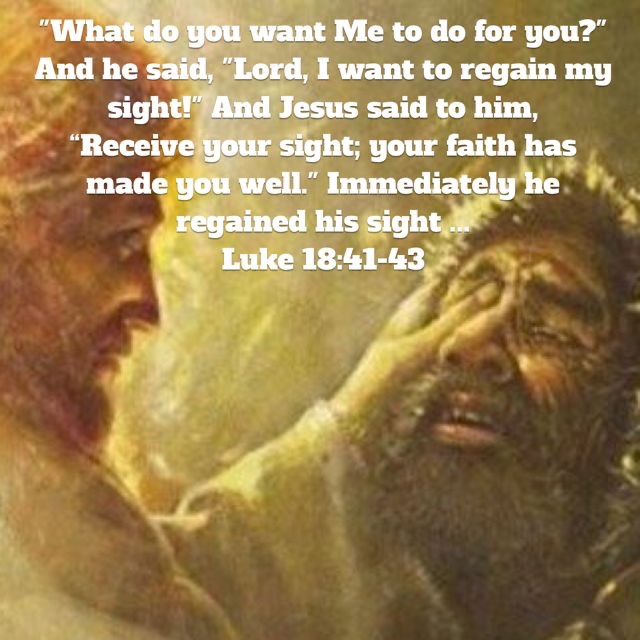
Jesus pauses, engages with the man, and responds to his plea. “Receive your sight; your faith has saved” (18:42). The man, all of a sudden, could see; all was clear, so he took his place among those following Jesus on the way (18:43).
This incident takes place towards the conclusion of the lengthy journey that Jesus undertook with his disciples, from Galilee in the north (4:14, 31; 5:17; 8:1, 26, 40), through Samaria (9:51–56; 17:11–19) and into Jericho (18:35; 19:1) en route to Jerusalem (19:11, 28, 41). That journey had I commenced soon after Jesus had been transfigured on the top of a mountain (9:28–36). This striking event, at which Moses and Elijah appeared, pointed towards the exodon (NRSV, “departure”) which Jesus “was about to accomplish at Jerusalem” (9:31).
The essence of that exodon is revealed by Jesus in the words he speaks to his disciples both immediately prior to, and soon after, his transfiguration. Before, he declares “the Son of Man must undergo great suffering, and be rejected by the elders, chief priests, and scribes, and be killed, and on the third day be raised” (9:22). After, he provides a brief summary: “the Son of Man is going to be betrayed into human hands” (9:45). The journey to Jerusalem would be a journey to his death. When this journey is almost at an end, Jesus returns to this teaching, reminding them “we are going up to Jerusalem, and everything that is written about the Son of Man by the prophets will be accomplished” (18:31).
At the start of the journey, the disciples had exhibited a thorough and complete lack of understanding at the teaching of Jesus. Luke provides a succinct threefold declaration that “they did not understand this saying; its meaning was concealed from them, so that they could not perceive it”, before noting that “they were afraid to ask him about this saying” (9:45).
Over the course of the journey, Jesus has taught, healed, told parables, and cast out demons, all of which (we might imagine) could have alerted the disciples to the true nature of the mission of Jesus. So, when the group approaches Jericho, Jesus reminded them of his earlier words, giving more extensive details about what this entails: “he will be handed over to the Gentiles; and he will be mocked and insulted and spat upon; after they have flogged him, they will kill him, and on the third day he will rise again” (18:32–33).
Whilst the disciples were completely ignorant at the start of the journey—at the end, sadly, they were apparently none the wiser. Luke again offers a succinct threefold exposé of the continued ignorance of this group: “they understood nothing about all these things; in fact, what he said was hidden from them, and they did not grasp what was said” (18:34).
So the healing of the blind man functions as an enacting of the teaching of Jesus; it is a moment of revealing that Jesus was, no doubt, hoping would become evident to his followers. As the blind man hear the noise of a nearby crowd, he enquires and is told, “Jesus of Nazareth is passing by” (18:37). The man, it seems, does not share the ignorance or hesitancy of the disciples; he immediately reaches out to the man passing by, calling out “Jesus, Son of David, have mercy on me!” (18:38), and then repeating the plea when he was told to be quite (18:39).
The request, “have mercy on me”, sounds much like a prayer to God; it exactly echoes the prayer in a psalm attributed to the penitent adulterer-murderer, David (“have mercy on me, O God, according to your steadfast love”; Ps 51:1) as well as the cry of the pilgrim travellers heading towards Jerusalem (“have mercy upon us, O Lord, have mercy upon us”; Ps 123:3) and another psalm ascribed to the time “when David fled from Saul in a cave” (“be merciful to me, O God, be merciful to me, for in you my soul takes refuge”; Ps 57:1). This phrase has, of course, become the basis of a much-repeated prayer amongst pious Christians: “Lord, have mercy on me”.
Indeed, God’s mercy is acknowledged in many psalms—most notably in the well-known affirmation, “surely goodness and mercy shall follow me all the days of my life” (Ps 23:6), but also in another dozen places (Ps 25:6; 40:11; 69:16; 79:1; 86:15; 103:4; 111:4; 116:5; 119:77, 156; 123:2–3; 145:8). God’s mercy is integral to the repeated biblical affirmation, “the Lord is merciful and gracious, slow to anger and abounding in steadfast love” (Ps 103:8; see also Exod 34:6; Neh 9:17; Ps 86:15; 145:8; Joel 2:13; Jon 4:2).
The man by the road knows of this divine mercy, and believes he will receive it from Jesus. He stands as a striking contrast to those walking with Jesus along the road who, despite an extended time of learning from Jesus, fail to understand him. This man knows exactly what Jesus offers, and he pleads for it. And the immediate response from Jesus was to restore his sight, affirming “your faith has saved you”(18:42)—the same affirmation given to the woman who, before he had set out on this journey, had anointed his feet (7:50).
The conclusion to the story is clear and impactful: “he regained his sight and followed him, glorifying God; and all the people, when they saw it, praised God” (18:43). This man responds to the actions of Jesus as he “followedm him”; he joins those already following him, his committed disciples (5:11, 27–28; 7:9; 9:11, 23, 57–62; 14:27; 18:22, 28), as they walk into Jerusalem.
The man’s response of “glorifying God” shows that he knows the source of the power that Jesus had to heal. It replicates the response of the paralytic man who had been healed by Jesus (5:25). The response of the crowd, “praising God”, echoes the words of Simeon over the infant Jesus soon after his birth (2:28), and anticipates the response of the centurion at the very moment of the death of Jesus (23:47). It also resonates with the responses of the crippled woman (13:13) and the Samaritan leper (17:15), each of whom recognises the divine source of the power manifested by Jesus.
One of the questions that is often put to Independent candidates relates to the issue of funding. “Where is your funding coming from?” “Your candidate is on the Climate 200 website—that means they’re a Teal, doesn’t it?” Some basic figures might be helpful here.
In the 2022 election, Climate 200 donated a total of $6.5 million, distributed amongst 19 candidates. This money had come from 6,750 donors—including Simon and Karina Holmes à Court, but obviously including so many more than them. That indicates widespread support for Independents amongst the community; the vast majority of C200 donors were individual supporters of the community-backed Independents.
However, the $6.5 million from Climate 200 for community-backed Independents pales into insignificance when we note the donations received by the two major parties. For the 2022 election, Labor raised $124 million to spend on its electioneering, and the Coalition raised $115 million. Together, that’s 36 times more money than was provided by Climate 200.
And the bulk of these donations come from a small number of well-heeled individuals: the top 5% of donors provided 82% of the donations to the major parties. The Centre for Public Integrity reports that the top 5 individual donors to the ALP contributed $205.4 million, (that’s 34.5% of their total donations), while the top 5 donors to the Coalition contributed $118.8 million (22.6% of their total donations). So who is calling the shots? Just a few very rich people.
Many of the community-supported Independent candidates ran strong grassroots campaigns in the 2022 election, attracting much more of their funding support from donations made by community members. For example, Monique Ryan raised $1.8 million from 3,762 donors for her successful campaign to unseat former treasurer Josh Frydenberg in the Melbourne seat of Kooyong. This clearly reflects the higher socio-economic level of the population in this electorate, compared with western Melbourne or western Sydney seats, where support at such a level would not be able to materialise.
Climate 200 has been completely transparent about the individual donors whose money is them distributed amongst community-nominated Independent campaigns that they supported. They are listed by name on their website:
These donors support C200 in its platform of assisting Independent candidates with community support, who are each committed to the three basic areas of responsible climate policies, integrity in government, and gender equity. These three areas are designed to ensure a focus on equity within society. Our federal members need to represent us all.
By contrast, the fossil fuel industry has provided strong support for the major parties in an attempt to further their environmentally damaging projects, which bring financial benefit to their businesses. Their intense lobbying and continued financial support is intended to get these parties to support their businesses enterprises, and to slow or stall the support given to renewable sources of energy,which are much more environmentally responsible.
The Australian Electoral Commission has published the figures of where donations came from in the 2022 election, and it shows that:
Fossil fuel industry sources gave more than $2.3 million to the major political parties ($1.4 million to Labor and over $900,000 to the Coalition parties).
The mining and energy division of the CFMEU union ($500,000) and industry lobby group the Minerals Council ($105,000) were the biggest fossil fuel interest donors to Labor, while oil and gas lobby group APPEA ($56,700) was also a big contributor.
Tamboran Resources, the company that plans to extract gas from the Beetaloo Basin, donated a combined total of $200,000 to Labor, Liberal and National parties.
Oil and gas giant Woodside donated a total of $109,930 to Labor, Liberal and Nationals.
Mineral Resources Limited ($135,000) and gas giant Santos ($77,310) were the biggest individual fossil fuel company donors to Labor.
Coal miner Adani donated $100,000 to the Liberal-National Party in Queensland.
Climate 200 estimates that if the proposed changes to electoral funding are in place for the 2028 election, the two parties could expect to receive 2.44 times as much as in 2025, with the forecast windfall increasing by $82.66m to $140.01m. This includes an estimated $16.53m in new administrative support funding.
These calculations are based on the Reserve Bank of Australia’s inflation projections, the current trajectory of first-preference voting for the two biggest parties and the proposed rate of public funding per eligible vote.
So any criticism of the support given to community-nominated and community-supported Independents should be placed alongside these figures!
******
Declaration of interest: for the 2025 federal election I am an active and committed member of the campaign team for Jeremy Miller,who is the community-supported Independent candidate in the seat of Lyne.















 An Informed Faith