There in heaven a door stood open (Rev 4)

In the book of Revelation, we are invited into a world of unfettered imagination, with evocative imagery, enticing language, and disturbing rhetoric. The whole book comes from words spoken by “one like the Son of Man, clothed with a long robe and with a golden sash across his chest” (Rev 1:13). Clearly, it is a vision of the glorified Jesus Christ, now conveying his “revelations” to John, who is instructed to write letters to seven churches (in chapters 2—3) and then to detail a series of amazing visions (in chapter 4 onwards to the end of the book). 

Each vision contains graphic descriptions and dramatic happenings. The first of these visions (proposed for this coming Sunday in the Narrative Lectionary Summer Series for this year) sets the scene set for what will later be revealed as a colossal, cosmic battle between good and evil. 
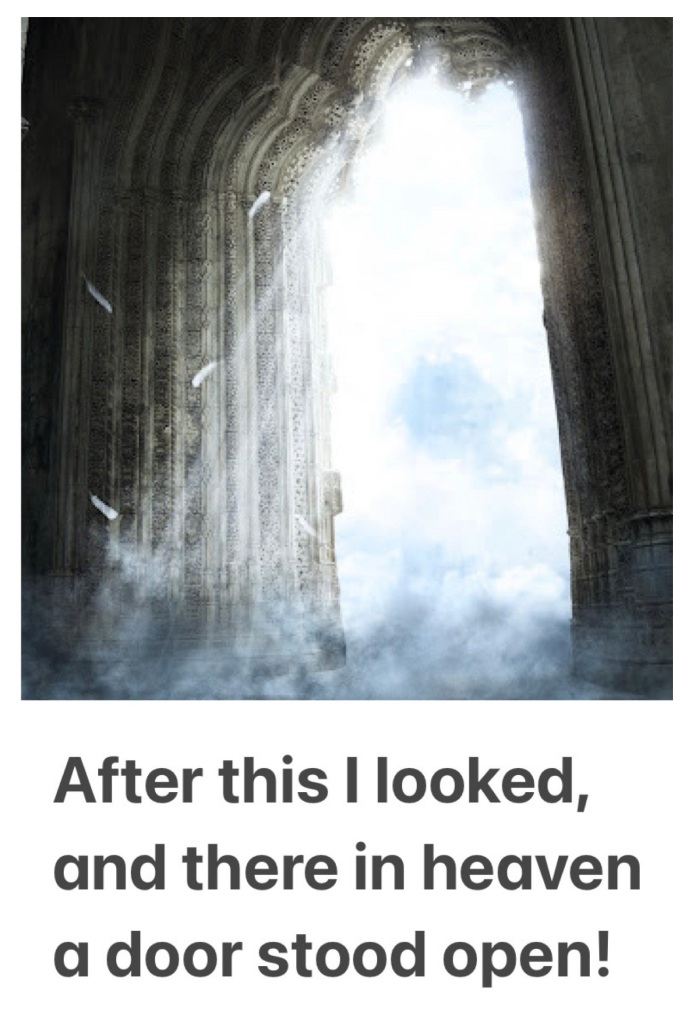
It opens with the striking claim that the door into heaven is opened (4:1). A disturbing and increasingly detailed dramatization of “what must take place after this” is revealed. The vision comes to a climax with an image of a slaughtered lamb (5:11–14), which  is the passage set in the Narrative Lectionary for a week after this coming Sunday.

Gazing into heaven, the author views a magnificent scene of worship. The importance of this scene is signalled by gleaming jewels and a shining rainbow, golden crowns and white robes, thrones and torches of fire, a sea of glass, grumbling thunder and flashes of lightning (4:3–6).

Thunder and lightning were characteristic of the God of Israel. In the book of Job, Elihu praises God, describing “the thunder of his voice and the rumbling that comes from his mouth … his voice roars; he thunders with his majestic voice” (Job 37:1–5). The psalmist sings of  “voice of the Lord over the waters” which thunders with powerful and is “full of majesty” as it “breaks the cedars of Lebanon … flashes forth flames of fire … shakes the wilderness of Kadesh … causes the oaks to whirl, and strips the forest bare” (Ps 29:3–9).

Thunder and lightning were associated with the foundational event of Israel, in the Exodus from Egypt. David sang of how the Lord God “thundered from heaven; sent out arrows, and scattered them—lightning, and routed them; then the channels of the sea were seen, the foundations of the world were laid bare at the rebuke of the Lord, at the blast of the breath of his nostrils” (2 Sam 22:14–16; Ps 18:13–19). The same graphic descriptions occur at Ps 77:16–20. 

In the book of Exodus, the scene at Mount Sinai includes thunder and lightning, a thick cloud, the blast of a trumpet, the shaking of the mountain and a spreading haze of smoke from the burning fire, an intensifying of the trumpet blast and peals of thunder  (Exod 19:16–19). This was the setting for Moses’ encounter with the Lord, when (according to the story passed on through the generations) the foundation of Torah was laid. The biblical nature of the imagery is very clear; these are all associated with an encounter with the divine.

Twenty-four elders and four six-winged creatures sing praises to “one seated on the throne” (4:2–11), and to a slaughtered lamb “with seven horns and seven eyes” (5:1–14). The hymns they sing in chapters 4, 5, and 7 appear to combine attributes of God which feature in scriptural songs of praise (holy, worthy, glory, honour, power, creator) as well as elements familiar from other New Testament texts in which early Christian thinking is developing. The twenty-four elders, sitting on thrones (4:4), along with the seven spirits (4:5; see also 1:4; 3:1) represent numbers of great symbolism throughout scripture, if we consider the twenty-four to comprise two lots of twelve.

The four living creatures each have a distinctive facial feature: “the first living creature like a lion, the second living creature like an ox, the third living creature with a face like a human face, and the fourth living creature like a flying eagle” (4:7). These four creatures allude to the chariot vision which opens the book of Ezekiel, in which the prophet sees four such creatures, with “the face of a human being, the face of a lion on the right side, the face of an ox on the left side, and the face of an eagle” (Ezek 4:10). These creatures emerge out of the midst of “

“a great cloud with brightness around it and fire flashing forth continually, and in the middle of the fire, something like gleaming amber” (Ezek 4:4), later revealed to be a magnificent chariot (Ezek 4:15–28), on which sat “something that seemed like a human form” (v.26).

Jesus is depicted in this book as “one like the Son of Man, clothed with a long robe and with a golden sash across his chest” (Rev 1:13). He is the supreme authority, the one who has risen from the dead and is at one with God (1:18). Yet there is a stark counterpoint running throughout the whole book. Jesus is the one who has been pierced (1:7); perhaps this evokes the piercing of Jesus’ side as he hung on the cross (John 19:34–37, citing this as a fulfillment of Zech 12:10).

In this initial vision, the Lord God Almighty is seated on the throne, surrounded by four six-winged creatures (4:2–11), perhaps reminiscent also of the six-winged seraphim seen by Isaiah in his vision in the temple (Isa 6:1–2). The one on the throne is holding a scroll with seven seals, which no one was able to open (5:1–4). These seals form the basis for the sequence of visions in 6:1—8:1, culminating in the vision of seven angels holding seven trumpets (8:2), yet another angel burning incense (8:3–4), and the inevitable “peals of thunder, rumblings, flashes of lightning, and an earthquake” (8:5). The markers of the divine are evident once more.

The author continues on, to introduce the one who has power to open the scroll: “the Lion of the tribe of Judah, the Root of David” (5:5)—phrases which clearly evoke the Davidic lineage of Jesus which the Gospel writers have so carefully claimed. (The same Davidic lineage is noted at 22:16.) Immediately, and despite the magnificent splendour of the scene being described, with its many dazzling jewels and angelic creatures, this “Lion” is described as a “Lamb standing as if it had been slaughtered” (5:6).
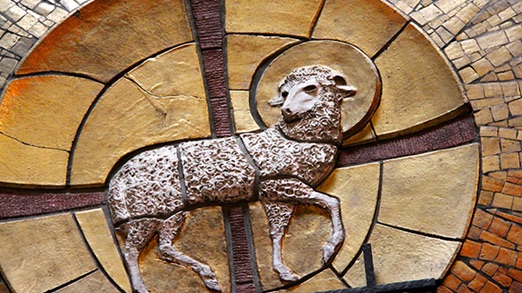
This paradoxical description of Jesus as “the Lamb that was slaughtered” recurs in hymns later in the book (5:9, 13; 13:8). His victory has been won, not through the power of force, but by submission to death. It seems that it is the fact that he has been slain which qualifies him to open the scroll. His power lies in his avoidance of violence, his submission to death.

This theme is the power that this strange book from a distant past offers us in the turmoil of the present. Our world today—as, indeed, the world time and time again over the centuries—is beset by conflict, aggression, and devastating warfare. Mass starvation and the killing of civilians in Gaza; a genocide, many now (rightly) say. Decades of terrorist activity and the exercise of military power in Israel, the West Bank, Gaza, and surrounding nations. An entrenched military battle on many fronts in the Ukraine, bogged down in the ego of a long-term tyrant. Ethnic violence and long-enduring civil warfare in the Sudan. Armed uprisings in the Congo. A civil war in Myanmar following the 2021 military coup. The list could go on to cover many–far too many–places.

The Geneva Academy of International Humanitarian Law (an institute of the University of Geneva) is monitoring more than 110 armed conflicts which are currently active across the globe. It’s a sad testimony to human greed for power, and to the seemingly endless capacity to inflict terrible damage on others.

The Way of the Lamb is a way that turns away from conflict as a means to resolve differences. In 1982, the National Assembly of my church (the Uniting Church in Australia) passed a resolution declaring “that God came in the crucified and risen Christ to make peace; that he calls all Christians to be peacemakers, to save life, to heal and to love their neighbours. The call of Christ to make peace is the norm, and the onus of proof rests on any who resort to military force as a means of solving international disputes.” 

It reiterated this affirmation some decades later, in 2003, when the Assembly further declared that “that the Church is committed to be a peacemaking body”. This is central to who we are as a faith community. Many other church denominations around the world have similar resolutions marking a similar commitment. Pope John XXIII had issued his encyclical “Pacem in Terris” in 1963. Yet wars snd conflicts have continued. More recently, Pope Francis issued a “Prayer for Peace” in which he invited the faithful to pray, “Renew our hearts and minds, so that the word which always brings us together will be “brother”, and our way of life will always be that of: Shalom, Peace, Salaam!”. Pope Leo XIV prayed for peace in the Middle East and in other conflicted areas. The church yearns for peace. Too many leaders perpetuate antagonism, foment conflict, engender wars.

We need to recapture the central element of the way of discipleship as a commitment to the way of peace, as we seek to follow Jesus in our contemporary world. This is the vision of Revelation. May it be that, as we hear again of the door in heaven standing open, and the vision of the “Lamb standing as if it had been slaughtered”, we recommit to praying for peace, living in a peaceable way, and writing to our political representatives urging them to withdraw support for any armed conflict (including the withdrawal of arms and financial support for those perpetrating aggression). 
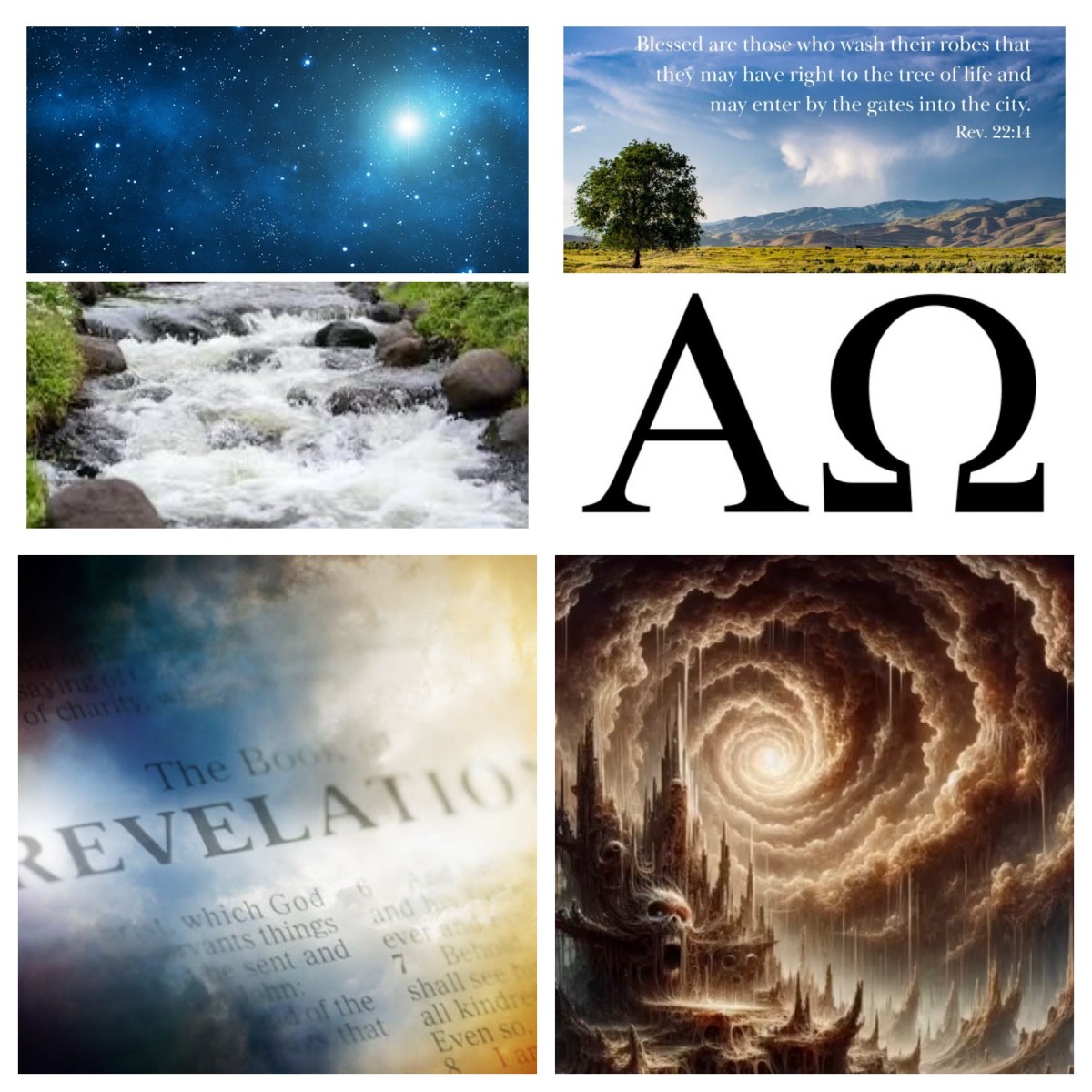
Alpha and Omega, bright morning star, water of life: final images in Revelation (Easter 7C; Rev 22)

During the season of Easter this year, we have read and heard passages from Revelation, the dramatic and vivid last book of scripture. We have encountered a number of creatively striking images: a white-haired, fiery-eyed figure like the Son of Man, a slaughtered lamb upon a throne, a multitude of white-robed people singing praises, a new heaven and new earth, and a city descending from the heavens. An amazing list, drawn from a book with even more amazing images in other chapters.

This Sunday, as the final Sunday in the seven-week season of Easter, we hear a passage which contains three striking images within the closing declarations and blessings that end the book (Rev 22:12–21). To give the creators of the lectionary their due, they have chosen not to excise a verse with a rather difficult message from the passage proposed—as they are wont to do at other times when dealing with other difficult verses.

So we will hear this Sunday the statement by John, as he concludes his long series of images, that whilst those who “wash their robes” will be firmly included within the holy city that has descended to earth (22:14; see 21:2, 10–26), those who are “dogs and sorcerers and fornicators and murderers and idolaters, and everyone who loves and practices falsehood” will remain outside, debarred from entry (22:15; see 21:27). The holy city will remain as the place which has “the glory of God and a radiance like a very rare jewel, like jasper, clear as crystal” (21:11). It’s a vibrant picture to bring to a close this year’s season of Easter, as we celebrate the risen Jesus in our midst.

In the midst of this exultant final vision of the book, we also hear this dire warning to all who read this book: “if anyone takes away from the words of the book of this prophecy, God will take away that person’s share in the tree of life and in the holy city, which are described in this book” (22:19). They are evocative of the instruction to Daniel, that the words of that book “are to remain secret and sealed until the time of the end” (Dan 12:9).

The book of Revelation has included many gruesome scenes where punishment—and, indeed, torture—are envisaged. As each of seven seals are broken and seven angels each blow their trumpet in turn (8:6–11:19), repeated scenes of destruction and devastation unfold across the earth. After the fifth seal is broken, locusts are sent to inflict on those who do not bear the seal of God on their foreheads five months of torture “like the torture of a scorpion when it stings someone” (9:3–5). After the sixth seal, “a third of humankind was killed by the fire and smoke and sulfur coming out of [the] mouths” of the four angels rampaging across the earth on their horses (9:15–19).

In subsequent visions, because of the evil that has infiltrated the whole world in multiple manifestations, a great red dragon threatens to consume the child born to a pregnant woman (12:1–4); a beast with ten horns and seven heads wages war “over every tribe and people and language and nation” (13:1–10); ad a group of seven angels pours out the wrath of God on earth, sea, rivers, sun, the throne of the beast, the great river, and into the air (15:1, 16:1–21). 

These visions climax with the vision of “the great whore”, Babylon, and “the beast with seven heads and ten horns that carries her” (17:1–8), who gatherers up all the sins of the world, whose sins “are heaped high as heaven, and God has remembered her iniquities” (18:5). Judgement comes upon her as  “plagues will come in a single day—pestilence and mourning and famine—and she will be burned with fire” (18:8, celebrated in song from v.10 to v.24). 

Then, in due course, the beast and the false prophet “were thrown alive into the lake of fire that burns with sulfur” (19:20), and last of all, after a millennium has passed, “the devil who had deceived them was thrown into the lake of fire and sulfur, where the beast and the false prophet were, and they will be tormented day and night forever and ever” (20:10).

These scenes of judgement, plagues, punishments, and torture, come to dominate the whole book. Yet none of these scenes appear in the passages selected for inclusion in the lectionary. The only negative notes in the passages included in the lectionary relate to the description of the lamb as one who has been slaughtered, but who now sits triumphant on the throne (5:6–14). So it is somewhat striking that this final passage includes these particular  negative notes. 

*****

In association with the celebratory notes attached to his vision of this holy city—the river of the water of life, the dazzling jewels of the city, the eternally-shining light from God, the celebrations around the throne of God and of the Lamb—John also offers striking statements about the figure whom he first described at the start of his book, the one “coming with the clouds” (1:7) whose face “was like the sun shining with full force” (1:16). This imposing figure is the one who is yet “coming soon” (22:12, 20). 

Three striking images characterise him in these final verses. None of these images should come as a surprise; they have each appeared earlier in Revelation, and indeed they tap into imagery in other books of scripture, in both testaments.

ALPHA AND OMEGA

The first striking image is one that was sounded at the very start of the book, when John was testifying “to the word of God and to the testimony of Jesus Christ, even to all that he saw” (1:2). Included in that early testimony is the claim that “the one who is pierced” is “coming with the clouds; every eye will see him” (1:7). At this, God himself speaks: “‘I am the Alpha and the Omega’, says the Lord God, who is and who was and who is to come, the Almighty” (1:8). 

Then, in the second of the seven letters to be sent to the seven churches (2:1—3:22), this claim is adopted by the author of the letter, “one like the Son of Man, clothed with a long robe and with a golden sash across his chest” (1:13). This figure adopts the words spoken by the Lord God as he declares “these are the words of the first and the last, who was dead and came to life” (2:8). It is a clear reference to Jesus, already identified as “the faithful witness, the firstborn of the dead, and the ruler of the kings of the earth”, the one who “loves us and freed us from our sins by his blood” (1:5–6).

The same claim recurs in the climactic closing vision of the book, when “the one who was seated on the throne” (21:5)—that is, the great white throne on which sat the judge of all humanity (20:11–16)—declared, “It is done! I am the Alpha and the Omega, the beginning and the end” (21:6). And then, after the vision concludes, the angelic figure seen by John reminds him, “I am the Alpha and the Omega, the first and the last, the beginning and the end” (Rev 22:13).

The words spoken by the Lord God, the one like a Son of Man, the judge on his throne, and his angelic messenger rekindle the image of God which had been described, centuries before, by the unnamed exilic prophet whose words are included as the second section of the book of Isaiah (Isa 40—55). “Who has performed and done this, calling the generations from the beginning?”, the prophet asks.”I, the Lord, am first, and will be with the last”, is the response (Isa 41:4). In a later oracle, the Lord God declares “I am the first and I am the last; besides me there is no god” (Isa 44:6); and still later, “Listen to me, O Jacob, and Israel, whom I called: I am He; I am the first, and I am the last” (Isa 48:12).

The significance of this claim is outlined in another prophecy: “Remember the former things of old; for I am God, and there is no other; I am God, and there is no one like me, declaring the end from the beginning and from ancient times things not yet done, saying, ‘My purpose shall stand, and I will fulfill my intention’” (Isa 46:8–10).

In the Revelation of John, these words are heard from the mouth of the one like a Son of Man, identified as Jesus (1:5; 22:16). Jesus is both Alpha and Omega, first and last; as the letter to the Hebrews declares in its idiosyncratic language, “without father, without mother, without genealogy, having neither beginning of days nor end of life, but resembling the Son of God, he remains a priest forever” (Heb 7:3).

BRIGHT MORNING STAR

A second striking image is that of the morning star, in the words of Jesus, “I am the root and the descendant of David, the bright morning star” (22:16). That image was first expressed early in this book, in one of the seven letters to the churches. In each of the seven letters included in this book, “those who conquer” are given a specific gift to signal their special status. To those in Thyatira, to signal the authority that is given to them “to rule [the nations] with an iron rod, as when clay pots are shattered”, the specific gift is “I will also give the morning star” (2:26–28).

The morning star is referenced in the book of Ecclesiasticus (Ben Sirach), in a poem which praises Simon son of Onias (high priest in the early C3rd BCE). After celebrating his work in repairing and fortifying the temple, the joy that he brought is described through a series of images: “How glorious he was, surrounded by the people, as he came out of the house of the curtain. Like the morning star among the clouds, like the full moon at the festal season; like the sun shining on the temple of the Most High, like the rainbow gleaming in splendid clouds” (Sirach 50:5–7, and continuing on for some verses). A similar use of the phrase appears in the second letter attributed to Peter, where “the prophetic message” is compared with “a lamp shining in a dark place, until the day dawns and the morning star rises in your hearts” (2 Pet 1:19).

It is the bright, dazzling quality of the star that rises early in the morning, before sunrise—the planet we know as Venus—that is in view here. We should note that there is no intention to allude to the words of Isaiah, who refers in one of his prophecies about the punishment that was imminent for the King of Babylon. The prophet warns, “Sheol beneath is stirred up to meet you when you come … you pomp is brought down to Sheol” (Isa 14:9, 11), before depicting this decline in poetic language: “How you are fallen from heaven, O Day Star, son of Dawn! How you are cut down to the ground, you who laid the nations low!” (Isa 14:12).

In the 17th century King James Version, “O Day Star” is rendered as Lucifer—since that is how “light-bringer” is expressed in Latin. This was the term used in the Vulgate, a late-4th century Latin translation of the Bible. This verse has been picked up in later theological developments and applied to the figure of the devil; it is probably also influenced by words attributed to Jesus in Luke 10:18, “I watched Satan fall from heaven like a flash of lightning”. 

However, this sense of the term does not relate at all to the way the imagery of “the morning star” appears in Revelation. In this book, the devil is depicted as “a great red dragon, with seven heads and ten horns, and seven diadems on his heads” (Rev 12:3; 20:2) who is “the deceiver of the whole world” (Rev 12:9) who is ultimately “thrown into the lake of fire and sulfur …[to be] tormented day and night forever and ever” (Rev 20:10).

WATER OF LIFE 

The third striking image in this final chapter of Revelation is “the water of life”. John had indicated that this water would be gifted to those who are thirsty (Rev 21:6). This gift comes from “the Lamb at the centre of the throne” who is the shepherd of “a great multitude that no one could count, from every nation, from all tribes and peoples and languages, standing before the throne and before the Lamb, robed in white, with palm branches in their hands” (7:9). This shepherd, says John, “will guide them to springs of the water of life, and God will wipe away every tear from their eyes” (7:17).

The imagery appears returns as integral part of the final climactic vision of “the holy city Jerusalem coming down out of heaven from God” (21:10). John writes that the angel showing him the vision of this city “showed me the river of the water of life, bright as crystal, flowing from the throne of God and of the Lamb” (22:1). 

The river brings water to nourish life, just as another John (compiling a Gospel narrative) attributes to Jesus words in which he offers water as the basis for life: “those who drink of the water that I will give them will never be thirsty; the water that I will give will become in them a spring of water gushing up to eternal life” (John 4:14). These words evoke the reality that all human beings know, that “the necessities of life are water, bread, and clothing, and also a house to assure privacy” (Sirach 29:21; see a similar, but expanded, list at Sirach 39:26).

The scene at the end of Revelation evokes the vision described centuries earlier by the prophet Ezekiel, in the final chapter of his book. Ezekiel details the water flowing from the temple, the abundant trees growing beside the river, and the food sources for the people (Ezek 47:1–12). It is a wonderful ecologically vibrant scene, as is the vision in Revelation, where “on either side of the river is the tree of life with its twelve kinds of fruit, producing its fruit each month; and the leaves of the tree are for the healing of the nations” (Rev 22:2).

So the book ends with words of grace: “The Spirit and the bride say, ‘Come’; and let everyone who hears say, ‘Come’, and let everyone who is thirsty come. Let anyone who wishes take the water of life as a gift” (22:17). It’s a nice closing note.

Ominous clouds overshadowing a joyous celebration (John 2; Epiphany 2C)

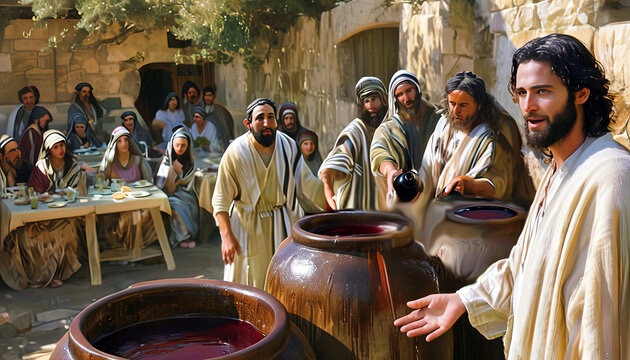
For the second Sunday in Epiphany, we are offered a passage from early in the book of signs—the work that we know as the Gospel according to John. It is the first sign performed by Jesus, when he was attending a wedding in the town of Cana in Galilee (John 2:1–11).

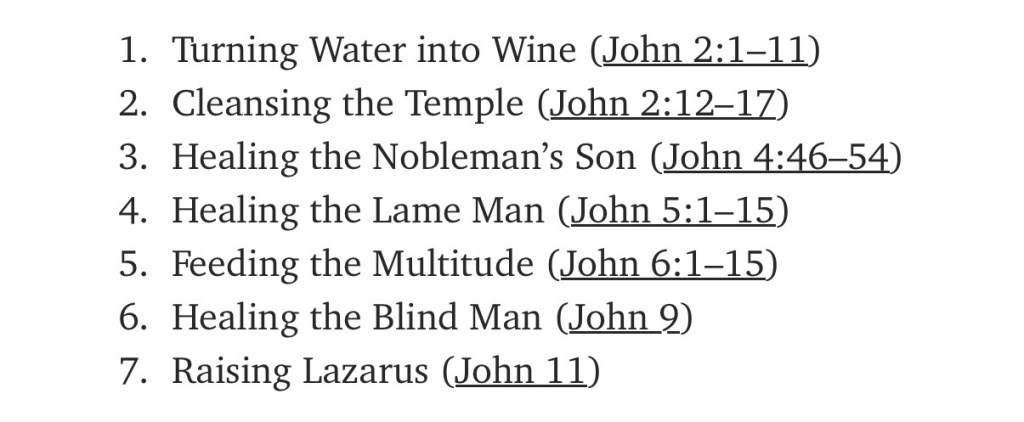
I call this Gospel the book of signs because it includes seven clearly narrated signs, or miracles, performed by Jesus. Most of them are inserted in the midst of an evolving narrative, in which followers of Jesus grow in their understanding of who he is, whilst at the same time a movement of those opposed to Jesus gains strength. Both of those features are evident in this first sign.

The author of this Gospel makes it clear that there were more signs performed by Jesus than what is narrated (20:30), and that the signs actually narrated are told in order to strengthen the faith of those hearing or reading them (20:31).

The first and second signs take place in Galilee (2:1–11, 4:46–54). Subsequent signs are located in Jerusalem (5:2–9), the Sea of Galilee (6:1–14), on the Sea of Galilee near Capernaum (6:16–21), back in Jerusalem (9:1–7) and then, for the seventh, and final, sign of those narrated, in Bethany, where Lazarus had recently died (11:17–44).

This final sign provides a clear climax to the Book of Signs, the first half of the whole Gospel. This is the miracle supreme—raising a dead person back to life takes some beating! It is told at some length, with many details, leading to the climactic moment of the appearance of the once-dead man, now alive. “The dead man came out, his hands and feet bound with strips of cloth, and his face wrapped in a cloth. Jesus said to them, “Unbind him, and let him go.” (11:44).

In the literary framework of the whole Gospel, however, this building to a climax through the seven signs is paralleled by the growing tension as leaders in the Jewish community marshal forces in plotting against Jesus. Initially, there were positive responses to Jesus (2:23, 4:42, 4:45). Then, an engagement in debate and controversy with “the Jews” (5:13) quickly escalated into persecution (5:16) and indeed an attempt to kill Jesus (5:18).

This early opposition then continues unchecked throughout the narrative. Whilst Jesus remained popular in Galilee (6:14, 34) and amongst some in Jerusalem (7:31, 40-41a, 46: 8:30; 9:17, 38; 10:21, 41) and Bethany (11:27, 45), hostility towards Jesus continued, being expressed both in verbal aggression (6:41, 52; 7:15, 20; 8:48; 9:18-19; 10:20), threats of his arrest (7:32, 44; 11:57), direct physical threats (stoning at 8:49, expulsion from the synagogue at 9:22, and stoning once more at 10:31) and threats against his life (7:1, 25, 32).

Then, at the climactic moment, after Lazarus appears, the Jewish leadership plans a strategy to put Jesus to death (11:45-53). The plot is hatched, the fate of Jesus is sealed. That section of the narrative also includes the famous, yet ironic, comment by Caiaphas: “it is better for you to have one man die for the people than to have the whole nation destroyed” (11:50). And so the inevitable process begins, moving towards the death of Jesus (11:53, 57). 

For the author of the book of signs, affirming the identity of Jesus shapes the whole narrative of this Gospel. Each sign points to the significance of Jesus. The first sign, in Cana of Galilee, manifests his glory (2:12); the next sign, also in Cana, fosters belief in Jesus (4:48, 53). What Jesus does beside the Sea of Galilee identifies him as “the Prophet who is to come into the world!” (6:14), whilst the sign performed in Jerusalem signal that he is  the Son of Man (9:35–38). Later, in Bethany, Jesus raises Lazarus from death, and Martha articulates the faith of others when she confesses Jesus to be Son of God and Messiah (11:27). Alongside these seven signs, the various interpersonal encounters that are narrated illuminate the identity of Jesus.

I read the whole sequence of scenes in this Gospel, from the wedding in Cana, with its implicit criticism of “the Jewish rites of purification” (2:1–11), through the heated debates of chs. 5—8, the high drama of the multi-scene conflict with Jewish leaders and “expulsion from the synagogue” in ch.9, on into the plot of ch.11, as a story that reflects the position of the followers of Jesus who comprised the community in which this book was eventually written. 

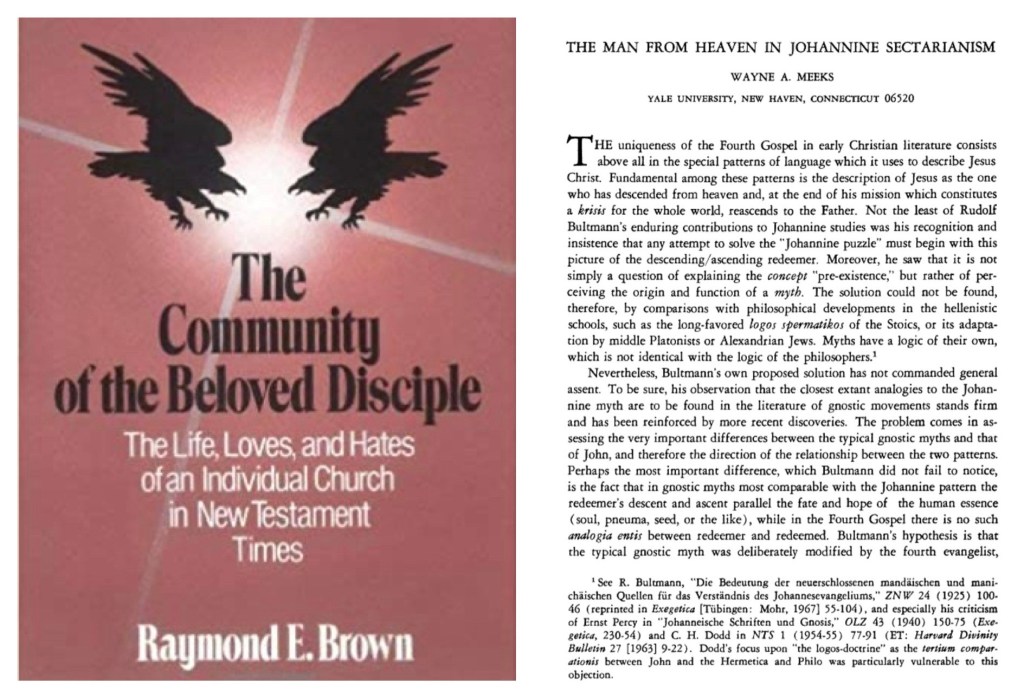
This group of people (what Raymond Brown called “the community of the beloved disciple”) had been rejected by their fellows, expelled from their community of faith, because of their views about Jesus. They had become yet another sectarian group in the mixture of late Second Temple Judaism, which then bled into early Rabbinic Judaism. 

It is this “Johannine sectarianism”, as Wayne Meeks called it, which explains the bruising debates in this Gospel; Jesus is being remembered as “standing up for the truth” by a group of people who had been pillaged and persecuted for standing up for what they say as “the truth”. They had become outsiders; some of them had met death for the stand they took. This was what it meant for them to be faithful to Jesus. 

This tragic development is a natural development, at least as the author tells it, from that initial sign, where Jesus is already portrayed as being in tension with others of his own faith. Although it was a wedding—a time of joyous celebration—there were ominous clouds overshadowing what transpired in Cana that day.

Wayne Meeks, “The Man from Heaven in Johannine Sectarianism”, JBL 91 (1972) 44–72)

Raymond E. Brown, The Community of the Beloved Disciple (Paulist, 1978)

A kingdom not from this world (John 18; The Reign of Christ, Pentecost 27B)

I preached this sermon for Project Reconnect, to be used in the resources they distribute for Sunday 24 November 2024, the Festival of the Reign of Christ. For information about Project Reconnect, see the end of this blog.

The church’s year is currently designated as Year B. During the year, on most Sundays we have heard from the Gospel of Mark, along with passages from the narrative of Samuel and Kings, some of the Wisdom Literature, and letters written by Paul and James, and more recently, the letter to the Hebrews. And each Sunday, one of the Psalms is designated also for us to hear, sing, and reflect on. 

The lectionary provides a rich offering throughout the three years that form the full cycle, ensuring that we read passages from all four Gospels and all major sections of scripture. The current year draws to a close this coming Sunday, as happens at the end of each church year, with the Festival of the Reign of Christ. After this Sunday, we enter a new church year, as the season of Advent begins for Year C, when the focus is on Luke, the prophets, and other letters.

The church’s year is organised differently from the calendar year; it revolves around the key events of our faith: the birth of Jesus, which we celebrate each Christmas, the death and resurrection of Jesus, which comes into focus at Easter, the birth of the Church, which we recall at the celebration of Pentecost, and the long season after Pentecost, when we attend to our life as disciples and the mission into which we are called as people of faith.

This Sunday, the day I am referring to as the festival of the Reign of Christ, has been known traditionally as the festival of Christ the King, when we commemorate the reign that Christ exercises over the world. I prefer the term Reign of Christ as at least one step away from the connotations that are associated with that archaic institution of monarchy. 

And that flags one of the questions that I have with this feast day: how do we maintain a contemporary feel about aspects of our faith that seem to be bound to older patterns and customs? It’s a question that relates to many aspects of our life in the church; how do we demonstrate the relevance for today of the ancient faith? It’s a question worth pondering.

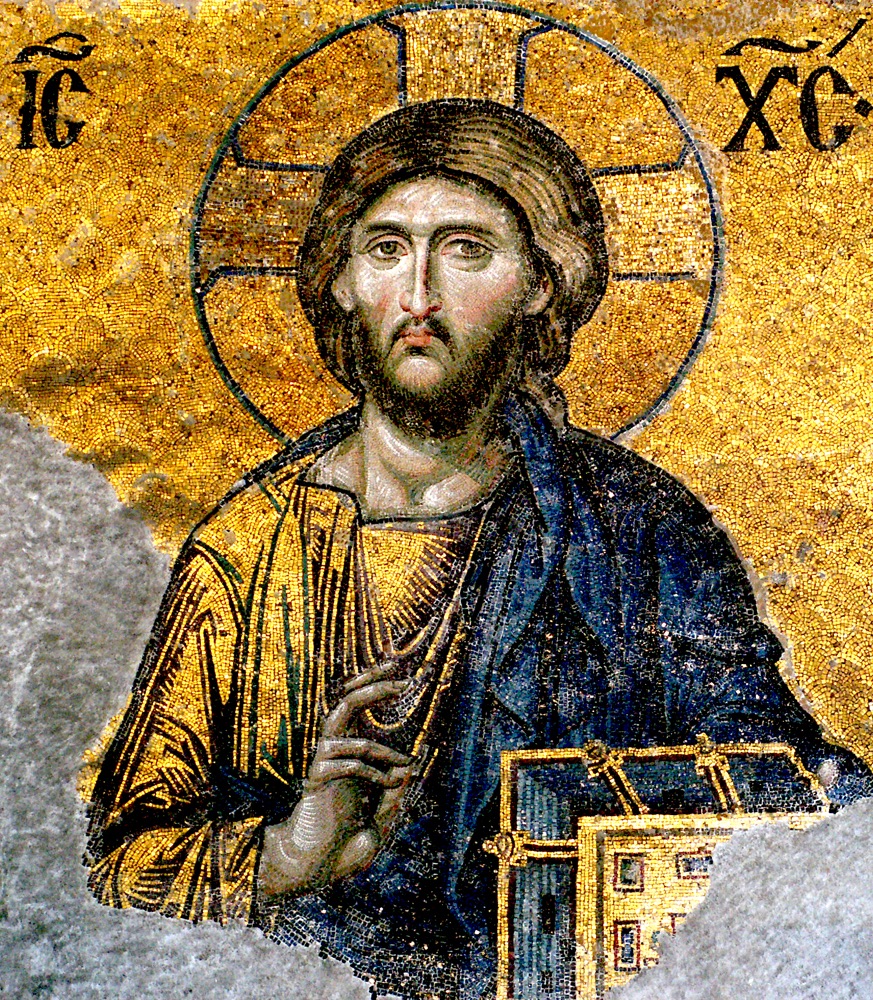
A depiction of Jesus Christ Pantocrator (ruler of all)
in the Hagia Sophia church (now Mosque) in Istanbul

The Reign of Christ is a relatively new festival in the calendar of church festivals—it was introduced by Pope Pius XI in 1925, and has since been adopted by Lutheran, Anglican, and various Protestant churches around the world, and also, apparently, by the Western Rite parishes of the Russian Orthodox Church Outside Russia. (Yes, that is a real denomination!) 

So that is a second question that I have relating to this day—along with Trinity Sunday, it sits as a day devoted to “a doctrine” developed later in the church’s life, rather than “a time in the life of Jesus”, which is what Christmas and Easter is, or “a time in the life of the church”, namely, Pentecost. Does it really belong in our pattern of seasonal celebrations?

In Roman Catholic tradition, the day is explained by some words from Cyril of Alexandria, a fifth century Doctor of the Church who served as Patriarch of Alexandria, in Egypt, from 412 to 444. In establishing this festival, Pope Pius XI quoted from the writings of Cyril: “Christ has dominion over all creatures … by essence and by nature … the Word of God, as consubstantial with the Father, has all things in common with him, and therefore has necessarily supreme and absolute dominion over all things created. From this it follows that to Christ angels and men [sic] are subject. Christ is also King by acquired, as well as by natural right, for he is our Redeemer. …’ We are no longer our own property, for Christ has purchased us with a great price; our very bodies are the members of Christ.”

However, the festival of the Reign of Christ has only been celebrated in the Roman Catholic Church since it was introduced by Pope Pius XI in 1925. This was a time when Fascist dictators were rising to power in Europe.  I have read that “the specific impetus for the Pope establishing this universal feast of the Church was the martyrdom of a Catholic priest, Blessed Miguel Pro, during the Mexican revolution”; see Today’s Catholic, 18 Nov 2014, at 

The article continues, “The institution of this feast was, therefore, almost an act of defiance from the Church against all those who at that time were seeking to absolutize their own political ideologies, insisting boldly that no earthly power, no particular political system or military dictatorship is ever absolute. Rather, only God is eternal and only the Kingdom of God is an absolute value, which never fails.”

The scriptures, as a whole, puncture the pomposity of powerful kings, and subversively present Jesus as the one who stands against all that those kings did. This festival provides a unique way of reflecting on the eternal kingship of Jesus. It offers a distinctive way for considering how the kingship bestowed upon David has been understood to last “forever”.

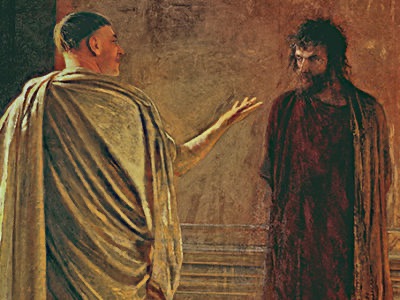
Indeed, if you had listened carefully to the Gospel reading, you would have heard the interaction between Pilate and Jesus, on this very matter. When Jesus is brought before the Roman Governor by the priests who had religious authority in Jerusalem, Governor Pilate asks him a direct question: “So, you are a king?”. I hear the question in this way: “So, Jesus, you think you are a king, do you?” 

Pilate, in this way of understanding his question, seems quite sceptical about such a claim, because the priests have brought their prisoner Jesus to him, indicating that he was “a criminal”, and seeking to have the Roman authority pass a sentence of death upon him. “Are you the King of the Jews?”, Pilate had asked Jesus—to which Jesus replies with his own question, “do you ask this on your own, or did others tell you about me?” The prisoner from Galilee knows that the Roman Governor is really just following the line presented to him by the Jerusalem priests.

Pilate’s response to this is to observe that “your own nation and the chief priests have handed you over to me”, so there must be an issue of some sort here. “What have you done?” is the naive question that Pilate then poses; Jesus answers, “my kingdom is not from this world”. In this response, Jesus seems to be accepting that he is a king—but not a king in the form that the rulers of the nations would recognise. It is no wonder that Pilate seems not to grasp the point. How can this bedraggled Galilean be a king over a kingdom “not from this world”.

So he presses the point. “So you are a king, then?” Jesus will not give a straightforward answer. He will not say, “yes, I am a king”; nor will he deny it, “no, of course I am not a king”. Rather, he diverts the focus, from the political reality of kingship, to the esoteric philosophical concept of “truth”. “For this I came into the world”, Jesus says, “to testify to the truth; everyone who belongs to the truth listens to my voice.” 

The implication is that he was not planning to lead a political uprising that would use force try to take over control of the land from the Romans; so Pilate should not have any fears on that account. Rather, says Jesus, “I came into the world to testify to the truth”.

Which draws from Pilate his most famous words, “What is truth?” According to the author of John’s Gospel, this trial scene morphed into a philosophical discussion—a development quite unexpected, and indeed, quite unrealistic. Which means, I think, that the whole scene is filled with irony. 

The first point of irony is when the Jewish priests, whose nation once did boast a king, tell the Roman Governor, “we have no king but the emperor”. The second irony is when the Roman Governor, whose nation had banned kings and despised this autocratic form of government, questions Jesus, “are you the king of the Jews?”. And the third moment of irony comes when Galilean prisoner, dressed with a crown of thorns around his head a purple robe on his shoulders, passes by the opportunity to give a clear answer and instead asserts, “my kingdom is not from this world”. 

From our point of view, as people of faith, many centuries later, we could well consider this ancient account quite strange. From our perspective, informed by centuries when deeper theological understandings have been developed and complex doctrine has been articulated, we may well see Jesus as God’s chosen human being, imbued with divine powers, enthroned as the King over all the earth. 

Why, we sing of him in this way: “Jesus shall reign where’er the sun does his successive journeys run”, “At the name of Jesus every knee shall bow”, “King of kings and Lord of lords”, “Come, Thou Almighty King … come, and reign over us”, “Rejoice, the Lord is King: your Lord and King adore!”, “Glory, glory, glory to the King of kings” … and many more.

So it is deeply embedded in our collective understanding that Jesus is, indeed, King who reigns over all, whose power and dominion covers the whole earth. And yet, in this passage, offered to us for the very festival of The Reign of Christ, the words of scripture invite us to reconsider: the nature of the Reign that Jesus envisages is radically different from the kind of reign that kings—and queens—have demonstrated throughout history. 

He is, as Graham Kendrick’s song so powerfully expresses it, our Servant King, who came as a “helpless babe”, who “entered our world … not to be served but to serve, and give [his] life that we might live”; for “This is our God, The Servant King, [who] calls us now to follow him, to bring our lives as a daily offering of worship to The Servant King”.

On this day, this festive celebration of the Reign of Christ, let us commit to following him not along the pathway of power, authority, prestige … but rather in service, with humility, through compassion, standing firm for justice, holding fast to a righteous way of living. For this is our king, the one who reigns, and this is the path that he calls us to walk.

Project Reconnect is a ministry of The Hunter Presbytery of the Uniting Church in Australia which provides a weekly worship resource for congregations, including a video sermon and a video all-age address, with music resources and discussion starters. See https://projectreconnect.com.au

To watch my sermon, see

24th November 2024 (Year B – Reign of Christ Sunday) “A Kingdom not of this World”

He took a little child … and taking it in his arms … (Mark 9; Pentecost 18B)

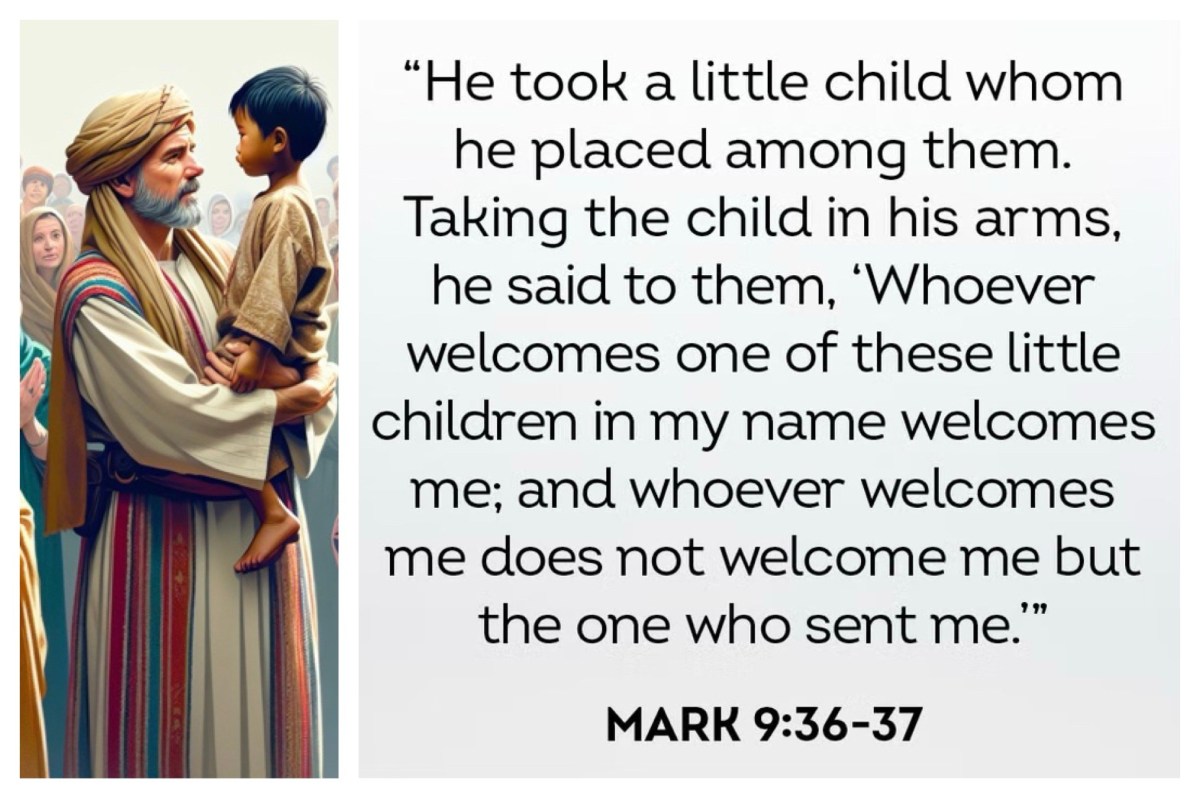
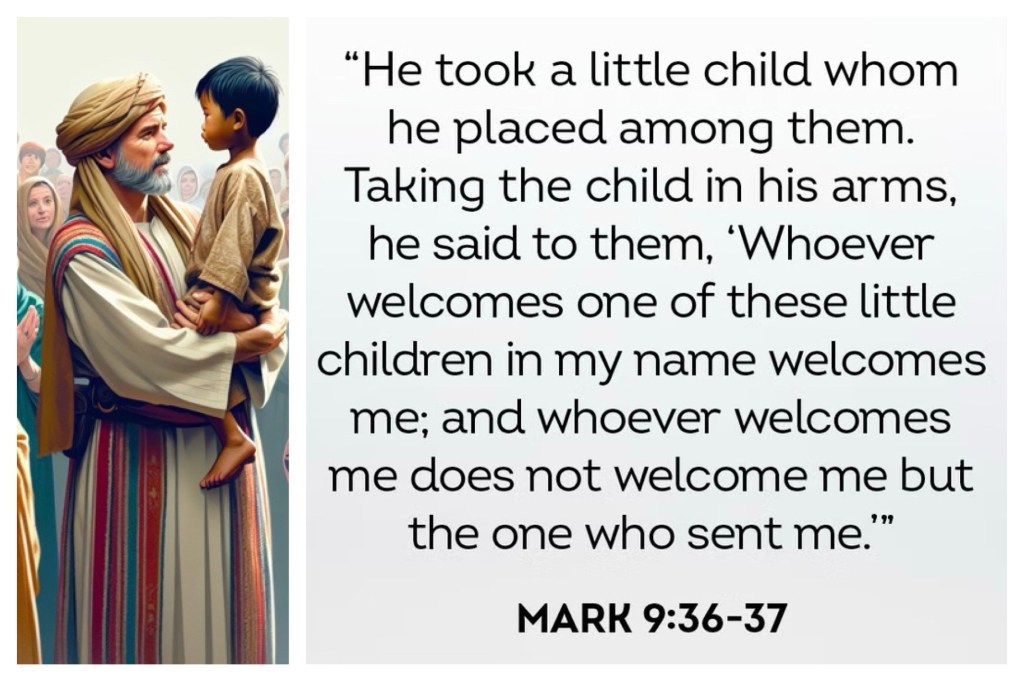
“Whoever welcomes one such child in my name welcomes me, and whoever welcomes me welcomes not me but the one who sent me.” In this striking statement, which occurs in the lectionary Gospel passage we hear this coming Sunday (Mark 9:30–37), Jesus does two important things.

The first is that he prioritises one of the least important figures in ancient society—a child—and puts them forth as a representative of him The second is that he then uses this affirmation as the basis for making a statement about his relationship to God.

First, Jesus affirms the central significance of a child in his consideration of this issue. Mark notes that Jesus “took a little child and put it among them” (9:36), using the presence of this child to undergird his statement about welcoming such a child (9:37). Still earlier, Jesus had placed the health of a child at the centre of his focus, when approached by a synagogue leader, who pleads with Jesus, “my little daughter is at the point of death; come and lay your hands on her, so that she may be made well, and live” (5:23).

In ancient times, a child was inevitably a person with no authority, no status, no prestige or power, in the society of the day; yet the low-status, not-important child is the exemplar, not only of Jesus, but of God, “the one who sent me” (9:37). Welcoming the  child is a clear manifestation of the paradox that lies at the heart of the Gospel. Jesus is the one who will walk resolutely towards death (8:31: 9:31: 10:34), becoming “the slave of all” (10:44) who will “give his life a ransom for many” (10:45). Along this pathway, it is the child who best exemplifies the simplicity of this sacrificial service; it is the child who best prefigures the fullness of life promised in the coming age.

Interestingly, in the Hebrew Scriptures which formed the context for Jesus’ faith development, there are some fascinating examples of the value and power of younger people. Young Isaac questions his father Abraham, who is about to sacrifice him, asking him, “where is the lamb for a burnt offering?” (Gen 22:7). 17-year-old Joseph boldly shares his dreams with his brothers, taking the risk of alienating himself from them (Gen 37:1–11). The young boy Samuel hears God’s call in the temple (1 Sam 3:1–18); he grows to become “a trustworthy prophet of the Lord” (1 Sam 3:20) who will play a pivotal role in events leading to the establishment of a king in Israel. And before he became one of those kings, a youthful David enters the battlefield and, against all the odds, slays the giant Goliath (1 Sam 17). 

Alongside these young men in scripture, there are girls who also have significant roles to play. An adolescent Rebekah eagerly offers hospitality to visitors and ultimately receives the blessing of “thousands of myriads” of descendants (Gen 24:15–60). The young Miriam bravely negotiates with Pharaoh’s daughter to ensure the safety of her newly-born brother Moses (Exod 2:1–10). A young princess Tamar speaks eloquently to Amnon; ultimately, she is unsuccessful in resisting his sexual assault, but this is the beginning of his downfall (2 Sam 13:1–20). Then, at the end of his life, it is the young Abishag who faithfully serves the ageing king, David (1 Kgs 1:1–4).

Jesus has many role models of children, young people, to draw on from his heritage. He knows that they are able to speak the truth and act with integrity. So he happily receives children as they come to him and highlights them as models of the kind of life that is needed to enter the kingdom of God. Those who follow Jesus on his pathway to that kingdom will need to take up their crosses (8:34), lose their lives (8:35), be “last of all and servant of all” (9:35), “receive the kingdom of God as a little child” (10:15), sell all that they possess (10:21), leave their families (10:29), and become “last of all” (10:31). (See https://johntsquires.com/2021/09/06/the-paradoxes-of-discipleship-mark-8-pentecost-16b/)

So, the children show how Jesus is in relationship with God; “whoever welcomes one such child in my name welcomes me, and whoever welcomes me welcomes not me but the one who sent me” (Mark 9:37). In this saying, Jesus offers a description of God as “the one who sent me”. This Markan saying is found also in a Lukan form, with the same words followed by the tag, “for the least among all of you is the greatest” (Luke 9:48).

A related version of this saying appears in the Q tradition, which lacks direct reference to the child (Matt 10:40 and Luke 10:16), although the context in Matt 10 does develop the central idea of the saying, and adds a further saying about giving “a cup of cold water to one of these little ones” (Matt 10:42).

The saying has close links with a turn of phrase found in another strand of the tradition—that found in John’s Gospel. Identifying God as “the one who sent me” first appears in this Gospel on the mouth of John, who refers to “the one who sent me to baptize with water” (John 1:33). This phrase is picked up by the Johannine Jesus, who uses it no less than 22 times to refer to God. It is an interesting overlap of the streams of tradition that are usually considered in isolation from one another, as if they never overlapped. Yet here, Johannine tradition bears similarities with Markan tradition and Q material.

In John’s Gospel, Jesus declares that “my food is to do the will of him who sent me and to complete his work” (4:34; 9:4) and “I seek to do not my own will but the will of him who sent me” (5:30; 6:38–39). The Johannine Jesus refers to God as the one who sent him as he declares that “my teaching is not mine but his who sent me” (7:16) and notes that “the Father who sent me has himself given me a commandment about what to say and what to speak” (12:49; 14:24).

As Jesus affirms that “the one who sent me is true” (7:28; 8:26), he looks to his return to be with God in sayings that use this phrase: “I will be with you a little while longer, and then I am going to him who sent me” (7:33; 16:5). Indeed, Jesus asserts that “the one who sent me is with me; he has not left me alone, for I always do what is pleasing to him” (8:29). 

Because of this belief, in the first farewell discourse at his last meal with his disciples, Jesus speaks the same word that we have heard in Mark 9:37, namely, “whoever receives one whom I send receives me; and whoever receives me receives him who sent me” (John 13:20). The phrase is integral to the Johannine concept of the Union of Father and Son, most famously expressed as “the Father and I are one” (10:20). 

That intimate relationship that Jesus has with God is emphasised in the final High Priestly Prayer of the Johannine Jesus, where Jesus prays “you, Father, are in me and I am in you” (17:21), for the Father has given him his glory (17:22). This intimacy provides the basis for the charge that Jesus gives his disciples: “as the Father has sent me, so I send you” (20:21); as he has prayed for them, “the glory that you have given me I have given them, so that they may be one, as we are one, I in them and you in me, that they may become completely one, so that the world may know that you have sent me and have loved them even as you have loved me” (17:22–23).

This rich and extensive theological understanding of the relationship between Jesus as Son and God as Father is developed throughout John’s Gospel. It is hinted at in the saying found at Mark 9:37 and its synoptic parallels, but receives no development in those three Gospels. There, Jesus is chosen by God for a purpose—sent, if you will—but no thought of organic unity of the two persons is ventured in those works. 

Jesus is the messenger of God, telling in his words and showing in his life how God wishes people to live. And most powerfully of all, Jesus declares, this life that he, the special child of God, advocates, is seen simply in “a little child” from within our midst.

And still more bread: the Johannine remembrance of Eucharistic communion (John 6; Pentecost 14B)

The long detour away from Mark’s Gospel draws to a close. Next week we will rejoin the story of the beginning of the good news of Jesus, Messiah (which we know as the Gospel of Mark), after having spent more than a month with the book of signs, which contains just some of “the many things that Jesus did” (which we know as the Gospel of John).

Some weeks ago, after hearing John’s version of Jesus feeding a large crowd (6:1–13), we heard a passage ending with the first declaration by Jesus, “I am the bread of life” (6:24–35). Then we heard the next section of that discourse, dealing with an elaborated midrashic exposition about that “bread of life” (6:35–51), followed by the disputes that this teaching generated with the Judaean authorities (6:51–58). This coming Sunday we hear the final section of the discourse where Jesus turns to deal with dissent from his own disciples (6:56–69).
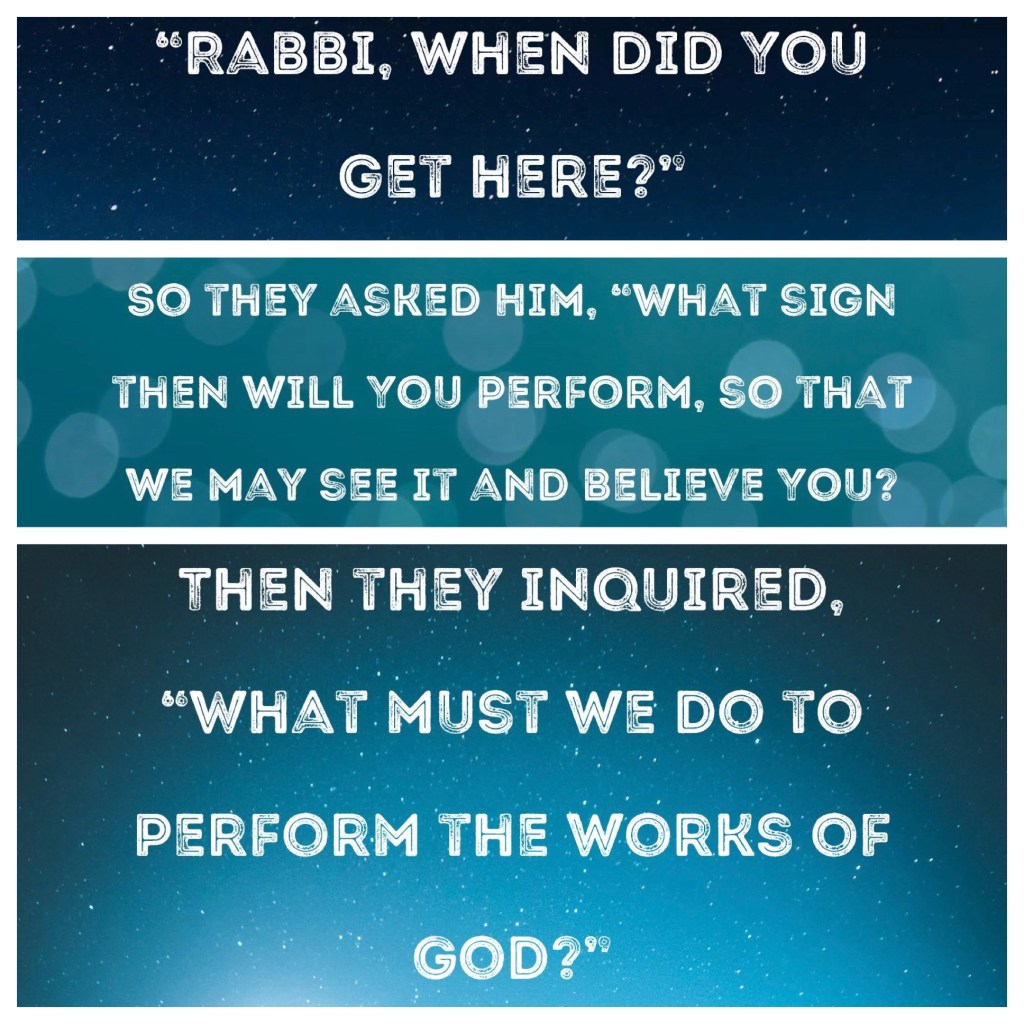
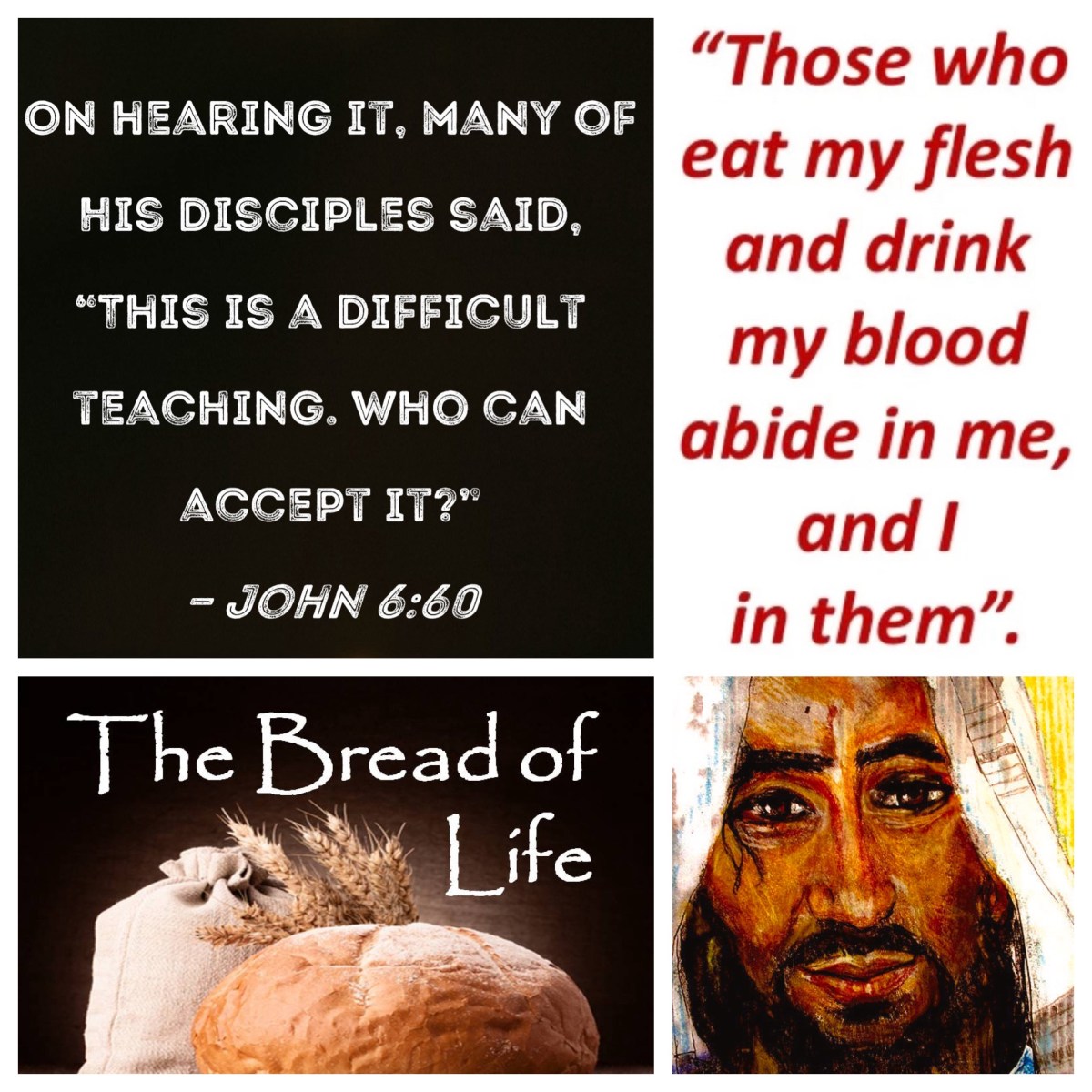
The early section of this passage contains verses which are always controversial when they are read in worship. Last week’s passage had drawn to a close with Jesus declaring that “those who eat my flesh and drink my blood have eternal life, and I will raise them up on the last day” (v.54), before continuing on to provide a further statement: “my flesh is true food and my blood is true drink” (v.55). The language is significant; Jesus does not talk about his body (sōma), but his flesh (sarx). That continues through to v.58, and on into v.63.

The passage proposed for this coming Sunday picks up at v.56, in the middle of this discussion, and runs through to the end of the chapter. We have noted that verse 58 provides a neat conclusion to the lengthy midrashic treatment that began in v.31, with the citation of a scriptural verse and was focussed by the statement of Jesus, “I am the bread of life” (v.35, repeated at v.48). That’s a neat inclusio for the whole extended discussion.

The conclusion in v.58 rehearses this central theme: “this is the bread that came down from heaven, not like that which your ancestors ate [with reference to v.31], and they died”. Jesus then extends the imagery to cover those who are his followers: “the one who eats this bread will live forever”. That includes his disciples in the eternal state that he himself enjoys. So v.58 actually functions more like a hinge, connecting what has gone before with what then follows. 

The difficulty that the disciples identify (v.60) is inherent in the language and concepts of what Jesus has said. As far back as v.51 he has stated, “the bread that I will give for the life of the world is my flesh (sarx)”. He continued with the claim, “unless you eat the flesh (sarka) of the Son of Man and drink his blood, you have no life in you” (v.53), intensifying the claim with “my flesh (sarx) is true food and my blood is true drink” (v.55). 

The whole sequence comes to a head with the narrator’s comment that “Jesus, being aware that his disciples were complaining about it, said to them, ‘Does this offend you?’” (v.61). The Greek verb in what Jesus says is skandalidzō, which we might translate as “scandalized”. That translation well encapsulates the outrage and disgust of the disciples.

The use of the word sarx in this sequence of statements is jarring. Elsewhere in Eucharistic passages in the New Testament, Jesus refers to his body as sōma, a word which has connotations of materiality, earthiness. The more physical term, sarx, refers to flesh. Eating the body of Jesus is one thing—already a difficult enough concept—but eating the flesh of Jesus makes it sound like a cannibalistic feast (as later critics of the Christians argued). 

Some commentators maintain that the use of the more basic term sarx reflects the incarnational emphasis of this Gospel, already set forth with clarity at 1:14, “the Word became flesh and lived among us”. In that same section of text, one description of human beings is “those born of the will of the flesh”, so that argument does carry some weight. James Dunn (in a short article in NTS 17, 1971, p.336) says that the choice of vocabulary is “best understood as a deliberate attempt to exclude docetism by heavily, if somewhat crudely, underscoring the reality of the incarnation in all its offensiveness”. However, I find it somewhat unusual that the author of this Gospel would operate in this rather clumsy manner.

Added to this observation, we might note that the word that is used here for “eating” is a very base word, most commonly referring to “munching” or “chewing”, as the BAGD Lexicon notes. This verb, trōgō, is used in quick succession in verses 54,56,57,58, and also at 13:18, where it is in a quotation of Ps 91.10, “the one who ate my bread has lifted his heel against me”.  This vocabulary, then, is quite distinctive; it, too, is quite earthy and base.

A common interpretive question is whether the references to eating bread and drinking blood in this latter part of John 6 were intended to be eucharistic—that is, to evoke the moment in the last supper that Jesus ate with his disciples when he broke the bread and shared it with them? On face value, that seems unlikely. John’s Gospel does have Jesus sharing a last meal with his disciples (from 13:1 onwards), but there is no mention of any breaking of bread and drinking of wine in the formal pattern found in the Synoptic Gospels. Rather, in that meal the focus is initially on washing feet (13:3–5), before Jesus offers a long, extended “farewell discourse” (or, more accurately, two such discourses) stretching through until his long prayer in ch.17. 

The recollection of the last meal of Jesus is clearly attested in four separate New Testament books. The earliest to write about it, Paul, recalls the tradition that he received, in which Jesus said “This is my body, which is for you; do this in remembrance of me” (1 Cor 11:24). Mark recalls the words of Jesus as the simple “Take, this is my body” (Mark 14:22), while Matthew, utilising Mark’s account, slightly extends this to “Take, eat; this is my body” (Matt 26:26). The latest of the four, the Lukan record, has more of an evocation of Paul’s version, “This is my body, which is given for you; do this in remembrance of me” (Luke 22:19). All four passages have Jesus use the word sōma, body. In John 6, however, the word sōma is nowhere to be found, unlike in John’s account, where Jesus is reported as using the word “flesh” (sarx).

Raymond Brown, in his thorough analysis of this Gospel and working within his hypothesis regarding the complex formation of the text through various stages, is clear: when compared with verses 35–50, “verses 51–58 have a much clearer eucharistic reference” (Brown, The Gospel according to John, vol.I pp.290–91). However, he concedes that this reference is “scarcely intelligible in the setting in which it now stands”. In Brown’s view, the various redactional layers in the text means that the original intention has been lost.

Writing decades later, Australian scholar Francis Moloney notes that, in true Johannine style, “the midrashic unfolding of the verb ‘to eat’ naturally led to the use of eucharistic language to insinuate a secondary but important theme” (Sacra Pagina: The Gospel of John, p.224). For Moloney, the occurrence of regular eucharistic celebrations, even in those ancient times, would evoke and bring forth the eucharistic sense that underlies the passage.

Moloney and Brown are Roman Catholics; we might expect such commentators to lean towards the eucharistic understanding. Coming from a rather different ecclesial context (as an evangelical Baptist), however, George Beasley-Murray admits that “neither the Evangelist nor the Christian readers could have written or read the saying without conscious reference to the Eucharist” (Word Biblical Commentary: John, p.95).

One final comment on this issue from me: we know that in the early centuries of Christianity, there was much passing on of tradition by word of mouth; for some (such as Papias) oral traditions were even to be preferred over written documents. The context was fluid, so the possibilities for variations and differences was much higher than our contemporary context, in which written texts are precise and need to be quoted exactly (at least in academic and careful liturgical contexts). The author of John’s Gospel could well be working from a slightly different tradition and saw no constraints in developing it in the direction that particularly wanted to take it.

The whole chapter draws to a close, after the intense explanation of eating and drinking that Jesus offers, with his response to the offence taken by the disciples, as he reiterates the “spirit” emphasis that was central in his encounters with the Pharisee in Jerusalem (3:4–8) and the woman in Samaria (4:23–24). Indeed, since the Spirit had descended upon Jesus (1:32–33), it is now the one “whom God has sent [who] gives the Spirit without measure” (3:34). So he declares, “it is the spirit that gives life … the words that I have spoken to you are spirit and life” (6:63). Jesus says more about the Spirit later, in his farewell discourses (14:15–17, 25–26; 15:26; 16:12–15).

Of course, in the very same breath, Jesus dismisses the flesh as “useless” (6:63), thereby relativising the impact of the incarnational affirmation of 1:14 that we have noted above. Jesus here presses the importance of faith, ultimately, in what God is doing: “no one can come to me unless it is granted by the Father” (v.65). This is the framework of reality that he operates in, and into which he invites his followers. 

I am wary of reading this as a kind of proto-Calvinist claim about predestination. Rather, I think it reflects the sectarian nature of the community for which the author is writing (as I have noted in earlier posts). The group was battered by the conflicts they had experienced, culminating in their expulsion from the synagogue. They needed to recall the story of Jesus in a way that encouraged them and affirmed their own sense of holding to “the truth”.

Through this long and complex chapter, then, Jesus has been building a picture of the “symbolic universe” in which he, the disciples, and his opponents are located. This is the context in which the members of the community understood themselves to be. All that takes place is set within the overarching framework of God’s work, which is what Jesus is called to do (4:34; 17:4) and what his followers are called to undertake (6:29–30; 9:4). The whole thing becomes mutually self-reinforcing.

The teachings they have heard from Jesus, however, are portrayed as being off-putting to some of the disciples, who “turned back and no longer went about with him” (6:66). The division amongst humanity, signalled from very early in the Gospel (1:10–13) and acted out in the extended conflict with the Judaean authorities which runs through the whole Gospel, here infiltrates the company of disciples. Some continued with Jesus, some departed from him.

Jesus puts “the twelve” on the spot, asking them, “do you also wish to go away?” (v.67). Simon Peter here speaks on their behalf (as he does often in the Synoptics) to affirm faith in Jesus: “you have the words of eternal life; we have come to believe and know that you are the Holy One of God” (6:69). This is the Johannine equivalent of the confession that Peter speaks, on behalf of the disciples, at Caesarea Philippi (Mark 8:29; extended at Matt 16:16; see also Luke 9:30). In John’s Gospel, however, this high point of confession is repeated later in the narrative by Martha, who extends her statement even further: “I believe that you are the Messiah, the Son of God, the one coming into the world” (John 11:27). 

The chapter ends with the gathering of ominous dark clouds, as Judas is identified as the one who was going to betray Jesus (v.71)—quite dramatically, he is identified as “a devil” (v.70). This is explained later, in the introduction to the last meal scene, as “the devil had already put it into the heart of Judas son of Simon Iscariot to betray him” (13:1). The lines are drawn. And so the ultimate end of what is being narrated about Jesus is signalled.

For previous blogs, see

and on the whole sequence of this chapter

Disputing the claim of Jesus to be “the bread of life” (John 6; Pentecost 13B)

Under the guidance of the lectionary, we have been following a pathways which has deviated from the story of “the beginning of the good news of Jesus, Messiah” (which we know as the Gospel of Mark) that we have been following each Sunday since Pentecost. For the moment, we read and hear excerpts from “the book of signs”, which contains just some of “the many things that Jesus did” (which we know as the Gospel of John).

We have read or heard the account that John gives of when Jesus “took the loaves, and when he had given thanks, he distributed them to those who were seated; so also the fish, as much as they wanted” (John 6:1–13). From that day, we have then been guided to follow the extensive discourse that Jesus gives to a crowd that “went to Capernaum looking for Jesus” (John 6:25–71).

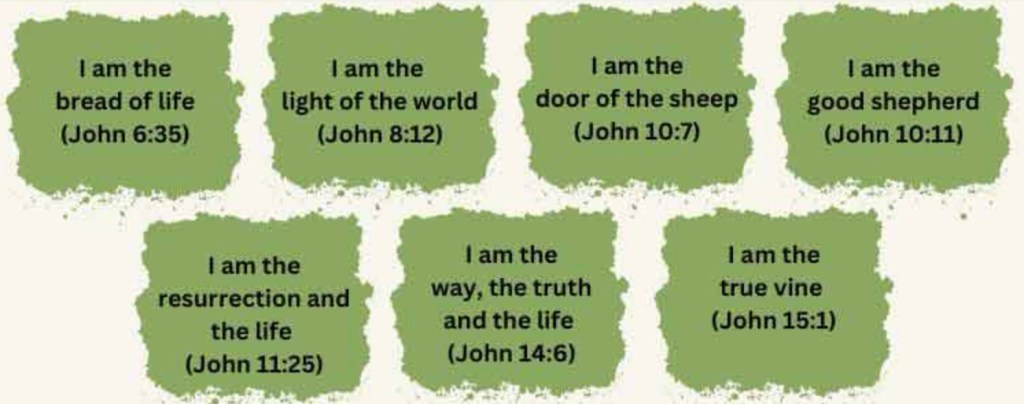
First, we heard a passage that ends with the first of seven I AM declarations made by the Johannine Jesus, “I am the bread of life” (6:24–35). Then, in the next section of that discourse, we encountered an elaborated exposition of that “bread of life” (6:35–51). This Sunday we hear about the disputes that this teaching generated with the Judaean authorities (6:51–58), and then the following Sunday takes us to the final section of the discourse where Jesus then has to deal with dissent from his own disciples (6:56–69).

The passage for this coming Sunday (John 6:51–58) is introduced, as we saw in the previous blog on this discourse, with a restatement of the theme that Jesus had what has just been declared: first, the primary affirmation about Jesus: “I am the living bread that came down from heaven” (v.51a); followed by the consequence for those who believe in him: “whoever eats of this bread will live forever” (v.51b)—and then a further step, following this summary, with and immediate extension of the argument: “the bread that I will give for the life of the world”, Jesus declares, “is my flesh” (v.51c).

Whilst a superficial, or impatient, reading of this chapter reacts with “here we go again, ‘I am the bread of life’ yet again”, a more careful reading will reveal to us the developments and new elements that are being added into the discourse at each reiteration of this fundamental claim. This restatement does just that.

A strong response to the statement of Jesus made in v.51 comes immediately. Most contemporary translations refer to “the Jews” when they report the immediate kickback: “[they] disputed among themselves, saying, ‘How can this man give us his flesh to eat?’” (v.52).

It’s a fair question, I reckon, since it’s a curious, and confronting, thing for Jesus to say. Who talks about giving his own flesh to others for them to eat?

I am reminded of the criticism of the Christians made in the early centuries of the movement. Second century Roman writer Suetonius wrote that “Nero inflicted punishment on the Christians, a sect given to a new and mischievous religious belief” (Suetonius, The 12 Caesars, Nero Claudius Caesar, XVI). A similar comment is found in the Annals of Tacitus: “Nero fastened the guilt and inflicted the most exquisite tortures on a class hated for their abominations, called Christians by the populace” (Tacitus, Annals 15.44).

In a third century work written by Minucius Felix we gain a glimpse of the accusation of cannibalism being levelled against the Christians, in a “story about the initiation of young novices” (Octavius 30). Minucius Felix reports the criticism that an infant, “covered over with meal, that it may deceive the unwary, is placed before him who is to be stained with their rites” (that is, before the person about to be baptised).

He continues with a description of the alleged horrors: “this infant is slain by the young pupil, who has been urged on as if to harmless blows on the surface of the meal, with dark and secret wounds”, and then gives a graphic description of what ensues: “thirstily … they lick up its blood; eagerly they divide its limbs; by this victim they are pledged together; with this consciousness of wickedness they are covenanted to mutual silence.” It’s quite a take on what believers know as the celebration of Holy Communion.

(We will come back to the strangely-different language and the distinctive Eucharistic resonances of the discourse of the Johannine Jesus in John 6 in my blog on next week’s lectionary passage.)

Who are these “Jews” who are criticizing Jesus in this way? I have already noted (in my blog on John 6:1–15) that most translations describe this latter group simply as “the Jews”. The Greek word used, however, can equally be translated as “the Judeans”. It’s a preferable option, I believe, as it avoids having a sense of antisemitism creep into our understanding of the text, every time we hear “the Jews” criticising and arguing with Jesus.

To be fair to the whole population of Judaea at the time, however, I’ll refer to them as “Judaean leaders”, as it seems clear that this is the particular group that is generating and exacerbating the conflict.

In doing so, I am taking the lead from D. Moody Smith, who argues that that the way the word is used in the fourth Gospel means that it should be translated as “a group of Jewish leaders who exercise great authority among their compatriots and are especially hostile to Jesus and his disciples … it refers to certain authorities rather than to the people as a whole.” See D. Moody Smith, “Judaism and the Gospel of John”, accessible at https://www.bc.edu/content/dam/files/research_sites/cjl/sites/partners/cbaa_seminar/Smith.htm

The sixth chapter of John’s Gospel offers a series of encounters that reveal misunderstanding, antagonism, and conflict in the ways that people relate to Jesus, even whilst he sets forth this significant teaching that he is “the bread of life” (6:35, 48). To be sure, the earlier interactions between Jesus and “the crowd” (6:24–40) appear to be amenable, offering Jesus the opportunity to explain himself.

However, when this group of Judaean leaders come into the foreground (v.41), this become more tense. The antagonism of these leaders is palpable. This mood continues through their complaining (vv.41–51) and disputing (vv.52–58), on into the complaining of the disciples of Jesus (v.60–65) and the rejection of Jesus by some of them (vv.66–71).

We have already met opponents of Jesus very early in John’s narrative. Indeed, in the prosaic interpolation into the poetic prologue, even before the story proper begins, there is a clear indication of looming opposition to Jesus: “the world did not know him … his own people did not accept him” (1:10–11).

Early in the narrative that John the evangelist presents, a group of Judaean leaders had questioned John the baptiser, asking him “who are you?” (1:19); then they had questioned Jesus, “what sign can you show us?” (2:18). These questions are not necessarily antagonistic. (You could read them as a form of “appreciative enquiry”.)

The explicit opposition to Jesus from these Judaean leaders emerges, however, after he has healed on the sabbath (5:10). Here, the narrator declares that these Judaean leaders “started persecuting Jesus” (5:16) and indeed “were seeking all the more to kill him” because of what he was saying (5:18). From this point on, the conflict just deepens.

After they began to complain about Jesus (6:41) and quarrel about him (6:52), these leaders have success: “many of his disciples turned back and no longer went about with him” (6:66). They intensify their opposition, “looking for an opportunity to kill him” (7:1), intimidating people to silence (7:13), further questioning the teaching of Jesus (7:35–36; 8:22, 57; 10:24), accusing him of being a Samaritan (8:48) and possessed by a demon (8:48, 52; 10:20)—although not everyone holds this view (10:19, 21) and there are indeed Judaean leaders who “believed in him” (11:45; 12:11).

Twice the Judaean leaders take up stones to kill Jesus (8:59; 10:31–33; 11:8), accusing him of blasphemy in “making yourself God” (10:33, alluding back to their assessment of 5:18). Their success in persecuting the followers of Jesus is reflected in the observation that they “had already agreed that anyone who confessed Jesus to be the Messiah would be put out of the synagogue” (9:22; and see later references at 12:52; 16:2). The plot to kill Jesus is finalised when Pharisees and priests combine, in the face of the greatest sign performed by Jesus, in raising Lazarus from death (11:46–53).

Where these Judaean leaders stand in relation to Jesus and the truth that he declares (1:14, 17; 8:23, 40, 45–47; 14:6; 18:37) is clear from the division outlined in the vehement vitriol of the debate in chapter 8. “You are from below, I am from above”, Jesus tells them; “you are of this world, I am not of this world” (8:23). Not content with this (characteristically Johannine) dualistic assessment, he then confronts them with the clear reality, as he sees it: “I told you that you would die in your sins, for you will die in your sins unless you believe that I am he” (8:24).

I read the whole sequence of scenes in this Gospel, from the wedding in Cana, with its implicit criticism of “the Jewish rites of purification” (2:1–11), through the heated debates of chs. 5—8, the high drama of the multi-scene conflict with Jewish leaders and “expulsion from the synagogue” in ch.9, on into the plot of ch.11, as a story that reflects the position of the followers of Jesus who comprised the community in which this book was eventually written.

This group of people (what Raymond Brown called “the community of the beloved disciple”) had been rejected by their fellows, expelled from their community of faith, because of their views about Jesus. They had become yet another sectarian group in the mixture of late Second Temple Judaism, which then bled into early Rabbinic Judaism.

It is this “Johannine sectarianism”, as Wayne Meeks called it, which explains the bruising debates in this Gospel; Jesus, “the man from heaven”, as Meeks styles him, is being remembered as “standing up for the truth” in the face of intense criticism, by a group of people who had been pillaged and persecuted for standing up for what they saw as “the truth”. They had become outsiders; some of them had met death for the stand they took. This was what it meant for them to be faithful to Jesus.

So in the Johannine story of Jesus, the Judaean authorities, and the disciples of Jesus, the die is cast; the antagonism is set. Jesus will head to his death and his followers also will experience “an hour … when those who kill you will think that by doing so they are offering worship to God” (16:2). The fate that is in store for Jesus is the same fate for his followers.

Using the commonplace image of “a grain of wheat [that] falls into the earth and dies” (12:24), Jesus appears to foreshadow his imminent death; “the hour has come for the Son of Man to be glorified” (12:23) is the way that the Johannine Jesus refers to his death (7:39; 11:4; 12:16, 28–33; 13:31–33; 17:1–5).

He follows the saying about the grain of wheat dying, only to “bear much fruit”, with an assertion about his followers: “those who love their life lose it, and those who hate their life in this world will keep it for eternal life” (12:25; the language reflects Mark 8:35; Matt 10:39; 16:25; Luke 9:24; 17:33). The way of Jesus is also the way of his followers.

(At this point, we might want to reflect on how appropriate for us—or how distant from us—this portrayal of Jesus is. How much do I know, personally, of the opposition and conflict that puts my very life in peril, because of what I believe and how I live? In this light, the Johannine Jesus and the community faithful adhered to his way can appear to be alien from the comfortable existence of so many Christians—myself included—in the western world.)

The final verse of this section (not included in the lectionary selection, 6:51–58) is a surprise: “he said these things while he was teaching in the synagogue at Capernaum” (6:59). The chapter had begun on “the other side of the Sea of Galilee, also called the Sea of Tiberias” (v.1), where Jesus had fed the large crowd, before moving “across the sea to Capernaum” (v.17), where Jesus had walked on the water.

When those left on “the other side” of the sea saw the crowd across the lake, “they got into the boats and went to Capernaum looking for Jesus” (v.24), where they found him, engaging him in discussion (v.25). The mention of the synagogue in 6:59 provides a pivot for the narrative then to focus on the disciples, who had been with Jesus “on the other side” (v.3) and then in the boat (vv.6–7). What ensues (v.60 onwards) then maintains a focus on Jesus interacting with the disciples. On which, see next week’s blog …

See previous blogs at

and on the whole sequence of this chapter

A midrashic exposition on “the bread of life” (John 6; Pentecost 12B)

Two weeks ago, the lectionary directed us to turn off the road we were following through the story of “the beginning of the good news of Jesus, Messiah” (which we know as the Gospel of Mark), and spend five weeks with “the book of signs”, which contains just some of “the many things that Jesus did” (which we know as the Gospel of John).

This detour came just at the point when we were going to read the story of when Jesus took “five loaves and two fish, looked up to heaven, and blessed and broke the loaves, and gave them to his disciples to set before the people; and he divided the two fish among them all … [and] those who had eaten the loaves numbered five thousand men” (Mark 6:30–44). The wording is strongly evocative of the Eucharistic words that Mark later reports: “he took a loaf of bread, and after blessing it he broke it, gave it to them …” (Mark 14:22).

Instead, two Sundays ago we read or heard the account that John gives us, with a less-eucharistic flavour, when Jesus “took the loaves, and when he had given thanks, he distributed them to those who were seated; so also the fish, as much as they wanted” (John 6:1–13); and from that passage, we are then guided over the following four Sundays to follow the extensive discourse that Jesus gives to a crowd that “went to Capernaum looking for Jesus” (John 6:25–71).

Last Sunday, John 6:24–35 was the passage that the lectionary proposed as the Gospel reading. This passage ends with the first I AM declaration by Jesus, “I am the bread of life” (6:35).

After hearing that, on the next Sunday (this coming Sunday) we will read or hear the next section of that discourse, dealing with an elaborated exposition of that “bread of life” (6:35–51). That is to be followed by an account of the disputes that this teaching generated with the Judaean authorities (6:51–58), and then the final section of the discourse where Jesus then has to deal with dissent from his own disciples (6:56–69).

I have already offered comments on those two earlier sections, and plan to continue to trace the words and interactions of Jesus from this long chapter in the coming weeks. For today, we focus on the way that Jesus expands and develops his theme of “the living bread which came down from heaven” (6:35–51). And interestingly, after having eschewed a direct eucharistic allusion in the miracle reported earlier, here the Johannine Jesus takes us step-by-step towards a strongly eucharistic understanding. (More on that in coming weeks.)

A key observation that can assist us in understanding this lengthy discourse is that it has the nature of a Jewish midrashic discussion. The Jewish Virtual Library notes that there are two main types of midrash, and defines it as follows: “Midrash aggada derive the sermonic implications from the biblical text; Midrash halakha derive laws from it.”

The article continues: “When people use the word midrash, they usually mean those of the sermonic kind. Because the rabbis believed that every word in the Torah is from God, no words were regarded as superfluous. When they came upon a word or expression that seemed superfluous, they sought to understand what new idea or nuance the Bible wished to convey by using it.” That is how I am understanding the relevance of this section of the discourse in John 6.

See https://www.jewishvirtuallibrary.org/halakha-aggadata-midrash#google_vignette

My Jewish Learning defines midrash as “an interpretive act, seeking the answers to religious questions (both practical and theological) by plumbing the meaning of the words of the Torah. Midrash responds to contemporary problems and crafts new stories, making connections between new Jewish realities and the unchanging biblical text.”

See https://www.myjewishlearning.com/article/midrash-101/

That would indicate that the words of Jesus, in John 6 (as, indeed, elsewhere in the Gospel) were being remembered and retold, expanded and developed, in light of the hopes, concerns, and needs of the community within which this Gospel came into being. In other words, whilst we do not have an accurate historical reporting of “what Jesus actually said”, we do have words which give us a pathway into understanding how at least this group of followers of Jesus understood him, and how they lived in response.

It seems to me that applying a Jewish understanding of how biblical texts are appropriated and understood, through midrash, helps to explain what is happening in John 6. Although it seems repetitive to us moderns, the discourse is actually probing the possibilities and exploring the options in understanding the scripture text that was provided to Jesus by the crowd around him.

Earlier in the chapter, a series of questions have been put to Jesus, moving to a key matter, when the crowd asks: “what sign are you going to give us? … what work are you performing?” (v.30). They continue by quoting scripture (v.31)—a move that is fundamental for the nature of what follows.

By quoting scripture, the crowd gives Jesus his “text” for the teaching that follows. And, of course, as they are Jews, and as Jesus was a Jew, the argument is developed by means of a typical midrashic “playing with the text” in the words that follow. More than that, when we look for the text that the crowd speaks, we find it is a compilation text—something that draws on the post-exilic narrative of the manna from heaven (Exod 16:4 and 15), a poetic retelling of this scene (Psalm 78:24), and an even later Hellenistic-era reporting of this incident (Wisdom of Solomon 16:20).

The fact that we do not have a precise quotation of the text “as we know it” should alert us to the fluidity that was commonplace in the ancient world, when texts were referred to. My own teacher, the late Dr. Robert Maddox (in an unpublished paper entitled “The Use of the Old Testament in John’s Gospel”) put it very clearly:

“The freedom of wording of John’s quotations and allusions is due not to ignorance nor to the nature of the texts he used, but to the fact that he had steeped himself in the Scriptures, as Jesus had before him; and the Biblical text was no longer something external to be reached for to bolster an argument, but something which had become a part of the author’s mind and heart.”

Dr Maddox offers this concise summation of how the author operated: “He treats the Biblical text not with the deference of polite respect but with the freedom of intimate familiarity.”

So, what follows here is a typical Jewish midrash—a use of the text in a somewhat fluid and flexible way that develops and expands a theme. How does Jesus do this? We can be helped by the work of Scandinavian scholar Peder Borgen. He offers a detailed (book-length) analysis of this discourse in the context of the practices and techniques found in rabbinic literature. The book is entitled Bread from Heaven: An Exegetical Study of the Concept of Manna in the Gospel of John and the Writings of Philo (NovTSup 10, 1965).

Borgen compares the midrash undertaken by the Johannine Jesus with midrahim on the same theme found in a third century rabbinic work, the Mekhilta on Exodus 16:15, as well as in a tractate written about a century before John’s Gospel by the Alexandrian scholar Philo, with the title That the Worse is Wont to Attack the Better (Quod det. potior.). (And yes: in preparing to teach John’s Gospel at tertiary level some 25 years ago, I worked carefully through the detailed argument that Borgen has provided!)

Borgen proposes two sections to this midrash: what he calls “a miniature elaboration” in three parts (vv.31–35), followed by “a more detailed elaboration” in four parts (vv.41–51). The first section begins with the scripture citation: “he gave them bread from heaven to eat” (v.31b) and concludes within the full statement of the theme by Jesus: “I am the bread of life. Whoever comes to me will never be hungry, and whoever believes in me will never be thirsty” (v.35).

The second section recapitulates theme, in words attributed to “the Judaeans”, repeating (and expanding) the earlier words of Jesus: “he said, “I am the bread that came down from heaven” (v.41). In between, Jesus engages in a (typical) excursus, discussing “the will of my Father”, which is what he is charged with carrying out (vv.36–40). Belief (v.36) will lead to eternal life (v.40)—a central Johannine motif (see John 3:14–16, 36; 5:24–29; 6:68–69; 11:25–27; 14:6–7; 17:1–3; 20:31).

In the “miniature elaboration” (vv.31–35), after the crowd has stated the key issue in their scripture citation (v.31), Jesus offers an interpretation of this scripture by means of a classic rabbinic-style contrast statement; it is “not Moses … but my Father in heaven” who provided the bread (v.32).

The allusion back to the earlier programmatic declaration in the Johannine prologue is clear: “the law indeed was given through Moses; grace and truth came through Jesus Christ” (1:17). In what follows, Jesus will seek to place himself, as “the bread of life”, in the position occupied by “the Father” in that earlier statement.

So at this point, he pivots from speaking about the bread that God gave from heaven, to speaking about “the true bread from heaven”, himself. An explanation, introduced by the little word gar (“for”), is that Jesus is the bread which “gives life to the world” (v.33). Then, instead of a question, the crowd puts a request to Jesus; “Sir, give us this bread always” (v.34). Which means that Jesus can now make very clear what his thesis is: “I am the bread of life” (v.35).

After the excursus about “doing the will of my Father” (6:40; a matter found also at 4:34; 7:17; 14:13), it is “the Judaeans” who bring Jesus back to the topic at hand. In the “more detailed elaboration” that follows, we find that the restatement of the theme is put onto their lips, as they complain about what he has said (6:41). The use of the verb Ἐγόγγυζον is a deliberate reference to “the murmuring tradition” in the Pentateuch, when the Israelites complained about the hardships of the desert (Exod 15:24; 16:2, 7; 17:3; Num 11:1–2; 14:2–4; 27, 29, 36).

In the objection raised these critics question the authority of Jesus to speak in this way: “Is not this Jesus son of Joseph?” (v.42a), followed by a further repetition of what Jesus is declaring: “how can he now say, ‘I have come down from heaven’?” (v.42b). The placing of the claim made by Jesus on the lips of his opponents—not once, but twice—is a delicious irony!

There follows an answer to this objection, given at some length, by Jesus (vv.43–48). In so doing, Jesus draws himself on another scripture passage (Isa 54:13, at John 6:45). This is absolutely typical of the rabbinic style of midrashic argumentation, in which (as we have seen) an explanation of one text is provided by reference to another scripture text , related by means of a key word or idea.

What Jesus says to them also draws on the typical Joannine motif of Jesus as the one who has “come down from heaven” (v.38; see also 3:13, 27, 31; 12:28; 17:1–5). Another one of my teachers, Professor Wayne Meeks of Yale University, picked up n on the importance of this motif in an article he published just over 50 years ago.

Meeks notes that the claims made about Jesus in the fourth Gospel function as reinforcements of the sectarian identity of the community. As this community had come into existence because of the claims that it had made about Jesus, so the reinforcement of the life of the new community took place, to a large degree, through the strengthening and refining of its initial claim concerning Jesus. What is said about Jesus can also be said about his followers. So what the Johannine Jesus is doing in this long discourse is not simply clarifying his identity; these words provide a reinforcement of how the members of the later community of believers saw themselves in the world. (Again, we will come back to this in a later blog.)

Joh has Jesus make one of his typically exclusivist claims at this point: “not that anyone has seen the Father except the one who is from God” (v.46). Here, Jesus stakes out his claim: he is The Teacher, The Revealer, The One who has seen God and who conveys that truth to those who follow him. This is how “eternal life” is gained: through access to this knowledge, passed on in what Jesus reveals.

So Jesus returns to the main theme with his repeated assertion, “I am the bread of life” (v.48, repeating v.35), and then continues with an expositional development in the following verses. Again he compares “your ancestors” who, although they “ate the manna in the wilderness”, nevertheless died (v.49) with his role, as “the bread that came down from heaven”, which means that anyone eating it will not die (v.50). We are edging into the centre of eucharistic theology at this point, with talk of eating “the bread from heaven”, that is, Jesus. (More on this in a subsequent blog.)

Verse 51 restates what has just been declared: first, the primary affirmation about Jesus: “I am the living bread that came down from heaven”; followed by the consequence for those who believe in him: “whoever eats of this bread will live forever”. It seems redundant to us, but in the midrashic style it is important to synthesize and summarise in this manner.

There is a further step that Jesus takes in what he says at the end of v.51. This also is typical of midrashic style texts; summarise but immediately extend the argument. And the extension that Jesus gives here opens u0 a new issue—one which will be the focus in the following verses, which the lectionary reserves for us to read and hear on the Sunday after this coming Sunday. “The bread that I will give for the life of the world”, Jesus declares, “is my flesh” (v.51c). And so a new matter requires attention … which we will explore in the blog for the Sunday after this coming Sunday.

See also

and on the whole sequence of this chapter

The Bread of Life: take one (John 6; Pentecost 11B)

Last Sunday, the lectionary took us away from the Gospel of Mark, with an awkward detour into the Gospel of John that will see preachers being invited to grapple for another four weeks with a long, extended discourse of Jesus revolving around the first of seven I AM statements found in this Gospel. The statement that “I am the bread of life” has been motivated by the account of Jesus miraculously feeding a large crowd with only “five barley loaves and two fish”, which is told in the passage heard last Sunday (John 6:1–21).

This coming Sunday, this awkward detour leads us into the opening section of this long discourse, as John 6:24–35 is the passage that the lectionary proposes as the Gospel reading. This passage ends with the first declaration by Jesus, “I am the bread of life” (6:35). After this week, we are in store for further sections of that discourse, dealing with an elaborated exposition of that “bread of life” (6:35–51), the disputes that this teaching generated with the Judaean authorities (6:51–58), and the final section of the discourse where Jesus then has to deal with dissent from his own disciples (6:56–69).

I have often heard preachers grumble about the repetitive nature of these selections—“not another week on ‘the bread of life’”—but I think that this underestimates the intricacy of this chapter, and the complexity of the issues that are signalled as Jesus pursues his teaching about “the bread of life”. So the challenge I am taking up is to offer a series of four blogs in which a number of those issues are explored and explained.

Perhaps the first stumbling block in dealing with this chapter is that it does appear to be incredibly repetitive. The phrase “the bread of life”, for instance, appears four times (6:33, 35, 48, 51), with the stylistic variant “the bread from heaven” another five times (6:31, 32a, 41, 50, 58), the intensified phrase “the true bread from heaven” (6:32b), and “the living bread that came down from heaven” also in 6:51. That does, to be fair, seem like overkill. But other discourses in this distinctive Gospel exhibit a similarly repetitive style (as, indeed, does the first letter attributed to John). It is a particular style which characterises this Gospel—one of the many features that set it apart from the three Synoptic Gospels.

Each discourse in the series of discourses found in the first half of John’s Gospel displays some standard features. Each discourse arises out of a specific incident; in this case, the feeding of the large crowd (6:1–21) is the stimulus for discussing “the bread of life”. The discourse picks up a key word or idea from the report of the incident and develops that idea by relentless repetition. That is an integral part of its style. So there are eleven references to bread in ch.6, just as there had been seven references to water in ch.4, seven references to life or living in ch.5, and later there are twelve references to sheep in ch.10.

In typical Johannine style, the thesis of the discourse is driven by questions and misunderstandings. Questions invite an answer; misunderstandings require an explanation. And so the argument in this whole chapter proceeds by means of a series of questions.

First, after the feeding of the large crowd and the crossing of the lake (vv.22–25), the crowd asks Jesus, “ Rabbi, why did you come here?”(v.25). This opens the way for Jesus to explain that his work is not “for the food that perishes [a reference to the loaves of bread that they had recently eaten], but for the food that endures for eternal life” (v.27). And so the theme for the discourse that follows is set; and the irony that is embedded in the language of “bread” becomes foundational for what follows.

Next, they ask Jesus, “what must we do?” (v.28), allowing Jesus then to define the nature of “the works of God” as “that you believe in him whom he has sent” (v.29)—that is, in Jesus himself. Next, the crowd asks a third question: “what sign are you going to give us? … what work are you performing?” (v.30). They continue by quoting scripture—a move that will prove to be fundamental for the nature of what follows.

By quoting scripture (a variant of Exod 16:4 and 15; also Psalm 78:24) the crowd is gives Jesus his “text” for the teaching that follows. And, of course, as they are Jews, and as Jesus was a Jew, the argument is developed by means of a typical midrashic “playing with the text” in the words that follow. We will come back to the midrashic nature of this discourse in a later blog.

Jesus offers an interpretation of this scripture; it is “not Moses … but my Father in heaven” who provided the bread (v.32). At this point, he pivots from speaking about the bread that God gave from heaven, to speaking about “the true bread from heaven”, himself. He is the bread which “gives life to the world” (v.33).

So this section of the discourse ends, not with a question, but with a request from the crowd; “Sir, give us this bread always” (v.34). Which means that Jesus can now make very clear what his thesis is: “I am the bread of life” (v.35). And so, at last, we get to the point! And at this point, the lectionary passage for this Sunday stops—but we will return next week!

This statement is one of a number of “I Am” statements that are placed on the lips of Jesus in the book of signs, which we know as the Gospel according to John. These sayings comprise a verb (“I am”) followed by a predicate (the entity which Jesus claims to be). The predicates in most of these sayings are drawn from traditional Jewish elements.

When Jesus calls himself “the bread of heaven” (6:25–59), he is clearly evoking the scriptural account of the manna in the wilderness (Ex 16:1–36; Num 11:1–35; Pss 78:23–25; 105:40). The discourse which develops from this saying includes explicit quotations of scripture, as well as midrashic discussions of its meaning.

When Jesus presents himself as “the vine” (John 15:1–11), he draws on a standard scriptural symbol for Israel (Ps 80:8; Hos 10:1; Isa 5:7; Jer 6:9; Ezek 15:1–6; 17:5–10; 19:10–14). Likewise, when Jesus calls himself “the good shepherd” (10:1–18), he evokes the imagery of the good shepherd as the true and faithful leader in Israel (Num 21:16–17; Ezek 34:1–31; Jer 23:4), and the people as the sheep who are cared for (Pss 95, 100; Ezek 34:31).

The statement that Jesus is “the light of the world” (8:12; 9:1–5) evokes the story of the creation of light (Gen 1:3–5) and the light which the divine presence shone over Israel (Exod 13:21–22). The Psalmist uses the imagery of light to indicate obedience to God’s ways (Pss 27:1; 43:3; 56:13; 119:105, 130; etc.), and it is a common prophetic motif as well (Isa 2:5; 42:6; 49:6; Dan 2:20–22; Hos 6:5; Mic 7:8; Zech 14:7; cf. the reversal of the imagery at Jer 13:16; Amos 5:18–20).

Although it is not part of an “I am” statement, the references to the “living waters” which flow from Jesus (4:7–15; 7:37–39) are reminiscent of the water which were expected to flow from the eschatological temple (Ezek 47:1; Joel 3:18; Zech 14:8), and, more directly, refer to the description of God used by the prophet Jeremiah (Jer 2:13).

In addition, biblical scholars have noted that rabbinic symbolism has affinities with Johannine symbols; for example, the terms bread, light, water and wine are all used by the rabbis in connection with the Torah. The author of John’s Gospel stands in the stream of Jewish writers who have used multiple images to convey their faith in the Lord God.

Thus, the distinctive set of Christological claims made for Jesus in the Gospel according to John seek to enter into this stream of writing. They are both thoroughly grounded in scriptural images and familiar from the ongoing traditions taught by the rabbis. The author of this Gospel is using a number of ways to declare his faith in Jesus as “the Word of God”, “the Way”, and indeed as being at one with God. It is a high claim.

Amidst the variety of Jewish voices at the end of Second Temple Judaism clamouring to be holders of “the truth”, using a wide variety of rhetorical means, this author seeks to position his community—a sectarian Jewish group—as the holder of the true faith, the ones who adhere most clearly to what the Lord God requires amongst his faithful people. And for this group, it is Jesus of Nazareth who most clearly and faithfully leads them along that pathway of understanding and living.

See more on this understanding of the community of John at

So this discourse addresses what we might assume to have been a well-known and widespread understanding of the nature of God amongst Jews of the time; he is the one who provides the bread to nourish and sustain lives of faith. When Jesus lays claim to being “the true bread”, it is yet another moment when he says, quite poetically, what he later declares in a very prosaic manner: “the Father and I are one” (10:30).

*****

Still to come in considering the lectionary passages from John 6 that lie ahead:

Jesus offers a midrashic exposition on “the bread of life” (6:35–51): how does Jesus operate in his Jewish context?

Disputing the claim of Jesus to be “the bread of life” (6:51–58): the characters in the story John tells, the sectarian nature of his community

The Johannine remembrance of Eucharistic communion and the community’s distinctive “structure of reality” (6:56–69)

and on the various I AM statements

I write these things … that you may know (1 John 5; Easter 7B)

“I write these things to you who believe in the name of the Son of God, so that you may know that you have eternal life” (1 Joh. 5:13). That’s how the author of the work we know as the first letter of John begins the final section of this work, drawing to a close the extended reflection that has been offered in the previous sections, regarding belief in Jesus and what it means for believers.

Of course, as I have already noted, although this work is described as a letter by John, it does not show many characteristics at all of the classic letter style, nor does it anywhere explicitly identify its author as John. The closest we get to an indication that this could have been a letter is in the phrases “little children, I am writing these things” (2:1), “beloved, I am writing you” (2:7), and the immediately-repeated “I am writing to you” (2:8, 12, 13). And the closest we get to any sense of Johannine authorship is the claim for eyewitness status, “what we have seen and heard”, in the opening lines (1:1–4). See more at

The verses that come immediately before this statement are proposed by the lectionary as the Epistle reading for this coming Sunday (1 John 5:9–13). This is the final selection from this letter, which we have been following during the season of Easter. It begins with a reference to “the testimony of God” and continues by declaring that, for believers, this this testimony in “in their hearts” (5:10). Then, the content of the testimony is given: “this is the testimony: God gave us eternal life, and this life is in his Son” (5:11).

The Gospel attributed to the author with the same name that is applied to this letter—John—refers a number of times to the testimony that was given concerning the Son. That testimony begins with John, who “came as a witness to testify to the light, so that all might believe through him; he himself was not the light, but he came to testify to the light” (John 1:7–8). It continues in the words and actions of Jesus himself, as he regularly states (John 3:11, 33; 5:31–36; 8:14, 18; 10:25;18:37).

Testimony comes also through scripture (John 5:39), from the crowd that witnessed the final sign involving Lazarus (12:17), from the work of the Spirit (15:26), by the disciples themselves (15:27)—and by the author of this Gospel himself: “he who saw this has testified so that you also may believe; his testimony is true, and he knows that he tells the truth” (19:35).

This statement towards the end of John’s Gospel is echoed in two statements in the first letter of John. The letter begins with the author’s claim to eyewitness status: “we declare to you what was from the beginning, what we have heard, what we have seen with our eyes, what we have looked at and touched with our hands, concerning the word of life— this life was revealed, and we have seen it and testify to it, and declare to you the eternal life that was with the Father and was revealed to us— we declare to you what we have seen and heard so that you also may have fellowship with us” (1 John 1:1–3).

A second such claim is made in the discussion about God’s love being revealed in the Son; “we have seen and do testify that the Father has sent his Son as the Saviour of the world”, the author maintains (1 John 4:14). This is followed, some verses later, with the statement that “there are three that testify: the Spirit and the water and the blood, and these three agree” (5:7). This is a passage which has been the focus of controversy amongst interpreters, for two reasons.

The first is that it seems to come from nowhere, and lacks consistency with the rest of this letter. The Spirit as witness does echo John 15:26, noted above; as for the other two elements being witnesses, there are no such indications elsewhere in the letter (or the Gospel). And in the letter itself, the affirmation is made just a few sentences later, that the testimony is actually that “God gave us eternal life, and this life is in his Son” (5:11).

The second reason is that there is an extension to this verse that does not appear in many manuscripts; it is very clear that this is a later scribal addition designed to make the initial claim consistent, at least, with the developing orthodox theology of the church. The “three that testify in heaven, the Father, the Word, and the Holy Spirit, and these three are one”, clearly aligns this letter with the theology that is articulated by the Council of Nicea (in 325 CE); the parallelism is signalled in the final phrase, “and there are three that testify on earth”.

The final verse in the selection proposed by the lectionary (5:13) introduced the epilogue for the whole letter (5:13–21), in which key themes of the letter are reprised. This verse itself includes three key Johannine words, which figure prominently in both Gospel and letter: belief, knowledge, and life.

The author addresses those who “believe in the name of the Son of God”, echoing earlier injunctions to “believe in the name of [God’s] Son Jesus Christ and love one another, just as he has commanded us” (3:23), the affirmation that “we have known and believe the love that God has for us” (4:16), and the statement already noted in 5:10.

The author also indicates that they write so that those receiving this letter “may know that you have eternal life”. Knowledge figures earlier in the letter (2:3–4, 13–14, 18, 21, 29; 3:2, 5, 14–16, 19, 24; 4:2, 6, 8, 13; 5:2).

It is also prominent at key moments in the Gospel, when the woman in Samaria convinces the people of her city to know that Jesus “truly is the Saviour of the world” (John 4:42), Peter confesses on behalf of the twelve that “we have come to believe and know that you are the Son of God” (6:69), and Martha affirms that she knows that Lazarus will rise “in the resurrection on the last day”, which leads Jesus to push her further so that she can affirm to him, “I believe you are the Messiah, the Son of God, the one coming into the world” (11:23–27).

Life, eternal life, is what is known (3:14; see also 1:2; 2:25), as the words immediately prior to this affirm: “this is the testimony: God gave us eternal life, and this life is in his Son. Whoever has the Son has life; whoever does not have the Son of God does not have life” (3:11–12).

Life, eternal life, is what Jesus promises and delivers in the Gospel, as is stated in the most famous verse of the Gospel (3:16) and in the two great affirmations by Jesus, “I am the resurrection and the life” (11:25) and “I am the way, the truth, and the life” (14:6), and at many other places (1:4; 3:15, 36; 4:14, 36; 5:21, 24, 26, 29, 39–40; 6:27, 33, 35, 40, 47–48, 51–54, 60–68; 8:12; 10:10–17, 28; 12:50; 17:2–3).

It is also noteworthy that this statement of purpose by the author of the letter closely parallels a statement of purpose made by the author of the Gospel. In the Gospel, the author writes “so that you may come to believe that Jesus is the Messiah, the Son of God, and that through believing you may have life in his name” (John 20:31).

In the letter, the author says, “I write these things to you who believe in the name of the Son of God, so that you may know that you have eternal life” (1 John 5:13). It is a most fitting conclusion to the sequence of passages that we have read from this letter throughout Easter.