Give us a King, like other nations (1 Sam 8–10; Pentecost 3B)

1 Samuel 8:4–20 is the passage offered by the lectionary for this coming Sunday. It is the second in the sequence of Hebrew Scripture passages that we are reading through the first half of the long “season after Pentecost”, from May to August. The passage addresses an issue that was important in ancient Israel; that is important in modern-day Israel/Palestine; and that is important, also, in all nations around the world today.

This Sunday we will hear the beginning of a process—debate about having a king as a ruler—that culminates, at the end of August, with an account of Solomon, the wisest, most powerful, and perhaps most damaging king of all. That makes this ancient text potent in the contemporary situation, where Israel is engaged in a life- and-death struggle with Hamas, where megalomania amongst leaders in Russia, North Korea, China, and even the USA predominates, and where too many countries around the globe suffer under dictatorial, repressive regimes.

The passages selected today focus on the issue of power. Precisely: what kind of power in leadership is acceptable in Israel? should Israel be ruled by a king? For centuries, judges had led the people, determining what was right and what was wrong. The book of Judges tells of a string of such judges, men who worked hard to recall the people to their covenant with the Lord God: Othniel (Judg 3:9), Ehud (3:15), Shamgar (3:31), an unnamed prophet (6:8), Gideon (6:11–18), Tola (10:1), Jair (10:3), Jephthah (11:1; 12:7), Ibzan, Elon, and Abdon (12:8–15), and Samson (13:24–25; 16:28–31).

And, of course, it most famously tells of Deborah, “a prophetess, wife of Lappidoth, [who] was judging Israel; she used to sit under the palm of Deborah between Ramah and Bethel in the hill country of Ephraim; and the Israelites came up to her for judgment” (Judg 4:4–5).

However, the impact of the efforts of these various judges was merely transitory; the people returned again and again to their sinful, idolatrous ways. “The Israelites did what was evil in the sight of the Lord” (initially at 2:11, repeated at 3:7) is a recurring refrain throughout the book of Judges. It signals that the people reverted to their evil ways after Othniel (3:12), Shamgar (4:1), Deborah (6:1), Jair (9:6), and Abdon (13:1).

As a result, we are told that the people were “given into the hands” of their enemies on each of these occasions (3:8; 4:2; 6:1, 13; 10:7; 13:1). The horror perpetrated by Jephthah, offering his own daughter as a burnt offering (11:29–40), and the deceit and arrogance of Samson (16:1–31) exemplify this sinful streak.

In the final chapters of the book, details are given of the evil deeds of various people: the mother of Micah, who made an idol of cast metal (17:1–6); the men of Gibeah, who raped the Levite’s concubine (19:22–25); the Levite himself, who cut his concubine into twelve pieces (19:27–30); and then the attacks on the Bejaminites by the other tribes of Israel (20:1–48). The book draws to its end with the mournful conclusion, “in those days there was no king in Israel; all the people did what was right in their own eyes” (21:25).

So it is made clear in the narrative constructed in the book of Judges, that Israel’s downfall was that it was not ruled by a king, as other nations surrounding Israel were. A king could maintain justice and ensure equity within the society of Israel. And a king could marshal the forces needed to repel invaders and stand resolute against the sinful ways that would be imposed upon the nation by those who did not fear the Lord God.

So the elders of Israel press for change; we can understand why. However, the prophet who has been called by God, Samuel, is attuned to God’s voice on this matter, and so he rejects this request. But the people persist with their request—their demand, even. And so it is that God, in a striking reversal of opinion, decides to have a change of mind about kingship. God pushes Samuel to accept this change.

The lectionary this coming Sunday offers us excerpts from the lengthy section of 1 Samuel where this matter is considered (1 Sam 8—11). The matter is first raised in the request made of Samuel by the people: “appoint for us, then, a king to govern us, like other nations” (1 Sam 8:5). The revolution comes, chapters later, after various points of view have been canvassed.
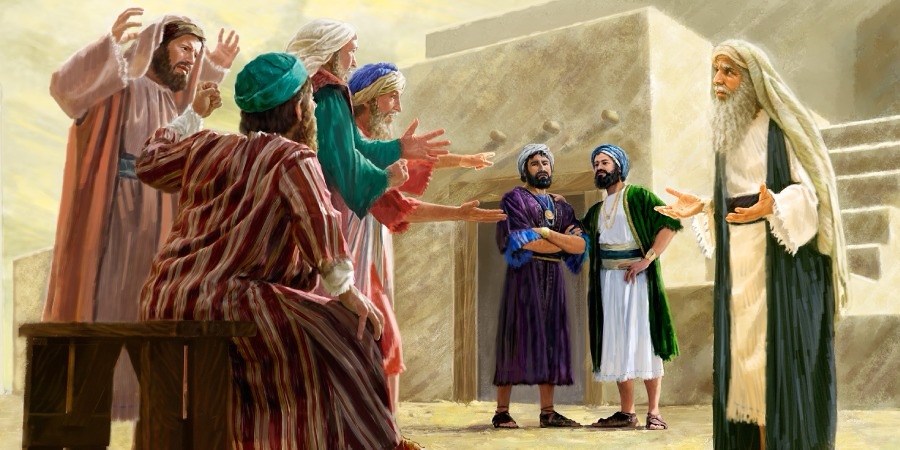
The lectionary selection for this Sunday offers us “A Dummies Guide to Kings in Israel”—that is, a series of “bites” [1 Samuel 8:4-11, (12-15), 16-20, (11:14-15)], some of which are optional (placed in parentheses). After the initial request, it includes the resistance of Samuel to this proposal (8:12–18) and the persistence of the people in pressing their request: “the people refused to listen to the voice of Samuel; they said “No! but we are determined to have a king over us” (8:19–20).

The full text of 1 Samuel provides reports of the back-and-forth that transpires, which the lectionary omits. It skips to a final optional reading of a further short section (11:14–15) which reports the outcome: “all the people went to Gilgal, and there they made Saul king before the Lord in Gilgal”.

The appointment of a king was obviously a matter of some controversy in ancient Israel; the compiler of the Deuteronomistic History (of which 1 Samuel is a part) devoted a significant amount of space to it, taking pains to include conflicting views about this matter. And, as we read these texts with the benefit of hindsight, we know that a king was ultimately appointed. This led to the later establishment of the Davidic dynasty, which became important in the claims later made about Jesus of Nazareth, recognised as Son of David.

So, of course, the person (or persons) chronicling the history of Israel in what scholars now call the Deuteronomistic history will tell the story with this outcome in view. The end result shapes how the story is told.

Writing in With Love to the World, Elizabeth Raine observes that “Israel looks for a leader to win battles and guarantee their security. It is a black-and-white understanding of the King; a figure military strength and political power. This is not the same as the way the prophet saw the role of King”. The people want power. The prophet warns of corruption. The people want victory. The prophet warns of failing to ensure justice.

And a clear thread in Hebrew Scripture would come to be that the king was called by God and anointed by God’s prophet to ensure that justice and righteousness were found in the land of Israel (Ps 72:1; 99:4; 1 Ki 3:28, 10:9; Isa 11:1–9; 32:1). That, at least, became the ideology for kingship in Israel; the reality, as we see in the stories selected for future weeks, was often different.

Elizabeth continues, “The story calls us to examine where we are placing our allegiances, and move to transformation, that process of repentance and renewal in which we turn back to God in every area. Whilst such self-examination is no doubt painful, it is also the only way to ensure we remain connected with God’s life-giving Spirit. As more and more people make the shift to a faithful allegiance that ensures that God’s Kingdom will be realised here on earth, we will hopefully see the reality of justice, peace, and love spreading in our world.”

To close, I offer two reflections on how this ancient story might speak to us today. The first perspective is that this story, about the desire for a powerful leader, and the dangers of pushing an agenda of power over all other matters, is a direct challenge to the way that the leaders of the modern state of Israel are conducting themselves in the long-enduring conflict with the Palestinians, who share an equally just claim to the land that was bequeathed to Jews in 1948. I have reflected at more length on this matter at

and my colleague Chris Budden has offered good insights into this conflict at

The second perspective is that this story is the first in a series of stories from ancient days which address a pressing contemporary issue: how to bring about effective change within the community of faith. It is something we all know about today, as society changes and the church occupies a different place in that society. How do we listen for God’s voice in this context? How do we advocate for effective change? I have written further on this dynamic at

and

With Love to the World is a daily Bible reading resource, written and produced within the Uniting Church in Australia, following the Revised Common Lectionary. It offers Sunday worshippers the opportunity to prepare for hearing passages of scripture in the week leading to that day of worship. It seeks to foster “an informed faith” amongst the people of God.

Appropriating the words of an Israelite prophet for a Christian doctrine (Isaiah 6; Trinity B)

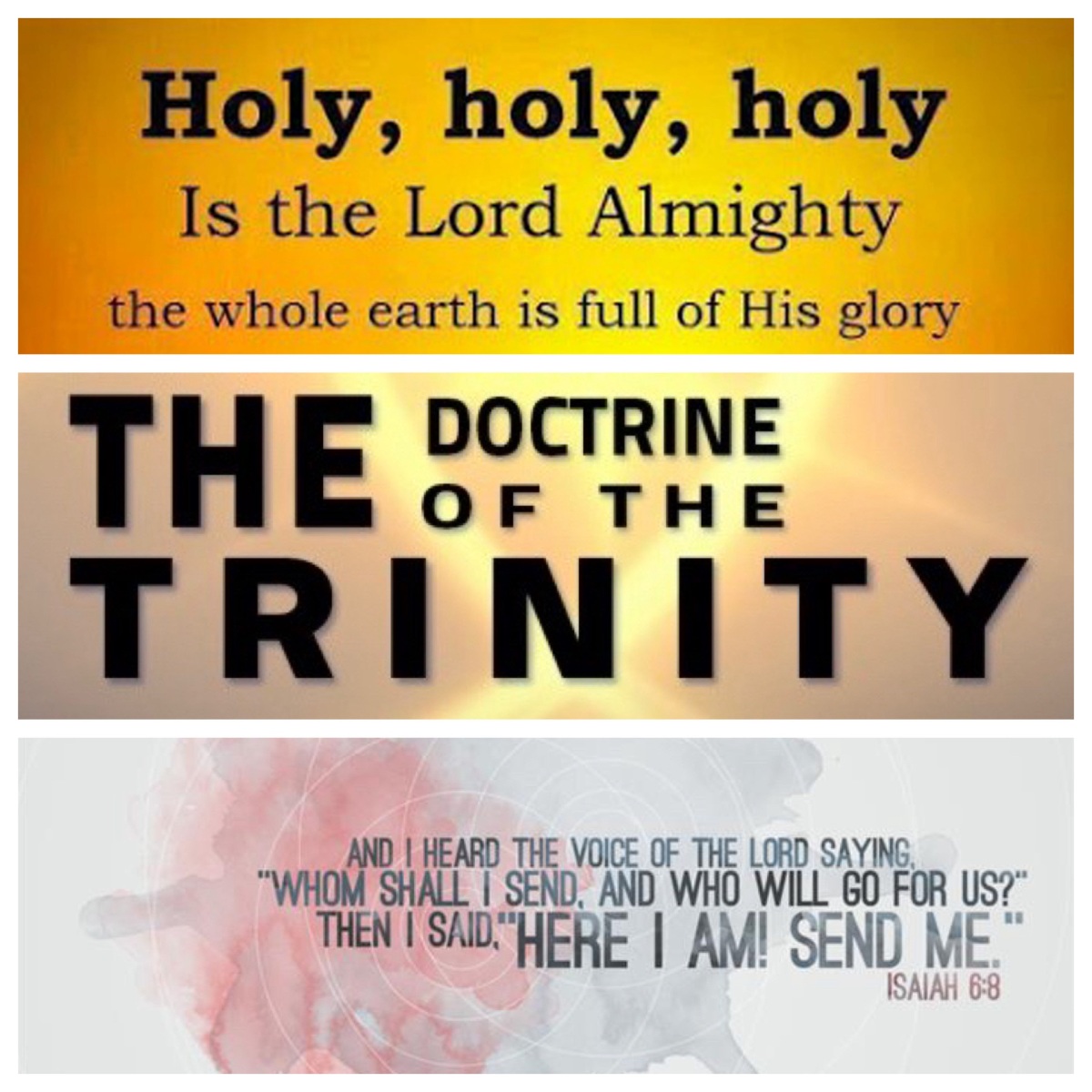
Trinity Sunday is one of the very few times in the Christian calendar that a Sunday is named for a doctrine, rather than for a biblical story (Easter, Pentecost, Christmas, and the like). The passages are chosen to encourage us to reflect on the doctrine of the Trinity, as a doctrine that is central to our faith, through selected biblical passages; this year, sections of Isaiah, John, and Romans (with a Psalm chosen to complement these selections).

So this Sunday we are being asked to approach scripture in a way quite different from many other Sundays, when biblical texts are offered for us to consider in their own right. Trinity Sunday, by contrast, pays scant attention to the historical and literary contexts of the chosen texts. Rather, they are selected as isolated “bites” that can be woven together to provide “a biblical basis” for a doctrine that was developed and expressed a number of centuries later.

In this regard, it has similarities with the way that we are encouraged to read selections from the prophets of ancient Israel—taking particular passages which are placed alongside certain Gospel stories because they “illuminate” or “complement” these later texts. The birth of Jesus at Christmas and the death of Jesus at Easter—and the weeks leading up to these days, in the seasons of Advent and Lent, respectively—are the times when this process is most evident.

So the choice of Isaiah 6:1–8 as the First Reading for this coming Sunday, Trinity Sunday, has both of those pressures running in parallel. First, this text is intended to speak from six centuries before Jesus about what people four centuries after Jesus thought about him, God, and the Spirit. That’s a leapfrog over a whole millennium!!

And second, this text is intended to focus our thoughts on the threefold nature of God—Father, Son, and Holy Spirit—through the somewhat fortuitous chanting of “holy, holy, holy” by seraphim in the smoke-filled temple atop Mount Zion (Isa 6:3). The only other place in scripture where this threefold acclamation of divine holiness appears is in the extravagantly symbolic visions of the spirit-infused prophet of Revelation, as he “sees things” in his old age (Rev 4:8).

The chanting of the seraphim in the former book, Isaiah, is the first articulation of a chant which, millennia later, became associated with the triune God, worshipped in Christian liturgies. In my own church, after the presiding minster prompts with the words: “And so we praise you with the faithful of every time and place, joining with the choirs of angels and the whole creation in the eternal hymn”, the people respond, “Holy, holy, holy Lord, God of power and might, heaven and earth are full of your glory. Hosanna in the highest. Blessed is he who comes in the name of the Lord. Hosanna in the highest.” (quoted from The Service of the Lord’s Day in Uniting in Worship 2; Assembly of the Uniting Church in Australia, 2005).

This song has an integral place in the liturgy, not just of the Uniting Church, but of numerous liturgical denominations around the world. It is sung or spoken in the Great Prayer of Thanksgiving, as people offer thanks to God and prepare to receive the sacrament. Its location within the Christian liturgy means that, in the minds of many believers, it is thoroughly Christianised.

And I suspect that the threefold expression, “holy, holy, holy”, is intended to evoke the three-in-one nature of God, as understood in classic Christian theology. Perhaps it is intended to be a subconscious evocation of “Holy God, Holy Son, Holy Spirit” — even though the song itself says nothing about the unity of those three elements?

The author of the latter book, Revelation, quotes this chant in the long sequence of visions that he reports in this book. He says that he was “in the spirit” (1:10; 4:2; 17:3; 21:10), hearing “the voice of many angels” (5:11–12), as four living creatures sing without ceasing, “Holy, holy, holy, the Lord God the Almighty, who was and is and is to come” (4:8). That’s a multiplying of the threefold aspect of God—three times holy, over three eras of time.

The creatures singing this song are “full of eyes in front and behind”, and they variously appear like a lion, an ox, a creature with a face like a human face, and a flying eagle (4:6–7). These strange creatures appear before the prophet then sees “a lamb standing as if it had been slaughtered, having seven horns and seven eyes” (5:6). The scene is quite fantastical.

There follows further, increasingly bizarre, visions: “the lamb” opens a series of seals with associated dramatic events (6:1–17; 8:1), angels are seen to be hold back nature (7:1), one angel speaks forth (7:2–3) and then seven angels each blow their trumpets (8:6—9:14) before another four angels who were “bound at the great river Euphrates” are released in order to wreak vengeance on the earth and on humanity (9:15–21). We are well and truly into the vividly creative inner mind of the prophet, surely.

After all of this, the prophet is offered a scroll by an angel “wrapped in a cloud, with a rainbow over his head; his face was like the sun, and his legs like pillars of fire” (10:1–2). The prophet takes the scroll and eats it (10:8–10); “it was sweet as honey in my mouth, but when I had eaten it, my stomach was made bitter” (10:10). That should hardly have been a surprise; the human digestive system is not intended for such a diet!

Then the prophet is instructed to “prophesy again about many peoples and nations and languages and kings” (10:11)—and he does so in a series of increasingly dramatic, vivid, and bizarre prophecies (chs. 11—22). It’s hardly the stuff that encourages me to think that the vision which included the threefold acclamation of God (4:8) was being considered in a rational way and employed in a constructive process of building a doctrine that would serve the church well over time!

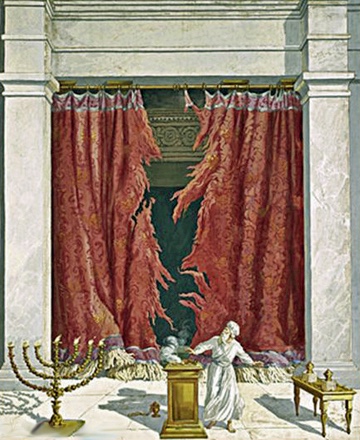
Quite surprisingly, in the midst of this extravagant revelatory exotica, there is a little scene that is strongly reminiscent of the scene in the temple on Mount Zion that Isaiah had described centuries beforehand. An angel with a golden censer “came and stood at the altar; he was given a great quantity of incense to offer with the prayers of all the saints on the golden altar that is before the throne” (Rev 8:3). After this, “the smoke of the incense, with the prayers of the saints, rose before God from the hand of the angel” (8:4) before the angel took the censer and filled it with fire from the altar and “threw it on the earth; and there were peals of thunder, rumblings, flashes of lightning, and an earthquake” (8:5).

The scene that is narrated in Revelation, therefore, might have certain resonances with the scene when the thresholds of the doorway to the Temple building “shook at the voices of those who called, and the house filled with smoke” (Isa 6:4). However, the creative imagination of the later prophet on Patmos (Rev 1:9) has taken him far, far away from the scene of the earlier prophet, Isaiah, in Jerusalem. And he ends up even further away from the process of vigorous debate and philosophical disputation which was the context within which the doctrine of the Trinity was formulated.

Isaiah locates the moment when he sensed his calling to be a prophet precisely when those seraphs sang their song, “holy, holy, holy” (Isa 6:3). “Woe is me”, he cries, explaining that “I am lost, for I am a man of unclean lips, and I live among a people of unclean lips” (6:5a). An intense sense of personal and communal inadequacy grips the prophet.

“Yet”, he continues, “my eyes have seen the King, the Lord of hosts!” (6:5b). This is far from an exposition of the inner nature of God; there is nothing to provide a hint of the doctrine of the Trinity, to be sure. In fact, this vision is similar to that seen by the prophets Amos during the time of Uzziah of Judah and Jeroboam of Israel (Amos 9:1) and Micaiah during the time of Jehoshaphat of Judah and Ahab of Israel (1 Ki 22:19; 2 Chron 18:18), when “coals of fire flamed forth” from the brightness before the Lord God.

In what Isaiah sees in this vision of “the King, the Lord of hosts”, he reports that “one of the seraphs flew to me, holding a live coal that had been taken from the altar with a pair of tongs; the seraph touched my mouth with it” (6:7) and uttered words of cleansing and forgiveness (6:8), followed by a word of commissioning (6:8). The coals are reminiscent of David’s vision of the Lord in his prayer calling for help, as “smoke went up from his nostrils, and devouring fire from his mouth; glowing coals flamed forth from him” (Ps 18:8, 12; 2 Sam 22:9, 13).

This moment during the visionary experience in the smoke-filled Temple grounds the prophet in the realities of his earthly life. The seraphs fly from the envisioned presence of the Lord God to touch the prophet directly in his physical state. There is nothing speculative or metaphysical involved in this sixth century BCE experience, such as we find in the expressions of Trinity that have been formulated since the fourth century CE.

It is noteworthy that the content of the commissioning that Isaiah then hears (6:9–13) is omitted from the verses suggested by the lectionary for Trinity Sunday. This severs the scene in the middle; the charge given to Isaiah is integral to the scene, and should not be omitted! Granted, the words which Isaiah hears are challenging and complex, for he is to “listen, but not comprehend; keep looking, but not understand” (6:9); indeed, he is to “make the mind of this people dull, and stop their ears, and shut their eyes, so that they may not look with their eyes, and listen with their ears, and comprehend with their minds, and turn and be healed” (6:10).

This is sobering. It is also material which could have been considered—indeed, should have been considered—in the process of exploring the essence of God, and articulating the nature of the divine—which is precisely what the doctrine of the Trinity is attempting to do. The God who cleanses and calls (6:7–8) is the same God who challenges and convicts (6:9–10), and who then judges with a ferocious intensity which is born out of a deep integrity (6:11–13).

How long is Isaiah to prophesy his words of challenge? “Until cities lie waste without inhabitant, and houses without people”, the answer comes (6:11); until “vast is the emptiness in the midst of the land” (6:12). For better or worse, we need to reckon with this dimension of God’s nature—and this coming Sunday would have been as good a time as any to ponder it!

So on Sunday during worship, ignore the lectionary, don’t stop at verse 8, and keep reading to the end of the chapter; and then reflect on who this God whom we worship really is.

See also

I will put my spirit within you … I will place you on your own soil (Ezekiel 37; Pentecost B)

In the alternate reading that the Revised Common Lectionary proposes for the festival of Pentecost, this coming Sunday, we find a section from the exilic prophet Ezekiel (Ezek 37:1–14). This is the famous prophecy covering the dead bones, to which the Lord (through Ezekiel) declares, “I will cause breath to enter you, and you shall live. I will lay sinews on you, and will cause flesh to come upon you, and cover you with skin, and put breath in you, and you shall live; and you shall know that I am the Lord” (Ezek 37:5–6).

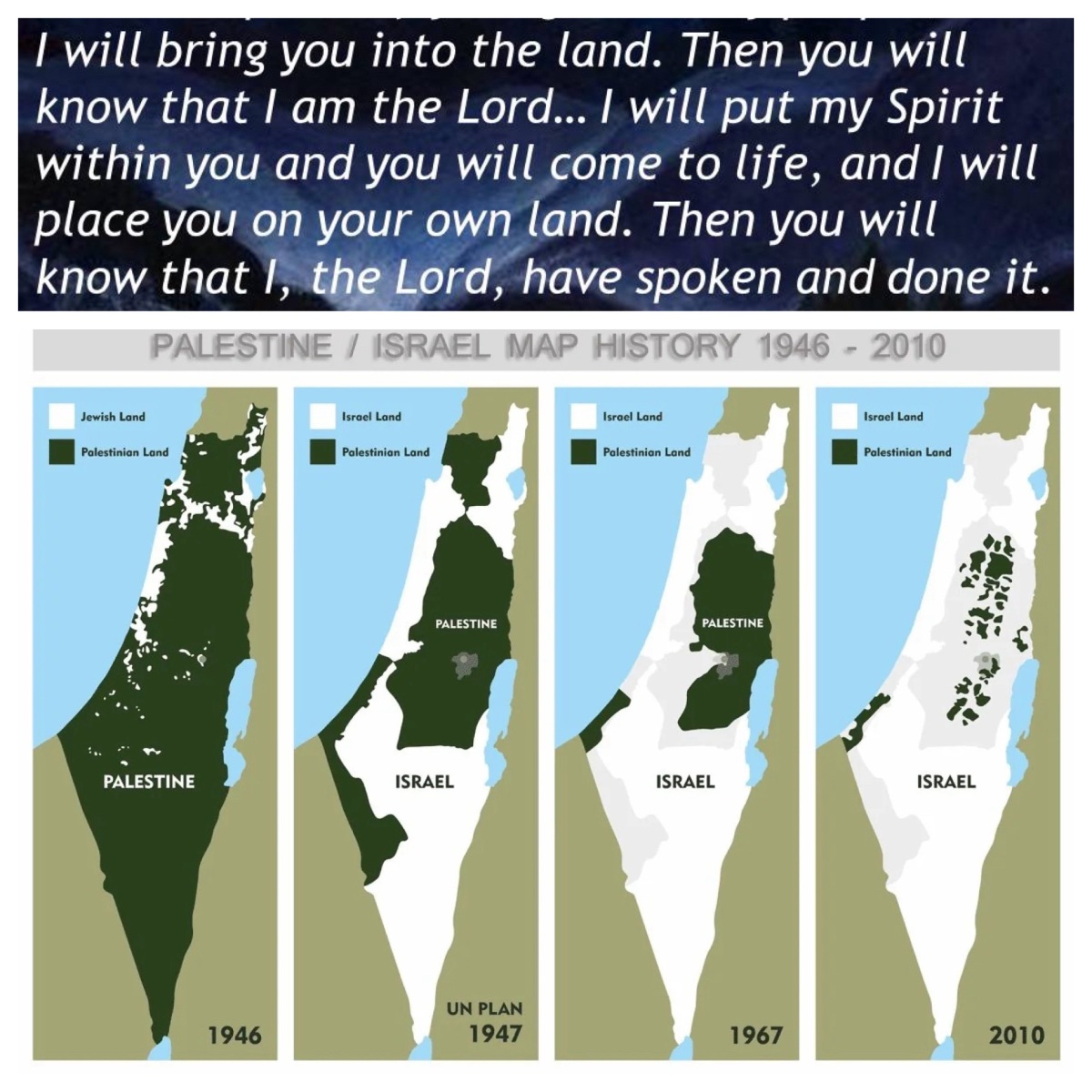
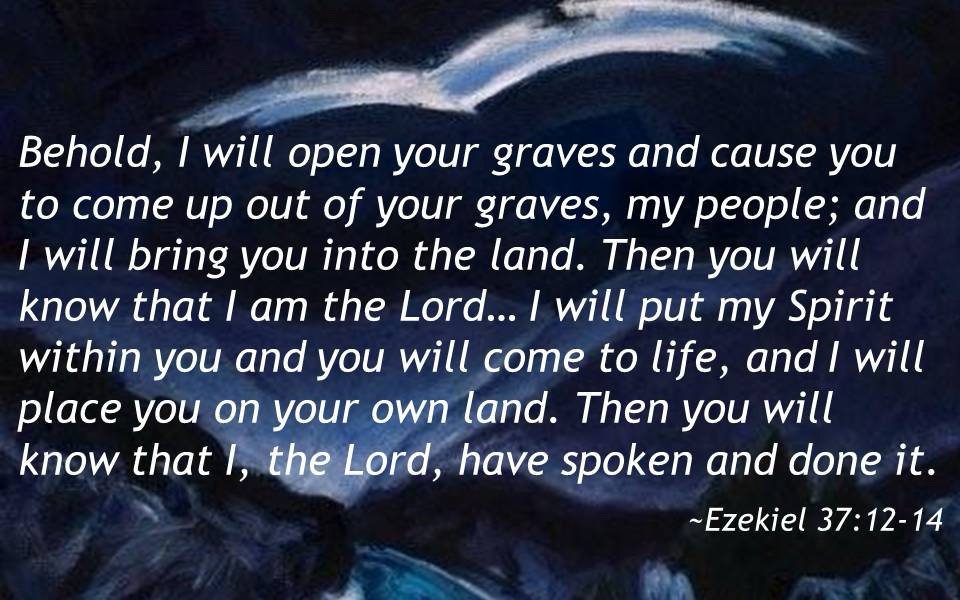
However, this passage also contains words which were filled with hope for the exiled people—but which, in the light of current events in the Middle East, and especially since the eruption of conflict on 7 October last year, are fraught with difficulties. God instructs Ezekiel, “prophesy, and say to them, Thus says the Lord God: I am going to open your graves, and bring you up from your graves, O my people; and I will bring you back to the land of Israel. … I will put my spirit within you, and you shall live, and I will place you on your own soil; then you shall know that I, the Lord, have spoken” (Ezek 37:12,14).

However, this passage also contains words which were filled with hope for the exiled people—but which, in the light of current events in the Middle East, and especially since the eruption of conflict on 7 October last year, are fraught with difficulties. God instructs Ezekiel, “prophesy, and say to them, Thus says the Lord God: I am going to open your graves, and bring you up from your graves, O my people; and I will bring you back to the land of Israel. … I will put my spirit within you, and you shall live, and I will place you on your own soil; then you shall know that I, the Lord, have spoken” (Ezek 37:12,14).

These words are fraught because of the long history of conflict relating to “the land of Israel”—the land to which the exiles would return under the decree of Cyrus of Persia; the land which today is the focus of such controversy and conflicted claims.

The land marked out for Israel was based on the historical reality that in ancient times Israelites/Jews had lived on that land for centuries until the scattering of all Jews under Roman rule first and second centuries of the Common Era. But since then, Arabs of various origins had held control of the land (see below), and those living there came to be known as Palestinians.

In the early 20th century, the place where Arabs who identified as Palestinians were living was decreed to be the British Mandate of Palestine (1920–1948). The ancient conflicts, it was hoped, would be well in the past. A place for Palestinians in the modern world was, it was thought, now settled. But this was not to be, as we well know today.

In part in response to the horrors of the Shoah, exposed by the ending of World War Two, the modern state of Israel was created in 1948. This was a hugely important, completely justified step to take, give the atrocities of genocide that had been inflicted on Jews in Europe by the Nazi regime of Germany.

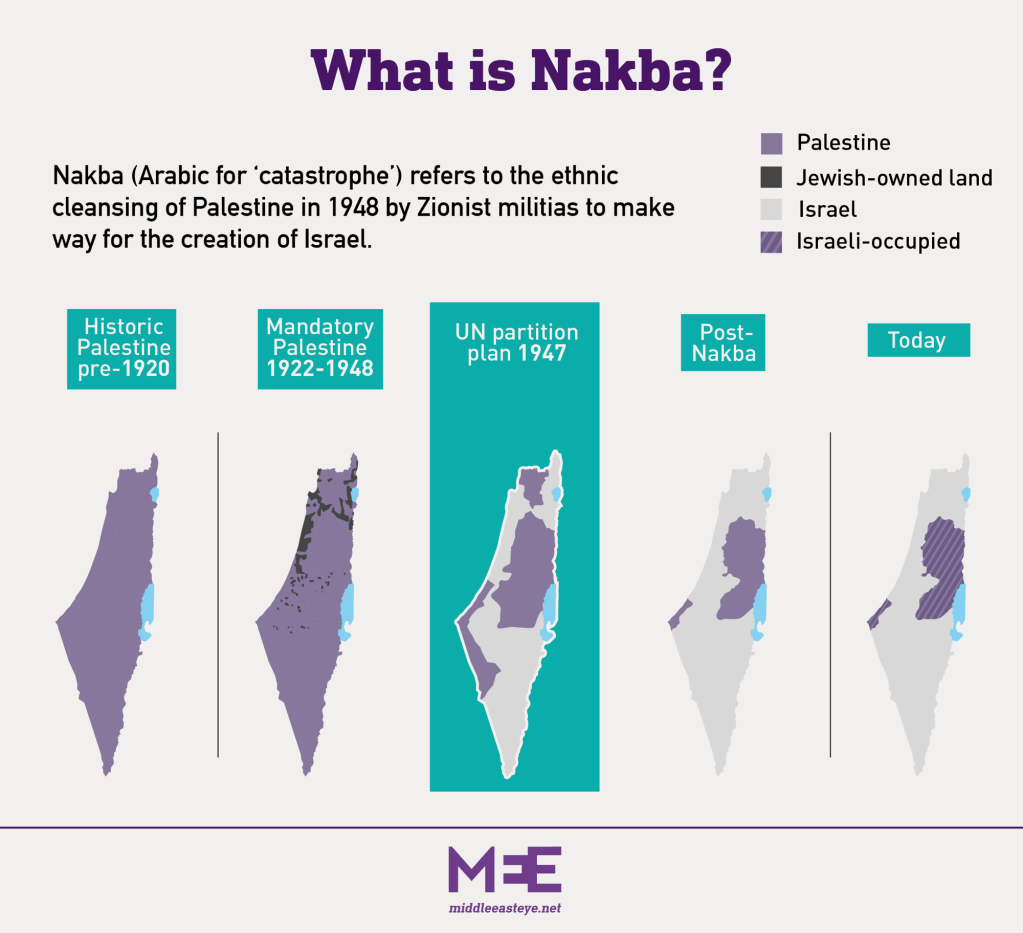
The new nation of Israel took 78% of the area which had been provided for Palestinians in the British Mandate. That this was now Jewish territory was a blessing for Jews, but it was a huge and continuing irritant to Palestinian sensibilities, which is why the period from 1948 onwards is known as the Nakba, the Palestinian Catastrophe. A significant number of Palestinians fled the area declared as Israel, as (in one estimate) over 500 Palestinian villages were repopulated by Jews, becoming refugees with no national identity. That was indeed a catastrophe for those inhabitants.

The contested regions of the Gaza Strip (along the east coastline of the Mediterranean Sea) and the West Bank (land immediately to the west of the River Jordan) became known as the Palestinian Territories. They have been disputed territories ever since they were occupied by Israel, two decades later, in the Six-Day War of 1967. In the decades since then, continuing and increasingly aggressive expansion of Israeli settlements into areas where Palestinians were living has greatly exacerbated the situation.

And so those who were dispossessed—and offered the hope of return to “their land”—become the dispossessors of others, to whom that same land was also “their land”; and so the tragic cycle continues.

The biblical texts which claim that God gave land to a chosen people so long ago are not verbatim accounts of “what God said” long ago, nor are they historical reports of actual events. They were written by priests returning from Exile, trying to recapture the period when Israel had some autonomy, because of the strength of its army under various tribal leaders (presented as “kings”). The texts form aetiological tales—that is, they are written as stories at a point in time, purporting to be ancient records, laying the foundation for a claim such as “this is our land, God gave it to us”.

That same land, promised to Abraham, claimed by Moses, is in contention today. It has had a chequered history. The ancient land of Cana an eventually became the land of Israel, then (along with Judaea) part of the Roman province of Syria Palaestina (132–390), and then of the Diocese of the East in the Roman Empire (to 536). What followed the fall of the Roman Empire was a millennium and a half of Muslim rule of this land, first as a part of Bilad al-Sham, the Greater Syria region, under various Caliphates.

The region continued to be part of various organisational configurations under successive Muslim rule, on into the Ottoman Caliphate (from 1517) and then into the modern era, as already noted. (I am not an expert, by any means, of this ancient and medieval history; for this summary, I am dependent on what I read in what I consider to be reputable sources.)

An exaggerated, idealised view of the extent of the land claimed by modern-day Israelis is evident in so many ways in the portrayal of Solomon, who was seen to be filled with “wisdom and knowledge”, and granted “riches, possessions, and honour, such as none of the kings had who were before you, and none after you shall have the like” (2 Chron 1:7–12, especially verses 10 and 12). The biblical figure of Solomon is an exaggerated caricature, a description of an idealised ruler whose existence is actually still a matter of debate amongst ancient historians.

It is also worth noting that the large reach of land that Solomon ruled over, even more extensive than the oft-cited phrase “from Dan to Beersheba” (Judg 20:1; 1 Sam 3:20; 2 Sam 3:10; 17:11; 24:2, 15; 1 Ki 4:25; 1 Chron 21:2; 2 Chron 30:5), did not continue past his death. The hagiographical exaggeration of territory under Solomon is not noted in the period after his death. The narrative books that recount the stories of the kingdoms of Israel, in the north, and Judah, in the south, in the centuries after Solomon, indicate that the scope of those kingdoms was more constrained.

*****

In the light of this, we need to take care when we come across texts in the Hebrew Scriptures which dogmatically and definitively declare that this land belongs to the people of Israel. Indeed, even scripture itself tells the story of the invading colonisers who claimed this land for their own (in the book of Joshua).

So I don’t think it is responsible, today, to lay claim to the whole, extended territory of the land, from the biblical passages noted, as the scope for the modern state of Israel which was created in 1948. There is no justification for the continued aggressive expansion of Israeli settlements in Palestinian areas. So I have sympathy for Palestinians who have lived on the land for thousands of years prior to 1948, as they understand this to be their ancestral land. It has been a continuing Nakba, a catastrophe, for Palestinians over these decades.

I also have sympathy for Jews, both those living in the land of Israel today, as well as those living in diaspora, for whom the land of Israel has a powerful symbolic significance—especially since the Shoah of 1933—1945 and the terrible genocide perpetrated by the Nazis against Jews in so many countries during that period. Granting them land in the area where their ancestors long ago had lived, a homeland that gives them security in the modern world, is important and necessary.

That said, I don’t agree that Palestinians should take matters into their own hands to seek vengeance against people in Israel in the way that they have done, once again, in recent months. In the same manner, nor do I think that the Israeli forces should respond in the aggressive and violent manner that they have done, once again, in recent times, with deaths of women and children, and aid workers, noted on the news with dreadful persistence. Too many people—innocent people—are dying and being injured, making any possible progress towards peace with justice even more difficult each day.

We need to seek once more the peace of these peoples. And we need to find that peace on the basis of justice. Neither terrorist attacks nor military crackdowns will achieve this. They will simply exacerbate a dangerous situation.

How do we deal, today, with the promises of God made long ago? “I will bring you back to the land of Israel. … I will place you on your own soil” (Ezek 37:12,14). We need to tread with care. Perhaps some other texts from both Jewish scripture Christian scripture provide guidance.

“Depart from evil, and do good; seek peace, and pursue it.” (Psalm 34:14). “Blessed are the peacemakers, for they will be called children of God.” (Matt 5:9). “Justice, and only justice, you shall pursue, so that you may live and occupy the land that the Lord your God is giving you.” (Deut 16:20). “… the weightier matters of the law: justice and mercy and faith. It is these you ought to have practiced …” (Mat 23:23). May these be the principles that guide the leaders of the warring groups in Israel and Palestine today.

I did not hide my face from insult and spitting (Isa 50 and the Passion Narrative; Lent 6B)

The passage of Hebrew Scripture we hear this coming Sunday (Isa 50:4–9a) is a significant passage. It comes from the second section of this long book (Isa 40—55), which opens with the familiar song, “comfort, comfort all my people” (Isa 40:1). Widely considered to be written in a period later than the earlier section (Isa 1—39), this section of Isaiah is called Second Isaiah. (The third main section, chapters 56—66, is called Third Isaiah.)

The comfort sung about by the prophet speaks to the situation of the people: their forebears had been taken into exile by the Babylonians in 587 BCE, and now a new generation (perhaps four to five decades later) yearns to return to the land of Israel, given to the people in ancient times, as recounted in the foundational myth—story of the Exodus. Other parts of the Hebrew Bible reflect the anguish of the people during their time of Exile (Ps 137 is the most famous instance). Deutero-Isaiah, however, focuses consistently on the hope of return to the land of Israel.

Looking to the new power of Persia to permit this return, the prophet of this later period speaks with hope and joy, to the people living in exile, using vivid imagery and dramatic scenes of promise and confidence. A joyous, positive tone runs right through the oracles in this section of Isaiah. “I am about to do a new thing”, says the Lord; “I will make a way in the wilderness and rivers in the desert” (43:19). “I will pour water on the thirsty land and streams on the dry ground”, the Lord continues; “I will pour my spirit upon your descendants, and my blessing on your offspring” (44:3).

Deutero-Isaiah is fundamental for the theological developments that we find in the New Testament. Scattered through this section, we find four Songs of the Servant—three relatively brief (42:1–9; 49:1–7; 50:4–11); and the fourth, best-known within Christian circles, a longer description of the servant who “was despised and rejected by others; a man of suffering and acquainted with infirmity” (Isa 52:13–53:12).

The resonances that this longer song has with the passion narrative of Jesus are crystal clear. The song is explicitly linked with Jesus six times in the New Testament (Matt 8:14–17; Luke 22:35–38; John 12:37–41; Acts 8:26–35; Romans 10:11–21; 1 Pet 2:19–25); furthermore, so many of the details of the passion narrative are shaped in the light of this song, along with a number of psalms of the righteous sufferer. (See

The third of these songs, which we hear this coming Passion Sunday, portrays the speaker as a Teacher. The resonances of this song with the story of Jesus are also clear. The punishment experienced by the Teacher—his back is struck, his beard is pulled, he is insulted, people spit on his face (Isa 50:6)—is echoed in the punishments inflicted on Jesus by Roman soldiers and Jewish passers-by. He is struck with a reed by Roman soldiers and spat upon (Mark 15:19). He is insulted by passers-by and the Jewish authorities (Mark 15:29–32).

The lectionary offers us this passage for Passion Sunday, a time when we reflect at some length on the passion of Jesus, which we recall also each Good Friday. The lectionary also offers the full story of the fate of Jesus after he entered Jerusalem at Passover. This part of the Gospel story (chapters 14–15 in Mark) is known as the passion narrative, because it tells about what Jesus suffered in his final days. (“Passion” comes from the Latin word passio, meaning suffering.)

The author of the beginning of the good news, which we know as Mark’s Gospel, seems to have been the first person (as far as we know from the evidence) who drew together a number of expressions about the way of Jesus, and worked them into a single, cohesive whole, in a continuous narrative style.

This narrative recounts the death of Jesus by relating it to the figure of righteous person who suffers injustice, who appears in various Hebrew Scripture passages. The author of this Gospel takes great pains to show that Jesus remains faithful to his calling despite the pressures he faces, just as the righteous sufferer of old also held to their faith.

The Gethsemane scene (Mark 14:32–42) draws on imagery from Hebrew Scripture to underline this. The narrative evokes the suffering of the faithful righteous person, referring especially to some phrases found in the Psalms. The Golgotha scene (Mark 15:21–41) also contains this orientation. What takes place is interpreted with reference to scripture; here, the allusions are both subtle, and more direct. The cry which Jesus utters at the ninth hour, Eloi, Eloi, lama sabachthani (15:34), is a clear reference to Psalm 22, by quoting its first verse. See more at

The offering of Isa 50:4–9a thus “fits” with the way that the author of the Markan passion narrative presents to story of the final hours of Jesus. His intense feeling of the agony inflicted on him, and yet his steadfast grappling with the faith he holds, is to the fore. The story invites us into sombre meditation as we approach the annual return of Easter.

With wings like eagles (Isa 40; Epiphany 5B)

The passage proposed for this coming Sunday, the Fifth Sunday after Epiohany (Isa 40:21–31) is from a section of the book of Isaiah which is very well known. It reaches it climax with the well-known acclamation that “those who wait for the Lord shall renew their strength, they shall mount up with wings like eagles, they shall run and not be weary, they shall walk and not faint” (Isa 40:31).

Words earlier in this oracle tell of the voice which cries out “in the wilderness prepare the way of the Lord” (Isa 40:3). We know these words as they are applied directly to John the baptiser early in the Gospels (Mark 1:2–4 and parallels; John 1:19–23). In that context, these words of the prophet invite us to look forward, in anticipation to the story of Jesus, which will follow.

These words, however, have a different reference in their original context. The words of the exilic prophet whose work forms the second section of Isaiah (chs. 40—55) are oriented towards the appearance of God to the people of Israel as they wait and hope for the end of their exile in Babylon. The prophet says that God will comfort the people (v.1), speaking tenderly to Jerusalem, declaring that “her penalty is paid” (v.2)—and then, that “the glory of the Lord shall be revealed, and all people shall see it together” (v.5).

The promise of God is clear; the prophet states that God declares, “I will send to Babylon and break down all the bars, and the shouting of the Chaldeans will be turned to lamentation” (43:14; 48:14; and see the extended oracle of 47:1–15). He specifically nominates Cyrus of Persia as the one chosen (or anointed) by God to bring the exiles home (Isa 44:28—45:1; 45:13). We know from 2 Chron 36:22–23, and the books of Ezra and Nehemiah, that this did indeed take place.

The prophet describes the way out of exile and back to the land once promised, ages before, to the ancestors of Israel, in terms which evoke the miraculous liberation from slavery in Egypt—at least in terms of the story that is told in Exodus. Whilst evidence to support the Exodus narrative as “historical” is strikingly missing, the story developed in the Exodus narrative is powerful.

So as the prophet describes the journey leaving Babylon and returning to Jerusalem he evokes that narrative escape from Egypt, indicating that the Lord God “will open rivers on the bare heights, and fountains in the midst of the valleys … [he] will make the wilderness a pool of water, and the dry land springs of water” (41:17–20; see also 43:16–17; 49:9–10; 50:2).

Because it was the Lord who “dried up the sea, the waters of the great deep [and] made the depths of the sea a way for the redeemed to cross over” (cf. Exod 14:19–22, 30–31), the prophet declares exultantly, “the ransomed of the Lord shall return, and come to Zion with singing” (Isa 51:10–11). In order to facilitate this return, in the opening oracle of this section, the prophet declares that “every valley shall be lifted up, and every mountain and hill be made low; the uneven ground shall become level, and the rough places a plain” (40:4).

The particular part of this opening oracle that the lectionary offers for this Sunday (Isa 40:21–31) is a song of praise to God, for the power that “the everlasting God, the Creator of the ends of the earth” exercises in the world. In the foundational saga of Israel, “Everlasting God” is the name given to the Lord by Abraham at Beersheba (Gen 21:33).

In contrast to the eternally-enduring deity, whose word will “stand forever” (40:8), the prophet observes that humans are like grass; “the grass withers, the flower fades”, he twice states (40:7, 8). In this, the prophet echoes other passages where the same observation is made. One psalmist laments that “my days are like an evening shadow; I wither away like grass” (Ps 102:11), in contrast to the Lord, who is “enthroned forever; your name endures to all generations” (Ps 102:12).

Job, similarly, bemoans the reality that “a mortal, born of woman, few of days and full of trouble, comes up like a flower and withers, flees like a shadow and does not last” (Job 14:1–2). This fleeting character is linked with evildoers in another psalm; they “will soon fade like the grass, and wither like the green herb” (Ps 37:2).

Yet another psalm includes a prayer that the wicked will “vanish like water that runs away; like grass let them be trodden down and wither; let them be like the snail that dissolves into slime; like the untimely birth that never sees the sun” (Ps 58:7–8). The prophet Jeremiah links the withering of grass to the wickedness of those in the land (Jer 12:1–4), while the prophet Isaiah had noted that the withering of the whole world was a curse that signalled the impending judgement on the world (Isa 24; see v.4).

In the context of this understanding of God, the eternal one, and human beings, whose lives are fleeting, the prophet has announced good tidings (40:9), that the Lord God “comes with might, and his arm rules for him; his reward is with him, and his recompense before him” (40:10). God will not leave people bereft. God comes to “feed his flock like a shepherd … gather the lambs in his arms, and carry them in his bosom, and gently lead the mother sheep” (40:11). The eternal God is a caring, compassionate being.

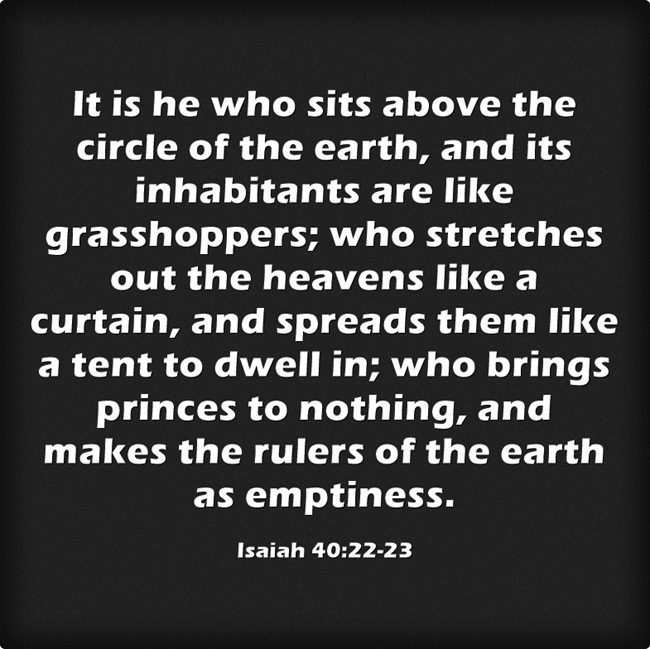
Alongside this comforting image of the deity, the prophet shares a vision of the God who “sits above the circle of the earth … stretches out the heavens like a curtain, and spreads them like a tent to live in” (40:22). God is described as residing “above” in narrative texts (Josh 2:11; 1 Ki 8:23; 2 Ki 19:15) and prophets (Isa 37:16; Ezek 10:19; 11:22). Job recognises “God above” (Job 3:4; 31:2, 28); psalmists praise “God above the heavens” (Ps 57:5, 11; 108:5).

God above is not remote; God above descends to intervene—as the prophet says, the Lord God “brings princes to naught, and makes the rulers of the earth as nothing” (Isa 40:23). This resonates with the words that Hannah sings, that the Lord “kills and brings to life; he brings down to Sheol and raises up … [he] makes poor and makes rich; he brings low, he also exalts; he raises up the poor from the dust; he lifts the needy from the ash heap, to make them sit with princes and inherit a seat of honour” (1 Sam 2:6–8).

This also correlates with words of the psalmist, singing that when the hungry “are diminished and brought low through oppression, trouble, and sorrow, he pours contempt on princes and makes them wander in trackless wastes; but he raises up the needy out of distress, and makes their families like flocks” (Ps 107:39–41), and that “the Lord upholds all who are falling, and raises up all who are bowed down” (Ps 145:14). Similar thoughts, of course, are also,expressed in the pregnant Mary’s song of praise (Luke 1:51–53).

Extolling this God as above all and eternal means that the existence of other entities with a claim to divinity need to be explained. “To whom then will you compare me, or who is my equal?”, the prophet enquires (40:25). Only the Lord God is creator (40:26, 28). Surely, in the mind of the prophet, this places this God in a distinct and unique place.

So it is within these oracles of promise and hope that the theological understanding of monotheism is clearly articulated for the first time in the history of Israel. “Is there any god besides me? There is no other rock; I know not one” (44:8). The phrase, “there is no other (god)”, recurs a number of times in this section (42:8; 45:5, 14, 21, 22; 46:9). This echoes the refrain in Deuteronomy, that “the Lord is God; there is no other besides him” (Deut 4:35, 39; 5:7; 6:14; 7:4; 8:19; 11:16, 28; 13:6–7, 13; 17:3; 18:20; 28:14, 36, 64; 29:26; 30:17–20). Deuteronomy in the form that we know it is to be dated to the exile or return—the same time as the unnamed prophet in Second Isaiah is active.

This claim that the Lord God is the only god is in contrast to the way that the God of Israel had previously been portrayed, as “among the gods” (Exod 15:11; Judg 2:12; Ps 86:8), with the commandment to have “no other gods before me” (Exod 20:3; Deut 5:7) distinguishing this God from those other gods whom Israel was clearly forbidden to worship (Deut 6:14; 7:4; 8:19; 11:16; 13:1–18; 17:2–5; 18:20).

Before the Exile, the possibility of other gods had been entertained. After the experience of exile, the singularity of the Lord God becomes a central claim. And this, in turn, leads into the monotheistic strand that shapes the movement that Jesus initiated.

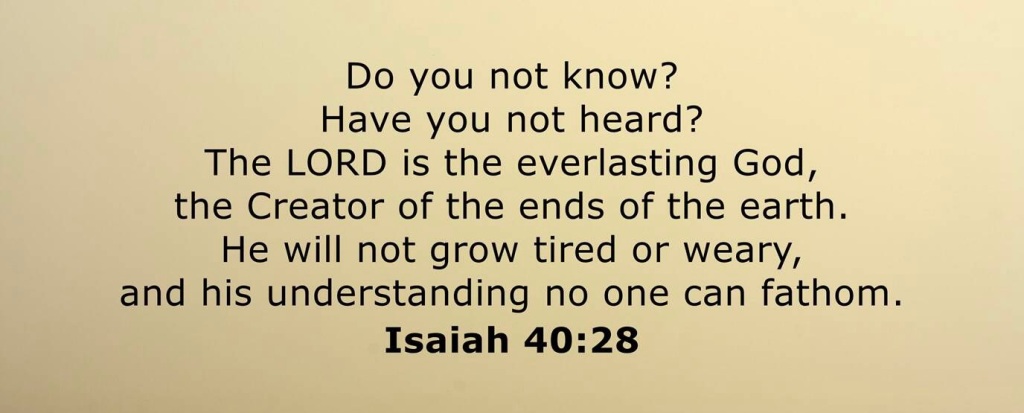
The prophet concludes this particular oracle with words of inspiration (40:28–31). Two rhetorical questions set the scene: “Have you not known? Have you not heard?” (40:28a). A foundational theological affirmation in the prophet’s worldview follows: “The Lord is the everlasting God, the Creator of the ends of the earth” (40:28b).

Elsewhere in Hebrew Scripture, we find statements that God “looks to the ends of the earth and sees everything under the heavens” (Job 28:24), that God’s name “reaches to the ends of the earth” (Ps 48:10), that God is “the hope of all the ends of the earth and of the farthest seas” (Ps 65:5), and that “all the ends of the earth have seen the victory of our God” (Ps 98:3).

Prophets also affirm that “from the ends of the earth we hear songs of praise, of glory to the Righteous One” (Isa 24:16), that “all the ends of the earth shall see the salvation of our God” (Isa 52:10), and that to the Lord “shall the nations come from the ends of the earth and say: Can mortals make for themselves gods? Such are no gods!” (Jer 16:19).

And so the rhetoric of the prophet rises up into a grand poetic affirmation about this world-encompassing God, who “does not faint or grow weary” (40:28c), as the prophet repeats the earlier affirmation (40:23) that God “gives power to the faint, and strengthens the powerless” (40:29). This picks up the earlier affirmation that God “brings princes to naught and makes the rulers of the earth as nothing” (40:23), folded into the declaration that this same God “gives power to the faint and strengthens the powerless” (40:29).

Springboarding off the imagery of fainting/strengthening, the prophet then contrasts “youths [who] will faint and be weary and young [who] will fall exhausted” (40:30) with “those who wait for the Lord [who] shall renew their strength” (40:31a). This imagery, which closes the oracle, is used to portray this renewal of strength—that of an eagle rising up into the sky. It has caught the imagination of people of faith over many centuries. The rising eagle depicts the way that believers “shall run and not be weary, they shall walk and not faint” (40:31b).

The eagle is known in Christian symbolism as the symbol of the evangelist John, because of the “high Christology” his Gospel contains, reflecting the divinity of Jesus in traditional interpretation. The four symbols (man, lion, ox, and eagle) are in turn derived from the striking vision that opens the book of Ezekiel, who saw “fire flashing forth continually, and in the middle of the fire, something like gleaming amber; in the middle of it was something like four living creatures … the four had the face of a human being, the face of a lion on the right side, the face of an ox on the left side, and the face of an eagle” (Ezek 1:4–10).

“The way of an eagle in the sky” is included amongst the “three things too wonderful for me” that the sage ponders (Prov 30:18–19), while the prophet Obadiah warns Moab, “though you soar aloft like the eagle, though your nest is set among the stars, from there I will bring you down, says the Lord” (Obad 1:4).

The power of the eagle, soaring high into the sky and spreading wide its wings, features in oracles by Jeremiah (Jer 48:40; 49:22) and Ezekiel (Ezek 17:3), and is used to describe how the Lord God guided “his people Jacob”: “as an eagle stirs up its nest and hovers over its young; as it spreads its wings, takes them up, and bears them aloft on its pinions, the Lord alone guided him” (Deut 32:11–12). It’s a powerful and inspiring image to conclude this opening oracle of the prophet as he looks for the exile of his people to end.

See also https://johntsquires.com/2022/08/31/comfort-and-hope-return-from-exile-isaiah-40-55/

A prophet like Moses (Deut 18; Epiphany 4B)

“I will raise up for them a prophet like you from among their own people; I will put my words in the mouth of the prophet, who shall speak to them everything that I command” (Deut 18:18). These words are the heart of the Hebrew Scripture passage which the Revised Common Lectionary proposes for this coming Sunday, the Fourth Sunday after Epiphany.

Here, Moses informs the people that, just as he spoke words placed into his mouth by God, so there will be later individuals who also will speak words given to them by God. And so, Israel is assured of the presence of a prophet in their midst throughout the centuries.

Indeed, a number of the prophets of Israel remind us that they speak forth “the voice of the Lord” (Isa 66:6; Jer 42:5–6; Dan 9:9–10; Mic 6:9; Hag 1:12; Zech 6:15). Jesus stands in this tradition, offering words of guidance, challenge, and judgement. In traditional Christian understanding, he is the way by which, “in these last days, God … has spoken to us” (Heb 1:1–2).

What will the prophet speak? In so many reports of prophetic activity, it is justice which is the heart of their message—God’s justice; the justice which God desires for the people of God; the justice which God speaks through the voice of the prophets; the justice that God calls for in Israel; the justice that provides the measure against which Israel will be judged, and saved, or condemned.

Moses himself was charged with ensuring that justice was in place in Israelite society. One story told of the time after the Israelites had escaped from Egypt places Moses as a judge. Whilst in the wilderness of Sin, being visited by his father-in-law Jethro, we learn that “Moses sat as judge for the people, while the people stood around him from morning until evening” (Exod 18:13).

Noticing that Moses was overwhelmed by the volume of matters requiring adjudgment, Jethro suggested—and Moses adopted—a system whereby appointed men who “judged the people at all times; hard cases they brought to Moses, but any minor case they decided themselves” (Exod 18:14–16). The charge given to these men is clear: they are to give a fair hearing to every member of the community, and they “must not be partial in judging: hear out the small and the great alike; [do] not be intimidated by anyone, for the judgment is God’s” (Deut 1:16–17).

Prophets coming after Moses thus inherited this responsibility to ensure that justice was upheld within society. Amos calls for “justice and righteousness” (Amos 5:22). Micah asks the question, “what does the Lord require of you but to do justice?” (Mic 6:8), while through the prophet Hosea, the Lord God promises to Israel, “I will take you for my wife in righteousness and in justice, in steadfast love, and in mercy” (Hos 2:19).

Isaiah ends his famous love-song of of the vineyard by declaring that God “expected justice” (Isa 5:7); Jeremiah notes the need to “not oppress the sojourner, the fatherless, or the widow” (Jer 7:5–7). Second Isaiah foresees that the coming Servant “will bring forth justice to the nations” (Isa 42:1) while Third Isaiah begins his words with a direct declaration, “maintain justice, and do what is right” (Isa 56:1), for “I the Lord love justice” (Isa 62:8).

This commitment resonates with the psalmist, who praises “the God of Jacob … who executes justice for the oppressed; who gives food to the hungry … [who] sets the prisoners free, [who] opens the eyes of the blind, [who] lifts up those who are bowed down [and] loves the righteous, [who] watches over the strangers [and] upholds the orphan and the widow” (Ps 146:5, 7–9). See

It may be significant that, in this year when Mark’s Gospel is featured in the lectionary, the Hebrew Scripture passages offered during the short season of Epiphany are drawn from the books of the prophets: 1 Samuel, Jonah, this passage from Deuteronomy, Isaiah, and then the story of Elijah and Elisha in 2 Kings. These passages help us to see in clear focus the way that Jesus operates like a prophet in Mark’s narrative. See

So the offering of the Deuteronomy passage this week particularly pushes us to consider how Jesus might be seen as a prophet, one whom God raised up to be like Moses (Deut 18:15-18). There are three key features of Mark’s portrayal of Jesus which depict him in a prophetic vein: words and deeds, a kingdom focus, and the importance of repentance.

I Words and deeds

Words, of course, are important, both for the prophets, and for Jesus. “Thus says the Lord”, a commonplace of prophetic rhetoric, is reflected in the comments of the Markan narrator that Jesus “went about all the villages teaching” (Mark 6:6), proclaiming his message (1:14–15, 38) and speaking of the kingdom of God in parables (4:11, 26–32; 12:1–12), in sayings (9:1, 47; 10:14–15, 23–25; 12:34), and in an extended apocalyptic discourse (13:3-37). Words were central to his public and private activity.

Jesus is remembered, however, as “a prophet mighty in deed and word” (Luke 24:19), so the deeds he performed are equally as important as the words he spoke. Indeed, this was always the case for prophets; God gave Moses words to speak and signs to perform (Exod 4:28–30), and the prophets that followed him accompany their message with acts that manifest the truth of what is proclaimed: Ahijah tearing his garment into twelve pieces (1 Ki 11), Isaiah walking naked for three years (Isa 20), Jeremiah buying and then breaking an earthenware jug (Jer 19), Ezekiel eating a scroll (Ezek 3), Ezekiel shaving his head and slashing the hair with a sword (Ezek 5), and many more.

In like manner, Jesus sent out his followers to proclaim his message, but also to “cast out many demons and anoint with oil many who were sick and cure them” (Mark 6:12–13). Word and deed belong together. So Mark reports, alongside the parables and sayings of Jesus, numerous instances when Jesus healed people (2:1–12; 3:1–6; 3:22; 5:21–43; 6:5, 53–56; 7:31–37: 8:22–26; 10:46–52), cast out demons and unclean spirits (1:21–28, 32–34, 39; 3:11; 5:1–20; 7:24–30; 9:14–29), as well as miraculously fed multitudes (6:30–44; 8:1–10), cleansed a leper (1:40–45), stilled a storm (4:35–41), and walked on water (6:45–52).

II The coming kingdom

Another way in which Jesus reflects his prophetic calling was through the kingdom focus in his teaching. That the imminence of the kingdom is a key note for Jesus is reflected both in his opening words in Mark (“the time is fulfilled, and the kingdom of God has come near”, 1:15a) and in some of his final words to his closest followers (“I will never again drink of the fruit of the vine until that day when I drink it new in the kingdom of God”, 14:25).

Jesus has so shaped the expectations of his followers that they anticipate this coming with intensity. “There are some standing here who will not taste death until they see that the kingdom of God has come with power”, he told them (9:1); to one enquirer, he affirmed, “you are not far from the kingdom of God” (12:34), and after his death, another follower who was “waiting expectantly for the kingdom of God ensured that the body of Jesus was cared for (15:43).

When some of his disciples hindered children wanting to come to him, Jesus chided them, saying, “whoever does not receive the kingdom of God as a little child will never enter it” (10:15); a little later, to his disciples, he warned, “how hard it will be for those who have wealth to enter the kingdom of God!” (10:23).

The final extended discourse of Jesus that Mark reports (13:4–37) provides reassurance of the sovereignty of God in the midst of crises and calamities. These events are but “the beginning of the birth pangs” (13:8). Jesus affirms that those enduring will be saved by divine action (13:13, 20), culminating in the appearance of “‘the Son of Man coming in clouds’ with great power and glory” (13:26) and the gathering of the elect by the angels of God (13:27).

The kingdom is the realm in which God will act decisively. In the words of the prophets, the kingdom of David and his successors was the realm in which God was seen to be active; after that kingdom was conquered and its people taken captive, the prophetic voices of Israel began to develop a notion that, at some time in the future, there would indeed be a kingdom which would be the realm in which God would be active. The prophetic hope in The Day when God would act came to full, dramatic expression in the apocalyptic portrayals of The End that was anticipated.

See

III Metanoia: a complete transformation

Proclaiming that repentance, metanoia, is the essential prerequisite for entry into that kingdom in order to fulfil God’s justice is a third feature of Mark’s portrayal of Jesus in the manner of a prophet. The first word of Jesus in Mark’s early account is clear: “the time is fulfilled, and the kingdom of God has come near; repent (metanoeite) and believe (pisteuete) in the good news” (1:15).

In this programmatic Markan announcement, the two statements (in the indicative mood) about “the time” and “the kingdom” are followed by two commands (in the imperative mood) to “repent” and “believe”. The imminence of the kingdom is the motivation for the call to repent and believe.

This call to repent is evident in the activity of the followers of Jesus who are sent out in pairs with “authority over the unclean spirits”; as they cast out demons and cured the sick, so they also “they proclaimed that all should repent” (6:7–13). Beyond that, the explicit call to repent is not repeated by Jesus, but its presence is evident throughout the narrative.

Jesus calls people to follow him; fishermen Peter and Andrew “left their nets and followed him” (1:18), fishermen James and John “left their father Zebedee in the boat with the hired men, and followed him” (1:20), and tax collector Levi son of Alphaeus, “got up and followed him” (2:14). Leaving behind signals the complete transformation undertaken by following Jesus.

Following Jesus is akin to taking up the cross, a sign of social rejection and alienation as well as personal denial (8:34). Jesus delivers a sequence of three sayings that reflect the complete turnaround that is required to effect metanoia. First, “those who want to save their life will lose it, and those who lose their life for my sake, and for the sake of the gospel, will save it” (8:35). Next, “whoever wants to be first must be last of all and servant of all” (9:35).

And then, “whoever wishes to become great among you must be your servant, and whoever wishes to be first among you must be slave of all” (10:43–44). Jesus himself provides the foundational model for this way of living; as the Son of Man, he came “to give his life a ransom for many” (10:45).

This persistent demand for complete life transformation—metanoia—resonates with Isaiah’s signal declaration that “Zion shall be redeemed by justice, and those in her who repent, by righteousness” (Isa 1:27), and regular prophetic calls to “return to me, says the Lord of hosts … return from your evil ways and from your evil deeds” (Zech 1:3–4); “repent and turn away from your idols; and turn away your faces from all your abominations” (Ezek 14:6; also 18:30), “return to me … remove your abominations from my presence and do not waver” (Jer 4:1); “return to me with all your heart, with fasting, with weeping, and with mourning” (Joel 2:12).

The recurring refrain of Amos, lamenting, “yet you did not return to me, says the Lord” (Amos 4:6,8,9,10,11), leads the prophet to assure Israel that “I will do this to you; prepare to meet your God, O Israel!” (Amos 4:12)—words akin to what the psalmist says, “if one does not repent, God will whet his sword; he has bent and strung his bow; he has prepared his deadly weapons, making his arrows fiery shafts” (Ps 7:12–13).

“I will raise up for them a prophet like you from among their own people; I will put my words in the mouth of the prophet, who shall speak to them everything that I command” (Deut 18:18). In the way that Mark presents Jesus in his narrative, we can see how Jesus speaks and acts in the manner of a prophet like Moses, the archetype of prophetic leadership.

*****

Please Note: in the above comments, I am not seeking to “ prove” that Jesus “fulfils prophecy”. Rather, I am interested to explore the ways that an understanding of Hebrew Scripture can inform the way we read and understand the Gospel narratives about Jesus. For further thoughts on how we read prophetic texts in a Christian context, see

and

The year of the Lord’s favour (Isa 61; Advent 3B)

As we move on in the new year in the church’s calendar, this coming Sunday we celebrate the third Sunday in the season of Advent, and continue our preparations for Christmas—the coming of Jesus, Saviour, chosen one, and Lord (Luke 2:11). During Advent, the lectionary offers a selection of biblical passages designed to help us in our preparations, building to the climactic moment of Christmas Day, when we remember that “the Word became flesh and lived among us, and we have seen his glory, the glory as of a father’s only son, full of grace and truth” (John 1:14).

These scripture passages include a sequence of excerpts from the Hebrew Scriptures—largely from the book of Isaiah—which orient us to the saving work of God, experienced by faithful people in Israel through the ages. These scripture passages inform us to sense how God was at work in the story of Jesus.

The passage proposed by the lectionary for this third Sunday in Advent (Isa 61:1–11) is another very well-known one. It comes from the third main section of Isaiah (chs.56—66), recording the words spoken by an unnamed during the return to the land after exile in Babylon. This prophet is often called Third Isaiah.

This passage is best known because the opening few verses are the words read by Jesus when he was handed the scroll to read in his hometown synagogue (Luke 4:16–19). Following that story offered by Luke, we read that Jesus “rolled up the scroll, gave it back to the attendant, and sat down, and the declared, “Today this scripture has been fulfilled in your hearing” (Luke 4:20–21). That statement shapes the interpretive approach of Christians to the words in Isaiah 61; we are guided to read them as a prophetic declaration about Jesus.

However, we need to take care not to override and exclude the intention of the message (to the extent that we can assess it) of the original speaker and the faithful scribe in that ancient post-exilic context. To do so would be to perpetuate a supersessionist reading of scripture, which claims that “the old” is no longer relevant because “the new” has superseded it. This is poor interpretive practice and bad theology.

How might we best understand this passage? Understanding the dynamics at play at the time the words were spoken and then written down is instructive. For the returning exiles, preparing to re-establish their distinctive society in their much-loved land, the call of the prophet, through the gifting of the Spirit, was orienting them clearly to face the ethical issues of that society. Oppression and captivity had been the experience of past decades; liberty and joyful encouragement were now to be the markers of life in the land.

So central to the task of rebuilding society was the age-old commitment of care for the vulnerable and support for the needy. Prophets of times past had expressed this in terms of care for the widow, the orphan, and the foreigner in the land. Isaiah proclaims God’s judgement on those who “turn aside the needy from justice … and rob the poor of my people, that widows may be your spoil, and that you may make the orphans your prey!” (Isa 10:1–2).

Other prophets join their voices to Isaiah’s declaration. Ezekiel laments that “the sojourner suffers extortion in your midst; the fatherless and the widow are wronged in you” (Ezek 22:7). Jeremiah encourages the people of Jerusalem with a promise that God will allow them to continue to dwell in their land if they “do not oppress the sojourner, the fatherless, or the widow” (Jer 7:5–7).

The words of Third Isaiah continue in this prophetic stream. They also resonate with the psalmist, who praises “the God of Jacob … who executes justice for the oppressed; who gives food to the hungry … [who] sets the prisoners free, [who] opens the eyes of the blind, [who] lifts up those who are bowed down [and] loves the righteous, [who] watches over the strangers [and] upholds the orphan and the widow” (Ps 146:5, 7–9). See

https://johntsquires.com/2023/05/14/father-of-orphans-and-protector-of-widows-psalm-68-easter-7a/

The distinctive contribution of this particular prophet is to frame the task through the story of the Jubilee, “the year of the Lord’s favour” (v.2). That Jubilee year had, as its flip side, the ominous “day of vengeance of our God” for those who failed to follow the way of Jubilee justice. The Jubilee entailed the release of slaves and the cancelling of debts; it was meant to be practised in society every fifty years during the year of Jubilee (Lev 25:8–17; see esp. v.13).

Whilst these levitical prescriptions appear to be the ideal that the priests hoped for, actual evidence that this was ever implemented in Israelite society is lacking. Indeed, it is suggested that while the people were in Exile, the land of Israel would “lie desolate”, and “enjoy its sabbath years” (Lev 26:34), providing recompense for all those years when “it did not have on your sabbaths when you were living in it” (Lev 26:35).

The return to the land, as far as Third Isaiah is concerned, meant that these levitical prescriptions should indeed be adhered to, as the people promised “to walk in God’s law, which was given by Moses the servant of God, and to observe and do all the commandments of the Lord our Lord and his ordinances and his statutes” (Neh 10:29). In the way that Jesus cited this prophetic passage in his hometown synagogue (Luke 4:16), implementing the Jubilee prescriptions in his own time was also what he envisaged.

The prophet lays claim to the work of the Spirit in setting forth this programme for the people. “The spirit of the Lord is upon me”, he declares (Isa 61:1), placing himself in a long line of spirit- inspired leaders in Israel. The Spirit had guided Moses and was then gifted to chosen elders (Num 11:16–25). That Spirit was subsequently imparted to Joshua (Num 27:18; Deut 34:9) and then to a string of Judges: Othniel (Judg 3:10), Gideon (6:34), Jephthah (11:29), and Samson (13:24–25; 14:6,19; 15:14).

In later years, the Spirit guides Saul (1 Sam 10:6–7), David (2 Sam 23:2), Solomon (Wisd Sol 7:7), the line of prophets (Neh 9:30), the servant of the Lord (Isa 42:1), Ezekiel (Ezek 3:12, 14; 8:3; and many subsequent references), Daniel (Dan 5:12), Micah (Mic 3:8), and Zechariah (Zech 4:6). The activity that the Spirit undertook in these instances was invariably to provide guidance regarding the conduct of Israelite society, through these anointed leaders and inspired prophetic voices.

The oracle of the post-exilic prophet thus blends notes of celebration and justice, such that “righteousness and praise [will] spring up before all the nations” (v.11). There will be “a garland instead of ashes, the oil of gladness instead of mourning” (v.3), “everlasting joy” (v.7), with rejoicing and exultation akin to a wedding celebration (v.10). Society will be marked by righteousness (vv.3, 10, 11), to demonstrate that “I the Lord love justice, I hate robbery and wrongdoing” (v.8).

Jesus stands firmly in this line. His connection of Spirit with justice in society is drawn directly from Third Isaiah. The Jubilee he announces in his hometown (Luke 4:19) is explained in his series of blessing and woes (Luke 6:20–26), his welcome of and advocacy for poor and outsiders (Luke 7:34; 10:8–9; 15:1–2), and in a number of parables which prefigure reversals in society (for instance, 14:7–24; 16:19–31).

Alongside these sounds of justice, a note of joy runs through the public activities of Jesus (Luke 6:23; 8:13; 10:17; 15:6, 7, 9, 10, 32). It is in this sense that we can affirm that Jesus has “fulfilled this scripture”, and that this prophetic passage is a helpful guide for us during Advent.

He will feed his flock like a shepherd (Isa 40; Advent 2B)

As we move on in the very new year in the church’s calendar, this coming Sunday we celebrate the second Sunday in the season of Advent, and continue our preparations for Christmas—the coming of Jesus, Saviour, chosen one, and Lord (Luke 2:11). During Advent, the lectionary offers a selection of biblical passages designed to help us in our preparations, building to the climactic moment of Christmas Day, when we remember that “the Word became flesh and lived among us, and we have seen his glory, the glory as of a father’s only son, full of grace and truth” (John 1:14).

These scripture passages include a sequence of excerpts from the Hebrew Scriptures—largely from the book of Isaiah—which orient us to the saving work of God, experienced by faithful people in Israel through the ages. These scripture passages lead us along a path that brings us to the point when we can sense God’s work in the story of Jesus.

The passage proposed for this second Sunday in Advent is a very well-known one; it is cited near the beginning of all four canonical Gospels, where it is used to describe what John the baptiser was doing as he called people to repentance and baptised them by dunking them in the River Jordan (Mark 1:2–5; Matt 3:3–6; Luke 3:1–6; John 1:24–28). One reason for hearing this Hebrew Scripture passage on Advent 2 may well be that the account of John, preaching and baptising, is the Gospel reading for this Sunday (Mark 1:1–8).

Whilst the voice which cries out “in the wilderness prepare the way of the Lord” (Isa 40:3) is applied directly to John in the Gospels, it has a different reference in its original context. The words of the exilic prophet whose work forms the second section (chs. 40–55) are oriented towards the appearance of God to the people of Israel as they wait and hope for the end of their exile in Babylon. The prophet says that God will comfort the people (v.1), speaking tenderly to Jerusalem, declaring that “her penalty is paid” (v.2)—and then, that “the glory of the Lord shall be revealed, and all people shall see it together” (v.5).

In the ensuing chapters, the prophet sets out the promise of God: “I will send to Babylon and break down all the bars, and the shouting of the Chaldeans will be turned to lamentation” (Isa 43:14; 48:14; and see the extended oracle of 47:1–15). He specifically nominates Cyrus of Persia as the one chosen (or anointed) by God to bring the exiles home (Isa 44:28—45:1; 45:13).

The prophet describes the journey leaving Babylon and returning to Jerusalem in terms reminiscent of the journey that Israel undertook in the wilderness, after leaving Egypt (Isa 41:17–20; 43:16–17; 49:9–10; 50:2). Because it was the Lord who “dried up the sea, the waters of the great deep [and] made the depths of the sea a way for the redeemed to cross over”, the prophet declares exultantly, “the ransomed of the Lord shall return, and come to Zion with singing” (Isa 51:10–11).

So the voice crying out in the original prophecy is not calling the people to repentance, but noting that they have already served their time of punishment (Isa 40:2), and that God is acting now to save them (43:3, 11; 45:15, 21; 49:26). Of Jerusalem, the prophet declares, “she has served her term … her penalty is paid … she has received from the Lord’s hand double for all her sins” (Isa 40:2).

Rather than declaring the judgements that are coming from the Lord in God and sounding a call to repentance, like the earlier pre-exilic prophet had done (Isa 1:27; 2:5; 5:1–7), this exilic prophet emphasises the positive deeds of the Lord as the exiles prepare to return to the land. The Lord will gather people from nations in all four directions into the land (Isa 43:5–7, 9) and will do “a new thing” for the people (Isa 42:9; 43:19; 48:6).

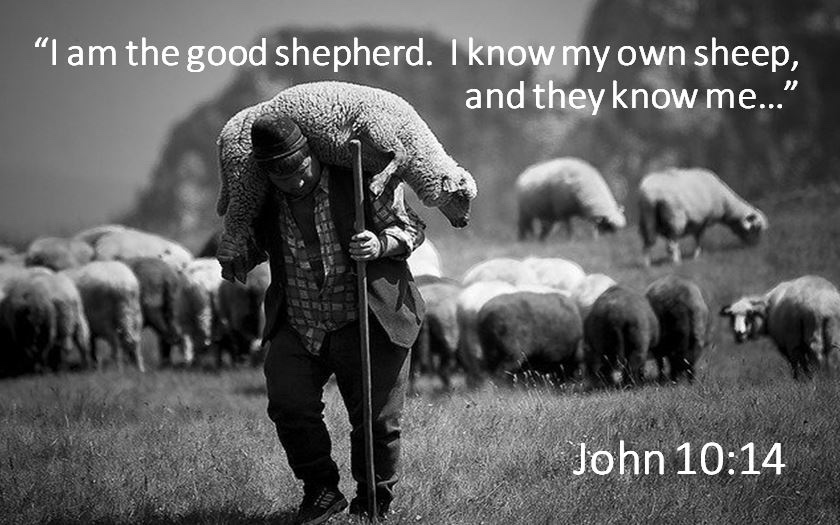
It is the statement about how the Lord will act that comes in the final verse of the prophetic passage which the lectionary offers for this coming Sunday (Isa 40:1–11) which resonates with us as we hear and ponder this passage at this time of the year (the second Sunday in Advent). The Lord God, we are told, “will feed his flock like a shepherd; he will gather the lambs in his arms, and carry them in his bosom, and gently lead the mother sheep” (Isa 40:11).

God, says the psalmist, is “Shepherd of Israel, who lead[s] Joseph like a flock” (Ps 80:1). Elsewhere, a psalmist sings, “he is our God, and we are the people of his pasture, and the sheep of his hand” (Ps 95:7); and of course the opening line of perhaps the best-known psalm is simply, “the Lord is my shepherd” (Ps 23:1).

The prophet Ezekiel declares that God himself “will search for my sheep, and will seek them out. As shepherds seek out their flocks when they are among their scattered sheep, so I will seek out my sheep” (Ezek 34:11–12). Ezekiel then extends this role to the king when he reports God’s words: “my servant David shall be king over them; and they shall all have one shepherd” (Ezek 37:24).

And then another exilic prophet most dramatically describes Cyrus of a Persia as both the Lord’s anointed one (Isa 45:1) and the one of whom the Lord says, “he is my shepherd and he shall carry out all my purpose” (Isa 45:28). That is a striking extension of the strong scriptural imagery of the shepherd, normally applied to the God of Israel or rulers within Israel, which is now placed onto a foreign ruler.

In this season of Advent, as Christians anticipate the celebration of Christmas, the scriptural imagery of the shepherd caring for their flock evokes Jesus, whose birth is remembered at Christmas. The birth of Jesus was first announced to shepherds, who were the earliest visitors (according to Luke) to the newborn and his parents (Luke 2:8–20). Mark and Matthew report that Jesus, as an adult, “had compassion for [the crowd], because they were like sheep without a shepherd” (Mark 6:34; also Matt 9:36).

And in one of his famous teaching sections in John’s Gospel, Jesus declares that he is the shepherd (John 10:11)—indeed, “the good shepherd” (John 10:14), “the good shepherd [who] lays down his life for the sheep” (John 10:11). Jesus himself extends the metaphor, noting that there are “other sheep that do not belong to this fold” and promising that “I must bring them also, and they will listen to my voice; so there will be one flock, one shepherd” (John 10:16).

Many in his Judean audience were not impressed at the way that Jesus, in these words, took on a key function of God and claimed it for himself. “He has a demon and is out of his mind. Why listen to him?”, they said (John 10:20). Aggrieved by Jesus’ claim, “the Father and I are one” (John 10:30), they sought to stone him, recalling the earlier antagonism of Judeans who sought to kill Jesus when he was “calling God his own Father, thereby making himself equal to God” (John 5:18). It seems that the care shown by this shepherd for his sheep failed to evoke the same response from his audience.

So this ancient prophecy reaches out across centuries, from Babylonian exile to Roman oppression, and on into the postmodern 21st century, with a promise of compassionate care for the people of God. Whilst the prophet was describing how God would care for the people of Israel in his time, the underlying dynamic is applicable, with due care, to the relationship of Jesus to his people, centuries later. It is in this regard that we can hear and read this passage as one that is appropriate for the season of Advent.

Tear open the heavens and come down (Isaiah 64; Advent 1B)

As we start a new year in the church’s calendar, this coming Sunday we will enter into the season of Advent, and begin our preparations once more for Christmas—the coming of Jesus, Saviour, chosen one, and Lord (Luke 2:11). During Advent, the lectionary offers a selection of biblical passages designed to help us in our preparations, building to the climactic moment of Christmas Day, when we remember that “the Word became flesh and lived among us, and we have seen his glory, the glory as of a father’s only son, full of grace and truth” (John 1:14).

These scripture passages include a sequence of excerpts from the Hebrew Scriptures—largely from the book of Isaiah—which orient us to the saving work of God, experienced by faithful people in Israel through the ages. These scripture passages lead us along a path that brings us to the point when we can sense God’s work in the story of Jesus.

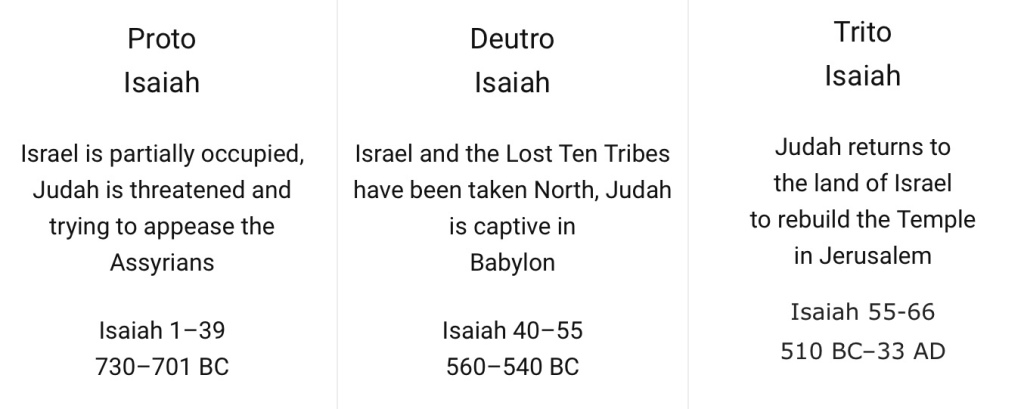
The book of Isaiah comprises three sections, which most scholars believe originated in three different periods during the history of Israel. The first section (chs. 1–39) is located in Judah in the eighth century BCE, as the Assyrians conquered the northern kingdom of Israel and attempted to gain control of the southern kingdom, but that effort failed. These events provide the context for the activity of Isaiah and the oracles include in chapters 1–39.

The second section of Isaiah (chs. 40–55) dates from the time of exile for the southern kingdom, after the people of Judah had been conquered by the Babylonians in 587 BCE; it offers words of hope as the people look to a return to the land. Then, the third section (chs. 56–66) is dated to a time when the exiles had returned to Judah, sometime after 520 BCE. By convention, the three parts are known as First Isaiah, Second Isaiah, and Third Isaiah.

For Advent 1, the lectionary offers us a passage from that final section, Third Isaiah, with words from the post-exilic prophet, “O that you would tear open the heavens and come down, so that the mountains would quake at your presence” (Isa 64:1). Echoing the apocalyptic words of Jesus in the Gospel passage for this Sunday (Mark 13), the prophet foreshadows the rending of the heavens that will occur when God steps into earthly life in Jesus of Nazareth.

Then from the very familiar passage that opens Second Isaiah, as the prophet looks to the end of the exile, on Advent 2 we hear the promise that “the Lord God comes with might … he will feed his flock like a shepherd; he will gather the lambs in his arms, and carry them in his bosom, and gently lead the mother sheep” (Isa 40:10–11). Words of comfort for the exiles; words which Christian interpreters see as a depiction of the shepherding role that Jesus undertakes.

On Advent 3 we return to the third section of Isaiah, to hear another set of very familiar words, which Luke tells us that Jesus appropriated (Luke 4:16–21) to describe his own mission in Israel: “the spirit of the Lord God is upon me, because the Lord has anointed me; he has sent me … to proclaim the year of the Lord’s favour” (Isa 61:1–2).

Then, on Advent 4, we move away from Isaiah to hear the narrative account in which the prophet Nathan tells King David that God has told him, “your house and your kingdom shall be made sure forever before me; your throne shall be established forever” (2 Sam 7:16). These are words which throughout the centuries since Jesus have been seen by Christians as applicable to his God-appointed role.

After this, for Christmas itself, we hear a selection of passages from Isaiah—one from each of the three sections of the book—which also have been seen by Christian interpreters to connect with the story of Jesus: “a child has been born for us, a son given to us; authority rests upon his shoulders; and he is named Wonderful Counselor, Mighty God, Everlasting Father, Prince of Peace” (Isa 9:6); “the Lord has proclaimed to the end of the earth: Say to daughter Zion, ‘See, your salvation comes; his reward is with him, and his recompense before him’” (Isa 62:11); and then, most strikingly, “all the ends of the earth shall see the salvation of our God” (Isa 52:10).

In the passage from Isaiah 64, the prophet is clear and direct. “Tear open the heavens” (v.1a), he implores God, shouting with the passionate intensity of one who fervently desires a clear sign of the presence of the divine. “Come down, so that the mountains would quake at your presence”, he cries (v.1b). After all the devastation that Israel has experienced (vv.6–7, 10–11), the psalmist yearns for God to act, just as God did “when you did awesome deeds that we did not expect, you came down, the mountains quaked at your presence” (v.3).

The various tribulations of the people of Israel, from their testings in the wilderness through to the Exile, when they had been “burned with fire … cut down” (v.16), are seen as multiple punishments heaped onto Israel. So the psalmist implores God, “do not be exceedingly angry, O Lord, and do not remember iniquity forever” (v.9), and pleads to God, “will you restrain yourself, O Lord? Will you keep silent, and punish us so severely?” (v.12).

The tone is much like the psalms where the writer pleads for God to act, for mercy to be shown. “O God, you have rejected us, broken our defenses; you have been angry; now restore us!” is the plea in one psalm (Ps 60:1). In another, the psalmist laments, “How long, O Lord? Will you be angry forever? Will your jealous wrath burn like fire?” (Ps 79:5); we hear similar words as the psalmist elsewhere asks, “Will you be angry with us forever? Will you prolong your anger to all generations?” (Ps 85:5).

Perhaps most vivid of all, and closest to the thoughts that the prophet declares, is this psalm: “Bow your heavens, O Lord, and come down; touch the mountains so that they smoke. Make the lightning flash and scatter them; send out your arrows and rout them. Stretch out your hand from on high; set me free and rescue me from the mighty waters, from the hand of aliens, whose mouths speak lies, and whose right hands are false.” (Ps 144:5–8)

The action of tearing is something that is dramatic and final. It damages permanently. The prophet Hosea describes this vividly in his account of how God plans to respond to Ephraim, when they “keep on sinning and make a cast image for themselves”; God’s intention is, “I will fall upon them like a bear robbed of her cubs, and will tear open the covering of their heart; there I will devour them like a lion, as a wild animal would mangle them” (Hos 13:8).

The language of “tearing” is used to describe the punishment that God will bring upon sinful Israel. Solomon is told, “since you have not kept my covenant and my statutes that I have commanded you, I will surely tear the kingdom from you and give it to your servant” (1 Ki 11:11). That threat is reflected also in psalms (Ps 52:5; 137:7–8) and prophecies (Jer 22:24–27; and cf. Amos 3:15). But the orientation of tearing in this prophecy is not about punishing Israel—rather, the psalmist, as we have seen, is imploring God to come, end the punishment of Israel, and “not remember iniquity forever” (Isa 64:9).

Tearing clothes in an act of mourning is reflected at times in scripture (2 Sam 3:31; Esther 4:1). But this seems far from the intent of this passage, which is focussed on seeking a sign of the presence of God, “so that the nations might tremble at your presence” (Isa 64:2) and so that God might “meet those who gladly do right, those who remember you in your ways” (Isa 64:5).

For Christian interpreters, however, when the prophet speaks of God tearing open the heavens in order that God might “come down” (from heaven, to earth), the clearest resonance lies elsewhere. Much is made of the connection with the moment when the curtain of the Temple was torn “from top to bottom” (Mark 15:38; Matt 27:51; Luke 23:45) at the death of Jesus. God dramatically tore apart the curtain that kept the priests from seeing the Holy of Holies, where God resided (Exod 26:33; Heb 9:3) and came down “from top to bottom”, from heaven to earth, in Jesus (cf. John 6:41, 51, 58; Phil 2:5–8).

And so a Christian appropriation of this passage may well appreciate the symbolism of God overcoming the division between heaven and earth in this way. And Christian interpreters may well go on to appropriate other phrases in this prophecy of Isa 64 as relating to Jesus, for in his life, they might affirm, God has done awesome deeds (v.3), has met “those who gladly do right” (v.5), who has reshaped sinners as the potter fashions the clay (v.8), who forgives iniquity (v.9), who acts as the only God ever known (v.4).

That said, we should caution that interpreting this passage and other ancient Israelite prophetic passages as predictive of Jesus is a strategy that we should undertake with care. Christians have a bad track record of taking Jewish texts and Christianising them, talking and writing and thinking about them as if they were always intended simply to be understood as Christian texts. But first of all, they were Jewish (or, to be precise, ancient Israelite) texts.

So the original setting of such passages needs always to be considered—the historical, social, political, cultural contexts in which they came into being, as well as the literary genre being used and the linguistic and literary conventions being deployed. Obliterating the original setting and acting as if the text was intended for a time many centuries later, is unfair and unethical.

Indeed, Christianising Old Testament texts can well become the first step in a dangerous process, as we firstly remove Judaism from our interpretive framework, and then treat the prophetic text as having nothing to do with Judaism, and everything to do with Christianity. This is the pathway that can lead to antisemitism—actively speaking and acting against Jews and Judaism. And having arrived at such a destination, we are reinforced in our pattern of ignoring and obliterating the earlier meanings in the text.

Texts (whether biblical or other literature) are always multivalent—that is, open to being interpreted in a number of ways, offering multiple ways of understanding them. That’s why we have sermons, and don’t just read the biblical text and then put it down. We keep it before our minds, and explore options for understanding and appropriating it. Ignoring the multiple layers of meaning inherent in biblical passages is a reductionist and self-centred way of undertaking interpretation. Reducing the prophetic texts to predictive declarations solely about Jesus is a poor interpretive process.

So let us tread with caution, this Advent, and beyond, as we hear, savour, and interpret texts from these ancient Israelite works—in which, nevertheless, we can indeed hear “the word of God” to us, in this day.