Prophesy, dream dreams, see visions, as the Spirit is poured out (Narrative Lectionary for Advent 2C; Joel 2)

As we continue in Advent, the Narrative Lectionary is continuing the sequence of passages from the prophets in ancient Israel. This coming Sunday, just four verses from the book of Joel are proposed (Joel 2:12–13, 28–29). The reason for these verses will become evident in my commentary that follows. But I think that the best approach is to begin with a consideration of the book as a whole; this gives the context (as best as we can determine) for those particular verses.

Joel speaks words of lament and calls for repentance amongst the people of Judah. Nothing in this book provides any clues as to the time when Joel was active. The identification of the prophet as “son of Pethuel” (Joel 1:1) gives no clue, as Pethuel appears nowhere else in the Hebrew Scriptures—indeed, the name Joel, itself appears nowhere else. The name appears to combine the divine names of Jah and El, suggesting that it may be a symbolic creation. Was Joel an historical person? or not?

Joel calls on the “ministers of God” to “put on sackcloth and lament” (1:13); this reminds us of the response of the pagans in Nineveh (Jonah 3), whilst his remonstrations that “the day of the Lord is near” (1:15) echoes the motif of “the day” already sounded by other prophets (Amos 5:18–20; Isa 2:12, 17; 13:6–8; 34:8; Zeph 1:7, 14–15; Jer 35:32–33; 46:10). 

This day forms the centrepiece of Joel’s undated prophecies, as he describes that day as “a day of darkness and gloom, a day of clouds and thick darkness!” (Joel 2:2), when “the earth quakes before them, the heavens tremble, the sun and the moon are darkened, and the stars withdraw their shining” (2:10). He describes the response of the people “in anguish, all faces grow pale” (2:6).

However, Joel adheres to the constant thread running through Hebrew Scriptures, that the Lord is “gracious and merciful, slow to anger, and abounding in steadfast love, and relents from punishing” (2:13). Because of this, he yearns for the people to “turn with all your heart, with fasting, with weeping, and with mourning” (2:12), sensing that there might be hope of restitution for the people. (These two verses form the start of the excerpt proposed for this Sunday by the Narrative Lectionary.)

Joel calls for the people to gather (2:15–16); the oracle that follows paints a picture of abundance and blessing (2:18–27), affirming that “my people shall never again be put to shame” (2:27). 

The prophet then speaks words which have been given a central place in the later story of the Christian church, when he foreshadows that the blessings of God will be manifest through the outpouring of the spirit: “your sons and your daughters shall prophesy, your old men shall dream dreams, and your young men shall see visions; even on the male and female slaves, in those days, I will pour out my spirit” (2:28–29).

The promise that is set forth here is specifically for “all flesh”; this universal vision informs the whole outward impulse of the movement of followers of Jesus, after the day of Pentecost, which Peter interprets as being a fulfilment of this prophecy (Acts 2:14–21). And that most likely explains why these two verses (2:28–29) form the concluding section of the passage proposed by the Narrative Lectionary.

The day of the Lord that is then envisaged (2:31) will signal a significant reversal for Israel. The Lord laughs at other nations (3:1–8), a reversal that pivots on a turn from despair to hope, from the threats of judgement to a glorious future (3:9–21). Joel repeats the irenic vision of swords being beaten into ploughshares (3:10; see Isa 2:4; Mic 4:3); he sees a ripe harvest (3:13), the land will drip with sweet wine, and there will be milk and water in abundance (3:18). The voice of the Lord “roars from Zion, and utters his voice from Jerusalem, and the heavens and the earth shake” (3:16; cf the similar pronouncement of Amos at Am 1:2; 3:8).

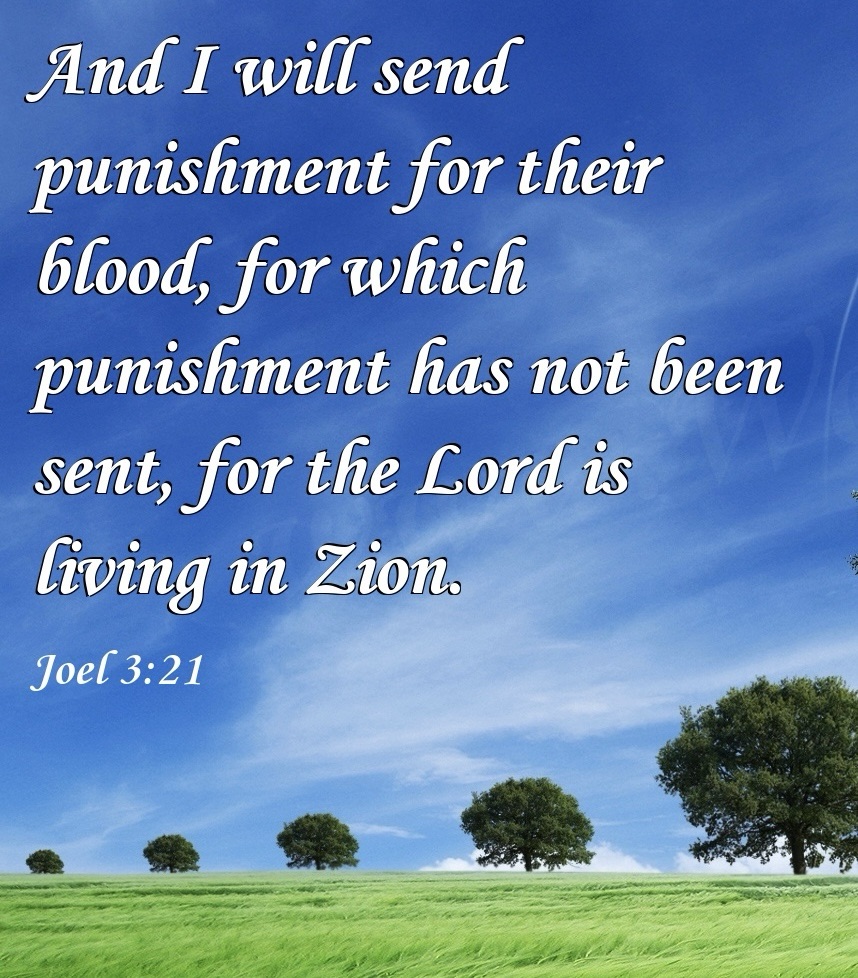
The last word of this book, “the Lord dwells on Zion” (3:21), provides assurance and certainty for the future. These words of hope promises a peaceful future for the nation. When Joel might have been speaking these words cannot be definitively determined; it could have been under the Assyrian threat, during the Babylonian dominance, in the time of exile, or after the return to the land—whatever it was, the promise of hope holds good in each of these scenarios. As, indeed, we might well claim it for our present times.

I will cause a righteous branch to spring up for David (Jer 33; Advent 1C)

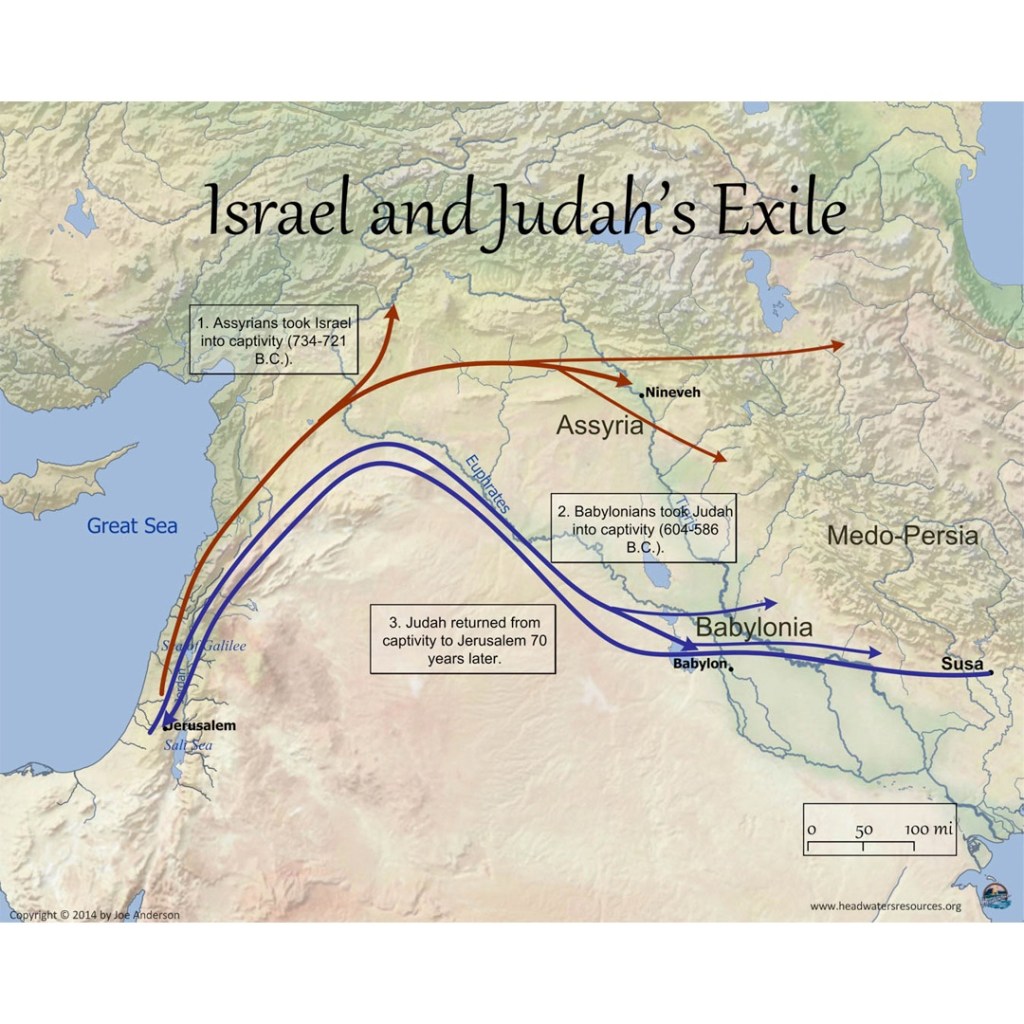
The prophet Jeremiah lived at a turning point in the history of Israel. The northern kingdom had been conquered by the Assyrians in 721 BCE; the elite classes were taken into exile, the land was repopulated with people from other nations (2 Kings 17). The southern kingdom had been invaded by the Assyrians in 701 BCE, but they were repelled (2 Kings 18:13–19:37). King Hezekiah made a pact with the Babylonians, but the prophet Isaiah warned that the nation would eventually fall to the Babylonians (2 Kings 20:12–19). Babylon conquered Assyria in 607 BCE and pressed hard to the south; the southern kingdom fell in 587 BCE (2 Kings 24–25) and “Judah went into exile out of its land” (2 Ki 25:21).

Jeremiah lived in the latter years of the southern kingdom, through into the time of exile—although personally, he was sent into exile in Egypt, even though most of his fellow Judahites were taken to Babylon. The difficult experiences of Jeremiah as a prophet colour many of his pronouncements. As the book moves on from the poetic oracles of chapters 1–25, to a series of prose narratives in chapters 26–45, some key events in the life of Jeremiah are reported. 

The passage from Jeremiah proposed for this coming Sunday, the first Sunday in Advent (Jer 33:14–16), contains a specific prophecy which appears fitting for this season, as we anticipate the celebration of the birth of Jesus. It takes on a deeper meaning if we understand where it fits within the original historical context of the time when Jeremiah was speaking.

Jeremiah had been called as a youth to declare the message of the Lord to the people of Israel, that God was planning “to pluck up and to pull down, to destroy and to overthrow, to build and to plant” (Jer 1:10). Years later, the adult prophet Jeremiah was called to “stand in the court of the Lord’s house and speak to all the cities of Judah that come to worship in the house of the Lord; speak to them all the words that I command you; do not hold back a word” (Jer 26:2). His message was about their failure to walk in the law that God had given them. The response from the ruling class is not positive—in fact, Jeremiah is threatened with death (26:7–11). 

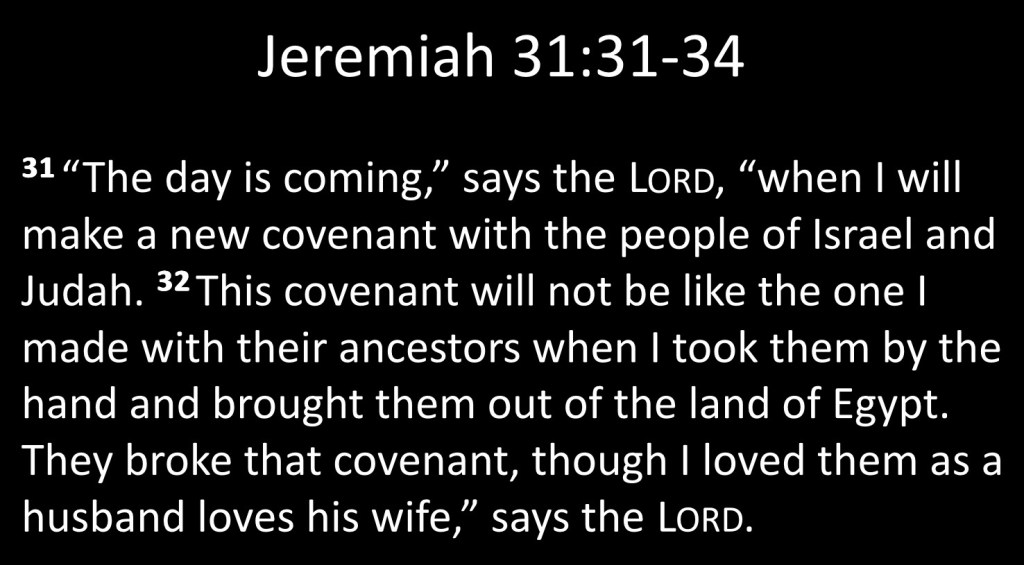
However, the midst of his despair, Jeremiah sees hope: “the days are surely coming, says the Lord, when I will restore the fortunes of my people, Israel and Judah, says the Lord, and I will bring them back to the land that I gave to their ancestors and they shall take possession of it” (30:3). In this context, Jeremiah indicates that the Lord “will make a new covenant with the house of Israel and the house of Judah … I will put my law within them, and I will write it on their hearts; and I will be their God, and they shall be my people” (31:31–34). 

To signal his confidence in this promised return, Jeremiah buys a field in his hometown of Anathoth from his cousin Hanamel (32:1–15). The narrator notes that “the army of the king of Babylon was besieging Jerusalem, and the prophet Jeremiah was confined in the court of the guard that was in the palace of the king of Judah, where King Zedekiah of Judah had confined him” (32:2–3). Nevertheless, the purchase serves to provide assurance that the exiled people will indeed return to the land of Israel; “houses and fields and vineyards shall again be bought in this land” (32:15). 

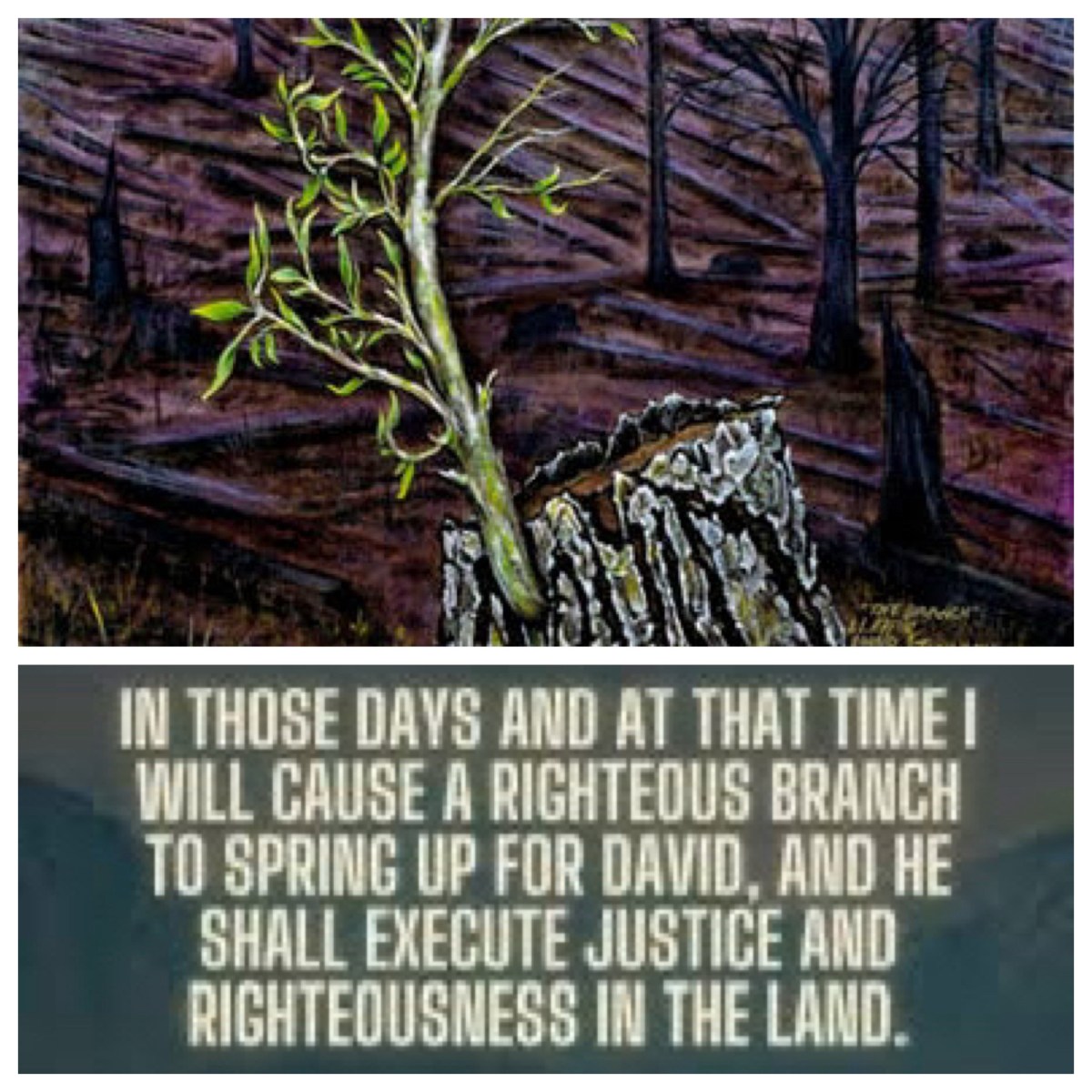
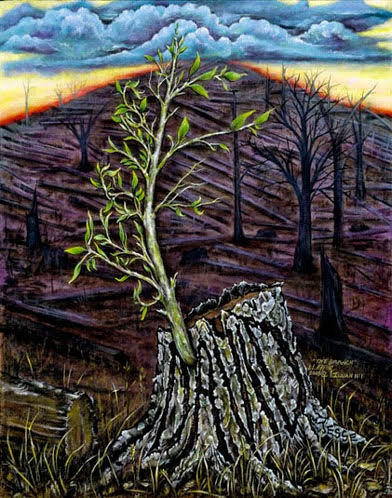
Jeremiah exhorts the people to “give thanks to the Lord of hosts, for the Lord is good, for his steadfast love endures forever!” (33:11), because in the places laid waste by the Babylonians, “in all its towns there shall again be pasture for shepherds resting their flocks … flocks shall again pass under the hands of the one who counts them, says the Lord” (33:12–13). As the people return to the land, the Lord “will cause a righteous Branch to spring up for David; and he shall execute justice and righteousness in the land” (33:15). The title “Son of David” is later applied to Jesus in three Gospels (Mark 10:47–48; Matt 1:1; 12:23; 15:22; 21:9, 15; Luke 18:38–39).

The prophet Isaiah also refers to the “shoot [which] shall come out from the stump of Jesse, and a branch shall grow out of his roots; the spirit of the Lord shall rest on him” (11:1–2). The appearance of this “shoot” will lead to the promised time when “the wolf shall live with the lamb, the leopard shall lie down with the kid, the calf and the lion and the fatling together, and a little child shall lead them” (11:6)—a wonderful Messianic prophecy.

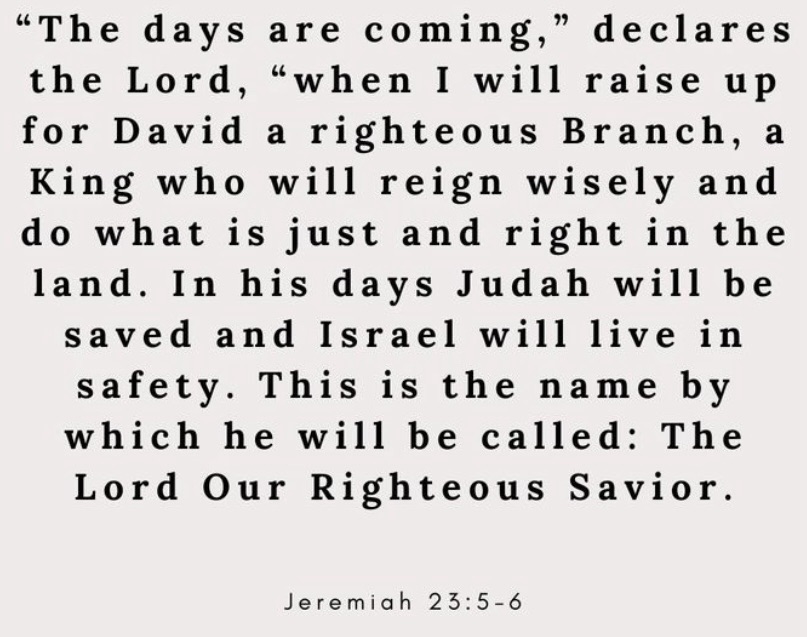
Jeremiah, in an earlier oracle, had declared that “the days are surely coming, says the Lord, when I will raise up for David a righteous Branch, and he shall reign as king and deal wisely, and shall execute justice and righteousness in the land” (Jer 23:5). His words at Jer 33:14–16 repeat this message of hope. That hope, in Christian theology, was taken up in Jesus, who was claimed to be the righteous branch, the one ruling with justice (Matt 12:15–21). Jesus spoke clearly about the need for justice in our lives (Matt 23:23; Luke 7:29). He spoke in the tradition of the prophets, including Jeremiah, who had regularly reminded the people,of Israel of the centrality of doing justice for those who were obedient to the covenant with the Lord God.

In speaking out for justice, Jesus provided a clear countercultural vision for his followers, and called them into a radically different way of living. It is that Jesus whom we celebrate at Christmas, and that countercultural vision that is at the heart of the Advent season.

Beginning the year on the right foot (Psalm 25; Advent 1C)

This coming Sunday is the first day in a new year-at least, as the church marks the years. Rather beginning on the first day of January (for the calendar month) or of July (for the financial year), the church year begins with the season of Advent. The season stretches over four weeks  and serves as preparation for the joyous celebration of Christmas, marking the birth of Jesus. So this coming Sunday in worship, it would be quite appropriate to wish other people a happy new year!

It is the custom more generally in society to make “New Year resolutions”—even if such resolutions rarely last weeks, or even days, into the new year. In keeping with that custom, perhaps it could be appropriate for people of faith to use the words of the psalm proposed by the lectionary for this coming Sunday, the First Sunday in Advent.

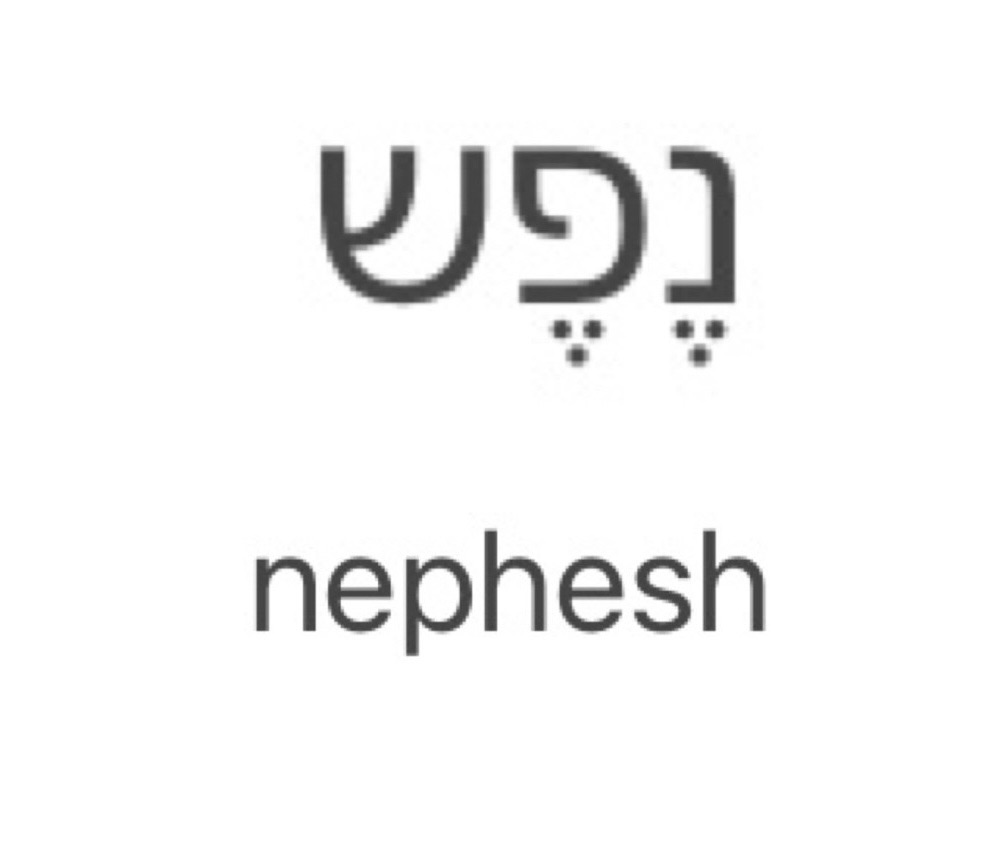
In Psalm 25, the psalmist sets out a clear view of what it is that God expects of people of faith. First, the psalmist begins by offering their “soul” to God, declaring “O my God, in you I trust” (vv.1–2). The Hebrew word translated as “soul” in v.1 is nephesh.  This is a common Hebrew word, appearing 688 times in Hebrew Scripture, of which the most common translation (238 times) is “soul”; the next most common translation is “life” (180 times). The word is thus a common descriptor for a human being, as a whole. 

However, to use the English word “soul” to translate nephesh does it a disservice. We have become acclimatised to regarding the soul as but one part of the whole human being—that is the influence of dualistic Platonic thinking, where “body and soul” refer to the two complementary parts of a human being. In Hebrew, nephesh has a unified, whole-of-person reference, quite separate from the dualism that dominates a Greek way of thinking.

Nephesh appears a number of times in the first creation story in Hebrew scripture, where it refers to “living creatures” in the seas (Gen 1:20, 21), on the earth (Gen 1:24), and to “every beast of the earth, and to every bird of the air, and to everything that creeps on the earth, everything that has the breath of life (nephesh hayah)” (Gen 1:30). It is found also in the second creation story, where it likewise describes how God formed a man from the dust of the earth and breathed the breath of life into him, and “the man became a living being (nephesh hayah)” (Gen 2:7). The claim that each living creature is a nephesh is reiterated in the Holiness Code (Lev 11:10, 46; 17:11). 

The concept of nephesh is a foundational understanding in Hebraic thought: the nephesh is the totality of existence for every creature, including humans. In our psalm for this Sunday, then, the psalmist offers their whole being to God, placing trust in God. This is a fine model for us to consider and emulate throughout the whole of the year: discipleship is a whole-of-being thing.

An attitude of trust towards God permeates the psalms. “Those who know your name put their trust in you”, one psalmist affirms, “for you, O Lord, have not forsaken those who seek you” (Ps 9:10). Another psalmist sings “I trust in you, O Lord; I say, ‘You are my God’; my times are in your hand” (Ps 31:14–15). A third psalmist affirms, “I am like a green olive tree in the house of God; I trust in the steadfast love of God forever and ever” (Ps 52:8). In yet another psalm, the writer sings “when I am afraid, I put my trust in you … in God I trust; I am not afraid” (Ps 52:3–4, 10–11).

One psalmist evokes the remembrance of trusting people in the past: “in you our ancestors trusted; they trusted, and you delivered them; to you they cried, and were saved; in you they trusted, and were not put to shame” (Ps 22:4–5). Another declares that they “trusted in your steadfast love; my heart shall rejoice in your salvation” (Ps 13:5), while yet another states “I have walked in my integrity, and I have trusted in the Lord without wavering” (Ps 26:1). Trust is a foundational element in our faith.

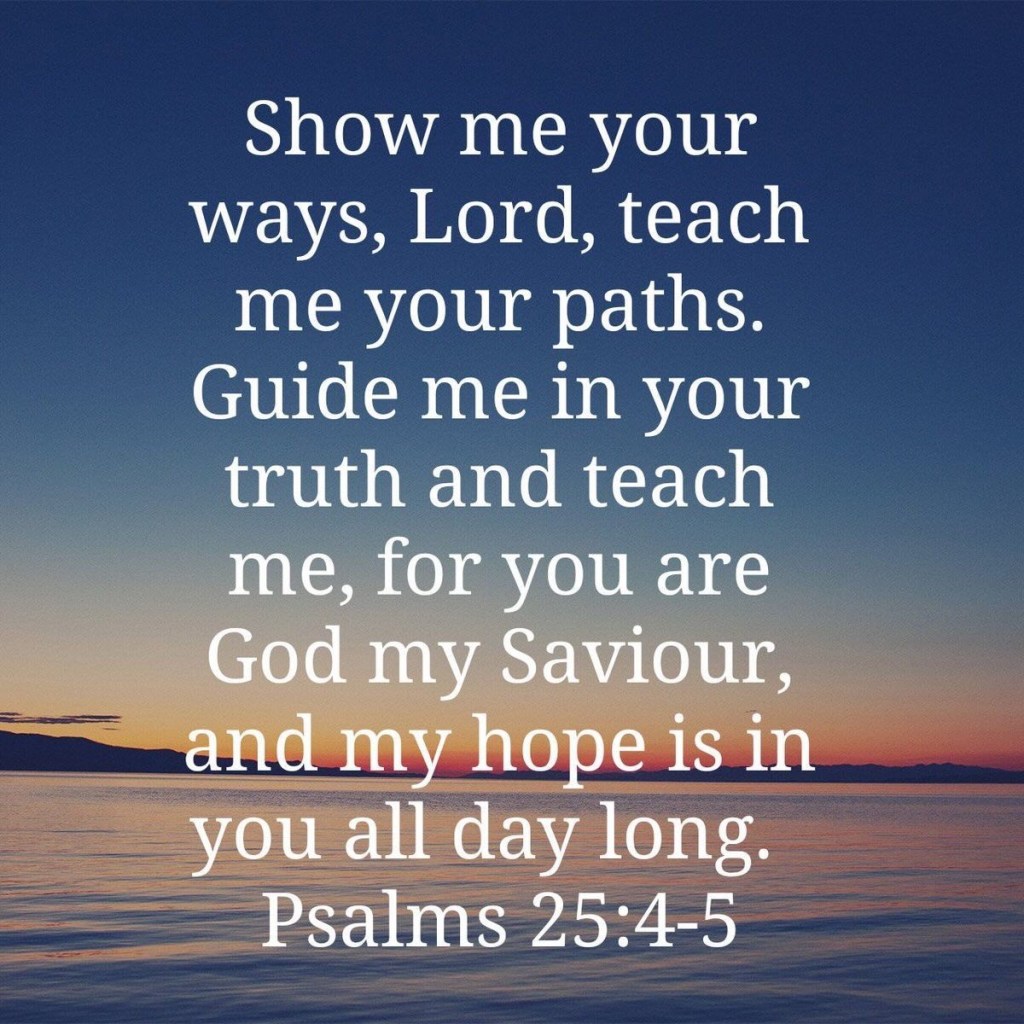
Then, the author of Psalm 25 prays for the ways in which they might know God’s ways: “make me to know your ways, O Lord; teach me your paths; lead me in your truth, and teach me” (vv.4–5). The paths of the Lord are probably best-known from the much-beloved Psalm 23, in the opening sequence of affirmations that the Lord “makes me lie down in green pastures … leads me beside still waters … restores my soul … [and] leads me in right paths” (Ps 23:2–3). 

This psalmist later explains that “the paths of the Lord are steadfast love and faithfulness for those who keep his covenant and his decrees” (Ps 25:10). Another psalmist affirms, “my steps have held fast to your paths; my feet have not slipped” (Ps 17:5); yet another, in a well-known refrain, sings “word is a lamp to my feet and a light to my path” (Ps 119:195). In like manner, another psalm rejoices that “you show me the path of life; in your presence there is fullness of joy” (Ps 16:11). 

Keeping to the path of the Lord requires knowing, and adhering to, the commandments of Torah, so one psalmist prays, “teach me to do your will, for you are my God; let your good spirit lead me on a level path” (Ps 143:10). In the longest psalm of all—an extended song of praise for Torah—the psalmist sings, “give me understanding, that I may keep your law and observe it with my whole heart; lead me in the path of your commandments, for I delight in it” (Ps 119:34–35). The prayer of Psalm 25, “make me to know your ways, O Lord; teach me your paths” reinforces the centrality of Torah obedience in the psalms.

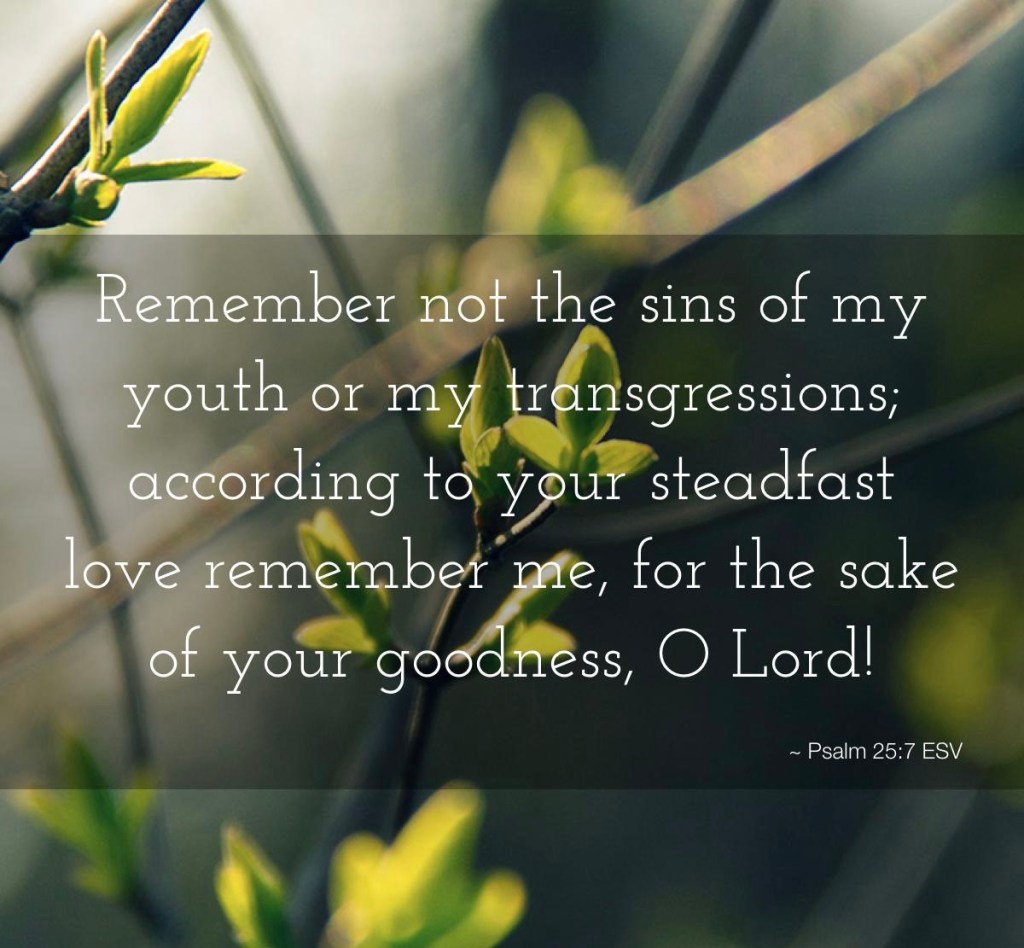
Third, the psalm includes a short prayer seeking forgiveness: “do not remember the sins of my youth or my transgressions; according to your steadfast love remember me, for your goodness’ sake, O Lord!” (v.7). The petition is repeated a few verses later: “for your name’s sake, O Lord, pardon my guilt, for it is great” (v.11). Some psalms contain verses which echo this prayer: “consider my affliction and my trouble, and forgive all my sins” (Ps 25:8); “help us, O God of our salvation, for the glory of your name; deliver us, and forgive our sins, for your name’s sake” (Ps 79:9). 

Other psalms offer an affirmation that God does, indeed, forgive: “when deeds of iniquity overwhelm us, you forgive our transgressions” (Ps 65:3); “if you, O Lord, should mark iniquities, Lord, who could stand? but there is forgiveness with you, so that you may be revered” (Ps 130:3–4); “bless the Lord, O my soul, and do not forget all his benefits—who forgives all your iniquity, who heals all your diseases” (Ps 103:2–3); “happy are those whose transgression is forgiven, whose sin is covered” (Ps 32:1). 

Forgiveness is of the essence of the Lord God, who is “is slow to anger, and abounding in steadfast love, forgiving iniquity and transgression” (Exod 34:6–8; Num 14:18; Neh 9:17b; Ps 145:8–9; Joel 2:13; Jonah 4:2; see also 2 Kings 13:23; 2 Chron 30:9). In one of the central episodes in the life of the Israelites, after they had made a golden calf, Moses pleads with God for forgiveness (Exod 32:32); after God had punished those who sinned in this episode by sending a plague (Exod 32:35), God is declared to be “abounding in steadfast love and faithfulness, keeping steadfast love for the thousandth generation, forgiving iniquity and transgression and sin”, and the covenant is renewed (Exod 34:6–10).

Seeking forgiveness was central to the life of ancient Israelites, and continued on to be important in Second Temple Judaism. Indeed, it is this prayer for forgiveness which is taken up in the prayer that Jesus taught his disciples: “forgive us our sins, for we ourselves forgive everyone indebted to us” (Luke 11:4), or in what was likely an earlier version: “forgive us our debts, as we also have forgiven our debtors” (Matt 6:12).

Finally, towards the end of the psalm, the psalmist prays, “may integrity and uprightness preserve me, for I wait for you” (v.21). Integrity and uprightness figure in other psalms. “I will walk with integrity of heart within my house”, one psalmist sings, “I will not set before my eyes anything that is base” (Ps 101:2–3), while another declares, “I have walked in my integrity, and I have trusted in the Lord without wavering” (Ps 26:1).

So one psalmist prays, “judge me, O Lord, according to my righteousness and according to the integrity that is in me” (Ps 7:8), while another affirms that the precepts of the Lord “are established forever and ever, to be performed with faithfulness and uprightness” (Ps 111:8). In another psalm we learn that “the Lord is righteous; he loves righteous deeds; the upright shall behold his face” (Ps 11:7), while another psalm declares that “justice will return to the righteous and all the upright in heart will follow it” (Ps 94:15). The motif of uprightness permeates these songs of faith.

When the psalmist sings, “for you I wait all day long” (Ps 25:5), they are reflecting a common attitude across many psalms, waiting for the Lord: “I wait for the Lord, my soul waits” (Ps 130:5–6), “it is for you, O Lord, that I wait; it is you, O Lord my God, who will answer” (Ps 38:15); “for God alone my soul waits in silence, for my hope is from him” (Ps 62:5). So the psalmist encourages others, “be strong, and let your heart take courage, all you who wait for the Lord” (Ps 31:24) and affirms that “those who wait for the Lord shall inherit the land” (Ps 37:9). 

Such waiting is in no way a passive statement being, for such waiting, as we have seen, involves the whole being (the nephesh) in active obedience to Torah and a deliberate intention to live in an upright way. This same attitude could well inform the way that we, today, live as people of faith.

I think this is a great psalm to read and hear at the start of the (church) year. It offers us a number of ways to ground our faith and live as faithful disciples in today’s world. If you don’t regularly include a reading of a psalm in your worship liturgy, this Sunday is a really good day to do that!

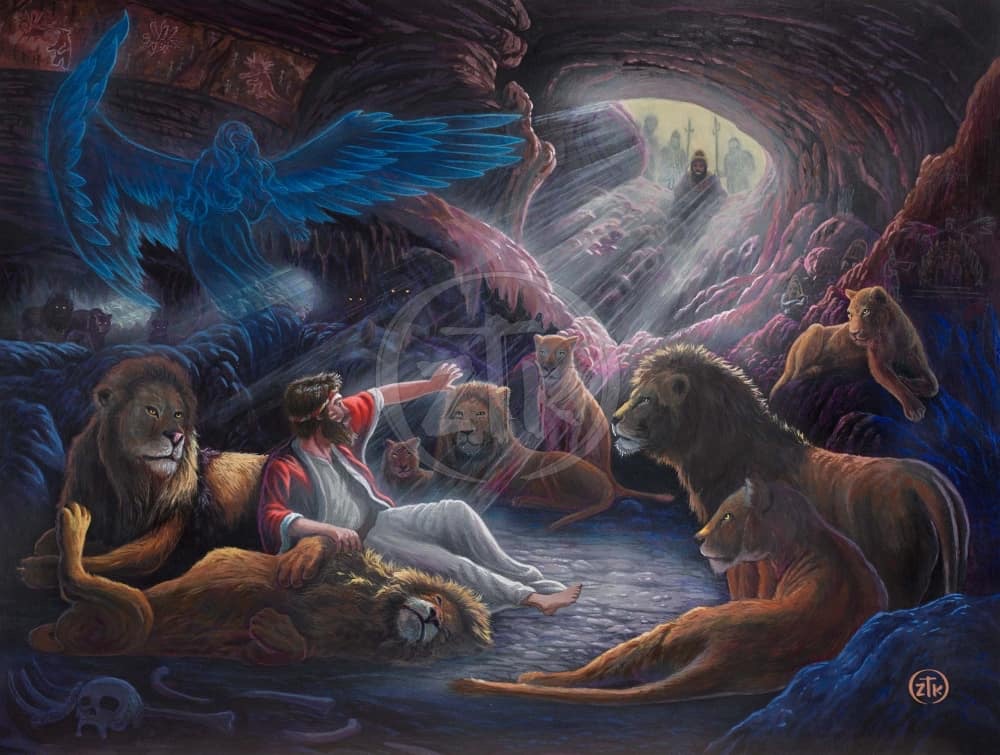
Daniel, saved from the power of the lions (Narrative Lectionary for Advent 1C; Daniel 6)

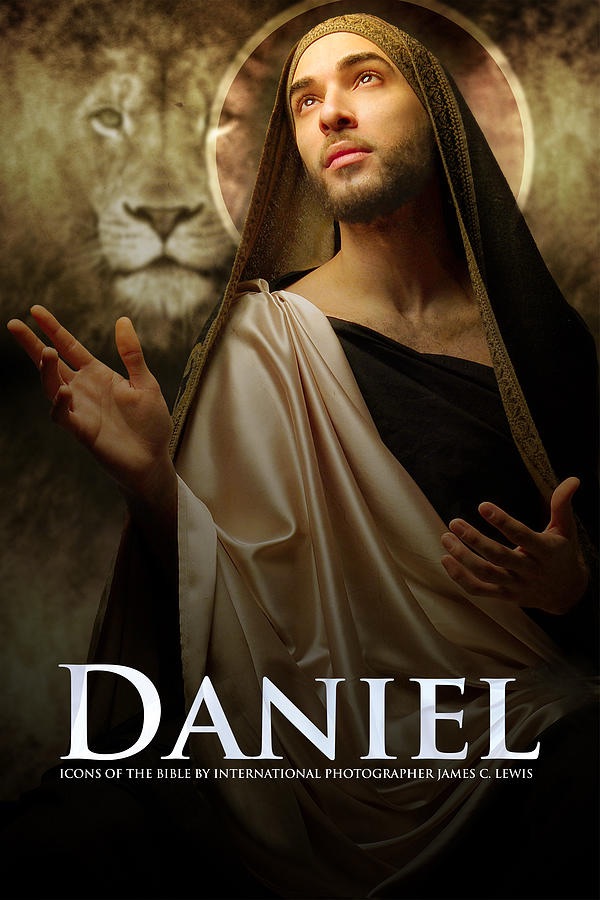
The Narrative Lectionary is currently offering us a selection of passages from six of the prophets of ancient Israel: Jonah, Isaiah, Jeremiah, Daniel, Joel, and the anonymous post-exilic prophet whose words are collected in Isaiah 56–66. This coming Sunday we we will read and hear the passage from Daniel 6, which tells of Daniel being placed in grave danger in a den of lions, and then rescued by the command of King Darius of Persia.

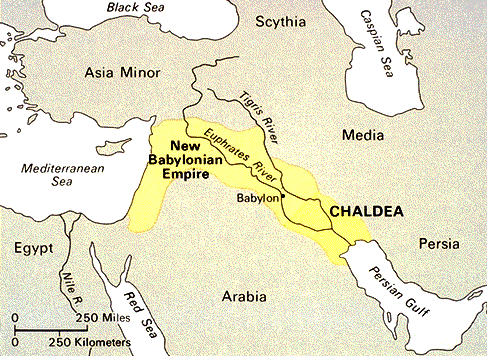
Ironically, although he is considered one of the four Major Prophets in Hebrew Scripture, Daniel himself is never “called to be a prophet”, as we have seen in other prophetic books; he is introduced as one of a number of “young men without physical defect and handsome, endowed with knowledge and insight”, who were chosen “to be taught the literature and language of the Chaldeans” (1:3–5). Indeed, the Israelite Daniel is given a Babylonian name, Belteshazzar (1:7; 4:8), and his entire story takes place in the Babylonian court. 

(The Chaldeans were part of the Babylonian Empire; centuries earlier they had settled beside the Euphrates in what became the southeastern edge of the Babylonian Empire. Abraham is said to have come from Ur, a city in the region of Chaldea; see Gen 11:31; 15:7.)

The story of the prophet Daniel is thus set outside Israel, in the time of exile, after the conquest of the southern kingdom by the Babylonians in 587 BCE (Dan 1:1–2; see 2 Kings 25). Daniel had been chosen to serve in the court of Nebuchadnezzar, who reigned from 605 BCE to 562 BCE (Dan 1:3–7); when the Persians took control of the Babylonian empire in 539 BCE, Daniel continued to serve in a position of some power.

Scholars believe, however, that the story is told at a much later time, after the exile—perhaps even during the time of Seleucid superiority in the second century BCE. Two centuries after they had returned to the land of Israel, rebuilt their Temple, restored their cities and towns, and living under Persian rule, the people of Israel were over run by the troops of Alexander the Great, King of Macedonia, as he swept across the eastern Mediterranean region as Far East as modern day India. A new foreign power, and a new attitude towards the religion and customs of Israel.

Initially the interaction between Israelites and Macedonians was one of integration. Greek became the language of trade; syncretism marked the religious life of the people, as they adopted Greek customs. But when Antiochus Epiphanes came to power over the region, he introduced an altar in the temple to receive pagan offerings—something which, in  Israelite eyes, was known a “desolating sacrilege” (Mark 13:14; 1 Mac 1:54). This appears to be clearly described in the final vision, recounting how forces “shall occupy and profane the temple and fortress, abolish the regular burnt offering and set up the abomination that makes desolate” (Dan 11:31).

A clear reflection of the exile experience is that an extended section of the book (2:4b—7:28) is written in Aramaic, a language which evolved from Hebrew because of the influence of Babylonian culture and language on the exiled Israelites. The rest of the book (like all the rest of Hebrew Scripture) is written in Hebrew. Whereas Aramaic became the common language of Jews even when they were living back in Israel (and this was the case by the time of Jesus), Hebrew was preserved as the holy language of scripture. 

Curiously, the book has two distinct parts, which overlap this linguistic division; each part is likely to have originated in a different time after the exile. The first six chapters recount stories about Daniel, who was serving in the court and enjoyed friendly relations with the monarch; the style is one found in other legends about courtiers and dream interpreters. Chapters 7–12 comprise a series of apocalyptic visions which appear to contain some very direct references to events that took place in the second century BCE. These chapters come “from the mouth of Daniel”, as it were, rather than being stories about him (as in chapters 1–6).

Daniel has been operating in the murky arena of national politics: then, as now, a fraught environment! He has twice advised the king by interpreting dreams. Whilst Daniel exercised his role as a satrap under Darius the Mede, a conspiracy was formed against him as opponents looked to bring him down. When he is caught praying to the Lord God, despite the interdict of the king (6:1–15), he is thrown into the lion’s den (6:16). 

The next morning, the king hurries to the den, and finds Daniel alive; his prayers have miraculously saved him (6:19–22). Daniel is released from the lion’s den and rescued from danger (6:23–28); Darius issues an edict praising “the living God” whose “kingdom shall never be destroyed, and his dominion has no end; he delivers and rescues, he works signs and wonders in heaven and on earth” (6:26–27).

If the story was written (as is thought by many) during the time of the Seleucids, its depiction of a foreign ruler who is positively disposed towards Israel’s God is striking. Under Antiochus Epiphanes, the colonising forces of the Macedonians “built a gymnasium in Jerusalem, according to Gentile custom, and removed the marks of circumcision, and abandoned the holy covenant; they joined with the Gentiles and sold themselves to do evil” (1 Mac 1:14–15). Antiochus not only erected an image in the temple (the “desolation of sacrilege”), but even had the scrolls of Torah collected and burnt—many centuries before the Nazis did this (you can read the details of his rule in 1 Mac 1:41–64).

The author of Daniel is writing political literature as political critique. We know that Antiochus provoked a political uprising led by the Maccabees, the sons of Matthias (1 Mac 2—6)—figures later upheld as heroes by the Zealots in the time of Jesus. The book of Daniel provides a rationale for the zealous ideology of the Maccabees, seeking to put in place a righteous leadership in Israel.

Carol Newsom observes that “in several narratives in the book of Daniel, the king humbly confesses the sovereignty of the God of the Jews, acknowledging that he rules by the will of God” (“Political Theology in the Book of Daniel: An Internal Debate”,  Review and Expositor, vol. 109, 2012, pp.557–568). Prof. Newsom continues, “other parts of the book depict the gentile king as being part of God’s plan, but a part that will ultimately be destroyed as incompatible with divine sovereignty.” We see this clearly in view in chapters 1—6.

Preparing for the joyous celebration soon to come (Advent in Year C)

The season of Advent, which begins this Sunday, marks the beginning of a new year in the calendar of the church. Advent is a period of four weeks of preparation ahead of the joyous celebration of Christmas, marking the birth of Jesus, and the season of Epiphany, recognising that with the birth of Jesus, “the light of the world” has been revealed.

There is a parallel of a kind with the season of Lent, which is a longer period of 40 days of preparation leading into the high days of Easter, remembering the last meal, arrest, and trial of Jesus, his crucifixion and burial, and his raising from the dead and appearing to his followers.  And following after these central days, there is the whole 50-day season Easter, in which the presence of the risen Jesus in the church is remembered.

Each season builds in anticipation towards a climactic moment in the story of Jesus. During Advent, the lectionary offers us a process to build towards the Christmas celebration by offering passages from Gospel, Epistle, Prophets, and song-like selections (both from the Psalms and the Gospel) which celebrate the joyous notes of salvation found scattered throughout scripture. 

These passages begin on Advent 1 by affirming that God will fulfil promises made earlier (Jer 33:14–16), giving thanks in joyfulness (1 Thess 3:9–13) and recalling the mercy, steadfast love, and faithfulness (Psalm 25). The selection from the Gospel is drawn from the final apocalyptic discourse of Jesus (which runs through Luke 21, verses 8–36), where he speaks about “dreadful portents and great signs from heaven”, deception and warfare, and “great distress on the earth and wrath against this people”. Yet the final section of this speech (Luke 21:25–36) points towards the time when “your redemption is drawing near” (v.28) and “the kingdom of God is near” (v.31). It is an invitation to anticipate and to celebrate.

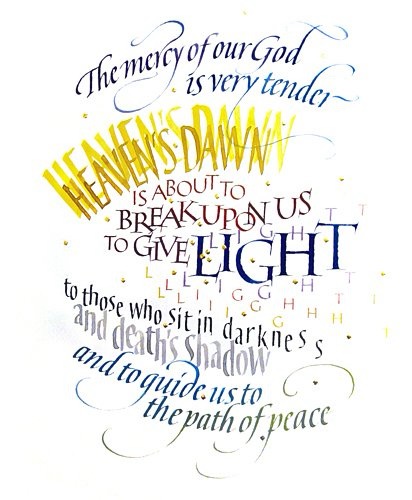
For Advent 2, the prophetic word comes from two prophets: Malachi declares that God “sending my messenger to prepare the way before me” (Mal 3:1–4) and Zechariah looks with hope towards a time when “in the tender mercy of our God, the dawn from on high will break upon us” (Luke 1:68–79). The lectionary shares the deep confidence of those waiting for “the day of the Lord” (Phil 1:3–11), and a reminder that, in the coming of Jesus, “all flesh shall see the salvation of God” (Luke 3:6). The sense of celebratory anticipation continues to build.

Then, for Advent 3, further prophetic words sound forth from Zephaniah, urging people to “rejoice and exult with all your heart” (Zeph 3:14), and from Isaiah, celebrating the salvation that comes from God and rejoicing that “great in your midst is the Holy One of Israel” (Isa 12:1–6). These words of hope and joy are accompanied by Paul’s exhortations to “rejoice in the Lord always” (Phil 4:4–7) and the prophet John’s proclamation of “good news” regarding “one who is more powerful than I is coming”—which includes stern reminders about the importance of acting with equity and justice (Luke 3:7–18).

It is that sense of justice which imbues the prophetic words attributed to the young Mary, which we hear on Advent 4. Mary “magnifies the Lord” and anticipates that the Lord God will have “scattered the proud in the imagination of their hearts … brought down the powerful from their thrones and lifted up the lowly … filled the hungry with good things and sent the rich away empty” (Luke 1:46–55). These words resonate with an older oracle spoken by Micah, who looked towards “one who is to rule in Israel, whose origin is from of old, from ancient days”, one who would bring peace and security to the people of Israel (Micah 5:2–5). 

These two oracles sit alongside the psalmist’s acknowledgement of the reality of hardship and even infidelity amongst the people of God, whose story has been that the Lord God has “fed them with the bread of tears and given them tears to drink in full measure”. Nevertheless, the psalmist is confident that faithful people will know that God has come to save them (Ps 80:1–7). 

And so the lectionary offers also words from an unknown writer, addressing a “word of exhortation” to “the Hebrews” in the assurance that “it is by God’s will that we have been sanctified through the offering of the body of Jesus Christ once for all” (Heb 10:5–10). (My personal view is that this passage sits rather oddly in the sequence of passages offered during Advent, with its priestly focus on sacrifices and offerings pointing to a different aspect of the story of Jesus—one which is more fitting to the Lenten period just before Easter.)

In these four weeks, the notes of hope and confidence, joy and justice, resound with increasing intensity, as we draw closer to Christmas. And for that festival, in a sequence of three passages from Isaiah, the three men whose work is collected under this single name declare the hope that marks the season, just as it had marked the people long ago in Israel. 

Alongside these prophetic words, the lectionary offers three joyful songs (Psalms 96—98), the same notes of joy and justice are sounded yet again, even as the Gospel passage offers the story of the birth of Jesus as Luke tells it (Luke 2:1–20), climaxing in “good news of great joy for all the people” (v.10) and the angelic hymn, “Glory to God in the highest heaven, and on earth peace among those whom he favours!” (v.14).

See 

Will hardline conservative evangelicals learn anything from the revelations about the abuses committed by John Smyth “in the name of the Gospel”?

Respectable gentlemen, pillars of society, and good citizens all. Advocating obedience and emphasising responsibility. Preaching “good news” which requires trust, faith, and “a serving heart”. Teaching “godliness” which entails decency, seemliness, and propriety. The outward appearance looks good, honourable, and worthy.

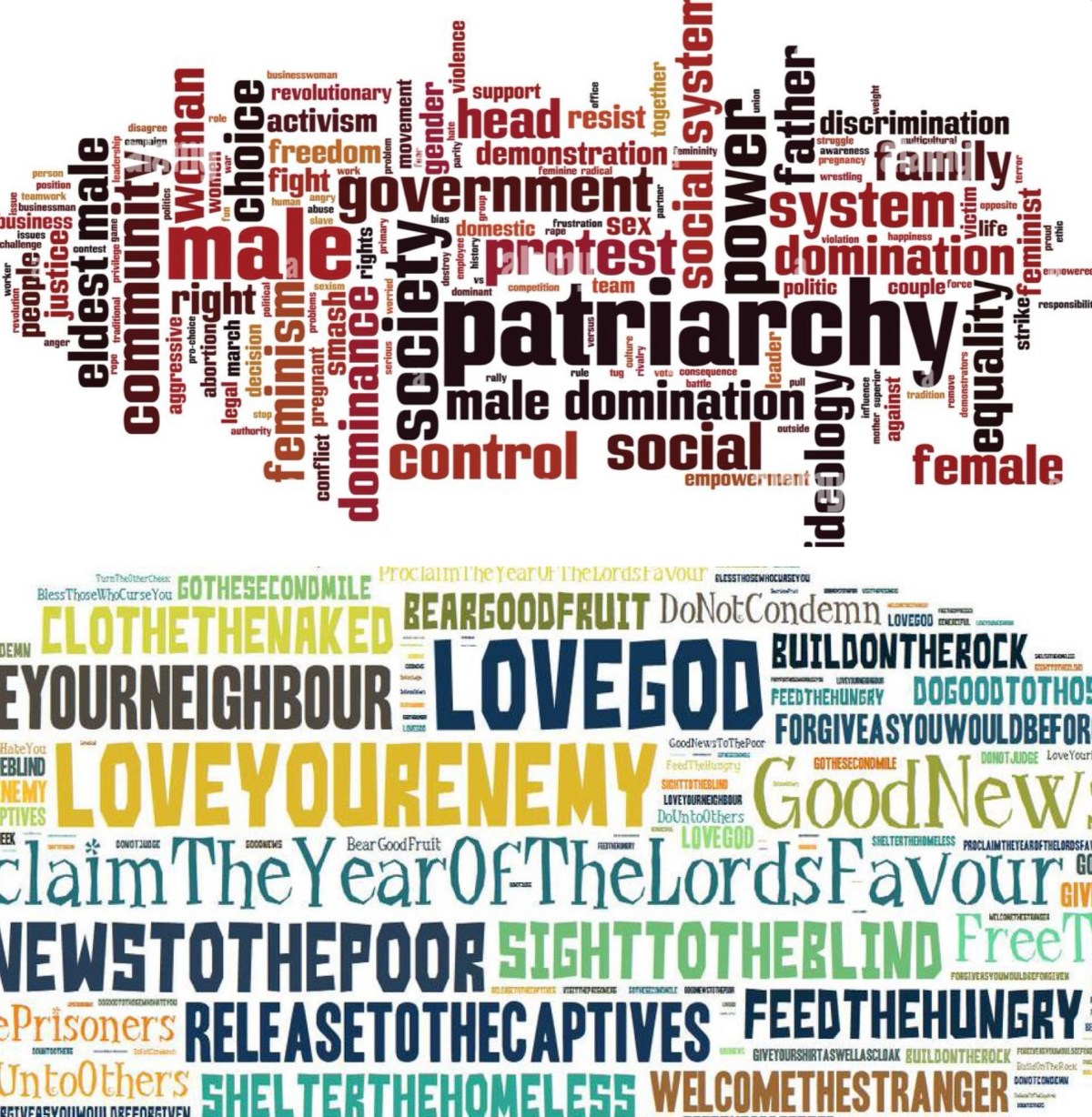
What this wraps around, however, is a world of rigorous discipline and strong patriarchy, a relentless drive to ensure submission to “the head”  (i.e. the man) and obedience to parents, a persistent marginalising and oppressing of women, a strident denunciation of all who stray from the “narrow way” of “Bible-believing Christianity”, and an incessant repetition of the fundamental message that “all have sinned” and all such sinners can only be “saved by the blood of the lamb”. Obedience and disciplined acceptance of what authority decrees are essential.

This is the world of hard-line conservative evangelicalism, which has long been part of the Establishment in Britain and, with a strong Puritan twist, has captured so many Protestant churches in the USA. It is present in Australia, most strikingly in the Sydney Anglican diocese, but there are tentacles into many other Anglican dioceses around the country—and, indeed, into a number of other denominations as well. (There has been a small and declining element of this in my own denomination; the most vigorous proponents of this distorted theology wisely decided to leave a couple of years ago.)

We have seen the very worst manifestation of British conservative evangelical Christianity in recent times, with revelations relating to the masochistic treatment meted out to school-age boys over many years by the head of a reputable evangelical organisation, the Iwerne Trust. The Trust held annual camps to instruct schoolage boys in so-called “muscular Christianity”. These camps were run on military lines; the leader of the camp was the “commandant”, his deputy was the “adjutant”, and all of the leaders were known as “officers”. (It sounds just like the regimented school cadets system that I remember from my schooldays, decades ago.)

It was in this kind of environment that a barrister named John Smyth found an opportunity to implement his harsh disciplininary measures. Smyth was camp leader on the Iwerne camps 1964–84, chair of the Iwerne Trust 1974–81, and a Scripture Union trustee 1971–79. (The Iwerne Trust operated under the umbrella of Scripture Union, but appears to have been only loosely associated with SU leadership.)

The details of what he did have been documented in church reports—the first, written around 40 years ago, but I comprehensively shelved by those in the know—as well as in media interviews with survivors and even his own son, who endured emotional abuse and vicious physical violence at the hands of his father (aided and abetted by his compliant mother). What is revealed is truly, deeply disturbing. 

Smyth died some years ago. He had been forced to relocate countries twice in his life, fleeing the revelations of his horrid modus operandi. But each time he moved on without any brief of the suspicions relating to him being forwarded to the next “Christian” organisation that he worked with. He avoided justice throughout his lifetime.

The latest public push regarding this man and the way his actions were covered up by complicit colleagues has led to the very public resignation of the Archbishop of Canterbury, who knew Smyth decades ago, apparently knew the suspicions swirling around him then, clearly learnt the full truth over a decade ago, but never did anything to bring this person to account. Welby has become the scapegoat for widespread institutional failure.

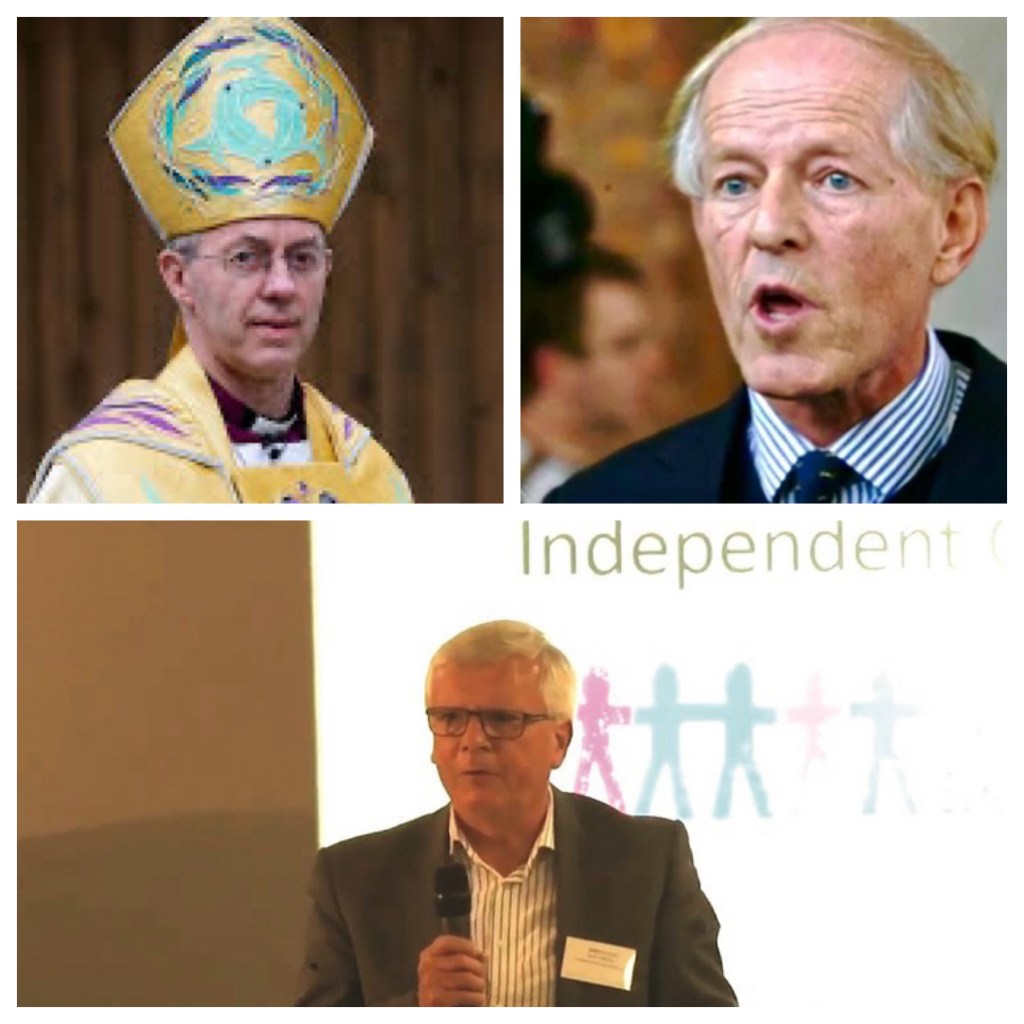
Archbishop Justin Welby (top left), complicit in the cover-up; John Smyth (top right), perpetrator of horrendous abuse; and Keith Makin (bottom), author of the recent Report.

What a shocking indictment! Welby’s sins, whilst totally unacceptable, seem to pale in comparison to the atrocious coverups of so many male clergy. It is just disgusting. But of course we know that the general culture fostered by hardline conservative evangelicals is punitive, oppressive, homophobic, and completely alien to the Gospel. Smyth was living out a distorted theology that had been developed from the increasingly strident message that was being promulgated by hardline evangelicals within the church—and which still lives and grows today. And he got away with it because so many people just gave him “another chance”, or turned a blind eye, wanting to protect the reputation of the church, or simply refused to believe that such a “devout man” could do this.

Prof. Adrian Thatcher has written with his typical clarity on this matter, arguing that “the Church of England will never ‘learn lessons’ about the causes of Smyth’s shocking exploits until it reviews its own theological failings.” In particular, he maintains that “many of [the Church of England’s] members and organisations do hold ideological beliefs that hurt people and are ‘followed at the expense of a core care and regard for every human being’.” He notes that there are “copious references among the testimony of survivors in the [2024 Makin] Report to misogyny, homophobia, to ‘muscular Christianity’, to outrageous sexism (remember the ‘lady helpers’), in the camps and organisations where Smyth’s wickedness was propagated.”

Thatcher quotes Makin’s conclusion that “the patriarchal approach in the organisations and cultures that John Smyth operated, was a conducive and organisational factor to the abuse”. That patriarchal approach is a key characteristic of conservative evangelicalism, whose leaders, Thatcher argues, are still “protected from an overdue examination of their patriarchal, sexist and homophobic beliefs, all ‘Bible-based’, and the harm that derives from them.”

The challenge to hardline conservative evangelical leaders is to reflect on the harm done by their ideological attachment to this distorted theology, to repent of the sins that have been and are being committed, and to rediscover the actual Gospel—good news—for humanity, which, as the latest Church of England media release says, is not about “a seemingly privileged group from an elite background to decide that the needs of victims should be set aside, and that Smyth’s abuse should not therefore be brought to light”, but rather “about proclaiming Good News to the poor and healing the broken hearted.”

Amen.

The Church of England’s media release about the Makin Review is at https://www.churchofengland.org/media/press-releases/independent-review-churchs-handling-smyth-case-published

Prof. Adrian Thatcher’s analysis is at

One detailed discussion of the complicity of some in the terrible coverup that has occurred is at https://www.prospectmagazine.co.uk/ideas/religion/church-of-england/68541/justin-welby-is-a-scapegoat-for-establishment-failures?

Another is at https://sixtyguilders.org/2024/11/18/st-ebbes-and-the-smyth-scandal-an-inadequate-response/?

The ruler of the Kings of the earth (Rev 1; The Reign of Christ, Pentecost 27B)

We are drawing to the end of the long “season after Pentecost” that began back in June and has run through half the year. This coming Sunday is celebrating The Festival of the Reign of Christ, as the climactic moment of this long “season of growth”, as it is often called. The Epistle reading proposed by the lectionary for this Sunday (Rev 1:4b—8) fits well with the theme of “the reign of Christ”, as it contains a greeting from the author which refers to “Jesus Christ, the faithful witness, the firstborn of the dead, and the ruler of the kings of the earth” (1:5).

It is also fitting that, on the last Sunday in the church year, we hear from the last book in the New Testament, commonly called the Revelation of John. This book has some indications that it is to be understood as a letter. The opening section (1:1–20) includes an explicit identification of the author (1:4) and the location of his writing (1:9); a brief description of the situation of the recipients (1:9) along with a listing of the specific cities in which they lived (1:11); and a short blessing and doxology (1:4–5).

The book also contains the text of seven short letters, to the churches in these seven cities (2:1–3:22). The closing section (22:8–21) reiterates the role of the author (22:8) and concludes with a blessing formula (22:21). Each of these elements reflects traditional letter-writing style.

The author identifies himself as John (1:4, 9; 22:8) and notes that he was living on the island of Patmos (1:9); church tradition has equated him with John, the disciple of Jesus, as well as the author of the fourth Gospel and three letters. However, this book is strikingly different from the Gospel and the three letters.

Some have argued that the tone of the book might reflect the style of one of “the sons of Thunder”, as the disciple John was labelled (Mark 3:17); but such a generalisation is not grounded in specific evidence.

Both the style of Greek employed and the way that biblical imagery is deployed sets this book apart from the Gospel which bears John’s name; whilst that book is steeped in biblical imagery and language, it is done in a more subtle and sophisticated manner.

The recipients of the book, identified generically as “the seven churches that are in Asia” (1:4), are subsequently named one by one, by city (1:11). In the details of the seven letters which are addressed specifically to these seven churches (2:1– 3:22), we might imagine that we will find insight into the specific situation in these churches, which is being addressed in this book.

Yet, a careful reading of these particular letters indicates that they are written and delivered in response to a dramatic vision of a distinguished figure with an ominous presence, who instructs the author to write the letters to the angels of the various churches (1:9–20). This figure can well be understood to be the “ruler of the kings of the earth” already referred to (see 1:4)—Jesus, reigning supreme over all. 

Indeed, this opening section of the book is rich with imagery which describes the significance of Jesus. Many of the phrases used here to describe Jesus are later employed in connection with those who follow him. In the initial doxology of 1:4–6, four key phrases are used to describe Jesus. First, the author affirms the traditional view of the redemptive power of the blood which Jesus has shed (1:5); the same language appears in other New Testament books (Rom 3:25; 5:9; 1 Cor 11:25–27; Col 1:20; Eph 1:7; 2:13; Heb 9:12–14; 10:19; 13:20; 1 Pet 1:2, 19; 1 John 1:7; 5:6–8).

This affirmation, of Jesus as the lamb who is sacrificed in order to effect redemption, returns as a common refrain in Revelation (5:10; 7:14; 12:11; 14:3–4; 19:13). In the regulations for temple sacrifice, the purity of the sacrificial lamb was seen as essential (Num 28:3; Lev 1:10). Jesus is depicted in this book as the supreme authority, the one who has risen from the dead and is at one with God. Yet there is a stark counterpoint running throughout the whole book. Jesus is the one who has been pierced (1:7); perhaps this evokes the piercing of Jesus’ side as he hung on the cross (John 19:34–37, citing this as a fulfillment of Zech 12:10). Such power comes only through complete submission. 

Next comes the affirmation that he is “the firstborn of the dead” (1:5; see also 1:18; 2:8); resurrected believers will follow the same path he treads (20:6). This resonates with the Pauline language about Jesus as firstborn from the dead (Rom 8:29; Col 1:15, 18; and see 1 Cor 15:20, 23; and Heb 1:6).

A third affirmation is that he is “the faithful witness” who testifies to the purposes of God (1:5; 3:14); those who follow his way are given insight into God’s will and in turn, they become witnesses to Jesus (17:6).

Jesus Christ Pantocrator,
from a mosaic in the Hagia Sophia Church
(now a Mosque) in Istanbul

Finally, as the risen one, Jesus is “the ruler of the kings of the earth” (1:5) who exercises the sovereign powers of God over earthly authorities (6:15–17); ultimately these rulers will either be destroyed (19:17–21) or acknowledge his authority (21:22– 24). His supreme authority is conveyed by a later reference to the keys given to him (1:18; see Isa 22:20–22; Matt 16:19); these keys grant him power over Death and Hades (1:18; see also 6:8; 20:13–14). This element certainly resonates with the theme of The Reign of Christ, which originated when it was introduced by Pope Pius XI in 1925. 

The 1920s were a time when Fascist dictators were rising to power in Europe.  I have read that “the specific impetus for the Pope establishing this universal feast of the Church was the martyrdom of a Catholic priest, Blessed Miguel Pro, during the Mexican revolution”; see Today’s Catholic, 18 Nov 2014, at https://todayscatholic.org/christ-the-king/

The article continues, “The institution of this feast was, therefore, almost an act of defiance from the Church against all those who at that time were seeking to absolutize their own political ideologies, insisting boldly that no earthly power, no particular political system or military dictatorship is ever absolute. Rather, only God is eternal and only the Kingdom of God is an absolute value, which never fails.” The vision of Rev 1:4b—8 is certainly consistent with this perspective. And the distinctive vision of this book, concerning “the lamb who was slain” (5:1–14), offers a distinctive way by which this political power is exercised. See

The work as a whole  is characterised as being “words of prophecy” (1:3; 22:10, 18–19). The prophecy which is presented in this book is summarised as “what must soon take place” (1:1; 22:6). Both at the beginning and at the end of the book, the author declares that he is looking forward in time, reporting events that will soon take place. When, exactly, those events will take place has been the focus of investigation by numerous people of faith over many centuries—“the end of the world is nigh” has been proclaimed in every century since the first century, and always (as we know) without success. Any claims in this regard, today, should be dismissed as not at all correct.

In the ways that Revelation has been interpreted, and the problems associated with each of them, see 

So, enjoy reading and hearing this very brief excerpt from this most unusual biblical book at this time of the year!