On Ash Wednesday each year, Christians around the world begin forty days (plus six Sundays) of the season of Lent. This is the focus for the first half of issue 17/6 of With Love to the World.
So often, when the season of Lent comes around each year, preachers inevitably start to talk about our “journey”, and seek to relate our “walk of faith” to the pathway that Jesus trod as he led his disciples, with firm and steadfast resolve, towards Jerusalem—the city where he knew what his fate would be.
Yet we are not tramping determinedly to our death at the end of Lent—at least, I hope we are not! And, in a sense, nor was Jesus. Yes, he would die in Jerusalem; he dies there because of the intersection of the plotting of Jewish leaders (always anxious about prophetic pretenders, as they probably saw him) and the co-operation of Roman authorities (always willing to act harshly to squash potential problems). But each Gospel attests, in its own way, to a life beyond the life that Jesus lived in Galilee and Judea.
Jesus has an ‘afterlife’ that leads him to appear to his followers, charge them with a global mission, and send the Spirit to renew and energise them in that mission. That’s how Matthew, Luke, and John portray what transpired around the time we mark as Easter—each in their own idiosyncratic way.
But this year (2024), we are following the story that the Gospel of Mark tells about Jesus; and we know that this account comes to an abrupt ending, right at the point where the news about Jesus, raised from the dead, is about to be broadcast (Mark 16:7–8). “They said nothing to nobody, for …” [my translation] is one way to render the awkward ending of this earliest Gospel. It is a peculiar way to end the story; many suggest that we may have lost Mark’s intended ending, as this sentence seems to trail off into nothing …
So here we face the question: how do we proclaim the good news that God raised Jesus from the dead, when our primary text (at least for this year) doesn’t report that? Yes, we can find hints in the words of Jesus (Mark 14:28) that are repeated by the young man in the empty tomb (Mark 16:7)—but the Gospel itself does not give us much more than this.
It is as if the author of this earliest written account of Jesus wants to hand the responsibility over to us—invite us to run with the story, to shape for ourselves the words and the actions which bear witness to the reality that Jesus has, indeed, “gone to Galilee”, and that we ourselves have seen him. What is the way that we, having traced the story of Jesus to this point, pick up the story and offer our own testimony to the living one who is in our midst?
In Mark’s Gospel, Jesus asks many questions; so do his followers, and his opponents. (I once counted them: this Gospel has 118 questions, in 668 verses!) I see the ending to Mark as another question—a big question, for us. He is not here. Jesus is risen.How do we proclaim that? How do we share this news? That is the big question addressed to us by this Gospel.
*****
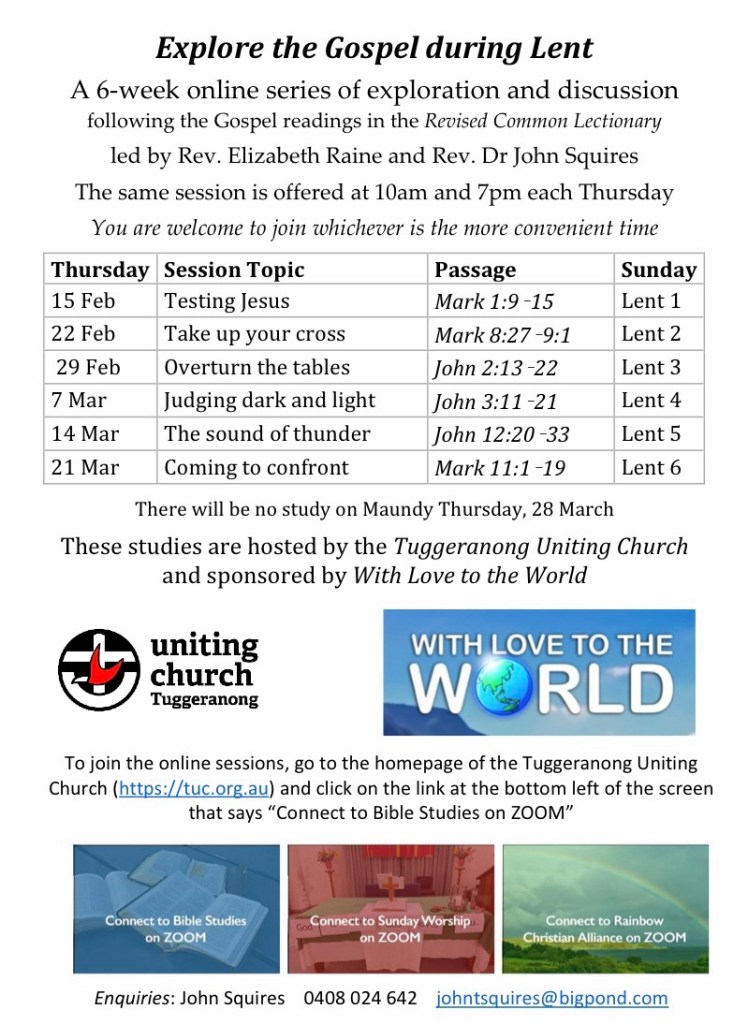
During Lent, you are invited to join an online Bible Study sponsored by With Love to the World, each Thursday, at either 10:00am or 7:00pm.
This week we once more read and hear the beginning of the story that Mark tells, about the very early stages of the public activity of Jesus. We have already read about John the baptiser during Advent (Advent 2), and heard Mark’s account of the baptism of Jesus (Epiphany 1).
Now, in this week’s Gospel reading (Lent 1), Jesus is baptised, plunged deep into the water, from which he emerges changed (1:9–11), driven into the wilderness, with wild beasts and angels, to be tested (1:12–13), and then announces what his message and mission will be (1:15–15).
This baptism is sometimes regarded as Jesus attesting to a deeply personal religious experience that he had in his encounter with John, who had been preaching his message of repentance with some vigour (1:4-11). His encounter with John deepens his faith and sharpens his commitment.
The relationship between Jesus and John is interesting. In the orderly account of things being fulfilled, which we attribute to Luke, it is clear from the start that John is related to Jesus (Luke 1:36). By tradition, they are considered to be cousins–although the biblical text does not anywhere expressly state this.
It seems also that some of the early followers of Jesus had previously been followers of John himself. This is evidenced in the book of signs, which we attribute to the evangelist John. Andrew, later to be listed among the earliest group of followers of Jesus, appears initially as one of two followers of John (John 1:35-40). They express interest in what John is teaching (John 1:39).
Andrew is the brother of Simon Peter, later acknowledged as the leader of the disciples of Jesus. He tells his brother about Jesus. It is Peter who comes to a clear and definitive understanding of the significance of Jesus, even at this very early stage: “we have found the Messiah” (John 1:41). Andrew and John are thenceforth committed disciples of Jesus.
Was Jesus engaging in “sheep-stealing”? Certainly, the dynamic in the narrative is of a movement shifting away from John the baptiser towards Jesus the Messiah; the juxtaposition of these two religious figures can be seen at a number of points (John 1:20, 29-34, 35-36; see also 3:22-30).
See further thoughts on John the baptiser in John’s Gospel at
(And I am looking forward to reading more about John in the most recent book by James McGrath, Christmaker: a life of John the Baptist, published by Eerdmans.)
None of this story relating to John is in view in the account we read in this Sunday’s Gospel. The rapid-fire movement in this opening chapter simply takes us from John, baptising in the Jordan, to Jesus at the Jordan and then in the wilderness, and on into Galilee, beside the lake and in Capernaum (Mark 1:1–45).
Mark has no concern with exploring the relationship between Jesus and John. He wishes only to indicate that, at the critical moment of the beginning of the public activity of Jesus, it was through contact with John, his message and his actions, that Jesus was impelled into his mission.
The Gospel account moves quickly on from the baptism, to a very different scene, set in the wilderness, where Jesus is tested, challenged about his call (1:12-15). The wilderness was the location of testing for Israel (Exod 17:1-7; Num 11:1-15; Deut 8:2). By the same token, the wilderness was also the place where “Israel tested God” (Num 14:20-23), when Israel grumbled and complained to God (see Exod 14-17, Num 11 and 14). Wilderness and testing go hand-in-hand.
The reference to Jesus being “forty days” in the wilderness evokes both the “forty years” of wilderness wandering for the people of Israel (Exod 16:35; Deut 2:7, 8:2, 29:5; Neh 9:21; Amos 2:10, 5:25), as well as the “forty days” that Moses spent fasting on Mount Sinai (Exod 34:28; Deut 9:9-11,18,25; 10:10).
Forty, however, should be regarded not as a strict chronological accounting, but as an expression indicating “an extended period of time”, whether that be in days or in years. It points to the symbolic nature of the account.
We see this usage of forty, for instance, in the comment in Judges, that “the land had rest forty years” (Judges 5:31, 8:28)–a statement that really means “for quite a long time”. Likewise, Israel was “given into the hands of the Philistines forty years” (Judges 13:1) and Eli the priest served for 40 years (1 Sam 4:18).
David the king reigned for 40 years (2 Sam 5:4, 1 Kings 2:11; 1 Chron 29:27), his son Solomon then reigned for another 40 years (1 Kings 11:42; 2 Chron 9:30), as also did Jehoash (2 Kings 12:1) and his son Jeroboam (2 Kings 14:23). If we take these as precise chronological periods, it is all very neat and tidy and orderly–and rather unbelievable!
Other instances of forty point to the same generalised sense of an extended time. Elijah journeyed from Mount Carmel to Mount Horeb “forty days and forty nights” (1 Kings 19:8), whilst the prophet Ezekiel’s announcement of punishments lasting forty years (Ezekiel 29:10-13) is intended to indicate “for a long time”, not for a precise chronological period. Jonah’s prophecy that there will be forty days until Nineveh is overthrown (Jonah 3:4) has the same force.
So the story of the testing of Jesus for “forty days in the wilderness” is not a precise accounting of exact days, but draws on a scriptural symbol for an extended, challenging period of time.
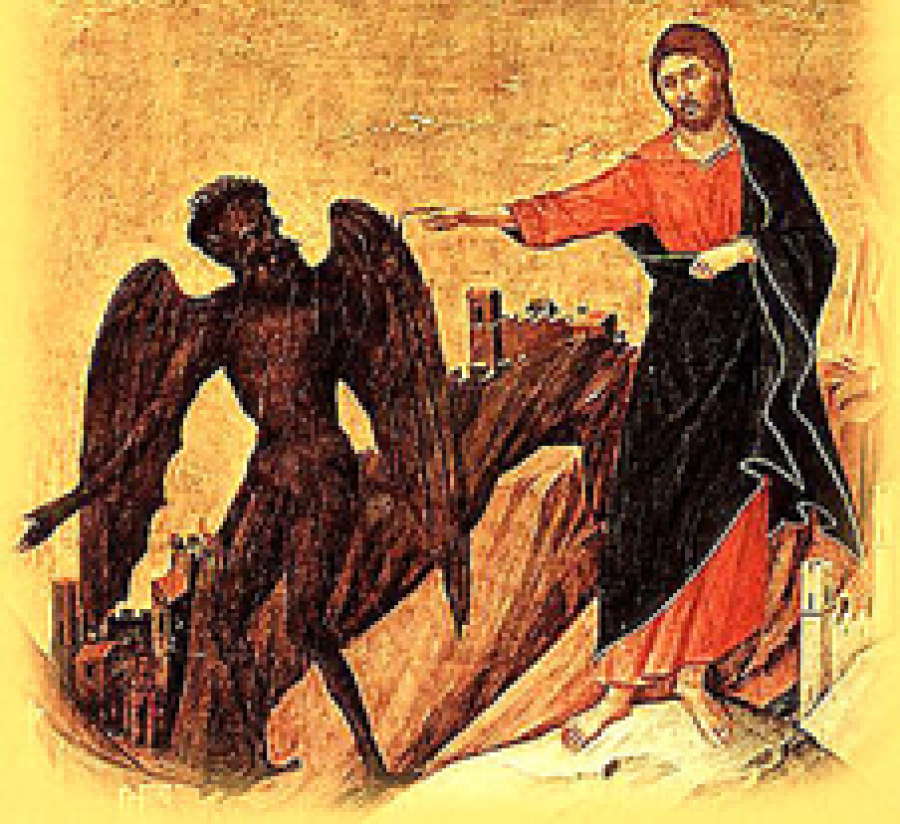
Details about the conversation that took place whilst Jesus was being tested in the wilderness are provided in the accounts in the Gospels attributed to Matthew (4:1-11) and Luke (4:1-13). This is not the case in Mark, where the much shorter account (1:12-13) focusses attention on the key elements of this experience: the wilderness, testing, wild beasts, angels–and the activity of the Spirit.
The Markan account of this period of testing is typically concise and focussed. The constituent elements in the story continue the symbolic character of the narrative.
The note that “he was with the wild beasts” sounds like the wilderness experience was a rugged time of conflict and tension for Jesus. However, commentators note that the particular Greek construction employed here is found elsewhere in this Gospel to describe companionship and friendly association: Jesus appointed twelve apostles “to be with him” (3:14); the disciples “took him [Jesus] with them onto the boat” (4:36); the man previously possessed by demons begged Jesus “that he might be with him” (5:14); and a servant girl declares to Peter that she saw “you also were with Jesus” (14:67).
If this Greek construction bears any weight, then it is pointing to the companionable, friendly association of the wild beasts with Jesus—a prefiguring of the eschatological harmony envisaged at the end of time, when animals and humans all live in harmony (Isaiah 11:6-9; Hosea 2:18). The wilderness scene has a symbolic resonance, then, with this vision.
Alongside the wild beasts, angels are present—and their function is quite specifically identified as “waiting on him” (1:13). The Greek word used here is most certainly significant. The word diakonein has the basic level of “waiting at table”, but in Markan usage it is connected with service, as we see in the descriptions of Peter’s healed mother-in-law (1:31), the women who followed Jesus as disciples from Galilee to the cross (15:41), and most clearly in the saying of Jesus that he came “not to be served, but to serve” (10:45). The service of the angels symbolises the ultimate role that Jesus will undertake.
Finally, we note that the whole scene of the testing of Jesus takes place under the impetus of the Spirit, which “drove him out into the wilderness” (1:12). This was the place that Jesus just had to be; the action of the Spirit, so soon after descending on him like a dove (1:11), reinforces the importance and essential nature of the testing that was to take place in the wilderness.
And the action of “driving out” is expressed in a word, ekballō, which contains strong elements of force—the word is used to describe the confrontational moment of exorcism (1:34, 39; 3:15, 22-23; 6:13; 9:18, 28, 38). The testing in the wilderness becomes a moment when Jesus comes face to face with his adversary, Satan—and casts his power aside. The more developed dialogues in Matthew and Luke expand on this understanding of the encounter.
Both of the key elements in this reading (baptism and testing) serve a key theological purpose in Mark’s narrative. They shape Jesus for what lies ahead. They signal that Jesus was dramatically commissioned by God, then rigorously equipped for the task he was then to undertake amongst his people. The two elements open the door to the activities of Jesus that follow in the ensuing 13 chapters, right up to the time when the long-planned plot against Jesus, initiated at 3:6, is put into action (14:1-2).
Of course, this story is offered in the lectionary each year on the first Sunday in the season of Lent. It serves as an introduction to the whole season. Jesus being tested in the wilderness points forward, to the series of events taking place in Jerusalem, that culminate in his crucifixion, death, and burial.
The narrative arc of Mark’s Gospel runs from the baptism and wilderness testing, through to death at Golgotha and burial in a tomb. The weekly pattern of Gospel readings during Lent follows a parallel path, from the wilderness testing of Lent 1, to the entry into Jerusalem on Lent 6, the farewell meal on Maundy Thursday, and the death and burial on Good Friday.
That is the path that Jesus trod. That is the way that he calls us to walk.
The story that is told in the Gospel for this coming Sunday (included in the longer reading of Mark 8:27—9:8) is a story about being changed; about being transformed. It’s a story that shows that being transformed means you are able to stand and challenge others to be transformed.
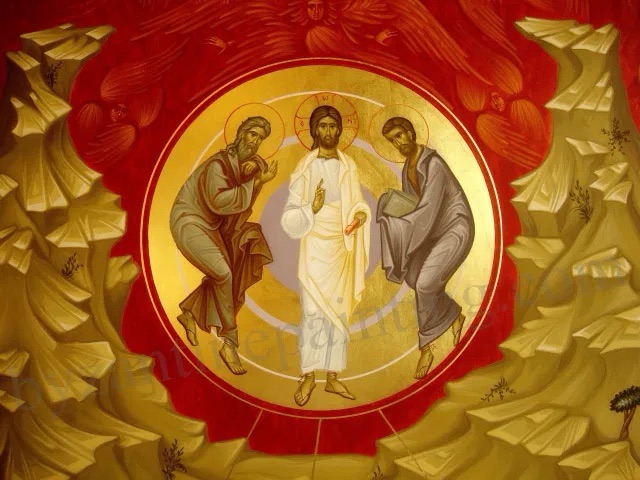
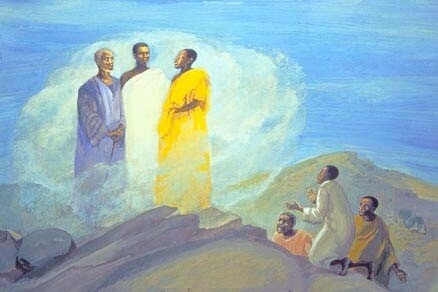
It’s the story of when Jesus took his three closest friends to a mountain, and they had a shared experience of seeing Jesus standing between two of the greats of their people: Moses, to whom God had given the Law to govern the people of Israel, and Elijah, through whom God had established a long line of prophets in Israel (Mark 9:2–8). It’s a story that in Christian tradition is called The Transfiguration.
The word Transfiguration is a strange word. It is not often found in common English usage. It’s one of those peculiar church words, that seems to be used only in church circles. Like thee and thy, holy and righteous, sanctification and atonement … and trinity. These words don’t usually pop up in regular usage!
I looked for some helpful synonyms for the word transfiguration, and found these: change, alter, modify, vary, redo, reshape, remodel, transform, convert, renew … and transmogrify. I am not sure whether that last one gets us anywhere nearer to a better understanding, but some of the others are helpful. Transfiguration is about change, adaptation, and taking on a new shape or size or appearance.
One of the other words offered as a synonym was metamorphose; and that caught my eye, because that word comes directly from the Greek word, metamorphidzo, which is used by Mark in his Gospel, when he tells his account of this incident. “After six days, Jesus took Peter, James and John with him and led them up a high mountain, where they were all alone; and he was metamorphosed before them” (Mark 9:2). Mark then explains that this metamorphosis was evident in that “his clothes became dazzling white”.
The story of the Transfiguration tells of the moment that Peter, James, and John perceived Jesus in a new way. No longer did they see him as the man from Nazareth. In this moment, they see him as filled to overflowing with divine glory. He was not simply the son of Joseph; he was now the divinely-chosen, God-anointed, Beloved Son (9:7).
Jesus brings the heavenly realm right to the earthly disciples. It is what is known, in Celtic Christianity, as a “thin place”: the place where heaven breaks into earthly life.
The disciples had the possibility, in a moment of time, to feel intensely close to the heavenly realm, to stand in the presence of God. They symbolise the desire of human beings, to reach out into the beyond, to grasp hold of what is transcendent—to get to heaven, as that is where God is (see Gen 28:10-12 and Deut 30:12; Pss 11:4, 14:2, 33:13, 53:2, 80:14, 102:19; although compare the sense of God being everywhere in Ps 139:8-12).
This key mountaintop moment contains the words from the heavens about Jesus, “This is my Son, the Beloved; listen to him!” (9:7). These words link back to the initial baptism of Jesus, when the same words were heard (1:11) and forward to the final scene of crucifixion, when a centurion and those with him at the foot of the cross witnesses Jesus’ death, and declares, “Truly this man was God’s Son!” (15:39).
All three scenes contain the foundational statement, recognising Jesus as Son of God, reiterating the words of the unclean spirits in Galilee (3:11) and the man possessed by demons in the country of the Gerasenes (5:7). For, as Simon Peter declares in the pivotal scene at Caesarea Philippi that is also included in this Sunday’s reading, Jesus is “the Messiah” (8:29).
The voice, booming forth from the clouds, “This is my Son, the Beloved; with him I am well pleased; listen to him!” (9:7) seems, at first hearing, to be quoting Hebrew scripture: perhaps the second Psalm, which praises the King of ancient Israel as the one whom God has begotten; or perhaps the song in Isaiah 42, which extols the servant as the one whom God has chosen, or anointed; or perhaps even the oracle in Deuteronomy 18, which instructs the people to listen carefully to the words of the prophet.
Whatever scripture, or scriptures, are here spoken by the divine voice, making this bold declaration from the cloud, it is clear that God has a special task, a special role, and a special place for Jesus. The words of this heavenly voice link this story back to the opening scenes of the story of the adult period in the life of Jesus, and also to a moment towards the end of that adult life.
As this voice is heard, Jesus is on a mountain, with three of his closest followers—and also with two key figures from the past of Israel: Moses, who led the people out of slavery, who then was the instrument for delivering the Torah to Israel; and Elijah, who stood firm in the face of great opposition, whose deep faith bequeathed him the mantle of prophet, as he ascended into heaven.
Mark says that “there appeared to them Elijah with Moses, who were talking with Jesus” (9:4). Matthew reverses the order, placing Moses before Elijah: “suddenly there appeared to them Moses and Elijah, talking with him” (Matt 17:3). Priority, in Matthew’s narrative, goes to Moses. Indeed, Matthew’s concern has been to make as many parallels as possible between the story of Jesus and the story of Moses. The regular reminder that “this took place to fulfil what the Lord has said through the prophets” (Matt 1:22; 2:4, 15, 17, 23) underlines this Mosaic typology.
The covenant given to Moses on Mount Sinai (Exod 19:1–6) is accompanied by the giving of the law (Exod 20:1–23:33), and is later sealed in a ceremony by “the blood of the covenant” (Exod 24:1–8). The scene on the mountaintop, with Jesus and his three disciples, evokes the mystery of the mountaintop scene in Exodus. This story is but one part of the story of Jesus which draws connections with the story of Moses.
*****
The Gospel writers say that Jesus was transformed at that moment. But in this story, also, there is the indication that the friends of Jesus were transformed. That moment on the mountain was a challenge to each of them; the response that Peter wanted to make was seen to be inadequate. Jesus challenged him to respond differently. It was another moment when metanoia, complete transformation, took place. And these disciples did change; yes, it took some time, but these friends of Jesus ultimately became leaders amongst the followers of Jesus, and spearheaded the movement that became the church.
The change, the metanoia, that occurred within Peter, James, and John, spread widely. They faced the challenge head on, and responses, in metanoia. That is mirrored, today, in changes that are taking place in society. Especially, that has been the experience of people over the last few years. We have met the challenge of a global viral pandemic; patterns of behaviour have been modified, as we prioritise safety and care for the vulnerable, and wear masks, sanitise, and socially distance. We have changed as a society.
In the church generally, through the pandemic that hit with such force in 2020, we have changed how we gather, how we worship, how we meet for Bible studies and fellowship groups, how we meet as councils and committees, how we attract people to our gatherings. Transformation has been widespread.
In my own church of these past few years, we worked hard to meet the challenge of reworking our understanding of mission; for across the church, we now see the importance of people from each Congregation engaging with the mission of God in their community as the priority in the life of the church. See
So in each place where people gather as church, there is a pressing need to consider how we might grow fresh expressions of faith, nurture new communities of interest, foster faith amongst people “outside of the building” and outside the inner circle of committed people. It is an ongoing process.
Change is taking place. Change is all around us. Change is the one thing that is constant about life: we are always changing. Sometimes we think that the church doesn’t change, isn’t changing, even resists changing. But that is not the case. Our church is changing. Our society is changing. And the story of the Transfiguration of Jesus encourages us throughout this change.
The latest issue of the daily Bible reading resource, With Love to the World, is currently being distributed tcsubscribers. It features a stunning wraparound cover photograph of “Reflection at Circular Pool”, taken at Walpole, WA, by Steph Waters of Perth.
Steph offers her own reflection on the significance of the seasons of Lent and Easter, which are the focus of this particular issue. I’ve included an introduction to each season in the opening pages of this issue, and the issue concludes with a wonderful poem on resurrection, “Seasons gone south”, by Alison Bleyerveen of Sydney.
With Love to the World has always sought to provide a resource which assists worshippers to come to Sunday worship with an awareness of the Bible passages they will hear read and proclaimed. So each day has not only a succinct commentary on a biblical passage, but also a prayer, a song, and a question for discussion, all related to the day’s passage. This means that Sunday worshippers will hear more acutely and respond more directly to the scripture in focus.
The writers of these commentaries in this issue are all experienced in pastoral ministry, and so as they reflect on the daily passage, they bring their theological training as well as their engagement in pastoral ministry to bear on what the passage is saying. In keeping with the commitment of With Love to the World, the writers are drawn from Asian, Pasifika, Maori, South African, and Anglo-Australian heritages.
Yvonne, Peter, Radhika, Simon, Jason, Alimoni, and Rob (and yours truly) each write with the intention of drawing from scripture ideas and provocations that are expressed in an accessible way. They write so that the the faith of their readers is deepened and their discipleship is strengthened.
As always, as Editor, I have a number of complimentary copies to distribute to encourage new subscribers. Please send me a direct message if you (a) would like to sample With Love to the World for yourself, or (b) know of a friend or someone in your congregation who might be interested in sampling an issue. I can mail them direct to you or to the person you nominate. (Please include your mailing address in your message to me.)
In addition, you can take out an annual subscription to With Love to the World on your phone or iPad via an App, for just $28 per year. (That’s just 54 cents a week, or seven and a half cents a day!) Search for With Love to the World on the App Store, or UCA—With Love to the World on Google Play. For the hard copy resource, for just $28 for a year’s subscription, email Trevor at wlwuca@bigpond.com or phone +61 (2) 9747-1369.
After the scene in the synagogue, which we heard last Sunday, the lectionary offers us a collection of scenes (Mark 1:29–39) for the fifth Sunday after the Epiphany. These scenes are part of the rapid sequence of events that Mark tells, to introduce Jesus, the main character of his narrative over the ensuing chapters.
We have already had the announcement from John about “one more powerful than I” (1:2–8) and the striking moment when Jesus of Nazareth was declared to be the beloved Son, anointed by the Spirit, equipped for his role of proclaiming the kingdom of God (1:9–11).
This summary is followed by two compressed accounts, told in formulaic exactitude, in which Jesus calls four of his key followers, brothers Simon and Andrew (“follow me; they left their nets, and followed him”), and then brothers James and John (“he called them; they left their father, and followed him” (1:16-20). See https://johntsquires.com/2024/01/16/fishing-for-people-not-quite-what-you-think-mark-1-epiphany-3b/
These two call narratives establish the nature of the movement that Jesus was initiating. He sets out a call to all four brothers; an exclamation, to which they must respond: “follow me!” The call invites a specific, tangible, and radical response: “leave everything”. And both encounters result in a new, binding commitment to Jesus: they “followed him”. The same pattern repeats with Levi in 2:14, and then with others (2:15; 8:34-36; 15:41). A rich young man comes to the brink, but then pulls away at the last moment (10:21).
Myers parallels this call scene with a later scene (8:22-9:13) in the following way: “Each prologue introduces the essential symbols, characters, and plot complications of the respective ‘books’. Each takes place in the context of ‘the Way’ (1:2f; 8:27), and discusses the relationship between Jesus and John-as-Elijah (1:6; 8:28). In both prologues, Jesus is confirmed as the anointed one by the divine voice (1:11; 9:7) in conjunction with symbolism drawn from the Exodus tradition (wilderness, 1:2,13; mountain, 9:2).
“Each articulates a call to discipleship (1:16-20; 8:34-36) specifically in regard to Peter, James, and John (1: 16,19; 9:2). In Book I Jesus calls disciples to follow him in overturning the structures of the present social order. But because these disciples’ understanding is suspect, Jesus must in the prologue of Book Il extend a ‘second’ call to follow, in which he introduces the central symbol for the rest of the narrative: the cross.”
After these stories of announcement and call to follow, there comes a scene in a synagogue, revealing the authority that Jesus had, in calling people, to command “the unclean spirit, convulsing him and crying with a loud voice, [to] come out of him” (1:21–28). See
The section of this chapter offered for this coming Sunday (1:29–39) begins with a pair of complementary scenes—the first set in the hustle and bustle of the village, where Jesus heals the sick and casts out more demons (1:29–34); the second an early morning start, where Jesus prays “in a deserted place” (1:35–37). This contrast is deliberate, and instructive. Both settings are vital for his project of radical discipleship.
This latter scene evokes the earlier scene, immediately after the public dunking of Jesus in the Jordan river (1:9–11), when Jesus spends a highly symbolic forty days “in the wilderness” (1:12–13). Although it was the Spirit which drove him into wilderness (1:12), it was Satan who tested Jesus during this period (1:13). And that seminal encounter sits alongside the first public declaration of Jesus as “beloved Son”, made over the waters of the Jordan (1:11). See Forty days, led by the Spirit: Jesus in the wilderness (Mark 1; Lent 1B)
The author then provides a characteristic summation of the activity that Jesus was called to do: “he went throughout Galilee, proclaiming the message in their synagogues and casting out demons” (1:38–39). Subsequent summaries in this vein appear a number of times in the ensuing narrative (3:7–8, 4:33–34, 6:12–13, 6:56, 10:1). The opening chapter thus sets the pattern of behaviour by Jesus.
A final, intensely emotional scene brings this substantial opening sequence to a close. In this final scene of chapter 1, Jesus is approached by a leper, seeking to be “made clean” (1:40–42). The way Jesus responds to this need is striking: what the NRSV translates as “moved with pity” is actually better rendered as “being totally consumed by deep-seated compassion” (1:41). An alternative textual variation renders the emotions of Jesus more sparsely: “and being indignant”.
The command to adhere to the law by bringing a sacrificial offering to the priests for his cleaning (as any teacher of Jewish Torah would advocate—Lev 14) is, strikingly, expressed in the typical manner of a wild magic healer; the NRSV translation, “sternly warning him”, is better expressed as “snorting like a horse”—the use of striking, dramatic language being a characteristic feature of ancient healers (1:43–44).
The final scene collects all the activity of the opening chapter into the bustling energy of the swarming public square. Jesus can no longer remain isolated or removed; “people came to him from every quarter” (1:45). However, this passage, along with other sections of chapter 2, appears in the lectionary only in a year when Easter is later and thus the season of Epiphany is extended by further weeks. Because of the early date of Easter this year (2024), we will not be reading and reflecting on it this year.
Perhaps the key takeaway for us, today, from this collection of scenes, is in verse 38: “let us go on to the neighboring towns, so that I may proclaim the message there also; for that is what I came out to do.” The Jesus of Mark is an energetic, passionately committed person, travelling relentlessly, proclaiming his message of the coming kingdom with an intensity, engaging with people with compassion, focussed on achieving his goal. That’s the invitation that stands before us this Sunday: how do we respond?
The passage proposed for this coming Sunday, the Fifth Sunday after Epiohany (Isa 40:21–31) is from a section of the book of Isaiah which is very well known. It reaches it climax with the well-known acclamation that “those who wait for the Lord shall renew their strength, they shall mount up with wings like eagles, they shall run and not be weary, they shall walk and not faint” (Isa 40:31).
Words earlier in this oracle tell of the voice which cries out “in the wilderness prepare the way of the Lord” (Isa 40:3). We know these words as they are applied directly to John the baptiser early in the Gospels (Mark 1:2–4 and parallels; John 1:19–23). In that context, these words of the prophet invite us to look forward, in anticipation to the story of Jesus, which will follow.
These words, however, have a different reference in their original context. The words of the exilic prophet whose work forms the second section of Isaiah (chs. 40—55) are oriented towards the appearance of God to the people of Israel as they wait and hope for the end of their exile in Babylon. The prophet says that God will comfort the people (v.1), speaking tenderly to Jerusalem, declaring that “her penalty is paid” (v.2)—and then, that “the glory of the Lord shall be revealed, and all people shall see it together” (v.5).
The promise of God is clear; the prophet states that God declares, “I will send to Babylon and break down all the bars, and the shouting of the Chaldeans will be turned to lamentation” (43:14; 48:14; and see the extended oracle of 47:1–15). He specifically nominates Cyrus of Persia as the one chosen (or anointed) by God to bring the exiles home (Isa 44:28—45:1; 45:13). We know from 2 Chron 36:22–23, and the books of Ezra and Nehemiah, that this did indeed take place.
The prophet describes the way out of exile and back to the land once promised, ages before, to the ancestors of Israel, in terms which evoke the miraculous liberation from slavery in Egypt—at least in terms of the story that is told in Exodus. Whilst evidence to support the Exodus narrative as “historical” is strikingly missing, the story developed in the Exodus narrative is powerful.
So as the prophet describes the journey leaving Babylon and returning to Jerusalem he evokes that narrative escape from Egypt, indicating that the Lord God “will open rivers on the bare heights, and fountains in the midst of the valleys … [he] will make the wilderness a pool of water, and the dry land springs of water” (41:17–20; see also 43:16–17; 49:9–10; 50:2).
Because it was the Lord who “dried up the sea, the waters of the great deep [and] made the depths of the sea a way for the redeemed to cross over” (cf. Exod 14:19–22, 30–31), the prophet declares exultantly, “the ransomed of the Lord shall return, and come to Zion with singing” (Isa 51:10–11). In order to facilitate this return, in the opening oracle of this section, the prophet declares that “every valley shall be lifted up, and every mountain and hill be made low; the uneven ground shall become level, and the rough places a plain” (40:4).
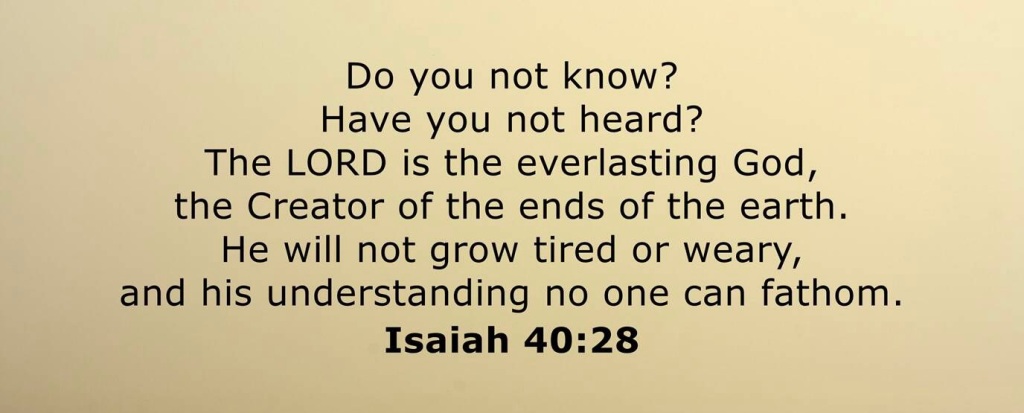
The particular part of this opening oracle that the lectionary offers for this Sunday (Isa 40:21–31) is a song of praise to God, for the power that “the everlasting God, the Creator of the ends of the earth” exercises in the world. In the foundational saga of Israel, “Everlasting God” is the name given to the Lord by Abraham at Beersheba (Gen 21:33).
In contrast to the eternally-enduring deity, whose word will “stand forever” (40:8), the prophet observes that humans are like grass; “the grass withers, the flower fades”, he twice states (40:7, 8). In this, the prophet echoes other passages where the same observation is made. One psalmist laments that “my days are like an evening shadow; I wither away like grass” (Ps 102:11), in contrast to the Lord, who is “enthroned forever; your name endures to all generations” (Ps 102:12).
Job, similarly, bemoans the reality that “a mortal, born of woman, few of days and full of trouble, comes up like a flower and withers, flees like a shadow and does not last” (Job 14:1–2). This fleeting character is linked with evildoers in another psalm; they “will soon fade like the grass, and wither like the green herb” (Ps 37:2).
Yet another psalm includes a prayer that the wicked will “vanish like water that runs away; like grass let them be trodden down and wither; let them be like the snail that dissolves into slime; like the untimely birth that never sees the sun” (Ps 58:7–8). The prophet Jeremiah links the withering of grass to the wickedness of those in the land (Jer 12:1–4), while the prophet Isaiah had noted that the withering of the whole world was a curse that signalled the impending judgement on the world (Isa 24; see v.4).
In the context of this understanding of God, the eternal one, and human beings, whose lives are fleeting, the prophet has announced good tidings (40:9), that the Lord God “comes with might, and his arm rules for him; his reward is with him, and his recompense before him” (40:10). God will not leave people bereft. God comes to “feed his flock like a shepherd … gather the lambs in his arms, and carry them in his bosom, and gently lead the mother sheep” (40:11). The eternal God is a caring, compassionate being.
Alongside this comforting image of the deity, the prophet shares a vision of the God who “sits above the circle of the earth … stretches out the heavens like a curtain, and spreads them like a tent to live in” (40:22). God is described as residing “above” in narrative texts (Josh 2:11; 1 Ki 8:23; 2 Ki 19:15) and prophets (Isa 37:16; Ezek 10:19; 11:22). Job recognises “God above” (Job 3:4; 31:2, 28); psalmists praise “God above the heavens” (Ps 57:5, 11; 108:5).
God above is not remote; God above descends to intervene—as the prophet says, the Lord God “brings princes to naught, and makes the rulers of the earth as nothing” (Isa 40:23). This resonates with the words that Hannah sings, that the Lord “kills and brings to life; he brings down to Sheol and raises up … [he] makes poor and makes rich; he brings low, he also exalts; he raises up the poor from the dust; he lifts the needy from the ash heap, to make them sit with princes and inherit a seat of honour” (1 Sam 2:6–8).
This also correlates with words of the psalmist, singing that when the hungry “are diminished and brought low through oppression, trouble, and sorrow, he pours contempt on princes and makes them wander in trackless wastes; but he raises up the needy out of distress, and makes their families like flocks” (Ps 107:39–41), and that “the Lord upholds all who are falling, and raises up all who are bowed down” (Ps 145:14). Similar thoughts, of course, are also,expressed in the pregnant Mary’s song of praise (Luke 1:51–53).
Extolling this God as above all and eternal means that the existence of other entities with a claim to divinity need to be explained. “To whom then will you compare me, or who is my equal?”, the prophet enquires (40:25). Only the Lord God is creator (40:26, 28). Surely, in the mind of the prophet, this places this God in a distinct and unique place.
So it is within these oracles of promise and hope that the theological understanding of monotheism is clearly articulated for the first time in the history of Israel. “Is there any god besides me? There is no other rock; I know not one” (44:8). The phrase, “there is no other (god)”, recurs a number of times in this section (42:8; 45:5, 14, 21, 22; 46:9). This echoes the refrain in Deuteronomy, that “the Lord is God; there is no other besides him” (Deut 4:35, 39; 5:7; 6:14; 7:4; 8:19; 11:16, 28; 13:6–7, 13; 17:3; 18:20; 28:14, 36, 64; 29:26; 30:17–20). Deuteronomy in the form that we know it is to be dated to the exile or return—the same time as the unnamed prophet in Second Isaiah is active.
This claim that the Lord God is the only god is in contrast to the way that the God of Israel had previously been portrayed, as “among the gods” (Exod 15:11; Judg 2:12; Ps 86:8), with the commandment to have “no other gods before me” (Exod 20:3; Deut 5:7) distinguishing this God from those other gods whom Israel was clearly forbidden to worship (Deut 6:14; 7:4; 8:19; 11:16; 13:1–18; 17:2–5; 18:20).
Before the Exile, the possibility of other gods had been entertained. After the experience of exile, the singularity of the Lord God becomes a central claim. And this, in turn, leads into the monotheistic strand that shapes the movement that Jesus initiated.
The prophet concludes this particular oracle with words of inspiration (40:28–31). Two rhetorical questions set the scene: “Have you not known? Have you not heard?” (40:28a). A foundational theological affirmation in the prophet’s worldview follows: “The Lord is the everlasting God, the Creator of the ends of the earth” (40:28b).
Elsewhere in Hebrew Scripture, we find statements that God “looks to the ends of the earth and sees everything under the heavens” (Job 28:24), that God’s name “reaches to the ends of the earth” (Ps 48:10), that God is “the hope of all the ends of the earth and of the farthest seas” (Ps 65:5), and that “all the ends of the earth have seen the victory of our God” (Ps 98:3).
Prophets also affirm that “from the ends of the earth we hear songs of praise, of glory to the Righteous One” (Isa 24:16), that “all the ends of the earth shall see the salvation of our God” (Isa 52:10), and that to the Lord “shall the nations come from the ends of the earth and say: Can mortals make for themselves gods? Such are no gods!” (Jer 16:19).
And so the rhetoric of the prophet rises up into a grand poetic affirmation about this world-encompassing God, who “does not faint or grow weary” (40:28c), as the prophet repeats the earlier affirmation (40:23) that God “gives power to the faint, and strengthens the powerless” (40:29). This picks up the earlier affirmation that God “brings princes to naught and makes the rulers of the earth as nothing” (40:23), folded into the declaration that this same God “gives power to the faint and strengthens the powerless” (40:29).
Springboarding off the imagery of fainting/strengthening, the prophet then contrasts “youths [who] will faint and be weary and young [who] will fall exhausted” (40:30) with “those who wait for the Lord [who] shall renew their strength” (40:31a). This imagery, which closes the oracle, is used to portray this renewal of strength—that of an eagle rising up into the sky. It has caught the imagination of people of faith over many centuries. The rising eagle depicts the way that believers “shall run and not be weary, they shall walk and not faint” (40:31b).
The eagle is known in Christian symbolism as the symbol of the evangelist John, because of the “high Christology” his Gospel contains, reflecting the divinity of Jesus in traditional interpretation. The four symbols (man, lion, ox, and eagle) are in turn derived from the striking vision that opens the book of Ezekiel, who saw “fire flashing forth continually, and in the middle of the fire, something like gleaming amber; in the middle of it was something like four living creatures … the four had the face of a human being, the face of a lion on the right side, the face of an ox on the left side, and the face of an eagle” (Ezek 1:4–10).
“The way of an eagle in the sky” is included amongst the “three things too wonderful for me” that the sage ponders (Prov 30:18–19), while the prophet Obadiah warns Moab, “though you soar aloft like the eagle, though your nest is set among the stars, from there I will bring you down, says the Lord” (Obad 1:4).
The power of the eagle, soaring high into the sky and spreading wide its wings, features in oracles by Jeremiah (Jer 48:40; 49:22) and Ezekiel (Ezek 17:3), and is used to describe how the Lord God guided “his people Jacob”: “as an eagle stirs up its nest and hovers over its young; as it spreads its wings, takes them up, and bears them aloft on its pinions, the Lord alone guided him” (Deut 32:11–12). It’s a powerful and inspiring image to conclude this opening oracle of the prophet as he looks for the exile of his people to end.
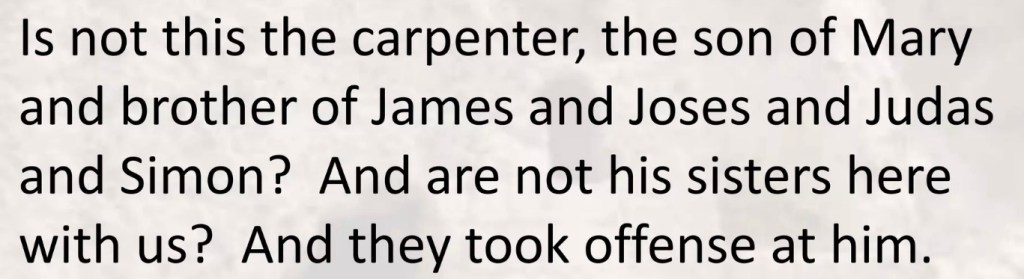
The offering from the narrative lectionary this coming Sunday (Mark 6:1–29) begins with the scene where Jesus goes to the synagogue in his hometown, Nazareth (6:1–6) and is rejected by those who “took offence at him” (6:3). Although he spoke with wisdom and performed acts of power (6:2), he is scorned as merely “the carpenter, the son of Mary and brother of James and Joses and Judas and Simon … and his sisters, here with us” (6:3).
You can imagine the murmurs amongst the people of the town. “He was not the eloquent preacher. Not the erudite teacher. Not the compassionate healer. Not the dazzling miracle-worker. Just plain old Jesus, the carpenter, from a local family. Nothing to look at here. Nothing of importance. A nobody, really. But he has pretensions. And we can’t stand for that, can we?”
Perhaps I’m being a little harsh on the townsfolk? Perhaps there is more to Jesus than they recognised, and perhaps Mark’s narrative might indicate that it is not wise to stereotype Jesus, as they were doing?
Earlier in his narrative, Mark has told of an encounter that Jesus had with his family when he came out of a house in Capernaum (3:20). Some onlookers in Capernaum describe him as being “out of his mind” (ἐξέστη, 3:21). This is a term that literally means that he was “standing outside of himself”, as if in a kind of dissociative state. It may be that this was the reason that Jesus was returning to his family?
The encounter doesn’t go well, however. Scribes have come from Jerusalem. They have already been antagonistic towards Jesus, questioning whether Jesus was blaspheming (2:6–7), and casting doubts on his choice of dinner guests (“why does he eat with tax collectors and sinners.”, 2:16). There will be further disputation with scribes (7:1–5; 9:14; 12:28, 38–41) and they will be implicated in the plot to arrest Jesus (11:18, 27; 14:1, 43, 53; 15:1) and in his death (8:31; 10:33).
These scribes—hardly friends—articulate what others present may well have been thinking: “he has Beelzebul” (3:22). The charge of demon possession correlates with the accusation levelled at John 10:20. It appears to have been one way that Jesus was stereotyped by others.
Beelzebul (Βεελζεβοὺλ), “the ruler of the demons”, is known from earlier scriptural references to Baal-zebub in 1 Kings 1:2–6, 16, where he is described as “the god of Ekron”, a Philistine deity. There is scholarly speculation that Beelzebul may have meant “lord of the temple” or “lord of the dwelling”, from the Hebrew term for dwelling or temple (as found at Isa 63.15 and 1 Kings 8.13); or perhaps it was connected with the Ugaritic word zbl, meaning prince, ruler.
Jesus refutes the charge in typical form, by telling a parable (3:23–27) that ends with the punchline about “binding the strong man” (τὸν ἰσχυρὸν δήσῃ). This potent phrase encapsulates something that sits right at the heart of the activities of Jesus in Galilee—when he encounters people who are possessed by demons, and when he casts out those demons, he is, in effect “binding the strong man”.
The accusation that refers to “blasphemy against the Holy Spirit” (3:29) may well reflect the stereotype that Jesus was demon-possessed (3:30). That stereotyped view of Jesus cannot be allowed to stand, for it cannot be justified in any way—at least, in Mark’s view.
So we see that there was dispute about Jesus, even beyond his hometown of Nazareth. There were those who sought to stereotype him in a negative way.
So Jesus goes to his hometown, with his disciples, and participates in the local synagogue on the sabbath. What do we know of his status in his hometown?
“In those days Jesus came from Nazareth of Galilee and was baptized by John in the Jordan” (Mark 1:9) is how Jesus is introduced in this Gospel. Mark takes us straight to the adult Jesus, bypassing the newborn infant who appears in other narratives. There is no explanation of his background; no stories from his childhood, to show the nature,of his character (such as were common in biographies written by educated folks in the Hellenistic world).
There is certainly no mention of Bethlehem, nor the rampage of Herod; nor any reference to magi travelling from the east, bearing gifts; nor to a census ordered under Quirinius, necessitating short-term accommodation. There is no story of the infant Jesus at all—and most strikingly, no mention of Mary and Joseph as the parents of Jesus in the opening scenes of this earliest Gospel.
Rather, in Mark’s narrative reporting the beginning of the good news about Jesus, the chosen one, Jesus explicitly distances himself from his family. “Who are my mother and my brothers?”, he asks, when confronted by scribes from Jerusalem and labelled as “out of his mind” by his own family (Mark 3:21, 33).
In this week’s passage, the people of his hometown (Nazareth) do not identify as “son of Joseph”—only in John’s book of signs do his fellow-Jews identify him as “son of Joseph” (John 6:42). So it is up to Luke and Matthew, each in their own way, to link Jesus, as a newborn, to these parents.
In Mark’s account of the scene when the adult Jesus returns to his hometown, he is “the carpenter, the son of Mary” (6:3). This is the only time that the name of his mother appears in this earliest account of Jesus; and there is simply no mention, by name, or by relationship, of his putative father. (Some scribes later modified this verse (Mark 6:3) to refer to him as “son of the carpenter and of Mary”, to align Mark’s account with how Matthew later reports it at Matt 13:55.)
Other than this one reference, Mark makes no reference to Jesus’s parents. He is simply, and consistently identified as “the son of God” (Mark 1:1; 3:11; 5:7; 9:7; 15:39). On one occasion, he is addressed as “son of David” (10:47–48; although this description is the subject of debate at 12:35–37).
More often, in this earliest of Gospels, using a term taken from Hebrew Scripture, Jesus refers to himself, or others refer to him, as “the son of humanity” (more traditionally translated as “the son of man”) (2:10, 28; 8:31, 38; 9:9, 12, 31; 10:33, 45; 13:26; 14:21, 41, 62; see Ezek 2:1, 8; 3:1, 4, 16; etc; and Dan 7:13). The origins and identity of Jesus, in Mark’s eyes, relate more to the larger picture—of his Jewish heritage, in his relationship to the divine, and with his role for all humanity—than to the immediacy of parental identification.
Mark ensures that we grasp this larger picture of Jesus in the way he presents Jesus. He also indicates that it is not proper to stereotype Jesus, describing him in demeaning terms, objectifying him as problematic or as “other”. It is a practice that we would do well to emulate in our relationships with others. And in considering Jesus, we should push beyond the stereotypes to discover the person who Jesus really is.
This year, on 26 January, no doubt many people around Australia will gather to cook at the BBQ and swim in the surf. Families and friends will enjoy a relaxing time on a public holiday. Somewhere in the background, perhaps, there will hover a sense of satisfaction that we are “the lucky country” full of “mates and cobbers”, where there is “a fair go” for everyone, a country in which we can wave our flags, have our BBQs, kick back and relax.
Indeed, around the world, people who call Australia home will most likely be gathering, perhaps with fellow-Aussies, to celebrate the day. I know that when I was living in a foreign country, 40 years ago, I did just that—finding some other Australians in the university’s Graduate Student Housing to share in a meal as we celebrated “being Australian” in a foreign land.
That was all almost half-a-lifetime ago, now; and my perspective on this has changed somewhat, I confess. I am still, as I was then, a fervent republican, believing that Australia needs to be a completely independent nation with no role at all for the inbred imperialist family whose forbears colonised this continent and who still have a formal, legal role in the affairs of this country, from many thousands of kilometres away.
And I am still resolutely opposed to the primitive tribal tendencies inherent in nationalism, and its ugly cousin jingoism, because of the emotional damage that this does to impressionable minds, and the consequent savagery that it has unleashed in warfare across the years.
The cost of war is immense and long-enduring; the “victory” won by a nation in prosecuting war is fleeting by comparison. War means injury and death, to our own troops, and to the troops of those we are fighting against. Every death means a family and a local community that is grieving. There is great emotional cost just in one death, let alone the thousands and thousands that wars incur. To say nothing of the damage done to civilians, particularly women and children, as “collateral damage” in these nationalistic enterprises. Jingoistic nationalism fuels the appetite for warfare.
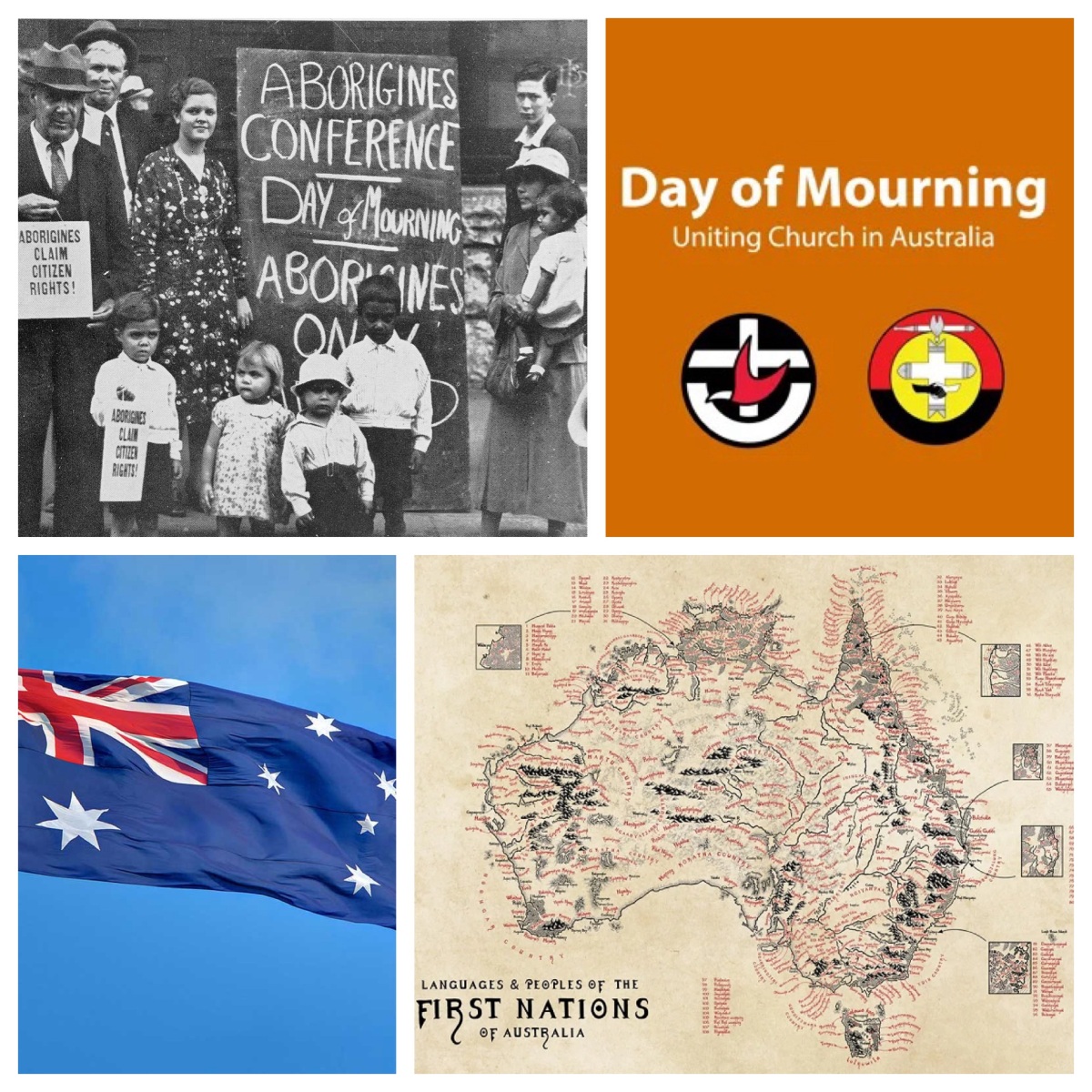
So it is with some small degree of satisfaction that I note that the many congregations of the Uniting Church of have held a Day of Mourning to reflect on the dispossession of Australia’s First Peoples and the ongoing injustices faced by First Nations people in this land. This resets and reorients the focus of the time around the “national day” of Australia.
For those of us who are Second Peoples from many lands, this focus offers an opportunity to lament that we were and remain complicit in the ongoing consequences of this dispossession. It also invites us to consider what we might do to move away from that negative trajectory.
The observance of a Day of Mourning on the Sunday before 26 January arises from a request from the Uniting Aboriginal and Islander Christian Congress (UAICC) which was endorsed by the 15th Assembly in 2018. Since then, many Congregations have held worship services that reflect on the effects of invasion, colonisation and racism on First Peoples. (This year it took place on Sunday 21 January.)
The first Day of Mourning took place in 1938, after years of work by the Australian Aborigines League (AAL) and the Aborigines Progressive Association (APA). In a pamphlet published for the occasion, it was stated that “the 26th of January, 1938, is not a day of rejoicing for Australia’s Aborigines; it is a day of mourning. This festival of 150 years’ so-called “progress” in Australia commemorates also 150 years of misery and degradation imposed upon the original native inhabitants by the white invaders of this country.”
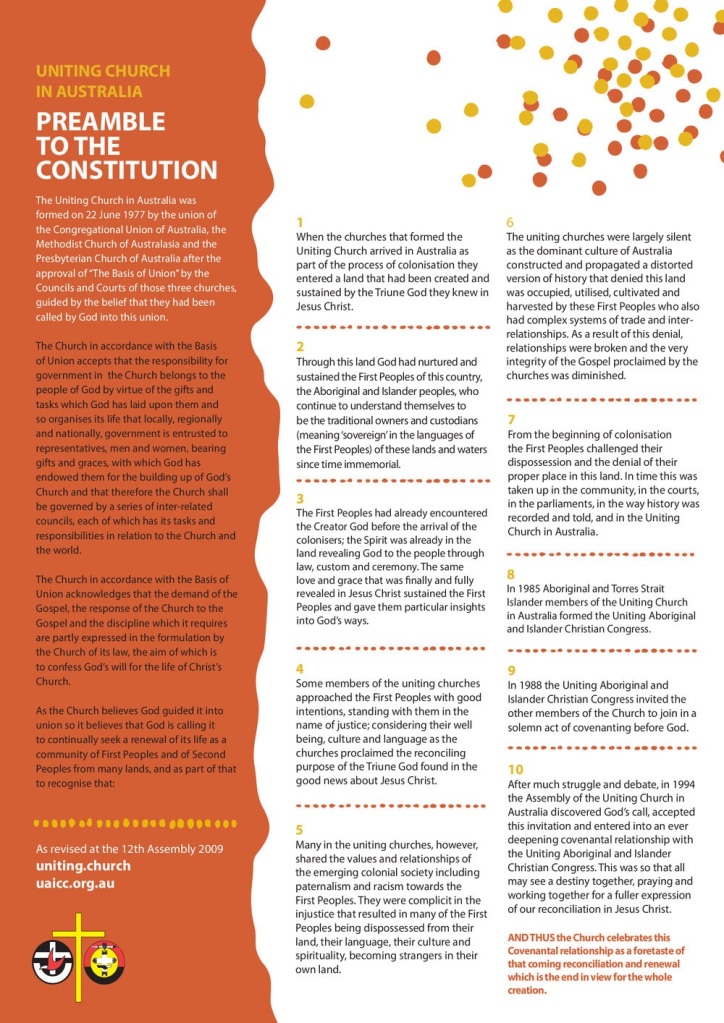
The Uniting Church has acknowledged that our predecessors in the denominations which joined in 1977 to form the Uniting Church have been “complicit in the injustice that resulted in many of the First Peoples being dispossessed from their land, their language, their culture and spirituality, becoming strangers in their own land”. That itself is a cause for lament and mourning.
The Uniting Church has also recognised that people in these churches “were largely silent as the dominant culture of Australia constructed and propagated a distorted version of history that denied this land was occupied, utilised, cultivated and harvested by these First Peoples who also had complex systems of trade and inter-relationships”.
[The quotations above come from the Revised Preamble to the Constitution of the Uniting Church in Australia, adopted in 2009]
In worship resources prepared in relation to this Revised Preamble, people are invited to affirm the general belief that “the Spirit has been alive and active in every race and culture, getting hearts and minds ready for the good news: the good news of God’s love and grace that Jesus Christ revealed”, as well as the specific statement four our context, that “from the beginning the Spirit was alive and active, revealing God through the law, custom and ceremony of the First Peoples of this ancient land”.
People are also invited to confess “with sorrow the way in which their land was taken from them and their language, culture and spirituality despised and suppressed”, as well as the reality that “in our own time the injustice and abuse has continued; we have been indifferent when we should have been outraged, we have been apathetic when we should have been active, we have been silent when we should have spoken out.”
So on 26 January this year, as a nation of multicultural complexity, with diverse narratives of origins and developments over the years, we would do well to follow this lead, and ensure that what happens on this day might include realistic mourning for what has been done in past years, and for what this means in our own time for First Peoples of this country; and perhaps some indications as to how we are planning and working to rectify injustice and overturn oppression.
Alongside the celebration of the ways that Australia has become a vibrant, strengthened “modern nation”, we would do well to include this note of reality and expression of hope for those who have, unfairly and in a disproportionate way, shouldered the burden of inequity over the decades.
It would be good for the trite, simplistic, jingoistic approach to our national day to incorporate some maturity in how we think about, reflect upon, and commit to act in relation to First Peoples. The sorry saga of last year’s referendum should at least prod us in this direction, surely?
“I will raise up for them a prophet like you from among their own people; I will put my words in the mouth of the prophet, who shall speak to them everything that I command” (Deut 18:18). These words are the heart of the Hebrew Scripture passage which the Revised Common Lectionary proposes for this coming Sunday, the Fourth Sunday after Epiphany.
Here, Moses informs the people that, just as he spoke words placed into his mouth by God, so there will be later individuals who also will speak words given to them by God. And so, Israel is assured of the presence of a prophet in their midst throughout the centuries.
Indeed, a number of the prophets of Israel remind us that they speak forth “the voice of the Lord” (Isa 66:6; Jer 42:5–6; Dan 9:9–10; Mic 6:9; Hag 1:12; Zech 6:15). Jesus stands in this tradition, offering words of guidance, challenge, and judgement. In traditional Christian understanding, he is the way by which, “in these last days, God … has spoken to us” (Heb 1:1–2).
What will the prophet speak? In so many reports of prophetic activity, it is justice which is the heart of their message—God’s justice; the justice which God desires for the people of God; the justice which God speaks through the voice of the prophets; the justice that God calls for in Israel; the justice that provides the measure against which Israel will be judged, and saved, or condemned.
Moses himself was charged with ensuring that justice was in place in Israelite society. One story told of the time after the Israelites had escaped from Egypt places Moses as a judge. Whilst in the wilderness of Sin, being visited by his father-in-law Jethro, we learn that “Moses sat as judge for the people, while the people stood around him from morning until evening” (Exod 18:13).
Noticing that Moses was overwhelmed by the volume of matters requiring adjudgment, Jethro suggested—and Moses adopted—a system whereby appointed men who “judged the people at all times; hard cases they brought to Moses, but any minor case they decided themselves” (Exod 18:14–16). The charge given to these men is clear: they are to give a fair hearing to every member of the community, and they “must not be partial in judging: hear out the small and the great alike; [do] not be intimidated by anyone, for the judgment is God’s” (Deut 1:16–17).
Prophets coming after Moses thus inherited this responsibility to ensure that justice was upheld within society. Amos calls for “justice and righteousness” (Amos 5:22). Micah asks the question, “what does the Lord require of you but to do justice?” (Mic 6:8), while through the prophet Hosea, the Lord God promises to Israel, “I will take you for my wife in righteousness and in justice, in steadfast love, and in mercy” (Hos 2:19).
Isaiah ends his famous love-song of of the vineyard by declaring that God “expected justice” (Isa 5:7); Jeremiah notes the need to “not oppress the sojourner, the fatherless, or the widow” (Jer 7:5–7). Second Isaiah foresees that the coming Servant “will bring forth justice to the nations” (Isa 42:1) while Third Isaiah begins his words with a direct declaration, “maintain justice, and do what is right” (Isa 56:1), for “I the Lord love justice” (Isa 62:8).
This commitment resonates with the psalmist, who praises “the God of Jacob … who executes justice for the oppressed; who gives food to the hungry … [who] sets the prisoners free, [who] opens the eyes of the blind, [who] lifts up those who are bowed down [and] loves the righteous, [who] watches over the strangers [and] upholds the orphan and the widow” (Ps 146:5, 7–9). See
It may be significant that, in this year when Mark’s Gospel is featured in the lectionary, the Hebrew Scripture passages offered during the short season of Epiphany are drawn from the books of the prophets: 1 Samuel, Jonah, this passage from Deuteronomy, Isaiah, and then the story of Elijah and Elisha in 2 Kings. These passages help us to see in clear focus the way that Jesus operates like a prophet in Mark’s narrative. See
So the offering of the Deuteronomy passage this week particularly pushes us to consider how Jesus might be seen as a prophet, one whom God raised up to be like Moses (Deut 18:15-18). There are three key features of Mark’s portrayal of Jesus which depict him in a prophetic vein: words and deeds, a kingdom focus, and the importance of repentance.
I Words and deeds
Words, of course, are important, both for the prophets, and for Jesus. “Thus says the Lord”, a commonplace of prophetic rhetoric, is reflected in the comments of the Markan narrator that Jesus “went about all the villages teaching” (Mark 6:6), proclaiming his message (1:14–15, 38) and speaking of the kingdom of God in parables (4:11, 26–32; 12:1–12), in sayings (9:1, 47; 10:14–15, 23–25; 12:34), and in an extended apocalyptic discourse (13:3-37). Words were central to his public and private activity.
Jesus is remembered, however, as “a prophet mighty in deed and word” (Luke 24:19), so the deeds he performed are equally as important as the words he spoke. Indeed, this was always the case for prophets; God gave Moses words to speak and signs to perform (Exod 4:28–30), and the prophets that followed him accompany their message with acts that manifest the truth of what is proclaimed: Ahijah tearing his garment into twelve pieces (1 Ki 11), Isaiah walking naked for three years (Isa 20), Jeremiah buying and then breaking an earthenware jug (Jer 19), Ezekiel eating a scroll (Ezek 3), Ezekiel shaving his head and slashing the hair with a sword (Ezek 5), and many more.
In like manner, Jesus sent out his followers to proclaim his message, but also to “cast out many demons and anoint with oil many who were sick and cure them” (Mark 6:12–13). Word and deed belong together. So Mark reports, alongside the parables and sayings of Jesus, numerous instances when Jesus healed people (2:1–12; 3:1–6; 3:22; 5:21–43; 6:5, 53–56; 7:31–37: 8:22–26; 10:46–52), cast out demons and unclean spirits (1:21–28, 32–34, 39; 3:11; 5:1–20; 7:24–30; 9:14–29), as well as miraculously fed multitudes (6:30–44; 8:1–10), cleansed a leper (1:40–45), stilled a storm (4:35–41), and walked on water (6:45–52).
II The coming kingdom
Another way in which Jesus reflects his prophetic calling was through the kingdom focus in his teaching. That the imminence of the kingdom is a key note for Jesus is reflected both in his opening words in Mark (“the time is fulfilled, and the kingdom of God has come near”, 1:15a) and in some of his final words to his closest followers (“I will never again drink of the fruit of the vine until that day when I drink it new in the kingdom of God”, 14:25).
Jesus has so shaped the expectations of his followers that they anticipate this coming with intensity. “There are some standing here who will not taste death until they see that the kingdom of God has come with power”, he told them (9:1); to one enquirer, he affirmed, “you are not far from the kingdom of God” (12:34), and after his death, another follower who was “waiting expectantly for the kingdom of God ensured that the body of Jesus was cared for (15:43).
When some of his disciples hindered children wanting to come to him, Jesus chided them, saying, “whoever does not receive the kingdom of God as a little child will never enter it” (10:15); a little later, to his disciples, he warned, “how hard it will be for those who have wealth to enter the kingdom of God!” (10:23).
The final extended discourse of Jesus that Mark reports (13:4–37) provides reassurance of the sovereignty of God in the midst of crises and calamities. These events are but “the beginning of the birth pangs” (13:8). Jesus affirms that those enduring will be saved by divine action (13:13, 20), culminating in the appearance of “‘the Son of Man coming in clouds’ with great power and glory” (13:26) and the gathering of the elect by the angels of God (13:27).
The kingdom is the realm in which God will act decisively. In the words of the prophets, the kingdom of David and his successors was the realm in which God was seen to be active; after that kingdom was conquered and its people taken captive, the prophetic voices of Israel began to develop a notion that, at some time in the future, there would indeed be a kingdom which would be the realm in which God would be active. The prophetic hope in The Day when God would act came to full, dramatic expression in the apocalyptic portrayals of The End that was anticipated.
Proclaiming that repentance, metanoia, is the essential prerequisite for entry into that kingdom in order to fulfil God’s justice is a third feature of Mark’s portrayal of Jesus in the manner of a prophet. The first word of Jesus in Mark’s early account is clear: “the time is fulfilled, and the kingdom of God has come near; repent (metanoeite) and believe (pisteuete) in the good news” (1:15).
In this programmatic Markan announcement, the two statements (in the indicative mood) about “the time” and “the kingdom” are followed by two commands (in the imperative mood) to “repent” and “believe”. The imminence of the kingdom is the motivation for the call to repent and believe.
This call to repent is evident in the activity of the followers of Jesus who are sent out in pairs with “authority over the unclean spirits”; as they cast out demons and cured the sick, so they also “they proclaimed that all should repent” (6:7–13). Beyond that, the explicit call to repent is not repeated by Jesus, but its presence is evident throughout the narrative.
Jesus calls people to follow him; fishermen Peter and Andrew “left their nets and followed him” (1:18), fishermen James and John “left their father Zebedee in the boat with the hired men, and followed him” (1:20), and tax collector Levi son of Alphaeus, “got up and followed him” (2:14). Leaving behind signals the complete transformation undertaken by following Jesus.
Following Jesus is akin to taking up the cross, a sign of social rejection and alienation as well as personal denial (8:34). Jesus delivers a sequence of three sayings that reflect the complete turnaround that is required to effect metanoia. First, “those who want to save their life will lose it, and those who lose their life for my sake, and for the sake of the gospel, will save it” (8:35). Next, “whoever wants to be first must be last of all and servant of all” (9:35).
And then, “whoever wishes to become great among you must be your servant, and whoever wishes to be first among you must be slave of all” (10:43–44). Jesus himself provides the foundational model for this way of living; as the Son of Man, he came “to give his life a ransom for many” (10:45).
This persistent demand for complete life transformation—metanoia—resonates with Isaiah’s signal declaration that “Zion shall be redeemed by justice, and those in her who repent, by righteousness” (Isa 1:27), and regular prophetic calls to “return to me, says the Lord of hosts … return from your evil ways and from your evil deeds” (Zech 1:3–4); “repent and turn away from your idols; and turn away your faces from all your abominations” (Ezek 14:6; also 18:30), “return to me … remove your abominations from my presence and do not waver” (Jer 4:1); “return to me with all your heart, with fasting, with weeping, and with mourning” (Joel 2:12).
The recurring refrain of Amos, lamenting, “yet you did not return to me, says the Lord” (Amos 4:6,8,9,10,11), leads the prophet to assure Israel that “I will do this to you; prepare to meet your God, O Israel!” (Amos 4:12)—words akin to what the psalmist says, “if one does not repent, God will whet his sword; he has bent and strung his bow; he has prepared his deadly weapons, making his arrows fiery shafts” (Ps 7:12–13).
“I will raise up for them a prophet like you from among their own people; I will put my words in the mouth of the prophet, who shall speak to them everything that I command” (Deut 18:18). In the way that Mark presents Jesus in his narrative, we can see how Jesus speaks and acts in the manner of a prophet like Moses, the archetype of prophetic leadership.
*****
Please Note: in the above comments, I am not seeking to “ prove” that Jesus “fulfils prophecy”. Rather, I am interested to explore the ways that an understanding of Hebrew Scripture can inform the way we read and understand the Gospel narratives about Jesus. For further thoughts on how we read prophetic texts in a Christian context, see
In earlier posts on the Gospel of Mark, on passages that are proposed by the lectionary during the season of Epiphany, we have seen that Mark tells of the beginning of the good news of Jesus, chosen one, with stories in which Jesus is commissioned for his role (1:12–13), announces his message (1:14–15), and calls people to follow him (1:16–20). It is a strikingly energetic start to his narrative.
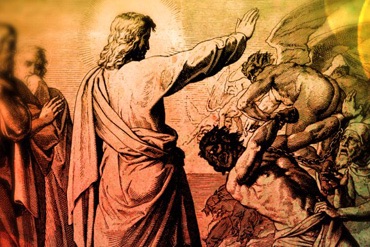
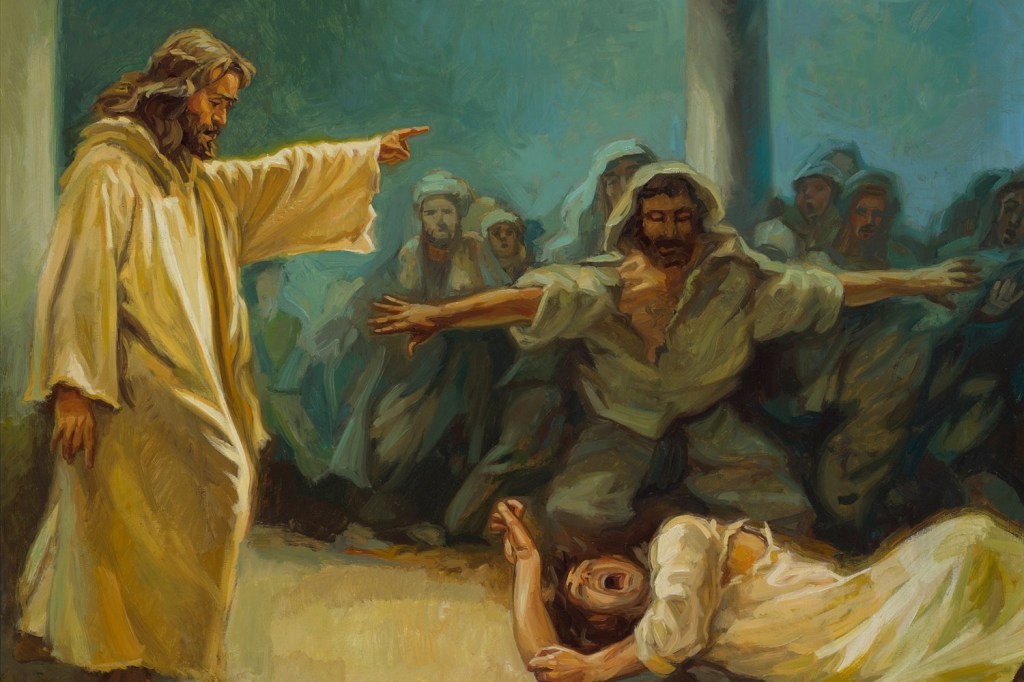
After these scenes Mark takes us to a scene in a synagogue, where he reveals the authority that Jesus had, in calling people, to command “the unclean spirit, convulsing him and crying with a loud voice, [to] come out of him” (Mark 1:21–28). This is offered by the lectionary as the Gospel for the fourth Sunday after Epiphany.
The initial impression of the people in the synagogue regarding Jesus is positive; they were “astounded at his teaching” (1:22). Teaching is one of the key characteristics of the activity of Jesus (4:2; 6:6, 34; 8:31; 9:31; 11:17; 12:14, 35). In Galilee, “he went about among the villages teaching” (6:6); in Jerusalem, “day after day I was with you in the temple teaching”, Jesus tells the crowd in the Garden of Gethsemane (14:49).
However, we have not heard anything of the teaching of Jesus at this early point in Mark’s narrative; detailed teaching will come later, in parables beside the sea (4:1–34), in Genessaret (6:53—7:23), on the road to Jerusalem (8:31–38), in Judea (10:1–16), in the temple forecourt (11:27—12:24), and on the Mount of Olives opposite the temple (13:3–37). This synagogue scene in Capernaum is thus the first glimpse of the power of Jesus’ words.
The polemic that will dog Jesus all the way through his public activities is signalled in this synagogue scene. The people in the synagogue were astounded at his teaching “for he taught them as one having authority, and not as the scribes” (1:22). Those scribes will be seen in conflict with Jesus in subsequent scenes; in Capernaum (2:1–12), in the house of Levi son of Alphaeus (2:13–17), in Nazareth (3:19–35), in Genessaret (6:53–7:23), in Galilee (9:14), and in Jerusalem (11:18, 27). Eventually they join with the priests (1:1) and then with the earlier conspirators, Pharisees and Herodians (3:6) to implement the plot “to arrest Jesus by stealth and kill him” (14:1).
By the end of the scene, the people have become even more convinced; Mark says that they are amazed, and are asking, “what is this? a new teaching—with authority! he commands even the unclean spirits, and they obey him” (1:27). The response of amazement occurs also when Jesus heals a paralyzed man (2:12), when the demoniac from the Gerasene tombs declares “how much Jesus had done for him” (5:20), and when he confounded the Pharisees and Herodians with his clever riposte (12:17).
The disciples, walking on the road to Jerusalem, are amazed with the response that Jesus gives to a comment by Peter (10:28–32); as was Pilate, when he presses Jesus to respond to the charges brought against him, but “Jesus made no further reply, so that Pilate was amazed” (15:5).
This synagogue scene not only places Jesus into conflict with the scribes; it also defines the cosmic dimension in which the story of Jesus is set, as he grapples with unclean spirits (1:23–26; 3:11; 5:1–13; 6:7; 7:14–29), also identified as demons (7:24–30; 1:32–34, 39; 3:14–15, 22; 5:14–18; 6:13; 9:38). Jesus is a human being, situated in first century occupied Palestine—but he is engaged in a contest in a cosmic dimension.
Ched Myers offers a compelling interpretation of the scene in the synagogue: “The synagogue on the Sabbath is scribal turf, where they exercise the authority to teach Torah. This “spirit” personifies scribal power, which holds sway over the hearts and minds of the people. Only after breaking the influence of this spirit is Jesus free to begin his compassionate ministry to the masses (1:29ff).”
We may be tempted, today, to look at the way that Jesus operated in these scenes of conflict with “unclean spirits” or “demons” who had possessed a person, and dismiss them as primitive attempts to explain what we now understand as mental illnesses. The many developments in psychology over the last century have certainly enabled us to have a better appreciation of the way the human mind works, and how it meets challenges and disruptions. People possessed by spirits or demons may simply have been people suffering trauma, epilepsy, or psychosis, for instance. And so, we may be tempted to dismiss these exorcisms as unbelievable miracles.
But the approach that Myers takes invites us to give more sober consideration to the structural and societal factors that were at work in these stories. The activity of Jesus was not simply relating to individuals; he was sending a signal to the leaders of his society, confronting them with some of the unpleasant dysfunctions that were the realities for common people living under foreign oppression.
What has generated this conflict from the authorities, and this amazement from the people? It is what Jesus does in the synagogue, when he meets “a man with an unclean spirit” (1:23), who cries out, “what have you to do with us, Jesus of Nazareth?”, then accuses him, “have you come to destroy us?” (1:24).
Destroy is a very strong word. It is used to describe the conspiracy that is afoot against Jesus from early in the Gospel—after some Pharisees watch Jesus heal a man with a withered hand, and “the Pharisees went out and immediately conspired with the Herodians against him, how to destroy him” (3:6).
And Jesus himself uses this term in a parable, to describe what the owner of the vineyard will do after the tenants kill the slaves, and even the son, sent to them by the owner (12:9). Since the audience of Jerusalem authorities recognise that Jesus “had told this parable against them” (12:12), it is clearly directed at the scribes and other authorities (cf. 11:27).
So, paradoxically, the man with an unclean spirit is aligned with those charged with the responsibility of overseeing the Holiness Code and ensuring that people are “clean”—the scribes and Pharisees, and especially the priests—in articulating this aggressive conflict with Jesus.
And yet, also paradoxically, this unclean man reveals a key matter about Jesus, when he continues, saying, “I know who you are, the Holy One of God” (1:24). It is the spirits and demons in Mark’s narrative who have this insight (see also 3:11; 5:7).
The man calls Jesus “Holy One”. This is a term applied to God in the writings of Hebrew Scripture (Ps 71:22; 78:41; 89:18; Prov 9:10; Job 6:10; Sir 4:14; 23:9; 53:10; 47:8; 48:20) and also by the Prophets (Isa 1:4; 5:19, 24; and a further 24 times; Jer 50:29; Ezek 8:13; Hos 11:9, 12; Hab 1:12; 3:3). It is a central element of who God is, and a key factor in understanding Jesus.
Of course, Holiness was a central element of piety in ancient Israel, exemplified by the Holiness Code of Leviticus (Lev 11:44–45; 19:2; 20:7–8; see also Deut 7:6; 14:2, 21; 28:9). But this man, possessed by an unclean spirit and therefore not in a state of holiness, is able to speak the truth about Jesus as “the Holy One of God”. He was on the edge of society, and yet he was able to perceive a central reality about Jesus and his society. Perhaps it might be our experience, that people on the edge of society are able to see things with a clearer perspective, and illuminate central,realities of society in our time?
Mark indicates that when Jesus instructs the spirit to “be silent, and come out of him!” (1:25), the man is “convulsing him and crying with a loud voice” (1:26). Convulsions caused by a spirit leaving a possessed person are evident also in the scene immediately after the Transfiguration of Jesus, when that spirit “convulsed the boy, and he fell on the ground and rolled about, foaming at the mouth” (9:20).
Such convulsions may perhaps have been associated, in the mind of first century Jews, with King Saul, after he has been defeated by the Philistines (1 Sam 31:1–3). Sensing what this meant for him, Saul took his own life (1 Sam 31:4). One of Saul’s troops escaped the battle; he recounted to David how Saul had implored that man, “come, stand over me and kill me; for convulsions have seized me, and yet my life still lingers” (2 Sam 1:9).
In the modern mind, these convulsions are known to be a part of the medical condition of epilepsy, so we assume that both Saul, the spirit-possessed people in Capernaum, and the spirit- possessed boy in Galilee, were each afflicted with this condition. The healing that Jesus performs appeared impressive to those present; “he commands even the unclean spirits, and they obey him” (Mark 1:25–26).
Yet, curiously, the acclamation of the crowd relates, not to the healing powers of Jesus, but to his words of instruction: “what is this? a new teaching—with authority!” (1:27). Neither the details of this teaching, nor the actual process of drawing out the spirit, are recounted in this scene; simply, “Jesus rebuked him” (1:25). It is from this time that “his fame began to spread throughout the surrounding region of Galilee” (1:28).
And so Jesus is followed by crowds in Galilee (2:4, 13; 3:9, 20, 32; 4:1, 36; 5:21–34; 6:34, 45; 7:14, 17; 8:34; 9:14–17, 25), in the Decapolis (7:33; 8:1–9), in Jericho (10:46), and in Jerusalem (11:8, 18, 32; 12:12, 37). The tragedy of the last days of Jesus is acted out in front of crowds of people, when he is arrested (14:43) and brought before Pilate (15:6–15); by implication, numbers of people witness his crucifixion (15:29–32, 40–42).
But the crowds in Capernaum, early in his public ministry, have witnessed him at the height of his powers. And the man in the synagogue, impaired by his condition, has taken us right to the heart of who Jesus is, and what he is doing as he travels around Galilee.

























 An Informed Faith