Dark sayings from of old (Psalm 78; Pentecost 24A)

Scripture contains many sayings. Of particular note in the Hebrew Scriptures are “sayings of the wise” (Prov 24:23), offering insights into the best ways of living with integrity in daily life. The book of Proverbs refers to “thirty sayings of admonition and knowledge” (Prov 22:20), but in fact it contains a multitude of succinct two-part sayings, known as proverbs, attributed to King Solomon (Prov 10:1—29:27), Agur Ben Jakeh, a sage of Arabic descent (Prov 30:1–33), and King Lemuel, perhaps of Assyria (Masa) (Prov 31:1–9).

The Preacher, characteristically, bemoans that “the sayings of the wise are like goads, and like nails firmly fixed are the collected sayings that are given by one shepherd” (Eccl 12:11). He notes that “of the making many books there is no end, and much study is a weariness of the flesh” (Eccl 12:12). He presumably sees little need for saying after saying after saying.

Nevertheless, scripture as a whole has collected and retained “treasuries of wisdom” in which there are many “sayings of the wise” (Sir 1:25), sayings which are “life to those who find them, and healing to all their flesh” (Prov 4:22). Attention to these words means that “you may hold on to prudence, and your lips may guard knowledge” (Prov 5:2).

Faithful people are advised to “keep your father’s commandment, and do not forsake your mother’s teaching; them upon your heart always; tie them around your neck” (Prov 6:20)—words which evoke the directions given to Israel concerning the Torah itself: “bind them as a sign on your hand, fix them as an emblem on your forehead, and write them on the doorposts of your house and on your gates” (Deut 6:8–9).

So the “sayings of the wise” are regularly described in some of the terms used to describe Torah: they are “commandments” (Prov 2:1; 3:1; 4:4; 7:1–2; 10:8) and “precepts” (Prov 4:2), and like the Torah itself, they provide “instruction” (Prov 1:8; 4:1, 13; 8:10, 33; 9:9; 10:17; 15:5, 32–33; 19:20, 27; 23:12, 23; 24:32). Ben Sirach links the two when he advises, “if you desire wisdom, keep the commandments, and the Lord will lavish her [i.e. Wisdom] upon you”, for “the fear of the Lord is wisdom and discipline” (Sir 1:26–27).

The people are told that, “if you accept my words and treasure up my commandments within you, making your ear attentive to wisdom and inclining your heart to understanding … then you will understand the fear of the Lord and find the knowledge of God” (Prov 2:1–2, 5). The connection between “the fear of the Lord” and the wisdom that is conveyed by “the sayings of the wise” is manifest (Prov 1:7; 2:5; 9:10; 14:27; 15:33).

Penetrating into the wisdom contained within these sayings ought to come readily to those who are regular and persistent in listening to them; yet, as Job laments regarding God, “how small a whisper do we hear of him!”, and “the thunder of his power who can understand?” (Job 26:14). At the end of the long whirlwind speech of God, Job concedes that his knowledge of God had been quite inadequate, noting that “I had heard of you by the hearing of the ear, but now my eye sees you” (Job 42:5).

The introduction to the book of Proverbs recognises the difficulty of gaining clear understanding of these sayings, indicating that it takes work: “let the wise also hear and gain in learning, and the discerning acquire skill, to understand a proverb and a figure, the words of the wise and their riddles” (Prov 1:5–6).

Ben Sirach notes that “the one who devotes himself to the study of the law of the Most High” is one who “seeks out the wisdom of all the ancients, and is concerned with prophecies; he preserves the sayings of the famous and penetrates the subtleties of parables; he seeks out the hidden meanings of proverbs and is at home with the obscurities of parables” (Sir 39:1–3).

Those hidden meanings and obscurities may well be what has driven the psalmist, in the psalm offered in this coming Sunday”s lectionary psalm, to refer to “hidden things, things from of old” (Ps 78:2, NIV)—or more ominously, as the NRSV translates it, “dark sayings from of old” (Ps 78:2, NRSV). What are these hidden things, these dark sayings, from the past?

Although the psalmist refers to “the glorious deeds of the Lord, and his might, and the wonders that he has done” in years past, recounting them with admiration and gratitude (Ps 78:5–16), they note with pathos that the people “did not keep God’s covenant … refused to walk according to his law … forgot what he had done”, that they “sinned still more against him, rebelling against the Most High in the desert … tested God in their heart … spoke against God” (Ps 78:10–11, 17–19). Understanding came hard to the people.

The psalmist places these “hidden things”, these “dark sayings from of old” in parallel with parables (Ps 78:2). The Hebrew word translated as parable is mashal, which signals a comparison; it literally means “is like”. We know about parables from the use that Jesus made of them in his teaching. “The kingdom of heaven is like …”, or “what shall I compare the kingdom of God to?” are introductions to short stories which Jesus tells, in which the realm of God is explained with reference to a familiar situation in daily life—making bread, keeping sheep, tending a vineyard, seeking work, attending a marriage.

A mashal, a parable, is simply a comparison. So in Proverbs, we can read various parables: “the path of the righteous is like the morning sun, shining ever brighter till the full light of day; but the way of the wicked is like deep darkness; they do not know what makes them stumble” (Prov 4:18–19); “like a gold ring in a pig’s snout is a beautiful woman who shows no discretion” (Prov 11:22); “the words of the reckless pierce like swords, but the tongue of the wise brings healing” (Prov 12:18); “a king’s rage is like the roar of a lion, but his favour is like dew on the grass” (Prov 19:12); “like a roaring lion or a charging bear is a wicked ruler over a poor people” (Prov 28:15); and so on.

Elsewhere in the Hebrew Scriptures, we find comparisons—parables—that are short and succinct. A classic short, simple Another example is the proverb quoted by two prophets, about the impact of the Exile: “the parents have eaten sour grapes, and the children’s teeth are set on edge” (Jer 31:29; Ezek 18:2). The point of this saying is clear, and telling.

We also find more extended comparisons—parables with developed plots and allegorical elements. (In an allegory, particular individual features can play an independently figurative role, so that the story told becomes a kind of riddle which invites a response from the listener. “What do you think?” becomes the implied way that the allegory-riddle ends.) The most famous examples in the Hebrew Bible are Samuel’s story-parable comparing David with a callous rich herdsman in 2 Samuel 12 and the prophet’s lovesong-parable comparing Israel with an unfruitful vineyard in Isaiah 5.

Psalm 78:2 in Hebrew

The Hebrew word in parallel to mashal (משל, “parable”) in Ps 78:2, which is translated as “hidden things” (NIV) or “dark sayings” (NRSV), is the word chidah, חַידָה, which is most often translated as “riddle”. This word refers to a parable “whose point is deliberately obscured so that greater perception is needed to interpret it”, according to the Jewish Virtual Library (reference below). A good example is the riddle is that spoken by Samson, “out of the eater came something to eat; out of the strong came something sweet” (Judg 14:14). The narrative comment that follows is delightful: “for three days they could not explain the riddle”!

A number of proverbs are classified as riddles, especially in the section of Proverbs containing “the sayings of Agur son of Jakeh—an inspired utterance” (Prov 30:1). For instance: “There are three things that are never satisfied, four that never say, ‘Enough!’: the grave, the barren womb, land, which is never satisfied with water, and fire, which never says, ‘Enough!’” (Prov 30:15b—16). Another example comes a few verses later: ““There are three things that are too amazing for me, four that I do not understand: the way of an eagle in the sky, the way of a snake on a rock, the way of a ship on the high seas, and the way of a man with a young woman” (Prov 30:18–19).

In Psalm 78, we do not seem to have specific verses that can be categorised as riddles—rather, it presents as one of the psalms which retell the saga of the origins of Israel (as well as this psalm, see also Psalms 105, 106, 135 and 136). The particular perspective of the psalmist in retelling this story in Psalm 78 is that the people “should set their hope in God, and not forget the works of God, but keep his commandments” (v.7), in the hope that “they should not be like their ancestors, a stubborn and rebellious generation, a generation whose heart was not steadfast, whose spirit was not faithful to God” (v.8). After all, God had performed many miracles in the Exodus, at the formational stage of the people of Israel (vv.12–16).

Nevertheless, the repeated sinfulness shown by Israel in the wilderness (vv.17–19) is replicated in later times; in spite of all that God did for them in the wilderness (vv.20, 23–29), “they still sinned; they did not believe in his wonders” (v.32), “their heart was not steadfast toward him; they were not true to his covenant” (v.37), “they tested God again and again, and provoked the Holy One of Israel” (v.41), thereby incurring the great wrath of God (vv.44–51).

Even when God led them to Canaan and “drove out nations before them; he apportioned them for a possession and settled the tribes of Israel in their tents” (v.56), still “they tested the Most High God and rebelled against him; they did not observe his decrees, but turned away and were faithless like their ancestors; they twisted like a treacherous bow” (vv.56–57), incurring still more punishment (vv.58–64).

The psalm ends with a picture of pastoral bliss as God favoured the tribe of Judah with the site of the temple, and David is installed as the shepherd-king of the people (vv.65–72). The conclusion is encouraging; “David shepherded them with integrity of heart; with skillful hands he led them” (v.72).

Perhaps, notwithstanding this irenic ending, this is the chidah, the riddle, the dark saying of the past? Perhaps it is about the stubborn, incorrigible nature of human beings—exemplified by Israel’s regular return to sinful ways?

Perhaps the psalm was written in the knowledge of the persistent inadequacies and sinfulness of the kings who came after David? (We might note the regular refrain about the kings who “did evil in the eyes of the Lord” throughout the narrative books, first applied to Solomon at 1 Ki 11:6 and then forming a recurring formula of condemnation of many of the kings that followed him in the northern kingdom as well as a number in the southern kingdom).

Perhaps it is that, no matter how much God did for God’s people, their persistent sinfulness would always rise to the surface? If that is so, it is a dark saying, indeed.

On parables in Hebrew Scripture, see https://www.jewishvirtuallibrary.org/parable

On later developments on rabbinic literature, see https://www.jewishencyclopedia.com/articles/11898-parable

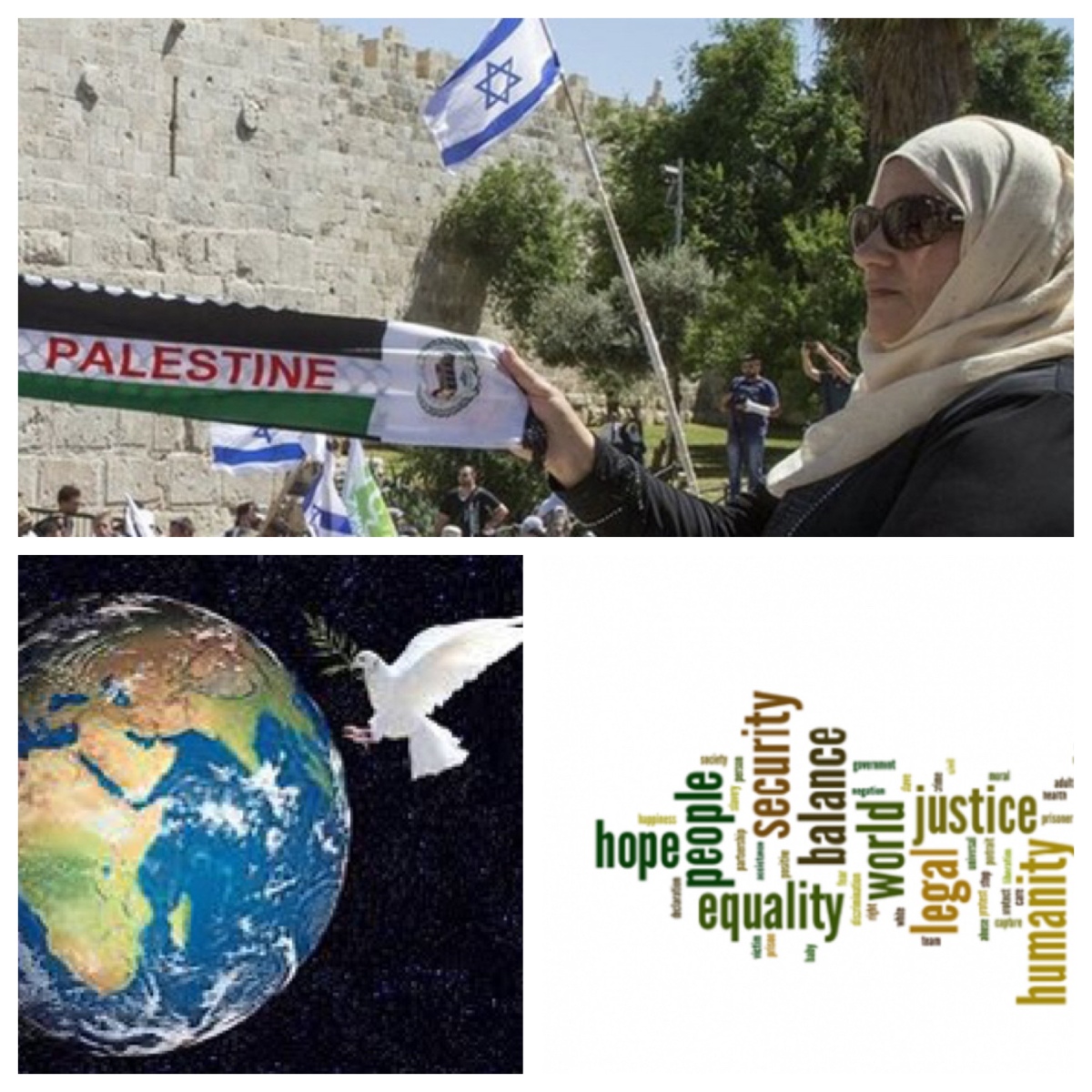
Re-reading the story of Palestine and Israel

This blog comes from a guest blogger, the Rev. Dr Chris Budden. It relates to the current explosion of the conflict in Gaza and Israel. Chris is a retired Uniting Church Minister who is actively engaged with First Peoples; amongst other things, he teaches a course on reconciliation at United Theological College in Sydney, Australia. He has a long interest in ways to find peace in Palestine-Israel. His present research interest is the Preamble to the Constitutional of the Uniting Church in Australia.

There are, in my opinion, three contributing factors to both poor analysis and inadequate responses to the conflict between Palestine and Israel, and the particular role of Hamas.

Let me be very clear from the beginning. Hamas’ actions in Israel were wrong, profoundly and horribly wrong.

First, however, the response and analysis has sought to ignore history. There is a pretence that Hamas simply attacked Israel out of the blue in an act of irrationality. They are mad people who must be eliminated, regardless of the cost to the civilian population. Consider the reality:

  • In 1917 the British Government issued the Balfour Declaration supporting the establishment in Palestine of a home for Jewish people. The aim was not to protect Jewish people, but to get rid of them out of Britain.
  • Prior to World War 2, there were relatively small numbers of Jewish people in Palestine, which was controlled as a British Protectorate.
  • At the end of the war, and with the guilt of the near annihilation of the Jewish people in Germany, support was given to finally enact the Balfour Declaration. People entered Palestine, often illegally, and began to push Palestinians off their land.
  • By 1948 there was significant occupation. The UN declared that the land should be partitioned, and two states established. Israel was established, but a Palestinian state has never gained proper support. Israel is opposed to such a state, believing it would threaten their security.
  • The State of Israel is a settler-colonial state, and has done exactly what such states have done in Australia, New Zealand, USA and Canada. That is, they have stolen land, and justified that theft with the claim that the place was largely unoccupied. Where it was, the people did not use the land properly. People can be dispossessed because they are lesser people – it is a racist narrative, that has been imbedded in apartheid.
  • Palestinians have been pushed into smaller and smaller enclaves, reducing any chance of a proper state. They have had walls built around them, their movements are controlled. Witnesses say that they live in a virtual prison.
  • In the last 10 years, 3500 Palestinians have been killed by the IDF, including large numbers of children.

One of the things we learned from the struggle against apartheid in South Africa was that we should asked those who are oppressed to tell the story of their oppression, and not to ask the oppressors. People should tell their own story, and not have it told by those who continue to harm them.

Second, the clear narrative across the world is that some people are of more value than others. The latest deaths in Israel quite rightly bring forth international condemnation. But the deaths of Palestinians rarely cause a protest. And because people are not seen as equal, then it is okay to seek revenge that is completely disproportionate. Many more Palestinians must die to make up for the death of citizens of Israel.

Third, the US and its allies like Australia must take some blame for what is happening because we have failed to uphold international law; we have failed to insist that the law applies to Israel. The settlements on Palestinian land are illegal, yet they keep expanding. The state of Palestine has been declared by the UN, but no-one does anything to make it happen. It is illegal to attack civilians, but civilians in Palestine are attacked and killed all the time, and no-one is held accountable. It is illegal to punish civilians for what their military do, which is exactly what Israel is doing, but the US and its allies will not tell them to stop.

Let me say it again, this is not a defence of Hamas. Which, by the way, was supported by Israel for years as a way of dividing the Palestinian opposition.

This is a claim that we will not have peace in the area until people are treated as of equal value, until international law is respected, and until people stop stealing land. The alternative is a never-ending spiral of violence.

The response to this argument is often to label it and me as antisemitic. This is about the actions of the State of Israel. To name the ways a state breaks international laws, and oppresses other people is not antisemitic or aimed at Jewish people at all. I hope opponents will not throw labels that obscure the debate but will actually respond to the arguments I have made.

Chris Budden, 31 October 2023

*****

This piece was first posted on UC Forum at https://ucforum.unitingchurch.org.au/?p=5286

For my own earlier reflections on this situation, see

and for a comprehensive overview of the history of this region over the last 100 years, from Al-Jazeera, see

https://www.aljazeera.com/news/2023/10/9/whats-the-israel-palestine-conflict-about-a-simple-guide

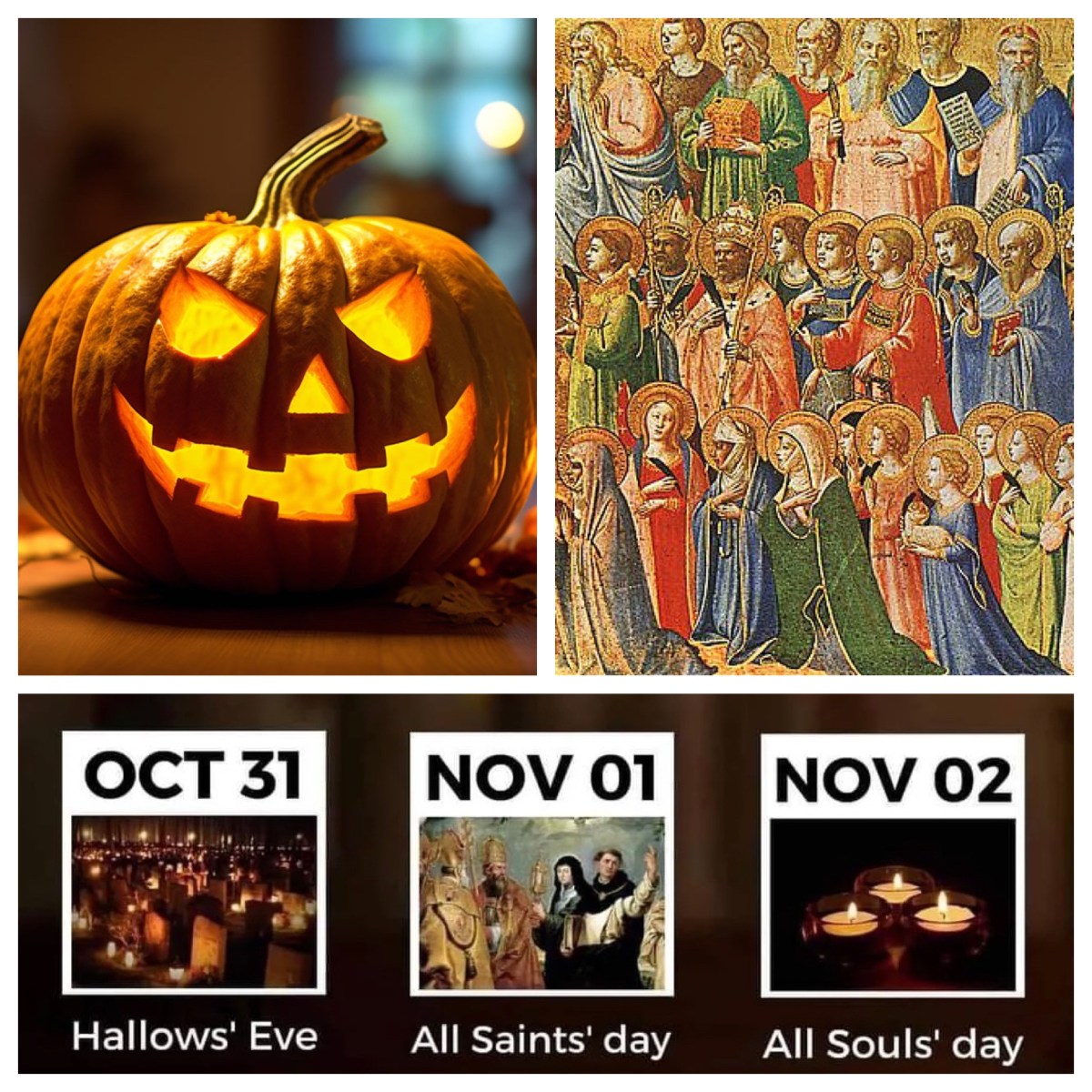
The “other” three days: on remembering, celebrating, and contextualising (Halloween, All Saints, and All Souls)

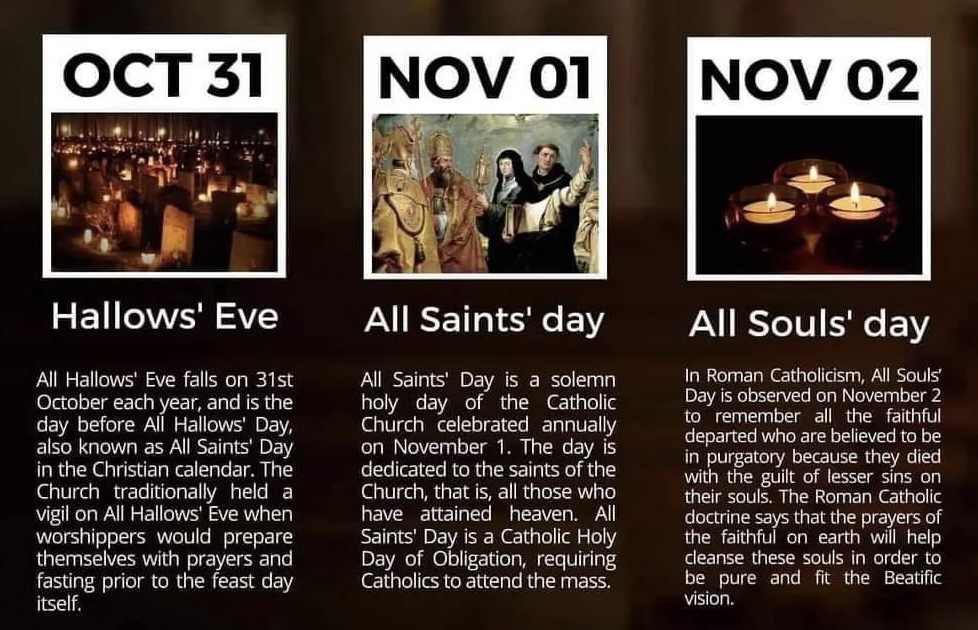
Today we are in the middle of a special sequence of days, which in traditional Roman Catholic piety form a triduum (simply meaning, “three days”). This current sequence of three days is the “other” three days—standing in the shadow of the Great Three Days of Easter (Good Friday—Holy Saturday—Easter Sunday). Whilst the three days of Easter celebrate new life (the Triduum of Life), this “other” three days has been called the Triduum of Death.

Why, death? Well, the explanation lies in the three particular days that are included: All Hallows’ Eve, All Saints’ Day, and All Souls’ Day. All three have to do with life beyond this life as we know it, in one form or another—that is, they are dealing with death and those who have died.

All Hallows’ Eve is best known to us as Halloween; it falls, every year, on 31 October, round about six months after Easter Sunday. Unlike Easter, however, this is not a “moveable feast”, following the pattern of the lunar cycle (which does not lineup with our solar-based calendar). Halloween falls, each and every year, on the very last day of October.

It needs to be said that the contemporary commercialised celebration of Halloween is a long way from its origins in medieval Christian piety. And so it also needs to be emphasised that Halloween is not a pagan festival. It has its origins deep in Christian history and tradition.

The English word ‘Halloween’ is a shortening of All Hallows’ Eve(n), which long ago began this series of three holy days, designed to enable the faithful to remember the saints of old (All Saints’ Day on 1 November) and the faithful who have died, “the souls of the faithful departed” (All Souls’ Day on 2 November). These three days, Halloween—All Saints’ Day—All Souls’ Day, belong together—as the “other” Christian triduum (like Good Friday—Holy Saturday—Easter Sunday).

How long ago this sequence began is not clear, as local customs varied. There is evidence that some days had been identified as the time to remember individual saints or groups of saints in some locations in the 7th to 9th centuries. By around 800, churches in Northumbria and Ireland apparently remembered “all saints” on 1 November.

In the online resources of the Northumbria Community, there is a good statement about the significance of this time. (Elizabeth and I use the resources of the Northumbria Community as the basis for our daily devotional, with Morning Prayer and Evening Compline serving to mark each day and night and provide a faith-focus at those moments which, it is intended, will carry through the full 24-hour cycle each day and night.)

The Northumbria Community resource says: “The old belief was that there was danger and vulnerability at this time of transition, which was neither in one year nor the next. Spiritual barriers could be dissolved. Inevitably, looking back led to the remembrance of those who had died and gone before; and, as the dark, cold days were awaited, protection was sought against the evil spirits that were bound to be abroad until spring returned. These old beliefs were never quite eradicated by the coming of Christianity, but lingered as a persistent superstition, a residual folk memory.” See

https://www.northumbriacommunity.org/saints/celtic-new-year-all-hallows-eve-and-all-saints-tide-october-31stnovember-1st/

By the 12th century, All Saints’ and All Souls’ had become holy days of obligation in the medieval churches, and various rituals developed for each day. Baking and sharing cakes for the souls of baptised people is evidenced in some European countries in the 15th century; this may be the origins of trick-or-treat. Lighting candles in homes on these days was done in Ireland in the 19th century—another element which is reflected in current Halloween practices.

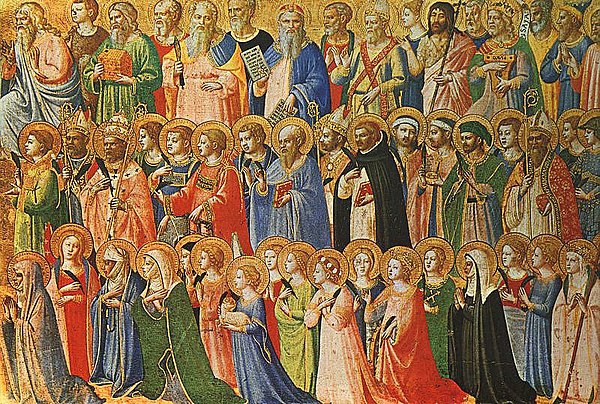
The Forerunners of Christ with Saints and Martyrs
by Fra Angelico (1395–1455)

I have had the experience, in churches today, of being caught up in a grand worship experience for All Saints’ Day, the middle of the three days (a number of these were memorable experiences where my wife Elizabeth Raine created and presided at the liturgy). We surrounded ourselves with the memory of saints of ancient and more recent times, and recalled with gratitude saints of the present times, particularly those important to the immediate locality or congregation.

In those times of worship, we joined in singing “for all the saints who from their labour rest—alleluia! alleluia!” (from a hymn by William Walsham How), and then “a world without saints forgets how to praise; in loving, in living, they prove it is true— their way of self-giving, Lord, leads us to you” (from a hymn by Jacob Friedrich).

It is sometimes claimed that Halloween originated as a response to existing pagan rituals—but we need some considered nuance as we reflect on this. A number of the current practices involved in Halloween certainly do show the strong influence of folk customs with pagan origins in a number of Celtic countries.

This is especially so in relation to Samhain in Ireland, marking the start of winter with a festival from sundown on 31 October to sundown on 1 November. This was a liminal time when the boundary between this world and the world beyond was thinned; at this time, it was thought, the spirits could more easily enter this world. The connection with the Christian days of All Saints’ and All Souls’ is thus clear to see.

However, this does not mean that we can simply (and simplistically) conclude that these days have pagan origins; rather, what we ought to recognise is that, like other Christian festivals, there has been a blurring of customs and practices and a linking of Christian patterns with pagan festivities.

This blurring and linking is a natural tendency that has taken place time after time in place after place. This is what historians and scholars of religion call syncretism—the merging and assimilating of traditions that were originally discrete, with separate origins. It can also be called eclecticism; but I prefer to see this more accurately as contextualisation, the shaping of a tradition in the light of the immediate social and cultural context.

For that is what Halloween did in the mists of the time when it was being created and shaped—existing practices of pagan neighbours were co-opted and adapted by faithful Christians. Then, the practices were extended with the introduction of days to remember All Saints and All Souls. (The same dynamic was at work in the ways that Easter was shaped, drawing on northern hemisphere Spring practices, and the way that Christmas also developed, drawing on northern hemisphere Winter Solstice practices—but these are stories for other times of the year!)

The same perspective can be applied to the ways that Halloween, in particular, is commemorated each year. Lamenting the commercialisation of a festival that was originally Christian is a poor strategy. (And, as noted, this commercialisation has already happened with Christmas—which is now peak selling period for so many businesses and peak holiday period for many families—and in a different way with Easter—which is now a second peak holiday period for so many families.)

This kind of commercialisation (Jack-o’-Lantern pumpkins, bright lanterns, all manner of costumes, the proliferation of sweets for Halloween, trick-or-treat, and more) is now well underway with Halloween. We won’t turn the clock back. People of faith can simply hold to Christian understandings and practices in the midst of the increasing changes being made in broader society. As we observe what is taking place around us, the best strategy, surely, is to inform ourselves of the origins of, and reasons for, the season, and to reflect on those matters that take us to the heart of our faith.

*****

To close, here is my poetic musing on this season in the life of the church:

Every year in the church we remember,

we remember the saints of old;

those who kept silence, those who spoke clearly,

monks and ascetics, sisters and nurses,

teachers and preachers, writers and poets,

mystics and prophets, all serving faithfully;

saints who were blessed in their lives,

saints who blessed others through their lives.

Every year in the church we remember,

we remember those souls now departed;

family, friends, acquaintances, strangers,

known and remembered, hallowed in death.

To commemorate all the faithful departed,

we mark this time as All Souls’ Day.

And the evening before All Saints’ Day,

it is best known as “Halloween”.

Hallowed, sanctified, sainted in memory,

recalled in remembrance, all saints and all souls.

Once in each year, that is our focus;

once in each year, year after year.

The land, the people, the invaders, the tragedy (Josh 3; Pentecost 23A)

Last week, as the lectionary invited us to hear the closing section of Deuteronomy, we turned our attention to the land that was promised to Moses and the people of Israel. Land, as we know, can be contentious. Land claims often ferment into conflict. Acceptance—or rejection—of First Peoples’ Connection to Country in Australia underlies the current political situation downunder. And contested claims to land in the Middle East, from millennia ago, undergird the current disastrous situation that is unfolding there.

The Hebrew Scripture passage for this coming Sunday, from Joshua 3, continues the focus on land. It tells a part of the larger story of the Conquest of Canaan; the taking of the land by force. This story of the Hebrews entering the land of Canaan, battling the inhabitants and colonising the territory, lies underneath the whole story of Exodus, wilderness, and conquest, which is at the heart of the biblical narrative that accounts for the origins of Israel as a nation.

The story of invasion and conquest is told in all its bloody detail in the book of Joshua. Perhaps because of this, the lectionary offers us very few passages from this book in the three years of the lectionary—and one such occasion occurs this coming Sunday (Pentecost 23A), when we are invited to hear Joshua 3:7–17. There are a number of factors to consider when reading or hearing this passage, or any passage in the book of Joshua, and indeed any section of this long, extended saga of the origins of Israel.

Joshua as history?

The story from Joshua tells, in a highly stylised way, of the entry of the people of God into the promised land. This is a key moment in the extended narrative that stretches from Genesis to 1 Kings, recounting stories of the ancestors, a time of slavery in Egypt, the redemptive moment of Exodus, the giving of the Law, the long haul of wilderness wanderings, the battles waged to capture the land under the Judges, and the ultimate vindication of the establishment of the kingdom of Israel under King David.

Of course, it didn’t actually happen like this. For one thing, the book of Joshua is almost universally considered to be a wonderfully embellished and highly stylised narrative constructed by the priests in the sixth century BCE, as they prepared to lead the exiled people of Israel in their return to the land from which they had been removed. So it is an account from many centuries after the events that it purportedly recounts.

The book as a whole is marked by the schematic structuring that was so characteristic of priestly narratives. Structure and order was central to the priestly mindset and is evident in their literary style. We might note how Gen 1:1—2:3 is carefully structured, and observe the structure of the whole book of Numbers, as well as the whole book of Joshua; and we can also note the repeated formulaic assessment of various kings in 1 Ki 11:6, 11:19, 14:22, 15:5, 15:11, 15:26, 15:34, 16:7, etc.

For another thing, we know that the division of Israel into the twelve tribes (3:12), so important in the story that the priests of Israel tell about the nation, was a later ideological construction of the priestly story-tellers. As far as we know, there were no neatly schematised tribes at the time of this incident.

And, of course, the whole story of Exodus, liberation, wilderness and conquest, is beset by multiple historical problems. There is no evidence in the records of the Egyptians about the escape of a large crowd of slaves, not any record of the destruction of the Egyptian Army in the Red Sea. There are no remains in the wilderness between Egypt and Israel that suggest that such a large crowd was travelling, for many years, through the desert—no remains of campsites, no graves of deceased people have ever been found. And there is no archaeological evidence that correlates with the biblical record of the capture of Jericho and other cities in the land. All we have is the story told in the Bible.

The form of the story we have was written down quite some centuries from when the event is alleged to have taken place. It serves an ideological purpose, as the exiled people prepare to return to the land. As the 5th century exiles enter the land, the story of the wandering tribes entering the land from centuries before provides encouragement and inspiration.

So it is not the historical reliability of this incident itself that is to the fore as the story is told. What we, in the post-Enlightenment era, understand to be “history”, is very different from the way that “history” was understood in the time when the story was written.

Joshua as saga

Rather than history, the narrative offers us a saga that invites us into a creative, thoughtful pondering of the story. It offers the people of Israel, exiles returning from Babylon, hope and assurance for their future. The best question we can ask of this story, is not, “did this actually happen?”, but rather, “what does this story offer to us, today?”

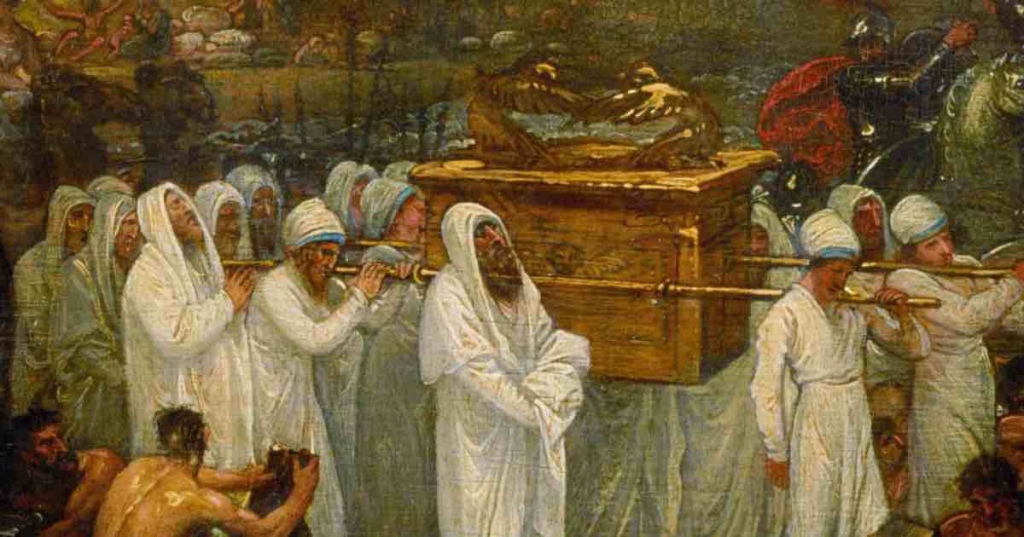
Central in the story is the ark of the covenant. The story tells of the time at Mount Sinai when God established a covenant with Moses and Israel, and the giving of the Law within that covenant relationship. The ark is a sign of the presence of God, continuing on with the people of Israel beyond Mount Sinai (Exod 25:10–22). God is not an absentee God, but very present amongst the people. The ark symbolises and reinforces that message.

Levites carrying the ark of the covenant

The priests serve to mediate the presence of God. They carry the ark of the covenant, maintaining it, ensuring that it remains safe (Deut 10:8; 31:9, 25–26; Josh 3:3, 6, 8, 13). The story offers an indication that holy people are necessities in life; their mediation of the divine in the midst of the mundane is important. (As an ordained person, I confess that I have a vested interest in this claim!) As the priests shape the story, they make sure that priests play a central role in what is narrated.

Joshua as testimony to faith

The story contains a memorable description of God as “the living God” (3:10). The phrase appears elsewhere in a Hebrew Scriptures (Deut 5:26, 1 Sam 17:26, 36, 2 Kings 19:4, 16, Ps 42:2, 84:2, Isa 37:4,17, Jer 10:10, 23:36, Dan 6:20, 26, Hos 1:10) and also in the New Testament (Matt 16:16, 26:63, Acts 14:15, Rom 9:26, 2 Cor 3:3, 6:16, 1 Thess 1:9, 1 Tim 3:15, 4:10, Heb 3:13, 4:12, 9:14, 10:31, 12:22, Rev 7:2). The ark is a sign that this living God is present, active and engaged in the lives of the people.

A striking event demonstrates this: as the priests stand in the river, the waters stand still (3:16), and so the people are able to cross the river and enter the land. Of course, later on in Joshua, another miraculous event takes place, as the sun stands still (10:13). These were not actual events, but symbolic of divine intervention. The waters standing still evokes the moment in the Exodus story when the waters of the Sea of Reeds parted to allow the Israelites to pass through (Exod 14:21–22, 29).

We might well compare the New Testament story of the earthquake and resurrection of the saints (found only in Matt 27) after the resurrection of Jesus. This, too, was not an historical event; it was a dramatic tale told to underline that God was active in the story.

The key aspect of the story of the escape from Egypt, as the story is found in Exodus 14—15, is the connection with the Feast of the Passover. The story that is attached to the Exodus actually serves a liturgical purpose; the priests have developed the story to reinforce and highlight the way that God was able to redeem the people—as in the story, so in the experience of the returning exiles.

Likewise, the key aspect of this story of the entry into the land, in Joshua 3, is not the actual physical wading across the river, but the assurance of faith that comes from the telling of the story of entering the land. God is not only the redeemer, who delivers the people into freedom, but the one who delivers the land to the people. The promise of the gift of land, first made to Abraham (Gen 12:1, 15:7, 17:8), then reiterated to Jacob (Gen 28:4,13, 35:12) and again to Moses (Exod 3:8,17, 6:4,8, 12:25, 13:5,11), is now coming to fulfilment.

Joshua as military victory

Indeed, the crossing of the river itself points to the symbolism that this story contributes to the overarching narrative. Leaving Egypt, the Lord God parts the waters, the people pass through, the army is bogged and drowned, and their escape from Egypt is secure. Entering Canaan, the Lord God once again stops the flow of the waters, the priests who carried the ark of the covenant enable the people to cross the river and enter the land, and their hold on the land is made secure. Josh 4:19–24 draws this comparison quite explicitly.

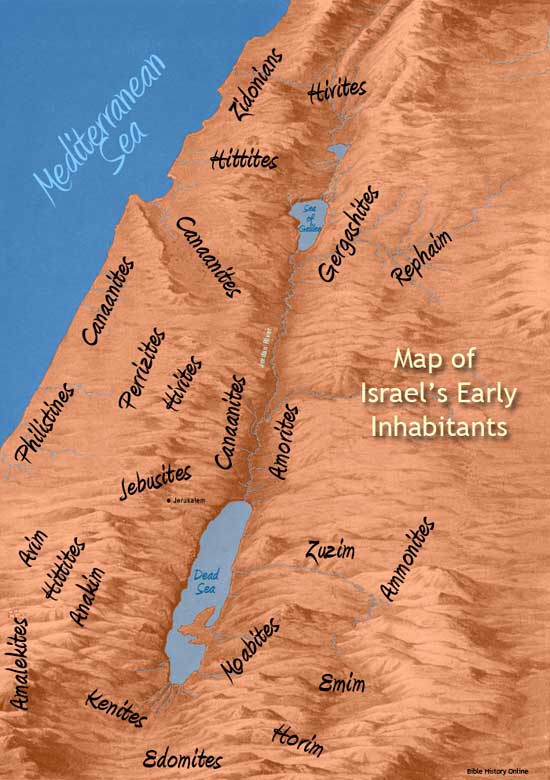
The parallel continues in the strong militaristic element, found in the list of the peoples whom “the living God who without fail will drive out from before you”. The text specifies “the Canaanites, Hittites, Hivites, Perizzites, Girgashites, Amorites, and Jebusites” (3:10). Even before the battles are waged, the victories have been declared. This also provides a neat bookend: the army of Egypt is crushed in Exodus 15, the inhabitants of the land are subdued and defeated in Joshua 3.

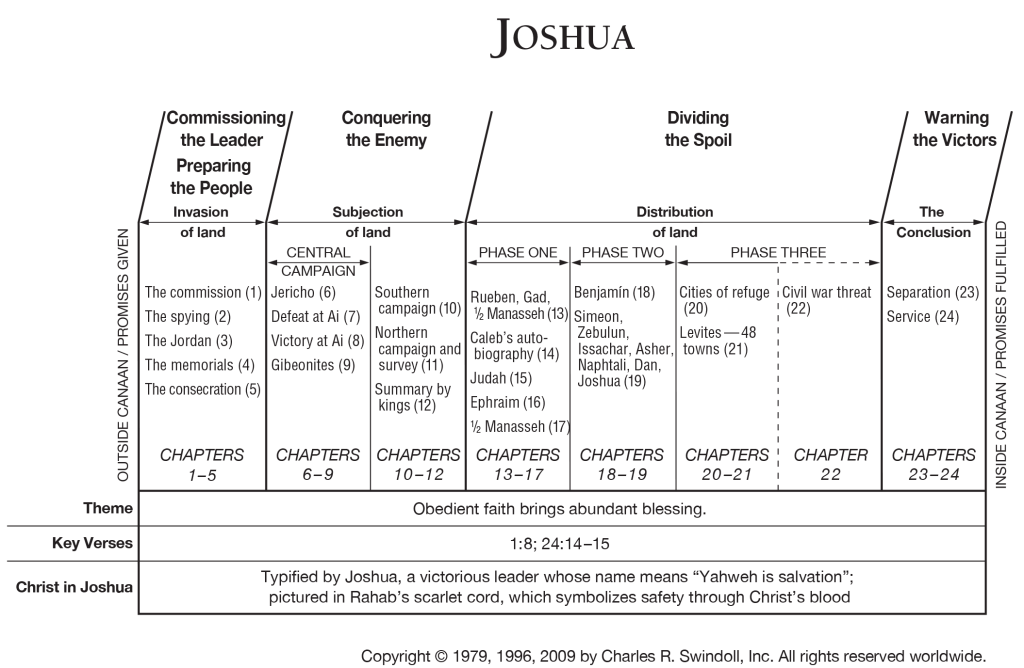
What follows on from this story of entering the land is a highly schematic presentation of the military conquest of the land, in the rest of the book of Joshua. The invaders take the key areas in turn: first the Central area (chs. 6—8), then the Southern regions (chs. 9—10) followed by the Northern areas (ch 11). Chapter 12 then provides a summary of the conquest, listing “the kings of the lands whom the Israelites defeated”—a kind of victor’s gloating, “thirty-one kings in all” (Josh 3:24).

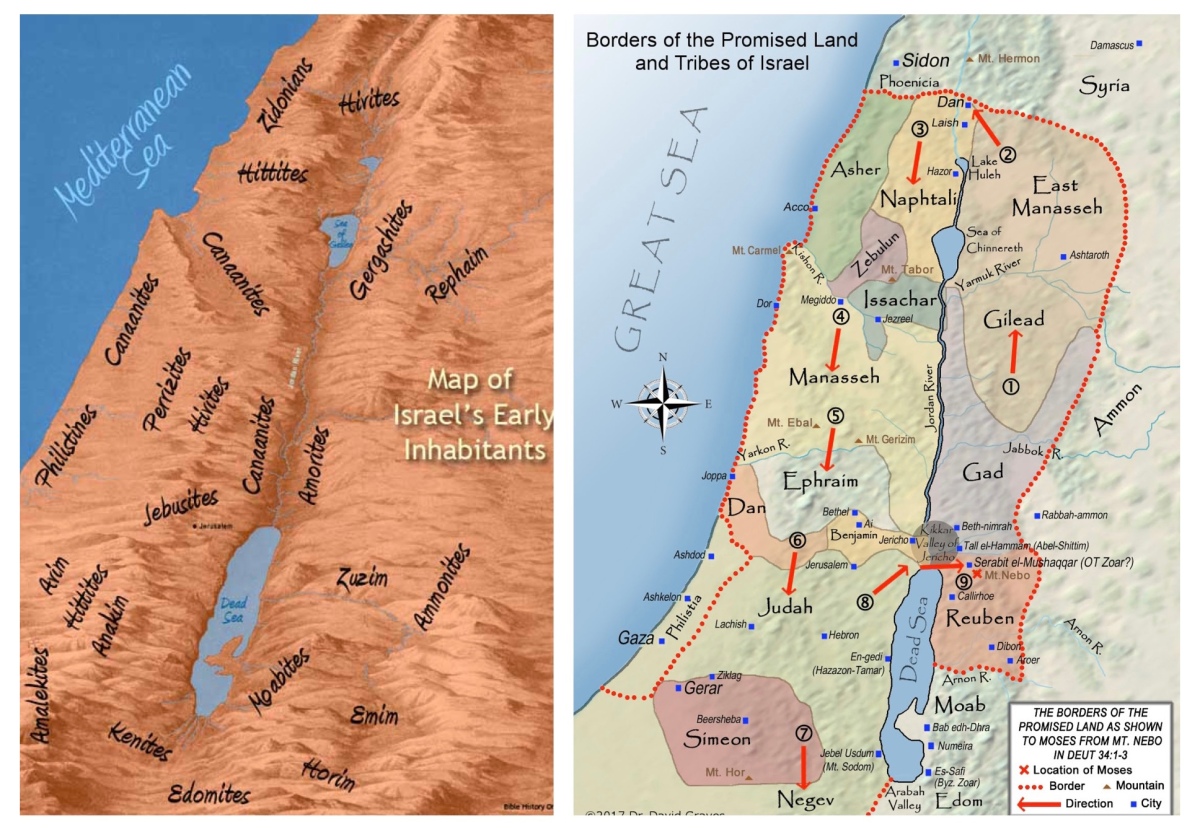
The story of taking control of the land is then followed by a parallel schematic account of the allotment of the land to each of the tribes. The Transjordan (the land to the east of the Jordan River) is allotted in ch. 13; the Central regions in chs. 14—17; and then the peripheral regions to the north and south in chs. 18—19. Chapter 20 details the allocation of the five “cities of refuge”, whilst chapter 21 identifies the forty-eight towns which were allotted to the tribe of Levi, from which the priests came.

None of these are historical accounts. The schematic ordering carries symbolic weight, rather than being an historical account. Indeed, the twelve tribes of Israel were a later construction by the compiler of the narrative, rather than being an actual organisational principle at the time of any such conquest.

And even as the list of conquered peoples are identified, the savagery of this glorious moment is revealed. The memorial stones provide a reminder of the event (Josh 4:1–10), a reminder of the power of the invading force as they colonise the settled inhabitants of the land. We hear the story from the perspective of the victorious invaders—the people of Israel. The dispossession and death of so many Canaanites is simply “collateral damage” in this process.

Joshua and Israel, Britain and Australia, and the Indigenous perspective

This is a story of land, invasion, massacre, colonisation, and victory. It is an ancient story which resonates strongly with the experience of Indigenous peoples in the modern era of history. Time and time again, from late medieval times onwards, “explorers” set out from Western powers, “discovered” new lands, followed by “settlers” who came and established “civilisation”, most often by means of “subduing” the indigenous peoples, making them subservient to the “new order”—and even, in many instances, punishing those who resisted their new ways, even utilising means of killing the Indigenous peoples.

This is the dynamic of the story of “Israel entering the promised land” which is told in Joshua, as well as the story of “establishing British civilisation in the land of Australia” which is the story of the continent on which I live. It is a story of many other places, also, around t,he world today. The imposition of a new way of living by a more powerful force, the subjugation of those who already were living in the land, and the use of violence and murder to ensure that the new order was maintained and could flourish—all of this is in the history of Australia since 1788.

The story of invasion and settlement, defeat and decline, resonates with the contemporary Australian experience of the indigenous peoples of the continent and its islands. Which gives us pause for thought: how, then, do we hear and understand that story recounted in Joshua?

See also

and for my perspective on the way that biblical literalism has fed into the modern conflict over the land of Israel/Palestine, see

Never since has there arisen a prophet like Moses (Pentecost 13A to 22A)

Over the past ten weeks, we have heard and thought about various moments in the story of Moses, the reluctant prophet who came to stand tall in the stories told about the origins of Israel—Moses, the infant who was rescued by Egyptian women; Moses, who was called by God to lead his people to freedom; Moses, who received the Torah from God; Moses, who led the people through the wilderness for forty years;

Moses, who saw the promised land but died before he was able to enter that land. As the writer of Deuteronomy states, “never since has there arisen a prophet in Israel like Moses, whom the Lord knew face to face” (Deut 34:10). Here are the blog posts I have made about this extended story of Moses and the Israelites.

Like a father with his children … gentle as a nurse tenderly caring for her children (1 Thess 2; Pentecost 22A and 23A)

“As you know, we dealt with each one of you like a father with his children, urging and encouraging you and pleading that you lead a life worthy of God, who calls you into his own kingdom and glory.” So the followers of Jesus in the community that had formed in Thessalonica in the early 50s of the first century would have heard, when a letter sent to them from Paul, Silvanus, and Timothy was read to them in their community gathering (1 Thess 2:11–12).

Ancient letters normally followed clear formulaic patterns (as,minded, modern letters do). They began by identifying the parties involved in a short opening address, followed by a prayer for their wellbeing. So in such letters, we often find something like “Publius to Demetrius, greetings; I pray you may be well”.

So it is no surprise that the letters we have in the New Testament reflect this pattern. Almost all of what we describe as “Paul’s letters” begin with a greeting from the writer to members of the church at the designated location. In one letter (Philemon), three individuals are named as the recipients (Philemon, Apphia and Archippus) as well as the whole church community. The three “pastoral letters” (1 Tim, 2 Tim, Titus) are addressed to an individual person.

It is often overlooked that seven of the letters specified co-writers along with Paul: Timothy (2 Cor, Phil, 1 Thess and Phlm; Col and 2 Thess), Sosthenes (1 Cor) and Silvanus (1 Thess and 2 Thess). Paul was the sole designated writer in only two “authentic” letters (Rom and Gal) and in four “debated” letters (Eph, 1 Tim, 2 Tim, Titus).

So “Paul’s first letter to the Corinthians” was actually “a letter from Paul and Sosthenes to the Corinthians” (see 1 Cor 1:1). And “Paul’s first letter to the Thessalonians”, which appears at the moment in the lectionary sequence for Pentecost 21A to 25A), was actually “a letter from Paul, Silvanus, and Timothy, to the church of the Thessalonians” (see 1 Thess 1:1).

This coming Sunday, the lectionary offers us an excerpt from this letter, from the place after the greetings and opening prayer (1:1–10), which we heard last Sunday. This is where we would normally expect the body of the letter to begin (2:1), exploring the matters of substance in the community that the authors wanted to raise with the recipients. However, Paul and his co-writers turn their attention at this point away from the community in Thessalonica, to focus more specifically on the way that they had been operating whilst they had been with the Thessalonians (2:1–12).

There are two striking matters to note in this section. The writers of this letter lay claim to behaving “like a father with his children” as they relate to the Thessalonians. This is unusual—although in other letters bearing his name, Paul does claim to be father to Timothy (Phil 2:22) and to Onesimus (Phlm 10).

Whilst all letters written in the name of Paul refer to God as Father (Rom 1:7; Gal 1:1–5; 1 Cor 8:6; Phil 4:20; Eph 4:6; and in other places), claiming a paternal relationship with those who are being addressed in the letter is unusual. In the case of the Thessalonians, it would seem that this claim rests on the fact that Paul and his fellow-missionaries were the ones who brought them to faith in Jesus.

“Our message of the gospel came to you not in word only, but also in power and in the Holy Spirit and with full conviction”, they declared (1 Thess 1:5), and so “we had courage in our God to declare to you the gospel of God in spite of great opposition” (2:2), and then “you became imitators of us and of the Lord” (1:6), as “you turned to God from idols, to serve a living and true God, and to wait for his Son from heaven, whom he raised from the dead—Jesus, who rescues us from the wrath that is coming” (1:9–10). This paternal glow at the response of these believers to the preaching of the three evangelists in Thessalonica is clear.

A second claim that is even more striking is the assertion that “we were gentle among you, like a nurse tenderly caring for her own children” (2:8). It’s a claim that is distinctive, in that the three male authors of this letter are using female imagery to describe their modus operandi whilst in Thessalonica.

Gentleness is not a quality often associated with evangelists or those called by God to proclaim “the word of the Lord” to the people, although one proverb does state that “a gentle tongue is a tree of life” (Prov 15:4) and the prophet Jeremiah notes that when his life was threatened by the people of Anathoth, “I was like a gentle lamb led to the slaughter” (Jer 11:19). Gentleness is seen as a sign of “the righteous man” in the Wisdom of Solomon 2:19.

The claim to be “gentle as a nurse” comes, as we have noted, in the context of describing, in some detail, the way in which those who proclaimed the good news in Thessalonica were operating while they had been with the Thessalonians (2:1–12).

As they write to the Thessalonians, the authors of this letter feel the need to defend themselves, pointing out that their motivation in proclaiming the gospel was not based on “deceit or impure motives or trickery” (2:3), nor did they speak “with words of flattery or with a pretext for greed” (2:5). Rather, they undertook their task with deep-seated care (2:8) and purity of motive (2:10).

The three writers invoke the divine no less than nine times in twelve verses, proclaiming that the methods used were “approved by God” and that the spoke only “to please God” (2:4). Their invocation of God serves to underline the truth of what they write, and what they have said and done, with the Thessalonians.

The language which Paul, Silvanus, and Timothy use in this part of the letter is reminiscent of discussions of rhetoricians and philosophers of the time, a number of whom were accused of having base motives, an interest in self-promotion and a desire for immediate financial rewards!

The three who were writing to the Thessalonians could well have been accused of functioning in such a self-serving way, especially if their modus operandi was seen to be very similar to those wandering preachers of philosophical messages—deceitful, self-serving, using flattery and trickery, seeking financial gain. The power of their words (1:5; 2:12) could have fuelled such a critical perspective of their activities.

In addition, the itinerant way of life adopted by Paul, and his various companions, could easily leave them open to such a criticism. Yet, how Paul and the others defend themselves is similar to the way that the better class of philosophers and rhetoricians of the day tried to defend themselves. We know about this through the writings of pagan philosophers who canvassed the different types of itinerant philosophers that were known at the time.

In particular, the writings of Dio Chrysostom are relevant and helpful in this regard. Dio was an orator of the second century, but the phenomena that he described had been in existence for decades before. We can assume, with a reasonable degree of confidence, that his words describe a phenomenon akin to what was happening in the first century.

In the 32nd discourse of Dio Chrysostom, delivered “to the people of Alexandria”, he talks about a range of people who wandered from village to village, spruiking their own moral teachings. (In what follows I am quoting from the translation of Dio’s Oration 32 by J.W. Cohoon and H. Lamar Crosby in the Loeb Classical Library.)

First, Dio refers to a class of rather undesirable people; itinerants “whose tenets, to be sure, comprise practically nothing spurious or ignoble, yet who must make a living”. He describes them as Cynics, noting that “posting themselves at street-corners, in alley-ways, and at temple-gates, [they] pass round the hat and play upon the credulity of lads and sailors and crowds of that sort, stringing together rough jokes and much tittle-tattle and that low badinage that smacks of the market-place”.

His assessment is that “they achieve no good at all, but rather the worst possible harm, for they accustom thoughtless people to deride philosophers in general, just as one might accustom lads to scorn their teachers, and, when they ought to knock the insolence out of their hearers, these Cynics merely increase it”.

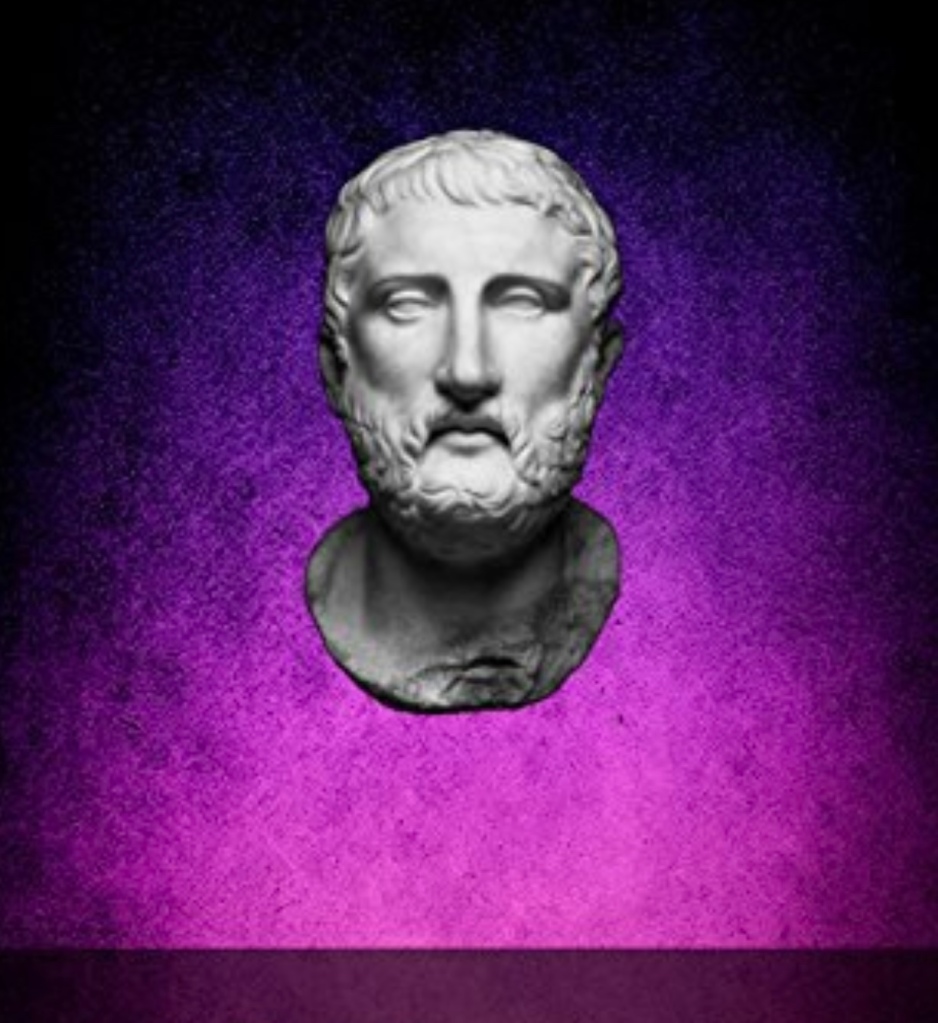
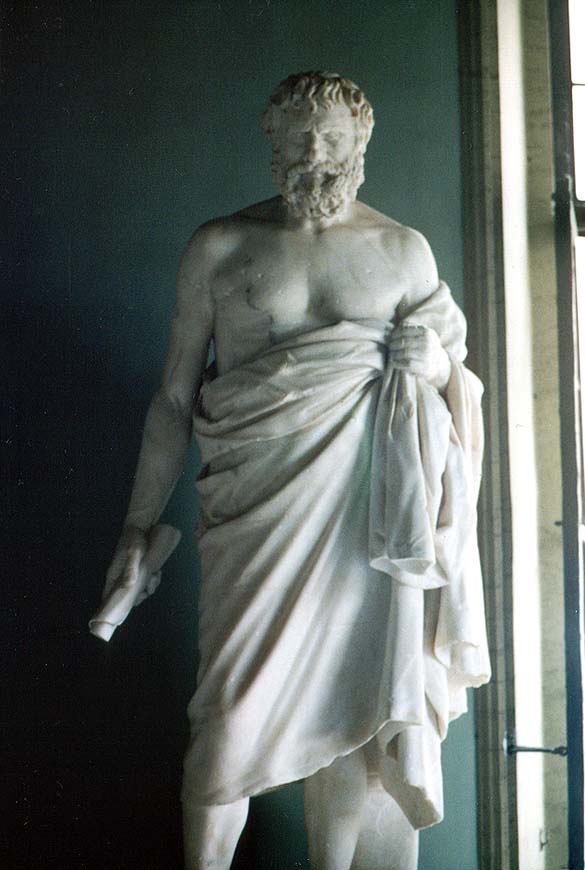
Statue of an unknown Cynic philosopher
from the Capitoline Museums in Rome.

Dio then notes that such people come “in the guise of philosophers” but that “they do these things with a view to their own profit and reputation, and not to improve you”. He declares that this is “shocking; for it is as if a physician when visiting patients should disregard their treatment and their restoration to health, and should bring them flowers and courtesans and perfume”.

He then moves on to describe “only a few who have displayed frankness in your presence, and that but sparingly, not in the same way as to fill your ears therewith nor for any length of time; nay, they merely utter a phrase or two, and then, after berating rather than enlightening you, they make a hurried exit, anxious lest before they have finished you may raise an outcry and send them packing, behaving in very truth quite like men who in winter muster up courage for a brief and hurried voyage out to sea”.

“But to find a man”, Dio continues, “who in plain terms and without guile speaks his mind with frankness, and neither for the sake of reputation nor for gain makes false pretensions, but out of good will and concern for his fellow-men stands ready, if need be, to submit to ridicule and to the disorder and the uproar of the mob — to find such a man as that is not easy, but rather the good fortune of a very lucky city, so great is the dearth of noble, independent souls and such the abundance of toadies, mountebanks, and sophists”.

And then, he puts forward his own situation, calling on the (unidentified) deity whom he worships: “I feel that I have chosen that rôle, not of my own volition, but by the will of some deity”, and he concludes by affirming that “when divine providence is at work for men, the gods provide, not only good counsellors who need no urging, but also words that are appropriate and profitable to the listener”.

As Dio has explained his own mode of operating, in contrast to the imperfect and self-serving ways of others, so too Paul, Silvanus, and Timothy are pressing their case, using similar language and concepts to articulate their cause. They present as called by God, speaking to please God, eschewing morally questionable practices, and sharing their very lives with their audience. The similarities are striking.

These similarities are explored in detail in the Anchor Bible Commentary on 1 Thessalonians by Abraham Malherbe. There is a good summary of Malherbe’s analysis of 1 Thess 2 in this vein, at http://www.religion.emory.edu/faculty/robbins/SRI/Examples/textures/inter/echo2.cfm The initial article in Novum Testamentum (1970) in which Malherbe argued this case can be read at https://library.mibckerala.org/lms_frame/eBook/atla0000721845%20Cynic%20Background.pdf

I confess to having a clear bias in regard to this line of interpretation; Abe Malherbe was my doktorvater, the supervisor of my doctoral thesis, on hellenistic apologetics, Josephus, and Luke-Acts, at Yale University. Before that, I took classes with him during my coursework year, including an exegesis class on “Paul’s Macedonian Correspondence” (1 and 2 Thessalonians and Philippians), and I participated in a doctoral seminar on “Paul and the Moral Philosophers”—so I am well-schooled in the details of his case; and in full agreement with his view on this particular matter. (There were other exegetical matters in which we disagreed; the papers I wrote to argue against Malherbe’s views were nail-biting pieces, as he could be a fierce critic, as well as a warm encourager, on such matters.)

The problem of Canaan: conquering, colonising, massacring (Deut 34; Pentecost 22A)

Land rights. Land claims. Land has always been a bone of contention-in the past, as in the present. This week, the lectionary invites us to consider land. The Hebrew Scripture passage contains an important statement about land a land claim, as it were.

“This is the land of which I swore to Abraham, to Isaac, and to Jacob”, God declares to Moses in the last moments of his life (Deut 34:4), as he stands on Mount Nebo, surveying “the whole land: Gilead as far as Dan, all Naphtali, the land of Ephraim and Manasseh, all the land of Judah as far as the Western Sea, the Negeb, and the Plain- that is, the valley of Jericho, the city of palm trees as far as Zohar” (Deut 34:1–3).

That land encompassed all the land of Canaan, which later becomes the land of Israel. It is the land which was in contention between different peoples long before the story of Moses was written on the scroll that became part of Torah.

That was most likely sometime before or during the period that Josiah ruled as king of Judah, when he commanded the high priest Hilkiah to undertake an audit of funds in the temple. We are told that, in the course of this audit, Hilkiah said to Shaphan his secretary, “I have found the book of the law in the house of the Lord” (2 Ki 22:8). That’s presumed to be the first version of what we know as Deuteronomy, which later found its place as the fifth of “the five Books of Moses”.

That same land, promised to Abraham, claimed by Moses, is in contention today. It has had a chequered history. The ancient land of Canaan eventually became the land of Israel, then (along with Judaea) part of the Roman province of Syria Palaestina (132–390), and then of the Diocese of the East in the Roman Empire (to 536). What followed the fall of the Roman Empire was a millennium and a half of Muslim rule of this land, first as a part of Bilad al-Sham, the Greater Syria region, under various Caliphates.

The region continued to be part of various organisational configurations under successive Muslim rule, on into the Ottoman Caliphate (from 1517) and then into the modern era. (I am not an expert, by any means, of this ancient and medieval history; for this summary, I am dependent on what I read in what I consider to be reputable sources.)

In the early 20th century, the place where Arabs identifying as Palestinians lived was decreed to be the British Mandate of Palestine (1920–1948). The ancient conflicts, it was hoped, would be well in the past. A place for Palestinians in the modern world was, it was thought, now settled.

But this was not to be, as we well know today.

In part in response to the horrors of the Shoah, exposed by the ending of World War Two, the modern state of Israel was created in 1948. The new nation took 78% of the area which had been provided for Palestinians in the British Mandate. That this was now Jewish territory was a blessing for Jews, but it was a huge irritant to Palestinian sensibilities, which has referred to the period from 1948 onwards as the Nakba, the Palestinian Catastrophe. In the early years of the Nakba, significant number of Palestinians fled the area declared as Israel, as (in one estimate) over 500 Palestinian villages were repopulated by Jews, becoming refugees with no national identity.

The contested regions of the Gaza Strip (along the east coastline of the Mediterranean Sea) and the West Bank (land immediately to the west of the River Iordan) became known as “the Palestinian Territories”.

Another irritant has been the fact that they have been occupied by Israel since the Six-Day War of 1967, and subsequent expansion of Israeli settlements into areas where Palestinians live has exacerbated the situation. And so those who were dispossessed become the dispossessors of others, and the cycle continues.

So when we hear, this coming Sunday, “This is the land of which I swore to Abraham, to Isaac, and to Jacob”, we can be sure that we know these territories; we know the conflicted situation in the modern era; and we know how the ancient texts describe and lay claim to Israelite “ownership” of the land.

When Abraham left his homeland to settle in Canaan (Gen 13:12) and when the Lord God later formalised a covenant with Abraham (then aged 99 years, we are told), the promise was made by God that “I will give to you, and to your offspring after you, the land where you are now an alien, all the land of Canaan, for a perpetual holding” (Gen 17:8).

That same phrase, “a perpetual holding”, is subsequently spoken by Jacob, as he tells Joseph, Manasseh and Ephraim of God’s words, “I am going to make you fruitful and increase your numbers; I will make of you a company of peoples, and will give this land to your offspring after you for a perpetual holding” (Gen 48:4).

That land, Canaan, is a problem that sits at the heart of the story that the Bible recounts in its early narrative books. It becomes a problem at the heart of life for the millions living in that region today, as I have outlined above. The biblical narrative tells of numerous battles leading to the defeat of many tribes: the Moabites (Judg 3:26–30) and the Ammonites to the east Judg 10:6–11:33), as well as “the Hittites, the Girgashites, the Amorites, the Canaanites, the Perizzites, the Hivites, and the Jebusites, seven nations mightier and more numerous than you” in the land (Deut 7:1; see also Josh 3:10; 12:8; 24:11), and also the Anakim (Josh 11:21–23).

Further, as recent events in Australia have powerfully reminded us, there is a problem right at the heart of the narrative that has been constructed about modern Australia. Our most recent failure even to accept a modest proposal to recognise the existence of First Peoples on the continent prior to 1788, is testimony to that problem. Although the First People of Australia were not completely destroyed and eliminated, they continue to be discriminated against in a multitude of ways.

Both the ancient Israelite narrative and the contemporar Australian narrative tell a story of a group of people who invade, conquer, massacre, colonise, settle, marginalise, and then claim as their own what had previously belonged to others who had long been there before them.

It’s a story, in both instances, that we need to hear, understand, and appreciate. We need to develop awareness of just how easily we adopt the victor’s point of view, and uncritically retell it, without thinking any more about the pain, hurt, anguish, and generations-long damage that was done, in each case.

That is hard to do. I am a white Australian, raised on the myths of the great Australian character, taught from my schooldays onwards about the glories of the British Empire and the values of western society. Understanding the situation of First Peoples in Australia takes time, focus, empathy, energy, and persistence.

And I am a Christian, raised on the stories of the Bible, taught from Sunday School onwards about the promises God made to the chosen people about the holy land that had been selected for them. Getting into the mindset of a people from so long ago, who have almost (but not quite) been written out of the story, is hard to do.

The story of the Hebrews entering the land of Canaan, battling the inhabitants and colonising the territory, lies underneath the whole story of Exodus, wilderness, and conquest, which is at the heart of the biblical narrative that accounts for the origins of Israel as a nation.

A specific set of stories which tell of that invasion and conquest is found in all its bloody detail in the book of Joshua. That book tells, in a highly stylised way, of the entry of the people of God into the promised land. It is a key incident in the extended narrative history that stretches from Genesis to 1 Kings, from slavery in Egypt, through the long haul of wilderness wanderings, to the establishment of the kingdom of Israel under King David.

That story has multiple historical problems, and needs to be understood as a mythological saga telling of the nature and identity of the people, rather than an accurate historical account of “what actually took place”. See

Invasion and colonisation, Joshua 3 and contemporary Australia (Pentecost 23A)

This ancient story of invasion, conquering, massacre, colonisation, settlement, marginalisation, and then the claiming as their own what had previously belonged to others, resonates strongly with the experience of indigenous peoples in so many places in the modern era of history-including, and especially, in Australia.

Time and time again, from late medieval times onwards, “explorers” set out from Western powers, “discovered” new lands, followed by “settlers” who came and established “civilisation”, most often by means of “subduing” the indigenous peoples, making them subservient to the “new order” and even, in many instances, punishing those who resisted their new ways, utilising various means of killing the indigenous peoples.

This is the dynamic at the heart of the story of “Israel entering the promised land” which is told in Ioshua. It is also at the heart of the story of “establishing British civilisation in the land of Australia” which is the story of the continent on which I live the land now called Australia. The imposition of a new way of living by a more powerful force, the subjugation of those who already were living in the land, and the use of violence and murder to ensure that the new order was maintained and could flourish all of this is in the history of Australia since 1788.

The story of invasion and settlement of Canaan, the defeat and decline of the various indigenous peoples of that land, resonates with the contemporary Australian experience of the indigenous peoples of the continent and its islands. Which gives us pause for thought: how, then, do we hear and understand that story recounted in Joshua, which is prefigured in this final chapter of Deuteronomy? What land claims do we accept from this ancient text? And how does that guide us, today, as we consider the land claims that are being made?

See also my discussion of the wav that biblical literalism has fed into the modern conflict over this land at

Plotting Pharisees: a public confrontation in the honour-shame culture (Matt 22; Pentecost 21A)

The dynamic at work in the Gospel passage which is offered by the lectionary this coming Sunday (Matt 22:15–22) is compelling. Some people might worry about the way that the Pharisees—strong advocates for the importance of Torah in everyday life—are collaborating with the Herodians—presumed to be more hellenised Jews sympathetic to (or even employed in the court of) Herod and his successors.

It’s a strange alliance, to be sure, but Matthew has inherited this story from Mark, who placed the two groups side-by-side (Mark 12:13–17), and he chooses not to alter that.

Others might be excited by the coin presented to Jesus for his adjucation—said to be a δηνάριον (a denarius), the standard Roman coin in use at the time, and reputed to be “the usual daily wage” for a labourer (so the NRSV translates the word at Matt 20:2, 9, 10, 13). The fact that staunch Jews were carrying such a coin has engaged some interpreters—although I reckon that they simply needed to, in order to survive in daily life in Roman-occupied Palestine.

What interests me more in this story is the dynamic at work in the interaction between Jesus and the people of these two Jewish groups. The passage begins, “the Pharisees went and plotted to entrap him in what he said” (v.15). In league with the Herodians, they approach Jesus with flattery (v.16) before posing a simple question: “is it lawful to pay taxes to the emperor, or not?” (v.17). So the story is set up as a trap: a public confrontation designed to bring Jesus down.

The narrator notes that Jesus is “aware of their malice”, responding to their question with one of his own: “why are you putting me to the test, you hypocrites?” (v.18). There is then an interaction relating to a coin which is produced at the request of Jesus (vv.19–20), before Jesus makes a concluding statement (v.21), which leads to the narrator’s summation of the scene: “when they heard this, they were amazed; and they left him and went away” (v.22).

The dynamic in this back-and-forth can best be understood by reference to the honour-shame culture which was the foundational culture of ancient Mediterranean societies. Malina and Rohrbaugh describe the process of challenge and riposte, in which “a challenge … that seeks to undermine the honour of another person” must be met with “a response that answers in equal measure or ups the ante and thereby challenges in return … to avoid a serious loss of face” (Social Scientific Commentary, p.307).

Such challenge-riposte encounters typically involved the challenger setting forth a claim, through either words or actions; a response to the challenge by the persons who was challenged; then, after further back-and-forth amongst the participants, once the challenge and riposte has run its course, the verdict is declared by the public who was watching the encounter. (See a clear description of this process, as it applies in Mark 11:27–12:34, using the analysis of Jerome Neyrey and Bruce Malina, at https://www.etsjets.org/files/JETS-PDFs/43/43-2/43-2-pp213-228_JETS.pdf)

The challenge that the Pharisees and Herodians raise to Jesus in this passage is one in which he bests the authorities with his responses; he maintains his place of honour within society. Had that not been the case, he would have been publically shamed. And a public shaming for a male in that society was a very demeaning experience.

The incident narrated in this passage (Matt 22:15–22) is one of a series of public confrontations that Jesus had whilst he was teaching in the temple (21:23 through to 22:46). Prior to this debate about the coin that was used to pay tax to the Emperor, Jesus had defended his authority to teach (21:23–27), before telling three parables which provoked his listeners to think out of the box about how God was at work (21:28–32; 21:33–44; 22:1–14).

Jesus, of course, was a Jew, instructed in the way of Torah. He knew his scriptures—he argued intensely with the teachers of the Law over a number of different issues. He frequented the synagogue, read from the scroll, prayed to God, told parables, and went on pilgrimage to Jerusalem and into the Temple—all typically Jewish activities.

Immediately prior to this encounter with Herodians and Pharisees, Jesus had offered a scathing critique of the practices that were taking place in the courtyard of the Temple (21:12–17). It was the response of the children to his actions, echoing the earlier son of the crowd by singing out “Hosanna to the Son of David” (21:9) had angered the chief priests and the scribes (21:15). The way that he resolved this situation (at least temporarily) was to quote scripture (21:16, citing Psalm 8:2)—a very Pharisaic-rabbinic way of operating!

Earlier in his narrative, Matthew has reported a number of tense encounters between Jesus and his disciples on the one hand, and the scribes and Pharisees on the other (9:2–8, 10–13; 12:38–42; 15:1–20; 16:1–4; 19:3–9; 21:15–16). Those encounters inevitably revolved around differing interpretations of Torah prescriptions and included regular references to (Hebrew) scriptural passages.

Whilst teaching in the Temple, Jesus engaged in debate and disputation with various Jewish authorities: chief priests and elders (21:23), Pharisees and Herodians (22:15–16), Sadducees (22:23), and then Pharisees once more (22:34, 41). Each of those groups came to Jesus with a trick question, which they expected would trap Jesus (22:15). Jesus inevitably bests them with his responses (21:27; 22:22, 33, 46).

Each of the parables that Jesus told ends with a twist that snares the opponents of Jesus more intensely. The short parables of the two sons (21:28–32) ends with a barb: “John came to you in the way of righteousness and you did not believe him, but the tax collectors and the prostitutes believed him; and even after you saw it, you did not change your minds and believe him” (21:32).

The third parable, of the wedding banquet (22:1–14) ends with words that are surely intended to put the Pharisees well and truly in their place: “many are called, but few are chosen” (22:14). Are they the ones who will be “[bound] hand and foot, and [thrown] into the outer darkness, where there will be weeping and gnashing of teeth” (22:13)?

In the middle parable (21:33–44), the conclusion is equally damning: “the kingdom of God will be taken away from you and given to a people that produces the fruits of the kingdom” (21:43). Recognising that they were the targets of this teaching, the chief priests and Pharisees “realized that he was speaking about them; they wanted to arrest him, but they feared the crowds, because they regarded him as a prophet” (21:46).

Indeed, this whole sequence of conflicted encounters—public disputations, challenge-riposte displays—ends with a recognition of the fact that Jesus has retained (and perhaps even increased) his share of honour: “no one was able to give him an answer, nor from that day did anyone dare to ask him any more questions” (22:46).

As Matthew had noted earlier, in the passage for this Sunday, the Pharisees and Herodians “were amazed; and they left him and went away” (22:22); and then, after dialogue with the Sadducees, “when the crowd heard it, they were astounded at his teaching” (22:33). To the crowd, it is clear: Jesus is the man of honour, who has publically shamed Pharisees, Sadducees, priests, and Herodians.

Pharisees plotting with malice; that is a sharply negative portrayal of these characters in this encounter. Elsewhere in Matthew’s Gospel, the Pharisees are the subject of similar invective, placed on the lips of Matthew. Although Jesus affirms “the scribes and the Pharisees” as those who “sit on Moses’ seat” and teach well, he criticises them as failing to live by that teaching in their lives (23:1–3).

What follows this affirmation is an incessant string of criticisms, each introduced with the uncompromising invective, “woe to you, scribes and Pharisees, hypocrites!” Jesus accuses them of “lock[ing] people out of the kingdom of heaven” (23:13), “tith[ing] mint, dill, and cummin, and neglect[ing] the weightier matters of the law: justice and mercy and faith” (23:23), and acting in ways that are “full of greed and self-indulgence” (23:25).

He accuses them directly, noting that they are “child[ren] of hell” (23:15), that “inside you are full of hypocrisy and lawlessness” (23:28), and that they are “descendants of those who murdered the prophets” (23:31). The punishment due to them is the fate in store for all who are lawless—to depart from Jesus, who never knew them (7:23), to be “throw[n] into the furnace of fire, where there will be weeping and gnashing of teeth” (13:42), to be “sentenced to hell” (23:33) as they “fill up the measure of your ancestors” (23:32).

And so, in the face of the abandonment of the Law by the very teachers of the Law, Jesus teaches how to live by the Law, with a ferocious intensity that exceeds anything that the Pharisees and scribes might offer (5:21–48), for “unless your righteousness exceeds that of the scribes and Pharisees, you will never enter the kingdom of heaven” (5:20). He is positioned in a way that places him as the supreme teacher of Torah, over and above the Pharisees.

Judaism was in a state of flux after the destruction of the Temple in 70 CE. Evidence indicates that there were a number of sectarian groups contesting with each other for recognition and influence. During this period, the Pharisees became increasingly important as an alternative to the Temple cult, and in time they emerged as the dominant Jewish religious movement. Their power base was moved from Jerusalem and spread throughout the area.

Josephus comments that the Pharisees lived in the towns and villages with and alongside the people. He wrote that “they live meanly, and despise delicacies in diet; and they follow the contract of reasons” (Antiquities of the Jews, 18.3), so presumably they lived without the ostentation and wealth that Josephus ascribes to the Sadducees.

Josephus also comments that the Pharisees were usually held in high regard by the ordinary people of the day. Since nine out of every ten persons could not read, the importance of scribes—literate, educated, and sympathetic—could not be underestimated. Whilst the Pharisees clustered around towns in Judea, the scribes were to be found in the synagogues of villages throughout greater Israel, and indeed in any place where Jews were settled. Their task was to educate the people as to the ways of holiness that were commanded in the Torah. It was possible, they argued, to live as God’s holy people at every point of one’s life, quite apart from any pilgrimages made to the Temple in Jerusalem.

The way that Jesus is portrayed in the Gospels–especially the three Synoptic Gospels–places him in opposition to the Pharisees, as the authoritative teacher of Torah. In Matthew’s Gospel, as we have noted, this opposition is further intensified, for Jesus is seen as the only one able to interpret and apply the laws for them in their lives.

So there is a clear reason for the negative language used in the incident about the coin: “the Pharisees went and plotted to entrap him” (22:15), and Jesus was “aware of their malice” (22:18). In the context of the latter part of the first century, in which Matthew’s Gospel was written, this antagonism can be understood. The intensity of conflict heightened the sharpness of antagonism that the author of this Gospel has drawn.

****(

For those of us reading, hearing, and preaching on this passage in the 21st century, we need to be very careful not to use negative, derogatory, or judgemental language about the Pharisees of the first century, or about Jewish people in our own times. Judaism is a living faith with its own integrity, and Jews today should be recognised and valued as people of faith and not valued in terms of conflicts from centuries ago.

In 2009, my own church, the Uniting Church, adopted a Statement on Jews and Judaism in which we resolved to:

acknowledge that many of the early Christian writings collected in the New Testament were written in a context of controversy and polemic between the Church and Synagogue;

not accept Christian teaching that is derogatory towards Jews and Judaism;

and encourage its members and councils to be vigilant in resisting antisemitism and anti-Judaism in church and society.

The full statement can be read at https://assembly.uca.org.au/resources/key-papers-reports/item/download/1022_7d707d6a8cd8a2fe2188af65d6f04548

You can read about how the Uniting Church has sought to engage the Jewish Community in constructive dialogue for many years, now, at https://uniting.church/an-introduction-to-the-uca-jewish-dialogue/

and learn about an excellent resource it has produced entitled Light Eternal at https://assembly.uca.org.au/rof/rof-news/item/1986-light-eternal

On the UCA commitment to interfaith relations, see https://johntsquires.com/2019/05/04/friendship-in-the-presence-of-difference-a-gospel-call-in-a-world-of-intolerance-and-hatred/

Seeing God face to face (Exod 33; Pentecost 21A)

“Show me your glory, I pray”, Moses prays. It is a bold request. It is one to which God responds—although not in exactly the way that Moses hopes for. We hear the account of this request, and of God’s response, in the final passage (Exod 33:12–23) in the sequence of passages from Exodus that the lectionary has been offering during this series of Sundays after Pentecost.

After the incident we heard last Sunday—that involving the idolatry of the golden bull (Exod 32:1–35)—Moses now yearns to know that he has found favour with God: “if I have found favour in your sight”, he prays, “show me your ways, so that I may know you and find favour in your sight” (33:13).

In response, God promises that “my presence will go with you, and I will give you rest” (33:14), but Moses presses his case: “show me your glory, I pray” (33:18). Not just the divine presence, but the glory of God is what Moses seeks.

God does not respond exactly as Moses hoped for, saying that “I will make all my goodness pass before you, and will proclaim before you the name, ‘The Lord’; and I will be gracious to whom I will be gracious, and will show mercy on whom I will show mercy” (33:19).

What the Lord affirms to Moses is subsequently echoed in the prayer that Moses offers Aaron and his sons: “the Lord bless you and keep you … and be gracious to you” (Num 6:22–27)—a ancient prayer which lives on in Christian spirituality and liturgy!

However, the Lord God stops short of full self-revelation, declaring, “you cannot see my face; for no one shall see me and live” (Exod 33:20). Moses is granted a view of God’s “back”, but is not able to see the face of God (33:23). Now, the Hebrew word here translated as “back” refers to the “hindquarters”—a polite way of saying that Moses saw only God’s exposed buttocks, rather than his smiling face. Almost every translation chooses the polite wording, “my back”. The King James Version comes closest to an honest translation with “my back parts”. We might best translate this verse as “you will see my backside, but not my face”.

Yet the request for God’s face to shine upon people is pressed in a number of psalms. “There are many”, says the psalmist, “who say, ‘O that we might see some good! Let the light of your face shine on us, O Lord!’” (Ps 4:6). In Psalm 31, the psalmist sings, “Let your face shine upon your servant; save me in your steadfast love” (Ps 31:16). Again in Psalm 67, the psalmist echoes more explicitly the Aaronic Blessing, praying, “May God be gracious to us and bless us and make his face to shine upon us—Selah—that your way may be known upon earth, your saving power among all nations” (Ps 67:1–3).

The psalmist prays for God’s favour to be shown to the faithful people of Israel (Ps 90:17; 106:4; 119:58) and the ancestral sagas record that God showed favour to Noah (Gen 6:8), Joseph (Gen 39:4), Moses (Exod 33:12-17), the people in the wilderness (Lev 26:9), Samuel (1 Sam 2:26), Manasseh (2 Chron 33:12-13), and the remnant who returned to the land (Ezra 9:8). God’s gracious favour endures through the generations.

The favour of the Lord is manifested most often in “the glory of the Lord” which shines over Israel. Moses experiences this on the top of Mount Sinai, when “the appearance of the glory of the Lord was like a devouring fire on the top of the mountain in the sight of the people of Israel” (Exod 24:16–18). That glory had already been seen by the Israelites in the wilderness of Sin (Exod 16:10), and that glory filled the tabernacle when the people had finished constructing it (Exod 40:34–35).

The closing verse of the book of Exodus notes that “the cloud of the Lord was on the tabernacle by day, and fire was in the cloud by night, before the eyes of all the house of Israel at each stage of their journey” (Exod 40:38). A number of other references to this are made throughout the books of the Torah (Lev 9:6, 23; Num 14:10; 16:19, 42; 20:6; Deut 5:24). This appears to have continued on until the ark of God was captured by the Philistines, for at that moment “the glory has departed from Israel” (1 Sam 4:21–22).

Centuries later, at the time that Solomon prayed his lengthy prayer of dedication of the newly-built Temple in Jerusalem, “when the priests came out of the holy place, a cloud filled the house of the Lord, so that the priests could not stand to minister because of the cloud; for the glory of the Lord filled the house of the Lord” (1 Kings 8:10–11; 2 Chron 7:1–3).

The glory of the Lord was then closely associated with the Temple in ensuing centuries, as various psalms attest (Ps 24:3–10; 96:7–8). “O Lord, I love the house in which you dwell, and the place where your glory abides”, one psalmist sings (Ps 26:8); yet other psalms extend the location of God’s glory, exulting that it extends “over all the earth” (Ps 57:5, 11; 72:19; 102:15; 108:5) and even “above the heavens” (Ps 8:1; 19:1; 57:5, 11; 97:6; 108:5; 113:4; 148:13).

By the time of the prophet Isaiah, this wider scope of the glory of the Lord was sung by the seraphim in their song, “Holy, holy, holy is the Lord of hosts; the whole earth is full of his glory” (Isa 6:3), whilst a little later another voice sang that “the earth will be filled with the knowledge of the glory of the Lord, as the waters cover the sea” (Hab 2:14). During the Exile, another prophet, looking to the return of the people to the land of Israel, declared that “the glory of the Lord shall be revealed, and all people shall see it together” (Isa 40:5).

Another exilic prophet had a series of visions in which “the glory of the Lord” was seen (Ezek 1—39), culminating in a declaration by God that “I will display my glory among the nations; and all the nations shall see my judgment that I have executed, and my hand that I have laid on them” (Ezek 39:21), followed by a vision in which “the Lord entered the temple by the gate facing east”, and at that time “the spirit lifted me up, and brought me into the inner court; and the glory of the Lord filled the temple” (Ezek 44:4–5).

Later still, a prophetic voice during the time of return to the land declared to the people that “the Lord will arise upon you, and his glory will appear over you; nations shall come to your light, and kings to the brightness of your dawn” (Isa 60:2–3). And well after that, another prophet attributes to “one like a human being, coming with the clouds of heaven”, the gift of “dominion and glory and kingship, that all peoples, nations, and languages should serve him” (Dan 9:13–14).

Another way that this vision of God was sought was through yearning for the ability to “see God face to face”. That’s what Moses experienced at Sinai (Deut 5:1–4), and what he experienced when he went out of the camp, to where the tent was pitched, for “ whenever Moses entered the tent, the pillar of cloud would descend and stand at the entrance of the tent, and the Lord would speak with Moses … thus the Lord used to speak to Moses face to face, as one speaks to a friend” (Exod 33:7–11).

That’s what Jacob had experienced at the ford of the Jabbok (Gen 32:30). That’s what Moses continued to experience through the wilderness years (Num 12:7–8), as Moses reports: “you, O Lord, are seen face to face, your cloud stands over them and you go in front of them, in a pillar of cloud by day and in a pillar of fire by night” (Num 14:14). Moses is remembered as unique amongst the prophets because he was one “whom the Lord knew face to face” (Deut 34:10; see also,Sir 44:5).

Gideon was also privileged to see the angel of the Lord face to face (Judg 6:22), while Ezekiel tells Israel that God declares to them, “I will bring you out from the peoples … and I will bring you into the wilderness of the peoples, and there I will enter into judgment with you face to face” (Ezek 20:34–35).

And most strikingly and strategically of all, it was on the top of Mount Sinai that Moses had the most direct encounter with God of any in the ancestral sagas: “Moses came down from Mount Sinai; as he came down from the mountain with the two tablets of the covenant in his hand, Moses did not know that the skin of his face shone because he had been talking with God” (Exod 34:29). It was said that “the Lord used to speak to Moses face to face, as one speaks to a friend” (Exod 33:11).

Paul draws on the scriptural idea of the divine glory when he writes to the Romans that “we boast in our hope of sharing the glory of God” (Rom 5:2), and that it is through the work of the Spirit which gives hope to the whole creation that it will “obtain the freedom of the glory of the children of God” (Rom 8:21). He tells the Thessalonians that “God … calls you into his own kingdom and glory” (1 Thess 2:12) and speaks of the life of believers as being “sown in dishonour … raised in glory” (1 Cor 15:43).

So Paul advises the Corinthians, “whether you eat or drink, or whatever you do, do everything for the glory of God” (1 Cor 10:31), and later on tells them that “all of us, with unveiled faces, seeing the glory of the Lord as though reflected in a mirror, are being transformed into the same image from one degree of glory to another; for this comes from the Lord, the Spirit” (2 Cor 3:18).

And Paul celebrates that God “has shone in our hearts to give the light of the knowledge of the glory of God in the face of Jesus Christ” (2 Cor 4:6), rejoicing that Jesus “will transform the body of our humiliation that it may be conformed to the body of his glory, by the power that also enables him to make all things subject to himself” (Phil 3:21).

Later writers pick up on this motif of believers sharing in the glory of God. Writing in the name of Paul, one affirms that “God chose to make known how great among the Gentiles are the riches of the glory of this mystery, which is Christ in you, the hope of glory” (Col 1:27), while another declares that that God “called you through our proclamation of the good news, so that you may obtain the glory of our Lord Jesus Christ” (2 Thess 2:14). Another writer speaks of God “bringing many children to glory” through Jesus (Heb 2:10), yet another celebrates that God will “make you stand without blemish in the presence of his glory with rejoicing” (Jude 24).

This, of course, leads into the notion in later Christian theology that heaven can be described as the place of glory—the place where James and John wish to be seated alongside Jesus (Mark 10:37), the place where believers are raised (1 Cor 15:43), the place where faithful elders will “win the crown of glory that never fades away” (1 Pet 5:4), the place where the place where Jesus himself is ultimately “taken up in glory” (1 Tim 3:16).

And that glory was most clearly seen, one writer maintains, in Jesus, when “the Word became flesh and lived among us, and we have seen his glory” (John 1:14). For the author of John’s Gospel, the full manifestation of heaven (glory) was made on earth, in Jesus, who was God’s only son, “who is close to the Father’s heart, who has made him known” (John 1:18).

For my earlier Exodus posts, see

Executing justice and righteousness (Ps 99; Pentecost 21A)

“You have established equity; you have executed justice and righteousness in Jacob” (Ps 99:4). So the psalmist sings, in the psalm offered by the lectionary for this coming Sunday. Noting that leaders of the past have called out to God and been answered—Moses, Aaron, and Samuel (99:6)—the psalmist praises God, “you answered them; you were a forgiving God to them, but an avenger of their wrongdoings” (99:8).

In this psalm it is the king, the “Mighty King, lover of justice [who has] established equity” (99:4), whose “royal scepter is a scepter of equity” (Ps 45:6), modelled on the Lord God himself, who “judges the world with righteousness [and] judges the peoples with equity” (Ps 9:8; see also 67:4; 75:2; 96:10; 98:9). Accordingly, King David is remembered as the one who “administered justice and equity to all his people” (2 Sam 8:15; 1 Chron 18:14), and the opening words of the book of wisdom attributed to King Solomon are “love righteousness, you rulers of the earth, think of the Lord in goodness and seek him with sincerity of heart” (Wisd Sol 1:1).

Divine justice is regularly noted in tandem with God’s mercy forgiveness. “Great is your mercy, O Lord; give me life according to your justice” (Ps 119:156); and “in your steadfast love hear my voice; O Lord, in your justice preserve my life” (Ps 119:149). The prophet Isaiah tells the rebellious people of his day, “the Lord waits to be gracious to you; therefore he will rise up to show mercy to you—for the Lord is a God of justice; blessed are all those who wait for him” (Isa 30:18).
Likewise, through the prophet Hosea, the Lord God promises to Israel, “I will take you for my wife in righteousness and in justice, in steadfast love, and in mercy” (Hos 2:19), whilst centuries later, Ezekiel reminds the exiles of God’s pledge: “I say to the righteous that they shall surely live, yet if they trust in their righteousness and commit iniquity, none of their righteous deeds shall be remembered; but in the iniquity that they have committed they shall die” (Ezek 33:13). Justice and mercy belong hand-in-hand, as yet another prophetic voice declares as the exiles are returning to the land: “in my wrath I struck you down, but in my favour I have had mercy on you” (Isa 60:10).

God’s mercy sat at the heart of the covenant made with Israel; the Lord affirms to Moses, “I will be gracious to whom I will be gracious, and will show mercy on whom I will show mercy” (Exod 33:19). So in the longest psalm, declaring persistent praise of the Law, the psalmist offers the petition, “let your mercy come to me, that I may live, for your law is my delight” (Ps 119:77). A number of other psalms likewise contain petitions God to show mercy (Ps 25:6; 40:11; 51:1; 69:16; 123:3).

Jesus, centuries later, brings together mercy and justice when he accuses the scribes and the Pharisees of hypocrisy, as they “neglect the weightier matters of the law: justice and mercy and faith” (Matt 23:23).

Justice, of course, is at the heart of the covenant that God made with Israel. Moses is said to have instructed, “justice, and only justice, you shall pursue” (Deut 16:20), the king is charged with exhibiting justice (Ps 72:1–2; Isa 32:1), whilst many prophets advocate for justice (Isa 1:17; 5:7; 30:18; 42:1–4; 51:4; 56:1; Jer 9:24; 22:3; 23:5; 33:15; Ezek 18:5–9; 34:16; Dan 4:37; Hos 12:6; Amos 5:15, 24; Mic 3:1–8; 6:8).

That God is righteous is likewise declared in scripture (Deut 32:4; Ps 145:7; Job 34:17). The psalmists regularly thank God for God’s righteousness (Ps 5:8; 7:17; 9:8; 33:5; 35:24, 28; 36:6; 50:6; etc) and note the importance of humans living in that same way of righteousness (Ps 18:20, 24; 85:10–13; 106:3, 31; 112:1–3, 9).

The book of Proverbs advises that the wisdom it offers is “for gaining instruction in wise dealing, righteousness, justice, and equity” (Prov 1:3) and the prophets consistently advocated for Israel to live in accordance with righteousness (Hos 10:12; Amos 5:24; Isa 1:22; 5:7; 28:17; 32:16–17; 54:14; Jer 22:3; Ezek 18:19–29; Dan 9:24; 12:3; Zeph 2:3; Mal 4:1–3; Hab 2:1–4).

This psalm thus focusses some important elements in the Israelite understanding of God, summarising notes from many places elsewhere in Hebrew Scriptures. These recurring notes of the nature of God then form the basis for a Christian understanding of Jesus, who affirms mercy (Matt 23:23), teaches righteousness (Matt 5:6, 10, 20; 6:33), offers forgiveness (Mark 2:10; Luke 23:34; 1 John 1:9), and exudes grace (John 1:14–18). The affirmation made in this ancient Jewish psalm is one that we Christians can joyfully sing and affirm!

*****

Since I wrote this blog post, the situation in the Middle East has erupted once again. My reflections in the early stages of the present inflammation of that conflict is at