We have explored the disruptive and transformative work of the Spirit in Hebrew Scripture, the Gospels and Acts, and in Corinth, a cosmopolitan city with groups of believers with whom Paul was in regular communication. What of the Spirit elsewhere in Paul’s writings? A different perspective emerges from the communities of faith gathering in Rome—people in a city which Paul had not previously visited, but to whom Paul nevertheless wrote a great length, explaining his theological commitments.
In this longest letter, written to “all God’s beloved in Rome, who are called to be saints”, Paul places importance in the role played by the Spirit of God. The word spirit appears 32 times in this letter; many of these refer to the Holy Spirit. Incidentally, the terms “righteous” and “righteousness”, “justify” and “justification”, which are usually identified as the central theme of Romans, appear 42 times in this letter. So Spirit is up there alongside these terms as a key focus in this letter.
Paul retains from his Jewish upbringing a sense of the Spirit as a manifestation of divine energy; the Spirit is God’s gift to believers (5:5) and thus the source of life and peace (7:6; 8:2, 5–6). Paul knows that in his scriptures, the Spirit has breathed over the waters of chaos as God’s primary agent in creation, gifted the elders appointed by Moses, anointed the prophets and inspired their pointed words of warning. The disruption brought by the Spirit has indeed been transformative and constructive.
Paul’s words in Romans imbue the Spirit with an eschatological role—first, the Spirit acts by raising Jesus from the dead (1:4; 8:11) and then by adopting believers as “children of God” (8:14–17, 23). The Spirit is a marker of life in the kingdom of God (14:17). The kingdom, for Paul, remains a future promise, to become a reality within the eschatological timetable (1 Cor 15:23-26). In these passages, the Spirit is the way that God enters human existence, disturbs and reshapes, transforming people so that the ultimate vision of the kingdom can be realised.
But there is a broader procure at hand for Paul. He speaks with passion about how the creation groans in the present time of distress (Rom 8:18–23), as believers hold fast to their hope in the renewal of creation (8:17, 21, 24–25; see also 1 Cor 7:28–31). The role of the Spirit in this period is to strengthen believers by interceding for them (8:26–27).
Paul reminds the Romans that they are “in the Spirit” (8:9); this is reminiscent of his guidance to the Galatians to live “by the Spirit” (Gal 5:16, 22–25) and his exposition to the Corinthians of the gifts which are given “through the Spirit” (1 Cor 12:1, 4–11). The understanding of the gifting of believers by the Spirit, articulated in the first letter to the Corinthians, has played a significant role throughout the history of the church over the centuries.
The life of faith, lived “in the Spirit”, is therefore to be characterised by “spiritual worship” (Rom 12:1). Paul immediately explains that this requires believers to be “transformed by the renewing of your minds” (Rom 12:2). The Spirit disturbs in order to transform. There can be no comfortable familiarity when the Spirit enters, inspires, and energises the community of faith.
After making this bold programmatic statement, Paul then devotes significant time (in chapters 12–15) to spelling out some of the ways in which this transformation might take place amongst the Romans—and, by extrapolation, elsewhere, even into our time and place. As the Spirit produces transformation, the behaviour as well as the words of believers are reshaped. The spirit is manifest in practical ways.
The long letter to the Romans is often associated with the much shorter, and earlier, letter to the Galatians. The common factor is regularly considered to be the focus on “justification by faith”, set out in short form to the Galatians (Gal 2:15–21) and then developed at length in the argument of Romans (see Rom 1:16–18; 3:21–26; 4:13–25: 5:1–5, 18–21; 8:1–2, 10–11; 10:1–4, 12–13; 11:32).
However, there is another connection—the presence and activities of the Spirit. “Did you receive the Spirit by doing the works of the law or by believing what you heard?”, Paul confronts the Galatians (Gal 3:2). That God had granted them the Spirit is not doubted by Paul (3:3–5); the work of this Spirit is seen when “the blessing of Abraham [ comes ] to the Gentiles” (3:14), which is how Paul perceives many in the Galatian community (4:8–9). Yes, indeed, “God has sent the Spirit of his Son into your hearts”, he affirms (4:6).
But the Galatians manifest “the works of the flesh”, which are manifestly opposed to “what the Spirit desires” (5:17). And so, after listing the vices present in the Galatian community (5:18–21), Paul exhorts them to “live by the Spirit”, listing the qualities which form “the fruit of the Spirit” (5:22–25). And the qualities that he enumerates are decidedly counter-cultural, running against the grain of the Greco-Roman society, marked by honour-shame contests, patronage and servitude, hierarchy and order. The “fruits of the Spirit” must be seen as disruptive in that society, and transformative within the community of faith.
Beyond the time of Paul, there is evidence for developments within the movement that Jesus initiated, that see a progressive tendency to embrace that hierarchy and order so dominant in society, and to organise itself so that it becomes an institution, with structured leadership, decreed belief statements, and less openness to the disruptive and transformative actions of the Spirit.
In later letters written in the name of Paul by one of his followers, whilst some fragments of authentic Pauline theology might be included, the focus on this process of institutionalisation means that the Spirit is co-opted to become a clause in a creed (1 Tim 3:16, a precursor of the third section of the Apostles Creed), a guarantor of orthodoxy (“guard the good treasure entrusted to you, with the help of the Holy Spirit living in us”, 2 Tim 1:14), and the agent of an ecclesial ritual (Tit 3:4–6). The Spirit gifts “power … and self-discipline” (2 Tim 1:7), quite a different role from what is envisaged in the authentic letters by Paul.
That trajectory continues on into writers of the second century, reflecting the order of the church (Ignatius) and the increasing concern with “right beliefs” (Justin Martyr, Irenaeus, Tertullian). The disruptive Spirit which enlivens and transforms is hidden with power structures and credal words. And so the church closes options for the renewal that is looked to, experienced, and hoped for, in many places within scripture.
Whenever Christians think about the Spirit—and specifically about the dynamic force that is displayed by the Holy Spirit—our attention goes most immediately to the story of the Day of Pentecost in Acts 2. That’s when the coming of the Spirit was experienced as “a sound like the rush of a violent wind [which] filled the entire house where they were sitting”, followed by “tongues, as of fire … resting on each of them” (vv.2–3). A disruptive and transformative experience, to be sure!
But that’s not all there is to say about the Holy Spirit. As I explored in my previous blogs on this topic, the Holy Spirit was already integral to the faith of the ancient Israelites; and then that same Spirit continued to play a key role for the early Christians. So the Spirit remains a force to be reckoned with in our own times, today.
Beyond the accounts of Jesus and of the first Pentecost, when the Spirit is in mind, we might immediately think of Corinth—the port city, renowned for its trade and for its promiscuity, the city where Paul founded a community of Jesus-followers, where he stayed teaching for what was, for Paul, a long time; the city where relationships in the growing faith community needed ongoing attention, encouragement—and even, because this is Paul we are taking about—correction.
Paul says much about the Spirit in his first letter to the Corinthians. He says that the Spirit searches “the depths of God” (1 Cor 2:10) and gives gifts “to those who are spiritual” (2:13). Those gifts are summarised under the term “spiritual things” (2:13). Accordingly, “those who are spiritual” are able to discern “all things” (2:15), such that they can be confident that they have “the mind of Christ” (2:16).
So confident were some of the Corinthians, that they mistreated others within that same faith community. Small as it was, divisions erupted within the community, and bad behaviour ensued. “All things are lawful”, some of the members maintained (10:23), claiming that they had carte blanche to behave as they wished.
Furthermore, because they maintained that “all of us possess knowledge” (8:1), when it came to the scruples about food shown by some members of the community (presumably Jewish members, reflecting their commitment to kosher food), the very diets of the members (and the source of the food they eat) became a highly contentious issue (8:4–13; 10:23–33). The claim, and the behaviour, of those who were assured that they had the Spirit, leads Paul to explode: “some of you, thinking that I am not coming to you, have become arrogant” (4:18; also 5:2; and compare 13:2).
Squashed by the arrogance of these claims, and the dominating behaviour that resulted, those in the community who felt marginalised were unable to take part in the same way in the community gatherings (11:17–21). Paul strengthens his criticism of those who behave with arrogance, accusing them directly through his characteristically blunt rhetorical questions: “what! do you not have homes to eat and drink in? or do you show contempt for the church of God and humiliat[ing] those who have nothing?” (11:22).
In Corinth, then, the gifting of the Spirit is claimed by some as a basis for unedifying behaviour which tears apart, rather than builds up, the community. This is manifested in another way in the worship of the Corinthian community, where, fuelled by their sense of being “the spiritual ones”, some people unleash chaos in the gathering, in contrast to Paul’s sense that in the gathering “all things should be done decently and in order” (14:40), as befits the God who is “a God not of disorder but of peace” (14:33).
Paul does affirm that tongues and prophecies, and other phenomena, are indeed gifts of the Spirit (12:7–11; 14:1, 5, 13, 18). Nevertheless, he observes that “in a gathering I would rather speak five words with my mind, in order to instruct others also, than ten thousand words in a tongue” (14:19). Paul’s discernment leads him to be critical of the way that these gifts of the Spirit have been utilised in this community.
Is the Spirit here disruptive? Yes, it is most certainly clear that the gifting of the Spirit has disrupted and disturbed the gatherings of the community. The firm assurance of spiritual leading, that has developed into arrogance amongst some, has ensured that there is a distinct lack of “good order and unhindered devotion to the Lord” (7:35).
Yet Paul himself will advise the Corinthians in a later communication, “the Lord is the Spirit, and where the Spirit of the Lord is, there is freedom” (2 Cor 3:17). In that freedom, the Spirit is able to work significant change; “all of us … are being transformed into the same image from one degree of glory to another; for this comes from the Lord, the Spirit” (2 Cor 3:18).
The only problem is, as we have seen, some within the community in Corinth appear to have been quite unaware of “the glory … that comes from the Lord”, to the extent that they inflicted damage—in worship, and in relationships—on others. The disruptive Spirit had not led to a positive transformative experience, but had a very negative impact on the community.
Be wary of how you utilise what the Spirit gives you, Paul advises; measure it, and temper it, against the primary importance of “building up the gathering” (1 Cor 14:4, 12). “Let all things be done for building up”, he advises (1 Cor 14:26). The Spirit needs to be harnessed, focussed, and channelled, so that it is not destructive disorder, but constructive progress, which results.
Many psalms in the later sections of the Book of Psalms begin with the exclamation, “praise the Lord!” (106:1; 111:1; 112:1; 117:1; 135:1; 146:1; 147:1; 148:1; 149:1; 150:1), whilst some end with that same exclamation (105:45; 106:48; 115:18; 117:2; 135:21; 146:10; 147:20; 148:14; 149:9; 150:6). We find this phrase at the beginning and at the end of Psalm 149, which is offered by the lectionary as the psalm for this coming Sunday.
Singing (v.1) is mentioned often in the psalms: “how good it is to sing praise to our God” (147:1), “with my song I give thanks to him” (28:7), “I will praise the name of God with a song” (69:30), and so the people of Israel are encouraged to “sing to God … lift up a song to him who rides on the clouds” (68:4), “raise a song, sound the tambourine, the west lyre with the harp” (81:2). A whole sequence of “songs of ascent” are included in this book, reflecting the journey of pilgrims as the approach the temple to bring their offerings (psalms 120—134).
, was a staple part of the temple liturgy. The Chronicler regularly reports the role that “the singers” had in the Temple, where “they were on duty [to sing] day and night” (1 Chron 9:33). They were to “play on musical instruments, on harps and lyres and cymbals, to raise loud sounds of joy” (1 Chron 15:16; see also 2 Chron 5:12–13; 9:11; 23:13; 29:28; 35:15).
In the return of the people to the city after the Exile, singers take their place alongside “the gatekeepers and the temple servants” (Ezra 2:70; 7:7; 7:24; Neh 7:1, 73; 10:28, 39; 12:45–47; 13:5). Often in these passages they are mentioned in association with the Levites. It was the descendants of Levi who had been appointed to take care of the Tabernacle (Num 1:51–53; 1 Sam 6:15; 2 Sam 5:24; 1 Ki 8:4) and then the Temple (1 Chron 6:48), “living in the chambers of the temple free from other service” (1 Chron 9:33–34).
Psalms are often communal. This particular psalm which we hear this coming Sunday is set “in the assembly of the faithful” (Ps 149:1), as others seem to be (Ps 7:7; 89:5; 107:32). Still other psalms reflect a setting in “the sanctuary of the Lord” (Ps 60:6; 68:35; 96:6; 108:7; 150:1). Sing “a new song” is often enjoined by the psalmists (33:3; 40:3; 96:1; 98:1; 144:9; and here, 149:1). This refrain is picked up by the four living creatures and the twenty-four elders in heaven (Rev 5:9) and then “the one hundred and forty-four thousand who had [the Lamb’s] name and his Father’s name written on their foreheads” (Rev 14:1–2). These latter texts have occasioned much interest in what, exactly, that “new song” was. But who knows?
The instruction to “let them praise his name … making melody to him with tambourine and lyre” (v.3) is repeated in “praise the Lord with the lyre, make melody to him with the harp of ten strings” (Ps 33:2) and further expanded in the complete orchestral array that is mentioned in Ps 150:1–6, as well as in narrative texts concerning the band of prophets coming to meet Samuel and Saul (1 Sam 10:5) and the sons of Jeduthun (1 Chron 25:1–8). Job notes that faithful people “sing to the tambourine and the lyre” (Job 21:12) and David, of course, was recognised for his skill with the lyre (1 Sam 16:14–16, 23; 18:10).
The role of playing the tambourine appears to have been linked with young girls (Ps 68:25) and women (1 Sam 18:6), following the example of “the prophet Miriam, Aaron’s sister” (Exod 15:20). There are tambourines in the instrumental array in the time of David (2 Sam 6:5; 1 Chron 13:8) and they are noted by Jeremiah (Jer 31:4) and in Judith’s “new psalm” of praise to God (Judith 16:1).
Their presence at weddings is reflected in the sad tale of the wedding of the family of Jambri, where weapons concealed amongst “the tambourines and musicians” are used to perpetrate a huge slaughter, such that “the wedding was turned into mourning and the voice of their musicians into a funeral dirge” (1 Mac 9:37–41).
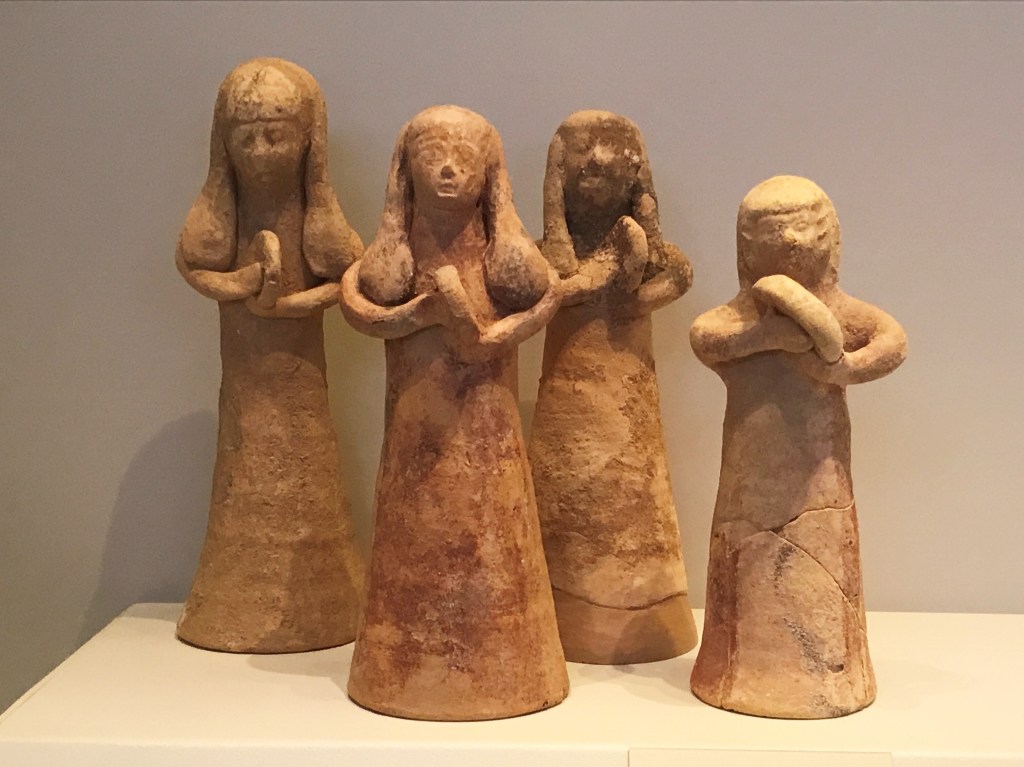
A group of terracotta figurines dating to the eight-seventh century BCE. These small figurines, six–eight inches tall, represent female figures playing the hand-drum, which was probably a woman’s instrument in ancient Israel. These terracottas are in the collection of the Israel Museum in Jerusalem. Photo by Carol Meyers, Duke University; from https://jwa.org/encyclopedia/article/women-with-hand-drums-dancing-bible
Dancing in temple worship (v.3) is also noted in other psalms; on Zion “singers and dancers alike say, ‘all my springs are in you’” (Ps 87:7), and praising God “with tambourine and dance” is encouraged in the great final psalm of praise (Ps 150:4). Dancing appears also in the narrative texts concerning Miriam (Exod 15:20), the daughter of Jephthah (Judg 11:34), Saul (1 Sam 8:6), and David (2 Sam 6:5; 1 Chron 13:8; 15:29).
The psalm ends with a celebration of the ways that God’s justice will be implemented (Ps 149:6–9), which is bracketed by reference to “the faithful” who “exult in glory” (v.5) and the closing affirmation, “this is glory for all his faithful ones” (v.9). These “faithful ones” are active in offering praise in other psalms (Ps 30:4), for they are valued by God. The psalmists affirm that the Lord “will not forsake his faithful ones” (Ps 37:28) and that their death is “precious … in the sight of the Lord” (Ps 116:15).
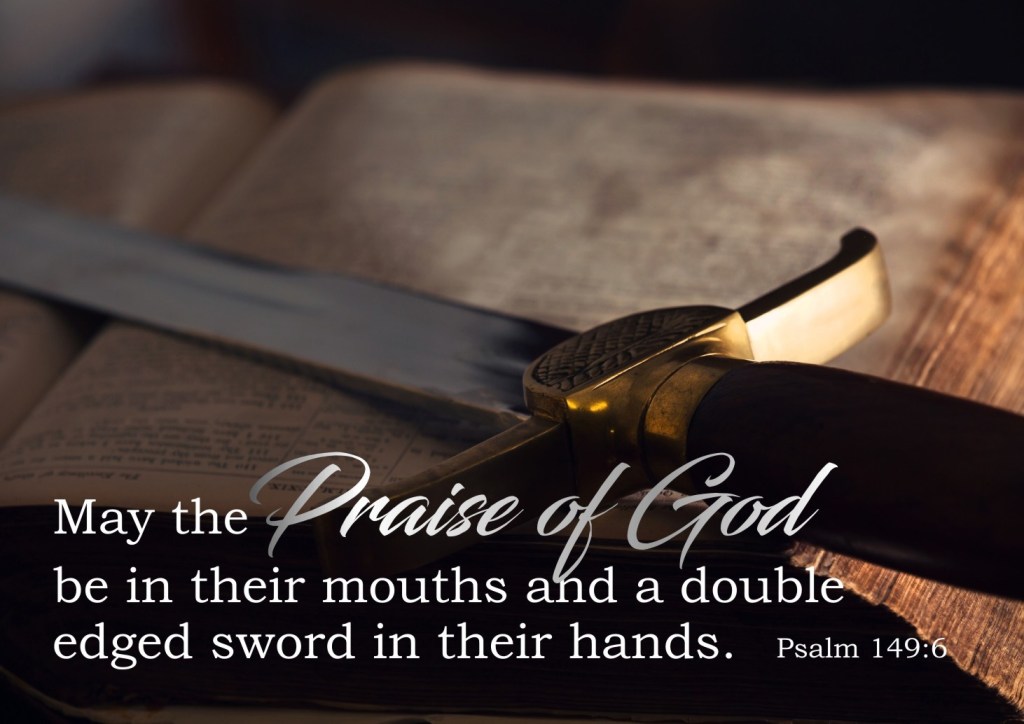
Yet regarding God’s just actions as the “glory” which God grants to these “faithful ones” is a reminder of the realities of the world in which the Israelites lived. It was marked by conflicts and battles, by bloodshed and killings, by invasions and deportations, so the judgement of God was sought by the “faithful ones” in brutal terms. With “two-edged swords”, with fetters and chains of iron, so “the judgement decreed” by the Lord God will take place (vv.6–9).
After which, the psalmist takes breath, and concludes, “Praise the Lord!” Indeed!
Whenever Christians think about the Spirit—and specifically about the dynamic force that is displayed by the Holy Spirit—our attention goes most immediately to the story of the Day of Pentecost in Acts 2. That’s when the coming of the Spirit was experienced as “a sound like the rush of a violent wind [which] filled the entire house where they were sitting”, followed by “tongues, as of fire … resting on each of them” (vv.2–3).
In the chaos that resulted—“all of them … began to speak in other languages”—the crowd that heard them were bewildered, amazed, astonished, and thought that they were drunk! That’s a disruptive event initiated and impelled by the Spirit right there. The story of Pentecost is a story about God intervening, overturning, and reshaping the people of God. The Spirit certainly was active at Pentecost.
As Luke tells the story of Pentecost, he is deliberately linking his second volume, not only to the activity of the Spirit in Hebrew Scriptures, but also to the way the Spirit overshadowed Mary (Luke 1:35), nurtured John, son of Zechariah and Elizabeth (1:80), descended upon Jesus at his baptism (3:22), led Jesus out into the Judean wilderness (4:1) and then back into Galilee (Luke 4:14) to sustain the activities and preaching of Jesus (4:18; 10:21).
Luke, of course, had received the account of the active role of the spirit in the baptism and testing of Jesus (Mark 1:10, 12) and developed it, just as Matthew had done likewise, introducing the saying of Jesus, “if it is by the Spirit of God that I cast out demons, then the kingdom of God has come to you” (Matt 12:28).
Certainly, the activities of Jesus can only be thought of as both disruptive—framed by the breach of the heavens at his baptism, the tearing of the temple curtain at his death—and as transformative—signalled by the transfiguration on the mountain top, as well as the change in the disciples effected by their time with Jesus.
Some interpreters have noted that the book of Acts is less about “the acts (deeds) of the apostles” than it is about “the acts of the Hoy Spirit”.
The author himself described the two-volumes work (Luke’s Gospel Acts) as “an orderly account of the things that have come to fulfilment amongst us”. The work highlights how the Holy Spirit plays a central, active role in what is being reported—and how the dual motifs of disruption and transformation continue apace in the movement that Jesus inspired.
The events reported in Acts are generated from the dramatic intervention of the Spirit into the early community formed by the followers of Jesus after his ascension. The story of that intervention reports that Jews came from around the eastern Mediterranean are gathered in Jerusalem for the annual festival (Acts 2:1–13), when the Spirit comes upon them. Each bursts out, “speaking about God’s deeds of power” (2:11). The joy and excitement is tangible even as we hear the story at two millennia’s distance.
Unthinkingly, the wider group of pilgrims hear the cacophony of Spirit-inspired voices, and assume that this is a sign of drunkenness (2:13, 15). Actually, as Luke has made clear, the tongues being heard are not the unintelligible gibberish evident in Corinth, but known languages from the various places of origin of those speaking. And the disruptive element is not from the tongues spoken, but from the actions undertaken by believers in the days, months, and years ahead—as the narrative of Acts conveys.
A second story of the coming of the Spirit is told at a later point in Acts—after Peter sees a vision in which God declares “all food is clean”, and he is summoned to the home of the Gentile centurion, Cornelius, in Caesarea (10:1–33). As Peter preaches to the Gentiles, the Spirit falls on them, “just as it had upon us [Jews] at the beginning (11:15). This event is specifically portrayed as a complementary event alongside the falling of the Spirit on Jews on the Day of Pentecost (2:1–4). It is a further disruptive action that the Spirit impels.
The activity of the Spirit is noted at various places in this sequence of events. The Spirit guides Peter to meet the men sent by Cornelius and travel with them to Caesarea (10:19; 11:12). In reporting to the church in Jerusalem about the arrival of messengers from Cornelius (11:11–12), Peter notes simply that “the spirit said to me to go with them without criticism” (11:12; cf. 10:19–20).
In this report to the Jerusalem church, Peter is short on factual reporting, as it were; he simply states that the spirit fell on them (11:15). His omission of many details (character traits, travel details, conversation and personnel; even, surprisingly, the name of Cornelius) places the focus on the role of the spirit. Once again, what the Spirit impels from this vision, visit, and sermon, is highly disruptive for the early communities of faith.
Jews had been used to eating separately from Gentiles and selectively in terms of food, in accordance with the prescriptions of Leviticus. Now, they are now invited—indeed, commanded—to share at table with Gentiles and to put aside the traditional dietary demarcations.
This is disruptive: just imagine being commanded by God to become vegan and eat meals with the family of your worst nightmares, for instance! And it is transformative: from this sequence there emerge inclusive communities of Jews and Gentiles across the Mediterranean basin, sharing at table and in all manner of ways. That becomes the way of the church.
The importance of the Spirit in Luke’s account of the early movement cannot be underestimated. The significance for the church today of the Spirit’s disruptive, empowering, transformative presence at Pentecost is likewise high. And that transformative activity continues on throughout Acts.
After Peter’s sermon in Caesarea and the gifting of the Spirit to the Gentiles (Acts 10—11), the Spirit guides Barnabas and Paul to Seleucia and onwards (13:2) and then later guides Paul away from Asia Minor, towards Macedonia (16:6–7). This latter move marks a critical stage in the story that Luke tells.
At this key moment of decision in Troas, three injunctions are given; each one is from a divine source. The first of these, an instruction not to speak in the southern region of Asia, comes from the Holy Spirit (16:6). The second direction, a prohibition against any attempt to head north and enter Bithynia, comes from the same spirit, here described as “the spirit of Jesus” (16:7). The third divine interjection takes place at Troas, where a vision is seen in the night with a petition to “come across into Macedonia” (16:9).
The new spirit-inspired direction of travel is disorienting; a serious disagreement between Paul and Barnabas had just occurred (15:39). But this disruption provides the springboard for Paul and Silas to undertake a new mission in Philippi, Thessalonica, and Beroea (16:11—17:15), before visiting the centre of Greek philosophy and politics, Athens (17:16–34), and then Corinth, where Paul stayed eighteen months (18:1–17). Indeed, all that takes place, as Paul travels relentlessly with various companions across many places (13:4—21:17), is driven by the Spirit (13:2, 4), a constantly disruptive and transformative presence.
Much later, Paul’s final visit to Jerusalem and his subsequent arrest takes place under the guidance of the Spirit (20:22-23; 21:11). That event had hugely disruptive consequences for Paul, of course, as he is arrested and spends the rest of his life as a prisoner under Roman guard.
The story of the early years of the movement initiated by Jesus, then, is of multiple events inspired and propelled by the Spirit over these years—intrusive, disruptive, yet transformative events. The Spirit who guides all of this is both disruptive and transform. We need, today, to be open to the same disruption and transformation today.
Whenever Christians think about the Spirit—and specifically about the dynamic force that is displayed by the Holy Spirit—our attention goes most immediately to the story of the Day of Pentecost in Acts 2. That’s when the coming of the Spirit was experienced as “a sound like the rush of a violent wind [which] filled the entire house where they were sitting”, followed by “tongues, as of fire … resting on each of them” (vv.2–3). And, of course, the chaos that resulted—“all of them … began to speak in other languages” meant that the crowd that heard them were bewildered, amazed, astonished, and thought that they were drunk!
That’s a disruptive event initiated and impelled by the Spirit right there. The story of Pentecost is a story about God intervening, overturning, and reshaping the people of God. The Spirit certainly was active at Pentecost; but this was not the first time that Jewish people had experienced the Spirit. Pentecost was far from being the first time that the Spirit came and caused upheaval!
Hebrew Scripture refers to the actions of the spirit at many places throughout the story of Israel. In the Exodus from Egypt, the foundational story of Israel—an incredibly disruptive and disturbing experience, to be sure!—the Spirit was at work. “You gave your good spirit to instruct them, and did not withhold your manna from their mouths, and gave them water for their thirst” is how Ezra recounts the story (Neh 9:20–22). It was the work of the Spirit to release the captives from Egypt, lead them through the challenges of the wilderness, and then bring them into the land promised to them.
The Spirit which had guided Moses and was then gifted to chosen elders (Num 11:16–25) was subsequently imparted to Joshua (Num 27:18; Deut 34:9) and then to a string of Judges: Othniel (Judg 3:10), Gideon (6:34), Jephthah (11:29), and Samson (13:24–25; 14:6,19; 15:14). Each of these men led their people through dangerous, challenging, and turbulent experiences, as they sought to impose Israelite domination on the peoples already living in Canaan.
We might justifiably have a different ethical assessment of this process today—invasion, colonisation, and massacre are familiar dynamics, unfortunately, in the Australian context—but for our present purposes we can note that the Spirit was the energising force in this long and disruptive process. It was disruptive for the inhabitants of the land, as they lost homes, families, and cultural heritage. It was disruptive for the invading Israelites, as they followed they call of their leaders to enter and inhabit the land that they believed God had long promised to them.
The Spirit was also active during the period of kingship in Israel. Saul, after he was anointed as king, was possessed by the Spirit and fell into “a prophetic frenzy” (1 Sam 10:6, 10). During his reign, the Spirit continued to operate through David (1 Sam 16:13; 2 Sam 23:2) and presumably gifted Solomon with “his very great wisdom, discernment, and breadth of understanding as vast as the sand on the seashore” (1 Ki 4:29–34; and see Prov 2:6–11). Perhaps Solomon was the model for the spirit-gifted wisdom exhibited by Joseph (Gen 41:33, 38–39), when the ancestral sagas were collected and compiled into the book of Genesis?
It was the Spirit seen in these first three kings who would be seen as the agent for God to be at work in subsequent rulers (Isaiah 11:2). In addition, the prophetic frenzy manifested by Saul might well be regarded as the prototype for later prophetic activity. It signals just how powerfully the work of the Spirit can disrupt and disturb individuals, and a collective group.
*****
The clearest example of this personally disruptive impact is found in the story of the priest Ezekiel, son of Buzi, who was dramatically called to be a prophet. After Ezekiel saw a striking and bizarre vision of a winged chariot, bearing four winged figures (Ezek 1:4–28), he fell on his face; but the Spirit grabbed hold of Ezekiel, entering into him and raising him up onto his feet (Ezek 2:2). Ezekiel has the same visceral experience many more times (Ezek 3:12, 14, 24; 8:3; 11:1, 24; 37:1; 43:5). The work of the Spirit was anything but calm and measured for Ezekiel.
In his prophecies, Ezekiel notes that the Lord God promised to mete out the same dramatic treatment to the Israelites during their exile (Ezek 11:19; 36:26–27; 37:14). Being seized by the Spirit would reorient the hearts and refashion the lives of the exiles, as they look to a return to the land. That is thoroughly disruptive!
Other prophets also look to the activity of the Spirit to be both disruptive and also transformative. The Spirit would inspire prophecies amidst dramatic portents (Joel 2:28–42); the Spirit would declare the way of justice in the midst of the injustices perpetrated by the people, which presages ruin for the land (Micah 3:8–12); and the Spirit would equip leadership during the return to the land, ahead of the tumult of God “shaking the heavens and the earth and the sea and the dry land” (Haggai 1:14—2:9).
The book of Isaiah contains various exilic oracles which point to the Spirit as the agent of declaring justice to the people (Isa 42:1–9; 61:1–11) and wreaking revenge on the enemies of Israel (Isa 48:14–16). Once again, the disruptive dimension of the Spirit’s work is evident.
In later texts in Hebrew Scripture, there are indications that the spirit inhabits human beings simply through the fact that they exist as the creations of God (Job 27:3; 32:18; 33:4; Zech 12:1). Indeed, all of creation came into being through the spirit of God (Ps 104:30). The act of creation itself was a fracturing of an existing state, a breaking-open of what was for it to become something other than what it had been. Creative activity is disruptive activity.
*****
So the last thing to note about the Spirit in Hebrew Scripture is the first thing that is said about it in the opening chapter of Genesis—the post-exilic priestly document which recounts the foundational creation myth of the Israelite peoples. As the story of creation is placed at the very beginning of the first scroll in the Hebrew Scriptures (Gen 1:1—2:4a), it is explicitly noted that it was by the spirit of God that the creation came into being (Gen 1:1-3).
That creative act began with complete chaos, and shaped and formed the “formless void and darkness” of the very beginning, to become an ordered, cohesive, complex system of inter-relating parts. The status quo of formless nothingness was disrupted, as the wondrously beautiful creation was shaped by “a wind from God [which] swept over the face of the waters” (Gen 1:2). Interpreters over the centuries have assumed that this wind was in fact the Spirit of God, active from the very beginning of God’s creative act.
The Holy Spirit was already integral to the faith of the ancient Israelites. The Holy Spirit continued to play a key role for the early Christians. The Holy Spirit remains a force to be reckoned with in our own times, today. The Spirit may well be how God is calling us to disrupt the status quo of the church today!
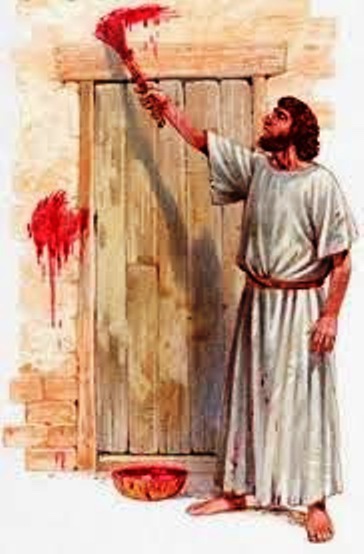
The instructions are clear: “take some of the blood and put it on the two doorposts and the lintel of the houses in which they eat it” (Exod 12:7).
The explanation is also clear: “I will pass through the land of Egypt that night, and I will strike down every firstborn in the land of Egypt, both human beings and animals … the blood shall be a sign for you on the houses where you live: when I see the blood, I will pass over you, and no plague shall destroy you when I strike the land of Egypt” (Exod 12:12–13).
It’s a story of hope, expressed in joy; and it’s a story about death, filled with despair. We will hear it this Sunday, as it is offered as the Hebrew Scripture reading for Pentecost 15 (Exodus 12:1–14). It all depends on where you stand as you hear the story. Are you in the shoes of the escaping Hebrews? Or in the shoes of the Egyptians who saw their beloved children slaughtered?
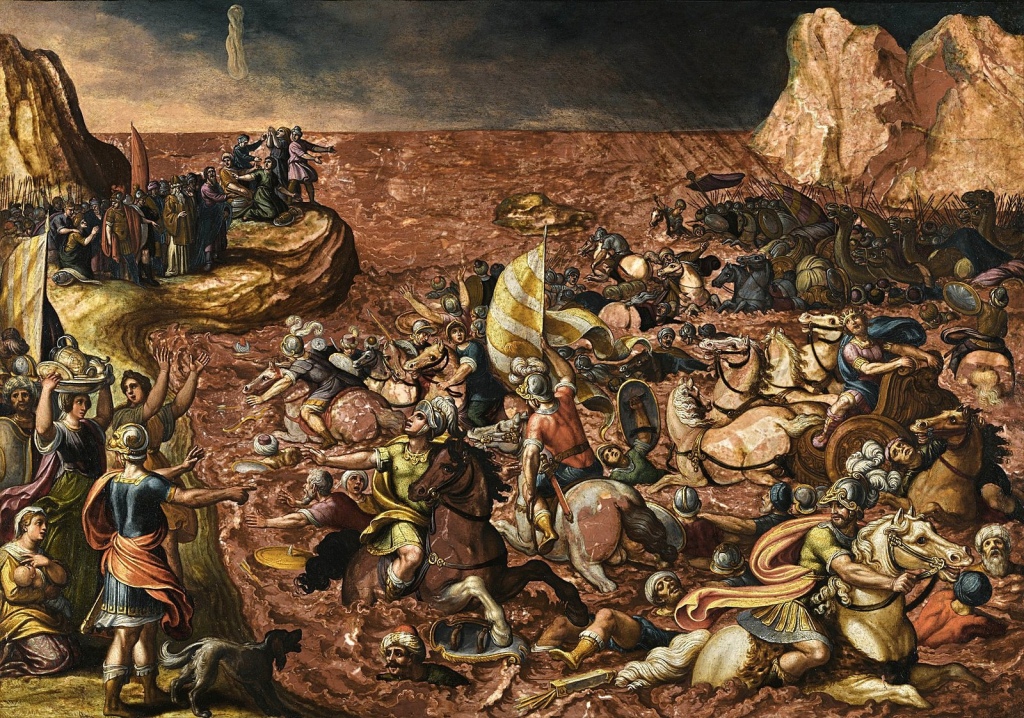
The story that is told about the Exodus in the Hebrew Scriptures is a story filled with hope. It tells of the liberation of an oppressed people, suffering under the burdens of forced labour; it recounts the sequence of events that led to the miraculous escape from slavery, crossing through the Sea of Reeds, travelling unhindered through the wilderness, into a land which the story claims was promised by God—a promised land, gifted to a chosen people by a holy God.
The story that is told in the Hebrew Bible about the Exodus is also a story filled with violence. There is the violence executed in Pharaoh’s actions in having the young boys murdered. There is the violence that is threatened by the Egyptian army as their chariots and horses thunder in hot pursuit of the escaping Israelites.
Worse, there is the insistent violence in the series of increasingly damaging plagues which God is said to have sent against the Egyptians. And finally, there is the climactic and catastrophic violence of the surging of waters over the army and their horses, as they as swamped and drowned in the middle of the Sea of Reeds.
It is a difficult story to take at face value; what sort of people remember such a tale of incessant violence? and what sort of a God takes sides with one group of people and acts in such a vicious way against their opponents? Furthermore, how can we accept this story as part of our canon of scripture, when it is so filled with violent act after violent act?
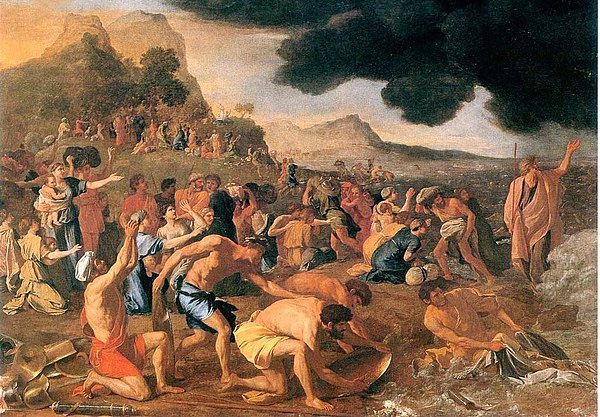
The Crossing of the Red Sea by Nicholas Poussin (1633–34)
This is not the only place that we encounter violence in the Hebrew Scriptures; as the story goes on, it proves to be one of invasion, massacre, colonisation, and dispossession of people in the land of Canaan; and then, a string of battles take place in various locations, as the invading Israelites gradually exert their dominance over the indigenous people of the land.
All of this violence is indeed of deep concern, and it can be seen to place the whole of those scriptures under a cloud. However, I don’t want to fall into the supercessionist trap, the approach taken in the second century by Marcion of Sinope, who discarded the whole of the Old Testament—and, indeed, a significant part of the New Testament! We have these stories as part of our scriptures, and we need to hear them, ponder them, and engage critically with them.
Nor do I want to gloss over the fact that acts of violence, both those committed by human beings, and those attributed to the Lord God, can be found in many parts of the New Testament. It is a ubiquitous problem. Violence is expressed in many texts in scripture—both Jewish and Christian—and, indeed, is found in the texts of many other religious traditions. Human beings live, and die, by violence. We can never escape it, it seems.
If we take these texts as a literal account of historical events, we have significant theological issues to address. And there are a number of difficult historical questions that must be addressed, if we want to hold to the claim that Exodus is reporting an historical “as it really happened”. Where is the evidence for the escape of a huge number of people at that time? (There is none.) Who was the Pharaoh of the time? (There are two very different suggestions about this.)
What about the evidence for the huge crowd that spent 40 years in the desert? Where are the bones of the dead, the remains of campsites, from that crowd, if that is accepted to be the massive crowd 600,000 males (plus their women and children) that would set forth into the wilderness (see Exod 12:37) and then their descendants? There is absolutely no evidence for these archaeological remains, at all.
But such a forensic historical interrogation is not my approach to the story of the Exodus, nor to other parts of Hebrew Scripture, nor, indeed, to the narratives found in the New Testament.
So my approach to these texts has been to undertake an appreciative enquiry approach: what is this text saying? what drives the energy of the writer? what issues of concern do I read and hear—explicitly in the words used, and implicitly, in between and under what is said? what elements can I affirm, as contributing constructively to the Hebrew Scriptures’ understandings of God? and, as a consequence of that, to the New Testament’s understandings of God?
To begin, we need to recognise that the Exodus was seen as the paradigm for liberation—political, cultural, social, religious—which has shaped Jewish life for millennia. It is no wonder that it was picked up as a key motif for early followers of Jesus, to describe his significance: preaching the kingdom of God, the righteous-justice of a compassionate God, a challenge to the collective political, social, and religious status quo, and a liberating way of being for those following him.
A group of priests in the exile in Babylon collected and collated materials from earlier traditions, and developed a series of stories that conveyed in saga form the key elements of their national story. Symbolism and poetry were the paramount features of these stories, originally oral, later written on scrolls.
In the latter stages of the Exile or perhaps in the early stages of return to the land and rebuilding society, the stories and sagas were drawn into the set of scrolls we know as the Torah, the first part of the TaNaK. Symbolism featured prominently in these poetic stories and narrative rehearsals of the past.
The Passover occupies a central place in the long, sweeping narrative that is told in Hebrew Scripture. As well as the story of the Passover which led to the exodus from Egypt (Exod 12–15) and the thrice-documented priestly regulations governing the annual celebration (Lev 23:4–8; Num 28:16–25; Deut 16:1–8), the story is told of celebrating Passover at key moments in that ongoing narrative: at the foot of Mount Sinai (Num 9:1–14), at Gilgal when about to enter the land of Canaan (Josh 5:10–12), when the Temple worship was restored under Hezekiah (2 Chron 30:1–27), and during the great reformation that took place under Josiah (2 Ki 23:21–23).
The priest-prophet Ezekiel, in his vision of the restored land and new Temple, seen during the Exile, insists that the Passover be celebrated on a recurring annual basis (Ezek 45:21–25). Even though the Temple that was eventually rebuilt was of a different size and shape, when the Exiles returned under Darius, the Passover was celebrated at the dedication of the rebuilt Temple (Ezra 6:19–22).
Over time, interpreters under influence from later developments in thinking began to “reify” and “historicise” these symbolic sagas and develop the idea that they reported “events that actually happened”. They didn’t—as we have noted, there is no evidence outside the Bible for the sequence of events found in the Exodus saga. But the story had a potency for these priestly writers as the land was restored, the Temple rebuilt, society reconstructed.
The Passover story, leading up to the escape of the Exodus, that Jews recall and relive each year and which Christians remember on a regular basis in the eucharistic celebration, tells the age-old scapegoat dynamic in a dramatic story filled with symbolism. It too was not an historical event, but a story developed to explain the special significance of the people of Israel and their faith in a god who took extraordinary steps to secure their freedom.
Of course, within the emerging Jewish movement that had a focus on Jesus as an authoritative teacher of the Torah, a key way of grappling with the fact that Jesus was put to death as a criminal, hung on a cross under the orders of the Roman Governor, was to draw on this story of blood shed, lambs sacrificed, and salvation gained.
The timing of the death of Jesus is placed within the Passover festival by all four canonical Gospels. That is the festival that remembers the story of what happened to Israel, long ago—and that passes on the story that this happens year-in, year-out, as the faithful people of Israel remember and relive their national salvation.
One Gospel even locates the actual hour when Jesus dies on the cross as being “on the day of preparation for the Passover” (John 19:14, 31). Jesus, already identified in this Gospel as “the lamb of God who takes away the sins of the world” (John 1:29, 36), dies when the Passover lambs are being slaughtered in preparation for the Passover meal that evening. (The other three Gospels, of course, place the last meal of Jesus with his disciples at the Passover meal—Mark 14:12–25 and parallels—and thus, in their chronology, he dies on the day after Passover.)
Jesus is remembered as the “paschal lamb … who has been sacrificed” (1 Cor 5:7); it is by the shedding of his blood that atonement with God takes place (Rom 3:25), that faithful people are justified (Rom 5:9), that peace is achieved (Col 1:20), that redemption occurs (Eph 1:7). One writer makes much of this, emphasising that this redemption is eternal (Heb 9:12; 13:20), opening up “a new and living way” (Heb 10:19–20). It is his shed (sprinkled) blood makes Jesus “the mediator of a new covenant” (Heb 12:24) and that his faithful people are sanctified (Heb 13:12).
So this ancient story, passed down by word of mouth and then written in scrolls that themselves were passed down for reading and understanding, sits deeply within the self-understanding of both Jewish and Christian people. It is a story we cannot avoid.
The Gospel we ascribe to the authorship of Matthew the tax collector, the first of the four in the canon of the New Testament, is distinctive for a number of reasons. One of those is that it contains a collection of the sayings of Jesus which relate to life in the community of faith—a kind of a miniature “community rule” for the people for whom the author was writing.
Those sayings are collected together in chapter 18, which is the fourth of five teaching blocks in the arrangement made by the author of this Gospel. We will hear and read some of those words this coming Sunday (Matt 18:15–20, Pentecost 15A), and then a parable relating to these teachings next week (Matt 18:21–35, Pentecost 16A). And this week’s reading contains some stridently harsh words from Jesus: if a person who has “sinned against” refuses to be reconciled, then “let such a one be to you as a Gentile and a tax collectors” (18:17)!
These five teaching blocks canvass ethical imperatives (5:1–7:29), missional guidelines (10:5–11:1), parables of the kingdom (13:1–53), relationships within the community of faith (18:1–19:1), and apocalyptic predictions about the coming kingdom along with strengthened indications of what righteousness is required in that kingdom (23:1–26:2). These teachings are demanding and comprehensive.
In each block of material, the author has drawn together teachings of Jesus that have been assembled from various sources, and arranged in a manner that presents these collected sayings and teachings as a cohesive, sermon-like presentation. The hand of the author is clear, just as the voice of Jesus is strong.
So the first fourteen verses of this chapter comprise words which are found at various places in the Gospel of Mark, one of Matthew’s sources, as well as in the sayings material which is believed to have been collected earlier, in the hypothetical source known as Q. (Material in Q, according to this theory, was known to and used by both Matthew and Luke, but in different ways and in different places in their works.)
The first five verses (18:1–5) report the words of Jesus about the child and the kingdom of heaven, which are included in all three Synoptic Gospels. When a child is placed before him, Jesus declares that “unless you change and become like children, you will never enter the kingdom of heaven; whoever becomes humble like this child is the greatest in the kingdom of heaven” (18:3–4). The same saying is found in slightly varied forms at Mark 10:14–15 and Luke 18:16–17.
The conclusion to this short scene, “whoever welcomes one such child in my name welcomes me” (Matt 18:5), is a variant on an earlier Matthean saying, “whoever welcomes you welcomes me, and whoever welcomes me welcomes the one who sent me” (Matt 10:40; and the subsequent variations, 10:41–42).
This, in turn, is derived from Mark’s own earlier account of when Jesus “took a little child and put it among them; and taking it in his arms, he said to them, ‘Whoever welcomes one such child in my name welcomes me, and whoever welcomes me welcomes not me but the one who sent me’” (Mark 9:36–37). Luke replicates this at Luke 9:47–48.
So the first section of this chapter already shows the dependence of the author on an earlier source, and his willingness to appropriate and reshape the material for his own purposes.
The next four verses (18:6–9) deal with skandala, a group of sayings that Mark reports in his account: “if any of you put a stumbling block [a skandalon] before one of these little ones who believe in me, it would be better for you if a great millstone were hung around your neck and you were thrown into the sea” (Mark 9:42). Mark himself then extends this saying with reference to having a hand or foot cut off, if it is a skandalon, as well as an eye plucked out if it, also, is a skandalon (Mark 9:43–48).
Matthew includes all the material that he finds in his Markan source—the little ones, the errant hand and foot, and the eye—and expands it, adding some words that intensify the warning: “Woe to the world because of stumbling blocks! Occasions for stumbling are bound to come, but woe to the one by whom the stumbling block comes!” (Matt 18:7).
Luke reports the initial words of Jesus (Luke 17:1–2), but then places the word about forgiving another member of the community (Luke 17:3) and the command to “forgive seven times seven” (Luke 17:4)—a word which provides the basis for the last section in Matthew’s fourth teaching block (Matt 18:15–35). So Luke and Matthew have each collated diverse words of Jesus, but in different combinations.
Before that, however, Matthew has Jesus tell the parable of the lost sheep (Matt 18:10–14), which is found also in Luke 15. In Luke’s recounting of the story, it is the first of three parables focussed on seeking the lost and welcoming them home with joy.: a list sheep, a list coin, and then two sons, each list for very different reasons
In Matthew’s narrative, however, the parable stands on its own, as a hinge between the warnings about skandala and instructions about dealing with conflict. The orientation is clear: stumbling blocks present problems, but the Gospel includes a call to seek reconciliation and embrace the return of a repentant one—for “it is not the will of your Father in heaven that one of these little ones should be lost” (18:14).
So the theme is set for passage which is offered by the lectionary this Sunday (18:15–20), which deals with conflict within the community. There is a short and direct statement about such a situation that is made by Jesus in Luke’s account: “if another disciple sins, you must rebuke the offender, and if there is repentance, you must forgive; and if the same person sins against you seven times a day, and turns back to you seven times and says, ‘I repent,’ you must forgive” (Luke 17:2–3).
It seems that this word comprises a reflection that sits neatly alongside an independent Markan saying: “whenever you stand praying, forgive, if you have anything against anyone; so that your Father in heaven may also forgive you your trespasses” (Mark 11:25). That word provides the undergirding for the instruction to forgive: God offers forgiveness.
Divine forgiveness is a theme that the Hebrew prophets of old surely knew (see Isa 33:24; Jer 31:34; 33:8; 36:3; Ezek 16:62–63; Dan 9:9, 17–19; Amos 7:1–3; Hos 4:4–7) and which the psalmists regularly sought (Ps 25:18; 32:1; 65:3; 79:9). They know that, “if you, O Lord, should mark iniquities, Lord, who could stand? But there is forgiveness with you, so that you may be revered” (Ps 130:3–4). And so Jesus instructs his disciples, when praying, to ask God to “forgive us our sins, for we ourselves forgive everyone indebted to us” (Luke 11:4; and compare Matt 6:12).
In Matthew’s reworking of this Q material, it takes no less than twenty verses to get from the presenting problem—“if another member of the community sins against you” (18:15)—to the final resolution, that we are to show mercy and forgive—for “if you do not forgive your brother or sister from your heart”, neither will God forgive you (18:35). Matthew does this through some direct instructions (18:15–20), which we hear in this week’s lectionary readings, and then an extended parable (18:21–35), which we will hear in the following week’s lectionary offerings.
The construction of this instructional section is clear and informative. There are four “if” clauses, setting out a hypothetical situation: “if another member sins” (v.15a), “if the member listens” (v.15b), “if you are not listened to” (v.16), and “if the member refuses to listen” (v.17). We know that this is a hypothetical situation, because the syntax of the Greek at this point does not use the simple construction for a “real present condition”, ei followed by the verb in the indicative mood, with a resolution also in the indicative.
Here, the syntax is ean followed by the verb in the subjunctive mood, followed by a resolution in the indicative. That pattern appears four times in these three verses. Jesus (via Matthew) is setting out a possible scenario, with clear guidance as to what course of action is to be taken in that scenario.
For the first three times, the response is clear and compassionate. If a sin occurs, “go and point out the fault” (v.15a). If the person listens, “you have regained that person” (v.15b). If the person does not listen, “take one or two others with you” (v.16). And as the situation increases, the inclusion of others in the process broadens the responsibility for possible resolution.
It is thought that the “one or two others” in the third step reflects the need for “two or three witnesses” in the prescriptions of Torah (Deut 17:6, and especially 19:15). Indeed, the author of this Gospel, as a pious Jew immersed in the details of Torah, would have known well the process that is outlined in Deut 19:15–21, which provides that “a single witness shall not suffice to convict a person of any crime or wrongdoing” (Deut 19:15).
It is this passage, famously, that proceeds through a process of clarification—particularly in relation to identifying a false witness (Deut 19:16–19)—before the culminating sentence is pronounced: “so you shall purge the evil from your midst … show no pity: life for life, eye for eye, tooth for tooth, hand for hand, foot for foot” (Deut 19:19, 21). Justice is clear; justice is hard; justice is demanded.
Seen in the light of this Torah provision, we can therefore understand the sequence that Jesus, via Matthew, envisages: a private conversation, then a conversation with witnesses , and then, if required, a full, public declaration of the sin—and the punishment, “let such a one be to you as a Gentile and a tax collector” (Matt 18:17).
The process that Matthew envisages is oriented towards “regaining” the one who has sinned. The Greek word in verse 15 which is translated in this way was used by Paul to indicate success as he seeks to convince people to follow Jesus as Messiah (1 Cor 9:19–23; notice the reacting “so that I might win”). It may be that Matthew has this in mind in his use of the word in verse 15; the aim is to “win” or “regain” a person back into the community, through a process of intensified persuasion.
I confess that I once wrote a detailed exegesis of this passage which argued that this word provided the key to the passage: the aim was to regain a person, to have reconciliation. I even went on to claim that “like a Gentile or a tax collector” in verse 17 did not mean, banish this person from the community, but consider them to be providing a new opportunity for them to be “converted”, persuaded of the value of the Gospel. My professor said it was very well argued, even though he did not agree with my somewhat optimistic conclusion. (I got a good grade, though!)
In the decades since then, a number of conversations with my wife Elizabeth—who has spent more time focussing on Matthew’s Gospel than I have, even though I have taught courses on Matthew for 20 years now—convinced me that the clue lies in the words used in verse 17. After all, neither a Gentile nor a tax collector is highly regarded in this Torah-informed Gospel.
Jesus, in Matthew’s account, instructs his disciples “do not heap up empty phrases as the Gentiles do” (6:7), noting that “if you greet only your brothers and sisters, what more are you doing than others? do not even the Gentiles do the same.” (5:47), and also that “it is the Gentiles who strive for these things” that are of passing value—food and drink, the length of life and our clothing—on contrast to “the kingdom of God and God’s righteous-justice” (Matt 6:32–33). The Gentiles do not get a good rap from the Matthean Jesus.
Indeed, in this Gospel, Jesus quite distinctively commands his disciples, “go nowhere among the Gentiles, and enter no town of the Samaritans, but go rather to the lost sheep of the house of Israel” (10:5-6), and dismissively informs a Canaanite woman, “I was sent only to the lost sheep of the house of Israel”, and so “it is not fair to take the children’s food and throw it to the dogs” (15:24, 26). Keep away from the Gentiles is his persistent message! (Until that is reversed by the risen Jesus, in a great turnaround, at 28:19–20).
And as for tax collectors: the first thing to say ist hat whilst the traditional understanding is that this Gospel was written by a tax collector (the one identified at 9:9), scholarly interpreters regularly dismiss this as later tradition, and note that working from the text leads us to conclude that the author was more likely a fervent, pious Jew, Torah-abiding and also deeply committed to regarding Jesus as rabbi, teacher, and Messiah.
Of course, Jesus was known for eating with tax collectors (Mark 2:15–16 and parallels)—but not so much with Gentiles (especially in Matthew’s Gospel!). Here, however, the tax collectors to whom the errant community member are to be dispatched (18:17) are those linked with sinners (9:10–11; 11:19) and with prostitutes (21:32), those who, rather than loving their enemies (5:44), “love those who love you”. “Do not even the tax collectors do the same?”, Jesus asks (5:46), placing them on par with the Gentiles, as we have already noted (5:47). So in this Gospel, it seems that to be with tax collectors and Gentiles is to be amongst those, outcast from God, who are determined to live in a way that does not reflect how Jesus understands God wants his people to live.
So the Matthew passage results in the Sam end as the Deuteronomy passage” “purge the evil from your midst” (Deut 19:19), let the sinful one “be to you as a Gentile and a tax collector” (Matt 18:17). In both cases, the need for a clear boundary, marking off the faithful from the evil ones who surrounded them, was paramount. No gentle Jesus, meek and mild, here!!
The decision is undergirded by words about binding and loosing which harken back to the authority given to Peter (16:19). It is a decision reinforced by divine authority—what is decided on earth “will have been bound (or loosed) in heaven”.
“Love is the fulfilling of the law”, Paul asserts in the passage that we are offered by the lectionary for consideration this coming Sunday (Rom 13:8–14). “Christ is the end of the law”, he has boldly asserted in an early part of the letter (Rom 10:4). How do these two seemingly contradictory statements stand alongside each other? What is the status of the law—the Torah, the foundation of Jewish life and faith—for Christians?
In making his statement about Christ and the Law (10:4), Paul has used an important Greek word: telos. This is regularly translated as “Christ is the end of the Law”; but we might well ask, what is the sense of the word “end” in this verse? On the one hand, this word might does infer a meaning of “the end as and abolition”, doing away with the Law. Apart from the fact that this directly contradicts what Jesus said about his intention not to abolish any single part of the Law (Matt 5:17–18), it is a most an unsatisfactory supercessionist reading, which completely does away with all the Old Testament.
On the other hand, there is the sense (which I prefer) that this means “the end as in bringing to the height of fulfilment”. In which case, Christ is bringing the Law to its logical and natural end, or goal: the complete expression of the Law through love. In other places where the word telos is used, it has this sense of bringing to fulfilment or bringing to perfection.
Indeed, this latter sense accords with the use of the term in other Pauline texts, where it is used to refer to those with spiritual maturity. He encourages the Corinthians, “in your thinking, be adult (teleioi)” (1 Cor 14:20). He confesses to the Philippians, “not that I have already obtained this or have already reached the goal (teteleiōmenoi)” (Phil 3:12) and exhorts “those of us then who are mature [to] be of the same mind” (Phil 3:15).
In later letter claiming Paul as author, the term signifies those “mature in Christ (teleioi en Christō)” (Col 1:28; see also Eph 4:13). It is perhaps similar to the meaning in Hebrews, which makes the claim that Jesus is the means of offering a perfect sacrifice (Heb 2:10; 5:9) through which “by a single offering he has perfected (teteleiōken)for all time those who are sanctified” (Heb 10:14).
Of course, the idea of being perfect is integral to the appreciation of God that is expressed at various places in Hebrew Scripture. “This God—his way is perfect”, the psalmist sings (Ps 18:30; echoed also at Deut 32:4; 2 Sam 22:31; Job 37:16), and in another psalm, “the law of the Lord is perfect, reviving the soul” (Ps 19:7).
So the temple that Solomon built was to be perfect (1 Ki 6:22), the sacrifice of wellbeing to be offered there, “to be acceptable it must be perfect, there shall be no blemish in it” (Lev 22:21), and no person with a blemish is able to serve as a priest (Lev 21:16–24).
Perhaps this is the sense of telos, perfection, complete fulfillment, that sits underneath the use of this word by Paul at Rom 10:4? That would mean that he is proposing that Christ brings the Law to a state of perfection in which it is filled to overflowing with God’s goodness.
Certainly, this would explain why Paul is able to affirm that “the whole law is summed up in a single commandment, ‘You shall love your neighbour as yourself’” (Gal 5:14). Law and love are here seen in close interrelationship with one another, not in opposition to one another. Love is the essence of the Law, bringing fulfillment what the Law set forth.
And that would also explain the words we have in this coming Sunday’s reading from Rom 13, that “the one who loves another has fulfilled the law” and so “love is the fulfilling of the law” (Rom 13:8, 10).
The key words used in Rom 13:8–10 are equally strong with regard to the ongoing validity and relevance of the Law, for Paul. He uses two words derived from the verb plēroō, meaning “to fill up”, and thus, “to fulfill”. In 13:8, he says that “love has fulfilled the law”, using the perfect form of the verb, peplērōken. The perfect has the sense of an action completed in the past which has consequences which continue on into the present time. So the fulfilling of the Law in the past by deeds of love has ongoing consequences—that Law, those acts of love, impinge on the present time.
Then, in 13:10, Paul reiterates that “love is the fulfilling of the law”, using a noun formed from this verb, plērōma. That conveys the idea that the Law has been filled right up to overflowing, fully and completely, by acts of love. The Law remains relevant and potent, because of those fulfilling acts of love.
Alongside these two words, Paul uses another word to make a similarly strong statement. Quoting for of the Ten Commandments, he affirms that these laws are “summed up” in another set of words, taken from Hebrew Scripture itself: “love your neighbour as yourself” (13:9, quoting Lev 19:18). The verb translated “summed up” is anakephalaioutai, a compound word combining the idea of “the head” (kephalē) and “brought up to” (the preposition ana).
This word contains the sense, then, that everything is gathered together and taken up into the head; obedience to each and every one of the commandments of the Law is gathered together and taken up into the head, that is, in the act of loving the neighbour.
Paul could not be clearer, and could not be stating things more strongly: the Law is filled to overflowing in love. The Law continues to have power. It is not abandoned as irrelevant or outdated.
Paul’s attitude to the Law, however, is quite complex. He trained as a Pharisee, and he notes at he was “far more zealous for the traditions of my ancestors” (Gal 1:14), and so he has a “delight in the law of God in my inmost self” (Rom 7:22). He affirms that he upholds the Law (Rom 3:31), alluding to various commands in The Ten Words which he insists are worth obeying (2:17–22), and affirming that, in its essential character, “the law is holy, and the commandment is holy and just and good” (7:12).
Yet his calling to be “apostle to the Gentiles” (Rom 11:23; Gal 2:8) led to his experience of eating at table with Jews and Gentiles together, in breach of kosher food laws (Gal 2:11–13)—an issue that is clearly in view decades later, as Luke writes his account of the early years of the Jesus movement, siding with Paul in the view that God has set aside the requirement for separate foods and separate tables (Acts 10:1–11:18; 15:19–20, 28–29).
This, in turn, leads Paul to his missionary goal of bridging the gap between Jews and Gentiles in practical ways (Rom 15:25–27), undergirded by the message that he preaches, affirming that salvation is offered “to everyone who has faith, to the Jew first and also to the Greek” (Rom 1:16; see also 2:10; 10:12; Gal 3:28; and the post-Pauline development in Eph 2:11–22). He is driven by the scriptural claim that “God shows no partiality” (Rom 2:11; Deut 16:19–20; 2 Chron 19:7; Sir 35:15–16).
So his letter to the Romans is a long and complex argument in which he explains how he understands that the good news is that “the righteous-justice of God [is] through faith in Jesus Christ for all who believe” (3:22), that there is “justification and life for all” (5:18). The argument builds and develops, demonstrating how God has chosen to make righteous-justice available to all human beings, through Abraham as through Jesus, by means of the indwelling Spirit.
So this leads Paul to write in negative terms about the Law. Although he maintains that having faith in Jesus does not “overthrow the law”, and he insists that “we uphold the law” (3:31), he goes on to note that “the law brings wrath” (4:14), for where “the law came in … the trespass multiplied” (5:20). “If it had not been for the law”, he asserts, “I would not have known sin” (7:7), and so “I am a slave to the law of sin” (7:25), and in Jesus, “God has done what the law, weakened by the flesh, could not do” (8:3).
Accordingly, “Israel, who did strive for the righteousness that is based on the law, did not succeed in fulfilling that law” (9:31). Or, as he portrays things in writing to the Galatians, “a person is justified not by the works of the law but through faith in Jesus Christ” (Gal 2:16), “through the law I died to the law” (2:19), “if justification comes through the law, then Christ died for nothing” (2:21), “no one is justified before God by the law” (3:11), and even, “if you are led by the Spirit, you are not subject to the law” (5:18).
However, to the proposition that he poses, “Is the law then opposed to the promises of God?”, Paul immediately replies, “Certainly not!” (3:21), and then argues that “the law was our disciplinarian until Christ came, so that we might be justified by faith” (3:24). This looks like Paul is ready to contend that the Law is superseded, and should be put aside. But not so fast; “I testify to every man who lets himself be circumcised that he is obliged to obey the entire law” (5:3). He is not prepared to let it go entirely. The Law still stands for Jews—but not for Gentiles.
Indeed, in the most complex midrashic section of his letter to the Romans, Paul plunges into a complex reading of scriptural texts in order to sanction the claim that God’s sovereign mercy offers a universal righteous-justice, both to Jews and to Gentiles alike (Rom 9:1–11:32).
This section of the letter contains the greatest concentration of scripture citations and allusions of the whole of this letter to the Romans—and, indeed, of all of the seven authentic letters of Paul. In the argument that is advanced by a Paul, whilst he signals the limits and inadequacies of the Law, he holds fast with the view that the Law is not rendered obsolete, but rather is brought to fulfilment (10:4; see the discussion above).
Paul,asks pointed questions: “does this mean that “the word of God had failed”? (9:6) and “has God rejected his people?” (11:1). “By no means!” is once again the Pauline riposte. “Through the stumbling [of Israel] salvation has come to the Gentiles, so as to make Israel jealous” (11:11), yet “as regards election they are beloved, for the sake of their ancestors; for the gifts and the calling of God are irrevocable” (11:28–29).
The complex midrashic argumentation of these three chapters comes to a climax in a string of joyously prayerful affirmations concerning God’s “riches and wisdom and knowledge”, leading to the attribution of glory to God forever (11:33–36). This is the ultimate response to the singular grace of God’s gift of righteous-justice to all human beings. And that gracious gift fulfils, or brings to culmination, the Law that Israel was given.
The Voice to Parliament is not a partisan political issue; it is a national matter that draws together a wide range of Australian society in support of the First Nations people of this continent and its surrounding islands.
Over 110 ethnic and cultural community organisations have committed their “steadfast support” for a YES vote in the upcoming Voice referendum. Signatories includes multiple Indian and Chinese community organisations, along with Sri Lankan, Italian, Irish, Iranian, Greek, Vietnamese, Filipino, Sikh, Islamic, Hindu, Buddhist and Pacific Islander community groups – to name just a few.
The Joint Resolution describes a constitutionally guaranteed Voice as “modest, practical and fair”. In their press release, multicultural community leaders say, “as leaders of diverse multicultural community organisations, we endorse the Uluru Statement and its call for a First Nations voice guaranteed by the Constitution”. They further say, “We commit our steadfast support, and urge all Australians to work together to ensure referendum success. Let us co-operate across differences of politics and diversities of culture and faith, to heal our country and unify the nation.”
*****
Leaders of Australian Muslim communities have expressed their strong support of the YES vote in the coming referendum. Indigenous Australian peoples have a long relationship with Muslims, dating back centuries before British colonisation.
Yolngu and other Indigenous peoples in the north of Australia traded and engaged in cultural exchanges with Makassans from Indonesia. Islamic references identified in Yolngu mythology and ritual include “the ‘Dreaming’ creation figure, Walitha’walitha, also known as Allah.”
Many Indigenous Australian women married Afghan cameleers who were brought to Australia in the 1800s to help traverse the country’s interior arid and desert regions. Others intermarried with early Muslim Australians, particularly Indian ‘hawkers’, also who came to Australia as ‘guest’ workers in the late 1800s.
The Islam in Australia survey conducted in 2019 found 94 percent agree or strongly agree that Indigenous Australians should be recognised in Australia’s Constitution.
*****
Australian Jewish community leader Mark Leibler thinks an Indigenous Voice to Parliament is important. Whilst he recognises there will always be a diversity of views within any community, he believes that the Australian Jewish community broadly supports the Voice as a just and reasonable step towards righting past wrongs.
He refers to a famous quote from the prophet Jeremiah that references a voice, and it comes to mind as we contemplate this step: “A voice is heard, crying, weeping. It is a mother, Rachel, crying about her children; inconsolable because her children are gone.” The Aboriginal and Torres Strait Islander Voice needs to be heard because our Indigenous children are suffering also, says Mark Leibler. And the words of the prophet tell us why: calm your weeping – as there is hope for your future.
He wisely notes that “we are privileged as Australians that our history encompasses the most ancient, enduring culture on earth. Surely, our founding document should recognise and celebrate this richness.”
He also notes that “while Australians of today are not responsible for past wrongs, we are responsible for recognising the impact of intergenerational trauma and for supporting Indigenous fellow citizens to heal from this trauma so that it doesn’t negatively impact generations to come.”
*****
Not all members of the Liberal Party are reluctant to support the YES vote in the proposed referendum. Liberals for Yes is a group of Liberals from around Australia, from branch members to federal politicians, who support a yes vote on the Indigenous voice to parliament.
Kate Carnell is national convener of Liberals for Yes. She is a serving member of the board of BeyondBlue, a former CEO of the Australian Chamber of Commerce and Industry, and a former chief minister of the ACT.
She says, “We want to ensure that Liberals across Australia feel empowered and comfortable to vote yes and even advocate for it in their communities. We acknowledge that our federal parliamentary leadership has chosen to oppose the proposed constitutional amendment. But the Liberal party’s greatest tradition is that it is a broad church that accommodates a diverse range of views.
“An Indigenous voice would be a standing body aimed at practical outcomes, with its existence mandated by the Australian people because they support recognition of Aboriginal and Torres Strait Islander as the original inhabitants of our continent.
So it is fair, it is practical, it is workable and constitutionally safe; this makes it well aligned with Liberal values.”
Members of the Tuggeranong Uniting Church Council and a group of leaders from within the Congregation met recently in a workshop based around the CliftonStrengths Inventory. It was a most enjoyable and productive day, and something that other Church Councils could well consider doing when they come to the place that Tuggeranong finds themselves in, looking to call a new minister into placement with them.
Ben Gilmour, Director of Vital Leadership in the Synod of NSW.ACT of the Uniting Church in Australia, led the group through a process of discussion, designed to assist with the task of discerning “the gifts and graces” that would be needed in the minister who would be called to follow Elizabeth Raine in ministry at Tuggeranong, as she retires later this year. Presbytery members of the Joint Nominating Committee who would be involved with representatives of the Congregation in that task were also participating on the day. There were eight discrete sections to the workshop.
Ben is trained in the use of the Inventory in various situations, and he is able to adapt the programme to suit the specific needs of a Congregation, be it team building, leadership development workshops, or coaching of an individual or a leadership team.
Those present for the Tuggeranong workshop had completed the CliftonStrengths Inventory ahead of the meeting, enabling Ben to prepare an overview of the relative strengths of the combined leadership in each of the four areas measured by this Inventory: Strategic Thinking, Relationship Building, Influencing, and Executing. This was a revelatory exercise in itself. Ben then had collated a comprehensive statement of the practices and vision of the Congregation, as seen through the collated leadership reports.
Personally, as a longterm sceptic about psychological-type assessment tools, I was cautious. I know that Myers-Briggs and the Enneagram offer some value, but I don’t like the way that people can be “boxed” into certain categories by the way they are used. (You’re a Number Four? With a Seven Wing? Oh! A Thinking Introvert? With a tendency to Perception? Really?)
But this was a more detailed tool, open to greater complexities and subtleties, than anything I had previously experienced. The online assessment tool is capable of describing 34 themes that make up the user’s personality. The results of the test “are intended to help individuals understand their unique strengths and how they can use them to achieve their goals and improve their performance.”
Collated together, the results of the twenty people who completed the inventory provided a rich description of the active leadership within the Congregation. When I read my own report, it felt like I was “looking into a mirror”—the person described was me! Others who took part had similar experiences. The reports are realistic and honest (and detailed).
The 34 themes are divided into 4 domains. First, Strategic Thinking covers Analytical, Context, Futuristic, Ideation, Input, Intellection, Learner, and Strategic strengths. Next, Relationship Building encompasses Adaptability, Connectedness, Developer, Empathy, Harmony, Includer, Individualization, Positivity, and Relator.
Then, Influencing details Activator, Command, Communication, Competition, Maximizer, Self-assurance, Significance, and something charmingly called “Woo”. Finally, in the area of Executing, the test dealt with Achiever, Arranger, Belief, Consistency, Deliberative, Discipline, Focus, Responsibility, and Restorative.
The “payout” at the end of the day was a strong awareness amongst the Congregation’s leadership of what the community values, where their strengths of the collective leadership lie, what might be done to build on these strengths, and what areas could benefit from attention in the future.
The workshop has assisted the JNC to form a clear picture of what they would be looking for in a minister who might be called to Tuggeranong in 2024. That JNC has a strong base for the discernment conversations that they will have, and the wider leadership team of the Congregation has a firm foundation for developing and extending the already fruitful ministries that the Congregation is undertaking in its mission to the people of the Tuggeranong Valley.