The church is alive and well in southern Canberra

The church is alive and well. In recent years, Uniting Mission and Education, working within the Synod of New South Wales and the Australian Capital Territory of the Uniting Church in Australia, has supported a project in which good news stories of thriving congregations are told through professionally-produced videos. The Signal Box has just completed the sixth video in this series, Transforming Connections, featuring the mission and ministry of the Tuggeranong Congregation in the southern suburbs of Canberra.

Under the energetic leadership of the Rev. Elizabeth Raine [my wife], the Tuggeranong Church Council has charted a deliberate course to make a difference in the wider Tuggeranong community—to be the “salt of the earth” in southern Canberra. “I am a change agent”, says Elizabeth, with great honesty; “I won’t just come in and do the ‘status quo’.” The video, which shows the results of this approach, can be viewed at https://www.nswact.uca.org.au/resources/our-story-future-directions-video-series/

In this video, we learn how deliberate connections have been fostered with a number of community groups in the area. Kirsty and Liz speak about the flourishing with SeeChange Tuggeranong, which has seen regular events with a focus on sustainability. In recent years, the Congregation has also participated in local ACT community events such as Floriade Reimagined and SouthFest, and hosted the Canberra SleepBus for a period of time.

Jenny and Anne represent the fine team of volunteers in the Red Dove pop-up Op Shop. Wearing their “volunteers uniform” (which has the words of Micah 6:8 as the motif for the shop), they speak about the reinvigoration that has taken place, as the team has focussed on both living and sharing the good news—the Gospel—that drives the enterprise. As well as providing recycled clothing and goods at very reasonable prices, there is an environmental plus: “Jesus would be horrified with all this clothing going into the tip”, Anne says. That marks one of the many ways that the Congregation is working to reduce their carbon footprint on the earth.

Within the Congregation, another group continues to provide its weekly Emergency Food programme and the Lunchtime Conversation group. Quite a number of people within the Congregation take part in the weekly visit to Karralika, a drug and alcohol rehabilitation centre in the Tuggeranong Valley, to offer a “God space” to residents. Leonie and one of the former residents speak in the video with joy and hope about the positive impact that this ministry offering has had over many years.

Bill Lang, a member of the Church Council, is responsible for communications for the Congregation. Under Bill’s leadership, the website has been upgraded, regular Facebook posts are made about activities of the church, and short seasonal videos are posted on the Tuggeranong Uniting Church (TUC) website at https://tuc.org.au. Bill also edits and uploads videos of the weekly online Bible Studies which are offered throughout the year—they can be accessed in the TUC YouTube Library at https://www.youtube.com/@tuggeranongunitingchurch4795/playlists

Bill has been a member at Tuggeranong for many decades, and in the video he speaks about the ways the Congregation has adapted and developed through into the contemporary period. The online presence of TUC, through website, Facebook, and Instagram, is a key to the growth of the Congregation. Another longterm member Liz talks about the TUC Girls Brigade ministry that has been offered over the years.

Supporting the Congregation in its development, Canberra Region Presbytery Minister Andrew Smith talks in the video about the importance of informed, enthusiastic leadership—from ministers as well as from key lay leaders. “Elizabeth’s leadership has been really important”, Andrew says; “she has enabled them to see differently, to imagine differently for what church might be”.

“Canberra has a higher proportion of same-sex couples than any other city according to the Australian Bureau of Statistics”, Elizabeth Raine comments, “and TUC offers a safe space for the many Christian LGBTQI people who report poor experiences with churches and Christianity in general.” A monthly Rainbow Christian Alliance, which has been a part of the Congregation for eight years, has broadened its membership in recent years, spreading beyond gay and lesbian people to include growing numbers of people who are trans, intersex, and asexual. Three members of the Rainbow group speak in the video about their experiences of being accepted and valued within a faith community.

The local Greens MLA, Jonathan Davis, who himself identifies as gay, is a friend of the Congregation. In the video, he speaks about how he finds the Tuggeranong Community to be a welcoming space for him—unlike many other faith spaces where he has felt awkward or unwanted.

A monthly Messy Church under the name of Fam@4 now meets at 4pm on the 4th Sunday of the month, providing a time for younger folk to enjoy craft, worship, and eat a meal together. The video shows one of the regular intergenerational worship services which are held at key moments on Sunday mornings. Inevitably the church is filled with people of all ages, craft activities, vibrant music, with lots of colour, energy, and caring relationships growing. Pentecost is always a blaze of red; Christmas offers opportunity for joyous celebrations!

The Rev. Sharon Jacobs recently began a placement as the Relationships and Growth Minister, a newly-created position funded substantially by the Synod Growth Fund. Sharon is focussing her 50% role on developing the Congregation’s work with families and children, as well as supporting and growing the leadership and membership of the Rainbow Christian Alliance.

She works alongside Elizabeth Raine, whose experience in transitional ministry and understanding of how systems work has undergirded the way she has encouraged, enthused, challenged, and grown the many aspects of the life of the Congregation. The video offers dramatic and encouraging glimpses into the development and growth that has taken place.

And there is a stunning drone shot of the recently-completed mural on the large western wall of the church building which looks out across Comrie St to the regional Erindale Shopping Centre. The joy and colour of the symbols in the mural offer an inviting facade to those who pass by each day. The church is known and valued within its local community—and the many connections that have been made, and are being made, are truly “transforming connections”. They are transforming for the community; and they are transforming for the Congregation.

The full set of Our Story videos can be accessed at https://www.nswact.uca.org.au/resources/our-story-future-directions-video-series/. There are currently stories about Condobolin, Orange, Leichhardt, Lane Cove, Auburn, and Tuggeranong.

To keep up to date with future videos in this series, join the Our Story Facebook Forum at https://www.facebook.com/groups/ourstoryforum/

On the dedication of the mural, see

On the Rainbow Christian Alliance, see

On Floriade Reimagined, see

The church is alive and well in southern Canberra

The church is alive and well. In recent years, Uniting Mission and Education, working within the Synod of New South Wales and the Australian Capital Territory of the Uniting Church in Australia, has supported a project in which good news stories of thriving congregations are told through professionally-produced videos. The Signal Box has just completed the sixth video in this series, Transforming Connections, featuring the mission and ministry of the Tuggeranong Congregation in the southern suburbs of Canberra.

Under the energetic leadership of the Rev. Elizabeth Raine [my wife], the Tuggeranong Church Council has charted a deliberate course to make a difference in the wider Tuggeranong community—to be the “salt of the earth” in southern Canberra. “I am a change agent”, says Elizabeth, with great honesty; “I won’t just come in and do the ‘status quo’.” The video, which shows the results of this approach, can be viewed at https://www.nswact.uca.org.au/resources/our-story-future-directions-video-series/

In this video, we learn how deliberate connections have been fostered with a number of community groups in the area. Kirsty and Liz speak about the flourishing with SeeChange Tuggeranong, which has seen regular events with a focus on sustainability. In recent years, the Congregation has also participated in local ACT community events such as Floriade Reimagined and SouthFest, and hosted the Canberra SleepBus for a period of time.

Jenny and Anne represent the fine team of volunteers in the Red Dove pop-up Op Shop. Wearing their “volunteers uniform” (which has the words of Micah 6:8 as the motif for the shop), they speak about the reinvigoration that has taken place, as the team has focussed on both living and sharing the good news—the Gospel—that drives the enterprise. As well as providing recycled clothing and goods at very reasonable prices, there is an environmental plus: “Jesus would be horrified with all this clothing going into the tip”, Anne says. That marks one of the many ways that the Congregation is working to reduce their carbon footprint on the earth.

Within the Congregation, another group continues to provide its weekly Emergency Food programme and the Lunchtime Conversation group. Quite a number of people within the Congregation take part in the weekly visit to Karralika, a drug and alcohol rehabilitation centre in the Tuggeranong Valley, to offer a “God space” to residents. Leonie and one of the former residents speak in the video with joy and hope about the positive impact that this ministry offering has had over many years.

Bill Lang, a member of the Church Council, is responsible for communications for the Congregation. Under Bill’s leadership, the website has been upgraded, regular Facebook posts are made about activities of the church, and short seasonal videos are posted on the Tuggeranong Uniting Church (TUC) website at https://tuc.org.au. Bill also edits and uploads videos of the weekly online Bible Studies which are offered throughout the year—they can be accessed in the TUC YouTube Library at https://www.youtube.com/@tuggeranongunitingchurch4795/playlists

Bill has been a member at Tuggeranong for many decades, and in the video he speaks about the ways the Congregation has adapted and developed through into the contemporary period. The online presence of TUC, through website, Facebook, and Instagram, is a key to the growth of the Congregation. Another longterm member Liz talks about the TUC Girls Brigade ministry that has been offered over the years.

Supporting the Congregation in its development, Canberra Region Presbytery Minister Andrew Smith talks in the video about the importance of informed, enthusiastic leadership—from ministers as well as from key lay leaders. “Elizabeth’s leadership has been really important”, Andrew says; “she has enabled them to see differently, to imagine differently for what church might be”.

“Canberra has a higher proportion of same-sex couples than any other city according to the Australian Bureau of Statistics”, Elizabeth Raine comments, “and TUC offers a safe space for the many Christian LGBTQI people who report poor experiences with churches and Christianity in general.” A monthly Rainbow Christian Alliance, which has been a part of the Congregation for eight years, has broadened its membership in recent years, spreading beyond gay and lesbian people to include growing numbers of people who are trans, intersex, and asexual. Three members of the Rainbow group speak in the video about their experiences of being accepted and valued within a faith community.

The local Greens MLA, Jonathan Davis, who himself identifies as gay, is a friend of the Congregation. In the video, he speaks about how he finds the Tuggeranong Community to be a welcoming space for him—unlike many other faith spaces where he has felt awkward or unwanted.

A monthly Messy Church under the name of Fam@4 now meets at 4pm on the 4th Sunday of the month, providing a time for younger folk to enjoy craft, worship, and eat a meal together. The video shows one of the regular intergenerational worship services which are held at key moments on Sunday mornings. Inevitably the church is filled with people of all ages, craft activities, vibrant music, with lots of colour, energy, and caring relationships growing. Pentecost is always a blaze of red; Christmas offers opportunity for joyous celebrations!

The Rev. Sharon Jacobs recently began a placement as the Relationships and Growth Minister, a newly-created position funded substantially by the Synod Growth Fund. Sharon is focussing her 50% role on developing the Congregation’s work with families and children, as well as supporting and growing the leadership and membership of the Rainbow Christian Alliance.

She works alongside Elizabeth Raine, whose experience in transitional ministry and understanding of how systems work has undergirded the way she has encouraged, enthused, challenged, and grown the many aspects of the life of the Congregation. The video offers dramatic and encouraging glimpses into the development and growth that has taken place.

And there is a stunning drone shot of the recently-completed mural on the large western wall of the church building which looks out across Comrie St to the regional Erindale Shopping Centre. The joy and colour of the symbols in the mural offer an inviting facade to those who pass by each day. The church is known and valued within its local community—and the many connections that have been made, and are being made, are truly “transforming connections”. They are transforming for the community; and they are transforming for the Congregation.

The full set of Our Story videos can be accessed at https://www.nswact.uca.org.au/resources/our-story-future-directions-video-series/. There are currently stories about Condobolin, Orange, Leichhardt, Lane Cove, Auburn, and Tuggeranong.

To keep up to date with future videos in this series, join the Our Story Facebook Forum at https://www.facebook.com/groups/ourstoryforum/

On the dedication of the mural, see

On the Rainbow Christian Alliance, see

On Floriade Reimagined, see

Limping priests and the counsel of perfection (Gen 32; Pentecost 10A)

When the priests of Judah returned to their homeland after decades in exile, they wrote down their ideal as to how the people should worship God and honour God in their lives. An integral part of that system of worship was the offering of the tamid, the daily sacrifice, “two male lambs a year old without blemish, daily, as a regular offering; one lamb you shall offer in the morning, and the other lamb you shall offer at twilight.” (Num 28:3). The importance of offering a perfect lamb, without any blemish, was paramount.

In parallel with that, every priest also needed to be “perfect”, with no sign of blemish—“not one who is blind or lame, or one who has a mutilated face or a limb too long, or one who has a broken foot or a broken hand, or a hunchback, or a dwarf, or a man with a blemish in his eyes or an itching disease or scabs or crushed testicles”, according to Lev 21:16–24. Yoiks!

Jesus, of course, picks up on this notion of perfection when he counsels a wealthy young man who claims that he keeps all the commandments, “if you wish to be perfect, go, sell your possessions, and give the money to the poor, and you will have treasure in heaven; then come, follow me.” (Matt 19:21). This “counsel of perfection” was then developed by the evolving Christian tradition, specifically impressing upon candidates for the priesthood their need to aspire to that perfection, through vows of chastity, poverty, and obedience.

My own church, the Uniting Church in Australia, fortunately does not require its ministers to be chaste, or even poor—although we do ask for a good measure of obedience. But the image of Ministry which sits firmly with me as the primary one is not that of “being perfect”; rather, it comes from a story in the ancient sagas of the people of Israel—a story about when Jacob wrestled with a man all night.

In this story, one of the patriarchs of Israel, Jacob, “wrestled with him until daybreak; and when the man saw that he did not prevail against Jacob, he struck him on the hip socket; and Jacob’s hip was put out of joint as he wrestled with him.” (Gen 32:25). This is the story which the lectionary provides for our consideration this coming Sunday (Gen 32:22–31).

It is in this story that Jacob, the “supplanter”, is given the new name Israel, “he wrestled with God”. The patriarch Jacob, who would give his name to the people Israel, limped, because of the all-night struggle that he had at this ford in the river. One of my teaching colleagues once wrote a paper in which he developed the image of the minister as the limping priest of God. And so it has been, for me; awareness of my own limping, my emotional and psychological wrestling which has caused psychological and emotional limping, has been an important aspect of my own exercise of ministry.

I have reflected on this personal struggle and my consequent “limping”, with the help of some good company, at

I like to think that gaining insight into my own limping, as difficult as that has been, has enabled me to walk with others as they limped, to understand their pain, to provide compassionate companionship along that way. And, sometimes, to hope that people would come to understand their own limping, and see how it had thrown things out of alignment, and how they might attend to that, and rectify wrongs that may have been occasioned by their limping, their distorted walking patterns, their imperfect ways of operating—even as I regularly reflected on my own walk, my own limping, and how that, in turn, impacted the way that I ministered.

This story of the night-long wrestling and the resulting lifelong limping of the patriarch of Israel was not, of course, an account of an historical event. Like all the stories of incidents involving the patriarchs and matriarchs (Abram, Sarah, and Hagar, Isaac and Rebekah, Jacob, Leah, and Rachel, and Joseph) these ancient stories were woven together at the time of Exile for Israel.

They formed an extended narrative that provided a foundational saga for the exiled people, yearning for release from their captivity, a return to their homeland. The saga formed a national mythology, weaving together previously isolated stories that had been passed down from generation to generation, shaped and reworked by skilled storytellers. Together, they created a tapestry that represented the resilience and the hope of the peoples.

Exile in Babylon was a time when the people of Israel, as a whole, had been limping. Invaded and conquered, captured and transported, relocated to an alien landscape amongst a foreign peoples speaking an unknown language and practising strange customs, the people were dislocated, out of joint, and so they limped in their daily lives. (See expressions of their grief in Lamentations, and their anger in Psalms 42–43, 44, and 137.)

The story of Jacob—wrestling with an unknown stranger, struck at the hip, experiencing dislocation, walking with a limp—resonated strongly with them. It was told and retold as “their story”, an oral expression of their personal and national angst. It reminded them that, even in the midst of struggle and opposition, they were still, like Jacob, able to “see God face to face” (Gen 32:30).

*****

That deep level of the myth told and retold by ancient Israelites resonates still with us, today. Opposition and oppression, struggle and the fear of defeat, do not impede the possibility that we might, indeed, “see God face to face”. The story of Jacob at Penuel reminds us of this, and provides a resource for thinking about our own lives, the lives of those we know who are facing challenges, and striving (as Jacob was) to make sense of these experiences.

Jacob wrestled with a man, who turns out to be God. Paul talks about a “thorn in the flesh”, given to him “to keep me from being too elated” (2 Cor 12:7)—although he attributes this to the work of Satan, rather than God. Elsewhere, he encourages the Romans to “be patient in suffering” (Rom 12:12), and informs the Philippians that God “has graciously granted you the privilege … of suffering with Christ” (Phil 1:29).

Paul himself knows about suffering. He catalogues quite a list of what he has endured: imprisonments, floggings, five times being lashed “forty lashes minus one”, three times “beaten with rods”, stoned, becalmed, and shipwrecked; he feared “danger from rivers, danger from bandits, danger from my own people, danger from Gentiles, danger in the city, danger in the wilderness, danger at sea, danger from false brothers and sisters”, and suffered “in toil and hardship, through many a sleepless night, hungry and thirsty, often without food, cold and naked” (2 Cor 11:24–31).

From those many experiences of suffering, Paul is able to affirm that “suffering produces endurance, and endurance produces character, and character produces hope, and hope does not disappoint us, because God’s love has been poured into our hearts” (Rom 5:3–5). It seems that God is able to work through those difficult experiences—“all things work together for good for those who love God” (Rom 8:28). Suffering, therefore, is integral to God’s work with us.

When Luke, decades later, reports the commissioning of Paul, he reports the divine word to Ananias to tell Paul: “I myself will show you how much he must suffer for the sake of my name” (Acts 9:16). The narrative that follows places Paul in danger in a number of times; in looking back over his missionary activities, Luke has Paul note that he was “enduring the trials that came to me through the plots of the Jews” (20:19), and foreseeing that in the future “the Holy Spirit testifies to me in every city that imprisonment and persecutions are waiting for me” (20:23).

In the narrative that follows, Luke notes that Paul is kidnapped (Acts 21:27), beaten (21:30–3; 23:3), threatened (22:22; 27:42), arrested many times (21:33; 22:24, 31; 23:35; 28:16) and accused in lawsuits (21:34; 22:30; 24:1–2; 25:2, 7; 28:4), ridiculed (26:24), shipwrecked (27:41), and bitten by a viper (28:3). The list correlates strongly with Paul’s own words in 2 Cor 11, noted above. And beyond this, Paul has indicated that “after I have gone, savage wolves will come in among you, not sparing the flock” (20:29). Opposition and persecution is endemic in the early stages of the Jesus movement.

Yet all of this takes place under “the whole purpose of God” (20:27)—the overarching framework within which Luke has told the story of Jesus and the movement that grew from his preaching and activities. Luke, like Paul, understands suffering as integral to God’s working in the world. It is a hard message to hear when we are in the midst of the turmoil engendered by suffering; it may be possible, with hindsight, to look back on that suffering and see how good did, in the end, eventuate from it. It seems he was able to see “the face of God” in all of that, as Jacob did long ago at Penuel.

That’s what this story of the wrestling Jacob offered the people of Israel, long remembered from the past telling of stories, now taking on a deeper and more central significance as they returned from the decades of suffering in exile in a foreign land. Out of suffering, something amazingly good is able to emerge. May this ancient story of wrestling and limping, of striving with God and so seeing God “face to face”, offer us the same encouragement in our lives, today.

*****

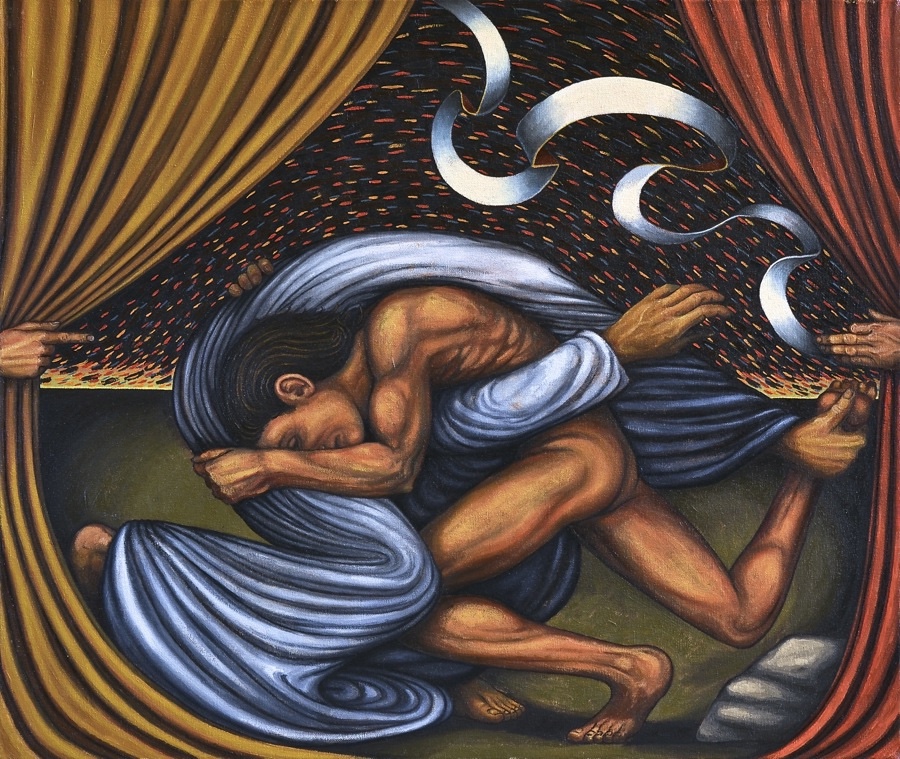
The cover image, “Jacob wrestling with God” by Jack Baumgartner, if from Image. https://imagejournal.org/artist/jack-baumgartner/jacob-wrestling-with-god/

Nothing but five loaves and two fish (Matt 14; Pentecost 10A)

My post about this week’s Gospel passage is once again indebted to conversations that I have had with my wife Elizabeth about this story, and the surrounding material, in Matthew’s Gospel. She has undertaken much careful research into the way that Matthew redacts his Markan source.

*****

The story that the lectionary invites us to hear this coming Sunday (Matt 14:13–21) is Matthew’s account of “the feeding of the five thousand”, a much-beloved miracle of Jesus. It is also one of a handful of miracle stories that is narrated by all four canonical Gospels (Mark 6:30–44; Matt 14:13–21; Luke 9:12–17; and John 6:1–14).

The set-up for this story is that Jesus and the disciples are surrounded by a large crowd, time is drawing on, and there appears to be no food to eat. The punchline for the miracle is that, whilst at the start there was “nothing but five loaves and two fish”, by the end,,after “all ate and were filled”, there were “twelve baskets full” of leftovers!

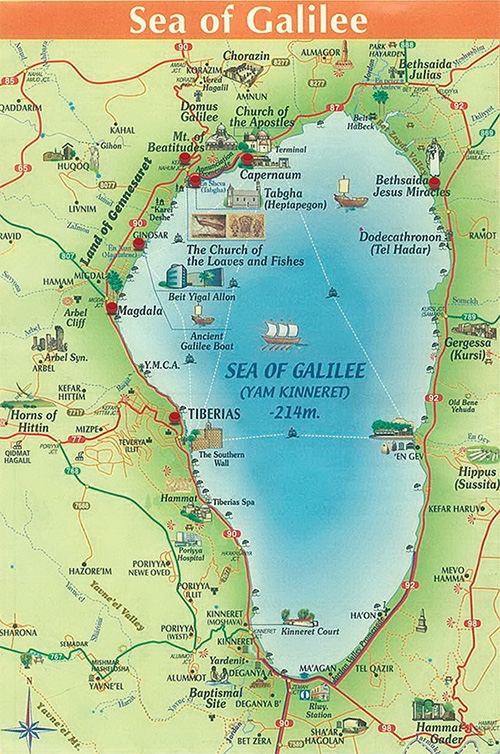
For John, the feeding takes place “on the other side of the Sea of Galilee, also called the Sea of Tiberias” (John 6:1), before Jesus and the disciples cross the Sea of Galilee, back to Capernaum (John 6:16–17). Mark, however, locates this feeding in Jewish territory, after the first trip that Jesus had made to the Decapolis, on “the other side” (Mark 4:35—5:21). Matthew and Luke follow Mark in locating this scene in Jewish territory.

Then, following Mark, Matthew recounts a second feeding, of four thousand, which Mark locates on the Gentile side of the lake (Mark 8:1–10). The geography in Matthew’s narrative of this scene (Matt 15:32–39) is, as we shall see, somewhat vaguer; the incident is, however, the same in most details as that found in Mark. Luke omits all mention of this second feeding, as does John.

The number fed is consistently reported in all four accounts as being five thousand—although there are variations here. John offers this figure as an approximation of the whole crowd present (John 6:10). Mark and Luke both specify that those fed were men only (Mark 6:44; Luke 9:14), whilst Matthew teases out the implications: “those who ate were about five thousand men, besides women and children” (Matt 14:21).

Mark notes that Jesus organised the crowd in smaller groups, sitting on “green grass” (Mark 6:39), noting that “they sat down in groups of hundreds and of fifties” (Mark 6:40). Matthew simply notes that they sat on grass, colour not specified, and makes no reference to sitting in groups (Matt 14:19). This is typical of the way that Matthew omits much of the detailed narrative colouring that Mark regularly reports—such as the groups on the green grass.

So Matthew’s account is somewhat shorter than Mark’s account (seven verses in Matthew, ten verses in Mark). Both accounts, as well as Luke’s version, report the actions of Jesus as he “looked up to heaven, and blessed and broke the loaves, and gave them to his disciples to set before the people” (Mark 6:41; Matt 14:19; Luke 9:16).

This sequence clearly reflects the liturgically-developed pattern (repeated religiously in eucharistic settings over the centuries) of the last supper of Jesus: “he took a loaf of bread, and after blessing it he broke it, gave it to them … then he took a cup, and after giving thanks he gave it to them, and all of them drank from it” (Mark 14:22–23 and parallels; and see also 1 Cor 11:23–25).

The pattern is missing from John’s account, which simply notes that “Jesus took the loaves, and when he had given thanks, he distributed them to those who were seated” (John 6:11). John’s Gospel omits any specific report of eating at that “last supper”, focussing rather on the washing of feet and discussion of Jesus’s imminent departure (John 13).

Johannine allusions to eucharistic practice appear later in chapter 6, after a long sequence of midrashic exposition by Jesus, around the theme of “the living bread … that came down from heaven” (John 6:22–59)—a discourse that we learn, at the end, is set “in the synagogue at Capernaum” (John 6:59)—back on the side of the lake from whence Jesus had departed (John 6:16).

*****

All four stories contain the significant detail that “all ate and were filled; and they took up what was left over of the broken pieces, twelve baskets” (Matt 14:20; see also Mark 6:43; Luke 9:17; John 6:13). Now twelve was an important number for the Jewish people; perhaps the twelve baskets are symbolic for the Jewish people? In which case, we might ponder how much of the story is symbolic, and how much “actually happened”?

To think a little about twelve … There were 12 sons of Jacob (Gen 49:1–28), then 12 tribes of Israel (Deut 27:12–13). On the table in the Tabernacle were placed 12 silver plates, 12 silver dishes, and 12 golden plates (Num 7:84–89), and the breastplate of the priest contained 12 precious stones (Exod 28:21) as emblems of the 12 tribes as they camped round about the Sanctuary. Moses built an altar at the foot of Mount Sinai with 12 pillars (Exod 24:4) and Joshua had the people take 12 stones from the River Jordan to be placed as a memorial to their entry into the land (Josh 4:1–10).

As the story continues in the Gospels, Jesus chose 12 apostles as his inner circle (Mark 3:13–19 and parallels in Matt 10 and Luke 6; and John 6:67–71). Jesus indicates that this signified the link between his movement and the traditions of Israel (Matt 19:28; Luke 22:30; and see James 1:1). And when Jesus feeds the great crowd of 4,000 people beside the Sea of Galilee (Mark 8:1–9), there are twelve baskets of bread left over (Mark 8:19).

And in the final dramatic visions written about the promised future by the aged seer John, the number 12 figures prominently. We see this first in the vision of a woman wearing a crown with 12 stars (Rev 12:1). The number then appears in the architecture of “the holy city Jerusalem coming down out of heaven from God” (Rev 21:10), with its 12 gates with 12 angels and the names of the 12 tribes (Rev 21:12), and its 12 foundations with the names of the 12 apostles (Rev 21:14). Finally, there are 12 pearls on these 12 gates (Rev 21:21) and 12 fruits on the tree of life (Rev 22:2).

Is the emphasis on 12 in this narrative in Mark 6 and Matthew 14 and the other gospels deliberately underlining the Jewish setting, and pointing to the centrality of Jewish matters in the story? It’s a fascinating thought, which is strengthened by the observation that in the accounts of the feeding of the 4,000 (Mark 8:1–10; Matt 15:32–39) there were “seven baskets full” (Mark 8:8; Matt 15:37).

Mark locates this scene “on the other side” of the Sea of Galilee. In this Gospel, Jesus had just been “in the region of the Decapolis” (Mark 7:31), and after this feeding, he returns to Jewish territory on “the other side” (Mark 8:13).

Matthew removes any reference to Jesus being in the Decapolis; after the journey by sea that Jesus undertakes with his disciples to “the other side” (Matt 14:22), Jesus apparently returns immediately to Genessaret, on the western (Jewish) side of the lake (Matt 14:34), and has gone “up the mountain” beside the Sea of Galilee, where “he sat down” (Matt 15:29). That is a strong clue that Jesus is on Jewish territory, teaching and healing.

For Matthew, the second crowd that Jesus feeds is entirely Jewish. For Mark, the crowd that was being fed most likely included many Gentiles, as well as Jews who lived “on the other side”. The significance of seven has been the focus of attention for many interpreters (does it refer to the seven gentile nations which were in the land of Canaan? the seven days of creation? or the seventy nations, 7×10, that are listed as “the nations” at Gen 10:1–32?) Whilst the symbolism of twelve is clear, the symbolism of seven is less obvious.

*****

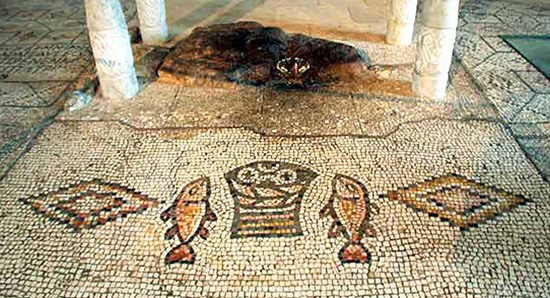
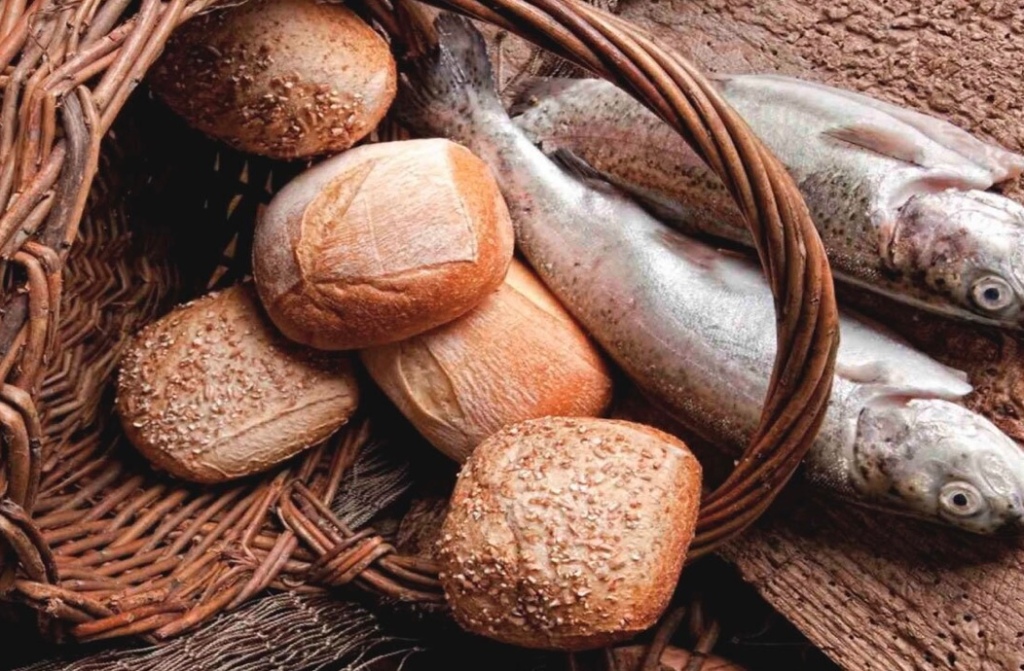
Each account of the feeding of the 5,000 also notes that, as well as the five loaves, there were two fish provided for distribution to the crowd (Mark 6:38; Matt 14:17; Luke 9:13; John 6:9). Only Mark notes that the twelve baskets of leftovers included fish as well as “broken pieces” of bread (Mark 6:41). Interestingly, in Matthew’s account of the feeding of the 4,000, “a few small fish” were provided along with the seven loaves (Matt 15:34).

Mark’s account, presumably known to Matthew, did not mention this detail. Was Matthew unconsciously harmonising the narratives of the two feedings? Certainly, a fish would become an important symbol used by the early Christians (and still seen today) to mark their identity. The Greek word for fish, ichthus, written in capitals as IXTHUS, was used as an acronym to signal faith in Jesus: I (Iēsous, Jesus), X (Christos, Messiah), TH (theou, of God), U (huios, Son), S (sōtēr, Saviour).

Of the four accounts, only John notes that the loaves of bread had been made from barley (John 6:9), perhaps evoking the story of the twenty loaves of barley provided to Elisha to feed a hundred people (2 Kings 4:42–44). And only John included the detail, much beloved by flowery preachers, that the five loaves and two fish were provided by a boy (John 6:9). It adds a simplicity to a wonderfully impressive miracle, perhaps. However, in each of three Synoptic accounts, those loaves and fish simply appear from within the crowd.

*****

Finally, we turn to the way that this feeding story is introduced by the evangelists. All four evangelists note that a large crowd was gathering: “many were coming and going … [Jesus] saw a great crowd” (Mark 6:31, 34; Matt 14:13–14; Luke 9:11; John 6:2, 5). In John’s account, the presence of this “large crowd” leads Jesus simply to ask a straightforward logistical question, “where are we to buy bread for these people to eat?” (John 6:5).

In the Synoptic accounts, it is the disciples who get worried about the numbers present, and advise Jesus to “send the crowd away” so that they can get provisions elsewhere (Mark 6:36; Matt 14:15; Luke 9:12).

In two of the Synoptic narratives, however, the crowd has previously drawn words of compassion from Jesus. Mark reports that “he saw a great crowd and he had compassion for them, because they were like sheep without a shepherd, and he began to teach them many things” (Mark 6:34). Matthew simply notes that Jesus “had compassion for them and cured their sick” (Matt 14:14). It’s a neat pastoral touch, I think, to have Jesus healing, rather than teaching, with this large crowd.

The lack of food at hand signals that the scene is set well away from the towns and villages that Jesus frequented. Indeed, in Mark’s narrative, Jesus had intentionally taken his apostles into a boat and moved away into “a deserted place” (Mark 6:31); Matthew follows Mark in this regard (Matt 14:13). In the biblical tradition, the wilderness plays a pivotal role in the story of the Israelites, freed from captivity in Egypt, yearning for the promise of land and safety still ahead of them.

The wilderness was the place where the character of Israel was forged. It was in the wilderness, throughout that long period of wandering, that they had encounters with the divine, that their identity was shaped, that their foundations as a nation were laid. The stories told in Exodus, Numbers, and Deuteronomy tell of thirst and hunger in the wilderness, encounters with snakes and other trials—as well as the giving of the law, on Sinai, a mountain in the middle of the wilderness.

The journey through the wilderness figured in the songs of Israel. It is regularly recalled in the Psalms (68:7, 78:15-20, 40, 52, 95:8, 106:14-33, 136:16) as well as in various prophetic oracles prophetic oracles (Isaiah 40:3-5, 41:17-20, 43:19-20, Jer 2:6, 31:2-3, Ezekiel 20:8b-21, Hosea 13:4-6, Amos 2:9-10, Wisdom of Solomon 11:1-4) and occasional narrative references. The exodus from Egypt and the subsequent wilderness wandering, provided the foundational story for Israel, from long ago, and still through into the present.

The wilderness was where Israel met God; where Israel’s commitment was tested; where Israel’s faith was shaped. That is where, in the narratives of Mark and Matthew, Jesus expresses his compassion for the crowd and feeds “five thousand men, besides women and children” (Matt 14:21).

Luke, by contrast, has Jesus take his followers to “withdraw privately to a city called Bethsaida” (Luke 9:10), whilst John reports that Jesus “went up the mountain and sat down there with his disciples” (John 6:3), adding the note that “the Passover, the festival of the Jews, was near” (John 6:4)—the second of three Passovers in this narrative (John 2:13; 6:4; 11:55).

The four accounts differ in remarkably few details, overall, indicating either that there was a high level of memory retention by those who told and retold the story orally, before the Gospels took written firm; or else, that some kind of manuscript with an account of this incident (as well as some other stories) was known amongst the followers of Jesus at a relatively early stage of development of the Gospels. Either way, it is an intriguing and informative narrative for us to reflect on this coming Sunday.

Hear a just cause, O God (Psalm 17; Pentecost 10A)

“Hear a just cause, O Lord; attend to my cry”, the psalmist cries (Ps 17:1). The expectation that God will act with justice is crystal clear in this psalm; the psalmist expects vindication from God (v.2), who will “show your steadfast love” (v.7), who will “rise up, confront [and] overthrow” the wicked (v.13). “As for me”, the psalmist concludes, “I shall behold your face in righteousness; when I awake I shall be satisfied, beholding your likeness” (v.15).

Other psalms make it clear that justice is integral to God’s being. “The word of the Lord is upright … he loves righteousness and justice” (Ps 33:4–5). “The Lord works vindication and justice for all who are oppressed” (Ps 103:6); “the Lord loves justice, he will not forsake his faithful ones” (Ps 37:28); “the Lord maintains the cause of the needy and executes justice for the poor” (Ps 140:12).

One psalmist provides a fulsome description of how this works in society, declaring that they place their trust in “the God of Jacob … who keeps faith forever, who executes justice for the oppressed, who gives food to the hungry … who sets the prisoners free [and] opens the eyes of the blind … [who] lifts up those who are bowed down … [who] watches over the strangers, upholds the orphan and the widow” (Ps 146:5–9). This resonates with other prophetic texts and with the mission that Jesus later undertook.

That God will act with justice is an expectation that is found again and again throughout the pages of Hebrew Scripture. The prophet Amos places justice and righteousness at the heart of God’s intentions for Israel, prioritising them over any ritual actions of worship (Amos 5:21–23). In like manner, the prophet Hosea declares that God “desires steadfast love and not sacrifice, the knowledge of God rather than burnt offerings” (Hos 6:6).

According to the narrative books recounting earlier stories, justice had been the key quality of the prophetic messages given to Israel over a number of centuries before these prophets. Moses and the elders he appointed had a responsibility to judge the people (Exod 18:13–27). This was continued by men and women designated as judges in the book of Judges.

Over time, the role of the prophet arose, as judges gave way to kings; the prophet was called to hold the king to account (for instance, Nathan at 2 Sam 12). This then expands so that the prophetic voice speaks truth to all the people, persistently calling out for justice. Amos sounds this central motif: “let justice roll down like waters, and righteousness like an ever-flowing stream” (Amos 5:24). Micah repeats and expands it in his powerful rhetorical question, “what does the Lord require of you but to do justice, and to love kindness, and to walk humbly with your God?” (Micah 6:8).

Praying that God’s ways of justice and righteousness may be evident in the king is a repeated motif in the psalms. “Give the king your justice, O God, and your righteousness to a king’s son; may he judge your people with righteousness and your poor with justice” (Ps 72:1–2). “Mighty King, lover of justice, you have established equity, you have executed justice and righteousness in Jacob” (Ps 99:4).

“Righteousness and justice are the foundation of your throne”, another psalmist sings (Ps 89:14); “happy are the people … who walk, O Lord, in the light of your countenance … who extol your righteousness” (Ps 86:15–16). Prayers for justice to be lived out in the society of the time are also found at Ps 10:17–18; 37:5–6; 106:3; and the whole of Psalm 112 offers a song in praise of “those who conduct their affairs with justice”, who exude the best of the character of God: “they are gracious, merciful, and righteous” (Ps 112:4).

The oracles placed at the start of the book of Isaiah sounds the importance of living with justice: “wash yourselves, make yourselves clean … cease to do good, learn to do good, seek justice, rescue the oppressed, defend the orphan, plead for the widow” (Isa 1:16–17). The powerful “song of the vineyard” (Isa 5:1–7) concludes with the wonderful Hebrew wordplay, which reinforces this theme: so, “he expected justice (mishpat) but saw bloodshed (mispach); righteousness (tsedakah) but heard a cry (seakah)” (5:7).

What follows is a searing prophetic denunciation of the ills of society: the excesses of a debaucherous elite, the oppressive state of the lowly (5:8–23). The prophet yearns for the coming of a royal child who will rule the nation “with justice and with righteousness from this time onward and forevermore” (Isa 9:6–7). A later prophet whose oracles are collected with those of Isaiah likewise looks for “my servant … my chosen … [who] will bring forth justice to the nations … he will faithfully bring forth justice … [he will] establish justice in the earth” (Isa 42:1–4). Again, the resonances with the later story of Jesus are evident to Christian readers.

A little later than Isaiah, the prophet Zephaniah declares that “the Lord is righteous, he does no wrong; every morning he renders his judgement, each dawn without fail” (Zeph 3:5). Prophets in exile repeat this vision. Jeremiah instructs the nation to “execute justice in the morning and deliver from the hand of the oppressor anyone who has been robbed” (Jer 21:12; 22:3; 33:15). Ezekiel advises that “if a man is righteous and does what is lawful and right … he shall surely live” (Ezek 18:5–9; 34:11–16). Zeph 3:5).

And in the last prophetic book (in the order familiar to Christians), the prophet Malachi asks, “where is the God of justice?”, and answers his own question with a description of “the messenger of the covenant” who will execute justice “like a refiner’s fore and like fuller’s soap … he will purify the descendants of Levi … until they present offerings to the Lord in righteousness” (Mal 2:17—3:4).

This prophetic cry continues into the New Testament, as justice is placed at the centre. Jesus calls for justice (Matt 23:23; Luke 11:42, 18:1–8)—at times, we find it rendered as “righteousness” in his sayings (Matt 5:1–12, 20; 6:33, 21:28–32). This, of course, is the way that it appears in the letters of Paul, where the righteousness of God is the action that we experience when God implements justice in our lives (Rom 3:21–26, 4:1–25; 2 Cor 5:16–21).

Both the manifesto for mission that Luke highlights at the start of the public activity of Jesus (Luke 4:18–21) and the climactic parable of the sheep and the goats that Matthew places at the end of the public teaching of Jesus (Matt 25:31–46) draw strongly from Old Testament insights. Both demonstrate the priority that Jesus gave to practical actions of support, care, and advocacy within ordinary life—precisely what justice is!

Jesus highlights the judgement executed by God (Matt 8:10–12; Luke 13:28–30) and told a number of parables of judgement—particularly those collected in Matthew’s Gospel (Matt 13:36–43, 47–50, 22:1–14, 24:44–25:46). These stories use the threat of divine judgement as a warning against sinful injustice and as a spur to righteous living. Underlying these warnings is the fundamental principle that God’s justice undergirds all (Matt 12:17–20; Luke 18:1–8).

“Hear a just cause, O Lord; attend to my cry”, the psalmist cries (Ps 17:1). The expectation that God will act with justice saturates the books of Hebrew Scriptures and flows on into the books of the New Covenant. Justice is at the heart of what we believe about God; justice is to mark the lives that we live by faith. May it be so.

Leah’s eyes were lovely, and Rachel was graceful and beautiful (Gen 29; Pentecost 9A)

The stories we are following in the sagas of ancient Israel, during this season after Pentecost, come from a different time, a different place. They reflect different cultures, with different customs, and seemingly different moralities. And they certainly depict the women at the centre of these stories in ways that we would recoil from, if we were to tell stories in our own time, place, and culture.

“Leah’s eyes were lovely, and Rachel was graceful and beautiful” (Gen 29:17). That’s how we are introduced to the two women, sisters, daughters of Laban, who figure in the story offered by the lectionary for this coming Sunday (Gen 29:15–28). Could a more patronising and sexist introduction be given to these two characters? Descriptions of women on the basis of their outward appearance are sure to disturb and anger contemporary readers of this story; judging a woman by her appearance is not a sensible way to proceed!

More than that, however, we find that the older male protagonist in this story, Laban, appears to have very dubious ethical standards. He does not seem to act in accord with the propriety that we, today, would expect. Jacob had been instructed by Isaac “not marry one of the Canaanite women” but rather to take a wife from “one of the daughters of Laban, your mother’s brother” (28:2). Jacob is under instruction; what role does Laban play?

On arrival at Haran, or Paddan-Aram, in “the land of the people of the east” (29:1), Jacob early on indicates his interest in Laban’s daughter Rachel, kissing her (29:11). When Rachel then conveys to her father the fact of his family’s connection to theirs, Laban greets him with joy: “surely you are my bone and my flesh!” (19:14). From that, we might expect honest behaviour will follow.

Jacob flags his interest in Rachel; Laban promises her to him in exchange for seven years of work (29:15–20). Writing in My Jewish Learning, Dr Kristine Henriksen-Garroway, Associate Professor of Hebrew Bible at the Hebrew Union College in Jerusalem, observes that “to marry a woman, a man had to first pay her father a מֹהַר (mohar), ‘bride-price.’ Although Laban allows Jacob to marry Rachel before working off his debt, she only has her first child at the end of the seven-year period.

Dr Henriksen-Garroway explains, “Jacob wishes to marry Rachel, but he has no land or money to speak of; he is a guest in Laban’s house. Marriage is not free, so he offers his own labor as the bride-price (mohar/tirḫatum). While the text makes no mention of his being betrothed first, Jacob’s need to wait until the bride-price is paid in full in order to marry Rachel fits with biblical and ancient Near Eastern practice.”

*****

So Jacob marries Rachel and works for Laban for seven years; after which time, Laban craftily provided Leah as the woman with whom Jacob slept (29:21–22). The language suggests that it is sexual union that is to the forefront of Jacob’s mind (“give me my wife that I may go in to her, for my time is completed”, 29:21), so his lack of awareness appears due to this focus. Had he not slept with Rachel in those seven years?

The NRSV, following the KJV, renders the words of Jacob in this crass manner, “that I may go in to her”. The NIV reports Jacob as saying, “give me my wife; I want to make love with her”; the NASB says, “that I may have relations with her”; and the NLT is much more demure with “so I can sleep with her”.

Whatever translation is used, it is clear that events are driven by the libido of Jacob. He was the “supplanter”, who gained his birthright by bargaining with his brother and deceiving his father. But his time has come; as we read on in the story, it is clear that Laban has always been intent on deceiving Jacob.

Citing local customs, Laban claims that “giving the younger [daughter] before the firstborn” in marriage was a custom that was “not done in our country” (29:26). Laban manipulates matters so that Jacob, still besotted by Rachel’s grace and beauty, is willing to submit to a further seven years of working for Laban, in order to secure Rachel as his wife, even though he is now married to Leah, who had lovely eyes. Jacob trusts Laban—but why? He has already been deceived once by him.

So, he needs to work for Laban for another “week (of years)”. The text is very matter-of-fact at this point, simply recounting that “Jacob did so, and completed her week; then Laban gave him his daughter Rachel as a wife” (29:28). Dr Henriksen-Garroway notes that “the requirement for Jacob to ‘pay’ to marry Rachel fits with the basic sequence of marriage steps assumed in the Bible and ancient Near East”.

In her further exploration of ancient Israelite marriage customs, she notes that “when a girl’s father agreed to a union between a suiter and his daughter, the suiter often did not have the bride-price handy. This may be one reason for the betrothal period, what the rabbis call ʾerusin (from the root א.ר.שׂ). The girl’s betrothal to the man made her unavailable to other men, but she still lived with her father until the man paid the bride-price.”

This explains Jacob’s seven years of working whilst betrothed to Rachel, who continued to live with Laban, before Laban deceitfully gave him Leah (29:18–20). It also explains the further seven years of working before he actually is given Rachel in marriage (29:27–28). What trust Jacob had—believing Laban, even after that first act of trickery. Would he do the same yet again? Perhaps, as he seems to have had only two daughters, Rachel would be “supplied” to him second time around.

Dr Henriksen-Garroway offers further explanation: “when we look at Laban’s agreement carefully, we can see that he never explicitly accepts Jacob’s proposal or mentioned which of his daughters he is offering”, citing the vagueness of Laban’s earlier comment, “it is better that I give her to you than that I should give her to any other man; stay with me” (29:19).

*****

So, after Jacob had worked his second term of seven years, this time actually for Rachel (29:28), another matter-of-fact statement follows in the NRSV: “Jacob went in to Rachel also, and he loved Rachel more than Leah” (29:30). Once again, other translations use the euphemisms we have earlier noted, in order to soften the crude physical depiction into a more relational understanding.

Yet the story is crassly sexualised—consummating the marital relationship is at the heart of events. Although, to be fair, the production of an heir is an important focus in ancient societies, and an heir for Jacob is necessary to fulfil “the promise that the Lord made on oath … to Abraham, to Isaac, and to Jacob” (Deut 9:5; Exod 32:13). This promise was first announced to Abraham—“I will make of you a great nation” (Gen 12:1, reiterated at 22:17)—then repeated to his son, Isaac (26:4–5, 24) and to his grandson, Jacob (28:13–14; 32:12). So the story continues with a sequence of event that show how this eventuates.

Like his grandfather and his father, Jacob finds that his wife, Rachel, is barren (29:31). In subsequent years, Leah bore him four sons, Reuben, Simeon, Levi, and Judah (29:32–35), and Rachel’s maid Bilhah bore him two sons, Dan and Naphtali (30:4–8), and Leah’s maid Zilpah then bore him two more sons, Gad and Asher (30:9–13), and then Leah bore him two further sons, Issachar and Zebulun (30:16–20) as well as a daughter, Dinah (30:21).

Six boys and one girl, in seven years: Leah fulfils the primary expectation of fertile women in ancient Israel—producing children. That the majority are males is even better! And it is noteworthy that, as Dr Henriksen-Garroway observes, “a wife who cannot produce children might even feel the need to give her husband a surrogate to produce children for her (Gen 16:2, 30:3, 9), since otherwise, they are not fulfilling their function as wife”.

As Leah produces children for Jacob, Rachel remains barren—a stigma in ancient societies, an indication amongst Israelites that God has chosen not to “open her womb”. Barrenness is attributed to the action of God, for he had previously “closed fast all the wombs of the house of Abimelech because of Sarah” (20:18). Perhaps the fact that Jacob had not yet paid off his debt to Laban meant that God would not act to provide a child to this union?

It is only after the seven children had been born to Leah, and the seven years that Jacob was working towards marriage with Rachel had been completed, that we then read, “then God remembered Rachel, and God heeded her and opened her womb; she conceived and bore a son … and she named him Joseph, saying, ‘May the Lord add to me another son!’” (30:22–24).

Later still, after fleeing from Laban and returning at last to Canaan, Rachel becomes mother to a second son, Benjamin (35:16–18), although sadly she dies during this childbirth. Ironically, Benjamin was the only one of “the twelve sons of Israel” (Gen 35:22–26; Exod 28:21; 39:14; 1 Ki 18:31) who gave their names to the regions of Israel (Num 26:52–56) to have been born in that land.

*****

And the one daughter, Dinah, of course has no place in “the twelve tribes of Israel”, named after the twelve sons (by four different women!) that Jacob produced (Gen 49:1–28). Despite the fractured nature of their origins—twelve boys from four mothers, two of whom took fourteen years and one deceitful trick for Jacob to secure—these twelve sons gave their names to “the twelve tribes of Israel” throughout the ensuing saga (Exod 24:4; 28:21; 39:14; Josh 3:12; 4:8; 1 Ki 18:31; Ezra 6:17).

Dinah’s own fate is sombre; she is raped by “Shechem son of Hamor the Hivite, prince of the region”, who when he saw her, “he seized her and lay with her by force” (34:3). He then wishes to marry her, and negotiates to receive the blessing of the men of the city at the gates of the city, who curiously agree, subject to the one condition “that every male among us be circumcised as they are circumcised” (34:22).

However, before this can be finalised, the dishonouring of Dinah is enacted by two of her brothers, Simeon and Levi, who “killed Hamor and his son Shechem with the sword, and took Dinah out of Shechem’s house, and went away”, only to be followed by “the other sons of Jacob [who] came upon the slain, and plundered the city, because their sister had been defiled” (34:25–29).

Jacob is unimpressed at their violent actions; but the reposte of the brothers cannot be answered: “should our sister be treated like a whore?” (34:31). As a result, the whole family returns to Bethel, in southern Canaan (35:1), where Jacob will have a significant religious experience (35:9–15), and his name is changed to Israel.

And the new name of the father, as well as the names of each of the twelve sons, live on throughout the stories told and the scrolls written in Israel—and on through into today.

*****

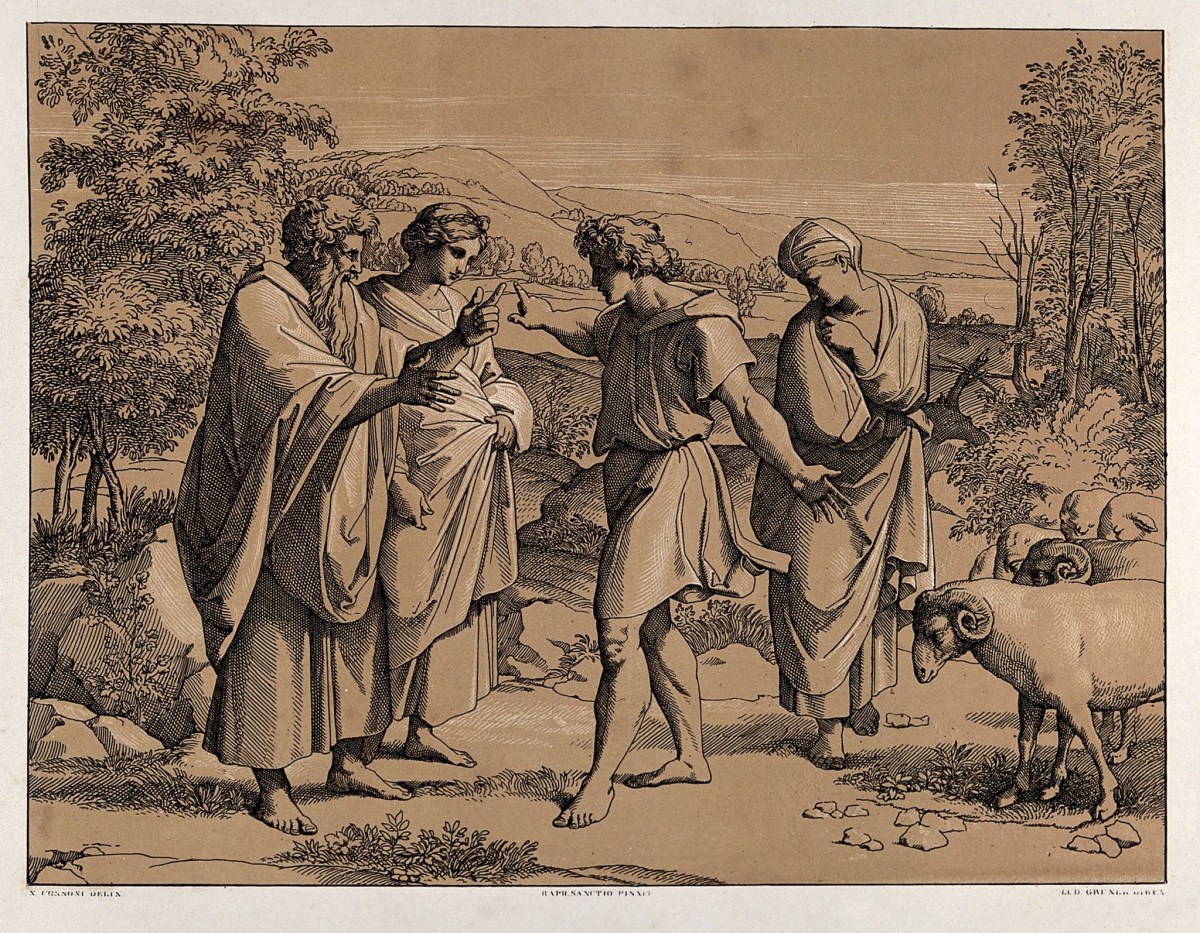
The image on the front of this post is Jacob accusing Laban for having given him Leah instead of Rachel, a colour lithograph by L. Gruner, after N. Consoni, after Raphael (1483–1520), from the Wellcome Collection, a free online museum and library.

God is mindful of this covenant forever (Psalm 105; Pentecost 9A)

“The Lord our God … is mindful of his covenant forever, of the word that he commanded, for a thousand generations, the covenant that he made with Abraham, his sworn promise to Isaac, which he confirmed to Jacob as a statute, to Israel as an everlasting covenant” (Ps 105:7–10).

The psalm set for this coming Sunday (Ps 105:1–11, 45c) offers this striking affirmation of the covenant, which was the means by which the people of God entered into relationship with God. The covenant that is offered to them by God stretches back, in the saga told about the early times of Israel, to Abraham, Isaac, and Jacob, the three great patriarchs of that ancient saga.

The covenant is a key theme of the Hebrew Scriptures. God’s commitment to covenant takes us deep into the abiding relationship between God and God’s people. That covenant had been offered initially to Noah, and to all living creatures (Gen 9), before it was subsequently renewed (and reshaped) by being offered to Abraham (Gen 15, 17), as mentioned here (Ps 105:9). That same covenant is renewed with Isaac (Gen 17) and then with Jacob (Israel) (Gen 35), and later is extended to Moses and the whole people (Exod 19), and later still to the people again through Jeremiah (Jer 31).

Underlying the covenant is the clear understanding that God is a loving God, filled with steadfast love. A regular refrain in the Hebrew Scriptures is this clear affirmation: “The Lord, the Lord, a God merciful and gracious, slow to anger, and abounding in steadfast love and faithfulness, keeping steadfast love for thousands, forgiving iniquity and transgression and sin” (Exod 34:6–8; Num 14:18; Neh 9:17b; Ps 145:8–9; Joel 2:13; Jonah 4:2; see also 2 Kings 13:23; 2 Chron 30:9).

The nature of the covenant is expressed when the Lord affirms to Moses, “I will be gracious to whom I will be gracious, and will show mercy on whom I will show mercy” (Exod 33:19), and Moses offers Aaron and his sons the prayer, “the Lord bless you and keep you … and be gracious to you” (Num 6:22–27)—a ancient prayer which lives on in Christian spirituality and liturgy! The Psalmist knows that graciousness is a key characteristic of God, for there are regular calls throughout these songs for God to demonstrate divine graciousness (Ps 4:1, 6:2, 9:13, 25:16, 31:9, 41:10, 56:1, 67:1, and many more times).

However, the juxtaposition of punishment and steadfast love is clearly stated (Exod 20:5–6), signalling that the complexity of God’s nature is clearly understood. The offer of divine graciousness and the demands of divine justice co-exist within the Lord God. That is the very nature of the covenant that God has made with Israel: it sets standards, but also ensures God’s faithfulness even when conditions are broken by human beings.

The covenant is noted in a number of psalms. “The friendship of the Lord is for those who fear him, and he makes his covenant known to them”, sings the psalmist (Ps 25:14). “I have made a covenant with my chosen one, I have sworn to my servant David”, God sings in another psalm; “I will establish your descendants forever, and build your throne for all generations” (Ps 89:3–4).

In this same psalm, God affirms that, even if the children of David “forsake my law and do not walk according to my ordinances”, God will punish them, but “forever I will keep my steadfast love for him, and my covenant with him will stand firm … I will not violate my covenant, or alter the word that went forth from my lips” (Ps 89:28, 34). That covenant is to last forever (Ps 111:9).

In the face of disobedience, God punishes, and then, as he “regarded their distress when he heard their cry” (Ps 106:40, 44), still “he remembered his covenant, and showed compassion according to the abundance of his steadfast love” (Ps 106:45). So God “provides food for those who fear him; he is ever mindful of his covenant” (Ps 111:5). And the psalmist encourages others in Israel to maintain faithfulness to that covenant (Ps 25:10; 103:8; 132:12).

The covenant will not be withdrawn; this is the focus in this particular psalm, with the psalmist’s insistence that God is “mindful of his covenant forever”, which is “an everlasting covenant” (Ps 105:8, 10). So, when Israel breaks the conditions of the covenant, God nevertheless will offer an opportunity for the people to renew their covenant with him.

Such renewal of the covenant is promised by one prophet, with “a new covenant with the house of Israel and the house of Judah” which “will not be like the covenant that I made with their ancestors … I will put my law within them, and I will write it on their hearts; and I will be their God, and they shall be my people” (Jer 31:31–33). Another prophet declares, “[with] you who have despised the oath, breaking the covenant … I will remember my covenant with you in the days of your youth, and I will establish with you an everlasting covenant” (Ezek 16:59–60).

Renewing the covenant, of course, is the way that various New Testament writers understand the purpose of Jesus’ life and death (2 Cor 3:1–6; Heb 7:22, 8:10–13, 12:24). And the very title ‘New Testament’ is itself a variant of ‘New Covenant’ (the same Greek word can be translated as covenant or testament).

When Luke introduces the story of Jesus, he places a blessing on the lips of the once-dumb Zechariah, who sings, “blessed be the Lord God of Israel, for he has looked favourably on his people and redeemed them … he has shown the mercy promised to our ancestors, and has remembered his holy covenant, the oath that he swore to our ancestor Abraham” (Luke 1:68, 72–73).

Jesus evokes this covenant with his words at his final meal with his followers, reminding them that “this is my blood of the covenant, which is poured out for many” (Mark 14:24; Matt 26:28; Luke 22:20; 1 Cor 11:25).

Paul has the final word on what has been a long enduring relationship between God and Israel, when he considers the situation, “what if some were unfaithful? will their faithlessness nullify the faithfulness of God?” (Rom 3:3). “By no means!” is his immediate response (Rom 3:4), since “the righteousness of God has been disclosed, and is attested by the law and the prophets” (Rom 3:21), and that righteousness means that God remains “God of the Jews” whilst also being acknowledged as “God of the Gentiles” (Rom 3:29).

Accordingly, Paul insists that “it is not as though the word of God had failed” (Rom 9:6), and that “there is no distinction between Jew and Greek; the same Lord is Lord of all and is generous to all who call on him” (Rom 10:12). Again, he asks, “has God rejected his people?”, evoking the immediate response, “by no means!” (Rom 11:1)—for “God has not rejected his people whom he foreknew” (Rom 11:2).

So Paul tells the Roman’s that “those of Israel, if they do not persist in unbelief, will be grafted in, for God has the power to graft them in again” (Rom 11:23), and thus “all Israel will be saved; as it is written … “this is my covenant with them, when I take away their sins” (Rom 11:26–27). “The gifts and the calling of God are irrevocable” (Rom 11:29), as he says; the covenant is, as the psalmist affirms, “an everlasting covenant” (Ps 105:10).

And there important consequences, for Christian readers of scripture, with regard to our relationship with the ongoing expressions of Jewish faith in our world today—as we shall see when we read on, in coming weeks, into what Paul wrote to the believers in Rome, in Romans 9–11.

Informed, Collaborative, Diverse: With Love to the World (2)

The next issue of With Love to the World is currently being distributed. The issue covers the second half of the season of Pentecost, from mid-August through until mid-November. There are commentaries on biblical passages for each day (with the four “lectionary passages” included), along with a prayer, a song, a psalm, and a discussion question for each passage. During September and October, to help focus on the Season of Creation, a creation psalm begins the readings each week.

The resource is published by the Uniting Church in Australia, but is used by people of many denominations in a number of countries. As always, the resource exhibits a core commitment of the Uniting Church: to present “an informed faith”.

This commitment was articulated in the Basis of Union for the UCA. Each contributor offers a reflection on the daily passage which is informed by their theological training as well as their engagement in pastoral ministry. The resource seeks to assist worshippers to come to Sunday worship with an awareness of the Bible passages they will hear read and proclaimed.

With Love to the World also seeks to be faithful to the UCA commitment to shape “a destiny together” with the First Nations Peoples of Australia. The period covered in this issue includes a week of commentaries by Nathan Tyson, an Aboriginal man of Anaiwon/Gomeroi descent, who has lived most of his life in Sydney. Nathan currently serves as First Nations Strategy and Engagement Manager for the NSW.ACT Synod of the Uniting Church in Australia.

The other commentaries in this issue of the resource are provided largely by Australian Uniting Church people with Pasifika heritage, who know at first hand the complexities of living as a Christian in Australia with awareness of their own heritage. There are Tongan, Fijian, Samoan, Rotuman, and Niuean voices which can be heard and considered in this issue. This reflects the commitment made by the Uniting Church in 1985, to be “a multicultural church”.

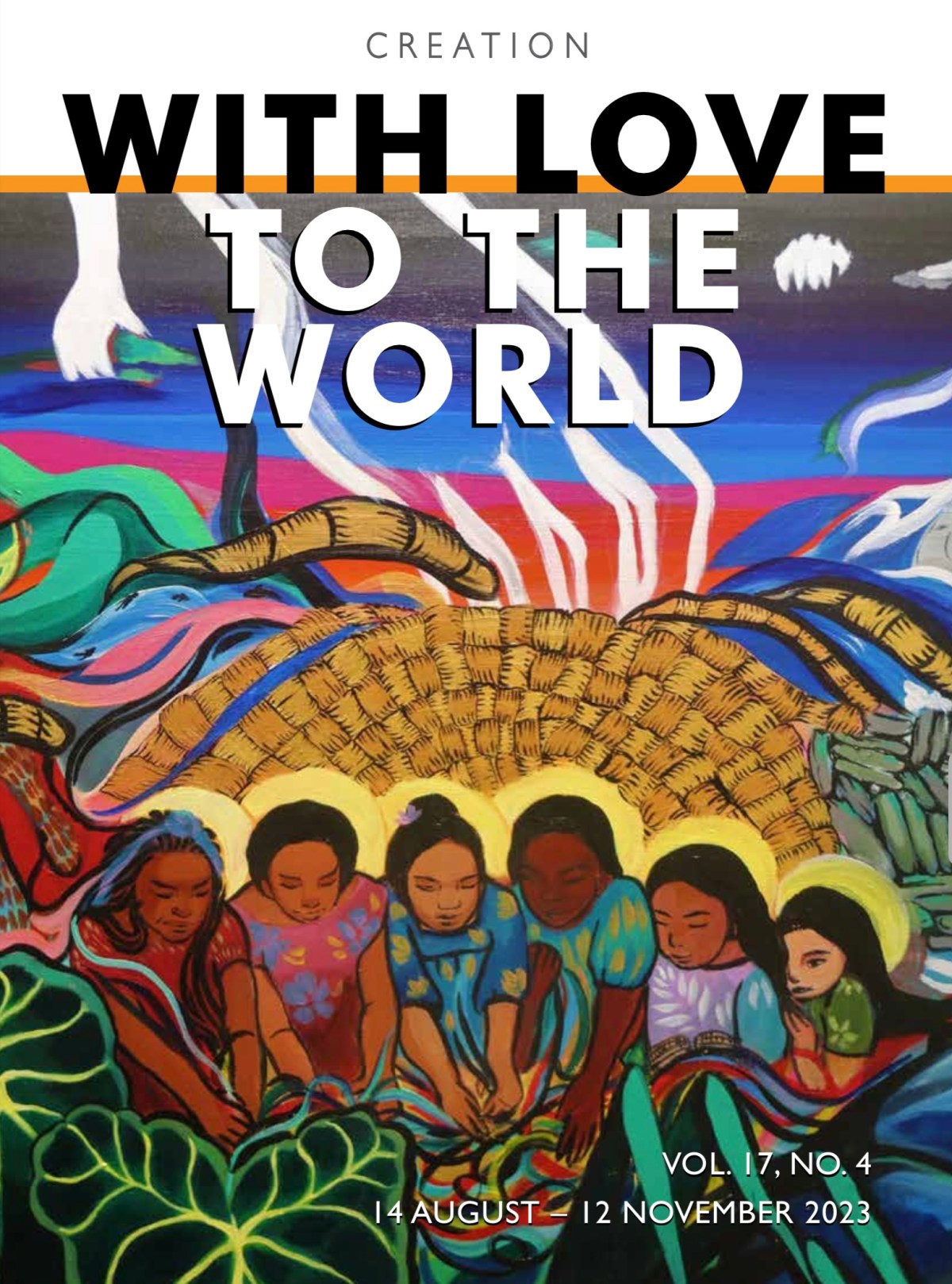
The striking cover of the issue on the front of this post) is a painting by Malia Patricia Akanisi Vaurasi, from the island of Rotuma, near Fiji. This painting, Hands of Resistance, was created as a way to portray the vast ocean of struggles that Pacific people bravely navigate.

Malia explains, “those struggles relate to our nuclear legacies, the climate crisis and growing food insecurity, the continuous struggle for self-determination by our brothers and sisters in West Papua, Maohi Nui, and Kanaky, the neo-colonialist hands of greed and exploitation that reach out to pillage the abundance of our lands and oceans to enrich their empires—and in this process our people are displaced and our natural environment is destroyed.” It is a brilliantly colourful depiction of the life of Pasifika peoples.

You will be sure to find commentaries that probe the depths of the biblical passages, questions that challenge your own discipleship, and,prayers that nurture your spirit, as you read through this daily resource.

With Love to the World can be ordered as a printed resource for just $28 for a year’s subscription (email Trevor at wlwuca@bigpond.com or phone +61 (2) 9747-1369). It can also be accessed on phones and iPads via an App, for a subscription of $24.49 per year (go to the App Store or Google Play).

Home

Parables, riddles, and allegories: the craft of Jewish storytelling (Matt 13; Pentecost 8A)

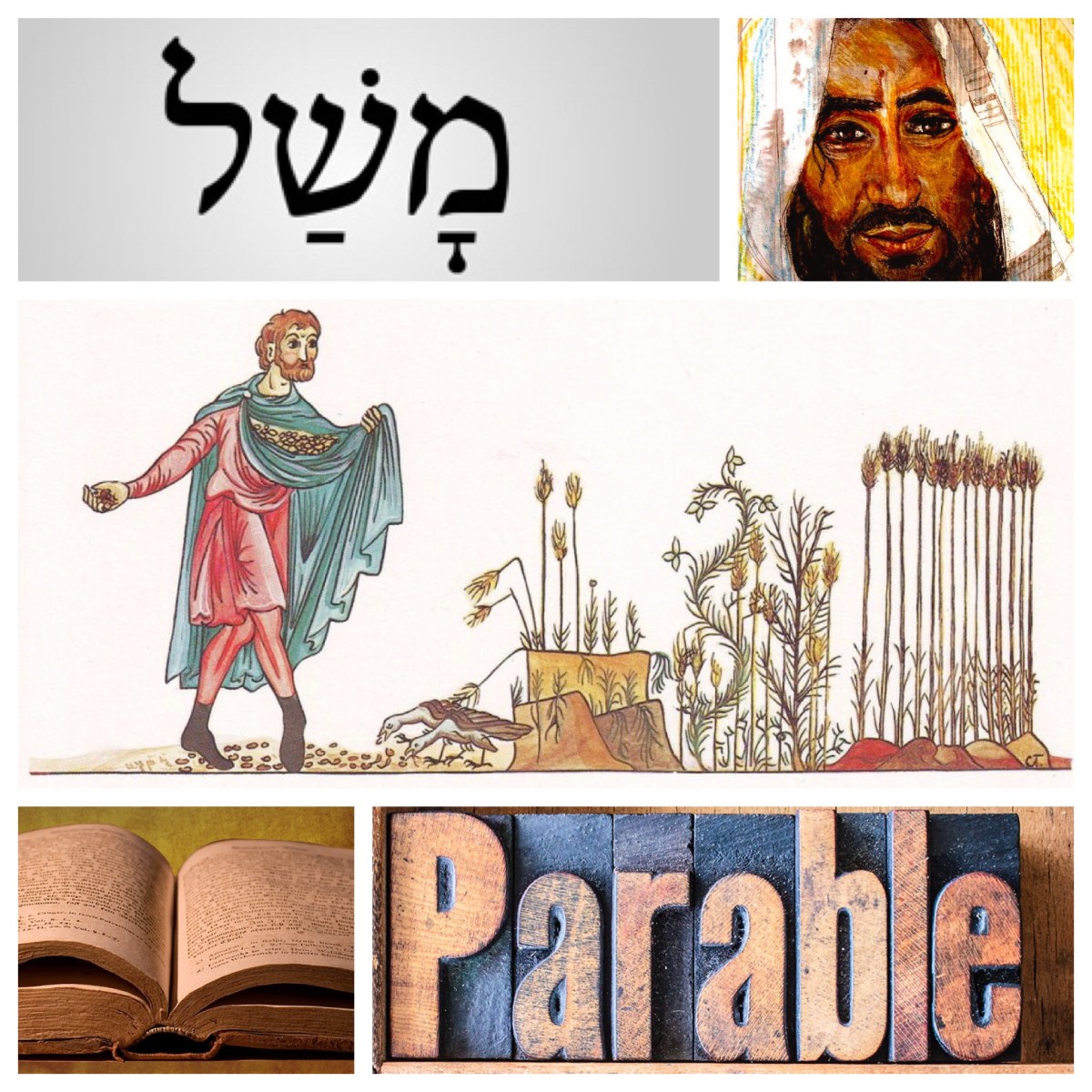
Jesus used parables as the chief means of his story-telling. A parable is a story told in a specific way, often to make a single clear point. Parables are conundrums. They contain unresolved tensions. They invite multiple understandings. They press for exploration and investigation. We have another parable in the Gospel reading for this coming Sunday!

The accounts of Jesus that we have in scripture—Mark’s beginning of the good news of Jesus, Matthew’s book of origins of Jesus, Chosen One, and Luke’s orderly account of the things fulfilled—each contain a number of parables. Even in John’s book of signs, there are some parable-like sections, buried in the midst of the long discourses that this book contains.

Last week (Pentecost 7A), we had the parable of the seeds and the sower (13:3-9) and its interpretation (13:18-23). This week (Pentecost 8A), we will hear the parable of the weeds among the wheat (13:24-30) and its interpretation (13:36-43). Then in the following week (Pentecost 9A), we will hear the other five parables in this chapter: the mustard seed (13:31-32), the yeast in the flour (13:33), hidden treasure (13:44), a pearl of great value (13:45-46), and the net that caught fish (13:47-48)—each one offered without interpretation.

As with last week, so also this week we are given a parable, followed immediately by an interpretation of the parable. I had a spout last week about the way that a later allegorising understanding of the parable has been placed on the lips of Jesus, in this Gospel account. You can read that at https://johntsquires.com/2020/07/09/parables-the-craft-of-storytelling-in-the-book-of-origins-matt-13/

However, Elizabeth and I have had a rolling conversation about parables, and how they were seen and used in Judaism. The idea that the allegorising interpretation was a later addition, beyond the time of Jesus, has held sway for a number of decades in critical biblical scholarship. Christian scholars are dubious about whether Jesus would have utilise this somewhat hellenised approach to stories. (We know that allegories were in evidence centuries before Jesus in Greek literature. Whether Jesus knew this long tradition is debatable.)

Yet this critical Christian perspective overlooks the claim that Judaism, and the long stream of Jewish tellers of parables, have on such stories. Parables are found, in Jewish literature, in various forms. There are, for a start in Hebrew Scripture, a number of short, succinct, one-liners, often introduced as a simple comparison (“this is like that”), making just one focussed point. (Indeed, that is what the Greek word parabolē means—it signals two things that are “thrown beside” each other.)

The widow in Tekoa explains her plight to King David, explaining that “your servant had two sons, and they fought with one another in the field; there was no one to part them, and one struck the other and killed him; now the whole family has risen against your servant” (2 Sam 14:6–7).

When Ahab was king, a prophet waited beside the road, disguised with a bandage over his eyes, and taunts the king: “your servant went out into the thick of the battle; then a soldier turned and brought a man to me, and said, ‘Guard this man; if he is missing, your life shall be given for his life, or else you shall pay a talent of silver.’ While your servant was busy here and there, he was gone.” (1 Ki 20:38–40).

The “song of my lover about his vineyard” that Isaiah tells (Isa 5:1–7) is longer, but drives relentlessly to the single point: the Lord of hosts “expected justice, but saw bloodshed; righteousness, but heard a cry!”. Another agricultural parable relates the skill of the farmer who utilises good practices to produce abundant harvests; “they are well instructed; their God teaches them”, and so “this also comes from the Lord of hosts; he is wonderful in counsel, and excellent in wisdom” (Isa 28:24–29).

The classic example from Hebrew Scripture comes after David pursues Bathsheba, the wife of Uriah, after he has sent Uriah off into battle. The adultery of King David leads the prophet Nathan to confront him with a story about “a rich man who had many flocks” and “a poor man who had nothing but one little ewe lamb” (2 Sam 12:1–4).

As the story develops, and the rich man took the poor man’s lamb to feed a visitor, the king explodes into anger (2 Sam 12:5–6)—only to be met by the damning words of the prophet: “you are the man!” (2 Sam 12:7). The parable had drawn David into the web of the story, and there was now no escape!

In the parable of the weeds and the wheat which Jesus tells (Matt 13:24–30), there is a simple contrast drawn between the weeds and the wheat, and a story which develops so that the conclusion that is drawn can only be seen as inevitable. That simplicity, and also that technique of drawing the listener into the story, is typical of parables that Jesus told.

A number of the parables told be Jesus were indeed short and direct, making a single point and needing little explanation: see the parables of the treasure (13:44) and the pearl (13:45), for instance. This made the parable easy to remember and repeat orally.

These parables are little more than an introduction (“the kingdom of heaven is like…”) and a single image which is used to describe a characteristic of the kingdom (hidden treasure, or fine pearls). The first part of this week’s parable (13:24–26) has this form. It is short and direct.

It starts with the classic introduction, “the kingdom of heaven may be compared to …”. It goes on to tell of the good seeds, which grow into wheat, and the bad seeds, which grow into weeds. This part of the parable has a simple contrasting form, like the parable of the good fish and the bad fish caught in the net, as told in the last of the seven parables (13:47–48).

But the parable has a story attached to these weeds among the wheat (13:27–30). So Jesus continues with a little plot development, which brings in a reflection on the human characters who sowed the seeds. In this regard, this is like other parables of Jesus, which are a little more developed; they still make a single point, but it is developed or explained a little more. And the questions are raised … and the listeners ponder, and consider their responses …

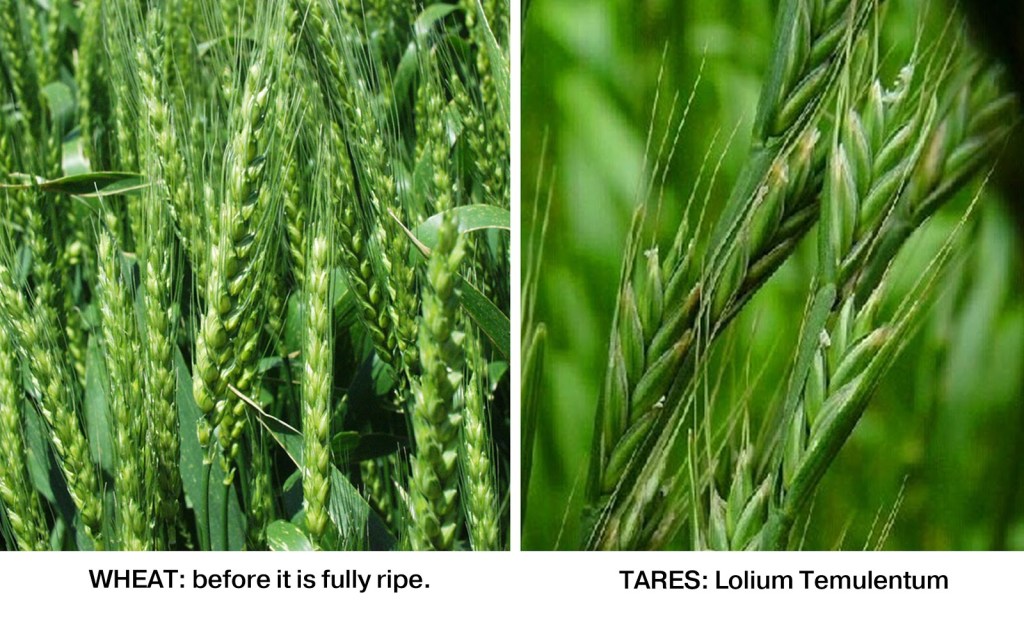
This parable plays,quite cleverly, on the fact that there is, indeed, a type of “weed” which, for much of its life, looks quite like wheat (the bearded darnel, lolium temulentum, or Darnel Ryegrass). So it is a story which is quite credible in the scenario it proposes. And then, added to the actual parable, there comes a separate section that provides a strongly allegorised interpretation of what happened in the field where the wheat and the weeds grew (13:24–30).

That development in the plot of this parable, and the subsequent allegorical interpretation, might well relate to the fact that the Hebrew Scriptures also contain parables with developed plots and allegorical elements. In an allegory, particular individual features can play an independently figurative role, so that the story told becomes a kind of riddle which invites a response from the listener. “What do you think?” becomes the implied way that the allegory-riddle ends. Listening to the story is not enough—the listener needs to engage, enter the conundrum, make up their mind!

A classic short, simple riddle is that spoken by Samson, “out of the eater came something to eat; out of the strong came something sweet” (Judg 14:14). The narrative comment that follows is delightful: “for three days they could not explain the riddle”! Another example is the proverb quoted by two prophets, about the impact of the Exile: “the parents have eaten sour grapes, and the children’s teeth are set on edge” (Jer 31:29; Ezek 18:2). The point of this saying is clear, and telling.

In Hebrew Scripture, the allegory of the Eagles and the Vine (Ezek 17:3–10) is described as both ḥidah (“riddle”) and mashal in verse 2. The parable first describes “a great eagle, with great wings and long pinions”, who carried seed far away where it took root and became a vine (a classic symbol of Israel). It then offers a further description of “another great eagle, with great wings and much plumage”, which the teller of the parable fears may seek to uproot the vine.

“When it is transplanted, will it thrive”, the parable ends (v.10)—will Israel, transplanted into exile, manage to survive that experience? Then follows an explanation of the details of the parable (Ezek 17:11–21), relating the story to the immediate situation of Israel.

Further parable-riddles occur in subsequent chapters in Ezekiel. There is the Lamenting of the Lioness (Ezek 19:2–9) and the Transplanted Vine (Ezek 19:10–14), and the stories of the Harlot Sisters (ibid. 23:2–21). There is also one of my favourites, the very vivid—and gruesome—parable of the Cooking-Pot (Ezek 24:3b—5).

In this parable, the prophet warns the people of judgement: “set on the pot … pour in water … put in the pieces, the thigh and the shoulder … fill it with choice bones” (that is, the meat and bones of the Israelites being punished). The prophet concludes with a booming denunciation: “woe to the bloody city … the blood is shed inside it … to rouse my wrath, I have placed the blood she shed on on a bare rock” (Ezek 24:6–8, and then the metaphor extended still further in 24:9–14).

Each of these parables are clearly allegorical, in that the overall point is clear, and yet also the details in the story invite connection with specific people or events. Ezekiel is a powerful speaker, who utilises this dramatic story-form with great flair, and effect.

A third type of mashal is the fable, where animals or inanimate objects are made to speak and act like men. We know about fables in Greek literature from Aesop, of course, and in more recent literature through those tales collected by the Brothers Grimm; but the article on “Parables” in the Jewish Virtual Library notes a number of instances where Hebrew Scripture contains fables. One good example is Judges 9:8–15, where the trees confer as to who will become king. Another is 2 Kings 14:9–10, where a thornbush sends a message to a cedar, but a wild animal tramples down the thornbush. These fables can be seen to relate directly to the political situation of Israel at different times in their history.

The article on “Parable” in the Jewish Virtual Library also notes: “Mashal and ḥidah are used almost synonymously in Ezekiel 17:2; Habakkuk 2:6; Psalms 49:5 and 78:2; and Proverbs 1:6. Certain proverbs are in effect parable-riddles, e.g., Proverbs 30:15a, 15b–16, 18–19, and 21–31.

“Other biblical forms related to the parable type of mashal are: prophetic oracles where a metaphor is extended into a lively description, e.g., Isaiah 1:5–6; Hosea 2:2–15; 7:8–9, 11–12; Joel 4:13; and Jeremiah 25:15–29; prophetic oracles proclaimed through symbolic actions, e.g., I Kings 11:29; II Kings 13:15–19, and Isaiah 20:2–6; extended personifications as of Wisdom and Folly in Proverbs 1:20–33; 8:1–36; 9:1–6, 13–18; and revelatory dreams and visions having symbolism which the sequel interprets as allegorical, e.g., Genesis 37:6–11; 40:9–13, 16–19; Zechariah 1:8–11; 2:1–4; and Daniel 2:31–45.

Beyond these many examples, there are the multitudes of parables in rabbinic literature (about which, see the further resources listed at the end of this blog).

Returning to the parable of the wheat and the weeds: if we take an agricultural approach to the story, it is a mystery why the weeds had to be burnt, and not just pulled out—as in the version of this parable found in the Gospel of Thomas—and composted—as would occur in my own gardening!

My own take would be that this links with the Jewish prophetic tendency to connect burning with God’s judgement (see Isa 27:2–4; Jer 4:4, 7:20, 15:14, 17:4; Nahum 1:13; Malachi 4:1; see also Ps 79:5, 89:46, and Exod 15:7). And we saw in my comments on the earlier parable that God’s judgement was a strong motif in the parables and teachings of Jesus, especially strengthened in Matthew’s account.

The parable of the mustard seed (13:31–32) is another example of a simple parable with a short plot development. This parable uses the same introductory phrase, “the kingdom of heaven is like …”, and conveys its main point in an image (mustard seed, 13:31) which is further developed to convey what happens to the mustard seed as it grows and forms “the greatest of shrubs” (13:32).

So the plot of the parable of the wheat and the weeds continues until the punchline is reached. It is not during the growing that any distinction is to be made; it is at the harvest that this distinction is enforced. Wheat that grew from good seeds is to be collected and stored; weeds that grew from bad seeds are to be bundled and burnt (13:28–30).

That much, as a parable, has a clear message: don’t intervene into the process of growing, don’t judge (recalling words of Jesus reported at Matt 7:1), but let the end result of the process of growing be the moment when the judgement occurs—and let that judgement be undertaken by God. And that taps into a strong interest, throughout the book of origins, for depicting Jesus as the eschatological preacher of judgement. See

This probably explains one curious aspect of the parable, that we noted above: why the weeds had to be burnt, and not just pulled out. It connects with Jewish understandings of judgement. Consistently throughout the book of origins, Jesus is presented as a prophetic eschatological figure. And yet alongside that, he functions as a master story-teller, in the mode of prophets of old as well as the rabbis to come!

In his capacity as God’s Messiah, Jesus frequently promises (or threatens) judgement (5:21–26; 7:1–2; 10:15; 11:21–24; 12:36–37; 19:28– 30; 21:33–44; 22:1–14; 24:29–31, 36-44, 45–51; 25:1–13, 14–30, 31–46; 26:64). The language of burning in the eternal fire characterises both conclusions to parables of Jesus, and the warnings of earlier prophets. Many of these declarations occur in eschatological contexts, where Jesus is warning about the punishment that is to come at “the end of time”, unless the righteous-justice that he advocates is followed in the present.

In the previous chapter, a quotation from the prophet Isaiah (Isa 42:1–4, at Matt 12:15–21) includes an extended quotation from Isaiah 42, where the servant of the Lord proclaims judgement to the Gentiles and they are said to have hope in his name (presumably because they repent and believe him). This is the function that Jesus, as God’s servant, the Chosen One, carries out. It’s not for us human beings to take on the role of judge. That belongs to God, carried out through his chosen agent, Jesus.

The parable of the wheat and the weeds has an intensity because of its focus and orientation towards this fearsome judgement, executed by Jesus as “the Son of Man” (24:30–31), in obedience to the desire of God. The interpretation of the parable might be seen to defuse the intensity of the parable by fussing about what each element refers to: the Sower is the Son of Man, the good seeds are the children of the kingdom, the bad seeds are the children of the evil one, the enemy is the devil, and so on (13:39). But the end point remains clear: judgement is a hand!

The interpretation of the parable ends with a repetition and expansion of the scene of judgement that ended the parable—but the good seed is not simply stored, it morphs into the righteous in the kingdom, and the bad seed is not burnt as seed, but it becomes the ones who disobeyed the law, burning in the furnace (13:41–43). And there will be “weeping and gnashing of teeth” (13:42; see also 13:50; 22:14; 25:30). So the same punchline holds in this section, as in the parable itself.

Interestingly, the interpretation ends with the same punchline that concluded the parable of the seeds and the sower: let anyone with ears, listen! (13:43, cf. 13:9). Jesus continues to press the point. Judgement is inevitable. He will continue to articulate this ominous message throughout the remainder of the Gospel—right through to the sequence of the four parables of judgement that conclude the final teachings of Jesus (24:44—25:46). Let anyone with ears, listen, indeed!

This blog draws on material in MESSIAH, MOUNTAINS, AND MISSION: an exploration of the Gospel for Year A, by Elizabeth Raine and John Squires (self-published 2012), and from ongoing conversations that Elizabeth and I have had about parables, Christian interpretation, Jewish storytelling techniques, and associated matters.

On Jesus’ language of judgement elsewhere in Matthew’s book of origins, see

The Jewish Virtual Library is a project of the American-Israeli Cooperative Enterprise (AICE), which was established in 1993 as a nonprofit and nonpartisan organization to strengthen the U.S.-Israel relationship by emphasizing the fundamentals of the alliance — the values which those two nations share. The extensive online resource on Jewish history, politics and culture provides a one-stop shop for users from around the world seeking answers to questions on subjects ranging from anti-Semitism to Zionism.
AICE seeks to provide a vehicle for the research, study, discussion and exchange of views concerning nonmilitary cooperation (Shared Value Initiatives) between the peoples and governments of the United States and Israel.

The Jewish Virtual Library article on “Parable” can be found at https://www.jewishvirtuallibrary.org/parable

For further reading on parables in the rabbinic tradition, see

https://www.cfi.org.uk/downloads/rabinnic-parables.pdf

https://www.jewishencyclopedia.com/articles/11898-parable

https://www.jerusalemperspective.com/2721/

God’s generous extravagance on display at Tuggeranong

Last Sunday morning at Tuggeranong Uniting Church (TUC) in the south of Canberra, the Moderator came to visit. The Rev. Simon Hansford preached on the parable of the seeds and the sower—or the four types of ground onto which the seeds were sown (Matt 13). In his sermon, the Moderator called this “a story of God’s grace-filled, generous extravagance; a story that subverts our expectations and invites us to listen, pay attention, and be changed”.

The Moderator contrasted the story that Jesus told with the current business focus on KPIs (key performance indicators) and the need to measure, assess, and evaluate every aspect of work life—including the work of ministers within the church at large. In this view of work, no energy is to be expended on activity that does not produce results! Everything must be successful and achieve the desired goals; nothing should be “wasted”.

He then went on to insist that we should not focus on the fear of wasting the seeds we sow through our Christian life and witness. The story is not instructing us to measure how well we are doing. Rather, he invited the Congregation to hear the story as a demonstration of how God engages with us in Christ—generously, gracefully, extravagantly—and to model our own lives as disciples on this pattern. The story encourages us to live “a discipleship of gentleness and mercy, of grace and wonder”, he said.

The new mural on the large western brick wall
of the Tuggeranong Uniting Church in Wanniassa, ACT

After worship, the Congregation moved outside to the western wall of the church, where Geoff Filmer’s wonderful mural—hope-filled, inviting, and generous—was dedicated by the Moderator. Geoff had recently painted this mural on what was previously a huge blank brick wall, facing the street and the Erindale shopping centre. Now, vibrant primary colours adorn the wall, with a set of symbols that were designed in close consultation between the artist and a small working group of the church. The mural is one way amongst many ways by which the Congregation is making connections with the local Tuggeranong community.

The Rev. Elizabeth Raine, minister of the Tuggeranong Uniting Church,
with the Rev. Simon Hansford, moderator of the NSW.ACT Synod
of the Uniting Church in Australia

The mural was the idea of the Rev. Elizabeth Raine, one of the ministers in placement at Tuggeranong. One of the mission groups that were established early in her ministry (in 2019) worked through the process of conceptualising the idea, fundraising to finance the mural, engaging the Congregation with the proposal, and negotiating with the artist. Some funding came from the Synod, other funding came from a community grant. The work was mostly completed just two months ago.

As a whole, the mural offers the community of the Tuggeranong Valley the symbols of the Gospel: hope and growth, an inclusive welcome and a resilient future. A large dove hovers in the sky, while rain falls to nurture the earth, symbolising the TUC commitment to environmental responsibility. The Uniting Church logo is surrounded by dots, representing a desire to seek reconciliation with First Peoples, whilst a rainbow signals the welcome extended to members of the LGBTIQA+ community, who participate both in the Rainbow Christian Alliance at TUC and in Sunday morning worship.

Members of the congregation complete the mural—
much to the delight of Geoff Filmer,
the artist who painted the mural

As people gathered on the grass, the Moderator prayed a blessing on the mural and the mission of the Congregation in the Tuggeranong Valley. To celebrate the occasion, members of the Congregation—young and old—joined Geoff Filmer in completing the bottom right-hand corner of the mural, painting sprouts of new growth which are now blossoming into life! The future looks bright; the seeds of God’s generous grace will continue to be sown throughout the Tuggeranong Valley.

The bottom right-hand section of the mural,
complete after members of the Congregation finished
the painting of a beautiful sprouting flower!