In exploring the history of the land and house which Elizabeth and I purchased in Dungog a few years ago, I have already noted the early landholders for this property, and investigated the life of Daniel and Sarah Bruyn and their family after Daniel purchased the land in 1858. When Daniel died intestate in 1882, all of his property was made over to his son, Daniel Justin Bryan, whose life we now consider.
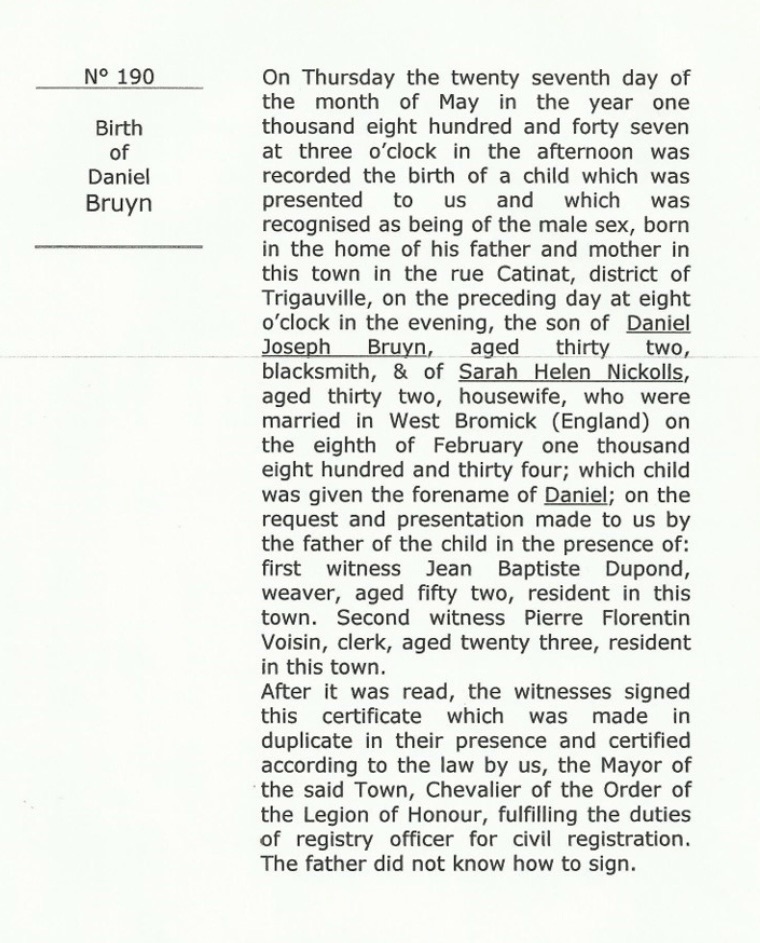
Daniel Justin Bruyn was born in France. His parents, Joseph and Sarah, had married in 1837 in West Bromwich, Staffordshire, where four children were born in the years 1837 to 1842. The family travelled to France, perhaps seeking to use there the skills that Daniel Snr had as a Blacksmith. Two children were born there; Mary died within a year, Daniel Jnr was born on 26 May 1847, at Graville, Le Havre, Seine.
After four years the family returned to England because of the unrest relating to industrialisation. Another daughter was born; the family then migrated to the Colony of New South Wales in 1856 and settled in Dungog, where Daniel purchased land and established his Blacksmith business.
Daniel Justin Bruyn was eleven years of age when his father purchased the land in Brown St; presumably he lived with the family there for some time after they moved into the building that was erected there, at some stage between 1858 and 1866, as noted previously.
Grevilles 1872 Post Office Directory lists both Daniel Bryun, Blacksmith, of Brown St, Dungog, and Joseph Bruyn, farmer, “near Dungog”. Joseph was the firstborn son of Daniel. At some point after this, Daniel Justin Bruyn began to purchase land holdings to the north of Dungog.
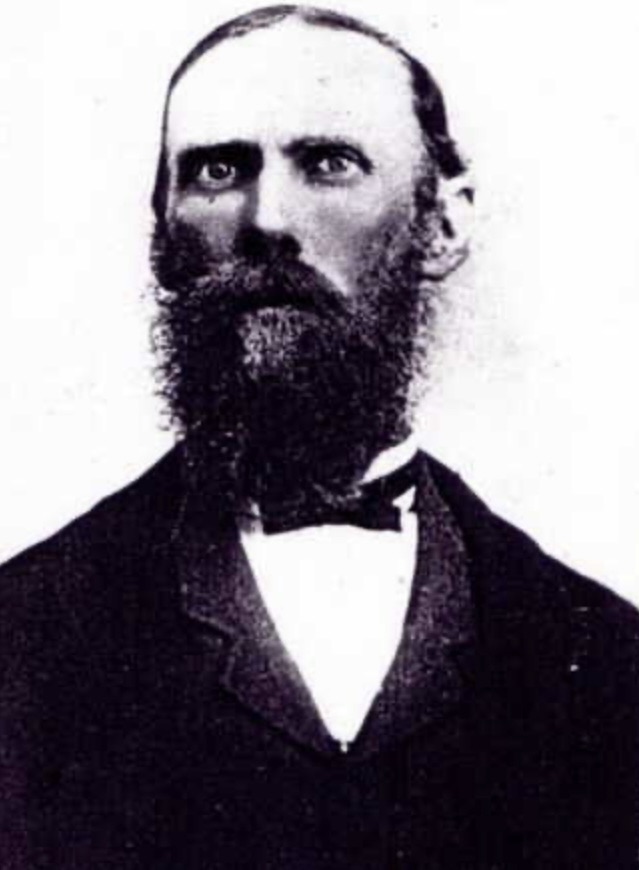
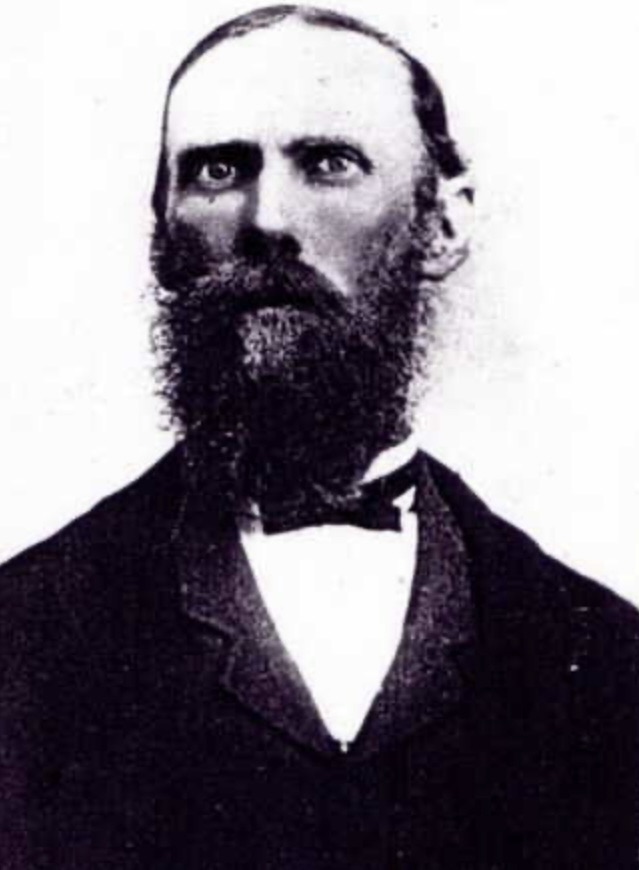
Daniel Justin Bruyn
On 11 Sept 1879, Daniel Justin Bruyn is listed as selecting 234 acres in Dungog, Al. No. 76-37754, C.P. No. 73–9338. On 19 April 1883 Daniel Justin Bruyn made application to be registered as “Proprietor by Transmission” of land in Dungog, as the Administrator of the intestate estate of Daniel Bruyn, deceased. The land was 3 acres, Lots 1, 2, and 3, of Section 32, Town of Dungog; this was on the northern side of Hooke St, between Abelard and Eloisa Streets. (There are residential building on these lots today.)
On 1 September 1892 Daniel Justin Bruyn made application for 79 1/2 acres at Tillegra; on 1 February 1893, 78 3/4 acres was granted to him. On 20 October 1892 he made application for 77 acres at Dungog; on 1 February 1893, 65 1/4 acres was granted to him. It is also reasonable to assume, from a piece of evidence noted below, that Daniel had a room in the house at Brown Street where his sister lived. That was his base when he was in town, it would seem.
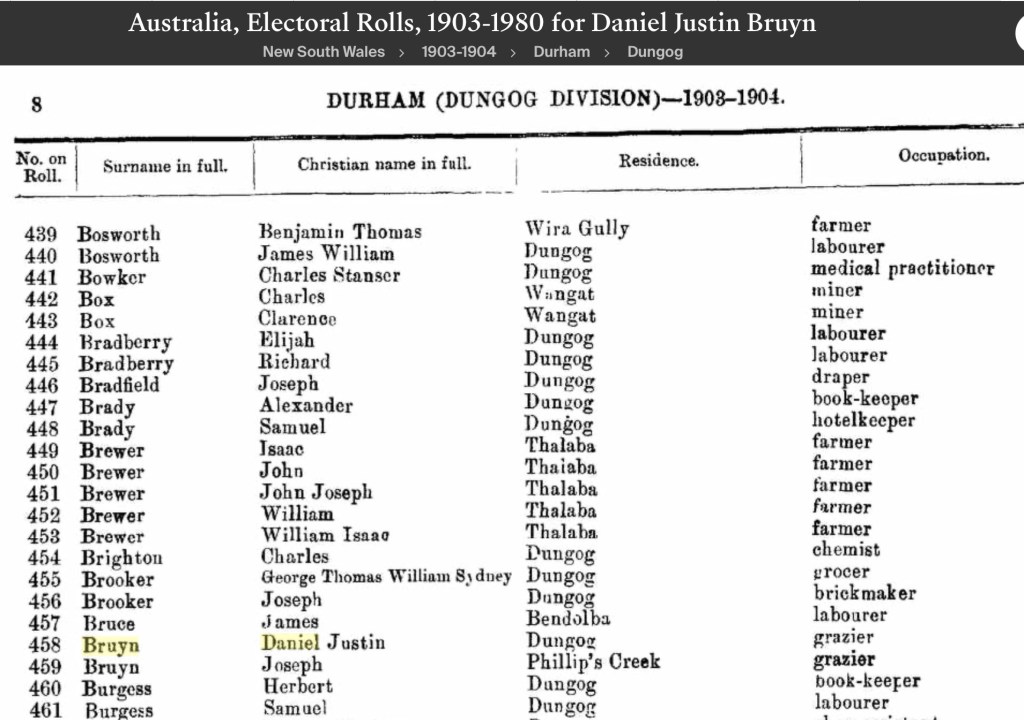
In a series of Electoral Rolls (1895, 1900, 1904) Daniel Justin Bryun, Grazier, is listed as living at Sugarloaf. In 1905, he is listed as having 15 horses and 190 cattle (and no sheep) on his property at Sugarloaf Creek.
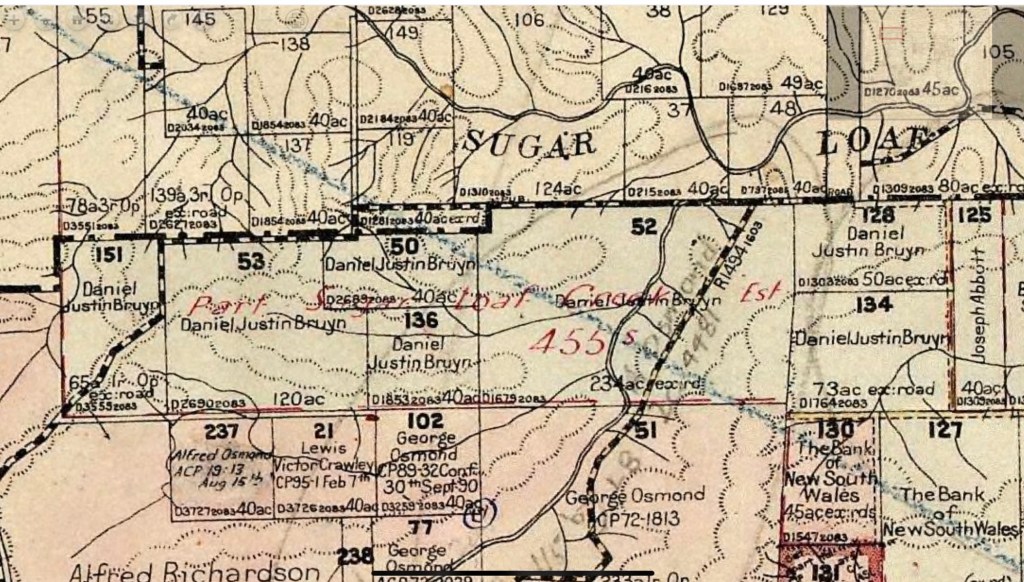
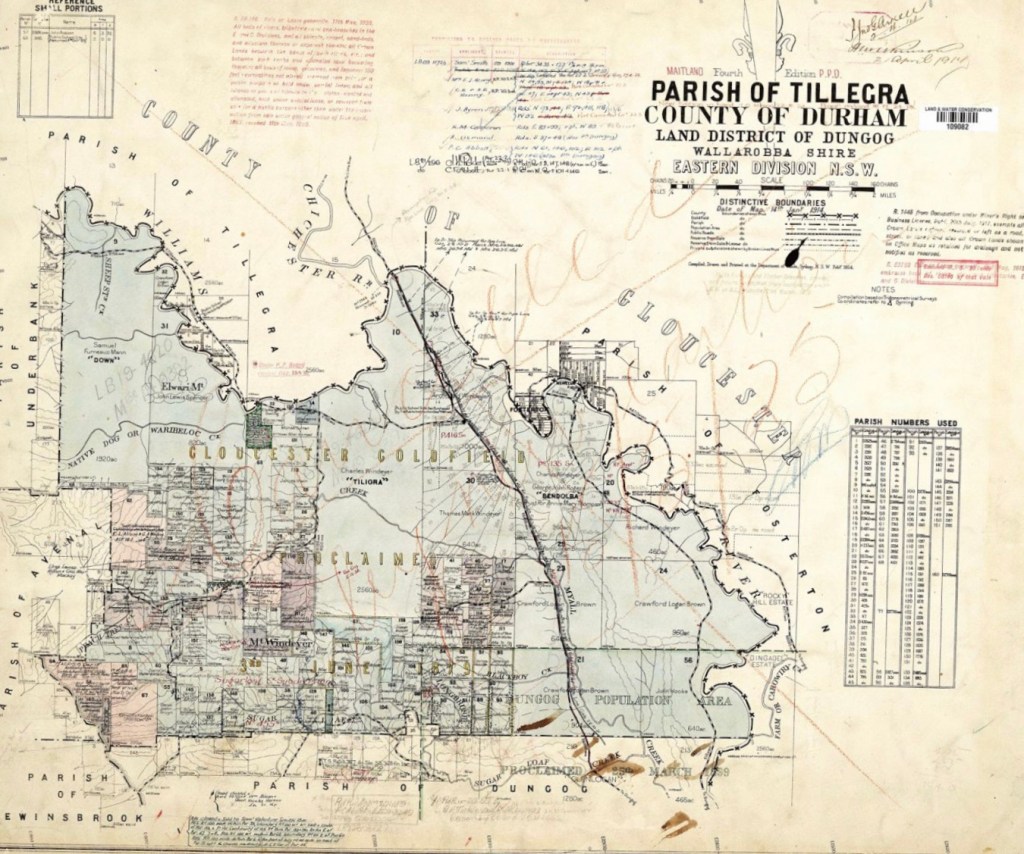
A survey map of the area, dated 9 January 1894, designates seven properties in his name running along the northern boundary of the Parish of Dungog, adjacent to the Parish of Tillegra, to the south of the current Sugarloaf Road, and west of the Longbrush Gully. Another survey map for the Parish of Tillegra places him as owner of a further fourteen Lots running in parallel to his Dungog Parish holdings.
In the Parish of Dungog, running east to west, Bruyn owned Lots 128 (50 acres) and 134 (73 acres), adjacent to each other; then stretching west from them, Lots 52 (234 acres), 50 (40 acres), 136 (40 acres), 53 (120 acres), and 151 (65 acres). This final Lot was the penultimate Lot before the boundary with the Parish of Lewinsbrook, covering the area between Dungog and Gresford. The total acreage of these seven Lots is 622 acres.
The holdings of Daniel Justin Bruyn in the Sugarloaf region, running along the northern boundary of the Parish of Dungog
In addition, on the other side of the Parish boundary, in the Parish of Tillegra, there is another, more extensive, collection of Lots in the name of Daniel Justin Bruyn. Running east to west, he owned Lots 48 (40 acres), 129 (49 acres), 37 (40 acres), 38 (40 acres), 49 (80 acres), 106 (114 acres), 4 (99 acres), 149 (40 acres), 119 (40 acres), 137 (40 acres), 138 (40 acres), 55 (78 acres), 145 (40 acres), and 55 (78 acres)! The total acreage of these Lots is 818 acres.
The holdings of Daniel Justin Bruyn in the Sugarloaf region on the southern border of the Parish of Tillegra, adjacent to his holdings in the Parish of Dungog
The Sugarloaf Creek meanders its way through the easternmost half of the Lots in the Parish of Tillegra. A survey map declares that all of these Lots were part of a larger area, Gloucester Coldfield, that was proclaimed on 3rd June 1879. Together, the 1,440 acres of these Lots form a very significant landholding. To the east of Daniel’s landholdings, another series of Lots totalling 249 acres bear the name of his sister, Ellen Bruyn.
In the Dungog Chronicle of 30 August 1898, p.3, a notice appeared relating to a proposed “public meeting for the purpose of petitioning the Minister for Works, through the Member for Durham, to construct a road between Gresford and Dungog”. There are 14 signatories to this notice, including that of Daniel J. Bruyn, indicating that “a public meeting [is] to be held at the Council Chambers on THURSDAY NEXT, at 8 p.m.”
As one owning property in the Sugarloaf Creek area, Daniel Bruyn obviously had a vested interest. It is clear that the petition for the construction of this road was successful, as a road today does wind its way through the beautiful hills in the area between Gresford and Dungog, and through some of the land once owned by Daniel Justin Bruyn.
Scenery on the Sugarloaf Road from Dungog to Gresford, 2024
Not only did Daniel Justin Bruyn die a wealthy man, however; he died also a highly-regarded and well-respected member of the Dungog community. His obituary (see below) indicated that he was a Trustee of the Dungog Hospital, a Municipal Alderman, a Justice of the Peace, a longterm committee member of the A. and H. Association, and one of the founders of the Dungog School of Arts. He followed the local cricket team with enthusiasm, and owned a number of horses that he raced in the local area.
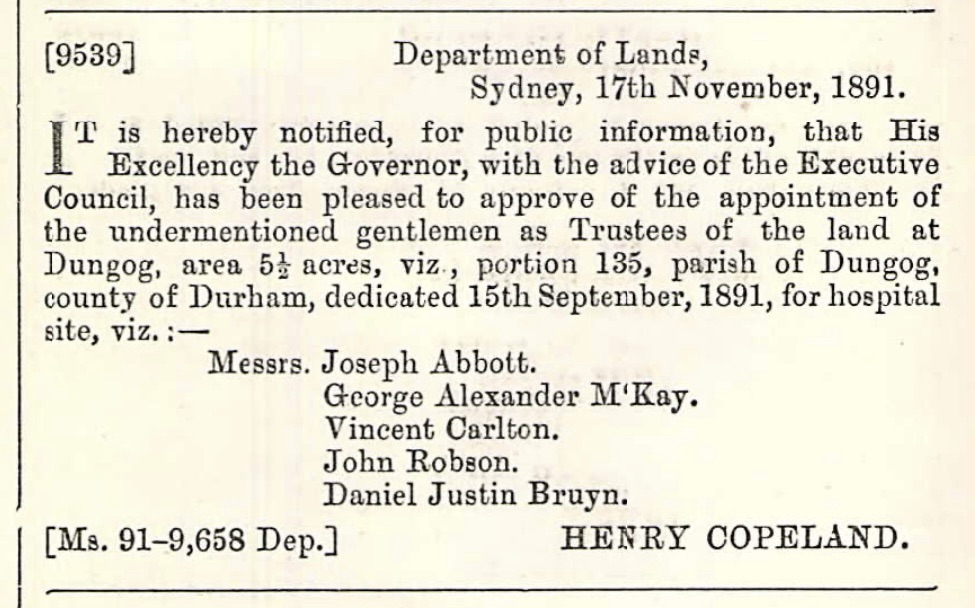
On 17 November 1891, the Government Gazette (p.9023) contained a notice from the Department of Lands of the appointment of Joseph Abbott, George Alexander McKay, Vincent Carlton, John Robson, and Daniel Justin Bruyn, as “Trustees of the land at Dungog, viz. portion 135, parish of Dungog, county of Dungog, dedicated 15th September 1891, for hospital site”.
Notice from the NSW Government Gazette of 7 Nov 1891
The Dungog Cottage Hospital was opened on Hospital Hill in 1892 and the site, now much expanded, has provided local hospital and medical services since that time.
The Dungog Cottage Hospital building
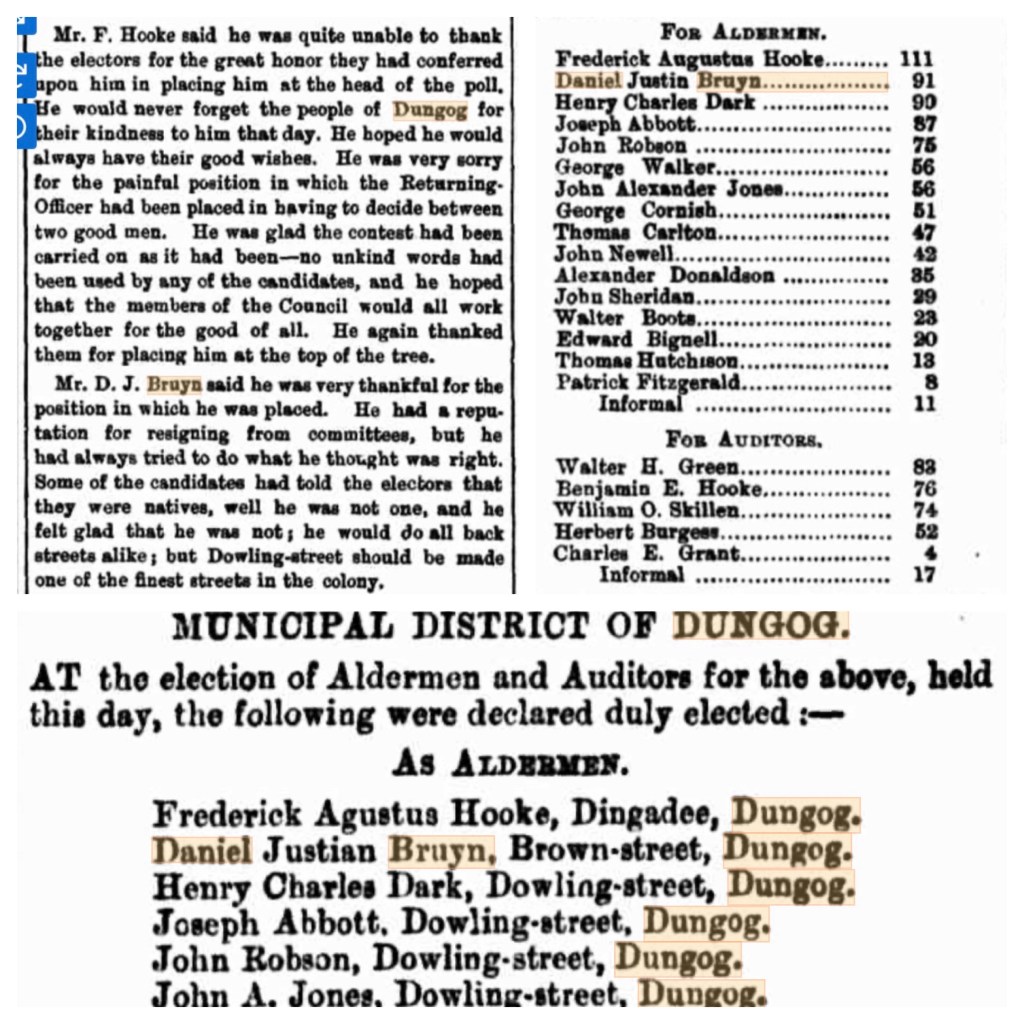
On 21 July 1893, the Government Gazette (p.5663) contained a notice of the election of Frederick Agustus Hooke, Dingadee, Dungog; Daniel Justian [sic.] Bruyn, Brown-street, Dungog; Henry Charles Dark, Dowling-street, Dungog; Joseph Abbott, Dowling-street, Dungog; John Robson, Dowling-street, Dungog; and John A. Jones, Dowling-street, Dungog, as Aldermen of the Municipal District of Dungog.
1893 Government Gazette announcement
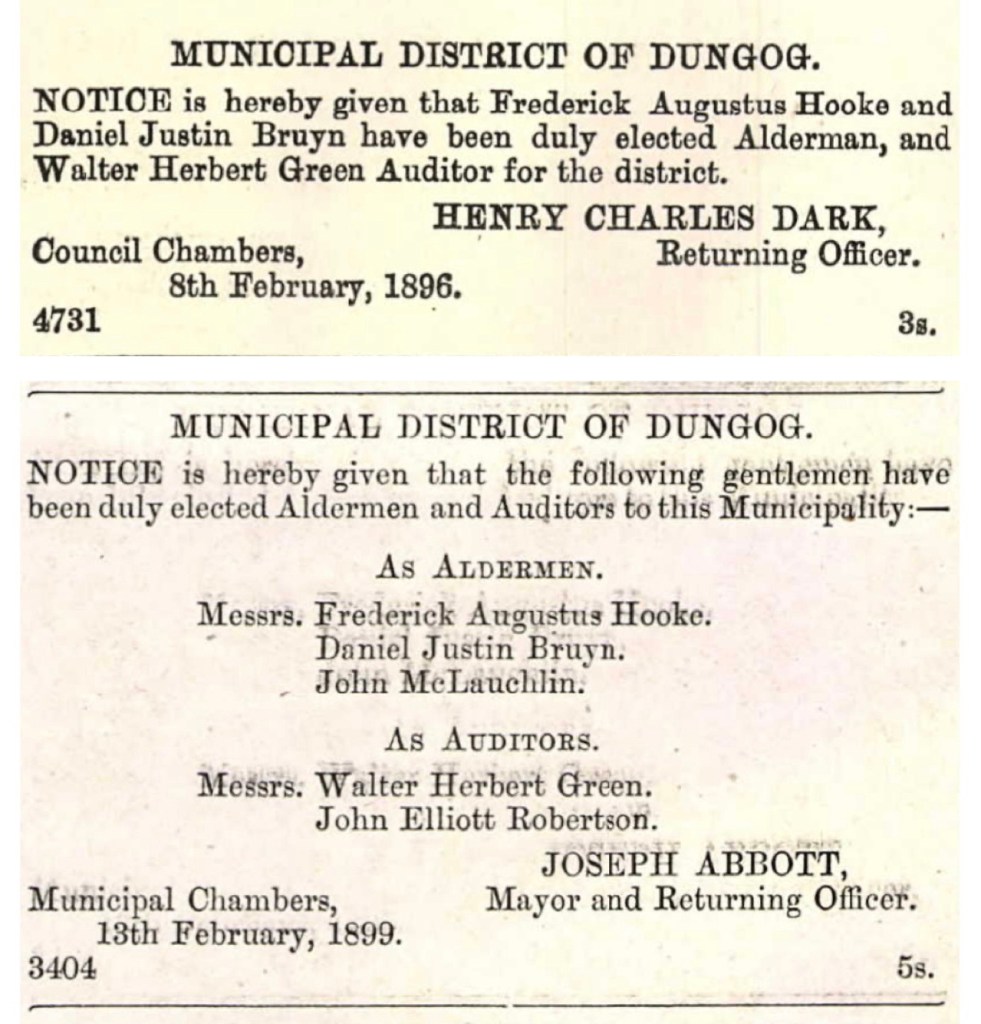
Then, on 8 February 1896, the Government Gazette (p.1022) contained a notice of the election of Frederick Augustus Hooke and Daniel Justin Bruyn, as Aldermen of the Municipal District of Dungog. Three years later, on 13 February 1899, the Government Gazette (p.1415) contained a notice of the election of Frederick Augustus Hooke, Daniel Justin Bruyn, and John McLauchlin, as Aldermen of the Municipal District of Dungog.
Extracts from the Dungog Chronicle of 1896 and 1989, announcing the election of Alderman for the Municipality of Dungog
On 4 May 1901, the Maitland Mercury (p.3) reported that Daniel Justin Bruyn was amongst a list of “gentlemen appointed to them commission of the Peace” (that is, as a Magistrate, or a Justice of the Peace).
On 22 September 1886, Daniel Justin Bruyn had made his last Will and Testament “whereby he gave devised and bequeathed all his property of whatsoever nature and wheresoever situate to his sister Ellen Bruyn absolutely and appointed the said Ellen Bruyn the sole Executrix thereof”. On 1 November 1912 Daniel Justin Bruyn died, and that will came into effect. So Ellen received a significant amount of property, as we have seen.
The Register of Coroner’s Inquests for 2 November 1912 lists an inquest for Daniel Justyn Bruyn of Dungog, held by Walterus Le Brun Brown, J.P., which notes that “cash or property possessed by deceased” was “probably over £10,000”. That equates to around $1.45 million in 2023.
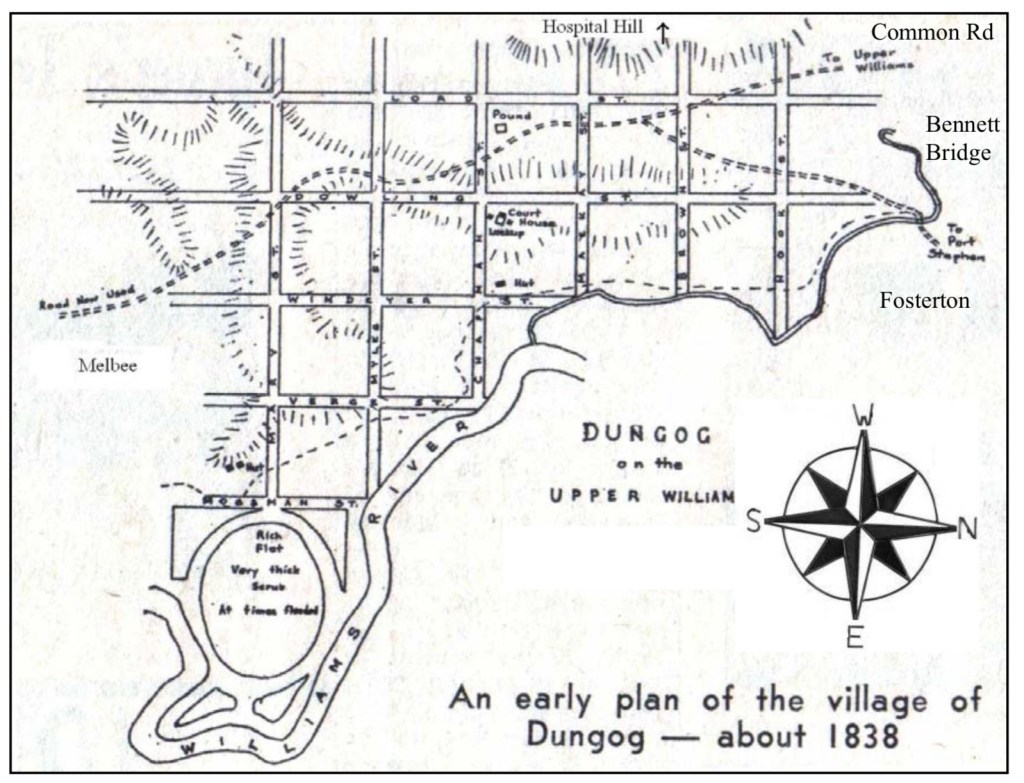
The land on which the house that we currently own and live in, on Brown Street, Dungog, was part of the original area of land in the town of Dungog that was made available in 1838 to settlers by the Governor of the Colony of New South Wales, Sir George Gipps.
Of course, this land and the surrounding region had been the land of the Gringai people for millennia; but once the British government started sending convicts to this continent, and began the process of claiming the land from the Indigenous people, the British system of law, and of land and property, became dominant as new settlements were opened up for the incoming settlers.
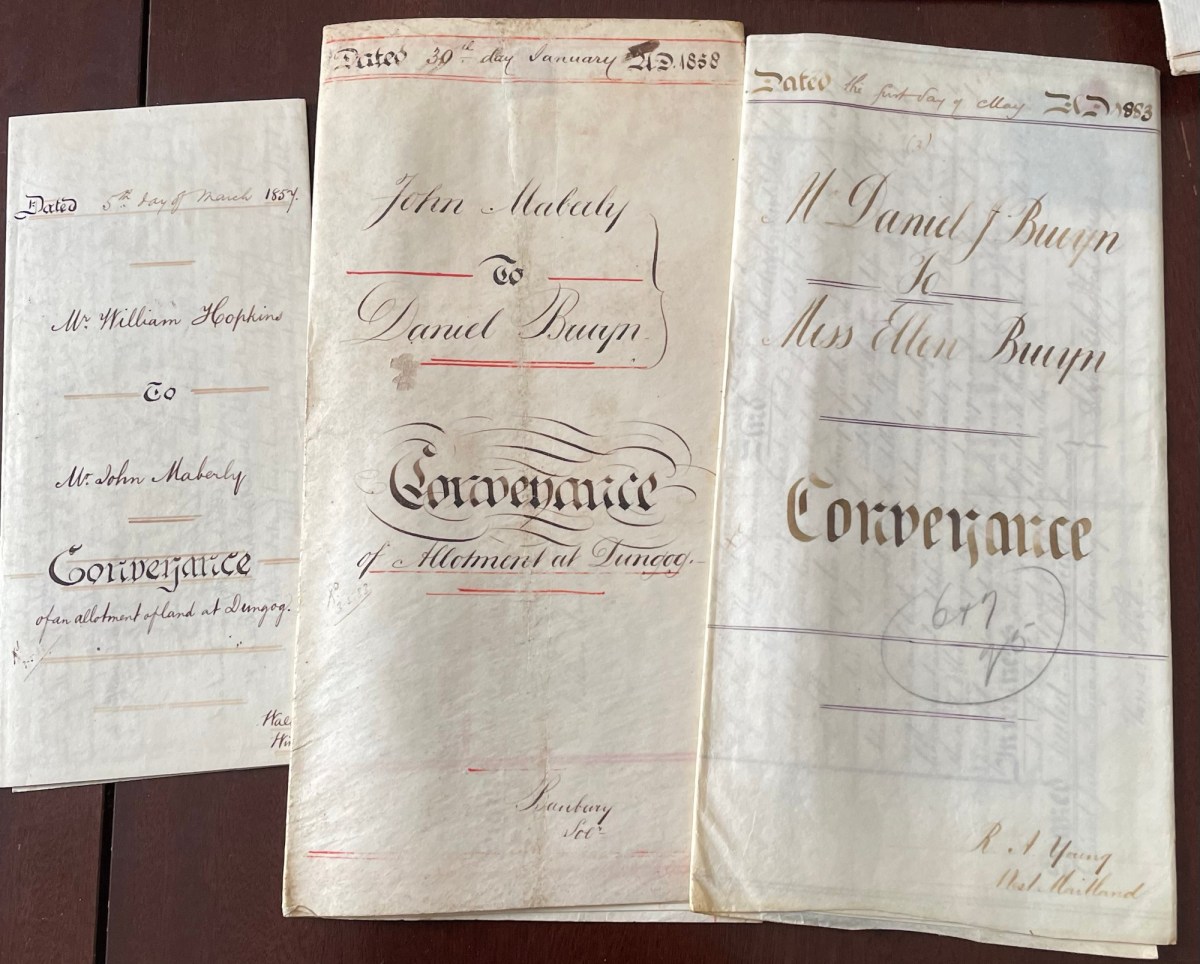
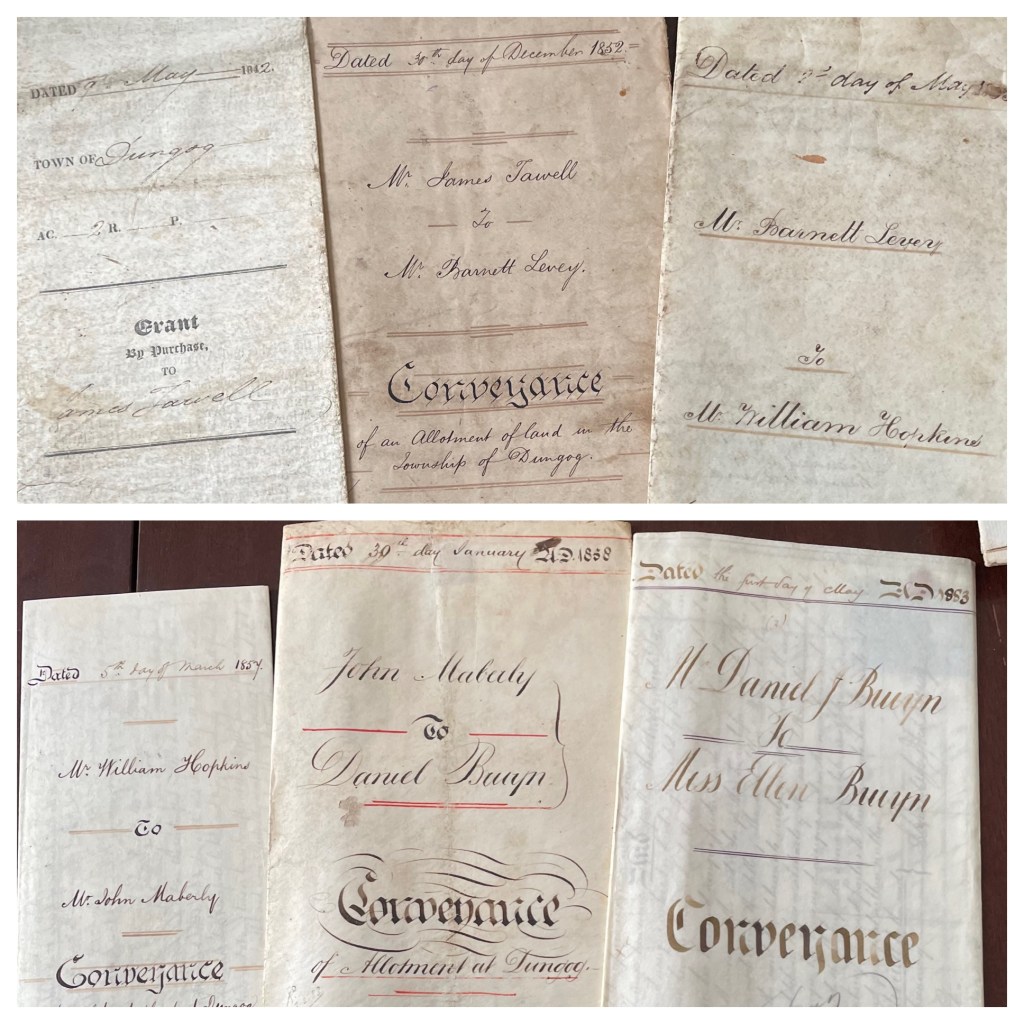
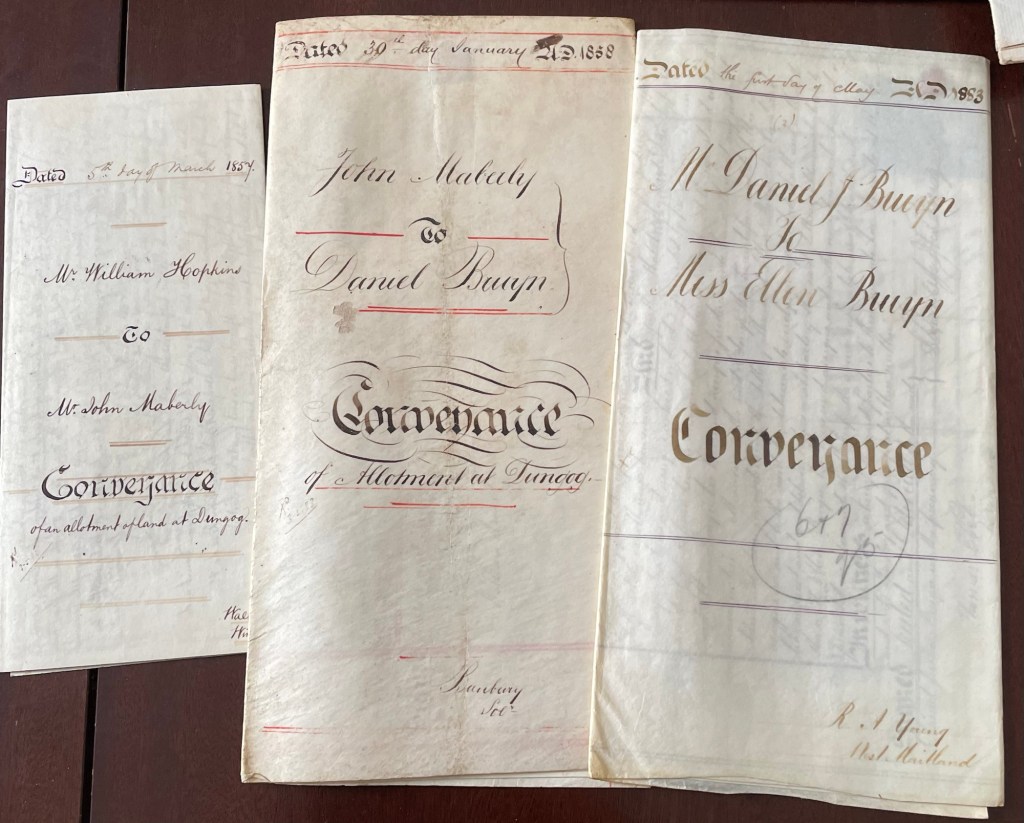
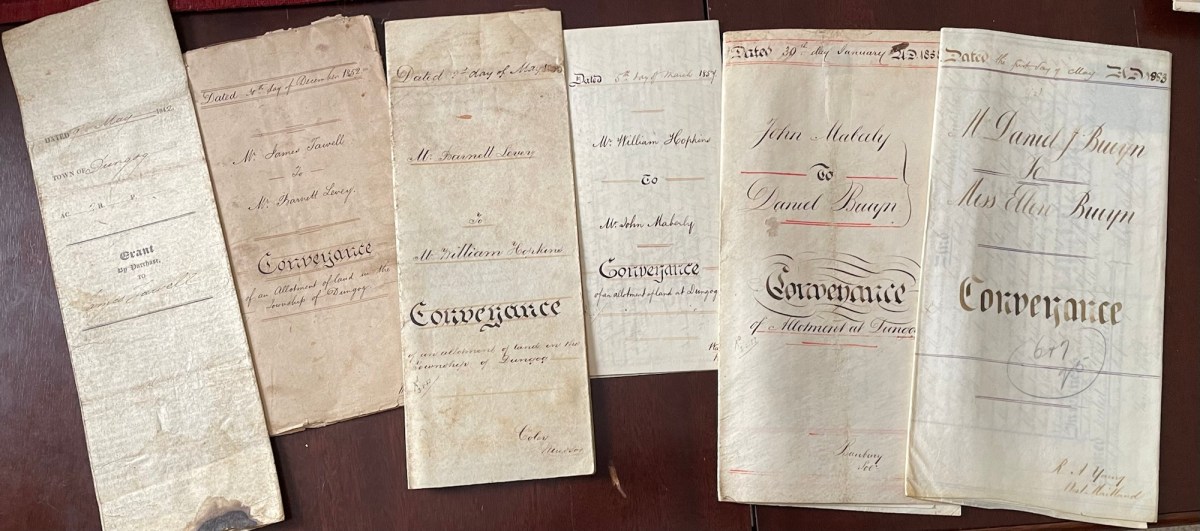
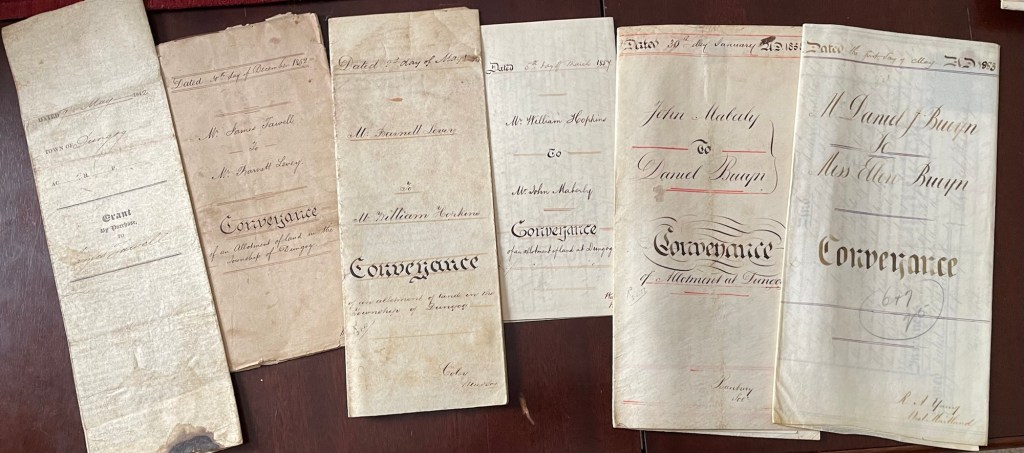
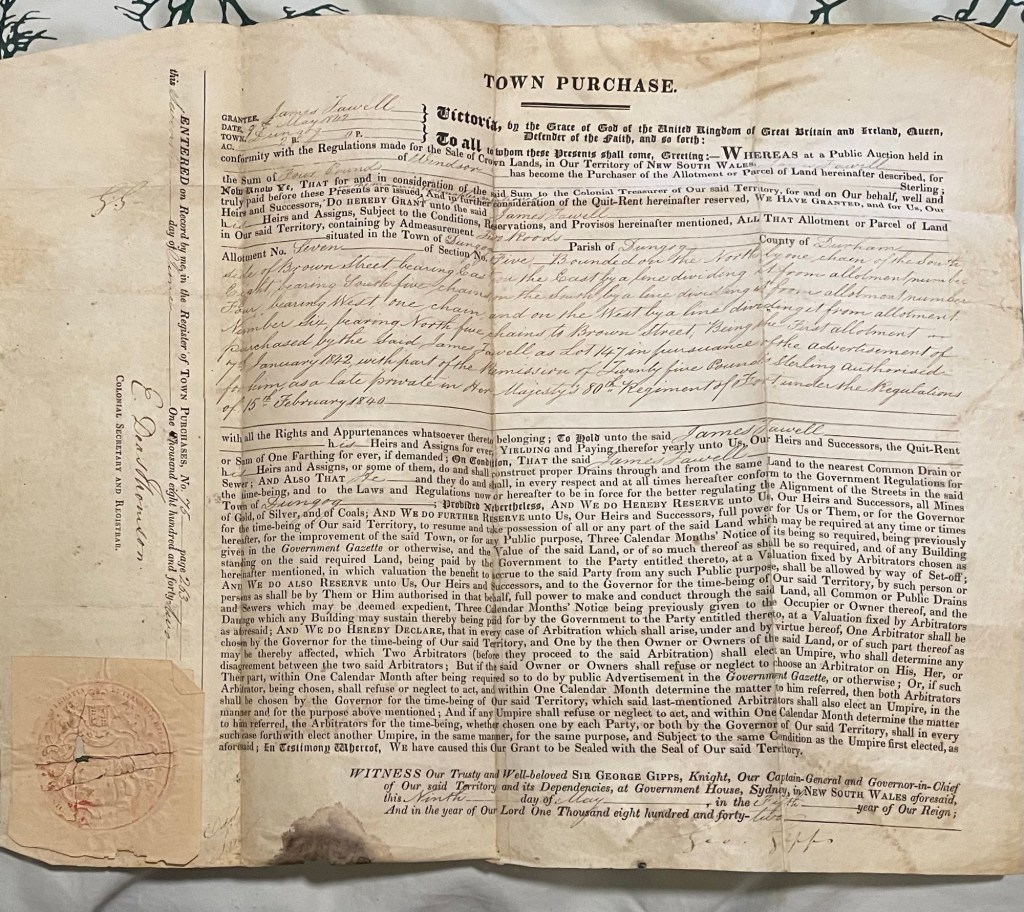
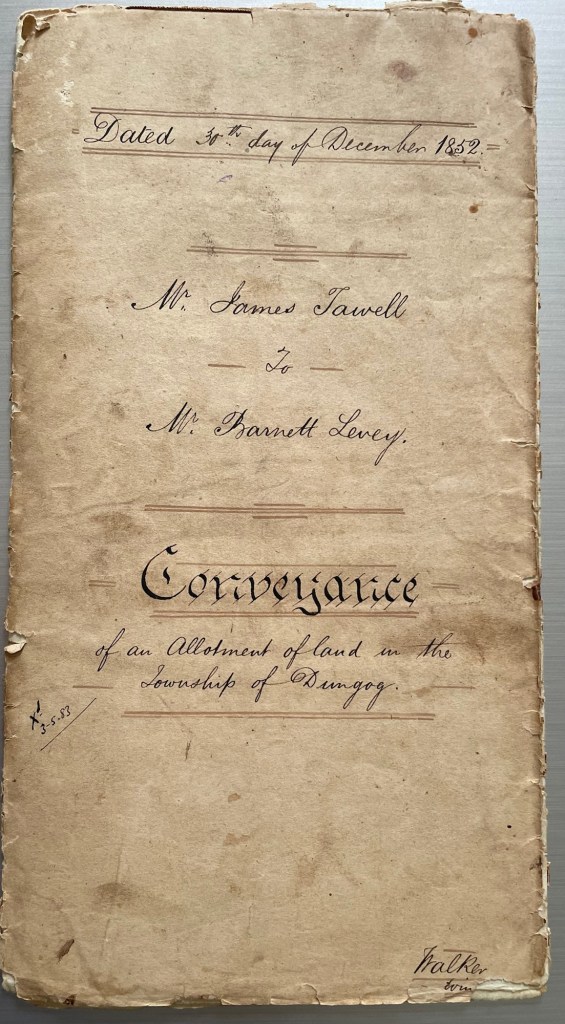
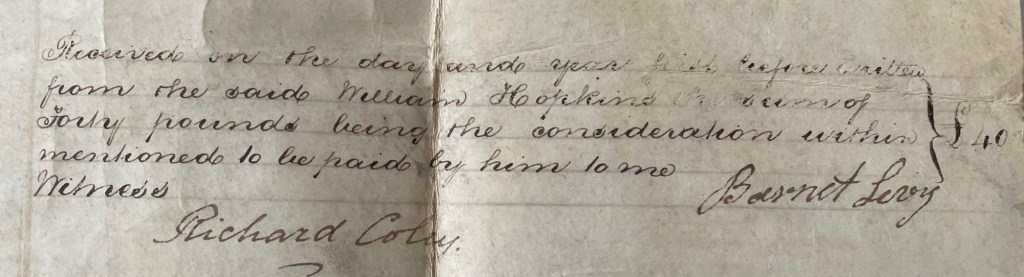
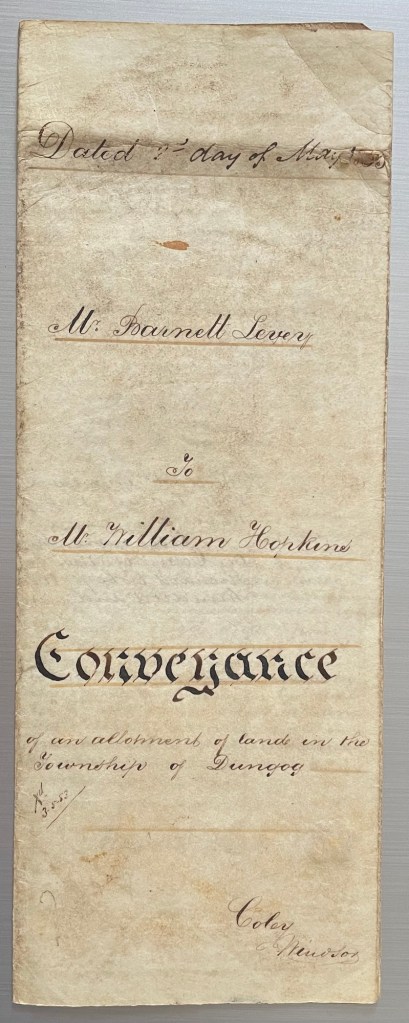
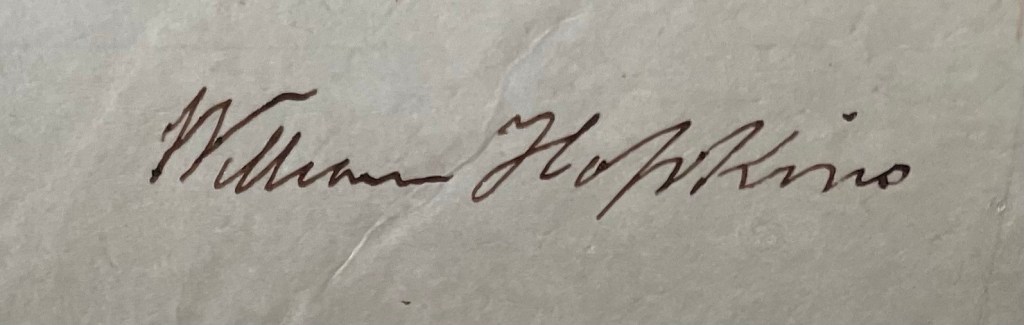
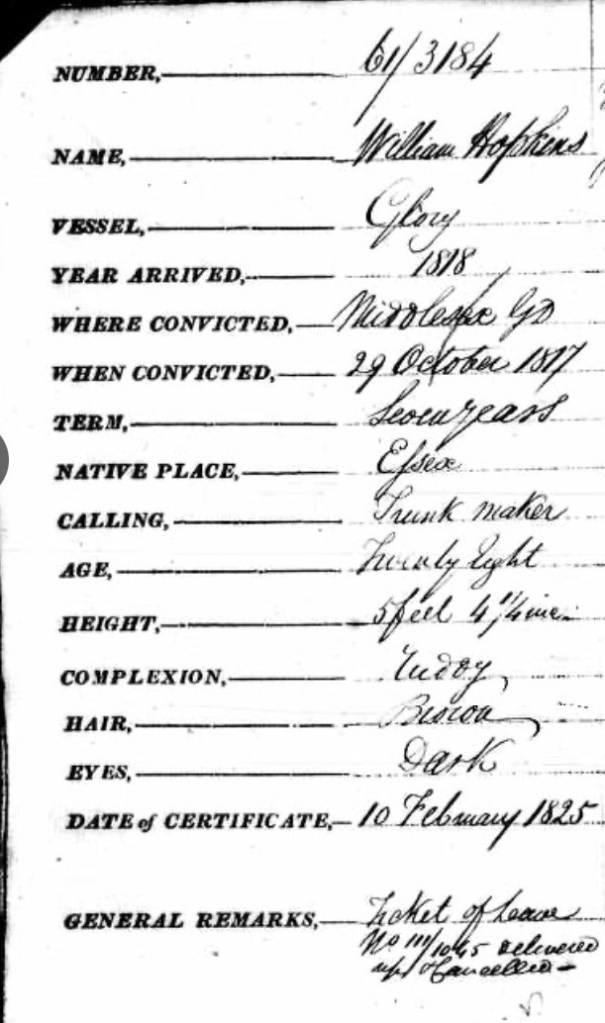
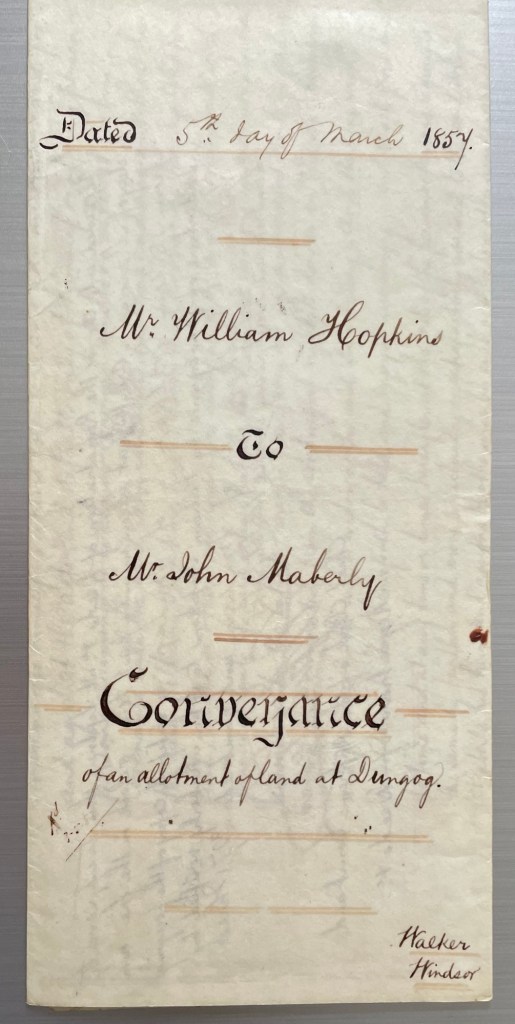
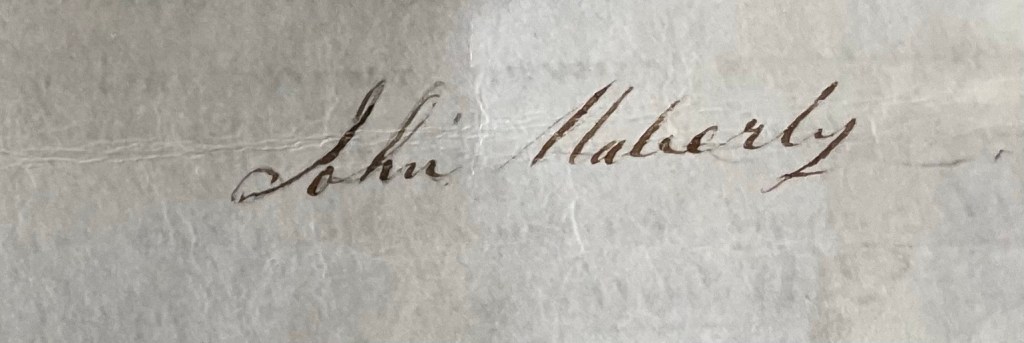
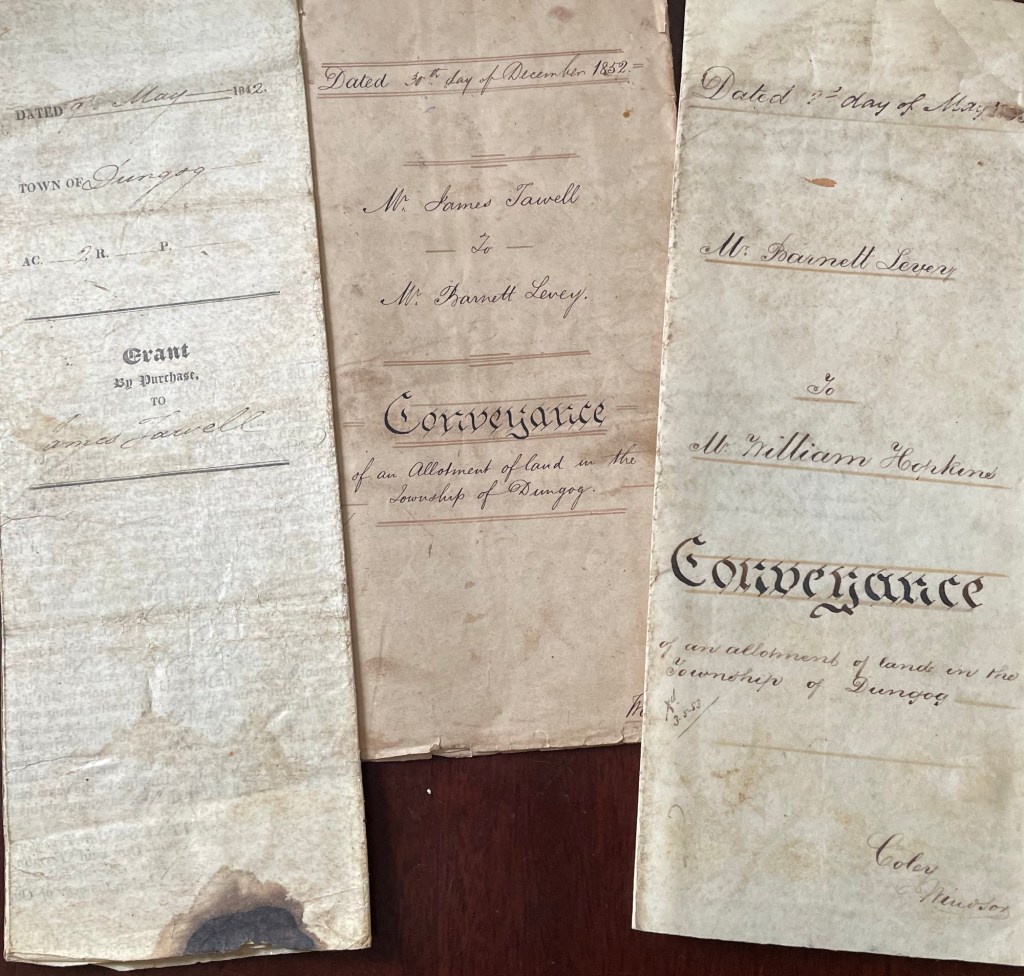
A bundle of documents which we received when we purchased the property provides information about the sequence of owners, from 1842, when the land was bought by James Fawell, up to 1969, when it was bought by Victoria Jack and Wendy Elizabeth Finney. These documents show that it was owned by a series of men in the middle of the 19th century: James Fawell (1852), Barnet Levey (1852), William Hopkins (1855), John Maberly (1857), and then Daniel Bruyn (1858).
The series of legal documents relating to the Brown St property
When Daniel Bruyn purchased the land in 1858, two years after arriving on New South Wales, it meant that he could provide a home for his family in Dungog, as well as a site to conduct his business as a Blacksmith. When Daniel Snr died intestate in 1882, all of his property was made over to his son, Daniel Justin Bryan; a few months later, the land he held in Brown St had been purchased by his daughter, Ellen Bruyn. She lived in the house until her death in 1927.
What do we know of the life of the Bruyn family? In the obituary to Miss Ellen Bruyn after her death, published in the Dungog Chronicle of Tuesday 4 October 1927, p.2, we read: “In the memorable flood of 1857, the [Bruyn] family had to be rescued from their home, which, although situated at a comparatively high level, was inundated by the swirling waters. It was the year that eight of the ill-fated Ross family were swept to death from their home on Melbee flat.”
The Bruyn family survived the flood. The names of the members of the Ross family who died in this flood are listed in a report of the inquest held on 1 September 1857, namely: “George Ross, aged 39 years; Mrs. Ross, aged 27 years; William Ross, aged 9 years; Mary Jane Ross, aged 7 years; John Ross, aged 6 years; Elizabeth Ross, aged 4 years; Julia Ross, aged 1 year and 9 months.” (Maitland Mercury, Thursday 3 September 1857, p.2)
The obituary to Ellen Bruyn also reports that “The Bruyn family played an important part in Dungog’s progress, and were prominently identified with every forward movement. They experienced many of the trials and hardships inseparably associated with the early pioneering days, and saw many thrilling happenings.” That’s a very nice tribute to them all—and it would be fascinating to know more about some of these “thrilling happenings”!
We know far more about men in society in the 19th and 20th centuries than we do about women; not only were male occupations more public (“a woman’s place is in the home”, as the sexist, but generally accurate, saying went in those days), but the bias towards males overall is evident in so many ways.
Newspapers articles do report the contributions of women to some charitable and community events and organisations; but it is predominantly the men who serve on Council, buy and sell property, conduct professions and trades, and are in what were seen, at that time, to be leadership roles in the community.
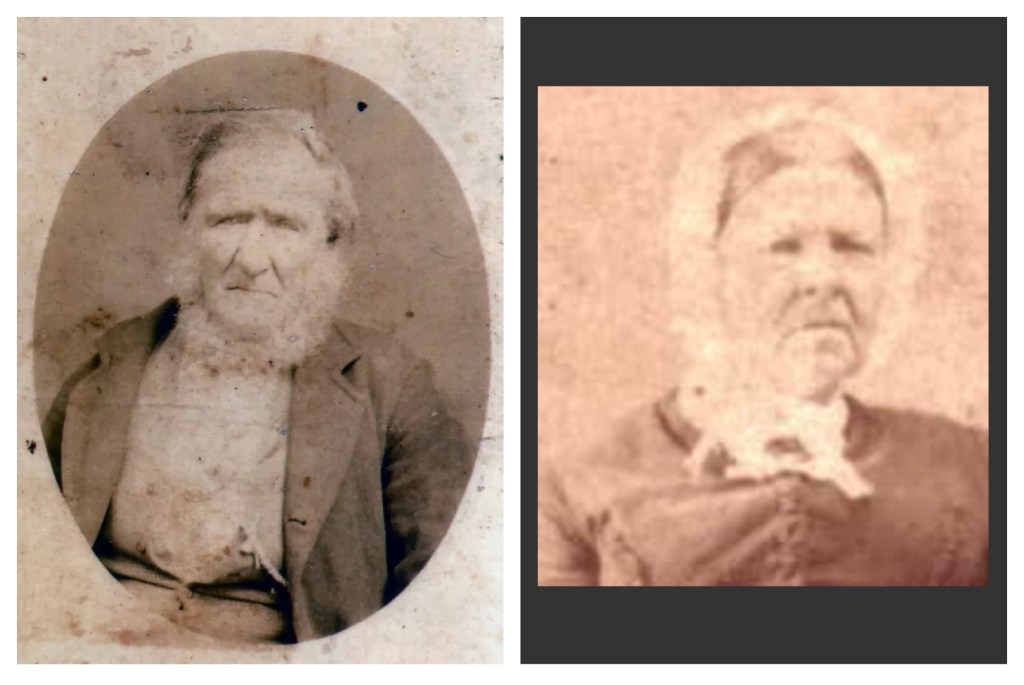
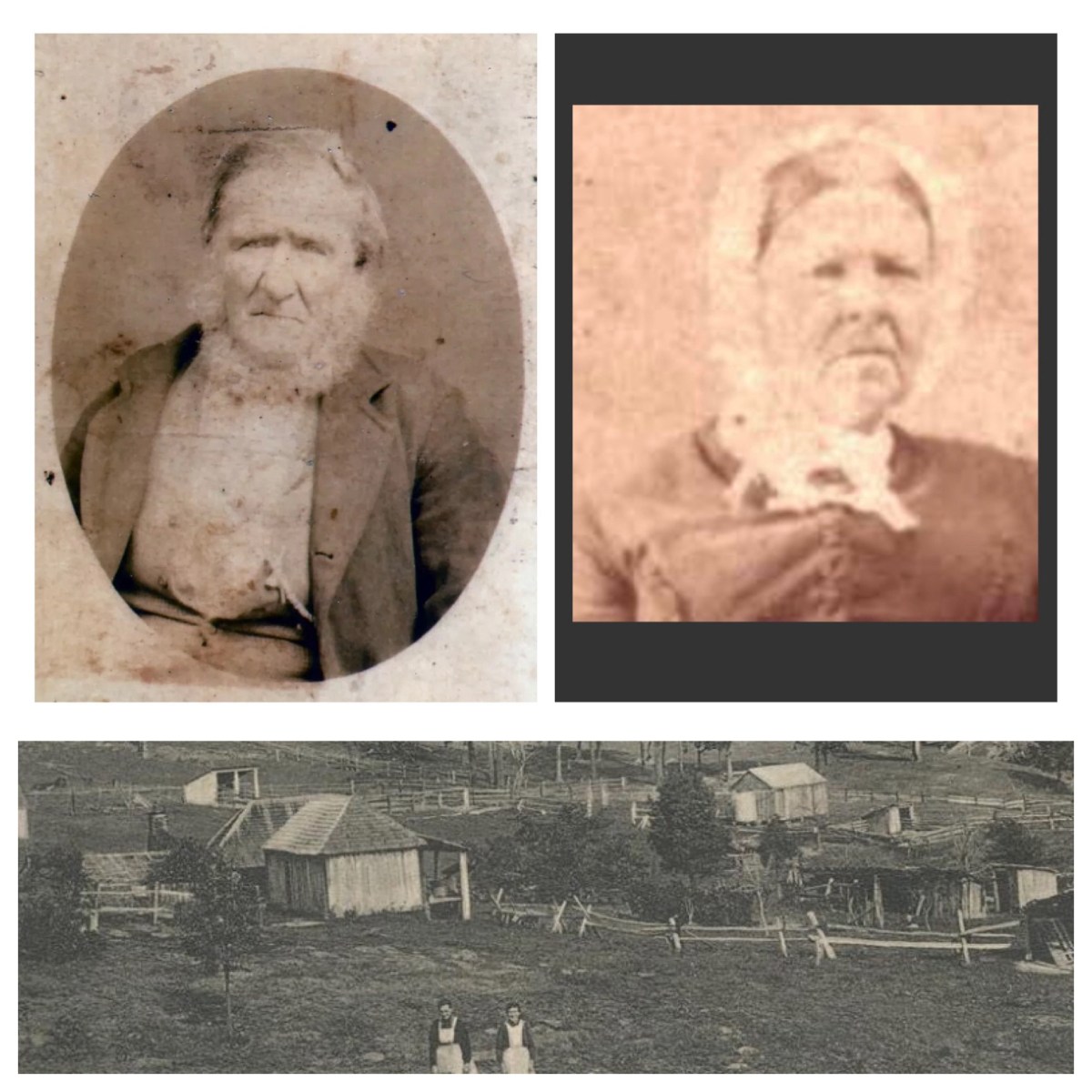
Daniel and Sarah Bruyn, late in their lives
So not much more cannot be said about Sarah Bruyn other than, as a faithful wife and mother of six children, she would have organised and run the Bruyn household with efficiency and diligence. She should always be considered to be there—albeit “in the shadows”—when her husband, Daniel Joseph Bruyn, is mentioned.
And fortuitously, as we shall see, her spinster daughter Ellen would be noted more often in the newspapers of the day and even on property registers (as an adult she owned land adjacent to the holdings of her brother, Daniel Justin). Through her compassion, diligence, and concentrated effort, she was able to make bequests in her will that both reflected her community involvements and that had a life of their own, for two decades and more, for the good of the community. Did she inherit these traits from her mother, perchance?
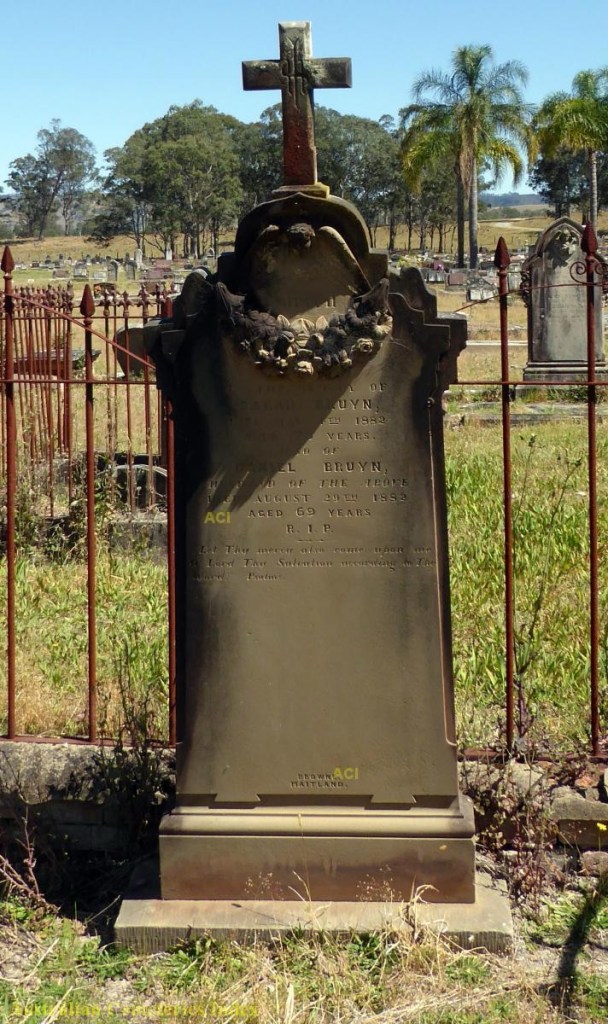
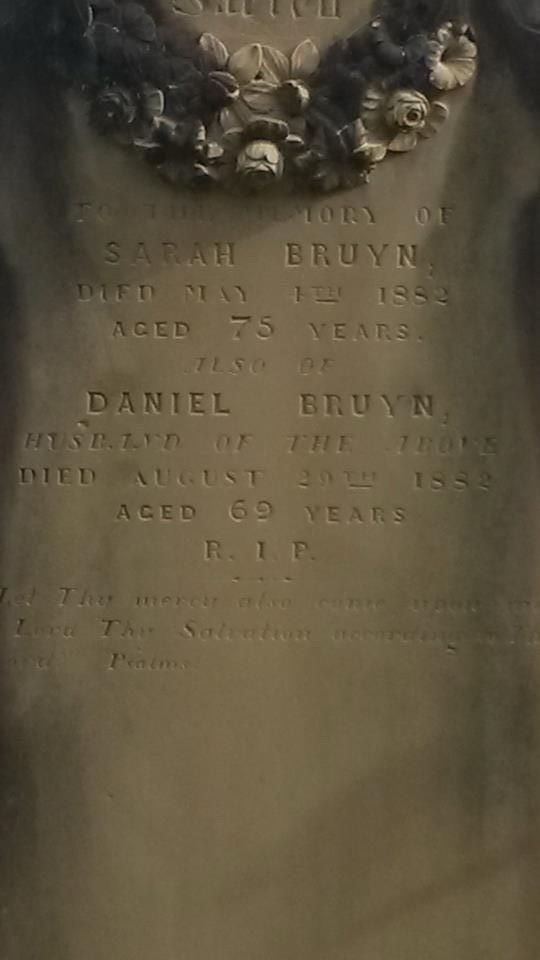
At the age of 75, the mother of the Bruyn family, Sarah Ellen Bruyn, died on 4 May 1882; her husband Daniel Joseph Bruyn died soon after on 29 August 1882. They are both buried in the Dungog Cemetery.
The tombstone for Daniel and Sarah Bruyn in the Dungog Cemetery The inscriptions on the tombstone of Daniel and Sarah Bruyn
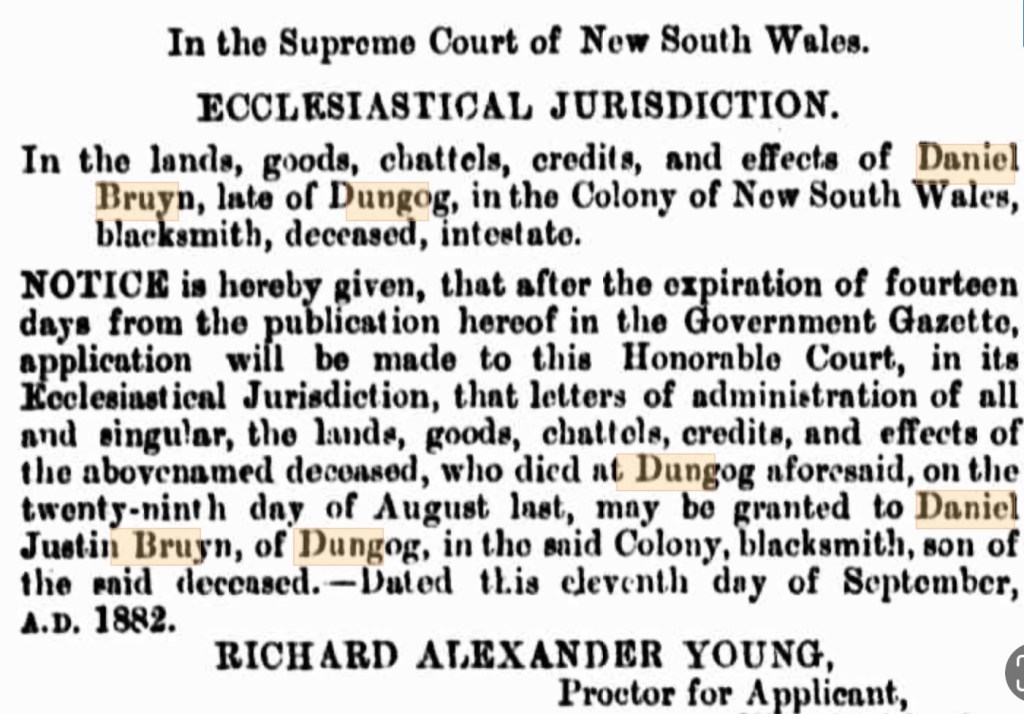
Daniel died intestate, so there were legal matters to be dealt with. In the first instance, all of the property held by Daniel Joseph Bruyn was to be given over to his son, Daniel Justin Bruyn. The Dungog Chronicle included the following notice:
In the Supreme Court of New South Wales ECCLESIASTICAL JURISDICTION. In the land, goods, chattels, credits, and effects of Daniel Bruyn, late of Dungog, in the Colony of New South Wales, blacksmith, deceased, intestate.
NOTICE is hereby given, that after the expiration of fourteen days from the publication hereof in the Government Gazette, application will be made to this Honorable Court, in its Ecclesiastical Jurisdiction, that letters of administration of all and singular, the lands, goods, chattels, credits, and effects of the abovenamed deceased, who died at Dungog aforesaid, on the twenty-ninth day of August last, may be granted to Daniel Justin Bruyn, of Dungog, in the said Colony, blacksmith, son of the said deceased.—Dated this eleventh day of September, A.D. 1882.
RICHARD ALEXANDER YOUNG, Proctor for Applicant, West Maitland. By W. J. Fergusson, 136, Pitt-street, his Agent. 6023 6s. 6d.
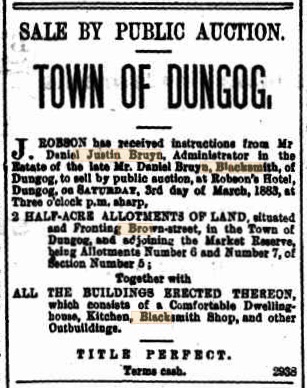
It appears that plans were made for this to be duly executed, as a notice in the classified advertising of the Maitland Mercury of Sat 24 Feb 1883, p.7, indicates that the two blocks of land in Brown St are to be sold be auction:
SALE BY PUBLIC AUCTION.
J. ROBSON has received instructions from Mr Daniel Justin Bruyn, Administrator in the Estate of the late Mr. Daniel Bruyn, Blacksmith, of Dungog, to sell by public auction, at Robson’s Hotel, Dungog, on Saturday, 3rd day of March, 1883, at Three o’clock p.m. sharp, 2 HALF-ACRE ALLOTMENTS OF LAND, situated and Fronting Brown-street, in the Town of Dungog, and adjoining the Market Reserve, being Allotments Number 6 and Number 7, of Section Number 5; Together with ALL THE BUILDINGS ERECTED THEREON, which consists of a Comfortable Dwellinghouse, Kitchen, Blacksmith Shop, and other Outbuildings. TITLE PERFECT. Terms cash. 2938
This notice certainly shows that buildings had been erected on the land and were in use well before 1883.
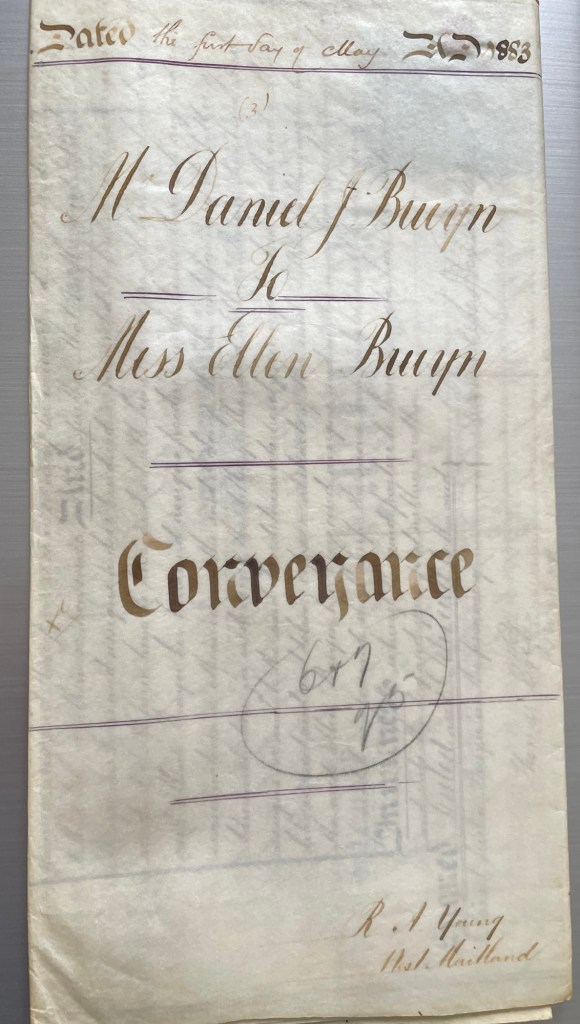
The next piece of information about this property comes from the next Conveyance contained in the bundle of documents we received when purchasing our land. That Conveyance, dated 1 May 1883 (two months after the auction day) indicates that Ellen bought the two blocks of land from her brother Daniel for £160.
“Conveyance dated 31st day of May 1883 … between Ellen Bruyn of Dungog, Spinster, and Daniel Justin Bruyn of Dungog, Blacksmith, Allotment No. Seven of Section No. Five and Allotment No. Six of Section No. Five. Two hundred pounds”.
Before we explore the story of Ellen Bruyn, we need to give due consideration to the life of Daniel Justin Bruyn.
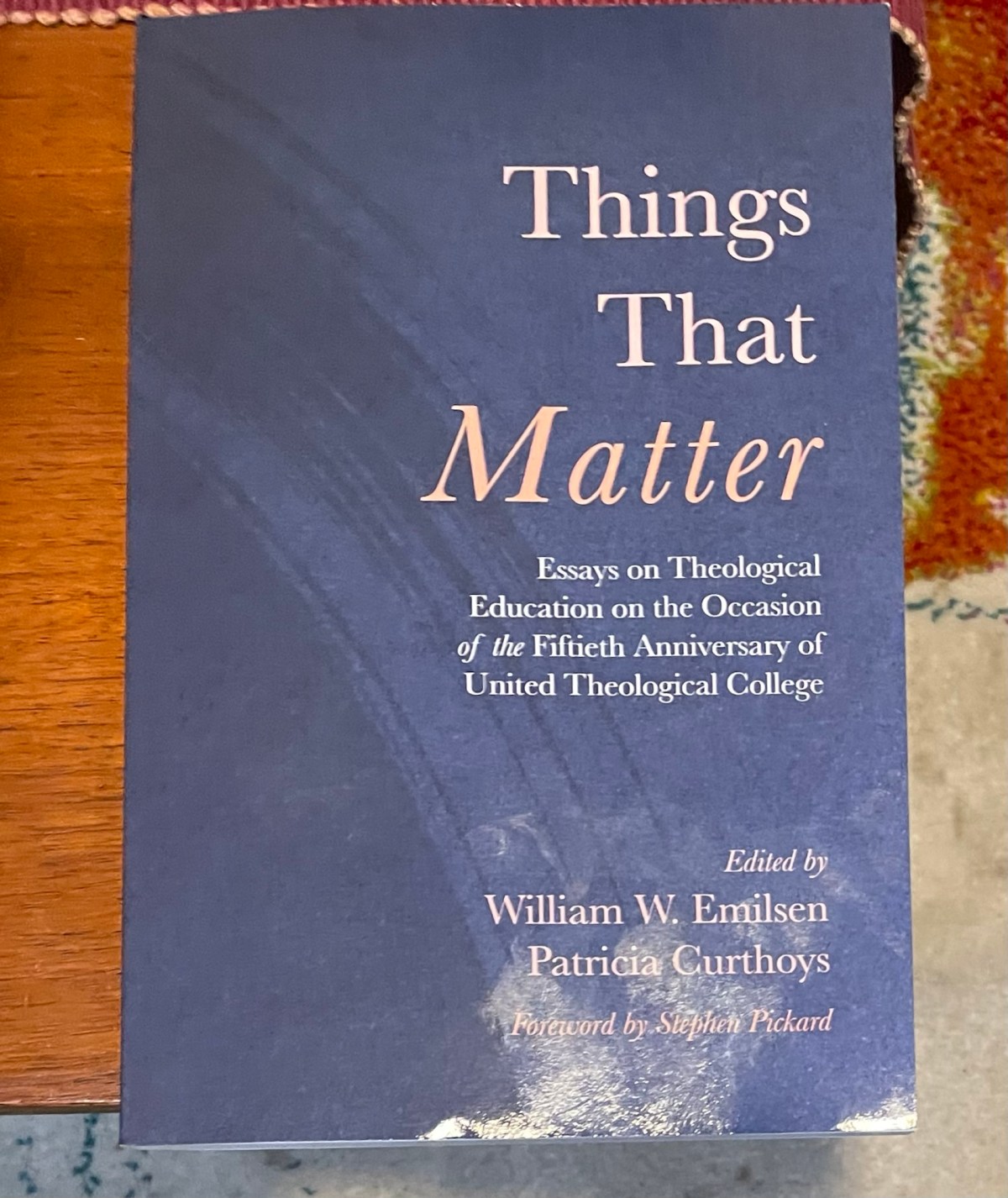
I’ve just received my copy of Things That Matter: Essays on Theological Education on the Occasion of the Fiftieth Anniversary of United Theological College. The college (UTC) was where I trained for ministry in the latter years of the 1970s, was a visiting lecturer in the later 1980s, and taught as a member of the Faculty from 1990 to 2010.
It is edited by my friend and colleague, William W. Emilsen (whom I’ve known since he was also a student at UTC in the 1970s) and Patricia Curthoys. Both are historians of some repute within the Australian church and beyond, each having written and published a number of significant historical works, as well as collaborating on earlier historical volumes.
The UTC campus in North Parramatta, Sydney, NSW
Prof. Glen O’Brien says that the book “highlights well the flourishing of the diverse contextual theologies that have been developed at UTC over many decades.” Assoc. Prof. Geoff Thompson, reflecting the title of the book, appreciates that the book explores “what has mattered, what no longer matters, what should matter.” And the President of the Uniting Church, the Rev. Charissa Suli (herself a graduate of UTC) offers appreciation for the way the book “beautifully weaves personal narratives with deep reflections on identity, vocation, and hospitality within Christian discipleship.”
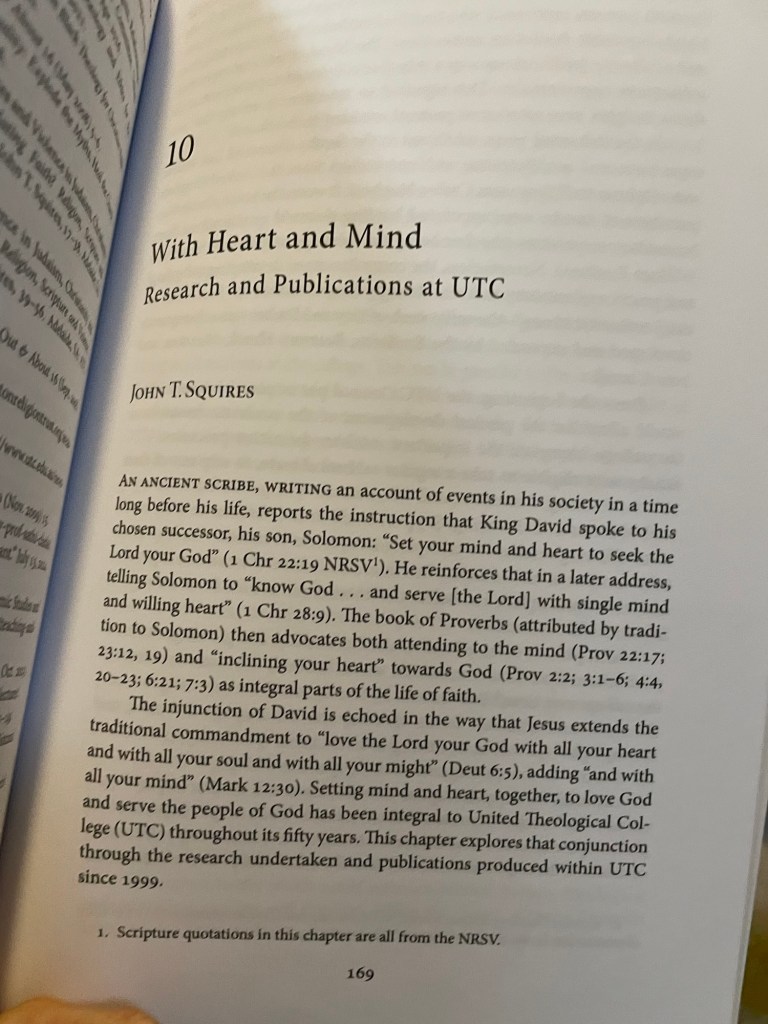
There are ten chapters in the book, each written by a different author. I was pleased to be able to contribute the final chapter, “With Heart and Mind”, exploring the research output produced within the college over the last 25 years—both publications by members of Faculty as well as the many doctoral dissertations that they supervised during those years.
I’d had early involvement in the development of the research culture of the College when we offered bachelor and masters degrees through the Sydney College of Divinity in the 1990s. In those days we had a Research and Publications Committee, which I convened, and a regular masters-level seminar. It is most pleasing to see how from those early steps a strong research and publications culture has developed, with scores of doctoral dissertations having been produced in the first 25 years of this century, supported by the regular Friday postgraduate seminar where ideas are presented, critiqued, and refined.
In the end, my chapter in this book ran to twenty-two pages with 114 footnotes, followed by a bibliography of works published by Faculty and PhD dissertations completed under their supervision, which added another 8 pages. So it was quite a piece of work: variously fascinating, illuminating, daunting, and finally: achieved!
There are many reasons why I am looking forward to reading this book. In an opening chapter, Ross Chambers explores the relationship of the College (and through it, the Church) to the University of which we became a part, in the School of Theology of Charles Sturt University. This is a substantial reason that underlies the flourishing research culture that I wrote about; government funding to the University meant that the college gained financial contributions for each faculty publication and for supervision of research students.
Ross was instrumental in negotiating the involvement of UTC in CSU; he saw the value of bringing into the School a Faculty where each member themselves had a quality doctoral qualification as well as a growing experience in research supervision. (And, of course, this would undoubtedly look good for the University!) Ross is both a former Vice-Chancellor of CSU and a Chair of the UTC Council (which in earlier years, when I was then secretary of this council, was chaired by two previous Vic-Chancellors of Macquarie University: Bruce Mansfield and then Barry Leal).
There are chapters in this book which explore ministerial formation, the centrality of community, the varying approaches to teaching from those responsible for Systematic Theology, the wonderful Camden Theological Library under the brilliantly entrepreneurial stewardship of Moira Bryant, and the opportunities for continuing education (especially through the presence of overseas visiting scholars) for those already engaged in ministry.
There’s a chapter on the intersection between multiculturalism (a key commitment of the Uniting Church) and theological learning, as well as a chapter each devoted to the experiences of the many Korean students of UTC, and the equally numerous Pasifika students, many of whom have produced doctoral work that develops and extends the theology of their native countries (Tonga, Samoan, Fiji, Tuvalu, the Cook Islands, and more).
It’s a delight to know that my co-contributors to this book are both those alongside whom I taught for many years, as well as some whom I had taught in their foundational theological studies. It augurs well for the College and the Church that the current Faculty includes UTC graduates Peter Walker (Principal), Sef Carroll (Cross Cultural Ministry and Theology) and Bec Lindsay (Hebrew Scripture/Old Testament). A number of previous faculty members (myself included) had also begun their theological studies at UTC. Whilst there is certainly value in having teachers from beyond this circle—indeed, in some cases, from beyond the Uniting Church—on the faculty, it’s important to have “home-grown” scholars-ministers as well.
As I say, I am looking forward to reading the other chapters. I understand that the publication of the book will be recognised at the forthcoming meeting of the NSW.ACT Synod, and then there will be a formal public launch on 12 September at UTC in North Parramatta.
The land on which the house that we currently own and live in, on Brown Street, Dungog, was part of the original area of land in the town of Dungog that was made available in 1838 to settlers by the Governor of the Colony of New South Wales, Sir George Gipps.
Of course, this land and the surrounding region had been the land of the Gringai people for millennia; but once the British government started sending convicts to this continent, and began the process of claiming the land from the Indigenous people, the British system of law, and of land and property, became dominant as new settlements were opened up for the incoming settlers.
A bundle of documents which we received when we purchased the property provides information about the sequence of owners, from 1842, when the land was bought by James Fawell, up to 1969, when it was bought by Victor Jack and Wendy Elizabeth Finney. These documents show that it was owned by a series of men in the middle of the 19th century: James Fawell (1852), Barnet Levey (1852), William Hopkins (1855), John Maberly (1857), and then Daniel Bruyn (1858).
Three Conveyances, dated from 1857, 1858, and 1883, relating to the land in Brown St, Dungog
Daniel Bruyn obtained ownership of the land in 1858. A Conveyance dated 30th January 1858, between John Maberly of Windsor, Boot and Shoe Maker, and Daniel Bruyn of Dungog, Blacksmith, reports that “Allotment No. Seven of Section No. Five in the Town of Dungog” changed hands for the price of Fifty three pounds ten shillings. The land would stay in his hands until he died.
What do we know of this man and his family? Daniel Joseph Bruyn was born in Roscommon, Ireland, in the closing years of the 18th century. He migrated to England, and married Sarah Ellen Nichols on 5 February 1837 in West Bromwich, Staffordshire. Sarah had been born in 1807. Daniel’s occupation was Blacksmith.
A number of children were born to Daniel and Sarah in England: Joseph (1837—1905) and Margaret (Dec 1837—1928), both in Birmingham, Warwickshire; Ellen Esther (1839—1927) and Elizabeth Ann (1842—1929), both in Smethwick, Staffordshire.
At that point of time, the current County boundaries were different; Smethwick today is a suburb of the huge city of Birmingham, population now 1.142 million; but in the 1830s it was a small village four miles away from the centre of the town of Birmingham, population then 183,000.
The family travelled to France, where two children were born. A daughter, Mary, arrived in 1845 but died within a year. A son, Daniel Jnr, was born on 26 May 1847, at Graville, Le Havre, Seine. After four years the family returned to England, due to a surge of unrest in French society. Some claims have been made that people were upset about foreigners taking the jobs of French Citizens; many foreigners sought to escape and it is said that most left without their belongings and being paid. Certainly, unemployment and the cost of living was rising, fuelling such unrest.
The Library of Congress Guides contains the following report about the broader political situation of the time:
“The Revolution of 1848, or February Revolution, ended the Orléanist rule and brought in the period of the Second Republic. During this time, many countries in Europe were undergoing revolutions that sought to topple conservative monarchies with liberal democracies … This era also coincided with a deep interest in socialism in France. The Saint Simonian movement was at its height by now. There was a mood of general discontent … Paris became a battleground between numerous factions … equally opposed to one another.
“Election results were not to the satisfaction of the radicals (the popular vote elected moderate and conservative candidates) and as a result the so-called “June Days” erupted, a short-lived civil war in Paris. The rebellion was put down by General Cavaignac, but it took months for the Assembly to come up with a constitution. When it was finally agreed upon it was quite liberal and provided a four-year term President chosen by universal male suffrage. They chose Louis-Napoléon Bonaparte (nephew to Napoléon I) to be president of the Second Republic.”
Back in England, another daughter, Malvenia (1850—1938) was born in Smethwick, Staffordshire. It seems that Malvenia was also known as Sarah; at her marriage to John Landers of Dungog in 1871 she is identified as “Sarah Malvina Bruen”. They moved to the New England region, and the Electoral Roll for 1930, 12 years after John’s death, lists “Landers, Sarah Malvina, Castle Doyle road, Armidale, home duties”.
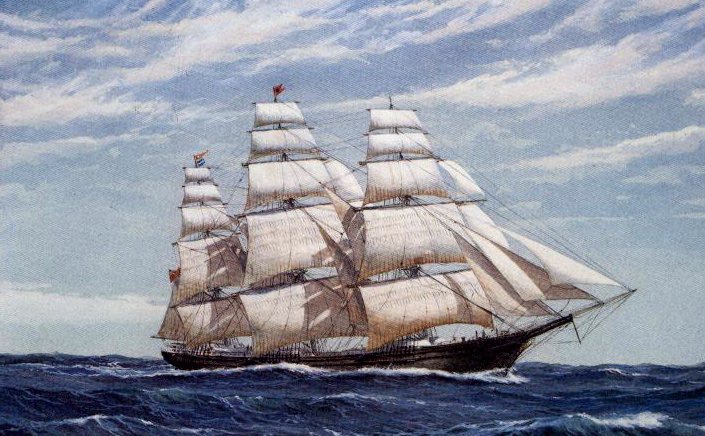
The Commodore Perry. It was launched in 1854; in 1856 it brought immigrants to Australia and returned to England with gold and wool. The February 1856 voyage which brought the Bruyn family to the Colony was completed in just over 72 days, an excellent time for those times.
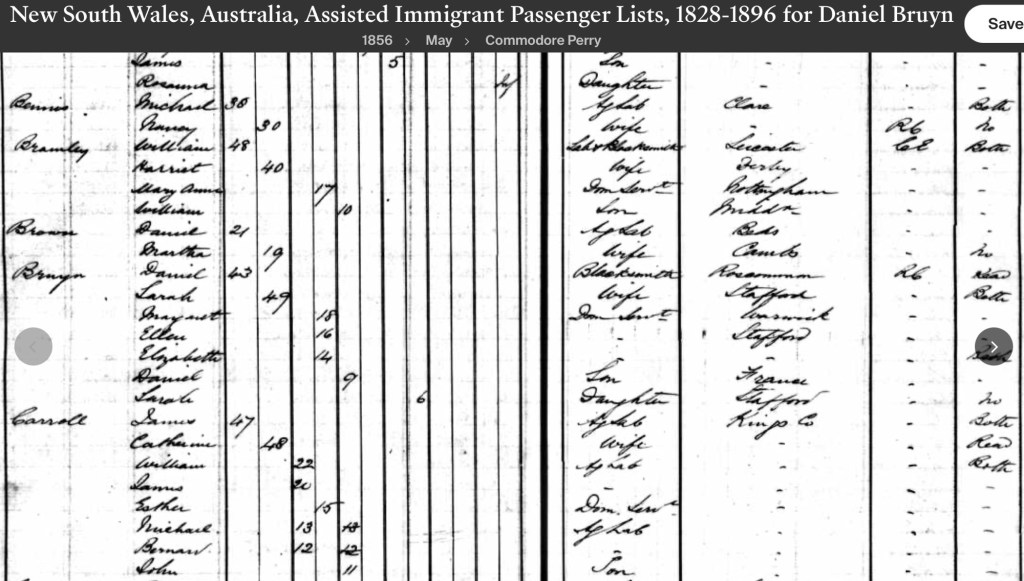
The family came to the Colony of New South Wales in 1856 as assisted migrants. Daniel and Sarah arrived on board the Commodore Perry on 1 May 1856 with their five children. The list of immigrants on this ship lists “Daniel Bruyn age 43, Sarah Bruyn age 49, Margaret age 18, Ellen age 16, Elizabeth age 14, Daniel age 9, Sarah age 6”.
Their eldest child Joseph (then aged 19) did not travel with them, although he does appear in New South Wales a few years later. Joseph had been born to Daniel and Sarah prior to their marriage. He was born with his mother’s surname, as Joseph Nichols, and later married under that name.
Joseph Nicholls was 22 when he and his wife and children arrived on the Daphne 1859 as the Nicholls family (Daniel Bruyn was the person who assisted this immigration). Once off the ship Joseph, his wife and children changed their name to Bruyn. Sadly, Joseph and Mary lost four of their children to Diphtheria in March 1866 (Sarah Jane, Ellen, Frederick, and Thomas).
Daniel and Sarah Bruyn, later in life
Within two years of arriving in Australia, the Bruyns had moved to Dungog and settled in the town. Some comments in the Dungog Chronicle of Tuesday 4 October 1927, p.2, report that on arrival in Sydney in 1856, “the family came direct to Dungog, arriving here on May 24th.” However, in an interview with Ellen, one of the daughters, conducted many decades later in the last year of her life, the Sydney Daily Telegraph of Tuesday 14 June 1927 reported her as saying that when they came to Australia “they all joined in the gold rush at Hanging Rock” (p.18).
At Hanging Rock in the Armidale region to the northwest of Sydney, gold had been discovered in 1851; by February the next year, 27 cradles were operating with some 200 diggers searching for their fortune. Panning continued for some decades; at its peak there were several thousand people living at Hanging Rock. It is entirely feasible that the Bruyn family had gone there for a brief period in 1856—1857, but I have found no other evidence to substantiate this claim made by Ellen in this 1927 interview.
The same report continues, reporting that the Bruyn family “occupied a house, long since demolished, then owned by Mr. Campbell that stood at the rear of Mrs. M. A. Dark’s present home, and almost opposite the residence that Miss Bruyn occupied for the past few decades.” (This extract is from an obituary to Miss Ellen Bruyn after her death in 1927.)
The residence of Mrs. Dark which is noted in this report would be Coolalie, on Dowling Street; it is referred to as her house because her husband, Henry Charles Dark, had died in 1901, and so it would be known in 1927 as “Mrs Dark’s home”. The house to the rear would have been opposite the land on Brown Street that is the focus of our explorations.
The Mr. Campbell referred to here could be Dougall Campbell, who was a convict assigned in 1828 to Mr. John Hooke. (Hooke gave his name to Hooke St on the northern end of the town; he had been granted 2560 acres in 1828.) If so, we may presume that by the 1850s, Campbell had received his Certificate of Freedom and had become a reputable citizen of the town, as many former convicts have done across the continent.
Just two years after arriving in Dungog, Daniel Bruyn became the owner of “Allotment No. Seven of Section No. Five in the Town of Dungog”. In a Conveyance dated 30 January 1858 between John Maberly of Windsor, Boot and Shoe Maker, and Daniel Bruyn of Dungog, Blacksmith, the transfer was effected for a price of fifty three pounds ten shillings.
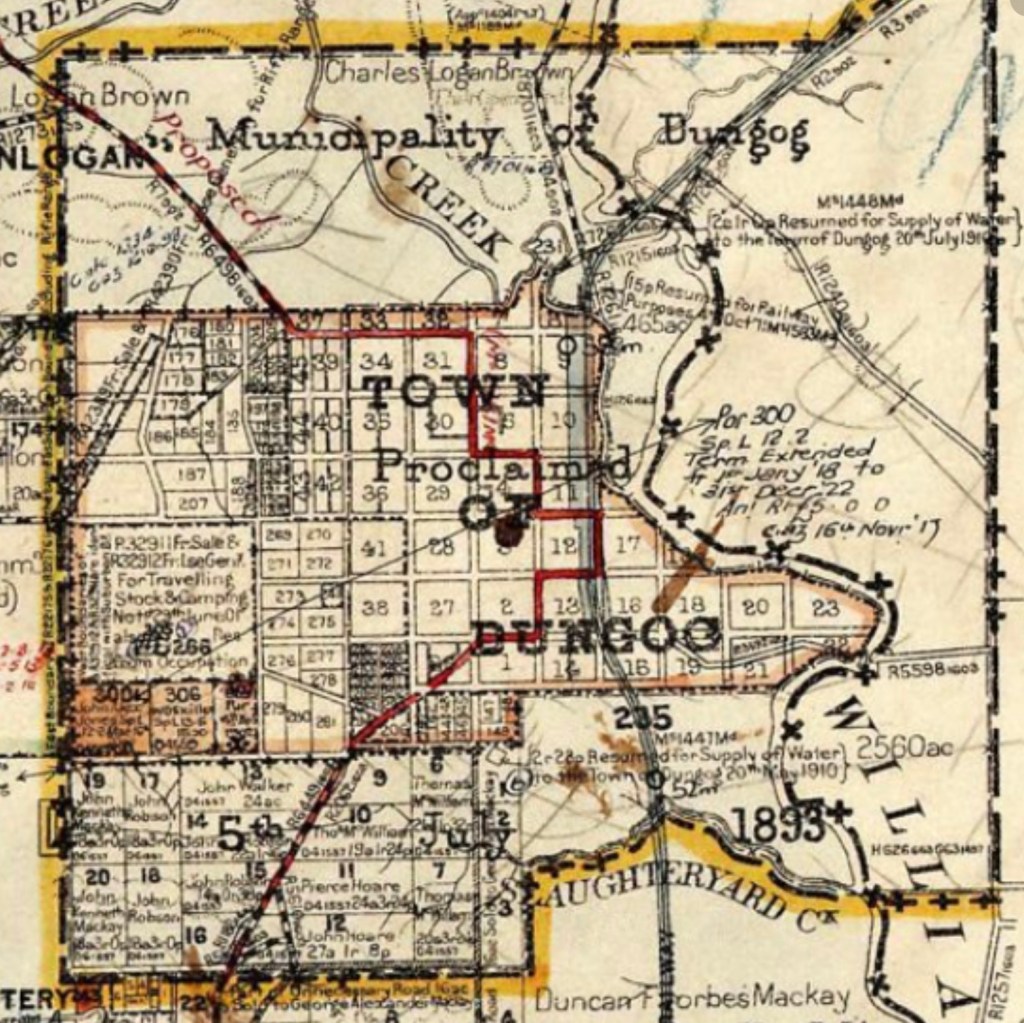
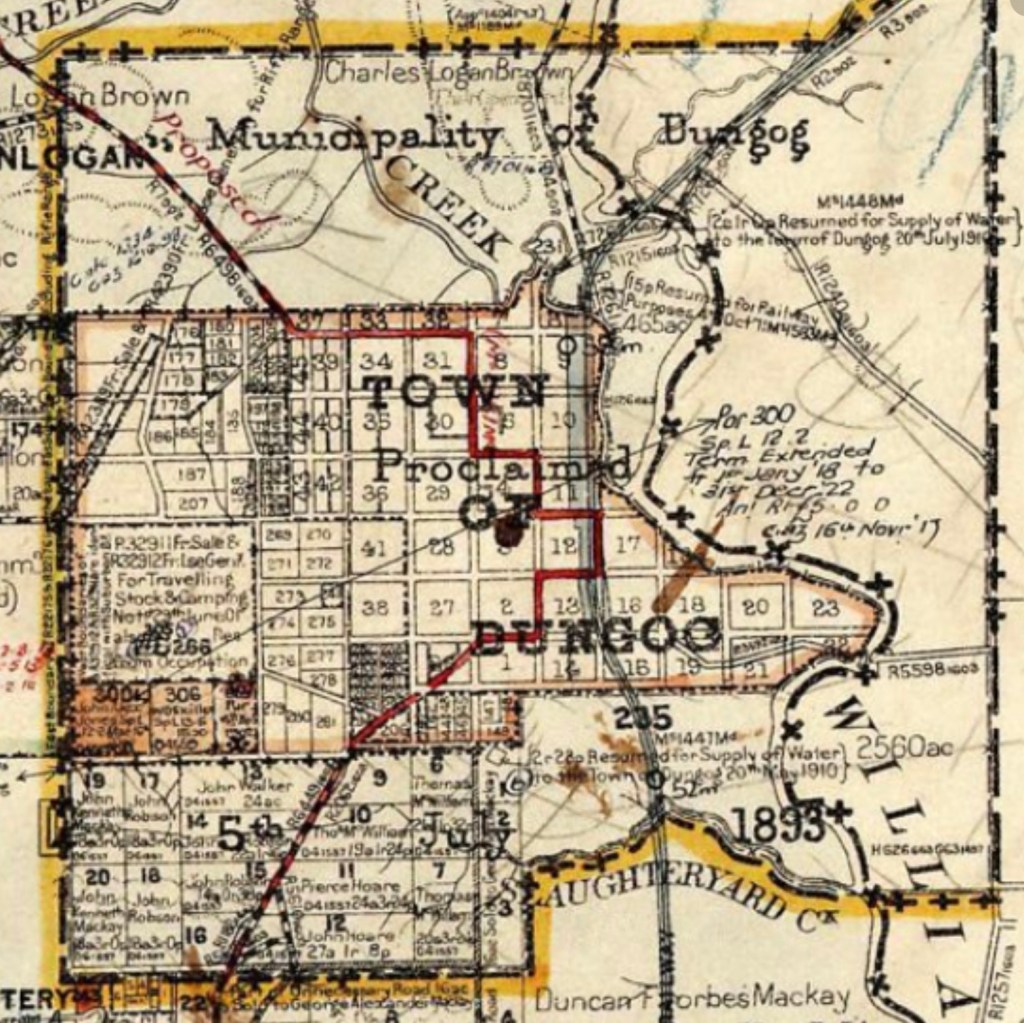
Section 5 in the Town of Dungog can be seen marked just below the WN of the word TOWN on this survey map
The land, facing Brown Street, would stay in the hands of the Bruyn family for over a century—from 1858 to 1968; although, as we shall see, members of the Bruyn family lived there only until 1927. There is good evidence that Daniel conducted his business as a Blacksmith on this property during the two decades or so that the family lived here.
It is not clear when the family moved from the residence behind Mrs. Dark’s home, mentioned in the 1927 obituary of Ellen Bruyn, onto the property across the road where there was a “residence that Miss Bruyn occupied for the past few decades” (until her death in 1927). It is reasonable to hypothesise that the family came to Dungog, found housing in Mr Campbell’s property, purchased the land in Brown Street, had a house built on that land, and then moved in to that building. How soon after the 1858 purchase of this land this move took place, is not known.
It is certainly clear that at some stage Joseph Bruyn also had a foundry built where he could carry out his business as a Blacksmith. One mention of Bruyn’s blacksmithing business comes in a 1934 report of reminiscences by “Mr. Hewlitt Tate, of Lithgow”, in the Dungog Chronicle of Friday 5 January 1934, p.5, entitled DUNGOG’S FIRST BLACKSMITH.
Mr Tate recalls that “The first blacksmith in Dungog, I was led to believe, was Thomas Smith, father of Johnny Smith who was wheelwright in Dungog 70 years ago. He has been dead between 80 and 90 years. Mother used to tell us boys about her grandfather riding over to Stroud when he was sent for by the A.A. Company, to do any special blacksmithing. Mother was then 12 or 13 years of age.
“I remember the late Mr. Kehoe, an old blacksmith, of Dungog, telling us boys that he was in Dungog before the late Mr. Bruyn. Then there was an old Mr. Arrowsmith who used to live along the Stroud road about half a mile the other side of the river.”
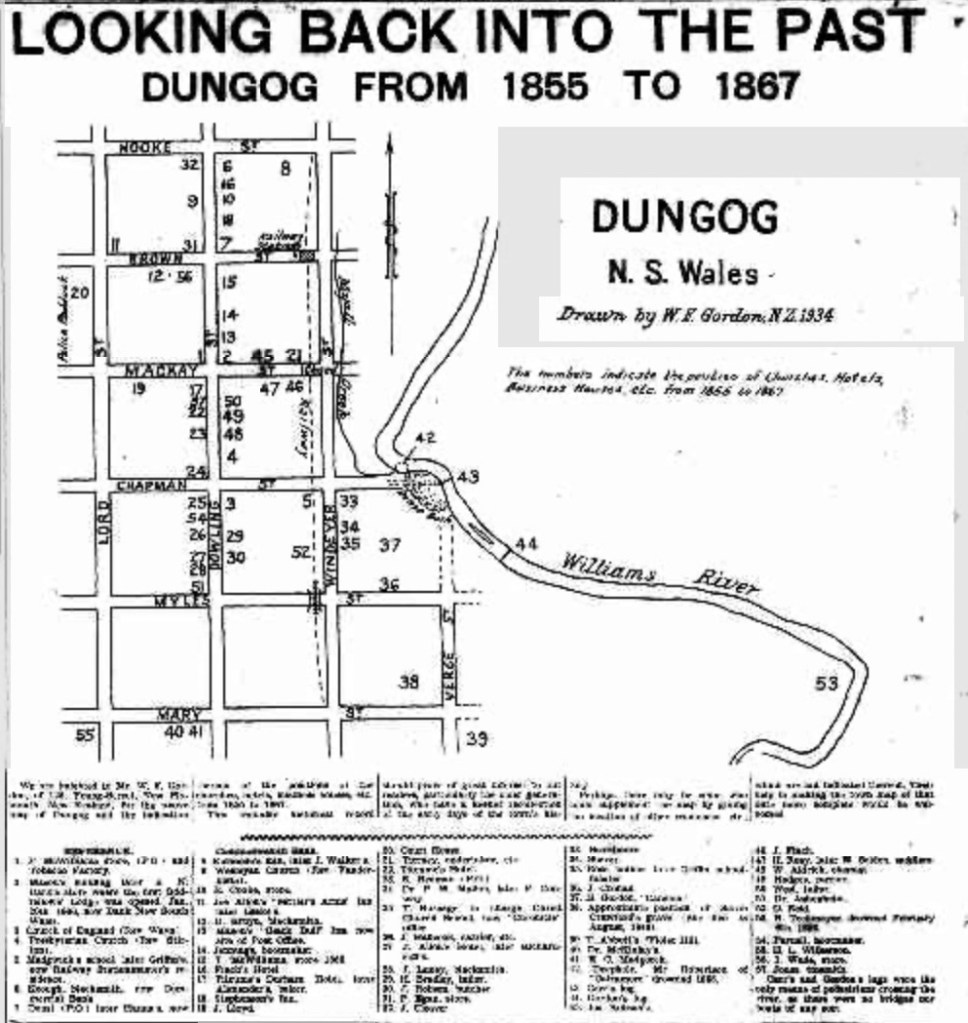
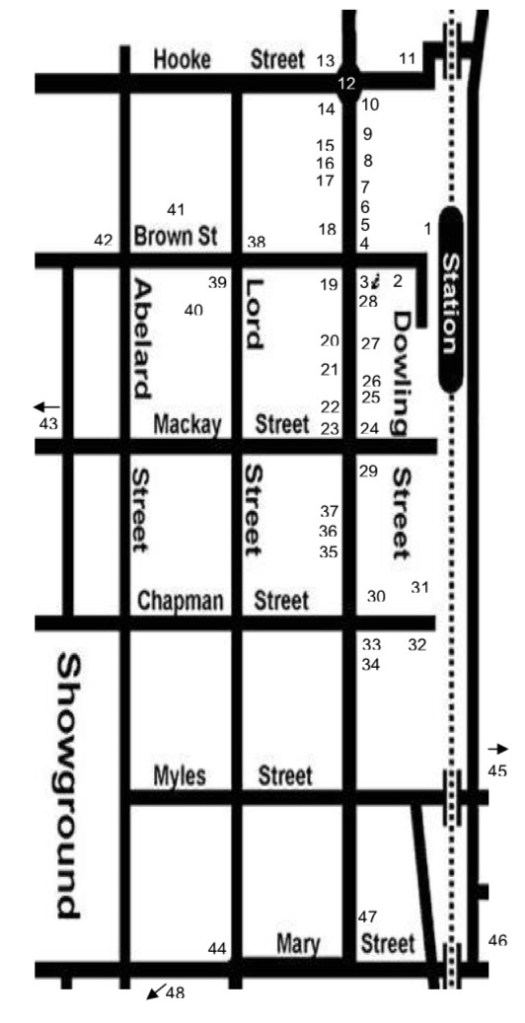
Some months later, on Tuesday 17 July 1934, the Dungog Chronicle published a hand-drawn map entitled LOOKING BACK INTO THE PAST: DUNGOG FROM 1855 TO 1867. Key businesses are indicated on the map by numerical coding. In the relevant block of Brown St, on the corner of Dowling St, #56 designates “J. Wade, store”, which was established by John Wade in 1866.
An article in the Australian Dictionary of Biography describes Wade as “an active member of the Methodist Church, Wade was conference representative and circuit steward at Dungog, and later at Ashfield and Mosman. He helped to found the Dungog School of Arts with an abiding friend Rev. Dr J. E. Carruthers who served at that town in 1871–73. Wade was also a founder (1881) and chairman of the Williams River Steam Navigation Co. Ltd. As a Protectionist, he twice unsuccessfully contested the Legislative Assembly seat of Durham.”
Wade’s store was later bought by H.C. Dark and was developed to become the largest general store in Dungog. The present long and imposing two-story building was built in 1897 and extended in 1917.
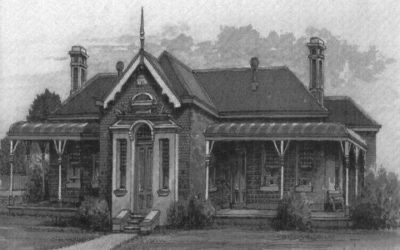
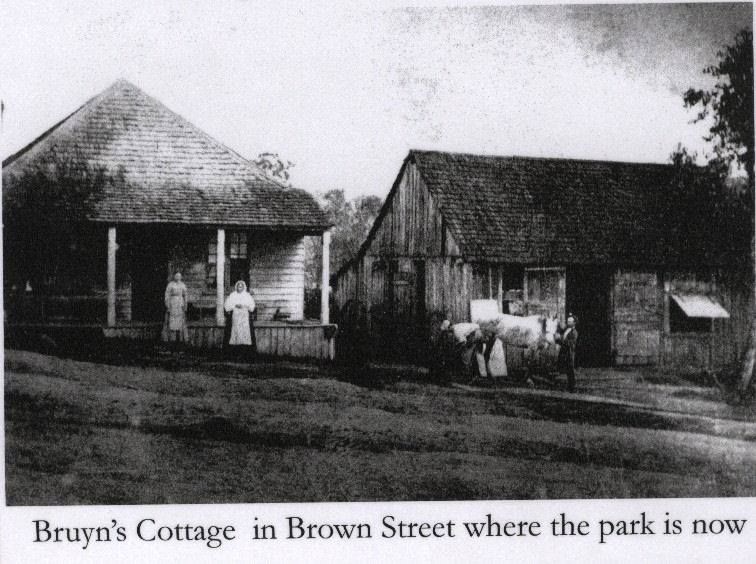
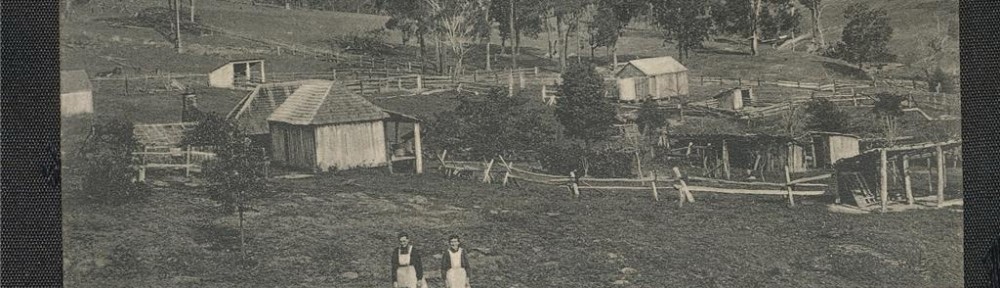
In 1866, however, Wade’s store would have been a much more modest building. Immediately adjacent to that on the LOOKING BACK INTO THE PAST map is #12, “D. Bruyn, blacksmiths”. An undated image entitled “Bruyn’s Cottage in Brown Street where the park is now” appears to show a family house with white posts, next to a building that most likely was the foundry for Bruyn.
Outside the house are two women (perhaps Sarah and one of her daughters?), while outside the putative foundry are two horses, one held by an apparently-bearded man (perhaps Daniel Bruyn himself?). Certainly, and unsurprisingly given the fashion, a photo of Daniel Bruyn late in his life shows him sporting a generous set of muttonchops and beard.
A decade later than the 1934 publication of this map, the Dungog Chronicle Friday 19 October, 1943 (p.5) published an article entitled “Early Recollections of Dungog” by a person styling themselves simply “Ex-Dungogite”. The recollections in this article includes a discussion of trades in the town. The author notes that “Mr. J. Tierney carried on wheel-wrighting in a general way with which he combined the undertaking business. Mr. Jno Smith, succeeded by Mr. Thos. Gurr, was also in the wheel-wrighting trade in another part of the town.”
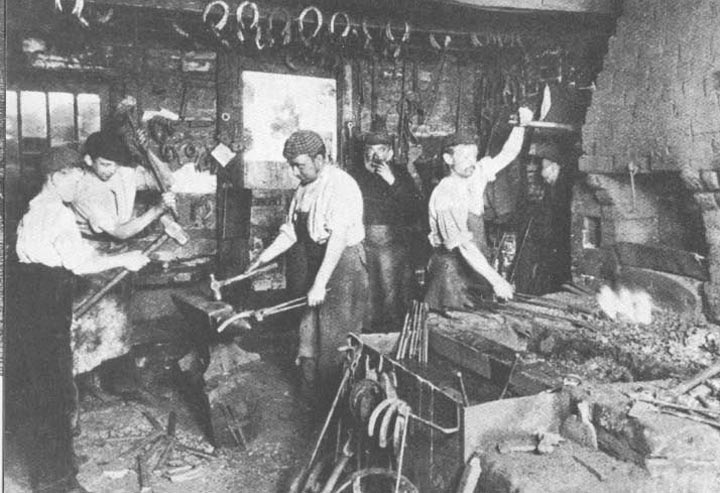
A photograph of a Victorian Blacksmith’s Shop, from The Victorian Web at. https://victorianweb.org/history/work/blacksmith.html The commentary attached to this photograph notes that “blacksmiths had a place among the working classes, and these men worked with their hands and arms in a hot, grimy smithy. Blacksmiths, who have a history that goes back thousands of years, however, had a far higher economic and social position than farm or factory workers. As highly skilled artisans, they also managed to remain independent and in demand until well into the twentieth century when the automobile destroyed many of their opportunities for work. Even then, these skilled iron workers often morphed into auto mechanics just as a century earlier some had become pioneeering engineers.”
With regard to blacksmiths, the author notes that “Mr. J. Keogh was a general blacksmith in the Main Street, while Mr. D. Bruyn carried on a similar business in the hollow in Brown street … Mr. J. Luney first conducted a blacksmithing business in the allotment occupied at present by the newspaper office. He afterwards removed farther up the street.” The town was well-served by blacksmiths—including Daniel Bruyn “in the hollow in Brown street”, on the property he had bought in 1858.
(The writer also speculates that “Miss Ellen Bruyn, if still existant as I trust she is and still well, notwithstanding her sum of honorable years — must be the oldest Dungog resident.” Writing in 1943, the “Ex-Dungogite” appears unaware of Ellen Bruyn’s death, at the age of 88 years, some 16 years earlier.)
This essay and the one before it in a previous blog is written by my friend and colleague, the Rev. Dr Geoff Dornan, offering a Christian ethical perspective on a recent controversy (one of so, so many) in the United States of America. Geoff has a PhD in Philosophy, Theology & Ethics from Boston University, USA. He is currently serving as Minister in Placement at Wesley Uniting Church in Canberra, ACT.
1. INTRODUCTION
In the first essay, I traced the events of the conflict between, the American Vice President J.D Vance and the Vatican at the beginning of 2025 – in particular the former Pope, Francis I – when Vance offered a theological and moral defence of the Trump Administration’s policy of forced mass deportations without due process, in defiance of the fifth and fourteenth amendments of the American constitution.
The defence that Vance offered was grounded in the thought of St Thomas Aquinas’ OrdoAmoris, the right ordering of love. In that paper, I concluded that Thomas does not offer any such defence to the Trump Administration’s policy or practice. I also suggested that the OrdoAmoris is not a sufficient basis in and of itself for any modern discussion of the issue. I noted that a millennium has passed since Thomas offered his rationale on love of the neighbour, and that any adequate discussion must consider developments since.
In this essay, I shall explain those developments. My contention is that if J.D. Vance had been cognizant of them, he would have been more cautious in his ill-considered action of grasping Thomas for his own political purposes. The first developmentconcerns the change in the purpose and service of Catholic theology. The second aspect concerns the rise of Catholic Social Teaching in the last 100 or so years, that has helped redefine that purpose as an enterprise directed to the poor of history: that which is sometimes referred to as the Gospel’s “preferential option for the poor”.
2. WHAT SORT OF SERVICE MAY THEOLOGY RENDER?
Historically speaking Catholic theology has been quite different to its Protestant counterpart. The latter has been directed to the believer, as they work out their faith in the world. Protestant theology has taken many forms – evangelical, liberal, dialectical, existentialist, political, liberationist, feminist, black and process – to name but a few.
Catholic theology on the other hand has been less haphazard, more tightly organized, and better managed, but not for that matter, any less prone to conflict. In reading Catholic theology, one can understand both the official line approved by the Dicastery for the Doctrine of the Faith and the dissident lines to which the Dicastery responds. In Catholic theology the parameters are always clearer.
Now, the great debate in Catholic theology which has repeatedly surfaced over the last 120 years or more has concerned its purpose. For much of Catholic history, theology had been addressed to the theologians, not the faithful as such. This took a particularly pellucid, explicit form in what was called neo-Thomism, where theology was a conversation between intellectuals.
Grounded in mediaeval thought, neo-Thomism was really a form of romanticism that lasted until the middle of the 20th century and still prevails among some conservative Catholic circles. It held that theology was the queen of the sciences, a super-science, that offered security and certainty from the instability and vicissitudes of the volatile, erratic human sciences. It held to the immutability of Catholic teaching, excusing itself from the obligation of adapting to modern times.
José Comblin, a Belgian priest who spent many years in Latin America in mission and teaching, put it this way: “It was an intellectual realm living on the margins of world history, anachronistically reconstructing some total form of learning and resurrecting a mediaeval world in the very midst of a technological and scientific society”.
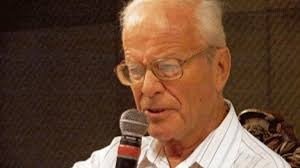
Fr. José Comblin
Unsurprisingly, neo-Thomism, in considering theology as a detached, immutable and contemplative exercise, considered God in the same way. God was seen as removed from the world, utterly ‘other’ in transcendence, to such an extent that divine grace never really touched the world. Grace and nature remained strangers to each other. There was a gap between them.
Perhaps the biblical reading in John’s Gospel where Jesus is reported to have said, “My kingdom is not of this world” (18:36) in his interrogation under Pilate, typifies this gap. Speaking theologically, in neo-Thomism, divine grace is extrinsic to, stands outside of concrete human experience, because God is understood to eclipse, surpass creation.
The problem with this interpretation of Christianity was that the utterly transcendent God remained almost irrelevant to human beings and human experience. Grace and salvation – the latter explained as “the tangible experience of grace’s results in our lives”, were reduced, diminished to the interior spiritual life, ignoring altogether those crucial human dimensions of the social and the political.
So, the problem for Catholic theology in a nutshell was that it was caught between two worlds: the natural and the supernatural, earth and heaven, with no real link, connection, or affiliation between them. The basic theological ideas of neo-Thomism were mere abstractions. Theology offered the service of debating abstract metaphysical ideas for the cultivated erudite Catholic elites, but little more.
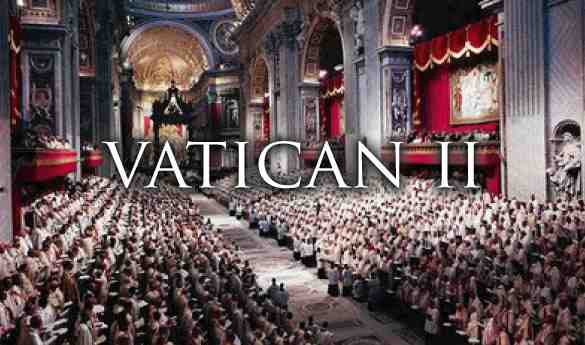
But then things changed. This separation of nature and grace, this misunderstanding of salvation as esoteric or super-spiritualised, never social or political, was finally addressed in modern Catholic thought in the reforming council known as Vatican II, (1st October 1962 to 8th December 1965). In essence, Vatican II was a revolution in the Roman Catholic church, with its spirit of aggiornamiento – the Italian for renewal or updating. This renewal led to the construction of a new connection between grace and salvation, with human experience and social justice.
In turn, this dramatic change stimulated Latin American Liberation Theology in the 1960s and modern German Political Theology at about the same time. In remarking upon this new connection, one of the great popes of the 20th century, Paul VI – to whom it fell to continue the reforms of Vatican II – wrote in his apostolic exhortation EvangeliiNuntiandi, “On Evangelization in the Modern World” (December 8th, 1975),
“The Church…has the duty to proclaim the liberation of millions of human beings, many of whom are her own children – the duty of assisting the birth of this liberation, of giving witness to it, of ensuring that it is complete. This is not foreign to evangelization. (EN.30)
3. CATHOLIC SOCIAL TEACHINGS
If the rethinking of the relationship between nature and grace led to a recasting of the connection between salvation and social justice, Catholic Social Teachings were the vehicle through which this occurred. I have already referred to Pope Paul VI’s document Evangelii Nuntiandi, which is part of Catholic Social Teaching. But we need to dig deeper if we are to bring to light J.D. Vance’s misadventure in poor theology and poor politics.
Let us then ask the question, what are Catholic Social Teachings? Most Protestants know nothing about it, but then again, few Catholics do either. How did they begin and how do they operate today?
A. ITS ROOTS
Catholic Social Doctrine, today referred to as Catholic Social Teachings, began less as an enlightened project of the Catholic Church and more a defensive strategy at the end of the nineteenth century, as the Catholic Church, submerged in the first industrial revolution, fought against the rise of Marxist Socialism, and the exodus of the European working class from the pews.
This response in the face of exploitative capitalism, nevertheless, did not suggest a sudden rethinking of the tradition as a whole. Rather, the conservative Catholic dogmatic tradition, centred in Thomas Aquinas continued. In fact, it was reinforced, with but a few sporadic endorsements of modernity.
In keeping with this entrenched approach, in a letter of 1892, Pope Leo XIII directed all Catholic professors of theology to accept particular statements of Thomas as definitive. Where Aquinas had not spoken on a given theme, any conclusions reached, had to be in harmony with his known options and opinions. Within a generation neo-Thomism became an unquestioned and unquestionable ossified orthodoxy in Catholic educational institutions.
B. IT CONFRONTS ‘THE REAL’
As we have just read, Catholic theology maintained two quite separate streams: conservative dogmatic theology for the intellectuals, detached from the real world, and the growing presence of Catholic Social Teaching, that confronted ‘the real’, the struggles of the poor. It was a binary approach that remains today.
That said, even though Catholic Social Teachings were born in a context of obscurantism and traditionalism, it is this stream which has grown, as Rome has understood that the Catholic Church must face the problems of our age.
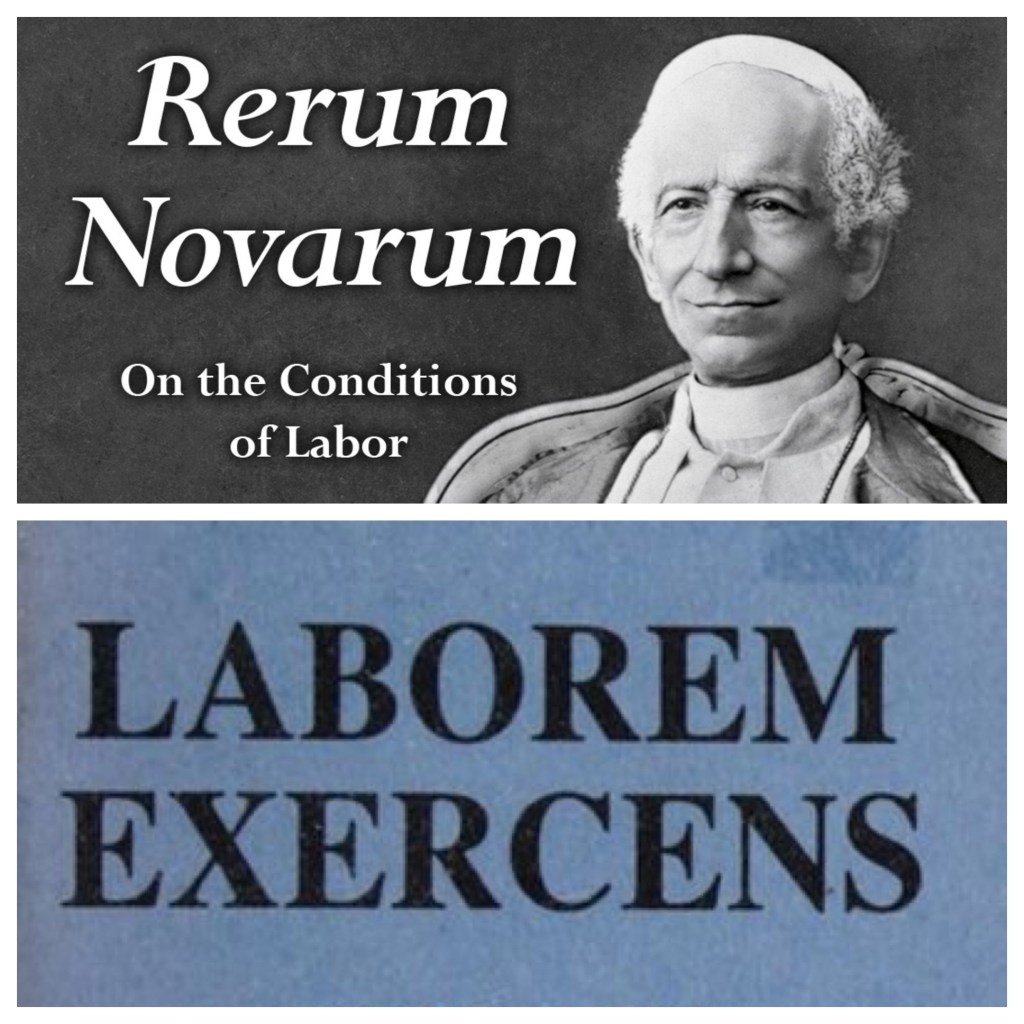
Let us make mention of some of the key teachings. The first encyclical, penned by no other than Leo XIII himself, entitled RerumNovarum (New Things), called for what today are still radical measures: a passionate attack upon unrestricted market capitalism, the duty of state intervention on behalf of the worker, the right to a living wage and the rights of organized labour. This newfound radicalism changed the terms of all future Catholic discussion of social questions.
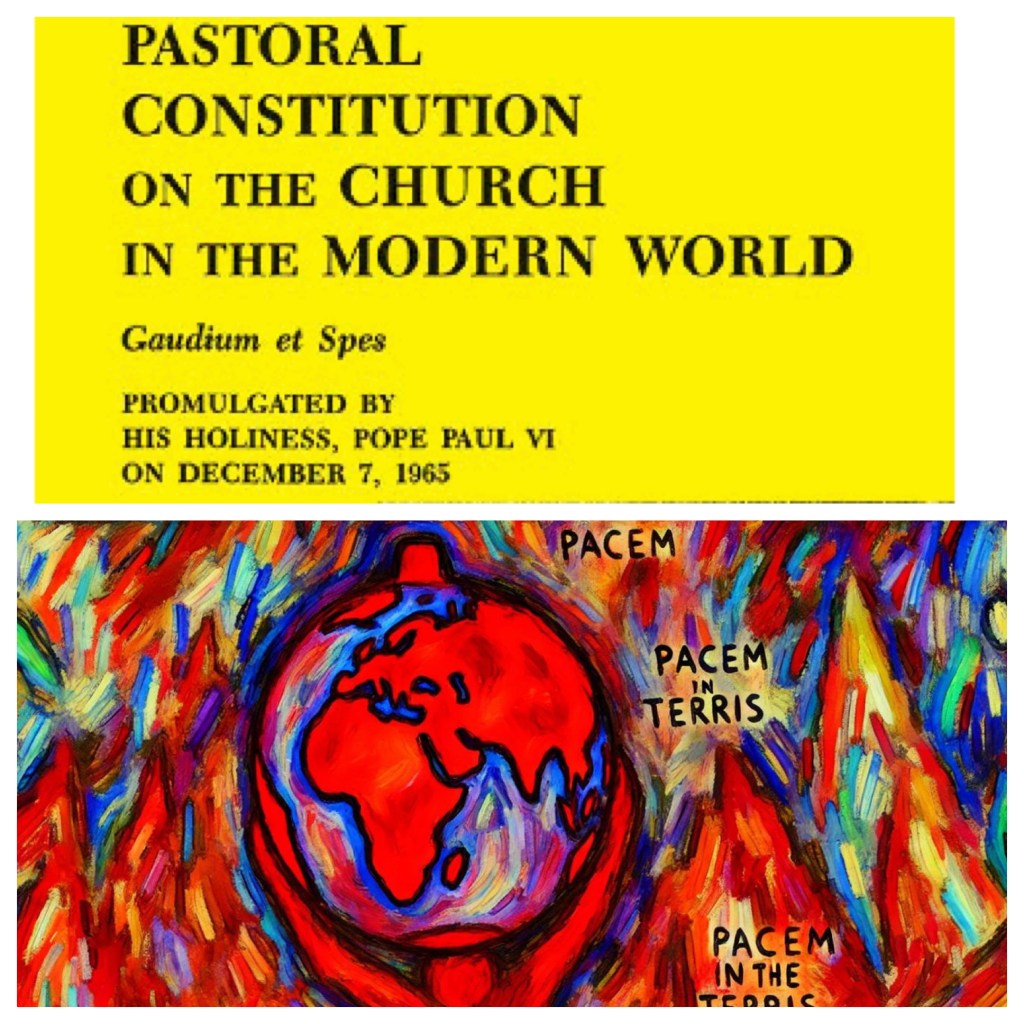
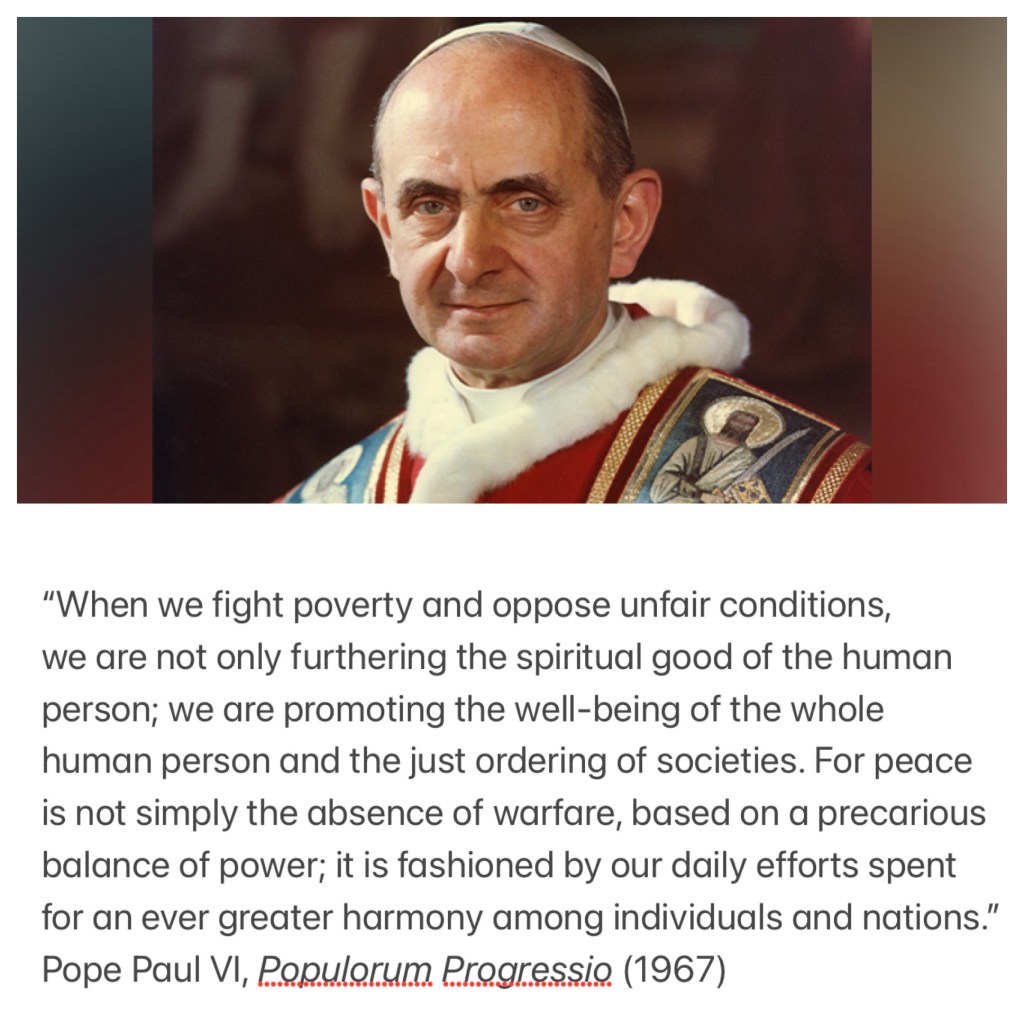
From there followed some outstanding statements: Pius XI’s QuadragesimoAnno, (On Reconstruction of the Social Order) in 1931; ExsulFamilia, (The Émigré Family) in 1952; John XXIII’s, Pacem in Terris, (Peace on Earth) in 1963; Vatican II’s Gaudium et Spes (Pastoral Constitution on the Church in the Modern World) in 1965; Paul VI’s PopolorumProgressio, (On the Development of Peoples) in 1967; The International Synod of Bishops, Justicia in Mundo, (Justice in the World) in 1971; John Paul II’s Laborem Exercens, (On Human Work) in 1981; and Centesimus Annus, (On the Centenary of Leo XIII’s Rerum Novarum, looking back and updating thought about Worker’s Rights) in 1991.
In all these encyclicals up till the turn of the twentieth century, the recurring themes were those of the dignity of the human person, the priority for the immigrant and refugee, the priority of labour over capital, the centrality of the common good, and the universal destiny of all goods of creation to serve all peoples, not just some.
Can we then speak of a difference between Thomas and Catholic Social Teachings? Clearly yes! Catholic Social Teaching’s reading of the order of love, how love is to be structured in the world, is more naturally comprehensive; deeper than that of Thomas. And how could it be otherwise as theology must respond to change; especially that of a larger and interdependent world, where the very concept of the neighbour has broadened.
CONCLUSION
So, what may we say? What may we conclude?
The fundamental point that must be made here is that J.D. Vance’s approach to Christian theology is both too narrow and too defensive. To justify the Trump Administration’s policy and practice regarding the forced mass deportation of non-US citizens without due process, he seizes upon OrdoAmoris but as we saw in the first paper, notwithstanding Thomas’ weaknesses, Vance fails to honour Thomas’ integrity of thought.
More importantly, Vance fails to read theology through an historical lens, ignoring the entirety of Catholic Social Teachings, which have been around for some time: over one hundred years. It is a similar approach to those who grasp a biblical text, ignoring its wider theological context and meaning, to sanction their already prejudged agenda.
Pope Francis in his communication to the U.S. bishops sums it up as he speaks of the “rightly formed conscience”, implying that it is this that is missing in the Trump Administrations’ approach.
Pope Francis
Francis writes:
“I have followed closely the major crisis that is taking place in the United States with the initiation of a program of mass deportations. The rightly formed conscience (my italics) cannot fail to make a critical judgment and express its disagreement with any measure that tacitly or explicitly identifies the illegal status of some migrants with criminality. At the same time, one must recognize the right of a nation to defend itself and keep communities safe from those who have committed violent or serious crimes while in the country or prior to arrival. That said, the act of deporting people who in many cases have left their own land for reasons of extreme poverty, insecurity, exploitation, persecution or serious deterioration of the environment, damages the dignity of many men and women, and of entire families, and places them in a state of particular vulnerability and defencelessness.”
For Pope Francis, and as far as we may judge, the recently elected Pope Leo XIV, the Gospel concern is above all about the defence of the salvation and liberation of the poor in a hostile global pro defensio salutis et liberationis pauperum.
For J.D. Vance, on the other hand, the concern is – as we should expect – the interest of the United States within the global order. Which concern should carry greater weight in the Christian scheme of things, and how each may creatively interact with the other, if at all, remains a matter of judgment and discernment over the remaining period of the Trump presidency.
This essay and the one which follows it in a subsequent blog is written by my friend and colleague, the Rev. Dr Geoff Dornan, offering a Christian ethical perspective on a recent controversy (one of so, so many) in the United States of America. Geoff has a PhD in Philosophy, Theology & Ethics from Boston University, USA. He is currently serving as Minister in Placement at Wesley Uniting Church in Canberra, ACT.
1. INTRODUCTION: JD VANCE ON ORDO AMORIS
In an interview by Fox News’ Sean Hannity, on January 30th this year, the U.S. Vice President. J.D. Vance offered a theological and moral defence of the Trump Administration’s policy of forced mass deportations.
This policy revokes the temporary legal status of potentially hundreds of thousands of people without due process, in defiance of the fifth and fourteenth amendments of the American constitution.
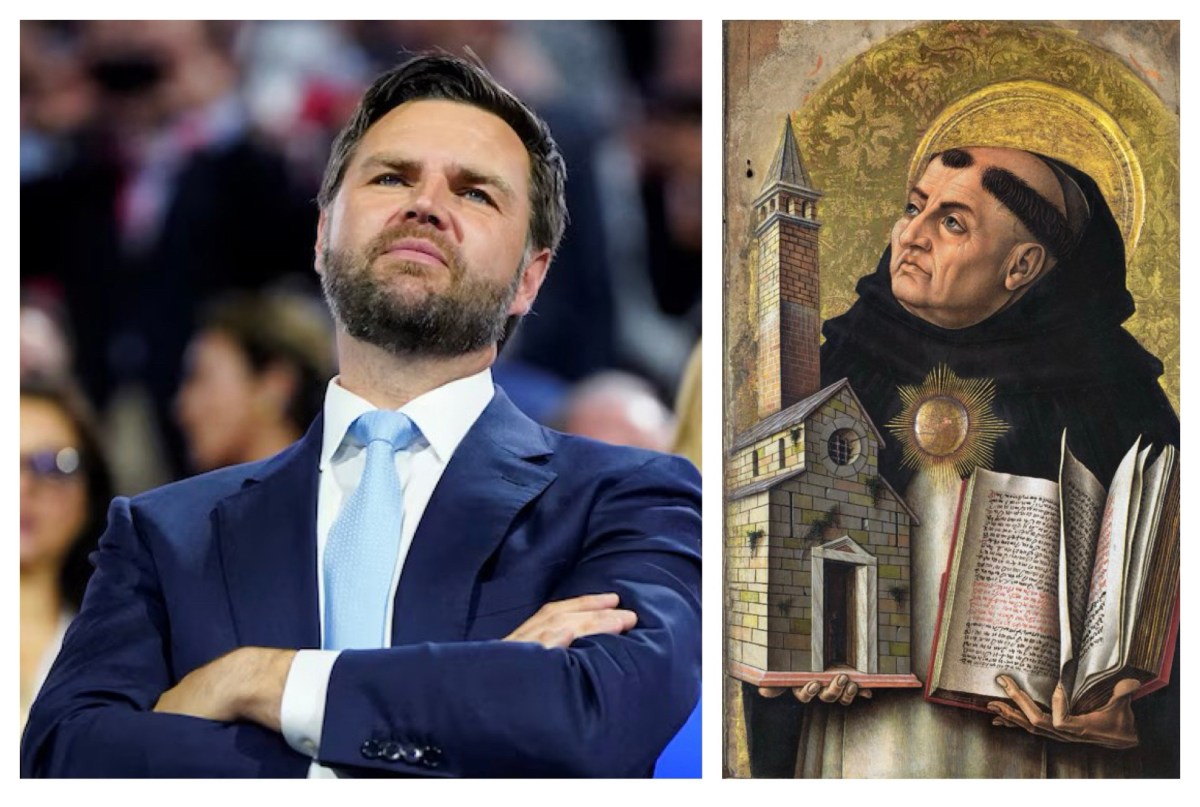
In the discussion, Vance declared that “the far left” in the United States tend to have “more compassion” for people residing in the country “illegally” (my apostrophes), including those who have committed crimes, than they do for American citizens. He opined that compassion should first be directed to fellow citizens, adding that this does not mean that people from outside of one’s borders, should be hated, but that one’s priority should be for those within.
Vance and Hannity
In support of his contention, Vance said:
“But there’s this old-school [concept] – and I think a very Christian concept, by the way – that you love your family, and then you love your neighbour, and then you love your community, and then you love your fellow citizens in your own country, and then after that you can focus and prioritize the rest of the world.”
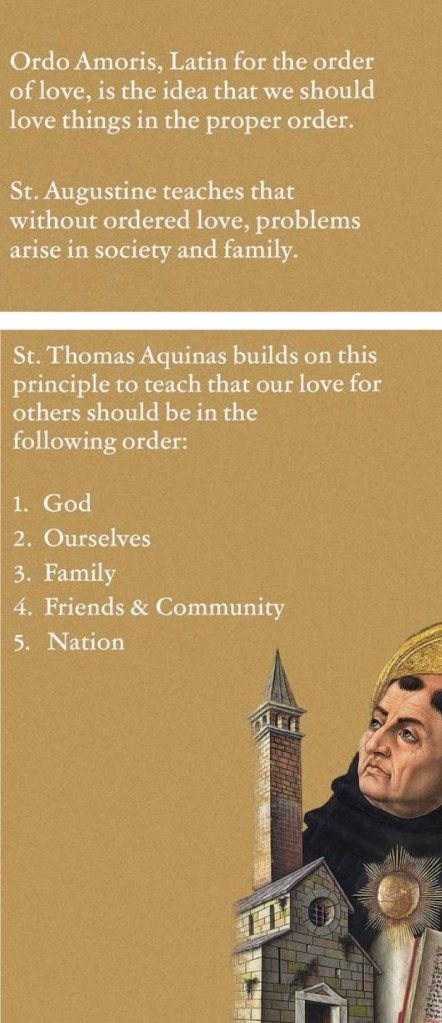
The idea to which Vance referred was that of St Thomas Aquinas, commentated upon in his great body of work, the Summa Theologica, known as ordoamoris – “rightly ordered love”.
Later that evening Vance responded on social media to a British professor and former conservative politician, Rory Stewart, who criticized Vance’s comments as a “bizarre take on John 15:12–13” and as “less Christian and more pagan tribal.” (The Bible verse referenced by Stewart reads “This is my commandment, that you love one another as I have loved you.”).
Stewart’s reference to this verse, and its relevance to the point he was labouring to make, was not and is not altogether clear. Perhaps because of that fact, he then referred to the parable of the Good Samaritan (Luke 10:25–37), applying the story as a legitimation of foreign aid.
Vance curtly responded to Stewart’s confusing comments with, “just google ordoamoris”!
The reaction that has flowed from these two interviews has been discordant. On the one hand, there has been some approval, a positive nodding of the heads from some theological and political circles.
On the other there has been clear disapproval from the Catholic leadership. Some responses have on the other hand fallen in between, seeking to qualify Vance’s response.
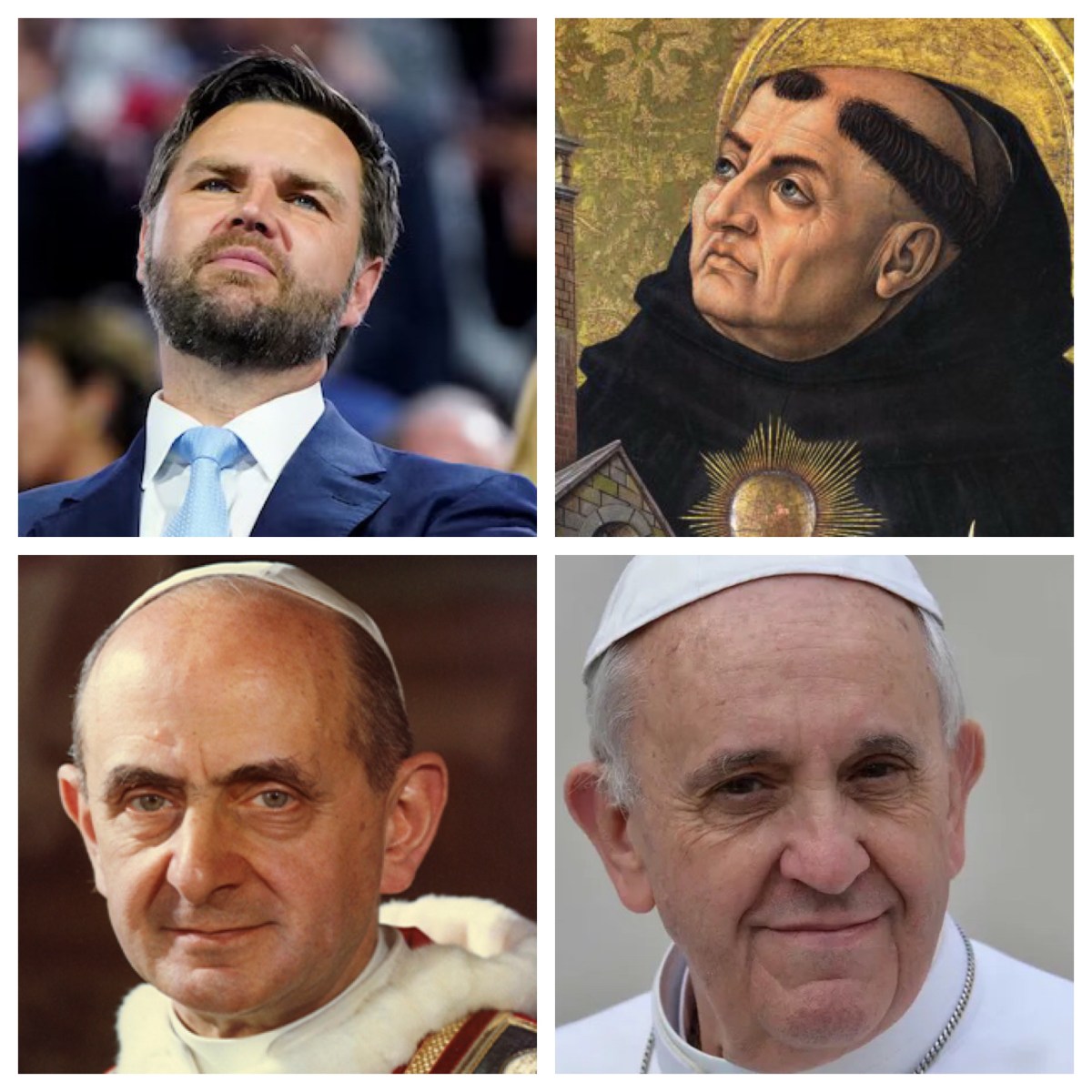
J.D. Vance, Vice-President of the USA
Regarding the first, the theological publication First Things included an article entitled “JD Vance States the Obvious about OrdoAmoris” by James Orr, Associate Professor of Religion at Cambridge, and notably, UK Chair of the conservative Edmund Burke Foundation. Orr argued that Stewart’s appropriation of the Good Samaritan was mistaken, in as much as its message is not that one should help all victims wherever they may be, but that we must care for those who fall within the compass of our practical concern.
In keeping with this take, he points out the Greek word for neighbour in the New Testament is πλησίον (plēsion), which is derived directly from πλησίος (plēsios), meaning “near” or “close by.” Apparently then, according to Orr, it is proximity that makes neighbours our objects of care and attention.
In contrast to Orr, the Catholic leadership has shown notable dissatisfaction with Vance’s interpretation. Pope Francis, attributing Vance’s motivation and appropriation of Ordo Amoris to the Trump Administration’s defensive armoury for deportation of non-citizens without due process, said to the US bishops on February 10th that “an authentic rule of law is verified precisely in the dignified treatment that all people deserve, especially the poorest and most marginalized”. He averred that such policy and practice “does not impede the development of a policy that regulates orderly and legal migration”.
Pope Francis
In other words, good policy can and must include dignity for such people. Targeting Vance’s take on Aquinas within the context of Christian social ethics, he continued that “Christian love is not a concentric expansion of interests that little by little extend to other persons and groups. He proffered, “the human person is not just a mere individual, relatively expansive, with some philanthropic feelings”. As if to ensure the point could not be missed, he added, that the “true ordoamoris that must be promoted is that which we discover by meditating constantly on the parable of the ‘Good Samaritan’… that is, by meditating on the love that builds fraternity open to all without exception”.
Pressing the point further, it is widely understood that Cardinal Pietro Parolin, the Vatican Secretary of State and confidant of Francis, was later tasked with speaking to Vance to ensure that there could be no ambiguity or misunderstanding as to the Holy Pontiff’s point. Moreover, Cardinal Robert Prevost, prior to his recent election as pope, posted a tweet on February 13th, sharing several links to articles critical of Vance’s take on Ordo Amoris. Prevost, now Pope Leo XIV, has had a long history of working among the poor in northern Peru, passionately supporting the rights of those who seek lives of dignity.
2. THINKING THROUGH THE CATHOLIC TRADITION
So, what to make of this?
On the one hand, the US administration lays hold of the writings of Thomas Aquinas, Doctor of the Catholic Church (referred to hereafter simply as Thomas, in keeping with Catholic academic tradition).
The US Administration took hold of the words of Thomas for its own purposes, seeking to legitimise its policy and practices regarding immigrants deemed illegals, while the Catholic leadership expresses its annoyance at what it considers the abuse of Church teaching, pressed intoservice in an attack upon the vulnerable.
In the following paragraphs, I shall examine two things: first, Thomas’ theology: setting it in context, explaining its strengths and limitations. Second, I shall set out the developments in Catholic instruction since Thomas: the movement from neo-Thomism to modern Catholic theology, and particularly the Social Teachings of the Catholic Church, of which Vance seems unaware, despite their more recent genesis in Western theological and moral discussion.
A. THE WORLD VIEW OF THOMAS AQUINAS, 1225–1274: SOCIAL AND POLITICAL ETHICS AS A ‘RIGHT ORDERING’
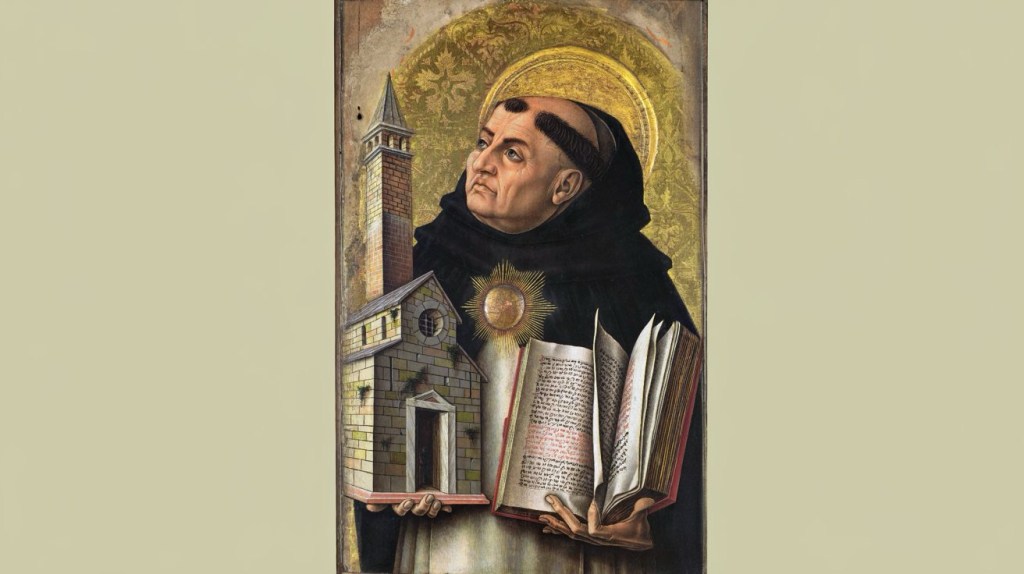
Thomas Aquinas (1225—1274), Dominican friar who was canonized in 1323, depicted in the panel of an altarpiece from Ascoli Piceno in Italy, by Carlo Crivelli (15th century)
Thomas Aquinas’ world view unsurprisingly reflects the mediaeval age in which he lived but builds upon it in unique ways. His thinking was one of the greatest attempts of Mediaeval Scholasticism after the fall of the Roman Empire to unite in one body knowledge and revelation, philosophy and theology.
For Thomas, the human being is by nature a social animal. In speaking in this way, hedraws from the inspiration of Aristotle, most of whose writings had only been rediscovered by the western church a little earlier, between 1150 and 1250, stimulating an explosion of intellectual energy. Additional to Thomas’ appreciation of the social nature of the human being, he holds a view of society as firmly ordered and hierarchical; and this, according to his understanding of the Divine plan. The whole structure of things reflects what Thomas considered the natural order of humanity as created by God.
Ernst Troeltsch, an early sociologist of religion, in his classic Social Teaching of the Christian Churches (1911), interpreted Thomas’ way of seeing things – what we call the ‘Thomist ethic’ – as the ultimate expression of an “ecclesiastical unity of civilization”. Thomas’ ethic touched every element of mediaeval life, framed by its division between nature and supernature. It furnished a theoretical justification for social hierarchy, insisting upon an ethical purpose for each social role and place.
In essence, the church with its treasury of merit and sacraments, provided the means of grace through which the temporal life gained eternal meaning. From a sociological point of view, as J. Philip Wogaman puts it, “the system made it possible for there to be a unity of civilization (my italics), encompassing not only ‘ordinary’ Christians whose faith was inevitably corrupted by the world, but also those who sought the purer morality and spirituality of monastic life.”
But was this social ethic, this hierarchy of living, a strict top-down affair, that ‘softly’legitimized injustice? On this question, opinion is split. Some subscribe to the view that Thomas’ ethic was a distinct advance upon hitherto mediaeval arrangements.
To the extent that all aspects of society served specified ends – the highest ranks serving those beneath them, and the lowest serving their superiors – a basic form of mutuality was envisaged, grounded in the common good. Such an arrangement it is argued, relieved the mediaeval system of its worst features.
Others, however, subscribe to the opposite view: that Thomas does little more than defend the pattern of living of thirteenth century Europe, holding that pattern as proper for all societies and times. Both sides are probably correct. Thomas was no social radical, although he was a man of great intellectual acumen, as he created a synthesis of thought of the pagan philosopher Aristotle and the early Church Father, Augustine.
Turning to Thomas’ political ethic, Thomas sees the state or political community as a “perfect” society, in the sense that it has all the means necessary to fulfil its appointed purpose of the common good, by which he means material development and the pursuit of virtue. It must be added that this includes coercive force to restrain vice and evil, to ensure the peace of the whole.
But let us be clear about the power of state coercion! For Thomas is no simple authoritarian.
He pragmatically understands that not all vices can be expungedwithout at times generating more problems. As such, he holds that the state must never attempt to do what cannot be done effectively.
So, overall, both Thomas’ social and political ethics are grounded in a special ordering;certainly conservative when contrasted with western modernity, nevertheless, moderate in that Thomas sees that the state has its limits.
B. ORDO AMORIS: THE RIGHT ORDERING OF LOVE?
On the one hand, the US administration lays hold of the writing of Thomas Aquinas, Doctor of the Catholic Church, for its own purposes, seeking to legitimise its policy and practices regarding immigrants deemed illegals, while the Catholic leadership expresses its annoyance at what it considers the abuse of Church teaching, pressed intoservice in an attack upon the vulnerable.
In the following paragraphs, I shall examine two things: first, Thomas’ theology: setting it in context, explaining its strengths and limitations. Second, I shall set out the developments in Catholic instruction since Thomas: the movement from neo-Thomism to modern Catholic theology, and particularly the Social Teachings of the Catholic Church, of which Vance seems unaware, despite their more recent genesis in Western theological and moral discussion.
And so, to OrdoAmoris, the right ordering of love within Thomas’ social and political ethics! The problem as I see it, is that his attempt to affirm this principle has its difficulties. In large part, this is so, because of his approach in assuming a hierarchy of obligation. Let us explore this.
For Thomas, love of and for God stands above all else in the hierarchy of love. From there in Ordo Amoris, Thomas orders or grades all other loves based on the just claims that a person may make upon another’s love for them. Here lies the seed for the idea that we owe a debt of love to those in closest proximity to us, for they are entitled to such an expectation.
For Thomas, to neglect those nearest to us, on the pretext of loving more broadly and generously those who are afar, is not to really exercise love at all. As V.J. Tarantino explains through the story of Lazarus in the Gospel of Luke, “To skip over Lazarus on the doorstep [in order] to volunteer at the charity auction, is at least to some degree a matter of self-satisfaction”, [rather than love]”.
But what is the difficulty here? Let us name it! The point is that Thomas’ undertaking to establish theoretical rules for whom we are to prioritize in love, is tricky. Yes, Thomas does indeed maintain that a man should love his fellow citizens before the stranger; his father before his mother; both parents before his wife and children; and, before all non-family outsiders, his civic ruler.
However, this rule-bound way of operating appears to be deficient: first as mentioned earlier, because love is explained in terms of what is owed, but second because his thought is so mechanistic, so duty driven, ignoring the very nature of human love, which is altogether a more spontaneous, impromptu, Spirit led thing.
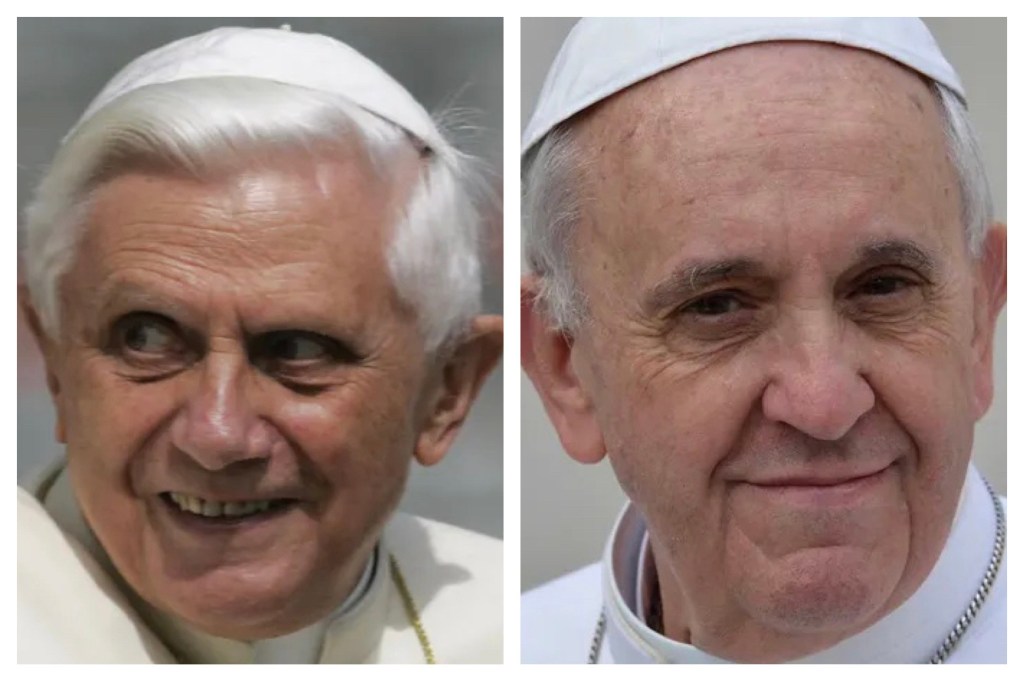
Joseph Ratzinger, better known as Pope Benedict XVI (2005–2013) in his stand-out encyclical Deus Caritas Est (God is Love) makes exactly this point: that love is not about duty bound commandments, imposed from outside of the human person, but rather a freely bestowed experience beginning with God, which by its very character drives us to share itintuitively with others.
Pope Benedict XVI (left) and his successor Pope Francis (right)
Pope Francis (2013–2025) says something similar by way of application of Benedict’s insight. In his encyclical Fratelli Tutti (On Fraternity and Social Friendship), as he writes about the story of the Good Samaritan, he emphasizes that the priest and the Levite were most concerned with their duties as religious professionals.
Their structured social roles and their structured ethics, which determined who would enjoy a higher place as beneficiaries of their love, blinded them to the distraction of the man on the roadside, who simply did not fit. Love, as they understood it, was a duty owed to specific groups, not something to be freely, graciously, injudiciously lived out.
3. THOMAS: A TRIAL BALANCE
What then may we conclude about Thomas’ approach to the ethics of love? While love of and for God remains the genesis of everything, nevertheless the ordering of love which follows from it, is bound to and limited by the social and political structures of which Thomas was a part.
On the other hand, there is no sense in Thomas that love is simply a limited quantity that is to be parcelled out to those close to us, with little or nothing left for those in need; that there is only so much that can go around. He does understand order – after all he was a systematic theologian and carries his systematization into everything he writes – but to assume, as Vance does, that he would give his blessing to mass deportation, and this without legal due process, goes too far.
So, is there anything missing in Thomas? I think there is: the extraordinary liberality, largesse, the remarkable prodigality of the Gospel. In the broad scheme of things, Thomas does not manage to reflect the richness of the Good News. Tarantino puts it so well: “the erring sheep…preferred to the ninety-nine obedient sheep; the worker who commences at the final hour…compensated in equal measure to the one who laboured from daybreak; the tax collectors and the prostitutes…entering Heaven; the last [being] first; and God himself [giving] his only Son”.
4. BACK TO J.D. VANCE AND HIS APPROPRIATION OF THOMAS
In this paper I have sought to answer the question whether the American Vice President J.D. Vance is justified in harnessing Thomas’ ordo amoris for his political purposes: namely forced mass deportations of people without due process from U.S. territory.
My conclusion is that Thomas does not deliver such justification, but nor is OrdoAmoris adequate in and of itself to provide a definitive answer one way or the other for modern Christian ethics. Rather, to answer the question, one needs to turn to more recent moral theology of the Catholic tradition. I refer to Catholic Social Teachings, which I shall examine in the next essay.
During the long season after Pentecost in Year C, the lectionary includes a range of stories and oracles from the prophetic texts of Hebrew Scripture. The first three come from the books bearing the title of Kings—although the contents of these two books canvass more than the kings of Israel; prophets figure prominently at key points in the story.
Two of these passages are well-known because Jesus refers to them in the sermon he delivered at Nazareth: Elijah and the widow at Zarephath, and Elisha and the Syrian army commander, Naaman. Elijah is sent to a faithful woman, who perhaps typically remains unnamed; Elisha is sent to faithful man, identified by name as Naaman (Luke 4:25–27).
Both characters demonstrate trust in the stories told about them. The woman trusted Elijah when he said, “first make me a little cake of it and bring it to me, and afterwards make something for yourself and your son” (1 Ki 17:13). She did this, and there was enough for her and her son, and for Elijah “for many days … the jar of meal was not emptied, neither did the jug of oil fail” (2 Ki 17:15–16).
The army commander (eventually) trusted Elisha when he said, “go, wash in the Jordan seven times, and your flesh shall be restored and you shall be clean” (2 Ki 5:10). After an initial reluctance, Naaman did as the prophet said, and he was healed; “his flesh was restored like the flesh of a young boy, and he was clean” (2 Ki 5:14).
The woman, who was not an Israelite (Zarephath is in Sidon, a Gentile territory) is of low social status; the army commander, of course, is a high status person, even if he is a foreigner, as a Syrian. Jesus alienates his audience in Nazareth by focussing his attention on God’s merciful care for foreigners like the widow of Sidon and the soldier of Syria, regardless of their social status—and on the way each one of these foreigners modelled trusting obedience. As Luke reports, his audience was not impressed!
We hear the second of these stories this coming Sunday: the encounter between the prophet Elisha and the general Naaman is what is in the Hebrew Scriptures passage proposed by the lectionary. The story comes after Elisha has taken on the role of prophet in the kingdom of Israel, following on from Elijah. Elisha asked Elijah to grant him a double share of his spirit (2 Ki 2:9); Elijah agreed, and after Elijah departed, a company of prophets declared “the spirit of Elijah rests on Elisha” (2:15).
So, as I noted in last week’s blog post, Elisha performs miracles that replicate those performed earlier by Elijah; but he does more than Elijah, with an abundance of miraculous deeds. This particular miracle is given more space than any other miracle that either prophet performs.
The early and substantive miracle of Elijah, his reviving the widow ‘s son (1 Ki 17), is told in eight verses; the story of Elisha and Naaman (2 Ki 5) takes up fourteen verses, but the story continues for another thirteen verses, detailing the consequences for Elisha’s servant Gehazi after his intervention into the sequence of events.
The lectionary, of course, does not offer all of the elements of this long narrative. We hear, firstly, the opening two verses which introduce Naaman and his situation; we then skip to verse 6, to hear the course of events leading to the healing of Naaman. Whilst verse 2 also introduces a young Israelite girl who had been taken captive to serve Naaman’s wife, we do not hear her role in the narrative offered by the lectionary (vv.3–5). The lectionary, unfortunately, is good at minimising or informing female characters in the stories it includes.
As for Naaman, we learn much and observe much during the course of events. Naaman is introduced in a distinctive way. He is a “mighty warrior”, a commander “of the army of the king of Aram”—that is, a foreigner—who was “in high favour with his master, because by him the Lord had given victory to Aram” (5:1). Aram was a province in Syria, to the northeast of Israel, with Damascus as a key city. The province is perhaps best known through the fact that its name forms the basis of the language which came to be the dominant tongue across the Middle East: Aramaic.
In the days of Israel’s kings and prophets, foreigners were inevitably regarded as enemies, to be fought, subdued, and held captive. The regular battles recorded throughout the books of Samuel and Kings attest to this, and many psalms also reflect this deep-seated antagonism.
One psalmist sings “rise up, O Lord, in your anger; lift yourself up against the fury of my enemies” (Ps 7:9), another affirms that “surely God is my helper … he will repay my enemies for their evil” (Ps54:4–5), while yet another celebrates at length: “you made my enemies turn their backs to me, and those who hated me I destroyed. They cried for help, but there was no one to save them … I beat them fine, like dust before the wind; I cast them out like the mire of the streets” (Ps 18:40–42).
In the NRSV, no less than ten psalms have been given titles which include the words “Deliverance from Enemies” (Pss 4, 5, 10, 13, 31, 35, 59, 70, 140, 143). It was a standard element, it would seem, that was to be found in temple worship and in the prayers of faithful people, as these psalms attest.
This is one factor that helps explain the intractability of national relationships in the Middle East today; centuries of antagonism and conflict have led to hatred and demonising of the “other”. There is no clear and simple way back from this deeply-ingrained perspective, held by Jew and Arab alike.
In the context provided by these psalms, the celebration of Naaman as a military commander whose victory was enabled by the Lord God of Israel is striking. Whether Naaman was an historical person or not cannot be determined; his actual existence is as secure, or as fragile, as the existence of any other figure in the narratives found in the grand saga of Israel in these biblical books. There are no known references to him in sources outside the biblical texts.
To be sure, the story, first told by storytellers and then passed on through the growing oral tradition, would have struck a distinctive note in ancient Israel, given this ingrained antagonism towards foreigners—especially those in military service. By the time the Deuteronomic History was compiled and published, the Israelites had already experienced the beneficence of Cyrus, King of Persia. Under Cyrus—declared by the Lord in Second Isaiah to be “my shepherd [who] shall carry out all my purpose” as the Lord’s anointed (Isa 44:28, 45:1)—Israel had experienced a positive action by a foreign ruler. Naaman’s victory, empowered by the Lord God, would have had a resonance with that experience for this who heard, or read, his story.
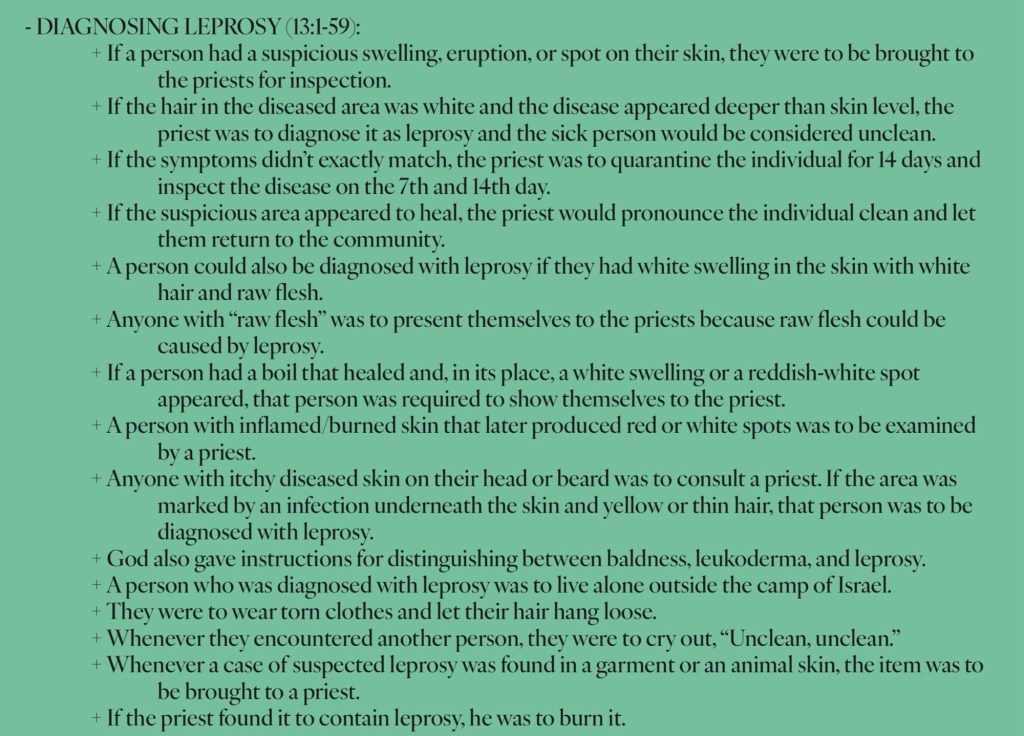
But Naaman is also introduced as a mezora, a person affected by the skin disease tzaraath (2 Ki 5:1). This latter term is traditionally rendered as “leprosy”, but it is clear that it was not at all what today we know as Hansen’s disease, a highly-contagious disease in which a bacterial infection can damage some or all of a person’s skin, nerves, eyes, and their respiratory tract. Biblical leprosy was, rather, a disfiguration of a person’s skin—usually manifested in white patches of skin—which rendered a person ritually unclean. There are a range of prescriptions for dealing with this disease in Lev 13–14.
Naaman’s condition renders him unclean in Israelite society. It is his his slave girl (taken into service from her home in Israel) who suggests to him that he might visit “the prophet who is in Samaria”, for “he would cure him of his leprosy” (5:3). Naaman goes to Elisha with the blessing of his king, whose army had previously been at war with the Israelite army (1 Ki 20, 22); now, however, Israel was battling the Moabites to the south (2 Ki3), so Aram was a beneficent neighbour.
The process that Elisha sets for Naaman to follow is symbolically rich and practically powerful. “Go, wash in the Jordan seven times, and your flesh shall be restored and you shall be clean” (5:10), the prophet commands him. The “seven times” signals a perfect, completed process, typical of Israelite practices (“seven times” appears four times in the ritual of Lev 14, and another five times in other ritual elsewhere in Leviticus).
This process is far simpler than the required ritual for Israelites: Leviticus prescribes a far more complex process. It begins with an investigation by the priest to determine whether the person is in fact unclean (Lev 13, with multiple options for consideration set out in the first 46 verses, and then 13 further verses relating to clothing and houses!)
If the disease is still active, a purification process then ensues in which “two living clean birds and cedarwood and crimson yarn and hyssop” are to be brought to the priest, who will then slaughter one bird and “take the living bird with the cedarwood and the crimson yarn and the hyssop, and dip them and the living bird in the blood of the bird that was slaughtered over the fresh water” (Lev 14:4–6). This blood is then sprinkled seven times on the one who is to be cleansed of the leprous disease; “then he shall pronounce him clean, and he shall let the living bird go into the open field” (Lev 14:7).
A further process is then required, with the person to be healed washing, shaving, living apart for a week, shaving again, and then taking another collection of items for this ritual: “two male lambs without blemish, and one ewe lamb in its first year without blemish, and a grain offering of three-tenths of an ephah of choice flour mixed with oil, and one log of oil” (Lev 14:10). Another ritual of sacrifice follows, with detailed instructions given (Lev 14:11–20). It is complex!
The response of Naaman, in the light of this complex process expected of Israelites, is striking. He is impatient! He had actually been expecting an instantaneous cure, and wondered why he could not simply was in a river closer to his home (2 Ki 5:12). In his anger, he dismisses Elisha as weak and ineffective (5:11–12). But after an intercession from his servants, he dutifully obeys, and the result (after seven immersions) is dramatic: “his flesh was restored like the flesh of a young boy, and he was clean” (5:14). Naaman returns to Elisha, to praise the God who has enabled the prophet to heal him and to offer a gift (5:15).
Why does the lectionary end the section of the text offered for this Sunday (5:1–14) before the following verse? Surely to end the section with the climactic confession, “I know that there is no God in all the earth except in Israel” would have been quite powerful! Perhaps it stops abruptly to avoid the apparently embarrassing words of Naaman, “please accept a present from your servant” (v.15b). This was to be expected in the patron—client society of antiquity; is it felt a little crass for modern ears, or does it unhelpfully suggest that grateful parishioners today should shower their ministers with gifts in gratitude? (That would be contrary to the Code of Ethics that I am bound to operate by.)
Or perhaps because the last part of this verse introduces a whole new act in the story of Naaman and Elisha? The suggestion of a gift for the prophet, his stern refusal (vv.16–18) and his final word of peace (v.19), all lead on into the final part of the long story told in this chapter. It takes us to Gehazi, the interfering servant of Elisha, and the consequences of his actions which are recounted in vv.20–27. Again, the lectionary ignores this part of the story; but its inclusion in the Deuteronomic History indicates that it had significance for the Israelites in subsequent years, and especially in the years after the Exile, when this lengthy document was put into a final form.
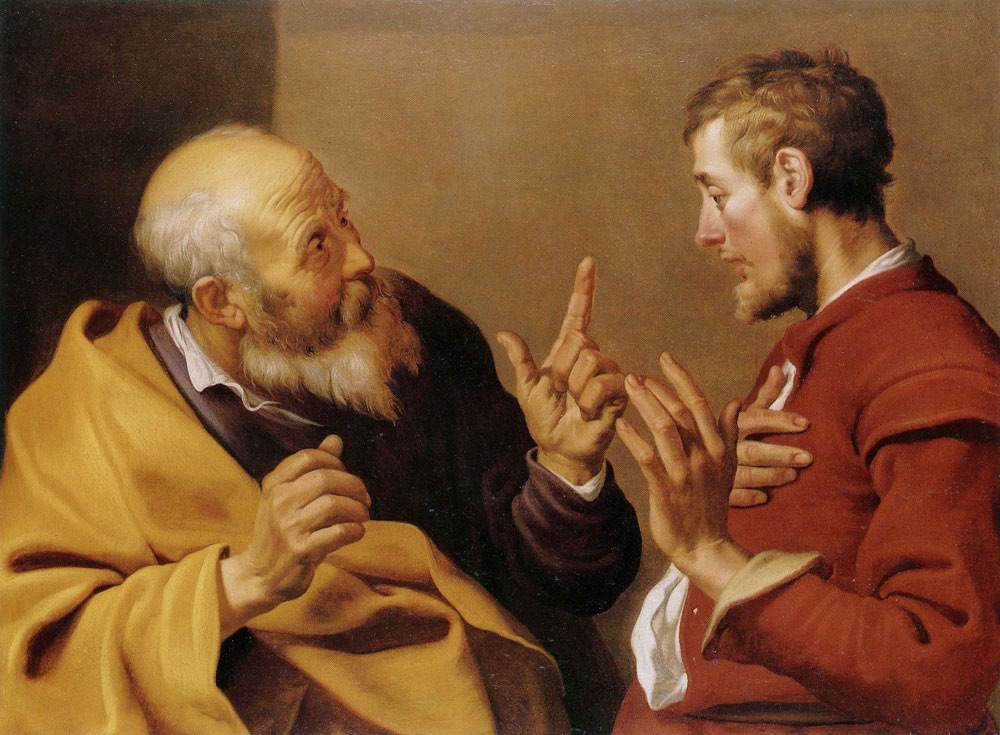
Elisha and his servant Gehazi
Elisha, in the end, is required to pronounce judgement over the miscreant servant. Gehazi intervenes, seeking additional money from Naaman—who willingly gives more than what is asked for. “Please give them a talent of silver and two changes of clothing”, the servant begs; Naaman responds by giving him “two talents of silver in two bags, with two changes of clothing” (5:22–23). So gratified was the Syrian for his healing that he gave in abundance.
But Elisha knows what his servant has done; “did I not go with you in spirit when someone left his chariot to meet you?”, he says (5:26). And so the story ends with a clear reversal: “the leprosy of Naaman shall cling to you, and to your descendants forever”, the prophet tells his servant (5:27). And so it does. The man who was once leprous is now healed, for “his flesh was restored like the flesh of a young boy, and he was clean” (5:14); whereas Gehazi now bears the stigma of Naaman’s leprosy, and as he departs from Elisha, “he left his presence leprous, as white as snow” (5:27).
In later Jewish tradition, the figure of Gehazi serves as a type for those who are avaricious in their dealings with others, as Gehazi was. An article in the Jewish Encyclopedia describes how he is portrayed in the Babylonian Talmud: “When Naaman went to Elisha, the latter was studying the passage concerning the eight unclean “sheraẓim” (creeping things; comp. Shab. xiv. 1).
“Therefore when Gehazi returned after inducing Naaman to give him presents, Elisha, in his rebuke, enumerated eight precious things which Gehazi had taken, and told him that it was time for him to take the punishment prescribed for one who catches any of the eight sheraẓim, the punishment being in his case leprosy. The four lepers at the gate announcing Sennacherib’s defeat were Gehazi and his three sons (b.Soṭ 47a).”
In a Christian context, we might also note that the dynamics of this story in 2 Kings 5 foreshadow the dynamics of true faith spoken of by a later teacher in Israel: “whoever wants to be first must be last of all and servant of all” (Mark 9:35); “the greatest among you must become like the youngest, and the leader like” (Luke 22:26); “blessed are you who are hungry now, for you will be filled; blessed are you who weep now, for you will laugh … woe to you who are full now, for you will be hungry; woe to you who are laughing now, for you will mourn and weep” (Luke 6:21,25). What a pity the lectionary has omitted this potent conclusion to a well-known story.
Continuing the story of the half-acre block in the centre of the town which Elizabeth and I bought five years ago; the block which has the house that we are now living in.
It turns out that we are just the latest in a line of people who have owned this particular block since soon after it was put up for sale, under the land ownership system of the invading British colonisers, in 1842. We know that this land had been Gringai land for millennia prior to the arrival of the British. We know also that they systematically and relentlessly marginalised the First Peoples and laid claim to the land, both locally, and indeed right across the continent we now know as Australia.
We know the names of the previous owners of this block under British colonial law from the legal documentation that came with the title to the land. And we have been able to find something about each of these owners through searching the internet and sifting the material we have found.
The set of documents from the 19th century relating to land in Brown St, Dungog, which we acquired when we purchased the house and land.
The block of land which we recently bought was originally bought under the system of colonial landholding by James Fawell on 9 May 1842. It cost him £4.0.0. The legal documentation identifies it as “Lot No. Seven Section No. Five in the Town of Dungog”. Section Five is the block bounded by Dowling, Brown, Lord, and Mackay Streets. Dowling St runs along the ridge beside the Williams River, and it developed early into the street of commerce for the town.
The land on Brown St that James Fawell bought is described in the legal documentation as “two roods situate in the Town of Dungog County of Durham, bounded on the North by one chain of the South side of Brown Street, bearing East on the East by a line dividing it from allotment number eight, bearing South five chains on the South by a line dividing it from allotment number four, bearing West one chain and on the West by a line dividing it from allotment number six, bearing North to Brown Street”.
The 1842 document granting land in Brown Street, Dungog, to James Fawell
All of this means it was a long block, fronting Brown St, a little more than 20 metres (one chain) wide and just over 100 metres (five chains) wide. In total, the “two roods” equates to half an acre (since one rood equals a quarter-acre).
After Fawell bought the land at Public Auction in 1842, there were a number of owners of the land over the ensuing years. The land was purchased by Barnett Levey (in 1852), sold to William Hopkins (in 1855), then sold to John Maberly (in 1857), and in the next year (1858) to Daniel Bruyn.
There is no indication from the legal papers that any of these owners either built a house on the land, or lived on the land. Indeed, Daniel Bruyn is the first owner to be identified as being “of Dungog”; those before him, apart from Fawell, all lived in Windsor. This reflects what is known of Dungog in the mid—19th century.
Throught the 1800s, it seems that there was relatively little building west of Lord St. The main populated area was on Dowling St and within a block either way on its various cross streets (Hooke, Brown, Mackay, Chapman, Myles, and Mary). One John Wilson, born in Dungog in 1854, is said to have described the town as a “sea of bush and scrub, with a house here and there”, and with bullock teams and drays having “to wend their way between stumps and saplings”.
A photo of early Dungog, from History in the Williams River Valley
Even in 1892, at the opening of Dungog Cottage Hospital on Hospital Hill to the west, the trek up was largely through open countryside. Boosted by the development of the dairy industry from the 1890s, Dungog grew more rapidly; as with all towns north of Newcastle, a further boost occurred with the arrival of the railway in 1911.
Indeed, many of the finest houses and commercial buildings still standing in the town were built from the end of the nineteenth century, into the first two decades of the twentieth century. Coolalie (206 Dowling St) and Coimbra (72 Dowling St), as well as the then Angus & Coote building (146–148 Dowling St) and the Dark stores (184–190 Dowling St) all date from this period of expansion. Which may well provide a clue regarding the house eventually built on our Brown St block of land.
Dowling St, Dungog, around 1910; photo from History of the Williams River Valley
Who were these five men who owned, in turn, Lot Seven in Section Five of the Town of Dungog, over the 16 years from 1842 to 1858? All had their origins in England. I have been able to find out some basic information about some of them, and with some educated hunches, perhaps also about the others. It seems to me that, with the exception of the fifth of these five men, each of them bought the property in order to leverage their possession to increase their finances. Certainly, each time the land was sold, it brought a profit to the seller.
James Fawell purchased the block of land on 9 May 1842 for £4. The Grant by Purchase document states that he was using “part of the Remission of Twenty five Pounds Sterling Authorised for him as a late private in Her Majesty’s 80th Regiment of Foot under the Regulations of 15th February 1840”. This was a regiment raised in 1793 in Staffordshire; it saw action in Flanders and the Netherlands and it was part of the British force that expelled Napoleon from Egypt in 1801. The Regiment served in India from 1803 to 1817.
In May 1836 a detachment of the Regiment, led by Major Narborough Baker, left Gravesend as the guard on the convict ship Lady Kennaway. It arrived in Sydney in October 1836. 25 further detachments followed as convict guards on convict ships in the next two years. Fawell must have come to the Colony in this capacity.
Fawell owned the land for a decade. A Conveyance dated 30 December 1852 reports that James Fawell of Windsor, Settler, sold this land to Barnett Levey of Windsor, Innkeeper, for Nine Pounds Sterling.
The 1852 Conveyance of the Brown St land from James Fawell to Barnett Levey
Who was Barnett Levey? Was he one of the four children of Barnett Levey (1798–1837), theatrical entrepreneur, first free Jewish settler in NSW ?
The signature of Barnett Levey on the 1852 Conveyance
It is an unusual name; so if this hunch is correct, Barnett jnr was born 1827 and listed in the 1828 Census with his parents. He later worked as a Teacher (1870–1896) and he died in 1907.
The next owner was William Hopkins. Levey held the land for less than three years; a Conveyance dated 2 May 1855 documents the transaction between Barnet Levey of Windsor, Dealer, and William Hopkins of Windsor, Miller. The land cost Hopkins Forty Pounds Sterling, so Levey had received more than three times what he paid for the land in 1852.
The 1855 Conveyance transferring the Brown St land from Barnett Levey to William Hopkins
Was the purchaser of this land William Hopkins, Miller, of Windsor, who established the Fitz Roy Steam Flour Mill at 309 George Street, Windsor in the 1840s? If so, it would mean that this land was once owned by a convict who gained his Certificate of Freedom on 10 February 1825.
This William Hopkins was born in the late 1790s. He was indicted for stealing, on the 17th of October, one coat, value 20s., the goods of Henry Moule. He was (again) indicted for stealing, on the 17th of October, one tea-pot, value 5s; and two spoons, value 2s , the goods of Charles Moody. Hopkins was convicted at Middlesex Gaol Delivery for a term of 7 years on 29 October 1817. He was aged 22.
The signature of William Hopkins on the 1855 Conveyance
Hopkins was one of 170 convicts transported on the ship ‘Glory’, which departed in May 1818 and arrived in the Colony on 14 Sept 1818. At age 26, Hopkins was free by servitude, and became a landholder at Wilberforce. His wife at this time was Susannah Lisson, born in 1796; their children were William, 2, born in the colony, and Ann, 11 months, also born in the colony. William died and was buried on 30 Jan 1862.
The 1825 Certificate of Freedom for William Hopkins
The land then had two further owners in quick succession: John Maberly in 1857, and in the next year, 1858 Daniel Bruyn. A Conveyance dated 5th day of March 1857, between William Hopkins of Windsor, Miller, and John Maberly of Windsor, Boot and Shoe Maker, states that Allotment No. Seven of Section No. Five was sold at Public Auction by Mr John Boulton Laverack, Auctioneer, for the sum of Fifty Pounds. Hopkins thus made Ten Pounds in the space of 22 months when he sold the land.
The 1857 Conveyance transferring the Brown St land from William Hopkins to John Maberly.
John Rogers Maberly (1827–1860) was the son of convict John Maberly, a carpenter, who arrived in the Colony in 1830 on the Nithsdale), and Elizabeth Rogers. He was born on 14 Oct 1827 in Lambourne, West Berkshire and married Mary Ann Miller (1831–1918) in 1849. John Maberly died of heart disease on 18 Oct 1860 at Windsor; Mary Ann later married William Stubbs at Richmond on 21 June 1866. Stubbs was the son of William Stubbs (1796–1852), who came to the Colony on the Coromandel in 1802.
The signature of John Maberly on the 1857 Conveyance
There is also another document from 1857, a Bond of Indemnity from William Hopkins to John Maberly in relation to Rebecca Levy, widow of Barnett Levy.
Within less than a year, Maberly had sold the land. In a Conveyance dated 30 January 1858 between John Maberly of Windsor, Boot and Shoe Maker, and Daniel Bruyn of Dungog, Blacksmith, the transfer was effected for a price of fifty three pounds ten shillings.
The first three Conveyances
The land would stay in the Bruyn family for the next 110 years. What, then, do we know about Daniel Bruyn?
A little over five years ago, Elizabeth and I bought land in Dungog. It was a half-acre block in the centre of the town; the block which has the house that we are have been living in, now, for just over 18 months. It turns out that we are just the latest in a line of people who have owned this particular block.
We know the names of the previous owners of this block from the legal documentation that came with the title to the land. And we have been able to find something about each of these owners—from the person who was originally granted the land in 1842, right up to the people who bought the house and land in 1969, from whose deceased estate we bought the house and land a few years back. We have found this through searching the internet and sifting the material we have found.
The block of land in Brown St was part of the original area of land in the town that was made available in 1838 to settlers by the Governor of the Colony of New South Wales, Sir George Gipps. Of course, this land and the surrounding region (like all land that had been granted to the invading British colonisers) had been the land of the Indigenous people of the area for millennia.
As I have done with each move of recent times, I have taken some time to investigate a little of what is known about the First Peoples of the area to which we have moved. I have been exploring the stories about contact between the invading British colonisers and the First Peoples who have cared for the land from time immemorial.
The First Peoples of this area are the Gringai. The traditional lands of the Gringai include an area centred on the place where the town of Dungog is situated, next to the Williams River. It is thought that the name Dungog is derived from a word meaning “clear hills” in the Gringai language. I have explored what we know of the Gringai and this area in my earlier blogs
Once the British government started sending convicts to this continent, and began the process of claiming the land from the Indigenous people, the British system of law, and of land and property, became dominant as new settlements were opened up for the incoming settlers.
“In 1825 the sale of land by private tender began (Instructions to Governor Brisbane, 17 July 1825, HRA 1.12.107-125). There were still to be grants without purchase but they were not to exceed 2,560 acres or be less than 320 acres unless in the immediate vicinity of a town or village.
“On 5 September 1826, a Government order allowed Governor Darling to create the limits of location. Settlers were only permitted to take up land within this area. A further Government order of 14 October 1829 extended these boundaries to an area defined as the Nineteen Counties.
“In a despatch dated 9 January 1831, Viscount Goderich instructed that no more free grants (except those already promised) be given. All land was thenceforth to be sold at public auction (HRA 1.16.22) and revenue from the sale of land was to go toward the immigration of labourers.
“Following this, land was sold by public auction without restrictions being placed on the area to be acquired. After 1831 the only land that could be made available for sale was within the Nineteen Counties. This restriction was brought about to reduce the cost of administration and to stem the flow of settlers to the outer areas.”
The Nineteen Counties in which settlement by British colonists was permitted as from 1829. Squatters, however, soon began “squatting” on lands outside the Nineteen Counties.
The first county, Cumberland, had been established soon after the British colony was established, in June 1788. a second county, Northumberland, was proclaimed in 1804. By 1820, nine counties had been established: Roxburgh, Northumberland, Durham, Westmoreland, Cumberland, Argyle, Camden, Ayr and Cambridge. The town of Dungog would be established in the Durham County, named after John George Lambton, First Earl of Durham (1792–1840).
The nine counties in 1832
In 1829, when the establishment of the nineteen counties was decreed to be the limits of settlement, the original Durham County was divided into two, with Gloucester County taking the eastern half of the original county. The dividing boundary was the Williams River, with Dungog lying just to the west of the river in County Durham. (Durham County in the UK was the place where Elizabeth’s family, the Raine family, had originated.)
Durham and Gloucester counties in 1886
The Census of 1857 indicated that Dungog village had 25 houses and a population of 126 people. By 1861 the population had grown to 458 people. The town had begun some decades earlier, in 1838, when a fully surveyed plan of land for sale in Dungog was advertised in the Sydney Gazette. Initially, land was sold at a “Minimum price” of “£2 sterling per acre”. In 1839, a further parcel of half acre and other sized allotments were offered for sale at £4 per acre.
The 1838 plan can be seen as an example of the early colonial government’s attempts to create an English-style model of small villages and surrounding estates. The central area of the village was divided into a number of sections, each separated by a street. The first grant of land in the area had been made a decade earlier, to John Hooke, of Parramatta, in July 1828.
Map of the 1838 plan for Dungog, reproduced from Ah! Dungog
The block of land which we recently bought was originally bought under the system of colonial landholding by James Fawell on 9 May 1842. It cost him £4.0.0. The legal documentation identifies it as “Lot No. Seven Section No. Five in the Town of Dungog”. Section Five is the block bounded by Dowling, Brown, Lord, and Mackay Streets. Dowling St runs along the ridge beside the Williams River, and it developed early into the street of commerce for the town.
All four streets are named after early British settlers in the town. Dowling St bears the name of James Dowling, who was granted land in 1828. Dowling became the second Chief Justice of NSW, serving from 29 August 1837 to 27 September 1844, the day of his death.
The Hon. Sir James Dowling; engraving by Henry Samuel Sade, c. 1860
Mackay St is named after D.F. Mackay, whose grant of 640 acres was made in 1829. Mackay took up the position of Superintendent of Prisoners and Public Works in Newcastle.
Lord St carries the name of John Lord, whose land (2560 acres) had been designated, in 1829, to be granted to Archibald Mosman; in 1836 it was re-allocated to John Lord. (Mosman did purchase land in the area in 1837, but sold it a year later and moved to Glen Innes.)
Brown Street, it seems, carries the name of one Crawford Logan Brown, a Scotsman who in 1829 had been granted 1280 acres at Dungog by the then Governor, Sir Ralph Darling.
Brown’s estate was named Cairnsmore. In 1836 he added to his grant with a purchase of 640 acres at a cost of £160. In addition to Cairnsmore at Williams River, Crawford L. Brown also owned land at Patrick Plains known as Blackford. He exemplifies the expansionary style of those privileged to obtain grants—and to have convict labour assigned to them—under the British colonial system.
Crawford Logan Brown served as a Magistrate at Dungog from 1845 until his death on 13th December 1859 in Dungog. An interesting—and startling—anecdote known about him is that in January 1846, whilst serving as Magistrate, he sentenced his own assigned servant Thomas Fry to two years in irons. This sentence was punishment for an assault that Fry had made on Brown himself!
An extract from a late 19th century survey map of the Parish of Dungog, showing the grid plan and numbered Lots in the Town of Dungog.
There will be more of the story told in a series of blogs to follow, focussing in on the history of the people, the land, and the house on the property that we currently occupy … … …
In the Hebrew Scriptures passage that the lectionary sets before us this coming Sunday (in 2 Kings 2), we read about the transition from Elijah the prophet to Elisha the prophet. This is an important moment in the story, as it moves on from the words and deeds of Elijah the Tishbite, later remembered as the great “prophet like fire [whose] word burned like a torch” (Sirach 48:1) and as one who had “great zeal for the law” (1 Macc 2:58).
Whilst Elijah remained in his heavenly abode, it was considered that he would ultimately return from that place “before the great and terrible day of the Lord”; he would come “to turn the hearts of the people of Israel” so that the Lord God “will not come and strike the land with a curse” (Mal 4:5–6). But in the meantime, who would follow him in the earthly realm to declare the word of the Lord and to signal the power of the Lord God by performing miracles, as Elijah had done? This transition story offers the answer.
In the book we know as 1 Kings, the compiler of the Deuteronomic History reports many incidents which attest to the courage and power of Elijah. In his sermon in Nazareth, Jesus refers to the first miracle of Elijah, when he provided a widow in Zarephath with food and oil that “did not fail”, even though the land was in drought (1 Ki 17:1–16). In subsequent incidents in this book, he raises a dead son (17:17–24), confronts King Ahab (18:1–18) and famously stares down the prophets of Baal in a mountaintop showdown (18:19–40), leading to the breaking of the drought (18:41–46).
Elijah later condemns Ahab over his unjust seizure of the vineyard of Naboth (21:17–29) and then stands before Ahab’s son, King Ahaziah, to condemn him to death (2 Ki 1:2–16); a death “according to the words of of the Lord that Elijah had spoken” which is promptly reported (2 Ki 1:17). During the rule of Ahab, Elijah had also most famously heard the Lord God “not in the wind … not in the earthquake … not in the fire”—the standard elements involved in a theophany since the time of Moses (Exod 19:1–6)—but rather in “the sound of sheer silence” (1 Ki 19:11–12). Elijah was his own, distinctive man, with his own, distinctive encounter with God.
Then, immediately after that encounter, Elijah the Tishbite, from Gilead, called Elisha son of Shaphat, a farmer ploughing his fields, to be his chosen disciple (1 Ki 19:19–21). All of these stories serve as the background to the story that we face on this Sunday’s readings, when Elijah “ascended in a whirlwind into heaven” (2 Ki 2:11) and leaves behind his prophetic mantle, which Elisha then took as his own (2 Ki 2:12–14). From that moment, as “the company of prophets who were at Jericho” declared, “the spirit of Elijah rests on Elisha” (2 Ki 2:13–15).
Indeed, Elisha had rather brashly requested of Elijah, “please let me inherit a double share of your spirit” (2:9). Elijah had responded, “you have asked a hard thing; yet, if you see me as I am being taken from you, it will be granted you; if not, it will not” (2:10). Sure enough, as Elisha subsequently watches as “a chariot of fire and horses of fire” take Elijah and he ascends “in a whirlwind” (2:11), Elisha is watching, indeed crying out a description of the spectacle: “father, father! the chariots of Israel and its horsemen!” (2:12). He will surely be doubly blessed. The narrator makes sure we know that Elisha could see Elijah departing, commenting that “when he could no longer see him, he grasped his own clothes and tore them in two pieces” (2:12).
Elisha knows he had the blessing of Elijah when his first action after the departure of his mentor was to pick up the cloak (or mantle) that Elijah had left behind, and immediately uses it to enact a miracle (2:13–14)—replicating what Elijah had just done (2:8). It seems that a distinctive cloak, or mantle, was worn by prophets over the years; although cloaks were common garments—worn, for instance, by Ezra (Ez 9:5) and Job (Job 1:20)—it is thought the cloak or mantle worn by Samuel (1 Sam 15:27) and Elijah (1 Ki 19:13) was a sign of their prophetic role. That certainly seems the case with Elisha (2 Ki 2:8, 12).
Now, Elisha is not exactly my favourite prophet. After all, look at what he did when some small boys taunted him because of his distinctive hairline. They jeered at him, calling him “bald head”; in response, he cursed them and, presumably to enact the curse, “two she-bears came out of the woods and mauled forty-two of the boys” (2 Kings 2:23–24). As a particularly alopecic person myself, this does not particularly endear this prophet to me. Why did his sensitivity about his follicularly-challenged head justify this incredibly excessive response to the games of children?
However, the compiler of the Deuteronomic History sees otherwise. Elisha is honoured as a prophet who is able to perform miracles, who confronts kings, and who declares the word of the Lord forthrightly and without fear. He replicated the last miracle of Elijah (2 Ki 2:8) by striking a steam of water with his newly-acquired mantle, so that “the water was parted to the one side and to the other” (2:13–14). He made good the bad water in Jericho (2:19–22), then spoke the word that made the water flow again in Judah (3:13–20), replicating another miracle of Elijah when he caused an earlier drought in Israel to end (1 Ki 18:41–45).
He later supplies an impecunious widow with an abundance of oil to save her from her debtors (2 Ki 4:1–7) and then raises from the dead the son of a Shunnamite woman (4:8–37). These two miracles replicate actions performed earlier by Elijah (1 Ki 17:8–16, 17–24). Elisha’s miraculous deeds continue as he supplies food to end a famine in Gilgal (2 Ki 4:38–41), feeds a hundred men (4:42–44), and then heals the Syrian army commander Naaman (5:1–19), a story that we will focus on in worship the Sunday after this coming one. And as Elijah had challenged the kings of his day, so Elisha confronts the king of his time (2 Ki 6).
Still more miracles are reported, before Elisha became ill and died (13:14–20). Yet even in death, his miraculous powers continued; the narrative reports that as the Moabites invade the land each spring, “as a man was being buried, a marauding band was seen and the man was thrown into the grave of Elisha; as soon as the man touched the bones of Elisha, he came to life and stood on his feet” (13:21). Whilst Elijah had not died—his ascension into heaven was most certainly while he was still alive (2 Ki 2:11–12)—Elisha had died, but his power to perform miracles lived on (2 Ki 13:21).
In his long “hymn in honour of our ancestors”, Jesus, son of Sirach lavishes praise on Elisha. “When Elijah was enveloped in the whirlwind”, he writes, “Elisha was filled with his spirit. He performed twice as many signs, and marvels with every utterance of his mouth. Never in his lifetime did he tremble before any ruler, nor could anyone intimidate him at all. Nothing was too hard for him, and when he was dead, his body prophesied. In his life he did wonders, and in death his deeds were marvelous.” (Sirach 48:12–14). He was, by all accounts, a worthy successor to Elijah. I may have to allow him that, despite his hyper-sensitivity about his hairstyle.