It’s now been two months since we moved into a period when restrictions on social gatherings came into force because of the spread of the COVID-19 virus. As restrictions are gradually eased, people are starting to grapple with what that will look like. How will hope be found, in what lies ahead?
Now my mind is thinking about what the future might look like. People are struggling with number of matters. These matters have been the subject of conversations in my household over recent weeks, as Elizabeth and I think about what the future might hold, and how we need to prepare for it, both personally, and as a church.
As we consider these struggles, I want to look beyond, to what a hope-filled, missionally-engaged future might await us. So this is the second in a series of posts in which I muse about a series of issues that emerge as we think about this. The first was focussed on “where” people are wanting to be in that future time.
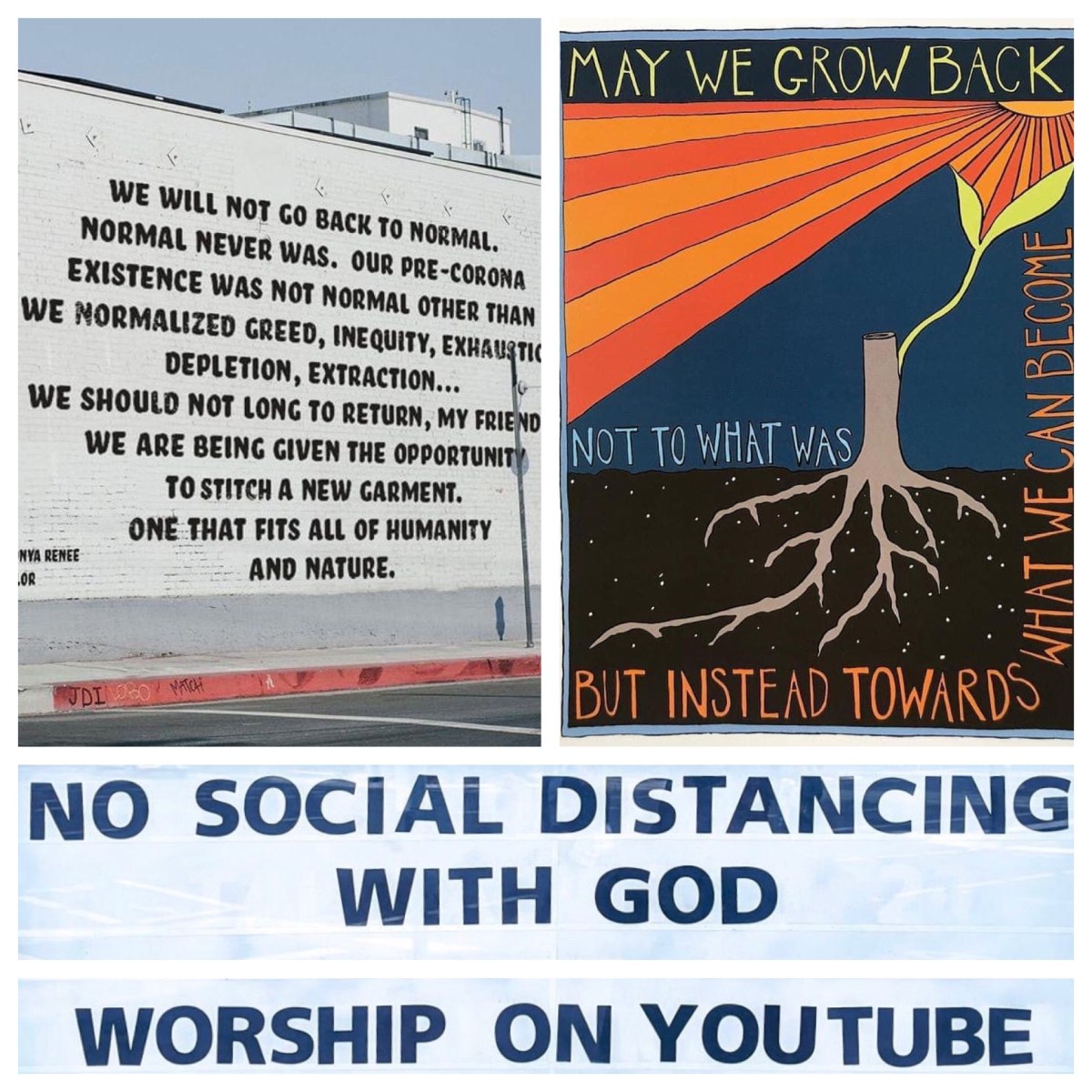
This post reflects on the “when” of our hopes for the future. How often have you heard someone refer, longingly, to “the way things used to be”? How often have you heard people lament that they would really like things to be “just like they used to be”?
This is a refrain in society—let’s get back to when life was simpler, people were friendlier, choices were easier. It is also a refrain in the church—let’s get back to when buildings were filled on Sundays, Friday night youth groups were thriving, Sunday Schools were overflowing. Ah, the good old days …
It is still a struggle for some people to try to move beyond this yearning for the past. When they try to imagine what it will be like when we get back to meeting in person, such people simply have in mind that things will be “just like they used to be”. The natural human urge is for us to move out of a time of upheaval, right back into the comfort zone of what is familiar, what is predictable, what has been the comforting routine of “life as usual”.
That is no less the case in the present period of COVID-19 restrictions. Back to church worship on a Sunday morning, seeking the much-loved group of friends once again, sitting in the usual spot, singing the favourite hymns, sharing the chit-chat over morning tea—church as usual, just if nothing had happened!
We can’t, of course, go back to the old familiar patterns. COVID-19 has ensured that this will be the case. We will need to clean and disinfect buildings regularly, maintain contact lists of all people attending any event, ensure that all physical touch elements in worship are modified, and, for the moment, ensure that there is adherence to social distancing and the limits on numbers in the building. And we would be well-advised not to sing when we gather for worship, for that is a high risk activity. Things will be different.
“Behold, I am about to do a new thing”, the prophet of old long ago declared to the people of Israel (Isa 43:19). To the people of Israel who had been decades in exile in Babylon, the word of the Lord spoke of hope and promise, of a new initiative, stepping out in a new way. The people journey back across the wilderness, heading back to the land where their ancestors had lived for centuries.
Without the “new thing” of the Lord, the people of Israel would have remained in exile and, presumably, have diminished in their distinctiveness, threatening the existence of the people of God as a nation called to be “a holy priesthood”. Finding the “new thing” that is happening in our own time is important.
So the question for us could well be: what is the “new thing” that God is doing, that the Spirit is calling to us to take part in, as public society begins to reactivate, as church begins to regather, in the weeks ahead?
I have read a number of pointers about how about society will need to be structured differently after the current restrictions have been eased and then lifted. In what I have read, there are a number of things that point directly at how things will need to change when we gather as a church.
One commentator, Tomas Pueyo, has noted that “Social gatherings should be avoided if a lot of people are close to each other, sing, talk a lot, or commingle. Indoor, confined areas are much worse than outdoors activities.” (See Tomas Pueyo, “Coronavirus: Prevent Seeding and Spreading”, https://medium.com/@tomaspueyo/coronavirus-prevent-seeding-and-spreading-e84ed405e37d)
Both of those factors place church gatherings, worship services, morning teas, and other group gatherings, into the high risk category. They are usually indoors, inviting people into close personal contact with others. And singing—we always sing when we gather, for grace, for praise, for communion, for benedictions. All high risk.
The same commentator, Tomas Pueyo, has noted that “Time matters. A short time is probably ok. Hours probably not.” That might please some people, if we apply it to church—short is better, no more long droning sermons!
But short worship services will be hard to monitor—even a short time for worship sees many people on site for quite some time, first while setting up, then in social mingling afterwards (and even the occasional “car park conversations” that prolong the time together even more!).
How we gather, what we do when we gather, cannot simply be stepping back into what we used to do. We are entering a time when things must be different. How will we engage with that challenge? How will we ensure that we don’t just step back into the past and settle into the well-worn routines? What will church look like, for us, in the future? That is the challenging question that sits before us, now, as we consider our future as the church in post-COVID times.
Thanks again to Elizabeth for the conversations that have shaped these ideas as we talk about future hopes for the church.
It’s now been two months since we moved into a period when restrictions on social gatherings came into force because of the spread of the COVID-19 virus. The full set of restrictions that were put into place are beginning to be eased, with more changes still to come. Governments across the country are making announcements, indicating timetables, looking with hope to the future.
As restrictions are gradually eased, people are starting to grapple with what that will look like. Some are anxious about moving too rapidly to lift current restrictions. Some are hopeful that we can start meeting again in person very, very soon. And some are angry about the intrusion of governments into our lives, the measures in place seen as unwarranted restrictions on our freedoms.
I want now to offer some reflections from my own perspective on what the future might look like. I am aware of a number of matters which remain a struggle for people, and I offer these thoughts with particular reference to the struggles that people in my church (the Uniting Church in Australia) are dealing with.
These matters have been the subject of conversations in my household over recent weeks, as Elizabeth and I think about what the future might hold, and how we need to prepare for it, both personally, and as a church. From within these struggles, I want to look beyond, to what a hope-filled, missionally-engaged future might await us. So this is the first of a series of posts in which I muse about a series of issues that emerge as we think about this.
First, lets think about Sundays. It is still a struggle for many people to imagine anything other than “Sunday morning” when they speak about “church”. The dominance of the Sunday morning worship service, in the minds of so many people, is abundantly clear. Ministers have known this forever—how many times have we heard the half-joking, half-serious comment, “well, you really only work for one hour on one day each week, don’t you?” Grrrrr!
Church, of course, is far more than Sunday morning worship. And people do make the connection from “church” as worship, to visiting hospitals, running a youth group, feeding the hungry, lobbying the local member, providing shelter to homeless people, or doing the shopping for the shut-in down the street. These are seen great things to do—but for many, they are viewed as a kind of optional extra beyond the Sunday morning worship gathering.
Somehow, over the centuries of history that the church has existed, the Sunday morning worship gathering has come to be seen as the very heart, the essential centre, of being church. The importance of gathering to worship has taken over all other elements in being church. In our own time, the dominance of the Sunday morning worship gathering is clear.
We talk about “going to church”—meaning worship in the church building. We ask, “what time is church?”—meaning the time for Sunday worship. We say, “see you in church”—often meaning next Sunday morning. Sunday morning worship has taken over our sense of what it means to be church.
In this view, “church” is really all about hymns and prayers, sermons and morning teas, rosters, and rosters, and more rosters! So the Sunday gathering has become an end in itself. Many people look to Sunday worship in the church building as the time and place for them to carry out their Christian duty. Church has been completely conflated to worship.
A fuller understanding of worship is required. Worship should not be the END. Worship should not be what is always in view, when we think about “church”. Worship should actually be a MEANS to fostering a sense of missional activity in which we share the good news of Jesus in order to build up the body of Christ. The end, from this perspective, is not the time of worship. The end is missional engagement in the world. One of the means to strengthen that end (and only one, amongst a number of things) is worship, as a gathered community.
We need to struggle some more with the implications of this way of seeing things. “Church” is much more than Sunday morning. But so much frenetic activity over the past two months, when gathering in person has not been possible, has been devoted to ensuring that, even if we can’t meet together in person, there is still some “church” happening on Sunday morning—online, on Facebook, on YouTube, on ZOOM. Because, you know, “church” means “worship”.
Let’s struggle to live beyond this blinkered and limited view. Let’s work to foster a strong sense of “church” being a seven-day-a-week enterprise. Let’s talk much more about being disciples, following the risky way of Jesus, and let’s be more active in the world amidst all the diversity of humanity that we encounter. Let’s talk much less about being members, settled into a comfortable club, and let’s not be bound by the traditional customs and practices of our own little clique.
Certainly, scripture contains an encouragement to meet regularly for worship (Heb 10:25), and there are passages that provide specific guidelines and instructions relating to worship in various places (1 Cor 11, 1 Cor 12-14, Col 3:16, Eph 5:18-20). But worship is not all that there is to being church.
Paul uses the language of worship when he writes to the Romans, appealing to them “to present your bodies as a living sacrifice, holy and acceptable to God, which is your spiritual worship” (Rom 12:1). The letter continues with a string of exhortations, injunctions, and instructions, which point very clearly to the view that “spiritual worship” entails living a life wholly committed to discipleship in every way, not simply focussed on the worship gathering. That outward orientation is something that we could do well to hold to. Church is more than just Sunday worship.
This Sunday (the seventh Sunday in the season of Easter) we return to an early section of the second volume of the orderly account that, by tradition, is attributed to Luke. The narrative offers an expanded version of the ascension of Jesus (Acts 1:6-11), an event already reported in brief in the first volume (Luke 24:50-53) but here repeated with additional details.
The ascension forms the pivotal moment in Luke’s narrative; it is the hinge between the two volumes, and attention is drawn to the ascension and exaltation of Jesus at a number of points elsewhere (Luke 9:51; 22:69; Acts 2:33; 3:21; 5:31; 7:56). Luke expands this second narrative account of the ascension through the explicit recording of words spoken on that occasion: the last words of Jesus to his followers, and the words of the two angel-like men to the followers of Jesus after his ascension.
The dialogue between Jesus and his disciples raises the central theological issue of sovereignty (the kingdom of God). The disciples ask “Lord, (may we ask) if you will at this time restore sovereignty to Israel?” (1:6) — quite rightly, for the issue of sovereignty was central to Jesus’ preaching (1:3). Here, however, the orientation of the question is concerned with the sovereignty of Israel. Jesus replies with three clear affirmations, which stand as his last words before he ascends into heaven.
The first affirmation of Jesus in 1:8 turns the question away from Israel, back to the primary theme of God’s sovereignty, with the clear declaration that the times and seasons are under the sovereignty of God who has “set them by his own authority” (1:7). Rather than the political independence of Israel, it is God’s unfettered freedom to act in history which is crucial to his enterprise.
The second affirmation, “you will receive power when the holy spirit has come upon you” (1:8), is a promise which reinforces the key role of the spirit, as divine agent, throughout this volume (beginning with the events of 2:1-4).
The third affirmation introduces the important motif of witness (1:22; 2:32; 3:15; 4:33; 5:32; 10:39,41,43; 13:31; 22:15,18,20; 23:11; 26:11,22) and provides a condensed geographical summation of the course of the ensuing events: “in Jerusalem [1:12-8:3] and in all Judaea and Samaria [8:4-12:25] and to the end of the earth [13:1 onwards]”.
What does “the end of the earth” refer to? A contemporary Jewish work, the Psalms of Solomon 8:15, may suggest that it refers to Rome, it is preferable to see the reference as drawn from Isa 49:6, a verse cited at Luke 2:32 and Acts 13:47. It is thus a poetic statement about the extensive scope of the ensuing events. These departing words of the Lukan Jesus neatly conjoin the geographical pattern and theological foundation of Acts: from Jerusalem outwards, the divine spirit will enable followers of Jesus to bear witness to the sovereignty of God.
Two men in white robes then appear (1:10), evokes similar appearances in earlier chapters: the two men in the tomb (Luke 24:4), the transfigured Jesus in the company of two scriptural figures (Luke 9:29-31). The prominence they have at this point establishes the important role of such epiphanies throughout Acts. The words spoken to the followers of Jesus who witness his ascension stress that his return will be in the same manner as his departure (1:11), although no detailed description is provided (cf. 1 Thess 4:16; Mark 13:27; Matt 24:31).
Ten days separate the ascension (forty days after Passover, 1:3) from the day of Pentecost (2:1, fifty days after Passover). Only two things are told of these ten days; already the process of selectivity which shaped Luke’s Gospel can be seen in his second volume. Thus, we learn only that the community had gathered on the day of ascension (1:12-14) and that at some stage in these days a replacement was found for Judas Iscariot (1:15-26).
Luke’s report of the regathering of the community (1:12-14) establishes key features of this community. Firstly, since they returned to Jerusalem immediately after the ascension (1:12), the focus remains on Jerusalem, which retains its pre-eminent position as the birthplace of the movement. Any gathering of believers elsewhere is incidental to the single-minded picture painted by Luke, of the Jerusalem community as the movement’s place of origin. This is the only community which matters for Luke at this moment.
Secondly, the description reveals that this was a community that met continuously during these ten days (“these [the eleven] all were unanimously attending constantly to prayer with the women and Mary the mother of Jesus and his siblings”, 1:14). The constant and communal nature of their meetings will later become important in Luke’s narrative; for the moment, the emphasis rests on the line of continuity between Jesus and this group.
Those present here in Jerusalem relate to those who journeyed with Jesus, in Galilee: the women (Luke 8:2-3), the family of Jesus (Luke 8:19), and the inner group of named male followers who are identified as apostles (Luke 6:14-16; ‘the twelve’ of Luke 8:1).
The specific reference to the inclusion of women within the community continues a particular interest already unveiled in Luke’s Gospel (Luke 8:1-3; 10:38-42; 23:49,55-56); it is subsequently explicitly noted throughout the second volume (Acts 5:14; 8:3,12; 9:2; 17:4,12).
This blog is based on a section of my commentaryn on Acts in the Eerdmans Commentary on the Bible, ed. Dunn and Rogerson (Eerdmans, 2003).
Last week, the Prime Minister indicated that, because of the good response across society to observe the restrictions on social gatherings and the limitations on moving around, there is now a plan for a three-stage move away from the current restrictions, towards a society where more mobility and more interaction in person will be possible.
This has, unsurprisingly, raised expectations amongst Congregations, that various activities might recommence. These activities include small groups, business meetings, hall rentals by local business or community groups, and, of course, Sunday worship.
In response to the statement by the Prime Minister, leaders of the 14 Presbyteries in my Synod met on Monday with the Synod leadership team. As a result, this leadership group has issued a clear statement, strongly recommending that we should not be meeting in person for services of worship or face to face meeting in our churches. You can read this at https://nswact.uca.org.au/media/8680/covid19-information-guide-gathering-12-may-2020v2.pdf
In the weeks to come, as the stages of easing restrictions come into play, there will undoubtedly be conversations about “can we meet together again, now?”. We will need to be prepared for such conversations.
In making decisions about these matters, we need to be sure that we are not simply rushed along with the excitement and anticipation that life will soon be “back to normal”. Life will return, step-by-step, to a situation that will be more like “normal” than the last few weeks have been. However, it is abundantly clear that life will not, indeed, be “back to normal”, as many are anticipating.
Life will change. Life will be different. Gathering-together, after a period of gathering-apart, will necessarily be different. Familiar customs and practices will not be able to be followed unthinkingly. Beloved institutions that have long been part of the Sunday worship rituals will need to be radically altered, or, indeed, put aside entirely.
There are a number of practical matters to be considered in relation to each activity that could re-commence with in-person gatherings. In my mind, these practical matters include:
* room size and spatial distancing (how do we ensure good monitoring of numbers of people in the building, and behaviours of people whilst in the building?)
* maintaining an accurate list of contacts (this is required, now, no matter what size of gathering, to facilitate tracing in the case of an infection, so—someone will need to take responsibility for this; people will need to be asked if they agree to having their contact details recorded; and will refusal to give permission mean access to the activity on the property will be refused?)
* ensuring non-contact in every activity (greetings at the door as people arrive for worship, shaking hands or hugging during the passing of the peace, the handshaking-line at the end of worship, the passing of the offering plate, the passing of the trays with individual communion glasses, and other elements—these will all need to be dropped)
* ensuring scrupulous adherence to thorough disinfecting procedures (the building must be thoroughly disinfected to be prepared before every use, and thoroughly disinfected at the end of every use—an activity that will take some time, each time the building is used)
* ensuring scrupulous adherence to strict food handling procedures (we need to adhere to commercial-standard protocols, and ensure that every volunteer understands exactly what they can and can’t do—and perhaps we should consider whether serving tea/coffee/nibbles after worship is to be banned?)
* the question of singing (latest research shows this is a high risk activity, especially inside, so singing the old favourite hymns or the new choruses will equally be out of bounds for some time—some experts suggest 18 months to 2 years, until a vaccine is available)
* and—pardon the gritty reality here—toilets (everyone will need to be committed to flushing with the lid closed and washing hands thoroughly after each use; we know that flushing toilets spreads aerosols which contain faecal matter—so the question to consider might well be, should toilets not be available for use? or should someone be rostered to thoroughly disinfect the toilet area after each and every individual use?)
Alongside that, there is a set of questions that we perhaps could explore in a fruitful way—questions which consider how we make decisions, how we undertake discussions, and who we are considering in the process of these discussions and decisions. And, from my perspective, reflecting on relevant biblical passages that can inform the way that we operate, can be helpful and fruitful.
Ministry leaders will be catapulted into such discussions (if we have not, already, found ourselves there). So here are some key principles, along with some associated biblical passages that, in my thinking, shape our ethos and inform how we make responsible ethical decisions about regathering as church.
1. Gathering for worship is important, but safety of people is more important
We know that, across society, there are many people who are vulnerable, who needs our particular care, support, and attention. Whilst gathering-together for worship, prayer, discussion, fellowship, and conversation, is highly valued, our highest priority must be to act in a manner that ensures the lowest risk for people in society, that offers a safe place and safe manner for people to gather-together.
We have committed to being a Safe Place some years ago, and whilst we have applied that to matters such as the safety of children and young people, the physical arrangement in our buildings, and acceptance of diversity. Can we now apply that to the matter of community health and wellbeing?
The psalmist reflects, “Because the poor are despoiled, because the needy groan, I will now rise up,” says the LORD; “I will place them in the safety for which they long” Psalm 12:5). In another psalm, we hear the prayer, “O Lord, let your steadfast love and your faithfulness keep me safe forever” (Psalm 40:11). We need to echo that sentiment and follow that commitment to safety as we gather together.
2. The weakest or most vulnerable is the test for any decision we make
The people who have high risk of infection are those who have the following vulnerabilities: an impaired immune system, one of a number of chronic medical conditions, age, and people with Aboriginal and Islander descent.
Paul writes to the believers in a number of his communities, exhorting those who are “stronger” to attend to “the weak”, with the fundamental principle that “orientation to the needs of the other” undergirds everything. That orientation should govern how we think about, and how we act in, the days ahead. Those who are most vulnerable in terms of age or health should be the litmus test for anything that we consider doing when we gather-together.
Our own personal needs (or desires), the hopes and wants (or desires) of a community of faith, need to have this first consideration governing all that they decide. As Paul writes:
“Do nothing from selfish ambition or conceit, but in humility regard others as better than yourselves. Let each of you look not to your own interests, but to the interests of others.” (Phil 2:3-4)
“Let us therefore no longer pass judgment on one another, but resolve instead never to put a stumbling block or hindrance in the way of another.” (Rom 14:13)
You can read more about this way of operating in Romans 14:1-15:13. This would form an excellent focus for a Bible Study to go alongside a Church Council discussion of what steps can be taken as we consider gathering-together once more.
3. Relationships with others are our first priority. Loving our neighbour takes priority over programs and activities
“Which commandment is the first of all?” Jesus answered, “The first is, ‘Hear, O Israel: the Lord our God, the Lord is one; you shall love the Lord your God with all your heart, and with all your soul, and with all your mind, and with all your strength.’ The second is this, ‘You shall love your neighbour as yourself.’ There is no other commandment greater than these.” (Mark 12:28-31)
Relationships with other people are given priority in this passage, and in the teachings of Jesus throughout the Gospels. That’s a fairly simple observation, but it is incredibly potent in the current situation. How do we ensure that we are “loving our neighbour” in what we decide and what we do together?
Jesus places this as the second “greatest commandment”, alongside the first, of loving God. We need to hold these two aspects in tension, and ensure that we do not focus solely on “loving God” (and doing that in the old, familiar ways, unthinkingly), but we hold together “loving our neighbour” with “loving God”, and that we prioritise these over “returning to business as usual”. If business as usual is just about ourselves as a group, then our higher priority needs to be about how we operate in relation to all those around us.
4. We have a commitment to the common good—the good of all people in society
Almost a decade ago, the Uniting Church adopted a snappy slogan which expressed our commitment to “the common good”. This has been a rallying cry at many gatherings where matters of social justice are being addressed and advocated for—refugees and asylum seekers, affordable housing, care for the creation and environmental policies, sheltering the homeless and feeding the hungry, for instance.
Now, in this challenging time, we need to apply that same commitment “to the common good” to the question of what the implications are when we gather-together, after a time of gathering-apart. We need to ensure that whatever steps we take do contribute to that common good, not simply to the benefit of the group gathering together—be that Congregation, Church Council, Fellowship Group, Bible Study Group, our informal lunch gathering at the church.
And let us remember that “the common good” is itself an important biblical marker:
“So then, whenever we have an opportunity, let us work for the good of all, and especially for those of the family of faith.” (Gal 6:10)
“To each is given the manifestation of the Spirit for the common good.” (1 Cor 12:7)
5. We need to ensure the safety of vulnerable people in leadership (ministry leaders, both ordained and lay)
“So the LORD said to Moses, “Gather for me seventy of the elders of Israel, whom you know to be the elders of the people and officers over them; bring them to the tent of meeting, and have them take their place there with you. I will come down and talk with you there; and I will take some of the spirit that is on you and put it on them; and they shall bear the burden of the people along with you so that you will not bear it all by yourself.” (Num 11:16-17)
This story from the Hebrew Scriptures demonstrates that God was concerned to take care of the leadership of the people of Israel. The seventy Elders were he people. appointed to assist Moses in his growing role as a leader of the people in a stressful and challenging time (as they journey through the wilderness, seeking a way to the promised land). The story from of old has strong resonances with our current situation!
If we accept that God demonstrated concerns for the pressures on Moses, can we see that this provides an analogy for the way that we offer care for our leaders, especially those who are vulnerable themselves, or living in a household with another vulnerable person?
Pressures on ministry leaders (both those ordained, and those lay people who are providing local leadership) to lead their people in gatherings should not be countenanced, until such time as it is clear that all the required protocols can be, and are being, adhered to, and they are not in any position of extra vulnerability because of this. That requires careful discernment and wise leadership at the local level.
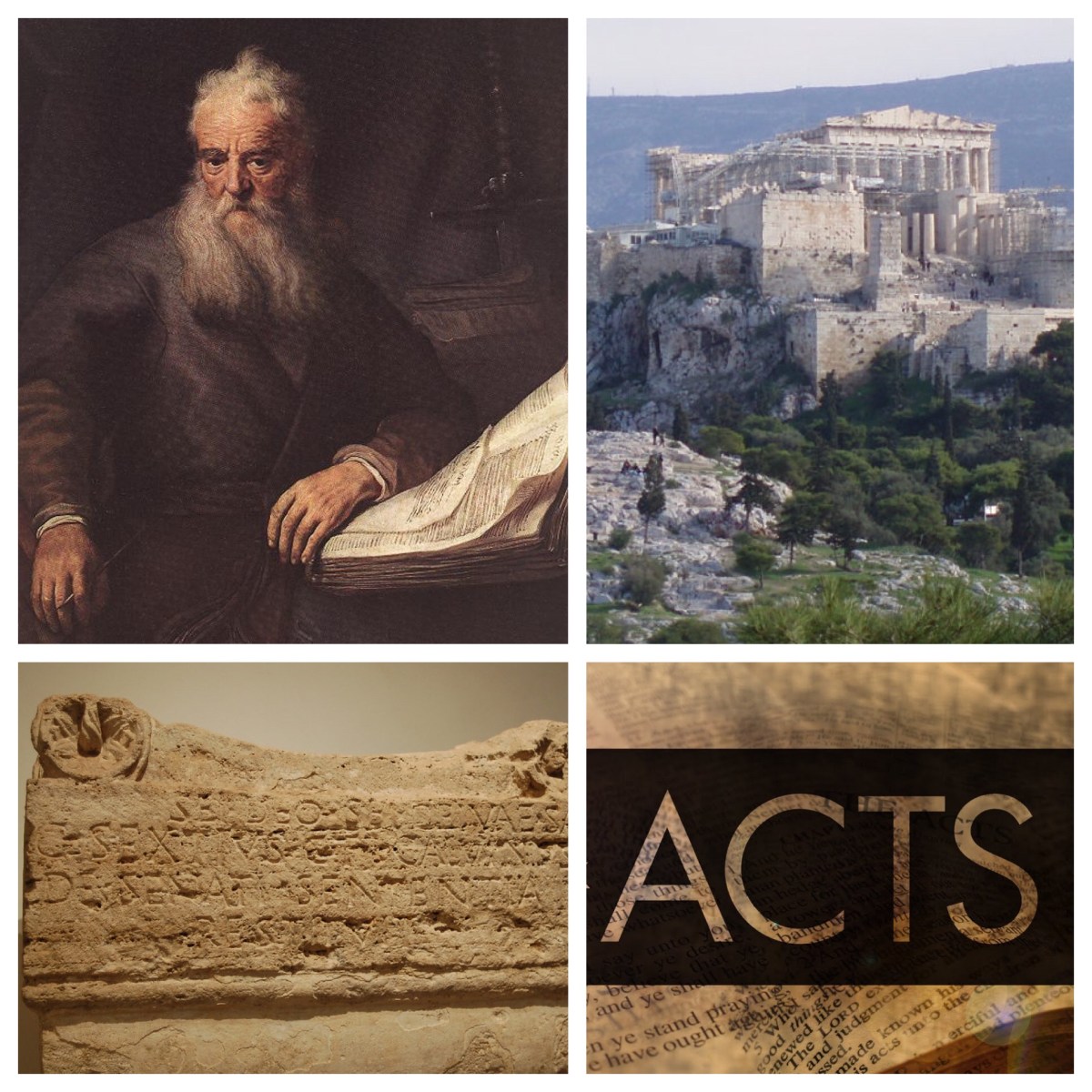
This Sunday (the sixth Sunday in the season of Easter) the lectionary offers us Luke’s account of Paul’s speech on the Areopagus. This famous speech represents a key moment in the story of the early Jesus movement. Many speeches before it in Acts have been delivered to Jews and Godfearers, gathered in synagogues. Now, by contrast, Paul stands before Gentiles—although his listeners initially thought that he was something of a “babbler”, telling frivolous novelties.
In this speech, Paul seeks to convince the Athenians of his beliefs—he is engaged in the task of apologetics—expounding, explaining, and defending his beliefs to others. The speech is, of course, a thoroughly Lukan creation, which most likely owes its shape to the development of preaching in Hellenistic Judaism. (We have various examples in works from the centuries or two before, and after, Paul.)
As Paul attempts to persuade his audience, he seeks to move them from what they can agree upon to what he wishes them to believe; this is the nature of apologetic preaching. He presents as thoughtful, relevant, respectful, and persuasive—an excellent role model for contemporary preachers!
Paul quotes, not from his own Jewish scripture, as he usually did in synagogues; he begins with a reference to the “altar to an unknown God” (17:23) and later refers to “your own poets” (17:28). That is a key apologetic move; contextualise your words, start with what is known to be in common between speaker and audience.
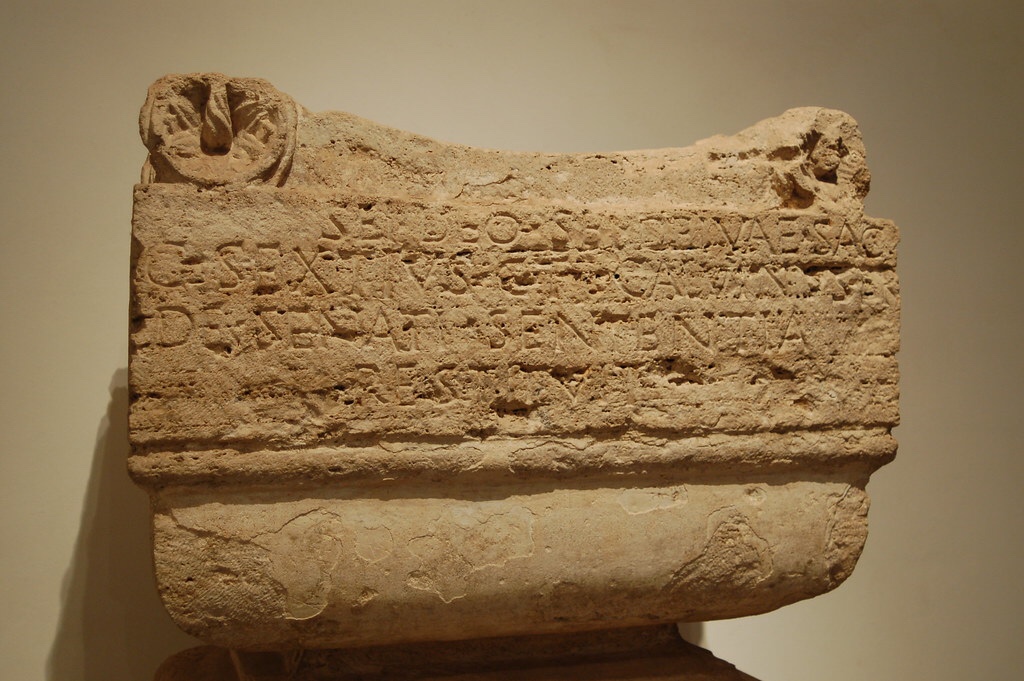
An altar which refers to an “unknown God”. It was found in 1820 on the Palatine Hill of Rome. It contains an inscription in Latin that says: SEI·DEO·SEI·DEIVAE·SAC G·SEXTIVS·C·F·CALVINVSPR DE·SENATI·SENTENTIA RESTITVIT Either for a god or a sacred goddess, Caius Sextius Calvinus, son of Gaius, praetor by order of the Senate restored this.
Indeed, the argument of this speech is thoroughly connected with the audience, drawn from the two leading schools of Epicurus and the Stoics (17:18). Paul declares his belief in the providential care of God for all humanity. Stoics and Epicureans held strongly opposing views on the question of divine providence: the Stoics exalted fate as pre-eminent, whilst the Epicureans dismissed it as an illusion. Luke’s apologetic strategy has Paul pitch his speech on the basis of the Stoic view.
The speech begins, in proper rhetorical style, with an “eager seizing of goodwill”, or captatio benevolentiae (17:22). Then Luke has Paul identify the “unknown God” of the altar (17:23) as “the God who made the earth and all things in it” (17:24; cf. 4:24; 14:15). God functions as the subject of the speech which follows; God’s actions encompass everything from the creation (17:24) to repentance (17:30).
There are three substantive claims made in this speech: first, that God relates to humanity through creation (17:24-26); second, that humanity searches for God and finds fulfilment by dwelling in the divine being (17:27-28); and then, third, that we can know directly by the way that God relates to us through Jesus (17:29-31).
Paul’s polemic against idols (17:24, 29) repeats a motif already sounded in Stephen’s speech (7:48); the theme would have been familiar to the philosophers (Heraclitus, Ep. 4; Seneca, Ep. 95.48). This is another indication of the calculated apologetic strategy that Luke attributes to Paul in this speech.
The final reported sentence in the speech adds to this a reference to God’s eschatological judgement, that time when he will establish a day for judgement (17:31). This is a transformation of Peter’s earlier assertion concerning the final days (3:19-21,26). Such judgement will be on the basis of righteousness, a term used infrequently by the Lukan Paul (13:10, 38-39; 24:25), although it is so important in some of Paul’s letters.
Reference to Jesus in this speech is truncated to the abrupt “man whom he chose” who will execute judgement on that day (17:31). Jesus is not even identified by name! In previous speeches, God has related to humanity through events in the history of Israel (Paul, 13:17-22; see also Stephen’s speech, 7:1-53) but pre-eminently through Jesus (see 2:22-36 and 13:23-39). In Paul’s Areopagus speech, God’s relationship to humanity is described, without reference to Jesus, in terms of God’s creative and systematising activity (17:24-26), humanity’s quest for God (17:27), and the consequent indwelling of human beings in the divine being (17:28).
The speech is radically different from earlier speeches in Acts, in two ways: God’s presence is described in philosophical rather than historical terms, and the texts cited to support the argument are drawn from Greek writers rather than the Jewish scriptures. “Your own poets” (17:28) introduces a quotation from Aratus (Phaenom. 5, cited by Eusebius, Prep. Evang. 666b) whilst there are affinities with Stoic writers in the clause “in him we live and move and have our being” (Dio Chrysostom, Or. 12.27-28).
The claim about the antiquity of the beliefs which Paul articulates has been a consistent element in his previous speeches in Acts, although it is usually couched in terms of the fulfilment of prophecy because of his Jewish audiences (see 13:33-37).
However, this speech still has features in common with the earlier speeches of Acts — for each speech interprets human existence in terms of being in relation to God, whether that be expressed in Jewish terms or hellenistic terms. Paul’s Areopagus speech is thus a notable variant of the established pattern — yet it must be regarded as nothing more than a variant, since it still uses language about God to shape the message.
The response to Paul’s speech in Athens follows the pattern seen throughout Paul’s journeys to this point, namely, a divided response of acceptance and rejection (see 13:4-12). A subtle difference here is the reversal of order; rather than first noting those who show interest in Paul’s message, Luke draws attention to those who mocked (17:32a), before providing more details concerning those who sought to know more (17:32b) and those individuals—Dionysius, Damaris, and others unnamed—who believed (17:34).
Some scholars note the distinctive nature of this speech, and the rejection by some, and consider that it therefore indicates Paul’s failure in Athens. This, they maintain, led to a new missionary strategy which is articulated in 1 Corinthians. They cite 1 Cor 2:1-2, “I did not come proclaiming the mystery of God to you in lofty words or wisdom … I decided to know nothing among you except Jesus Christ, and him crucified” as an expression of Paul’s rejection of philosophical argumentation, as we see in the Areopagus speech.
I don’t agree. Rather, this account emphasises Paul’s success in the cultural capital of Greece. That’s why Luke has crafted this scene so carefully. Athens was an important intellectual centre. The Gospel now has a foothold in the wider hellenised world. It is clearly reaching out beyond Judaism. Paul continues on his way to Rome (28:14), and thus enables the good news to reach to “the ends of the earth” (1:8).
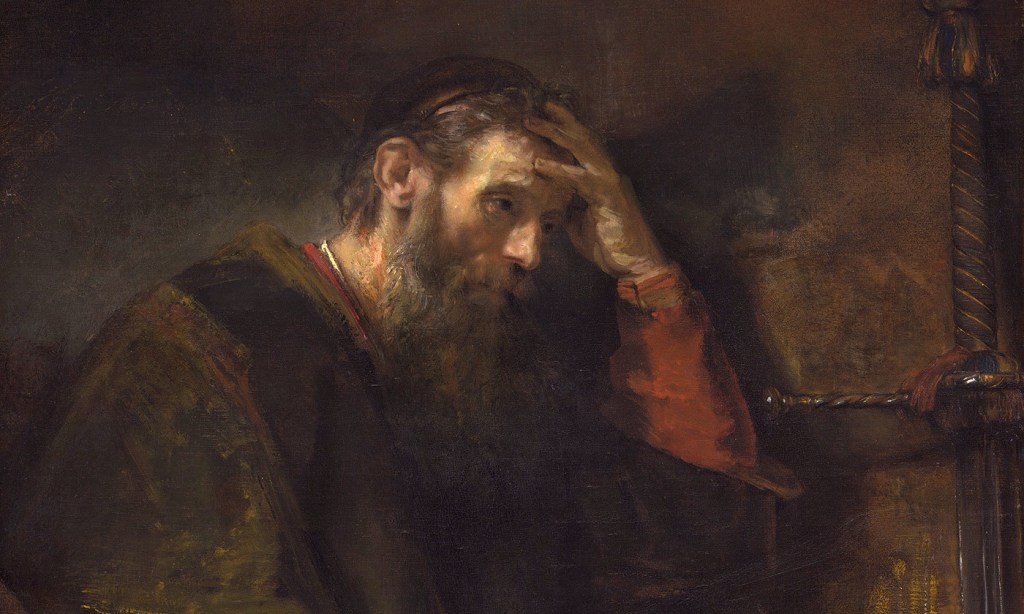
Detail from The Apostle Paul by Rembrandt van Rijn (c1675), held by the National Gallery of Art
This blog is based on a section of my commentary on Acts in the Eerdmans Commentary on the Bible, ed. Dunn and Rogerson (Eerdmans, 2003).
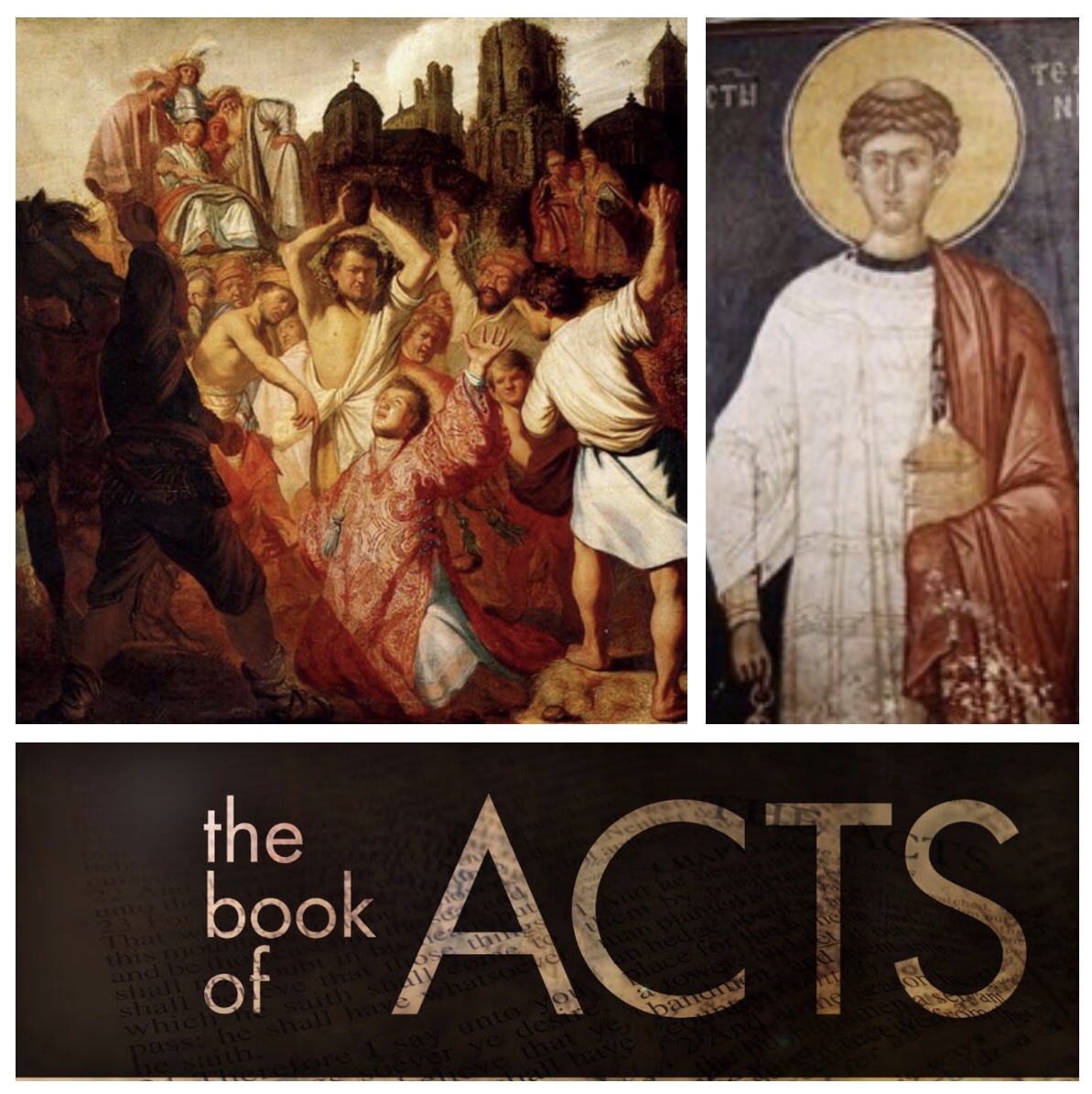
The passage from Acts that is set for this coming Sunday (the fifth Sunday in the season of Easter) tells of Stephen, who is remembered as the first Christian martyr. The word “martyr” comes from the Greek word martus, meaning “witness”. Yet it also signifies a person willing to die for their faith. This passage recounts how that death took place, and reinforces the witness offered by Stephen.
Stephen had been introduced earlier in Acts as one of the Seven who were selected by the apostles as being “full of the Spirit and of wisdom” (6:3). He was additionally noted as being a person “filled with the spirit” (6:5); that description recurs here (7:55). Stephen experiences an epiphany in which he sees “the glory of God” (7:55), which aligns him with Abraham (7:2), as well as “Jesus standing at the right hand of God” (7:55-56). Stephen is one of many witnesses to the nature of God.
Stephen is also, and more strikingly, aligned with Jesus. When Stephen describes seeing the heavens opening, he evokes the scene of Jesus’ baptism (“the heaven was opened”, Luke 3:21). Like Jesus, Stephen was given a perspective that took him, metaphorically, right into the heart of God. Unlike Jesus, however, whose deeper insight came at the start of his public activities, Stephen gains that insight after his speech, and immediately before the moment of his death.
This claim by Stephen, that he saw heaven opened, evokes not only the baptism of Jesus, but also the moment at the death of Jesus when the curtain of the Temple is ripped in two (Luke 23:45). It evokes the “open door” in heaven seen at the start of the apocalyptic visions by the ageing, exiled John (Rev 4:1), and directly repeats the phrase found much later in those visions (Rev 19:11, when the white horse appears).
Furthermore, Luke reports that Stephen dies in a way that strongly evokes his particular account of how Jesus died on the cross. Stephen’s words about the heavenly Son of Man “standing at the right hand of God” are strikingly reminiscent of the apocalyptic vision which Jesus paints at his trial (“the Son of Man … at the right hand of the power of God”; Luke 22:69). Stephen’s prayer, “receive my spirit”, recalls the last words of Jesus (“into your hands I commend my spirit”; Luke 23:46).
As Stephen cries “in a loud voice” (7:60) he reminds us of the same cry by Jesus as he dies (Luke 23:46, which itself is a quotation of Psalm 31:46). Stephen’s last cry, a petition that the Lord overlook this sin (7:60), is similarly evocative of the Lukan Jesus’ forgiveness of those who crucified him (“Father, forgive them”, Luke 23:34).
This first martyr follows the pathway already established by Jesus. He bears witness to his faith, even as he dies. And as Luke has clearly interpreted the death of Jesus as God’s predetermined action (2:23, 4:28), this similar description of Stephen’s death has at least overtones of divine authorisation. Stephen dies, as faithful witness to God, in accord with the will of God.
******
The lectionary provides us with just this short section of text, focussed on the death of Stephen. It might be worth your while, this week, to look back to what is reported in the narrative, immediately before this death. Stephen had been arrested—the manner of this arrest, by means of a plot by the authorities (6:11-12) who set up false witnesses (6:13-14) as he was questioned by the high priest (7:11), also mirrors the pattern of events recounted in relation to Jesus.
In response to the question of the high priest, Stephen delivers a long speech (7:1-53). It is by far the longest speech of all those included in the book of Acts. By means of this speech, Luke matches the divinely-given qualities of Stephen (6:3,5,8,10) with his testimony to the acts of God in the history of Israel.
Like every speech in Acts, this was written by Luke, the compiler of the orderly account of things being fulfilled. So the speech begins in typical Lukan fashion by defining the subject as God (7:2; cf. 2:17; 3:13; 5:30); the phrase used here, “the God of glory”, is drawn from scripture (Ps 29:3). The speech which follows rebuts the charges laid against Stephen; it demonstrates that, far from speaking “blasphemous words against God” (6:11), Stephen has a fulsome understanding of God’s place in Israel’s history.
At the end of his speech, Stephen takes up the charge of the false witnesses, that he spoke “against the holy place” (6:13). Luke has Stephen quote scripture (7:49-50, citing Isa 66:1-2) in order to show that his criticism of the temple (God’s “place of rest”, 7:49) arises from within Jewish tradition itself.
There are numerous scriptural allusions and quotations in this speech by Stephen. In general, this seems similar to the earlier speeches by Peter, although the precise function of these scriptural elements is somewhat distinctive in this speech. Here, scripture functions as historical narrative, whereas elsewhere in Acts it provides prophecies to be fulfilled. (The exceptions within the speech are the prophecies of 7:6,7 which are fulfilled at 7:9-16,36 respectively.)
Luke has Stephen provide a detailed rehearsal of significant parts of Israel’s history, by focussing in turn on Abraham (7:2-8), Joseph (7:9-16) and Moses (7:17-44). Then, after making brief mention of Joshua (7:45a), David (7:45b-46) and Solomon (7:47), Stephen moves to the climactic claim of the speech (7:48-53).
Lengthy recitals of key features of Israel’s history are already found in Hebrew Scripture (Deut 26; Josh 24; Neh 9; Psalms 78; 105; 106; 135; 136; Ezek 20). In the present instance, the effect of the long recital of the earlier part of Israel’s history is twofold. First, the historical recital reinforces Stephen’s Jewish credentials. When he begins to speak critically of the temple, and of the Jerusalem authorities, it is clear that he does so from within the Jewish tradition. Stephen is not an outsider, but an insider, offering a prophetic critique.
Second, the historical recital provides insight into a further layer of God’s providential activity. Earlier speeches by Peter have interpreted the events of the life, death, resurrection and ascension of Jesus as being within the divine providence (we saw this in previous weeks, in 2:14-41).
Various features of the narrative have revealed the active involvement of God in the events that take place in the Jerusalem community. Now, the undergirding plan of God is revealed within the long history of Israel. The line of continuity is strengthened between each layer; God is at work in the Jerusalem community, as in the life of Jesus, as in the history of Israel. Such is the testimony that Stephen offers.
There is one final feature of the section of Acts set for this Sunday. As the crowd prepares to stone Stephen, dragged him out of the city and laying down their coats, we are told that the coast fall “at the feet of a young man named Saul” (7:58). And this young man, Saul, we then learn, “approved of their killing him” (8:1a). Who is this man? He comes back into the story as persecutor (8:3; 9:4), then convert (9:17-19a), then preacher (9:19b-22), travelling evangelist (13:1-3); he was subsequently known as Paul (13:9), and acknowledged as an apostle (14:4, 14).
*****
This blog is based on a section of my commentary on Acts in the Eerdmans Commentary on the Bible, ed. Dunn and Rogerson (Eerdmans, 2003).
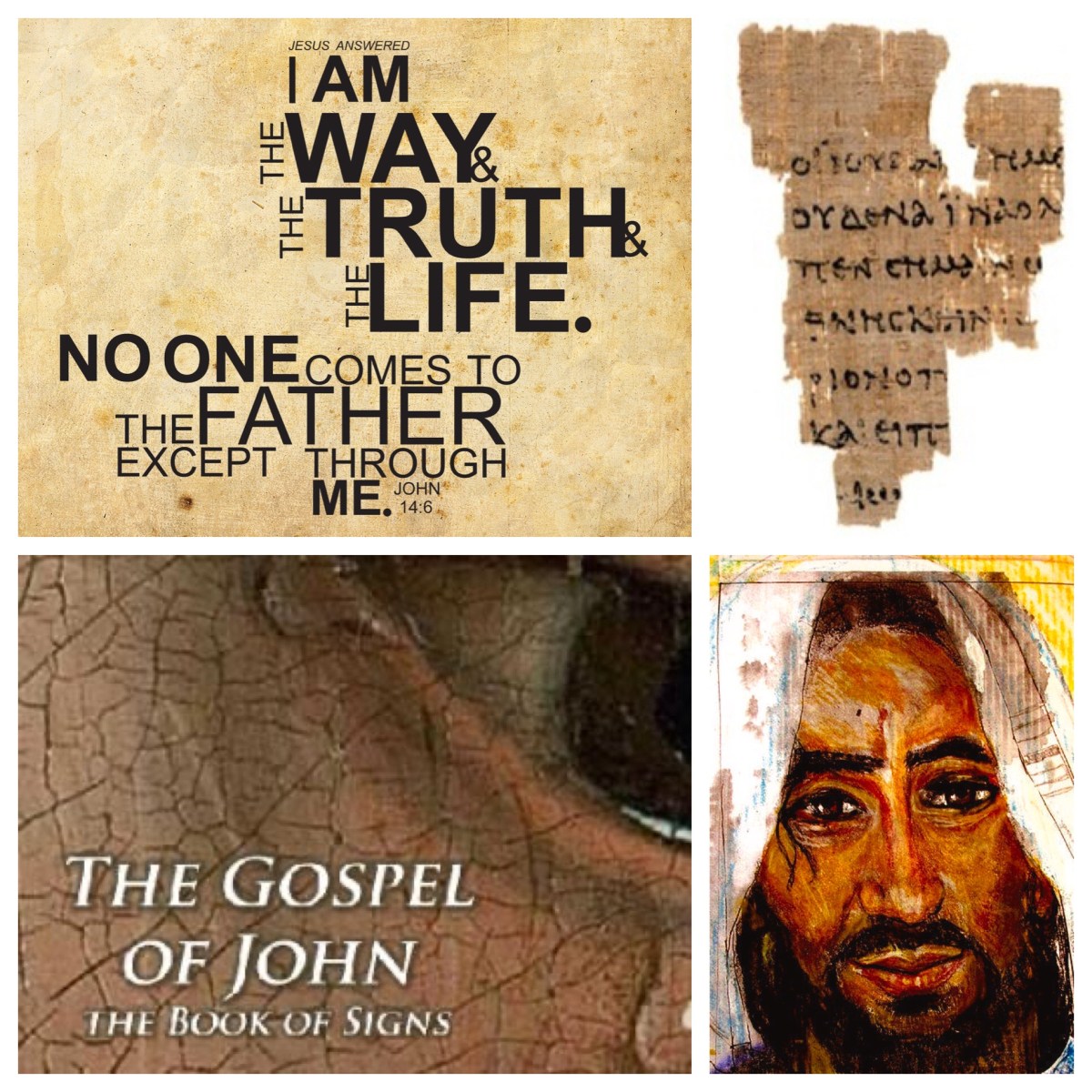
The reading this Sunday contains some very familiar, oft-quoted words attributed to Jesus: “I am the way, the truth, and the life” (John 14:6a). And especially oft-quoted is the next sentence that follows, “No one comes to the Father except through me” (John 14:6b).
That second sentence is frequently used to interpret the first sentence, to give it a sense of elitist exclusivism—there is but ONE WAY, there is certainly NO OTHER WAY, of approaching God, of being drawn near to the divine presence. Especially amongst more conservative theological elements in the church, this sense of “only one way”, “no other way” is regularly advocated.
But is this the only way to understand “I am the way”? Let me put the verse into context, consider a number if factors, and suggest why we may need to seek other ways of understanding this declaration about “the way”.
*****
The first observation to make is that this statement draws on traditional Jewish terminology used by the people in the movement which Jesus initiated. “The Way” is a term which occurs in various chapters in the second volume of the orderly account, the book of Acts (9:2; 18:25; 19:9,23; 22:4; 24:14,22). This, according to these references, was the earliest term used to describe these people. (The term which eventually came to dominate, “Christians”, is first referenced at Acts 11:26, and is less-used in Acts.)
Calling the early followers of Jesus “The Way” may owe its origins to scriptural usage in association with God’s activity. The term is used in this way in Psalms 5:8; 18:30; 25:9; 27:11; 37:34; 50:23; 67:2, and so on. We might also note the occurrence of the term in Isa 40:3-5, and observe that it is cited in a prominent position at Luke 3:4-6. The return from exile in Babylon is marked as a preparing of the way by the Lord, leading the exiled people back to their homeland.
The term is also appropriated in the Dead Sea Scrolls as a means of defining the Qumran community (1QS 9.17-18,21; 10:21; CD 1:13; 2:6). This may reflect competing claims for being the authentic keepers of Torah amongst Jewish sects. The Qumran group, of course, was strongly exclusivist (it kept strong boundaries around the membership of the community) and could also be seen as being somewhat elitist in its theological outlook (some documents reflect the worldview that can be crudely summarised as “we have the truth, everyone else is wrong”).
In subsequent usage (beyond the first century) this term, The Way, has come to be completely overshadowed by a term used less often by Luke, that of “Christian” or “messianist” (11:26; 26:28). The latter term initially referred to the fact that the followers of Jesus, from early on, claimed that he was the anointed one, the Messiah (in Greek, the Christ).
So by using the term “the Way”, Luke emphasises the thoroughly Jewish nature of those communities which declared Jesus to be Messiah.
*****
The second observation for understanding the verse in context is that it is one of a number of “I Am” statements that are placed on the lips of Jesus in the book of signs, which we know as the Gospel according to John. These sayings comprise a verb (“I am”) followed by a predicate (the entity which Jesus claims to be). The predicates in most of these sayings are drawn from traditional Jewish elements.
Jesus presents himself as “the vine” (John 15:1–11), drawing on a standard scriptural symbol for Israel (Ps 80:8; Hos 10:1; Isa 5:7; Jer 6:9; Ezek 15:1–6; 17:5–10; 19:10–14).
Jesus calls himself “the good shepherd” (10:1–18), evoking the imagery of the good shepherd as the true and faithful leader in Israel (Num 21:16–17; Ezek 34:1–31; Jer 23:4), and the people as the sheep who are cared for (Pss 95, 100; Ezek 34:31).
When Jesus calls himself “the bread of heaven” (6:25–59), he is clearly evoking the scriptural account of the manna in the wilderness (Ex 16:1–36; Num 11:1–35; Pss 78:23–25; 105:40). The discourse which develops from this saying includes explicit quotations of scripture, as well as midrashic discussions of its meaning.
Jesus, “the light of the world” (8:12; 9:1–5), evokes the story of the creation of light (Gen 1:3–5) and the light which the divine presence shone over Israel (Exod 13:21–22). The Psalmist uses the imagery of light to indicate obedience to God’s ways (Pss 27:1; 43:3; 56:13; 119:105, 130; etc.), and it is a common prophetic motif as well (Isa 2:5; 42:6; 49:6; Dan 2:20–22; Hos 6:5; Mic 7:8; Zech 14:7; cf. the reversal of the imagery at Jer 13:16; Amos 5:18–20).
Although it is not part of an “I am” statement, the references to the “living waters” which flow from Jesus (4:7–15; 7:37–39) are reminiscent of the water which were expected to flow from the eschatological temple (Ezek 47:1; Joel 3:18; Zech 14:8), and, more directly, refer to the description of God used by the prophet Jeremiah (Jer 2:13).
In addition, biblical scholars have noted that rabbinic symbolism has affinities with Johannine symbols; for example, the terms bread, light, water and wine are all used by the rabbis in connection with the Torah.
Thus, the distinctive set of Christological claims made for Jesus in the Gospel according to John are both thoroughly grounded in scriptural images and familiar from the ongoing traditions taught by the rabbis.
******
A third observation is that the book of signs was written in a context of polarised disputation and growing hostilities. There was deepening conflict between the followers of Jesus, who acclaimed him as Messiah, and the scribes and Pharisees, teaching the traditions of the ancestors in the synagogues of the post-70 period.
After the destruction of the Temple in the Roman—Jewish War of 66-74CE, as there was no need for priests, the Pharisees became the dominant force in Judaism. Synagogues became key places for instruction in the Law, communal worship, and also community hospitality. Those claiming that the Messiah had come (as the followers of Jesus did) were problematic to the Pharisees. Tensions grew. Hostility broke out in some places.
There are three references to being expelled from the synagogue in the book of origins (John 9:22; 12:52; 16:2). These are widely understood to refer, not to the time of Jesus, but to the time when the Gospel came to take its final form—probably around the end of the first century—when the conflict between the synagogue authorities and the followers of Jesus had come to a head.
Biblical scholars have drawn on the insights of sociology in this regard. A group which acted in the way that the followers of Jesus were acting, is described as a sectarian community. Differentiating itself from the parent body by means of distinctive belief claims is typical of sectarian groups.
As it had come into existence because of the claims that it had made about Jesus, so the reinforcement of the life of the new community took place, to a large degree, through the strengthening and refining of its initial claim concerning Jesus.
Claims made about Jesus, the Messiah (Christ) thus function as markers of the emerging self–identity of the new community. This emerges over against the inadequate understandings of Jesus which continue to be held in the old community (the synagogue), still under the sway of the Pharisees. The messianists are confident about their faith. And they are certain about the absolute importance of following Jesus and believing in him. He is The Way.
Each of the “I am” sayings noted above is reported in this Gospel in this context of dispute and controversy. The sayings function as markers to differentiate Jesus from his Jewish contemporaries—and, by association, the followers of Jesus from their Jewish contemporaries.
Thus, when the Johannine Jesus expresses the claim, “I am the way, the truth, and the life”, there is an obvious and (to first-century ears) very clear claim being made about how the community of Jesus’ followers saw themselves, in relation to other groups in Judaism of the day. Like others, they were making claims about their exclusivity as the faithful one, their elitist understanding of what fidelity to the Law meant—and about the singular and central place of Jesus in their faith.
This Gospel consistently sets out a clear claim for Jesus as a distinctive figure, set apart and set higher than other religious leaders. Those who follow him have “the truth”, and are very clear what exactly is “the way” to God. Following Jesus was seen as the way—the only way—to gain “life”, or access directly to God. This is a polemic claim in the context it was first made.
The community in which the Gospel of John was compiled and valued was functioning in precisely the way that sectarian communities operate, holding fast to their exclusivism and elitism.
******
How do we read such a text in our contemporary situation? We live in a world where retreating into a corner, keeping separate from other people, and treating anyone different from us with suspicion (if not outright hostility) is practised by some, but it really is an untenable and unhelpful way of living.
In the Uniting Church, our Basis of Union advocates that as we live our faith, we seek to be critically informed (as we enter into the inheritance of literary, historical and scientific enquiry), ecumenically engaged (as we relate to our partners within the world-wide fellowship of churches), contextually relevant (through contact with contemporary thought), and missionally oriented (as we engage with contemporary societies) (see paragraph 11).
Engaging with contemporary societies and participating in them such that we better come to understand our own nature and mission, is a key commitment of this church. Multicultural societies, such as Australia, offer many opportunities for such engagement and learning. Seeking to understand the cultural practices and commitments of friends and neighbours in our midst, means that we will better understand who we are as Church: what it means to be in relationship with one another, to serve one another, to proclaim the living Word afresh.
I wrote a blog about this last year (after the tragic events in the Mosque in Christchurch), which you can read at
The Uniting Church Assembly has advocated, “Friendship in the presence of difference is regarded as being a central Christian attitude and value. Engagement with those of other faiths is welcomed as a pathway on which we may rediscover the heart of the Christian way while also being enriched by wisdom others have to share.” (Adopted at the Thirteenth Assembly (2012), from a statement prepared by the Working Group onRelations with Other Faiths, entitled Friendship in the Presence of Difference: Christian Witness in Multifaith Australia.)
******
So: with this theological commitment to living with those different from us with an attitude of acceptance and friendship, a generous attitude of embracing diversity, an intention to hold to an informed faith, on the one hand; and a biblical text (John 14:6) that recounts how a deepened understanding of Jesus emerged through the process of antagonism, aggressive argumentation, and hostile actions—what do we need to do to hold these two together?
Should a text which originated in conflict, with the intention of carving out a space for a smaller group with a distinctive set of beliefs, still be interpreted in the same way as those first readers and hearers of the Gospel understood it?
Or do we allow the changed context in which we live, and the different perceptions that have developed in our time, to reshape our understanding, to recast our interpretation, to challenge long-held views and to invite fresh appreciations?
Is it the case that we MUST read this biblical text as requiring us to have an attitude of elitist exclusivism—there is but ONE WAY, there is certainly NO OTHER WAY, of approaching God, of being drawn near to the divine presence?
Or—is there another way to understand “I am the way”?
This blog draws on material in JOURNEYING WITH JOHN: an exploration of the Johannine writings, by Elizabeth Raine and John Squires (self-published 2014)
Change is happening around us. We are noticing changes taking place in society. The COVID-19 virus has forced a range of changes on us. Decades ago, Bob Dylan penned a folk song, “The times, they are a-changin’”, which has come to be seen as an anthem celebrating the changes that are always taking place in our society.
But in the present time, as we live under significant restrictions on gathering in person, as we keep our distance and stay at home for all manner of things, we sense that our times, are, indeed, a-changin’. So let’s ponder those changes.
Some of these are not good changes. Some may well be beneficial changes. We have had to let go of some valued ways of operating. We have also had to learn new skills and adopt new practices. This is what happens during a time of transition: many things can change. How we deal with these changes is important. What we choose to accept, and what we chose to reject, is up to us.
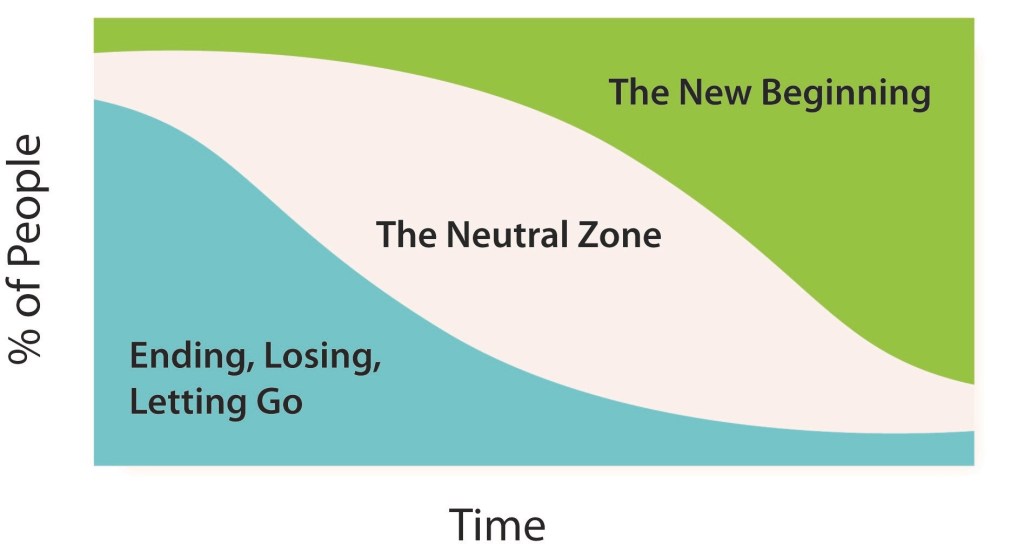
William Bridges has written an insightful book about such processes, entitled Managing Transitions (2009). Bridges talks about transitions in terms of three stages (as the graphic indicates): first, there is the letting go; then there is the neutral zone of being in-between; and finally, the connection into a new place, a new way of being.
In that neutral, in-between zone, there is a need for us to develop a capacity to live within the discomfort of ambiguity which arises during the experience of loss, as we move away from the familiar. That is the space we are in now, in the midst of restrictions on gathering, as we work to slow the spread of the COVID-19 virus. We are experiencing, in various ways, the discomfort of ambiguity, as things shift under our feet.
In that liminal space, that unfamiliar territory, we have the time and space to reconsider, to review, to reshape, to remake ourselves. What changes will we accept? What changes will we reshape? What changes will we reject?
****
Some changes taking place in society feel difficult. Unemployment rates are rising, and many people who move out of employment will find it hard, if not impossible, to gain work after the restrictions end. Funerals are taking place with friends and most family unable to attend; weddings are occurring with even less people physically present. People who live alone are experiencing more intense feelings of loneliness and are craving real human interaction.
People who are vulnerably housed will have far fewer options for shelter at night during winter, as Safe Shelter programs will not be running because of the risks of passing on the virus. The rates of domestic violence are rising, as pressures in the home situation grow, for some, to boiling point. More people are drawing on the social services network provided by our government, but they will hit the ground with a thump after the restrictions end, when benefits will return to their “normal” level (well below the poverty line).
Some small businesses are looking at a glum future, considering the prospect of having to close for good. Tourism companies and travel agencies are particularly impacted, and their reduced business means loss of employment for significant numbers of people. Apparently more than 16,000 new coronavirus-related online domains have been registered since January 2020—many of which are believed to be set up to enable malware and hacking tools to be sold through COVID-19 “discount codes”.
But some changes are good. More than $1 billion has been saved in poker machine losses in the first five weeks of COVID-19 restrictions in Australia, according to the Alliance for Gambling Reform. There have been 25% less call outs of paramedics in the Ambulance Service in the ACT, because “people are not out and about so much, they are taking things very easy.” In the NT, the same decrease has been observed, because “there’s less traffic on the roads, so less motor vehicle accidents.”
Seeds have sold out, as people plant their own vegetables in anticipation of food shortages. Laying pullets are scarce and those for sale are selling at two or three times the normal price, as people look to guarantee their supply of eggs. Backyard gardening is making a comeback!
“We’ve been riding bikes for years, now, and we have never experienced so many people out and about walking and riding bikes on the bike trails!”, a number of our friends have commented. Meanwhile, in my region, there are no electric bikes available for sale at the moment—all stock has been sold out!
Local communities have rallied together in so many places. People are much more attuned to those folks who are shut-ins or who are self isolating because of their medical conditions or age. Phone calls and food drops at the front door have been made on a regular basis, and online coffee and chat groups are springing up to maintain connections amongst friends who cannot see each other in person.
Pollution rates have fallen across the globe at the moment; satellite observations showed that levels of nitrogen dioxide (NO₂) decreased quite significantly over China in the first month that COVID-19 infections were occurring there, February 2020. The same pattern is now taking place in other countries where restrictions on travel, because of the corona virus, means less traffic, less pollution, less NO₂.
(The NO₂ in our air is almost entirely from combustion. When coal and wood burn, nitrogen trapped in the fuel is oxidised as NO₂. Cars and trucks make NO₂ in their engines when they break down nitrogen in the air at extremely high temperatures. It makes a significant contribution to air pollution, which causes acute respiratory issues like asthma, as well as long-term diseases such as stroke, heart disease, and cancer. The World Health Organisation estimates that in recent years, seven million deaths a year have been attributable to air pollution.)
Drug arrests in Chicago have been measured at 42% lower during March, as drug dealers have no choice but to wait out the economic slump. El Salvador reported an average of two killings a day during March, down from a peak of 600 a day a few years ago. Even criminals are practising social distancing, social isolation!
And our Chief Medical Officer is now saying that we need to ensure that some changes in the way we relate to one another remain permanent, and we don’t go back to old ways—he advocates that we keep our distance from each other, continue our good hand hygiene habits, and don’t shake hands with other people. (This will lower the spread of all forms of viral infections, not just COVID-19.)
Changes are happening in society. Which of these beneficial changes will hold fast into the future? Which ones do we really want to hold on to? Which ones do we want to keep, just a little modified, in the future?
*****
We are also noticing changes that are happening in churches. For instance, I have been keeping a collection of comments from people in my home congregation about the positive nature of the changes they are experiencing, such as: “We can see the faces of people at worship with us, instead of the backs of their heads.” “Morning tea was more lively, I got to talk with different people, people that I normally don’t talk with.” “It was easy to go to church, I can sit in my comfortable chair and don’t have to get going early.”
And some more: “We have seen people come to online church who haven’t been able to come to church in person for months.” “We need to keep on offering services by ZOOM for those who can’t get to church in person.” “Finding happiness in the present moment and situation is such a great way to live. Not always easy to pull off, but a great goal.”
A recent conversation I heard between two people was very succinct: “I’m still learning.” “Aren’t we all!” And I have just seen online an elderly man who has never seen the need for a mobile phone, let alone a computer, who got his technologically-literate son to buy him a second-hand laptop, so he could join the Sunday morning worship. He set ZOOM himself and has been participating every week since!
Another ZOOM meeting I attended recently included people from across a number of Congregations who have been in office, in some cases, for quite some time. Someone from one of the places further away from Canberra (where Presbytery staff and most office bearers are based) said, “It’s nice to put a face to a name after all this time”. Another tick for people from dispersed locations meeting together online!
In another Synod-wide online meeting, a comment was made that “the current crisis has brought to a head some long-running issues; we now need to deal with them and get involved in a constructive way”. The situation has stimulated proactive engagement in situations where the tendency had been to hold back and “let’s hope things sorts out by themselves” (which, of course, they rarely, if ever, do!)
I have heard one person comment that they have turned to the Psalms for spiritual nurture, and they observed that, wherever the psalmist reflects desolation, that is almost always followed by a sense of consolation. Perhaps that idea can undergird our prayers and reflections on the current situation.
Another colleague has observed that new, and positive, connections are being made between previously disconnected and distanced communities and individuals, which has been good for the health of the whole body. The challenge of disruption has generated a new pattern of collaboration and hopefulness.
One regional body is taking advantage of this interruption to “business as usual” by focussing on mission planning for the future, asking, “what are we learning in this current disrupted period, that we can apply to being the church in a renewed missional way?”
And many times, now, I have heard a story that runs along the same lines: since we have been in this period of restrictions on gathering, we have been making intentional connections with people who had drifted away from our Sunday gatherings. Now we have refreshed our connections and we are feeling that many of them seem to be “part of us” once again.
Some of the changes are, to be sure, experienced as less than desireable. “How many people are clicking on to online worship more as voyeurs than as fully engaged disciples?”, asked one colleague. Another mused, “my minister seems to be spending all their time playing with technology rather than making contact with people”. These are practices that we need to find a way to balance better.
I’ve heard one person articulate the need to move away from “leading worship well” towards a way to “equip people to grow in their own discipleship”. Some colleagues are devoting significant time, not just to preparing the Sunday worship, but to collating, writing and distributing resources that are available for personal use in the home—reflective worship times, meditations on scripture, studies to deepen discipleship, questions to challenge people to seek new ways of serving in the post-COVID period.
Another church leader has identified the challenges that are immediately before us as we consider how we might serve people with particular issues: people living with disabilities, people dealing with longterm mental illness, people who are vulnerable housed and dependent on church and community provision of safe shelter (especially in winter time). For such people who depend so much on in-person connection, the online manner of connecting leaves much to be desired. (And, for some, they lack any capacity to have the capability of regular, trustworthy online connection.)
By the same token, those whose particular challenge has been that they live at a significant distance from their place of worship, and need to undertake lengthy drives each time they attend worship, fellowship, or church council meetings, have found that being able to attend online, from the comfort of their own home, has many benefits.
So I think that, overall, my take on all of this can be articulated in some short and simple comments: Community is more important than worship. Service is at the centre of the Gospel. Discipleship engages us with the whole of society, not simply the inner club. Consistent relationships with other human beings are crucial. Creativity can flourish when we are thrust into unfamiliar situations. Disruption can deepen our faith, extend our understandings, refresh our mission.
******
Dr Kimberley Norris, an authority on confinement and reintegration at University of Tasmania, has undertaken a detailed study of the mental health of Australians who have overwintered in Antarctica. She found that those who have been through a period of isolation value the experience for what it has taught: They have a better idea of their personal values, and they’re more committed to acting on them. (See https://www.abc.net.au/triplej/programs/hack/coronavirus-covid19-isolation-third-quarter-phenomenon-has-begun/12190270)
The study indicates that the positives from this liminal period can be valued and retained, even as we shed the negatives and less desireable aspects from our time of social,distancing and self isolation.
Dr Norris believes that post-COVID, “we will see differences in the way people engage with each other, in the way people work, in the priorities given to the environment, and the way people think about travel.” And another interesting comment she has: “A lot of people expect spirituality to increase.”
That study clearly indicates that we stand in a critical period of time, during which we have the opportunity to explore our priorities—personal, as disciples, and communal, as a church—and to make commitments to refreshed and innovative ways of operating in the future. It’s an opportunity, not a threat. We ought to rejoice in, and focus on our strengths, not bemoan our situation and become fixated on the weaknesses it has exposed.
So what changes do we want to keep? What things can we change to ensure that the good things that have been happening continue? What new things do we plan to introduce as a result of the changes we have experienced in this period of time? What strategies are we developing to be well placed for the post-COVID situation?
Crowds attending ANZAC Day events, it has reported for many years now, are growing. The further away we are from the events of Gallipoli, Lone Pine, the Kokoda Trail, and Long Tan, the more people are flocking to crowded public events: at dawn services, at Cenotaph gatherings, at local town war memorials, and in major city marches.
But not this year. No social gatherings, no travel except for essential purposes, meant no ANZAC gatherings: no large Cenotaph dawn services, no massed marches, not even any local services at the town war memorial. Instead, a grassroots movement saw thousands of people standing outside their house, at the front of their driveways, as the sun rose.
TV news reports this year showed streets with one, two or a handful of people outside each house, a string of candlelights stretching along the street, as the sun rose. Gathering apart, no close contact, no large crowds. In some enterprising streets, musicians played The Last Post on bugle, trumpet, clarinet, or saxophone.
And those official events that did take place, with just a handful of invited “dignitaries” in attendance, were seriously pared-down events: no massed singing; no droning long addresses on the valour and bravery of those who died in war; no string of people, one after another, laying wreaths in remembrance. Instead, a short statement, the traditional Last Post and Reveille, the Ode of Remembrance, just a few words to mark the occasion; perhaps the national anthems of Australia and then New Zealand.
Then, it was over. Short, succinct, sombre.
****
Central to the Christian story of Jesus is the death and burial of Jesus, followed by his being raised from the dead on the third day. Central to the Christian Church is the annual remembrance of those crucial events, over the four days of the Easter weekend.
Quietly reflective recollections of the last meal of Jesus on Thursday evening, subdued recollections of the story of his crucifixion and death on the Friday, a time of silent vigil on Friday afternoon and, for some, throughout Saturday; then, the early Sunday morning fire (in some denominations) and the grand Sunday morning celebrations, recalling our baptism, hearing the Gospel read and proclaimed, gathering at the table of the Lord. This is what Easter is. This is what the church does so well.
Indeed, every Sunday morning throughout the year, in purpose-built structures and and in rented halls, in majestic cathedrals with stained-glass windows and in modest wooden country church buildings out in the paddock, people of faith gather to be reminded of the good news, to be strengthen in their faith, to be challenged in their discipleship. The Gospel is read and interpreted, hymns of praise and reflective tunes are sung, prayers are offered, then tea and coffee are drunk as people share news and gossip.
But not this year.The doors of every church, every cathedral (and every synagogue, every mosque, every temple, every meeting house) were shut for Easter, and will remain closed, locked, not to be opened until the wave of viral infections has well and truly passed. Inside, the vacant spaces, the silenced pulpits, the empty tables, all point to the way that we are now “being church” in different ways—in ways that, not so long ago, we never imagined or expected to see.
So the worship services have been transferred to online platforms: ZOOM, YouTube, Facebook Streaming; or resources are collated and emailed to people; or printed and posted, or even hand delivered to letter boxes or front doors. We have demonstrated both great ingenuity and also focussed energy, devoted to ensuring that we maintain contact with everyone connected to our church communities.
And more than worship—now, morning teas that once took place around tables in church halls, now take place online, in chaotic but warm and friendly conversations on ZOOM. Church Council meetings that once required everyone attending in person, now also meet online by ZOOM. We have held on to our connections, and are ensuring that nobody is left out.
*******
Churches, of course, are more than just worship. Lots of community-oriented activities are integral to the life of the church. Op Shops with low cost clothing and kitchen items, weekly Free Meal programmes, Emergency Relief and Food Pantry programs for vulnerable people in society, book libraries at the front door of the church building with free books available for borrowing and swapping, are some examples.
Fellowship Groups for lonely people to meet and talk together on a regular basis, the availability of overnight accommodation as Safe Shelter in church halls for people who are vulnerably housed, and Community Gardens operating from the grounds of churches. All of these activities are fundamental ways that faithful followers of Jesus live out their discipleship. Caring for others, especially the lonely and the vulnerable, is at the heart of how people of faith live out the command to “love your neighbour”.
Such activities happen day in and day out, throughout the year, each year. But, for the most part, not this year. Some of these activities have had to be suspended for the duration of the period that restrictions are in place. Some of them have been able to continue, albeit with significant changes to the regular way in which they were operating.
Food pantries have adopted strict social distancing and thorough disinfecting protocols. Some meals programs continue by providing pre-cooked, individually packaged take away meals for regular clients. Many Op Shops, unable to provide space to enable appropriate social distancing, have closed for the duration.
*******
What will ANZAC Day look like in 2021? Assuming that restrictions are eased and “life returns to normal” by April next year, we might well expect to see the return of the massed gatherings, the carefully-choreographed dawn services and the modest meetings at thousands of small town and suburban war memorials, the long, extended city marches, followed by the inevitable breakfasts, two up games and afternoon drinking sessions. ANZAC Day will likely “return to normal”.
What will Easter look like in 2021? Again, if we assume that restrictions are lifted, most churches will undoubtedly offer their usual array of worship services across the weekend; people will gather to reflect, to grieve, to give thanks, to celebrate. And Easter egg hunts will presumably be able to be held once again!
What will church look like in 2021? Will it simply “return to normal”? Or will we take this opportunity to change things, to do church differently, to step out into a new way of gathering and serving?
Will worship go back to “Sunday morning at 9:30am, everyone in the same building”? Or will a variety of ways of gathering be offered, including options that continue online participation from those least able to be present in person?
Will food programs revert to the “business as usual” pattern of past years, or will there be important learnings about hygiene, work patterns, seating, or other matters, that will inform new practices?
Will church-based Community Gardens open up to all members of the community with “free seed collection” days, so the people can benefit from the produce in their own gardens?
What will church look like, near year? and the year after? What are your thoughts?
In this season of Easter, we are following passages from the second volume of the book of Acts, the second volume in the orderly account which, by tradition, is attributed to Luke. We have followed, in previous weeks, Peter’s speech to the crowd which had gathered in Jerusalem on the Festival of Pentecost (Acts 2:1).
In the passage set for this Sunday (the fourth Sunday in the season of Easter), we see how Peter’s speech and the response which follows from it leads to the expansion of the community within Jerusalem. I have already reflected on the four marks of the church that we might discern from Acts 2:42. This blog continue on, to explore other characteristics of the gathering that are noted in this short but rich section of text.
There is a public dimension to what the believers are doing. Members of the community are to be found both in the temple and in their homes (2:46). Even though Luke writes after the destruction of the temple (Luke 19:41-44; 21:20-24), he knows well the prominent role of the temple in Jerusalem and accurately locates the messianic community as continuing faithful to the temple cult.
Thus, their public presence in the temple (2:46) continues unabated throughout the first section (3:1,11; 5:12,20,21,42). Such a practice is continued by Paul, both in the Jerusalem temple (21:26-30, a single event which is recounted at 22:17; 24:6,18; and 26:21) as well as in other public places (for instance, in Philippi, 16:13; the Athenian agora, 17:17; and the Areopagus, 17:19). Paul tells elders from Epehsus that he was regularly “proclaiming the message to you and teaching you publicly and from house to house” (20:20).
Roman historians who wrote in the decades after Luke’s writing described members of this community as “a class of men given to a new and mischievous superstition” (Suetonius, Life of Nero 16) and as adherents of a “detestable superstition” who were “hated for their shameful deeds” (Tacitus, Annals 15.44). Still later, Christian apologists defended Christians against criticisms that they were secretive, and therefore not to be trusted (Minucius Felix, Octavius 8.1-4; Origen, Against Celsus 1.1,23; 3.50,55; 4.23; 8.2,17,49).
It may be that Luke’s insistence on the public witness of the community meets this type of objection if it was already being raised late in the first century CE. The practice of private meetings in their homes is likewise continued throughout Judaea and Samaria (8:3) and, as would be expected of a religious association, in dispersion communities in Caesarea (10:30; 11:12-14; 21:8) and Philippi (16:34). Paul continues this twofold pattern, for his activities typically take place “in public and from house to house” (20:20).
The community is further described as “having grace towards the whole of the people” (NRSV “having the goodwill of all the people”, 2:47). This introduces another term which will have significance in the narrative of Acts: charis. The NRSV translates this as “goodwill”; but the usual rendering of this Greek word is “grace”. What does it mean, if we translate it in this way, in this passage?
Grace is referenced in the third summary description of the community (4:33), where it is related to the testimony of the apostles. In 2:47 it is linked with the inner life of the community as they “ate their food with glad and generous hearts, praising God and having grace towards the whole of the people”.
Grace is a characteristic which also marks Stephen, enabling him to perform “great wonders and signs” (6:8); in his speech, he notes that God ascribed grace to Moses (7:10) and to David (7:46). It is this grace of God which is evident in the growing community in Antioch (11:23) and continues to be a characteristic of the community in Iconium, where once again it is evident through the signs and wonders granted by God (14:3).
Such grace is regarded as the means of salvation (15:11) which enables people to believe that Jesus is Messiah (18:27-28). This same grace of God is attested by Paul throughout his ministry (20:24,32). It thus forms another of the characteristics of messianic communities in Jerusalem and beyond. And by extension, it ought also to characterise the church of the 21st century–at least, if we want to remain faithful to the intentions of Jesus, who established the movement which was initially known as The Way, and the communities of faith in ensuing decades, which reinforced and enriched the movement as it grew into an institution, which we now call The Church.
Thus, we see that in providing this careful description of the community of messianic Jews in Jerusalem from the day of Pentecost onwards, Luke has shaped it to introduce a number of key characteristics of the messianic communities that he will describe in later chapters. Along with the miraculous events of Pentecost and the speech of Peter, this summary description performs a programmatic role in the narrative. It offers us a picture which could serve as a model for how we live as church today.