Will hardline conservative evangelicals learn anything from the revelations about the abuses committed by John Smyth “in the name of the Gospel”?

Respectable gentlemen, pillars of society, and good citizens all. Advocating obedience and emphasising responsibility. Preaching “good news” which requires trust, faith, and “a serving heart”. Teaching “godliness” which entails decency, seemliness, and propriety. The outward appearance looks good, honourable, and worthy.

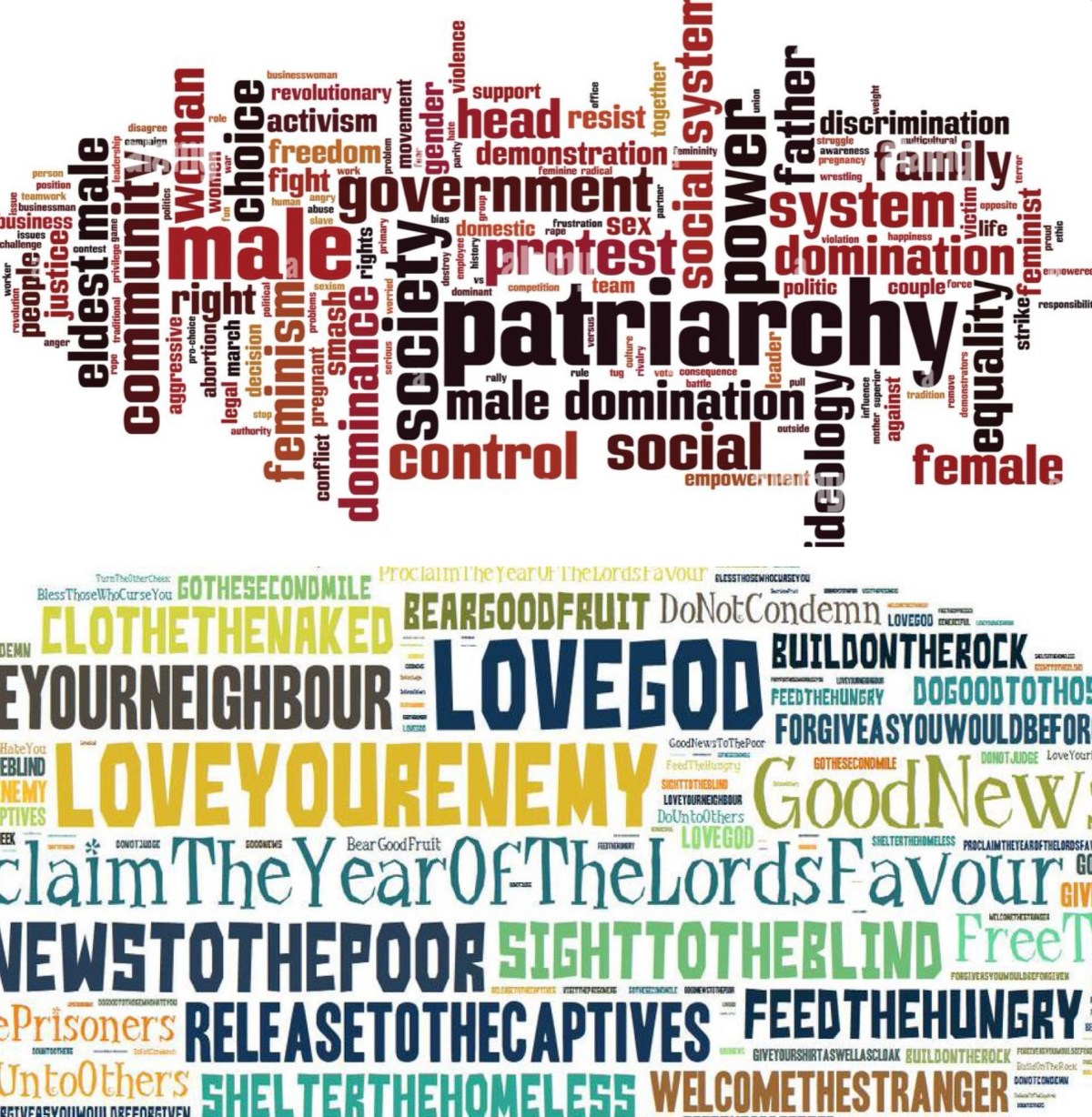
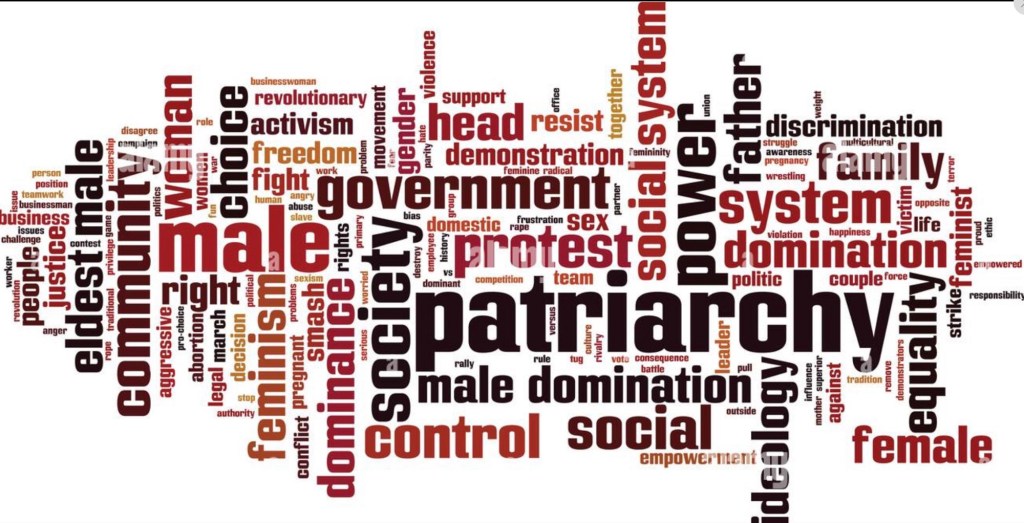
What this wraps around, however, is a world of rigorous discipline and strong patriarchy, a relentless drive to ensure submission to “the head”  (i.e. the man) and obedience to parents, a persistent marginalising and oppressing of women, a strident denunciation of all who stray from the “narrow way” of “Bible-believing Christianity”, and an incessant repetition of the fundamental message that “all have sinned” and all such sinners can only be “saved by the blood of the lamb”. Obedience and disciplined acceptance of what authority decrees are essential.
This is the world of hard-line conservative evangelicalism, which has long been part of the Establishment in Britain and, with a strong Puritan twist, has captured so many Protestant churches in the USA. It is present in Australia, most strikingly in the Sydney Anglican diocese, but there are tentacles into many other Anglican dioceses around the country—and, indeed, into a number of other denominations as well. (There has been a small and declining element of this in my own denomination; the most vigorous proponents of this distorted theology wisely decided to leave a couple of years ago.)

We have seen the very worst manifestation of British conservative evangelical Christianity in recent times, with revelations relating to the masochistic treatment meted out to school-age boys over many years by the head of a reputable evangelical organisation, the Iwerne Trust. The Trust held annual camps to instruct schoolage boys in so-called “muscular Christianity”. These camps were run on military lines; the leader of the camp was the “commandant”, his deputy was the “adjutant”, and all of the leaders were known as “officers”. (It sounds just like the regimented school cadets system that I remember from my schooldays, decades ago.)

It was in this kind of environment that a barrister named John Smyth found an opportunity to implement his harsh disciplininary measures. Smyth was camp leader on the Iwerne camps 1964–84, chair of the Iwerne Trust 1974–81, and a Scripture Union trustee 1971–79. (The Iwerne Trust operated under the umbrella of Scripture Union, but appears to have been only loosely associated with SU leadership.)

The details of what he did have been documented in church reports—the first, written around 40 years ago, but I comprehensively shelved by those in the know—as well as in media interviews with survivors and even his own son, who endured emotional abuse and vicious physical violence at the hands of his father (aided and abetted by his compliant mother). What is revealed is truly, deeply disturbing. 

Smyth died some years ago. He had been forced to relocate countries twice in his life, fleeing the revelations of his horrid modus operandi. But each time he moved on without any brief of the suspicions relating to him being forwarded to the next “Christian” organisation that he worked with. He avoided justice throughout his lifetime.

The latest public push regarding this man and the way his actions were covered up by complicit colleagues has led to the very public resignation of the Archbishop of Canterbury, who knew Smyth decades ago, apparently knew the suspicions swirling around him then, clearly learnt the full truth over a decade ago, but never did anything to bring this person to account. Welby has become the scapegoat for widespread institutional failure.
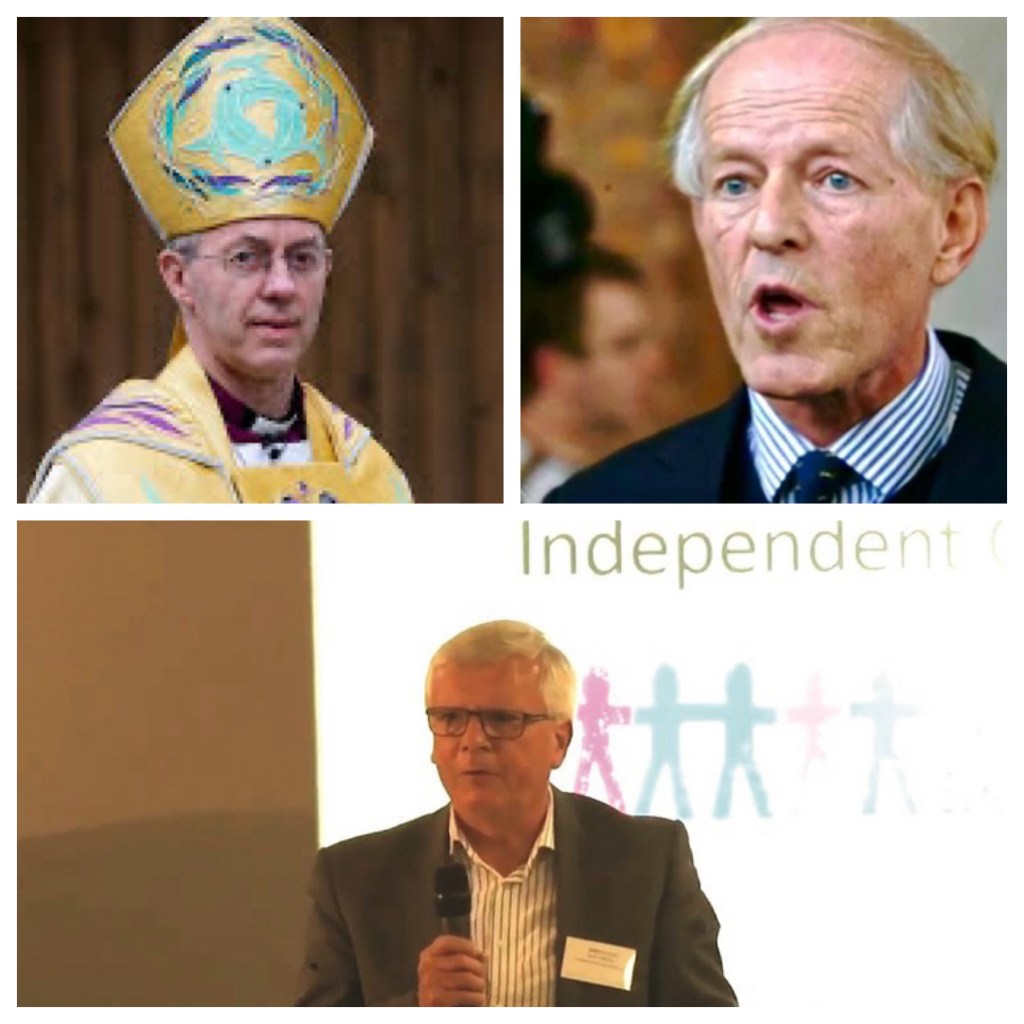
Archbishop Justin Welby (top left), complicit in the cover-up; John Smyth (top right), perpetrator of horrendous abuse; and Keith Makin (bottom), author of the recent Report.

What a shocking indictment! Welby’s sins, whilst totally unacceptable, seem to pale in comparison to the atrocious coverups of so many male clergy. It is just disgusting. But of course we know that the general culture fostered by hardline conservative evangelicals is punitive, oppressive, homophobic, and completely alien to the Gospel. Smyth was living out a distorted theology that had been developed from the increasingly strident message that was being promulgated by hardline evangelicals within the church—and which still lives and grows today. And he got away with it because so many people just gave him “another chance”, or turned a blind eye, wanting to protect the reputation of the church, or simply refused to believe that such a “devout man” could do this.

Prof. Adrian Thatcher has written with his typical clarity on this matter, arguing that “the Church of England will never ‘learn lessons’ about the causes of Smyth’s shocking exploits until it reviews its own theological failings.” In particular, he maintains that “many of [the Church of England’s] members and organisations do hold ideological beliefs that hurt people and are ‘followed at the expense of a core care and regard for every human being’.” He notes that there are “copious references among the testimony of survivors in the [2024 Makin] Report to misogyny, homophobia, to ‘muscular Christianity’, to outrageous sexism (remember the ‘lady helpers’), in the camps and organisations where Smyth’s wickedness was propagated.”

Thatcher quotes Makin’s conclusion that “the patriarchal approach in the organisations and cultures that John Smyth operated, was a conducive and organisational factor to the abuse”. That patriarchal approach is a key characteristic of conservative evangelicalism, whose leaders, Thatcher argues, are still “protected from an overdue examination of their patriarchal, sexist and homophobic beliefs, all ‘Bible-based’, and the harm that derives from them.”

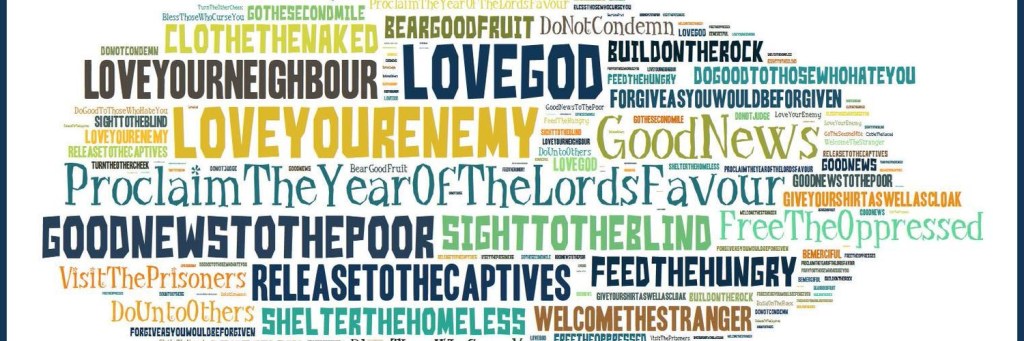
The challenge to hardline conservative evangelical leaders is to reflect on the harm done by their ideological attachment to this distorted theology, to repent of the sins that have been and are being committed, and to rediscover the actual Gospel—good news—for humanity, which, as the latest Church of England media release says, is not about “a seemingly privileged group from an elite background to decide that the needs of victims should be set aside, and that Smyth’s abuse should not therefore be brought to light”, but rather “about proclaiming Good News to the poor and healing the broken hearted.”

Amen.
The Church of England’s media release about the Makin Review is at https://www.churchofengland.org/media/press-releases/independent-review-churchs-handling-smyth-case-published

Prof. Adrian Thatcher’s analysis is at

One detailed discussion of the complicity of some in the terrible coverup that has occurred is at https://www.prospectmagazine.co.uk/ideas/religion/church-of-england/68541/justin-welby-is-a-scapegoat-for-establishment-failures?

Another is at https://sixtyguilders.org/2024/11/18/st-ebbes-and-the-smyth-scandal-an-inadequate-response/?
On the mount of the Lord it shall be provided (Gen 22; Pentecost 5A)

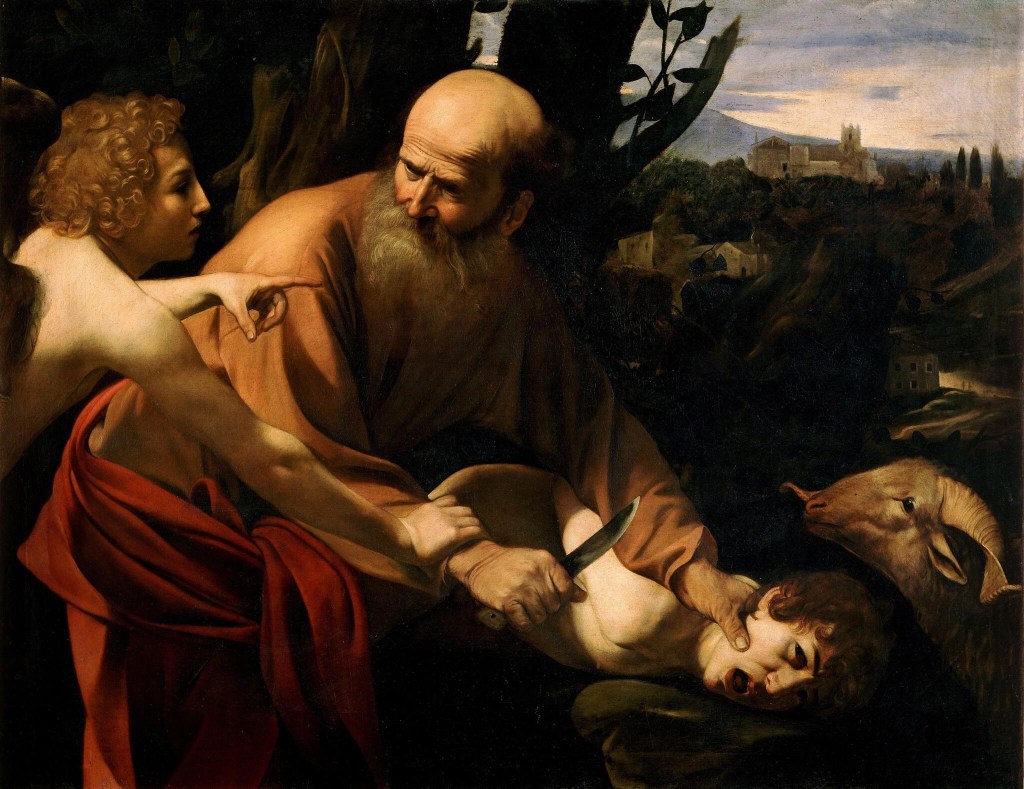
“Abraham reached out his hand and took the knife to kill his son” (Gen 22:10). We read these chilling words in the passage that the lectionary offers for our reflection and consideration this coming Sunday (Gen 22:1–14). It’s hardly edifying reading material for worship, is it?

The Sacrifice of Isaac, by Caravaggio, c. 1603

It’s a horrifying story. Who is this God who calls Abraham to take his “only son” up the mountain and “offer him there as a burnt offering” (22:2)? How does this God relate to the God who, it is said, has shows “steadfast love” to the people of Israel (Exod 15:13), and before that to Joseph (Gen 39:21), to Jacob (Gen 32:9–19), and indeed to Abraham himself (Gen 24:27)? Why has God acted in a way that Is seemingly so out of character in this incident in Gen 22? Or is this the real nature of God, and later displays of “steadfast love” are simply for show?

Writing in With Love to the World, the Revd Sophia Lizares, a Uniting Church Minister originally from the Philippines, now serving in Perth, WA, says that this story is “an improbable and troubling reading: a God who demands a father to kill his beloved son, a father who questions not.” It is not just the knife in Abraham’s hand which is raised (22:10)—there are many such questions raised by these seemingly callous story.

My wife, Elizabeth Raine, has a cracker of a sermon in which she compares this story with the account of Jephthah and his daughter (Judg 11:29–40). Whilst the Lord commands Abraham to kill his son as a burnt offering, it is the vow made by Jephthah to sacrifice “whoever comes out of the doors of my house to meet me, when I return victorious from the Ammonites” as a burnt offering (Judg 11:30).

And whilst the Lord intervenes in what Abraham is planning to do at the very last moment, sending an angel to command him, “do not lay your hand on the boy or do anything to him” (Gen 22:11–12), Jephthah is held to the vow he has made—by his very own daughter, who knows that she will be the victim of this vow (Judg 11:39). There is no divine intervention in this story.

And worse, whilst Abraham had carefully prepared for the sacrifice, taking his donkey, two servants, and the wood for the fire up the mountain with him (Gen 22:3–6), Jephthah’s vow was made on the spur of the moment (Judg 11:30–31), and when his daughter insisted that he must carry through with this vow, he gives her, as requested, two full months for her to spend with her companions before he sacrificed her (Judg 11:37–39). Surely he might have had time in those two months to reconsider his vow and turn away from sacrificing his daughter?

It would seem, then, that the daughter was dispensable; the son, the much loved only son of Sarah and Abraham, was clearly indispensable. That would clearly reflect the values of the patriarchal society of the day, in which “sons are indeed a heritage from the Lord, the fruit of the womb a reward” (Ps 127:3).

And Abraham would have followed the same pathway, sacrificing his only son, had not the Lord intervened. Neither father is looking very appealing in these two stories! Which makes it hard to see how the story of the sacrifice told in Judg 11, and the story of the almost-sacrifice told in Gen 22, can be “the word of the Lord” for us, today, in the 21st century. Indeed, the story of Abraham and Isaac comes perilously close to being a story of child abuser—if not physical abuse, by the end of the story, at least emotional and spiritual abuse.

Situations of abuse destroy trust. After such an experience, how could Isaac ever trust his father again? And as we hear the story, how can we trust God? How could we ever believe that his commands to us are what we should follow?—if he follows the pattern of this story, and changes his mind at the last minute, after pushing us to the very brink of existence? How could we trust a God like this?

Or, if the story involving poor Isaac is really about God providing, as Abraham intimates early on (22:8), and then concludes at the end (22:14), then it is a rather malicious way for God to go about showing how he is able to “provide”. Provision, and providence, should be something positive—not perilous and threatening, as in this story.

Or yet again, if the story is about testing Abraham’s faith, as many interpreters conclude, then it is a particularly nasty and confronting way for God to do this—and that points to a nasty streak in the character of God. Is this really what we want to sit with? Was there not some other way for God to push Abraham to test his faith?

What do we do with such a story within our shared sacred scriptures?

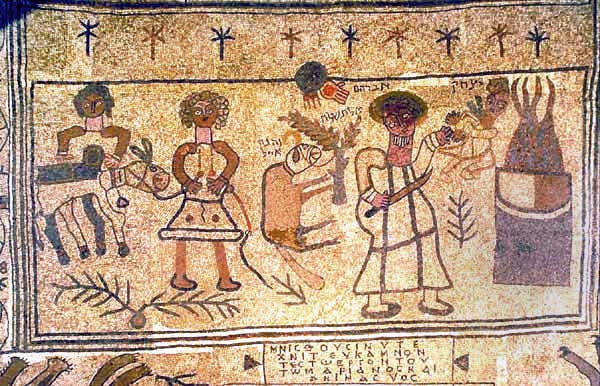
A sixth-century CE floor mosaic from the Beth Alpha synagogue, in Israel’s Jezreel Valley. The mosaic lay near the door, so that anyone who entered was confronted by the scene. In this mosaic, Abraham and Isaac are identified in Hebrew. The hand of God extends from heaven to prevent Abraham from proceeding. Below the hand are the Hebrew words, “Lay not [your hand].” Next to the ram are the words, “Behold a ram.”

*****

The Jewish site, My Jewish Learning, states that “although the story itself is quite troubling, it does contain a message of hope for Rosh Hashanah. In the liturgy we ask God to “remember us for life.” The binding of Isaac concludes with his life being spared, and he too is “remembered for life.” Abraham’s devotion results in hope for life.”

How does the message of hope for life emerge from this story? Clearly, the life of Isaac is spared; but this is a terrible way to teach that message!

James Goodman, writing in My Jewish Learning, explains how he was taught to understand this story. “I learned that the story was God’s way of proclaiming his opposition to human sacrifice”, Goodman writes.

He refers to the way his Hebrew-school teacher explained this story: “God had brought Abraham to a new land. A good and fertile land, where it was common for pagan tribes, hoping to keep the crops and flocks coming, to sacrifice first-born sons to God. Then one day, God commanded Abraham to sacrifice Isaac, the beloved son of his old age.

“Abraham set out to do it, and was about to, when God stopped him. He sacrificed a ram instead. In the end, Abraham had ‘demonstrated his—and the Jews’—heroic willingness to accept God and His law,’ and God had ‘proclaimed’ that ‘He could not accept human blood, that He rejected all human sacrifices’.”

See https://www.myjewishlearning.com/2013/09/11/understanding-genesis-22-god-and-child-sacrifice/

Setting the story in the broader context of the practice of child sacrifice is a way of accepting that this terrible story might indeed have some value. Seeing the story is a dramatised version of God’s command not to sacrifice children can be a way to deal with it. “Do not lay your hand on the boy or do anything to him”, the angel says; so Abraham obeys, finds a ram, offers the ram as a burnt offering (22:12–13). And so, the name of the place is given: “the Lord will provide” (22:14).

Three kings of Israel, at different times in the history of Israel, are said to have practised child sacrifice, as they turned to practices found in nations other than Israel. Solomon in his old age is said to have turned to the worship of Molech (1 Ki 11:7); this practice was subsequently adopted by Ahaz, who “made offerings in the valley of the son of Hinnom, and made his sons pass through fire, according to the abominable practices of the nations whom the Lord drove out before the people of Israel” (2 Chron 28:3). Likewise, Manasseh “made his son pass through fire; he practiced soothsaying and augury, and dealt with mediums and with wizards” (2 Ki 21:6).

Direct commands not to sacrifice children are found in two books of Torah in the scriptural texts. Most direct is “you shall not give any of your offspring to sacrifice them to Molech, and so profane the name of your God: I am the Lord” (Lev 20:18). In Deuteronomy, other nations are condemned as they “burn their sons and their daughters in the fire to their gods” (Deut 12:31), so the command is “no one shall be found among you who makes a son or daughter pass through fire” (Deut 18:10). The prophet Jeremiah also asserts that this practice is not something that the Lord God had thought of (Jer 7:31).

So the passage we have in the lectionary responds to this practice by telling a tale which has, as its punchline, the command “do not lay your hand on the boy or do anything to him” (22:12). Might this be the one redeeming feature of this passage?

But if that is the case, the story belongs back in the days when child sacrifice was, apparently, widely practised. What, then, does it say to us today???

See also

The Kingdom: showing the character of Christ—not a culture of celebrity

I recently watched the SBS documentary entitled The Kingdom. The story that was told in this documentary canvassed recent events relating to Hillsong, and included interviews and visits to other Pentecostal churches in both Australia and the United States of America.

The documentary had a clear thread running throughout, of how a person found acceptance and support within the Pentecostal world. Marc Fennell, who narrates the documentary, offers a very personal testimony of his involvement, throughout his childhood, in Hillsong and “a number of other Pentecostal churches”, until the point, 17 years ago, when he decided that this was no longer for him. He left—the first time he set foot back into a Pentecostal church was during the making of this documentary.

The honesty of the personal angst of Fennell runs through the documentary, giving it authenticity and integrity. He was exploring Hillsong from the vantage point of a person who had known very well what the experiences of worship and participation was like. He made it clear how important to him was the support and friendship of people within the churches he attended, especially since his family situation was apparently rather difficult. Fennell was loved and valued by people at Hillsong and other churches—even though, in his innermost being, he was not able to enter into the intense emotional experience of Pentecostal worship.

There are moments of pathos in the documentary, as Fennell offers personal revelations about his own spirituality. He showed great courage in what he decided to say in this very public national forum. (The documentary was broadcast by SBS and remains able to be viewed on SBS On Demand.)

*****

Woven in and through this personal thread is another, more dominant, thread, which becomes the reason for making the documentary. The failures of Hillsong have become known, piece by piece, over the past four years. Like any church—like any organisation run by, and for, human beings—there will always be problems, brought about by the deficiencies of people involved, and in some cases by the deliberate efforts of some to benefit personally. All human organisations are fallible.

In Hillsong’s case, however, those deficiencies were magnified by the way that key leadership operated. A particular culture was created, which exploited people. It is true that many people have been helped by the ministries of Hillsong, to a greater or lesser degree, over the years. Many (myself included) have enjoyed singing and playing some of their better songs. But many also have been hurt and exploited by leaders in Hillsong in that same period. The culture that was created was toxic and abusive for far too many people.

I was waiting, throughout the documentary, to hear how Fennell would describe the culture that was fostered within Hillsong. He touched on a number of bad elements in the way that Hillsong operated. Abuse of volunteers was canvassed early on. The “Prosperity Gospel” push to encourage participants to tithe—and to give beyond that tithing so that it hurt them financially—was examined. Accusations of fraud perpetrated by those with access to the finances of the organisation was discussed, including money laundering and tax evasion.

Eventually, the documentary came to identify the issue that had most strongly been reported by mainstream media: various sexual encounters by people in leadership, and the infidelity of key leaders, both in Sydney and elsewhere around the world. (Hillsong is a “global phenomenon”.) The paedophilic abuse perpetrated by Frank Houston, the founder of Hillsong (in the days when it was known as the Christian Life Centre) was also reported, and there is a court case involving his son, Brian, that is ongoing.

So the documentary gave some hints to what I consider to be the key to all of this: the culture of celebrity which permeated the organisation, from the onstage worship leaders, musicians, and preachers, through the pastoral workers, even to some the financial and administrative workers.

All that the leadership of Hillsong seemed concerned about was to focus on ensuring that “the experience” of Hillsong was fabulous, and that it grew month by month and year by year. Growth in numbers was the key metric, indeed (so it seems) the only metric. The way to ensure that growth was by providing ever-increasing endorphin hits of pleasure. And celebrity was the way to generate enthusiasm and maintain the growth trajectory. So a culture of celebrity was nurtured.

All of this, of course, is contradictory to the Gospel that Jesus preached and lived. He advocated humility; “blessed are the meek, for they shall inherit the earth”, not “build up your leaders to be seen as grand and exciting figures”. He instructed people not to store up wealth on earth; “sell all that you own and distribute the money to the poor”, not “call for tithes and more to fund an increasingly extravagant lifestyle of the leaders”.

Jesus encouraged his disciples by saying “whoever welcomes a child in my name welcomes me”, not “see children as potential targets for grooming and sexual abuse”. This is the character of Christ that we know from the Gospels. This is the culture that churches should seek to emulate.

*****

The documentary is being widely applauded as being “a pretty fair treatment”, as “balanced” in how it reports on Hillsong. I have seen it described as “thoughtful”, which it was; as “honest”, which I agree it was. But my sense is that it lacks a critical lense on the whole phenomenon, from the point of view of faith (and by this, I mean faith as Jesus taught and lived it, not how Hillsong portrayed it).

A critical theological assessment is really needed—and Marc Fennell is not able to provide this, because he is explicitly NOT a believer and certainly does not have theological training.

So my sense is that the title, The Kingdom, invites people of faith to reflect further. Whose Kingdom? Fennell posed this question in terms of “who inherits the Hillsong mantle?” What Pentecostal churches are manoeuvring to fill the gap that is opening up, as people leave Hillsong? Whilst that’s a worthwhile question to explore, that’s not what The Kingdom implies to me.

The Kingdom was what Jesus proclaimed. The Kingdom was what he taught in his parables. The Kingdom coming near was the message that he gave to his disciples, for them to spread far and wide. And what was that Kingdom? A realm in which God’s compassion and justice would be known and experienced and lived.

In this realm, outsiders are to be welcomed—children, those marginalised, those challenged by life, and people identifying somewhere within the LGBTIQA+ spectrum, and placed them at the centre. A place and a time where relationships would be genuine, empathic, and nourishing. A place and a time marked by the characteristics of Christ.

It’s in relation to this final observation that I have one more comment. Nothing in the documentary indicated the discriminatory way that Hillsong has dealt with LGBTIQA+ people. There have been high profile instances of such people being removed from leadership positions. The church is not “gay-friendly”. I can only presume that there are other instances of discriminatory behaviour directed towards LGBTIQA+ people which have not received publicity. Omitting mention of this is a deficiency in how Hillsong was presented in the documentary.

All in all, I join my voice with others who have said, about the documentary, The Kingdom: yes, watch this. It is worth devoting time to see it. But watch it with critical eyes. Watch it with the knowledge of who God is, how Jesus speaks about God, and what God’s Kingdom is like.

Watch it, and weep. Weep for those abused and ostracised. Weep for those conned by the culture of celebrity. Weep for those struggling to rebuild lives and faith after traumatic experiences. Watch it with eyes wide open, hearts reaching out, and faith in the Kingdom into which Jesus invites us all to share. For this Kingdom will exude the character of Christ.