The account of how Peter heals a lame man (3:1–11) is the passage proposed by the Narrative Lectionary for the Third Sunday in Easter this year. This healing provides a specific instance of the “many wonders and signs” which the apostles performed (2:43).
As this particular healing takes place in the grounds of the temple (3:2), the focus remains on the heart of the Jewish capital. Peter and John come to the temple to pray (3:1), in keeping with both the community practice of prayer (2:42) and of regularly attending the temple (2:46). The temple remained a focal point for prayer until its destruction in 70 CE.
The juxtaposition of the lame man and the temple setting is striking. Lame animals were decreed to be unsuitable as offerings to God (Deut 15:21; Mal 1:8,13) and lame people were amongst those forbidden from drawing near to offer sacrifice in the temple (Lev 21:18; 2 Sam 5:8). Yet amongst the prophets, the lame are included among the outcasts gathered by God as the faithful remnant (Jer 31:8; Mic 4:6-7; Zeph 3:19), and the vision of the return of the redeemed to Zion (Isa 35:1–10) includes the assertion that “the lame shall leap like a deer” (Isa 35:6).
Jesus has followed in this prophetic tradition by healing the various categories of outcast; by his activity, “the blind receive their sight, the lame walk, the lepers are cleansed, the deaf hear, the dead are raised, the poor have good news preached to them” (Luke 7:22, par Matt 11:5; see also Luke 4:18; Matt 15:30–31; 21:14).
In parables told only by the Lukan Jesus, the lame are included in the outcasts invited to the banquets (Luke 14:13,21). This compares with the account of how Mephibosheth, the lame grandson of Saul, son of Jonathan, ate regularly at the table of King David (2 Sam 4:4; 9:1–13).
Although no account of a specific healing of a lame person is found in Luke’s Gospel (cf. John 5:1–9), the healing of this lame man (the first specific healing incident in Acts) places the apostles in continuity with Jesus who heals the lame (Luke 7:22). A similar healing is later performed by Paul (14:8–10), whilst Philip is described as healing “many others who were paralysed or lame” (8:7).
The lame man’s expectation that he would receive alms (3:2–3) is reasonable. Caring for the needy was integral to Jewish piety (Deut 15:7–11). By the hellenistic period, almsgiving had become highly valued as a religious duty (Sir 3:30; 7:10; 29:9–12; 40:24; Tob 4:7–11,16; 12:8–10; 14:8–11; cf. Matt 6:2–4). The Lukan Jesus commended almsgiving (Luke 11:41; 12:33) and subsequent characters in Acts practice almsgiving—notably, Cornelius (Acts 10:2,4,31) and Paul (24:17).
However, as Peter and John “look intensely” at the man (3:4; on such intense scrutiny, see 14:9), they sidestep this responsibility, for the focus in this account is to be on their exercise of divine power. Peter commands the man to stand, revealing that his power comes from “the name of the Messiah, Jesus of Nazareth” (3:6).
This name has already been declared as the source of salvation (2:21) and forgiveness (2:38); “the name” remains a constant emphasis in the ensuing scenes (3:16; 4:7,10,12,17–18,30; 5:40-41) and appears subsequently in connection with proclamation (8:12; 9:15–16,27-28; 10:43; 15:14,17; 21:13), baptism (8:16; 10:48; 19:5; 22:16) and exorcism (16:18; 19:13,17).
As Peter raises up the lame man (3:7), he is healed and strengthened, and enters the temple (3:8). The healed man immediately recognises the source of this miracle, for he is portrayed as “praising God” (3:8,9). The man thus joins himself with the community members whose regular life is typified by an attitude of praise towards God (2:47).
Later in the account, even the people will praise God, recognising that God has been at work in this incident (4:21). At this point, their response is one of “wonder” (3:10), a questioning attitude also displayed towards Jesus (Luke 4:36; 5:9), and “amazement” (3:10), a more insightful appreciation of the incident, as also displayed towards Jesus (Luke 5:26).
The companion passage that is offered by the Narrative Lectionary alongside acts 3 is a short excerpt from Mark 6. If you’d like to explore some of the key elements in this passage—“take nothing for [the] journey except a staff; no bread, no bag, no money”, “if any place will not welcome you and they refuse to hear you, as you leave, shake off the dust that is on your feet as a testimony against them”, and “casting out many demons”—see
The season of Easter stretches over seven weeks, from Easter Sunday to Pentecost Sunday. It takes those of us in the southern hemisphere from the balmy days of autumn into the time when the icy winds arrive and the temperatures drop. During this season, the lectionary replaces the stories from Hebrew Scriptures, and provides us with a diet of stories that tell of the church—stories taken from the Acts of the Apostles.
One explanation for replacing Hebrew Scripture passages with excerpts from Acts is that it reminds us that the risen Jesus, whom we celebrate on Easter Sunday, was at work in those early days amongst the first group of believers in Jerusalem, as they formed community together, and that Jesus was proclaimed and attested as people from that community travelled beyond Jewish territory, into the wider Hellenistic (Greek-speaking) world.
So this coming Sunday, the Second Sunday in Easter, we turn to an early chapter of Acts to hear a summary description of the early community of believers in Jerusalem (Acts 4:32–35). The community was still actively involved in Jewish religious life and was continuing to participate in temple rituals (2:46; 3:1; 5:20-21, 42).
The term “Christian” is not used for these people in Acts until Antioch in Syria (11:26). The were originally known as people of “The Way” (9:2; 19:9, 23; 24:14,22). They had formed a messianic Jewish community, since the central affirmation for the believers was that “the Messiah, he is Jesus” (2:36; 3:19–20; 5:42).
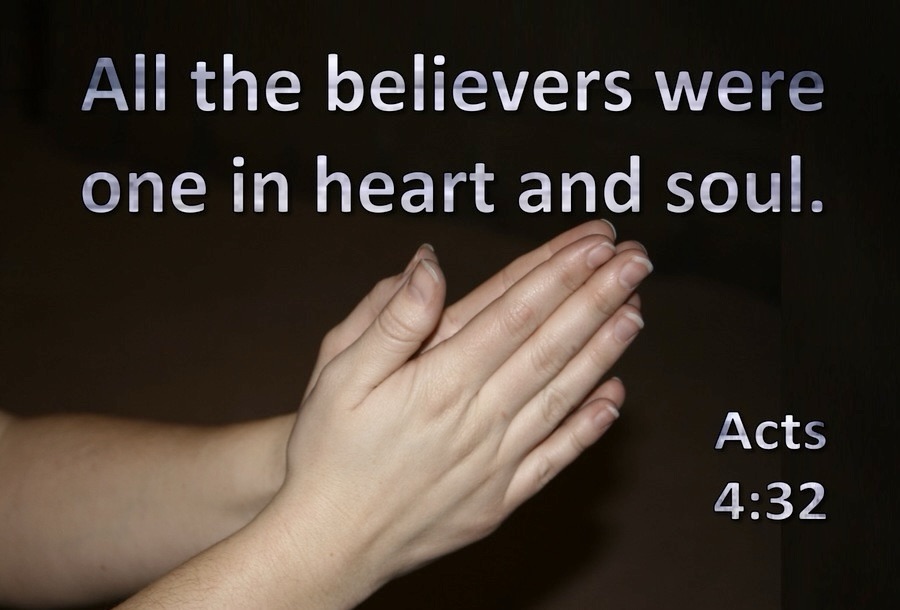
This passage provides a reminder of key elements in the life of this messianic Jewish community: unity of purpose (4:32; see 2:42,46), powerful testimony to the resurrection (4:33; see 2:24,32; 3:15; 4:2), and the manifestation of grace (4:33b; see 2:47). The major focus in this summary description is on the first feature, which is introduced with a striking phrase: the believers were “one in heart and soul”, to which is added a repetition of the earlier comment that “for them all things were common” (4:32; see 2:44).
Being “one in heart and soul” is a phrase which evokes the traditional Greek proverbs, “friends have one soul” and “the goods of friends are common property”, which were known since the time of Aristotle (Aristotle, Nicomedian Ethics 9.8.2; Cicero, De officiis 1.16.51; Plutarch, On Brotherly Love 490E, How to Tell a Flatterer 65A and De amic. mult. 96E; Iamblichus, Life of Pythagoras 65A; Dio Chrysostom Oration 34.20; Diogenes Laertius 5.20, 8.10).
The Jewish monastic community of Essenes were described in a similar way by Philo, Every Good Man is Free 85, and Josephus, J.W. 2 §122. It was a common trope, known to hellenised Jews. The first phrase is also reminiscent of the common Deuteronomic reference to “heart and soul” in the exhortation, “the Lord your God is commanding you to observe these statutes and ordinances; so observe them diligently with all your heart and with all your soul” (Deut 26:16; and see also 6:5; 10:12; 11:13; 13:4; 26:16; 30:2,6,10).
Luke, as a hellenised Jew, draws on this tradition to make a strong point about the community in Jerusalem: their unity was their strength. He is writing for Theophilus—a Greek name, meaning “lover of God”—who may indeed have been a real person, a patron who engaged Luke to undertake the collection of sources and careful analysis to which he refers at the start of his work (Luke 1:1–4).
So Luke, writing in Greek, draws both on the Hebrew Scriptures and on Greek ideas as he describes this Jewish messianic community. He writes a number of decades after the time on which he is reporting; he writes with an eye to his patron and an audience of educated Hellenistic readers. It is an idealised picture of the early Jerusalem community; certainly, we know from other sources—letters by Paul and John, especially—that the early communities formed of followers of Jesus had (more than?) their fair share of tension and conflict. They were, after all, only human.
Of course, unity of purpose was not simply a hellenistic ideal; it was also valued in Israelite society. To demonstrate this, the psalm which is proposed by the lectionary for this coming Sunday, Psalm 133, focusses strongly on this theme. It is presumably chosen by the lectionary as a complement to the passage from Acts 4 because of this very theme.
In this short psalm, the central thought concerns “when kindred [brothers and sisters] live together in unity” (v.1). Two images are used to indicate how much this unity is valued. The first image, “like the precious oil on the head, running down upon the beard” (v.2), perhaps evokes the “precious oil” stored in the treasure house of Hezekiah (2 Ki 20:13; Isa 39:2). This is something of immense value.
The second image, “like the dew of Hermon, which falls on the mountains of Zion” (v.3a), references one of the the prominent mountains in the north of Israel, on the border with Syria and modern. Lebanon. Today, it is part of the contested Golan Heights territory. Some scholars consider Mount Hermon to be the site where Jesus was transfigured, in company with Moses and Elijah (Mark 9 and parallels).
In later Jewish tradition, Hermon was said to be the place where the “watchers” amongst the fallen angels descended to earth to take wives amongst human beings. The story appears at Gen 6:1–4 without reference to location; Hermon is specified when the story is retold and developed within “The Book of the Watchers”, in 1 Enoch 6–11 (see 6:6 for the reference to Hermon).
Richard Clifford, in his commentary on the psalms, says: “Though the Mediterranean climate of Palestine had no rainfall from May or June to September, it had dew. Dew was important in the summer and a supplement to rain. Zion was therefore a place of fertility which even in the rainless season has an abundance of dew” (Psalms 73-50; Abingdon, 2003, pp.263-64). The majority of the water supplying modern Israel flows from the melting snow on Mount Hermon down into the River Jordan. See https://www.sciencedirect.com/science/article/abs/pii/0022169490900726
Hermon was a long way from Zion; so the dew of Hermon would not literally fall on Zion. This is a symbol of the unity of the whole nation of Israel. But the mention of Zion in Psalm 133 provides the opportunity for an affirmation that it was on Zion that “the Lord ordained his blessing”, which is immediately specified as “life forevermore” (v.3b). Blessings that last “forevermore” are celebrated in other psalms: “pleasures forevermore” (Ps 16:11), the Lord watching over his people (Ps 121:8) and surrounding them (Ps 125:2), the reign of the faithful sons of David (Ps 132:12), and the holiness of the Lord’s house (Ps 93:5).
The language of “ordaining” is usually applied to the priests (Exod 28:40-41; 29:9, 35; Lev 8:31-36; Num 3:1-3). However, in this psalm, perhaps the allusion is more directly to Solomon’s affirmation that “I am now about to build a house for the name of the Lord my God and dedicate it to him [for various offerings which are listed] … on the sabbaths and the new moons and the appointed festivals of the Lord our God, as ordained forever for Israel” (2 Chron 2:4). The pi almost, like the Chronicler, certainly valued the long term stability that was envisaged for Israel through God’s faithfulness.
During the season of Easter, it is worthwhile to give consideration of the nature of the community of faith to which we belong. What are the key values in this community? How do members of the community demonstrate these values in practical ways? How much is unity of purpose valued? What is done to ensure that diverse voices are valued, even as this focus on unity is maintained? These are good questions which these lectionary passages might invite us to consider this Easter.
This week we move on from the Gospel story, into the narrative of “the things fulfilled among us” that is attributed, by tradition, to Luke, the author of a Gospel and a sequel that we call the Acts of the Apostles. We will hear four excerpts from this second volume in the coming weeks.
I have already offered some exploration of the first parts of the passage on offer for this Sunday, in Acts 1:1–11. See
In this blog, we turn to the earliest reported gathering of the community in Jerusalem.
The list of those meeting in the upper room of the house in Jerusalem (Acts 1:12–14) includes both eleven of the twelve already identified (Luke 6:14–16) as well as “certain women, including Mary the mother of Jesus, as well as his brothers” (Acts 1:14). That is consistent with the notes of women who followed Jesus in Galilee (Luke 8:1–3; 23:27, 49) as well as the presence of his brothers (Luke 8:19–21). The community which met together “constantly devoting themselves to prayer” was a gender-inclusive group.
Luke uses a hugely significant Greek word here; the word homothumadon. This is a word used only 12 times in the New Testament, with most of those occurrences in the Book of Acts, and one in Romans. Luke uses it to help us understand the uniqueness of the Christian community. It is most often translated as “all together”.
Luke initially tells of how “they were all together in the upper room” (1:12), forty days after the resurrection of Jesus—the day when Jesus ascended into heaven. Ten days later, they were all together once again, in the precincts of the Temple (2:1), along with devout Jews from all the nations surrounding Israel (2:9–11).
Then in the days following, as “they devoted themselves to the apostles’ teaching and fellowship, to the breaking of bread and the prayers” (2:42), they continued to be all together; “they spent much time together in the temple, they broke bread at home and ate their food with glad and generous hearts, praising God” (2:46).
And still later, the community of believers came together to welcome Peter and John, after their hearing before the authorities, and “they raised their voice to God all together in prayer” (4:24). And then again, some days later, “they were all together in Solomon’s porch” in the Temple precinct (5:12). Gathering together, meeting in unity, was a key characteristic of the early community of Jesus followers.
As the story continues, Phillip travelled north out of Judea into the region of Samaria, where he was preaching to the Samaritans. Here, Luke comments: “the people were all together listening to those things which Philip spoke” (8:6).
Then, some time later, after Saul had his Damascus Road experience and Peter had his vision of all foods being declared clean, after Paul and Silas and Barnabas had been travelling amongst the Gentiles sharing the good news, we read that there was a gathering of church leaders in Jerusalem, who conferred together, “the apostles and the elders, with the consent of the whole church, being assembled together as one, decided to choose … representatives and send them to you, along with our beloved Barnabas and Paul” (15:22,25).
So the point is, with each step along the way, this little community of assorted disciples, was all together … or, of one accord, in another translation.
Homothumadon is a compound of two words, homo meaning “in unison” and thumos meaning “temperament, emotion of the mind, the principle of life, feeling and thought.” One scholar writes that there is a musical sense to this word, where it suggests notes being brought into harmony together, under the masterful hand of the conductor. The role of the conductor is to ensure that flutes and cellos, drums and violas, trumpets and clarinets, are all making their distinctive contribution to the end result—the piece of music being performed for the audience to enjoy.
Perhaps another appropriate image, today, might be of the way that the artist sets out a palette of colours to be used in painting, and as the creative activity gets underway, those various shades and hues and colours are mixed together in such a way as to produce an intricate, complex, and aesthetically pleasing end result: a work of art.
That is how Christian community is to function. That is what we are to be, as the people of God in the place where we gather. Homothumadon denotes the unity of a group who have the same passion, who share the one persuasion, who are of the same mind, of one accord, with one purpose.
I suggests both a harmony of feelings as well as singleness of purpose. However, while i refers to a group acting as one, it does not mean lack of diversity. It means cooperation in the midst of diversity.
The word first appears in Greek literature from 500 years before the time of Jesus (in the plays of the dramatist Aristophanes, the treatises of the philosopher Plato, the oratory of the general Demosthenes) and was used in the political sphere to describe the visible, inner unity of a group which drew together when facing a common duty or danger. The New International Dictionary of New Testament Theology emphasises that “the unanimity is not based on common personal feelings but on a cause greater than the individual”.
In a sermon I gave on this passage, I noted that believers today stand with Peter and the disciples and the women and the brothers of Jesus in a liminal place, a place on the edge. We are leaving behind the old, reaching out to the new. The dramatic events of Pentecost, that we will recall in a week’s time, invite us to move to the future, and to change ourselves in a renewed commitment to our faith and our mission.
These words from the book of Acts challenge us not to simply continue our present practices and beliefs unchanged, but to hear a new message and a new way of being. We are being asked to change ourselves, to let go of what we find reassuring, and step out in faith into the chaos represented by the Spirit of God. We are being asked to be all together, to ‘act of one spirit’, to unite for the common good. May we be up to the challenge!
This blog is based on a section of my commentary on Acts in the Eerdmans Commentary on the Bible, ed. Dunn and Rogerson (Eerdmans, 2003). I have also explored the theme of the plan of God at greater depth in my doctoral research, which was published in 1993 by Cambridge University Press as The plan of God in Luke-Acts (SNTSM 76).
Whenever Christians think about the Spirit—and specifically about the dynamic force that is displayed by the Holy Spirit—our attention goes most immediately to the story of the Day of Pentecost in Acts 2. That’s when the coming of the Spirit was experienced as “a sound like the rush of a violent wind [which] filled the entire house where they were sitting”, followed by “tongues, as of fire … resting on each of them” (vv.2–3).
In the chaos that resulted—“all of them … began to speak in other languages”—the crowd that heard them were bewildered, amazed, astonished, and thought that they were drunk! That’s a disruptive event initiated and impelled by the Spirit right there. The story of Pentecost is a story about God intervening, overturning, and reshaping the people of God. The Spirit certainly was active at Pentecost.
As Luke tells the story of Pentecost, he is deliberately linking his second volume, not only to the activity of the Spirit in Hebrew Scriptures, but also to the way the Spirit overshadowed Mary (Luke 1:35), nurtured John, son of Zechariah and Elizabeth (1:80), descended upon Jesus at his baptism (3:22), led Jesus out into the Judean wilderness (4:1) and then back into Galilee (Luke 4:14) to sustain the activities and preaching of Jesus (4:18; 10:21).
Luke, of course, had received the account of the active role of the spirit in the baptism and testing of Jesus (Mark 1:10, 12) and developed it, just as Matthew had done likewise, introducing the saying of Jesus, “if it is by the Spirit of God that I cast out demons, then the kingdom of God has come to you” (Matt 12:28).
Certainly, the activities of Jesus can only be thought of as both disruptive—framed by the breach of the heavens at his baptism, the tearing of the temple curtain at his death—and as transformative—signalled by the transfiguration on the mountain top, as well as the change in the disciples effected by their time with Jesus.
Some interpreters have noted that the book of Acts is less about “the acts (deeds) of the apostles” than it is about “the acts of the Hoy Spirit”.
The author himself described the two-volumes work (Luke’s Gospel Acts) as “an orderly account of the things that have come to fulfilment amongst us”. The work highlights how the Holy Spirit plays a central, active role in what is being reported—and how the dual motifs of disruption and transformation continue apace in the movement that Jesus inspired.
The events reported in Acts are generated from the dramatic intervention of the Spirit into the early community formed by the followers of Jesus after his ascension. The story of that intervention reports that Jews came from around the eastern Mediterranean are gathered in Jerusalem for the annual festival (Acts 2:1–13), when the Spirit comes upon them. Each bursts out, “speaking about God’s deeds of power” (2:11). The joy and excitement is tangible even as we hear the story at two millennia’s distance.
Unthinkingly, the wider group of pilgrims hear the cacophony of Spirit-inspired voices, and assume that this is a sign of drunkenness (2:13, 15). Actually, as Luke has made clear, the tongues being heard are not the unintelligible gibberish evident in Corinth, but known languages from the various places of origin of those speaking. And the disruptive element is not from the tongues spoken, but from the actions undertaken by believers in the days, months, and years ahead—as the narrative of Acts conveys.
A second story of the coming of the Spirit is told at a later point in Acts—after Peter sees a vision in which God declares “all food is clean”, and he is summoned to the home of the Gentile centurion, Cornelius, in Caesarea (10:1–33). As Peter preaches to the Gentiles, the Spirit falls on them, “just as it had upon us [Jews] at the beginning (11:15). This event is specifically portrayed as a complementary event alongside the falling of the Spirit on Jews on the Day of Pentecost (2:1–4). It is a further disruptive action that the Spirit impels.
The activity of the Spirit is noted at various places in this sequence of events. The Spirit guides Peter to meet the men sent by Cornelius and travel with them to Caesarea (10:19; 11:12). In reporting to the church in Jerusalem about the arrival of messengers from Cornelius (11:11–12), Peter notes simply that “the spirit said to me to go with them without criticism” (11:12; cf. 10:19–20).
In this report to the Jerusalem church, Peter is short on factual reporting, as it were; he simply states that the spirit fell on them (11:15). His omission of many details (character traits, travel details, conversation and personnel; even, surprisingly, the name of Cornelius) places the focus on the role of the spirit. Once again, what the Spirit impels from this vision, visit, and sermon, is highly disruptive for the early communities of faith.
Jews had been used to eating separately from Gentiles and selectively in terms of food, in accordance with the prescriptions of Leviticus. Now, they are now invited—indeed, commanded—to share at table with Gentiles and to put aside the traditional dietary demarcations.
This is disruptive: just imagine being commanded by God to become vegan and eat meals with the family of your worst nightmares, for instance! And it is transformative: from this sequence there emerge inclusive communities of Jews and Gentiles across the Mediterranean basin, sharing at table and in all manner of ways. That becomes the way of the church.
The importance of the Spirit in Luke’s account of the early movement cannot be underestimated. The significance for the church today of the Spirit’s disruptive, empowering, transformative presence at Pentecost is likewise high. And that transformative activity continues on throughout Acts.
After Peter’s sermon in Caesarea and the gifting of the Spirit to the Gentiles (Acts 10—11), the Spirit guides Barnabas and Paul to Seleucia and onwards (13:2) and then later guides Paul away from Asia Minor, towards Macedonia (16:6–7). This latter move marks a critical stage in the story that Luke tells.
At this key moment of decision in Troas, three injunctions are given; each one is from a divine source. The first of these, an instruction not to speak in the southern region of Asia, comes from the Holy Spirit (16:6). The second direction, a prohibition against any attempt to head north and enter Bithynia, comes from the same spirit, here described as “the spirit of Jesus” (16:7). The third divine interjection takes place at Troas, where a vision is seen in the night with a petition to “come across into Macedonia” (16:9).
The new spirit-inspired direction of travel is disorienting; a serious disagreement between Paul and Barnabas had just occurred (15:39). But this disruption provides the springboard for Paul and Silas to undertake a new mission in Philippi, Thessalonica, and Beroea (16:11—17:15), before visiting the centre of Greek philosophy and politics, Athens (17:16–34), and then Corinth, where Paul stayed eighteen months (18:1–17). Indeed, all that takes place, as Paul travels relentlessly with various companions across many places (13:4—21:17), is driven by the Spirit (13:2, 4), a constantly disruptive and transformative presence.
Much later, Paul’s final visit to Jerusalem and his subsequent arrest takes place under the guidance of the Spirit (20:22-23; 21:11). That event had hugely disruptive consequences for Paul, of course, as he is arrested and spends the rest of his life as a prisoner under Roman guard.
The story of the early years of the movement initiated by Jesus, then, is of multiple events inspired and propelled by the Spirit over these years—intrusive, disruptive, yet transformative events. The Spirit who guides all of this is both disruptive and transform. We need, today, to be open to the same disruption and transformation today.
The Spirit is an important figure in Christian experience and in Christian theology. The festival of Pentecost, which is celebrated this coming Sunday, is an opportunity to focus on the Spirit in the worship life of the Church. Every year, at Pentecost, the story of “the first Pentecost” is proceed by the lectionary as the reading: an account of how the Spirit was experienced by believers gathered in Jerusalem, 50 days after the death and resurrection of Jesus.
Acts 2 forms a pivotal turning point in the story that Luke tells throughout his two-volume work, which we know as two separate books, The Gospel according to Luke, and the Acts of the Apostles. The Spirit plays a crucial role in both volumes, beginning before Jesus and his cousin John are born, and continuing right through until the final thing that Paul says, when he meets with the Jewish leadership in Rome while under house arrest.
Over the last few years, I have written quite a number of posts for this week, as we approach Pentecost. I’ve listed them below, as you may wish to dip into some of them in the lead up to Pentecost.
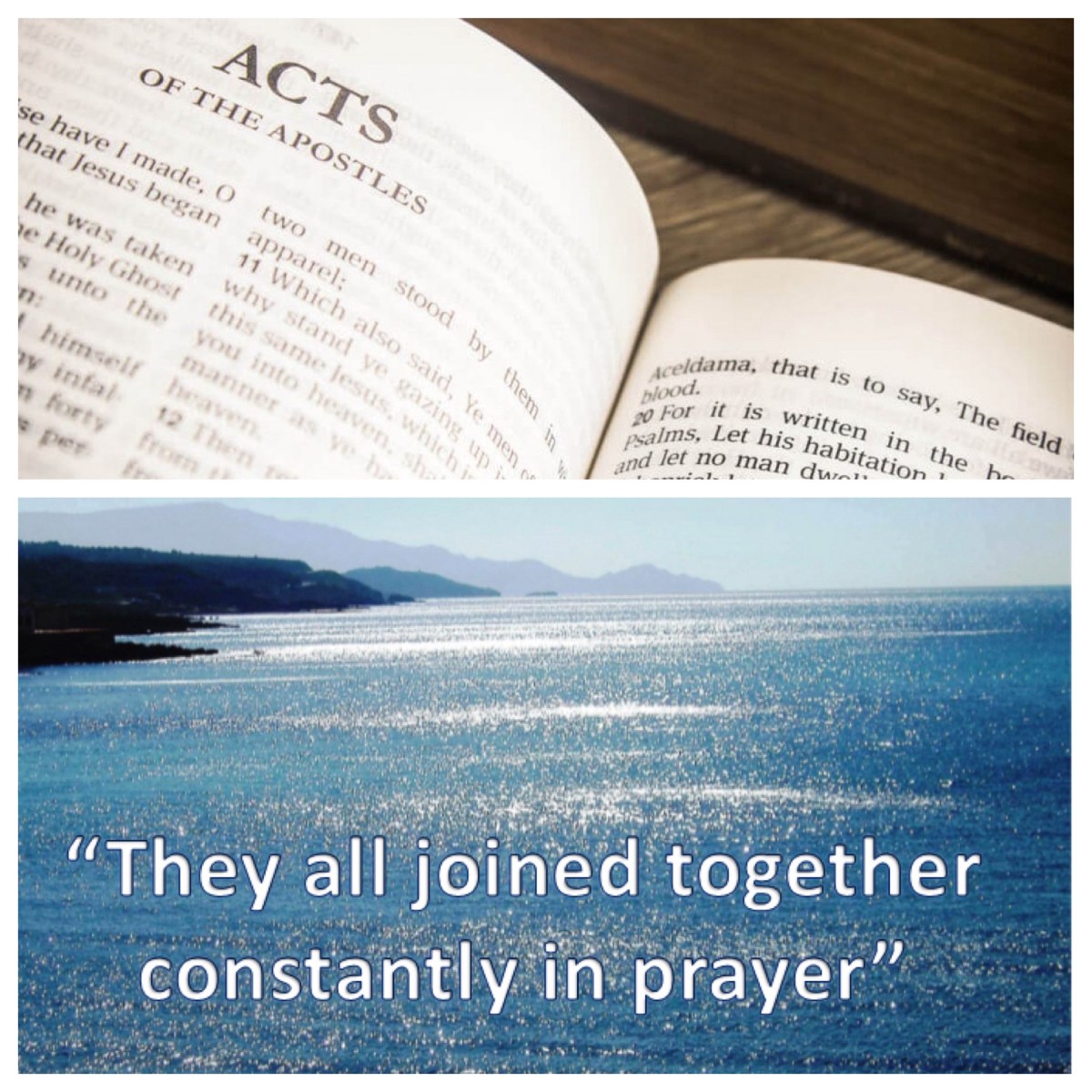
During the season of Easter, we have been hearing stories from the book of Acts, with highlights this year with Peter in Jerusalem (Acts 2), Stephen in Jerusalem (Acts 7), and then Paul in Athens (Acts 17). This coming Sunday, the lectionary takes us back to the opening chapter of Acts (1:6-14), most likely in order to prepare for the reading that we will have the following week, on Pentecost Sunday (2:1-21). Here we encounter a community that was, as the NRSV translates, “constantly devoting themselves to prayer”.
This Sunday, the Seventh Sunday in Easter, for the First Reading the lectionary offers us a passage from Acts (1:6–14) which includes the story of the ascension of Jesus (1:6–11) and an insight into that early community, gathered in Jerusalem (1:12–14). This sets the scene for recounting various scenes from the life of the community in Jerusalem, where the earliest followers of Jesus establish a pattern of faithful living through their common life, their public witness, and their persistent adherence to their Jewish traditions. The whole section is located entirely within Jerusalem (1:4,8,12; 2:5; 4:5; 5:16; 6:7; 8:1).
Ten days separate the ascension of Jesus (forty days after Passover, 1:3) from the coming of the Spirit on the day of Pentecost (2:1, fifty days after Passover). Only two things are told of these ten days; already the process of selectivity which shaped Luke’s Gospel can be seen in his second volume.
In the previous blog, I noted that the departure of Jesus by means of his ascension into heaven is actually the moment when Jesus charges his followers to be engaged in mission. The departure of Jesus heralds the start of the church. The (physical) absence of the Saviour brings in the impetus for engaging wholeheartedly with the world which he has (physically) left. In this blog, my focus is on how that community of followers begins to prepare for that enterprise.
Thus, we learn only that the community had gathered on the day of ascension (1:12–14) and that at some stage in these days a replacement was found for Judas Iscariot (1:15–26). The material relating to Judas is omitted from the lectionary offering this year (it appears in Year B); you can read my take on this passage at
The list of those meeting in the upper room of the house in Jerusalem includes both eleven of the twelve already identified (Luke 6:14–16) as well as “certain women, including Mary the mother of Jesus, as well as his brothers” (Acts 1:14). That is consistent with the notes of women who followed Jesus in Galilee (Luke 8:1–3; 23:27, 49) as well as the presence of his brothers (Luke 8:19–21). The community which met together “constantly devoting themselves to prayer” was a gender-inclusive group.
Luke uses a hugely significant Greek word here; the word homothumadon. This is a word used only 12 times in the New Testament, with most of those occurrences in the Book of Acts, and one in Romans. Luke uses it to help us understand the uniqueness of the Christian community. It is most often translated as “all together”.
Luke initially tells of how “they were all together in the upper room” (1:12), forty days after the resurrection of Jesus—the day when Jesus ascended into heaven. Ten days later, they were all together once again, in the precincts of the Temple (2:1), along with devout Jews from all the nations surrounding Israel (2:9–11).
Then in the days following, as “they devoted themselves to the apostles’ teaching and fellowship, to the breaking of bread and the prayers” (2:42), they continued to be all together; “they spent much time together in the temple, they broke bread at home and ate their food with glad and generous hearts, praising God” (2:46).
And still later, the community of believers came together to welcome Peter and John, after their hearing before the authorities, and “they raised their voice to God all together in prayer” (4:24). And then again, some days later, “they were all together in Solomon’s porch” in the Temple precinct (5:12). Gathering together, meeting in unity, was a key characteristic of the early community of Jesus followers.
As the story continues, Phillip travelled north out of Judea into the region of Samaria, where he was preaching to the Samaritans. Here, Luke comments: “the people were all together listening to those things which Philip spoke” (8:6).
Then, some time later, after Saul had his Damascus Road experience and Peter had his vision of all foods being declared clean, after Paul and Silas and Barnabas had been travelling amongst the Gentiles sharing the good news, we read that there was a gathering of church leaders in Jerusalem, who conferred together, “the apostles and the elders, with the consent of the whole church, being assembled together as one, decided to choose … representatives and send them to you, along with our beloved Barnabas and Paul” (15:22,25).
So the point is, with each step along the way, this little community of assorted disciples, was all together … or, of one accord, in another translation.
In the early chapters of Acts, as we have noted, we are at a very significant point of transition. Luke is clearly marking the end of one phase and the beginning of another. The Jesus part of Luke’s story has come to an end. But it is the beginning of another story—the story of the church.
Homothumadon is a compound of two words, homo meaning “in unison” and thumos meaning “temperament, emotion of the mind, the principle of life, feeling and thought.” One scholar writes that there is a musical sense to this word, where it suggests notes being brought into harmony together, under the masterful hand of the conductor. The role of the conductor is to ensure that flutes and cellos, drums and violas, trumpets and clarinets, are all making their distinctive contribution to the end result—the piece of music being performed for the audience to enjoy.
Perhaps another appropriate image, today, might be of the way that the artist sets out a palette of colours to be used in painting, and as the creative activity gets underway, those various shades and hues and colours are mixed together in such a way as to produce an intricate, complex, and aesthetically pleasing end result: a work of art.
That is how Christian community is to function. That is what we are to be, as the people of God in the place where we gather. Homothumadon denotes the unity of a group who have the same passion, who share the one persuasion, who are of the same mind, of one accord, with one purpose.
Homothumadon suggests both a harmony of feelings as well as singleness of purpose. However, while homothumadon refers to a group acting as one, it does not mean lack of diversity. It means cooperation in the midst of diversity.
The word first appears in Greek literature from 500 years before the time of Jesus (in the plays of the dramatist Aristophanes, the treatises of the philosopher Plato, the oratory of the general Demosthenes) and was used in the political sphere to describe the visible, inner unity of a group which drew together when facing a common duty or danger. The New International Dictionary of New Testament Theology emphasises that “the unanimity is not based on common personal feelings but on a cause greater than the individual”.
In a sermon I gave on this passage, I noted that believers today stand with Peter and the disciples and the women and the brothers of Jesus in a liminal place, a place on the edge. We are leaving behind the old, reaching out to the new. The dramatic events of Pentecost, that we will recall in a week’s time, invite us to move to the future, and to change ourselves in a renewed commitment to our faith and our mission.
These words from the book of Acts challenge us not to simply continue our present practices and beliefs unchanged, but to hear a new message and a new way of being. We are being asked to change ourselves, to let go of what we find reassuring, and step out in faith into the chaos represented by the Spirit of God. We are being asked to be all together, to ‘act of one spirit’, to unite for the common good. May we be up to the challenge!
The following dialogue was written by Elizabeth Raine and John Squires,and delivers as the sermon for the Tuggeranong Uniting Church on Sunday 14 May 2023.
*****
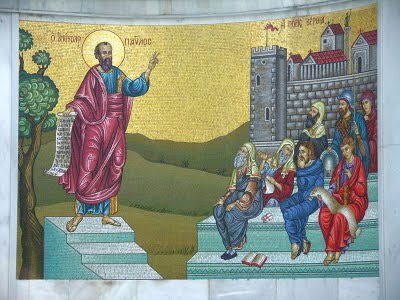
While Paul was waiting in Athens for Silas and Timothy, he was greatly upset when he noticed how full of idols the city was. So he argued in the synagogue with the Jews and the gentiles who worshipped God, and in the public square every day with the people who happened to come by.
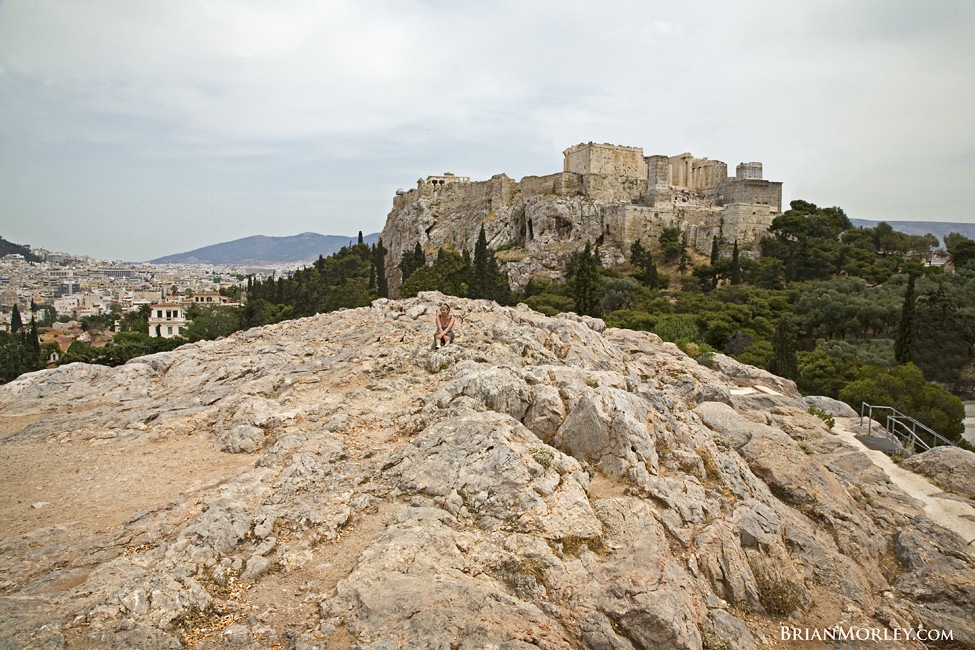
Then Paul was brought before the city council, which met at the Areopagus in Athens. Today, as we listen to what Paul said to the council, we are also going to listen in to what might have been going through the minds of two people in his audience: a learned Greek man called Demetrius, and a woman of deep faith, known as Damaris.
Paul stood up in front of the meeting of the Areopagus and said, “People of Athens, I see that in every way you are very religious.”
Demetrius: Yes, this is correct. We are very proud of our religions here in Athens. As religious people, we worship lots of gods. Just look around you, and you will see altars and temples of every size, shape, and description. Over there, is the fine temple to Zeus. And beside it, the shrine to Apollo; it, too, is a remarkable holy building. It is not for nothing that we in Athens have the reputation of great piety.
And, of course, when you turn your eyes to the top of the hill, you will see the pride and joy of our city: the magnificent temple of Artemis, where our ancestors have long worshipped the greatest of all goddesses. This temple is world famous. It is respected — even envied, dare I say — by peoples of all other nations.
And Athens has also been blessed by many famous teachers of philosophy. Plato and Socrates, Aristotle and Pythagoras, Epicurus and many more. Why, even today, I believe that you could find no better array of teachers in any other city!
Yes, all of this shows you just how religious we are. This Paul is so right when he describes us in such generous terms.
Damaris: Indeed, it is true that we do have a lot of temples in our city. And we certainly have many fine teachers, as you say. Lots of people say that we are the most religious city in the world.
But something is missing, I think. There is so much ritual and pomp and ceremony that goes on; sometimes, I think that this can get in the way of worshipping the gods, rather than helping us to worship them.
And there are so many teachers who speak truths that are complex; sometimes it hurts my head just to listen to them all! And all those poor animals that are sacrificed to all of these gods and goddesses. I wonder whether this really is such a good idea.
I have heard it said that Paul believes in a god that cannot be depicted on stone. It’s a curious idea to us Athenians; but some of my friends have told me about the group that believes this idea. A god that exists, but that we can’t see, or know much about at all is an odd idea.
23Paul continued, “For as I walked through your city and looked at the places where you worship, I found also an altar on which is written, ‘To an Unknown God.’ That which you worship, then, even though you do not know it, is what I now proclaim to you. God, who made the world and everything in it, is Lord of heaven and earth, and does not live in temples made by humans. Nor does God need anything that people can supply by working for him, since it is God himself who gives life and breath and everything else to all people. From the one person God created all human beings, and he made them live over the whole earth. God himself fixed beforehand the exact times and the limits of the places where they would live.”
Demetrius: Mmm, yes. Good point. I agree. Paul has said some important things about this God. When you boil it all down, there is a force in human history that looks over all things. Providence, or Fate, we call it.
And despite all of these shrines and images of the gods, there is a quality about the divine that is rather unknown to us. In the end, we would have to say that the gods are beyond our understanding. This is what our revered teacher, Plato, said about them. The gods transcend this earthly life and really have no need of our human worship.
Many of the priests in our city would be horrified by this, as they insist that we get access to the gods by offering sacrifices. But this kind of other-worldly god is very attractive. I like what Paul has to say.
Damaris: Yes, I too find Paul’s words attractive, Demetrius. And it is reassuring to know that all the things that happen in life are ultimately under the control of Divine Providence. But I am a little bit worried about what Paul seems to be saying. The god he is talking about seems to be rather removed from us all. I wonder how Paul thinks this god of his could be accessible to us? How could we relate to this god, if we can’t see his image?
Paul went on to say, “God did this so that they would look for him, and perhaps find him as they felt around for him. Yet God is actually not far from any one of us; as someone has said, ‘In him we live and move and exist.’ It is as some of your poets have said, ‘We too are his children.’”
Demetrius: Well, this is a surprising turn. From a god who is so far away from us, to a god who is near to us. Come to think of it, Paul is on to something here. In fact, he is quoting from our own Greek traditions here. I recognise those words he said — Aratus, I think it was, the poet, who said of god “in him we live and move and exist”. And “we are god’s children” — I know that, too. Well, that is very good, a Jew like Paul, showing that he knows our poetry and philosophical writings.
Damaris: I quite like the idea of a god who is with me all the time. All of these holy places and holy rituals can get too much, and tend to place too many things in between the gods and ourselves. Sometimes I’d just like to be able to relate to a god in an intimate, and personal way. So a god who is with me all the time — not just when I visit his shrine or place a sacrifice on his altar — is an appealing concept. “We are God’s children” — God as the one who gives birth to us, who nurtures us, who disciplines us, and who loves us. This sounds really good.
Demetrius: Yes, this is great. A god who is always with us. Why don’t we build an altar to him! I’ll get in touch with my friend Stephanas, he has a very good stone mason as one of his slaves, and we’ll see what we can come up with. I can just see it now; “To the god in whom we live and move and exist: this statue was erected by Demetrius and Stephanas” — no, “this statue was erected by Demetrius, with help from Stephanas”. Oh, why not just, “erected by Demetrius, a leading citizen of the city”. In large letters. Yes, that will look fine. And we’ll use the best stone; and have it trimmed in gold, with bright colours, so that it stands out, and….
“No!”, said Paul. “Since we are God’s children, we should not suppose that his nature is anything like an image of gold or silver or stone, shaped by the art and skill of a human being.”
Demetrius: No?
Damaris: I think I see the point. If this god is always near to us, then it would be silly to build an altar or erect a temple for him. After all, the temple is where the god or goddess lives, so that we know where to go to visit them. But if the god is always with us, then we don’t need to build him or her a home. So, if we aren’t going to build an altar or put up a statue, how are we going to worship this god?
Then Paul explained, “God has overlooked the times when people did not know, but now he commands all people everywhere to turn away from their evil ways. For God has fixed a day in which he will judge the whole world with justice, by means of a man he has chosen. He has given proof of this to everyone by raising that man from death!”
Demetrius: Oh, now he has spoilt it. What! How can a person be raised from the dead? Everyone knows that once we die, we go down into the underworld and live as shadows. Once you cross the river Styx, your previous life is left far behind. Who would want to go back into the earthly body once again?
No, this claim by Paul raises too many questions that are just not able to be answered satisfactorily. Any talk about raising the dead and bringing back their bodies is stupid.
Damaris: Well, to tell you the truth, I’ve always been worried by this idea. The thought of being a shadow after I die doesn’t really hold any attraction for me. I am much more interested in the story of a god who is able to transform death. What a powerful and caring god this must be! After all, death is what we all must face, and what we all fear so much.
And further, I am starting to see something quite special in what Paul is talking about. He has mentioned a special man, a chosen human being, who will be the one to carry out God’s justice in all the world. This idea is what really grabs me. To think that a god can not only be with us, but that this god can be a human being, just one of us, is really very special.
Now that I think about, this message reminds me of a letter that I received from my sister in Corinth just recently. As I recall now, she spoke about this man named Paul, who had visited the city, and had preached about a man from Nazareth, in the province of Galilee. Paul said that this man, Jesus, was not only a great prophet, but that he had been raised from the dead, and that he is the one who will bring God’s justice into the world. Perhaps this Paul that we are listening to today is the same person that she was talking about?
As Paul puts it, this God has a presence and a power that touches human life in profound and moving ways. This kind of power is lacking in the stone images that I see around me. Paul is leading me right into the heart of this God. So I think I will take his advice, and turn away from the gods I used to worship, and wait for the coming of divine justice through this man who is raised from the dead.
When the people heard Paul speak about a raising from death, some of them made fun of him, but others said, “We want to hear you speak about this again.”
Demetrius: Well, I have to say that this Paul is a bit of a surprise. I admit that he has said one or two foolish things — but not quite as many as I thought he would when he started. But this business of being raised from death is just not on. Yet some of the things that he has said are worth pondering. He is quite a philosopher, isn’t he? I can’t make up my mind about him, and about the god that he has proclaimed to us, and the religion that he has told us about. I’ll need some time to reflect on what he has said.
Perhaps he will be back in the public square tomorrow; I hope so. Maybe I will go there with my kitchen slaves in the morning, when they go to buy our household food for the midday dinner.
Then Paul left their meeting. Some men joined him and believed; among them was Dionysius, a member of the Areopagus, a woman named Damaris, and some others.
*****
As we return to the 21st century, it is worthwhile pondering Paul’s words and actions, and the response that both Damaris and Demetrius had to these words.
The words of Luke suggests that perhaps Paul was “off duty”, as his prime reason for being in Athens was to wait for Silas and Timothy to rejoin him there. Unable to do nothing or ignore the temples of idols around him, Paul’s idea of “off duty” appears to be to argue with everyone he meets in the town square. However this may have been perceived, Paul’s message of “the God you are looking for, the God you don’t even have a name for, the God who is in danger of getting lost in the plethora of all the other idols you are worshipping – let me tell you about that God…” is the God that we surely could take with us into our own town squares – maybe represented today by our cathedrals of consumerism in the large shopping malls, clubs and coffee shops we frequent today.
Paul presents his “new teaching” and “strange ideas” by meeting the Athenians on their own ground, by quoting two of the Greek poets: the Cretan Epimenides (600 BCE), that “in him we live and move and have our being,” and then the opening lines of the Phaenomena by Aratus (315-240 BCE), a Greek poet and Stoic of Cilicia, that “we are his children.”
It is also worth noting that Paul does not condemn them as unredeemed pagans on a one-way trip to hell, he tells them that both he and they worship the same God. Paul plainly saw God at work in the world through all people, and we would do well to remember this as well. Paul viewed the venerable Areopagus as just another place where the Lord of all creation had gone before him and was already present; indeed, as Paul said to the Athenians, “He is not far from each one of us.”
We Christians need to be aware of isolating and insulating ourselves from our culture’s mainstream. We must avoid being inward-looking, self-absorbed, and judgmental, instead of engaging people in our contemporary Areopagus. Instead, we need to follow Paul’s example of living, learning and sharing the gospel in the marketplace of ideas, engaging real people where they live, work, and think, in order to gain a hearing for our “strange ideas” about God, grace, and the resurrection.
As we prepare for this coming Sunday, when we will hear about the fate of Stephen, the first martyr in the movement initiated by Jesus, we continue our considerations of the longest speech in Acts, which also reveals significant elements of the theological commitments held by the author of Acts—by tradition, named as Luke.
The reading offered by the lectionary (Acts 7:55–60) comes from one of the longest chapters in that book. That chapter records in great detail the speech made by Stephen, when he was brought before the council, charged with “saying things against this holy place and the law” (Acts 6:13). However, we are really shortchanged, because although this is the longest of all the speeches in Acts, we are given only the final comment by Stephen—just one verse (7:56)—before he is stoned, and he dies saying “Lord Jesus, receive my spirit” (7:59).
So in a series of blogs this week, I have been considering the whole of this speech in some detail. Let’s not undervalue the contribution of this Lukan-created speech, attributed to Stephen, in the theology of the two-volume work, Luke-Acts. (My analysis is based on what I wrote in my commentary on Acts in the Eerdman’s Commentary on the Bible (2003).)
After recounting the ancestral sagas of Israel, and the story of Moses (7:1–43), Stephen then summarises how God was at work in the conquest of Israel and the early monarchy. The presence of the tent of testimony fulfils what God commanded to Moses (7:44; cf. Exod 25:40); Joshua leads the conquest of the nations “whom God drove out” (7:45; cf. Josh 21:43-45; 23:9; 24:18); the tent remains in the land until the time of David, who “had grace before God” (7:46; on grace, see 2:47).
The speech ends with Solomon’s action of building a house for God (7:47). According to Stephen, this inverts the typical relationship seen in Israel’s history. The Deuteronomic explanation for the building of the temple was that it was done in fulfilment of God’s promise to David (1 Kgs 8:14-21). By contrast, Stephen announces that, by building the temple, Solomon acted in a way that God has not sanctioned. Solomon thus repeats the error made under Moses, when the Israelites made an idol and “revelled in the works of their hands” (7:39-41).
The argument leads us to expect that Solomon would incur the same wrath as exhibited to the people under Moses (7:42-43). Indeed, God’s opposition to Solomon’s building is evident in that it is not in the temple built by human hands (7:48) but in the world which “my [God’s] hand made” (7:50) that God is to be found. Stephen here quotes a prophetic text (Isa 66:1-2), but the message resonates with the way that Cynic philosophers mounted their critiques of idols.
The climactic moment of this speech provides a foundation for understanding the subsequent shift of focus away from the temple, and towards the house-based communities that will be established during the ‘turn to the Gentiles’ in chapters 8–12. The language about God in the latter part of this speech thus establishes a parallel set of antagonisms: between God and Israel under Moses, and between God and Israel under Solomon.
A further parallel can be drawn from the surrounding narrative: there is antagonism between God and the Jewish authorities who have brought Stephen (God’s agent) to trial. This antagonism mirrors both the antagonism which the apostles (God’s agents) have experienced from the same Jewish authorities (chapters 3–5), and the antagonism mounted against Jesus (another of God’s agents) by those authorities (Luke 19:47 onwards; Acts 4:27). Paul (yet another of Gods agents) will subsequently experience similar antagonism in his encounters with Jewish groups in the Diaspora (9:23; chapters 13–18) and in Jerusalem (9:29, 21:27-28).
In concluding the speech, Luke has Stephen turn his focus directly onto his accusers; he levels his own charges against them, depicting them as “resisting the holy spirit” (7:51). At this point Ananias and Sapphira come to mind; for a similar antagonism towards the spirit, they were killed (5:1-11). However, the tables are turned on Stephen, for those listening to his speech interrupt him at this point.
*****
And so we come to the Lukan narrative about the fate of Stephen, the first martyr in the movement initiated by Jesus. After the long account of the story of Israel, Stephen’s martyrdom (7:54-8:1a) is told. There is reinforcement of the validity of his point of view which comes through language about the divine. in what is narrated, in typical Lukan style.
Stephen is once again described as “filled with the spirit” (7:55, evoking 6:3,5). He experiences an epiphany in which he sees “the glory of God” (7:55), which aligns him with Abraham (7:2), as well as “Jesus standing at the right hand of God” (7:55-56). Stephen is also aligned with Jesus; in 7:56, his description of the heavens opening evokes the Lukan account of Jesus’ baptism (Luke 3:21), and his vision of the Son of Man is similar to the apocalyptic vision which Jesus paints at his trial (Luke 22:69).
Stephen’s two cries “in a great voice” (7:57,60) are reminiscent of the death of Jesus (Luke 23:46), and his dying words, “receive my spirit” (7:59), are patterned on the final words of the Lukan Jesus (Luke 23:46, citing Ps 31:6). Stephen’s last cry, a petition that the Lord overlook this sin (7:60), is similarly evocative of the Lukan Jesus’ forgiveness of those who crucified him (Luke 23:34). As Luke clearly interprets the death of Jesus as God’s predetermined action (2:23, 4:28), this similar description of Stephen’s death has at least overtones of divine authorisation, even if they are not explicit.
Later in his narrative, Luke has Paul describe Stephen as God’s “witness” (22:20). As already noted, the task of bearing witness is enabled by the gift of the spirit (1:8). There follows the seventh summary description of the community (8:1b-3), the final one of this first section, in which the opposition experienced by Peter and John, and more dramatically by Stephen, is broadened to include the persecution of everyone in the Jerusalem assembly except the apostles (8:1).
This leads to the scattering of the community (8:1b), an adversity which will come to be the primary means by which the promise of 1:8 is fulfilled—beginning here with Judaea and Samaria. The summary description also notes the role played by Saul in this persecution of the assembly (8:3).
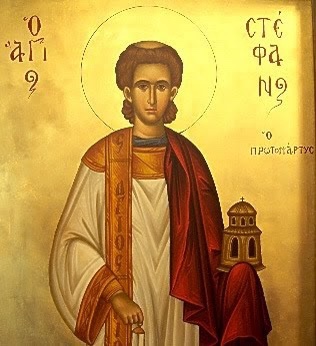
Stephen is an important figure in the narrative that is offered in the Book of Acts. He is the pivot on which the storyline shifts from “in Jerusalem” (chs. 1–7), beginning to turn “to the Gentiles” (chs. 8–12) and then on into the missionary activities of Paul and his companions (chs. 13 onwards). The early church recognised the significance of Stephen, declaring him to be a saint, and honouring him as the first Christian martyr.
As we prepare for this coming Sunday, when we will hear about the fate of Stephen, the first martyr in the movement initiated by Jesus (Acts 7:55–60), we continue our considerations of the longest speech in Acts, Stephen’s speech (7:1-53). By means of this speech, Luke matches the divinely-given qualities of Stephen (6:3,5,8,10) with his testimony to the acts of God in the history of Israel.
This Lukan-created speech, attributed to Stephen, makes a critical contribution to the theology of the two-volume work, Luke-Acts. (My analysis is based on what I wrote in my commentary on Acts in the Eerdman’s Commentary on the Bible (2003).) It is the longest speech of all of the speeches in Acts, and thus deserves our attention, even if the lectionary fails to include it!
The speech begins in typical Lukan fashion by defining the subject as God (7:2; cf. 2:17; 3:13; 5:30); the phrase used here, “the God of glory”, is drawn from scripture (Ps 29:3). The speech which follows rebuts the charges laid against Stephen; it demonstrates that, far from speaking “blasphemous words against God” (6:11), Stephen has a fulsome understanding of God’s place in Israel’s history.
At the end of his speech, Stephen takes up the charge that he spoke “against the holy place” (6:13). Luke has Stephen quote scripture, “Heaven is my throne, and the earth is my footstool. What kind of house will you build for me, says the Lord, or what is the place of my rest? Did not my hand make all these things?’” (Acts 49-50, citing Isa 66:1-2), in order to show that his criticism of the temple (God’s “place of rest”, 7:49) arises from within Jewish tradition itself.
Stephen makes numerous scriptural allusions and quotations in this speech. In general, this seems similar to the earlier speeches by Peter, although the precise function of these scriptural elements is somewhat distinctive in this speech. Here, scripture functions as historical narrative, whereas elsewhere in Acts it provides prophecies to be fulfilled. (The exceptions within the speech are the prophecies of 7:6,7 which are fulfilled at 7:9-16 and 7:36 respectively.)
Luke has Stephen provide a detailed rehearsal of significant parts of Israel’s history, by focussing in turn on Abraham (7:2-8), Joseph (7:9-16) and Moses (7:17-44). Then, after making brief mention of Joshua (7:45a), David (7:45b-46) and Solomon (7:47), Stephen moves to the climactic claim of the speech (7:48-53). This is an ancient Jewish practice; lengthy recitals of key features of Israel’s history are already found in Hebrew Scripture (Deut 26; Josh 24; Neh 9; Pss 78; 105; 106; 135; 136; Ezek 20).
In the present instance, the effect of the long recital of the earlier part of Israel’s history is twofold. First, the historical recital reinforces Stephen’s Jewish credentials. When he begins to speak critically of the temple, and of the Jerusalem authorities, it is clear that he does so from within the Jewish tradition. Stephen is not an outsider, but an insider, offering a prophetic critique.
Second, the historical recital provides insight into a further layer of God’s providential activity. Earlier speeches by Peter have interpreted the events of the life, death, resurrection and ascension of Jesus as being within the divine providence (see 2:14-41). Various features of the narrative of Acts have revealed the active involvement of God in the events that take place in the Jerusalem community. Now, the undergirding plan of God is revealed within the long history of Israel. The line of continuity is strengthened between each layer; just as God is at work in the Jerusalem community, so God is at work in the life of Jesus, and God is at work in the history of Israel. There is a strong line of continuity being drawn by Luke.
Each of the leaders of Israel is interpreted in typically Lukan style to present them as the vehicles through whom God was working in history. It was to Abraham (7:2-8) that God appeared, speaking to him the promise of a land (“God … said to him”, 7:2-3; cf. Gen 12:1). His move from Haran to Canaan was at the initiative of God (7:4; cf. Gen 11:35–12:5), but the fact that his descendants did not inherit this land was also God’s intention (7:5; cf. Gen 17:8). Subsequently God spoke to Abraham of the promise of the covenant of circumcision (“God spoke thus … and God said”, 7:6-8; cf. Gen 17:9-14).
Of Joseph (7:9-16), Luke has Stephen say that “God was with him” (7:9; cf. Gen 39:1-3,21), the same phrase as is later used of Jesus (10:38). God’s presence enables Joseph to exhibit grace and wisdom (7:10), characteristics with which God had also endowed Stephen (6:3,8,10) and Jesus (Luke 1:40,52). As a result of his wisdom, Joseph is given authority by Pharaoh (7:10; cf. Gen 41:37-45). Joseph is brought through afflictions and is rescued by God (7:10); the same term describes God’s rescue of Israel under Moses (7:34, quoting Exod 3:7-8) and of Paul (26:17).
The events which follow are reported without explicit reference to God, but demonstrate the outworking of Joseph’s wisdom. The ensuing famine (7:11; cf. Gen 41:53-54) leads to the two visits of Joseph’s brothers (7:12-13; cf. Gen 42:1-28; 43:1-44:34). The family settle in Egypt (7:14-15; cf. Gen 45:1-47:12); subsequently Jacob and others are returned to the family grave at Schechem in Canaan (7:16; cf. Gen 49:29-32; 50:13, where the grave is located in Hebron).
After recounting the ancestral sagas of Israel, Stephen moves on to the “time of the promise which God confessed to Abraham”, which comes to fruition under Moses (7:17-43). During the time between Joseph and Moses, the people “increased and multiplied” (7:17), the same phrase used to describe the expanding community in Jerusalem (“the number of disciples increased and multiplied greatly”, 6:7) and elsewhere (12:24; 19:20).
At his birth, Moses is “beautiful before God” (7:20; cf. Exod 2:2). As he grows, he is trained in wisdom in Egypt and becomes “powerful in his words and deeds” (7:22). These qualities evoke the divine enabling seen in Luke’s accounts of Stephen, the apostles, and Jesus, and are in direct contrast with the scriptural description of Moses as “slow of speech and slow of tongue” (Exod 4:10).
Luke has Stephen demonstrate that Moses shares other similarities with those chosen by God in later ages, especially Jesus. Despite the rejection he experiences from his kinsfolk (7:23-29; cf. Exod 2:11-22), “God through his hand gave salvation” to Israel (7:25), just as God later gives salvation through Jesus (Luke 1:69; 2:11,30; 3:6; Acts 5:31; 13:23,26). When this salvation takes place under Moses it is accompanied by divinely-enabled wonders and signs (7:36; cf. Exod 7:3), as it does through Jesus (2:22). This fulfils the command given to Moses (7:34) when an angel appeared to him in the burning bush (7:30) and God spoke to him (7:32,33-34; cf. Exod 3:1-10).
Stephen omits entirely the series of objections raised by Moses when he is called (Exod 3:11-4:17); his portrayal of Moses is that of a person who is immediately obedient to the divine call. This sequence of call (7:30-34) and obedient response (7:36) repeats the pattern seen with Abraham (call, 7:2-3; obedient response, 7:4). It is replicated in the narrative of Acts, especially with regard to Saul (call, 9:15; obedient response, 9:19b-20).
Stephen tells of Moses being mocked by his kinsfolk, who could not conceive of him as ruler and judge (7:27,35; cf. Exod 2:14). Stephen affirms that he is rightly called ruler, infers that he is correctly regarded as judge, and adds the further title of liberator (7:35). The functions of two of these titles are attributed to Jesus (judgement at 10:42; 17:31; liberation at Luke 1:68; 2:38; 21:28; 24:21). The third function, of leader, is not directly attributed to Jesus by Luke; however, he does use the related term archegos at 3:15; 5:31.
A further title applied to Moses is the scriptural one of prophet (7:37; cf. Deut 18:15), which has also been applied to Jesus (Luke 7:16; 9:8,19; 24:19) as well as to numerous individuals in the narrative of the Gospel (Luke 1:67,76; 2:36; 7:26) and Acts (11:27; 15:32; 21:9). That it is a divinely-bestowed function is already evident from Peter’s Pentecost speech: “I will pour out my Spirit upon all flesh, and your sons and your daughters shall prophesy, and your young men shall see visions, and your old men shall dream dreams” (2:17-18).
Stephen’s depiction of Moses thus resonates strongly with the Lukan understanding of Jesus, the prophet, ruler and judge through whom God was at work enabling signs and wonders and bringing liberation and salvation for the people of Israel.
As prophet, Moses is given living oracles by yet another angel (7:38; see 7:53; cf. Exod 19:1-2:21; Deut 5:1-33). The idea that the law was mediated by angels is not found in Hebrew Scripture; it is mentioned at Gal 3:17; Heb 2:2. Moses in turn passes on these oracles to Israel, but they refuse to accept them and commit idolatry by making a golden calf (7:39-43; cf. Exod 32:1-35). The description of the golden calf introduces the theme of idolatry which will undergird Stephen’s critique of the temple in 7:48-51. A prophetic citation (Amos 5:25-27) provides justification for God’s abandonment of Israel (7:42); they had been idolators in the wilderness (7:42-43).
Stephen is an important figure in the narrative that is offered in the Book of Acts. He is the pivot on which the storyline shifts from “in Jerusalem” (chs. 1–7), beginning to turn “to the Gentiles” (chs. 8–12) and then on into the missionary activities of Paul and his companions (chs. 13 onwards). The early church recognised the significance of Stephen, declaring him to be a saint, and honouring him as the first Christian martyr.
The lectionary really shortchanges us this coming Sunday. As is the custom during the season of Easter, the First Reading comes from the book of Acts, rather than from Hebrew Scriptures. And this week, the Fifth Sunday of Easter, that reading comes from one of the longest chapters in that book. That chapter records in great detail the speech made by Stephen, when he was brought before the council, charged with “saying things against this holy place and the law” (Acts 6:13).
However, we are really shortchanged, because although this is the longest of all the speeches in Acts, in the passage offered by the lectionary (Acts 7:55–60), we are given only the final comment by Stephen—just one verse (7:56)—before he is stoned, and he dies saying “Lord Jesus, receive my spirit” (7:59).
So in a series of blogs this week, I will consider the setting as well as the content of this speech, and the consequence that followed from it for Stephen—namely, his death as a martyr. Let’s not undervalue the contribution of this Lukan-created speech, attributed to Stephen, in the theology of the two-volume work, Luke-Acts. (My analysis is based on what I wrote in my commentary on Acts in the Eerdman’s Commentary on the Bible (2003).)
The setting of the speech. After chapters telling of the gathering of the early community in Jerusalem (1:6-26), events on the day of Pentecost (2:1-47), the activities of Peter and John in the Temple and before the Council (3:1-5:42), and the establishment of a diaconal role to meet the material needs of the community (6:1-6), Luke (the person attributed in tradition as the author of the Book of Acts) provides the sixth in a series of summary descriptions of the community: “the word of God continued to spread; the number of the disciples increased greatly in Jerusalem, and a great many of the priests became obedient to the faith” (6:7; see earlier at 1:14; 2:42-47; 4:32-35; 5:12; 5:42).
This summary repeats key phrases from the narrative of the scene which has just concluded. “The word of God” (6:2) is now used to describe the community itself, rather than an activity of its leadership; “disciple” (6:1,2) now becomes the standard term for members of the messianic community (6:7; and a further 25 times in chapters 9-21).
The increasing numbers in the community (6:1) forms the basis for the comment that “the number of disciples increased and multiplied greatly” (6:7); the two verbs that are used here recur with the word of God in subsequent summary descriptions (12:24; 19:20; similar ideas are expressed at 9:31; 16:5). The membership of the community now comprises “a great many of the priests”—a surprising comment, in light both of the constant opposition shown by the priests to this point (4:1,6; 5:17,21,24,27) and of the role that the priests will soon play in Stephen’s death (7:1; as members of the council, 6:12).
The fate of Stephen is now told. Out of the seven just appointed, Luke focuses first on Stephen, who is described in familiar terms as a person empowered by God. Stephen is full of grace (6:8), a mark of the community at 2:47, 4:33, and of power, a divine gift (2:22) exhibited by the apostles (4:33); he is able to perform wonders and signs (6:8), a divinely-inspired capacity (2:19) exhibited by Jesus (2:22) and the apostles (2:43; 5:12). Luke notes again that he speaks with wisdom and spirit (6:10), attributes already noted as divine in origin (see 6:3); here they are qualified as being unable to be withstood by humans.
This description introduces the account of the arrest of Stephen (6:8-15). This is a stylised account which draws from familiar Lukan themes. Those in conflict with Stephen are Diaspora Jews who have returned to Jerusalem, where they worship in a synagogue (6:9). However, they do not make the front running against Stephen, but they conscript agitators to stir up the crowd (6:11-12). This is reminiscent of a detail in the trial of Jesus (Mark 15:11; Matt 27:20) which Luke omits, transferring it to Stephen’s trial. Similar agitation of the crowd will later be encountered by Paul (13:50; 14:19; 17:5,13).
Likewise, the “false witnesses” who accuse Stephen of speaking against the temple (6:13) recall the false witnesses who charge Jesus with the claim that he would destroy the temple (Mark 14:55-58; Matt 26:59-61), another detail which Luke transfers to Stephen’s trial. Later, Luke will consciously model Stephen’s death on the death scene of Jesus (7:54-60; cf. Luke 23:34,44-46).
Stephen is charged with uttering “blasphemous words against Moses and God” (6:11) which are manifest in his allegedly speaking against “this holy place and the law” (6:13). Similar charges are later brought against Paul (21:28). The charges against Stephen turn out to be ironic, since in the speech which follows, he will speak at length and with deep conviction about the people of Israel, to whom the law was given, and with penetrating insight about the role of the holy place of Israel.
It is worth remembering that Stephen, venerated as the first Christian martyr, was fervent in his adherence to the Jewish faith into which he was born. How tragic that his strong advocacy for what he saw as the most faithful way to live out his commitment led to his death. How ironic that the first Christian martyr died for being a deeply devout Messianic Jew!
Stephen is an important figure in the narrative that is offered in the Book of Acts. He is the pivot on which the storyline shifts from “in Jerusalem” (chs. 1–7), beginning to turn “to the Gentiles” (chs. 8–12) and then on into the missionary activities of Paul and his companions (chs. 13 onwards). He is also an important figure in the developing movement that began with Jesus. The early church recognised the significance of Stephen, declaring him to be a saint, and honouring him as the first Christian martyr. See more at












 An Informed Faith