
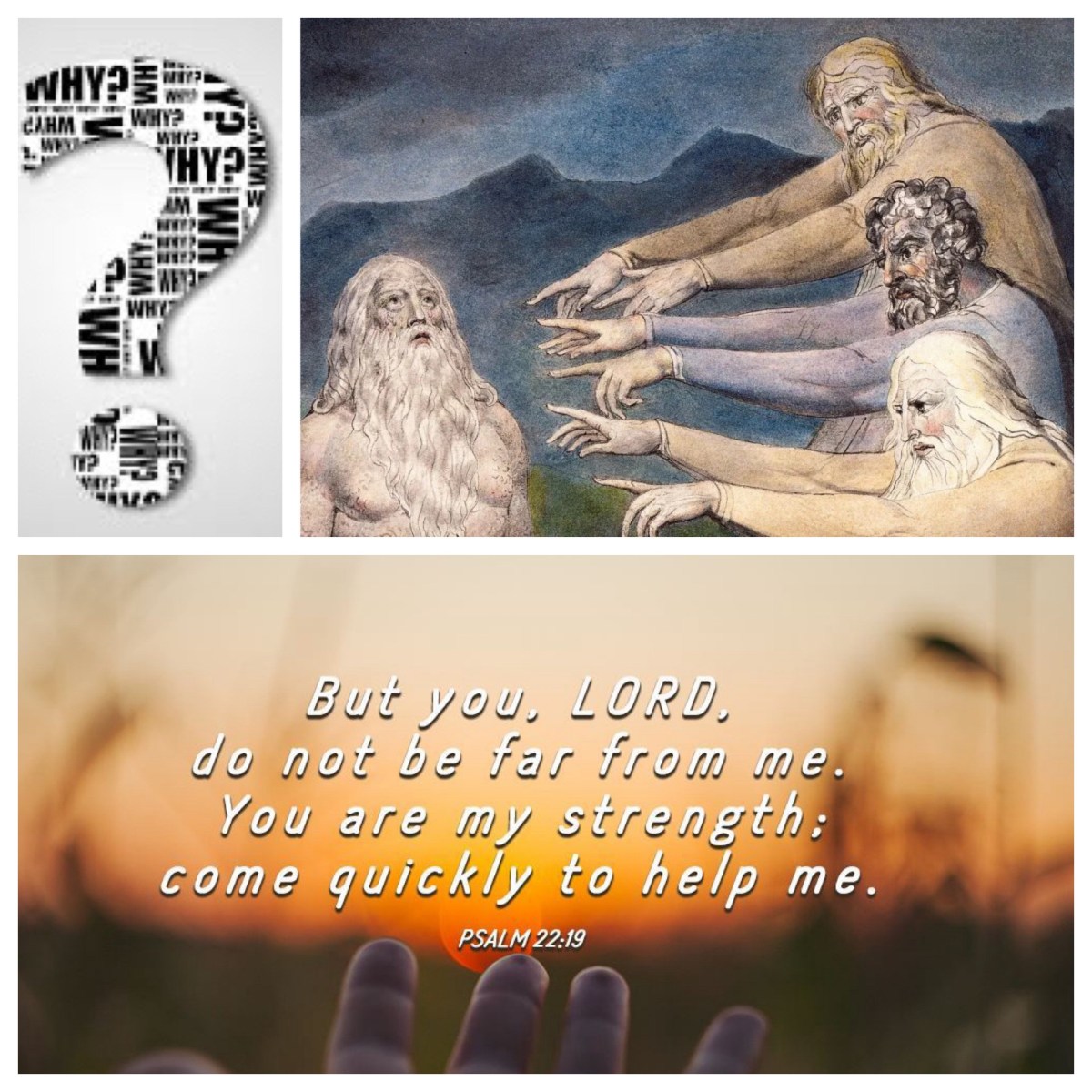
“My God, my God, why have you forsaken me?”, the psalmist laments, in words familiar to us from their strategic occurrence in the foundational Christian story, as Jesus hangs, dying, upon the cross (Mark 15:34). “Why are you so far from helping me, from the words of my groaning?”, they continue, in their resentful tone (Psalm 22:1).
The lectionary offers us the first 15 verses of this psalm for this coming Sunday—no doubt to stand as a companion piece alongside the equally resentful and accusatory words of Job, “today also my complaint is bitter” (Job 23:2). Job, as we know, was “blameless and upright, one who feared God and turned away from evil” (Job 1:2). Even after adversity struck him, he maintained his faith in God—and his integrity, as his wife observes (2:9).
Last week, the psalmist offered by the lectionary to stand alongside the opening scenes in the story of Job was Psalm 26, in which the psalmist assures God that “I have walked in my integrity, and I have trusted in the Lord without wavering” (Ps 26:1, 11), listing the ways in which he has lived this out: “I walk in faithfulness to you; I do not sit with the worthless, nor do I consort with hypocrites; I hate the company of evildoers and will not sit with the wicked; I wash my hands in innocence and go around your altar, O Lord, singing aloud a song of thanksgiving and telling all your wondrous deeds” (Ps 26:3–7).
Accordingly, the psalmist beseeches God to vindicate them (26:1), to “redeem me and be gracious to me” (26:11), asking God “not sweep me away with sinners nor my life with the bloodthirsty” (26:9), and assuring God that “in the great congregation I will bless the Lord” (26:12).
Job maintains his integrity throughout his adversities, matching the psalmist as a person of integrity. Of course, Job is simply a character in the story that is being told; the opening words, “there once was a man” are the ancient equivalent of our “once upon a time”, and “the land of Uz” is an imaginary land. This story is a fable, and those who originally heard it would know this from the opening salvo.
But that doesn’t mean that it is all make-believe and of consequence; for the story is told to tap into some deep human experiences and emotions. The figure of Job is a representative figure; his story is told to represent those of us who, like Job, know the experience of deep pain and great personal loss, when all of his family, servants, and animals were lost, and when his body was covered with boils. Job lived in great pain, physical and psychological. In all this, we are told, “Job did not sin or charge God with wrongdoing” (Job 1:22).

Ilya Repin, Job and His Friends, 1869
Job’s three friends try to turn his thoughts away from his personal suffering, by proposing that this was just how God worked, and Job simply had to accept the situation. One friend, Eliphaz, has been waxing lyrical about God in the previous chapter; “if you return to the Almighty, you will be restored”, he assures Job, piously advising this righteous and upright man, “if you remove unrighteousness from your tents … then you will delight yourself in the Almighty, and lift up your face to God” (Job 22:23–26).
In response, Job laments, “his hand is heavy despite my groaning” (Job 23:2). Blaming God for the sufferings being experienced is a common human trait. How can a person believe in a God who inflicts such suffering—or, at least, allows it to happen unchecked? So, in a clever doubling back on a beloved psalm, Job declares his case against this deity: “I go forward, he is not there; or backward, I cannot perceive him; on the left he hides, and I cannot behold him; I turn to the right, but I cannot see him” (Job 23:8–9; cf. Ps 139:7–12).
These two Hebrew Scripture passages, from the neighbouring books of Job and Psalms, do not inspire hope and engender a light, optimistic feeling. Rather, they take us deep into the pit of human disenchantment with life. Although they both face the same issue of suffering, each one of them deals with this situation in a different way.
The psalm is one of the psalms of individual lament, as the psalmist reflects the wretched condition of a person who is suffering unjustly, crying out, “why are you so far from helping me, from the words of my groaning? … I am a worm, and not a human … all who see me mock at me; they make mouths at me, they shake their heads …. I am poured out like water, and all my bones are out of joint; my heart is like wax; it is melted within my breast; my mouth is dried up like a potsherd, and my tongue sticks to my jaws; you lay me in the dust of death.” (Ps 22:1, 6, 14–15).
In other songs included in the Book of Psalms, various psalmists lament on behalf of the people, in “psalms of communal lament”, such as Psalms 44, 60, 74, 79, 80, 85, 86, and 90; or they bemoan their own personal situation, in the psalms of individual lament, such as this psalm, as well as Psalms 3, 6, 13, 25, 31, 71, 77, 86, and 142. In the face of God’s seeming inaction and unresponsiveness to pleading prayers, the psalmists seem to say, what is there to do, other than to lament?
Why? Why? Why? is Job’s constant question.

Later, Elihu will rebuke Job, turning his incessant questioning back on him: “God is greater than any mortal. Why do you contend against him, saying, ‘He will answer none of my words’? For God speaks in one way, and in two, though people do not perceive it.” (33:12–14). “Far be it from God that he should do wickedness, and from the Almighty that he should do wrong”, Elihu contends (34:10). “Surely God does not hear an empty cry, nor does the Almighty regard it”, he maintains (35:13).
The claim that God is not just is an outrage to Elihu. He turns to the inscrutable nature of God: “Surely God is great, and we do not know him; the number of his years is unsearchable” (36:26). “The Almighty—we cannot find him”, Elihu maintains; “he is great in power and justice, and abundant righteousness he will not violate” (37:23).
Yet Job will not budge. Finally, after a blistering speech from the Lord himself, out of the whirlwind (38:1–41:34), in which the deity makes it clear that Job cannot pretend to have any comprehension of the ways that God operates, Job backs down. He responds, sarcastically: “I know that you can do all things, and that no purpose of yours can be thwarted” (42:2), and then delivers his coup-de-grace: “therefore I despise myself, and repent of dust and ashes” (42:6). Job throws in the towel; it is all hopeless; he can never win.
The psalmist does not, however, follow the same trajectory. As is so often the case in psalms of lament, what begins with accusations, wailings, and despair, eventually turns to promise, and then to hope, and faith. Before that—in the fifteen verses that the lectionary allocates for this Sunday—the psalmist rattles off a list of hurts and difficulties: they are scorned, mocked, and despised (vv.6–8), feeling trapped and monstered by the baying dogs (v.16) and the encircling “strong bulls of Bashan” (vv.12–13; perhaps the accusations of Amos 4:1 and Jer 22:20–23 are evoked here?).
With a series of striking metaphors, the psalmist details their personal distress, manifested in physical ways: “I am poured out like water, and all my bones are out of joint; my heart is like wax; it is melted within my breast; my mouth is dried up like a potsherd, and my tongue sticks to my jaws; you lay me in the dust of death … my hands and feet have shriveled; I can count all my bones” (Ps 22:14–17).
Yet this psalmist moves to express a firm assurance that God is “holy, enthroned on the praises of Israel”; in times past, “in you our ancestors trusted; they trusted, and you delivered them; to you they cried, and were saved; in you they trusted, and were not put to shame” (v.3–5). “Do not be far from me”, they plead, “for trouble is near and there is no one to help” (v.11). And then, in the part of the psalm not included in what the lectionary offers for this Sunday, they plead, “deliver my soul from the sword, my life from the power of the dog! save me from the mouth of the lion!” (vv.20–21).

Confident that God will indeed respond, the psalmist exhorts his companions to praise God, stand in awe of him, and pay their vows to God (vv.23–25). So the psalm ends with verses that are strongly evocative of the great prayers of praise and thanksgiving (vv.25–31; cf. PSs 95–100 and 145–150). The psalmist is embued with confidence and trust in the one who has dominion over all, ruling over the nations (v.28). Such confidence differentiates the psalmist from Job; it is almost as if the singer of this song has joined forces with the friends of Job who, in the face of his persistently mournful complaints, defends the Lord God and exalts God.
Bildad had assured Job, “God will not reject a blameless person, nor take the hand of evildoers. He will yet fill your mouth with laughter, and your lips with shouts of joy” (8:20–21). Yet that is not Job’s experience. When Zophar considered the limits of God, he found there are none. “Can you find out the deep things of God?” he asks; “Can you find out the limit of the Almighty? It is higher than heaven—what can you do? Deeper than Sheol—what can you know? Its measure is longer than the earth, and broader than the sea” (Job 11:7–9). Job will not accept this affirmation of faith, either. Eliphaz had assured Job, “Is not God high in the heavens? See the highest stars, how lofty they are!” (Job 22:12). Once again, Job will demur; that is not his experience.
So Job will not be persuaded. “My foot has held fast to his steps”, he asserts; “I have kept his way and have not turned aside; I have not departed from the commandment of his lips; I have treasured in my bosom the words of his mouth” (Job 23:11–12). Yet this faithful, upright, righteous man is frustrated by the supreme and unfettered sovereignty of God: “he stands alone and who can dissuade him? what he desires, that he does” (Job 23:13). All he has left is to complain and accuse, to bewail and lament. He will not accept the blandishments of his friends; he will not follow the path taken by the psalmist.

If we sit simply with the accusatory speech of Job and the lamentations of the psalmist—and do not try to “rescue” the situation with a closing word of hope—then we are sitting with Job, and with countless human beings, in despair, without hope. That is the existential situation. That is where these passages call us to be: in solidarity with the suffering, with empathy for the hurting, offering compassion to the wounded, not offering an excuse or seeking an easy way out. That is of the essence of ministry, of pastoral ministry. Can we sit with Job and the psalmist, and do that, I wonder?
In her sermon on Job 23 (preached in the midst of the pandemic), my wife Elizabeth Raine said:
“We need to sit as long as we can with those who have suffered and are suffering from injustice and immense suffering. And perhaps, as we ponder our own tragedies, and the fate of the uncounted and unnamed men, women and children who have died in war or ethnic violence, or pray for the current victims of poverty, famine and disease in our world, we might find our thoughts connecting with experiences and the suffering of Job.”
See
For more on Job, that I wrote three years ago while reflecting on this book in the midst of the COVID. pandemic, see
 An Informed Faith