And still more bread: the Johannine remembrance of Eucharistic communion (John 6; Pentecost 14B)

The long detour away from Mark’s Gospel draws to a close. Next week we will rejoin the story of the beginning of the good news of Jesus, Messiah (which we know as the Gospel of Mark), after having spent more than a month with the book of signs, which contains just some of “the many things that Jesus did” (which we know as the Gospel of John).

Some weeks ago, after hearing John’s version of Jesus feeding a large crowd (6:1–13), we heard a passage ending with the first declaration by Jesus, “I am the bread of life” (6:24–35). Then we heard the next section of that discourse, dealing with an elaborated midrashic exposition about that “bread of life” (6:35–51), followed by the disputes that this teaching generated with the Judaean authorities (6:51–58). This coming Sunday we hear the final section of the discourse where Jesus turns to deal with dissent from his own disciples (6:56–69).

The early section of this passage contains verses which are always controversial when they are read in worship. Last week’s passage had drawn to a close with Jesus declaring that “those who eat my flesh and drink my blood have eternal life, and I will raise them up on the last day” (v.54), before continuing on to provide a further statement: “my flesh is true food and my blood is true drink” (v.55). The language is significant; Jesus does not talk about his body (sōma), but his flesh (sarx). That continues through to v.58, and on into v.63.

The passage proposed for this coming Sunday picks up at v.56, in the middle of this discussion, and runs through to the end of the chapter. We have noted that verse 58 provides a neat conclusion to the lengthy midrashic treatment that began in v.31, with the citation of a scriptural verse and was focussed by the statement of Jesus, “I am the bread of life” (v.35, repeated at v.48). That’s a neat inclusio for the whole extended discussion.

The conclusion in v.58 rehearses this central theme: “this is the bread that came down from heaven, not like that which your ancestors ate [with reference to v.31], and they died”. Jesus then extends the imagery to cover those who are his followers: “the one who eats this bread will live forever”. That includes his disciples in the eternal state that he himself enjoys. So v.58 actually functions more like a hinge, connecting what has gone before with what then follows. 

The difficulty that the disciples identify (v.60) is inherent in the language and concepts of what Jesus has said. As far back as v.51 he has stated, “the bread that I will give for the life of the world is my flesh (sarx)”. He continued with the claim, “unless you eat the flesh (sarka) of the Son of Man and drink his blood, you have no life in you” (v.53), intensifying the claim with “my flesh (sarx) is true food and my blood is true drink” (v.55). 
The whole sequence comes to a head with the narrator’s comment that “Jesus, being aware that his disciples were complaining about it, said to them, ‘Does this offend you?’” (v.61). The Greek verb in what Jesus says is skandalidzō, which we might translate as “scandalized”. That translation well encapsulates the outrage and disgust of the disciples.

The use of the word sarx in this sequence of statements is jarring. Elsewhere in Eucharistic passages in the New Testament, Jesus refers to his body as sōma, a word which has connotations of materiality, earthiness. The more physical term, sarx, refers to flesh. Eating the body of Jesus is one thing—already a difficult enough concept—but eating the flesh of Jesus makes it sound like a cannibalistic feast (as later critics of the Christians argued). 

Some commentators maintain that the use of the more basic term sarx reflects the incarnational emphasis of this Gospel, already set forth with clarity at 1:14, “the Word became flesh and lived among us”. In that same section of text, one description of human beings is “those born of the will of the flesh”, so that argument does carry some weight. James Dunn (in a short article in NTS 17, 1971, p.336) says that the choice of vocabulary is “best understood as a deliberate attempt to exclude docetism by heavily, if somewhat crudely, underscoring the reality of the incarnation in all its offensiveness”. However, I find it somewhat unusual that the author of this Gospel would operate in this rather clumsy manner.

Added to this observation, we might note that the word that is used here for “eating” is a very base word, most commonly referring to “munching” or “chewing”, as the BAGD Lexicon notes. This verb, trōgō, is used in quick succession in verses 54,56,57,58, and also at 13:18, where it is in a quotation of Ps 91.10, “the one who ate my bread has lifted his heel against me”.  This vocabulary, then, is quite distinctive; it, too, is quite earthy and base.
A common interpretive question is whether the references to eating bread and drinking blood in this latter part of John 6 were intended to be eucharistic—that is, to evoke the moment in the last supper that Jesus ate with his disciples when he broke the bread and shared it with them? On face value, that seems unlikely. John’s Gospel does have Jesus sharing a last meal with his disciples (from 13:1 onwards), but there is no mention of any breaking of bread and drinking of wine in the formal pattern found in the Synoptic Gospels. Rather, in that meal the focus is initially on washing feet (13:3–5), before Jesus offers a long, extended “farewell discourse” (or, more accurately, two such discourses) stretching through until his long prayer in ch.17. 

The recollection of the last meal of Jesus is clearly attested in four separate New Testament books. The earliest to write about it, Paul, recalls the tradition that he received, in which Jesus said “This is my body, which is for you; do this in remembrance of me” (1 Cor 11:24). Mark recalls the words of Jesus as the simple “Take, this is my body” (Mark 14:22), while Matthew, utilising Mark’s account, slightly extends this to “Take, eat; this is my body” (Matt 26:26). The latest of the four, the Lukan record, has more of an evocation of Paul’s version, “This is my body, which is given for you; do this in remembrance of me” (Luke 22:19). All four passages have Jesus use the word sōma, body. In John 6, however, the word sōma is nowhere to be found, unlike in John’s account, where Jesus is reported as using the word “flesh” (sarx).

Raymond Brown, in his thorough analysis of this Gospel and working within his hypothesis regarding the complex formation of the text through various stages, is clear: when compared with verses 35–50, “verses 51–58 have a much clearer eucharistic reference” (Brown, The Gospel according to John, vol.I pp.290–91). However, he concedes that this reference is “scarcely intelligible in the setting in which it now stands”. In Brown’s view, the various redactional layers in the text means that the original intention has been lost.

Writing decades later, Australian scholar Francis Moloney notes that, in true Johannine style, “the midrashic unfolding of the verb ‘to eat’ naturally led to the use of eucharistic language to insinuate a secondary but important theme” (Sacra Pagina: The Gospel of John, p.224). For Moloney, the occurrence of regular eucharistic celebrations, even in those ancient times, would evoke and bring forth the eucharistic sense that underlies the passage.

Moloney and Brown are Roman Catholics; we might expect such commentators to lean towards the eucharistic understanding. Coming from a rather different ecclesial context (as an evangelical Baptist), however, George Beasley-Murray admits that “neither the Evangelist nor the Christian readers could have written or read the saying without conscious reference to the Eucharist” (Word Biblical Commentary: John, p.95).

One final comment on this issue from me: we know that in the early centuries of Christianity, there was much passing on of tradition by word of mouth; for some (such as Papias) oral traditions were even to be preferred over written documents. The context was fluid, so the possibilities for variations and differences was much higher than our contemporary context, in which written texts are precise and need to be quoted exactly (at least in academic and careful liturgical contexts). The author of John’s Gospel could well be working from a slightly different tradition and saw no constraints in developing it in the direction that particularly wanted to take it.
The whole chapter draws to a close, after the intense explanation of eating and drinking that Jesus offers, with his response to the offence taken by the disciples, as he reiterates the “spirit” emphasis that was central in his encounters with the Pharisee in Jerusalem (3:4–8) and the woman in Samaria (4:23–24). Indeed, since the Spirit had descended upon Jesus (1:32–33), it is now the one “whom God has sent [who] gives the Spirit without measure” (3:34). So he declares, “it is the spirit that gives life … the words that I have spoken to you are spirit and life” (6:63). Jesus says more about the Spirit later, in his farewell discourses (14:15–17, 25–26; 15:26; 16:12–15).

Of course, in the very same breath, Jesus dismisses the flesh as “useless” (6:63), thereby relativising the impact of the incarnational affirmation of 1:14 that we have noted above. Jesus here presses the importance of faith, ultimately, in what God is doing: “no one can come to me unless it is granted by the Father” (v.65). This is the framework of reality that he operates in, and into which he invites his followers. 

I am wary of reading this as a kind of proto-Calvinist claim about predestination. Rather, I think it reflects the sectarian nature of the community for which the author is writing (as I have noted in earlier posts). The group was battered by the conflicts they had experienced, culminating in their expulsion from the synagogue. They needed to recall the story of Jesus in a way that encouraged them and affirmed their own sense of holding to “the truth”.

Through this long and complex chapter, then, Jesus has been building a picture of the “symbolic universe” in which he, the disciples, and his opponents are located. This is the context in which the members of the community understood themselves to be. All that takes place is set within the overarching framework of God’s work, which is what Jesus is called to do (4:34; 17:4) and what his followers are called to undertake (6:29–30; 9:4). The whole thing becomes mutually self-reinforcing.

The teachings they have heard from Jesus, however, are portrayed as being off-putting to some of the disciples, who “turned back and no longer went about with him” (6:66). The division amongst humanity, signalled from very early in the Gospel (1:10–13) and acted out in the extended conflict with the Judaean authorities which runs through the whole Gospel, here infiltrates the company of disciples. Some continued with Jesus, some departed from him.

Jesus puts “the twelve” on the spot, asking them, “do you also wish to go away?” (v.67). Simon Peter here speaks on their behalf (as he does often in the Synoptics) to affirm faith in Jesus: “you have the words of eternal life; we have come to believe and know that you are the Holy One of God” (6:69). This is the Johannine equivalent of the confession that Peter speaks, on behalf of the disciples, at Caesarea Philippi (Mark 8:29; extended at Matt 16:16; see also Luke 9:30). In John’s Gospel, however, this high point of confession is repeated later in the narrative by Martha, who extends her statement even further: “I believe that you are the Messiah, the Son of God, the one coming into the world” (John 11:27). 

The chapter ends with the gathering of ominous dark clouds, as Judas is identified as the one who was going to betray Jesus (v.71)—quite dramatically, he is identified as “a devil” (v.70). This is explained later, in the introduction to the last meal scene, as “the devil had already put it into the heart of Judas son of Simon Iscariot to betray him” (13:1). The lines are drawn. And so the ultimate end of what is being narrated about Jesus is signalled.

For previous blogs, see

and on the whole sequence of this chapter
The Bread of Life: take one (John 6; Pentecost 11B)

Last Sunday, the lectionary took us away from the Gospel of Mark, with an awkward detour into the Gospel of John that will see preachers being invited to grapple for another four weeks with a long, extended discourse of Jesus revolving around the first of seven I AM statements found in this Gospel. The statement that “I am the bread of life” has been motivated by the account of Jesus miraculously feeding a large crowd with only “five barley loaves and two fish”, which is told in the passage heard last Sunday (John 6:1–21).

This coming Sunday, this awkward detour leads us into the opening section of this long discourse, as John 6:24–35 is the passage that the lectionary proposes as the Gospel reading. This passage ends with the first declaration by Jesus, “I am the bread of life” (6:35). After this week, we are in store for further sections of that discourse, dealing with an elaborated exposition of that “bread of life” (6:35–51), the disputes that this teaching generated with the Judaean authorities (6:51–58), and the final section of the discourse where Jesus then has to deal with dissent from his own disciples (6:56–69).

I have often heard preachers grumble about the repetitive nature of these selections—“not another week on ‘the bread of life’”—but I think that this underestimates the intricacy of this chapter, and the complexity of the issues that are signalled as Jesus pursues his teaching about “the bread of life”. So the challenge I am taking up is to offer a series of four blogs in which a number of those issues are explored and explained.

Perhaps the first stumbling block in dealing with this chapter is that it does appear to be incredibly repetitive. The phrase “the bread of life”, for instance, appears four times (6:33, 35, 48, 51), with the stylistic variant “the bread from heaven” another five times (6:31, 32a, 41, 50, 58), the intensified phrase “the true bread from heaven” (6:32b), and “the living bread that came down from heaven” also in 6:51. That does, to be fair, seem like overkill. But other discourses in this distinctive Gospel exhibit a similarly repetitive style (as, indeed, does the first letter attributed to John). It is a particular style which characterises this Gospel—one of the many features that set it apart from the three Synoptic Gospels.

Each discourse in the series of discourses found in the first half of John’s Gospel displays some standard features. Each discourse arises out of a specific incident; in this case, the feeding of the large crowd (6:1–21) is the stimulus for discussing “the bread of life”. The discourse picks up a key word or idea from the report of the incident and develops that idea by relentless repetition. That is an integral part of its style. So there are eleven references to bread in ch.6, just as there had been seven references to water in ch.4, seven references to life or living in ch.5, and later there are twelve references to sheep in ch.10.

In typical Johannine style, the thesis of the discourse is driven by questions and misunderstandings. Questions invite an answer; misunderstandings require an explanation. And so the argument in this whole chapter proceeds by means of a series of questions.

First, after the feeding of the large crowd and the crossing of the lake (vv.22–25), the crowd asks Jesus, “ Rabbi, why did you come here?”(v.25). This opens the way for Jesus to explain that his work is not “for the food that perishes [a reference to the loaves of bread that they had recently eaten], but for the food that endures for eternal life” (v.27). And so the theme for the discourse that follows is set; and the irony that is embedded in the language of “bread” becomes foundational for what follows.

Next, they ask Jesus, “what must we do?” (v.28), allowing Jesus then to define the nature of “the works of God” as “that you believe in him whom he has sent” (v.29)—that is, in Jesus himself. Next, the crowd asks a third question: “what sign are you going to give us? … what work are you performing?” (v.30). They continue by quoting scripture—a move that will prove to be fundamental for the nature of what follows.

By quoting scripture (a variant of Exod 16:4 and 15; also Psalm 78:24) the crowd is gives Jesus his “text” for the teaching that follows. And, of course, as they are Jews, and as Jesus was a Jew, the argument is developed by means of a typical midrashic “playing with the text” in the words that follow. We will come back to the midrashic nature of this discourse in a later blog.

Jesus offers an interpretation of this scripture; it is “not Moses … but my Father in heaven” who provided the bread (v.32). At this point, he pivots from speaking about the bread that God gave from heaven, to speaking about “the true bread from heaven”, himself. He is the bread which “gives life to the world” (v.33).

So this section of the discourse ends, not with a question, but with a request from the crowd; “Sir, give us this bread always” (v.34). Which means that Jesus can now make very clear what his thesis is: “I am the bread of life” (v.35). And so, at last, we get to the point! And at this point, the lectionary passage for this Sunday stops—but we will return next week!

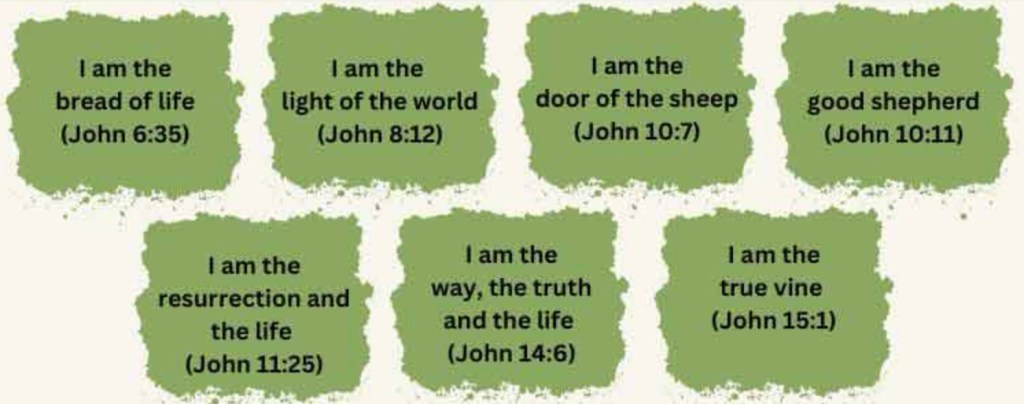
This statement is one of a number of “I Am” statements that are placed on the lips of Jesus in the book of signs, which we know as the Gospel according to John. These sayings comprise a verb (“I am”) followed by a predicate (the entity which Jesus claims to be). The predicates in most of these sayings are drawn from traditional Jewish elements.

When Jesus calls himself “the bread of heaven” (6:25–59), he is clearly evoking the scriptural account of the manna in the wilderness (Ex 16:1–36; Num 11:1–35; Pss 78:23–25; 105:40). The discourse which develops from this saying includes explicit quotations of scripture, as well as midrashic discussions of its meaning.

When Jesus presents himself as “the vine” (John 15:1–11), he draws on a standard scriptural symbol for Israel (Ps 80:8; Hos 10:1; Isa 5:7; Jer 6:9; Ezek 15:1–6; 17:5–10; 19:10–14). Likewise, when Jesus calls himself “the good shepherd” (10:1–18), he evokes the imagery of the good shepherd as the true and faithful leader in Israel (Num 21:16–17; Ezek 34:1–31; Jer 23:4), and the people as the sheep who are cared for (Pss 95, 100; Ezek 34:31).

The statement that Jesus is “the light of the world” (8:12; 9:1–5) evokes the story of the creation of light (Gen 1:3–5) and the light which the divine presence shone over Israel (Exod 13:21–22). The Psalmist uses the imagery of light to indicate obedience to God’s ways (Pss 27:1; 43:3; 56:13; 119:105, 130; etc.), and it is a common prophetic motif as well (Isa 2:5; 42:6; 49:6; Dan 2:20–22; Hos 6:5; Mic 7:8; Zech 14:7; cf. the reversal of the imagery at Jer 13:16; Amos 5:18–20).

Although it is not part of an “I am” statement, the references to the “living waters” which flow from Jesus (4:7–15; 7:37–39) are reminiscent of the water which were expected to flow from the eschatological temple (Ezek 47:1; Joel 3:18; Zech 14:8), and, more directly, refer to the description of God used by the prophet Jeremiah (Jer 2:13).

In addition, biblical scholars have noted that rabbinic symbolism has affinities with Johannine symbols; for example, the terms bread, light, water and wine are all used by the rabbis in connection with the Torah. The author of John’s Gospel stands in the stream of Jewish writers who have used multiple images to convey their faith in the Lord God.

Thus, the distinctive set of Christological claims made for Jesus in the Gospel according to John seek to enter into this stream of writing. They are both thoroughly grounded in scriptural images and familiar from the ongoing traditions taught by the rabbis. The author of this Gospel is using a number of ways to declare his faith in Jesus as “the Word of God”, “the Way”, and indeed as being at one with God. It is a high claim.

Amidst the variety of Jewish voices at the end of Second Temple Judaism clamouring to be holders of “the truth”, using a wide variety of rhetorical means, this author seeks to position his community—a sectarian Jewish group—as the holder of the true faith, the ones who adhere most clearly to what the Lord God requires amongst his faithful people. And for this group, it is Jesus of Nazareth who most clearly and faithfully leads them along that pathway of understanding and living.

See more on this understanding of the community of John at

So this discourse addresses what we might assume to have been a well-known and widespread understanding of the nature of God amongst Jews of the time; he is the one who provides the bread to nourish and sustain lives of faith. When Jesus lays claim to being “the true bread”, it is yet another moment when he says, quite poetically, what he later declares in a very prosaic manner: “the Father and I are one” (10:30).

*****

Still to come in considering the lectionary passages from John 6 that lie ahead:

Jesus offers a midrashic exposition on “the bread of life” (6:35–51): how does Jesus operate in his Jewish context?

Disputing the claim of Jesus to be “the bread of life” (6:51–58): the characters in the story John tells, the sectarian nature of his community

The Johannine remembrance of Eucharistic communion and the community’s distinctive “structure of reality” (6:56–69)

and on the various I AM statements

Nothing but five loaves and two fish (Matt 14; Pentecost 10A)

My post about this week’s Gospel passage is once again indebted to conversations that I have had with my wife Elizabeth about this story, and the surrounding material, in Matthew’s Gospel. She has undertaken much careful research into the way that Matthew redacts his Markan source.

*****

The story that the lectionary invites us to hear this coming Sunday (Matt 14:13–21) is Matthew’s account of “the feeding of the five thousand”, a much-beloved miracle of Jesus. It is also one of a handful of miracle stories that is narrated by all four canonical Gospels (Mark 6:30–44; Matt 14:13–21; Luke 9:12–17; and John 6:1–14).

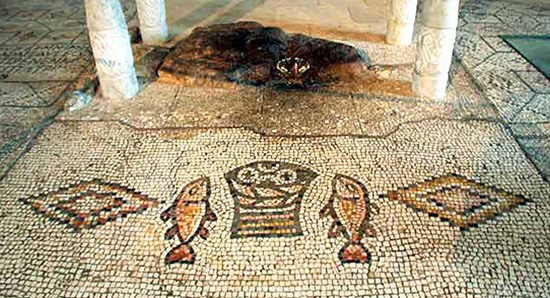
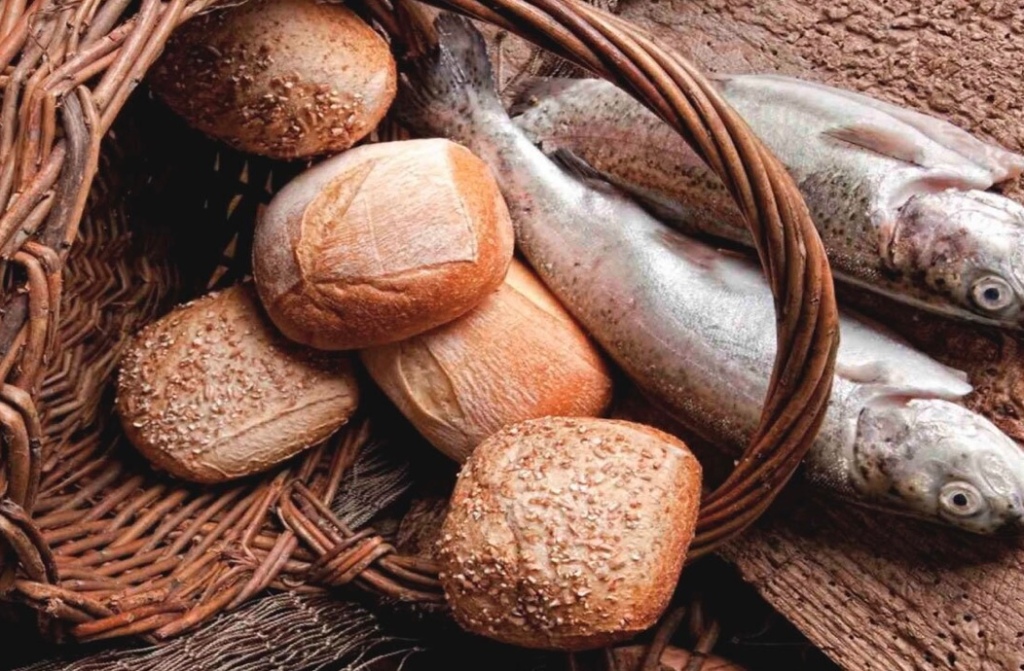
The set-up for this story is that Jesus and the disciples are surrounded by a large crowd, time is drawing on, and there appears to be no food to eat. The punchline for the miracle is that, whilst at the start there was “nothing but five loaves and two fish”, by the end,,after “all ate and were filled”, there were “twelve baskets full” of leftovers!

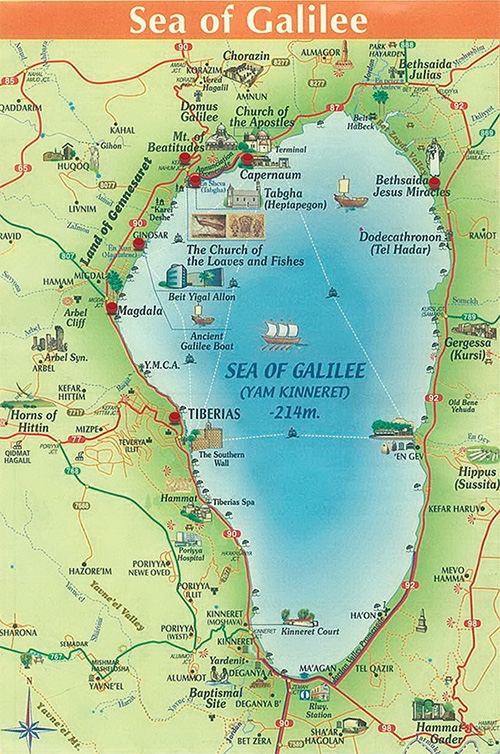
For John, the feeding takes place “on the other side of the Sea of Galilee, also called the Sea of Tiberias” (John 6:1), before Jesus and the disciples cross the Sea of Galilee, back to Capernaum (John 6:16–17). Mark, however, locates this feeding in Jewish territory, after the first trip that Jesus had made to the Decapolis, on “the other side” (Mark 4:35—5:21). Matthew and Luke follow Mark in locating this scene in Jewish territory.

Then, following Mark, Matthew recounts a second feeding, of four thousand, which Mark locates on the Gentile side of the lake (Mark 8:1–10). The geography in Matthew’s narrative of this scene (Matt 15:32–39) is, as we shall see, somewhat vaguer; the incident is, however, the same in most details as that found in Mark. Luke omits all mention of this second feeding, as does John.

The number fed is consistently reported in all four accounts as being five thousand—although there are variations here. John offers this figure as an approximation of the whole crowd present (John 6:10). Mark and Luke both specify that those fed were men only (Mark 6:44; Luke 9:14), whilst Matthew teases out the implications: “those who ate were about five thousand men, besides women and children” (Matt 14:21).

Mark notes that Jesus organised the crowd in smaller groups, sitting on “green grass” (Mark 6:39), noting that “they sat down in groups of hundreds and of fifties” (Mark 6:40). Matthew simply notes that they sat on grass, colour not specified, and makes no reference to sitting in groups (Matt 14:19). This is typical of the way that Matthew omits much of the detailed narrative colouring that Mark regularly reports—such as the groups on the green grass.

So Matthew’s account is somewhat shorter than Mark’s account (seven verses in Matthew, ten verses in Mark). Both accounts, as well as Luke’s version, report the actions of Jesus as he “looked up to heaven, and blessed and broke the loaves, and gave them to his disciples to set before the people” (Mark 6:41; Matt 14:19; Luke 9:16).

This sequence clearly reflects the liturgically-developed pattern (repeated religiously in eucharistic settings over the centuries) of the last supper of Jesus: “he took a loaf of bread, and after blessing it he broke it, gave it to them … then he took a cup, and after giving thanks he gave it to them, and all of them drank from it” (Mark 14:22–23 and parallels; and see also 1 Cor 11:23–25).

The pattern is missing from John’s account, which simply notes that “Jesus took the loaves, and when he had given thanks, he distributed them to those who were seated” (John 6:11). John’s Gospel omits any specific report of eating at that “last supper”, focussing rather on the washing of feet and discussion of Jesus’s imminent departure (John 13).

Johannine allusions to eucharistic practice appear later in chapter 6, after a long sequence of midrashic exposition by Jesus, around the theme of “the living bread … that came down from heaven” (John 6:22–59)—a discourse that we learn, at the end, is set “in the synagogue at Capernaum” (John 6:59)—back on the side of the lake from whence Jesus had departed (John 6:16).

*****

All four stories contain the significant detail that “all ate and were filled; and they took up what was left over of the broken pieces, twelve baskets” (Matt 14:20; see also Mark 6:43; Luke 9:17; John 6:13). Now twelve was an important number for the Jewish people; perhaps the twelve baskets are symbolic for the Jewish people? In which case, we might ponder how much of the story is symbolic, and how much “actually happened”?

To think a little about twelve … There were 12 sons of Jacob (Gen 49:1–28), then 12 tribes of Israel (Deut 27:12–13). On the table in the Tabernacle were placed 12 silver plates, 12 silver dishes, and 12 golden plates (Num 7:84–89), and the breastplate of the priest contained 12 precious stones (Exod 28:21) as emblems of the 12 tribes as they camped round about the Sanctuary. Moses built an altar at the foot of Mount Sinai with 12 pillars (Exod 24:4) and Joshua had the people take 12 stones from the River Jordan to be placed as a memorial to their entry into the land (Josh 4:1–10).

As the story continues in the Gospels, Jesus chose 12 apostles as his inner circle (Mark 3:13–19 and parallels in Matt 10 and Luke 6; and John 6:67–71). Jesus indicates that this signified the link between his movement and the traditions of Israel (Matt 19:28; Luke 22:30; and see James 1:1). And when Jesus feeds the great crowd of 4,000 people beside the Sea of Galilee (Mark 8:1–9), there are twelve baskets of bread left over (Mark 8:19).

And in the final dramatic visions written about the promised future by the aged seer John, the number 12 figures prominently. We see this first in the vision of a woman wearing a crown with 12 stars (Rev 12:1). The number then appears in the architecture of “the holy city Jerusalem coming down out of heaven from God” (Rev 21:10), with its 12 gates with 12 angels and the names of the 12 tribes (Rev 21:12), and its 12 foundations with the names of the 12 apostles (Rev 21:14). Finally, there are 12 pearls on these 12 gates (Rev 21:21) and 12 fruits on the tree of life (Rev 22:2).

Is the emphasis on 12 in this narrative in Mark 6 and Matthew 14 and the other gospels deliberately underlining the Jewish setting, and pointing to the centrality of Jewish matters in the story? It’s a fascinating thought, which is strengthened by the observation that in the accounts of the feeding of the 4,000 (Mark 8:1–10; Matt 15:32–39) there were “seven baskets full” (Mark 8:8; Matt 15:37).

Mark locates this scene “on the other side” of the Sea of Galilee. In this Gospel, Jesus had just been “in the region of the Decapolis” (Mark 7:31), and after this feeding, he returns to Jewish territory on “the other side” (Mark 8:13).

Matthew removes any reference to Jesus being in the Decapolis; after the journey by sea that Jesus undertakes with his disciples to “the other side” (Matt 14:22), Jesus apparently returns immediately to Genessaret, on the western (Jewish) side of the lake (Matt 14:34), and has gone “up the mountain” beside the Sea of Galilee, where “he sat down” (Matt 15:29). That is a strong clue that Jesus is on Jewish territory, teaching and healing.

For Matthew, the second crowd that Jesus feeds is entirely Jewish. For Mark, the crowd that was being fed most likely included many Gentiles, as well as Jews who lived “on the other side”. The significance of seven has been the focus of attention for many interpreters (does it refer to the seven gentile nations which were in the land of Canaan? the seven days of creation? or the seventy nations, 7×10, that are listed as “the nations” at Gen 10:1–32?) Whilst the symbolism of twelve is clear, the symbolism of seven is less obvious.

*****

Each account of the feeding of the 5,000 also notes that, as well as the five loaves, there were two fish provided for distribution to the crowd (Mark 6:38; Matt 14:17; Luke 9:13; John 6:9). Only Mark notes that the twelve baskets of leftovers included fish as well as “broken pieces” of bread (Mark 6:41). Interestingly, in Matthew’s account of the feeding of the 4,000, “a few small fish” were provided along with the seven loaves (Matt 15:34).

Mark’s account, presumably known to Matthew, did not mention this detail. Was Matthew unconsciously harmonising the narratives of the two feedings? Certainly, a fish would become an important symbol used by the early Christians (and still seen today) to mark their identity. The Greek word for fish, ichthus, written in capitals as IXTHUS, was used as an acronym to signal faith in Jesus: I (Iēsous, Jesus), X (Christos, Messiah), TH (theou, of God), U (huios, Son), S (sōtēr, Saviour).

Of the four accounts, only John notes that the loaves of bread had been made from barley (John 6:9), perhaps evoking the story of the twenty loaves of barley provided to Elisha to feed a hundred people (2 Kings 4:42–44). And only John included the detail, much beloved by flowery preachers, that the five loaves and two fish were provided by a boy (John 6:9). It adds a simplicity to a wonderfully impressive miracle, perhaps. However, in each of three Synoptic accounts, those loaves and fish simply appear from within the crowd.

*****

Finally, we turn to the way that this feeding story is introduced by the evangelists. All four evangelists note that a large crowd was gathering: “many were coming and going … [Jesus] saw a great crowd” (Mark 6:31, 34; Matt 14:13–14; Luke 9:11; John 6:2, 5). In John’s account, the presence of this “large crowd” leads Jesus simply to ask a straightforward logistical question, “where are we to buy bread for these people to eat?” (John 6:5).

In the Synoptic accounts, it is the disciples who get worried about the numbers present, and advise Jesus to “send the crowd away” so that they can get provisions elsewhere (Mark 6:36; Matt 14:15; Luke 9:12).

In two of the Synoptic narratives, however, the crowd has previously drawn words of compassion from Jesus. Mark reports that “he saw a great crowd and he had compassion for them, because they were like sheep without a shepherd, and he began to teach them many things” (Mark 6:34). Matthew simply notes that Jesus “had compassion for them and cured their sick” (Matt 14:14). It’s a neat pastoral touch, I think, to have Jesus healing, rather than teaching, with this large crowd.

The lack of food at hand signals that the scene is set well away from the towns and villages that Jesus frequented. Indeed, in Mark’s narrative, Jesus had intentionally taken his apostles into a boat and moved away into “a deserted place” (Mark 6:31); Matthew follows Mark in this regard (Matt 14:13). In the biblical tradition, the wilderness plays a pivotal role in the story of the Israelites, freed from captivity in Egypt, yearning for the promise of land and safety still ahead of them.

The wilderness was the place where the character of Israel was forged. It was in the wilderness, throughout that long period of wandering, that they had encounters with the divine, that their identity was shaped, that their foundations as a nation were laid. The stories told in Exodus, Numbers, and Deuteronomy tell of thirst and hunger in the wilderness, encounters with snakes and other trials—as well as the giving of the law, on Sinai, a mountain in the middle of the wilderness.

The journey through the wilderness figured in the songs of Israel. It is regularly recalled in the Psalms (68:7, 78:15-20, 40, 52, 95:8, 106:14-33, 136:16) as well as in various prophetic oracles prophetic oracles (Isaiah 40:3-5, 41:17-20, 43:19-20, Jer 2:6, 31:2-3, Ezekiel 20:8b-21, Hosea 13:4-6, Amos 2:9-10, Wisdom of Solomon 11:1-4) and occasional narrative references. The exodus from Egypt and the subsequent wilderness wandering, provided the foundational story for Israel, from long ago, and still through into the present.

The wilderness was where Israel met God; where Israel’s commitment was tested; where Israel’s faith was shaped. That is where, in the narratives of Mark and Matthew, Jesus expresses his compassion for the crowd and feeds “five thousand men, besides women and children” (Matt 14:21).

Luke, by contrast, has Jesus take his followers to “withdraw privately to a city called Bethsaida” (Luke 9:10), whilst John reports that Jesus “went up the mountain and sat down there with his disciples” (John 6:3), adding the note that “the Passover, the festival of the Jews, was near” (John 6:4)—the second of three Passovers in this narrative (John 2:13; 6:4; 11:55).

The four accounts differ in remarkably few details, overall, indicating either that there was a high level of memory retention by those who told and retold the story orally, before the Gospels took written firm; or else, that some kind of manuscript with an account of this incident (as well as some other stories) was known amongst the followers of Jesus at a relatively early stage of development of the Gospels. Either way, it is an intriguing and informative narrative for us to reflect on this coming Sunday.