“We thank you for the ministry you have exercised”. A service of Closure of Ministry.

Elizabeth and I have just attended the Closure of Ministry service at which the Rev. Jane Fry concluded her years of service as the Secretary of the Synod of NSW.ACT—or, as Elizabeth referred to it, the Synod of the ACT and NSW (ever loyal to our time in the Canberra Region Presbytery!)

It was held in the impressive surroundings, dripping with signs and symbols of Christendom, in St Stephen’s Uniting Church in Macquarie Street, Sydney, directly opposite the NSW Houses of Parliament. The team from St Stephens, under the wise and gentle leadership of Ken Day, did a fine job in hosting the crowd of people who came for this important occasion.

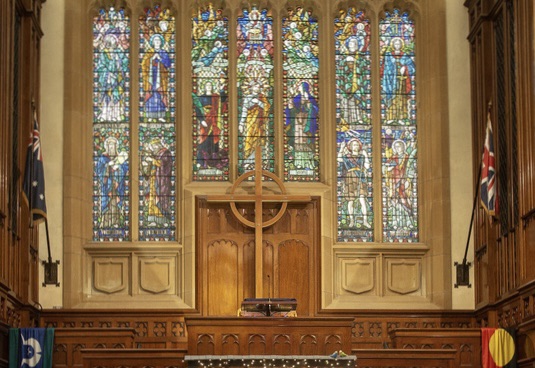
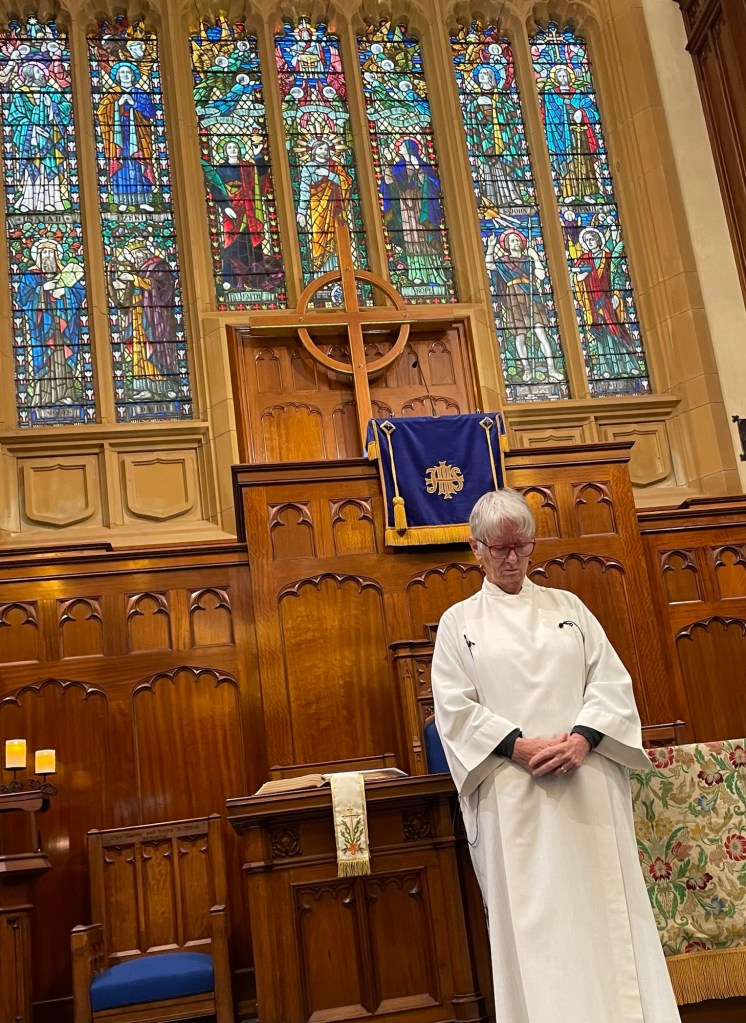
Banks of wooden pews filled the large floor area of the church, with wooden panelling running around the walls. At the front, above the high central (typically Presbyterian) pulpit, stained glass windows reached up to the high vaulted ceiling—including various Hebrew prophets and early Christian saints (including, of course, St Stephen himself). Two flags from the glory days of Church and Empire hung high at the front—the Australian Blue Ensign on the left, the British Union Jack on the right—and the respective flags of Aboriginal and Torres Strait Islanders were draped over the railings running out from the high pulpit. Rich symbolism abounded.
Our venturing all the way into the Sydney CBD for this event (170km, but who’s counting?) meant, on the one hand, that we had to endure the thick, turgid, stress-evoking traffic snarls of Sydney; nothing can be a stronger signal to Elizabeth and myself that we have made the right decision to retire in rural Dungog! Yet this visit also offered the welcome opportunity to celebrate and express gratitude for the gifts Jane has brought to this crucial leadership role, and to meet up with many people with faces and names familiar from past years (or decades)! It was good to reconnect in person with many who for some time now have been “Facebook friends”. The bonds of years past hold strong.

There were multiple conversations in the church’s Ferguson Hall in the time after worship, as we ate, drank, and caught up, under the watchful eye of the Rev. John Ferguson, after whom the hall is named. Ferguson was minister of St Stephen’s from 1894 to 1925, including a term as Moderator-General of the Presbyterian Church in Australia commencing in 1909. 

Alan Dougan writes in the Australian Dictionary of Biography that “his inaugural address, published as The Economic Value of the Gospel, raised a storm in Melbourne and praise from trade union leaders. Billy Hughes said ‘The new moderator preaches a gospel all sufficient, all powerful. He grapples with the problems of poverty … he insists on justice being done, though the heavens fall. I advise every citizen to read every word of it’.”

Ferguson was a most enlightened minister, it would seem; apparently he sought an audience with the Pope on a visit to Rome in 1914, “an action that evoked much hostile criticism in Sydney”, says Dougan. The tribalism in Sydney’s ecclesial life, clearly evident in this reaction, is sadly still alive and well in this city, where sectarian fundamentalism (“We Know The Truth, and Only We Have It!”) has an iron grip in some churches. Not in the Uniting Church, however!
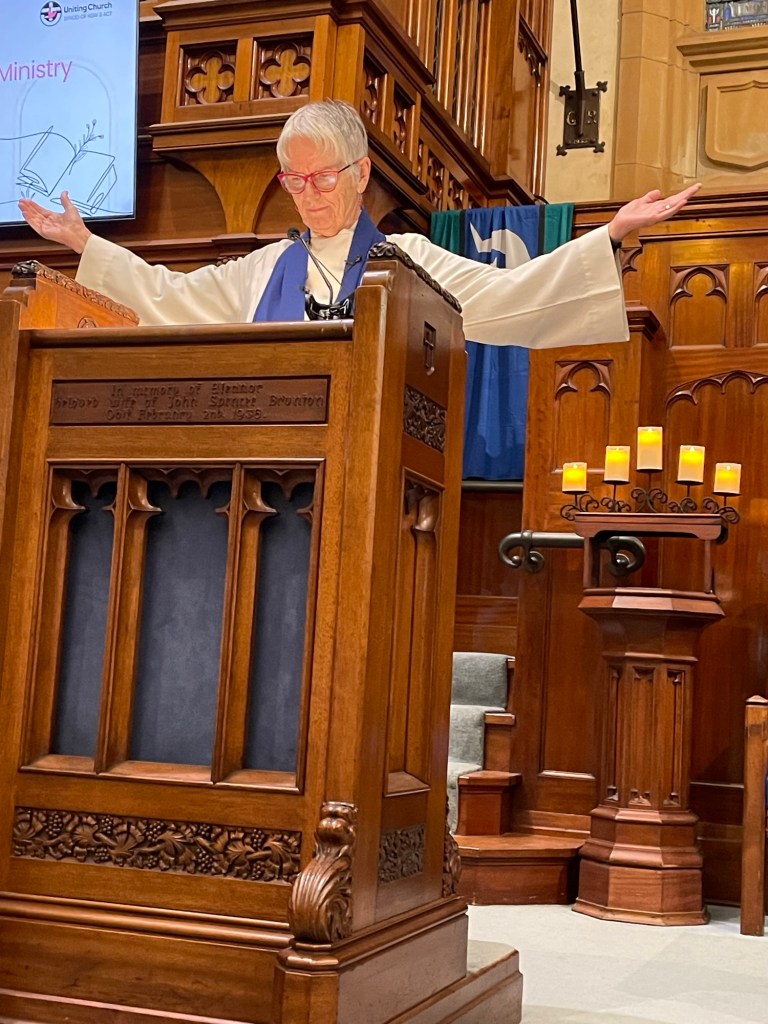
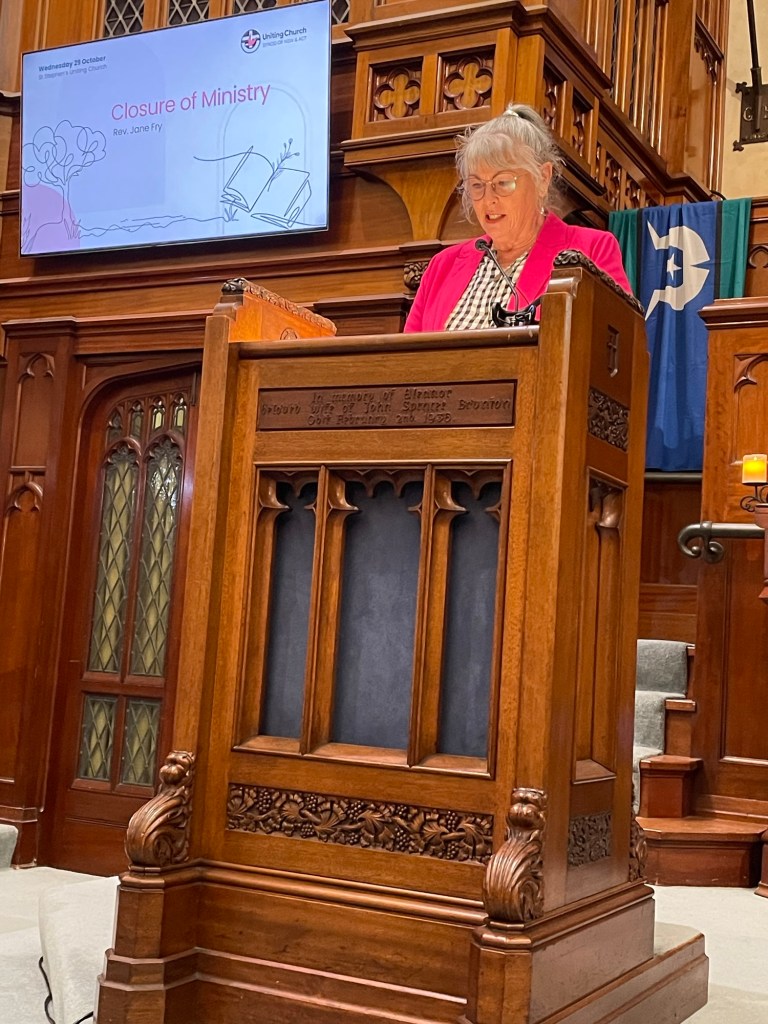
Jane Fry calling the people to worship

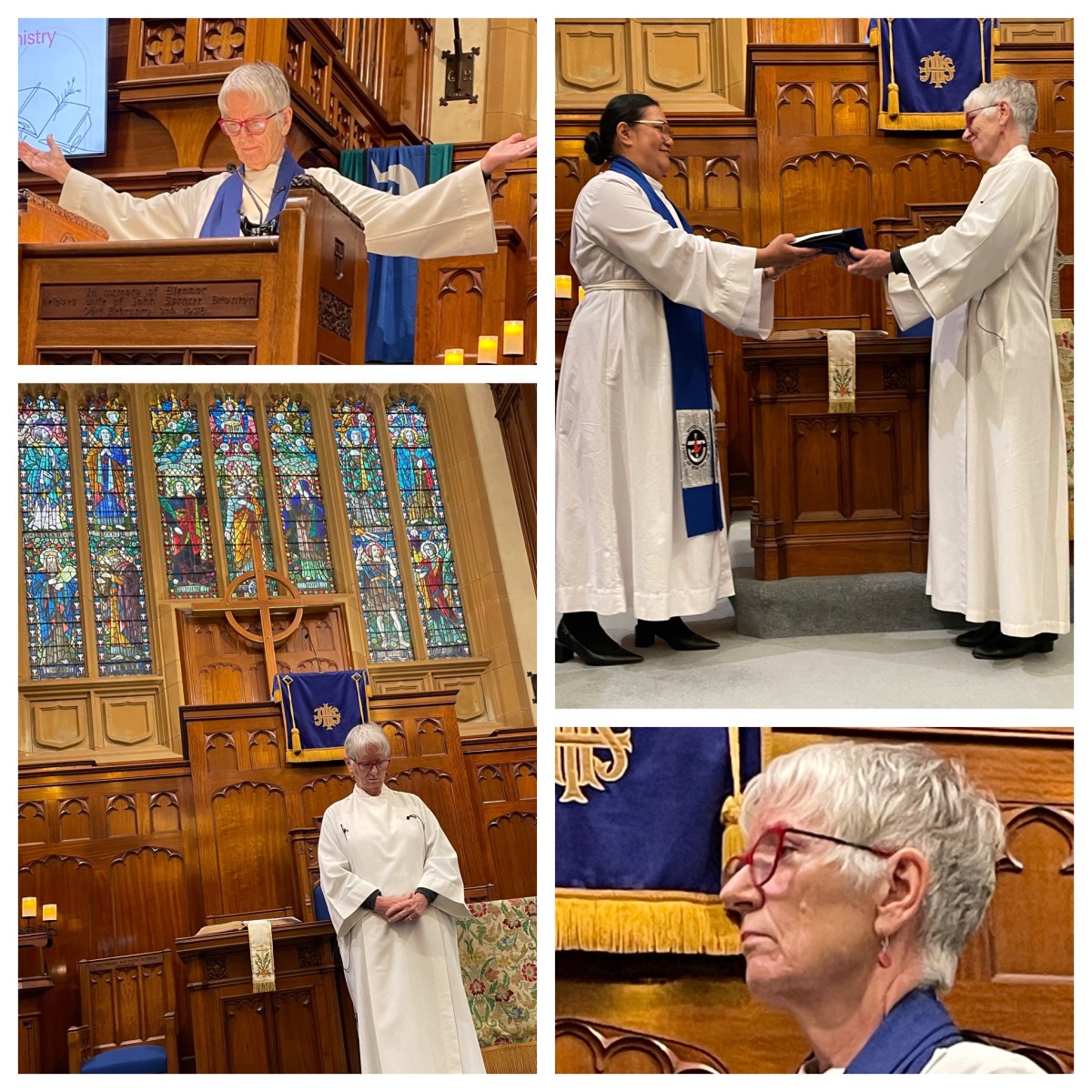
The church on this occasion held a full congregation when the service itself began, with Jane in characteristic pose, arms outstretched, as she called the people to worship: “Look! Listen!”, with a string of appropriate scripture sentence after each iteration. Nathan Tyson then acknowledged Country, giving thanks for the First Peoples who have cared for the land for millennia, and offering a gracious and warm welcome to the many Second Peoples (of multiple cultural heritages) who had gathered for the occasion.
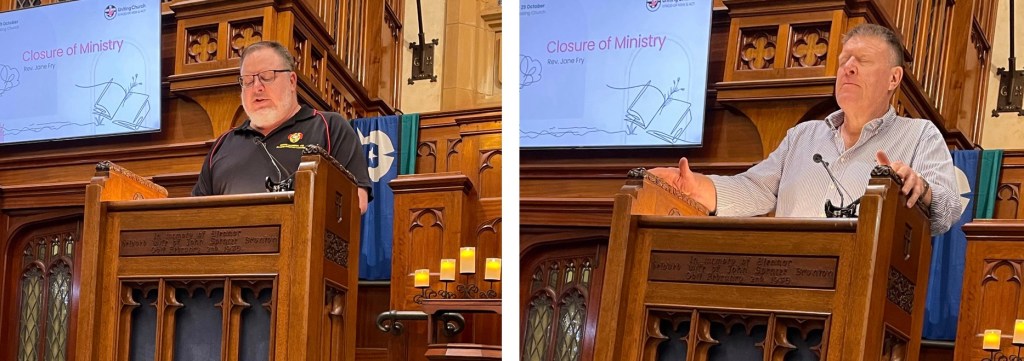
Nathan Tyson (left), Simon Hansford (right)

Past Moderator Simon Hansford brought words of confession (“we speak words of cynicism and anger; for this we are sorry …”) before offering an Assurance of God’s pardon, to which we replied, “thanks be to God”. Jane and Simon had worked together as a fine set of leaders of the Synod team for six years, through the difficulties and challenges of the COVID pandemic. It was good to have his clarity of thought in these prayers of confession.

We sang a number of good hymns, including a favourite one written by Charles Wesley “a long time ago”, as wry Jane’s annotation in the order of service observed. How many people were like me: enjoying the melody and harmony of “And can it be” whilst inwardly recoiling at the blood, wrath, and divine vengeance permeating the hymn, before divine grace eventually shone through? 

Yes, these words show that it was indeed “a long time ago” that such theology reigned supreme; fortunately within the Uniting Church we can see that “the Lord has yet more light and truth to break forth from his word” (in the words of John Robinson, spoken to the Pilgrims in 1620 as they departed on their journey to “the new world” in 1620, and then include in a hymn written by British Congregationalist George Rawson in  the 1850s).

So it is that, as a church, we do indeed rejoice in the affirmation that we “remain open to constant reform under [God’s] Word” and that as “a pilgrim people, always on the way towards a promised goal” we are able to delve into our scripture, traditions, and heritage, “give thanks for the knowledge of God’s ways with humanity which are open to an informed faith”, “sharpen its understanding of the will and purpose of God by contact with contemporary thought”, and stand “ready when occasion demands to confess the Lord in fresh words and deeds”. (Excerpts from the UCA Basis of Union)

Neale Roberts of Uniting brought two readings from scripture, delivered with eloquence, nuance, and expression. From the scriptures we share with Jewish people he read a passage celebrating Wisdom: “When he marked out the foundations of the earth, I was there, beside him … now, then, listen to me” (Proverbs 8).
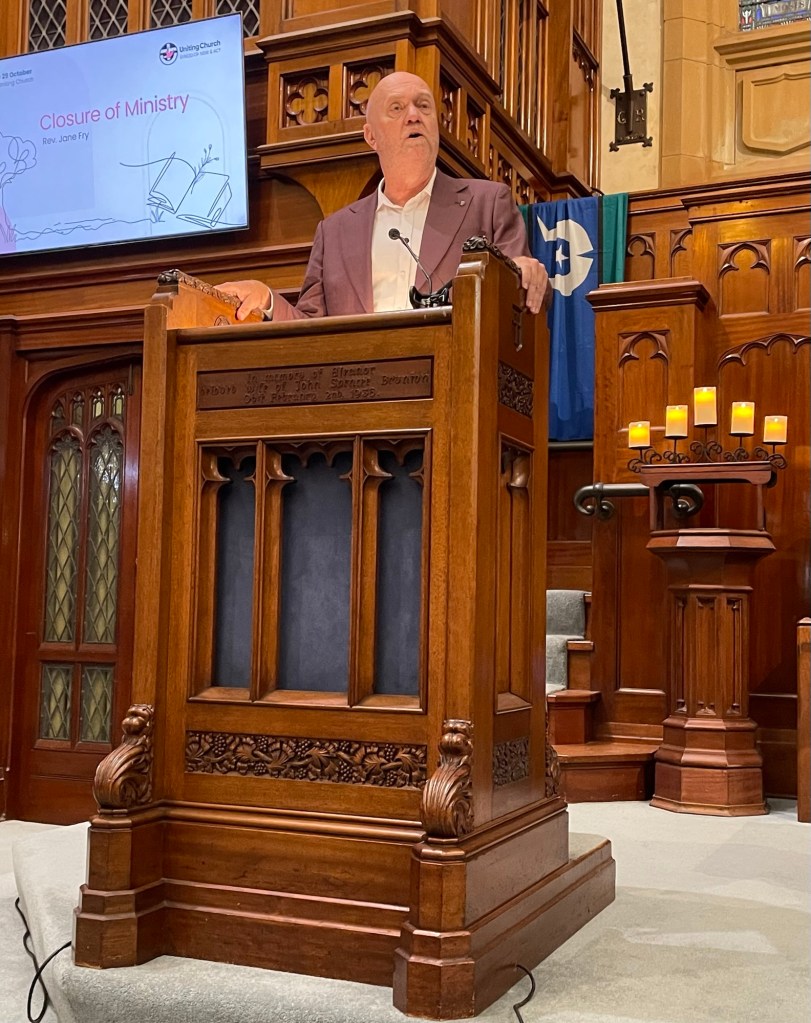
Neale Roberts

And then he read words attributed to Jesus: “do not worry about your life … look at the birds of the air … consider the lilies of the field … do not worry about tomorrow, for tomorrow will bring worries of its own; today’s trouble is enough for today”. As Neale observed to me afterwards, “I am sure Jane picked that passage for its final words, as a word to the church today”. They do indeed encapsulate the deep faith and strong hope that Jane has always exuded.

Elizabeth Raine, friend and colleague of Jane since they first met as theological students at UTC in the early 1990s, preached the sermon. Indeed, as a personal aside, I was struck the fact that all who offered leadership in this service, apart from Nathan Tyson, had studied theology and undergone formation for ministry at UTC during the 1990s; perhaps a fine testament to the grounding they had received then—more certainly, a clear indicator of the qualities and giftedness that each person has brought to ministry over the ensuing decades. The church has benefitted much from the calling to which each of them has responded.
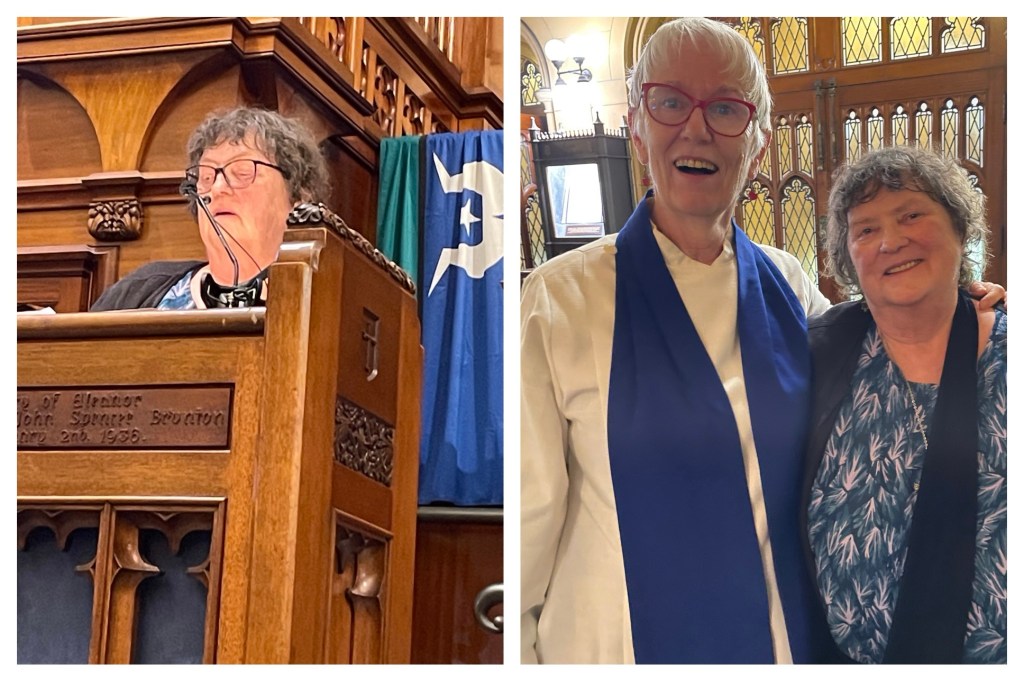
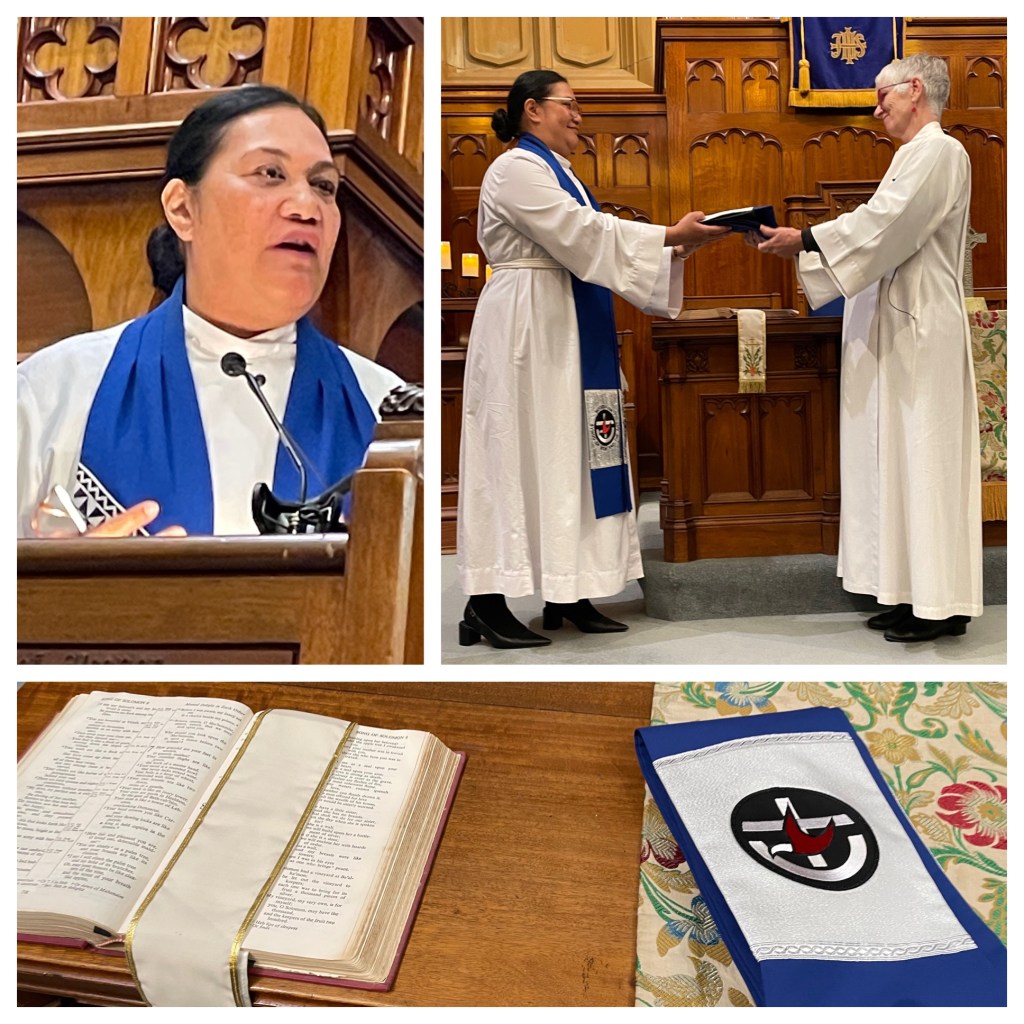
Elizabeth preaching (left); Elizabeth and Jane (right)

Elizabeth spoke about the figure of Wisdom who had been the focus of the Proverbs reading. She warned the congregation, “I told Jane I would be feral and unfiltered … and Jane said to me, ‘go for it!’” And so she did. You can read the full sermon via the link at the end of the blog, but here are some choice extracts: “Wisdom calls us on an unexpected journey … she transgresses male boundaries, standing at the street corner, raising her voice in public places … but Wisdom has been grafted on to Jesus by the early church scholars … they were consumed by their categories and systems … we emerged with a transgendered Holy Spirit … a meek, obedient virgin-mother became the model for women … the figure of Wisdom has been overshadowed.”

Elizabeth offered incisive exegetical insights into the riches that the poetic passage in Proverbs contains. concluded that Wisdom speaks to the church today; “she offers us a relational faith, listening to others, working together for the common good … anyone, but anyone, can acquire what she offers … she would undoubtedly value the invitation of Jesus to his disciples to ‘fish on the other side of the boat’, to be open to new possibilities, not to be bound to practices of the past, and to hold to a relational, experimental theology”. “How will we as a church relate to Wisdom?” she concluded.

Lady Wisdom, from the “Women of the Bible” series
by Sara Beth Baca; https://www.sarahbethart.com

It was clear from the many expressions of thanks—mostly, not entirely, from women in the congregation—that Elizabeth’s “unfiltered” feminist exposition of this crucial passage had struck a very positive chord for many who were present. “We need to hear this message, we need to hear your voice” was a regular refrain. Preachers and teachers in the church should take note; there is, within informed Uniting Church people, a deep appetite for substantive biblical preaching with a clear, prophetic, feminist hermeneutic that speaks directly into our situation today!
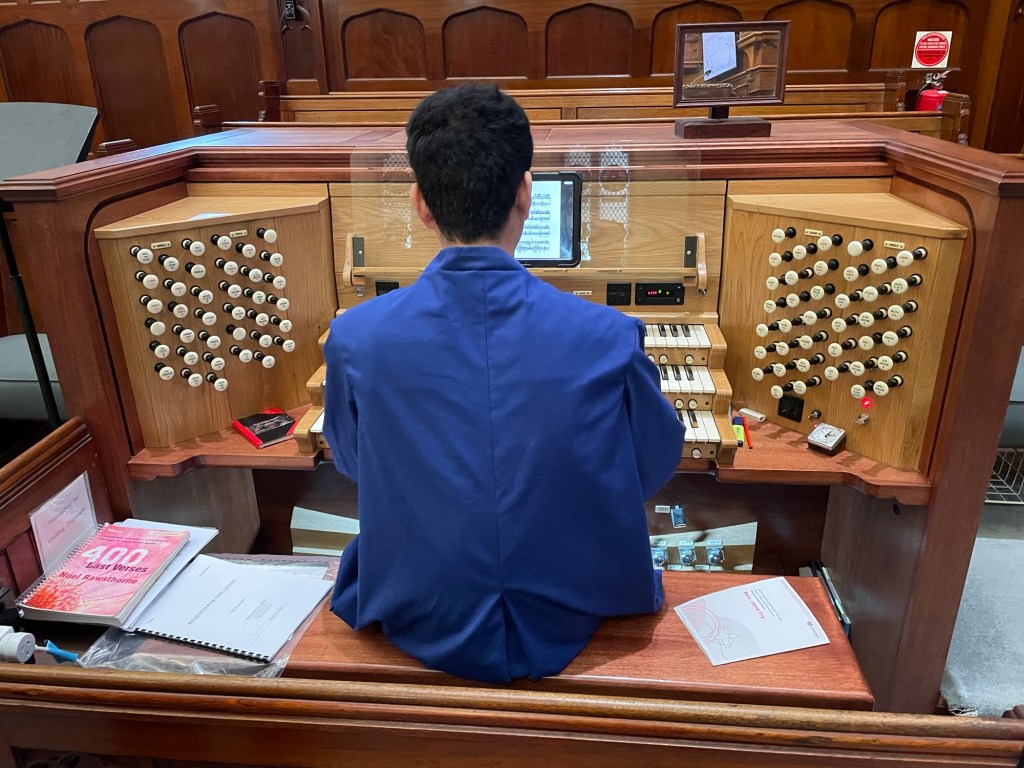
After joining in an Affirmation of Faith, we enjoyed the inspiring playing of the Stephens’ Organ Scholar, Andrei Hadap (pictured in action above), as we meditated on the delightful words of a hymn by Thomas Troeger: “how shall we love this heart-strong God who gives us everything, whose ways to us are strange and odd: what can we give or bring?” Associate Secretary of Synod Bronwyn Murphy then led the prayers of the people to this “heart-strong God”: “so much pain held within one small planet … so hear us, O God, as we pray for your earth … for all people, gathered within your welcome … for the Uniting Church, a body in transition … and for Jane and her family”.
Bron Murphy prays

Jane then spoke in her characteristic direct and challenging style. She referred to the “nine years of drama, change, and engagement across the church”. She is, she confessed (as if we needed reminding!) “a sceptical person, not an early adopter [who] did not expect the recent significant decisions of Synod to have been adopted!” Her reflection at this point was, once again, characteristically Jane; she saw this as an indication that “God is not done with the Uniting Church”.

She reminded all present that “the change [we have] initiated is just housekeeping. Synod is administrative, Presbytery has an oversight role, but the Congregation is where faith is nurtured”. She emphasised that the church is called to “nurture faith, form discipleship, and welcome all: these are the critical elements of being the church.” Her final word exuding the hope she has always held over the years in fulfilling her leadership roles in Congregation, Presbytery, and Synod: “neglecting the disciplines of faith is incredibly dangerous: prayer is the foundation. Letters us remember: ‘God has got this’”.
The Moderator receives from Jane the stole which symbolized
her ministry as Secretary of Synod

The Moderator, Mata Havea Hilau, then led the formal closure of ministry for Jane, offering the thanks of all present in the worship space and those participating via the livestream, and praying for Jane, “May the God who rested on the seventh day to delight in all the creation hold you in her arms as you have held this work, celebrate with us the life that takes life from you, and give you grace to let go into a new freedom”; to which all the people responded: Amen!
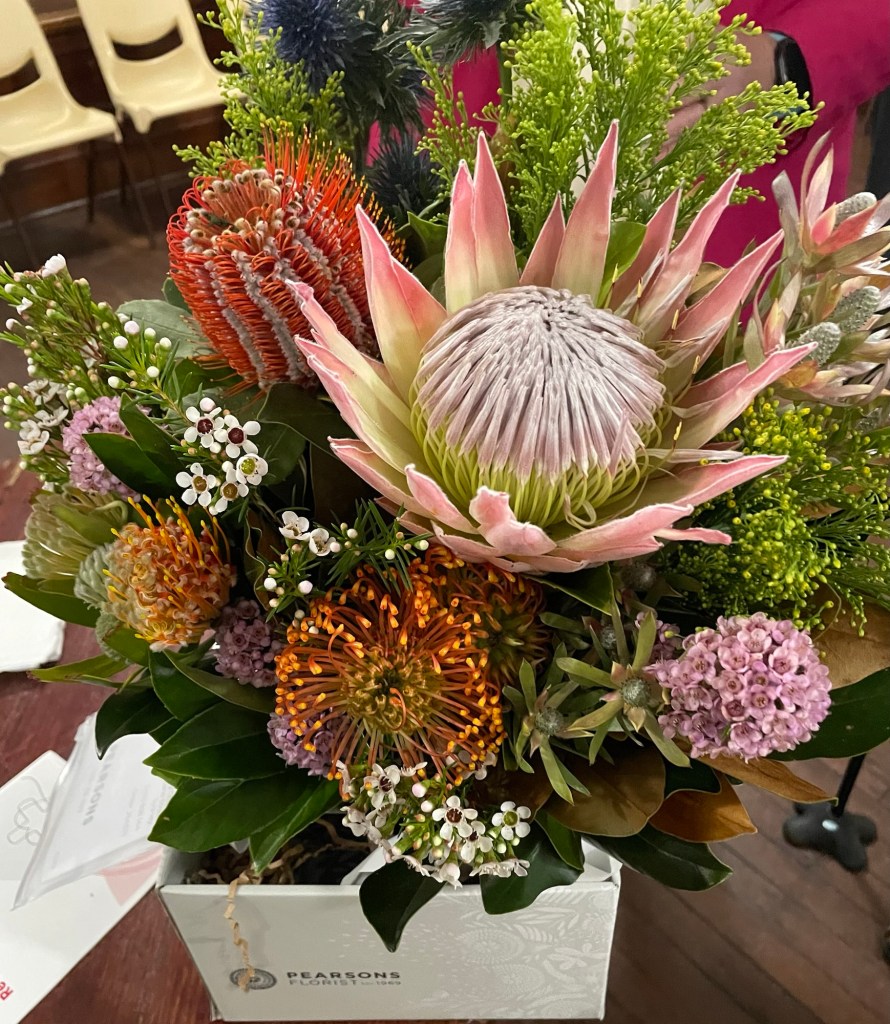
In the Ferguson Hall after the service, in the midst of the plethora of conversations filling the space with a cascade of sounds, Peter Walker, the incoming Secretary of Synod and former Principal of UTC (and yet another graduate of UTC from the 1990s!) presided over a brief time of formality. Jane expressed her thanks to many people who had worked alongside her and encouraged her over the past nine years. She was given a gift of a lovely bunch of native flowers.
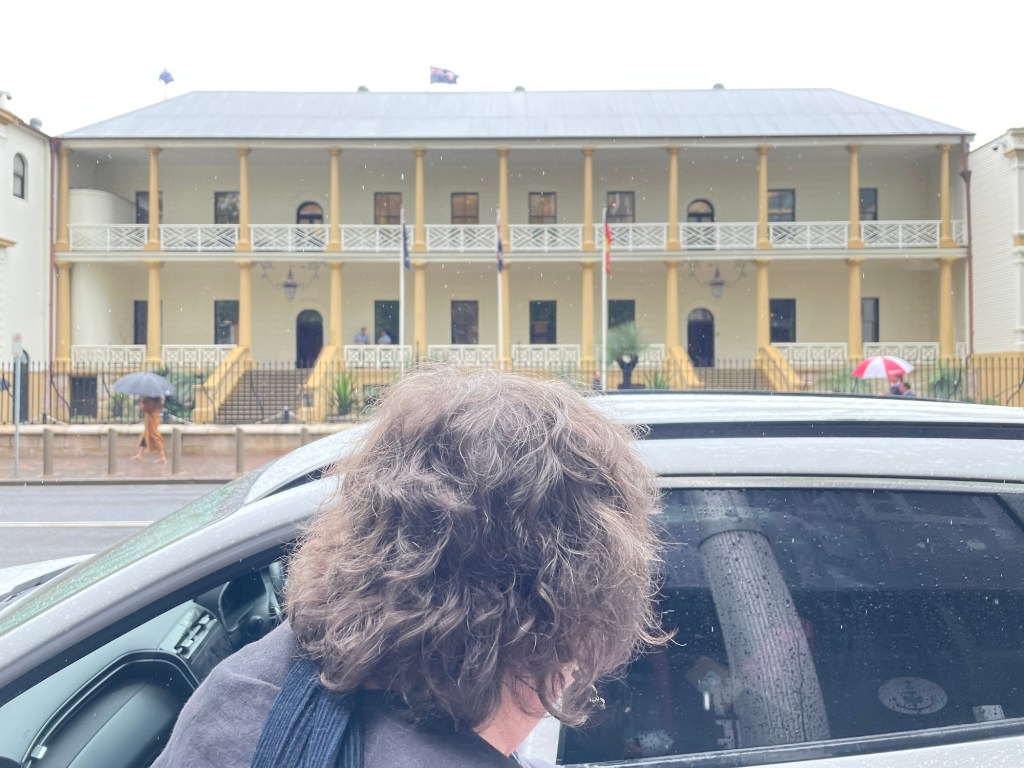
And then the crowd dispersed, stepping back into the rain, the traffic, the chaos of everyday life … … …
*****

You can read the full text of Elizabeth’s sermon at

A Triple Treat at Tuggeranong

This past weekend has provided a “triple treat” for the people of the Tuggeranong Uniting Church and the community of the Tuggeranong Valley, in the south of Canberra.

The first “treat” was the emergence of beautiful tulips in the garden beds at the entry to the church. The colourful flowers are part of Floriade Reimagined, a community initiative that that ACT Government put in place in 2020 when the COVID pandemic meant that the annual Floriade display in Commonwealth Park could not be held.

Floriade Reimagined tulips at Tuggeranong Uniting Church

The government provided bulbs to churches and community organisations, to be planted on their properties, and thus enable a reimagined form for Floriade to take place. During the period of lockdown, Canberrans were able to drive around the city and admire colourful displays at many dispersed sights. Tuggeranong Uniting Church was one of those, and since Floriade Reimagined has continued each year since 2020, the annual display of tulips was on again this year.

The second “treat” was the annual SpringFest, held on the grounds and in the building of the Tuggeranong Uniting Church (TUC). A fruitful partnership with local environmental advocacy group SEE-Change has led to SpringFest being a combination of a typical church Spring Fair and a community day with a focus on sustainability and environmental responsibility.

The carpark was filled with stalls, with the SEE-Change stall providing information on many ways to reduce our carbon footprint. Another stall provided a recycling drop-off point for a range of household items. Other stall holders offered demonstrations of how to make beeswax wraps, a Trash to Treasure Art Competition, an Indigenous Art collection of items, a Repurposed Art stall, garden tools sharpening and repairs, rock painting for the kids, and head and neck massages for stressed adults.

Information about Eco-Sustainability was provided by Suburb Zero (transitioning Canberra to fully-electric), ACT No Waste (a part of the ACT Government City Services Directorate), and the Southern ACT Catchment Group (an umbrella group for active environmental groups in the areas of Woden, Weston Creek, Tuggeranong and Tharwa).

In the Erindale Neighbourhood Centre on one side of the church, Spider-Man led a comic-drawing workshop—much to the delight of the children attending—and Elizabeth Raine explained how to reduce plastic by using alternatives in everyday household items that are more environmentally friendly. In the Erindale Community Garden on the other side of the church, workshops were offered on Composting and Worm Farms and Keeping Backyard Chickens, as well as an Introduction to Permaculture.

The results of the Spider-Man comic drawing workshop

The church building had a cake stall run by the Girls Brigade, clothing from the Red Dove Op Shop, books galore, crafts from church members and community members alike, a stall for clothes and repairs, a nature photography stall, and a comfortable space to sit and enjoy the cakes and slices made by TUC members, while drinking coffee or tea, and enjoying the live music provided throughout the day.

Over 400 people came to SpringFest, making it one of the highlight events for the church each year. All who came were greeted on entry by the Mad Hatter—aka the Rev. Sharon Jacobs, Growth and Relationships Minister at TUC. When people entered the church building, the Spring Fairy—aka the Rev. Elizabeth Raine, TUC Minister—beguiled them with her sparkling wings and enticed people to buy monkeys made by vulnerable Cambodian women, to support their micro-enterprise.

The third “treat” was a gathering on the Sunday after SpringFest, to celebrate the ministry of Elizabeth Raine, as she concluded her time in ministry at Tuggeranong and moved into retirement. Colleagues and friends from around the Presbytery joined TUC members to give thanks for the energy, dynamism, plain speaking, and strong leadership that Elizabeth has provided throughout the past five years. The church has changed and transformed during the pandemic, but has held all its members and has been gaining new participants in the worship and mission of the congregation. It is a growing, lively, inclusive community of faith.

The Rev. Jane Fry, Synod Secretary, with Ms Janet Kay, Canberra Region Presbytery Chairperson, and colleague ministers from the Presbytery, with the Rev. Elizabeth Raine at her Closure of Ministry service

The Synod Secretary, the Rev. Jane Fry, has been a good friend of Elizabeth since their time together in theological college 30 years ago. Jane preached during the service, reflecting on the “grumbling” of the Israelites in the wilderness, and pondering how we might “grumble” constructively in today’s world. A collection of friends from years past and recent provided lively musical leadership for the Congregation.

Local Federal Member for Bean, David Smith MP, spoke warmly about Elizabeth, noting her “deep personal faith and firm commitment to working for the common good in society … her passion in standing for justice and her compassion in serving people at their particular point of need.” David noted that, “as minister of the Tuggeranong Uniting Church in the electorate of Bean, she has worked collaboratively and energetically with the people of this church to extend its mission to be inclusive, community-oriented, rainbow-friendly, an advocate for climate justice, a support for people facing economic stress, and a strong advocate for the Voice to Parliament.”

David Smith MP present a gift to Elizabeth Raine

Elizabeth returned the symbols of her ministry—baptismal jug, communion cup and plate, Bible, TUC Directory, Rainbow banner, and her fairy’s wand—to members of the Tuggeranong Congregation, before Church Council Chairperson thanked Elizabeth for keeping the promises she had made in her initial conversation with the church—she promised to challenge people, to test them in their discipleship and commitment, and to change the way that they were church. He noted that “she did—and we did!”

Presbytery Chairperson Janet Kay then led the group in praying for Elizabeth, blessing her for her retirement. Elizabeth has served in a rich variety of ministry placements—as school chaplain and SRE teacher, a tenancy advocate, a congregational minister, an Intentional Interim Minister in four congregations, in a Presbytery Minister role in two Presbyteries, and then as Minister at Tuggeranong, where she preached and led worship, offered Bible Studies and pastoral care, participated in Presbytery committees, and strengthened the missional outreach of the church through multiple community connections.

The Tuggeranong Uniting Church Congregation
with the recently-painted mural on the western wall of the church building

Elizabeth will move with husband John to the Hunter Valley, to rest and wind down after a very active time at TUC. That should be a treat for them. But to end the series of “treats” at TUC on the weekend, the whole gathering enjoyed a typically delicious Tuggeranong afternoon tea!

Celebrating Pentecost 2023

For many years, people have come to church for key festive days of celebration. You may know the old saying about people who are “C-and-E Christians”—that is, they come to church at Christmas and Easter. And churches welcome this influx of irregular visitors—it is good to celebrate the key moments of our faith with those who choose to join in on those days.

In more recent years, a third festive day has emerged as a time when churches are filled with people joining in the celebrations. The Day of Pentecost is taking its place alongside Christmas and Easter as a key festive day in the church’s calendar. Pentecost, of course, is fifty days after Easter (the name itself signals that fifty-day marker). This year, it took place last Sunday, 28 May.

Tuggeranong Uniting Church (ACT, Australia)
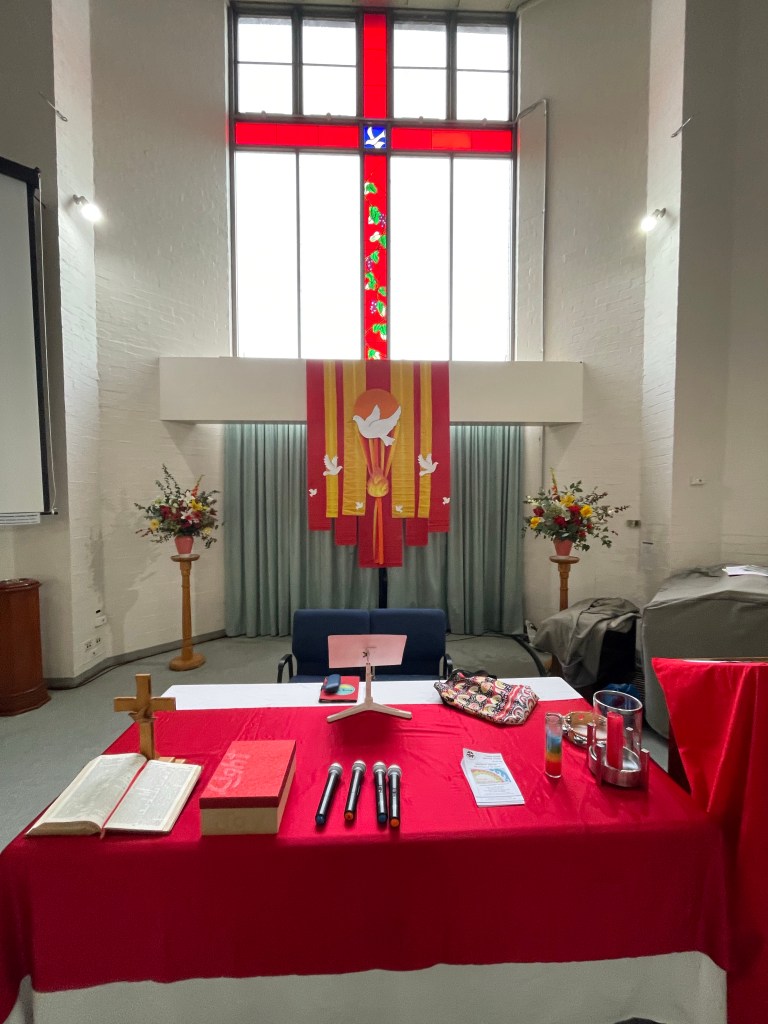
prepared for worship on Pentecost Sunday

Pentecost offers a wonderful opportunity for celebrating what is best about our faith. Remembering the coming of the Holy Sprit amongst the early followers of Jesus means that we can celebrate the openness to change, the joy of new developments, that we see around us in the church today. As the Spirit swooped with power amongst those early followers, so too the Spirit is energising the church today to new ways of serving.

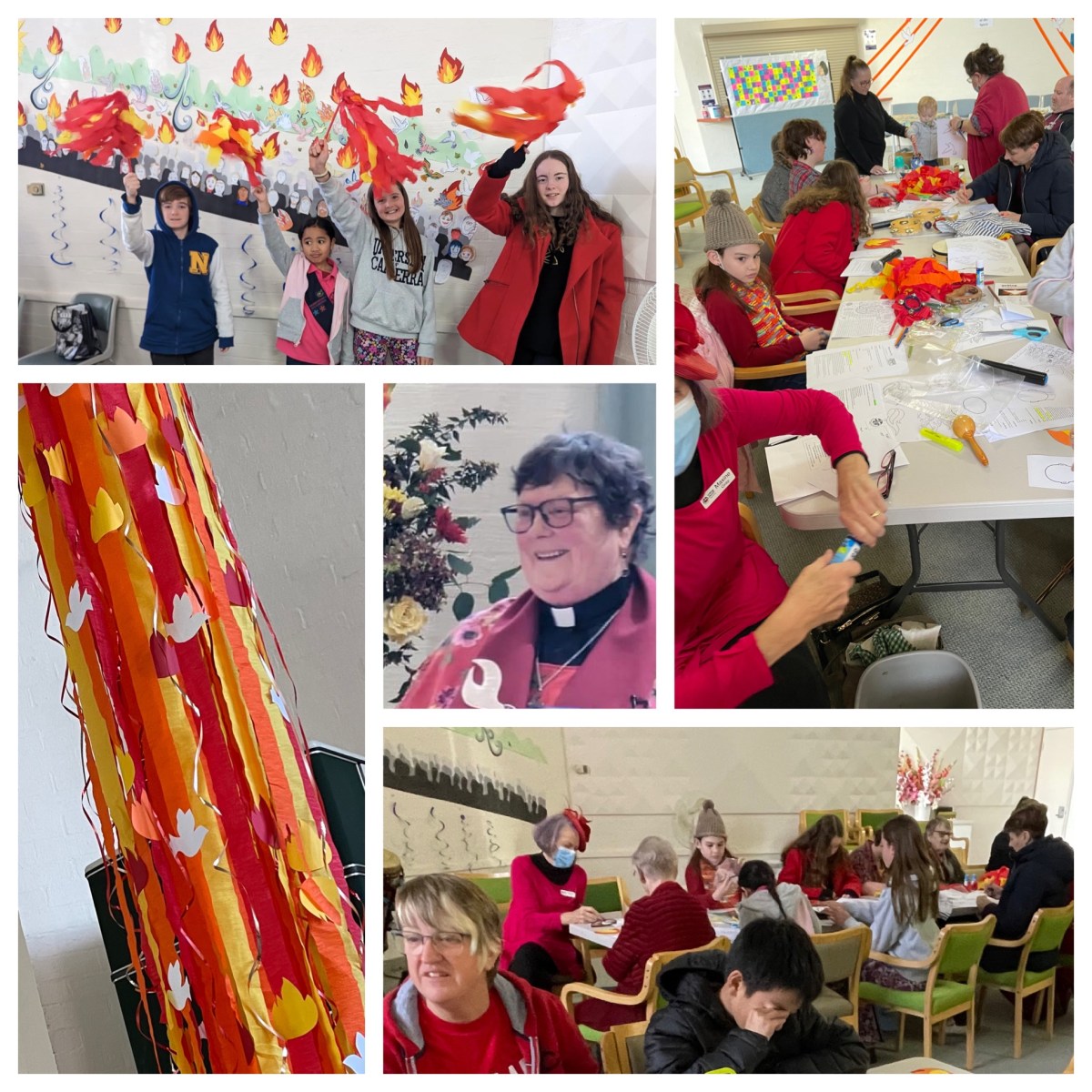
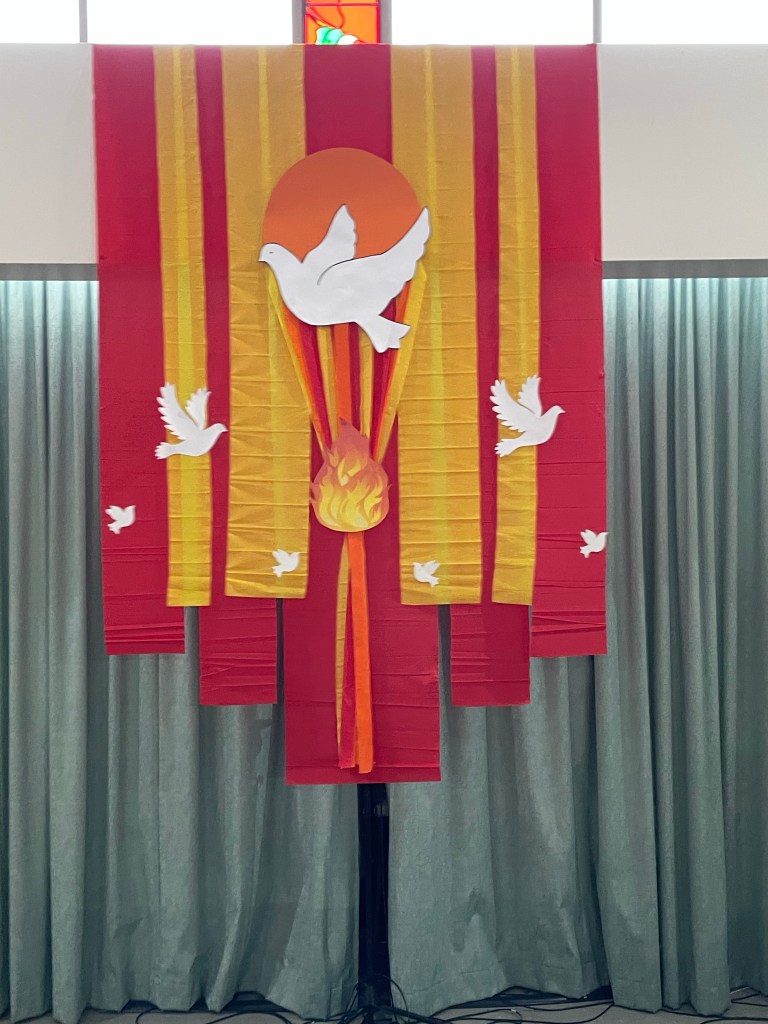
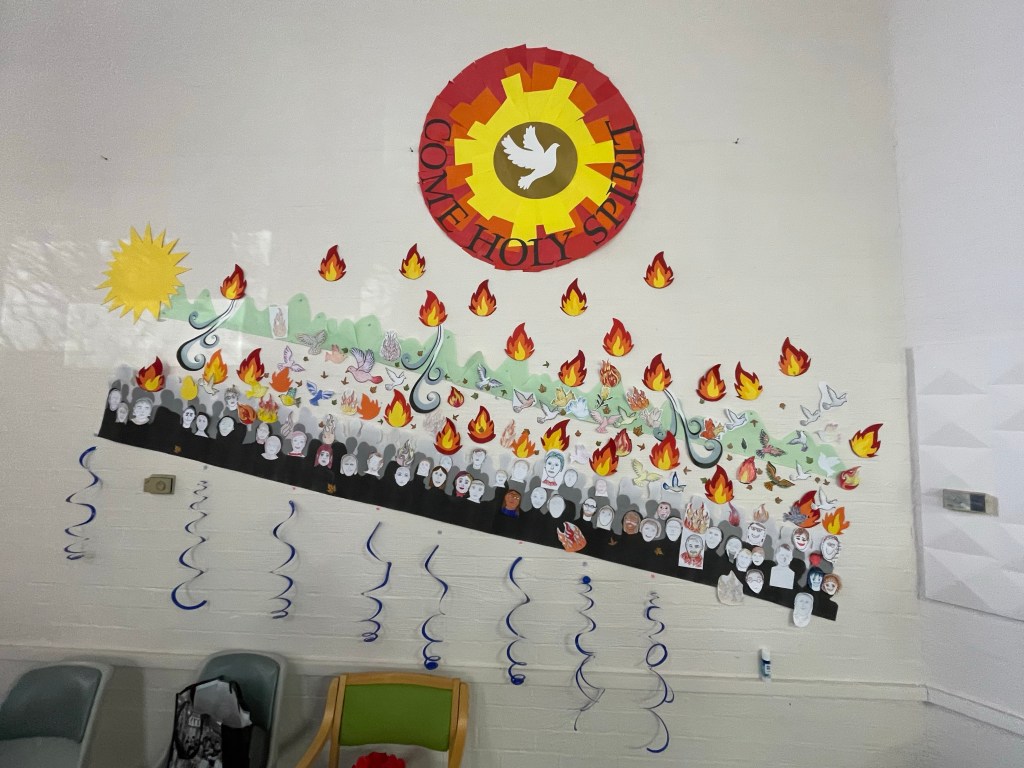
Red is the colour for the day, signalling the flames of fire by which the Holy Spirit rested on each of the believers who were gathered in the story told by Luke. At Tuggeranong Uniting Church, Pentecost Sunday has become one of the days when the Tuggeranong 15th Girls Brigade shares in leadership of the service. Girls Brigade Captain Elizabeth Moglia and a crew of enthusiastic helpers decorated the church with striking red-orange-yellow streamers and banners; the scene was set for a fine time of worship!

As the Rev. Elizabeth Raine gathered the congregation with an Acknowledgement of Country, members of the Girls Brigade led in prayer and presented a dramatic “radio news” account of the day of Pentecost. The regular group of five musicians led the congregation for the singing of joyful Pentecost songs, and one member of the congregation offered the Prayers of the People, praying for people in need locally and around the world.

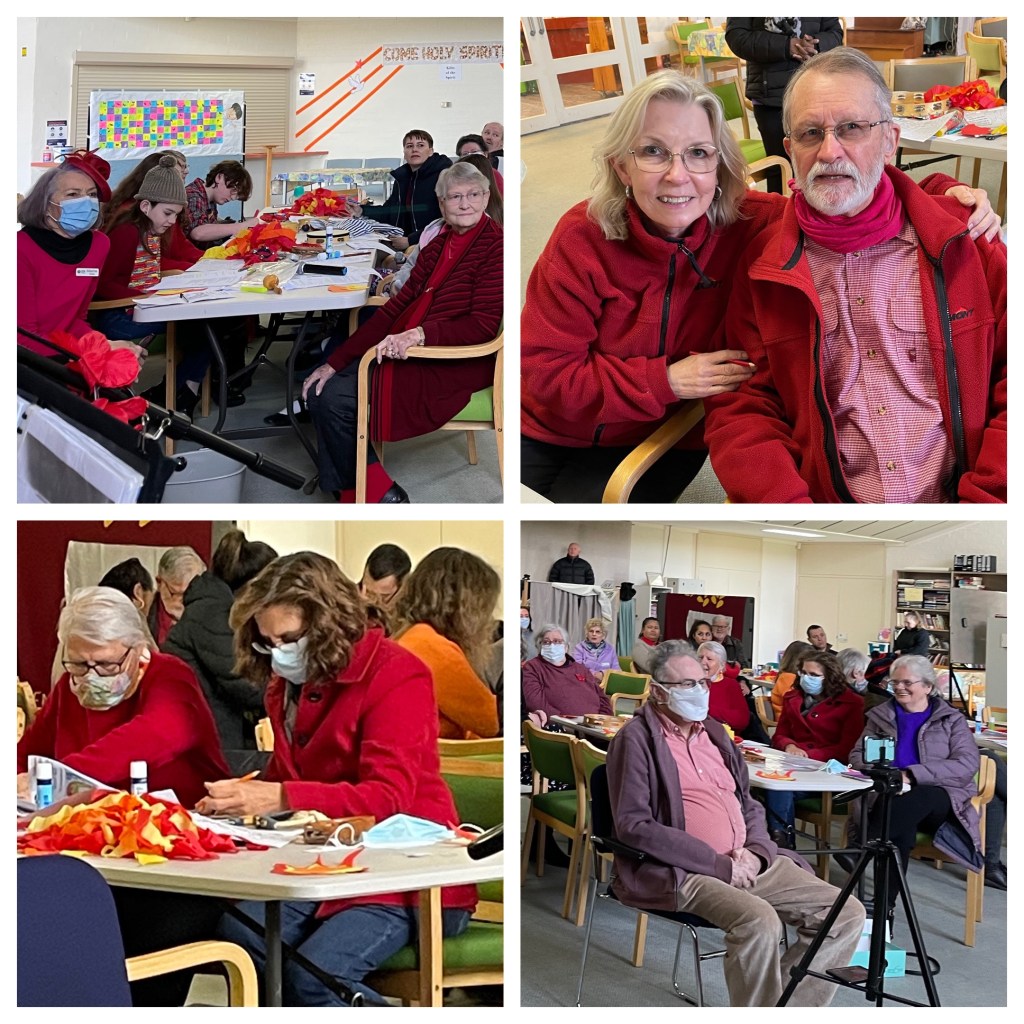
The church was set up for people to sit at table groups, and as the service progressed, each person present was invited to draw their face and pin that face, along with some fiery flames and doves, onto the side wall under a sign inviting “Come, Holy Spirit”. This symbolised the empowering of each member of the congregation for mission in their lives.

Present for this worship service was a strong contingent of younger members who brought energy and enthusiasm to the worship, inspiring all to join in enthusiastically. There was even a line of “cheer squad leaders” waving bright red-orange-and-yellow streamers during the joyful songs!

Elizabeth invited the congregation to consider: “does the Spirit still sweep through the church today, in the same way she did on that first Pentecost”? People responded by saying together an affirmation of the Spirit: “We believe in the spirit. She is extraordinary and wonderful; unknown and mysterious. She is always whirling, always animated; powerful and intense. She is magnificent and amazing; the fantastic, happy, joyful, golden, expression of God” (affirmation from Spill the Beans).

And, because it was the birthday of the church, there was a birthday cake to share at morning tea (and some smaller cupcakes for those with lactose or gluten intolerances); and a box with “gifts of the Spirit” for the young people present—gifts of joy, love, patience, courage, compassion, and more.

What a wonderful celebration! What a fine way to remember a central aspect of our Christian faith! What a great way to be motivated to live our neighbour, share our compassion, and serve those in need in our communities!

Gather—Dream—Amplify: World Pride 2023

World Pride 2023 is taking place in Sydney at the moment. It started on 17 February and runs through to 5 March, with a concentration of Pride-related events in Sydney, including a fine Pride Concert last night and the annual Gay and Lesbian Mardi Gras Parade that is taking place later today, Saturday 25 February. This is the first time that World Pride has taken place in the southern hemisphere.

The theme for World Pride 2023 is Gather—Dream—Amplify. The website describes the event as “A time to listen deeply, learn, take action, protest and party … A time to dream. Imagine the future we want and demand it … A time to step aside, making sure there is an abundance of space for everyone. New voices. New dreams. A time for new perspectives and possibilities.” It is a positive, optimistic, affirmation.

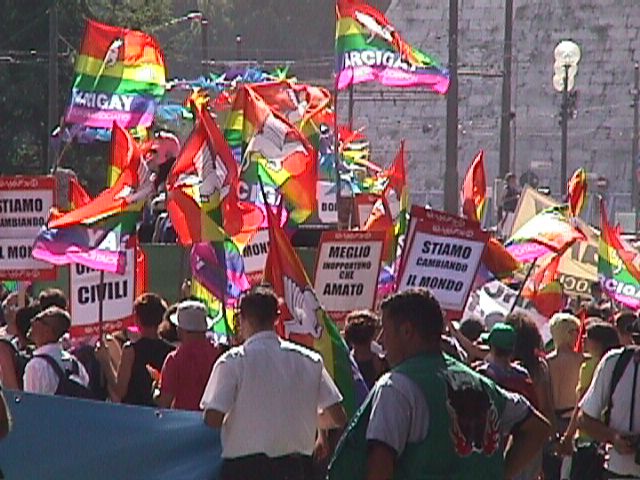
World Pride has been held since 2000, when it took place in Rome. It was next held six years later, in Jerusalem (2006), and then a further six years later, in London (2012). Momentum grew, as subsequent gatherings took place in Toronto (2014) and then Madrid (2017).

Two years later, in 2019, World Pride was held in New York City, commemorating the 50th anniversary of the Stonewall uprising, with five million spectators attending in Manhattan over the central Pride weekend. The Stonewall uprising is widely considered to mark the start of the modern Gay Rights Movement (now more commonly referred to as the fight for LGBTQIA+ rights).

In 2021, World Pride was shared between Copenhagen, Denmark, and Malmo, Sweden. The Crown Princess of Denmark was patron of the event, making her the first ever royal to serve as patron for a major LGBTQ event.

This year, in Sydney, the key events include a Fair Day on Sunday 19 Feb, the formal Opening Ceremony and Concert in the Sydney Domain on Friday 24 Feb, the annual Mardi Gras Parade and Party on Saturday 25 Feb; a Human Rights Conference from Wednesday 1 to Friday 3 March; a First Nations Gala Concert and a Mardi Gras International Arts Festival and Film Festival; and on the last day, Sunday 5 March, a Pride March over the Sydney Harbour Bridge and a grand Closing Ceremony.

Faith communities are actively involved in World Pride 2023, with a full listing of events at https://www.worldpridefaith.com.au/?mibextid=S66gvF&fbclid=IwAR15hAd9eTPZqO1QlU_o_XyEBD7n8-dtFSChxoMGLr3ILkEBgjHvG2kdar8

The Uniting Church is strongly supportive of the event, and a number of Sydney churches are involved. See https://uniting.church/uniting-churches-welcome-world-pride/

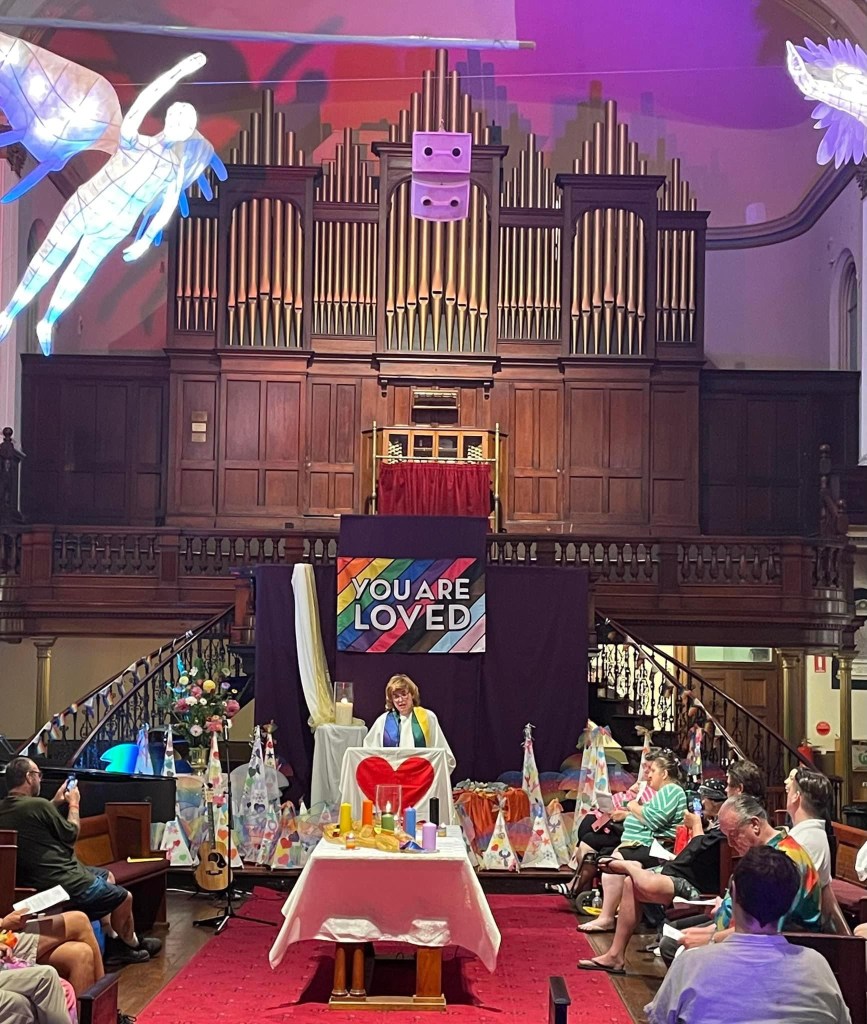
The Pitt St Uniting Church, located in the heart of Sydney, is actively involved in World Pride 2023, bringing a strong faith voice into the event. Pitt St is holding a photo exhibition, Queer Faces of Faith and providing a rehearsal space for the Out&Loud&Proud Choir rehearsals, as well as providing a safe and celebratory faith space and pastoral support to World Pride people in the heart of the CBD. A full program of prayer support for World Pride is operating as well. See https://pittstreetuniting.org.au/wp-content/uploads/2023/02/Diary-of-Praise-and-Prayer-for-World-Pride-2023.pdf

*****

Christians have had an unhappy relationship with LGBTIQA+ people. Sadly, far too many Christians hold a judgemental and discriminatory attitude towards people whom they regards as sinners, and many of these carry those negative attitudes through into discriminatory, oppressive, and damaging actions.

These negative attitudes were born long ago, in societies with different understandings of sexuality and gender. Many such societies of the past were centred around what they perceived as normality. “Normality” is what is most commonly found. “Normality” is also what is needed to ensure the ongoing survival of society. So regular reproduction of the species was essential in such societies, especially given the rate of deaths was much higher than in most modern societies.

The communities reflected in the Bible are no exceptions to this. Humanity is defined in Hebrew Scripture as needing to strive for perfection, so we see those who cannot see or hear, with missing limbs or those unable to speak, excluded from worship and community on the basis of how they differ from “perfection”. They are perceived as a threat to the good order and flourishing of society, because of their inherent “difference” from the norm. This is reflected in ancient Israelite law, and this continued on into in the understandings of the New Testament writers.

In modern times, our understanding of “normality” has broadened from such a binary understanding, to include now a spectrum of what is seen as “normal”. No longer do we exclude people on the basis that their physical appearance does not conform to the physical appearance of the majority of people, for instance. The understanding that the human brain operates on a spectrum has been well established, and we are now used to hearing regular references to the fact that neurodiversity in human beings has placed people at various points along a spectrum of neurological functioning.

The same applies to human sexuality. As further research is done, it has becoming increasingly clear that the way that people experience and express their sexuality, like the way that the brains of different people function differently, exists on a spectrum and is not confined to a binary state. Gender identity and sexual orientation both sit on such spectrums rather than existing in oppositional binary states.

Within such spectrums, there are “standard deviations” which we expect to find in any human population. This is a perfectly “normal” phenomenon. So, today we recognise that there is a range of gender identity along a spectrum of identities, and a range of sexual orientation along a range of sexual orientation.

Our Bible is an ancient document. It was written at a time when “normality” was seen as living within the divine favour and existing in a way that accords with the divine statutes. Those who failed to conform to the “normality” of those statues were seen as “abnormal”, incomplete and perhaps, at times, sinful. They occupied what we today call “the tails of the bell curve”. They were not seen as “normal”, since they were unable to promote the future of community.

In ancient times, sexual behaviour that fell into the expected variation of the tails of the bell curve was frequently perceived as “not normal” and threatening to the community, and an aberration that threatened the survival of the community. That is no longer the case for us, today.

The Hebrew Scriptures use the word nephesh (נֶפֶש) to describe human beings (and, indeed, all other living creatures). It is a common Hebrew word, appearing 688 times in Hebrew Scripture. It is most commonly translated (238 times) as “soul”; the next most common translation is “life” (180 times). The word is a common descriptor for a human being, as a whole. (I have learnt much about nephesh in my discussions with my wife, the Rev. Elizabeth Raine.)

However, to use the English word “soul” to translate nephesh does it a disservice. We have become acclimatised to regarding the soul as but one part of the whole human being—that is the influence of dualistic Platonic thinking, where “body and soul” refer to the two complementary parts of a human being. In Hebrew, nephesh has a unified, whole-of-person reference, quite separate from the dualism that dominates a Greek way of thinking.

Nephesh appears a number of times in the first creation story in Hebrew scripture, where it refers to “living creatures” in the seas (Gen 1:20, 21), on the earth (Gen 1:24), and to “every beast of the earth, and to every bird of the air, and to everything that creeps on the earth, everything that has the breath of life (nephesh hayah)” (Gen 1:30).

It is found also in the second creation story, where it likewise describes how God formed a man from the dust of the earth and breathed the breath of life into him, and “the man became a living being (nephesh hayah)” (Gen 2:7). The claim that each living creature is a nephesh is reiterated in the priestly Holiness Code (Lev 11:10, 46; 17:11). So we human beings are part of a wide spectrum of creatures, all created by God, all seen to be “good”, a wonderful kaleidoscopic variety of beings.

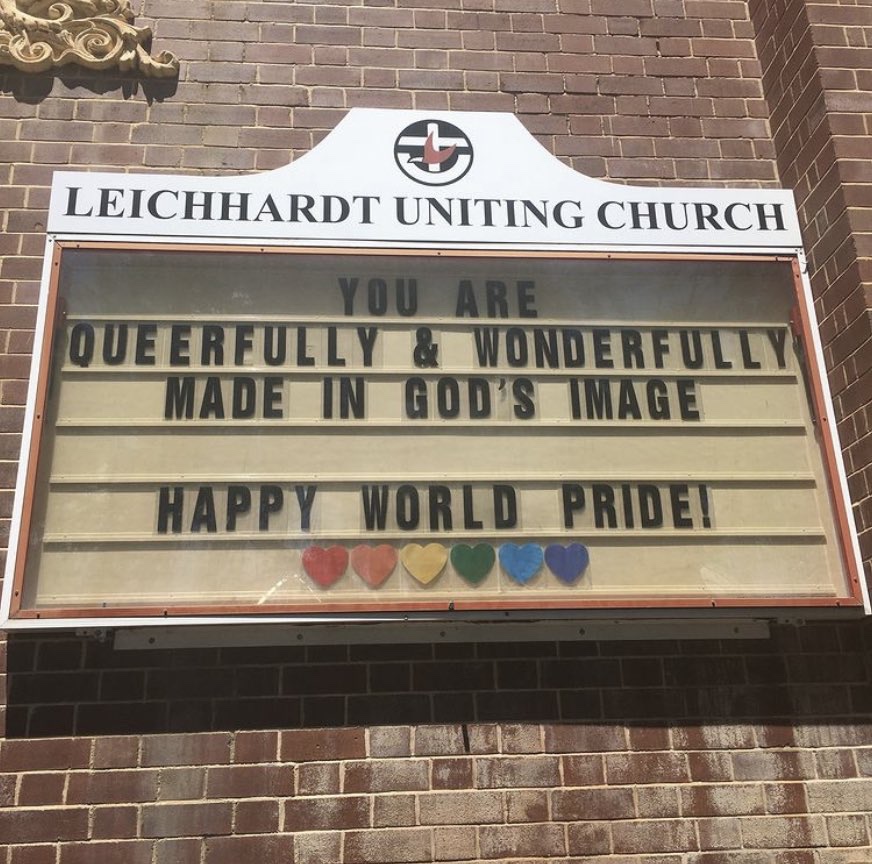
Our theology of the human being needs to underline the claim that all people, no matter where they are located on the bell curve, are “nephesh” and are filled with the sprit of God. We are all part of the creation that, in Christian and Jewish mythological, God declared “very good” (Gen 1:31). We are, each and every one of us, “fearfully and wonderfully made”, as the psalmist sings (Ps 139:14a)—like the intricate, complex, and beautiful created world in which we live, each human being is, exactly as they are, one of the “wonderful works” of the Lord God (Ps 139:14b).

And that is exactly what World Pride 2023 is celebrating!

*****

See also

and for Canberra people, there is a safe space every Sunday morning at 9:30am and once a month on Sunday at 6:00pm (the 2nd Sunday of the month) at Tuggeranong Uniting Church, where Elizabeth Raine and Sharon Jacobs lead the ministry team. See

and for further biblical discussion, see