
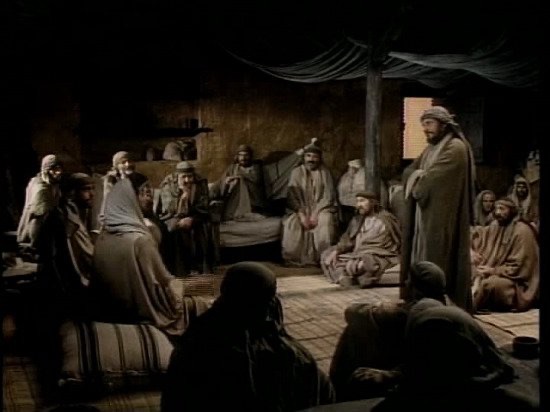
This coming Sunday, the Narrative Lectionary presents us with another passage from Acts as the primary reading: the count of the council in Jerusalem (Acts 15:1–18). There had already been a significant meeting held earlier in Jerusalem, which is reported in Acts 11; on that occasion, Peter convinces “the apostles and the believers who were in Judea” about what had occurred when “the Gentiles had accepted the word of God” (11:1).
Although the meeting had begun with a difference of opinion, by the end those gathered were praising God, saying that “God has given even to the Gentiles the repentance that leads to life” (11:18).
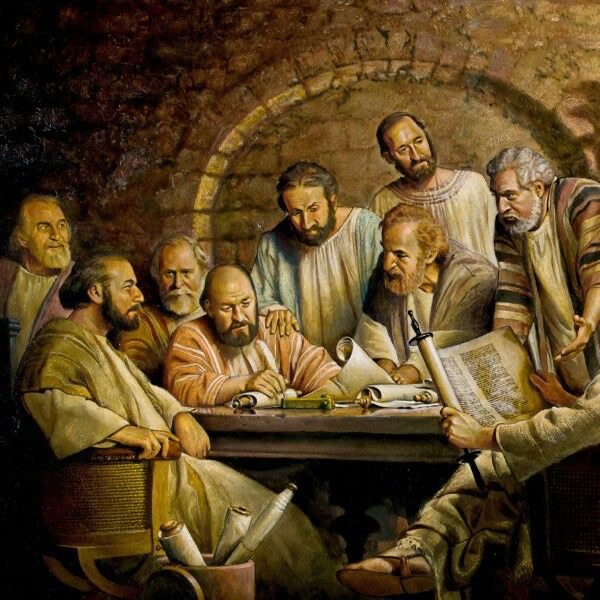
On a later occasion in Jerusalem, the presenting issue as Luke reports it is the requirement that converts had to be “circumcised according to the custom of Moses” in order to be saved (15:1). In one of his early letters, Paul offers a report of this meeting (Gal 2:1–10) which differs significantly from Luke’s account in overall tenor and in specific details. Whilst Paul presents himself as exhibiting great persuasive power in what he portrays as a strongly polemical debate, Luke emphasises the irenic nature of the meeting and focuses more on the contributions made by the Jerusalem leaders, Peter and James.
Raising the issue of circumcision leads to “not a little dispute and discussion” between Barnabas and Paul, in company with others of their group, and some Judean believers (15:2). In their opening report to the meeting, Paul and Barnabas summarise their activities as being “what God did with them” (15:4; cf. 14:27). This reflects the Lukan understanding of how the divine will guides the events reported in Acts; see
Some Pharisaic believers present at the council provide a different perspective on the divine will. The sympathetic attitude of Pharisees towards the messianists is critical on two occasions in forensic settings (5:34-39; 23:9), so Luke sees no conflict in the idea that some Pharisees had joined the messianic community in Jerusalem.
Since the assertion of the Pharisaic believers, that “it is necessary to circumcise them” (15:5), is grounded in scripture (Gen 17:1–14,21–27), it appears plausible that this necessity is the divine will. However, Luke’s report of the debate in this council shows that this is not the case. Three speeches are reported, each of which draws on earlier events to rebut the claim advanced by these Pharisaic members.

Peter’s speech (15:7–11) interprets what Paul and Barnabas have done in the light of Peter’s experience in Caesarea. He uses the established Lukan pattern of interpreting what has occurred by reference to God’s actions, when he explains that “God chose through my mouth for the Gentiles to hear the word of the good news and to believe” (15:7). Peter offers a summary of the events already reported in detail at 10:1–48. In this context, such language about God serves to reinforce the validity of the activities of Paul and Barnabas, and to rebut the claims advanced by the Pharisaic members.
This sense is strengthened by the repetition of familiar language about God in the remainder of the speech: “God who knows all hearts” (15:8, cf. 1:24) “gave the holy spirit” (15:8, cf. 10:44-46; 11:17) in a way which exactly parallels “them” with “us” (15:8, cf. 10:47; 11:15,17) and thus “did not distinguish between us and them” (15:9, cf. 11:12). To question this understanding of events would be to tempt God (15:10) and thus to encounter the fate imposed on Ananias and Sapphira (5:9).
Peter concludes by urging acceptance of what Paul and Barnabas have done, since those Jews who believe have received salvation “in the same way as them” (Gentile believers)—that is, “through the grace of the Lord Jesus” (15:11).

In this way, he argues that the “God who is not partial” (10:34–35) has clearly been at work both in events in Caesarea, which Peter experienced, and in the activity of Paul and Barnabas throughout Asia Minor. The assemblies they established are inclusive; Gentiles belong in them just as much as Jews.
The second speech is reported only as a condensed summary of what Barnabas and Paul reply (15:12). This restates their earlier report of “what God did with them” (15:4) and applies that understanding to the signs and wonders which were performed through them among the Gentiles throughout Asia Minor (15:12). Their speech strengthens the argument for inclusive assemblies, for just as God enabled signs amongst Jews (5:12), so too are signs given amongst Gentiles (15:12).
James’ speech (15:13–21) comes next, and proves to be decisive. This demonstrates the prominence of James, the brother of Jesus, in the Jewish community of believers in Jerusalem. He begins by supporting Peter’s explanation through the use, yet again, of language about God.

For a start, the claim of James that “God visited” (15:14; NRSV “God looked favourably”) evokes the blessing of Zecharaiah (“blessed be the Lord God of Israel, for he has looked favorably on his people and redeemed them”; Luke 1:68).
James makes the suggestion that by incorporating “a people (laos) from the Gentiles” (15:14), God has brought about “redemption for his people” (Luke 1:68). Careful readers of Luke’s work would know that, in scripture, the term laos has often referred to Israel (Exod 6:7; Deut 4:20,34; 14:2; 26:18–19; 32:9), but the incorporation of the Gentiles into this people now reflects the promise of Zech 2:14–15: “Many nations shall join themselves to the Lord on that day, and shall be my people”.
James then provides further scriptural validation of the inclusion of Gentiles within the messianist assemblies (15:15–18). He cites the agreement of a compilation of scriptural texts (Jer 12:15; Amos 9:11–12; Isa 45:21) which depicts the way that “all the nations … will seek out the Lord”. He affirms that this process is one which “the Lord … has been making known from long ago” (15:18, cf. 15:8). Like the prophetic quotation by Peter at 2:16–21, this prophetic citation is strategically placed to interpret the ensuing narrative about the mission that Paul and others are undertaking.
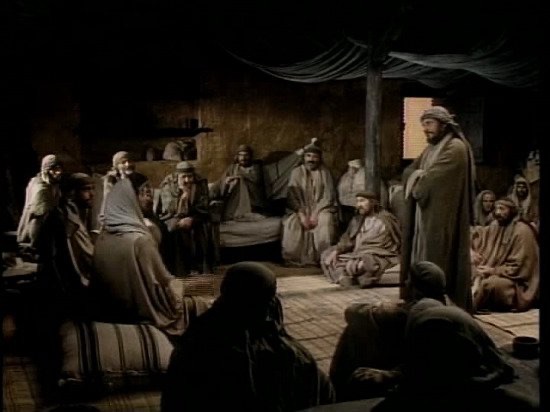
The selection proposed by the Narrative Lectionary concludes with the speech of James (15:13–18), but Luke’s account continues with some important elements. First, James indicates, “I have reached the decision” that will be crucial in bringing the council to agreement (15:19). He argues that “those among the Gentiles who turn to God” (15:19; cf. 14:15) should not be troubled, and he proposes a compromise position (15:20) with a limited number of prescriptions, each of which has a clear scriptural basis. That was acceptable to the Jews for whom scripture was important; that ought also to have been acceptable to Gentiles who recognised the high moral standards of the new movement.
The prescriptions include: No idol food: Exod 34:11–17; Lev 17:8–9. No sexual immorality: Lev 18:6–29. No strangled animals: Exod 22:31; Lev 17:10–16, equating “what is torn”, 17:15, with “something strangled”. No blood: Gen 9:4; Deut 12:15–16,23–25; cf. Lev 17:11,15.
Luke’s portrayal of James indicates his prominent role amongst the leaders of the assembly, since what James decides (15:19–20) is adopted unchanged by the council (15:28–29). This Lukan view of the authority of James is reinforced later in his account; when Paul returns to Jerusalem, he will report directly to James (21:17–19). Indeed, the Jerusalem community accepts the four requirements without dissent (21:25).
Thus, Luke’s report of these council debates reaffirms the understanding already developed in the narrative of 13:4-14:27, namely, that Paul and Barnabas engage in activities amongst the Gentiles in accord with the divine will. The logical consequence of this perspective is thus worked out in the council’s letter to the assemblies (15:22-29), which is to be distributed amongst the “believers who are from the Gentiles” in assemblies in Antioch and Syria and Cilicia by four chosen delegates: Judas, Silas, Paul and Barnabas (15:22–23).
The letter asserts that it has been worked out by the council and the holy spirit (15:28), thus placing this decision within the stream of events which have been guided and shaped by God. The inclusion of Gentiles within the Jewish messianic assemblies is validated directly by God. The letter is well received in Antioch, where the assembly rejoices (15:31; see 13:48) and receives it as an exhortation (15:31; see 13:15). Paul and Barnabas continue on their way, “teaching and proclaiming the good news” (15:35). All is well that ends well (at least, to this point).
Some of this material is from my commentary on “The Acts of the Apostles” in the Eerdmans Commentary on the Bible (ed. J.D.G. Dunn and John Rogerson; Eerdmans, 2003)
 An Informed Faith