Saul and Jonathan, beloved and lovely! part 2 (1 Sam 18–20; 2 Sam 1; Pentecost 6B)

For the Hebrew Scripture passage this coming Sunday, the lectionary offers a controversial passage (2 Sam 1:1, 17–27). The controversy revolves around the nature of the relationship between David and Jonathan. That relationship has an interesting history, and comes to a full expression in this passage.

In recent decades, a critical question that has been the focus of interpretation of the relationship between Jonathan and David has been, was this a loving same-gender relationship? Quite a number of scholars have argued that this was, indeed, the case.

Of course, more conservative and fundamentalist interpreters steadfastly refute this. They offer a number of arguments in support of their claims. The way that Jonathan’s love for David (1 Sam 18:3; 20:17) and the way that David describes his love for Jonathan (2 Sam 1:26) did not have sexual connotations, they claim. Alongside this, David is never said to have “known” Jonathan, which is a way that sexual intercourse is elsewhere described (Gen 4:1, 17, 25; 1 Sam 1:19).

These conservative scholars do not see the forming of a covenant (1 Sam 18:3) as signalling a loving relationship, as it was a political mechanism, as we noted in the previous blog on this passage. They claim that the “knitting” or “binding” of Jonathan’s soul to David (1 Sam 18:1) was more akin to the love of a father for his son; they also claim that Jonathan’s shedding of his clothes (1 Sam 18:4) was not in order to make love, but done as a political gesture.

However, I think that such arguments swim against the strong current that flows through the story of Jonathan and David. Writing thirty years ago, the biblical scholars Danna Nolan Fewell and David M. Gunn observed that “few commentators afford serious consideration to reading a homosexual dimension in the story of David and Jonathan”.

Fewell and Gunn note that “this is hardly surprising, given that until recently, most have been writing out of a strongly homophobic tradition… [but] far from stretching probability, a homosexual reading … finds many anchor points in the text.” (Fewell and Gunn, Gender, Power and Promise: The Subject of the Bible’s First Story  [Nashville: Abingdon Press, 1993], 148-49.) we need to explore this claim in more detail.

The key feature of the relationship that is anchored in the text is conveyed in the word אַהֲבָה (ahabah), which is translated “love”. It is a word which appears 40 times throughout the Hebrew Scriptures, describing the relationship that God has with Israel (Deut 7:8; 1 Ki 10:9; 2 Chron 2:11; 9:8), as well as that between husband and wife (Prov 5:19; Eccl 9:9), and most specifically the sexually-passionate love expressed in the Song of Songs (Song 2:5–7; 3:5, 10). In these latter places, there are strong romantic and sexual dimensions to its meaning.

Certainly, love defines the relationship between Jonathan and David; the word is used three times in this regard, as we have noted above (1 Sam 18:3; 20:17; 2 Sam 1:26 ). Joel Baden, in a fine article “Understanding David and Jonathan”, notes that “over and over again we are told that Jonathan loved David”. He observes that while the most common sense of the term is “a non-romantic meaning of ‘covenant loyalty’ … the use of the word in the case of Jonathan seems to go beyond that.”

Baden lists the accumulation of evidence in a series of key verses. First, “Jonathan does not just ‘love’ David. ‘Jonathan’s soul became bound up with the soul of David’ (18:1).

Second, when we read that “Jonathan ‘delighted greatly in David’ (19:1)”, Baden notes that “the same Hebrew word used in Genesis to describe Shechem’s desire for Jacob’s daughter Dinah (Gen 34:19).”

Third, Baden observes that when Jonathan dies, “David laments for him in these words: ‘More wonderful was your love for me than the love of women’ (2 Sam 1:26)”. That is a very strong statement indeed; as Baden notes, “the comparison to the love of women can hardly have a political valence; this is as close to an expression of romantic attachment between two men as we find in the Bible.”

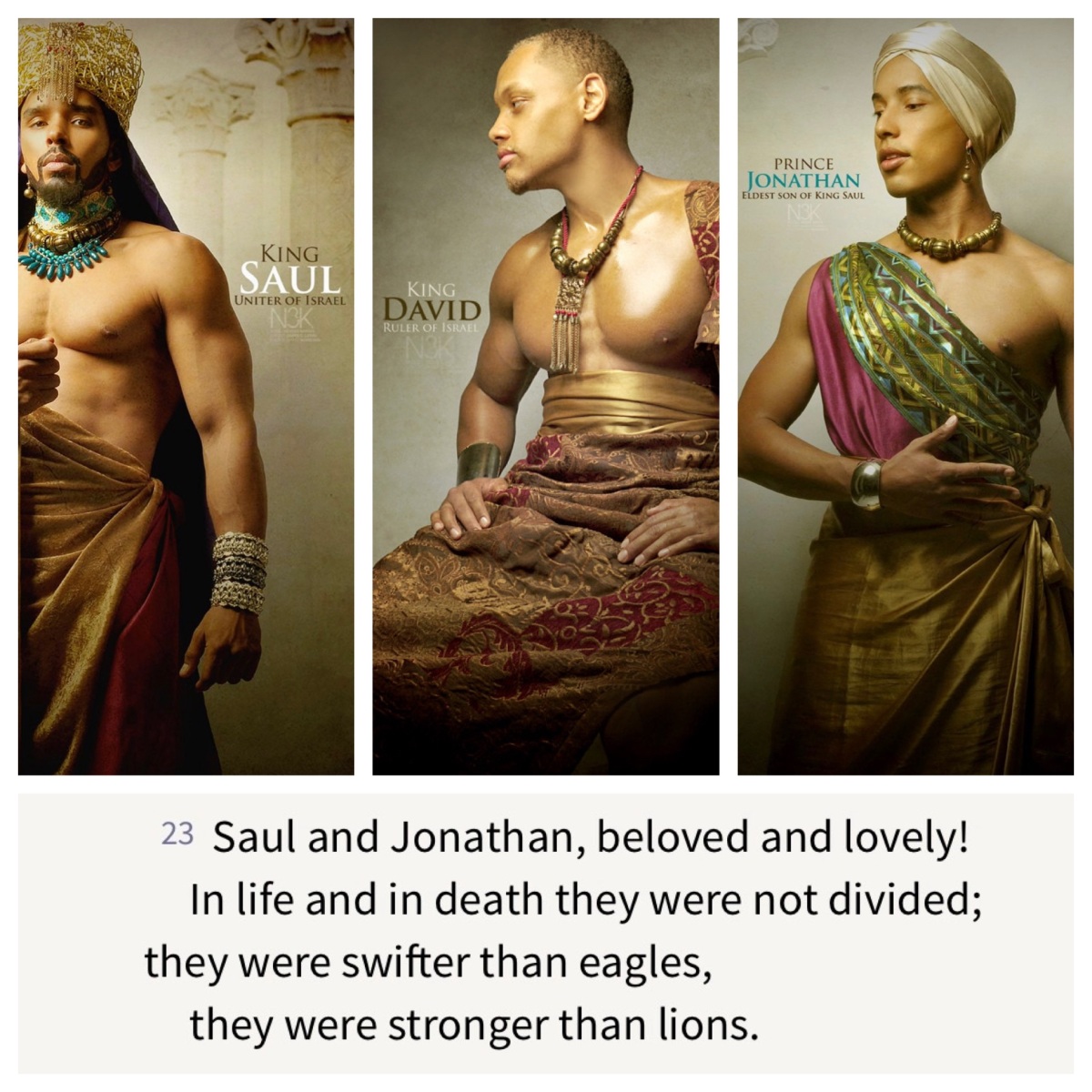
Representations of Jonathan and David
by photographer James C. Lewis

Indeed, we might reflect more on David’s comparison of Jonathan’s love for him with the love of women for him. Remember, he had no less than eight wives, who bore him at least eighteen children! So David knew a lot, we might assume about “the love of women”. It is worth pondering the comparisons that are drawn between the way that David experienced his living relationship with Jonathan, and his relationship with his first wife, Michal, whom he had married soon after he had entered into the covenant with Jonathan (1 Sam 18:20–27)—thereby incurring the wrath of Saul (18:28–29). I will explore this in a subsequent blog.

For the full discussion by Baden, see https://bibleinterp.arizona.edu/articles/2013/12/bad378027

*****

I think there are two important factors to consider as we think further about the relationship that David had with Jonathan. The first has to do with the function of the Jonathan—David relationship in the whole Samuel—Kings narrative. The second has to do without understanding of same gender sexual attraction.

With regard to the first matter: is it satisfactory simply to read the story of David and Jonathan as entirely political? Or, by contrast, as entirely personal? In a fine recent article, Nila Hiraeth offers a thoughtful and detailed consideration of the issues, drawing on a range of recent scholarly discussions of the story of David and Jonathan.

See https://thecooperativehub.com/the-opinions/the-opinions/jonathan-s-love-and-david-s-lament-part-3

Hiraeth proposes that the whole Samuel tradition (from his birth at 1 Sam 1 through to his death at 1 Sam 25) “has something to say about post exilic attitudes toward Israel’s transition to monarchy; specifically, a whispering undercurrent weighs the human cost of political pursuits and power-plays”. That is, the whole narrative has a politico-religious edge to it; the particular relationships within the narrative each contribute to that overarching purpose.

Hiraeth therefore does not discount the political dimension of the David—Jonathan relationship; she maintains that it is indeed present, but considers that this does not override the personal dimension of the story. In other words, it is not a binary, either-or, black-or-white scenario. Both political and personal aspects are integral to the story. “In Jonathan’s love we find personal attachment overlaid with political consequence”, she writes, and “in David’s lament we find political gain overlaid with personal loss”.

In terms of what this means, then, for a “queer reading” of the story of David and Jonathan, Hiraeth proposes that the story addresses the age-old tension between love and power. She notes that “the ultimate example for the prioritizing of the personal over the political in the David-Jonathan material is Jonathan, who chooses love over power. The text goes on to suggest that such an ordering of priorities can save lives, bestow dignity, shame kings into right action and move gods to mercy. Beauty for ashes; the government of heaven.”

And so, she concludes that “the David-Jonathan material of the Samuel tradition speaks most helpfully to contemporary discussions around Scripture and sexual identity, where the saving of lives and the bestowing of dignity are central concerns, and where the Christian traditions’ prioritising of power over love continues to carry a terrible human cost.”


David and Jonathan“La Somme le Roi”, AD 1290;
French illuminated ms (detail); British Museum

A second factor that is important to consider in reading this story—as, indeed, with every story within these ancient narratives that includes elements of same gender attraction or activity—is to recognise the significant difference between ancient understandings and contemporary conceptions of sexual identity and attraction. We need to take care with how we use the terms “homosexual” and “heterosexual”. What we today understand by these terms is, most likely, not what the ancient thought about sexual identity and attraction.

Hiraeth observes that “the Bible clearly presupposes certain attitudes about sex and gender that are rooted in the socio-sexual mores of the ancient Mediterranean world and are foreign to the views likely to be defended openly by most adherents of Christianity and Judaism.” In undertaking a thorough and detailed literary-critical analysis of the texts, Hiraeth observes that “the privileging of a political or theological-political reading of Jonathan’s love over and against a personal and potentially erotic and/or sexual reading arguably has less to do with the text itself and more to do with the imposition of heteronormative values upon the text.” See https://thecooperativehub.com/the-opinions/the-opinions/jonathan-s-love-and-david-s-lament-part-3

The most detailed and helpful recent scholarly work that has been done with regard to ancient and modern conceptualisings of sexuality has been the research of Prof. Bill Loader, who over the past decade has published a number of full-length books as well as more focussed articles. See https://billloader.com

Books by Bill Loader, displayed on his website
https://billloader.com

Prof. Loader has stated an important principle of interpretation when it comes to dealing with “homosexuality” in the Bible. He notes that biblical texts reflect a worldview quite different from what contemporary scientific research reveals. He proposes that “we need to respect what these texts are and neither read into them our modern scientific understandings nor for dogmatic reasons assert that they are inerrant or adequate accounts of reality.” See https://www.billloader.com/LoaderSameSex.pdf

Citing the matter that generated great controversy in the 19th century—evolution—he observes that “mostly we have no hesitation in recognising the distance between our understandings and theirs [in antiquity] about creation’s age and evolution”. So when we think about sexuality and gender, it should be possible that just as “new information enables us to see that creation is much older and complex”, so we can see that “reducing humankind to simply male and female in an exclusive sense and denying the fact that the matter is much more complex and includes variation and fluidity, at least around the edges, or suggesting this all changed with the first human sin, is inadequate.”

In other words, when we today recognise that people can quite readily identify as “gay” or “lesbian” or “bisexual” or “asexual”, we are a world away from the ancient world in which the biblical texts were written, in which it was assumed that all people were heterosexual but some took part from time to time in sexual activity with people of the same gender. That is radically different from the committed, loving, lifelong same gender relationships that we know exist in the world today.

Prof. Loader has made available his research in an accessible series of short studies, at https://billloader.com/SexualityStudies.pdf

So let us read this passage recounting David’s love for Saul and particularly Jonathan with care. Let’s not “assume” what we think is the reality; let’s not “condemn” what we find abhorrent; let’s not “dismiss” what does not align with our personal commitments. Let’s be open to the strong possibility that the relationship between David and Jonathan was a mutually-fulfilling, deeply personal, committed and loving relationship between two adult men who had a deep-seated attraction to one another. It’s a passage that challenges us in multiple ways!

*****

For part one, see
Saul and Jonathan, beloved and lovely! part 1 (1 Sam 18–20; 2 Sam 1; Pentecost 6B)

For the Hebrew Scripture passage this coming Sunday, the lectionary offers a passage (2 Sam 1:1, 17–27) that has been the subject of controversy. The passage is a lament, sung by David on the death of Jonathan, the son of Saul. The controversy revolves around the nature of the relationship between David and Jonathan. That relationship has an interesting history, and comes to a full expression in this passage.

Depiction of Jonathan by photographer Samuel C. Lewis

We first meet Jonathan, son of Saul, when he led a thousand troops, defeating the Philistines in a battle at Gibeah (1 Sam 13:2–3). He was successful in a number of subsequent battles; Jonathan was renowned for his skill with bow and sword (2 Sam 1:22). David had met him after he had slain the Philistine giant, Goliath (1 Sam 17); the narrator of this book observes that “the soul of Jonathan was bound to the soul of David, and Jonathan loved him as his own soul” (1 Sam 18:1).

What Jonathan does is striking, as he “stripped himself of the robe that he was wearing, and gave it to David, and his armour, and even his sword and his bow and his belt” (1 Sam 18:4). As Saul’s firstborn son, Jonathan might have expected to have inherited the crown from his father; instead, he divests himself of all the royal trappings and places them on the one anointed as king, his friend David. The imagery has political significance. But does it also have a personal dimension?

The friendship between David and Jonathan continued through various battles until, eventually, “the Philistines overtook Saul and his sons; and the Philistines killed Jonathan and Abinadab and Malchishua, the sons of Saul” (1 Sam 31:2). Saul himself was wounded (1 Sam 31:3) but then, sensing the inevitable, he “took his own sword and fell upon it” (1 Sam 31:4).

With the death of Saul and the earlier death of Samuel (1 Sam 25:1), a new era was beginning. David, previously anointed as king over Israel by Samuel (1 Sam 16:13), was now also anointed as king over Judah (2 Sam 2:4). A united monarchy would continue for decades.

Depiction of Saul by photographer Samuel C. Lewis

The relationship between Jonathan and David has been the cause of renewed enquiry in recent decades. Was the love expressed by these two men for one another simply “bruvver love”, as best mates; or was it deeper and more controversial than this? Loving relationships between people of the same gender are increasingly accepted in today’s world, at least in Western societies. Was that what was happening between the king and the former king’s son?

The “great delight” that Jonathan had for David (1 Sam 19:1) and his complete trust in him (1 Sam 20:4) leads them to form a covenant together on the basis that Jonathan loved David “as he loved his own life” (1 Sam 20:16–17).

Entering into a covenant with another person is a serious undertaking. Abraham and Abimelech covenant together at Beersheba, so that Abraham can live peaceably amongst the Philistines (Gen 21:22–34).

Laban and Jacob covenant together at Galeed to consolidate the two-decades-long relationship between the two men (Gen 31:43–55). David made a covenant with the elders of Israel at Hebron when he was anointed as king over Israel (2 Sam 5:1–5). Jehoida made a covenant with the captains of the Carites and of the guards, so that his son Joash would be protected and ultimately proclaimed king (2 Ki 11:4–12).

And, of course, the Lord God made a covenant with Noah and the whole of creation (Gen 9), and then renewed that covenant a number of times—with Abram (Gen 17), with Isaac and with Jacob (Lev 26:42), with all Israel through Moses (Exod 19, 24), under Joshua (John 24), and then with David (2 Sam 7) and various of his descendants. All major exilic prophets look to a time when God will renew the covenant with the people back in the land (Isa 55–56; Jer 31:31–35; Ezek 16:59–63; 37:24–28). The people of Israel were bound to the Lord God in covenant; the steadfast love that God shows towards Israel is an expression of that covenant.

Human-to-human covenants were political tools, creating alliances amongst the leaders of various tribes or nations of people in the ancient world. The covenant formed between Jonathan and David clearly has political implications. Jonathan, the son of Saul and rightful heir to the throne, hands over his armour to David (1 Sam 18:4) to signal that he is ceding power to David as the next king. The scene is infused with the political freight of an ancient covenant.

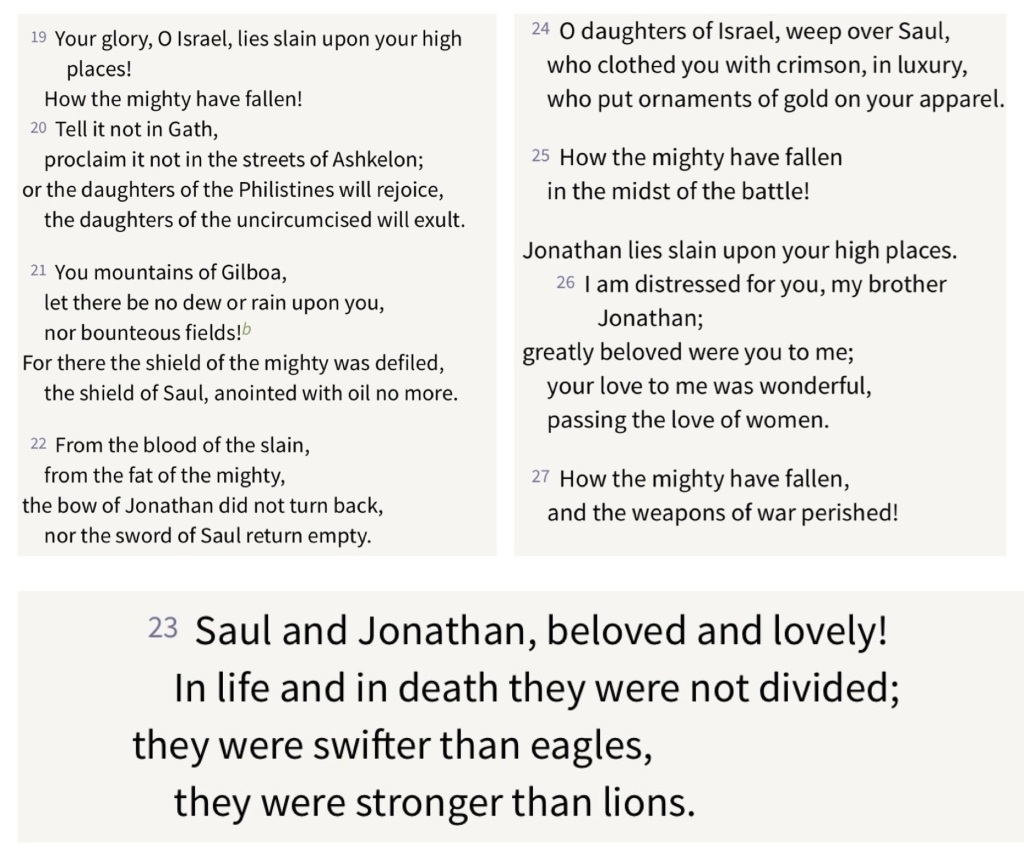
The poem in this week’s reading (2 Sam 1:19–27) offers a clear and loving acknowledgement by David of his respect and love for Saul. Despite the many difficulties encountered in their relationship, at the end of Saul’s life, David is able to acknowledge the virtue of the first King of Israel, and his son. “Saul and Jonathan, beloved and lovely!”, he sings; “in life and in death they were not divided; they were swifter than eagles, they were stronger than lions” (2 Sam 1:23).

Writing in With Love to the World, Kyounghee Cho reflects on the character of David seen in this passage. She writes, “David means “beloved”. David was tremendously loved by God. He was loved by the people of Israel, and now he is cherished and praised as an exemplary figure of faith by Christians worldwide. Today’s passage shows why God loved him and gives a lesson for believers of God. King Saul, David’s enemy, who had been chasing him for 10 years to kill him, died. While Saul’s demise might have been welcome news to David, he understood it not from his personal standpoint but from the perspective of the nation and its people.”

Kyounghee continues, “David paid tribute to Saul as the chosen leader of God and his soldiers as the army of the Lord of Hosts. He composed an elegy and instructed the people of Judah to learn it and sing it.” The song is a wonderful testimony to the king whose name came to characterise most strongly the chosen people, in covenant with the Lord God.

The story of David dominates the quasi-historical narrative of the early decades of the monarchy in Israel, stretching from his initial appearance at 1 Samuel 16 to his death at 1 Kings 2. The covenant people who come in following centuries are regularly identified as “the house of David” (2 Sam 3:1–6; 1 Ki 12:19–20, 26; 13:2; 14:8; 2 Ki 17:21; 2 Chron 10:19; 21:7; Neh 12:37; Ps 122:5; Isa 7:2, 13; 22:22; Jer 21:12; Zech 12:7–14; 13:1; Tobit 1:4; Sirach 48:15; 51:12; and see Luke 1:27).

This identification, of course, is highlighted many times in the New Testament, where Jesus is identified as “Son of David” in the Synoptic Gospels (Mark 10:47–48; 12:35; Luke 3:31; 18:38–39; and especially in Matt 1:1, 20; 9:27; 12:23; 15:22; 20:30–31; 21:9, 15; 22:42). This claim is also noted at John 7:42; Rom 1:3; 2 Tim 2:8; Rev 3:7; 5:5; 22:16). The heritage of David lives on in these stories.

The lament sung by David in 2 Sam 1 also provides a beautiful acknowledgement of the depth and strength of the love that undergirds this covenant between Jonathan and David. Peppering his song with the refrain “how the mighty have fallen” (vv. 19, 25, 27), David laments over his friend: “greatly beloved were you to me; your love to me was wonderful, passing the love of women” (2 Sam 1:26).

Could it be that, even in ancient Israel, such love between two men was valued and accepted? That will form the focus of the next blog that I will offer on this passage.

As we continue through narrative passages from the Hebrew Scriptures, this Sunday, we come to David’s poetic lament for his friend, Jonathan (2 Sam 1). This passage invites us to consider the depth of love that David expressed for Jonathan: “your love to me was wonderful, passing the love of women”. Just what can we make of this relationship? (This is the second of three posts this week on this topic.)

See

*****

With Love to the World is a daily Bible reading resource, written and produced within the Uniting Church in Australia, following the Revised Common Lectionary. It offers Sunday worshippers the opportunity to prepare for hearing passages of scripture in the week leading to that day of worship. It seeks to foster “an informed faith” amongst the people of God.

You can subscribe on your phone or iPad via an App, for a subscription of $28 per year. Search for With Love to the World on the App Store, or UCA—With Love to the World on Google Play. For the hard copy resource, for just $28 for a year’s subscription, email Trevor at wlwuca@bigpond.com or phone +61 (2) 9747-1369.

Diminutive David and the giant Goliath (1 Sam 17; Pentecost 5B)

The Hebrew Scripture passage which the lectionary offers us for this coming Sunday—the next in the series of stories from the early days of the monarchy in Israel—feeds into the “David worship” that we find in these ancient narratives. From the moment that David is introduced, as being “ruddy, and had beautiful eyes, and was handsome” (1 Sam 16:12), the narrator is concerned to present him in the most positive way. For the moment, at least.

David provides a better alternative to Saul. Saul had won a significant battle against the Philistines, but did not wait for Samuel the prophet to come to preside over the sacrifice he offered (ch.13). Soon after this, he made a rash oath, forbidding his troops to eat before sundown. His son Jonathan ate, however, and chided his father: “my father has troubled the land; see how my eyes have brightened because I tasted a little of this honey” (ch.14).

When instructed by Samuel to destroy all that was taken in his defeat of the Amalekites —“do not spare them, but kill both man and woman, child and infant, ox and sheep, camel and donkey”, Samuel instructed him—he kept the best of these spoils and destroyed only what was “despised and worthless” (ch.15). (Mind you, we might well be horrified at Samuel’s instructions and side with Saul on this!) So Saul has offended the Lord God; the kingship will be taken from him, as we saw last week.

By contrast, when Samuel first sees David, the narrator introduces him with the description, “he was ruddy, and had beautiful eyes, and was handsome” (16:12). And yet, the narrator has already told us that the Lord God “[does] not look on his appearance or on the height of his stature … the Lord does not see as mortals see; they look on the outward appearance, but the Lord looks on the heart” (1 Sam 16:7). What is in the heart of David, that so pleases the Lord?

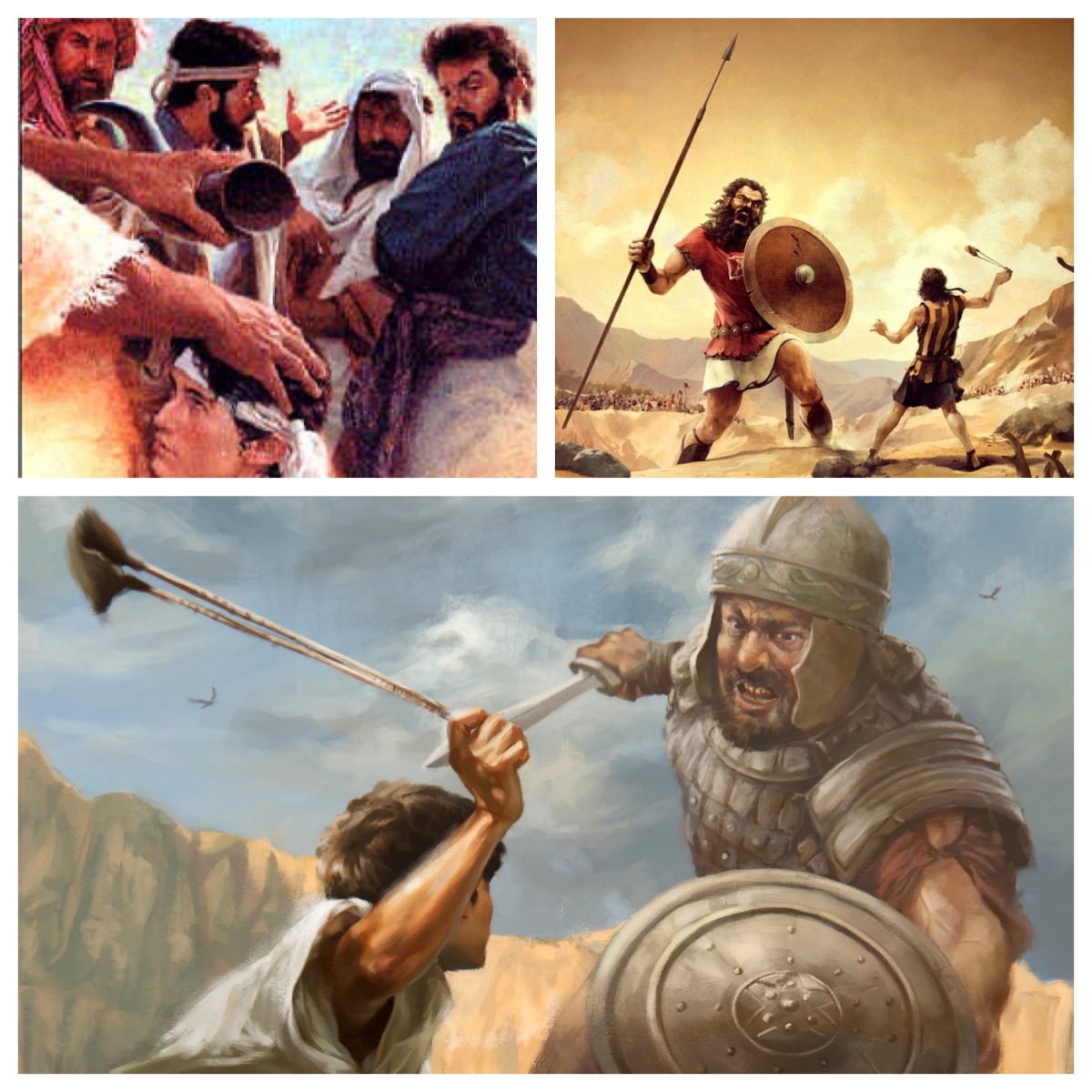
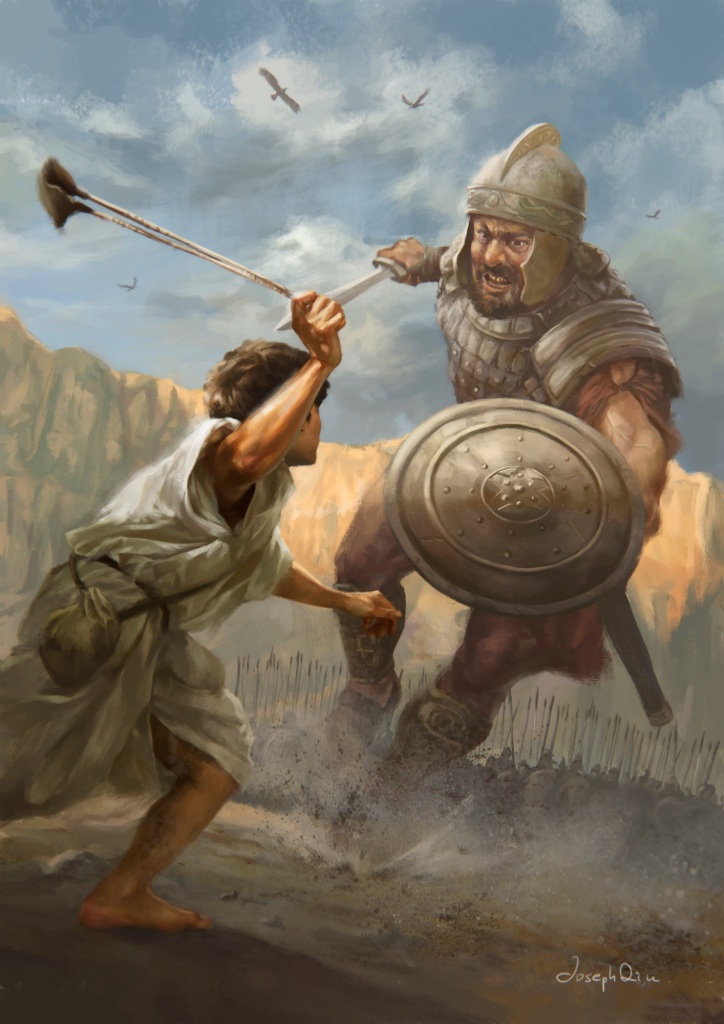
So in this Sunday’s passage—1 Sam 17:32–49, an extract from a much longer account of this pivotal encounter (all 58 verses of ch.17), we see David in action against the Philistines. In this extract we read some of what leads up the climactic moment when David “put his hand in his bag, took out a stone, slung it, and struck the Philistine on his forehead; the stone sank into his forehead, and he fell face down on the ground” (17:49). It’s the stuff that Sunday School lessons and Cecil B. DeMille films were made of!

This story of David and Goliath is legendary. It fits with a pattern, found throughout the mythic sagas of Israel (Genesis to Nehemiah), in which the underdog, the least expected person, plays a key role in leading God’s people. Think Jacob the supplanter, think Joseph the favourite youngest son, think Moses the murderer and Rahab the harlot, or Daniel with his strange diet and zany dream interpretations.

Even Jesus later picked up on this motif very strongly; the last becoming first, the child symbolising the kingdom, amd his saying, “among those born of women no one has arisen greater than John the Baptist; yet the least in the kingdom of heaven is greater than he” (Matt 11:11).

As youngest child and one challenged in physical prowess, the diminutive David stands before the giant Goliath; it seems the match would be over before it began. When Goliath stood and roared at the Israelites, goading them to come out and fight, “give me a man, that we may fight together”, the narrator captures their panicked mood: “Saul and all Israel heard these words of the Philistine, they were dismayed and greatly afraid” (1 Sam 17:8–11).

That is not surprising, given not only the size of Goliath (four cubits and a span, that is, almost 3 metres, or 9’9” tall) but also his accoutrements: “he had a helmet of bronze on his head, and he was armed with a coat of mail; the weight of the coat was five thousand shekels of bronze. He had greaves of bronze on his legs and a javelin of bronze slung between his shoulders. The shaft of his spear was like a weaver’s beam, and his spear’s head weighed six hundred shekels of iron; and his shield-bearer went before him” (17:4–7).

Not so, however, as the story unfolds. David brings provisions for his brothers after they had been involved in 40 days of battle—a biblical way of saying “an awfully long time had passed” (17:16). Still, the reaction of the Israelites was that of fear; “when they saw the man, they fled from him” (17:24). Saul tries to talk him out of stepping up to fight the giant; “you are just a boy, and he has been a warrior from his youth” (17:33).

So we come to the passage proposed by the lectionary for this coming Sunday (17:32–49). David protests; as a shepherd, he has killed lions and bears in defending his flock, “and this uncircumcised Philistine shall be like one of them, since he has defied the armies of the living God” (17:37). Notice the scathing put down of this giant of a man as merely an “uncircumcised Philistine” and the implicit grouping of him with savage beasts. David is confident that “the Lord, who saved me from the paw of the lion and from the paw of the bear, will save me from the hand of this Philistine” (17:37).

David, full of trust, steps up to the mark; the Philistine “disdained him, for he was only a youth, ruddy and handsome in appearance” (17:42), words which echo the initial description of David (16:12). Whereas they were used to advocate for David at that point, here they form a denigrating dismissal of him; a nice irony! Goliath goads him: “am I a dog, that you come to me with sticks?” (17:43); and invites David to draw near.

David holds his ground, delivering a short sermon on God’s sovereign power in this situation (17:45–47). We might reflect on whether (a) we would have the same equanimity at this moment; and (b) whether we find this theological perspective persuasive, or troublingly simplistic, or anathema to our understanding of God.

Since David stands firm, Goliath begins to approach him; now David joins the battle (17:48). The end is short and swift: “David put his hand in his bag, took out a stone, slung it, and struck the Philistine on his forehead; the stone sank into his forehead, and he fell face down on the ground” (17:49).

The remaining verses (omitted by the lectionary) tell of David severing Goliath’s head, the Philistines retreating, the typical battlefield behaviour of the victors in plundering the camp of their defeated foes, and the victory march of the Israelites as David bore the head of Goliath (17:50–54).

A short coda (17:55–58) places the young David before King Saul; this encounter had very significant consequences for David, since “when David had finished speaking to Saul, the soul of Jonathan was bound to the soul of David, and Jonathan loved him as his own soul” (18:1). That is an important lead into the passage that we will read and hear the Sunday after next, concerning David and Jonathan.

Writing in With Love to the World, Sione Leaaetoa says, “the story has been used widely in Western culture as a metaphor for describing any individual or group of people who have the courage to overcome great odds to defeat an oppressor or overcome or some great obstacle. There is certainly an aspect of human courage in this story; but the passage is primarily about being bold and having an unwavering faith in the Lord.”

He notes that “the story makes it clear that when Saul and the Israelites heard Goliath’s challenge, they were ‘dismayed and terrified’ (v.11)”, but then that David would “remind them of who they are, ‘the armies of the living God’ (vv.26, 36); hence, God is the one that will fight their battle and give them the victory.” Sione then concludes, “As children of the living God, through all the battles or challenges we may face in life, we need to remember that God is with us.”

Strategic cunning allows the shepherd boy to defeat the towering enemy. That appears to be how God works to bring about the victory. What model does this offer us? I am not advocating for the use of physical violence to bring about victory—but that was the way of things at that time in history (and still is, for many, today).

So I am left with questions: Why is this story told? Are there elements of this story that inform how we “live by faith” in today’s world? I wonder what you think they might be?

We can’t leave this story without commenting on the ancient Philistines and modern Palestinians. In what ways might the biblical stories about the Israelites doing battle with the Philistines mirror and inform how we think about the conflict between the modern state of Israel and displaced Palestinians in Gaza and the West Bank?

There are, to be sure, certain linguistic similarities between the two words, Philistia and Palestina. However, there is no historical evidence at all that proves any familial continuity between the ancient Philistines and contemporary Palestinians. They connection is simply from the ancient use of the term Palestina in the Roman province, Syria Palestina, which was a latinizing of a Semitic word that we transliterate as Philistines.

However, there are historical matters to consider in terms of who lived in the land, how other people dealt with the people living in the land when they invaded that land, and what claims stand from this. Establishing the state of Israel and displacing thousands of Palestinians in 1947–48 has not “righted wrongs”, but exacerbated them.

Neither Muslim hegemony over the city of Jerusalem in medieval times, nor ancient Israelite dominance in Jerusalem and surrounds three millennia ago, represent the bedrock of land ownership; history reveals this all too well. We will return to this issue in future blogs, as we continue to trace the story of ancient Israel in 1–2 Samuel and 1 Kings. What we need today is to tread carefully and respectfully with the different claims that are being pressed, tragically, through violent means.

I have given this consideration, in the light of the terrible situation at present in Gaza, in

and see also

*****

With Love to the World is a daily Bible reading resource, written and produced within the Uniting Church in Australia, following the Revised Common Lectionary. It offers Sunday worshippers the opportunity to prepare for hearing passages of scripture in the week leading to that day of worship. It seeks to foster “an informed faith” amongst the people of God.

You can subscribe on your phone or iPad via an App, for a subscription of $28 per year. Search for With Love to the World on the App Store, or UCA—With Love to the World on Google Play. For the hard copy resource, for just $28 for a year’s subscription, email Trevor at wlwuca@bigpond.com or phone +61 (2) 9747-1369.

Do not judge by appearances (1 Sam 15–16; Pentecost 4B)

In the lectionary during the weeks after Pentecost, we hear stories from the period of time when Israel was ruled by a king. The story of the choosing of the first king, Saul, is told in 1 Samuel 9; his rule runs through the narratives told from this chapter until the last chapter of this book, namely, 1 Samuel 31.

As I have noted before, although these narratives have the appearance of being historical, they are actually ancient tales which were told and retold, passed on by word of mouth and then written down, because of their enduring significance for the people of ancient Israel. Scholars call such stories “myths”, meaning that they convey something of fundamental importance. (We might best define myth as “a traditional story, usually associated with the time of origins, of paradigmatic significance for the society in which it is told”.)

See more on the nature of these stories at

The picture of Saul, the first man chosen to be king in Israel, demonstrates the flaws of this system of leadership. His reign was characterised by turbulence and opposition; as early as chapter 13 there are signs of the problems that there were in his leadership.

After defeating the Philistines, and being impatient for the prophet Samuel to arrive, he went ahead with a burnt offering, in contradiction to the command of God. “You have done foolishly; you have not kept the commandment of the Lord your God, which he commanded you”, Samuel berates the king (1 Sam 13:13). This is not the behaviour expected of a person leading the chosen people of God!

The prophet Samuel foreshadows the coming turmoil under Saul’s leadership, telling him that “the Lord would have established your kingdom over Israel forever, but now your kingdom will not continue” (1 Sam 13:14). The passage offered by the lectionary for this coming Sunday, 1 Sam 15:34—16:13, follows soon after. Here, we learn that because the rule of Saul is fraught with difficulties, a significant change is on the cards.

Pushed by the words of the prophet Samuel, Saul confesses his sin (1 Sam 15:24, 30). Samuel announces to him that “the Lord has rejected you from being king over Israel” (15:26) and declares, quite dramatically, “the Lord has torn the kingdom of Israel from you this very day, and has given it to a neighbour of yours, who is better than you” (15:28).

The narrator of this story engages in an interesting theological exploration at this point. Samuel is clear about God’s intentions: “the Glory of Israel will not recant or change his mind; for he is not a mortal, that he should change his mind” (15:29). This God had explicitly chosen Saul, who said he was “only a Benjaminite, from the least of the tribes of Israel, and my family is the humblest of all the families of the tribe of Benjamin” (9:21).

God had chosen David, this least and most humble person, to serve as ruler over the people, to “save my people from the hand of the Philistines” (9:16). He would rule for 40 years—the biblical way of saying “for an awfully long time”—and exert great power. We might note that this “least-become-greatest” dynamic prefigures some of the teaching of Jesus, a descendant of David, a millennia later. (See Mark 9:33– 37; Matt 11:11; 18:1–5; 23:11–12; Luke 7:28; 9:48; 22:24–27).

Samuel, exercising his prophetic leadership, had assured the people, “there is no one like him among all the people” (10:24); but some in the crowd were doubtful, saying, “how can this man save us?”, and they despised him (10:27). Paradoxically, these men had insight into the character of Saul which the Lord God himself failed to perceive at this time.

However, a little later, the narrator of this story muses that “the Lord was sorry that he had made Saul king over Israel” (15:35). This is regret, but seemingly not quite a full change-of-mind. It does, however, paint the divine in a rather human way; an action undertaken that does not bear fruit for us as anticipated can indeed generate regret.

Elsewhere in Hebrew Scriptures, the matter of a change-of-mind by the divine is explored. Jeremiah instructs the people, “amend your ways and your doings, and obey the voice of the Lord your God, and the Lord will change his mind about the disaster that he has pronounced against you” (Jer 26:13). In the tale of Jonah, when God saw the repentance of the people of Nineveh, “God changed his mind about the calamity that he had said he would bring upon them; and he did not do it” (Jon 3:10).

The prophet Amos petitions God, such that “the Lord relented concerning this; ‘it shall not be,’ said the Lord” (Amos 7:3, 6). And in the story of the Golden Bull, Moses implores God to “turn from your fierce wrath; change your mind and do not bring disaster on your people”, and so the Lord repents (Exod 32:12–14).

We might wonder: is the regret that the narrator perceives in the divine (1 Sam 15:35) strong enough to chasten God in future actions, so that there will be no need for a divine change-of-mind?

For more on this topic, see

As Saul relinquishes his role, Jesse steps onto the stage; one of his eight sons will sit on the throne. It has been a bitterly-fought transition, and Samuel was saddened by the course of events. But the voice of God pushes him on, to step into his role in the transition taking place; and so the prophet faithfully anoints Saul’s successor.

We should remember that, in the a Christian canon, the two books that tell of the rule of Saul and then David are named, not after those kings, but after the prophet, Samuel—who held and exercised great power, as the story shows, in that he is attuned to God’s voice and speaks God’s words to the people. We saw this dynamic clearly articulated in the earlier narrative (1 Sam 3) on the Sunday after Trinity Sunday (Pentecost 2).

So Samuel follows God’s advice: “do not look on his appearance or on the height of his stature, because I have rejected him; for the Lord does not see as mortals see; they look on the outward appearance, but the Lord looks on the heart” (1 Sam 16:7). This verse is often quoted by people of faith when reflecting on the importance of inner conviction and commitment to God.

Writing in With Love to the World, Sione Leaaetoa says, “behind the narrative is a God who sees and deals with the heart of human beings (v.7). The condition of our hearts is more important to God than what we do for God outwardly. Our heart is important to God because it can very much affect everything we are and do, as stated in Luke 6:45, “the good person out of the good treasure of his heart produces good, and the evil person out of his evil treasure produces evil, for out of the abundance of the heart his mouth speaks”. In similar vein, Proverbs 4:23 states ‘keep your heart with all vigilance, for from it flow the springs of life’.”

There is a danger here, of course; the outward actions of people are indeed important, and the claim that God’s focus is solely on our “heart” can be deceptive. Both our inner nature and our outer actions are significant; they each point to our faith and express our discipleship.

Indeed, it is worth remembering that, in the Hebrew language—the language in which this narrative was written—the word translated as heart is לֵבָב, lebab. It’s a common word in Hebrew Scripture, and is understood to refer to the mind, will, or heart of a person—words which seek to describe the essence of the person. It is sometimes described as referring to “the inner person”. The word appears 248 times in the scriptures, of which well over half (185) are translated as “heart”. It has a strong connotation of indication “the whole of a person’s being”. That’s what God is focussed on; that’s where faith is shown and discipleship is lived out.

For more on this, see

So Jesse brings his sons before Samuel. But which son is it to be? Samuel first offers a sacrifice to God (15:2–5), in the expectation that what he does next will be in accord with the will of God. Samuel had his own ideas, based on appearances; God reprimands him, now telling him to focus on the heart—the very core of the being of the chosen one, the whole of that person’s being (16:7). After receiving all of Jesse’s sons in order (16:8–10), Samuel exercises his prophetic discernment, selecting the youngest son, David, to be the new king (16:11–13).

Of course, this is an often-encountered dynamic in the Hebrew Scriptures: Abel’s offering was preferred over his older brother Cain; the younger of twins, Jacob was chosen over Esau; Joseph was favoured over his 11 older brothers; Ephraim was favoured over his older brother Manasseh; and the younger Moses took the lead over Aaron.

God then confirms this choice by gifting David with the spirit: “the spirit of the Lord came mightily upon David from that day forward” (16:13). Openness to new ways and new possibilities has led to this defining moment.

Ironically, when Samuel first sees David, the narrator introduces him with the description, “he was ruddy, and had beautiful eyes, and was handsome” (16:12)—precisely the elements of “outward appearance” that we were told earlier that the Lord does not consider. Even the careful crafter of this story gets caught!!

Screenshot

With Love to the World is a daily Bible reading resource, written and produced within the Uniting Church in Australia, following the Revised Common Lectionary. It offers Sunday worshippers the opportunity to prepare for hearing passages of scripture in the week leading to that day of worship. It seeks to foster “an informed faith” amongst the people of God.

You can subscribe on your phone or iPad via an App, for a subscription of $28 per year. Search for With Love to the World on the App Store, or UCA—With Love to the World on Google Play. For the hard copy resource, for just $28 for a year’s subscription, email Trevor at wlwuca@bigpond.com or phone +61 (2) 9747-1369.

David: monk, saint, national hero

As it is St David’s Day today, we are honouring our Welsh heritage, as we remember our various Welsh ancestors:

John’s paternal grandfather, John Squires and his parents (Gilbert Squires and Charlotte Jones) from Monmouthshire;

Elizabeth’s paternal great-great-grandfather, John Griffith and his parents (George Griffiths and Mary Humphries) from Breconshire;

Elizabeth’s paternal great-great-grandmother, Winifred Harris and her parents (David Harris and Miriam Jenkins) from Monmouthshire;

John’s maternal great-great-great-grandfather, William Hoskin, from Pembrokeshire;

and way, way back on Elizabeth’s maternal Lowe line, which reaches back into the aristocracy and eventually back to the royal families of old, there are Welsh ancestors galore from the medieval period!

Today (1 March) is the day in the Christian calendar that is set side to remember Saint David. This Welsh Saint shares his name with the most well-known King of Israel—David, son of Jesse, father of Solomon, ancestor of Jesus, whose reign is said to have lasted for forty years (1010 to 970 BCE), although the biblical term of “forty years” signals something like “a long, long time”, rather than being a precise chronological measurement.

And although the books of 1–2 Kings and 1 Chronicles purport to describe his reign, the actual historical reality of David is buried in the mists of time. Indeed, there is some debate amongst biblical scholars as to whether he did actually exist, or whether he was a literary figure created centuries later to symbolise the alleged might of Israel at an earlier time.

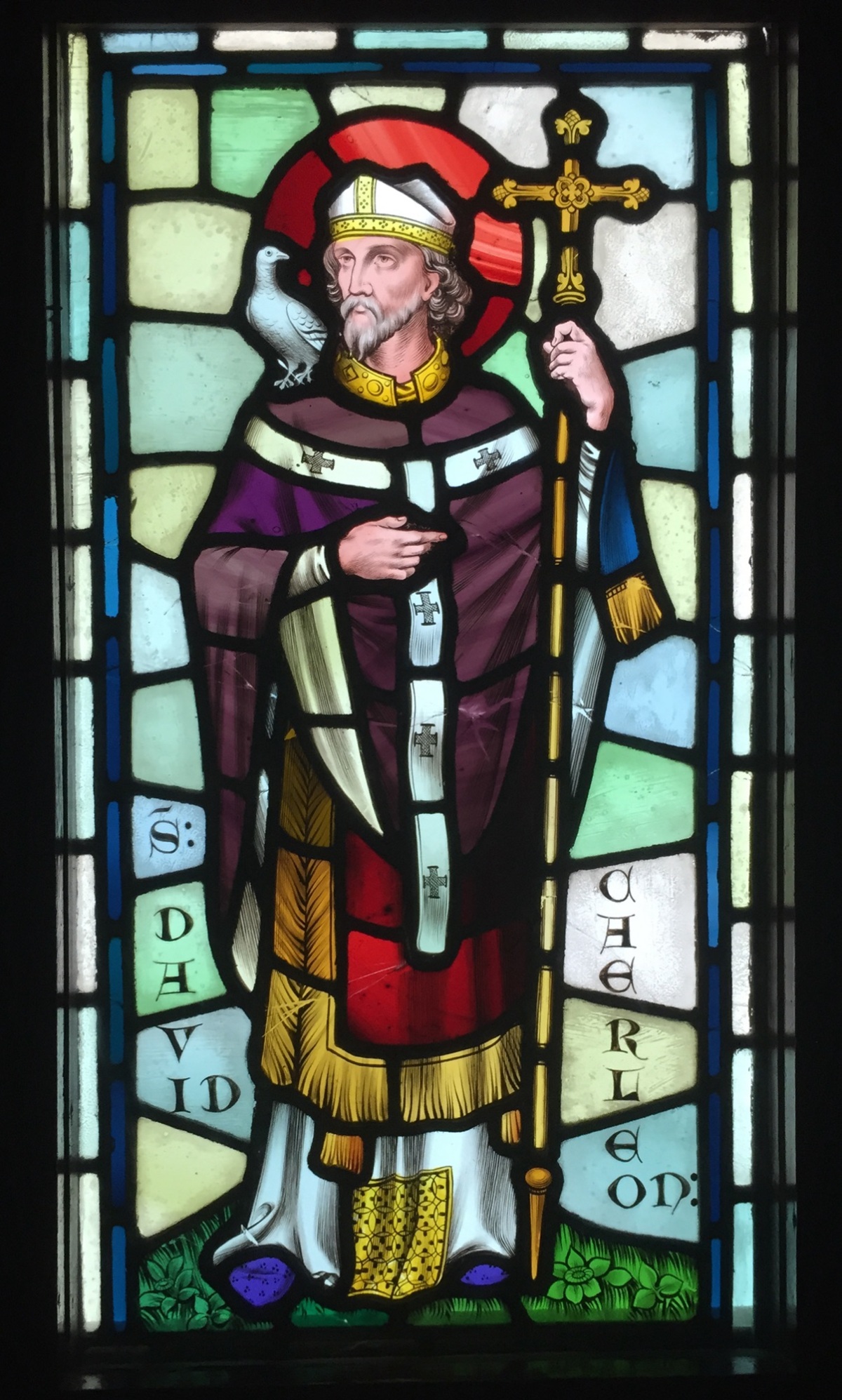
But today is a day devoted to his namesake, Dewi, Bishop of Mynyw. It is said that the birth of Dewi was foretold by an angel thirty years before it took place, both to his father, Sant, a man of the royal house, and to Patrick in Ireland.

Dewi’s mother, Non, also of noble birth, was a great beauty. When Sant saw her on his travels, was enflamed with passion for her and forced her to lie with him. The local ruler threatened to kill the child at birth, but when that day came a violent storm arose, and Non fled for shelter to a chapel by a holy well. The lightning flooded the area with brilliant light, protecting both Non and her baby.

The hagiography about Dewi, developed in the centuries after his life to extol him as a saint, makes the claim that he became a renowned preacher, founding monastic settlements and churches in Wales, Brittany and southwest England (including, possibly, the abbey at Glastonbury). It is said that he made a pilgrimage to Jerusalem, from which he brought back a stone that now sits in an altar at St David’s Cathedral, built on the site of his original monastery.

Such stories come from a book written by Rhygyfarch, an 11th century Bishop in the city of St Davids in Pembrokeshire, who claimed that his work was based on documents found in the cathedral archives. By this time, hagiographies of various saintly figures had been written for some centuries; standard elements included comparing the life of the saint with the life of Jesus, and providing a detailed account of the martyrdom of the saint if they died as a martyr.

The purpose of hagiographical writing was not to preserve “actual history” (not that such a thing is actually possible to access). It is thought that hagiographies provided priests and theologians with models to follow as they preached and wrote. They have a similar function to classical handbooks, as they provide the rhetorical tools necessary to present Christian faith through the example of the saints’ lives.

So “what actually happened to Dewi” is not the point at hand; rather, “how Dewi models faithful discipleship” is the reason for remembering him, telling stories of his life, providing an example for medieval Christians.

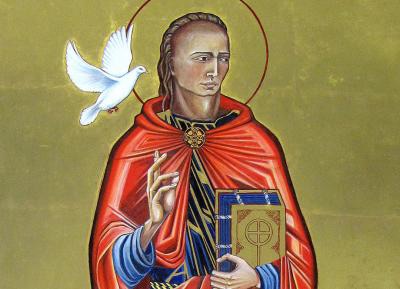
The religious symbol associated with Dewi is a white dove. The story that explains this is that whilst Dewi was preaching at the Synod of Brefi, a mound arose from the ground to form a small hill, and a white dove settled on his shoulder. The sermon, apparently, was a criticism of Pelagianism, a belief that the fall did not introduce original sin, and that human beings can work to achieve perfection in God’s sight.

Dewi was ascetic and vegetarian; he believed that “hard manual labor was the duty of all, thus preferring not to use cattle to help them plow the fields” and imposed on his community “a diet of bread and vegetables, with just a sprinkling of salt, so as not to inflict unnecessary suffering upon any creature by taking its life for food.” (Holly Roberts, Vegetarian Christian Saints, Anjeli Press, 2004, p. 131.)

It is said that he taught the monks of his community how to grow leeks—a vegetable which has become associated with Wales. It’s a tasty vegetable which adds flavour to various meals that we cook, today.

Dewi died peacefully at the end of the 6th century; it is said that the monastery was “filled with angels as Christ received his soul”. His remains were initially placed in the cathedral, but later conflicts meant that they were disrupted and moved. Dewi was canonised as Saint David in 1120 and declared to be the National Saint of Wales. Over 50 churches in South Wales had been dedicated to him before the Reformation.

So today, we give thanks for David: monk, saint, national hero.

See https://www.historic-uk.com/HistoryUK/HistoryofWales/St-David-Patron-Saint-of-Wales/

I will be a father to him, and he shall be a son to me (2 Sam 7; Advent 4B)

During this season of Advent, the lectionary offers a selection of biblical passages designed to help us in our preparations, building to the climactic moment of Christmas Day, when we remember that “the Word became flesh and lived among us, and we have seen his glory, the glory as of a father’s only son, full of grace and truth” (John 1:14).

These scripture passages have include a sequence of excerpts from the Hebrew Scriptures—largely from the book of Isaiah—which orient us to the saving work of God, experienced by faithful people in Israel through the ages. These scripture passages inform us as to how God might be understood to be at work in the story of Jesus. For my part, I don’t read these Hebrew Scripture passages as “predictions” pointing to Jesus. Rather, I consider that the prophets and psalmists of ancient times were addressing their own situations, not peering into the distant future.

How I read these passages is not in a simplistic prophecy—fulfilment pattern. That is too crass, and it pays no respect at all to the wisdom of faithful people in ancient Israel. Rather, I read these passages as testimonies to the way that faithful people of old understood and experienced God to be at work in their own times, in their own lives. What they wrote—the word of the Lord for their own time—has been repeated and remembered, retold by word of mouth and written onto scrolls which, over time have become recognised as important, influential, even inspired words of wisdom.

So whilst the Hebrew Scripture passages tell us of how God had been at work in years past, they are retained as relevant words which provide guidance and direction for understanding how God would presumably be at work in later times, in the times of Jesus, and indeed in our own times today. When we read and hear and ponder these ancient words, we are opening our hearts and minds to the guidance of God’s Spirit, instructing us in our lives of faith today.

For the fourth Sunday in Advent, we are offered a well-known passage from 2 Samuel; the message that the prophet Nathan receives from the Lord God, which he is instructed to convey to King David (2 Sam 7:1–11, 16). Curiously, the lectionary omits the final comment of the narrator, “in accordance with all these words and with all this vision, Nathan spoke to David” (2 Sam 7:17).

It is worth understanding where this passage comes in the narrative flow of events, for it occurs at a critical time in the story of the people of Israel. In earlier chapters, the prophet Samuel had (somewhat reluctantly) anointed Saul as king in Israel (1 Sam 10:1). This was done in obedience to a direct word of the Lord to Samuel: “I will send to you a man from the land of Benjamin, and you shall anoint him to be ruler over my people Israel. He shall save my people from the hand of the Philistines; for I have seen the suffering of my people, because their outcry has come to me.” (1 Sam 9:16).

However, in the midst of his battles with the Philistines, Saul eventually kills himself, when he sees how hopeless the situation has become (1 Sam 31). The early chapters of 2 Samuel recount the antagonism and chaos of the ensuing days, as “the people of Judah … anointed David king over the house of Judah” (2 Sam 2:4). However, “there was a long war between the house of Saul and the house of David”; during the course of this war “David grew stronger and stronger, while the we Bw ww c house of Saul and and became weaker and weaker” (2 Sam 3:1).

At this point in the story, David recognises an incongruity: “I am living in a house of cedar, but the ark of God stays in a tent”, he tells Nathan (2 Sam 7:2). The implication is that David is now about to redeploy the carpenters and masons whom King Hiram of Tyre had earlier provided for him to build his own house (2 Sam 5:11), and commission them now to build a house for God to live in (2 Sam 7:5).

So the Lord God directs the prophet Nathan to intervene, reminding him that “I have not lived in a house since the day I brought up the people of Israel from Egypt to this day, but I have been moving about in a tent and a tabernacle” (2 Sam 7:6). Samuel is to inform David that God does not need a house to be built for his residence. Rather, God will create a “house” for David; but that house will not be a cedar lodge of multiple rooms, but a royal dynasty with a lineage of monarchs.

The wordplay on “house” is at the heart of this passage. In Hebrew, the word bayith can equally refer to a structure built for people to live in, or to a collection of people living together as a household or related as a family group. That is the same as the English word “house”, which can refer to a domestic structure or a family group. While David yearns to build a structure to house the Lord God—a temple—the intentions of God for David are rather that he will build a family—a dynasty—which will ensure the security of the nation in future generations.

God promises David that he will make him the first in a line of men to rule over Israel—indeed, God promises that “I will establish the throne of his kingdom forever” (2 Sam 7:13). So confident is the Lord God about this promise that he repays it; “your house and your kingdom shall be made sure forever before me; your throne shall be established forever” (7:16).

I think the thrice-repeated claim “forever” is hyperbolic grandstanding; the united kingdom that David inherited from Saul and bequeathed to Solomon did not last “forever”. In less than a century, the kingdom was divided; in another two centuries, the northern kingdom had been defeated and there were no rulers in the line of David, and within another one-and-a-half centuries the southern kingdom had met the same fate.

Later generations would cling to that promise and interpret it in various ways. The narrator of 1–2 Samuel and 1–2 Kings tells of the continuation of this promise over the centuries. Whoever edited the final version (sometime in the Exile, is the best guess) would have known that the promise did not actually last “forever”; yet they retained that claim in the narrative of 2 Sam 7. The promise had been made; even knowing that it was not carried through in history, that story still was to be told.

Various psalms follow suit, celebrating that God “shows steadfast love to his anointed, to David and his descendants forever” (Ps 18:50), bestowing blessings on David forever (Ps 21:6; 45:2), ensuring that “your throne, O God, endures forever and ever” (Ps 45:6), and offering prayers for the king, “may he be enthroned forever before God” (Ps 61:7), “may his name endure forever” (Ps 72:17).

Similarly, even whilst in exile, the prophet Jeremiah celebrates the promise that “David shall never lack a man to sit on the throne of the house of Israel” (Jer 33:17). However, as the prophet surveys “the towns of Judah and the streets of Jerusalem that are desolate, without inhabitants, human or animals” (Jer 33:10), he considers, at least fleetingly, the consequence that David “would not have a son to reign on his throne” (Jer 33:21).

(Nevertheless, the oracle ends with a reversion to the hope that God “will restore their fortunes, and will have mercy upon them”, v.26; earlier, Jeremiah had spoken of the “righteous Branch” who would “spring up for David”, v.15. Indeed, all the exilic prophets hold strongly to the hope of a restored and renewed kingdom.)

However, the definitive break of the line is clearly envisaged at the same time, during the exile, by one of the psalmists, in Psalm 89. Initially, in this psalm, the psalmist declares that “your steadfast love is established forever” (v.2), notes that God’s “hand shall always remain” with David (v.21), and affirms that “his line shall continue forever” (v.36).

And yet, that psalmist continues, “you have spurned and rejected him; you are full of wrath against your anointed” (v.38), “you have removed the scepter from his hand and hurled his throne to the ground” (v.44). The psalm ends with lament: “Lord, where is your steadfast love of old, which by your faithfulness you swore to David?” (v.49).

Clearly, “forever” did not mean for all time, in some aspects of the developing Jewish understanding. The period of exile was indeed the catalyst for consideration of how a Jewish nation might continue; from this time onwards, many Jews continued to practice their religion in the Diaspora, right through to the present. But their practices and customs changed, developed, adapted. And as the sages of the people grappled with ways to live out their faith in a healthy way in those dispersed contexts, they developed various reassessments of the previously strong links between the king, the covenant, and the Lord God. “Forever” did not mean “forever”.

And yet in Christianity, the promise was seen to be still valid; indeed, the Christian claim is that it was continuing in Jesus. The angel Gabriel tells the pregnant Mary that the child she will bear “will reign over the house of Jacob forever, and of his kingdom there will be no end” (Luke 1:33). The writer of the letter to the Hebrews quotes Psalm 45:6 and applies it directly to the Son: “your throne, O God, is forever and ever” (Heb 1:8), while the author of Revelation foresees that when the seventh angel blew his trumpet, “there were loud voices in heaven, saying, ‘The kingdom of the world has become the kingdom of our Lord
and of his Messiah, and he will reign forever and ever’” (Rev 11:15).

So the inclusion of this story in the readings for Advent 4 is, no doubt, because of the Christian understanding that Jesus stands in the line of David, as the shepherd of his sheep, and as the one who rules over the house of God in an eternal kingdom that will never end. (Quite uncharacteristically for me, I have here combined ideas from a number of biblical texts into one harmonised theological statement. This is what systematic theology often does.)

David, the shepherd boy, is anointed as King and designated as the head of a house that will provide leaders stretching into the future in a kingdom that will “be made sure forever before me” (2 Sam 7:16). Jesus is claimed to be of the house of David (Luke 1:27; Matt 1:20) and is acclaimed as “Son of David” (Mark 10:47–48; Matt 20:30–31; Luke 18:38–39), a title that is especially emphasised elsewhere in Matthew’s Gospel (Matt 9:27; 12:23; 15:22; 21:9, 15). The title, for Jewish hearers of those early Gospels, signals the belief that God is at work through this person, Jesus, to guide and lead the people of God.

This Hebrew Scripture passage, like others we have read and heard during Advent, thus orients us to the saving work of God, experienced by faithful people in Israel through the ages, which is later claimed by followers of Jesus to have been manifested in his life. For that reason, we hear it during this Advent season; not as a prophecy which was fulfilled by Jesus, but as a testimony to the ways of God which continue from aeons ago into the present time.

Psalm 86: a primer of prayer (Pentecost 4A) part II

Psalm 86 is offered by the lectionary for this coming Sunday, the Fourth Sunday after Pentecost. This psalm comprises a string of prayers, offering petition, thanksgiving, adoration, and intercession, filled with phrases that occur in other psalms and prayers in Hebrew Scripture. Although some commentators have criticised it for being unoriginal, it serves an important purpose, collating many phrases that can serve well those who pray.

In an earlier blog, I considered the structure of this psalm, and explored three types of prayers that are to be found in it: thanksgiving, adoration, and intercession. See

In this blog, I turn my attention to the petitions that are included in this psalm. The opening section (verses 1–7) includes a substantial collection of petitions to be prayed in times of trouble. Along with the further petitions in verse 11 and verses 16–17, there are a total of eleven petitions to God in this psalm. Let’s consider each of them in turn.

“Incline your ear, O Lord” (v.1) is a request made in other psalms (Ps 17:6; 31:2; 71:2; 88:2; 102:2); in one psalm, there is a confidence that God “will hear the desire of the meek … will strengthen their heart … will incline your ear to do justice” (10:17–18). Likewise, a number of psalms include the request for God to “answer me” (v.1; see Ps 4:1; 13:3; 27:7; 55:2; 69:13, 16, 17; 102:2; 108:6; 119:145; 143:1, 7). In one psalm the author affirms that “I call upon you, for you will answer me, O God” (Ps 17:6); likewise, in Ps 86, the psalmist affirms with confidence that “in the day of my trouble I call on you, for you will answer me” (v.7).

In the same verse, the psalmist describes themselves: “I am poor and needy” (v.1)—a self-description also offered at Ps 40:17; 70:5; and 109:22. The phrase is placed in parallel with “the downtrodden” at Ps 74:21. That God stands with the poor and needy is asserted regularly in the psalms; “because the poor are despoiled, because the needy groan, I will now rise up, says the Lord; I will place them in the safety for which they long” (Ps 12:5).

So God “raises the poor from the dust and lifts the needy from the ash heap” (Ps 113:7); God “maintains the cause of the needy and executes justice for the poor” (Ps 140:12). “As for me, I am poor and needy, but the Lord takes thought for me; you are my help and my deliverer, O God” (Ps 40:17; also 70:5). And the psalmist pleads that the king will “judge your people with righteousness and your poor with justice … defend the cause of the poor of the people, give deliverance to the needy” (Ps 72:2, 4)

“Preserve my life” is the next petition (v.2), echoing the same prayer found at Ps 64:1; 79:11; 119:49, 159; 143:11; a prayer made on the basis that God is “a hiding place for me [for] you preserve me from trouble” (Ps 32:7), for “though I walk in the midst of trouble, you preserve me against the wrath of my enemies” (Ps 138:7).

The psalmist undergirds this request to God with the declaration, “I am devoted to you” (v.2), a phrase that might also be translated as “I am a godly person” or “I am a faithful person”. The Hebrew word used here, hasid, is the basis for the contemporary group of ultra-conservative Orthodox Jews known as Hasidic Jews. Many psalms uses this word as a description for those in Israel who were godly people (Ps 12:1; 52:1) or faithful people (Ps 4:3; 16:10; 30:4; 32:6; 37:28; 50:5; 52:9; 79:2; 85:8; 89:19; 97:10; 116:15; 132:9, 16; 145:10). The NRSV also translates this word as blameless (Ps 18:25) and as saints (Ps 31:23).

*****

The plea of the psalmist for God to “save” them (v.2) is another persistent refrain throughout the psalms—both “save me” (Ps 6:4; 7:1; 22:21; 31:2, 16; 44:6; 54:1; 57:3; 59:2; 69:1; 71:2, 3; 109:26, 116:4; 119:94, 146; 142:6; 143:9) and “save us” (Ps 28:9; 31:2; 80:2; 106:47; 118:25). This is a request grounded in the assurance that “God is my shield, who saves the upright in heart” (Ps 7:10); “the Lord is near to the brokenhearted, and saves the crushed in spirit” (Ps 34:18); God “fulfils the desire of all who fear him; he also hears their cry, and saves them” (Ps 145:19). Of course , God as Saviour is an important Hebraic way of understanding the divine, that then has implications and influence as the New Testament documents are written, centuries later.

The self-description of the psalmist in this verse, as “your servant who trusts in you” (v.2), is a description found also in verses 4 and 16. The writer presents themselves as God’s servant in a number of other psalms (Ps 19:11, 13; 27:9; 31:16; 35:27; 69:17; 109:28; 116:16; 143:2, 12) as well as twelve times in Psalm 119 (vv.17, 23, 38, 49, 65, 76, 84, 124, 125, 135, 140, 176).

The attitude of trust in God (v.2) is a stance which is shared with other psalms. “Those who know your name put their trust in you, for you, O Lord, have not forsaken those who seek you”, the psalmist sings (Ps 9:10). “O my God, in you I trust; do not let me be put to shame; do not let my enemies exult over me” (Ps 25:2), they sing, affirming that “steadfast love surrounds those who trust in the Lord” (Ps 32:10), “happy are those who make the Lord their trust” (Ps 40:4), and “in God I trust; I am not afraid” (Ps 56:4; and similar, 55:23).

“Be gracious to me, O Lord” (v.3) is yet another petition that is typical of the psalms. The psalmist regularly implores God, “be gracious to me, for I am in distress” (Ps 31:9; similarly, 6:2; 9:13; 56:1), or “be gracious to me, and hear my prayer” (Ps 4:1), or “be gracious to me and answer me” (Ps 27:7), or simply, “be gracious to me” (Ps 25:16; 26:11; 30:10; 41:4).

In one song, the psalmist muses, “has God forgotten to be gracious?” (Ps 77:9), but in typical style, this cry of lament transforms into words of praise, for “you are the God who works wonders … with your strong arm you redeemed your people” (Ps 77:11–20). God showing grace towards God’s faithful people is indeed “your custom toward those who love your name” (Ps 119:132).

The cry for God to be gracious is a constant and insistent plea, “for to you do I cry all day long” (v.3). The cry of the psalmist is expressed often (Ps 3:4; 5:2; 17:1; 18:6; 27:7; 28:2; 39:12; 57:2; 61:1; 77:1; 88:1–2; 102:1; 119:146–147, 169; 120:1; 142:1, 5–6). Even though the psalmist cries to God “with my whole heart” (Ps 119:145), there are times when this cry feels futile; “I cry by day, but you do not answer me, and by night, but find no rest” (Ps 22:2), and “O Lord, I cry out to you; in the morning my prayer comes to you; why do you cast me off? why do you hide your face from me?” (Ps 88:13–14).

Yet the psalmist is persistent, crying “all day long” (v.3); this mirrors the oppression and distress experienced by the psalmists “all day long”. Various psalms reflect “sorrow in my heart all day long” (Ps 13:2), “groaning all day long” (Ps 32:3), “all day long I go around mourning” (Ps 38:6), “all day long I have been plagued” (Ps 73:14). “All day long my foes oppress me” (Ps 56:1), laments the psalmist, “all day long my enemies taunt me” (Ps 102:8), even bemoaning that “we are being killed all day long” (Ps 44:22). Extended personal distress seems to mark a number of psalms.

However, in other psalms, we have affirmations that “the eyes of the Lord are on the righteous and his ears are open to their cry” (Ps 34:15); “when the righteous cry for help, the Lord hears” (Ps 34:17); “I waited patiently for the Lord; he inclined to me and heard my cry” (Ps 40:1); “he regarded their distress when he heard their cry” (Ps 106:44). As the psalmist cries “out of the depths”, so they are assured that “with the Lord there is steadfast love, and with him there is great power to redeem” (Ps 130:1–8).

The same dynamic, of calling out to God and anticipating an answer, is sung in the petition in v.6, “give ear, O Lord, to my prayer”. This is found in ten other psalms (Ps 5:1; 17:1; 39:12; 54:2; 55:1; 80:1; 84:8; 140:6; 141:1; 143:1), and the parallel request, “listen to my cry of supplication” (v.6) is also offered in two other psalms (Ps 5:2; 61:1).

The psalmist’s confidence that, “on the day of my trouble I call on you, for you will answer me” (v.7), is also reflected at Ps 17:6. This confidence is undergirded by the words spoken by God to those who trust in God: “those who love me, I will deliver; I will protect those who know my name; when they call to me, I will answer them” (Ps 91:14–15).

Verse 11 moves from the offering of prayers and anticipation of receiving answers, to the request to “teach me your way, O Lord, that I may walk in your truth”. The language here reflects another common element in the relationship between the psalmist and the divine, as a student learning from a teacher.

“Teach me” (v.11) is what the psalmist asks for, seeking to be taught “your ways … your paths … your truth” (Ps 25:4–5), “your way” (27:11; 143:8), “your will” (Ps 143:10), “the fear of the Lord” (Ps 34:11), and “wisdom in my secret heart” (Ps 51:6). Throughout the longest psalm of all, there are regular petitions for the Lord to teach “your statutes” (Ps 119:12, 26, 33, 64, 68, 124, 171) as well as “good judgement and knowledge” (Ps 119:66). The psalmists appear to be keen students, thirsting for knowledge.

The next request is for God to “give me an undivided heart” (v.11)—an unusual request, not found in any other psalm, and using a Hebrew word that appears in only two other places in Hebrew Scripture (Gen 49:6; Isa 14:20). The purpose of this request, “to revere your name” (v.11), draws on a very common Hebrew word, found often in the formulaic “do not be afraid” (Gen 15:1;21:17;26:24; 35:17;46:3; Exod 14:13; 20:20; etc.; and on into New Testament texts). This is no fear in the sense of negative terror, for the psalmist clearly draws on the positive sense of the verb, yare’, to indicate a reverence towards God.

*****

In the final set of verses, there are three further petitions worthy of note. “Turn to me and be gracious to me” (v.16) is a petition repeated exactly (Ps 25:16; 119:132) and in shortened form, “turn to me” (Ps 69:16; 119:79). “Give your strength to your servant” (v.16) recalls the closing verse of a powerful nature psalm, “may the Lord give strength to his people! may the Lord bless his people with peace!” (Ps 29:11). The latter part of verse 16, “save the child of your serving girl”, echoes the petition of verse 2, “save your servant who trusts in you”, which we have dealt with above.

Finally, “show me a sign of your favour” (v.17) does not reflect any other psalm, but does evoke the petition of Gideon to the Lord, “now I have found favour with you, then show me a sign that it is you who speak with me” (Judg 6:17).

The purpose of this sign which is sought by the psalmist, “so that those who hate me may see it and be put to shame” (v.17), does however reflect a common request across a number of psalms, pleading for enemies to be “put to shame” (Ps 6:10; 31:17; 35:4, 26; 40:14; 50:5: 57:3; 70:2; 71:13, 24; 83:17; 97:7;109:28; 119:78; 129:5). The other side of this petition is the request, “do not let me be put to shame” (Ps 25:2, 20; 31:1, 17; 71:1; 119:31, 116).

*****

And so we can see that throughout this psalm, in offering petition, thanksgiving, adoration, and intercession, the psalmist has made use of many phrases that occur in other psalms and prayers in Hebrew Scripture. This psalm, a primer for prayer, serves an important purpose, as it draws together many phrases that can serve well those who pray.

Psalm 86: a primer of prayer (Pentecost 4A) part I

Christians are used to praying The Lord’s Prayer on a regular basis, in obedience to the instructions of Jesus recorded in two Gospels: “when you pray, say …” (Luke 11:2; Matt 6:9). This prayer can be considered a succinct primer for prayer, since it contains the key elements of praying.

After an opening adoration of God (“our Father in heaven, holy is your name”), there follows prayers for the world (“your kingdom come, your will be done”), petitions for ourselves (“give us bread for the day, forgive us our sins, do not bring us to the time of trial”), and intercessions for others (“as we forgive those who sin against us”). In the later version of the prayer, a closing benediction is included (“yours is the kingdom, the power, the glory”), ending, of course, with “Amen”. The pattern is clear and concise. See

and

and

There is a similar primer for prayer in Hebrew Scriptures, and it is offered by the lectionary for this coming Sunday, the Fourth Sunday after Pentecost. Psalm 86 comprises a string of prayers, offering petition, thanksgiving, adoration, and intercession, filled with phrases that occur in other psalms and prayers in Hebrew Scripture. Although some commentators have criticised it for being unoriginal, it serves an important purpose, collating many phrases that can serve well those who pray.

(And a similar criticism of unoriginality can be levelled against The Lord’s Prayer; every phrase in that prayer reflects ideas expressed already in Hebrew Scriptures. The originality of the prayer lies not in its content, but in the distinctive way that Jesus has drawn together each element into a cohesive unity.)

Psalm 86 is a prayer which is titled as “A psalm of David”, one of 72 psalms directly attributed to the poet king. Critical studies of the Psalms maintain a strong degree of scepticism regarding the attribution to David of those songs. As the psalm is a fine compilation of various psalmic phrases, however, we will maintain references to the author as “the psalmist”.

The psalm falls into four sections, each with its own style of praying. First (86:1–7), the psalmist cries out in great need, asking God to hear and act on his or her behalf. Then, in a traditional formulaic statement (86:8–10), the psalmist offers adoration of God as the only true God, the Lord of the nations. In the following verses (86:11–13), the psalmist asks God to teach them God’s way and to unite their heart to fear God’s name, so that they might glorify God’s name forever. Finally (86:14–17), in light of the enemies that are perceived, the psalmist again appeals to God’s mercy and grace to deliver them.

The opening section of the prayer (verses 1–7) thus includes a substantial collection of petitions to be prayed in times of trouble. Along with the further petitions in verse 11 and verses 16–17, there are a total of eleven petitions to God in this psalm. (We will explore these further in a subsequent blog post.)

Thanksgiving is the focus in verses 12–13, when the psalmist declares, “I will give thanks to you, O Lord my God, with my whole heart, and I will glorify your name forever; for great is your steadfast love toward me; you have delivered my soul from the depths of Sheol”. Prayers giving thanks to God occur frequently in the book of Psalms (Ps 7:17; 9:1; 28:7; 30:12; 44:8; 54:6; 57:9; 75:1; 79:13; 92:1; 97:12; 100:4; 105:1; 106:1, 47; 107:1; 108:3; 109:30; 111:1; 118:1, 19, 28–29; 122:4; 136:1–3, 26; 138:1–2; 140:13; 142:7; 145:10; see also 1 Chron 29:13; 2 Chron 30:22; Neh 12:24).

Celebrations of being delivered from Sheol likewise occur in other psalms (Ps 30:3; 49:15; 71:20; and see a counterpoint at Hos 13:14). Glorifying the name of the Lord is also a common practice (Ps 22:23; 29:2; 66:2; 72:19; 96:8; 105:3; 115:1; 148:13; 1 Chron 16:8–10, 28–30, 35; Isa 24:15; and for a counterpoint, Mal 2:2). Each of these phrases connects in multiple ways with other parts of Hebrew Scripture.

Adoration is offered in verses 8 to 10 and again in verse 15 of Psalm 86. In the latter verse, the psalmist addresses God as “a God merciful and gracious, slow to anger and abounding in steadfast love and faithfulness”—the same refrain found in many places in the Hebrew Scriptures (Exod 34:6; 2 Chron 30:8–9; Neh 9:17, 32; Jonah 4:2; Joel 2:13; Ps 86:15; 103:8, 11; 111:4; 145:8–9). In both thanksgiving and in adoration, then, the psalm echoes the prayers offered in other psalms as well as in prophetic works.

In the first expression of adoration, the psalmist draws a clear comparison between the Lord God and the many other gods: “there is none like you among the gods, O Lord, nor are there any works like yours” (v.8). This reflects early (pre-Exilic) understandings about the Lord God amongst the many gods, before the Exilic experience crystallised the move into monotheism, articulated especially by Second Isaiah, that “beside me there is no god” (Isa 45:5, 14, 18, 21, 22; 46:9), and in Deuteronomy, that “the Lord is God; there is no other besides him” (Deut 4:35, 39; 5:7; 6:14; 7:4; 8:19; 11:16, 28; 13:6–7, 13; 17:3; 18:20; 28:14, 36, 64; 29:26; 30:17–20).

Could this be a clue that supports the claim in the title of this psalm, that it was written by David? The pre-monotheistic view of the Lord God amongst the gods is reflected in the ancestral narratives concerning Jacob (Gen 31:30–35; 35:1–4). Psalm 82 begins, “God has taken his place in the divine council; in the midst of the gods he holds judgement” (Ps 82:1); of these gods, he says “they have neither knowledge nor understanding, they walk around in darkness” (Ps 82:5).

This criticism reflects the claim that while they wandered in the wilderness, the people “made [God] jealous with strange gods, with abhorrent things they provoked him; they sacrificed to demons, not God, to deities they had never known, to new ones recently arrived, whom your ancestors had not feared” (Deut 32:16–17).

This critical view of other gods is also reflected in the opening words of the Decalogue: “You shall have no other gods before me. You shall not make for yourself an idol, whether in the form of anything that is in heaven above, or that is on the earth beneath, or that is in the water under the earth. You shall not bow down to them or worship them; for I the Lord your God am a jealous God, punishing children for the iniquity of parents, to the third and the fourth generation of those who reject me, but showing steadfast love to the thousandth generation of those who love me and keep my commandments” (Exod 20:2–5).

In the song of celebration attributed to Moses after passing through the Sea of Reeds, the people rejoice, asking “who is like you, O Lord, among the gods? who is like you, majestic in holiness, awesome in splendor, doing wonders?” (Exod 15:11). Later, Jethro the Midianite affirms, “I know that the Lord is greater than all gods, because he delivered the people from the Egyptians, when they dealt arrogantly with them” (Exod 18:11). The distinctiveness of the Lord God is known and celebrated in these ancient sagas. The psalm thus may well have origins in the time of David, long before later post-Exilic theological developments had occurred.

Intercession is the flavour of the prayers offered in verses 14 and 17. Although there is antagonism towards “the insolent … a band of ruffians” (v.14), nevertheless the psalmist hopes that “those who hate me may see [a sign of your favour] and be put to shame” (v.17). Prayers for enemies to be put to shame occur regularly in the psalms (Ps 6:10; 35:4, 26; 40:14; 57:3; 70:2; 71:13, 24; 83:17; 109:28; 119:78; 129:5) and the prophets look for this fate to meet those who are unfaithful (Isa 42:17; 44:9, 11; Jer 2:36; 17:13; 50:2; 51:47; Hos 10:6; Zech 10:3-5).

But praying for enemies to experience God’s grace, as in Ps 86:17, is rare. The psalmist prays for God’s favour to be shown to the faithful people of Israel (Ps 90:17; 106:4; 119:58) and the ancestral sagas record that God showed favour to Noah (Gen 6:8), Joseph (Gen 39:4), Moses (Exod 33:12-17), the people in the wilderness (Lev 26:9), Samuel (1 Sam 2:26), Manasseh (2 Chron 33:12-13), and the remnant who returned to the land (Ezra 9:8).

There is, nevertheless, no other prayer in Hebrew Scripture for God to show favour to enemies, apart from the final verse of Psalm 86. This distinctive prayer thus reaches out across the centuries to link with the teaching of Jesus, to “love your enemies, do good to those who hate you, bless those who curse you, pray for those who abuse you” (Luke 6:27-28).

Picturing God as the one who “has helped me and comforted me” (v.17) does resonate strongly, however, with other scriptural passages. God comforts—most famously in Psalm 23, where the psalmist prays, “your rod and your staff, they comfort me” (Ps 23:4), but also in the longest psalm of all, where we hear the plea, “let your steadfast love become my comfort according to your promise to your servant” (Ps 119:76), as well as the affirmation, “when I think of your ordinances from of old, I take comfort, O Lord” (Ps 119:52).

So, in a famous oracle, the prophet Jeremiah promises Israel that God says, “I will turn their mourning into joy, I will comfort them, and give them gladness for sorrow” (Jer 31:13), and another prophet in exile sings, “the Lord will comfort Zion; he will comfort all her waste places” (Isa 51:3). Years later, a post-exilic prophet affirms that God declares, “as a mother comforts her child, so I will comfort you; you shall be comforted in Jerusalem” (Isa 66:13), and another, Zechariah, conveys the message that “cities shall again overflow with prosperity; the Lord will again comfort Zion and again choose Jerusalem” (Zech 1:17).

Not only will God comfort; God is also the one who helps (Ps 86:17). “The Lord helps [the righteous] and rescues them; he rescues them from the wicked, and saves them, because they take refuge in him”, says the psalmist (Ps 37:40). “It is the Lord God who helps me”, says Isaiah (Isa 50:7, 9). So God is “helper of the orphan” (Ps 10:14), “the God of the lowly, helper of the oppressed, upholder of the weak, protector of the forsaken, saviour of those without hope” (Judith 9:11). “Surely, God is my helper”, sings the psalmist (Ps 54:4), and so they pray, “O Lord, be my helper” (Ps 30:10).

How God is understood in this psalm, and the way that God relates to the people who are in covenant with God, and indeed with all people of the world, is entirely consistent with these elements as expressed elsewhere in scripture.

(more in the next blog …)