In the sound of sheer silence (1 Kings 19; Narrative Lectionary for Pentecost 21)

On the passage about Elijah in 1 Ki 19 proposed by the Narrative Lectionary

In the passage which the Narrative Lectionary places before us this coming Sunday (from 1 Kings 19), we come to Elijah; one of the key prophetic figures whose deeds are recounted in the books of the Kings or whose words are collected within the Hebrew Scriptures under the catch-all second section of Nevi’im (Prophets).

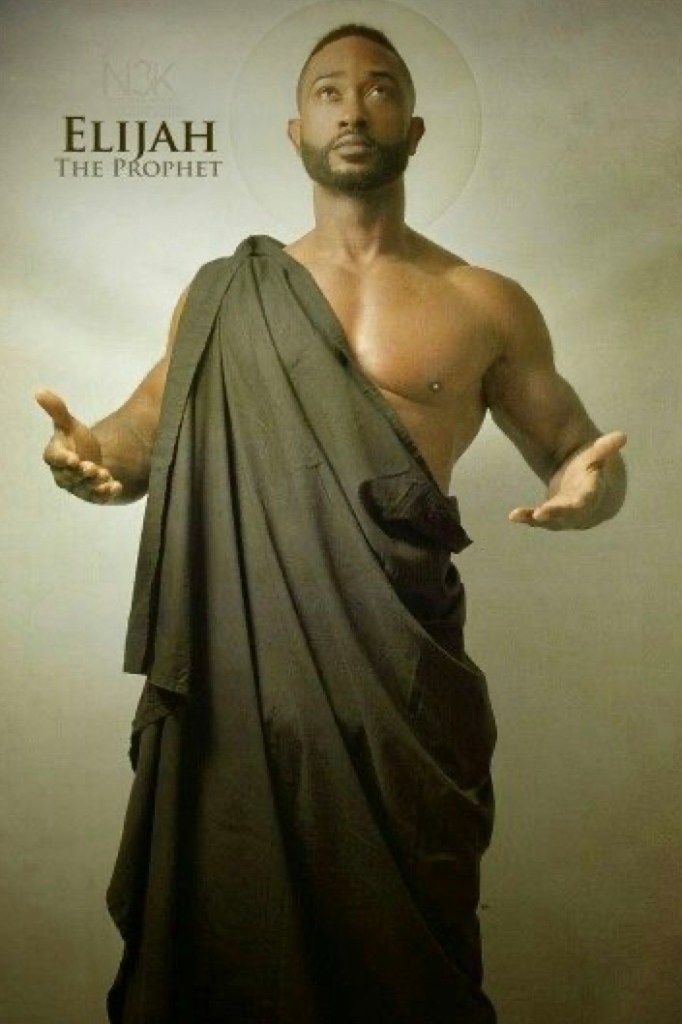
Elijah, famous for being described as “a hairy man, with a leather belt around his waist” (2 Ki 1:8), was first introduced as Elijah the Tishbite, meaning he came from Tishbe in Gilead (1 Ki 17:1), a place whose precise location has occasioned some debate.  See

This initial portrayal of Elijah is nested within the accounts of that long period of time when Israel was ruled by kings, when prophets functioned as the conscience of the king and the voice of integrity within society. The distinctive dress of Elijah perhaps sets him apart from the court of the kings, where a more “civilized” dress code was presumably operative. Nevertheless, Elijah does have some engagement with the kings who ruled at the time he was active: Ahab, and then Ahaziah. Indeed, his distinctive dress points to his emboldened attitude towards those kings.

Elijah operated during the period when Ahab ruled Israel; he figures in various incidents throughout the remainder of 1 Kings—most famously, in the conflict with the prophets of Baal which came to a showdown on Mount Carmel (1 Ki 18), and then later in his confrontation with Ahab and his wife Jezebel, over the matter of Naboth’s vineyard (1 Ki 21). Like Jesus, Elijah was no shrinking violet!

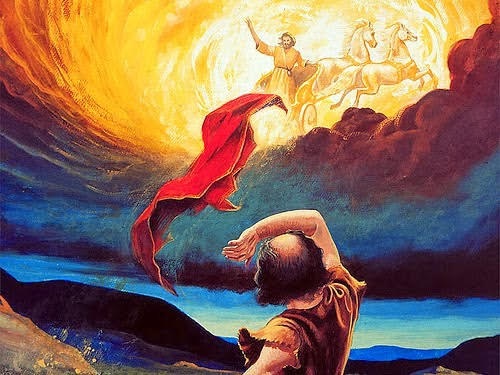
Elijah first appears in the narrative of the various kings, seemingly out of nowhere, just after King Ahab had taken as his wife Jezebel, daughter of King Ethbaal of the Sidonians, who presumably influenced him to begin his worship of Baal (1 Ki 17:31–33). In the same way, at the end of his time of prophetic activity, Elijah simply disappears from sight soon after Kong Ahaziah died. Elijah hands over his role to his successor, Elisha, and as “a chariot of fire and horses of fire separated the two of them”, Elijah ascends in a whirlwind into heaven (2 Ki 2:1–15).

In the book we know as 1 Kings, the compiler of the Deuteronomic History (which stretches from Deuteronomy through Joshua and Judges to Samuel and then Kings) reports many incidents which attest to the courage and power of Elijah. The boldness of Elijah is evident in the confrontations that he has with various rulers; this is made clear, centuries later, to the followers of Jesus, in the earliest account of his life, when John the baptiser is depicted as a fiery desert preacher, calling for repentance, just as Elijah had called the kings to account (Mark 1:1–8). 

In a later account of Jesus, there is a clear inference connecting John with Elijah when Jesus notes, “Elijah is indeed coming and will restore all things; but I tell you that Elijah has already come, and they did not recognize him, but they did to him whatever they pleased” (Matt 17:11–12).

Then, in his sermon in Nazareth (Luke 4:16–30), Jesus refers to the first reported miracle of Elijah, when he provided a widow in Zarephath with food and oil that “did not fail”, even though the land was in drought (1 Ki 17:1–16). In subsequent incidents in 1 Kings, Elijah raises a dead son (17:17–24), directly confronts King Ahab with his sins (18:1–18), and famously stares down the prophets of Baal in a mountaintop showdown (18:19–40), leading to the breaking of the drought (18:41–46).

Elijah later condemns Ahab over his unjust seizure of the vineyard of Naboth (21:17–29) and then stands before Ahab’s son, King Ahaziah, to condemn him to death (2 Ki 1:2–16); a death “according to the words of of the Lord that Elijah had spoken” which is promptly reported (2 Ki 1:17). 

During the rule of Ahab, Elijah had also most famously heard the Lord God “not in the wind … not in the earthquake … not in the fire”—but rather in something else, which the NRSV renders as “the sound of sheer silence” (1 Ki 19:11–12). This incident is, as noted, the story set before us by the lectionary this coming Sunday. We need to ponder what is being conveyed through the symbols employed in this story. 

The three means by which God is said not to have appeared to Elijah reflect the very same means through which Moses, and the people of Israel, did experience the manifestation of the Lord God in their midst. When the escaping Israelites arrived at the Sea of Reeds, according to one version of this archetypal story, “the Lord God drove the sea back by a strong east wind all night, and turned the sea into dry land; and the waters were divided” (Exod 14:21). 

The people later celebrated the defeat of the Egyptians who were pursuing them: “you blew with your wind, the sea covered them; they sank like lead in the mighty waters” (Exod 15:10). The wind was a sign of God’s presence, and an agent of divine protection—indeed, it was the very same “wind from God” which “swept over the face of the waters” at the beginning of creation (Gen 1:2). But for Elijah, the Lord God was “not in the wind”.

Then, as they had travelled through the wilderness, the people were accompanied by a blazing fire, another sign of divine presence: “the Lord God went in front of them in a pillar of cloud by day, to lead them along the way, and in a pillar of fire by night, to give them light, so that they might travel by day and by night” (Exod 13:21). The fire signalled the divine presence.
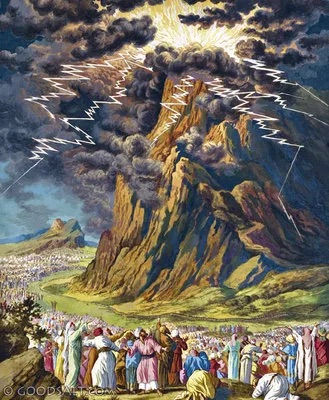
Indeed, the very same flaming fire had been manifested to Moses when he was but a mere shepherd in Midian; “the angel of the Lord appeared to him in a flame of fire out of a bush; he looked, and the bush was blazing, yet it was not consumed” (Exod 3:2). What follows is the account of the call of Moses; God tells him “I will send you to Pharaoh to bring my people, the Israelites, out of Egypt” (Exod 3:10). The fire had been the assurance to Moses that it was the Lord God who was present.  But for Elijah, the Lord God was “not in the fire”.

The same element of fire was present when Moses and the people ultimately arrived at Mount Sinai in the wilderness of Sinai (Exod 19:1–2). “Mount Sinai”, so the account goes, “was wrapped in smoke, because the Lord had descended upon it in fire; the smoke went up like the smoke of a kiln, while the whole mountain shook violently” (Exod 19:18). Associated with this there was “thunder and lightning, as well as a thick cloud on the mountain, and a blast of a trumpet so loud that all the people who were in the camp trembled” (Exod 19:16). 

The scene at Sinai surely reflects the experience of an earthquake; the same phenomenon that prophets would later interpret as a sign of divine presence—indeed, divine judgement. “You will be visited by the Lord of hosts”, Isaiah subsequently tells the people of his time, “with thunder and earthquake and great noise, with whirlwind and tempest, and the flame of a devouring fire” (Isa 29:6). 

Still later, Zechariah describes how “the Mount of Olives shall be split in two from east to west by a very wide valley”, and instructs the people, “you shall flee as you fled from the earthquake in the days of King Uzziah of Judah; then the Lord my God will come, and all the holy ones with him” (Zech 14:4–5).

Nahum reflects on the jealous and avenging nature of God, declaring that “his way is in whirlwind and storm, and the clouds are the dust of his feet; he rebukes the sea and makes it dry, and he dries up all the rivers; the mountains quake before him, and the hills melt; the earth heaves before him, the world and all who live in it” (Nah 1:2–5). 

This dramatic motif continues on into later apocalyptic writings (Isa 64:1; 1 Esdras   4:36; 2 Esdras 16:12). The prophets and their apocalyptic heirs  knew clearly that this whole dramatic constellation of events revolving around an earthquake was a sign of divine presence.  But for Elijah, the Lord God was “not in the earthquake”. He was heard in something quite different.

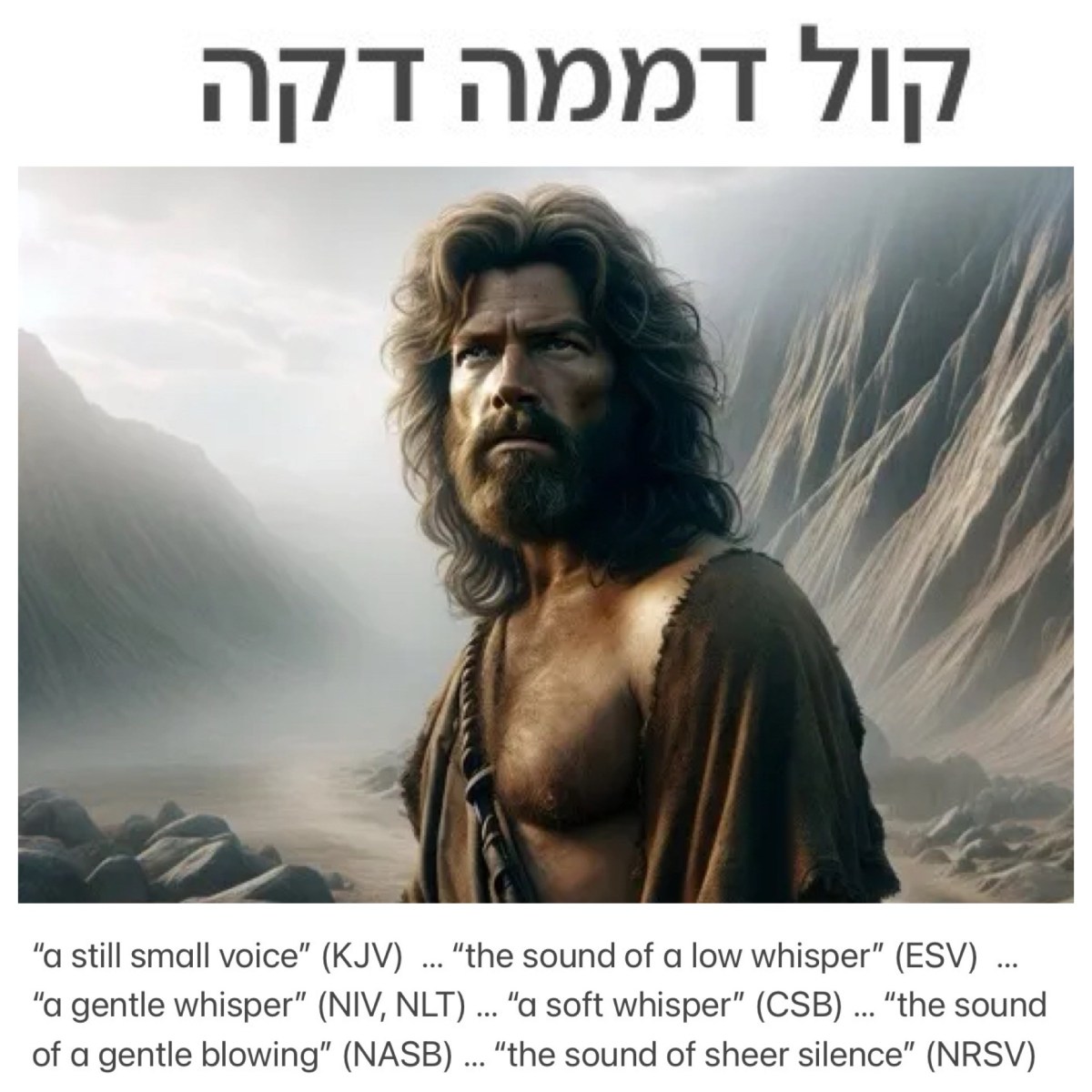
What did Elijah hear? The Hebrew phrase in verse 12 is qol d’mamah daqqah. The King James Version translated this as “still small voice”.  More recent translations have provided variants on how these words might be translated. Alternatives that are found include “the sound of a low whisper” (ESV), “a gentle whisper” (NIV, NLT), “a soft whisper” (CSB), or “the sound of a gentle blowing” (NASB). These reflect variations on the kind of nuance that the KJV was offering. 

Screenshot

However, the NRSV option of translating this phrase as “the sound of sheer silence” is more confronting: the presence of God is sensed in the absence of sound; any communication from the deity comes, not in audible sounds, but in the utter absence of any sound. It is a striking paradox!

And in the context of the developing story of 1 Kings, the paradox is strong. Earlier, the prophet had stood firm against the might of Baal, the foreign god whom Ahab and Jezebel had prioritized in the life of Israel (1 Ki 18:17–40). When “the four hundred and fifty prophets of Baal and the four hundred prophets of Asherah who eat at Jezebel’s table” gathered on Mount Carmel, they failed to obtain any response from their god, the god of storms. No matter how intensely the pleaded, all they heard was “no voice, no answer, no response” (18:29).

Elijah, by contrast, prays to the Lord God and the fire of his god fell on the sacrificial altar; it consumed “the burnt offering, the wood, the stones, and the dust, and even licked up the water that was in the trench” (18:38). The victory was absolute and complete; the storm god had been defeated. And yet, the deity who accomplished this would communicate most personally and intimately with his chosen prophet, “not in the wind … not in the earthquake … not in the fire”, but rather in “a sound of sheer silence” (19:11–12). What a deliciously powerful irony!

Elijah was his own, distinctive man, with his own, distinctive encounter with God. He experienced God in a way quite different from what was experienced by Moses and the people of Israel. He experienced God in a way that stood apart from his contemporaries who were priests and prophets of Baal. For that reason, whilst the Lord God of Elijah stands over and against the Baal of Ahab and Jezebel, so too Elijah stands alongside and apart from Moses as a different, but equally great, leader of the people.

Elisha and Naaman (2 Kings 5; Pentecost 4C)

During the long season after Pentecost in Year C, the lectionary includes a range of stories and oracles from the prophetic texts of Hebrew Scripture. The first three come from the books bearing the title of Kings—although the contents of these two books canvass more than the kings of Israel; prophets figure prominently at key points in the story. 

Two of these passages are well-known because Jesus refers to them in the sermon he delivered at Nazareth: Elijah and the widow at Zarephath, and Elisha and the Syrian army commander, Naaman. Elijah is sent to a faithful woman, who perhaps typically remains unnamed; Elisha is sent to faithful man, identified by name as Naaman (Luke 4:25–27). 

Both characters demonstrate trust in the stories told about them. The woman trusted Elijah when he said, “first make me a little cake of it and bring it to me, and afterwards make something for yourself and your son” (1 Ki 17:13). She did this, and there was enough for her and her son, and for Elijah “for many days … the jar of meal was not emptied, neither did the jug of oil fail” (2 Ki 17:15–16).

The army commander (eventually) trusted Elisha when he said, “go, wash in the Jordan seven times, and your flesh shall be restored and you shall be clean” (2 Ki 5:10). After an initial reluctance, Naaman did as the prophet said, and he was healed; “his flesh was restored like the flesh of a young boy, and he was clean” (2 Ki 5:14).

The woman, who was not an Israelite (Zarephath is in Sidon, a Gentile territory) is of low social status; the army commander, of course, is a high status person, even if he is a foreigner, as a Syrian. Jesus alienates his audience in Nazareth by focussing his attention on God’s merciful care for foreigners like the widow of Sidon and the soldier of Syria, regardless of their social status—and on the way each one of these foreigners modelled trusting obedience. As Luke reports, his audience was not impressed! 

See more at 

We hear the second of these stories this coming Sunday: the encounter between the prophet Elisha and the general Naaman is what is in the Hebrew Scriptures passage proposed by the lectionary. The story comes after Elisha has taken on the role of prophet in the kingdom of Israel, following on from Elijah. Elisha asked Elijah to grant him a double share of his spirit (2 Ki 2:9); Elijah agreed, and after Elijah departed, a company of prophets declared “the spirit of Elijah rests on Elisha” (2:15).

So, as I noted in last week’s blog post, Elisha performs miracles that replicate those performed earlier by Elijah; but he does more than Elijah, with an abundance of miraculous deeds. This particular miracle is given more space than any other miracle that either prophet performs.

The early and substantive miracle of Elijah, his reviving the widow ‘s son (1 Ki 17), is told in eight verses; the story of Elisha and Naaman (2 Ki 5) takes up fourteen verses, but the story continues for another thirteen verses, detailing the consequences for Elisha’s servant Gehazi after his intervention into the sequence of events. 

The lectionary, of course, does not offer all of the elements of this long narrative. We hear, firstly, the opening two verses which introduce Naaman and his situation; we then skip to verse 6, to hear the course of events leading to the healing of Naaman. Whilst verse 2 also introduces a young Israelite girl who had been taken captive to serve Naaman’s wife, we do not hear her role in the narrative offered by the lectionary (vv.3–5). The lectionary, unfortunately, is good at minimising or informing female characters in the stories it includes.

As for Naaman, we learn much and observe much during the course of events. Naaman is introduced in a distinctive way. He is a “mighty warrior”, a commander “of the army of the king of Aram”—that is, a foreigner—who was “in high favour with his master, because by him the Lord had given victory to Aram” (5:1). Aram was a province in Syria, to the northeast of Israel, with Damascus as a key city. The province is perhaps best known through the fact that its name forms the basis of the language which came to be the dominant tongue across the Middle East: Aramaic. 

See https://www.biblicalarchaeology.org/daily/ancient-cultures/ancient-near-eastern-world/what-is-aramaic/#gf_1

In the days of Israel’s kings and prophets, foreigners were inevitably regarded as enemies, to be fought, subdued, and held captive. The regular battles recorded throughout the books of Samuel and Kings attest to this, and many psalms also reflect this deep-seated antagonism.

One psalmist sings “rise up, O Lord, in your anger; lift yourself up against the fury of my enemies” (Ps 7:9), another affirms that “surely God is my helper … he will repay my enemies for their evil” (Ps54:4–5), while yet another celebrates at length: “you made my enemies turn their backs to me, and those who hated me I destroyed. They cried for help, but there was no one to save them … I beat them fine, like dust before the wind; I cast them out like the mire of the streets” (Ps 18:40–42). 

In the NRSV, no less than ten psalms have been given titles which include the words “Deliverance from Enemies” (Pss 4, 5,  10, 13, 31, 35, 59, 70, 140, 143). It was a standard element, it would seem, that was to be found in temple worship and in the prayers of faithful people, as these psalms attest.

This is one factor that helps explain the intractability of national relationships in the Middle East today; centuries of antagonism and conflict have led to hatred and demonising of the “other”. There is no clear and simple way back from this deeply-ingrained perspective, held by Jew and Arab alike.

In the context provided by these psalms, the celebration of Naaman as a military commander whose victory was enabled by the Lord God of Israel is striking. Whether Naaman was an historical person or not cannot be determined; his actual existence is as secure, or as fragile, as the existence of any other figure in the narratives found in the grand saga of Israel in these biblical books. There are no known references to him in sources outside the biblical texts.

To be sure, the story, first told by storytellers and then passed on through the growing oral tradition, would have struck a distinctive note in ancient Israel, given this ingrained antagonism towards foreigners—especially those in military service. By the time the Deuteronomic History was compiled and published, the Israelites had already experienced the beneficence of Cyrus, King of Persia. Under Cyrus—declared by the Lord in Second Isaiah to be “my shepherd [who] shall carry out all my purpose” as the Lord’s anointed (Isa 44:28, 45:1)—Israel had experienced a positive action by a foreign ruler. Naaman’s victory, empowered by the Lord God, would have had a resonance with that experience for this who heard, or read, his story.

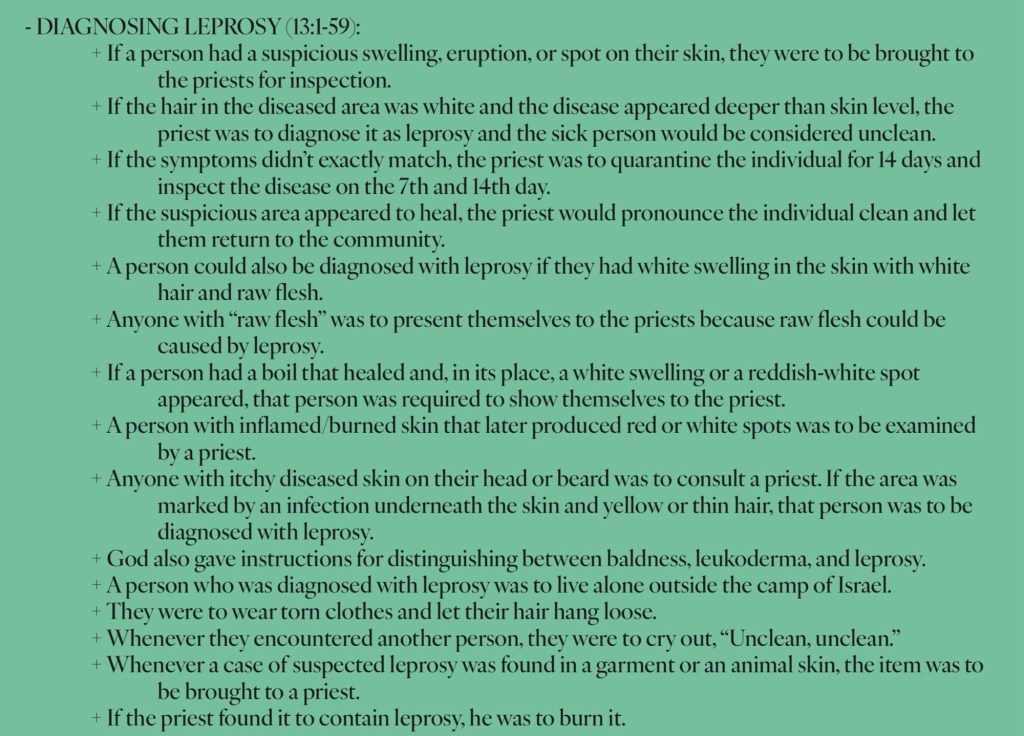
But Naaman is also introduced as a mezora, a person affected by the skin disease tzaraath  (2 Ki 5:1). This latter term is traditionally rendered as “leprosy”, but it is clear that it was not at all what today we know as Hansen’s disease, a highly-contagious disease in which a bacterial infection can damage some or all of a person’s skin, nerves, eyes, and their respiratory tract. Biblical leprosy was, rather, a disfiguration of a person’s skin—usually manifested in white patches of skin—which rendered a person ritually unclean. There are a range of prescriptions for dealing with this disease in Lev 13–14.

Naaman’s condition renders him unclean in Israelite society. It is his his slave girl (taken into service from her home in Israel) who suggests to him that he might visit “the prophet who is in Samaria”, for “he would cure him of his leprosy” (5:3). Naaman goes to Elisha with the blessing of his king, whose army had previously been at war with the Israelite army (1 Ki 20, 22); now, however, Israel was battling the Moabites to the south (2 Ki3), so Aram was a beneficent neighbour.

The process that Elisha sets for Naaman to follow is symbolically rich and practically powerful. “Go, wash in the Jordan seven times, and your flesh shall be restored and you shall be clean” (5:10), the prophet commands him. The “seven times” signals a perfect, completed process, typical of Israelite practices (“seven times” appears four times in the ritual of Lev 14, and another five times in other ritual elsewhere in Leviticus).

Summary of Lev 13, from https://www.2belikechrist.com/articles/leviticus-13-summary-in-5-minutes

This process is far simpler than the required ritual for Israelites: Leviticus prescribes a far more complex process. It begins with an investigation by the priest to determine whether the person is in fact unclean (Lev 13, with multiple options for consideration set out in the first 46 verses, and then 13 further verses relating to clothing and houses!)

If the disease is still active, a purification process then ensues in which  “two living clean birds and cedarwood and crimson yarn and hyssop” are to be brought to the priest, who will then slaughter one bird and “take the living bird with the cedarwood and the crimson yarn and the hyssop, and dip them and the living bird in the blood of the bird that was slaughtered over the fresh water” (Lev 14:4–6). This blood is then sprinkled seven times on the one who is to be cleansed of the leprous disease; “then he shall pronounce him clean, and he shall let the living bird go into the open field” (Lev 14:7).

A further process is then required, with the person to be healed washing, shaving, living apart for a week, shaving again, and then taking another collection of items for this ritual: “two male lambs without blemish, and one ewe lamb in its first year without blemish, and a grain offering of three-tenths of an ephah of choice flour mixed with oil, and one log of oil” (Lev 14:10). Another ritual of sacrifice follows, with detailed instructions given (Lev 14:11–20). It is complex! 

The response of Naaman, in the light of this complex process expected of Israelites, is striking. He is impatient! He had actually been expecting an instantaneous cure, and wondered why he could not simply was in a river closer to his home (2 Ki 5:12). In his anger, he dismisses Elisha as weak and ineffective (5:11–12). But after an intercession from his servants, he dutifully obeys, and the result (after seven immersions) is dramatic: “his flesh was restored like the flesh of a young boy, and he was clean” (5:14).  Naaman returns to Elisha, to praise the God who has enabled the prophet to heal him and to offer a gift (5:15). 

Why does the lectionary end the section of the text offered for this Sunday (5:1–14) before the following verse? Surely to end the section with the climactic confession, “I know that there is no God in all the earth except in Israel” would have been quite powerful! Perhaps it stops abruptly to avoid the apparently embarrassing words of Naaman, “please accept a present from your servant” (v.15b). This was to be expected in the patron—client society of antiquity; is it felt a little crass for modern ears, or does it unhelpfully suggest that grateful parishioners today should shower their ministers with gifts in gratitude? (That would be contrary to the Code of Ethics that I am bound to operate by.)

Or perhaps because the last part of this verse introduces a whole new act in the story of Naaman and Elisha? The suggestion of a gift for the prophet, his stern refusal (vv.16–18) and his final word of peace (v.19), all lead on into the final part of the long story told in this chapter. It takes us to Gehazi, the interfering servant of Elisha, and the consequences of his actions which are recounted in vv.20–27. Again, the lectionary ignores this part of the story; but its inclusion in the Deuteronomic History indicates that it had significance for the Israelites in subsequent years, and especially in the years after the Exile, when this lengthy document was put into a final form.

Elisha and his servant Gehazi

Elisha, in the end, is required to pronounce judgement over the miscreant servant. Gehazi intervenes, seeking additional money from Naaman—who willingly gives more than what is asked for. “Please give them a talent of silver and two changes of clothing”, the servant begs; Naaman responds by giving him “two talents of silver in two bags, with two changes of clothing” (5:22–23). So gratified was the Syrian for his healing that he gave in abundance.

But Elisha knows what his servant has done; “did I not go with you in spirit when someone left his chariot to meet you?”, he says (5:26). And so the story ends with a clear reversal: “the leprosy of Naaman shall cling to you, and to your descendants forever”, the prophet tells his servant (5:27). And so it does. The man who was once leprous is now healed, for “his flesh was restored like the flesh of a young boy, and he was clean” (5:14); whereas Gehazi now bears the stigma of Naaman’s leprosy, and as he departs from Elisha, “he left his presence leprous, as white as snow” (5:27). 

In later Jewish tradition, the figure of Gehazi serves as a type for those who are avaricious in their dealings with others, as Gehazi was. An article in the Jewish Encyclopedia describes how he is portrayed in the Babylonian Talmud: “When Naaman went to Elisha, the latter was studying the passage concerning the eight unclean “sheraẓim” (creeping things; comp. Shab. xiv. 1).

“Therefore when Gehazi returned after inducing Naaman to give him presents, Elisha, in his rebuke, enumerated eight precious things which Gehazi had taken, and told him that it was time for him to take the punishment prescribed for one who catches any of the eight sheraẓim, the punishment being in his case leprosy. The four lepers at the gate announcing Sennacherib’s defeat were Gehazi and his three sons (b.Soṭ 47a).”

Gehazi is also identified as one of four individuals who deny the resurrection of the dead and have no portion in the world to come (b.Sanh 90a). See https://www.jewishencyclopedia.com/articles/6557-gehazi

In a Christian context, we might also note that the dynamics of this story in 2 Kings 5 foreshadow the dynamics of true faith spoken of by a later teacher in Israel: “whoever wants to be first must be last of all and servant of all” (Mark 9:35); “the greatest among you must become like the youngest, and the leader like” (Luke 22:26); “blessed are you who are hungry now, for you will be filled; blessed are you who weep now, for you will laugh … woe to you who are full now, for you will be hungry; woe to you who are laughing now, for you will mourn and weep” (Luke 6:21,25). What a pity the lectionary has omitted this potent conclusion to a well-known story. 

See also


The spirit of Elijah rests on Elisha (2 Kings 2; Pentecost 3C)

In the Hebrew Scriptures passage that the lectionary sets before us this coming Sunday (in 2 Kings 2), we read about the transition from Elijah the prophet to Elisha the prophet. This is an important moment in the story, as it moves on from the words and deeds of Elijah the Tishbite, later remembered as the great “prophet like fire [whose] word burned like a torch” (Sirach 48:1) and as one who had “great zeal for the law” (1 Macc 2:58).

Whilst Elijah remained in his heavenly abode, it was considered that he would ultimately return from that place “before the great and terrible day of the Lord”; he would come “to turn the hearts of the people of Israel” so that the Lord God “will not come and strike the land with a curse” (Mal 4:5–6). But in the meantime, who would follow him in the earthly realm to declare the word of the Lord and to signal the power of the Lord God by performing miracles, as Elijah had done? This transition story offers the answer.

In the book we know as 1 Kings, the compiler of the Deuteronomic History reports many incidents which attest to the courage and power of Elijah. In his sermon in Nazareth, Jesus refers to the first miracle of Elijah, when he provided a widow in Zarephath with food and oil that “did not fail”, even though the land was in drought (1 Ki 17:1–16). In subsequent incidents in this book, he raises a dead son (17:17–24), confronts King Ahab (18:1–18) and famously stares down the prophets of Baal in a mountaintop showdown (18:19–40), leading to the breaking of the drought (18:41–46).

Elijah later condemns Ahab over his unjust seizure of the vineyard of Naboth (21:17–29) and then stands before Ahab’s son, King Ahaziah, to condemn him to death (2 Ki 1:2–16); a death “according to the words of of the Lord that Elijah had spoken” which is promptly reported (2 Ki 1:17). During the rule of Ahab, Elijah had also most famously heard the Lord God “not in the wind … not in the earthquake … not in the fire”—the standard elements involved in a theophany since the time of Moses (Exod 19:1–6)—but rather in “the sound of sheer silence” (1 Ki 19:11–12). Elijah was his own, distinctive man, with his own, distinctive encounter with God.

Then, immediately after that encounter, Elijah the Tishbite, from Gilead, called Elisha son of Shaphat, a farmer ploughing his fields, to be his chosen disciple (1 Ki 19:19–21). All of these stories serve as the background to the story that we face on this Sunday’s readings, when Elijah “ascended in a whirlwind into heaven” (2 Ki 2:11) and leaves behind his prophetic mantle, which Elisha then took as his own (2 Ki 2:12–14). From that moment, as “the company of prophets who were at Jericho” declared, “the spirit of Elijah rests on Elisha” (2 Ki 2:13–15).

Indeed, Elisha had rather brashly requested of Elijah, “please let me inherit a double share of your spirit” (2:9). Elijah had responded, “you have asked a hard thing; yet, if you see me as I am being taken from you, it will be granted you; if not, it will not” (2:10). Sure enough, as Elisha subsequently watches as “a chariot of fire and horses of fire” take Elijah and he ascends “in a whirlwind” (2:11), Elisha is watching, indeed crying out a description of the spectacle: “father, father! the chariots of Israel and its horsemen!” (2:12). He will surely be doubly blessed. The narrator makes sure we know that Elisha could see Elijah departing, commenting that “when he could no longer see him, he grasped his own clothes and tore them in two pieces” (2:12).

Elisha knows he had the blessing of Elijah when his first action after the departure of his mentor was to pick up the cloak (or mantle) that Elijah had left behind, and immediately uses it to enact a miracle (2:13–14)—replicating what Elijah had just done (2:8). It seems that a distinctive cloak, or mantle, was worn by prophets over the years; although cloaks were common garments—worn, for instance, by Ezra (Ez 9:5) and Job (Job 1:20)—it is thought the cloak or mantle worn by Samuel (1 Sam 15:27) and Elijah (1 Ki 19:13) was a sign of their prophetic role. That certainly seems the case with Elisha (2 Ki 2:8, 12).

Now, Elisha is not exactly my favourite prophet. After all, look at what he did when some small boys taunted him because of his distinctive hairline.  They jeered at him, calling him “bald head”; in response, he cursed them and, presumably to enact the curse, “two she-bears came out of the woods and mauled forty-two of the boys” (2 Kings 2:23–24). As a particularly alopecic person myself, this does not particularly endear this prophet to me. Why did his sensitivity about his follicularly-challenged head justify this incredibly excessive response to the games of children?

However, the compiler of the Deuteronomic History sees otherwise. Elisha is honoured as a prophet who is able to perform miracles, who confronts kings, and who declares the word of the Lord forthrightly and without fear. He replicated the last miracle of Elijah (2 Ki 2:8) by striking a steam of water with his newly-acquired mantle, so that “the water was parted to the one side and to the other” (2:13–14). He made good the bad water in Jericho (2:19–22), then spoke the word that made the water flow again in Judah (3:13–20), replicating another miracle of Elijah when he caused an earlier drought in Israel to end (1 Ki 18:41–45).

He later supplies an impecunious widow with an abundance of oil to save her from her debtors (2 Ki 4:1–7) and then raises from the dead the son of a Shunnamite woman (4:8–37). These two miracles replicate actions performed earlier by Elijah (1 Ki 17:8–16, 17–24). Elisha’s miraculous deeds continue as he supplies food to end a famine in Gilgal (2 Ki 4:38–41), feeds a hundred men (4:42–44), and then heals the Syrian army commander Naaman (5:1–19), a story that we will focus on in worship the Sunday after this coming one. And as Elijah had challenged the kings of his day, so Elisha confronts the king of his time (2 Ki 6).

Still more miracles are reported, before Elisha became ill and died (13:14–20). Yet even in death, his miraculous powers continued; the narrative reports that as the Moabites invade the land each spring, “as a man was being buried, a marauding band was seen and the man was thrown into the grave of Elisha; as soon as the man touched the bones of Elisha, he came to life and stood on his feet” (13:21). Whilst Elijah had not died—his ascension into heaven was most certainly while he was still alive (2 Ki 2:11–12)—Elisha had died, but his power to perform miracles lived on (2 Ki 13:21).

In his long “hymn in honour of our ancestors”,  Jesus, son of Sirach lavishes praise on Elisha. “When Elijah was enveloped in the whirlwind”, he writes, “Elisha was filled with his spirit. He performed twice as many signs, and marvels with every utterance of his mouth. Never in his lifetime did he tremble before any ruler, nor could anyone intimidate him at all. Nothing was too hard for him, and when he was dead, his body prophesied. In his life he did wonders, and in death his deeds were marvelous.” (Sirach 48:12–14). He was, by all accounts, a worthy successor to Elijah. I may have to allow him that, despite his hyper-sensitivity about his hairstyle.

See also 

In the sound of sheer silence (1 Kings 19; Pentecost 2C)

In the passage which the lectionary places before us this coming Sunday (from 1 Kings 19), we meet the first of a number of prophetic figures whose deeds are recounted in the books of the Kings or whose words are collected within the Hebrew Scriptures under the catch-all second section of Nevi’im (Prophets).

The first of these prophetic figures is the Elijah the Tishbite, who was introduced as coming from Tishbe in Gilead (1 Ki 17:1), a place whose precise location has occasioned some debate.  See https://www.biblegateway.com/resources/encyclopedia-of-the-bible/Tishbite

Elijah is later described as “a hairy man, with a leather belt around his waist” (2 Ki 1:8). This initial portrayal of Elijah is nested within the accounts of that long period of time when Israel was ruled by kings, when prophets functioned as the conscience of the king and the voice of integrity within society. The distinctive dress of Elijah perhaps sets him apart from the court of the kings, where a more “civilized” dress code was presumably operative. Nevertheless, Elijah does have some engagement with the kings who ruled at the time he was active: Ahab, and then Ahaziah. Indeed, his distinctive dress points to his emboldened attitude towards those kings.

Elijah operated during the period when Ahab ruled Israel; he figures in various incidents throughout the remainder of 1 Kings—most famously, in the conflict with the prophets of Baal which came to a showdown on Mount Carmel (1 Ki 18), and then later in his confrontation with Ahab and his wife Jezebel, over the matter of Naboth’s vineyard (1 Ki 21). Like Jesus, Elijah was no shrinking violet!

Elijah first appears in the narrative of the various kings, seemingly out of nowhere, just after King Ahab had taken as his wife Jezebel, daughter of King Ethbaal of the Sidonians, who presumably influenced him to begin his worship of Baal (1 Ki 17:31–33). In the same way, at the end of his time of prophetic activity, Elijah simply disappears from sight soon after Kong Ahaziah died. Elijah hands over his role to his successor, Elisha, and as “a chariot of fire and horses of fire separated the two of them”, Elijah ascends in a whirlwind into heaven (2 Ki 2:1–15).

In the book we know as 1 Kings, the compiler of the Deuteronomic History reports many incidents which attest to the courage and power of Elijah. The boldness of Elijah is evident in the confrontations that he has with made clear, centuries later, to the followers of Jesus, in the earliest account of his life, when John the baptiser is depicted as a fiery desert preacher, calling for repentance, just as Elijah had called the kings to account (Mark 1:1–8). In a later account of Jesus, there is a clear inference connecting John with Elijah when Jesus notes, “Elijah is indeed coming and will restore all things; but I tell you that Elijah has already come, and they did not recognize him, but they did to him whatever they pleased” (Matt 17:11–12).

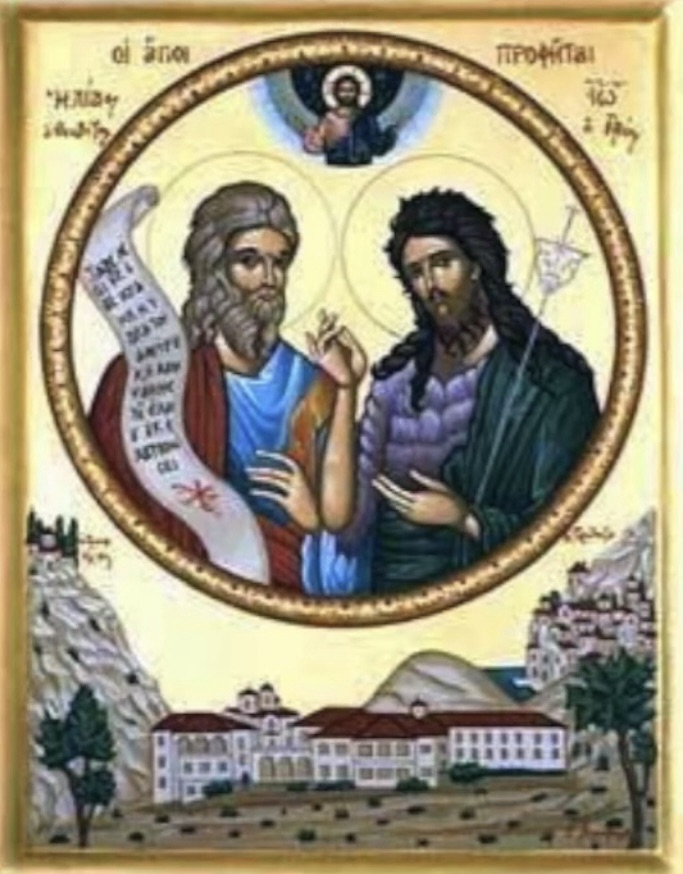
An icon of the Prophet Elijah and Saint John the Baptist from the Monastery of the Prophet Elias (Elijah) in Preveza, Greece

Then, in his sermon in Nazareth (Luke 4:16–30), Jesus refers to the first reported miracle of Elijah, when he provided a widow in Zarephath with food and oil that “did not fail”, even though the land was in drought (1 Ki 17:1–16). In subsequent incidents in 1 Kings, Elijah raises a dead son (17:17–24), directly confronts King Ahab with his sins (18:1–18), and famously stares down the prophets of Baal in a mountaintop showdown (18:19–40), leading to the breaking of the drought (18:41–46).

Elijah later condemns Ahab over his unjust seizure of the vineyard of Naboth (21:17–29) and then stands before Ahab’s son, King Ahaziah, to condemn him to death (2 Ki 1:2–16); a death “according to the words of of the Lord that Elijah had spoken” which is promptly reported (2 Ki 1:17). 

During the rule of Ahab, Elijah had also most famously heard the Lord God “not in the wind … not in the earthquake … not in the fire”—but rather in something else, which the NRSV renders as “the sound of sheer silence” (1 Ki 19:11–12). This incident is, as noted, the story set before us by the lectionary this coming Sunday. We need to ponder what is being conveyed through the symbols employed in this story. 

The three means by which God is said not to have appeared to Elijah reflect the very same means through which Moses, and the people of Israel, did experience the manifestation of the Lord God in their midst. When the escaping Israelites arrived at the Sea of Reeds, according to one version of this archetypal story, “the Lord God drove the sea back by a strong east wind all night, and turned the sea into dry land; and the waters were divided” (Exod 14:21). 

The people later celebrated the defeat of the Egyptians who were pursuing them: “you blew with your wind, the sea covered them; they sank like lead in the mighty waters” (Exod 15:10). The wind was a sign of God’s presence, and an agent of divine protection—indeed, it was the very same “wind from God” which “swept over the face of the waters” at the beginning of creation (Gen 1:2). But for Elijah, the Lord God was “not in the wind”.

Then, as they had travelled through the wilderness, the people were accompanied by a blazing fire, another sign of divine presence: “the Lord God went in front of them in a pillar of cloud by day, to lead them along the way, and in a pillar of fire by night, to give them light, so that they might travel by day and by night” (Exod 13:21). The fire signalled the divine presence.

Indeed, the very same flaming fire had been manifested to Moses when he was but a mere shepherd in Midian; “the angel of the Lord appeared to him in a flame of fire out of a bush; he looked, and the bush was blazing, yet it was not consumed” (Exod 3:2). What follows is the account of the call of Moses; God tells him “I will send you to Pharaoh to bring my people, the Israelites, out of Egypt” (Exod 3:10). The fire had been the assurance to Moses that it was the Lord God who was present.  But for Elijah, the Lord God was “not in the fire”.

The same element of fire was present when Moses and the people ultimately arrived at Mount Sinai in the wilderness of Sinai (Exod 19:1–2). “Mount Sinai”, so the account goes, “was wrapped in smoke, because the Lord had descended upon it in fire; the smoke went up like the smoke of a kiln, while the whole mountain shook violently” (Exod 19:18). Associated with this there was “thunder and lightning, as well as a thick cloud on the mountain, and a blast of a trumpet so loud that all the people who were in the camp trembled” (Exod 19:16). 

The scene at Sinai surely reflects the experience of an earthquake; the same phenomenon that prophets would later interpret as a sign of divine presence—indeed, divine judgement. “You will be visited by the Lord of hosts”, Isaiah subsequently tells the people of his time, “with thunder and earthquake and great noise, with whirlwind and tempest, and the flame of a devouring fire” (Isa 29:6). 

Still later, Zechariah describes how “the Mount of Olives shall be split in two from east to west by a very wide valley”, and instructs the people, “you shall flee as you fled from the earthquake in the days of King Uzziah of Judah; then the Lord my God will come, and all the holy ones with him” (Zech 14:4–5).

Nahum reflects on the jealous and avenging nature of God, declaring that “his way is in whirlwind and storm, and the clouds are the dust of his feet; he rebukes the sea and makes it dry, and he dries up all the rivers; the mountains quake before him, and the hills melt; the earth heaves before him, the world and all who live in it” (Nah 1:2–5). 

This dramatic motif continues on into later apocalyptic writings (Isa 64:1; 1 Esdras   4:36; 2 Esdras 16:12). The prophets and their apocalyptic heirs  knew clearly that this whole dramatic constellation of events revolving around an earthquake was a sign of divine presence.  But for Elijah, the Lord God was “not in the earthquake”. He was heard in something quite different.

What did Elijah hear? The Hebrew phrase found in verse 12 is qol d’mamah daqqah.

The King James Version translated this as “still small voice”.  More recent translations have provided variants on how these words might be translated. Alternatives that are found include “the sound of a low whisper” (ESV), “a gentle whisper” (NIV, NLT), “a soft whisper” (CSB), or “the sound of a gentle blowing” (NASB). These reflect variations on the kind of nuance that the KJV was offering. 

However, the NRSV option of translating this phrase as “the sound of sheer silence” is more confronting: the presence of God is sensed in the absence of sound; any communication from the deity comes, not in audible sounds, but in the utter absence of any sound. It is a striking paradox!

And in the context of the developing story of 1 Kings, the paradox is strong. Earlier, the prophet had stood firm against the might of Baal, the foreign god whom Ahab and Jezebel had prioritized in the life of Israel (1 Ki 18:17–40). When “the four hundred and fifty prophets of Baal and the four hundred prophets of Asherah who eat at Jezebel’s table” gathered on Mount Carmel, they failed to obtain any response from their god, the god of storms. No matter how intensely they raised their frenzied pleas, all they heard was “no voice, no answer, no response” (18:29).

Elijah, by contrast, prays to the Lord God and the fire of his god fell on the sacrificial altar; it consumed “the burnt offering, the wood, the stones, and the dust, and even licked up the water that was in the trench” (18:38). The victory was absolute and complete; the storm god had been defeated. And yet, the deity who accomplished this would communicate most personally and intimately with his chosen prophet, “not in the wind … not in the earthquake … not in the fire”, but rather in “a sound of sheer silence” (19:11–12). What a deliciously powerful irony!

Elijah was his own, distinctive man, with his own, distinctive encounter with God. He experienced God in a way quite different from what was experienced by Moses and the people of Israel. He experienced God in a way that stood apart from his contemporaries who were priests and prophets of Baal. For that reason, whilst the Lord God of Elijah stands over and against the Baal of Ahab and Jezebel, so too Elijah stands alongside and apart from Moses as a different, but equally great, leader of the people.

God’s care for the widow; the widow’s care for the prophet (1 Kings 17; Narrative Lectionary for Pentecost 24C)

This blog explores the passage which the Narrative Lectionary offers for this Sunday (1 Kings 17:1–24), in which the prophet Elijah is introduced. But let me begin with Jesus.

Jesus was a Jew, raised in the manner of his time, taught to read Torah, the scrolls which held prime place in his religion. He was schooled in the detailed requirements of the Law which expressed commitment to the covenant made by the Lord God with ancestors of old (Noah, Abraham, Jacob, David). He actively participated in the practice of prayer and study which occurred in the synagogues and the rituals of offerings and sacrifices that took place in the Temple in Jerusalem.

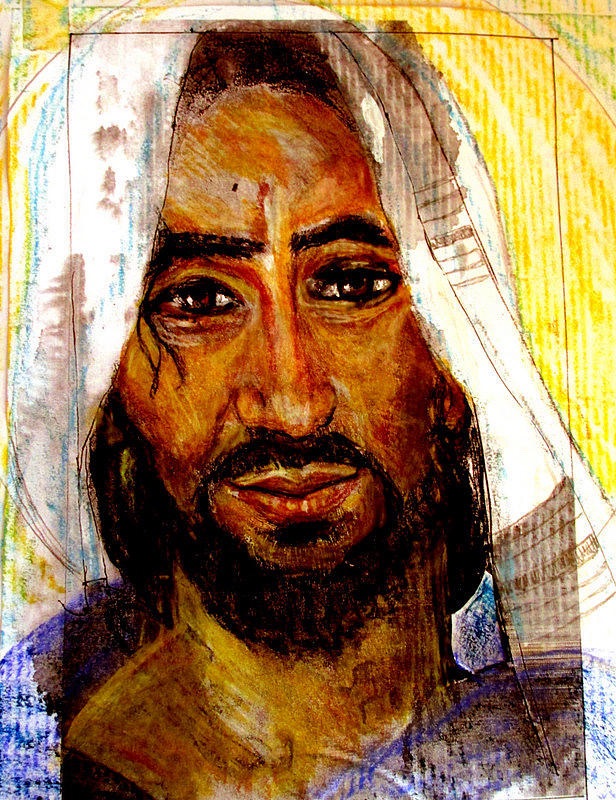
A depiction of Jesus the Jew

As an adult, Jesus broke with his family and began to exercise an itinerant ministry, travelling from place to place with a small, but growing, group of followers, dependant upon the hospitality of those who welcomed him to the villages and towns he visited. In this regard, Jesus was following the practice of prophets in the traditions of the Israelites who travelled from place to place, not settling anywhere. Both Elijah and Elisha lived in this manner; Elijah was known as “hairy man, with a leather belt around his waist” (2 Ki 1:8). 

This mode of living, of course, was adopted by John the Baptist, who was “clothed with camel’s hair, with a leather belt around his waist, and he ate locusts and wild honey” (Mark 1:6). And, of course, there are indications that Jesus—and some of his own disciples—had been followers of John before he launched into his own public mission. Jesus continued the message proclaimed by John, to “repent, for the kingdom of heaven has come near” (Matt 3:2; 4:17) and he continued the emphasis of John to “bear fruits worthy of repentance” (Matt 3:8–10; 7:17–20)  and to share one’s own clothing and food with others who are lacking these essentials of life (Luke 3:11; 12:42; and see Matt 25:34–40). 

For more on how Jesus and John are related, see the groundbreaking work of Prof. James McGrath in Christmaker, which I have reviewed at 


As an adult, Jesus travelled from village to village, preaching his intense message that “the kingdom of God” was drawing near, fervently calling people to repent of their sins and commit completely to the ethical way of living that Torah required. It was all in for Jesus, both in terms of what he preachers, and in terms of how he lived—there was no halfway point for him!

In this regard, Jesus shared the key characteristics of a wild-eyed, desert-dwelling, fiery apocalyptic preacher, vigorously proclaiming the imminent coming of the reign of God. This itinerant, apocalyptic Jesus was resolutely Jewish, standing in the tradition of a string of earlier wild-eyed, rhetorically powerful prophetic figures: Elijah, Nathan, Isaiah, Jeremiah, Joel, Malachi—and his own relative and mentor, John the baptiser. 

A depiction of Elijah the Tishbite, “a hairy man”

It is Elijah the Tishbite whom we meet in the passage which the Narrative Lectionary offers for this Sunday (1 Kings 17:1–24)—Elijah, who is later described as “a hairy man, with a leather belt around his waist” (2 Ki 1:8). This initial portrayal of Elijah is nested within the accounts of that long period of time when Israel was ruled by kings, when prophets functioned as the conscience of the king and the voice of integrity within society. 

Elijah operated during the period when Ahab ruled Israel; he figures in various incidents throughout the remainder of 1 Kings—most famously, in the conflict with the prophets of Baal which came to a showdown on Mount Carmel (1 Ki 18), and then later in his confrontation with Ahab and his wife Jezebel, over the matter of Naboth’s vineyard (1 Ki 21). Like Jesus, Elijah was no shrinking violet!

Elijah first appears in the narrative of kings, seemingly out of nowhere, at the beginning of this lectionary passage (1 Ki 17)—just as he disappears from sight when he hands over his role to his successor, Elisha, and as “a chariot of fire and horses of fire separated the two of them”, Elijah ascends in a whirlwind into heaven (2 Kings 2:1–15).

So in 1 Kings 17, Elijah predicts a drought and takes himself into the desert, where ravens fed him food and he drank from the wadi, until the wadi dried up (vv.1–6). Elijah did as he was commanded and travelled out of Israel, to the neighbouring region of Sidon (v.7). Is this start of Elijah’s public activity mirrored, centuries later, in the account of Jesus retreating into the wilderness near the Jordan, before his public activity got underway?

However, whilst Jesus meets the tempter, Elijah meets a widow who, despite being unnamed, is nevertheless well known in Christian circles because Jesus himself, according to Luke, refers to her in a keynote sermon. This took place when he came to his hometown on Nazareth, and was given opportunity to speak in the synagogue (Luke 4:14–30). After reading from the scroll of Isaiah, Jesus refers to stories of two prophets—Elijah and Elisha—and honours this particular widow amongst “the many widows in Israel at the time of Elijah” (Luke 4:25–26). These verses form the short subsidiary reading which the Narrative Lectionary places alongside 1 Kings 17.

The widow offers hospitality to the prophet. Hospitality was a fundamental cultural practice in ancient Israel; there are many stories of the hospitality offered by people such as Abraham (Gen 18:1–15), Rahab (Josh 2:1–16), and David (2 Sam 9:7–13), and hospitality offered earlier to Moses in Midian (Exod 2:15–25), here to Elijah in Zarephath (1 Ki 17:10–24), and later Elijah in Shunem (2 Ki 4:8–17). Welcoming hospitality is commanded in relation to aliens in Israel (Lev 19:33–34) and is advocated in relation to exiles returning to the land (Isa 58:7). The passage from 1 Kings 17 that is proposed by the Narrative Lectionary well exemplifies this practice. The widow had very little; and yet she finds enough to provide for Elijah, in a display of warm hospitality to this foreign Israelite in her territory. 

Hospitality had a fundamental significance in the cultural practices of the day. Writing in Bible Odyssey, Peter Altman notes that “hospitality serves as an underlying core value for how the characters in the Hebrew Bible should treat others, for they, too, understood the precarious nature of life as an outsider”.

See https://www.bibleodyssey.org/articles/hospitality-in-the-hebrew-bible/

In the same resource, Carolyn Osiek notes that this value continues strongly throughout New Testament books, which are “full of images and stories of guests received, both those already known as friends and those strangers who are taken in and transformed into guests. Among nomadic tribes, the guest comes under the protection of the host, who guarantees inviolable safety. The important elements of hospitality include the opportunity for cleansing dusty feet, scented oil to soften dried skin and mask odors of the road, food, shelter, security, and companionship.”

See https://www.bibleodyssey.org/articles/hospitality-in-the-new-testament/

Gerd Theissen, a German New Testament scholar, has proposed that the message of Jesus was spread by itinerants within the early Jesus movement who travelled from village to village with their message. They were dependent on those who received them for hospitality and lodging, in literal obedience to what Jesus had told his disciples (Mark 6:10–11; see also Matt 10:41 and Didache 11:1, 4–6). Jesus and his followers were living in complete obedience to “the Son of Man [who] has nowhere to lay his head” (Matt 8:20; Luke 9:58). In a sense, they are also continuing the pattern which we see in this story of Elijah, as he travels to Sidon during the famine, receiving hospitality from the widow of Zarephath. 

Widows in ancient Hebrew society were in a perilous position. In a strongly patriarchal society, the patronage of a man was vital: a man as husband and provider, a man as father and protector, a man as the household head. Children without fathers—orphans—as well as women without husbands—widows—were in equally perilous situations. They were vulnerable people, often at risk of being mistreated and exploited, of being pushed to the edge of society and being forgotten. They could well be the desolate who needed housing (Ps 68:6).

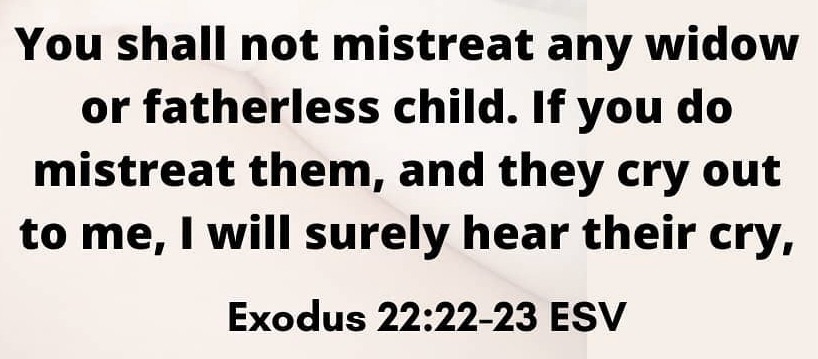
In the Hebrew Scriptures there are regular exhortations and instructions to the people to take care of widows and orphans, the key classes of vulnerable people in that society: “you shall not mistreat any widow or fatherless child” (Exod 22:22) and the instruction to gather a tithe of produce and invite “the Levite, the foreigner, the fatherless, and the widow to come and eat and be filled” (Deut 14:28–29). Even in ancient society, vulnerable people needed protection.

More that this, the Torah provides that the widow and the fatherless child were to included along with the sojourner in celebratory moments in Israel, at the Feast of Weeks (Deut 16:9–12) and the Feast of Booths (Deut 16:13–15). This was also to be the practice when the men were in the field harvesting; they were to leave some for gleaning by ”the alien, the orphan, and the widow” (Deut 24:19–22); and similar prescriptions govern the time when tithing (Deut 26:12–13; also 14:28–29).

Not everyone adhered to these prescriptions. Among the prophets, Isaiah proclaims God’s judgement on those who “turn aside the needy from justice … and rob the poor of my people”, including the way that they exploit the fatherless and widows (Isa 10:1–2). Likewise, Ezekiel includes those who “have made many widows” in Israel amongst those who will experience the full force of God’s vengeance (Ezek 22, see verse 25). He observes that “the sojourner suffers extortion in your midst; the fatherless and the widow are wronged in you” (Ezek 22:7). Jeremiah encourages the people of Jerusalem with a promise that God will allow them to continue to dwell in their land if they “do not oppress the sojourner, the fatherless, or the widow, or shed innocent blood in this place … or go after other gods” (Jer 7:5–7). 

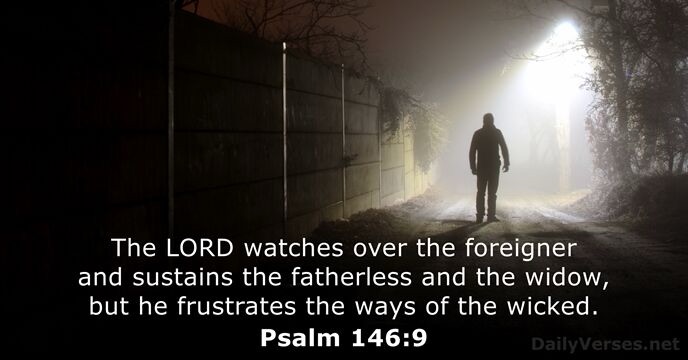
Accordingly, the people of Israel would regularly have sung, in the words of the psalmist, “the Lord watches over the sojourners; he upholds the widow and the fatherless, but the way of the wicked he brings to ruin” (Ps 146:9). Care for widows was central to the life of holiness required amongst the covenant people. This psalm reminds them of that claim on their lives.

And so the brother of Jesus, James, writes that “religion that is pure and undefiled before God, the Father, is this: to care for orphans and widows in their distress, and to keep oneself unstained by the world” (James 1:27), summing up a strong thread running through Israelite religion and on into Second Temple Judaism. See more on widows in biblical texts at 

In 1 Kings 17, the first two key incidents that we are told of regarding Elijah both involve this widow: the widow who offers hospitality to Elijah, and the widow whose son had died, but whom Elijah brought back to life. In the first scene, the tables are turned on the typical biblical view of widows, as vulnerable and in need of protection. Here,it is the widow who serves and nourishes the prophet at his time of need. In another evocation of what Jesus taught, we see the humble exalted, the man of power brought down to a position of dependence, perhaps?

Both scenes involving the widow of Zarephath, a non-Israelite, are evoked in the stories about Jesus: first, the generosity of the widow, offering hospitality out of her meagre provisions, is echoed in the positive words Jesus spoke about widows giving in the temple (Mark 12:41–44; and see also Luke 18:1–8).

Second, the raising of the widow’s son from the dead is paralleled in the story Luke tells about Jesus when he visited Nain (Luke 7:10–17). That story ends with the people declaring, “A great prophet has risen among us!” and “God has looked favorably on his people!” (Luke 7:16). The story of Elijah bringing the widow’s son back to life ends in similar fashion, as the woman confesses, “Now I know that you are a man of God, and that the word of the Lord in your mouth is truth” (1 Ki 17:24). The prophetic vocation of both Jesus and Elijah is confirmed by their performing such a deed. And that is precisely the point in mind as the narrator introduces the prophet Elijah to us in these two stories.

Changed. Transformed. Transfigured. (Mark 9; Narrative Lectionary for Transfiguration, Epiphany 6)

The story that is told in the Gospel for this coming Sunday (included in the longer reading of Mark 8:27—9:8) is a story about being changed; about being transformed. It’s a story that shows that being transformed means you are able to stand and challenge others to be transformed.

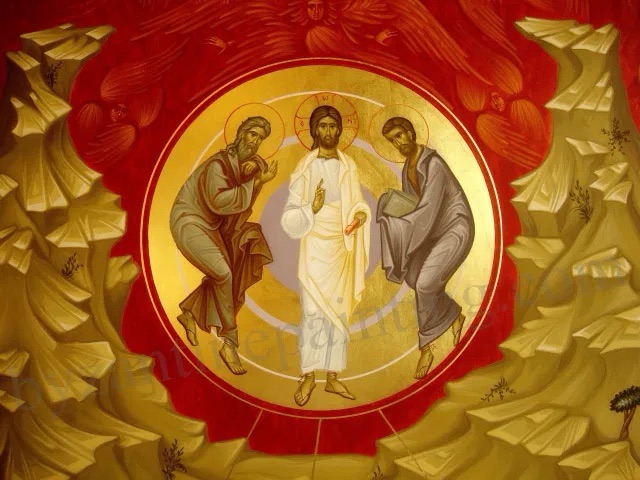
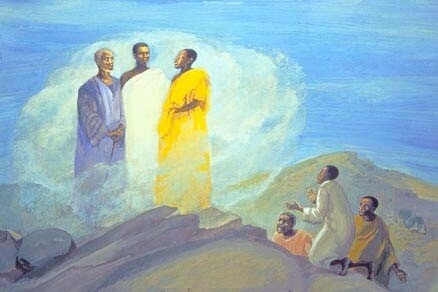
It’s the story of when Jesus took his three closest friends to a mountain, and they had a shared experience of seeing Jesus standing between two of the greats of their people: Moses, to whom God had given the Law to govern the people of Israel, and Elijah, through whom God had established a long line of prophets in Israel (Mark 9:2–8). It’s a story that in Christian tradition is called The Transfiguration.

The word Transfiguration is a strange word. It is not often found in common English usage. It’s one of those peculiar church words, that seems to be used only in church circles. Like thee and thy, holy and righteous, sanctification and atonement … and trinity. These words don’t usually pop up in regular usage!

I looked for some helpful synonyms for the word transfiguration, and found these: change, alter, modify, vary, redo, reshape, remodel, transform, convert, renew … and transmogrify. I am not sure whether that last one gets us anywhere nearer to a better understanding, but some of the others are helpful. Transfiguration is about change, adaptation, and taking on a new shape or size or appearance.

One of the other words offered as a synonym was metamorphose; and that caught my eye, because that word comes directly from the Greek word, metamorphidzo, which is used by Mark in his Gospel, when he tells his account of this incident. “After six days, Jesus took Peter, James and John with him and led them up a high mountain, where they were all alone; and he was metamorphosed before them” (Mark 9:2). Mark then explains that this metamorphosis was evident in that “his clothes became dazzling white”.

The story of the Transfiguration tells of the moment that Peter, James, and John perceived Jesus in a new way. No longer did they see him as the man from Nazareth. In this moment, they see him as filled to overflowing with divine glory. He was not simply the son of Joseph; he was now the divinely-chosen, God-anointed, Beloved Son (9:7).

Jesus brings the heavenly realm right to the earthly disciples. It is what is known, in Celtic Christianity, as a “thin place”: the place where heaven breaks into earthly life.

The disciples had the possibility, in a moment of time, to feel intensely close to the heavenly realm, to stand in the presence of God. They symbolise the desire of human beings, to reach out into the beyond, to grasp hold of what is transcendent—to get to heaven, as that is where God is (see Gen 28:10-12 and Deut 30:12; Pss 11:4, 14:2, 33:13, 53:2, 80:14, 102:19; although compare the sense of God being everywhere in Ps 139:8-12).

This key mountaintop moment contains the words from the heavens about Jesus, “This is my Son, the Beloved; listen to him!” (9:7). These words link back to the initial baptism of Jesus, when the same words were heard (1:11) and forward to the final scene of crucifixion, when a centurion and those with him at the foot of the cross witnesses Jesus’ death, and declares, “Truly this man was God’s Son!” (15:39).

All three scenes contain the foundational statement, recognising Jesus as Son of God, reiterating the words of the unclean spirits in Galilee (3:11) and the man possessed by demons in the country of the Gerasenes (5:7). For, as Simon Peter declares in the pivotal scene at Caesarea Philippi that is also included in this Sunday’s reading, Jesus is “the Messiah” (8:29).

The voice, booming forth from the clouds, “This is my Son, the Beloved; with him I am well pleased; listen to him!” (9:7) seems, at first hearing, to be quoting Hebrew scripture: perhaps the second Psalm, which praises the King of ancient Israel as the one whom God has begotten; or perhaps the song in Isaiah 42, which extols the servant as the one whom God has chosen, or anointed; or perhaps even the oracle in Deuteronomy 18, which instructs the people to listen carefully to the words of the prophet.

Whatever scripture, or scriptures, are here spoken by the divine voice, making this bold declaration from the cloud, it is clear that God has a special task, a special role, and a special place for Jesus. The words of this heavenly voice link this story back to the opening scenes of the story of the adult period in the life of Jesus, and also to a moment towards the end of that adult life.

As this voice is heard, Jesus is on a mountain, with three of his closest followers—and also with two key figures from the past of Israel: Moses, who led the people out of slavery, who then was the instrument for delivering the Torah to Israel; and Elijah, who stood firm in the face of great opposition, whose deep faith bequeathed him the mantle of prophet, as he ascended into heaven.

Mark says that “there appeared to them Elijah with Moses, who were talking with Jesus” (9:4). Matthew reverses the order, placing Moses before Elijah: “suddenly there appeared to them Moses and Elijah, talking with him” (Matt 17:3). Priority, in Matthew’s narrative, goes to Moses. Indeed, Matthew’s concern has been to make as many parallels as possible between the story of Jesus and the story of Moses. The regular reminder that “this took place to fulfil what the Lord has said through the prophets” (Matt 1:22; 2:4, 15, 17, 23) underlines this Mosaic typology.

The covenant given to Moses on Mount Sinai (Exod 19:1–6) is accompanied by the giving of the law (Exod 20:1–23:33), and is later sealed in a ceremony by “the blood of the covenant” (Exod 24:1–8). The scene on the mountaintop, with Jesus and his three disciples, evokes the mystery of the mountaintop scene in Exodus. This story is but one part of the story of Jesus which draws connections with the story of Moses.

*****

The Gospel writers say that Jesus was transformed at that moment. But in this story, also, there is the indication that the friends of Jesus were transformed. That moment on the mountain was a challenge to each of them; the response that Peter wanted to make was seen to be inadequate. Jesus challenged him to respond differently. It was another moment when metanoia, complete transformation, took place. And these disciples did change; yes, it took some time, but these friends of Jesus ultimately became leaders amongst the followers of Jesus, and spearheaded the movement that became the church.

The change, the metanoia, that occurred within Peter, James, and John, spread widely. They faced the challenge head on, and responses, in metanoia. That is mirrored, today, in changes that are taking place in society. Especially, that has been the experience of people over the last few years. We have met the challenge of a global viral pandemic; patterns of behaviour have been modified, as we prioritise safety and care for the vulnerable, and wear masks, sanitise, and socially distance. We have changed as a society.

In the church generally, through the pandemic that hit with such force in 2020, we have changed how we gather, how we worship, how we meet for Bible studies and fellowship groups, how we meet as councils and committees, how we attract people to our gatherings. Transformation has been widespread.

In my own church of these past few years, we worked hard to meet the challenge of reworking our understanding of mission; for across the church, we now see the importance of people from each Congregation engaging with the mission of God in their community as the priority in the life of the church. See

So in each place where people gather as church, there is a pressing need to consider how we might grow fresh expressions of faith, nurture new communities of interest, foster faith amongst people “outside of the building” and outside the inner circle of committed people. It is an ongoing process.

Change is taking place. Change is all around us. Change is the one thing that is constant about life: we are always changing. Sometimes we think that the church doesn’t change, isn’t changing, even resists changing. But that is not the case. Our church is changing. Our society is changing. And the story of the Transfiguration of Jesus encourages us throughout this change.