A fine man, a great scholar: giving thanks for Richard Hays

I’ve heard the sad news that New Testament scholar Prof. Richard Hays has died this week. He recently had a recurrence of an earlier pancreatic cancer and just last week entered hospice care. I remember him as a compassionate, insightful, and articulate person, and am sad to hear of his death.

Richard was a member of the Faculty at Yale University when I started my doctoral studies there in 1983. I got to know him through our mutual participation in the NT seminar each semester, and in 1984 I took a seminar course on “War and Peace in the Bible” with him one semester. We grappled with many relevant biblical texts and ethical issues as we engaged with interpreters through 2000 years of Christian history and tradition, across a range of perspectives, from “just war” advocates to Mennonite pacifists, including Reinhold Neibuhr and Roland Bainton, former Yale professors and eminent contributors to the debate. It was a vigorous semester-long exploration of ethics and hermeneutics in relation to the matter of war and peace. It was immensely stimulating! 

The major paper that I wrote in this seminar (“Hermeneutical Issues in the Search for the Historical Political Jesus”) was most helpful for me in establishing and consolidating some key elements of my own hermeneutical practice. Then, in 1988, Richard was one of the three examiners of my PhD dissertation—and provided a number of pages of detailed commentary and critique of what I had written about. (He agreed that I should be awarded the degree, however!) 

It’s sobering for me to reflect that all three of my examiners, Wayne Meeks, Richard Hays, and Rowan Greer, and my doctoral supervisor, Abraham Malherbe, are now deceased. I am grateful for the important roles that each had (along with other teachers) in preparing me for my subsequent years of teaching, research, and writing.

Just after the turn of the millennium, Richard visited Australia for a conference and spent some time at United Theological College, leading a seminar for interested members of the college community. Elizabeth and I were scheduled to take him out to dinner was, but she was then in her period of extended hospital stays, fighting recurrent lung infections, and so we couldn’t do that. In his typically gracious way, he came with me to RNSH and met with her and me for a meal in the private hospital cafeteria. We had a long, long exegetical discussion as Elizabeth had most recently been immersed in her controversial doctoral research into Matthew’s Gospel. It was not the kind of conversation that usually occurs in a hospital café! We were both very grateful for, and much energised by, this conversation!

Richard has been one of the most well-respected NT scholars in the world. He was the George Washington Ivey Professor Emeritus of New Testament at Duke University in the USA—a prestigious and important post. In an early work, he developed a technical argument that Paul was referring, not to our “faith IN Jesus Christ”, but rather to “the faith OF Jesus Christ” as the basis for salvation. It was a technical linguistic argument with huge theological consequences, and was debated, explored, for it grounded our salvation in Jesus, not in our own actions of believing. This understanding has been largely taken up by a number of leading scholars in subsequent years.

A decade after I had studied with him, Richard had famously argued *against* LGBTQ inclusion in his landmark ethics book, The Moral Vision of the New Testament (1996). In the book, he was seeking to develop a wider framework for ethical decision-making that was not simply pegged onto “proof texts”, but which was developed from the broad sweep of biblical and theological understandings. I realised on reading it that the 1984 seminar had provided the basis for one of the chapters in this book. 

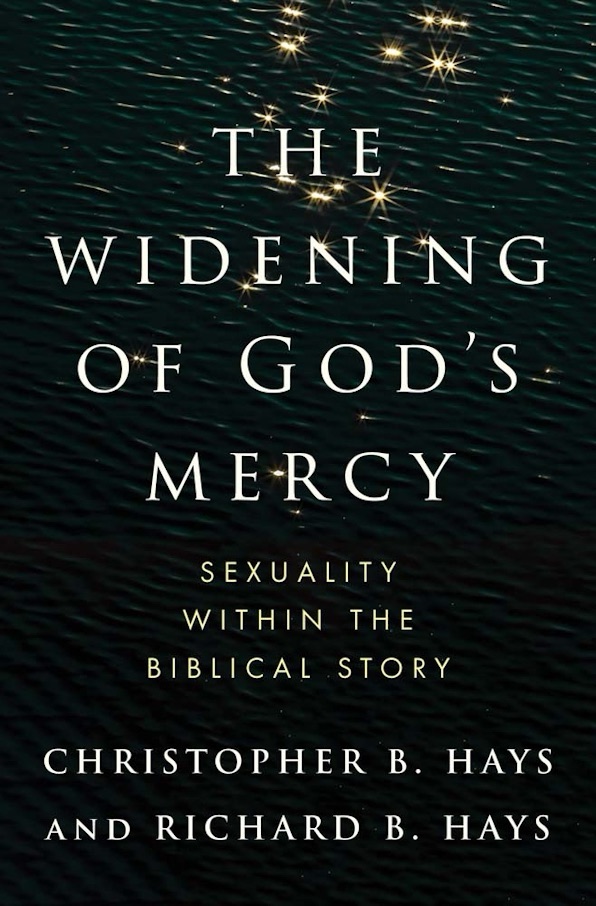
The search for a broad biblical-theological basis for ethics eventually led him, more recently, to become a proponent of affirming and inclusion of LGBTG people within the church. With his son, Christopher Hays, a well-respected OT/Ancient Near Eastern scholar at Fuller Seminary, he co-wrote The Widening of God’s Mercy: Sexuality Within the Biblical Story (2024).

The publisher’s blurb says that in this book, the authors write about “a dynamic and gracious God who is willing to change his mind, consistently broadening his grace to include more and more people. Those who were once outsiders find themselves surprisingly embraced within the people of God, while those who sought to enforce exclusive boundaries are challenged to rethink their understanding of God’s ways.” 

In closing the last chapter, the father and son authorial team write, “This book is therefore not just an argument about the meaning of the Bible in the past, but an invitation to readers to make new meaning in the present by listening to the Spirit and joining God now in saying, “I will gather others to them besides those already gathered” (Isa 56:8) … We hope that this book offers encouragement to see that the inclusion of sexual minorities is not a rejection of the Bible’s message but a fuller embrace of its story of God’s expansive mercy.” Richard in particular offered his own declaration of repentance for his earlier writing. 

It was an act of deep humility; and a wonderful “last word” from this great scholar and fine man. 
See also https://johntsquires.com/2024/04/07/affirming-the-kaleidoscopic-array-of-gender-identities-and-sexual-orientations-a-forthcoming-book/

Love is the fulfilling of the law (Romans 13; Pentecost 15A)

“Love is the fulfilling of the law”, Paul asserts in the passage that we are offered by the lectionary for consideration this coming Sunday (Rom 13:8–14). “Christ is the end of the law”, he has boldly asserted in an early part of the letter (Rom 10:4). How do these two seemingly contradictory statements stand alongside each other? What is the status of the law—the Torah, the foundation of Jewish life and faith—for Christians?

In making his statement about Christ and the Law (10:4), Paul has used an important Greek word: telos. This is regularly translated as “Christ is the end of the Law”; but we might well ask, what is the sense of the word “end” in this verse? On the one hand, this word might does infer a meaning of “the end as and abolition”, doing away with the Law. Apart from the fact that this directly contradicts what Jesus said about his intention not to abolish any single part of the Law (Matt 5:17–18), it is a most an unsatisfactory supercessionist reading, which completely does away with all the Old Testament.

On the other hand, there is the sense (which I prefer) that this means “the end as in bringing to the height of fulfilment”. In which case, Christ is bringing the Law to its logical and natural end, or goal: the complete expression of the Law through love. In other places where the word telos is used, it has this sense of bringing to fulfilment or bringing to perfection.

Indeed, this latter sense accords with the use of the term in other Pauline texts, where it is used to refer to those with spiritual maturity. He encourages the Corinthians, “in your thinking, be adult (teleioi)” (1 Cor 14:20). He confesses to the Philippians, “not that I have already obtained this or have already reached the goal (teteleiōmenoi)” (Phil 3:12) and exhorts “those of us then who are mature [to] be of the same mind” (Phil 3:15).

In later letter claiming Paul as author, the term signifies those “mature in Christ (teleioi en Christō)” (Col 1:28; see also Eph 4:13). It is perhaps similar to the meaning in Hebrews, which makes the claim that Jesus is the means of offering a perfect sacrifice (Heb 2:10; 5:9) through which “by a single offering he has perfected (teteleiōken)for all time those who are sanctified” (Heb 10:14).

Of course, the idea of being perfect is integral to the appreciation of God that is expressed at various places in Hebrew Scripture. “This God—his way is perfect”, the psalmist sings (Ps 18:30; echoed also at Deut 32:4; 2 Sam 22:31; Job 37:16), and in another psalm, “the law of the Lord is perfect, reviving the soul” (Ps 19:7).

So the temple that Solomon built was to be perfect (1 Ki 6:22), the sacrifice of wellbeing to be offered there, “to be acceptable it must be perfect, there shall be no blemish in it” (Lev 22:21), and no person with a blemish is able to serve as a priest (Lev 21:16–24).

Perhaps this is the sense of telos, perfection, complete fulfillment, that sits underneath the use of this word by Paul at Rom 10:4? That would mean that he is proposing that Christ brings the Law to a state of perfection in which it is filled to overflowing with God’s goodness.

Certainly, this would explain why Paul is able to affirm that “the whole law is summed up in a single commandment, ‘You shall love your neighbour as yourself’” (Gal 5:14). Law and love are here seen in close interrelationship with one another, not in opposition to one another. Love is the essence of the Law, bringing fulfillment what the Law set forth.

And that would also explain the words we have in this coming Sunday’s reading from Rom 13, that “the one who loves another has fulfilled the law” and so “love is the fulfilling of the law” (Rom 13:8, 10).

The key words used in Rom 13:8–10 are equally strong with regard to the ongoing validity and relevance of the Law, for Paul. He uses two words derived from the verb plēroō, meaning “to fill up”, and thus, “to fulfill”. In 13:8, he says that “love has fulfilled the law”, using the perfect form of the verb, peplērōken. The perfect has the sense of an action completed in the past which has consequences which continue on into the present time. So the fulfilling of the Law in the past by deeds of love has ongoing consequences—that Law, those acts of love, impinge on the present time.

Then, in 13:10, Paul reiterates that “love is the fulfilling of the law”, using a noun formed from this verb, plērōma. That conveys the idea that the Law has been filled right up to overflowing, fully and completely, by acts of love. The Law remains relevant and potent, because of those fulfilling acts of love.

Alongside these two words, Paul uses another word to make a similarly strong statement. Quoting for of the Ten Commandments, he affirms that these laws are “summed up” in another set of words, taken from Hebrew Scripture itself: “love your neighbour as yourself” (13:9, quoting Lev 19:18). The verb translated “summed up” is anakephalaioutai, a compound word combining the idea of “the head” (kephalē) and “brought up to” (the preposition ana).

This word contains the sense, then, that everything is gathered together and taken up into the head; obedience to each and every one of the commandments of the Law is gathered together and taken up into the head, that is, in the act of loving the neighbour.

Paul could not be clearer, and could not be stating things more strongly: the Law is filled to overflowing in love. The Law continues to have power. It is not abandoned as irrelevant or outdated.

Paul’s attitude to the Law, however, is quite complex. He trained as a Pharisee, and he notes at he was “far more zealous for the traditions of my ancestors” (Gal 1:14), and so he has a “delight in the law of God in my inmost self” (Rom 7:22). He affirms that he upholds the Law (Rom 3:31), alluding to various commands in The Ten Words which he insists are worth obeying (2:17–22), and affirming that, in its essential character, “the law is holy, and the commandment is holy and just and good” (7:12).

Yet his calling to be “apostle to the Gentiles” (Rom 11:23; Gal 2:8) led to his experience of eating at table with Jews and Gentiles together, in breach of kosher food laws (Gal 2:11–13)—an issue that is clearly in view decades later, as Luke writes his account of the early years of the Jesus movement, siding with Paul in the view that God has set aside the requirement for separate foods and separate tables (Acts 10:1–11:18; 15:19–20, 28–29).

This, in turn, leads Paul to his missionary goal of bridging the gap between Jews and Gentiles in practical ways (Rom 15:25–27), undergirded by the message that he preaches, affirming that salvation is offered “to everyone who has faith, to the Jew first and also to the Greek” (Rom 1:16; see also 2:10; 10:12; Gal 3:28; and the post-Pauline development in Eph 2:11–22). He is driven by the scriptural claim that “God shows no partiality” (Rom 2:11; Deut 16:19–20; 2 Chron 19:7; Sir 35:15–16).

So his letter to the Romans is a long and complex argument in which he explains how he understands that the good news is that “the righteous-justice of God [is] through faith in Jesus Christ for all who believe” (3:22), that there is “justification and life for all” (5:18). The argument builds and develops, demonstrating how God has chosen to make righteous-justice available to all human beings, through Abraham as through Jesus, by means of the indwelling Spirit.

So this leads Paul to write in negative terms about the Law. Although he maintains that having faith in Jesus does not “overthrow the law”, and he insists that “we uphold the law” (3:31), he goes on to note that “the law brings wrath” (4:14), for where “the law came in … the trespass multiplied” (5:20). “If it had not been for the law”, he asserts, “I would not have known sin” (7:7), and so “I am a slave to the law of sin” (7:25), and in Jesus, “God has done what the law, weakened by the flesh, could not do” (8:3).

Accordingly, “Israel, who did strive for the righteousness that is based on the law, did not succeed in fulfilling that law” (9:31). Or, as he portrays things in writing to the Galatians, “a person is justified not by the works of the law but through faith in Jesus Christ” (Gal 2:16), “through the law I died to the law” (2:19), “if justification comes through the law, then Christ died for nothing” (2:21), “no one is justified before God by the law” (3:11), and even, “if you are led by the Spirit, you are not subject to the law” (5:18).

However, to the proposition that he poses, “Is the law then opposed to the promises of God?”, Paul immediately replies, “Certainly not!” (3:21), and then argues that “the law was our disciplinarian until Christ came, so that we might be justified by faith” (3:24). This looks like Paul is ready to contend that the Law is superseded, and should be put aside. But not so fast; “I testify to every man who lets himself be circumcised that he is obliged to obey the entire law” (5:3). He is not prepared to let it go entirely. The Law still stands for Jews—but not for Gentiles.

Indeed, in the most complex midrashic section of his letter to the Romans, Paul plunges into a complex reading of scriptural texts in order to sanction the claim that God’s sovereign mercy offers a universal righteous-justice, both to Jews and to Gentiles alike (Rom 9:1–11:32).

This section of the letter contains the greatest concentration of scripture citations and allusions of the whole of this letter to the Romans—and, indeed, of all of the seven authentic letters of Paul. In the argument that is advanced by a Paul, whilst he signals the limits and inadequacies of the Law, he holds fast with the view that the Law is not rendered obsolete, but rather is brought to fulfilment (10:4; see the discussion above).

Paul,asks pointed questions: “does this mean that “the word of God had failed”? (9:6) and “has God rejected his people?” (11:1). “By no means!” is once again the Pauline riposte. “Through the stumbling [of Israel] salvation has come to the Gentiles, so as to make Israel jealous” (11:11), yet “as regards election they are beloved, for the sake of their ancestors; for the gifts and the calling of God are irrevocable” (11:28–29).

The complex midrashic argumentation of these three chapters comes to a climax in a string of joyously prayerful affirmations concerning God’s “riches and wisdom and knowledge”, leading to the attribution of glory to God forever (11:33–36). This is the ultimate response to the singular grace of God’s gift of righteous-justice to all human beings. And that gracious gift fulfils, or brings to culmination, the Law that Israel was given.

Christ suffered for you, leaving you an example (1 Peter 2; Easter 4A)

Another excerpt from the letter we know as 1 Peter is offered by the lectionary this coming Sunday (1 Peter 2:19–25). This letter as a whole envisages the community of faith in terms drawn from the household, and this particular passage sits within a section of the letter which is known as a “household table” (2:18–3:7).

Believers within the communities of faith which are addressed are said to comprise a “spiritual house” (2:5), the “household of God” (4:17), a “family of believers” (2:17) who are intimately related to their “brothers and sisters in all the world” (5:9). Hospitality is important (4:9), as was the case in all ancient societies. Both husbands and wives are “heirs of the gracious gift of life” (2:7); they are called to “inherit a blessing” (3:9) and have already been born into their inheritance (1:4).

As befits life in the patriarchal society of the day, there is also an emphasis on matters of honour and shame. Whilst honour is viewed as an eschatological goal, to be expected “when Jesus Christ is revealed” (1:7), it remains the benchmark for daily living, as the firm exhortations of 2:12 and 2:17, just before our chosen passage, clearly indicate. Shame is alien to the life of the believer (2:6) and even a husband must show honour to his wife (3:7)

These two features—the language of the household and the concepts of honour and shame— coalesce in the use that is made in this letter of the familiar household table, a form of ethical instruction which we have seen used in some of the debated letters of Paul. Here, the table is introduced with a programmatic statement about honour (2:12) and a series of general injunctions (2:13–17) which urge subordination to authority and the honouring of leaders.

The address then turns to slaves, but not masters (2:18–25), and then wives as well as husbands (3:1–7); however, it stops short of dealing with children and parents (which regularly figured in the typical household table form—see Col 3:18–4:1; Eph 5:21–6:9). The stance is clear: slaves are to “accept the authority of your masters” (2:18), just as wives likewise are to “accept the authority of your husbands” (3:1). Obedience is undoubtedly a quality to be emulated, both within the community of faith (5:5) as well as within society (2:13).

The people of Israel had maintained the daily offering of a lamb without blemish for centuries; each day, a lamb in the morning, another lamb in the evening (Exod 29:38–41). It sounds to us moderns like a terrible waste of good stock; to the ancients, however, it confirmed the covenant between the nation, Israel, and their God, the Lord (Exod 39:43–46). The writer of this letter can see Jesus taking the place of that daily sacrificial lamb, quoting from a well-known song (Isa 53:9) about his sinless nature.

For more on the way that the New Testament interprets the sacrificial death of Jesus as a means of atonement with God, see

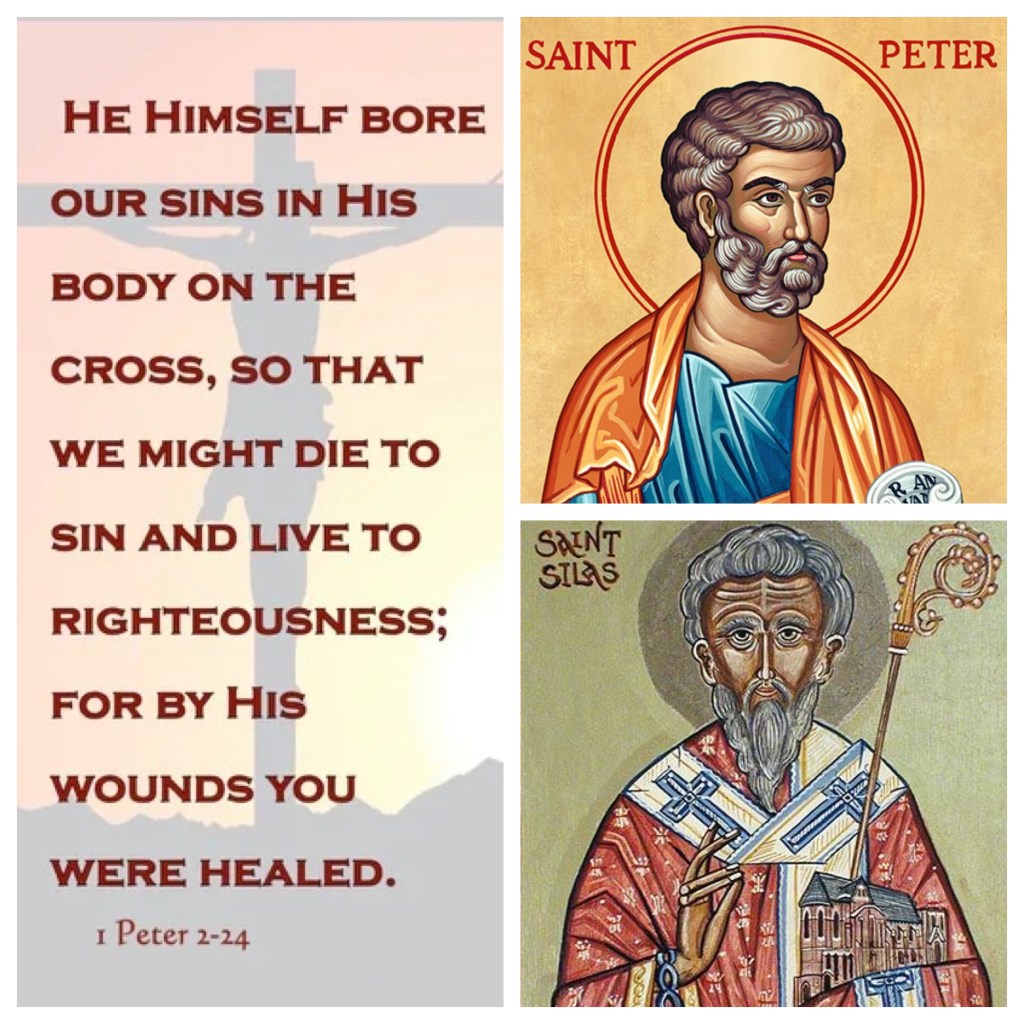
In the Gospel for this coming Sunday, Jesus speaks about the shepherd (John 10:1–10). In the excerpt from this letter which is offered on this coming Sunday (1 Pet 2:19–25), Jesus takes on the role of the lamb, offered up as a sacrificial victim: “he himself bore our sins in his body on the cross” (1 Pet 2:24).

The language and concepts used here relate to ancient practices of sacrifice. They also undergird later Christian understandings of the significance of Jesus and the process of atonement that, it is believed, he effected through his death.

The humility of submission to the violence of sacrificial slaughter is central to the story of the death of Jesus. The lamb is unable to fight back. Chosen for this role, as one who was perfect, without blemish, the lamb can do no other than submit. That humble submission, evident in the lamb, is the vehicle for effecting atonement of sins and a life in righteousness, when found in Jesus—this is the understanding of the cross that has held fast through centuries of theological debate about the death of Jesus. It is an ancient custom, addressing a contemporary need, speaking to current concerns about the proliferation of violence in our world.

So slaves are offered the positive example of Jesus as the model for their submission (2:21–25), in a manner which picks up the cultural and religious Jewish practices of the day and adapts them into the developing Christian context. It demonstrates an awareness of how traditions can be adopted and adapted into new understandings.

By contrast, the instructions to wives are grounded in a reading of scripture which is thoroughly traditional and patriarchal (3:1– 6). In reality, the instructions to wives are based on the expectations of Hellenistic society: reverence, modesty, a quiet spirit, subdued external adornment. They are declared to be “the weaker sex” (3:7) and twice commanded to “accept the authority of their husbands” (3:1, 5).

In fact, the ethics of this letter frequently draw from many elements familiar to Gentiles in the Hellenistic society. Despite the rhetoric of holiness already noted, the believers are not encouraged to live a completely separate life, isolated from wider society. Continued interaction with Gentiles is envisaged at 2:12; believers are to “be ready to make your defence to anyone who demands from you an accounting of the hope that is in you” (3:15). The behaviour of believers should be honourable, and not draw shame upon them; on the contrary, appropriate behaviour will result in the aggressive non-believers being shamed (3:15–16).

In contrast to the letter of James, the brother of Jesus, the specific teachings of Jesus are rarely in view in this letter attributed to Peter, a disciple of Jesus. For James, Jesus taught the righteousness of God and the need for the followers of Jesus to live in a distinctive manner; “true religion” required them “to care for orphans and widows in their distress, and to keep oneself unstained by the world” (James 1:27).

Rather, the ethics of 1 Peter reflect an ethos of temperate behaviour, moderated in a manner which is appropriate to the wider society: “Honour everyone. Love the family of believers. Fear God. Honour the emperor.” (2:7). Although there is a polemic against the base ways of the gentiles, a number of the positive characteristics which were valued within gentile society are also praised in this letter: discipline (1:13; 4:7; 5:7), obedience (1:14, 22; 2:8, 13–14; 3:1, 6) and reverence (3:2, 16).

In short, the ethics of 1 Peter reflect a process of adaptation, in which the Gospel has been accommodated to the cultural patterns of the Hellenistic world. It offers a useful insight into this process, which occurs in all places and all times, as received traditions are incorporated into the life of believers in varied cultural contexts. It is not something to be afraid of; it is something to be acknowledged, understood, and appreciated.

See also