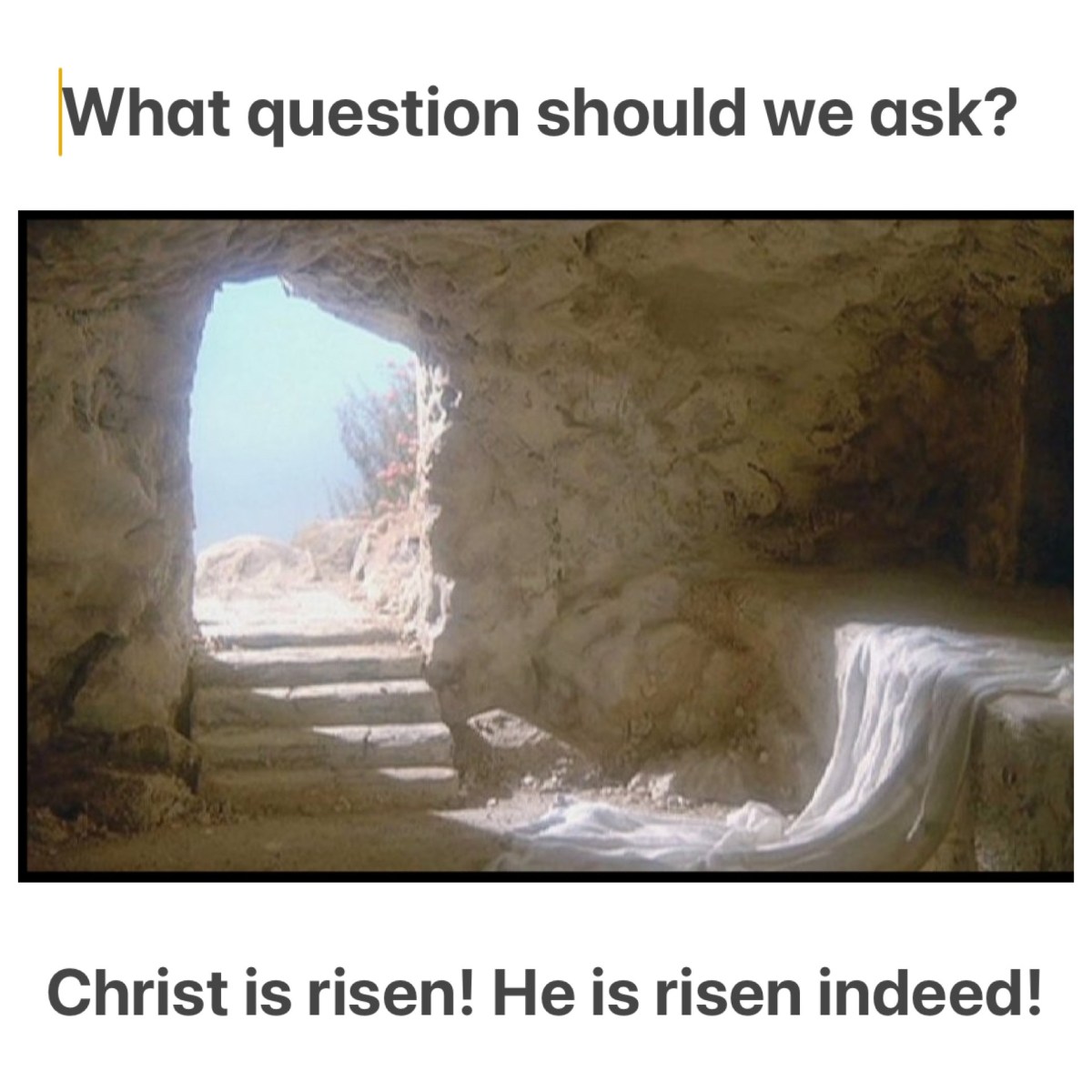
What question should we ask? (for Easter Sunday)

A sermon preached at Dungog Uniting Church on Easter Sunday 2025.

Today is a day of celebration. We gather, we sing, we exclaim “Christ is risen!” Joy fills the air; expectation and hope are abundant. It’s a fine way to emerge from the sombre mood of Friday, when we last gathered, on day of mourning, to remember the sombre reality, “Christ has died”. 

On that day, we remembered again the story of the last days of Jesus: a story of betrayal and denial, of physical abuse and verbal mocking, of abandonment and death, of grief and despair. 

And yet, today, we have moved from that deep despair, into abundant joy. 

Today is a day of celebration.

Today is also a day of mystery. It is a day that we cannot fully explain with simple phrases and formulaic responses. It is a day that invites us to pause, reflect, and ponder. 

Last week, Lurline quoted what she called “the most electric sentence of the Bible”: “he is not here; he has risen!” 

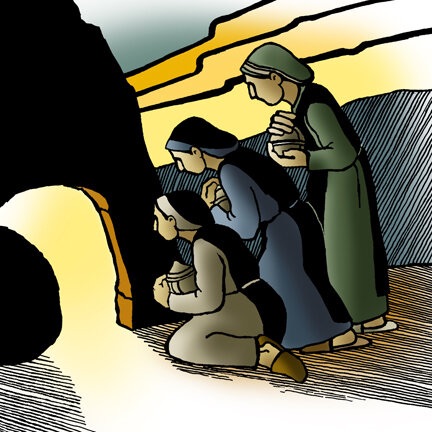
We have heard that electric expression of joy in the reading from Luke’s Gospel. “Why do you look for the living among the dead? He is not here, but has risen.” (Luke 16:5)

And so we greet one another on this day: Christ is risen! Christ is risen indeed!!

That electric sentence provokes many questions. 

What is it that actually happened? 

How was the stone moved? 

Where is the body of Jesus? 

How exactly was Jesus raised from the dead? 

What is the form that Jesus now takes? 

What does it mean for us to hold the hope that we, too, will be raised from our death? 

This day of mystery confronts us with a host of questions. Preachers and priests, scholars and writers, over decades and centuries, have asked these questions, have explored them in their words, have sought to provide explanations, all the while intending to buttress and strengthen our faith on this day of mystery.

Did the resurrection really happen? is one of the questions that is often asked on or around this day. What was the historical reality of the day? I have to say, that is a very modern question. It may surprise you, but for centuries, this was not a question that troubled the minds of believers. It is really only something that has concerned us in the last few centuries—from the time of The Enlightenment, when the focus shifted from lives lived by faith to lives exploring scientific and historical realities. 

The question about “what really happened?” is a classic post-Enlightenment question. It’s not something that occurred to those of ancient times. So the biblical texts of antiquity don’t provide any explanation that satisfies us modern listeners and readers. 

Indeed, this is a question that cannot be answered by a simple historical “proof”. The resurrection is, by its nature, something that transcends the material, earthly focus of our modern era. It resists clearcut scientific or historical questions. It remains, in the end, a mystery.

What actually happened to the body of Jesus? is another question that is often asked about today—which also reflects the time in which we live, when “what happened?” is often an important question. And the answer offered by numerous writers has varied, ranging from “the body was stolen” through to “a miracle happened”. Again, a satisfactory explanation is beyond us. It is a mystery.

How was the stone removed from the doorway to the tomb? is another question that is asked. Mark’s Gospel says that when the women came to the tomb to anoint Jesus, “they saw that the stone, which was very large, had already been rolled back” (Mark 16:4). So, too, does Luke (Luke 16:2); neither evangelist was interested in providing any explanation about this curious feature.

The account in Matthew’s gospel, however, does venture an answer: when the women arrive at the, “suddenly there was a great earthquake; for an angel of the Lord, descending from heaven, came and rolled back the stone and sat on it” (Matt 28:2). That’s the explanation, it seems. This evangelist then continues, “his appearance was like lightning, and his clothing white as snow; for fear of him the guards shook and became like dead men” (Matt 28:3–4). Understandably! 

However, we need to note that Matthew’s account had also reported an earthquake at the very moment that Jesus had died on the cross: “Jesus cried again with a loud voice and breathed his last. At that moment the curtain of the temple was torn in two, from top to bottom. The earth shook, and the rocks were split. The tombs also were opened, and many bodies of the saints who had fallen asleep were raised. After his resurrection they came out of the tombs and entered the holy city and appeared to many.” (Matt 27:50–53).

That’s quite a story! and even more striking, perhaps, is the fact that none of the other evangelists report this incredible series of events: an earthquake and the raising of dead people at the moment Jesus died. It’s not in Mark’s earliest version; and it’s not in Luke’s later account, that we heard this morning. We can see, I hope, that this is part of the particular way that Matthew—a faithful Jew who held to the hope that God would act to come to earth to bring in the kingdom of God—tells the story of Jesus. 

The earthquake that happens as Jesus dies and the second earthquake that comes just as the women discover the empty tomb both draw on apocalyptic imagery that the later prophets used and developed in their prophetic oracles. It’s not an actual historical account. It’s a vivid, dramatic telling of the story, designed to highlight this one central fact: God acted, God came to us, God raised Jesus from the dead, the kingdom of God is now present!

So today is a day of celebration; we celebrate that God has determined to be amongst us in a new, startling, and dramatic way. That is what motivated the women, when the discovered the tomb to be empty, made haste to return to the other disciples, to tell them “he is not here; he has risen” (Luke 24:8).

This is also a day of mystery, for the way that God came to us, raising Jesus from the dead, poses a range of questions, as I have considered. There is much to celebrate, and yet so many questions to consider. And that is probably why the apostles—Peter and Andrew, James and John, Matthew and Bartholomew and Thaddeus and Thomas—all men, it must be noted, heard what the women told them, and as Luke crisply reports: “it seemed to them an idle tale, and they did not believe them” (Luke 24:11). Ah, the patriarchy!

It was, they presumed, a strange story, told by hysterical women, completely unbelievable—even though the men in the tomb had explicitly reminded the women of what Jesus had said “while he was still in Galilee, that the Son of Man must be handed over to sinners, and be crucified, and on the third day rise again” (Luke 24:7). 

It’s a day of celebration; a day of mystery; and perhaps, in the end, today is a day that calls for faith. At the heart of the story of Jesus, as we have heard over the last few days, is a story of betrayal and denial, of physical abuse and verbal mocking, of abandonment and death, of grief and despair. It could very well lead us to a pessimistic view of the world, and to dampen our hopes.

Yet today is a day that calls us to have faith. To have faith that death is not the end of life. To have faith that there is more to our existence than our physical bodies. To have faith that God’s desire and intention is to work through even the despair of the lowest moments and to offer us the hope of what we can but glimpse today. 

For that is what the resurrection of Jesus stands for. We may not be able to answer the many questions that it poses. But we can affirm, with the faithful people of ages past, and across the world M.today, and those still to come in the future beyond us, that “Christ has died. Christ is risen“ … “Christ is risen indeed! Alleluia!” For God is with us.

What I am saying, is this: we will all be changed (1 Cor 15; Epiphany 8C)

The lectionary invites us this week to hear the final section of 1 Cor 15, which has offered a lengthy consideration of the “resurrection of the dead ones” (a raising of many believers) and the “resurrection of Jesus”. Resurrection was a Jewish belief that had developed in preceding centuries; not all Jews accepted it (see Acts 23:6–8) and amongst some Gentiles there was scepticism about the idea (see Acts 17:32). 

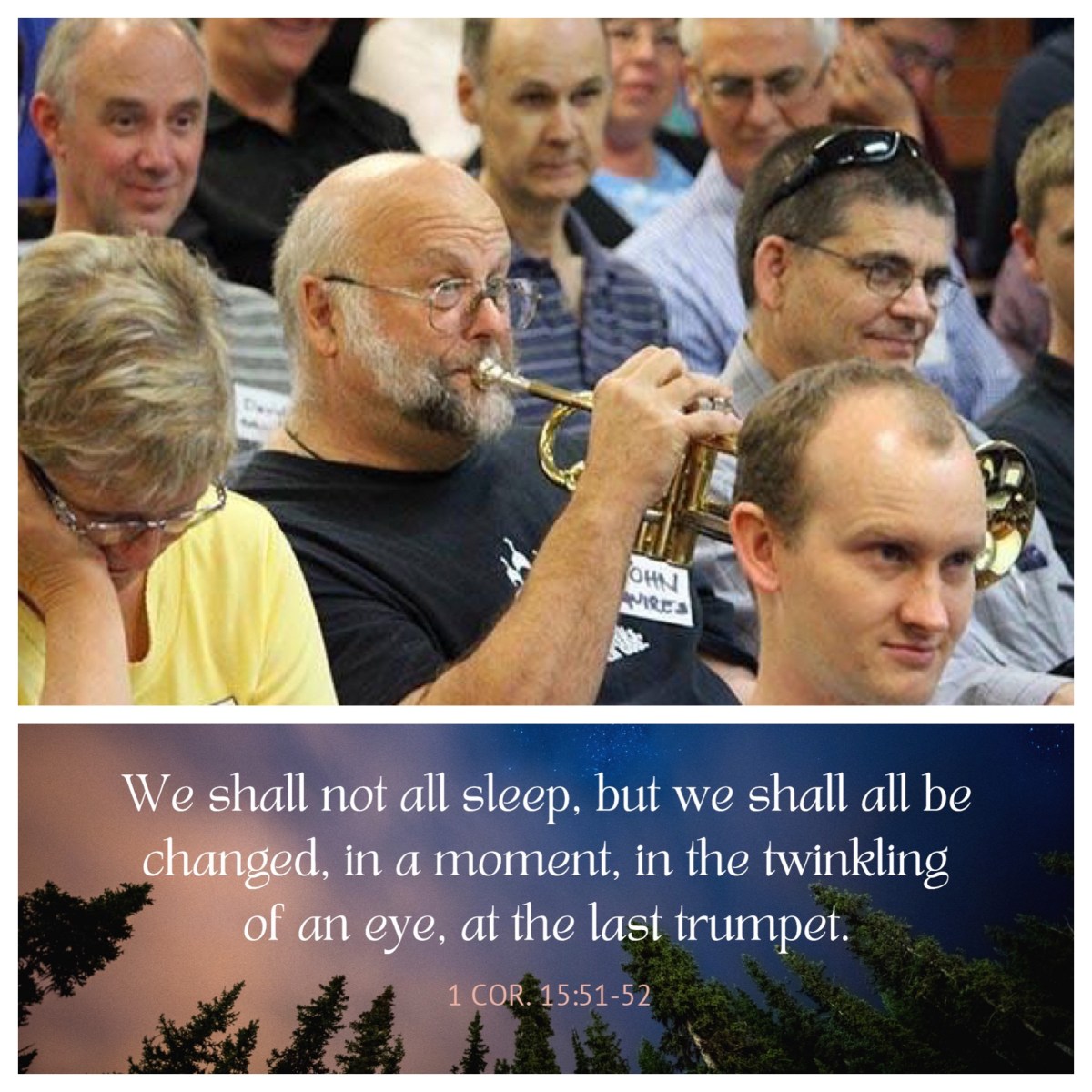
There was also dispute about this matter in Corinth, resulting in a number of debates about particular aspects of this belief. In the verses of 1 Cor 15 dealt with in recent weeks, a number of matters have been explored, debated in fine rhetorical style, and dispatched. To conclude their reflections on this matter (15:50–58), Paul and Sosthenes offer a final glimpse into the eschatological drama that awaits at “the end of time”. “What [we] are saying”, they declare, “is this: we will all be changed, in a moment, in the twinkling of an eye, at the last trumpet” (15:51–52).

The argument now is no longer logic-based, as they move through a sequence of vividly-imagined images in a dramatic rhetorical style. The whole long discussion of this matter ends with a simple, concise ethical exhortation: “be steadfast, immovable” (15:58). The eschatological language used in getting to this point, in these last few verses, is poetic, not realistic; it is evocatively-inspiring, not argumentatively-logical. The argument is brought to a conclusion with a sequence of images, not with any list of legal definitions.

What do we make of the concept of resurrection? Earlier in this chapter, the letter writers have asserted quite forcefully that “if Christ has not been raised, your faith is futile and you are still in your sin” (15:17). Are we therefore not at liberty to interrogate this concept, of the resurrection of Jesus and thus the resurrection of the dead, beyond affirming that it is essential to the faith? My mind recoils at such a stricture! I am committed, as this blog’s name indicates, to “an informed faith”, a faith in which the exercise of “all your mind” is integral to its full understanding and full expression.

So what, then, do we make of resurrection? Contemporary debate has canvassed a number of options as to the nature of the resurrection: Must it be in a bodily form? Was Jesus raised “in the memory of his followers”, but not as a physical body? Is resurrection a pointer to a transcendent spiritual dimension? What was meant by the reference to an “immortal state” in 1 Cor 15:53-54?

Some believers aggressively promote the claim that we must believe in the boldly resurrection of Jesus, that we must adhere to a literal understanding of what the biblical texts report. I prefer to advocate for ways of responding to the story which are creative, imaginative, expanding our understandings and drawing us away from age-old doctrinal assertions which are grounded in obsolete worldviews, on into new explorations of how this metaphor can make sense for us in our lives in the 21st century.

My basic position (as I hinted at towards the end of my previous blog on 1 Cor 15) is that resurrection is a claim that does not direct us away from this world, into a heavenly or spiritual realm. The resurrection offers us both an invitation to affirm our bodily existence in this world, and to explore fresh ways of renewal and recreation in our lives, in our society. It is about liberating life for renewal in our own time and place, here in this world.

It is the apostle Paul who, most of all in the New Testament, provides evidence for the way that early believers began to think about the central aspects of the Easter story—death on the cross, newness in the risen life (Rom 6:3-4:23, 8:6,13; 1 Cor 15:21-23; 2 Cor 4:8-12; Phil 2:5-11, 3:10-11). Paul probably did not begin such ideas; indeed, in both arenas, there are clear Jewish precedents. These were ideas that were live at the time. 

However, the application of these ideas to Jesus—and their insertion into the story of his life—has moved them into a different dimension. They seem, to some, to be “historical events”. I think this pushes things too far. Certainly, Jesus died; but the evaluation of his death as a sacrifice is an interpretive move. In same fashion, the story of Jesus being raised from death was an interpretive move made within a context where “resurrection” was a live idea. In our context, it is a contested idea which sits uneasily within our scientific understandings.

I maintain that other writers in the New Testament provide important keys for understanding the function that “resurrection” plays in our faith. In Luke’s Gospel, the notion that Jesus may be appearing to the disciples as “a ghost” (the Greek is pneuma, usually translated as “spirit”) is dismissed when Jesus instructs the disciples to “look at my hands and my feet; see that it is I myself; touch me and see; for a ghost (pneuma) does not have flesh and bones as you see that I have” (Luke 24:38–39). Here, the emphasis is on the fact that the risen Jesus bears the marks of the crucified Jesus; in his resurrected form, the scars and burdens of his human life continue to be manifest.

In like fashion, when John recounts what may well be his version of the same scene, he puts to the fore the claim by the initially-absent Thomas that Jesus will only be identifiable by “the mark of the nails in his hands” and the wound on his side (John 20:25). So, a week later, when Jesus appears again, he instructs Thomas to “put your finger here and see my hands; reach out your hand and put it in my side” (John 20:27). It is on this basis—the tangible evidence of the crucifixion markings on the body of the resurrected Jesus—that Thomas can move from doubt to belief.

So, in these stories, the primary function of the appearance of the risen Jesus is not to point away from life on earth to some imagined heavenly realm—rather, it is to point back immediately to the scars of the cross, carried for eternity in the resurrected body of Jesus. It is an evocative, poetic presentation.

I return to 1 Cor 15, and the claim that the language used here is also poetic, proceeding in a series of images. Paul and Sosthenes do not conclude their rhetorical dissertation on resurrection with logic-based argumentation, but with a poetic doxology. What concludes the detailed argument of this long chapter is a simple outburst of thanksgiving: “thanks be to God, who gives us the victory through our Lord Jesus Christ” (15:57).

Indeed, such doxologies characterise a number of the letters of Paul. In Romans, they punctuate the complex theological argumentation of this longest letter at key moments. “Thanks be to God”, he rejoices at the end of the tortured discussion of Law, sin, and death (Rom 7:25a). “I am convinced that … nothing in all creation will be able to separate us from the love of God in Jesus Christ our Lord”, a chapter later (8:38–39). Then, after three complex midrashic chapters about Israel, the exultant “O the depths of the riches and wisdom and knowledge of God  … to him be the glory forever; Amen” (11:33–36). 

Finally, in drawing to a close, Paul offers the Romans a prayer of hope (15:13), a brief blessing (15:33), and a reiteration of the offering of grace (16:20b). In a final redaction of the letter, a later scribe then added a most flowery doxology as the conclusion to the whole letter (16:25–27).

The phrase used at 1 Cor 15:57, “thanks be to God”, appears also in Romans (6:17; 7:25) and 2 Corinthians (2:14; 8:16; 9:15); and see also 1 Thess 1:2; 2:13. Paul peppers his letters with notes of praise and adoration addressed towards God. This is poetry that evokes emotions—not words that wrangle doctrines. Such is the nature of his final word on resurrection at 1 Cor 15:57.

The brief word that follows this doxology is a word of hope-filled assurance to the Corinthians, whom he has criticised so mercilessly at many places throughout the letter: “you know that in the Lord your labour is not in vain” (15:58). The letter writers have earlier reminded the  saints in Corinth what they know in a string of affirmations, most introduced with the rhetorical “do you not know?”. These affirmations include “you are God’s temple and God’s Spirit dwells in you” (3:16; similarly, 6:19), “a little yeast leavens the whole batch of dough” (5:6), “the saints will judge the world” (6:2), “wrongdoers will not inherit the kingdom of God” (6:9), “your bodies are members of Christ” (6:15), and “‘no idol in the world really exists’ and “there is no God but one” (8:4).

In the discussion of the rights of an apostle, they are reminded that “those who are employed in the temple service get their food from the temple, and those who serve at the altar share in what is sacrificed on the altar” (9:13) and “in a race the runners all compete, but only one receives the prize” (9:24). In the introduction to the discussion of “the body”, they are reminded that “when you were pagans, you were enticed and led astray to idols that could not speak” (12:2), and I the extended discussion of the use of gifts in worship, there are regular reminders about their knowledge (14:7, 9, 11, 16; and most controversially, v.35). 

Here the reminder of what the saints “know” is the encouraging word, “in the Lord your labour is not in vain” (15:58). It is a typical teaching technique, drawn directly from the heart of the traditions of paraenesis (exhortation, or encouragement) which characterizes all of the letters of Paul. So the chapter ends both with praise directed to God and (despite their conflicts and scepticism) encouragement offered to the Corinthians. It is an uplifting conclusion.

See also 

Receiving and passing on a living tradition (1 Cor 15; Epiphany 5C)

In the verses proposed by the lectionary for this coming Sunday, we come to a central claim of Christian faith. As the fourth century Apostles Creed puts it: we believe in Jesus Christ … who suffered under Pontius Pilate, was crucified, died, and buried, descended into hell, rose again on the third day, ascended into heaven, and is seated at the right hand of God. Four of those claims (crucified, died, buried, rose again) are articulated in the passage from this first letter to the Corinthians that we will hear on Sunday (1 Cor 15:1–11).

What is the nature of the confessional affirmation that Paul and Sosthenes offer in this passage? The previous chapters of 1 Corinthians have alerted us to the disorganised ethos of the community in the cosmopolitan port city of Corinth. Those earlier chapters have indicated a number of problems that existed within the community of followers of Jesus. There was factionalism (chs.1–4), immorality (ch.5), resorting to civil lawsuits (ch.6), and dissension regarding marriage, celibacy, and sexuality (ch.7). There were differing attitudes towards consuming meat bought in the marketplace after it had been offered to idols (chs.8–10), and multiple issues that manifested in their gatherings for worship (chs.11–14). 

The letter proceeds by addressing each of these matters in turn, all undertaken with the same intention, to bring about order in the midst of the chaos that existed in Corinth. His words in the midst of the lengthy discussion about marriage, celibacy, and sexuality state his purpose with clarity: “I say this for your own benefit, not to put any restraint upon you, but to promote good order and unhindered devotion to the Lord” (7:35).

The disorder and chaos evident in worship, in particular, led Paul and Sosthenes, in the chapter immediately preceding this passage, to advise the Corinthians to seek to speak to others in worship “for their upbuilding and encouragement and consolation” (14:3). The letter writers advise them to exercise their spiritual gifts appropriately; to “strive to excel in them for building up the church” (14:12), to “not be children in your thinking … but in thinking be adults” (14:20). Their advice is, “let all things be done for building up” (14:26), noting that “all things should be done decently and in order” (14:40), for “God is a God not of disorder but of peace” (14:33). 

People speaking over the top of each other in worship, not attending to important words of prophecy and tongues, reflected the disordered chaos of the apparently quite libertine community. The infamous words ordering women to “keep silent” (14:33b—36), along with the adjacent commands to “keep silent” while one interprets tongues that are spoken (14:27–28) and “keep silent” to those seeking to offer a word of prophecy while others are still prophesying (14:29–31), are included in this letter precisely to address this chaotic disorder. And not for the first time in this letter, Paul invokes his higher authority to support his directions: “[you] must acknowledge that what I am writing to you is a command of the Lord” (14:37; see also 5:3–4; 7:40; 10:20–22; 11:27–28; 16:10; and cf. 7:25).

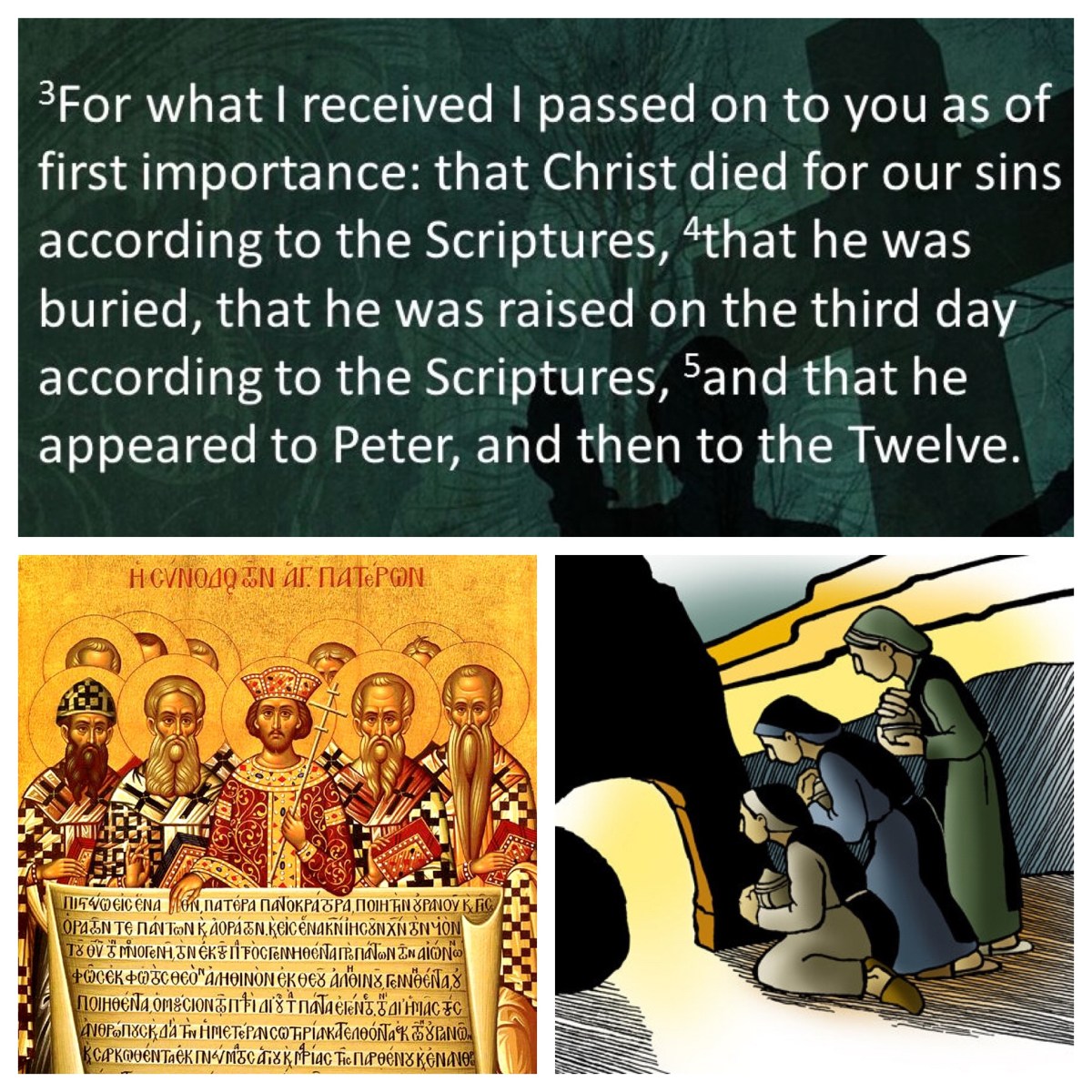
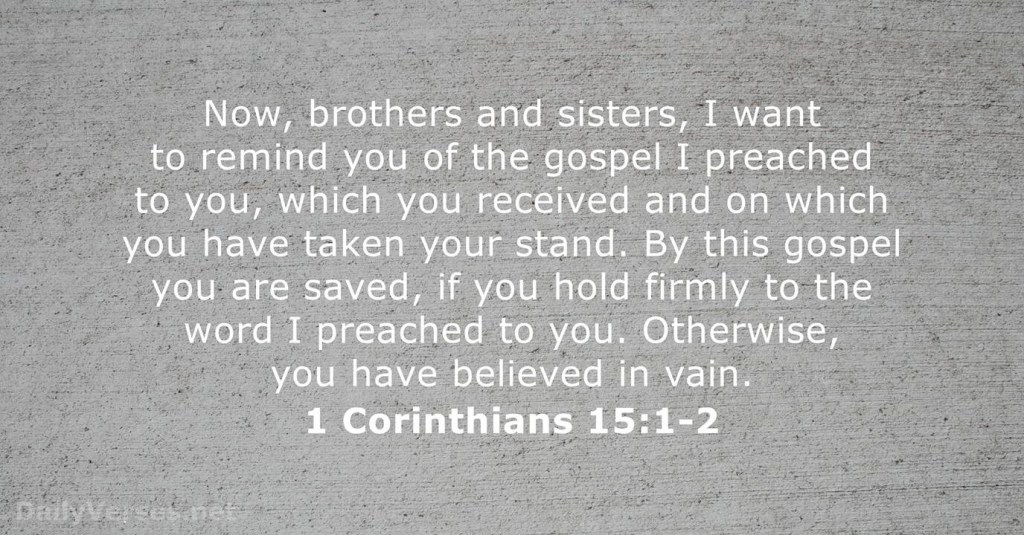
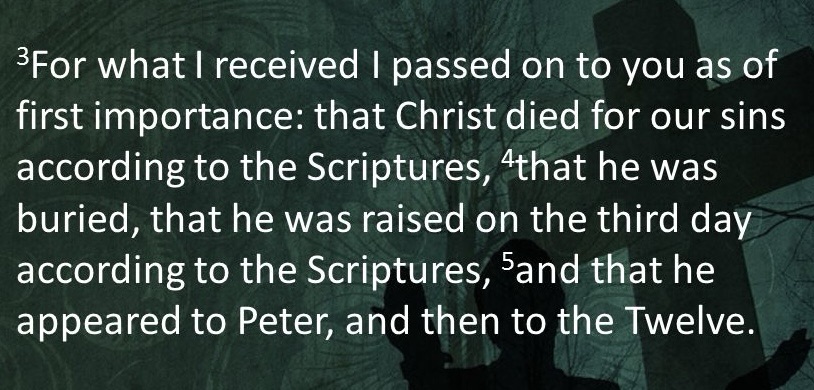
Immediately after this extensive discussion about worship, Paul and Sosthenes turn to the foundational message about Jesus, in a four-part statement: Christ died—was buried—was raised—and then appeared to various people (15:3–5). He uses terms that denote the passing on of traditions: “I received … I handed on … which you received … in which you stand” (15:1); and he insists on the importance of what he passes on: “you are being saved, if you hold firmly to the message that I proclaimed to you” (15:2). These two verses provide a strong, insistent introduction to what follows in the ensuing verses.

We see this dynamic also in an earlier chapter, in the familiar words associated with the Last Supper: “I received from the Lord what I also handed on to you” (1 Cor 11:23), as well as in the commendation of the Corinthians as they “maintain the traditions just as I handed them on to you” (11:2).

The core tradition that Paul and Sosthenes cite is the fourfold declaration that Jesus died, was buried, was raised, and appeared (vv.3–5). It may have already have been an existing formula; we know that Paul, in this letter that he wrote with Sosthenes, as well as in other letters, was willing to make use of very short credal-like statements that it is likely had already been developed by others, some of which he cites in order to refute, such as: “is well for a man not to touch a woman” (7:1), “all of us possess knowledge” (8:1), “all things are lawful” (10:23), and “how can some of you say there is no resurrection of the dead?” (15:12).

There are other succinct sayings which appear as the basis for further developments in the argument being made, such as “I decided to know nothing among you except Jesus Christ, and him crucified” (2:2), “knowledge puffs up, but love builds up” (8:1), “there is no God but one” (8:4), and “all things are lawful, but not all things build up” (10:24). The discussion of factions in chs.1–4 is built off “I belong to Paul … I belong to Apollos … [but] what then is Apollos? what is Paul?” (3:4–5), while Paul’s lengthy discussion of spiritual gifts (12:4—14:40) jumps off from the unspiritual “Jesus be cursed!” and the spirit-inspired response, “Jesus is Lord” (12:3).

Furthermore, Paul writes a number of longer credal-like statements, some of which seem shaped for liturgical usage: the words which became the “words of institution” in the church’s eucharistic practice (1 Cor 11:23–26), and others such as Rom 8:28; 2 Cor 4:14; Gal 1:3–5; Phil 2:6–11. The writers in the school of Paul who later wrote letters claiming to have his authority ( the “pastoral epistles”) followed this practice (see 1 Tim 2:5–6; 3:16; 2 Tim 2:11–13; Titus 2:11–14).

Two clauses in this tradition-based affirmation of 1 Cor 15:3–5 are buttressed by reference to scripture, another voice of authority alongside “the tradition”. What the specific scripture passages are, Paul and Sosthenes do not state; this has left open the door for speculation by later interpreters. 

Supporting arguments by reference to scripture is not unknown in Paul’s writings; as a Pharisee, he had attained a good awareness of Torah and its application to life (see Gal 1:14; Phil 3:5–6). He bases his magnum opus, Romans, on a scripture citation (Rom 1:17, citing Hab 2:4) and there is barely a chapter of this letter that does not contain scripture quotations and allusions in abundance. 

Key moments in 1 Corinthians are likewise supported by verses from Hebrew Scripture (1 Cor 1:19, 31; 2:9, 16; 3:19–20; 14:21; 15:54–55), and the well-known “words of institution” themselves (11:23–26) reference the tradition which emerges in later decades in the Synoptic Gospels, recording the words of Jesus himself at the last supper (Mark 14:22–25; Matt 26:26–29; Luke 22:14–20).

By using the terminology of traditions being received and handed on, Paul and Sosthenes are reining in the wayward Corinthians, recalling them to the fundamentals of their faith. So he sets out the dynamic of died—buried—raised—appeared (15:3–5) as the foundation for then discussing, in the remainder of the chapter, issues associated with the resurrection of Jesus (15:6–58).

Who saw the risen Jesus? First, Paul and Sosthenes tell of an appearance to the early leaders, Cephas (Peter) (v.5) and James (v.7)—although none of these appearances are reported in any Gospel.

Then, they indicate that Jesus appeared to “the twelve” (v.5) and “all the apostles” (v.8)—apparently alluding to narratives found in the later texts of three Gospels Matt 28:16–20, Luke 24:33–48; John 20:19–23, 24–29; 21:1–14. (The appearances narrated in the shorter and longer endings of Mark, added after 16:8, are not relevant; these are later patristic additions based on the other three Gospels, designed to harmonise the ending of Mark with these others.) Acts 1:6–11 might also be relevant here.

An interesting question is, how did he distinguish between these two groups—“the twelve” on the one hand, and “all the apostles” on the other. Indeed, these terms appear to be inherited by the letter writers from earlier traditions. This is the only place in all Pauline letters which refer to “the twelve”; and besides, the Gospel narratives noted above do not have Jesus appearing to “the twelve”, as Judas was absent from all of them, and so was Thomas in John 20:19–23. 

As far as the word “apostle” is concerned, in 16 of the 18 occurrences in the Pauline corpus (including those not authentic to Paul) Paul explicitly apply the term to himself. Paul acknowledges others as apostles: James (Gal 1:19), Peter (Gal 2:8), perhaps Barnabas (1 Cor 9:1, 5–6), an unspecified number of believers who were given gifts to be apostles (1 Cor 12:28–29; see also Eph 4:11), and most strikingly, Andronicus, a male, with Junia, a female (Rom 16:7). Are these the people that Paul has in mind at 1 Cor 15:8? Or is this simply a phrase inherited from the tradition, which Paul has repeated?

Next, Paul and Sosthenes identify an appearance to “more than five hundred brothers and sisters at one time” (v.6), which again has no place in any Gospel account. Last, Jesus appears to Paul himself (v.8), which he briefly reports at 1 Cor 9:1 and Gal 1:1. Strikingly absent from his list is the empty tomb and the appearances to Mary in the garden (John 20:14), to the women as they left the tomb (Matt 28:9–10), to the two travellers to Emmaus (Luke 24:15), or to the seven fishing by the Sea of Tiberias (John 21:1–4). What a perplexing inconsistency between the various testimonies to these appearances!!

This is an early collection of “witnesses to the resurrection”; Paul and Sosthenes wrote to the Corinthians in the mid 50s. But there is no mention of what was important to all four evangelists, writing in later decades: the women at the empty tomb and the role that women played in bearing testimony to the risen one. Is this accidental? or deliberate? Given what we have noted about 1 Corinthians as a whole—and especially what ch.14 reveals about the disorderly behaviour of Corinthian women—we might well wonder, are Paul and Sosthenes shaping the received tradition to “fit the context” already at this early stage? It is a tantalising suggestion.

There is a wonderful quote that is pertinent to this issue, which is attributed to Gustav Mahler, the late 19th century Austro—Bohemian composer: “Tradition is not the worship of ashes, but the preservation of fire.” These words indicate that if tradition stands still, it will run out of momentum and fizzle out of energy. Tradition always needs to be reinvigorated and renewed, in the way that fire sizzles and snaps as it continually changes its shape and form. 

And that’s a fine thought for us to have as we consider the resurrection of Jesus. As the Apostles Creed affirms, echoing 1 Cor 15:3–5, we believe in Jesus Christ … who was crucified, died, and was buried … who rose again from the dead on the third day. We need to renew and rekindle that tradition, to find fresh ways to understand and proclaim that mysterious happening, which sits at the heart of classic Christian confessions.

I’ve offered my own initial reflections on precisely that task in this blog:

See also


Ominous clouds overshadowing a joyous celebration (John 2; Epiphany 2C)

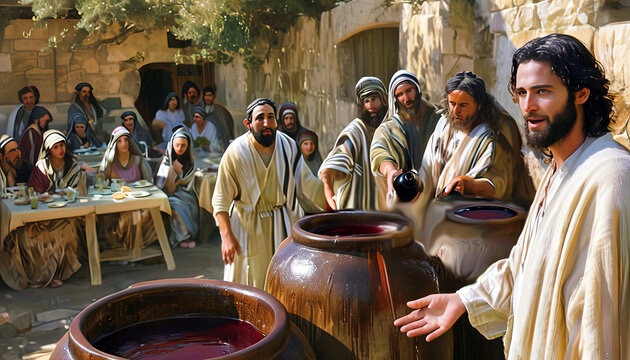
For the second Sunday in Epiphany, we are offered a passage from early in the book of signs—the work that we know as the Gospel according to John. It is the first sign performed by Jesus, when he was attending a wedding in the town of Cana in Galilee (John 2:1–11).

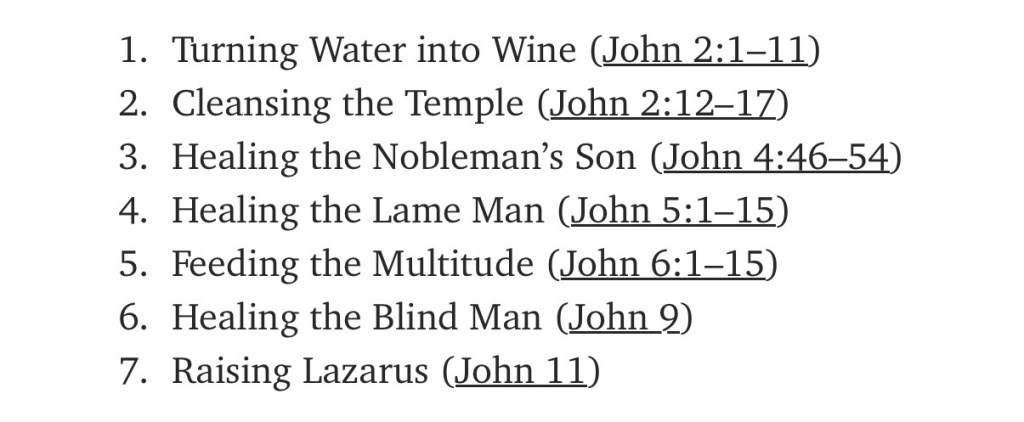
I call this Gospel the book of signs because it includes seven clearly narrated signs, or miracles, performed by Jesus. Most of them are inserted in the midst of an evolving narrative, in which followers of Jesus grow in their understanding of who he is, whilst at the same time a movement of those opposed to Jesus gains strength. Both of those features are evident in this first sign.

The author of this Gospel makes it clear that there were more signs performed by Jesus than what is narrated (20:30), and that the signs actually narrated are told in order to strengthen the faith of those hearing or reading them (20:31).

The first and second signs take place in Galilee (2:1–11, 4:46–54). Subsequent signs are located in Jerusalem (5:2–9), the Sea of Galilee (6:1–14), on the Sea of Galilee near Capernaum (6:16–21), back in Jerusalem (9:1–7) and then, for the seventh, and final, sign of those narrated, in Bethany, where Lazarus had recently died (11:17–44).

This final sign provides a clear climax to the Book of Signs, the first half of the whole Gospel. This is the miracle supreme—raising a dead person back to life takes some beating! It is told at some length, with many details, leading to the climactic moment of the appearance of the once-dead man, now alive. “The dead man came out, his hands and feet bound with strips of cloth, and his face wrapped in a cloth. Jesus said to them, “Unbind him, and let him go.” (11:44).

In the literary framework of the whole Gospel, however, this building to a climax through the seven signs is paralleled by the growing tension as leaders in the Jewish community marshal forces in plotting against Jesus. Initially, there were positive responses to Jesus (2:23, 4:42, 4:45). Then, an engagement in debate and controversy with “the Jews” (5:13) quickly escalated into persecution (5:16) and indeed an attempt to kill Jesus (5:18).

This early opposition then continues unchecked throughout the narrative. Whilst Jesus remained popular in Galilee (6:14, 34) and amongst some in Jerusalem (7:31, 40-41a, 46: 8:30; 9:17, 38; 10:21, 41) and Bethany (11:27, 45), hostility towards Jesus continued, being expressed both in verbal aggression (6:41, 52; 7:15, 20; 8:48; 9:18-19; 10:20), threats of his arrest (7:32, 44; 11:57), direct physical threats (stoning at 8:49, expulsion from the synagogue at 9:22, and stoning once more at 10:31) and threats against his life (7:1, 25, 32).

Then, at the climactic moment, after Lazarus appears, the Jewish leadership plans a strategy to put Jesus to death (11:45-53). The plot is hatched, the fate of Jesus is sealed. That section of the narrative also includes the famous, yet ironic, comment by Caiaphas: “it is better for you to have one man die for the people than to have the whole nation destroyed” (11:50). And so the inevitable process begins, moving towards the death of Jesus (11:53, 57). 

For the author of the book of signs, affirming the identity of Jesus shapes the whole narrative of this Gospel. Each sign points to the significance of Jesus. The first sign, in Cana of Galilee, manifests his glory (2:12); the next sign, also in Cana, fosters belief in Jesus (4:48, 53). What Jesus does beside the Sea of Galilee identifies him as “the Prophet who is to come into the world!” (6:14), whilst the sign performed in Jerusalem signal that he is  the Son of Man (9:35–38). Later, in Bethany, Jesus raises Lazarus from death, and Martha articulates the faith of others when she confesses Jesus to be Son of God and Messiah (11:27). Alongside these seven signs, the various interpersonal encounters that are narrated illuminate the identity of Jesus.

I read the whole sequence of scenes in this Gospel, from the wedding in Cana, with its implicit criticism of “the Jewish rites of purification” (2:1–11), through the heated debates of chs. 5—8, the high drama of the multi-scene conflict with Jewish leaders and “expulsion from the synagogue” in ch.9, on into the plot of ch.11, as a story that reflects the position of the followers of Jesus who comprised the community in which this book was eventually written. 

This group of people (what Raymond Brown called “the community of the beloved disciple”) had been rejected by their fellows, expelled from their community of faith, because of their views about Jesus. They had become yet another sectarian group in the mixture of late Second Temple Judaism, which then bled into early Rabbinic Judaism. 

It is this “Johannine sectarianism”, as Wayne Meeks called it, which explains the bruising debates in this Gospel; Jesus is being remembered as “standing up for the truth” by a group of people who had been pillaged and persecuted for standing up for what they say as “the truth”. They had become outsiders; some of them had met death for the stand they took. This was what it meant for them to be faithful to Jesus. 

This tragic development is a natural development, at least as the author tells it, from that initial sign, where Jesus is already portrayed as being in tension with others of his own faith. Although it was a wedding—a time of joyous celebration—there were ominous clouds overshadowing what transpired in Cana that day.

Wayne Meeks, “The Man from Heaven in Johannine Sectarianism”, JBL 91 (1972) 44–72)

Raymond E. Brown, The Community of the Beloved Disciple (Paulist, 1978)

A small member which boasts of great exploits (James 3; Pentecost 17B)

Warning! Warning! As we follow the lead of the lectionary and come to this Sunday’s passage from chapter 3 of James, people like me are immediately put on alert. “Not many of you should become teachers, my brothers and sisters, for you know that we who teach will be judged with greater strictness” (James 3:1). So there!

I have never trained as a teacher; however, the church, in its wisdom, saw fit to invite me to learn the craft of teaching at the very beginning of my ministry as an ordained person. I served as a Tutor assisting Robert Maddox in his university teaching, taking over his course when his brain tumour developed.

Then I was encouraged to apply for doctoral studies in New Testament and Early Christianity, learning more of the craft of teaching whilst undertaking the coursework and research of that degree, as I worked as Teaching Assistant for various professors: in Old Testament, Brevard Childs and then Robert Wilson; in Early Church, the Gnostic specialist Bentley Layton; and then Abraham Malherbe, who then was the primary supervisor of my thesis, completed in 1987.

After that I taught courses at Sydney University and United Theological college, before accepting a call in 1990 to the Faculty of UTC, where I taught Biblical Studies for two decades. Then, moving into other ministry roles, I shared with my wife Elizabeth Raine in teaching lay leaders in the Mid North Coast in a range of subjects; spent two years as Principal of Perth Theological Hall; and then moved to Canberra, where again Elizabeth and I were involved in teaching lay people (and some ministers doing their continuing education) for five years. So my career over 45 years has regularly involved teaching!

Therefore, I take the opening words of James 3 with utter seriousness. They are striking: both discouraging people from becoming teachers (although we do need teachers!) and then warning that who teach “will be judged with greater strictness”. That’s worth considering. Why are teachers to be held to a higher level of accountability than people in other professions? than doctors and nurses? or judges and lawyers? or police officers and prison guards? Don’t all of them need to have the highest of standards to which they need to be held accountable? 

The reason that James makes this curious claim is, of course, “the tongue”. “The tongue is a small member”, James writes, “yet it boasts of great exploits” (3:5). And that is what underlies this whole passage. The author uses a series of analogies to indicate how such a small member, the tongue, has great power. The tongue is compared to a bridle guiding a horse  (v.3), a ship’s rudder (v.4), a spark lighting a fire (vv.4b-5), as something that “stains the whole body” (v.6) and a spring from which water pours forth (v.11).

In each case, the analogy is of something small which contains immense power to control something much larger—to guide a warhorse or steer a cargo ship, to set in motion the train of events that leads to a damaging fire or an infection of the whole person or widespread flooding. The tongue is potent—and so it needs to be used with great care.

Earlier in this letter, James has implored those listening to this letter to “be quick to listen, slow to speak, slow to anger” (1:19). Left unchecked, it seems, the tongue can rapidly run to anger—and this is unhelpful, since “anger does not produce God’s righteousness” (1:20), and it is this righteousness which is most desired for those who are wise, “those who make peace” (3:13–18). Indeed, as the theological argumentation that James offers indicates, Abraham was made righteous (justified) “by works”, and it was those works which ensured that “it was reckoned to him as righteousness” (2:18–26, with the key scriptural verse in this argument being Gen 15:6).

“Be quick to listen, slow to speak” is advice which the older brother of James would have been happy to support. Indeed, we may perhaps speculate that James shapes this instruction under the influence of the words of Jesus, “let anyone with ears to hear listen!” (Mark 4:9, 23)—words repeated by others who told the story of his life (Matt 11:15; 13:9, 15, 43; Luke 8:8; 14:35). Jesus exhorts his followers to prioritise listening; brother James follows his lead and includes this direction. “You have two ears and only one tongue; so you should listen twice as long as you speak” is a saying that I have often heard over the years, nd it seems to resonate with what Jesus is saying.

Early in my time of teaching, I learnt this lesson very well. Fresh from the heady environment of doctoral research and plunged into the midst of making revisions of my dissertation ahead of publication (which came, in due course, in 1993), I taught a course which was shaped almost entirely around my thesis chapters. I had so much to say, and only 13 weeks to say it to the students! I still remember the sobering set of “course evaluations” that I received at the end of that semester. 

The next time I taught that subject I made sure to incorporate regular opportunities for small-group “buzz groups” within each lecture, posing questions which students were expected to discuss and decide for themselves—rather than just listen to me talk ad nauseum. I had learnt the value of my listening to students, and wanted to encourage them to practice “active listening” to inform their own thinking. The tongue was put into its place; one tongue, but two ears!

The tongue plays an interesting role in scripture. The “speech of the angels” produced in the unruly worship times at Corinth (1 Cor 12–14) has attracted much attention; then there are also the”native languages” of the Jews gathered in Jerusalem for the feast of Pentecost,when then spirit fell upon them (Acts 2). These were active tongues which contributed to the faith of those speaking (in Corinth) and to the development of the mission of the early Jesus movement (in Acts). These tongues were carrying out important duties.

But the tongue is also what holds back Moses from accepting his call; “I am slow of speech and slow of tongue”, he protests (Exod 4:10). Likewise, Jeremiah attempts to divert God from calling him; “Truly I do not know how to speak, for I am only a boy”, he protests (Jer 1:6). Not so reticent was David, who at the end of his life declared, “the spirit of the Lord speaks through me, his word is upon my tongue” (2 Sam 23:2); in some of the psalms also the psalmists make similar claims (Ps 35:28; 51:14; 66:17; 71:24; 119:172; 126:2). And, of course, many of the prophets followed in this tradition, boldly speaking words which they prefaced, “Thus says the Lord God”. 

Yet other psalms reflect the reality of damaging words spoken by a “deceitful tongue” (Ps 52:4; 120:2–3), spoken by those who slander (Ps 15:3), deceive (Ps 34:13; 50:19), plot treachery (Ps 52:2) and scheme “secret plots” (Ps 64:1–8). Such people “make their tongue sharp as a snake’s, and under their lips is the venom of vipers” (Ps 140:3); this is  what Job calls “the tongue of the crafty” (Job 15:5). Such words provoke the plea for vengeance from one psalmist: “let the mischief of their lips overwhelm them! let burning coals fall on them! let them be flung into pits, no more to rise!” (Ps 140:9–10). 

Many proverbs contrast the good which a tongue can do when it is used well, with the evil that results when the tongue is used for ill. “Rash words are like sword thrusts, but the tongue of the wise brings healing” (Prov 12:18) is one such comparison; another is “Truthful lips endure forever, but a lying tongue lasts only a moment” (Prov 12:19). Another proverb states “the tongue of the wise dispenses knowledge, but the mouths of fools pour out folly” (Prov 15:2); with a different approach, another proverb advises “whoever rebukes a person will afterward find more favour than one who flatters with the tongue” (Prov 28:23).

It seems that James is as aware as both the psalmists and the collators of these proverbs are of the damage that misuse of the tongue can cause. One striking proverb claims that “death and life are in the power of the tongue, and those who love it will eat its fruits” (Prov 18:21). That surely makes the tongue a most powerful thing. And just as these books of a wisdom reflect the good that the tongue can do when used wisely, so James knows of the value of the tongue and the power it can impart.

One of the proverbs that still contains an incredibly potent sting in the tail for me is this: “the mouth of the righteous brings forth wisdom, but the perverse tongue will be cut off” (Prov 10:31). The language is metaphorical, as is the case with some many proverbs—and with the analogies of the tongue as a horse’s bridle, a ship’s rudder, a spark lighting a fire (vv.4b-5), and a spring from which water pours forth, which James employs. The language is powerful, evocative, dramatic—but not at all to the taken literally.

The reason this particular proverb holds such a power for me, is that many years ago something similar was spoken to me: “don’t tell anyone or I will cut your tongue out”. The adult person saying this to me had incredible power over my small 6-year-old self; I was utterly terrified and for decades I did not dare to tell anyone about what he had done to me. I believed that he would actually, physically do this, if I disobeyed him and talked to anyone about this. 

So I kept the knowledge of what had happened hidden deep within myself; it was almost four decades later that I started the slow and incredibly difficult task of coming to grips with this. I have eventually been able to talk with others about this experience, but it has been a complex process (which is still incomplete in various ways). I have shared more recently in a podcast with a friend and colleague. 

For my own story, see 

and for the podcast in which I talk about this, go to

https://open.spotify.com/episode/5feSJb2qyVAhzBEfoeHj1x?si=29983b58d694477d

The power of the tongue: I know this well—both the positive, upbuilding capacity of the tongue to convey knowledge, invite learning, and deepen faith; and the negative, destructive capacity of the tongue when it is used to threaten and distort reality. James rightly observes that, with the very same tongue “we bless the Lord and Father, and with it we curse those who are made in the likeness of God; from the same mouth come blessing and cursing” (James 3:9–10). The wise and understanding, he advises, will use their tongue judiciously and constructively, so that it is “by your good life that your works are done with gentleness born of wisdom” (3:13).

The tongue. It is powerful. Take care how you use it!

And still more bread: the Johannine remembrance of Eucharistic communion (John 6; Pentecost 14B)

The long detour away from Mark’s Gospel draws to a close. Next week we will rejoin the story of the beginning of the good news of Jesus, Messiah (which we know as the Gospel of Mark), after having spent more than a month with the book of signs, which contains just some of “the many things that Jesus did” (which we know as the Gospel of John).

Some weeks ago, after hearing John’s version of Jesus feeding a large crowd (6:1–13), we heard a passage ending with the first declaration by Jesus, “I am the bread of life” (6:24–35). Then we heard the next section of that discourse, dealing with an elaborated midrashic exposition about that “bread of life” (6:35–51), followed by the disputes that this teaching generated with the Judaean authorities (6:51–58). This coming Sunday we hear the final section of the discourse where Jesus turns to deal with dissent from his own disciples (6:56–69).

The early section of this passage contains verses which are always controversial when they are read in worship. Last week’s passage had drawn to a close with Jesus declaring that “those who eat my flesh and drink my blood have eternal life, and I will raise them up on the last day” (v.54), before continuing on to provide a further statement: “my flesh is true food and my blood is true drink” (v.55). The language is significant; Jesus does not talk about his body (sōma), but his flesh (sarx). That continues through to v.58, and on into v.63.

The passage proposed for this coming Sunday picks up at v.56, in the middle of this discussion, and runs through to the end of the chapter. We have noted that verse 58 provides a neat conclusion to the lengthy midrashic treatment that began in v.31, with the citation of a scriptural verse and was focussed by the statement of Jesus, “I am the bread of life” (v.35, repeated at v.48). That’s a neat inclusio for the whole extended discussion.

The conclusion in v.58 rehearses this central theme: “this is the bread that came down from heaven, not like that which your ancestors ate [with reference to v.31], and they died”. Jesus then extends the imagery to cover those who are his followers: “the one who eats this bread will live forever”. That includes his disciples in the eternal state that he himself enjoys. So v.58 actually functions more like a hinge, connecting what has gone before with what then follows. 

The difficulty that the disciples identify (v.60) is inherent in the language and concepts of what Jesus has said. As far back as v.51 he has stated, “the bread that I will give for the life of the world is my flesh (sarx)”. He continued with the claim, “unless you eat the flesh (sarka) of the Son of Man and drink his blood, you have no life in you” (v.53), intensifying the claim with “my flesh (sarx) is true food and my blood is true drink” (v.55). 

The whole sequence comes to a head with the narrator’s comment that “Jesus, being aware that his disciples were complaining about it, said to them, ‘Does this offend you?’” (v.61). The Greek verb in what Jesus says is skandalidzō, which we might translate as “scandalized”. That translation well encapsulates the outrage and disgust of the disciples.

The use of the word sarx in this sequence of statements is jarring. Elsewhere in Eucharistic passages in the New Testament, Jesus refers to his body as sōma, a word which has connotations of materiality, earthiness. The more physical term, sarx, refers to flesh. Eating the body of Jesus is one thing—already a difficult enough concept—but eating the flesh of Jesus makes it sound like a cannibalistic feast (as later critics of the Christians argued). 

Some commentators maintain that the use of the more basic term sarx reflects the incarnational emphasis of this Gospel, already set forth with clarity at 1:14, “the Word became flesh and lived among us”. In that same section of text, one description of human beings is “those born of the will of the flesh”, so that argument does carry some weight. James Dunn (in a short article in NTS 17, 1971, p.336) says that the choice of vocabulary is “best understood as a deliberate attempt to exclude docetism by heavily, if somewhat crudely, underscoring the reality of the incarnation in all its offensiveness”. However, I find it somewhat unusual that the author of this Gospel would operate in this rather clumsy manner.

Added to this observation, we might note that the word that is used here for “eating” is a very base word, most commonly referring to “munching” or “chewing”, as the BAGD Lexicon notes. This verb, trōgō, is used in quick succession in verses 54,56,57,58, and also at 13:18, where it is in a quotation of Ps 91.10, “the one who ate my bread has lifted his heel against me”.  This vocabulary, then, is quite distinctive; it, too, is quite earthy and base.

A common interpretive question is whether the references to eating bread and drinking blood in this latter part of John 6 were intended to be eucharistic—that is, to evoke the moment in the last supper that Jesus ate with his disciples when he broke the bread and shared it with them? On face value, that seems unlikely. John’s Gospel does have Jesus sharing a last meal with his disciples (from 13:1 onwards), but there is no mention of any breaking of bread and drinking of wine in the formal pattern found in the Synoptic Gospels. Rather, in that meal the focus is initially on washing feet (13:3–5), before Jesus offers a long, extended “farewell discourse” (or, more accurately, two such discourses) stretching through until his long prayer in ch.17. 

The recollection of the last meal of Jesus is clearly attested in four separate New Testament books. The earliest to write about it, Paul, recalls the tradition that he received, in which Jesus said “This is my body, which is for you; do this in remembrance of me” (1 Cor 11:24). Mark recalls the words of Jesus as the simple “Take, this is my body” (Mark 14:22), while Matthew, utilising Mark’s account, slightly extends this to “Take, eat; this is my body” (Matt 26:26). The latest of the four, the Lukan record, has more of an evocation of Paul’s version, “This is my body, which is given for you; do this in remembrance of me” (Luke 22:19). All four passages have Jesus use the word sōma, body. In John 6, however, the word sōma is nowhere to be found, unlike in John’s account, where Jesus is reported as using the word “flesh” (sarx).

Raymond Brown, in his thorough analysis of this Gospel and working within his hypothesis regarding the complex formation of the text through various stages, is clear: when compared with verses 35–50, “verses 51–58 have a much clearer eucharistic reference” (Brown, The Gospel according to John, vol.I pp.290–91). However, he concedes that this reference is “scarcely intelligible in the setting in which it now stands”. In Brown’s view, the various redactional layers in the text means that the original intention has been lost.

Writing decades later, Australian scholar Francis Moloney notes that, in true Johannine style, “the midrashic unfolding of the verb ‘to eat’ naturally led to the use of eucharistic language to insinuate a secondary but important theme” (Sacra Pagina: The Gospel of John, p.224). For Moloney, the occurrence of regular eucharistic celebrations, even in those ancient times, would evoke and bring forth the eucharistic sense that underlies the passage.

Moloney and Brown are Roman Catholics; we might expect such commentators to lean towards the eucharistic understanding. Coming from a rather different ecclesial context (as an evangelical Baptist), however, George Beasley-Murray admits that “neither the Evangelist nor the Christian readers could have written or read the saying without conscious reference to the Eucharist” (Word Biblical Commentary: John, p.95).

One final comment on this issue from me: we know that in the early centuries of Christianity, there was much passing on of tradition by word of mouth; for some (such as Papias) oral traditions were even to be preferred over written documents. The context was fluid, so the possibilities for variations and differences was much higher than our contemporary context, in which written texts are precise and need to be quoted exactly (at least in academic and careful liturgical contexts). The author of John’s Gospel could well be working from a slightly different tradition and saw no constraints in developing it in the direction that particularly wanted to take it.

The whole chapter draws to a close, after the intense explanation of eating and drinking that Jesus offers, with his response to the offence taken by the disciples, as he reiterates the “spirit” emphasis that was central in his encounters with the Pharisee in Jerusalem (3:4–8) and the woman in Samaria (4:23–24). Indeed, since the Spirit had descended upon Jesus (1:32–33), it is now the one “whom God has sent [who] gives the Spirit without measure” (3:34). So he declares, “it is the spirit that gives life … the words that I have spoken to you are spirit and life” (6:63). Jesus says more about the Spirit later, in his farewell discourses (14:15–17, 25–26; 15:26; 16:12–15).

Of course, in the very same breath, Jesus dismisses the flesh as “useless” (6:63), thereby relativising the impact of the incarnational affirmation of 1:14 that we have noted above. Jesus here presses the importance of faith, ultimately, in what God is doing: “no one can come to me unless it is granted by the Father” (v.65). This is the framework of reality that he operates in, and into which he invites his followers. 

I am wary of reading this as a kind of proto-Calvinist claim about predestination. Rather, I think it reflects the sectarian nature of the community for which the author is writing (as I have noted in earlier posts). The group was battered by the conflicts they had experienced, culminating in their expulsion from the synagogue. They needed to recall the story of Jesus in a way that encouraged them and affirmed their own sense of holding to “the truth”.

Through this long and complex chapter, then, Jesus has been building a picture of the “symbolic universe” in which he, the disciples, and his opponents are located. This is the context in which the members of the community understood themselves to be. All that takes place is set within the overarching framework of God’s work, which is what Jesus is called to do (4:34; 17:4) and what his followers are called to undertake (6:29–30; 9:4). The whole thing becomes mutually self-reinforcing.

The teachings they have heard from Jesus, however, are portrayed as being off-putting to some of the disciples, who “turned back and no longer went about with him” (6:66). The division amongst humanity, signalled from very early in the Gospel (1:10–13) and acted out in the extended conflict with the Judaean authorities which runs through the whole Gospel, here infiltrates the company of disciples. Some continued with Jesus, some departed from him.

Jesus puts “the twelve” on the spot, asking them, “do you also wish to go away?” (v.67). Simon Peter here speaks on their behalf (as he does often in the Synoptics) to affirm faith in Jesus: “you have the words of eternal life; we have come to believe and know that you are the Holy One of God” (6:69). This is the Johannine equivalent of the confession that Peter speaks, on behalf of the disciples, at Caesarea Philippi (Mark 8:29; extended at Matt 16:16; see also Luke 9:30). In John’s Gospel, however, this high point of confession is repeated later in the narrative by Martha, who extends her statement even further: “I believe that you are the Messiah, the Son of God, the one coming into the world” (John 11:27). 

The chapter ends with the gathering of ominous dark clouds, as Judas is identified as the one who was going to betray Jesus (v.71)—quite dramatically, he is identified as “a devil” (v.70). This is explained later, in the introduction to the last meal scene, as “the devil had already put it into the heart of Judas son of Simon Iscariot to betray him” (13:1). The lines are drawn. And so the ultimate end of what is being narrated about Jesus is signalled.

For previous blogs, see

and on the whole sequence of this chapter

I write these things … that you may know (1 John 5; Easter 7B)

“I write these things to you who believe in the name of the Son of God, so that you may know that you have eternal life” (1 Joh. 5:13). That’s how the author of the work we know as the first letter of John begins the final section of this work, drawing to a close the extended reflection that has been offered in the previous sections, regarding belief in Jesus and what it means for believers.

Of course, as I have already noted, although this work is described as a letter by John, it does not show many characteristics at all of the classic letter style, nor does it anywhere explicitly identify its author as John. The closest we get to an indication that this could have been a letter is in the phrases “little children, I am writing these things” (2:1), “beloved, I am writing you” (2:7), and the immediately-repeated “I am writing to you” (2:8, 12, 13). And the closest we get to any sense of Johannine authorship is the claim for eyewitness status, “what we have seen and heard”, in the opening lines (1:1–4). See more at

The verses that come immediately before this statement are proposed by the lectionary as the Epistle reading for this coming Sunday (1 John 5:9–13). This is the final selection from this letter, which we have been following during the season of Easter. It begins with a reference to “the testimony of God” and continues by declaring that, for believers, this this testimony in “in their hearts” (5:10). Then, the content of the testimony is given: “this is the testimony: God gave us eternal life, and this life is in his Son” (5:11).

The Gospel attributed to the author with the same name that is applied to this letter—John—refers a number of times to the testimony that was given concerning the Son. That testimony begins with John, who “came as a witness to testify to the light, so that all might believe through him; he himself was not the light, but he came to testify to the light” (John 1:7–8). It continues in the words and actions of Jesus himself, as he regularly states (John 3:11, 33; 5:31–36; 8:14, 18; 10:25;18:37).

Testimony comes also through scripture (John 5:39), from the crowd that witnessed the final sign involving Lazarus (12:17), from the work of the Spirit (15:26), by the disciples themselves (15:27)—and by the author of this Gospel himself: “he who saw this has testified so that you also may believe; his testimony is true, and he knows that he tells the truth” (19:35).

This statement towards the end of John’s Gospel is echoed in two statements in the first letter of John. The letter begins with the author’s claim to eyewitness status: “we declare to you what was from the beginning, what we have heard, what we have seen with our eyes, what we have looked at and touched with our hands, concerning the word of life— this life was revealed, and we have seen it and testify to it, and declare to you the eternal life that was with the Father and was revealed to us— we declare to you what we have seen and heard so that you also may have fellowship with us” (1 John 1:1–3).

A second such claim is made in the discussion about God’s love being revealed in the Son; “we have seen and do testify that the Father has sent his Son as the Saviour of the world”, the author maintains (1 John 4:14). This is followed, some verses later, with the statement that “there are three that testify: the Spirit and the water and the blood, and these three agree” (5:7). This is a passage which has been the focus of controversy amongst interpreters, for two reasons.

The first is that it seems to come from nowhere, and lacks consistency with the rest of this letter. The Spirit as witness does echo John 15:26, noted above; as for the other two elements being witnesses, there are no such indications elsewhere in the letter (or the Gospel). And in the letter itself, the affirmation is made just a few sentences later, that the testimony is actually that “God gave us eternal life, and this life is in his Son” (5:11).

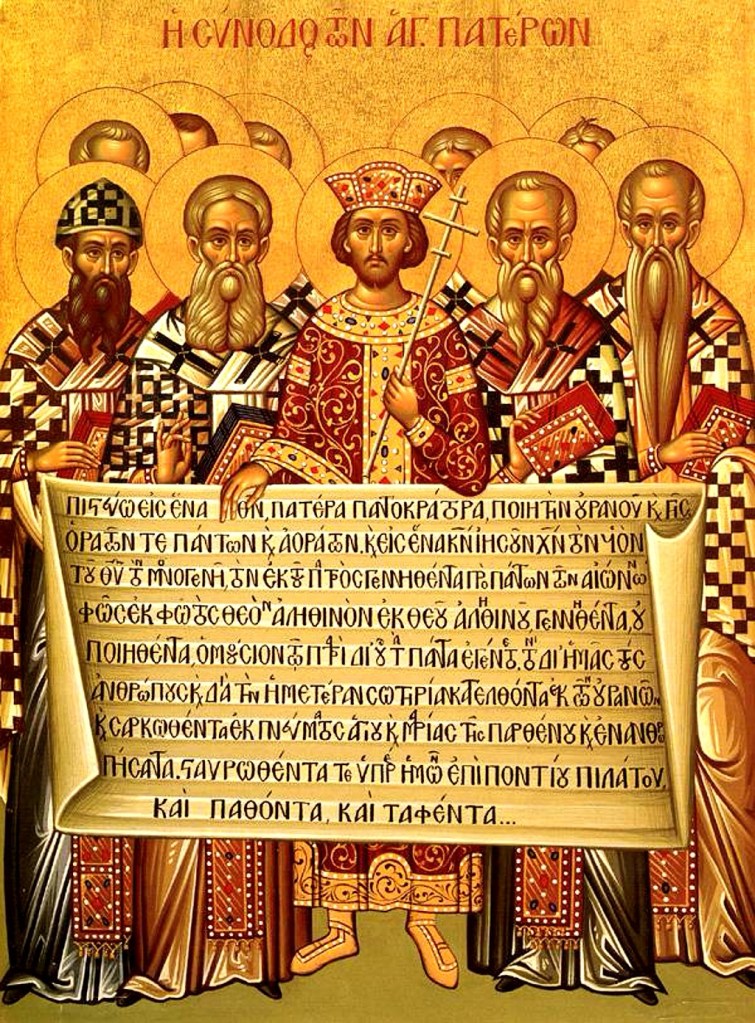
The second reason is that there is an extension to this verse that does not appear in many manuscripts; it is very clear that this is a later scribal addition designed to make the initial claim consistent, at least, with the developing orthodox theology of the church. The “three that testify in heaven, the Father, the Word, and the Holy Spirit, and these three are one”, clearly aligns this letter with the theology that is articulated by the Council of Nicea (in 325 CE); the parallelism is signalled in the final phrase, “and there are three that testify on earth”.

The final verse in the selection proposed by the lectionary (5:13) introduced the epilogue for the whole letter (5:13–21), in which key themes of the letter are reprised. This verse itself includes three key Johannine words, which figure prominently in both Gospel and letter: belief, knowledge, and life.

The author addresses those who “believe in the name of the Son of God”, echoing earlier injunctions to “believe in the name of [God’s] Son Jesus Christ and love one another, just as he has commanded us” (3:23), the affirmation that “we have known and believe the love that God has for us” (4:16), and the statement already noted in 5:10.

The author also indicates that they write so that those receiving this letter “may know that you have eternal life”. Knowledge figures earlier in the letter (2:3–4, 13–14, 18, 21, 29; 3:2, 5, 14–16, 19, 24; 4:2, 6, 8, 13; 5:2).

It is also prominent at key moments in the Gospel, when the woman in Samaria convinces the people of her city to know that Jesus “truly is the Saviour of the world” (John 4:42), Peter confesses on behalf of the twelve that “we have come to believe and know that you are the Son of God” (6:69), and Martha affirms that she knows that Lazarus will rise “in the resurrection on the last day”, which leads Jesus to push her further so that she can affirm to him, “I believe you are the Messiah, the Son of God, the one coming into the world” (11:23–27).

Life, eternal life, is what is known (3:14; see also 1:2; 2:25), as the words immediately prior to this affirm: “this is the testimony: God gave us eternal life, and this life is in his Son. Whoever has the Son has life; whoever does not have the Son of God does not have life” (3:11–12).

Life, eternal life, is what Jesus promises and delivers in the Gospel, as is stated in the most famous verse of the Gospel (3:16) and in the two great affirmations by Jesus, “I am the resurrection and the life” (11:25) and “I am the way, the truth, and the life” (14:6), and at many other places (1:4; 3:15, 36; 4:14, 36; 5:21, 24, 26, 29, 39–40; 6:27, 33, 35, 40, 47–48, 51–54, 60–68; 8:12; 10:10–17, 28; 12:50; 17:2–3).

It is also noteworthy that this statement of purpose by the author of the letter closely parallels a statement of purpose made by the author of the Gospel. In the Gospel, the author writes “so that you may come to believe that Jesus is the Messiah, the Son of God, and that through believing you may have life in his name” (John 20:31).

In the letter, the author says, “I write these things to you who believe in the name of the Son of God, so that you may know that you have eternal life” (1 John 5:13). It is a most fitting conclusion to the sequence of passages that we have read from this letter throughout Easter.

The last enemy to be destroyed is death (1 Cor 15; Narrative Lectionary for Easter 7)

Paul’s letter to the Corinthians canvasses a wide range of matters. First, he spends time addressing the serious divisions emerging within the Corinthian community. Paul declares that this matter “has been reported to me by Chloe’s people” (1:11); it is thought that this must have been a verbal report passed on to Paul when he met with a group from Corinth, perhaps slaves, sent by Chloe (about whom nothing else is revealed).

A second matter is introduced by a similar phrase, “it is actually reported…” (5:1), although the informant is not named. Some scholars think that the similarity of wording suggests that this news may also have been conveyed by “Chloe’s people”. A little later on, another matter is introduced by Paul with the phrase, “now concerning the matters about which you wrote” (7:1). Clearly, there had been written correspondence with Paul as well as the verbal report already indicated.

Towards the end of the letter, Paul refers to “the coming of Stephanas and Fortunatus and Achaichus” (16:17). This might suggest that they visited Paul; perhaps they bore a letter from the community (or a section of it), asking for Paul’s opinions about these matters? The fact that their names are Roman names reflecting an educated status, would lend support to this hypothesis.

Regardless of who actually brought this news, Paul is willing to deal with the matters raised, introducing them in turn by the shorthand formula, “now concerning”. Such matters include “food sacrificed to idols” (8:1), “spiritual matters” (12:1), “the collection for the saints” (16:1), and “our brother Apollos” (16:12).

The final theological issue which Paul addresses in his first letter to the Corinthians concerns the resurrection of believers. A rather stronger formula is used to introduce a major theological issue at 15:1: “now I would remind you, brothers and sisters, of the good news that I proclaimed to you…”.

Paul writes at length about this matter, which many scholars regard as the fundamental problem in the Corinthian community of faith, underlying other issues already explored. From comments later in this chapter (15:12, 15:29, and possibly 15:35), it is clear that divergent views about resurrection were held within the community of faith in Corinth. Paul’s response deals with each of them in a theological and rhetorical fashion.

Paul begins dealing with the issue with a series of affirmations concerning the crucifixion and resurrection of Jesus. There is an apologetic tone at the start, as Paul insistently underlines the validity and authority of what he says (15:1–3a). The “good news” which “I proclaimed” is described in technical terms indicating the passing-on of pre-existing tradition: “I received”, “I handed on”, “you received”.

Associated with this is an insistence that the Corinthians “stand” in this news, and must “hold firmly” to it, as the basis for “being saved”.

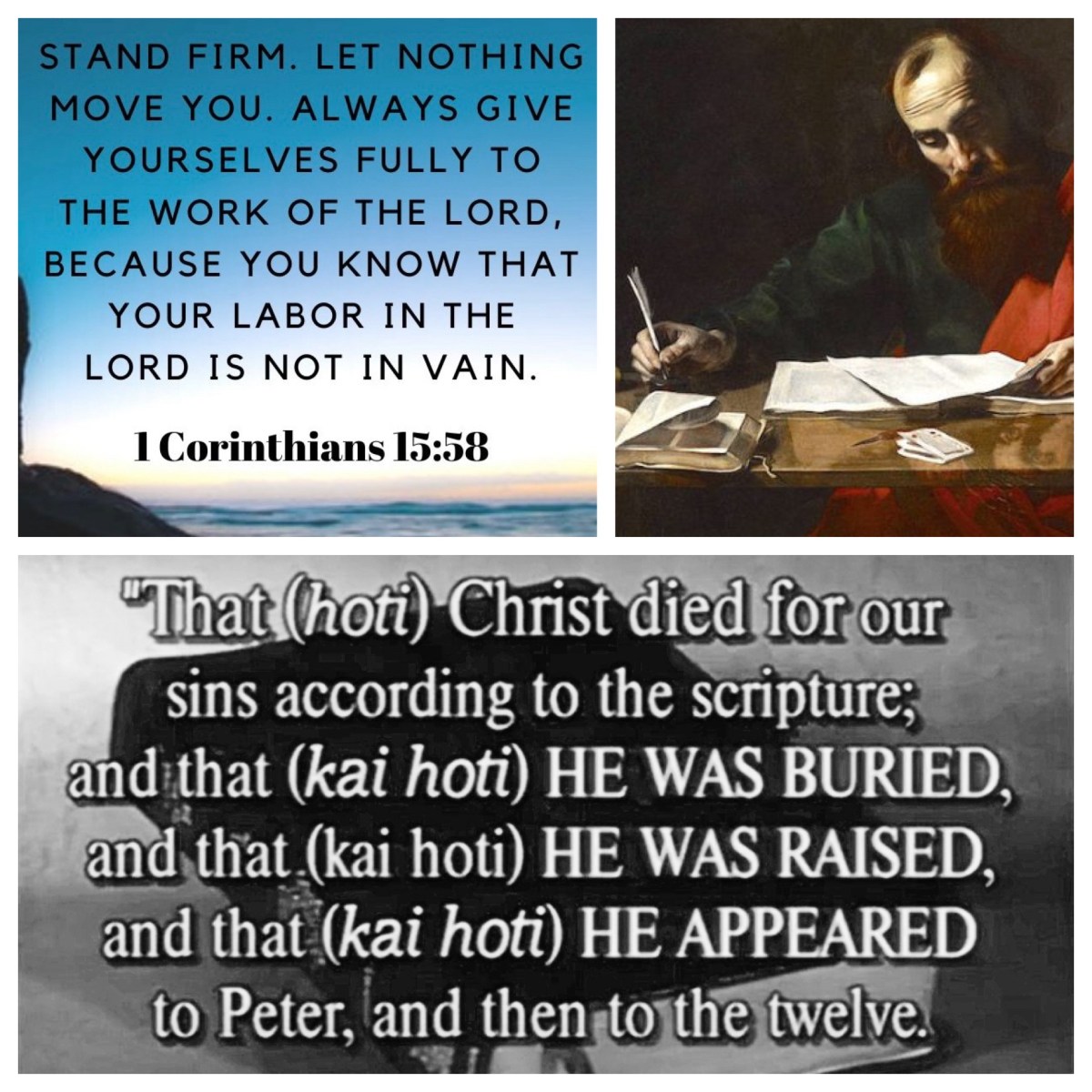
The foundational tradition which he then reports (15:3b–7) is based on an early four-part affirmation of faith: “Christ died…he was buried…he was raised…he appeared”.

The first and third elements are elaborated with the formulaic “in accordance with the scriptures”. The fourth element, the appearances of the risen Jesus, is extended beyond the list received by Paul (to Cephas, the twelve, more than 500, James, all the apostles; 15:5–7) to include Paul himself (“as to one untimely born”, 15:8), leading on to an assertion of Paul’s apostolic credentials and divinely-assisted activities (15:9–11).

The beginning of this lengthy discussion of resurrection reaches back to the “theology of the cross” at the start of the letter by references to the crucifixion and death of Jesus; but Paul does not develop this connection. Instead, he moves straight to the first pastoral situation in Corinth regarding the resurrection (15:12–19).

The “resurrection of the dead” (the Greek word is plural, reflecting a raising of many believers) was a Jewish belief that had developed in preceding centuries; not all Jews accepted it (see Acts 23:6–8) and amongst some Gentiles there was scepticism about the idea (see Acts 17:32).

The community in Corinth contained sceptics (15:12); Paul’s counter-argument attempts to refute their opinion in a series of logic-based steps, beginning with a questioning of the reality of the resurrection of the one person, Jesus (15:13–16) and leading to the conclusion that “your faith is futile” (15:17). He cannot countenance this, so launches into an exposition of what he sees as eschatological realities (15:20–28), explaining the places allocated, at the end, to humans, Jesus, and God.

The rhetorical structure of the first part of this argument (15:21–22) returns to the pattern of juxtaposing two different entities, which Paul has used in earlier sections of the letter. We can see this pattern as follows: for since death came through a human being / the resurrection of the dead has also come through a human being; for as all die in Adam / so all will be made alive in Christ. An expanded version of this argument takes place in Rom 5:12–21.

Paul then continues by explaining that Christ is “the first fruits”, who has “all things put in subjection under his feet” (15:23–27). But Christ himself is subjected to God; finally, God is “all in all” (15:28). Paul has not proven the resurrection as such, but has explained how it fits into his view of the end days.

A second pastoral situation is noted (15:29) but abruptly dismissed with two rhetorical questions; the clear inference is that there is no validity at all in the viewpoint held by those who practice “baptism on behalf of the dead”. Then follows a poetic reflection (15:30–34) in which Paul draws on Hebrew scripture (Isaiah 22:13) and Greek poetry (Menander, Thais) to denounce those who “have no knowledge of God” (15:34).

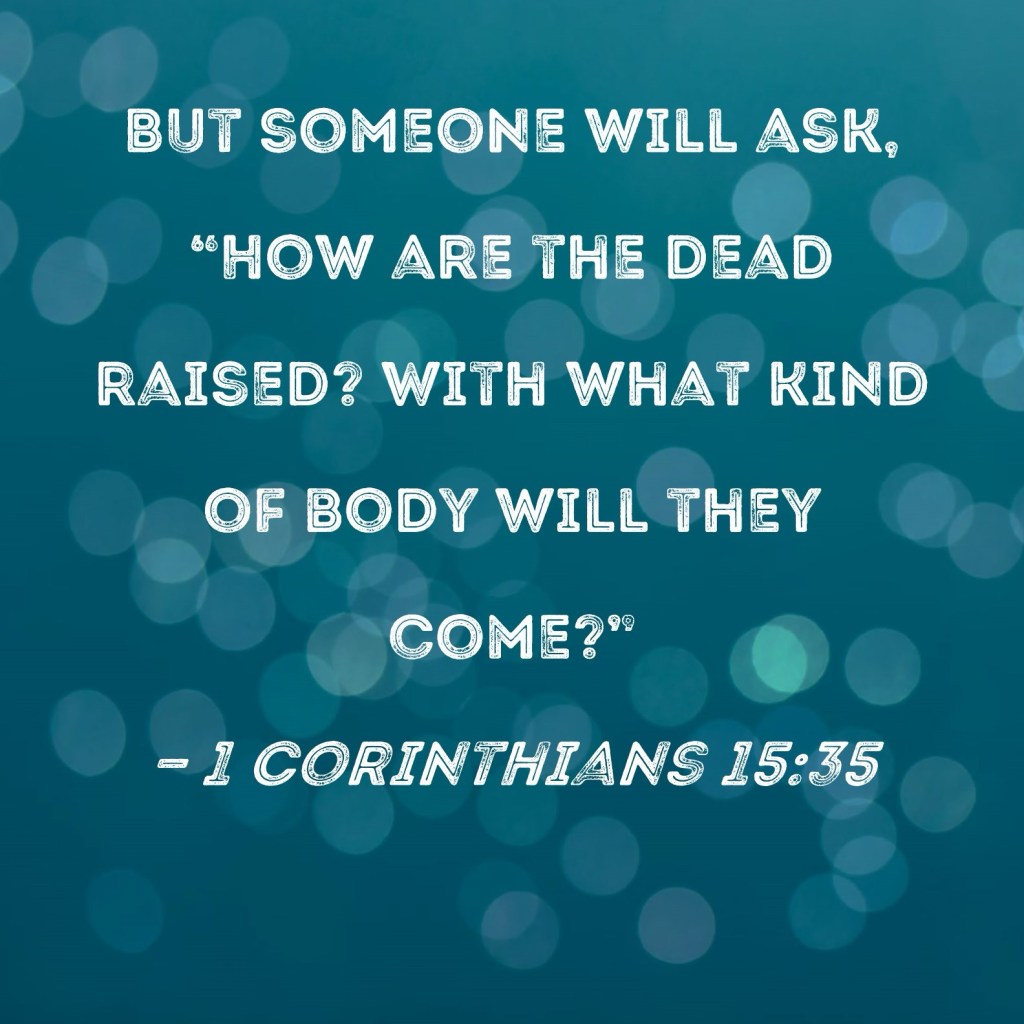
A third pastoral situation might possibly be indicated at 15:35, although the form employed (a rhetorical question attributed to an indefinite person) was commonly used by a skilled rhetorician to raise an objection which he knew could be raised, allowing it to be dealt with in advance (the same technique is found in Rom 2–6 and 9–11).

The question provides an opportunity for further eschatological teachings about the nature of the resurrection body (15:35–49) and a further display of Paul’s rhetorical prowess.

Once again, the rhetorical structure of the argument provides contrast by juxtaposition, advanced in a sequence of logical steps:

What is sown is perishable / what is raised is imperishable.

It is sown in dishonour / it is raised in glory.

It is sown in weakness / it is raised in power.

It is sown a physical body/ it is raised a spiritual body.

If there is a physical body / there is also a spiritual body.

Thus it is written, “The first man, Adam, became a living being”/ the last Adam became a life-giving spirit.

But it is not the spiritual that is first / but the physical, and then the spiritual.

The first man was from the earth, a man of dust; / the second man is from heaven.

As was the man of dust, so are those who are of the dust; / and as is the man of heaven, so are those who are of heaven.

Just as we have borne the image of the man of dust, / we will also bear the image of the man of heaven.

The symmetry is certainly poetically and rhetorically satisfying.

Some concluding reflections (15:50–58) allow for a final glimpse into the eschatological drama that awaits. The argument now is no longer logic-based, as Paul moves through a sequence of vividly-imagined images in a dramatic rhetorical style. The whole long discussion of this matter ends with the concise ethical exhortation, “be steadfast, immovable” (15:58).

The last word after this word of encouragement is a word of hope-filled assurance to the Corinthians, whom he has criticised so mercilessly at many places throughout the letter: “you know that in the Lord your labor is not in vain” (15:58).