Each of us will be accountable to God (Romans 14; Pentecost 16A)

Back in the days when I regularly taught “Exegesis of Paul’s Letters” in a theological college (seminary), I would begin the section on Romans in chapter 1, as might reasonably be expected. In characteristically Pauline style, the qualities for which he gives thanks in his opening prayer (1:8–14), as well as the way in which he introduces himself to the believers in Rome (1:1–7), signal a number of the key matters to which he will address himself later in this letter. So that seemed a logical place to start.

However, once we got to 1:16–17, the apparent “theme of the letter”, I would jump over to 15:14–33, and explore what Paul wrote about the intentions that he had, to visit “God’s beloved in Rome, who are called to be saints” (1:7), before pressing on to Spain. Why did he tell them this? It seems to be relevant to what was in Paul’s mind as he wrote his longest, and most theologically complex, letter.

But then, we would continue on, to look at chapter 16, which provides a long list of names of people in Rome to whom Paul sent greetings, as well as those who were with him, who added their greetings to those of Paul. More grist for the mill for understanding Paul’s circumstances, and thus also feeding into his rationale for writing. But also helpful, I believe, for getting an understanding of the situation in Rome, to which Paul was addressing his words. What he indicates about “God’s beloved in Rome, who are called to be saints” in that final chapter, is entirely relevant to our understanding of the letter as a whole.

After that, we would revert to chapter 1, and trace through the theological argumentation of this rhetorically-effusive, doctrinally-loaded stream of words, from 1:16, the thematic declaration of the gospel, which Paul describes as “the power of God for salvation to everyone who has faith, to the Jew first and also to the Greek”, in which “the righteousness of God is revealed through faith for faith”, all the way through to 15:33, the closing blessing, “the God of peace be with all of you. Amen.”

Had I been even braver, before we looked at chapters 1–11, I would have made the class work through the so-called “ethical section” of the letter (12:1–15:33), for what Paul says there has direct and immediate application to the situation in Rome which he sketches in those opening and closing sections. The “ethical exhortations” in this section do reveal more of the dynamics at play within that community, as I have argued over the last two weeks. Understanding that brings even more appreciation of the specific theological argument that is advanced and developed in “the body of the letter” (1:18—11:36).

However, I wasn’t quite brave enough to do that. And besides, the lectionary we are now using in worship has followed the letter through in the order in which it appears in our Bibles, beginning with chapter 1 back in Epiphany, then picking up from chapter 4 after Trinity Sunday. So it is only now, after many weeks of excerpts throughout Pentecost, that we have arrived at the final part of that ethical section. (And sadly, chapter 16 does not get a look-in in the lectionary offerings.)

And so, here we are in chapter 14 of Romans, with a passage that will be our last chance to consider this letter (Rom 14:1–12). Clearly, the quarrels that Paul had heard about in Rome (13:13) and which he here describes (14:1–3) had resulted in some judging others (14:4). The difficulties that this would have created in the community can be imagined; and I have already explored how some earlier teaching of Paul (12:9–21) could be seen to be a corrective to this problematic situation. I have also written about how the Gentile perception of Jews and the relevance, or otherwise, of the Jewish law for followers of Jesus might have exacerbated this situation (13:8–10).

In this section of Romans, Paul provides ethical instruction which is undergirded by his understanding of what Jesus has done for those who believe, and what this means in terms of how to behave. “We do not live to ourselves”, Paul asserts (14:7), and then immediately asserts in the same breath, ““we do not die to ourselves”. The reason he gives for this is straightforward: “whether we live or whether we die, we are the Lord’s—for to this end Christ died and lived again, so that he might be Lord of both the dead and the living” (14:9).

Paul draws no distinction between the living and the dead, insofar as he considers that the death and resurrection of Jesus took place for all people, whether alive or dead. Because he affirms that “we will all stand before the judgment seat of God” (14:10), he then asserts that “each of us will be accountable to God” (14:12). The level of accountability is consistent across all people. And that accountability is, first and foremost, to God.

The situation that has drawn this statement from Paul is one of “quarrelling over opinions” (14:1). Some—later identified as “we who are strong” (15:1)—are those who “believe in eating anything”, while others—here labelled as “the weak” will be more discriminatory, and “eat only vegetables” (14:2). This terminology appears to reflect the same disagreement that is dealt with in more detail in 1 Cor 8—10.

In that context, “the weak” is regularly interpreted to be how Gentile believers perceived the Jews within the Corinthian faith community–they are weak because they refrain from eating meat that had previously been offered to idols and then sold on in the marketplace. “The strong” would thus be the Gentile self-description of those who are not troubled by this, since they know that “no idol in the world really exists” since “there is no God but one” (1 Cor 8:4).

If that is how these terms are to be understood in the context of the various communities of faith that existed in Rome, then the dynamic at work parallels that which Paul knew well in Corinth. In that letter, he admonishes the Corinthians to “build up the church” (1 Cor 14:4), to “strive to excel in [spiritual gifts] for building up the church” (14:12), and to “let all things be done for building up” (14:26).

In writing to the Romans, he offers similar advice: “welcome those who are weak in faith” (Rom 14:1), to “no longer pass judgment on one another, but resolve instead never to put a stumbling block or hindrance in the way of another” (14:13), to “pursue what makes for peace and for mutual upbuilding” (14:19), and to “welcome one another, therefore, just as Christ has welcomed you, for the glory of God” (15:7).

These exhortations are firmly grounded on Paul’s understanding of what God has already done in Jesus. In the extended discussion that follows the passage in view this coming Sunday, he makes it clear that his instruction to the Romans, “each of us must please our neighbour for the good purpose of building up the neighbour”, is based on the understanding that “Christ did not please himself” (15:2–3). This, in turn, is grounded in the word of the psalmist which he cites, “the I nsults of those who insult you have fallen on me” (Ps 69:9b).

The behaviour of believers is to be modelled on the example of Jesus, whose sacrificial offering paved the way for the inclusive community that Paul desires to see in Rome, and elsewhere: “Christ has become a servant of the circumcised on behalf of the truth of God in order that he might confirm the promises given to the patriarchs, and in order that the Gentiles might glorify God for his mercy” (15:8–9).

Once again, this is grounded in ancient scriptural affirmations. To undergird this view, Paul cites a string of texts, each making reference to the goyim (the nations, or the Gentiles): v.9 cites Ps 18:49, v.10 quotes Deut 32:42, v.11 draws on Ps 117:1, and v.12 draws on the statement about “the root of Jesse” in Isa 11:10.

So the pattern of behaviour that is required in Rome is clear: “if your brother or sister is being injured by what you eat, you are no longer walking in love”, leading to the direct practical application into the Roman situation, “do not let what you eat cause the ruin of one for whom Christ died” (14:15).

And in in the section of Romans that we will hear this Sunday, Paul has undergirded this advocacy of mutual care and concern with a deeper theological rationale, again based on the example of Jesus: “if we live, we live to the Lord, and if we die, we die to the Lord; so then, whether we live or whether we die, we are the Lord’s” (14:8).

Paul concludes this affirmation with the use of a phrase that came to be used by other early Christian writers, pointing to the universal dominion of God: “for to this end Christ died and lived again, so that he might be Lord of both the dead and the living” (14:9; compare “the God of the living and the dead” at Acts 10:42; 2 Tim 4:1; 1 Pet 4:5; and perhaps Rev 1:18).

And so it is that Paul asserts that “we will all stand before the judgment seat of Gods (14:10), a conclusion that he once again supports with reference to scripture—lit is written, ‘As I live, says the Lord, every knee shall bow to me, and every tongue shall give praise to God’” (14:11, quoting Isa 45:23). So then, he concludes, “each of us will be accountable to God” (Rom 14:12).

Israel saw the Egyptians dead on the seashore (Exodus 14; Pentecost 16A)

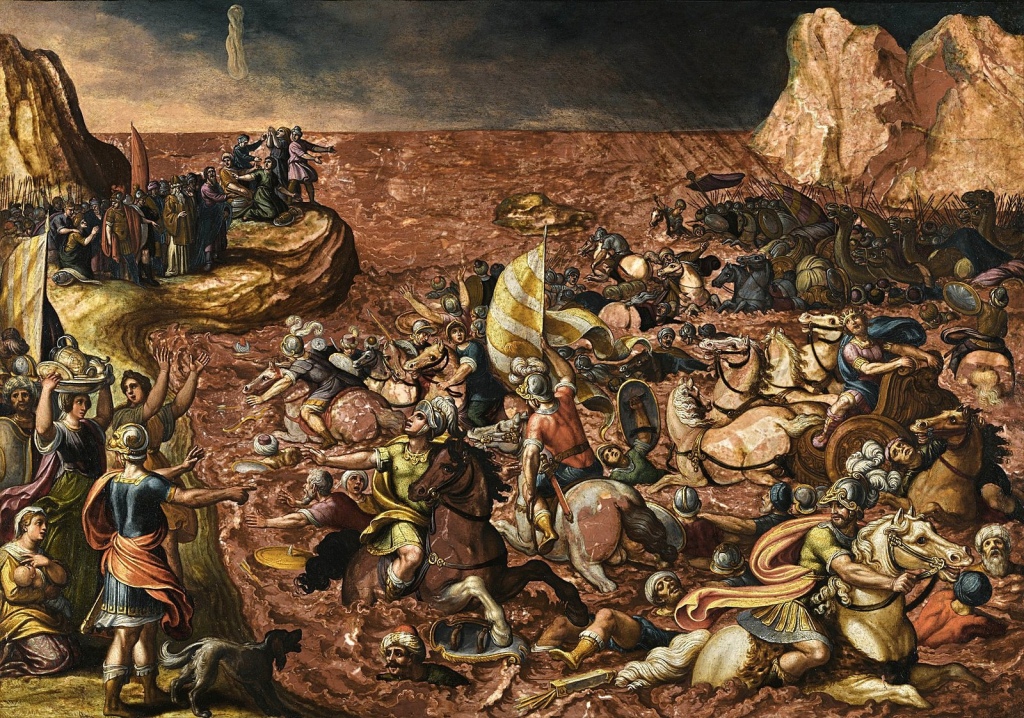
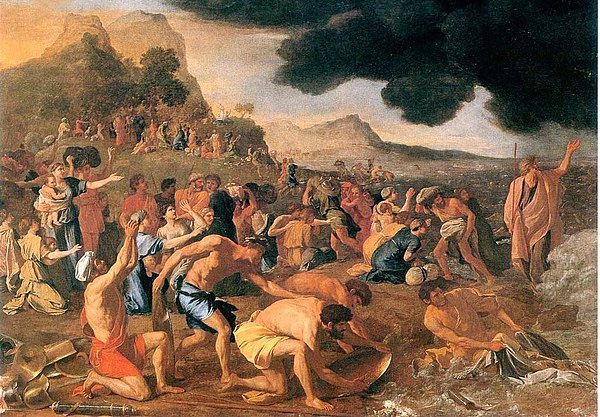
“So the Lord saved Israel that day from the Egyptians; and Israel saw the Egyptians dead on the seashore” (Exod 14:20). That’s the statement that tells the story of the Exodus in one short verse; it’s also the ethical problem that sits at the heart of the Exodus story. A part of that story is offered by the lectionary for this coming Sunday (Exod 14:19–31).

I have already offered some reflections on the violence that is central to the story of the Exodus from Egypt; see https://johntsquires.com/2023/09/06/escaping-from-oppression-how-do-we-make-sense-of-the-exodus-exodus-12-pentecost-15a/

As I have noted, there is much violence spread throughout the pages of the Hebrew Scriptures—and the reading proposed by the lectionary for this coming Sunday is no exception! I have no doubt that, for many people, the violent scenes in the “historical” narratives, in the prayers of the psalmists, in the visions of the prophets, is most off-putting. As a pacifist myself, I find these scenes disturbing.

As I have worked with people who have experienced trauma from abuse in their lives, I recognise how they may “work through” these matters in ways that are confronting and hard to handle; I have tried to cultivate an attitude of acceptance of them and curiosity about what drives their angry and violent language. And as a person who myself has experienced the trauma of violence through sexual abuse, when I was a child, I am intensely attuned to the ways that violent words and deeds can impact on people.

For my own story, see

and for the podcast in which I talk about this, go to

https://open.spotify.com/episode/5feSJb2qyVAhzBEfoeHj1x?si=29983b58d694477d

*****

I don’t, of course, hold to each and every event in the biblical narratives as literal historical events; but I do believe that these narratives reflect the zeitgeist of the time. It was a violent time, life was more precarious, people lived in a more tribal fashion (and thus fighting the neighbour was somehow a regular occurrence). And yet, in the midst of this, we see the emergence and development of a spirituality that values something wider than the immediate tribal, parochial viewpoint.

To the extent that the final editors of the many narratives shaped things intentionally, we might note that the stories of the little tribe(s) which later identified together as Israel, were framed by a grand narrative of the cosmic creation (Gen 1–2) and the strategic place of humanity within that creation (Gen 2–3). That, it seems to me, signals the moves that have been made from the violent tribal interactions of many narratives, into the poetic appreciation (mediated via the hierarchical priestly mindset) of the larger global—and spiritual—picture.

Thus, these texts do have some value; but they need to be understood in their detail, in their contexts, and in terms of the whole. They include the earlier stories of their heritage—because the people creating these texts “honour mother and father”, they preserve and retell those stories—but they also show how faithful people grappled with their various situations and challenges.

In Hebrew Scripture, then, we have extended stories constructed by writers seeking to shape the society of their time through a reconstructed (and perhaps idealised) past; songs from psalmists seeking to find God in trying situations; writings from sages plumbing the depths of wisdom and discernment; and oracles from prophets decrying infidelity and lack of commitment to the covenant, using graphic, even violent, language. The whole is a fascinating mix of case studies about “how to be faithful” in changing and challenging circumstances.

The Exodus needs to be seen in this context. It contains poetic sections (Exod 15) celebrating victory after violent engagement; a narrative shaped around that poem; then a further narrative, woven into the existing narrative but expanding or correcting or challenging the earlier material, all included into a literary stream of words that we puzzle, now, to unknot and make sense of.

The story of this Exodus from Egypt came to occupy a central place in the life of the people of Israel. It gained traction as a story that conveyed the identity of the people—once enslaved, miraculously liberated, steadfastly guided, and ultimately rewarded with a place of their own. It was retold in a number of psalms (Psalms 77 and 78; 80 and 81; 105 and 106; 114; 135 and 136).

A standard refrain which recalls the Exodus, “I am the Lord your God, who brought you out of the land of Egypt, out of the house of slavery” (Exod 20:2; Deut 5:6) recurs throughout the ensuing narrative books (Deut 1:27; 5:6; 6:12; 8:14; etc; Judg 2:12; 1 Sam 12:6; 1 Ki 6:1; 8:9, 21; 9:9; 12;28; 2 Ki 17:7, 36; 2 Chron 6:5; 7:22). A number of prophets also recall this story with similar phrases (Jer 7:22, 25; 11:4, 7; 16:14; 23:7; 31:32; 32:21; 34:13; Ezek 20:4–10; Dan 9:15; Hos 11:1; Amos 2:10; 3:1; Mic 6:4; 7:15; Hag 2:5).

In the difficulties of the Exile in Babylon, when the final form of the story as we know it was created, this saga resonated deeply with the confronting experiences and the fervently-held hopes of the people. Their Exile was their Egypt; their Exodus was still awaited, and their entry into the land of Israel remained yet well ahead of them. And so, the story is told of the past, but it becomes a story of the present, a hope for the future, for the people.

It seems to me that the dreaming stories of First Nations Peoples in Australia instruct us about the way that the ancients told their stories, retold and reworked them, and then wrote them down (a step that some First Nations peoples are now taking, under the pressure of western colonisation).

It is quite likely that the same kinds of processes were present in the formation, development, and passing on of the stories of ancient Israel, until such time as it was felt needed to write them down (a step that was clearly taken during the Exile in Babylon and in the years after that, as the people returned to the land of Israel).

The narratives bear witness to the faith of ancient peoples; they reflect life and society as it was, with all its faults as well as its positive points; and they invite us to share in the attitude of faith towards God and the demonstration of justice and care for one another that is reflected in the stories that are told.

What, then, do we make of the story of deliberate, divine-authorised death, which is told in Exodus 14, as we hear in the Hebrew Scripture reading in worship this coming Sunday? The story has become foundational, not only for Jews, but also for Christians, as I noted last week. (See the link above.)

Writing in Bible Odyssey, Professor Brian M. Britt offers this insightful summary of the function of the Exodus mythology over a long, extended period of time. He observes, “The prevalence of the exodus tradition in the Bible demonstrates its importance as a foundational collective memory from ancient Israel that predates the monarchy and survives into the time of the early rabbis and followers of Jesus.

“Postbiblical exodus traditions take many forms, from the Jewish observance of Passover to Christian celebrations of Easter, Muslim teachings about the Prophet Musa, and modern liberation theologies. Though many modern readers have asked whether episodes of the exodus, from the plagues in Egypt to the parting of the Red Sea, “really happened,” the exodus remains one of the most powerful narratives of divine compassion and liberation found in the Bible.”

See

The Exodus Tradition in the Bible

For Jews, this story is foundational. It is both in the remembrance of that first “passing over” at the annual Passover dinner in people’s homes, but also in the self-identity of the people as chosen by the Lord for a special, designated purpose, saved from the antagonisms of hostile surrounding nations, such that the story gains life and becomes effective as a fundamental mythos, a story that explains the very essence of who Jews are.

For Christians, it is in the remembrance of “the night on which the Lord [Jesus] was betrayed”, in the oft-repeated eucharistic celebration in local churches and cathedrals, that the story is foundational. It is part of the central thread of the grand narrative (the death and resurrection of Jesus) that sits at the heart of that religion.

That the story involves bloodshed and death—as well as rescue and salvation—indicates the earthy nature of each faith. Judaism and Christianity alike are grounded in the realities of human existence and deal with factors that are of the essence of human life. It is a foundational story that is important to remember. But that does not mean that the story is without problems.

The fate of the Egyptians, first being bogged in the muddy ground, next panicking as they are subsumed by the waters, and then drowning in the rising sea, is a difficult part of the story. The claim that God deliberately hardens their hearts (14:17) in order to lure them into the waters, is abhorrent. Is this really what God is like? Or is this an element introduced into the story by the narrator, to provide some form of explanation for their fate? I lean to the latter—but it still does not make for easy reading.

This part of the story remains, sitting as an accusatory claim. It is hard to resolve this in a satisfactory way. The Egyptians become a cipher for all with whom the Israelites struggled, over the centuries. They symbolise “the other”; and with the Canaanites, later in the grand narrative, they exercise a peculiar function; a reminder of those who were “in the way” of the grand plan (of God, it was claimed) that was being enacted.

They are difficult people in the way of the story–much like the First Peoples of the continent of Australia and its surrounding islands are “in the way” of the grand colonising, civilising narrative that has been created by powerful white historians, storytellers, and political leaders.

There is, however, another side of the story of Israel, which is presented in the concluding verses of this week’s passage. What happened in the Sea of Reeds is remembered as the day when “the Lord saved Israel … from the Egyptians” (14:20), the day when “Israel saw the great work that the Lord did against the Egyptians” (14:31). It is a story designed to evoke and strengthen faith.

The graphic scene is sketched in few words, but they are telling words: “Israel saw the Egyptians dead on the seashore” (14:30). That is a vastly understated comment. If you have ever seen pictures from the Western Front battles during World War I, you will know that a scene of dead bodies littering the ground is indeed a gruesome and sobering sight. The Exodus story contains just such a devastating scene.

But the whole purpose of the story is not to lament the dead (they are mere collateral damage, in modern terminology). It is to encourage faith and hope amongst those who have continued as faithful in subsequent years. “So the people feared the Lord and believed in the Lord and in his servant Moses” (14:31). Another brief, pointed observation. All’s well that ends well, it would seem—at least, for the victors.

Let such a one be to you as a Gentile and a tax collector (Matt 18; Pentecost 15A)

The Gospel we ascribe to the authorship of Matthew the tax collector, the first of the four in the canon of the New Testament, is distinctive for a number of reasons. One of those is that it contains a collection of the sayings of Jesus which relate to life in the community of faith—a kind of a miniature “community rule” for the people for whom the author was writing.

Those sayings are collected together in chapter 18, which is the fourth of five teaching blocks in the arrangement made by the author of this Gospel. We will hear and read some of those words this coming Sunday (Matt 18:15–20, Pentecost 15A), and then a parable relating to these teachings next week (Matt 18:21–35, Pentecost 16A). And this week’s reading contains some stridently harsh words from Jesus: if a person who has “sinned against” refuses to be reconciled, then “let such a one be to you as a Gentile and a tax collectors” (18:17)!

These five teaching blocks canvass ethical imperatives (5:1–7:29), missional guidelines (10:5–11:1), parables of the kingdom (13:1–53), relationships within the community of faith (18:1–19:1), and apocalyptic predictions about the coming kingdom along with strengthened indications of what righteousness is required in that kingdom (23:1–26:2). These teachings are demanding and comprehensive.

In each block of material, the author has drawn together teachings of Jesus that have been assembled from various sources, and arranged in a manner that presents these collected sayings and teachings as a cohesive, sermon-like presentation. The hand of the author is clear, just as the voice of Jesus is strong.

So the first fourteen verses of this chapter comprise words which are found at various places in the Gospel of Mark, one of Matthew’s sources, as well as in the sayings material which is believed to have been collected earlier, in the hypothetical source known as Q. (Material in Q, according to this theory, was known to and used by both Matthew and Luke, but in different ways and in different places in their works.)

The first five verses (18:1–5) report the words of Jesus about the child and the kingdom of heaven, which are included in all three Synoptic Gospels. When a child is placed before him, Jesus declares that “unless you change and become like children, you will never enter the kingdom of heaven; whoever becomes humble like this child is the greatest in the kingdom of heaven” (18:3–4). The same saying is found in slightly varied forms at Mark 10:14–15 and Luke 18:16–17.

The conclusion to this short scene, “whoever welcomes one such child in my name welcomes me” (Matt 18:5), is a variant on an earlier Matthean saying, “whoever welcomes you welcomes me, and whoever welcomes me welcomes the one who sent me” (Matt 10:40; and the subsequent variations, 10:41–42).

This, in turn, is derived from Mark’s own earlier account of when Jesus “took a little child and put it among them; and taking it in his arms, he said to them, ‘Whoever welcomes one such child in my name welcomes me, and whoever welcomes me welcomes not me but the one who sent me’” (Mark 9:36–37). Luke replicates this at Luke 9:47–48.

So the first section of this chapter already shows the dependence of the author on an earlier source, and his willingness to appropriate and reshape the material for his own purposes.

The next four verses (18:6–9) deal with skandala, a group of sayings that Mark reports in his account: “if any of you put a stumbling block [a skandalon] before one of these little ones who believe in me, it would be better for you if a great millstone were hung around your neck and you were thrown into the sea” (Mark 9:42). Mark himself then extends this saying with reference to having a hand or foot cut off, if it is a skandalon, as well as an eye plucked out if it, also, is a skandalon (Mark 9:43–48).

Matthew includes all the material that he finds in his Markan source—the little ones, the errant hand and foot, and the eye—and expands it, adding some words that intensify the warning: “Woe to the world because of stumbling blocks! Occasions for stumbling are bound to come, but woe to the one by whom the stumbling block comes!” (Matt 18:7).

Luke reports the initial words of Jesus (Luke 17:1–2), but then places the word about forgiving another member of the community (Luke 17:3) and the command to “forgive seven times seven” (Luke 17:4)—a word which provides the basis for the last section in Matthew’s fourth teaching block (Matt 18:15–35). So Luke and Matthew have each collated diverse words of Jesus, but in different combinations.

Before that, however, Matthew has Jesus tell the parable of the lost sheep (Matt 18:10–14), which is found also in Luke 15. In Luke’s recounting of the story, it is the first of three parables focussed on seeking the lost and welcoming them home with joy.: a list sheep, a list coin, and then two sons, each list for very different reasons

In Matthew’s narrative, however, the parable stands on its own, as a hinge between the warnings about skandala and instructions about dealing with conflict. The orientation is clear: stumbling blocks present problems, but the Gospel includes a call to seek reconciliation and embrace the return of a repentant one—for “it is not the will of your Father in heaven that one of these little ones should be lost” (18:14).

So the theme is set for passage which is offered by the lectionary this Sunday (18:15–20), which deals with conflict within the community. There is a short and direct statement about such a situation that is made by Jesus in Luke’s account: “if another disciple sins, you must rebuke the offender, and if there is repentance, you must forgive; and if the same person sins against you seven times a day, and turns back to you seven times and says, ‘I repent,’ you must forgive” (Luke 17:2–3).

It seems that this word comprises a reflection that sits neatly alongside an independent Markan saying: “whenever you stand praying, forgive, if you have anything against anyone; so that your Father in heaven may also forgive you your trespasses” (Mark 11:25). That word provides the undergirding for the instruction to forgive: God offers forgiveness.

Divine forgiveness is a theme that the Hebrew prophets of old surely knew (see Isa 33:24; Jer 31:34; 33:8; 36:3; Ezek 16:62–63; Dan 9:9, 17–19; Amos 7:1–3; Hos 4:4–7) and which the psalmists regularly sought (Ps 25:18; 32:1; 65:3; 79:9). They know that, “if you, O Lord, should mark iniquities, Lord, who could stand? But there is forgiveness with you, so that you may be revered” (Ps 130:3–4). And so Jesus instructs his disciples, when praying, to ask God to “forgive us our sins, for we ourselves forgive everyone indebted to us” (Luke 11:4; and compare Matt 6:12).

In Matthew’s reworking of this Q material, it takes no less than twenty verses to get from the presenting problem—“if another member of the community sins against you” (18:15)—to the final resolution, that we are to show mercy and forgive—for “if you do not forgive your brother or sister from your heart”, neither will God forgive you (18:35). Matthew does this through some direct instructions (18:15–20), which we hear in this week’s lectionary readings, and then an extended parable (18:21–35), which we will hear in the following week’s lectionary offerings.

The construction of this instructional section is clear and informative. There are four “if” clauses, setting out a hypothetical situation: “if another member sins” (v.15a), “if the member listens” (v.15b), “if you are not listened to” (v.16), and “if the member refuses to listen” (v.17). We know that this is a hypothetical situation, because the syntax of the Greek at this point does not use the simple construction for a “real present condition”, ei followed by the verb in the indicative mood, with a resolution also in the indicative.

Here, the syntax is ean followed by the verb in the subjunctive mood, followed by a resolution in the indicative. That pattern appears four times in these three verses. Jesus (via Matthew) is setting out a possible scenario, with clear guidance as to what course of action is to be taken in that scenario.

For the first three times, the response is clear and compassionate. If a sin occurs, “go and point out the fault” (v.15a). If the person listens, “you have regained that person” (v.15b). If the person does not listen, “take one or two others with you” (v.16). And as the situation increases, the inclusion of others in the process broadens the responsibility for possible resolution.

It is thought that the “one or two others” in the third step reflects the need for “two or three witnesses” in the prescriptions of Torah (Deut 17:6, and especially 19:15). Indeed, the author of this Gospel, as a pious Jew immersed in the details of Torah, would have known well the process that is outlined in Deut 19:15–21, which provides that “a single witness shall not suffice to convict a person of any crime or wrongdoing” (Deut 19:15).

It is this passage, famously, that proceeds through a process of clarification—particularly in relation to identifying a false witness (Deut 19:16–19)—before the culminating sentence is pronounced: “so you shall purge the evil from your midst … show no pity: life for life, eye for eye, tooth for tooth, hand for hand, foot for foot” (Deut 19:19, 21). Justice is clear; justice is hard; justice is demanded.

Seen in the light of this Torah provision, we can therefore understand the sequence that Jesus, via Matthew, envisages: a private conversation, then a conversation with witnesses , and then, if required, a full, public declaration of the sin—and the punishment, “let such a one be to you as a Gentile and a tax collector” (Matt 18:17).

The process that Matthew envisages is oriented towards “regaining” the one who has sinned. The Greek word in verse 15 which is translated in this way was used by Paul to indicate success as he seeks to convince people to follow Jesus as Messiah (1 Cor 9:19–23; notice the reacting “so that I might win”). It may be that Matthew has this in mind in his use of the word in verse 15; the aim is to “win” or “regain” a person back into the community, through a process of intensified persuasion.

I confess that I once wrote a detailed exegesis of this passage which argued that this word provided the key to the passage: the aim was to regain a person, to have reconciliation. I even went on to claim that “like a Gentile or a tax collector” in verse 17 did not mean, banish this person from the community, but consider them to be providing a new opportunity for them to be “converted”, persuaded of the value of the Gospel. My professor said it was very well argued, even though he did not agree with my somewhat optimistic conclusion. (I got a good grade, though!)

In the decades since then, a number of conversations with my wife Elizabeth—who has spent more time focussing on Matthew’s Gospel than I have, even though I have taught courses on Matthew for 20 years now—convinced me that the clue lies in the words used in verse 17. After all, neither a Gentile nor a tax collector is highly regarded in this Torah-informed Gospel.

Jesus, in Matthew’s account, instructs his disciples “do not heap up empty phrases as the Gentiles do” (6:7), noting that “if you greet only your brothers and sisters, what more are you doing than others? do not even the Gentiles do the same.” (5:47), and also that “it is the Gentiles who strive for these things” that are of passing value—food and drink, the length of life and our clothing—on contrast to “the kingdom of God and God’s righteous-justice” (Matt 6:32–33). The Gentiles do not get a good rap from the Matthean Jesus.

Indeed, in this Gospel, Jesus quite distinctively commands his disciples, “go nowhere among the Gentiles, and enter no town of the Samaritans, but go rather to the lost sheep of the house of Israel” (10:5-6), and dismissively informs a Canaanite woman, “I was sent only to the lost sheep of the house of Israel”, and so “it is not fair to take the children’s food and throw it to the dogs” (15:24, 26). Keep away from the Gentiles is his persistent message! (Until that is reversed by the risen Jesus, in a great turnaround, at 28:19–20).

And as for tax collectors: the first thing to say ist hat whilst the traditional understanding is that this Gospel was written by a tax collector (the one identified at 9:9), scholarly interpreters regularly dismiss this as later tradition, and note that working from the text leads us to conclude that the author was more likely a fervent, pious Jew, Torah-abiding and also deeply committed to regarding Jesus as rabbi, teacher, and Messiah.

Of course, Jesus was known for eating with tax collectors (Mark 2:15–16 and parallels)—but not so much with Gentiles (especially in Matthew’s Gospel!). Here, however, the tax collectors to whom the errant community member are to be dispatched (18:17) are those linked with sinners (9:10–11; 11:19) and with prostitutes (21:32), those who, rather than loving their enemies (5:44), “love those who love you”. “Do not even the tax collectors do the same?”, Jesus asks (5:46), placing them on par with the Gentiles, as we have already noted (5:47). So in this Gospel, it seems that to be with tax collectors and Gentiles is to be amongst those, outcast from God, who are determined to live in a way that does not reflect how Jesus understands God wants his people to live.

So the Matthew passage results in the Sam end as the Deuteronomy passage” “purge the evil from your midst” (Deut 19:19), let the sinful one “be to you as a Gentile and a tax collector” (Matt 18:17). In both cases, the need for a clear boundary, marking off the faithful from the evil ones who surrounded them, was paramount. No gentle Jesus, meek and mild, here!!

The decision is undergirded by words about binding and loosing which harken back to the authority given to Peter (16:19). It is a decision reinforced by divine authority—what is decided on earth “will have been bound (or loosed) in heaven”.

Love is the fulfilling of the law (Romans 13; Pentecost 15A)

“Love is the fulfilling of the law”, Paul asserts in the passage that we are offered by the lectionary for consideration this coming Sunday (Rom 13:8–14). “Christ is the end of the law”, he has boldly asserted in an early part of the letter (Rom 10:4). How do these two seemingly contradictory statements stand alongside each other? What is the status of the law—the Torah, the foundation of Jewish life and faith—for Christians?

In making his statement about Christ and the Law (10:4), Paul has used an important Greek word: telos. This is regularly translated as “Christ is the end of the Law”; but we might well ask, what is the sense of the word “end” in this verse? On the one hand, this word might does infer a meaning of “the end as and abolition”, doing away with the Law. Apart from the fact that this directly contradicts what Jesus said about his intention not to abolish any single part of the Law (Matt 5:17–18), it is a most an unsatisfactory supercessionist reading, which completely does away with all the Old Testament.

On the other hand, there is the sense (which I prefer) that this means “the end as in bringing to the height of fulfilment”. In which case, Christ is bringing the Law to its logical and natural end, or goal: the complete expression of the Law through love. In other places where the word telos is used, it has this sense of bringing to fulfilment or bringing to perfection.

Indeed, this latter sense accords with the use of the term in other Pauline texts, where it is used to refer to those with spiritual maturity. He encourages the Corinthians, “in your thinking, be adult (teleioi)” (1 Cor 14:20). He confesses to the Philippians, “not that I have already obtained this or have already reached the goal (teteleiōmenoi)” (Phil 3:12) and exhorts “those of us then who are mature [to] be of the same mind” (Phil 3:15).

In later letter claiming Paul as author, the term signifies those “mature in Christ (teleioi en Christō)” (Col 1:28; see also Eph 4:13). It is perhaps similar to the meaning in Hebrews, which makes the claim that Jesus is the means of offering a perfect sacrifice (Heb 2:10; 5:9) through which “by a single offering he has perfected (teteleiōken)for all time those who are sanctified” (Heb 10:14).

Of course, the idea of being perfect is integral to the appreciation of God that is expressed at various places in Hebrew Scripture. “This God—his way is perfect”, the psalmist sings (Ps 18:30; echoed also at Deut 32:4; 2 Sam 22:31; Job 37:16), and in another psalm, “the law of the Lord is perfect, reviving the soul” (Ps 19:7).

So the temple that Solomon built was to be perfect (1 Ki 6:22), the sacrifice of wellbeing to be offered there, “to be acceptable it must be perfect, there shall be no blemish in it” (Lev 22:21), and no person with a blemish is able to serve as a priest (Lev 21:16–24).

Perhaps this is the sense of telos, perfection, complete fulfillment, that sits underneath the use of this word by Paul at Rom 10:4? That would mean that he is proposing that Christ brings the Law to a state of perfection in which it is filled to overflowing with God’s goodness.

Certainly, this would explain why Paul is able to affirm that “the whole law is summed up in a single commandment, ‘You shall love your neighbour as yourself’” (Gal 5:14). Law and love are here seen in close interrelationship with one another, not in opposition to one another. Love is the essence of the Law, bringing fulfillment what the Law set forth.

And that would also explain the words we have in this coming Sunday’s reading from Rom 13, that “the one who loves another has fulfilled the law” and so “love is the fulfilling of the law” (Rom 13:8, 10).

The key words used in Rom 13:8–10 are equally strong with regard to the ongoing validity and relevance of the Law, for Paul. He uses two words derived from the verb plēroō, meaning “to fill up”, and thus, “to fulfill”. In 13:8, he says that “love has fulfilled the law”, using the perfect form of the verb, peplērōken. The perfect has the sense of an action completed in the past which has consequences which continue on into the present time. So the fulfilling of the Law in the past by deeds of love has ongoing consequences—that Law, those acts of love, impinge on the present time.

Then, in 13:10, Paul reiterates that “love is the fulfilling of the law”, using a noun formed from this verb, plērōma. That conveys the idea that the Law has been filled right up to overflowing, fully and completely, by acts of love. The Law remains relevant and potent, because of those fulfilling acts of love.

Alongside these two words, Paul uses another word to make a similarly strong statement. Quoting for of the Ten Commandments, he affirms that these laws are “summed up” in another set of words, taken from Hebrew Scripture itself: “love your neighbour as yourself” (13:9, quoting Lev 19:18). The verb translated “summed up” is anakephalaioutai, a compound word combining the idea of “the head” (kephalē) and “brought up to” (the preposition ana).

This word contains the sense, then, that everything is gathered together and taken up into the head; obedience to each and every one of the commandments of the Law is gathered together and taken up into the head, that is, in the act of loving the neighbour.

Paul could not be clearer, and could not be stating things more strongly: the Law is filled to overflowing in love. The Law continues to have power. It is not abandoned as irrelevant or outdated.

Paul’s attitude to the Law, however, is quite complex. He trained as a Pharisee, and he notes at he was “far more zealous for the traditions of my ancestors” (Gal 1:14), and so he has a “delight in the law of God in my inmost self” (Rom 7:22). He affirms that he upholds the Law (Rom 3:31), alluding to various commands in The Ten Words which he insists are worth obeying (2:17–22), and affirming that, in its essential character, “the law is holy, and the commandment is holy and just and good” (7:12).

Yet his calling to be “apostle to the Gentiles” (Rom 11:23; Gal 2:8) led to his experience of eating at table with Jews and Gentiles together, in breach of kosher food laws (Gal 2:11–13)—an issue that is clearly in view decades later, as Luke writes his account of the early years of the Jesus movement, siding with Paul in the view that God has set aside the requirement for separate foods and separate tables (Acts 10:1–11:18; 15:19–20, 28–29).

This, in turn, leads Paul to his missionary goal of bridging the gap between Jews and Gentiles in practical ways (Rom 15:25–27), undergirded by the message that he preaches, affirming that salvation is offered “to everyone who has faith, to the Jew first and also to the Greek” (Rom 1:16; see also 2:10; 10:12; Gal 3:28; and the post-Pauline development in Eph 2:11–22). He is driven by the scriptural claim that “God shows no partiality” (Rom 2:11; Deut 16:19–20; 2 Chron 19:7; Sir 35:15–16).

So his letter to the Romans is a long and complex argument in which he explains how he understands that the good news is that “the righteous-justice of God [is] through faith in Jesus Christ for all who believe” (3:22), that there is “justification and life for all” (5:18). The argument builds and develops, demonstrating how God has chosen to make righteous-justice available to all human beings, through Abraham as through Jesus, by means of the indwelling Spirit.
So this leads Paul to write in negative terms about the Law. Although he maintains that having faith in Jesus does not “overthrow the law”, and he insists that “we uphold the law” (3:31), he goes on to note that “the law brings wrath” (4:14), for where “the law came in … the trespass multiplied” (5:20). “If it had not been for the law”, he asserts, “I would not have known sin” (7:7), and so “I am a slave to the law of sin” (7:25), and in Jesus, “God has done what the law, weakened by the flesh, could not do” (8:3).

Accordingly, “Israel, who did strive for the righteousness that is based on the law, did not succeed in fulfilling that law” (9:31). Or, as he portrays things in writing to the Galatians, “a person is justified not by the works of the law but through faith in Jesus Christ” (Gal 2:16), “through the law I died to the law” (2:19), “if justification comes through the law, then Christ died for nothing” (2:21), “no one is justified before God by the law” (3:11), and even, “if you are led by the Spirit, you are not subject to the law” (5:18).

However, to the proposition that he poses, “Is the law then opposed to the promises of God?”, Paul immediately replies, “Certainly not!” (3:21), and then argues that “the law was our disciplinarian until Christ came, so that we might be justified by faith” (3:24). This looks like Paul is ready to contend that the Law is superseded, and should be put aside. But not so fast; “I testify to every man who lets himself be circumcised that he is obliged to obey the entire law” (5:3). He is not prepared to let it go entirely. The Law still stands for Jews—but not for Gentiles.

Indeed, in the most complex midrashic section of his letter to the Romans, Paul plunges into a complex reading of scriptural texts in order to sanction the claim that God’s sovereign mercy offers a universal righteous-justice, both to Jews and to Gentiles alike (Rom 9:1–11:32).

This section of the letter contains the greatest concentration of scripture citations and allusions of the whole of this letter to the Romans—and, indeed, of all of the seven authentic letters of Paul. In the argument that is advanced by a Paul, whilst he signals the limits and inadequacies of the Law, he holds fast with the view that the Law is not rendered obsolete, but rather is brought to fulfilment (10:4; see the discussion above).

Paul,asks pointed questions: “does this mean that “the word of God had failed”? (9:6) and “has God rejected his people?” (11:1). “By no means!” is once again the Pauline riposte. “Through the stumbling [of Israel] salvation has come to the Gentiles, so as to make Israel jealous” (11:11), yet “as regards election they are beloved, for the sake of their ancestors; for the gifts and the calling of God are irrevocable” (11:28–29).

The complex midrashic argumentation of these three chapters comes to a climax in a string of joyously prayerful affirmations concerning God’s “riches and wisdom and knowledge”, leading to the attribution of glory to God forever (11:33–36). This is the ultimate response to the singular grace of God’s gift of righteous-justice to all human beings. And that gracious gift fulfils, or brings to culmination, the Law that Israel was given.

Present your bodies as a living sacrifice (Romans 12; Pentecost 13A)

There are a number of well-known, oft quoted verses in Romans. “All have sinned and fall short of the glory of God” (Rom 3:23). “I know that nothing good dwells within me, that is, in my flesh” (Rom 7:18)—expressing the innate sinfulness of humanity that perhaps Paul was seeking to explain at 5:12–21, and which Augustine sought to leverage through his interpretation of two small words in 5:12.

There is also the succinct “Christ is the end of the law” (10:4), which seems clear it—although a number of interpreters (myself included) maintain has been taken out of context and misinterpreted in ways that Paul did not intend. And, on the other side of the equation, “the one who is righteous will live by faith” (Rom 1:17)—although here Paul is quoting a prophet from within Israelite tradition itself(Hab 2:4).

Also, there is “since we are justified by faith, we have peace with God through our Lord Jesus Christ, through whom we have obtained access to this grace in which we stand” (Rom 5:1–2)—made famous by Luther’s sola gratia, sola fide. Paul returns to this motif when he affirms that “there is now no condemnation for those who are in Christ Jesus, for the law of the Spirit of life in Christ Jesus has set you free from the law of sin and of death” (Rom 8:1–2). All rich, juicy statements about the Gospel.

So from the passage offered by the lectionary for this coming Sunday, Pentecost 13A (Rom 12:1–8), we hear this familiar injunction, to “present your bodies as a living sacrifice, holy and acceptable to God, which is your spiritual worship. Do not be conformed to this world, but be transformed by the renewing of your minds” (Rom 12:1–2). It’s a familiar command that has a clear place within the context of the communities of faith in Rome to whom Paul was writing, and which has been applied time and time and again over the centuries, to believers in vastly different cultures and contexts.

With these verses, we leave the complex theological argumentation that we have been exploring in the passages that the lectionary has offered from Romans 4–11 (Pentecost 2A to 12A), where Paul teases out all of the factors that are involved in his proclaiming the gospel which is “the power of God for salvation to everyone who has faith, to the Jew first and also to the Greek”, in which he demonstrates that “the righteousness of God is revealed through faith for faith” (1:16–17).

Paul has made the exuberant affirmation that “neither death, nor life, nor angels, nor rulers, nor things present, nor things to come, nor powers, nor height, nor depth, nor anything else in all creation, will be able to separate us from the love of God in Christ Jesus our Lord” (8:31–39).

He has then sung with joy, celebrating “the depth of the riches and wisdom and knowledge of God! How unsearchable are his judgments and how inscrutable his ways! ‘For who has known the mind of the Lord? Or who has been his counselor?’ ‘Or who has given a gift to him, to receive a gift in return?’ For from him and through him and to him are all things. To him be the glory forever. Amen.” (11:33–36).

It sounds like he has completed the work that he set out to do in writing this letter. A big full stop (Amen), underlined by a shout of praise (to him be the glory forever)!! But not so fast—there is more to come, as Paul immediately pivots from his theological exposition, into a section where he provides a string of ethical exhortations and instructions to the community in Rome. The pivot happens with a simple phrase: “I appeal to you therefore, brothers and sisters” (12:1).

The words which Paul uses here deserve careful attention. First, we should note that this is a word of exhortation; Paul begins his sentence, “I appeal to you” (NRSV), “I urge you” (NIV), “I encourage you” (CEB), even “I beg you” (Phillips), or the more antiquated “I beseech you” (KJV). Paul seems to be hoping to instruct the believers in Rome, without coming across as dominating—although he has been consistently forceful in the first eleven chapters, as he set out his understanding of the Gospel.

In fact, the Greek phrase used here, Παρακαλῶ οὖν ὑμᾶς, is a common way of turning the attention of his listeners from more abstract (or doctrinal) matters, to direct ethical matters of behaviour. We see this at 1 Cor 4:16 and 2 Cor 10:1, each time signalling a new section, as well as at 1 Cor 1:10 and Phlm 9, where the primary issue of each letter is described. It is a familiar rhetorical turn of phrase designed to draw the attention of those hearing, or reading, the letter, to a new topic of instruction.

Indeed, this phrase itself draws from the practice of Greek moral philosophisers in antiquity, of providing “moral exhortation in which someone is advised to pursue or abstain from something”. That’s a quote from one of my teachers, Prof. Abraham Malherbe, who spent decades researching and writing about these philosophers; see Malherbe, “Styles of Exhortation”, in Moral Exhortation; Westminster John Knox Press, 1986 pp. 121–127.

So Paul utilises this technique from Greek literature—just like he also makes extensive use of many elements of a diatribe in his letter to the Romans. However, although he is writing in Greek, some of the language which follows is drawn from Jewish traditions. Paul exemplifies the richness of the multicultural society of the day, where Jewish and hellenistic Greek customs, traditions, and religions intermingled, along with distinctively local practices in each place of the Roman Empire where the traditional deities, language, and culture survived.

“Present your bodies as a living sacrifice”, Paul advises the Romans (12:1). However, he is not specifically instructing them to offer their loves as martyrs. The language is more subtle than this. The offering of sacrifices to the deities was known within ancient Greece and in the Roman Empire. Writing on religion in Ancient Greece, Colette and Séan Hemingway state that “the central ritual act in ancient Greece was animal sacrifice, especially of oxen, goats, and sheep. Sacrifices took place within the sanctuary, usually at an altar in front of the temple, with the assembled participants consuming the entrails and meat of the victim.” See

https://www.metmuseum.org/toah/hd/grlg/hd_grlg.htm#:~:text=The%20central%20ritual%20act%20in,offerings%2C%20or%20libations%20(1979.11.

Paul himself asserts that “what pagans sacrifice, they sacrifice to demons and not to God” (1 Cor 10:20), and so, when believers share in meals involving meat which has been bought at the meat market, “if someone says to you, ‘This has been offered in sacrifice,’ then do not eat it” (1 Cor 10:28). The offering of meat as a sacrifice which was subsequently sold on to the market by the pagan priests was obviously still happening in Corinth.

However, sacrifice was also at the heart of Israelite faith; the Temple was not simply the holy place where the God of Israel resided, but it was also the place to which offerings and sacrifices were brought in order to give thanks to God and to seek forgiveness from God. As the psalmist sings, “lift up your hands to the holy place and bless the Lord” (Ps 134:2).

Since “the Lord is in his holy temple” (Ps 11:4) the psalmist also promises, “I will offer to you a thanksgiving sacrifice and call on the name of the Lord; I will pay my vows to the Lord in the presence of all his people, in the courts of the house of the Lord, in your midst, O Jerusalem” (Ps 116:18–19). Sacrifice was integral to the ancient faith of the Israelites, continued on by Jewish people into the first century CE.

But sacrifice was not just the slaughter of animals and birds. Interpreting the death of Jesus in terms of his sacrifice was a logical move for the Jews who were the first followers of Jesus. In doing that, they “spiritualised” the concept of sacrifice. It was a small step from that, to apply the language of sacrifice to the lives of believers.

Jewish writers had already taken this step: the psalmist sings that “the sacrifice acceptable to God is a broken spirit; a broken and contrite heart, O God, you will not despise” (Ps 51:17), and “those who bring thanksgiving as their sacrifice honour me; to those who go the right way I will show the salvation of God” (Ps 50:23).

So to “present your bodies as a living sacrifice” (Rom 12:1) was not, therefore, a call to martyrdom, but a call to humble, selfless living. The bodies of believers are to be presented to God as holy. Holiness was at the heart of Israelite religion, the faith into which Paul, and Jesus, were born.

Paul also notes that the “living sacrifice” presented to God should be “acceptable”. There’s a strong emphasis throughout Leviticus on the need to bring an offering or sacrifice that is “acceptable” (Lev 1:4; 7:18; 19:5–8; 22:17–21, 26–30); for a sacrifice of wellbeing “to be acceptable it must be perfect; there shall be no blemish in it” (Lev 22:21). That was the role of the priests: to examine carefully the animals being brought for sacrifice, to ensure that they were “perfect”.

The next phrase, often rendered as “spiritual worship”, also needs careful consideration. Paul has earlier referred to “some spiritual gift” that he wished to share with the Roman believers (Rom 1:11), and talked to the Jews about “real circumcision” being “a matter of the heart—it is spiritual and not literal” (2:29). However, the Greek word used in both instance is derived from the root word for spirit (πνευματικὸν at 1:11; ἐν πνεύματι at 2:29).

Not so at Romans 12:1–the phrase in question is τὴν λογικὴν λατρείαν ὑμῶν, which the NASB translates as “your spiritual act of worship”, the NCV as “the spiritual way for you to worship”, the WEB as “your spiritual service”. The use of the word “spiritual” here is misleading; more accurate translations are offered by the NRSV as “your reasonable act of worship”, the NIV as “your true and proper worship”.

The kind of worship for which Paul is advocating is worship which is grounded in the logos, the reason, the rational capacity of human beings. He is not encouraging the Romans to waft off into the ether of “spiritual gifts” that he had found manifest, causing such problems, within the community in Corinth. He is, rather, advocating for a careful, reasoned approach to the worship of God. The sacrifice to be offered should be considered and well thought-out, much in the same way that priests in the Temple would scrutinise and assess potential sacrifices.

There are clues, then, as to what would typify this kind of “worship”. Paul refers to the grace which was “given to me” (12:3)—grace at work in Paul’s life (1:5), and grace lavished on believers (3:24; 5:2, 15–21; 6:15–15). That grace has been a significant motif throughout the theological exposition that Paul has undertaken in the complex argumentation he sets out in the chapters prior to chapter 12.

The ethic that is inculcated by this grace is to think first of the other: “not to think of yourself more highly than you ought to think, but to think with sober judgment, each according to the measure of faith that God has assigned” (12:3). Again, the Greek term translated as “sober judgement” (σωφρονεῖν) has the sense of what is sensible or reasonable. Mark employs this word when he reports that the Gadarene demoniac, after being exorcised by Jesus, was “sitting there, clothed and in his right mind” (Mark 5:15).

This leads smoothly into a discussion of the community of faith as the body—an image which he had already used in his first letter to the Corinthians (1 Cor 12:12–31). There, Paul first identified a range of gifts (1 Cor 12:8–10), and then emphasised the claim that “the body does not consist of one member, but of many” (1 Cor 12:14). As a result, each and every member plays an integral role in the whole.

From this, Paul deduces that “the members of the body that seem to be weaker are indispensable … God has so arranged the body, giving the greater honour to the inferior member” (1 Cor 12:22–25). The context in Corinth shapes the direction into which Paul develops this image.

Here, in writing to the Romans, Paul begins with the same affirmation that “in one body we have many members” (Rom 12:4), but then heads firmly in the direction of identifying the gifts that God has given: “we have gifts that differ according to the grace given to us”, before naming seven such gifts (Rom 12:6–8).

The list of gifts in these verses overlaps with, but differs at key points from, the lists found in 1 Cor 12:8–10 and 12:28. The specifics of the particular gifts are not the point at hand; of more significance in this letter is to press the point that the Romans are “not to think of yourself more highly than you ought to think” (Rom 12:3).

This is a central ethical exhortation to which Paul will return in later chapters when he instructs the believers in Rome to “extend hospitality to strangers” (12:13), “live in harmony with one another” (12:16), and “love your neighbour as yourself” (13:9, quoting Lev 19:18). He directs them to “welcome those who are weak in faith” (14:1), urging them, “let us no longer pass judgement on one another” (14:13) and “let us pursue what makes for peace and for mutual upbuilding” (14:19)

As he draws towards the close of his long letter, Paul advocates for “the good purpose of building up the neighbour” (15:2), and so the believers in Rome are to “welcome one another just as Christ has welcomed you” (15:7). This is the mode for which he has advocated in chapter 12, when he has urged them, “do not be conformed to this world, but be transformed by the renewing of your minds” (12:2). The transformation that Paul seeks is to develop a perspective that is fully oriented to the other, “not to please ourselves” (15:1), but to “please our neighbour” (15:2).

His prayer for the Roman believers is that God will “grant you to live in harmony with one another … so that together you may with one voice glorify the God and Father of our Lord Jesus Christ” (15:5–6). His words in 12:1–8 (which the lectionary offers us this coming Sunday) have set a strong foundation for this trajectory of teaching about mutual responsibility and accountability.

Demons and dogs, crumbs from the table and lost sheep—and faith (Matt 15; Pentecost 12A)

A dialogue sermon on Jesus’ encounter with a Canaanite Woman (Matt 15), written by the Rev. Elizabeth Raine and the Rev. Dr John Squires, and preached by them on Project Reconnect for Sunday 20 August 2023.

The Gospel story we have heard today is an interesting one. It tells of an encounter that took place between Jesus, the disciples and a Canaanite woman, near the ambiguous are of the borders of the lands of Tyre and Sidon. The unnamed woman has come out from there to seek Jesus’ help. Initially repulsed both by Jesus and the disciples, she remains undeterred.

Today, we invite you to join us on an imaginative journey, which may well lead you to think about the story from different perspectives, to engage with different assumptions, and perhaps lead you to different conclusions. We are going to offer you the opportunity to listen in to a conversation about what might have happened that day when Jesus encountered the Canaanite woman.

We will not be listening directly to the conversation between Jesus and the woman—although it will figure in the discussion that takes place. Instead, we will be eavesdropping on a conversation between an acquaintance of the woman, Tamar, and a relative of one of the followers of Jesus, known as Baruch.

Baruch and Tamar are somewhat different people. Tamar is a Canaanite, from the land of Canaan which was taken over by the Israelites who conquered its original inhabitants. Baruch is an Israelite who has become a follower of Jesus, and who has heard a version of the story from his cousin Zebedee. They have accidentally met up in one of the Palestinian market places and have been drawn into a conversation about Jesus’ latest miracle.

So now, please imagine yourself watching this scene.

*****

B: Have you heard of the latest miracle performed by our Lord? Why, he healed the daughter of a Canaanite – and by long distance! A truly remarkable feat.

T: Can I enquire as to the details of this miracle, Baruch? I believe I may have some knowledge of it.

B: Sure. She was an unaccompanied Canaanite woman – a woman without a male relative! I ask you, do these Canaanites have no sense of decorum? She came crying after Jesus and his disciples, all alone, no male to chaperone her, demanding that he heal her daughter. Such presumption!

T: Now just a minute. I object to you pronouncing the word ‘Canaanite’ as if we were a nasty plague of insects. I also do not think you appreciate the desperation of a loving mother, worried about her child.

B:  If this Canaanite woman was a decent woman, she would have approached Jesus with her husband, let him do the talking, and remained quiet, eyes down and head bent.

T: What if she was widowed, or her husband did not want to beg a favour of a Jew – after all, it was the Jews who drove many of the Canaanites from their traditional homelands?

B: You must know that Canaan was the land that God promised to the Israelite people. It was foreordained that the Canaanites would have to relinquish it. And rightly so. Just look at some of the dreadful practices they had – worshipping strange gods, boiling baby goats in their mother’s milk – disgusting! All stopped when Israel took over the land.

T: I believe you are exaggerating – both about their practices and whether Israel indeed stopped them. But what right do you have to use this ancient history to belittle this woman? Whatever her ancestors did, it was hardly her fault.

B: I disagree. We all know these things can be passed down from generation to generation. And I reiterate – what was she doing running around alone on the public roadways crying after strange men? And a why would a Canaanite seek help from their Jewish conquerors like that?

T: I believe you know the answer to that. She understood that Jesus was a healer, someone special. I heard she called him “Lord”.

B: Well, there is that. I suppose his fame and reputation had spread far. But this is no excuse for her behaviour, and she must have known that the Messiah was to come only to the Jews!

T: I have heard he made that abundantly clear to the woman – and called her names. I thought a Messiah was meant to love everyone, not to mention have some sympathy with a race that had originally shared a homeland.

B: Nonsense. The Messiah was sent only to the lost sheep of Israel – everyone knows that. And a lone woman shrieking like a mad thing out in public – she deserved to be called names! And for presuming to quarrel with our Lord.

T: Don’t you think calling someone “dog” is rather insulting? Even if it is the Lord who says so? And as the Canaanites were killed or were hustled out of their land by God’s orders, I would think that it is time to make some amends to them. Why shouldn’t the Messiah share the love around a bit? And what would you do if your daughter was demon possessed? Maybe she was right to quarrel with Jesus.

B: Hmmmmm, I see your point. Of course we all want what is best for our children. And the scriptures do occasionally say that God is the God of other people. But you must admit that she behaved in a somewhat irregular way.

T: I am admitting nothing of the sort. This poor woman goes in search for help for her daughter, and she is told to go away, she is scorned for not being a Jew, and called a dog into the bargain. It is to her credit that she persisted with such a rude lot.

B: You are not telling the whole story. She was helped by Jesus, remember?

T: Let me recap as I heard this story. The woman called Jesus ‘Lord’, and asked for help. The disciples wanted her sent away. So Jesus tells her that he is sent only to the lost sheep of Israel. He then informs her that this is because it is wrong to take bread from the children (that is, the Jews) and throw it to the dogs (that is, the Canaanites). Are you honestly telling me she did not have a right to feel insulted?

B: (reservedly) Well, I suppose when you put it that way, you have a point. But still, a woman alone in public, crying out – I am not sure about this at all.

T: Then let me put it another way. If Jesus decided that after all, she had a case, and he decided to help her, then what is your problem? Remember what the law says about caring for widows and the oppressed. Baruch, you place great value in these laws, don’t you? So surely you should be prepared to some sympathy to this woman?

B: I am not entirely convinced. She must have been some sort of sinner or outcast to behave that way.

T: Nonsense. And actually, she behaved exactly like Lady Wisdom in the scroll of Proverbs. Bold, unafraid, in public alone and demanding justice. Are you saying Wisdom is a bad role model? After all, when Jesus did engage her in conversation, he accepted the woman’s argument as the right one and healed her daughter. I have also heard that he called her faith ‘great’.

B: Lady Wisdom? What rubbish. And why would Jesus commend the faith of a Canaanite woman?

T: Well, he did. And I believe that once she had convinced him that her faith was sound, he was making a point to those men in the Jewish faith who didn’t believe. Seems she knew the scripture about the Messiah better than they.

B: I grant you that there may have been extenuating circumstances. But you must understand that in Jewish custom, men do not speak to strange women in public. No wonder Jesus acted the way he did in the first instance.

T: Jesus did not shame her for being a woman. His quarrel with her was the fact she was not an Israelite. You Jews are so exclusive!

B: But he did concede the argument to her.

T: Are you saying then that she changed Jesus’ mind?

B: I suppose I am. I guess she must have been someone pretty special.

T: As I said, just like Wisdom. This woman stuck to her beliefs and cried out for justice. She was persistent, she was not going to be oppressed or pushed to the side. There is great power in the way that this woman acted.

B: She took quite a risk, then, in acting like this.

T: Indeed she did. It is an interesting point, isn’t it? Some people I have heard speaking about Jesus tend to claim that he is always the one who was right; that he will always persuade the other person, always win the debate. But in this instance, it is the woman who seems to be the one who speaks the deepest truth. In the end, Jesus admits that she is right, and he grants her request. Perhaps Jesus was the one who was transformed. So that doesn’t suggest a woman who is an outcast, does it? It suggests a woman brimming over with wisdom and spirit!

B: Well, it is clear that Jesus was affected by her. And I guess it follows that this must be good news for all of those people who aren’t Jews, but who want to follow Jesus.

T: Ah, now I think you are on to something. If the Messiah allows himself to be transformed, just think; if we emulate this, then we could transform our world, not just our two peoples. Think of it. The Canaanites were despised by Israel, whose ancestors took over their land. So the way that the disciples and Jesus responded to her at first, was simply the customary way. Such a response perpetuates resentment and hatred that then runs from people to people, from generation to generation.

B: Yes, I can see that humiliation, resentment, and violence have been passed down by people who do not stop to think that things may have changed, that there may be a better way. Jesus, with his final acceptance of the woman and his gift of healing, has set aside these conventions of ethnic hatred. In his final words, he treats the woman as one of the faithful, and opens up the way for all of us to do the same.

T: That appeals to me, for this is the attitude that can heal these historical rifts and create community. Imagine if our peoples reached out to each other in love and acceptance. And that in spite of a long history of enmity between us, we accepted that we are all equally loved by God, and that our faith and worship could be shared and celebrated together. What is to stop it happening now?

Why is it that we all just cannot talk to one another to heal the hurts of history?

*****

Today there are voices that want us to think that the foreigner or our indigenous and colonised races are a threat –a danger to be kept away, or a problem to be ignored. There are voices that press us to toe the line and follow the well-worn traditions of society and remain comfortable, settled, and unchanging. But the path of discipleship instead takes us to liminal borders and beckons us into an uncertain future. It invites us to question, consider and maybe even change our minds. It calls us to live out our beliefs, to put into practice our ideals, to venture into ambiguous places and to travel along the path less followed. Then maybe, like Jesus, we too will be transformed.

Mercy: doesn’t need to be pristine, nor need to be huge. It doesn’t need to be protected, nor kept in a pot with a lid and a lock – and oh-so-carefully parcelled out to those deemed ‘deserving’. And … just a crumb will do.

Mercy: is not like pie, nor is it mealy-mouthed or stingy. It can’t be measured, cannot help itself cannot be contained. No matter how some try, still, it overspills the tables of power and privilege, subversively escaping in scraps and crumbs that are limitless, boundary-breaking and render tables irrelevant. And … just a crumb will do.

Mercy: is subversive, spilling out for all, even those deemed (by some) as: ‘undeserving’, ‘different’, ‘not one of us’. It re-draws the circle wider than the edges of our imagination. Just a crumb contains more than enough: more grace and love than we will ever need. And … just a crumb will do.

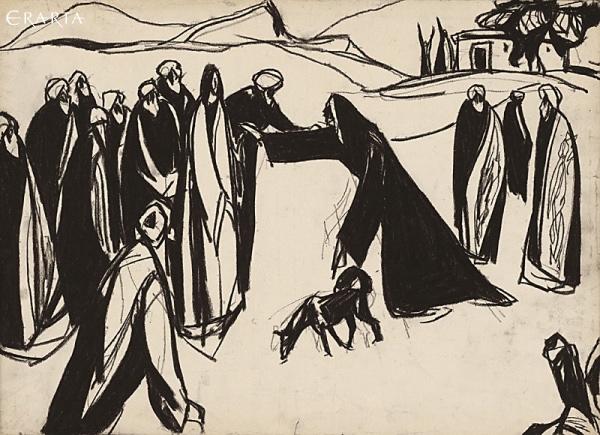
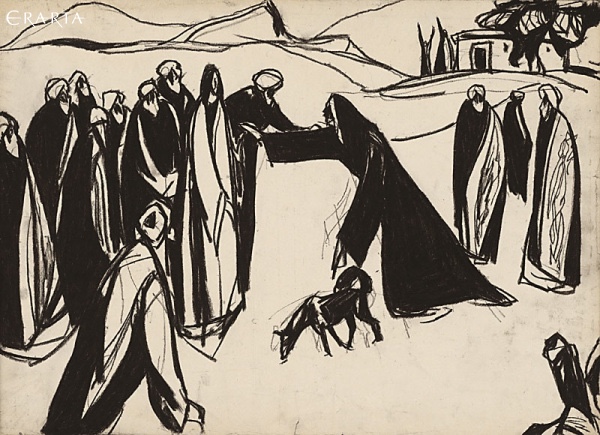
Exorcising the Canaanite Woman’s Daughter
by Peter Gorman (1990)

Liminal experiences and thin places (Matt 14; Pentecost 11A)

“Immediately he made the disciples get into the boat and go on ahead to the other side, while he dismissed the crowds” (Matt 14:22). And then, “early in the morning he came walking toward them on the sea; but when the disciples saw him walking on the sea, they were terrified, saying, ‘It is a ghost!’, and they cried out in fear” (Matt 14:25–26).

Both incidents come from the Gospel passage which is offered in the schedule of lectionary readings for this coming Sunday (Matt 14:22–33). The first excerpt, telling of a crossing of the Sea of Galilee by boat, reports a liminal experience, as the disciples cross over from one side of the lake to the other side. The second excerpt tells of a thin place moment, when the eyes of the disciples are opened up to see Jesus in a new way. Both liminal experiences and thin place moments are important in the Christian life. And often they are interconnected and occur almost simultaneously, as in this story.

Liminal experiences occur at times of transition, when we move from one place to another. The word liminal comes from the Latin word līmen, which means “a threshold”. Technically, that is the place that marks off one space from another. Its origin was the strip of wood or stone at the bottom of a doorway, which was crossed in entering a house or room.

The thresh is the place where one treads as one enters a room. So the threshold is where you take hold of the thresh, where you put your foot as you walk into a new room or new place. Anthropologists define liminality as “the quality of ambiguity or disorientation that occurs in the middle stage of a ritual”. It is the moment when participants no longer hold their preritual status but have not yet begun the transition to the status they will hold when the rite is complete.

Sociologists say that in the liminal stage of a rite, participants “stand at the threshold” between their previous way of structuring their identity, time, or community, and a new way, which completing the rite establishes. I wonder how that might apply the story of Jesus sending his disciples away, across the lake, while he went “up a mountain” to pray. Why has he sent them on ahead of him? What kind of experience was he anticipating that they might have, without him?

The concept of liminality was developed in the early twentieth century sociologists. It was applied particularly to religious rituals marking the movement of a person from one stage to another. More recently, usage of the term has broadened to the political and cultural arena, alongside the religious or faith area.

During liminal periods of all kinds, the experts tell us, “social hierarchies may be reversed or temporarily dissolved, continuity of tradition may become uncertain, and future outcomes once taken for granted may be thrown into doubt. The dissolution of order during liminality creates a fluid, malleable situation that enables new institutions and customs to become established.”

[I found this on Wikipedia, which references the source as Agnes Horvath, Bjørn Thomassen, and Harald Wydra, Introduction: Liminality and Cultures of Change (International Political Anthropology 2009). Accessed 18 March 2019.]

That’s where the disciples found themselves, as they sailed across the lake, pushing from land on one side of the lake, heading towards the land they could see on the other side, but on the water, in the midst of the lake: in a liminal moment.

And the liminal moment is precisely where change takes place, where a new reality can be experienced. In liminal moments, a thin place might be experienced. Is that what happened to the disciples on the lake, as they saw a figure walking towards them? A figure that they recognised as Jesus—for when “the disciples saw him walking on the sea, they were terrified, saying, ‘It is a ghost!’ And they cried out in fear” (14:26).

In the Celtic world, thin places are those places where the veil between this world and the otherworld is porous. They are places where human beings on the earth sense that they are standing in a place where the sky opens up, as it were, and they are drawn into a strong connection with the world beyond—with the spiritual realm, with the place where the deity is, with heaven, if you like.

The thin place is the place where the thick, dividing barrier between “heaven” and “earth” is lessened, where it becomes thin—a place where a person feels that they could reach out and “touch God”.

Thin places are often experienced where there is a sense of mystery in the landscape, or where there is a deep sense of belonging to the land as a sacred place, a sense of being so deeply earthed, yet at a place, paradoxically, which opens up to reveal something of a transcending reality, enabling contact beyond the immediate time and place. This is particularly the case among peoples whose connection to place has remained unbroken through the ages—indigenous people in Australia, in the United States and Canada, and Celtic people in Ireland and Scotland.

For the disciples, the Sea of Galilee was familiar territory. Indeed, four of them had made their living by fishing in that sea before they encountered Jesus and responded to his call to “follow me” (4:18-22). Would they have regarded that sea as a thin place where they could encounter God? Perhaps it had become a holy place for them, as they carried out their daily tasks, and felt that the difference between themselves and the sea was falling away?

Earlier in Matthew’s narrative, the disciples had been in a boat with Jesus on the sea (8:23), when a dramatic experience took place. Crossing the sea, a huge storm whips up the water. Mark’s earlier account had described this as a lailaps, a ferocious wind (Mark 4:37); Matthew modifies his version, such that the disturbance of the water was explained as being due to a seismos, an earthquake (Matt 8:24).

In both versions, the sleeping Jesus is woken, and he stills the storm (Mark 4:39; Matt 8:26). Seeing this, the disciples have an epiphany; the moment has opened up a new insight into Jesus for his disciples, as they utter the words, “What sort of man is this, that even the winds and the sea obey him?” (Matt 8:27). In asking this question, the disciples are alluding to Psalm 107, which affirms of God, “he made the storm be still, and the waves of the sea were hushed” (Ps 107:29–30). In like manner, another psalm praises God that “you rule the raging of the sea; when its waves rise, you still them” (Ps 89:9).

The question of the disciples is rhetorical; it is clear that when Jesus stills the storm, he is manifesting divine powers. Indeed, Matthew’s reworking of the story to introduce the earthquake links this “thin place” experience with other moments in the story of Jesus when the divine interposes into human life—as Jesus dies on the cross (27:51, 54), as soldiers keep watch at the tomb (28:2), and at the predicted “beginning of the birth pangs” at the coming “end of the age” (24:7–8).

That moment on the sea, in the midst of the earthquake-indicted storm, is a liminal experience that functions like a thin place for the disciples; the reality of God’s presence is glimpsed by the disciples. So it seems that on the second journey across the lake to “the other side” (8:18; 14:22), another thin place experience takes place for them. The ferocious wind and the battering of the waves places them, once again, in a precarious situation. Did they have in mind the earlier experience,when Jesus stilled the storm? The terra that leads them to exclaim” it is a ghost” (14:26) suggests that they were quite discombobulated.

Jesus had sent the disciples on across the lake ahead of himself, while he took time to go “up the mountain by himself to pray” (14:23). Jesus, of course, is often up a mountain in Matthew’s Gospel: early on, when he is tested by the devil (4:8); then as he teaches his disciples (5:1–8:1), after he had cured many people beside the Sea of Galilee (15:29), and when he is transfigured (17:1–9); and in the very final scene of the Gospel, after his resurrection (28:16–20).

The mountain, in earlier stories, had been the place where Moses engaged with God (Exod 19:3–25), where Joshua is appointed to succeed Moses (Num 27:12–23), where Solomon builds the Temple (1 Ki 5:5; 6:1–38), where Elijah experiences “the sound of sheer silence” (1 Ki 19:11–18), and where generations of faithful Israelites worshipped the Lord God (Ps 99:9). In Matthew’s narrative, Jesus is on the mountain to draw near to his Father—to find his own thin place, as it were.

So this narrative has elements that invite us to consider our own faith journey; to reflect on the liminal moments in that journey, when we have moved from one place, through a transition, into another; and to ponder when it was that we felt closest to God, to the extent that we were at a thin place, where we could reach out and touch God. The story we hear this coming Sunday, a story about Jesus and his disciples, invites us yet again to ponder our own story.

The church is alive and well in southern Canberra

The church is alive and well. In recent years, Uniting Mission and Education, working within the Synod of New South Wales and the Australian Capital Territory of the Uniting Church in Australia, has supported a project in which good news stories of thriving congregations are told through professionally-produced videos. The Signal Box has just completed the sixth video in this series, Transforming Connections, featuring the mission and ministry of the Tuggeranong Congregation in the southern suburbs of Canberra.

Under the energetic leadership of the Rev. Elizabeth Raine [my wife], the Tuggeranong Church Council has charted a deliberate course to make a difference in the wider Tuggeranong community—to be the “salt of the earth” in southern Canberra. “I am a change agent”, says Elizabeth, with great honesty; “I won’t just come in and do the ‘status quo’.” The video, which shows the results of this approach, can be viewed at https://www.nswact.uca.org.au/resources/our-story-future-directions-video-series/

In this video, we learn how deliberate connections have been fostered with a number of community groups in the area. Kirsty and Liz speak about the flourishing with SeeChange Tuggeranong, which has seen regular events with a focus on sustainability. In recent years, the Congregation has also participated in local ACT community events such as Floriade Reimagined and SouthFest, and hosted the Canberra SleepBus for a period of time.

Jenny and Anne represent the fine team of volunteers in the Red Dove pop-up Op Shop. Wearing their “volunteers uniform” (which has the words of Micah 6:8 as the motif for the shop), they speak about the reinvigoration that has taken place, as the team has focussed on both living and sharing the good news—the Gospel—that drives the enterprise. As well as providing recycled clothing and goods at very reasonable prices, there is an environmental plus: “Jesus would be horrified with all this clothing going into the tip”, Anne says. That marks one of the many ways that the Congregation is working to reduce their carbon footprint on the earth.

Within the Congregation, another group continues to provide its weekly Emergency Food programme and the Lunchtime Conversation group. Quite a number of people within the Congregation take part in the weekly visit to Karralika, a drug and alcohol rehabilitation centre in the Tuggeranong Valley, to offer a “God space” to residents. Leonie and one of the former residents speak in the video with joy and hope about the positive impact that this ministry offering has had over many years.

Bill Lang, a member of the Church Council, is responsible for communications for the Congregation. Under Bill’s leadership, the website has been upgraded, regular Facebook posts are made about activities of the church, and short seasonal videos are posted on the Tuggeranong Uniting Church (TUC) website at https://tuc.org.au. Bill also edits and uploads videos of the weekly online Bible Studies which are offered throughout the year—they can be accessed in the TUC YouTube Library at https://www.youtube.com/@tuggeranongunitingchurch4795/playlists

Bill has been a member at Tuggeranong for many decades, and in the video he speaks about the ways the Congregation has adapted and developed through into the contemporary period. The online presence of TUC, through website, Facebook, and Instagram, is a key to the growth of the Congregation. Another longterm member Liz talks about the TUC Girls Brigade ministry that has been offered over the years.

Supporting the Congregation in its development, Canberra Region Presbytery Minister Andrew Smith talks in the video about the importance of informed, enthusiastic leadership—from ministers as well as from key lay leaders. “Elizabeth’s leadership has been really important”, Andrew says; “she has enabled them to see differently, to imagine differently for what church might be”.

“Canberra has a higher proportion of same-sex couples than any other city according to the Australian Bureau of Statistics”, Elizabeth Raine comments, “and TUC offers a safe space for the many Christian LGBTQI people who report poor experiences with churches and Christianity in general.” A monthly Rainbow Christian Alliance, which has been a part of the Congregation for eight years, has broadened its membership in recent years, spreading beyond gay and lesbian people to include growing numbers of people who are trans, intersex, and asexual. Three members of the Rainbow group speak in the video about their experiences of being accepted and valued within a faith community.

The local Greens MLA, Jonathan Davis, who himself identifies as gay, is a friend of the Congregation. In the video, he speaks about how he finds the Tuggeranong Community to be a welcoming space for him—unlike many other faith spaces where he has felt awkward or unwanted.

A monthly Messy Church under the name of Fam@4 now meets at 4pm on the 4th Sunday of the month, providing a time for younger folk to enjoy craft, worship, and eat a meal together. The video shows one of the regular intergenerational worship services which are held at key moments on Sunday mornings. Inevitably the church is filled with people of all ages, craft activities, vibrant music, with lots of colour, energy, and caring relationships growing. Pentecost is always a blaze of red; Christmas offers opportunity for joyous celebrations!

The Rev. Sharon Jacobs recently began a placement as the Relationships and Growth Minister, a newly-created position funded substantially by the Synod Growth Fund. Sharon is focussing her 50% role on developing the Congregation’s work with families and children, as well as supporting and growing the leadership and membership of the Rainbow Christian Alliance.

She works alongside Elizabeth Raine, whose experience in transitional ministry and understanding of how systems work has undergirded the way she has encouraged, enthused, challenged, and grown the many aspects of the life of the Congregation. The video offers dramatic and encouraging glimpses into the development and growth that has taken place.

And there is a stunning drone shot of the recently-completed mural on the large western wall of the church building which looks out across Comrie St to the regional Erindale Shopping Centre. The joy and colour of the symbols in the mural offer an inviting facade to those who pass by each day. The church is known and valued within its local community—and the many connections that have been made, and are being made, are truly “transforming connections”. They are transforming for the community; and they are transforming for the Congregation.

The full set of Our Story videos can be accessed at https://www.nswact.uca.org.au/resources/our-story-future-directions-video-series/. There are currently stories about Condobolin, Orange, Leichhardt, Lane Cove, Auburn, and Tuggeranong.

To keep up to date with future videos in this series, join the Our Story Facebook Forum at https://www.facebook.com/groups/ourstoryforum/

On the dedication of the mural, see

On the Rainbow Christian Alliance, see

On Floriade Reimagined, see

The church is alive and well in southern Canberra

The church is alive and well. In recent years, Uniting Mission and Education, working within the Synod of New South Wales and the Australian Capital Territory of the Uniting Church in Australia, has supported a project in which good news stories of thriving congregations are told through professionally-produced videos. The Signal Box has just completed the sixth video in this series, Transforming Connections, featuring the mission and ministry of the Tuggeranong Congregation in the southern suburbs of Canberra.

Under the energetic leadership of the Rev. Elizabeth Raine [my wife], the Tuggeranong Church Council has charted a deliberate course to make a difference in the wider Tuggeranong community—to be the “salt of the earth” in southern Canberra. “I am a change agent”, says Elizabeth, with great honesty; “I won’t just come in and do the ‘status quo’.” The video, which shows the results of this approach, can be viewed at https://www.nswact.uca.org.au/resources/our-story-future-directions-video-series/

In this video, we learn how deliberate connections have been fostered with a number of community groups in the area. Kirsty and Liz speak about the flourishing with SeeChange Tuggeranong, which has seen regular events with a focus on sustainability. In recent years, the Congregation has also participated in local ACT community events such as Floriade Reimagined and SouthFest, and hosted the Canberra SleepBus for a period of time.

Jenny and Anne represent the fine team of volunteers in the Red Dove pop-up Op Shop. Wearing their “volunteers uniform” (which has the words of Micah 6:8 as the motif for the shop), they speak about the reinvigoration that has taken place, as the team has focussed on both living and sharing the good news—the Gospel—that drives the enterprise. As well as providing recycled clothing and goods at very reasonable prices, there is an environmental plus: “Jesus would be horrified with all this clothing going into the tip”, Anne says. That marks one of the many ways that the Congregation is working to reduce their carbon footprint on the earth.

Within the Congregation, another group continues to provide its weekly Emergency Food programme and the Lunchtime Conversation group. Quite a number of people within the Congregation take part in the weekly visit to Karralika, a drug and alcohol rehabilitation centre in the Tuggeranong Valley, to offer a “God space” to residents. Leonie and one of the former residents speak in the video with joy and hope about the positive impact that this ministry offering has had over many years.

Bill Lang, a member of the Church Council, is responsible for communications for the Congregation. Under Bill’s leadership, the website has been upgraded, regular Facebook posts are made about activities of the church, and short seasonal videos are posted on the Tuggeranong Uniting Church (TUC) website at https://tuc.org.au. Bill also edits and uploads videos of the weekly online Bible Studies which are offered throughout the year—they can be accessed in the TUC YouTube Library at https://www.youtube.com/@tuggeranongunitingchurch4795/playlists

Bill has been a member at Tuggeranong for many decades, and in the video he speaks about the ways the Congregation has adapted and developed through into the contemporary period. The online presence of TUC, through website, Facebook, and Instagram, is a key to the growth of the Congregation. Another longterm member Liz talks about the TUC Girls Brigade ministry that has been offered over the years.

Supporting the Congregation in its development, Canberra Region Presbytery Minister Andrew Smith talks in the video about the importance of informed, enthusiastic leadership—from ministers as well as from key lay leaders. “Elizabeth’s leadership has been really important”, Andrew says; “she has enabled them to see differently, to imagine differently for what church might be”.

“Canberra has a higher proportion of same-sex couples than any other city according to the Australian Bureau of Statistics”, Elizabeth Raine comments, “and TUC offers a safe space for the many Christian LGBTQI people who report poor experiences with churches and Christianity in general.” A monthly Rainbow Christian Alliance, which has been a part of the Congregation for eight years, has broadened its membership in recent years, spreading beyond gay and lesbian people to include growing numbers of people who are trans, intersex, and asexual. Three members of the Rainbow group speak in the video about their experiences of being accepted and valued within a faith community.

The local Greens MLA, Jonathan Davis, who himself identifies as gay, is a friend of the Congregation. In the video, he speaks about how he finds the Tuggeranong Community to be a welcoming space for him—unlike many other faith spaces where he has felt awkward or unwanted.

A monthly Messy Church under the name of Fam@4 now meets at 4pm on the 4th Sunday of the month, providing a time for younger folk to enjoy craft, worship, and eat a meal together. The video shows one of the regular intergenerational worship services which are held at key moments on Sunday mornings. Inevitably the church is filled with people of all ages, craft activities, vibrant music, with lots of colour, energy, and caring relationships growing. Pentecost is always a blaze of red; Christmas offers opportunity for joyous celebrations!

The Rev. Sharon Jacobs recently began a placement as the Relationships and Growth Minister, a newly-created position funded substantially by the Synod Growth Fund. Sharon is focussing her 50% role on developing the Congregation’s work with families and children, as well as supporting and growing the leadership and membership of the Rainbow Christian Alliance.

She works alongside Elizabeth Raine, whose experience in transitional ministry and understanding of how systems work has undergirded the way she has encouraged, enthused, challenged, and grown the many aspects of the life of the Congregation. The video offers dramatic and encouraging glimpses into the development and growth that has taken place.

And there is a stunning drone shot of the recently-completed mural on the large western wall of the church building which looks out across Comrie St to the regional Erindale Shopping Centre. The joy and colour of the symbols in the mural offer an inviting facade to those who pass by each day. The church is known and valued within its local community—and the many connections that have been made, and are being made, are truly “transforming connections”. They are transforming for the community; and they are transforming for the Congregation.

The full set of Our Story videos can be accessed at https://www.nswact.uca.org.au/resources/our-story-future-directions-video-series/. There are currently stories about Condobolin, Orange, Leichhardt, Lane Cove, Auburn, and Tuggeranong.

To keep up to date with future videos in this series, join the Our Story Facebook Forum at https://www.facebook.com/groups/ourstoryforum/

On the dedication of the mural, see

On the Rainbow Christian Alliance, see

On Floriade Reimagined, see

Limping priests and the counsel of perfection (Gen 32; Pentecost 10A)

When the priests of Judah returned to their homeland after decades in exile, they wrote down their ideal as to how the people should worship God and honour God in their lives. An integral part of that system of worship was the offering of the tamid, the daily sacrifice, “two male lambs a year old without blemish, daily, as a regular offering; one lamb you shall offer in the morning, and the other lamb you shall offer at twilight.” (Num 28:3). The importance of offering a perfect lamb, without any blemish, was paramount.

In parallel with that, every priest also needed to be “perfect”, with no sign of blemish—“not one who is blind or lame, or one who has a mutilated face or a limb too long, or one who has a broken foot or a broken hand, or a hunchback, or a dwarf, or a man with a blemish in his eyes or an itching disease or scabs or crushed testicles”, according to Lev 21:16–24. Yoiks!

Jesus, of course, picks up on this notion of perfection when he counsels a wealthy young man who claims that he keeps all the commandments, “if you wish to be perfect, go, sell your possessions, and give the money to the poor, and you will have treasure in heaven; then come, follow me.” (Matt 19:21). This “counsel of perfection” was then developed by the evolving Christian tradition, specifically impressing upon candidates for the priesthood their need to aspire to that perfection, through vows of chastity, poverty, and obedience.

My own church, the Uniting Church in Australia, fortunately does not require its ministers to be chaste, or even poor—although we do ask for a good measure of obedience. But the image of Ministry which sits firmly with me as the primary one is not that of “being perfect”; rather, it comes from a story in the ancient sagas of the people of Israel—a story about when Jacob wrestled with a man all night.

In this story, one of the patriarchs of Israel, Jacob, “wrestled with him until daybreak; and when the man saw that he did not prevail against Jacob, he struck him on the hip socket; and Jacob’s hip was put out of joint as he wrestled with him.” (Gen 32:25). This is the story which the lectionary provides for our consideration this coming Sunday (Gen 32:22–31).

It is in this story that Jacob, the “supplanter”, is given the new name Israel, “he wrestled with God”. The patriarch Jacob, who would give his name to the people Israel, limped, because of the all-night struggle that he had at this ford in the river. One of my teaching colleagues once wrote a paper in which he developed the image of the minister as the limping priest of God. And so it has been, for me; awareness of my own limping, my emotional and psychological wrestling which has caused psychological and emotional limping, has been an important aspect of my own exercise of ministry.

I have reflected on this personal struggle and my consequent “limping”, with the help of some good company, at

I like to think that gaining insight into my own limping, as difficult as that has been, has enabled me to walk with others as they limped, to understand their pain, to provide compassionate companionship along that way. And, sometimes, to hope that people would come to understand their own limping, and see how it had thrown things out of alignment, and how they might attend to that, and rectify wrongs that may have been occasioned by their limping, their distorted walking patterns, their imperfect ways of operating—even as I regularly reflected on my own walk, my own limping, and how that, in turn, impacted the way that I ministered.

This story of the night-long wrestling and the resulting lifelong limping of the patriarch of Israel was not, of course, an account of an historical event. Like all the stories of incidents involving the patriarchs and matriarchs (Abram, Sarah, and Hagar, Isaac and Rebekah, Jacob, Leah, and Rachel, and Joseph) these ancient stories were woven together at the time of Exile for Israel.

They formed an extended narrative that provided a foundational saga for the exiled people, yearning for release from their captivity, a return to their homeland. The saga formed a national mythology, weaving together previously isolated stories that had been passed down from generation to generation, shaped and reworked by skilled storytellers. Together, they created a tapestry that represented the resilience and the hope of the peoples.

Exile in Babylon was a time when the people of Israel, as a whole, had been limping. Invaded and conquered, captured and transported, relocated to an alien landscape amongst a foreign peoples speaking an unknown language and practising strange customs, the people were dislocated, out of joint, and so they limped in their daily lives. (See expressions of their grief in Lamentations, and their anger in Psalms 42–43, 44, and 137.)

The story of Jacob—wrestling with an unknown stranger, struck at the hip, experiencing dislocation, walking with a limp—resonated strongly with them. It was told and retold as “their story”, an oral expression of their personal and national angst. It reminded them that, even in the midst of struggle and opposition, they were still, like Jacob, able to “see God face to face” (Gen 32:30).

*****

That deep level of the myth told and retold by ancient Israelites resonates still with us, today. Opposition and oppression, struggle and the fear of defeat, do not impede the possibility that we might, indeed, “see God face to face”. The story of Jacob at Penuel reminds us of this, and provides a resource for thinking about our own lives, the lives of those we know who are facing challenges, and striving (as Jacob was) to make sense of these experiences.

Jacob wrestled with a man, who turns out to be God. Paul talks about a “thorn in the flesh”, given to him “to keep me from being too elated” (2 Cor 12:7)—although he attributes this to the work of Satan, rather than God. Elsewhere, he encourages the Romans to “be patient in suffering” (Rom 12:12), and informs the Philippians that God “has graciously granted you the privilege … of suffering with Christ” (Phil 1:29).

Paul himself knows about suffering. He catalogues quite a list of what he has endured: imprisonments, floggings, five times being lashed “forty lashes minus one”, three times “beaten with rods”, stoned, becalmed, and shipwrecked; he feared “danger from rivers, danger from bandits, danger from my own people, danger from Gentiles, danger in the city, danger in the wilderness, danger at sea, danger from false brothers and sisters”, and suffered “in toil and hardship, through many a sleepless night, hungry and thirsty, often without food, cold and naked” (2 Cor 11:24–31).

From those many experiences of suffering, Paul is able to affirm that “suffering produces endurance, and endurance produces character, and character produces hope, and hope does not disappoint us, because God’s love has been poured into our hearts” (Rom 5:3–5). It seems that God is able to work through those difficult experiences—“all things work together for good for those who love God” (Rom 8:28). Suffering, therefore, is integral to God’s work with us.

When Luke, decades later, reports the commissioning of Paul, he reports the divine word to Ananias to tell Paul: “I myself will show you how much he must suffer for the sake of my name” (Acts 9:16). The narrative that follows places Paul in danger in a number of times; in looking back over his missionary activities, Luke has Paul note that he was “enduring the trials that came to me through the plots of the Jews” (20:19), and foreseeing that in the future “the Holy Spirit testifies to me in every city that imprisonment and persecutions are waiting for me” (20:23).

In the narrative that follows, Luke notes that Paul is kidnapped (Acts 21:27), beaten (21:30–3; 23:3), threatened (22:22; 27:42), arrested many times (21:33; 22:24, 31; 23:35; 28:16) and accused in lawsuits (21:34; 22:30; 24:1–2; 25:2, 7; 28:4), ridiculed (26:24), shipwrecked (27:41), and bitten by a viper (28:3). The list correlates strongly with Paul’s own words in 2 Cor 11, noted above. And beyond this, Paul has indicated that “after I have gone, savage wolves will come in among you, not sparing the flock” (20:29). Opposition and persecution is endemic in the early stages of the Jesus movement.

Yet all of this takes place under “the whole purpose of God” (20:27)—the overarching framework within which Luke has told the story of Jesus and the movement that grew from his preaching and activities. Luke, like Paul, understands suffering as integral to God’s working in the world. It is a hard message to hear when we are in the midst of the turmoil engendered by suffering; it may be possible, with hindsight, to look back on that suffering and see how good did, in the end, eventuate from it. It seems he was able to see “the face of God” in all of that, as Jacob did long ago at Penuel.

That’s what this story of the wrestling Jacob offered the people of Israel, long remembered from the past telling of stories, now taking on a deeper and more central significance as they returned from the decades of suffering in exile in a foreign land. Out of suffering, something amazingly good is able to emerge. May this ancient story of wrestling and limping, of striving with God and so seeing God “face to face”, offer us the same encouragement in our lives, today.

*****

The cover image, “Jacob wrestling with God” by Jack Baumgartner, if from Image. https://imagejournal.org/artist/jack-baumgartner/jacob-wrestling-with-god/