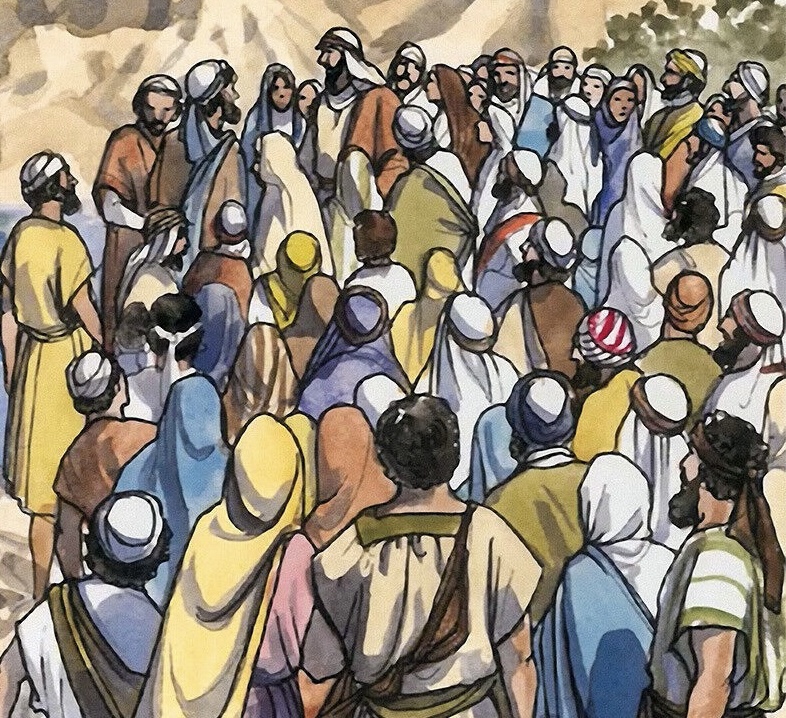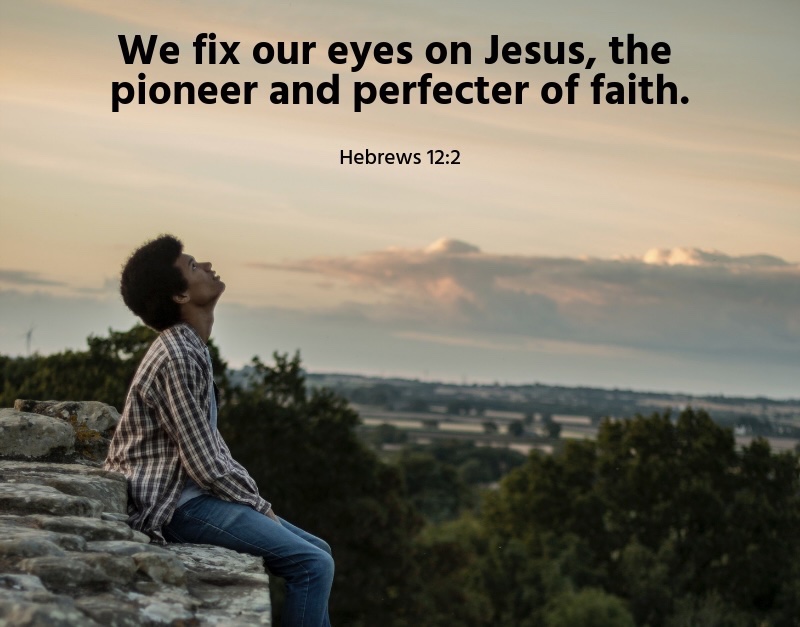
In defence of Thomas: a doubting sceptic? or a passionate firebrand? (John 20; Easter 2A)

The Gospel reading for this coming Sunday provides the name by which this Sunday is often known in church tradition: it is Thomas Sunday. (The reading is John 20:19-31.)

We all know about Thomas: he had to have proof … had to see with his own eyes … had to touch to know it was real … did not have faith without tangible proof. Thomas often gets a bad rap: oh he of little faith! … why did he not believe straight away, like the others who followed Jesus? … why was he in the thrall of doubt at precisely the time that faith was called for?

Thomas wants to pin the matter down, to have the evidence produced, to know without question what has taken place. We remember him from this story, as the doubting sceptic.

Let us reflect a little on this: Thomas was not alone. All the other early witnesses, followers, and writers, in the movement of people clustered around Jesus, had the same need to pin the matter down. There were many sceptics in this movement. They needed some form of proof. They looked for evidence. They sought signs that would validate the new way that Jesus was in their midst.

The endings of the Gospels testify to this. The earliest Gospel ended with an open narrative, hanging on those words: the tomb is empty — he is not here! (See https://johntsquires.wordpress.com/2019/04/21/the-tomb-is-empty-he-is-not-here-he-is-risen/)

Subsequent compilers of the narrative about Jesus could not live with the uncertainty of an open-ended story, with an absent Jesus who would appear only in a distant, remote, unimportant location (Galilee). No; they had to have him come to the women, the travellers, even the inner core of disciples, in or near to Jerusalem. Indeed, Luke explicitly reports that the risen Jesus provided them with “many convincing proofs” after his resurrection (Acts 1:3).

Thomas, of course, is the disciple whom we most closely associate with doubt, not with faith, derived from this very report of his encounter with the risen Jesus. “Unless I see, I will not believe”, the sceptic Thomas says, in John 20. “Unless I can put my finger in the mark in the side of my master, I will not believe that he has risen”, declares Thomas.

And in the modern scientific era, where we operate by testing, questioning, doubting, and seeking to prove hypotheses, this kind of approach has a certain attractiveness. For some Christians in the present time, in the period of probing scientific hypotheses and seeking historical certainties, Thomas has become a kind of patron saint—a saint of doubting, questioning, and proving. “Unless I see, I will not believe” is the mantra of such a saint.

But Thomas appears in two other places in John’s Gospel. One is at the last meal that Jesus shared with his followers, when Thomas asks Jesus a question: “Lord, we do not know where you are going. How can we know the way?” This question provokes one of the most well-known sayings of Jesus: “I am the way, and the truth, and the life. No one comes to the Father except through me. If you know me, you will know my Father also. From now on you do know him and have seen him.” (John 14:5-7). It is thanks to Thomas that we have this saying of Jesus!

The other time that Thomas is mentioned in this Gospel provides us with another insight into the character of Thomas. He appears early on, in the story of the raising of Lazarus from the dead, as told in chapter 11 of John’s Gospel. In that story, we encounter a rather different Thomas. In that incident, Thomas was a man on a mission who was filled with faith. He spoke with Jesus with the intensity of a fervent believer. He declared that he was prepared to follow Jesus, whatever it cost him.

Faced with a request to travel to Bethany, near Jerusalem, because of the death of Lazarus, Jesus and his followers discuss whether they should make this trip. John’s Gospel tells us that the message of Jesus was so provocative to the southerners in Judea, that they had already mounted a number of attempts to stone him (John 8:59, 10:31).

So the disciples were convinced that if Jesus travelled close to Jerusalem, he would be walking to his death. What to do, they wonder, when this urgent message comes from friends in Bethany: “Lazarus is dead; please come; we need you here!” (John 11:1-8).

At that moment, Thomas springs into action. There is no doubt about it, he declares:  Jesus needs to go there; and the disciples need to go with him. “We need to get moving! Come on, why are we waiting?” And from the mouth of Thomas come these incredible words: “We should go too, and die with him” (John 11:16).

Thomas utters the excitable words of a zealous follower of Jesus; he gives a fervent declaration of commitment and trust in the one who had been his guide for many months now. Thomas was not paralysed by fear, not distressed by doubt; here, Thomas was fired up by faith, and committed to a journey that could well lead to death. If Jesus, our master, is going to die—then we, too, should be prepared to die with him! (See https://johntsquires.com/2020/03/23/yes-lord-i-believe-even-in-the-midst-of-all-of-this-john-11/)

This portrayal of Thomas as a committed follower, as a passionate firebrand, is not how we normally remember him, because the story from chapter 20 of the Gospel holds sway. Yet in this earlier story in chapter 11 of the Gospel, it is clear that Thomas has faith, even if it is somewhat unusual, and it is abundantly clear that he is prepared to put his life on the line for what he believes.

So, perhaps we should place this Thomas, the passionate firebrand of John 11, alongside the hesitating, doubting figure that we imagine him to be like, courtesy of John 20. Where are the signs of this passionate, committed, fervent, zealous man of faith, in this encounter? Where was the fiery partisan Thomas living out his faith in the risen Jesus?

I like to imagine (and it is only an imagination … a speculation … as the biblical txt is silent on this point) … I like to imagine that, as the disciples gather behind locked doors, paralysed by their fear, Thomas was not to be found in their midst, because he was back into his regular life, living out his faith in the public arena.

Even after Jesus had been raised from the dead, the transformation of Easter, as we know it, had not really kicked in for the disciples. They were locked into their fear. Where were the disciples living out their faith? It seems they took the line of least resistance, and shared their faith only in the safety of their own group, hidden away, safe in the seclusion of a private home.

And where was Thomas? He was not there. He was out beyond the locked doors, out in the community, in the full gaze of the antagonistic authorities. What was he doing? We are not told; we have to imagine.

Is it feasible to imagine that Thomas was back into his regular routine, going about his business, attending to his daily tasks? That he was seeking to live out his faith, not cowed by the threat of persecution, but firmly holding fast to his belief in Jesus in public? That he was continuing to live as that fiery, fanatical believer who was still willing to put his faith on the line? It is a tempting, enticing way to imagine him.

If Thomas was really the passionately committed believer whom we met in the Lazarus story, then it is quite plausible that this is why he was not with the other disciples, behind locked doors, hiding out of fear.

Perhaps Thomas was wanting to demonstrate his faith to those who did not yet believe. Something had happened to Jesus—the tomb was empty, believers were testifying that he was risen—so he was wanting to show others that his faith had not been shattered.

Where was Thomas living out his faith? In his everyday life, amidst acquaintances and friends—and even enemies. Now that is a model that we would do well to ponder, and imitate, in our lives!
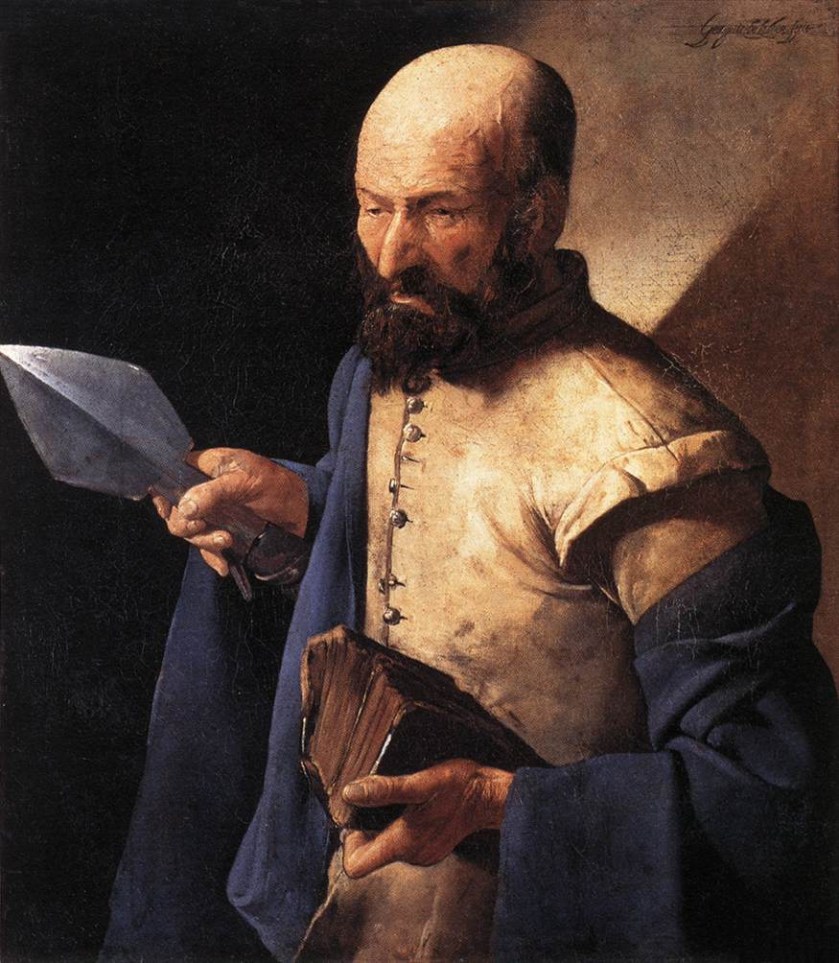
(The image is of Saint Thomas, by Georges de La Tour, a French painter of the 17th century.)

See also

Do not hold on to me: Mary’s early-morning encounter (John 20; Easter Sunday Year A)

A sermon written by the Rev. Elizabeth Raine for the celebration of Easter Sunday, 9 April 2023, at the Tuggeranong Uniting Church

*****

All four Gospels tell of women, coming to the tomb where Jesus had been lain, early in the morning. In this more intimate narrative of John’s Gospel (John 20:1–18), Mary Magdalene comes alone to the tomb in the dark, not bearing myrrh, not expecting anything. The presence she encounters in the garden is not what she has previously experienced or understood.

When Mary realises that it is Jesus she sees in the garden, she instinctively reaches out to him, only to be rebuffed by the words ‘Do not hold on to me’. 

It is both a tender and painful moment that sits between intimacy and distance, love and loss. It reminds us of how it was at the beginning of the pandemic, where the normal, natural instinct to reach out to touch and hold one another became a potential source of danger.

But there was no pandemic in Jerusalem when Mary heard her name being spoken in the unmistakable tones of her beloved teacher and friend, whom she had thought was lost to her forever. Mary’s seeking to touch Jesus would have been the most natural form of greeting in any circumstances, never mind in this extraordinary moment. So why does Jesus respond with what must have felt like a hurtful rejection?

We have the sense that the Gospel is picking up that Mary had a hard time letting go of the physical Jesus. It is no wonder. We all feel like this in our grief. Yet, Jesus is pointing to the broader context of God’s liberating power at work in the Easter story.

John is making the point that the risen Jesus is not a return to the ‘old normal’ but the start of something new. Life is not going to continue as before, whatever Mary’s initial hopes may have been.

The ‘new normal’, which John’s readers were already having to live, did not include Jesus’ physical presence in a recognisable, huggable human body. For a short time, resurrection appearances would convince the disciples that he was, indeed, alive, but the message was that they must not become dependent on him.

*****

“Do not hold onto to me”. Like much of John’s gospel, there is a deeper meaning to the words. John is advising us. Do not cling to the holy as you once knew the holy. The time is here for you to learn, see, hear and perceive anew. Open your consciousness and awake to the dawn of something entirely transformed and transforming.  

We can also pick out the events of Simon Peter’s dash towards the tomb with the ‘other disciple’, and the events that unfolded there, as worthy of thinking about. When they entered the space, only the linen was there. We are told that the other disciple “saw and believed”. This is an interesting comment. What did he believe? What exactly did he see that turned his heart from despair to hope? What belief exactly did he come to?

We are told that the disciples still did not understand the scriptures in relation to Jesus’resurrection, yet something clearly happened in their understanding as they left transformed by the encounter.

Surely transformation sits at the core of the mystery of resurrection. It is not a magical replacement of the old with something new, but an innovating change from deep within. We are reminded in this story of the first Easter that God’s action often takes place in the liminal spaces—on the edges of things, at the boundary points between ‘this and that’: despair and hope, hate and love, death and life.

William Brodrick, in a thoughtful reflection used by the Northumbria community, notes that the faithful have to be like candles, “burning between hope and despair, faith and doubt, life and death” and that this is the “disquieting place where people must always find us.”

We need people like Mary who will blunder through the garden blinded by tears but also with a willingness to be curious and open to the impossible. We need people like the male disciples to wonder out loud, stay present in the moment and take risks rather than living life in fear. We need people who somehow generate more hope than we believed could be possible.

While Easter morning brings joy and hope, and a fresh start after grief and brokenness, it also encourages us to be those candles shining brightly between hope and despair in our world. It encourages us to transform and to recognise that the world cannot be the same either in a post-covid era or indeed, a post-resurrection one.

May we not cling on to things that we imagine will keep us safe: may we learn instead to let go in order to findour true selves; and die in order to rise to newness of life.

Perception is everything: a sermon on John 9 (Lent 4A)

This sermon was written and preached by the Rev. Elizabeth Raine at the Tuggeranong Uniting Church on Sunday 19 March (the Fourth Sunday in Lent).

*****

The story in John this week reminded me of the play, The One Day of the Year. I don’t know if you know it, but it is about different perceptions of Anzac Day. For Hughie Cook, the son, Anzac Day appeared to be just an excuse for “one long grog-up”. For his father Alf, an ex-servicemen, it was a day to be with your mates. For Wacka, his mate, it was a day when we as a nation reflected on those who had paid with the sacrifice of their lives.

At one point during a heated debate between father and son, Alf points out that Wacka was there at Gallipoli and knew what Anzac was all about. Hughie puts the counter argument that soldiers who took part in the campaign at Gallipoli couldn’t know the full story of the disaster that was Anzac Cove because they only saw part of the whole picture, the part they were involved in. He sees himself as having a full overview, having studied history.

But Hughie’s view that Anzac Day was just “one long grog-up” is also flawed, as this is the only part of the picture Hughie can currently see. He doesn’t see the mateship, or the skill and resourcefulness, or the sense of pride that Alf and Wacka see in the ex-servicemen who ‘hung in there’ on Anzac Cove. And Hughie fails to recognise that the freedom that gives him the right to speak his opinion was a freedom in part won by soldiers like his father, fighting in the jungles of Asia.

These different viewpoints in the play all contributed to the whole picture of what Anzac day is, but none of the parts on their own are the full story. The story today of the healing of the blind man is very similar in its construction.

How often do we fail to grasp the whole picture? Let us do a simple exercise. Look around you. What do you see? Now, look around again, more carefully. What do you now see that you didn’t notice the first time? If I asked to describe the church, the answer would vary depending on whether you were looking at the front or the back, or even relying on your memory. The whole picture can be hard to take in.

We view the world through the lens of our own experience and perceptions. Like Alf and Hughie in the play, we concentrate on some things and take them in, but filter out others that we deem as unimportant or that perhaps we don’t understand or don’t like. We regularly interpret the information we receive, and we each choose different ways to respond to it. The writer Anais Nin was right when she said, “We do not see things as they are. We see things as we are.” In effect, often we see only what we choose to see.

We see this happening in the gospel story. As the disciples walk down a village street with Jesus, they saw what they had been taught to see – a man who was being punished by God. They knew something of his story. He had always been blind. Which raised a tough question for them. Did the birth defect mean that he had somehow sinned in the womb, or was he the victim of his parents’ transgression? For the disciples, this was simply an interesting theological question to raise with their teacher, Jesus, but for the man concerned it was a painful reality that he lived every day, and that, it seems, had left him destitute.

We know that his parents were still alive because later in the story they get called in by the religious authorities to testify at the investigation into his healing. But, probably out of fear, they refuse to be drawn in, and simply point out their son is now a grown adult and can answer for himself.

Their presence at this point in the story raises some questions though. If they were alive, and close enough to be called in for questioning, why was this man a beggar? why was he left pleading for the pity of strangers in order to survive? why was he not cared for by his parents?

*****

How then did this man see himself? After a life of being outcast, perhaps from his parents, from his neighbours, from the Temple, how could he have felt anything but shame and despair? how could he possibly even think that he might see something different in himself from what everyone else saw? how could he not accept the wisdom of the crowds and judge himself accordingly?

And he remains this way until someone came along who could see the whole situation, and see it differently. Jesus did not accept the dominant paradigm of his times, that illness and disability was a punishment from God. Perhaps for the first time, the blind man felt the gaze of someone who did not pity him or wonder what sin he had committed. For the first time the blind man knew what it was to be valued, to be accepted and to be made whole.

And then, as if this wasn’t enough, he discovered what it was like to really see, to accept light into his eyes and have it transformed into colours and textures, depth and movement. But if he thought this healing would make everything right he was mistaken. He may have had his eyes opened, but there were other, more powerful people who were not interested in having theirs opened. They were convinced that they knew how the world worked, and they weren’t about to change their perceptions.

*****

It can’t have been easy for the Pharisees in this story, for Jesus had a tendency to complicate things. When religious custom dictates that blindness is God’s judgement for sin, it’s easy to know what to do and what to think. But, when blind people get miraculously healed in God’s name, it all gets messy. If sin didn’t cause the problem, then where did it come from? And what about all those other beggars? Would they now be expected to be treated as equals? And if a healing really had happened, then they had another problem. None of them had done it, Jesus had done it. For them, it was best not to see the whole picture and just stick with what they knew.

What to do? The Pharisees try and extract a confession from the blind man. Perhaps he wasn’t really blind – it had been a lifelong hoax and the community had fallen for it. Or maybe he’d found a body-double who was now pretending to be healed to get him a few minutes of fame. Then they resorted to questioning his parents. Again, the result was unsatisfactory.

*****

Finally, there was no other option but to throw him out of the synagogue. Though the blind man could see, the Pharisees refused to see. The religious leaders had decided that Jesus was a fraud, so that’s all they could see. They decided the blind man was a sinner, so that’s all they could see. And they had decided that God could no more use Jesus to heal than that God would heal a person God had afflicted with blindness in the first place. Because that’s what they believed, that’s what they saw.

Perception is everything. It’s not just what we see or don’t see, but how we interpret what we see that determines our actions, our responses and our beliefs. We can look at the poor and see unfortunate victims of circumstance, or lazy people who refuse to work, or dignified human beings making the most of a tough situation. We can look at climate science and see a natural cycle which has just happened to hit us now, or human actions putting our planet under pressure.

Ultimately, how we determine what we see and what it means must flow from Jesus’ example. How did Jesus address poverty? How did Jesus view the natural world, power, violence, sickness, and human dignity? If we are to follow Jesus into a world of justice, we will have to wrestle with these questions and not see them as outside of the realm of faith. And once we have seen the problems, we also have the task of helping others – our leaders, our neighbours, our children – to see as well.

In our daily lives we all make choices (consciously or subconsciously) about what we will see and what we won’t. It’s tempting to choose not to see the suffering and injustice in our world – to switch off the news, and to ignore reports of grief, warand trauma. It’s tempting to avoid seeing certain people and to allow them to just blend in with the landscape, removing their need and struggle from our vision.

It’s tempting to avoid seeing God’s truth and grace in those with whom we disagree, and whom we would rather see as “all bad”. It’s tempting to avoid seeing the brokenness in those we support and with whom we agree and to see them as “all good”. It’s tempting to avoid seeing the resources, the opportunities and the capacity we have for making a difference, and to believe we can do nothing.

But, if we have really seen Jesus, and if we have truly seen God’s reign proclaimed and manifest in him, then we have to confront how we see things, and allow God’s grace and mercy, God’s truth and justice to change our seeing and shed light on our world, our relationships and our neighbourhoods.

And, once again, our seeing must be informed by God’s different perspective where the greatest are the least, and where everyone – even a young shepherd boy, or a carpenter from the countryside – can make significant differences in the world.

“If you or anyone you know needs help, call Lifeline on 13 11 14”

It’s a familiar mantra that we hear on TV news bulletins and read at the end of online news items: “If you or anyone you know needs help, call Lifeline on 13 11 14”. And this month marks sixty years since Lifeline began.

Lifeline describes itself as “Australia’s leading suicide prevention service”, which is “a national charity providing all Australians experiencing a personal crisis with access to 24-hour crisis support”. It began as a small-scale local enterprise in Sydney, and now has branches right across Australia, where 1,000 staff and 10,000 volunteers work together to provide a caring, compassionate response to people who are in crisis.

In the early 1960s, the Rev Alan Walker took a phone call from a distressed man who was very distressed. The Rev Walker was the Superintendent Minister of the Central Methodist Mission in Sydney, a part of the then Methodist Church. The CMM, as it was known, had a long and valued ministry to vulnerable people in the inner city of Sydney—including a number of hostels and day programmes for such people. The ministers and staff of the Mission had regular contact with a wide range of people in distressing and difficult circumstances.

The Rev Alan Walker during his time as the Superintendent Minister
of the Central Methodist Mission in Sydney

Three days after taking that phone call, the Rev Walker learned that the man had taken his own life. Determined that he would do something to assist other people who were lonely, anxious, depressed, or suicidal, the Rev Walker instigated a planning process that eventually led to the establishment of Lifeline, on 16 March 1963, as a crisis line operated by people associated with the CMM.

The website of Lifeline Australia states that “Lifeline Sydney was two years in planning and preparation, with 150 people attending a nine-month training course to work at the centre. A century old, dilapidated building owned by the Mission, on the fringes of downtown Sydney was renovated for the purposes of this new support centre. A staff of full-time employees was appointed to direct the work of these new telephone crisis support ‘workers’. The Director General of Post and Telephone Services authorised that this crisis support service should be listed on the Emergency Page of the Telephone Directory and the phones were installed.”

You can read more at https://www.lifeline.org.au/

In 1994, Lifeline transitioned the 24-hour telephone crisis support line, with local counsellor dealing with local phone calls in each location, to a single national priority 13 number (13 11 14). Then in 2007, Lifeline introduced national call flow to the 24-hour service, which allowed Lifeline to begin flowing calls nationally over a wide area network, to be answered by the next available telephone support volunteer, anywhere in the country. It has been a wonderful development that has taken place over these six decades.

My own connection with Lifeline took place in 1975. I was working at the Central Methodist Mission as the Youth Director (a grand title for what was actually a very lowly job). I ran a variety of weekly programmes that brought me into contact with younger people that were vulnerably housed, or living below the poverty line; people who faced mental health challenges, but who found comfort in the community of the church on Pitt St in Sydney.

Looking to develop my own (meagre and basic) skills in relating to such people, I did the Telephone Counsellor Training Course that Lifeline offered—three hours, once a week, for six months, with practical sessions as a trainee counsellor, taking phone calls and learning how to deal with people in crisis. (The limited success, or rather the ultimate failure, of my attempts to develop good skills in listening, intervening, and referring, I leave to the judgement of those who know me now!) I served in that role for a couple of years, by which time I was a candidate for ministry, undertaking other training to prepare me for my lifetime in ministry.

The Rev Dr Sir Alan Walker, as he became, is rightly remembered and honoured for the creative and practical way that he responded to what was becoming, even in the 1960s, a widespread and difficult societal problem. Well known for his strong public stands against gambling and alcohol, and for his opposition to the Vietnam War, the Rev Walker’s initiative to establish Lifeline points to the way that he lives, and preaches, and acted, in response to the Gospel: both pastoral and prophetic responses were required.

The Rev Walker shows that the Gospel is as much about a person’s individual life and their relationship with God, as it is about how society was structured and how it provided equity and justice for all. I have always appreciated my opportunity to learn this at close quarters, from the 13 months that I spent working at the CMM. (The CMM is now Wesley Mission, one of Australia’s largest benevolent organisations, as well as one of the largest Uniting Church organisations.)

In substantiating their claim that “Lifeline is Australia’s largest suicide prevention service provider”, the website of Lifeline Australia reports:

• Each year, over 1 million Australians reach out to Lifeline for support.

• Lifeline’s 13 11 14 crisis support line receives a call every 30 seconds.

• Lifeline’s network of 41 centres, 10,000 volunteers, and 1,000 employees provide a lifesaving national infrastructure for those experiencing immense pain and anguish.

• There are 3,500 Crisis Supporters working with Lifeline so that no person in Australia has to face their darkest moments alone.

It is sobering to read the breakdown of suicides reported in Australia. The following statistics, reported by Lifeline Australia, are taken from the Australian Bureau of Statistics (https://www.abs.gov.au/statistics/health/causes-death/causes-death-australia/latest-release#intentional-self-harm-deaths-suicide-in-australia)

• 8.6 Australians die every day by suicide; that’s more than double the road toll

• 75% of those who take their own life are male

• An unknown number of Australians attempt suicide every year, with some estimates suggesting this figure may be over 65,000

• Suicide is the leading cause of death for Australians between the ages of 15 and 44

• The suicide rate in Aboriginal and Torres Strait Islander peoples is twice that of their non-Indigenous counterparts

• People in rural populations are 2 times more likely to take their life by suicide by suicide

In addition, they report that LGBTIQ+ community members report having attempted suicide in the past 12 months at a rate 10 times higher than the general Australian population. Despite the advances made in recent years relation to this sector of society, they still experience much stress and live in high risk environments.

All of this remains a cause for deep concern. It is a fine thing that people in Australian society do have the support of Lifeline Australia—and, indeed, other organisations such as Beyond Blue, the Black Dog Institute, both Headspace and Reachout for young people, Open Arms for veterans and their families, and 13Yarn for First Nations people; and more. See https://mhaustralia.org/need-help

I am grateful today for the energy, initiative, and compassion of Alan Walker, six decades ago, in seeing a need and working to implement a practical response. I am also grateful to the many staff and especially the thousands of volunteers, on the phone and behind the scenes, that enable this service to operate right around the clock, every day of the year—no annual breaks, no public holidays, no time out at all (collectively).

“If you or anyone you know needs help, call Lifeline on 13 11 14”.

We do not know how it is that he now sees (John 9; Lent 4A)

The lectionary offers us stories, during Lent, of encounters that Jesus had with a range of people. We have already heard of his conversation with a Pharisee in Jerusalem and a woman beside a well in Samaria. This week, he is in Jerusalem, where one of the people he encounters is a man who was born blind (John 9:1–41).

Of course, each of these scenes is a narrative which has been shaped and formed by the author, more in the nature of a developed literary creation than a verbatim account of an historical event. It may be that each extended scene is based on a report of an encounter that took place decades before the Gospel was written, but most certainly it has been elaborated and developed over a period of time, worked into a narrative that catches attention, invites reflection, and has a life all of its own.

“John” wrote his Gospel some 50 to 80 years after the lifetime of Jesus. The account of each of these conversations—at night with Nicodemus, at noon with the woman, in Jerusalem with the authorities, and then the encounter in Bethany and the council meeting in Jerusalem—are thus far removed from each of these events. (And how could we possibly claim to know verbatim what was said in a Sanhedrin meeting in the early 30s CE? — especially since the High Priest articulates a central tenet of later Christian doctrine! ).

But removing certainty with regard to the historical accuracy of the encounter does not in any way impair the power of the story to connect with us as we read and hear it, many centuries later, in a very different context—we still have stories from the 1st century, valued and passed on and collected in scripture, that speak to our own journeys of faith development in the 21st century.

The scene—or rather, the series of scenes—that we are offers this coming Sunday occur within a context that has set up antagonism and tension in the relationship that Jesus has with the authorities in Jerusalem. In John’s narrative, he has set things off in an interesting way: violence in the courtyard of the Temple (2:13–22) is his first action in the capital city.

Then follows the secret meeting with Nicodemus, “a leader of the Jews” in which Jesus appears to accuse Nicodemus and his ilk of misunderstanding what Jesus teaches about “heavenly things” (3:11–12), and the public noontime meeting with a Samaritan woman by the well, in which he contests the northern penchant for worship “on this mountain” (4:19–24).

However, the antagonism in these encounters pales into insignificance when compared with what follows. After he has healed an official’s son in Galilee (4:46–54) and a man challenged by his poor mobility (5:2–9), Jesus enters into debate with “the Judeans”—most likely the scribal and priestly authorities in Jerusalem—which has already stirred them up, as “they were seeking all the more to kill him” (5:18).

For my views on why references to “the Jews” in this Gospel should be translated as “the Judean authorities”, see

Then a long session of exposition with his disciples by the lake in Galilee (6:22–71) sees not only Judeans stirred by his words (6:52), but his own disciples resistant (6:60) and some, indeed, leaving his company of followers (6:66). We don’t hear much, usually, about Jesus’ failures!!

After a debate about whether Jesus and his followers should go south to Jerusalem (7:1–9), Jesus went, “not publicly but as it were in secret” (7:10), engaging in yet more discussion with “the Judeans” (7:15–62), in the course of which, the accusation is shouted by the crowd, “you have a demon!” (7:20). That languages comes back in the subsequent scene, an extended section in which Jesus remains in Jerusalem (8:12–10:21).

The claim that Jesus makes, “I am the light of the world” (8:12), introduces a section where accusation and counter-accusation intensify. “You are from your father the devil, and you choose to do your father’s desires”, Jesus declares, continuing with the accusation that “he was a murderer from the beginning and does not stand in the truth, because there is no truth in him” (8:44). In response, “the Judeans” ask, “are we not right in saying that you are a Samaritan and have a demon?” (8:48), and then “they picked up stones to throw at him” (8:59). Jesus escapes by leaving the temple.

This polemic continues in chapter 10, when many of “the Judeans” were saying, “He has a demon and is out of his mind. Why listen to him?” (10:20), whilst others were saying, “These are not the words of one who has a demon. Can a demon open the eyes of the blind?” (10:21). The long scene ends with the narrator reporting, “they tried to arrest him again, but he escaped from their hands” (10:39).

The antagonism will continue, nevertheless, for after Jesus has moved to Bethany, encountered a grieving family, and raised Lazarus back to life (11:1–44), the Jewish authorities decide to make their move. Worried that, “if we let him go on like this, everyone will believe in him, and the Romans will come and destroy both our holy place and our nation” (11:48), Caiaphas leads with these prophetic words: “it is better for you to have one man die for the people than to have the whole nation destroyed” (11:50). And so, “from that day on they planned to put him to death” (11:53).

*****

The extended narrative revolving around the man born blind, whom Jesus heals, and the associated controversy, is thus set at the heart of this extended sequence of conflict scenes. It is different, in character, from the earlier scenes of encounter, where the focus is on Jesus and the person with whom he is talking—Nicodemus, and the Samaritan woman in particular. This particular scene of encounter has quite a cast of characters—Jesus, his disciples, the blind man, his parents, the Pharisees, and a crowd of people in Jerusalem.

In fact, this encounter leads to a sequence that feels more like a dramatic portrayal of a court scenario, than a religious story. There are seven scenes in all. The first scene is narrated in the opening verses (9:1–7), telling of Jesus healing the man. The question from the disciples (9:2) allows Jesus to give an explanation about the purpose of “his work” (9:3–5) which culminates in a reprise of his earlier claim, “I am the light of the world” (9:5; see 8:12, as well as the initial reference at 1:5).

Jesus heals the man by forming mud with his own saliva (9:6)—something jarring to modern sensibilities, but a common practice amongst ancient miracle-workers and healers. For my reflections on the distinctive way that Jesus heals this blind man, see

The second scene involves the neighbours of the healed man debating with him about what has happened (9:8–12); “how were your eyes opened?”, they ask him (9:10), incredulous at the change that has taken place. This scene is something of “set-up”, to lead into the third scene, in which the complexities of the situation begin to be unravelled.

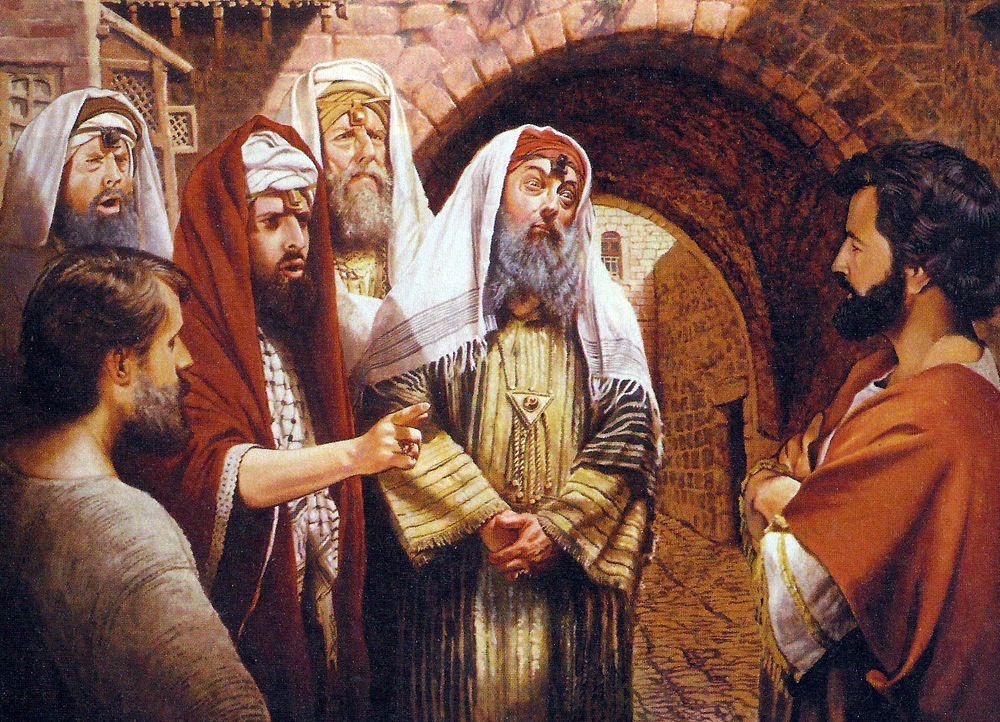
The third scene sees the healed man brought before the Pharisees (9:13–17); what ensues feels like it is setting up to be a cross-examination, since the healing took place on a sabbath (9:14) and thus the event comes under Torah prescriptions (cf. Mark 2:23–28; 3:1–6; Luke 13:10–17; 14:1–6; and John 7:19–24). In fact, the Pharisees accuse Jesus, “this man is not from God, for he does not observe the sabbath” (9:16), while the healed man, pressed hard, declares, “he is a prophet” (9:17).

A prophet: is the same affirmation made by the Samaritan woman (4:19), a crowd in Galilee after a miracle (6:14), and a crowd in Jerusalem (7:40)—and, by implication, perhaps some in the Sanhedrin, led by Nicodemus, say that also (7:52)?

Does the author want his hearers and readers to understand each of these affirmations in terms of the central one: “this is indeed the prophet who is to come into the world” (6:14), presumably along the lines of the earlier statement of Moses, “the Lord your God will raise up for you a prophet like me from among your own people; you shall heed such a prophet … I will raise up for them a prophet like you from among their own people; I will put my words in the mouth of the prophet, who shall speak to them everything that I command” (Deut 18:15, 18). Certainly, this is the text on the basis of which Samaritans were anticipating the return of Moses as their Taheb, their Restorer.

We resume the extended narrative of John 9 with the fourth scene, involving the parents of the man, whom the Pharisees summonses and proceed to question (9:18–23). They ask, “Is this your son, who you say was born blind? How then does he now see?” (9:19). The key element in this scene is the narrative comment—reflecting the experience of the followers of Jesus many decades after the setting of this scene, in Jerusalem in the early 30s—that “the [Judean authorities] had already agreed that anyone who confessed Jesus to be the Messiah would be put out of the synagogue” (9:22).

John’s Gospel indicates, three times, that followers of Jesus were expelled from the synagogue (9:22; 12:42; 16:1–2). That’s quite a schism! This indicates that the negative portrayals of people from years back may well have as much to do with what has transpired in those intervening years, as with the actual event—probably, I think, much more to do with those intervening years than with the conversations and encounters as reported in the book of signs.

The whole Gospel reflects a situation much developed from the time in which the story is set, when Jesus was a Galilean man preaching and teaching in Israel in the 30s CE. American scholar Raymond Brown developed a complex hypothesis about multiple stages of development of this Gospel, with the figure of the Beloved Disciple providing a focal point of leadership and identity—and perhaps also serving as the earliest source for the distinctive Johannine traditions?

Brown developed this hypothesis as he worked on a marvellous two-volume commentary on John’s Gospel (Anchor Bible, Yale Uni Press, 1966) and then published a clear analysis of this in his book The Community of the Beloved Disciple (Paulist Press, 1978).

Much had transpired in the decades between the time of Jesus and the finalisation of the Gospel—including an intensification of the antagonism between the followers of Jesus and the rabbinic leadership of Judaism. This antagonism is “written back” into the time of the story of Jesus through the verbal polemics that take place in chapters 5–12, between Jesus and the authorities in Jerusalem.

My own teacher, Wayne Meeks (in his classic article, “The Man from Heaven in Johannine Sectarianism”, JBL 91 (1972) 44–72), noted that the claims made about Jesus in the fourth Gospel function as reinforcements of the sectarian identity of the community. As this community had come into existence because of the claims that it had made about Jesus, so the reinforcement of the life of the new community took place, to a large degree, through the strengthening and refining of its initial claim concerning Jesus. The account of the interaction between Jesus, the man born blind, now healed, and the Pharisees and leadership in Jerusalem, reflects elements of that sectarian mindset.

This becomes clear in the fifth scene, in which the Pharisees recall the healed man to question him further (9:24–34). The Pharisees set the key issue: “as for this man, we do not know where he comes from” (9:29). The experience of the healed man, “you do not know where he comes from, and yet he opened my eyes”, leads him to testify, “never since the world began has it been heard that anyone opened the eyes of a person born blind. If this man were not from God, he could do nothing” (9:30–33). That clear affirmation of faith in Jesus, and recognition of his status, from one “on the inside”, brings the cross-examination to an abrupt close; incredulous, the Pharisees ask, “are you trying to teach us?”, and then drive him out from their gathering (9:34).

The issue at stake is the identity of Jesus and his status as prophet, teacher, “from God”. Of course, hearers and readers of the Gospel have known from the beginning that Jesus, the Word, “was with God, and … was God” (1:1), that this Word “became flesh and lived among us … full of grace and truth” (1:14), and that this Word was “the only Son, who is close to the Father’s heart, who has made him known” (1:18). We have been let into the insiders’ world, with access to full knowledge. This is where the healed man is to be found; he recognises Jesus, not only as miracle worker, but as “from God” (9:33).

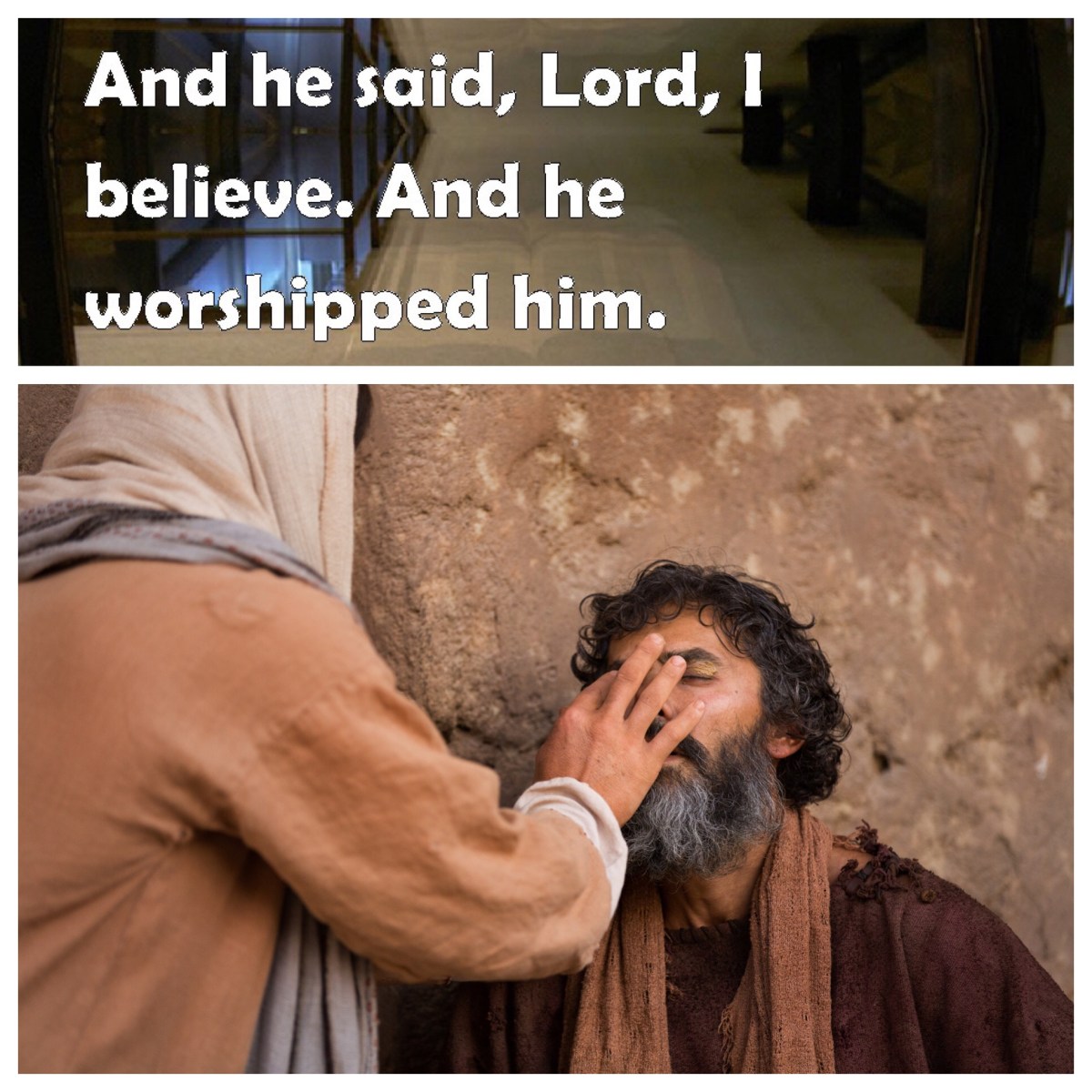
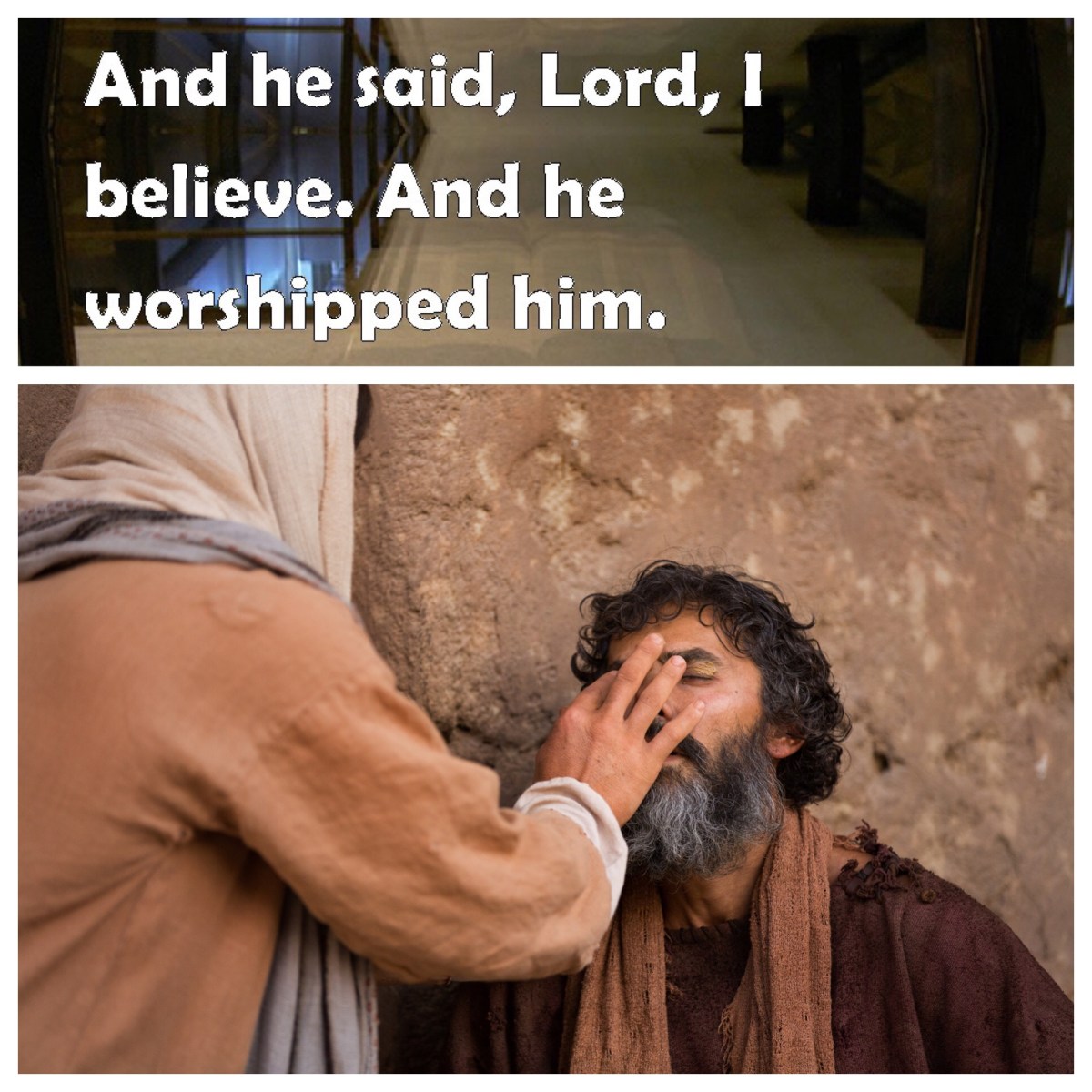
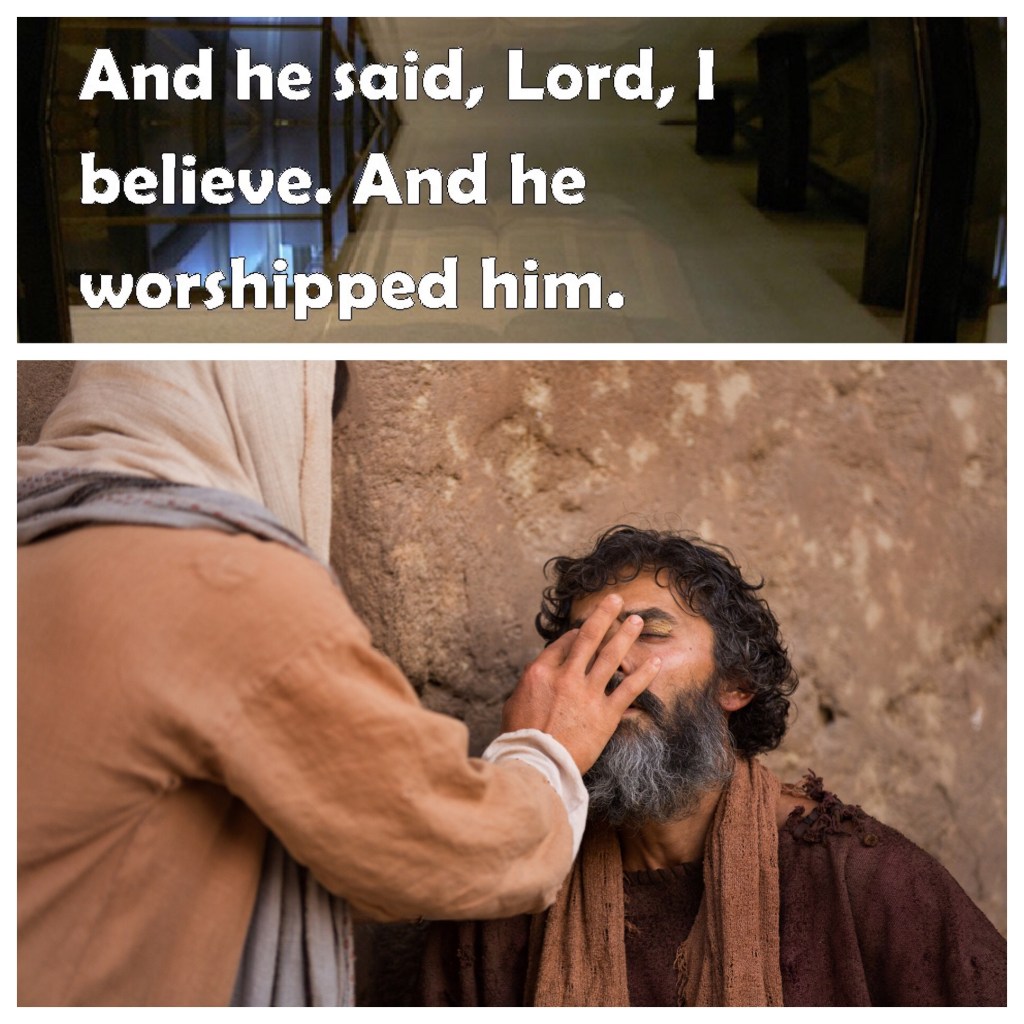
So the sixth scene (9:35–38) depicts Jesus interacting directly with the healed man once more—the last time he saw him was back in scene one, when he had spat onto the ground to make mud, rubbed it on the man’s eyes, and told him to “wash in the pool of Siloam” (9:6–7). Now, Jesus asks the leading question, “do you believe in the Son of Man?” (9:35), evoking the clear affirmation, “Lord, I believe” (9:38). That is the same affirmation of faith made by Simon Peter (6:69), Martha (11:27), and, by inference, Thomas (20:24–28). The identity of Jesus—Holy One of God, Messiah, Son of Man, Lord and God—is the critical issue which delineates insiders from outsiders.

For my reflections on the significance of this man’s confession of faith in the context of the book of signs as a whole, see

The seventh scene brings Jesus directly into contact with the Pharisees (9:39–41). Compared to the earlier extended debate of 8:31–59 and the less extensive debate which follows at 10:22–39, this is brief, succinct, and focussed on the theological issues of blindness and seeing, and sin. This links back to the opening question of the disciples about blindness and sin (9:2) and the consequent statement of Jesus, “as long as I am in the world, I am the light of the world” (9:5). This statement, of course, repeats the earlier declaration of Jesus (8:12) which has introduced the whole narrative context in which this encounter sits (8:12–10:21).

*****

So the whole scene (like the whole Gospel) is about the situation of a group of followers of Jesus towards the end of the first century CE, inheriting the richness of the Jewish faith, convinced that they have found The Teacher of the way that God requires, in Jesus of Nazareth. As a result, they have encountered opposition, argumentation, and expulsion from their familiar faith community, and through this they have engaged in verbal warfare with those who have pushed them out.

Retelling the story of that man in a way that validates their perspective as what God intends and desires, is what has led an unknown member of their community to construct this narrative, in which he reinforces the views that have been developed by the members of his community, even as he hopes that others might “come to believe that Jesus is the Messiah, the Son of God, and that through believing [they] may have life in his name” (20:31).

Reckoning what is right (Romans 4; Lent 2A) part two

In a previous post, I explored the first half of Romans 4, sections of which are offered by the lectionary as the Epistle reading for this coming Sunday, the Second Sunday in Lent (Rom 4:1–5, 13–17). See

There we noted that Paul quotes scripture texts, poses questions, and provides immediate answers to those questions, as he develops his argument. In this post, I will explore the origins of this style of developing an argument and continue on with an analysis of Paul’s argument in Romans 4.

What we see at work in the rhetorical style that Paul utilises in this letter is that he is not only functioning as a Pharisee, schooled in the methods of midrashic treatment of scriptural texts; but that, as a hellenised Jew (educated in Jerusalem, yes, but living in Tarsus in the diaspora, according to Acts 22:3), he utilises the rhetorical techniques of the diatribe. This was a way of speaking in public that had been created by Bion of Borysthenes in the 4th century BCE, and then developed and refined amongst Greek rhetoricians and utilised particularly by Cynic philosophers in the ensuing centuries.

We know that diatribes were well-known in Ancient Greece; the 4th century playwright Euripides commented that “the peculiarity of the diatribe as distinct from other forms of popular moralizing lies in the assumed presence of an opponent. He is not permitted to reply, but his position is indicated by statements or rhetorical questions put into his mouth by the speaker, and thus the introduction of an objection in the form of a question becomes one of the characteristic features of the diatribe.” It is clear that this is a development of the dialogue form, so its origin is usually traced to the dialogues of Plato.

The popularity of the long-used form of diatribe is well attested into the Common Era in the work entitled Diatribes (more commonly translated as Discourses), published in the early 2nd century CE by Arrian, reporting the diatribes of Epictetus, a first century slave who studied Stoic philosophy and, after he gained his freedom, taught in Rome until Domitian banished all philosophers from Rome in 93CE. (Epictetus moved to Nicopolis and established a school there where he continued to teach Stoic philosophy.)

This demonstrates the enduring character and the widespread know,edge of this particular form of rhetorical argumentation. That Paul was using it quite extensively and to good effect in his letter to Rome (and also at places in other letters he wrote, it must be said) cannot be gainsaid.

Biblical scholars have explored how Paul adapts and utilises the diatribe method. Stanley Stowers pioneered this analysis in his book A Rereading Romans: Justice, Jews, and Gentiles (Yale, 1997), and Douglas Campbell has developed this approach most extensively in The Deliverance of God: an Apocalyptic Rereading of Justification in Paul (Eerdmans, 2009).

Campbell offers a clear explanation of the style: “Ancient diatribe is essentially a distinctive mode of discourse built largely with apostrophe [addressing a fictitious person as if they were present] and speech-in-character (a figure of speech in which an absent or imaginary person is represented as speaking; the technical name for this is prosopopoeia].”

Campbell explains that “A constructed character is generally addressed by the discourse’s central protagonist—who is a broadly Socratic figure—by means of the literary technique of apostrophe, so much of the discourse unfolds through the use of second person singular grammar. And that interlocutor then responds, whether in brief or at length, through the literary technique of speech-in-character, so here the author puts words in this character’s mouth.”

Campbell concludes, “The result is a dramatic discourse mimicking the to and fro of debate and conversation, although slipping were necessary into more extended speeches by one or the other party.” (Campbell, The Deliverance of God, p.535)

We can see the resemblance of Paul’s style of argumentation in Romans, to this rhetorical strategy.

*****

In the second section of Romans 4, then, after having established the universal scope of God’s providential grace—for this is how God meets the universal spread of sinfulness amongst human beings—Paul focusses on the faith that Abraham showed, and it’s importance for believers in Rome( and elsewhere). The thesis for this part of the argument is immediately posed: the promise to Abraham (which he was given in Gen 12:1–3) was “not through the law but through the righteousness of faith” (4:13).

First, Paul indicates that the promise cannot be fulfilled only through “the adherents of the law”, for “the law brings wrath” (4:14–15; he expands on this in chapter 7). Then, he asserts that the promise must rest on faith, both to those who adhere to the law but also “to those who share the faith of Abraham” (4:16). Abraham is here described as “the father of all of us”, drawing on yet another scripture citation (Gen 17:5; Paul uses the same argument at Gal 3:15–18, and the phrase is also at play in the debate reported in John 8:41–59).

Then follows further explication of this scripture (Gen 17:5), particularly explaining how Abraham, “hoping against hope”, became “the father of many nations” (4:17b—21). Despite the barrenness of Sarah’s womb (4:19), Abraham “was fully convinced that God was able to do what he had promised” (4:21). To conclude this exegetical foray, Paul quotes, for the third time, the foundational text: “his faith ‘was reckoned to him as righteousness’” (4:22, quoting Gen 15:6).

Paul then explains that these words describe not only the situation of Abraham, long in the last, but also the situation of those to whom he writes (4:23–24). This is a foundational aspect of Paul’s hermeneutic; he restates it at Rom 15:4, declaring that the scripture “written in former days was written for our instruction”. See

And so the argument draws to a close, moving back into the heart of Paul’s concern, to expound the Gospel concerning God “who raised Jesus Christ from the dead” (4:24–25). The final verse is most likely a traditional formulaic expression; we find a similar pattern at 1 Cor 15:3–4, a midrashic-style reflection on this pattern at 1 Cor 15:42–44, a variant form at 2 Cor 5:14–15, and extended discussion using the pattern of Christ, dead and raised, as the model for believers, “buried with him by baptism into death, so that, just as Christ was raised from the dead by the glory of the Father, so we too might walk in newness of life” (Rom 6:4). Paul provides a fuller discussion of this paradigm at 6:3–11, and there is a similar discussion, albeit varied for the different context, at Col 3:11–15.

The extended argument of this chapter (represented, unfortunately, by truncated excerpts in the lectionary offering) takes us from an initial question about Abraham, through an exploration of the story of Abraham, and Sarah, to a conclusion about the life of those who place their trust in what God has done through Jesus Christ; namely, that God “will justify [or, reckon as righteous] the circumcised on the ground of faith and the uncircumcised through that same faith” (3:30), and so, in like manner, “it will be reckoned to us who believe in him who raised Jesus our Lord from the dead” (4:24). It is all about being reckoned as righteous on the basis of faith.

As Paul would say: Thanks be to God!

Reckoning what is right (Romans 4; Lent 2A) part one

For the next two Sundays, the Epistle reading offered by the lectionary comes from the longest and most theologically weighty letter written by Paul—that addressed “to all God’s beloved in Rome, who are called to be saints” (Rom 1:7). Although it has this specific, localised audience in view, the letter has become a declaration heard and taken up and studied carefully by Christians right around the world, across millennia of years.

It is generally regarded as the most explicit and detailed exposition of the theological commitments which had energised Saul of Tarsus to spend years of his life “to be a minister of Christ Jesus to the Gentiles in the priestly service of the gospel of God, so that the offering of the Gentiles may be acceptable, sanctified by the Holy Spirit” (Rom 15:16). For this enterprise, he is well-known as the “Apostle to the Gentiles”.

The passages on offer this coming Sunday (Rom 4:1–5, 13–17) and the following Sunday (Rom 5:1–11) come from the heart of the letter, the long section often described as presenting Paul’s key theological understanding of the grace of God by which people of faith are justified (reckoned as righteous, or put right with God). This theological understanding is set forth, initially, through a quotation from a short book in Hebrew Scripture, that of the prophet Habakkuk.

Habakkuk is a shadowy figure, known, really, for only one statement—just half of one verse. That is the short statement, “the righteous live by their faith [or faithfulness]” (2:4b), which stands as the text upon which Paul developed his important theological statement in Romans: “in it [the gospel] the righteousness of God is revealed through faith for faith; as it is written, ‘the one who is righteous will live by faith’” (Rom 1:17). As well, Paul quotes this verse in his letter to the Galatians (Gal 3:11) and the verse is cited in the “word of exhortation” sent to the Hebrews (Heb 10:38). So it appears in significant writings of the early Christian movement.

In the context of Habakkuk’s prophetic activity, the affirmation that “the righteous live by their faith [or faithfulness]” (2:4b) is the word that God gives to the prophet, responding to his complaints about what sufferings are taking place. Habakkuk’s complaints come because God is “rousing the Chaldeans, that fierce and impetuous nation, who march through the breadth of the earth to seize dwellings not their own” (1:6), and through their dreadful and fearsome activities, God is “destroying nations without mercy” (1:17).

That God is using foreigners to deal with Israel is a striking theological development—one that is at odds with the traditions that emphasise Israel as a chosen nation, holy and set apart, dedicated to the Lord; the nation alone through whom the Lord God works. That this God will use foreigners is a theme found also in the later writings of Deutero-Isaiah (Isa 40–55), where Cyrus, the Persian ruler, is acclaimed as the one chosen by God, the Messiah, to allow the people of Judah to return to their land (Isa 44:24–45:13).

That God is at work amongst people who are not of Israel resonates, of course, with the activity that Paul and his fellow-workers had been undertaking amongst the Gentiles (those not of the people of Israel)—although Paul is not working in a context of oppression and threatening invasion. So this brief citation from Habakkuk is entirely apposite for Paul’s work and his writings. And as the later chapters of Roman clearly show, God has indeed been at work amongst the Gentiles in Rome.

Paul quotes a string of scriptures to demonstrate “that the Gentiles might glorify God for his mercy” (Rom 15:9–12); he writes of his goal “to win obedience from the Gentiles, by word and deed, by the power of signs and wonders, by the power of the Spirit of God” (Rom 15:18–19); and he affirms “all the churches of the Gentiles” (Rom 16:4). The letter concludes with a prayer of thanks (although most likely not from the hand of Paul), celebrating that “the revelation of the mystery that was kept secret for long ages but is now disclosed, and through the prophetic writings is made known to all the Gentiles” (Rom 16:25–26).

Habakkuk laments and complains about the situation in Israel of his time (the years immediately before the Babylonian invasion of 587 BC). God instructs him to “look at the proud—their spirit is not right in them”, and to be assured that “the righteous live by their faith” (2:4). The theme of the faith of the righteous that is signalled here by the prophet is a central motif in Hebrew Scriptures. It appears in the ancestral stories concerning the key figures of Abraham (Gen 15:6), Saul (1 Sam 26:23), David (2 Sam 22:21–26; 1 Ki 3:6), and Solomon (1 Ki 10:9). It is the motif that Paul takes up for his magnum opus, his theological bequest to later believers.

*****

The theme articulated in Rom 1:17—the claim that it is in the Gospel that “the righteousness of God is revealed through faith for faith”—is set forth in more detail at 3:21–26. Paul declares that “the righteousness of God has been disclosed, and is attested by the law and the prophets, the righteousness of God through faith in Jesus Christ for all who believe”, and proceeds to explain that “they are now justified by his grace as a gift, through the redemption that is in Christ Jesus, whom God put forward as a sacrifice of atonement by his blood, effective through faith”. This was evident in the past (in the story of Israel), and is further evident in Paul’s time, demonstrating that God “himself is righteous and that he justifies the one who has faith in Jesus”.

This explanation is dense, compressed, and complex. Interestingly, the lectionary completely avoids this seminal theological passage, which has been so important for the development of the classic doctrine of the Atonement! (By contrast, portions of chapter 5 appear in the lectionary on four different occasions, and parts of chapter 8 on seven occasions.) There are many key theological terms in 3:21–26 which require unpacking and explanation. Paul proceeds to offer that in the chapters that follow.

Chapters 5–8 have classically been regarded as an extended exposition of what 3:21–26 has set out, climaxing in the doxology of 8:31-39 as the climactic moment of the letter (“[nothing] will be able to separate us from the love of God in Christ Jesus our Lord”). In more recent interpretation, chapters 9–11 have been seen, not as an addendum (as earlier interpreters argued), but as a flourishing of the argument set out from 3:21 onwards, heading steadfastly to the doxological prayer of 11:33–36 (“O the depth of the riches and wisdom and knowledge of God … to him be the glory forever. Amen.”)

My own reading is consistent with this latter line of interpretation. See

Before all of this, however, Paul starts with the example of Abraham—for in Paul’s mind, the words written about Abraham in Genesis 15, ‘it was reckoned to him as righteousness’, “were written not for his sake alone, but for ours also” (Rom 4:23–24; the citation is from Gen 15:6).

The argument develops—unsurprisingly—in typical Pharisaic/rabbinic midrashic style—by posing questions, drawing on biblical texts, exploring details, and concluding with the text that draws the argument together—Abraham’s faith “was reckoned to him as righteousness” (Gen 15:6).

So we find the argument containing, first a general reference to Abraham (4:1–2), set forth as a rhetorical question which Paul nevertheless processes to answer! He does this by first quoting the key verse in his argument (4:3, quoting Gen 15:6)—introduced with a second rhetorical question—and then discussing what it means to “reckon” or to “justify the ungodly” (4:4–5).

Next, a quotation from the Psalms, beginning “blessed are those whose iniquities are forgiven” (4:6–8, citing Ps 32:1–2), which occasions a third question, posed in order to be immediately explored: exactly who is forgiven (4:9a)? Is this blessedness only for those circumcised (Jews), or does it encompass those beyond (Gentiles)?

Gen 15:6 is cited, for a second time, at 4:9b, opening the way for a discussion of when Abraham was “reckoned as righteous”—was it before he was circumcised, or after? This matter is stated in two short rhetorical questions (4:10a), followed immediately by the answer (4:10). The answer is obvious from a straightforward reading of the Genesis narrative; it was after Abraham was blessed by Melchizedek (Gen 14:7–15:6), before he was circumcised, after the birth of Ishmael (Gen 16:15–17:27). Circumcision, says Paul, is “a seal of the righteousness that he had by faith” (4:11), thereby making Abraham “the ancestor of all who believe without being circumcised” (4:11), as well as “the ancestor of the circumcised” (4:12).

This conclusion will prove to be foundational for Paul’s subsequent argument in the letter, which he has already flagged in earlier chapters: the Gospel is “the power of God for salvation to everyone who has faith, to the Jew first and also to the Greek” (1:16), and then, “all, both Jews and Greeks, are under the power of sin” (3:9), and finally, “the righteousness of God [is available] through faith in [or, the faith of] Jesus Christ for all who believe” (3:22).

Accordingly, he declares (in typical style, with questions driving to the obvious answer), “is God the God of Jews only? is he not the God of Gentiles also? Yes, of Gentiles also, since God is one” (3:29–30). The universal scope of God’s providential grace is clear; this is how God meets the universal spread of sinfulness amongst human beings.

In a following post, I will explore the origins of this style of developing an argument (quoting sources, posing questions, immediately providing answers) and continue on with an analysis of Paul’s argument in Romans 4.

Blessings and greatness: a promise for the ages (Gen 12; Lent 2A)

This year during the season of Lent, the Gospel readings offer a series of narratives which describe encounters that Jesus had (largely from the Gospel according to John). In parallel to those stories, in the Hebrew Scripture readings, the lectionary offers a sequence of passages telling some of the key moments in the story of Israel (from Genesis, Exodus, 1 Samuel, and Ezekiel),

This sequence of key moments in the story of Israel offers a series of vignettes of faithful people from the past—our ancestors in the faith who stand as role models to encourage us, centuries later, in our own journey of faith. They are figures which are worth holding up for our reflection and consideration. These stories each have the function of an aetiology—that is, a mythic story which is told to explain the origins of something that is important in the time of the storyteller.

The online Oxford Classical Dictionary defines the term as follows: “Aetiology in religion and mythology refers to an explanation, normally in narrative form (hence ‘aetiological myth’), of a practice, epithet, monument, or similar.” Whilst telling of something that is presented as happening long back in the past, the focus is on present experiences and realities, for “such explanations elucidate something known in the contemporary world by reference to an event in the mythical past”.

See https://oxfordre.com/classics/display/10.1093/acrefore/9780199381135.001.0001/acrefore-9780199381135-e-7050;jsessionid=3DB38C42C54D01E1CBFA8682FB55DA4C

The ancestral narratives of Israel (Gen 12–50), as well as the series of books known as “the historical narratives” (Exodus to 2 Kings, Ezra—Nehemiah) are all written at a time much later that the presumed events which they narrate. The final form of the books as we have them most likely date to the Exile or post-exilic times, although pre-existing sources would have been used for many of these stories. (There are specific references to earlier written documents—now lost to us—scattered throughout 1—2 Kings.)

Those older stories were remembered, retold, and then written down, because they spoke into the present experiences of the writers. Common scholarly belief is that the stories found in Gen 12–50 were originally oral tales, that were collected together, told and retold over the years, and ultimately written down in one scroll, that we today call Genesis.

*****

For this coming Sunday, we are offered the account of the calling of Abram, who journeys into a new future (Gen 12:1–4a, Lent 2A). This has been a key passage for Jews throughout the centuries; Abram is remembered and honoured as “the father of the nation”—indeed, as “the father of all nations”; and this passage claims that it was God’s intention to grant the blessing of abundant descendants to Abram and his wife, to fulfil this promise.

The passage is found after the opening 11 chapters, which are often labelled the “Primeval History”, since they recount the creation of the world and the sequence of events which were fundamental for understanding human existence (such as human sinfulness and conflict, the expansion of humanity, the great flood, the growth of tribal entities, and the diversification of languages).

The passage also stands at the head of those stories, originally oral, which were collected because they revealed much about the nature of Israel as a people and as a nation. These chapters tell stories about the patriarchs and their wives (Abram and Sarai, Isaac and Rebekah, Jacob and Leah and Rachel). This particular passage introduces key themes for the people of Israel.

A word of caution: the lectionary stops in the middle of verse 4: “Abram went, as the LORD had told him; and Lot went with him”. To be fair, however, we need to read beyond the point where the lectionary ends this passage; that selection indicates that Abram took Lot with him, but the narrative actually continues, indicating that Abram travelled with his wife Sarai and his nephew Lot, “and all the possessions that they had gathered, and the persons whom they had acquired in Haran; and they set forth to go to the land of Canaan” (Gen 12:5).

The lectionary is, sadly, blatantly sexist at this point: it includes the names of the two leading males, Abram and Lot, but fails to note that they travelled with their spouses, Sarai and the (always unnamed) wife of Lot; and indeed there is reference to the presence of many others with them in their journey, which would undoubtedly have included both males and females within the extended family grouping. We need to read this ancient aetiology with a contemporary critical awareness. Certainly, the faith of Abram and Sarai and their extended family is a key message conveyed by this passage.

The story explains four important aspects of life and faith for the people of ancient Israel and on into contemporary Judaism: the land is given to this people, the people (of Israel) will become “a great nation”, the name (of Abram) will be blessed, and the descendants of Abram, “all the families of the earth”, will likewise be blessed. These four points—land, people, name, descendants—loom large throughout the history of Israel. Indeed, they maintain their potency into the present age—and need to be read and understood with political and cultural sensitivity today.

*****

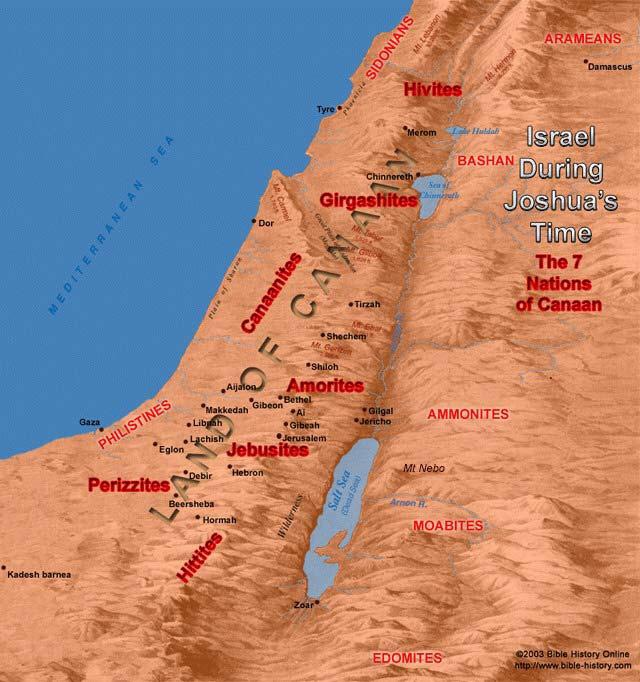
The story makes it clear that the land of Canaan was given by God to Abram and his descendants. As the story continues beyond the section offered by the lectionary, “they set forth to go to the land of Canaan. When they had come to the land of Canaan, Abram passed through the land to the place at Shechem, to the oak of Moreh. At that time the Canaanites were in the land. Then the LORD appeared to Abram, and said, ‘To your offspring I will give this land.’ So he built there an altar to the LORD, who had appeared to him.” (Gen 12:5–7).

Laying claim to the land of Canaan us a thread that runs through Hebrew Scripture. The promise of land is repeated in the covenant with Abram: “your descendants I give this land, from the river of Egypt to the great river, the river Euphrates, the land of the Kenites, the Kenizzites, the Kadmonites, the Hittites, the Perizzites, the Rephaim, the Amorites, the Canaanites, the Girgashites, and the Jebusites” (Gen 15:18–21). The long list of names of those inhabiting this land indicates the extent to which this promise would prove to be disruptive for these peoples.

The promise to Abraham was confirmed to Isaac (Gen 26:3) and to Jacob (Gen 28:13), and the full extent of the promised land was set out in Exodus 23:31, “from the Red Sea to the sea of the Philistines, and from the wilderness to the Euphrates”. By the time of the United Kingdom, it is said that “Solomon was sovereign over all the kingdoms from the Euphrates to the land of the Philistines, even to the border of Egypt” (1 Ki 4:21).

The disruption to the inhabitants from the invasion and colonisation by the incoming Israelites is told in detail through the book of Joshua, when the people enter the land and cause havoc for the inhabitants; and the book of Joshua, indicating how the “settlement” of the land required centuries of battles and conflicts.

When first the northern kingdom, then the southern kingdom each went into Exile, the yearning to return to the land was strong. When Jeremiah buys a field in his hometown of Anathoth from his cousin Hanamel (Jer 32:1–15), the purchase serves to provide assurance that the exiled people will indeed return to the land of Israel; “houses and fields and vineyards shall again be bought in this land” (Jer 32:15).

Ezekiel, speaking for God, declares that the people “shall know that I am the Lord their God because I sent them into exile among the nations, and then gathered them into their own land. I will leave none of them behind; and I will never again hide my face from them, when I pour out my spirit upon the house of Israel, says the Lord God” (Ezek 39:28–29).

As a sign of his confidence that God will maintain his commitment to Israel, Ezekiel tells in detail his vision of the new temple that would, he believed, be built in the land (40:1–43:27), as well as the role of the Levitical priests in that temple (44:15–31) and various provisions that would be in force after the return to the land (45:1–46:24).

Third Isaiah predicts that “your people shall all be righteous; they shall possess the land forever” (Isa 60:21); he speaks of a time when “they shall bring all your kindred from all the nations as an offering to the Lord, on horses, and in chariots, and in litters, and on mules, and on dromedaries, to my holy mountain Jerusalem, says the Lord” (Isa 66:20). The focus on the land is a strong thread running throughout Hebrew Scripture.

*****

The claim that the people of Israel have made for their land has been contentious throughout history—not least in the last 80 years, since the post-WWII settlement re-established the modern state of Israel in this precise area. This return of the Jews to their homeland after World War Two was implemented with little concern for what it would mean for the people who had long lived in the area—those now identified as the Palestinians.

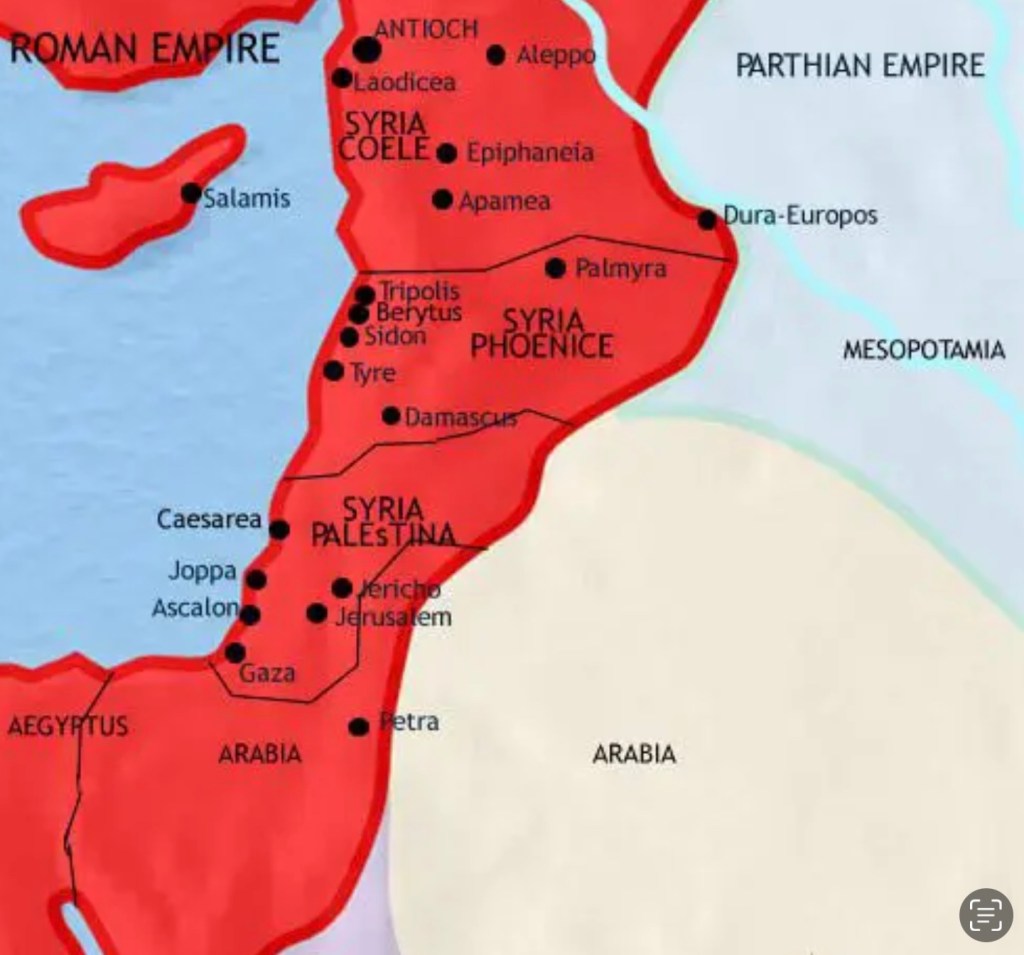
The term Palestinian is ancient term, being used by the Greek historian Herodotus five centuries before the common era (BCE) to designate “a district of Syria, called Palaistinê” between Phoenicia and Egypt” (Histories 1.105). The term was subsequently used by numerous Greek and Roman writers.

In the early 2nd century CE, the term “Syria Palestina” (literally, “Palestinian Syria”) was given to the Roman province of Judea, which had been the area ruled over by kings of the Southern Kingdom after the time of Solomon. This occurred after the uprising led by Bar Kochba—so the designation was for a land which no longer had many Jewish inhabitants.

Roman Provinces c.200CE

In putting down the Jewish uprising, the Romans had also removed Jews from Jerusalem and the surrounding rural areas, which they renamed Colonia Aelia Capitolina. Aelia came from Hadrian’s nomen designating his gens, Aelius, while Capitolina indicated that the city formerly known as Jerusalem was dedicated to Jupiter Capitolinus, to whom a newly-built temple was dedicated.

So the contest between ‘Israel’ and ‘Palestine’ was an ancient enmity which was revived and intensified from 1948 onwards. The homeland had been given to the Jews in the aftermath of the Shoah, also called the Holocaust, perpetrated by Nazi Germany and its sympathisers. For Palestinians, yet he establishment of the Nakba, a period in which the displacement of many local populations has taken place. Unfortunately, and unjustly, this continues even today under the Israeli Government’s policy of continuing to establish new settler areas.

So whilst the passage about Abram and Sarai setting off, exuding hope and demonstrating trust in God’s promise, is a fine reminder of the need to have trust in Hod and to set our in faith in new directions in our discipleship, it is also now a fraught and contested word, given how it has been used to justify events millennia later. Let us speak of this passage with care.

*****

I am so pleased that my own church, the Uniting Church in Australia, has been thinking about our relationship with the Jewish People for a number of decades now, a nd that has included giving careful consideration to issues surrounding the land—both historical claims and current realities.

In 1997, a working group (of which I was a member) had presented a Statement to the national body of the church, the Assembly, in which these matters had been canvassed. The Assembly agreed to invite Uniting Church bodies and members to give consideration to these matters:

7.9 that the Jewish people have a particular historical, cultural, emotional and spiritual bond with the land of Israel, which is a central element of the Jewish faith, and which is inextricably bound to the history of the Jewish People;

7.10 that the historic roots, rights and aspirations of the Palestinian people must be properly acknowledged;

7.11 that from a properly informed position, and in the light of the moral tradition of Christianity, it can be appropriate for the Uniting Church to have and express a view about both Israeli and Palestinian policies and actions;

7.12 that the search for a just and lasting peace for all states and peoples in the Middle East merits prayerful engagement on the part of all Christians

See https://www.jcrelations.net/statements/statement/inviting-the-members-of-the-uniting-church-in-australia-to-ongoing-dialogue.html

In obedience to that guidance, whilst I was a member and, for a time, co-convenor of the Uniting Church’s National Dialogue with the Jewish Community, I took part in many vigorous discussions relating to these issues. I listened and learnt, as well as speaking, in those discussions.

In 2009, the Assembly received and adopted a full Statement on Jews and Judaism in which it reiterated “that the State of Israel and a Palestinian State each have the right to live side by side in peace and security”. See https://assembly.uca.org.au/rof/resources/learn-more/item/download/1109_09f709cccf49d83607c92e31d650d581

In 2011, following the work of another working group (of which I was also a member), the President and General Secretary issued an invitation to Uniting Church members “to consider taking peaceful action toward a resolution to the conflict”; it included a comprehensive set of suggested actions, including prayers, advocating with MPs, inviting speakers, supporting a relief or development project in the West Bank or Gaza, and supporting a boycott of goods produced in the illegal Israeli settlements in the Occupied Palestinian Territories. This was published under the heading of A Prayer for Peace, at https://assembly.uca.org.au/images/Ministries/ROF/images/stories/A_Prayer_For_Peace_Information_PageED.pdf

*****

Abram and Sarai stepped out in faith. That is a wonderful role model for us to emulate. Where they went, and what their descendants did, has given us pause for consideration. How do we venture into the new in ways that do not damage others?

Jesus, the pioneer and perfecter of faith (Hebrews 11–12; Pentecost 10C)

The excerpt from chapters 11 and 12 of the letter to the Hebrews, offered by the lectionary this coming Sunday, concludes a long chapter of forty verses, providing a long list of the many witnesses who have lived their lives by faith. There was is a reference to Abraham and Sarah in the section we heard last week, but there is also mention of Abel and Enoch, Isaac and Jacob, Moses, Joshua and Rahab, Gideon and Barak, Samson and Jephthah, David and Samuel and the prophets—people who lived through many adventures, women who were faithful throughout their lives, martyrs who met an early death and rulers who bore responsibility for leading a nation.

These people are all drawn from the pages of our shared scriptures, the “heroes of the faith” from the stories of the Hebrew people. The excerpt offered this coming Sunday by the lectionary (Heb 11:29–12:2) canvasses many examples of faith, culminating in the opening verses of chapter 12, where the final example of faith which we are offered is the most familiar figure: “Jesus, the pioneer and perfecter of our faith” (12:2).

Faith, it is stated, is about what we cannot see, and what is not immediately evident in tangible ways when we look around us. We cannot point to an object, and claim: “there it is”. We cannot hold up a particular item, and say: “look at it ..? do you see it?” Because faith, in the end, is about what we value inside ourselves; it is about the qualities we hold dear, the principles by which we live.

And yet, in the stories offered in this reading, we are invited to consider what the writer of the letter to the Hebrews described as something which is “hoped for, but not seen”. This is a real thing, there is no doubt about it; but it cannot be documented or measured in specific, physical, tangible ways. It points us to something different, something other, than the obvious reality in front of our eyes. Faith, in the understanding of the author of this letter, invites us to look at the world in a different way; to perceive reality in a new fashion; to consider the evidence from an unfamiliar angle.

And in the story of Jesus, that faith becomes tangible, visible, knowable—a story filled with many details, a multitude of scenes, encounters, teachings, travels—all providing material that enable us to perceive of Jesus as a real, tangible human being, a fine example of faith.

*****

Three images of Jesus dominate the extended sermon which we know as the epistle to the Hebrews: Jesus as the pioneer of salvation, the great high priest, and the perfecter of faith.

These images are combined at key points (2:8b–11a; 5:7–10; 12:1–2), as they are developed in an interconnected fashion throughout the book. Their common point is the author’s focus on the death of Jesus on the cross (2:9; 5:7–8; 12:2). It is this “suffering of death” which transforms Jesus from his state of being “lower than the angels” to being “crowned with glory and honour” (2:9).

In his death, Jesus is the “pioneer of salvation” (2:10) who “endured the cross, disregarding its shame” (12:2). Through his death, Jesus “brings many children to glory” and is made “perfect through sufferings” (2:10). This image recurs in the claim that Jesus was made perfect after “he learned obedience through what he suffered” (5:8–9; see also 7:28; 12:2). It is this claim which undergirds the call for believers to “go on toward perfection” (6:1; see also 10:14; 11:40; 12:23).

The image of Jesus as the perfecter of faith is also related to the third image, of Jesus as the great high priest (4:14; 7:11). This image is firmly grounded in his humanity. Jesus shares “flesh and blood” with God’s children (2:14) and became like these humans “in every respect” (2:17). He has been “tested as we are” (4:15) and is chosen to be priest from among mortals (5:1, 5).

Yet this image also allows a place for the transcendent nature of Jesus. When he is designated high priest according to “the order of Melchizedek” (5:10; 6:20), Jesus is understood to be the high priest who has “passed through the heavens” (4:14) and is “holy, blameless, undefiled, separated from sinners, and exalted above the heavens” (7:26).

As Jesus is seated at God’s right hand (8:1), he is able to enter into the holy place of “the greater and perfect tent” (9:11–12) to offer the sacrifice which “makes perfect those who approach” (10:1, 14). This sacrifice brings the process of sanctification to a head (13:12; see also 2:11; 9:13–14; 10:10, 14, 29) and enables believers to “approach with a true heart in full assurance of faith” (10:19–22).

Paradoxically, Jesus both stands in the place of the priest slaughtering the sacrificial beast (2:17; 3:1; 5:1–6; 6:20; 7:26–28; 8:3; 10:12) and simultaneously lies on the altar as the one whose blood is being shed (9:11–14; 9:26; 10:19; 12:24; 13:20). Although the details of the imagery are confused, there is a consistently firm assertion developed through this image: Jesus is the assurance of salvation (2:10; 5:9; 10:22).

A sense of hope thus permeates the sermon, with references to “the full assurance of hope” (6:11), the “sure and steadfast anchor of the soul, a hope that enters the inner shrine behind the curtain” (6:19), “the confession of our hope” (10:23) which is undergirded with the assurance that it is offered by God, for “he who has promised is faithful”. (See other references to hope at 3:6; 6:18; 11:1.) It is the work of the high priest which brings believers “a better hope” (7:19) and assures them of their salvation—“without the shedding of blood there is no forgiveness of sins” (9:22).

*****

Throughout the sermon, the author of Hebrews presses his audience to live a moral life in response to this message, beginning with an opening exhortation which warns of penalties if the message is not heeded (2:1– 4). This warning is intensified by references to God’s anger in response to “an evil, unbelieving heart” (3:7–12), leading to the directive to “exhort one another every day” (3:13). In his capacity as high priest, Jesus has “passed through the heavens”, resulting in a further encouragement, “let us approach the throne of grace with boldness” (4:14–16).

More practical guidance regarding the behaviour which is expected of believers is set out in succinct commands: “let us consider how to provoke one another to love and good deeds, not neglecting to meet together, as is the habit of some, but encouraging one another’ (10:24–25); “pursue peace with everyone…see to it…that no root of bitterness springs up and causes trouble” (12:14–17). A more extensive list of instructions appears in the final series of exhortations which close the sermon (13:1–19). These exhortations are delivered in a sharp, staccato style, one after the other, in short, sharp bursts.

By contrast, a distinctive and well-loved feature of Hebrews is the lengthy paean in praise of “so great a cloud of witnesses” (11:1–12:1), in which each attest to a vibrant faith in God. The poem, as we have noted, offers many examples of faith from amongst this cloud of witnesses, culminating in

Jesus, through whom “God provided something better” (11:40).

By his entrance into the heavenly realm, Jesus has been proven “the pioneer and perfecter of our faith” (12:2), an exalted status similar to earlier descriptions of him as “the apostle and high priest of our confession” (3:1), “a great high priest who has passed through the heavens” (4:14), “the mediator of a new covenant” which offers “the promised eternal inheritance” (9:15).

The hope of these witnesses points to the deeds of Jesus, which provide the motivation for the lyrical exhortation which draws this section to a close: “therefore lift your drooping hands and strengthen your weak knees, and make straight paths for your feet, so that what is lame may not be put out of joint, but rather be healed” (12:12–13).

As Sarah and Abraham travelled this journey, as pilgrim people; as Moses and the people escaped slavery and trod the long wilderness path to Canaan; as people conquered kingdoms, administered justice, obtained promises, quenched raging fire, endured so, so many battles; as people were tortured, suffered mocking and flogging, and even chains and imprisonment, were stoned to death and were killed by the sword; as others were persecuted and tormented; and as Jesus “endured the cross, disregarding its shame”, so we also are invited to travel in similar manner – on a journey into the future, a journey infused with hope, a journey grounded in faith, “the assurance of things hoped for, the conviction of things not seen”, which was their fundamental resource for life. And so may it be for us.

*****

See also

And