
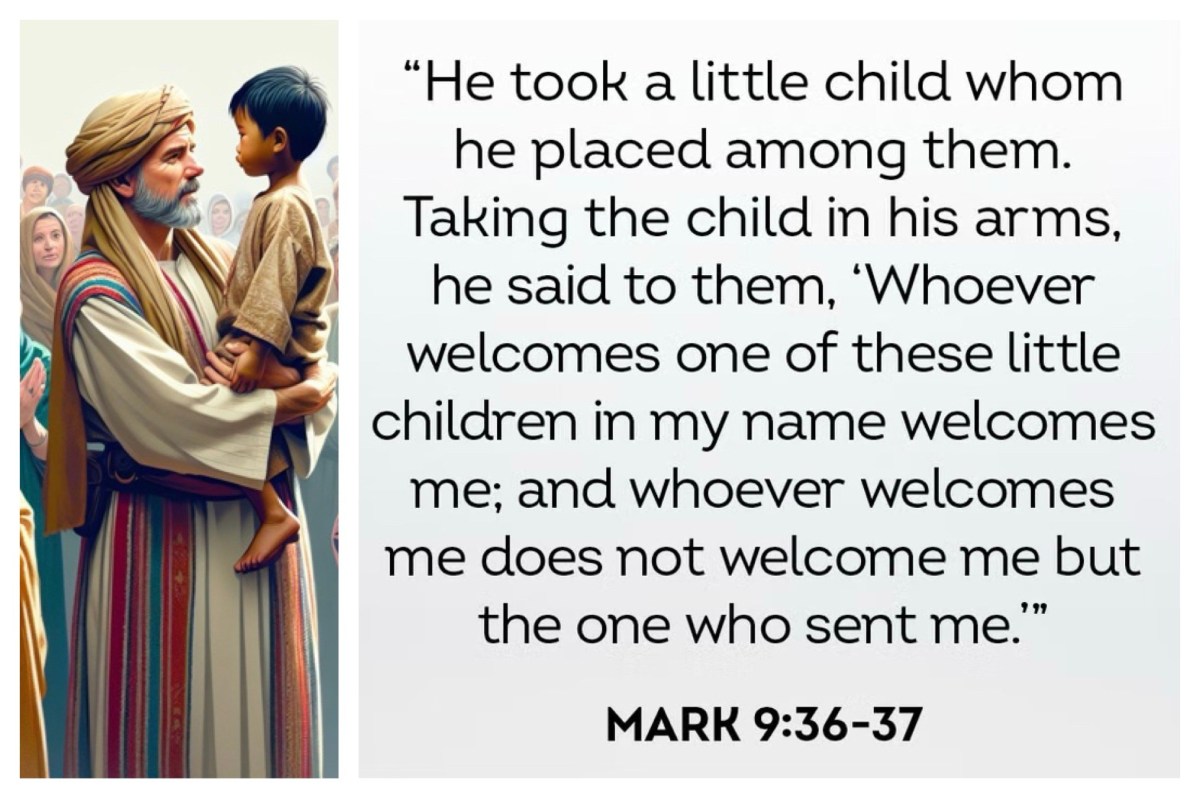
“Whoever welcomes one such child in my name welcomes me, and whoever welcomes me welcomes not me but the one who sent me.” In this striking statement, which occurs in the lectionary Gospel passage we hear this coming Sunday (Mark 9:30–37), Jesus does two important things.
The first is that he prioritises one of the least important figures in ancient society—a child—and puts them forth as a representative of him The second is that he then uses this affirmation as the basis for making a statement about his relationship to God.
First, Jesus affirms the central significance of a child in his consideration of this issue. Mark notes that Jesus “took a little child and put it among them” (9:36), using the presence of this child to undergird his statement about welcoming such a child (9:37). Still earlier, Jesus had placed the health of a child at the centre of his focus, when approached by a synagogue leader, who pleads with Jesus, “my little daughter is at the point of death; come and lay your hands on her, so that she may be made well, and live” (5:23).
In ancient times, a child was inevitably a person with no authority, no status, no prestige or power, in the society of the day; yet the low-status, not-important child is the exemplar, not only of Jesus, but of God, “the one who sent me” (9:37). Welcoming the child is a clear manifestation of the paradox that lies at the heart of the Gospel. Jesus is the one who will walk resolutely towards death (8:31: 9:31: 10:34), becoming “the slave of all” (10:44) who will “give his life a ransom for many” (10:45). Along this pathway, it is the child who best exemplifies the simplicity of this sacrificial service; it is the child who best prefigures the fullness of life promised in the coming age.
Interestingly, in the Hebrew Scriptures which formed the context for Jesus’ faith development, there are some fascinating examples of the value and power of younger people. Young Isaac questions his father Abraham, who is about to sacrifice him, asking him, “where is the lamb for a burnt offering?” (Gen 22:7). 17-year-old Joseph boldly shares his dreams with his brothers, taking the risk of alienating himself from them (Gen 37:1–11). The young boy Samuel hears God’s call in the temple (1 Sam 3:1–18); he grows to become “a trustworthy prophet of the Lord” (1 Sam 3:20) who will play a pivotal role in events leading to the establishment of a king in Israel. And before he became one of those kings, a youthful David enters the battlefield and, against all the odds, slays the giant Goliath (1 Sam 17).
Alongside these young men in scripture, there are girls who also have significant roles to play. An adolescent Rebekah eagerly offers hospitality to visitors and ultimately receives the blessing of “thousands of myriads” of descendants (Gen 24:15–60). The young Miriam bravely negotiates with Pharaoh’s daughter to ensure the safety of her newly-born brother Moses (Exod 2:1–10). A young princess Tamar speaks eloquently to Amnon; ultimately, she is unsuccessful in resisting his sexual assault, but this is the beginning of his downfall (2 Sam 13:1–20). Then, at the end of his life, it is the young Abishag who faithfully serves the ageing king, David (1 Kgs 1:1–4).

Jesus has many role models of children, young people, to draw on from his heritage. He knows that they are able to speak the truth and act with integrity. So he happily receives children as they come to him and highlights them as models of the kind of life that is needed to enter the kingdom of God. Those who follow Jesus on his pathway to that kingdom will need to take up their crosses (8:34), lose their lives (8:35), be “last of all and servant of all” (9:35), “receive the kingdom of God as a little child” (10:15), sell all that they possess (10:21), leave their families (10:29), and become “last of all” (10:31). (See https://johntsquires.com/2021/09/06/the-paradoxes-of-discipleship-mark-8-pentecost-16b/)
So, the children show how Jesus is in relationship with God; “whoever welcomes one such child in my name welcomes me, and whoever welcomes me welcomes not me but the one who sent me” (Mark 9:37). In this saying, Jesus offers a description of God as “the one who sent me”. This Markan saying is found also in a Lukan form, with the same words followed by the tag, “for the least among all of you is the greatest” (Luke 9:48).
A related version of this saying appears in the Q tradition, which lacks direct reference to the child (Matt 10:40 and Luke 10:16), although the context in Matt 10 does develop the central idea of the saying, and adds a further saying about giving “a cup of cold water to one of these little ones” (Matt 10:42).
The saying has close links with a turn of phrase found in another strand of the tradition—that found in John’s Gospel. Identifying God as “the one who sent me” first appears in this Gospel on the mouth of John, who refers to “the one who sent me to baptize with water” (John 1:33). This phrase is picked up by the Johannine Jesus, who uses it no less than 22 times to refer to God. It is an interesting overlap of the streams of tradition that are usually considered in isolation from one another, as if they never overlapped. Yet here, Johannine tradition bears similarities with Markan tradition and Q material.
In John’s Gospel, Jesus declares that “my food is to do the will of him who sent me and to complete his work” (4:34; 9:4) and “I seek to do not my own will but the will of him who sent me” (5:30; 6:38–39). The Johannine Jesus refers to God as the one who sent him as he declares that “my teaching is not mine but his who sent me” (7:16) and notes that “the Father who sent me has himself given me a commandment about what to say and what to speak” (12:49; 14:24).
As Jesus affirms that “the one who sent me is true” (7:28; 8:26), he looks to his return to be with God in sayings that use this phrase: “I will be with you a little while longer, and then I am going to him who sent me” (7:33; 16:5). Indeed, Jesus asserts that “the one who sent me is with me; he has not left me alone, for I always do what is pleasing to him” (8:29).
Because of this belief, in the first farewell discourse at his last meal with his disciples, Jesus speaks the same word that we have heard in Mark 9:37, namely, “whoever receives one whom I send receives me; and whoever receives me receives him who sent me” (John 13:20). The phrase is integral to the Johannine concept of the Union of Father and Son, most famously expressed as “the Father and I are one” (10:20).
That intimate relationship that Jesus has with God is emphasised in the final High Priestly Prayer of the Johannine Jesus, where Jesus prays “you, Father, are in me and I am in you” (17:21), for the Father has given him his glory (17:22). This intimacy provides the basis for the charge that Jesus gives his disciples: “as the Father has sent me, so I send you” (20:21); as he has prayed for them, “the glory that you have given me I have given them, so that they may be one, as we are one, I in them and you in me, that they may become completely one, so that the world may know that you have sent me and have loved them even as you have loved me” (17:22–23).
This rich and extensive theological understanding of the relationship between Jesus as Son and God as Father is developed throughout John’s Gospel. It is hinted at in the saying found at Mark 9:37 and its synoptic parallels, but receives no development in those three Gospels. There, Jesus is chosen by God for a purpose—sent, if you will—but no thought of organic unity of the two persons is ventured in those works.
Jesus is the messenger of God, telling in his words and showing in his life how God wishes people to live. And most powerfully of all, Jesus declares, this life that he, the special child of God, advocates, is seen simply in “a little child” from within our midst.
 An Informed Faith