
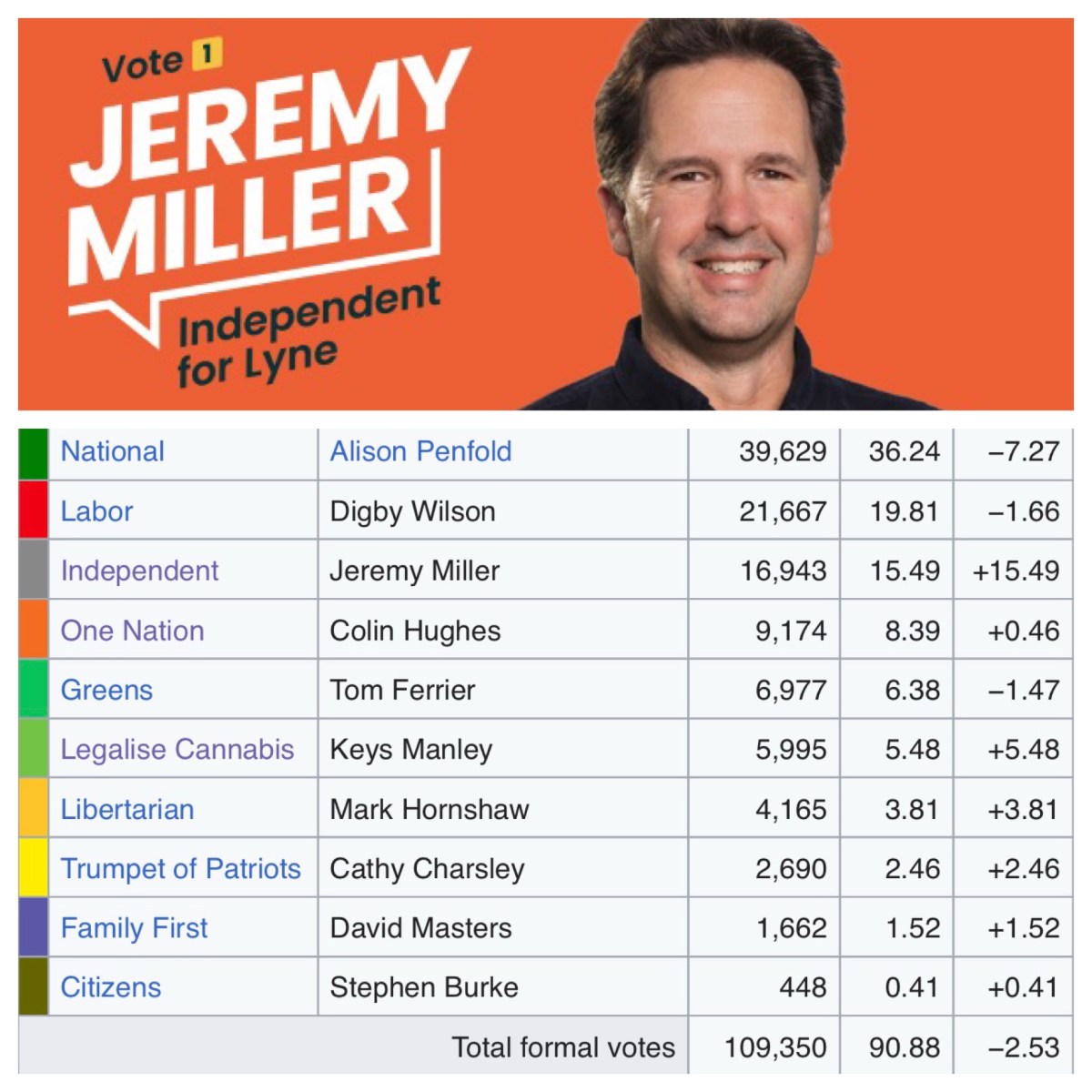
“So how did your bloke go?” Have you been asked this question in the weeks since the election? Recently a group of local leaders and volunteers in the Jeremy Miller for Lyne campaign met with members of the central campaign team to look at the future for an Independent candidate in Lyne. As part of that exploration, we heard an overview of what the polling in the booths reveal about how “our bloke” Jeremy actually went in the 2025 election.
1 The overall result
Now that the poll has been declared, we know the big picture: he didn’t win the seat—but, realistically, that would have been a huge achievement, which was somewhat unexpected. Yet, he did do remarkably well for a first-time community-supported candidate. Jeremy gained just under 16% of first preferences across the whole electorate, which was about 8% more than the votes that independent candidates gained in the 2022 election.
And by the way: that 8% came from an 8% swing away from the Nationals candidate, for the 36.24% of first preference votes for the Nationals candidate was a healthy 7.27% less than the first preference votes for the Nationals in the 2022 election— and a massive 20% less than the 56.31% of first preferences that voters gave to the National Party way back in the 2004 federal election. That’s been a significant drop in the Nationals votes over the past two decades. Do they really think they are serving the electorate well, if one in five voters has stopped supporting them?
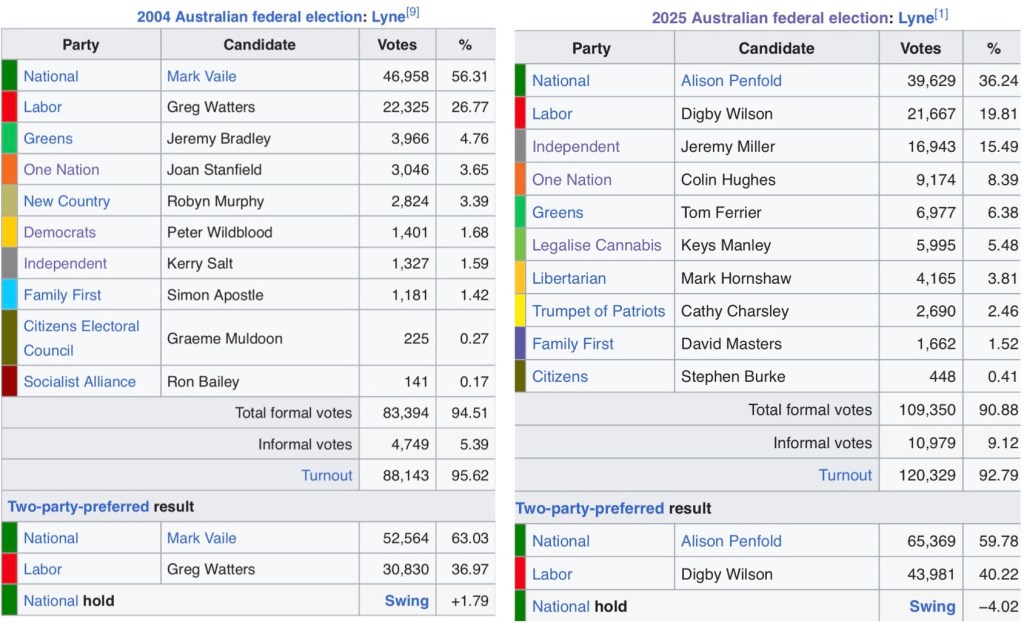
Looking at the longer-term trends, like this, as well as the detailed votes from booths across the electorate (discussed below) certainly indicates where our attention needs to be focussed in the next election in 2028: on “soft” Nationals voters who are open to being persuaded to change the way they vote. Are they happy with how the electorate is being represented in Canberra? Or are they discontent with the way the Lyne electorate is being treated? Might they be open to a different way of seeing things? After all, “if you want things to change, you need to change the way you vote”.
2 Where Jeremy polled best of all
If we look at the first preference votes cast booth-by-booth, we can see that in a good dozen or so booths, Jeremy’s vote was over 20%. He did best at Tinonee, with a wonderful 28.82% of first preference votes (more than the Labor vote and just under the Nationals votes) and at Old Bar, with 27.6% of first preferences there (ahead of both Labor and Nationals). At Taree West, where he attracted 26.2% of first preferences, he received the same number of votes as the Nationals and almost double the votes for Labor.
A more detailed breakdown of statistics indicates that Jeremy did indeed gain votes “where it matters”—in the larger population areas of Greater Taree and Forster—Tuncurry, where 40% of the voters live.
That detailed breakdown (which you can skip if figures befuddle you) is: in the Taree area, where Jeremy’s recognition is high, he attracted over 20% of the vote at Tinonee (28.82), Old Bar (27.6), Taree West (26.28), Cundletown (25.31), Purfleet (24.00), Chatham (22.08), and Taree (21.85). The exception in this area was the lower vote of 18.5% at Taree North. Nevertheless, all of these booths are significantly higher than the 15.8% primary vote across the electorate.
Further south, in Forster—Tuncurry, the best results were achieved at Pacific Palms (24.17, higher than each of Labor and the Nationals), Coomba Park (21.67), Forster East (21.67), Forster (21.50), Bungwahl (20.55), and Tuncurry (17.09). Other good results in this part of the electorate were at Hallidays Point (23.11) and Diamond Beach (24.78). At Lansdowne, Jeremy received 19.69, and at Coopernook 16.81, whilst at the two booths in Wingham, Jeremy secured 16.84 and 14.20. Again, these booth results are higher than the average.
So this is further cause for reflection: what was it in these particular areas that helped Jeremy to push his vote up, higher than the 15.8% average for the whole electorate? Clearly, the fact that he lives in the area and that he is a very active Councillor on the MidCoast Council must both have helped in securing that higher vote. Being “known” in these areas was a strong positive for Jeremy. These results again point to an area where our energy might best be focussed in the time leading up to the next election (presumably in 2028).
The largest blocks of voters live in the two main urban areas—Greater Taree (including Wingham, Old Bar, and surrounds) and Forster—Tuncurry. This is where the influence of the National Party is less, by comparison, than it is in the inland rural areas. And these are amongst the areas in the electorate where we might expect population growth in future years. How do we plan and implement effective campaigning in these areas in the next few years?
3 In other places across the electorate of Lyne
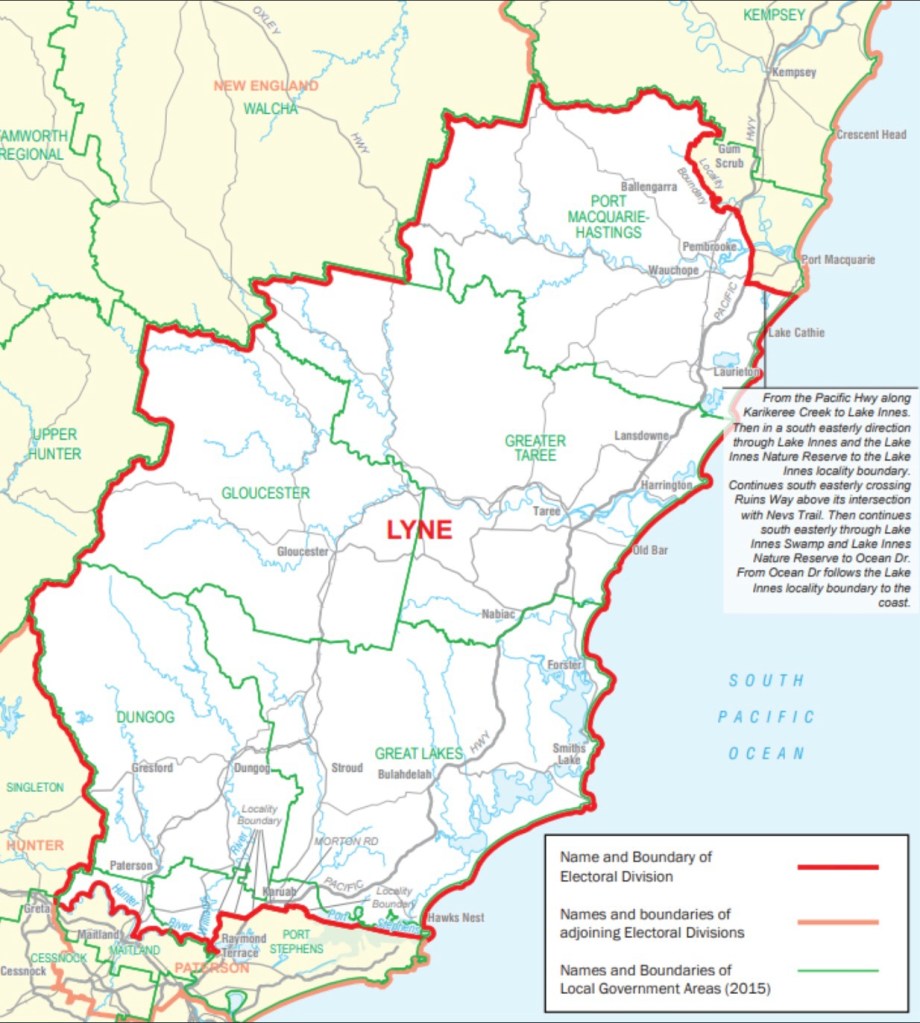
In the north of the electorate, at Barrington, Jeremy secured 20.99, and in Gloucester itself 16.38. In Wauchope, he obtained fewer votes: 11.28 at Wauchope and 10.53 at Wauchope South. Nearby in Beechwood, the vote was 13.26, and in King Creek 15.27. These are promising results, offering a good base for future campaigning.
In the Dungog Shire, there was a good result at Paterson (16.46), and less at Seaham (12.59), Dungog (12.57), and Clarence Town (11.92). Closer to the coast, Jeremy’s share of the votes ranged from Krambach (17.00) to Bulahdelah (11.01) and Karuah (10.19). In polling places in the Port Stephens Council, votes ranged from Hawks Nest (16.74) to North Arm (14.13) and Tea Gardens (12.60).
4 Votes for Jeremy and votes for Labor
Another area of particular interest is in the area immediately to the north of Maitland which are currently included in the very southern end of the electorate. Whilst some votes for Jeremy were under 10% (in the more rural locations), better results were gained at Largs (10.81%), Lorn (11.67%), and Bolwarra (11.86%). These percentages are still below the average vote across the whole electorate. But a significant factor in this area is the support for Labor.
At these three polling booths, Labor’s share was consistently over 27%, although in Lorn it was 40.14%, the highest of all the booths in Lyne. This reflects the strong Labor base in Maitland itself (where the seat of Paterson saw a swing of 4.2% to Labor, despite the massive resources allocated to this seat by the Liberal Party). Making any headway in this area by attracting hesitant Labor voters would need a sustained campaign leading into the 2028 election.
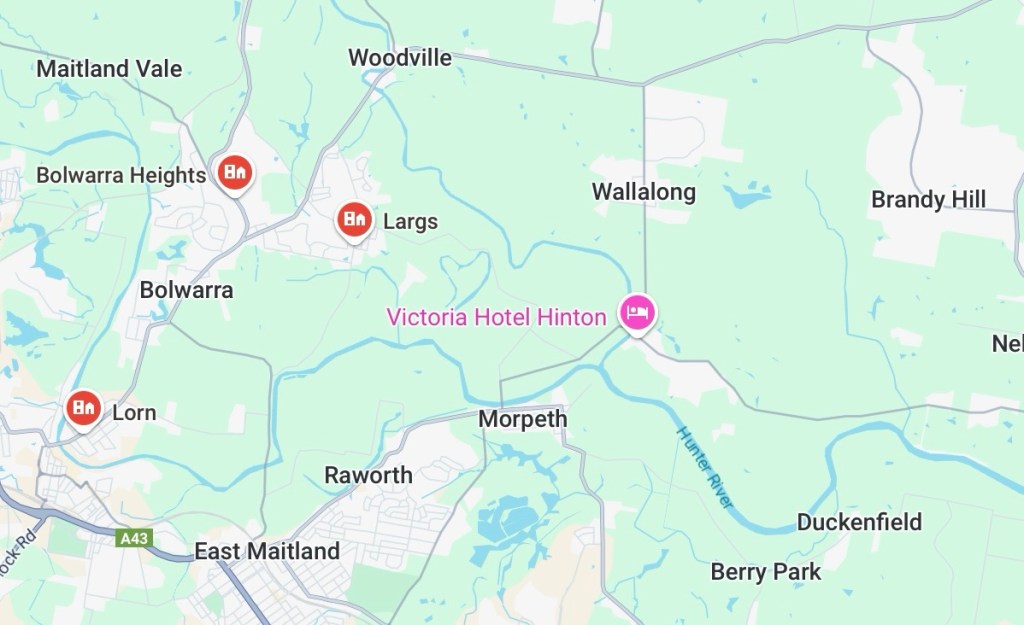
And finally, if we look to places where Jeremy polled better than Labor, we can see some striking margins. At Old Bar, the 27.66 primary vote for Jeremy was greater than Labor’s 18.59. There were good margins also at other eight booths in this region: Taree pre-polling (21.93 to 16.47), Taree (21.85 to 14.94), Taree West (26.28 to 14.46), Cundletown (25.31 to 10.05), Chatham (22.08 to 15.35), Tinonee (25.82 to 13.64), Taree North (18.50 to 17.22), and Wingham West (16.84 to 13.46).
Jeremy also secured more votes than Labor at another seven polling booths: Hallidays Point (23.11 to 16.49), Diamond Beach (24.78 to 16.34), Pacific Palms (24.17 to 21.87), Krambach (17.00 to 14.41), Beechwood (13.26 to 12.80), King Creek (15.27 to 14.34), and Barrington (20.99 to 14.36). In all cases except for Old Bar and Pacific Palms, however, the Nationals still out-polled both Jeremy and Labor at these booths.
5 The future
So we can see from this just how well “our bloke” Jeremy did, and also just what work lies ahead for an even more successful campaign in 2028. I hope that lots will stay on board and even more sign up for that ride!
***** ***** *****
Written by John Squires, Member of the Central Campaign Team for Jeremy4Lyne, drawing on data prepared by James Foster, Polling Coordinator, Central Campaign Team, and data on the website of the Australian Electoral Commission.
See also


 An Informed Faith