

Racing happens around the year around Australia. At least 168 horses were killed on Australian racetracks in the last racing year. This equates to one horse suffering a painful, life-ending injury in the name of gambling profits every two days. This is almost entirely made up of the deaths made public from official race day reports.
Countless other horses are taken away from the racetrack and killed behind the scenes when it is clear they cannot (or were chosen not to) be saved. Fifty-one of these deaths occurred past the winning post, meaning many horses were suffering injuries whilst being beaten and pushed beyond their limits to the finish line.
Whilst the racing industry is spending big bucks on advertisments aimed at luring back Australia’s trust in the Melbourne Cup and spruiking new Spring Carnival safety measures, the thousands of other horses forced onto racetracks across the rest of the year are being forgotten. Those are the horses who make up the vast majority of deaths on track and nothing is being done to protect them, simply because they are not Melbourne Cup runners who attract the media spotlight.
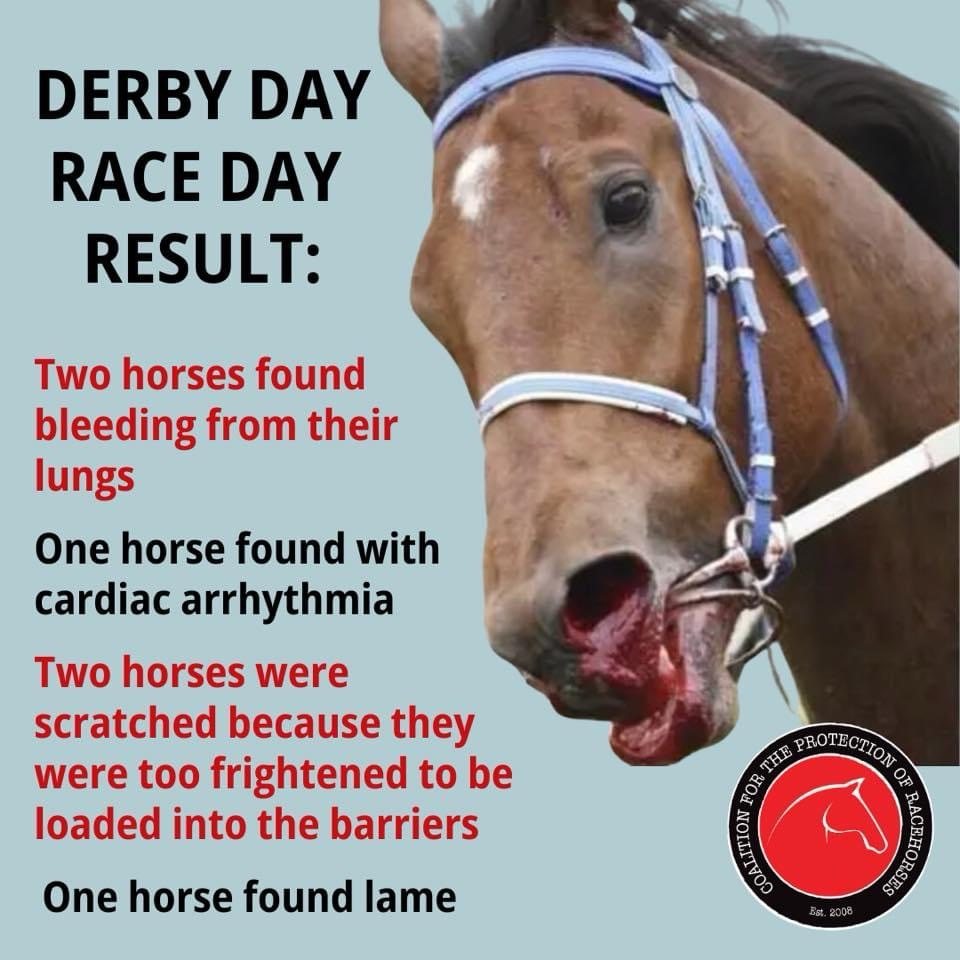
On Derby Day just a few days ago, at the Flemington Racecourse and Victoria Racing Club, two horses, Traffic Warden and Oxford Blue, were found to be bleeding from the lungs after the race. Two other horses, Hurry Curry and Ziggy Rose, were both panicking so badly that they were unable to be loaded into the barriers. Another horse, Bodyguard, was found lame, and Scary was found suffering cardiac arrhythmia. This happens with regularity on racecourses around Australia.
Lots of money is gambled on horses. A recent study calculated that turnover in Australia was $29.144 billion. This was an increase of $1.910 billion or 7 per cent from 2020–2021. A study entitled Household, Income and Labour Dynamics in Australia (HILDA) Survey, from 2015, estimated that nearly one million Australians regularly gambled on horse and dog racing. Most race bettors were men, and aged between 30 and 64. Their typical monthly expenditure on race betting amounted to $1,300 each over the year. Some 400,000 experienced one or more gambling-related problems.
In a typical month, the survey report commented, 41 cents in every dollar spent on race betting by regular race bettors came from a person with moderate to severe gambling problems. The Australian Institute of Health and Welfare states that in Australia about $25 billion was lost on legal forms of gambling in 2018–19.
Harm from gambling is not only about losing money or financial problems, gambling harm can also include: health problems including emotional, psychological distress or physical issues — issues with relationships with family or friends — problems with work or study — cultural problems — and criminal activity.

According to the Vic Health report Drinking cultures and social occasions: Alcohol harms in the context of major sporting events, there is a significant rise in acute alcohol intoxication, assault, and motor vehicle accidents on Melbourne Cup Day. This is especially noted in men and young people. Police have also recorded that family incidents of assault ‘were significantly elevated on Melbourne Cup.’ Celebrations on Melbourne Cup Day put a strain on the public health system in Victoria. Ambulance attendances, emergency department presentations and hospital admissions due to intoxication and assault rise in the days leading up to Melbourne Cup and on the day itself.
In 2021, the amount spent in betting on the Melbourne Cup was $221.6 million. Total spending on the race averaged out at almost $180 for each adult in Australia; this includes both bets placed as well as money spent workplaces around the nation for their social events relating to the day.
*****
I have drawn the text and statistics above from various sources, including:

 An Informed Faith