“Male and female he made them” … and more? (Pentecost 20B; Mark 10 and Gen 1)

The lectionary Gospel reading for this Sunday (Mark 10:2–16) reports an encounter between Jesus and some Pharisees—the first such encounter in Judea, as earlier encounters had been in Galilee. I have already explored this story in the context of the cultural and religious context of the time, in late Second Temple Judaism.

In the debate that takes place in this encounter, Jesus quotes from the first creation story, the grand priestly narrative that occupies pride of place at the start of Bereshith, the first scroll of Torah, and thus at the beginning also of the scriptures collected by the followers of Jesus that formed what we know as The Holy Bible.

Words in origin stories have a particular power—and origin stories, such as this one (Gen 1:1–2:4a), are chosen with care and deliberation. That is certainly the case with this particular verse. In debating the Pharisees, Jesus says, “from the beginning of creation, ‘God made them male and female’” (Mark 10:6).

Here Jesus uses the verse as the claim that seals his particular stance regarding divorce—that it was not part of the plan that God had for humanity, since the male—female gender structure is integral to our humanity, and underscores his conclusion regarding divorce, that “what God has joined together, let no one separate“ (Mark 10:9). This, in turn, is his deduction from what the second creation story sets forth about marriage, that “a man leaves his father and his mother and clings to his wife, and they become one flesh” (Gen 2:24; quoted at Mark 10:7–8a). See

The statement by Jesus that God made human beings as male and female sounds like a definitive declaration: this is the reality, this is who we are, there is nothing more to debate! Certainly, that’s the way this verse has been used in the “gender wars” that have swirled through western societies in recent times. “God made male and female” became “God made Adam and Eve, not Adam and Steve”, in an early salvo against the emerging number of people who were “outing” themselves as same-gender attracted. “Not so” was the sloganeers’ reply; two genders, each attracted to the opposite, is who we are. Definitively. Resolutely. Absolutely.

It’s worth going back to the quote from Genesis in its original context. What the priestly authors of the creation story wrote was “God created humankind in his image, in the image of God he created them; male and female he created them” (Gen 1:27). The emphasis is not so much on defining who we are are gendered people—but rather, the verse is reflecting on the amazing feature that, within humanity, signs of divinity are reflected. And in association with that, the statement indicates that the two genders familiar from humanity are somehow reflected in the very nature of God.
As God’s creatures, we are images of that creating being. The Hebrew word used, tselem (image), indicates a striking, detailed correlation between the human and the deity. This was the insight brought by the authors of this passage, perhaps shaped and honed over generations of telling and retelling the story, passing on through the oral tradition the insights of older generations.

My sense is that these ancients were not so much making a definite declaration about the nature of humanity—an early dogmatic assertion, if you like—as they were actually reflecting on their experience. They sensed that there was something within humanity that reaches out, beyond the material, into the unknown, beyond the tangible, into “the spiritual”. They surely knew the kind of experience that Celtic mystics have known, of coming to a place where “heaven meets earth”—what they call “a thin place”, where God can be sensed in the ordinariness of life. Indeed, such a “thin place” might well be being described in Gen 28:10–22, where Jacob comes to the realisation that “surely, the Lord is in this place” (Gen 28:16).

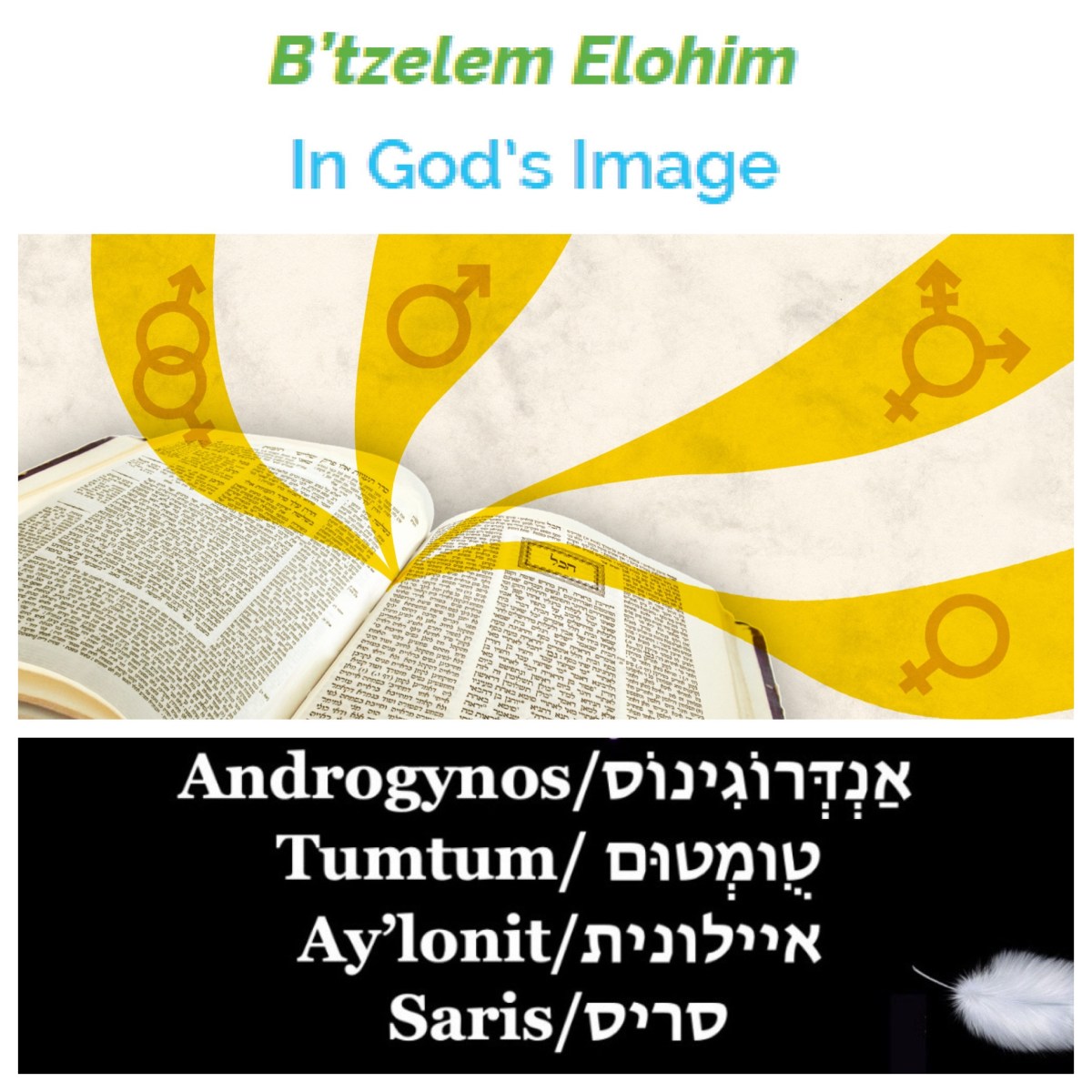
Indeed, as Jewish tradition developed over time, this fundamental duality of human gender—male and female—was questioned, probed, explored, and developed. Rabbis of late antiquity and the early medieval period (using the standard Western terminology) actually identified six genders. The first move takes place in the Mishnah (early 3rd century). Tractate Bikkurim 4.1 contains the assertion, “an Androginus (a hermaphrodite, who has both male and female reproductive organs) is similar to men in some ways and to women in other ways, in some ways to both and in some ways to neither”. It is interesting that the term androginus, a Greek term, is simply transliterated in this Aramaic work, as אדדוגינוס. That’s a sign that the consideration of this issue encompassed more than just rabbinic scholars, as they were drawing on insights and term androginus from the hellenised world.
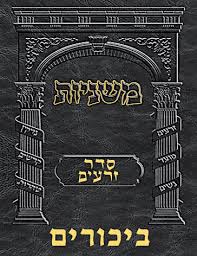
The tractate Bikkurim (first fruits) is part of the first order
of the Mishnah, entitled Zera’im (seeds).

The text of Bikkurim goes on to offer indications of the ways that an androginus person is similar to, and dissimilar to, each gender (4.2–3). Another passage in the Mishnah identifies people known as a saris, סריס (Yevamot 8.4). These are people we identify as eunuchs; whether these are “eunuchs who have been so from birth … eunuchs who have been made eunuchs by others … [or] eunuchs who have made themselves eunuchs” (as Matthew reports Jesus saying, Matt 19:12) is not relevant in this context; but we do meet such a person at Acts 8:27. Presumably, the rabbis refer to males with arrested sexual development who are unable to procreate.  The female term for such people is given as aylonit, אילונית. The discussion that follows makes it clear that these people are women with arrested sexual development who cannot bear children.

So this means that rabbis recognised four genders: male, female, androgyne, and eunuch. In the Babylonian Talmud (sixth century CE), Rabbi Ammi is quoted as stating that “Abraham and Sarah were originally tumtumim” (טומטמין). Here we find another gender identity term; this time, describing people a person whose sex was unknown because their genitalia were hidden, undeveloped, or difficult to determine. (The Hebrew word tumtum means “hidden”.)

Thus, Abraham and Sarah lived most of their life as infertile, as their sex was not clear; and then, in Rabbi Ammi’s explanation, miraculously turned into a fertile husband and wife in their old age. The Rabbi points to Isa 51:1–2, saying that the instruction to “look to the rock from where you were hewn, and to the hole of the pit from where you were dug […] look to Abraham your father and to Sarah who bore you” explains their genitals being uncovered and miraculously remade.

(Explaining one scripture passage by drawing on another passage, however distantly related—often through their sharing a common word or phrase—was a common rabbinic mode of scripture interpretation.)

Today, we would explain the phenomenon of a tumtum as being an intersex person, born with both male and female characteristics, including genitalia—although modern science would not go so far as to accept a miraculous reversal of the condition, as Rabbi Ammi proposed. 
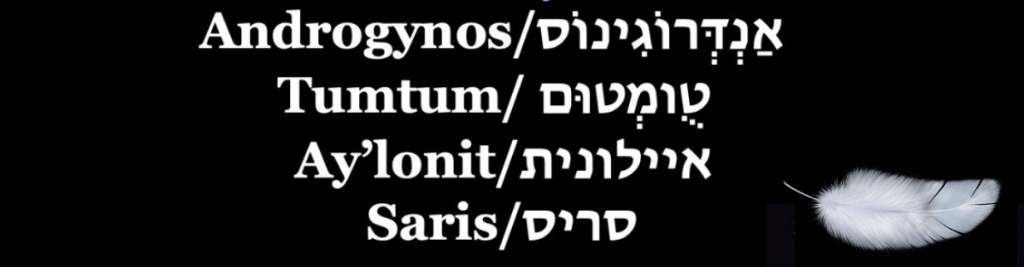
There’s a quite accessible discussion of these issues in an article on My Jewish Learning by Dr Rachel Scheinerman, entitled “The Eight Genders in the Talmud”. The title reflects the fact that Dr Scheinerman divides both aylonit and saris into two, on the basis of birth identification. So she lists: (1) zachar, male; (2) nekevah, female; (3) androgynos, having both male and female characteristics; (4) tumtum, lacking sexual characteristics; (5) aylonit hamah, identified female at birth but later naturally developing male characteristics; (6) aylonit adam, identified female at birth but later developing male characteristics through human intervention; (7) saris hamah, identified male at birth but later naturally developing female characteristics; and (8) saris adam, identified male at birth and later developing female characteristics through human intervention.

Dr Scheinerman concludes, “In recent decades, queer Jews and allies have sought to reinterpret these eight genders of the Talmud as a way of reclaiming a positive space for nonbinary Jews in the tradition. The starting point is that while it is true that the Talmud understands gender to largely operate on a binary axis, the rabbis clearly understood that not everyone fits these categories.”

https://www.myjewishlearning.com/article/the-eight-genders-in-the-talmud/
Dr. Charlotte Elisheva Fonrobert, a Talmudic scholar in the Department of Religious Studies at Stanford University, California, has provided a much more detailed and technical discussion of the matter of gender identity, in the online resource the Jewish Women’s Archive. See 

https://www.myjewishlearning.com/article/the-eight-genders-in-the-talmud/

The abstract of this article reads:

“Jewish law is based on an assumption of gender duality, and fundamental mishnaic texts indicate that this halakhic duality is not conceived symmetrically (as seen through the gendered exemptions of some commandments). Rabbinic halakhic discourse institutes a functional gender duality, anchored in the need of reproduction of the Jewish collective body. As such, it aims to enforce and normalize a congruence between sexed bodies and gendered identities. Furthermore, the semiotics of body surfaces produces other different and seemingly more ambiguous gender possibilities, and rabbinic discourse has widely discussed the halakhic implications of these ambiguities.”

What that means, I think, is that whilst Torah prescriptions are based on a definite duality of gender (you re either male or female), later rabbinic discussions entertained the possibility of a range of gender identifications. In this regard, the rabbinic discussions prefigured the move in contemporary society to recognise the full spectrum of diversity amongst human beings: some men are gay, some women are lesbian; some people are bisexual, attracted to both genders, while others are asexual, having no sexual-attraction feelings at all.

Biologically, we know that some are born intersex, with both male and female physical characteristics; whilst psychologically, some people are born into a body that is clearly one gender have an internal energy that leads them to identify with the opposite gender, and so they undergo a medical transition to that gender, and we identify them as transgender people. And so, we have the now-widespread “alphabet soup” of LGBTIQA+ (where the plus sign indicates there may well be other permutations within this widely diverse spectrum).
So we would do well not to remain in a static state of assertion that the Genesis text is a prescription for how human beings should be identified (and a definition for marriage). I think it is preferable to add into the discussion both the rabbinic understandings,  contemporary medical understandings, and psychological insights that reveal a wide spectrum of gender identities; a dazzling kaleidoscope of “letters”, as it were. For this is how we human beings are made, in an image that reflects the diversity and all-encompassing nature of God. Rather than misusing the Genesis/Mark text as a club to batter people into submission, let’s rejoice in the diversity we see amongst humanity, and affirm that, no matter whether L or G, whether B or A, whether T or I, all people who are Q, and all who are straight, are “fearfully and wonderfully made” (Ps 139:14).
There is a helpful collection of Jewish texts relating to this matter in the online resource, Sefaria, entitled “More Than Just Male and Female: The Six Genders in Ancient Jewish Thought”, collated by Rabbi Sarah Freidson of Temple Beth Shalom in Mahopac, NY, USA. See

https://www.sefaria.org/sheets/37225?lang=bi

See also 
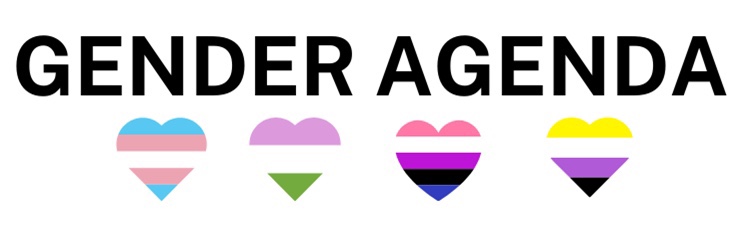
 

The gender agenda: a multiplicity of matters

Over the past week, I’ve been aware of a number of happenings that point to the continuing shifts within the Christian church relating to the matter of gender. Some of these events have been encouraging. Some have been disappointing. Some raise serious questions. Others offer occasion for great joy. Together, they point to the gender agenda, which continues to agitate the churches. It’s something that involves a multiplicity of matters.

This week has been Transgender Awareness Week. On Sunday evening, the Rainbow Christian Alliance met at Tuggeranong Uniting Church in Canberra. There was sharing, as there is always is, but with a particular focus at this meeting on the stories of transgender members of the group. It was a rich time, celebrating the way that people have been able to be “true to themselves” and express that inner reality in the ways that they dress, relate, and function within society—and, indeed, undertake the daunting process of hormone replacement therapy and even surgery to fully assume the actual gender identity as a manifestation of their inner, real person.

I have reflected on the week in my blog, at

On the same weekend, the Baptist Union of NSW and the ACT held one of their regular gathering of representatives from across the state and territory, at which the issue of gender was to the fore. Specifically, discussion was held and then a decision was made, that Baptist pastors and churches which were agreeable to marrying couples of the same gender would be asked to affirm “the traditional understanding of marriage”—that is, that marriage involves always a male and a female—or that they leave the association of Baptist churches.

There is a blog by one Baptist pastor who feels that he is unable to affirm that “traditional understanding of marriage”; he has described the experience of that all-day meeting as being akin to “a casual crucifixion”—a searingly potent, and deeply saddening, description.

The blog by Will Small is at https://www.willsmall.com.au/words/a-casual-crucifixion-i-never-gave-a-shite-about-being-a-baptist-until-someone-else-decided-i-couldnt-be

There is also a fine article by Erin Martine Sessions, another member of the gathering, at https://www.abc.net.au/religion/have-baptists-just-sold-their-soul-over-same-sex-marriage/

The Baptists, sadly, have taken an approach to this particular issue of same-gender marriage that has recently led to a split in the United Methodist Church; see my reflections at

I have also written a series of blogs exploring how such an aggressive approach to the gender agenda has been prosecuted—unsuccessfully, fortunately—within the Uniting Church in Australia.

My posts on these various groups are at

and

It is sad to see the same divisive development taking place within the Baptist fellowship.

An event that took place during the week was the funeral of a Roman Catholic priest, Father Peter Maher. This was noteable for various reasons; for a start, there were three bishops and many priests in attendance. I’ve known Peter for five decades, and can attest to his valued ministry and important contribution to the consideration of the gender agenda within the Roman Catholic Church in Australia.

Peter was a strong advocate, throughout his ministry, for “the least and the lost”, and especially, in recent decades, for members of the LGBTIQA+ community. His weekly Mass for rainbow people, held at St Joseph’s Church in Newtown, attracted people and was the basis for the formation of a wonderfully extensive community of people of faith who identify with sexual or gender diversity.

Peter’s funeral signalled the lifetime of work devoted, in various ways, to the gender agenda—affirming, supporting, counselling, encouraging, and advocating for, the many people of faith (and of no faith) within the broad LGBTIQA+ community. There have been many tributes to Peter posted online, which I have canvassed in a blog post at

A fine tribute to Peter is at https://www.misacor.org.au/item/28929-rip-peter-maher-vigorous-priest-sydney-longtime-editor-of-the-swag

And then, on Friday night, a celebration of 30 years since the Anglican Church ordained women as priests was held in St John’s Anglican Cathedral in Brisbane. The issue of the ordination of women was a focus of intense debate and discussion throughout the Anglican Church for many years. Most dioceses throughout Australia came to a view that this was a most reasonable course of action; a few renegades, spurred on by the sectarian leadership in Sydney, dug their toes in and resisted at every step of the way.

But the truth of the Gospel shone through, and women were ordained in Goulburn—Canberra, Brisbane, and Perth Dioceses, in 1992, and the in many other places in the ensuing years. The celebration in Brisbane recognised an important step forward in addressing the gender agenda in the Anglican Church. An exhibition marking this step forward can be seen at

It would be tempting of me to end this review of recent events with a smug, self-satisfied comment about the ways that the Uniting Church in Australia (and, indeed, its three predecessor denominations) has been a trailblazer in many ways relating to the overarching gender agenda—ordaining women, female quotas to ensure diversity, ordaining gay and lesbian ministers, marrying same-gender couples, and so on.

However, just this past week, I was part of a conversation in which I observed that the particular Uniting Church Congregation, throughout the whole 45 years of its existence, had had a string of white male ministers in placement with them. In that conversation, I was told that before the current minister was called, one key person in leadership in that Congregation advised the Presbytery, “we won’t accept any minister other than a white male”.

So we, too, have work still to be done. The gender agenda remains a live concern. The gender question remains firmly on our agenda in the Uniting Church. There is still much work to be done.

See also

Transgender Awareness Week

Every year on 20 November, we pause for the Transgender Day of Remembrance. The week before that day is designated as Transgender Awareness Week. Individuals and organizations participate in this week to help raise the visibility of transgender people and address issues members of the community face.

My own awareness of Transgender people (the T in LGBTIQA+) has been a slow and gradual process of increasing awareness and understanding. Whilst trans people have been a reality in humanity ever since when, the public discussion of such people has been slow to emerge, only picking up visibility in the public arena in recent years.

In considering the sexuality of people, we have become familiar with the terms “gay” and “lesbian”—male and female people, respectively, who are attracted sexually to people of the same gender as they are—as well as “bisexual” (attracted sexually to people of either gender) and “asexual” (people who have no feelings of sexual attraction to others).

Alongside the terms that relate to our sexuality, there are terms that relate to gender. To put it simply (perhaps to oversimplify), if sexuality is about how our feelings of attraction are expressed, then gender is about how we identify ourselves, in terms of being male or female, the traditional terminology used over the centuries.

Often the genitals found on a person determine how gender is assigned. Think the classic film scene of a woman giving birth—after the mandatory cry from the baby, to assure people present that the newborn is breathing, the next matter is, “is the baby a boy or girl?” A quick look at the genitals—is there a penis or a vagina?—usually provides the answer to that question. Although, these days, for an increasing number of births, the gender of the baby has been explored and determined by means of ultrasounds, so more and more, parents already know the gender of their child.

However, as we have become aware in recent times, not everybody is born as clearly identifiable as either male, or female. The vast majority of people are; but for a significant minority, they may have been born with both male and female genitals. A superficial inspection may mean that answering the question, “boy or girl?”, can’t be readily answered. Such people are identified under the letter I , LGBTIQA+, I being short for Intersex.

For other people, whilst the genital determination of their gender is straightforward, the actual sense that such individuals have of their own innate gender is more complex. The deepest meaning of gender, is that is describes who you really are; what you feel, inside yourself, that your actual identity is. It is far more internal than it is external.

For the majority of people, they are cis-gendered—that is, their assigned gender correlates exactly with their physical body and their innate sense of who they are. (The prefix cis- comes from the Latin word which means “on this side of”; it is the opposite of the Latin word trans, meaning “on the other side of”. ) However, for others, these feelings may not necessarily fall into the assumed, “natural” category that is conveyed by their genital configuration. These are people who are referred under the letter T, standing for transgender.

In short, someone who is transgender most likely does not feel that “who they are” on the inside matches their assigned gender on the outside. This is quite different from intersex; it is a matter of personal psychology and self-understanding. Indeed, more recent scientific studies indicate that there may be differences in the white matter tracts in the brain between cisgender (agreement between gender and sex) and transgender men and women. See https://www.jneurosci.org/content/34/46/15466

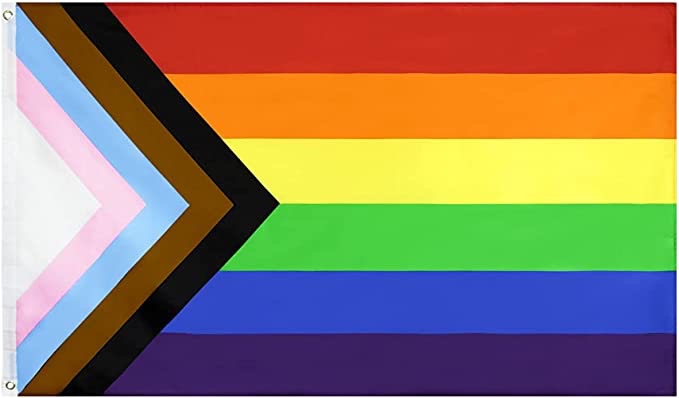
The transgender flag, created in 1999, uses the stereotypical colours, “blue for boys, pink for girls”, and splice in the colour white, signalling those undertaking transition from one gender to another. With the T and I colours, they have been added to the now-traditional rainbow flag, representing LGB people, along with black and brown stripes, to represent marginalized LGBTIQA+ communities of colour. It is an ever-evolving symbol!

One important aspect of the recent discussion about transgender people relates to the emotional cost that comes with living in a body that does not correlate with the realities of emotions and experiences that they have. This is often called “gender dysmorphia”; the Mayo Clinic defines this as “the feeling of discomfort or distress that might occur in people whose gender identity differs from their sex assigned at birth or sex-related physical characteristics”. See https://www.mayoclinic.org/diseases-conditions/gender-dysphoria/symptoms-causes/syc-20475255

Those who are closely related to people who are experiencing such “gender dysmorphia” would do well to take careful advice about how they can support people through this process. See https://facty.com/lifestyle/wellness/what-does-transgender-mean/

Transgender people may choose to undertake a slow, lengthy, graduated process of transitioning from their assigned gender, into their innate gender. This may start with a time of sharing with people closest to them about their inner feelings. They may then adopt the clothing and grooming habits of their desired sex. Some may change their name at this point, or later.

The availability of hormone therapy means that transgender people who are transitioning are able to assist their bodies to take on the various characteristics of the gender to which they are transitioning. Likewise, they may decide to proceed with surgeries to modify their bodies to reach an external expression of the gender they are internally. Both hormone therapy and surgery are undertaken in close conjunction with counselling sessions from appropriately qualified people, to inform, guide, and support people through the transitioning process.

Such processes must, surely, be emotionally challenging and personally costly for transgender people. However, as I have been learning from friends that I know who are transitioning or who have transitioned, the deep-seated inner sense of “this is who I really am” is the primary factor that drives the complex process of transitioning. Empathic and patient listening, embedded within a non-judgemental attitude which is open to hearing and learning new things, is the best gift that a cis-gendered person can give to a person who is undergoing, or has competed, transitioning.

Being true to oneself is a virtue that has long been lauded in our society. “This above all: to thine own self be true, And it must follow, as the night the day, Thou canst not then be false to any man”, says Polonius in Shakespeare’s play, Hamlet. In Ancient Greece, a well-known saying connected with the Adelphi Oracle was “know thyself”. The famous existentialist philosopher, Sören Kierkegaard, advised that “Not to be one’s self, as God created you, is despair”. There is plenty of good philosophical and ethical consideration of the importance of being true to oneself.

For myself, there is a strong theological affirmation that also undergirds this issue. It comes from the opening story of scripture—the story of creation. When God created Adam from the earth, God breathed the breath of life into the human, and Adam became a nephesh, a living being (Gen 1:30; 2:7). All human beings—indeed, all living creatures—are given life by God’s spirit and share the essence of a nephesh (Ps 104:24–30; Job 12:7–10). That is the fundamental feature of all of God’s created beings.

This is what God first declared to be good (Gen 1:21, 24)—indeed, to be very good (Gen 1:31). So, as human beings, how we were made (straight or gay, identifying as male or female, or sensing that our biological gender does not match our inner sense of gender) is good; God made us that way, we are called to be true to ourselves, honest about our identity, comfortable in our own skin.

Transgender Awareness Week is a week when transgender people and their allies take action to bring attention to the community by educating the public about who transgender people are, sharing stories and experiences, and advancing advocacy around the issues of prejudice, discrimination, and violence that affect the transgender community. It is a good thing for each of us to make sure we are aware of the reality of Transgender people, and to ensure we relate sympathetically and encouragingly to such people when we uencounter them.

See also https://johntsquires.com/2022/05/04/moving-ahead-as-an-inclusive-respectful-community/