Limping priests and the counsel of perfection (Gen 32; Pentecost 10A)

When the priests of Judah returned to their homeland after decades in exile, they wrote down their ideal as to how the people should worship God and honour God in their lives. An integral part of that system of worship was the offering of the tamid, the daily sacrifice, “two male lambs a year old without blemish, daily, as a regular offering; one lamb you shall offer in the morning, and the other lamb you shall offer at twilight.” (Num 28:3). The importance of offering a perfect lamb, without any blemish, was paramount.

In parallel with that, every priest also needed to be “perfect”, with no sign of blemish—“not one who is blind or lame, or one who has a mutilated face or a limb too long, or one who has a broken foot or a broken hand, or a hunchback, or a dwarf, or a man with a blemish in his eyes or an itching disease or scabs or crushed testicles”, according to Lev 21:16–24. Yoiks!

Jesus, of course, picks up on this notion of perfection when he counsels a wealthy young man who claims that he keeps all the commandments, “if you wish to be perfect, go, sell your possessions, and give the money to the poor, and you will have treasure in heaven; then come, follow me.” (Matt 19:21). This “counsel of perfection” was then developed by the evolving Christian tradition, specifically impressing upon candidates for the priesthood their need to aspire to that perfection, through vows of chastity, poverty, and obedience.

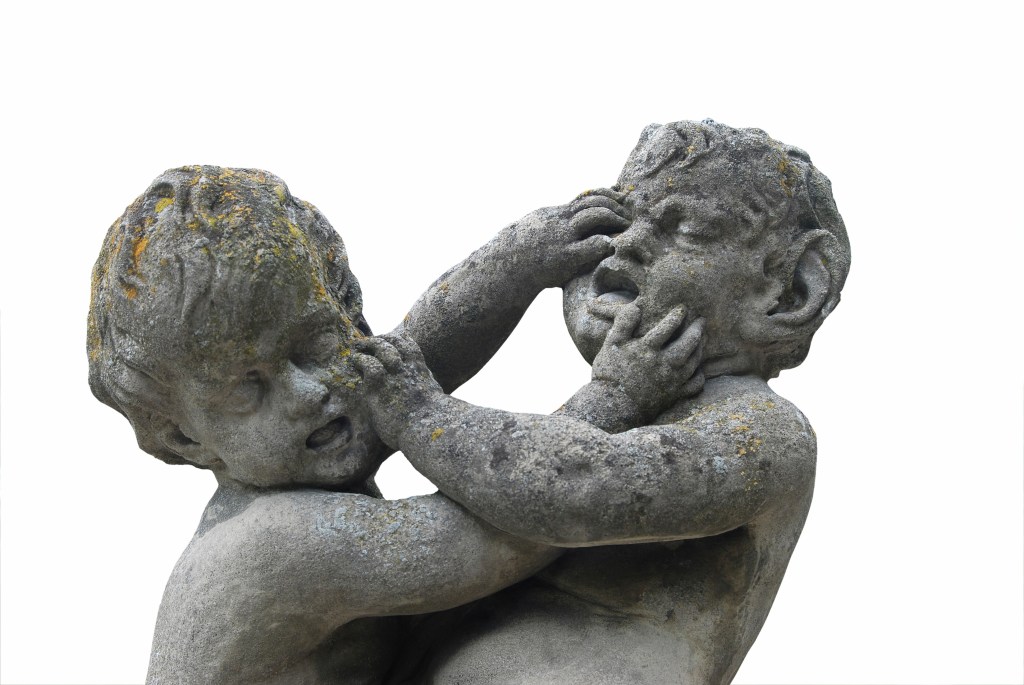
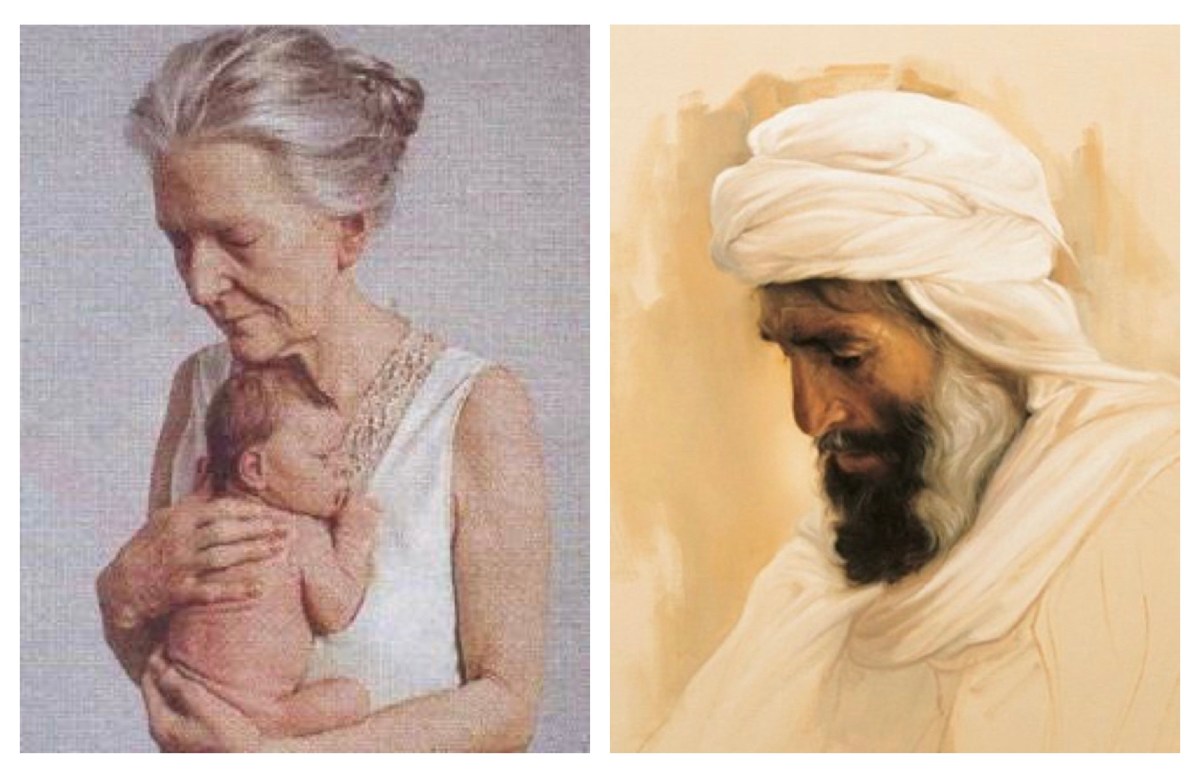
My own church, the Uniting Church in Australia, fortunately does not require its ministers to be chaste, or even poor—although we do ask for a good measure of obedience. But the image of Ministry which sits firmly with me as the primary one is not that of “being perfect”; rather, it comes from a story in the ancient sagas of the people of Israel—a story about when Jacob wrestled with a man all night.

In this story, one of the patriarchs of Israel, Jacob, “wrestled with him until daybreak; and when the man saw that he did not prevail against Jacob, he struck him on the hip socket; and Jacob’s hip was put out of joint as he wrestled with him.” (Gen 32:25). This is the story which the lectionary provides for our consideration this coming Sunday (Gen 32:22–31).

It is in this story that Jacob, the “supplanter”, is given the new name Israel, “he wrestled with God”. The patriarch Jacob, who would give his name to the people Israel, limped, because of the all-night struggle that he had at this ford in the river. One of my teaching colleagues once wrote a paper in which he developed the image of the minister as the limping priest of God. And so it has been, for me; awareness of my own limping, my emotional and psychological wrestling which has caused psychological and emotional limping, has been an important aspect of my own exercise of ministry.

I have reflected on this personal struggle and my consequent “limping”, with the help of some good company, at

I like to think that gaining insight into my own limping, as difficult as that has been, has enabled me to walk with others as they limped, to understand their pain, to provide compassionate companionship along that way. And, sometimes, to hope that people would come to understand their own limping, and see how it had thrown things out of alignment, and how they might attend to that, and rectify wrongs that may have been occasioned by their limping, their distorted walking patterns, their imperfect ways of operating—even as I regularly reflected on my own walk, my own limping, and how that, in turn, impacted the way that I ministered.

This story of the night-long wrestling and the resulting lifelong limping of the patriarch of Israel was not, of course, an account of an historical event. Like all the stories of incidents involving the patriarchs and matriarchs (Abram, Sarah, and Hagar, Isaac and Rebekah, Jacob, Leah, and Rachel, and Joseph) these ancient stories were woven together at the time of Exile for Israel.

They formed an extended narrative that provided a foundational saga for the exiled people, yearning for release from their captivity, a return to their homeland. The saga formed a national mythology, weaving together previously isolated stories that had been passed down from generation to generation, shaped and reworked by skilled storytellers. Together, they created a tapestry that represented the resilience and the hope of the peoples.

Exile in Babylon was a time when the people of Israel, as a whole, had been limping. Invaded and conquered, captured and transported, relocated to an alien landscape amongst a foreign peoples speaking an unknown language and practising strange customs, the people were dislocated, out of joint, and so they limped in their daily lives. (See expressions of their grief in Lamentations, and their anger in Psalms 42–43, 44, and 137.)

The story of Jacob—wrestling with an unknown stranger, struck at the hip, experiencing dislocation, walking with a limp—resonated strongly with them. It was told and retold as “their story”, an oral expression of their personal and national angst. It reminded them that, even in the midst of struggle and opposition, they were still, like Jacob, able to “see God face to face” (Gen 32:30).

*****

That deep level of the myth told and retold by ancient Israelites resonates still with us, today. Opposition and oppression, struggle and the fear of defeat, do not impede the possibility that we might, indeed, “see God face to face”. The story of Jacob at Penuel reminds us of this, and provides a resource for thinking about our own lives, the lives of those we know who are facing challenges, and striving (as Jacob was) to make sense of these experiences.

Jacob wrestled with a man, who turns out to be God. Paul talks about a “thorn in the flesh”, given to him “to keep me from being too elated” (2 Cor 12:7)—although he attributes this to the work of Satan, rather than God. Elsewhere, he encourages the Romans to “be patient in suffering” (Rom 12:12), and informs the Philippians that God “has graciously granted you the privilege … of suffering with Christ” (Phil 1:29).

Paul himself knows about suffering. He catalogues quite a list of what he has endured: imprisonments, floggings, five times being lashed “forty lashes minus one”, three times “beaten with rods”, stoned, becalmed, and shipwrecked; he feared “danger from rivers, danger from bandits, danger from my own people, danger from Gentiles, danger in the city, danger in the wilderness, danger at sea, danger from false brothers and sisters”, and suffered “in toil and hardship, through many a sleepless night, hungry and thirsty, often without food, cold and naked” (2 Cor 11:24–31).

From those many experiences of suffering, Paul is able to affirm that “suffering produces endurance, and endurance produces character, and character produces hope, and hope does not disappoint us, because God’s love has been poured into our hearts” (Rom 5:3–5). It seems that God is able to work through those difficult experiences—“all things work together for good for those who love God” (Rom 8:28). Suffering, therefore, is integral to God’s work with us.

When Luke, decades later, reports the commissioning of Paul, he reports the divine word to Ananias to tell Paul: “I myself will show you how much he must suffer for the sake of my name” (Acts 9:16). The narrative that follows places Paul in danger in a number of times; in looking back over his missionary activities, Luke has Paul note that he was “enduring the trials that came to me through the plots of the Jews” (20:19), and foreseeing that in the future “the Holy Spirit testifies to me in every city that imprisonment and persecutions are waiting for me” (20:23).

In the narrative that follows, Luke notes that Paul is kidnapped (Acts 21:27), beaten (21:30–3; 23:3), threatened (22:22; 27:42), arrested many times (21:33; 22:24, 31; 23:35; 28:16) and accused in lawsuits (21:34; 22:30; 24:1–2; 25:2, 7; 28:4), ridiculed (26:24), shipwrecked (27:41), and bitten by a viper (28:3). The list correlates strongly with Paul’s own words in 2 Cor 11, noted above. And beyond this, Paul has indicated that “after I have gone, savage wolves will come in among you, not sparing the flock” (20:29). Opposition and persecution is endemic in the early stages of the Jesus movement.

Yet all of this takes place under “the whole purpose of God” (20:27)—the overarching framework within which Luke has told the story of Jesus and the movement that grew from his preaching and activities. Luke, like Paul, understands suffering as integral to God’s working in the world. It is a hard message to hear when we are in the midst of the turmoil engendered by suffering; it may be possible, with hindsight, to look back on that suffering and see how good did, in the end, eventuate from it. It seems he was able to see “the face of God” in all of that, as Jacob did long ago at Penuel.

That’s what this story of the wrestling Jacob offered the people of Israel, long remembered from the past telling of stories, now taking on a deeper and more central significance as they returned from the decades of suffering in exile in a foreign land. Out of suffering, something amazingly good is able to emerge. May this ancient story of wrestling and limping, of striving with God and so seeing God “face to face”, offer us the same encouragement in our lives, today.

*****

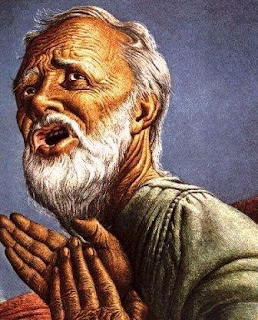
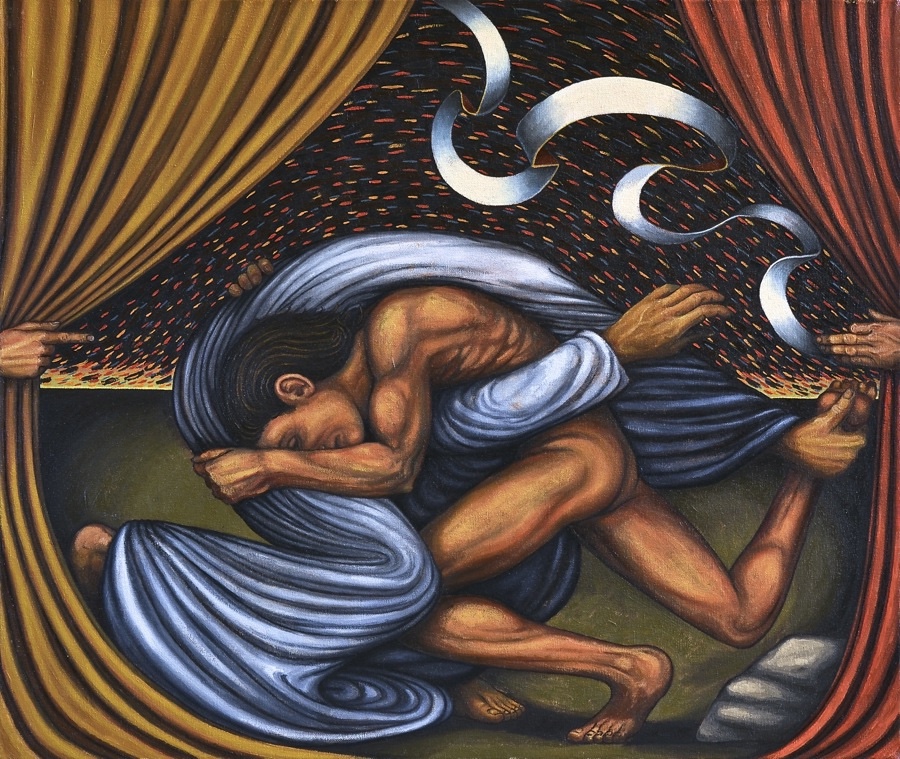
The cover image, “Jacob wrestling with God” by Jack Baumgartner, if from Image. https://imagejournal.org/artist/jack-baumgartner/jacob-wrestling-with-god/
Leah’s eyes were lovely, and Rachel was graceful and beautiful (Gen 29; Pentecost 9A)

The stories we are following in the sagas of ancient Israel, during this season after Pentecost, come from a different time, a different place. They reflect different cultures, with different customs, and seemingly different moralities. And they certainly depict the women at the centre of these stories in ways that we would recoil from, if we were to tell stories in our own time, place, and culture.

“Leah’s eyes were lovely, and Rachel was graceful and beautiful” (Gen 29:17). That’s how we are introduced to the two women, sisters, daughters of Laban, who figure in the story offered by the lectionary for this coming Sunday (Gen 29:15–28). Could a more patronising and sexist introduction be given to these two characters? Descriptions of women on the basis of their outward appearance are sure to disturb and anger contemporary readers of this story; judging a woman by her appearance is not a sensible way to proceed!

More than that, however, we find that the older male protagonist in this story, Laban, appears to have very dubious ethical standards. He does not seem to act in accord with the propriety that we, today, would expect. Jacob had been instructed by Isaac “not marry one of the Canaanite women” but rather to take a wife from “one of the daughters of Laban, your mother’s brother” (28:2). Jacob is under instruction; what role does Laban play?

On arrival at Haran, or Paddan-Aram, in “the land of the people of the east” (29:1), Jacob early on indicates his interest in Laban’s daughter Rachel, kissing her (29:11). When Rachel then conveys to her father the fact of his family’s connection to theirs, Laban greets him with joy: “surely you are my bone and my flesh!” (19:14). From that, we might expect honest behaviour will follow.

Jacob flags his interest in Rachel; Laban promises her to him in exchange for seven years of work (29:15–20). Writing in My Jewish Learning, Dr Kristine Henriksen-Garroway, Associate Professor of Hebrew Bible at the Hebrew Union College in Jerusalem, observes that “to marry a woman, a man had to first pay her father a מֹהַר (mohar), ‘bride-price.’ Although Laban allows Jacob to marry Rachel before working off his debt, she only has her first child at the end of the seven-year period.

Dr Henriksen-Garroway explains, “Jacob wishes to marry Rachel, but he has no land or money to speak of; he is a guest in Laban’s house. Marriage is not free, so he offers his own labor as the bride-price (mohar/tirḫatum). While the text makes no mention of his being betrothed first, Jacob’s need to wait until the bride-price is paid in full in order to marry Rachel fits with biblical and ancient Near Eastern practice.”

*****

So Jacob marries Rachel and works for Laban for seven years; after which time, Laban craftily provided Leah as the woman with whom Jacob slept (29:21–22). The language suggests that it is sexual union that is to the forefront of Jacob’s mind (“give me my wife that I may go in to her, for my time is completed”, 29:21), so his lack of awareness appears due to this focus. Had he not slept with Rachel in those seven years?

The NRSV, following the KJV, renders the words of Jacob in this crass manner, “that I may go in to her”. The NIV reports Jacob as saying, “give me my wife; I want to make love with her”; the NASB says, “that I may have relations with her”; and the NLT is much more demure with “so I can sleep with her”.

Whatever translation is used, it is clear that events are driven by the libido of Jacob. He was the “supplanter”, who gained his birthright by bargaining with his brother and deceiving his father. But his time has come; as we read on in the story, it is clear that Laban has always been intent on deceiving Jacob.

Citing local customs, Laban claims that “giving the younger [daughter] before the firstborn” in marriage was a custom that was “not done in our country” (29:26). Laban manipulates matters so that Jacob, still besotted by Rachel’s grace and beauty, is willing to submit to a further seven years of working for Laban, in order to secure Rachel as his wife, even though he is now married to Leah, who had lovely eyes. Jacob trusts Laban—but why? He has already been deceived once by him.

So, he needs to work for Laban for another “week (of years)”. The text is very matter-of-fact at this point, simply recounting that “Jacob did so, and completed her week; then Laban gave him his daughter Rachel as a wife” (29:28). Dr Henriksen-Garroway notes that “the requirement for Jacob to ‘pay’ to marry Rachel fits with the basic sequence of marriage steps assumed in the Bible and ancient Near East”.

In her further exploration of ancient Israelite marriage customs, she notes that “when a girl’s father agreed to a union between a suiter and his daughter, the suiter often did not have the bride-price handy. This may be one reason for the betrothal period, what the rabbis call ʾerusin (from the root א.ר.שׂ). The girl’s betrothal to the man made her unavailable to other men, but she still lived with her father until the man paid the bride-price.”

This explains Jacob’s seven years of working whilst betrothed to Rachel, who continued to live with Laban, before Laban deceitfully gave him Leah (29:18–20). It also explains the further seven years of working before he actually is given Rachel in marriage (29:27–28). What trust Jacob had—believing Laban, even after that first act of trickery. Would he do the same yet again? Perhaps, as he seems to have had only two daughters, Rachel would be “supplied” to him second time around.

Dr Henriksen-Garroway offers further explanation: “when we look at Laban’s agreement carefully, we can see that he never explicitly accepts Jacob’s proposal or mentioned which of his daughters he is offering”, citing the vagueness of Laban’s earlier comment, “it is better that I give her to you than that I should give her to any other man; stay with me” (29:19).

*****

So, after Jacob had worked his second term of seven years, this time actually for Rachel (29:28), another matter-of-fact statement follows in the NRSV: “Jacob went in to Rachel also, and he loved Rachel more than Leah” (29:30). Once again, other translations use the euphemisms we have earlier noted, in order to soften the crude physical depiction into a more relational understanding.

Yet the story is crassly sexualised—consummating the marital relationship is at the heart of events. Although, to be fair, the production of an heir is an important focus in ancient societies, and an heir for Jacob is necessary to fulfil “the promise that the Lord made on oath … to Abraham, to Isaac, and to Jacob” (Deut 9:5; Exod 32:13). This promise was first announced to Abraham—“I will make of you a great nation” (Gen 12:1, reiterated at 22:17)—then repeated to his son, Isaac (26:4–5, 24) and to his grandson, Jacob (28:13–14; 32:12). So the story continues with a sequence of event that show how this eventuates.

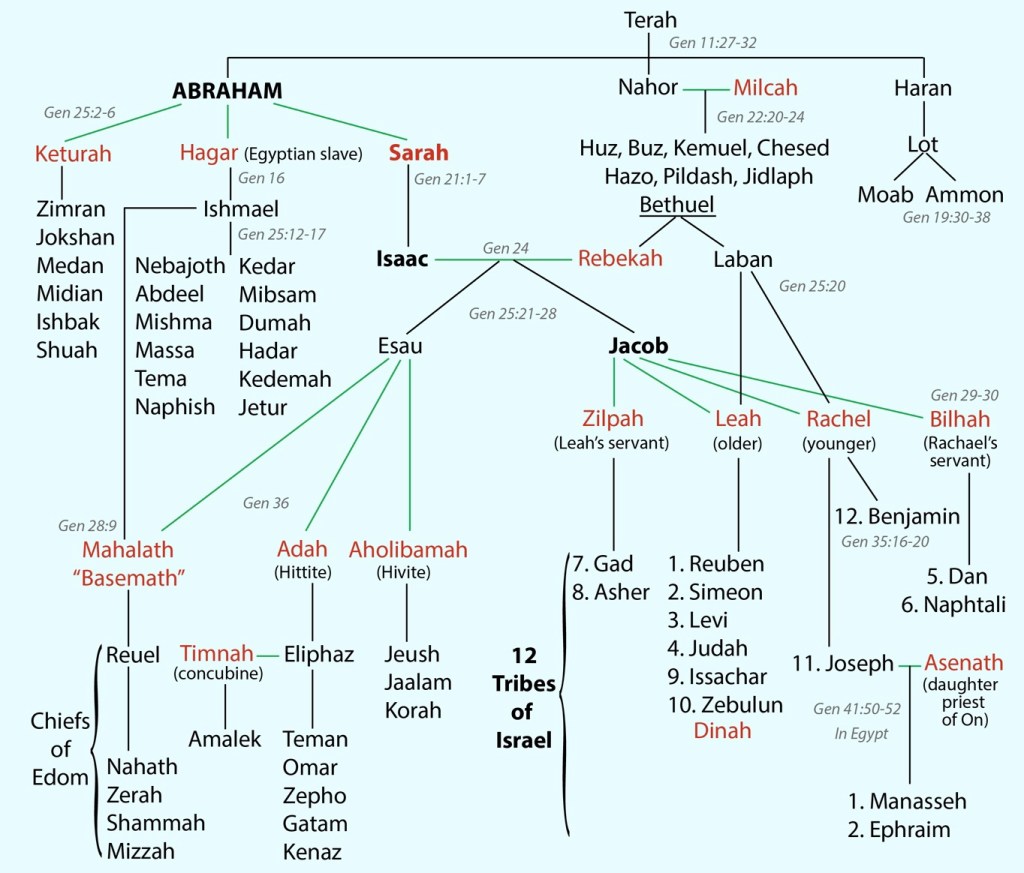
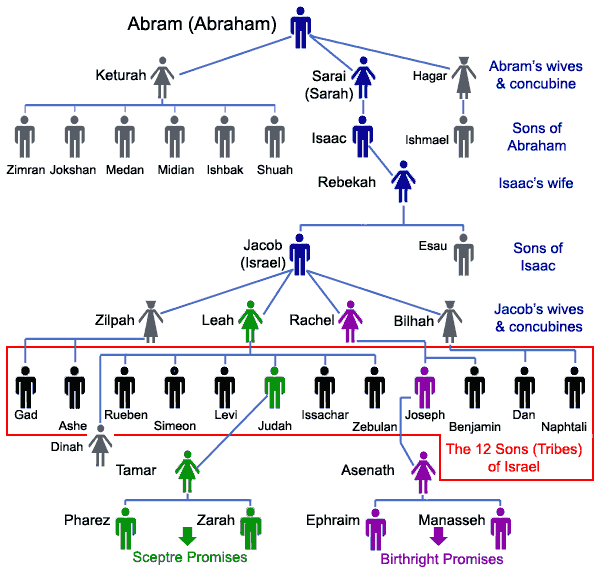
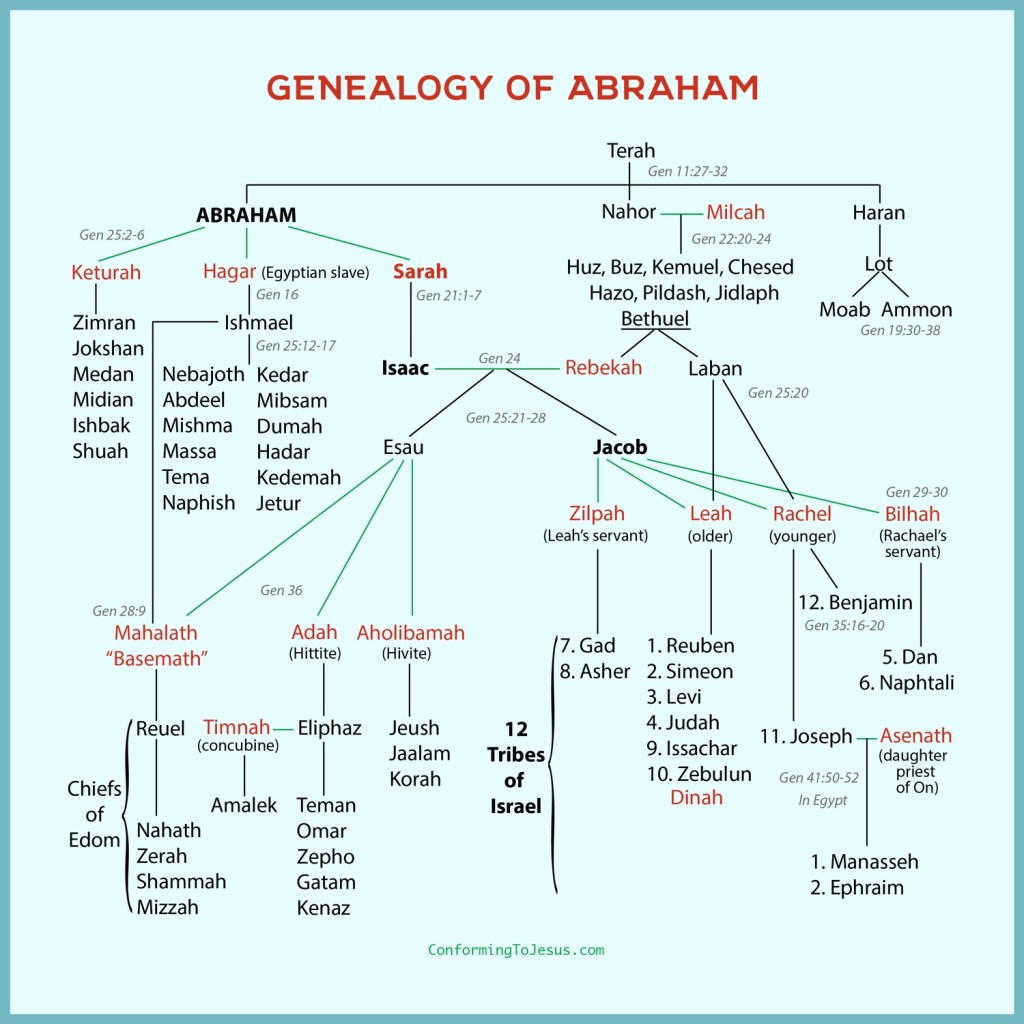
Like his grandfather and his father, Jacob finds that his wife, Rachel, is barren (29:31). In subsequent years, Leah bore him four sons, Reuben, Simeon, Levi, and Judah (29:32–35), and Rachel’s maid Bilhah bore him two sons, Dan and Naphtali (30:4–8), and Leah’s maid Zilpah then bore him two more sons, Gad and Asher (30:9–13), and then Leah bore him two further sons, Issachar and Zebulun (30:16–20) as well as a daughter, Dinah (30:21).

Six boys and one girl, in seven years: Leah fulfils the primary expectation of fertile women in ancient Israel—producing children. That the majority are males is even better! And it is noteworthy that, as Dr Henriksen-Garroway observes, “a wife who cannot produce children might even feel the need to give her husband a surrogate to produce children for her (Gen 16:2, 30:3, 9), since otherwise, they are not fulfilling their function as wife”.

As Leah produces children for Jacob, Rachel remains barren—a stigma in ancient societies, an indication amongst Israelites that God has chosen not to “open her womb”. Barrenness is attributed to the action of God, for he had previously “closed fast all the wombs of the house of Abimelech because of Sarah” (20:18). Perhaps the fact that Jacob had not yet paid off his debt to Laban meant that God would not act to provide a child to this union?

It is only after the seven children had been born to Leah, and the seven years that Jacob was working towards marriage with Rachel had been completed, that we then read, “then God remembered Rachel, and God heeded her and opened her womb; she conceived and bore a son … and she named him Joseph, saying, ‘May the Lord add to me another son!’” (30:22–24).

Later still, after fleeing from Laban and returning at last to Canaan, Rachel becomes mother to a second son, Benjamin (35:16–18), although sadly she dies during this childbirth. Ironically, Benjamin was the only one of “the twelve sons of Israel” (Gen 35:22–26; Exod 28:21; 39:14; 1 Ki 18:31) who gave their names to the regions of Israel (Num 26:52–56) to have been born in that land.

*****

And the one daughter, Dinah, of course has no place in “the twelve tribes of Israel”, named after the twelve sons (by four different women!) that Jacob produced (Gen 49:1–28). Despite the fractured nature of their origins—twelve boys from four mothers, two of whom took fourteen years and one deceitful trick for Jacob to secure—these twelve sons gave their names to “the twelve tribes of Israel” throughout the ensuing saga (Exod 24:4; 28:21; 39:14; Josh 3:12; 4:8; 1 Ki 18:31; Ezra 6:17).

Dinah’s own fate is sombre; she is raped by “Shechem son of Hamor the Hivite, prince of the region”, who when he saw her, “he seized her and lay with her by force” (34:3). He then wishes to marry her, and negotiates to receive the blessing of the men of the city at the gates of the city, who curiously agree, subject to the one condition “that every male among us be circumcised as they are circumcised” (34:22).

However, before this can be finalised, the dishonouring of Dinah is enacted by two of her brothers, Simeon and Levi, who “killed Hamor and his son Shechem with the sword, and took Dinah out of Shechem’s house, and went away”, only to be followed by “the other sons of Jacob [who] came upon the slain, and plundered the city, because their sister had been defiled” (34:25–29).

Jacob is unimpressed at their violent actions; but the reposte of the brothers cannot be answered: “should our sister be treated like a whore?” (34:31). As a result, the whole family returns to Bethel, in southern Canaan (35:1), where Jacob will have a significant religious experience (35:9–15), and his name is changed to Israel.

And the new name of the father, as well as the names of each of the twelve sons, live on throughout the stories told and the scrolls written in Israel—and on through into today.

*****

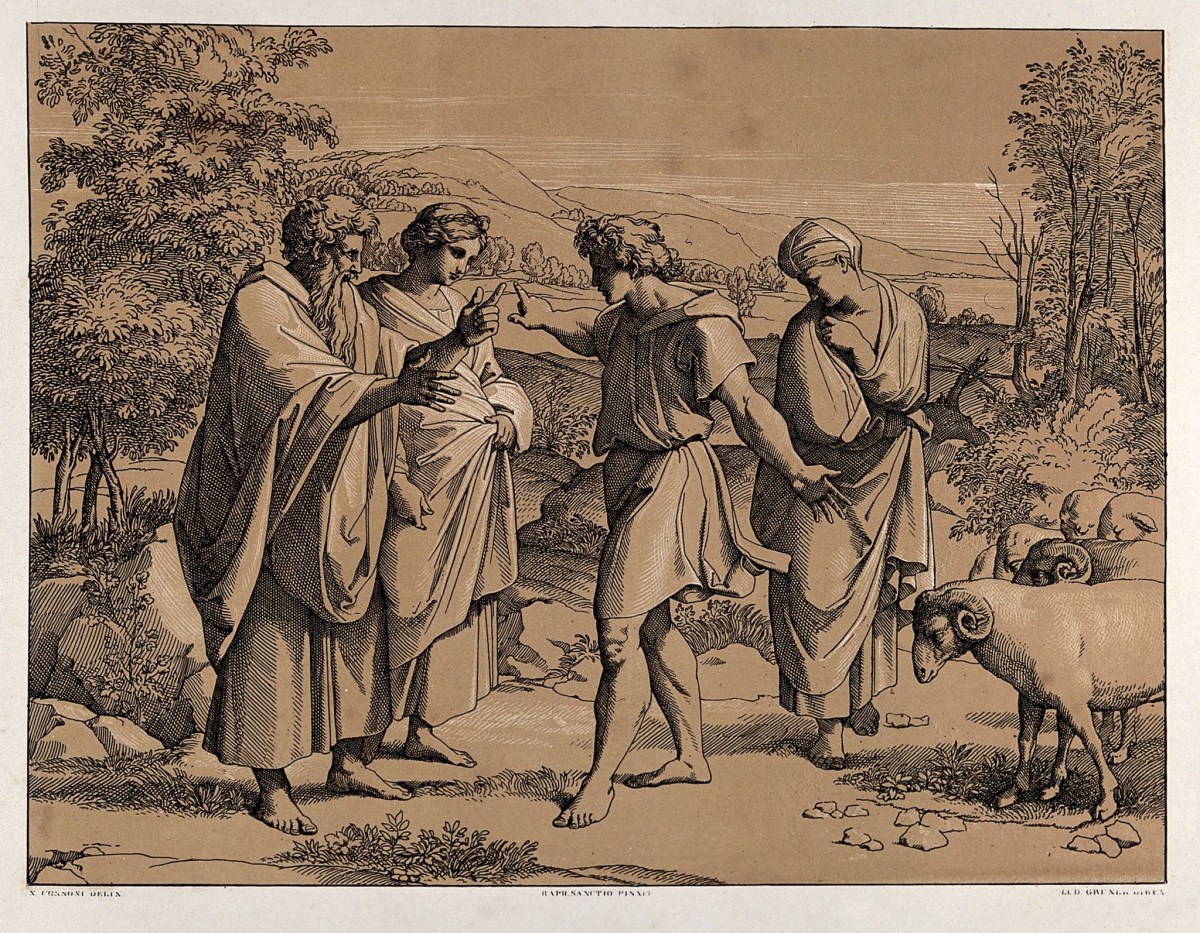
The image on the front of this post is Jacob accusing Laban for having given him Leah instead of Rachel, a colour lithograph by L. Gruner, after N. Consoni, after Raphael (1483–1520), from the Wellcome Collection, a free online museum and library.

Twins! (Gen 25; Pentecost 7A)

“Is it a boy or a girl?” For many years, that has been a standard question after a woman has just given birth. In more recent times, due to the advances in medical technology that have occurred, that question can no be put to pregnant couples: “Is it a boy or a girl?” Ultrasounds can now apparently reveal the gender of the foetus from about 11–13 weeks.

So it is always a surprise when the answer to that question is not “boy” or “girl”, but “both”—in the case of male-and-female twins—or “two boys” or “two girls”, as the case may be, in other instances.

“Isaac prayed to the Lord for his wife, because she was barren; and the Lord granted his prayer, and his wife Rebekah conceived”, we read in the Hebrew Scripture passage offered by the lectionary for this coming Sunday (Gen 25:19–34). Here, we meet another barren woman in the ancestral sagas of Israel. Years before, Isaac’s mother Sarah had been barren, and that state had lasted for many decades—and indeed “the Lord had closed fast all the wombs of the house of Abimelech because of Sarah, Abraham’s wife” (20:18).

And other barren women are yet to come in those ancestral sagas; the rabbis note that there are seven significant women who were infertile in scripture: Sarah (Gen 11:30), Rebekah (Gen 25:2), Rachel and Leah (Gen 29:31), Manoah’s wife (Judg 13:2), Hannah (1 Sam 1:2), and Zion (Isa 54:1). The eventual gifting of children to these seven is related by the rabbis to a textual variant in 1 Sam 2:5, reading “the barren has borne seven” as “on seven occasions has the barren woman borne”.

The seventh in this list, Zion, is not an individual who lived in the past but is the personified Israel of some future time, based on Second Isaiah’s characterization of Zion as a barren woman: “Sing, O barren one who did not bear, burst into song and shout, you who have not been in labour; for the children of the desolate woman will be more than the children of her that is married, says the Lord” (Isa 54:1).

The result of God’s intervention, in Rebekah’s case, was a surprise: not one, but two, boys! But the time for shouting with joy is short, for poor Rebekah is given sobering news about her twin boys: “two nations are in your womb, and two peoples born of you shall be divided” (25:23a). Not only that, but “the one shall be stronger than the other, the elder shall serve the younger” (25:23b).

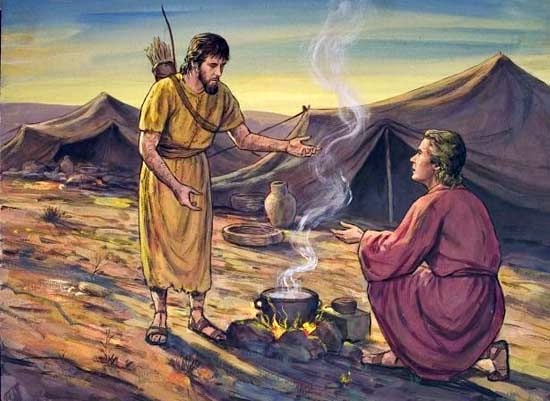
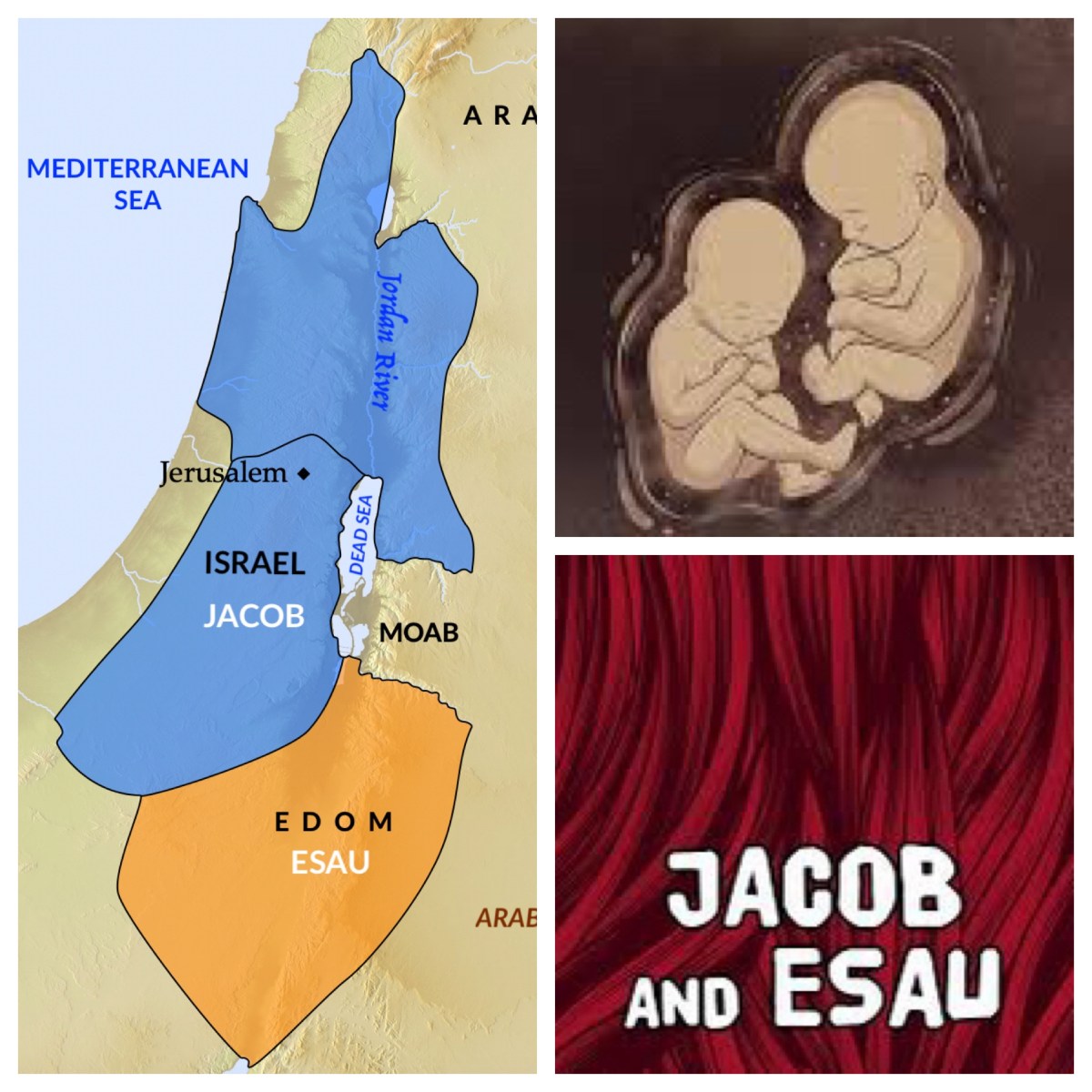
Isaac and Rebekah have brought into the world two boys—the older, who “came out red, all his body like a hairy mantle”, who was named Esau (meaning “hairy”), and the younger, hot on the heels of his brother (literally), who followed immediately “with his hand gripping Esau’s heel”, who was named Jacob (meaning “supplanter”).

The other twins that are (in)famous in Hebrew Scripture are Perez (“a breach”) and Zerah (“brightness”), twin sons of Tamar, daughter-in-law of Judah, who had liaised with her whilst visiting his sheepshearers (38:12–30). In the New Testament, “Thomas the Twin” is one of the named twelve disciples (John 11:16; 20:24; 21:2), although his sibling is never identified.

Who calls their child “the one who supplants” at the moment of birth? The names, identified in the narrative at the moment of birth (25:25–26), must surely be retrojections into the story, for the names prefigure events as they later transpired. This story, like many of the stories in the book of Genesis, is an aetiological narrative—a story told to explain how things are as they are.

I have noted previously that such narratives tell of something that is said to have occurred long back in the past, but the focus is on present experiences and realities, for “such explanations elucidate something known in the contemporary world by reference to an event in the mythical past”.

See https://oxfordre.com/classics/display/10.1093/acrefore/9780199381135.001.0001/acrefore-9780199381135-e-7050;jsessionid=3DB38C42C54D01E1CBFA8682FB55DA4C

The name of Jacob is given to explain his role in the story that is unfolding: first, Jacob tricks his brother Esau to sell his birthright to him (25:29–34). As firstborn, Esau should have inherited from Isaac; now, Jacob has supplanted him (as his name indicates). In subsequent passages that the lectionary skips over, Jacob deceives his father in order to receive the blessing that was intended for the firstborn (27:1–29).

As Esau subsequently laments to his father, “Is he not rightly named Jacob? He has supplanted me these two times: he took away my birthright; and look, now he has taken away my blessing” (27:36). His fate as the one no longer relevant for the continuation of the family line, promised to Abraham and continuing through Isaac to Jacob, now, comes when he marries “Mahalath daughter of Abraham’s son Ishmael, and sister of Nebaioth, to be his wife in addition to the wives he had” (28:9). See my earlier reflections on Ishmael at

So Jacob lives up to his name. And we know well his name, through the seven places in the New Testament where we find formulaic references to the three patriarchs, Abraham, Isaac, and Jacob (Mark 12:26; Matt 8:11; 22:32; Luke 13:28; 20:37; Acts 3:13; 7:32), as well as the many references to them together in the Hebrew Scriptures (Gen 50:24; Exod 2:24; 3:6, 15, 16; 4:5; 6:3, 8; 33:1; Lev 26:42; Num 32:11; Deut 1:8; 6:10; 9:5, 27; 29:13; 30:20; 34:4; 2 Ki 13:23; Jer 33:26).

Yet the irony is that Jacob’s name is later changed, to a name that would become still more famous—and live on into the modern world as the name of the nation of people who see themselves as the chosen ones. After wrestling all night with a man at the ford of the river Jabbok, Jacob is told “you shall no longer be called Jacob, but Israel, for you have striven with God and with humans, and have prevailed” (32:28; see Pentecost 10A).

And that story, of course, is yet another aetiological narrative; for the name given, Israel, means “the one who strives with God”, which was the fate of Jacob on that night, and of the people of the nation over the centuries and millennia to follow. So the story of this change of names is an important one to remember and pass on.

In this story, however, the names of the boys born to Isaac and Rebekah are the key point: one is born hairy, the other is a supplanter. And the trick that he played to gain the inheritance of his father plays a crucial role in the self-understanding of the people who were telling this story, and passing it down the generations, and remembering it to this day. It is the second-born (even if just by a few seconds in time) who supplants the firstborn.

So Isaac was preferred over his older brother, Ishmael. Jacob gained the birthright of his (slightly) older twin brother Esau. Joseph gained ascendancy over his many older brothers. Jacob, at the end of his life, blessed the younger son of Joseph, Ephraim, rather than his older son, Manasseh. Moses was chosen as God’s spokesperson in Egypt, in preference to his older brother, Aaron. And instead of any of the seven older sons of Jesse, the ruddy, handsome youngest, David, received the blessing of the prophet Samuel to be anointed as king. In each case, it was the younger who was preferred over the older—a striking set of stories to be remembered!

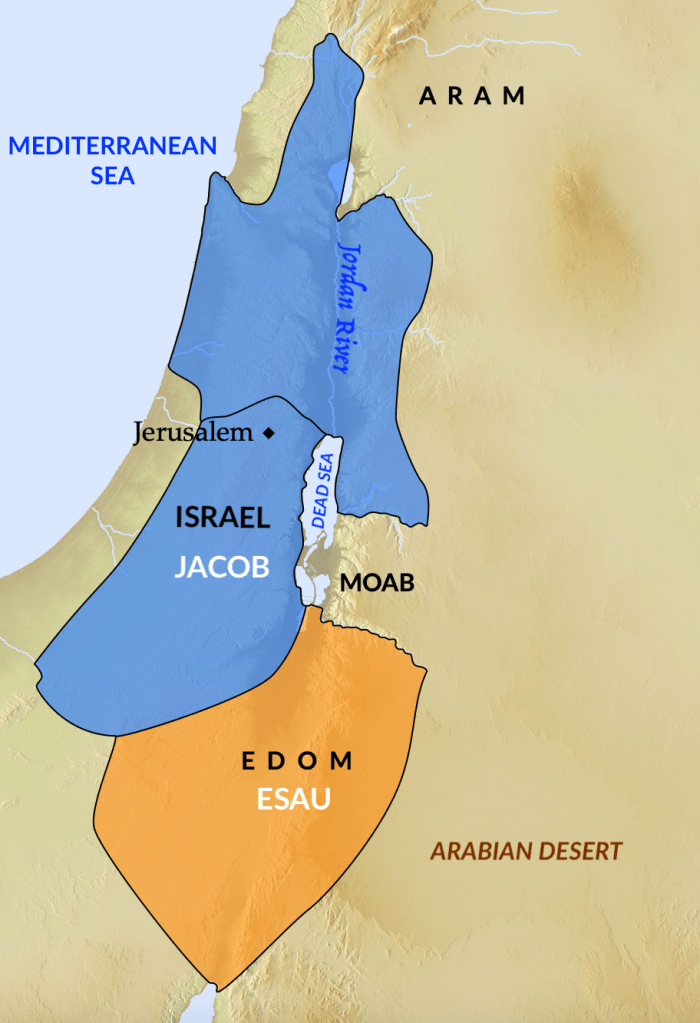
Esau, we are told, is the ancestor of the Edomites, to the south of Israel (Gen 36:1–43), whilst the descendants of Jacob (Gen 25:19–28), of course, populated the land of Canaan, known as Israel, after the name later given to Jacob (Gen 32:28; see Pentecost 10A).

A ring on her nose, and bracelets on her arms (Gen 24; Pentecost 6A)

For this coming Sunday, the lectionary provides us with part of a larger story from the section of Genesis dealing with Abraham (Gen 24:34–38, 42–49, 58–67). As Abraham’s son Isaac comes to age, Abraham knows that there is a need to find him a wife.

Abraham now appears not to be living with his wife, Sarah—he is in Beersheba, with his servants (22:19) whilst Sarah remains at Hebron, where she dies (23:1–2). Was this because of the tension that grew between the patriarch and the matriarch after he had almost sacrificed his son? This is the story we read last week; see

Tensions were already evident earlier in the story, when Sarah had banished Hagar and Ishmael into the wilderness of Beersheba (21:10–14). To send them on their way, Abraham made sure that they had bread and water to sustain them in the wilderness (21:14). We do not see Abraham and Sarah together again in the story. In discussing this with my wife, Elizabeth Raine, last week, she proposed that Sarah was so upset with Abraham’s actions on Mount Mariah, threatening the life of their son Isaac (Gen 22:1–14), that she left him behind at Beersheba and moved to Hebron, some 42km to the north.

It is only on her death that Abraham travels to where Sarah had been living, in Hebron. Abraham sought to purchase a field there to serve as the burial place for Sarah. Ephron the Hittite, moved with compassion, wanted to gift him a field with a cave where Sarah’s body could be laid (23:7–12), but Abraham insisted and paid Ephron the value of the field, 400 shekels of silver (23:12–16). So he was doing the honourable thing for his wife after her death, even though there seems to have been a relationship breakdown prior to this.

Despite the fact that he willingly enters into these dealings with the Hittites in Beersheba, and the fact that he had earlier entered into a covenant with Abimelech, King of Gerar, a Philistine (21:22–34), Abraham is now concerned that Isaac not marry locally, to a Canaanite, but that a wife be found for him in “my country” and amongst “my people”, as he instructs his servant (24:4–5).

We may perhaps know of people who share that desire that their children not marry “foreigners”, but find a partner from amongst their own. So it is an ancient story with very modern resonances. Marlene Andrews, Church leader at Ngukurr, shares her perspective on this passage in the current issue of With Love to the World, a daily Bible study resource.

(Ngukurr is a town of about 1,000 people, located about 330 kilometres south-east of Katherine on the Roper Highway. Ngukurr is one of the largest Aboriginal communities in the Roper Gulf region.)

She says: “This story is about Abraham, his son. Abraham wanted the best for his son in marriage. Abraham knew that God was with him at the time of his decision-making. Abraham was faithful to God’s calling. Abraham knew how to go about finding a good wife for his son, Isaac. It was important that his son’s wife came from Abraham’s country. That is where Abraham came from, and where he wanted his son to connect to. Abraham knew the culture and the background of his people. Abraham knew in finding a wife for his son, she had to come from his homeland.”

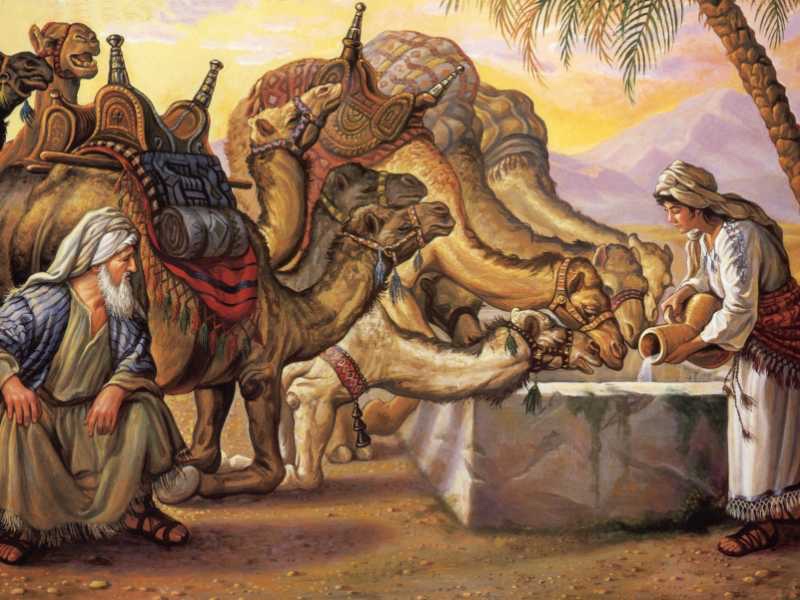
The marriage is arranged, at a distance, by Abraham. Isaac plays no part in the whole saga that is recounted in detail in Genesis 24. Abraham sends his servant all the way north to a well near the city of Nahor, which was back in Aramea, the homeland of Abraham. This was in the area we know as the Fertile Crescent, in between the two rivers of the Tigris and the Euphrates (24:10). The well near Nahor becomes the location for the match-making that Abraham undertakes, through the servant whom he sent there (24:10–14).

Isaac will, much later in time, notice Rebekah, the daughter of Bethuel, “son of Milcah, the wife of Nahor, Abraham’s brother” (24:15), but this is not until the story has almost come to its close (24:62–67). It is understandable that Isaac was agreeable to the arrangement that his father had made, for “the girl was very fair to look upon, a virgin, whom no man had known” (24:16).

This last comment is important, in the light of the drastic provision in the Torah that, if evidence of the young woman’s virginity is lacking, “they shall bring the young woman out to the entrance of her father’s house and the men of her town shall stone her to death, because she committed a disgraceful act in Israel by prostituting herself in her father’s house” (Deut 22:21).

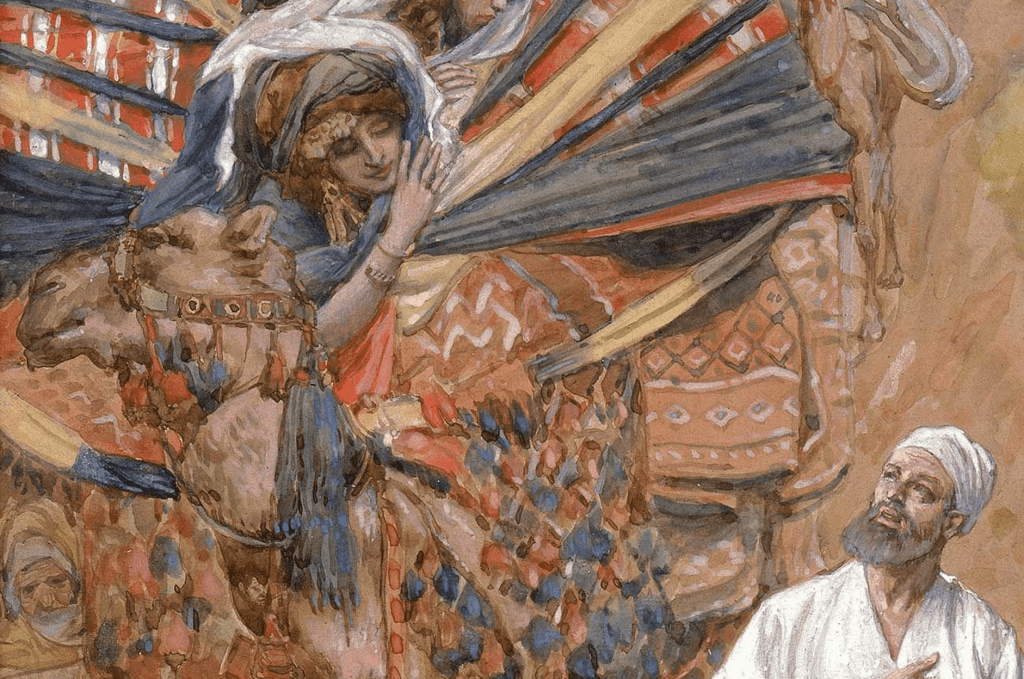
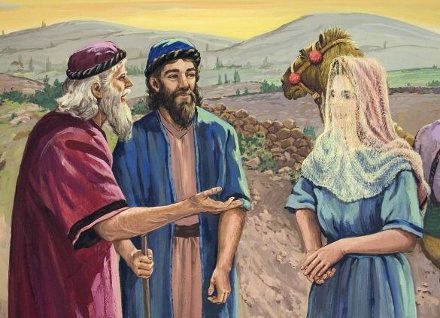
Reckoning that the woman was able to be considered for marriage (we have to trust the insight of the narrator at this point), the servant was prepared for what he hoped would transpire; he had with him “a gold nose-ring weighing a half shekel, and two bracelets for her arms weighing ten gold shekels” (24:22).

After Rebekah has brought her brother Laban into the story (24:28–29), and he noticed the nose-ring and bracelets (24:30), he offered hospitality to the servant, which was duly accepted (24:31–33). The purpose of the nose-ring and bracelets is then revealed—although surely those who heard this story in antiquity would be well aware of their significance. Brokering a marriage is the clear intention (24:34–41).

The woman had had a ring placed in her nose, and bracelets put around her arms (24:47); the action presumably took place at 24:22–27, although it was not explicitly narrated there. The ring and bracelets were obviously the custom for women in the time when the story was initially told, and they held their place within the story as it was passed down from generation to generation, even if customs may have changed.

Marriage customs do vary across time and place, from one culture to another. What held in the days of the patriarchs (or, at least, in the days in ancient Israel when people told stories about how they imagined things were in the “olden days” of the patriarchs) does not necessarily hold good for our time, today. A story of a man who married a woman so that, after a prescribed period of time (seven years!) he could marry her sister, as was the case with Jacob, Rachel, and Leah (Gen 29–30), for instance, would not hold today! And whilst rings remain the most common sign of a marriage, they are placed around fingers, and not into noses, in most modern cultures!

So Isaac, eventually, enters the story (some 47 verses after Rebekah was first introduced!). He notices, first, the camels which had come all the way from Nahor to the Negeb (24:62–63); and then, “Isaac brought her into his mother Sarah’s tent; he took Rebekah, and she became his wife; and he loved her” (24:67). All is well, that ends well—thanks to the well!

However, even though Isaac had never been to the well at Nahor where the marriage agreement was made, this well was the first of a number of wells where marriages were negotiated and confirmed within the sagas of ancient Israel. Jacob met his wife-to-be, Rachel, beside a well in Canaan, later Samaria (Gen 29:1–3). Moses, when travelling in Midian, “sat down by a well”, where, in due time, the local priest Jethro gave one of his daughters, Zipporah, to Moses in marriage (Exod 2:15–21).

The well in Canaan, known as Jacob’s well, is much later on the location for another famous encounter, between Jesus of Nazareth and an unnamed woman of Samaria (John 4:4–30)—although no marriage resulted from this encounter!

The two marriages, of the son and grandson of Abraham, which resulted from encounters beside the two wells, are important, for they demonstrate that the promise made to Abraham, of many descendants who will be blessed by God (Gen 12:2–3), will be guaranteed. Sure enough, Isaac and Rebekah produce twin boys, Esau and Jacob; and Jacob, in turn, is the father of twelve sons, whose names provide the identification of the twelve tribes of Israel. So these wells are integral to the divine promise!

Isaac was the son of Abraham; Rebekah was the granddaughter of Nahor, the brother of Abraham; so they were cousins. Tracy M. Lemos, Associate Professor of Hebrew Bible and ancient Near Eastern language and literature in the Faculty of Theology of Huron University College at Western University in London, Ontario, writes in Bible Odyssey that “Biblical texts make clear that marriages between cousins were strongly preferred”. She continues, “different Israelite communities and authors had diverse viewpoints on marriage and that Israelite viewpoints evolved over time”. See

https://www.bibleodyssey.org/passages/related-articles/weddings-and-marriage-traditions-in-ancient-israel/

The conclusion of Prof. Lemos, that “many biblical customs would be unfamiliar or even objectionable to many people living in western societies today”, certainly stands with regard to the passage we are offered for this coming Sunday. The detailed story that is told in Gen 24 is a fascinating insight into another world, another time, another culture. Yet it is part of our shared heritage, as Jews and Christians, in the modern era. It is good to hear the story, once again, as the lectionary offers it to us this Sunday.

She laughed. But what else do we know about Sarah? (Gen 11–23, for Pentecost 6A)

We know that “she laughed”. And that she produced a miracle baby at the ripe old age of 90 (or so it is said). But what else do we know about Sarah? Before she disappears from view in the Hebrew Scripture passages that the lectionary is offering us, let’s spend some time thinking about Sarah.

During this season after Pentecost, the lectionary has been offering us stories selected from the ancestral sagas of Israel, tracing the way that the promise to Abraham—“I will make of you a great nation” (Gen 12:1), “look toward heaven and count the stars … so shall your descendants be” (Gen 15:5)—was able to come to fruition.

Over successive Sundays, we have read of the call to Abram (ch.12), the promise of a child to Sarah (ch.18), the banishment of Abraham’s son through his slave girl Hagar (ch.21), the near-sacrifice of the preferred son, Isaac (ch.22), and the manoeuvring by Abraham to ensure a wife for Isaac who is of “my country and my kindred” (ch.24).

In future Sundays, we move on to stories about the twin boys born to Isaac and his wife Rebekah (ch.25), Jacob’s dream at the Jabbok (ch.28), Jacob and his marriages to, first Leah, and then Rachel (ch.29), and then the story of Jacob at Penuel, which explains how he had his name changed to Israel (ch.32). The story then focusses on one of Jacob’s twelve sons, Joseph, who is taken to Egypt (ch.37) and later saves his brothers during a famine (ch.45).

These stories—have you noticed?—follow the male line of descent, and place the male at the centre of the story. It is Abram’s call, Abraham’s near-sacrifice of Isaac, Isaac who needs a wife, Jacob who has a dream, Jacob who obtains two wives, Jacob who wrestled with God, and Joseph who becomes the saviour of his brothers.

What role is played by the women in the story? We do know the names of the matriarchs—Sarah, Rebekah, Leah and Rachel—and they do figure in the stories; but the focus is quite patriarchal, as would befit the nature of ancient society.

Sarah, whom we meet initially as Sarai (11:29), is essential to the storyline at various points; and she has come to be venerated alongside Abraham in later traditions. Paul refers to her as the means by which God’s promise is fulfilled (Rom 9:9) and he even offers her and Hagar together as providing an allegory for “the present Jerusalem, in slavery … and the Jerusalem above [who is] free, our mother” (Gal 4:21–26).

In the letter to the Hebrews, Sarah is named (in contrast to many other women) and takes her place alongside Abraham as part of “so great a cloud of witnesses” (Heb 12:1)—although all that is said of her is the stark declaration, “Sarah herself was barren” (Heb 11:11). The miracle, it would seem, was that “from one person, and this one as good as dead, descendants were born” (Heb 11:12)—that is to say, it was the transformation of the “as good as dead Abraham” that is being celebrated here.

In 1 Peter, Sarah is put forward as one of the “holy women who hoped in God”—although, in this instance, what is said of her again mirrors the patriarchal dominance of society; “Sarah obeyed Abraham and called him lord. You have become her daughters as long as you do what is good and never let fears alarm you” (1 Pet 3:5–6).

It takes an exilic prophet, whose words were appended to the earlier scroll of Isaiah, to give Sarah (almost) equal billing with Abraham: “Listen to me, you that pursue righteousness, you that seek the Lord. Look to the rock from which you were hewn, and to the quarry from which you were dug. Look to Abraham your father and to Sarah who bore you; for he was but one when I called him, but I blessed him and made him many.” (Isa 51:1–2).

So, what do we know of Sarah from those ancestral narratives which were told by word of mouth, handed down the generations, and ultimately (sometime in the Exile in Babylon) written down in the form we now have them, in the scroll entitled Bereshit, which we know as the book of Genesis?

We meet Sarai (meaning “my princess”) in the list of descendants of Terah, the father of Abraham (Gen 11:29), although (as in the Hebrews reference) it is simply noted that “Sarai was barren; she had no child” (11:30). That’s a serious roadblock in a passage that is listing descendant upon descendant!

In that same passage, we are told that Sarai, daughter-in-law of Terra, accompanied the family when they journeyed from Ur of the Chaldeans to Haran, where they settled (11:31). The journey had been intended to go as far as Canaan; that would not take place until the Lord called Abram to “go from your country and your kindred and your father’s house to the land that I will show you” (12:1). Sarai is there, as well as Lot and his perpetually-unnamed wife, “and all the possessions that they had gathered, and the persons whom they had acquired in Haran” (12:5).

The next story involving Sarai is perplexing and disturbing. Because of a famine, Abram “went down to Egypt to reside there as an alien” (12:10). We know that Sarai accompanies him, because he forewarns her, “I know well that you are a woman beautiful in appearance; and when the Egyptians see you, they will say, ‘This is his wife’; then they will kill me, but they will let you live. Say you are my sister, so that it may go well with me because of you, and that my life may be spared on your account.” (12:11–13).

The story is repeated twice more in Genesis; once when Abraham repeats this ruse in Gerar, before King Abimelech (20:1–7), and again when Isaac tells the same Abimelech that Rebekah is his sister (26:6–11)! It seems that the fruit does not fall far from the tree; Isaac exactly replicates his father’s devious strategy.

In between those two instances of spousal deception in Gen 12 and Gen 20, Sarai has been the cause of plagues falling onto Pharaoh and his house (12:17), settled with her husband “by the oaks of Mamre, which are at Hebron” (13:1, 18), and presumably learnt from Abram about the covenant which the Lord made with him (15:1–21)—although the text is silent about where Sarai was as this revelation came to Abram.

Sarai is front and centre, however, in the next story told, as she offers her Egyptian slave-girl, Hagar, to Abram so that he might reproduce, and fulfil the divine promise (16:1–3). Tension between the servant girl and her mistress resulted, so “Sarai dealt harshly with her, and she [Hagar] ran away from her [Sarai]” (16:6). Eventually, an angel instructed Hagar to “return to your mistress, and submit to her” (16:9), so she did, and in time bore a child to Abram.

In the next story, the circumcision of Abram and “every male among you” (17:1–27), we might wonder what role was played by Sarai. Did she witness the ceremony? Did she and her women assist those who were subjected to this procedure? Certainly, in the midst of the conversation that Abram has with God at this time, both he and his wife are given new names: “no longer shall your name be Abram, but your name shall be Abraham” (17:5), and “as for Sarai your wife, you shall not call her Sarai, but Sarah shall be her name” (17:15).

Abram, whose name describes his status in the story as “exalted ancestor”, will henceforth be known as Abraham, “ancestor of a multitude”, in keeping with the promise of God that “you shall be the ancestor of a multitude of nations” (17:4), while Sarai, “my princess”, will henceforth be known simply as “princess”, without any inflection indicating that she is “owned” by anyone.

So Sarah takes her place at the centre of the story at this point. Her status as princess means that “she shall give rise to nations; kings of peoples shall come from her” (17:16), and the birth of a son, Isaac, is predicted (17:19) and his role in continuing the lineage is confirmed (17:20). That birth is again foreshadowed when three visitors stay with Abraham and Sarah at Mamre (18:10). Sarah’s sceptical laughter (18:12) was already prefigured in the name allocated to her son, Isaac—meaning “he laughs” (17:19).

Before Isaac is born, however, the terrible story of inhospitality and divine vengeance on Sodom and Gomorrah is told in some detail (18:16–19:29), and the origins of the southern neighbours of Israel, the Moabites and Ammonites, is told (19:30–38), as well as the deception of Abraham in Gerar, when he passes the pregnant Sarah off as his sister (20:1–7).

Then comes the birth of Isaac (21:2–3), after which she rejoices, “God has brought laughter for me; everyone who hears will laugh with me” (21:6)—after which Sarah again orders Hagar, and also Ishmael, to depart into the wilderness. Sarah instructs Abraham to “cast out this slave woman with her son” (21:10); “the matter was very distressing to Abraham on account of his son” (21:11).

And so the schism between Abraham and Sarah is opened up; the events of the next incident, when Abraham takes Isaac to a mountain in Mariah, to sacrifice him (22:1–3), appear to seal the split. As I was talking with my wife, Elizabeth Raine, about this difficult story last week, she pointed out to me that we do not see Abraham and Sarah together in the same place after this.

Abraham now appears not to be living with his wife, Sarah—he is in Beersheba, with his servants (22:19) whilst Sarah remains at Hebron, where she dies (23:1–2). Was this because of the tension that grew between the patriarch and the matriarch after he had almost sacrificed his son? This is the story we read last week; see

Tensions were already evident earlier in the story, when Sarah had banished Hagar and Ishmael into the wilderness of Beersheba (21:10–14). To send them on their way, Abraham made sure that they had bread and water to sustain them in the wilderness (21:14). As Elizabeth noted, we do not see Abraham and Sarah together again in the story.

It is only on her death that Abraham travels to where Sarah had been living, in Hebron, some 42km further north. Abraham sought to purchase a field there to serve as the burial place for Sarah. Ephron the Hittite, moved with compassion, wanted to gift him a field with a cave where Sarah’s body could be laid (23:7–12), but Abraham insisted and paid Ephron the value of the field, 400 shekels of silver (23:12–16). He dies at least honour her appropriately at the point of her death.

*****

Writing in My Jewish Learning, Jewish educator Rachael Gelfman Schultz notes that “Genesis contains the greatest concentration of female figures in the Bible (32 named and 46 unnamed women). The fact that Genesis consists of a series of family stories (including several genealogies) accounts for the remarkable concentration of female figures.” Sarah is an important figure in that list of women. Rabbinic tradition lists her among the seven women prophets, the others being Miriam, Deborah, Hannah, Abigail, Huldah, and Esther.

See https://www.myjewishlearning.com/article/sarah-in-the-bible/

Nissan Mindel, writing in Chabad.org, observes that “Sarah was just as great as Abraham. She had all the great qualities that Abraham had. She was wise and kind, and a prophetess. And G‑d told Abraham to do as she says.”

He describes the home that they made in Beersheba, noting that whilst Abraham received visitors, offered them hospitality, and conversed with them (following the pattern shown in Gen 18), “Sarai was busy with the women folk, and long after all visitors were gone, or had retired to sleep, Sarai would sit up in her tent, making dresses and things for the poor and needy.

“When everybody was fast asleep, there was still a candle burning in Sarai’s tent, where she was sitting doing some hand-work, or preparing food for the next day. So G‑d sent a special Cloud of Light to surround her tent. For miles and miles around, the Cloud of Glory could be seen hovering over Sarai’s tent, and everybody said, “’There dwells a woman of worth.’”

See https://www.chabad.org/library/article_cdo/aid/112057/jewish/Abraham-And-Sarah.htm

So there is much to value, and honour, about Sarah, princess, prophet, and matriarch supreme. We would do well not to overlook her, the matriarch of matriarchs, amidst the stories of the patriarchs.

Among egalitarian religious congregations of Jews throughout the world, the most popular addition to the traditional liturgy is the mention of the Matriarchs in birkat avot (the blessing of the ancestors), the opening blessing of the Amidah:

Praised are You, Adonai our God and God of our ancestors, God of Abraham, Isaac, and Jacob, God of Sarah, Rebekah, Rachel, and Leah, great, mighty, awesome, exalted God who bestows lovingkindness, Creator of all. You remember the pious deeds of our ancestors and will send a redeemer to their children’s children because of Your loving nature.

https://jwa.org/encyclopedia/article/matriarchs-liturgical-and-theological-category

On the mount of the Lord it shall be provided (Gen 22; Pentecost 5A)

“Abraham reached out his hand and took the knife to kill his son” (Gen 22:10). We read these chilling words in the passage that the lectionary offers for our reflection and consideration this coming Sunday (Gen 22:1–14). It’s hardly edifying reading material for worship, is it?

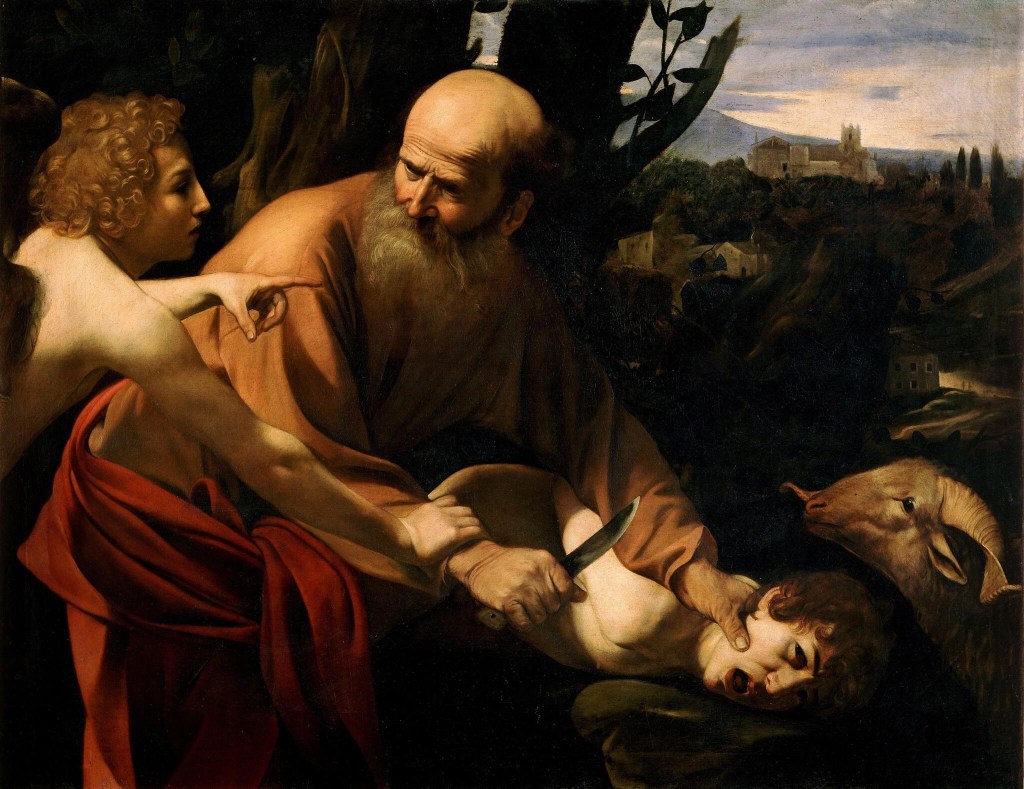
The Sacrifice of Isaac, by Caravaggio, c. 1603

It’s a horrifying story. Who is this God who calls Abraham to take his “only son” up the mountain and “offer him there as a burnt offering” (22:2)? How does this God relate to the God who, it is said, has shows “steadfast love” to the people of Israel (Exod 15:13), and before that to Joseph (Gen 39:21), to Jacob (Gen 32:9–19), and indeed to Abraham himself (Gen 24:27)? Why has God acted in a way that Is seemingly so out of character in this incident in Gen 22? Or is this the real nature of God, and later displays of “steadfast love” are simply for show?

Writing in With Love to the World, the Revd Sophia Lizares, a Uniting Church Minister originally from the Philippines, now serving in Perth, WA, says that this story is “an improbable and troubling reading: a God who demands a father to kill his beloved son, a father who questions not.” It is not just the knife in Abraham’s hand which is raised (22:10)—there are many such questions raised by these seemingly callous story.

My wife, Elizabeth Raine, has a cracker of a sermon in which she compares this story with the account of Jephthah and his daughter (Judg 11:29–40). Whilst the Lord commands Abraham to kill his son as a burnt offering, it is the vow made by Jephthah to sacrifice “whoever comes out of the doors of my house to meet me, when I return victorious from the Ammonites” as a burnt offering (Judg 11:30).

And whilst the Lord intervenes in what Abraham is planning to do at the very last moment, sending an angel to command him, “do not lay your hand on the boy or do anything to him” (Gen 22:11–12), Jephthah is held to the vow he has made—by his very own daughter, who knows that she will be the victim of this vow (Judg 11:39). There is no divine intervention in this story.

And worse, whilst Abraham had carefully prepared for the sacrifice, taking his donkey, two servants, and the wood for the fire up the mountain with him (Gen 22:3–6), Jephthah’s vow was made on the spur of the moment (Judg 11:30–31), and when his daughter insisted that he must carry through with this vow, he gives her, as requested, two full months for her to spend with her companions before he sacrificed her (Judg 11:37–39). Surely he might have had time in those two months to reconsider his vow and turn away from sacrificing his daughter?

It would seem, then, that the daughter was dispensable; the son, the much loved only son of Sarah and Abraham, was clearly indispensable. That would clearly reflect the values of the patriarchal society of the day, in which “sons are indeed a heritage from the Lord, the fruit of the womb a reward” (Ps 127:3).

And Abraham would have followed the same pathway, sacrificing his only son, had not the Lord intervened. Neither father is looking very appealing in these two stories! Which makes it hard to see how the story of the sacrifice told in Judg 11, and the story of the almost-sacrifice told in Gen 22, can be “the word of the Lord” for us, today, in the 21st century. Indeed, the story of Abraham and Isaac comes perilously close to being a story of child abuser—if not physical abuse, by the end of the story, at least emotional and spiritual abuse.

Situations of abuse destroy trust. After such an experience, how could Isaac ever trust his father again? And as we hear the story, how can we trust God? How could we ever believe that his commands to us are what we should follow?—if he follows the pattern of this story, and changes his mind at the last minute, after pushing us to the very brink of existence? How could we trust a God like this?

Or, if the story involving poor Isaac is really about God providing, as Abraham intimates early on (22:8), and then concludes at the end (22:14), then it is a rather malicious way for God to go about showing how he is able to “provide”. Provision, and providence, should be something positive—not perilous and threatening, as in this story.

Or yet again, if the story is about testing Abraham’s faith, as many interpreters conclude, then it is a particularly nasty and confronting way for God to do this—and that points to a nasty streak in the character of God. Is this really what we want to sit with? Was there not some other way for God to push Abraham to test his faith?

What do we do with such a story within our shared sacred scriptures?

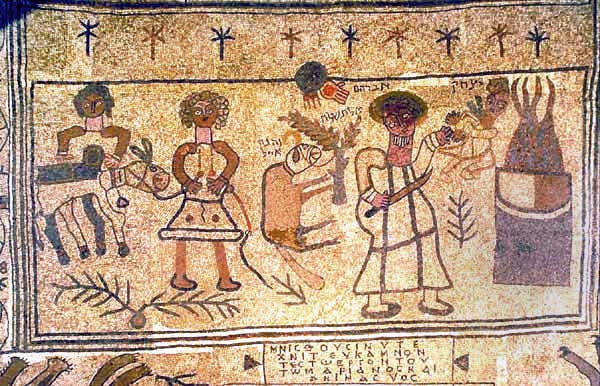
A sixth-century CE floor mosaic from the Beth Alpha synagogue, in Israel’s Jezreel Valley. The mosaic lay near the door, so that anyone who entered was confronted by the scene. In this mosaic, Abraham and Isaac are identified in Hebrew. The hand of God extends from heaven to prevent Abraham from proceeding. Below the hand are the Hebrew words, “Lay not [your hand].” Next to the ram are the words, “Behold a ram.”

*****

The Jewish site, My Jewish Learning, states that “although the story itself is quite troubling, it does contain a message of hope for Rosh Hashanah. In the liturgy we ask God to “remember us for life.” The binding of Isaac concludes with his life being spared, and he too is “remembered for life.” Abraham’s devotion results in hope for life.”

How does the message of hope for life emerge from this story? Clearly, the life of Isaac is spared; but this is a terrible way to teach that message!

James Goodman, writing in My Jewish Learning, explains how he was taught to understand this story. “I learned that the story was God’s way of proclaiming his opposition to human sacrifice”, Goodman writes.

He refers to the way his Hebrew-school teacher explained this story: “God had brought Abraham to a new land. A good and fertile land, where it was common for pagan tribes, hoping to keep the crops and flocks coming, to sacrifice first-born sons to God. Then one day, God commanded Abraham to sacrifice Isaac, the beloved son of his old age.

“Abraham set out to do it, and was about to, when God stopped him. He sacrificed a ram instead. In the end, Abraham had ‘demonstrated his—and the Jews’—heroic willingness to accept God and His law,’ and God had ‘proclaimed’ that ‘He could not accept human blood, that He rejected all human sacrifices’.”

See https://www.myjewishlearning.com/2013/09/11/understanding-genesis-22-god-and-child-sacrifice/

Setting the story in the broader context of the practice of child sacrifice is a way of accepting that this terrible story might indeed have some value. Seeing the story is a dramatised version of God’s command not to sacrifice children can be a way to deal with it. “Do not lay your hand on the boy or do anything to him”, the angel says; so Abraham obeys, finds a ram, offers the ram as a burnt offering (22:12–13). And so, the name of the place is given: “the Lord will provide” (22:14).

Three kings of Israel, at different times in the history of Israel, are said to have practised child sacrifice, as they turned to practices found in nations other than Israel. Solomon in his old age is said to have turned to the worship of Molech (1 Ki 11:7); this practice was subsequently adopted by Ahaz, who “made offerings in the valley of the son of Hinnom, and made his sons pass through fire, according to the abominable practices of the nations whom the Lord drove out before the people of Israel” (2 Chron 28:3). Likewise, Manasseh “made his son pass through fire; he practiced soothsaying and augury, and dealt with mediums and with wizards” (2 Ki 21:6).

Direct commands not to sacrifice children are found in two books of Torah in the scriptural texts. Most direct is “you shall not give any of your offspring to sacrifice them to Molech, and so profane the name of your God: I am the Lord” (Lev 20:18). In Deuteronomy, other nations are condemned as they “burn their sons and their daughters in the fire to their gods” (Deut 12:31), so the command is “no one shall be found among you who makes a son or daughter pass through fire” (Deut 18:10). The prophet Jeremiah also asserts that this practice is not something that the Lord God had thought of (Jer 7:31).

So the passage we have in the lectionary responds to this practice by telling a tale which has, as its punchline, the command “do not lay your hand on the boy or do anything to him” (22:12). Might this be the one redeeming feature of this passage?

But if that is the case, the story belongs back in the days when child sacrifice was, apparently, widely practised. What, then, does it say to us today???

See also

Come, lift up the boy and hold him fast: “the other son”, Ishmael (Gen 21; Pentecost 4A)

As we continue through the season After Pentecost, the lectionary offers stories of some quite extraordinary people, drawn from the sagas that tell of the key moments in the story of Israel. The sagas we will hear are found in the narrative books, Genesis, Exodus, Deuteronomy, Joshua, and Judges.

This coming Sunday, we hear another story relating to the patriarch of Israel, Abraham, his Egyptian slave Hagar, and the child that is born to them, Ishmael (21:8–21). This is the first child of Abraham; he and Sarah had not produced any children over many years. The fact that his mother is Abraham’s servant, Hagar, rather than his wife, Sarah, is not unusual. Later in the Genesis saga, Abraham’s grandson Jacob, already married to Leah and then to her sister Rachel, has children by Leah (29:32–35), as well as his servant Bilhah (30:1–7), and later by Leah’s servant Zilpah (30:9–11), before eventually Rachel gave him a son, Joseph (30:22–24) and later, Benjamin (35:16–21).

Earlier in Genesis, in a passage omitted by the lectionary, a report is provided of the circumstances leading to the birth of Ishmael (16:1–16). The naming of the child is announced by angelic visitation to Hagar (16:7–12), establishing a pattern which will later be used in recounting the naming of Samson (Judg 14:2–7), the child of a young woman in the time of Isaiah (Isa 7:13–16), and then of Jesus (Matt 1:20–21; Luke 1:31). It appears, at this earlier point, that it is Ishmael through whom the promise made to Abraham would be fulfilled: “I will make you exceedingly fruitful; and I will make nations of you, and kings shall come from you” (17:6).

In this week’s passage, however, the enmity that was evident once Sarah learnt that Hagar had conceived, comes to full fruition. Once the pregnant Hagar had this news confirmed, “she looked with contempt on her mistress” (16:4), and so “Sarah dealt harshly with her, and she [Hagar] ran away from her” (16:6). Hagar retreats to a spring in the wilderness (16:7), which is where the angel makes their announcement about the name and character of the child. Ishmael means “God has heard”, signalling that God was acting to fulfil the promise. But the life foreseen for Ishmael was one of conflict and opposition: “he shall live at odds with his kin” (16:12).

Hagar presumably returned to be with Abraham and Sarah; in due time, a son, Isaac, is born to Abraham and Sarah (21:1–7). At the start of this week’s passage (21:8–21), it appears that Ishmael is playing happily with his brother (21:8). Jewish interpreters note that the Hebrew word used, tsachaq, can be interpreted as “playing” or “laughing”—or with a more menacing overtone, perhaps hinting at Ishmael’s envy of his half-brother as the favoured one, at least in Sarah’s eyes.

(The LXX, in translating this word into Greek, takes the more benign option, adding the words “with his brother” to imply that this is just children playing games; and that is what Christian translators reflect in their translations.)

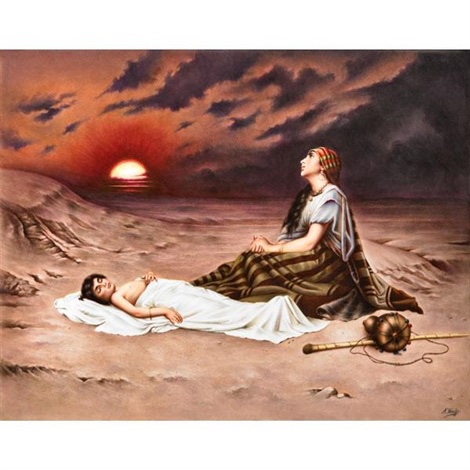
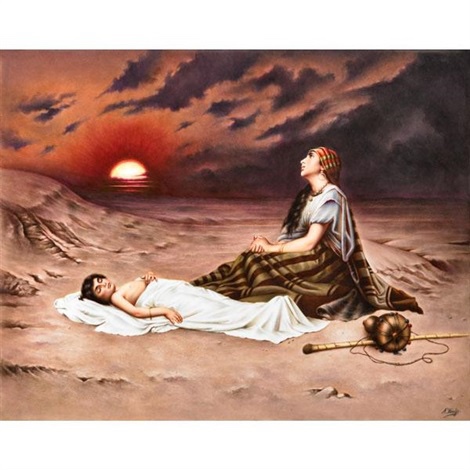
Sarah’s dissatisfaction with this moment of “play”—whether innocent or, perhaps more likely, with a threatening element—leads her to expel Hagar for another time, this time into the wilderness of Beersheba (21:9–14). Hagar’s distress is intense, such that she prepares for the death of the child Ishmael—only to be visited by another angelic intervention, inviting her to “lift up the boy and hold him fast with your hand”, assuring her that “I will make a great nation of him” (21:18).

Writing on the story in this week’s issue of With Love to the World, the Revd Sophia Lizares, a Uniting Church Minister originally from the Philippines, now serving in Perth, WA, says: “God is in the wilderness and hears even the least of the least. In times of trial, God opens our eyes to the goodness close at hand. Even those who have been banished, God accompanies into a unique and unexpected future. In God, the wilderness becomes a sanctuary where Hagar and Ishmael flourish.”

The story is told as an offering of hope—hope that what is yearned for will come to pass, even in the midst of distressingly difficult circumstances. The story has “a happy ending”, of sorts, for an angel intervenes (21:17)—does this perhaps indicate that Sarah was wrong to expel Hagar?

Guided by the angel, Hagar finds water (21:19) and the boy grows to become “an expert with the bow” (21:20). It is even said of him that “God was with the boy” (21:20), a presaging of what was later said of King Solomon (1 Chron 1:1), then later still of the infant Jesus, “the favour of God was upon him” (Luke 2:40), and of the whole life of Jesus, “God was with him” (Acts 10:38).

And the boy Ishmael does indeed become the father of “a great nation” (2:18)—through the 12 sons which he fathered! All’s well that ends well, it would seem.

*****

Yet the conflict that was to be visited upon Ishmael is an important element in this story which we must not pass by. “He shall be a wild ass of a man, with his hand against everyone, and everyone’s hand against him; and he shall live at odds with all his kin” (16:21) is a heavy burden to be laying on the child from the start of his life.

Although Ishmael was circumcised in accordance with the covenant that Abraham had entered into with the Lord God (17:23–27), and although he is indeed “blessed and made fruitful” (17:20) and does become the father of twelve sons (25:13–16) as well as a daughter (28:9), he still faced enmity. He bequeathed that conflicted state to his progeny. Indeed, the story of Ishmael functions (as do many of the stories in Genesis) as an aetiology.

An aetiology, as I have noted previously, tells of something that is said to have occurred long back in the past, but the focus is on present experiences and realities, for “such explanations elucidate something known in the contemporary world by reference to an event in the mythical past”.

See https://oxfordre.com/classics/display/10.1093/acrefore/9780199381135.001.0001/acrefore-9780199381135-e-7050;jsessionid=3DB38C42C54D01E1CBFA8682FB55DA4C

In the developing Jewish tradition, Ishmael attracts negative stories. It is said that he prayed to idols—some rabbis offer this as the explanation for Sarah expelling Ishmael and Hagar into the wilderness. Other rabbis claim that Hagar, an Egyptian woman (16:1) was not “a slave girl” but rather a daughter of Pharaoh.

Some interpreters, following the opening given by the ambiguity in the Masoretic (Hebrew) text, interpret the “playing with Isaac” (21:9) as an attempt to usurp the birthright of Isaac, the son of Abraham’s wife. Was Ishmael play-acting how he planned to dispose of his half-brother, and claim the heritage of his father Abraham?

By contrast, Ishmael is honoured in Islam as a prophet and as the patriarch of Muslims. Abraham—Ibrahim in Arabic—is acknowledged as a messenger of God and recognised as father of the nations, as scripture attests. The Kaaba in Mecca, the holy site to which Muslims make pilgrimage each year, is considered to have been built by Abraham and Ishmael, while the near-sacrifice of Isaac, told in Gen 22, is commemorated by Muslims on the holy day of ‘Eid al-Ada (“the Feast of Sacrifice”). In Muslim thinking, Abraham cleansed the world of idolatry.

In the Muslim holy text, the Quran, there are a number of mentions of Ishmael, who is described as “an Apostle, a Prophet” (19:54), as “truly good”, along with Elijah (38:48), and as inspired, along with “Abraham … and Isaac, and Jacob, and their descendants, including Jesus and Job, and Jonah, and Aaron, and Solomon … and David” (4:163). He occupies a key place in the stories of their past.

*****

The Quran is well-disposed towards Isaac, declaring, “we believe in God, and in that which has been bestowed upon Abraham and Ishmael and Isaac and Jacob and their descendants, and that which has been vouchsafed by their Sustainer unto Moses and Jesus and all the [other] prophets: we make no distinction between any of them; and unto him do we surrender ourselves” (3:84; the term Islam, of course, means “surrender” or “submission”).

Antagonism between Jews and Muslims has nevertheless been experienced throughout much of the time which followed the establishment of Islam as a faith with its own doctrines and practices during the seventh century. Early Muslim expansionary undertakings brought cultural, technological, and literary developments through Persia, Syria, Arabia, Palestine, Egypt, and North Africa. There was a “golden age” under this Islamic rule, during which Jews, Christians, and Muslims lived together in harmony—the so-called convivienca.

During the Middle Ages, the Crusades undertaken under the auspices of the Roman Church scarred relationships between Christianity and Islam—the storming of Jerusalem in 1099 saw masses of Muslims slaughtered. Jerusalem was recaptured by Saladin in 1187, but he ordered that Christians not be slaughtered; Muslims controlled the city but allowed Christian pilgrims access to holy sites.

The Fall of Constantinople, capital of the Byzantine Christian empire, in 1453 and the later expulsion of Muslims from Spain marked the end of congenial relationships. Later Christian missionary enterprises regarded Indigenous and Muslim peoples as primitive and uncivilised, and forced a Western way of life onto them, creating a heritage that still plays out across the world today.

*****

In like manner, Jews living in Muslim lands throughout the Middle Ages were permitted to practise their faith and culture for many centuries, although there are various instances of localised massacres and ghettoisation of Jews by Muslims. The height of tension between these two faiths has been in the modern era, relating to the creation of the State of Israel.

In the 19th century, Zionist Jews were calling for Jews to return to their ancestral homeland, which had been under Muslim control for centuries. The declaration of the State of Israel in 1958, so soon after the Shoah (“the Destruction”) that Jews had so recently experienced in Nazi Germany, meant that Palestinians experienced the Nakba (“the Catastrophe”) of becoming displaced from a land that had been their home for many centuries.

Tensions about the borders of Israel, the rights of Jewish settlers, the removal of Palestinian (Muslim) residents, the barricading of the West Bank and the Golan Heights, as well as the Temple Mount in the centre of Jerusalem, have been the focus of increasing and apparently unresolvable tensions for the past 75 years. The Temple Mount—the place from which Abraham ascended into heaven, in Muslim belief—is also,contentious. This is where the Muslim Dome of the Rock is built, on the foundations which centuries ago formed the base of the two Jewish Temples (one built by Solomon, and then the second built under Nehemiah and extended by Herod the Great).

So the Ishmael story has been a potent saga throughout history, and stands today as a powerful signal of the possibility of co-operative relationships, but the unfortunate reality is one of fractured and unhappy relationships which have spilled out into aggressive and destructive conflict.

Might it be that as we hear again this story of Ishmael, Hagar, and Sarah, we might recommit to being makers of peace, and work towards the goal of co-operative harmony, so that “the wilderness becomes a sanctuary where Hagar and Ishmael flourish”, where Jews and Muslims and Christians can find a common, irenic venture?

May it be so.

Visiting Abraham and Sarah by the oaks at Mamre (Gen 18; Pentecost 3A)

During the long season of “ordinary time” After Pentecost, the lectionary offers stories of some quite extraordinary people, drawn from the sagas that tell of the key moments in the story of Israel. These sagas are found in the narrative books, Genesis, Exodus, Deuteronomy, Joshua, and Judges. These stories run through until the Twenty-Fifth Sunday after Pentecost, in mid-November.

This coming Sunday, we hear a well-known story relating to the patriarch and matriarch whose adventures comprises significant part of Genesis (12:1—25:11). The story tells of how Abraham and Sarah undertook the long journey from Ur to Canaan (12:1–9), spent time in Egypt (12:10–20) and the Negeb (13:1–14:24), entered into covenant with God (15:1–21) and sealed this with a ceremony of circumcision (17:1–27).

Abraham himself has also fathered a child with his servant, Hagar (16:1–16); that dimension of the story appears important as it signals that there would be a descendant of Abraham, to fulfil the promise made earlier (12:2; 15:12–21). Yet the child who arrives is the son of Hagar, not Sarah. So the passage which is offered by the lectionary for this coming Sunday (Gen 18:1–15) addresses the infertility of Abraham and Sarah, by telling of how this couple learnt that they would, indeed, become parents together.

Abraham was allegedly aged 100 years, while Sarah was aged 90 years (see 17:17). It is no wonder that Sarah, when she learns of her forthcoming pregnancy, laughs (18:12)—although when confronted about this, she denies having laughed (18:15). Yet the name of the son to be born to Sarah, Isaac, means “the one who laughs”. So the joke is on her!

In the next two weeks, the lectionary will offer stories from subsequent chapters of Genesis, that focus on the two sons of Abraham: first, Ishmael, banished to the desert by his father, where he and his mother were vulnerable (21:8–21); and then Isaac, called to his own sacrifice under the hand of his own father (22:1–14). Certainly, Abraham does not come out of either of these stories looking very good!

The news about Isaac comes to Sarah and Abraham after a visit from three men, one of whom looks forward to the birth of a son to Sarah (18:10). Abraham had welcomed the visitors, as was the custom, saying “let a little water be brought, and wash your feet, and rest yourselves under the tree; let me bring a little bread, that you may refresh yourselves” (18:4–5).

Quite tellingly—given the strongly patriarchal nature of ancient society—we next learn that “Abraham hastened into the tent to Sarah, and said, ‘Make ready quickly three measures of choice flour, knead it, and make cakes’”. There we have it: the man decides, the woman implements. Has this changed in today’s society? A little? A lot? The jury is still out …

But more than this; “Abraham ran to the herd, and took a calf, tender and good, and gave it to the servant, who hastened to prepare it” (18:7). The master selects the animal; the servant prepares the meal. Again, all in accord with the customs of the time. But the next verse has always jarred with me: “Then he took curds and milk and the calf that he had prepared, and set it before them” (18:8). The food that he had prepared??? The food that he had ordered others to prepare, surely!

In his commentary on this passage in With Love to the World, the Revd Dr John Jegasothy, a retired Uniting Church Minister who came to Australia some decades ago, seeking asylum from civil war in Sri Lanka, observes that “strangers and aliens were considered as enemies in the ancient times. We, today, warn our children not to talk to strangers, because they could be predators”. He notes that, in the experience of his own family, “we have met many strangers in our lives, like new neighbours or new migrants in this multicultural country, who have become friends and channels of blessings to us. We too have become good neighbours and friends to them.”

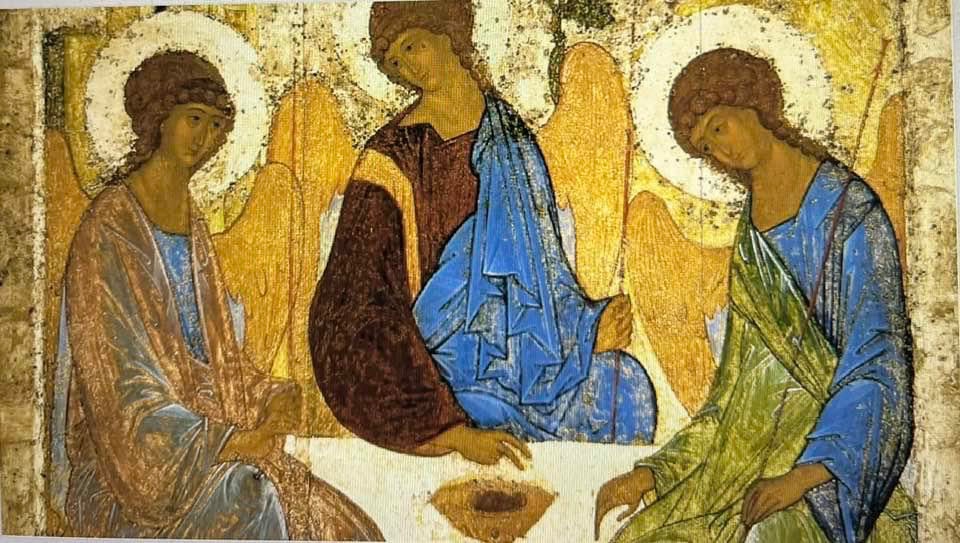
The visitors, offered hospitality by Sarah and Abraham, bring an important revelation to them. These three travellers are the means by which God speaks into the ongoing story. Later Christian interpreters have, unhelpfully and inaccurately, seen the “three men” as a visitation of the Triune God—an interpretation made famous through Andrew Rublev’s early 15th century icon (pictured).

The story, of course, is an ancient Jewish legend, which tells of hospitality and progeny; the Christian doctrine of the Trinity was shaped amidst the patriarchal polemics of the state-sponsored church of the later Roman Empire as church leaders argued about complex matters of speculative philosophical questions. (Was Jesus truly human? Was he truly divine? How are God and Jesus related? Do they share the same essence? Are they of like nature, or of exactly the same nature? and so on …)

The two are worlds apart. It’s another case where Christian interpreters, wanting to find “biblical proof” for that doctrine, have done great damage to a passage of Hebrew Scripture, forcing it to say something that clearly is not evident from a plain reading within the ancient Israelite context.

If we focus on the dynamic that is evident in the story, we see how it highlights the importance of hospitality. And that should encourage and inspire us, as we go about our daily lives, to offer that hospitality to others: to welcome the stranger, invite into our homes and our lives those in need of food, drink, and shelter; to reach out to those caught in the prisons of their minds, their poverty, their crimes, their inadequacies.

All of which sounds like sage words … now, where have we heard that before?

*****

See also

“In you all the families of the earth shall be blessed” (Gen 12; Pentecost 2A)

Each year during the Sundays which follow after the festival of Pentecost, the Gospel readings offer a series of stories, encounters, and parables from the Gosepl attributed to Matthew. In parallel to those stories, in the Hebrew Scripture readings, the lectionary offers a sequence of passages telling some of the key moments in the story of Israel, from the narrative books, Genesis, Exodus, Deuteronomy, Joshua, and Judges. These stories run through until the Twenty-Fifth Sunday after Pentecost, in mid-November.

This sequence of passages offers us stories which were told, retold, and probably developed over quite some time by the elders in ancient Israel. They are stories which define the nature of the people and convey key values which were important in ancient Israel. These faithful people from the past stand, for us today, as role models to encourage us, centuries later, in our own journey of faith. They are stories which are worth holding up for our reflection and consideration.

These stories each have the function of an aetiology—that is, a mythic story which is told to explain the origins of something that is important in the time of the storyteller. The online Oxford Classical Dictionary defines an aetiology as “an explanation, normally in narrative form (hence ‘aetiological myth’), of a practice, epithet, monument, or similar.”

Whilst telling of something that is presented as happening long back in the past, the focus is on present experiences and realities, for “such explanations elucidate something known in the contemporary world by reference to an event in the mythical past”.

See https://oxfordre.com/classics/display/10.1093/acrefore/9780199381135.001.0001/acrefore-9780199381135-e-7050;jsessionid=3DB38C42C54D01E1CBFA8682FB55DA4C

The ancestral narratives of Israel (Gen 12–50), as well as the series of books known as “the historical narratives” (Exodus to 2 Kings, Ezra—Nehemiah) are all written at a time much later that the presumed events which they narrate. The final form of the books as we have them most likely date to the Exile or post-exilic times, although pre-existing sources would have been used for many of these stories. (There are specific references to earlier written documents—now lost to us—scattered throughout 1—2 Kings.)

Those older stories were remembered, retold, and then written down, because they spoke into the present experiences of the writers. Common scholarly belief is that the stories found in Gen 12–50 were originally oral tales, that were collected together, told and retold over the years, and ultimately written down in one scroll, that we today call Genesis.

*****

For this coming Sunday (the Second Sunday after Pentecost), we are offered the account of the calling of Abram, who journeys into a new future (Gen 12:1–9). This has been a key passage for Jews throughout the centuries; Abram is remembered and honoured as “the father of the nation”—indeed, as “the father of all nations”; and this passage claims that it was God’s intention to grant the blessing of abundant descendants to Abram and his wife, to fulfil this promise.

The passage is found after the opening 11 chapters, which are often labelled the “Primeval History”, since they recount the creation of the world and the sequence of events which were fundamental for understanding human existence (such as human sinfulness and conflict, the expansion of humanity, the great flood, the growth of tribal entities, and the diversification of languages).

The passage also stands at the head of those stories, originally oral, which were collected because they revealed much about the nature of Israel as a people and as a nation. These chapters tell stories about the patriarchs and their wives (Abram and Sarai, Isaac and Rebekah, Jacob and Leah and Rachel). This particular passage introduces key themes for the people of Israel.

The passage indicates that Abram took his wife Sarai and his nephew Lot with him, “and all the possessions that they had gathered, and the persons whom they had acquired in Haran; and they set forth to go to the land of Canaan” (Gen 12:5). They would also have had the (always unnamed) wife of Lot with them, for their companions would undoubtedly have included both males and females within the extended family grouping. We need to read this ancient aetiology with a contemporary critical awareness. Certainly, the faith of Abram and Sarai and their extended family is a key message conveyed by this passage.

The story explains four important aspects of life and faith for the people of ancient Israel and on into contemporary Judaism: the land is given to this people, the people (of Israel) will become “a great nation”, the name (of Abram) will be blessed, and the descendants of Abram, “all the families of the earth”, will likewise be blessed. These four points—land, pepople, name, descendants—loom large throughout the history of Israel. Indeed, they maintain their potency into the present age—and need to be read and understood with political and cultural sensitivity today.

*****

This passage sounds the initial claim of the people of Israel to the land of Canaan. This was promised by God to Abram and his descendants, we are told. They set out towards that land; “when they had come to the land of Canaan, Abram passed through the land to the place at Shechem, to the oak of Moreh. At that time the Canaanites were in the land. Then the Lord appeared to Abram, and said, ‘To your offspring I will give this land.’ So he built there an altar to the Lord, who had appeared to him.” (Gen 12:5–7). The claim recurs at various points throughout the ensuing narratives, culminating in the conquest narrated in the book of Joshua.

See more on this aspect of the passage at

and on the difficulties involved in the story of invasion and violent colonisation, see

In his commentary on this passage in With Love to the World, the Revd Dr John Jegasothy, a retired Uniting Church Minister originally from Sri Lanka, reflects on this story of journeying to a new land, from his own perspective as an asylum seeker some decades ago. “As a family we had to decide to leave Sri Lanka and migrate to Australia on Special Humanitarian Visa as I was a human rights advocate and death came close. God had a plan for me to be an advocate for refugees here.”

Dr Jegasothy continues, “I look at our journey as a journey like Abram and Sarai undertook. They absolutely trusted in God’s promises and because of their faith they were counted as righteous.” There is an invitation here for each of us to ponder this story, in terms of our own journey of faith. How and when has God called us on to journey into new places or new experiences?

*****

Alongside the claim to the land of Canaan, the story of Gen 12 portrays Abram (and Sarai) as the origin of a multitude of descendants; through them, “all the families of the earth shall be blessed” (12:3). Initially, this claim appears to be quite precarious; after all, the first mention of Sarai indicates that “Sarai was barren; she had no child” (11:29–30).

Later, when Sarai advises Abram, “see that the Lord has prevented me from bearing children; go in to my slave-girl; it may be that I shall obtain children by her” (16:1–2), Abram diligently obeys; he “went in to Hagar, and she conceived; and when she saw that she had conceived, she looked with contempt on her mistress” (16:4). Tensions between the wife, Sarai, and the slave-girl, Hagar, lead to Hager’s flight into the wilderness, where she gave birth to Abram’s son, Ishmael (16:7–16).

Still later, when Abram (now Abraham) sealed the covenant with the Lord God through the ritual of circumcision (17:1–14), he is told that Sarai (now Sarah) will now be blessed by the Lord, for “I will give you a son by her; I will bless her, she shall give rise to nations; kings of peoples shall come from her” (17:16). And in due time—despite the laughter of Sarah (18:12)—Isaac is born (21:1–3).

The lectionary studiously avoids the story of the birth of Ishmael, but provides us with a sequence of passages that recount the promise to Sarah (18:1–15, Pentecost 3A), the banishing of Hagar and Ishmael (21:8–21, Pentecost 4A), and the near-sacrifice of Isaac (22:1–14, Pentecost 5A), before turning to the story of Isaac and his wife Rebekah (Pentecost 6A) and then on to Jacob (with excerpts from chs. 25 to 37, Pentecost 7A to 11A).

After Sarah died, Abraham married Keturah and had six sons with her (25:1–4). He also “gave gifts to the sons of his concubines while he was living” (25:6), so there were other (unnamed) progeny of Abraham. In due time, Abraham and Sarah’s son Isaac and his wife Rebekah gave birth to twins, Jacob and Esau (25:19–26), whilst Ishmael, the son of Abraham and Hagar, was the father of twelve sons who had many descendants (25:12–18), as well as a daughter who was the ancestor of the Edomites. Abraham’s brothers Nahor fathered twelve sons (22:20–24) whilst Haran was the father of Lot (11:27), who himself fathered Moab and Ammon. Many of these descendants continued reproducing, and so the line of Abraham grew and expanded, generation by generation.

Collectively, this family was responsible for a multitude of descendants, which brings to fulfilment God’s promise to Abraham, “I have made you the ancestor of a multitude of nations; I will make you exceedingly fruitful; and I will make nations of you, and kings shall come from you” (17:5–6). The tenuous moments in the story leave us, as readers, wondering whether this promise would come to fruition; in time, of course, that fulfilment is reported in the Genesis narrative. Abraham does indeed become “father of all nations”, and a key figure in the sagas about Israel that were told and retold throughout the ages.

Forcing scripture to support doctrine: texts for Trinity Sunday (Gen 1, Psalm 8; Trinity A)

This coming Sunday is one of those extremely rare moments in the course of the church year. It’s a Sunday that raises some difficulties for me. First, it’s one of the very few times in the Christian calendar that a Sunday is named for a doctrine, rather than for a biblical story (Easter, Pentecost, Christmas, and the like). And second, it is unusual in that it presents problems for the shapers of the lectionary, since (in my view) the Doctrine of the Trinity is not actually proclaimed in the biblical texts.

Indeed, we might well argue that the texts which are selected for this coming Sunday (Genesis 1, Psalm 8, 2 Corinthians 13, and Matthew 28) are actually being asked to undertake work that they weren’t intended to do, and that they can’t actually do without significant violence being done to them. None of them were created with a view to being foundations for a doctrine that was developed some centuries later (in the case of the New Testament texts) or, indeed, a millennium or more later (in the case of the Hebrew Scripture passages).

And further, the two passages from Hebrew Scripture were actually written well before the time of Jesus, long before the Church came into being, centuries before Christian doctrine was developed in the height of the neo-Platonic speculative theology of the late Roman Empire. They were not shaped with such doctrinal expressions in mind; in fact, they were, and are, sacred texts in another religious expression, Judaism—which, although we Christians claim it as the context from which our faith evolved, nevertheless is a distinct and separate faith tradition.

Setting these two passages of scripture in the lectionary for a Sunday when the focus is on a Christian doctrine is anachronistic and invites us, unless we think carefully, to do violence to the text in our interpretation of them within that doctrinal context. In the normal,course of events, placing a narrative or piece of poetry from ancient Israelite religion alongside texts from the New Testament makes some sense, insofar as our understanding of such passages must always be informed by the heritage bequeathed by Hebrew Scripture texts. But setting such ancient texts as resources to interpret the fourth- and fifth-century doctrinal perspective is quite unhelpful.

Perhaps we should have readings from Origen, Athanasius, and Augustine, for Trinity Sunday? But the fact is, that we have texts from Genesis, the Psalms, Paul, and a Gospel, for this Sunday. What do we make of them?

Genesis 1, the story of the creation of the world, is most likely offered for Trinity Sunday in Year A because the opening verses refer, in turn, to God, a wind, or breath, from God sweeping over the waters, and the activity of God speaking in order to bring forth elements of that creation (Gen 1:1–3). It is not too difficult to read that with Christian spectacles on, and see the presence of God the Creator, the Word of God, and the wind, or breath, as God’s spirit. So numerous Christian interpreters have pressed upon their people, for centuries.

However, arguing that this provides the foundation for the full Christian doctrine of the Triune God does severe damage to the intentions of the passage, at least as we may understand them if we read the text carefully. There is no suggestion that these three elements are persons who are interrelated into one being. There is no indication that they are related, other than the fact that the breath and the speaking are activities of God. That is in no way unusual or extraordinary.

Indeed, if we think some more about the God who is described in these opening few verses, we would recognise that there are a number of other activities undertaken by God, or manifestations of God’s being, that are reported in the various scrolls of the Hebrew Scriptures. As well as the voice (speaking) and the wind (breathing), there are other aspects of the person of God which are said to be active: the mouth, the hands, the fingers of God. Such quasi-independent activity is not limited to two entities alone. The notion of a three-in-one person is nowhere to be found in these scripture passages.

So we need to read Genesis 1 in that much broader context. In addition, we need to be aware of the other “personifications” of the deity that appear in Hebrew Scripture. The ruach—the spirit of God—is, of course, active in calling prophets (1 Sam 10:6, 16; Isa 42:1; 61:1; Ezek 2:2; Dan 5:14; Joel 2:28–29; Mic 3:8; Zech 7:12).

Alongside the spirit, Wisdom, Hochmah, takes on her own persona and role in the wisdom literature; she is the “master worker” who works with God to create the universe (Prov 8:22–31), so that “The Lord by wisdom founded the earth; by understanding he established the heavens; by his knowledge the deeps broke open, and the clouds drop down the dew” (Prov 4:19). It is Wisdom who “cries out in the street; in the squares she raises her voice”, teaching God’s ways to the people (Prov 1:20–23; also 8:1–9). The psalmist affirms that “the fear of the Lord is the beginning of wisdom” (Ps 111:10). Wisdom is God at work in creating and in teaching.

In the narratives telling of the years wandering in the wilderness, the Glory of God, the kabod, appears regularly. When the people arrived at the edge of the wilderness, “the Lord went in front of them in a pillar of cloud by day, to lead them along the way, and in a pillar of fire by night, to give them light, so that they might travel by day and by night; neither the pillar of cloud by day nor the pillar of fire by night left its place in front of the people” (Exod 13:21–22). This manifestation is identified as “the glory of the Lord” (Exod 16:10).

On arrival at Mount Sinai, “the glory of the Lord settled on Mount Sinai, and the cloud covered it for six days … the appearance of the glory of the Lord was like a devouring fire on the top of the mountain in the sight of the people of Israeli” (Exod 24:16–17). In rabbinic literature, this phenomenon is given the name shekinah—a further way of describing the manifestation of divine activity. The Shekinah is yet another manifestation of the divine which becomes personified over time in Jewish traditions; not a separate person, rather an expression of God’s being.

Yet another rabbinic term for divine manifestation is the Bat Qol, the voice of God. This takes the many statements in scripture about God speaking, and attributes quasi-personal firm to the voice of. God. The term Bat Qol literally means “the daughter of the voice”, as if simply by speaking, God generates a personality or a being from that process.

There is much discussion in rabbinic literature about the role and function of the Bat Qol. It was thought that the Bat Qol had been active in biblical times, even though there is no explicit statement of her activity in Hebrew Scripture. A common view in rabbinic literature is that the Bat Qol became the way that God communicated with humanity after the end of the prophetic era.

Also in later rabbinic discussions, even Torah itself—the teaching, or instruction, of God which was given in “the Law”—is personified and seen to be active in and of itself. So along with word and breath (or spirit), there is Wisdom (Hochmah), Glory (Shekinah), Bat Qol, and Torah, who are active expressions of God in the developing Jewish tradition.

Psalm 8 is also offered by the lectionary for Trinity Sunday in Year A; and it is also offered by the lectionary on this day in Year C, as well as for New Years Day in each of the three years. It is a logical companion piece with the Genesis story of creation, which is reflected in verses 1–2 and 7–9. In the middle of the psalm, the place of humanity is in focus; here the emphasis is on the relationship that humanity has with the deity (“a little lower than God, crowned with glory and honour”, v.5) and the responsibility of “dominion” that is given to humans over animals, birds, and fish (vv.7–8).

Perhaps the connection for this Sunday is with the element in the doctrine that lays claim to Jesus as not only human, but also divine; the connection point between the divine realm and the human world? But there is no specific pointer towards Jesus, naturally, in this psalm, and no indication that there was any need for any enhancement, so to speak, of the way that humans related to the divine, beyond that which is set out in this psalm. So it really doesn’t provide a biblical pointer towards understanding the doctrine of the Trinity.

*****

to be continued in a further post …