That his glory may dwell in our land (Psalm 85; Advent 2B)

As we move on in the very new year in the church’s calendar, this coming Sunday we celebrate the second Sunday in the season of Advent, and continue our preparations for Christmas—the coming of Jesus, Saviour, chosen one, and Lord (Luke 2:11). During Advent, the lectionary offers a selection of biblical passages designed to help us in our preparations, building to the climactic moment of Christmas Day, when we remember that “the Word became flesh and lived among us, and we have seen his glory, the glory as of a father’s only son, full of grace and truth” (John 1:14).

These scripture passages include a sequence of psalms which orient us to the saving work of God, experienced by faithful people in Israel through the ages. In the psalms, faithful people over the ages have sung of their trust in God and their joy at what God has been doing. These psalms thus bring us to the point of anticipation that we can sense God’s work in the story of Jesus.

Last Sunday, Advent 1, we heard the psalmist’s prayer, “restore us, O God; let your face shine, that we may be saved” (Ps 80:3, 7, 19). In my blog on this passage last week, I reflected on the terms restore, shine, and save. This coming Sunday, Advent 2, we will hear the psalmist sing that “steadfast love and faithfulness will meet; righteousness and peace will kiss each other; faithfulness will spring up from the ground, and righteousness will look down from the sky” (Ps 85:10–11).

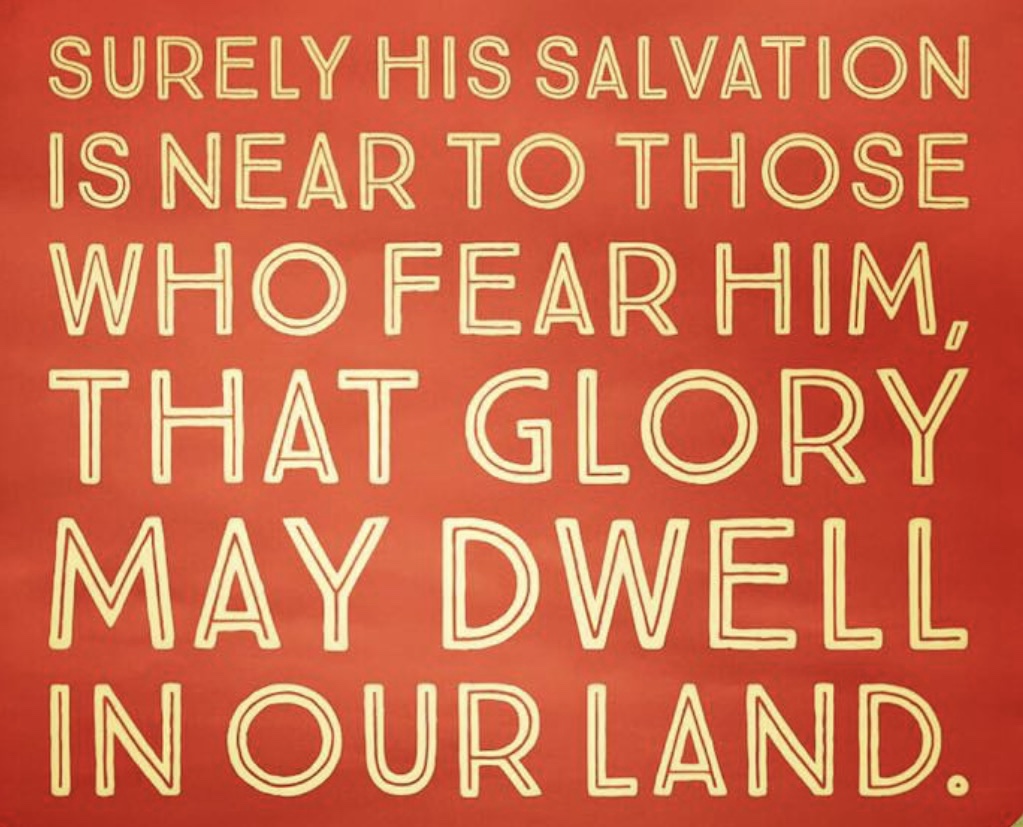
“Surely his salvation is at hand for those who fear him, that his glory may dwell in our land” (Ps 85:9) is the key affirmation for this coming Sunday, Advent 2. As we have pondered the theme of salvation so recently, in this blog I turn my thoughts to the theme of glory.

In a story found in the narrative section of the final chapters of Exodus, Moses yearns to know that he has found favour with God: “if I have found favour in your sight”, he prays, “show me your ways, so that I may know you and find favour in your sight” (Exod 33:13). In response, God promises that “my presence will go with you, and I will give you rest” (33:14), but Moses presses his case: “show me your glory, I pray” (33:18). Not just the divine presence, but the glory of God is what Moses seeks.

Moses had experienced “the glory of the Lord” on the top of Mount Sinai, when “the appearance of the glory of the Lord was like a devouring fire on the top of the mountain in the sight of the people of Israel” (Exod 24:16–18). That glory had already been seen by the Israelites in the wilderness of Sin (Exod 16:10), and that glory subsequently filled the tabernacle when the people had finished constructing it (Exod 40:34–35).

The closing verse of the book of Exodus notes that “the cloud of the Lord was on the tabernacle by day, and fire was in the cloud by night, before the eyes of all the house of Israel at each stage of their journey” (Exod 40:38). A number of other references to this are made throughout the books of the Torah (Lev 9:6, 23; Num 14:10; 16:19, 42; 20:6; Deut 5:24). This appears to have continued on until the ark of God was captured by the Philistines, for at that moment “the glory has departed from Israel” (1 Sam 4:21–22).

Centuries later, at the time that Solomon prayed his lengthy prayer of dedication of the newly-built Temple in Jerusalem, “when the priests came out of the holy place, a cloud filled the house of the Lord, so that the priests could not stand to minister because of the cloud; for the glory of the Lord filled the house of the Lord” (1 Kings 8:10–11; 2 Chron 7:1–3).

The glory of the Lord was then closely associated with the Temple in ensuing centuries, as various psalms attest (Ps 24:3–10; 96:7–8). “O Lord, I love the house in which you dwell, and the place where your glory abides”, one psalmist sings (Ps 26:8); yet other psalms extend the location of God’s glory, exulting that it extends “over all the earth” (Ps 57:5, 11; 72:19; 102:15; 108:5) and even “above the heavens” (Ps 8:1; 19:1; 57:5, 11; 97:6; 108:5; 113:4; 148:13).

By the time of the prophet Isaiah, this wider scope of the glory of the Lord was sung by the seraphim in their song, “Holy, holy, holy is the Lord of hosts; the whole earth is full of his glory” (Isa 6:3), whilst a little later another voice sang that “the earth will be filled with the knowledge of the glory of the Lord, as the waters cover the sea” (Hab 2:14). During the Exile, another prophet, looking to the return of the people to the land of Israel, declared that “the glory of the Lord shall be revealed, and all people shall see it together” (Isa 40:5).

Another exilic prophet had a series of visions in which “the glory of the Lord” was seen (Ezek 1—39), culminating in a declaration by God that “I will display my glory among the nations; and all the nations shall see my judgment that I have executed, and my hand that I have laid on them” (Ezek 39:21), followed by a vision in which “the Lord entered the temple by the gate facing east”, and at that time “the spirit lifted me up, and brought me into the inner court; and the glory of the Lord filled the temple” (Ezek 44:4–5).

Later still, a prophetic voice during the time of return to the land declared to the people that “the Lord will arise upon you, and his glory will appear over you; nations shall come to your light, and kings to the brightness of your dawn” (Isa 60:2–3). And well after that, another prophet attributes to “one like a human being, coming with the clouds of heaven”, the gift of “dominion and glory and kingship, that all peoples, nations, and languages should serve him” (Dan 9:13–14).

Paul draws on the scriptural idea of the divine glory when he writes to the Romans that “we boast in our hope of sharing the glory of God” (Rom 5:2), and that it is through the work of the Spirit which gives hope to the whole creation that it will “obtain the freedom of the glory of the children of God” (Rom 8:21). He tells the Thessalonians that “God … calls you into his own kingdom and glory” (1 Thess 2:12) and speaks of the life of believers as being “sown in dishonour … raised in glory” (1 Cor 15:43).

So Paul advises the Corinthians, “whether you eat or drink, or whatever you do, do everything for the glory of God” (1 Cor 10:31), and later on tells them that “all of us, with unveiled faces, seeing the glory of the Lord as though reflected in a mirror, are being transformed into the same image from one degree of glory to another; for this comes from the Lord, the Spirit” (2 Cor 3:18).

And Paul celebrates that God “has shone in our hearts to give the light of the knowledge of the glory of God in the face of Jesus Christ” (2 Cor 4:6), rejoicing that Jesus “will transform the body of our humiliation that it may be conformed to the body of his glory, by the power that also enables him to make all things subject to himself” (Phil 3:21).

Later writers pick up on this motif of believers sharing in the glory of God. Writing in the name of Paul, one affirms that “God chose to make known how great among the Gentiles are the riches of the glory of this mystery, which is Christ in you, the hope of glory” (Col 1:27), while another declares that that God “called you through our proclamation of the good news, so that you may obtain the glory of our Lord Jesus Christ” (2 Thess 2:14). Another writer speaks of God “bringing many children to glory” through Jesus (Heb 2:10), yet another celebrates that God will “make you stand without blemish in the presence of his glory with rejoicing” (Jude 24).

This, of course, leads into the notion in later Christian theology that heaven can be described as the place of glory—the place where James and John wish to be seated alongside Jesus (Mark 10:37), the place where believers are raised (1 Cor 15:43), the place where faithful elders will “win the crown of glory that never fades away” (1 Pet 5:4), the place where the place where Jesus himself is ultimately “taken up in glory” (1 Tim 3:16).

And that glory was most clearly seen, one writer maintains, in Jesus, when “the Word became flesh and lived among us, and we have seen his glory” (John 1:14). For the author of John’s Gospel, the full manifestation of heaven (glory) was made on earth, in Jesus, who was God’s only son, “who is close to the Father’s heart, who has made him known” (John 1:18).

So the expectation of the psalmist, that the glory of the Lord will dwell in their land, is offered at this Advent time, as we Christians anticipate that God’s glory will again be shown to us in Jesus. It’s a motif that runs through scripture from Moses onwards and is shown forth in striking fashion in the life of Jesus.
Tear open the heavens and come down (Isaiah 64; Advent 1B)

As we start a new year in the church’s calendar, this coming Sunday we will enter into the season of Advent, and begin our preparations once more for Christmas—the coming of Jesus, Saviour, chosen one, and Lord (Luke 2:11). During Advent, the lectionary offers a selection of biblical passages designed to help us in our preparations, building to the climactic moment of Christmas Day, when we remember that “the Word became flesh and lived among us, and we have seen his glory, the glory as of a father’s only son, full of grace and truth” (John 1:14).

These scripture passages include a sequence of excerpts from the Hebrew Scriptures—largely from the book of Isaiah—which orient us to the saving work of God, experienced by faithful people in Israel through the ages. These scripture passages lead us along a path that brings us to the point when we can sense God’s work in the story of Jesus.

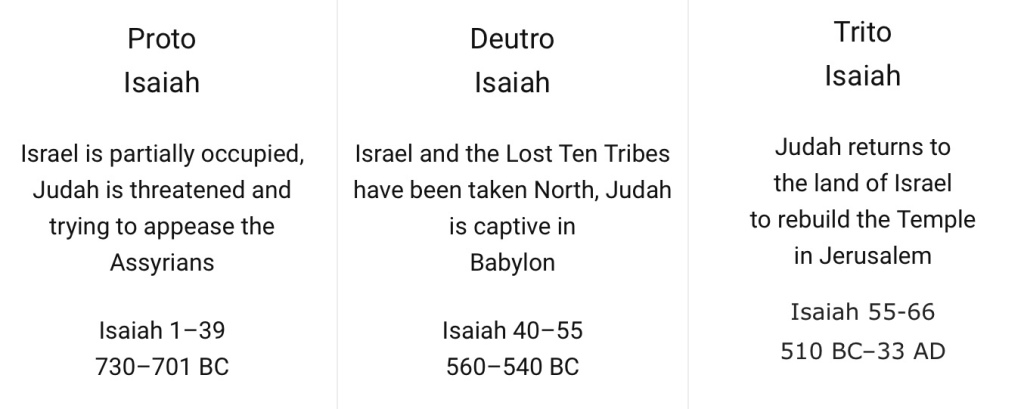
The book of Isaiah comprises three sections, which most scholars believe originated in three different periods during the history of Israel. The first section (chs. 1–39) is located in Judah in the eighth century BCE, as the Assyrians conquered the northern kingdom of Israel and attempted to gain control of the southern kingdom, but that effort failed. These events provide the context for the activity of Isaiah and the oracles include in chapters 1–39.

The second section of Isaiah (chs. 40–55) dates from the time of exile for the southern kingdom, after the people of Judah had been conquered by the Babylonians in 587 BCE; it offers words of hope as the people look to a return to the land. Then, the third section (chs. 56–66) is dated to a time when the exiles had returned to Judah, sometime after 520 BCE. By convention, the three parts are known as First Isaiah, Second Isaiah, and Third Isaiah.

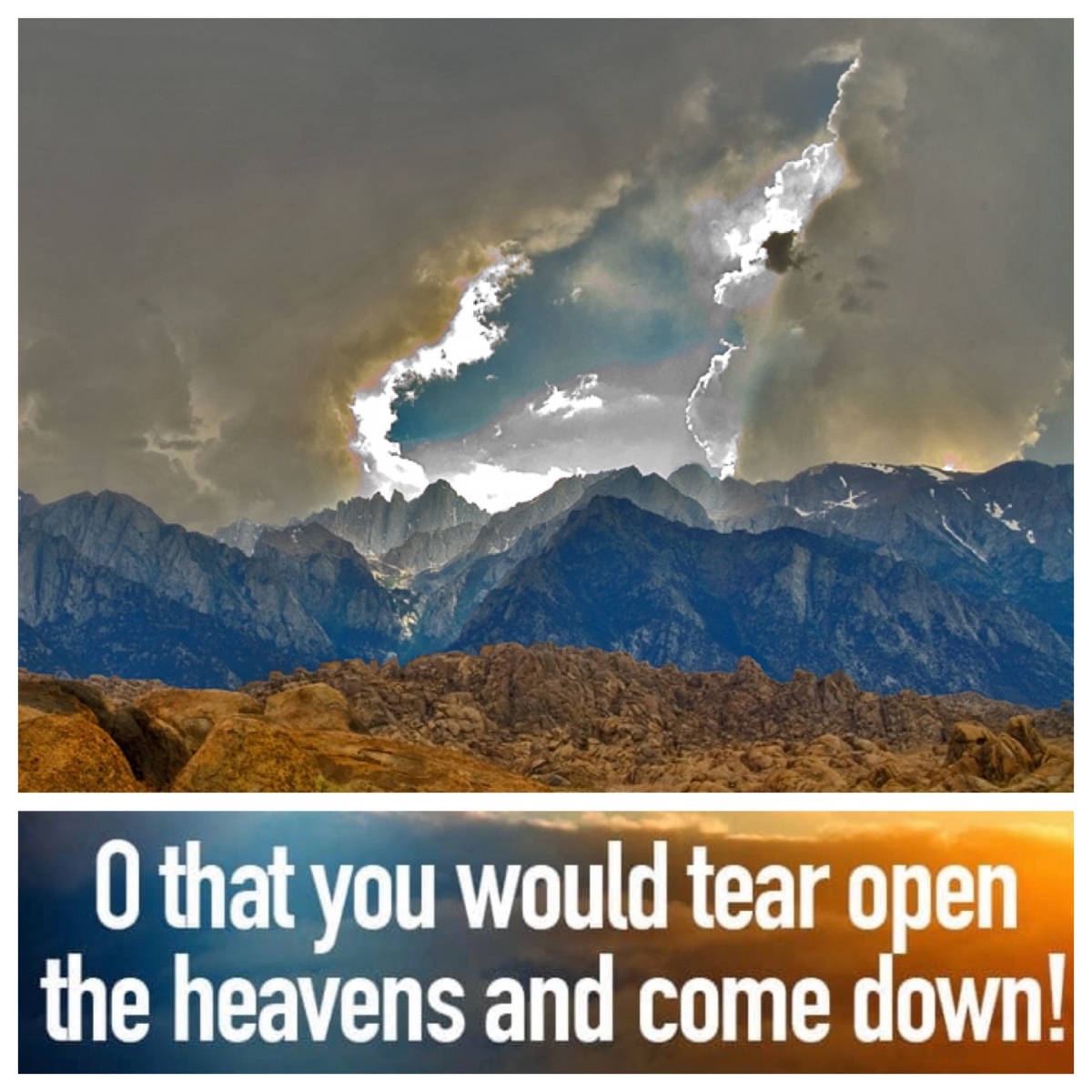
For Advent 1, the lectionary offers us a passage from that final section, Third Isaiah, with words from the post-exilic prophet, “O that you would tear open the heavens and come down, so that the mountains would quake at your presence” (Isa 64:1). Echoing the apocalyptic words of Jesus in the Gospel passage for this Sunday (Mark 13), the prophet foreshadows the rending of the heavens that will occur when God steps into earthly life in Jesus of Nazareth.

Then from the very familiar passage that opens Second Isaiah, as the prophet looks to the end of the exile, on Advent 2 we hear the promise that “the Lord God comes with might … he will feed his flock like a shepherd; he will gather the lambs in his arms, and carry them in his bosom, and gently lead the mother sheep” (Isa 40:10–11). Words of comfort for the exiles; words which Christian interpreters see as a depiction of the shepherding role that Jesus undertakes.

On Advent 3 we return to the third section of Isaiah, to hear another set of very familiar words, which Luke tells us that Jesus appropriated (Luke 4:16–21) to describe his own mission in Israel: “the spirit of the Lord God is upon me, because the Lord has anointed me; he has sent me … to proclaim the year of the Lord’s favour” (Isa 61:1–2).

Then, on Advent 4, we move away from Isaiah to hear the narrative account in which the prophet Nathan tells King David that God has told him, “your house and your kingdom shall be made sure forever before me; your throne shall be established forever” (2 Sam 7:16). These are words which throughout the centuries since Jesus have been seen by Christians as applicable to his God-appointed role.

After this, for Christmas itself, we hear a selection of passages from Isaiah—one from each of the three sections of the book—which also have been seen by Christian interpreters to connect with the story of Jesus: “a child has been born for us, a son given to us; authority rests upon his shoulders; and he is named Wonderful Counselor, Mighty God, Everlasting Father, Prince of Peace” (Isa 9:6); “the Lord has proclaimed to the end of the earth: Say to daughter Zion, ‘See, your salvation comes; his reward is with him, and his recompense before him’” (Isa 62:11); and then, most strikingly, “all the ends of the earth shall see the salvation of our God” (Isa 52:10).

In the passage from Isaiah 64, the prophet is clear and direct. “Tear open the heavens” (v.1a), he implores God, shouting with the passionate intensity of one who fervently desires a clear sign of the presence of the divine. “Come down, so that the mountains would quake at your presence”, he cries (v.1b). After all the devastation that Israel has experienced (vv.6–7, 10–11), the psalmist yearns for God to act, just as God did “when you did awesome deeds that we did not expect, you came down, the mountains quaked at your presence” (v.3).

The various tribulations of the people of Israel, from their testings in the wilderness through to the Exile, when they had been “burned with fire … cut down” (v.16), are seen as multiple punishments heaped onto Israel. So the psalmist implores God, “do not be exceedingly angry, O Lord, and do not remember iniquity forever” (v.9), and pleads to God, “will you restrain yourself, O Lord? Will you keep silent, and punish us so severely?” (v.12).

The tone is much like the psalms where the writer pleads for God to act, for mercy to be shown. “O God, you have rejected us, broken our defenses; you have been angry; now restore us!” is the plea in one psalm (Ps 60:1). In another, the psalmist laments, “How long, O Lord? Will you be angry forever? Will your jealous wrath burn like fire?” (Ps 79:5); we hear similar words as the psalmist elsewhere asks, “Will you be angry with us forever? Will you prolong your anger to all generations?” (Ps 85:5).

Perhaps most vivid of all, and closest to the thoughts that the prophet declares, is this psalm: “Bow your heavens, O Lord, and come down; touch the mountains so that they smoke. Make the lightning flash and scatter them; send out your arrows and rout them. Stretch out your hand from on high; set me free and rescue me from the mighty waters, from the hand of aliens, whose mouths speak lies, and whose right hands are false.” (Ps 144:5–8)

The action of tearing is something that is dramatic and final. It damages permanently. The prophet Hosea describes this vividly in his account of how God plans to respond to Ephraim, when they “keep on sinning and make a cast image for themselves”; God’s intention is, “I will fall upon them like a bear robbed of her cubs, and will tear open the covering of their heart; there I will devour them like a lion, as a wild animal would mangle them” (Hos 13:8).

The language of “tearing” is used to describe the punishment that God will bring upon sinful Israel. Solomon is told, “since you have not kept my covenant and my statutes that I have commanded you, I will surely tear the kingdom from you and give it to your servant” (1 Ki 11:11). That threat is reflected also in psalms (Ps 52:5; 137:7–8) and prophecies (Jer 22:24–27; and cf. Amos 3:15). But the orientation of tearing in this prophecy is not about punishing Israel—rather, the psalmist, as we have seen, is imploring God to come, end the punishment of Israel, and “not remember iniquity forever” (Isa 64:9).

Tearing clothes in an act of mourning is reflected at times in scripture (2 Sam 3:31; Esther 4:1). But this seems far from the intent of this passage, which is focussed on seeking a sign of the presence of God, “so that the nations might tremble at your presence” (Isa 64:2) and so that God might “meet those who gladly do right, those who remember you in your ways” (Isa 64:5).

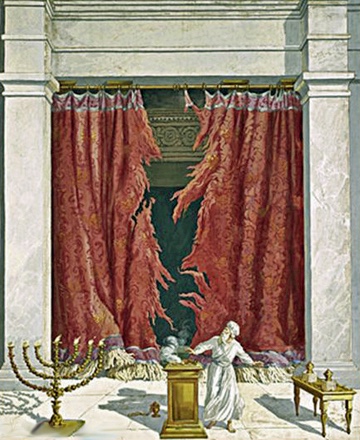
For Christian interpreters, however, when the prophet speaks of God tearing open the heavens in order that God might “come down” (from heaven, to earth), the clearest resonance lies elsewhere. Much is made of the connection with the moment when the curtain of the Temple was torn “from top to bottom” (Mark 15:38; Matt 27:51; Luke 23:45) at the death of Jesus. God dramatically tore apart the curtain that kept the priests from seeing the Holy of Holies, where God resided (Exod 26:33; Heb 9:3) and came down “from top to bottom”, from heaven to earth, in Jesus (cf. John 6:41, 51, 58; Phil 2:5–8).

And so a Christian appropriation of this passage may well appreciate the symbolism of God overcoming the division between heaven and earth in this way. And Christian interpreters may well go on to appropriate other phrases in this prophecy of Isa 64 as relating to Jesus, for in his life, they might affirm, God has done awesome deeds (v.3), has met “those who gladly do right” (v.5), who has reshaped sinners as the potter fashions the clay (v.8), who forgives iniquity (v.9), who acts as the only God ever known (v.4).

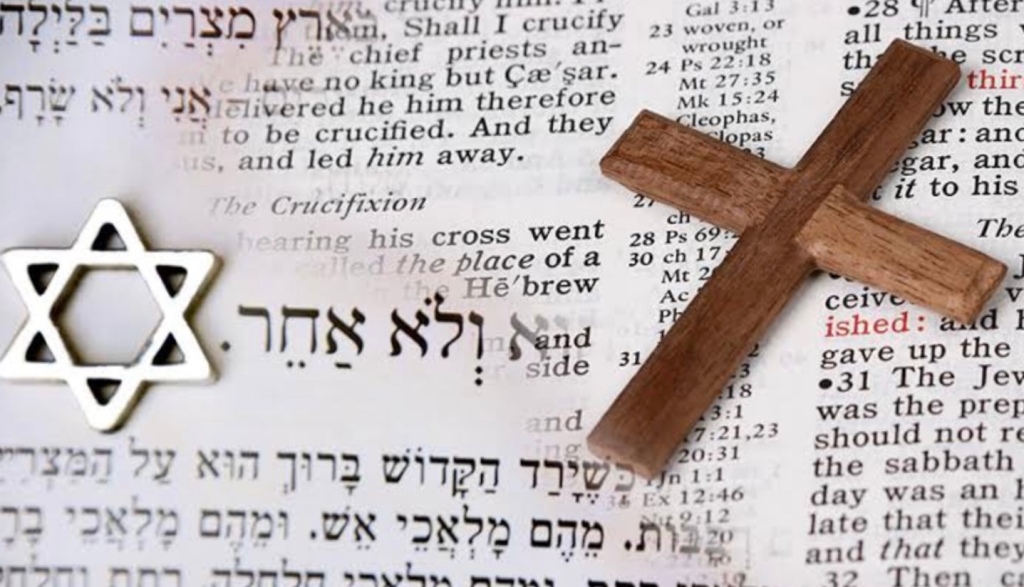
That said, we should caution that interpreting this passage and other ancient Israelite prophetic passages as predictive of Jesus is a strategy that we should undertake with care. Christians have a bad track record of taking Jewish texts and Christianising them, talking and writing and thinking about them as if they were always intended simply to be understood as Christian texts. But first of all, they were Jewish (or, to be precise, ancient Israelite) texts.

So the original setting of such passages needs always to be considered—the historical, social, political, cultural contexts in which they came into being, as well as the literary genre being used and the linguistic and literary conventions being deployed. Obliterating the original setting and acting as if the text was intended for a time many centuries later, is unfair and unethical.

Indeed, Christianising Old Testament texts can well become the first step in a dangerous process, as we firstly remove Judaism from our interpretive framework, and then treat the prophetic text as having nothing to do with Judaism, and everything to do with Christianity. This is the pathway that can lead to antisemitism—actively speaking and acting against Jews and Judaism. And having arrived at such a destination, we are reinforced in our pattern of ignoring and obliterating the earlier meanings in the text.

Texts (whether biblical or other literature) are always multivalent—that is, open to being interpreted in a number of ways, offering multiple ways of understanding them. That’s why we have sermons, and don’t just read the biblical text and then put it down. We keep it before our minds, and explore options for understanding and appropriating it. Ignoring the multiple layers of meaning inherent in biblical passages is a reductionist and self-centred way of undertaking interpretation. Reducing the prophetic texts to predictive declarations solely about Jesus is a poor interpretive process.

So let us tread with caution, this Advent, and beyond, as we hear, savour, and interpret texts from these ancient Israelite works—in which, nevertheless, we can indeed hear “the word of God” to us, in this day.

Let your face shine (Psalm 80; Advent 1B)

As we start a new year in the church’s calendar, this coming Sunday we will enter into the season of Advent, and begin our preparations once more for Christmas—the coming of Jesus, Saviour, chosen one, and Lord (Luke 2:11). During Advent, the lectionary offers a selection of biblical passages designed to help us in our preparations, building to the climactic moment of Christmas Day, when we remember that “the Word became flesh and lived among us, and we have seen his glory, the glory as of a father’s only son, full of grace and truth” (John 1:14).

These scripture passages include a sequence of psalms which orient us to the saving work of God, experienced by faithful people in Israel through the ages. In the psalms, faithful people over the ages have sung of their trust in God and their joy at what God has been doing. These psalms thus bring us to the point of anticipation that we can sense God’s work in the story of Jesus.

For Advent 1, we hear the psalmist’s prayer, “restore us, O God; let your face shine, that we may be saved” (Ps 80:3, 7, 19). “Surely his salvation is at hand for those who fear him, that his glory may dwell in our land” (Ps 85:9) is the affirmation for Advent 2, while on Advent 3 we join with the psalmist to confirm, “the Lord has done great things for us, and we rejoiced” (Ps 126:3).

Then, on Advent 4, we sing joyfully with the psalmist, “I will sing of your steadfast love, O Lord, forever; with my mouth I will proclaim your faithfulness to all generations” (Ps 89:1), before a rich series of three joyous psalms are offered for our Christmas celebrations: “sing to the Lord a new song” (Ps 96:1), “light dawns for the righteous, and joy for the upright in heart” (Ps 97:11), and “make a joyful noise to the Lord, all the earth; break forth into joyous song and sing praises” (Ps 98:4).

*****

In the psalm offered for this Sunday, Psalm 80, the writer prays for God to act. However, this is not just a single-sentence prayer; rather, the writer pleads incessantly with God to restore Israel to her former glory. “Restore us” is a repeated request (80:3, 7, 19), along with calls to “give ear” (80:1), “stir up your might” (80:2), “turn again” (80:14), “come to save us” (80:2), and “give us life” (80:18).

This recurring refrain of petitions is accompanied by the request for God to “let your face shine” (80:3, 7, 19); the prayers accumulate in intensity, reflected in the wording that builds throughout the psalm: “restore us, O God” (80:3); “restore us, O God of hosts” (80:7); “turn again, O God of hosts” (80:14); “restore us, O Lord God of hosts” (80:19).

Restore us, O God

This prayer of the psalmist, “restore us, O God”, reflects the same prayer found in a number of psalms. In penitence, a psalm traditionally associated with the repentant David asks God to “restore to me the joy of your salvation, and sustain in me a willing spirit” (Ps 51:12). Another psalm, associated with David after defeat in battle (according to the title included in the Hebrew text) implores God, “you have rejected us, broken our defenses; you have been angry; now restore us!” (Ps 60:1).

A psalm “of the Korahites” pleads, “restore us again, O God of our salvation, and put away your indignation toward us” (Ps 85:4), while the seventh Song of Ascent celebrates “when the Lord restored the fortunes of Zion, we were like those who dream”, rejoicing that “our mouth was filled with laughter, and our tongue with shouts of joy” (Ps 126:1–2), offering the prayer “restore our fortunes, O Lord, like the watercourses in the Negeb” (Ps 126:4).

Prophets also sought God’s restoration. In the midst of his incessant despair, Jeremiah yet sees hope: “the days are surely coming, says the Lord, when I will restore the fortunes of my people, Israel and Judah, says the Lord, and I will bring them back to the land that I gave to their ancestors and they shall take possession of it” (30:3). It is in this context that Jeremiah indicates that the Lord “will make a new covenant with the house of Israel and the house of Judah … I will put my law within them, and I will write it on their hearts” (31:31, 33).

The final oracle in the book of Amos (9:11–15)—most likely a later exilic addition—envisages a restored and rebuilt Israel after their time of exile, in a land once again productive, and ends with a strong expression of confidence in the people: “I will plant them upon their land, and they shall never again be plucked up out of the land that I have given them, says the Lord” (9:15).

Restoration after exile is also foreseen towards the end of the book of Deuteronomy, when Israel is told that “the Lord your God will restore your fortunes and have compassion on you, gathering you again from all the peoples among whom the Lord your God has scattered you” (Deut 30:3).

In Second Isaiah, the servant is chosen “to raise up the tribes of Jacob and to restore the survivors of Israel” and God says, “I will give you as a light to the nations, that my salvation may reach to the end of the earth” (Isa 49:6). Likewise, Ezekiel’s final,sequence of visions includes God’s promise, “I will restore the fortunes of Jacob, and have mercy on the whole house of Israel” (Ezek 39:25). Other prophets similarly look to a time of restoration (Hos 6:11; Joel 3:1; Zeph 2:7; 3:20; Zech 9:12).

So in the book of Nehemiah, the Governor issues the instruction, “Restore to them, this very day, their fields, their vineyards, their olive orchards, and their houses, and the interest on money, grain, wine, and oil that you have been exacting from them”; and the response is, “We will restore everything and demand nothing more from them. We will do as you say” (Neh 5:11–12).

Let your face shine

Another request that the psalmist makes, for God to shine their face upon people (Ps 80:3), is a request that is found in other psalms. “There are many”, says the psalmist, “who say, ‘O that we might see some good! Let the light of your face shine on us, O Lord!’” (Ps 4:6). In Psalm 31, the psalmist sings, “Let your face shine upon your servant; save me in your steadfast love” (Ps 31:16).

In Psalm 67, the psalmist echoes more explicitly the Aaronic Blessing, praying, “May God be gracious to us and bless us and make his face to shine upon us—Selah—that your way may be known upon earth, your saving power among all nations” (Ps 67:1–3). This reflects the ancient priestly blessing recorded in Num 6:24–26: “The Lord bless you and keep you; the Lord make his face to shine upon you, and be gracious to you; the Lord lift up his countenance upon you, and give you peace.”

In this three-line prayer, the second line includes the phrase, “the LORD make his face to shine upon you”. The simple parallelism in this blessing indicates that for God to “make his face shine” (v.25) is equivalent to blessing (v.24) and lifting up his countenance (v.26). The second verb in each phrase is, likewise, in parallel: the psalmist asks God to keep (v.24), be gracious (v.25), and grant peace (v.26). These words offer a prayer seeking God’s gracious presence for the people of Israel.

The face of God was a matter of some significance in the ancestral story of Jacob, who becomes Israel. Estranged for decades from his twin, Esau, when they meet up again, Jacob has just spent the night wrestling with a man (Gen 32:22–32). Jacob’s hip is struck, and he walks with a limp; yet he describes the place where this happened as Peniel, “the face of God”, and characterises the encounter as a time when “I have seen God face to face, and yet my life is preserved” (32:30). To see God face-to-face was a rare and intense experience. Jacob was, indeed, blessed.

In the seventeenth section of the longest of all psalms, Psalm 119, a prayer asking for God to help the psalmist keep the Law culminates with the request for God’s face to shine: “Turn to me and be gracious to me, as is your custom toward those who love your name. Keep my steps steady according to your promise, and never let iniquity have dominion over me. Redeem me from human oppression, that I may keep your precepts. Make your face shine upon your servant, and teach me your statutes.” (Ps 119:132–135).

Come to save us

The plea of the psalmist for God to “save” them (v.2) is another persistent refrain throughout the psalms—both “save me” (Ps 6:4; 7:1; 22:21; 31:2, 16; 44:6; 54:1; 57:3; 59:2; 69:1; 71:2, 3; 109:26, 116:4; 119:94, 146; 142:6; 143:9) and “save us” (Ps 28:9; 31:2; 80:2; 106:47; 118:25).

The plea for saving is a request also found in prayers attributed to Samuel (1 Sam 7:8), David (2 Sam 22:2–4; 1 Chron 16:35), Hezekiah (2 Ki 19:18; Isa 37:20), Isaiah (Isa 25:9), and Jeremiah (Jer 17:14)—a prayer to which Jeremiah says that the Lord has said, “I will surely save you, and you shall not fall by the sword; but you shall have your life as a prize of war, because you have trusted in me” (Jer 39:18).

This request is grounded in the assurance that “God is my shield, who saves the upright in heart” (Ps 7:10); “the Lord is near to the brokenhearted, and saves the crushed in spirit” (Ps 34:18); God “fulfils the desire of all who fear him; he also hears their cry, and saves them” (Ps 145:19).

There are many indications in the narratives included in the Hebrew Scriptures that point to the saving purposes of God. The Chronicler reports that when David places the ark of God into the tent on Mount Zion, he instructs the Levites to sing, “save us, O God of our salvation, and gather and rescue us from among the nations” (1 Chron 16:35).

The prophet Isaiah affirms that “the Lord will save me” (Isa 38:20) and the prophet Habakkuk reflects that the Lord God “came forth to save your people, to save your anointed” (Hab 3:13). Later, when King Sennacherib of Assyria besieges Jerusalem and presses King Hezekiah of Judah to surrender, he addresses “all the people of Judah that were in Jerusalem”, ironically asking them, “Is not Hezekiah misleading you … when he tells you, ‘The Lord our God will save us?'” (2 Chron 32:9–11).

Subsequently, the prophet Jeremiah assures his fellow exiles that “the Lord of hosts, the God of Israel” promises, “I am going to fulfill my words against this city for evil and not for good … but I will save you on that day” (Jer 39:16–17). It is no wonder that God is addressed as Saviour by kings (David, 2 Sam 22:3) and prophets (Isa 43:3, 11; 45:15, 21; 49:26; 60:16; 63:8; Jer 14:8; Hos 13:4), in psalms (Ps 17:7; 106:21) and in later wisdom literature (Judith 9:11; Wisdom of Solomon 16:7; Sirach 51:1).

In the longest psalm, Psalm 119, as the psalmist cries out, “let your steadfast love come to me, O Lord”, they equate that love precisely with “your salvation according to your promise” (v.41). Unsurprisingly, the psalmist places their trust in Torah as the means for attaining that salvation: “my [whole being] languishes for your salvation, I hope in your word” (v.81).

Indeed, this waiting requires persistence; “my eyes fail from watching for your salvation, and for the fulfillment of your righteous promise” (v.123). By contrast, “salvation is far from the wicked, for they do not seek your statutes” (v.155). This salvation is intimately bound up with keeping Torah (vv.94, 146, 166, 174); “I do not forget [Torah]” is a persistent affirmation (vv.16, 61, 109, 141, 153, and in the final verse, 176).

Of course , God as Saviour is an important Hebraic way of understanding the divine, that then has implications and influence as the New Testament documents are written, centuries later. “Christ Jesus came into the world to save sinners” (1 Tim 1:15) is a classic Christian formulation, valued as central to Christian theology over the centuries.

In the Gospels, Jesus declares, “the Son of Man came to seek out and save the lost” (Luke 19:10). Paul identifies Jesus as Saviour (Phil 3:20), proclaims good news “through which also you are being saved” (1 Cor 15:2), and celebrates that “everyone who calls on the name of the Lord shall be saved” (Rom 10:13, quoting Joel 2:32). So the psalmist (in Psalm 80) is sounding a foundational claim, made throughout scripture: O God, “come and save us”.

From this repeated refrain in this psalm, we can appreciate that it is an appropriate word for us to hear and reflect on, as we start a new year in the church’s calendar, enter into the season of Advent, and begin our preparations once more for Christmas—when in the coming of Jesus, Saviour, chosen one, and Lord, we celebrate that the face of God has shone upon us, that God will restore us, that God has come to save us.

The outer darkness, the eternal fire, and the threat of Hell (Matt 25; Pentecost 25A) part two

There have been a number of posts on my Facebook feed in recent weeks, on the matter of Hell. A number of them have made the claim that Hell does not appear in the New Testament. It’s a common claim made by hardline “progressive” Christians. I have started to address this in an earlier post; see

The Gospel passage proposed by the Revised Common Lectionary for this coming Sunday (Matt 25:14–30) raises this matter quite directly. This passage offers a parable of Jesus (found here and, in another version, in Luke 19), in which two slaves are commended for their shrewd stewardship of a huge amount of money that was entrusted to them, whilst one slave is punished for not improving the amount he was given.

That slave is called “wicked and lazy” (Matt 25:26) as well as “worthless”, and his punishment is far more severe: he is to be thrown “into the outer darkness” (25:30). That is often interpreted, with some justification, as being thrown into Hell.

I know about the way that Hell can be used in Christian rhetoric. In the past, I have been labelled, by a fellow-member of my church, with derogatory and insulting labels regarding my marital status. I have been condemned for “worshipping Satan” and being “doomed to hell”. I have been called out, publically, as an “apostate” who “has been deceived”, and told that I am “hell-bound without repentance”.

Graphic descriptions of my fate, as being condemned to “the eternal lake of burning sulphur” (Rev 20:7–10 and 21:8), have been provided for me to ruminate over. And worse, this particular individual has justified this way of responding by maintaining that there is “nothing unchristian about warning demonically inspired LGBTI advocates against Hell and the Lake of Fire”. How charmingly pastoral!

The slave who was not prepared for the return of his master—in the first of four parables (24:45–51) which conclude the final teaching discourse of Jesus—faces this clear punishment: “put him with the hypocrites, where there will be weeping and gnashing of teeth” (24:51). Where was that place, where the hypocrites are to be found? Jesus does not specify that here.

Jesus had earlier spoken a similar instruction to “throw him into the outer darkness, where there will be weeping and gnashing of teeth” in the parable where a person came to a wedding inappropriately dressed (22:13). This is a recurrent motif in Matthew’s Gospel; but this passage gives no further description of where that outer darkness with its weeping and gnashing of teeth is located.

Elsewhere in this Gospel, Jesus has pointed to the same punishment for lawless and disobedient people: such weeping and gnashing of teeth is cited in his words of judgement spoken in Capernaum, where he encounters a distressed centurion (8:12); in his explanation of the parable of the weeds and the wheat (13:42); in the parable of the good and bad fish (13:50); and in the parable of the talents (25:30). But where is the outer darkness where this experience located?

The gnashing of teeth is a punishment that is taken from Hebrew Scripture texts: “the wicked plot against the righteous and gnash their teeth at them (Ps 37:12); “the wicked gnash their teeth and melt away; the desire of the wicked comes to nothing” (Ps 112:10); “malicious witnesses … impiously mocked more and more, gnashing at me with their teeth” (Ps 35:11,16). The prophet laments that when Jerusalem is ransacked, “all your enemies open their mouths against you, they hiss, they gnash their teeth, they cry ‘we have devoured her!’” (Lam 2:16). It is a well-known form of torment and punishment.

The Matthean parable of the unprepared servant also has this apparently savage instruction: he will cut him in pieces (24:51). In a similar version, found in Luke’s Gospel (Luke 12:42–48), the master similarly “will cut him in pieces, and put him with the unfaithful” (Luke 12:46), but again the location of the unfaithful is not specified.

In a number of places in Hebrew Scripture, cutting a body into pieces was an action used in sacrificing animals (1 Kings 18:23, 33) and as a warning of judgement against sinners—in the terrible story of the Levite’s concubine (Judges 19:29), after Saul defeated the Ammonites (1 Sam 11:7), and also in direct prophetic warnings (Isa 45:2; 51:9; Ezek 16:40; Dan 2:34; also Judith 5:22). This is the fate decreed for the unprepared slave—a terrible end, indeed!

Throughout Matthew’s Gospel, Jesus declares that sinners are destined for the judgement of fire (Matt 5:22; 7:19; 13:40, 42, 50; 18:8–9; 25:41). This gives a clearer indication of the location where punishment will be meted out to the unfaithful, the hypocrites, and those who disobey the law. The reference to the judgement of fire picks up from the warning of John the baptiser, which Matthew has added to his Markan source: “You brood of vipers! who warned you to flee from the wrath to come? … even now the ax is lying at the root of the trees; every tree therefore that does not bear good fruit is cut down and thrown into the fire” (Matt 3:7, 10).

That place is described by Jesus, in parables unique to Matthew, as “the furnace of fire” (Matt 13:43, 50; 25:41). Sinners will be sent to a place of “eternal fire” (18:8; 25:41), “the hell of fire” (5:22; 18:9), the “unquenchable fire” threatened by John, as he baptised repentant sinners and warned that “the chaff he will burn with unquenchable fire” (3:12). This builds on the warnings found in Mark’s Gospel about the punishment in store for those who put stumbling blocks in the way of “these little ones”—they will be condemned to “the unquenchable fire” (Mark 9:42–48). These warnings are repeated by Jesus in Matt 18:6–9.

Matthew’s portrayal of Jesus is consistent in reporting that he warns his followers, again and again, of the fiery fate that awaits evildoers. Once again, this picks up on Hebrew Scripture passages in which various prophets declare that God will use fire to destroy people and places because of their sinfulness (Isa 1:7; 5:24; 30:27–28, 30, 33 18–19; Jer 4:4; 6:27–30; 20:47–48; Hos 8:14; Joel 2:1–3; Amos 1:4—2:5; Nah 1:15).

Amongst those prophetic oracles, Zephaniah, for instance, portrays utter devastation through divine judgement: “neither their silver nor their gold will be able to save them on the day of the Lord’s wrath; in the fire of his passion the whole earth shall be consumed” (Zeph 1:18).

However, the final prophet in the Christian Old Testament, Malachi, reworks this imagery, offering some hope; God’s messenger on The Day of the Lord “is like a refiner’s fire and like fullers’ soap; he will sit as a refiner and purifier of silver, and he will purify the descendants of Levi and refine them like gold and silver, until they present offerings to the Lord in righteousness” (Mal 3:1–4).

A number of psalms reflect a desire for God to punish evildoers severely; “pour out your indignation upon them, and let your burning anger overtake them” is the cry of one psalm (Ps 69:24). Another psalm notes the vengeance of God—“in your hearts you devise wrongs; your hands deal out violence on earth” (Ps 58:2)—and suggests that “the righteous will rejoice when they see vengeance done; they will bathe their feet in the blood of the wicked” (Ps 58:10). We must wonder: did Jesus pray these psalms? did he concur with their ideas? did he pray for God to act with vengeance? The words that Matthew attribute to Jesus in his Gospel would suggest that he did.

The image of fiery punishment is often noted by the psalmists: “on the wicked [God] will rain coals of fire and sulfur; a scorching wind shall be the portion of their cup” (Ps 11:6); “the voice of the Lord flashes forth flames of fire; the voice of the Lord shakes the wilderness” (Ps 29:6-7); and again, “your hand will find out all your enemies; your right hand will find out those who hate you; you will make them like a fiery furnace when you appear; the Lord will swallow them up in his wrath, and fire will consume them.” (Ps 21:8-9).

Indeed, one psalmist prays to God, “as fire consumes the forest, as the flame sets the mountains ablaze, so pursue them with your tempest and terrify them with your hurricane” (Ps 83:14-15). After one such prayer, other psalmists must have been astounded as “smoke went up from his nostrils, and devouring fire from his mouth; glowing coals flamed forth from him” (Ps 18:8; see also 18:12; 46:9; 68:2; 78:21, 63; 97:3; 104:4; 106:18). And so the psalmist laments, “how long, O Lord? will you be angry forever? will your jealous wrath burn like fire?” (Ps 79:5; 89:46).

This imagery is picked up and placed into the story of Daniel (Dan 3:1–30) and appears again in the last book of the New Testament, where the prophet describes his visions of “the lake of fire that burns with sulfur” (Rev 19:20; 20:10, 14–15), also described as “the second death” (Rev 20:14; 21:8). It is there that the devil, the beast, and the false prophet “will be tormented day and night forever and ever” (Rev 20:10). Matthew appears to share some similarities with the writer of this book, for as we have noted, eternal punishment in a fiery furnace features also in the words of Jesus in Matthew’s Gospel.

So we can’t simply brush aside the closing words of the parable which is in focus this coming Sunday—the Heavenly Father, we are told, will follow the example of the unforgiving servant, who will be “tortured until he would pay his entire debt” (18:34–35), in the service of ensuring that faithful people do indeed forgive one another! (How he will be able to pay off his debt while he is being tortured in prison, I do not know!)

Such punishment is consistent with the way that God’s justice will be implemented, according to the various teachings and parables of Jesus in Matthew’s Gospel that we have already noted. It will be incredibly hard to be let off the hook by this fierce, punitive God!! We are left in no doubt whatsoever, that Jesus believed in a place where divine wrath would visit punishment and wreak revenge on evildoers.

So as we read and hear and interpret this parable, today, and as we reflect on the matter of punishment, Hell, and the afterlife, we are left to ponder for ourselves: do we still hold to this place, Hell, as a place of eternal torment for sinners? or can we move on in our understanding and reshape our theology to form a belief system that offers a different way of addressing injustice and rewarding faithfulness? (I would like to think we can.)

Certainly, the survey of passages above reveals a clear development in various Hebrew Scripture passages, on through into New Testament textswhich raises the question, why, then, do we need to stop our thinking about these ideas—our conceptualisation of how God deals with sin—with late first century texts? And let’s note that understandings of these ancient texts have been mediated especially through interpreters of late antiquity and the medieval period, and their more recent followers. Is it not legitimate for us, today, to continue that development and for us to articulate new understandings?

We are also left with the conundrum: what are we to make of this aggressively violent, retributive God, condemning sinners to the misery of “hell”? Is this the last word about God? or can we legitimately form a different, more nuanced understanding of the divine? (Again, this is the direction I would like to move.)

These questions focus the the challenge of preaching and interpreting this parable of Jesus, and these ancient texts as a whole, in our contemporary world.

************

Material in this and the previous blogs is drawn in part from the research of Elizabeth Raine and from MESSIAH, MOUNTAINS, AND MISSION: an exploration of the Gospel for Year A, by Elizabeth Raine and John Squires (self-published 2012)

See also

The outer darkness, the eternal fire, and the threat of Hell (Matt 25; Pentecost 25A) part one

There have been a number of posts on my Facebook feed in recent weeks, on the matter of Hell. A number of them have made the claim that Hell does not appear in the New Testament. It’s a common claim made by hardline “progressive” Christians. The Gospel passage proposed by the Revised Common Lectionary for this coming Sunday (Matt 25:14–30) would suggest otherwise, however.

This passage offers a parable of Jesus (found here and, in another version, in Luke 19), in which two slaves are commended for their shrewd stewardship of a huge amount of money that was entrusted to them, whilst one slave is punished for not improving the amount he was given.

In Luke’s version, the third slave is called “wicked” (Luke 19:22) and the money he was given is taken from him and given to the first slave, to illustrate the saying, “to all those who have, more will be given; but from those who have nothing, even what they have will be taken away” (Luke 19:24–26). In Matthew’s version of this this parable, the slave is called “wicked and lazy” Matt 25:26) as well as “worthless”, and his punishment is far more severe: he is to be thrown “into the outer darkness” (25:30).

This is the third reference by the Matthean Jesus to “outer darkness” (8:12; 22:13; 25:30). As the parable that follows refers to “the eternal fire prepared for the devil and his angels” (25:41)—to which Jesus had earlier referred (18:8)—it does seem that Jesus is referring to a place that we know by the term “hell”. Indeed, words spoken by Jesus in Matt 18:9 are rendered explicitly as “the hell of fire” in the NRSV, while the NIV renders this “the fire of hell”. They are both translating a Hebrew word, here transliterated into Greek, Gehenna (on which, see more, below).

Over the years I have had a number of interesting conversations about these passages, and others, and about “hell” in biblical texts, with my wife, Elizabeth Raine, as she has studied both Matthew’s Gospel (where there is a preponderance of passages referring, in one way or another, to “hell”), as well as the relevant Hebrew Scripture passages often linked with “hell”, so what follows is strongly informed by those conversations.

Now, my search of the NRSV indicates that the word “hell” does appear 13 times in this translation of the New Testament. 11 of these are in the Synoptic Gospels, each time in words attributed to Jesus (the other two are in James and 2 Peter). The NIV has the same 13 occurrences of the word “hell”; but in the 17th century translation authorised by King James, the word appears 23 times in the New Testament (15 of these in the Synoptics) as well as 31 times in the Old Testament. Clearly, the reticence to use this word in translating relevant Hebrew or Greek words grew between the 17th and the 20th century. Why might that have been?

I think that this reticence might relate, in part, to a developing clarity about what the various words in Hebrew and Greek actually described. Rather than lumping them all together under the catch-all term “hell”, more recent translators take care to provide more distinctive descriptors.

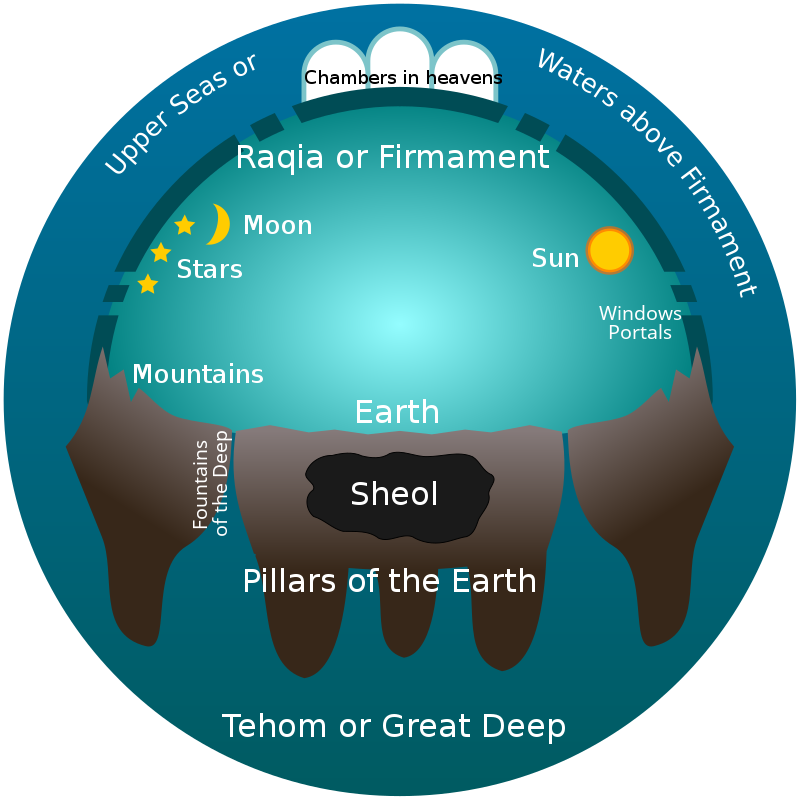
There are a number of concepts which need to be considered. This takes us into the strange world of ancient Hebrew cosmology—the world, heavens and earth, what was above and what was below, was understood in a different way from the way that 21st century people understand such things.

In Hebrew Scripture, there are references to the Deep, the Pit, and Sheol. These three words appear to describe the state of being of human beings after they have died. In the King James Version, the word “hell” is used to translate these Hebrew words on quite a number of occasions. But we need to explore them more carefully.

Sheol is the opposite of heaven in spatial terms; as heaven is in the heights, so Sheol is in the depths. (Gen 49:25). Isaiah says that God invited King Ahaz to “ask a sign of the Lord your God; let it be deep as Sheol or high as heaven” (Isa 7:11; the sign that is then given is the famous child, to be named Immanuel, 7:14). Ezekiel describes the demise of “Assyria, a cedar of Lebanon … [that] towered high and set its top among the clouds” in these words from God: “on the day it went down to Sheol I closed the deep over it and covered it” (Ezek 31:15). In this fate, it shared with those who “are handed over to death, to the world below … with those who go down to the Pit” (Ezek 31:14).

The terms found here—Sheol, the Deep, the Pit, the world below—are part of a cluster of terms which appear throughout Hebrew Scripture. Technically, The Deep describes the waters of chaos, outside the Dome, which can rise up to flood the world, as in the story of Noah, when in one version “all the fountains of the great deep burst forth, and the windows of the heavens were opened” (Gen 7:11) and, after 150 days, “God made a wind blow over the earth, and the waters subsided; the fountains of the deep and the windows of the heavens were closed, the rain from the heavens was restrained, and the waters gradually receded from the earth” (Gen 8:2).

Sheol and The Pit each describe the state of the nephesh (the essence of being) of those whose bodies have died. In Psalm 88, when the psalmist laments “my soul is full of troubles”, they use these and other terms in poetic parallelism to describe their fate: “my life draws near to Sheol; I am counted among those who go down to the Pit; I am like those who have no help, like those forsaken among the dead, like the slain that lie in the grave, like those whom you remember no more, for they are cut off from your hand; you have put me in the depths of the Pit, in the regions dark and deep” (Ps 88:3–6). Another psalm describes this as “the land of silence” (Ps 94:17), while the prophet Ezekiel imagines it as the place where the dead, the “people of long ago” lie “among primeval ruins” (Ezek 26:20)

In this state, people simply lie in darkness, not living, with no future in view, no hope in store. Job laments, “if I look for Sheol as my house, if I spread my couch in darkness, if I say to the Pit, ‘You are my father,’ and to the worm, ‘My mother,’ or ‘My sister,’ where then is my hope?” (Job 17:13-15). Job also equates entering the Pit with “traversing the River” (Job 33:18), in words that seem to reflect the River Hubur (in Sumerian cosmology) or the River Styx (in Greek cosmology), the place where the souls of the dead cross over into the netherworld.

Other words for Sheol in Hebrew Scripture include Abaddon, meaning ruin (Ps 88:11; Job 28:22; Prov 15:11) and Shakhat, meaning corruption (Isa 38:17; Ezek 28:8). These terms indicate the forlorn, lost, irretrievable nature of this state of being. This is the fate in store for all human beings, whether righteous or wicked; there is no sense of judgement or punishment associated with this state. It is simply a state of non-being.

By the time of the New Testament, however, there had been quite some development in this direction within Jewish thinking. In the apocalyptic visions of 2 Esdras, Ezra is depicted as foreseeing that “the pit of torment shall appear, and opposite it shall be the place of rest; and the furnace of hell shall be disclosed, and opposite it the paradise of delight” (2 Esd 7:36).

Likewise, the seven Maccabean brothers tell “the tyrant Antiochus” that “justice has laid up for you intense and eternal fire and tortures, and these throughout all time will never let you go” (4 Macc 9:9; also 12:12). In the teaching contained in the Wisdom of Solomon, however, a complementary element is noted, as Solomon is said to declare “the souls of the righteous are in the hand of God, and no torment will ever touch them” (Wisd Sol 3:1).

The New Testament—largely in the Synoptic Gospels, but also in Revelation—reflects these developments in the way that it portrays the afterlife, with a number of sayings portraying a place of punishment for sinners after death, as well as the promise of eternal life for the righteous with God in the kingdom of heaven.

There are three Greek words that are relevant at this point: Gehenna, Hades, and Tartarus. The first, Gehenna, was a geographical term, referring to the Valley of Hinnom, to the southwest of Jerusalem, where in periods of sinfulness before the Exile, children had been sacrificed to Molech (2 Ki 23:10; 2 Chron 28:3; 33:6; Jer 7:31-32; 32:35). This practice was the cause of punishments experienced by the people for their sinful behaviour.

Gehenna appears twelve times in the New Testament—eleven of those being in words attributed to Jesus (Mark 9:43, 45, 47, paralleled in Matt 18:9; Matt 5:22, 29, 30; 10:28; 23:15, 33; and Luke 12:5). In some of these occurrences, Gehenna is placed into parallel with other ideas which suggest it is no longer the simple geographical reference of Hebrew Scripture texts, but it has become a place of punishment for sinners in the afterlife (see further below).

The potency of Gehenna is noted when James warns those who misuse their tongue as “a restless evil, full of deadly poison” (James 3:8) that “the tongue is placed among our members as a world of iniquity; it stains the whole body, sets on fire the cycle of nature, and is itself set on fire by hell [translating the Greek Gehenna]” (James 3:6).

A second word, found ten times in the New Testament, is Hades; a word adopted from older Greek literature, where it appears from Homer onwards as the name of the God of the lower regions (Hades, later Pluto, the brother of Zeus and Poseidon) and of the realm of the dead. This was where all people went after their death; leaving Hades was not possible (with the exception of a few heroic figures in the myths of the Greeks).

Jesus speaks of going down to Hades (Matt 11:23; Luke 10:15); perhaps he himself went there? (1 Pet 3:19 may allude to this). The deceased rich man in Hades looks up to heaven to see the poor man, Lazarus, with Abraham (Luke 16:22–23). Hades in this parable is a place of torment (Luke 16:23, 25); the rich man endures punishment which apparently cannot be revoked (Luke 16:26).

In Acts, Peter is said to have quoted Ps 16:10, referring to the soul being abandoned in Hades, in his speech at Pentecost (Acts 2:27, 31), and four times in Revelation Hades is linked with death (Rev 1:18; 6:8; 20:13–14). The Matthean Jesus informs Peter that “the gates of Hades will not prevail” against the church, founded in Peter, the rock (Matt 16:18). Hades has gates, presumably to ensure its inhabitants cannot escape the fate determined for them.

It is interesting that for a number of verses in the Septuagint, the Greek word Hades translates Sheol, thereby turning it from a Hebrew idea into a Greek concept for the hellenised Jewish readers of the Septuagint.

The introduction of punitive elements into the way that Gehenna and Hades are described leads to a third Greek word which is relevant to our considerations. The Greek noun is Tartarus, which the Encyclopedia Britannica explains in this way: “the name was originally used for the deepest region of the world, the lower of the two parts of the underworld, where the gods locked up their enemies. It gradually came to mean the entire underworld. As such it was the opposite of Elysium, where happy souls lived after death.” See https://www.britannica.com/topic/Tartarus

Whilst that name itself does not appear in the New Testament, the cognate verb tartaróō is found once, in the very late and pseudonymous epistle, 2 Pet 2:4. It is translated as “to cast down to hell” in the KJV and in most recent modern translations, where it describes what God did to sinful angels, demonstrating that “the Lord knows how to rescue the godly from trial, and to keep the unrighteous under punishment until the day of judgment —especially those who indulge their flesh in depraved lust, and who despise authority” (2 Pet 2:9–10). So be warned!

All of which indicates that notions of Hell as a place in the afterlife where sinful people are sent, to experience divine punishment, are alive and well at the time the various New Testament books were written.

And so: what of the parable that Jesus tells (Matt 25:14–30) ??

… to be continued …

*****

With thanks to Elizabeth Raine for insights about relevant texts at many places through this discussion.

Deborah: judge, canny strategist, “mother in Israel” (Judg 4; Pentecost 25A)

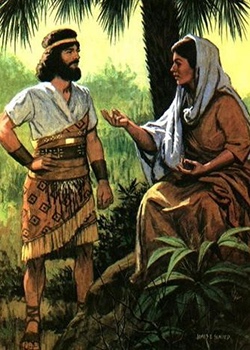
“At that time, Deborah, a prophet*, wife of Lappidoth, was judging Israel. She used to sit under the palm of Deborah between Ramah and Bethel in the hill country of Ephraim; and the Israelites came up to her for judgment.” (Judg 4:4–5).

[* Most translations use the feminine ‘prophetess’ here, as the Hebrew is nebiah, the feminine form of nabi, ‘prophet’. However, the key point is not her gender, but the role she fulfils, so I have followed the recently Updated Edition of the NRSV in using the generic term ‘prophet’ here to highlight that point. At any rate, the very next phrase, ‘wife of Lappidoth’, clearly indicates her gender.]

After the death of Joshua, the narrative reports that “the Israelites did what was evil in the sight of the Lord and worshiped the Baals; and they abandoned the Lord, the God of their ancestors, who had brought them out of the land of Egypt; they followed other gods, from among the gods of the peoples who were all around them, and bowed down to them; and they provoked the Lord to anger” (Judg 2:11–12).

In this context, God decided to “deliver them out of the power of those who plundered them” (Judg 2:16). So the book of Judges tells of a string of judges, men who worked hard to recall the people to their covenant with the Lord God: Othniel (3:9), Ehud (3:15), Shamgar (3:31), an unnamed prophet (6:8), Gideon (6:11–18), Tola (10:1), Jair (10:3), Jephthah (11:1; 12:7), Ibzan, Elon, and Abdon (12:8–15), and Samson (13:24–25; 16:28–31).

An image of Samson, one of the judges,
from the Icons of the Bible collection by James C. Lewis

The chapters of Judges maintain that these men, chosen to be judges over Israel, mostly exemplified good, positive qualities—although the story told of Samson, in particular, might cause us to question this assessment! The text declares that the spirit of the Lord came upon Othniel (2:10), as well as Gideon (6:34), Jephthah (11:29), and Samson (14:6, 19; 15:14). Othniel was called a deliverer (3:9), as were Ehud (3:15) and Shamgar (3:31), and Gideon was commissioned to deliver Israel (6:14–16, 36–38), as were Tola (10:1) and Samson (13:2–5). Led by the spirit, called to be a deliverer: these are qualities that Christians read about in the story of Jesus, many centuries later.

The impact of the efforts of these various judges was merely transitory; the people returned again and again to their sinful, idolatrous ways. “The Israelites did what was evil in the sight of the Lord” (initially at 2:11, repeated at 3:7) is a recurring refrain throughout the book of Judges. It signals that the people reverted to their evil ways after Othniel (3:12), Shamgar (4:1), Deborah (6:1), Jair (9:6), and Abdon (13:1). As a result, we are told that the people were “given into the hands” of their enemies on each of these occasions (3:8; 4:2; 6:1, 13; 10:7; 13:1).

Beyond these summary statements, in the final chapters of the book, details are given of the evil deeds of the mother of Micah, who made an idol of cast metal (17:1–6); the men of Gibeah, who raped the Levite’s concubine (19:22–25); the Levite himself, who cut his concubine into twelve pieces (19:27–30); and then the attacks on the Bejaminites by the other tribes of Israel (20:1–48). The book draws to its end with the mournful conclusion, “in those days there was no king in Israel; all the people did what was right in their own eyes” (21:25).

So many good leaders; so many evil deeds; so little progress over the four centuries covered by the stories told in the book of Judges. The pattern is relentless (see 2:18–20): first, “the Lord raised up judges for them, the Lord was with the judge, and he delivered them from the hand of their enemies all the days of the judge” (2:18). The explanation for this rests with God: “the Lord would be moved to pity by their groaning because of those who persecuted and oppressed them” (2:18).

However, this did not last: “whenever the judge died, they would relapse and behave worse than their ancestors, following other gods, worshiping them and bowing down to them” (2:19). So “the anger of the Lord was kindled against Israel” (2:20) and the cycle repeated. The pattern adheres to the typical Deuteronomic view, that God blesses those who “fully obey the Lord your God and carefully follow all his commands” (Deut 28:1) and curses those who “do not obey the Lord your God and do not carefully follow all his commands and decrees” (Deut 28:15).

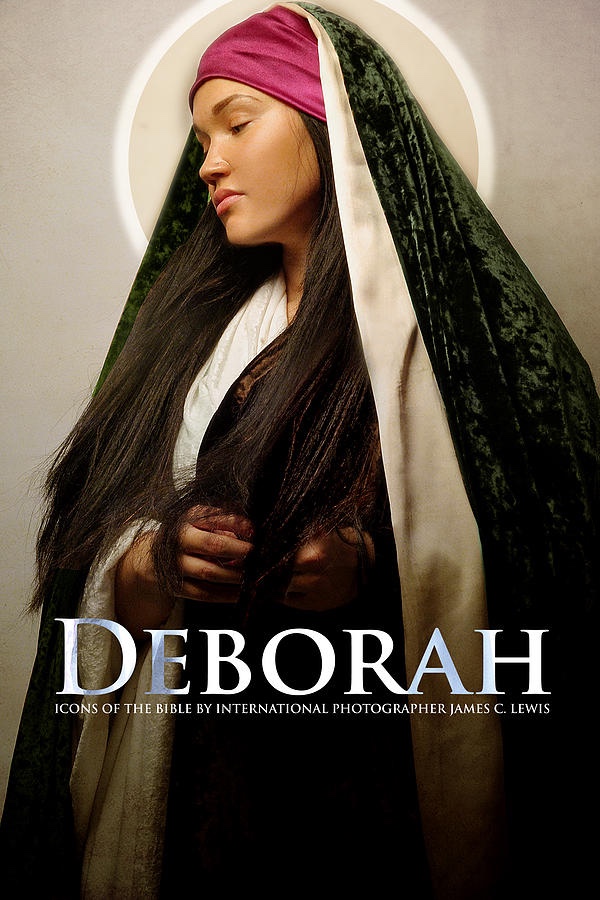
An image of Deborah, one of the judges,
from the Icons of the Bible collection by James C. Lewis

Amidst this string of male judges, Deborah stands out. She is, of course, the only female amongst the list of male judges noted in this book. That makes her quite exceptional—she stands alongside Sarah, Miriam, Hannah, Abigail, Huldah, and Esther as one of the seven female prophets in Israel. Whilst stories approving of the leadership of some of those male judges are told (notably, of Gideon and Samson), much more is said of the female judge Deborah.

For a start, no other judge is accorded a long poetic song celebrating their achievements; Deborah is (5:1–31), as she joins with Barak son of Abinoam to “make melody to the Lord, the God of Israel” (5:3) and celebrate that “the earth trembled, and the heavens poured, the clouds indeed poured water, the mountains quaked before the Lord, the One of Sinai, before the Lord, the God of Israel” (5:4–5), when “you arose, Deborah, arose as a mother in Israel” (5:7).

My wife, Elizabeth Raine, has researched Deborah’s story, and tells me that it is believed that the Song of Deborah (and Barak) is modelled on the Song of Miriam (and Moses) reported as the fleeing Israelites reached safety on the other side of the Sea of Reeds. There, a short song attributed to Miriam (Exod 15:20–21) is linked with a longer song, attributed to Moses, which has the same opening line (Exod 15:1–19; see especially verse 1).

As all the tribes gathered (5:14–18), Deborah and Barak sing of Jael: “most blessed of women be Jael, the wife of Heber the Kenite, of tent-dwelling women most blessed” (5:24), and tell of when Sisera asked for water, “she gave him milk, she brought him curds in a lordly bowl” (5:25), before recounting in gruesome detail, “[she] put her hand to the tent peg and her right hand to the workmen’s mallet; she struck Sisera a blow, she crushed his head, she shattered and pierced his temple” (5:26).

What follows is sung in stark simplicity: “he sank, he fell, he lay still at her feet; at her feet he sank, he fell; where he sank, there he fell dead” (5:27)—and then, in a powerful conclusion, “the mother of Sisera gazed through the lattice”, asking the poignant questions, “Why is his chariot so long in coming? Why tarry the hoofbeats of his chariots?” (5:28).

Then—as we hear at the end of the rule of some of the other judges in this book—“the land had rest forty years” (5:31; see also 3:11, 30; 8:28). It is a stark contrast to the tumult of the battle just recounted.

A second distinctive feature about Deborah is that she is the one judge in this book who is described as making legal judgments (4:4–5). She sat under the tree which later bore her name, “the palm of Deborah, between Ramah and Bethel in the hill country of Ephraim”; there, “the Israelites came up to her for judgment” (4:5). It is this brief note about her role that later is used in the phrase “palm tree justice”, referring to “ad hoc legal decision-making, the judge metaphorically sitting under a tree to make rulings based on common sense rather than legal principles or rules” (Oxford Reference, an online resource from OUP).

Even though the book bears the name Judges, almost all the key characters in the book are not described using this word. The early mention of judges indicates their role in the society of the day (2:16–18); yet later in the book, Jephthah informs the King of the Ammonites that he will not enact judgement; “let the Lord, who is judge, decide today for the Israelites or for the Ammonites” (11:27). The term “judging” is used only of Deborah (4:4)—she is the only person, apart from God, who makes any “judgement” (4:5). The figures whom we regularly describe as judges are actually presented in this book, as we have seen, as deliverers, guided by the Spirit. It is because of the programmatic statement of 2:16–18 that we consider them to be judges.

But it is only Deborah who sits under the palm tree to judge. The palm tree, known for its fruit in Israel (Ps 92:12; Song of Songs 7:7–8; Ezek 41:18–19; Joel 1:12), is one of the trees utilised by Wisdom when she later declares, “I grew tall like a cedar in Lebanon, and like a cypress on the heights of Hermon; I grew tall like a palm tree in En-gedi, and like rosebushes in Jericho; like a fair olive tree in the field, and like a plane tree beside water I grew tall” (Sir 24:13–14), before she extends the invitation, “come to me, you who desire me, and eat your fill of my fruits; for the memory of me is sweeter than honey, and the possession of me sweeter than the honeycomb” (Sir 24:19–20).

A third feature of Deborah is that she did not herself engage directly in armed battle with those living in the land of Canaan. Others who led Israel in this period willingly engaged directly in such battles. Othniel “went out to war, and the Lord gave King Cushan-rishathaim of Aram into his hand” (2:10). Ehud, a left-handed man, “made for himself a sword with two edges, a cubit in length; and he fastened it on his right thigh under his clothes” and then, at an opportune time, he killed King Eglon of Moab (3:16–22).

Of Shamgar, it is noted quite succinctly that he “killed six hundred of the Philistines with an oxgoad” (3:31), whilst Gideon’s successful campaign against the Midianites is narrated in quite some detail (6:7—8:21) and Samson’s conflict with the Philistines also receives detailed attention, culminating in the moment at Lehi when “he found a fresh jawbone of a donkey, reached down and took it, and with it he killed a thousand men” (15:1–15).

Whilst Deborah did instruct Barak, of the tribe of Naphtali, to take up a position on Mount Talbot and prepare to do battle (4:6–7) and, whilst she did travel up Mount Tabor with him and his men (4:8–10), she did not take part in the battle that ensued. Deborah sent Barak and his ten thousand warriors down to engage and defeat the Canaanites under Sisera (4:14).

In a scene that was reminiscent of the time when “all of Pharaoh’s horses, chariots, and chariot drivers” were “ thrown into panic” at the sea of reeds (Exod 14:23–24), we learn that “the Lord threw Sisera and all his chariots and all his army into a panic before Barak; Sisera got down from his chariot and fled away on foot, while Barak pursued the chariots and the army to Harosheth-ha-goiim” (Judg 4:15–16).

The rout was complete, placing Deborah and Barak in the same category as Moses, effecting a complete and total defeat of the enemy. “All the army of Sisera fell by the sword”, we are told; “no one was left” (4:16). The gory end of Sisera, impaled with a tent peg in his skull (4:22) completes the saga of Deborah; this deed was performed by another powerful woman, Jael wife of Heber the Kenite (4:17–21), who is celebrated in the song of Deborah and Barak (5:24–31).

And so the people of ancient faith remember their even older ancestor, Deborah: prophet, judge, warrior, “a mother in Israel”.

Oil and light, and being prepared (Matt 25; Pentecost 24A)

“When the foolish took their lamps, they took no oil with them; but the wise took flasks of oil with their lamps. As the bridegroom was delayed, all of them became drowsy and slept.” (Matt 25:3–4) These words come from the parable of Jesus which is offered by the lectionary for this coming Sunday (Matt 25:1–13). The parable serves as a warning to be ready for the arrival of the bridegroom. “Keep awake therefore, for you know neither the day nor the hour”, Jesus ends this parable (25:13).

It seems that many people in the earliest church communities expected the parousia to occur and Jesus to return from heaven into their midst at any day. Paul had indicated this some decades before this Gospel was written, telling the Corinthians that “the appointed time has grown short” (1 Cor 7:29) and “the present form of this world is passing away” (1 Cor 7:31), and warning the Thessalonians that “the day of the Lord will come like a thief in the night” (1 Thess 5:2).

Paul also describes to the Thessalonians the scene in which “the Lord himself, with a cry of command, with the archangel’s call and with the sound of God’s trumpet, will descend from heaven, and the dead in Christ will rise first; then we who are alive, who are left, will be caught up in the clouds together with them to meet the Lord in the air; and so we will be with the Lord forever”(1 Thess 4:16–17).

When writing to the Romans, Paul says that “the creation waits with eager longing for the revealing of the children of God” ahead of “the glory about to be revealed to us” (Rom 8:18–19), which again suggests an imminent occurrence; whilst the first letter attributed to Peter simply declares that “the end of all things is near” (1 Pet 4:7).

However, this much-anticipated return of Jesus to earth did not take place in the lifetime of that first generation of believers. Matthew’s Gospel, written at least four decades after the lifetime of Jesus, contains indications of how this delay impacted on people. The fact that Jesus was delayed in his appearance to his followers may have affected the faith of members of the community, or influenced others to leave the community for which Matthew was writing.

Matthew’s Jesus has in mind the coming eschatological deliverance, a deliverance which is expected imminently and that will vindicate the community as faithful and righteous to the will of God. So he tells his followers that “you will not have gone through all the towns of Israel before the Son of Man comes” (10:23). The mission that his followers undertake amongst Jews only is urgent; the end of time is coming soon, and they will not have shared “the good news [that] the kingdom of heaven has come near” (10:7) before “the Son of Man appears in heaven, and then all the tribes of the earth will mourn, and they will see ‘the Son of Man coming on the clouds of heaven’ with power and great glory” (24:30).

In this way, Matthew is typical of one type of Judaism after the destruction of the Second Temple; that of apocalyptic hope. Most of the post-70 sectarian groups express hope that God will remember his covenant with them, the faithful few of Israel, and save them; for example, 2 Baruch and 4 Ezra write that God will provide consolation for their suffering and vindicate them, whilst also punishing their enemies on the Day of Judgement (2 Baruch 6:21; 82:1–2; 4 Ezra 8:51–59; 12:34).

In these sectarian documents, the kingdom of God is eschatological is nature; it has not yet arrived on earth, though signs telling of its coming can be detected. These communities also agree that much of Israel no longer truly follows the Law of God, and that the dominant Jewish leadership is unfaithful and wicked, and that they are the ones alone representing the true Israel. Therefore, entry to the kingdom is dependent upon faithfulness to the Law as interpreted by the community.

Matthew reflects this in his reporting of words of Jesus found only in this Gospel: “do not think that I have come to abolish the law or the prophets; I have come not to abolish but to fulfill .. until heaven and earth pass away, not one letter, not one stroke of a letter, will pass from the law until all is accomplished … unless your righteousness exceeds that of the scribes and Pharisees, you will never enter the kingdom of heaven” (Matt 5:17–20). There is a fierce apocalyptic intensity behind the interpretation of Torah which the Matthean Jesus provides.

It is, however, the delay of the return of Jesus, rather than the detailed development of scenarios relating to that predicted coming, which is the issue undergirding the chapter of the Gospel that appears in our lectionary this Sunday, as well as the two following Sundays. Although the lengthy apocalyptic discourse of chapter 24 shows that Jesus appears to “buy in” to the speculative apocalyptic hypothesising of contemporary Jews, Matthew reorients this traditional material to focus on one key issue.

All three Synoptic Gospels have brought the apocalyptic discourse of Jesus to a climax with the vision, taken from Daniel 7, of “the Son of Man coming in a cloud with power and great glory” (Mark 13:26; Matt 24:30; Luke 21:27), followed soon after by the saying, “this generation will not pass away until all these things have taken place” (Mark 13:30; Matt 24:34; Luke 21:32). They each report this, surely, because Jesus believed he would be returning in glory soon after his death. Jesus was firmly grounded in the apocalyptic worldview and saw himself as the crucial prophet figure in the fulfilment of that coming end.

Mark emphasises the point with the thrice-repeated warning: “beware, keep alert, for you do not know when the time will come … keep awake … keep awake” (Mark 13:34, 35, 37). Luke likewise reports Jesus as saying “be on guard … be alert” (Luke 21:34, 36). The implication is that the return will be soon (although Luke has undertaken various editorial alterations to his sources to indicate this has not been the case).

Matthew ends the apocalyptic discourse of Jesus with a similar warning: “you also must be ready, for the Son of Man is coming at an unexpected hour” (Matt 24:44). However, he then moves immediately to report four parables, told by Jesus to remind people that they need to hold fast to their faith, be ready for whenever “the master returns”, “the bridegroom comes”, “the Son of Man comes [and] sits on his throne in glory”. In these parables, he emphasises the need to practise a sense of active waiting (24:45–25:46).

Two parables contain specific warnings about the behaviour that is expected during this period of waiting (24:45–51; 25:1–13); the second of these, which we encounter it in the lectionary this coming Sunday, is unique to Matthew. The story told in this parable indicates that active waiting involves making wise decisions, persisting tenaciously in hope for what lies in the future. The wise virgins are commended: “those who were ready went with him [the bridegroom] into the wedding banquet” (25:10). The foolish are rejected by Jesus: “truly I tell you, I do not know you” (25:12).

Similar warnings occur in other parables drawn from the Q tradition: the parable of the banquet (22:1–14), which we have read some weeks back; and the well-known parable of the talents (25:14–30), which appears next Sunday, in which the master commends his two “good and trustworthy slaves” with the words, “you have been trustworthy in a few things, I will put you in charge of many things; enter into the joy of your master” (25:21,23). By contrast, the third slave is condemned as worthless: “throw him into the outer darkness, where there will be weeping and gnashing of teeth” (25:30).

These parables all advocate active waiting as the desired form of discipleship. Being faithful to the way of Jesus means being ready for his coming, prepared for the kingdom. The message is driven home by the contrasting pairs: in this parable, wise virgins and foolish virgins; in subsequent parables, two trustworthy slaves and a worthless slave (25:14–30), and then the righteous and those who do evil (25:31–46).

The contrast between those who are wise and those who are foolish is a trope in the Wisdom literature from which Jesus is drawing in this parable. Amongst the collected proverbs attributed to Solomon we read these aphorisms: “A wise child makes a glad father, but a foolish child is a mother’s grief” (Prov 10:1), slightly varied in “A wise child makes a glad father, but the foolish despise their mothers” (Prov 15:20), and “The wise woman builds her house, but the foolish tears it down with her own hands” (Prov 14:1).

In Ecclesiastes, the Preacher observes, “Better is a poor but wise youth than an old but foolish king, who will no longer take advice” (Eccl 4:13) and muses, “and who knows whether they will be wise or foolish?” (Eccl 2:19). The parable told by Jesus makes clear how to distinguish between the wise and the foolish: the wise are prepared, their lamps are filled with oil; the foolish had no oil.

The lack of preparedness of the five foolish bridesmaids is telling. Oil, of course, is needed to keep the lamp burning, and thus to shine light in the darkness. This basic fact lies underneath the exhortation of Jesus to his followers: “let your light shine before others, so that they may see your good works and give glory to your Father in heaven” (Matt 5:16). Well might we think that the five bridesmaids who took no oil with them were foolish! (25:1–3).

Ready access to oil in the land of Israel was secured by the blessing of God, reported in Deuteronomy: “The Lord your God will maintain the covenant loyalty that he swore to your ancestors; he will love you, bless you, and multiply you; he will bless the fruit of your womb and the fruit of your ground, your grain and your wine and your oil, the increase of your cattle and the issue of your flock, in the land that he swore to your ancestors to give you.” (Deut 7:12–13). Of course, olive trees are well suited to the Mediterranean climate, and so would have grown prolifically, ensuring a steady supply of olives for making oil, regardless of God’s covenant loyalty!

Ben Sirach affirms that “the basic necessities of human life are water and fire and iron and salt and wheat flour and milk and honey, the blood of the grape and oil and clothing” (Sir 39:26); so oil ought to have been at hand for the five foolish bridesmaids to secure.

Oil plays a key role in the religion of the Israelites. In the instructions relating to the tabernacle, Moses was instructed to “command the people of Israel to bring you pure oil of beaten olives for the lamp, that a light may be kept burning regularly” (Lev 24:1), and Aaron and his sons are delegated to ensure that it keeps burning each night as “a perpetual ordinance to be observed throughout their generations by the Israelites” (Exod 27:20–21). Oil was added to many sacrifices and offerings that were brought to the temple, as almost all of the 88 appearances of the word in Exodus, Numbers, and Leviticus attest.

Oil was also central in the ceremonies of anointing new kings—Saul (1 Sam 10:1), David (1 Sam 16;13; Ps 89:20), Solomon (1 Ki 1:39), Jehu (2 Ki 9:6), and presumably all other kings of Israel and Judah. Oil anoints the heads of faithful believers (Ps 23:5; 45:7) and “makes the face to shine” as one of the gifts provided by God to all humanity (Ps 104:15). The followers of Jesus anointed with oil those who were sick (Mark 6:13), accompanied with prayer (James 5:14); even the Good Samaritan “went to [the injured man] and bandaged his wounds, having poured oil and wine on them” (Luke 10:34).

Given its importance in Israelite culture and religion, as well as in daily life, one would have thought that the five bridesmaids would have been well prepared to meet the bridegroom, ensure their lamps were filled with oil!

Perhaps when he told this parable, Jesus also had in mind the following story involving the prophet Elisha? In this story, the wise use of oil reflects the faithfulness of a widow and her trust in the word of the prophet, which brings her an assured future. She was wise.

Now the wife of a member of the company of prophets cried to Elisha, “Your servant my husband is dead; and you know that your servant feared the LORD, but a creditor has come to take my two children as slaves.” Elisha said to her, “What shall I do for you? Tell me, what do you have in the house?” She answered, “Your servant has nothing in the house, except a jar of oil.” He said, “Go outside, borrow vessels from all your neighbors, empty vessels and not just a few. Then go in, and shut the door behind you and your children, and start pouring into all these vessels; when each is full, set it aside.” So she left him and shut the door behind her and her children; they kept bringing vessels to her, and she kept pouring. When the vessels were full, she said to her son, “Bring me another vessel.” But he said to her, “There are no more.” Then the oil stopped flowing. She came and told the man of God, and he said, “Go sell the oil and pay your debts, and you and your children can live on the rest.” (2 Ki 4:1–7)

*****

For more on apocalyptic in Israelite tradition, see

and in this section of Matthew’s book of origins, see

Joshua made a covenant with the people that day (Josh 24; Pentecost 24A)

“Then Joshua gathered all the tribes of Israel to Shechem, and summoned the elders, the heads, the judges, and the officers of Israel; and they presented themselves before God … so Joshua made a covenant with the people that day, and made statutes and ordinances for them at Shechem” (Josh 24:1, 25).

For the last two weeks, we have been considering the matter of the land promised to Israel and claimed by them under Joshua, as we heard first Deut 34 and then Josh 3. This week, as the lectionary presents us with a second passage from the book of Joshua (Josh 24:1–3a,14–25), our attention is turned to the covenant, the formalising of the relationship between the Lord God and the people of Israel.

The covenant that was formally ratified on that day had already been made with the people. During their wanderings in the wilderness, Moses “went up to God” on Mount Sinai, where the covenant was offered to Moses by God, and the people accepted the offer (Exod 19:1–8). The covenant was sealed in a formal ceremony in which “the blood of the covenant” was splashed on the altar and the people (Exod 24:1–8).

That covenant stood on the foundation of a series of covenants that had already been offered to people—initially to Noah, and to all living creatures (Gen 9), before it was subsequently renewed (and reshaped) by being offered to Abraham (Gen 15, 17). That same covenant was then renewed with Isaac (Gen 17) and then with Jacob (Israel) (Gen 35), before being extended to Moses and the whole people (Exod 19).

It is this sequence which is celebrated by the psalmist: “The Lord our God … is mindful of his covenant forever, of the word that he commanded, for a thousand generations, the covenant that he made with Abraham, his sworn promise to Isaac, which he confirmed to Jacob as a statute, to Israel as an everlasting covenant” (Ps 105:7–10).

And it is this sequence of events which is remembered in the narrative of Joshua 24. It begins by recalling when “your ancestors—Terah and his sons Abraham and Nahor—lived beyond the Euphrates and served other gods” (Josh 24:2), a time reported in Gen 11:26–32. Then follows the gifting of land and descendants to Abraham (Josh 24:3), recalling the promise of Gen 12:1–3 and the story told in Gen 12 onwards, including the making of a covenant (Gen 15:17–21), the sealing of that covenant by circumcision (Gen 17:1–27), the promise of a son to Abraham (Gen 18:1–15) and the arrival of that son, Isaac (Gen 21:1–7).

The ceremony at Shechem, as recounted in Joshua 24, continues with a brief mention of Isaac, Jacob and Esau (24:3–4) before noting that “Jacob and his children went down to Egypt” (24:4). This is the story that is recounted in Genesis 21 through to 50, which ends with a reminder that “God will surely come to you, and bring you up out of this land to the land that he swore to Abraham, to Isaac, and to Jacob” (Gen 50:24).

The story of the people of Israel leaving Egypt and wandering in the wilderness is recalled in Josh 24:5–7, summarising the lengthy narrative of Exodus 3—17, before remembering the early forays into the land promised, the land of Canaan (Josh 24:8–12). This culminates in the words, “I gave you a land on which you had not labored, and towns that you had not built, and you live in them; you eat the fruit of vineyards and oliveyards that you did not plant” (24:13). That is the point in the narrative at which the story of Joshua stands—whilst some of the land has been occupied, the people are still to mount the campaigns that will see them claim the whole of that land.

What follows is a pledge of loyalty made by the people, in response to the urging of Joshua to “revere the Lord, and serve him in sincerity and in faithfulness” (24:14). The people recall all that God had done for them: he “brought us and our ancestors up from the land of Egypt … did those great signs in our sight … protected us along all the way that we went … and drove out before us all the peoples who lived in the land” (24:17–18). Their declaration is, “we also will serve the Lord, for he is our God” (24:18).

The ceremony that follows under Joshua (Josh 24:24–28) contains five components, each one of which has resonances with the covenant made with Israel in the time of Moses (Exod 19 and 24). This narrative is brought to consistency wi the earlier account in Exodus through the work of the priestly redactors at work in the Exile, as they collated, wrote down, and shaped a narrative of the saga of Israel’s origins.

First, when the people repeat their vow, “The Lord our God we will serve, and him we will obey” (Josh 24:24, repeating v.18), they are echoing the earlier occasion when Moses “summoned the elders of the people, and set before them all these words that the Lord had commanded him” (Exod 19:7). At that moment, we are told that “the people all answered as one: ‘Everything that the Lord has spoken we will do’” (Exod 19:8).

Second, the text declares that “Joshua made a covenant with the people that day, and made statutes and ordinances for them at Shechem” (Josh 24:25). This evokes the earlier covenantal offer by God at Sinai, “if you obey my voice and keep my covenant, you shall be my treasured possession out of all the peoples” (Exod 19:5), as well as the subsequent actions of Moses which signalled acceptance of that covenant (Exod 24:6–8).

The Exodus narrative (itself shaped by the later priestly redactional undertaking) reports that Moses dashed half of the blood against the altar (24:6), read from the book of the covenant—to which the people once again affirmed, “All that the Lord has spoken we will do, and we will be obedient” (24:7), and then dashed the other half of the blood on the people, and said, “See the blood of the covenant that the LORD has made with you in accordance with all these words” (24:8).

Third, we learn that “Joshua wrote these words in the book of the law of God; and he took a large stone, and set it up there under the oak in the sanctuary of the Lord” (Josh 24:26). This is a clear reflection of the action of Moses at Sinai, when “he built an altar at the foot of the mountain, and set up twelve pillars, corresponding to the twelve tribes of Israel” (Exod 24:4). Of course, the stone is also present in the tablets of stone which God gave to Moses (24:12), “written with the finger of God” (Exod 31:18).

The stone set up at Shechem might well also connect with the twelve stones that Joshua had taken from the River Jordan when the people had crossed over into the land of Canaan, to be “laid down in the place where you camp tonight” (Josh 4:1–9). Those twelve stones, one for each tribe, were to be “a memorial forever” to the Israelites (4:7), and were placed at Gilgal, the place of transition into the land. Gilgal was the place where all the male Israelites were circumcised (5:1–9), the Passover was celebrated (5:10–11), and the daily gift of manna, provided throughout the wilderness years, ceased (5:12). See

Fourth, Joshua tells the people, “See, this stone shall be a witness against us; for it has heard all the words of the Lord that he spoke to us; therefore it shall be a witness against you, if you deal falsely with your God” (Josh 24:27). The large stone at the holy site of Shechem reflects the altar of stone at Sinai which Moses was commanded to build: “do not build it of hewn stones; for if you use a chisel upon it you profane it” (Exod 20:25). The stone bears witness to the people at Shechem, just as the stone altar and tablets bore witness at Sinai.

Finally, the narrator indicates that “Joshua sent the people away to their inheritances” (Josh 24:28)—namely, into those parts of the land which had been allocated to them in the earlier chapters of this book. This provides a fulfilment of the journey that the people had been undertaking, ever since Moses had sealed the covenant with the Lord at Sinai. From that time, “the cloud of the Lord was on the tabernacle by day, and fire was in the cloud by night, before the eyes of all the house of Israel at each stage of their journey” (Exod 40:38).

So the ceremony recorded in Joshua 24 is a renewal of the covenant made with Moses. This covenant would be renewed yet again in the time of King Josiah, after the discovery of “a book of the law” and his consultation with the prophet Huldah (2 Chron 34:29–33).

It was renewed yet again after the exiled people of Judah returned to the land under Nehemiah, when Ezra read from “the book of the law” for a full day (Neh 7:73b—8:12) and the leaders of the people made “a firm commitment in writing … in a sealed document” which they signed (Neh 9:38–10:39). This is the renewal of the covenant with the people which is signalled in the words of the prophet Jeremiah (Jer 31:31–34).

The particular expression of renewal that Jeremiah articulates proved to be critical for the way that later writers portray the covenant renewal undertaken by Jesus of Nazareth (1 Cor 11:25; Luke 22:20; 2 Cor 3:6–18; Heb 8:8–12). Especially significant is the claim that this renewed covenant “will not be like the covenant that I made with their ancestors when I took them by the hand to bring them out of the land of Egypt—a covenant that they broke” (Jer 31:32).

Jeremiah indicates that God “will put my law within them, and I will write it on their hearts; and I will be their God, and they shall be my people” (31:33). This is a covenant which has “the forgiveness of sins” at its heart (31:34)— precisely what is said of the “new covenant” effected by Jesus (Matt 26:28; and see Acts 5:31; 10:43; 13:38; 26:18).

The story in Joshua 24 that we hear this coming Sunday thus stands firmly in the stream of significant biblical passages which tell of the covenant between the Lord God and the people of God, offered and received and renewed a number of times throughout the long story of the people of Israel, from ancestral times through to the time of Jesus.

Dark sayings from of old (Psalm 78; Pentecost 24A)

Scripture contains many sayings. Of particular note in the Hebrew Scriptures are “sayings of the wise” (Prov 24:23), offering insights into the best ways of living with integrity in daily life. The book of Proverbs refers to “thirty sayings of admonition and knowledge” (Prov 22:20), but in fact it contains a multitude of succinct two-part sayings, known as proverbs, attributed to King Solomon (Prov 10:1—29:27), Agur Ben Jakeh, a sage of Arabic descent (Prov 30:1–33), and King Lemuel, perhaps of Assyria (Masa) (Prov 31:1–9).

The Preacher, characteristically, bemoans that “the sayings of the wise are like goads, and like nails firmly fixed are the collected sayings that are given by one shepherd” (Eccl 12:11). He notes that “of the making many books there is no end, and much study is a weariness of the flesh” (Eccl 12:12). He presumably sees little need for saying after saying after saying.

Nevertheless, scripture as a whole has collected and retained “treasuries of wisdom” in which there are many “sayings of the wise” (Sir 1:25), sayings which are “life to those who find them, and healing to all their flesh” (Prov 4:22). Attention to these words means that “you may hold on to prudence, and your lips may guard knowledge” (Prov 5:2).

Faithful people are advised to “keep your father’s commandment, and do not forsake your mother’s teaching; them upon your heart always; tie them around your neck” (Prov 6:20)—words which evoke the directions given to Israel concerning the Torah itself: “bind them as a sign on your hand, fix them as an emblem on your forehead, and write them on the doorposts of your house and on your gates” (Deut 6:8–9).

So the “sayings of the wise” are regularly described in some of the terms used to describe Torah: they are “commandments” (Prov 2:1; 3:1; 4:4; 7:1–2; 10:8) and “precepts” (Prov 4:2), and like the Torah itself, they provide “instruction” (Prov 1:8; 4:1, 13; 8:10, 33; 9:9; 10:17; 15:5, 32–33; 19:20, 27; 23:12, 23; 24:32). Ben Sirach links the two when he advises, “if you desire wisdom, keep the commandments, and the Lord will lavish her [i.e. Wisdom] upon you”, for “the fear of the Lord is wisdom and discipline” (Sir 1:26–27).

The people are told that, “if you accept my words and treasure up my commandments within you, making your ear attentive to wisdom and inclining your heart to understanding … then you will understand the fear of the Lord and find the knowledge of God” (Prov 2:1–2, 5). The connection between “the fear of the Lord” and the wisdom that is conveyed by “the sayings of the wise” is manifest (Prov 1:7; 2:5; 9:10; 14:27; 15:33).

Penetrating into the wisdom contained within these sayings ought to come readily to those who are regular and persistent in listening to them; yet, as Job laments regarding God, “how small a whisper do we hear of him!”, and “the thunder of his power who can understand?” (Job 26:14). At the end of the long whirlwind speech of God, Job concedes that his knowledge of God had been quite inadequate, noting that “I had heard of you by the hearing of the ear, but now my eye sees you” (Job 42:5).

The introduction to the book of Proverbs recognises the difficulty of gaining clear understanding of these sayings, indicating that it takes work: “let the wise also hear and gain in learning, and the discerning acquire skill, to understand a proverb and a figure, the words of the wise and their riddles” (Prov 1:5–6).

Ben Sirach notes that “the one who devotes himself to the study of the law of the Most High” is one who “seeks out the wisdom of all the ancients, and is concerned with prophecies; he preserves the sayings of the famous and penetrates the subtleties of parables; he seeks out the hidden meanings of proverbs and is at home with the obscurities of parables” (Sir 39:1–3).

Those hidden meanings and obscurities may well be what has driven the psalmist, in the psalm offered in this coming Sunday”s lectionary psalm, to refer to “hidden things, things from of old” (Ps 78:2, NIV)—or more ominously, as the NRSV translates it, “dark sayings from of old” (Ps 78:2, NRSV). What are these hidden things, these dark sayings, from the past?

Although the psalmist refers to “the glorious deeds of the Lord, and his might, and the wonders that he has done” in years past, recounting them with admiration and gratitude (Ps 78:5–16), they note with pathos that the people “did not keep God’s covenant … refused to walk according to his law … forgot what he had done”, that they “sinned still more against him, rebelling against the Most High in the desert … tested God in their heart … spoke against God” (Ps 78:10–11, 17–19). Understanding came hard to the people.

The psalmist places these “hidden things”, these “dark sayings from of old” in parallel with parables (Ps 78:2). The Hebrew word translated as parable is mashal, which signals a comparison; it literally means “is like”. We know about parables from the use that Jesus made of them in his teaching. “The kingdom of heaven is like …”, or “what shall I compare the kingdom of God to?” are introductions to short stories which Jesus tells, in which the realm of God is explained with reference to a familiar situation in daily life—making bread, keeping sheep, tending a vineyard, seeking work, attending a marriage.

A mashal, a parable, is simply a comparison. So in Proverbs, we can read various parables: “the path of the righteous is like the morning sun, shining ever brighter till the full light of day; but the way of the wicked is like deep darkness; they do not know what makes them stumble” (Prov 4:18–19); “like a gold ring in a pig’s snout is a beautiful woman who shows no discretion” (Prov 11:22); “the words of the reckless pierce like swords, but the tongue of the wise brings healing” (Prov 12:18); “a king’s rage is like the roar of a lion, but his favour is like dew on the grass” (Prov 19:12); “like a roaring lion or a charging bear is a wicked ruler over a poor people” (Prov 28:15); and so on.

Elsewhere in the Hebrew Scriptures, we find comparisons—parables—that are short and succinct. A classic short, simple Another example is the proverb quoted by two prophets, about the impact of the Exile: “the parents have eaten sour grapes, and the children’s teeth are set on edge” (Jer 31:29; Ezek 18:2). The point of this saying is clear, and telling.

We also find more extended comparisons—parables with developed plots and allegorical elements. (In an allegory, particular individual features can play an independently figurative role, so that the story told becomes a kind of riddle which invites a response from the listener. “What do you think?” becomes the implied way that the allegory-riddle ends.) The most famous examples in the Hebrew Bible are Samuel’s story-parable comparing David with a callous rich herdsman in 2 Samuel 12 and the prophet’s lovesong-parable comparing Israel with an unfruitful vineyard in Isaiah 5.

Psalm 78:2 in Hebrew

The Hebrew word in parallel to mashal (משל, “parable”) in Ps 78:2, which is translated as “hidden things” (NIV) or “dark sayings” (NRSV), is the word chidah, חַידָה, which is most often translated as “riddle”. This word refers to a parable “whose point is deliberately obscured so that greater perception is needed to interpret it”, according to the Jewish Virtual Library (reference below). A good example is the riddle is that spoken by Samson, “out of the eater came something to eat; out of the strong came something sweet” (Judg 14:14). The narrative comment that follows is delightful: “for three days they could not explain the riddle”!

A number of proverbs are classified as riddles, especially in the section of Proverbs containing “the sayings of Agur son of Jakeh—an inspired utterance” (Prov 30:1). For instance: “There are three things that are never satisfied, four that never say, ‘Enough!’: the grave, the barren womb, land, which is never satisfied with water, and fire, which never says, ‘Enough!’” (Prov 30:15b—16). Another example comes a few verses later: ““There are three things that are too amazing for me, four that I do not understand: the way of an eagle in the sky, the way of a snake on a rock, the way of a ship on the high seas, and the way of a man with a young woman” (Prov 30:18–19).

In Psalm 78, we do not seem to have specific verses that can be categorised as riddles—rather, it presents as one of the psalms which retell the saga of the origins of Israel (as well as this psalm, see also Psalms 105, 106, 135 and 136). The particular perspective of the psalmist in retelling this story in Psalm 78 is that the people “should set their hope in God, and not forget the works of God, but keep his commandments” (v.7), in the hope that “they should not be like their ancestors, a stubborn and rebellious generation, a generation whose heart was not steadfast, whose spirit was not faithful to God” (v.8). After all, God had performed many miracles in the Exodus, at the formational stage of the people of Israel (vv.12–16).

Nevertheless, the repeated sinfulness shown by Israel in the wilderness (vv.17–19) is replicated in later times; in spite of all that God did for them in the wilderness (vv.20, 23–29), “they still sinned; they did not believe in his wonders” (v.32), “their heart was not steadfast toward him; they were not true to his covenant” (v.37), “they tested God again and again, and provoked the Holy One of Israel” (v.41), thereby incurring the great wrath of God (vv.44–51).

Even when God led them to Canaan and “drove out nations before them; he apportioned them for a possession and settled the tribes of Israel in their tents” (v.56), still “they tested the Most High God and rebelled against him; they did not observe his decrees, but turned away and were faithless like their ancestors; they twisted like a treacherous bow” (vv.56–57), incurring still more punishment (vv.58–64).

The psalm ends with a picture of pastoral bliss as God favoured the tribe of Judah with the site of the temple, and David is installed as the shepherd-king of the people (vv.65–72). The conclusion is encouraging; “David shepherded them with integrity of heart; with skillful hands he led them” (v.72).

Perhaps, notwithstanding this irenic ending, this is the chidah, the riddle, the dark saying of the past? Perhaps it is about the stubborn, incorrigible nature of human beings—exemplified by Israel’s regular return to sinful ways?

Perhaps the psalm was written in the knowledge of the persistent inadequacies and sinfulness of the kings who came after David? (We might note the regular refrain about the kings who “did evil in the eyes of the Lord” throughout the narrative books, first applied to Solomon at 1 Ki 11:6 and then forming a recurring formula of condemnation of many of the kings that followed him in the northern kingdom as well as a number in the southern kingdom).

Perhaps it is that, no matter how much God did for God’s people, their persistent sinfulness would always rise to the surface? If that is so, it is a dark saying, indeed.

On parables in Hebrew Scripture, see https://www.jewishvirtuallibrary.org/parable

On later developments on rabbinic literature, see https://www.jewishencyclopedia.com/articles/11898-parable

The land, the people, the invaders, the tragedy (Josh 3; Pentecost 23A)

Last week, as the lectionary invited us to hear the closing section of Deuteronomy, we turned our attention to the land that was promised to Moses and the people of Israel. Land, as we know, can be contentious. Land claims often ferment into conflict. Acceptance—or rejection—of First Peoples’ Connection to Country in Australia underlies the current political situation downunder. And contested claims to land in the Middle East, from millennia ago, undergird the current disastrous situation that is unfolding there.

The Hebrew Scripture passage for this coming Sunday, from Joshua 3, continues the focus on land. It tells a part of the larger story of the Conquest of Canaan; the taking of the land by force. This story of the Hebrews entering the land of Canaan, battling the inhabitants and colonising the territory, lies underneath the whole story of Exodus, wilderness, and conquest, which is at the heart of the biblical narrative that accounts for the origins of Israel as a nation.

The story of invasion and conquest is told in all its bloody detail in the book of Joshua. Perhaps because of this, the lectionary offers us very few passages from this book in the three years of the lectionary—and one such occasion occurs this coming Sunday (Pentecost 23A), when we are invited to hear Joshua 3:7–17. There are a number of factors to consider when reading or hearing this passage, or any passage in the book of Joshua, and indeed any section of this long, extended saga of the origins of Israel.

Joshua as history?

The story from Joshua tells, in a highly stylised way, of the entry of the people of God into the promised land. This is a key moment in the extended narrative that stretches from Genesis to 1 Kings, recounting stories of the ancestors, a time of slavery in Egypt, the redemptive moment of Exodus, the giving of the Law, the long haul of wilderness wanderings, the battles waged to capture the land under the Judges, and the ultimate vindication of the establishment of the kingdom of Israel under King David.

Of course, it didn’t actually happen like this. For one thing, the book of Joshua is almost universally considered to be a wonderfully embellished and highly stylised narrative constructed by the priests in the sixth century BCE, as they prepared to lead the exiled people of Israel in their return to the land from which they had been removed. So it is an account from many centuries after the events that it purportedly recounts.

The book as a whole is marked by the schematic structuring that was so characteristic of priestly narratives. Structure and order was central to the priestly mindset and is evident in their literary style. We might note how Gen 1:1—2:3 is carefully structured, and observe the structure of the whole book of Numbers, as well as the whole book of Joshua; and we can also note the repeated formulaic assessment of various kings in 1 Ki 11:6, 11:19, 14:22, 15:5, 15:11, 15:26, 15:34, 16:7, etc.

For another thing, we know that the division of Israel into the twelve tribes (3:12), so important in the story that the priests of Israel tell about the nation, was a later ideological construction of the priestly story-tellers. As far as we know, there were no neatly schematised tribes at the time of this incident.

And, of course, the whole story of Exodus, liberation, wilderness and conquest, is beset by multiple historical problems. There is no evidence in the records of the Egyptians about the escape of a large crowd of slaves, not any record of the destruction of the Egyptian Army in the Red Sea. There are no remains in the wilderness between Egypt and Israel that suggest that such a large crowd was travelling, for many years, through the desert—no remains of campsites, no graves of deceased people have ever been found. And there is no archaeological evidence that correlates with the biblical record of the capture of Jericho and other cities in the land. All we have is the story told in the Bible.

The form of the story we have was written down quite some centuries from when the event is alleged to have taken place. It serves an ideological purpose, as the exiled people prepare to return to the land. As the 5th century exiles enter the land, the story of the wandering tribes entering the land from centuries before provides encouragement and inspiration.

So it is not the historical reliability of this incident itself that is to the fore as the story is told. What we, in the post-Enlightenment era, understand to be “history”, is very different from the way that “history” was understood in the time when the story was written.

Joshua as saga

Rather than history, the narrative offers us a saga that invites us into a creative, thoughtful pondering of the story. It offers the people of Israel, exiles returning from Babylon, hope and assurance for their future. The best question we can ask of this story, is not, “did this actually happen?”, but rather, “what does this story offer to us, today?”

Central in the story is the ark of the covenant. The story tells of the time at Mount Sinai when God established a covenant with Moses and Israel, and the giving of the Law within that covenant relationship. The ark is a sign of the presence of God, continuing on with the people of Israel beyond Mount Sinai (Exod 25:10–22). God is not an absentee God, but very present amongst the people. The ark symbolises and reinforces that message.

Levites carrying the ark of the covenant

The priests serve to mediate the presence of God. They carry the ark of the covenant, maintaining it, ensuring that it remains safe (Deut 10:8; 31:9, 25–26; Josh 3:3, 6, 8, 13). The story offers an indication that holy people are necessities in life; their mediation of the divine in the midst of the mundane is important. (As an ordained person, I confess that I have a vested interest in this claim!) As the priests shape the story, they make sure that priests play a central role in what is narrated.

Joshua as testimony to faith

The story contains a memorable description of God as “the living God” (3:10). The phrase appears elsewhere in a Hebrew Scriptures (Deut 5:26, 1 Sam 17:26, 36, 2 Kings 19:4, 16, Ps 42:2, 84:2, Isa 37:4,17, Jer 10:10, 23:36, Dan 6:20, 26, Hos 1:10) and also in the New Testament (Matt 16:16, 26:63, Acts 14:15, Rom 9:26, 2 Cor 3:3, 6:16, 1 Thess 1:9, 1 Tim 3:15, 4:10, Heb 3:13, 4:12, 9:14, 10:31, 12:22, Rev 7:2). The ark is a sign that this living God is present, active and engaged in the lives of the people.

A striking event demonstrates this: as the priests stand in the river, the waters stand still (3:16), and so the people are able to cross the river and enter the land. Of course, later on in Joshua, another miraculous event takes place, as the sun stands still (10:13). These were not actual events, but symbolic of divine intervention. The waters standing still evokes the moment in the Exodus story when the waters of the Sea of Reeds parted to allow the Israelites to pass through (Exod 14:21–22, 29).

We might well compare the New Testament story of the earthquake and resurrection of the saints (found only in Matt 27) after the resurrection of Jesus. This, too, was not an historical event; it was a dramatic tale told to underline that God was active in the story.

The key aspect of the story of the escape from Egypt, as the story is found in Exodus 14—15, is the connection with the Feast of the Passover. The story that is attached to the Exodus actually serves a liturgical purpose; the priests have developed the story to reinforce and highlight the way that God was able to redeem the people—as in the story, so in the experience of the returning exiles.

Likewise, the key aspect of this story of the entry into the land, in Joshua 3, is not the actual physical wading across the river, but the assurance of faith that comes from the telling of the story of entering the land. God is not only the redeemer, who delivers the people into freedom, but the one who delivers the land to the people. The promise of the gift of land, first made to Abraham (Gen 12:1, 15:7, 17:8), then reiterated to Jacob (Gen 28:4,13, 35:12) and again to Moses (Exod 3:8,17, 6:4,8, 12:25, 13:5,11), is now coming to fulfilment.

Joshua as military victory

Indeed, the crossing of the river itself points to the symbolism that this story contributes to the overarching narrative. Leaving Egypt, the Lord God parts the waters, the people pass through, the army is bogged and drowned, and their escape from Egypt is secure. Entering Canaan, the Lord God once again stops the flow of the waters, the priests who carried the ark of the covenant enable the people to cross the river and enter the land, and their hold on the land is made secure. Josh 4:19–24 draws this comparison quite explicitly.

The parallel continues in the strong militaristic element, found in the list of the peoples whom “the living God who without fail will drive out from before you”. The text specifies “the Canaanites, Hittites, Hivites, Perizzites, Girgashites, Amorites, and Jebusites” (3:10). Even before the battles are waged, the victories have been declared. This also provides a neat bookend: the army of Egypt is crushed in Exodus 15, the inhabitants of the land are subdued and defeated in Joshua 3.

What follows on from this story of entering the land is a highly schematic presentation of the military conquest of the land, in the rest of the book of Joshua. The invaders take the key areas in turn: first the Central area (chs. 6—8), then the Southern regions (chs. 9—10) followed by the Northern areas (ch 11). Chapter 12 then provides a summary of the conquest, listing “the kings of the lands whom the Israelites defeated”—a kind of victor’s gloating, “thirty-one kings in all” (Josh 3:24).

The story of taking control of the land is then followed by a parallel schematic account of the allotment of the land to each of the tribes. The Transjordan (the land to the east of the Jordan River) is allotted in ch. 13; the Central regions in chs. 14—17; and then the peripheral regions to the north and south in chs. 18—19. Chapter 20 details the allocation of the five “cities of refuge”, whilst chapter 21 identifies the forty-eight towns which were allotted to the tribe of Levi, from which the priests came.

None of these are historical accounts. The schematic ordering carries symbolic weight, rather than being an historical account. Indeed, the twelve tribes of Israel were a later construction by the compiler of the narrative, rather than being an actual organisational principle at the time of any such conquest.

And even as the list of conquered peoples are identified, the savagery of this glorious moment is revealed. The memorial stones provide a reminder of the event (Josh 4:1–10), a reminder of the power of the invading force as they colonise the settled inhabitants of the land. We hear the story from the perspective of the victorious invaders—the people of Israel. The dispossession and death of so many Canaanites is simply “collateral damage” in this process.

Joshua and Israel, Britain and Australia, and the Indigenous perspective

This is a story of land, invasion, massacre, colonisation, and victory. It is an ancient story which resonates strongly with the experience of Indigenous peoples in the modern era of history. Time and time again, from late medieval times onwards, “explorers” set out from Western powers, “discovered” new lands, followed by “settlers” who came and established “civilisation”, most often by means of “subduing” the indigenous peoples, making them subservient to the “new order”—and even, in many instances, punishing those who resisted their new ways, even utilising means of killing the Indigenous peoples.

This is the dynamic of the story of “Israel entering the promised land” which is told in Joshua, as well as the story of “establishing British civilisation in the land of Australia” which is the story of the continent on which I live. It is a story of many other places, also, around t,he world today. The imposition of a new way of living by a more powerful force, the subjugation of those who already were living in the land, and the use of violence and murder to ensure that the new order was maintained and could flourish—all of this is in the history of Australia since 1788.

The story of invasion and settlement, defeat and decline, resonates with the contemporary Australian experience of the indigenous peoples of the continent and its islands. Which gives us pause for thought: how, then, do we hear and understand that story recounted in Joshua?

See also

and for my perspective on the way that biblical literalism has fed into the modern conflict over the land of Israel/Palestine, see