A king forever (2 Sam 7; Pentecost 9B)

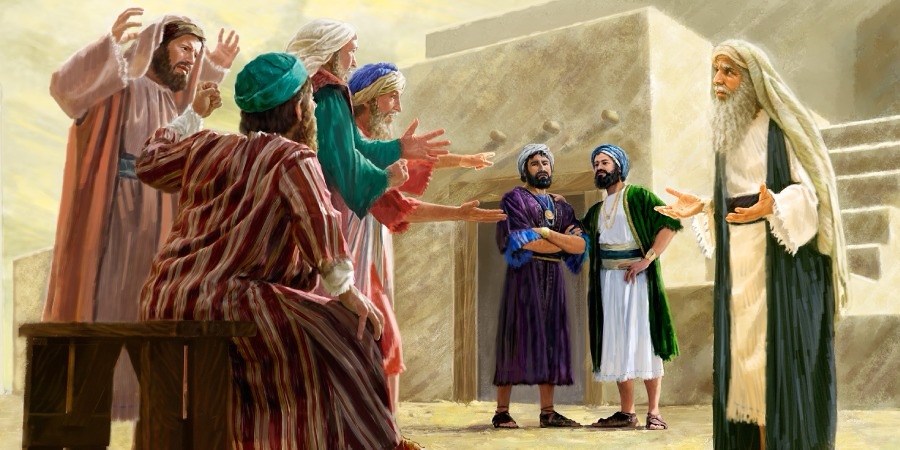
“A king forever”. That is the promise of these well-known words in 2 Samuel 7, which we will hear and reflect on in worship this coming Sunday. They are significant words for Jews; they are also significant words for Christians, for they have informed the way that followers of Jesus would talk about him. The words are given initially to David, only the second king of Israel, but the one who would provide descendants to sit on the throne for half a millennium.

The words of the prophet Nathan, given to him (as he says) by the Lord God, are reported and remembered over those centuries as validation of the power of those kings, even though so many of them “did evil in the sight of the Lord” (as later verses in the historical narratives of Israel report). God stood by those leaders over many generations, consistently reminding the people of their responsibility to adhere to the covenant, affirming them at moments when their faith is evident, and rebuking them at times when that is not the case.

These words have been remembered further by Christians, who see that in Jesus, God has sent “the King of the ages” (1 Tim 1:17), to whom “belong the glory and the power forever and ever” (1 Pet 4:11; also Rom 16:26; Eph 3:21). This is in accord with the “eternal purpose that [God] has carried out in Christ Jesus our Lord” (Eph 3:11), to lead believers to “eternal life” (Luke 10:25; John 17:3; Rom 5:21; 6:23).

Of course, in those words which Nathan speaks to David, we recognise the play on words that occurs. David understands God to be promising a “house” which is “a house of cedar” (v.7), but God actually intends to establish “offspring after you … his kingdom” (v.12).

Writing in With Love to the World, Mel Pouvalu observes that “The word “house” is used fifteen times in 2 Samuel 7, where it has three different meanings. It refers to David’s palace (vv.1–2), to the temple of the Lord God (vv.5–7, 13), and then to David’s dynasty (vv.11, 16, 18–19, 25–27, 29).” She continues, “It is important to see that our ways are not God’s ways, even if we mean well. The story promises a stable future for generations to come, and these narratives are reminders that God will always be seeking us.”

The motif of a kingdom that lasts “forever” is linked both with the affirmation that there will be a king “forever”, and also with the belief that the covenant with Israel will last “forever”. That there will be a king “forever” is integral to God’s promise to David that “your throne shall be established forever” (2 Sam 7:16), repeated by the Chronicler, “when your days are fulfilled to go to be with your ancestors, I will raise up your offspring after you, one of your own sons, and I will establish his kingdom … and I will establish his throne forever” (1 Chron 17:11–12).

The kingdom that will last “forever” is introduced by God’s words in 2 Samuel 7, where God promises David that “your house and your kingdom shall be made sure forever before me” (2 Sam 7:16). The Chronicler also repeats this promise, quoting God as saying of David, “I will confirm him in my house and in my kingdom forever, and his throne shall be established forever” (1 Chron 17:14).

Affirmation of a covenant that will last forever is found in a number of psalms. “The Lord our God … is mindful of his covenant forever, of the word that he commanded, for a thousand generations, the covenant that he made with Abraham, his sworn promise to Isaac, which he confirmed to Jacob as a statute, to Israel as an everlasting covenant” (Ps 105:7–10).

The covenant is noted in a number of psalms. “The friendship of the Lord is for those who fear him, and he makes his covenant known to them”, sings the psalmist (Ps 25:14). “I have made a covenant with my chosen one, I have sworn to my servant David”, God sings in another psalm; “I will establish your descendants forever, and build your throne for all generations” (Ps 89:3–4).

In this same psalm, God affirms that, even if the children of David “forsake my law and do not walk according to my ordinances”, God will punish them, but “forever I will keep my steadfast love for him, and my covenant with him will stand firm … I will not violate my covenant, or alter the word that went forth from my lips” (Ps 89:28, 34). That covenant is to last “forever” (Ps 111:9).

The ultimate message, then, is that God will stand by the leaders of Israel, punishing them, forgiving them, loving them at each step along the way. A promise to sustain a king and a kingdom “forever”, by virtue of a covenant that lasts “forever”, undergirds this reality for the people of Israel. The modern nation state of Israel has adopted this confident assertion, although without any critical appreciation of the context and the purpose of this promise in antiquity. The dreadful results of this unthinking adoption of the mantra that “God is always with us” is playing out in the many deaths, injuries, and sadness that is taking place in Gaza, even today.

Of course, in the traditional understanding of Christianity, the “forever” component has been taken up in the application of 2 Samuel 7 to Jesus of Nazareth. Jesus is acclaimed as “Son of David” in the Synoptic Gospels (Mark 10:47–48; 12:35; Luke 3:31; 18:38–39; and especially in Matt 1:1, 20; 9:27; 12:23; 15:22; 20:30–31; 21:9, 15; 22:42). This claim is also noted at John 7:42; Rom 1:3; 2 Tim 2:8; Rev 3:7; 5:5; 22:16). The heritage of David lives on in these stories.

This particular son of David, as Christian understanding develops, was understood to be king “forever”; “he will reign over the house of Jacob forever, and of his kingdom there will be no end” (Luke 1:31–33). The covenant that he has renewed and enacted with the people of God is “forever” (Heb 9:15; 12:20); and the kingdom that he proclaimed and for which we hope will also be “forever” (2 Pet 1:11).

In the late first century document that we know as letter to the Ephesians, for instance, the resurrected Jesus is seen as seated at the right hand of God “in the heavenly places, far above all rule and authority and power and dominion, and above every name that is named” (Eph 1:20–21). That place of authority for Jesus is envisaged as stretching into eternity, “not only in this age but also in the age to come” (1:20), and as encompassing all places, for God “has put all things under his feet and has made him the head over all things” (1:22).

The global and eternal rule of Christ is here clearly articulated. The statement by the writer that God “seated [Jesus] at his right hand in the heavenly places, far above all rule and authority and power and dominion” (1:20–21) has inspired the development of the imagery of Christ as Pantocrator (Greek for “ruler of all”) in Eastern churches, both Orthodox and Catholic.
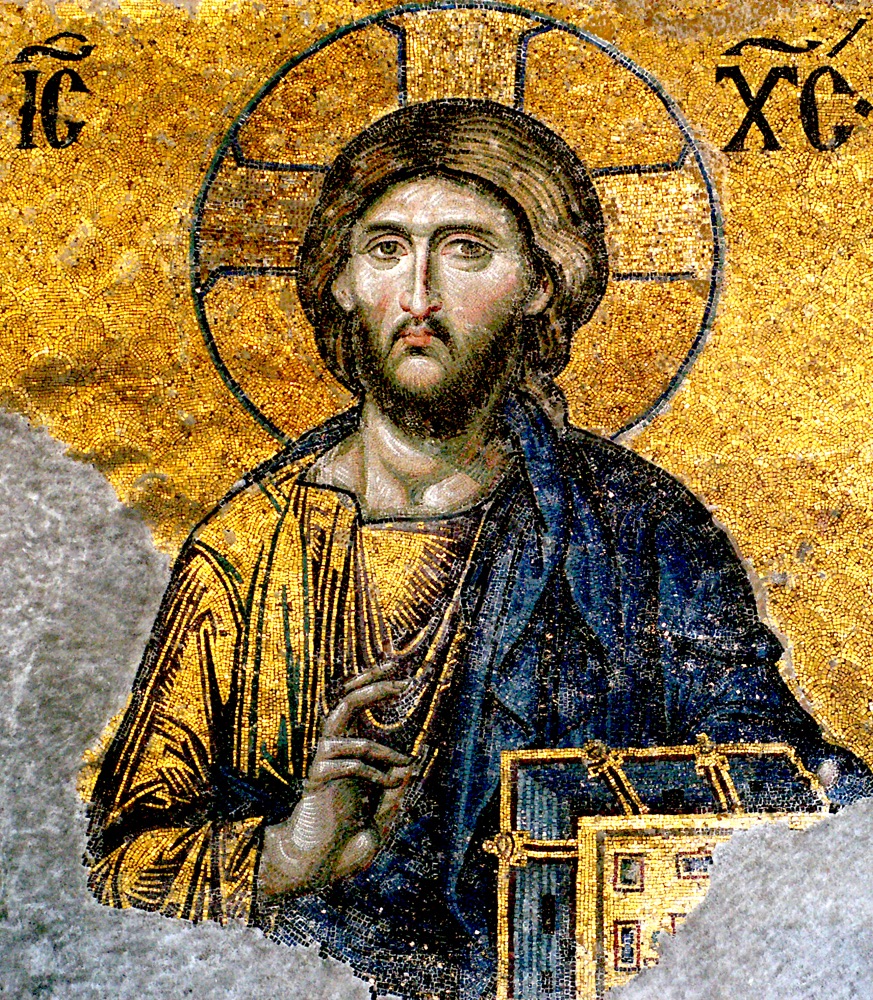

Jesus Christ Pantocrator; from a mosaic in the Hagia Sophia mosque (formerly a church), in Istanbul

This line of thinking has culminated in the festival of the Reign of Christ, which has been celebrated in the Roman Catholic Church since it was introduced by Pope Pius XI in 1925. It has since been adopted by Lutheran, Anglican, and various Protestant churches around the world, and also, apparently, by the Western Rite parishes of the Russian Orthodox Church Outside Russia.

1925 was a time when Fascist dictators were rising to power in Europe. I have read that “the specific impetus for the Pope establishing this universal feast of the Church was the martyrdom of a Catholic priest, Blessed Miguel Pro, during the Mexican revolution”; see Today’s Catholic, 18 Nov 2014, at

The article continues, “The institution of this feast was, therefore, almost an act of defiance from the Church against all those who at that time were seeking to absolutize their own political ideologies, insisting boldly that no earthly power, no particular political system or military dictatorship is ever absolute. Rather, only God is eternal and only the Kingdom of God is an absolute value, which never fails.”

The scriptures puncture the pomposity of powerful kings, and subversively present Jesus as the one who stands against all that those kings did. This festival provides a unique way of reflecting on the eternal kingship of Jesus. It offers a distinctive way for considering how the kingship bestowed upon David has been understood to last “forever”.

With Love to the World is a daily Bible reading resource, written and produced within the Uniting Church in Australia, following the Revised Common Lectionary. It offers Sunday worshippers the opportunity to prepare for hearing passages of scripture in the week leading to that day of worship. It seeks to foster “an informed faith” amongst the people of God.

You can subscribe on your phone or iPad via an App, for a subscription of $28 per year. Search for With Love to the World on the App Store, or UCA—With Love to the World on Google Play. For the hard copy resource, for just $28 for a year’s subscription, email Trevor at wlwuca@bigpond.com or phone +61 (2) 9747-1369.


David and Michal, Uzzah and the Ark (2 Sam 6; Pentecost 8B)

For the passage from Hebrew Scripture this coming Sunday, the lectionary offers us selected verses from 2 Sam 6:1–19. Last week, we heard the brief account of how David, the king of Judah, took the city of Jerusalem from its inhabitants, the Jebusites, and was anointed as king of “all Israel” (5:1–10). Next week, we will hear of the promise that God makes to David, that “I will make for you a great name … your throne shall be established forever” (7:1–14).

In between these two pivotal events, establishing beyond doubt that David was both the conqueror supreme of the earlier inhabitants and the progenitor of a dynasty—“the house of David”—that would hold power for centuries to come, we have a curious, yet significant, account relating to The Ark of the Covenant (6:1–19). See

David uses the Ark to reinforce and undergird his authority; his intention in bringing into the city, Jerusalem, was to confirm absolutely that he was God’s anointed, in Jerusalem, ruling over all Israel.

However, the lectionary (as it is wont to do) omits some verses from the middle of this narrative (6:6–11), as well as the closing section of the chapter (6:20–26). The middle section (6:6–11) reports the death of Uzzah, one of the sons of Abinadab, because he touched the holy ark with his hand. Before this omitted account is the report of David, with “all the house of Israel”, vigorously dancing “with all their might” as he led the Ark into the city (6:1–5), “with songs and lyres and harps and tambourines and castanets and cymbals” (6:5b). After the omitted verses we find David, continuing to dance “with all his might”, offering sacrifices to the Lord God and distributing food to the people in celebration (6:12–19).

Michael Brown, writing in With Love to the World, continues his reflections on this story: “The celebrations ended abruptly. This story of Uzzah’s death by touching the ark—with the best of intentions to steady it as the oxen stumbled—may be strange to us. Yet it is told as a reminder that it is not within anyone’s power to control, guide or steady the divinity to whom the sacred symbols point. Rather, it is we who are guided, steadied or even shaken by the sacred. David, shaken to the core, angry and afraid, stopped the procession in its tracks and left the ark at a nearby house for three months. An awe-filled experience of the sacred may be a chance to pause and recalibrate.”

Uzzah touches the Ark directly

The death of Uzzah occurs because of the holiness of the ark, as the dwelling place of God. Touching it directly—breaching the boundary between the holy and the everyday—would be enough to incur death. “God struck him there because he reached out his hand to the ark”, the text advises (2 Sam 6:7); this contravenes the earlier instruction of the Lord to Moses, “you shall put the poles into the rings on the sides of the ark, by which to carry the ark; the poles shall remain in the rings of the ark; they shall not be taken from it” (Exod 25:14–15).

The holiness of the Ark is evident in the set of directions regarding the Tabernacle (from Exod 25 onwards), when Moses had been instructed, “you shall put the mercy seat on the ark of the covenant in the most holy place” (Exod 26:34). Likewise, decades after David, as Solomon dedicates the Temple, “the priests brought the ark of the covenant of the Lord to its place, in the inner sanctuary of the house, in the most holy place, underneath the wings of the cherubim” (1 Ki 8:6; also 2 Chron 5:5–7; and see Heb 9:1–5).

The way that David welcomed the ark into the city underlines the reverence and awe that was due towards God. A wonderful festival is held. From that time onwards, the ark remains in Zion, where the Temple is the focus of piety. Another transition has taken place, from a holy artefact that was mobile, to a fixed, permanent house for God. Now “the most holy place” of the mobile Tabernacle (Exod 26:33–34; 1 Chron 6:49) would be come “the most holy place” of the temple (1 Ki 6:16; 7:50; 8:6; 2 Chron 3:8–10), or “the Holy of Holies” (as it is labelled in Heb 9:3).

Holiness was certainly central to the religious and social life of ancient Israel. Those who ministered to God within the Temple, as priests, were to be especially concerned about holiness in their daily life and their regular activities in the Temple (Exod 28—29; Lev 8–9). The priests oversaw the implementation of the Holiness Code, a large section of Leviticus (chapters 17—26), which explained the various applications of the word to Israel, that “you shall be holy, for I the Lord your God am holy” (Lev 19:2; also 20:7,26).

As well as overseeing the various offerings and sacrifices that were to be brought to the Temple, the priests provided guidance and interpretation in many matters of daily life, including sexual relationships and bodily illnesses, as well as the annual festivals and other ritual practices.

In the towns and villages of Israel, by contrast, the scribes and Pharisees provided guidance in the interpretation of Torah and in the application of Torah to ensure that holiness was observed in daily living. They undertook the highly significant task of showing how the Torah was relevant to the daily life of Jewish people. It was possible, they argued, to live as God’s holy people at every point of one’s life, quite apart from any pilgrimages made to the Temple in Jerusalem.

Flowing on into the time of Jesus, we see that the followers of Jesus are instructed to consider themselves as God’s holy people (1 Cor 3:17; 6:19; Eph 5:25–27; Col 1:22; 3:12; Heb 3:1; 1 Pet 1:13–16; 2:5, 9) and to live accordingly. Holiness continues to be central in the Jesus movement—albeit, in the manner in which it has been redefined by Jesus (Mark 7:18–23; Matt 15:17–20).


James J. Tissot, David Dances before the Ark (1896–1902),
gouache on board, The Jewish Museum, New York

The lectionary also omits the report of what Michal, the wife of David, said and did as she witnessed this spectacle (6:20–23). It includes the observation that, as Michal look at what David was doing, “she despised him in her heart” (6:16). This is a striking contrast to the earlier affirmation that “Michal loved David” (1 Sam 18:20, 28) and to the care that Michal took to save David from her father, Saul (1 Sam 19:8–17).

Michal is clearly offended that David was “uncovering himself today before the eyes of his servants’ maids, as any vulgar fellow might shamelessly uncover himself” (2 Sam 6:20), even though the earlier report had simply noted that “David was girded with a linen ephod” (6:14). We also don’t read the sad note that concludes this chapter, that “Michal the daughter of Saul had no child to the day of her death” (2 Sam 6:23). The alienation between the two seems complete; we hear nothing more of Michal in the later chapters of 2 Samuel, nor in the book of Chronicles.

Writing in the Encyclopedia of Jewish Women, Dr. Tamar Kadari notes that later Rabbis proposed that “she had no children until her dying day, but on her dying day she bore a son. The midrash speaks of three women who had difficult deliveries and died in childbirth: Rachel, the wife of Phinehas, and Michal daughter of Saul. Michal bleated like a sheep when giving birth and died, and therefore she was called “Eglah” (Gen. Rabbah 82:7).” (The Hebrew word eglah means “heifer”.) This midrash links Michal with “the wife of David” mentioned at 2 Sam 3:5 and 1 Chron 3:3, who was the mother of Ithraem.

Kadari also notes that Rabbis in a later time—when the Talmud was finalised in the fifth or sixth century CE—elevated Michal in status, noting that they comment that “this righteous woman that Michal would put on tefillinn every day, and the sages of the time did not protest, even though there is no halakhah requirement for a woman to do so (JT Eruvin 10:1, 26a).”

Michal

In an article in the online Biblical Theology Bulletin: Journal of Bible and Culture (vol.51 no.1, 2021), David. J. Zucker explores “Four Women in Samuel Confront Power”. He alert us to the stories of four occasions in the books of 1–2 Samuel when “women put their lives at risk as they dare to confront power … Abigail of Maon to rebellious David; the Medium of Endor to King Saul; the Wise Woman of Tekoa to King David; and the Wise Woman of Abel to Joab, King David’s general.”

Sadly, none of the stories relating to these women are included in the passages suggested by the Revised Common Lectionary. As is often the case, the focus is on the men in the narratives proposed.

Zucker notes that “The details surrounding their specific situations differ considerably from case to case. Likewise, from what little the Bible tells about their backgrounds, it is likely that they all came from different social classes. Nonetheless, each example fits within a broad definition of speaking truth to power.”

See https://journals.sagepub.com/doi/10.1177/0146107920980931?

The four women dealt with by Zucker are Abigail of Maon, the wife of Nabal (1 Samuel 25); the Medium of Endor (1 Samuel 28); the Wise Woman of Tekoa (2 Samuel 14); and the Wise Woman of Abel (2 Samuel 20). None of these chapters are included in the sequence of lectionary offerings. Zucker explains how these women speak truth to power.

“Abigail of Maon interacts with pre-monarchic David, then a rebel on the run since he is distanced from King Saul. The Medium of Endor is visited by King Saul, who is seeking Divine counsel via the recently deceased prophet Samuel. The Tekoite has come to King David ostensibly to seek resolution to her family’s blood vengeance problem. The Abelite representing her community which is threatened with immediate destruction is in dialogue with Joab, King David’s foremost general.”

He notes that “these stories vividly capture some of the very different ways in which women in the [Hebrew Bible] are resisting the violence of war that has the potential to utterly destroy their families and the communities in which they live.” What a pity we are not offered the opportunity to consider them in what we read in public worship.

*****

With Love to the World is a daily Bible reading resource, written and produced within the Uniting Church in Australia, following the Revised Common Lectionary. It offers Sunday worshippers the opportunity to prepare for hearing passages of scripture in the week leading to that day of worship. It seeks to foster “an informed faith” amongst the people of God.

You can subscribe on your phone or iPad via an App, for a subscription of $28 per year. Search for With Love to the World on the App Store, or UCA—With Love to the World on Google Play. For the hard copy resource, for just $28 for a year’s subscription, email Trevor at wlwuca@bigpond.com or phone +61 (2) 9747-1369.
Out of the depths (Psalm 130; Pentecost 6B)

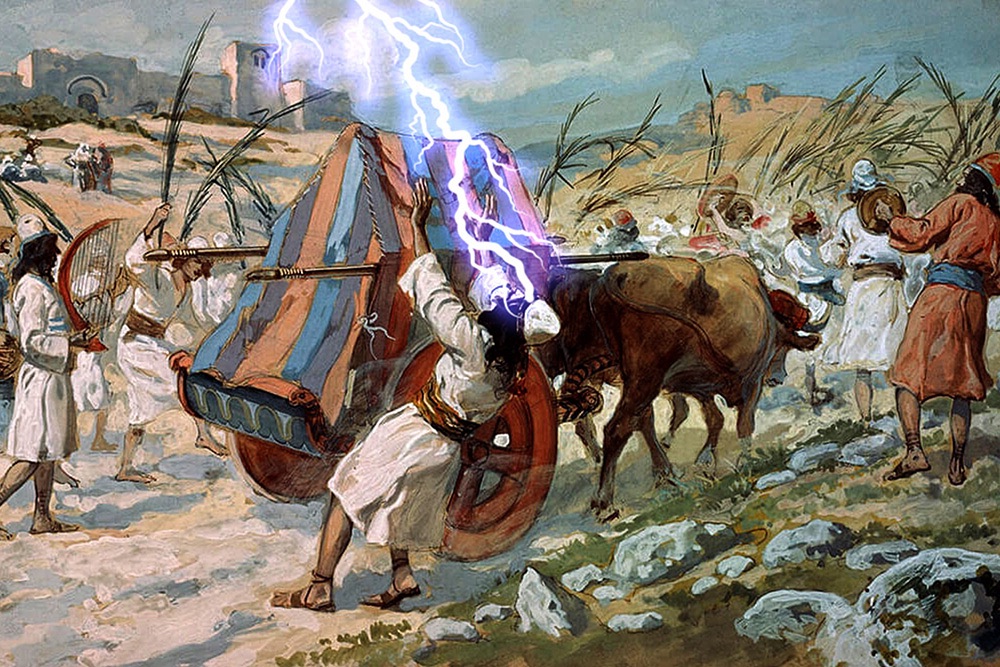
The psalm offered by the lectionary for this coming Sunday, Psalm 130, is one of a series of 15 psalms (Psalms 120—134), each of which is each identified as shir hammalowt, “a song of ascents”. They are so called because it is believed they were sung by faithful Israelites as they made their pilgrimage, ascending to Jerusalem, on one of the three annual festivals—the Feast of Unleavened Bread (Passover), the Feast of Weeks (Pentecost), and the Feast of Tabernacles (as listed in Deut 16:16).

The series of Songs of Ascent begins with “in my distress I cry to the Lord” (Ps 120:1), moving on to “I lift up my eyes to the hills” (Ps 121:1). I like to imagine that this was being sung as the outline of the city built on and around Mount Zion appeared in the far distance. We can imagine the pilgrims drawing closer to the walls of the city as the psalmist sings, “I was glad when they said to me, ‘Let us go to the house of the Lord!’” (Ps 122:1), then sings of lifting up their eyes to “you who are enthroned in the heavens” (Ps 123:1).

Next, the pilgrims offer expressions of trust in God (Ps 124:8; 125:1–2), celebrating “when the Lord restored the fortunes of Zion” (Ps 126:1), and yearn that the Lord God might “restore our fortunes … like the watercourses in the Negeb” (Ps 126:4).

By this time, I imagine the pilgrims viewing both the city from outside its walls and the Temple on its highest point, singing “unless the Lord builds the house, those who build it labor in vain; unless the Lord guards the city, the guard keeps watch in vain” (Ps 127:1). This psalm then celebrates the gift of sons (Ps 127:4–5) and the following psalm celebrates “your wife [who] will be like a fruitful vine within your house; your children will be like olive shoots around your table”, concluding “thus shall the man be blessed who fears the Lord” (Ps 128:3–4).

I also like to imagine that, as the pilgrims were entering the city, the pilgrims sang to celebrate, “the Lord is righteous; he has cut the cords of the wicked” (Ps 129:4), followed by a heartfelt cry to God from “out of the depths” (Ps 130:1) and an affirmation that “with the Lord there is steadfast love, and with him is great power to redeem” (Ps 130:7).

Next, the psalmist simply observes, “I have calmed and quieted my soul” (Ps 131:2); and then, as the Temple is immediately before them, the pilgrims sing, “Let us go to his dwelling place, let us worship at his footstool” (Ps 132:7).

Then follows the two shortest of all the Songs of Ascent, to bring the series to a close. One song celebrates the unity of the people, with oil running down the head “like the dew of Hermon, which falls on the mountains of Zion” (Ps 133:3), and then in the final song the pilgrims are “stand[ing] by night in the house of the Lord”, concluding with the prayer, “may the Lord, maker of heaven and earth, bless you from Zion” (Ps 134:3). It is a beautiful blessing to conclude the whole sequence.

In Psalm 130, the psalmist utters a cry of deep despair: “out of the depths I cry to you, O Lord” (Ps 130:1), picking up the opening prayer of the first song of ascent, “in my distress I cry to the Lord, that he may answer me” (Ps 120:1). The depths of the earth were the place where sinful people went (Ps 63:9; Isa 14:15), following the lead of the Egyptians who pursued the Israelites and “went down into the depths like a stone” (Exod 5:4–5; Neh 9:11; Isa 63:11–13). There, in the depths, God’s anger burned (Deut 32:22). It would indeed be a place causing distress, as the psalmist’s prayer recognises.

However, those banished to the depths were able to be brought back from the depths by God’s decree (Ps 68:22; 71:20; 86:13), so in this psalm the cry of the psalmist from the depths is followed by the plea, “Lord, hear my voice! Let your ears be attentive to the voice of my supplications!” (Ps 130:2).

This plea, “hear my voice”, is uttered in three other psalms (Ps 28:2; 64:1; 119:49), and twice the psalmist affirms that God does indeed listen: “O Lord, in the morning you hear my voice” (Ps 5:3) and “evening and morning and at noon I utter my complaint and moan, and he will hear my voice” (Ps 55:17).

Supplication is regularly made by the psalmist (Ps 28:2; 30:8; 55:1; 86:6; 119:170; 142:1) and the affirmation is clear: “the Lord has heard my supplication; the Lord accepts my prayer” (Ps 6:9). The psalmist’s confidence in God’s trustworthy response to prayer is undergirded by three qualities attributed to God in this short psalm: forgiveness (v.4), steadfast love (v.7a), and power to redeem (vv.7b—8).

The psalmist prays for forgiveness from God (Ps 25:18: 79:9) and affirms that “Praise is due to you, O God, in Zion; and to you shall vows be performed, O you who answer prayer!”, for “when deeds of iniquity overwhelm us, you forgive our transgressions” (Ps 65:1–3). In another psalm, we hear the song, “happy are those whose transgression is forgiven, whose sin is covered” (Ps 32:1), which thus undergirds the affirmation in this psalm, “there is forgiveness with you, so that you may be revered” (Ps 130:4).

With this trusting attitude, the psalmist sings, “I wait for the Lord, my soul waits” (Ps 130:5–6), reflecting a common attitude across many psalms, waiting for the Lord: “you are the God of my salvation; for you I wait all day long” (Ps 25:5); “it is for you, O Lord, that I wait; it is you, O Lord my God, who will answer” (Ps 38:15); “for God alone my soul waits in silence, for my hope is from him” (Ps 62:5). So the psalmist encourages others, “be strong, and let your heart take courage, all you who wait for the Lord” (Ps 31:24) and affirms that “those who wait for the Lord shall inherit the land” (Ps 37:9).

As the psalmist waits, it is trust in the steadfast love of God which is envisaged and yearned for (Ps 130:7). Elsewhere, the psalmist addresses God as “a God merciful and gracious, slow to anger and abounding in steadfast love and faithfulness” (Ps 86:15) and sings of how “steadfast love and faithfulness will meet; righteousness and peace will kiss each other” (Ps 85:10). The refrain which praises God’s steadfast love and faithfulness is found in many places in the Hebrew Scriptures (Exod 34:6; 2 Chron 30:8–9; Neh 9:17, 32; Jonah 4:2; Joel 2:13; Ps 86:15; 103:8, 11; 111:4; 145:8–9).

Accordingly, the prophet Micah affirms that God’s steadfast love will rescue those who “lick dust like a snake, like the crawling things of the earth”, and will indeed “cast all our sins into the depths of the sea” (Mic 7:17, 19). This may be a vivid description of the state in which the psalmist finds themself, as they cry “out of the depths” (v.1); there, the steadfast love of the Lord will indeed meet them (v.7). So the psalmist confidently affirms, “I wait for the Lord, my soul waits, and in his word I hope” (Ps 130:5).

In that waiting, the psalmist believes, the redemption of the Lord will surely be experienced: “Israel, hope in the Lord! For with the Lord there is steadfast love, and with him is great power to redeem. It is he who will redeem Israel from all its iniquities” (Ps 103:7–8). Through the establishment of the covenant and the giving of Torah, God “sent redemption to his people;” (Ps 111:9), and so prayers seeking redemption are regularly offered: “rise up, come to our help; redeem us for the sake of your steadfast love” (Ps 44:26); “redeem me from human oppression, that I may keep your precepts” (Ps 119:134); “as for me, I walk in my integrity; redeem me, and be gracious to me” (Ps 26:11).

The psalmist is confident, also, about God’s redemptive activity: “I call upon God, and the Lord will save me … he will redeem me unharmed from the battle that I wage, for many are arrayed against me” (Ps 55:16, 18). The foundational story of the Exodus, the primal myth of the people of Israel, assures the psalmist of the promise of abode that “I will free you from the burdens of the Egyptians and deliver you from slavery to them; I will redeem you with an outstretched arm and with mighty acts of judgment” (Exod 6:6).

That same divine redemption continued to bring the people into the land promised to them; as David asked of God, “is there another nation on earth whose God went to redeem it as a people, and to make a name for himself, doing great and awesome things for them, by driving out before his people nations and their gods?” (2 Sam 7:23; 1 Chron 17:21). So as the psalmist prays out of the depths, confidently waiting for God to act, they know that “it is [the Lord] who will redeem Israel from all its iniquities” (Ps 130:8).

This psalm resonates with me, from its opening plea, “out of the depths I cry”, to its closing affirmation that, through “the steadfast love” of the Lord, “he will redeem”. In my own moments of deep distress, I have experienced comfort and assurance that I am not unvalued. The love and care of people, grounded in their own faith and expressed in specifically acts of support for and encouragement towards me, have brought the transforming, redeeming presence of the loving God into my life at those moments of distress. I am grateful for this; my own faith has been deepened and strengthened in this way.

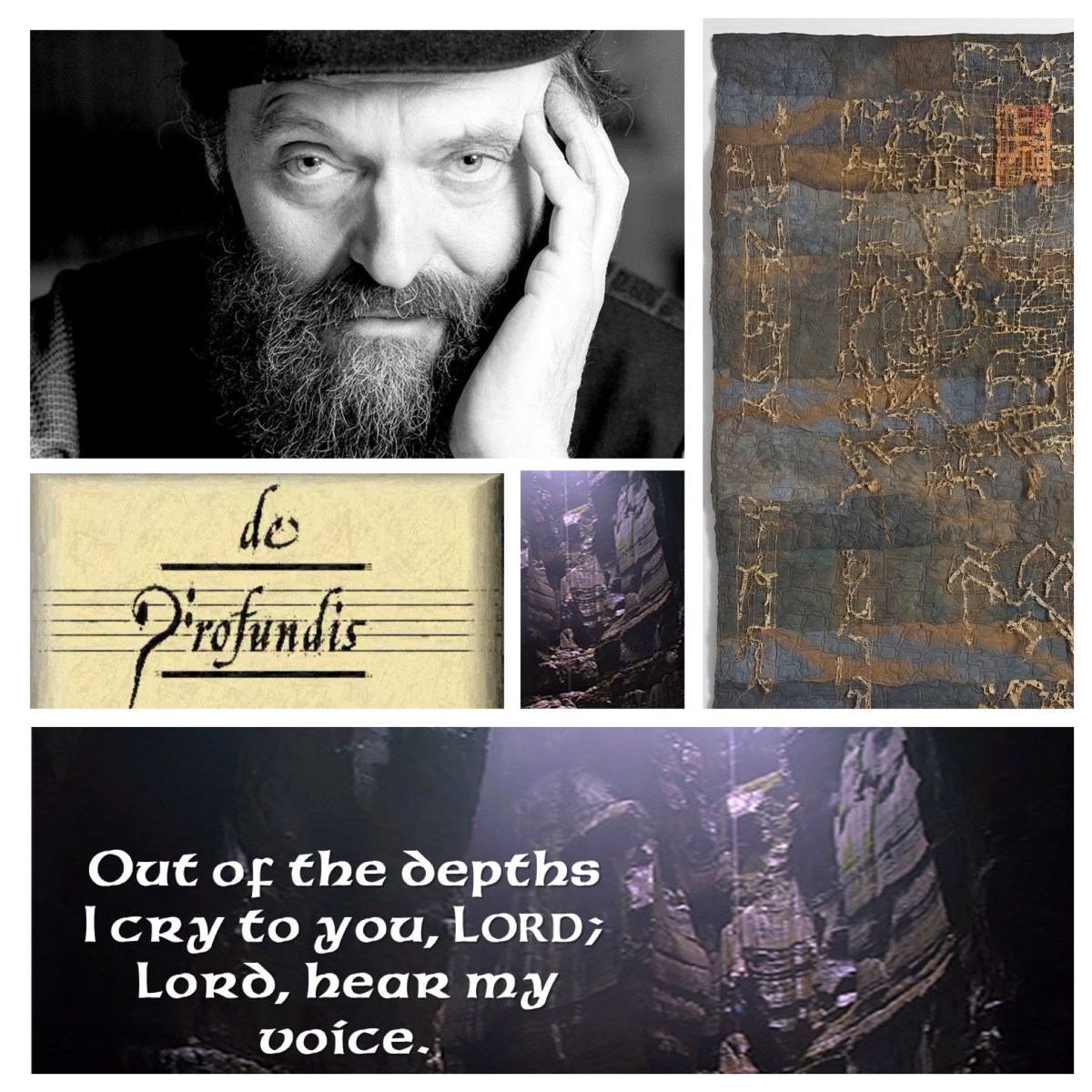
My favourite musical setting of the psalm is that by contemporary Estonian composer Arvo Pärt, a setting for a four-part male choir, with organ and percussion. In this short seven- minute piece, Pärt employs his distinctive style of a slowly-moving ostinato in the deep notes of the organ as a foundation, over which the choir moves slowly, building in volume to a climactic moment in unison, just before the music dies away at the end, returning to silence, the ending marked by a single note from a tubular bell.

Music critic John Irvine, in reviewing this piece, wrote: “De Profundis (1980) is an impassioned and yet simple vocal setting … where the voices climb out of the very depths of despair, with a funereal drum beat. Immediately we are drawn into an atmosphere of impassioned worship and reverence.” (https://www.crossrhythms.co.uk/products/Paul_Hilliars_Theatre_Of_Voices/Arvo_Part_De_Profundis/17054/)

This is the artwork that Elizabeth purchased for me on my 70th birthday. It is a piece which we saw at the “Urban Narratives” exhibition last year in Newcastle, held by Timeless Textiles. It is called De Profundis, Latin for “Out of the Depths”, which is how Psalm 130 begins. This psalm contains the affirmation of hope, “my soul waits for the Lord, more than those who watch for the morning”.

The artwork was made by ESZTER BORNEMISZA, an artist based in Budapest, Hungary. She works with waste newspaper, vintage cloth, and other soft materials that she finds “discarded”. Her basic process of creation is machine stitching and paper casting with additional elements of printing, dyeing and painting.

She writes, “From the beginning I have worked with various used textiles, which I have inherited and received from friends. I feel more conscious of environmental issues when I recycle material trying to draw attention to the environmental impact of waste; while tons of garments end up in the dump, we still keep the same level of consumption. I also like to experiment with used materials that I up-cycle to give them new connotations: spoilt X-ray films, computer keyboard integrated circuit films and buttons, discarded electric and chicken-wires and plastic covering sheets from constructions wastes.

“Recently I have mainly used newsprints that play a central role in my work as they provide further visual experiences by their ephemeral character. They are fragile; the content is obsolete sometimes already at the hour of appearance while still bearing fragments of important details from the recent past. They deliver deluges of information from which we must sift out the true from the fake. I use them in my recent translucent works capturing the play of opaque and open elements that play an important role: the shadow behind the work adds another layer of complexity.”

This explains something of why I really love this striking piece of art—combining wonderful artistic creativity with social commentary and environmental responsibility!

See her portfolio of works at https://bornemisza.com

David, Jonathan, and Michal (1 Sam 18–20; 2 Sam 1; Pentecost 6B)

In the days leading up to this Sunday, we are thinking of the lament which opens the book we know as 2 Samuel, where David sings of his love for both King Saul and his son Jonathan (2 Sam 1:1, 17–27). As the lectionary has jumped from the rollicking yarn of how David killed Goliath (1 Sam 17), to this sorrowful lament that David sings (2 Sam 1), it has leapt over some important stories.

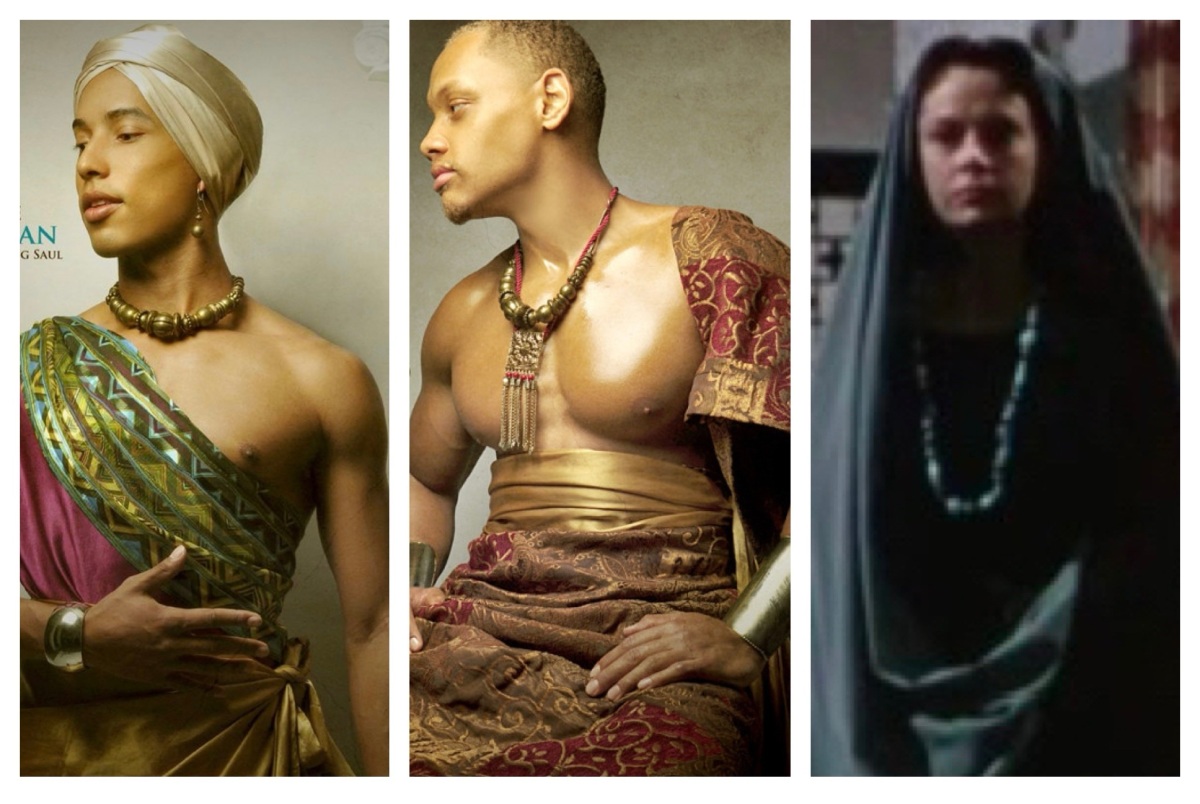
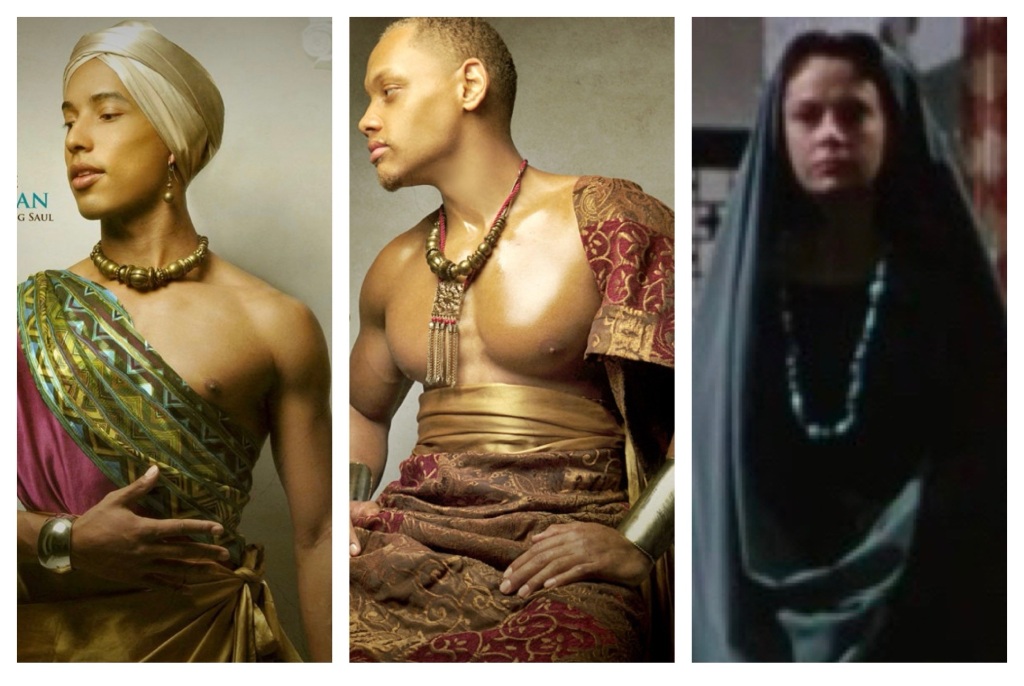
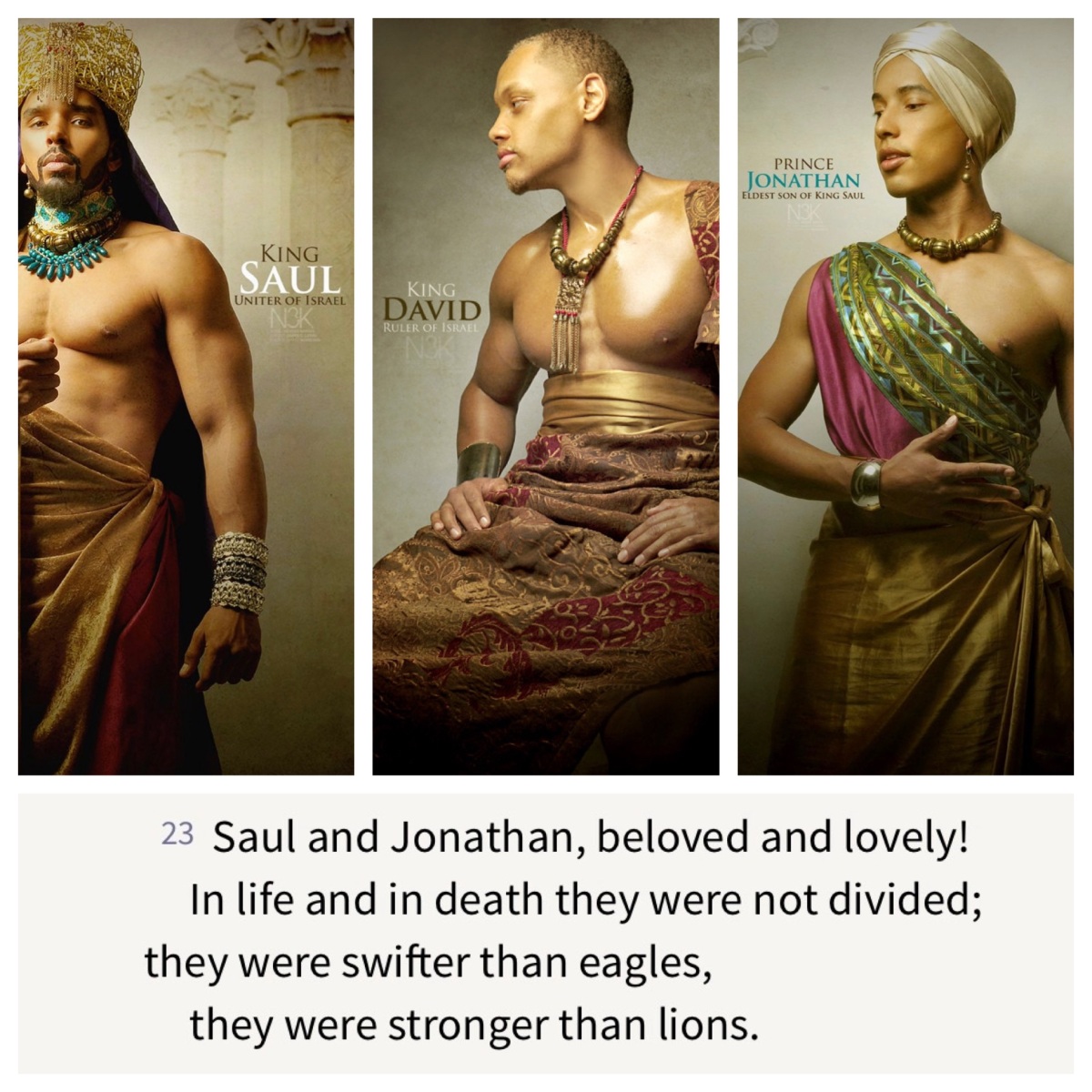
Jonathan as depicted by photographer James C. Lewis

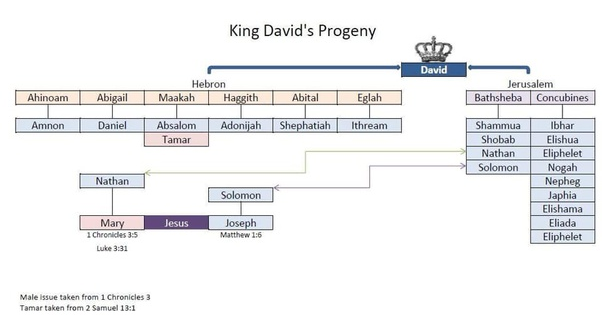
We have had little opportunity to consider Jonathan, who had been in an intense and intimate relationship with David; he features in the battles of 1 Sam 13—14, but the lectionary has omitted all of these scenes. Nor have we had opportunity to consider Michal, the sister of Jonathan, who was married to David as his first wife—of eight: for after her came Ahinoam the Yizre’elite; Abigail, the widow of Nabal the Carmelite; Maacah, the daughter of Talmay, king of Geshur; Haggith; Abigail; and Eglah.

A list in 1 Chron 3:1–8 identifies eighteen of David’s sons, before concluding “these were David’s sons, besides the sons of the concubines”, and then adding the tag- line, “and Tamar was their sister” (1 Chron 3:9).

David’s relationship with Jonathan was, as we have seen, intense and intimate: “the soul of Jonathan was bound to the soul of David, and Jonathan loved him as his own soul. Saul took him that day and would not let him return to his father’s house. Then Jonathan made a covenant with David, because he loved him as his own soul.” (1 Sam 18:1–3).

The verb used here is אָהַב (ahab), the same used throughout the ancestral narratives for the love of a man for a woman (Gen 24:67; 25:28; 29:18, 20, 30, 32; 34:3; Judg 16:4; 1 Sam 1:5; 2 Sam 13:1, 4, 15; 1 Ki 11:1; 2 Chron 11:21). It is also used for God’s love for Israel (Deut 7:8; 1 Ki 10,9; 2 Chron 2:11; 9:8)—and, of course, God is understood as the husband (masculine) of Israel (feminine) (Hos 2:16; Isa 54:5–7; Jer 31:32; Ezek 16:8–14; and see Eph 5:31–32; Rev 21:2).

David’s relationship with Michal comes after her father, Saul, had offered David his daughter Merab as his wife—an offer which David politely declined (1 Sam 18:17–19). The first we know of Michal is the stark comment, “Saul’s daughter Michal loved David” (18:20, repeated at v.28). The verb used is אָהַב (ahab), the same used of David’s love for Jonathan (1 Sam 20:17; 2 Sam 1:16). Michal’s love for David had the same quality, the same character, as Jonathan’s love for David, and David’s love for Jonathan.

Perhaps we might reflect more on what David says when he compares Jonathan’s love for him with the love of women for him (2 Sam 1:26). Remember, he had no less than eight wives, who bore him at least nineteen children! So David knew a lot, we might assume about “the love of women”.

In his lament, David remembers that Jonathan’s love for him was “wonderful” (2 Sam 1:27). This is one possible translation of the word used here, פָלָא (pala), which has the sense of something extraordinary, something surpassing normal phenomena. It is used on occasion to refer to the miraculous “signs” that God performed in redeeming Israel from slavery in Egypt (Exod 3:20; Judg 6:13; 1 Chron 16:9–12; Neh 9:17) and that are promised to Israel in future years (Exod 34:10; Josh 3:5). David’s praise for Jonathan’s love is high indeed!

It is worth pondering these two forms of love that revolve around David in the early stages of his kingship. My wife, Elizabeth Raine, has undertaken a careful analysis of how these two relationships are described, and has noted a striking set of comparisons that are drawn between the way that David experienced his living relationship with Jonathan, and his relationship with his first wife, Michal.

David had married Michal (1 Sam 18:20–27) soon after he had entered into the covenant with Jonathan (1 Sam 18:3–5). Michal and Jonathan are both children of Saul, but they show more loyalty to Saul’s competitor (David) than to Saul. Their stories are told side-by-side side in 1 Samuel 18—20. What follows is Elizabeth’s analysis.

When we make careful comparisons, the results are surprising: traditional Hebrew male traits are attached to Michal, the female; whilst traditional Hebrew feminine traits are linked with Jonathan, the male. David relates to Michal as a man relates to a man, whilst David relates to Jonathan as a man relates to a woman.

David and Michal

We are told that Michal loved David and made it known (1 Sam 18:20, 18:28). This is the only time in 1—2 Samuel when a woman chooses her husband; usually the man chooses his wife. We note that it is never said that David married Michal for love, unlike the feelings that he appears to have had for Bathsheba (2 Sam 12:24; so also at the end of his life, in 1 Ki 1–2). Rather, David marries Michal for political reasons; he wants to be the son-in-law of King Saul.

Michal’s masculinity is contrasted with effeminate nature of her husband, Paltiel, who runs along crying when David forcibly reclaims Michal (2 Sam 3:16). Michal’s masculine traits are on show when she takes assertive physical action, unlike the typical Hebrew female (with just a few exceptions, like Jael and Deborah). First, Michal saves David by physically lowering him out a window (1 Sam 19:12). Then, she arranges her bed to make it appear that David is there (1 Sam 19:13), she lies to messengers, and then she lies to Saul (1 Sam 19:14–15).

Finally, Michal never bore a child to David; she does not fulfil the primary female role for women. And Michal is never described as beautiful, as other biblical women are: Abigail (1 Sam 25:3), Bathsheba (2 Sam 11:2), Tamar (2 Sam 13:1; 14:27), the queen of Ophir (Ps 45:11), and Esther (Esther 2:7)—and, over and over, the woman, “black and beautiful”, of the Song of Solomon.

Thus, Michal is cast in a most unfeminine role.

David and Jonathan

By contrast, David’s love and tenderness are reserved for Jonathan (2 Sam 1:26). On a number of occasions, as we have noted, Jonathan makes known his warm feelings for David (1 Sam 18:1; 19:1; 20:17). When Jonathan declares his feelings for David, David meets him and reciprocates with extravagant actions: “he prostrated himself with his face to the ground, bowed three times, and they kissed each other, and wept with each other; David wept the more” (1 Sam 20:41).

David and Jonathan kissed and wept with intensity until David ends their encounter with words pregnant with meaning: “the Lord shall be between me and you, and between my descendants and your descendants, forever” (1 Sam 20:42). These words evoke the covenantal commitment made by Jacob with Laban at Galeed—the Mizpah blessing, “the Lord watch between you and me, when we are absent one from the other” (Gen 31:49). The intensity of David’s covenantal promise is unparalleled elsewhere in the Hebrew Bible.

The narrative is clear that Jonathan assumes a role exactly like David’s women. Saul condemns Jonathan for choosing “the son of Jesse”—he won’t even name him (1 Sam 20:30–31)—and says it “to your own shame and the shame of your mother’s nakedness”, a polite way of referring to her genitalia (1 Sam 20:30). Saul is angered at his public shaming by Jonathan’s choice, and he wants to put David to death (1 Sam 20:31). When the tables turn later, David refuses to kill Saul (1 Sam 24:8–15), turning around Saul’s view of him (1 Sam 24:17–21).

David and Jonathan contract a covenant which is analogous to a marriage agreement (1 Sam 18:3) and the text, as we have seen, stresses a number of times that Jonathon had love for David. Jonathan, in turn, is prepared to give up his kingdom for David (1 Sam 18:3). Then, in David’s lament after he learns of Jonathan’s death, he declares that his love for Jonathan was greater than his love for any woman (2 Sam 1:26).

Although Jonathan saves the life of David, he never uses physical means; it is not by action, but by talk, that he does this—exhibiting much more of the characteristic feminine traits in this regard (1 Sam 20:26—29). When David concocts a lie for Jonathan to tell the messengers, Jonathan remains passive (1 Sam 20:4—11); in this, Jonathan acts in the way that Abigail later does (1 Sam 25). Then, David later adopts Mephibosheth, the son of Jonathan (2 Sam 4:4; 9:6–13).

Finally, we might well deduce that, as David presumably had sexual relations with each of his wives, resulting in children from most of them, we can reasonably assume that the love which “passes the love of women” that David expresses for Jonathon (2 Sam 1:26) may well have included sexual relations.

Thus, Jonathan is cast in a most unmasculine role.

When we look at the whole story that is told in this section of 1–2 Samuel, it is very important that we note Jonathan was part of God’s divine plan. His love for David is never condemned by God or by others in the narrative, with the exception of his father, Saul, who had been cursed by God. The love that David had for Jonathan, and that Jonathan reciprocated, was expressed in a fully-formed, deep, mature relationship, about which the text gives many affirming indications.

For earlier posts on the David—Jonathan—Saul relationships, see

and

Saul and Jonathan, beloved and lovely! part 2 (1 Sam 18–20; 2 Sam 1; Pentecost 6B)

For the Hebrew Scripture passage this coming Sunday, the lectionary offers a controversial passage (2 Sam 1:1, 17–27). The controversy revolves around the nature of the relationship between David and Jonathan. That relationship has an interesting history, and comes to a full expression in this passage.

In recent decades, a critical question that has been the focus of interpretation of the relationship between Jonathan and David has been, was this a loving same-gender relationship? Quite a number of scholars have argued that this was, indeed, the case.

Of course, more conservative and fundamentalist interpreters steadfastly refute this. They offer a number of arguments in support of their claims. The way that Jonathan’s love for David (1 Sam 18:3; 20:17) and the way that David describes his love for Jonathan (2 Sam 1:26) did not have sexual connotations, they claim. Alongside this, David is never said to have “known” Jonathan, which is a way that sexual intercourse is elsewhere described (Gen 4:1, 17, 25; 1 Sam 1:19).

These conservative scholars do not see the forming of a covenant (1 Sam 18:3) as signalling a loving relationship, as it was a political mechanism, as we noted in the previous blog on this passage. They claim that the “knitting” or “binding” of Jonathan’s soul to David (1 Sam 18:1) was more akin to the love of a father for his son; they also claim that Jonathan’s shedding of his clothes (1 Sam 18:4) was not in order to make love, but done as a political gesture.

However, I think that such arguments swim against the strong current that flows through the story of Jonathan and David. Writing thirty years ago, the biblical scholars Danna Nolan Fewell and David M. Gunn observed that “few commentators afford serious consideration to reading a homosexual dimension in the story of David and Jonathan”.

Fewell and Gunn note that “this is hardly surprising, given that until recently, most have been writing out of a strongly homophobic tradition… [but] far from stretching probability, a homosexual reading … finds many anchor points in the text.” (Fewell and Gunn, Gender, Power and Promise: The Subject of the Bible’s First Story  [Nashville: Abingdon Press, 1993], 148-49.) we need to explore this claim in more detail.

The key feature of the relationship that is anchored in the text is conveyed in the word אַהֲבָה (ahabah), which is translated “love”. It is a word which appears 40 times throughout the Hebrew Scriptures, describing the relationship that God has with Israel (Deut 7:8; 1 Ki 10:9; 2 Chron 2:11; 9:8), as well as that between husband and wife (Prov 5:19; Eccl 9:9), and most specifically the sexually-passionate love expressed in the Song of Songs (Song 2:5–7; 3:5, 10). In these latter places, there are strong romantic and sexual dimensions to its meaning.

Certainly, love defines the relationship between Jonathan and David; the word is used three times in this regard, as we have noted above (1 Sam 18:3; 20:17; 2 Sam 1:26 ). Joel Baden, in a fine article “Understanding David and Jonathan”, notes that “over and over again we are told that Jonathan loved David”. He observes that while the most common sense of the term is “a non-romantic meaning of ‘covenant loyalty’ … the use of the word in the case of Jonathan seems to go beyond that.”

Baden lists the accumulation of evidence in a series of key verses. First, “Jonathan does not just ‘love’ David. ‘Jonathan’s soul became bound up with the soul of David’ (18:1).

Second, when we read that “Jonathan ‘delighted greatly in David’ (19:1)”, Baden notes that “the same Hebrew word used in Genesis to describe Shechem’s desire for Jacob’s daughter Dinah (Gen 34:19).”

Third, Baden observes that when Jonathan dies, “David laments for him in these words: ‘More wonderful was your love for me than the love of women’ (2 Sam 1:26)”. That is a very strong statement indeed; as Baden notes, “the comparison to the love of women can hardly have a political valence; this is as close to an expression of romantic attachment between two men as we find in the Bible.”

Representations of Jonathan and David
by photographer James C. Lewis

Indeed, we might reflect more on David’s comparison of Jonathan’s love for him with the love of women for him. Remember, he had no less than eight wives, who bore him at least eighteen children! So David knew a lot, we might assume about “the love of women”. It is worth pondering the comparisons that are drawn between the way that David experienced his living relationship with Jonathan, and his relationship with his first wife, Michal, whom he had married soon after he had entered into the covenant with Jonathan (1 Sam 18:20–27)—thereby incurring the wrath of Saul (18:28–29). I will explore this in a subsequent blog.

For the full discussion by Baden, see https://bibleinterp.arizona.edu/articles/2013/12/bad378027

*****

I think there are two important factors to consider as we think further about the relationship that David had with Jonathan. The first has to do with the function of the Jonathan—David relationship in the whole Samuel—Kings narrative. The second has to do without understanding of same gender sexual attraction.

With regard to the first matter: is it satisfactory simply to read the story of David and Jonathan as entirely political? Or, by contrast, as entirely personal? In a fine recent article, Nila Hiraeth offers a thoughtful and detailed consideration of the issues, drawing on a range of recent scholarly discussions of the story of David and Jonathan.

See https://thecooperativehub.com/the-opinions/the-opinions/jonathan-s-love-and-david-s-lament-part-3

Hiraeth proposes that the whole Samuel tradition (from his birth at 1 Sam 1 through to his death at 1 Sam 25) “has something to say about post exilic attitudes toward Israel’s transition to monarchy; specifically, a whispering undercurrent weighs the human cost of political pursuits and power-plays”. That is, the whole narrative has a politico-religious edge to it; the particular relationships within the narrative each contribute to that overarching purpose.

Hiraeth therefore does not discount the political dimension of the David—Jonathan relationship; she maintains that it is indeed present, but considers that this does not override the personal dimension of the story. In other words, it is not a binary, either-or, black-or-white scenario. Both political and personal aspects are integral to the story. “In Jonathan’s love we find personal attachment overlaid with political consequence”, she writes, and “in David’s lament we find political gain overlaid with personal loss”.

In terms of what this means, then, for a “queer reading” of the story of David and Jonathan, Hiraeth proposes that the story addresses the age-old tension between love and power. She notes that “the ultimate example for the prioritizing of the personal over the political in the David-Jonathan material is Jonathan, who chooses love over power. The text goes on to suggest that such an ordering of priorities can save lives, bestow dignity, shame kings into right action and move gods to mercy. Beauty for ashes; the government of heaven.”

And so, she concludes that “the David-Jonathan material of the Samuel tradition speaks most helpfully to contemporary discussions around Scripture and sexual identity, where the saving of lives and the bestowing of dignity are central concerns, and where the Christian traditions’ prioritising of power over love continues to carry a terrible human cost.”


David and Jonathan“La Somme le Roi”, AD 1290;
French illuminated ms (detail); British Museum

A second factor that is important to consider in reading this story—as, indeed, with every story within these ancient narratives that includes elements of same gender attraction or activity—is to recognise the significant difference between ancient understandings and contemporary conceptions of sexual identity and attraction. We need to take care with how we use the terms “homosexual” and “heterosexual”. What we today understand by these terms is, most likely, not what the ancient thought about sexual identity and attraction.

Hiraeth observes that “the Bible clearly presupposes certain attitudes about sex and gender that are rooted in the socio-sexual mores of the ancient Mediterranean world and are foreign to the views likely to be defended openly by most adherents of Christianity and Judaism.” In undertaking a thorough and detailed literary-critical analysis of the texts, Hiraeth observes that “the privileging of a political or theological-political reading of Jonathan’s love over and against a personal and potentially erotic and/or sexual reading arguably has less to do with the text itself and more to do with the imposition of heteronormative values upon the text.” See https://thecooperativehub.com/the-opinions/the-opinions/jonathan-s-love-and-david-s-lament-part-3

The most detailed and helpful recent scholarly work that has been done with regard to ancient and modern conceptualisings of sexuality has been the research of Prof. Bill Loader, who over the past decade has published a number of full-length books as well as more focussed articles. See https://billloader.com

Books by Bill Loader, displayed on his website
https://billloader.com

Prof. Loader has stated an important principle of interpretation when it comes to dealing with “homosexuality” in the Bible. He notes that biblical texts reflect a worldview quite different from what contemporary scientific research reveals. He proposes that “we need to respect what these texts are and neither read into them our modern scientific understandings nor for dogmatic reasons assert that they are inerrant or adequate accounts of reality.” See https://www.billloader.com/LoaderSameSex.pdf

Citing the matter that generated great controversy in the 19th century—evolution—he observes that “mostly we have no hesitation in recognising the distance between our understandings and theirs [in antiquity] about creation’s age and evolution”. So when we think about sexuality and gender, it should be possible that just as “new information enables us to see that creation is much older and complex”, so we can see that “reducing humankind to simply male and female in an exclusive sense and denying the fact that the matter is much more complex and includes variation and fluidity, at least around the edges, or suggesting this all changed with the first human sin, is inadequate.”

In other words, when we today recognise that people can quite readily identify as “gay” or “lesbian” or “bisexual” or “asexual”, we are a world away from the ancient world in which the biblical texts were written, in which it was assumed that all people were heterosexual but some took part from time to time in sexual activity with people of the same gender. That is radically different from the committed, loving, lifelong same gender relationships that we know exist in the world today.

Prof. Loader has made available his research in an accessible series of short studies, at https://billloader.com/SexualityStudies.pdf

So let us read this passage recounting David’s love for Saul and particularly Jonathan with care. Let’s not “assume” what we think is the reality; let’s not “condemn” what we find abhorrent; let’s not “dismiss” what does not align with our personal commitments. Let’s be open to the strong possibility that the relationship between David and Jonathan was a mutually-fulfilling, deeply personal, committed and loving relationship between two adult men who had a deep-seated attraction to one another. It’s a passage that challenges us in multiple ways!

*****

For part one, see

Saul and Jonathan, beloved and lovely! part 1 (1 Sam 18–20; 2 Sam 1; Pentecost 6B)

For the Hebrew Scripture passage this coming Sunday, the lectionary offers a passage (2 Sam 1:1, 17–27) that has been the subject of controversy. The passage is a lament, sung by David on the death of Jonathan, the son of Saul. The controversy revolves around the nature of the relationship between David and Jonathan. That relationship has an interesting history, and comes to a full expression in this passage.

Depiction of Jonathan by photographer Samuel C. Lewis

We first meet Jonathan, son of Saul, when he led a thousand troops, defeating the Philistines in a battle at Gibeah (1 Sam 13:2–3). He was successful in a number of subsequent battles; Jonathan was renowned for his skill with bow and sword (2 Sam 1:22). David had met him after he had slain the Philistine giant, Goliath (1 Sam 17); the narrator of this book observes that “the soul of Jonathan was bound to the soul of David, and Jonathan loved him as his own soul” (1 Sam 18:1).

What Jonathan does is striking, as he “stripped himself of the robe that he was wearing, and gave it to David, and his armour, and even his sword and his bow and his belt” (1 Sam 18:4). As Saul’s firstborn son, Jonathan might have expected to have inherited the crown from his father; instead, he divests himself of all the royal trappings and places them on the one anointed as king, his friend David. The imagery has political significance. But does it also have a personal dimension?

The friendship between David and Jonathan continued through various battles until, eventually, “the Philistines overtook Saul and his sons; and the Philistines killed Jonathan and Abinadab and Malchishua, the sons of Saul” (1 Sam 31:2). Saul himself was wounded (1 Sam 31:3) but then, sensing the inevitable, he “took his own sword and fell upon it” (1 Sam 31:4).

With the death of Saul and the earlier death of Samuel (1 Sam 25:1), a new era was beginning. David, previously anointed as king over Israel by Samuel (1 Sam 16:13), was now also anointed as king over Judah (2 Sam 2:4). A united monarchy would continue for decades.

Depiction of Saul by photographer Samuel C. Lewis

The relationship between Jonathan and David has been the cause of renewed enquiry in recent decades. Was the love expressed by these two men for one another simply “bruvver love”, as best mates; or was it deeper and more controversial than this? Loving relationships between people of the same gender are increasingly accepted in today’s world, at least in Western societies. Was that what was happening between the king and the former king’s son?

The “great delight” that Jonathan had for David (1 Sam 19:1) and his complete trust in him (1 Sam 20:4) leads them to form a covenant together on the basis that Jonathan loved David “as he loved his own life” (1 Sam 20:16–17).

Entering into a covenant with another person is a serious undertaking. Abraham and Abimelech covenant together at Beersheba, so that Abraham can live peaceably amongst the Philistines (Gen 21:22–34).

Laban and Jacob covenant together at Galeed to consolidate the two-decades-long relationship between the two men (Gen 31:43–55). David made a covenant with the elders of Israel at Hebron when he was anointed as king over Israel (2 Sam 5:1–5). Jehoida made a covenant with the captains of the Carites and of the guards, so that his son Joash would be protected and ultimately proclaimed king (2 Ki 11:4–12).

And, of course, the Lord God made a covenant with Noah and the whole of creation (Gen 9), and then renewed that covenant a number of times—with Abram (Gen 17), with Isaac and with Jacob (Lev 26:42), with all Israel through Moses (Exod 19, 24), under Joshua (John 24), and then with David (2 Sam 7) and various of his descendants. All major exilic prophets look to a time when God will renew the covenant with the people back in the land (Isa 55–56; Jer 31:31–35; Ezek 16:59–63; 37:24–28). The people of Israel were bound to the Lord God in covenant; the steadfast love that God shows towards Israel is an expression of that covenant.

Human-to-human covenants were political tools, creating alliances amongst the leaders of various tribes or nations of people in the ancient world. The covenant formed between Jonathan and David clearly has political implications. Jonathan, the son of Saul and rightful heir to the throne, hands over his armour to David (1 Sam 18:4) to signal that he is ceding power to David as the next king. The scene is infused with the political freight of an ancient covenant.

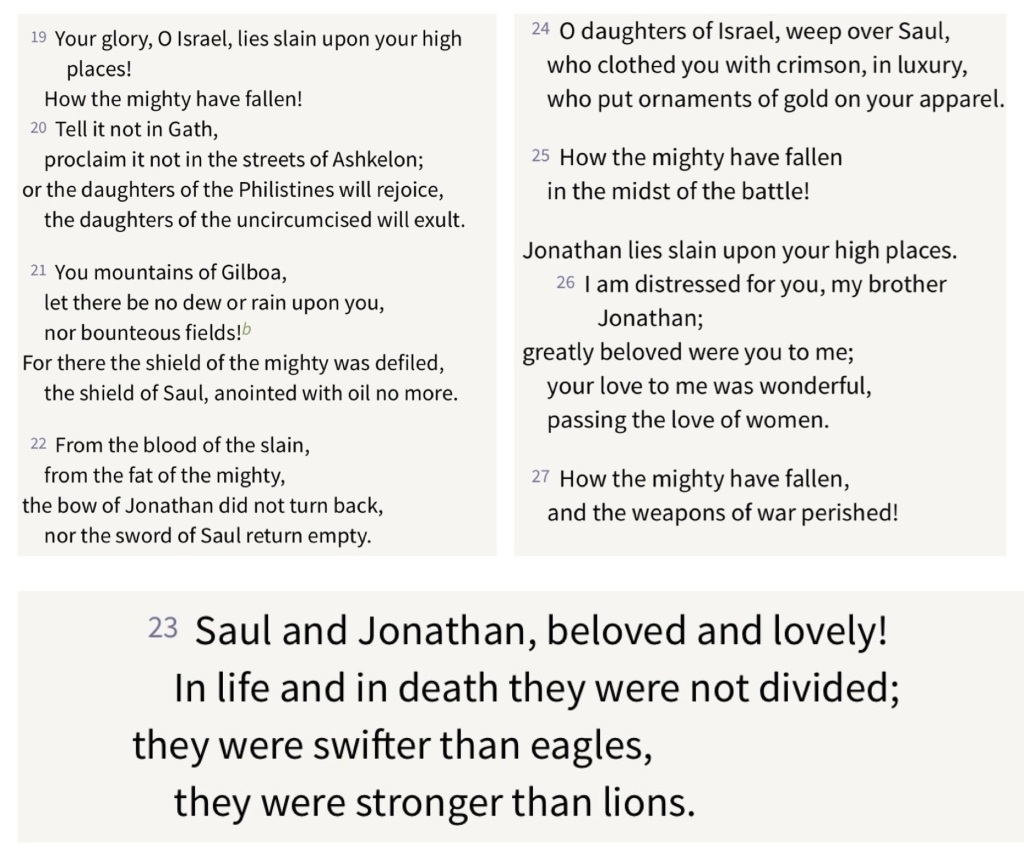
The poem in this week’s reading (2 Sam 1:19–27) offers a clear and loving acknowledgement by David of his respect and love for Saul. Despite the many difficulties encountered in their relationship, at the end of Saul’s life, David is able to acknowledge the virtue of the first King of Israel, and his son. “Saul and Jonathan, beloved and lovely!”, he sings; “in life and in death they were not divided; they were swifter than eagles, they were stronger than lions” (2 Sam 1:23).

Writing in With Love to the World, Kyounghee Cho reflects on the character of David seen in this passage. She writes, “David means “beloved”. David was tremendously loved by God. He was loved by the people of Israel, and now he is cherished and praised as an exemplary figure of faith by Christians worldwide. Today’s passage shows why God loved him and gives a lesson for believers of God. King Saul, David’s enemy, who had been chasing him for 10 years to kill him, died. While Saul’s demise might have been welcome news to David, he understood it not from his personal standpoint but from the perspective of the nation and its people.”

Kyounghee continues, “David paid tribute to Saul as the chosen leader of God and his soldiers as the army of the Lord of Hosts. He composed an elegy and instructed the people of Judah to learn it and sing it.” The song is a wonderful testimony to the king whose name came to characterise most strongly the chosen people, in covenant with the Lord God.

The story of David dominates the quasi-historical narrative of the early decades of the monarchy in Israel, stretching from his initial appearance at 1 Samuel 16 to his death at 1 Kings 2. The covenant people who come in following centuries are regularly identified as “the house of David” (2 Sam 3:1–6; 1 Ki 12:19–20, 26; 13:2; 14:8; 2 Ki 17:21; 2 Chron 10:19; 21:7; Neh 12:37; Ps 122:5; Isa 7:2, 13; 22:22; Jer 21:12; Zech 12:7–14; 13:1; Tobit 1:4; Sirach 48:15; 51:12; and see Luke 1:27).

This identification, of course, is highlighted many times in the New Testament, where Jesus is identified as “Son of David” in the Synoptic Gospels (Mark 10:47–48; 12:35; Luke 3:31; 18:38–39; and especially in Matt 1:1, 20; 9:27; 12:23; 15:22; 20:30–31; 21:9, 15; 22:42). This claim is also noted at John 7:42; Rom 1:3; 2 Tim 2:8; Rev 3:7; 5:5; 22:16). The heritage of David lives on in these stories.

The lament sung by David in 2 Sam 1 also provides a beautiful acknowledgement of the depth and strength of the love that undergirds this covenant between Jonathan and David. Peppering his song with the refrain “how the mighty have fallen” (vv. 19, 25, 27), David laments over his friend: “greatly beloved were you to me; your love to me was wonderful, passing the love of women” (2 Sam 1:26).

Could it be that, even in ancient Israel, such love between two men was valued and accepted? That will form the focus of the next blog that I will offer on this passage.

As we continue through narrative passages from the Hebrew Scriptures, this Sunday, we come to David’s poetic lament for his friend, Jonathan (2 Sam 1). This passage invites us to consider the depth of love that David expressed for Jonathan: “your love to me was wonderful, passing the love of women”. Just what can we make of this relationship? (This is the second of three posts this week on this topic.)

See

*****

With Love to the World is a daily Bible reading resource, written and produced within the Uniting Church in Australia, following the Revised Common Lectionary. It offers Sunday worshippers the opportunity to prepare for hearing passages of scripture in the week leading to that day of worship. It seeks to foster “an informed faith” amongst the people of God.

You can subscribe on your phone or iPad via an App, for a subscription of $28 per year. Search for With Love to the World on the App Store, or UCA—With Love to the World on Google Play. For the hard copy resource, for just $28 for a year’s subscription, email Trevor at wlwuca@bigpond.com or phone +61 (2) 9747-1369.
Diminutive David and the giant Goliath (1 Sam 17; Pentecost 5B)

The Hebrew Scripture passage which the lectionary offers us for this coming Sunday—the next in the series of stories from the early days of the monarchy in Israel—feeds into the “David worship” that we find in these ancient narratives. From the moment that David is introduced, as being “ruddy, and had beautiful eyes, and was handsome” (1 Sam 16:12), the narrator is concerned to present him in the most positive way. For the moment, at least.

David provides a better alternative to Saul. Saul had won a significant battle against the Philistines, but did not wait for Samuel the prophet to come to preside over the sacrifice he offered (ch.13). Soon after this, he made a rash oath, forbidding his troops to eat before sundown. His son Jonathan ate, however, and chided his father: “my father has troubled the land; see how my eyes have brightened because I tasted a little of this honey” (ch.14).

When instructed by Samuel to destroy all that was taken in his defeat of the Amalekites —“do not spare them, but kill both man and woman, child and infant, ox and sheep, camel and donkey”, Samuel instructed him—he kept the best of these spoils and destroyed only what was “despised and worthless” (ch.15). (Mind you, we might well be horrified at Samuel’s instructions and side with Saul on this!) So Saul has offended the Lord God; the kingship will be taken from him, as we saw last week.

By contrast, when Samuel first sees David, the narrator introduces him with the description, “he was ruddy, and had beautiful eyes, and was handsome” (16:12). And yet, the narrator has already told us that the Lord God “[does] not look on his appearance or on the height of his stature … the Lord does not see as mortals see; they look on the outward appearance, but the Lord looks on the heart” (1 Sam 16:7). What is in the heart of David, that so pleases the Lord?

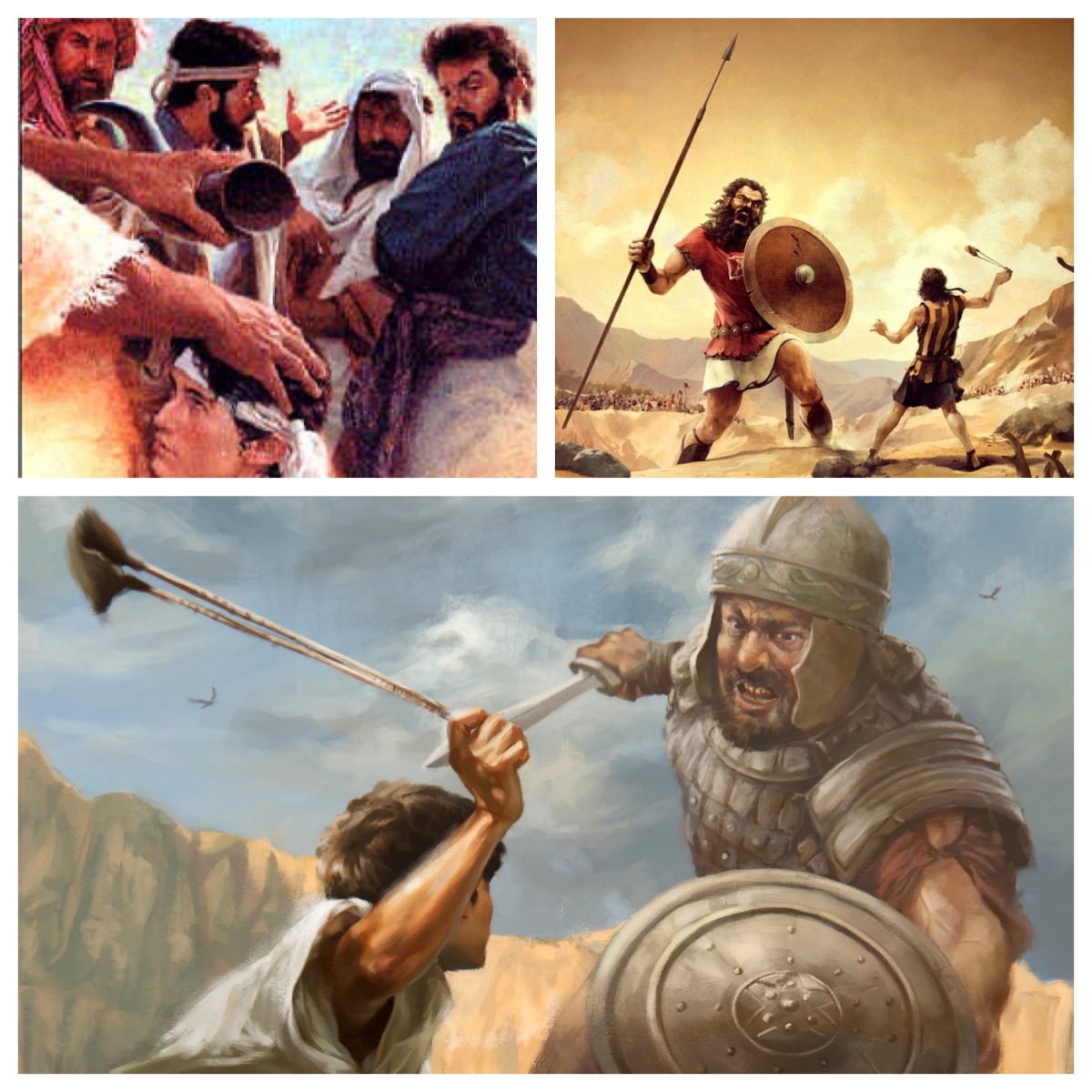
So in this Sunday’s passage—1 Sam 17:32–49, an extract from a much longer account of this pivotal encounter (all 58 verses of ch.17), we see David in action against the Philistines. In this extract we read some of what leads up the climactic moment when David “put his hand in his bag, took out a stone, slung it, and struck the Philistine on his forehead; the stone sank into his forehead, and he fell face down on the ground” (17:49). It’s the stuff that Sunday School lessons and Cecil B. DeMille films were made of!

This story of David and Goliath is legendary. It fits with a pattern, found throughout the mythic sagas of Israel (Genesis to Nehemiah), in which the underdog, the least expected person, plays a key role in leading God’s people. Think Jacob the supplanter, think Joseph the favourite youngest son, think Moses the murderer and Rahab the harlot, or Daniel with his strange diet and zany dream interpretations.

Even Jesus later picked up on this motif very strongly; the last becoming first, the child symbolising the kingdom, amd his saying, “among those born of women no one has arisen greater than John the Baptist; yet the least in the kingdom of heaven is greater than he” (Matt 11:11).

As youngest child and one challenged in physical prowess, the diminutive David stands before the giant Goliath; it seems the match would be over before it began. When Goliath stood and roared at the Israelites, goading them to come out and fight, “give me a man, that we may fight together”, the narrator captures their panicked mood: “Saul and all Israel heard these words of the Philistine, they were dismayed and greatly afraid” (1 Sam 17:8–11).

That is not surprising, given not only the size of Goliath (four cubits and a span, that is, almost 3 metres, or 9’9” tall) but also his accoutrements: “he had a helmet of bronze on his head, and he was armed with a coat of mail; the weight of the coat was five thousand shekels of bronze. He had greaves of bronze on his legs and a javelin of bronze slung between his shoulders. The shaft of his spear was like a weaver’s beam, and his spear’s head weighed six hundred shekels of iron; and his shield-bearer went before him” (17:4–7).

Not so, however, as the story unfolds. David brings provisions for his brothers after they had been involved in 40 days of battle—a biblical way of saying “an awfully long time had passed” (17:16). Still, the reaction of the Israelites was that of fear; “when they saw the man, they fled from him” (17:24). Saul tries to talk him out of stepping up to fight the giant; “you are just a boy, and he has been a warrior from his youth” (17:33).

So we come to the passage proposed by the lectionary for this coming Sunday (17:32–49). David protests; as a shepherd, he has killed lions and bears in defending his flock, “and this uncircumcised Philistine shall be like one of them, since he has defied the armies of the living God” (17:37). Notice the scathing put down of this giant of a man as merely an “uncircumcised Philistine” and the implicit grouping of him with savage beasts. David is confident that “the Lord, who saved me from the paw of the lion and from the paw of the bear, will save me from the hand of this Philistine” (17:37).

David, full of trust, steps up to the mark; the Philistine “disdained him, for he was only a youth, ruddy and handsome in appearance” (17:42), words which echo the initial description of David (16:12). Whereas they were used to advocate for David at that point, here they form a denigrating dismissal of him; a nice irony! Goliath goads him: “am I a dog, that you come to me with sticks?” (17:43); and invites David to draw near.

David holds his ground, delivering a short sermon on God’s sovereign power in this situation (17:45–47). We might reflect on whether (a) we would have the same equanimity at this moment; and (b) whether we find this theological perspective persuasive, or troublingly simplistic, or anathema to our understanding of God.

Since David stands firm, Goliath begins to approach him; now David joins the battle (17:48). The end is short and swift: “David put his hand in his bag, took out a stone, slung it, and struck the Philistine on his forehead; the stone sank into his forehead, and he fell face down on the ground” (17:49).

The remaining verses (omitted by the lectionary) tell of David severing Goliath’s head, the Philistines retreating, the typical battlefield behaviour of the victors in plundering the camp of their defeated foes, and the victory march of the Israelites as David bore the head of Goliath (17:50–54).

A short coda (17:55–58) places the young David before King Saul; this encounter had very significant consequences for David, since “when David had finished speaking to Saul, the soul of Jonathan was bound to the soul of David, and Jonathan loved him as his own soul” (18:1). That is an important lead into the passage that we will read and hear the Sunday after next, concerning David and Jonathan.

Writing in With Love to the World, Sione Leaaetoa says, “the story has been used widely in Western culture as a metaphor for describing any individual or group of people who have the courage to overcome great odds to defeat an oppressor or overcome or some great obstacle. There is certainly an aspect of human courage in this story; but the passage is primarily about being bold and having an unwavering faith in the Lord.”

He notes that “the story makes it clear that when Saul and the Israelites heard Goliath’s challenge, they were ‘dismayed and terrified’ (v.11)”, but then that David would “remind them of who they are, ‘the armies of the living God’ (vv.26, 36); hence, God is the one that will fight their battle and give them the victory.” Sione then concludes, “As children of the living God, through all the battles or challenges we may face in life, we need to remember that God is with us.”

Strategic cunning allows the shepherd boy to defeat the towering enemy. That appears to be how God works to bring about the victory. What model does this offer us? I am not advocating for the use of physical violence to bring about victory—but that was the way of things at that time in history (and still is, for many, today).

So I am left with questions: Why is this story told? Are there elements of this story that inform how we “live by faith” in today’s world? I wonder what you think they might be?

We can’t leave this story without commenting on the ancient Philistines and modern Palestinians. In what ways might the biblical stories about the Israelites doing battle with the Philistines mirror and inform how we think about the conflict between the modern state of Israel and displaced Palestinians in Gaza and the West Bank?

There are, to be sure, certain linguistic similarities between the two words, Philistia and Palestina. However, there is no historical evidence at all that proves any familial continuity between the ancient Philistines and contemporary Palestinians. They connection is simply from the ancient use of the term Palestina in the Roman province, Syria Palestina, which was a latinizing of a Semitic word that we transliterate as Philistines.

However, there are historical matters to consider in terms of who lived in the land, how other people dealt with the people living in the land when they invaded that land, and what claims stand from this. Establishing the state of Israel and displacing thousands of Palestinians in 1947–48 has not “righted wrongs”, but exacerbated them.

Neither Muslim hegemony over the city of Jerusalem in medieval times, nor ancient Israelite dominance in Jerusalem and surrounds three millennia ago, represent the bedrock of land ownership; history reveals this all too well. We will return to this issue in future blogs, as we continue to trace the story of ancient Israel in 1–2 Samuel and 1 Kings. What we need today is to tread carefully and respectfully with the different claims that are being pressed, tragically, through violent means.

I have given this consideration, in the light of the terrible situation at present in Gaza, in

and see also

*****

With Love to the World is a daily Bible reading resource, written and produced within the Uniting Church in Australia, following the Revised Common Lectionary. It offers Sunday worshippers the opportunity to prepare for hearing passages of scripture in the week leading to that day of worship. It seeks to foster “an informed faith” amongst the people of God.

You can subscribe on your phone or iPad via an App, for a subscription of $28 per year. Search for With Love to the World on the App Store, or UCA—With Love to the World on Google Play. For the hard copy resource, for just $28 for a year’s subscription, email Trevor at wlwuca@bigpond.com or phone +61 (2) 9747-1369.
Do not judge by appearances (1 Sam 15–16; Pentecost 4B)

In the lectionary during the weeks after Pentecost, we hear stories from the period of time when Israel was ruled by a king. The story of the choosing of the first king, Saul, is told in 1 Samuel 9; his rule runs through the narratives told from this chapter until the last chapter of this book, namely, 1 Samuel 31.

As I have noted before, although these narratives have the appearance of being historical, they are actually ancient tales which were told and retold, passed on by word of mouth and then written down, because of their enduring significance for the people of ancient Israel. Scholars call such stories “myths”, meaning that they convey something of fundamental importance. (We might best define myth as “a traditional story, usually associated with the time of origins, of paradigmatic significance for the society in which it is told”.)

See more on the nature of these stories at

The picture of Saul, the first man chosen to be king in Israel, demonstrates the flaws of this system of leadership. His reign was characterised by turbulence and opposition; as early as chapter 13 there are signs of the problems that there were in his leadership.

After defeating the Philistines, and being impatient for the prophet Samuel to arrive, he went ahead with a burnt offering, in contradiction to the command of God. “You have done foolishly; you have not kept the commandment of the Lord your God, which he commanded you”, Samuel berates the king (1 Sam 13:13). This is not the behaviour expected of a person leading the chosen people of God!

The prophet Samuel foreshadows the coming turmoil under Saul’s leadership, telling him that “the Lord would have established your kingdom over Israel forever, but now your kingdom will not continue” (1 Sam 13:14). The passage offered by the lectionary for this coming Sunday, 1 Sam 15:34—16:13, follows soon after. Here, we learn that because the rule of Saul is fraught with difficulties, a significant change is on the cards.

Pushed by the words of the prophet Samuel, Saul confesses his sin (1 Sam 15:24, 30). Samuel announces to him that “the Lord has rejected you from being king over Israel” (15:26) and declares, quite dramatically, “the Lord has torn the kingdom of Israel from you this very day, and has given it to a neighbour of yours, who is better than you” (15:28).

The narrator of this story engages in an interesting theological exploration at this point. Samuel is clear about God’s intentions: “the Glory of Israel will not recant or change his mind; for he is not a mortal, that he should change his mind” (15:29). This God had explicitly chosen Saul, who said he was “only a Benjaminite, from the least of the tribes of Israel, and my family is the humblest of all the families of the tribe of Benjamin” (9:21).

God had chosen David, this least and most humble person, to serve as ruler over the people, to “save my people from the hand of the Philistines” (9:16). He would rule for 40 years—the biblical way of saying “for an awfully long time”—and exert great power. We might note that this “least-become-greatest” dynamic prefigures some of the teaching of Jesus, a descendant of David, a millennia later. (See Mark 9:33– 37; Matt 11:11; 18:1–5; 23:11–12; Luke 7:28; 9:48; 22:24–27).

Samuel, exercising his prophetic leadership, had assured the people, “there is no one like him among all the people” (10:24); but some in the crowd were doubtful, saying, “how can this man save us?”, and they despised him (10:27). Paradoxically, these men had insight into the character of Saul which the Lord God himself failed to perceive at this time.

However, a little later, the narrator of this story muses that “the Lord was sorry that he had made Saul king over Israel” (15:35). This is regret, but seemingly not quite a full change-of-mind. It does, however, paint the divine in a rather human way; an action undertaken that does not bear fruit for us as anticipated can indeed generate regret.

Elsewhere in Hebrew Scriptures, the matter of a change-of-mind by the divine is explored. Jeremiah instructs the people, “amend your ways and your doings, and obey the voice of the Lord your God, and the Lord will change his mind about the disaster that he has pronounced against you” (Jer 26:13). In the tale of Jonah, when God saw the repentance of the people of Nineveh, “God changed his mind about the calamity that he had said he would bring upon them; and he did not do it” (Jon 3:10).

The prophet Amos petitions God, such that “the Lord relented concerning this; ‘it shall not be,’ said the Lord” (Amos 7:3, 6). And in the story of the Golden Bull, Moses implores God to “turn from your fierce wrath; change your mind and do not bring disaster on your people”, and so the Lord repents (Exod 32:12–14).

We might wonder: is the regret that the narrator perceives in the divine (1 Sam 15:35) strong enough to chasten God in future actions, so that there will be no need for a divine change-of-mind?

For more on this topic, see

As Saul relinquishes his role, Jesse steps onto the stage; one of his eight sons will sit on the throne. It has been a bitterly-fought transition, and Samuel was saddened by the course of events. But the voice of God pushes him on, to step into his role in the transition taking place; and so the prophet faithfully anoints Saul’s successor.

We should remember that, in the a Christian canon, the two books that tell of the rule of Saul and then David are named, not after those kings, but after the prophet, Samuel—who held and exercised great power, as the story shows, in that he is attuned to God’s voice and speaks God’s words to the people. We saw this dynamic clearly articulated in the earlier narrative (1 Sam 3) on the Sunday after Trinity Sunday (Pentecost 2).

So Samuel follows God’s advice: “do not look on his appearance or on the height of his stature, because I have rejected him; for the Lord does not see as mortals see; they look on the outward appearance, but the Lord looks on the heart” (1 Sam 16:7). This verse is often quoted by people of faith when reflecting on the importance of inner conviction and commitment to God.

Writing in With Love to the World, Sione Leaaetoa says, “behind the narrative is a God who sees and deals with the heart of human beings (v.7). The condition of our hearts is more important to God than what we do for God outwardly. Our heart is important to God because it can very much affect everything we are and do, as stated in Luke 6:45, “the good person out of the good treasure of his heart produces good, and the evil person out of his evil treasure produces evil, for out of the abundance of the heart his mouth speaks”. In similar vein, Proverbs 4:23 states ‘keep your heart with all vigilance, for from it flow the springs of life’.”

There is a danger here, of course; the outward actions of people are indeed important, and the claim that God’s focus is solely on our “heart” can be deceptive. Both our inner nature and our outer actions are significant; they each point to our faith and express our discipleship.

Indeed, it is worth remembering that, in the Hebrew language—the language in which this narrative was written—the word translated as heart is לֵבָב, lebab. It’s a common word in Hebrew Scripture, and is understood to refer to the mind, will, or heart of a person—words which seek to describe the essence of the person. It is sometimes described as referring to “the inner person”. The word appears 248 times in the scriptures, of which well over half (185) are translated as “heart”. It has a strong connotation of indication “the whole of a person’s being”. That’s what God is focussed on; that’s where faith is shown and discipleship is lived out.

For more on this, see

So Jesse brings his sons before Samuel. But which son is it to be? Samuel first offers a sacrifice to God (15:2–5), in the expectation that what he does next will be in accord with the will of God. Samuel had his own ideas, based on appearances; God reprimands him, now telling him to focus on the heart—the very core of the being of the chosen one, the whole of that person’s being (16:7). After receiving all of Jesse’s sons in order (16:8–10), Samuel exercises his prophetic discernment, selecting the youngest son, David, to be the new king (16:11–13).

Of course, this is an often-encountered dynamic in the Hebrew Scriptures: Abel’s offering was preferred over his older brother Cain; the younger of twins, Jacob was chosen over Esau; Joseph was favoured over his 11 older brothers; Ephraim was favoured over his older brother Manasseh; and the younger Moses took the lead over Aaron.

God then confirms this choice by gifting David with the spirit: “the spirit of the Lord came mightily upon David from that day forward” (16:13). Openness to new ways and new possibilities has led to this defining moment.

Ironically, when Samuel first sees David, the narrator introduces him with the description, “he was ruddy, and had beautiful eyes, and was handsome” (16:12)—precisely the elements of “outward appearance” that we were told earlier that the Lord does not consider. Even the careful crafter of this story gets caught!!

Screenshot

With Love to the World is a daily Bible reading resource, written and produced within the Uniting Church in Australia, following the Revised Common Lectionary. It offers Sunday worshippers the opportunity to prepare for hearing passages of scripture in the week leading to that day of worship. It seeks to foster “an informed faith” amongst the people of God.

You can subscribe on your phone or iPad via an App, for a subscription of $28 per year. Search for With Love to the World on the App Store, or UCA—With Love to the World on Google Play. For the hard copy resource, for just $28 for a year’s subscription, email Trevor at wlwuca@bigpond.com or phone +61 (2) 9747-1369.

Give us a King, like other nations (1 Sam 8–10; Pentecost 3B)

1 Samuel 8:4–20 is the passage offered by the lectionary for this coming Sunday. It is the second in the sequence of Hebrew Scripture passages that we are reading through the first half of the long “season after Pentecost”, from May to August. The passage addresses an issue that was important in ancient Israel; that is important in modern-day Israel/Palestine; and that is important, also, in all nations around the world today.

This Sunday we will hear the beginning of a process—debate about having a king as a ruler—that culminates, at the end of August, with an account of Solomon, the wisest, most powerful, and perhaps most damaging king of all. That makes this ancient text potent in the contemporary situation, where Israel is engaged in a life- and-death struggle with Hamas, where megalomania amongst leaders in Russia, North Korea, China, and even the USA predominates, and where too many countries around the globe suffer under dictatorial, repressive regimes.

The passages selected today focus on the issue of power. Precisely: what kind of power in leadership is acceptable in Israel? should Israel be ruled by a king? For centuries, judges had led the people, determining what was right and what was wrong. The book of Judges tells of a string of such judges, men who worked hard to recall the people to their covenant with the Lord God: Othniel (Judg 3:9), Ehud (3:15), Shamgar (3:31), an unnamed prophet (6:8), Gideon (6:11–18), Tola (10:1), Jair (10:3), Jephthah (11:1; 12:7), Ibzan, Elon, and Abdon (12:8–15), and Samson (13:24–25; 16:28–31).

And, of course, it most famously tells of Deborah, “a prophetess, wife of Lappidoth, [who] was judging Israel; she used to sit under the palm of Deborah between Ramah and Bethel in the hill country of Ephraim; and the Israelites came up to her for judgment” (Judg 4:4–5).

However, the impact of the efforts of these various judges was merely transitory; the people returned again and again to their sinful, idolatrous ways. “The Israelites did what was evil in the sight of the Lord” (initially at 2:11, repeated at 3:7) is a recurring refrain throughout the book of Judges. It signals that the people reverted to their evil ways after Othniel (3:12), Shamgar (4:1), Deborah (6:1), Jair (9:6), and Abdon (13:1).

As a result, we are told that the people were “given into the hands” of their enemies on each of these occasions (3:8; 4:2; 6:1, 13; 10:7; 13:1). The horror perpetrated by Jephthah, offering his own daughter as a burnt offering (11:29–40), and the deceit and arrogance of Samson (16:1–31) exemplify this sinful streak.

In the final chapters of the book, details are given of the evil deeds of various people: the mother of Micah, who made an idol of cast metal (17:1–6); the men of Gibeah, who raped the Levite’s concubine (19:22–25); the Levite himself, who cut his concubine into twelve pieces (19:27–30); and then the attacks on the Bejaminites by the other tribes of Israel (20:1–48). The book draws to its end with the mournful conclusion, “in those days there was no king in Israel; all the people did what was right in their own eyes” (21:25).

So it is made clear in the narrative constructed in the book of Judges, that Israel’s downfall was that it was not ruled by a king, as other nations surrounding Israel were. A king could maintain justice and ensure equity within the society of Israel. And a king could marshal the forces needed to repel invaders and stand resolute against the sinful ways that would be imposed upon the nation by those who did not fear the Lord God.

So the elders of Israel press for change; we can understand why. However, the prophet who has been called by God, Samuel, is attuned to God’s voice on this matter, and so he rejects this request. But the people persist with their request—their demand, even. And so it is that God, in a striking reversal of opinion, decides to have a change of mind about kingship. God pushes Samuel to accept this change.

The lectionary this coming Sunday offers us excerpts from the lengthy section of 1 Samuel where this matter is considered (1 Sam 8—11). The matter is first raised in the request made of Samuel by the people: “appoint for us, then, a king to govern us, like other nations” (1 Sam 8:5). The revolution comes, chapters later, after various points of view have been canvassed.

The lectionary selection for this Sunday offers us “A Dummies Guide to Kings in Israel”—that is, a series of “bites” [1 Samuel 8:4-11, (12-15), 16-20, (11:14-15)], some of which are optional (placed in parentheses). After the initial request, it includes the resistance of Samuel to this proposal (8:12–18) and the persistence of the people in pressing their request: “the people refused to listen to the voice of Samuel; they said “No! but we are determined to have a king over us” (8:19–20).

The full text of 1 Samuel provides reports of the back-and-forth that transpires, which the lectionary omits. It skips to a final optional reading of a further short section (11:14–15) which reports the outcome: “all the people went to Gilgal, and there they made Saul king before the Lord in Gilgal”.

The appointment of a king was obviously a matter of some controversy in ancient Israel; the compiler of the Deuteronomistic History (of which 1 Samuel is a part) devoted a significant amount of space to it, taking pains to include conflicting views about this matter. And, as we read these texts with the benefit of hindsight, we know that a king was ultimately appointed. This led to the later establishment of the Davidic dynasty, which became important in the claims later made about Jesus of Nazareth, recognised as Son of David.

So, of course, the person (or persons) chronicling the history of Israel in what scholars now call the Deuteronomistic history will tell the story with this outcome in view. The end result shapes how the story is told.

Writing in With Love to the World, Elizabeth Raine observes that “Israel looks for a leader to win battles and guarantee their security. It is a black-and-white understanding of the King; a figure military strength and political power. This is not the same as the way the prophet saw the role of King”. The people want power. The prophet warns of corruption. The people want victory. The prophet warns of failing to ensure justice.

And a clear thread in Hebrew Scripture would come to be that the king was called by God and anointed by God’s prophet to ensure that justice and righteousness were found in the land of Israel (Ps 72:1; 99:4; 1 Ki 3:28, 10:9; Isa 11:1–9; 32:1). That, at least, became the ideology for kingship in Israel; the reality, as we see in the stories selected for future weeks, was often different.

Elizabeth continues, “The story calls us to examine where we are placing our allegiances, and move to transformation, that process of repentance and renewal in which we turn back to God in every area. Whilst such self-examination is no doubt painful, it is also the only way to ensure we remain connected with God’s life-giving Spirit. As more and more people make the shift to a faithful allegiance that ensures that God’s Kingdom will be realised here on earth, we will hopefully see the reality of justice, peace, and love spreading in our world.”

To close, I offer two reflections on how this ancient story might speak to us today. The first perspective is that this story, about the desire for a powerful leader, and the dangers of pushing an agenda of power over all other matters, is a direct challenge to the way that the leaders of the modern state of Israel are conducting themselves in the long-enduring conflict with the Palestinians, who share an equally just claim to the land that was bequeathed to Jews in 1948. I have reflected at more length on this matter at

and my colleague Chris Budden has offered good insights into this conflict at

The second perspective is that this story is the first in a series of stories from ancient days which address a pressing contemporary issue: how to bring about effective change within the community of faith. It is something we all know about today, as society changes and the church occupies a different place in that society. How do we listen for God’s voice in this context? How do we advocate for effective change? I have written further on this dynamic at

and

With Love to the World is a daily Bible reading resource, written and produced within the Uniting Church in Australia, following the Revised Common Lectionary. It offers Sunday worshippers the opportunity to prepare for hearing passages of scripture in the week leading to that day of worship. It seeks to foster “an informed faith” amongst the people of God.

Speak, for your servant is listening (1 Sam 3; Pentecost 2B)

For three months—the first half of the long season “after Pentecost”—the lectionary offers a sequence of passages which comprise some key narratives from the books of Samuel and the early chapters of Kings. These stories recount the development of the monarchy in Israel, with stories of Saul, David, and Solomon, the first three men charged with the responsibility of leading Israel and ensuring that there was justice in the land. “Give the king your justice, O God”, the psalmist sings (Ps 72:1), so that they might rule with justice and righteousness (Ps 99:4; Prov 29:4; Isa 32:1; Jer 23:5). That is what these kings, and their successors, were charged with ensuring.

These stories also engage us with the lives of prophets, Samuel and Nathan—men who were called to speak the word of God. We are told that as the young Samuel grew up, “the Lord was with him and let none of his words fall to the ground; and all Israel from Dan to Beer-sheba knew that Samuel was a trustworthy prophet of the Lord” (1 Sam 3:20–21). Years later, Nathan is commissioned by “the word of the Lord” to “go and tell my servant David, ‘thus says the Lord’” (2 Sam 7:4–5). That is the role of the prophet—to listen to what God says to them, and then to speak forth the word of the Lord to the people of their society.

Samuel, Nathan, and other prophets were particularly called to speak truth to the king and to recall them to the centrality of their role, to ensure that God’s justice was a reality in Israelite society (Isa 42:1–4; 61:1–2; Mic 3:8). We see this when Nathan confronts David (2:Sam 12), when Elijah confronts Ahab and the priests of Baal (1:Ki 18), when Isaiah advises Hezekiah (2 Ki 20), and when Josiah consults Huldah (2 Ki 22; 2 Chron 34).

As we pay attention to the details of the stories, let us remember that these stories are not “history” as we know it today. Rather, they are ancient tales told and retold, passed on by word of mouth and then written down, because of their enduring significance for the people of ancient Israel. Scholars call such stories “myths”, meaning that they convey something of fundamental importance. (We might best define myth as “a traditional story, usually associated with the time of origins, of paradigmatic significance for the society in which it is told”.)

See more on the nature of these stories at

and on the sequence of stories told in Genesis and Exodus, at

Identifying the stories in the narrative books of the Hebrew Scriptures doesn’t mean they are “not true”—rather, it means that we need to read them, not as historically accurate accounts, but as stories which convey fundamentally important ideas. These stories were valued by people of ancient times. They may well offer us, in our own times, insights and guidance of value.

So we read and ponder these stories from old once again, in our time, because we believe that there is wisdom and guidance in the dynamics we see at work in this ancient society. We pay attention to them because we believe that the same Spirit who anointed the kings, and who called and equipped the prophets, is the very Spirit who today meets us, calls us, and equips us.

We begin with a narrative that recounts the call of the young boy, Samuel, to the role of prophet (1 Sam 3:1–10). This series of narratives from Samuel and Kings provide insights into the leadership of the people of Israel in the crucial years when a key transition was taking place, moving from a group of invading tribes, consolidating into a coherent kingdom. Prophets and Kings provided leadership in challenging times.

Samuel was the designated prophet whose wisdom guided the people in the early period of the monarchy. This story from the early years of Samuel’s life instructs us as we hear it in later times, to listen to God’s voice, and to respond with obedience. Young Samuel was in the temple, where the elderly Eli was priest. In the evening, while the lamp was still burning, Samuel hears a voice. The voice simply calls his name. “Here I am”, Samuel responds when he hears that voice. He is sure that it is Samuel who is speaking to him—there is nobody else around. Three times, he hears “Samuel”; and three times, he responds “here I am” (vv.4,6,8).

Samuel had been thinking that it was Eli speaking to him; but it was not the priest, it was the voice of the Lord. The story conveys a sense of confusion and unknowing. This reflects something of the uncertainty that people of faith often have with regard to “hearing the voice of the Lord”.

Indeed, the fragility of living by faith without clear and obvious demonstration of he presence of God is signalled in the opening verse: “the word of the Lord was rare in those days; visions were not widespread” (v.1). The poor vision of the elderly priest, Eli (v.2), is a second signal of this uncertainty. The priest cannot see; the child hears but does not understand.

Paying attention to the voice of the Lord is a persistent refrain in Hebrew Scriptures. Indeed, the psalmist rejoices in the clarity of God’s voice: “the voice of the Lord is over the waters; the God of glory thunders, the Lord, over mighty waters; the voice of the Lord is powerful; the voice of the Lord is full of majesty” (Ps 29:3–4). Yet another psalmist recalls the time, in the wilderness, when the people of Israel “grumbled in their tents, and did not obey the voice of the Lord” (Ps 106:25). The people were not always faithful, even though the voice sounded with clarity. They needed reminders of that voice.

In the foundational saga of Israel, Moses is called by the voice of God while tending sheep on Mount Horeb (Exod 3:4). In obedience, he leads the people to freedom—and then informs the people, “if you will listen carefully to the voice of the Lord your God, and do what is right in his sight, and give heed to his commandments and keep all his statutes”, then God promises not to inflict them with disease (Exod 15:26). Later, when Moses has delivered to them “all the words of the Lord and all the ordinances”, the response of the people is an affirmative “all the words that the Lord has spoken we will do” (Exod 24:3).

A number of the prophets indicate that they are impelled to declare “the word of the Lord” to a sinful people because they have heard, and are obedient to, “the voice of the Lord”. Isaiah hears the voice of the Lord calling him: “whom shall I send, and who will go for us?” (Isa 6:8). Isaiah is given words of woe to pronounce over the people (Isa 6:9–13); he warns the leaders of Israel, “listen, and hear my voice; pay attention, and hear my speech” (Isa 28:23).

His fellow-southerner, the shepherd Amos, opens his words with the bold declaration, “the Lord roars from Zion, and utters his voice from Jerusalem” (Amos 1:2), before he launches into his long series of oracles against the surrounding nations (Amos 1:3—2:3) and then against Judah and Israel (Amos 2:4–16).

The image of the lord as a roaring lion is used also by Joel, “the Lord roars from Zion, and utters his voice from Jerusalem, and the heavens and the earth shake” (Joel 3:16), while in another oracle he says, “the Lord utters his voice at the head of his army; how vast is his host!” (Joel 2:1). Joel’s words of judgement penetrate to the heart of the evil of the people: the coming day will be “a day of darkness and gloom, a day of clouds and thick darkness!” (Joel 2:2), and so he calls the people to “return to [the Lord] with all your heart, with fasting, with weeping, and with mourning; rend your hearts and not your clothing” (Joel 2:12–13).

Micah also declares, “the voice of the Lord cries to the city (it is sound wisdom to fear your name)” (Mic 6:9) before he lambasts the people for their wickedness: “your wealthy are full of violence; your inhabitants speak lies, with tongues of deceit in their mouths” (Mic 6:12; the whole damning oracle is 6:9–16).

Called as a youth by “the word of the Lord” (Jer 1:4–8), Jeremiah hears the assurance, “I have put my words in your mouth” (Jer 1:9); the prophet later instructs the people, “amend your ways and your doings, and obey the voice of the Lord your God, and the Lord will change his mind about the disaster that he has pronounced against you” (Jer 26:13). Again, he tells them, “obey the voice of the Lord in what I say to you, and it shall go well with you, and your life shall be spared” (Jer 38:20). Eventually, the people affirm, “whether it is good or bad, we will obey the voice of the Lord our God to whom we are sending you, in order that it may go well with us when we obey the voice of the Lord our God” (Jer 42:6).

In the return from exile, both Haggai (Hag 1:12) and Zechariah (Zech 6:15) rejoice that Israel “obeyed the voice of the Lord their God”; but Daniel laments that his people “have not obeyed the voice of the Lord our God by following his laws, which he set before us by his servants the prophets; Israel has transgressed your law and turned aside, refusing to obey your voice” (Dan 9:10).

And yet, various prophets had hesitated when first hearing “the voice of the Lord”. The initial response of Moses is “who am I that I should go to Pharaoh, and bring the Israelites out of Egypt?” (Exod 3:11), followed by a series of further objections that he raises (Exod 3:13; 4:1; 4:10). Amos explains to the priest Amaziah how his call had surprised him: “I am no prophet, nor a prophet’s son; but I am a herdsman, and a dresser of sycamore trees” (Amos 7:14).

Isaiah seeks to excuse himself from the prophetic task: “I am lost, for I am a man of unclean lips, and I live among a people of unclean lips” (Isa 6:5). Jeremiah objects, “truly I do not know how to speak, for I am only a boy” (Jer 1:5). A number of the prophets are, initially at least, reluctant spokespersons for the Lord God.

By contrast, in the story told in 1 Sam 3, after hearing his name spoken by the Lord for a third time, Samuel responds with a declaration of obedience: “speak, for your servant is listening” (v.10). This was just as the priest Eli had instructed him (v.9). Here, Samuel demonstrates careful listening, patience, openness to what he encounters, and complete obedience to that voice.

Just beyond the passage set by the lectionary, the narrator indicates that what will follow will be dramatic and compelling; it will “make both ears of anyone who hears of it to tingle” (v.11). The immediate drama which les ahead will tell of punishment for the sins of the house of Eli. Young Samuel is given his first commission: tell his patron Eli about what lies in store for him. Samuel, in fear and trembling, dutifully does so (v.18); Eli recognises the word of the Lord in the voice of the prophet, and accepts his fate.

The pattern of Samuel’s life is thus set: he will need to summon inner strength, demonstrate commitment to the cause, use clarity of speech, and model integrity of life. The fact that the young Samuel already demonstrated these qualities may well be why this story is remembered and retold. These two stories from the early years of Samuel’s life are remembered in order to instruct those who hear them in later generations, to listen and to obey, to be brave and focussed. And so we, in our time, are to hear the story, reflect on it, and respond appropriately.