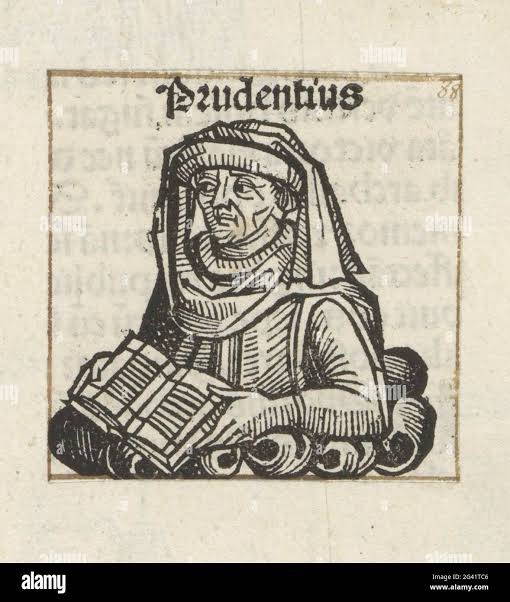
I have been amazed to learn that, back in the fifth century, the poet Prudentius wrote a number of hymns that tell the story of the slaughter of innocent children, ordered by King Herod.
Whilst the basic theological orientation of these hymns is clearly patristic orthodoxy, they do contain a gritty realism that seems to have largely flown out the window when modern day carols are sung!
Here is a hymn which remembers those innocent children who were, according to the theology of Prudentius, “victims slain for Christ the King”.
All hail, you infant martyrs’ flow’rs,’
Cut off in life’s first dawning hours
As rosebuds, snapt in tempest strife
When Herod sought the Savior’s life.
O tender flock of Christ, we sing
Of victims slain for Christ the King
Oppression’s loud lament we raise,
Then join the martyrs’ song of praise:
All honor, laud, and glory be,
O Jesus, Virgin-born, to thee;
All glory, as is ever meet,
To Parent and to Paraclete.
(Prudentius, 5th century, alt.)
This hymn is a cento (a patchwork quilt of words from various sources) from the twelfth and last poem in the Cathemerinon of Prudentius, and in its full form it contains 208 lines. The first line of the complete hymn is Quicumque Christum quaeritis. Four beautiful centos from this hymn were included in the Breviary by Pius V (1568); see https://media.churchmusicassociation.org/pdf/hymnsofbreviary.pdf
The original Latin text of the hymn is:
Salvete, flores Martyrum, in lucis ipso lumine Quos ssevus ensis messuit, ceu turbo nascentes rosas.
Vos prima Christi victima, grex immolatorum tener, Aram sub ipsam simplices palma et coronis luditis.
Quid proficit tantum nefas ? Quid crimen Herodem juvat? Unus tot inter funera impune Christus tollitur.
Inter coaevi sanguinis fluenta solus integer, Ferrum quod orbabat nurus party’s fefellit virginis.
Qui natus es de Virgine Jesu, tibi sit gloria, Cum Patre, cumque Spiritu, in sempiterna secula.
Another of his compositions recounts the same story from the perspective of King Herod.
With boding fears the tyrant hears A King of Kings is hard at hand, Who rule shall claim o’er Israel’s name And high in David’s palace stand.
With wild surprise, ” We die,” he cries, “ Around us lurks a traitor brood ; ” Up, guard, awake, thy weapon take, “ And every cradle drown in blood.”
What boots his ire, and dark desire; What help, if he his thousands slay ? Alone of all, around that fall, The Christ is safely borne away.
Jesu, to Thee all glory be, Of Mary, Virgin-Mother born ; To God Triune all praise be done, Through endless life’s unwaning morn.
The Latin text:
Audit tyrannus anxius adesse regum principem,
qui nomen Israel regat teneatque David regiam.
Exclamat amens nuntio, successor instat, pellimur;
satelles i, ferrum rape, perfunde cunas sanguine.
Quid proficit tantum nefas, quid crimen Herodem iuvat?
unus tot inter funera inpune Christus tollitur.
Iesu, tibi sit gloria, qui natus es de Virgine,
cum Patre et almo Spiritu, in sempiterna saecula. Amen.
This is the 12th and last poem in his Cathemerinon, and in its full form consists of 208 lines. It is found in a 5th century manuscript in the Bibliotheque Nationale, Paris (Prudentius, Opera, 8048, f. 39b).
Though one of the finest poems of Prudentius, it was apparently little used in the services of the Church until the revision of the Roman Breviary after the Council of Trent.
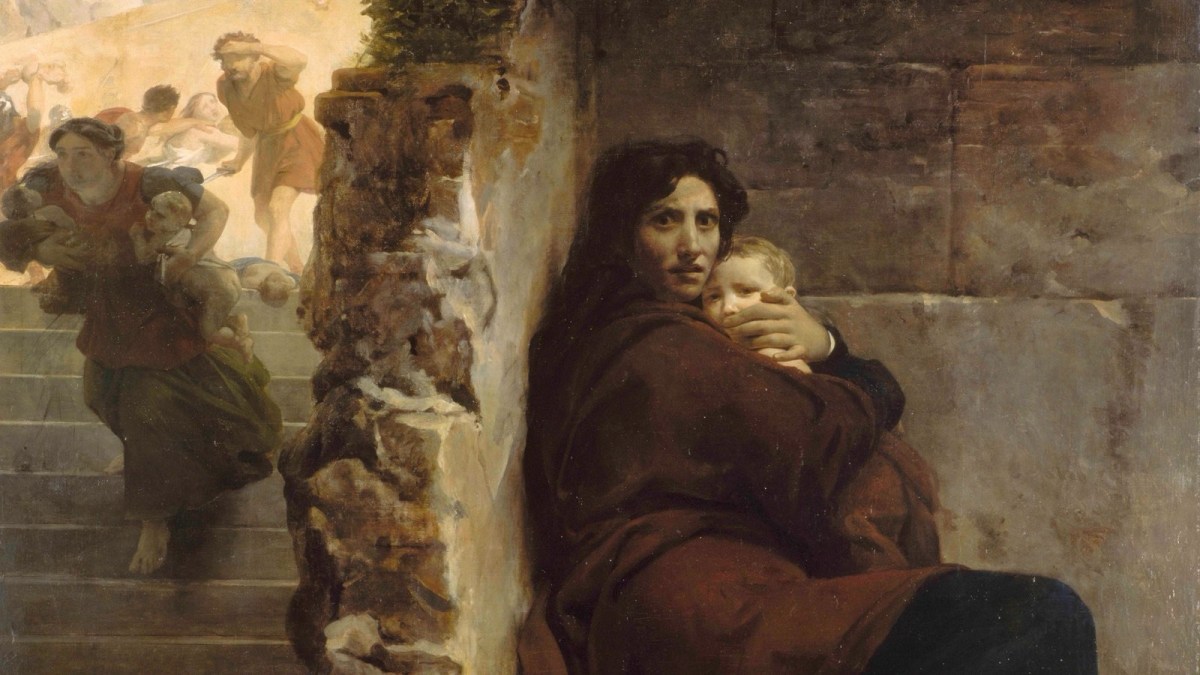
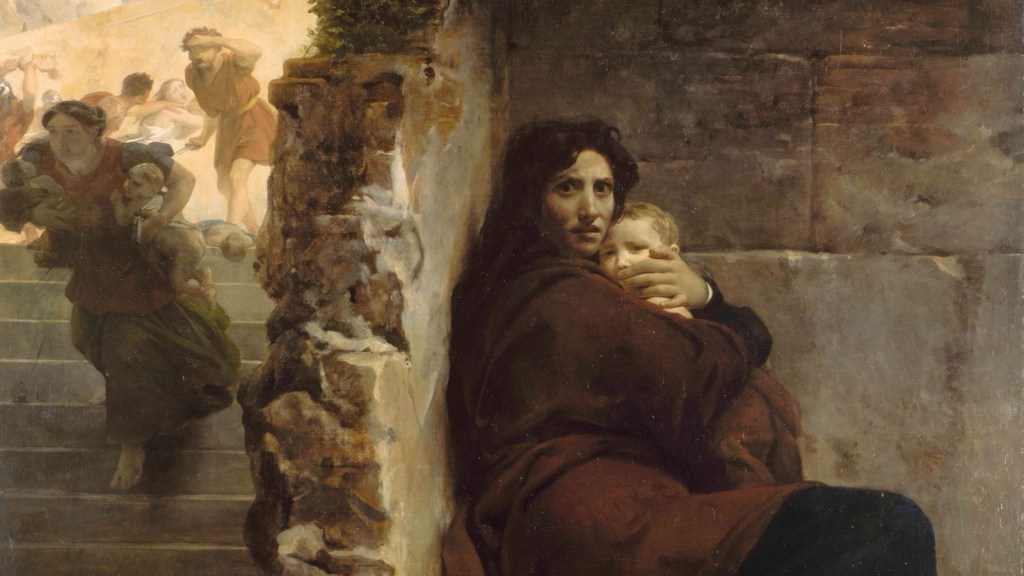
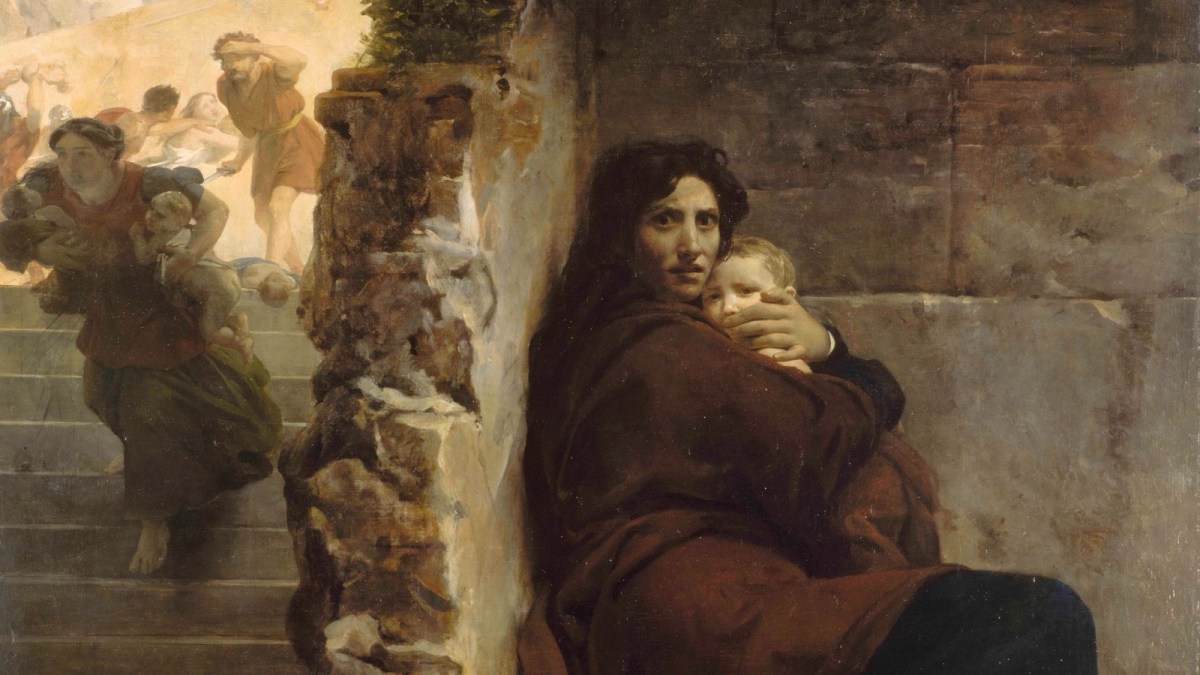
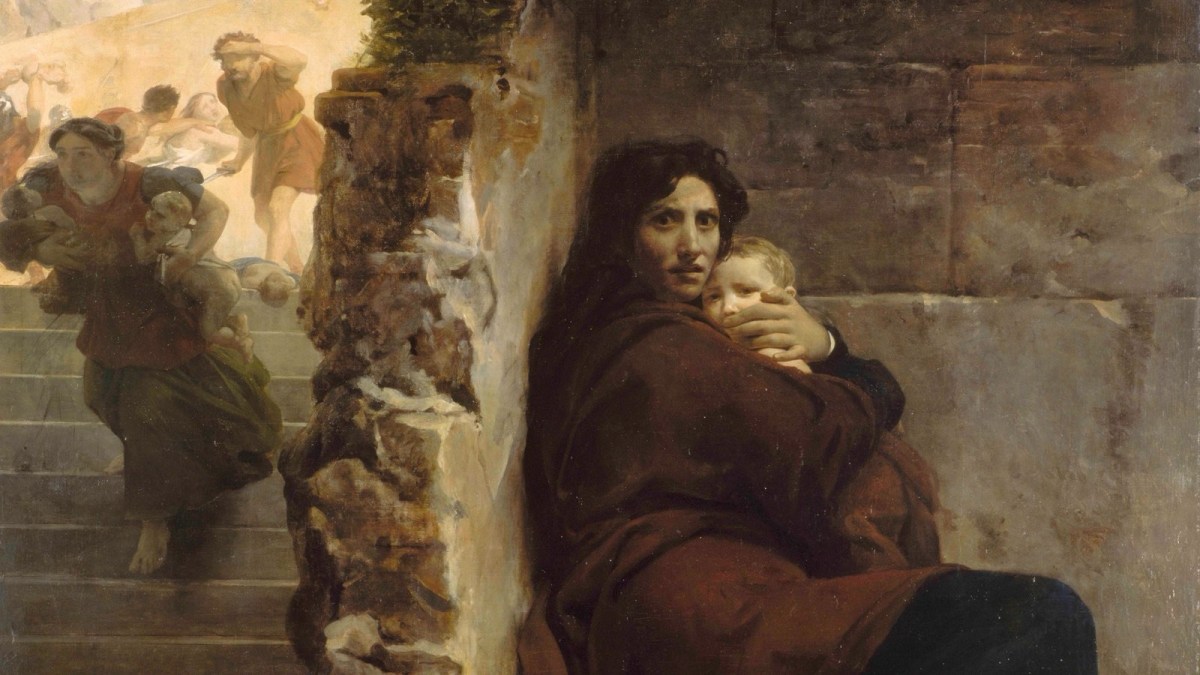
“The Massacre of the Innocents,” an 1824 painting by Léon Cogniet, held in the Musée des Beaux-Arts
Yesterday, we focussed on “the slaughter of the innocents” which is commemorated in the Western Church on 28 December. Today, 29 December, is the day when this commemoration takes place in the Eastern Church.
This this potent story, full of pathos, is so resonant with events in the world in which we live today: people dying in invasions and wars; people fleeing, seeking refuge, in a safe place. Sadly, this part of the story has all but faded from view in “the Christmas story” that is recounted each Christmas. So here are some more thoughts—largely from the words written by contemporary hymn writers that tell this story.
There are clear words in these carols which show how the story challenges political values and policies and how it connects with the deepest feelings of human existence.
One contemporary hymn writer who has turned his attention to the story of Herod’s tyrannical rampage against the male children in Bethlehem, is the British Methodist, the Rev. Dr Andrew Pratt. Here is a powerful hymn which he has written about this story.
Another person who has worked well with words over many decades is the late Shirley Erena Murray, a Presbyterian from Aotearoa New Zealand. She was right on the money when she highlighted the violence and fear at the heart of the story, claiming that the infant in the story has “come to plead war’s counter-case”, and articulating the hope that “goodness will outclass the gun, evil has no tooth that can kill the truth.” Here’s her words:
Summer sun or winter skies, Christmas comes —
shepherds, angels, lullabies, words recorded by the wise:
read it in the book — take another look . . . .
Shadows track the hawk in flight, Christmas now —
children born in fire and fight, silent night a violent night,
hawks are in control of a nation’s soul.
There where terror plies its trade, Christmas now —
children learn to be afraid, minefields of distrust are laid,
evil is in force on a winning course.
Child of peace, God’s human face, Christmas now —
come to plead war’s counter-case, bring the dove a nesting place,
though her wings are torn, though her blood is drawn.
Winter skies or summer sun, Christmas comes —
still the threads of hope are spun, goodness will outclass the gun,
evil has no tooth that can kill the truth.
This ancient story resonates so strongly with our situation today, not because “it really happened, exactly like this”, but because (like a good myth does) it takes us to the centre of our humanity and reveals the depth of God’s presence in our midst. We ought to sing more about it!
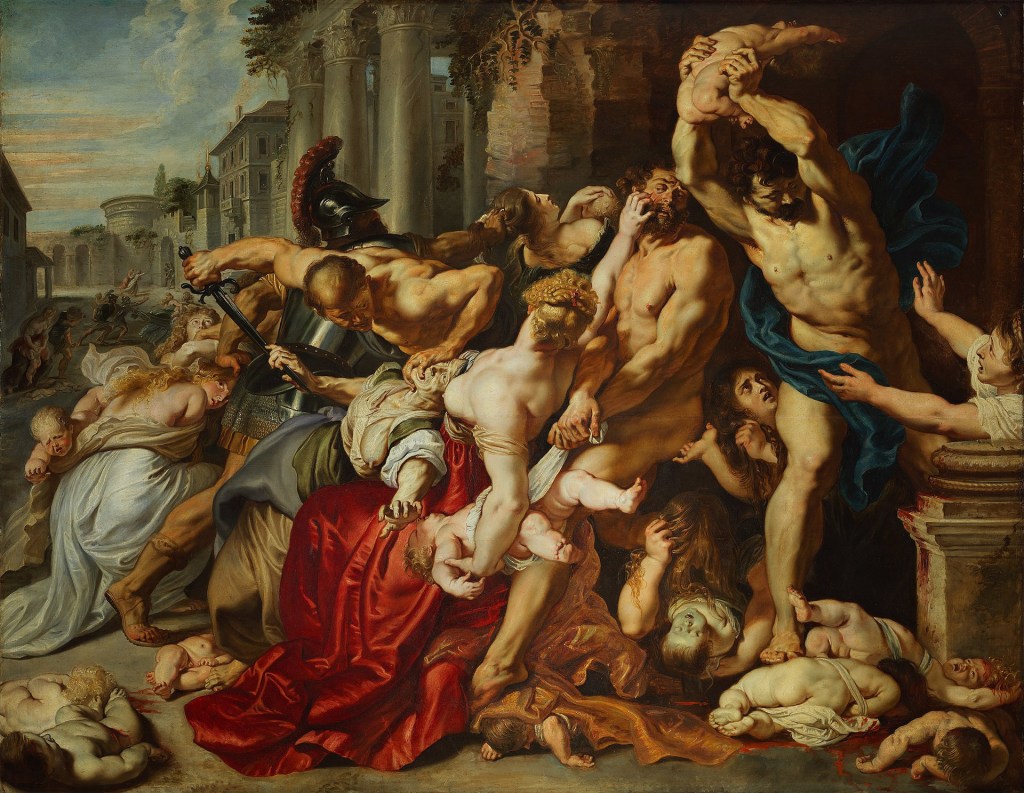
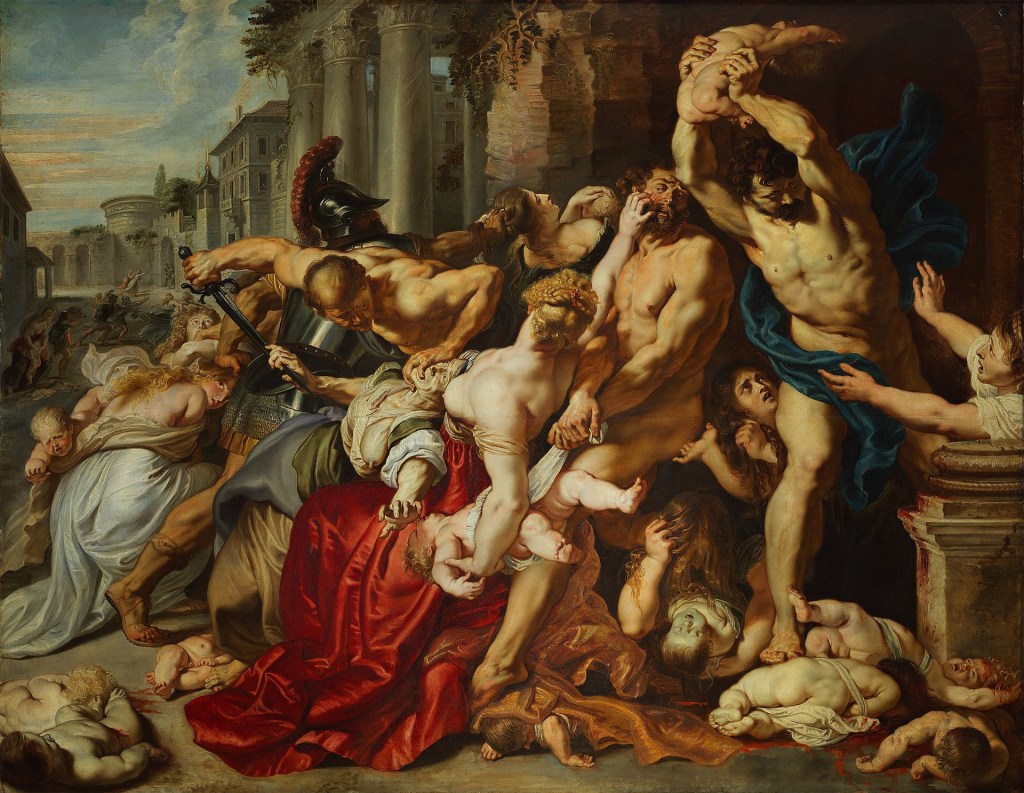
Today (in the Western Church) is designated as the Feast of the Holy Innocents. (It is celebrated tomorrow in the Eastern Church.) This festival day commemorates a tradition known as “the slaughter of the Innocents”, reportedly ordered by King Herod. It’s a gruesome attachment to the story that is told in the Gospel of Matthew that begins, “now the birth of Jesus the Messiah took place in this way” (Matt 1:18).
The tradition is that when Herod learnt of the birth of “the King of the Jews”, he feared that this king would pose a threat to his own rule (as a client king under the Roman Empire) over the Jewish people. Herod, it is said, ordered that all male children under two years of age should be killed, to ensure that this rival king was safely despatched (Matt 2:16). Jesus survived this because after visitors “from the east” came from the court of Herod to pay tribute to him (2:11), his parents were advised of the imminent pogrom by an angelic visitation (2:13).
“The Massacre of the Innocents,” an 1824 painting by Léon Cogniet, held in the Musée des Beaux-Arts
The story is told only in Matthew’s Gospel. It is highly unlikely that the events reported by Matthew actually took place. First, his is the only account of such an event in any piece of literature from that time. An event with so many deaths would surely have been noted by other writers. It is true that Herod was a tyrannical ruler; but amongst the various accounts of his murderous deeds, there is nothing which correlates to the events reported in Matthew’s Gospel.
Second, the story is embedded in the opening section of the Gospel, which uses typical Jewish typology and scripture-fulfilment to present the story of Jesus as a re-enactment of the story of Moses. The author of Matthew’s Gospel, a follower of Jesus who had been raised as a faithful Jew, was especially partial in the opening chapters of his work to quoting scripture and claiming that events that he reports “took place to fulfill what had been spoken by the Lord through the prophet” (1:22–23).
The chief priests and scribes in the royal court, says this author, told Herod that Jesus had been born in Bethlehem, “for so it has been written by the prophet” (2:4–6); the flight into Egypt of Joseph, Mary, and their newborn child was “to fulfill what had been spoken by the Lord through the prophets (2:15); the slaughter of the children itself “fulfilled what had been spoken through the prophet Jeremiah” (2:17–18); and the return of the family some time later and their settling in Nazareth was “so that what had been spoken through the prophets might be fulfilled” (2:21–23).
Aiding and abetting these notes of scripture fulfilment are other typical elements in the Jewish traditions of storytelling, namely, that the events as they take place are guided by the appearance of an angel in the dreams of Joseph (1:20–21; 2:13; 2:19) as well as direct guidance mediated by a dream of the visitors “from the east” (2:12) and again in a further dream of Joseph (2:22). The story that appears in Matt 1:18–2:23 would readily have been recognised by Jewish listeners as employing the typical elements and patterns of Jewish haggadicmidrash.
The book of Exodus also employed these elements and patterns. It opens in the time when “a new king arose over Egypt, who did not know Joseph” (Exod 1:8). This king, unnamed except for the designation of “Pharaoh”, feared the increasing numbers and growing power of the Israelites who been enslaved in Egypt for hundreds of years, determined that he would slow the rate of increase and lessen the power of the Israelites by decreeing, “every boy that is born to the Hebrews you shall throw into the Nile, but you shall let every girl live” (Exod 1:22).
It is in this context that Moses is born; he is hidden “among the reeds on the bank of the river” (Exod 2:1–4), and then taken home by the daughter of Pharaoh (Exod 2:5–9), adopted by her, and raised as a member of the royal household (Exod 2:10). The origin of the child is revealed to the readers (but presumably not to the Pharaoh) by his being named Moses, because, as Pharaoh’s daughter said, “I drew him out of the water” (Exod 2:10b).
The fact that a name conveys a deeper meaning has been found again and again in the traditional tales collated to form the narrative of Genesis: Adam reflects his creation “from the dust of the ground” (Gen 2:7), Eve’s name indicates that she is “the mother of all living” (3:20), Cain means “acquired” and is reflected in Eve’s comment that “I have produced [or acquired, qanah] a man with the help of the Lord” (4:1), and Abel is related to the Hebrew word for “emptiness” (havel).
Abram’s name is changed to Abraham, which means “leader [ab] of multitudes [raham]”, to signal the covenantal promise of the Lord God that “I will make you exceedingly fruitful; and I will make nations of you, and kings shall come from you … for an everlasting covenant, to be God to you and to your offspring after you” (17:4–6). The name of the aged, barren Sarai is changed to Sarah, meaning “she laughed” (17:15), to signal her incredulous response to the news that she will bear a child (18:9–15). The name of Ishmael literally means “God listens” (16:11) and that of Jacob means “he who supplants” (25:24–26); after his all-night struggle with a man at the ford of Jabbok (32:22–24), his name was changed to Israel, meaning “the one who strives with God” (32:28). Names are deeply significant!
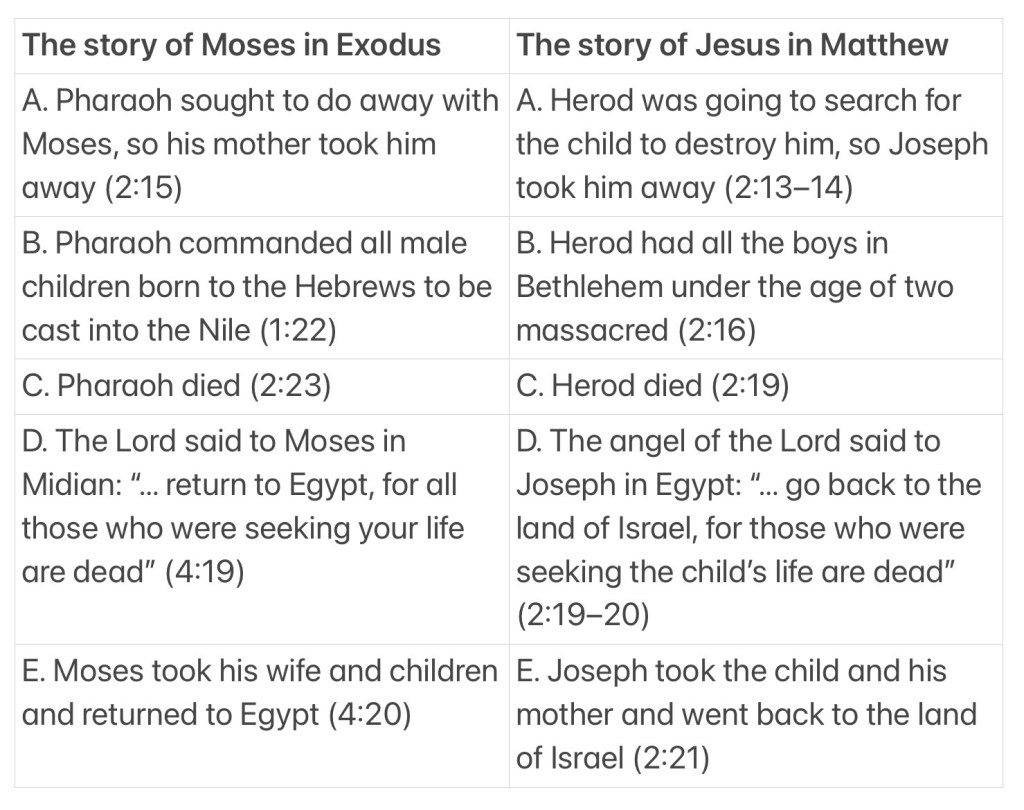
So Moses means “drawn from water”, and Jospeh is given the message that his son is to be given the name that signifies his role, Jesus: “for he will save his people from their sins” (Matt 1:21). And the ancient tale of the slaughter of infants at the time of the birth of Moses is replicated at many points in Matthew’s account of the slaughter of infants at the time of the birth of Jesus (Matt 2:1–18). This later account simply fits the pattern of the earlier account, as this chart shows:
The parallels are very clear!
And just as the literary structure of each story runs in the same pattern, so also the “historical” similarities are clear. Just as there is no historical evidence beyond Exodus to corroborate that the story of the pogrom at the time of Moses took place, neither is there evidence beyond the Gospel of Matthew to corroborate the account found there. Both patterns of events were stories, tales told, not history recorded.
But these non-historical stories are important for theological reasons. The Moses story is part of the whole Exodus complex that provides the fundamental explanation for the identity of Israel. The Jesus story as Matthew presents it is part of the foundational myth of the Christian faith. The writer of Matthew’s Gospel wants to make strong correlations between Jesus and Moses, as the two key figures in their respective stories—and religious systems. This starts in the mythological account found in the opening chapters, and continues throughout the following chapters of the Gospel.
As myth, the tradition found in Matt 1—2 points to important truths. The Slaughter of the Innocents grounds the story of Jesus in the historical, political, and cultural life of the day. It provides a dreadful realism to a story which, all too often in the developing Christian Tradition, has become etherealised, spiritualised, and romanticised.
So we remember this story as an important pointer to the counter-cultural, alternative-narrative impact of the person of Jesus. It is not history, but it offers a powerful myth.
A traditional hymn which remembers this tradition is the Coventry Carol. This dates from the 16th century, when it was performed in Coventry, England, as a part of a mystery play entitled The Pageant of the Shearman and Tailors.
The single surviving text of this pageant (including the words of this carol) was published by one Robert Croo, who dated his manuscript 14 March 1534. The carol is in the form of a lullaby, sung as a poignant remembrance by the mother of a child who is doomed to die in the pogrom.
The passage we explore today takes us into the world of politics in ancient Judea. It is the story of Herod, Herodias, and John the baptiser (Mark 6:14–29). The Herod in this story is Herod Antipas, the son of Herod the Great, who features in Matthew’s account of the birth of Jesus, as the ruler ordering the killing of “all the children in and around Bethlehem who were two years old or under” (Matt 2:16). He is the same Herod to whom Jesus was sent in the course of his trial before Pilate—at least, according to Luke’s account (Luke 23:6–12).
Just as the birth and death of Jesus are each immersed in the politics of the day, so too the death of John the Baptist is best understood in terms of the politics of the day. The story appears at this point, midway through Mark’s narrative, even though John had been beheaded at the command of Herod Antipas some time earlier (Mark 6:17).
Luke, in fact, locates the arrest of John immediately after reporting his baptising and preaching activity “in the wilderness” (Luke 3:1–20), before mentioning, in a brief aside, that Herod had beheaded John (Luke 9:9).
Mark, once again, provides us with plentiful details about the incident: Herod’s protection of John (Mark 6:20), that he liked to listen to John (6:21), his granting of a wish to his daughter Herodias (6:22), the consultation Herodias then had with her mother (6:24), the grief of Herod when he had to adhere to his promise to fulfil the wishes of Herodias (6:26), and the reverent disposal of John’s body by his disciples (6:29). Matthew reports each of these elements, with far fewer words—although he does add that John’s disciples, after burying his body, “went and told Jesus” (Matt 14:12).
Luke omits all of these details, noting only the arrest and the beheading of John in terse narrative comments. John makes no mention at all of Herod, and in his Gospel the figure of the Baptist serves primarily to point to Jesus as Messiah (John 1:6–8, 15, 19–28, 29–34; 3:25–30; 5:33; 10:41). John the evangelist knows that John was baptising (3:23), in apparent competition with the disciples of Jesus (4:1–2); perhaps these were the disciples of John who left him to follow Jesus (1:35–42)? The evangelist also knows that he was arrested (3:24), but reports nothing of his death.
So Mark offers a rich narrative with many details. It seems that this was a story “doing the rounds” at the time. The story criticised Herod—who was not popular among the Jews. Telling the story gave an indirect way to criticise him, albeit in an indirect way. The “hero” of the story—John, who tragically meets his death—is the polar opposite of Herod. John was austere, ascetic, and obedient to God; Herod was profligate, extravagant, and ran his territory of Galilee according to Roman custom.
Herod and John
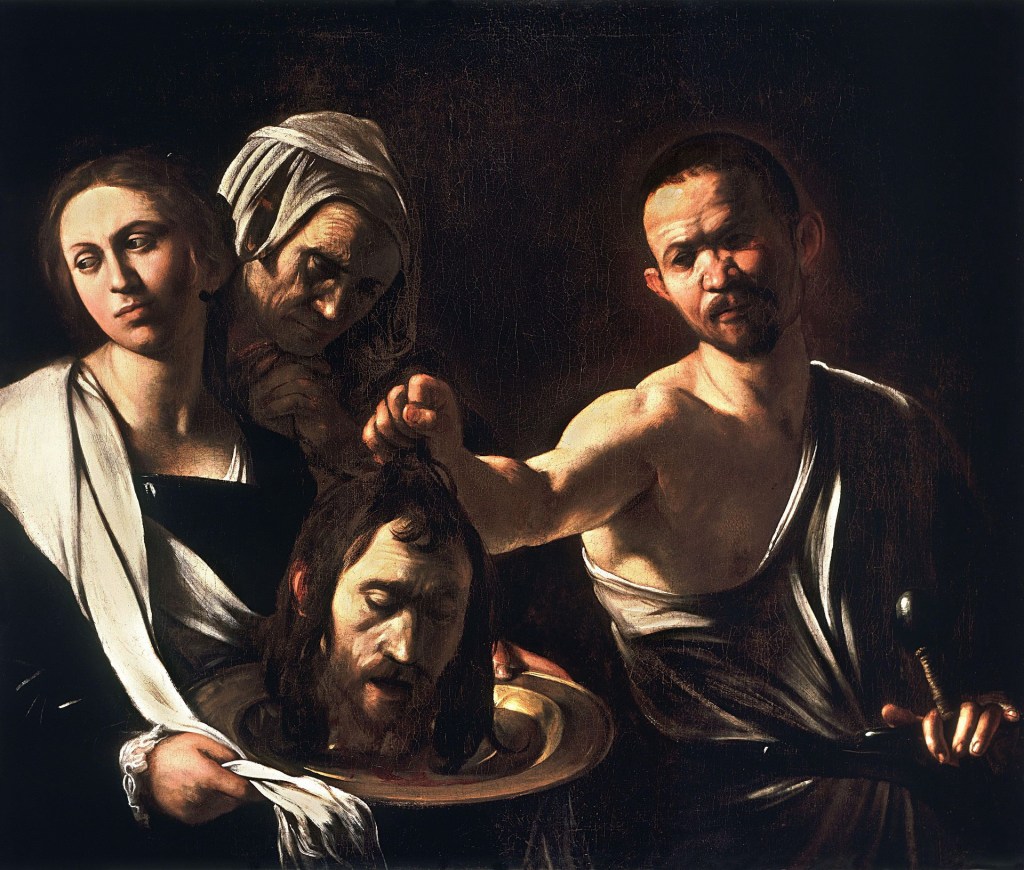
One detail that neither Mark, nor the other evangelists, includes, is that the Hebrew name of Herodias, the daughter of Herod Antipas, was Salome—the name by which she is best known in subsequent art and literature. Salome’s “dance of the seven veils” (another detail absent from the Gospel narratives!) is renowned, having inspired paintings by Titian and Moreau, an 1891 play by Oscar Wilde, a 1905 opera by Richard Strauss, and a 1953 film starring Rita Hayworth.
Indeed, in his recent book Christmaker (Eerdmans, 2024), Prof. James McGrath observes that “the best-known elements of the story—the dance of Salome, the promise of Herod, and John’s head on a platter—are the ones about which a historian has the most reason to be sceptical” (p.116).
James McGrath with his book on John, Christmaker
In fact, even in a number of manuscripts (from the 500s onwards, and especially in the Latin versions), the name of the woman we find named in our Bibles as Herodias (6:22) is missing; in these, she is called “the daughter of Herodias” (and thus the granddaughter of Herod Antipas). But this is a minor point compared to some other factors.
So what do we make of this story? Why has Mark chosen to tell it?
Three Herods: untangling the knots
The Herod who appears in this story that Mark and Josephus each tell is one of three Herods mentioned in the New Testament. What follows is an attempt to untangled the knots of history and make clear where each Herod fits.
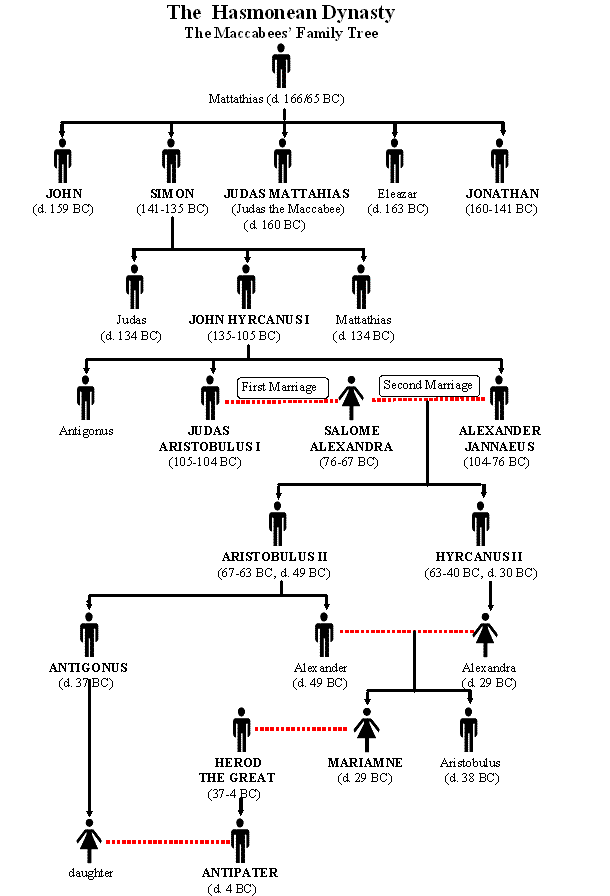
We begin with the Roman general Pompey leading Roman troops into Jerusalem in 63 BCE. Pompey granted Hyrcanus II the throne, under Roman oversight; Hyrcanus II ruled until 40 BCE. As a Roman protectorate, Judea had the right to have a king. Hyrcanus was a Hasmonean, a member of a priestly family that had worked itself into a position of power in Jerusalem after the revolt in the time of Antiochus Epiphanes (175—167 BCE).
The revolutionary activity of the Maccabees, led by a priest, Mattathias, and his five sons, sought to expel the foreigners from Israel. When Antiochus had a pagan symbol placed into the holy Temple, “Mattathias and his sons tore their clothes, put on sackcloth, and mourned greatly” (1 Macc 2:14). In the face of orders from the king’s officers, Mattathias declared, “I and my sons and my brothers will continue to live by the covenant of our ancestors. Far be it from us to desert the law and the ordinances. We will not obey the king’s words by turning aside from our religion to the right hand or to the left” (1 Macc 2:20–22).
The family of Mattathias and their followers were given the Hebrew name Maccabees, meaning hammer—reflecting the hammer blows they struck, again and again, against their enemies. From 167 BCE they fought an armed insurgency which eventually brought victory over the Seleucids in 164 BCE. For a time, Jews would rule Israel once again.
The Hasmonean dynasty
The family given the name Maccabees had at its centre a number of descendants of Hashmon (referred to by Josephus as Asmoneus at Jewish Antiquities 12.265). Thus the string of rulers drawn from this family for the ensuing century, until 63 BCE, are known as the Hasmoneans. The first three rulers from this family were sons of Mattathias: Judah (164–160), his youngest brother Jonathan (160–142), and then his oldest brother Simon (142–134). Each, in turn, moved the religious and cultural practices away from the initial zealous intention to restore Torah and Temple to Israel.
The Hasmoneans believed they should not only sit on the throne of Judah, but also exercise the responsibilities of the High Priest. Claiming this religious leadership was not in accord with the tradition that the priests came from the descendants of Aaron, the brother of Moses, descending through the tribe of Levi (Num 1:48–54; 1 Chron 6:48; 2 Chron 13:10–12; Ezek 44:15). That the Hasmonean high priests were not priests in this precise lineage was a problem for the more traditional members of Israelite society, and would foster discontent and rivalry amongst various groups with Israelite society.
In the midst of growing discontent and instability, in 40 BCE the Roman Senate declared Herod of Idumea to be “King of the Jews”. One of Herod’s many wives was Marianne, the granddaughter of both Aristobulus II and Hyrcanus II. (Aristobulus’s son, Alexander, had married Alexandria, the daughter of Hyrcanus. They were the parents of Marianne.) So he had married into the Hasmonean family.
It is said that Antigonus, the brother of Alexander and son of Aristobulus, had cut off Hyrcanus’s ears to make him unsuitable for the High Priesthood, so Antigonus ruled for three years in defiance of Rome’s decree. Herod, with the support of Mark Anthony, seized power in 37 BCE and held power until his death in 4 BCE. Hasmonean rule was at an end; Herod was an Idumean, the son of an Idumean man, Antipater, who served in the court of Hyrcanus II, and his wife Cypros, from a Nabatean Arab princess. He has been raised as a Jew, but to many Jews he was not a Jew, but an Idumean (the kingdom that had evolved from the Edomites, to the south of Judah).
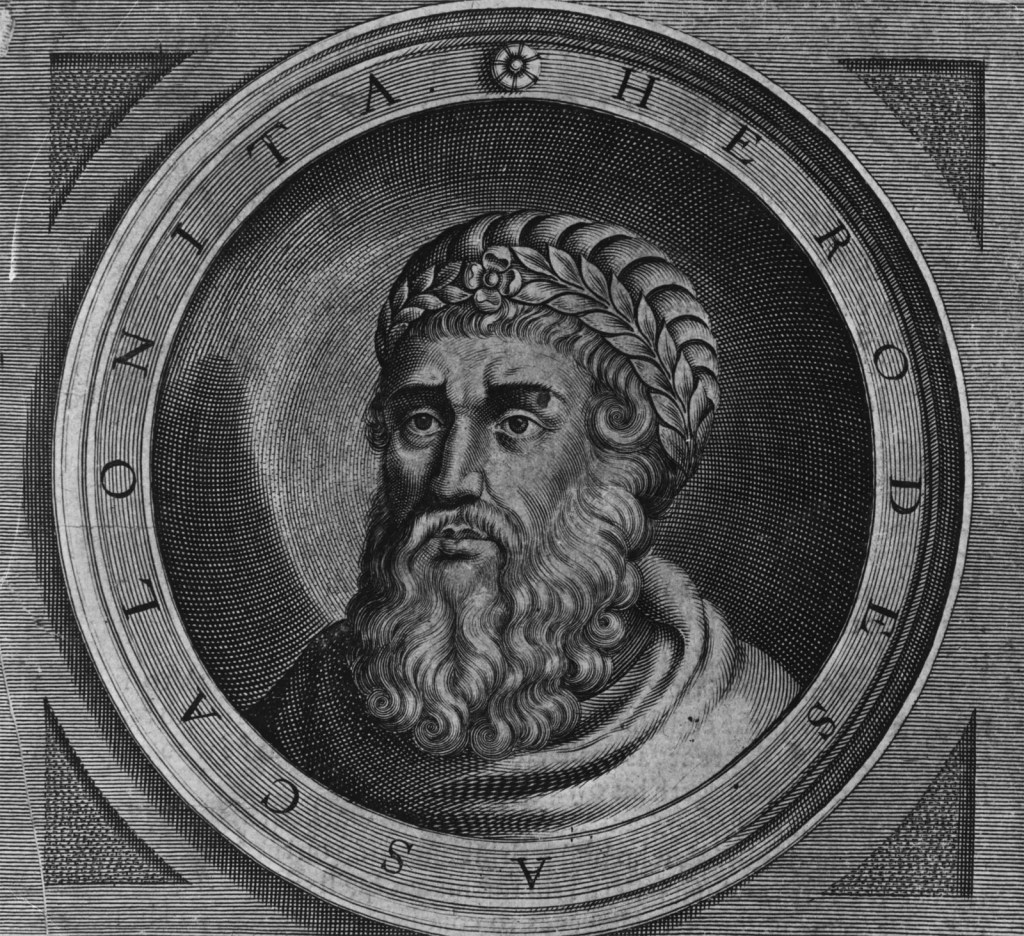
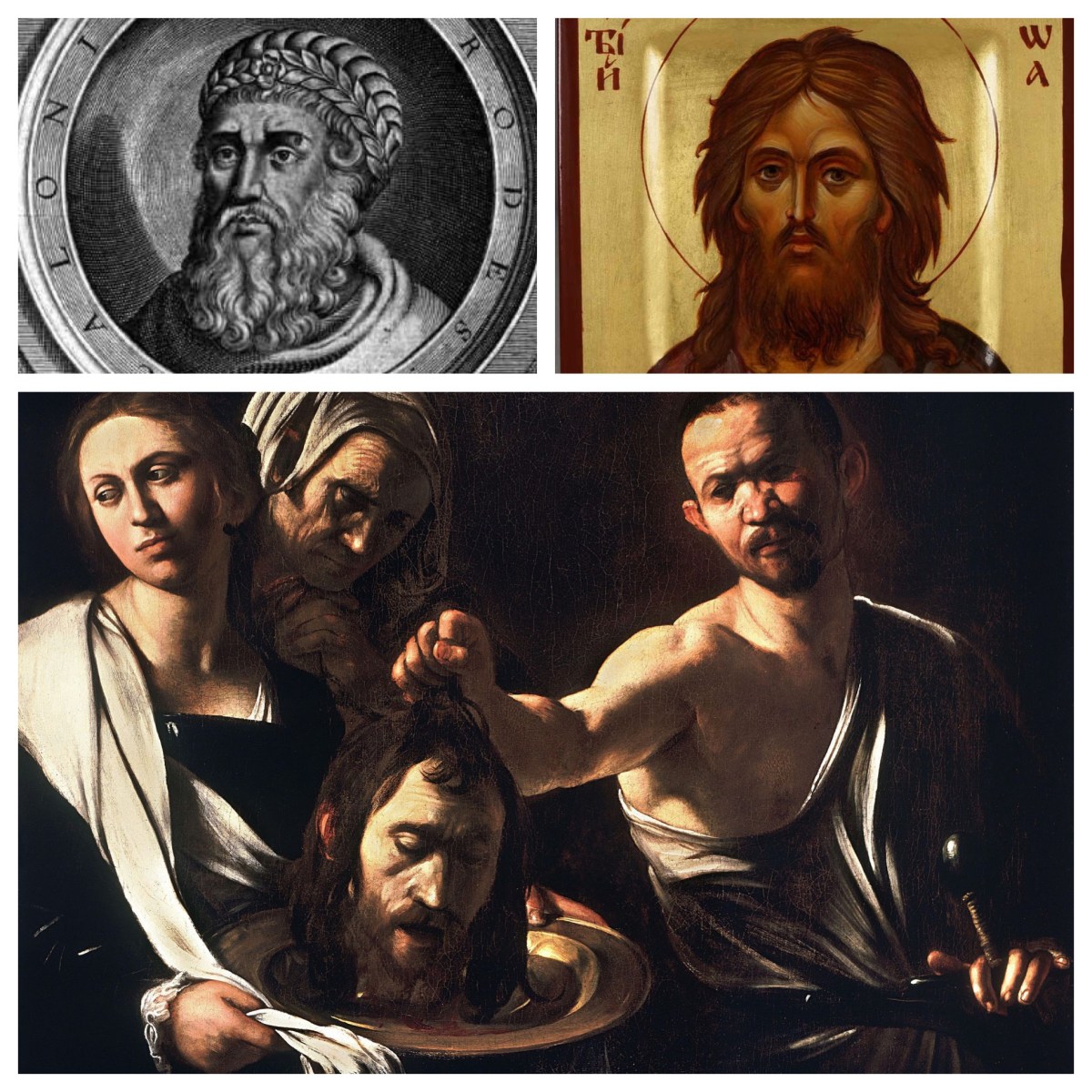
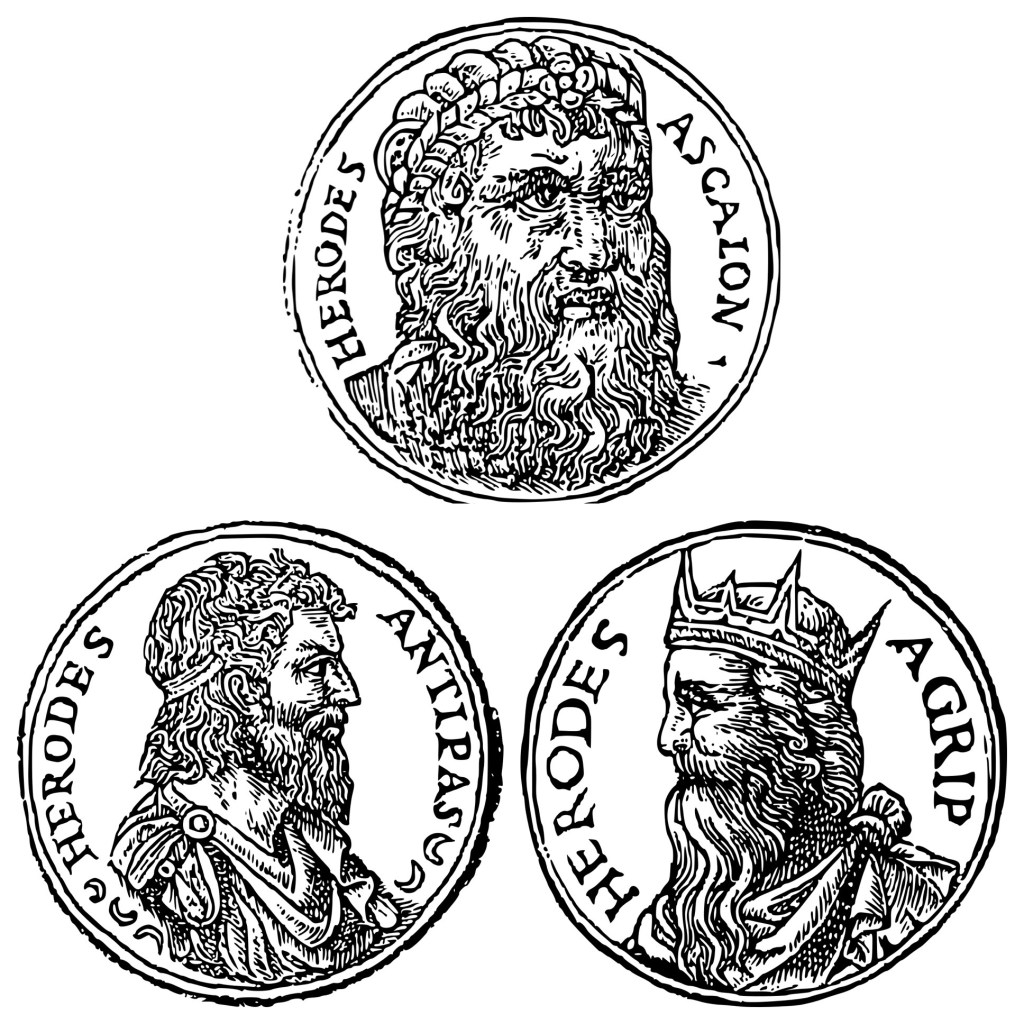
Herod the Great (top), titled “Herod Ascalon” in light of the tradition that he was born in Ashkelon; one of his younger sons, Herod Antipas (bottom left), and his grandson through Aristobulus, Herod Agrippa (bottom right)
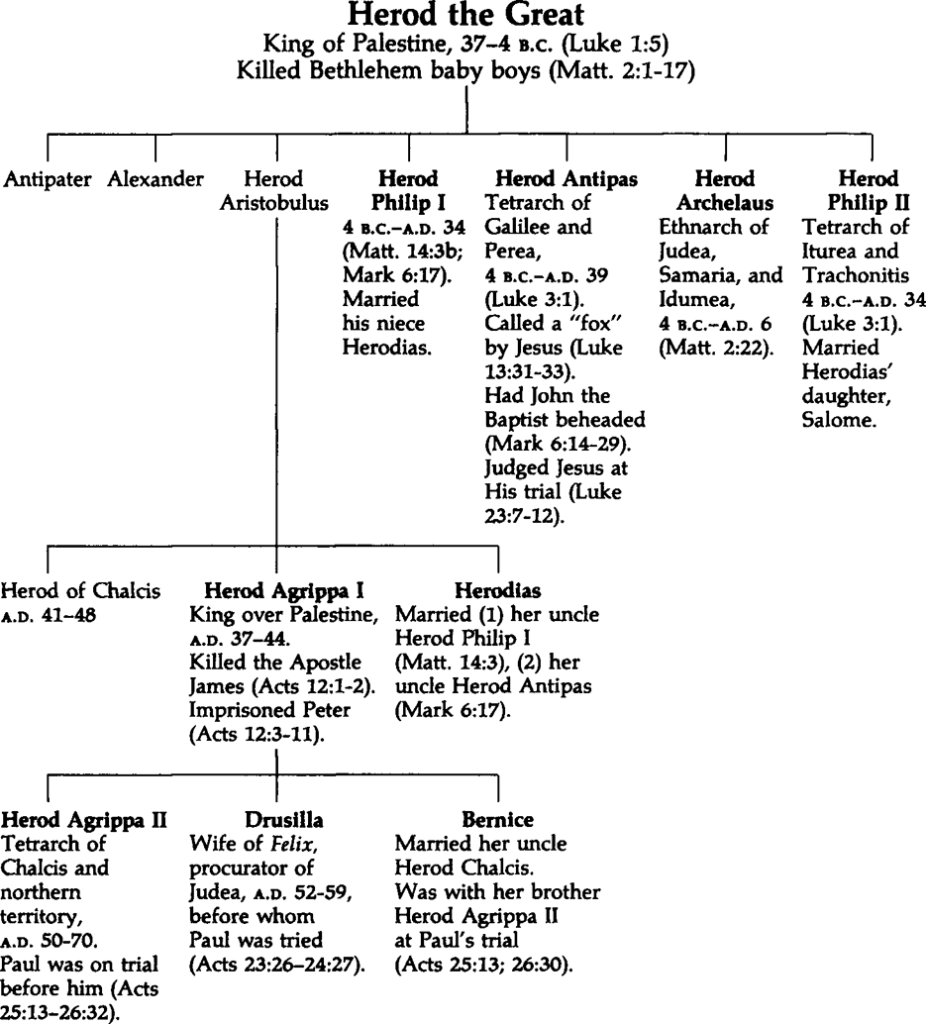
Later, after the death of Herod, one third of his kingdom (the region of Galilee) came under the control of Herod Antipas, the son of Herod the Great and one of his wives, Malthace, from Samaria. Herod senior was “Herod the Great”, the king who, according to Matthew, ordered the slaughter of all males born in Israel (Matt 2:16–18).
The Herodian family
Herod Antipas, his son, was, according to Mark, the ruler who, against his better judgement, ordered the beheading of John the baptiser (Mark 6:17–29). Herod Agrippa was another member of the family, a grandson of King Herod by another of his wives, Mariamne, who ruled as King of Judea from 41 to 44 CE. He appears as “King Agrippa” in Acts 24—25, when Paul is brought to Caesarea, the seat of government, to be judged by Agrippa, his consort Bernice, and the Roman Governor Festus.
So today’s story from Mark 6 involves the middle Herod, Herod Antipas. His relationship with John the Baptist is what lies at the heart of the account in Mark 6.
Why did Herod put John to death?
We actually have two detailed accounts of the death of John. Mark, as we have seen, portrays Herod as equivocating. He tries to move the primary responsibility of John’s death away from Herod, by interspersing his daughter and her request. Perhaps Mark feels the need to excuse the Roman-supported ruler of the time, to avoid having the Jesus movement portrayed as a terrorist movement?
After all, even though Jesus was clearly crucified under orders from the Roman Governor, Pilate (Mark 15:15), Mark does have Pilate bow to the pressure of the crowd that is calling out “crucify him”, by asking the question, “what evil has he done?” (15:12–14). It is Mark who provides our earliest source for placing the blame on the chief priests”, who had stirred up the crowd to press for Jesus to be crucified (15:10–11). So if there an apologetic purpose in the passion narrative—blame the Jews, excuse the Romans–then is a similar apologetic happening in the story of John’s death?—blame Herodias, excuse Herod.
There is an account written later than Mark, by the Jewish historian Flavius Josephus, in his history of the Jews, which he wrote under Roman patronage in the latter decades of the first century CE. Here, Josephus pins the blame squarely on Herod.
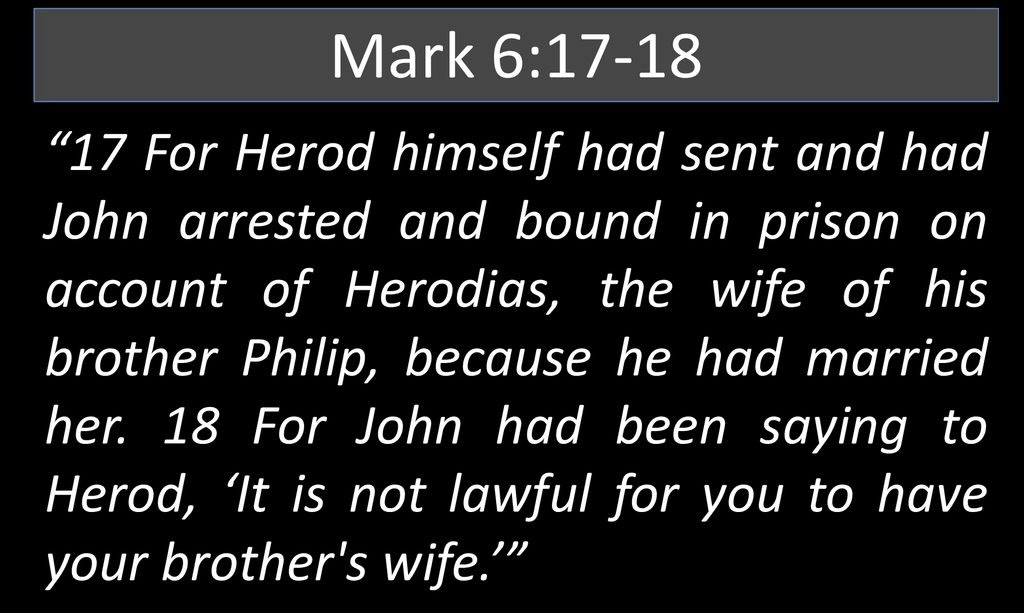
Herod Antipas had divorced his first wife Phasael, who was the daughter of the king of Nabataea. Herod Antipas then married Herodias, who had previously been married to Herod’s half-brother Herod II. John was publically critical of this (Mark 6:18; Matt 14:4; Luke 3:18).
John’s criticisms of Herod’s divorce and subsequent marriage did not sit well with Herod. John’s popularity meant that he was persuading many others to this negative view of Herod. Indeed, God later vindicates the criticisms made by John, according to Josephus, who says that God punished Herod by his later defeat in battle. Josephus writes:
“Herod had put him to death, though he was a good man and had exhorted the Jews to lead righteous lives, to practise justice towards their fellows and piety towards God, and so doing to join in baptism.
“In [John’s] view this was a necessary preliminary if baptism was to be acceptable to God. They must not employ it to gain pardon for whatever sins they committed, but as a consecration of the body implying that the soul was already thoroughly cleansed by right behaviour.
“When others too joined the crowds about him, because they were aroused to the highest degree by his sermons, Herod became alarmed. Eloquence that had so great an effect on mankind might lead to some form of sedition, for it looked as if they would be guided by John in everything that they did.
“Herod decided therefore that it would be much better to strike first and be rid of him before his work led to an uprising, than to wait for an upheaval, get involved in a difficult situation and see his mistake. Though John, because of Herod’s suspicions, was brought in chains to Machaerus, the stronghold that we have previously mentioned, and there put to death, yet the verdict of the Jews was that the destruction visited upon Herod’s army was a vindication of John, since God saw fit to inflict such a blow on Herod.” (Jewish Antiquities 18.116–19)
Josephus sides with God, in arguing that Herod did the wrong thing by putting John to death—and he paid for it later on. Mark sides a little more with Herod, in seeking to excuse him and shift the blame elsewhere.
So we might well ponder: How do we respond to the idea that as they tell the story of John and Herod, both the evangelist Mark, and Flavius Josephus have apologetic purposes? Josephus puts the blame on Herod. Mark shapes the story to excuse certain people and shift the blame to others. Does this cause us to question the historical value of these texts? Are we more inclined to believe Mark rather than Josephus? or the other way around? Why might that be?
John and the prophetic tradition
The fact that Herod finds John to be of interest is rather unusual. As a ruler under Roman control, he might be expected to want to repress Jewish voices, to ensure that order is kept in society. And yet, Herod has a Jewish heritage, and would know of the importance of the voice of the prophets within that heritage.
Nathan called out David for his adultery (2 Sam 12). Elijah spoke boldly against King Ahab (1 Ki 17–19, 21) and King Ahaziah in Samaria (2 Ki 1). Elisha spoke out to King Jehoram (2 Ki 3). Amos spoke out against King Jeroboam (Amos 7). Isaiah declared the word of the Lord to Hezekiah (2 Ki 20).
Haggai likewise guided Zerubbabel, the governor of Judah, after the exile (Hag 1) and at the same time Zechariah was making declarations to King Darius of Persia (Zech 7). The role of the prophet was to be an essential, irritant in the ears of rulers, to be the niggling (and perhaps even booming) voice in the ears of rulers.
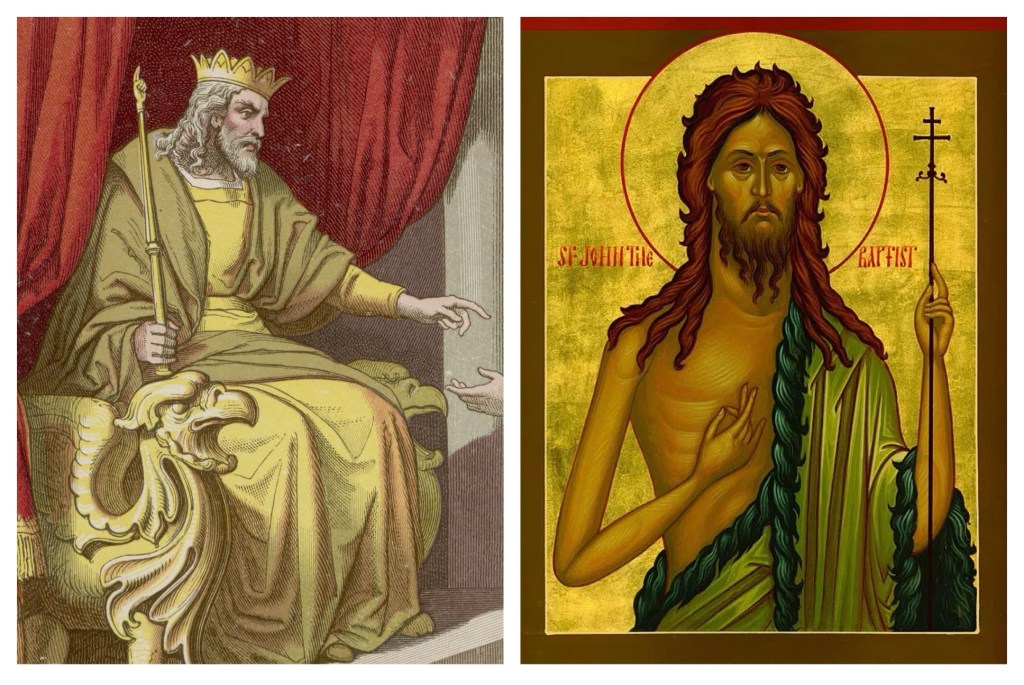
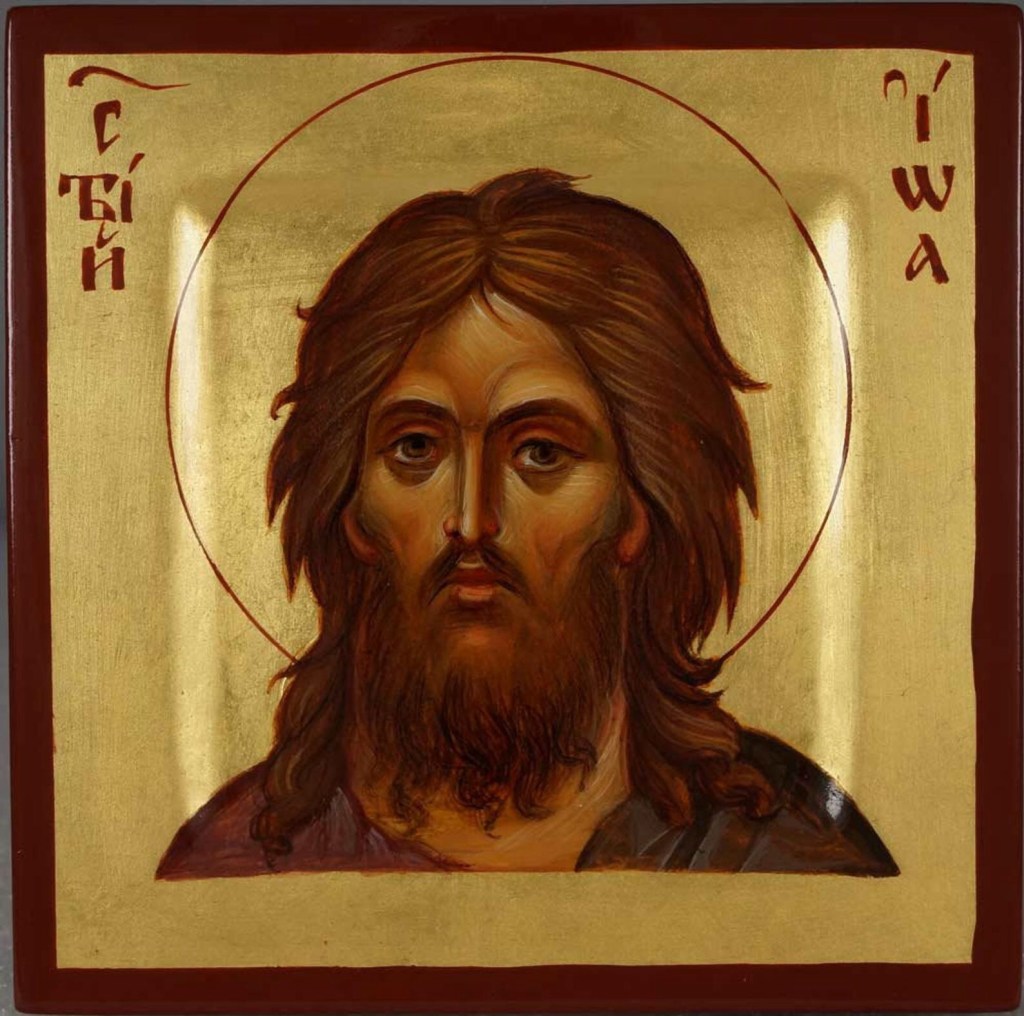
A depiction of John
John stands, it would seem, in that tradition. Not only was he an irritant to “people from the whole Judean countryside and all the people of Jerusalem” (Mark 1:5), calling them to repentance and baptizing them as they confessed their sins. He was also, according to this story, an irritant to the ruler of the time—Herod Antipas. Herod, Mark says, regarded John as “a righteous and holy man” (6:20)—high praise indeed. Herod, Mark says, “protected” John and “liked to listen to him” (6:20). And yet, he is persuaded to arrest and then behead John, not of his own initiative, but by keeping the promise he had made to Herodias (6:26–28).
We have noted briefly that the stories of the death of John and the death of Jesus have certain similarities. John functioned as a prophet, apparently speaking to those in power. Jesus also conducted himself in a prophetic manner, speaking about the kingdom which God was going to bring in—although he talked about this, not directly to those in power, but to the people of Galilee and, ultimately, of Jerusalem.
John’s popularity was his undoing; it seemed that many liked to listen to John and accepted his criticisms of Herod and Herodias. Jesus’s popularity was also his undoing. Large crowds had followed Jesus since early in Galilee (2:13; 3:20, 32; 4:1; 5:21; 24, 30–31; 6:34; 7:14; 8:1–2, 34; 9:14–15, 25; 10:1, 46; 11:18; 12:37).
The Jewish leadership in Jerusalem were offended at the teachings they heard from Jesus in the temple; “they wanted to arrest him, but they feared the crowd” (Mark 12:12). in similar fashion, Mark notes that those priests and scribes “were afraid of the crowd, for all regarded John [the Baptist] as truly a prophet” (11:32).
In many churches today, “good discipleship” or “being a good Christian” would seem to be equated with “being a good citizen”. John provides a model that steps out of the bounds of “good citizenship”. Is this a model for us to consider? For instance, in the Code of Ethics and Ministry Practice in my own church (the Uniting Church in Australia), section 6.2 states that “It is unethical for Ministers deliberately to break the law or encourage another to do so. The only exception would be in instances of political resistance or civil disobedience.”
Ministers have been arrested for protesting against laws that they believe, as a matter of conscience, to be unethical, or against their principles. They are standing in the tradition of John and the prophets before him—although nobody who has done this has, to my knowledge, been beheaded like John was!!
The famous painting of Caravaggio, Salome with the Head of John the Baptist (c. 1607–1610; National Gallery, London)




 An Informed Faith