We continue this week hearing from a well-known section of the letter that Paul and Sosthenes wrote to the believers in Corinth. In the chapter proposed in the lectionary passages last Sunday and this coming Sunday (1 Cor 12:1–31), Paul and Sosthenes address the nature of the community that has been formed by those who formerly were “pagans … led astray to idols” (12:2). They have now have come to believe that “Jesus is Lord” (v.3) and desire to follow his way in their lives through offering their gifts in service (vv.4–7).
Paul and Sosthenes
In Corinth, however, the gifting of the Spirit has been claimed by some as a basis for unedifying behaviour, which as Paul and Sosthenes say, tears apart, rather than builds up, the community. This is manifested in various ways, including (as we noted last week) in the worship of the Corinthian community, where, fuelled by their sense of being “the spiritual ones”, some people unleash chaos in the gathering. This is in contrast to the desire of the letter writers that in this gathering “all things should be done decently and in order” (14:40), as befits the God who is “a God not of disorder but of peace” (14:33).
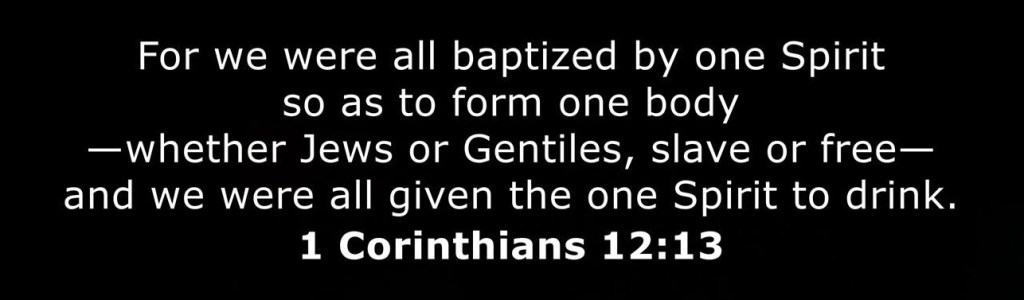
In the passage from 1 Cor 12 proposed as the Epistle for this coming Sunday (1 Cor 12:12–31), Paul and Sosthenes offer a strong affirmation to the Corinthians about the wide reach and inclusive invitation that characterises the work of the spirit: “For in the one Spirit we were all baptized into one body—Jews or Greeks, slaves or free—and we were all made to drink of one Spirit.” (1 Cor 12:13).
I rejoice that these words have been taken up in my church, the Uniting Church in Australia, as the basis for fostering a broad community of faith, across multiple social factors which could divide rather than unite (in paragraph 13 of the Basis of Union). Ministry is enabled by the gift of the spirit. To anyone. To everyone. It is a fine ideal.
That paragraph of the Basis affirms that “every member of the Church is engaged to confess the faith of Christ crucified and to be his faithful servant”. It continues with a declaration, grounded in the scriptural witness (1 Cor 12) that “the one Spirit has endowed the members of Christ’s Church with a diversity of gifts”.
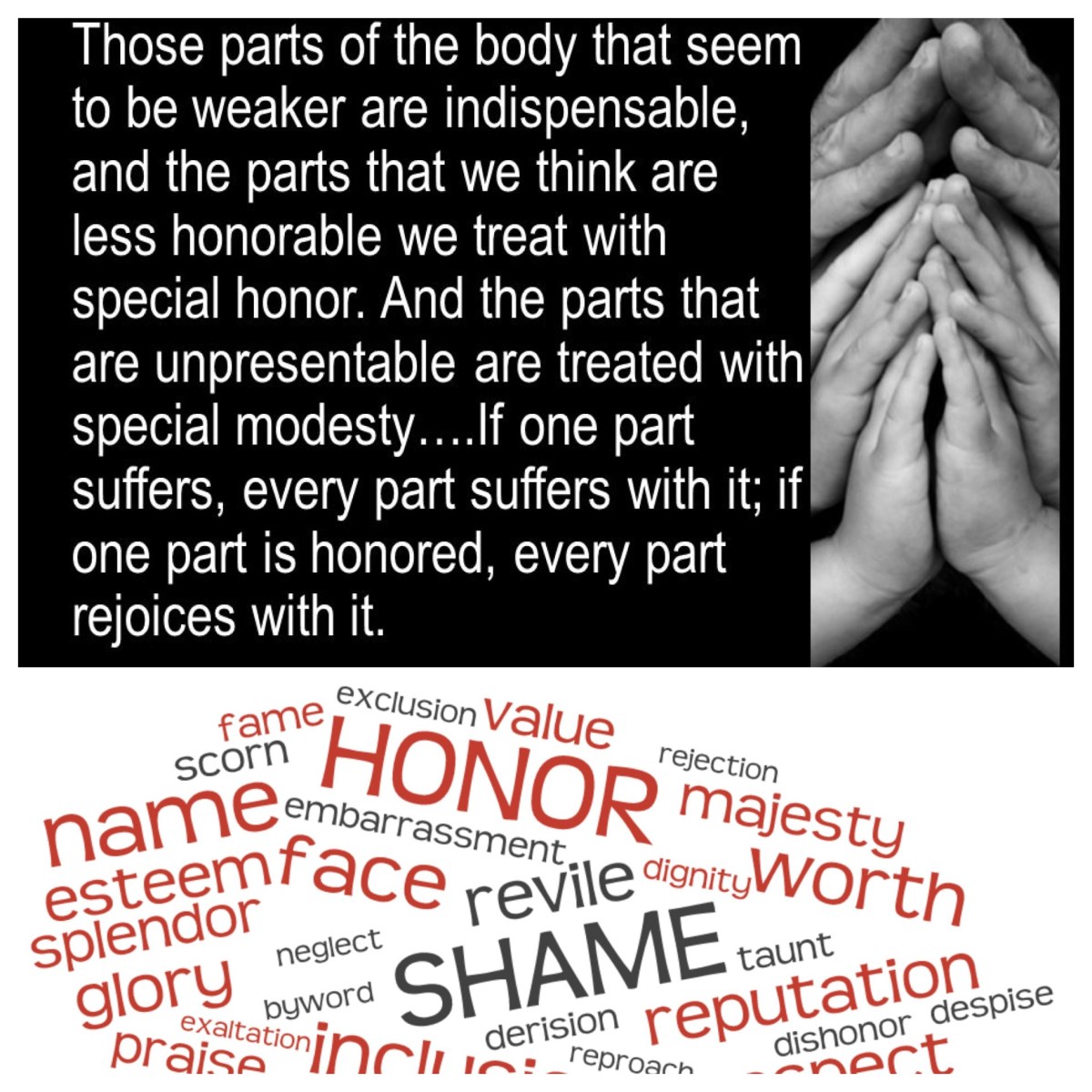
In writing to the Corinthians, Paul and Sosthenes first identified a range of gifts (1 Cor 12:8–10), and then emphasised the claim that “the body does not consist of one member, but of many” (1 Cor 12:14). As a result, each and every member plays an integral role in the whole. From this, they deduce that “the members of the body that seem to be weaker are indispensable … God has so arranged the body, giving the greater honour to the inferior member” (1 Cor 12:22–25). The context in Corinth has shaped the direction into which Paul develops this image.
Honour and shame were central features of ancient Mediterranean societies. Possessing much honour reflected a high social status; gathering much shame reflected low social status. Public debate amongst males was a key way in which honour was demonstrated; besting another person in such a debate was a means by which an increase in honour could be attained. Acting in a way that brought shame upon oneself meant that the amount of honour attributed to you would diminish. Women acting in ways that were not in accord with the patriarchal structures of the time would also be considered as shameful. A woman’s place was, literally, in the home.
Jesus did not shy away from the challenge to his honour and authority that public debating posed. He engaged in many debates, responding with confidence to challenges to his honour as various questions were posed to him, as is reported in Mark’s Gospel: “why does this fellow speak in this way? it is blasphemy! who can forgive sins but God alone?” (Mark 2:7); “why does he eat with tax collectors and sinners?” (2:16); “why do your disciples do not fast?” (2:18); “by what authority are you doing these things?” (11:28); “is it lawful to pay taxes to the emperor, or not?” (12:14). According to Mark, he bested his opponents on each of these occasions; he was a public debater of the first order.
Honour was praised by the Greek philosopher Aristotle as “the greatest of all external goods” (Aristotle, Nic. Eth. 1), whilst Xenophon considered that honour was what differentiated humans from animals (Hiero 7.3). Philo of Alexandria, bridging both Jewish and Hellenistic worlds, affirmed that “fame and honour are a most precarious possession, tossed about on the reckless tempers and flighty words of careless men” (Abraham 264).
The honour—shame culture runs through the Hebrew Scriptures. The ancient Hebrews affirmed that honour belongs primarily to God (1 Chron 16:27), so that God could bestow honour on those who were faithful to his ways (Ps 92:14-15). The same idea is expressed in the version of Isa 28:16 which is cited at 1 Pet 2:6, which modifies the ending to provide explicit reference to the claim that God will not shame believers. God can thus honour human beings (Ps 8:5), even those regarded as shameful (Zeph 3:19); and conversely, God could shame those accorded honour by humans (Isa 23:9). Paul later reflects this early in his first letter to Corinth (1 Cor 1:27).
And later in that letter, Paul and Sosthenes addressed the hierarchical ranking that is integral to the honour—shame culture, and offered a completely counter—cultural perspective. “The members of the body that seem to be weaker are indispensable”, he asserts; and so too, “those members of the body that we think less honourable we clothe with greater honour” (1 Cor 12:22–23). Accordingly, he advocates that “our less respectable members” should be “treated with greater respect; whereas our more respectable members do not need this” (12:23:—24). This is how this part of the letter upends the conventions of his time.
Then Paul and Sosthenes provide the theological rational that undergirds this perspective; “God has so arranged the body, giving the greater honour to the inferior member, that there may be no dissension within the body, but the members may have the same care for one another” (12:24–25). The pastoral conclusion that they draw from this—reinforcing the sense of equality that should mark the community of followers of Jesus—is that “if one member suffers, all suffer together with it; if one member is honoured, all rejoice together with it” (12:26). It is the fundamental lesson in standing firm against the culture because of the demands that the Gospel places on believers.
The dynamic at work in the Gospel passage which is offered by the lectionary this coming Sunday (Matt 22:15–22) is compelling. Some people might worry about the way that the Pharisees—strong advocates for the importance of Torah in everyday life—are collaborating with the Herodians—presumed to be more hellenised Jews sympathetic to (or even employed in the court of) Herod and his successors.
It’s a strange alliance, to be sure, but Matthew has inherited this story from Mark, who placed the two groups side-by-side (Mark 12:13–17), and he chooses not to alter that.
Others might be excited by the coin presented to Jesus for his adjucation—said to be a δηνάριον (a denarius), the standard Roman coin in use at the time, and reputed to be “the usual daily wage” for a labourer (so the NRSV translates the word at Matt 20:2, 9, 10, 13). The fact that staunch Jews were carrying such a coin has engaged some interpreters—although I reckon that they simply needed to, in order to survive in daily life in Roman-occupied Palestine.
What interests me more in this story is the dynamic at work in the interaction between Jesus and the people of these two Jewish groups. The passage begins, “the Pharisees went and plotted to entrap him in what he said” (v.15). In league with the Herodians, they approach Jesus with flattery (v.16) before posing a simple question: “is it lawful to pay taxes to the emperor, or not?” (v.17). So the story is set up as a trap: a public confrontation designed to bring Jesus down.
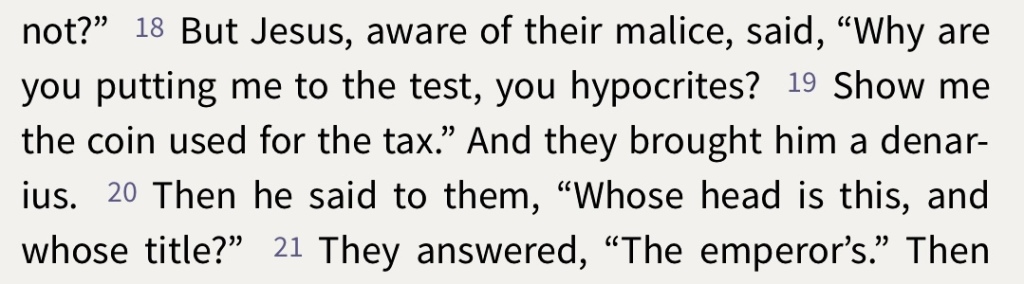
The narrator notes that Jesus is “aware of their malice”, responding to their question with one of his own: “why are you putting me to the test, you hypocrites?” (v.18). There is then an interaction relating to a coin which is produced at the request of Jesus (vv.19–20), before Jesus makes a concluding statement (v.21), which leads to the narrator’s summation of the scene: “when they heard this, they were amazed; and they left him and went away” (v.22).
The dynamic in this back-and-forth can best be understood by reference to the honour-shame culture which was the foundational culture of ancient Mediterranean societies. Malina and Rohrbaugh describe the process of challenge and riposte, in which “a challenge … that seeks to undermine the honour of another person” must be met with “a response that answers in equal measure or ups the ante and thereby challenges in return … to avoid a serious loss of face” (Social Scientific Commentary, p.307).
Such challenge-riposte encounters typically involved the challenger setting forth a claim, through either words or actions; a response to the challenge by the persons who was challenged; then, after further back-and-forth amongst the participants, once the challenge and riposte has run its course, the verdict is declared by the public who was watching the encounter. (See a clear description of this process, as it applies in Mark 11:27–12:34, using the analysis of Jerome Neyrey and Bruce Malina, at https://www.etsjets.org/files/JETS-PDFs/43/43-2/43-2-pp213-228_JETS.pdf)
The challenge that the Pharisees and Herodians raise to Jesus in this passage is one in which he bests the authorities with his responses; he maintains his place of honour within society. Had that not been the case, he would have been publically shamed. And a public shaming for a male in that society was a very demeaning experience.
The incident narrated in this passage (Matt 22:15–22) is one of a series of public confrontations that Jesus had whilst he was teaching in the temple (21:23 through to 22:46). Prior to this debate about the coin that was used to pay tax to the Emperor, Jesus had defended his authority to teach (21:23–27), before telling three parables which provoked his listeners to think out of the box about how God was at work (21:28–32; 21:33–44; 22:1–14).
Jesus, of course, was a Jew, instructed in the way of Torah. He knew his scriptures—he argued intensely with the teachers of the Law over a number of different issues. He frequented the synagogue, read from the scroll, prayed to God, told parables, and went on pilgrimage to Jerusalem and into the Temple—all typically Jewish activities.
Immediately prior to this encounter with Herodians and Pharisees, Jesus had offered a scathing critique of the practices that were taking place in the courtyard of the Temple (21:12–17). It was the response of the children to his actions, echoing the earlier son of the crowd by singing out “Hosanna to the Son of David” (21:9) had angered the chief priests and the scribes (21:15). The way that he resolved this situation (at least temporarily) was to quote scripture (21:16, citing Psalm 8:2)—a very Pharisaic-rabbinic way of operating!
Earlier in his narrative, Matthew has reported a number of tense encounters between Jesus and his disciples on the one hand, and the scribes and Pharisees on the other (9:2–8, 10–13; 12:38–42; 15:1–20; 16:1–4; 19:3–9; 21:15–16). Those encounters inevitably revolved around differing interpretations of Torah prescriptions and included regular references to (Hebrew) scriptural passages.
Whilst teaching in the Temple, Jesus engaged in debate and disputation with various Jewish authorities: chief priests and elders (21:23), Pharisees and Herodians (22:15–16), Sadducees (22:23), and then Pharisees once more (22:34, 41). Each of those groups came to Jesus with a trick question, which they expected would trap Jesus (22:15). Jesus inevitably bests them with his responses (21:27; 22:22, 33, 46).
Each of the parables that Jesus told ends with a twist that snares the opponents of Jesus more intensely. The short parables of the two sons (21:28–32) ends with a barb: “John came to you in the way of righteousness and you did not believe him, but the tax collectors and the prostitutes believed him; and even after you saw it, you did not change your minds and believe him” (21:32).
The third parable, of the wedding banquet (22:1–14) ends with words that are surely intended to put the Pharisees well and truly in their place: “many are called, but few are chosen” (22:14). Are they the ones who will be “[bound] hand and foot, and [thrown] into the outer darkness, where there will be weeping and gnashing of teeth” (22:13)?
In the middle parable (21:33–44), the conclusion is equally damning: “the kingdom of God will be taken away from you and given to a people that produces the fruits of the kingdom” (21:43). Recognising that they were the targets of this teaching, the chief priests and Pharisees “realized that he was speaking about them; they wanted to arrest him, but they feared the crowds, because they regarded him as a prophet” (21:46).
Indeed, this whole sequence of conflicted encounters—public disputations, challenge-riposte displays—ends with a recognition of the fact that Jesus has retained (and perhaps even increased) his share of honour: “no one was able to give him an answer, nor from that day did anyone dare to ask him any more questions” (22:46).
As Matthew had noted earlier, in the passage for this Sunday, the Pharisees and Herodians “were amazed; and they left him and went away” (22:22); and then, after dialogue with the Sadducees, “when the crowd heard it, they were astounded at his teaching” (22:33). To the crowd, it is clear: Jesus is the man of honour, who has publically shamed Pharisees, Sadducees, priests, and Herodians.
Pharisees plotting with malice; that is a sharply negative portrayal of these characters in this encounter. Elsewhere in Matthew’s Gospel, the Pharisees are the subject of similar invective, placed on the lips of Matthew. Although Jesus affirms “the scribes and the Pharisees” as those who “sit on Moses’ seat” and teach well, he criticises them as failing to live by that teaching in their lives (23:1–3).
What follows this affirmation is an incessant string of criticisms, each introduced with the uncompromising invective, “woe to you, scribes and Pharisees, hypocrites!” Jesus accuses them of “lock[ing] people out of the kingdom of heaven” (23:13), “tith[ing] mint, dill, and cummin, and neglect[ing] the weightier matters of the law: justice and mercy and faith” (23:23), and acting in ways that are “full of greed and self-indulgence” (23:25).
He accuses them directly, noting that they are “child[ren] of hell” (23:15), that “inside you are full of hypocrisy and lawlessness” (23:28), and that they are “descendants of those who murdered the prophets” (23:31). The punishment due to them is the fate in store for all who are lawless—to depart from Jesus, who never knew them (7:23), to be “throw[n] into the furnace of fire, where there will be weeping and gnashing of teeth” (13:42), to be “sentenced to hell” (23:33) as they “fill up the measure of your ancestors” (23:32).
And so, in the face of the abandonment of the Law by the very teachers of the Law, Jesus teaches how to live by the Law, with a ferocious intensity that exceeds anything that the Pharisees and scribes might offer (5:21–48), for “unless your righteousness exceeds that of the scribes and Pharisees, you will never enter the kingdom of heaven” (5:20). He is positioned in a way that places him as the supreme teacher of Torah, over and above the Pharisees.
Judaism was in a state of flux after the destruction of the Temple in 70 CE. Evidence indicates that there were a number of sectarian groups contesting with each other for recognition and influence. During this period, the Pharisees became increasingly important as an alternative to the Temple cult, and in time they emerged as the dominant Jewish religious movement. Their power base was moved from Jerusalem and spread throughout the area.
Josephus comments that the Pharisees lived in the towns and villages with and alongside the people. He wrote that “they live meanly, and despise delicacies in diet; and they follow the contract of reasons” (Antiquities of the Jews, 18.3), so presumably they lived without the ostentation and wealth that Josephus ascribes to the Sadducees.
Josephus also comments that the Pharisees were usually held in high regard by the ordinary people of the day. Since nine out of every ten persons could not read, the importance of scribes—literate, educated, and sympathetic—could not be underestimated. Whilst the Pharisees clustered around towns in Judea, the scribes were to be found in the synagogues of villages throughout greater Israel, and indeed in any place where Jews were settled. Their task was to educate the people as to the ways of holiness that were commanded in the Torah. It was possible, they argued, to live as God’s holy people at every point of one’s life, quite apart from any pilgrimages made to the Temple in Jerusalem.
The way that Jesus is portrayed in the Gospels–especially the three Synoptic Gospels–places him in opposition to the Pharisees, as the authoritative teacher of Torah. In Matthew’s Gospel, as we have noted, this opposition is further intensified, for Jesus is seen as the only one able to interpret and apply the laws for them in their lives.
So there is a clear reason for the negative language used in the incident about the coin: “the Pharisees went and plotted to entrap him” (22:15), and Jesus was “aware of their malice” (22:18). In the context of the latter part of the first century, in which Matthew’s Gospel was written, this antagonism can be understood. The intensity of conflict heightened the sharpness of antagonism that the author of this Gospel has drawn.
****(
For those of us reading, hearing, and preaching on this passage in the 21st century, we need to be very careful not to use negative, derogatory, or judgemental language about the Pharisees of the first century, or about Jewish people in our own times. Judaism is a living faith with its own integrity, and Jews today should be recognised and valued as people of faith and not valued in terms of conflicts from centuries ago.
In 2009, my own church, the Uniting Church, adopted a Statement on Jews and Judaism in which we resolved to:
acknowledge that many of the early Christian writings collected in the New Testament were written in a context of controversy and polemic between the Church and Synagogue;
not accept Christian teaching that is derogatory towards Jews and Judaism;
and encourage its members and councils to be vigilant in resisting antisemitism and anti-Judaism in church and society.
Only in Luke’s Gospel do we learn of the woman who was healed by Jesus after suffering from “a spirit that had crippled her for eighteen years”, who was “bent over and was quite unable to stand up straight” (Luke 13:10–17). That’s the Gospel reading offered by the lectionary this coming Sunday.
The woman is bent over; as she encounters Jesus, he tells her that she is set free, and “immediately she stood up straight and began praising God”. This takes place “in one of the synagogues on the sabbath”—a place and a time that we often encounter Jesus in Luke’s narrative, an orderly account of the events that have been fulfilled among us (Luke 1:1).
We find generalising statements to this effect early in Luke’s narrative; in Galilee, Jesus “began to teach in their synagogues and was praised by everyone” (4:15) and “he continued proclaiming the message in the synagogues of Judea” (4:44; some early texts have what is more likely to have been the case, “in the synagogues of Galilee”).
There are specific instances where Jesus is in synagogues in Nazareth (4:16), in Capernaum (4:33), and somewhere else unidentified in Galilee (6:6). There is also the invitation to visit the house of the synagogue leader, also somewhere in Galilee, to heal his deceased daughter (8:41–42, 49–56), and the invitation to visit the house of the centurion, of whom the Jewish elders in Capernaum say, “he loves our people, and it is he who built our synagogue for us”, to heal his seriously ill slave (7:1–10).
Jesus, it is evident, had quite a lot to do with synagogues—the places of learning and fellowship, hospitality and prayer, within the culture of his day. He demonstrated his love for God, fidelity to the commandments, and commitment to the covenant, through this regular synagogue attendance and participation. (And not only in Luke’s Gospel; the other three Gospels also place him in synagogues at various times; see Mark 1:21, 39; 3:1; 6:2; Matt 4:23; 9:35; 12:9; 13:54; John 6:59; 18:20.)
Alongside this, there are stories relating to the activity that Jesus undertakes on the sabbath, often in a synagogue. One sabbath incident evokes a positive response from the people, after Jesus releases from his bondage a man who had been held by “the spirit of an unclean demon” (4:31–37). That positive response to Jesus from the people continues throughout his activities in Galilee (4:40, 42; 5:15, 26; 6:18–19; 7:16–17; 8:56a; 9:11, 43) and on the journey towards Jerusalem (10:17; 11:27; 12:1; 13:17; 14:25a; 15:1; 18:15, 36; 19:3, 36–38) and in Jerusalem (19:48; 21:37–38).
Later sabbath incidents involve the interpretive authorities, the Pharisees and scribes, who bring their judgemental assessment of such activity to bear when the disciples of Jesus seek to find nourishment on the sabbath (6:1–5), or when Jesus restores the withered hand of a man on the sabbath (6:6–11), or when he straightens this bent woman, again on the sabbath (13:14–17), or when he heals another man, swollen with fluid retention (dropsy) throughout his body, yet again on the sabbath (14:1–6).
In each case, these interpretive authorities declare Jesus out of order, for engaging in such activity on the sabbath. Those who had authority to interpret the law and detail its practical application in relation to the Temple in Jerusalem were the Sadducees, a group aligned with the priests; but in the towns and villages away from Jerusalem, the scribes and Pharisees undertook that role (Josephus, Antiquities of the Jews 18.11–13). Indeed, Josephus notes that “great disputes and differences have arisen among them [the Pharisees and the Sadducees]” (Antiquities of the Jews 13.298; this is attested at many places in the Mishnah, where Sadducees and Pharisees argue about interpretations of specific commandments).
So the presence of Pharisees and scribes in this Lukan narrative, monitoring the activities of Jesus, debating his interpretations of certain commandments and judging his actions in the synagogues and other public places, indicates how seriously they took their roles as the authorities qualified to provide definitive interpretations.
Nevertheless, we can see that Jesus maintained a consistent practice of engaging with God, and with other people, on the day set apart especially for this, the sabbath day, often in the place set apart for this, the synagogue. He kept the commandment to “love God”.
He also ensured that his devotion to God, by keeping the sabbath and attending synagogue, did not stand in the way of his relationships with other people—indeed, it is precisely on the set-apart day, the sabbath, in the set-apart place, the synagogue, that Jesus relates with, and affirmingly restores other people to health.
However, as Malina and Rohrbaugh note in their Social Scientific Commentary on the Synoptic Gospels (p.363), “illness in antiquity was a social as well as a physical phenomenon”. They wisely observe that “healing required re-establishing social relationships as well as restoring physical health”. This is signalled, they say, in the response that Jesus gives to the leader of the synagogue, when he describes the woman as “a daughter of Abraham” (13:16)—a sign of her belonging to the community as “a legitimate member”.
By restoring the woman to a healthy place within the community, Jesus demonstrates that he knows also to “love neighbour”. Love of God did not preclude love of neighbour—indeed, love of God impelled him to exercise compassionate love towards his neighbours (see 10:27–28). So he once again heals on the sabbath.
Some of these sabbath stories conclude with emotionally-laden responses from those authorities, after their efforts to trap or condemn Jesus are foiled. After Jesus restored the withered hand of a man in one synagogue, “they were filled with fury and discussed with one another what they might do to Jesus” (6:11).
After Jesus straightens the bent woman in another synagogue, “all his opponents were put to shame; and the entire crowd was rejoicing at all the wonderful things that he was doing” (13:17). A third time, after Jesus healed a man with dropsy whilst at a dinner party in the house of one of those Pharisees, we hear that “they were silent …. they could not reply to this” (14:4, 6).
The reason for the fury expressed in the first of these scenes (6:11) is explained by the narrative comment after the encounter with the woman; his healing of her and besting of the synagogue leader and his associates (“all his opponents”) was understood to be a public shaming (6:11). Malina and Rohrbaugh rightly note that this was a process of challenge and riposte, in which “a challenge … that seeks to undermine the honour of another person” must be met with “a response that answers in equal measure or ups the ante and thereby challenges in return … to avoid a serious loss of face” (Social Scientific Commentary, p.307). Jesus bests the authorities with his responses; he maintains his place of honour within society.
The scene with the bent over woman, then, is part of a pattern we find repeated a number of times in the narrative of the orderly account that we attribute to Luke: a person in need, in a religious setting, reaching out to Jesus, met with grace and compassion, rejoicing that their need has been met; surrounded by figures invested with interpretive authority, debating and disputing the validity of the grace-filled offer that Jesus extends; and a resolution in which these authority figures find that their status is shamed, their reasoning is rejected, their objection is overruled.
It exemplifies the essential story of Jesus: human beings, enmeshed in systems and structures, engaging in interactions and relationships, can find themselves caught in binds that bend them over, disfiguring and disabling them, making them unable to function effectively within the community to which they belong. The physical ailments evident in these stories—a tortured mind, a withered hand, a swollen body, a bent body—reflect the reality that these differences have led to an inability to function effectively and happily, within daily life, and within the community of the particular individual.
Malina and Rorhrbaugh distinguish disease from illness; the former is “a biomedical malfunction”, whereas the latter is “a disvalued state of being in which social networks have been disrupted and meaning lost” (Social Scientific Commentary, p.315). Further, they note, “illness is a matter of deviance from cultural norms and values”. The ill people whom Jesus encounters are disrupted and in a state of irregularity within their social networks. Jesus meets them and restores them to a valued place in their society.
There are other instances where Jesus engages with people, not in the synagogue, not on the sabbath, but where he extends gracious compassion to a person in need, to a person constrained by whatever reason so as to be unable to function effectively: a woman with a fever (4:38–39), a man with a skin disease (5:12–16), a paralysed man (5:17–26), a grieving widow (7:11-17), a woman labelled “sinner” (7:36–50), a man tortured by multiple pressures (8:26–39), an epileptic boy (9:37–43), a person unable to speak (11:14–23), and then a group of people with diseased skin (17:11–19).
And in the midst of this string of encounters in which Jesus offers compassionate grace—and for which he is criticised by the interpretive authorities—Jesus speaks a word of stinging invective against those whose narrow minds perpetuate greed and wickedness, demonstrate lack of love and justice, impose burden after burden, and remove “the key of knowledge” which thereby hinders those who were seeking to enter God’s realm (11:37–52).
There has been no dogmatic prerequisite, no moralising judgement, exercised by Jesus in any of these encounters, unlike what he has observed and experienced from the interpretive authorities. Jesus has simply met people as they are, with no preconditions extended. In that meeting, he offers his welcoming embrace, his healing touch, his restorative presence.
This outburst leads the scribes and the Pharisees “to be very hostile toward him and to cross-examine him about many things, lying in wait for him, to catch him in something he might say” (11:53–54). It continues the opposition flagged earlier in the narrative (4:28–30; 5:21–24; 6:11; 7:39) and leads in the direction that comes to an inexorable climax in the plot to kill Jesus (13:31; 19:47–48; 22:1–6). This inevitability is echoed by the fate of the son in the parable which Jesus tells 20:9–16, which also feeds into this trajectory (20:19).
Continued resistance to the open-hearted, graciously accepting, welcoming compassion that Jesus demonstrated, results in this terrible fate: “the Son of Man must undergo great suffering, and be rejected by the elders, chief priests, and scribes, and be killed, and on the third day be raised” (9:22). The clash has been one that reaches to the depths of status within the society, for the opponents of Jesus, and for Jesus himself. In the end, he is bowed and brought down by their scheming. But this Sunday, we hear of how he enabled a bent woman to stand, to stand straight, to take her place in her community.







 An Informed Faith