Disputing the claim of Jesus to be “the bread of life” (John 6; Pentecost 13B)

Under the guidance of the lectionary, we have been following a pathways which has deviated from the story of “the beginning of the good news of Jesus, Messiah” (which we know as the Gospel of Mark) that we have been following each Sunday since Pentecost. For the moment, we read and hear excerpts from “the book of signs”, which contains just some of “the many things that Jesus did” (which we know as the Gospel of John).

We have read or heard the account that John gives of when Jesus “took the loaves, and when he had given thanks, he distributed them to those who were seated; so also the fish, as much as they wanted” (John 6:1–13). From that day, we have then been guided to follow the extensive discourse that Jesus gives to a crowd that “went to Capernaum looking for Jesus” (John 6:25–71).
First, we heard a passage that ends with the first of seven I AM declarations made by the Johannine Jesus, “I am the bread of life” (6:24–35). Then, in the next section of that discourse, we encountered an elaborated exposition of that “bread of life” (6:35–51). This Sunday we hear about the disputes that this teaching generated with the Judaean authorities (6:51–58), and then the following Sunday takes us to the final section of the discourse where Jesus then has to deal with dissent from his own disciples (6:56–69).

The passage for this coming Sunday (John 6:51–58) is introduced, as we saw in the previous blog on this discourse, with a restatement of the theme that Jesus had what has just been declared: first, the primary affirmation about Jesus: “I am the living bread that came down from heaven” (v.51a); followed by the consequence for those who believe in him: “whoever eats of this bread will live forever” (v.51b)—and then a further step, following this summary, with and immediate extension of the argument: “the bread that I will give for the life of the world”, Jesus declares, “is my flesh” (v.51c).

Whilst a superficial, or impatient, reading of this chapter reacts with “here we go again, ‘I am the bread of life’ yet again”, a more careful reading will reveal to us the developments and new elements that are being added into the discourse at each reiteration of this fundamental claim. This restatement does just that.

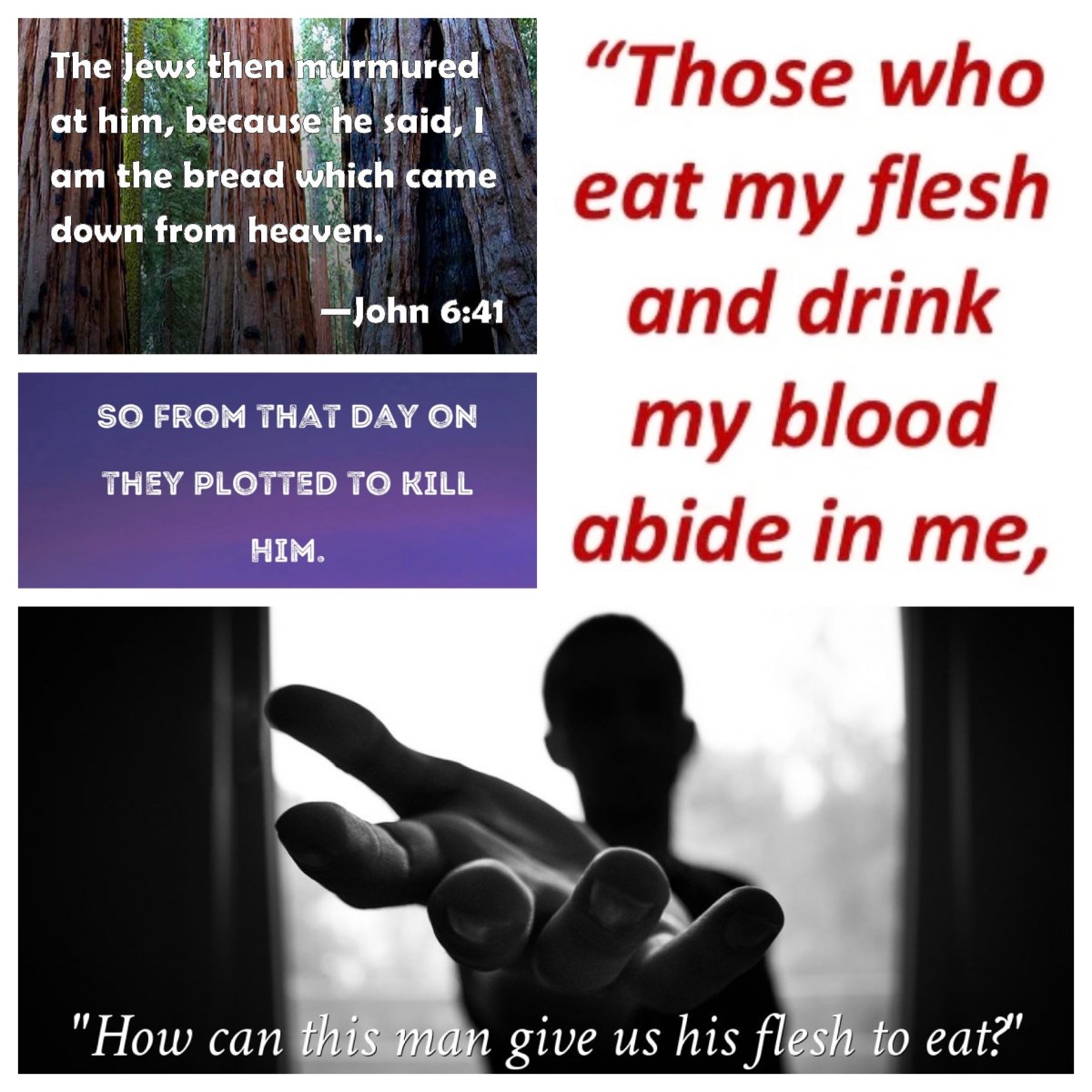
A strong response to the statement of Jesus made in v.51 comes immediately. Most contemporary translations refer to “the Jews” when they report the immediate kickback: “[they] disputed among themselves, saying, ‘How can this man give us his flesh to eat?’” (v.52).
It’s a fair question, I reckon, since it’s a curious, and confronting, thing for Jesus to say. Who talks about giving his own flesh to others for them to eat?

I am reminded of the criticism of the Christians made in the early centuries of the movement. Second century Roman writer Suetonius wrote that “Nero inflicted punishment on the Christians, a sect given to a new and mischievous religious belief” (Suetonius, The 12 Caesars, Nero Claudius Caesar, XVI). A similar comment is found in the Annals of Tacitus: “Nero fastened the guilt and inflicted the most exquisite tortures on a class hated for their abominations, called Christians by the populace” (Tacitus, Annals 15.44).

In a third century work written by Minucius Felix we gain a glimpse of the accusation of cannibalism being levelled against the Christians, in a “story about the initiation of young novices” (Octavius 30). Minucius Felix reports the criticism that an infant, “covered over with meal, that it may deceive the unwary, is placed before him who is to be stained with their rites” (that is, before the person about to be baptised).

He continues with a description of the alleged horrors: “this infant is slain by the young pupil, who has been urged on as if to harmless blows on the surface of the meal, with dark and secret wounds”, and then gives a graphic description of what ensues: “thirstily … they lick up its blood; eagerly they divide its limbs; by this victim they are pledged together; with this consciousness of wickedness they are covenanted to mutual silence.” It’s quite a take on what believers know as the celebration of Holy Communion.

(We will come back to the strangely-different language and the distinctive Eucharistic resonances of the discourse of the Johannine Jesus in John 6 in my blog on next week’s lectionary passage.)
Who are these “Jews” who are criticizing Jesus in this way? I have already noted (in my blog on John 6:1–15) that most translations describe this latter group simply as “the Jews”. The Greek word used, however, can equally be translated as “the Judeans”. It’s a preferable option, I believe, as it avoids having a sense of antisemitism creep into our understanding of the text, every time we hear “the Jews” criticising and arguing with Jesus.

To be fair to the whole population of Judaea at the time, however, I’ll refer to them as “Judaean leaders”, as it seems clear that this is the particular group that is generating and exacerbating the conflict.

In doing so, I am taking the lead from D. Moody Smith, who argues that that the way the word is used in the fourth Gospel means that it should be translated as “a group of Jewish leaders who exercise great authority among their compatriots and are especially hostile to Jesus and his disciples … it refers to certain authorities rather than to the people as a whole.” See D. Moody Smith, “Judaism and the Gospel of John”, accessible at https://www.bc.edu/content/dam/files/research_sites/cjl/sites/partners/cbaa_seminar/Smith.htm

The sixth chapter of John’s Gospel offers a series of encounters that reveal misunderstanding, antagonism, and conflict in the ways that people relate to Jesus, even whilst he sets forth this significant teaching that he is “the bread of life” (6:35, 48). To be sure, the earlier interactions between Jesus and “the crowd” (6:24–40) appear to be amenable, offering Jesus the opportunity to explain himself.
However, when this group of Judaean leaders come into the foreground (v.41), this become more tense. The antagonism of these leaders is palpable. This mood continues through their complaining (vv.41–51) and disputing (vv.52–58), on into the complaining of the disciples of Jesus (v.60–65) and the rejection of Jesus by some of them (vv.66–71).

We have already met opponents of Jesus very early in John’s narrative. Indeed, in the prosaic interpolation into the poetic prologue, even before the story proper begins, there is a clear indication of looming opposition to Jesus: “the world did not know him … his own people did not accept him” (1:10–11).
Early in the narrative that John the evangelist presents, a group of Judaean leaders had questioned John the baptiser, asking him “who are you?” (1:19); then they had questioned Jesus, “what sign can you show us?” (2:18). These questions are not necessarily antagonistic. (You could read them as a form of “appreciative enquiry”.)

The explicit opposition to Jesus from these Judaean leaders emerges, however, after he has healed on the sabbath (5:10). Here, the narrator declares that these Judaean leaders “started persecuting Jesus” (5:16) and indeed “were seeking all the more to kill him” because of what he was saying (5:18). From this point on, the conflict just deepens.

After they began to complain about Jesus (6:41) and quarrel about him (6:52), these leaders have success: “many of his disciples turned back and no longer went about with him” (6:66). They intensify their opposition, “looking for an opportunity to kill him” (7:1), intimidating people to silence (7:13), further questioning the teaching of Jesus (7:35–36; 8:22, 57; 10:24), accusing him of being a Samaritan (8:48) and possessed by a demon (8:48, 52; 10:20)—although not everyone holds this view (10:19, 21) and there are indeed Judaean leaders who “believed in him” (11:45; 12:11).

Twice the Judaean leaders take up stones to kill Jesus (8:59; 10:31–33; 11:8), accusing him of blasphemy in “making yourself God” (10:33, alluding back to their assessment of 5:18). Their success in persecuting the followers of Jesus is reflected in the observation that they “had already agreed that anyone who confessed Jesus to be the Messiah would be put out of the synagogue” (9:22; and see later references at 12:52; 16:2). The plot to kill Jesus is finalised when Pharisees and priests combine, in the face of the greatest sign performed by Jesus, in raising Lazarus from death (11:46–53).

Where these Judaean leaders stand in relation to Jesus and the truth that he declares (1:14, 17; 8:23, 40, 45–47; 14:6; 18:37) is clear from the division outlined in the vehement vitriol of the debate in chapter 8. “You are from below, I am from above”, Jesus tells them; “you are of this world, I am not of this world” (8:23). Not content with this (characteristically Johannine) dualistic assessment, he then confronts them with the clear reality, as he sees it: “I told you that you would die in your sins, for you will die in your sins unless you believe that I am he” (8:24).

I read the whole sequence of scenes in this Gospel, from the wedding in Cana, with its implicit criticism of “the Jewish rites of purification” (2:1–11), through the heated debates of chs. 5—8, the high drama of the multi-scene conflict with Jewish leaders and “expulsion from the synagogue” in ch.9, on into the plot of ch.11, as a story that reflects the position of the followers of Jesus who comprised the community in which this book was eventually written.

This group of people (what Raymond Brown called “the community of the beloved disciple”) had been rejected by their fellows, expelled from their community of faith, because of their views about Jesus. They had become yet another sectarian group in the mixture of late Second Temple Judaism, which then bled into early Rabbinic Judaism.
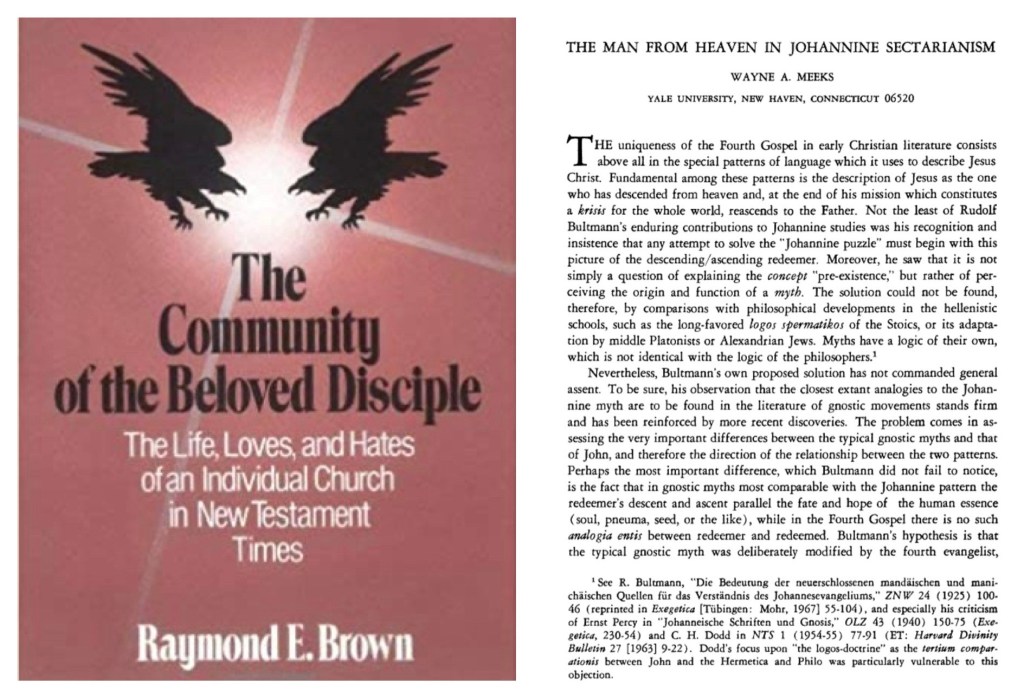
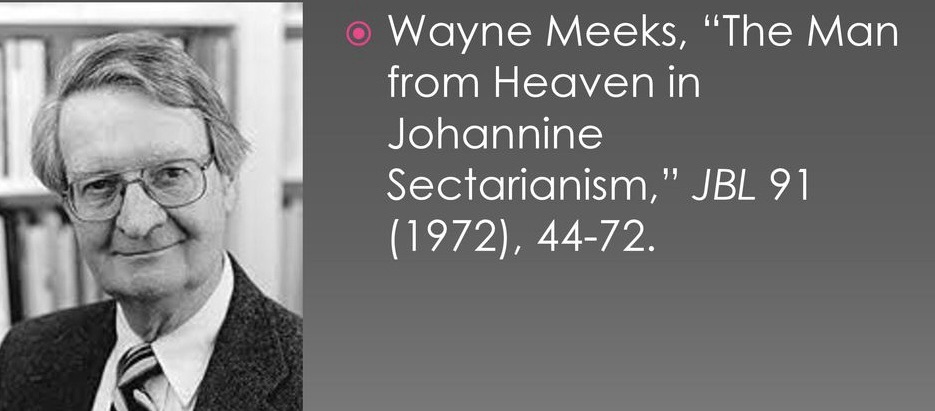
It is this “Johannine sectarianism”, as Wayne Meeks called it, which explains the bruising debates in this Gospel; Jesus, “the man from heaven”, as Meeks styles him, is being remembered as “standing up for the truth” in the face of intense criticism, by a group of people who had been pillaged and persecuted for standing up for what they saw as “the truth”. They had become outsiders; some of them had met death for the stand they took. This was what it meant for them to be faithful to Jesus.

So in the Johannine story of Jesus, the Judaean authorities, and the disciples of Jesus, the die is cast; the antagonism is set. Jesus will head to his death and his followers also will experience “an hour … when those who kill you will think that by doing so they are offering worship to God” (16:2). The fate that is in store for Jesus is the same fate for his followers.

Using the commonplace image of “a grain of wheat [that] falls into the earth and dies” (12:24), Jesus appears to foreshadow his imminent death; “the hour has come for the Son of Man to be glorified” (12:23) is the way that the Johannine Jesus refers to his death (7:39; 11:4; 12:16, 28–33; 13:31–33; 17:1–5).

He follows the saying about the grain of wheat dying, only to “bear much fruit”, with an assertion about his followers: “those who love their life lose it, and those who hate their life in this world will keep it for eternal life” (12:25; the language reflects Mark 8:35; Matt 10:39; 16:25; Luke 9:24; 17:33). The way of Jesus is also the way of his followers.

(At this point, we might want to reflect on how appropriate for us—or how distant from us—this portrayal of Jesus is. How much do I know, personally, of the opposition and conflict that puts my very life in peril, because of what I believe and how I live? In this light, the Johannine Jesus and the community faithful adhered to his way can appear to be alien from the comfortable existence of so many Christians—myself included—in the western world.)

The final verse of this section (not included in the lectionary selection, 6:51–58) is a surprise: “he said these things while he was teaching in the synagogue at Capernaum” (6:59). The chapter had begun on “the other side of the Sea of Galilee, also called the Sea of Tiberias” (v.1), where Jesus had fed the large crowd, before moving “across the sea to Capernaum” (v.17), where Jesus had walked on the water.

When those left on “the other side” of the sea saw the crowd across the lake, “they got into the boats and went to Capernaum looking for Jesus” (v.24), where they found him, engaging him in discussion (v.25). The mention of the synagogue in 6:59 provides a pivot for the narrative then to focus on the disciples, who had been with Jesus “on the other side” (v.3) and then in the boat (vv.6–7). What ensues (v.60 onwards) then maintains a focus on Jesus interacting with the disciples. On which, see next week’s blog …

See previous blogs at

and on the whole sequence of this chapter
A midrashic exposition on “the bread of life” (John 6; Pentecost 12B)

Two weeks ago, the lectionary directed us to turn off the road we were following through the story of “the beginning of the good news of Jesus, Messiah” (which we know as the Gospel of Mark), and spend five weeks with “the book of signs”, which contains just some of “the many things that Jesus did” (which we know as the Gospel of John).

This detour came just at the point when we were going to read the story of when Jesus took “five loaves and two fish, looked up to heaven, and blessed and broke the loaves, and gave them to his disciples to set before the people; and he divided the two fish among them all … [and] those who had eaten the loaves numbered five thousand men” (Mark 6:30–44). The wording is strongly evocative of the Eucharistic words that Mark later reports: “he took a loaf of bread, and after blessing it he broke it, gave it to them …” (Mark 14:22).

Instead, two Sundays ago we read or heard the account that John gives us, with a less-eucharistic flavour, when Jesus “took the loaves, and when he had given thanks, he distributed them to those who were seated; so also the fish, as much as they wanted” (John 6:1–13); and from that passage, we are then guided over the following four Sundays to follow the extensive discourse that Jesus gives to a crowd that “went to Capernaum looking for Jesus” (John 6:25–71).

Last Sunday, John 6:24–35 was the passage that the lectionary proposed as the Gospel reading. This passage ends with the first I AM declaration by Jesus, “I am the bread of life” (6:35).

After hearing that, on the next Sunday (this coming Sunday) we will read or hear the next section of that discourse, dealing with an elaborated exposition of that “bread of life” (6:35–51). That is to be followed by an account of the disputes that this teaching generated with the Judaean authorities (6:51–58), and then the final section of the discourse where Jesus then has to deal with dissent from his own disciples (6:56–69).

I have already offered comments on those two earlier sections, and plan to continue to trace the words and interactions of Jesus from this long chapter in the coming weeks. For today, we focus on the way that Jesus expands and develops his theme of “the living bread which came down from heaven” (6:35–51). And interestingly, after having eschewed a direct eucharistic allusion in the miracle reported earlier, here the Johannine Jesus takes us step-by-step towards a strongly eucharistic understanding. (More on that in coming weeks.)

A key observation that can assist us in understanding this lengthy discourse is that it has the nature of a Jewish midrashic discussion. The Jewish Virtual Library notes that there are two main types of midrash, and defines it as follows: “Midrash aggada derive the sermonic implications from the biblical text; Midrash halakha derive laws from it.”

The article continues: “When people use the word midrash, they usually mean those of the sermonic kind. Because the rabbis believed that every word in the Torah is from God, no words were regarded as superfluous. When they came upon a word or expression that seemed superfluous, they sought to understand what new idea or nuance the Bible wished to convey by using it.” That is how I am understanding the relevance of this section of the discourse in John 6.

See https://www.jewishvirtuallibrary.org/halakha-aggadata-midrash#google_vignette

My Jewish Learning defines midrash as “an interpretive act, seeking the answers to religious questions (both practical and theological) by plumbing the meaning of the words of the Torah. Midrash responds to contemporary problems and crafts new stories, making connections between new Jewish realities and the unchanging biblical text.”

See https://www.myjewishlearning.com/article/midrash-101/

That would indicate that the words of Jesus, in John 6 (as, indeed, elsewhere in the Gospel) were being remembered and retold, expanded and developed, in light of the hopes, concerns, and needs of the community within which this Gospel came into being. In other words, whilst we do not have an accurate historical reporting of “what Jesus actually said”, we do have words which give us a pathway into understanding how at least this group of followers of Jesus understood him, and how they lived in response.

It seems to me that applying a Jewish understanding of how biblical texts are appropriated and understood, through midrash, helps to explain what is happening in John 6. Although it seems repetitive to us moderns, the discourse is actually probing the possibilities and exploring the options in understanding the scripture text that was provided to Jesus by the crowd around him.

Earlier in the chapter, a series of questions have been put to Jesus, moving to a key matter, when the crowd asks: “what sign are you going to give us? … what work are you performing?” (v.30). They continue by quoting scripture (v.31)—a move that is fundamental for the nature of what follows.

By quoting scripture, the crowd gives Jesus his “text” for the teaching that follows. And, of course, as they are Jews, and as Jesus was a Jew, the argument is developed by means of a typical midrashic “playing with the text” in the words that follow. More than that, when we look for the text that the crowd speaks, we find it is a compilation text—something that draws on the post-exilic narrative of the manna from heaven (Exod 16:4 and 15), a poetic retelling of this scene (Psalm 78:24), and an even later Hellenistic-era reporting of this incident (Wisdom of Solomon 16:20).

The fact that we do not have a precise quotation of the text “as we know it” should alert us to the fluidity that was commonplace in the ancient world, when texts were referred to. My own teacher, the late Dr. Robert Maddox (in an unpublished paper entitled “The Use of the Old Testament in John’s Gospel”) put it very clearly:

“The freedom of wording of John’s quotations and allusions is due not to ignorance nor to the nature of the texts he used, but to the fact that he had steeped himself in the Scriptures, as Jesus had before him; and the Biblical text was no longer something external to be reached for to bolster an argument, but something which had become a part of the author’s mind and heart.”

Dr Maddox offers this concise summation of how the author operated: “He treats the Biblical text not with the deference of polite respect but with the freedom of intimate familiarity.”

So, what follows here is a typical Jewish midrash—a use of the text in a somewhat fluid and flexible way that develops and expands a theme. How does Jesus do this? We can be helped by the work of Scandinavian scholar Peder Borgen. He offers a detailed (book-length) analysis of this discourse in the context of the practices and techniques found in rabbinic literature. The book is entitled Bread from Heaven: An Exegetical Study of the Concept of Manna in the Gospel of John and the Writings of Philo (NovTSup 10, 1965).

Borgen compares the midrash undertaken by the Johannine Jesus with midrahim on the same theme found in a third century rabbinic work, the Mekhilta on Exodus 16:15, as well as in a tractate written about a century before John’s Gospel by the Alexandrian scholar Philo, with the title That the Worse is Wont to Attack the Better (Quod det. potior.). (And yes: in preparing to teach John’s Gospel at tertiary level some 25 years ago, I worked carefully through the detailed argument that Borgen has provided!)

Borgen proposes two sections to this midrash: what he calls “a miniature elaboration” in three parts (vv.31–35), followed by “a more detailed elaboration” in four parts (vv.41–51). The first section begins with the scripture citation: “he gave them bread from heaven to eat” (v.31b) and concludes within the full statement of the theme by Jesus: “I am the bread of life. Whoever comes to me will never be hungry, and whoever believes in me will never be thirsty” (v.35).

The second section recapitulates theme, in words attributed to “the Judaeans”, repeating (and expanding) the earlier words of Jesus: “he said, “I am the bread that came down from heaven” (v.41). In between, Jesus engages in a (typical) excursus, discussing “the will of my Father”, which is what he is charged with carrying out (vv.36–40). Belief (v.36) will lead to eternal life (v.40)—a central Johannine motif (see John 3:14–16, 36; 5:24–29; 6:68–69; 11:25–27; 14:6–7; 17:1–3; 20:31).

In the “miniature elaboration” (vv.31–35), after the crowd has stated the key issue in their scripture citation (v.31), Jesus offers an interpretation of this scripture by means of a classic rabbinic-style contrast statement; it is “not Moses … but my Father in heaven” who provided the bread (v.32).

The allusion back to the earlier programmatic declaration in the Johannine prologue is clear: “the law indeed was given through Moses; grace and truth came through Jesus Christ” (1:17). In what follows, Jesus will seek to place himself, as “the bread of life”, in the position occupied by “the Father” in that earlier statement.

So at this point, he pivots from speaking about the bread that God gave from heaven, to speaking about “the true bread from heaven”, himself. An explanation, introduced by the little word gar (“for”), is that Jesus is the bread which “gives life to the world” (v.33). Then, instead of a question, the crowd puts a request to Jesus; “Sir, give us this bread always” (v.34). Which means that Jesus can now make very clear what his thesis is: “I am the bread of life” (v.35).

After the excursus about “doing the will of my Father” (6:40; a matter found also at 4:34; 7:17; 14:13), it is “the Judaeans” who bring Jesus back to the topic at hand. In the “more detailed elaboration” that follows, we find that the restatement of the theme is put onto their lips, as they complain about what he has said (6:41). The use of the verb Ἐγόγγυζον is a deliberate reference to “the murmuring tradition” in the Pentateuch, when the Israelites complained about the hardships of the desert (Exod 15:24; 16:2, 7; 17:3; Num 11:1–2; 14:2–4; 27, 29, 36).

In the objection raised these critics question the authority of Jesus to speak in this way: “Is not this Jesus son of Joseph?” (v.42a), followed by a further repetition of what Jesus is declaring: “how can he now say, ‘I have come down from heaven’?” (v.42b). The placing of the claim made by Jesus on the lips of his opponents—not once, but twice—is a delicious irony!

There follows an answer to this objection, given at some length, by Jesus (vv.43–48). In so doing, Jesus draws himself on another scripture passage (Isa 54:13, at John 6:45). This is absolutely typical of the rabbinic style of midrashic argumentation, in which (as we have seen) an explanation of one text is provided by reference to another scripture text , related by means of a key word or idea.

What Jesus says to them also draws on the typical Joannine motif of Jesus as the one who has “come down from heaven” (v.38; see also 3:13, 27, 31; 12:28; 17:1–5). Another one of my teachers, Professor Wayne Meeks of Yale University, picked up n on the importance of this motif in an article he published just over 50 years ago.

Meeks notes that the claims made about Jesus in the fourth Gospel function as reinforcements of the sectarian identity of the community. As this community had come into existence because of the claims that it had made about Jesus, so the reinforcement of the life of the new community took place, to a large degree, through the strengthening and refining of its initial claim concerning Jesus. What is said about Jesus can also be said about his followers. So what the Johannine Jesus is doing in this long discourse is not simply clarifying his identity; these words provide a reinforcement of how the members of the later community of believers saw themselves in the world. (Again, we will come back to this in a later blog.)

Joh has Jesus make one of his typically exclusivist claims at this point: “not that anyone has seen the Father except the one who is from God” (v.46). Here, Jesus stakes out his claim: he is The Teacher, The Revealer, The One who has seen God and who conveys that truth to those who follow him. This is how “eternal life” is gained: through access to this knowledge, passed on in what Jesus reveals.

So Jesus returns to the main theme with his repeated assertion, “I am the bread of life” (v.48, repeating v.35), and then continues with an expositional development in the following verses. Again he compares “your ancestors” who, although they “ate the manna in the wilderness”, nevertheless died (v.49) with his role, as “the bread that came down from heaven”, which means that anyone eating it will not die (v.50). We are edging into the centre of eucharistic theology at this point, with talk of eating “the bread from heaven”, that is, Jesus. (More on this in a subsequent blog.)

Verse 51 restates what has just been declared: first, the primary affirmation about Jesus: “I am the living bread that came down from heaven”; followed by the consequence for those who believe in him: “whoever eats of this bread will live forever”. It seems redundant to us, but in the midrashic style it is important to synthesize and summarise in this manner.

There is a further step that Jesus takes in what he says at the end of v.51. This also is typical of midrashic style texts; summarise but immediately extend the argument. And the extension that Jesus gives here opens u0 a new issue—one which will be the focus in the following verses, which the lectionary reserves for us to read and hear on the Sunday after this coming Sunday. “The bread that I will give for the life of the world”, Jesus declares, “is my flesh” (v.51c). And so a new matter requires attention … which we will explore in the blog for the Sunday after this coming Sunday.

See also

and on the whole sequence of this chapter

The Bread of Life: take one (John 6; Pentecost 11B)

Last Sunday, the lectionary took us away from the Gospel of Mark, with an awkward detour into the Gospel of John that will see preachers being invited to grapple for another four weeks with a long, extended discourse of Jesus revolving around the first of seven I AM statements found in this Gospel. The statement that “I am the bread of life” has been motivated by the account of Jesus miraculously feeding a large crowd with only “five barley loaves and two fish”, which is told in the passage heard last Sunday (John 6:1–21).

This coming Sunday, this awkward detour leads us into the opening section of this long discourse, as John 6:24–35 is the passage that the lectionary proposes as the Gospel reading. This passage ends with the first declaration by Jesus, “I am the bread of life” (6:35). After this week, we are in store for further sections of that discourse, dealing with an elaborated exposition of that “bread of life” (6:35–51), the disputes that this teaching generated with the Judaean authorities (6:51–58), and the final section of the discourse where Jesus then has to deal with dissent from his own disciples (6:56–69).

I have often heard preachers grumble about the repetitive nature of these selections—“not another week on ‘the bread of life’”—but I think that this underestimates the intricacy of this chapter, and the complexity of the issues that are signalled as Jesus pursues his teaching about “the bread of life”. So the challenge I am taking up is to offer a series of four blogs in which a number of those issues are explored and explained.

Perhaps the first stumbling block in dealing with this chapter is that it does appear to be incredibly repetitive. The phrase “the bread of life”, for instance, appears four times (6:33, 35, 48, 51), with the stylistic variant “the bread from heaven” another five times (6:31, 32a, 41, 50, 58), the intensified phrase “the true bread from heaven” (6:32b), and “the living bread that came down from heaven” also in 6:51. That does, to be fair, seem like overkill. But other discourses in this distinctive Gospel exhibit a similarly repetitive style (as, indeed, does the first letter attributed to John). It is a particular style which characterises this Gospel—one of the many features that set it apart from the three Synoptic Gospels.

Each discourse in the series of discourses found in the first half of John’s Gospel displays some standard features. Each discourse arises out of a specific incident; in this case, the feeding of the large crowd (6:1–21) is the stimulus for discussing “the bread of life”. The discourse picks up a key word or idea from the report of the incident and develops that idea by relentless repetition. That is an integral part of its style. So there are eleven references to bread in ch.6, just as there had been seven references to water in ch.4, seven references to life or living in ch.5, and later there are twelve references to sheep in ch.10.

In typical Johannine style, the thesis of the discourse is driven by questions and misunderstandings. Questions invite an answer; misunderstandings require an explanation. And so the argument in this whole chapter proceeds by means of a series of questions.

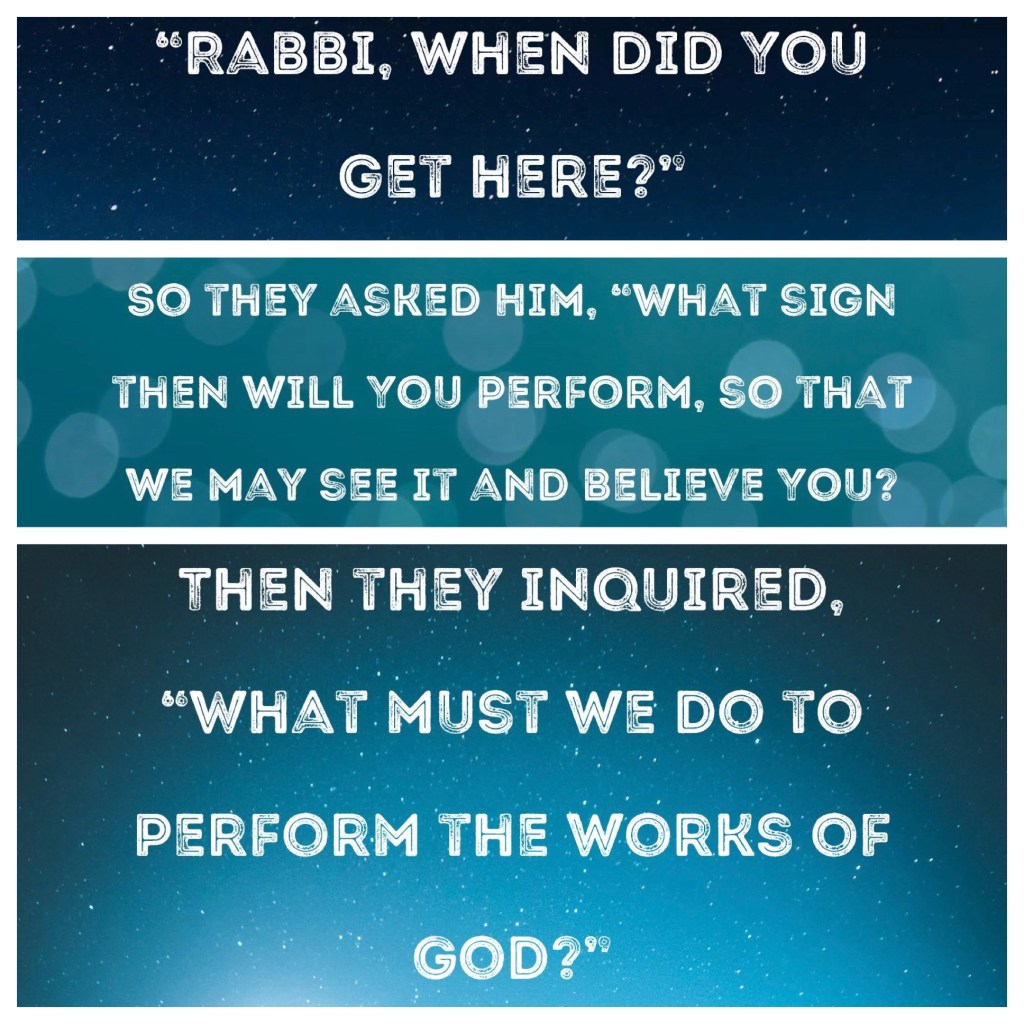
First, after the feeding of the large crowd and the crossing of the lake (vv.22–25), the crowd asks Jesus, “ Rabbi, why did you come here?”(v.25). This opens the way for Jesus to explain that his work is not “for the food that perishes [a reference to the loaves of bread that they had recently eaten], but for the food that endures for eternal life” (v.27). And so the theme for the discourse that follows is set; and the irony that is embedded in the language of “bread” becomes foundational for what follows.

Next, they ask Jesus, “what must we do?” (v.28), allowing Jesus then to define the nature of “the works of God” as “that you believe in him whom he has sent” (v.29)—that is, in Jesus himself. Next, the crowd asks a third question: “what sign are you going to give us? … what work are you performing?” (v.30). They continue by quoting scripture—a move that will prove to be fundamental for the nature of what follows.

By quoting scripture (a variant of Exod 16:4 and 15; also Psalm 78:24) the crowd is gives Jesus his “text” for the teaching that follows. And, of course, as they are Jews, and as Jesus was a Jew, the argument is developed by means of a typical midrashic “playing with the text” in the words that follow. We will come back to the midrashic nature of this discourse in a later blog.

Jesus offers an interpretation of this scripture; it is “not Moses … but my Father in heaven” who provided the bread (v.32). At this point, he pivots from speaking about the bread that God gave from heaven, to speaking about “the true bread from heaven”, himself. He is the bread which “gives life to the world” (v.33).

So this section of the discourse ends, not with a question, but with a request from the crowd; “Sir, give us this bread always” (v.34). Which means that Jesus can now make very clear what his thesis is: “I am the bread of life” (v.35). And so, at last, we get to the point! And at this point, the lectionary passage for this Sunday stops—but we will return next week!

This statement is one of a number of “I Am” statements that are placed on the lips of Jesus in the book of signs, which we know as the Gospel according to John. These sayings comprise a verb (“I am”) followed by a predicate (the entity which Jesus claims to be). The predicates in most of these sayings are drawn from traditional Jewish elements.

When Jesus calls himself “the bread of heaven” (6:25–59), he is clearly evoking the scriptural account of the manna in the wilderness (Ex 16:1–36; Num 11:1–35; Pss 78:23–25; 105:40). The discourse which develops from this saying includes explicit quotations of scripture, as well as midrashic discussions of its meaning.

When Jesus presents himself as “the vine” (John 15:1–11), he draws on a standard scriptural symbol for Israel (Ps 80:8; Hos 10:1; Isa 5:7; Jer 6:9; Ezek 15:1–6; 17:5–10; 19:10–14). Likewise, when Jesus calls himself “the good shepherd” (10:1–18), he evokes the imagery of the good shepherd as the true and faithful leader in Israel (Num 21:16–17; Ezek 34:1–31; Jer 23:4), and the people as the sheep who are cared for (Pss 95, 100; Ezek 34:31).

The statement that Jesus is “the light of the world” (8:12; 9:1–5) evokes the story of the creation of light (Gen 1:3–5) and the light which the divine presence shone over Israel (Exod 13:21–22). The Psalmist uses the imagery of light to indicate obedience to God’s ways (Pss 27:1; 43:3; 56:13; 119:105, 130; etc.), and it is a common prophetic motif as well (Isa 2:5; 42:6; 49:6; Dan 2:20–22; Hos 6:5; Mic 7:8; Zech 14:7; cf. the reversal of the imagery at Jer 13:16; Amos 5:18–20).

Although it is not part of an “I am” statement, the references to the “living waters” which flow from Jesus (4:7–15; 7:37–39) are reminiscent of the water which were expected to flow from the eschatological temple (Ezek 47:1; Joel 3:18; Zech 14:8), and, more directly, refer to the description of God used by the prophet Jeremiah (Jer 2:13).

In addition, biblical scholars have noted that rabbinic symbolism has affinities with Johannine symbols; for example, the terms bread, light, water and wine are all used by the rabbis in connection with the Torah. The author of John’s Gospel stands in the stream of Jewish writers who have used multiple images to convey their faith in the Lord God.

Thus, the distinctive set of Christological claims made for Jesus in the Gospel according to John seek to enter into this stream of writing. They are both thoroughly grounded in scriptural images and familiar from the ongoing traditions taught by the rabbis. The author of this Gospel is using a number of ways to declare his faith in Jesus as “the Word of God”, “the Way”, and indeed as being at one with God. It is a high claim.

Amidst the variety of Jewish voices at the end of Second Temple Judaism clamouring to be holders of “the truth”, using a wide variety of rhetorical means, this author seeks to position his community—a sectarian Jewish group—as the holder of the true faith, the ones who adhere most clearly to what the Lord God requires amongst his faithful people. And for this group, it is Jesus of Nazareth who most clearly and faithfully leads them along that pathway of understanding and living.

See more on this understanding of the community of John at

So this discourse addresses what we might assume to have been a well-known and widespread understanding of the nature of God amongst Jews of the time; he is the one who provides the bread to nourish and sustain lives of faith. When Jesus lays claim to being “the true bread”, it is yet another moment when he says, quite poetically, what he later declares in a very prosaic manner: “the Father and I are one” (10:30).

*****

Still to come in considering the lectionary passages from John 6 that lie ahead:

Jesus offers a midrashic exposition on “the bread of life” (6:35–51): how does Jesus operate in his Jewish context?

Disputing the claim of Jesus to be “the bread of life” (6:51–58): the characters in the story John tells, the sectarian nature of his community

The Johannine remembrance of Eucharistic communion and the community’s distinctive “structure of reality” (6:56–69)

and on the various I AM statements

The true vine (John 15; Easter 5B)

The Gospel passage that the lectionary designates for reading this coming Sunday opens with the statement by Jesus, “I am the true vine, and my Father is the vinegrower” (15:1). In a later verse, the statement is reworked: “I am the vine, you are the branches” (15:5).

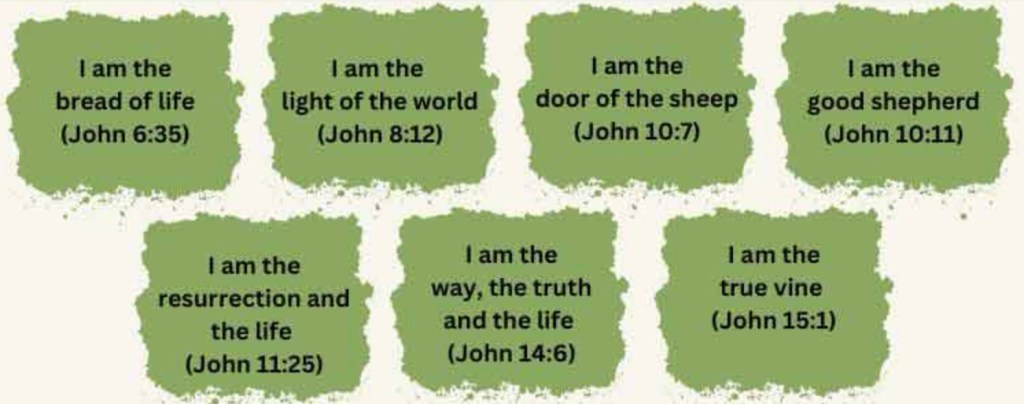
“I am the vine” is the last in a series of seven I AM statements found within the book of signs, the Gospel we attribute to John. “I am the bread of life” (6:48) is the first such instance in this series. The others are “the light of the world” (8:12), “the door of the sheep” (10:7, 9), “the good shepherd” (10:11, 14), “the resurrection and the life” (11:25), “the way, the truth, and the life” (14:6), and “the true vine” (16:1).

The vine, of course, was a standard image for Israel. The psalmist sings, “you brought a vine out of Egypt; you drove out the nations and planted it; you cleared the ground for it; it took deep root and filled the land; the mountains were covered with its shade, the mighty cedars with its branches; it sent out its branches to the sea, and its shoots to the River” (Ps 80:8–10). The prophet Hosea reflects a similar understanding, declaring, “Israel is a luxuriant vine that yields its fruit; the more his fruit increased, the more altars he built; as his country improved, he improved his pillars” (Hosea 10:1–2).

In the book of Judges, Jotham, the youngest son of Jerubbaal, tells a parable in which the trees seek a king, asking first the olive tree and the fig tree, before approaching to the vine, saying, “You come and reign over us”. However, the vine replied, “Shall I stop producing my wine

that cheers gods and mortals, and go to sway over the trees?”, before the bramble ultimately accepted the role (Judg 9:8–15).

Various prophets portray Israel as a vine. Isaiah sings God’s “love-song for my beloved … concerning his vineyard”, in which Israel is portrayed as the vineyard. He ends it by declaring that God “expected justice, but saw bloodshed; righteousness, but heard a cry!” (Isa 5:1–7).

In similar vein, Jeremiah laments the state of Israel, conveying God’s plea, “I planted you as a choice vine, from the purest stock. How then did you turn degenerate and become a wild vine?” (Jer 2:21). In a later oracle, the lament continues: “I wanted to gather them, says the Lord, there are no grapes on the vine, nor figs on the fig tree; even the leaves are withered, and what I gave them has passed away from them” (Jer 8:13).

Fellow prophet Ezekiel also utilises the imagery of the vine as a way to berate Israel for its sinful state. He reflects on the uselessness “the vine branch that is among the trees of the forest”—nothing useful is made from it, it simply provides wood for the fire (Ezek 15:1–8). The prophet draws the pointed comparison: “thus says the Lord God: like the wood of the vine among the trees of the forest, which I have given to the fire for fuel, so I will give up the inhabitants of Jerusalem; I will set my face against them” (Ezek 15:7–8).

Another parable told by Ezekiel involves a vine, planted and flourishing; it bore fruit and became a noble vine (Ezek 17:3–19). The parable ends with the rhetorical questions, “Will it prosper? Will he not pull up its roots, cause its fruit to rot and wither, its fresh sprouting leaves to fade? No strong arm or mighty army will be needed to pull it from its roots” (Ezek 17:9). Regarding the king who presides over this situation, God declares, “I will surely return upon his head my oath that he despised, and my covenant that he broke. I will spread my net over him, and he shall be caught in my snare; I will bring him to Babylon and enter into judgment with him there … all the pick of his troops shall fall by the sword, and the survivors shall be scattered to every wind” (Ezek 17:19–21).

A third use of the image begins positively, as Ezekiel speaks to the people, “Your mother was like a vine in a vineyard transplanted by the water, fruitful and full of branches from abundant water. Its strongest stem became a ruler’s sceptre; it towered aloft among the thick boughs; it stood out in its height with its mass of branches” (Ezek 18:10–11). But the sins of the people meant that God plucked out the vine and burnt it in fury, “so that there remains in it no strong stem, no sceptre for ruling” (Ezek 18:12–14).

In developing this parabolic image, Jesus applies it to his followers, both positively and negatively. The negative application comes directly from the way the prophets used this image in their parables and oracles; Jesus declares that “whoever does not abide in me is thrown away like a branch and withers; such branches are gathered, thrown into the fire, and burned” (John 15:6).

The more positive dimension of the imagery receives a more extended treatment by Jesus, both in this chapter and in other places in John’s Gospel. “Those who abide in me and I in them bear much fruit, because apart from me you can do nothing”, says Jesus (John 15:5b). “If you abide in me, and my words abide in you, ask for whatever you wish, and it will be done for you”, he continues (15:7).

The close relationship of the vine and the branches thus provides significant statements about the mutual indwelling of the Son with the disciples, in these verses. This is a theme that runs throughout John’s Gospel. “Abide in me as I abide in you. Just as the branch cannot bear fruit by itself unless it abides in the vine, neither can you unless you abide in me. I am the vine, you are the branches.” (15:4–5a).

The sense of “abiding in” is a mysterious inner connection that binds followers to their master; but because that master has likewise been bound with the Father, the intimacy of connection between Father, Son, and disciples is clear. In an earlier chapter, where the saying “I am the bread of life” is prominent, the Johannine Jesus had introduced this theme in relation to Eucharistic practice: “those who eat my flesh and drink my blood have eternal life, and I will raise them up on the last day … those who eat my flesh and drink my blood abide in me, and I in them” (6:54, 56).

Thus, in the extended explanation that Jesus had provided in response to the request of Philip, “Lord, show us the Father” (14:8), he affirms that “you will know that I am in my Father, and you in me, and I in you” (14:20). Those who are linked inextricably with the Son, who abide in him, are linked through his intimate connection with the Father, as he abides in the Father. Father, Son, and Disciples: this is what I refer to as the Johannine version of the trinity; it comes to full fruition in the chapter that provides the Gospel,passage for the Sunday after this coming Sunday (John 17).

On the way that this three-part unity of Father, Son, and Disciples is developed in John’s Gospel, see more detail at