I had a dream (Genesis 27–28; Narrative Lectionary for Pentecost 15) 

A discussion of the passage in the Narrative Lectionary for Pentecost 15

There are some famous dreams throughout history. “I have a dream”, said the Rev. Martin Luther King Jr, speaking in Washington on 28 August 1963, “a dream that my four little children will one day live in a nation where they will not be judged by the color of their skin but by the content of their character. I have a dream today.” That may be the most famous dream in the 20th century.

There have been other significant dreams in modern times. Paul McCartney woke from a dream and wrote the whole score of “Yesterday”. Mary Shelley’s novel “Frankenstein” was inspired by a nightmare. Niels Bohr had a dream in which he saw “the nucleus of the atom, with electrons spinning around it, much as planets spin around their sun”; and thus he developed his theory of atomic structure—a theory later proven by experimental investigation.
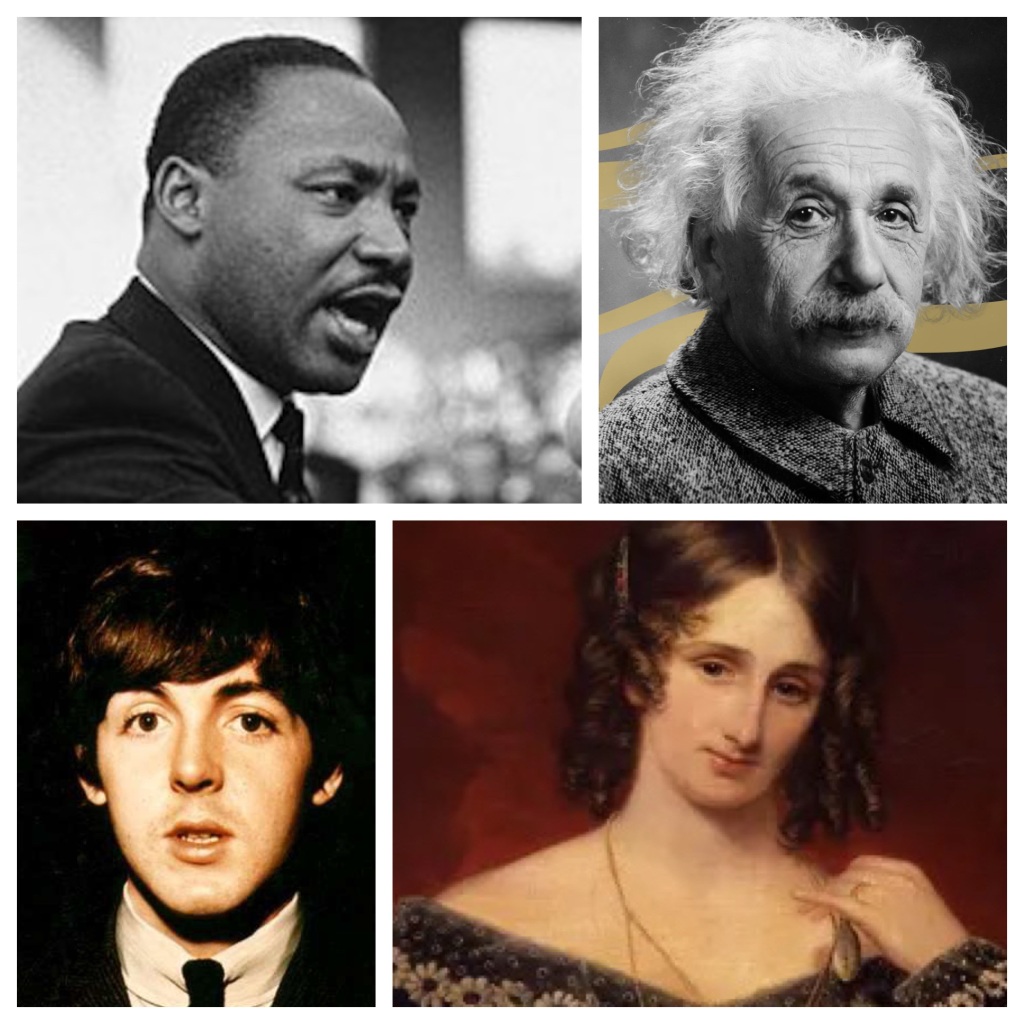
In like manner, Albert Einstein is said to have posed his theory of relativity in a dream in which “he was sledding down a steep mountainside, going so fast that eventually he approached the speed of light … at this moment, the stars in his dream changed their appearance in relation to him”; while it was a dream that led Frederick Banting to develop insulin as a drug to treat diabetes.

I found these and other significant modern dreams described at

https://www.world-of-lucid-dreaming.com/10-dreams-that-changed-the-course-of-human-history.html

*****

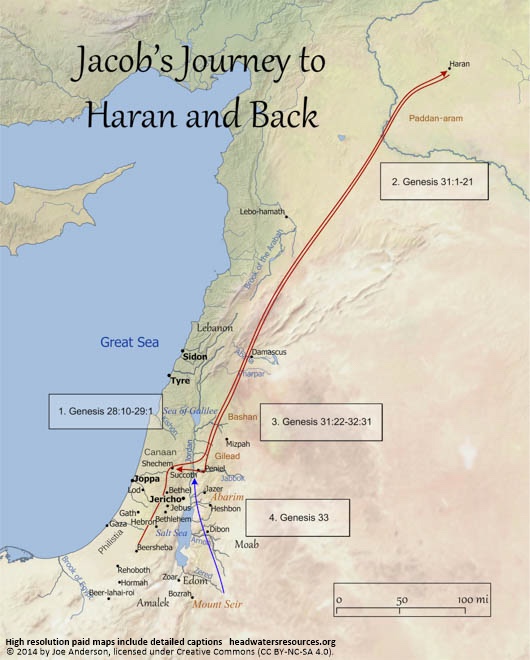
A part of the Hebrew Scripture readings that are offered by the Narrative Lectionary for this coming Sunday (Gen 28:10–17) includes a dream that Jacob had, as he slept one night. He was journeying from Beer-sheba, in the Negeb desert in the south of Israel, which is where he had received a blessing from his father, Isaac. This blessing, as we hear in the other section of scripture offered for this Sunday, was won by trickery,as he took the blessing that was intended for Esau  (Gen 27:1–4, 15–23). Which explains the name given to Jacob: he is “the one who supplants” (see Hos 12:3).

Isaac was travelling north towards Haran, the place from which Abram and Sarai had left on their journey towards the land of Canaan, the land which God had promised to him (12:1, 4–5). So the journey that Jacob is undertaking is a reversal, in direction and orientation, of the earlier journey that his grandfather had undertaken. 
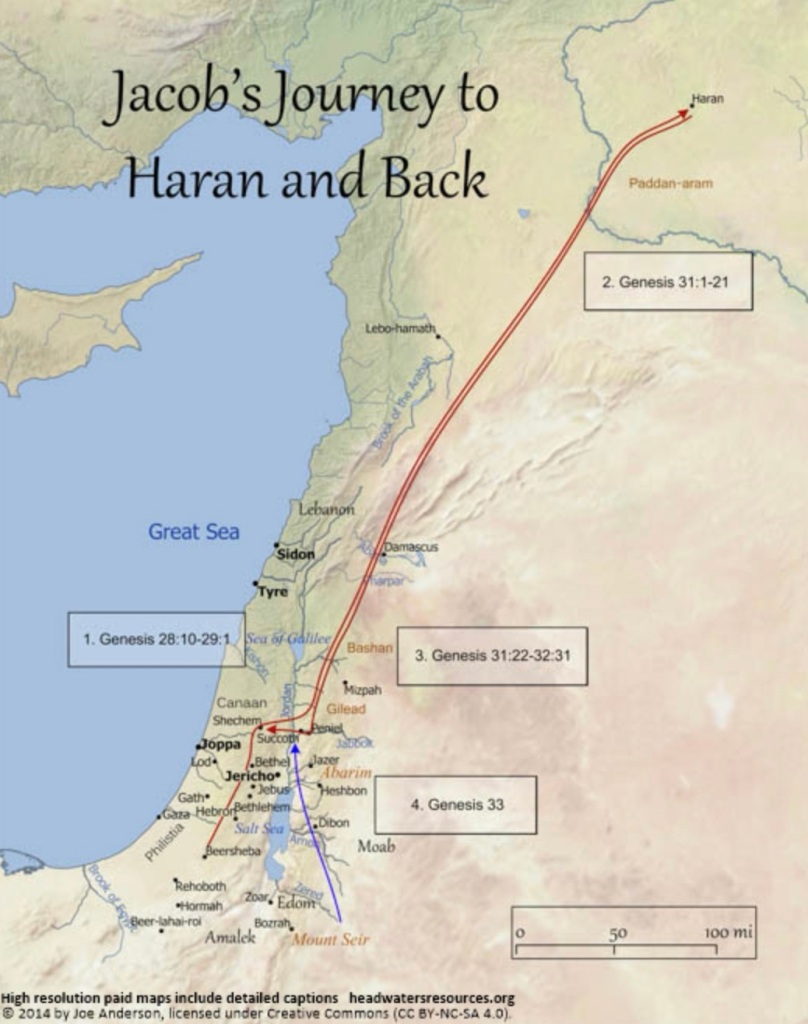
He was travelling to escape the anger of his brother Esau, after he had tricked their father Isaac into blessing him, Jacob, gifting him with the inheritance that was rightly owed to Esau (27:41). Abraham had travelled south in order to receive God’s blessing. Jacob travels in the other direction after having deceitfully gained his father’s blessing.

We are told that, understandably, “Esau hated Jacob because of the blessing with which his father had blessed him” (27:41), and that he threatens to murder his brother, once “the days of mourning for my father” are completed (27:42). Learning of this hatred, Rebekah advises her son, “flee at once to my brother Laban in Haran, and stay with him a while, until your brother’s fury turns away” (27:43–44).

Whether he had been tipped off about this by Rebekah, or not, Isaac commissions his son to journey back to the homeland—in another case of “don’t marry one of these folks, go back to our homeland and marry one of our own” (as we saw with Abraham and Isaac). Isaac says to Jacob, “you shall not marry one of the Canaanite women; go at once to Paddan-aram to the house of Bethuel, your mother’s father; and take as wife from there one of the daughters of Laban, your mother’s brother” (28:1–2). So Jacob obeys him. 

It is on this journey of escape that Jacob has his striking dream. Jacob is not the first to have encountered God in a dream, in these ancestral sagas. Abimelech of Gerar heard from God in a dream (20:3–7). After Jacob’s dream at Bethel (28:12–15), Jacob has a further dream regarding a flock of goats, relating to his inheritance, urging him to return to Isaac in the land of Canaan (31:10–16). At the same time, God appeared in a dream to Laban (31:24), conveying instructions which he disobeyed. 

The two great “dreamers” in Hebrew Scripture are, of course, Joseph, one of the sons of Jacob, and Daniel, one of the courtiers of Nebuchadnezzar of Babylon, many centuries later. Both men not only dream dreams, but offer interpretations—and interpret dreams that have been dreamt by others. Jeremiah, too, knew of those who claimed that they encountered God in dreams, but warns that understanding those dreams correctly is important (Jer 23:28; 29:8–9). 

And dreams as the vehicle for divine communication is found in an important New Testament story, when Joseph learns of the pregnancy of Mary, in Matt 1–2. “Dreaming dreams” is actually an activity inspired by the Spirit, as Joel prophesied (Joel 2:28) and Peter reminds the crowd on the day of Pentecost (Acts 2:17).

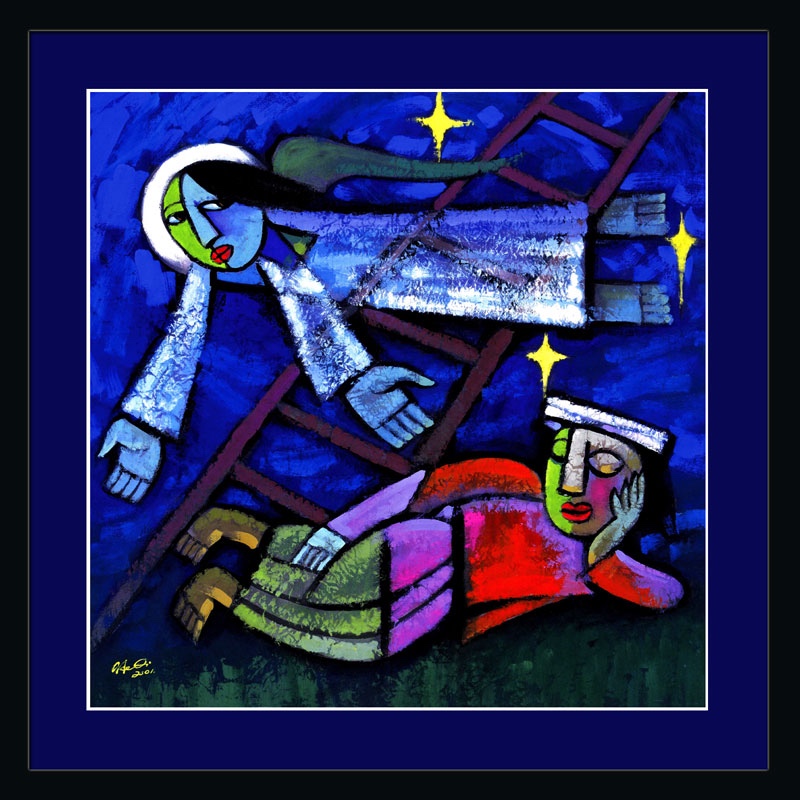
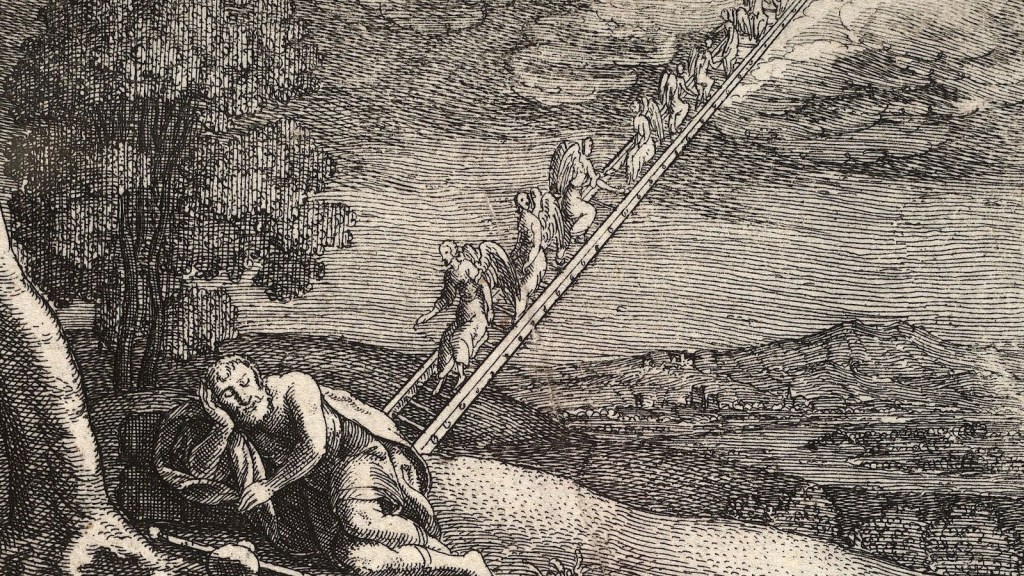
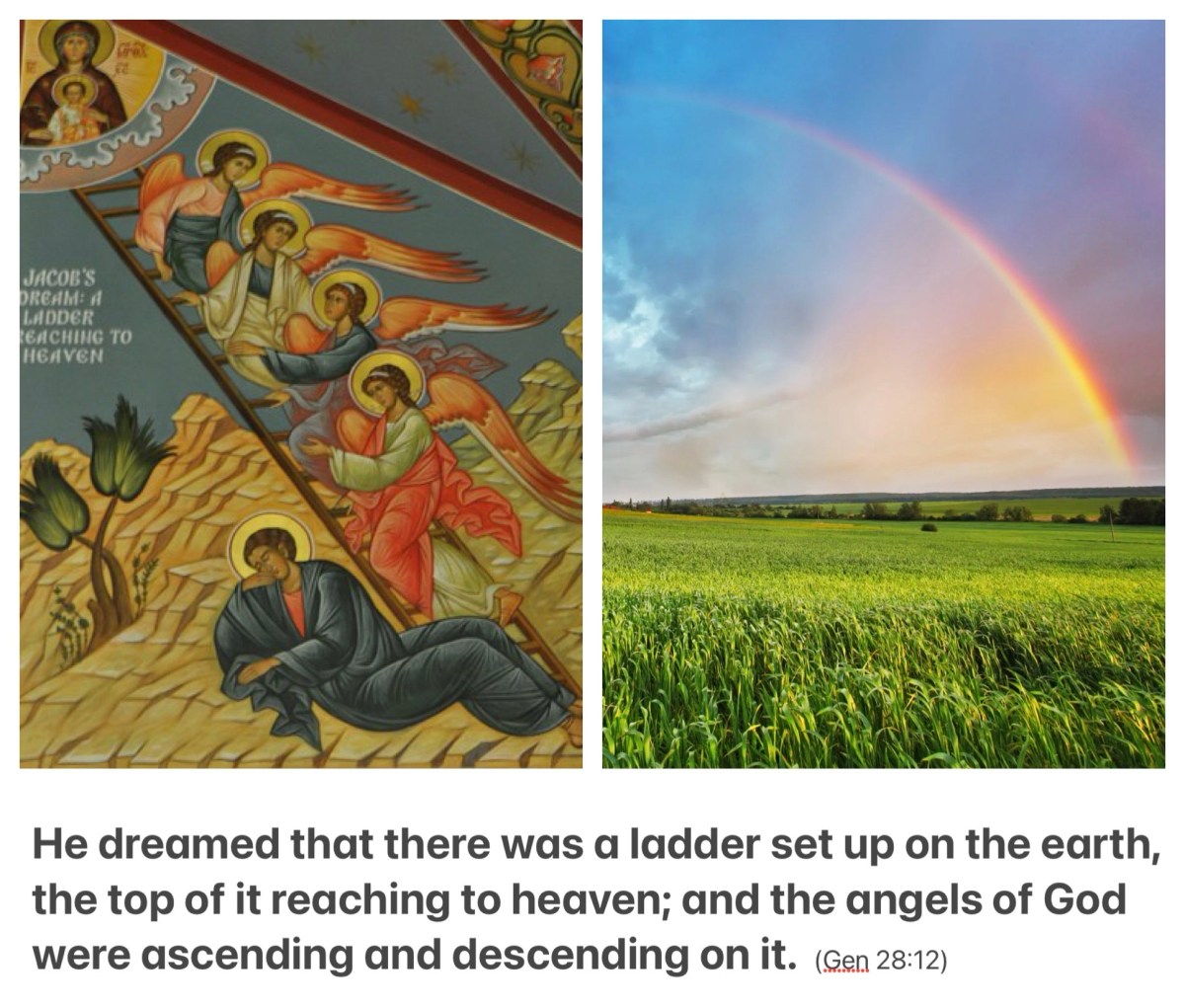
In the story we hear this coming Sunday, Jacob sleeps. As he does, he dreams that “there was a ladder set up on the earth, the top of it reaching to heaven; and the angels of God were ascending and descending on it” (28:12). What do we make of that dream?

In My Jewish Learning, Pinchas Leiser quotes from a book entitled Ruah Chaim (“the breath of life”), by Rabbi Haim of Volozhin. The Rabbi, who lived from 1749 to 1821, was a student of the Vilna Gaon (1695–1785), the pre-eminent sage of Lithuanian Jewry whose ideas were fundamental for the development of modern Jewry. Rabbi Haim writes:

“Our sages come to teach us that we ought not think that, because of our base material, we are truly despicable, like mere plaster on a wall. About this it says, a ladder stationed on the earth–that is Sinai; and its top reaches the heaven–which represents our soul’s life, which is in the highest sphere. There are even souls that see God, and they are the highest of the high, higher than ministering angels, and by this status can the soul cleave to Torah . A whole person is like a tree whose roots are above, and whose trunk extends downward, which is the body, and which is fastened to its supernal roots.”

Pinchas Leiser, a Jewish psychologist and educator, comments: “Thus, Rabbi Haim of Volozhin views Torah learning as a Sinaitic event, since Torah is what connects the heavens and the earth. With Torah, one can ascend and descend between the two spheres. The people who do so are angel-like.” 

This is a penetrating insight into the nature of human beings. We are not spiritual beings, trapped in the prison of the material world, as Plato imagined (and as many writers, including Paul, who were influenced by his philosophy, wrote). Rather, we are fully nephesh, creatures of God containing both material and spiritual characteristics. We belong both to earth and to heaven.

The ladder which Jacob saw reveals this true nature, and tells us that we can transport ourselves between the two places, if we would only open ourselves to the possibility. Jacob’s dream was archetypal—it illustrated exactly who we are and how we can live!

And for me, as a Christian reader, it is important to note that this story (and, indeed, many others in Hebrew Scripture) undermines the crass stereotyping of ancient Israelites—and modern Jews—as alienated from God, crushed under unbearable burdens, far from the grace of God. For this ancient story, told orally for many years before it was ever written down, portrays the possibility of a close and enduring relationship with God, accessible from the patriarch Jacob onwards.

Accompanying the dream of Jacob is a sense of the presence of God; the divine speaks to Jacob, assuring him that God will never leave him. Jacob could never go beyond God’s keeping; angels accompany him on his onward journey to northern Mesopotamia, which was his destination (Gen 29:1). These angels keep going up and coming down on the ladder during this journey; more than this, they continue to accompany him for the twenty years he spends in Haran and then travel with him on his return to the land of Canaan (Gen 31:11; 32:1). The story has a strong sense of the enduring, faithful nature of God’s accompaniment of people of faith throughout their lives.

God’s grace is at work in this story. Jacob was an outcast who had deceived his father and lost friends. Seeking God was probably far from his mind; human company was probably what he yearned for. Nevertheless, he was guided by God at this point of need, offering him revealed care and an assurance for the future. Even though he was not expecting grace, grace was unleashed upon Jacob with no word of blame.

So there is a sign of God’s grace in this story—the ladder connecting heaven and earth, on which “angels” ascend and descend at will. God meets Jacob, even as he is running away from family, and perhaps also running away from God; God meets Jacob in a dream. Jacob was fleeing the consequences of his deception of his father. He wanted to be far away from Isaac, whom he deceived, and Esau, from whom he stole the birthright. And in the midst of that journey, God offers a sign of acceptance and grace in this dream.

Indeed, scripture had offered an earlier sign of God’s grace, in the story of Noah. This is a terrible story—God deliberately and intentionally destroys the world, and “starts all over again”. Only Noah and his family, and the animals on his ark, are saved. The rainbow in the sky is the sign of God’s grace for those who have survived, signalling that God will never again destroy the creation.

The ladder represents the commitment that God has, to an enduring connection with human beings, no matter what their situation. It is a sign of God’s grace—for which we can be thankful.

“Here comes this dreamer” (Gen 37, 50; Narrative Lectionary for Pentecost 18C)

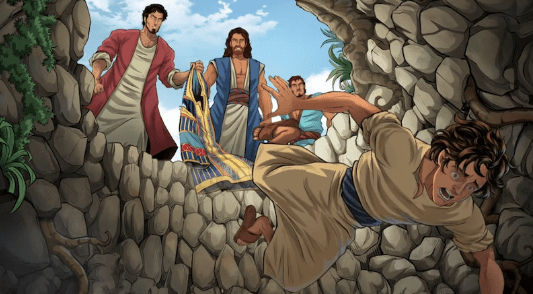
“Here comes this dreamer. Come now, let us kill him and throw him into one of the pits; then we shall say that a wild animal has devoured him, and we shall see what will become of his dreams” (Gen 37:19–20). There it is: “brotherly love” on display, for everyone to see! 

The sons of Jacob, who became the sons of Israel, and then gave their names to “the twelve tribes of Israel”, as we saw in an earlier blog, are terrible role models. They show us fraternal jealousy and hatred at its worst. The first part of the story offered by the lectionary for this coming Sunday pulls no punches (Gen 37:3–8, 17b—22). These sons could be mean!

The chapters before this have told the stories of the three patriarchs of Israel, Abraham, Isaac, and Jacob, and their wives, the four matriarchs Sarah, Rebekah, Leah, and Rachel—although Jacob is still alive, and he will figure in some of the final scenes of Genesis in chapters 46 and 48—50. We turn our attention to Joseph, who had been born to Jacob’s wife Rachel, after years of waiting. 

Only after his first wife Leah had given birth to six sons and a daughter, did Rachel give birth, as God “heeded Rachel and opened her womb” (Gen 30:22). As a sign of the passing of her barren state, Rachel declared, ‘God has taken away my reproach’; and we read that “she named him Joseph, saying, ‘May the Lord add to me another son!’ (Gen 30:23). That son, Benjamin, came years later, although Rachel tragically died giving birth (Gen 35:16–20).

We meet Joseph in the passage offered by the lectionary, which notes that, as he grew, Joseph was the favoured son (Gen 37:3). Of course, this fostered the jealousy of his brothers, who “hated him, and could not speak peaceably to him” (Gen 37:4). And so the scene is set for the problematic sequence of events that ensues, as his brothers initially plot to kill him (Gen 37:19–20), before Reuben intervenes (Gen 37:21–23).

We should note that the ethical standards of the people in these ancestral stories leaves something to be desired for us,with our modern sense of ethical standards.  Cheating, stealing, rape, incest, murder, and double dealing appear to be par for the course. Yet these brothers who plot to kill Joseph are the men who give their names to the tribes of Israel—names that are given pride of place in the priestly garments (Exod 1:1–4; 28:9–12, 21, 29; 39:6–7, 14) and in the later history of the people (1 Chron 2:1–2). 

That these stories of their murky ways of operating have been preserved, passed on, and preached on with regularity, is quite remarkable! Perhaps we should reflect that human beings have always been flawed? Or that we should well expect that the ethical standards and cultural practices of our time are different from what held sway in past eras?

And perhaps we need also to note—and take caution from the observation—that this particular incident, selling Joseph for twenty pieces of silver, has fed into the unhelpful stereotype of the Jews who are always and in every way concerned about money. It’s a stereotype that has fed the burgeoning antisemitic attitude and actions of people throughout the Middle Ages, past the Enlightenment on into the modern age—culminating, of course, in the horrors of the Shoah (Holocaust) in Nazi Germany. See

https://antisemitism.adl.org/greed/

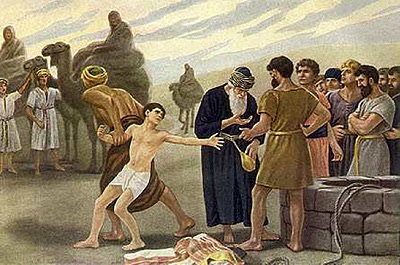
Back to the story of Genesis 37. That the brothers plot to kill Joseph, and are only dissuaded by the intervention of Reuben (Gen 37:21–23), is clearly a mark against them. That Judah then suggests that they sell him to a passing caravan of Ishmaelites (Gen 37:25–28), whilst it saves the life of Joseph, is yet another mark against the brothers.

Christian readers will perhaps compare the “twenty pieces of silver” that was paid for Joseph (Gen 37:28) with the thirty pieces of silver paid to Judas for handing Jesus over to the authorities (Matt 26:15). However, a number of passages in Hebrew Scriptures provide a more fitting contrast to the price paid for Joseph. 

Abimelech, in his unsuccessful attempt to install himself as king in Israel, took “seventy pieces of silver out of the temple of Baal-berith with which [he] hired worthless and reckless fellows, who followed him” (Judg 9:4). So twenty pieces are significantly less. 

And the story is told in Judges about when the lords of the Philistines bribed Delilah with eleven hundred pieces of silver to hand over Samson to them (Judg 16:5; 17:1–5), and in the Song of Songs the (poetically-exaggerated) claim is made that Solomon expected a thousand pieces of silver from each of the keepers of his vineyard (Song 8:11). So twenty pieces pales into utter significance, by comparison. Was Joseph worth so little.

The irony is that Israel as a whole is identified with reference to Joseph at a number of places in the Hebrew Scriptures. Both narrative texts and prophets refer to the whole nation as “the house of Joseph” (Josh 17:17; 18:5; Judg 1:22–23, 35; 2 Sam 19:20; 1 Ki 11:28; Amos 5:6; Obad 1:18; Zech 10:6). 

The psalms sing of “the descendants of Jacob and Joseph” (Ps 77:15) and bring petitions to God, “Shepherd of Israel, you who lead Joseph like a flock” (Ps 80:1). Psalm 81 places Joseph alongside Jacob and Israel: “it is a statute for Israel, an ordinance of the God of Jacob, he made it a decree in Joseph, when he went out over the land of Egypt” (Ps 81:4–5). The name of Joseph was revered in the ongoing traditions of Israel.

So let us treasure and reflect on this story, in which Joseph is sold off to foreign travellers. His life had been saved from the plotting of his brothers by a compassionate intervention by one of their number; but he is taken off into Egypt—for what fate? 

Reading the story chapter-by-chapter, as it appears in Genesis, we don’t yet know the significance of Egypt (other than the account of the time that Abram and Sarai spent in Egypt in Gen 12:10—13:12). But people hearing the story when it was written into the scrolls, after the return from Exile, would know of the time of slavery spent by their ancestors in Egypt, when “the Egyptians became ruthless in imposing tasks on the Israelites, and made their lives bitter with hard service” (Exod 1:13–14). They know the ominous threat that lies over Joseph at the end of this week’s story: “they took Joseph to Egypt” (Gen 37:28).

That fate is symbolised by the note in the immediately following verses, that the brothers of Joseph dipped his coat into the blood of a slaughtered goat and brought it back to Jacob. When Jacob recognized the coat, he concluded that “a wild animal has devoured him; Joseph is without doubt torn to pieces” (Gen 37:33). Jacob mourned for many days; despite the best efforts of his family, “he refused to be comforted, and said, ‘I shall go down to Sheol to my son, mourning” (Gen 37:35).

The narrative leaves Joseph with the tantalising comment that he was sold by the Midianites to Potiphar, one of Pharaoh’s officials (Gen 37:36), before veering off to tell a long story about Judah and Tamar (Gen 38). The question remains: what fate awaits Joseph?

After Joseph is sold off to the Egyptians (Gen 37), much happens that the lectionary skips over. Potiphar makes Joseph his personal attendant; he was in charge of the entire household. There is a subplot concerning Potiphar’s wife and Joseph, resulting in Joseph being imprisoned (Gen 39). However, the chief gaoler liked Joseph and put him in charge of all the other prisoners, including Pharaoh’s butler and baker. One night both the butler and the baker had strange dreams, which Joseph interpreted in ways that soon came true. Joseph gained a reputation as a dream interpreter (Gen 40).

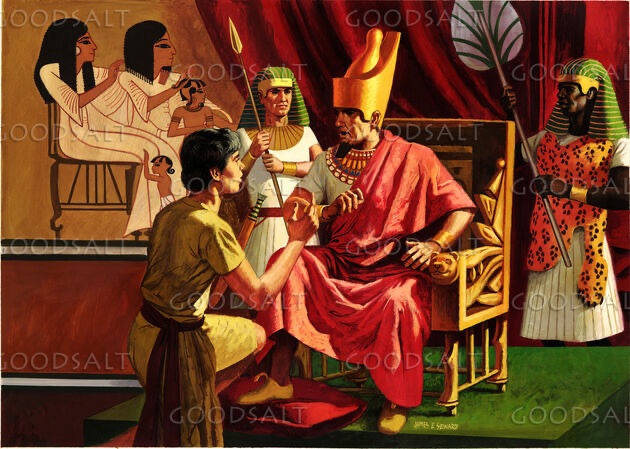
Two years later, Pharaoh had two dreams that his magicians could not interpret. Joseph was summoned and told Pharaoh that the dreams forecasted seven years of plentiful crops followed by seven years of famine. Following Joseph’s advice, Pharaoh made Joseph his second-in-command. He gave Joseph his ring and dressed him in robes of linen with a gold chain around his neck. Pharaoh gave him the Egyptian name Zaphenath-paneah and found him a wife named Asenath, daughter of Poti-phera the priest of On (Gen 41).

Joseph traveled throughout Egypt, gathering and storing enormous amounts of grain from each city. During these years, Asenath and Joseph had two sons: Manasseh, meaning, “God has made me forget (nashani) completely my hardship and my parental home, and Ephraim, meaning, “God has made me fertile (hiprani) in the land of my affliction”. These sons, grandsons to Jacob, would later have a key role (but the lectionary doesn’t include this part of the story).

After seven years, a famine spread throughout the world, and Egypt was the only country that had food. Joseph was in charge of rationing grain to the Egyptians and to all who came to Egypt. The famine affected Canaan, so Jacob sent ten of his sons to Egypt. He kept back Benjamin, Rachel’s second son and Jacob’s youngest child, the son who had intervened to save Joseph years earlier (Gen 42). 

The story assumes a rollicking-good-yarn feeling, as Joseph recognises the brothers but does not let on, and sends them back to Canaan. He kept Simeon in jail pending their return with Benjamin, as instructed, despite Jacob’s misgivings (Gen 43).

The brothers return to Egypt with Benjamin, along with a gift for Joseph as well as double the necessary money to repay the money that was returned to them. Again, there is a comedy-of-errors feel, as Joseph acts is if he does not know the brothers when they actually do; in the end he instructed his servant to fill the brothers’ bags with food, return each one’s money a second time, and put his own silver goblet in Benjamin’s bag. Then he sends his servant after them, to accuse them of theft. Benjamin is detained; Judah pleads with Joseph to release him (Gen 44). Will he do so?

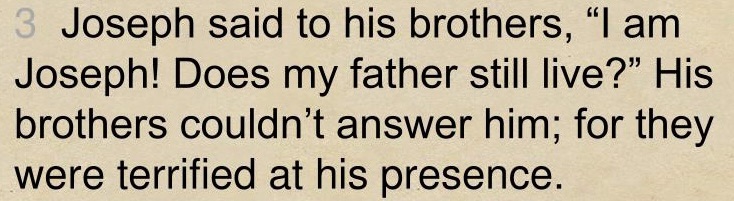
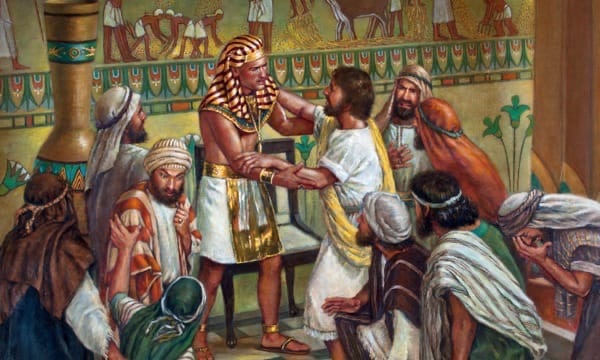
At this point in the story, Joseph reveals his true identity to his brothers (Gen 45:3). The narrative is fraught with emotion: Joseph could no longer control himself (v.1), he wept loudly (v.2), his brothers are dumbstruck and dismayed (v.3). After a lengthy speech of explanation (vv.4–13), Joseph bursts into tears, as does Benjamin (v.14), and then Joseph “kissed all his brothers and wept upon them” (v.15). The emotions are deep-seated and visceral; the physical actions described signal the profound effect that the experiences have had on Joseph and his brothers.

The narrative of this meeting ends in a very prosaic manner: “and after that his brothers talked with him” (Gen 45:15). The fractured relationships amongst the twelve has been repaired; the lines of communication between estranged individuals have been restored. It just remains for this to be communicated to Jacob—which is done in the rest of chapter 45. Jacob and his whole family, sixty-six persons in all, relocate to Egypt (Gen 46), but famine eventually strikes even Egypt (Gen 47).

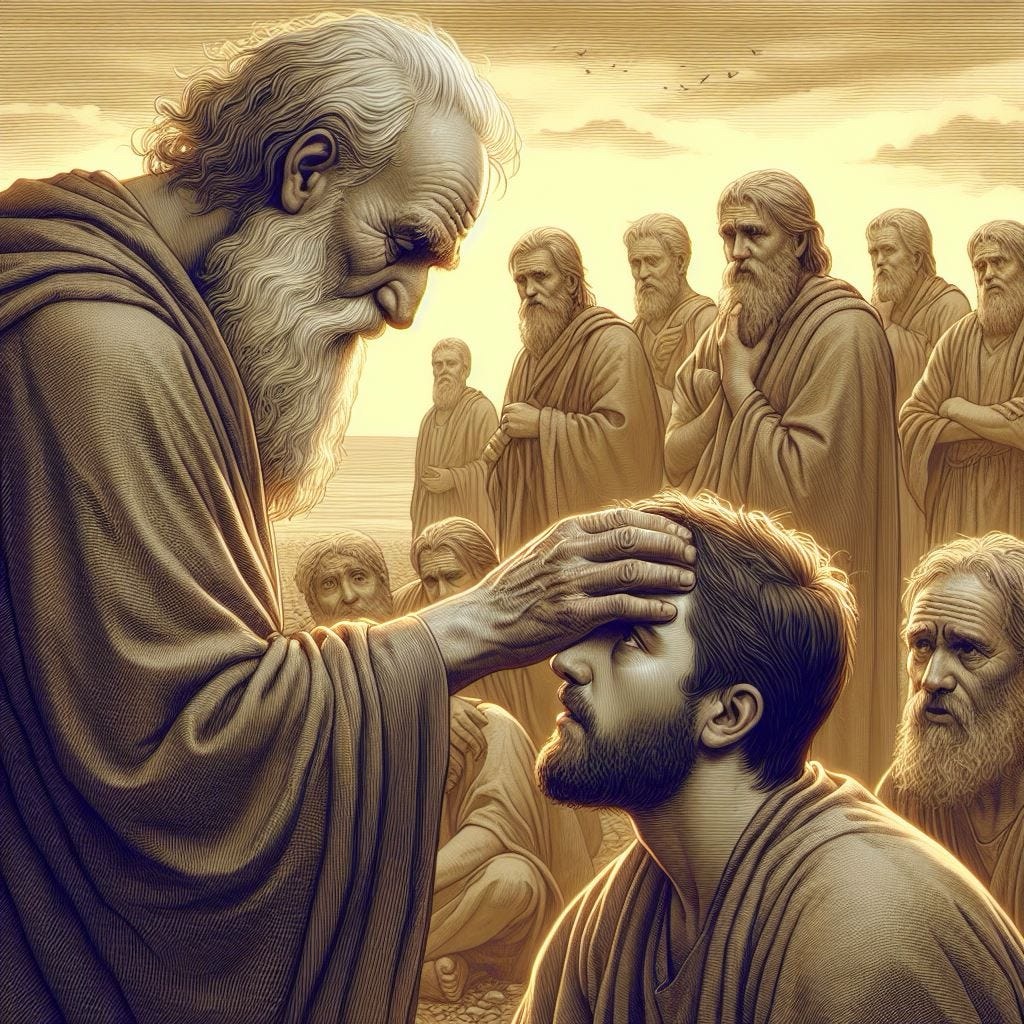
The book concludes with grand scenes of blessing and farewell. Jacob blesses Joseph (Gen 48:15–16), Joseph’s sons Ephraim and Manasseh (Gen 48:17–22), and then the full  complement of his twelve sons (Gen 49:1–28), before Jacob dies and is buried (Gen 49:29—50:14). 

The closing scenes are touching; Joseph’s brothers fear that he may still bear a grudge against them (50:15), but Joseph, highly emotional once again (50:17), reassures his equally emotional brothers, “have no fear; I myself will provide for you and your little ones”; final attitude towards his brothers is one of kindness (50:21). And so, in due time, Joseph himself comes to the end of his earthly life; aged 110, he was “embalmed and placed in a coffin in Egypt” (Gen 50:26).

There is a longer summary of the full saga that is told in the Joseph section of Genesis (chapters 37–40) in the Jewish Virtual Library at https://www.jewishvirtuallibrary.org/joseph-jewish-virtual-library

I had a dream (Gen 28; Pentecost 8A)

There are some famous dreams throughout history. “I have a dream”, said the Rev. Martin Luther King Jr, speaking in Washington on 28 August 1963, “a dream that my four little children will one day live in a nation where they will not be judged by the color of their skin but by the content of their character. I have a dream today.” That may be the most famous dream in the 20th century.

There have been other significant dreams in modern times. Paul McCartney woke from a dream and wrote the whole score of “Yesterday”. Mary Shelley’s novel “Frankenstein” was inspired by a nightmare. Niels Bohr had a dream in which he saw “the nucleus of the atom, with electrons spinning around it, much as planets spin around their sun”; and thus he developed his theory of atomic structure—a theory later proven by experimental investigation.

In like manner, Albert Einstein is said to have posed his theory of relativity in a dream in which “he was sledding down a steep mountainside, going so fast that eventually he approached the speed of light … at this moment, the stars in his dream changed their appearance in relation to him”; while it was a dream that led Frederick Banting to develop insulin as a drug to treat diabetes.

I found these and other significant modern dreams described at

https://www.world-of-lucid-dreaming.com/10-dreams-that-changed-the-course-of-human-history.html

*****

The Hebrew Scripture passage that is offered by the lectionary for this coming Sunday (Gen 28:10–19a) includes a dream that Jacob had, as he slept one night during his journey from Beer-sheba, in the Negeb desert in the south of Israel, north towards Haran, the place from which Abram and Sarai had left on their journey towards the land of Canaan, the land which God had promised to him (12:1, 4–5).

So the journey that Jacob is undertaking is a reversal, in direction and orientation, of the earlier journey that his grandfather had undertaken. He was travelling to escape the anger of his brother Esau, after he had tricked their father Isaac into blessing him, Jacob, gifting him with the inheritance that was rightly owed to Esau (27:41). Abraham had travelled south in order to receive God’s blessing. Jacob travels in the other direction after having deceitfully gained his father’s blessing.

We are told that, understandably, “Esau hated Jacob because of the blessing with which his father had blessed him” (27:41), and that he threatens to murder his brother, once “the days of mourning for my father” are completed (27:42). Learning of this hatred, Rebekah advises her son, “flee at once to my brother Laban in Haran, and stay with him a while, until your brother’s fury turns away” (27:43–44).

Whether he had been tipped off about this by Rebekah, or not, Isaac commissions his son to journey back to the homeland—in another case of “don’t marry one of these folks, go back to our homeland and marry one of our own” (as we saw with Abraham and Isaac). Isaac says to Jacob, “you shall not marry one of the Canaanite women; go at once to Paddan-aram to the house of Bethuel, your mother’s father; and take as wife from there one of the daughters of Laban, your mother’s brother” (28:1–2). So Jacob obeys him.

It is on this journey of escape that Jacob has his striking dream. Jacob is not the first to have encountered God in a dream, in these ancestral sagas. Abimelech of Gerar heard from God in a dream (20:3–7). After Jacob’s dream at Bethel (28:12–15), Jacob has a further dream regarding a flock of goats, relating to his inheritance, urging him to return to Isaac in the land of Canaan (31:10–16). At the same time, God appeared in a dream to Laban (31:24), conveying instructions which he disobeyed.

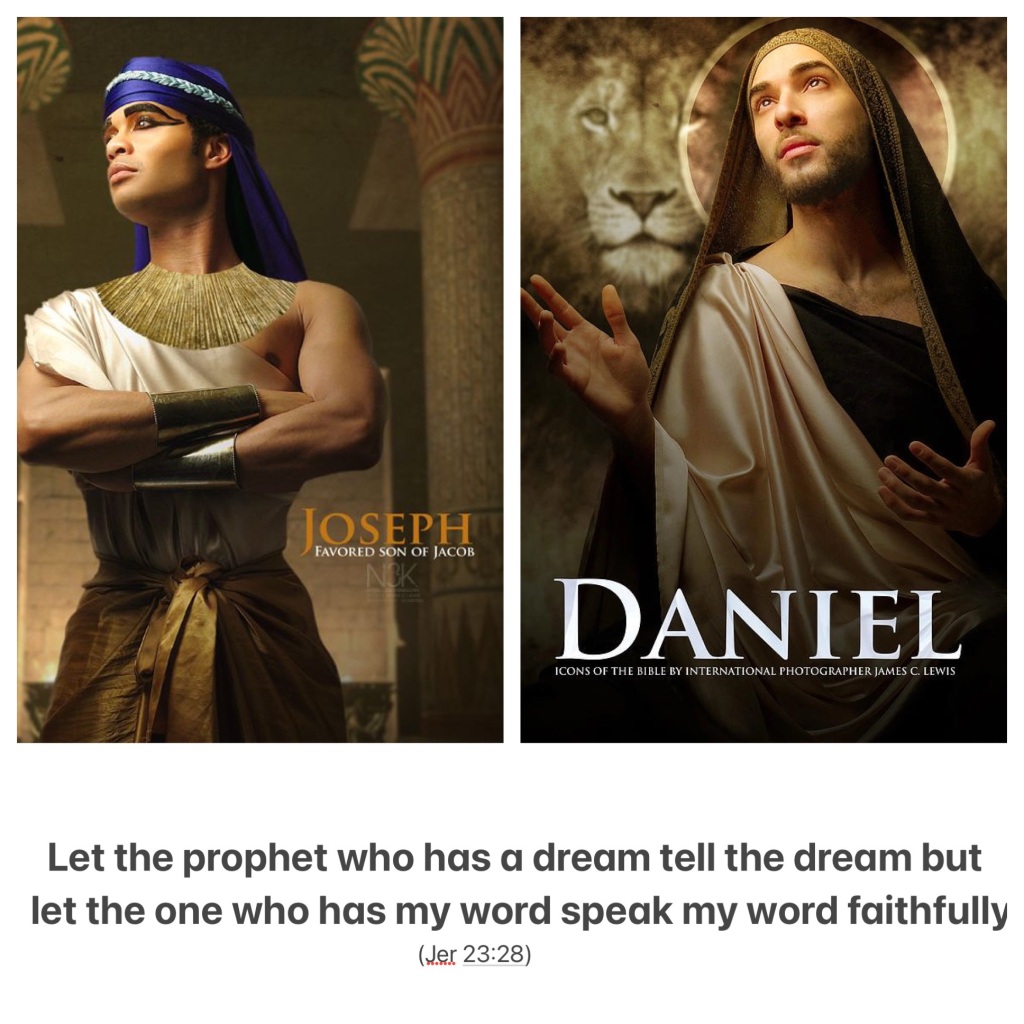
The two great “dreamers” in Hebrew Scripture are, of course, Joseph, one of the sons of Jacob, and Daniel, one of the courtiers of Nebuchadnezzar of Babylon, many centuries later. Both men not only dream dreams, but offer interpretations—and interpret dreams that have been dreamt by others. Jeremiah, too, knew of those who claimed that they encountered God in dreams, but warns that understanding those dreams correctly is important (Jer 23:28; 29:8–9).
And dreams as the vehicle for divine communication is found in an important New Testament story, when Joseph learns of the pregnancy of Mary, in Matt 1–2. “Dreaming dreams” is actually an activity inspired by the Spirit, as Joel prophesied (Joel 2:28) and Peter reminds the crowd on the day of Pentecost (Acts 2:17).

*****

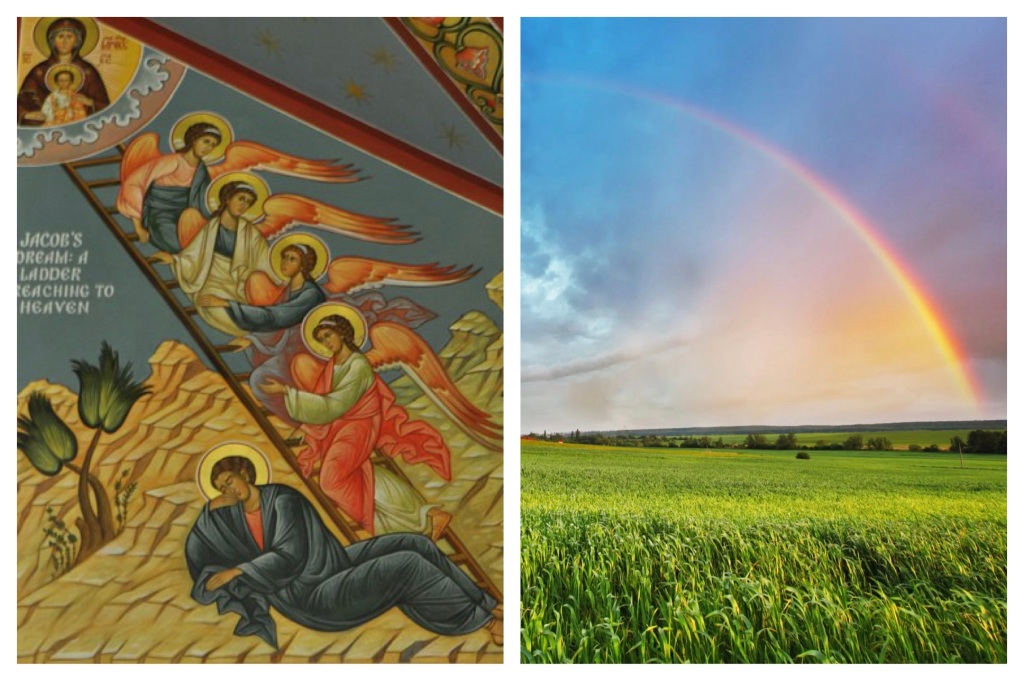
As Jacob sleeps, he dreams that “there was a ladder set up on the earth, the top of it reaching to heaven; and the angels of God were ascending and descending on it” (28:12). What do we make of that dream?

In My Jewish Learning, Pinchas Leiser quotes from a book entitled Ruah Chaim (“the breath of life”), by Rabbi Haim of Volozhin. The Rabbi, who lived from 1749 to 1821, was a student of the Vilna Gaon (1695–1785), the pre-eminent sage of Lithuanian Jewry whose ideas were fundamental for the development of modern Jewry. Rabbi Haim writes:

“Our sages come to teach us that we ought not think that, because of our base material, we are truly despicable, like mere plaster on a wall. About this it says, a ladder stationed on the earth–that is Sinai; and its top reaches the heaven–which represents our soul’s life, which is in the highest sphere. There are even souls that see God, and they are the highest of the high, higher than ministering angels, and by this status can the soul cleave to Torah . A whole person is like a tree whose roots are above, and whose trunk extends downward, which is the body, and which is fastened to its supernal roots.”

Pinchas Leiser, a Jewish psychologist and educator, comments: “Thus, Rabbi Haim of Volozhin views Torah learning as a Sinaitic event, since Torah is what connects the heavens and the earth. With Torah, one can ascend and descend between the two spheres. The people who do so are angel-like.”

This is a penetrating insight into the nature of human beings. We are not spiritual beings, trapped in the prison of the material world, as Plato imagined (and as many writers, including Paul, who were influenced by his philosophy, wrote). Rather, we are fully nephesh, creatures of God containing both material and spiritual characteristics. We belong both to earth and to heaven.

The ladder which Jacob saw reveals this true nature, and tells us that we can transport ourselves between the two places, if we would only open ourselves to the possibility. Jacob’s dream was archetypal—it illustrated exactly who we are and how we can live!

And for me, as a Christian reader, it is important to note that this story (and, indeed, many others in Hebrew Scripture) undermine the crass stereotyping of ancient Israelites—and modern Jews—as alienated from God, crushed under unbearable burdens, far from the grace of God. For this ancient story, told orally for many years before it was ever written down, portrays the possibility of a close and enduring relationship with God, accessible from the patriarch Jacob onwards.
*****

A related approach is taken by the Rev. Sunny Lee, writing in With Love to the World. Sunny Lee says, “As he hears the voice of God, Jacob feels the dynamic presence of God and he is assured that God will never leave him. Jacob could never go beyond God’s keeping. The angels will go with him to northern Mesopotamia, which was his destination (Gen 29:1). And they will keep going up and coming down on the ladder. Also, they will accompany him for twenty years in Haran and return to the land (Canaan) with him (Gen 31:11; 32:1). Here, we can see that there will always be a ladder! Always the angels! Always God! (with Jacob).”

Sunny sees a sign of God’s grace in this story: “Jacob was outcast and alone because he deceived his father. He was not seeking God. Nevertheless, he was guided by God in his misery. God revealed God’s care and assurance for the future. Even though he was not expecting grace, grace was unleashed upon his soul with no word of blame.”

So there is a sign of God’s grace in this story—the ladder connecting heaven and earth, on which “angels” ascend and descend at will. God meets Jacob, even as he is running away from family, and perhaps also running away from God; God meets Jacob in a dream. Jacob was fleeing the consequences of his deception of his father. He wanted to be far away from Isaac, whom he deceived, and Esau, from whom he stole the birthright. And in the midst of that journey, God offers a sign of acceptance and grace in this dream.

Indeed, scripture had offered an earlier sign of God’s grace, in the story of Noah. This is a terrible story—God deliberately and intentionally destroys the world, and “starts all over again”. Only Noah and his family, and the animals on his ark, are saved. The rainbow in the sky is the sign of God’s grace for those who have survived, signalling that God will never again destroy the creation.

The ladder represents the commitment that God has, to an enduring connection with human beings, no matter what their situation. It is a sign of God’s grace—for which we can be thankful.
Twins! (Gen 25; Pentecost 7A)

“Is it a boy or a girl?” For many years, that has been a standard question after a woman has just given birth. In more recent times, due to the advances in medical technology that have occurred, that question can no be put to pregnant couples: “Is it a boy or a girl?” Ultrasounds can now apparently reveal the gender of the foetus from about 11–13 weeks.

So it is always a surprise when the answer to that question is not “boy” or “girl”, but “both”—in the case of male-and-female twins—or “two boys” or “two girls”, as the case may be, in other instances.

“Isaac prayed to the Lord for his wife, because she was barren; and the Lord granted his prayer, and his wife Rebekah conceived”, we read in the Hebrew Scripture passage offered by the lectionary for this coming Sunday (Gen 25:19–34). Here, we meet another barren woman in the ancestral sagas of Israel. Years before, Isaac’s mother Sarah had been barren, and that state had lasted for many decades—and indeed “the Lord had closed fast all the wombs of the house of Abimelech because of Sarah, Abraham’s wife” (20:18).

And other barren women are yet to come in those ancestral sagas; the rabbis note that there are seven significant women who were infertile in scripture: Sarah (Gen 11:30), Rebekah (Gen 25:2), Rachel and Leah (Gen 29:31), Manoah’s wife (Judg 13:2), Hannah (1 Sam 1:2), and Zion (Isa 54:1). The eventual gifting of children to these seven is related by the rabbis to a textual variant in 1 Sam 2:5, reading “the barren has borne seven” as “on seven occasions has the barren woman borne”.

The seventh in this list, Zion, is not an individual who lived in the past but is the personified Israel of some future time, based on Second Isaiah’s characterization of Zion as a barren woman: “Sing, O barren one who did not bear, burst into song and shout, you who have not been in labour; for the children of the desolate woman will be more than the children of her that is married, says the Lord” (Isa 54:1).

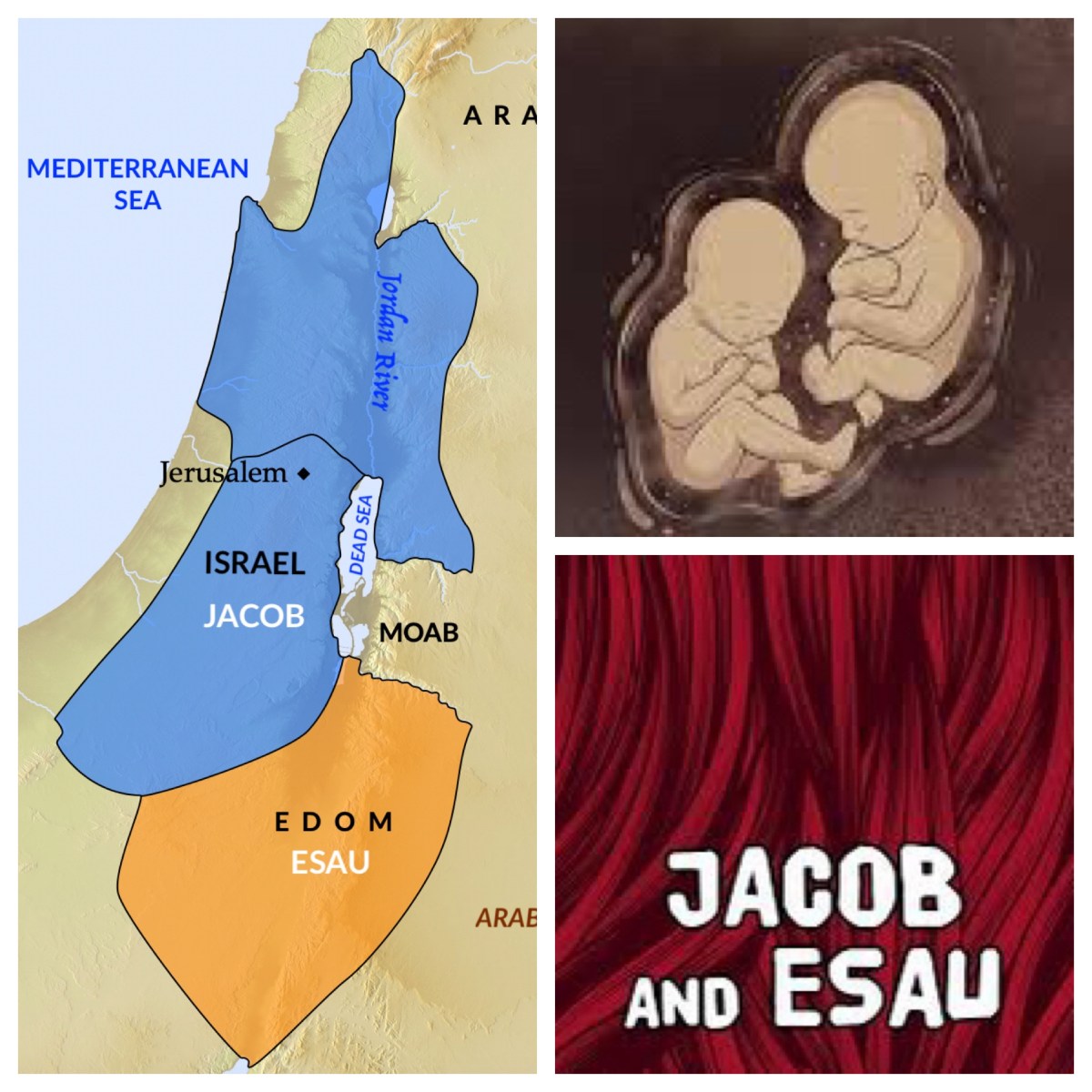
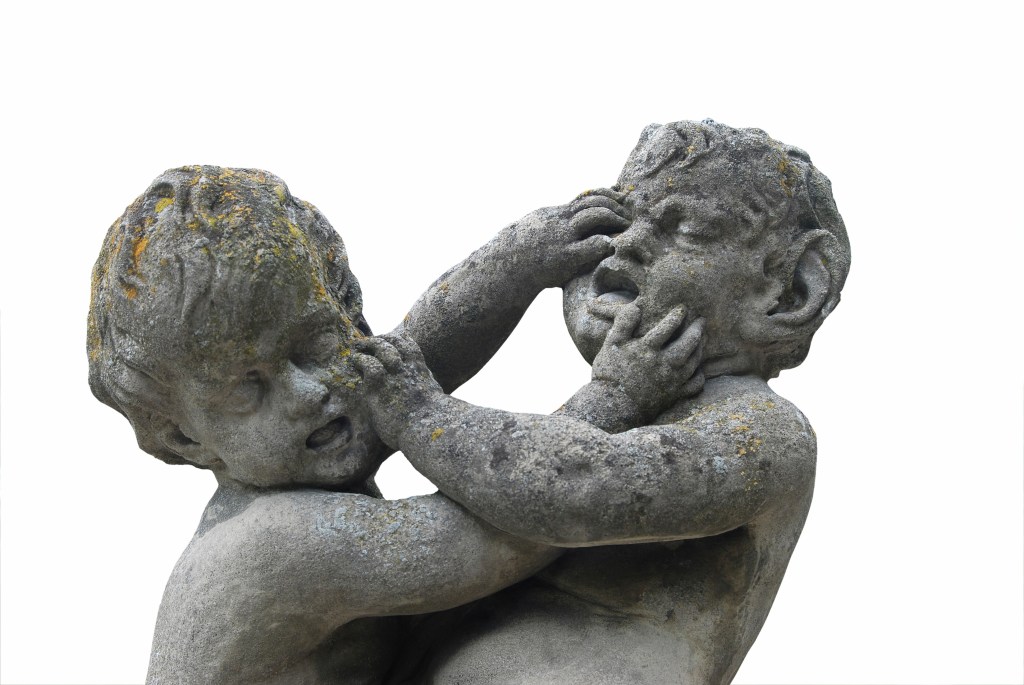
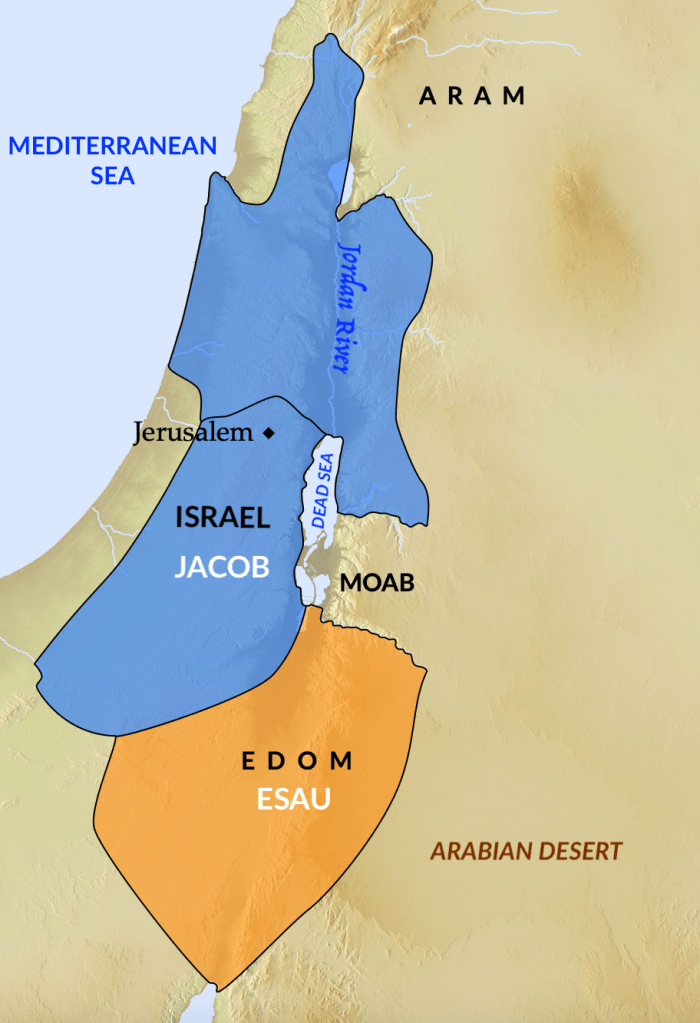
The result of God’s intervention, in Rebekah’s case, was a surprise: not one, but two, boys! But the time for shouting with joy is short, for poor Rebekah is given sobering news about her twin boys: “two nations are in your womb, and two peoples born of you shall be divided” (25:23a). Not only that, but “the one shall be stronger than the other, the elder shall serve the younger” (25:23b).

Isaac and Rebekah have brought into the world two boys—the older, who “came out red, all his body like a hairy mantle”, who was named Esau (meaning “hairy”), and the younger, hot on the heels of his brother (literally), who followed immediately “with his hand gripping Esau’s heel”, who was named Jacob (meaning “supplanter”).

The other twins that are (in)famous in Hebrew Scripture are Perez (“a breach”) and Zerah (“brightness”), twin sons of Tamar, daughter-in-law of Judah, who had liaised with her whilst visiting his sheepshearers (38:12–30). In the New Testament, “Thomas the Twin” is one of the named twelve disciples (John 11:16; 20:24; 21:2), although his sibling is never identified.

Who calls their child “the one who supplants” at the moment of birth? The names, identified in the narrative at the moment of birth (25:25–26), must surely be retrojections into the story, for the names prefigure events as they later transpired. This story, like many of the stories in the book of Genesis, is an aetiological narrative—a story told to explain how things are as they are.

I have noted previously that such narratives tell of something that is said to have occurred long back in the past, but the focus is on present experiences and realities, for “such explanations elucidate something known in the contemporary world by reference to an event in the mythical past”.

See https://oxfordre.com/classics/display/10.1093/acrefore/9780199381135.001.0001/acrefore-9780199381135-e-7050;jsessionid=3DB38C42C54D01E1CBFA8682FB55DA4C

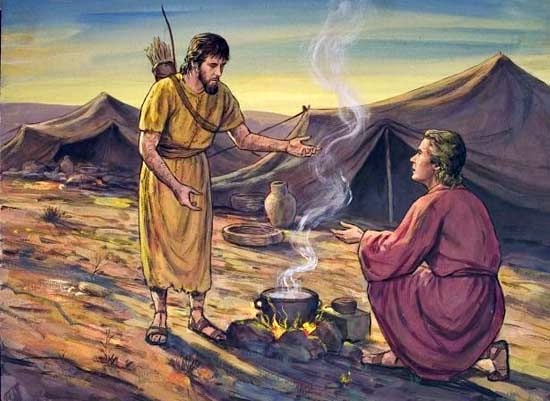
The name of Jacob is given to explain his role in the story that is unfolding: first, Jacob tricks his brother Esau to sell his birthright to him (25:29–34). As firstborn, Esau should have inherited from Isaac; now, Jacob has supplanted him (as his name indicates). In subsequent passages that the lectionary skips over, Jacob deceives his father in order to receive the blessing that was intended for the firstborn (27:1–29).

As Esau subsequently laments to his father, “Is he not rightly named Jacob? He has supplanted me these two times: he took away my birthright; and look, now he has taken away my blessing” (27:36). His fate as the one no longer relevant for the continuation of the family line, promised to Abraham and continuing through Isaac to Jacob, now, comes when he marries “Mahalath daughter of Abraham’s son Ishmael, and sister of Nebaioth, to be his wife in addition to the wives he had” (28:9). See my earlier reflections on Ishmael at

So Jacob lives up to his name. And we know well his name, through the seven places in the New Testament where we find formulaic references to the three patriarchs, Abraham, Isaac, and Jacob (Mark 12:26; Matt 8:11; 22:32; Luke 13:28; 20:37; Acts 3:13; 7:32), as well as the many references to them together in the Hebrew Scriptures (Gen 50:24; Exod 2:24; 3:6, 15, 16; 4:5; 6:3, 8; 33:1; Lev 26:42; Num 32:11; Deut 1:8; 6:10; 9:5, 27; 29:13; 30:20; 34:4; 2 Ki 13:23; Jer 33:26).

Yet the irony is that Jacob’s name is later changed, to a name that would become still more famous—and live on into the modern world as the name of the nation of people who see themselves as the chosen ones. After wrestling all night with a man at the ford of the river Jabbok, Jacob is told “you shall no longer be called Jacob, but Israel, for you have striven with God and with humans, and have prevailed” (32:28; see Pentecost 10A).

And that story, of course, is yet another aetiological narrative; for the name given, Israel, means “the one who strives with God”, which was the fate of Jacob on that night, and of the people of the nation over the centuries and millennia to follow. So the story of this change of names is an important one to remember and pass on.

In this story, however, the names of the boys born to Isaac and Rebekah are the key point: one is born hairy, the other is a supplanter. And the trick that he played to gain the inheritance of his father plays a crucial role in the self-understanding of the people who were telling this story, and passing it down the generations, and remembering it to this day. It is the second-born (even if just by a few seconds in time) who supplants the firstborn.

So Isaac was preferred over his older brother, Ishmael. Jacob gained the birthright of his (slightly) older twin brother Esau. Joseph gained ascendancy over his many older brothers. Jacob, at the end of his life, blessed the younger son of Joseph, Ephraim, rather than his older son, Manasseh. Moses was chosen as God’s spokesperson in Egypt, in preference to his older brother, Aaron. And instead of any of the seven older sons of Jesse, the ruddy, handsome youngest, David, received the blessing of the prophet Samuel to be anointed as king. In each case, it was the younger who was preferred over the older—a striking set of stories to be remembered!

Esau, we are told, is the ancestor of the Edomites, to the south of Israel (Gen 36:1–43), whilst the descendants of Jacob (Gen 25:19–28), of course, populated the land of Canaan, known as Israel, after the name later given to Jacob (Gen 32:28; see Pentecost 10A).