A small member which boasts of great exploits (James 3; Pentecost 17B)

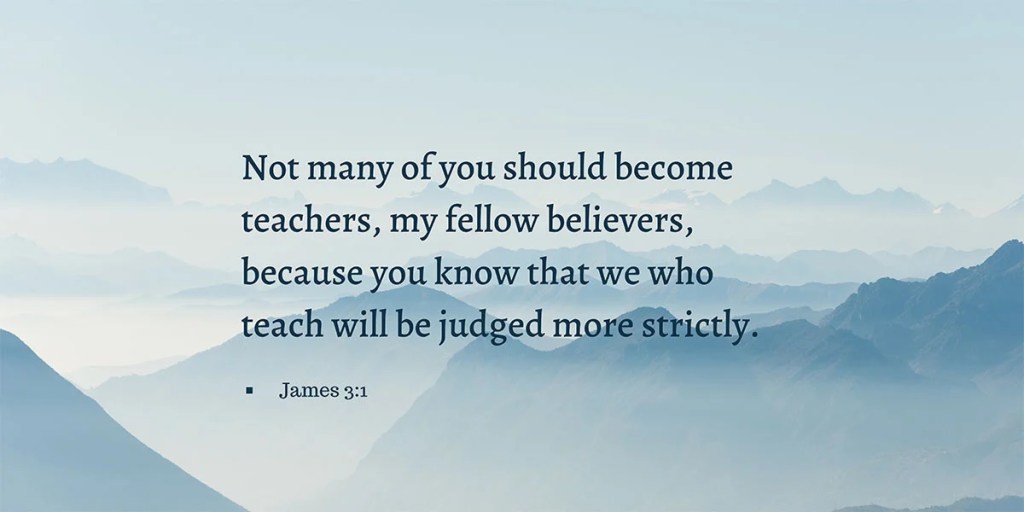
Warning! Warning! As we follow the lead of the lectionary and come to this Sunday’s passage from chapter 3 of James, people like me are immediately put on alert. “Not many of you should become teachers, my brothers and sisters, for you know that we who teach will be judged with greater strictness” (James 3:1). So there!
I have never trained as a teacher; however, the church, in its wisdom, saw fit to invite me to learn the craft of teaching at the very beginning of my ministry as an ordained person. I served as a Tutor assisting Robert Maddox in his university teaching, taking over his course when his brain tumour developed.

Then I was encouraged to apply for doctoral studies in New Testament and Early Christianity, learning more of the craft of teaching whilst undertaking the coursework and research of that degree, as I worked as Teaching Assistant for various professors: in Old Testament, Brevard Childs and then Robert Wilson; in Early Church, the Gnostic specialist Bentley Layton; and then Abraham Malherbe, who then was the primary supervisor of my thesis, completed in 1987.

After that I taught courses at Sydney University and United Theological college, before accepting a call in 1990 to the Faculty of UTC, where I taught Biblical Studies for two decades. Then, moving into other ministry roles, I shared with my wife Elizabeth Raine in teaching lay leaders in the Mid North Coast in a range of subjects; spent two years as Principal of Perth Theological Hall; and then moved to Canberra, where again Elizabeth and I were involved in teaching lay people (and some ministers doing their continuing education) for five years. So my career over 45 years has regularly involved teaching!

Therefore, I take the opening words of James 3 with utter seriousness. They are striking: both discouraging people from becoming teachers (although we do need teachers!) and then warning that who teach “will be judged with greater strictness”. That’s worth considering. Why are teachers to be held to a higher level of accountability than people in other professions? than doctors and nurses? or judges and lawyers? or police officers and prison guards? Don’t all of them need to have the highest of standards to which they need to be held accountable? 

The reason that James makes this curious claim is, of course, “the tongue”. “The tongue is a small member”, James writes, “yet it boasts of great exploits” (3:5). And that is what underlies this whole passage. The author uses a series of analogies to indicate how such a small member, the tongue, has great power. The tongue is compared to a bridle guiding a horse  (v.3), a ship’s rudder (v.4), a spark lighting a fire (vv.4b-5), as something that “stains the whole body” (v.6) and a spring from which water pours forth (v.11).
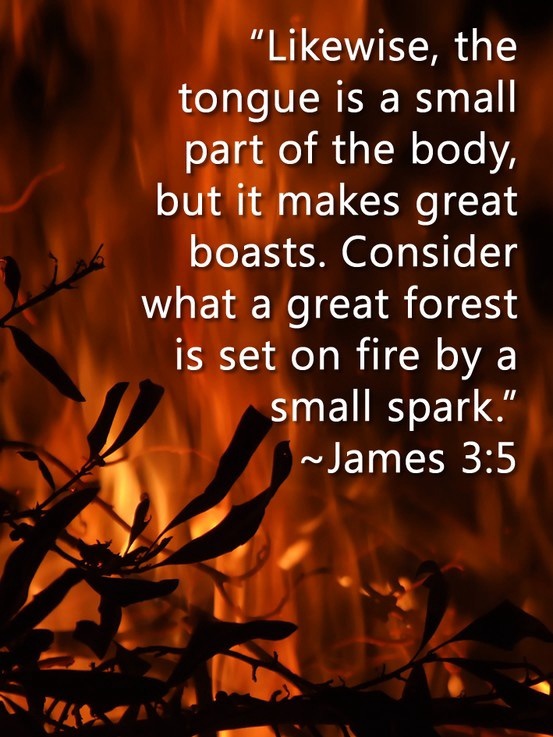
In each case, the analogy is of something small which contains immense power to control something much larger—to guide a warhorse or steer a cargo ship, to set in motion the train of events that leads to a damaging fire or an infection of the whole person or widespread flooding. The tongue is potent—and so it needs to be used with great care.

Earlier in this letter, James has implored those listening to this letter to “be quick to listen, slow to speak, slow to anger” (1:19). Left unchecked, it seems, the tongue can rapidly run to anger—and this is unhelpful, since “anger does not produce God’s righteousness” (1:20), and it is this righteousness which is most desired for those who are wise, “those who make peace” (3:13–18). Indeed, as the theological argumentation that James offers indicates, Abraham was made righteous (justified) “by works”, and it was those works which ensured that “it was reckoned to him as righteousness” (2:18–26, with the key scriptural verse in this argument being Gen 15:6).

“Be quick to listen, slow to speak” is advice which the older brother of James would have been happy to support. Indeed, we may perhaps speculate that James shapes this instruction under the influence of the words of Jesus, “let anyone with ears to hear listen!” (Mark 4:9, 23)—words repeated by others who told the story of his life (Matt 11:15; 13:9, 15, 43; Luke 8:8; 14:35). Jesus exhorts his followers to prioritise listening; brother James follows his lead and includes this direction. “You have two ears and only one tongue; so you should listen twice as long as you speak” is a saying that I have often heard over the years, nd it seems to resonate with what Jesus is saying.

Early in my time of teaching, I learnt this lesson very well. Fresh from the heady environment of doctoral research and plunged into the midst of making revisions of my dissertation ahead of publication (which came, in due course, in 1993), I taught a course which was shaped almost entirely around my thesis chapters. I had so much to say, and only 13 weeks to say it to the students! I still remember the sobering set of “course evaluations” that I received at the end of that semester. 

The next time I taught that subject I made sure to incorporate regular opportunities for small-group “buzz groups” within each lecture, posing questions which students were expected to discuss and decide for themselves—rather than just listen to me talk ad nauseum. I had learnt the value of my listening to students, and wanted to encourage them to practice “active listening” to inform their own thinking. The tongue was put into its place; one tongue, but two ears!

The tongue plays an interesting role in scripture. The “speech of the angels” produced in the unruly worship times at Corinth (1 Cor 12–14) has attracted much attention; then there are also the”native languages” of the Jews gathered in Jerusalem for the feast of Pentecost,when then spirit fell upon them (Acts 2). These were active tongues which contributed to the faith of those speaking (in Corinth) and to the development of the mission of the early Jesus movement (in Acts). These tongues were carrying out important duties.

But the tongue is also what holds back Moses from accepting his call; “I am slow of speech and slow of tongue”, he protests (Exod 4:10). Likewise, Jeremiah attempts to divert God from calling him; “Truly I do not know how to speak, for I am only a boy”, he protests (Jer 1:6). Not so reticent was David, who at the end of his life declared, “the spirit of the Lord speaks through me, his word is upon my tongue” (2 Sam 23:2); in some of the psalms also the psalmists make similar claims (Ps 35:28; 51:14; 66:17; 71:24; 119:172; 126:2). And, of course, many of the prophets followed in this tradition, boldly speaking words which they prefaced, “Thus says the Lord God”. 

Yet other psalms reflect the reality of damaging words spoken by a “deceitful tongue” (Ps 52:4; 120:2–3), spoken by those who slander (Ps 15:3), deceive (Ps 34:13; 50:19), plot treachery (Ps 52:2) and scheme “secret plots” (Ps 64:1–8). Such people “make their tongue sharp as a snake’s, and under their lips is the venom of vipers” (Ps 140:3); this is  what Job calls “the tongue of the crafty” (Job 15:5). Such words provoke the plea for vengeance from one psalmist: “let the mischief of their lips overwhelm them! let burning coals fall on them! let them be flung into pits, no more to rise!” (Ps 140:9–10). 

Many proverbs contrast the good which a tongue can do when it is used well, with the evil that results when the tongue is used for ill. “Rash words are like sword thrusts, but the tongue of the wise brings healing” (Prov 12:18) is one such comparison; another is “Truthful lips endure forever, but a lying tongue lasts only a moment” (Prov 12:19). Another proverb states “the tongue of the wise dispenses knowledge, but the mouths of fools pour out folly” (Prov 15:2); with a different approach, another proverb advises “whoever rebukes a person will afterward find more favour than one who flatters with the tongue” (Prov 28:23).

It seems that James is as aware as both the psalmists and the collators of these proverbs are of the damage that misuse of the tongue can cause. One striking proverb claims that “death and life are in the power of the tongue, and those who love it will eat its fruits” (Prov 18:21). That surely makes the tongue a most powerful thing. And just as these books of a wisdom reflect the good that the tongue can do when used wisely, so James knows of the value of the tongue and the power it can impart.

One of the proverbs that still contains an incredibly potent sting in the tail for me is this: “the mouth of the righteous brings forth wisdom, but the perverse tongue will be cut off” (Prov 10:31). The language is metaphorical, as is the case with some many proverbs—and with the analogies of the tongue as a horse’s bridle, a ship’s rudder, a spark lighting a fire (vv.4b-5), and a spring from which water pours forth, which James employs. The language is powerful, evocative, dramatic—but not at all to the taken literally.

The reason this particular proverb holds such a power for me, is that many years ago something similar was spoken to me: “don’t tell anyone or I will cut your tongue out”. The adult person saying this to me had incredible power over my small 6-year-old self; I was utterly terrified and for decades I did not dare to tell anyone about what he had done to me. I believed that he would actually, physically do this, if I disobeyed him and talked to anyone about this. 

So I kept the knowledge of what had happened hidden deep within myself; it was almost four decades later that I started the slow and incredibly difficult task of coming to grips with this. I have eventually been able to talk with others about this experience, but it has been a complex process (which is still incomplete in various ways). I have shared more recently in a podcast with a friend and colleague. 

For my own story, see 

and for the podcast in which I talk about this, go to

https://open.spotify.com/episode/5feSJb2qyVAhzBEfoeHj1x?si=29983b58d694477d

The power of the tongue: I know this well—both the positive, upbuilding capacity of the tongue to convey knowledge, invite learning, and deepen faith; and the negative, destructive capacity of the tongue when it is used to threaten and distort reality. James rightly observes that, with the very same tongue “we bless the Lord and Father, and with it we curse those who are made in the likeness of God; from the same mouth come blessing and cursing” (James 3:9–10). The wise and understanding, he advises, will use their tongue judiciously and constructively, so that it is “by your good life that your works are done with gentleness born of wisdom” (3:13).

The tongue. It is powerful. Take care how you use it!
As an example, take the prophets (James 5; Pentecost 18B)

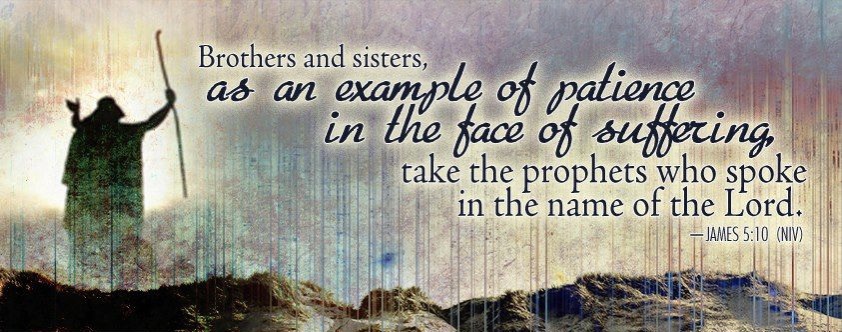
“Is anyone among you suffering? Let him pray.” So we read in this week’s selection from the treatise of James which is offered by the lectionary (James 5:13–20). As a further encouragement, a few verses earlier, we are enjoined, “as an example of suffering and patience, brothers, take the prophets who spoke in the name of the Lord” (5:10).

In this rhetorical question and proverbial statement, we find that the author of this treatise does something that we have seen to be quite familiar from other sections of the book; he makes reference to Hebrew scripture. In doing this, James, the author, was doing what his more famous brother—Jesus—so regularly did. Referencing scriptural traditions was a family trait; indeed, it was what any faithful Jewish man would do, and provide scriptural resonances in what he was saying.

A number of statements in the treatise of James resonate with the teachings of Jesus that we know so well in the Beatitudes (Matt 5:3–10). Most strikingly, the final beatitude spoken by Jesus, in which he exhorts joy in the face of persecution, in the manner of “the prophets who were before you”, is reflected in the opening exhortation of James, “whenever you face trials…consider it nothing but joy” (1:2), as well as the later reminder of James, “as an example of suffering and patience, take the prophets” (5:10). The two brothers are simply providing variations on a theme.

Other teachings in the book of James provide similarities to the teachings of Jesus spoken in the beatitudes, in the form found in Matt 5:3–12. The question posed by James, “has not God chosen the poor in the world…to be heirs of the kingdom?” (2:5) is similar to the first beatitude of Jesus, “blessed are the poor” (Matt 5:3).

The promise that James envisages, of “a harvest of righteousness…for those who sow peace” (3:18), is reminiscent of another beatitude of Jesus, “blessed are the peacemakers” (Matt 5:9). The instruction to “purify your hearts” (4:8) echoes “blessed are the pure in heart” (Matt 5:8).

Perhaps we should not be surprised about these resonances between the teachings of Jesus and the treatise of James; if this work was indeed written by James, the brother of Jesus, a leader of the church in Jerusalem (Gal 1:19), would we not expect him to know what Jesus was teaching? The two brothers are singing from the same songsheet.

These similarities between the teachings of Jesus and the writings of James are significant. The fact that they are preserved in different documents, shaped and then preserved by the followers of Jesus, is suggestive of an awareness of a common tradition of these ethical guidelines amongst Jewish members of the growing messianic movement.

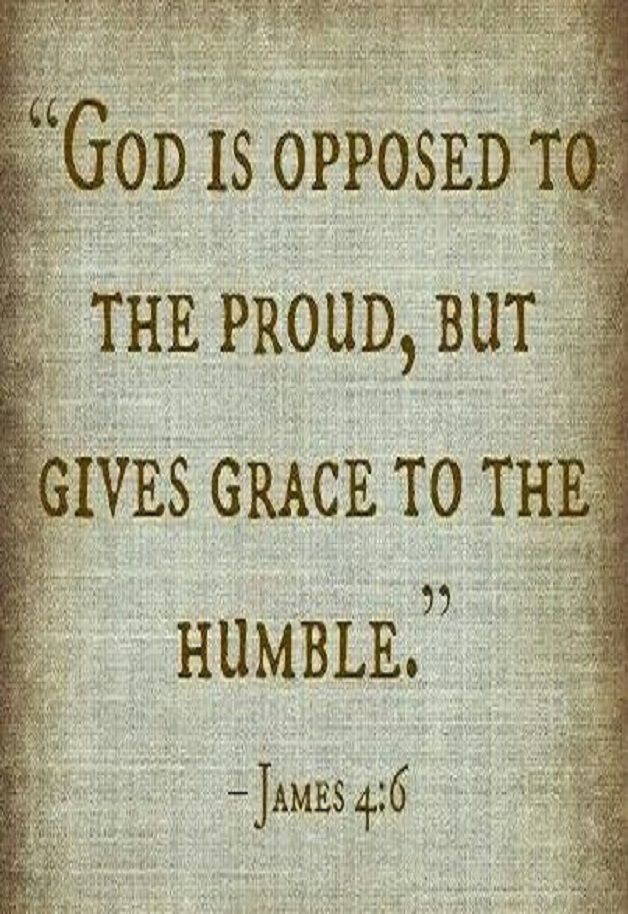
James quotes Hebrew Scripture directly in verse 4:6, “God opposes the proud but gives grace to the humble” (Prov 3:34). This is the basis for his instruction, “humble yourselves before the Lord, and he will exalt you” (4:10).

The same scripture undergirds the words of Jesus which declare the same thing: “whoever exalts themselves will be humbled, and whoever humbles themselves will be exalted” (Matt 23:12; see also Luke 14:11, 18:14). It is also informs the prophetic words sung by his mother before his birth, “he has brought down the mighty from their thrones and exalted those of humble estate” (Luke 1:52). The two sons of Mary (Jesus and James) are singing from the same songsheet as their mother!

When James writes a warning about laying up treasure (5:3), we are reminded of Jesus’ parable about the same topic. (Luke 12:13-21). In these words, both Jesus and James are drawing from Hebrew scriptures. Speaking against the oppressive actions of the rich sounds very much like a number of oracles thundered by the ancient prophets (Amos 2, 4, Micah 6, Hosea 12, Ezekiel 7).

The details use snippets of pertinent prophetic denunciations. “The last days” evoke “the Day of the Lord” (Isa 34:7-8, Jer 25:33-34, Ezek 7:1-4, Joel 2:1-3, Amos 5:18-20). The withholding of the wages of the labourers (5:4) contradicts the Law (Lev 19:13, Deut 24:14-15) and echoes denunciations spoken by prophets (Jer 22:13, Mal 3:5).

The condemnation of “fattened hearts” (5:5) evokes Jer 5:27-28, Ezek 34:2-4. And murdering the righteous person reminds us, not only of the wrongheaded approach of wicked people (Wisdom 2:10-20) and the fate of the righteous servant (Isa 53:3-5, 7-9), but especially of the fate of Jesus, the Righteous One (John 15:20; Acts 3:14).

Then, the command of James, “be patient until the coming of the Lord” (5:7), sounds a note that we hear in the final teachings which Jesus gives to his disciples, not long before his arrest. The earlier version of these teachings infers that patience will be required as “the beginnings of the birth pains” are seen (Mark 13:5–8), before Jesus exhorts his disciples: “the one who endured to the end will be saved” (Mark 13:13).

Interestingly, “be patient” in the midst of these tumultuous happenings is a refrain found elsewhere in the New Testament. Paul advises, “let us keep awake and be sober” (1 Thess 5:6); John encourages, “little children, abide in him” (1 John 2:28); and Jesus himself is quoted as saying, “I am coming soon” (Rev 22:7).

It was a widespread belief amongst the followers of Jesus in the first century, that Jesus would soon return, and that God would establish the kingdom of heaven on earth. (That is the final, climactic vision, offered in Revelation 21:1-22:6). “The coming of the Lord is at hand” (5:8) is a recurring New Testament motif (Rom 13:12; Phil 4:5; 1 Pet 4:7).

Over twenty centuries later, we know that this did not eventuate in the timeframe that was imagined, and hoped for, in the first century. Does that invalidate all that those earliest believers thought, wrote, and prayed for? Or is there another way that we are to take their words for our times?

Certainly, the direct ethical instructions found in this passage of the treatise of James sound like they are timeless: cultivate patience (5:7-8), avoid complaining (5:9), remain steadfast (5:11), be as good as your word in all you do (5:12), prayer and sing praise (5:13), seek healing and forgiveness (5:14–15) after confessing your sins (5:16). This is what we are called to do as we await the coming of God.

The wisdom from above (James 3; Pentecost 18B)

“If any of you lacks wisdom, let him ask God, who gives generously to all without reproach, and it will be given him”. So we read at the start of the treatise of James (1:5). There is a strong wisdom flavour to this treatise. The word appears in just four verses (1:5; 3:13, 15, 17), but the nature of the book is quite akin to the most famous work of wisdom in scripture: the book of Proverbs.

The “letter” of James is, in reality, a moral treatise (see https://johntsquires.com/2021/08/25/on-care-for-orphans-and-widows-james-1-pentecost-14b/) Sometimes called “the Proverbs of the New Testament,” the book of James provides practical guidance on how to live. It canvasses matters such as perseverance, controlling one’s tongue when speaking, submitting to God’s will, responsibilities towards the poor, dealing with anger, and fostering patience.

In terms of its style, James reflects the wisdom tradition that is so evident in Hebrew Scripture and in continuing Jewish traditions. An important place was ascribed to Wisdom amongst Jews of the Dispersion; Wisdom became a key figure for such Jews, as is reflected in a number of writings.

Wisdom is highlighted in Proverbs, which affirms that Wisdom was present with God at creation (Prov 8:22–31). Wisdom was the key creative force at work beside God, in conjunction with God, in creation the world. Wisdom plays a key role in the book of Sirach, where she gives knowledge, makes demands of those seeking instruction from her, imposes her yoke and fetters on her students, and then offers rest (Sir 6:24–28; 51:23–26). Furthermore, Wisdom is portrayed as the intermediary assisting God at creation and throughout salvation history (Sir 24:1–8).

Another document which highlights the role of Wisdom, is the work known as the Wisdom of Solomon—a work which the anonymous author tells of his own search for Wisdom. But the description of Wisdom that is given in this book is more philosophical than biblical; it owes much to the developing middle platonic philosophy of the late Hellenistic period. Wisdom is described as “a breath of the power of God, a pure emanation of the Almighty” (Wis Sol 7:25) and reflects a most dazzling sequence of attributes (Wis Sol 7:22–24).

A comparison with Proverbs and Sirach can be drawn with Matthew, where it is said that Wisdom is at work in Jesus; when the Son of Man eats and drinks with tax collectors and sinners, Jesus declares that “Wisdom is justified by her deeds” (Matt 11:19b). Soon after those words, the Matthean Jesus explicitly adopts the language of Wisdom in a well-known set of words. Like Wisdom, he is a teacher (Matt 11:27). Like Wisdom, he invites his followers to take on the yoke of learning, and through this, find true rest (Matt 11:28–30).

Jesus teaches extensively in the style of the wise teacher, employing strings of short, pithy epithets and succinct maxims (see, for example, the collation of such sayings at Matt 6:19–34; 7:1–27; 9:10–17; 10:24–42; 18:1–14).

*****

The divine gift of wisdom occupies a central position in the treatise of James (1:5–8); this “wisdom from above” is to be contrasted with wisdom which is “earthly, unspiritual, devilish” (3:13–18).

Numerous epithets typical of the wisdom style are included in the treatise; there are succinct sayings which provide a definitive conclusion to discussion of a topic; for example, “mercy triumphs over judgement” (2:13; compare Matt 9:13) or “who are you to judge your neighbour?” (4:12; compare Matt 7:1).

Practical guidance, which also features in wisdom literature, runs through the treatise of James: “do not be deceived” (1:16), “care for orphans and widows” (1:27), do not favour the rich over the poor (2:1–7), curb your tongues, like putting a bridle in a horse’s mouth (3:3), “do not be boastful” (3:14), “humble yourselves before the Lord” (4:10), “do not grumble against one another” (5:9), “do not swear…by any oath” (5:12), “pray for one another” (5:16).

The treatise of James includes a biting tirade against the oppressive actions of the rich (5:1–6). James quotes snippets of pertinent prophetic denunciations of the rich (Isa 5:9; Jer 12:3), yet the same perspective is evident in Wisdom Literature. We see this, for example, in: “riches do not profit in the day of wrath, but righteousness delivers from death” (Prov 11:4); “a good name is to be chosen rather than great riches, and favour is better than silver or gold” (Prov 22:1); “whoever oppresses the poor to increase his own wealth, or gives to the rich, will only come to poverty” (Prov 22:16).

In an extended diatribe against wealth and honour (Eccles 5:8–6:12), The Teacher notes, “He who loves money will not be satisfied with money, nor he who loves wealth with his income; this also is vanity.” (Eccles 5:10). In Job, Zophar the Naamathite speaks of the wicked: “He swallows down riches and vomits them up again; God casts them out of his belly” (Job 20:15). Antagonism to the rich accumulating more and more wealth is found in various Wisdom works.

A diatribe against engaging in various prohibited actions (arguing, coveting, murder, adultery and impurity, 4:1–10) includes the statement, “God opposes the proud but gives grace to the humble” (James 4:6), which is perhaps citing Prov 3:34, “toward the scorners he is scornful, but to the humble he gives favour”.

The treatise as a whole ends with another saying which includes words from Proverbs: “if anyone among you wanders from the truth and someone brings him back, let him know that whoever brings back a sinner from his wandering will save his soul from death and will cover a multitude of sins” (5:20), citing the later part of Prov 10:12, “hatred stirs up strife, but love covers all offenses”.

The numerous scriptural allusions peppered through the moral exhortations of each chapter certainly demonstrate that the influence of Hebrew scripture on this book, and particularly of the Wisdom literature, cannot be underplayed.

*****

See also https://johntsquires.com/2021/09/12/in-the-squares-she-raises-her-voice-lady-wisdom-in-proverbs-pentecost-16b/ and https://johntsquires.com/2021/09/08/wisdom-cries-in-the-streets-proverbs-1-pentecost-16b/

and there’s a fine sermon on this passage by Avril Hannah-Jones at https://revdocgeek.com/2021/09/18/sermon-avril-preaches-to-herself/