The Bread of Life: take one (John 6; Pentecost 11B)

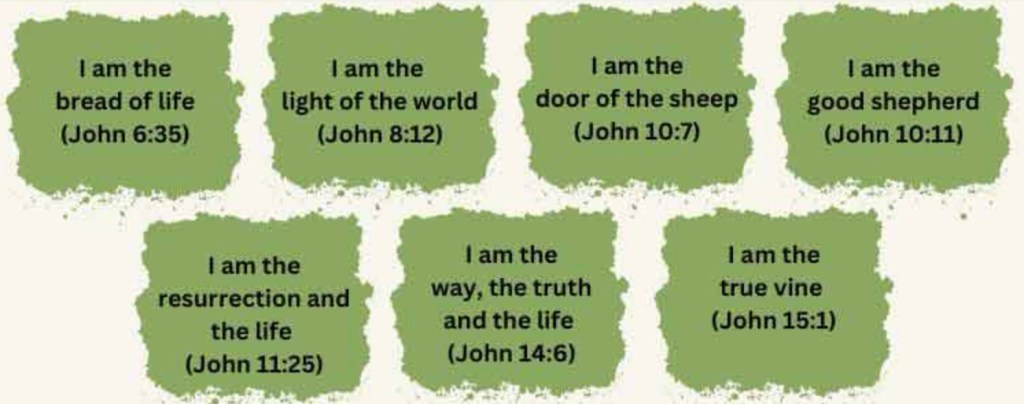
Last Sunday, the lectionary took us away from the Gospel of Mark, with an awkward detour into the Gospel of John that will see preachers being invited to grapple for another four weeks with a long, extended discourse of Jesus revolving around the first of seven I AM statements found in this Gospel. The statement that “I am the bread of life” has been motivated by the account of Jesus miraculously feeding a large crowd with only “five barley loaves and two fish”, which is told in the passage heard last Sunday (John 6:1–21).

This coming Sunday, this awkward detour leads us into the opening section of this long discourse, as John 6:24–35 is the passage that the lectionary proposes as the Gospel reading. This passage ends with the first declaration by Jesus, “I am the bread of life” (6:35). After this week, we are in store for further sections of that discourse, dealing with an elaborated exposition of that “bread of life” (6:35–51), the disputes that this teaching generated with the Judaean authorities (6:51–58), and the final section of the discourse where Jesus then has to deal with dissent from his own disciples (6:56–69).
I have often heard preachers grumble about the repetitive nature of these selections—“not another week on ‘the bread of life’”—but I think that this underestimates the intricacy of this chapter, and the complexity of the issues that are signalled as Jesus pursues his teaching about “the bread of life”. So the challenge I am taking up is to offer a series of four blogs in which a number of those issues are explored and explained.

Perhaps the first stumbling block in dealing with this chapter is that it does appear to be incredibly repetitive. The phrase “the bread of life”, for instance, appears four times (6:33, 35, 48, 51), with the stylistic variant “the bread from heaven” another five times (6:31, 32a, 41, 50, 58), the intensified phrase “the true bread from heaven” (6:32b), and “the living bread that came down from heaven” also in 6:51. That does, to be fair, seem like overkill. But other discourses in this distinctive Gospel exhibit a similarly repetitive style (as, indeed, does the first letter attributed to John). It is a particular style which characterises this Gospel—one of the many features that set it apart from the three Synoptic Gospels.

Each discourse in the series of discourses found in the first half of John’s Gospel displays some standard features. Each discourse arises out of a specific incident; in this case, the feeding of the large crowd (6:1–21) is the stimulus for discussing “the bread of life”. The discourse picks up a key word or idea from the report of the incident and develops that idea by relentless repetition. That is an integral part of its style. So there are eleven references to bread in ch.6, just as there had been seven references to water in ch.4, seven references to life or living in ch.5, and later there are twelve references to sheep in ch.10.

In typical Johannine style, the thesis of the discourse is driven by questions and misunderstandings. Questions invite an answer; misunderstandings require an explanation. And so the argument in this whole chapter proceeds by means of a series of questions.

First, after the feeding of the large crowd and the crossing of the lake (vv.22–25), the crowd asks Jesus, “ Rabbi, why did you come here?”(v.25). This opens the way for Jesus to explain that his work is not “for the food that perishes [a reference to the loaves of bread that they had recently eaten], but for the food that endures for eternal life” (v.27). And so the theme for the discourse that follows is set; and the irony that is embedded in the language of “bread” becomes foundational for what follows.

Next, they ask Jesus, “what must we do?” (v.28), allowing Jesus then to define the nature of “the works of God” as “that you believe in him whom he has sent” (v.29)—that is, in Jesus himself. Next, the crowd asks a third question: “what sign are you going to give us? … what work are you performing?” (v.30). They continue by quoting scripture—a move that will prove to be fundamental for the nature of what follows.

By quoting scripture (a variant of Exod 16:4 and 15; also Psalm 78:24) the crowd is gives Jesus his “text” for the teaching that follows. And, of course, as they are Jews, and as Jesus was a Jew, the argument is developed by means of a typical midrashic “playing with the text” in the words that follow. We will come back to the midrashic nature of this discourse in a later blog.

Jesus offers an interpretation of this scripture; it is “not Moses … but my Father in heaven” who provided the bread (v.32). At this point, he pivots from speaking about the bread that God gave from heaven, to speaking about “the true bread from heaven”, himself. He is the bread which “gives life to the world” (v.33).

So this section of the discourse ends, not with a question, but with a request from the crowd; “Sir, give us this bread always” (v.34). Which means that Jesus can now make very clear what his thesis is: “I am the bread of life” (v.35). And so, at last, we get to the point! And at this point, the lectionary passage for this Sunday stops—but we will return next week!
This statement is one of a number of “I Am” statements that are placed on the lips of Jesus in the book of signs, which we know as the Gospel according to John. These sayings comprise a verb (“I am”) followed by a predicate (the entity which Jesus claims to be). The predicates in most of these sayings are drawn from traditional Jewish elements.

When Jesus calls himself “the bread of heaven” (6:25–59), he is clearly evoking the scriptural account of the manna in the wilderness (Ex 16:1–36; Num 11:1–35; Pss 78:23–25; 105:40). The discourse which develops from this saying includes explicit quotations of scripture, as well as midrashic discussions of its meaning.

When Jesus presents himself as “the vine” (John 15:1–11), he draws on a standard scriptural symbol for Israel (Ps 80:8; Hos 10:1; Isa 5:7; Jer 6:9; Ezek 15:1–6; 17:5–10; 19:10–14). Likewise, when Jesus calls himself “the good shepherd” (10:1–18), he evokes the imagery of the good shepherd as the true and faithful leader in Israel (Num 21:16–17; Ezek 34:1–31; Jer 23:4), and the people as the sheep who are cared for (Pss 95, 100; Ezek 34:31).

The statement that Jesus is “the light of the world” (8:12; 9:1–5) evokes the story of the creation of light (Gen 1:3–5) and the light which the divine presence shone over Israel (Exod 13:21–22). The Psalmist uses the imagery of light to indicate obedience to God’s ways (Pss 27:1; 43:3; 56:13; 119:105, 130; etc.), and it is a common prophetic motif as well (Isa 2:5; 42:6; 49:6; Dan 2:20–22; Hos 6:5; Mic 7:8; Zech 14:7; cf. the reversal of the imagery at Jer 13:16; Amos 5:18–20).

Although it is not part of an “I am” statement, the references to the “living waters” which flow from Jesus (4:7–15; 7:37–39) are reminiscent of the water which were expected to flow from the eschatological temple (Ezek 47:1; Joel 3:18; Zech 14:8), and, more directly, refer to the description of God used by the prophet Jeremiah (Jer 2:13).

In addition, biblical scholars have noted that rabbinic symbolism has affinities with Johannine symbols; for example, the terms bread, light, water and wine are all used by the rabbis in connection with the Torah. The author of John’s Gospel stands in the stream of Jewish writers who have used multiple images to convey their faith in the Lord God.

Thus, the distinctive set of Christological claims made for Jesus in the Gospel according to John seek to enter into this stream of writing. They are both thoroughly grounded in scriptural images and familiar from the ongoing traditions taught by the rabbis. The author of this Gospel is using a number of ways to declare his faith in Jesus as “the Word of God”, “the Way”, and indeed as being at one with God. It is a high claim.

Amidst the variety of Jewish voices at the end of Second Temple Judaism clamouring to be holders of “the truth”, using a wide variety of rhetorical means, this author seeks to position his community—a sectarian Jewish group—as the holder of the true faith, the ones who adhere most clearly to what the Lord God requires amongst his faithful people. And for this group, it is Jesus of Nazareth who most clearly and faithfully leads them along that pathway of understanding and living.

See more on this understanding of the community of John at

So this discourse addresses what we might assume to have been a well-known and widespread understanding of the nature of God amongst Jews of the time; he is the one who provides the bread to nourish and sustain lives of faith. When Jesus lays claim to being “the true bread”, it is yet another moment when he says, quite poetically, what he later declares in a very prosaic manner: “the Father and I are one” (10:30).

*****

Still to come in considering the lectionary passages from John 6 that lie ahead:

Jesus offers a midrashic exposition on “the bread of life” (6:35–51): how does Jesus operate in his Jewish context?

Disputing the claim of Jesus to be “the bread of life” (6:51–58): the characters in the story John tells, the sectarian nature of his community

The Johannine remembrance of Eucharistic communion and the community’s distinctive “structure of reality” (6:56–69)

and on the various I AM statements

The one coming after me: a review of “Christmaker”, a fresh look at John the Baptist

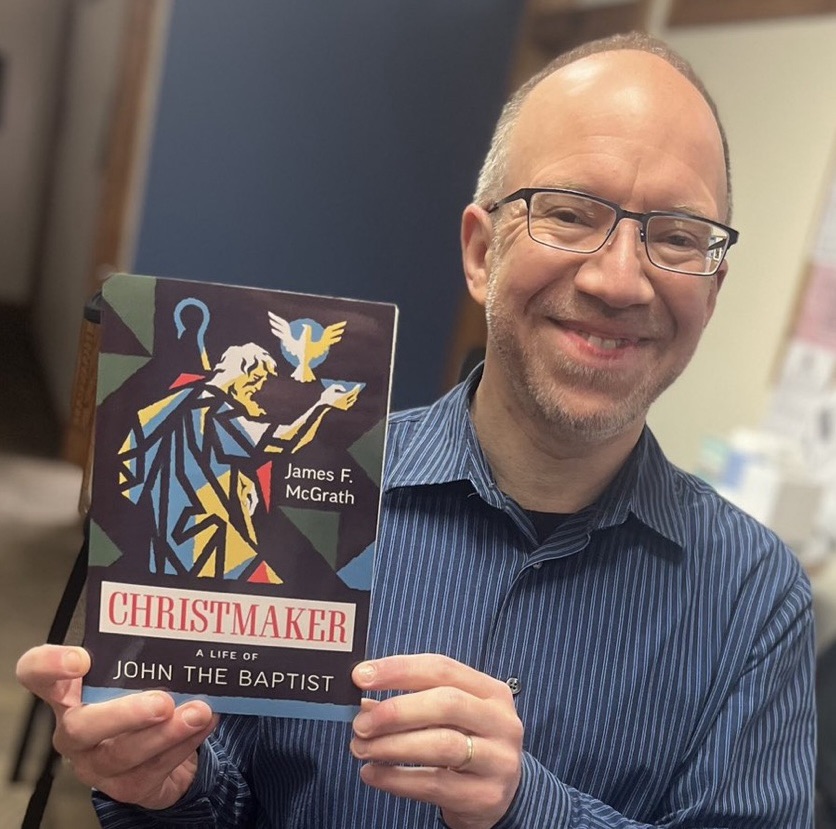
Yesterday Elizabeth and I had the opportunity to attend a lecture at Macquarie University given by our friend and colleague, Prof. James F. McGrath of Butler University, Indiana, who is on a short visit downunder at the moment. James has recently completed two books on John the Baptist, and as part of his visit he is speaking about some of the research involved in producing those books. The first is Christmaker: A Life of John the Baptist (Eerdmans, 2024); the second is John of History, Baptist of Faith: The Quest for the Historical Baptizer (Eerdmans, 2024).

His other personal and professional interest is in the intersection of religious studies and science fiction—he has written other works in relation to this area of interest: Time and Relative Dimensions in Faith (Dayton, Longman and Todd, 2013) and Theology and Science Fiction (Cascade, 2016). James is also speaking tonight at Sci-Fi Church in northern Sydney.

Elizabeth and I met James in 1997, when we were all a part of the research community in the Theology Department at Durham University in the UK. Both James and Elizabeth were undertaking postgraduate research under the supervision of the late Prof. James D.G. Dunn—James, into the Christology of John’s Gospel, and Elizabeth, into mission in the Gospel of Matthew.

The two books that McGrath has written complement each other. Christmaker is unapologetically “popular”, in that is was written for a generalist audience. I can confirm that it is easy to read as it invites us along the journey of discovery that McGrath himself has taken. The second book (a clever riff off the oft-heard statement about Jesus, “the Jesus of history, the Christ of faith”) promises to take us deep into the scholarly explorations of the ancient texts that provide the foundation for Christmaker. In his recent lecture at Macquarie University, James McGrath has provided a glimpse of those scholarly discussions in his typical engaging style.

The small book Christmaker (just 172 pages) opens with typical McGrath-esque snappy commentary: “everybody thinks they know John the Baptist; he has good name recognition”, and yet, “I bet most readers of this book would know him the way they know a homeless man they pass on their way to work each day … [with] an astonishing lack of detail, little apart from vague impressions” (p.1).

The book proceeds to explore “the splash John made” (pp.3–8) and then to set out how a reconstruction of the life of John will be built, using both familiar and less familiar sources. The best-known sources come from Hebrew Scripture—the infancy narratives of 1 Samuel 1—2 and Judges 13—and the New Testament—the conception and birth of John in Luke 1; the Gospel accounts of the baptising activity and preaching/witnessing of the adult John, and the Synoptic accounts of his death. The other sources he uses, barely known outside a small academic circle, are the Infancy Gospel of James from within second century Christianity, and the Mandaean Book of John, from the traditions of another living religion, Mandaeism.

There is, obviously, solid and groundbreaking scholarly work lying beneath the surface of this accessible “fresh look at the life of John the Baptist”. One element of this is that McGrath has co-authored the only English translation of the Mandaean Book of John, published in a critical edition (de Gruyter, 2019) which takes the readers on a wondrous journey into the poetry and imagery of this 7th century Aramaic text.

See the translation at http://www.gnosis.org/library/The_Mandaean_Book_of_John_Open_Access_Ve.pdf

Since late antiquity, the Mandaeans have followed the baptismal practice of John and have revered him as the key figure in their religion. Communities of Mandaeans are to be found in many places around the world today, still practising their faith. One significant characteristic of McGrath’s work is that he has connected with, and interacted with, Mandaean communities in a number of countries.

By discussing his views with them, he has ensured that he is best understanding (from the vantage of an “outsider” to the religion) how John is today understood within that faith tradition. Indeed, there were a number of Mandaeans present at the lecture that Elizabeth and I attended, and they offered helpful insights into the thesis that McGrath was proposing.

Another contribution to the fine scholarly work that is evident in this book is the careful critical reading of the Infancy Gospel of James, a second century Christian text replete with miracles and extravagant tales relating to the birth of Jesus (chs. 1–20) and the death of Zecharias, father of John the Baptist (chs. 22–24).

See a translation at https://www.newadvent.org/fathers/0847.htm and my own discussion at

By reading these two unfamiliar texts alongside the biblical passages already noted, McGrath is able to posit quite a lot about the quite overshadowed—and largely misunderstood—figure of John the Baptist. He wasn’t an unkempt and unruly figure, wandering the desert, angrily denouncing his fellow-Jews, for one; rather, he travelled the rural areas, proclaiming his vision for Israel. McGrath has visited many of the sites traditionally associated with John in person—beyond the all-too-predictable River Jordan spot where John’s baptisms were said to have taken place. So this adds another dimension to his discussion of the traditions.

John was not, as might have been expected of the son of a priest, devoted to service in the temple; rather, he was “an antiestablishment rebel and activist”, challenging the hegemony of the Temple through the practice of baptism, for which he is best-known. Such baptism “invited people to have a mystical spiritual experience of rebirth”—leading, eventually, to a Gnostic-type movement (Mandaeism) which embraced his practice as the key to religious fulfilment.

John did, indeed, look to the coming of “one who is to come”, to rectify the classism of ancient Israelite society—although it is not necessarily so clear-cut that John himself actually envisaged any particular one of his followers (let alone the man from Nazareth, Jesus) as the one to fill that role.

And, in a surpassing twist, it may well have been the overenthusiastic action of this particular disciple, Jesus of Nazareth, who sought physically to overturn the practices of the Temple in his famous “Temple tantrum” (a catchy phrase that McGrath has used in conversation with me). So it was John’s stimulus of Jesus which provoked controversy about his movement through this act, leading to the arrest of John and his eventual death. That Jesus might have borne primary responsibility for the death of John is a twist, indeed!

See my recent discussion of the death of John at

So, what can we take from this fascinating tour through ancient texts and modern religious practices? Jjj, that Christianity started within a very specific social and religious context—the Baptist movement—and not just within an undifferentiated amorphous mass of “Judaism of the time”. Jesus, as a disciple of John, adopted his teachings, his practices, his vision. The introduction that Luke provides to his Gospel, focussing on Zechariah, Elizabeth, and John, needs then to be reconsidered in this light.

Second, that piecing together a life of John the Baptist can and should be done by judiciously critical use of the later Mandaean sources. Scholars have learnt, in the last half-century, to utilise material from rabbinic writings in Mishnah, Midrash, and Talmud—works from late antiquity—with appropriate care and critical acumen, to inform our discussions of the foundational documents of Christianity (especially the Gospels). In similar manner, a critical appreciation of the Mandaean Book of John offers a range of applicable insights.

Third, scholars have become aware of “editorial fatigue” in their treatment of various ancient texts. This refers to the practice of including source material without paying careful attention to the need to adapt and contextualise it for the later writing in which it is used. Evidence for this “editorial fatigue” can be found in works by historians, evangelists, and apologists alike. McGrath cites instances in the Infancy Gospel of James which throw light on the figure of John the Baptist—especially the jagged change in ch.22 from a story about Jesus, to a story about John.

On this basis, he proposes that the author of this second century Gospel was using an existing account of the infancy of John and adapting it as a story about the origins of Jesus. An editorial lapse (forgetting to change the names of mother and child!) provides the key to unlocking this reading. We may well, then, have access to an early tradition about John, separate from the apologetic way that he is portrayed in the New Testament Gospels (where he is portrayed as “second-fiddle” to Jesus).

So a readily-accessible “life of John the Baptist” (set out with clarity in Christmaker) becomes possible, by tracing and examining the interlocking and overlapping threads across three religious traditions—Judaism, Christianity, and Mandaeism—through the various source documents already noted. What results is a creative, insightful, and groundbreaking book. I recommend it as worth purchasing and reading.

See also https://www.insights.uca.org.au/what-can-mandaean-sources-teach-christian-scholars/

James F. McGrath with Christmaker

A king forever (2 Sam 7; Pentecost 9B)

“A king forever”. That is the promise of these well-known words in 2 Samuel 7, which we will hear and reflect on in worship this coming Sunday. They are significant words for Jews; they are also significant words for Christians, for they have informed the way that followers of Jesus would talk about him. The words are given initially to David, only the second king of Israel, but the one who would provide descendants to sit on the throne for half a millennium.

The words of the prophet Nathan, given to him (as he says) by the Lord God, are reported and remembered over those centuries as validation of the power of those kings, even though so many of them “did evil in the sight of the Lord” (as later verses in the historical narratives of Israel report). God stood by those leaders over many generations, consistently reminding the people of their responsibility to adhere to the covenant, affirming them at moments when their faith is evident, and rebuking them at times when that is not the case.

These words have been remembered further by Christians, who see that in Jesus, God has sent “the King of the ages” (1 Tim 1:17), to whom “belong the glory and the power forever and ever” (1 Pet 4:11; also Rom 16:26; Eph 3:21). This is in accord with the “eternal purpose that [God] has carried out in Christ Jesus our Lord” (Eph 3:11), to lead believers to “eternal life” (Luke 10:25; John 17:3; Rom 5:21; 6:23).

Of course, in those words which Nathan speaks to David, we recognise the play on words that occurs. David understands God to be promising a “house” which is “a house of cedar” (v.7), but God actually intends to establish “offspring after you … his kingdom” (v.12).

Writing in With Love to the World, Mel Pouvalu observes that “The word “house” is used fifteen times in 2 Samuel 7, where it has three different meanings. It refers to David’s palace (vv.1–2), to the temple of the Lord God (vv.5–7, 13), and then to David’s dynasty (vv.11, 16, 18–19, 25–27, 29).” She continues, “It is important to see that our ways are not God’s ways, even if we mean well. The story promises a stable future for generations to come, and these narratives are reminders that God will always be seeking us.”

The motif of a kingdom that lasts “forever” is linked both with the affirmation that there will be a king “forever”, and also with the belief that the covenant with Israel will last “forever”. That there will be a king “forever” is integral to God’s promise to David that “your throne shall be established forever” (2 Sam 7:16), repeated by the Chronicler, “when your days are fulfilled to go to be with your ancestors, I will raise up your offspring after you, one of your own sons, and I will establish his kingdom … and I will establish his throne forever” (1 Chron 17:11–12).

The kingdom that will last “forever” is introduced by God’s words in 2 Samuel 7, where God promises David that “your house and your kingdom shall be made sure forever before me” (2 Sam 7:16). The Chronicler also repeats this promise, quoting God as saying of David, “I will confirm him in my house and in my kingdom forever, and his throne shall be established forever” (1 Chron 17:14).

Affirmation of a covenant that will last forever is found in a number of psalms. “The Lord our God … is mindful of his covenant forever, of the word that he commanded, for a thousand generations, the covenant that he made with Abraham, his sworn promise to Isaac, which he confirmed to Jacob as a statute, to Israel as an everlasting covenant” (Ps 105:7–10).

The covenant is noted in a number of psalms. “The friendship of the Lord is for those who fear him, and he makes his covenant known to them”, sings the psalmist (Ps 25:14). “I have made a covenant with my chosen one, I have sworn to my servant David”, God sings in another psalm; “I will establish your descendants forever, and build your throne for all generations” (Ps 89:3–4).

In this same psalm, God affirms that, even if the children of David “forsake my law and do not walk according to my ordinances”, God will punish them, but “forever I will keep my steadfast love for him, and my covenant with him will stand firm … I will not violate my covenant, or alter the word that went forth from my lips” (Ps 89:28, 34). That covenant is to last “forever” (Ps 111:9).

The ultimate message, then, is that God will stand by the leaders of Israel, punishing them, forgiving them, loving them at each step along the way. A promise to sustain a king and a kingdom “forever”, by virtue of a covenant that lasts “forever”, undergirds this reality for the people of Israel. The modern nation state of Israel has adopted this confident assertion, although without any critical appreciation of the context and the purpose of this promise in antiquity. The dreadful results of this unthinking adoption of the mantra that “God is always with us” is playing out in the many deaths, injuries, and sadness that is taking place in Gaza, even today.

Of course, in the traditional understanding of Christianity, the “forever” component has been taken up in the application of 2 Samuel 7 to Jesus of Nazareth. Jesus is acclaimed as “Son of David” in the Synoptic Gospels (Mark 10:47–48; 12:35; Luke 3:31; 18:38–39; and especially in Matt 1:1, 20; 9:27; 12:23; 15:22; 20:30–31; 21:9, 15; 22:42). This claim is also noted at John 7:42; Rom 1:3; 2 Tim 2:8; Rev 3:7; 5:5; 22:16). The heritage of David lives on in these stories.

This particular son of David, as Christian understanding develops, was understood to be king “forever”; “he will reign over the house of Jacob forever, and of his kingdom there will be no end” (Luke 1:31–33). The covenant that he has renewed and enacted with the people of God is “forever” (Heb 9:15; 12:20); and the kingdom that he proclaimed and for which we hope will also be “forever” (2 Pet 1:11).

In the late first century document that we know as letter to the Ephesians, for instance, the resurrected Jesus is seen as seated at the right hand of God “in the heavenly places, far above all rule and authority and power and dominion, and above every name that is named” (Eph 1:20–21). That place of authority for Jesus is envisaged as stretching into eternity, “not only in this age but also in the age to come” (1:20), and as encompassing all places, for God “has put all things under his feet and has made him the head over all things” (1:22).

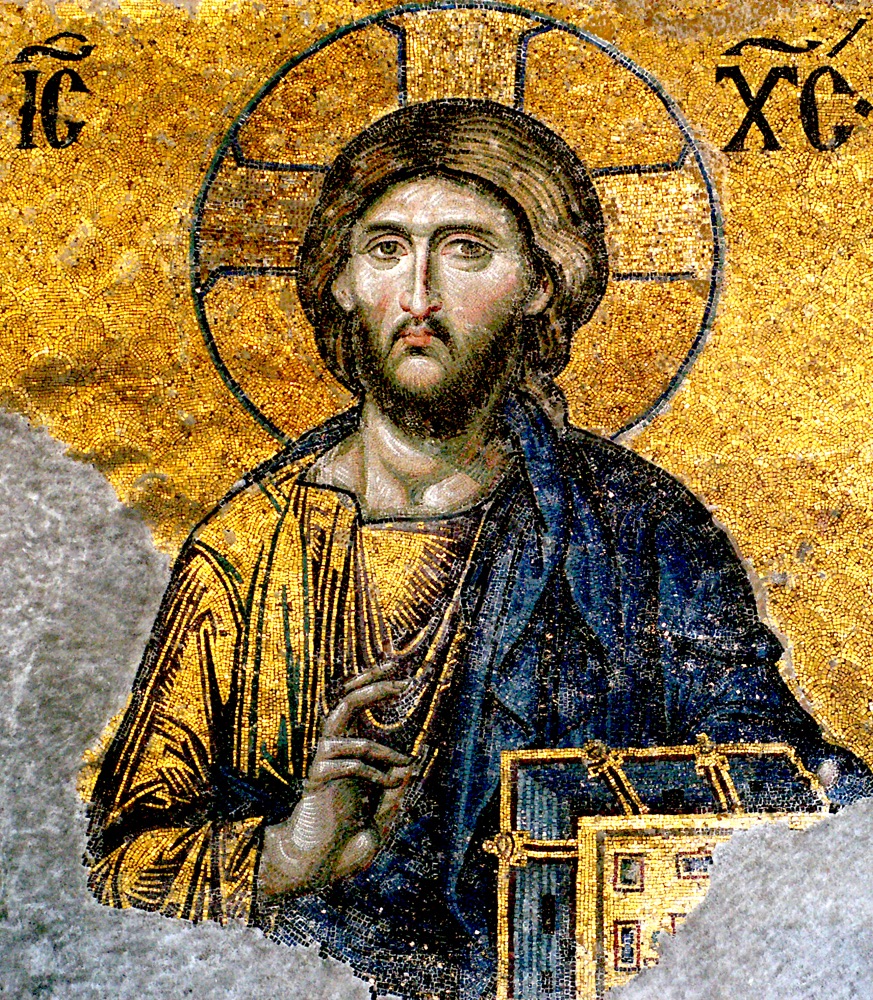
The global and eternal rule of Christ is here clearly articulated. The statement by the writer that God “seated [Jesus] at his right hand in the heavenly places, far above all rule and authority and power and dominion” (1:20–21) has inspired the development of the imagery of Christ as Pantocrator (Greek for “ruler of all”) in Eastern churches, both Orthodox and Catholic.


Jesus Christ Pantocrator; from a mosaic in the Hagia Sophia mosque (formerly a church), in Istanbul

This line of thinking has culminated in the festival of the Reign of Christ, which has been celebrated in the Roman Catholic Church since it was introduced by Pope Pius XI in 1925. It has since been adopted by Lutheran, Anglican, and various Protestant churches around the world, and also, apparently, by the Western Rite parishes of the Russian Orthodox Church Outside Russia.

1925 was a time when Fascist dictators were rising to power in Europe. I have read that “the specific impetus for the Pope establishing this universal feast of the Church was the martyrdom of a Catholic priest, Blessed Miguel Pro, during the Mexican revolution”; see Today’s Catholic, 18 Nov 2014, at

The article continues, “The institution of this feast was, therefore, almost an act of defiance from the Church against all those who at that time were seeking to absolutize their own political ideologies, insisting boldly that no earthly power, no particular political system or military dictatorship is ever absolute. Rather, only God is eternal and only the Kingdom of God is an absolute value, which never fails.”

The scriptures puncture the pomposity of powerful kings, and subversively present Jesus as the one who stands against all that those kings did. This festival provides a unique way of reflecting on the eternal kingship of Jesus. It offers a distinctive way for considering how the kingship bestowed upon David has been understood to last “forever”.

With Love to the World is a daily Bible reading resource, written and produced within the Uniting Church in Australia, following the Revised Common Lectionary. It offers Sunday worshippers the opportunity to prepare for hearing passages of scripture in the week leading to that day of worship. It seeks to foster “an informed faith” amongst the people of God.

You can subscribe on your phone or iPad via an App, for a subscription of $28 per year. Search for With Love to the World on the App Store, or UCA—With Love to the World on Google Play. For the hard copy resource, for just $28 for a year’s subscription, email Trevor at wlwuca@bigpond.com or phone +61 (2) 9747-1369.

What’s in, and what’s out (Mark 6; Pentecost 9B)

At this time of the year, every Year B, the lectionary strays away from choosing the Gospel readings from the beginning of the good news of Jesus, the Gospel of Mark. Next week, we will launch into a series of five weeks of readings drawn from John 6. That chapter revolves around the motif of Jesus as “the living bread which came down from heaven” (John 6:51). Because of this looming focus, the Gospel passage provided by the lectionary for this Sunday is curiously shaped. It takes two separate sections of Mark’s Gospel, and omits a large section that sits in between these two passages.

The story of the feeding of the crowd of “about 5,000 in all” (John 6:1–14) which we will read next Sunday replicates the story omitted from this Sunday’s reading, where the Jesus was able to feed a crowd comprising “5,000 men” (Mark 6:44).

The lectionary provides the surrounding sections (Mark 6:30–34, 53–56) and omits the feeding narrative (Mark 6:35–44). It also omits the account of Jesus walking on the water (Mark 6:45–52)—a story paralleled in Matt 14:22-33). Thus, we have a curiously disrupted passage for consideration.

We need, then, to consider, both what’s in, and what’s out, in this week’s lectionary selection.

What’s in: three key terms

The selection offered by the lectionary includes reference to Jesus taking his followers aside, to rest (6:31). We know well the words that Jesus spoke, offering rest to his followers (Matt 11:28–30). But we perhaps give little thought to the need that Jesus had, along with this followers, to rest from the bustling business that he engaged in. Mark states it well: “many were coming and going, and they had no leisure even to eat” (6:31).

Jesus moves away to a deserted place with his followers. He goes into the wilderness. The Greek word used here, eremon, is significant. This is where Jesus goes when he is tested by God (1:12), immediately after he had been completely immersed in the water by John the baptiser, resident in that wilderness (1:3, 4).

It was in the wilderness that Israel came to know its essential identity: a people, beloved by God, rescued from slavery, called into covenant, equipped for the battles of entry into the land, as the great myth from the past declared. It was, likewise, in the wilderness that Jesus came to know his mission in life, and where he came to know his identity as the Son of God, chosen for that mission. So it is fitting that he moves to a deserted place, seeking respite from the crowds.

Yet the crowds will not let the healer and his followers rest; they continue to press on Jesus, and as they saw him, with his followers, in the boat, they hurried on foot to that deserted place, “and arrived ahead of them” (6:33). This had been going on since early in the Gospel; large crowds had followed Jesus since early in Galilee (2:13; 3:20, 32; 4:1; 5:21; 24, 30–31) and would continue on in Galilee (7:14; 8:1–2, 34; 9:14–15, 25; 10:1, 46) and into Jerusalem (11:18; 12:37).

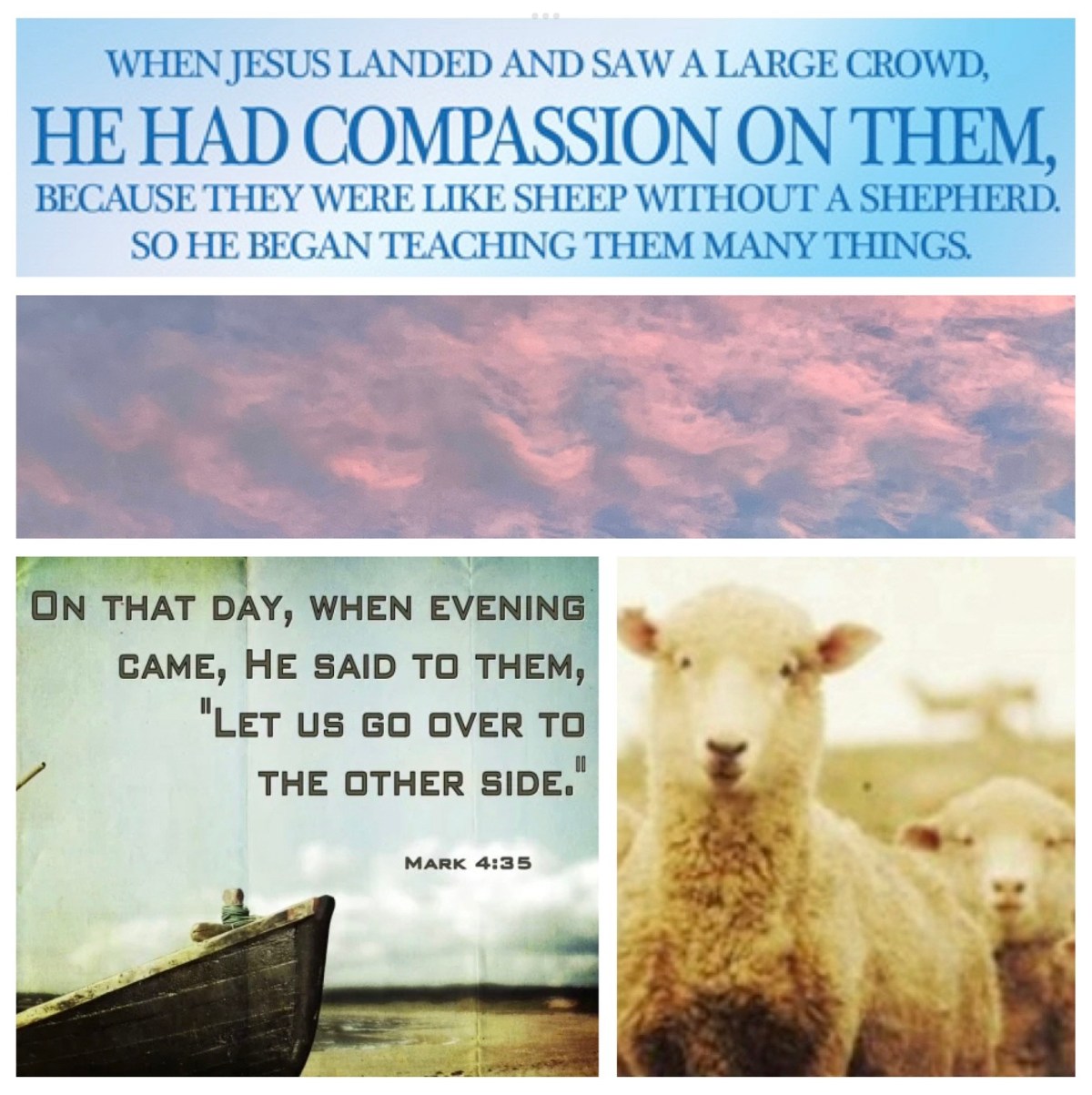
The response of Jesus is instructive. Here we find a second significant term. He “had compassion for them”, the NRSV reports (6:34). The distinctive Greek term used (esplangnisthē) appears here, and in the parallel of Matt 14:14 (as well as an editorial comment at Matt 9:36).

The term refers to that deep-seated churning in the gut that takes place when an emotional cord is struck. It is a profound and penetrating feeling. The same term is found in the paired story of the feeding of the 4,000, where Jesus tells his followers, “I have compassion on the crowd” (Mark 8:2, par Matt 15:32).

Such compassion is characteristic of Jesus on many occasions. The term has already appeared in Mark’s report of the leper who came to Jesus, seeking to be made clean, where it describes the way that Jesus responds to him (“moved with pity” in the NRSV, reflecting a textual variant in Mark 1:41, par Matt 10:6). It’s also used to characterise the way Jesus deals with two blind men near Jericho (“Jesus in pity touched their eyes”, NRSV Matt 20:34).

Other places where the word appears are in the story of the mute boy who suffers convulsions (Mark 9:14–29). The father of the boy begs Jesus to cast out the spirit which possesses the boy, imploring him, “if you can do anything, have compassion on us and help us” (9:22). Jesus responds by rebuking the spirit, which leaves the boy (9:25–27).

In the orderly account which we attribute to Luke, the compassion of Jesus is noted when he interacts with a widow who is mourning her dead son (Luke 7:13), and is also found within two of the parables told by Jesus, reported only in this Gospel. The Samaritan has compassion (Luke 10:33), as does the father when he sees his prodigal son returning home (Luke 15:20).

A third important idea is found when the author implicitly draws an analogy between Jesus, and a shepherd (6:34). In the book of signs, Jesus explicitly calls himself “the good shepherd” (10:1–18). This evokes the scriptural imagery of the good shepherd as the true and faithful leader in Israel (Num 21:16–17; Ezek 34:1–31; Jer 23:4). The phrase also alludes to the people as the sheep who are cared for (Pss 95, 100; Ezek 34:31).

People who are “sheep without a shepherd” recall the description of Israel in Hebrew Scriptures (Num 27:17; 1 Kings 22:17, par 2 Chron 18:16; and Judith 11:19). The narrator’s reference in Mark 6:34 contains these deep scriptural resonances. The compassion demonstrated by Jesus fits with his role as shepherd of the sheep.

A third key idea is contained in the brief statement that the compassion of Jesus is expressed as “he began to teach them many things” (Mark 6:34). The teaching activity of Jesus runs through this Gospel. Jesus teaches beside the sea (4:1), in the synagogue (1:21–27; 6:2), beside the lake (2:13; 4:1–2; 6:34), in the villages (6:6), and as he and his followers walk along the way towards Jerusalem (8:31; 9:31).

When Jesus reaches Jerusalem, he is said to be teaching the crowd in the courtyard of the Temple (11:15–18). A little later, some Pharisees and Herodians approach him, observing that “you are not swayed by appearances, but truly teach the way of God” (12:14). “Day after day I was with you in the Temple teaching”, he says to the armed crowd sent from the Jewish authorities to arrest him (14:43–49).

The same emphasis on his teaching is found on the other Synoptics. Matthew reports that “Jesus went throughout Galilee, teaching in their synagogues and proclaiming the good news of the kingdom” (Matt 4:23; see also 7:28–29; 9:35; 21:23; 22:33; 26:55), while Luke notes that when Jesus went to Capernaum, “he was teaching them on the sabbath; they were astounded at his teaching, because he spoke with authority” (Luke 4:31–32; see also 5:17; 6:6; 10:39; 13:10; 13:22; 19:47; 20:1; 21:37; 23:5).

What’s out: two substantial scenes

So much for what’s in this week’s selection. What about what’s out?

First, the Gospel offering provided by the lectionary includes the surrounding sections (Mark 6:30–34, 53–56) but omits what it surrounds—the feeding narrative (Mark 6:35–44). I think this is because the lectionary picks up that incident next Sunday, but it uses the account found in the fourth Gospel (John 6:1–21) before tracing the long (and repetitive) speech of Jesus in the rest of the chapter John 6:24–69).

This feeding story is also retold by the other two synoptic evangelists. In the book of origins (Matt 14:15–21), the crowd comprises “about five thousand men, besides women and children (Matt 14:21). In the orderly account of things fulfilled (Luke 9:12–17), the crowd is recorded, as in the Markan source, as being “about 5,000 men” (Luke 9:14).

The scene is reminiscent also of the parallel scene of feeding “4,000 men” recounted at Mark 8:1-10 and also at Matt 15:32-39; although Matthew indicates that there were “4,000 men, besides women and children”. (Luke omits this story.)

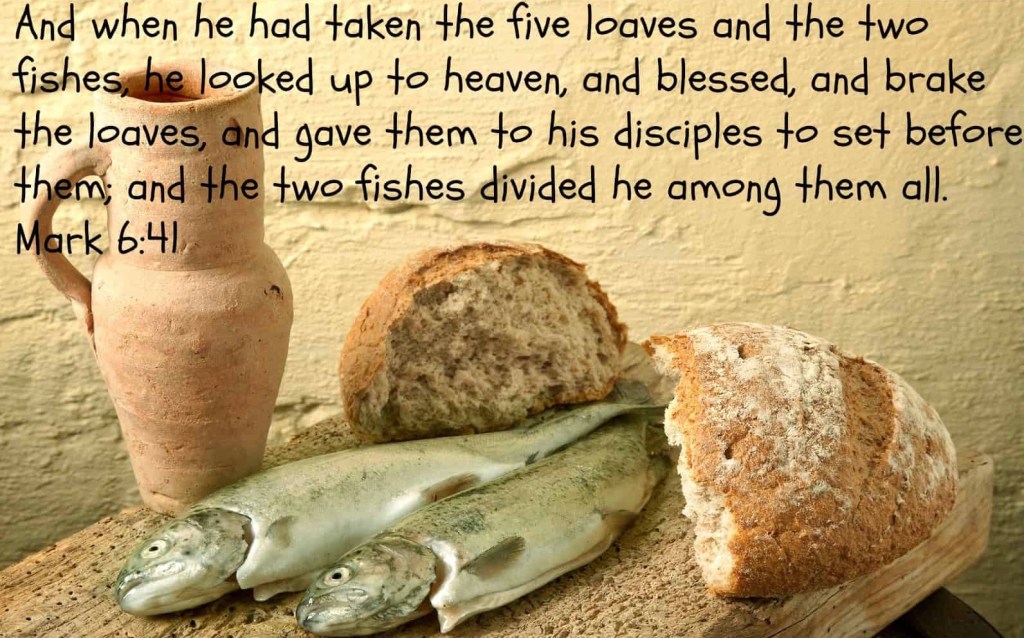
In each of those cases, the accounts provide the opportunity for Jesus to model the traditional pattern of a Jewish meal, as he “looked up to heaven, and blessed, and broke the loaves, and gave them to the disciples to set before the people” (Mark 6:41; Matt 14:19; Luke 9:16; and again at Mark 8:6 and Matt 15:36). This prefigures the familiar pattern from the last supper (Mark 14:22; Matt 26:26; Luke 22:19; 1 Cor 11:24; and see also Acts 20:7, 27:35).

So Mark recounts the scene: “And taking the five loaves and the two fish, he looked up to heaven and said a blessing and broke the loaves and gave them to the disciples to set before the people. And he divided the two fish among them all. And they all ate and were satisfied. And they took up twelve baskets full of broken pieces and of the fish. And those who ate the loaves were five thousand men.” (Mark 6:41–44).

And the resonances with the central Christian ritual, the remembrance of the last supper, are surely strong and deep.

Second, the lectionary omits the account of Jesus walking on the water (Mark 6:45–52) which plays an important role in Mark’s account. By omitting this, the lectionary has excised the important reference to Jesus crossing over “to the other side”, from the Decapolis across to Bethsaida (Mark 6:45).

In this earliest Gospel, Jesus had left Jewish territory earlier, when he crossed “to the other side of the sea, to the country of the Gerasenes” (5:1), then returned “to the other side” (5:21), where he visited “his own country” (6:1) before venturing again across “to the other side” (6:45–52).

This maritime movement makes an important symbolic point for the the author: the ministry of Jesus incorporated not only territories in Jewish areas (to 4:41, then 5:21 to 6:44) as well as the Gentile territories. Jesus firstly crosses into the Decapolis (5:1–20), where he cast out multiple demons from the tomb-dwelling man, sending them into the nearby pigs. (This story is also omitted by the lectionary during this particular year.)

One of the striking aspects in this story is that this man, possessed by an unclean spirit, fettered in chains, dwelling beside tombs, self-harming and acting inappropriately (5:2–6), becomes the first active missionary in this Gospel; after the encounter with Jesus, “he began to proclaim in the Decapolis how much Jesus had done for him, and everyone marvelled” (5:20). A pity we missed that this year.

Jesus is active on “the other side” again from Mark 6:53, when he enters the regions of Gennesaret (6:53). Subsequently, Jesus is located at Tyre and Sidon (7:24), and then “the region of the Decapolis” (7:31), before returning to Bethsaida (8:22) and Caesarea Philippi (8:27), in Jewish territory.

These geographical references are treated variably in the later accounts which used Mark as a source. Matthew retains Genessaret (Matt 14:34) and Tyre and Sidon (15:21), but removes the reference to the Decapolis (15:29). The geographical references from Caesarea Philippi onwards then appear in his ongoing narrative. Luke omits the whole section containing these earlier references (Mark 6:53–8:26), removing the clear indication that Jesus spent quite some time on Gentile soil.

Omitting the “crossing over” movement in the narrative lessens the significance of this observation: much of what takes place in the ensuing four chapters, takes place on Gentile soil. This is very important for our understanding of the stories that Mark reports. We need to hear that in mind as we read the later stories in this section of the Gospel: Jesus is “on the other side”, moving amongst the Gentiles of the Decapolis.

In his house, out of his mind (Mark 3; Pentecost 3B)

This Sunday, we continue reading and hearing from the earliest and shortest account of the story of Jesus, the beginning of the good news of Jesus, chosen one, which we know as the Gospel according to Mark. This week, we hear a story from the middle of chapter 3, as Jesus “went home” (as the NRSV reports).

In fact, the Greek simply notes that Jesus went “into a house” (εἰς οἶκον, 3:20). Is this the same house that was referred to, in Capernaum, at 2:1? The notion that it was his family home comes from the fact that his family came out of the house to meet him (3:21), and then his mother and brothers are noted once more, later in the scene (3:31).

Jesus, of course, is known as coming from Nazareth (Mark 1:9, 24; 10:47; 16:6; Matt 21:11; 26:71; Luke 4:16, 34; 18:37; 24:19; John 1:45–46; 18:5, 7; 19:19), but Matthew’s account explicitly states that he moved from Nazareth to Capernaum (Matt 4:13). Yet the occasion when Jesus returned to his hometown is inevitably located at Nazareth (Mark 6:1–6 and the parallel, Matt 13:55-58).

If this is the family home, in Capernaum, it is an interesting location; there is very little in the Gospels, apart from this scene, that brings the adult Jesus into direct contact with his family. So this is a distinctive scene.

However, it is also a typical, somewhat unremarkable scene, in that Jesus is found in a house. He has previously been in the house of Simon and Andrew in Capernaum (1:29) and then of Levi the tax collector (2:15). Later, he is found at the house of a synagogue ruler (5:38), a house of an unidentified resident (7:17), a house in the region of Tyre (7:24), the house of an epileptic child (9:28), another house in Capernaum (9:33), a house in Judea (10:10), and the house of Simon the leper in Bethany (14:3). Indeed, Jesus instructs his disciples that, when they go out to proclaim the kingdom of God, they are to enter houses (6:10).

In Mark’s Gospel, Jesus is regularly to be found in houses. Yes, he taught in the open spaces in public (2:13; 2:23; 4:1; 10:1), and engaged with people whom he encountered as he was walking along the road (3:7–12; 5:1–2; 5:21, 35; 6:53–56; 7:1–2; 8:22–26; 8:34; 9:14–15; 10:13, 32–34, 46). Jesus was to be found at times in synagogues (1:21–28; 1:39; 3:1–6; 6:1–6) and, once in Jerusalem, in the Temple precincts (11:11, 15, 27, on through to 13:1).

However, whilst travelling around Galilee, Jesus consistently undertook his ministry in houses. That, say some interpreters of this Gospel, most likely reflects the reality that the followers of Jesus, in the decades following, were gathered most often in houses—not in the Temple (except for the idealised account that Luke offers in the early chapters of Acts), not even in the synagogues (although some would have been there), but in houses.

These houses were the sites for hospitality, which was so important in the cultural practices of the day (see https://www.bibleodyssey.org/en/passages/related-articles/hospitality-in-the-new-testament) One scholar describes the house as “the dominant architectural marker” in Mark’s Gospel (https://open.library.ubc.ca/media/download/pdf/24/1.0070991/2 — this is a whole thesis on the topic!)

The work of Carolyn Osiek on the importance of the house for the early church is most significant in this regard (see her overview from a 1995 address at http://www1.lasalle.edu/~dolan/2003/Osiek.pdf). “The local house church or apartment church”, she writes, “provided, among other things, a sense of communal life and individual commitment, theological pluralism, a base for mission, and a model of the universal church.” (See p.21 of this article).

The prominence of the house is certainly reflected in the letters of Paul, who refers often to “the church in the house of …” (Rom 16:5; 1 Cor 11:22, 16:19; Col 4:15; Philemon 2; and 1 Tim 5:13). The early Jesus movement was a house church movement! The standard work in this area has long been the book by Australian scholar Robert Banks, on Paul’s idea of community (http://www.lifeandleadership.com/book-summaries/banks-pauls-idea-of-community.html).

When Jesus comes out of his house in Capernaum, some onlookers describe him as being “out of his mind” (ἐξέστη, 3:21). This is a term that literally means that he was “standing outside of himself”, as if in a kind of dissociative state. It may be that this was the reason that Jesus was returning to his family?

The encounter doesn’t go well, however. Scribes have come from Jerusalem. They have already been antagonistic towards Jesus, questioning whether Jesus was blaspheming (2:6–7), and casting doubts on his choice of dinner guests (“why does he eat with tax collectors and sinners.”, 2:16). There will be further disputation with scribes (7:1–5; 9:14; 12:28, 38–41) and they will be implicated in the plot to arrest Jesus (11:18, 27; 14:1, 43, 53; 15:1) and in his death (8:31; 10:33).

These scribes—hardly friends—articulate what others present may well have been thinking: “he has Beelzebul” (3:23). The charge of demon possession correlates with the accusation levelled at John 10:20. This sits as the fundamental reason for perceiving Jesus as being “out of his mind”.

Beelzebul (Βεελζεβοὺλ), “the ruler of the demons”, is known from earlier scriptural references to Baal-zebub in 1 Kings 1:2–6, 16, where he is described as “the god of Ekron”, a Philistine deity. There is scholarly speculation that Beelzebul may have meant “lord of the temple” or “lord of the dwelling”, from the Hebrew term for dwelling or temple (as found at Isa 63.15 and 1 Kings 8.13); or perhaps it was connected with the Ugaritic word zbl, meaning prince, ruler.

Jesus refutes the charge in typical form, by telling a parable (3:23–27) that ends with the punchline about “binding the strong man” (τὸν ἰσχυρὸν δήσῃ). This potent phrase encapsulates something that sits right at the heart of the activities of Jesus in Galilee—when he encounters people who are possessed by demons, and when he casts out those demons, he is, in effect “binding the strong man”.

The notion that a demon would bind the person that they inhabited is found at Luke 13:16, and in the book of Jubilees (5:6; 10:7-11). The book of the same title by Ched Myers provides a fine guide to reading the whole of Mark’s Gospel through this lens (see https://chedmyers.org/2013/12/05/blog-2013-12-05-binding-strong-man-25-years-old-month/)

The accusation that refers to “blasphemy against the Holy Spirit” (3:29) may well reflect this claim that Jesus was demon-possessed (3:30). That is a claim that cannot be allowed to stand, that cannot be justified in any way—and thus, that cannot be forgiven or set aside. This is a critical dimension for the Jesus who is active in Mark’s Gospel.

We may think of Jesus as a preacher, a story teller, delivering parables and aphorisms. Much of Mark’s account, however, is focussed on the healing and exorcising activities of Jesus.

Some of the most striking stories told of Jesus were those relating the miraculous deeds he performed: curing lepers, healing the sick, casting out demons, controlling the forces of nature, even raising the dead. Jesus, it was recounted, was able to cure illnesses such as a fever (1:30–31), leprosy (1:40–42), paralysis (2:1–12), haemorrhaging (5:25–29), deafness (7:31–37), and blindness (8:22–26).

He is said to have engaged in conversations with demons which were possessing individuals, and he was able to command the demons to leave those individuals (1:23–26; 5:1–15; 7:24–30). In some cases, demonic possession was manifested in the body in medical ways: epilepsy (9:19–29), or an inability to speak (9:32–33), coupled with blindness (12:22).

The action of “casting out” or “driving out” a demon (3:22, 23) is expressed in a word which contains strong elements of force. The phrase is ἐκβάλλει τὰ δαιμόνια. The verb is used regularly to describe the confrontational moment of exorcism (1:34, 39; 3:15, 22-23; 6:13; 9:18, 28, 38). It first appears in the account of Jesus being tempted in the wilderness—here, however, it is the Spirit who casts Jesus out into the wilderness. The story reflects a moment when Jesus comes face to face with his adversary, Satan—and casts his power aside. (The more developed dialogues in Matthew 4 and Luke 4 expand on this understanding of the encounter.)

On the first occasion when Jesus has gathered all twelve apostles together, he gives them a twofold commission: “he appointed twelve…to be with him and to be sent out to proclaim the message and to have authority to cast out demons” (3:14–15). As the Gospel then proceeds to report how Jesus speaks and acts, the meaning of this discipleship is spelled out. The apostles—and other followers—have the opportunity to learn from his teachings and to witness his actions while they are with Jesus, and then to replicate these teachings and actions through their presence in other places.

“Proclaiming the message and casting out demons” is how the activities of Jesus are characterised (1:39). These same activities form the basis for the mission of the twelve as it is reported at 6:7–13. They model their words and deeds on Jesus: “they proclaimed that all should repent…they cast out many demons and anointed with oil many who were sick and cured them” (6:12–13).

Their mission is to be characterised by an ascetic mode of dress (6:8–9) and a focussed mode of proceeding (6:10–11). Their attention is to be directed entirely to the task at hand. In this way they are to follow the example and pattern of Jesus, confronting the powers and casting them out of their strongholds. This is what is at stake in the scene we read this Sunday (3:20–35).

The final section of this scene (3:31–35) depicts the breach between Jesus and his family—those who had earlier come to greet him and care for him in his state of being “out of his mind” (3:20–21). No longer are they to function as his family; those who are closest to him, “whoever does the will of God”, now serves as his brother, sister, mother. The work of challenging and exorcising “the ruler of demons” is deeply costly. The challenge to follow him is likewise incredibly costly.

Receiving and passing on a living tradition: died and buried, raised and appeared (1 Cor 15; Easter Sunday)

On Easter Sunday, we say: “Christ is risen! He is risen indeed!”, to celebrate that “God raised Jesus from the dead” (Gal 1:1; Rom 4:24; 10:9; Acts 2:32). Paul affirms this good news in this extract from his first letter to the saints in Corinth, which is the Epistle reading that the lectionary offers for Easter Sunday (1 Cor 15:1–11). Some verses in this passage have played a key role in the development of Christian tradition, which affirms in creeds and confessions a belief in “Jesus Christ … who was crucified, died, and was buried … who rose again from the dead on the third day”.

What is the nature of the confessional affirmation that Paul offers in this passage? The previous chapters of 1 Corinthians have alerted us to the disorganised ethos of the community in the cosmopolitan port city of Corinth. Those earlier chapters have indicated a number of problems that existed within the community of followers of Jesus. There was factionalism (chs.1–4), immorality (ch.5), resorting to civil lawsuits (ch.6), and dissension regarding marriage, celibacy, and sexuality (ch.7). There were differing attitudes towards consuming meat bought in the marketplace after it had been offered to idols (chs.8–10), and multiple issues that manifested in their gatherings for worship (chs.11–14).

Paul addresses each of these matters with the same intention, to bring about order in the midst of the chaos that he has been told about. His words in the midst of the lengthy discussion about marriage, celibacy, and sexuality state his purpose with clarity: “I say this for your own benefit, not to put any restraint upon you, but to promote good order and unhindered devotion to the Lord” (7:35).

The disorder and chaos evident in worship, in particular, led Paul, in the chapter immediately preceding this passage, to advise the Corinthians to seek to speak to others in worship “for their upbuilding and encouragement and consolation” (14:3). He advises them to exercise their spiritual gifts appropriately; to “strive to excel in them for building up the church” (14:12), to “not be children in your thinking … but in thinking be adults” (14:20). He advises them, “let all things be done for building up” (14:26), noting that “all things should be done decently and in order” (14:40), for “God is a God not of disorder but of peace” (14:33).

People speaking over the top of each other in worship, not attending to important words of prophecy and tongues, reflected the disordered chaos of the apparently quite libertine community. The infamous words ordering women to “keep silent” (14:33b—36), along with the adjacent commands to “keep silent” while one interprets tongues that are spoken (14:27–28) and “keep silent” to those seeking to offer a word of prophecy while others are still prophesying (14:29–31), are included in this letter precisely to address this chaotic disorder. And not for the first time in this letter, Paul invokes his higher authority to support his directions: “[you] must acknowledge that what I am writing to you is a command of the Lord” (14:37; see also 5:3–4; 7:40; 10:20–22; 11:27–28; 16:10; and cf. 7:25).

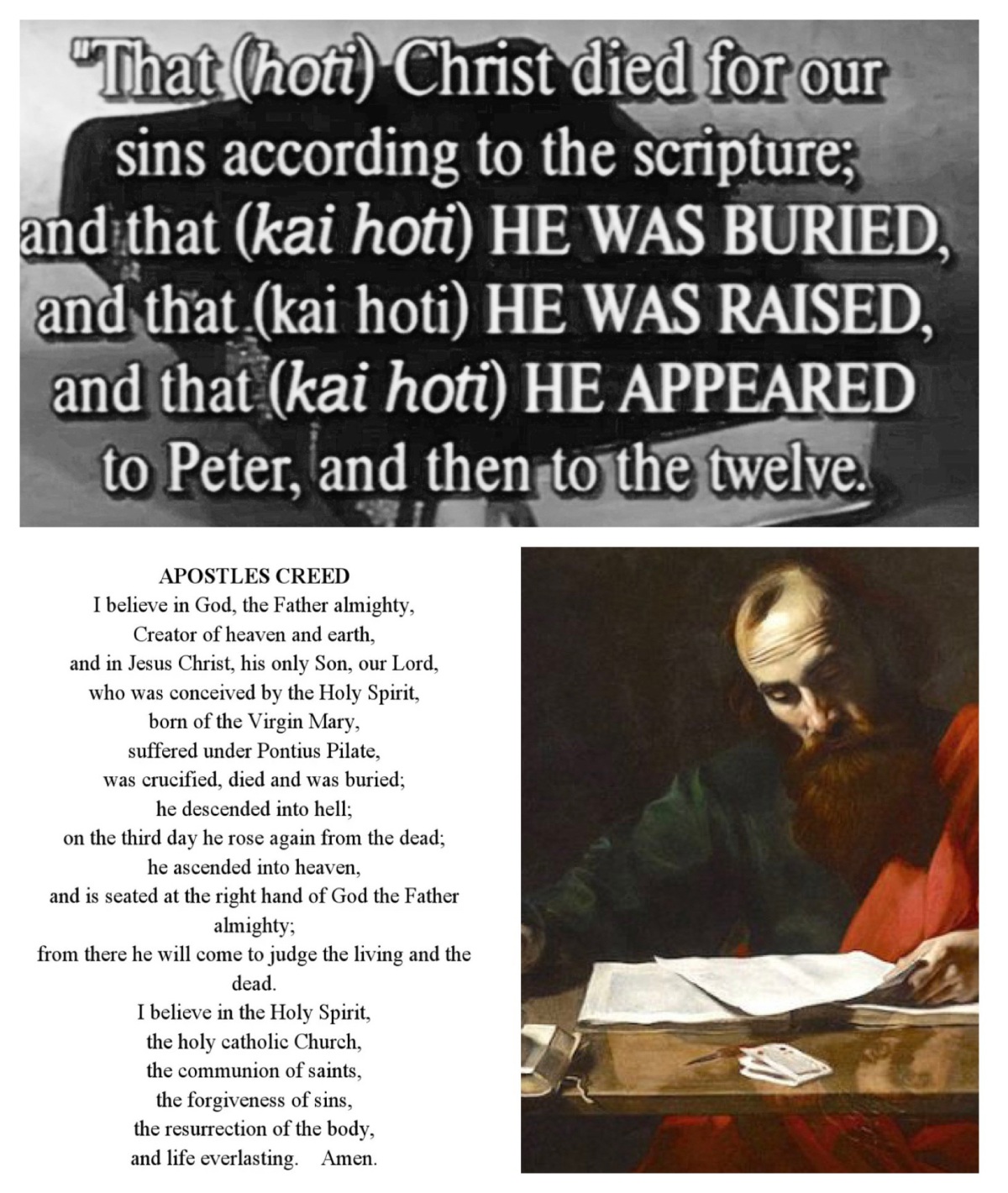
Immediately after this extensive discussion about worship, Paul turns to his foundational message about Jesus, in a four-part statement: Christ died—was buried—was raised—and then appeared to various people (15:3–5). He uses terms that denote the passing on of traditions: “I received … I handed on … which you received … in which you stand” (15:1); and he insists on the importance of what he passes on: “you are being saved, if you hold firmly to the message that I proclaimed to you” (15:2). These two verses provide a strong, insistent introduction to what follows in the ensuing verses.

We see this dynamic also in an earlier chapter, in the familiar words associated with the Last Supper: “I received from the Lord what I also handed on to you” (1 Cor 11:23), as well as in the commendation of the Corinthians as they “maintain the traditions just as I handed them on to you” (11:2).

The core tradition that Paul cites is the fourfold declaration that Jesus died, was buried, was raised, and appeared (vv.3–5). It may have already have been an existing formula; we know that Paul, in this letter and elsewhere, makes use of very short credal-like statements that it is likely had already been developed by others, some of which he cites in order to refute, such as: “is well for a man not to touch a woman” (7:1), “all of us possess knowledge” (8:1), “all things are lawful” (10:23), and “how can some of you say there is no resurrection of the dead?” (15:12).

There are other succinct sayings which Paul uses as the basis for further developments in his argument, such as “I decided to know nothing among you except Jesus Christ, and him crucified” (2:2), “knowledge puffs up, but love builds up” (8:1), “there is no God but one” (8:4), and “all things are lawful, but not all things build up” (10:24). The discussion of factions in chs.1–4 is built off “I belong to Paul … I belong to Apollos … [but] what then is Apollos? what is Paul?” (3:4–5), while Paul’s lengthy discussion of spiritual gifts (12:4—14:40) jumps off from the unspiritual “Jesus be cursed!” and the spirit-inspired response, “Jesus is Lord” (12:3).

Furthermore, Paul writes a number of longer credal-like statements, some of which seem shaped for liturgical usage: the words which became the “words of institution” in the church’s eucharistic practice (1 Cor 11:23–26), and others such as Rom 8:28; 2 Cor 4:14; Gal 1:3–5; Phil 2:6–11. The writers in the school of Paul who later wrote letters claiming to have his authority ( the “pastoral epistles”) followed this practice (see 1 Tim 2:5–6; 3:16; 2 Tim 2:11–13; Titus 2:11–14).

Two clauses in Paul’s tradition-based affirmation of 1 Cor 15:3–5 are buttressed by reference to scripture, another voice of authority alongside “the tradition”. What the specific scripture passages are, Paul does not state; this has left open the door for speculation by later interpreters.

Supporting arguments by reference to scripture is not unknown in Paul’s writings; as a Pharisee, he had attained a good awareness of Torah and its application to life (see Gal 1:14; Phil 3:5–6). He bases his magnum opus, Romans, on a scripture citation (Rom 1:17, citing Hab 2:4) and there is barely a chapter of this letter that does not contain scripture quotations and allusions in abundance.

Key moments in 1 Corinthians are likewise supported by verses from Hebrew Scripture (1 Cor 1:19, 31; 2:9, 16; 3:19–20; 14:21; 15:54–55), and the well-known “words of institution” themselves (11:23–26) reference the tradition which emerges in later decades in the Synoptic Gospels, recording the words of Jesus himself at the last supper (Mark 14:22–25; Matt 26:26–29; Luke 22:14–20).

By using the terminology of traditions being received and handed on, Paul is reining in the wayward Corinthians, recalling them to the fundamentals of their faith. So he sets out the dynamic of died—buried—raised—appeared (15:3–5) as the foundation for then discussing, in the remainder of the chapter, issues associated with the resurrection of Jesus (15:6–58).

Who saw the risen Jesus? First, Paul tells of an appearance to the early leaders, Cephas (Peter) (v.5) and James (v.7)—of which, neither appearance is reported in any Gospel. Then, Paul indicates that Jesus appeared to “the twelve” (v.5) and “all the apostles” (v.8)—apparently alluding to narratives found in the later texts of three Gospels Matt 28:16–20, Luke 24:33–48; John 20:19–23, 24–29; 21:1–14. (The appearances narrated in the shorter and longer endings of Mark, added after 16:8, are not relevant; these are later patristic additions based on the other three Gospels, designed to harmonise the ending of Mark with these others.) Acts 1:6–11 might also be relevant here.

An interesting question is, how did he distinguish between these two groups—“the twelve” on the one hand, and “all the apostles” on the other. Indeed, these terms appear to be inherited by Paul from earlier traditions. This is the only place in all Pauline letters which refer to “the twelve”; and besides, the Gospel narratives noted above do not have Jesus appearing to “the twelve”, as Judas was absent from all of them, and so was Thomas in John 20:19–23.

As far as the word “apostle” is concerned, in 16 of the 18 occurrences in the Pauline corpus (including those not authentic to Paul) Paul explicitly apply the term to himself. Paul acknowledges others as apostles: James (Gal 1:19), Peter (Gal 2:8), perhaps Barnabas (1 Cor 9:1, 5–6), an unspecified number of believers who were given gifts to be apostles (1 Cor 12:28–29; see also Eph 4:11), and most strikingly, Andronicus, a male, with Junia, a female (Rom 16:7). Are these the people that Paul has in mind at 1 Cor 15:8? Or is this simply a phrase inherited from the tradition, which Paul has repeated?

Next, Paul identifies an appearance to “more than five hundred brothers and sisters at one time” (v.6), which again has no place in any Gospel account. Last, Jesus appears to Paul himself (v.8), which he briefly reports at 1 Cor 9:1 and Gal 1:1. Strikingly absent from his list is the empty tomb and the appearances to Mary in the garden (John 20:14), to the women as they left the tomb (Matt 28:9–10), to the two travellers to Emmaus (Luke 24:15), or to the seven fishing by the Sea of Tiberias (John 21:1–4). What a perplexing inconsistency between the various testimonies to these appearances!!

This is an early collection of “witnesses to the resurrection”; Paul wrote to the Corinthians in the mid 50s. But there is no mention of what was important to all four evangelists, writing in later decades: the women at the empty tomb and the role that women played in bearing testimony to the risen one. Is this accidental? or deliberate? Given what we have noted about 1 Corinthians as a whole—and especially what ch.14 reveals about the disorderly behaviour of Corinthian women—we might well wonder, is Paul shaping the received tradition to “fit the context” already at this early stage? It is a tantalising suggestion.

There is a wonderful quote that is pertinent to this issue, which is attributed to Gustav Mahler, the late 19th century Austro—Bohemian composer: “Tradition is not the worship of ashes, but the preservation of fire.” These words indicate that if tradition stands still, it will run out of momentum and fizzle out of energy. Tradition always needs to be reinvigorated and renewed, in the way that fire sizzles and snaps as it continually changes its shape and form.

And that’s a fine thought for us to have as we consider the resurrection of Jesus. As the Apostles Creed affirms, echoing 1 Cor 15:3–5, “we believe in Jesus Christ … who was crucified, died, and was buried … who rose again from the dead on the third day”. We need to renew and rekindle that tradition, to find fresh ways to understand and proclaim that mysterious happening, which sits at the heart of classic Christian confessions.

I’ve offered my own initial reflections on precisely that task in this blog:

“What do you wish me to do?” Interrogating the unlikely portrayal of Pilate (Mark 14–15; for Holy Week)

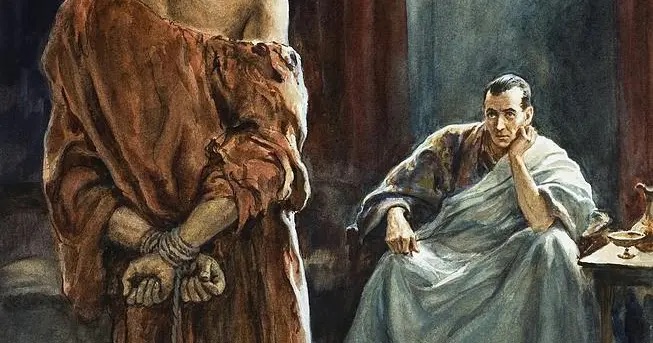
“What do you wish me to do?”, Pilate asks—according to the earliest account of his interaction with Jesus of Nazareth, recounted in the Gospel we attribute to Mark (although the narrative itself refrains from offering any identification of the author). Pilate, the Governor, representative of the mighty Roman Empire, asking a rag-tag crowd of Jews for advice on what he should do? Is there any historical plausibility in this scene which the unknown first century writer constructs?

I have had a number of discussions of this issue with my wife, Elizabeth Raine, whose knowledge of ancient authors and ancient Roman practices has been illuminating for the way we might understand the Gospel accounts. Much of what follows reflects those discussions.

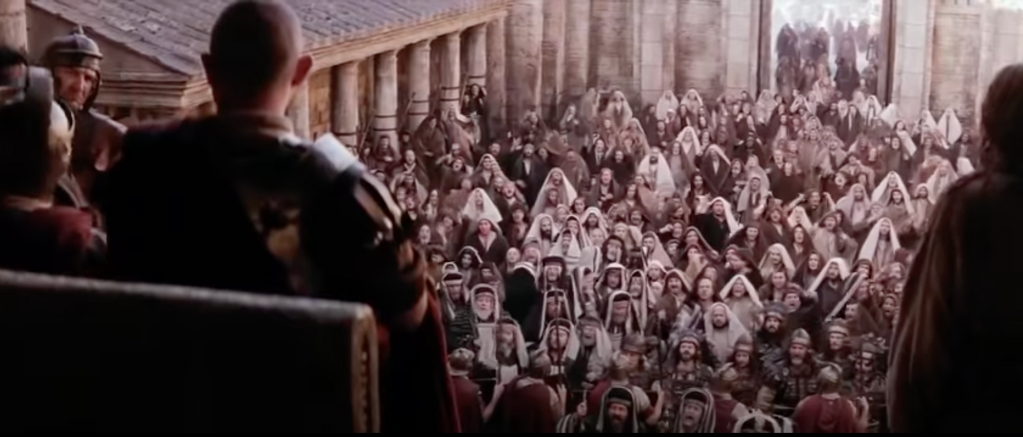
“What do you wish me to do?” (Mark 15:12). It is not only this question that should cause us to question the narrative. Earlier, Pilate had seemed at a loss: “do you want me to release for you the King of the Jews?” (15:9). The narrative offers an explanation: “he realized that it was out of jealousy that the chief priests had handed him over” (15:10). And then it presses the point: “the chief priests stirred up the crowd to have him release Barabbas for them instead” (15:11), and so he asks the crowd, “what do you want me to do?” (15:12). For us, the question is: what do we make of this dithering, indecisive Pilate?

The narrative plays out the conflict by making sure that we understand Pilate has been cowed by the crowd, reporting that the crowd shouted at the Governor, “Crucify him!” (15:13). Instead of portraying the Governor as responding with all his imperial might, the narrative continues with Pilate asking a naïve question, “Why, what evil has he done?” (15:14a). To this, the crowd pressed still louder, “Crucify him!” (15:14b). And so, the denouement plays out: “Pilate, wishing to satisfy the crowd, released Barabbas for them; and after flogging Jesus, he handed him over to be crucified” (15:15).

We know that the Gospels were not written as “eye-witness accounts”. It would especially have been unlikely that one of the followers of Jesus was there, taking notes, as Pilate dealt with Jesus Barabbas and Jesus of Nazareth. The unlikelihood of this slim possibility is intensified by the comment in Mark’s Gospel, about the followers of Jesus, that “all of them deserted him and fled” (14:50). Clearly, the author envisages that none of those followers were there at this scene. (The reference to a group of women “who used to follow him and provided for him when he was in Galilee” refers, not to this moment in the sequence of events, but only to the later scene when Jesus is dying on the cross; see 15:40–41.)

We can’t treat the Gospels as actual “history-as-it-took-place”. We can’t treat the Markan account of Jesus before Pilate as historical. That is especially the case regarding the way that Pilate is portrayed. Most of our knowledge of Pilate outside the New Testament comes from the writings of the Romano-Jewish historian Flavius Josephus, who details many incidents during the governorship of Pilate, and Philo Judaeus, a learned Jewish philosopher living in diaspora in his Alexandria. The Pilate they describe is quite different.

Their Pilate is said to have displayed a serious lack of empathy for Jewish sensibilities, for example by displaying Roman battle standards in Jerusalem. Josephus writes, “On one occasion, when the soldiers under his command came to Jerusalem, he caused them to bring with them their ensigns, upon which were the usual images of the emperor. The ensigns were brought in privily by night, but their presence was soon discovered. Immediately multitudes of excited Jews hastened to Caesarea to petition him for the removal of the obnoxious ensigns. For five days he refused to hear them, but on the sixth he took his place on the judgment seat, and when the Jews were admitted he had them surrounded with soldiers and threatened them with instant death unless they ceased to trouble him with the matter.”

The story does end with Pilate backing down; but this is in the face of a large uprising, and not just in relation to one individual. Josephus continues, “The Jews thereupon flung themselves on the ground and bared their necks, declaring that they preferred death to the violation of their laws. Pilate, unwilling to slay so many, yielded the point and removed the ensigns.” (Josephus, Jewish War 2.169–174; Antiquities of the Jews 18.55–59)

Philo of Alexandria tells us that on other occasion Pilate dedicated some gilt shields in the palace of Herod in honour of the emperor. On these shields there was no representation of any forbidden thing, but simply an inscription of the name of the donor and of him in whose honour they were set up. The Jews petitioned him to have them removed; when he refused, they appealed to Tiberius, who overrode the governor, ordering that they should be removed to Caesarea. (Philo, Legatio ad Gaium, 38)

Josephus also reports how Pilate appropriated Temple funds for the construction of an aqueduct: “At another time he used the sacred treasure of the temple, called corban (qorban), to pay for bringing water into Jerusalem by an aqueduct. A crowd came together and clamoured against him; but he had caused soldiers dressed as civilians to mingle with the multitude, and at a given signal they fell upon the rioters and beat them so severely with staves that the riot was quelled.” (Josephus, Jewish War 2.175–177; Antiquities of the Jews 18.60–62)

Pilate may possibly have responded harshly to the unrest in Jerusalem during the Passover in 33 CE, because, due to other political machinations at that time, the powerful neighbouring Roman province of Syria was unable to provide him military support, as usual. (This the hypothesis that Elizabeth has developed; I think it makes sense.) Pilate wanted to suppress the potential uprising before it got momentum.

We do know that in approximately 36 CE, Pilate used arrests and executions to quash a Samaritan religious uprising. After complaints were then made to the Roman legate of Syria, Pilate was recalled to Rome; he is believed to have later committed suicide.

So, we can see that the character of Pilate in other ancient texts beyond the earliest Christian texts is far more ferocious and determined than how he is depicted in the Gospels; and, indeed, he is antagonistic towards Jews in particular. His vascillation, and his bowing to the shouted demands of the crowd, do not correlate with the character of the figure to which these two Jewish writers attest.

Thus, there is a clear political improbability to the account found in Mark’s Gospel—indeed, in all four Gospels, whose authors each strengthen the Markan portrayal. Matthew has Pilate wash his hands of his decision, saying, “I am innocent of this man’s blood; see to it yourselves” (Matt 27:24). Luke has Pilate declare that Jesus was innocent not once, but three times (Luke 23:4, 14, 22). And John’s Pilate engages in a philosophical discussion with Jesus (John 18:33–38) and questions him further, seeking to find a way to excuse him (John 19:8–12), before bowing to the pressure of the crowd (John 19:13–16).

So Pilate as we know him from other accounts was a ferocious and fearless leader whose strength of character is made clear by the numerous times that, according to Josephus, he sent in his troops to quell an uprising, to scatter a crowd, to squash a rebellion.

American scholar Bart Ehrman concludes that Pilate “was a brutal, ruthless ruler with no concerns at all for what the people he governed thought about him or his policies. He was violent, mean-spirited, and hardheaded. He used his soldiers as thugs to beat the people into submission, and he ruled Judea with an iron fist.” (See https://www.patheos.com/blogs/rationaldoubt/2019/05/pilate-released-barabbas-really/)

Surely Pilate would not have been cowed by the crowd in Jerusalem for Passover? Had he wanted to act, he would simply have ordered his troops to attack, scatter the crowd, and disperse the built-up tension. The Gospel accounts of Pilate, across all four narratives, are improbable; the apologetic purpose (to show the Romans in a better light, to avoid being seen as an agitator or rebel, and to place the blame on the Jewish authorities) becomes clear, when we read in this way. We need to bear all of this in mind, as we read and listen to the familiar narrative this Easter, and each Easter.

Would a Roman Governor ask a Jewish crowd for advice? That would be an untenable act, completely undermining his authority. Would a Roman Governor release a known insurrectionist from his sentence? There is no known precedent for this—indeed, no evidence at all, apart from the Gospels, of this practice. It is historically implausible (particularly in the light of the fact that Barnabas means “son of God”).

On the (mythological) story of Barabbas:

Would a Roman Governor be so under the control of the Jewish Sanhedrin to act in this way? Especially since it was Rome which appointed the High Priest; it was the Jewish hierarchy which needed to do as Rome commanded. In the earliest account, Pilate questions the crowd as to whether he should sentence Jesus (Mark 15:5, 14). The same question is noted in Matt 27:23. By the time of Luke’s Gospel, he speaks a clear threefold affirmation of the innocence of Jesus (Luke 23:4, 13–16, 22).

By the fourth Gospel, the scene where Jesus is brought to Pilate is changed from a trial to a philosophical discussion (John 18:29–31, 38). Pilate (quite uncharacteristically) backs down in the face of a baying crowd (Mark 15:6-15, and parallels). In Matthew’s account, Pilate enacts the potent symbol of washing his hands of the whole affair (Matt 27:24).

The Jewish Sanhedrin, by contrast, is placed firmly in the firing line. All four Gospels tell the story in the same way: the central factor that leads to Jesus being condemned to death is the decision of the Jewish Sanhedrin (Mark 14:63-64, and parallels), and their agitation amongst the crowd (Mark 15:11; Matt 27:20; Luke 23:13-16; John 18:38b-40). Mind you, the Gospel accounts are also on shaky historical ground in the way they describe the actions of the Sanhedrin. See

So another relevant question is: Would a follower of a man put to death under Roman rule for treason write a narrative which placed the blame squarely on the shoulders of the Roman Governor? I can see exactly why the Gospel writers sought to move the blame away from Pilate, onto the Jewish leadership in Jerusalem. Yes, Jesus was crucified by order of the Roman Governor (Mark 15:15 and parallels); but his hand was forced, they say.

So, with supreme irony, the inscription set over Jesus identifies him as King of the Jews (Mark 5:26). Ironic, because the inscription was ordered by Pilate, the Roman Governor over Judea—and Romans did not honour kingship, did not value kingship. Their rulers were Caesars, not Kings, elected by the Senate, not inherited by birth. The irony of the way that this story is told is that the Roman Governor apparently recognises the kingship of Jesus. The reality of the moment was that the Governor recognised a threat to the power of Rome, and acted to quell that.

In Luke, the Roman soldiers at the cross taunt Jesus, saying, “If you are the King of the Jews, save yourself!” (23:37)—a taunt provoked by the sign that was affixed to the top of the cross, bearing an inscription that read, “This is the King of the Jews” (23:36). That inscription; although it is intended to identify Jesus, is actually a statement of power and authority, made by Governor Pilate on behalf of the Roman Empire which he served. In the end, he asserts his authority. The Roman Governor has a pretender King put to death for treason. That much, I believe, can be retrieved as bedrock history, nestled within this rather fanciful narrative.

And so, in the end, even the Gospel accounts attest to the reality of Roman power. Their constant presence, their marching legions, their brutal commanders, intervening to execute their bloodthirsty justice … and their governor, Pilate, as fierce and rough and unbending as any governor ever known, ensured that Jesus went to his death.

“All of them condemned him as deserving death.” Interrogating the unlikely narrative of the Council (Mark 14; for Holy Week)

“They took Jesus to the high priest; and all the chief priests, the elders, and the scribes were assembled” (Mark 14:53). That’s how the author of the good news of Jesus the chosen one reports the scene when the fate of Jesus is sealed (Mark 14:53–65). Accused of predicting that the Temple would be destroyed (14:58), Jesus is interrogated by the high priest (14:60–63) before the declaration is made: “you have heard his blasphemy!” (14:64).

After further consultation by the chief priests “with the elders and scribes and the whole council”, Jesus is led away to Pilate, the Roman Governor (15:1). And so the fateful course of events is set in motion—questioned by Pilate, sentenced to be crucified, nailed to a cross where he dies, and the the lifeless body of Jesus is handed over to some of his followers (15:2–47).

The other evangelists follow suit. One notes that “the assembly of the elders of the people, both chief priests and scribes, gathered together, and they brought him to their council” (Luke 22:66), another specifies that “they took him to Caiaphas the high priest, in whose house the scribes and the elders had gathered” (Matt 26:57). The fourth gospel reports that “first they took him to Annas, who was the father-in-law of Caiaphas, the high priest that year” (John 18:13), and subsequently “Annas sent him bound to Caiaphas the high priest” (John 18:28).

The account of the time that Jesus spent being interrogated by them Jewish leadership appears, on the surface, to be an objective account of what transpired in that meeting. The council was the Great Sanhedrin, the supreme religious body in Israel during the Second Temple period—from the time when the exiles returned to the land under Nehemiah, until the destruction of the Temple in the year 70 CE. See more at https://www.jewishvirtuallibrary.org/the-sanhedrin

The source of the narrative in Mark 14 is unclear; indeed, the narrator has emphasised just before reporting on this meeting that when Jesus was seized in the garden by “a crowd with swords and clubs [who had come] from the chief priests, the scribes, and the elders” (14:43), after a token display of resistance (14:47), “all [of his followers] deserted him and fled” (14:50).

The narrator underscores this with a tantalising glimpse of the figure whom I (anachronistically) call “the first Christian streaker”— “a certain young man [who] was following him” who escaped the grasp of those in the crowd, shedding his linen cloth, “and “ran off naked” (14:51–52). And Peter, most pointedly, was outside the chamber, warming himself by the fire (14:54), and denying that he even knew Jesus—not once, but three times (14:68,70,71). There was nobody—absolutely nobody—from amongst the followers of Jesus who was present to witness what transpired as Jesus was brought before “the chief priests and the whole council” (14:55).

So how do we know what happened in that council meeting?

Further exploration of the scene is warranted. Such further examination might well consider some key factors. When did the council meet? Where did they meet? How did they conduct their business? And how did they come to a decision about Jesus?

To guide any exploration of these matters, scholars have turned—with due caution—to a Jewish text which sets out the designated procedures for a meeting of the Jewish council at which serious matters such as blasphemy were considered. The due caution is warranted, because the text is found in the Mishnah, a document written early in the third century CE—thus, almost 200 years after the time when Jesus was said to have been brought before the council. Did the provisions of this 3rd century text apply in the 1st century?

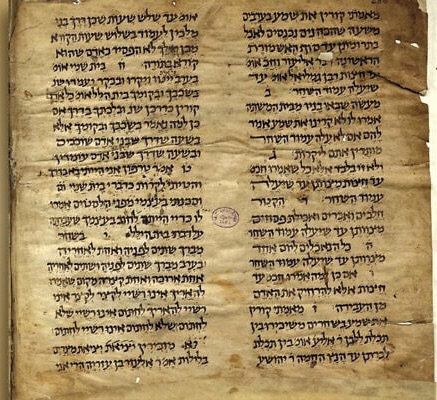
The opening page of the Kaufmann manuscript of the Mishnah, the most complete early manuscript of the Mishnah,
dated to the 10th or 11th centuries CE.

And such caution is intensified by the fact that the Mishnah is written at a time long after most Jews had been expelled from Jerusalem. This expulsion was finalised during the abortive uprising by Bar Kochba in 132–135 CE. Indeed, the book was written well after the time when the Sanhedrin had ceased to function as the peak legislative and judicial body in Jerusalem. After the failed war against the Romans of 66—74 CE, there was no longer any such body operating in Jerusalem. Yet 150 years later, a text was written that set out specific details of how the council was to function.

So some interpreters claim that this account is simply to be seen as an idealistic, romanticised recreation of “how things used to be”, expressed in such a way that is oblivious to the reality of the time—that there was no longer a functioning Sanhedrin in Jerusalem.

Alongside these notes of caution, we must hear also the claim that is made, not just about this text, but about many texts within the body of rabbinic literature that survives, from first through to sixth centuries. That claim is that, in an oral culture such as Second Temple Judaism and Rabbinic Judaism, where stories and laws and prescriptions and debates were passed on by word of mouth, from teacher to student, from that student to their student, and so on—the reliability and historical validity of what is written can be assessed positively.

For a more detailed discussion of the oral Torah, see https://www.jewishvirtuallibrary.org/the-oral-law-talmud-and-mishna

For myself, given what I have learnt in recent years about the importance and validity of stories and laws passed on over time in the oral cultures of First Nations peoples in Australia, I am inclined to accept this positive assessment of the ancient Jewish oral traditions in general, although specific texts are always open to informed critical exploration of their details.

I’m aware also, from discussions that have happened in the Uniting Church Dialogue with Jewish People that Elizabeth and I were members of for some years, that many rabbis today, who know their sacred texts well, consider that the Gospel narratives about this scene cannot be historical—for reasons that will be explored in what follows.

So, what does this text from the Mishnah say about a council meeting called to interrogate a possible criminal, such as we find in the Gospel narratives about Jesus? The relevant passages are in chapters 4 and 5 of tractate Sanhedrin, a part of the fourth order, Nezikin, which deals with Jewish criminal and civil law and the Jewish court system. And a comparison between the Gospel narratives and the Mishnah provisions raises a number of problems.

At night

The first matter is that the meeting with Jesus took place at night. Earlier, the narrator of Mark’s account has reported that the disciples “prepared the Passover meal; when it was evening, he came with the twelve” (14:16–17). Some hours later, after Jesus is apprehended in the Garden, he is taken to “the high priest … the chief priests, the elders, and the scribes” (Mark 14:53). It is still night when that meeting takes place. After coming to their decision that Jesus was “deserving death”, (14:64), the narrator notes that “as soon as it was morning, the chief priests held a consultation with the elders and scribes and the whole council” (15:1a).

So this meeting took place at night. But Mishnah Sanhedrin 4:1 states, “in cases of capital law, the court judges during the daytime, and concludes the deliberations and issues the ruling only in the daytime.” A court meeting at night, to determine a matter in which a person is determined to be “ deserving death”, is contrary to this provision.

The same section of the Mishnah also states that “in cases of capital law, the court may conclude the deliberations and issue the ruling even on that same day to acquit the accused, but must wait until the following day to find him liable” (Sanhedrin 4:1). Coming to a decision of guilty in the same session as the evidence is heard, without an overnight pause for the members of the council to consider, was also contrary to what was required. In the case of Jesus, this provision has been breached.

On a feast day

A second matter is that the meeting with Jesus took place during a festival. The whole sequence of events begins “on the first day of Unleavened Bread, when the Passover lamb is sacrificed” (14:12). At the end of their interrogation of Jesus, the narrator notes that “they bound Jesus, led him away, and handed him over to Pilate” (15:1b), and then observes that “at the festival he used to release a prisoner for them, anyone for whom they asked” (15:6).

Again, the provisions in Sanhedrin 4:1 state that “since capital cases might continue for two days, the court does not judge cases of capital law on certain days, neither on the eve of Shabbat [Sabbath] nor the eve of a Festival.” So the Markan narrative is in breach of this provision as well, by reporting that this meeting took place during Passover.

In the lack of evidence for this custom of releasing a prisoner at Passover, see more at

In the house of Caiaphas

Where exactly did this interrogation of Jesus take place? The implication in Mark is that the council was meeting in the house of Caiaphas. “Peter had followed him at a distance, right into the courtyard of the high priest; and he was sitting with the guards, warming himself at the fire” (14:54). This implication is made explicit at Matt 26:57 (“they took him to Caiaphas the high priest, in whose house the scribes and the elders had gathered”) and Luke 22:54 (“bringing him into the high priest’s house”).

Once more, this flies in the face of the prescriptions of tractate. Later in the tractate Sanhedrin, there is a reference to “the Sanhedrin of seventy-one judges that is in the Chamber of Hewn Stone” (Sanhedrin 11:2). This means the meeting should have taken place in this part of the Temple; in the Babylonian Talmud, it is stated to have been in the north wall (b.Yoma 25a). The Gospel narratives locate the meeting with Jesus in the house of the high priest; this is a third breach of the Mishnaic provisions.

The witnesses did not agree

A fourth issue is the observation that Mark makes and then repeats, that “many gave false testimony against him, and their testimony did not agree. Some stood up and gave false testimony against him … even on this point their testimony did not agree” (14:56–59).

Tractate Sanhedrin requires a verdict to be made only if the witnesses are in agreement, declaring, “At a time when the witnesses contradict one another, their testimony is void” (Sanhedrin 5:2). In a later rabbinic text, the Talmud, this requirement is expanded: “afterward they bring in the second witness and examine him in the same manner. If their statements are found to be congruent the judges then discuss the matter” (b.Sanhedrin 29a). This clearly did not occur in the case of Jesus.

A page of the Babylonian Talmud, showing how
the central text of Mishnah (in large print)
is then commented upon in Gemara (in medium print)
and later medieval notes (in small print)
surround these in the margins.

These various matters would seem, on the surface, to indicate that the members of the council were so panicked by Jesus that they acted to condemn him with flagrant disregard for their own provisions—assuming that the later text of the Mishnah does, in fact, describe the requirements in place in the first century.

An alternative explanation is that the narrative was compiled by someone who was ignorant of these provisions, and they simply “made up” a narrative which demonstrated the desperation of the Jewish authorities to deal with Jesus and have him out of the way.

We should place this view alongside the observation that the narratives in the Gospels take a number of steps to minimise the blame that Pilate must bear for sentencing Jesus to he crucified.

On the flawed picture of Pilate in the Gospels and the implausibility of the role assigned to him in these accounts, see

Minimising the culpability of the governor of the imperial power in these events, and strengthening the role of the Jewish authorities, go hand-in-hand. A clear apologetic purpose is at work in this narrative. It made sense for the narrator to avoid further condemnation by Rome, which held continuing power during the time he was writing, and to magnify the blame of the Jewish authorities, with whom the fledgling movement of followers of Jesus had been in increasing tension and conflict.

In other words, the narrative of this trial before the Sanhedrin is both historically implausible, and apologetically purposeful, as it shifts the blame for sentencing Jesus more onto the Jewish authorities than on Pilate. And in a later scene, it is the Jewish crowd which calls for Pilate to hand down the sentence of death (“crucify him! crucify him!”, 15:13–14). That is a most unlikely occurrence, indeed.

And so another element grew in the developing Christian ideology which placed the blame for the death of Jesus on the Jewish authorities (and sadly, in later centuries, on “the Jews” themselves). It is a view that we would do well to reject.

See also

The end of the ages; the beginnings of the birth pangs (Mark 13; Narrative Lectionary for Lent 5)

The Gospel reading which the Narrative Lectionary proposes for this coming Sunday (Mark 13:1–8, 24–37) is an excerpt from a longer speech, a block of teaching which Jesus delivered to his disciples (13:3–37) some time after they had arrived in the city of Jerusalem (11:1–11). It’s a striking speech, with vivid language and dramatic imagery. As Jesus’ last long speech in this Gospel, it certainly makes a mark!

The speech is delivered beside the towering Temple, built under Solomon, rebuilt under Nehemiah (13:1, 3). That temple was a striking symbol for the people of Israel—it represented their heritage, their traditions, their culture. The Temple was the place where the Lord God dwelt, in the Holy of Holies; where priests received sacrifices, designed to enable God to atone for sins, and offerings, intended to express the people’s gratitude to God; where musicians led the people in singing of psalms and songs that exulted God, that petitioned God for help, that sought divine benevolence for the faithful covenant people.

Or so the story goes; so the scriptures said; so the priests proclaimed. The holiest place in the land that was holy, set apart and dedicated to God. Yet what does Jesus say about this magnificent construction? “Not one stone will be left here upon another; all will be thrown down” (13:2). Jesus envisages the destruction of the Temple. Not only this; he locates that destruction within the context of widespread turmoil and disruption: “nation will rise against nation, and kingdom against kingdom; there will be earthquakes in various places; there will be famines” (13:8). And then, to seal this all, Jesus refers directly to the fact that “the end is still to come” (13:7).

The End. Eight centuries before Jesus, the prophet Amos had declared, “the LORD said to me, ‘the end has come upon my people Israel; I will never again pass them by’” (Amos 8:2). Amos continues, declaring that God has decreed that “on that day … I will make the sun go down at noon, and darken the earth in broad daylight. I will turn your feasts into mourning, and all your songs into lamentation; I will bring sackcloth on all loins, and baldness on every head; I will make it like the mourning for an only son, and the end of it like a bitter day” (Amos 8:9–10).

That image of The Day when the Lord enacts justice and brings punishment upon the earth, because of the evil being committed by people on the earth, enters into the vocabulary of prophet after prophet. Amos himself declares that it is “darkness, not light; as if someone fled from a lion, and was met by a bear; or went into the house and rested a hand against the wall, and was bitten by a snake. Is not the day of the LORD darkness, not light, and gloom with no brightness in it?” (Amos 5:18–20).

Isaiah, just a few decades after Amos, joined his voice: “the Lord of hosts has a day against all that is proud and lofty, against all that is lifted up and high … the haughtiness of people shall be humbled, and the pride of everyone shall be brought low; and the Lord alone will be exalted on that day” (Isa 2:12, 17). He warns the people, “Wail, for the day of the Lord is near; it will come like destruction from the Almighty!” (Isa 13:6).

Isaiah uses a potent image to describe this day: “pangs and agony will seize them; they will be in anguish like a woman in labour” (Isa 13:7). He continues, “the day of the Lord comes, cruel, with wrath and fierce anger, to make the earth a desolation, and to destroy its sinners from it” (Isa 13:8), and later he portrays that day as “a day of vengeance” (Isa 34:8).

Zephaniah, who was active at the time when Josiah was king (640–609 BCE) declares that “the day of the Lord is at hand; the Lord has prepared a sacrifice, he has consecrated his guests” (Zeph 1:7); “the great day of the Lord is near, near and hastening fast; the sound of the day of the Lord is bitter, the warrior cries aloud there; that day will be a day of wrath, a day of distress and anguish, a day of ruin and devastation, a day of darkness and gloom, a day of clouds and thick darkness ” (Zeph 1:14–15).

Habakkuk, active in the years just before the Babylonian invasion of 587 BCE, declares that “there is still a vision for the appointed time; it speaks of the end, and does not lie” (Hab 2:3); it is a vision of “human bloodshed and violence to the earth, to cities and all who live in them” (Hab 2:17).

Later, during the Exile, Jeremiah foresees that “disaster is spreading from nation to nation, and a great tempest is stirring from the farthest parts of the earth!” (Jer 35:32); he can see only that “those slain by the Lord on that day shall extend from one end of the earth to the other. They shall not be lamented, or gathered, or buried; they shall become dung on the surface of the ground” (Jer 35:33). He also depicts this day as “the day of the Lord God of hosts, a day of retribution, to gain vindication from his foes” (Jer 46:10).

And still later (most likely after the Exile), the prophet Joel paints a grisly picture of that day: “the day of the Lord is coming, it is near—a day of darkness and gloom, a day of clouds and thick darkness! Like blackness spread upon the mountains, a great and powerful army comes; their like has never been from of old, nor will be again after them in ages to come. Fire devours in front of them, and behind them a flame burns. Before them the land is like the garden of Eden, but after them a desolate wilderness, and nothing escapes them.” (Joel 2:1-3).

Later in the same oracle, he describes the time when the Lord will “show portents in the heavens and on the earth, blood and fire and columns of smoke; the sun shall be turned to darkness, and the moon to blood, before the great and terrible day of the Lord comes” (Joel 2:30–31). Joel also asserts that “the day of the Lord is near in the valley of decision; the sun and the moon are darkened, and the stars withdraw their shining” (Joel 3:14–15).

*****

The language of The Day is translated, however, into references to The End, in some later prophetic works. In the sixth century BCE, the priest-prophet Ezekiel, writing in exile in Babylon, spoke about the end that was coming: “An end! The end has come upon the four corners of the land. Now the end is upon you, I will let loose my anger upon you; I will judge you according to your ways, I will punish you for all your abominations.” (Ezek 7:2–3).

And again, Ezekiel declares, “Disaster after disaster! See, it comes. An end has come, the end has come. It has awakened against you; see, it comes! Your doom has come to you, O inhabitant of the land. The time has come, the day is near—of tumult, not of reveling on the mountains. Soon now I will pour out my wrath upon you; I will spend my anger against you. I will judge you according to your ways, and punish you for all your abominations.” (Ezek 7:5–8). This day, he insists, will be “a day of clouds, a time of doom for the nations” (Ezek 30:3; the damage to be done to Egypt is described many details that follow in the remainder of this chapter).

Obadiah refers to “the day of the Lord” (Ob 1:15), while Malachi asserts that “the day is coming, burning like an oven, when all the arrogant and all evildoers will be stubble; the day that comes shall burn them up, says the Lord of hosts, so that it will leave them neither root nor branch” (Mal 4:1).

Malachi ends his prophecy with God’s promise that “I will send you the prophet Elijah before the great and terrible day of the Lord comes; he will turn the hearts of parents to their children and the hearts of children to their parents, so that I will not come and strike the land with a curse” (Mal 4:5–6). This particular word is the final verse in the Old Testament as it appears in the order of books in the Christian scriptures; it provides a natural hinge for turning, then, to the story of John the baptiser, reminiscent of Elijah, who prepares the way for the coming of Jesus, evocative of Moses.

Another prophet, Daniel, declares that “there is a God in heaven who reveals mysteries, and he has disclosed to King Nebuchadnezzar what will happen at the end of days” (Dan 2:28), namely, that “the God of heaven will set up a kingdom that shall never be destroyed, nor shall this kingdom be left to another people. It shall crush all these kingdoms and bring them to an end, and it shall stand forever” (Dan 2:44).

Whilst the story of Daniel is set in the time of exile in Babylon—the same time as when Ezekiel was active—there is clear evidence that the story as we have it was shaped and written at a much later period, in the 2nd century BCE; the rhetoric of revenge is directed squarely at the actions of Antiochus IV Epiphanes, who had invaded and taken control of Israel and begun to persecute the Jews from the year 175BCE onwards.

The angel Gabriel subsequently interprets another vision to Daniel, “what will take place later in the period of wrath; for it refers to the appointed time of the end” (Dan 8:19), when “at the end of their rule, when the transgressions have reached their full measure, a king of bold countenance shall arise, skilled in intrigue. He shall grow strong in power, shall cause fearful destruction, and shall succeed in what he does. He shall destroy the powerful and the people of the holy ones.” (Dan 8:23–24). This seems to be a clear reference to Antiochus IV.

Still later in his book, Daniel sees a further vision, of seventy weeks (9:20–27), culminating in the time of “the end” (9:26). In turn, this vision is itself spelled out in great detail in yet another vision (11:1–39), with particular regard given to the catastrophes taking place at “the time of the end” (11:1–12:13; see especially 11:25, 40; 12:4, 6, 9, 13).

This final vision makes it clear that there will be “a time of anguish, such as has never occurred since nations first came into existence” (12:1), when “evil shall increase” (12:3) and “the wicked shall continue to act wickedly” (12:10). The visions appear to lift beyond the immediate context of the Seleucid oppression, and paint a picture of an “end of times” still to come, after yet worse tribulations have occurred.

***

Could these visions of “the end” be what Jesus was referring to, as he sat with his followers on the Mount of Olives, opposite the towering Temple? Later in the same discussion with his disciples, he indicates that “in those days, after that suffering, the sun will be darkened, and the moon will not give its light, and the stars will be falling from heaven, and the powers in the heavens will be shaken” (Mark 13:24). This picks up the language we have noted consistently throughout the prophetic declarations, in Amos, Joel, Isaiah, Habakkuk, Zephaniah, Ezekiel, and Daniel.

The judgement of God, says Jesus, with the “gathering up the elect from the four words, from the ends of the earth to the ends of heaven” (13:27), will be executed by “the Son of Man coming in clouds with great power and glory” (13:25)—language which draws directly from the vision of Daniel concerning “one like the Son of Man, coming with the clouds of heaven” (Dan 7:13).

So the resonances are strong, the allusions are clear. Jesus is invoking the prophetic visions of The Day, The End; the judgement of God, falling upon the wicked of the earth. And he deliberately applies these vivid and fearsome prophetic and apocalyptic traditions to what he says about the Temple.

By linking his teaching directly to the question of four of his disciples, Peter, James, John, and Andrew (Mark 13:3), enquiring about the Temple, Jesus appears to be locating the end of the Temple—its sacrifices and offerings, its psalms and rituals, its wealth and glory … and perhaps also its priestly class—in the midst of the terrible, violent retributive judgements of the Lord God during the days of the end.

The language also resonates with the end section of 2 Esdras, in which God informs “my elect ones” that “the days of tribulation are at hand, but I will deliver you from them”. Those who fear God will prevail, whilst “those who are choked by their sins and overwhelmed by their iniquities” are compared with “a field choked with underbrush and its path overwhelmed with thorns” and condemned “to be consumed by fire” (2 Esdras 16:74–78). (This book claims to be words of Ezra, the scribe and priest who was prominent in the return to Jerusalem in the 5th century BCE, but scholarly opinion is that it was written after the Gospels, perhaps well into the 2nd century CE.)

All of the happenings that are described by Jesus in his teachings whilst seated with his followers outside the Temple (Mark 13:3) can be encapsulated in this potent image: “this is but the beginning of the birth pangs” (13:8). This is imagery which reaches right back to the foundational mythology of Israel, which tells of the pains of childbirth (Gen 3:16). It is language used by prophets (Jer 4:3; 22:23; 49:2; 49:24; Hos 13:13; Isa 21:3; 66:7–8; Micah 4:9; 5:3).

This chapter in Mark’s Gospel, along with the parallel accounts in Luke (chapter 21) and Matthew (chapter 24), are regarded as instances of apocalyptic material. The meaning of apocalyptic is straightforward: it refers to the “unveiling” or “revealing” of information about the end time, the heavenly realm, the actions of God.
Such a focus does not come as a surprise to the careful reader, or hearer, of this Gospel. This style of teaching is consistent with, and explanatory of, the message which the Gospels identify as being the centre of the message proclaimed by Jesus: “The time is fulfilled, and the kingdom of God has come near; repent, and believe in the good news” (Mark 1:14); “repent, for the kingdom of heaven has come near” (Matt 4:17); “I must proclaim the good news of the kingdom of God to the other cities also; for I was sent for this purpose” (Luke 4:43). Each of these distillations of the message is apocalyptic—revealing the workings of God as the way is prepared for the coming of the sovereign rule of God.

Apocalyptic is the essential nature of Jesus’ teachings about “the kingdom of God”. This final speech confirms the thoroughly apocalyptic character of Jesus’ teaching. The parables he tells about that kingdom are apocalyptic, presenting a vision of the promised future that is in view. The call to repent is apocalyptic, in the tradition of the prophets. The demand to live in a way that exemplifies righteous-justice stands firmly in the line of the prophetic call. Such repentance and righteous-just living is as demanding and difficult as giving birth can be.
Mark’s Gospel has drawn to a climax with the same focussed attention to the vision of God’s kingdom, as was expressed at the start. The beginnings of the birth pangs are pointers to the kingdom that Jesus has always had in view. Jesus was, indeed, a prophet of apocalyptic intensity.

*****

I have written another blog that sets this apocalyptic teaching of Jesus into its literary and historical contexts, at