John (the baptizer) and Jesus (the anointed) in the book of signs (the Gospel of John; Epiphany 2A)

The fourth Gospel in our New Testament describes itself quite explicitly as the book of signs which is intended to foster trust in Jesus the anointed one (see John 20:30). Like the other three Gospels in the New Testament, it begins by placing Jesus (the anointed) in relationship with John (the baptizer). This relationship is declared in the selection from the opening chapter which is found in the lectionary for this coming Sunday.

So scholars wonder if there was originally a link between the Jesus movement and the movement led by John the baptiser. Evidence for this link is also drawn from places such as Acts 19:1–7, and the Q passage in Luke 7 (par Matt 11).

Nevertheless, it is John’s Gospel which provides the clearest evidence, when it recounts that the earliest followers of Jesus were drawn from the followers of John (1:35–42).

John (the baptizer), in this gospel, does not call for repentance; rather, he bears witness to Jesus (1:6–8, 15; 1:29–36; 3:25–30; 10:41), testifying that Jesus is the light (1:7), of greater rank than John himself (1:15, 30), the Lamb of God (1:29, 36), the Son of God (1:34), the bridegroom (3:29), and, by implication, the Messiah (1:20; 3:28).

This emphatic depiction of John as deflecting attention from himself, to Jesus, indicates that there was, at an early stage, some competition between the two figures—or, at least, between their respective followers.

The account we have in the book of signs dates from many decades after the lifetime of John and Jesus. This section seems to have been written as a defence against any idea that John, who came first, might have been regarded as superior to Jesus. The words and actions of John deflect attention from himself, and place Jesus in the spotlight. And some of his followers leave him, and take up following Jesus!

This link is confirmed, for some scholars, by the nexus of ideas that flow from Johannine Christianity into the Mandean literature of the third and fourth centuries CE—including, amongst other things, the prominence accorded to John the baptiser.

My friend James McGrath is an expert in this relationship; he has blogged about this at https://www.patheos.com/blogs/religionprof/2020/01/preview-the-mandaean-book-of-john.html and he has written a blog which has links to all manner of interesting discussions about the relationship between John and Jesus, at https://www.patheos.com/blogs/religionprof/2019/11/the-symbolism-and-meaning-of-johns-baptism.html

Thus, the reform movement within Second Temple Judaism headed by John is seen to have had some influence on the gospel, in its early stages, at least. John stands outside the Pharisaic–rabbinic stream of Judaism which would become dominant after 70 CE. This is the first indication of the influence of a different form of Judaism on this Gospel.

The early prominence accorded to John the baptizer joins other indications in the book of signs—the fact that the first large–scale success enjoyed by Jesus was in Samaria (John 4), and the appearance of Greeks in Jerusalem, seeking Jesus (John 12), for instance—in pointing to this wider canvas. Sometimes this is described as “heterodox Judaism”, in contrast to the dominant Pharisaic stream within formative Judaism.

This Gospel thus includes indications of the development of a faith community which looked beyond the parameters of Judaism as it was being shaped by the Pharisees, towards other forms of Jewish faith and life—and perhaps beyond. The Gospel is being painted on a wider canvas. It is already a sign to what would eventuate after the first century, as the Gospel spread and took hold amongst Gentiles beyond the Jewish homeland.

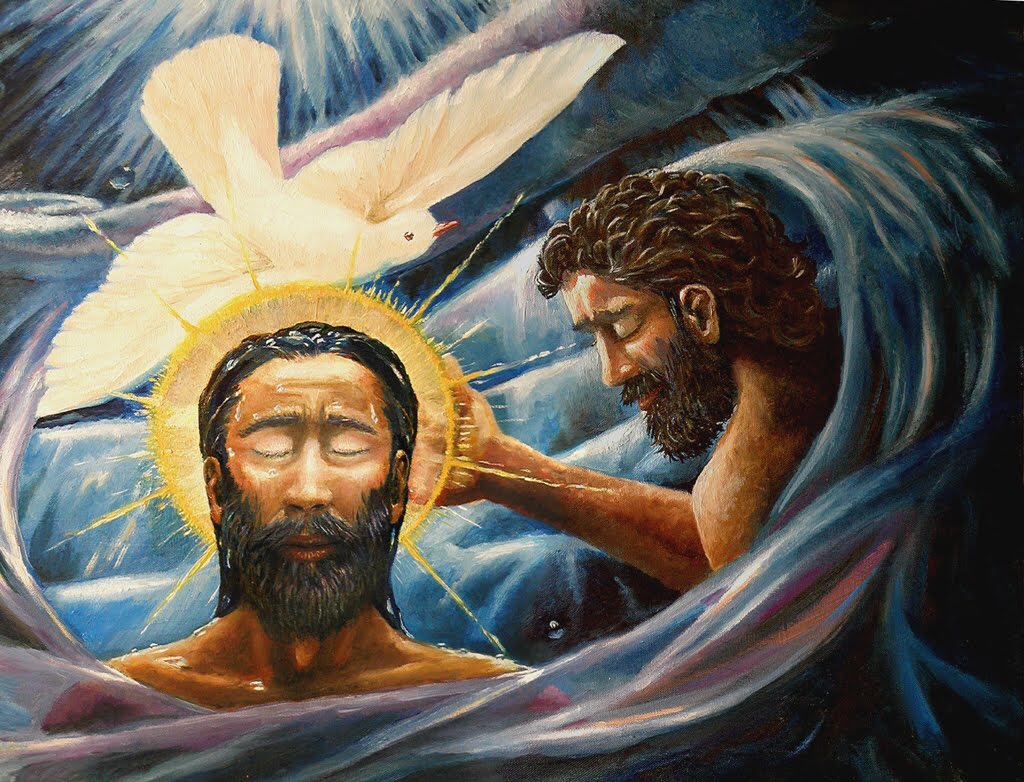
The image is sourced from peacesojourner.blogspot.com

The Paraclete in John’s Gospel: exploring the array of translation options (John 14, 15, 16)

The Gospel reading for this Sunday, from the Gospel of John, contains a rather unusual word, which is translated in various ways across the range of English translations. The word (in Greek) is parakletos. It appears four times in the Gospel of John (14:16, 14:26, 15:26, and 16:7) and once more in the first epistle of John (1 John 2:1). How should this word be translated?

First, a word about translations. There is a range of possibilities for undertaking a translation of the Bible into modern English, stretching across a spectrum that ranges from formal correspondence translations, all the way to dynamic equivalence translations. 

At one end of the spectrum, formal correspondence translations place a high value on sticking closely to the original biblical language. They follow, as closely as is possible, what was written in the original language. Where the original Greek or Hebrew is obscure, it may attempt to assist the reader in some measure; but the sentence structure of the original language is basically adhered to, and there are approximately the same number of words in the translation as in the original. 

At the other end of the spectrum of translations, dynamic equivalence translations move the emphasis away from the original language; the overriding concern of the translators is to communicate the meaning of the text in contemporary, idiomatic English expression. There are anumber of such translations that have been published over the years.

When we turn to this single Greek word, used in John and 1 John to describe the Holy Spirit, we find that the Revised Standard Version translates this word Parakletos, as Counsellor. The same term is used in the New International Version.

Both translations aim at formal correspondence as much as possible. The term counsellor infers that the spirit is a guide for Christian faith; one who relates one-to-one with the Christian person, who walks alongside them, encouraging them and offering advice where relevant. This is a fair translation of the Greek word used here.

The New Revised Standard Version has made a significant change from its parent translation, the RSV. In place of the term Counsellor, the NRSV prefers the term Advocate. The Jersualem Bible and the New Living Translation also use this term. It has quite a different nuance in English. 

The usual location for the term advocate, in contemporary English, is the courtroom; so we move from the intimacy of the counselling relationship, to the public realm of judicial hearings. By describing the spirit as an advocate, these translations are describing the spirit as a person who represents the Christian person and stands up for their rights, who ensures that the believer is given a full and fair hearing at the day of judgement. 

The NRSV translation, Advocate, is equally as valid as the alternative, Counsellor, since the Greek term they both translate actually contains both shades of meaning  it refers to one who walks beside and supports, as well as one who stands on behalf of and represents. Either translation corresponds formally to the original term. But, in opting for one or the other of the nuances of the term, the meaning has actually been specified far more narrowly than in the original language. Such are the limitations of translations. 

The Good News Bible, a dynamic equivalence translation, translates the word for the Spirit in John 14-15 as Helper. The New American Standard Bible and the translation made by J.B. Philips also use the term Helper.

This choice of word is obviously related to the sense of Counsellor, but it is very limited in meaning. A counsellor can certainly help; usually they have specific skills and expertise that they bring to bear into a situation. By contrast, the word helper suggests someone who is in a subordinate position, one who pitches in by assisting with the more menial tasks, and perhaps one who is at the beck and call of the one requesting the help. 

This kind of nuance might give some insight into the role of the spirit, who does come to the aid of the Christian person and provide assistance. Nevertheless, the English word helper sits somewhat at odds with the broader Christian conception of the Holy Spirit. It is a limited, over-simplistic view of the role of the Holy Spirit.  

A fourth option for translating this term is the word Comforter, which appears in the King James Version, the so-called ‘Authorised Version’ of 1611. This also is an accurate translation of the word Parakletos, for it was used in ancient writings to describe the comfort, or consolation, to those who were aggrieved. By opting for this translation, the KJV was also being faithful to the text. 

However, there are other considerations to be made here. Because the KJV is so old – it is over four centuries since this translation was made  it can sometimes be less relevant to contemporary understandings. The word “comfort” has shifted in meaning over the centuries, and to us it now conveys an image of the kindly parent, hugging the distressed child, drying their tears, settling them down into bed; a domestic image which may well describe something of the role of the spirit, but which loses so much of the broader scope inherent in the term.

In addition to the formal correspondence and dynamic equivalence translations, a third type of bible version which can be bought today is the Paraphrase. Although some of these versions claim to be translations, there is a significant difference. A paraphrase will happily move very far from the original text of the Bible, in order to convey in precise detail the particular nuance of the passage being translated. Most paraphrases deliberately use a number of words, a phrase, to convey one of the possible meanings of the original word. 

A popular contemporary paraphrase is The Message. In this instance, it uses just one word for Paraclete, which it renders as Friend. That is nice and cosy—but not quite grasping the range of meanings in the Greek! 

Finally, let me note a fifth option for translating the Greek term for the Holy Spirit in John 14-15. The Jerusalem Bible translates the term parakletos as Advocate; but in revising the JB, the New Jerusalem Bible has decided simply to transliterate the term from Greek into English. It thus uses the non-English term, the Paraclete, at this point. The virtue of this is that all the possible meanings are inherent in the term. We need to explore what it means, using biblical dictionaries or commentaries. Thus, this translation has encouraged us to work out what the word means for ourselves. 

The disadvantage of this translation is that, from a simple reading of the text, we have absolutely no idea what a Paraclete is. It is not an English word, and it is as puzzling as reading the original Greek. We cannot simply read this translation; we have to stop, think, explore, and question. Depending upon the situation, this may be appropriate and valuable, or frustrating and unhelpful.

The bottom line, for me, is: use a range of translations … explore the alternatives that are chosen in each of them … and use this range, to ponder the significance of the text that is under investigation!

In defence of Thomas: a doubting sceptic? or a passionate firebrand? (Easter Sunday)

The Gospel reading for this coming Sunday provides the name by which this Sunday is often known in church tradition: it is Thomas Sunday. (The reading is John 20:19-31.)

We all know about Thomas: he had to have proof … had to see with his own eyes … had to touch to know it was real … did not have faith without tangible proof. Thomas often gets a bad rap: oh he of little faith! … why did he not believe straight away, like the others who followed Jesus? … why was he in the thrall of doubt at precisely the time that faith was called for?

Thomas wants to pin the matter down, to have the evidence produced, to know without question what has taken place. We remember him from this story, as the doubting sceptic.

Let us reflect a little on this: Thomas was not alone. All the other early witnesses, followers, and writers, in the movement of people clustered around Jesus, had the same need to pin the matter down. There were many sceptics in this movement. They needed some form of proof. They looked for evidence. They sought signs that would validate the new way that Jesus was in their midst.

The endings of the Gospels testify to this. The earliest Gospel ended with an open narrative, hanging on those words: the tomb is empty — he is not here! (See https://johntsquires.wordpress.com/2019/04/21/the-tomb-is-empty-he-is-not-here-he-is-risen/)

Subsequent compilers of the narrative about Jesus could not live with the uncertainty of an open-ended story, with an absent Jesus who would appear only in a distant, remote, unimportant location (Galilee). No; they had to have him come to the women, the travellers, even the inner core of disciples, in or near to Jerusalem. Indeed, Luke explicitly reports that the risen Jesus provided them with “many convincing proofs” after his resurrection (Acts 1:3).

Thomas, of course, is the disciple whom we most closely associate with doubt, not with faith, derived from this very report of his encounter with the risen Jesus. “Unless I see, I will not believe”, the sceptic Thomas says, in John 20. “Unless I can put my finger in the mark in the side of my master, I will not believe that he has risen”, declares Thomas.

And in the modern scientific era, where we operate by testing, questioning, doubting, and seeking to prove hypotheses, this kind of approach has a certain attractiveness. For some Christians in the present time, in the period of probing scientific hypotheses and seeking historical certainties, Thomas has become a kind of patron saint—a saint of doubting, questioning, and proving. “Unless I see, I will not believe” is the mantra of such a saint.

But Thomas appears in two other places in John’s Gospel. One is at the last meal that Jesus shared with his followers, when Thomas asks Jesus a question: “Lord, we do not know where you are going. How can we know the way?” This question provokes one of the most well-known sayings of Jesus: “I am the way, and the truth, and the life. No one comes to the Father except through me. If you know me, you will know my Father also. From now on you do know him and have seen him.” (John 14:5-7). It is thanks to Thomas that we have this saying of Jesus!

The other time that Thomas is mentioned in this Gospel provides us with another insight into the character of Thomas. He appears early on, in the story of the raising of Lazarus from the dead, as told in chapter 11 of John’s Gospel. In that story, we encounter a rather different Thomas. In that incident, Thomas was a man on a mission who was filled with faith. He spoke with Jesus with the intensity of a fervent believer. He declared that he was prepared to follow Jesus, whatever it cost him.

Faced with a request to travel to Bethany, near Jerusalem, because of the death of Lazarus, Jesus and his followers discuss whether they should make this trip. John’s Gospel tells us that the message of Jesus was so provocative to the southerners in Judea, that they had already mounted a number of attempts to stone him (John 8:59, 10:31).

So the disciples were convinced that if Jesus travelled close to Jerusalem, he would be walking to his death. What to do, they wonder, when this urgent message comes from friends in Bethany: “Lazarus is dead; please come; we need you here!” (John 11:1-8).

At that moment, Thomas springs into action. There is no doubt about it, he declares:  Jesus needs to go there; and the disciples need to go with him. “We need to get moving! Come on, why are we waiting?” And from the mouth of Thomas come these incredible words: “We should go too, and die with him” (John 11:16).

Thomas utters the excitable words of a zealous follower of Jesus; he gives a fervent declaration of commitment and trust in the one who had been his guide for many months now. Thomas was not paralysed by fear, not distressed by doubt; here, Thomas was fired up by faith, and committed to a journey that could well lead to death. If Jesus, our master, is going to die—then we, too, should be prepared to die with him! (See https://johntsquires.com/2020/03/23/yes-lord-i-believe-even-in-the-midst-of-all-of-this-john-11/)

This portrayal of Thomas as a committed follower, as a passionate firebrand, is not how we normally remember him, because the story from chapter 20 of the Gospel holds sway. Yet in this earlier story in chapter 11 of the Gospel, it is clear that Thomas has faith, even if it is somewhat unusual, and it is abundantly clear that he is prepared to put his life on the line for what he believes.

So, perhaps we should place this Thomas, the passionate firebrand of John 11, alongside the hesitating, doubting figure that we imagine him to be like, courtesy of John 20. Where are the signs of this passionate, committed, fervent, zealous man of faith, in this encounter? Where was the fiery partisan Thomas living out his faith in the risen Jesus?

I like to imagine (and it is only an imagination … a speculation … as the biblical txt is silent on this point) … I like to imagine that, as the disciples gather behind locked doors, paralysed by their fear, Thomas was not to be found in their midst, because he was back into his regular life, living out his faith in the public arena.

Even after Jesus had been raised from the dead, the transformation of Easter, as we know it, had not really kicked in for the disciples. They were locked into their fear. Where were the disciples living out their faith? It seems they took the line of least resistance, and shared their faith only in the safety of their own group, hidden away, safe in the seclusion of a private home.

And where was Thomas? He was not there. He was out beyond the locked doors, out in the community, in the full gaze of the antagonistic authorities. What was he doing? We are not told; we have to imagine.

Is it feasible to imagine that Thomas was back into his regular routine, going about his business, attending to his daily tasks? That he was seeking to live out his faith, not cowed by the threat of persecution, but firmly holding fast to his belief in Jesus in public? That he was continuing to live as that fiery, fanatical believer who was still willing to put his faith on the line? It is a tempting, enticing way to imagine him.

If Thomas was really the passionately committed believer whom we met in the Lazarus story, then it is quite plausible that this is why he was not with the other disciples, behind locked doors, hiding out of fear.

Perhaps Thomas was wanting to demonstrate his faith to those who did not yet believe. Something had happened to Jesus—the tomb was empty, believers were testifying that he was risen—so he was wanting to show others that his faith had not been shattered.

Where was Thomas living out his faith? In his everyday life, amidst acquaintances and friends—and even enemies. Now that is a model that we would do well to ponder, and imitate, in our lives!

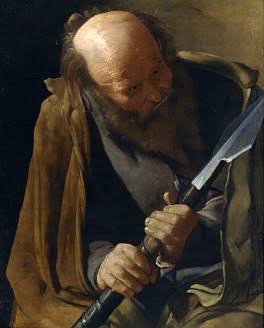
(The image is of Saint Thomas, by Georges de La Tour, a French painter of the 17th century.)