
“Sell your possessions, and give alms”. So Jesus instructs his followers, in the midst of a lyrical section of teaching in which he praises the way that God feeds ravens, bedecks lilies in flowery glory, and assures his followers that “it is your Father’s good pleasure to give you the kingdom” (Luke 12:22–34). This is the passage from Luke’s Gospel—which largely parallels a passage also in Matthew’s Gospel (Matt 6:25–34)—that is proposed by the Revised Common Lectionary for reading in services this coming Sunday.
The passage gives the impression that Jesus was advocating a life of asceticism, marked by poverty, lived in complete dependence on the provisions of God. Indeed, some interpreters have claimed that Jesus was born in poverty, deriving this from the “born in a manger … no room at the inn” element of “the Christmas story” (Luke 2:7), as well as Luke’s later comment that when Mary brought the offering for her purification (Luke 2:22), it was the lesser option prescribed for one who could not afford to offer a sheep (Lev12:8). Further, that he was known as “the carpenter”(Mark 6:3) or as “the carpenter’s son” (Matt 13:55) is seen to be evidence of his lowly status.
More careful analysis, however, indicates that this is too simplistic. British Anglican scholar Ian Paul has posted a detailed consideration of this matter, in which he draws on very helpful research by historians and economists who have turned their attention to the ancient world. (Ian Paul can be aggressively dismissive of arguments that do not align with his clear-cut conservative-evangelical-Anglican perspective, especially when it comes to the debate about sexuality and gender in the. Church of England; but in this post—as in many others on his page—his careful scholarly analysis is most helpful.)
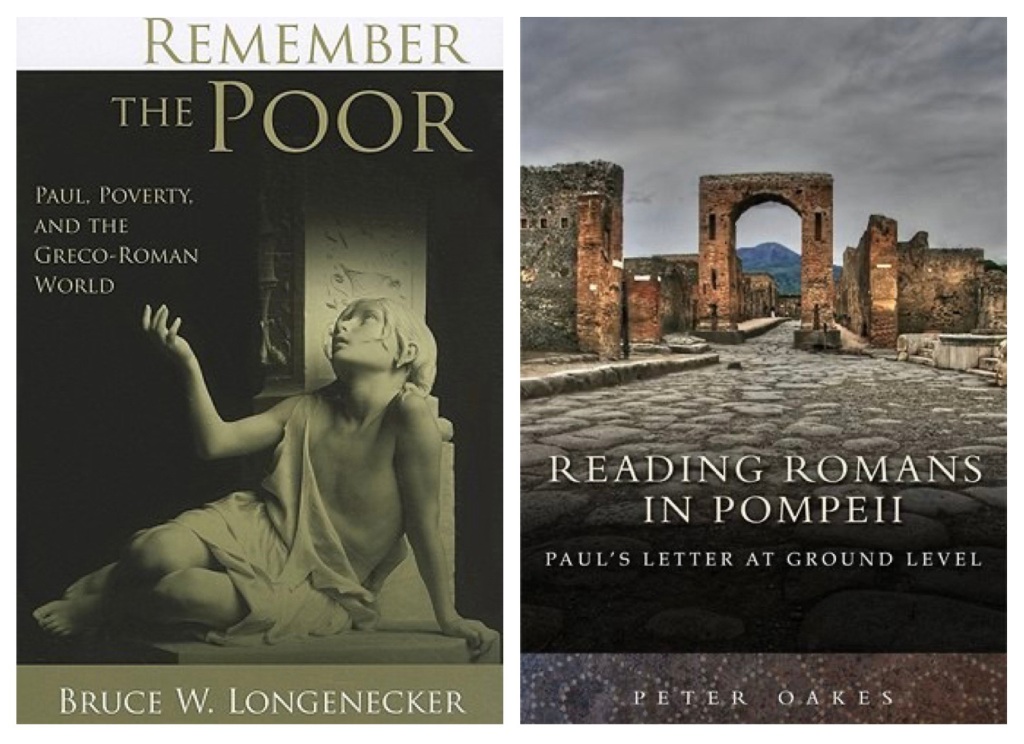
Paul notes what others before have observed—that a tiny minority of people in the Hellenistic world had power and wealth, but a substantial proportion of people were at the other end of the social stratum. At the very bottom, in the most precarious position, were those who were desperately poor: orphans, widows, unskilled workers, beggars, prisoners, and disabled people—perhaps 25 to 30% of the population. Above them were those who were dependent on their labour to meet their day-by-day needs—perhaps 30 to 40% of the population; and then above them, a further 20 to 25% of the population who generally lived just above the minimum level required to sustain a reasonable life: most merchants and traders, skilled artisans, freedpersons (formerly slaves), and families living on larger farms.
This breakdown is based on estimates by biblical scholar Bruce Longenecker in his analysis of social levels in Pauline churches (Remember the Poor, Eerdmans, 2010). Longenecker in turn draws on the work of historian Peter Oakes, who had undertaken careful analysis of demography and housing in Pompeii (Reading Romans in Pompeii; SPCK, 2009).
The Gospels provide a number of clues as to where the disciples might have fitted into this schema. The toll collector Matthew (or Levi) was a small business man operating to collect tolls from travellers along the roads (Mark 2:14; Matt 9:9); the four Galilean fisherman ran their own fishing businesses with their “hired men” (Mark 1:20). As for Jesus, Paul observes that “as a tekton, a general builder (Matt 13:55; Mark 6:3) working with stone and wood (though not metal), it is more than likely that Joseph (and therefore Jesus) … was above either 55% or 82% of the population not including slaves, across the Empire as a whole”.
See https://www.psephizo.com/biblical-studies/was-jesus-actually-born-into-a-poor-family/
So we can see that the teachings of Jesus that instruct his followers on the matter of wealth and possessions are designed to stimulate the consciences of his followers, who were not beggardly poor, to alert them to their responsibilities towards those in the lowest socio-economic levels of society. They are to act towards them remembering that God has long had good news for the the poor and liberty for the oppressed (Isa 61:1–2, quoted at Luke 4:18), knowing that Jesus blesses those who are poor, hungry, and weeping (Luke 6:20–21), and recalling how Mary sang that God has “lifted up the lowly [and] filled the hungry with good things” (Luke 1:52–53), which itself evoked the ancient song of Hannah that God “raises up the poor from the dust [and] lifts the needy from the ash heap” (1 Sam 2:8, repeated at Ps 113:7).
Accordingly, in instructing his followers to give no regard to food and clothing, Jesus is not necessarily saying, “remain in poverty”. Rather, I think he is admonishing them—and us—not to be caught in the perpetual circle of seeking more, to enjoy more. Rather, his message is that, what we have, must be shared; what we gain, we should use judiciously, to help those in greater need than we are. For this is what “the kingdom” is about, surely.

 An Informed Faith