
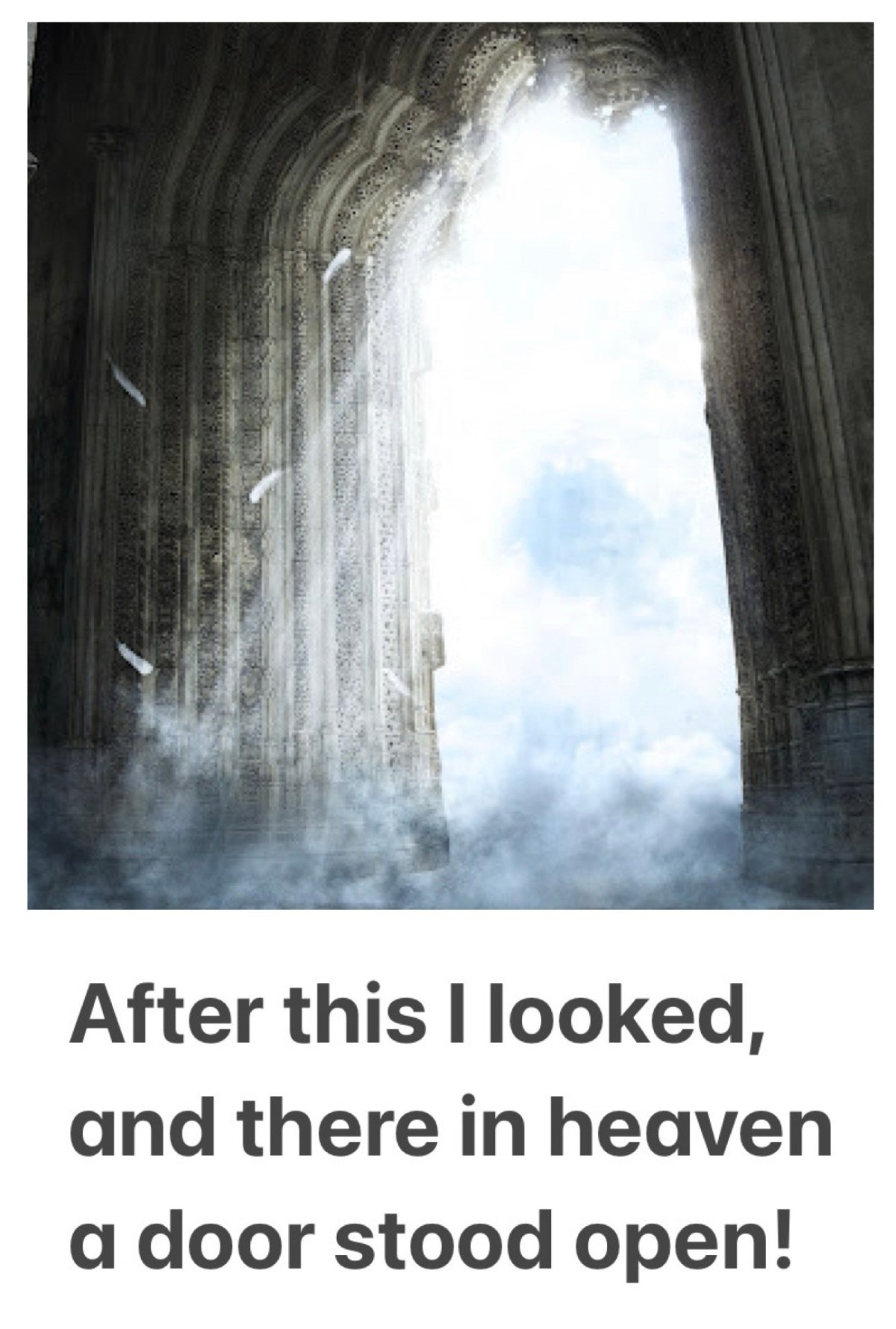
In the book of Revelation, we are invited into a world of unfettered imagination, with evocative imagery, enticing language, and disturbing rhetoric. The whole book comes from words spoken by “one like the Son of Man, clothed with a long robe and with a golden sash across his chest” (Rev 1:13). Clearly, it is a vision of the glorified Jesus Christ, now conveying his “revelations” to John, who is instructed to write letters to seven churches (in chapters 2—3) and then to detail a series of amazing visions (in chapter 4 onwards to the end of the book).
Each vision contains graphic descriptions and dramatic happenings. The first of these visions (proposed for this coming Sunday in the Narrative Lectionary Summer Series for this year) sets the scene set for what will later be revealed as a colossal, cosmic battle between good and evil.
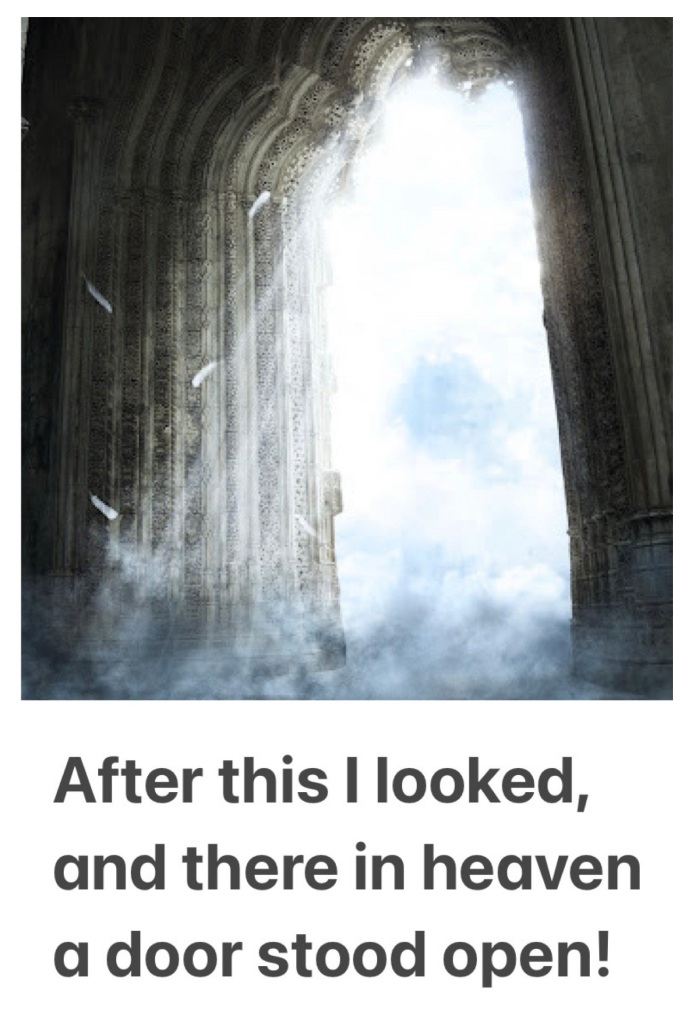
It opens with the striking claim that the door into heaven is opened (4:1). A disturbing and increasingly detailed dramatization of “what must take place after this” is revealed. The vision comes to a climax with an image of a slaughtered lamb (5:11–14), which is the passage set in the Narrative Lectionary for a week after this coming Sunday.
Gazing into heaven, the author views a magnificent scene of worship. The importance of this scene is signalled by gleaming jewels and a shining rainbow, golden crowns and white robes, thrones and torches of fire, a sea of glass, grumbling thunder and flashes of lightning (4:3–6).
Thunder and lightning were characteristic of the God of Israel. In the book of Job, Elihu praises God, describing “the thunder of his voice and the rumbling that comes from his mouth … his voice roars; he thunders with his majestic voice” (Job 37:1–5). The psalmist sings of “voice of the Lord over the waters” which thunders with powerful and is “full of majesty” as it “breaks the cedars of Lebanon … flashes forth flames of fire … shakes the wilderness of Kadesh … causes the oaks to whirl, and strips the forest bare” (Ps 29:3–9).
Thunder and lightning were associated with the foundational event of Israel, in the Exodus from Egypt. David sang of how the Lord God “thundered from heaven; sent out arrows, and scattered them—lightning, and routed them; then the channels of the sea were seen, the foundations of the world were laid bare at the rebuke of the Lord, at the blast of the breath of his nostrils” (2 Sam 22:14–16; Ps 18:13–19). The same graphic descriptions occur at Ps 77:16–20.
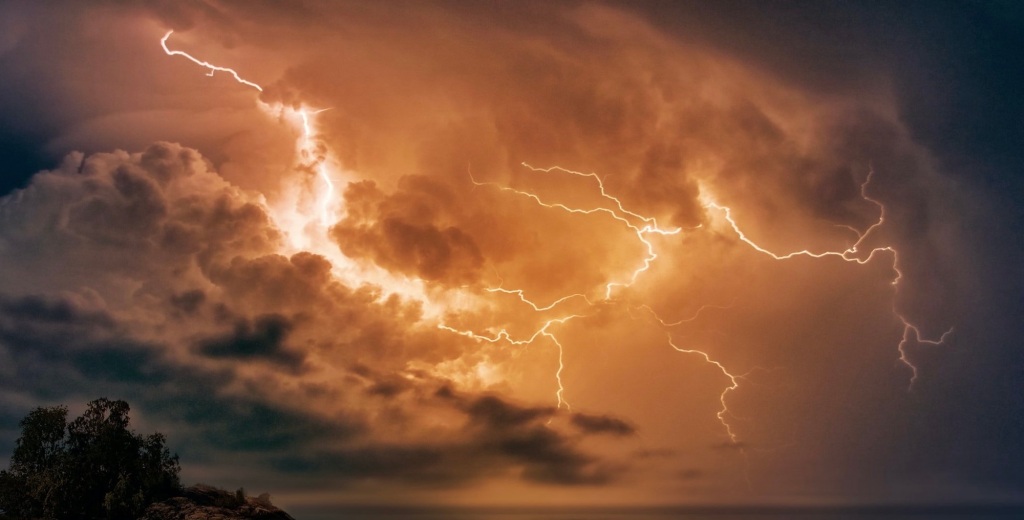
In the book of Exodus, the scene at Mount Sinai includes thunder and lightning, a thick cloud, the blast of a trumpet, the shaking of the mountain and a spreading haze of smoke from the burning fire, an intensifying of the trumpet blast and peals of thunder (Exod 19:16–19). This was the setting for Moses’ encounter with the Lord, when (according to the story passed on through the generations) the foundation of Torah was laid. The biblical nature of the imagery is very clear; these are all associated with an encounter with the divine.
Twenty-four elders and four six-winged creatures sing praises to “one seated on the throne” (4:2–11), and to a slaughtered lamb “with seven horns and seven eyes” (5:1–14). The hymns they sing in chapters 4, 5, and 7 appear to combine attributes of God which feature in scriptural songs of praise (holy, worthy, glory, honour, power, creator) as well as elements familiar from other New Testament texts in which early Christian thinking is developing. The twenty-four elders, sitting on thrones (4:4), along with the seven spirits (4:5; see also 1:4; 3:1) represent numbers of great symbolism throughout scripture, if we consider the twenty-four to comprise two lots of twelve.
The four living creatures each have a distinctive facial feature: “the first living creature like a lion, the second living creature like an ox, the third living creature with a face like a human face, and the fourth living creature like a flying eagle” (4:7). These four creatures allude to the chariot vision which opens the book of Ezekiel, in which the prophet sees four such creatures, with “the face of a human being, the face of a lion on the right side, the face of an ox on the left side, and the face of an eagle” (Ezek 4:10). These creatures emerge out of the midst of “
“a great cloud with brightness around it and fire flashing forth continually, and in the middle of the fire, something like gleaming amber” (Ezek 4:4), later revealed to be a magnificent chariot (Ezek 4:15–28), on which sat “something that seemed like a human form” (v.26).
Jesus is depicted in this book as “one like the Son of Man, clothed with a long robe and with a golden sash across his chest” (Rev 1:13). He is the supreme authority, the one who has risen from the dead and is at one with God (1:18). Yet there is a stark counterpoint running throughout the whole book. Jesus is the one who has been pierced (1:7); perhaps this evokes the piercing of Jesus’ side as he hung on the cross (John 19:34–37, citing this as a fulfillment of Zech 12:10).
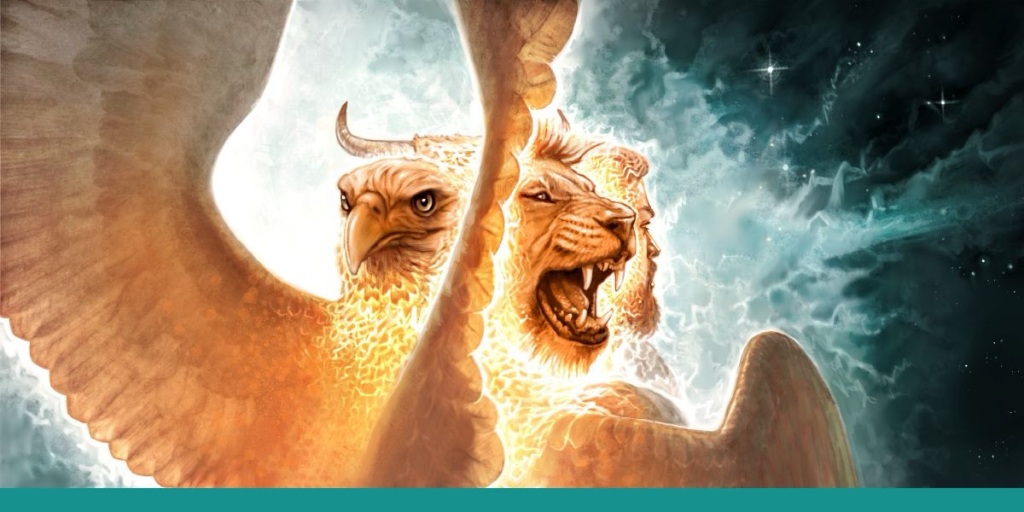
In this initial vision, the Lord God Almighty is seated on the throne, surrounded by four six-winged creatures (4:2–11), perhaps reminiscent also of the six-winged seraphim seen by Isaiah in his vision in the temple (Isa 6:1–2). The one on the throne is holding a scroll with seven seals, which no one was able to open (5:1–4). These seals form the basis for the sequence of visions in 6:1—8:1, culminating in the vision of seven angels holding seven trumpets (8:2), yet another angel burning incense (8:3–4), and the inevitable “peals of thunder, rumblings, flashes of lightning, and an earthquake” (8:5). The markers of the divine are evident once more.
The author continues on, to introduce the one who has power to open the scroll: “the Lion of the tribe of Judah, the Root of David” (5:5)—phrases which clearly evoke the Davidic lineage of Jesus which the Gospel writers have so carefully claimed. (The same Davidic lineage is noted at 22:16.) Immediately, and despite the magnificent splendour of the scene being described, with its many dazzling jewels and angelic creatures, this “Lion” is described as a “Lamb standing as if it had been slaughtered” (5:6).
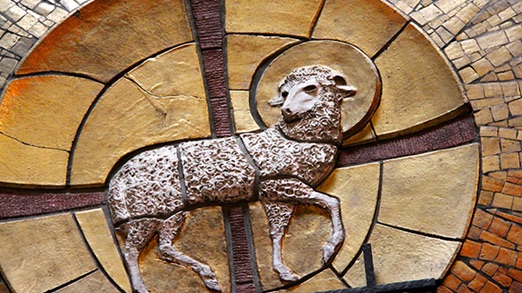
This paradoxical description of Jesus as “the Lamb that was slaughtered” recurs in hymns later in the book (5:9, 13; 13:8). His victory has been won, not through the power of force, but by submission to death. It seems that it is the fact that he has been slain which qualifies him to open the scroll. His power lies in his avoidance of violence, his submission to death.
This theme is the power that this strange book from a distant past offers us in the turmoil of the present. Our world today—as, indeed, the world time and time again over the centuries—is beset by conflict, aggression, and devastating warfare. Mass starvation and the killing of civilians in Gaza; a genocide, many now (rightly) say. Decades of terrorist activity and the exercise of military power in Israel, the West Bank, Gaza, and surrounding nations. An entrenched military battle on many fronts in the Ukraine, bogged down in the ego of a long-term tyrant. Ethnic violence and long-enduring civil warfare in the Sudan. Armed uprisings in the Congo. A civil war in Myanmar following the 2021 military coup. The list could go on to cover many–far too many–places.
The Geneva Academy of International Humanitarian Law (an institute of the University of Geneva) is monitoring more than 110 armed conflicts which are currently active across the globe. It’s a sad testimony to human greed for power, and to the seemingly endless capacity to inflict terrible damage on others.
The Way of the Lamb is a way that turns away from conflict as a means to resolve differences. In 1982, the National Assembly of my church (the Uniting Church in Australia) passed a resolution declaring “that God came in the crucified and risen Christ to make peace; that he calls all Christians to be peacemakers, to save life, to heal and to love their neighbours. The call of Christ to make peace is the norm, and the onus of proof rests on any who resort to military force as a means of solving international disputes.”
It reiterated this affirmation some decades later, in 2003, when the Assembly further declared that “that the Church is committed to be a peacemaking body”. This is central to who we are as a faith community. Many other church denominations around the world have similar resolutions marking a similar commitment. Pope John XXIII had issued his encyclical “Pacem in Terris” in 1963. Yet wars snd conflicts have continued. More recently, Pope Francis issued a “Prayer for Peace” in which he invited the faithful to pray, “Renew our hearts and minds, so that the word which always brings us together will be “brother”, and our way of life will always be that of: Shalom, Peace, Salaam!”. Pope Leo XIV prayed for peace in the Middle East and in other conflicted areas. The church yearns for peace. Too many leaders perpetuate antagonism, foment conflict, engender wars.
We need to recapture the central element of the way of discipleship as a commitment to the way of peace, as we seek to follow Jesus in our contemporary world. This is the vision of Revelation. May it be that, as we hear again of the door in heaven standing open, and the vision of the “Lamb standing as if it had been slaughtered”, we recommit to praying for peace, living in a peaceable way, and writing to our political representatives urging them to withdraw support for any armed conflict (including the withdrawal of arms and financial support for those perpetrating aggression).
 An Informed Faith