I will put my spirit within you … I will place you on your own soil (Ezekiel 37; Pentecost B)

In the alternate reading that the Revised Common Lectionary proposes for the festival of Pentecost, this coming Sunday, we find a section from the exilic prophet Ezekiel (Ezek 37:1–14). This is the famous prophecy covering the dead bones, to which the Lord (through Ezekiel) declares, “I will cause breath to enter you, and you shall live. I will lay sinews on you, and will cause flesh to come upon you, and cover you with skin, and put breath in you, and you shall live; and you shall know that I am the Lord” (Ezek 37:5–6).

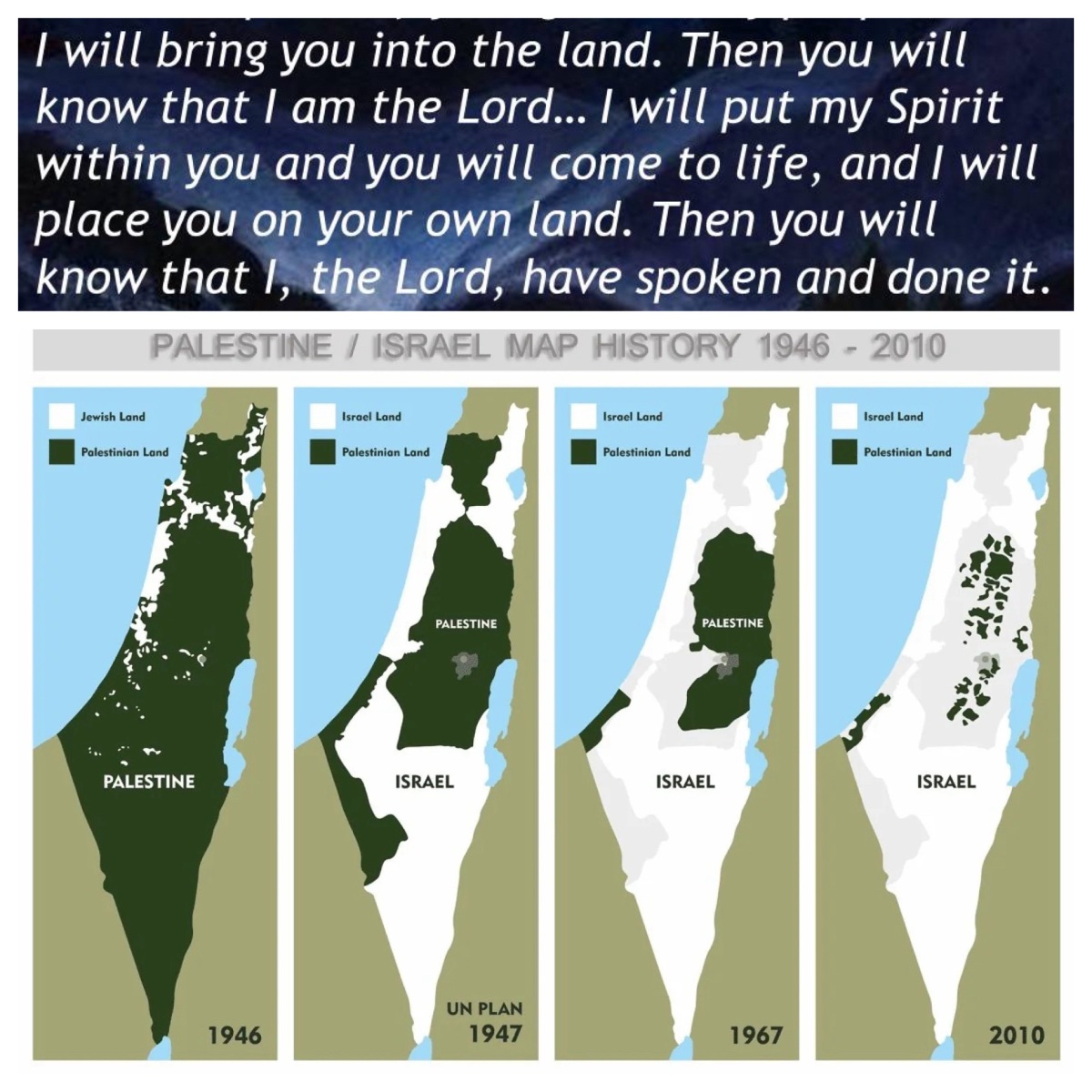
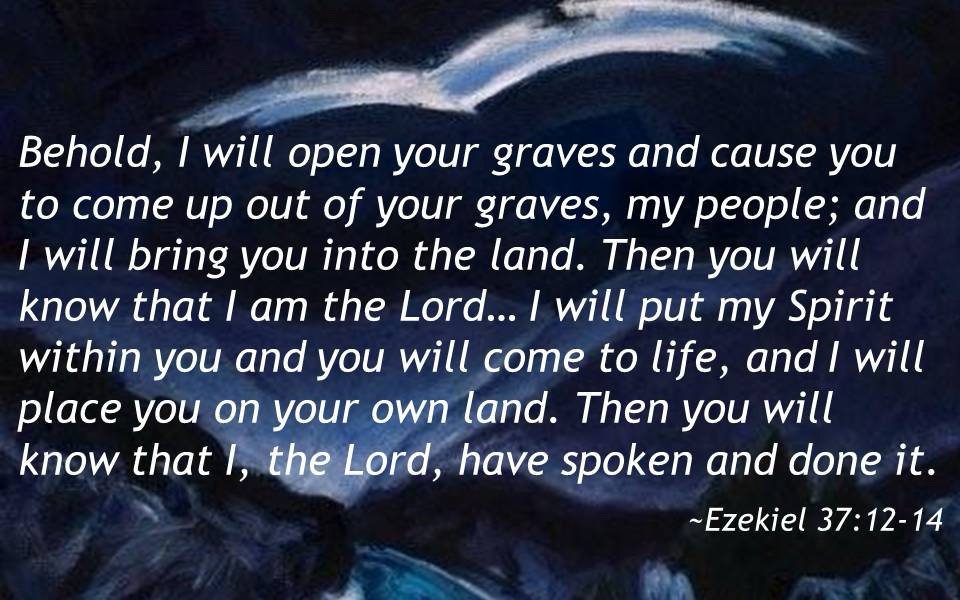
However, this passage also contains words which were filled with hope for the exiled people—but which, in the light of current events in the Middle East, and especially since the eruption of conflict on 7 October last year, are fraught with difficulties. God instructs Ezekiel, “prophesy, and say to them, Thus says the Lord God: I am going to open your graves, and bring you up from your graves, O my people; and I will bring you back to the land of Israel. … I will put my spirit within you, and you shall live, and I will place you on your own soil; then you shall know that I, the Lord, have spoken” (Ezek 37:12,14).
However, this passage also contains words which were filled with hope for the exiled people—but which, in the light of current events in the Middle East, and especially since the eruption of conflict on 7 October last year, are fraught with difficulties. God instructs Ezekiel, “prophesy, and say to them, Thus says the Lord God: I am going to open your graves, and bring you up from your graves, O my people; and I will bring you back to the land of Israel. … I will put my spirit within you, and you shall live, and I will place you on your own soil; then you shall know that I, the Lord, have spoken” (Ezek 37:12,14).

These words are fraught because of the long history of conflict relating to “the land of Israel”—the land to which the exiles would return under the decree of Cyrus of Persia; the land which today is the focus of such controversy and conflicted claims.

The land marked out for Israel was based on the historical reality that in ancient times Israelites/Jews had lived on that land for centuries until the scattering of all Jews under Roman rule first and second centuries of the Common Era. But since then, Arabs of various origins had held control of the land (see below), and those living there came to be known as Palestinians.

In the early 20th century, the place where Arabs who identified as Palestinians were living was decreed to be the British Mandate of Palestine (1920–1948). The ancient conflicts, it was hoped, would be well in the past. A place for Palestinians in the modern world was, it was thought, now settled. But this was not to be, as we well know today.

In part in response to the horrors of the Shoah, exposed by the ending of World War Two, the modern state of Israel was created in 1948. This was a hugely important, completely justified step to take, give the atrocities of genocide that had been inflicted on Jews in Europe by the Nazi regime of Germany.

The new nation of Israel took 78% of the area which had been provided for Palestinians in the British Mandate. That this was now Jewish territory was a blessing for Jews, but it was a huge and continuing irritant to Palestinian sensibilities, which is why the period from 1948 onwards is known as the Nakba, the Palestinian Catastrophe. A significant number of Palestinians fled the area declared as Israel, as (in one estimate) over 500 Palestinian villages were repopulated by Jews, becoming refugees with no national identity. That was indeed a catastrophe for those inhabitants.
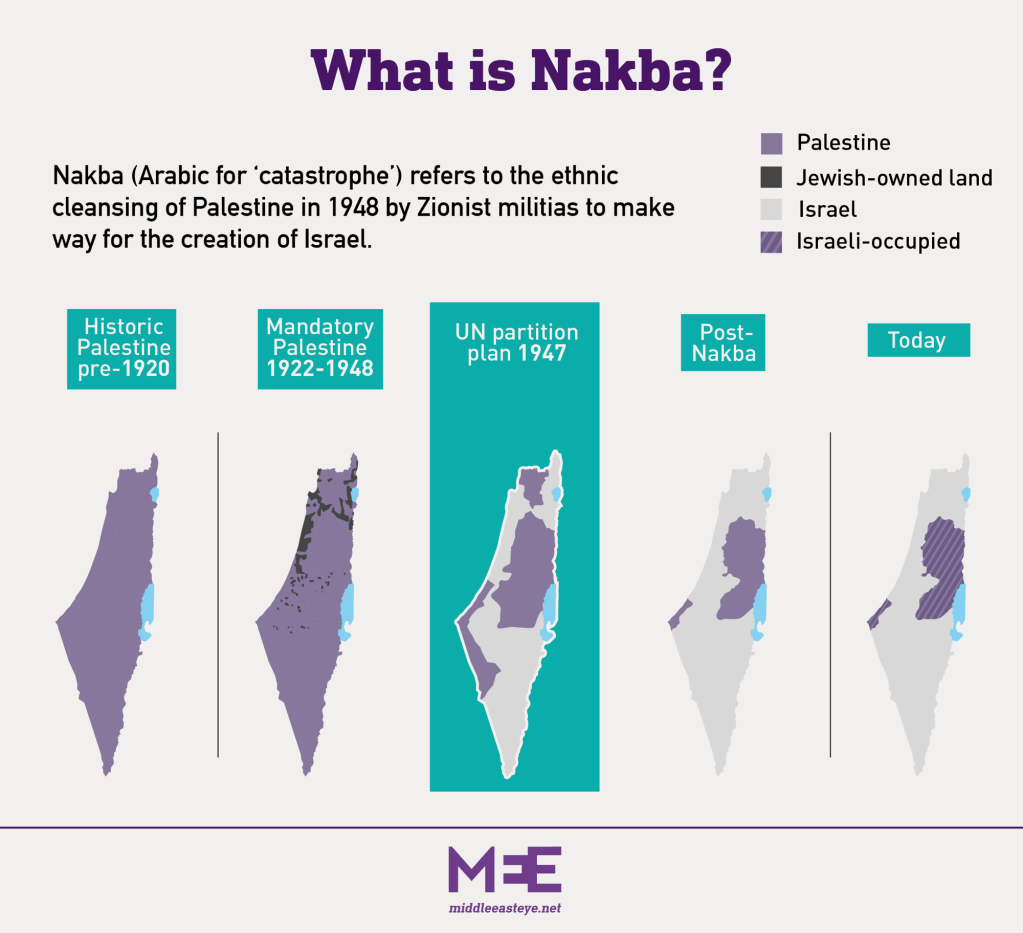
The contested regions of the Gaza Strip (along the east coastline of the Mediterranean Sea) and the West Bank (land immediately to the west of the River Jordan) became known as the Palestinian Territories. They have been disputed territories ever since they were occupied by Israel, two decades later, in the Six-Day War of 1967. In the decades since then, continuing and increasingly aggressive expansion of Israeli settlements into areas where Palestinians were living has greatly exacerbated the situation.

And so those who were dispossessed—and offered the hope of return to “their land”—become the dispossessors of others, to whom that same land was also “their land”; and so the tragic cycle continues.

The biblical texts which claim that God gave land to a chosen people so long ago are not verbatim accounts of “what God said” long ago, nor are they historical reports of actual events. They were written by priests returning from Exile, trying to recapture the period when Israel had some autonomy, because of the strength of its army under various tribal leaders (presented as “kings”). The texts form aetiological tales—that is, they are written as stories at a point in time, purporting to be ancient records, laying the foundation for a claim such as “this is our land, God gave it to us”.

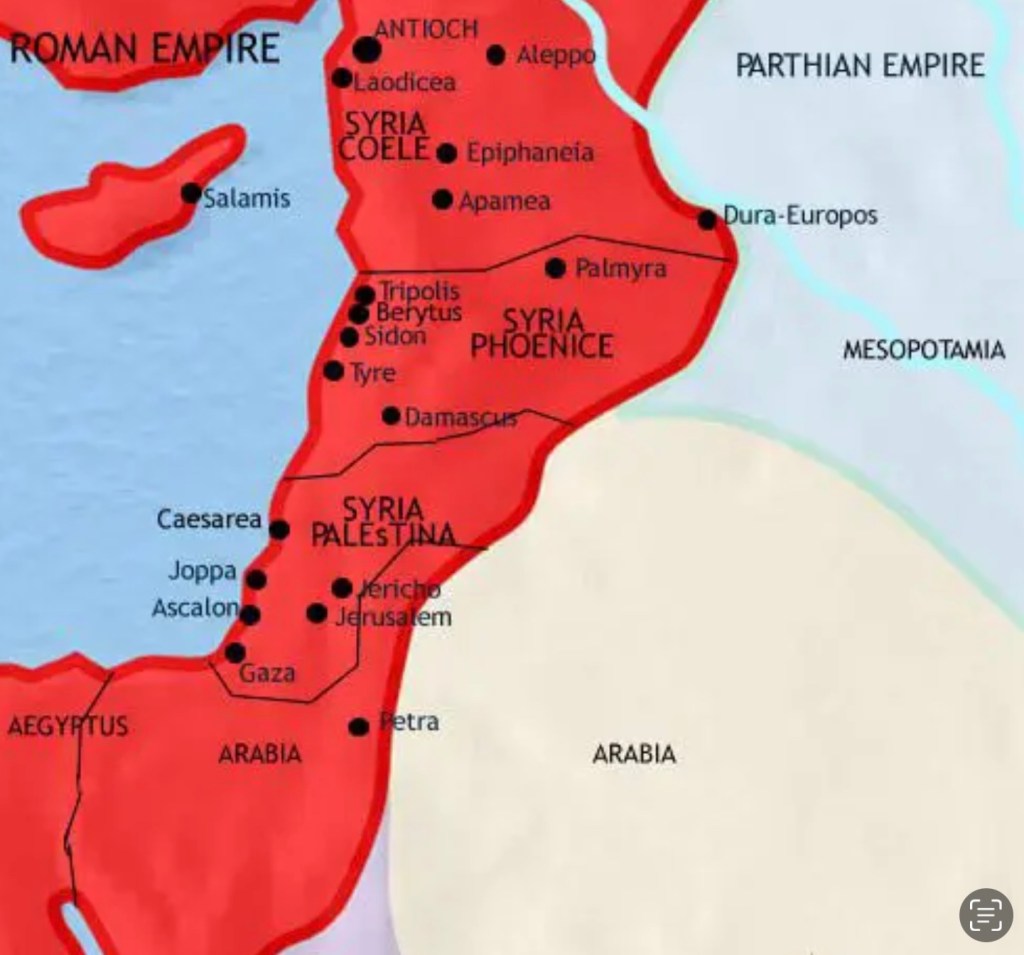
That same land, promised to Abraham, claimed by Moses, is in contention today. It has had a chequered history. The ancient land of Cana an eventually became the land of Israel, then (along with Judaea) part of the Roman province of Syria Palaestina (132–390), and then of the Diocese of the East in the Roman Empire (to 536). What followed the fall of the Roman Empire was a millennium and a half of Muslim rule of this land, first as a part of Bilad al-Sham, the Greater Syria region, under various Caliphates.

The region continued to be part of various organisational configurations under successive Muslim rule, on into the Ottoman Caliphate (from 1517) and then into the modern era, as already noted. (I am not an expert, by any means, of this ancient and medieval history; for this summary, I am dependent on what I read in what I consider to be reputable sources.)

An exaggerated, idealised view of the extent of the land claimed by modern-day Israelis is evident in so many ways in the portrayal of Solomon, who was seen to be filled with “wisdom and knowledge”, and granted “riches, possessions, and honour, such as none of the kings had who were before you, and none after you shall have the like” (2 Chron 1:7–12, especially verses 10 and 12). The biblical figure of Solomon is an exaggerated caricature, a description of an idealised ruler whose existence is actually still a matter of debate amongst ancient historians.

It is also worth noting that the large reach of land that Solomon ruled over, even more extensive than the oft-cited phrase “from Dan to Beersheba” (Judg 20:1; 1 Sam 3:20; 2 Sam 3:10; 17:11; 24:2, 15; 1 Ki 4:25; 1 Chron 21:2; 2 Chron 30:5), did not continue past his death. The hagiographical exaggeration of territory under Solomon is not noted in the period after his death. The narrative books that recount the stories of the kingdoms of Israel, in the north, and Judah, in the south, in the centuries after Solomon, indicate that the scope of those kingdoms was more constrained.

*****

In the light of this, we need to take care when we come across texts in the Hebrew Scriptures which dogmatically and definitively declare that this land belongs to the people of Israel. Indeed, even scripture itself tells the story of the invading colonisers who claimed this land for their own (in the book of Joshua).

So I don’t think it is responsible, today, to lay claim to the whole, extended territory of the land, from the biblical passages noted, as the scope for the modern state of Israel which was created in 1948. There is no justification for the continued aggressive expansion of Israeli settlements in Palestinian areas. So I have sympathy for Palestinians who have lived on the land for thousands of years prior to 1948, as they understand this to be their ancestral land. It has been a continuing Nakba, a catastrophe, for Palestinians over these decades.

I also have sympathy for Jews, both those living in the land of Israel today, as well as those living in diaspora, for whom the land of Israel has a powerful symbolic significance—especially since the Shoah of 1933—1945 and the terrible genocide perpetrated by the Nazis against Jews in so many countries during that period. Granting them land in the area where their ancestors long ago had lived, a homeland that gives them security in the modern world, is important and necessary.

That said, I don’t agree that Palestinians should take matters into their own hands to seek vengeance against people in Israel in the way that they have done, once again, in recent months. In the same manner, nor do I think that the Israeli forces should respond in the aggressive and violent manner that they have done, once again, in recent times, with deaths of women and children, and aid workers, noted on the news with dreadful persistence. Too many people—innocent people—are dying and being injured, making any possible progress towards peace with justice even more difficult each day.

We need to seek once more the peace of these peoples. And we need to find that peace on the basis of justice. Neither terrorist attacks nor military crackdowns will achieve this. They will simply exacerbate a dangerous situation.

How do we deal, today, with the promises of God made long ago? “I will bring you back to the land of Israel. … I will place you on your own soil” (Ezek 37:12,14). We need to tread with care. Perhaps some other texts from both Jewish scripture Christian scripture provide guidance.

“Depart from evil, and do good; seek peace, and pursue it.” (Psalm 34:14). “Blessed are the peacemakers, for they will be called children of God.” (Matt 5:9). “Justice, and only justice, you shall pursue, so that you may live and occupy the land that the Lord your God is giving you.” (Deut 16:20). “… the weightier matters of the law: justice and mercy and faith. It is these you ought to have practiced …” (Mat 23:23). May these be the principles that guide the leaders of the warring groups in Israel and Palestine today.

Blessings and greatness: a promise for the ages (Gen 12; Lent 2A)

This year during the season of Lent, the Gospel readings offer a series of narratives which describe encounters that Jesus had (largely from the Gospel according to John). In parallel to those stories, in the Hebrew Scripture readings, the lectionary offers a sequence of passages telling some of the key moments in the story of Israel (from Genesis, Exodus, 1 Samuel, and Ezekiel),

This sequence of key moments in the story of Israel offers a series of vignettes of faithful people from the past—our ancestors in the faith who stand as role models to encourage us, centuries later, in our own journey of faith. They are figures which are worth holding up for our reflection and consideration. These stories each have the function of an aetiology—that is, a mythic story which is told to explain the origins of something that is important in the time of the storyteller.

The online Oxford Classical Dictionary defines the term as follows: “Aetiology in religion and mythology refers to an explanation, normally in narrative form (hence ‘aetiological myth’), of a practice, epithet, monument, or similar.” Whilst telling of something that is presented as happening long back in the past, the focus is on present experiences and realities, for “such explanations elucidate something known in the contemporary world by reference to an event in the mythical past”.

See https://oxfordre.com/classics/display/10.1093/acrefore/9780199381135.001.0001/acrefore-9780199381135-e-7050;jsessionid=3DB38C42C54D01E1CBFA8682FB55DA4C

The ancestral narratives of Israel (Gen 12–50), as well as the series of books known as “the historical narratives” (Exodus to 2 Kings, Ezra—Nehemiah) are all written at a time much later that the presumed events which they narrate. The final form of the books as we have them most likely date to the Exile or post-exilic times, although pre-existing sources would have been used for many of these stories. (There are specific references to earlier written documents—now lost to us—scattered throughout 1—2 Kings.)

Those older stories were remembered, retold, and then written down, because they spoke into the present experiences of the writers. Common scholarly belief is that the stories found in Gen 12–50 were originally oral tales, that were collected together, told and retold over the years, and ultimately written down in one scroll, that we today call Genesis.

*****

For this coming Sunday, we are offered the account of the calling of Abram, who journeys into a new future (Gen 12:1–4a, Lent 2A). This has been a key passage for Jews throughout the centuries; Abram is remembered and honoured as “the father of the nation”—indeed, as “the father of all nations”; and this passage claims that it was God’s intention to grant the blessing of abundant descendants to Abram and his wife, to fulfil this promise.

The passage is found after the opening 11 chapters, which are often labelled the “Primeval History”, since they recount the creation of the world and the sequence of events which were fundamental for understanding human existence (such as human sinfulness and conflict, the expansion of humanity, the great flood, the growth of tribal entities, and the diversification of languages).

The passage also stands at the head of those stories, originally oral, which were collected because they revealed much about the nature of Israel as a people and as a nation. These chapters tell stories about the patriarchs and their wives (Abram and Sarai, Isaac and Rebekah, Jacob and Leah and Rachel). This particular passage introduces key themes for the people of Israel.

A word of caution: the lectionary stops in the middle of verse 4: “Abram went, as the LORD had told him; and Lot went with him”. To be fair, however, we need to read beyond the point where the lectionary ends this passage; that selection indicates that Abram took Lot with him, but the narrative actually continues, indicating that Abram travelled with his wife Sarai and his nephew Lot, “and all the possessions that they had gathered, and the persons whom they had acquired in Haran; and they set forth to go to the land of Canaan” (Gen 12:5).

The lectionary is, sadly, blatantly sexist at this point: it includes the names of the two leading males, Abram and Lot, but fails to note that they travelled with their spouses, Sarai and the (always unnamed) wife of Lot; and indeed there is reference to the presence of many others with them in their journey, which would undoubtedly have included both males and females within the extended family grouping. We need to read this ancient aetiology with a contemporary critical awareness. Certainly, the faith of Abram and Sarai and their extended family is a key message conveyed by this passage.

The story explains four important aspects of life and faith for the people of ancient Israel and on into contemporary Judaism: the land is given to this people, the people (of Israel) will become “a great nation”, the name (of Abram) will be blessed, and the descendants of Abram, “all the families of the earth”, will likewise be blessed. These four points—land, people, name, descendants—loom large throughout the history of Israel. Indeed, they maintain their potency into the present age—and need to be read and understood with political and cultural sensitivity today.

*****

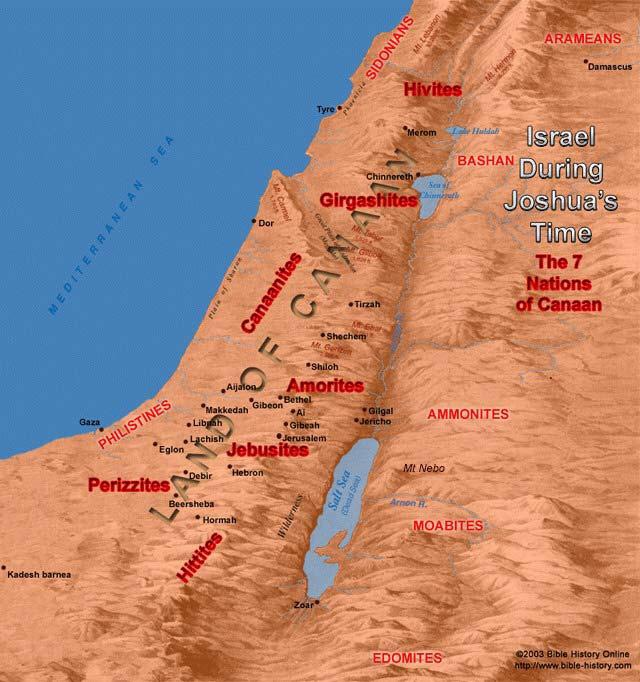
The story makes it clear that the land of Canaan was given by God to Abram and his descendants. As the story continues beyond the section offered by the lectionary, “they set forth to go to the land of Canaan. When they had come to the land of Canaan, Abram passed through the land to the place at Shechem, to the oak of Moreh. At that time the Canaanites were in the land. Then the LORD appeared to Abram, and said, ‘To your offspring I will give this land.’ So he built there an altar to the LORD, who had appeared to him.” (Gen 12:5–7).

Laying claim to the land of Canaan us a thread that runs through Hebrew Scripture. The promise of land is repeated in the covenant with Abram: “your descendants I give this land, from the river of Egypt to the great river, the river Euphrates, the land of the Kenites, the Kenizzites, the Kadmonites, the Hittites, the Perizzites, the Rephaim, the Amorites, the Canaanites, the Girgashites, and the Jebusites” (Gen 15:18–21). The long list of names of those inhabiting this land indicates the extent to which this promise would prove to be disruptive for these peoples.

The promise to Abraham was confirmed to Isaac (Gen 26:3) and to Jacob (Gen 28:13), and the full extent of the promised land was set out in Exodus 23:31, “from the Red Sea to the sea of the Philistines, and from the wilderness to the Euphrates”. By the time of the United Kingdom, it is said that “Solomon was sovereign over all the kingdoms from the Euphrates to the land of the Philistines, even to the border of Egypt” (1 Ki 4:21).

The disruption to the inhabitants from the invasion and colonisation by the incoming Israelites is told in detail through the book of Joshua, when the people enter the land and cause havoc for the inhabitants; and the book of Joshua, indicating how the “settlement” of the land required centuries of battles and conflicts.

When first the northern kingdom, then the southern kingdom each went into Exile, the yearning to return to the land was strong. When Jeremiah buys a field in his hometown of Anathoth from his cousin Hanamel (Jer 32:1–15), the purchase serves to provide assurance that the exiled people will indeed return to the land of Israel; “houses and fields and vineyards shall again be bought in this land” (Jer 32:15).

Ezekiel, speaking for God, declares that the people “shall know that I am the Lord their God because I sent them into exile among the nations, and then gathered them into their own land. I will leave none of them behind; and I will never again hide my face from them, when I pour out my spirit upon the house of Israel, says the Lord God” (Ezek 39:28–29).

As a sign of his confidence that God will maintain his commitment to Israel, Ezekiel tells in detail his vision of the new temple that would, he believed, be built in the land (40:1–43:27), as well as the role of the Levitical priests in that temple (44:15–31) and various provisions that would be in force after the return to the land (45:1–46:24).

Third Isaiah predicts that “your people shall all be righteous; they shall possess the land forever” (Isa 60:21); he speaks of a time when “they shall bring all your kindred from all the nations as an offering to the Lord, on horses, and in chariots, and in litters, and on mules, and on dromedaries, to my holy mountain Jerusalem, says the Lord” (Isa 66:20). The focus on the land is a strong thread running throughout Hebrew Scripture.

*****

The claim that the people of Israel have made for their land has been contentious throughout history—not least in the last 80 years, since the post-WWII settlement re-established the modern state of Israel in this precise area. This return of the Jews to their homeland after World War Two was implemented with little concern for what it would mean for the people who had long lived in the area—those now identified as the Palestinians.

The term Palestinian is ancient term, being used by the Greek historian Herodotus five centuries before the common era (BCE) to designate “a district of Syria, called Palaistinê” between Phoenicia and Egypt” (Histories 1.105). The term was subsequently used by numerous Greek and Roman writers.

In the early 2nd century CE, the term “Syria Palestina” (literally, “Palestinian Syria”) was given to the Roman province of Judea, which had been the area ruled over by kings of the Southern Kingdom after the time of Solomon. This occurred after the uprising led by Bar Kochba—so the designation was for a land which no longer had many Jewish inhabitants.

Roman Provinces c.200CE

In putting down the Jewish uprising, the Romans had also removed Jews from Jerusalem and the surrounding rural areas, which they renamed Colonia Aelia Capitolina. Aelia came from Hadrian’s nomen designating his gens, Aelius, while Capitolina indicated that the city formerly known as Jerusalem was dedicated to Jupiter Capitolinus, to whom a newly-built temple was dedicated.

So the contest between ‘Israel’ and ‘Palestine’ was an ancient enmity which was revived and intensified from 1948 onwards. The homeland had been given to the Jews in the aftermath of the Shoah, also called the Holocaust, perpetrated by Nazi Germany and its sympathisers. For Palestinians, yet he establishment of the Nakba, a period in which the displacement of many local populations has taken place. Unfortunately, and unjustly, this continues even today under the Israeli Government’s policy of continuing to establish new settler areas.

So whilst the passage about Abram and Sarai setting off, exuding hope and demonstrating trust in God’s promise, is a fine reminder of the need to have trust in Hod and to set our in faith in new directions in our discipleship, it is also now a fraught and contested word, given how it has been used to justify events millennia later. Let us speak of this passage with care.

*****

I am so pleased that my own church, the Uniting Church in Australia, has been thinking about our relationship with the Jewish People for a number of decades now, a nd that has included giving careful consideration to issues surrounding the land—both historical claims and current realities.

In 1997, a working group (of which I was a member) had presented a Statement to the national body of the church, the Assembly, in which these matters had been canvassed. The Assembly agreed to invite Uniting Church bodies and members to give consideration to these matters:

7.9 that the Jewish people have a particular historical, cultural, emotional and spiritual bond with the land of Israel, which is a central element of the Jewish faith, and which is inextricably bound to the history of the Jewish People;

7.10 that the historic roots, rights and aspirations of the Palestinian people must be properly acknowledged;

7.11 that from a properly informed position, and in the light of the moral tradition of Christianity, it can be appropriate for the Uniting Church to have and express a view about both Israeli and Palestinian policies and actions;

7.12 that the search for a just and lasting peace for all states and peoples in the Middle East merits prayerful engagement on the part of all Christians

See https://www.jcrelations.net/statements/statement/inviting-the-members-of-the-uniting-church-in-australia-to-ongoing-dialogue.html

In obedience to that guidance, whilst I was a member and, for a time, co-convenor of the Uniting Church’s National Dialogue with the Jewish Community, I took part in many vigorous discussions relating to these issues. I listened and learnt, as well as speaking, in those discussions.

In 2009, the Assembly received and adopted a full Statement on Jews and Judaism in which it reiterated “that the State of Israel and a Palestinian State each have the right to live side by side in peace and security”. See https://assembly.uca.org.au/rof/resources/learn-more/item/download/1109_09f709cccf49d83607c92e31d650d581

In 2011, following the work of another working group (of which I was also a member), the President and General Secretary issued an invitation to Uniting Church members “to consider taking peaceful action toward a resolution to the conflict”; it included a comprehensive set of suggested actions, including prayers, advocating with MPs, inviting speakers, supporting a relief or development project in the West Bank or Gaza, and supporting a boycott of goods produced in the illegal Israeli settlements in the Occupied Palestinian Territories. This was published under the heading of A Prayer for Peace, at https://assembly.uca.org.au/images/Ministries/ROF/images/stories/A_Prayer_For_Peace_Information_PageED.pdf

*****

Abram and Sarai stepped out in faith. That is a wonderful role model for us to emulate. Where they went, and what their descendants did, has given us pause for consideration. How do we venture into the new in ways that do not damage others?