The priority of the Torah: love God, love neighbour (Mark 12; Narrative Lectionary for Lent 4)

“You shall love the Lord your God with all your heart, and with all your soul, and with all your strength, and with all your mind” (Deuteronomy 6:5). “You shall love your neighbour as yourself” (Leviticus 19:8). These two commandments are cited in a story about Jesus engaging in a discussion with a scribe, a teacher of the Law, which ends with Jesus saying, “there is no commandment greater than these” (Mark 12:31).

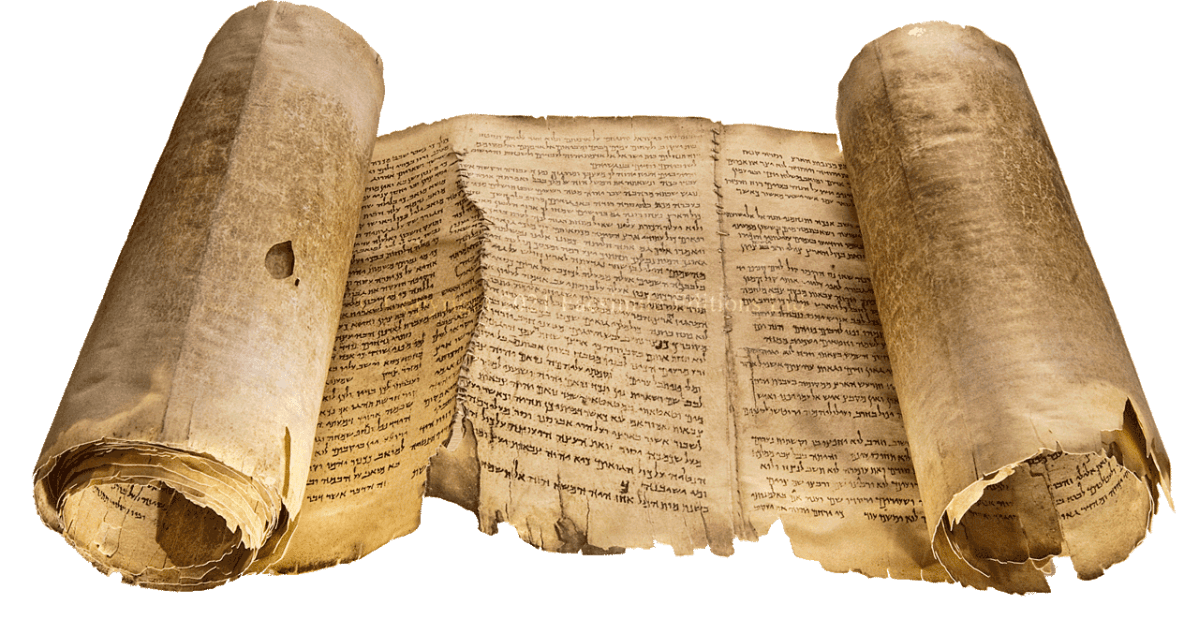
The Narrative Lectionary includes this story (Mark 12:28–34) as the opening section of a longer Gospel passage that is proposed for worship this coming Sunday (12:28–44). It’s a passage that takes us deep into the heart of Torah—those guidelines for living all of life in covenant faithfulness with God. Torah sits at the centre of Judaism. See more on this at

Of course, Jesus hasn’t answered the question precisely in the terms that it was asked; he doesn’t indicate what is “the first” commandment, but which two are “greatest”. It’s like a dead heat in an Olympic race: a race when even a finely-tuned system can’t differentiate between the two winners, even down to one thousandth of a second. Both love of God and love of neighbour are equally important. Joint winners—like that high jump competition a year or two back where the two leading jumpers just decided to share the gold medal, rather than keep competing—and risk not getting gold.

Both commands are biblical commands, found within the foundational books of scripture within Judaism. They were texts that Jewish people, such as Jesus and his earliest followers would have known very well. Each command appears in a significant place within the books of Torah, the first five books of Hebrew Scriptures.

The command to “love God” sits at the head of a long section in Deuteronomy, which reports a speech by Moses allegedly given to the people of Israel (Deut 5:1–26:19). The speech rehearses many of the laws that are reported in Exodus and Leviticus, framing them in terms of the repeated phrases, “the statutes and ordinances for you to observe” (4:1,5,14; 5:1; 6:1; 12:1; 26:16–17), “the statutes and ordinances that the Lord your God has commanded you” (6:20; 7:11; 8:11).

After proclaiming the Ten Commandments which God gave to Israel through Moses (Deut 5:1–21; cf. Exod 20:1–17) and rehearsing the scene on Mount Sinai and amongst the people below (5:22–33; cf. Exod 19:1–25; 20:18–21). Moses then delivers the word which sits at the head of all that follows: “Hear, O Israel: The LORD is our God, the LORD alone. You shall love the LORD your God with all your heart, and with all your soul, and with all your might. Keep these words that I am commanding you today in your heart” (Deut 6:4–6). This, it would seem, is the key commandment amongst all the statutes and ordinances.

These words are known in Jewish tradition as the Shema, a Hebrew word literally meaning “hear” or “listen”. It’s the first word in this key commandment; and more broadly than simply “hear” or “listen”, it caries a sense of “obey”. These words are important to Jews as the daily prayer, to be prayed twice a day—in keeping with the instruction to recite them “when you lie down and when you rise” (Deut 6:7). As these daily words, “love the Lord your God” with all of your being are said, they reinforce the centrality of God and the importance of commitment to God within the covenant people.

The command to “love your neighbour” in Leviticus 19 culminates a series of instructions regarding the way a person is to relate to their neighbours: “you shall not defraud your neighbour … with justice you shall judge your neighbour … you shall not profit by the blood of your neighbour … you shall not reprove your neighbour … you shall love your neighbour” (Lev 19:13–18).

These instructions sit within the section of the book which is often called The Holiness Code—a section which emphasises the word to Israel, that “you shall be holy, for I the Lord your God am holy” (Lev 19:2; also 20:7, 26). Being holy means treating others with respect. Loving your neighbour is a clear manifestation of that ethos. Loving your neighbour exemplifies the way to be a faithful person in covenant relationship with God.

So it is for very good reasons that Jesus extracts these two commandments from amongst the 613 commandments that are to be found within the pages of the Torah. (The rabbis counted them all up—there are 248 “positive commandments”, giving instructions to perform a particular act, and 365 “negative commandments”, requiring people to abstain from certain acts.)

Jesus, of course, was a Jew, instructed in the way of Torah. He knew his scriptures—he argued intensely with the teachers of the Law over a number of different issues. He frequented the synagogue, read from the scroll, prayed to God, and went on pilgrimage to Jerusalem and into the Temple—where, once again, he offered a critique of the practices that were taking place in the courtyard of the Temple (11:15–17).

Then he engaged in debate and disputation with scribes and priests (11:27), Pharisees and Herodians (12:13), and Sadducees (12:18). Each of those groups came to Jesus with a trick question, which they expected would trap Jesus (12:13). Jesus inevitably bests them with his responses (11:33; 12:12, 17, 27). It was at this point that the particular scribe in our passage approached Jesus, perhaps intending to set yet another trap for him (12:28).

So Jesus, good Jew that he was, is well able to reach into his knowledge of Torah in his answer to the scribe. The commandments that he selects have been chosen with a purpose. They contain the essence of the Torah. His answer draws forth the agreement of the scribe—there will be no robust debate now! In fact, in affirming Jesus, the scribe reflects the prophetic perspective, that keeping the covenant in daily life is more important that following the liturgical rituals of sacrifice in the Temple (see Amos 5:21–24; Micah 6:6–8; Isaiah 1:10–17).

The scene is similar to a Jewish tale that is reported in the Babylonian Talmud, a 6th century CE work. In Shabbat 31a, within a tractate on the sabbath, we read: “It happened that a certain non-Jew came before Shammai and said to him, ‘Make me a convert, on condition that you teach me the whole Torah while I stand on one foot.’ Thereupon he repulsed him with the builder’s cubit that was in his hand. When he went before Hillel, he said to him, ‘What is hateful to you, do not to your neighbour: that is the whole Torah, the rest is the commentary; go and learn it.’”

Hillel, of course, had provided the enquiring convert, not with one of the 613 commandments, but with one that summarised the intent of many of those commandments. We know it as the Golden Rule, and it appears in the Synoptic Gospels as a teaching of Jesus (Matt 7:12; Luke 6:31).

Some Jewish teachers claim that the full text of Lev 19:18 is actually an expression of this rule: “You shall not take vengeance or bear a grudge against any of your people, but you shall love your neighbour as yourself: I am the LORD.” Later Jewish writings closer to the time of Jesus reflect the Golden Rule in its negative form: “do to no one what you yourself dislike” (Tobit 4:15), and “recognise that your neighbour feels as you do, and keep in mind your own dislikes” (Sirach 31:15).

Paul clearly knows the command to love neighbours, for he quotes it to the Galatians: “the whole law is summed up in a single commandment, ‘You shall love your neighbour as yourself’” (Gal 5:14), and James also cites it: “you do well if you really fulfill the royal law according to the scripture, ‘You shall love your neighbour as yourself’” (James 2:8). Both writers reflect the fact that this was an instruction that stuck in people’s minds!

And I wonder … perhaps there’s a hint, in these two letters, that the greater of these two equally-important commandments is actually the instruction to “love your neighbour”?

*****

I have provided a more detailed technical discussion of the words used in this passage, and its Synoptic parallels, in this blog:

On the Pharisees and Torah, see

In praise of Torah (Psalm 19; Lent 3B)

The compilers of the Revised Common Lectionary have selected a psalm for each Sunday of the year, noting that this has normally been in order to provide a passage that complements the First Reading, which is most often a passage from Hebrew Scripture.

The psalm for this coming Sunday, Psalm 19, was obviously chosen as a companion reading alongside the Hebrew Scripture passage from Exodus 20, which recounts The Ten Words given to Israel, through Moses, when he met with the Lord on Mount Sinai (Exod 20:1–17). For that passage, see

Creation is the focus in the first six verses of the psalm, where the psalmist’s view is fixed on “the heavens”, which are “telling the glory of God” (v.1). In those heavens the Lord “has set a tent for the sun, which comes out like a bridegroom from his wedding canopy, and like a strong man runs its course with joy” (v.4–5)—clearly a description of the daily movement of the sun across the sky (from our perspective), from east to west, as verse 6 then elucidates.

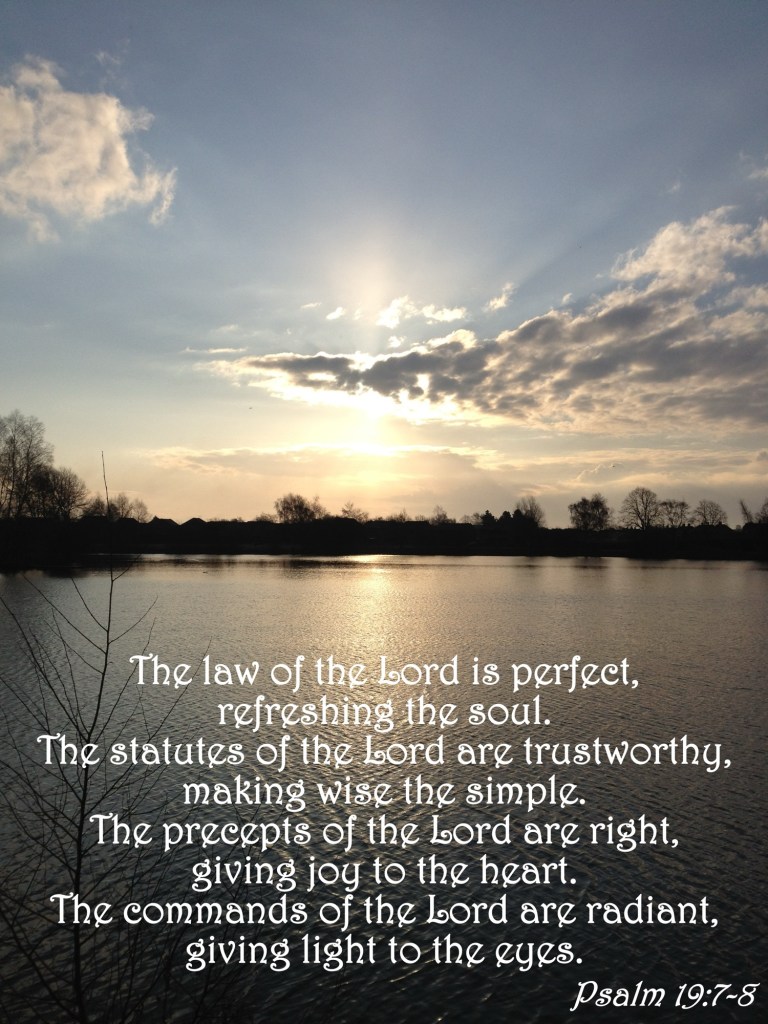
However, at this point the focus changes to Torah. The psalmist expresses a consistently positive attitude towards Torah in verses 7–14. Those verses contain a ringing affirmation of the Torah as “perfect, reviving the soul … sure, making wise the simple … right, rejoicing the heart … clear enlightening the eyes … pure, enduring forever … true and righteous altogether … more to be desired than gold … sweeter also than honey” (Ps 19:7–14).

The terms used here in parallel to describe Torah (law, decrees, precepts, commandment, fear, ordinances) are found regularly in the narrative books to describe the collection of laws (Deut 8:11; 11:1; 1 Ki 2:3; 6:12; 8:58; 2 Ki 17:34–37; 1 Chron 22:13; 28:17; Neh 9:13; 10:29) as well as right throughout Psalm 119. See

Such affirmations of Torah sound out insistently throughout the majestically grand doublets of the longest psalm, Psalm 119. The 176 verses of this psalm, artistically arranged into acrostic stanzas of eight verses at a time, are bracketed by delight and confidence (“happy are those … who walk in the way of the Lord … I long for your salvation, O Lord, and your law is my delight”, vv.1, 174). This psalm indicates that the Law shapes the way that the covenant is kept; and the covenant gives expression to the steadfast love and grace of God.

*****

So much is Torah valued, that it apparently offers perfection: “the law of the Lord is perfect” (Ps 19:7), which we might compare with “I have seen a limit to all perfection, but your commandment is exceedingly broad” (Ps 119:96). In this regard, the psalmist’s appreciation for Torah as perfection seems to reflect the priestly desire for people to offer perfect sacrifices, without blemish (Lev 22:21), and Solomon’s desire to build the Temple as a perfect house for God (1 Ki 6:22).

Indeed, such a conception of perfect Torah also resembles the sage’s musings regarding Wisdom: “to fix one’s thought on her is perfect understanding” (Wisdom 6:15), and thoughts found in a prayer attributed to Solomon: “even one who is perfect among human beings will be regarded as nothing without the wisdom that comes from you” (Wisdom 9:6).

Much value is accorded to these words of Torah. As well as calling the law “perfect”, we hear that “the decrees of the Lord are sure” (Ps 19:7), a claim echoed in another psalm (Ps 93:5). The precepts of the Lord that are right (Ps 19:8; see also 119:75, 137, 172) means that one who is faithful and obedient will be led “in right paths” (Ps 23:3) as they pray “put a new and right spirit within me” (Ps 51:10). “The commandment of the Lord is clear” (Ps 19:8) is a claim that informs the later portrayal of those who trace the course of Wisdom “from the beginning of creation … [who] make knowledge of her clear” (Wisd Sol 6:22).

The psalmist extends the adoration of the Law, declaring that “the fear of the Lord is pure” (Ps 19:9), a claim extended in another statement found in wisdom texts, “the fear of the Lord is the beginning of wisdom” (Ps 111:10; Prov 1:7; 9:10; 15:33; Sir 1:18, 27; 19:20). A further elaboration, “the ordinances of the Lord are true and righteous altogether” (Ps 19:9), is the way that Ezra describes the laws given to Moses on Mount Sinai (Neh 9:13). They are righteous (Ps 119:7, 62, 106, 160, 164), good (119:39), the basis of hope (119:43) and comfort (119:52).

The closing affirmation in this shorter psalm, “more to be desired are they than gold, even much fine gold; sweeter also than honey, and drippings of the honeycomb” (Ps 19:10), is echoed in the longest psalms, “how sweet are your words to my taste, sweeter than honey to my mouth!” (Ps 119:103).

By contrast, when Job asks, “where shall wisdom be found? and where is the place of understanding?”, he proposes that “gold and glass cannot equal it, nor can it be exchanged for jewels of fine gold” (Job 28:12–19), and concludes, “the fear of the Lord, that is wisdom; and to depart from evil is understanding” (Job 28:28).

Wisdom, love, the fear of the Lord, enlightenment, and rejoicing—these are the fruits of Torah, as the psalmist sings. These are the benefits of the law which are to be valued even into our own times, as this Sunday we hear again the words of this ancient psalm and affirm its relevance and importance in the contemporary world.

A bleeding woman, a dying child in Mark 5 (Narrative Lectionary for Epiphany 4)

This coming Sunday, the section of Mark’s Gospel that the narrative lectionary proposes contains a pair of interlinked stories: one about the dying girl who had lived for 12 years (Mark 5:25–34) and one about the woman who has bled for 12 years (Mark 5:21–24, 35–43). These are stories with a Jewish focus. They each contain the number 12, a very important number in Judaism. I have reflected on the significance of this number in these stories in this blog:

These two stories each tell of a way that Jesus offered hope to the woman and the girl. And they each deal with matters of protocol and behaviour within the Jewish holiness system.

Holiness was central to the people of Israel. Those who ministered to God within the Temple, as priests, were to be especially concerned about holiness in their daily life and their regular activities in the Temple (Exod 28-29; Lev 8-9). The priests oversaw the implementation of the Holiness Code, a large section of Leviticus (chapters 17–26), which explained the various applications of the word to Israel, that “you shall be holy, for I the Lord your God am holy” (Lev 19:2; also 20:7,26).

As well as overseeing the various offerings and sacrifices that were to be brought to the Temple, the priests provided guidance and interpretation in many matters of daily life, including sexual relationships and bodily illnesses, as well as the annual festivals and other ritual practices.

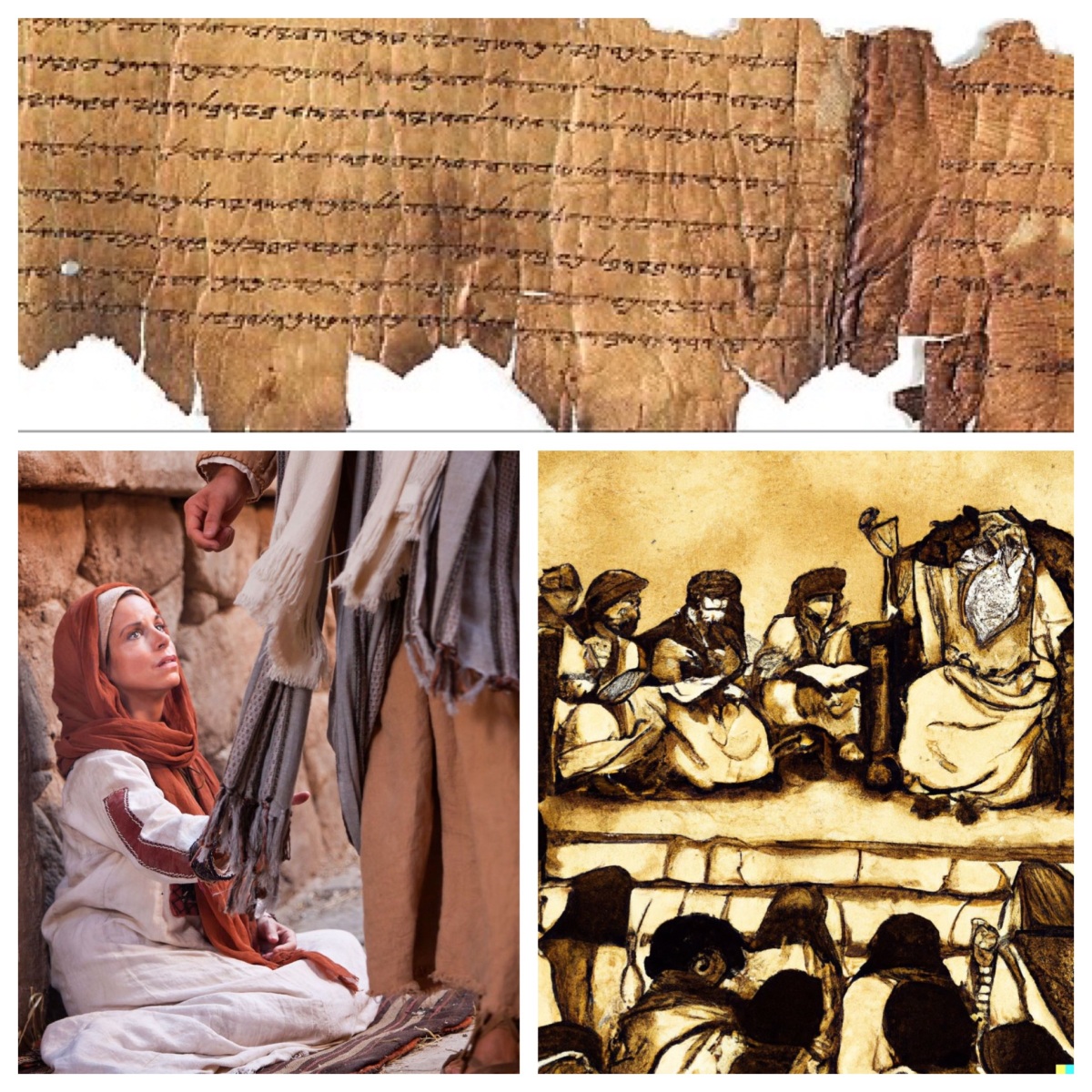
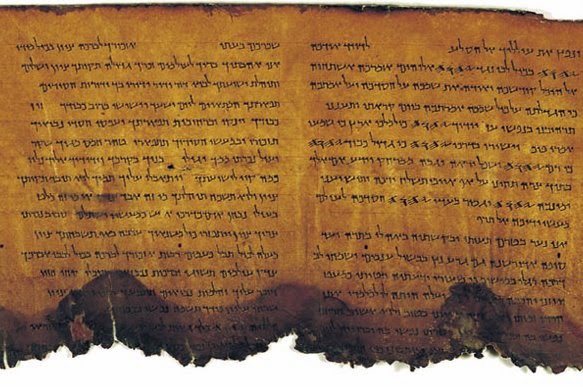
Part of the Paleo-Hebrew Leviticus scroll (discovered 1956; dated C2–C1 BCE)
which contains the oldest known copy of the Holiness Code.

In the towns and villages of Israel, by contrast, the scribes and Pharisees provided guidance in the interpretation of Torah and in the application of Torah to ensure that holiness was observed in daily living. They undertook the highly significant task of showing how the Torah was relevant to the daily life of Jewish people. It was possible, they argued, to live as God’s holy people at every point of one’s life, quite apart from any pilgrimages made to the Temple in Jerusalem.

So the encounter of the bleeding woman with Jesus had implications in terms of how he interacted with someone suffering from a physical illness. This was a matter regulated by various laws, including, most prominently, a comprehensive catalogue of laws relating to skin diseases, or leprosy (Lev 13–14) and, more relevant to this story, bodily discharges (Lev 15).

These laws specify that, if blood was being discharged from the woman as menstrual blood (“her regular discharge from her body”) that required specific actions to deal with the uncleanness that this produced (Lev 15:19-24).

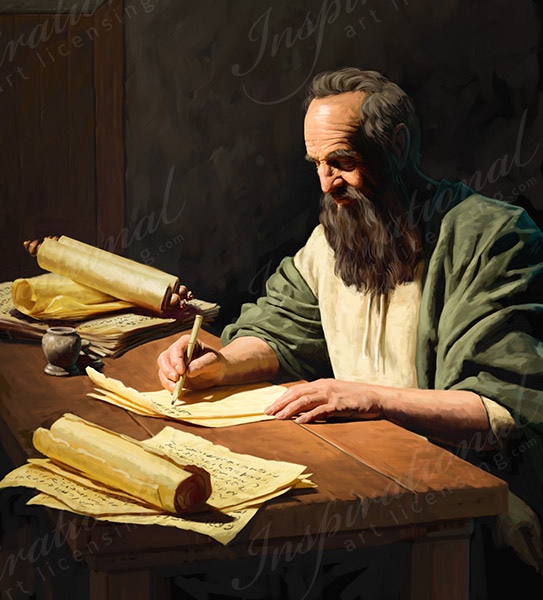
An image generated by AI,
illustrating an ancient synagogue gathering
where the Law is read

If it was for other reasons (“a discharge of blood … not at the time of her impurity”) another set of laws applies (Lev 15:25-30). The woman herself is not seen as unclean; but anything she touches, anything she sits or lies on, is regarded as unclean. The processes for maintaining a clean status in her household, avoiding these items of furniture, or even direct contact with the woman, would have been onerous.

Furthermore, the request of the synagogue leader to Jesus could possibly bring him into contact with a dead body—a matter that was regulated by laws (Lev 22:4; Num 5:1-2, 9:6-12, 19:11-13). Jairus says that the girl is “at the point of death” (5:23). The cries of the crowd (“your daughter is dead”, 5:35) and the weeping and wailing of the people outside the house (5:38) suggest that the rituals of mourning for a deceased person had already begun. Nevertheless, Jesus assures Jairus that the girl is not dead, but sleeping (5:35).

Another strongly Jewish element in the story of the bleeding woman in her belief that, if she touched the clothing of Jesus (most likely the fringes or tassels), she would be cured. Whilst the laws relating to bleeding indicate that the “direction” of things is that an unclean state touching a clean state renders the clean state unclean, the direction is reversed in this story. The power that resides in Jesus is able to overcome the uncleanness associated with the woman (5:29).

The way that Christians have often read the Levitical prescriptions has been to dismiss the so-called “cultic laws” and maintain adherence only to the moral imperatives embedded within the pages of details about ritual and worship. From this perspective, the stories included in the section of Mark’s Gospel that we are focussing on, it is said, reveal that Jesus ignored or dismissed the prescriptions of the Law. Jesus is seen to validate the attitude that the laws in the Old Testament are no longer valid.

But neither of these Gospel stories give any warrant for such a negative approach to the Holiness Code. In neither case does Jesus actually breach the provisions of the Law. Indeed, the way that the Law functions is misunderstood in so many Christian readings of this story, as well as other parts of the Gospels.

Rather than operating as a constraining imposition, the Law actually deals with real life situations and provides ways that these situations are to be dealt with or managed. The woman with a discharge “beyond the time of her impurity”, for instance, could remove her uncleanness by offering two turtle doves or two pigeons (Lev 15:29–30).

The Pharisees, it is often said, imposed numerous demands on the people. They “made a fence around the law”—a phrase derived from the opening words of Pirke Aboth (The Sayings of the Fathers), a tractate in the Mishnah. The tractate begins: “Moses received the Torah at Sinai and transmitted it to Joshua, Joshua to the elders, and the elders to the prophets, and the prophets to the Men of the Great Assembly. They said three things: Be patient in [the administration of] justice, raise many disciples and make a fence round the Torah.”

Making a fence around the Law is apparently derived from Deut 22:8, which in one translation instructs that when you are building a house, you must build a fence around the roof in order to avoid guilt should someone fall off the roof.

The Pharisees were operating as ancient fence-makers (or gatekeepers, if you will), ensuring that people operated within the bounds of what was required by the Law. Of course, each time a particular law is invoked in a specific situation, it needs to be applied to that situation, interpreted as to how it might apply. That goes for laws in society today, as much as it does for laws in the ancient Jewish society. See

The criticisms that Jesus makes of those who follow the Law and teach the Law need to be seen as debates taking place within Judaism, not as criticisms made from outside Judaism. Jesus was a Jew, living in Jewish lands, trained in understanding the Torah, engaged in applying it to situations in life. His words reflect his interpretation of the Law, not a rejection per se of the Law, as he participates in the culture, practices, and customs of his people.

Christians and Jews have had difficult relationships over the years. The difficulties have been based on misunderstandings, accusations, and the damaging intensification that comes through polemical debate, where careful listening and understanding have been absent. That has been the case, sadly, when matters associated with the application of the Law is concerned.

The Gospel passage for this Sunday reminds us of this lack of appreciation, and invites us to commit to a positive appreciation of Jewish traditions and practices, recognising that Judaism continues as a living faith today, and acknowledging that Jesus was engaged in interpretation, not rejection, of the Law. And in the midst of this, he offers hope to a woman who had suffered for 12 years, and a girl of 12 who was on the point of death.

Ten things about the Ten Words (Exod 20; Pentecost 19A)

The Hebrew Scripture reading for this coming Sunday contains a set of well-known words—the Ten Commandments (Exod 20:1–20), given to Moses on Mount Sinai, for him to take down to the people of Israel as their set of guidelines for faithful living within the covenant. That covenant was sealed by God and Moses in the previous chapter (19:1–8).

These words set the pattern for life that the Israelites are to follow. They accept and commit to this way of life, declaring “everything the Lord has spoken we will do” (19:8). Those Ten Commandments are then followed by multiple other commands for living (20:22—23:19). It is these commands that the people are instructed to live by, to which they again make their commitment: “all the words that the Lord has spoken we will do” (24:3).

Moses then confirms this in a very public way: he arranged for “burnt offerings and sacrificed oxen [to be] offerings of well-being to the Lord”, as well as dashing half of the blood from those offerings against the altar he had constructed (24:5–6).

Then we read that Moses “took the book of the covenant, and read it in the hearing of the people; and they said, ‘All that the Lord has spoken we will do, and we will be obedient’” (24:7)—and the remaining half of the blood from the offerings was dashed on the people, who are told “see, the blood of the covenant that the Lord has made with you in accordance with all these words” (24:8).

What do we make of these familiar words? The Ten Commandments are probably one of the most well-known passages in Hebrew Scripture—even if most people would struggle to identify the specific requirements of all ten of the commandments. It’s more “the vibe of the thing” that we recall, rather than the precise words.

Here are ten things about these Ten Commandments that help us to understand and appreciate their significance—both in Judaism, the religion that developed from ancient Israelite practices, as well as in Christianity, which appropriated the stories, songs, oracles, and teachings of Judaism as the foundation for its own development.

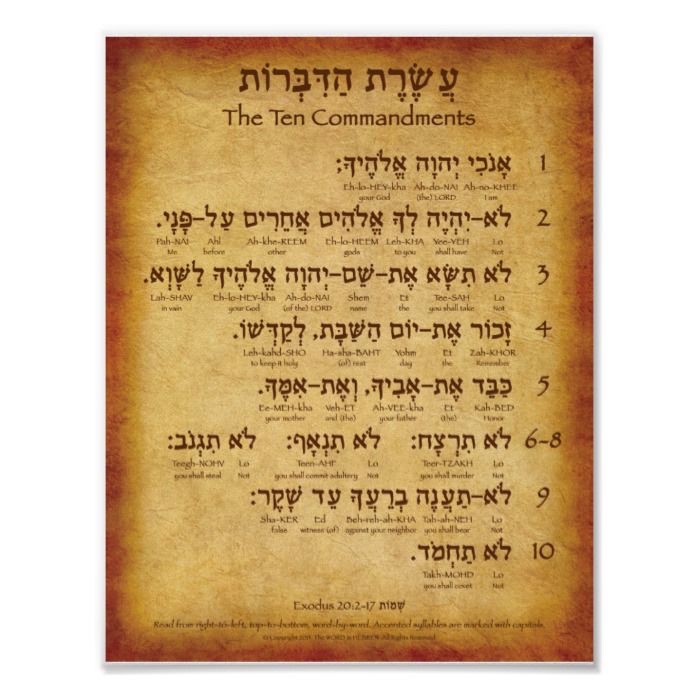
1. The description of these commandments. In Judaism, this collection of ten commands is known as the Aseret ha-Dibrot, a Hebrew phrase often translated by Jews today as “Ten Statements” or “Ten Declarations”. This is how this collection of “the words of the covenant” are described at Exod 34:28 (and again at Deut 4:13; 10:4). The second word in that phrase is simply “word”—so we might well think of these ten statements as “Ten Words” spoken by God to provide guidance and instruction to the Israelites.

2. The two versions of these Ten Words. The first version of these words is what we have in Exodus 20. (The lectionary edits the selection offered, omitting verses 5–6 and 10–11, to shorten some of the longer parts.) The second version appears in Deuteronomy 5. There are many similarities between the two versions, although the Deut 5 version is longer. One noteworthy difference is the instruction relating to the sabbath; “remember the sabbath day” (Exod 20:8), contrasted with “observe the sabbath day” (Deut 5:12). The difference in the verb is a just slight nuance of difference.

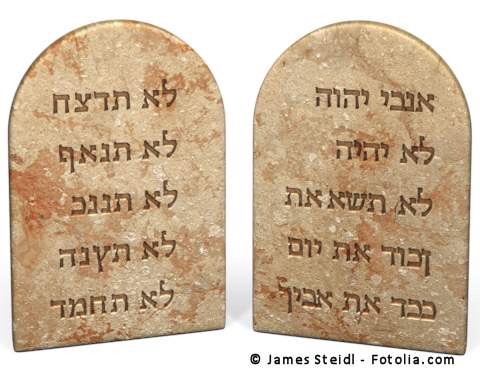
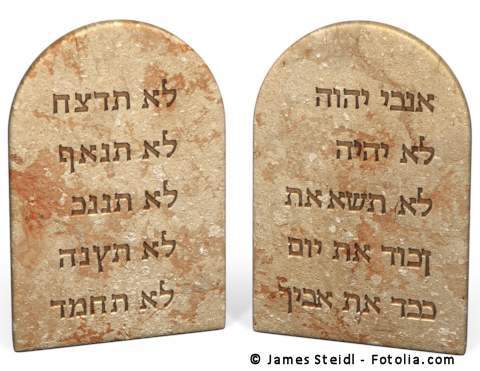
3. Two tablets of stone. Moses is given “two tablets of stone” by God, who informs him that they contain “the law (torah) and the commandment (mitsvah), which I have written for their instruction (horotam, from yara)” (24:12). The Hebrew words used here are part of a larger group of terms which describe all the instructions given throughout the first five books of scripture, the Torah. These tablets are later described as having been written “by the finger of God” (31:8), noting also that “the tablets were the work of God, and the writing was the writing of God, engraved upon the tablets” (32:6).

These two tablets are the ones that are notoriously broken by Moses in his anger when he discovers that the Israelites, in his absence, had made an image of a golden calf (32:19). This leads to the production of a replacement set of stone tablets, which Moses himself wrote under God’s instructions (34:1–4, 28).

These two tablets have most likely influenced the interpretation of the Ten Words as comprising one set of words in which the orientation is towards God (“you shall have no other gods … you shall not make an idol … you shall not make wrongful use of the name of the Lord your God … remember the sabbath day”, 20:2–11) and a second set oriented towards other humans (“honour your father and your mother, you shall not murder, you shall not commit adultery, you shall not steal, you shall not bear false witness against your neighbour, [and] you shall not covet”, 10:12–17). This, in turn, may have been an influence on the later rabbinic exposition (taken up by Jesus) of the Law as requiring love of God and love of neighbour (see Mark 12:28–31 and parallels).

4. How many laws do we have to remember? The natural desire to summarise and synthesise long lists into shorter, more readily remembered lists, may well account for the desire, in this encounter between Jesus and the scribe, to reduce all the commands to two. But there were other aspects involved in this process.

The Rabbis observed that the Torah, the first five books of scripture, actually contain 613 commandments (mitzvoth). There are 248 positive commands (“you shall …”) and 365 negative commands, or prohibitions (“you shall not …”). Collectively, these are known as mitzvoth, commandments; they comprise the Torah, the Law. In strict Jewish households, every one of them must be carefully observed.

However, the Babylonian Talmud (b. Makkoth 23b—24a) reports a rabbinic sermon in which various texts were cited in an attempt to make it easier to remember the central principles of the Torah. Rabbi Simlai declared that David reduced the 613 laws to eleven, citing Psalm 15. After him, Isaiah came, and found the basis in six commandments, quoting Isaiah 35:15-16.

Then the famous Micah triplet is cited, involving just three laws, “do justice, love kindness, walk humbly with your God” (Micah 6:8); before a later section of Isaiah is cited, noting that it proposed just two laws, “maintain justice, and do what is right” (Isa 56:1). Finally, Rabbi Simlai said there was an even shorter way to remember all the laws, and he cited Amos 5:4 as a single command: “seek me and live”.

Rabbi Nahman bar Isaac, however, proposed another prophetic text which provides one statement that summarises the Torah: “the righteous person lives by their faith” (Hab 2:4). This verse, of course, is familiar to Christians from Paul’s citation of it at Rom 1:17 and Gal 3:11.

Another way to summarise the Law is offered by the story of Rabbi Hillel, who is approached by a Gentiles seeking to convert to Judaism. Hillel says to the enquirer, “What is hateful to you, do not do to your neighbor. That is the whole Torah; the rest is the explanation of this—go and study it!” (b.Shabbat 31a). In like manner, when he was asked “which commandment is the most important of all?” (Mark 12:28), Jesus replies by citing two simple words: to love God (Deut 6:5) and to love neighbour (Lev 19:18).

5. Reading these words regularly. The Ten Words are read in full three times each year in Jewish synagogues. Jews follow a one-year lectionary, in which every verse in the first five books of scripture (the Torah, or the Five Books of Moses) is read in sabbath service during the course of the year. The weekly readings (called parashot, or “portions”) begin with Gen 1 and conclude with Deut 34. (The Jewish calendar follows the lunar cycle, and so it has 12 months of 29 or 30 days each, with an extra month added seven times every nineteen years. It’s complicated!)

So the Exodus passage is heard in the week when Exod 18:1—20:23 is read; and later in the year, the Deuteronomy version is heard, when Deut 3:23—7:11 is read. The Ten Words are also read at the Feast of Shavuot, which in the Jewish cycle of festivals is when the giving of the Law (the Ten Words) is remembered.

6. Quoted in the New Testament. The various commandments of these Ten Words are quoted in assorted New Testament passages. Jesus, in Matthew’s Gospel, affirms that all of the Law holds good; he comes to fulfil, not abolish, the Law (Matt 5:17). In the Sermon on the Mount, he specifically interprets—and intensifies—commands relating to murder and adultery, as well as not using God’s name in vain (Matt 5: 21–37).

Elsewhere in this Gospel, Jesus reinforces the importance of honouring parents (Matt 15:14) and of keeping this and further Words (murder, adultery, stealing, and lying, Matt 19:18). Paul likewise affirms that “the one who loves another has fulfilled the law” and “love is the fulfilling of the law” (Rom 13:8–10). In that passage, he cites four of the Ten Words (those relating to adultery, murder, stealing, and covetousness).

Earlier in the letter, he has referred to those words relating to stealing, adultery, and idol worship (Rom 2:21–22). Worshipping God, the first Word, is commended at Matt 4:10 and Luke 4:8; avoiding idol worship is advocated in the letter of the Jerusalem Church (Acts 15:20) and by Paul (1 Cor 6:9–10). The Sabbath is kept by Jesus (Luke 4:16) and Paul (Acts 17:2), as well as at Heb 4:9. Covetousness is condemned by Jesus (Luke 12:15) and Paul (Rom 7:7–11). So all ten of these Ten Words are affirmed in the New Testament—some on a number of occasions.

7. Numbering the list of ten. Judaism, unlike Catholicism and Protestantism, considers “I am the Lord, your God” to be the first “commandment”. Catholicism, unlike Judaism and Protestantism, considers coveting property to be separate from coveting a spouse. Protestantism, unlike Judaism and Catholicism, considers the prohibition against idolatry to be separate from the prohibition against worshipping other gods. No two religions agree on a single way to divide this stream of words into a list of ten distinct commands. So whose list should we follow?

8. Torah as a gift. To the Israelites of the past, as well as to Jews of today, the Torah is experienced as a gift which enriches their lives, not as a crass demand which weighs them down. The relationship that the people of Israel had with God was signalled in the Covenant that is offered to them. Exodus reports that the Lord spoke to Moses, “if you obey my voice and keep my covenant, you shall be my treasured possession out of all the peoples—indeed, the whole earth is mine, but you shall be for me a priestly kingdom and a holy nation” (Exod 19:5–6).

The Covenant is an outworking of this deep and abiding relationship between God and God’s people. That Covenant was not an idealised or abstract idea; it was known and expressed in each of the 613 laws contained within the Hebrew Scriptures. So the Law was considered to be a gift to the people, to be celebrated and valued as much as to be kept (Ps 19:7–11, 40:8, 119:97–104, 169–176). These Ten Words thus play a vital role in the shaping of society so that we live in ways that keep us in covenant relationship with God.

9. The basis of ethics. The Ten Words have formed a solid foundation for ethical principles, not just in Judaism and Christianity, but in wider societies more generally. During the early centuries of the church, these commandments are referenced in various documents, including the second century Didache, and they came to occupy their place in the developing catechism of the church, as Augustine of Hippo indicates in his Questions on Exodus.

The medieval scholastic, Thomas Aquinas, declared in his Summa Theologiae that these commandments provided “the primary precepts of justice and all law, and natural reason gives immediate assent to them as being plainly evident principles”. In his Institutes of the Christian Faith, Jean Calvin provides a detailed consideration of the Ten Commandments. He writes that “God has so depicted his character in the law that if any man [sic.] carries out in deeds whatever is enjoined there, he will express the image of God, as it were in his own life … it would be therefore a mistake for anyone to believe that the law teaches nothing but some rudiments and preliminaries of righteousness by which men [sic.] begin their apprenticeship, and does not also guide them to the true goal, good works.”

Their influence continues into 21st century societies across the globe. Writing in the Desert News (a conservative LDS publication), Paul Edwards proposes that “as long as people yearn for a cohesive and cooperative society that supports familial ties, secures the integrity of personhood and property, shuns petty jealousies and violence, and seeks to treat all alike in the eyes of social authority and before God, then the Ten Commandments — which accomplish these and much more — will continue to be inescapably relevant.”

10. The last word on the Ten Words relates to the last of these ten commandments. It is a curiosity not often commented on—but this last command indicates that these words are directed towards the males in the community, not to everyone, males and females alike. The final command specifies that a person “shall not covet your neighbour’s wife”, and the wording used clearly indicates that these words are directed towards males. It doesn’t say, “you shall not covet your neighbor’s husband”—which is the first indication that the instruction is directed towards men.

Further, we might note that Hebrew is a language in which gender can be indicated in the choice of words; and in this instance, every time the possessive pronoun “your” appears in this commandment, each of those possessive pronouns are masculine. It is your (male) neighbour’s house, your (male) neighbour’s wife, your (male) neighbour’s slave or ox or donkey, or anything that belongs to your (male) neighbour.

And it is noteworthy that there are feminine words used in this commandment (wife and maidservant), so the distinction is being drawn with intention and care. It is the male who possesses house and male slave and ox and donkey, as well as female slave and wife—all are possessions of the male. Which is only to be expected in the patriarchal culture in which these commandments were articulated.

And so, as we hear these Ten Words this coming Sunday, there are many things for us to reflect on!

See also

The law of the Lord is perfect (Psalm 19; Pentecost 19A)

The psalm that is offered by the lectionary for this coming Sunday (Psalm 19) contains some very well-known phrases. It deals with the way that we know God, and know about God—through creation, and through scripture. Those two “ways of knowing” form the basis for the later theological development of the notions of “natural revelation” (that we can know about God by observing the world around us) and “scriptural revelation” (that we can know about God by reading and studying the scriptures).

However, in this psalm, although there are two clearly delineated sections (verses 1–6 and 7–13) with a concluding verse 14, there are overlaps and connections between those two sections. Howard Wallace notes that “there are certain connections between the [two] parts of the psalm: word connections (e.g. ‘hid’ and ‘hide’ in vv. 6 and 12; ‘heart’ in vv. 8 and 14) … also the theme of ‘speech’ ties the psalm together (e.g. in vv. 1, 2, and 14, and presumed in the words ‘precepts’ and ‘commandments’)”. He concludes that “these connections invite us to consider the psalm as a unity with the meaning of the whole greater than the sum of the parts.”

See https://hwallace.unitingchurch.org.au/WebOTcomments/LentB/Lent3BExod20Ps19.html

Creation is the focus in the first six verses. The psalmist’s view is fixed on “the heavens”, which are “telling the glory of God” (v.1). In those heavens the Lord “has set a tent for the sun, which comes out like a bridegroom from his wedding canopy, and like a strong man runs its course with joy” (v.4–5)—clearly a description of the daily movement of the sun across the sky (from our perspective), from east to west, as verse 6 then elucidates.

In other psalms, the psalmist praises God for the heavens as the place where “you have set your glory above the heavens” (Ps 8:1); as a consequence, “the Lord has established his throne in the heavens” (Ps 103:19). By contrast with earthly idols—deaf, dumb, blind, immobile, mute—“God is in the heavens” (Ps 115:3–7; 123:1), from where he blesses the house of Israel (Ps 115:12–13).

So a recurrent refrain is, “your steadfast love is higher than the heavens, and your faithfulness reaches to the clouds” (Ps 36:5; 57:10; 108:4). “Be exalted, O God, above the heavens; let your glory be over all the earth” is another repeated prayer (Ps 57:5, 11; 108:5). In the same mode, another psalm rejoices that “your power and your righteousness, O God, reach the high heavens” (Ps 71:19).

However, another psalm declares that God “thundered in the heavens, and the Most High uttered his voice; and he sent out his arrows, and scattered them; he flashed forth lightnings, and routed them” (Ps 18:13–14). These natural elements, in the view of this psalmist, reflect the righteous judgement of the Lord—a view that we would distance ourselves from, today. (See also Ps 50:4–6; 76:7–9.)

By contrast, the rain that poured forth from the heavens when the people of Israel were in the wilderness “restored your heritage when it languished … in your goodness, O God, you provided for the needy” (Ps 68:7–10). So the heavens can be the source of nourishment and refreshment, as another psalm affirms: “he commanded the skies above, and opened the doors of heaven; he rained down on them manna to eat, and gave them the grain of heaven” (Ps 78:23–29).

Along with “the moon and the stars that you have established”, the heavens are seen to be “the work of your fingers” (Ps 8:3). “The Lord made the heavens” (Ps 96:5), “the heavens are yours, the earth also is yours”, other psalms offer, declaring that “the world and all that is in it—you have founded them” (Ps 89:11). It is “by the word of the Lord the heavens were made”, the psalmists sing (Ps 33:6; 102:25; 136:5), providing a bridge which connects both the heavens and the Law of the Lord, as in Psalm 19. Both the creation and the scriptures are the Lord God speaking to humanity.

The Law of the Lord is what shapes the second part of the psalm (verses 7–14). Those verses contain a ringing affirmation of the Torah as “perfect, reviving the soul … sure, making wise the simple … right, rejoicing the heart … clear enlightening the eyes … pure, enduring forever … true and righteous altogether … more to be desired than gold … sweeter also than honey” (Ps 19:7–14).

The terms used here in parallel to describe Torah (law, decrees, precepts, commandment, fear, ordinances) are found regularly in the narrative books to describe the collection of laws (Deut 8:11; 11:1; 1 Ki 2:3; 6:12; 8:58; 2 Ki 17:34–37; 1 Chron 22:13; 28:17; Neh 9:13; 10:29) as well as right throughout Psalm 119. See

https://johntsquires.com/2023/07/13/a-fully-developed-theology-from-just-one-psalm-psalm-119-pentecost-7a-§§4-5/

Such affirmations of Torah sound out insistently throughout the majestically grand doublets of the 176 verses which are artistically-arranged into acrostic stanzas of Psalm 119 (“happy are those … who walk in the way of the Lord … I long for your salvation, O Lord, and your law is my delight”, vv.1, 174). This psalm indicates that the Law shapes the way that the covenant is kept; and the covenant gives expression to the steadfast love and grace of God.

So much is Torah valued, that it apparently offers perfection: “the law of the Lord is perfect” (Ps 19:7), which we might compare with “I have seen a limit to all perfection, but your commandment is exceedingly broad” (Ps 119:96). In this regard, the psalmist’s appreciation for Torah as perfection seems to reflect the priestly desire for people to offer perfect sacrifices, without blemish (Lev 22:21), and Solomon’s desire to build the Temple as a perfect house for God (1 Ki 6:22).

Indeed, such a conception of perfect Torah also resembles the sage’s musings regarding Wisdom: “to fix one’s thought on her is perfect understanding” (Wisdom 6:15), and thoughts found in a prayer attributed to Solomon: “even one who is perfect among human beings will be regarded as nothing without the wisdom that comes from you” (Wisdom 9:6).

Much value is accorded to these words of Torah. As well as calling the law “perfect”, we hear that “the decrees of the Lord are sure” (Ps 19:7), a claim echoed in another psalm (Ps 93:5). The precepts of the Lord that are right (Ps 19:8; see also 119:75, 137, 172) means that one who is faithful and obedient will be led “in right paths” (Ps 23:3) as they pray “put a new and right spirit within me” (Ps 51:10). “The commandment of the Lord is clear” (Ps 19:8) is a claim that informs the later portrayal of those who trace the course of Wisdom “from the beginning of creation … [who] make knowledge of her clear” (Wisd Sol 6:22).

The psalmist extends the adoration of the Law, declaring that “the fear of the Lord is pure” (Ps 19:9), a claim extended in another statement found in wisdom texts, “the fear of the Lord is the beginning of wisdom” (Ps 111:10; Prov 1:7; 9:10; 15:33; Sir 1:18, 27; 19:20). A further elaboration, “the ordinances of the Lord are true and righteous altogether” (Ps 19:9), is the way that Ezra describes the laws given to Moses on Mount Sinai (Neh 9:13). They are righteous (Ps 119:7, 62, 106, 160, 164), good (119:39), the basis of hope (119:43) and comfort (119:52).

The closing affirmation, “more to be desired are they than gold,

even much fine gold; sweeter also than honey, and drippings of the honeycomb” (Ps 19:10), is echoed in “how sweet are your words to my taste, sweeter than honey to my mouth!” (Ps 119:103). By contrast, when Job asks, “where shall wisdom be found? and where is the place of understanding?”, he proposes that “gold and glass cannot equal it, nor can it be exchanged for jewels of fine gold” (Job 28:12–19), and concludes, “the fear of the Lord, that is wisdom; and to depart from evil is understanding” (Job 28:28).

Meditation and prayer is then affirmed in the final verse which brings the psalm to a close: “let the words of my mouth and the meditation of my heart be acceptable to you, O Lord, my rock and my redeemer” (v.14). They echo the plea of another psalm, “hear my prayer, O God; give ear to the words of my mouth” (Ps 54:2).

Yet another psalm affirms that “all the kings of the earth shall praise you, O Lord, for they have heard the words of your mouth” (Ps 138:4), while in another psalm the prayer is, “may my meditation be pleasing to him, for I rejoice in the Lord” (Ps 104:34). Finally, the closing verse of Psalm 19 resonates with a similar affirmation in Psalm 49, “my mouth shall speak wisdom; the meditation of my heart shall be understanding” (Ps 49:3).

A fully-developed theology from just one psalm? (Psalm 119; Pentecost 7A) §§6, 7

Psalm 119, the longest of all psalms, is the 176–verse grand acrostic of the Hebrew Scriptures (22 section s of eight verses each, commencing in order with the letters of the Hebrew alphabet. A small portion of this psalm (119:105–112) is offered by the lectionary this coming Sunday. I am exploring the questions: what would a theology look like, using only the verses in this psalm? and how full (or inadequate) would that theology be? See earlier instalments at

6 The life of a faithful person

So a sixth element in the psalm, which also correlates with a standard section in a fully-developed theology, is what it says about the life of a faithful person. This life is characterised most strikingly by delight—a quality that is articulated ten times in the psalm. The second section ends in a paean of praise: “I delight in the way of your decrees as much as in all riches. I will meditate on your precepts, and fix my eyes on your ways. I will delight in your statutes; I will not forget your word.” (vv.14–16).

The psalmist continues, “your decrees are my delight, they are my counselors” (v.24); “lead me in the path of your commandments, for I delight in it” (v.35); “I find my delight in your commandments, because I love them” (v.47); “I delight in your law” (v.70), “your law is my delight” (v.77, 174); “your commandments are my delight” (v.143); and, most powerfully, “if your law had not been my delight, I would have perished in my misery” (v.92). The requirements of the law bring delight to the person of faith.

A second characteristic of the life of a person of faith is that it is marked by love. In typical style, this love—which is a response to the steadfast love of God (see above)—is focussed on Torah, the source of knowledge about, and relationship with, God. Nearing the end of the psalm, we hear the psalmist say, “consider how I love your precepts; preserve my life according to your steadfast love” (v.159), drawing together the two expressions of love—love of God for humans, love of humans for God’s word in Torah.

The psalmist exults, “I find my delight in your commandments, because I love them; I revere your commandments, which I love, and I will meditate on your statutes” (vv.47–48). They exclaim, “Oh, how I love your law! It is my meditation all day long” (v.97) and affirm that “truly I love your commandments more than gold, more than fine gold” (v.127).

So much is Torah valued, that it apparently offers perfection: “I have seen a limit to all perfection, but your commandment is exceedingly broad” (v.96). In this regard, the psalmist’s appreciation for Torah as perfection seems to reflect the priestly desire for people to offer perfect sacrifices, without blemish (Lev 22:21), and Solomon’s desire to build the Temple as a perfect house for God (1 Ki 6:22).

Indeed, such a conception of perfect Torah also resembles the sage’s musings regarding Wisdom: “to fix one’s thought on her is perfect understanding” (Wisdom 6:15), and thoughts found in a prayer attributed to Solomon: “even one who is perfect among human beings will be regarded as nothing without the wisdom that comes from you” (Wisdom 9:6).

The writer clearly loves Torah. This love leads to joy: “your decrees are my heritage forever; they are the joy of my heart” (v.111). Joy is manifest in praise: “let me live that I may praise you, and let your ordinances help me” (v.175). And God’s love also provides comfort: “let your steadfast love become my comfort according to your promise to your servant” (v.76). This is the fulfilment of God’s promise to the believer: “let my supplication come before you; deliver me according to your promise” (v.170).

The psalmist prays “give me life” a number of times, linking this life with God’s ways (v.37), righteousness (v.40), word (v.107), promise (v.154), and justice (v.156). In return, the psalmist makes a whole-of-being commitment; this is the way I believe that the Hebrew nephesh should be translated. (It is regularly translated as “soul”, but this fails to convey the sense that the Hebrew has, of the whole of a person’s being.)

So the author prays, “my [whole being] is consumed with longing for your ordinances at all times” (v.20), “your decrees are wonderful; therefore my [whole being] keeps them” (v.129), and “my [whole being] keeps your decrees; I love them exceedingly” (v.167).

Another way that the Hebrews spoke about the whole of a person’s being was to refer to the “heart” (Hebrew, leb). The psalmist opens with the declaration, “happy are those who keep [God’s] decrees, who seek him with their whole heart” (v.2), place the phrase about seeking “with their whole heart” in apposition to “walk in the law of the Lord” (v.1). With their heart, the psalmist praises God (v.7), seeks God (v. 10), implores God’s favour (v.58), and cries to God (v.145).

The psalmist’s heart “stands I awe of [God’s] words” (v.161), and it is in their heart that they treasure God’s word (v.11), observe God’s law (v.34), and keep God’s precepts (v.69). Truly “your decrees are my heritage forever; they are the joy of my heart; I in line my heart to perform your statutes forever, to the end” (vv.111-112). Diligence in attending to Torah is clearly to the benefit of the psalmist; they pray, “may my heart be blameless in your statutes, so that I may not be put to shame” (v.80).

Likewise, shame is avoided when the psalmist looks towards the commandments (v.6). They confess that, as they are “looking at vanities”, God needs to “turn their eyes”(v.37); they confess, “my eyes shed streams of tears because your law is not kept” (v.136). So it is with their whole being (nephesh), their whole heart (leb), and also with their eyes (ayin) that the psalmist demonstrates this whole of being commitment to Torah. “I will meditate on your precepts and fix my eyes on your ways” (v.15), they pray; and yet these eyes “fail from watching” (vv.82, 123), so the psalmist petitions, “open my eyes” (v.18).

With knowledge of Torah, the psalmist is able to walk in God’s way. “Your word is a lamp to my feet and a light to my path” (v.105) is the best known statement of this; but we have also “when I think of your ways, I turn my feet to your decrees” (v.59) and “I hold back my feet from every evil way, in order to keep your word” (v.101).

Finally, along with sight and touch, the sense of taste is engaged in responding to God. “How sweet are your words to my taste”, the psalmist sings, “sweeter than honey to my mouth!” (v.103). These words are reminiscent of the same praise in Psalm 19, when reflecting on the words of Torah:”more to be desired are they than gold, even much fine gold; sweeter also than honey, and drippings of the honeycomb” (Ps 19:10).

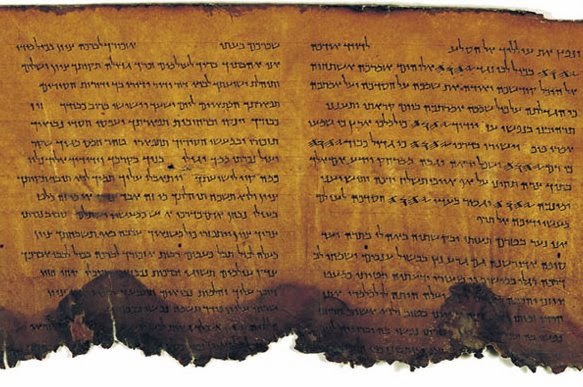
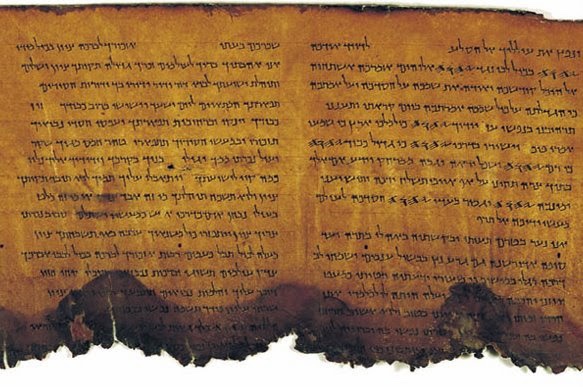
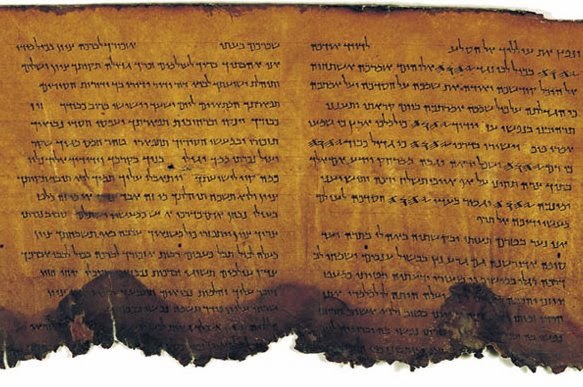
4QPs Dead Sea Scroll Psalm 119 First Century CE

7 The future

Most classic articulations of a full theology end with a view looking forward into the future. This is perhaps the least-developed aspect of Psalm 119. The writer is focussed on obedience to Torah in the present, simply as an expression of faithfulness and commitment. There is full acceptance of the Deuteronomic view that this life is when God rewards those who are faithful and punishes disobedience and evil. There is not yet any sense of the later Pharisaic development that there will be a “resurrection of the dead” and that rewards (and punishments) can be deferred to be experienced in the afterlife.

For the psalmist, the future is simply as far ahead within this life as can be envisaged. In light of that, they sing to God, “your faithfulness endures to all generations; you have established the earth, and it stands fast” (v.90). Throughout all of those generations, what is required is continuing faithfulness: “long ago I learned from your decrees that you have established them forever” (v.152), and so “I incline my heart to perform your statutes forever, to the end” (v.112), for “every one of your righteous ordinances endures forever” (v.160). The psalmist prays, “your decrees are righteous forever; give me understanding that I may live” (v.154).

The viewpoint has strong resonances with words of Jesus which Matthew reports: “until heaven and earth pass away, not one letter, not one stroke of a letter, will pass from the law until all is accomplished” (Matt 5:18).

Indeed, what undergirds this confidence is the affirmation that “the Lord exists forever; your word is firmly fixed in heaven” (v.89). That stanza continues with deep assurance, “your faithfulness endures to all generations; you have established the earth, and it stands fast; by your appointment they stand today, for all things are your servants” (vv.90–91).

Whatever may come, it seems, the author of this psalm will hold fast with confidence to the way set before them. It is as if they “lay aside every weight and the sin that clings so closely, and … run with perseverance the race that is set before us”—although, rather than “looking to Jesus the pioneer and perfecter of our faith” (Heb 12:1–2), they look to Torah as the foundation and indeed the perfection of their faith (cf. Ps 119:96).

A fully-developed theology from just one psalm? (Psalm 119; Pentecost 7A) §§4, 5

Psalm 119, the longest of all psalms, is the 176–verse grand acrostic of the Hebrew Scriptures (22 sections of eight verses each, commencing in order with the letters of the Hebrew alphabet. A small portion of this psalm (119:105–112) is offered by the lectionary this coming Sunday. I am exploring the questions: what would a theology look like, using only the verses in this psalm? and how full (or inadequate) would that theology be? See earlier instalments at

4 Relationship to God

Like all of the psalms, this psalm indicates a firm belief that God can be directly involved in the life of the believer. This is yet another topic which features in a fully-developed theology. The author invites God to “turn to me and be gracious to me, as is your custom toward those who love your name” (v.132); there is a clear sense that God is at hand, hearing the song, and willing to respond.

In one section (vv.81–88), the author sounds a classic lament, indicating that they are languishing, feeling “like a wineskin in the smoke” (v.83); they are persecuted, facing pitfalls, “they have almost made an end of me on earth” (v.87). Yet although they fear their life (v.88), they endure, with hope, and keep “watching for your promise” (v.82).

Confidence in God’s ability to intervene and strengthen the person of faith is expressed in a multitude of ways throughout this psalm. The psalmist prays, “revive me according to your word” (v.25), and is grateful to report that when “I told of my ways, you answered me” (v.26).

“Confirm to your servant your promise, which is for those who fear you”, the psalmist prays (v.38), offering a hope that God will “give me life” (v.37, 107, 154). This is a hope that is regularly expressed throughout the psalm: “in your righteousness, give me life” (v.40), “your promise gives me life” (v.50), “I will never forget your precepts, for by them you have given me life” (v.93), and “consider how I love your precepts; preserve my life according to your steadfast love” (v.159).

The mutuality of this relationship (as befits the covenantal relationship) is well-expressed in the couplet, “in your steadfast love, hear my voice; O Lord, in your justice, preserve my life” (v.149). The confident trust that the psalmist has in God is declared in the affirmation, “great is your mercy, O Lord; give me life according to your justice” (v.156). The intensity of this desire is articulated by the affirmation, “in your steadfast love, spare my life, so that I may keep the decrees of your mouth” (v.88).

The psalmist has this deep confidence in their personal relationship with God, for “this blessing has fallen to me” (v.56), echoing the favoured situation that was enjoyed by many in the past who were blessed by God: Noah and his progeny (Gen 9:1), Abram (Gen 12:1–3; 24:1), Isaac (Gen 25:11; 26:12), Jacob (Gen 27:23–29; 28:1; 35:9), Joseph (Gen 48:15–16), the twelve tribes (Gen 49:28), and then all the people who journeyed in the wilderness and entered the land (Deut 2:7; 7:14; 28:1–6)—and, of course, in the foundational creation story, all human beings themselves (Gen 1:28; 5:2).

On the basis of this deep confidence, the psalmist therefore asks God, “I implore your favour with all my heart; be gracious to me according to your promise” (v.58) and “turn to me and be gracious to me, as is your custom toward those who love your name” (v.132). Those who love the name of the Lord are also described, in typical scriptural terms, as “those who fear you” (vv.38, 63, 74, 79, 120). More often, the psalmist relates their love, not directly for God, but for God’s commandments (vv.47–48, 127), decrees (vv.119, 167), precepts (v.159), and law (vv.97, 113, 163, 165).

Quite characteristically, the psalmist looks to the Lord to teach—after all, the root sense of Torah is actually teaching, as already noted. “Put false ways far from me and graciously teach me your law” (v.29) is the psalmist’s prayer; “teach me your way” (vv.12), or “your ordinances” (v.108), or most often, “your statutes” (vv.26, 33, 64, 68, 124, 135, 171). Such teaching will provide and enlarge understanding (vv.32, 34, 73, 125, 144, 169).

The psalmist is clear that “the unfolding of your words gives light; it imparts understanding to the simple” (v.130), and so they are able to assert, “through your precepts I get understanding” (v.104), and, indeed, “I have more understanding than all my teachers, for your decrees are my meditation” (v.99).

This is an active, engaged deity, relating directly with the person singing this lengthy prayer. God relates specifically through the words of Torah, yes; but nevertheless, those words draw the psalmist into a close relationship with the Lord God—a relationship that feels intimate, a relationship that is based on solid trust and firm confidence.

On the basis of this confident trust in God, the psalmist affirms, “you are my hiding place and my shield; I hope in your word” (v.114), and again, “my hope is in your ordinances” (v.43). So the psalmist prays for God to “remember your word to your servant, in which you have made me hope” (v.49) and “my [whole being] languishes for your salvation; I hope in your word” (v.81).

The motif of hope is consistently expressed throughout: “uphold me according to your promise, that I may live, and let me not be put to shame in my hope” (v.116), “I rise before dawn and cry for help; I put my hope in your words” (v.147), and “I hope for your salvation, O Lord” (v.166).

The relationship with God that the psalmist demonstrates throughout is strong, trusting, confident, and hope-filled. It is an intensely personal relationship—which puts to lie to the terrible discriminatory caricature of Jews in the past having no personal relationship with God, and feeling weighed down by the demands of the Law.

4QPs Dead Sea Scroll Psalm 119 First Century CE

5 Revelation in Torah

What is striking about this psalm is that at every point, the understanding of God, and the expectation that God will relate closely to faithful human beings, is grounded in Torah. Torah was the essence of what God gave to Moses on Mount Sinai, and which Moses then passed on the people of Israel (Exod 19:1–9; 24:12–18; Deut 4:45–46; 6:1–9).

The psalmist values, appreciates, and is committed to Torah in every aspect that they are aware of. Torah does not oppress or bind; on the contrary, Torah gives life and offers salvation.

The psalm is thoroughly embued with the presence of Torah; this is the means by which God communicates to those singing and hearing the psalm. Not only does every one of the 8–verse stanzas of the psalm contain references to Torah, but also, a set of eight related words are deployed in ever-changing sequences of synonymous parallelism within each section. The most commonly word used, of course, is Torah, translated as law. It occurs 25 times in the 176 verses.

Synonymous with Torah (and, indeed, describing elements of it) are decrees (23 times), statutes (22), precepts (21), commandments (20), promises (15), and ordinances (14). The eighth word is word itself, appearing 21 times—most famously in the verse, “your word is a lamp to my feet and a light to my path” (v.105), which is often used in Christian liturgies to introduce the reading of scripture.

(If you add up the statistics in the previous paragraph, you find that there are 161 occurrences of these words for Torah; and as there are 176 verses in the psalm, this means that one of this cluster of terms appears in almost every single verse!)

This recurrent use of a set of synonyms expands the pattern that is found in the second section of Psalm 19, where the terms law, decrees, precepts, commandment, ordinances (and “fear of the Lord”) appear in parallelism in a section praising Torah (Ps 19:7–10).

Of this Torah, the psalmist affirms the word from God very early on, “I have commanded your precepts to be kept diligently” (v.4), to which they respond, “O that my ways may be steadfast in keeping your statutes!” (v.5). This way that is to be taught is important; “teach me, O Lord, the way of your statutes, and I will observe it to the end” (v.33).

The term way, of course, appears in the very first verse of the psalm as a synonym for those “who walk in the law of the Lord” (v.1) and then recurs a further six times (vv.9, 14, 27, 30, 32, 33). This is in contrast to “every evil way” (v.101), “every false way” (v.104, 128). It is the same contrast that expressed so succinctly in another psalm, “see if there is any wicked way in me, and lead me in the way everlasting” (Ps 139:24).

“The Way” is important in the story of Israel: both the way in the wilderness, escaping from Egypt and heading towards the promised land—“the way that the Lord had commanded you” (Exod 32:8; Deut 9:16; 13:5; 31:29); and also the way out of Exile, back across that wilderness—“the way of the Lord“ which is to be prepared, to make way for “the glory of the Lord [to] be revealed” (Isa 40:3–5).

In Proverbs, the sage declares that “the way of the Lord is a stronghold for the upright, but destruction for evildoers” (Prov 10:29), whilst the prophet Jeremiah equates “the way of the Lord” with “the law of the Lord” (Jer 5:4–5), and Ezekiel compares the righteous “way of the Lord” with the unrighteous ways of sinful Israel (Ezek 18:25–29; 33:17–20).

Seven times the psalmist refers to the “righteous ordinances” or “righteous commandments” of the Lord, including, “you are righteous, O Lord, and your judgments are right (v.137); “the sum of your word is truth; and every one of your righteous ordinances endures forever” (v.167); and “seven times a day I praise you for your righteous ordinances” (v.164).

Three times, the truth of Torah is affirmed as “the word of truth” comes from the mouth of God (v.43), “your law is the truth” (v.142), and “you are near, O Lord, and all your commandments are true” (v.151). In many ways, Torah functions as a central pivot in this psalm in the same way that “the word of the cross” functions as the central theological claim in Paul’s letters, and indeed the Gospels; and the way in which “the Bible” has a determinative, guiding, and even controlling role in Protestant evangelical theologies. This is how God can best be known, and this is what guides and informs the life of the believer.

*****

The final post is at

A fully-developed theology from just one psalm? (Psalm 119; Pentecost 7A) §§2, 3

Psalm 119, the longest of all psalms, is the 176–verse grand acrostic of the Hebrew Scriptures (22 section s of eight verses each, commencing in order with the letters of the Hebrew alphabet. A small portion of this psalm (119:105–112) is offered by the lectionary this coming Sunday. I am exploring the questions: what would a theology look like, using only the verses in this psalm? and how full (or inadequate) would that theology be? See the first instalment (Introduction, and on God) at

2 The human condition

The psalmist demonstrates a keen awareness of the human condition, lamenting that their very being (nephesh) “clings to the dust” (v.25), “melts away for sorrow” (v.28), and “languishes” (v.81), as well as offering the confession, “before I was humbled I went astray, but now I keep your word” (v.67).

Early on, they declare, “I live as an alien in the land; do not hide your commandments from me” (v.19). This is a curious statement, given that the psalm is intended for pious Israelites, holding fast to God’s Torah. Identifying with “the alien in the land” is a striking rhetorical move—although Torah is abundantly clear that “the alien in the land” is to be treated with compassion and equity in all ways (see Exod 12:47–49; 22:21; 23:9; Lev 19:33–34; 23:22).

This key ethical commitment, of respecting of the alien, is read back into the ancestral stories of Abram (Gen 21:22–24), Isaac (Gen 26:1–5), and Jacob (Gen 28:1–5; also Ps 105:23–25), as well as Joseph (Gen 37:1 and all that follows), and then Moses and Zipporah (Exod 2:15–22; 18:1–12). This central aspect of the story of Israel is then presented as the reason for respecting the alien (Exod 22:; 23:9; Lev 19:34; Deut 23:7; cf. Deut 26:5–9).

So the psalmist places themselves (and those who hear, and eventually, read, the psalm) in the position of “the alien in the land”, dependant on the grace of the Lord God, demonstrated through those surrounding them in the land (Ps 119:19). Whilst the phrase reflects the grounding of the people of the covenant in the land of Israel, perhaps to later Christian readers it also has resonances with the later notion that human beings are aliens in the material realm (Heb 11:13)?

More generally, the psalmist is acutely aware of the way that sin and evil grips human beings. This is an observation found elsewhere in Hebrew Scripture. Although the creation story describes humanity as created by God “in the image of God” (Gen 1:27) and declared by God to be “very good” (Gen 1:31), there is a clear recognition that “the inclination of the human heart is evil from youth” (Gen 8:21).

This latter statement comes at the end of the story of the flood in the time of Noah—a flood that was deemed necessary because “the wickedness of humankind was great in the earth, and every inclination of the thoughts of their hearts was only evil continually” (Gen 6:5). This evil is acted out by Cain (Gen 4:8) and indeed is reflected in the story of Adam and Eve (Gen 3:1–24).

Evil is also an explanation given for the forty years of Israel’s wandering in the wilderness (Num 32:13) and evil is foreseen by Moses as taking place once the,people are in the land, when the worship other gods (Deut 17:2–7; and note the refrain, “purge the evil from your midst”, at 17:12; 19:19; 21:21; 22:21, 22, 24; 24:7). The people acted with evil during the time of the Judges (Judg 2:11; 3:7, 12; 4:1; 6:1; 10:6; 13:1), and a string of kings from the time of David onwards are accused of “doing evil in the sight of the Lord” (2 Sam 12:9; 1 Ki 11:6; 14:22; 15:26, 34; 16:7, 19, 25, 30; 21:25; 22:52; 2 Ki 3:2; 8:18, 27; 13:2, 11; 14:25; 15:9, 18, 24, 28; 17:2; 21:2, 6, 9, 16, 20; 23:32, 37; 24:9, 19).

Sin is acknowledged in this psalm. First, the author’s own sin is to the fore: “I treasure your word in my heart, so that I may not sin against you” (v.11), and “I hold back my feet from every evil way, in order to keep your word” (v.101). So the psalmist prays, “put false ways far from me and graciously teach me your law” (v.29), and, using the recurrent biblical motif of a straying sheep, “I have gone astray like a lost sheep; seek out your servant, for I do not forget your commandments” (v.176).

Evil is seen, in addition, in other people—those characterised as “those who persecute me” (v.84, 86, 150, 161), the wicked … [who] forsake your law” (v.53; see also vv.61, 95, 110, 119, 155), evildoers (v.115), and adversaries (v.157). It is the arrogant who “utterly deride me” (v.51), “smear me with lies” (v.69), and have “dug pitfalls for me” (v.85). In each case, they are accused of flouting the Torah. So the psalmist prays, without regret, “let the arrogant be put to shame, because they have subverted me with guile” (v.78). The response of the psalmist is clear: “as for me, I will meditate on your precepts” (v.78; see also vv.15, 23, 27, 48, and 148).

In terms of how human beings are understood, then, this psalm reflects the view that, not only are we “made and fashioned” by God, but we are afflicted by sinfulness—a condition which requires addressing.

4QPs Dead Sea Scroll Psalm 119 First Century CE

3 Salvation

God’s way of addressing the human condition comes through salvation. As the psalmist meditates on Torah, they receive confirmation of God’s salvation, which is another key aspect of a classic theological structure. “Christ Jesus came into the world to save sinners” (1 Tim 1:15) is a classic Christian formulation, valued as central to Christian theology over the centuries.

In the Gospels, Jesus declares, “the Son of Man came to seek out and save the lost” (Luke 19:10). Paul identifies Jesus as Saviour (Phil 3:20), proclaims good news “through which also you are being saved” (1 Cor 15:2), and celebrates that “everyone who calls on the name of the Lord shall be saved” (Rom 10:13, quoting Joel 2:32). Indeed, there are many indications in Hebrew Scriptures of the saving purposes of God.

The Chronicler reports that when David places the ark of God into the tent on Mount Zion, he instructs the Levites to sing, “save us, O God of our salvation, and gather and rescue us from among the nations” (1 Chron 16:35). A number of psalms include the petition, “save me, O God” (Ps 22:21; 31:16; 54:1; 55:16; 59:2; 69:1; 71:2–3; 142:6; 143:9; and twice in Psalm 119, at verses 94 and 146).

The prophet Isaiah affirms that “the Lord will save me” (Isa 38:20) and the prophet Habakkuk reflects that the Lord God “came forth to save your people, to save your anointed” (Hab 3:13). Later, when King Sennacherib of Assyria besieges Jerusalem and presses King Hezekiah of Judah to surrender, he addresses “all the people of Judah that were in Jerusalem”, ironically asking them, “Is not Hezekiah misleading you … when he tells you, ‘The Lord our God will save us?'” (2 Chron 32:9–11).

Subsequently, the prophet Jeremiah assures his fellow exiles that “the Lord of hosts, the God of Israel” promises, “I am going to fulfill my words against this city for evil and not for good … but I will save you on that day” (Jer 39:16–17). It is no wonder that God is addressed as Saviour by kings (David, 2 Sam 22:3) and prophets (Isa 43:3, 11; 45:15, 21; 49:26; 60:16; 63:8; Jer 14:8; Hos 13:4), in psalms (Ps 17:7; 106:21) and in later wisdom literature (Judith 9:11; Wisdom of Solomon 16:7; Sirach 51:1).

In Psalm 119, thus, it is no surprise that as the psalmist cries out, “let your steadfast love come to me, O Lord”, they equate that love precisely with “your salvation according to your promise” (v.41). Unsurprisingly, the psalmist places their trust in Torah as the means for attaining that salvation: “my [whole being] languishes for your salvation, I hope in your word” (v.81).

Indeed, this waiting requires persistence; “my eyes fail from watching for your salvation, and for the fulfillment of your righteous promise” (v.123). By contrast, “salvation is far from the wicked, for they do not seek your statutes” (v.155). This salvation is intimately bound up with keeping Torah (vv.94, 146, 166, 174); “I do not forget [Torah]” is a persistent affirmation (vv.16, 61, 109, 141, 153, and in the final verse, 176).

The psalmist twice implores God to redeem them, another classic theological concept: “redeem me from human oppression” (v.134), “look on my misery and rescue me” (v.153), and “plead my cause and redeem me; give me life according to your promise” (v.154). That comes, of course, from the redemption won in the Exodus story (Exod 15:13; Deut 7:8; 9:26; 13:5; 15:15; 21:8; 24:18; Neh 1:10; Ps 74:2; 77:15; 78:42).

This understanding is further reflected in the times that God is addressed as Redeemer (Ps 19:14; 78:35; Job 19:25; Isa 41:14; 43:14; 44:6, 24; 47:4; 48:1, 17; 49:7, 26; 54:8; 59:20; 60:16; 63:16; Jer 50:34; and in the Hebrew epilogue to Sirach 51). Psalm 119 resonates with a common biblical motif, that salvific redemption is a key factor in the relationship that a person of faith has with God.

*****

Further posts are at

A fully-developed theology from just one psalm? (Psalm 119; Pentecost 7A) §1

I set myself a challenge: develop a fully-rounded theology from just one psalm. Easy, I thought; the shortest psalm, 117, has a number of key elements in its two verses: praise (“praise the Lord” twice, at the beginning and the end), adoration (“extol him”), a recognition of divine love (“great is his steadfast love towards us”), the universal orientation of that love (“all peoples”), and the assurance of divine fidelity (“the faithfulness of the Lord endures forever”).

There: done and dusted! … although, I think, on further reflection, that this looks more like the outline of a litany (praise—adoration—intercession —blessing) than a fully-developed theology. As a litany, it is succinct; as a theology, it is still quite deficient.

So, what about a challenge to develop a fully-rounded theology, not from the shortest psalm, but from the longest psalm? For just two psalms later, we have the 176–verse grand acrostic of the Hebrew Scriptures: Psalm 119—a small portion of which (119:105–112) is offered by the lectionary this coming Sunday. What would a theology look like, using only the verses in this psalm? And how full (or inadequate) would that theology be?

I love the way that this wonderfully artistic creation contains key elements of a theological understanding of the world. There are components regarding the nature of God, the human condition, and the divine response to that human condition. There is much to be gleaned regarding revelation and also salvation. And there are indications that touch on the character of living a faithful life, as well as signs of what the future is to be. All of these elements contribute to a fully-developed theology, surely?

This longest psalm of all, Psalm 119, is an acrostic series of 22 eight-verse stanzas (arranged alphabetically) in which the author(s) consistently affirm the value and importance of the teaching (Hebrew, torah) which sits at the centre of faith for the person singing this psalm. “I will delight in your statutes; I will not forget your word” (Ps 119:16). By contrast to “the arrogant”, whose “hearts are fat and gross”, the psalmist declares, “I delight in your law” (Ps 119:70).

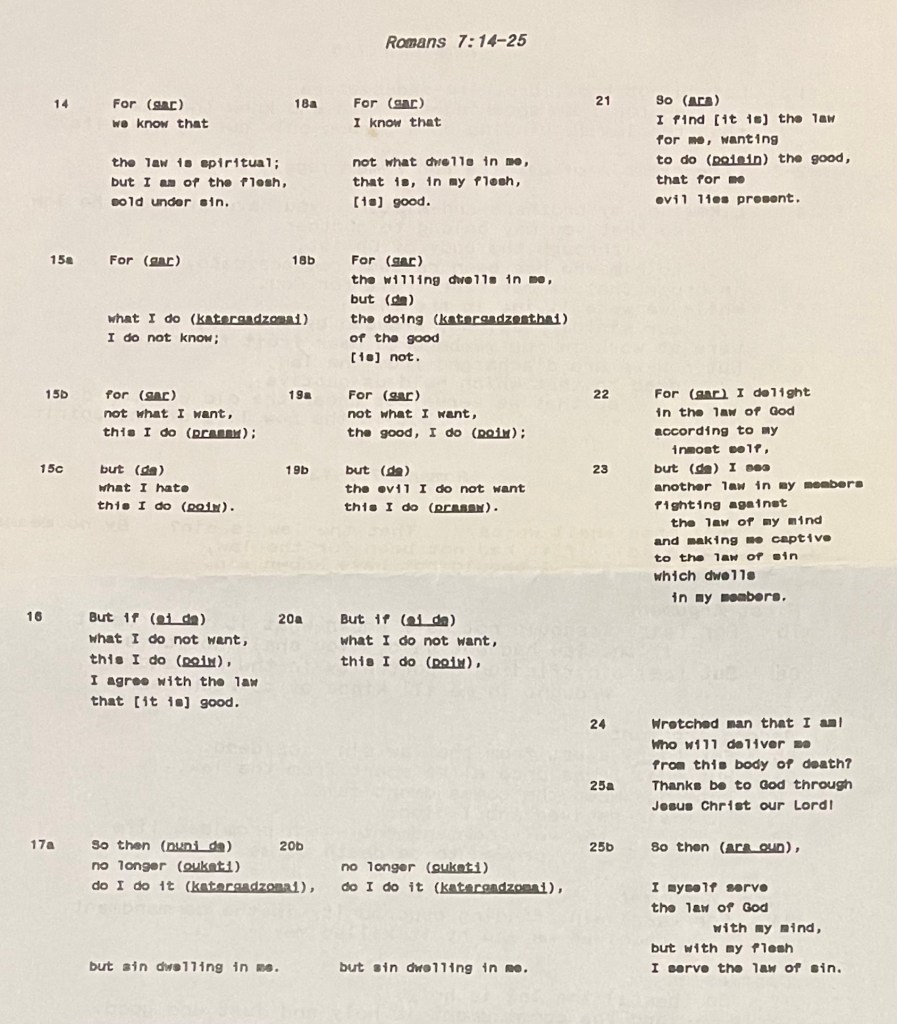
The psalm includes the petition, “let your mercy come to me, that I may live, for your law is my delight” (Ps 119:77), noting that “if your law had not been my delight, I would have perished in my misery” (Ps 119:92). It also affirms, “I long for your salvation, O Lord, and your teaching (torah) is my delight” (Ps 119:74). Echoing these words many centuries later, Paul, in the midst of his agonising about Torah in Romans 7, is able to affirm, “I delight in the law of God in my inmost self” (Rom 7:22). Delight for the Law runs through Jewish history.

This longest of all psalms is a series of 22 meditations on teachings, or Torah, which is usually translated as “law”. It contains regular affirmations of the place of Torah in personal and communal piety: “give me understanding, that I may keep your law and observe it with my whole heart” (v.34); “Oh, how I love your law! it is my meditation all day long” (v.97).

The psalmist contrasts their devotion to Torah with those who neglect or ignore it: “I hate the double-minded, but I love your law” (v.113); “I hate and abhor falsehood, but I love your law” (v.163). They rejoice that “great peace have those who love your law; nothing can make them stumble” (v.165). From this long and persistent affirmation of Torah throughout all 22 stanzas, we can indeed devise a fully-fledged theology, canvassing many of the key issues that we have come to associate with theology.

(In what follows, I will refer to the psalmist as “they”, making no assumptions about who they were, even their gender. As psalms were collective songs, it is reasonable to suggest that they were developed within the community, by members of the community—so “ they” is a reasonable assumption, I feel.)

4QPs Dead Sea Scroll Psalm 119 from the First Century CE

1 God

Undergirding the joyful appreciation of Torah in the lengthy psalm is a consistent trust in God, who is consistently acknowledged as the author and giver of Torah, but is also celebrated as creator: “your hands have made and fashioned me” (v.73). That affirmation reflects famous words sung in another psalm, “I praise you [God], for I am fearfully and wonderfully made; wonderful are your works; that I know very well” (Ps 139:14).

God’s creative power is at the centre of Hebrew Scripture. It is celebrated in passing in many psalms (Ps 8:3–8; 33:6–7; 74:16–17; 95:4–5; 96:5; 100:3; 103:14; 115:15; 121:2; 124:8; 136:4–9; 146:5–6); in the majestic celebratory psalm, Psalm 104, which rejoices, “Lord, how manifold are your works! In wisdom you have made them all” (Ps 104:24); and in the carefully-crafted priestly account of creation that stands at the head of Hebrew Scripture (Gen 1:1–2:4a). It is noted with appreciation also in psalm 119 (v.73).

A second element in this psalm is that God’s mercy is valued; “great is your mercy, O Lord” (v.156), and so the psalmist prays, “let your mercy come to me, that I may live; for your law is my delight” (v.77). This is a common refrain in other psalms, where God is asked to show mercy (Ps 25:6; 40:11; 51:1; 123:2, 3). As one proverb says, “no one who conceals transgressions will prosper, but one who confesses and forsakes them will obtain mercy” (Prov 28:13). A similar sentiment is offered by Isaiah: “the Lord waits to be gracious to you; therefore he will rise up to show mercy to you, for the Lord is a God of justice; blessed are all those who wait for him” (Isa 30:18).

Then, we might note the love of God. A recurrent refrain in Hebrew Scripture is a celebration of “the steadfast love of the Lord” (Exod 34:6; 2 Chron 30:8–9; Neh 9:17, 32; Jonah 4:2; Joel 2:13; Ps 86:15; 103:8, 11; 111:4; 145:8–9). This affirmation presents God as “merciful and gracious, slow to anger, and abounding in steadfast love and faithfulness, keeping steadfast love for the thousandth generation”.

God is praised for showing love by redeeming the people in the Exodus (Exod 15:13) and then guaranteeing abundance in the land is promised to the people: “he will love you, bless you, and multiply you; he will bless the fruit of your womb and the fruit of your ground, your grain and your wine and your oil, the increase of your cattle and the issue of your flock, in the land that he swore to your ancestors to give you”, says Moses (Deut 7:13).

Solomon later praises God, saying “you have shown great and steadfast love to your servant my father David … and you have kept for him this great and steadfast love, and have given him a son to sit on his throne today” (1 Ki 3:6; also 2 Chron 1:8), and then as he dedicates the Temple, he prays “there is no God like you in heaven above or on earth beneath, keeping covenant and steadfast love for your servants who walk before you with all their heart” (1 Ki 8:23; 2 Chron 6:14).

When the foundations of the Temple are laid, after it has been destroyed by the Babylonians, the people sing, “praising and giving thanks to the Lord, ‘for he is good, for his steadfast love endures forever toward Israel” (Ezra 3:11). When a covenant renewal ceremony takes place under Nehemiah, he addresses God as “a gracious and merciful God” and continues, “the great and mighty and awesome God, keeping covenant and steadfast love” (Neh 9:31–32). A number of prophets refer to God’s enduring, steadfast love (Isa 16:5; 43:4; 54:8, 10; 63:7; Jer 9:24; 31:3; 33:11; Dan 9:4; Hos 2:19; 11:3–4; Jonah 4:2; Micah 7:18–19; Zeph 3:17).

Reference is made to the steadfast love of God on seven occasions in this psalm (verses 41, 64, 76, 88, 124, 149, and 159). Such love is often linked with Torah—“the earth, O Lord, is full of your steadfast love; teach me your statutes” (v.64); and again, “deal with your servant according to your steadfast love, and teach me your statutes” (v.124). An important function of Torah is thus to communicate the extent of divine live.

In tandem with God’s mercy and steadfast love, so divine justice is also noted. “Great is your mercy, O Lord; give me life according to your justice” (v.156); and “in your steadfast love hear my voice; O Lord, in your justice preserve my life” (v.149).

Justice, of course, is at the heart of the covenant that God made with Israel. Moses is said to have instructed, “justice, and only justice, you shall pursue” (Deut 16:20), the king is charged with exhibiting justice (Ps 72:1–2; Isa 32:1), whilst many prophets advocate for justice (Isa 1:17; 5:7; 30:18; 42:1–4; 51:4; 56:1; Jer 9:24; 22:3; 23:5; 33:15; Ezek 18:5–9; 34:16; Dan 4:37; Hos 12:6; Amos 5:15, 24; Mic 3:1–8; 6:8).

So God, says the psalmist, holds the people of the covenant to the standard set in Torah: “you rebuke the insolent, accursed ones, who wander from your commandments” (Ps 119:21). The assumption throughout this psalm is that the creator God is personal, approachable, relatable; just and fair, kind and loving.

See further posts at

Paul and the Law, sin and the self (Rom 7; Pentecost 6A)

“I delight in the law of God in my inmost self, but I see in my members another law at war with the law of my mind” (Rom 7:23). So Paul writes, in the section of the letter written “to all God’s beloved in Rome, who are called to be saints” which is offered by the lectionary for this coming Sunday (Rom 7:15–25a).

The lectionary wants us to end this reading with the words of gratitude, “thanks be to God through Jesus Christ our Lord!” (15:25a). But in my analysis, Paul’s argument reaches its conclusion with the stalemate of verse 23—a clash between “the law of God” and “the law of my mind”. “Wretched man that I am”, he explodes in exasperation (7:24), after a lengthy and complex consideration of the issues which has led him to this damning conclusion.

What Paul is writing about in this complex section (7:1–25) is about the battle of wills, as God’s will comes into conflict with human will. The argument throughout this chapter—as, indeed, the argument throughout much of Romans—is presented as a dialectic, in which one point of view is put, to be met by an opposite point of view; followed by a rebuttal by the first voice, and a further oppositional claim by the second voice.

The thesis for discussion has been set out in 7:1–6, using the marriage relationship between husband and wife and “another man” (7:1–3) as the basis for an analogy (“in the same way”, 7:4) for the relationship between humans, “living in the flesh” (7:5) whilst also having “the new life of the Spirit” (7:6).

The use of analogy, already developed in earlier Greek rhetoric and used extensively by philosophers and political orators, does reflect rabbinic practice. The deployment of analogy, gezerah shewah, was one of Hillel’s principles of interpretation, indicating the influence of hellenistic thought and ideas on Jewish teachers and writers. So Paul here may well be operating as a rabbi, in the way that he sets out and developed his case.

But the fundamental dualism which underlies this whole chapter—the law of sin and death, the holy law of God—is thoroughly Greek in origin and character. Plato’s view of the soul trapped in the prison of the material world, which he set out in his Allegory of the Cave and which marks so many of his Dialogues: a clear line of demarcation between the spirit and the flesh, the body and the mind, the idea and the particular object.

So Paul, trained as a Pharisee, being “far more zealous for the traditions of my ancestors” (Gal 1:14), brings into the discussion a “delight in the law of God in my inmost self” (Rom 7:22). He affirms that he upholds the Torah (Rom 3:31), alluding to various commands in The Ten Words which he insists are worth obeying (2:17–22), and affirming that, in its essential character, “the law is holy, and the commandment is holy and just and good” (7:12).

Yet his calling to be “apostle to the Gentiles” (Rom 11:23; Gal 2:8) led to his experience of eating at table with Jews and Gentiles together, in breach of kosher food laws (Gal 2:11–13)—an issue that is clearly in view decades later, as Luke writes his account of the early years of the Jesus movement, siding with Paul in the view that God has set aside the requirement for separate foods and separate tables (Acts 10:1–11:18; 15:19–20, 28–29).

This, in turn, leads Paul to his missionary goal of bridging the gap between Jews and Gentiles in practical ways (Rom 15:25–27), undergirded by the message that he preaches, affirming that salvation is offered “to everyone who has faith, to the Jew first and also to the Greek” (Rom 1:16; see also 2:10; 10:12; Gal 3:28; and the post-Pauline development in Eph 2:11–22). He is driven by the scriptural claim that “God shows no partiality” (Rom 2:11; Deut 16:19–20; 2 Chron 19:7; Sir 35:15–16).

So Paul brings a firm commitment of this universal availability of salvation into this discussion in Rom 7:1–25. The argument that he has set out in the thesis of 5:1, “since we are justified by faith, we have peace with God through our Lord Jesus Christ, through whom we obtained access to this grace in which we stand”, is argued throughout the ensuing verses, and given a ringing affirmation at the end in 6:23, that all humanity is able to know and access “the free gift of God [which is] eternal life in Christ Jesus our Lord” (6:23).

This sounds, to us today, like a formal debate: three speakers, alternating between the Government for the proposition, the Opposition against the proposition, and then short concluding remarks, before the adjudicator declares a result and announces a winner. In the ancient world, however, Paul is writing in the style of a diatribe—a form that was developed in Ancient Greece and which was widely practised by Greek rhetoricians, philosophers, and teachers during the Hellenistic period.

See my analysis of the diatribe style in Rom 4 at

In the diatribe that Paul develops in Rom 7, he needs to address what he now sees as the inadequacy of Torah, given his affirmation that “God shows no partiality” (2:11) and his commitment to Jews and Gentiles eating together, without scruples regarding the food being shared. This deficiency in the law runs throughout the argument of Romans; it is impossible to keep the law (2:17–3:20).

Since his calling to work amongst the Gentiles, Paul has come to see that the law brings wrath (4:15) and increases sin (5:20), and indeed he maintains that the law “brought death” (7:9). As a consequence, righteousness must be gifted by God “apart from law”(3:21).

Paul, as we have seen, uses the scriptural example of Abraham, who “believed God, and it was reckoned to him as righteousness” (4:3), to argue that “the promise may rest on grace and be guaranteed to all his descendants, not only to the adherents of the law but also to those who share the faith of Abraham” (4:16). See

And so, he declares that “you have died to the law through the body of Christ, so that you may belong to another, to him who has been raised from the dead” (7:4), and thus “we are discharged from the law” (7:6). Paul then demonstrates this in what immediately follows. The law is not sin in and of itself; and yet, “if it had not been for the law, I would not have known sin” (7:6). This is seen, first, through the educational function of the law, which teaches for example, about covetousness (7:7–8a).

Then Paul notes that, paradoxically, the essential nature of the law reveals and activates sin (7:8b—10), so that “the very commandment which promised life proved to be death to me”, before he intensifies this with the claim that “sin, finding opportunity in the commandment, deceived me and by it killed me” (7:11).

He concludes this section with affirmation of the law as “holy, just, and good” (7:12), before clarifying that it was not the Law which brought death to him, but rather “it was sin … working death in me through what is good … through the commandment” (7:13). Paul has worked hard to differentiate sin from the Law; the one is evil, the other is good.

And yet, as he continues his diatribal discussion, more problems emerge (of course, since this is the nature of a diatribe!). Here is the dilemma: “we know that the law is spiritual; but I am of the flesh, sold into slavery under sin” (7:14). What follows is a foray into the murky mind of Paul, where, as he says, “I do not do what I want, but I do the very thing I hate” (7:15)—although he immediately attempts to excuse himself by stating that “it is no longer I that do it, but sin that dwells within me” (7:17).

That sits uncomfortably alongside Paul’s claim to the Galatians, that “it is no longer I who live, but it is Christ who lives in me”, and thus, Paul now “lives to God” (Gal 2:19–20). In writing to the Romans, Paul claims that “nothing good dwells within me, that is, in my flesh” (7:18), for it is “sin that dwells within me” (7:17, 20). The contradiction is confusing. What is the essential force that “lives within” Paul; it is Christ, as in Gal 2, or sin, as in Rom 7?

The confusion caused by “sin that dwells within me” (7:20) whilst still claiming that “I delight in the law of God in my inmost self” (7:22), drives Paul deeper into the hellenistic dualism, seeing “in my members another law at war with the law of my mind, making me captive to the law of sin that dwells in my members” (7:23). No wonder he throws his hands up in despair, exclaiming, “wretched man that I am! who will rescue me from this body of death?” (7:24).

The argument runs a parallel course three times, as my schematic structuring (below) demonstrates. For each proposition that is put (introduced often by the Greek particle gar, “for”), a counter-proposition is offered (introduced by the Greek particle de, “but”).

Modern psychological insights have been used to dig deeper into what Paul writes in Romans 7. Paul appears to be fixated on his own self, using the Greek word egō many times (7:9, 10, 14, 17, 18, 20, 21, 24, and 25). And the language of “sin” and “death” which runs through this chapter exacerbates the tendency to adopt this approach. Declaring that these malicious forces are at work within his inmost being appears to present Paul as a figure consumed with internal contradictions and unresolved tensions. In short, he is a prime candidate for psychological investigation, if not psychiatric intervention!

Who is the person, the egō, who is referenced in these verses? Some interpreters consider that Paul here is talking about his “old self”—the person he was before he encountered the risen Jesus and was commissioned for the task he now undertakes, as “apostle to the Gentiles”. This chapter, reflecting Paul the pious and intense Jew, living under the Law, desperately seeking to obey it in every detail, is thus contrasted with the following chapter, portraying Paul the apostle, fervent and passionate for the mission he is undertaking, freed from the Law and living in the liberty of divine grace.

That simplistic analysis, however, owes more to the 19th century Pietism that was driving interpreters of that time, who considered the Christian life inevitably involved a fierce inner struggle with sin which fermented and eventually erupted into an existential crisis that would, hopefully, ultimately result in a decision to live a new, Christ-centered life. We can see how that dynamic can be extracted from Paul’s agonising words in Rom 7.

A second way of dealing with this chapter, by contrast, has been to claim that the struggle about which Paul here writes reflects precisely the struggle he was enduring after that dramatic encounter with Christ.

The commission that Paul received in that encounter is reported in graphic terms, many decades later, by Luke, who makes the moment into a grand call–and–commissioning scene (Acts 9:3–8; 22:6–11; 26:12–18). Of course, Luke was not present for this event, so he shaped in along the lines of classic call-and-commissioning narratives that existed in earlier Jewish writings. (I have explored this in detail in my commentary on Acts in the Eerdman’s Commentary on the Bible, 2003). In Paul’s own writings, by contrast, this mentioned only briefly, in passing (1 Cor 9:1 and Gal 1:1, 11–12).

Whatever took place in that encounter, it is clear that, as a believer, Paul was not exempt from the ongoing struggle between the desire to do what is pleasing to oneself, but is sinful (Rom 7), on the one hand; and on the other hand, the delight of living a life redeemed by grace (Rom 8). So the passage offered by this week’s lectionary (7:14–25a) is offered as a counterpoint to that which we have on the following Sunday (8:1–11).

This has been the line of interpretation advocated, to various degrees, by Augustine, Aquinas, Luther, and Calvin—but it has fallen into disfavour with contemporary interpreters, who see this as too simplistic and as presenting an unresolved and unintegrated egō. Surely Paul was not caught in that immature state?

So a third line of interpretation has been that Paul here is setting forth the general, universal condition of the human being. The egō is Paul’s way to talk about “all of us”, for we are all still wrestling with that key characteristic of the human condition: we all, each one of us, “do not do the good [we] want, but the evil [we] do not want is what [we] do” (7:19).

This interpretation was proposed by Kümmel and has been followed by Bultmann, Käsemann, and Dunn, amongst others. Dunn argues that the struggle of Rom 7 provides the key to the argument developed by Paul throughout Rom 5—8 as a whole.

Beyond that, Kristen Stendhal has mounted a persuasive case, that the egō of Rom 7 should not be connected with Paul’s inner being, but rather with the broader issue to which Paul is addressing himself throughout the whole letter of Romans—what place does the Law have in the new community of faith, where both Jews and Gentiles are sharing together in fellowship? How might the demands of the Law function within such a context?

It’s a proposal that I find attractive and helpful, for indeed that broader question is what Paul comes back to in 8:1–8, and then in 9:30–33, 10:1–4, and 11:25–32; and finally in 13:8–10. The egō of Rom 7 is not the last word on this matter; Paul has “yet more light and truth to break forth” on this complex matter!

*****

You can look ahead to what I have to say about some of those passages, at