This is the fourth post in a series offering a number of imaginary letters from the ancient world, only recently “discovered”. The letters, we might imagine, reflect what the recipient of the “orderly account of the things that have come to fulfilment” (what we know as the Gospel of Luke), the man named Theophilus, might have written to the author of that work, as he received sections of the “orderly account” in sequence.
I give thanks to God for all good things granted to you.
I write briefly, so that this letter might accompany the rather more lengthy report and request, concerning my business affairs. I will not bore you with those details. But I do want you to know that now I understand what was meant by the words which you wrote that Jesus spoke: “you are witnesses of these things” (Luke 24:48).
Eumenes is thinking deeply about Jesus, whilst some others are at least interested to hear more about him. For myself, I am thinking much more about things than I have ever done before—even, I must say, to the point of feeling that I am able to mount a defence, an apologia, of what it is that I believe. I am most grateful that your narrative of Jesus has had this effect in me, and in those whom I have already mentioned. I will tell you more at a later date.
This is the third post in a series offering a number of imaginary letters from the ancient world, only recently “discovered”. The letters, we might imagine, reflect what the recipient of the “orderly account of the things that have come to fulfilment” (what we know as the Gospel of Luke), the man named Theophilus, might have written to the author of that work, as he received sections of the “orderly account” in sequence.
I give thanks to God for your faith, and for your gift of storytelling. But let me get straight to the point.
How exciting it was! As we gathered at table, my companions were in fact eager to hear from your writings. I had mentioned to them, at our last meal, that I was reading through your work, and that I was much impressed with its erudition as well as with its entertainment value. (I think, perhaps, that I exaggerated my point a little; but I am sure that you will forgive me this.) So, they were most eager to hear from it for themselves, and accordingly, I was able to read to them a not insignificant section of your work.
I chose to begin by reading from the charge which Jesus gave to his twelve closest followers, when he sent them out to proclaim God’s kingdom amongst the villages (Luke 9:1–6). I must admit that my decision to begin at this place was influenced by the fact that immediately after this, you reported the interest which King Herod showed, as he wished to learn more about Jesus (9:7–9).
It seemed to me to be important to establish that people of means and power, such as Herod, could take an interest in Jesus; for this was precisely the kind of group to which I was reading your account—people of means and power.
I continued my reading of what took place in your narrative, through the description of Jesus’ decision to head, steadfastly and with steely resolve, towards Jerusalem (9:51). At this point, the nobility of Jesus’ words about the supreme importance that should be attached to following him (9:57–62) had a striking effect on those who heard it.
All agreed that this was a most unconventional way to go about collecting students to teach! The reading followed all that you had written, in order, right on up to the passage where Jesus spoke with vigour and passion about God’s care for each one of us (12:22–34).
I must admit that I had some degree of discomfort when I read the stinging words spoken by Jesus concerning the rich, just before this passage (12:13– 21); for I felt that some of my companions at table might well take offence. I was also aware that some other things that Jesus had said must have been perplexing to my companions, for they probably were not aware of the intense hatred for Samaritans which is found amongst the inhabitants of Judea (9:52–56; 10:25–37).
However, it was more than pleasing to discover that these people amongst my audience were more concerned to explore the significance of Jesus’ teachings about the kingdom, and the sovereignty of God, which seem to be scattered throughout the excerpt which we read. In fact, the reading was interrupted by a vigorous discussion immediately after I had read the words, “it is your Father’s good pleasure to give you the kingdom” (12:32).
I was struck in a way that I had not imagined before, by the comments of one Philoxenes, a learned man, who showed not a little awareness of the niceties of history writing. For, you see, Philoxenes proposed that your description of Jesus as one who pointed to the providential care of God, was not unlike the way that some of the writers of the history of Greece and Rome had made use of precisely this topos to organise their works.
Indeed, I began to recall some of the lessons I had taken many years ago— lessons whose relevance had faded into insignificance until the present moment reawakened them in my memory. Lessons about how a good work of history tells of how the gods intervened in events, in both direct and indirect ways, so as to be seen to be sovereign over those events.
In the course of this discussion, I had occasion to refer to some comments in earlier passages of your work which I found to be of particular relevance. For instance, when you noted that Jesus preached his message as he travelled around the synagogues of Judea (by the way, surely you mean Galilee?—for at this point in the story, Jesus was active only in the north!)—when you say that his message was, “I must proclaim the good news of the kingdom” (4:43), are you intending to allude to this theme, of the providential guidance of human actions by the gods? For it seemed to some of us at table—and I must confess to being persuaded by this view—that this was, indeed, the theme which you had in mind: the divine necessity which impelled the message of Jesus.
Furthermore, as I proudly pointed out, in a portion of the work which we had not yet read (but which I have already surveyed), Jesus himself says, “I must be on my way to Jerusalem” (13:33). And I also noted that you had very clearly reported Jesus as referring to “the plan of God” (7:30) in a section of the work before that which we read at the meal.
And someone else commented on the striking tone of Jesus’ words to the disciples, “The Son of Man must undergo great suffering” (9:21), words which came almost immediately before the voice of God himself was heard, commending Jesus as “my son, my chosen one” (9:35). For it seemed to us that you had provided us, your listeners, with many pointers to the way in which the story of Jesus took place under the guidance and direction of the Lord God.
If this is indeed the case, I shall be careful to note any recurrences of this idea in the later sections of your work which, I confess, I have not yet been able to read. For I am now of the mind that you have consciously shaped your narrative on the models provided by those earlier chroniclers of human history who were intent upon showing how the divine providence has “brought the orderly arrangement of the visible stars and the natures of human beings together into one common relationship, continually directing their course throughout all eternity” (Diodorus Siculus, Universal History 1.1.3).
If you have time, it would be good to hear your comments on these ruminations. If you are not able to write—and I do not need to remind you of the comments you made to me, about how you would be consumed by the task of completing your second volume, so that it might be complete when I return—then I shall look forward to a spirited discussion with you when I see you once more in Achaia.
Greetings to all. Secundus, the faithful scribe of all that Theophilus dictates to him, adds his greetings. I pray that you may keep well.
I will return in a short time, after my business here is complete. Farewell.
*****
Questions for discussion: what do you think of the idea that “divine providence” is the guiding force in the events of history? do we still hold to this idea today? how do we discern what is in accord with the plan of God?
Next Sunday is the last Sunday in the season of Epiphany. The tradition within the churches that use the Revised Common Lectionary is that this is designated as the Feast of the Transfiguration, and the Gospel reading jumps from the early sections of Luke (chapters 4, 5 and 6) of recent weeks, to the story of the Transfiguration (9:28–36). See my reflections at https://johntsquires.com/2019/02/26/bringing-his-exodos-to-fulfilment/
In other denominations, including a number of Orthodox churches and in Roman Catholicism, the Transfiguration is celebrated on 6 August (the date was set for Catholics by decree of Pope Callixtus III in 1456).
For the last five weeks, we have been following key stories from the earlier chapters of Luke’s orderly account (Luke 4–6). But this Sunday we jump to chapter 9. By shifting from the continuous reading of Luke’s Gospel at this time, we lose the passage that would have been next to hear—the concluding section of the Lukan sermon on the plain (6:39–49). And we also lose the next story, the healing of the centurion’s servant (7:1–10). These two passages are scheduled in the lectionary for the Sundays of Epiphany 8C and Epiphany 9C, respectively.
That’s a contingency for those rare years when Easter, which follows the lunar calendar, is late, and the season of Epiphany stretches out for a full two months. In 2038, for instance, Easter Sunday will fall on 25 April and allow for a full Epiphany season. But not in 2022; Easter is mid-April, and the season of Epiphany ends earlier.
The parallel to this story in Matthew’s book of origins (Matt 8:5–13) does not appear in the Year A lectionary at all. Epiphany ends with the Sermon on the Mount (7:21–29), and the continuous reading of the Gospel resumes after Trinity Sunday with the account of the calling of the tax collector, Matthew (9:9–13). The story is also told in John’s book of signs (John 4:46–54) but that version also does not appear in the lectionary at any stage through the three-year cycle.
So I’m offering a blog on this story, even though it’s not on offer next Sunday. It’s a story that points to some important Lukan themes, so it is a pity that it is usually omitted.
The figures at the centre of this story are the centurion and his slave (doulos) who was ill, “at the point of death” (7:2); these characters appear also in Matthew’s account, where the ill person is his servant (pais). In John, Jesus engages with “a royal official”, whose son (huios—not servant or slave) was ill. The story is obviously the same, even though the characters are slightly different.
Only Luke reports that Jewish elders were sent by the centurion to Jesus, to function as intermediaries (7:3). There are no such intermediaries in the versions found in Matthew and John. It is been hypothesised that this avoids having Jesus come into direct contact with a Gentile—although, as we have seen, Gentiles were surely already present listening to Jesus and being healed by him (6:17–20). Nevertheless, Jesus himself follows the protocols expected of a faithful Jew, by not entering the house of a Gentile.
This is in accord with the statement placed in the mouth Peter, when he met with Cornelius some years later: “it is unlawful for a Jew to associate with or to visit a Gentile” (Acts 10:28). This position, of course, was overturned by the vision that Peter saw in Joppa (10:11–12), and led to his desire and intention to share in table fellowship with Cornelius (as is implied by 10:23a and 10:48). This is the big, climactic moment in Luke’s two-volume account of “the events that have been fulfilled among us” (Luke 1:1), when the Jew—Gentile barrier is broken down and the fully inclusive nature of the church is revealed.
To have Jesus deliberately adhere to traditional Jewish protocols in his engagement with the centurion in Capernaum allows for the dramatic build-up to this pivotal scene in Acts. We might note also that Luke omits the section of Mark (7:1–20) in which Jesus explicitly “declares all food clean” (7:19), which also points to the climactic intent in the Peter—Cornelius narrative. Leaving out that section of Mark ensures that Luke doesn’t spoil the impact of the later scene in Acts.
A later text, the Mishnah, from the 3rd century, states that “the houses of Gentiles are unclean” (m.Oholeth 18.7). However, it is not clear either that this dictum was in force in the time of Jesus, or that Jesus felt compelled to adhere to it as a sign of his keeping “pure” in terms of the holiness system of the day. Indeed, his later practice—paradoxically—is to share at table with tax collectors or sinful people, which indicates a willingness to breach the strong boundaries of that system. See https://johntsquires.com/2019/05/22/jesus-and-his-followers-at-table-in-lukes-orderly-account/
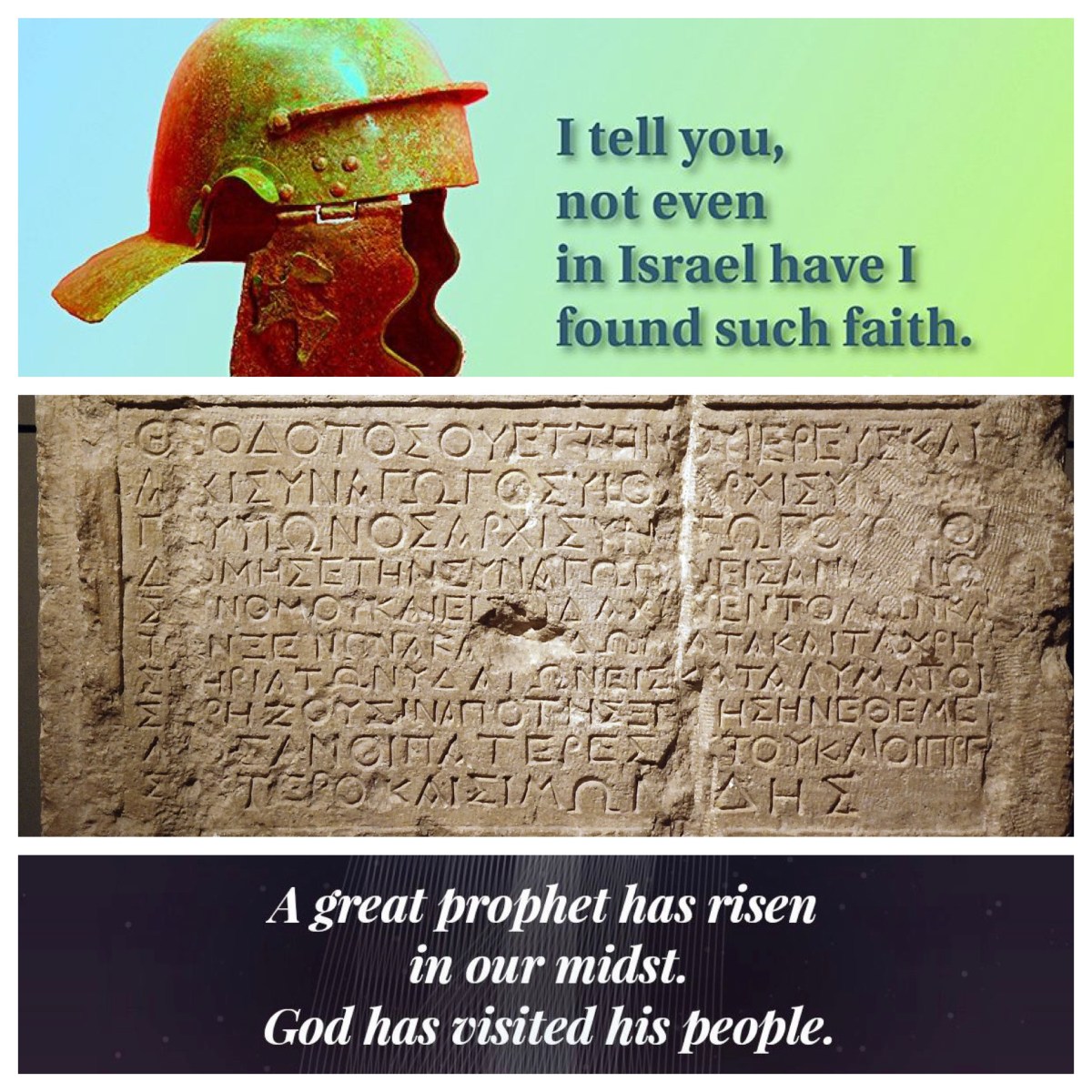
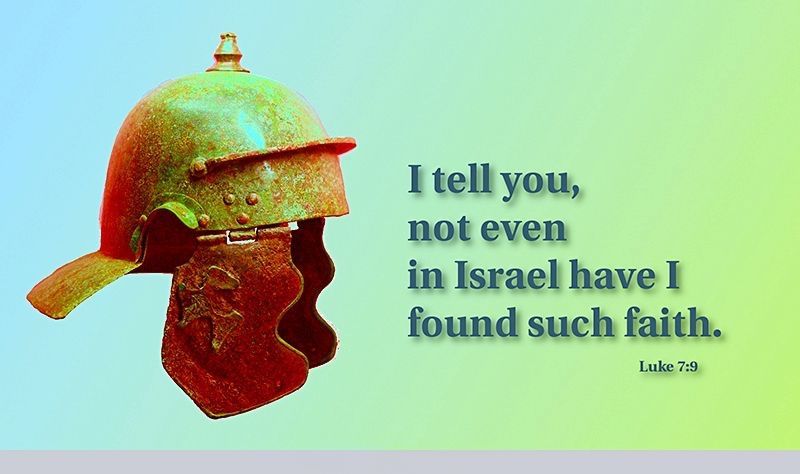
Only Luke reports that the centurion—a Gentile authority figure—had a relationship with the Jewish synagogue in Capernaum. Indeed, the Jewish elders give accolades to this man, stating that “he loves our people, it is he who built our synagogue for us” (7:5). That reveals an interesting relationship, positive and supportive, between a Gentile (the centurion) and the local Jewish community. So the barrier which Jesus allegedly maintains by not visiting the Gentile house is breached by the patronage (and, we presume, the visits) of a Gentile to a Jewish synagogue.
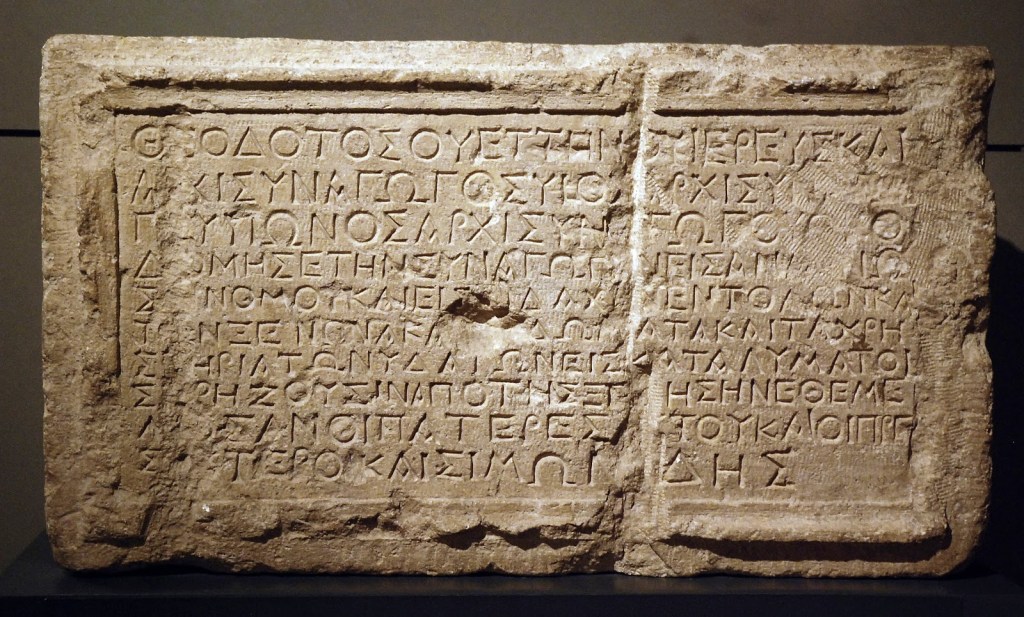
The Theodotus Inscription
Gentile patronage of Jewish synagogues is known from outside the New Testament; an inscription found in Jerusalem, which is dated from before the fall of the Temple in 70CE, indicates that a certain Theodotus “built the synagogue for the reading of the law and the teaching of the commandments, and also the guest chamber and the upper rooms and the ritual pools of water for accommodating those needing them from abroad, which his fathers, the Elders and Simonides founded.” See https://www.worldhistory.biz/ancient-history/52996-the-theodotus-inscription.html
“Only speak the word”, the elders beg Jesus, “do not trouble yourself” to come all the way to the house (7:6–7). In this way, they maintain the protocols, and try to ensure that that Jesus is kept from defiling himself. This is an interesting positive perspective on the Jewish leadership—a positive assessment that Luke often provides. (See, for instance, how positively he depicts the Pharisees in various scenes: 7:36; 11:37; 13:31; 14:1; and also Acts 5:34; 23:9).
Jesus affirms the man with the words, “not even in Israel have I found such faith” (7:9). This affirmation is given also in the account of this incident in Matthew’s book of origins (Matt 8:10), but not in John’s version of the encounter.
In these words, Jesus sounds a theme which recurs in his subsequent affirmations of the faith of the woman who anointed his feet (Luke 7:50), the woman who had suffered from haemorrhages for twelve years (8:48), the returning Samaritan leper (17:19), and the blind man outside Jericho (18:42), all of whom were characters on the edge, or outside, the central purity group. These affirmations sit uncomfortably alongside Jesus’ recurring lament over the lack of faith of his own followers (8:25; 12:28; 17:5–6; and see also 18:8; 22:31–34).
It’s also noteworthy that the statement of judgement found at Matt 8:11–12, where the characteristic Matthean theme of judgement over the sinful people of Israel is found, is omitted from the Lukan version of the story—although Luke does include this saying in his orderly account at a later point (13:28–30), in the context of his lament over the fate that lies in store for Jerusalem (13:31–35). That different context gives it a narrower focus than the Matthean setting, in which appears to be a (typically Matthean) global condemnation of the people of Israel.
Luke ends this incident with a simple report that the slave was found to be well once again (7:10), as does Matthew (8:13).
The story that follows, recounting how Jesus raises from the dead the son of a widow in the town of Nain (7:11–17), is also a key passage. It also appears rarely in the three-yearly cycle of readings in the Revised Common Lectionary. The fact that it narrates the raising of a person from the dead, yet is rarely heard in worship or preached on (in churches following the lectionary), is curious. After all, the story in John’s book of signs, about Jesus raising Lazarus from the dead, is very well-known and clearly entrenched in the regular lectionary cycle (see https://johntsquires.com/2020/03/25/holding-out-for-hope-in-the-midst-of-turmoil-john-11/)
I consider that the key point of this story is to establish Jesus as a prophet who enacts the visitation of God for the people of Israel (7:16). It is strange that the NRSV renders this statement as “God has looked favourably”, but it is the same verb (episkopeo) which appears at 19:44, where it is more accurately translated as “the time of your visitation from God”. And in that passage, Jesus comes to pronounce judgement up the sinful city.
It is clear that Jesus, by raising this man from the dead, demonstrates his credentials as a prophet, as the people cry that “a great prophet has risen among us!” (7:16)
The cry of the people also signals that the divine is drawing near to the people of Israel. It is curious that this story sits so deeply within the shadow cast by that other story of raising a man (Lazarus): from the dead. This is a striking and dramatic story, as is attested in the response of the people, of whom Luke reports, “fear seized all of them, and they glorified God” (7:16).
Fear (or better, awe) is the regular response in the presence of an angel (Zechariah, 1:12–13; Mary, 1:30; the shepherds, 2:10). It is also evoked by a miracle, as is seen in the responses of the neighbours of Zechariah and Elizabeth (1:65); Peter, James, and John after the huge catch of fish (5:10); the people of the Gerasene countryside (8:37); a messenger from the house of Jairus (8:50); and Peter, James, and John at the Transfiguration (9:34). Fear is also, understandably, manifest before the divine activity in the days of distress when “the powers of the heavens will be shaken” (21:25–26) when the Son of Man appears in power and great glory (21:27).
This passage appears in Proper 5, for those years when Easter is early, and the season of Pentecost has additional Sundays. The earlier story, of the centurion and his slave in Capernaum, is also offered in Proper 4 (when Pentecost is in mid-May). They are great stories, worth considering, even if not scheduled in the regular cycle of lectionary readings.
This is the second post in a series offering a number of imaginary letters from the ancient world, only recently “discovered”. The letters, we might imagine, reflect what the recipient of the “orderly account of the things that have come to fulfilment” (what we know as the Gospel of Luke), the man named Theophilus, might have written to the author of that work, as he received sections of the “orderly account” in sequence.
I have continued to make mention of you in my prayers, and I trust that you are likewise remembering me.
I rejoice in the gift of writing which God has bestowed on you, for as I indicated to you in my earlier letter, I have been reading your narrative concerning Jesus. Once more I have dined in the house of Themistocles, and once more our discussion ranged over many matters concerning business and pleasure.
When we came, as I had anticipated, to the topic of ‘great men’ once more, I felt that I was better prepared. For I had read your narrative about Jesus—or, at least, I have read a goodly amount of it.
So I spoke a little more about Jesus. However, one of the company retorted that he had never heard of this Jesus, and that he was probably a figure made up by a clever author. At this point, I was able to reply that you had explicitly described your account of Jesus as a diegesin (Luke 1:3)—that is, as a narrative which has the appearance of being in historical form.
Indeed, as I have read your work, I have come to understand how you have presented your story about Jesus in the fashion familiar to us from those who have written accounts of the lives of great men in a history-like fashion, so lifelike and understandable was the character of Jesus whom you had depicted.
Hegestratus said that one should not presume that simply because a work was described as a diegesin, that it could be accounted worthy of belief, since there were often too many paradoxa, too many strange things, which strained credulity in such works.
Another diner, Apollonius, disagreed, arguing that the inclusion of such sections performed the good function of forcing the hearers to decide for themselves just what they thought about it.
Indeed, this is precisely the effect that your work has had on me. It is fair to say that I did know the basic story of Jesus. You had talked with me about it, and of course I had been present at gatherings where one or another had spoken about the deeds of Jesus, or repeated and explained some of his words, while we met, as we often did, at table in the house of Nikias, as well as with my own household from time to time.
But I have to say, with admiration, that your account has provided me with many more details, some of which I suppose I might have heard, but most of which I have clearly not remembered.
You have also presented the particular incidents in an overall framework which I assume you have supplied in the course of your writing. As you yourself wrote, you knew various incidents and happenings relating to Jesus from those who had previously written about them, but you have cast them into a narrative of ‘an orderly account’ (Luke 1:3). For this, I am most grateful.
I now sense that what you have done is to provide me with a collection of stories about Jesus which I myself can learn and retell. They form a basis for my own thinking and talking about issues, using the stories about Jesus, but allowing me to appropriate them for myself, in relation to my own needs.
I trust that this is what I may be able to do, should there be occasion in future gatherings with my host and the highly enjoyable company which he always seems able to draw together for the meals in his house.
I hope also that I might be able to keep a clear head, for after many hours of talking, interspersed with drinking from the amphoras of good wine which he provides us, it is sometimes difficult to think with precision!
Give my greetings to Staphys, and Nikia, and to my own household. I intend not to be away too long this time! I hope to hear from you, as you are able to put pen to papyrus in reply.
I pray that you may keep well.
*****
Question for discussion: What do you think that Theophilus meant, in this letter, by ‘history’? Is it the same as what you mean by this term? If not, how might it be different?
This is the first post in a series of posts offering imaginary letters from the ancient world, only recently “discovered”. The letters, we might imagine, could reflect what the recipient of the “orderly account of the things that have come to fulfilment ” (what we know as the Gospel of Luke), the man named Theophilus, wrote to the author of that work, as he received sections of the “orderly account” in sequence.
Theophilus is away on a business trip. He writes home to Luke, telling of what happens as he reads Luke’s narrative and shares it with others. You will need to be prepared to engage in an act of imagination, which will transport you across the centuries into another time and place.
And so, imagine …
*****
Theophilus to Luke, greetings. Before all else, I wish that you are well, and that you are applying yourself to the tasks of writing that are before you.
I make prayers on your behalf to our Lord God, praying that you may continue to enjoy good health. Now that I have arrived in Antioch, and have found someone who is travelling back to Achaia, I have entrusted this letter to him. I hope that you will be able to write back to me, about your health, and about the health of our brothers and sisters in Achaia.
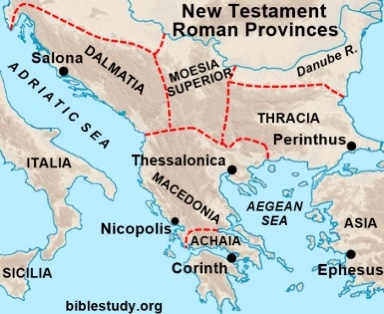
I am writing to you to report that I have now, at last, been able to find time to read the narrative which you delivered to me just before my departure from Achaia. After sailing across the Aegean to Ephesus, I have travelled along the common way to Laodicea, and now to Antioch, where I have lodged in the house of Themistocles whilst I conduct my business in this city.
In fact, whilst we were reclining at table just two nights ago, some matters arose in conversation which reminded me of the task which I had promised you that I would undertake whilst on this journey.
Our table talk covered many matters. The price of grain was, as usual, the matter to which the company first turned its attention. Then, one of the group spoke of the new trade opportunities that have been reported from a merchant who has just returned here from an eastern trip. Quite some time was spent in hearing the details of a scandal which has just erupted, concerning two of the servants of a local merchant here in Antioch.
The rather appalling state of the produce seen in the marketplace each day was also canvassed, as was the welcome news that the maritime trade season has just now begun, having been delayed some two weeks because of the unseasonable winds on the Aegean Sea. We all agreed that this should lead to an improvement in the marketplace produce within the week.
Incidentally, you must remind me to tell you of the scandal surrounding the two servants; I do not wish to be distracted by it at the moment, but I am certain that you will find it to be entertaining when I recount it to you face to face. I recall with fondness your own ability when it comes to storytelling, and I can only hope that I will live up to your best expectations when I have the opportunity to tell you this rather sordid tale. I know that you have an ear for tales of striking dramatic effect, and so I would be pleased to add this to your collection.
At any rate, as you might imagine, it was only a matter of time before our conversation happened to venture onto a more elevated plane. The opportunity for good table talk, such as was valued by a number of our company, was too valuable to be squandered on boring business details spiced with licentious scandal mongering, for the whole of the evening. And so we found ourselves engaged in a discussion concerning some of the great men from before our times.
One of my companions spoke about the virtues of Romulus, famed for his role in the founding of the city of Rome. None dare speak ill of the Romans at this time, of course; but at the time when the city was founded, it was, so it seems, a little place of no repute. Romulus is rightly honoured for his great deeds: he is the father of a widespread, if not widely-loved, empire.
Another at table with me spoke of the great Alexander, whose soldiers once marched not far from here, so I am told, as they ventured east to conquer many new lands. Rightly is Alexander endowed with the title ‘great’, for such were his deeds.
And yet another who was present with us spoke in exalted tones of Pythagoras, the famous teacher and philosopher, who performed no great deeds save that he taught of the mysteries of numbers, sounds, and ideas. It may perhaps be that his impact will be far greater than that of the other two, although it would have been a brave man to declare that in the company of those at table with me two nights back.
However, such conversation did embolden me to speak, for just a short while, of the man Jesus, about whom you have written so eloquently in your narrative which you have vouchsafed to me. If the truth be told, it was this moment in the discussion that reminded me of your work, of which I had read but two or three portions some days before the meal, but which now I have determined to read through consecutively, until I arrive at the ending. And so it was that I spoke about Jesus to my dinner companions.
As I did so, I recalled what you had written about the birth of Jesus: how strange, portentous happenings took place before and immediately after he was born. For I recall that you wrote about how the man Zechariah was struck dumb (Luke 1:19–22); and how Elizabeth conceived when everyone expected that she was well past her time (1:24–25); and then how Zechariah was able to speak (1:59–66). And you wrote also about how Mary conceived in strange, inexplicable circumstances, which you described as the spirit of holiness which overshadowed Mary (1:35).
And I recalled more clearly your words about how the angel spoke to Zechariah (1:8–20), and then to Mary (1:27–38), and still later to the shepherds (2:8–14). Indeed, these things reminded me of what I once read concerning the great Alexander—how his conception in the womb of Olympias had been announced to her in a dream in which a thunderbolt struck her womb, and then how Philip, the boy’s father, dreamed of how he sealed up the womb.
And I also recall reading how the priestess of the oracle at Delphi predicted how invincible the boy would be once he was born, and how the temple of Artemis was burnt to the ground on the very day that the child was born. Such amazing events took place in association with his birth!
This recollection gave me courage, then, to speak of Jesus during the table talk; for surely similar amazing things took place in association with his birth. But one of my companions objected in the strongest terms—what great things did this Jesus do? he asked. I recall now that you wrote about the prophecy that ‘he would be called great’ (Luke 1:32); I lament the fact that I was not quick-witted enough to speak of this at the meal itself.
At any rate, I told the company of how he spoke great things—like Pythagoras, like Epicurus, like Socrates even—things which help us to know how to live life and what choices to make when confronted with dilemmas in life.
As I spoke, it became clear to me that I had not remembered very well the things which you had told me, when we were speaking about your writing project at the time when I was with still you. And so, I was especially glad that I had brought your manuscript with me, and I have determined to make good use of my time away, so that I might read and understand the things which have been fulfilled amongst us, as you so eloquently describe them.
Give my greetings to the members of my household, and please assure my beloved wife that the requests she made for goods that I was to bring back with me have not been forgotten. I believe that it will be some time before my business here is concluded, and so I will write directly to her in good time; but it will please the gods if you are able to convey this message to her. Give greetings also to Staphys, and to the household of Nikias, and those who lodge with him.
I pray that you may keep well.
*****
Questions for discussion: do you think that it is reasonable to interpret the “signs and wonders” of Luke 1–2 not as historical occurrences, but as symbols which are pointers to the significance of Jesus? Are such ‘miracles’ (paradoxa) and ‘portents’ (to which Theophilus refers in this letter) something that we expect in histories today?
In this story, when Jesus reads in the synagogue in Nazareth, he quotes a scripture passage which begins with a reference to the holy spirit. The understanding of the spirit as an agent for divine guidance of human beings, as found in this passage early in the orderly account of Luke’s Gospel, is the same understanding which is found right throughout the books of the Hebrew Scriptures. The follow list summarises the key points concerning the spirit in these writings.
First, the spirit is active in the creation of the world (Gen 1:1–2; Job 33:4; Ps 104:30; Isa 42:5). Then, the spirit guides selected leaders within Israel, such as Moses (Num 11:16–17); Joshua (Deut 34:9); Othniel (Judg 3:10); Gideon (Judg 6:34); and David (1 Sam 16:17).
Further, it is the spirit which inspires prophecy (1 Sam 10:6, 19:23–24; Ezek 37:1; Joel 2:28–29; Mic 3:8), enables the interpretation of dreams by Joseph (Gen 41:38) and Daniel (Dan 4:8,18, 5:1), and gives other specific gifts to Israel (Num 11:25; Deut 34:9; Dan 4:8–18; Prov 1:23).
The qualities of the spirit will characterise the coming Messianic figure envisaged by the prophet Isaiah (Isa 11:2–5). This idea is taken up later in Isaiah in descriptions of the Servant (Isa 42:1–4; 61:1–7). In second Isaiah the spirit is promised as a gift to the people who are led by the Servant (Isa 42:5; 44:3; 48:16; 59:21). Third Isaiah recalls the time of Moses as a period when the spirit was given to Israel (Isa 63:11–14).
Jesus appropriates the passage from Isaiah 61 for himself in the claim “today this scripture has been fulfilled” (Luke 4:21). In so doing, he asserts that this spirit has now rested upon him, as the one anointed by the Lord. The previous chapters of Luke’s narrative have already established this point; the spirit has rested upon the adult Jesus at his baptism (3:21) and led him into the wilderness to be tempted (4:1).
Jesus returns to Galilee to begin his preaching “filled with the power of the spirit” (4:14). Indeed, even as an infant, the spirit is seen to be at work in Jesus (1:35, in his conception; 2:25– 34, in Simeon’s prophecy about the future role of Jesus). Thus, the reading of this scripture citation in the synagogue in Nazareth—“the Spirit of the Lord is upon me”—and the claim that it is now fulfilled in him, together confirm the Lukan claims about Jesus by undergirding them with scriptural validation.
Further references to the spirit in the life of Jesus are few (as he prays, 10:21; in his sayings, 11:13; 12:10–12; at his death, 23:46). Yet the principle that the spirit guides Jesus has been established beyond doubt in Luke 1–4 and stands as the keynote for understanding the activities of Jesus which will follow, and indeed for understanding the activities of the early church also.
In the second volume of this orderly account, the Acts of the Apostles, the presence of the spirit is widespread and consistent throughout the early church. The church is motivated for mission by the outpouring of the spirit (Acts 2:4, 17–18, 33). Specific leaders within the early church are said to be “filled with the spirit”: Peter (4:8), Stephen (6:3, 5; 7:55), Paul (9:17; 13:9), Barnabas (11:24). The spirit inspires Agabus to prophesy (11:28) and probably also guides the preaching of Apollos (18:25).
Indeed, in the early period, the whole community in Jerusalem is filled with the spirit (4:31); subsequently, the spirit falls on the Gentile believers in Caesarea (10:44–45; 11:15–16). The spirit guides Philip to travel with the Ethiopian eunuch (8:29, 39). The Spirit guides Peter to meet the men sent by Cornelius and travel with them to Caesarea (10:19; 11:12).
The Spirit guides Barnabas and Paul to Seleucia and onwards (13:2) and later guides Paul away from Asia Minor, towards Macedonia (16:6–7). Paul’s final visit to Jerusalem and his subsequent arrest there are also guided by the spirit (20:22–23; 21:11).
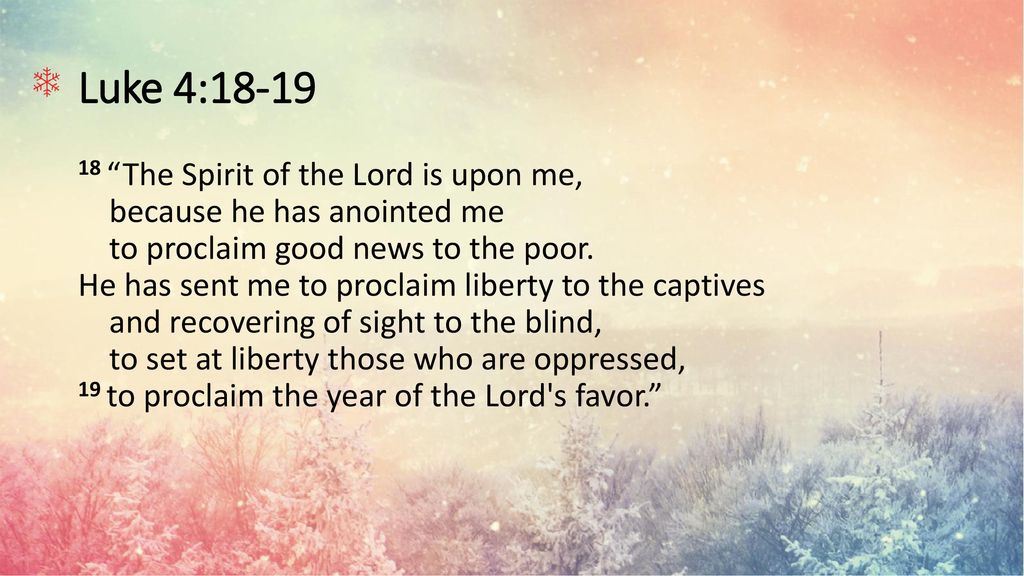
What does the spirit equip Jesus to do? The citation from Isaiah 61 identifies four activities: “good news to the poor…release to the captives…recovery of sight to the blind…freedom for the oppressed”, all summarised in the phrase “to proclaim the year of the Lord’s favour” (Luke 4:18–19). The holistic nature of these deeds characterises the activities of Jesus in subsequent chapters of the Gospel.
Jesus proclaims the good news (4:43; 8:1; 16:16; 20:1) and releases people bound in the captivity of demon possession (4:31–37; 8:2, 26–39; 9:37–43; 11:14–26; 13:32). He heals not only those unable to see (18:35–43) but also those with physical disabilities (5:17–26; 6:6–10; 14:1– 4), lepers (5:12–12; 17:11–19) and a number of women with specific ailments (4:38–39; 8:43–48; 13:11–13). He even raises one person from the dead (7:11–17).
When John the baptiser sends messengers to ask of Jesus, “are you the one who is to come?” (7:19), in his reply Jesus refers to precisely these kinds of deeds: “the blind receive their sight, the lame walk, the lepers are cleansed, the deaf hear, the dead are raised, the poor have good news brought to them” (7:22). This answer draws on Isaianic descriptions of the restorative deeds of the Lord (Isa 29:18–19; 35:5–6; 61:1).
In Luke’s second volume, the Acts of the Apostles, the early church is characterised by the ability to perform similar signs and wonders (Acts 2:43) alongside of their public proclamation of the good news (5:42). The apostles perform healings in Jerusalem (3:1–10; 4:22, 30; 5:12) and interpret these as being God’s actions.
Through the spirit, Stephen is able to perform signs and wonders (6:3, 8). Philip both heals and exorcises (8:6) and preaches the good news (8:4, 12, 25, 40). Peter heals in Lydda (9:32–25) and raises the dead Joppa (9:26–43). Barnabas and Paul perform signs and wonders as they travel throughout Asia Minor (14:3, 8–10; 15:12) and proclaim the good news (14:7, 15, 21; 15:35).
Alongside his public speaking, Paul continues his miraculous activity in Ephesus (19:11–12), Troas (20:7–12) and Malta (28:6–10). The spirit enables Paul to oppose the magician Elymas on Cyprus (13:4–12) and to cast out demons in Ephesus (19:13–20).
So we see that the presence of the spirit within the early church continues the holistic ministry which was seen in the life of Jesus, through proclamation, healings, and exorcisms. The scriptural citation in Luke 4:18–19 thus provides a declaration of a major theme running throughout both of Luke’s volumes.
In this passage, Luke reports that Jesus attends synagogues in his home region, Galilee (Luke 4:14) and especially in his hometown of Nazareth (4:16). As a faithful Jew, in the synagogue on the sabbath day, Jesus would expect to hear scripture read and interpreted. In fact, this is the task which he himself undertakes on this sabbath day in Nazareth.
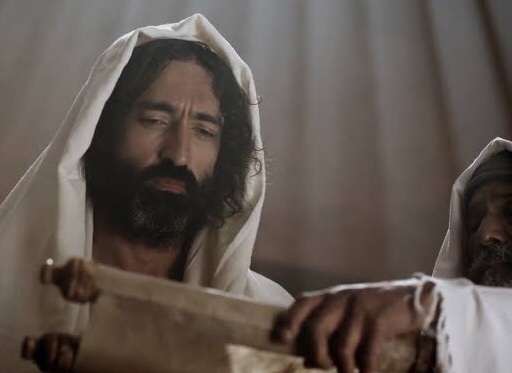
Luke expands the Markan account of the incident (Mark 6:1–6) by noting that Jesus unrolled the scroll and read a passage from the prophets; he then provides a direct quote from the passage, which we recognise as being found in Isaiah 61:1–2a, with the additional insertion of a line from Isaiah 58:6b, “to let the oppressed go free”.
Luke also adds the firm declaration of Jesus, “today this scripture has been fulfilled in your hearing” (Luke 4:21). In these brief put potent additions, Luke signals another of the themes which will recur throughout his story of Jesus: the inter-relation of scripture and experience.
An explicit citation of scripture, with an associated comment that it could be understood to explain events that were taking place, is moved to the very start of Luke’s description of the activities of the adult John the baptiser (3:4–6, quoting Isa 40:3–5).
The same pattern of interpreting an event by reference to scripture is followed by Jesus when he comments on the people’s misunderstanding of parables at 8:9–10; then when he criticises the practices being carried out in the temple courtyard at 19:45–46. Luke inserts a similar comment into his account of the passion of Jesus, at 22:37.
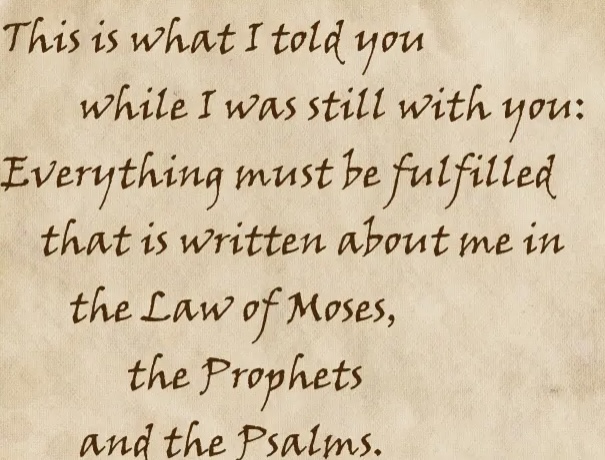
In his final appearance in Luke’s Gospel, the risen Jesus articulates the principle which undergirds these instances: “everything written about me in the law of Moses, the prophets, and the psalms, must be fulfilled” (24:44). That is to say, inherent in scripture is the potential for shedding light on the meaning of any event associated with Jesus.
These passages are the tip of the iceberg, where the link is explicitly noted; at many other points in Luke’s story of Jesus, there are scriptural allusions or suggestions that scriptural passages lie just below the surface of the narrative.
This particular hermeneutic is not unique to Luke; it is also to be found in other early Christian texts: in the good news told by Mark, in the book of signs attributed to the beloved disciple (John), and in certain of the letters of the apostle Paul. It saturates the sermon which we know as the epistle to the Hebrews, and recurs with a particular intensity throughout the book of origins, attributed to Matthew. It is also to be found, in a variant but related form, in the so-called pesher scrolls amongst the library discovered in the caves near Qumran. Such a hermeneutic was widespread throughout the Jewish world in the late hellenistic period.
In Luke’s second volume, the Acts of the Apostles, the same dynamic inter- relation between experience and scripture is to be found. This is most conspicuous at the start of Peter’s speech on the day of Pentecost, when he interprets the portentous events of the day by relating them to Joel 2:28–32, “God declares, I will pour out my spirit upon all flesh” (Acts 2:14–21).
It is also highlighted quite firmly at the conclusion of Paul’s defence speech in Caesarea. Paul declares to King Agrippa, Queen Bernice, and Governor Festus that the prophets and Moses have all pointed to the suffering of the Messiah as well as to the proclamation of light to the people and the Gentiles (26:23). This same perspective recurs on the lips of others who preach in the Acts of the Apostles: Peter (2:25–35), Stephen (7:2–50), Philip (8:32–35), James (15:16–18) and Paul (13:27–37; 28:23–27).
The perspective which the Lukan Jesus exemplifies in the hometown incident at Luke 4 is thus replicated throughout both volumes of Luke’s work. In this perspective, scripture and experience are brought into an intimate relationship—the one interprets the other. The experiences of faith are informed by scriptural passages which resonate with those experiences; and the passages which are read in scripture resound with the experiences of people of faith.
The Gospel for this coming Sunday recounts the teaching activity of Jesus in the synagogues of Galilee, and particularly his visit to his hometown, Nazareth, where he enters the synagogue on the sabbath day and teaches the people (Luke 4:14–21). The scene continues in next week’s Gospel selection (Luke 4:22–30).
This scene is not unique to Luke’s orderly account of the things being fulfilled among us; it appears both in Mark 6:1–6 and Matt 13:54–58. In all three accounts, as this same incident is reported, it is introduced in a very similar way, and runs a rather similar route towards its conclusion. Yet, in reporting this incident, Luke reshapes, expands, and highlights a number of aspects which, as we shall see, are of fundamental significance in Luke’s distinctive portrayal of Jesus and those who follow him.
What Luke but hints at in this passage is made explicit in more detailed ways throughout the rest of his account of the public activities of Jesus in Galilee, as he journeys towards Jerusalem, and then as he teaches in the Temple precincts. As he signals some of the main features of his portrayal of Jesus, he also gives clear indications of what it means to follow Jesus.
The incident in Nazareth takes place in the synagogue, a commonly found place of worship for Jews outside of Jerusalem. It takes place on the sabbath —the seventh day of the week, long devoted by Jews to prayers and the study of the Law. Jesus takes a scroll, from which he reads words of scripture, drawn from the prophet Isaiah. The passage speaks of the work of the Spirit of the Lord, the figure within Jewish history who has often implemented the will of the Lord God amongst the people of God. Each of these elements in the story is fundamentally and unequivocally Jewish.
These factors signal the inescapable fact that Jesus is intensely Jewish in Luke’s Gospel. His story is set in the heart of Jewish piety, from the very opening scene of the Gospel which reveals a pair of righteous Jews who faithfully keep the commandments of God (Luke 1:5–6). The man, Zechariah, is devoted to the service of God in the Temple (1:8–9). His wife, Elizabeth, expresses an attitude of deep faith in God, accepting her surprise pregnancy as “what the Lord has done for me” (1:25).
Her relative, Mary, demonstrates a similar faith as she submits to a similar fate with the words, “here am I, the servant of the Lord” (1:38). In turn, the traditional hopes and expectations of the people are articulated in spirit-inspired hymns sung by Mary (1:46–55), Zechariah (1:67–79) and Simeon the righteous (2:29–32). The children who are born—Jesus and John—bear the weight of these traditional hopes and expectations as they come into being.
The sense of deeply devoted and strongly conventional Jewish piety continues in the reports of the early years of Jesus. It is only in Luke’s Gospel that we find the information that Jesus was circumcised (2:21) and dedicated in the Temple (2:22–24), and that he showed an early interest in the Law (2:41–51).
In recounting the events of his adult years, Luke notes that Jesus regularly attended the synagogue (4:16, 44; 6:6), where he was accorded the status of a teacher (4:20–27; 4:31–33; 13:10). Luke emphasises that Jesus regularly prayed to God (3:21; 5:16; 6:12; etc.). He knew the importance of the daily prayer, the Shema (10:25–28) and the Ten Commandments (18:18–21). Like other Jewish teachers of the day, Jesus taught in parables (8:4–8; etc.); Luke reports a number of especially well-known parables of Jesus (10:29–37; 15:3–32; 16:19–31).
Indeed, as Luke narrates events leading to the birth of Jesus, he indicates that Jesus will seek the renewal of the ancient promises which God made to Israel (1:46–55; 1:67–79; 2:29–35). Thus, the Lukan Jesus insists that the purpose of his mission is to fulfil the hopes once spoken by the prophets (4:18–21; 7:18–23; 24:18–27; 24:44–47).
He is clear that what he has to offer is a grand vision of the kingdom in which all are invited to share in the Messianic Banquet (13:29; 14:15–24). This is one vision within Second Temple Judaism—it was not shared by all, but it draws on Jewish traditions, especially as articulated in the latter sections of the book of Isaiah (Isa 42:1– 6; 52:7–10; 55:1–5; 60:1–7; 66:18–24). So the Lukan Jesus functions as a prophetic voice in Israel, calling for change from within.
Luke does not play Jesus off, over against ‘the Jews’, in the way that we find happening in the work of his near-contemporary, in the Gospel according to John. Rather, the Lukan Jesus is immersed in the midst of his religion; he is one of the people of Israel at his birth, and he remains so even up to his death and beyond. Luke’s Gospel—and its sequel, the Acts of the Apostles— will provide no basis for a rejection of Judaism as no longer in keeping with God’s will. On the contrary, the story which Luke tells is about the way that the hopes of Jewish faith are brought to fruition in the life of Jesus, and in those who follow the way set forth by Jesus.
This motif continues in the second volume of Luke’s orderly account. The earliest followers of Jesus remain involved in Judaism. They participate in the Temple rituals in Jerusalem (Luke 24:53; Acts 2:46; 5:12) and attend the synagogues of the Diaspora (Acts 9:20; 13:5,14; etc.).
At the close of his missionary activity, Paul is to be found participating in a ritual in the Temple (21:26). When he is brought to trial, Paul insists that he has remained faithful to Judaism (23:1, 6; 24:14–16; 25:8, 10; 26:22–23; 28:17). Even in the final scenes of the book, in Rome, Paul is engaged with Jewish leaders, debating with them the identity of Jesus (28:17–28). There is no point at which Luke has in mind a decisive, irrevocable and universal split between church and synagogue.
As we have noted, Luke portrays Jesus as a pious Jew, devoted to the Law of Moses, loyal to the people of Israel. Yet Luke was also aware that Jesus was not uncritical of his religion. This is crystal clear in the “hometown incident” which Luke reports. At first, the people in the synagogue in Nazareth marvel at the “gracious words” he speaks to them (Luke 4:22). But as they listen to more of what he says, they gradually sense the challenge that is being placed before them.
This incident sounds the first indication of the tragedy of the story of Jesus; the actions of the people in Nazareth foreshadow his ultimate rejection in Jerusalem. Eventually, they become ‘enraged’ at Jesus and seek to kill him (4:28–29). The cost of taking a stance is clearly articulated.
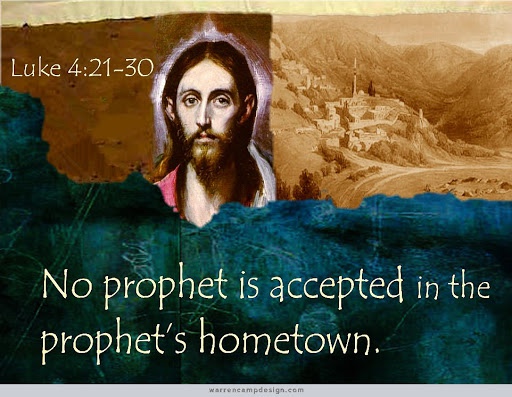
Jesus acknowledges the difficulty that people in the synagogue will have in accepting his words, in the terse proverb, “no prophet is accepted in the prophet’s hometown” (4:24). He stands firm for what he believes in— whatever the ultimate cost.
The same saying about the unacceptable prophet is quoted in the report of this incident—the hometown rejection—by Mark (6:4) and Matthew (13:57), and is inserted into another context in John’s Gospel (4:44). It is likewise attributed to Jesus in a scrap of Gospel-like material on one of the Oxyrhynchus Papyri (1:6) as well as in the noncanonical Gospel of Thomas (31). It seems sure that it is an authentic saying of Jesus. The cost of standing up for what one believes in is a thread running through many of the early Christian documents relating the life or sayings of Jesus.
What is it that leads the Nazareth crowd away from marvelling at the gracious words to wanting to kill out of blind fury? Jesus has presented a provocative challenge to his audience. The models of faithfulness which he puts forward in 4:25–27 contain a certain element of shock. His statements are implicitly critical of an exclusivist understanding of faith which is attested in some strands of Jewish religion in the Second Temple period. Jesus functions as an agent provocateur here, and indeed elsewhere in the Gospel.
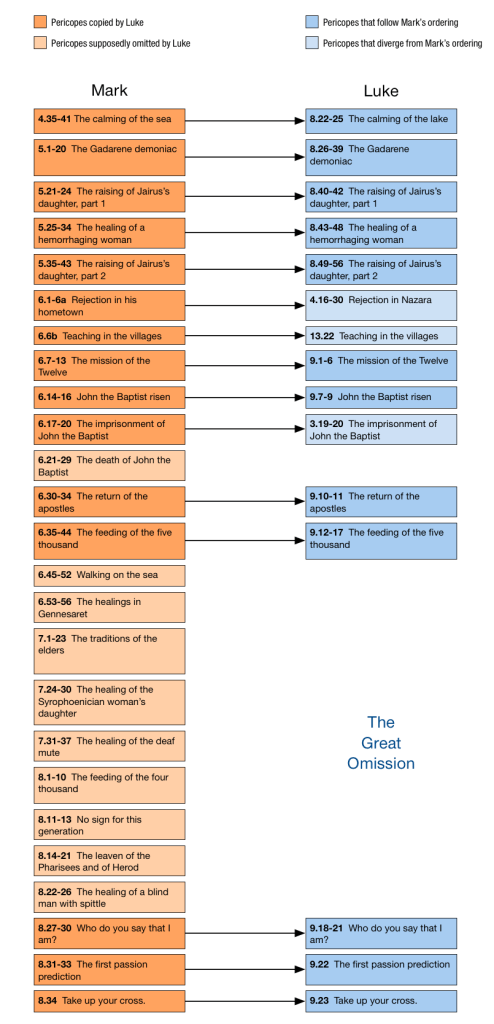
As we look steadfastly back to the earlier source that was used in the writing of this orderly account—the beginnings of the good news, which we call the Gospel according to Mark—we do well to note the omissions in the narrative that Luke shapes. These omissions are significant.
Most strikingly, there is a large section of Mark’s narrative (6:45–8:26) missing in Luke’s orderly account. We would have expected it at Luke 9:17, immediately after the feeding of the five thousand (Mark 6:30–44; Luke 9:10–17); but Luke 9:18 jumps to to Peter’s declaration that Jesus is Messiah (Mark 8:27–30). This is sometimes known as The Great Omission (a term coined as a riff off The Great Commission in Matt 28:16–20). Why has Luke omitted it?
Luke’s commitment to the universal impact of the message of Jesus can explain this. The omitted section includes the story of Jesus’ encounter with the Syro-Phoenician woman (Mark 7:24–30), which Matthew includes (Matt 15:21–28) because it reinforces his view that Jesus avoided Gentiles and Samaritans. Luke would have been happy to omit this, especially as it infers that Gentiles are dogs (Mark 7:27–28: Matt 15:26–27).
Immediately prior to this story in Mark (and Matthew) is the debate about Torah halakah that Jesus has with scribes and Pharisees, after they noticed that “some of his disciples were eating with defiled hands, that is, without washing them” (Mark 7:1–23; Matt 15:1–20).
The editorial declaration that Jesus “declared all foods clean” (Mark 7:19) is withheld by Luke from his story of Jesus, and deployed as a key statement in what serves as a major pivotal moment in the life of the early church—the moment when Peter sees a vision in which a voice from heaven declares, “What God has made clean, you must not call profane” (Acts 10:15; 11:9).
This central affirmation about food is then applied to relationships with people: “God has shown me that I should not call anyone profane or unclean” (10:28). So the Jew Peter and the Gentile Cornelius eat together at table—and provide a striking image for the life of the community of faith in Luke’s own time. Luke has removed the declaration of Jesus in the Jewish halakhic debate about food, so that it can serve as the punchline in the pivotal moment in volume 2—the turn to the Gentiles.
This orientation towards Gentiles is evident at many points in the story told in Acts. That is not to say, however, that the Jewish origins of the movement are ignored or left behind. Indeed, it is noteworthy that the believers in Jerusalem remain connected to the Temple, participating in the worship of that place (Acts 2:46; 3:1) and used the Temple area as the basis for their public preaching (5:17–21, 25–26; 5:42).
In like fashion, Paul and his fellow workers are regularly found proclaiming the good news in synagogues—in Antioch (13:14–15, 43, 44), Iconium (14:1), Thessalonians (17:1–3), Beroea (17:10–11), Athens (17:16–17), Corinth (18:4) and Ephesus (18:19 and again in 19:8–10). The “place of prayer” by the river in Philippi (16:13) was, most likely, also a place of gathering for Jews. Finally, Paul visited the Jerusalem Temple and took part in a purification ceremony there (21:17–36, when he is arrested).
However, in some of the locations, Paul addresses Gentiles who had already expressed interest in Judaism, known as godfearers (13:16, 26; 13:43, 50; 17:4; 17:17). Indeed, after commotions broke out in synagogues relating to the message that Paul was preaching, he turned explicitly to Gentiles—in Antioch (13:48) and Iconium (14:1–3), in Corinth (18:7) and in Ephesus (19:9–10), as well as in two highly significant scenes in the public marketplaces of Athens (17:16–34) and Ephesus (19:23–41).
Commentators regularly highlight the three occasions in Acts when Paul explicitly declares that, because of Jewish intransigence, he is turning to the Gentiles.
He first declares this when Jews in the Antioch synagogue rebuff him: “since you reject it and judge yourselves to be unworthy of eternal life, we are now turning to the Gentiles. For so the Lord has commanded us, saying, ‘I have set you to be a light for the Gentiles, so that you may bring salvation to the ends of the earth’” (13:46–47, citing Isa 49:6).
Paul says this again in Corinth, after similar upheavals: “when they opposed and reviled him, in protest he shook the dust from his clothes and said to them, “Your blood be on your own heads! I am innocent. From now on I will go to the Gentiles” (18:6–7). In the final scene of the book, while Paul is under house arrest in Rome, he makes it very clear that “this salvation of God has been sent to the Gentiles; they will listen” (28:28).
In the first two instances, whilst Paul moves out of the synagogue to continue preaching to Gentiles, in each case he immediately returns to the synagogues where he speaks to Jews (14:1 and 18:19, already noted above). Thus it makes sense for the final declaration in Rome to be interpreted in the same way. Paul expresses frustration at the rejections he experiences from Jews and sees fertile territory amongst Gentiles; but he is not saying that the Gospel no longer is relevant to Jews.
I think it is important not to over-interpret these three declarations as definitive rejections of the Jews within the providential plan of God. Rather, it is Paul’s way of emphasising the universal orientation and global relevance of the Gospel—a message which, as we have seen, is integral to Luke’s theology throughout both volumes of his orderly account.
The three declarations of a “turn to the Gentiles” provide narrative fulfilment of the early prophetic announcement of Simeon, that Jesus brings God’s salvation, “prepared in the presence of all peoples, a light for revelation to the Gentiles and for glory to your people Israel” (Luke 2:30–32). That is the primary focus of the two-volume work that Luke writes.
I have suggested that reading the orderly account (which we know as Luke’s Gospel) requires attention to a number of elements, with one eye looking back to sources, to see how they are used in telling the story of Jesus, as the other eye looks forward to subsequent events, to see how they influence the story of Jesus.
As we read, and reflect on, this account in this way, we may well note a number of key features that characterise this orderly account.
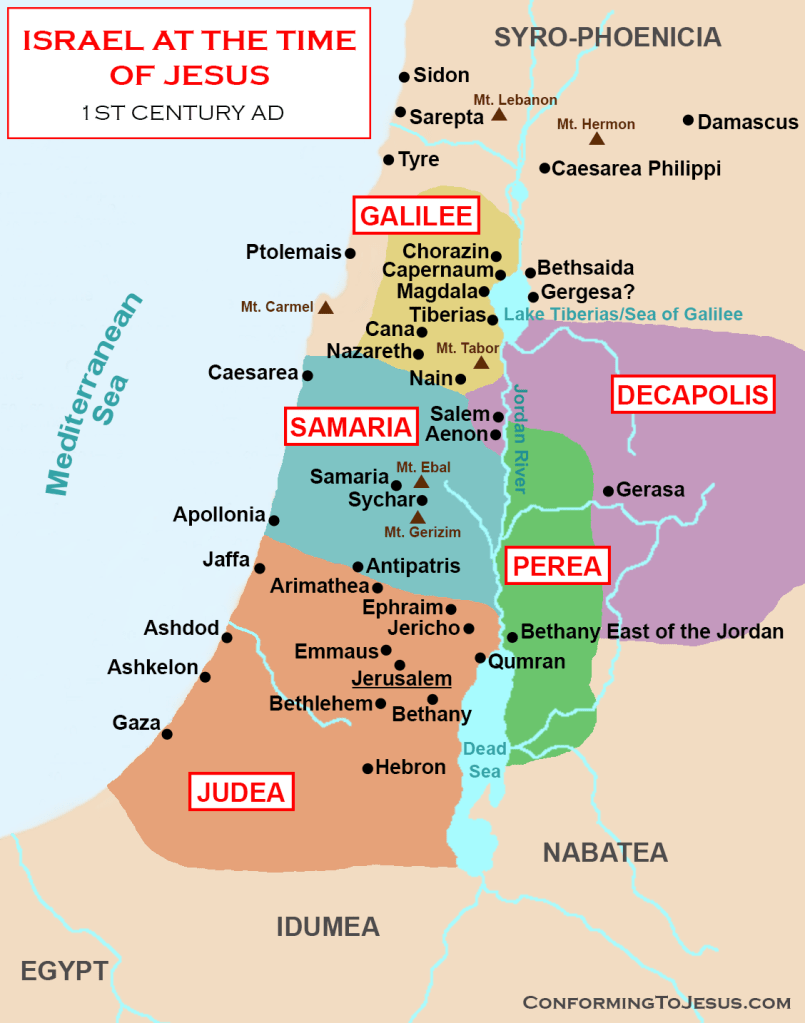
Geography is one key pointer in leading us to an important central feature of this two-volume orderly account. The earlier work about Jesus made it clear that he was from Nazareth in Galilee (Mark 1:9) and that, after being baptised in the Jordan near Jerusalem (1:9–11), Jesus returned to Galilee, where all his activities took place (1:14–9:50). After that, Jesus left that place and went to the region of Judea and beyond the Jordan” (10:1) and then entered Jerusalem—for the first and only time in this account—where he spent the remainder of his time (11:11–16:8).
That same Nazareth origin of Jesus is acknowledged in Luke’s account (Luke 1:26–27; 2:4, 39) and in this account, Jesus also is active for some time in Galilee (4:14–9:50). However, the majority of the narrative in this orderly account is set outside of Galilee. Once Jesus “set his face to go to Jerusalem” (9:51, 53) he is depicted as travelling relentlessly towards Jerusalem (13:22, 31–35; 17:11; 18:31; 19:11, 28, 41–44), where he spends the rest of his time (19:45–24:53).
Whilst in Jerusalem, Jesus spends time in the Temple precinct (Mark 11:15–19; 11:27–13:37; Luke 19:45–21:38). However, Luke takes great pains to emphasise the connection between Jesus and the Temple. Jesus does not leave the city once he has entered it (cf. Mark 11:19); in Luke, he remains there “every day” (Luke 19:47, 21:37) and this whole section is bracketed with explicit references to the Temple at 20:1 and 21:38.
In fact, the Temple connection has also been identified early in Luke’s narrative, where he tells of Zechariah the priest (1:5–10), the newborn Jesus, presented for purification (2:22–24), Simeon the prophet (2:25–35), and Anna the prophet (2:36–38), as well as the twelve-year-old Jesus himself in the Temple (2:41–52). Jesus, whilst he comes from Nazareth in Galilee, has a connection with the Temple, the centre and focal point of Judaism at that time. The story of Jesus begins in that central point, and comes to its climax also in that central location: the Temple in Jerusalem.
There are other key geographical markers in the orderly account we know as Luke. Samaria, for instance, figures in both volumes, even though there is no mention of it in Mark’s earlier narrative. (When Jesus leaves Galilee in Mark 10:1, he seems simply to go immediately to Judea! Even though Samaria is locked in between Galilee and Judea.) In the orderly account, Jesus travels through Samaria (Luke 9:51–53), tells a story about a Good Samaritan (10:25–37), and heals a group of lepers which 8n lures a Samaritan (17:11–19). By contrast, in Matthew’s account of Jesus, travel into Samaria is strictly forbidden (Matt 10:5–6).
Luke’s positive interest in Samaritans emerges in his second volume, for after the persecution in Jerusalem and the scattering of Jesus followers (Acts 8:1), it is in the region of Samaria that the good news gains traction; there is much joy after exorcisms and healings (8:8) and widespread acceptance of the message (8:12, 25), and consequent growth in believers (9:31). These scenes may well have influenced the author to include the distinctive elements relating to Samaria and the Samaritans in his first volume.
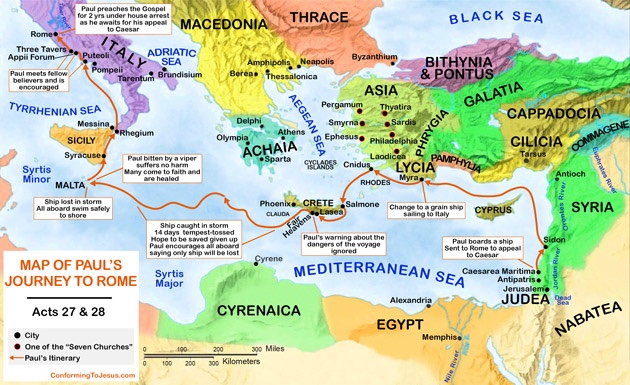
A third geographical marker is provided by the closing chapter of volume 2. Paul, the figure who has been centre-stage for 15 chapters, arrives in Rome (Acts 28:14–31). Rome was the capital of the political power which was dominant across the Mediterranean region, and had been the occupying power in Judea, Samaria and Galilee for twelve decades by this time.
Paul’s entry into Rome—even as a prisoner under house arrest (28:16, 23)—signals the arrival of the good news about Jesus in the centre of the empire. It indicates that the movement from Jerusalem, to Samaria, and then to Rome, makes it possible for this good news to reach “to the ends of the earth” (1:8). Not only Jews, but Gentiles also will become followers of Jesus (15:3, 12). So, in Antioch, Paul inform recalcitrant Jews that “we are now turning to the Gentiles” (13:46); in Corinth, he says that “from now on I will go to the Gentiles” (18:6); in Rome, he affirms, “this salvation of God has been sent to the Gentiles” (28:28).
The story has moved from Jerusalem, the centre of Judaism, to Rome, the centre of the dominant Gentile empire. The symbolism is powerful. Geography reveals theology.
This eventual destination of Rome, the centre of the Empire that stretches “to the end of the earth”, is read back into the story of Jesus. In fact, the Roman context for the story about Jesus has been signalled early in Luke’s orderly account, in the detailed dating provided in introducing John the baptiser (Luke 3:1–2).
The fact that the story of Jesus is to become known and valued amongst Gentiles is indicated in Simeon’s oracle that the child Jesus will bring “a light for revelation to the Gentiles” (Luke 2:32) and in the citation of Isaiah’s words that “all flesh shall see the salvation of God” (3:6, quoting Isa 40:5). There are a number of times in the Lukan narrative where Gentile receptivity to the good news is then affirmed.
So the reshaping of the beginnings of the good news of Jesus, the chosen one (the Gospel of Mark) into the orderly account of the things being fulfilled in our midst (the Gospel of Luke) retells the story in ways that give us clear indications about where all of this is headed. The Gospel becomes “a light for the Gentiles, salvation to the ends of the earth”.














 An Informed Faith