The stone that the builders rejected (Mark 12; Narrative Lectionary for Lent 3)

The parable of Jesus which is set in this Sunday’s lectionary appears to offer an invitation to adopt a negative approach towards Jews and Judaism. The author of “the good news of Jesus, chosen one” (by tradition, the evangelist Mark) interpreted this story as a polemic against the Jewish authorities who had gathered to hear Jesus teach (Mark 11:27).

As Jesus concludes his parable with a typical rabbinic scripture citation, designed to drive the point home with deep authority (Mark 12:10–11, citing Ps 118:22–23), the narrator comments, “when they realized that he had told this parable against them, they wanted to arrest him, but they feared the crowd; so they left him and went away” (Mark 12:12).

Often in Christian history, that negative portrayal of the Jewish authorities of the first century has been used as the basis for a direct attack on Jews of later times. That’s a very poor line of interpretation that we should ensure we do not follow.

The parable that Jesus tells is set in a vineyard. That’s an age-old symbol for the people of Israel. We can see this most clearly in passages of Hebrew Scripture such as Isaiah 5:1–7 and Psalm 80:7–15; they show how old and enduring this imagery was.

The parable that Jesus tells recounts the hard-hearted way in which the tenants in the vineyard (a traditional symbol for the people of Israel) reject the messengers sent to them by the landowner (seen as a symbol for God), culminating in the atrocious treatment meted out to the landowner’s son (whom we are meant to identify as Jesus, son of God).

The son is put to death. The punchline that Jesus crafts for this parable is potent: the owner of the vineyard “will come and destroy the tenants and give the vineyard to others” (vv.8–9). In Matthew’s parallel version of this parable, Jesus extends this ending to include the clear statement that “those who do not produce the fruits of the kingdom will not inherit the kingdom” (Matt 21:43).

The parable of the vineyard is one of the passages that has been difficult for us to understand accurately. When taken at a literal level, it has led to modern interpretations that are as damaging as they are unfair. The assumption is that the Pharisees and scribes are the ‘bad guys’, and this has led to the belief that Pharisee equals hypocrite. It is disturbing that such a stereotype has found its way into the language of our modern church.

The context of the parable suggests that although its message was aimed at the chief priests and the Pharisees, it does not exclude other Jewish people. The parable is told in one of a number of encounters between Jesus and Jewish leaders (11:27—12:44). Was this a consistent attitude of Jesus?

Equally disturbing is the notion that Jesus here seems to contradict his own teaching about loving one’s enemy and turning the other cheek. He depicts God as the avenging Lord. So what is really happening here?

I don’t think the parable of Jesus is intended to be simply an anti-Jewish polemic, an invitation to deride or dismiss Judaism and Jews.

It is true that, in the Gospel of Matthew, we find Jesus making some strident accusations and engaging in some vigorous debate with the Jewish authorities. But does he really believe that no faithful Jew will ever again enter the kingdom of heaven?

Judaism was in a state of flux as people lived under the continuing oppression of Roman rule. The destruction of the Temple in 70 CE was a pivotal moment. Evidence indicates that, during this time, there were various sectarian groups within Judaism who were contesting with each other for recognition and influence. Instead of making common cause against Rome, they continued to fight each other. Vigorous polemic and robust debate amongst Jews were not uncommon. See

During this period, the Pharisees were becoming increasingly important as an alternative to the Temple cult, and emerging as the dominant Jewish religious movement. Their power base was moved from Jerusalem and spread throughout the area. When the Temple was destroyed, they moved into the vacuum that was created, and became even more dominant.

(From this time on, Pharisees evolved into the “Rabbis”, and they developed the kind of Judaism that became dominant through to the present time. We need to be sensitized to the fact that, for many modern Jews, when we make damning criticisms of the Pharisees, they hear that as a criticism of their Rabbis, and, by extension, of the faith that they practise today.)

The kind of debates that we see in the Gospels—debates where Jesus goes head-on with the Pharisees—need to be understood in this context. Jesus was not “cutting the cord” of his connection with Judaism. He was not rejecting his faith as irrelevant or obsolete.

He was advocating, vigorously and persistently, for the kind of faith that he firmly believed in—and criticisng the Pharisees for their failure, in his eyes, to adhere to all that they taught. He wanted to renew Israel, to refresh the covenant, as the prophets before him had done.

And let’s remember that the accounts that we have of these debates come from years later than when they actually occurred; years that had been strongly shaped by the polemic and antagonism of the intervening decades.

Older academic Christian scholarship and popular evangelical Christian tradition perpetuate the stereotype that the Judaism of the time of Jesus was a harsh, legalistic, rigid religion—a stereotype heightened by an unquestioning acceptance of the New Testament caricature of the Pharisees as hypocritical legalists who made heavy demands but had no soul commitment to their faith. It was claimed that they were the leaders of a static, dying religion.

This stereotype has been completely demolished in recent decades—both through the growing interaction between Christian and Jewish scholarship, and also through a more critical reading of the relevant primary texts. I am very pleased that the church to which I belong, the Uniting Church in Australia, has made it very clear that we do not adhere to these inaccurate and hurtful stereotypes.

In 2009, the UCA national Assembly adopted a Statement which says, amongst other things:

The Uniting Church does not accept Christian teaching that is derogatory towards Jews and Judaism; a belief that God has abolished the covenant with the Jewish people;  supersessionism, the belief that Christians have replaced Jews in the love and purpose of God; and forms of relationships with Jews that require them to become Christian, including coercion and manipulation, that violate their humanity, dignity and freedom.

We do not accept these things.

See https://www.jcrelations.net/article/jews-and-judaism.pdf

Indeed, when we look to Matthew’s Gospel, Jesus does nothing to overturn the Law or to encourage his followers to disregard the Law; he is portrayed as a Jew who keeps Torah to the full. “I have come, not to destroy, but to fulfil the Law”, he says (5:17). See

And in that same section of the Gospel, Jesus is quoted as advocating for a better righteous-justice; a righteous-justice that “exceeds that of the scribes and Pharisees” (5:20). See

Virtually all of his criticisms of the Pharisees in the Synoptic Gospels can be understood within the framework of first century debates over the meaning and application of Law. The memory of Jesus is as a Torah-abiding Jew, who nevertheless stakes out a distinctive position within the context of those contemporary debates.

We should not interpret the parable of Jesus in Mark 12 as an outright condemnation of Judaism as a whole. As he debates the Jewish leadership of his day, he makes strong statements. But let’s not claim that Jesus validates any sense of anti-Jewish or antisemitic attitude.

Unfortunately, these words of Jesus and other parts of the New Testament story have been used throughout the centuries to validate anti-Jewish attitudes, to foster antisemitic hatred of the Jews. It is important for us to remember the real sense of the words of Jesus, and not follow the pathway to bigotry, hatred, persecution, and tragic attempts to annihilate the Jews.

A ransom for many: a hint of atonement theology? (Mark 10; Narrative Lectionary for Lent 2)

When Jesus instructed his followers to tread the pathway of humility and submission (Mark 8:34–38; 9:35–37; 10:38–44)—the same pathway that he himself has been following as he walks towards Jerusalem (8:31; 9:31: 10:32–34), he speaks about laying down his own life, just as he urges his followers to lay down their lives (10:45). This has been a regular refrain throughout his teachings.

See https://johntsquires.com/2024/02/17/not-to-be-served-but-to-serve-the-model-provided-by-jesus-mark-10-narrative-lectionary-for-lent-2/

However, in this particular saying, Jesus indicates that the laying- down of his life is to be seen, not just as the model for his followers to emulate, but as “a ransom for many” (10:45). There are two important observations to make about this short statement. The first relates to the word “ransom”; the second will be canvassed in a later post.

Ransom is a term that we associate with the forced kidnapping of a person and the demand for a payment in order for them to be released. This is not the way the term is used in biblical texts, where payment in return for release of a captive is not in view. Rather, the orientation is towards the idea that there is a significant cost involved in the process of ransoming.

The Greek word used in Mark 10:45, lutron, comes from a verb, lutrein, which means “to release”. It was a common term for the payment needed to secure the release of slaves, debtors, and prisoners of war. The noun, translated as ransom, occurs in the Septuagint. It identifies the price paid to redeem a slave or captive (Lev 25:51–52) or a firstborn (Num 18:15). It also indicates the price to be paid as recompense for a crime (Num 35:31–32) or injury (Exodus 21:30). In these instances, it translates the Hebrew word koper, which has the basic meaning of “covering”.

Another form of that word appears in another form in the name of the Great High Holy Day in Judaism—Yom Kippur, the Day of Atonement (see Lev 16:1–34; Num 29:7–11). On that day, as the cloud of incense covers the mercy seat (kapporeth, Lev 16:13), the mercy seat is smeared with the blood of the sacrificed bull (16:14) and then the blood of the goat which provides the sin offering (16:15). According to Leviticus, it is these actions which “shall make atonement (kipper) for the sanctuary, because of the uncleannesses of the people of Israel, and because of their transgressions, all their sins” (16:16).

The process of atonement in the Israelite religion was to cover up, to hide away from view, the sins of the people. This is developed to some degree in the fourth Servant Song of Deutero-Isaiah, when the prophet honours the servant because “he was wounded for our transgressions, crushed for our iniquities” (Isa 53:5). His life was understood as “an offering for sin” (53:10) which “shall make many righteous” (53:11). Indeed, as the Song ends, it affirms that “he bore the sin of many” (53:12). The Song resonates with the language and imagery of righteous suffering as the means of dealing with, and perhaps atoning for, sins.

That notion is further expounded in a later text which provides an account of the way that a righteous man, Eleazar, was martyred as a means of ransoming the nation during the time of upheaval under Antiochus Epiphanes (175–167 BCE). “Be merciful to your people, and let our punishment suffice for them”, he prays; “make my blood their purification, and take my life in exchange for theirs” (4 Macc 6:28–29).

The idea then appears in New Testament texts which describe the effect of the death of Jesus for those who have placed their trust in him. Paul uses ransom language tells the saints that they were “bought with a price” (1 Cor 6:20; 7:23). He also uses apolutrosis, a compound word but from the base word lutrein, to describe the redemption which was accomplished by Jesus, both in a formulaic way (1Cor 1:30) and in a more discursive manner (Rom 3:24; 8:23). The term recurs in later letters which likely were not written by Paul (Col 1:14; Eph 1:7, 14; 4:30), as well as in the Lukan redaction of the final eschatological speech of Jesus (Luke 21:28).

In another later letter attributed to Paul, most likely written by one of his students, we read of “one mediator between God and humans, the man Christ Jesus, who gave himself as a ransom for all” (1 Tim 2:6), using the term lutron. In another later work providing guidance an account of Paul by an author at some remove from him, the book of Acts, Paul was said to have declared of the church that God “obtained [it] with the blood of his own Son” (Acts 20:28).

It was the combination of such passages that led the third century scholar, Origen of Alexandria to develop an idiosyncratic theory of the atonement (the way that Jesus enables God to deal with human sinfulness). Origen’s ransom theory of atonement reads Genesis 3 as an account of Adam and Eve being taken captive by Satan; this state was then inherited by all human beings. The death of Jesus is what enables all humans to be saved; the means for this was that the blood shed by Jesus was the price paid to Satan to ransom humanity (or, in a variant form, a ransom paid by Jesus to God to secure our release).

However, none of these texts—and particularly not Mark 10:45—require this overarching theological superstructure to make sense of what they say. Origen’s ransom theory held sway for some centuries, but was definitively rejected by the medieval scholar Anselm of Canterbury. It is not a favoured theory of atonement in much of the contemporary church (though it is still advocated in various fundamentalist backwaters). Certainly, none of this should be attributed to the saying of Jesus in Mark 10:45. It is far more likely that he is drawing on the Jewish tradition of the righteous sufferer in his words.

Jesus himself draws on various psalms of the righteous sufferer; psalms 22, 27, 31, 69, and 109 would each seem to express the despair and anguish being felt by Jesus in his passion. However, it is the fourth of the four Servant Songs (Isa 42:1–9; 49:1–7; 50:4–11; 52:13–53:12) to which this statement in Mark 10:45 might best be correlated.

The passion narratives that we have in scripture, recounting events leading to the death of Jesus, offer many connections with details of this fourth song (Isa 52:13–53:12). The prophet describes the marred appearance of the Servant (52:14); he is despised, rejected, and suffering (53:3), bearing our infirmities (53:4), and wounded for our transgressions (53:5).

The Servant is led like a lamb to the slaughter (53:7), suffering “a perversion of justice” (53:8), not practising violence or speaking deceit (53:9), and is buried with the rich (53:9). The Servant gives his life as “an offering for sin” (53:10), carrying the iniquities of many (53:11), making them righteous (53:11), bearing the sin of many (53:12), making “intercession for the transgressors” (53:12).

The role that the Servant plays in relation to sin, for the sake of the many, shapes the important saying of Jesus, that “the Son of Man came not to be served but to serve, and to give his life a ransom for many” (Mark 10:45). Jesus, according to Mark, foresees his role as that chosen one, destined to suffer for the sake of many. As we look to the cross, we can see that this was an ominous foreboding.

Not to be served, but to serve: the model provided by Jesus (Mark 10; Narrative Lectionary for Lent 2)

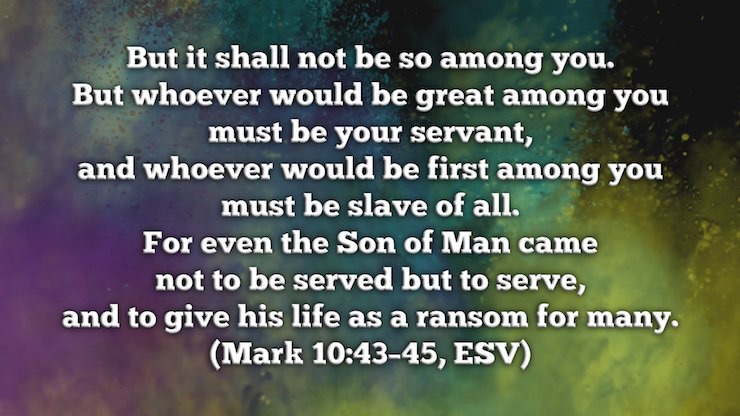
“The Son of Man came not to be served but to serve, and to give his life a ransom for many” (Mark 10:35-45). So Jesus instructs his followers, after a bruising encounter with James and John, two of the leading followers of Jesus (10:35-40) which enraged the rest of the disciples (10:42).

The dispute was over status; James and John wanted to claim the places next to Jesus: “one at your right hand and one at your left, in your glory” (10:37). This was not unusual in the world of that time (indeed, this is still the case in our own times). Public debate that was intended to best the other person was common in ancient Mediterranean societies. Seeking greater honour (higher status) by getting the upper hand, or the last word, in public debate, was common.

In an honour—shame society, such as that in which Jesus, James, and John lived, the culture was characterised by a constant and ongoing “challenge—riposte,” enacted in the public arena. Jesus engaged in such challenges on a regular basis; see the disputations of 2:1-3:6, when Jesus was travelling around Galilee, and later during his time in Jerusalem, in 11:27-12:34.

Such challenge—riposte encounters typically involved the challenger setting forth a claim, through either words or actions; a response to the challenge by the persons who was challenged; then, after further back-and-forth amongst the participants, once the challenge and riposte has run its course, the verdict is declared by the public who was watching the encounter.

(For a clear description of this process, as it applies in Mark 11:27–12:34, using the analysis of Jerome Neyrey and Bruce Malina, see https://www.etsjets.org/files/JETS-PDFs/43/43-2/43-2-pp213-228_JETS.pdf)

At this moment, Jesus critiques the common process of public disputation; he distances himself from the common cultural practice of seeking honour and working for a higher status. Those who lord it over others, who act as tyrants, are not to be the role models for his followers; “it is not so among you; but whoever wishes to become great among you must be your servant, and whoever wishes to be first among you must be slave of all” (10:43–44).

Indeed, Jesus rubs salt into the wound by inferring that James and John were acting like Gentiles (10:52). That was an insult, to be sure, for good Jews (see the sayings attributed the Jesus at Matt 5:47; 6:7, 32).

This was the third time, after demonstrating their misunderstanding of what Jesus was teaching, that his disciples were directly rebuked for their attitude. First, Peter represents the disciples’ lack of clarity about Jesus (8:27–38); then a number of the disciples arguing about being great, and John fails to welcome the activity of a person casting out demons (9:33–48); and now, James and John demonstrate their continued inability to understand the attitude of Jesus towards status (10:35–40).

At least in this last scene, the other ten disciples are angry about what James and John have asked for (10:41). Far too often, on earlier occasions, Jesus has lamented that the disciples failed to understand (4:22, 13; 6:52; 7:18: 8:17, 21; 9:32). It seems that finally, at this moment, things had fallen into place for the disciples. (Or were they simply annoyed at the way the brothers promoted their own interests over the hopes of the other disciples?)

On each of those three occasions of misunderstanding, Jesus responds by correcting the inadequacies displayed by his followers: he refers to the fate that is in store for him in Jerusalem (8:31; 9:31: 10:32–34), and then he indicates that his followers must tread that same pathway of humility and submission (8:34–38; 9:35–37; 10:38–44). See

On this occasion, Jesus goes one step further. His own life—or, more precisely, the laying-down of his own life—is to be seen, not just as the model for his followers to emulate, but as “a ransom for many” (10:45). This will be the focus of a subsequent blog post. See

A ransom for many: a hint of atonement theology? (Mark 10; Narrative Lectionary for Lent 2)

Forty days, led by the Spirit: Jesus in the wilderness (Mark 1)

This week we once more read and hear the beginning of the story that Mark tells, about the very early stages of the public activity of Jesus. We have already read about John the baptiser during Advent (Advent 2), and heard Mark’s account of the baptism of Jesus (Epiphany 1).

Now, in this week’s Gospel reading (Lent 1), Jesus is baptised, plunged deep into the water, from which he emerges changed (1:9–11), driven into the wilderness, with wild beasts and angels, to be tested (1:12–13), and then announces what his message and mission will be (1:15–15).

This baptism is sometimes regarded as Jesus attesting to a deeply personal religious experience that he had in his encounter with John, who had been preaching his message of repentance with some vigour (1:4-11). His encounter with John deepens his faith and sharpens his commitment.

The relationship between Jesus and John is interesting. In the orderly account of things being fulfilled, which we attribute to Luke, it is clear from the start that John is related to Jesus (Luke 1:36). By tradition, they are considered to be cousins–although the biblical text does not anywhere expressly state this.

It seems also that some of the early followers of Jesus had previously been followers of John himself. This is evidenced in the book of signs, which we attribute to the evangelist John. Andrew, later to be listed among the earliest group of followers of Jesus, appears initially as one of two followers of John (John 1:35-40). They express interest in what John is teaching (John 1:39).

Andrew is the brother of Simon Peter, later acknowledged as the leader of the disciples of Jesus. He tells his brother about Jesus. It is Peter who comes to a clear and definitive understanding of the significance of Jesus, even at this very early stage: “we have found the Messiah” (John 1:41). Andrew and John are thenceforth committed disciples of Jesus.

Was Jesus engaging in “sheep-stealing”? Certainly, the dynamic in the narrative is of a movement shifting away from John the baptiser towards Jesus the Messiah; the juxtaposition of these two religious figures can be seen at a number of points (John 1:20, 29-34, 35-36; see also 3:22-30).

See further thoughts on John the baptiser in John’s Gospel at

and

(And I am looking forward to reading more about John in the most recent book by James McGrath, Christmaker: a life of John the Baptist, published by Eerdmans.)

None of this story relating to John is in view in the account we read in this Sunday’s Gospel. The rapid-fire movement in this opening chapter simply takes us from John, baptising in the Jordan, to Jesus at the Jordan and then in the wilderness, and on into Galilee, beside the lake and in Capernaum (Mark 1:1–45).

See my comments on the character of Mark 1 at

Mark has no concern with exploring the relationship between Jesus and John. He wishes only to indicate that, at the critical moment of the beginning of the public activity of Jesus, it was through contact with John, his message and his actions, that Jesus was impelled into his mission.

The Gospel account moves quickly on from the baptism, to a very different scene, set in the wilderness, where Jesus is tested, challenged about his call (1:12-15). The wilderness was the location of testing for Israel (Exod 17:1-7; Num 11:1-15; Deut 8:2). By the same token, the wilderness was also the place where “Israel tested God” (Num 14:20-23), when Israel grumbled and complained to God (see Exod 14-17, Num 11 and 14). Wilderness and testing go hand-in-hand.

The reference to Jesus being “forty days” in the wilderness evokes both the “forty years” of wilderness wandering for the people of Israel (Exod 16:35; Deut 2:7, 8:2, 29:5; Neh 9:21; Amos 2:10, 5:25), as well as the “forty days” that Moses spent fasting on Mount Sinai (Exod 34:28; Deut 9:9-11,18,25; 10:10).

Forty, however, should be regarded not as a strict chronological accounting, but as an expression indicating “an extended period of time”, whether that be in days or in years. It points to the symbolic nature of the account.

We see this usage of forty, for instance, in the comment in Judges, that “the land had rest forty years” (Judges 5:31, 8:28)–a statement that really means “for quite a long time”. Likewise, Israel was “given into the hands of the Philistines forty years” (Judges 13:1) and Eli the priest served for 40 years (1 Sam 4:18).

David the king reigned for 40 years (2 Sam 5:4, 1 Kings 2:11; 1 Chron 29:27), his son Solomon then reigned for another 40 years (1 Kings 11:42; 2 Chron 9:30), as also did Jehoash (2 Kings 12:1) and his son Jeroboam (2 Kings 14:23). If we take these as precise chronological periods, it is all very neat and tidy and orderly–and rather unbelievable!

Other instances of forty point to the same generalised sense of an extended time. Elijah journeyed from Mount Carmel to Mount Horeb “forty days and forty nights” (1 Kings 19:8), whilst the prophet Ezekiel’s announcement of punishments lasting forty years (Ezekiel 29:10-13) is intended to indicate “for a long time”, not for a precise chronological period. Jonah’s prophecy that there will be forty days until Nineveh is overthrown (Jonah 3:4) has the same force.

So the story of the testing of Jesus for “forty days in the wilderness” is not a precise accounting of exact days, but draws on a scriptural symbol for an extended, challenging period of time.

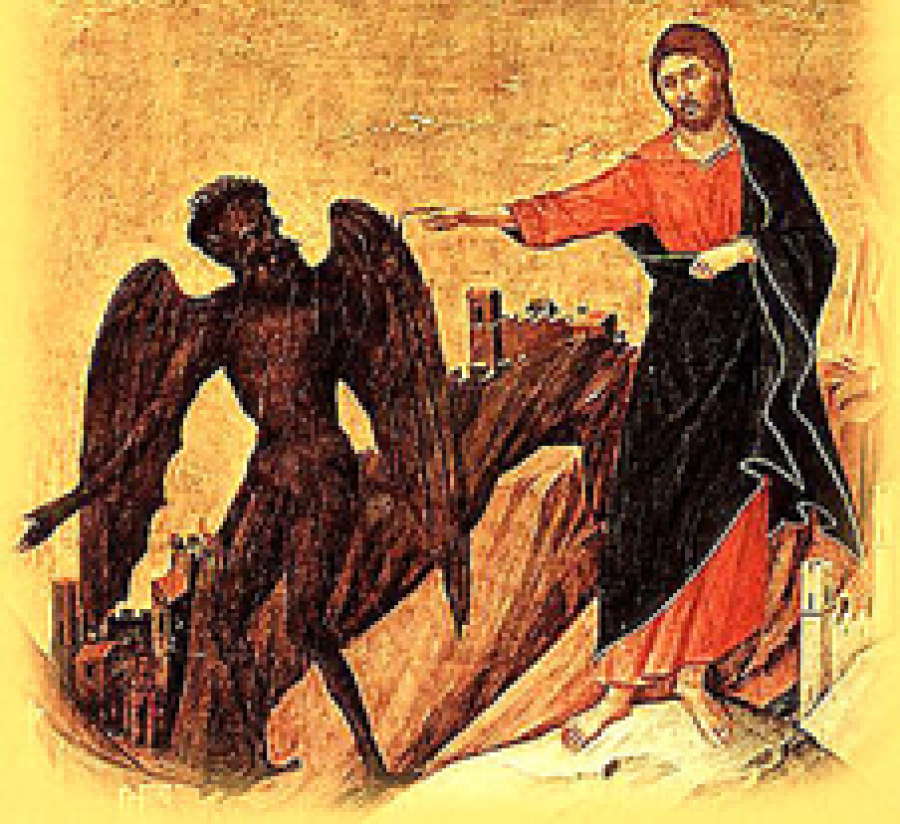
Details about the conversation that took place whilst Jesus was being tested in the wilderness are provided in the accounts in the Gospels attributed to Matthew (4:1-11) and Luke (4:1-13). This is not the case in Mark, where the much shorter account (1:12-13) focusses attention on the key elements of this experience: the wilderness, testing, wild beasts, angels–and the activity of the Spirit.

For more on Jesus in the wilderness, see

and

The Markan account of this period of testing is typically concise and focussed. The constituent elements in the story continue the symbolic character of the narrative.

The note that “he was with the wild beasts” sounds like the wilderness experience was a rugged time of conflict and tension for Jesus. However, commentators note that the particular Greek construction employed here is found elsewhere in this Gospel to describe companionship and friendly association: Jesus appointed twelve apostles “to be with him” (3:14); the disciples “took him [Jesus] with them onto the boat” (4:36); the man previously possessed by demons begged Jesus “that he might be with him” (5:14); and a servant girl declares to Peter that she saw “you also were with Jesus” (14:67).

If this Greek construction bears any weight, then it is pointing to the companionable, friendly association of the wild beasts with Jesus—a prefiguring of the eschatological harmony envisaged at the end of time, when animals and humans all live in harmony (Isaiah 11:6-9; Hosea 2:18). The wilderness scene has a symbolic resonance, then, with this vision.

Alongside the wild beasts, angels are present—and their function is quite specifically identified as “waiting on him” (1:13). The Greek word used here is most certainly significant. The word diakonein has the basic level of “waiting at table”, but in Markan usage it is connected with service, as we see in the descriptions of Peter’s healed mother-in-law (1:31), the women who followed Jesus as disciples from Galilee to the cross (15:41), and most clearly in the saying of Jesus that he came “not to be served, but to serve” (10:45). The service of the angels symbolises the ultimate role that Jesus will undertake.

Finally, we note that the whole scene of the testing of Jesus takes place under the impetus of the Spirit, which “drove him out into the wilderness” (1:12). This was the place that Jesus just had to be; the action of the Spirit, so soon after descending on him like a dove (1:11), reinforces the importance and essential nature of the testing that was to take place in the wilderness.

And the action of “driving out” is expressed in a word, ekballō, which contains strong elements of force—the word is used to describe the confrontational moment of exorcism (1:34, 39; 3:15, 22-23; 6:13; 9:18, 28, 38). The testing in the wilderness becomes a moment when Jesus comes face to face with his adversary, Satan—and casts his power aside. The more developed dialogues in Matthew and Luke expand on this understanding of the encounter.

Both of the key elements in this reading (baptism and testing) serve a key theological purpose in Mark’s narrative. They shape Jesus for what lies ahead. They signal that Jesus was dramatically commissioned by God, then rigorously equipped for the task he was then to undertake amongst his people. The two elements open the door to the activities of Jesus that follow in the ensuing 13 chapters, right up to the time when the long-planned plot against Jesus, initiated at 3:6, is put into action (14:1-2).

Of course, this story is offered in the lectionary each year on the first Sunday in the season of Lent. It serves as an introduction to the whole season. Jesus being tested in the wilderness points forward, to the series of events taking place in Jerusalem, that culminate in his crucifixion, death, and burial.

The narrative arc of Mark’s Gospel runs from the baptism and wilderness testing, through to death at Golgotha and burial in a tomb. The weekly pattern of Gospel readings during Lent follows a parallel path, from the wilderness testing of Lent 1, to the entry into Jerusalem on Lent 6, the farewell meal on Maundy Thursday, and the death and burial on Good Friday.

That is the path that Jesus trod. That is the way that he calls us to walk.

Changed. Transformed. Transfigured. (Mark 9; Narrative Lectionary for Transfiguration, Epiphany 6)

The story that is told in the Gospel for this coming Sunday (included in the longer reading of Mark 8:27—9:8) is a story about being changed; about being transformed. It’s a story that shows that being transformed means you are able to stand and challenge others to be transformed.

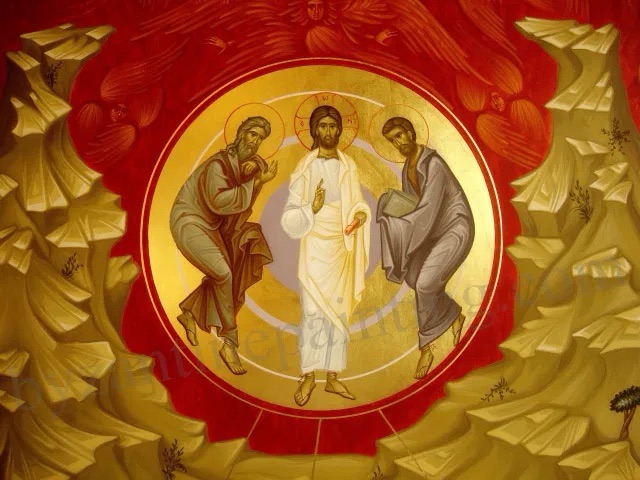
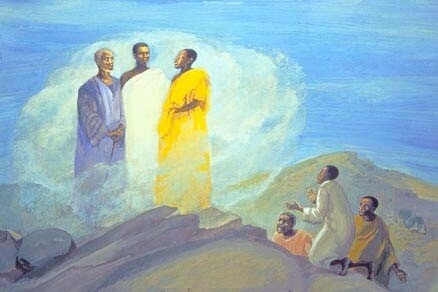
It’s the story of when Jesus took his three closest friends to a mountain, and they had a shared experience of seeing Jesus standing between two of the greats of their people: Moses, to whom God had given the Law to govern the people of Israel, and Elijah, through whom God had established a long line of prophets in Israel (Mark 9:2–8). It’s a story that in Christian tradition is called The Transfiguration.

The word Transfiguration is a strange word. It is not often found in common English usage. It’s one of those peculiar church words, that seems to be used only in church circles. Like thee and thy, holy and righteous, sanctification and atonement … and trinity. These words don’t usually pop up in regular usage!

I looked for some helpful synonyms for the word transfiguration, and found these: change, alter, modify, vary, redo, reshape, remodel, transform, convert, renew … and transmogrify. I am not sure whether that last one gets us anywhere nearer to a better understanding, but some of the others are helpful. Transfiguration is about change, adaptation, and taking on a new shape or size or appearance.

One of the other words offered as a synonym was metamorphose; and that caught my eye, because that word comes directly from the Greek word, metamorphidzo, which is used by Mark in his Gospel, when he tells his account of this incident. “After six days, Jesus took Peter, James and John with him and led them up a high mountain, where they were all alone; and he was metamorphosed before them” (Mark 9:2). Mark then explains that this metamorphosis was evident in that “his clothes became dazzling white”.

The story of the Transfiguration tells of the moment that Peter, James, and John perceived Jesus in a new way. No longer did they see him as the man from Nazareth. In this moment, they see him as filled to overflowing with divine glory. He was not simply the son of Joseph; he was now the divinely-chosen, God-anointed, Beloved Son (9:7).

Jesus brings the heavenly realm right to the earthly disciples. It is what is known, in Celtic Christianity, as a “thin place”: the place where heaven breaks into earthly life.

The disciples had the possibility, in a moment of time, to feel intensely close to the heavenly realm, to stand in the presence of God. They symbolise the desire of human beings, to reach out into the beyond, to grasp hold of what is transcendent—to get to heaven, as that is where God is (see Gen 28:10-12 and Deut 30:12; Pss 11:4, 14:2, 33:13, 53:2, 80:14, 102:19; although compare the sense of God being everywhere in Ps 139:8-12).

This key mountaintop moment contains the words from the heavens about Jesus, “This is my Son, the Beloved; listen to him!” (9:7). These words link back to the initial baptism of Jesus, when the same words were heard (1:11) and forward to the final scene of crucifixion, when a centurion and those with him at the foot of the cross witnesses Jesus’ death, and declares, “Truly this man was God’s Son!” (15:39).

All three scenes contain the foundational statement, recognising Jesus as Son of God, reiterating the words of the unclean spirits in Galilee (3:11) and the man possessed by demons in the country of the Gerasenes (5:7). For, as Simon Peter declares in the pivotal scene at Caesarea Philippi that is also included in this Sunday’s reading, Jesus is “the Messiah” (8:29).

The voice, booming forth from the clouds, “This is my Son, the Beloved; with him I am well pleased; listen to him!” (9:7) seems, at first hearing, to be quoting Hebrew scripture: perhaps the second Psalm, which praises the King of ancient Israel as the one whom God has begotten; or perhaps the song in Isaiah 42, which extols the servant as the one whom God has chosen, or anointed; or perhaps even the oracle in Deuteronomy 18, which instructs the people to listen carefully to the words of the prophet.

Whatever scripture, or scriptures, are here spoken by the divine voice, making this bold declaration from the cloud, it is clear that God has a special task, a special role, and a special place for Jesus. The words of this heavenly voice link this story back to the opening scenes of the story of the adult period in the life of Jesus, and also to a moment towards the end of that adult life.

As this voice is heard, Jesus is on a mountain, with three of his closest followers—and also with two key figures from the past of Israel: Moses, who led the people out of slavery, who then was the instrument for delivering the Torah to Israel; and Elijah, who stood firm in the face of great opposition, whose deep faith bequeathed him the mantle of prophet, as he ascended into heaven.

Mark says that “there appeared to them Elijah with Moses, who were talking with Jesus” (9:4). Matthew reverses the order, placing Moses before Elijah: “suddenly there appeared to them Moses and Elijah, talking with him” (Matt 17:3). Priority, in Matthew’s narrative, goes to Moses. Indeed, Matthew’s concern has been to make as many parallels as possible between the story of Jesus and the story of Moses. The regular reminder that “this took place to fulfil what the Lord has said through the prophets” (Matt 1:22; 2:4, 15, 17, 23) underlines this Mosaic typology.

The covenant given to Moses on Mount Sinai (Exod 19:1–6) is accompanied by the giving of the law (Exod 20:1–23:33), and is later sealed in a ceremony by “the blood of the covenant” (Exod 24:1–8). The scene on the mountaintop, with Jesus and his three disciples, evokes the mystery of the mountaintop scene in Exodus. This story is but one part of the story of Jesus which draws connections with the story of Moses.

*****

The Gospel writers say that Jesus was transformed at that moment. But in this story, also, there is the indication that the friends of Jesus were transformed. That moment on the mountain was a challenge to each of them; the response that Peter wanted to make was seen to be inadequate. Jesus challenged him to respond differently. It was another moment when metanoia, complete transformation, took place. And these disciples did change; yes, it took some time, but these friends of Jesus ultimately became leaders amongst the followers of Jesus, and spearheaded the movement that became the church.

The change, the metanoia, that occurred within Peter, James, and John, spread widely. They faced the challenge head on, and responses, in metanoia. That is mirrored, today, in changes that are taking place in society. Especially, that has been the experience of people over the last few years. We have met the challenge of a global viral pandemic; patterns of behaviour have been modified, as we prioritise safety and care for the vulnerable, and wear masks, sanitise, and socially distance. We have changed as a society.

In the church generally, through the pandemic that hit with such force in 2020, we have changed how we gather, how we worship, how we meet for Bible studies and fellowship groups, how we meet as councils and committees, how we attract people to our gatherings. Transformation has been widespread.

In my own church of these past few years, we worked hard to meet the challenge of reworking our understanding of mission; for across the church, we now see the importance of people from each Congregation engaging with the mission of God in their community as the priority in the life of the church. See

So in each place where people gather as church, there is a pressing need to consider how we might grow fresh expressions of faith, nurture new communities of interest, foster faith amongst people “outside of the building” and outside the inner circle of committed people. It is an ongoing process.

Change is taking place. Change is all around us. Change is the one thing that is constant about life: we are always changing. Sometimes we think that the church doesn’t change, isn’t changing, even resists changing. But that is not the case. Our church is changing. Our society is changing. And the story of the Transfiguration of Jesus encourages us throughout this change.

Stereotyping Jesus: coming home in Mark 6 (Narrative Lectionary for Epiphany 5)

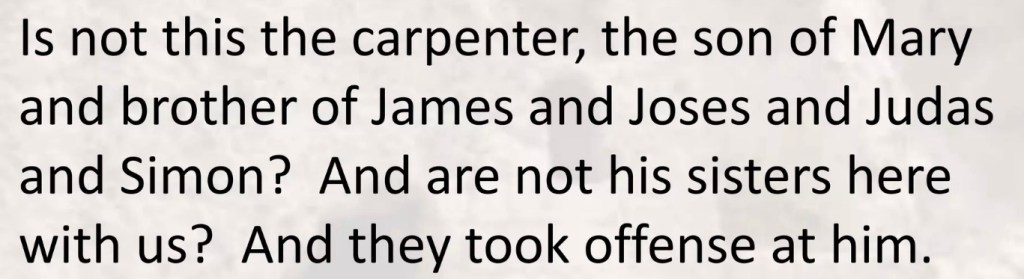
The offering from the narrative lectionary this coming Sunday (Mark 6:1–29) begins with the scene where Jesus goes to the synagogue in his hometown, Nazareth (6:1–6) and is rejected by those who “took offence at him” (6:3). Although he spoke with wisdom and performed acts of power (6:2), he is scorned as merely “the carpenter, the son of Mary and brother of James and Joses and Judas and Simon … and his sisters, here with us” (6:3).

You can imagine the murmurs amongst the people of the town. “He was not the eloquent preacher. Not the erudite teacher. Not the compassionate healer. Not the dazzling miracle-worker. Just plain old Jesus, the carpenter, from a local family. Nothing to look at here. Nothing of importance. A nobody, really. But he has pretensions. And we can’t stand for that, can we?”

Perhaps I’m being a little harsh on the townsfolk? Perhaps there is more to Jesus than they recognised, and perhaps Mark’s narrative might indicate that it is not wise to stereotype Jesus, as they were doing?

Earlier in his narrative, Mark has told of an encounter that Jesus had with his family when he came out of a house in Capernaum (3:20). Some onlookers in Capernaum describe him as being “out of his mind” (ἐξέστη, 3:21). This is a term that literally means that he was “standing outside of himself”, as if in a kind of dissociative state. It may be that this was the reason that Jesus was returning to his family?

The encounter doesn’t go well, however. Scribes have come from Jerusalem. They have already been antagonistic towards Jesus, questioning whether Jesus was blaspheming (2:6–7), and casting doubts on his choice of dinner guests (“why does he eat with tax collectors and sinners.”, 2:16). There will be further disputation with scribes (7:1–5; 9:14; 12:28, 38–41) and they will be implicated in the plot to arrest Jesus (11:18, 27; 14:1, 43, 53; 15:1) and in his death (8:31; 10:33).

These scribes—hardly friends—articulate what others present may well have been thinking: “he has Beelzebul” (3:22). The charge of demon possession correlates with the accusation levelled at John 10:20. It appears to have been one way that Jesus was stereotyped by others.

Beelzebul (Βεελζεβοὺλ), “the ruler of the demons”, is known from earlier scriptural references to Baal-zebub in 1 Kings 1:2–6, 16, where he is described as “the god of Ekron”, a Philistine deity. There is scholarly speculation that Beelzebul may have meant “lord of the temple” or “lord of the dwelling”, from the Hebrew term for dwelling or temple (as found at Isa 63.15 and 1 Kings 8.13); or perhaps it was connected with the Ugaritic word zbl, meaning prince, ruler.

Jesus refutes the charge in typical form, by telling a parable (3:23–27) that ends with the punchline about “binding the strong man” (τὸν ἰσχυρὸν δήσῃ). This potent phrase encapsulates something that sits right at the heart of the activities of Jesus in Galilee—when he encounters people who are possessed by demons, and when he casts out those demons, he is, in effect “binding the strong man”.

The notion that a demon would bind the person that they inhabited is found at Luke 13:16, and in the book of Jubilees (5:6; 10:7-11). The book of the same title by Ched Myers provides a fine guide to reading the whole of Mark’s Gospel through this lens (see https://chedmyers.org/2013/12/05/blog-2013-12-05-binding-strong-man-25-years-old-month/)

The accusation that refers to “blasphemy against the Holy Spirit” (3:29) may well reflect the stereotype that Jesus was demon-possessed (3:30). That stereotyped view of Jesus cannot be allowed to stand, for it cannot be justified in any way—at least, in Mark’s view.

So we see that there was dispute about Jesus, even beyond his hometown of Nazareth. There were those who sought to stereotype him in a negative way.

So Jesus goes to his hometown, with his disciples, and participates in the local synagogue on the sabbath. What do we know of his status in his hometown?

“In those days Jesus came from Nazareth of Galilee and was baptized by John in the Jordan” (Mark 1:9) is how Jesus is introduced in this Gospel. Mark takes us straight to the adult Jesus, bypassing the newborn infant who appears in other narratives. There is no explanation of his background; no stories from his childhood, to show the nature,of his character (such as were common in biographies written by educated folks in the Hellenistic world).

There is certainly no mention of Bethlehem, nor the rampage of Herod; nor any reference to magi travelling from the east, bearing gifts; nor to a census ordered under Quirinius, necessitating short-term accommodation. There is no story of the infant Jesus at all—and most strikingly, no mention of Mary and Joseph as the parents of Jesus in the opening scenes of this earliest Gospel.

Rather, in Mark’s narrative reporting the beginning of the good news about Jesus, the chosen one, Jesus explicitly distances himself from his family. “Who are my mother and my brothers?”, he asks, when confronted by scribes from Jerusalem and labelled as “out of his mind” by his own family (Mark 3:21, 33).

In this week’s passage, the people of his hometown (Nazareth) do not identify as “son of Joseph”—only in John’s book of signs do his fellow-Jews identify him as “son of Joseph” (John 6:42). So it is up to Luke and Matthew, each in their own way, to link Jesus, as a newborn, to these parents.

In Mark’s account of the scene when the adult Jesus returns to his hometown, he is “the carpenter, the son of Mary” (6:3). This is the only time that the name of his mother appears in this earliest account of Jesus; and there is simply no mention, by name, or by relationship, of his putative father. (Some scribes later modified this verse (Mark 6:3) to refer to him as “son of the carpenter and of Mary”, to align Mark’s account with how Matthew later reports it at Matt 13:55.)

Other than this one reference, Mark makes no reference to Jesus’s parents. He is simply, and consistently identified as “the son of God” (Mark 1:1; 3:11; 5:7; 9:7; 15:39). On one occasion, he is addressed as “son of David” (10:47–48; although this description is the subject of debate at 12:35–37).

More often, in this earliest of Gospels, using a term taken from Hebrew Scripture, Jesus refers to himself, or others refer to him, as “the son of humanity” (more traditionally translated as “the son of man”) (2:10, 28; 8:31, 38; 9:9, 12, 31; 10:33, 45; 13:26; 14:21, 41, 62; see Ezek 2:1, 8; 3:1, 4, 16; etc; and Dan 7:13). The origins and identity of Jesus, in Mark’s eyes, relate more to the larger picture—of his Jewish heritage, in his relationship to the divine, and with his role for all humanity—than to the immediacy of parental identification.

Mark ensures that we grasp this larger picture of Jesus in the way he presents Jesus. He also indicates that it is not proper to stereotype Jesus, describing him in demeaning terms, objectifying him as problematic or as “other”. It is a practice that we would do well to emulate in our relationships with others. And in considering Jesus, we should push beyond the stereotypes to discover the person who Jesus really is.

Fishing for people: not quite what you think! (Mark 1; Epiphany 3B)

Jesus said to them, “Follow me and I will make you fish for people” (Mark 1:17). That’s the famous verse in the Gospel reading that is suggested for this coming Sunday, the third Sunday in the season of Epiphany. They are striking words, coming at the very start of the public activity that Jesus undertook in the region of Galilee (see Mark 1:28, 39; 6:6b, 56; 9:30).

What do you think of when you hear these words? Perhaps you are guided by many sermons you have heard and devotional material you have read, and so you imagine that Jesus is calling his earliest followers to participate in the mission that he has in view for his life and for those who follow him? After all, at a crucial point in his ministry, he sent his earliest followers through the villages of Galilee with a message of proclamation (6:12).

Inspired by this instruction, and despairing at the lack of a satisfactory conclusion to this shortest of Gospels, one scribe later added a “longer ending” that concludes by re-affirming this missionary orientation: “they went out and proclaimed the good news everywhere, while the Lord worked with them and confirmed the message by the signs that accompanied it.” (This appears as Mark 16:20 in many Bibles today.)

In like manner, another scribe provided a much more succinct “shorter ending”, declaring that “Jesus himself sent out through them, from east to west, the sacred and imperishable proclamation of eternal salvation.” (The language is most un-Markan—just one of the clues that this ending was a later addition to the Gospel.)

This line of interpretation is fostered, no doubt, by the fact that other Gospels frame their accounts of the life of Jesus with statements about his missional directives. “As you go, make disciples of all nations, baptizing them … and teaching them …” is how Matthew ends his Gospel (Matt 28:19)—leading multiple interpreters to regard the visit of the Magi from the east (Matt 2:1–12) as a prefiguring of this mission. (I have a different take on the role played by the Magi.)

Luke is more forthright from the start of his “orderly account”. Inspired by the Spirit as he lays eyes on the infant Jesus, the aged Simeon tells his parents, “my eyes have seen your salvation, which you have prepared in the presence of all peoples, a light for revelation to the Gentiles and for glory to your people Israel” (Luke 2:30–32). Decades later, as he reports the activity of John the baptiser, the author includes the affirmation that “all flesh shall see the salvation of God” (Luke 3:6, quoting Isa 40:5).

Luke ends his account with Jesus telling his followers that “repentance and forgiveness of sins is to be proclaimed in his name to all nations, beginning from Jerusalem” (Luke 24:47). He then begins the second volume of his account with Jesus commissioning these followers, “you will be my witnesses in Jerusalem, in all Judea and Samaria, and to the ends of the earth” (Acts 1:8). The missionary impulse is clear.

These passages play a large role in shaping our understanding of the words and activities of Jesus as being oriented strongly towards mission. Certainly, that was a key impulse as the followers of Jesus grew and the faith gatherings that were established made inroads into their local communities with the message of the good news. But is that what is going on in the excerpt from Mark (1:14–20) that we will hear this Sunday? Let me offer some different thoughts.

(The direction that I have taken in the comments below has been inspired by a short commentary by Chad Bird, in his daily devotional book, Unveiling Mercy, pub. 2020.)

Was Jesus focussed on a world-wide mission from the very start? I want to propose that Mark’s account—the earliest “story of Jesus” that we have—does not suggest this. Not only is there no “mission commission” at the end of his Gospel, if we accept the earliest manuscripts do not include this; there is no call to mission anywhere in his narrative.

It is true that in chapter 6, Mark notes that the disciples are sent out to proclaim repentance; but this does not build through the following chapters into a persistent and expanding mission. In fact, in Mark’s narrative, rather than being empowered for mission, the disciples remain ignorant and unknowing.

“Do you not understand this parable?”, Jesus has asked them as he was teaching, continuing, “Then how will you understand all the parables?” (4:13). A little later, Mark notes that “they did not understand about the loaves, but their hearts were hardened” (6:52). Mark reinforces this view of the disciples as he reports Jesus asking them, “do you also fail to understand?” (7:17), then “do you still not perceive or understand?” (8:17) and “do you not yet understand?” (8:21), before concluding “they did not understand what he was saying and were afraid to ask him” (9:32). The disciples, in Mark’s narrative, remain unrelentingly obdurate. So much for the idea of energetic, enthusiastic missionaries!!

Jesus, according to Mark, is not intent on developing a crack mission team. Rather, he is focussed on calling people to metanoia—to a full, deep, all-pervading change of being that reorients their lives and resets their priorities. The first word of Jesus in Mark’s early account is clear: “the time is fulfilled, and the kingdom of God has come near; repent (metanoeite) and believe (pisteuete) in the good news” (1:15).

In this programmatic Markan announcement, the two statements (in the indicative mood) about “the time” and “the kingdom” are followed by two commands (in the imperative mood) to “repent” and “believe”. The imminence of the kingdom is the motivation for the call to repent and believe.

This fourfold declaration sits immediately before the story of the call of the fishermen, who are called to follow and told, “I will make you fish for people” (1:17). It is the imperative of metanoia and pistis that is at the heart of the enterprise that Jesus is engaged in. It is this dual imperative that should most strongly inform the way that we hear and understand the call to “fish for people”.

Fish are referenced in Hebrew Scripture texts on a number of occasions. Along with “every animal of the earth, and every bird of the air, and everything that creeps on the ground”, all the fish of the sea are integral to God’s created world (Gen 1:26, 28; 9:2; Deut 4:17–18; 1 Ki 4:33; Job 12:7–8; Ps 8:7–8; Ezek 38:20; Hos 4:3). But the Markan text is not quite about the fish of the sea; rather, the language of fishing is used as a metaphor for what Jesus is calling his disciples to undertake.

The prophet Jeremiah displays this kind of use of language, with metaphorical references to describe a known process. After he has warned Israel that the Lord God is “weary of relenting” and is now determined to bring punishment on a sinful people (Jer 15:2–9), he envisages that there will come a time when he “will bring them back to their own land that [he] gave to their ancestors” (Jer 16:15).

However, before this occurs, God makes this threatening promise: “I am now sending for many fishermen, says the Lord, and they shall catch them; and afterward I will send for many hunters, and they shall hunt them from every mountain and every hill, and out of the clefts of the rocks … I will doubly repay their iniquity and their sin, because they have polluted my land with the carcasses of their detestable idols, and have filled my inheritance with their abominations” (Jer 16:16–18). The men looking to catch fish, and the hunters looking to catch miscreants, are carrying out the work of the Lord God, bringing judgement on the people.

Is this the task that Jesus is calling his followers to undertake, when he says, “I will make you fish for people”? Centuries earlier than Jeremiah, Amos had warned the “cows of Bashan who are on Mount Samaria” of the punishment in store for them: “the time is surely coming upon you, when they shall take you away with hooks, even the last of you with fishhooks” (Amos 4:1–2).

A little later, Habakkuk uses similar imagery as he complains to God, “you have made people like the fish of the sea, like crawling things that have no ruler; the enemy brings all of them up with a hook; he drags them out with his net, he gathers them in his seine; so he rejoices and exults” (Hab 1:14–15). This is the way that God undertakes his task of “destroying nations without mercy” (Hab 1:17). To fish for people is to execute God’s righteous judgement.

Consistent with this understanding, the prophet-in-exile, Ezekiel, is charged with proclaiming this oracle of judgment against the Pharaoh of Egypt: “I will put hooks in your jaws, and make the fish of your channels stick to your scales. I will draw you up from your channels, with all the fish of your channels sticking to your scales. I will fling you into the wilderness, you and all the fish of your channels; you shall fall in the open field, and not be gathered and buried.” (Ezek 29:4–5). Once again, in the prophetic rhetoric, the metaphor of fishing for a human being indicates the means of carrying out the judgement of God.

Is Jesus, in Mark’s Gospel, engaged in a mission to declare divine judgement and warn of the wrath to come? Most certainly he is! Indeed, the instruction that he gives his disciples as he sends them out on mission (Mark 6:7–11) appears to be that they are to preach judgement; Mark comments that “they went out and proclaimed that all should repent” (6:12). Such repentance is the foundation of the message of Jesus (1:15; cf. 4:12).

Repentance, metanoia, entails a complete and thoroughgoing transformation of the individual, in light of the imminent appearance of God’s realm (1:14; 9:1; 14:25). This apocalyptic orientation (“the kingdom is coming, and coming soon”) governs the distinctive flavour of the preaching of Jesus, which is apocalyptic in that it is oriented towards the message of divine judgement. The coming kingdom of God, and the present need for metanoia, together show this clear orientation.

That Jesus expected God to act, to intervene in history, to redeem the faithful, is evident in his teaching: people will see “‘the Son of Man coming in clouds’ with great power and glory” (Mark 13:26, quoting Dan 7:13). Indeed, the expectation is that this will be very soon: “there are some standing here who will not taste death until they see that the kingdom of God has come with power” (Mark 9:1) and “this generation will not pass away until all these things have taken place” (13:30). So he warns his followers to “beware … keep alert … keep awake” (13:33, 35, 37).

There is no doubt that the Jesus portrayed in each of the Synoptic Gospels was an apocalyptic preacher with a fervent presentation of an intense message. It required a whole-hearted and equally intense response. “Follow me” is his clarion call (1:17; 2:14). Such following means that they must “deny themselves and take up their cross” (8:34); it is akin to losing their own lives (8:35–37).

No wonder when Jesus called one man in Judea to “sell what you own, and give the money to the poor … then come, follow me”, we are told that “he was shocked and went away grieving” (10:21–22). It is equally unsurprising that people in Galilee were saying of him, “he has gone out of his mind” and “he has an unclean spirit” (3:21, 30). Following Jesus was not for the faint hearted! Mark makes this clear; Matthew and Luke each intensify this in their portrayals of Jesus.

On the apocalyptic preaching of Jesus in Mark, see

and

So the call to “follow me” and the indication that “I will make you fish for people” (Mark 1:17) is intense. Fishing for people, if we understand it in the light of the Hebrew scriptural usage of this idea, is an apocalyptic enterprise, which means undertaking the daunting task of announcing the imminent judgement of God, calling those who listen to a complete life-transforming metanoia, and letting them know that “life as you once knew it is over”, as Chad Bird says (Unveiling Mercy, 11 Nov).

Parables of Jesus in Mark 4 (Narrative Lectionary)

Jesus used parables as the chief means of his story-telling. A parable is a story told in a specific way, often to make a single clear point. Parables are conundrums. They contain unresolved tensions. They invite multiple understandings. They press for exploration and investigation. We have a few parables in the Gospel reading for this coming Sunday!

The accounts of Jesus that we have in scripture—Mark’s “beginning of the good news of Jesus”, Matthew’s “book of origins of Jesus, Chosen One”, and Luke’s “orderly account of the things fulfilled”—each contain a number of parables. Even in John’s “book of signs”, there are some parable-like sections, buried in the midst of the long discourses that this book contains.

In the section of Mark’s “beginning of the good news of Jesus” that the narrative lectionary offers for this week (Mark 4:1–34), we begin with a parable (4:1–9), followed immediately by an “interpretation” of the parable (4:1–20). For years, I followed the line (and taught my students) that this later allegorising understanding of the parable has been placed on the lips of Jesus, in this Gospel account. In this understanding, the interpretation really treats the parable as an allegory, rather than as a simple parable.

In an allegory, each and every character and event in the story is regarded as being a symbol for something else beyond the story. Allegory literally means, “to say something other”; it comes from two Greek words, the verb agoreuo (to speak in the assembly), and the prefix allos (other). Allegories are found in ancient literature; in Greek, from the earliest literature, that of Homer, through to Plato, and on into the writings of people centuries after the time of Jesus. They were commonplace across Greek and Latin literature.

However, in more recent times, I have come to see parables differently—especially in light of how they were seen and used in Judaism. The idea that the allegorising interpretation was a later addition, beyond the time of Jesus, has held sway for a number of decades in critical biblical scholarship. Christian scholars are dubious about whether Jesus would have utilise this somewhat hellenised approach to stories. (We know that allegories were in evidence centuries before Jesus in Greek literature. Whether Jesus knew this long tradition is debated.)

This critical Christian perspective on parables overlooks the claim that Judaism, and the long stream of Jewish tellers of parables, have on such stories. Parables are found, in Jewish literature, in various forms. With that information, we might well come to the text of Mark 4 with a different set of questions. How do we hear these parables of Jesus? In what sense do they reveal “the secret of the kingdom of God”? (Mark 4:11). Do they remain to us words which we may well “listen, but not understand”? (4:12, quoting Isa 6:10).

How do we undertake the task that Jesus instructs of his disciples at the start (“listen!”, 4:3) and at the end of this section (“let anyone with ears to hear listen!” (4:21), which he then undergirds with a final saying, “pay attention to what you hear” (4:22). Will we be able to respond to the question of Jesus, “do you not understand this parable?” (4:13) with a resounding “of course we do!”? Or will we remain, as the disciples did, hard of hearing and lacking in understanding (see 6:52; 7:14, 18; 8:17, 21; 9:32). The task of interpretation in this passage is daunting indeed!

*****

Parables are found in various places in Hebrew Scripture. There is, for a start, a brief introductory announcement (“listen!”) and a single image which is used to describe a characteristic of the kingdom (a sower sowing seeds). The first part of this week’s parable (4:3) has this form. It is short and direct.

The parable then tells of the sowing of seeds onto a variety of surfaces, which gives the story plot development of a kind. In this regard, this is like other parables of Jesus, which are a little more developed; they still make a single point, but it is developed or explained a little more. What do these ground surfaces represent? What do we make of the actions of the sower?—they seem somewhat profligate, sowing on hard ground! So the questions are raised … and the listeners ponder, and consider their responses …

The development that occurs in the plot of this parable, and the subsequent allegorical interpretation, might well relate to the fact that the Hebrew Scriptures also contain parables with developed plots and allegorical elements. In an allegory, particular individual features can play an independently figurative role, so that the story told becomes a kind of riddle which invites a response from the listener. “What do you think?” becomes the implied way that the allegory-riddle ends. Listening to the story is not enough—the listener needs to engage, enter the conundrum, make up their mind!

What do you think, then, about the sower who sowed seed on four different types of ground. A symbol of the lavish generosity of God? A farmer who wasn’t really thinking sensibly? A pointer to the need to receive the seed, ground it deep, and nurture it, so that it will flourish? A warning about “the wiles of the devil” who waits to choke the growing plant? The possibilities are endless … … …

In like fashion, what do we make of the short,sharp parables in the latter part of this passage? The seed growing secretly seems to be a set-up,for some of the typical eschatological teaching that Jesus gave (“when the grain is ripe, at once he goes in with his sickle, because the harvest has come”, 4:29).

And what do we make of the even shorter parable about the mustard seed? This tiny seed grows into a large shrub with large branches, such that “the birds of the air can make nests in its shade” (4:32). Is this, as is often suggested, a subtle indication of the worldwide spread of the good news of the kingdom? (The prophetic parable of the lofty cedar is often cited in this regard; see Ezek 31:2–9, esp. v.6 regarding the birds).

A classic short, simple riddle in Hebrew scripture is that spoken by Samson, “out of the eater came something to eat; out of the strong came something sweet” (Judg 14:14). The narrative comment that follows is delightful: “for three days they could not explain the riddle”! Another example is the proverb quoted by two prophets, about the impact of the Exile: “the parents have eaten sour grapes, and the children’s teeth are set on edge” (Jer 31:29; Ezek 18:2). The point of this saying is clear, and telling.

In Hebrew Scripture, the allegory of the Eagles and the Vine (Ezek 17:3–10) is described as both ḥidah (“riddle”) and mashal. The parable first describes “a great eagle, with great wings and long pinions”, who carried seed far away where it took root and became a vine (a classic symbol of Israel). It then offers a further description of “another great eagle, with great wings and much plumage”, which the teller of the parable fears may seek to uproot the vine. “When it is transplanted, will it thrive”, the parable ends (v.10)—will Israel, transplanted into exile, manage to survive that experience?

Further parable-riddles occur in subsequent chapters in Ezekiel. There is the Lamenting of the Lioness (Ezek 19:2–9) and the Transplanted Vine (Ezek 19:10–14), and the stories of the Harlot Sisters (ibid. 23:2–21). There is also one of my favourites, the very vivid—and gruesome—parable of the Cooking-Pot (Ezek 24:3b—5).

In this parable, the prophet warns the people of judgement: “set on the pot … pour in water … put in the pieces, the thigh and the shoulder … fill it with choice bones” (that is, the meat and bones of the Israelites being punished). The prophet concludes with a booming denunciation: “woe to the bloody city … the blood is shed inside it … to rouse my wrath, I have placed the blood she shed on on a bare rock” (Ezek 24:6–8, and then the metaphor extended still further in 24:9–14).

Each of these parables are clearly allegorical, in that the overall point is clear, and yet also the details in the story invite connection with specific people or events. Ezekiel is a powerful speaker, who utilises this dramatic story-form with great flair, and effect.

A third type of mashal is the fable, where animals or inanimate objects are made to speak and act like men. The article on “Parables” in the Jewish Virtual Library notes two good examples: Judg 9:8–15, where the trees confer as to who will become king, and 2 Ki 14:9–10, where a thornbush sends a message to a cedar, but a wild animal tramples down the thornbush. These fables can be seen to relate directly to the political situation of Israel at different times in their history.

The article on “Parable” in the Jewish Virtual Library also notes: “Mashal and ḥidah are used almost synonymously in Ezekiel 17:2; Habakkuk 2:6; Psalms 49:5 and 78:2; and Proverbs 1:6. Certain proverbs are in effect parable-riddles, e.g., Proverbs 30:15a, 15b–16, 18–19, and 21–31.

“Other biblical forms related to the parable type of mashal are: prophetic oracles where a metaphor is extended into a lively description, e.g., Isaiah 1:5–6; Hosea 2:2–15; 7:8–9, 11–12; Joel 4:13; and Jeremiah 25:15–29; prophetic oracles proclaimed through symbolic actions, e.g., I Kings 11:29; II Kings 13:15–19, and Isaiah 20:2–6; extended personifications as of Wisdom and Folly in Proverbs 1:20–33; 8:1–36; 9:1–6, 13–18; and revelatory dreams and visions having symbolism which the sequel interprets as allegorical, e.g., Genesis 37:6–11; 40:9–13, 16–19; Zechariah 1:8–11; 2:1–4; and Daniel 2:31–45.

Beyond these many examples, there are the multitudes of parables in rabbinic literature (about which, see the further resources listed at the end of this blog).

All of which leaves us with the question: what do we make of these parables of Jesus? Have we gained insight into “the secret of the kingdom of God”? Or will we remain with the outsiders, deaf of hearing and unable to grasp the good news of what God is about to do? These questions confront us as we hear this passage, this coming Sunday.

*****

The Jewish Virtual Library article on “Parable” can be found at https://www.jewishvirtuallibrary.org/parable

For further reading on parables in the rabbinic tradition, see

Click to access rabinnic-parables.pdf

https://www.jewishencyclopedia.com/articles/11898-parable

https://www.jerusalemperspective.com/2721/

My son, the beloved, with whom I am well pleased (Mark 1; Epiphany 1B)

In this year of the lectionary, the focus is on the narrative offered by “the beginning of the good news of Jesus, Chosen One”, which we know as Mark’s Gospel. The author of this work plunges right in to the story from the very beginning. There is no preface, no prologue, no extended set up, like we have in other Gospels; just straight down to business. The various scenes in this opening chapter are offered in the revised common lectionary in Year B, largely during the season of Epiphany.

These scenes offer a snapshot of the key features of the lead character in the story that is told. That figure, Jesus of Nazareth, is intensely religious (Mark 1:9–11, 35), articulately focussed on his key message (1:14–15, 22, 39), building a movement of committed followers (1:16–20), regularly living out his faith in actions alongside his words (1:26, 31, 34, 39). Jesus is energised by personal contacts with individuals: the brothers whom he called (1:17, 20), the man in the synagogue (1:25), Simon’s mother-in-law (1:30–31), and a begging leper (1:40). In the midst of all of this, he makes sure that his central message (1:14–15) is conveyed with clarity and passion (1:27, 39, 45).

Jesus is nourished by quiet moments, in his wilderness testing (1:12–13) and in early morning prayer (1:35), and yet is consistently immersed in the public life of his community. The author most likely exaggerates, but he does indicate that Jesus was with “people from the whole Judean countryside and all the people of Jerusalem” (1:5), teaching a crowd in the synagogue in Capernaum (1:21), renowned “throughout the surrounding region of Galilee” (1:28).

The author also notes that Jesus is visited by “all who were sick or possessed with demons”, indeed by “the whole city” (1:32–33), told that “everyone is searching for you” (1:37), and touring throughout Galilee (1:39), where “people came to him from every quarter” (1:45). He is quite the drawcard!

It is an holistic portrayal of Jesus, setting the scene for the story that follows. Jesus is passionate and articulate, compassionate and caring, energised and engaged, focused on a strategy that will reap benefits as the story emerges. And yet, as we know, that passion and energy will also lead to conflict, suffering, and death; a conflict already depicted in some of these opening scenes, as the story commences, but soon to make its presence felt in full force as the narrative continues.



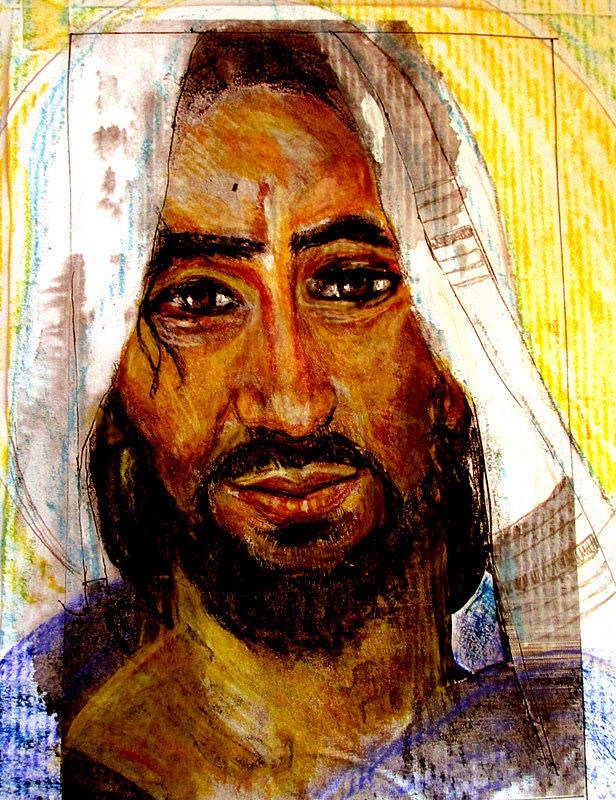
An image that depicts the way a first century Jewish male,
like Jesus, might well have appeared

The author of this narrative—known by tradition as “Mark”—begins this series of scenes with the striking moment when Jesus of Nazareth was declared to be the beloved Son, anointed by the Spirit, equipped for his role of proclaiming the kingdom of God (Mark 1:1–13), which we hear this coming Sunday when the focus is on the Baptism of Jesus.

We know that Jesus was raised as a good Jew. We can hypothesise much about his upbringing and faith. He knew the daily prayer of the Jews, the Shema (“Hear, O Israel, the Lord our God is One”). He also knew the major annual festivals of his people: Passover, Harvest (later called Pentecost) and Tabernacles.

Jesus attended the synagogue each Sabbath, where he watched the scrolls containing the Hebrew scriptures unrolled, before they were read (in Hebrew, the sacred language) and explained (in Aramaic, the language of the common Jewish folk). Jesus, like all his fellow–Jews, believed that his God, Yahweh, was the one true God. He followed the traditional practices of worship and studied the scriptures under the guidance of the scribes in his synagogue.

At a mature age (by tradition, in his early 30’s), Jesus made his way south towards Jerusalem, into the desert regions, along with other Jews of the day. Beside the Jordan River he listened to the preaching of a strange figure—a desert-dwelling apocalyptic prophet named John (Mark 1:4–8). This appears to have been a pivotal moment for the pious Jewish man from Nazareth. His encounter with John deepens his faith and sharpens his commitment.

John’s message was the traditional prophetic call to repent (1:4). Prophets occasionally call directly for teshuva (Hebrew; in Greek, metanoia). These words are usually translated into English as “repentance” (see Isa 1:27; Jer 8:4-7, 9:4-5, 34:15; Ezek 14:6, 18:30; Zech 1:1-6). Indeed, so many of the oracles included in both major and minor prophets provide extended diatribes against the sinfulness of Israel and call for a return to the ways of righteousness that are set out in the convening with the Lord. When prophets called for metanoia, repentance, they were seeking a striking and thoroughgoing change of mind, a reversal of thinking and acting, a 180 degree turnaround, amongst the people. This is what metanoia means.

Accompanying this, however, was a very distinctive action that John the desert dweller performed, of immersing people into the river (Mark 1:5). Our Bibles translate this as “baptising”, but it was actually a wholesale dunking right down deep into the waters of the river.

Our refined ecclesial terminology of “baptism” is often associated, in the popular mind, with cute babies in beautiful christening gowns surrounded by adoring grandparents, aunties and uncles. This leads us far away from the stark realities of the act: being pushed down deep into the river, being completely surrounded by the waters, before emerging saturated and maybe gasping for air.

Such a dramatic dunking was designed to signify the cleansing of the repentant person. Repentance and baptism were necessary for the ushering in of the reign of God, according to John. Jesus appears to have accepted this point of view; it is most likely that his baptism was an intense religious experience for him. He underwent a whole scale change of mind, a reorientation towards the mission that was thrust upon him.

Certainly, the way that the experience is presented by Mark (and also in the other canonical Gospels) presents Jesus as being singled out by God for a special role. There are multiple signs on the short account of this moment (Mark 1:9–11).

FIrst, Jesus sees “the heavens torn apart” (1:10). This breaking apart is mirrored in the water of the river, which parts “as he was coming up out of the water”. The breaking of the heavens perhaps echoes the cry of the prophet of old: “O that you would tear open the heavens and come down, so that the mountains would quake at your presence … to make your name known to your adversaries, so that the nations might tremble at your presence!” (Isa 64:1).

Then, he sees a vision of “the Spirit like a dove” (Mark 1:10). A dove, of course, appeared at a key moment early in the biblical narrative: as the waters of the Great Flood recede (Gen 8:6–12); but the association of the dove with the Spirit (a commonplace in our thinking today, surely) is not actually made anywhere in scripture before this moment. The dove which appears seems, to Jesus, to come from beyond rest on him, in the way that the prophet declares that “the spirit of the Lord God is upon me” (Isa 61:1). The dove brings a signal from the sky—from the Lord God, perhaps?

A third signal comes through “a voice from heaven” (Mark 1:11). This is a common note regarding the hearing of the divine voice. Moses tells the Israelites, “from heaven he made you hear his voice to discipline you” (Deut 4:36). In the wilderness, God “came down upon Mount Sinai, and spoke with them from heaven, and gave them right ordinances and true laws, good statutes and commandments” (Neh 9:13; also Exod 20:22). Ben Sirach tells the story of the judges, when “the Lord thundered from heaven, and made his voice heard with a mighty sound” (Sir 46:17). David sang that “the Lord thundered from heaven; the Most High uttered his voice” (2 Sam 22:14). So a voice speaking from heaven, in Jewish understanding, is a communication from God.

Finally, the actual words which that voice speaks are deeply significant. “You are my son” are words spoken by God to David (Ps 2:7). “With you I am well pleased” echoes what God says about “my servant, whom I uphold, my chosen, in whom my soul delights” (Isa 42:1); indeed, of the Servant, the prophet declares, God indicates that “I have put my spirit upon him; he will bring forth justice to the nations” (Isa 42:2). What is heard at the moment of the baptism of Jesus is confirmation of the place of Jesus as one beloved, chosen, and equipped by God for what lies ahead of him.

So it is that from the moment of this intense experience, Jesus was fervently committed to the renewal and restoration of Israel. His first words, as reported in this shortest and earliest account of his ministry, were clear and focussed (1:14–15). There are four key elements: fulfilment of the time, nearness of the kingdom, the need to repent, and belief in the good news. Repentance is pivotal in this succinct summary of his message. It was the heart of the message that Jesus instructed his followers to proclaim (6:12).

After this dramatic dunking by the desert dweller, Jesus left his family and began travelling around Galilee, announcing that the time was near for dramatic changes to take place. He gathered a group of men and women who accepted his teachings, journeying with him as he spread the news throughout Galilee.

The intense religious experience of his dunking meant that the fierce apocalyptic message spoken by the desert dweller was lived out in a radical way in daily life by this group of deeply committed associates of Jesus. The intense religious experience associated with his dramatic dunking by the desert dweller had a deep and abiding impact. The challenge, for those of us who follow him, is to live out this radical way of life today.