A prophet, a righteous person, and a little one (Matt 10; Pentecost 5A)

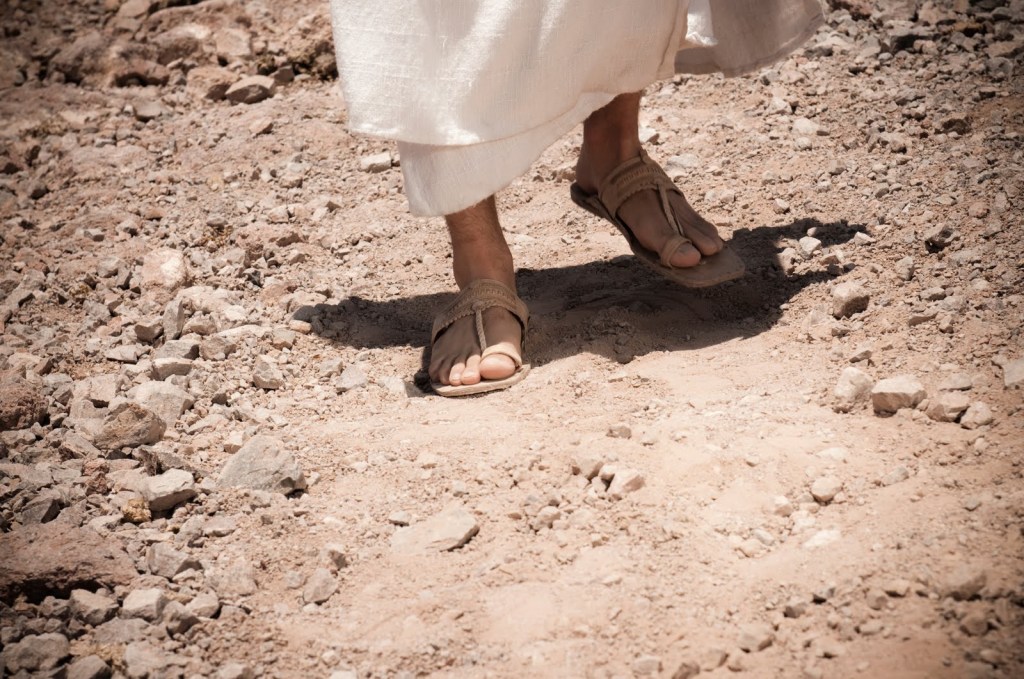
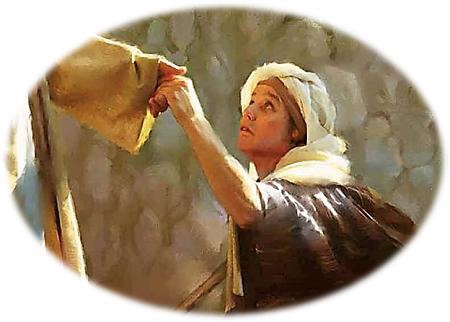
This Sunday, the lectionary offers a Gospel passage of just three succinct verses (Matt 10:40–42). In those verses, three key terms are used Jesus: prophet, righteous one, and little one. “Whoever welcomes you welcomes me, and whoever welcomes me welcomes the one who sent me,” Jesus asserts (Matt 10:42), before he proceed to extend this saying to include those who welcome a prophet, a righteous person, and “whoever gives even a cup of cold water to one of these little ones in the name of a disciple”. In each case, a reward is certain, says Jesus.

The last of these sayings, about “one of these little ones”, links these verses with the saying of Jesus he spoke after the disciples had been arguing about “who was the greatest”. This saying is reported in the triple tradition (Mark 9:33–37 and parallels in Matt 18 and Luke 9). In that scene, Jesus took a child in his arms and said, “whoever welcomes one such child in my name welcomes me, and whoever welcomes me welcomes not me but the one who sent me” (Mark 9:37; Matt 18:5; Luke 9:48).

Matthew here reports an expanded version of that saying, which is applied directly to the disciples. He begins by reversing Mark’s saying, taking the end of that version by referring initially to all the disciples: “whoever welcomes you”, before extending this to include “welcoming me” (10:40).

The disciples represent Jesus as “the one who sent me”, namely, God. This last phrase, found in the three Synoptic versions of this saying, is a favourite Johannine phrase for God (John 1:33; 6:44; 7:28; 8:26, 29; 9:4). The Johannine version of this saying is “whoever receives one whom I send receives me; and whoever receives me receives him who sent me” (John 13:20). That is very similar to the version that Matthew reports.

However, Matthew extends his version of Mark’s saying still further by adding “whoever welcomes a prophet”, then “whoever welcomes a righteous one” (10:41), before concluding with “whoever gives even a cup of cold water to one of these little ones in the name of a disciple” (10:52). The “little one” is presumably equivalent to “the child” which had begun Mark’s saying.

Jesus’ other saying about “the little ones” appears in all three Synoptic Gospels. The saying is highly likely to be authentic, if we adopt the classic form-critical criteria that were developed some decades ago. One marker of authenticity is for a saying to be hard, difficult, or unexpected. Jesus instructs his disciples, “if any of you put a stumbling block before one of these little ones who believe in me, it would be better for you if a great millstone were hung around your neck and you were thrown into the sea” (Mark 9:42; Luke 17:2; Matt 18:6).

This is a shocking, confronting instruction. It is undoubtedly a hard saying. In Mark 9, that shocking statement is extended regarding a hand or a foot or an eye causing a person to stumble; “it is better for you to enter life maimed … lame …[or] with one eye”, he advises (Mark 9:43-48). So Jesus is strenuously advocating for “the little ones”, and giving them a cup of water (Matt 10:42) is an essential act of discipleship.

*****

We have seen, then, that Matthew has inverted the order he received from Mark and extended the comparison he makes about welcoming a person who comes in his name. Adding the prophet to this saying (10:41) brings in another dimension to the story.

One line of interpretation that has been proposed intrigues me. Could these sayings reflect the on-the-ground nature of the earliest period of the movement that Jesus initiated? He had called disciples to follow him (4:18-22; 9:9), warned people of the difficulties that this would entail (8:18–22), selected an inner group to be designated as “emissaries—translating the Greek apostoloi (10:1–4), and commissioned them to proclaim the nearness of God’s presence in this world (10:5–15).

Jesus then warned these emissaries of the dangers that lay in store for them (10:16–25) and encourages them with the words, “do not fear those who kill the body but cannot kill the soul” (10:26–31), assuring them that “everyone who acknowledges me before others, I also will acknowledge before my Father in heaven” (10:32–33). The short lectionary passage brings the whole “mission discourse l (10:1–42) to a close. These words encapsulate the commission and the anticipated experience of the disciples.

How were the followers of Jesus to implement this? Gerd Theissen, a German New Testament scholar, has proposed that the message of Jesus was spread by itinerants within the early Jesus movement who travelled from village to village with their message. They were dependent on those who received them for hospitality and lodging, in literal obedience to what Jesus had told his disciples (Mark 6:10–11). They were living in complete obedience to “the Son of Man [who] has nowhere to lay his head” (Matt 8:20; Luke 9:58).

Evidence for such itinerant preachers can also be found in the Didache, which instructs: “Whosoever, therefore, comes and teaches you all these things that have been said before, receive him … Let every apostle that comes to you be received as the Lord. But he shall not remain except one day; but if there be need, also the next; but if he remain three days, he is a false prophet. And when the apostle goes away, let him take nothing but bread until he lodges; but if he ask money, he is a false prophet.” (Didache 11:1, 4–6).

The reference to prophets in Matthew’s account of the words of Jesus resonate with this portrayal of the early church. Receiving a prophet and welcoming them (providing them with hospitality—food, drink, and shelter) is affirmed, for the prophet comes as a representative of Jesus (10:41).

Throughout the story of Israel, the prophet has been the one who, literally, “speaks forth”; so the prophets sent by Jesus proclaim the message that “the kingdom of heaven has come near” (Matt 10:7). The prophets proclaiming this message, as prophets did in earlier times, accompany their message with acts that manifest the truth of what is proclaimed: “cure the sick, raise the dead, cleanse the lepers, cast out demons” (10:8).

*****

Matthew also adds a saying about receiving “a righteous one” 10:42). This is language which is very important to Matthew. The word dikaios, translated as righteous, refers to a person who adheres carefully to the prescriptions of Torah, who is faithfully trusting God, who follows the ways that God sets out, who contributes constructively to society so that it functions in a just and equitable way.

Torah and righteous-justice are linked in Jewish understanding. The psalmist, characteristically, places them in synonymous parallelism, when they sing, “your righteousness is an everlasting righteousness, and your law is the truth” (Ps 119:142). The prophet Habakkuk, lamenting the “destruction and violence” that surrounds him as the Babylonian army presses into Jerusalem, observes that “the law becomes slack and justice never prevails; the wicked surround the righteous—therefore judgment comes forth perverted” (Hab 1:4). The two go hand-in-hand.

Matthew reflects this close connection between Torah and righteous-justice, as he presents Jesus as being completely faithful to Torah. In reporting his baptism, only Matthew has Jesus declare to John, “it is proper for us in this way to fulfill all righteousness” (3:15). In beginning the Sermon on the Mount, Jesus declares blessed “those who hunger and thirst for righteousness” (5:6) and “those who are persecuted for righteousness’ sake” (5:10).

Jesus follows this by announcing his intention to intensify the demands of the Law (5:18) by demanding that his followers exhibit a righteous-justice that exceeds that demonstrated by the Pharisees (5:20). Only Matthew reports these words of Torah fidelity, and only Matthew has the various parables which affirm “the righteous” over against those who disobey the law (13:36–43; 13:47–49; 25:31–46).

Matthew presents Jesus as thoroughly Jewish, for he knows that God is righteous, as is declared in scripture (Deut 32:4; Ps 145:7; Job 34:17). The psalmists regularly thank God for God’s righteousness (Ps 5:8; 7:17; 9:8; 33:5; 35:24, 28; 36:6; 50:6; etc) and note the importance of humans living in that way for righteousness (Ps 18:20, 24; 85:10–13; 106:3, 31; 112:1–3, 9).

The book of Proverbs advises that the wisdom it offers is “for gaining instruction in wise dealing, righteousness, justice, and equity” (Prov 1:3) and the prophets consistently advocated for Israel to live in accordance with righteousness (Hos 10:12; Amos 5:24; Isa 1:22; 5:7; 28:17; 32:16–17; 54:14; Jer 22:3; Ezek 18:19–29; Dan 9:24; 12:3; Zeph 2:3; Mal 4:1–3; Hab 2:1–4).

So welcoming a righteous one is welcoming a person who follows, intensely and faithfully, the way that Jesus sets out, the way of God’s righteous law—just as welcoming a prophet is welcoming one who faithfully and persistently declares the message of that righteous law. That is the measure of faith that Matthew sets out in this saying. That is the intensity that the Jesus of Matthew presents.

Not peace, but a sword (Matt 10; Pentecost 4A)

“Do not think that I have come to bring peace to the earth; I have not come to bring peace, but a sword. For I have come to set a man against his father, and a daughter against her mother, and a daughter-in-law against her mother-in-law; and one’s foes will be members of one’s own household.” (Matt 10:34–36).

Gentle Jesus, meek and mild, lover of all, and patron of the close-knit nuclear family … where are you? The words of Jesus we are given by the lectionary for this coming Sunday (Matt 10:24–39) seem to come from a very different person from the stereotypical “Jesus loves the little children, all the children of the world”. Who exactl y is this Jesus?

“Go nowhere among the Gentiles” (10:5), he has told his disciples, establishing what appears to be a very exclusivist, racially-driven undertaking. “Take no gold, or silver, or copper in your belts, no bag for your journey, or two tunics, or sandals, or a staff” (10:9–10), on what will undoubtedly be an incredibly ascetic experience for the disciples. “If anyone will not welcome you or listen to your words, shake off the dust from your feet as you leave that house or town” (10:14), says Jesus, anticipating a divisive and difficult time for his followers.

And then, “I am sending you out like sheep into the midst of wolves” (10:16), for “they will hand you over to councils and flog you in their synagogues” (10:17). Yes, this sure to be an experience that the disciples will not forget—for all the wrong reasons! “You will be hated by all because of my name” (10:22) is hardly an enticing invitation to take part in this mission; indeed, the advice, “do not fear those who kill the body but cannot kill the soul” (10:28) bodes no good; are there not only persecutions, but also deaths, on the horizon?

What is going on? How did Jesus manage to entice a group of men and women to take part in this enterprise? And why was he so clear and direct about all the dangers that lay ahead of them?

***

As I noted in last week’s blog on Matthew 10, we know that Judaism was in a state of flux after the destruction of the Temple in 70 CE. Evidence indicates that there were a number of sectarian groups contesting with each other for recognition and influence. During this period, the Pharisees were becoming increasingly important as an alternative to the Temple cult, and emerging as the dominant Jewish religious movement. Their power base was moved from Jerusalem and spread throughout the area.

It has been claimed that a Jewish Council was formed in Jamnia, a city on the coast of Judea. This is taken to demonstrate that the Pharisees had laid claim to be the dominant group amongst the Jews; it might also indicate that it was possible to legislate for the formal separation of some communities (such as the Matthean one).

Note: this story is now regarded as more likely that this story of Jamnia was a ‘foundation myth’, developed in later years, with the aim of showing that there was unity in formative Judaism from the earliest times.

The area of Galilee is extremely important in Matthew’s Gospel (2:22; 3:13; 4:12–25; 17:22; 19:1; 21:11; 26:32; 28:7). As the Galilean Pharisees figure prominently in the narrative of Matthew’s Gospel, it seems reasonable to suppose there was a strong Pharisaic presence in Galilee, and that this group provided the main opponents for the community of Matthew.

The power of the Pharisees was rising, and with the destruction of the Temple, it was common to find new ways of interpreting how Judaism should exist. From this time on, Pharisees evolved into the “Rabbis”, and they developed the kind of Judaism that became dominant through to the present time.

Nevertheless, many Jews, particularly in the Diaspora, were not yet “Pharisaic”—they did not see their faith in the same way as the Pharisees. There were many disputes amongst Jewish communities as to the correct way of seeing things, and some of these disputes were quite bitter. Many groups claimed to be the ‘true Israel’ as distinct from other groups, who were false leaders and teachers, and who failed to follow the Law correctly.

The Law became the most accessible means of revealing God’s will for Israel after the destruction of the Temple, and most of these groups focused on what they believed to be the true interpretation and application of it.

Matthew’s Gospel reflects one such debate; scholars suggest that it should be read alongside of other literature from after the time of the destruction of the Temple—books such as 2 Baruch, 4 Ezra, and the Psalms of Solomon. This literature is trying to envisage what Judaism should be like in the aftermath of the destruction of the Temple.

Thus, although Matthew’s Gospel has been seen to have played an important role in the formation of early Christian theology, a more natural interpretation is to locate this Gospel within the post-70 Jewish debates about the survival of Judaism without the Temple. The polemic in Jesus’ debates with the Pharisees, and the warnings that are uttered to Israel, show that Matthew still had hope that his ideas would become normative for all Jewish people.

I think it likely that Matthew’s Gospel was created to insist on the centrality and priority of the teachings of Jesus, the Torah-observant Jew, whom God had chosen as the anointed one; it was his teaching, not that of the local synagogue leaders, which was to be given priority.

*****

In such a context, the opposition envisaged by Jesus and the warnings that he gives in this polemical speech to his earliest followers, starts to make sense. Matthew sets out the teachings of Jesus concerning discipleship within the context of an apocalyptic view of reality. This view looks at the present time in relation to the ultimate end of time, and calls for a way of living that will ultimately show responsibility for decisions made.

What ultimate end does Matthew have in view? Each Gospel writer tends to emphasis something slightly different. In Mark, the focus is on the resurrection of Jesus (Mark 14:28; 16:7). In Luke-Acts, carrying the good news throughout the Roman Empire fulfils the story (Luke 24:47–48; Acts 1:8). In John, it is eternal life which is emphasised (John 20:31).

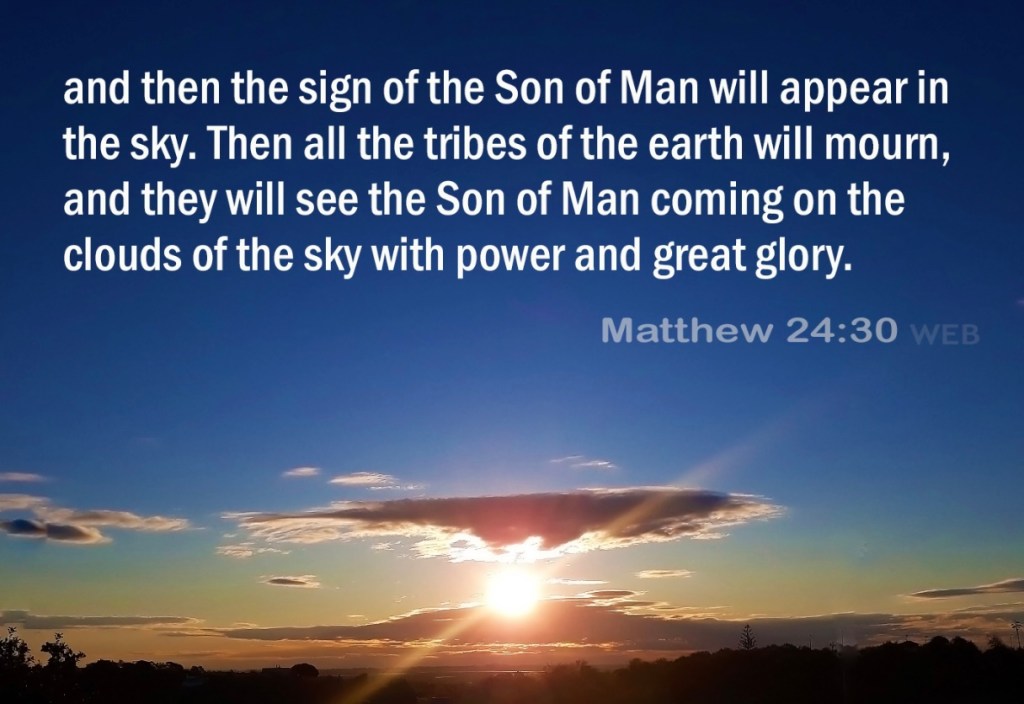
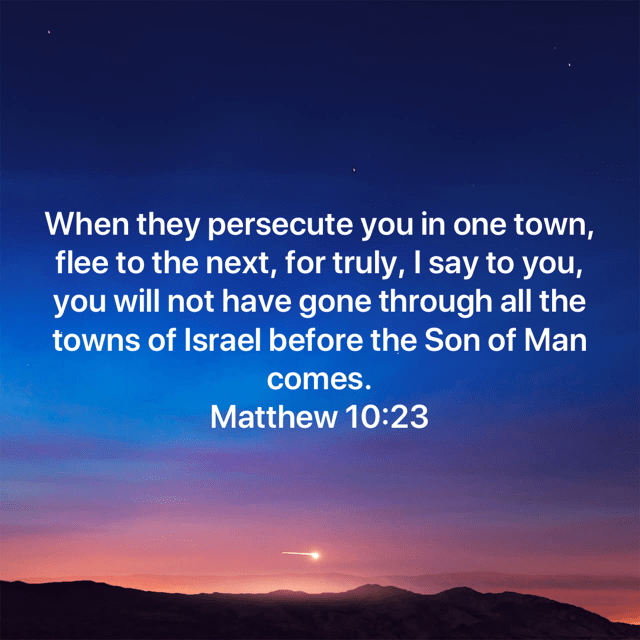
Matthew’s Jesus has in mind the coming eschatological deliverance, a deliverance which is expected imminently and that will vindicate the community as faithful and righteous to the will of God. So he tells his followers that “you will not have gone through all the towns of Israel before the Son of Man comes” (10:23). The mission that his followers undertake amongst Jews only is urgent; the end of time is coming soon, and they will not have shared “the good news [that] the kingdom of heaven has come near” (10:7) before “the Son of Man appears in heaven, and then all the tribes of the earth will mourn, and they will see ‘the Son of Man coming on the clouds of heaven’ with power and great glory” (24:30).

In this way, Matthew is typical of one type of Judaism after the destruction of the Second Temple; that of apocalyptic hope. Most of the post-70 sectarian groups express hope that God will remember his covenant with them, the faithful few of Israel, and save them; for example, 2 Baruch and 4 Ezra write that God will provide consolation for their suffering and vindicate them, whilst also punishing their enemies on the Day of Judgement (2 Baruch 6:21; 82:1–2; 4 Ezra 8:51–59; 12:34).

In these sectarian documents, the kingdom of God is eschatological is nature; it has not yet arrived on earth, though signs telling of its coming can be detected. These communities also agree that much of Israel no longer truly follows the Law of God, and that the dominant Jewish leadership is unfaithful and wicked, and that they are the ones alone representing the true Israel. Therefore, entry to the kingdom is dependent upon faithfulness to the Law as interpreted by the community.

*****

Much of this sectarian understanding can also be found in Matthew’s Gospel. Matthew redacts his sources and shapes his material so that this eschatological end is prominent—even in the mission discourse. The words of Jesus about persecutions (10:17–20) are very similar to words in the closing apocalyptic of Jesus (24:9); his words about divisions and hatred within the family (10:21–22 and 10:34-37) mirror the later declaration of betrayal and hatred (24:10).

The “false messiahs and false prophets” that are foreseen (10:24) evoke the false message of “those who will lead you astray” (24:4–5) whilst the words that the Spirit will speak through the disciples (10:19–20) provide the substance for the future “testimony to all the nations” concerning “the good news of the kingdom” (24:14). The instruction to flee in the face of persecution (10:23) foreshadows the apocalyptic command that “those in Judea must flee to the mountains” (24:16–18).

The urgency of the mission (9:37–38; 10:11–14) is because “you will not have gone through all the towns of Israel before the Son of Man comes” (10:23). And the note that the Son of Man is expected to come soon (10:23) presages the cataclysmic scene described in the closing speech of Jesus (24:29–31)—for “this generation will not pass away until all these things have taken place” (24:34). This later causes Jesus such frustration, when he berates his disciples, those of “little faith”, “you faithless and perverse generation, how much longer must I be with you? how much longer must I put up with you?” (17:17).

The mission discourse (10:5–42) thus contains many of the key elements of the apocalyptic discourse (24:3–44): opposition, persecution, division, fear, assurance, and urgency. Jesus, in this Gospel, is particularly clear that there are two ages: the first is the current time for the evangelist, and the second is the age to come (Matt 12:32, from Mark 3:29). In this Gospel, the first indication that we have of the nearness of the second age is the announcement of John the Baptist, “Repent, for the kingdom of heaven has come near” (3:2).

This succinct message has set the tone for the rest of the Gospel. Jesus repeats, word-for-word, John’s call for people to repent (4:17). He intensifies the need for faithful people to be obedient to God’s law (5:17–20) and demonstrate an intensified righteous-justice (5:21–48), as the end-time of God’s judgement is fast approaching. This is the centrepiece of the message that the disciples are to proclaim, when sent out on mission: “as you go, proclaim the good news, ‘The kingdom of heaven has come near.’ Cure the sick, raise the dead, cleanse the lepers, cast out demons” (10:7–8).

In Matthew’s understanding, the kingdom is imminent, but not yet arrived; however, signs of its imminence break in to the present times to demonstrate its nearness. The ministry of Jesus is set at the end of the first age; the second age will commence very shortly with the triumphant return of Jesus after his death, within the lifetime of his disciples (10:23; 16:28; 24:34).

Matthew does not reflect the notion that the kingdom has already arrived on earth, even though it can be seen in Jesus (12:28), and in the continuation of his ministry by his followers after his death. Jesus and the disciples both preach that the kingdom of heaven is near, or at hand (4:17; 7:21–22; 9:35; 10:7), but it has not yet established itself on earth.

A number of the parables of Jesus address the nature of this kingdom. The kingdom of heaven will be established “at the end of the age”, when the final judgement of righteous and unrighteous will take place (13:39–40, 49; 24:3). Before the coming of the Son of Man, it remains hidden and mysterious (13:31–33, 44–45), too small to be observed, but the day is coming when it will grow and become the “greatest of all things”, and the righteousness of God will triumph.

And entry into this kingdom—or not—will be determined by a person’s readiness (24:45–51; 25:1–11) and by an assessment of the way they lived their life (25:31–46). So Jesus gives his followers this assurance: “whoever welcomes a prophet … and whoever welcomes a righteous person … and whoever gives even a cup of cold water to one of these little ones in the name of a disciple—truly I tell you, none of these will lose their reward” (10:41–42).

He also issues this severe warning: “whoever loves father or mother more than me is not worthy of me; and whoever loves son or daughter more than me is not worthy of me; and whoever does not take up the cross and follow me is not worthy of me. Those who find their life will lose it, and those who lose their life for my sake will find it.” (10:37–39).

*****

Matthew takes source material about the mission of the disciples (Mark 6:7–13), modifies, intensifies, expands, and reshapes it, in the light of the context in which he is writing the Gospel. The events of the 50s and 60s, the onset of the war with the Romans in 66, and perhaps even the destruction of the Temple in 70CE, have all guided the way that the author of Matthew’s Gospel retells the instructions that Jesus gave to his first disciples, decades earlier.

Just as he and his community are experiencing intense difficulties and confronting entrenched conflict, so the Jesus of earlier times had foreseen such a situation, and had sent his followers out forewarned, and thus forearmed. What was taking place in the early 70s (or perhaps even in the late 60s) amongst a group of Torah-abiding, Messiah-following Jews, was an outworking of what Jesus is presented as speaking to his disciples.

In other words, the mission discourse of Matt 10:1–11:1 reveals much about the strife and contention amongst Jews in the local area where Matthew’s community was located, and the intensified expectation that the end was coming soon, that they felt. It was a word for his time; placed on the lips of Jesus, but speaking with clarity and insight into the lived experience of the people of Matthew’s community. For them, this was what obedience to the Gospel and following the way of Messiah Jesus, their Rabbi, entailed.

This blog draws on material in MESSIAH, MOUNTAINS, AND MISSION: an exploration of the Gospel for Year A, by Elizabeth Raine and John Squires (self-published 2012)

See also

“Go nowhere among the Gentiles” (Matt 10:5): the mission of Jesus in the book of origins (Pentecost 3A)

Jesus had a mission to the Gentiles. The mission to the Gentiles was “the fundamental missionary dimension of Jesus’ earthly ministry”—so wrote the guru of modern missiological studies, David Bosch (Transforming Mission, p. 30). And thus, every theology of mission since that paradigm-shifting work of 1991 has echoed this claim as a given fact.

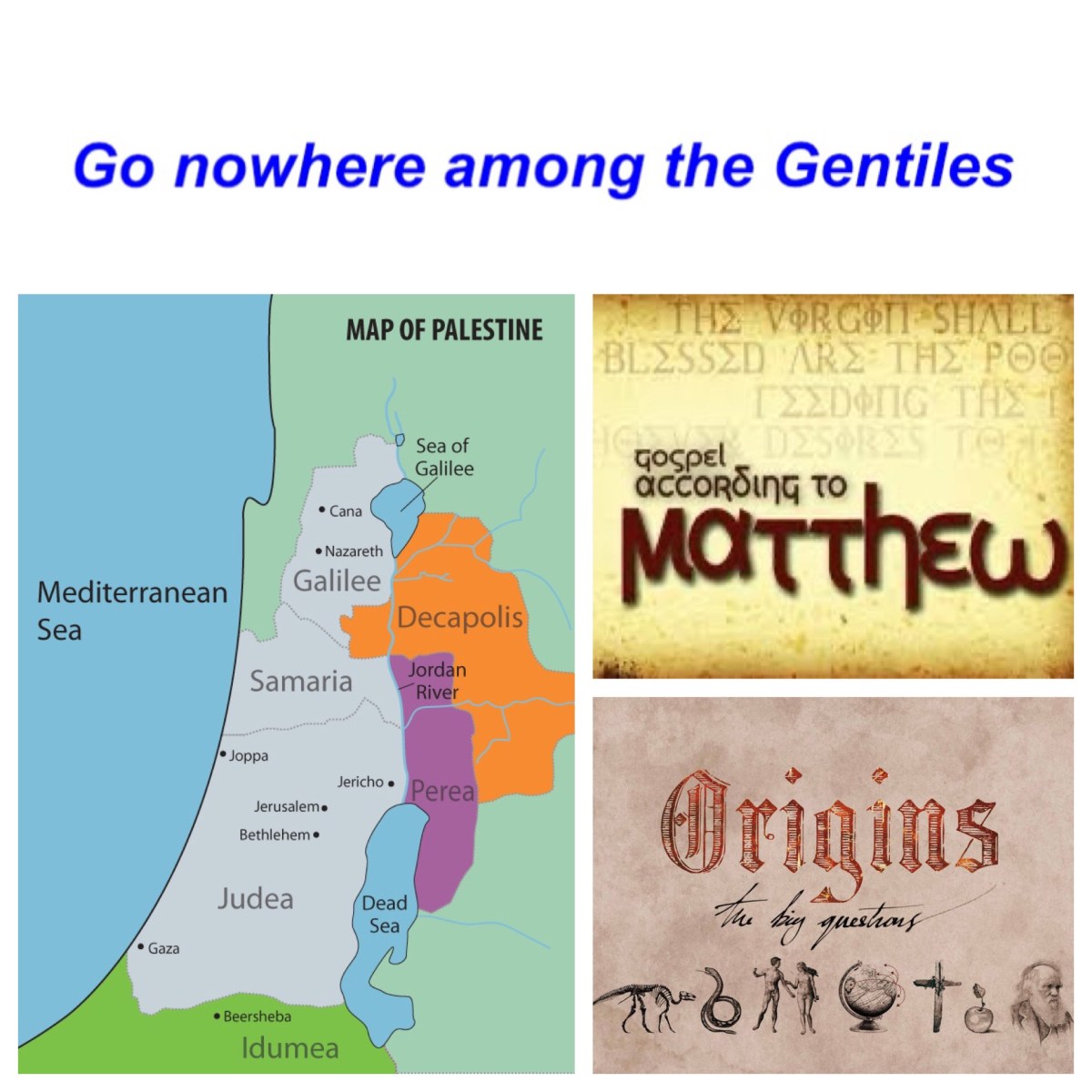
But when we turn to this week’s Gospel passage, we read that Jesus instructed his followers: “Go nowhere among the Gentiles, and enter no town of the Samaritans, but go rather to the lost sheep of the house of Israel” (Matt 10:5-6). What is going on?

This is a very distinctive claim to make. Other New Testament books have a different take—Jesus did engage with Gentiles, even with Samaritans, and did encourage a mission to the wider Gentile world. And plenty of New Testament texts can be pulled out to support this claim.

In Mark’s Gospel, in the story of the Gadarene demoniac (Mark 5:14–21), the healed man begs to be taken with Jesus. Jesus tells him to go home, and spread the story of the Lord’s mercy. This he does throughout the Decapolis—which was Gentile territory! The first evangelist, according to Mark, was a missionary to the Gentiles.

The Matthean Jesus, unlike the Lukan Jesus, never goes near Samaria (Luke 17:11–19), nor does he speak favourably about Samaritans, as he does in Luke (10:25–37), prefiguring the Lukan mission to Samaria (Acts 1:8; 8:4–25).

And in John’s Gospel, the first person who tells many others about Jesus is a woman whom Jesus meets when he is travelling through Samaria (John 4:5–26). After her discussion with Jesus, “the woman left her water jar and went back to the city, and said to the people, ‘Come and see a man who told me everything …he cannot be the Messiah, can he?’” (John 4:28–29). As a result of what she says, “many Samaritans in that city believed in him” (John 4:39); the first evangelist in John’s narrative is a Samaritan wo

Not in Matthew’s Gospel, however. Jesus does not go amongst Gentiles. Or Samaritans. Just as the disciples of Jesus are entirely drawn from Jewish people in Matthew’s Gospel, so also Matthew makes it very clear that Jesus’ mission is “only to the lost sheep of Israel”—that is, exclusively to the Jewish people.

My wife Elizabeth and I have had many conversations about this aspect of the Gospel according to Matthew. She has undertaken thorough research into the Jewish nature of this Gospel, and especially on how Jesus related to Gentiles. What follows is drawn from our conversations and particularly from the research of Elizabeth, as we have written this material together.

*****

The section of the book of origins that we are offered as the Gospel reading this coming Sunday (Matt 9:35–10:8) ought to be familiar. The first verse (9:35) is an almost-exact repeat of an earlier verse (4:23). The same three activities of Jesus are noted—teaching, proclaiming the good news, and curing disease. The earlier verse introduced the activity of Jesus in Galilee; this later version broadens the area where Jesus was active to “all the cities and villages”.

However, Jesus is still in Jewish territory; he had returned “to his home town” earlier (9:1) and emphasises that his followers are not to go into Gentile territory (10:5)—an instruction which he presumably maintains himself, for he tells them “go rather to the lost sheep of the house of Israel” (10:6) and later affirms that “I was sent only to the lost sheep of the house of Israel” (15:24).

This neat repetition of the whole verse that provides an inclusio—a literary device which bundles together all the material in between the two occurrences of the same sentence. The extended set of teachings that Jesus gave (5:—7:29), as well as the healings (8:1–17; 8:28–9:8; 9:18–34) are collated into a broader and comprehensive introduction to the mission of Jesus, which, as he indicates soon after, is to the Jews only (10:5).

Also included in this section is the call of Matthew (9:9), to match the earlier call of the first four disciples (4:18–22), and the warnings that Jesus issues about the difficulty of following him (8:18–21), which is followed by Jesus stilling the storm (8:22–27), which climaxes in the key question, posed by the disciples, “What sort of man is this, that even the winds and the sea obey him?” (8:27; the allusion is to a psalm praising the Lord that, amongst other things, “you silence the roaring of the seas, the roaring of their waves, the tumult of the peoples” (Ps 65:7).

Matthew finds a report of the mission of the twelve in one of his sources, the Gospel we attribute to Mark (Mark 6:8–11). The statement about going “only to the lost sheep of Israel” (10:5–6), in the mission directives to the twelve disciples, is clearly an addition to the original Markan passage. In this distinctive Matthean statement, Jesus directs that Gentile (and Samaritan) towns are to be avoided.

There is, as we have noted, a second statement to this effect in this Gospel, when Jesus encounters a Gentile woman on the northern borders of Galilee. This also is a clear redactional addition to an account already found in Mark (Mark 7:24–30). In Matthew’s version, he declares, “I was sent only to the lost sheep of the house of Israel” (Matt 15:24). There is nothing of this in Mark’s report of this encounter.

A third Matthean statement about mission, the “Great Commission” (28:16–20), is completely different, as the disciples are commanded to go out and actively “make disciples of all nations”. This command correlates with nothing at all in the body of the Gospel, during the earthly period of Jesus’ life. The mission to the Gentiles is an entirely post-resurrection phenomenon.

So the two major statements of mission to Israel in this Gospel, as well as other accounts of the activities and ministry of Jesus, contain a number of significant differences to that of Mark and Luke. The ministry of both Jesus and the disciples is geographically quite limited in Matthew’s account.

*****

Jesus rarely sets foot on any Gentile soil in this Gospel. In Matt 15:29–31, there is no tour through Sidon and the Decapolis as is reported in Mark (Mark 7:31–37), and no missionary activity undertaken by the demoniac after the demons have been exorcised from him (Mark 5:1–20; compare Matt 8:28–34).

The Matthean Jesus never goes near Samaria (contrast with Luke 17:11–19 and John 4:1– 42), nor does he speak favourably about Samaritans, as he does in Luke (Luke 10:25–37), prefiguring the Lukan mission to Samaria (Acts 1:8; 8:5-25). The activities of Jesus and the disciples are concentrated in the Galilean area, and on the Jewish people.

In Matthew‘s account, there are no Gentiles who are intentionally sought out by either Jesus or the disciples. Rather, there are just a select number of Gentiles who seek out Jesus. They come to him; he does not approach them or seek them out. (I am indebted to Elizabeth for this striking observation.) In two instances, it is their faith which includes them in the kingdom of God (the centurion in Capernaum, 8:10, 13; the Canaanite woman in Tyre and Sidon, 15:28).

Ultimately, Jesus says to the Jews, “the kingdom of God will be taken away from you and given to a people that produces the fruits of the kingdom” (21:43). He is not here saying that the kingdom will be opened to the Gentiles per se; his words are directed towards the chief priests and Pharisees (as 21:45 indicates).

It is those Jews who “produce the fruits of the kingdom” who will be given entry to the kingdom. Those who do “produce the fruits of the kingdom” include those normally considered as “unclean” by the Pharisees, and therefore outcasts or rejects from Judaism (9:10–13; 21:31, 32).

Jesus’ discourses and acts of healing, in general, involve only Jews. His contact with Gentiles, when it occurs in the Gospel, is always highly significant, and designed to illuminate some aspect of Jesus’ teaching or person regarding authority, inheritance of the kingdom, discipleship or messiahship.

It is noteworthy that those occasions when a person is asked whether they have faith before Jesus will heal them, are only when Gentiles are involved. Jesus readily heals Jewish people without requesting a prior faith statement (4:24; 8:3; 8:15; 12:13; 12:22; 14:36; 15:31; 21:14).

*****

More recent Matthean scholarship has recognised the Jewish character of this Gospel, and a consensus is emerging that this work was most likely written for a community that was still immersed within its Jewish tradition. It appears that members of this community had been ostracised and persecuted by other Jews (including their families) who did not believe Jesus to be the Messiah. They did not withdraw voluntarily from their local synagogues, but still operated as a group under Jewish authority (10:17; 23:34).

This community is still directly under Jewish law; the clear words of Jesus that are remembered and repeated are “the scribes and the Pharisees sit on Moses’ seat; therefore, do whatever they teach you and follow it” (23:1-3). That law is not to be abolished, but fulfilled (5:17); it remains “until all is accomplished” (5:18).

In the teachings of Jesus which are recalled in this community, their faithfulness in the midst of persecution is valued (5:10–12); they report that Jesus identifies this persecution as taking place “on my account” (5:11; see also 10:18, 39; 16:25; 19:29). Thus the difference between this community and many other Jews of the time was the belief that Jesus was the promised Messiah.

Judaism was in a state of flux in the middle to late decades of the first century. The pivotal moment looks, from the benefit of hindsight, to have been the a Jewish-Roman War of 66-74 CE, and particularly the destruction of the Jerusalem Temple which took place in 70 CE, in the middle of this war.

Things were different after the Temple was rendered unusable. That is often taken as a marker for understanding events in the period of the New Testament, certainly, it is a key marker for understanding the major shifts that took place within Judaism—with no Temple in place, the importance of synagogues as gathering places in towns and cities across Israel (and beyond) grew.

What little evidence we do have from this general period indicates that there were a number of sectarian groups within Judaism, which were contesting with each other for recognition and influence. During this period, the Pharisees were becoming increasingly important as an alternative to the Temple cult, and emerging as the dominant Jewish religious movement. Their power base was moved from Jerusalem and spread throughout the area. They were well-placed to take advantage, as it were, of the situation when the Temple no longer served as a focal point for Jews.

Nevertheless, many Jews, particularly in the Diaspora, were not yet “Pharisaic”—they did not see their faith in the same way as the Pharisees. There were many disputes amongst Jewish communities as to the correct way of seeing things, and some of these disputes were quite bitter.

Many groups claimed to be the ‘true Israel’ as distinct from other groups, who were false leaders and teachers, and who failed to follow the Law correctly. The Law became the most accessible means of revealing God’s will for Israel after the destruction of the Temple, and most of these groups focused on what they believed to be the true interpretation and application of it.

The synagogues were the places where the Law was studied and discussed, where it was preached and understood. The synagogue was where the scribes and Pharisees most naturally operated. The Pharisees thus grew in significance over time. They had established synagogues decades before Jesus was born. After 70 CE, synagogues became the key gathering place for Jews, both within Israel, and across the Dispersion.

*****

Matthew’s Gospel reflects one such debate, between the authorities in the synagogues and the followers of Jesus. Biblical scholars suggest that this Gospel should be read alongside of other literature from after the time of the destruction of the Temple—books such as 2 Baruch, 4 Ezra, and the Psalms of Solomon. This literature is trying to envisage what Judaism should be like in the aftermath of the destruction of the Temple. Understanding and living by the Law is central in each of these documents.

Thus, although Matthew’s Gospel has been seen to have played an important role in the formation of early Christian theology, a more natural interpretation is to locate this Gospel within the first century Jewish debates about how the Law is best to be understood and applied.

These debates took on even more intensity after 70 CE. The survival of Judaism without the Temple depended on the faithful practice of the Law: all of its commandments and instructions. The polemic in Jesus’ debates with the Pharisees, and the warnings that are uttered to Israel, show that Matthew still had hope that his ideas would become normative for all Jewish people.

If the author of this Gospel knew anything about what was happening elsewhere, he would have known about the gathering strength of the movement led by Saul of Tarsus, for whom strict obedience to Torah was of less importance than belief in Jesus as Messiah.

This arm of the movement was opening a door wide for Gentiles, who did not follow the Torah, to belong to such communities. This had been underway since the 50s. It had gained momentum by the late 60s and would become the dominant form of Christianity later in the second century.

It was perhaps with this awareness that Matthew’s Gospel was created—to insist on the centrality and priority of the traditional teaching of Jesus, the Torah-observant Jew, whom God had chosen as the anointed one. And the picture that he offers of Jesus is a resolutely Jewish one. Remembering that Jesus said “Go nowhere among the Gentiles” (10:5) makes perfect sense in this context.

(In fact, I think that this Gospel might more accurately reflect the activity of the historical Jesus during his earthly activities—he was a faithful Jew who observed Torah and advocated for his particular interpretation of how the commandments were to be kept. Staying away from Gentiles and Samaritans would be a perfectly respectable course of action for such a person.)

So, in reporting the words of Jesus about mission, and in insisting on the thoroughly Jewish nature of this movement, this really is “the book of origins”. This is how I translate the opening phrase (1:1). Usually this phrase is related to the story that follows, about the origins of Jesus (1:1–2:23). And that makes sense.

In a broader sense, however, the author of the book of origins is making a pitch about the true nature of the movement that was formed by Jesus.

Jesus instigated a prophetic movement to renew the people of Israel, to recall them to the prophetic heart of their traditions and restore the sense of righteous-justice that was fundamental to his understanding of Judaism. That is the real story of our origins, the author of this book is declaring.

******

This blog draws on material in MESSIAH, MOUNTAINS, AND MISSION: an exploration of the Gospel for Year A, by Elizabeth Raine and John Squires (self-published 2012)

See also

https://johntsquires.com/2019/11/28/leaving-luke-meeting-matthew/

https://johntsquires.com/2020/02/13/you-have-heard-it-said-but-i-say-to-you-matt-5/

https://johntsquires.com/2020/02/06/an-excess-of-righteous-justice-matt-5/

https://johntsquires.com/2020/01/30/blessed-are-you-the-beatitudes-of-matthew-5/

Matthew: tax collector, disciple, apostle, evangelist—and “scribe trained for the kingdom”? (Matt 9; Pentecost 2A)

At last! This coming Sunday, we return to Gospel passages in sequence, drawn from the book of origins—the Gospel attributed by tradition to Matthew. None of the four Gospels in the New Testament originally gave any indication as to who wrote those works; it was up to the evolving tradition within the early church to infer, claim, deduce, and assign specific authorship—either to apostles (Matthew and John) or to close followers of apostles (Mark, following Peter, and Luke, following Paul).

This year—Year A—we began with the early chapters of the Gospel according to Matthew (from 2:1 through to 5:37); but when the season of Lent began, the Gospel readings were taken largely from John, with John and Luke featuring during the Sundays after Easter. Only now, after Trinity Sunday, does the sequential pattern resume.

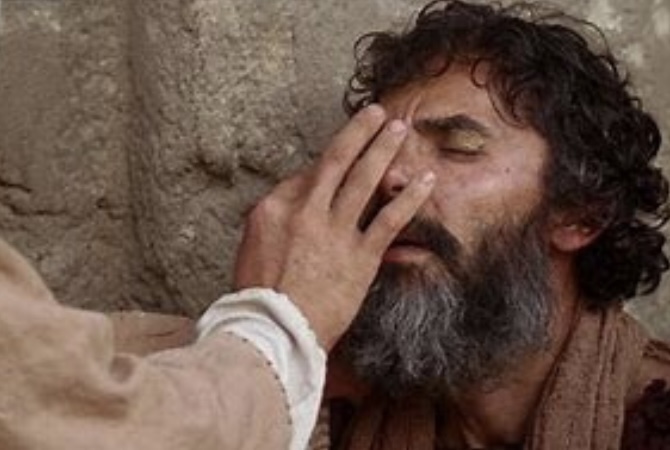
This coming Sunday, we will hear the story of the call of Matthew the tax collector (Matt 9:9–13) as well as the interlinked account of the healing of a haemorrhaging woman along with the raising of a young girl from death (9:18–26). The story of the call of Matthew is told with a somewhat astringent sparseness. “He said to him, ‘Follow me.’ And he got up and followed him.” (9:9). That’s it. No fuss, no fanfare. Just plain and simple, straight to the point: follow me—and he followed him.

This first Gospel, in the order that the four Gospels appear in the New Testament, bears the name of Matthew. It wasn’t the first written Gospel—that was Mark’s, which clearly was a source used by the author of Matthew’s Gospel. By tradition, the attributed author of this Gospel, Matthew, was a tax collector whom Jesus called to follow him. (Why a tax collector who followed Jesus would take the work of a junior and erratic follower as the basis for his work, remains unexplained.)

At any rate: after this tax collector became a disciple of Jesus, he was appointed as an apostle, and later he allegedly wrote an eye-witness account of the time he spent with Jesus. That account runs up until the crucifixion and burial of Jesus, and is wrapped around with some opening chapters about the beginnings of the life of Jesus, and a closing chapter relating to the body of Jesus, his resurrection and departure from his followers.

The tradition that this first Gospel was an eye-witness account by one of the twelve apostles has come under careful scrutiny from biblical scholars, exploring the language, structure, imagery, and ideas found in that narrative.

The consensus from this scholarly work is that the first Gospel in the New Testament was not an eye-witness account, but a carefully crafted account of Jesus, originating in a community of people who had maintained their Jewish culture and practices whilst affirming that Jesus of Nazareth was the long-awaited Messiah—a community that was, therefore, in conflict with the views and teachings of the synagogue leaders in their town, who did not see Jesus in that way.

Within ecclesial tradition, the picture of Matthew, tax collector—disciple—apostle, who subsequently wrote an eye-witness account of the time he spent with Jesus, holds sway. Within biblical scholarship, Matthew is simply a character who appears briefly in the story told by the first Gospel in the New Testament.

Matthew is identified in one short verse narrating his call by Jesus (Matt 9:9). He is also included in the list of twelve who were called to be apostles, with the added descriptor, “the tax collector” (Matt 10:3). He is also named in three other books, with nothing further said about him (Mark 3:18; Luke 6:15; and Acts 1:13). But little else about him is conveyed in the four books that name him. See

Those five fleeting references are the only times we see directly this person in the biblical narratives. He is surely there in other scenes, but he simply blends into the collection of “the disciples” (Mark 2:23; 3:7; 5:31: 6:1, 35, 41, 45; 7:17; 8:1–10, 14, 27, 34: 9:14, 28, 31; 10:10, 13, 23–24; 11:19; 12:43; 13:1; 14:12–16; and Synoptic parallels), “the twelve” (Mark 4:10; 6:7; 9:35; 14:20; and Synoptic parallels; and John 6:66–71; 20:24), or, even more anonymously, into “the crowd” (Mark 2:4, 13; 4:1; Matt 7:28; 13:2; Luke 5:1; 6:17; 7:11–12; 8:4; John 6:2; 12:9, 12; Acts 1:15; 2:6; etc.).

And yet, in the evolving church traditions, Matthew emerges from the shadows to take centre stage as disciple, apostle, saint, and author of the Gospel which is placed first in the New Testament. Some churches even maintain the patristic claim that Matthew wrote in Aramaic, and was later translated into the Greek version that forms the basis of the New Testament text.

The claim about Aramaic comes from a fourth century report by Eusebius of Caesarea that a second century bishop, Papias of Heirapolis, claimed that Matthew “put the logia in an ordered arrangement in the Hebrew language (Ἑβραΐδι διαλέκτῳ), but each person interpreted them as best he could” (Eusebius, Ecclesiastical History 3.39.16). We should note that this is a somewhat indirect witness at quite some remove, and also that the Greek word Ἑβραΐδι can be translated either as Hebrew or as Aramaic.

But this claim falls down from the clear evidence of the Greek text of Matthew’s Gospel, which mirrors very closely both the Gospel of Mark, at many points, and the Gospel of Luke, at other points, in passages found only in Matthew and Luke.

The two key conclusions drawn by many scholars are twofold: first, that Matthew (like Luke) used the Gospel of Mark as a basis for writing a narrative about Jesus—but modified and adapted both the order and wording of passages; and second, that Luke and Matthew had access to another source (whether oral or written) for many of the sayings of Jesus (the source is known as Q). This makes it completely unlikely that Matthew wrote, in Aramaic, or in Hebrew, the earliest account of Jesus.

And ascribing the authorship of this Gospel to the tax collector identified at Matt 9:9 is also a patristic move. The title of this (and the other) Gospels, identifying the alleged author, is found only in later manuscripts and patristic writings; the narrative itself fails to identify anyone as the author, let alone the tax collector named Matthew. This claim is a later apologetic move, most likely made to provide an “apostolic authorisation” to the Gospel.

See

So what do we say, then, of “Matthew”, the purported author of this Gospel, a work which the author declares at the start to be “the book of origins of Jesus, Messiah” (Matt 1:1)? For me, a key to the way that the author of this “book of origins” operated is provided at Matt 13:52, where Jesus concludes a sequence of parables with the statement that “every scribe who has been trained for the kingdom of heaven is like the master of a household who brings out of his treasure what is new and what is old”.

That description encapsulates very clearly, for me, who the author of this Gospel was—a scribe, “trained for the kingdom”, drawing on old resources, but reshaping them so that they are seen to be new. We can see this in many ways in the narrative that he constructs. We can especially see this in the way he presents Jesus as an authoritative teacher of Torah—the one whose words are to be heard, remembered, studied, and passed on. Thus, the reason for his writing of this Gospel.

In this Gospel, we are offered a distinctive, at times unique, portrayal of Jesus. Only in this Gospel does Jesus affirm that all of “the law and the prophets” stand, are not to be annulled, and indeed have been “fulfilled”, or given new life and meaning, by what Jesus teaches (Matt 5:17–20).

So the encounters between Jesus and his disciples, and the scribes and Pharisees, at various moments in the narrative (9:2–8, 10–13; 12:38–42; 15:1–20; 16:1–4; 19:3–9; 21:15–16; 22:34–46) inevitably revolve around differing interpretations of Torah prescriptions and include regular references to (Hebrew) scriptural passages.

Jesus debates the way that the scribes and Pharisees interpret Torah; he meets them on their terms, and engages in these debates in accordance with “the rules” of scripture interpretation. Far from abandoning the Torah, he rather keeps the commandments, valued as “what is old”, and provides distinctive insights and understandings, “what is new”, as he intensifies and radicalises them. (“You have heard it said …”, hard enough; “but I say to you …”, an impossible counsel of perfection?)

In this Gospel alone, Jesus affirms “the scribes and the Pharisees” as those who “sit on Moses’ seat” and teach well—but fail to live by that teaching in their lives (23:1–3). Accordingly, Jesus not only teaches how to live by the law, with a ferocious intensity (5:21–48; 23:13–36), but he puts his teachings into practice; he maintains the old but fills it with new meaning. All of this lies ahead in the passages that will be proposed by the lectionary over the coming months.

Our Father in heaven: a pattern for prayer (Luke 11, Matt 6) part III

In the series of Gospel readings offered by the Revised Common Lectionary, there is a break from the sequential readings from the Gospel of Matthew begun in early January each year. This year—Year A—we began with the early chapters of the Gospel according to Matthew (from 2:1 through to 5:37); but when the season of Lent began, that pattern was interrupted.

We return to Matthew with Matt 9 on the Second Sunday after Pentecost, jumping from where we had left the Gospel back in February, in the middle of the Sermon on the Mount. That means that we have omitted the passage where Jesus says “pray then in this way”, giving his disciples a set of words (6:9–13) that has come to be known as The Our Father (after its opening phrase) or The Lord’s Prayer (after the one who gave it to his disciples). So this week I am posting about this well-known and much-loved prayer. Previous posts were at

What of “the kingdom, the power, and the glory”? These terms are thoroughly scriptural, being found through the pages of Hebrew Scripture. Although not in the earliest manuscripts of either Matthew’s or Luke’s version of The Lord’s Prayer, the closing doxology is found in the text of the Didache (which I think was a second century document) and makes its way into later manuscripts of the canonical documents. That most likely signals that there was an oral tradition that this phrase was in use in later times, so later scribes felt the need to write it back into the words attributed to Jesus.

In scripture, it is not only the kingdom, the power, the glory which is prayed for—there is also the greatness, the majesty, and the victory which is sought, as well as riches and honour. The key text which draws all of these terms together, and places them into a prayer addressing God, is when David assembles “all the officials of Israel, the officials of the tribes, the officers of the divisions that served the king, the commanders of the thousands, the commanders of the hundreds, the stewards of all the property and cattle of the king and his sons, together with the palace officials, the mighty warriors, and all the warriors” (1 Chron 28:1) and addresses them as they prepare to commence work on building the Temple of the Lord in Jerusalem.

After delivering detailed plans for the building to his son Solomon (1 Chron 28:11–19)—plans which had been revealed to him by the Lord—David commissions Solomon for the task, presents him to the people, and then prays a prayer of blessing: “Blessed are you, O Lord, the God of our ancestor Israel, forever and ever. Yours, O Lord, are the greatness, the power, the glory, the victory, and the majesty; for all that is in the heavens and on the earth is yours; yours is the kingdom, O Lord, and you are exalted as head above all. Riches and honour come from you, and you rule over all. In your hand are power and might; and it is in your hand to make great and to give strength to all. And now, our God, we give thanks to you and praise your glorious name.” (1 Chron 29:10–13).

Kingdom, power, and glory are also collected together in Psalm 145: “All your works shall give thanks to you, O Lord, and all your faithful shall bless you. They shall speak of the glory of your kingdom, and tell of your power, to make known to all people your mighty deeds, and the glorious splendor of your kingdom” (Ps 145:10–12). It is God who holds the attributes of power and glory in overseeing God’s kingdom.

These terms were also terms used to honour (and, indeed, flatter!) human kings; the prophet Daniel addresses King Nebuchadnezzar in similarly extravagant terms: “You, O king, the king of kings—to whom the God of heaven has given the kingdom, the power, the might, and the glory, into whose hand he has given human beings, wherever they live, the wild animals of the field, and the birds of the air, and whom he has established as ruler over them all—you are the head of gold” (Dan 2:37–38).

However, the more common use of such flowery ascriptions of might and power are addressed to God, the king (as we have seen above). It is God who exercises power (Exod 15:6; 32:11; Num 11:23; Deut 4:34; 26:8; Ps 21:13; 130:7; 147:5; Isa 10:33; Jer 16:21; Dan 5:23; Nah 1:3).

It is also God in whom glory rests, as many stories on the narrative books attest (Exod 16:7, 10; 24:16–17; 40:34–35; Lev 9:6, 23; Num 14:10, 21; 16:19, 42; 20:6; Deut 5:24; 1 Ki 8:11; 1 Chron 16:28–29; 2 Chron 5:14; 7:1–3). The psalmists also acknowledge the glory of God (Ps 8:1; 24:8–10; 26:8; 29:1–3; 96:7–8; 102:15–16; 104:31; 113:4; 138:5; 148:13). The glory of the Lord is manifest to prophets (Isa 2:19–21; 6:3; 10:16–18; 24:23; 40:5; 42:8; 58:8; 59:19; 60:1–2; 61:3; Ezek 1:28; 3:12, 23; 9:3; 10:4, 18–19; 11:23; 43:4–5: 44:4; Hab 2:14; Zech 2:8).

In telling the story of Jesus, who preaches “the kingdom of God” and indicates that it has come near in him (Mark 1:14; Luke 17:20), the Gospels make note of the power of Jesus (Mark 5:30; 6:2; Matt 11:20; 13:54; Luke 4:14, 36; 5:17; 6:19; 8:46; 19:37; John 10:18) as well as his glory (Luke 2:32; 9:32; John 1:14; 2:11; 8:54; 12:41; 17:5, 22–24).

So the concluding doxology in the longer version of the prayer, ascribing the kingdom, the power, and the glory to God, is both a fitting scriptural conclusion as well as consistent with Jesus’s own perceptions of his role in God’s overarching plan of salvation.

Our Father in heaven: a pattern for prayer (Luke 11, Matt 6) part II

In the series of Gospel readings offered by the Revised Common Lectionary, there is a break from the sequential readings from the Gospel of Matthew begun in early January each year. This year—Year A—we began with the early chapters of the Gospel according to Matthew (from 2:1 through to 5:37); but when the season of Lent began, that pattern was interrupted.

We return to Matthew with Matt 9 on the Second Sunday after Pentecost, jumping from where we had left the Gospel back in February, in the middle of the Sermon on the Mount. That means that we have omitted the passage where Jesus says “pray then in this way”, giving his disciples a set of words (6:9–13) that has come to be known as The Our Father (after its opening phrase) or The Lord’s Prayer (after the one who gave it to his disciples). So this week I am posting about this well-known and much-loved prayer. The first post is at

“Give us bread for the day” has often been seen to be evoking the story embedded within the foundational myth (establishing the central identity) of the people of Israel, when the Lord provided manna to the people whilst they journey in the wilderness (Exod 16; Num 11); further reference is made to this manna in additional books of Hebrew scripture (Deut 8:3, 16; Neh 9:20; Ps 78:24).

That gift of manna, striking in the wilderness experience, was also provided to the Israelites when they camped at Gilgal, on the verge of entering into the land of Canaan (Josh 5:10–12). The story has a potency that makes it an essential element in the identity of Israel: it is a nation which trusts in the gracious provisions of God.

Jesus continues that attitude; God is the one who will provide when something is asked for (Mark 11:24; Matt 7:7, 11; 9:38; Luke 10:2; 11:9, 13; John 14:13; 15:7, 16; 16:23). Consistent with that, asking for “bread for the day” is an appropriate prayer to offer.

The next petition raises other questions. Differences in the Greek terms used in the early versions of this prayer point to the matter; is it “forgive us our sins” or “cancel the debts we owe”? On the different words used, see

Of course, forgiveness is part of the “gospel” of Hebrew Scriptures; the claim that God forgives is found in numerous places. Abraham wrangles with God to forgive Sodom (Gen 18:16–33); Moses pleads, successfully, with the Lord to forgive Israel after their rebellion in the wilderness (Num 14:1–25), and less successfully after the incident involving the golden statue of a calf (Exod 32:30–35). Jeremiah foresees that within the new covenant given by God, forgiveness will be offered (Jer 31:34).

A refrain in a number of places is that “the Lord is slow to anger, and abounding in steadfast love, forgiving iniquity and transgression” (sin” (Exod 34:6–8; Num 14:18; Neh 9:17b; Ps 145:8–9; Joel 2:13; Jonah 4:2; see also 2 Kings 13:23; 2 Chron 30:9). King Solomon prays for God to forgive the people (1 Ki 8:33–40; 2 Chron 6:18–40), the psalmist prays for forgiveness (Ps 25:18; 79:9), and so do some prophets (Ezek 16:63; Dan 9:19; Amos 7:2). Jesus’ prayer petition for God to forgive, in the central prayer he taught, continues this motif.

The associated clause of the prayer, instructing us to follow the example of God and forgive the sins of others, also reflects enduring Israelite understandings. Joseph forgives his brothers (Gen 50:15–21), David forgives Abigail (1 Sam 25:26–28, 32–35). Jesus exhorts his followers to forgive seven times (Luke 17:1–4) or seventy times seven (Matt 18:21–22), and is remembered as the one who came to forgive sins (Mark 2:10; Matt 9:6; Luke 5:24; 23:34), and so this clause of the pray is consistent with that.

If the prayer is about asking God to cancel debts,rather than forgive sins, then another theme in Hebrew Scripture is drawn in by Jesus. The release of slaves and the cancelling of debts was meant to be practised in society every fifty years during the year of Jubilee (Lev 25:8–17; see esp. v.13). Luke explicitly signals this theme in the opening speech of Jesus that he alone reports: “the Spirt of the Lord is upon me … to proclaim release to the captives and recovery of sight to the blind, to let the oppressed go free, to proclaim the year of the Lord’s favour” (4:18–19). The reference to “the year of the Lord’s favour” is commonly taken to be an indication of the Jubilee.

The practice of the Jubilee is, however, dubious. The levitical prescriptions appear to be the ideal that the priests hoped for; actual evidence that this was ever implemented in Israelite society is lacking. Indeed, it is suggested that while the people were in Exile, the land of Israel would “lie desolate”, and “enjoy its sabbath years” (Lev 26:34), providing recompense for all those years when “it did not have on your sabbaths when you were living in it” (Lev 26:35).

Nevertheless, Jesus may well be instructing his followers to pray that this will be a reality in society; that the people “shall proclaim liberty throughout the land to all its inhabitants”, and that those who had been taken to work elsewhere would return “to your property and every one of you to your family” (Lev 25:10). His prayer indicates that he wanted his followers to implement this practice in their lives.

The phrases “save us” and “deliver us” introduce the next two petitions. “Save me” or “save us” is the cry of psalmists (Ps 6:4: 7:1; 22:21; 31:2, 16; 44:6; 54:1; 55:16; 57:3; 59:2; 69:1; 71:2–3; 80:2; 86:16; 106:47; 109:26; 119:94, 146; 142:6; 143:9), and most famously in the Hallel psalm, Psalm 118, in the context of various phrases repeated in Christian worship on a regular basis: “This is the day that the Lord has made; let us rejoice and be glad in it. Save us, we beseech you, O Lord! O Lord, we beseech you, give us success! Blessed is the one who comes in the name of the Lord.” (Ps 118:24–26).

Prophets also cry out for God to save them (Isa 25:9; 33:22; 36:18; 37:20; Jer 17:14), as do the elders of Israel (1 Sam 4:3), the people of Israel (1 Sam 7:8), and the kings David (1 Chron 16:35) and Hezekiah (2 Ki 19:19).

“Deliver me” or “deliver us”, likewise, is a prayer addressed to God by Jacob (Gen 32:10), the people of Israel (Judg 10:15), the friends of Daniel (Dan 3:17), and time and time again by the psalmists (Ps 3:7; 6:4; 7:1; 25:20; 31:1, 15; 39:8; 40:13; 43:1; 51:14; 59:1–2; 70:1–2; 79:9; 106:4; 109:21; 119:170; 120:2; 140:1; 144:11). As Ben Sirach prays in the latter stages of his closing poem, “may he he entrust to us his mercy, and may he deliver us in our days!” (Sir 50:24).

“The time of trial” is a phrase found only in this prayer (Matt 6:13; Luke 11:4) and in the prayer which Jesus is said to have prayed in the Garden of Gethsemane (Mark 14:38; Matt 26:41; Luke 22:40, 46). However, the notion of being tested or put on trial is common in scripture. Moses reminds the Israelites of “what the Lord God did to Pharaoh and to all Egypt, the great trials that your eyes saw” as they wandered in the wilderness (Deut 7:18–19; 29:2–3).

Speaking about the righteous, the psalmist asserts that “the Lord will not abandon them to their power, or let them be condemned when they are brought to trial” (Ps 37:33), whilst the poet who wrote Lamentations reflects that in the invasion of Jerusalem the wrathful God “has besieged and enveloped me with bitterness and tribulation” (Lam 3:5), and Jib poetically reflects, “what are human beings, that you make so much of them, that you set your mind on them, visit them every morning, test them every moment?” (Job 7:17–18).

Several commentators point to the similarity between the request in the prayer taught by Jesus for God to “save us in the time of trial” and that found in later rabbinic teaching in the Babylonian Talmud. In the tractate Berakot, one is encouraged to ask the Lord, “Lead me not into error, nor into iniquity, nor into temptation nor into disgrace” (b. Ber. 60b).

Various prophets describe what took place in Israel, as they were invaded and conquered, and what they foresee in the future, when the Day of the Lord comes, in graphic terms that depict intense trials and tribulations. That is picked up in apocalyptic passages in New Testament texts. Being saved from such trials is in view when Jesus indicates that God will ensure that the apocalyptic trials that he foresees will come to an end (Mark 13:20; Matt 24:22). The seer of Patmos assures the church in Philadelphia that “because you have kept my word of patient endurance, I will keep you from the hour of trial that is coming on the whole world to test the inhabitants of the earth” (Rev 3:10).

Likewise, the phrase “the evil one” is absent from Hebrew Scripture, but the notion of evil is present throughout—from the garden of Eden, where Adam and Eve flaunt the ban on their eating fruit from “ the tree of the knowledge of good and evil” (Gen 2:15–17; 3:1–7), through the forty years when Israel,was condemned to “wander in the wilderness for forty years, until all the generation that had done evil in the sight of the Lord had disappeared” (Num 32:13), and the generations under the Judges when “the Israelites did what was evil in the sight of the Lord” (Judg 2:11; 3:7, 12; 4:1; 6:1; 9:23; 10:6; 13:1).

In their debate with Samuel regarding the need for a king in Israel, the people confess “the evil of demanding a king for ourselves” (1 Sam 12:19); this comes to fruition again and again in the following centuries. Under Jeroboam, son of Solomon, his wife prophesies against him, declaring that “you have done evil above all those who were before you” (1 Ki 14:9); under his brother Rehoboam, the people of Judah “did what was evil in the sight of the LORD; they provoked him to jealousy with their sins that they committed, more than all that their ancestors had done” (1 Ki 14:22).

The same formulaic denunciation then condemns almost all of the northern kingdom kings who follow: Nadal at 1 Ki 15:25–26; Baasha at 1 Ki 15:33–34; Zimri at 1 Ki 16:15–20; Omri at 1 Ki 16:25–28; Ahab at 1 Ki 16:29–30, 22:37–40; Ahaz at 1 Ki 22:51–53; Jehoram at 2 Ki 3:1–2; Ahaziah at 2 Ki 8:26–27; Jehoash at 2 Ki 13:10–13; Jeroboam II at 2 Ki 14:23–29; Zechariah at 2 Ki 15:8–12; Menahem at 2 Ki 15:17–22; Pekahaiah at 2 Ki 15:23–26; Pekah at 2 Ki 15:27–31; and Hoshea at 2 Ki 17:1–4. In other words, almost all of the kings of Israel! (Of course, the work comes from those telling the story in the southern kingdom.)

The notion of a personified “evil one” does not emerge until much closer to the time of Jesus. Satan was originally “an adversary” to Balaam (Num 22:22–23), David (1 Sam 29:4; 2 Sam 19:22; 1 Chron 21:1), Solomon (1 Ki 11:14, 23–25) and the high priest Joshua in the time of return from Exile under Darius of Persia (Zech 3:1–10). In Jewish literature in the ensuing centuries—1 Enoch, Jubilees, 2 Enoch—the adversary develops into an evil personage.

Most famously, the accuser from the heavenly court, delegated by God to prosecute the case against Job (Job 1:6–12; 2:2–8), would eventually become Satan, tester of Jesus (Mark 1:13), a fallen heavenly being (Luke 10:18) who is “deceiver of the whole world” (Rev 12:9; 20:2–3), and “the evil one” from whom Jesus instructed that we should pray to be delivered. He thus draws deep from the wells of his Jewish heritage in these petitions—“deliver us … save us”.

Our Father in heaven: a pattern for prayer (Luke 11, Matt 6) part I

In the series of Gospel readings offered by the Revised Common Lectionary, there is a break from the sequential readings begun in early January each year. This year—Year A—we began with the early chapters of the Gospel according to Matthew (from 2:1 through to 5:37); but when the season of Lent began, the Gospel readings were taken largely from John, with John and Luke featuring during the Sundays after Easter. Only now, after Trinity Sunday, does the sequential pattern resume.

However, that pattern begins with Matt 9 on the Second Sunday after Pentecost, jumping from where we had left the Gospel back in February, in the middle of the Sermon on the Mount. The missing chapters (5:38 to 9:8) are omitted by the lectionary. Now, the words of Jesus in the Sermon on the Mount are confronting and difficult—but that is no reason to avoid them!

What is omitted is the latter part of the sequence of Antitheses, including the command to love our enemies; teachings on fasting, prayer, and almsgiving; and a series of sayings about assorted matters, each of which presses us to be more intentional and focussed in our discipleship.

And in the middle of all of that, “pray then in this way”, says Jesus, giving his disciples a set of words (6:9–13) that has come to be known as The Our Father (after its opening phrase) or The Lord’s Prayer (after the one who gave it to his disciples). So before we get too far into the series of readings in the season of Pentecost, I thought I would offer some thoughts about this well-known and much-loved prayer.

Christians are used to praying this prayer on a regular basis, in obedience to the instructions of Jesus recorded in two Gospels: “when you pray, say …” (Luke 11:2; Matt 6:9). This prayer can be considered a succinct primer for prayer, since it contains the key elements of praying.

After an opening adoration of God (“our Father in heaven, holy is your name”), there follows prayers for the world (“your kingdom come, your will be done”), petitions for ourselves (“give us bread for the day, forgive us our sins, do not bring us to the time of trial”), and intercessions for others (“as we forgive those who sin against us”). In the later version of the prayer, a closing benediction is included (“yours is the kingdom, the power, the glory”), ending, of course, with “Amen”. The pattern is clear and concise.

Each element in this prayer is and expression of traditional Jewish piety; every line draws from Hebrew Scripture. Although this prayer is so frequently associated with Jesus, it is not a prayer that is original to him in its content or orientation. The originality of the prayer lies not in its content, but in the way that Jesus has drawn together each element into a cohesive unity.

The structure of the prayer is pleasingly aesthetic. There is an opening address to God (“our father in heaven”) and a closing benedictory phrase (“yours is the kingdom, the power, and the glory”). These phrases frame the who,e prayer; whilst the largest component of the prayer, the inner section, is focussed on us where we are in this present time, the outer frames set our lives into this larger context.

Following the opening phrase, there are three clauses addressed to God (“holy is your name … your kingdom come … your will be done”). These clauses extend the opening address to God, identifying key elements in how we understand God. (See below for further discussion of this.) The third clause is extended with the phrase “on earth as in heaven”, drawing our attention to the close correlation that is expected between the divine and we human beings.

Before the closing phrase, there are three requests made of God, for ourselves (“give us bread for the day … forgive us our sins … do not bring us to the time of trial”) with the second and third phrases extended with an additional phrase (“as we forgive those who sin against us” and “rescue us from the evil one”).

The second extension draws the attention of people who are praying the prayer away from us as people praying (give us, forgive us) to others who are beyond the scope of the group praying—to other people in society with whom we engage day by day.

And the third extension draws the attention of people away from us as people within this material world, to a dimension that is somehow beyond, transcending this world. Reference to “the evil one” raises the spectre (oops!) of the realm of “principalities and powers” (as referred to in the epistles). Life as we know it is not entirely within our own control; there are other forces—both evil, and also good—that impinge upon us. It’s an interesting extension in a prayer which is, at least in the larger middle section, focussed on our here-and-now in this world.

So in my mind, just as the opening and closing phrases balance each other, so these three petitions balance with the three addresses to God in the earlier half of the prayer. The symmetry is not exact, in terms of precise syllables or words used; but the syntactical structure is clearly patterned and pleasingly symmetrical, in my mind.

And then, to make sure that we know that the prayer is ending, we have the tag-line, as it were: “for ever and ever, Amen”. So in my mind, quite often when I pray this prayer, I hear the structure as an invitation to pause, focus on God, remember our needs and remember also others, recall the immediate dimension as well as the transcendent, and then conclude with gratitude to God. The Amen at the end is the typical conclusion to prayer, signalling the agreement of the prayers and all present to what has been prayed.

*****

2

The content of the prayer, as previously noted, draws at every point from Hebrew Scripture. The opening address identifies God as father, and as “hallowed”—a somewhat archaic adjective, rarely used now in common speech, meaning holy, consecrated, sacred, or revered. The related noun, hallow, denoted a saint in older English. The concept of being holy, however, was well- known in ancient Israel, and appears frequently in Hebrew Scripture.

Addressing God as “father in heaven” is found in just a few texts in Hebrew Scriptures: in the cry of “the faithful one”, “you are my Father, my God, and the Rock of my salvation!” (Ps 89:26), in the praises of the psalmist, “Father of orphans and protector of widows is God in his holy habitation” (Ps 68:5), and in the questioning of the prophet Malachi: “have we not all one father? has not one God created us? why then are we faithless to one another, profaning the covenant of our ancestors?” (Mal 2:10).

By contrast, that God’s name is holy is an affirmation found many times in Hebrew Scriptures. God is addressed as holy (Ps 22:3) and God’s name is holy (Ps 30:4; 33:21; 97:12; 103:1; 105:3; 106:47; 111:9; 145:21). “Holy One” is a term applied to God in the Writings (Ps 71:22; 78:41; 89:18; Prov 9:10; Job 6:10; Sir 4:14; 23:9; 53:10; 47:8; 48:20) and by the Prophets (Isa 1:4; 5:19, 24; and a further 24 times; Jer 50:29; Ezek 8:13; Hos 11:9, 12; Hab 1:12; 3:3). When Hannah sings with joy of the son whom she is expecting, she describes God as the Holy One (1 Sam 2:2).

Just as God was holy (Lev 11:44; 19:2; 20:7; 21:8; 1 Sam 2:2; Ps 99:5, 9), so God had called Israel to be a holy people (Exod 19:5–6; Deut 7:6; 14:2; 26:19; 28:9) and to live lives of holiness (Lev 11:45; Ps 77:13). God provided the people with a “holy land” for them to live (Josh 5:15) and there was a “most holy place” in the heart of the Temple where God dwelt (1 Kings 7:50; 1 Chron 6:49). And so, the followers of Jesus are instructed to consider themselves as God’s holy people (1 Cor 3:17; 6:19; Eph 5:25–27; Col 1:22; 3:12; Heb 3:1; 1 Pet 1:13–16; 2:5, 9) and to live accordingly.

“Your kingdom come” also expresses a hope that is central to the Hebrew Scriptures. Israel, of course, eventually adopted the pattern of nations that surrounded it, and appointed a king (1 Sam 8–10)—although not without some wrangling with the prophet Samuel (1 Sam 8:10–18). The various kings of the ensuing centuries each had to reckon with the prophets that were anointed by God and gifted by the Spirit, often to their great frustration!

A number of psalms acknowledge that God is in fact sovereign over Israel, declaring “the Lord is king” (Ps 10:16; 93:1; 96:10; 97:1; 99:1; and see also 1 Chron 16:31). “The Lord sits enthroned over the flood; the Lord sits enthroned as king forever”, says one song (Ps 29:10), amd extending the scope of divine sovereignty, “the Lord, the Most High, is awesome, a great king over all the earth”, is a striking claim in Ps 47:2.

One psalm claims that the kingdom of the Lord “is an everlasting kingdom, and your dominion endures throughout all generations” (Ps 145:13; also Dan 4:3; 7:27). Whilst the prophets who speak about a future kingdom invariably foresee a restoration of the greatness of a Israel in the land (Isa 9:7; 11:1–5; Amos 9:11–15; Obad 1:21), the developing notions relating to the demand for justice-righteousness, the judgement of God, the prediction of a Day when the Lord will act, and the coming of The End are all premised on the sovereignty of the Lord God and a certainty that God will indeed act to bring in a time and a place where God’s ways will guide all. See

For “on earth as in heaven” in the Lord’s Prayer, see

So Jesus stands firmly in that prophetic line of assurance in God’s sovereign power and certainty that God’s kingdom will come for people of all the nations (Mark 9:1; Matt 8:11; 16:28; 24:14; Luke 9:27; 13:29) and, indeed, that this kingdom has come near to Israel through his own message and activities, as he regularly declares (Mark 1:15; Matt 4:17; 10:7; 12:28; Luke 10:9, 11; 11:20). So this line in the prayer expresses both faithful Jewish expectations and typical perspective of Jesus.

See more at

Forcing scripture to support doctrine: texts for Trinity Sunday (2 Cor 13, Matt 28; Trinity A)

This coming Sunday is one of those extremely rare moments in the course of the church year. It’s a Sunday that raises some difficulties for me. First, it’s one of the very few times in the Christian calendar that a Sunday is named for a doctrine, rather than for a biblical story (Easter, Pentecost, Christmas, and the like). And second, it is unusual in that it presents problems for the shapers of the lectionary, since (in my view) the Doctrine of the Trinity is not actually proclaimed in the biblical texts.

Indeed, we might well argue that the texts which are selected for this coming Sunday are actually being asked to undertake work that they weren’t intended to do, and that they can’t actually do without significant violence being done to them. I have already explored the two Hebrew Scripture passages (Genesis 1 and Psalm 8); see

In this post I turn to the two New Testament passages (2 Corinthians 13 and Matthew 28). What then, first, of Paul’s closing words of his second letter to the Corinthians? This provides one of the rare instances in the New Testament where Jesus, God, and the Holy Spirit appear in close proximity within the same sentence. Could this be an early statement of a three-in-one deity? Some interpreters would have us think so.

However, the blessing that is offered at the end of this letter is not Paul making a doctrinal declaration about the inner nature of God. It is, rather, a poetically-inspired literary variation and expansion of the typical closing words that we find at the end of his letters.

“The grace of the Lord Jesus be with you” is how he has ended his earlier letter to the Corinthians (1 Cor 16:23), a closure similar to “the grace of our Lord Jesus Christ be with you” (1 Thess 5:28), “the grace of the Lord Jesus Christ be with your spirit” (Phil 4:23 and also Phlmn 25), and “may the grace of our Lord Jesus Christ be with your spirit, brothers and sisters. Amen” (Gal 6:18). Each ending has a very minor stylistic variation.

Writing to the believers in Rome, where dissension had gripped the house gatherings in that city, Paul most likely ended his long letter with a different blessing, “the God of peace be with all of you. Amen” (Rom 15:33). At some point, the extended greetings of Rom 16:1–16 was added, leading to a later word of blessing, “the God of peace will shortly crush Satan under your feet; the grace of our Lord Jesus Christ be with you” (Rom 16:20), after which yet more greetings are offered (Rom 16:21–23) and then a quite uncharacteristically flowery closure is appended–most likely by a later scribe, wanting to give a grand finale to Paul’s longest letter (Rom 16:25–27). In place of that excessive ending, another scribe substituted the more typical Pauline blessing, “the grace of our Lord Jesus Christ be with all of you. Amen” (marked as Rom 16:24 in our numbering).

All of which indicates that the closing blessing in Paul’s authentic letters was both predictable, in that it offered grace, and also variable, in that it was occasionally nuanced and modified from the basic form. Such is the case in 2 Cor, where the standard blessing is extended.

The first phrase picks up Paul’s concerns in this letter for God’s grace, manifest to the Corinthians (2 Cor 1:12; 4:15; 6:1; 8:1; 9:14; 12:9). The second phrase adds God’s love, evident not only in Paul’s earlier words in 1 Cor 13, but also in this letter (2 Cor 5:14; 13:11). And the third phrase evokes the compassionate outpouring of the opening chapter of this letter, as Paul expresses his fellowship with the Corinthians by offering them consolation in their sufferings (2 Cor 1:3–11) and his fervent desire to visit them (2 Cor 1:15—2:4), culminating in his passionate expression, “I wrote you out of much distress and anguish of heart and with many tears, not to cause you pain, but to let you know the abundant love that I have for you” (2 Cor 2:4).

Indeed, it in in this letter that Paul most clearly articulated his understanding of, and commitment to, “the ministry of reconciliation ” (2 Cor 5:11–21). This understanding has surely come to fullest expression in the context of his relationship with the Corinthians, with whom he has certainly struggled, yet for whom he has a profound depth of compassion and love. He yearns to be held within “the communion of the Holy Spirit” with them.

The closing blessing at 2 Cor 13:13 is thus a personal, compassionate expression of his love and concern for the Corinthians-a fitting ending to a most passionate letter. It is far away from being a statement of the doctrine of God.

Which leaves, last of all, the closing words of Matthew’s Gospel (Matt 28:16–20), in which Jesus is said to have given a final command to his disciples, and assured them of his enduring ongoing presence with them “to the end of the age”? Here, embedded in the primary command to “go to all nations”, there is the subsidiary instruction to “make disciples”, as well as a further subsidiary instruction to “baptise in the name”. It is this last clause, of course, which motivates the offering of this passage for Trinity Sunday.

The focus of the passage which is commonly referred to as “the Great Commission” in Matthew’s Gospel (28:19–20) need to be read carefully. There are four key verbs (doing words) in these two verses: go, teach, baptise, teach. In strict syntactical analysis, the main verb is the one in the imperative (expressing a command): “make disciples”. Subsidiary to that are the other three verbs, each of which is in a participial form (indicating an action that is related to, or consequent from, that main verb). So making disciples is the key factor in this commission.

The act of making disciples is directed towards “the nations”—that is, to anyone with whom the followers of Jesus come into contact. It is to be expressed through two activities: baptising, and teaching. The act of making disciples is also to take place “as you are going”, that is, as followers of Jesus are making their way through the world in the days ahead.

Teaching orients the focus of the disciples back to the time that they spent with Jesus; they are to teach the people of the nations “to obey everything that I have commanded you”. As Matthew has taken great care to compile and collate the teachings of Jesus into five clear sections of his Gospel (chs. 5–7, 10, 13, 18, 23–25), the guidelines provided by Jesus are evident. What he has taught in his time with the disciples is to be passed on (in good rabbinic style) to those whom they then instruct. Teaching is an activity for life in this world, very clearly.

Baptising orients the focus of the disciples to the life of the church in the future. Belonging to Jesus involves submitting to the ritual of immersion into water, signalling the new life that is taken on through faith. So, when we look at each of these factors—the syntax, the content, the focus of the passage, we must conclude that thispassage is clearly directed towards the activity that the disciples of Jesus are to undertake from this time onwards. It is not offering a doctrinal definition.

The formula used in Matt 28:19 is, in fact, something that emerges only later in the life of the church (probably not until the time of Constantine, as far as we can tell from other Christian literature). Once again, life in community on this earth is the focus. There is no sense of being baptised (“christened” in the old language) into a mysteriously complex entity of a triune being in order to “get into heaven” in accordance with institutional theological dogma. The emphasis is on community building and discipleship development within the evolving faith communities of the Jesus movement.

The focus here is on what the disciples need to do in the earthly life that stretches ahead of them: bear witness, make disciples, teach and baptise, continue out amongst “the nations” the mission that the earthly Jesus has been undertaking amongst “the lost sheep of the house of Israel”. That is far removed from any abstract speculative hypothesising about the nature of a transcendent divine being.

Save us, we beseech you: singing a Hallel psalm (Psalm 118; Lent 6A, Palm Sunday)

“Save us, we beseech you, O Lord!” This is the cry we hear in the psalm which is offered by the lectionary for this coming Sunday, Palm Sunday, the Sunday in Lent. Psalm 118 is one of the Hallel Psalms—six psalms (113 to 118) which are sung or recited on high festival days, such as Passover (Pesach), the Festival of Weeks (Shavuot), and the Festival of Booths (Sukkot), as well as Hanukkah and the beginning of each new month. This final Hallel Psalm, like the other five, is intended to be an uplifting, celebratory song, suitable for the congregation to hear and to sing as a way to inspire and rejoice.

See

It is no surprise that this psalm is offered by the lectionary for this coming Sunday, Palm Sunday—because the Gospel story for this day, of Jesus entering the city of Jerusalem to the acclaim of the crowd (Matt 21:1–11), is certainly one of celebration and joy. It is also, equally unsurprisingly, offered as the psalm for a week later, on Easter Sunday, which celebrates something much greater and more enduring: the raising of Jesus from the dead (Matt 28:1–10).

But clearly the psalm has a good fit with the Palm Sunday story that we will hear on Sunday; indeed, the Gospel writers report that the crowd cheering Jesus was singing, “Blessed is the one who comes in the name of the Lord”—which is, of course, a verse from the final Hallel Psalm (Ps 118:26).

Blessing God is a favourite Jewish activity—indeed, so many prayers still used by Jews today begin with a phrase of blessing: “Blessed are you, O Lord our God …”. Blessed are You, O Lord our God, Ruler of the universe, Who brings forth bread from the earth is prayed before a meal. Blessed are You, O Lord our God, Ruler of the universe, who creates the fruit of the vine is prayed before drinking wine. And a favourite blessing which I learnt from Jews is Blessed are you, O Lord our God, Ruler of the Universe, who has kept us alive, sustained us, and brought us to this moment. It’s a prayer to mark momentous occasions in life.

All of these prayers of blessing begin with the Hebrew words, Baruch atah Adonai Elohenu melekh ha’olam, the same formula of approaching, acknowledging, and blessing God.

We can see that formula used in blessings spoken by David (1 Chron 29:19 and the psalmist (Ps 119:12), as well as in later Jewish texts such as Tobit 3:11; 8:5, 15–17; Judith 13:17; 14:7; the Prayer of Azariah (six times), and 1 Maccabees 4:20. It appears also in New Testament texts such as Luke 1:68; Rom 9:5; 2 Cor 1:3; Eph 1:3; and 1 Pet 1:3.

More familiar, perhaps, is when Jesus uses a prayer of blessing, but speaks it to human beings; “blessed are you, Simon son of Jonah” (Matt 16:17), or “blessed are the eyes that see what you see”, to his disciples (Luke 10:23), or “blessed are those who have not seen and yet have come to believe” (John 20:29), and most famously of all, in a set of blessings spoken to a crowd on a level place (Luke 6:20–22) or to his disciples on a mountain top (Matt 5:3–12).

So the cry of the crowd as Jesus enters Jerusalem, “Blessed is the one who comes in the name of the Lord” (Ps 118:26) is a typical Jewish exclamation at a moment of joyful celebration.

*****

A further reason for linking this psalm with the Gospel narrative might well be that the cry of the crowd, “Hosanna!” (Mark 11:9–10; Matt 21:9; John 12:13). The word transliterated as “Hosanna” might actually be better translated as “save us”—another quote from the previous verse in that same psalm (Ps 118:25). The Hebrew comprises two words: hosha, which is from the verb “to save”, and then the word na, meaning “us”. Hosanna is not, in the first instance, a cry of celebration; rather, it is a cry of help, reaching out to God, pleading for assistance—and yet with the underlying confidence that God will, indeed, save, for “his steadfast love endures forever” (vv.1, 29).

See

Whilst the psalm, overall, sounds thanks for a victory that has been achieved, the petition, “save us” (v. 25) lies behind the first substantial section of this psalm (vv.5–14), which is largely omitted by the lectionary offering for this coming Sunday (which is Ps 118:1–2, 14–24). That section begins “out of my distress I called on the Lord” (v.5), claims that “the Lord is on my side to help me” (v.7), and concludes with rejoicing, “I was pushed hard, so that I was falling, but the Lord helped me; the Lord is my strength and my might; he has become my salvation” (vv.13–14).

Save us” is a prayer offered in other psalms (Ps 54:1; 80:2; 106:47); the petition appears more often in the singular, “save me” (Ps 7:1; 22:21; 31:16; 54:1; 55:16; 59:2; 69:1; 71:2; 109:26; 119:94, 146; 142:6; 143:9). “Save us” when faced with danger is the prayer of the elders of Israel as they faced the Philistine army (1 Sam 4:3) and the all the people a little later (1 Sam 7:8), David when the ark was put in place in Jerusalem (1 Chron 16:35), Hezekiah when Judah was being threatened by the Assyrians (2 Ki 19:19), as well as the prophet Isaiah at the same time (Isa 25:9; 33:22; 37:20).

This prayer in the context of festive celebrations—the context for which Psalm 118 appears to have been written—expresses the firm confidence of the people, trusting in the power of their God. That viewpoint is perfectly applicable to the Palm Sunday story (and even more so to the Easter Sunday narrative!).

But this psalm is not only a prayer of celebration; it is also a strong statement about the resilience and trust of the people, expressing their belief that God will give them redemption, even in the face of their Roman overlords, who had held political and military power for many decades. If this is what the crowd intended with their cry as Jesus enters the city—and I have no reason to see otherwise—then this is a striking, courageous political cry embedded in the story! It is a cry that affirms that salvation is at hand.

*****

Salvation is what is in the mind of the people as they cry, “save us” (v.25) and the earlier affirmation, “I thank you that you have answered me and have become my salvation” (v.21). As we have noted, “save us” was a recurring cry amongst the Israelites. In the song sung after the Exodus, the people acclaim God, singing “the Lord is my strength and my might, and he has become my salvation” (Exod 15:2). In his song of thanksgiving after battles with the Philistines, David praises God as “my rock, my shield and the horn of my salvation” (2 Sam 22:3; also vv.36, 47, 51; and 1 Chron 16:23, 35).

The same language, of salvation, appears in the psalms (Ps 13:5; 18:2, 35, 46; 24:5; 25:5; and another 40 times) and the prophets (Isa 12:2–3; 25:9; 33:2, 6; 45:8, 17; 46:13; 51:5–6; 52:7, 10; 56:1; 59:11; 61:10; 62:11; Mer 3:23; Mic 7:7; Hab 3:18). From the psalms, we remember “the Lord is my light and my salvation” (Ps 27:1); from Isaiah, “I will give you as a light to the nations, that my salvation may reach to the end of the earth” (Is 49:6).

There are a dozen occasions in Hebrew Scripture when God is identified as Saviour (2 Sam 22:3; Ps 17:7; 106:21; Isa 43:3, 11; 45:15, 21; 49:26; 60:16; 63:8; Jer 14:8); as the Lord God declares through Hosea, “I have been the Lord your God ever since the land of Egypt; you know no God but me, and besides me there is no Saviour” (Hos 14:4).

Salvation is linked with righteousness; “the salvation of the righteous is from the Lord … he rescues them from the wicked and saves them” (Ps 37:39–40). Being righteous is a quality of the Lord God (Ps 11:7; 35:28; 50:6; 71:16; 85:10; 89:16; 97:2, 6; 103:17; 111:3; 116:5; 119:137, 152; 129:4; Isa 45:21; Jer 23:6; 33:16; Dan 9:16; Zeph 3:5) which is thus desired of those in covenant with God (Gen 18:19; 1 Sam 26:23; 2 Sam 22:21, 25; 1 Ki 10:9; 2 Chron 9:8; Job 29:14; Ps 5:8; 9:8; 11:7; 33:5; Prov 1:3; Isa 1:27; 5:7; 28:17; 42:6; 61:11; Jer 22:3; Ezek 18:5–9; Hos 10:12; Amos 5:24; Zeph 2:3; Mal 3:3).

It is no surprise, then, that this psalm celebrates that “[God] has become my salvation” (Ps 118:21) by holding a “festal procession with branches” (v.27), entering through “the gates of righteousness” (v.19) and proceeding all the way “up to the horns of the altar” (v.27), singing “save us, Lord” (v.25) and “blessed is the one who comes in the name of the Lord” (v.26). This is a high celebratory moment!

So the closing verses take us back to the opening refrain, “O give thanks to the Lord, for he is good, for his steadfast love endures forever” (v.29; see also vv.1–4). The celebration is lifted to the highest level, with praise and thanksgiving abounding. And that makes this a perfect psalm for Palm Sunday!

****(

On the indications of the political nature of the Palm Sunday scene, see