The account of how Peter heals a lame man (3:1–11) is the passage proposed by the Narrative Lectionary for the Third Sunday in Easter this year. This healing provides a specific instance of the “many wonders and signs” which the apostles performed (2:43).
As this particular healing takes place in the grounds of the temple (3:2), the focus remains on the heart of the Jewish capital. Peter and John come to the temple to pray (3:1), in keeping with both the community practice of prayer (2:42) and of regularly attending the temple (2:46). The temple remained a focal point for prayer until its destruction in 70 CE.
The juxtaposition of the lame man and the temple setting is striking. Lame animals were decreed to be unsuitable as offerings to God (Deut 15:21; Mal 1:8,13) and lame people were amongst those forbidden from drawing near to offer sacrifice in the temple (Lev 21:18; 2 Sam 5:8). Yet amongst the prophets, the lame are included among the outcasts gathered by God as the faithful remnant (Jer 31:8; Mic 4:6-7; Zeph 3:19), and the vision of the return of the redeemed to Zion (Isa 35:1–10) includes the assertion that “the lame shall leap like a deer” (Isa 35:6).
Jesus has followed in this prophetic tradition by healing the various categories of outcast; by his activity, “the blind receive their sight, the lame walk, the lepers are cleansed, the deaf hear, the dead are raised, the poor have good news preached to them” (Luke 7:22, par Matt 11:5; see also Luke 4:18; Matt 15:30–31; 21:14).
In parables told only by the Lukan Jesus, the lame are included in the outcasts invited to the banquets (Luke 14:13,21). This compares with the account of how Mephibosheth, the lame grandson of Saul, son of Jonathan, ate regularly at the table of King David (2 Sam 4:4; 9:1–13).
Although no account of a specific healing of a lame person is found in Luke’s Gospel (cf. John 5:1–9), the healing of this lame man (the first specific healing incident in Acts) places the apostles in continuity with Jesus who heals the lame (Luke 7:22). A similar healing is later performed by Paul (14:8–10), whilst Philip is described as healing “many others who were paralysed or lame” (8:7).
The lame man’s expectation that he would receive alms (3:2–3) is reasonable. Caring for the needy was integral to Jewish piety (Deut 15:7–11). By the hellenistic period, almsgiving had become highly valued as a religious duty (Sir 3:30; 7:10; 29:9–12; 40:24; Tob 4:7–11,16; 12:8–10; 14:8–11; cf. Matt 6:2–4). The Lukan Jesus commended almsgiving (Luke 11:41; 12:33) and subsequent characters in Acts practice almsgiving—notably, Cornelius (Acts 10:2,4,31) and Paul (24:17).
However, as Peter and John “look intensely” at the man (3:4; on such intense scrutiny, see 14:9), they sidestep this responsibility, for the focus in this account is to be on their exercise of divine power. Peter commands the man to stand, revealing that his power comes from “the name of the Messiah, Jesus of Nazareth” (3:6).
This name has already been declared as the source of salvation (2:21) and forgiveness (2:38); “the name” remains a constant emphasis in the ensuing scenes (3:16; 4:7,10,12,17–18,30; 5:40-41) and appears subsequently in connection with proclamation (8:12; 9:15–16,27-28; 10:43; 15:14,17; 21:13), baptism (8:16; 10:48; 19:5; 22:16) and exorcism (16:18; 19:13,17).
As Peter raises up the lame man (3:7), he is healed and strengthened, and enters the temple (3:8). The healed man immediately recognises the source of this miracle, for he is portrayed as “praising God” (3:8,9). The man thus joins himself with the community members whose regular life is typified by an attitude of praise towards God (2:47).
Later in the account, even the people will praise God, recognising that God has been at work in this incident (4:21). At this point, their response is one of “wonder” (3:10), a questioning attitude also displayed towards Jesus (Luke 4:36; 5:9), and “amazement” (3:10), a more insightful appreciation of the incident, as also displayed towards Jesus (Luke 5:26).
The companion passage that is offered by the Narrative Lectionary alongside acts 3 is a short excerpt from Mark 6. If you’d like to explore some of the key elements in this passage—“take nothing for [the] journey except a staff; no bread, no bag, no money”, “if any place will not welcome you and they refuse to hear you, as you leave, shake off the dust that is on your feet as a testimony against them”, and “casting out many demons”—see
My post about this week’s Gospel passage is once again indebted to conversations that I have had with my wife Elizabeth about this story, and the surrounding material, in Matthew’s Gospel. She has undertaken much careful research into the way that Matthew redacts his Markan source.
*****
The story that the lectionary invites us to hear this coming Sunday (Matt 14:13–21) is Matthew’s account of “the feeding of the five thousand”, a much-beloved miracle of Jesus. It is also one of a handful of miracle stories that is narrated by all four canonical Gospels (Mark 6:30–44; Matt 14:13–21; Luke 9:12–17; and John 6:1–14).
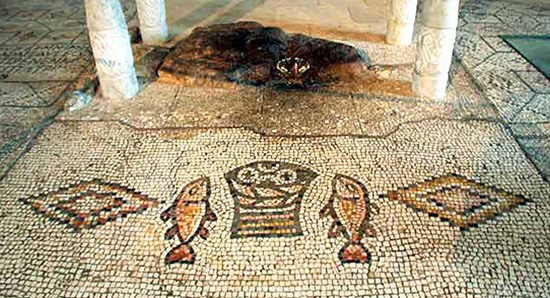
The set-up for this story is that Jesus and the disciples are surrounded by a large crowd, time is drawing on, and there appears to be no food to eat. The punchline for the miracle is that, whilst at the start there was “nothing but five loaves and two fish”, by the end,,after “all ate and were filled”, there were “twelve baskets full” of leftovers!
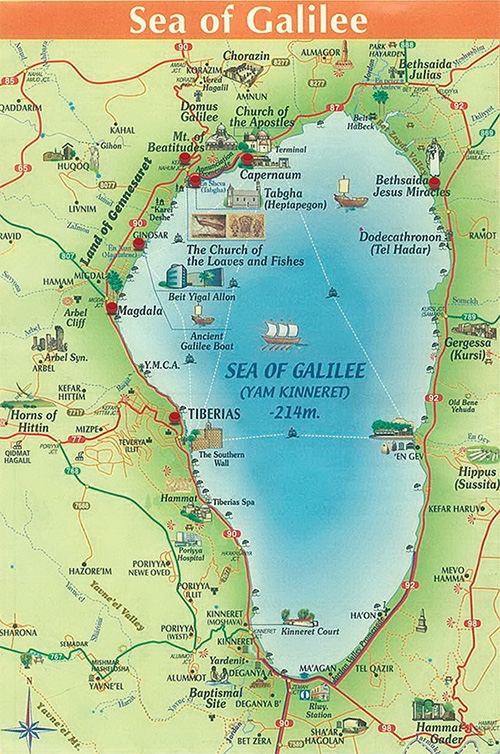
For John, the feeding takes place “on the other side of the Sea of Galilee, also called the Sea of Tiberias” (John 6:1), before Jesus and the disciples cross the Sea of Galilee, back to Capernaum (John 6:16–17). Mark, however, locates this feeding in Jewish territory, after the first trip that Jesus had made to the Decapolis, on “the other side” (Mark 4:35—5:21). Matthew and Luke follow Mark in locating this scene in Jewish territory.
Then, following Mark, Matthew recounts a second feeding, of four thousand, which Mark locates on the Gentile side of the lake (Mark 8:1–10). The geography in Matthew’s narrative of this scene (Matt 15:32–39) is, as we shall see, somewhat vaguer; the incident is, however, the same in most details as that found in Mark. Luke omits all mention of this second feeding, as does John.
The number fed is consistently reported in all four accounts as being five thousand—although there are variations here. John offers this figure as an approximation of the whole crowd present (John 6:10). Mark and Luke both specify that those fed were men only (Mark 6:44; Luke 9:14), whilst Matthew teases out the implications: “those who ate were about five thousand men, besides women and children” (Matt 14:21).
Mark notes that Jesus organised the crowd in smaller groups, sitting on “green grass” (Mark 6:39), noting that “they sat down in groups of hundreds and of fifties” (Mark 6:40). Matthew simply notes that they sat on grass, colour not specified, and makes no reference to sitting in groups (Matt 14:19). This is typical of the way that Matthew omits much of the detailed narrative colouring that Mark regularly reports—such as the groups on the green grass.
So Matthew’s account is somewhat shorter than Mark’s account (seven verses in Matthew, ten verses in Mark). Both accounts, as well as Luke’s version, report the actions of Jesus as he “looked up to heaven, and blessed and broke the loaves, and gave them to his disciples to set before the people” (Mark 6:41; Matt 14:19; Luke 9:16).
This sequence clearly reflects the liturgically-developed pattern (repeated religiously in eucharistic settings over the centuries) of the last supper of Jesus: “he took a loaf of bread, and after blessing it he broke it, gave it to them … then he took a cup, and after giving thanks he gave it to them, and all of them drank from it” (Mark 14:22–23 and parallels; and see also 1 Cor 11:23–25).
The pattern is missing from John’s account, which simply notes that “Jesus took the loaves, and when he had given thanks, he distributed them to those who were seated” (John 6:11). John’s Gospel omits any specific report of eating at that “last supper”, focussing rather on the washing of feet and discussion of Jesus’s imminent departure (John 13).
Johannine allusions to eucharistic practice appear later in chapter 6, after a long sequence of midrashic exposition by Jesus, around the theme of “the living bread … that came down from heaven” (John 6:22–59)—a discourse that we learn, at the end, is set “in the synagogue at Capernaum” (John 6:59)—back on the side of the lake from whence Jesus had departed (John 6:16).
*****
All four stories contain the significant detail that “all ate and were filled; and they took up what was left over of the broken pieces, twelve baskets” (Matt 14:20; see also Mark 6:43; Luke 9:17; John 6:13). Now twelve was an important number for the Jewish people; perhaps the twelve baskets are symbolic for the Jewish people? In which case, we might ponder how much of the story is symbolic, and how much “actually happened”?
To think a little about twelve … There were 12 sons of Jacob (Gen 49:1–28), then 12 tribes of Israel (Deut 27:12–13). On the table in the Tabernacle were placed 12 silver plates, 12 silver dishes, and 12 golden plates (Num 7:84–89), and the breastplate of the priest contained 12 precious stones (Exod 28:21) as emblems of the 12 tribes as they camped round about the Sanctuary. Moses built an altar at the foot of Mount Sinai with 12 pillars (Exod 24:4) and Joshua had the people take 12 stones from the River Jordan to be placed as a memorial to their entry into the land (Josh 4:1–10).
As the story continues in the Gospels, Jesus chose 12 apostles as his inner circle (Mark 3:13–19 and parallels in Matt 10 and Luke 6; and John 6:67–71). Jesus indicates that this signified the link between his movement and the traditions of Israel (Matt 19:28; Luke 22:30; and see James 1:1). And when Jesus feeds the great crowd of 4,000 people beside the Sea of Galilee (Mark 8:1–9), there are twelve baskets of bread left over (Mark 8:19).
And in the final dramatic visions written about the promised future by the aged seer John, the number 12 figures prominently. We see this first in the vision of a woman wearing a crown with 12 stars (Rev 12:1). The number then appears in the architecture of “the holy city Jerusalem coming down out of heaven from God” (Rev 21:10), with its 12 gates with 12 angels and the names of the 12 tribes (Rev 21:12), and its 12 foundations with the names of the 12 apostles (Rev 21:14). Finally, there are 12 pearls on these 12 gates (Rev 21:21) and 12 fruits on the tree of life (Rev 22:2).
Is the emphasis on 12 in this narrative in Mark 6 and Matthew 14 and the other gospels deliberately underlining the Jewish setting, and pointing to the centrality of Jewish matters in the story? It’s a fascinating thought, which is strengthened by the observation that in the accounts of the feeding of the 4,000 (Mark 8:1–10; Matt 15:32–39) there were “seven baskets full” (Mark 8:8; Matt 15:37).
Mark locates this scene “on the other side” of the Sea of Galilee. In this Gospel, Jesus had just been “in the region of the Decapolis” (Mark 7:31), and after this feeding, he returns to Jewish territory on “the other side” (Mark 8:13).
Matthew removes any reference to Jesus being in the Decapolis; after the journey by sea that Jesus undertakes with his disciples to “the other side” (Matt 14:22), Jesus apparently returns immediately to Genessaret, on the western (Jewish) side of the lake (Matt 14:34), and has gone “up the mountain” beside the Sea of Galilee, where “he sat down” (Matt 15:29). That is a strong clue that Jesus is on Jewish territory, teaching and healing.
For Matthew, the second crowd that Jesus feeds is entirely Jewish. For Mark, the crowd that was being fed most likely included many Gentiles, as well as Jews who lived “on the other side”. The significance of seven has been the focus of attention for many interpreters (does it refer to the seven gentile nations which were in the land of Canaan? the seven days of creation? or the seventy nations, 7×10, that are listed as “the nations” at Gen 10:1–32?) Whilst the symbolism of twelve is clear, the symbolism of seven is less obvious.
*****
Each account of the feeding of the 5,000 also notes that, as well as the five loaves, there were two fish provided for distribution to the crowd (Mark 6:38; Matt 14:17; Luke 9:13; John 6:9). Only Mark notes that the twelve baskets of leftovers included fish as well as “broken pieces” of bread (Mark 6:41). Interestingly, in Matthew’s account of the feeding of the 4,000, “a few small fish” were provided along with the seven loaves (Matt 15:34).
Mark’s account, presumably known to Matthew, did not mention this detail. Was Matthew unconsciously harmonising the narratives of the two feedings? Certainly, a fish would become an important symbol used by the early Christians (and still seen today) to mark their identity. The Greek word for fish, ichthus, written in capitals as IXTHUS, was used as an acronym to signal faith in Jesus: I (Iēsous, Jesus), X (Christos, Messiah), TH (theou, of God), U (huios, Son), S (sōtēr, Saviour).
Of the four accounts, only John notes that the loaves of bread had been made from barley (John 6:9), perhaps evoking the story of the twenty loaves of barley provided to Elisha to feed a hundred people (2 Kings 4:42–44). And only John included the detail, much beloved by flowery preachers, that the five loaves and two fish were provided by a boy (John 6:9). It adds a simplicity to a wonderfully impressive miracle, perhaps. However, in each of three Synoptic accounts, those loaves and fish simply appear from within the crowd.
*****
Finally, we turn to the way that this feeding story is introduced by the evangelists. All four evangelists note that a large crowd was gathering: “many were coming and going … [Jesus] saw a great crowd” (Mark 6:31, 34; Matt 14:13–14; Luke 9:11; John 6:2, 5). In John’s account, the presence of this “large crowd” leads Jesus simply to ask a straightforward logistical question, “where are we to buy bread for these people to eat?” (John 6:5).
In the Synoptic accounts, it is the disciples who get worried about the numbers present, and advise Jesus to “send the crowd away” so that they can get provisions elsewhere (Mark 6:36; Matt 14:15; Luke 9:12).
In two of the Synoptic narratives, however, the crowd has previously drawn words of compassion from Jesus. Mark reports that “he saw a great crowd and he had compassion for them, because they were like sheep without a shepherd, and he began to teach them many things” (Mark 6:34). Matthew simply notes that Jesus “had compassion for them and cured their sick” (Matt 14:14). It’s a neat pastoral touch, I think, to have Jesus healing, rather than teaching, with this large crowd.
The lack of food at hand signals that the scene is set well away from the towns and villages that Jesus frequented. Indeed, in Mark’s narrative, Jesus had intentionally taken his apostles into a boat and moved away into “a deserted place” (Mark 6:31); Matthew follows Mark in this regard (Matt 14:13). In the biblical tradition, the wilderness plays a pivotal role in the story of the Israelites, freed from captivity in Egypt, yearning for the promise of land and safety still ahead of them.
The wilderness was the place where the character of Israel was forged. It was in the wilderness, throughout that long period of wandering, that they had encounters with the divine, that their identity was shaped, that their foundations as a nation were laid. The stories told in Exodus, Numbers, and Deuteronomy tell of thirst and hunger in the wilderness, encounters with snakes and other trials—as well as the giving of the law, on Sinai, a mountain in the middle of the wilderness.
The journey through the wilderness figured in the songs of Israel. It is regularly recalled in the Psalms (68:7, 78:15-20, 40, 52, 95:8, 106:14-33, 136:16) as well as in various prophetic oracles prophetic oracles (Isaiah 40:3-5, 41:17-20, 43:19-20, Jer 2:6, 31:2-3, Ezekiel 20:8b-21, Hosea 13:4-6, Amos 2:9-10, Wisdom of Solomon 11:1-4) and occasional narrative references. The exodus from Egypt and the subsequent wilderness wandering, provided the foundational story for Israel, from long ago, and still through into the present.
The wilderness was where Israel met God; where Israel’s commitment was tested; where Israel’s faith was shaped. That is where, in the narratives of Mark and Matthew, Jesus expresses his compassion for the crowd and feeds “five thousand men, besides women and children” (Matt 14:21).
Luke, by contrast, has Jesus take his followers to “withdraw privately to a city called Bethsaida” (Luke 9:10), whilst John reports that Jesus “went up the mountain and sat down there with his disciples” (John 6:3), adding the note that “the Passover, the festival of the Jews, was near” (John 6:4)—the second of three Passovers in this narrative (John 2:13; 6:4; 11:55).
The four accounts differ in remarkably few details, overall, indicating either that there was a high level of memory retention by those who told and retold the story orally, before the Gospels took written firm; or else, that some kind of manuscript with an account of this incident (as well as some other stories) was known amongst the followers of Jesus at a relatively early stage of development of the Gospels. Either way, it is an intriguing and informative narrative for us to reflect on this coming Sunday.





 An Informed Faith