Mission and discipleship: training for the kingdom

This blog follows on from the earlier post, “Fostering a culture of ‘an informed faith’”. In that blog, I set out how the Uniting Church’s Basis of Union provides us with a stimulus to foster a culture of “an informed faith”. See https://johntsquires.com/2023/09/17/fostering-a-culture-of-an-informed-faith/

In this blog, I am focussing on an extrapolation from that basis, into an area that is of vital concern for the contemporary church—developing disciples who are well-equipped to engage in the mission of God.

Underlying this paper is an observation that my friend and colleague Craig Mitchell made last year: “When the ‘missional turn’ began to take hold in the UCA, we somehow made an either/or choice to resource mission instead of discipleship. We stopped resourcing local faith formation and education. Today most churches lack a plan for these, yet discipleship is one of the key aims of most councils. It’s like bemoaning the quality of preaching while cutting homiletics or biblical scholarship.”

Craig’s comment is undergirded by the important research he undertook in the course of completing his PhD, written up as (Re)forming Christian Education in Congregations as the Praxis of Growing Disciples for a Missional Church, PhD Thesis, Flinders University, 2018. See https://theses.flinders.edu.au/view/3da42e12-260f-4d92-b78a-51a9d193ee60/1

In this work, Craig explored a number of “intentional learning communities” within the Uniting Church. (The context where I was involved in team ministry with my wife, the Rev. Elizabeth Raine, was one of the “intentional learning communities” that Craig explored.) Craig has made available his conclusions and many resources relating to this research through his website; see https://craigmitchell.com.au/forming-disciples-in-mission/

I begin my own reflections with our current context. It is widely recognised that we are in a changing context for the church. The Christian Church now occupies a new position within society; no longer do we find that the church is considered to be at the centre of society. The old Christendom model of the village church in the centre of the marketplace, where people were to be found each day of the week, where the priest or vicar was the most educated person in the village, is no longer who we are as church.

Indeed, the view of church held by many in society is changing. There are various reasons for this. Certainly, the media has played a role, especially in the years when the Royal Commission has been in the spotlight, and many people in society have lumped all denominations together and tarred us all with the same brush as certain Roman Catholic and Anglican Dioceses and individuals. That’s not fair, to be sure, but it is a reality, unfortunately.

Such stereotyping is easy to do and proves to be the first port of call in many situations. Further steps have been taken by individuals and groups in society, who move from seeing the church as irrelevant, to taking a more antagonistic view of religion, and the church in particular. So we find ourselves in a changed and changing context.

The key questions for many congregations at this time, then, are these: what is the most faithful and most effective form of mission, today, in this changed and changing context? what is the way that we are being called, as the church, to demonstrate that God loves the world—the whole world—and that we are here to serve others at their points of need?

During the years that I served as Presbytery Minister—Wellbeing in the Canberra Region Presbytery, I worked to a set of five key commitments which the Presbytery had identified as key goals. The first two of these were Resourcing Congregations to function in healthy ways and Working with Congregations to discover new futures. Both of these proved to be important for developing a robust understanding and an effective practice of mission.

A fundamental element in the process of strengthening the mission of the church, is to encourage the development of a missional imagination amongst the leadership of each congregation. Such an imagination will approach the life of the congregation in two ways; it will enhance the existing missional commitments of congregations, but will also be working to ensure that local leadership pushes into new areas and adopts new methods of missional engagement.

To have missional imagination means to see, at every step, how the church can be on mission: in the traditional ways, in fresh expressions and new initiatives. This takes some work; I have found that I needed structured experiences to prompt me along the pathway of “developing a missional imagination”.

So I have learnt much about this by taking part in the Mission Shaped Ministry Course, developed in the UK but now widely applied in Australia. And I learnt more about God’s mission and fresh expressions of church as I prepared and led sessions designed to inform, challenge, and develop the missional imagination of those taking part in the course.

This course encourages the learning of new skills (community engagement, community development, creative missional activities). It also requires congregations to consider a re-prioritising away from the established paradigm of “being church”. In the current paradigm that is practised by many churches, Sunday worship and aged care worship enjoy high priority; maintaining established church groups and activities has a medium-high priority; and developing new initiatives is regularly perceived as too difficult and too threatening. This course challenges and invites people to re-order those priorities, and focus on developing new initiatives.

Teaching, they say, is the best way of learning. As a teacher, in tertiary contexts as well as with lay leaders of Congregations, I know that I have learnt much from all those times when I have undertaken preparation for, and then facilitation of, learning experiences for others. And the Uniting Church’s commitment for its ministers to be “lifelong learners” feeds directly into those experiences. I know that I learnt by teaching!

Experiencing, also, is a key element in learning. Reflective practice works best when a person is immersed in a experience, and then steps “outside” of that experience to consider what took place; to reflect on how they felt, how they acted, how they responded to others, what they did that was helpful, what they did that they might do differently next time.

I am grateful that I was taught long ago to be a “reflective practitioner”, and that I have been encouraged—and required—to practise those skills throughout my ministry. Regular supervision with a qualified professional supervisor is a great discipline for developing and extending those skills!

Alongside the importance of teaching and experiencing for the learning process, then, I want to place a further dimension, which encompasses both structured learning opportunities and reflection on experience. That dimension is one that ought to be familiar to anyone who listens regularly to the stories about Jesus that are collected in our Gospels: it is the matter of discipleship.

I fear, however, that the church today has “dropped the ball” with regard to discipleship. Worried about our declining numbers, our ageing buildings, our lack of outreach, our fixation on certain matters of doctrine and church practice, we have overlooked the fundamental element of being a follower of Jesus—a disciple.

The earliest written account of the life of Jesus, which we know as Mark’s Gospel, emphasises the necessity of following Jesus; “follow me” is an important refrain from the beginning of Mark’s story. In three early scenes, the command of Jesus, “follow me”, is met each time with an immediate response: Simon and Andrew follow him (1:17), then James and John follow him (1:19), and then Levi the tax collector follows him (2:14). Each leave what they are doing and follow Jesus.

What is involved in this “following”? The Gospel narratives make it clear that it involved walking along the dusty roadways alongside Jesus; sleeping in the homes offered to the wandering group by sympathetic villagers; eating at table with whomever happened to be present; witnessing the “deeds of power” that Jesus was equipped to undertake; and listening carefully as he taught in parables, offered succinct, pithy sayings, and gave extended discourses as opportunity presented.

“Have you understand all this?”, Jesus asked his followers, impertinently confronting them after having offered a series of parables (Matt 13:51). It’s my favourite question, amongst all the questions that Jesus asked. The response of the disciples (“Yes”) needs surely to be heard with a grain (or more) of salt. Clearly, there was more work for Jesus to do (see Matt 14:26; 15:23; 16:5–12, for subsequent examples of times when the disciples clearly did not understand).

How do we understand all that Jesus offers? The words he speaks after asking that impertinent question (Matt 13:51) contain a vital clue. He speaks about “every scribe who has been trained for the kingdom of heaven” in these words (Matt 13:52). The Greek word translated “trained” is mathēteutheis, from the root word manthanō, meaning “to be a disciple, to be a learner”. And that root word also morphs into the noun, mathētēs, which is regularly translated as “disciple”.

At the heart of discipleship is learning. This is why the first disciples were to follow Jesus—to learn. They learnt by listening (but we know that most learning doesn’t happen from simply listening). They learnt by watching (which has a better success rate—but is still not optimal). They learnt by being involved (which brings an even better result). And then, they learnt by doing, as Jesus sent them out, two by two, “to proclaim the kingdom of God and to heal” (Luke 9:2)—to do, for themselves, precisely those things that he had been doing, and they had been observing.

And, of course, after they returned from this practical experience, “they told Jesus all they had done, and he took them with him and withdrew privately to a city called Bethsaida” (Luke 9:10). I imagine that this was a very vigorous debriefing session as they recounted and reflected on their varied experiences during this period. This is precisely what we now recognise to be excellent pedagogical practice: some orientation, an immersion experience, and then in-depth reflection on what was learnt in that experience. (And then, repeat, and repeat, and repeat!)

Last year, I co-authored an article on mission with my wife, Elizabeth Raine (Minister at Tuggeranong Uniting Church in Canberra). The article was published in Uniting Church Studies vol.24 no.2, pp.43–51, and is available online at

https://drive.google.com/file/d/1QzokSsFEwU-sbrOb7e8DheQIEiw5-ngh/view?pli=1

In that article, we write as follows:

“We believe that mission is something that anyone can do, but it is not something that comes easily and naturally to most people. Training in mission is essential. Being prepared to step outside the familiar and comfortable “box” of church is an essential element—so the right mindset is the first step.

“After that, training can inspire, encourage, refine, and develop missional sensitivities and lead to strong missional practices. But without that commitment to do something different, to reach out of the predictable, to experiment and explore, no mission will occur. Business as usual is a big temptation to many church people; and business as usual can quickly stifle mission (unless mission itself is the “business as usual”).

“So, training in the “how-to” of Messy Church, Godly Play, Fresh Expressions, GodSend, and Mission Shaped Ministry, can indeed inspire and equip people to become missional in their orientation. These courses don’t provide any guarantee, but they do each offer a set of stimuli, challenges, and resources for people to consider how to “do church differently” and hopefully also “engage in mission”.

“There is a clear principle that is often articulated, with which we agree, and which we feel should be stated again and gain. Mission is about the world, not the church. Mission means knowing the community we live in, the society of which we are a part, and the culture(s) that shape(s) us, the expectations and patterns and customs of people.

“Mission means shaping and reshaping the way we “do church” in the light of these matters. The Mission of God is God doing things in the world, and we, as the people of God, joining with that activity. It means going out to others, not expecting others to come in to us. A missional church is not simply a church that opens the doors and expects people to flock in to the wonderful programmes that are on offer. A missional church is one that is always oriented outwards, a church whose people are dispersed, engaged in communities, actively involved in the various needs of people across these communities.”

In the context of the ACT-2 processes, and also in the light of what I have earlier written regarding the “culture of an informed faith”, I think it is imperative that we incorporate within our thinking and planning the essential element that each Congregation (re)commits to being an intentional learning community in which “the continuing witness and service of evangelist, of scholar, of prophet and of martyr” is valued, explores, and acted upon.

Learning from the voices of experience, alongside times of learning from being immersed into experiences and then reflecting on them, provide a rich way to develop discipleship and foster a missional imagination. May it be that one of the outcomes of the ACT-2 process is just such an outcome—a network of intentional learning communities in which missional imagination fostered, from which fresh expressions of church emerge, and through which the kingdom of God is proclaimed and enacted in contemporary Australian society.

*****

See also

The church is alive and well in southern Canberra

The church is alive and well. In recent years, Uniting Mission and Education, working within the Synod of New South Wales and the Australian Capital Territory of the Uniting Church in Australia, has supported a project in which good news stories of thriving congregations are told through professionally-produced videos. The Signal Box has just completed the sixth video in this series, Transforming Connections, featuring the mission and ministry of the Tuggeranong Congregation in the southern suburbs of Canberra.

Under the energetic leadership of the Rev. Elizabeth Raine [my wife], the Tuggeranong Church Council has charted a deliberate course to make a difference in the wider Tuggeranong community—to be the “salt of the earth” in southern Canberra. “I am a change agent”, says Elizabeth, with great honesty; “I won’t just come in and do the ‘status quo’.” The video, which shows the results of this approach, can be viewed at https://www.nswact.uca.org.au/resources/our-story-future-directions-video-series/

In this video, we learn how deliberate connections have been fostered with a number of community groups in the area. Kirsty and Liz speak about the flourishing with SeeChange Tuggeranong, which has seen regular events with a focus on sustainability. In recent years, the Congregation has also participated in local ACT community events such as Floriade Reimagined and SouthFest, and hosted the Canberra SleepBus for a period of time.

Jenny and Anne represent the fine team of volunteers in the Red Dove pop-up Op Shop. Wearing their “volunteers uniform” (which has the words of Micah 6:8 as the motif for the shop), they speak about the reinvigoration that has taken place, as the team has focussed on both living and sharing the good news—the Gospel—that drives the enterprise. As well as providing recycled clothing and goods at very reasonable prices, there is an environmental plus: “Jesus would be horrified with all this clothing going into the tip”, Anne says. That marks one of the many ways that the Congregation is working to reduce their carbon footprint on the earth.

Within the Congregation, another group continues to provide its weekly Emergency Food programme and the Lunchtime Conversation group. Quite a number of people within the Congregation take part in the weekly visit to Karralika, a drug and alcohol rehabilitation centre in the Tuggeranong Valley, to offer a “God space” to residents. Leonie and one of the former residents speak in the video with joy and hope about the positive impact that this ministry offering has had over many years.

Bill Lang, a member of the Church Council, is responsible for communications for the Congregation. Under Bill’s leadership, the website has been upgraded, regular Facebook posts are made about activities of the church, and short seasonal videos are posted on the Tuggeranong Uniting Church (TUC) website at https://tuc.org.au. Bill also edits and uploads videos of the weekly online Bible Studies which are offered throughout the year—they can be accessed in the TUC YouTube Library at https://www.youtube.com/@tuggeranongunitingchurch4795/playlists

Bill has been a member at Tuggeranong for many decades, and in the video he speaks about the ways the Congregation has adapted and developed through into the contemporary period. The online presence of TUC, through website, Facebook, and Instagram, is a key to the growth of the Congregation. Another longterm member Liz talks about the TUC Girls Brigade ministry that has been offered over the years.

Supporting the Congregation in its development, Canberra Region Presbytery Minister Andrew Smith talks in the video about the importance of informed, enthusiastic leadership—from ministers as well as from key lay leaders. “Elizabeth’s leadership has been really important”, Andrew says; “she has enabled them to see differently, to imagine differently for what church might be”.

“Canberra has a higher proportion of same-sex couples than any other city according to the Australian Bureau of Statistics”, Elizabeth Raine comments, “and TUC offers a safe space for the many Christian LGBTQI people who report poor experiences with churches and Christianity in general.” A monthly Rainbow Christian Alliance, which has been a part of the Congregation for eight years, has broadened its membership in recent years, spreading beyond gay and lesbian people to include growing numbers of people who are trans, intersex, and asexual. Three members of the Rainbow group speak in the video about their experiences of being accepted and valued within a faith community.

The local Greens MLA, Jonathan Davis, who himself identifies as gay, is a friend of the Congregation. In the video, he speaks about how he finds the Tuggeranong Community to be a welcoming space for him—unlike many other faith spaces where he has felt awkward or unwanted.

A monthly Messy Church under the name of Fam@4 now meets at 4pm on the 4th Sunday of the month, providing a time for younger folk to enjoy craft, worship, and eat a meal together. The video shows one of the regular intergenerational worship services which are held at key moments on Sunday mornings. Inevitably the church is filled with people of all ages, craft activities, vibrant music, with lots of colour, energy, and caring relationships growing. Pentecost is always a blaze of red; Christmas offers opportunity for joyous celebrations!

The Rev. Sharon Jacobs recently began a placement as the Relationships and Growth Minister, a newly-created position funded substantially by the Synod Growth Fund. Sharon is focussing her 50% role on developing the Congregation’s work with families and children, as well as supporting and growing the leadership and membership of the Rainbow Christian Alliance.

She works alongside Elizabeth Raine, whose experience in transitional ministry and understanding of how systems work has undergirded the way she has encouraged, enthused, challenged, and grown the many aspects of the life of the Congregation. The video offers dramatic and encouraging glimpses into the development and growth that has taken place.

And there is a stunning drone shot of the recently-completed mural on the large western wall of the church building which looks out across Comrie St to the regional Erindale Shopping Centre. The joy and colour of the symbols in the mural offer an inviting facade to those who pass by each day. The church is known and valued within its local community—and the many connections that have been made, and are being made, are truly “transforming connections”. They are transforming for the community; and they are transforming for the Congregation.

The full set of Our Story videos can be accessed at https://www.nswact.uca.org.au/resources/our-story-future-directions-video-series/. There are currently stories about Condobolin, Orange, Leichhardt, Lane Cove, Auburn, and Tuggeranong.

To keep up to date with future videos in this series, join the Our Story Facebook Forum at https://www.facebook.com/groups/ourstoryforum/

On the dedication of the mural, see

On the Rainbow Christian Alliance, see

On Floriade Reimagined, see

The church is alive and well in southern Canberra

The church is alive and well. In recent years, Uniting Mission and Education, working within the Synod of New South Wales and the Australian Capital Territory of the Uniting Church in Australia, has supported a project in which good news stories of thriving congregations are told through professionally-produced videos. The Signal Box has just completed the sixth video in this series, Transforming Connections, featuring the mission and ministry of the Tuggeranong Congregation in the southern suburbs of Canberra.

Under the energetic leadership of the Rev. Elizabeth Raine [my wife], the Tuggeranong Church Council has charted a deliberate course to make a difference in the wider Tuggeranong community—to be the “salt of the earth” in southern Canberra. “I am a change agent”, says Elizabeth, with great honesty; “I won’t just come in and do the ‘status quo’.” The video, which shows the results of this approach, can be viewed at https://www.nswact.uca.org.au/resources/our-story-future-directions-video-series/

In this video, we learn how deliberate connections have been fostered with a number of community groups in the area. Kirsty and Liz speak about the flourishing with SeeChange Tuggeranong, which has seen regular events with a focus on sustainability. In recent years, the Congregation has also participated in local ACT community events such as Floriade Reimagined and SouthFest, and hosted the Canberra SleepBus for a period of time.

Jenny and Anne represent the fine team of volunteers in the Red Dove pop-up Op Shop. Wearing their “volunteers uniform” (which has the words of Micah 6:8 as the motif for the shop), they speak about the reinvigoration that has taken place, as the team has focussed on both living and sharing the good news—the Gospel—that drives the enterprise. As well as providing recycled clothing and goods at very reasonable prices, there is an environmental plus: “Jesus would be horrified with all this clothing going into the tip”, Anne says. That marks one of the many ways that the Congregation is working to reduce their carbon footprint on the earth.

Within the Congregation, another group continues to provide its weekly Emergency Food programme and the Lunchtime Conversation group. Quite a number of people within the Congregation take part in the weekly visit to Karralika, a drug and alcohol rehabilitation centre in the Tuggeranong Valley, to offer a “God space” to residents. Leonie and one of the former residents speak in the video with joy and hope about the positive impact that this ministry offering has had over many years.

Bill Lang, a member of the Church Council, is responsible for communications for the Congregation. Under Bill’s leadership, the website has been upgraded, regular Facebook posts are made about activities of the church, and short seasonal videos are posted on the Tuggeranong Uniting Church (TUC) website at https://tuc.org.au. Bill also edits and uploads videos of the weekly online Bible Studies which are offered throughout the year—they can be accessed in the TUC YouTube Library at https://www.youtube.com/@tuggeranongunitingchurch4795/playlists

Bill has been a member at Tuggeranong for many decades, and in the video he speaks about the ways the Congregation has adapted and developed through into the contemporary period. The online presence of TUC, through website, Facebook, and Instagram, is a key to the growth of the Congregation. Another longterm member Liz talks about the TUC Girls Brigade ministry that has been offered over the years.

Supporting the Congregation in its development, Canberra Region Presbytery Minister Andrew Smith talks in the video about the importance of informed, enthusiastic leadership—from ministers as well as from key lay leaders. “Elizabeth’s leadership has been really important”, Andrew says; “she has enabled them to see differently, to imagine differently for what church might be”.

“Canberra has a higher proportion of same-sex couples than any other city according to the Australian Bureau of Statistics”, Elizabeth Raine comments, “and TUC offers a safe space for the many Christian LGBTQI people who report poor experiences with churches and Christianity in general.” A monthly Rainbow Christian Alliance, which has been a part of the Congregation for eight years, has broadened its membership in recent years, spreading beyond gay and lesbian people to include growing numbers of people who are trans, intersex, and asexual. Three members of the Rainbow group speak in the video about their experiences of being accepted and valued within a faith community.

The local Greens MLA, Jonathan Davis, who himself identifies as gay, is a friend of the Congregation. In the video, he speaks about how he finds the Tuggeranong Community to be a welcoming space for him—unlike many other faith spaces where he has felt awkward or unwanted.

A monthly Messy Church under the name of Fam@4 now meets at 4pm on the 4th Sunday of the month, providing a time for younger folk to enjoy craft, worship, and eat a meal together. The video shows one of the regular intergenerational worship services which are held at key moments on Sunday mornings. Inevitably the church is filled with people of all ages, craft activities, vibrant music, with lots of colour, energy, and caring relationships growing. Pentecost is always a blaze of red; Christmas offers opportunity for joyous celebrations!

The Rev. Sharon Jacobs recently began a placement as the Relationships and Growth Minister, a newly-created position funded substantially by the Synod Growth Fund. Sharon is focussing her 50% role on developing the Congregation’s work with families and children, as well as supporting and growing the leadership and membership of the Rainbow Christian Alliance.

She works alongside Elizabeth Raine, whose experience in transitional ministry and understanding of how systems work has undergirded the way she has encouraged, enthused, challenged, and grown the many aspects of the life of the Congregation. The video offers dramatic and encouraging glimpses into the development and growth that has taken place.

And there is a stunning drone shot of the recently-completed mural on the large western wall of the church building which looks out across Comrie St to the regional Erindale Shopping Centre. The joy and colour of the symbols in the mural offer an inviting facade to those who pass by each day. The church is known and valued within its local community—and the many connections that have been made, and are being made, are truly “transforming connections”. They are transforming for the community; and they are transforming for the Congregation.

The full set of Our Story videos can be accessed at https://www.nswact.uca.org.au/resources/our-story-future-directions-video-series/. There are currently stories about Condobolin, Orange, Leichhardt, Lane Cove, Auburn, and Tuggeranong.

To keep up to date with future videos in this series, join the Our Story Facebook Forum at https://www.facebook.com/groups/ourstoryforum/

On the dedication of the mural, see

On the Rainbow Christian Alliance, see

On Floriade Reimagined, see

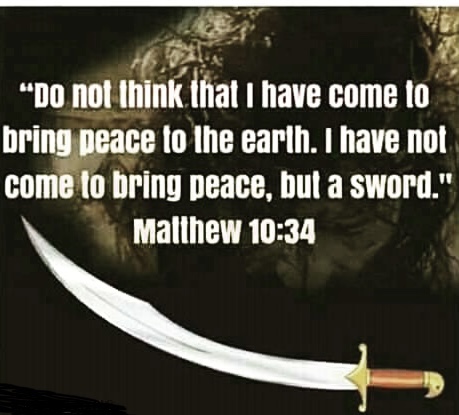
Not peace, but a sword (Matt 10; Pentecost 4A)

“Do not think that I have come to bring peace to the earth; I have not come to bring peace, but a sword. For I have come to set a man against his father, and a daughter against her mother, and a daughter-in-law against her mother-in-law; and one’s foes will be members of one’s own household.” (Matt 10:34–36).

Gentle Jesus, meek and mild, lover of all, and patron of the close-knit nuclear family … where are you? The words of Jesus we are given by the lectionary for this coming Sunday (Matt 10:24–39) seem to come from a very different person from the stereotypical “Jesus loves the little children, all the children of the world”. Who exactl y is this Jesus?

“Go nowhere among the Gentiles” (10:5), he has told his disciples, establishing what appears to be a very exclusivist, racially-driven undertaking. “Take no gold, or silver, or copper in your belts, no bag for your journey, or two tunics, or sandals, or a staff” (10:9–10), on what will undoubtedly be an incredibly ascetic experience for the disciples. “If anyone will not welcome you or listen to your words, shake off the dust from your feet as you leave that house or town” (10:14), says Jesus, anticipating a divisive and difficult time for his followers.

And then, “I am sending you out like sheep into the midst of wolves” (10:16), for “they will hand you over to councils and flog you in their synagogues” (10:17). Yes, this sure to be an experience that the disciples will not forget—for all the wrong reasons! “You will be hated by all because of my name” (10:22) is hardly an enticing invitation to take part in this mission; indeed, the advice, “do not fear those who kill the body but cannot kill the soul” (10:28) bodes no good; are there not only persecutions, but also deaths, on the horizon?

What is going on? How did Jesus manage to entice a group of men and women to take part in this enterprise? And why was he so clear and direct about all the dangers that lay ahead of them?

***

As I noted in last week’s blog on Matthew 10, we know that Judaism was in a state of flux after the destruction of the Temple in 70 CE. Evidence indicates that there were a number of sectarian groups contesting with each other for recognition and influence. During this period, the Pharisees were becoming increasingly important as an alternative to the Temple cult, and emerging as the dominant Jewish religious movement. Their power base was moved from Jerusalem and spread throughout the area.

It has been claimed that a Jewish Council was formed in Jamnia, a city on the coast of Judea. This is taken to demonstrate that the Pharisees had laid claim to be the dominant group amongst the Jews; it might also indicate that it was possible to legislate for the formal separation of some communities (such as the Matthean one).

Note: this story is now regarded as more likely that this story of Jamnia was a ‘foundation myth’, developed in later years, with the aim of showing that there was unity in formative Judaism from the earliest times.

The area of Galilee is extremely important in Matthew’s Gospel (2:22; 3:13; 4:12–25; 17:22; 19:1; 21:11; 26:32; 28:7). As the Galilean Pharisees figure prominently in the narrative of Matthew’s Gospel, it seems reasonable to suppose there was a strong Pharisaic presence in Galilee, and that this group provided the main opponents for the community of Matthew.

The power of the Pharisees was rising, and with the destruction of the Temple, it was common to find new ways of interpreting how Judaism should exist. From this time on, Pharisees evolved into the “Rabbis”, and they developed the kind of Judaism that became dominant through to the present time.

Nevertheless, many Jews, particularly in the Diaspora, were not yet “Pharisaic”—they did not see their faith in the same way as the Pharisees. There were many disputes amongst Jewish communities as to the correct way of seeing things, and some of these disputes were quite bitter. Many groups claimed to be the ‘true Israel’ as distinct from other groups, who were false leaders and teachers, and who failed to follow the Law correctly.

The Law became the most accessible means of revealing God’s will for Israel after the destruction of the Temple, and most of these groups focused on what they believed to be the true interpretation and application of it.

Matthew’s Gospel reflects one such debate; scholars suggest that it should be read alongside of other literature from after the time of the destruction of the Temple—books such as 2 Baruch, 4 Ezra, and the Psalms of Solomon. This literature is trying to envisage what Judaism should be like in the aftermath of the destruction of the Temple.

Thus, although Matthew’s Gospel has been seen to have played an important role in the formation of early Christian theology, a more natural interpretation is to locate this Gospel within the post-70 Jewish debates about the survival of Judaism without the Temple. The polemic in Jesus’ debates with the Pharisees, and the warnings that are uttered to Israel, show that Matthew still had hope that his ideas would become normative for all Jewish people.

I think it likely that Matthew’s Gospel was created to insist on the centrality and priority of the teachings of Jesus, the Torah-observant Jew, whom God had chosen as the anointed one; it was his teaching, not that of the local synagogue leaders, which was to be given priority.

*****

In such a context, the opposition envisaged by Jesus and the warnings that he gives in this polemical speech to his earliest followers, starts to make sense. Matthew sets out the teachings of Jesus concerning discipleship within the context of an apocalyptic view of reality. This view looks at the present time in relation to the ultimate end of time, and calls for a way of living that will ultimately show responsibility for decisions made.

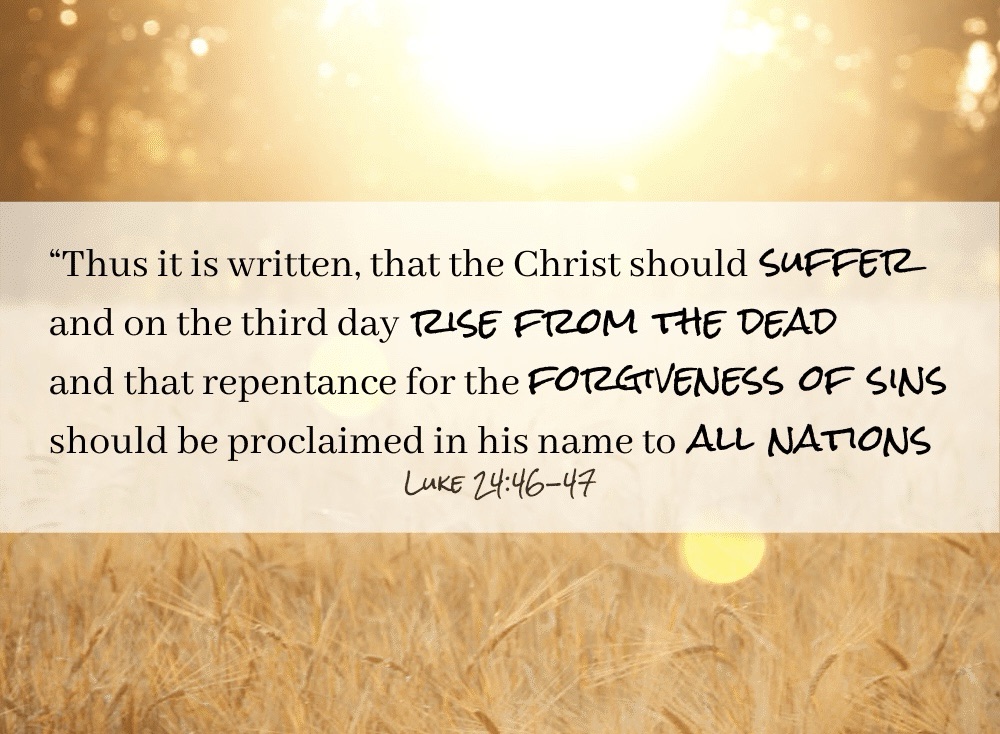
What ultimate end does Matthew have in view? Each Gospel writer tends to emphasis something slightly different. In Mark, the focus is on the resurrection of Jesus (Mark 14:28; 16:7). In Luke-Acts, carrying the good news throughout the Roman Empire fulfils the story (Luke 24:47–48; Acts 1:8). In John, it is eternal life which is emphasised (John 20:31).

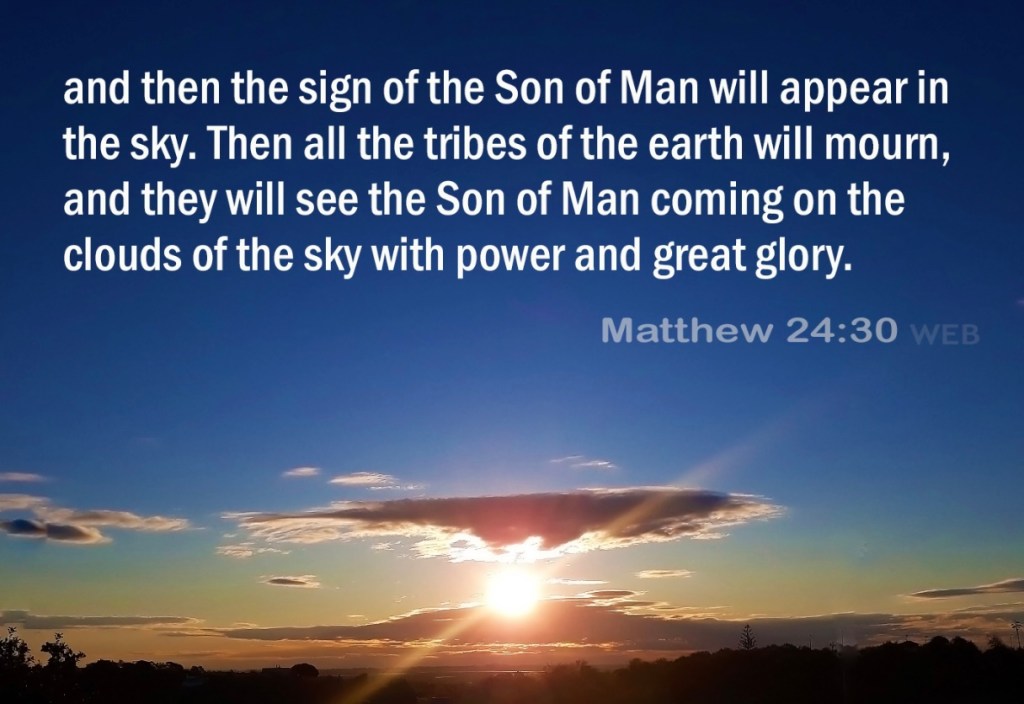
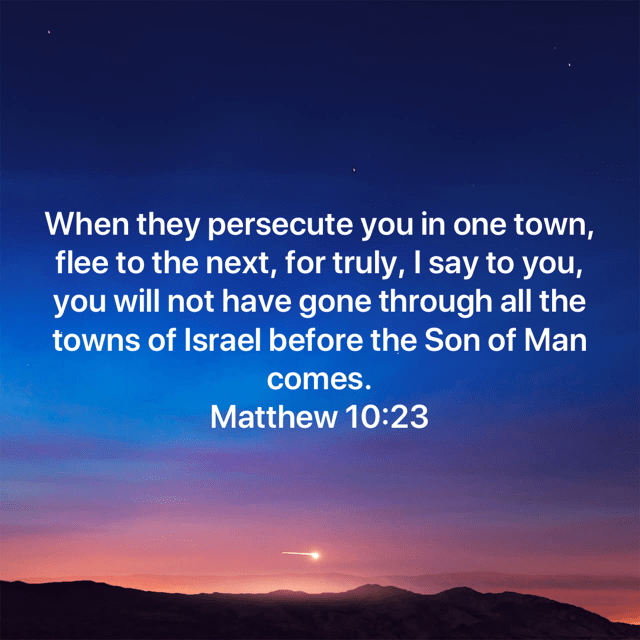
Matthew’s Jesus has in mind the coming eschatological deliverance, a deliverance which is expected imminently and that will vindicate the community as faithful and righteous to the will of God. So he tells his followers that “you will not have gone through all the towns of Israel before the Son of Man comes” (10:23). The mission that his followers undertake amongst Jews only is urgent; the end of time is coming soon, and they will not have shared “the good news [that] the kingdom of heaven has come near” (10:7) before “the Son of Man appears in heaven, and then all the tribes of the earth will mourn, and they will see ‘the Son of Man coming on the clouds of heaven’ with power and great glory” (24:30).

In this way, Matthew is typical of one type of Judaism after the destruction of the Second Temple; that of apocalyptic hope. Most of the post-70 sectarian groups express hope that God will remember his covenant with them, the faithful few of Israel, and save them; for example, 2 Baruch and 4 Ezra write that God will provide consolation for their suffering and vindicate them, whilst also punishing their enemies on the Day of Judgement (2 Baruch 6:21; 82:1–2; 4 Ezra 8:51–59; 12:34).

In these sectarian documents, the kingdom of God is eschatological is nature; it has not yet arrived on earth, though signs telling of its coming can be detected. These communities also agree that much of Israel no longer truly follows the Law of God, and that the dominant Jewish leadership is unfaithful and wicked, and that they are the ones alone representing the true Israel. Therefore, entry to the kingdom is dependent upon faithfulness to the Law as interpreted by the community.

*****

Much of this sectarian understanding can also be found in Matthew’s Gospel. Matthew redacts his sources and shapes his material so that this eschatological end is prominent—even in the mission discourse. The words of Jesus about persecutions (10:17–20) are very similar to words in the closing apocalyptic of Jesus (24:9); his words about divisions and hatred within the family (10:21–22 and 10:34-37) mirror the later declaration of betrayal and hatred (24:10).

The “false messiahs and false prophets” that are foreseen (10:24) evoke the false message of “those who will lead you astray” (24:4–5) whilst the words that the Spirit will speak through the disciples (10:19–20) provide the substance for the future “testimony to all the nations” concerning “the good news of the kingdom” (24:14). The instruction to flee in the face of persecution (10:23) foreshadows the apocalyptic command that “those in Judea must flee to the mountains” (24:16–18).

The urgency of the mission (9:37–38; 10:11–14) is because “you will not have gone through all the towns of Israel before the Son of Man comes” (10:23). And the note that the Son of Man is expected to come soon (10:23) presages the cataclysmic scene described in the closing speech of Jesus (24:29–31)—for “this generation will not pass away until all these things have taken place” (24:34). This later causes Jesus such frustration, when he berates his disciples, those of “little faith”, “you faithless and perverse generation, how much longer must I be with you? how much longer must I put up with you?” (17:17).

The mission discourse (10:5–42) thus contains many of the key elements of the apocalyptic discourse (24:3–44): opposition, persecution, division, fear, assurance, and urgency. Jesus, in this Gospel, is particularly clear that there are two ages: the first is the current time for the evangelist, and the second is the age to come (Matt 12:32, from Mark 3:29). In this Gospel, the first indication that we have of the nearness of the second age is the announcement of John the Baptist, “Repent, for the kingdom of heaven has come near” (3:2).

This succinct message has set the tone for the rest of the Gospel. Jesus repeats, word-for-word, John’s call for people to repent (4:17). He intensifies the need for faithful people to be obedient to God’s law (5:17–20) and demonstrate an intensified righteous-justice (5:21–48), as the end-time of God’s judgement is fast approaching. This is the centrepiece of the message that the disciples are to proclaim, when sent out on mission: “as you go, proclaim the good news, ‘The kingdom of heaven has come near.’ Cure the sick, raise the dead, cleanse the lepers, cast out demons” (10:7–8).

In Matthew’s understanding, the kingdom is imminent, but not yet arrived; however, signs of its imminence break in to the present times to demonstrate its nearness. The ministry of Jesus is set at the end of the first age; the second age will commence very shortly with the triumphant return of Jesus after his death, within the lifetime of his disciples (10:23; 16:28; 24:34).

Matthew does not reflect the notion that the kingdom has already arrived on earth, even though it can be seen in Jesus (12:28), and in the continuation of his ministry by his followers after his death. Jesus and the disciples both preach that the kingdom of heaven is near, or at hand (4:17; 7:21–22; 9:35; 10:7), but it has not yet established itself on earth.

A number of the parables of Jesus address the nature of this kingdom. The kingdom of heaven will be established “at the end of the age”, when the final judgement of righteous and unrighteous will take place (13:39–40, 49; 24:3). Before the coming of the Son of Man, it remains hidden and mysterious (13:31–33, 44–45), too small to be observed, but the day is coming when it will grow and become the “greatest of all things”, and the righteousness of God will triumph.

And entry into this kingdom—or not—will be determined by a person’s readiness (24:45–51; 25:1–11) and by an assessment of the way they lived their life (25:31–46). So Jesus gives his followers this assurance: “whoever welcomes a prophet … and whoever welcomes a righteous person … and whoever gives even a cup of cold water to one of these little ones in the name of a disciple—truly I tell you, none of these will lose their reward” (10:41–42).

He also issues this severe warning: “whoever loves father or mother more than me is not worthy of me; and whoever loves son or daughter more than me is not worthy of me; and whoever does not take up the cross and follow me is not worthy of me. Those who find their life will lose it, and those who lose their life for my sake will find it.” (10:37–39).

*****

Matthew takes source material about the mission of the disciples (Mark 6:7–13), modifies, intensifies, expands, and reshapes it, in the light of the context in which he is writing the Gospel. The events of the 50s and 60s, the onset of the war with the Romans in 66, and perhaps even the destruction of the Temple in 70CE, have all guided the way that the author of Matthew’s Gospel retells the instructions that Jesus gave to his first disciples, decades earlier.

Just as he and his community are experiencing intense difficulties and confronting entrenched conflict, so the Jesus of earlier times had foreseen such a situation, and had sent his followers out forewarned, and thus forearmed. What was taking place in the early 70s (or perhaps even in the late 60s) amongst a group of Torah-abiding, Messiah-following Jews, was an outworking of what Jesus is presented as speaking to his disciples.

In other words, the mission discourse of Matt 10:1–11:1 reveals much about the strife and contention amongst Jews in the local area where Matthew’s community was located, and the intensified expectation that the end was coming soon, that they felt. It was a word for his time; placed on the lips of Jesus, but speaking with clarity and insight into the lived experience of the people of Matthew’s community. For them, this was what obedience to the Gospel and following the way of Messiah Jesus, their Rabbi, entailed.

This blog draws on material in MESSIAH, MOUNTAINS, AND MISSION: an exploration of the Gospel for Year A, by Elizabeth Raine and John Squires (self-published 2012)

See also

Celebrating Pentecost 2023

For many years, people have come to church for key festive days of celebration. You may know the old saying about people who are “C-and-E Christians”—that is, they come to church at Christmas and Easter. And churches welcome this influx of irregular visitors—it is good to celebrate the key moments of our faith with those who choose to join in on those days.

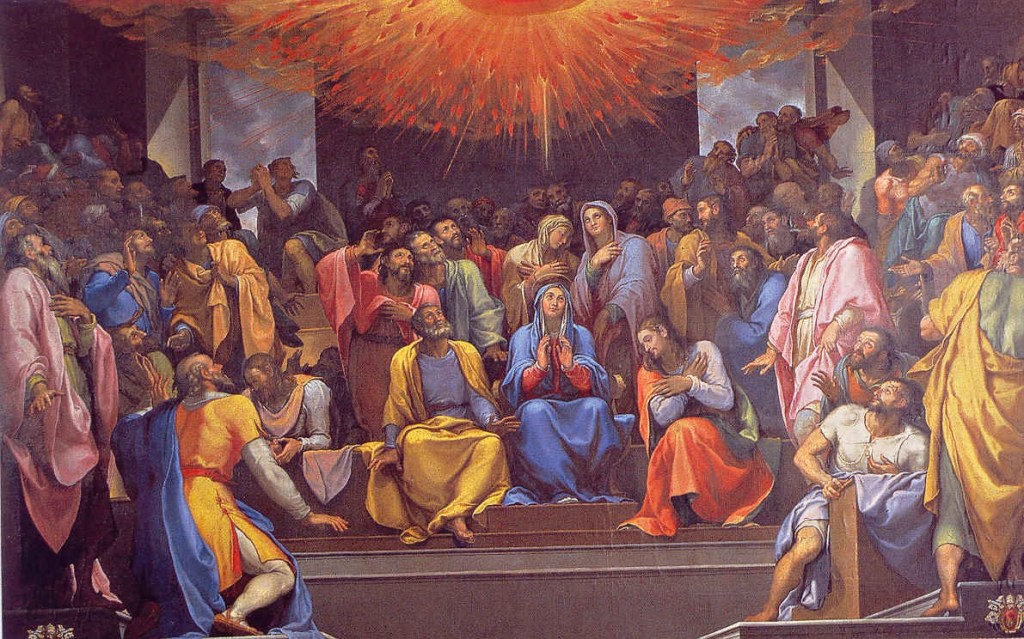
In more recent years, a third festive day has emerged as a time when churches are filled with people joining in the celebrations. The Day of Pentecost is taking its place alongside Christmas and Easter as a key festive day in the church’s calendar. Pentecost, of course, is fifty days after Easter (the name itself signals that fifty-day marker). This year, it took place last Sunday, 28 May.

Tuggeranong Uniting Church (ACT, Australia)
prepared for worship on Pentecost Sunday

Pentecost offers a wonderful opportunity for celebrating what is best about our faith. Remembering the coming of the Holy Sprit amongst the early followers of Jesus means that we can celebrate the openness to change, the joy of new developments, that we see around us in the church today. As the Spirit swooped with power amongst those early followers, so too the Spirit is energising the church today to new ways of serving.

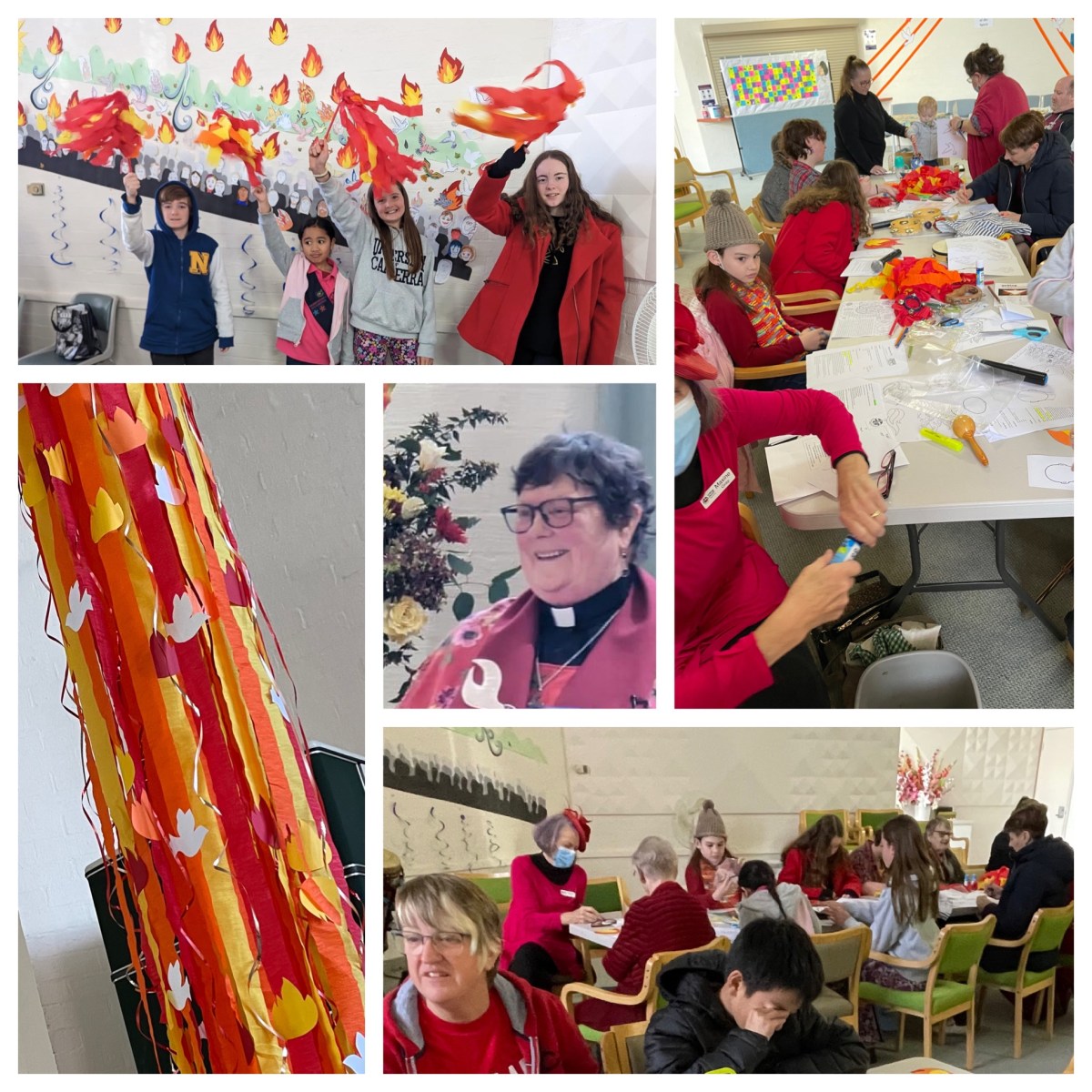
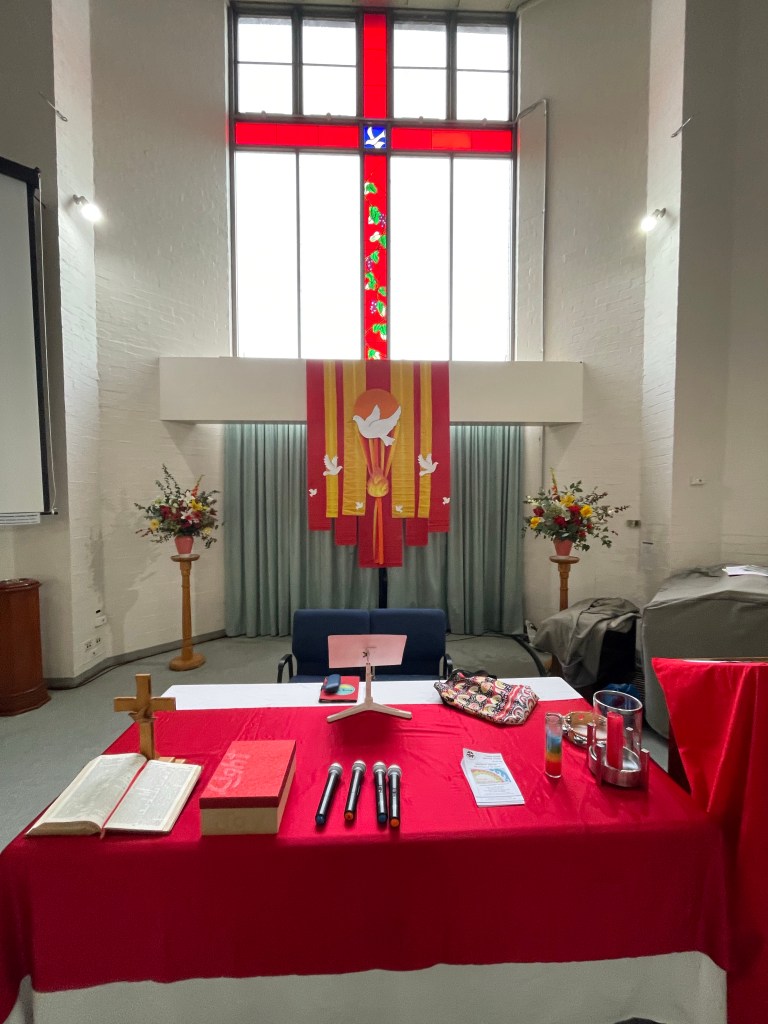
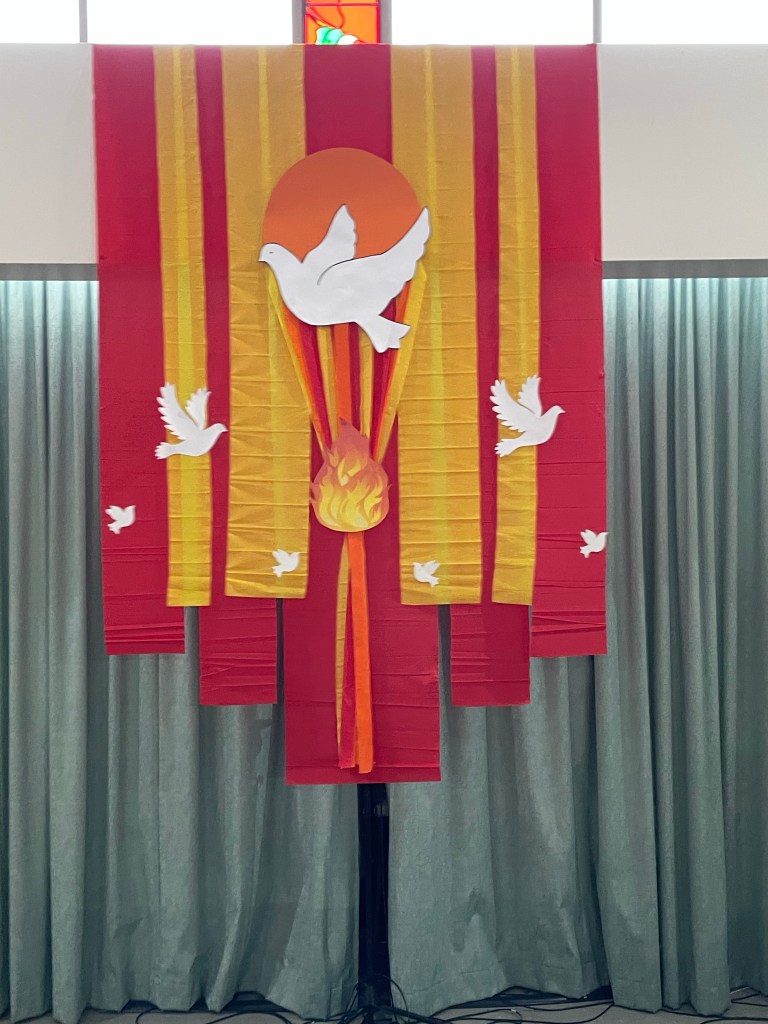
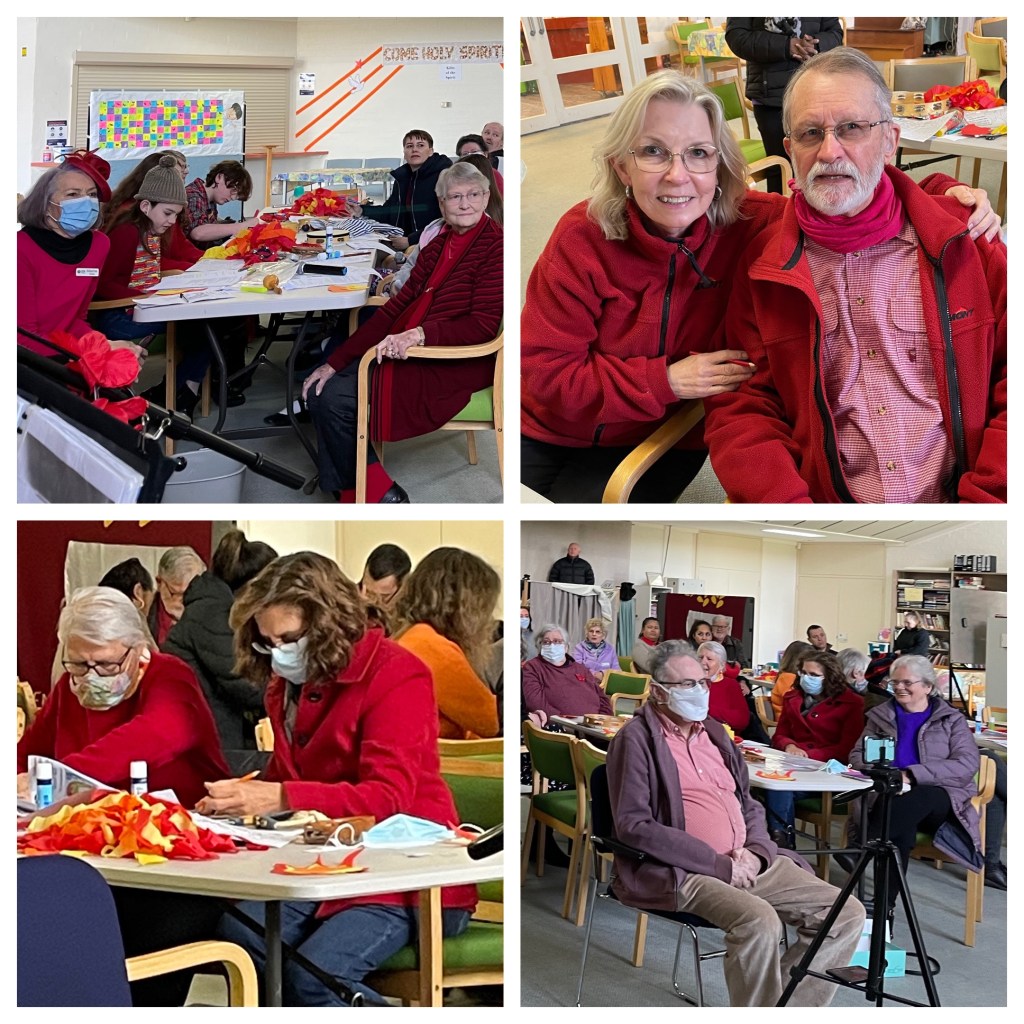
Red is the colour for the day, signalling the flames of fire by which the Holy Spirit rested on each of the believers who were gathered in the story told by Luke. At Tuggeranong Uniting Church, Pentecost Sunday has become one of the days when the Tuggeranong 15th Girls Brigade shares in leadership of the service. Girls Brigade Captain Elizabeth Moglia and a crew of enthusiastic helpers decorated the church with striking red-orange-yellow streamers and banners; the scene was set for a fine time of worship!

As the Rev. Elizabeth Raine gathered the congregation with an Acknowledgement of Country, members of the Girls Brigade led in prayer and presented a dramatic “radio news” account of the day of Pentecost. The regular group of five musicians led the congregation for the singing of joyful Pentecost songs, and one member of the congregation offered the Prayers of the People, praying for people in need locally and around the world.

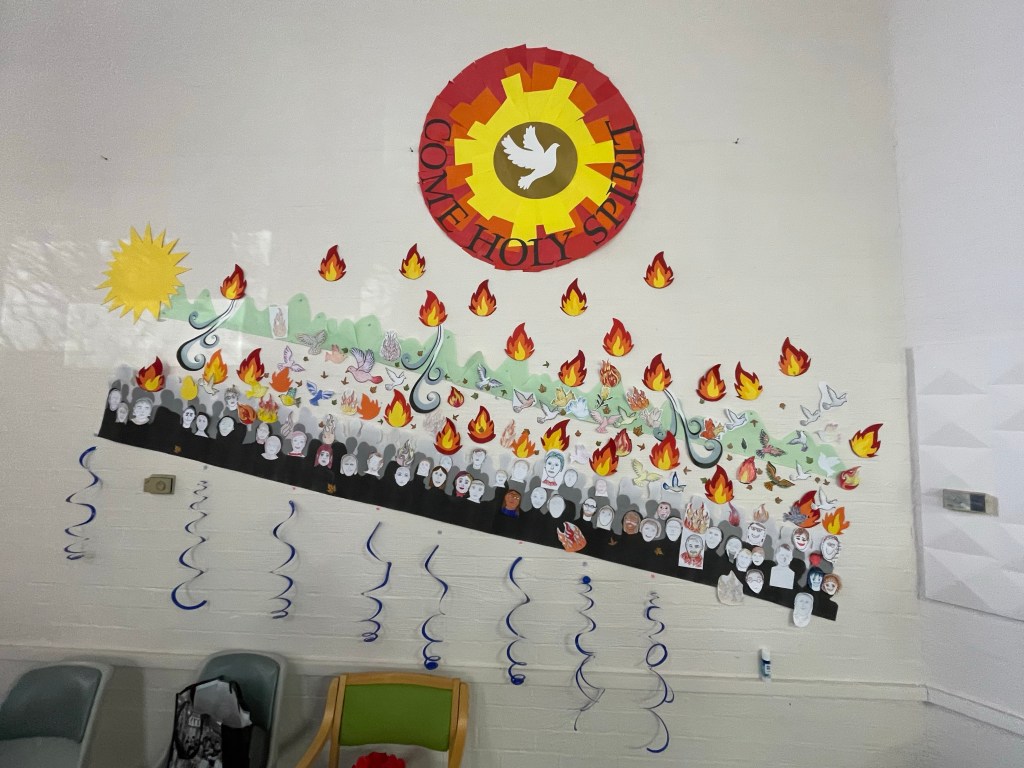
The church was set up for people to sit at table groups, and as the service progressed, each person present was invited to draw their face and pin that face, along with some fiery flames and doves, onto the side wall under a sign inviting “Come, Holy Spirit”. This symbolised the empowering of each member of the congregation for mission in their lives.

Present for this worship service was a strong contingent of younger members who brought energy and enthusiasm to the worship, inspiring all to join in enthusiastically. There was even a line of “cheer squad leaders” waving bright red-orange-and-yellow streamers during the joyful songs!

Elizabeth invited the congregation to consider: “does the Spirit still sweep through the church today, in the same way she did on that first Pentecost”? People responded by saying together an affirmation of the Spirit: “We believe in the spirit. She is extraordinary and wonderful; unknown and mysterious. She is always whirling, always animated; powerful and intense. She is magnificent and amazing; the fantastic, happy, joyful, golden, expression of God” (affirmation from Spill the Beans).

And, because it was the birthday of the church, there was a birthday cake to share at morning tea (and some smaller cupcakes for those with lactose or gluten intolerances); and a box with “gifts of the Spirit” for the young people present—gifts of joy, love, patience, courage, compassion, and more.

What a wonderful celebration! What a fine way to remember a central aspect of our Christian faith! What a great way to be motivated to live our neighbour, share our compassion, and serve those in need in our communities!

You will be my witnesses (Acts 1; Easter 7A)

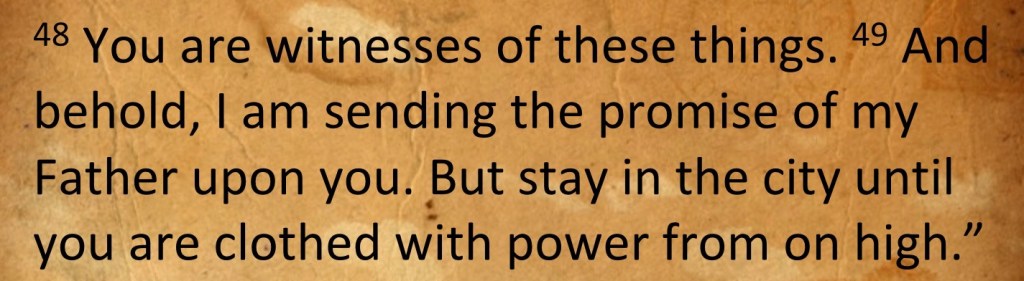
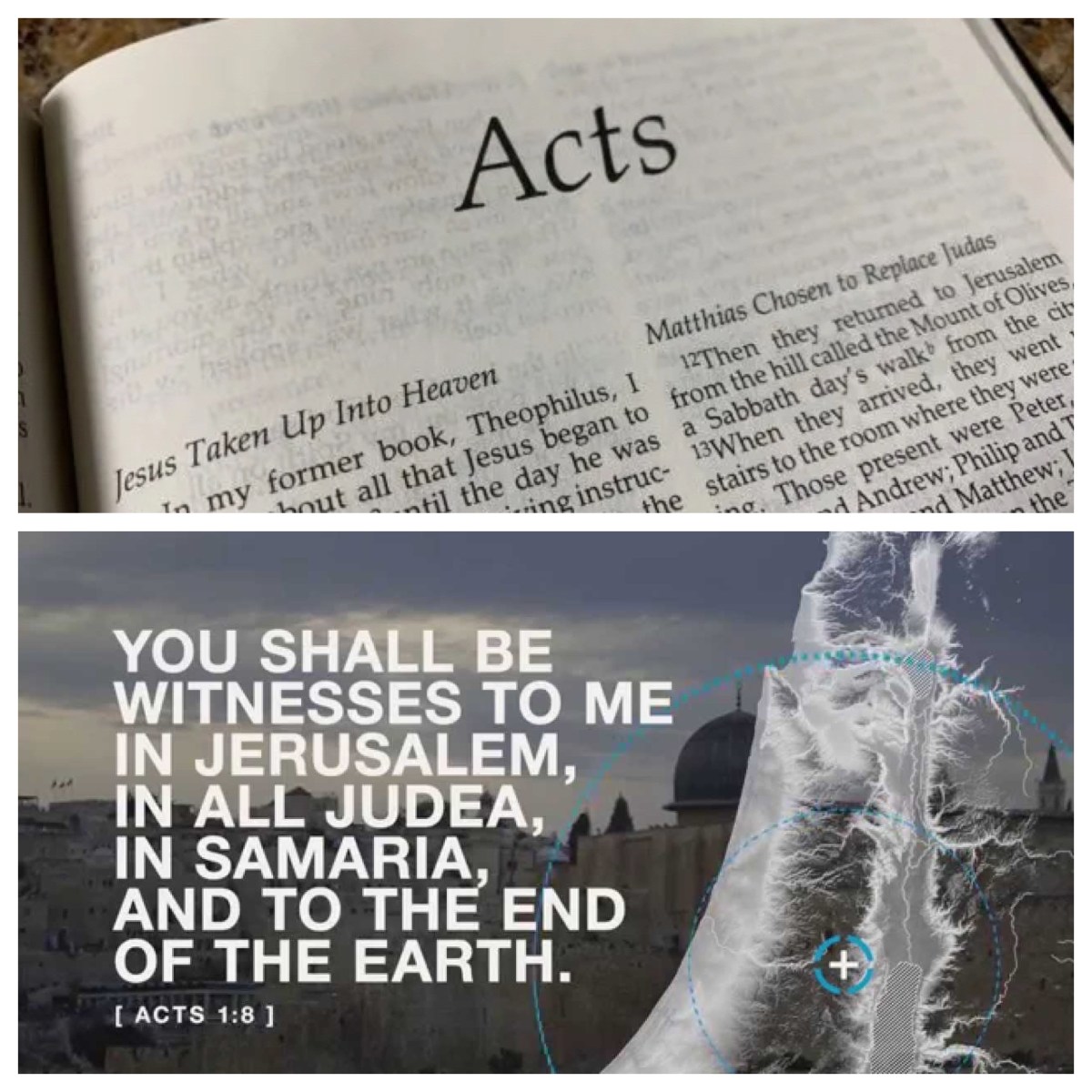
During the season of Easter, we have been hearing stories from the book of Acts, with highlights this year with Peter in Jerusalem (Acts 2), Stephen in Jerusalem (Acts 7), and then Paul in Athens (Acts 17). This coming Sunday, the lectionary takes us back to the opening chapter of Acts (1:6-14), most likely in order to prepare for the reading that we will have the following week, on Pentecost Sunday (2:1-21). Here we encounter the words of Jesus that charge this faithful group to be “witnesses in Jerusalem, in all Judea and Samaria, and to the ends of the earth” (1:8).

This Sunday, the Seventh Sunday in Easter, for the First Reading the lectionary offers us a passage from Acts (1:6–14) which includes the story of the ascension of Jesus (1:6–11) and an insight into that early community, gathered in Jerusalem (1:12–14). This sets the scene for recounting various scenes from the life of the community in Jerusalem, where the earliest followers of Jesus establish a pattern of faithful living through their common life, their public witness, and their persistent adherence to their Jewish traditions. The whole section is located entirely within Jerusalem (1:4,8,12; 2:5; 4:5; 5:16; 6:7; 8:1).

The narrative of Acts has begun with a recapitulatory preface (1:1-5) which summarises the Gospel and begins to prepare for the ensuing narrative about the community in Jerusalem. First, Luke explicitly acknowledges that what follows is a sequel to an earlier volume, addressed to the same recipient, Theophilus (1:1). We know this as the Gospel of Luke; here, however, the content of this Gospel is epitomised as simply “the things which Jesus began to do and to teach” up until his ascension (1:1-2). This recapitulation makes valid the claim that the preface to Luke’s Gospel also applies to his second volume, Acts.

Then follows a summation of the various manifestations of Jesus throughout the ensuing forty days (1:3), during which he speaks of “things concerning the sovereignty of God” (basileia tou theou, 1:3), a theme which had been the focus of Jesus’ message throughout Luke’s Gospel (Luke 4:43; 6:20; 7:20; 8:1,10; 11:2,20; 13:18,20,28,29; 14:15; 16:16; 17:20,21; 18:16; 19:12; 21:31; 22:16,18).

This preface continues with a bridging section (1:4-5) which foreshadows the events of the next chapter of the narrative. Jesus instructs the apostles not to depart from Jerusalem (1:4). This instruction keeps Luke’s geographic focus on Jerusalem, in contrast to other traditions concerning the post-resurrection departure of the apostles to Galilee which are inferred (Mark 14:28; 16:7; Matt 26:32) or explicitly told (Matt 28:7,10; John 21). Remaining in Jerusalem is required so that the apos­tles might receive the promise (1:4), which is immediately explained as being the holy spirit spoken of by John (1:5; evoking Luke 3:16). The fulfilment of this promise is narrated in detail in Acts 2.

Our reading for this Sunday follows, with an expanded retelling of the ascension (1:6–11), an event already reported in brief at Luke 24:50–53. The ascension forms the pivotal moment in Luke’s narrative; it is the hinge between volume 1 (Luke) and volume 2 (Acts), and attention is drawn to the ascension and exaltation of Jesus at a number of points elsewhere (Luke 9:51; 22:69; Acts 2:33; 3:21; 5:31; 7:56). Luke expands this second narrative account of the ascension through the explicit recording of words spoken on that occasion: the last words of Jesus to his followers, and the words of the two angel-like men to the followers of Jesus after his ascension.

The dialogue between Jesus and his disciples raises the central issue of sovereignty. The disciples ask “Lord, (may we ask) if you will at this time restore sovereignty to Israel?” (1:6)—quite rightly, for the issue of sovereignty was central to Jesus’ preaching (1:3). Here, however, the orientation of the question is con­cerned with the sovereignty of Israel. Jesus replies with a sequence of three c­lauses which stand as his last words before he ascends into heaven.

The first clause of Jesus’s words in 1:8 turns the question away from Israel, back to the primary theme of God’s sovereignty, with the clear declaration that the times and seasons are under the sovereignty of God who has “set them by his own authority” (1:7). Rather than the political independence of Israel, it is God’s unfettered freedom to act in history which is crucial to his enterprise.

The next clause, “you will receive power when the holy spirit has come upon you” (1:8), is a promise which reinforces the key role of the spirit, as divine agent, throughout this volume (beginning with the events of 2:1–4). The third clause introduces the important motif of witness (1:22; 2:32; 3:15; 4:33; 5:32; 10:39,41,43; 13:31; 22:15,18,20; 23:11; 26:11,22) and provides a condensed geographical summation of the course of the ensuing events: “in Jerusalem [1:12–8:3] and in all Judaea and Samaria [8:4–12:25] and to the end of the earth [13:1 onwards]”.

The precise referrent of “the end of the earth” is debated. Although Psalms of Solomon 8:15 may suggest that it refers to Rome, it is preferable to see the reference as drawn from Isa 49:6, a verse cited at Luke 2:32 and Acts 13:47. It is thus a poetic statement about the extensive scope of the ensuing events. These departing words of the Lukan Jesus neatly conjoin the geographical pattern and theological foundation of Acts: from Jerusalem outwards, the divine spirit will enable followers of Jesus to bear witness to the sovereignty of God.

The description of two men in white robes (1:10) evokes the epiphanic occurrences of earlier chapters: the two men in the tomb (Luke 24:4), the transfigured Jesus in the company of two scriptural figures (Luke 9:29–31). The prominence they have at this point establishes the important role of such epiphanies through­out Acts. The words spoken to the followers of Jesus who witness his ascension stress that his return will be in the same portentous manner as his departure (1:11), although no detailed description is provided (cf. 1 Thess 4:16; Mark 13:27; Matt 24:31).

As Jesus ascends into heaven (Acts 1:9–11), the story pivots from the earthly period of Jesus into the time when the movement of those who followed Jesus in that time will begin to form the customs and practices that led to the creation of the church. Luke presents the whole sequence of the death, resurrection and ascension of Jesus as both the climax to his earthly life and the foundation for the time of the church.

This is the issue in focus here: the departure of Jesus by means of his ascension into heaven is actually the moment when Jesus charges his followers to be engaged in mission. The departure of Jesus heralds the start of the church. The (physical) absence of the Saviour brings in the impetus for engaging wholeheartedly with the world which he has (physically) left.

*****

Ten days separate the ascension (forty days after Passover, 1:3) from the day of Pentecost (2:1, fifty days after Passover). Only two things are told of these ten days; already the process of selectivity which shaped Luke’s Gospel can be seen in his second volume. Thus, we learn only that the community had gathered on the day of ascension (1:12–14) and that at some stage in these days a replacement was found for Judas Iscariot (1:15–26). The material relating to Judas is omitted from the lectionary offering this year (it appears in Year B); you can read my take on this passage at

The list of those meeting in the upper room of the house in Jerusalem includes both eleven of the twelve already identified (Luke 6:14–16) as well as “certain women, including Mary the mother of Jesus, as well as his brothers” (Acts 1:14). That is consistent with the notes of women who followed Jesus in Galilee (Luke 8:1–3; 23:27, 49) as well as the presence of his brothers (Luke 8:19–21). The community which met together “constantly devoting themselves to prayer” was a gender-inclusive group.

Luke uses a hugely significant Greek word here; the word homothumadon. This is a word used only 12 times in the New Testament, with most of those occurrences in the Book of Acts, and one in Romans. Luke uses it to help us understand the uniqueness of the Christian community. It is most often translated as “all together”.

Luke initially tells of how “they were all together in the upper room” (1:12), forty days after the resurrection of Jesus—the day when Jesus ascended into heaven. Ten days later, they were all together once again, in the precincts of the Temple (2:1), along with devout Jews from all the nations surrounding Israel (2:9–11).

Then in the days following, as “they devoted themselves to the apostles’ teaching and fellowship, to the breaking of bread and the prayers” (2:42), they continued to be all together; “they spent much time together in the temple, they broke bread at home and ate their food with glad and generous hearts, praising God” (2:46).

And still later, the community of believers came together to welcome Peter and John, after their hearing before the authorities, and “they raised their voice to God all together in prayer” (4:24). And then again, some days later, “they were all together in Solomon’s porch” in the Temple precinct (5:12). Gathering together, meeting in unity, was a key characteristic of the early community of Jesus followers.

As the story continues, Phillip travelled north out of Judea into the region of Samaria, where he was preaching to the Samaritans. Here, Luke comments: “the people were all together listening to those things which Philip spoke” (8:6).

Then, some time later, after Saul had his Damascus Road experience and Peter had his vision of all foods being declared clean, after Paul and Silas and Barnabas had been travelling amongst the Gentiles sharing the good news, we read that there was a gathering of church leaders in Jerusalem, who conferred together, “the apostles and the elders, with the consent of the whole church, being assembled together as one, decided to choose … representatives and send them to you, along with our beloved Barnabas and Paul” (15:22,25).

So the point is, with each step along the way, this little community of assorted disciples, was all together … or, of one accord, in another translation.

In the early chapters of Acts, as we have noted, we are at a very significant point of transition. Luke is clearly marking the end of one phase and the beginning of another. The Jesus part of Luke’s story has come to an end. But it is the beginning of another story—the story of the church.

Homothumadon is a compound of two words, homo meaning “in unison” and thumos meaning “temperament, emotion of the mind, the principle of life, feeling and thought.” One scholar writes that there is a musical sense to this word, where it suggests notes being brought into harmony together, under the masterful hand of the conductor. The role of the conductor is to ensure that flutes and cellos, drums and violas, trumpets and clarinets, are all making their distinctive contribution to the end result—the piece of music being performed for the audience to enjoy.

Perhaps another appropriate image, today, might be of the way that the artist sets out a palette of colours to be used in painting, and as the creative activity gets underway, those various shades and hues and colours are mixed together in such a way as to produce an intricate, complex, and aesthetically pleasing end result: a work of art.

That is how Christian community is to function. That is what we are to be, as the people of God in the place where we gather. Homothumadon denotes the unity of a group who have the same passion, who share the one persuasion, who are of the same mind, of one accord, with one purpose.

Homothumadon suggests both a harmony of feelings as well as singleness of purpose. However, while homothumadon refers to a group acting as one, it does not mean lack of diversity. It means cooperation in the midst of diversity.

The word first appears in Greek literature from 500 years before the time of Jesus (in the plays of the dramatist Aristophanes, the treatises of the philosopher Plato, the oratory of the general Demosthenes) and was used in the political sphere to describe the visible, inner unity of a group which drew together when facing a common duty or danger. The New International Dictionary of New Testament Theology emphasises that “the unanimity is not based on common personal feelings but on a cause greater than the individual”.

In a sermon I gave on this passage, I noted that believers today stand with Peter and the disciples and the women and the brothers of Jesus in a liminal place, a place on the edge. We are leaving behind the old, reaching out to the new. The dramatic events of Pentecost, that we will recall in a week’s time, invite us to move to the future, and to change ourselves in a renewed commitment to our faith and our mission.

These words from the book of Acts challenge us not to simply continue our present practices and beliefs unchanged, but to hear a new message and a new way of being. We are being asked to change ourselves, to let go of what we find reassuring, and step out in faith into the chaos represented by the Spirit of God. We are being asked to be all together, to ‘act of one spirit’, to unite for the common good. May we be up to the challenge!

*****

See also

Reimagining ministry in these different times

I have exercised ministries in the position of Presbytery Minister over the past 12 years, more than half of which have included an explicit linkage with a local Congregation as part of that ministry. I have served in my current position for forty-two months (initially in part-time supply, then fulltime from February 2020). On Thursday I became a retired minister, and today I have shared with friends and colleagues in a Closure of Ministry service for my role as Canberra Region Presbytery Minister–Wellbeing.

As I began this role, a huge swathe of the east coast of Australia was in the grip of multiple fires, during the Black Summer of 2019–2020. The air in Canberra was thick with smoke; one night, the fires came within just a few kilometres of our house. With most of the rest of our street, we stood in the dark, watching the flames at a distance, as planes and helicopters flew overhead, dropping water in an attempt to slow the spread of the fire. Many communities within the Canberra Region Presbytery were seriously impacted by these fires. It was a time of great tension, and continued breathing difficulties.

As the fires diminished, our car was caught outside in a hailstorm that raced through Canberra. Then a few weeks later, we began learning of the virus that was infecting many and spreading rapidly; and so much of the next two and a half years would be spent in lockdown, with all worship, Bible study, fellowship, and organisational meetings held online. It has been quite a learning curve!! And then, multiple times in the ensuing months, friends and family members in various locations were forced to leave their houses, as rain far beyond the normal range fell, flooding river systems and causing widespread havoc.

So there have been fires and smoke, a hailstorm, a viral pandemic–the plague, it would once have been called–and floods. All very apocalyptic!!

In the midst of this, I have exercised ministry. At the end of my time in stipended ministry in formal placements, as I step into a period of unstipended, non-placement, but perhaps still somewhat active, ministry, my thoughts have turned to what I have learned, what I have valued, what I would wish for, and what I might say.

Ministry is both a calling and a profession. Ministry is taken up as Jesus invites his faithful followers to live out their faith in adventurous ways. Over the last two years and more, restrictions on gathering in person have led to a suspension of the regular activities of the church–worship, fellowship, prayer groups and bible studies, discipleship activities, training courses.

Then, as restrictions were eased, a return to each of these forms of gathering became possible. But, as we regathered, under the conditions of the COVID Safe Plans that were required, it became obvious that we were not simply entering a “back to normal” phase. Each form of gathering would be different from the earlier, more familiar, form of gathering. Yes, there would be familiar elements; but there would be additional requirements, and some changes in what we do when we gather.

In short, we were moving on into a different form of gathering–be that for worship, for study, for prayer, for meeting, for learning, or for sharing the Gospel with others. In contrast to the pre-COVID period (a time of settled familiarity in our various gatherings), we were now moving into a time of post-COVID realities–or, at least, a time when the realities of COVID needed to co-exist with the hopes about how we might gather, informed by the traditional practices of the pre-COVID period.

All of this has presented a challenge to the church, as we have grappled with what is possible at each stage of the process. All of this has also opened an opportunity to rethink what we do and reimagine how we might go forward. Many Congregations have been doing exactly this.

Alongside this review and reshaping of congregational life, a similar revisioning and reimagining of ministry can be–indeed, should be–taking place. Ministry itself can be reviewed and reshaped in this current time.

*****

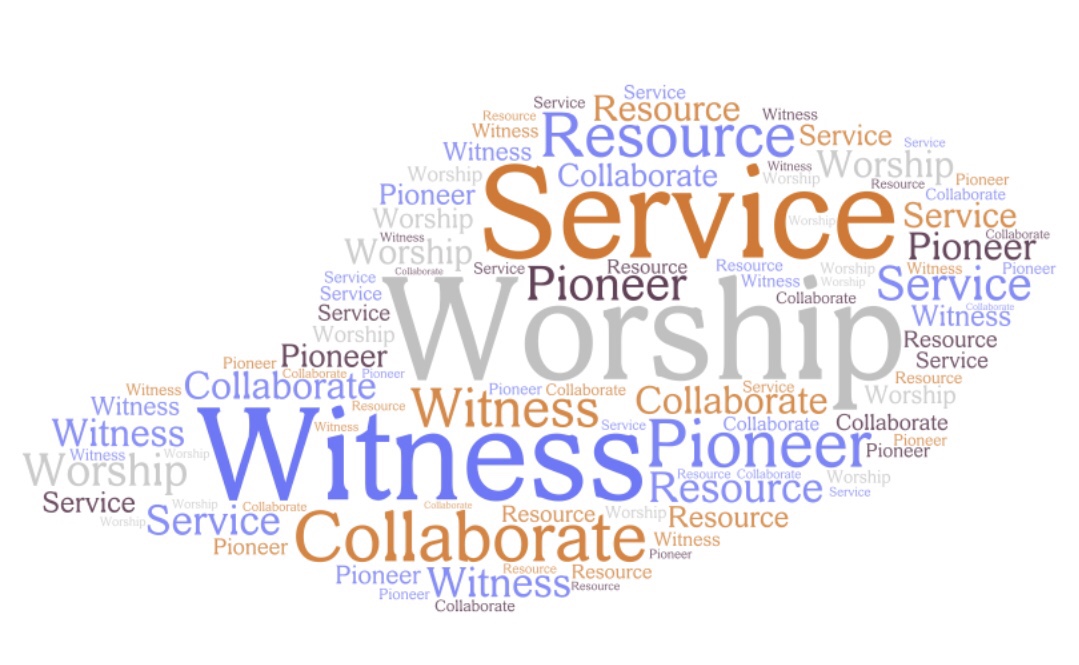
So in what follows, I want to offer a proposal about how we think about ministry in a refreshed way: that we might consider ministry to be a call to be on mission, through worship, witness and service, as we collaborate, resource, and pioneer.

These last three terms–collaborate, resource, and pioneer–invite us to approach ministry in a different way, when compared with the “traditional minister” of years past. These terms might sound like a different approach to ministry–different from the “preach the word, celebrate the sacraments, visit the people” pattern that shaped ministry for so many decades in the past.

Yet all three terms can be found in that section of the Regulations of the Uniting Church in Australia about the duties of a Minister. The Regulations provide a clear and comprehensive statement of the various duties that are expected of a Minister. (The full list is pasted below, from section 2.2.1 of the Regulations.)

Before we turn to this document, however, let me explain that I am using the term “Minister” to refer to a Minister of the Word or a Deacon, the two specified ministries to which people are ordained for life and for whom the normal form of ministry is exercised through placements under the oversight of the Presbytery. This is in accord with the definition that is given in section 3 of the UCA Constitution.

Deacons and Ministers of the Word are exercising their ministries in different, perhaps unprecedented, ways, in this current situation of change. The months where restrictions have been in place, prohibiting gatherings in person, have presented a challenge to many of my colleagues.

Our sense of what it is that we were called to, and how we have come to operate in response to that calling, has come to confront head-on the need to operate in different ways in this circumstance. How prepared are we, collectively, and individually, to meet these challenges and to re-orient our ministries to fit the new situation?

Tradition has seen that the role of Ministers has been to preach the Gospel, preside at the sacraments, and offer pastoral care. That threefold pattern has a long and valued history. I still hear it stated, from time to time, in the present age.

However, learning to do things differently, and re-prioritising what we do in ministry, is the challenge of the moment. I think it is worthwhile highlighting some of the points contained in this Regulation, to show that our ministerial charter actually invites and encourages us to engage in this process.

*****

Let’s start with the final point in that list of ministerial responsibilities, that a Minister will be involved in pioneering new expressions of the gospel. This contains a clear call to move beyond the “traditional” expectations of a Minister–that she or he will preach, undertake pastoral visitation, and organise the business of the congregation (which is perhaps the traditional way of reading a statement contained in the Basis of Union).

The restrictions of the past few months have forced us to develop new ways of ministering: new patterns of online worship, study groups online, distributing worship materials by email or post, and providing practical assistance through doorstop calls. We have developed new patterns of working, whilst new skills have been needed to minister effectively. Creativity has flourished under this stimulus.

The other clause in this final Regulation orients ministry in the same direction, emphasising the collegial or communal nature of the role of the Minister: that of encouraging effective ways of fulfilling the mission of the Church. This means that it is not up to “the Minister alone” to pioneer new expressions and develop the missional impetus of the church. It is to be “encouraged” by sharing the task with others–and presumably equipping those people to be effective in that role.

And that goal, to fulfil the mission of the church, has been to the fore in all that has been undertaken, in new ways, over recent times, as people have worked together in different ways–and as people previously unconnected or rarely engaged with each other, have co-operated and collaborated in many ways.

The same collegial and resourcing role is articulated in clause (iii). This clause follows two earlier clauses which specify that the Minister presides and preaches, but now it goes on to say that the Minister is charged with providing for other persons to undertake these roles.

That means that the Minister does not necessarily occupy the worship leading and preaching role for 48 Sundays a year (allowing for annual leave), but makes provision for sharing this role with others — who presumably are trained and equipped in appropriate ways for this role. I know of a number of Congregations where lay people have provided worship leadership for online gatherings, for instance, in situations where they have been reticent to do so in gatherings in person.

*****

The Basis of Union, at a number of points, identifies worship, witness and service as the lynchpin of the work of the congregation. Interestingly, whilst the “traditional” role of worship is embedded into the duties of the Minister, so too is witness specified at clause (iv) and service is likewise identified at clause (viii).

So what is expected of the congregation as a whole, is to be modelled and implemented by the Minister, personally, in their ministry. Those who argue that the Minister has a primary focus on worship and preaching, supplemented by pastoral care and administration, are not actually reading their Regulations carefully!

The “traditional” role of the Minister (the solo individual who preaches, presides, visits, and chairs) is so, so far removed from what the UCA Regulations actually articulate. We are called to be on mission, through worship, witness and service, collaborating, resourcing, and pioneering. It is a fine calling–and the challenges of the current context both enhance and challenge the way that we seek to carry that out.

*****

Regulation 2.2.1

(a) Within the ministry of the whole Church, Jesus Christ calls men and women to proclamation of the gospel in word and deed through the ministry of the Word and the ministry of Deacon. This calling is exercised by:

(i) preaching of the Word;

(ii) presiding at the celebration of the sacraments;

(iii) providing for other persons to preside at worship and/or preach within the pastoral charge in which the Minister is in placement;

(iv) witnessing in the community to the gospel of Jesus Christ;

(v) guiding and instructing the members of the Church and equipping them for their ministry in the community;

(vi) nurturing candidates for baptism and confirmation;

(vii) pastoral oversight and counsel wherever needed;

(viii) serving in the community, especially among those who are hurt, dis-advantaged, oppressed or marginalized;

(ix) careful attention to administrative responsibilities;

(x) due observance of the discipline of the Church;

(xi) the enhancement of the Minister’s own gifts for the work of ministry;

(xii) pioneering new expressions of the gospel and encouraging effective ways of fulfilling the mission of the Church.

*****

See also a series of posts that I made during 2020 about the challenges being faced and the changes being undertaken:

See also https://johntsquires.com/2019/11/14/ministry-and-mission-in-the-midst-of-change-and-transition-luke-2113/

https://johntsquires.com/2020/05/05/the-times-they-are-are-a-changin/

https://johntsquires.com/2020/05/04/not-this-year-so-what-about-next-year/

https://johntsquires.com/2020/04/22/its-been-just-over-a-month-but-there-have-been-lots-of-learnings/

https://johntsquires.com/2020/03/15/when-you-come-together-reflections-on-community-in-the-midst-of-a-pandemic/

https://johntsquires.com/2020/06/16/going-back-to-church-what-will-our-future-look-like-4/

https://johntsquires.com/2020/06/03/greet-one-another-2-cor-13-but-no-holy-kissing-and-no-joyful-singing/

https://johntsquires.com/2020/05/29/worship-like-the-first-christians-what-will-our-future-look-like-3/

https://johntsquires.com/2020/05/24/its-been-two-months-under-restrictions-what-will-our-future-look-like-2/

https://johntsquires.com/2020/05/22/its-been-two-months-under-restrictions-what-will-our-future-look-like-1/


Priorities in ministry: an ordination anniversary reflection

“Well, you only really work one day a week, don’t you?” After decades in ministry, I am not sure I can count how many times I have heard this comment—sometime flippant, but often rather serious.

Of course, ministers do not work only one day a week! That stereotype is based on the perception that the weekly sermon is the sum total of the work of ministry. Whilst it is true that many of my Protestant colleagues see the sermon as the most important, or critically significant, element of their weekly work, it is definitely the case that the work of ministry stretches far and wide beyond the weekly sermon.

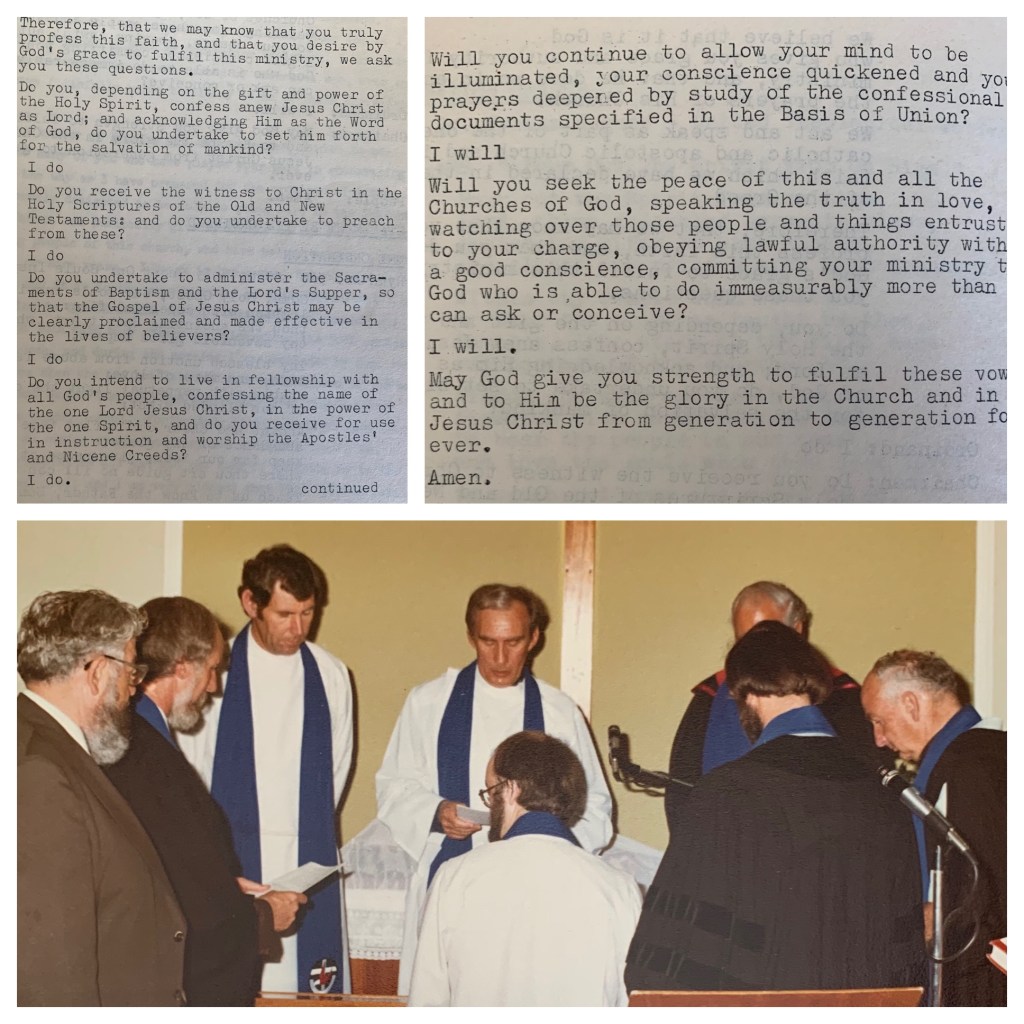
Today is the 42nd anniversary of my ordination; I was set aside to the Ministry of the Word in the Uniting Church in Australia in a service that took place on 3 December 1980 in my home Congregation of Seaforth, amongst the cloud of witnesses that had surrounded me in my early decades.

I have been privileged to have spent time in congregational ministry in two rural areas and one urban location, in regional roles in two presbyteries, in educational roles in two synods, and to have served the Assembly on a number of committees, as well as multiple committees in synod and presbytery roles over the years.

I have worked with some fine colleagues in each of these placements. And in each place, I have sought to live out those vows that I took at ordination, in the exercise of my ministry at Southern Illawarra and Waverley, in years of study at New Haven and two decades of teaching at North Parramatta, in sabbatical periods at Durham and Cambridge, back in ministry at Wauchope and the Mid North Coast Presbytery, in the venture overwest to Perth, and then at Queanbeyan and in this most recent Presbytery role.

In each of these placements, I have been comforted (and challenged) by the way that the Uniting Church articulates the various responsibilities of a minister. They are set out in section 2.2.1 of the national Regulations. The expression of those responsibilities has changed somewhat over time, although the basic shape of these responsibilities remains consistent in its focus. But there have been some interesting refinements over time.

(The current version of the Regulations is cited at the end of this blog.)

To start, we can note that preaching is given the first place in the list. Is this significant? Certainly, in the history of Protestant churches, the priority accorded to preaching is clear. And I know of colleagues today, who insist that, whatever else is happening, preparation of the weekly sermon is their first priority each week. That is central to our tradition.

Of course, preaching is not held exclusively to the ordained ministers. The Methodist Church contributed the ministry of lay people as preachers to the Uniting Church when it was formed, and Lay Preachers are now one of four specified ministries within the UCA, alongside the lay ministry of Pastor and the two ordained ministries of Deacon and Minister of the Word.

Second, presiding is noted. That sits hand in hand with the role of preaching; these are two of the key aspects in leading worship within the gathered community of faithful people. Leading prayers, reading scripture, explaining and expounding the message, baptising new members of the community, and gathering people around the table of the Lord at communion, are key aspects of leading worship on a regular basis.

Once again, presiding at the sacraments, within current Uniting Church understanding, is not limited exclusively to ordained people; in situations where access to an ordained minister is not regularly available, authorised lay people can preside, after having completed a training course and being recommended by their Church Council.

In fact, the third clause places conditions around the way that a minister exercises the roles of presider and preacher. The leading of worship is to be a shared, collaborative, team-based enterprise. All ministers should, in their practice, cultivate a team of people who can not only read scripture and lead prayers, but also preach and, if need be, preside at baptisms and communion within the placement. Certainly, neither the pulpit nor the table is the exclusive preserve of ordained ministers, as we have noted.

Clauses 3, 5 and 6 each indicate that a key function of ministry is to prepare others: prepare people to lead worship, prepare people to be baptised or confirmed within the church, prepare people to be faithful and more effective disciples, and prepare people to engage in the mission to which the church is committed. Each minister within the UCA is to exercise a ministry of education, training, equipping, resourcing. All ministers are educators; all ministers are called to build up the body of Christ by enabling others to exercise their gifts for ministry and carry out their roles in mission.

The classic understanding of ministry, which is even articulated at points in the Basis of Union, is that the minister the threefold role of preacher, presider, and pastor. Clause 7 addresses the matter of pastoring. Is it significant that this function is quite some way down the list? If the order is in any way significant, we should pause at this point and ponder the traditional expectation that the minister provides pastoral care to all members of the congregation. This is not what the Regulations specify.

And is it also significant, that pastoring the people is (like preaching and leading worship) not the preserve of the ordained alone? That is, all people are called to show care and concern for others. The role of pastor is exercised by those in ministry as an oversight role, ensuring that a team of pastoral careers or elders provide regular and personalised pastoral care. The clause is also made conditional by the phrase “wherever needed”, which suggests that what is in view is a responsive form of pastoring, on a needs basis, rather than a regular “visit the flock every three months” prescription simply because “that is what the minister does”.

Are ministers called to be prophets? Some colleagues that I know place a high value on this role. Nothing explicitly identifies this role, however. Yet understanding how the Bible relates to contemporary situations, and articulating the way that the Gospel speaks into our context, has a dynamic that is very similar to the dynamic that the prophets of old knew very well.

What is “the word of the Lord” for this situation? How do we do just that, in our preaching and teaching? What are the words that best identify prejudices and expose injustices, that advocate for the poor and speak for the voiceless or disempowered? That’s functioning as a prophet.

Practising faith, as a committed disciple, is indicated by a number of clauses. Clause 4 prescribes that ministers bear witness to their faith, while clauses 8, on serving, and 11, on being a committed lifelong learner, also relate to this important dimension of ministry. We need to live, and model, exactly what we say to others, in our own lives.

The final clause addresses the mission of the church. It specifies that Ministers will find ways to be effective in fulfilling that mission. Maintenance is not adequate. Missionary impetus is essential. And “pioneering new expressions of the Gospel” is integral to that process.

This final clause envisages that all ministers will be equally pioneers in mission, as much as they are preachers and presiders, or practising their faith and preparing others for leadership roles in their discipleship. Pioneering is closely linked to “fulfilling the mission of the church”. Over the centuries, the church has regularly reinvented itself, finding new forms for worship, for service, for witness, for fellowship. We need to keep doing that in our own times, to continue being effective in mission.

And might the last clause (following a familiar scriptural dictate) be made first? What would our ministry, and our mission, look like, if each minister made the task of “pioneering new expressions of faith” as their first priority—and, by implication, relegated preaching to a lower spot, maybe even the last spot, on the list? It is a challenge—but I think this might be an important clue for the way ahead.

See further at https://johntsquires.com/2022/12/04/reimagining-ministry-in-these-different-times/

*****

UCA Regulations 2.2.1

Within the ministry of the whole Church, Jesus Christ calls men and women to proclamation of the gospel in word and deed through the ministry of the Word and the ministry of Deacon. This calling is exercised by:

(i) preaching of the Word;

(ii) presiding at the celebration of the sacraments;

(iii) providing for other persons to preside at worship and/or preach within the pastoral charge in which the Minister is in placement;

(iv) witnessing in the community to the gospel of Jesus Christ;

(v) guiding and instructing the members of the Church and equipping them for their ministry in the community;

(vi) nurturing candidates for baptism and confirmation;

(vii) pastoral oversight and counsel wherever needed;

(viii) serving in the community, especially among those who are hurt, disadvantaged, oppressed or marginalized;

(ix) careful attention to administrative responsibilities;

(x) due observance of the discipline of the Church;

(xi) the enhancement of the Minister‘s own gifts for the work of ministry;

(xii) pioneering new expressions of the gospel and encouraging effective ways of fulfilling the mission of the Church.