The road to freedom: seeking the safety of refuge (Exod 16; Pentecost 17A)

This coming Sunday, we will hear a story that didn’t happen—yet a story that is always happening. Like all the stories we have heard in previous weeks—stories of Abraham, Sarah, and Hagar, of Isaac and Rebekah, stories of Jacob, Leah, and Rachel, and the twelve sons of Jacob, the stories of Joseph and his brothers and the stories from early in the life of Moses—these stories did not actually happen as they are reported; but they are told because the dynamics at work in the stories reflect the realities of life as humans experience it.

I don’t think we can say that these ancestral stories happened as actual historical events. Certainly, the historical elements in the story of the Exodus are impossible to validate using the standard methods of historical criticism. However, they are worth remembering and retelling, because they are always happening, in the murky depths of human life.

So this year in the lectionary cycle, as we read and hear these stories yet again, they refresh our understanding of life and they take us into the centre of our existential being. They have been told and retold throughout the centuries, because they express things that are deep within our lives.

The people depicted in the wilderness in today’s passage (Exodus 16:2–15) are quite relatable characters, to me. We are introduced to “the whole congregation of the Israelites” right at the start, and are told that they “complained against Moses and Aaron in the wilderness” (v.2). I’m going to pass on making any connection between this verse and any congregation of which I have been a part, or in which I have ministered. Let’s just say that humans complaining should not be a surprise to us!

However, let’s pause and consider: the complaint raised by the Israelites against Moses and Aaron appears to be quite unreasonable. How long have they been travelling in the wilderness? And already they seem to think that life was better for them back in Egypt, where “we sat by the fleshpots and ate our fill of bread”. Now, in the wilderness, the accuse their leaders of wanting “to kill this whole assembly with hunger” (v.3).

However, if you put yourself into the situation of the Israelites, you might well have a more empathic understanding of their situation. Their years in Egypt were intensely difficult: the Egyptians “set taskmasters over them to oppress them with forced labour … [they] became ruthless in imposing tasks on the Israelites, and made their lives bitter with hard service” (Exod 1:11–14). How were the Israelites to respond? Fright? Fight? or Flight??

We might hypothesise—imagining what might have been going through the minds of the Israelites in the story as they considered their situation. (As noted above, I don’t think that this was an actual historical event—but it is told in Exodus as a history-like narrative, and that history-like character invites us to consider how the hypothetical characters in that story might have thought and acted.)

In such a situation, fright would have been an understandable response. The power of the Egyptian overlords would have generated fear amongst the Israelites as they struggled to complete the increasingly demanding tasks imposed upon them. As there presumably were many years between the death of Joseph (Gen 50:26) and the time when “a new king arose over Egypt, who did not know Joseph” (Exod 1:8), that suggests that fright gripped the people and paralysed them into inaction. They continued as slaves under increasingly difficult conditions.

The thought of fight might have entered the minds of some—standing up for their rights and asserting themselves in order to gain freedom may well have been suggested, even debated, during this extended interim period. Indeed, as the story recounts, Moses himself, fuelled by a passion for justice and a dislike of injustice, was known to have intervened with passion and force into a situation of injustice—such that “he saw an Egyptian beating a Hebrew, one of his kinsfolk; he looked this way and that, and seeing no one he killed the Egyptian and hid him in the sand” (Exod 2:11–12). The next day, fearing that his actions were known, he fled across the desert to Midian, where he remained for quite some years.

Would Moses have thought to press hard against his Egyptian overlords, agitating for them to act justly in relation to the Israelites? His initial thoughts in this regard may well have been completely deficient—that is, until he had encountered God in the burning bush (Exod 3:1–5). From that bush, the voice had come, commissioning Moses to approach Pharaoh “to bring my people, the Israelites, out of Egypt” (3:10).

Moses, of course, argued with God about what that would mean (3:11–4:17)—but in the end, he returned to Egypt (4:18–31) with the intention of confronting Pharaoh, to say “Let my people go” (5:1). The initial request was simply “so that they may celebrate a festival to me in the wilderness” (5:1)—but Pharaoh was resistant, leading to the long sequence of divinely-initiated plagues (7:14—10:28), culminating in the plague of the death of “all the firstborn in the land” (12:29–32).

It was flight, however, which won the day for the Israelites—after they, in turn, had been convinced by Moses that this was what God wanted them to do (12:3, 21–28). And that flight, according to the story line, was supported by the interventions of the divine into the sequence of human events: “at midnight the Lord struck down all the firstborn in the land of Egypt, from the firstborn of Pharaoh who sat on his throne to the firstborn of the prisoner who was in the dungeon” (12:29), and then “the Lord brought the Israelites out of the land of Egypt, company by company” (12:51), and then “the Lord went in front of them in a pillar of cloud by day, to lead them along the way, and in a pillar of fire by night, to give them light, so that they might travel by day and by night” (13:21).

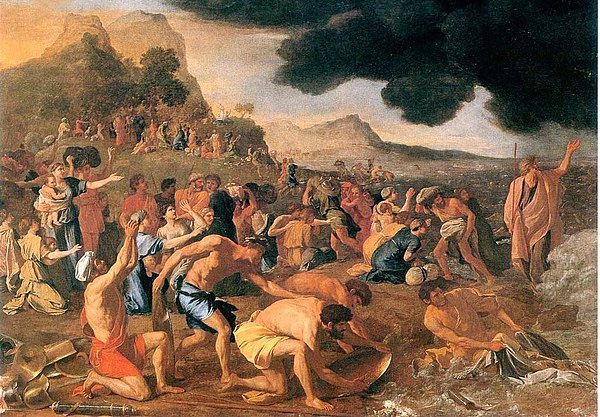
Then, when confronted with the sea in front of them, “the Lord hardened the heart of Pharaoh king of Egypt and he pursued the Israelites, who were going out boldly” (14:8), and then “the Lord drove the sea back by a strong east wind all night, and turned the sea into dry land; and the waters were divided. The Israelites went into the sea on dry ground, the waters forming a wall for them on their right and on their left. The Egyptians pursued, and went into the sea after them, all of Pharaoh’s horses, chariots, and chariot drivers.” (14:21–23).

And so the story resolves the tension: “the Lord tossed the Egyptians into the sea. The waters returned and covered the chariots and the chariot drivers, the entire army of Pharaoh that had followed them into the sea; not one of them remained. But the Israelites walked on dry ground through the sea, the waters forming a wall for them on their right and on their left.” (14:27–29).

The Israelites, so the story reveals to us, had thus experienced a long sequence of frightening and troubling events—culminating in their witnessing the mass drowning of the army that was pursuing them. The narrator makes it clear that “the Lord saved Israel that day from the Egyptians; and Israel saw the Egyptians dead on the seashore” (14:30). Today, meeting people who had experienced such a sequence of events, we would recognise that they had been immersed in a series of traumas, and we would readily explain their current state of being with reference to PTSD—post-traumatic stress disorder.

Of course, as we have noted, the narrator shrugs all of this off with the glib summation, “Israel saw the great work that the Lord did against the Egyptians; so the people feared the Lord and believed in the Lord and in his servant Moses” (14:31). The narrator expects the people in the story to move on. And so we are then given the full set of lyrics of the song that Moses led the people in singing, “I will sing to the Lord, for he has triumphed gloriously … the Lord is my strength and my might … this is my God, and I will praise him” (15:1–18), followed by a recapitulation of the earlier verses in the song that Miriam and the women sang, “Sing to the Lord, for he has triumphed gloriously; horse and rider he has thrown into the sea” (15:21).

But as the story continues on, the narrator cannot but help give indication of the ways that the trauma of this long sequence of events has impacted on the Israelites. The first indication of that comes in the complaint of the people when they could find no water; they cried out to Moses, and God intervenes again to enable him to provide water for drinking (15:22–25). The next indication comes in the passage which the lectionary offers us this coming Sunday, when another set of complaints is brought against Moses and Aaron, for the people are now hungry (16:1–3).

A further indication of this will be our focus on the following Sunday, when we hear the story of another moment of complaint, at Rephidim (17:1–7). And there are further stories of complaint at Num 11:1–15 and 14:1–4.

If we enter into the story and imagine the state of the people, there can be no doubt that they would have been gripped with terror and fear—wondering what the future would hold, lamenting the difficulties of the present, and looking back already on the past with “rose-coloured glasses”, unable to remember exactly how difficult and oppressive it was for them to live in Egypt.

And yet, the narrator wants us to understand that, in the midst of the complaints raised by the people, there was hope: they camped at a fertile oasis at Elim (15:27), they ate the quails and manna provided each day (16:13–18; Num 11:7–9); they had water to drink at Massah and Meribah (17:7).

The story that is shaped in the narrative of Exodus has a strong belief in an active, interventionist deity. That is possible to claim with the benefit of hindsight, knowing that the people did survive their time in the wilderness, did have nourishment and water, did eventually enter the land promised to them, and did settle and become prosperous in the land. That is the blessing of telling a story long after the time in which it is set; the long range result can be known!

It was not the case in the midst of the story, as the events being narratives took place. Doubt and fear grounded in uncertainty, as well as dysfunction generated by repeated traumatic events, would have blurred and marred any sense of confident hope, surely. And that is precisely the situation that we find ourselves in, today. Life is “happening” to us. We do not have a guarantee of the end-in-view, the longterm result that is hoped for. We ,I’ve by faith, with hope, yearning and trusting.

So the story we hear this coming Sunday (Exod 16:2–15) tells of God’s provision for the people of Israel—and, by extension, for people of faith today—as they, and we, live with an attitude of hopeful expectation and patient faith.

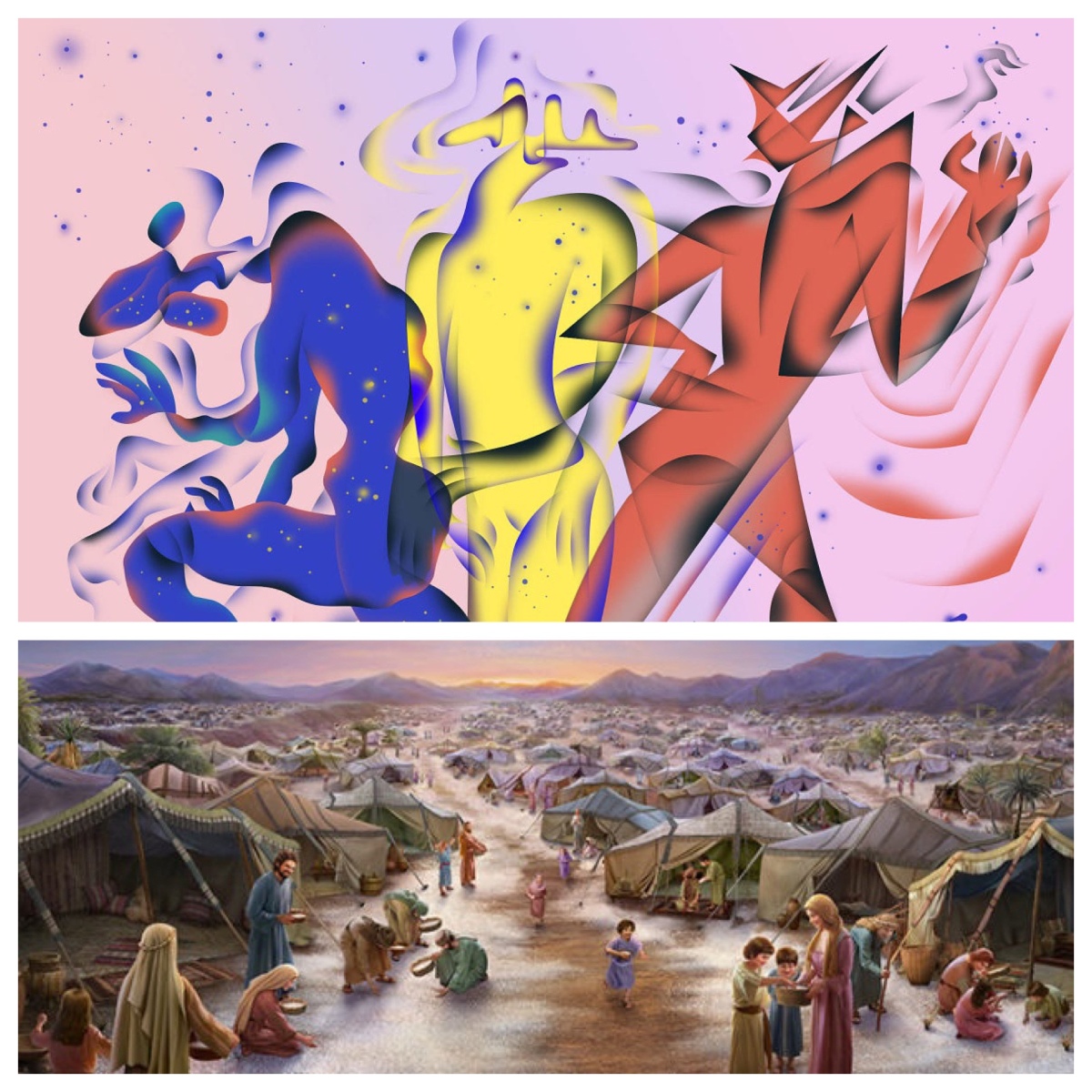
The climax of the story, at least in terms of the verses that the lectionary offers us, is the simple affirmation that the “fine flaky substance, as fine as frost on the ground”, the “bread from heaven” that they found, was indeed “the bread that the Lord has given you to eat” (16:4, 14–15).

Later in the chapter, we are told that this was the staple diet of the people for “forty years” (16:35), which is the standard biblical expression for “a very, very long time”. And much later, of course, in Christian tradition, Jesus of Nazareth is presented as “the bread from heaven”, the “living bread” which is given “for the life of the world” (John 6:31–51)—bread which lasts, not for ”forty years”, but “forever” (John 6:51).

Also in the story told in Exodus 16, we are told that “the house of Israel called it manna” and that “it was like wafers made with honey” (16:31). An explanation of this name—drawn from the comment made in Numbers—is that the phrase means “this is aphids”, indicating that the dew was crystallised matter deposited by insects. (See “the manna was like coriander seed, and its color was like the color of gum resin”, Num 11:7.)

An alternative explanation for the name manna lies within the text of Exodus itself; for when the people ask, “what is it?” (16:15), the Hebrew is man hu. And so the name reflects the initial puzzlement—a nice ironic twist, indeed.

How do we read this story today? For me, the story of the first half of Exodus has really strong resonances with the story of millions of people in the world today. These are people that we call refugees and asylum seekers—people fleeing from oppression and mistreatment in the land where they were born, travelling through difficulties and dangers, to seek the safety of refuge in a new land; a land that becomes, for them, a land of hope, a land of promise.

The United Nations Refugee Agency, UNHCR, keeps track of current numbers and publishes a summary each year. For 2022, the figures are:

You can see the consistent rise in numbers throughout this century, reflecting the persistence of civil war and uprisings in many places. Each person in those millions of people has experienced trauma, sought to escape, travelled along difficult pathways on land or sea, and is seeking safety in another country—or is patiently waiting to be resettled from the refugee camp where they are, into another country.

The UNHCR notes that over half of all refugees under UNHCR’s mandate and other people in need of international protection (52% in total) come from just three countries: 6.8 million from the Syrian Arab Republic, 5.7 million from the Ukraine, and another 5.7 million from Afghanistan. Just over a third (38%) of the 35.3 million refugees are being hosted in five countries (Türkiye, Iran, Colombia, Germany, and Pakistan), so there are a number of countries that are well-off and could well allow for a larger intake of refugees, to share in some of that burden of hosting and resettling such people.

Perhaps the Exodus story can resonate in our current global context, and remind us of the value of people who are seeking the safety of refuge, the importance of meeting their needs, and the necessity of remembering the trauma that they experienced which has pushed them to flee their homeland and seek safety elsewhere. The people of Israel, in the ancient story told by Exodus, were refugees, seeking asylum in a foreign land. And as people of faith, we might well ponder: how do we serve as the agents of God, to offer to refugees and asylum seekers, today, “the bread that the Lord has given [them] to eat”?

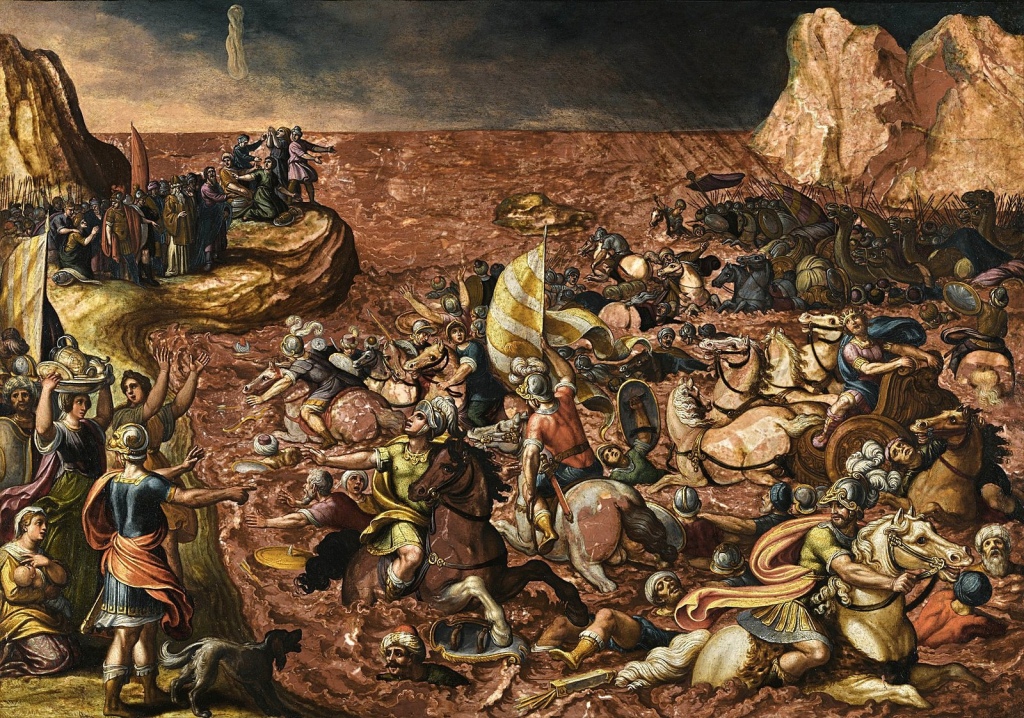
Israel saw the Egyptians dead on the seashore (Exodus 14; Pentecost 16A)

“So the Lord saved Israel that day from the Egyptians; and Israel saw the Egyptians dead on the seashore” (Exod 14:20). That’s the statement that tells the story of the Exodus in one short verse; it’s also the ethical problem that sits at the heart of the Exodus story. A part of that story is offered by the lectionary for this coming Sunday (Exod 14:19–31).

I have already offered some reflections on the violence that is central to the story of the Exodus from Egypt; see https://johntsquires.com/2023/09/06/escaping-from-oppression-how-do-we-make-sense-of-the-exodus-exodus-12-pentecost-15a/

As I have noted, there is much violence spread throughout the pages of the Hebrew Scriptures—and the reading proposed by the lectionary for this coming Sunday is no exception! I have no doubt that, for many people, the violent scenes in the “historical” narratives, in the prayers of the psalmists, in the visions of the prophets, is most off-putting. As a pacifist myself, I find these scenes disturbing.

As I have worked with people who have experienced trauma from abuse in their lives, I recognise how they may “work through” these matters in ways that are confronting and hard to handle; I have tried to cultivate an attitude of acceptance of them and curiosity about what drives their angry and violent language. And as a person who myself has experienced the trauma of violence through sexual abuse, when I was a child, I am intensely attuned to the ways that violent words and deeds can impact on people.

For my own story, see

and for the podcast in which I talk about this, go to

https://open.spotify.com/episode/5feSJb2qyVAhzBEfoeHj1x?si=29983b58d694477d

*****

I don’t, of course, hold to each and every event in the biblical narratives as literal historical events; but I do believe that these narratives reflect the zeitgeist of the time. It was a violent time, life was more precarious, people lived in a more tribal fashion (and thus fighting the neighbour was somehow a regular occurrence). And yet, in the midst of this, we see the emergence and development of a spirituality that values something wider than the immediate tribal, parochial viewpoint.

To the extent that the final editors of the many narratives shaped things intentionally, we might note that the stories of the little tribe(s) which later identified together as Israel, were framed by a grand narrative of the cosmic creation (Gen 1–2) and the strategic place of humanity within that creation (Gen 2–3). That, it seems to me, signals the moves that have been made from the violent tribal interactions of many narratives, into the poetic appreciation (mediated via the hierarchical priestly mindset) of the larger global—and spiritual—picture.

Thus, these texts do have some value; but they need to be understood in their detail, in their contexts, and in terms of the whole. They include the earlier stories of their heritage—because the people creating these texts “honour mother and father”, they preserve and retell those stories—but they also show how faithful people grappled with their various situations and challenges.

In Hebrew Scripture, then, we have extended stories constructed by writers seeking to shape the society of their time through a reconstructed (and perhaps idealised) past; songs from psalmists seeking to find God in trying situations; writings from sages plumbing the depths of wisdom and discernment; and oracles from prophets decrying infidelity and lack of commitment to the covenant, using graphic, even violent, language. The whole is a fascinating mix of case studies about “how to be faithful” in changing and challenging circumstances.

The Exodus needs to be seen in this context. It contains poetic sections (Exod 15) celebrating victory after violent engagement; a narrative shaped around that poem; then a further narrative, woven into the existing narrative but expanding or correcting or challenging the earlier material, all included into a literary stream of words that we puzzle, now, to unknot and make sense of.

The story of this Exodus from Egypt came to occupy a central place in the life of the people of Israel. It gained traction as a story that conveyed the identity of the people—once enslaved, miraculously liberated, steadfastly guided, and ultimately rewarded with a place of their own. It was retold in a number of psalms (Psalms 77 and 78; 80 and 81; 105 and 106; 114; 135 and 136).

A standard refrain which recalls the Exodus, “I am the Lord your God, who brought you out of the land of Egypt, out of the house of slavery” (Exod 20:2; Deut 5:6) recurs throughout the ensuing narrative books (Deut 1:27; 5:6; 6:12; 8:14; etc; Judg 2:12; 1 Sam 12:6; 1 Ki 6:1; 8:9, 21; 9:9; 12;28; 2 Ki 17:7, 36; 2 Chron 6:5; 7:22). A number of prophets also recall this story with similar phrases (Jer 7:22, 25; 11:4, 7; 16:14; 23:7; 31:32; 32:21; 34:13; Ezek 20:4–10; Dan 9:15; Hos 11:1; Amos 2:10; 3:1; Mic 6:4; 7:15; Hag 2:5).

In the difficulties of the Exile in Babylon, when the final form of the story as we know it was created, this saga resonated deeply with the confronting experiences and the fervently-held hopes of the people. Their Exile was their Egypt; their Exodus was still awaited, and their entry into the land of Israel remained yet well ahead of them. And so, the story is told of the past, but it becomes a story of the present, a hope for the future, for the people.

It seems to me that the dreaming stories of First Nations Peoples in Australia instruct us about the way that the ancients told their stories, retold and reworked them, and then wrote them down (a step that some First Nations peoples are now taking, under the pressure of western colonisation).

It is quite likely that the same kinds of processes were present in the formation, development, and passing on of the stories of ancient Israel, until such time as it was felt needed to write them down (a step that was clearly taken during the Exile in Babylon and in the years after that, as the people returned to the land of Israel).

The narratives bear witness to the faith of ancient peoples; they reflect life and society as it was, with all its faults as well as its positive points; and they invite us to share in the attitude of faith towards God and the demonstration of justice and care for one another that is reflected in the stories that are told.

What, then, do we make of the story of deliberate, divine-authorised death, which is told in Exodus 14, as we hear in the Hebrew Scripture reading in worship this coming Sunday? The story has become foundational, not only for Jews, but also for Christians, as I noted last week. (See the link above.)

Writing in Bible Odyssey, Professor Brian M. Britt offers this insightful summary of the function of the Exodus mythology over a long, extended period of time. He observes, “The prevalence of the exodus tradition in the Bible demonstrates its importance as a foundational collective memory from ancient Israel that predates the monarchy and survives into the time of the early rabbis and followers of Jesus.

“Postbiblical exodus traditions take many forms, from the Jewish observance of Passover to Christian celebrations of Easter, Muslim teachings about the Prophet Musa, and modern liberation theologies. Though many modern readers have asked whether episodes of the exodus, from the plagues in Egypt to the parting of the Red Sea, “really happened,” the exodus remains one of the most powerful narratives of divine compassion and liberation found in the Bible.”

See

The Exodus Tradition in the Bible

For Jews, this story is foundational. It is both in the remembrance of that first “passing over” at the annual Passover dinner in people’s homes, but also in the self-identity of the people as chosen by the Lord for a special, designated purpose, saved from the antagonisms of hostile surrounding nations, such that the story gains life and becomes effective as a fundamental mythos, a story that explains the very essence of who Jews are.

For Christians, it is in the remembrance of “the night on which the Lord [Jesus] was betrayed”, in the oft-repeated eucharistic celebration in local churches and cathedrals, that the story is foundational. It is part of the central thread of the grand narrative (the death and resurrection of Jesus) that sits at the heart of that religion.

That the story involves bloodshed and death—as well as rescue and salvation—indicates the earthy nature of each faith. Judaism and Christianity alike are grounded in the realities of human existence and deal with factors that are of the essence of human life. It is a foundational story that is important to remember. But that does not mean that the story is without problems.

The fate of the Egyptians, first being bogged in the muddy ground, next panicking as they are subsumed by the waters, and then drowning in the rising sea, is a difficult part of the story. The claim that God deliberately hardens their hearts (14:17) in order to lure them into the waters, is abhorrent. Is this really what God is like? Or is this an element introduced into the story by the narrator, to provide some form of explanation for their fate? I lean to the latter—but it still does not make for easy reading.

This part of the story remains, sitting as an accusatory claim. It is hard to resolve this in a satisfactory way. The Egyptians become a cipher for all with whom the Israelites struggled, over the centuries. They symbolise “the other”; and with the Canaanites, later in the grand narrative, they exercise a peculiar function; a reminder of those who were “in the way” of the grand plan (of God, it was claimed) that was being enacted.

They are difficult people in the way of the story–much like the First Peoples of the continent of Australia and its surrounding islands are “in the way” of the grand colonising, civilising narrative that has been created by powerful white historians, storytellers, and political leaders.

There is, however, another side of the story of Israel, which is presented in the concluding verses of this week’s passage. What happened in the Sea of Reeds is remembered as the day when “the Lord saved Israel … from the Egyptians” (14:20), the day when “Israel saw the great work that the Lord did against the Egyptians” (14:31). It is a story designed to evoke and strengthen faith.

The graphic scene is sketched in few words, but they are telling words: “Israel saw the Egyptians dead on the seashore” (14:30). That is a vastly understated comment. If you have ever seen pictures from the Western Front battles during World War I, you will know that a scene of dead bodies littering the ground is indeed a gruesome and sobering sight. The Exodus story contains just such a devastating scene.

But the whole purpose of the story is not to lament the dead (they are mere collateral damage, in modern terminology). It is to encourage faith and hope amongst those who have continued as faithful in subsequent years. “So the people feared the Lord and believed in the Lord and in his servant Moses” (14:31). Another brief, pointed observation. All’s well that ends well, it would seem—at least, for the victors.

Changed. Transformed. Transfigured. (Matt 17; Transfiguration A)

The story that is told in the Gospel for this coming Sunday is a story about being changed; about being transformed. It’s a story that shows that being transformed means you are able to stand and challenge others to be transformed. It’s the story of when Jesus took his three closest friends to a mountain, and they had a shared experience of seeing Jesus standing between two of the greats of their people: Moses, to whom God had given the Law to govern the people of Israel, and Elijah, through whom God had established a long line of prophets in Israel. It’s a story that in Christian tradition is called The Transfiguration.

The word transfiguration is a strange word. It is not often found in common English usage. It’s one of those peculiar church words, that seems to be used only in church circles. Like thee and thy, holy and righteous, sanctification and atonement … and trinity. These words don’t usually pop up in regular usage!

I looked for some helpful synonyms for the word transfiguration, and found these: change, alter, modify, vary, redo, reshape, remodel, transform, convert, renew … and transmogrify. I am not sure whether that last one gets us anywhere nearer to a better understanding, but some of the others are helpful. Transfiguration is about change, adaptation, and taking on a new shape or size or appearance.

One of the other words offered as a synonym was metamorphose; and that caught my eye, because that word comes directly from the Greek word, metamorphidzo, which is used by Mark in his Gospel, when he tells his account of this incident. “After six days, Jesus took Peter, James and John with him and led them up a high mountain, where they were all alone; and he was metamorphosed before them” (Mark 9:2). Mark then explains that this metamorphosis was evident in that “his clothes became dazzling white”.

The story of the Transfiguration tells of the moment that Peter, James, and John perceived Jesus in a new way. No longer did they see him as the man from Nazareth. In this moment, they see him as filled to overflowing with divine glory. He was not simply the son of Joseph; he was now the divinely-chosen, God-anointed, Beloved Son (Matt 17:5).

Jesus brings the heavenly realm right to the earthly disciples. They had the possibility, in a moment of time, to feel intensely close to the heavenly realm, to stand in the presence of God. They symbolise the desire of human beings, to reach out into the beyond, to grasp hold of what is transcendent—to get to heaven, as that is where God is (see Gen 28:10-12 and Deut 30:12; Pss 11:4, 14:2, 33:13, 53:2, 80:14, 102:19; although compare the sense of God being everywhere in Ps 139:8-12).

*****

This key mountaintop moment contains the words from the heavens about Jesus, “This is my Son, the Beloved; listen to him!” (17:5). These words link back to the initial baptism of Jesus, when the same words were heard (3:17) and forward to the final scene of crucifixion, when a centurion and those with him at the foot of the cross witnesses Jesus’ death, and declares, “Truly this man was God’s Son!” (27:54).

All three scenes contain the foundational statement, recognising Jesus as Son of God, reiterating the words of all the disciples in the boat with Jesus (14:33), and of two men possessed by demons (8:29)—and even, in the early scene of desert testing, the words the tempter supreme himself (4:3, 6). For, as Simon Peter declares in a pivotal scene at Caesarea Philippi, Jesus is “the Messiah, the Son of the living God” (16:16).

The voice, booming forth from the clouds, “This is my Son, the Beloved; with him I am well pleased; listen to him!” (17:5) seems, at first hearing, to be quoting Hebrew scripture: perhaps the second Psalm, which praises the King of ancient Israel as the one whom God has begotten; or perhaps the song in Isaiah 42, which extols the servant as the one whom God has chosen, or anointed; or perhaps even the oracle in Deuteronomy 18, which instructs the people to listen carefully to the words of the prophet.

Whatever scripture, or scriptures, are here spoken by the divine voice, making this bold declaration from the cloud, it is clear that God has a special task, a special role, and a special place for Jesus. The words of this heavenly voice link this story back to the opening scenes of the story of the adult period in the life of Jesus, and also to a moment towards the end of that adult life.

As this voice is heard, Jesus is on a mountain, with three of his closest followers—and also with two key figures from the past of Israel: Moses, who led the people out of slavery, who then was the instrument for delivering the Torah to Israel; and Elijah, who stood firm in the face of great opposition, whose deep faith bequeathed him the mantle of prophet, as he ascended into heaven.

Mark says that “there appeared to them Elijah with Moses, who were talking with Jesus” (Mark 9:4). Matthew reverses the order, placing Moses before Elijah: “suddenly there appeared to them Moses and Elijah, talking with him” (Matt 17:3). Priority, in Matthew’s narrative, goes to Moses. Indeed, Matthew’s concern has been to make as many parallels as possible with the story of Moses, the one whose life was imperilled by a powerful ruler (Exod 2:15; cf. Matt 2:13–14), who escaped the murderous rampage that occurred (Exod 1:22; cf. Matt 2:16), who fled into a foreign land (Exod 2:15; cf. Matt 2:14), and who then returned to where he had been born (Exod 4:20; cf. Matt 2:21).

The regular reminder that “this took place to fulfil what the Lord has said through the prophets” (Matt 1:22; 2:4, 15, 17, 23) underlines this Mosaic typology. The five blocks of teaching in Matthew’s Gospel (chs. 5–7, 10, 13, 18, 23–25) recall the five Books of Moses in the Torah. So, too, does the account of the Transfiguration in Matt 17 prioritise Moses.

The covenant given to Moses on Mount Sinai (Exod 19:1–6), accompanied by the giving of the law (Exod 20:1–23:33), is sealed in a ceremony by “the blood of the covenant” (Exod 24:1–8). The scene on the mountaintop, with Jesus and his three disciples, evokes the mystery of the mountaintop scene in Exodus. This story is but one part of a whole complex of events, from conception through birth to flight, which are (in my view) deliberately and consciously shaped in the light of the story of Moses, to make the claim that Jesus was the New Moses. (The theme continues strongly throughout this particular Gospel.)

*****

The Gospel writers say that Jesus was transformed at that moment. But in this story, also, there is the indication that the friends of Jesus were transformed. That moment on the mountain was a challenge to each of them; the response that Peter wanted to make was seen to be inadequate. Jesus challenged him to respond differently. It was another moment when metanoia, complete transformation, took place. And these disciples did change; yes, it took some time, but these friends of Jesus ultimately became leaders amongst the followers of Jesus, and spearheaded the movement that became the church.

The change, the metanoia, that occurred within Peter, James, and John, spread widely. They faced the challenge head on, and responses, in metanoia. That is mirrored, today, in changes that are taking place in society. Especially, that has been the experience of people over the last few years. We have met the challenge of a global viral pandemic; patterns of behaviour have been modified, as we prioritise safety and care for the vulnerable, and wear masks, sanitise, and socially distance. We have changed as a society.

In the church generally, through the pandemic, we have changed how we gather, how we worship, how we meet for Bible studies and fellowship groups, how we meet as councils and committees, how we attract people to our gatherings. Transformation is underway.

In my own church, we are attending to the challenge of reworking our understanding of mission; we now see the importance of people from each Congregation engaging with the mission of God in their community as the priority in the life of the church. We have considered, and continue to consider, how we might grow fresh expressions of faith, nurture new communities of interest, foster faith amongst people “outside of the building” and outside the inner circle of committed people. It is an ongoing process.

Change is taking place. Change is all around us. Change is the one thing that is constant about life: we are always changing. Sometimes we think that the church doesn’t change, isn’t changing, even resists changing. But that is not the case. Our church is changing. Our society is changing. And the story of the Transfiguration of Jesus encourages us throughout this change.

A blaze of glory, to end Epiphany (Exod 24 and Matt 17; Transfiguration A)

The season of Epiphany celebrates the manifestation of God in Jesus, the one chosen by God to show God’s love to the world. Running through many of the scripture passages offered by the lectionary for this season in Year A is the motif of light—for light illumines, light reveals. The passages remind us that God’s light shines brightly on our lives. See

This coming Sunday is the last Sunday in the season of Epiphany, and the readings for this Sunday do no disappoint in this regard. A theme of light runs through the readings: the appearance of the glory of the Lord” on Mount Sinai (Exod 24:17), the transformation of the appearance of Jesus as “he was transfigured before them, and his face shone like the sun, and his clothes became dazzling white” (Matt 17:2), and a reminiscence of that event from one who styles himself as one of the “eyewitnesses of his majesty” (2 Pet 1:16).

Light first figures in the biblical narrative in the Priestly narrative of creation that was placed at the head of the Torah, when the first word from God’s mouth was, “‘Let there be light’”; and there was light” (Gen 1:3; see also Job 12:22). Light is the companion to the Israelites as the traversed the wilderness: “the Lord went in front of them in a pillar of cloud by day, to lead them along the way, and in a pillar of fire by night, to give them light” (Exod 13:21; see also Neh 9:12).

Light was to burn constantly in the Tabernacle: “command the people of Israel to bring you pure oil of beaten olives for the lamp, that a light may be kept burning regularly. Aaron shall set it up in the tent of meeting, outside the curtain of the covenant, to burn from evening to morning before the Lord regularly” (Lev 24:2–3). In Numbers, the command is for seven golden lamps to shine forth light (Num 8:1–4).

In David’s last words, he sings an inspired song about the king as one “who rules over people justly, ruling in the fear of God, [who] is like the light of morning, like the sun rising on a cloudless morning, gleaming from the rain on the grassy land” (2 Sam 23:3–4). In this regard, the king reflects the Lord God, for “he will make your vindication shine like the light, and the justice of your cause like the noonday” (Ps 37:5–6). Many centuries later, the prophet Daniel would declare that God “reveals deep and hidden things; he knows what is in the darkness, and light dwells with him” (Dan 5:22).

In like fashion, the psalmist sings, “the Lord is my light and my salvation; whom shall I fear?” (Ps 27:1), rejoices that God is “clothed with honour and majesty, wrapped in light as with a garment” (Ps 104:1–2), and prays, “ let the light of your face shine on us, O Lord!” (Ps 4:6). “Your word is a lamp to my feet and a light to my path”, the writer of the longest psalm sings (Ps 119:105), rejoicing that “the unfolding of your words gives light; it imparts understanding to the simple” (Ps 119:130). The same thought appears in Proverbs: “the commandment is a lamp and the teaching a light” (Prov 6:23), and “the path of the righteous is like the light of dawn, which shines brighter and brighter until full day” (Prov 4:18).

Israel’s vocation, according to the exilic prophet whose words are included in the scroll of Isaiah, is to be “a covenant to the people, a light to the nations” (Isa 42:6, Epiphany 1A), “a light to the nations, that my salvation may reach to the end of the earth” (Isa 49:6, Epiphany 2A). That same prophet evokes the creation story, affirming that “I form light and create darkness, I make weal and create woe; I the Lord do all these things” (Isa 45:7), and reminds the people that God promises, “a teaching will go out from me, and my justice for a light to the peoples” (Isa 51:4). Later, after returning from exile, another prophet rejoices in the bright shining of the light of the Lord (Isa 60:1–3, set for the day of the Epiphany).

This theme extends the call of the prophet Isaiah himself, who cries, “O house of Jacob, come, let us walk in the light of the Lord!” (Isa 2:5) and foresees a time when “the people who walked in darkness have seen a great light; those who lived in a land of deep darkness—on them light has shined” (Isa 9:2, Epiphany 3A). For Micah, realisation of the scale of injustice within Israel lads him not only to call the the people “to do justice, and to love kindness, and to walk humbly with your God” (Mic 6:8, Epiphany 4A), but also leads him to express his deep penitence: “when I sit in darkness, the Lord will be a light to me … he will bring me out to the light; I shall see his vindication” (Mic 7:8–9).

The prophet Isaiah also links light with judgement, declaring that “the light of Israel will become a fire, and his Holy One a flame; and it will burn and devour his thorns and briers in one day; the glory of his forest and his fruitful land the Lord will destroy, both soul and body, and it will be as when an invalid wastes away” (Isa 10:17; see also 13:10–11

Other prophets use the absence of light—the presence of darkness—as a symbol for divine judgement in the face of human sinfulness (Amos 5:18–20; Jer 4:23; 13:16; 25:10; Lam 3:1–3; Ezek 32:7–8), although in his apocalyptic mode, Isaiah offers hope using this image: “the light of the moon will be like the light of the sun, and the light of the sun will be sevenfold, like the light of seven days, on the day when the Lord binds up the injuries of his people, and heals the wounds inflicted by his blow” (Isa 30:26).

In Third Isaiah this promise blossoms wonderfully: “the sun shall no longer be your light by day, nor for brightness shall the moon give light to you by night; but the Lord will be your everlasting light, and your God will be your glory. Your sun shall no more go down, or your moon withdraw itself; for the Lord will be your everlasting light, and your days of mourning shall be ended” (Isa 60:19–20). For Zechariah, the apocalyptic vision of the final victory of the Lord includes the affirmation that “ there shall be continuous day (it is known to the Lord), not day and not night, for at evening time there shall be light” (Zech 14:7).

Light, of course, forms one of the famous “I Am”affirmations that Jesus makes of himself in John’s Gospel (John 8:12; 9:5; see also 1:4–9; 3:19–21; 11:9–10; 12:35–36, 46) and the description of his faithful followers as “the light of the world” (Matt 5:14, 16). Paul rejoiced that “it is the God who said, “Let light shine out of darkness,” who has shone in our hearts to give the light of the knowledge of the glory of God in the face of Jesus Christ” (2 Cor 4:6).

He urged believers to “lay aside the works of darkness and put on the armour of light” (Rom 13:12) and affirmed that they are “all children of light and children of the day; we are not of the night or of darkness” (1 Thess 5:5). He rejoices that “it is the God who said, “Let light shine out of darkness,” who has shone in our hearts to give the light of the knowledge of the glory of God in the face of Jesus Christ” (2 Cor 4:6).

The author of 1 John also uses this imagery to affirm that “ God is light” (1 John 1:5) and advises believers, “if we walk in the light as he himself is in the light, we have fellowship with one another” (1 John 1:7; 2:10). The final vision of Revelation includes a description of the servants of the Lamb, noting that “there will be no more night; they need no light of lamp or sun, for the Lord God will be their light, and they will reign forever and ever” (Rev 22:5); indeed, “the city has no need of sun or moon to shine on it, for the glory of God is its light, and its lamp is the Lamb; the nations will walk by its light, and the kings of the earth will bring their glory into it” (Rev 21:23–24).

So the readings for this Sunday express a strong biblical theme that has run from the opening story of creation, through the story of Israel and the movement initiated by Jesus, to the vision of the promised future. What has been to the fore throughout Epiphany climaxes atop the mountains where Moses receives and Jesus interprets the Torah, with the appearance of “the glory of the Lord … like a devouring fire on the top of the mountain in the sight of the people of Israel” on Mount Sinai (Exod 24:17) and the glittering transformation of the appearance of Jesus as “his face shone like the sun, and his clothes became dazzling white” (Matt 17:2).